The 1856 Reservation for Chief Buffalo’s Estate
November 5, 2025
Collected & edited by Amorin Mello
This is one of many posts on Chequamegon History exploring the original La Pointe Band Reservations of La Pointe County on Chequamegon Bay, now known as the Bad River and Red Cliff Reservations. Specifically, today’s post is about the 1856 Reservation for Chief Buffalo’s subdivision of the La Pointe Band and how it got selected in accordance with the Sixth Clause of the Second Article of the 1854 Treaty with the Chippewa at La Pointe:
1854 Treaty with the Chippewa at La Pointe
…

Map of La Pointe Band Reservations:
334 – Bad River Reservation
335 – La Pointe Fishing Reservation
341 – Chief Buffalo’s Reservation
342 – Red Cliff Reservation
18th Annual Report of the Bureau of American Ethnology to the Secretary of the Smithsonian Institution 1896-’97
Printed by U.S. Congress in 1899
ARTICLE 2. The United States agree to set apart and withhold from sale, for the use of the Chippewas of Lake Superior, the following-described tracts of land, viz:
…
6th [Clause]. The Ontonagon band and that subdivision of the La Pointe band of which Buffalo is chief, may each select, on or near the lake shore, four sections of land, under the direction of the President, the boundaries of which shall be defined hereafter. And being desirous to provide for some of his connections who have rendered his people important services, it is agreed that the chief Buffalo may select one section of land, at such place in the ceded territory as he may see fit, which shall be reserved for that purpose, and conveyed by the United States to such person or persons as he may direct.
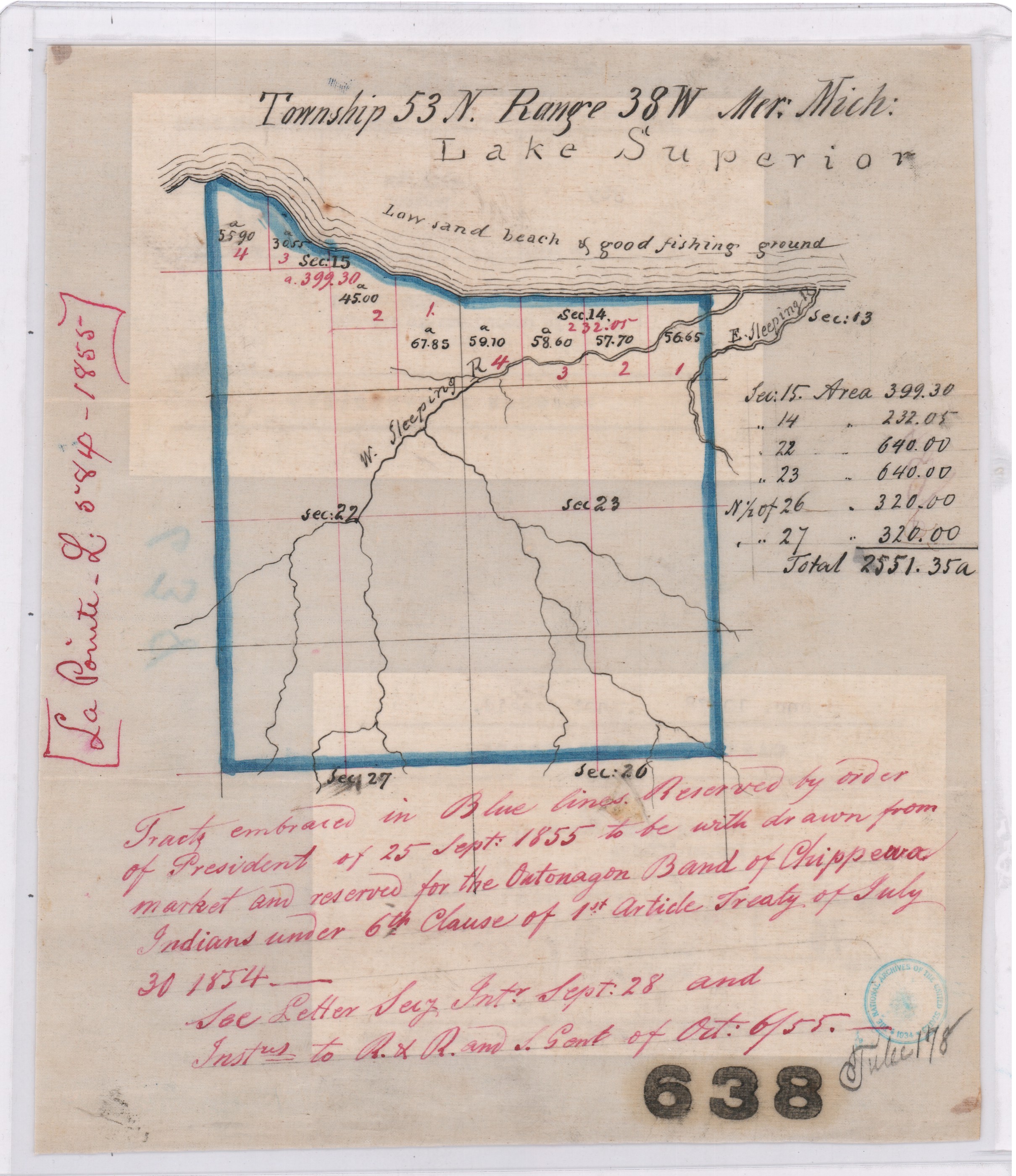
Map of “Tract embraced in blue lines reserved by order of President of 25 September 1855 to be withdrawn from market and reserved for the Ontonagon Band of Chippewa Indians“ on a “low sand beach & good fishing ground”.
Central Map File No. 638 (Tube No. 138)
NAID: 232923886 cites “La Pointe L.584-1855”.
The Ontonagon Band and Chief Buffalo’s Subdivision of the La Pointe Band got lumped together in this clause, so let’s review the Ontonagon Band first. Less than one year after the 1854 Treaty, the Ontonagon Band selected four square miles for their Reservation as approved by President Franklin Pierce’s Executive Order of September 25, 1855. Today the Ontonagon Band Reservation still has its original shape and size from 1855 despite heavy “checkerboarding” of its landownership over time.
In comparison to the Ontonagon Band Reservation, the history of how Chief Buffalo’s Reservation got selected is not so straightforward. Despite resisting and surviving the Sandy Lake Tragedy and Ojibwe Removal, making an epic trip to meet the President at Washington D.C., and securing Reservations as permanent homelands for the Chippewa Bands in the 1854 Treaty, Chief Buffalo of La Pointe died in 1855 before being able to select four square miles for his Subdivsion of the La Pointe Bands.
Fortunately, President Franklin Pierce’s Executive Order of February 21, 1856 withheld twenty-two square miles of land near the Apostle Islands from federal public land sales, allowing Chief Buffalo’s Estate to select four of those twenty-two square miles for their Reservation without competition from squatters and other land speculators, while other prime real estate in the ceded territory of La Pointe County was being surveyed and sold to private landowners by the United States General Land Office.
This 1856 Reservation of twenty-two square miles for Chief Buffalo’s Estate set the stage for what would eventually become the Red Cliff Reservation. We will return to this 1856 Reservation for Chief Buffalo’s Estate in several upcoming posts exploring more records about Red Cliff and the other La Pointe Band Reservations.

Maps marked “A” showing certain lands reserved by the 1854 Treaty:
Central Map File No. 793 (Tube 446)
NAID: 232924228 cites “La Pointe L.579-1855″.
Central Map File No. 816 (Tube 298)
NAIDs: 232924272 & 50926136 cites “Res. Chippewa L.516-1855”.

1878 Copy of President Franklin Pierce’s Executive Order of February 26, 1856 for Chief Buffalo’s Subdivision (aka “Red Cliff”).
NAID: 117092990
Office of Indian Affairs.
(Miscellaneous)
L.801.17.1878
Copy of Ex. Order of Feby. 21. 1856.
Chippewas (Red Cliff.)
Wisconsin.
Enc. in G.L.O. letter of Nov 23, 1878 (above file mark.)
in answer to office letter of Nov. 18, 1878.
Ex. Order File.

Secretary of the Interior
Robert McClelland
Department of the Interior
February 21, 1856
Sir,
I herewith return the diagram enclosed in your letter of the 20th inst, covering duplicates of documents which accompanied your letter of the 6th Sept. last, as well as a copy of the latter, the originals of which were submitted to the President in letter from the Department of the 8th Sept. last and cannot now be found.
You will find endorsements on said diagram explanatory of the case and an order of the President of this date for the withdrawal of the land in question for Indian purposes as recommended.
Respectfully
Your obt. Servt
R McClelland
Secretary
To
Hon Thos A Hendrick
Commissioner of the
General Land Office
(Copy)
General Land Office
September 6, 1855
Hon R. McClelland
Sec. of Interior
Sir:
Enclosed I have the honor to submit an abstract from the Acting Commissioner of Indian Affairs letter of the 5th instant, requesting the withdrawal of certain lands for the Chippewa Indians in Wisconsin, under the Treaty of September 30th, 1854, referred by the Department to this office on the 5th. instant, with orders to take immediate steps for the withdrawal of the lands from sale.
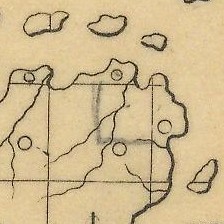
Detail of 1856 Reservation in pencil on “a map marked A.“
Central Map File No. 816 (Tube 298)
NAIDs: 232924272 & 50926136 cites “Res. Chippewa L.516-1855”.
In obedience to the above order I herewith enclose a map marked A. Showing by the blue shades thereon, the Townships and parts of Townships desired to be reserved, no portion of which are yet in market, to wit:
Township 51 N. of Range 3 West 4th Prin. Mer. Wis.
N.E. ¼ of Town 51 N ” 4 ” ” ” “.
Township 52 ” ” 3 & 4 ” ” ” “.
For the reservation of which, until the contemplated Selections under the 6th Clause of the Chippewa Treaty of 30th September 1854 can be made, I respectfully recommend that the order of the President may be obtained.
The requisite reports on the subject of the new surveys, and respecting preemption claims, referred to in the same order, will be prepared and communicated at an early day.
I am respectfully
Your Ob’t Serv’t
Thos. A. Hendricks
Commissioner
Department of the Interior
Feb. 20. 1856
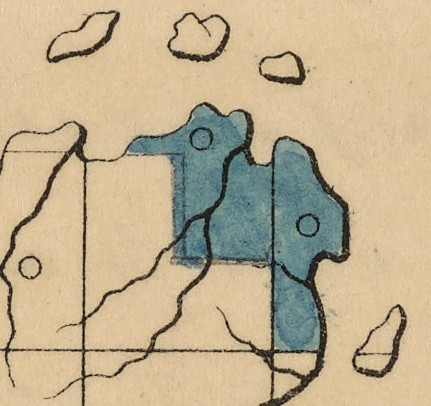
Detail of 1856 Reservation in blue on “duplicate of the original“.
NAID: 117092990
This plat represents by the blue shade, certain land to be withdrawn with a view to a reservation, under Chippewa Treaty of 30 Sept 1854, and as more particularly described in Commissioner of the General Land Office in letter of 6th Sept 1855. The subject was referred to the President for his sanction of the recommendation made in Secretary’s letter of 8th Sept 1855 and the original papers cannot now be found. This is a duplicate of the original, received in letter of Comm’r of the General Land Office of this date and is recommended to the President for his sanction of the withdrawal desired.
R. McClelland
Secretary

1856 Reservation in red and modern Red Cliff in brown. Although different in shape, both are roughly twenty-two square miles in size.
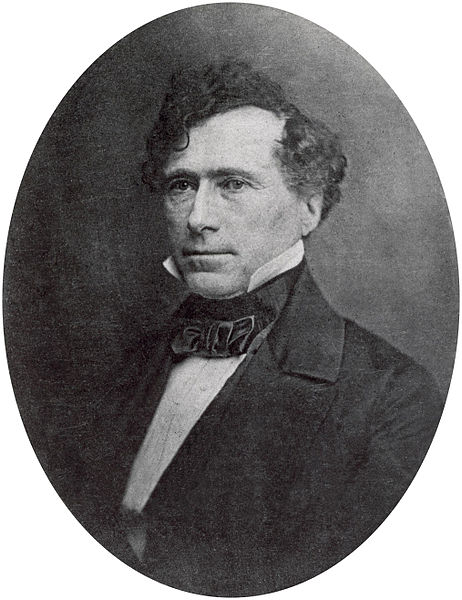
14th United States President
Franklin Pierce
February 21st 1856
Let the withdrawal be made as recommended.
Franklin Pierce
Chief Buffalo Picture Search: Coda
June 1, 2024
My last post ended up containing several musings on the nature of primary-source research and how to acknowledge mistakes and deal with uncertainty in the historical record. This was in anticipation of having to write this post. It’s a post I’ve been putting off for years.
Amorin forced the issue with his important work on the speeches at the 1842 Treaty negotiations. While working on it, he sent me a message that read something like, “Hey, the article quotes Chief Buffalo and describes him in a blue military coat with epaulets. Is the world ready for that picture that Smithsonian guy sent us years ago?”
This was the image in question:

Henry Inman, Big Buffalo (Chippewa), 1832-1833, oil on canvas, frame: 39 in. × 34 in. × 2 1/4 in. (99.1 × 86.4 × 5.7 cm), Smithsonian American Art Museum, Gift of Gerald and Kathleen Peters, 2019.12.2
We first learned of this image from a Chequamegon History comment by Patrick Jackson of the Smithsonian asking what we knew about the image and whether or not it was Chief Buffalo from La Pointe.
We had never seen it before.
This was our correspondence with Mr. Jackson at the time:
July 17, 2019
Hello, my name is Patrick, and I am an intern at the Smithsonian American Art Museum. I’m working on researching a recent acquisition: a painting which came to us identified as a Henry Inman portrait of “Big Buffalo Ke-Che-Wais-Ke, The Great Renewer (1759-1855) (Chippewa).” We have run into some confusion about the identification of the portrait, as it came to us identified as stated above, yet at Harvard Peabody Museum, who was previously the owner of the portrait, it was listed as an unidentified sitter. Seeing as you’ve written a few posts about the identification of images of the three different Chief Buffalos, I thought you might be able to give some insight into perhaps who is or isn’t in the portrait we have. Thank you for your time.
July 17, 2019
Hello,
I would be happy to comment. Can you send a photo to this email?
I am pretty sure Inman painted a copy of Charles Bird King’s portrait of Pee-che-kir.
Doe it resemble that portrait? Pee-che-kir (Bizhiki) means Buffalo in Ojibwe (Chippewa). From my research, I am fairly certain that King’s portrait is not of Kechewaiske, but of another chief named Buffalo who lived in the same era.
Leon Filipczak
July 17, 2019
Dear Leon,
I have attached our portrait—it’s not the best scan, but hopefully there’s enough detail for you to work with. I’ve compared it with the Peechikir in McKenney & Hall, as well as to the Chief Buffalo painted ambrotype and the James Otto Lewis portrait of Pe-schick-ee. The ambrotype has a close resemblance, as does the Peecheckir, though if that is what Charles Bird King painted I have doubts that Inman would make such drastic changes in clothing and pose.
The identification as Big Buffalo/Ke-Che-Wais-Ke/The Great Renewer, as far as I understand, refers to the La Pointe Bizhiki/Buffalo rather than the St. Croix or Leech Lake Buffalos, though of course that is a questionable identification considering Kechewaiske did not (I think) visit Washington until after Inman’s death in January of 1846. McKenney, however, did visit the Ojibwe/Chippewa for the negotiations for the Treaty of Fond du Lac in 1825/1826, and could feasibly have met multiple Chief Buffalos. Perhaps a local artist there would be responsible for the original? Another possibility is, since the identification was not made at the Peabody, who had the portrait since the 1880s, is that it has been misidentified entirely and is unrelated to any of the Ojibwe/Chippewa chiefs. Though this, to me, would seem unlikely considering the strong resemblance of the figure in our portrait to the Peechikir portrait and Chief Buffalo ambrotype.
Thank you again for the help.
Sincerely,
Patrick
July 22, 2019
Hello Patrick,
This is a head-scratcher. Your analysis is largely what I would come up with. My first thought when I saw it was, “Who identified it as someone named Buffalo? When? and using what evidence?” Whoever associated the image with the text “Ke-Che-Wais-Ke, The Great Renewer (1759-1855)” did so decades after the painting could be assumed to be created. However, if the tag “Big Buffalo” can be attached to this image in the era it was created, then we may be onto something. This is what I know:
1) During his time as Superintendent of Indian Affairs (late 1820s), Thomas McKenney amassed a large collection of portraits of Indian chiefs for what he called the “Indian Gallery” in the War Department. He sought the portraits out wherever and whenever he could. When chiefs would come to Washington, he would have Charles Bird King do the work, but he also received portraits from the interior via artists like James Otto Lewis.
2) In 1824, Bizhiki (Buffalo) from the St. Croix River (not Great Buffalo from La Pointe), visited Washington and was painted by King. This painting is presumed to have been destroyed in the Smithsonian fire that took out most of the Indian Gallery.
3) In 1825 at Prairie du Chien and in 1826 at Fond du Lac (where McKenney was present) James Otto Lewis painted several Ojibwe chiefs, and these paintings also ended up in the Indian Gallery. Both chief Buffalos were present at these treaties.
4) A team of artists copied each others’ work from these originals. King, for example remade several of Lewis’ portraits to make the faces less grotesque. Inman copied several Indian Gallery portraits (mostly King’s) to be sent to other institutions. These are the ones that survived the Smithsonian fire.
5) In the late 1830s, 10+ years after most of the portraits were painted, Lewis and McKenney sold competing lithograph collections to the American public. McKenney’s images were taken from the Indian Gallery. Lewis’ were from his works (some of which were in the Indian Gallery, often redone by King). While the images were printed with descriptions, the accuracy of the descriptions leaves something to be desired. A chief named Bizhiki appears in both Lewis and McKenney-Hall. In both, the chiefs are dressed in white and faced looking left, but their faces look nothing alike. One is very “Lewis-grotesque.” and the other is not at all. There are Lewis-based lithographs in both competing works, and they are usually easy to spot.
6) Not every image from the Indian Gallery made it into the published lithographic collections. Brian Finstad, a historian of the upper-St. Croix country, has shown me an image of Gaa-bimabi (Kappamappa, Gobamobi), a close friend/relative of the La Pointe Chief Buffalo, and upstream neighbor of the St. Croix Buffalo. This image is held by Harvard and strongly resembles the one you sent me in style. I suspect it is an Inman, based on a Lewis (possibly with a burned-up King copy somewhere in between).
7) “Big Buffalo” would seemingly indicate Buffalo from La Pointe. The word gichi is frequently translated as both “great” and “big” (i.e. big in size or big in power). Buffalo from La Pointe was both. However, the man in the painting you sent is considerably skinnier and younger-looking than I would expect him to appear c.1826.
My sense is that unless accompanying documentation can be found, there is no way to 100% ID these pictures. I am also starting to worry that McKenney and the Indian Gallery artists, themselves began to confuse the two chief Buffalos, and that the three originals (two showing St. Croix Buffalo, and one La Pointe Buffalo) burned. Therefore, what we are left with are copies that at best we are unable to positively identify, and at worst are actually composites of elements of portraits of two different men. The fact that King’s head study of Pee-chi-kir is out there makes me wonder if he put the face from his original (1824 portrait of St. Croix Buffalo?) onto the clothing from Lewis’ portrait of Pe-shick-ee when it was prepared for the lithograph publication.
A few weeks later, Patrick sent a follow-up message that he had tracked down a second version and confirmed that Inman’s portrait was indeed a copy of a Charles Bird King portrait, based on a James Otto Lewis original. It included some critical details.

Portrait of Big Buffalo, A Chippewa, 1827 Charles Bird King (1785-1862), signed, dated and inscribed ‘Odeg Buffalo/Copy by C King from a drawing/by Lewis/Washington 1826’ (on the reverse) oil on panel 17 1⁄2 X 13 3⁄4 in. (44.5 x 34.9 cm.) Last sold by Christie’s Auction House for $478,800 on 26 May 2022
The date of 1826 makes it very likely that Lewis’ original was painted at the Treaty of Fond du Lac. Chief Buffalo of La Pointe would have been in his 60s, which appears consistent with the image of Big Buffalo. Big Buffalo also does not appear as thin in King’s intermediate version as he does in Inman’s copy, lessening the concerns that the image does not match written descriptions of the chief.
Another clue is that it appears Lewis used the word Odeg to disambiguate Big Buffalo from the two other chiefs named Buffalo present at Fond du Lac in 1826. This may be the Ojibwe word Andeg (“crow”). Although I have not seen any other source that calls the La Pointe chief Andeg, it was a significant name in his family. He had multiple close relatives with Andeg in their names, which may have all stemmed from the name of Buffalo’s grandfather Andeg-wiiyaas (Crow’s Meat). As hereditary chief of the Andeg-wiiyaas band, it’s not unreasonable to think the name would stay associated with Buffalo and be used to distinguish him from the other Buffalos. However, this is speculative.
So, there we were. After the whole convoluted Chief Buffalo Picture Search, did we finally have an image we could say without a doubt was Chief Buffalo of La Pointe? No. However, we did have one we could say was “likely” or even “probably” him. I considered posting at the time, but a few things held me back.
In the earliest years of Chequamegon History, 2013 and 2014, many of the posts involved speculation about images and me trying to nitpick or disprove obvious research mistakes of others. Back then, I didn’t think anyone was reading and that the site would only appeal to academic types. Later on, however, I realized that a lot of the traffic to the site came from people looking for images, who weren’t necessarily reading all the caveats and disclaimers. This meant we were potentially contributing to the issue of false information on the internet rather than helping clear it up. So by 2019, I had switched my focus to archiving documents through the Chequamegon History Source Archive, or writing more overtly subjective and political posts.
So, the Smithsonian image of Big Buffalo went on the back burner, waiting to see if more information would materialize to confirm the identity of the man one way or the other. None did, and then in 2020 something happened that gave the whole world a collective amnesia that made those years hard to remember. When Amorin asked about using the image for his 1842 post, my first thought was “Yeah, you should, but we should probably give it its own post too.” My second thought was, “Holy crap! It’s been five years!”
Anyway, here is Chequamegon History’s statement on the identity of the man in Henry Inman’s 1832-33 portrait of Big Buffalo (Chippewa).
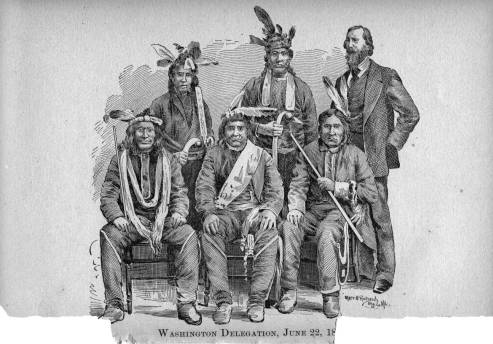
Likely Chief Buffalo of La Pointe: We are not 100% certain, but we are more certain than we have been about any other image featured in the Chief Buffalo Picture Search. This is a copy of a copy of a missing original by James Otto Lewis. Lewis was a self-taught artist who struggled with realistic facial features. Charles Bird King and Henry Inman, who made the first and second copies, respectively, had more talent for realism. However, they did not travel to Lake Superior themselves and were working from Lewis’ original. Therefore, the appearance of Big Buffalo may accurately show his clothing, but is probably less accurate in showing his actual physical appearance.
And while we’re on the subject of correcting misinformation related to images, I need to set the record straight on another one and offer my apologies to a certain Benjamin Green Armstrong. I promise, it relates indirectly to the “Big Buffalo” painting.
An engraving of the image in question appears in Armstrong’s Early Life Among the Indians.
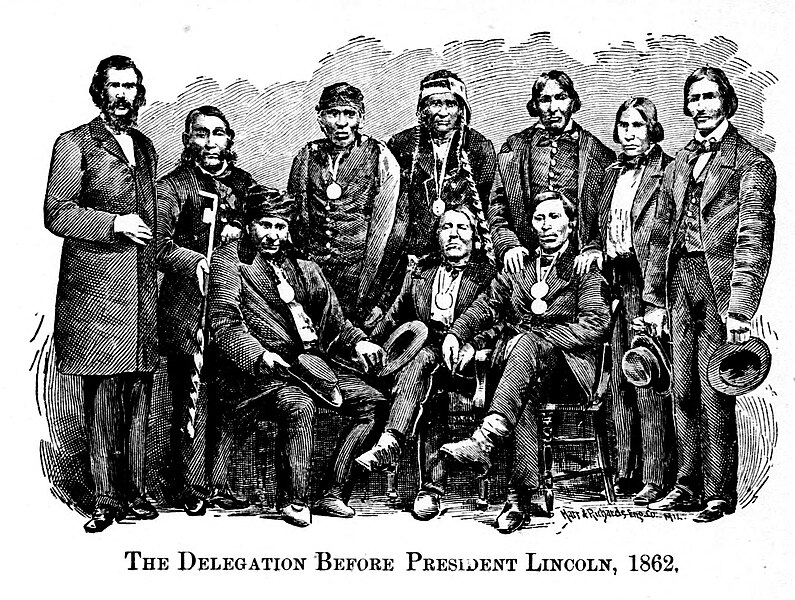
Ah-moose (Little Bee) from Lac Flambeau Reservation, Kish-ke-taw-ug (Cut Ear) from Bad River Reservation, Ba-quas (He Sews) from Lac Courte O’Rielles Reservation, Ah-do-ga-zik (Last Day) from Bad River Reservation, O-be-quot (Firm) from Fond du Lac Reservation, Sing-quak-onse (Little Pine) from La Pointe Reservation, Ja-ge-gwa-yo (Can’t Tell) from La Pointe Reservation, Na-gon-ab (He Sits Ahead) from Fond du Lac Reservation, and O-ma-shin-a-way (Messenger) from Bad River Reservation.
In this post, we contested these identifications on the grounds that Ja-ge-gwa-yo (Little Buffalo) from La Pointe Reservation died in 1860 and therefore could not have been part of the delegation to President Lincoln. In the comments on that post, readers from Michigan suggested that we had several other identities wrong, and that this was actually a group of chiefs from the Keweenaw region. We commented that we felt most of Armstrong’s identifications were correct, but that the picture was probably taken in 1856 in St. Paul.
Since then, a document has appeared that confirms Armstrong was right all along.
[Antoine Buffalo, Naagaanab, and six other chiefs to W.P. Dole, 6 March 1863
National Archives M234-393 slide 14
Transcribed by L. Filipczak 12 April 2024]
To Our Father,
Hon W P. Dole
Commissioner of Indian Affairs–
We the undersigned chiefs of the chippewas of Lake Superior, now present in Washington, do respectfully request that you will pay into the hands of our Agent L. E. Webb, the sum of Fifteen Hundred Dollars from any moneys found due us under the head of “Arrearages in Annuity” the said money to be expended in the purchase of useful articles to be taken by us to our people at home.
Antoine Buffalo His X Mark | A daw we ge zhig His X Mark
Naw gaw nab His X Mark | Obe quad His X Mark
Me zhe na way His X Mark | Aw ke wen zee His X Mark
Kish ke ta wag His X Mark | Aw monse His X Mark
I certify that I Interpreted the above to the chiefs and that the same was fully understood by them
Joseph Gurnoe
U.S. Interpreter
Witnessed the above Signed } BG Armstrong
Washington DC }
March 6th 1863 }
There were eight Lake Superior chiefs, an interpreter, and a witness in Washington that spring, for a total of ten people. There are ten people in the photograph. Chequamegon History is confident that this document confirms they are the exact ten identified by Benjamin Armstrong.
The Lac Courte Oreilles chief Ba-quas is the same person as Akiwenzii. It was not unusual for an Ojibwe chief to have more than one name. Chief Buffalo, Gaa-bimaabi, Zhingob the Younger, and Hole-in-the-Day the Younger are among the many examples.
The name “Sing-quak-onse (Little Pine) from La Pointe Reservation” seems to be absent from the letter, but he is there too. Let’s look at the signature of the interpreter, Joseph Gurnoe.

Gurnoe’s beautiful looping handwriting will be familiar to anyone who has studied the famous 1864 bilingual petition. We see this same handwriting in an 1879 census of Red Cliff. In this document, Gurnoe records his own Ojibwe name as Shingwākons, The young Pine tree.

So the man standing on the far right is Gurnoe. This can be confirmed by looking at other known photos of him.
Finally, it confirms that the chief seated on the bottom left is not Jechiikwii’o (Little Buffalo), but rather his son Antoine, who inherited the chieftainship of the Buffalo Band after the death of his father two years earlier. Known to history as Chief Antoine Buffalo, in his lifetime he was often called Antoine Tchetchigwaio (or variants thereof), using his father’s name as a surname rather than his grandfather’s.

So, now we need to address the elephant in the room that unites the Henry Inman portrait of Big Buffalo with the photograph of the 1862-63 Delegation to Washington:

Wisconsin Historical Society
This is the “ambrotype” referenced by Patrick Jackson above. It’s the image most associated with Chief Buffalo of La Pointe. It’s also one for which we have the least amount of background information. We have not been able to determine who the original photographer/painter was or when the image was created.
The resemblance to the portrait of “Big Buffalo” is undeniable.
However, if it is connected to the 1862-63 image of Chief Antoine Buffalo, it would support Hamilton Nelson Ross’s assertions on the Wisconsin Historical Society copy.
Clearly, multiple generations of the Buffalo family wore military jackets.
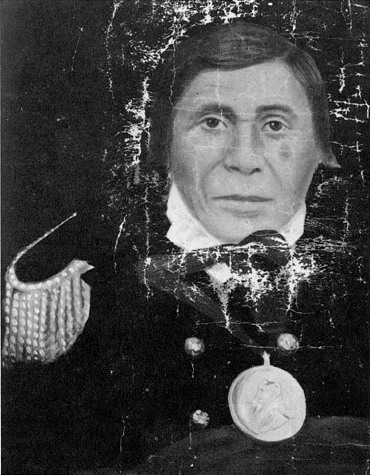
Inconclusive: uncertainty is no fun, but at this point Chequamegon History cannot determine which Chief Buffalo is in the ambrotype. However, the new evidence points more toward the grandfather (Great Buffalo) and grandson (Antoine) than it does to the son (Little Buffalo).
We will keep looking.
1842 Treaty Speeches at La Pointe in the News
May 15, 2024
Collected by Amorin Mello & edited by Leo Filipczak

Green Bay Republican:
Saturday, November 5, 1842, Page 2.

Robert Stuart was a top official in Astor’s American Fur Company in the upper Great Lakes region. Apparently, it was not a conflict of interest for him to also be U.S. Commissioner for a treaty in which the Fur Company would be a major beneficiary.
A gentleman who has recently returned from a visit to the Lake Superior Indian country, has furnished us with the particulars of a Treaty lately negotiated at La Pointe, during his sojourn at that place, by ROBERT STUART, Esq., Commissioner of Indian Affairs for the district of Michigan, on the part of the United States, and by the Chiefs and Braves of the Chippeway Indian nation on their own behalf and their people. From 3 to 4000 Indians were present, and the scene presented an imposing appearance. The object of the Government was the purchase of the Chippeway country for its valuable minerals, and to adopt a policy which is practised by Great Britain, i.e. of keeping intercourse with these powerful neighbors from year to year by paying them annuities and cultivating their friendship. It is a peculiar trait in the Indian character of being very punctual in regard to the fulfillment of any contract into which they enter, and much dissatisfaction has arisen among the different tribes toward our Government, in consequence of not complying strictly to the obligations on their part to the Indians, in the time of making the payments, for they are not generally paid until after the time stipulated in the treaty, and which has too often proven to be the means of losing their confidence and friendship.
On the 30th of September last, Mr. Stuart opened the Council, standing himself and some of his friends under an awning prepared for the occasion, and the vast assembly of the warlike Chippeways occupying seats which were arranged for their accommodation. A keg of Tobacco was rolled out and opened as a present to the Indians, and was distributed among them; when Mr. Stuart addressed them as follows:-
The Passenger Pigeon (Ectopistes migratorius) was a metaphor for infinite abundance in 1842. In less than 75 years, the species would be extinct. What that means for Stuart’s metaphor is hard to say (Biodiversity Heritage Library).
The chiefs who had been to Washington were the St. Croix chiefs Noodin (pictured below) and Bizhiki. They were brought to the capital as part of a multi-tribal delegation in 1824, which among other things, toured American military facilities.I am very glad to meet and shake hands with so many of my old friends in good health; last winter I visited your Great Father in Washington, and talked with him about you. He knows you are poor and have but little for your women and children, and that your lands are poor. He pities your condition, and has sent me here to see what can be done for you; some of your Bands get money, goods, and provisions by former Treaty, others get none because the Great Council at Washington did not think your lands worth purchasing. By the treaty you made with Gov. Cass, several years ago, you gave to your lands all the minerals; so the minerals belong no longer to you, and the white men are asking him permission to take the minerals from the land. But your Great Father wishes to pay you something for your lands and minerals before he will allow it. He knows you are needy and can be made comfortable with goods, provisions, and tobacco, some Farmers, Carpenters to aid in building your houses, and Blacksmiths to mend your guns, traps, &c., and something for schools to learn your children to read and write, and not grow up in ignorance. I hear you have been unpleased about your Farmers and Blacksmiths. If there is anything wrong I wish you would tell me, and I will write all your complaints to your Great Father, who is ever watchful over your welfare. I fear you do not esteem your teachers who come among you, and the schools which are among you, as you ought. Some of you seem to think you can learn as formerly, but do you not see that the Great Spirit is changing things all around you. Once the whole land was owned by you and other Indian Nations. Now the white men have almost the whole country, and they are as numerous as the Pigeons in the spring. You who have been in Washington know this; but the poor Indians are dying off with the use of whiskey, while others are sent off across the Mississippi to make room for the white men. Not because the Great Spirit loves the white men more than the Indians, but because the white men are wise and send their children to school and attend to instructions, so as to know more than you do. They become wise and rich while you are poor and ignorant, but if you send your children to school they may become wise like the white men; they will also learn to worship the Great Spirit like the whites, and enjoy the prosperity they enjoy. I hope, and he, that you will open your ears and hearts to receive this advice, and you will soon get great light. But said he, I am afraid of you, I see but few of you go to listen to the Missionaries, who are now preaching here every night; they are anxious that you should hear the word of the Great Spirit and learn to be happy and wise, and to have peace among yourselves.
The 1837 Treaty of St. Peters was mostly negotiated by Maajigaabaw or “La Trappe” of Leech Lake and other chiefs from outside the territory ceded by that treaty. The chiefs from the ceded lands were given relatively few opportunities to speak. This created animosity between the Lake Superior and Mississippi Bands.Your Great Father is very sorry to learn that there are divisions among his red children. You cannot be happy in this way. Your Great Father hopes you will live in peace together, and not do wrong to your white neighbors, so that no reports will be made against you, or pay demanded for damages done by you. These things when they occur displease him very much, and I myself am ashamed of such things when I hear them. Your Great Father is determined to put a stop to them, and he looks that the Chiefs and Braves will help him, so that all the wicked may be brought to justice; then you can hold up your heads, and your Great Father will be proud of you. Can I tell him that he can depend upon his Chippeway children acting in this way.
One other thing, your Great Father is grieved that you drink whiskey, for it makes you sick, poor, and miserable, and takes away your senses. He is determined to punish those men who bring whiskey among you, and of this I will talk more at another time.
Stuart would become irritated after the treaty when the Ojibwe argued they did not cede Isle Royale in 1842. This lead to further negotiations and an addendum in 1844. The Grand Portage Band, who lived closest to Isle Royale, was not party to the 1842 negotiations.When I was in New York about three moons ago I found 800 blankets which were due you last year, which by some mismanagement you did not get. Your Great Father was very angry about it, and wished me to bring them to you, and they will be given you at the payment. He is determined to see that you shall have justice done you, and to dismiss all improper agents. He despises all who would do you wrong. Now I propose to buy your lands from Fond du Lac, at the head of Lake Superior, down Lake Superior to Chocolate River near Grand Island, including all the Islands in the limits of the United States, in the Lake, making the boundary on Lake Superior about 250 miles in extent, and extending back into the country on Lake Superior about 100 miles. Mr. Stuart showed the Chiefs the boundary on the map, and said you must not suppose that your Great Father is very anxious to buy your lands, the principal object is the minerals, as the white people will not want to make homes upon them. Until the lands are wanted you will be permitted to live upon them as you now do. They may be wanted hereafter, and in this event your Great Father does not wish to leave you without a home. I propose that the Fond du Lac lands and the Sandy Lake tract (which embrace a tract 150 miles long by 100 miles deep) be left you for a home for all the bands, as only a small part of the Fond du Lac lands are to be included in the present purchase. Think well on the subject and counsel among yourselves, but allow no black birds to disturb you, your Great Father is now willing and can do you great good if you will, but if not you must take the consequences. To-morrow at the fire of the gun you can come to the Council ground and tell me whether the proposal I make in the name of your Great Father is agreeable to you; if so I will do what I can for you, you have known me to be your friend for many years. I would not do you wrong if I could, but desire to assist you if you allow me to do so. If you now refuse it will be long before you have another offer.

October 1st. At the sound of the Cannon the Council met, and when all were ready for business, Shingoop, the head Chief of the Fond du Lac band, with his 2d and 3d Chiefs, came forward and shook hands with the Commissioner and others associated with him, then spoke as follows:
Zhingob (Balsam), also known as Nindibens, signed the 1837, 1842, and 1854 treaties as chief or head chief of Fond du Lac. The Zhingob on earlier treaties is his father. See Ely, ed. Schenck, The Ojibwe Journals of Edmund F. ElyNaagaanab (Foremost Sitter) is likely the 2nd Fond du Lac chief mentioned here.
My friend, we now know the purpose you came for and we don’t want to displease you. I am very glad there are so many Indians here to hear me. I wish to speak of the lands you want to buy of me. I don’t wish to displease the Traders. I don’t wish to displease the half-breeds; so I don’t wish to say at once, right off. I want to know what our Great Father will give us for them, then I will think and tell you what I think. You must not tell a lie, but tell us what our Great Father will give us for our lands. I want to ask you again, my Father. I want to see the writing, and who it is that gave our Great Father permission to take our minerals. I am well satisfied of what you said about Blacksmiths, Carpenters, Schools, Teachers, &c., as to what you said about whiskey, I cannot speak now. I do not know what the other Chiefs will say about it. I want to see the treaty and the name of the Chiefs who signed. The Chief answered that the Indians had been deceived, that they did not so understand it when they signed it.
Mr. Stuart replied that this was all talk for nothing, that the Government had a right to the minerals under former treaty, yet their Great Father wishes now to pay for the minerals and purchase their lands.
The Chief said he was satisfied. All shook hands again and the Chief retired.
The next Chief who came forward was the “Great Buffalo” Chief of the La Pointe band. Had heavy epaulettes on his shoulders and a hat trimmed with tinsel, with a heavy string of bear claws about his neck, and said:-
“Big Buffalo (Chippewa),” 1832-33 by Henry Inman, after J.O. Lewis (Smithsonian).
My father, I don’t speak for myself only, but for my Chiefs. What you said here yesterday when you called us your children, is what I speak about. I shall not say what the other Chief has said, that you have heard already.

He then made some remarks about the Missionaries who were laboring in their country and thought as yet, little had been done. About the Carpenters, he said, that he could not tell how it would work, as he had not tried it yet.
We have not decided yet about the Farmers, but we are pleased at your proposal about Blacksmiths. Can it be supposed that we can complete our deliberations in one night. We will think on the subject and decide as soon as we can.
The great Antonaugen Chief came next, observing the usual ceremony of shaking hands, and surrounded by his inferior Chiefs, said:-
The great Ontonagon Chief is almost certainly Okandikan (Buoy), depicted here in a reproduction of an 1848 pictograph carried to Washington and reproduced by Seth Eastman. Okandikan is depicted as his totem symbol, the eagle (largest, with wing extended in the center of the image).
My father and all the people listen and I call upon my Great Father in Heaven to bear witness to the rectitude of my intentions. It is now five years since we have listened to the Missionaries, yet I feel that we are but children as to our abilities. I will speak about the lands of our band, and wish to say what is just and honorable in relation to the subject. You said we are your children. We feel that we are still, most of us, in darkness, not able fully to comprehend all things on account of our ignorance. What you said about our becoming enlightened I am much pleased; you have thrown light on the subject into my mind, and I have found much delight and pleasure thereby. We now understand your proposition from our Great Father the President, and will now wait to hear what our Great Father will give us for our lands, then we will answer. This is for the Antannogens and Ance bands.

Mr. Stuart now said, that he came to treat with the whole Chippeway Nation and look upon them all as one Nation, and said
I am much pleased with those who have spoken; they are very fine orators; the only difficulty is, they do not seem to know whether they will sell their lands. If they have not made up their minds, we will put off the Council.
Lac du Flambeau Chief, “the Great Crow,” came forward with the strict Indian formalities but had but little to say, as he did not come expecting to have any part in the treaty, but wished to receive his payment and go home.
The 2d Chief of this band wished to speak. He was painted red with black spots on each cheek to set off his beauty, his forehead was painted blue, and when he came to speak, he said:-
What the last Chief has said is all I have to say. We will wait to hear what your proposals are and will answer at a proper time.
Next came forward “Noden,” or the “Great Wind,” Chief of the Mill Lac band, and said:-

Noodin (Wind) is mentioned here as representing the Mille Lacs Band, though his village was usually on Snake River of the St. Croix.
I have talked with my Great Father in Washington. It was a pity that I did not speak at the St. Peters treaty. My father, you said you had come to do justice. We do not wish to do injustice to our relations, the half-breeds, who are also our friends. I have a family and am in a hurry to get home, if my canoes get destroyed I shall have to go on foot. My father, I am hurry, I came for my payment. We have left our wives and children and they are impatient to have us return. We come a great distance and wish to do our business as soon as we can. I hope you will be as upright as our former agent. I am sorry not to see him seated with you. I fear it will not go as well as it would. I am hurry.
Mr Stuart now said that he considered them all one nation, and he wished to know whether they wished to sell their lands; until they gave this answer he could do nothing, and as it regards any thing further he could say nothing, and said they might now go away until Monday, at the firing of the Cannon they might come and tell him whether they would sell their country to their Great Father.
We intend giving the remainder of the proceedings of the treaty in our next.
Green Bay Republican:
SATURDAY, NOVEMBER 12, 1842, Page 2.
(Treaty with the Chippeways Concluded.)
Monday morning three guns were fired as a signal to open the Treaty. When all things were in readiness, Mr. Stuart said:
I am glad you have now had time for reflection, and I hope you are now ready like a band of brothers to answer the question which I have proposed. I want to see the Nation of one heart and of one mind.
Shingoop, Chief of the Fond du Lac band, came forward with full Indian ceremony, supported on each side by the inferior Chiefs. He addressed the Chippeway nation first, which was not fully interpreted; then he turned to the Commissioner and said:
in this Treaty which we are about to make, it is in my heart to say that I want our friends the traders, who have us in charge provided for. We want to provide also for our friends the half-breeds – we wish to state these preliminaries. Now we will talk of what you will give us for our country. There is a kind of justice to be done towards the traders and half-breeds. If you will do justice to us, we are ready to-morrow to sign the treaty and give up our lands. The 2d Chief of the band remarked, that he considered it the understanding that the half-breeds and traders were to be provided for.
The Great Buffalo, of La Pointe band, and his associate Chiefs came next, and the Buffalo said:
My Father, I want you to listen to what I say. You have heard what one Chief has said. I wish to say I am hurry on account of keeping so many men and women here away from their homes in this late season of the year, so I will say my answer is in the affirmative of your request; this is the mind of my Chiefs and braves and young men. I believe you are a correct man and have a heart to do justice, as you are sent here by our Great Father, the President. Father, our traders are so related to us that we cannot pass a winter without them. I want justice to be done them. I want you and our Great Father to assist us in doing them justice, likewise our half-breed children – the children of our daughters we wish provided for. It seems to me I can see your heart, and you are inclined to do so. We now come to the point for ourselves. We wish to know what you will give us for our country. Tell us, then we will advise with our friends. A part of the Antaunogens band are with me, the other part are turned Christians and gone with the Methodist band, (meaning the Ance band at Kewawanon) these are agreed in what I say.
The Bird, Chief of the Ance band, called Penasha, came forward in the usual form and said:
My Father, now listen to what I have to say. I agree with those who have spoken as far as our lands are concerned. What they say about our traders and half-breeds, I say the same. I speak for my band, they make use of my tongue to say what they would say and to express their minds. My Father, we listen to what you will offer for our country, then we will say what we have to say. We are ready to sell our country if your proposals are agreeable. All shook hands – equal dignity was maintained on each side – there was no inclination of the head or removing the hat – the Chiefs took their seats.
The White Crow next appeared to speak to the Great Father, and said:-
White Crow is apparently unaware that in the eyes of the United States, his lands, (Lac du Flambeau) were already sold five years earlier at St. Peters. Clearly, the notion of buying and selling land was not understood by him in the same way it was understood by Stuart.
Listen to what I say. I speak to the Great Father, to the Chiefs, Traders, and Half-breeds. You told us there was no deceit in what you say. You may think I am troublesome, but the way the treaty was made at St. Peters, we think was wrong. We want nothing of the kind again. We think you are a just man. You have listened to those Chiefs who live on Lake Superior. What I say is for another portion of country. It appears you are not anxious to buy the lands where I live, but you prefer the mineral country. I speak for the half-breeds, that they may be provided for: they have eaten out of the same dish with us: they are the children of our sisters and daughters. You may think there is something wrong in what I say. As to the traders, I am not the same mind with some. The old traders many years ago, charged us high and ought to pay us back, instead of bringing us in debt. I do not wish to provide for them; but of late years they have had looses and I wish those late debts to be paid. We do not consider that we sell our lands by saying we will sell them, so we consent to sell if your proposals are agreeable. We will listen and hear what they are.
Several others of the Chiefs spoke well on the subject, but the substance of all is contained in the above.
Hole-in-the-day, who is at once an orator and warrior, came forward; he had an Arkansas tooth pick in his hand which would weigh one or two pounds, and is evidently the greatest and most intelligent man in the nation, as fine a form of body, head and face, as perhaps could be found in any country.
Father, said he, I arise to speak. I have listened with pleasure to your proposal. I have come to tie the knot. I have come to finish this part of the treaty, and consent to sell our country if the offers of the President please us. Then addressing the Chiefs of the several bands he said, the knot is now tied, and so far the treaty is complete, not to be changed.

Zhaagobe (“Little” Six) signed as first chief from Snake River, and he is almost certainly the “Big Six” mentioned here. Several Ojibwe and Dakota chiefs from that region used that name (sometimes rendered in Dakota as Shakopee).
Big Six now addressed the whole Nation in a stream of eloquence which called down thunders of applause; he stands next to Hole-in-the-day in consequence and influence in the nation. His motions were graceful, his enunciation rather rapid for a fine speaker. He evidently possesses a good mind, though in person and form he is quite inferior to Hole-in-the-day. His speech was not interpreted, but was said to be in favor of selling the Chippeway country if the offer of the Government should meet their expectations, and that he took a most enlightened view of the happiness which the nation would enjoy if they would live in peace together and attend to good counsel.
Mr. Stuart now said,
I am very happy that the Chippewa nation are all of one mind. It is my great desire that they should continue to for it is the only way for them to be happy and wise. I was afraid our “White Crow” was going to fly away, but am happy to see him come back to the flock, so that you are all now like one man. Nothing can give me greater pleasure than to do all for you I can, as far as my instructions from your Great Father will allow me. I am sorry you had any cause to complain of the treaty at St. Peters. I don’t believe the Commissioner intended to do you wrong, but perhaps he did not know your wants and circumstances so as to suit. But in making this treaty we will try to reconcile all differences and make all right. I will now proceed to offer you all I can give you for your country at once. You must not expect me to alter it, I think you will be pleased with the offer. If some small things do not suit you, you can pass them over. The proposal I now make is better than the Government has given any other nation of Indians for their lands, when their situations are considered. Almost double the amount paid to the Mackinaw Indians for their good lands. I offer more than I at first intended as I find there are so many of you, and because I see you are so friendly to our Government, and on account of your kind feelings for the traders and half-breeds, and because you wish to comply with the wishes of your Great Father, and because I wish to unite you all together. At first I thought of making your annuities for only twenty years but I will make them twenty-five years. For twenty-five years I will offer you the following and some items for one year only.
$12,500 in specie each year for 25 years, $312,500
10,500 in goods ” ” ” ” ” 262,500
2,000 in provisions and tobacco, do. 50,000$625,000
This amount will be connected with the annuity paid to a part of the bands on the St. Peters treaty, and the whole amount of both treaties will be equally distributed to all the bands so as to make but one payment of the whole, so that you will be but one nation, like one happy family, and I hope there will be no bad heart to wish it otherwise. This is in a manner what you are to get for your lands, but your Great Father and the great Council at Washington are still willing to do more for you as I will now name, which you will consider as a kind of present to you, viz:
2 Blacksmiths, 25 years, $2000, $50,000
2 Farmers, ” ” 1200, 30,000
2 Carpenters, ” ” 1200, 30,000
For Schools, ” ” 2000, 50,000
For Plows, Glass, Nails, &c. for one year only, 5000
For Credits for one year only, 75,000
For Half-breeds ” ” ” 15,000$255,000
Total $880,000
With regards to the claims. I will not allow any claim previous to 1822; none which I deem unjust or improper. I will endeavor to do you justice, and if the $75,000 is not all required to pay your honest debts, the balance shall be paid to you; and if but a part of your debts are paid your Great Father requires a receipt in full, and I hope you will not get any more credits hereafter. I hope you have wisdom enough to see that this is a good offer. The white people do not want to settle on the lands now and perhaps never will, so you will enjoy your lands and annuities at the same time. My proposal is now before you.
The Fond du Lac Chief said, we will come to-morrow and give our answer.
October 4th, Mr. Stuart opened the Council.
Clement Hudon Beaulieu, was about thirty at this time and working his way up through the ranks of the American Fur Company at the beginning of what would be a long and lucrative career as an Ojibwe trader. His influence would have been very useful to Stuart as he was a close relative of Chief Gichi-Waabizheshi. He may have also been related to the Lac du Flambeau chiefs–though probably not a grandson of White Crow as some online sources suggest.
We have now met said he, under a clear sun, and I hope all darkness will be driven away. i hope there is not a half-breed whose heart is bad enough to prevent the treaty, no half-breed would prevent he treaty unless he is either bad at heart or a fool. But some people are so greedy that they are never satisfied. I am happy to see that there is one half-breed (meaning Mr. Clermont Bolio) who has heart enough to advise what is good; it is because he has a good heart, and is willing to work for his living and not sponge it out of the Indians.

We now heard the yells and war whoops of about one hundred warriors, ornamented and painted in a most fantastic manner, jumping and dancing, attended with the wild music usual in war excursions. They came on to the Council ground and arrested for a time the proceedings. These braves were opposed to the treaty, and had now come fully determined to stop the treaty and prevent the Chiefs from signing it. They were armed with spears, knives, bows and arrows, and had a feather flag flying over ten feet long. When they were brought to silence, Mr. Stuart addressed them appropriately and they soon became quiet, so that the business of the treaty proceeded. Several Chiefs spoke by way of protecting themselves from injustice, and then all set down and listened to the treaty, and Mr. Stuart said he hoped they would understand it so as to have no complaints to make afterwards.
The provisions of the treaty are the same as made in the proposals as to the amount and the manner of payment. The Indians are to live on the lands until they are wanted by the Government. They reserve a tract called the Fond du Lac and Sandy Lake country, and the lands purchased are those already named in the proposals. The payment on this treaty and that of the St. Peters treaty are to be united, and equal payments made to all the bands and families included in both treaties. This was done to unite the nation together. All will receive payments alike. The treaty was to be binding when signed by the President and the great Council at Washington. All the Chiefs signed the treaty, the name of Hole-in-the-day standing at the head of the list, and it is said to be the greatest price paid for Indian lands by the United States, their situation considered, though the minerals are said to be very valuable.
The Commissioner is said to have conducted the treaty in a very just, impartial and honorable manner, and the Indians expressed the kindest feelings towards him, and the greatest respect for all associated with him in negotiating the treaty and the best feelings towards their Agent now about leaving the country, and for the Agents of the American Fur Company and for the traders. The most of them expressed the warmest kind of feelings toward the Missionaries, who had come to their country to instruct them out of the word of the Great Spirit. The weather was very pleasant, and the scene presented was very interesting.
Le Boeuf et Le Pain: Alexis Cadotte’s letter to Chief Buffalo and Manabozho, January 11, 1840
April 30, 2024
By Leo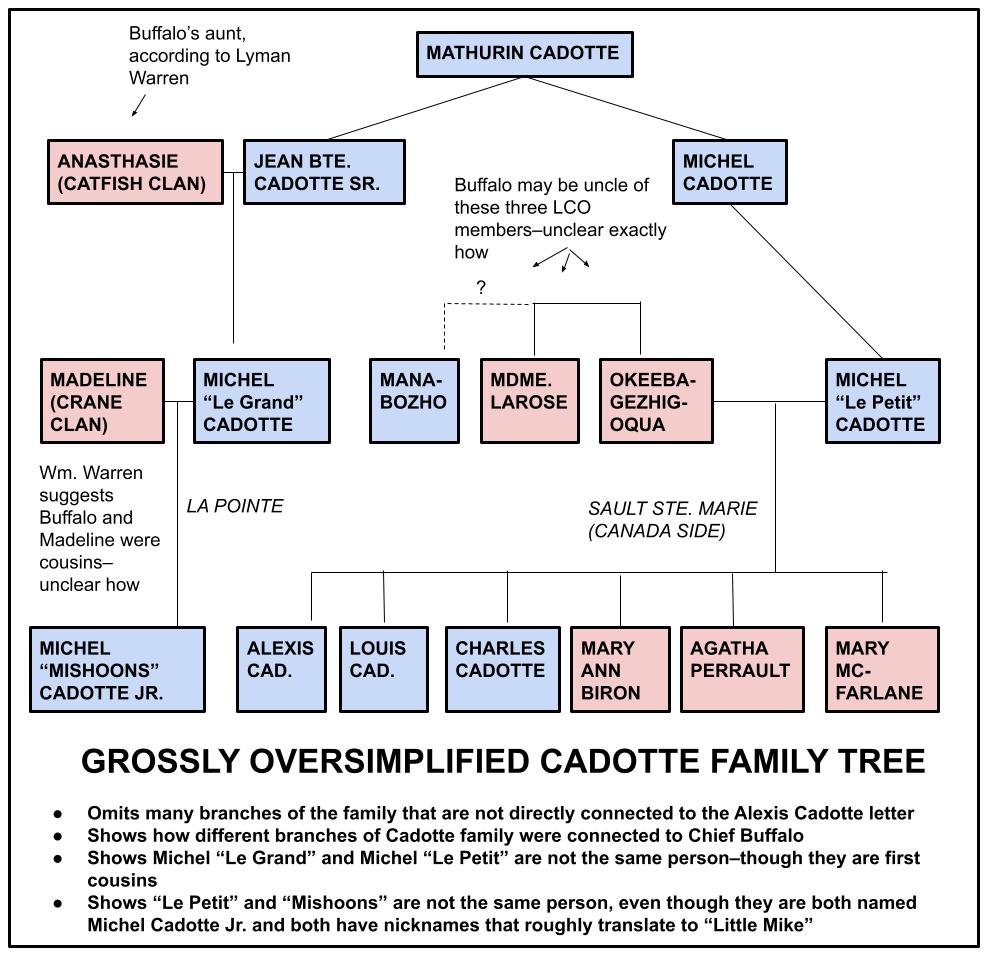
This was supposed to be a short post highlighting an interesting document with some light analysis of the relationship between the Ojibwe chiefs at La Pointe and the ones on the British-Canadian side of Sault Ste. Marie. It’s grown into an unwieldy musing on the challenges of doing what we do here at Chequamegon History. If you are only interested in the document, here it is:
(Copy)
Sault St. Maries 11 Janvier 1840
A Msr. le Beuf chef au tête à la pointe}
Cher grand-père,
Nous avons Recu votre par le darnier voyage des Barque de la Société. Ala nous avons apris la mort de votre fils qui nous a cose Boucup de chagrain, nous avons aussi bien compri le reste de votre, nous somme satisfait de n avoir vien neuf à la tréte de la pointe plus que vous ave vien neuf vous même nous somme de plus contents de vous pour L année prochaine arrive ici à votre endroit tachez de va espere promilles que vous nous fait que nous ayon la satisfaction an vous voyent de vous a tete cas il nous manque des Beuf ici, nous isperon que vous vous l espère Sanger il bon que vous venite a venire aucure une au Sault est Boucoup change de peu que la vie du Le Pain ne pas ici peu etre quil vous quelque chose pas cette ocation espre baucoup de vous voir l’etee prochienne, nous avons rien de particulier a vous mas que si non que faire. Baucoup a vous contée car il y a de grande nouvelles qui regarde toute votre nation et la nôtre tachez de nous faire réponse à notre lettre par le même.
2 Toute notre famille sont ans asse santé et Madame Birron qui est malade depui un mois et demi, un autre de ce petit garcon malade de pui cinq jour. Mon cher grand père nous finisson au vous Souhaitons toute sorte de Bonne prospérité croyez moi pour la vis votre tautre et efficionne fils
Signed Alexi Cadotte
Mon nomele Mainabauzo,
Je vous fais le meme Discours a vous dece que je vien de dire ici au Bouf. Il faut absolument que vous vene nous voir ici particulièrement votre patron qui moi meme et mon fils il y a un an l’été Darnier je vous espère au aspeill à la pointe nous avant neuf après ent la réponce du contenu de notre di proure si vous vere nous rejoindre nous iron ansemble à l ile Manito Wanegue au présent Anglois Car les Mitif se toi en Britanique resoive à présent comme les Sauvage vous dire à votre Jandre La pluve blanche que nous avon pas compri la lettre mon chère on ete je fini au vous enbrassan toute croyez moi pour la vie votre neveux.
signed Alexis Cadotte
Toute la famille vous fon des complément. Complement tous nous parans particulièrement
signed Cadotte
If you only want the translation, keep scrolling. If you want the story, read on.
Several years ago, I received a copy of this letter from Theresa Schenck, author and editor of several of the most important recent books on Ojibwe history. She knew that I was interested in the life of Chief Buffalo of La Pointe and described it as a charming letter written to Buffalo by one of his Cadotte relatives at Sault Ste. Marie. Dr. Schenck made a special point of telling me there were jokes inside.

Many streak freezes were used to obtain this number.
My immediate reaction was what many of you might be thinking, “But I don’t speak French!” Her response was very matter-of-fact, “Well you need to know French if you’re going to study Lake Superior history. Learn French.”
During the pandemic, I finally got to it, and according to Duolingo, I now have the equivalent of three years of high-school French even though I can’t speak it at all. I can read enough to decipher Alexis Cadotte’s handwriting, though, and get the words into Google Translate. That’s where we hit a second problem.
The French that Cadotte uses in 1840 is not the same French that Duolingo and Google Translate use in 2023. Ojibwe was almost certainly the mother tongue of Alexis, who was born at Lac Courte Oreilles around 1799, but later he would have picked up French, and later still English. However, the French spoken by Cadotte and his contemporaries was commonly called patois or Metis/Michif (Alexis spells it “Mitif”), and was a mixture of French, Ojibwe, and Cree. This letter shows that Cadotte had some formal education, but even formal Quebec French deviates significantly from modern standard French. This is all to say that the letter is filled with non-standard spellings and vocabulary.
Lacking confidence in my translation, I shared the letter with Patricia McGrath, a distant relative of Alexis’ and Canadian Chequamegon History reader, and with the help of her her cousin Stéphane, we combined to produce this:
(Copy)
Sault St. Maries 11 January 1840
To Mr. Le Boeuf, Head chief at La Pointe}
Dear grandfather,
We received your communication at the last arrival of the Company Boat. It was then that we learned of the death of your son, which left us in grief. We also understood the rest of your message. You are more satisfied to have us come again to the head of “La Pointe” than for you to come here yourself. We are more than happy to see you next year, when we arrive at your place, but we hold out hope for the promise you made to give us the satisfaction of seeing you here in person. We are missing some Beef here. We hope you agree. My blood, it would be good that you should come here soon. There are many changes at the Sault. One is that Le Pain does not live here anymore. Perhaps there is something wrong with the timing. We hope to see you next summer. We have nothing new in particular to say to you. Much has been said to you because there is great news, which concerns your entire nation and ours. Try to respond to our letter in the same way.
2 Our whole family is in good health but for Madame Birron, who has been ill for a month and a half, along with one of her little boys who has been sick for five days. My dear grandfather, we end by wishing you all kinds of good prosperity. Believe me, for life, your affectionate other son
Signed Alexi Cadotte
My namesake Mainabauzo,
I am making the same speech to you as I have just said here to Le Boeuf. You absolutely have to come see us here, especially your chief, who was with me and my son a year ago last summer. I hope you will welcome us to La Pointe. Please respond to the content of our report if you wish to join us, go together to Manito Wanegue Island and receive the presents of the English, because the Mitif, if you are in British territory, now receive them as the Indians do. You tell your son-in-law White Plover that we didn’t understand his letter. My dear one, we have finished greeting you all. Believe me, for life, your nephew.
signed Alexis Cadotte
The whole family sends salutations, especially the parents.
signed Cadotte
Food puns? Long, circular statements that seem to only say “come visit your relatives.” What the heck is going on here? Another letter, written by Alexis Cadotte on the same day, sheds some light.
Sault Ste Marie, January 11 1840
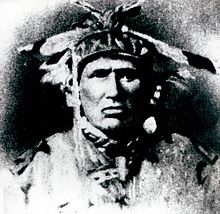 Cadotte clarifies here that Le Pain is yet another food pun–this time on Le Pin, or the Pine. Zhingwaakoons (Pine) was a powerful Ojibwe chief on the British side of the Sault. The Lagardes and their in-laws, the LeSages were Metis trading families in the region.
Eustache Legarde
My dear friend,
I write you this to wish you good health & to send my compliments to all our friends. I make known to you the result of the counsel we held yesterday with the Bread.* The answer is now received. The English Government has accepted all the applications of the Indians in favor of the half breeds, so the half breeds will begin to receive presents of the Government next summer. Furthermore the Government promises to supply the Indians with all things necessary to cultivate the soil. Besides all this the Government promises to build houses for the Half breeds, and to let them have a Forge. The Bread (Pine) is looking for a convenient place to build a half breed village. I recommend that you tell this news to all who are concerned in this matter. I am very sorry to inform you that your youngest nephew died some days ago. The rest of Sages family appear to be well. I close wishing you all kind of prosperity.
Believe me your friend
Alexis Cadotte
*Pine
From this letter, it becomes clear who “The Bread” is. It also shows that Cadotte’s motivation for writing Buffalo and Manabozho goes beyond simply missing his relatives. He wants the La Pointe chiefs to maintain their relationship with the British government and potentially relocate to Canada permanently.
By 1840, the Lake Superior Ojibwe were beginning to feel the heat of American colonization. The influx of white settlers (aside from in the lumber camps on the Chippewa and St. Croix) had yet to begin in earnest, but missionaries had settled in Ojibwe villages, and their presence was far from universally welcomed. The fur trade was in steep decline, and the monopolistic American Fur Company was well into its transition into a business model based on debts, land cessions, and annuity payments (what Witgen calls the political economy of plunder). The Treaty of St. Peters (1837) further divided Ojibwe society, creating deep resentments between the Lake Superior Bands and the Mississippi and Leech Lake Bands. Resentments also grew between the “full bloods” who were able to draw annuities from treaties, and the “mix-bloods,” who did not receive annuities but were able to use American citizenship and connections to the fur company for continued economic gain post-fur trade. Finally, the specter of removal hung over any Indian nation that had ceded its lands. The Lake Superior Ojibwe were well aware of the fates of the Meskwaki-Sauk, Potawatomi, Kickapoo, Ho-Chunk and other nations to their south.
Keeping up relations with the British offered benefits beyond just the material goods described by Cadotte. It forced the American government to remain on friendly terms with the Ojibwe to prove that they were a more benevolent people than the British. In negotiations, the Ojibwe leadership often reminded the U.S. of the generosity of the “British Father.” Canadian territory also offered a potential refuge in the event of forced removal. The Jay Treaty (1796) had drawn a line through Lake Superior on European maps, but in 1840, there was still Ojibwe territory on both sides of the lake, and the people of La Pointe had many relatives on both sides of the Soo.
Zhingwaakoons was a fierce advocate of Ojibwe self-determination, and Cadotte’s letter shows that Little Pine (a.k.a. The Bread) was beginning to implement his scheme to concentrate as many Ojibwe people as possible at Garden River. If he could add the Lake Superior bands on the American side to his number, it would strengthen his position with the British-Canadian authorities. The British were open to the idea, as the Ojibwe provided a military buffer against American aggression in the event of another war between the United States and the United Kingdom. The more Ojibwe on the border in Canada, the stronger the buffer.
If you are interested in these topics, I strongly recommend this book:
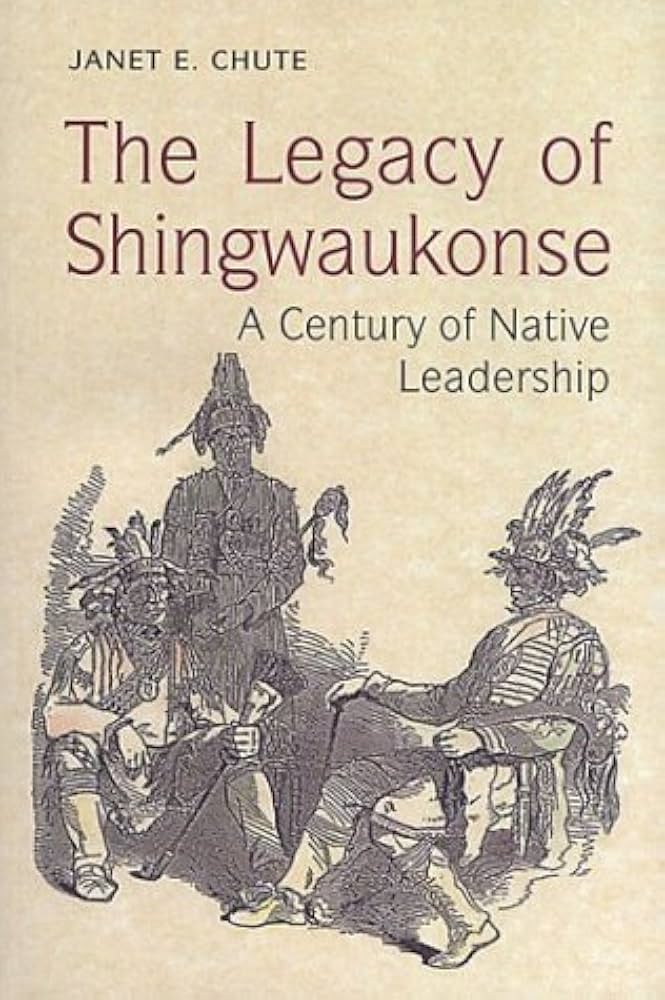
I had already been writing Chequamegon History for a few years before I discovered The Legacy of Shingwaukonse: A Century of Native Leadership by Janet E. Chute through multiple fascinating references in Paap’s Red Cliff, Wisconsin. It was a nice wakeup call. It’s easy to get into the rut of only looking at records from the U.S. Government, the fur companies, and the missionary societies. There are other sources out there, of which the material coming from the British side of the Sault is a one example.
One of the puzzling things about the Alexis Cadotte letter is that it’s written in French. The common mother tongue of Cadotte, Buffalo, and Manabozho would have been Ojibwe. Granted, 1840 was a little early for Father Baraga’s Ojibwe writing system to have caught on, and Cadotte wouldn’t have known Sherman Hall’s system. In the following decades, letters in the Ojibwe language would become slightly more common, but at that early point, Cadotte may have still regarded Ojibwe as strictly a spoken language. It’s also possible that French offered a little more secrecy than English. Potential translators on Madeline Island would be other Metis (or Canadien heads of Metis families), whose goals would align more with Cadotte’s than with the United States Government’s. However, this is speculation.
Chief Buffalo is probably referenced more than any other individual on Chequamegon History, but we haven’t had a lot to say about Manabozho. The truth is, we don’t have a lot of sources about him. From another French document, from another Cadotte, we know that he was living at La Pointe in 1831:
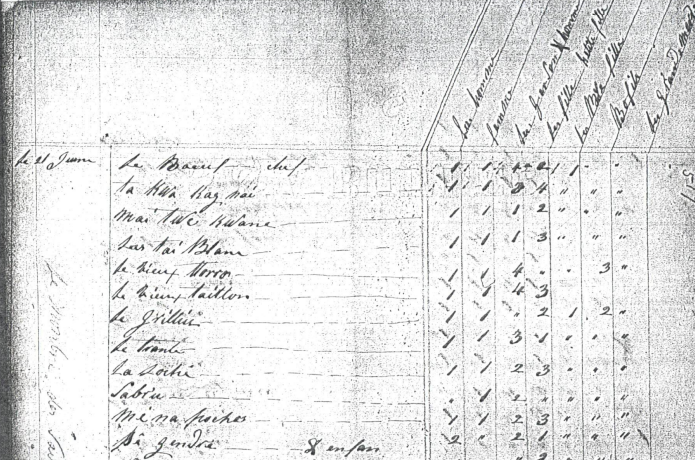
This 1831 census of La Pointe was taken by Big Michel Cadotte (first cousin of Alexis’ father, Little Michel Cadotte), and we see Le Boeuf listed as chief of the band. Me-na-poch-o is the eleventh household listed, and “se gendre,” an unidentified son-in-law and grandson are directly beneath him. 1 man (des hommes) 1 wife (des femmes) 2 sons (des hommes & garsons) and 3 daughters or granddaughters (des filles et petite filles) were living in Manabozho’s household.
We also see his name among the two La Pointe chiefs who signed the Treaty of Prairie du Chien (1825).

“Gitshee X Waiskee or Le Bouf of La pointe Lake superior” “Nainaboozho X of La pointe Lake Superior” Manabozho is named after the famous trickster and rabbit manitou who William Warren called “the universal uncle of the An-ish-in-aub-ag.” The initial consonant in the name of this powerful being could be an “M,” “N,” or “W” depending on grammatical context and regional dialect. Spellings in La Pointe documents from this era use all three.
And from the testimony from the 1839 payments at La Pointe, to mix-bloods and traders under the third and fourth articles of the Treaty of St. Peters (1837), we can see that Manabozho and Buffalo had a history of working with Alexis’ family. This testimony was given in favor of Alexis’ brother Louis’ claim against the Lac Courte Oreilles Ojibwe:
Heirs of Michel Cadotte a British Subject
To amount of private property destroyed at the post occupied by Mr. Louis Corbin in the year 1809 or 1810, the claimant being then absent from said post but had left there his private property and that of his deceased father, Estimated at Eight hundred Dollars– $800.00
Louis Cadotte
His X mark
La Pointe 30th August 1838
G Franchere } witnesses
Eustache Roussain
N.B. The papers and books were all destroyed
L x C
We the undersigned Pé-jé-ké, chief of the Chippewa Tribe of Indians, residing at La Pointe and Mé-na-bou-jou, also of La pointe but formerly residing at Lac Court Oreil, do hereby certify that, to our knowledge, to the best of our recollection, about the year 1809 or 1810 the above claimant and his father had who was an Indian trader at said Lac Court Oreil, had their property destroyed by a band of Chippewa Indians, whilst said claimant was absent as well as his late father who had gone to Michilimackinac to get his usual years supply of Goods for the prosecution of his trade, which we firmly believe that the amount of Eight hundred Dollars as specified in the above account, is just and reasonable, and ought to be allowed. In witness whereof we have signed these presents the same having been read over and interpreted to us by Eustache Roussain. La Pointe this 30th day of August 1838.
Pé-jé-ké his X mark The Buffalo
Mé-na-bou-jo his X mark

This claim is for property destroyed by followers of the Shawnee Prophet, Tenskwatawa on the Cadotte outfit post of Jean Baptiste Corbine at Lac Courte Oreille. Tenskwatawa, the brother of Tecumseh, had many followers in this region. Chequamegon History covered this incident, and Chief Buffalo’s role, back in 2013.
In the general mix blood claims, published in Theresa Schenck’s All Our Relations: Chippewa Mixed Bloods and the Treaty of 1837 (Amik Press; 2009), we learn more the exact relationship of Manabozho and Buffalo to the Cadottes. The former is their uncle, and the latter is their great uncle. Whether that makes the two men closely related to each other isn’t clear. The claims don’t say if they are blood relatives or in-laws of the Cadotte’s mother, Okeebagezhigoqua. However, if Manabozho was born into the band of Buffalo’s grandfather, Andegwiiyaas, and was living at Lac Courte Oreilles at the dawn of the 19th century, this would be consistent with a pattern of the “La Pointe Bands” of that era who were associated with La Pointe but living and hunting inland.
I should note that in Alexis Cadotte’s letter, he refers to Buffalo as grandpere rather than grand oncle. Don’t get too hung up on this. I am no expert on traditional Ojibwe conceptions of kinship other than to say they can be very different from European kinship systems and that it would not be at all unusual for a grandnephew to address his granduncle with the honorific title of grandfather.
From Francois, Joseph, and Charles LaRose claim
“Their Uncles are now residing at the Point, one of them is a respectable full blood Chippewa named Na-naw-bo-zho. The chief at La Pointe called Buffalo is their grand uncle. Their mother is a sister to the Cadottes. (Schenck, pg. 86)
From claims of Alexis, Louis, and Charles Cadotte, Mary Ann Biron, Agathe Perrault, and Mary McFarlane
“[Their] father was Michael Cadotte, a French trader in the ceded country, where he married a woman of the Ojibwa nation from Lake Coute Oreille named O-kee-ba-ge-zhi-go-qua.” (Schenck pg. 41)
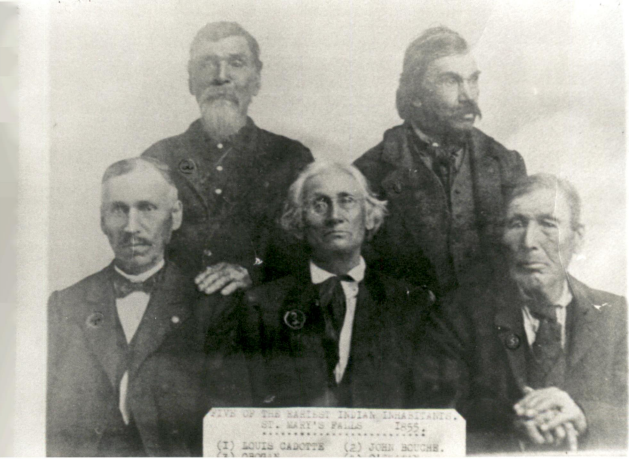
“Five of the Earliest Indian Inhabitants of St. Mary’s Falls, 1855: 1) Louis Cadotte, John Boushe, Obogan, O’Shawan, [Louis] Gurnoe If this caption is to be trusted, andcaptions aren’t always to be trusted, there is a man named Louis Cadotte in this photo who would be about the right age to be Alexis’s brother. I read the numbers to indicate that he’s the man in the upper right. Others have interpreted this photo differently.
Sometimes different people have the same name. Very few of us can be expected to be fluent in English, Ojibwe, and regional dialects and creoles of 18th-century Quebec French (that doesn’t mean we shouldn’t try!). It’s not only language. Subtle differences of religious and cultural understanding can skew the way a source is interpreted. Sources can be hard to come by, contradictory, misinterpreted by other researchers, or in unexpected places. Sometimes you stumble upon a previously unknown source that throws a monkey wrench into all your previous conclusions.
All this means that if you’re going to do this research, expect that you are going to have to humble yourself, admit mistakes, and admit when you might be pretty sure of something but not absolutely certain. My next few posts will explore these concepts further.
As always, thanks for reading,
Leo
~~~~~~~~~~~~~~~~~~~~~~~~~~~~~~~~~~~~~~~~~~~~~~~~~~~
P.S. Speaking of monkey wrenches…
Facts, Volumes 2-3. Facts Publishing Company. Boston, 1883. Pg. 66-68.


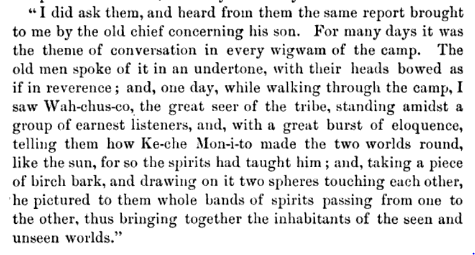
At Chequamegon History, we try to use reliable narrators. We try to use sources from before 1860. First-hand information is preferable to second or third-hand information, and we do not engage in much speculation or evaluation when it comes to questions of spirituality. This is especially true of traditional Ojibwe spirituality, of which we know very little.
Therefore, I strongly considered leaving out this excerpt from FACTS Prove the Truth of Science, and we do not know by any other means any Truth; we, therefore, give the so-called Facts of our Contributors to prove the Intellectual Part of Man to be Immortal. From what I can tell, this bizarre 1883 publication is dedicated to stories of “Spiritualism,” the popular late 19th-century pseudoscience (think the earliest Ouija boards, Rasputin, etc.). If you haven’t already guessed from the the length of the title, FACTS… appears to have been pretty fringe even for its own time. Take it for what it is.
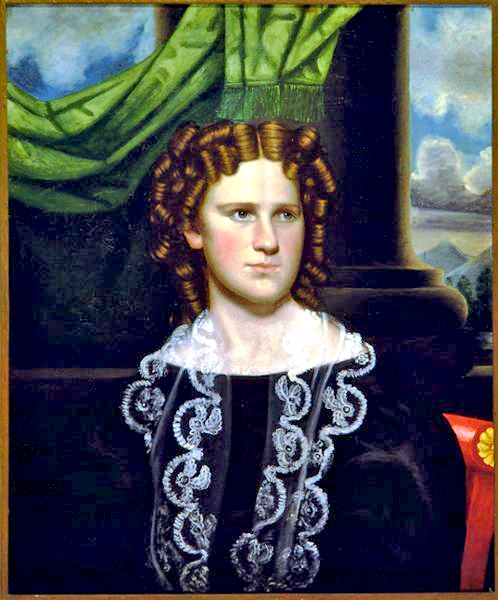
Florantha (above) and Granville Sproat were more than just teachers with funny names. They wrote about 1840s La Pointe. The sex scandal that led to their departure sent a ripple through the Protestant mission community. (Wisconsin Historical Society)
Granville Sproat, however, was a real person–a schoolteacher in the Protestant mission at La Pointe. His wife, Florantha, is quoted near the top of this post, referencing the death of Chief Buffalo’s sons. The Sproats’ impact on this area’s history is pretty minimal, though they did produce a fair amount of writing in the late 1830s and early ’40s. Perhaps the most interesting part of their Chequamegon story is their abrupt departure from the Island after Granville became embroiled in what I believe is Madeline Island’s earliest recorded gay sex scandal. Since I can’t end on that cliff hanger, and it might be several years before I get to that particular story, you can learn more from Bob Mackreth’s thorough and informative treatment of Florantha’s life on youtube.
This post has really gone off the rails. Thanks for sticking with it, and as always, thanks for reading. ~LF
Special thanks to Theresa, Patricia, and Stephane for making this post possible.
When we die, we will lay our bones at La Pointe.
March 20, 2024
By Leo
From individual historical documents, it can be hard to sequence or make sense of the efforts of the United States to remove the Lake Superior Ojibwe from ceded territories of Wisconsin and Upper Michigan in the years 1850 and 1851. Most of us correctly understand that the Sandy Lake Tragedy was caused an alliance of government and trading interests. Through greed, deception, racism, and callous disregard for human life, government officials bungled the treaty payment at Sandy Lake on the Mississippi River in the fall and winter of 1850-51, leading to hundreds of deaths. We also know that in the spring of 1852, Chief Buffalo and a delegation of La Pointe Ojibwe chiefs travelled to Washington D.C. to oppose the removal. It is what happened before and between those events, in the summers of 1850 and 1851, where things get muddled.

Confusion arises because the individual documents can contradict our narrative. A particular trader, who we might want to think is one of the villains, might express an anti-removal view. A government agent, who we might wish to assign malicious intent, instead shows merely incompetence. We find a quote or letter that seems to explain the plans and sentiments leading to the disaster at Sandy Lake, but then we find the quote is dated after the deaths had already occurred.
Therefore, we are fortunate to have the following letter, written in November of 1851, which concisely summarizes the events up to that point. We are even more fortunate that the letter is written by chiefs, themselves. It is from the Office of Indian Affairs archives, but I found a copy in the Theresa Schenck papers. It is not unknown to Lake Superior scholarship, but to my knowledge it has not been reproduced in full.
The context is that Chief Buffalo, most (but not all) of the La Pointe chiefs, and some of their allies from Ontonagon, L’Anse, Upper St. Croix Lake, Chippewa River and St. Croix River, have returned to La Pointe. They have abandoned the pay ground at Fond du Lac in November 1851, and returned to La Pointe. This came after getting confirmation that the Indian Agent, John S. Watrous, has been telling a series of lies in order to force a second Sandy Lake removal–just one year removed from the tragedy. This letter attempts to get official sanction for a delegation of La Pointe chiefs to visit Washington. The official sanction never came, but the chiefs went anyway, and the rest is history.
La Pointe, Lake Superior, Nov. 6./51
To the Hon Luke Lea
Commissioner of Indian Affairs Washington D.C.
Our Father,
We send you our salutations and wish you to listen to our words. We the Chiefs and head men of the Chippeway Tribe of Indians feel ourselves aggrieved and wronged by the conduct of the U.S. Agent John S. Watrous and his advisors now among us. He has used great deception towards us, in carrying out the wishes of our Great Father, in respect to our removal. We have ever been ready to listen to the words of our Great Father whenever he has spoken to us, and to accede to his wishes. But this time, in the matter of our removal, we are in the dark. We are not satisfied that it is the President that requires us to remove. We have asked to see the order, and the name of the President affixed to it, but it has not been shewn us. We think the order comes only from the Agent and those who advise with him, and are interested in having us remove.
Kicheueshki. Chief. X his mark
Gejiguaio X “
Kishkitauʋg X “
Misai X “
Aitauigizhik X “
Kabimabi X “
Oshoge, Chief X “
Oshkinaue, Chief X “
Medueguon X “
Makudeua-kuʋt X “
Na-nʋ-ʋ-e-be, Chief X “
Ka-ka-ge X “
Kui ui sens X “
Ma-dag ʋmi, Chief X “
Ua-bi-shins X “
E-na-nʋ-kuʋk X “
Ai-a-bens, Chief X “
Kue-kue-Kʋb X “
Sa-gun-a-shins X “
Ji-bi-ne-she, Chief X “
Ke-ui-mi-i-ue X “
Okʋndikʋn, Chief X “
Ang ua sʋg X “
Asinise, Chief X “
Kebeuasadʋn X “
Metakusige X “
Kuiuisensish, Chief X “
Atuia X “
Gete-kitigani[inini? manuscript torn]
L. H. Wheeler
We the undersigned, certify, on honor, that the above document was shown to us by the Buffalo, Chief of the Lapointe band of Chippeway Indians and that we believe, without implying and opinion respecting the subjects of complaint contained in it, that it was dictated by, and contains the sentiments of those whose signatures are affixed to it.
S. Hall
C. Pulsifer
H. Blatchford
When I started Chequamegon History in 2013, the WordPress engine made it easy to integrate their features with some light HTML coding. In recent years, they have made this nearly impossible. At some point, we’ll have to decide whether to get better at coding or overhaul our signature “blue rectangle” design format. For now, though, I can’t get links or images into the blue rectangles like I used to, so I will have to list them out here:
Joseph Austrian’s description of the same
Boutwell’s acknowledgement of the suspension of the removal order, and his intent to proceed anyway
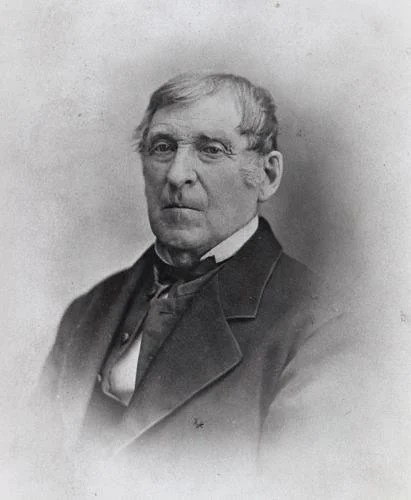
Chequamegon History has looked into the “Great Father” fur trade theater language of ritual kinship before in our look at Blackbird’s speech at the 1855 Payment. You may have noticed Makadebines (Blackbird) didn’t sign this letter. He was working on a different plant to resist removal. Look for a related post soon.
If you’re really interested in why the president was Gichi-noos (Great Father), read these books:

Watrous, and many of the Americans who came to the Lake Superior country at this time, were from northeastern Ohio. Watrous was able to obtain and keep his position as agent because his family was connected to Elisha Whittlesey.
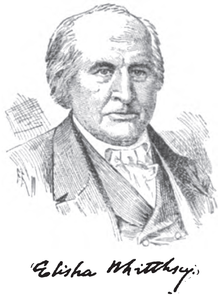
In the summer and fall of 1851, Watrous was determined to get soldiers to help him force the removal. However, by that point, Washington was leaning toward letting the Lake Bands stay in Wisconsin and Michigan.
Last spring, during one of the several debt showdowns in Congress, I wrote on how similar antics in Washington contributed to the disaster of 1850. My earliest and best understanding of the 1850-1852 timeline, and the players involved, comes from this book:

We know that Kishkitauʋg (Cut Ear), and Oshoge (Heron) went to Washington with Buffalo in 1852. Benjamin Armstrong’s account is the most famous, but the delegation’s other interpreter, Vincent Roy Jr., also left his memories, which differ slightly in the details.

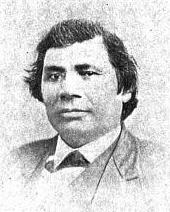
One of my first posts on the blog involved some Sandy Lake material in the Wheeler Family Papers, written by Sherman Hall. Since then, having seen many more of their letters, I would change some of the initial conclusions. However, I still see Hall as having committing a great sin of omission for not opposing the removal earlier. Even with the disclaimer, however, I have to give him credit for signing his name to the letter this post is about. Although they shared the common goal of destroying Ojibwe culture and religion and replacing it with American evangelical Protestantism, he A.B.C.F.M. mission community was made up of men and women with very different personalities. Their internal disputes were bizarre and fascinating.
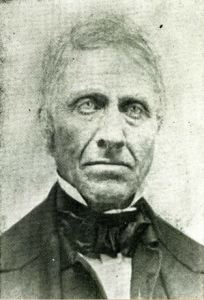

1837 Petitions from La Pointe to the President
January 29, 2023
Collected & edited by Amorin Mello
Letters Received by the Office of Indian Affairs:
La Pointe Agency 1831-1839
National Archives Identifier: 164009310
O. I. A. La Pointe J171.
Hon Geo. W. Jones
Ho. of Reps. Jany 9, 1838
Transmits petition dated 31st Augt 1837, from Michel Cadotte & 25 other Chip. Half Breeds, praying that the amt to be paid them, under the late Chip. treaty, be distributed at La Pointe, and submitting the names of D. P. Bushnell, Lyman M. Warren, for the appt of Comsr to make the distribution.
Transmits it, that it may receive such attention as will secure the objects of the petitioners, says as the treaty has not been satisfied it may be necessary to bring the subject of the petition before the Comsr Ind Affrs of the Senate.
Recd 10 Jany 1838
file
[?] File.
House of Representatives Jany 9th 1838

Sir
I hasten to transmit the inclosed petition, with the hope, that the subject alluded to, may receive such attention, as to secure the object of the petitioners. As the Chippewa Treaty has not yet been ratified it may be necessary to bring the subject of the petition before the Committee of Indian Affairs of the Senate.
I am very respectfully
Your obt svt
Geo W. Jones
C. A. Harris Esqr
Comssr of Indian Affairs
War Department

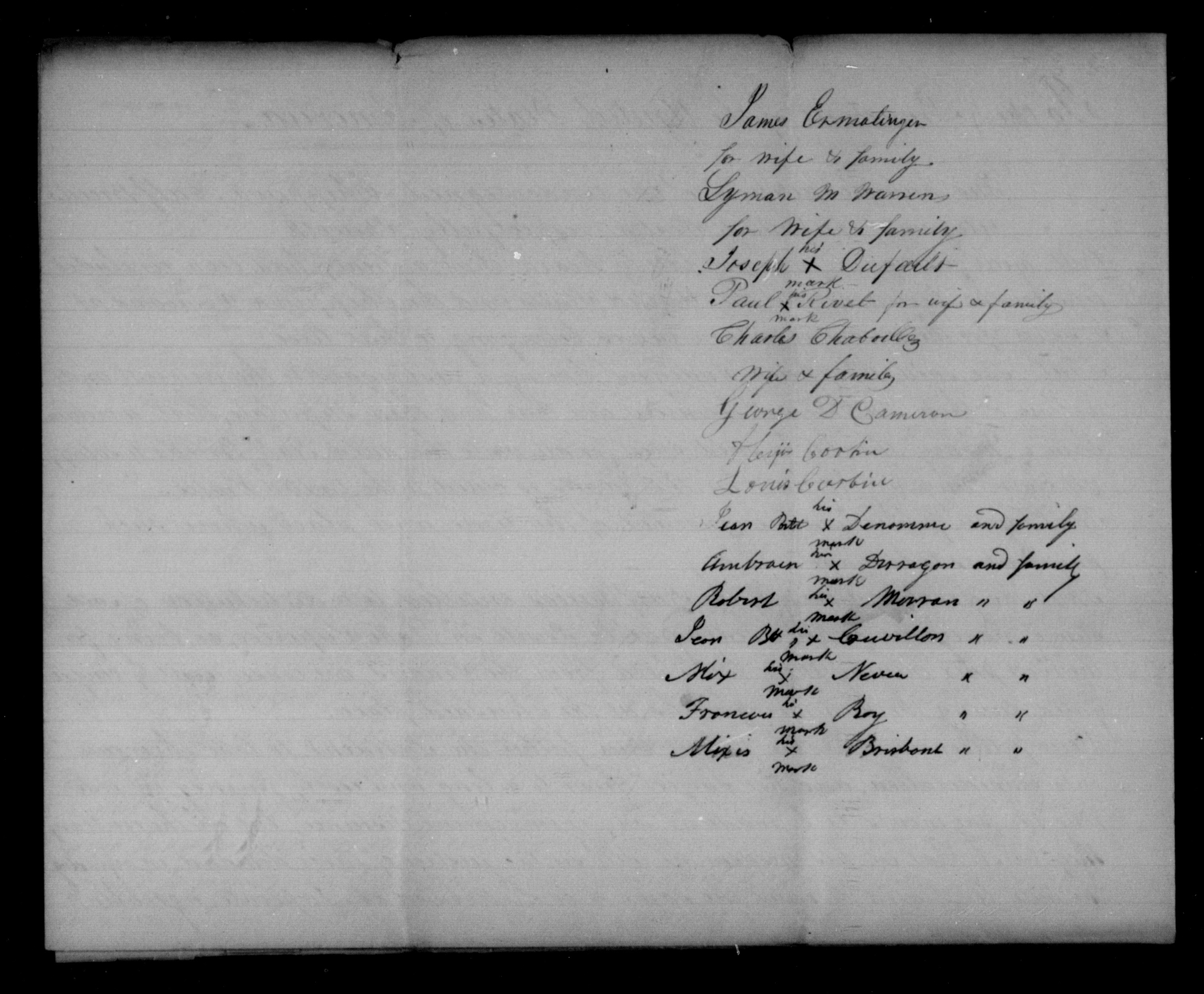
To the President of the United States of America
The humble petition of the undersigned Chippewa Half-Breeds citizens of the United Sates, respectfully Shareth:

Bizhiki (Buffalo), Dagwagaane (Two Lodges Meet), and Jechiikwii’o (Snipe, aka Little Buffalo) signed the 1837 Treaty of St Peters for the La Pointe Band.
That, your petitioners having lately heard that a Treaty had been concluded between the Government of the United Sates and the Chippewa Indians at St Peters, for the cession of certain lands belonging to that tribe:
ARTICLE 3.
“The sum of one hundred thousand dollars shall be paid by the United States, to the half-
breeds of the Chippewa nation, under the direction of the President. It is the wish of the
Indians that their two sub-agents Daniel P. Bushnell, and Miles M. Vineyard, superintend
the distribution of this money among their half-breed relations.”
That, the said Chippewa Indians X, having a just regard to the interest and welfare of their Half Breed brethren, did there and then stipulate; that, a certain sum of money should be paid once for all unto the said Half-Breeds, to satisfy all claim they might have on the lands so ceded to the United States.
That, your petitioners are ignorant of the time and place where such payment is to be made.
That the great majority of the Half-Breeds entitled to a distribution of said sum of money, are either residing at La Pointe on Lake Superior, or being for the most part earning their livelihood from the Traders, are consequently congregated during the summer months at the aforesaid place.
Your petitioners humbly solicit their father the President, to take their case into consideration, and not subject them to a long and costly journey in ordering the payments to be made at any inconvenient distance, but on the contrary they trust that in his wisdom he will see the justice of their demand in requiring he will be pleased to order the same to be distributed at Lapointe agreeable to their request.
Your petitioners would also intimate that, although they are fully aware that the Executive will make a judicious choice in the appointment of the Commissioners who will be selected to carry into effect the Provisions of said Treaty, yet, they would humbly submit to the President, that they have full confidence in the integrity of D. P. Bushnell Esqr. resident Indian Agent for the United States at this place and Lyman M Warren Esquire, Merchant.
Your petitioners entertain the flattering hope, that, their petition will not be made in vain, and as in duty bound will ever pray.
La Pointe, Lake Superior,
Territory of Wisconsin 31st August 1837
Michel Cadotte
Michel Bosquet X his mark
Seraphim Lacombe X his mark
Joseph Cadotte X his mark
Antoine Cadotte X his mark
Chs W Borup for wife & Children
A Morrison for wife & children
Pierre Cotte
Henry Cotte X his mark
Frances Roussan X his mark
James Ermatinger for wife & family
Lyman M Warren for wife & family
Joseph Dufault X his mark
Paul Rivet X his mark for wife & family
Charles Chaboullez wife & family
George D. Cameron
Alixis Corbin
Louis Corbin
Jean Bste Denomme X his mark and family
Ambrose Deragon X his mark and family
Robert Morran X his mark ” “
Jean Bst Couvillon X his mark ” “
Alix Neveu X his mark ” “
Frances Roy X his mark ” “
Alixis Brisbant X his mark ” “
Signed in presence of G. Pauchene
John Livingston
O.I.A. La Pointe W424.
Governor of Wisconsin
Mineral Pt. Feby 19, 1838
Transmits the talk of “Buffalo,” a Chip. Chief, delivered at the La Pointe SubAgt, Dec. 9, 1837, asking that the am. due the half-breeds under the late Treaty, be divided fairly among them, & paid them there, as they will not go to St Peters for it, &c.
Says Buffalo has great influence with his tribe, & is friendly to the whites; his sentiments accord with most of those of the half-breeds & Inds in that part of the country.
File
Recd 13 March 1838
[?] File.
Superintendency of Indian Affairs
for the Territory of Wisconsin
Mineral Point, Feby 19, 1838

Sir,
I have the honor to inclose the talk of “Buffalo,” a principal chief of the Chippewa Indians in the vicinity of La Pointe, delivered on the 9th Dec’r last before Mr Bushnell, sub-agent of the Chippewas at that place. Mr. Bushnell remarks that the speech is given with as strict an adherence to the letter as the language will admit, and has no doubt the sentiments expressed by this Chief accord with those of most of the half-breeds and Indians in that place of the Country. The “Buffalo” is a man of great influence among his tribe, and very friendly to the whites.
Very respectfully,
Your obed’t sevt.
Henry Dodge
Supt Ind Affs
Hon C. A. Harris
Com. of Ind. Affairs
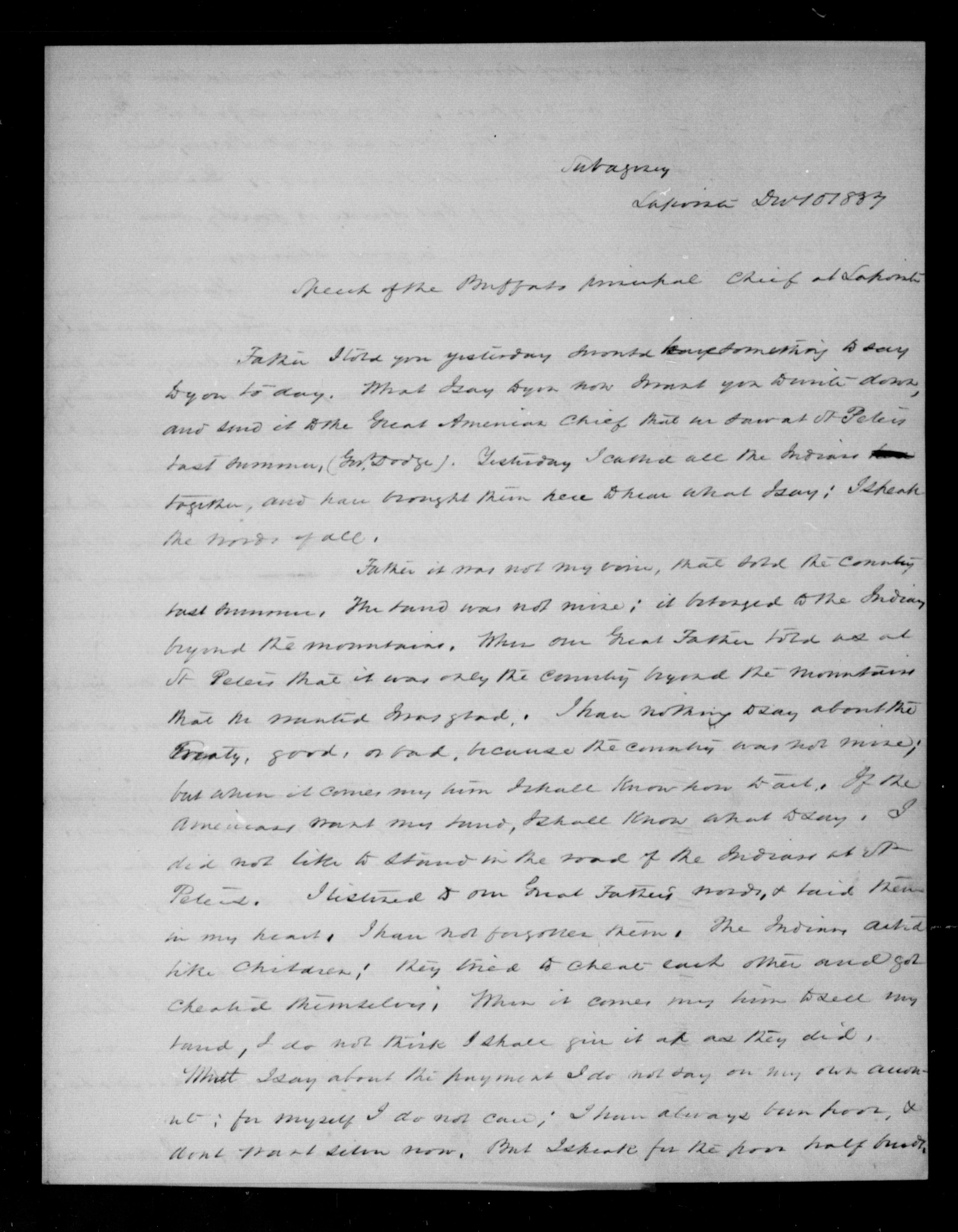
Subagency
Lapointe Dec 10 1837
Speech of the Buffalo principal Chief at Lapointe
Father I told you yesterday I would have something to say to you today. What I say to you now I want you to write down, and send it to the Great American Chief that we saw at St Peters last summer, (Gov. Dodge). Yesterday, I called all the Indians together, and have brought them here to hear what I say; I speak the words of all.
ARTICLE 1.
“The said Chippewa nation cede to the United States all that tract of country included
within the following boundaries:
[…]
thence to and along the dividing ridge between the waters of Lake Superior and those of the Mississippi
[…]“
Father it was not my voice, that sold the country last summer. The land was not mine; it belonged to the Indians beyond the mountains. When our Great Father told us at St Peters that it was only the country beyond the mountains that he wanted I was glad. I have nothing to say about the Treaty, good, or bad, because the country was not mine; but when it comes my time I shall know how to act. If the Americans want my land, I shall know what to say. I did not like to stand in the road of the Indians at St Peters. I listened to our Great Father’s words, & said them in my heart. I have not forgotten them. The Indians acted like children; they tried to cheat each other and got cheated themselves. When it comes my time to sell my land, I do not think I shall give it up as they did.
What I say about the payment I do not say on my own account; for myself I do not care; I have always been poor, & don’t want silver now. But I speak for the poor half breeds.
There are a great many of them; more than would fill your house; some of them are very poor They cannot go to St Peters for their money. Our Great Father told us at St Peters, that you would divide the money, among the half breeds. You must not mind those that are far off, but divide it fairly, and give the poor women and children a good share.
Father the Indians all say they will not go to St Peters for their money. Let them divide it in this parts if they choose, but one must have ones here. You must not think you see all your children here; there are so many of them, that when the money and goods are divided, there will not be more than half a Dollar and a breech cloth for each one. At Red Cedar Lake the English Trader (W. Aitken) told the Indians they would not have more than a breech cloth; this set them to thinking. They immediately held a council & their Indian that had the paper (The Treaty) said he would not keep it, and would send it back.
It will not be my place to come in among the first when the money is paid. If the Indians that own the land call me in I shall come in with pleasure.
ARTICLE 4.
“The sum of seventy thousand dollars shall be applied to the payment, by the United States, of certain claims against the Indians; of which amount twenty eight thousand dollars shall, at their request, be paid to William A. Aitkin, twenty five thousand to Lyman M. Warren, and the balance applied to the liquidation of other just demands against them—which they acknowledge to be the case with regard to that presented by Hercules L. Dousman, for the sum of five thousand dollars; and they request that it be paid.“
We are afraid of one Trader. When at St Peters I saw that they worked out only for themselves. They have deceived us often. Our Great Father told us he would pay our old debts. I thought they should be struck off, but we have to pay them. When I heard our debts would be paid, it done my heart good. I was glad; but when I got back here my joy was gone. When our money comes here, I hope our Traders will keep away, and let us arrange our own business, with the officers that the President sends here.
Father I speak for my people, not for myself. I am an old man. My fire is almost out – there is but little smoke. When I set in my wigwam & smoke my pipe, I think of what has past and what is to come, and it makes my heart shake. When business comes before us we will try and act like chiefs. If any thing is to be done, it had better be done straight. The Indians are not like white people; they act very often like children. We have always been good friends to the whites, and we want to remain so. We do not [even?] go to war with our enemies, the Sioux; I tell my young men to keep quiet.
Father I heard the words of our Great Father (Gov. Dodge) last summer, and was pleased; I have not forgotten what he said. I have his words up in my heart. I want you to tell him to keep good courage for us, we want him to do all he can for us. What I have said you have written down; I [?] you to hand him a copy; we don’t know your ways. If I [?] said any thing [?] dont send it. If you think of any thing I ought to say send it. I have always listened to the white men.
O.I.A. Lapointe, B.458
D. P. Bushnell
Lapointe, March 8, 1838
At the request of some of the petitioners, encloses a petition dated 7 March 1838, addressed to the Prest, signed by 167 Chip. half breeds, praying that the amt stipulated by the late Chip. Treaty to be paid to the half breeds, to satisfy all claims they ma have on the lands ceded by this Treaty, may be distributed at Lapointe.
Hopes their request will be complied with; & thinks their annuity should likewise be paid at Lapointe.
File
Recd 2nd May, 1838
Subagency
Lapointe Mch 6 1838
Sir
I have the honor herewith to enclose a petition addressed to the President of the United States, handed to me with a request by several of the petitioners that I would forward it. The justice of the demand of these poor people is so obvious to any one acquainted with their circumstances, that I cannot omit this occasion to second it, and to express a sincere hope that it will be complied with. Indeed, if the convenience and wishes of the Indians are consulted, and as the sum they receive for their country is so small, these should, I conciev, be principle considerations, their annuity will likewise as paid here; for it is a point more convenient of access for the different bands, that almost any other in their own country, and one moreover, where they have interests been in the habit of assembling in the summer months.
I am sir, with great respect,
your most obt servant,
D. P. Bushnell
O. I. A.
C. A. Harris Esqr.
Comr Ind. Affs
To the President of the United States of America
The humble petition of the undersigned Chippewa Half-Breeds citizens of the United States respectfully shareth
That your petitioners having lately heard, that a Treaty has been concluded between the Government of the United States and the Chippewa Indians at St Peters for the cession of certain lands belonging to that tribe;
That the said Chippewa Indians having a just regard to the interest and wellfare of their Half-Breed brethern, did there and then stipulate, that a certain sum of money should be paid once for all unto the said Half-Breeds, to satisfy all claims, they might have on the lands so ceded to the United States;
That your petitioners are ignorant of the time and place, where such payment is to be made; and
That the great majority of the Half-Breeds entitled to a portion of said sum of money are either residing at Lapointe on Lake Superior, or being for the most part earning their livelihood from the Traders, are consequently congregated during the summer months at the aforesaid place;
Your petitioners therefore humbly solicit their Father the President to take their case into consideration, and not subject them to a long and costly journey on ordering the payment to be made at any convenient distance, but on the contrary, they wish, that in his wisdom he will see the justice of this petition and that he will be pleased to order the same to be distributed at Lapointe agreeably to their request.
Your petitioners entertain the flattering hope, that their petition will not be made in vain and as in duly bound will ever pray.
Half Breeds of Folleavoine Lapointe Lac Court Oreilles and Lac du Flambeau
Georg Warren
Edward Warren
William Warren
Truman A Warren
Mary Warren
Michel Cadott
Joseph Cadotte
Joseph Dufault
Frances Piquette X his mark
Michel Bousquet X his mark
Baptiste Bousquet X his mark
Jos Piquette X his mark
Antoine Cadotte X his mark
Joseph Cadotte X his mark
Seraphim Lacombre X his mark
Angelique Larose X her mark
Benjamin Cadotte X his mark
J Bte Cadotte X his mark
Joseph Danis X his mark
Henry Brisette X his mark
Charles Brisette X his mark
Jehudah Ermatinger
William Ermatinger
Charlotte Ermatinger
Larence Ermatinger
Theodore Borup
Sophia Borup
Elisabeth Borup
Jean Bte Duchene X his mark
Agathe Cadotte X her mark
Mary Cadotte X her mark
Charles Cadotte X his mark
Louis Nolin _ his mark
Frances Baillerge X his mark
Joseph Marchand X his mark
Louis Dubay X his mark
Alexis Corbin X his mark
Augustus Goslin X his mark
George Cameron X his mark
Sophia Dufault X her mark
Augt Cadotte No 2 X his mark
Jos Mace _ his mark
Frances Lamoureau X his mark
Charles Morrison
Charlotte L. Morrison
Mary A Morrison
Margerike Morrison
Jane Morrison
Julie Dufault X her mark
Michel Dufault X his mark
Jean Bte Denomme X his mark
Michel Deragon X his mark
Mary Neveu X her mark
Alexis Neveu X his mark
Michel Neveu X his mark
Josette St Jean X her mark
Baptist St Jean X his mark
Mary Lepessier X her mark
Edward Lepessier X his mark
William Dingley X his mark
Sarah Dingley X her mark
John Hotley X his mark
Jeannette Hotley X her mark
Seraphim Lacombre Jun X his mark
Angelique Lacombre X her mark
Felicia Brisette X her mark
Frances Houle X his mark
Jean Bte Brunelle X his mark
Jos Gauthier X his mark
Edward Connor X his mark
Henry Blanchford X his mark
Louis Corbin X his mark
Augustin Cadotte X his mark
Frances Gauthier X his mark
Jean Bte Gauthier X his mark
Alexis Carpentier X his mark
Jean Bte Houle X his mark
Frances Lamieux X his mark
Baptiste Lemieux X his mark
Pierre Lamieux X his mark
Michel Morringer X his mark
Frances Dejaddon X his mark
John Morrison X his mark
Eustache Roussain X his mark
Benjn Morin X his mark
Adolphe Nolin X his mark
Half-Breeds of Fond du Lac
John Aitken
Roger Aitken
Matilda Aitken
Harriet Aitken
Nancy Scott
Robert Fairbanks
George Fairbanks
Jean B Landrie
Joseph Larose
Paul Bellanges X his mark
Jack Belcour X his mark
Jean Belcour X his mark
Paul Beauvier X his mark
Frances Belleaire
Michel Comptois X his mark
Joseph Charette X his mark
Chl Charette X his mark
Jos Roussain X his mark
Pierre Roy X his mark
Joseph Roy X his mark
Vincent Roy X his mark
Jack Bonga X his mark
Jos Morrison X his mark
Henry Cotte X his mark
Charles Chaboillez
Roderic Chaboillez
Louison Rivet X his mark
Louis Dufault X his mark
Louison Dufault X his mark
Baptiste Dufault X his mark
Joseph Dufault X his mark
Chs Chaloux X his mark
Jos Chaloux X his mark
Augt Bellanger X his mark
Bapt Bellanger X his mark
Joseph Bellanger X his mark
Ignace Robidoux X his mark
Charles Robidoux X his mark
Mary Robidoux X her mark
Simon Janvier X his mark
Frances Janvier X his mark
Baptiste Janvier X his mark
Frances Roussain X his mark
Therese Rouleau X his mark
Joseph Lavierire X his mark
Susan Lapointe X her mark
Mary Lapointe X her mark
Louis Gordon X his mark
Antoine Gordon X his mark
Jean Bte Goslin X his mark
Nancy Goslin X her mark
Michel Petit X his mark
Jack Petit X his mark
Mary Petit X her mark
Josette Cournoyer X her mark
Angelique Cournoyer X her mark
Susan Cournoyer X her mark
Jean Bte Roy X his mark
Frances Roy X his mark
Baptist Roy X his mark
Therese Roy X her mark
Mary Lavierge X her mark
Toussaint Piquette X his mark
Josette Piquette X her mark
Susan Montreille X her mark
Josiah Bissel X his mark
John Cotte X his mark
Isabelle Cotte X her mark
Angelique Brebant X her mark
Mary Brebant X her mark
Margareth Bell X her mark
Julie Brebant X her mark
Josette Lefebre X her mark
Sophia Roussain X her mark
Joseph Roussain X his mark
Angelique Roussain X her mark
Joseph Bellair X his mark
Catharine McDonald X her mark
Nancy McDonald X her mark
Mary Macdonald X her mark
Louise Landrie X his mark
In presence of
Chs W Borup
A Morrison
A. D. Newton
Lapointe 7th March 1838
1827 Deed for Old La Pointe
December 27, 2022
Collected & edited by Amorin Mello
Chief Buffalo and other principal men for the La Pointe Bands of Lake Superior Chippewa began signing treaties with the United States at the 1825 Treaty of Prairie Du Chien; followed by the 1826 Treaty of Fond Du Lac, which reserved Tribal Trust Lands for Chippewa Mixed Bloods along the St. Mary’s River between Lake Superior and Lake Huron:
ARTICLE 4.
The Indian Trade & Intercourse Act of 1790 was the United States of America’s first law regulating tribal land interests:
SEC. 4. And be it enacted and declared, That no sale of lands made by any Indians, or any nation or tribe of Indians the United States, shall be valid to any person or persons, or to any state, whether having the right of pre-emption to such lands or not, unless the same shall be made and duly executed at some public treaty, held under the authority of the United States.
It being deemed important that the half-breeds, scattered through this extensive country, should be stimulated to exertion and improvement by the possession of permanent property and fixed residences, the Chippewa tribe, in consideration of the affection they bear to these persons, and of the interest which they feel in their welfare, grant to each of the persons described in the schedule hereunto annexed, being half-breeds and Chippewas by descent, and it being understood that the schedule includes all of this description who are attached to the Government of the United States, six hundred and forty acres of land, to be located, under the direction of the President of the United States, upon the islands and shore of the St. Mary’s river, wherever good land enough for this purpose can be found; and as soon as such locations are made, the jurisdiction and soil thereof are hereby ceded. It is the intention of the parties, that, where circumstances will permit, the grants be surveyed in the ancient French manner, bounding not less than six arpens, nor more than ten, upon the river, and running back for quantity; and that where this cannot be done, such grants be surveyed in any manner the President may direct. The locations for Oshauguscodaywayqua and her descendents shall be adjoining the lower part of the military reservation, and upon the head of Sugar Island. The persons to whom grants are made shall not have the privilege of conveying the same, without the permission of the President.
The aforementioned Schedule annexed to the 1826 Treaty of Fond du Lac included (among other Chippewa Mixed Blood families at La Pointe) the families of Madeline & Michel Cadotte, Sr. and their American son-in-laws, the brothers Truman A. Warren and Lyman M. Warren:
-
To Michael Cadotte, senior, son of Equawaice, one section.
-
To Equaysay way, wife of Michael Cadotte, senior, and to each of her children living within the United States, one section.
-
To each of the children of Charlotte Warren, widow of the late Truman A. Warren, one section.
-
To Ossinahjeeunoqua, wife of Michael Cadotte, Jr. and each of her children, one section.
-
To each of the children of Ugwudaushee, by the late Truman A. Warren, one section.
-
To William Warren, son of Lyman M. Warren, and Mary Cadotte, one section.

Detail of Michilimackinac County circa 1818 from Michigan as a territory 1805-1837 by C.A. Burkhart, 1926.
~ UW-Milwaukee Libraries
Now, if it seems odd for a Treaty in Minnesota (Fond du Lac) to give families in Wisconsin (La Pointe) lots of land in Michigan (Sault Ste Marie), just remember that these places were relatively ‘close’ to each other in the sociopolitical fabric of Michigan Territory back in 1827. All three places were in Michilimackinac County (seated at Michilimackinac) until 1826, when they were carved off together as part of the newly formed Chippewa County (seated at Sault Ste Marie). Lake Superior remained Unceded Territory until later decades when land cessions were negotiated in the 1836, 1837, 1842, and 1854 Treaties.
Ultimately, the United States removed the aforementioned Schedule from the 1826 Treaty before ratification in 1827.
Several months later, at Michilimackinac, Madeline & Michel Cadotte, Sr. recorded the following Deed to reserve 2,000 acres surrounding the old French Forts of La Pointe to benefit future generations of their family.
Register of Deeds
Michilimackinac County
Book A of Deeds, Pages 221-224

Michel Cadotte and
Magdalen Cadotte
to
Lyman M. Warren
~Deed.
Received for Record
July 26th 1827 at two Six O’Clock A.M.
J.P. King
Reg’r Probate

Bizhiki (Buffalo), Gimiwan (Rain), Kaubuzoway, Wyauweenind, and Bikwaakodowaanzige (Ball of Dye) signed the 1826 Treaty of Fond Du Lac as the Chief and principal men of La Pointe.

“Copy of 1834 map of La Pointe by Lyman M. Warren“ at Wisconsin Historical Society. Original map (not shown here) is in the American Fur Company papers of the New York Historical Society.
Whereas the Chief and principal men of the Chippeway Tribe of indians, residing on and in the parts adjacent to the island called Magdalen in the western part of Lake Superior, heretofore released and confirmed by Deed unto Magdalen Cadotte a Chippeway of the said tribe, and to her brothers and sisters as tenants in common, thereon, all that part of the said Island called Magdalen, lying south and west of a line commencing on the eastern shore of said Island in the outlet of Great Wing river, and running directly thence westerly to the centre of Sandy bay on the western side of said Island;
and whereas the said brothers and sisters of said Magdalen Cadotte being tenants in common of the said premises, thereafterwards, heretofore, released, conveyed and confirmed unto their sister, the said Magdalen Cadotte all their respective rights title, interest and claim in and to said premises,
and whereas the said Magdalen Cadotte is desirous of securing a portion of said premises to her five grand children viz; George Warren, Edward Warren and Nancy Warren children of her daughter Charlotte Warren, by Truman A. Warren late a trader at said island, deceased, and William Warren and Truman A. Warren children of her daughter Mary Warren by Lyman M. Warren now a trader at said Island;
and whereas the said Magdalen Cadotte is desirous to promote the establishment of a mission on said Island, by and under the direction, patronage and government of the American board of commissioners for foreign missions, according to the plan, wages, and principles and purposes of the said Board.

William Whipple Warren was one of the beneficiary grandchildren named in this Deed.
Now therefore, Know all men by these presents that we Michael Cadotte and Magdalen Cadotte, wife of the said Michael, of said Magdalen Island, in Lake Superior, for and in consideration of one dollar to us in hand paid by Lyman M. Warren, the receipt whereof is hereby acknowledged, and for and in consideration of the natural love and affection we bear to our Grandchildren, the said George, Edward, Nancy, William W., and Truman A. Warren, children of our said daughters Charlotte and Mary;
and the further consideration of our great desire to promote the establishment of a mission as aforesaid, under and by the direction, government and patronage of Board aforesaid, have granted, bargained, sold, released, conveyed and confirmed, and by these presents do grant, bargain, sell, release, convey and confirm unto the said Lyman M. Warren his heirs and assigns, out of the aforerecited premises and as part and parcel thereof a certain tract of land on Magdalen Island in Lake Superior, bounded as follows,
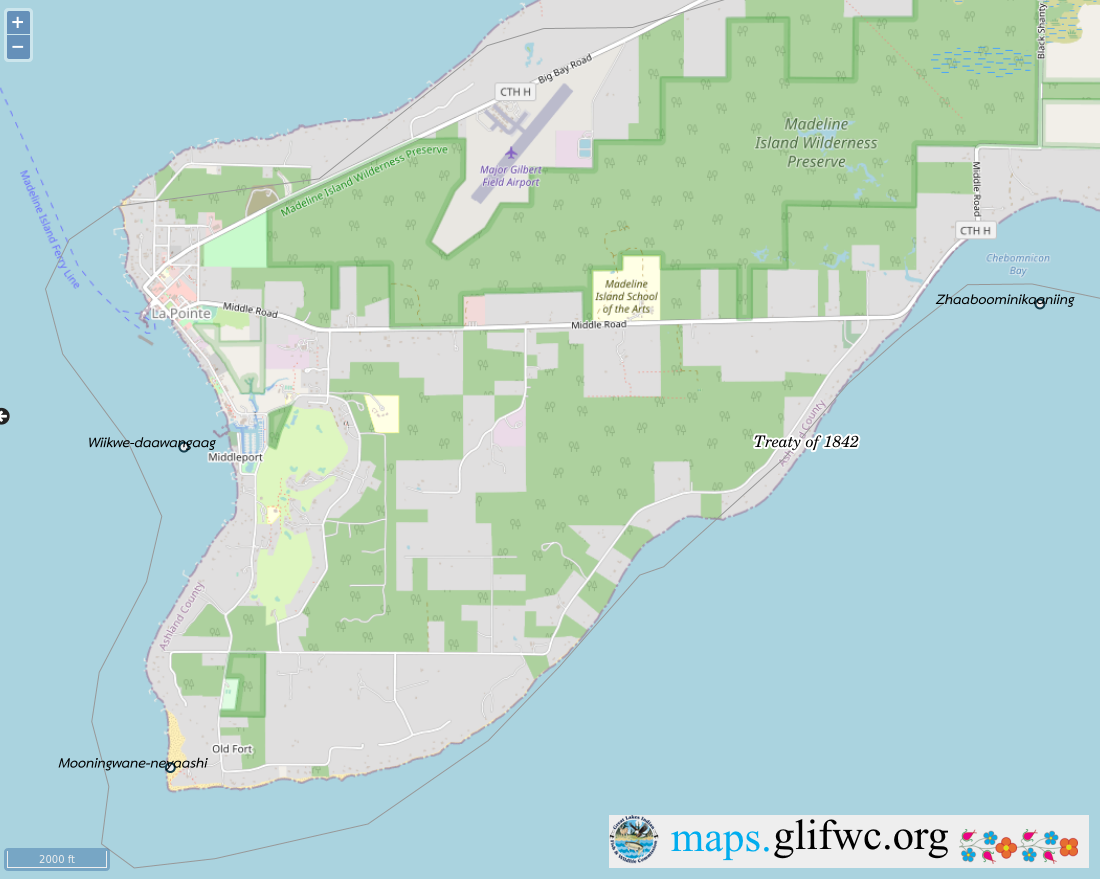
Detail of Ojibwemowin placenames on GLIFWC’s webmap.
that is to say, beginning at the most southeasterly corner of the house built and now occupied by said Lyman M. Warren, on the south shore of said Island between this tract and the land of the grantor, thence on the east by a line drawn northerly until it shall intersect at right angles a line drawn westerly from the mouth of Great Wing River to the Centre of Sandy Bay, thence on the north by the last mentioned line westward to a Point in said line, from which a line drawn southward and at right angles therewith would fall on the site of the old fort, so called on the southerly side of said Island; thence on the west by a line drawn from said point and parallel to the eastern boundary of said tract, to the Site of the old fort, so called, thence by the course of the Shore of old Fort Bay to the portage; thence by a line drawn eastwardly to the place of beginning, containing by estimation two thousand acres, be the same more or less, with the appurtenances, hereditaments, and privileges thereto belonging.
To have and to hold the said granted premises to him the said Lyman M. Warren his heirs and assigns: In Trust, Nevertheless, and upon this express condition, that whensoever the said American Board of Commissioners for foreign missions shall establish a mission on said premises, upon the plan, usages, principles and purposes as aforesaid, the said Lyman M. Warren shall forthwith convey unto the american board of commissioners for foreign missions, not less than one quarter nor more than one half of said tract herein conveyed to him, and to be divided by a line drawn from a point in the southern shore of said Island, northerly and parallel with the east line of said tract, and until it intersects the north line thereof.

Roughly 2,100 acres lies south of Middle Road.
And as to the residue of the said Estate, the said Lyman M. Warren shall divided the same equally with and amongst the said five children, as tenants in common, and not as joint tenants; and the grantors hereby authorize the said Lyman M. Warren with full powers to fulfil said trust herein created, hereby ratifying and confirming the deed and deeds of said premises he may make for the purpose ~~~
In witness whereof we have hereunto set our respective hands, this twenty fifth day of july A.D. one thousand eight hundred and twenty seven, of Independence the fifty first.
(Signed) Michel Cadotte {Seal}
Magdalen Cadotte X her mark {Seal}
Signed, Sealed and delivered
in presence of us }
Daniel Dingley
Samuel Ashman
Wm. M. Ferry
(on the third page and ninth line from the top the word eastwardly was interlined and from that word the three following lines and part of the fourth to the words “to the place” were erased before the signing & witnessing of this instrument.)
~~~~~~
Territory of Michigan }
County of Michilimackinac }
Be it known that on the twenty sixth day of July A.D. 1827, personally came before me, the subscriber, one of the Justices of the Peace for the County of Michilimackinac, Michel Cadotte and Magdalen Cadotte, wife of the said Michel Cadotte, and the said Magdalen being examined separate and apart from her said husband, each severally acknowledged the foregoing instrument to be their voluntary act and deed for the uses and purposes therein expressed.
(Signed) J. P. King
Just. peace
Cxd
fees Paid $2.25
By Leo
In April, the Supreme Court heard arguments in the case Department of Commerce v. New York and could render a decision any day on whether or not the 2020 federal census should include a question asking about citizenship status. In January, a Federal District Court in New York ruled that commerce secretary, Wilbur Ross, violated the law by pushing for that question.
Those in agreement with the District ruling suggest that the Trump administration wants to add the question as a way of discouraging immigrants from participating in the census, thereby diminishing the political power of immigrant communities. This, they say, would violate the Constitution on the grounds that the census must be an “actual enumeration” of all persons within the United States, not only citizens.
Proponents of the citizenship question counter that citizenship status is a perfectly natural question to ask in the census, that any government would want to know how many citizens it has, and that several past iterations of the 10-year count have included similar questions.
It remains to be seen how the Supreme Court will rule, but chances are it will not be the last time an issue of race, identity, or citizenship pops up in the politics of the census. From its creation by the Constitution as a way to apportion seats in congress according to populations of the states, the count has always begged tricky questions that essentially boil down to:
Who is a real American? Who isn’t? Who is a citizen? Who is three-fifths of a human being? Who might not be human at all? What does it mean to be White? To be Colored? To be civilized? How do you classify the myriad of human backgrounds, cultures and stories into finite, discrete “races?”
The Civil War and Fourteenth Amendment helped shed light on some of these questions, but it would be a mistake to think that they belong to the past. The NPR podcast Codeswitch has done an excellent series on census, and this episode from last August gives a broad overview of the history.
Here at Chequamegon History, though, we aren’t in the business broad overviews. We are going to drill down right into the data. We’ll comb through the 1850 federal census for La Pointe County and compare it with the 1860 data for La Pointe and Ashland Counties. Just for fun, we’ll compare both with the 1855 Wisconsin State Census for La Pointe County, then double back to the 1840 federal census for western St. Croix County. Ultimately, the hope is to help reveal how the population of the Chequamegon region viewed itself, and ultimately how that differed from mainstream America’s view. With luck, that will give us a framework for more stories like Amorin’s recent post on the killing of Louis Gurnoe.
Background
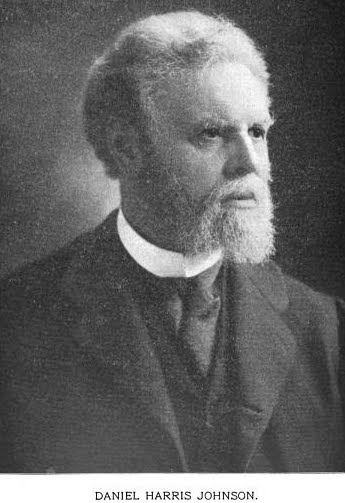 Judge Daniel Harris Johnson of Prairie du Chien had no apparent connection to Lake Superior when he was appointed to travel northward to conduct the census for La Pointe County in 1850. The event made an impression on him. It gets a mention in his short memorial biography in the 1902 Proceedings of the State Bar Association.
Two years after statehood, Lake Superior’s connection to the rest of Wisconsin was hardly existent. This was long before Highways 51 and 53 were built, and commerce still flowed west to east. Any communication to or from Madison was likely to first go through Michigan via Mackinaw and Sault Ste. Marie, or through Minnesota Territory via St. Paul, Stillwater, and Sandy Lake. La Pointe County had been created in 1845, and when official business had to happen, a motley assortment of local residents who could read and write English: Charles Oakes, John W. Bell, Antoine Gordon, Alexis Carpentier, Julius Austrian, Leonard Wheeler, etc. would meet to conduct the business.
It is unclear how much notice the majority Ojibwe and French-patois speaking population took of this or of the census generally. To them, the familiar institutions of American power, the Fur Company and the Indian Agency, were falling apart at La Pointe and reorganizing in St. Paul with dire consequences for the people of Chequamegon. When Johnson arrived in September, the Ojibwe people of Wisconsin had already been ordered to remove to Sandy Lake in Minnesota Territory for their promised annual payments for the sale of their land. That fall, the government would completely botch the payment, and by February, hundreds of people in the Lake Superior Bands would be dead from starvation and disease.
So, Daniel Johnson probably found a great deal of distraction and anxiety among the people he was charged to count. Indians, thought of by the United States as uncivilized federal wards and citizens of their own nations, were typically not enumerated. However, as I wrote about in my last post, race and identity were complicated at La Pointe, and the American citizens of the Chequamegon region also had plenty to lose from the removal.
Madison, for its part, largely ignored this remote, northern constituency and praised the efforts to remove the Ojibwe from the state. It isn’t clear how much Johnson was paying attention to these larger politics, however. He had his own concerns:

House Documents, Volume 119, Part 1. U.S. Government Printing Office, 1859. Google Books.
So, in “that thinly settled and half civilized region,” Johnson only found a population of about 500, “exclusive of Indians.” He didn’t think 500 was a lot, but by some counts, that number would have seemed very high. Take the word of a European visitor to La Pointe:
Among 200 Indians, only a few white families live there. One of the boatmen gave us a name, with which we found Mr. Austrian.
And, from this Mr. Austrian, himself:
There were only about 6 white American inhabitants on the Island, about 50 Canadian Frenchmen who were married to squaws, and a number of full blooded Indians, among whom was chief Buffalo who was a descendant of chiefs & who was a good Indian and favorably regarded by the people.
~Joseph Austrian, Brother of Julius and La Pointe resident 1851-52
Who lived around La Pointe in 1850?
In her biography, William W. Warren: the Life, Letters, and Times of an Ojibwe Leader, Theresa Schenck describes the short life of an ambitious young man from La Pointe. William Whipple Warren (1825-1853) grew up on the Island speaking Ojibwe as his first language. His father was a Yankee fur trader from New York. His mother was a daughter of Michel and Madeline Cadotte. In his famous History of the Ojibways Warren describes the Ojibwe as people with whom he readily claims kinship, but he doesn’t write as if he is an Ojibwe person himself. However, he helped interpret the Treaty of 1847 which had definitively made him an Indian in the eyes of the United States (a fact he was willing to use for economic gain). Still, a few years later, when he became a legislator in Minnesota Territory he dismissed challenges to his claims of whiteness.
If he were alive today, Warren might get a chuckle out of this line from the South African comedian Trevor Noah.
People mocked me. Gave me names like mixed breed, half caste — I hate that term ‘half’. Why half? Why not double? Or twice as nice, I don’t know.
— Trevor Noah
William Warren did not see himself as quite the walking contradiction we might see him as today. He was a product of the time and place he came from: La Pointe. By 1850, he had left that place, but his sister and a few hundred of his cousins still lived there. Many of them were counted in the census.
What is Metis?
Half-breeds, Mixed-bloods, Frenchmen, Wiisakodewininiwag, Mitif, Creoles, Metis, Canadiens, Bois Brules, Chicots, French-of-the-country, etc.–at times it seems each of these means the same thing. At other times each has a specific meaning. Each is ambiguous in its own way. In 1850, roughly half the families in the Chequamegon area fit into this hard-to-define category.

Kohl, J. G. Kitchi-Gami: Wanderings around Lake Superior. London: Chapman and Hall, 1860. pg. 260-61.
We were accompanied on our trip throughout the lakes of western Canada by half-Indians who had paternal European blood in their veins. Yet so often, a situation would allow us to spend a night inside rather than outdoors, but they always asked us to choose to Irish camp outside with the Indians, who lived at the various places. Although one spoke excellent English, and they were drawn more to the great American race, they thought, felt, and spoke—Indian! ~Carl Scherzer
In describing William Warren’s people, Dr. Schenck writes,
Although the most common term for people of mixed Indian and European ancestry in the nineteenth century was “half-breed,” the term “mixed blood” was also used. I have chosen to use the latter term, which is considered less offensive, although biologically inaccurate, today. The term “métis” was not in usage at the time, except to refer to a specific group of people of mixed ancestry in the British territories to the north. “Wissakodewinini,” the word used by the Ojibwe, meant “burned forest men,” or bois brulés in French, so called because half-breeds were like the wood of a burned forest, which is often burned on one side, and light on the other (pg. xv).
Schenck is correct in pointing out that mixed-blood was far more commonly used in 19th-century sources than Metis (though the latter term did exist). She is also correct in saying that the term is more associated with Canada and the Red River Country. There is an additional problem with Metis, in that 21st-century members of the Wannabe Tribe have latched onto the term and use it, incorrectly, to refer to anyone with partial Native ancestry but with no affiliation to a specific Indian community.
That said, I am going to use Metis for two reasons. The first is that although blood (i.e. genetic ancestry) seemed to be ubiquitous topic of conversation in these communities, I don’t think “blood” is what necessarily what defined them. The “pure-blooded French Voyageur” described above by Kohl clearly saw himself as part of Metis, rather than “blanc” society. There were also people of fully-Ojibwe ancestry who were associated more with Metis society than with traditional Ojibwe society (see my post from April). As such, I find Metis the more versatile and accurate term, given that it means “mixed,” which can be just as applicable to a culture and lifestyle as it is to a genetic lineage.

One time Canadian pariah turned national hero, Louis Riel and his followers had cousins at La Pointe (Photo: Wikipedia)
The second reason I prefer Metis is precisely because of the way it’s used in Manitoba. Analogous to the mestizo nations of Latin America, Metis is not a way of describing any person with Native and white ancestry. The Metis consider themselves a creole-indigenous nation unto themselves, with a unique culture and history. This history, already two centuries old by 1850, represents more than simply a borrowed blend of two other histories. Finally, the fur-trade families of Red River came from Sault Ste. Marie, Mackinac, Grand Portage, and La Pointe. There were plenty of Cadottes, Defaults, Roys, Gurnoes, and Gauthiers among them. There was even a Riel family at La Pointe. They were the same nation
Metis and Ojibwe Identity in the American Era
When the 1847 Treaty of Fond du Lac “stipulated that the half or mixed bloods of the Chippewas residing with them shall be considered Chippewa Indians, and shall, as such, be allowed to participate in all annuities which shall hereafter be paid…” in many ways, it contradicted two centuries of tradition. Metis identity, in part, was dependent on not being Indian. They were a minority culture within a larger traditional Anishinaabe society. This isn’t to say that Metis people were necessarily ashamed of their Native ancestors–expressions of pride are much easier to find than expressions shame–they were just a distinct people. This was supposedly based in religion and language, but I would argue it came mostly from paternal lineage (originating from highly-patriarchal French and Ojibwe societies) and with the nature of men’s work. For women, the distinction between Ojibwe and Metis was less stark.
The imposition of American hegemony over the Chequamegon region was gradual. With few exceptions, the Americans who came into the region from 1820 to 1850 were adult men. If new settlers wanted families, they followed the lead of American and British traders and married Metis and Ojibwe women.
Still, American society on the whole did not have a lot of room for the racial ambiguity present in Mexico or even Canada. A person was “white” or “colored.” Race mixing was seen as a problem that affected particular individuals. It was certainly not the basis for an entire nation. In this binary, if Metis people weren’t going to be Indian, they had to be white.
The story of the Metis and American citizenship is complicated and well-studied. There is risk of overgeneralizing, but let’s suffice to say that in relation to the United States government, Metis people did feel largely entitled to the privileges of citizenship (synonymous with whiteness until 1865), as well as to the privileges of Ojibwe citizenship. There wasn’t necessarily a contradiction.
Whatever qualms white America might have had if they’d known about it, Metis people voted in American elections, held offices, and were counted by the census.
Ojibwe “Full-bloods” and the United States Census
Representatives and direct Taxes shall be apportioned among the several States which
may be included within this Union, according to their respective Numbers, which shall be determined by adding to the whole Number of free Persons, including those bound to Service for a Term of Years, and excluding Indians not taxed, three fifths of all other Persons. The actual Enumeration shall be made within three Years after the first Meeting of the Congress of the United States, and within every subsequent Term of ten Years, in such Manner as they shall by Law direct.~Excerpt from Article I Section II, U. S. Constitution
As I argued in the April post, our modern conception of “full-blood” and “mixed-blood” has been shaped by the “scientific” racism of the late 19th and early 20th centuries. The distinction, while very real in a cultural sense, was not well-grounded in biology.
The relationship of Indians (i.e. full-bloods or those living a traditional lifestyle) to American society and citizenship was possibly more contradictory then that of the Metis. In one sense, America saw Indians as foreigners on their own continent: either as enemies to be exterminated, or as domestic-dependent ward nations to be “protected.” The constitutional language about the census calls for slaves to be counted as three-fifths of a person. It says Indians shouldn’t be counted at all.
In another sense, however, the path to personhood in America was somewhat clearer for Indians than it was for African Americans. Many New England liberals saw exodus to Liberia as the only viable future for free blacks. These same voices felt that Indians could be made white if only they were separated from their religions, cultures, and tribal identities. In 1834, to avoid a second removal, the Brothertown Indians of Wisconsin petitioned congress for citizenship and the termination of collective title to their tribal lands. In 1839, their request was granted. In the eyes of the law, they had effectively become white. Other communities would follow suit. However, most Native people did not gain any form of American citizenship until 1924.
How did that play out for the Ojibwe people of Chequamegon, and how did it impact the 1850 census? Well, it’s complicated.
Race, the Census, and Classifying Households
The enumeration forms Daniel H. Johnson carried to La Pointe had more rows and columns than ever. The Seventh Census was the first to count everyone in the household by name (previous versions only listed the Head of Household with tally marks). It was also the first census to have a box for “color.” Johnson’s choices for color were “white,” “black,” and “mulatto,” forcing him to make some decisions.
He seems to have tried to follow the Indians not taxed clause strictly. 40-50% of households in the region were headed by a full-blood Ojibwe person, possibly only two of them were enumerated. You won’t find Chief Buffalo, Makadebinesi (Blackbird), Oshkinaawe, Omizhinaawe, Edawegiizhig, and their immediate families in the 1850 census. Jechiikwii’o (often called Little Buffalo) is not in the document, even though he was an early Catholic convert, dressed in “white” clothing, and counted more Metis Ojibwe among his followers than full-bloods. However, his son, Antoine Buffalo Sr. (Antoine Jachequaon) is counted. Antoine, along with George Day, were counted as white heads of household by the census, though it is unclear if they had any European ancestry (Sources conflict. If anyone has genealogical information for the Buffalo and Day families, feel free to comment on the post). A handful of individuals called full-bloods in other sources, were listed as white. This includes 90-year old Madeline Cadotte, Marie Bosquet, and possibly the Wind sisters (presumably descendants of Noodin, one of the St. Croix chiefs who became Catholic and relocated to La Pointe around this time). They were married to Metis men or lived in Metis households. All Metis were listed as white.
Johnson did invent new category for five other Ojibwe people: “Civilized Indian,” which he seemed to use arbitrarily. Though also living in Metis households, Mary Ann Cadotte, Osquequa Baszina, Marcheoniquidoque, Charlotte Houle, and Charles Loonsfoot apparently couldn’t be marked white the way Madeline Cadotte was. These extra notations by Johnson and other enumeration marshals across the country are why the Seventh Federal Census is sometimes referred to as the first to count Native Americans.

So, out of 470 individuals enumerated at La Pointe and Bad River (I’ve excluded Fond du Lac from my study) Johnson listed 465 (99%) as white. By no definition, contemporary or modern, was the Chequamegon area 99% white in 1850. The vast majority of names on the lines had Ojibwe ancestry, and as Chippewas of Lake Superior, were receiving annuities from the treaties.
There were a few white American settlers. The Halls had been at La Pointe for twenty years. The Wheelers were well-established at Odanah. Junius and Jane Welton had arrived by then. George Nettleton was there, living with a fellow Ohioan James Cadwell. The infamous Indian agent, John Watrous, was there preparing the disastrous Sandy Lake removal. Less easy to describe as American settlers, but clearly of European origins, Fr. Otto Skolla was the Catholic priest, and Julius Austrian was the richest man it town.
There were also a handful of American bachelors who had drifted into the region and married Metis women. These first-wave settlers included government workers like William VanTassel, entrepreneurs like Peter VanderVenter, adventurers with an early connection to the region like Bob Boyd and John Bell, and homesteaders like Ervin Leihy.
It is unclear how many of French-surnamed heads of household were Chicots (of mixed ancestry) and how many were Canadiens (of fully-French ancestry). My sense is that it is about half and half. Some of this can be inferred from birthplace (though a birthplace of Canada could indicate across the river at Sault Ste. Marie as easily it could a farm in the St. Lawrence Valley). Intense genealogical study of each family might provide some clarifications, but I am going to follow Kohl’s voyageurs and not worry too much about it. Whether it was important or not to Jean Baptiste Denomie and Alexis Carpentier that they had no apparent Indian ancestry and that they had come from “the true homeland” of Quebec, for all intents and purposes they had spent their whole adult lives in “the Upper Country,” and their families were “of the Country.” They were Catholic and spoke a form of French that wasn’t taught in the universities. American society would not see them as white in the way it saw someone like Sherman Hall as white.
So, by my reckoning, 435 of the 470 people counted at La Pointe (92.5%) were Metis, full-blood Ojibwe living in Metis households, or Canadians in Metis families. Adding the five “Civilized Indians” and the six Americans married into Metis families, the number rises to 95%. I am trying to track down accurate data on the of Indians not taxed (i.e. non-enumerated full-bloods) living at or near La Pointe/Bad River at this time. My best estimates would put it roughly the same as the number of Metis. So, when Johnson describes a land with a language and culture foreign to English-speaking Americans, he’s right.
Birthplace, Age, and Gender
Ethnic composition is not the only data worth looking at if we want to know what this area was like 169 years ago. The numbers both challenge and confirm assumptions of how things worked.
Let’s take mobility for example:

The young voyageur quoted by Kohl may have felt like he didn’t have a home other than en voyage, but 86% of respondents reported being born in Wisconsin. Except for ten missionary children, all of these were Metis or “Civilized Indian.” Wisconsin could theoretically mean Lac du Flambeau, Rice Lake, or even Green Bay, this but this number still seemed high to me. I’m guessing more than 14% of 21st-century Chequamegon residents were born outside the state, and 19th-century records are all about commerce, long-distance travel, and new arrivals in new lands. We have to remember that most of those records are coming from that 14%.
In September of 1850 the federal government was telling the Ojibwe of Wisconsin they needed to leave Wisconsin forever. How the Metis fit into the story of the Sandy Lake Tragedy has always been somewhat fuzzy, but this data would indicate that for a clear majority, it meant a serious uprooting.
For those born outside Wisconsin, more than two-thirds reported being born in Michigan, Canada, or Minnesota Territory. These are overwhelmingly Metis or in the case of Anglo-Canadians like Robert Morrin, heads of Metis households from areas with a fur-trade tradition. Only eighteen individuals reported being born in the eastern United States. Only three reported Europe.
I had more questions than assumptions about the gender and age breakdown of the population. Would there be more women than men because of the dangerous jobs done by men or would mortality from childbirth balance that out? Or maybe widows wouldn’t be counted if they returned to the wigwams of their mothers? How would newcomers skew the age and gender demographics of the area?
Let’s take a look:
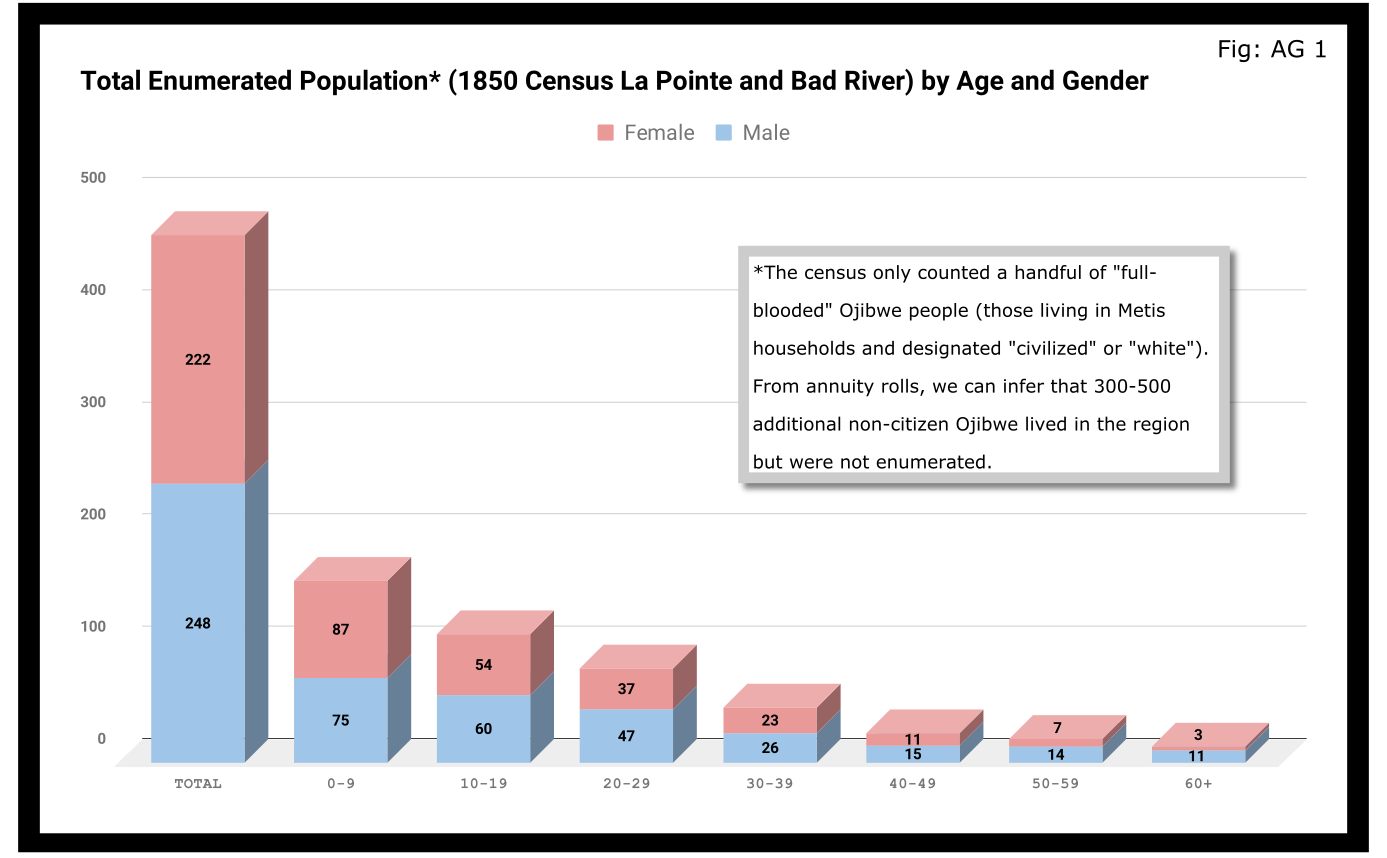
A quick glance at Figure AG 1 shows that the population skewed male 248-222 and skewed very young (61% under 20 years old). On the eve of Sandy Lake, the natural increase in the population seemed to be booming.

The hypotheses that women had higher mortality rates and were more likely to be undercounted looked good until we limit the data to the Wisconsin-born population. In Figure AG 2, we see that the male majority disappears entirely. The youthful trend, indicating large families and a growing population, continues with 66% of the Wisconsin-born population being under 20.

The male skew of the total population was entirely due to those born outside Wisconsin. This is not surprising given how much we’ve emphasized the number of men who came into the Lake Superior country to marry local women.
A look at the oldest residents in chart AG 2 and AG 3 hints at another story. Madeline Cadotte is the only Wisconsin-born person over seventy to be counted. The oldest men all came from Michigan and Canada. Why? My hypothesis is that between the fall of New France in 1759 and the establishment of Michel Cadotte’s post sometime around 1800, there wasn’t a large population or a very active fur trade around La Pointe proper. That meant Cadotte’s widow and other full bloods were the oldest locally-born residents in 1850. Their Metis contemporaries didn’t come over from the Soo or down from Grand Portage until 1810 or later.
Economics
Before the treaties, the economy of this area was built on two industries: foraging and trade. Life for Ojibwe people revolved around the seasonal harvest of fish, wild rice, game, maple sugar, light agriculture, and other forms of gathering food directly from the land. Trade did not start with the French, and even after the arrival of European goods into the region, the primary purpose of trade seemed to be for cementing alliances and for the acquisition of luxury goods and sacred objects. Richard White, Theresa Schenck, and Howard Paap have all challenged the myth of Ojibwe “dependence” on European goods for basic survival, and I find their arguments persuasive.
Trade, though, was the most important industry for Metis men and La Pointe was a center of this activity. The mid-19th century saw a steep decline in trade, however, to be replaced by a toxic cycle of debts, land sales, and annuity payments. The effects of this change on the Metis economy and society seem largely understudied. The fur trade though, was on its last legs. Again, the Austrian travel writer Carl Scherzer, who visited La Pointe in 1852:
After this discussion of the of the rates of the American Fur Company and its agents, we want to add some details about the men whose labor and time exerted such a great influence on the fate and culture of the Indian tribes. We wish to add a few explanatory words about the sad presence on La Pointe of the voyageurs or courriers du bois.
This peculiar class of people, which is like a vein of metal that suddenly disappears within the bedrock and reappears many hundreds of miles away under the same geological conditions, their light reaches the borders of the eastern Canadas. The British people, with their religion and customs, reappeared on the shores of these northern lakes only in 1808 with the Fur Company. For labor they drew on those who could carry their wares across the lakes and communicate with the Indians.
Many young men of adventurous natures left the old wide streets of Montreal and moved into the trackless primeval forests of the West. Young and strong as laborers, they soon started to adopt the lifestyle and language of the aborigines. They married with the Indians and inhabit small settlements scattered throughout those mighty lands which begin at Mackinow Island and come up the upper lake to the region of Minnesota. They almost all speak the Canadian patois along with the language of the Chippewas, the tribe with which they came into kinship. We found only a few, even among the younger generation, who understood English.
Since then, every day the population of the otherwise deserted shore of Lake Superior increases with the discovery of copper mines. The animals driven away by the whirlwind of civilization toward the west, attract the Indians with their sensitive guns, leaving La Pointe, abandoned by the Company for their headquarters at St. Paul in Minnesota. Most voyageurs left the island, having seen their business in ruins and lacking their former importance. Just a few families remain here, making a meager livelihood of hunting, fishing, and the occasional convoy of a few travelers led by business, science, or love of nature who purchase their limited resources.
From Scherzer’s description, two things are clear. It’s pretty clear from the flowery language of the Viennese visitor.Washington Irving and other Romantic-Era authors had already made the Voyageur into the stock stereotypical character we all know today. Th only change, though, is these days voyageurs are often depicted as representatives of white culture, but that’s a post for another time.
The second item, more pertinent to this post, is that a lot of voyageurs were out of work. This is especially relevant when we look at our census data. Daniel Johnson recorded the occupations of all males fifteen or over:
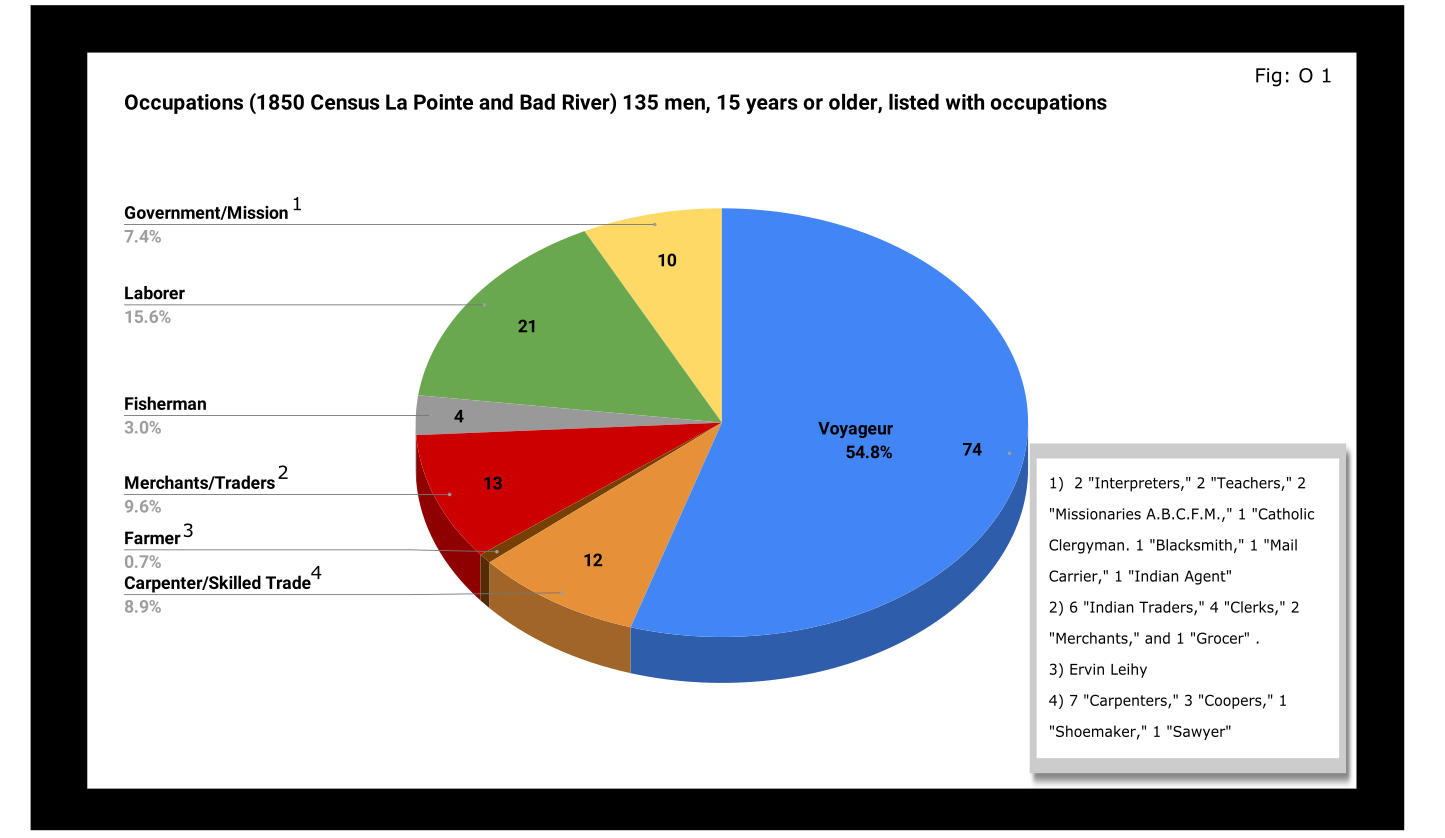
A full 55% of enumerated men fifteen and older still identified themselves as voyageurs in 1850. This included teenagers as well as senior citizens. All were from Metis households, though aside from farmer, all of the other occupation categories in Figure O 1 included Metis people.

A look at household sizes did not show voyageurs having to support significantly larger or smaller families when compared to the other occupation categories.
The other piece of economic data collected was value of real estate. Here we see some interesting themes:

If real estate is a good proxy for wealth in a farming community, it is an imperfect one in the Chequamegon area of 1850. If a voyageur had no home but the river and portage, then we might not expect him to put his coin into land and buildings. A teacher or Indian agent might draw a consistent salary but then live in supplied housing before moving on. With that caveat, let’s dig into the data.
Excluding the single farmer, men in the merchant/trader group controlled the most wealth in real estate, with Julius Austrian controlling as much as the other merchants combined. Behind them were carpenters and men with specific trades like cooper or shoemaker. Those who reported their occupation generally as “laborer” were not far behind the tradesmen. I suspect their real estate holdings may be larger and less varied than expected because of the number of sons and close relatives of Michel Cadotte Sr. who identified themselves as laborers. Government and mission employees held relatively little real estate, but the institutions they represented certainly weren’t lacking in land or power. Voyageurs come in seventh, just behind widows and ahead of fishermen of which there were only four in each category.
It is interesting, though, that the second and third richest men (by real estate) were both voyageurs, and voyageur shows a much wider range of households than some of the other categories: laborers in particular. With the number of teenagers calling themselves voyageurs, I suspect that the job still had more social prestige attached to it, in 1850, than say farmer or carpenter.
With hindsight we know that after 1854, voyageurs would be encouraged to take up farming and commercial fishing. It is striking, however, how small these industries were in 1850. Despite the American Fur Company’s efforts to push its Metis employees into commercial fishing in the 1830s, and knowing how many of the family names in Figure O 3 are associated with the industry, commercial fishing seemed neither popular nor lucrative in 1850. I do suspect, however, that the line between commercial and subsistence fishing was less defined in those days and that fishing in general was seen as falling back on the Indian gathering lifestyle. It wouldn’t be surprised if all these families were fishing alongside their Ojibwe relatives but didn’t really see fishing (or sugaring, etc.) as an occupation in the American sense.
Finally, it could not have escaped the voyageurs notice that while they were struggling, their former employers and their employers educated sons were doing pretty well. They also would have noticed that it was less and less from furs. Lump annuity payments for Ojibwe land sales brought large amounts of cash into the economy one day a year. It must have felt like piranhas with blood in the water. Alongside their full-blood cousins, Metis Ojibwe received these payments after 1847, but they had more of a history with money and capitalism. Whether to identify with the piranha or the prey would have depended on all sorts of decisions, opportunities and circumstances.
Education and Literacy
The census also collected data on education and literacy, asking whether children had attended school within the year, and whether adults over twenty could read and write. The history of white education efforts in this area are fairly well documented. The local schools in 1850 were run by the American Board of Commissioners of Foreign Missions (A.B.C.F.M.) at the La Pointe and Odanah missions, and an entire generation had come of age at La Pointe in the years since Rev. Sherman Hall first taught out of Lyman Warren’s storehouse in 1831. These Protestant ministers and teachers railed against the papists and heathens in their writings, but most of their students were Catholic or traditional Ojibwe in religion. Interestingly, much of the instruction was done in the Ojibwe language. Unfortunately, however, the census does not indicate the language an individual is literate in. I highly recommend The Ojibwe Journals of Edmund F. Ely, 1833-1849 if you are interested in these topics.
To start with, though, let’s look at how many people were going to school:

Thirty-nine students had gone to school in the previous year. There is a lot of sample-size noise in the data, but it seems like ages 7-11 (what we would call the upper-elementary years) were the prime years to attend school.
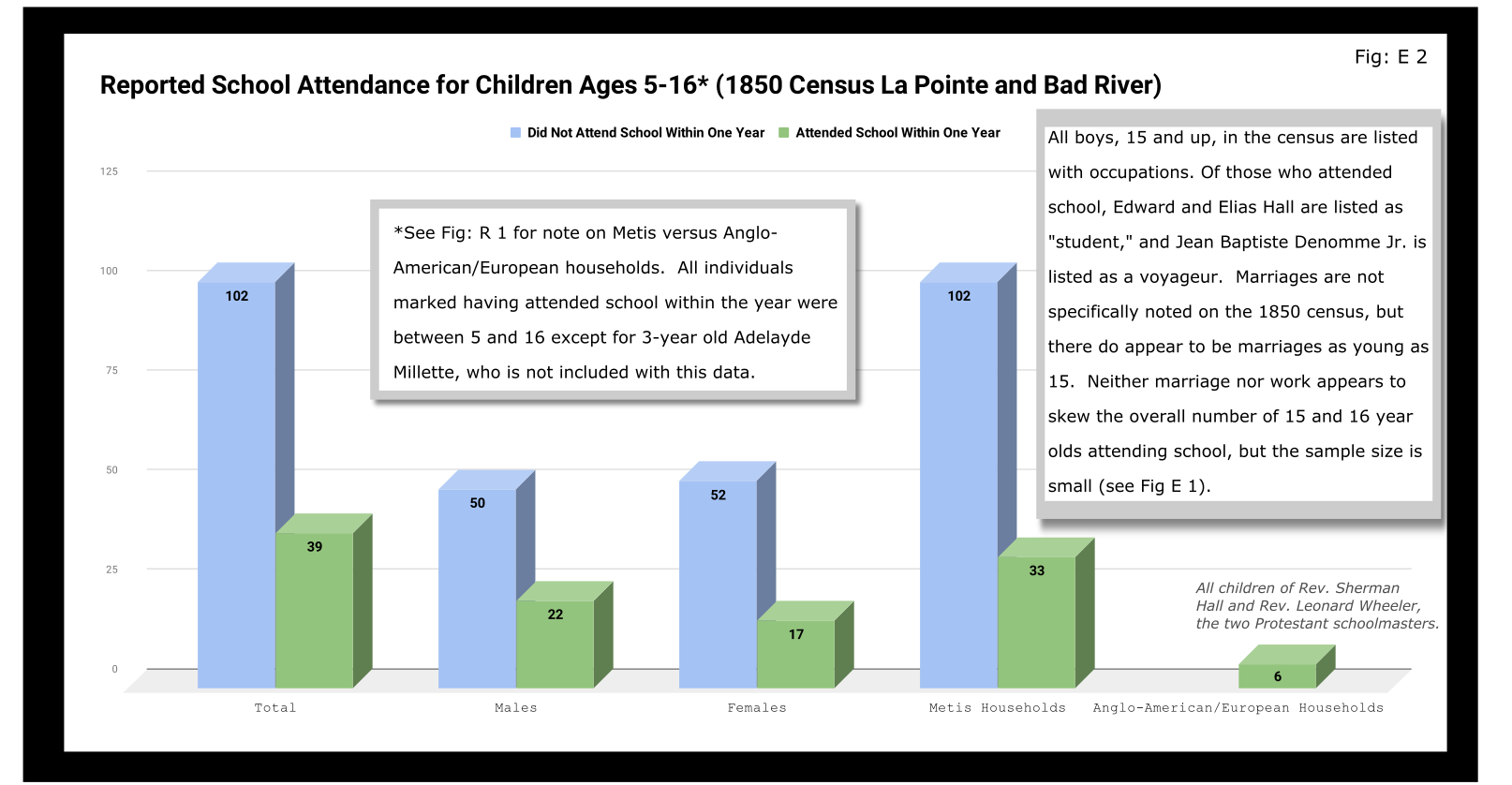
Overall, most children had not attended school within the year. Attendance rates were slightly higher for boys than for girls. White children, all from two missionary families, had a 100% attendance rate compared to 24% for the Metis and “Civilized Indian” children.
We should remember, however, that not attending school within the year is not the same as having never attended school. Twelve-year-old Eliza Morrin (later Morrison) is among the number that didn’t attend school, but she was educated enough to write her memoirs in English, which was her second language. They were published in 2002 as A Little History of My Forest Life, a fascinating account of Metis life in the decades following 1854.
Eliza’s parents were among the La Pointe adults who could read and write. Her aunt, uncle, and adult cousins in the neighboring Bosquet (Buskey) house were not. Overall, just over half of adults over 20 were illiterate without a significant gender imbalance. Splitting by birthplace, however, shows the literacy rate for Wisconsin-born (i.e. Metis and “Civilized Indian”) was only 30%, down from the overall male literacy rate of 48%. For Wisconsin-born women, the drop is only three points, from 47% to 44%. This suggests Metis women were learning to read while their husbands and brothers (perhaps en voyage) were not.

And this is exactly what the data say when we split by occupation. The literacy rate for voyageurs was only 13%. This beats fisherman–all four were illiterate–but lagged far behind all other types of work.
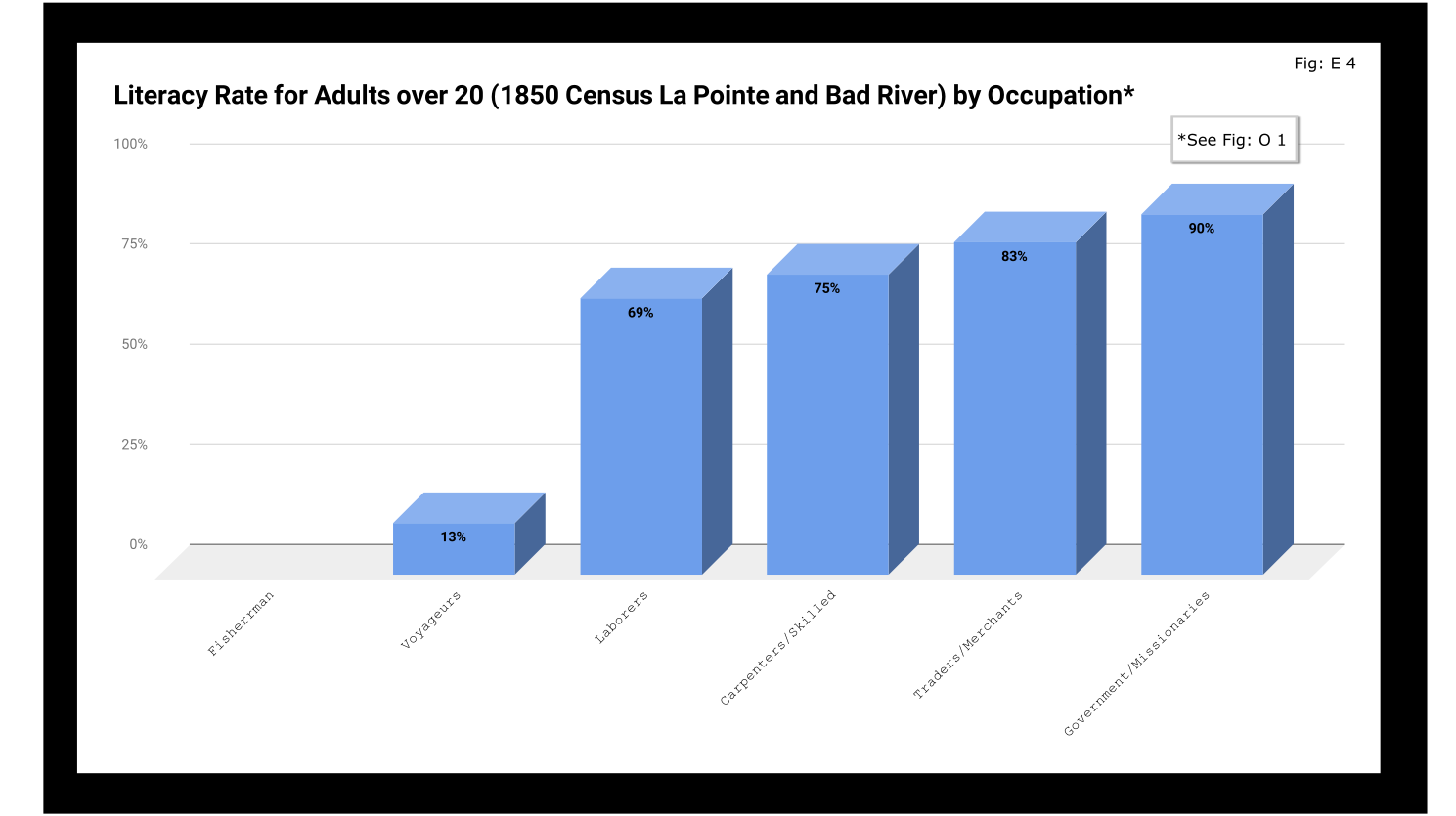
If education was going to be a factor in the economic mobility of unemployed voyageurs, the trends weren’t looking good.
Odds and Ends
Two marriages were reported as occurring in the year previous to the census: Peter and Caroline Vanderventer and Pierre and Marguerite Robideaux (ak.a. Peter and Margaret Rabideaux). Though married, however, Caroline was not living with her husband, a 32-year old grocer from New York. She (along with their infant daughter) was still in the home of her parents Benjamin and Margaret Moreau (Morrow). The Vanderventers eventually built a home together and went on to have several more children. It appears their grandson George Vanderventer married Julia Rabideaux, the granddaughter of Peter and Margaret.
I say appears in the case of George and Julia, because Metis genealogy can be tricky. It requires lots of double and triple checking. Here’s what I came across when I once tried to find an unidentified voyageur known only as Baptiste:

Sometimes it feels like for every Souverain Denis or Argapit Archambeau, there are at least 15 Jean-Baptiste Cadottes, 12 Charles Bresettes, 10 Francois Belangers and 8 Joseph DeFoes. Those old Canadian names had a way of persisting through the generations. If you were a voyageur at La Pointe in 1850, there was nearly a 30% chance your name was Jean-Baptiste. To your friends you might be John-Baptist, Shabadis, John, JB, or Battisens, and you might be called something else entirely when the census taker came around.
The final column on Daniel Johnson’s census asked whether the enumerated person was “deaf and dumb, blind, insane, idiotic, pauper, or convict.” 20 year-old Isabella Tremble, living in the household of Charles Oakes, received the unfortunate designation of idiotic. 26-year-old Francois DeCouteau did not have a mark in that column, but had “Invalid” entered in for his occupation. It’s fair to say we’ve made some progress in the treatment of people with disabilities.
Final Thoughts
I am not usually a numbers person when it comes to history. I’ll always prefer a good narrative story, to charts, tables, and cold numbers. Sometimes, though, the numbers help tell the story. They can help us understand why when Louis Gurnoe was killed, no one was held accountable. At the very least, they can help show us that the society he lived in was under significant stress, that the once-prestigious occupation of his forefathers would no longer sustain a family, and that the new American power structure didn’t really understand or care who his people were.
Ultimately, the census is about America describes itself. From the very beginning, it’s never been entirely clear if in E. pluribus unum we should emphasize the pluribus or the unum. We struggled with that in 1850, and we still struggle today. To follow the Department of Commerce v. New York citizenship case, I recommend Scotusblog. For more census posts about this area in the 19th century, keep following Chequamegon History.
Sources, Data, and Further Reading
-
Paap, Howard D. Red Cliff, Wisconsin a History of an Ojibwe Community ; Volume 1 The Earliest Years: the Origin to 1854. North Star Press of St. Cloud, Inc., 1854.
-
Satz, Ronald N. Chippewa Treaty Rights: the Reserved Rights of Wisconsin’s Chippewa Indians in Historical Perspective. University of Wisconsin Press, 1997.
-
Original Census Act of May 23, 1850 (includes form and instructions for marshals). (PDF)
-
Compiled data spreadsheets (Google Drive Folder) I’ll make these a lot more user friendly in future census posts. By the time it occurred to me that I should include my tables in this post, most of them were already done in tally marks on scrap paper.
-
Finally, these are the original pages, scanned from microfilm by FamilySearch.com. I included the image for Fond du Lac (presumably those living on the Wisconsin side of the St. Louis River) even though I did not include it in any of the data above.
-

- Bad River
-
- Fond du Lac (not included in above data)





Early Life among the Indians: Chapter II
March 21, 2018
By Amorin Mello

Early life among the Indians
by Benjamin Green Armstrong
continued from Chapter I.
CHAPTER II
In Washington.—Told to Go Home.—Senator Briggs, of New York.—The Interviews with President Fillmore.—Reversal of the Removal Order.—The Trip Home.—Treaty of 1854 and the Reservations.—The Mile Square.—The Blinding. »
After a fey days more in New York City I had raised the necessary funds to redeem the trinkets pledged with the ‘bus driver and to pay my hotel bills, etc., and on the 22d day of June, 1852, we had the good fortune to arrive in Washington.

“Washington Delegation, June 22, 1852“
Engraved from an unknown photograph by Marr and Richards Co. for Benjamin Armstrong’s Early Life Among the Indians. Chief Buffalo, his speaker Oshogay, Vincent Roy, Jr., two other La Pointe Band members, and Armstrong are assumed to be in this engraving.
I took my party to the Metropolitan Hotel and engaged a room on the first floor near the office for the Indians, as they said they did not like to get up to high in a white man’s house. As they required but a couple mattresses for their lodgings they were soon made comfortable. I requested the steward to serve their meals in their room, as I did not wish to take them into the dining room among distinguished people, and their meals were thus served.

Undated postcard of the Metropolitan Hotel, formerly known as Brown’s India Queen Hotel.
~ StreetsOfWashington.com
The morning following our arrival I set out in search of the Interior Department of the Government to find the Commissioner of Indian Affairs, to request an interview with him, which he declined to grant and said :
“I want you to take your Indians away on the next train west, as they have come here without permission, and I do not want to see you or hear of your Indians again.”
I undertook to make explanations, but he would not listen to me and ordered me from his office. I went to the sidewalk completely discouraged, for my present means was insufficient to take them home. I paced up and down the sidewalk pondering over what was best to do, when a gentleman came along and of him I inquired the way to the office of the Secretary of the Interior. He passed right along saying,
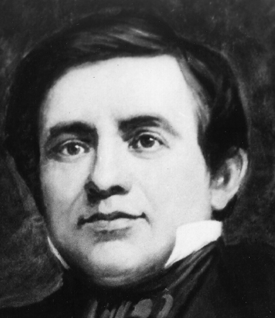
Secretary of the Interior
Alexander Hugh Holmes Stuart
~ Department of the Interior
“This way, sir; this way, sir;” and I followed him.
He entered a side door just back of the Indian Commissioner’s office and up a short flight of stairs, and going in behind a railing, divested himself of hat and cane, and said :
“What can I do for you sir.”
I told him who I was, what my party consisted of, where we came from and the object of our visit, as briefly as possible. He replied that I must go and see the Commissioner of Indian Affairs just down stairs. I told him I had been there and the treatment I had received at his hands, then he said :
“Did you have permission to come, and why did you not go to your agent in the west for permission?”
I then attempted to explain that we had been to the agent, but could get no satisfaction; but he stopped me in the middle of my explanation, saying :
“I can do nothing for you. You must go to the Indian Commissioner,”
and turning, began a conversation with his clerk who was there when we went in.
I walked out more discouraged than ever and could not imagine what next I could do. I wandered around the city and to the Capitol, thinking I might find some one I had seen before, but in this I failed and returned to the hotel, where, in the office I found Buffalo surrounded by a crowd who were trying to make him understand them and among them was the steward of the house. On my entering the office and Buffalo recognizing me, the assemblage, seeing I knew him, turned their attention to me, asking who he was, etc., to all of which questions I answered as briefly as possible, by stating that he was the head chief of of the Chippewas of the Northwest. The steward then asked:
“Why don’t you take him into the dining room with you? Certainly such a distinguished man as he, the head of the Chippewa people, should have at least that privilege.”

United States Representative George Briggs
~ Library of Congress
I did so and as we passed into the dining room we were shown to a table in one corner of the room which was unoccupied. We had only been seated a few moments when a couple of gentlemen who had been occupying seats in another part of the dining room came over and sat at our table and said that if there were no objections they would like to talk with us. They asked about the party, where from, the object of the visit, etc. I answered them briefly, supposing them to be reporters and I did not care to give them too much information. One of these gentlemen asked what room we had, saying that himself and one or two others would like to call on us right after dinner. I directed them where to come and said I would be there to meet them.
About 2 o’clock they came, and then for the first time I knew who those gentlemen were. One was Senator Briggs, of New York, and the others were members of President Filmore’s cabinet, and after I had told them more fully what had taken me there, and the difficulties I had met with, and they had consulted a little while aside. Senator Briggs said :
“We will undertake to get you and your people an interview with the President, and will notify you here when a meeting can be arranged. ”
During the afternoon I was notified that an interview had been arranged for the next afternoon at 3 o’clock. During the evening Senator Briggs and other friends called, and the whole matter was talked over and preparations made for the interview the following day, which were continued the next day until the hour set for the interview.

United States President
Millard Fillmore.
~ Library of Congress
When we were assembled Buffalo’s first request was that all be seated, as he had the pipe of peace to present, and hoped that all who were present would partake of smoke from the peace pipe. The pipe, a new one brought for the purpose, was filled and lighted by Buffalo and passed to the President who took two or three draughts from it, and smiling said, “Who is the next?” at which Buffalo pointed out Senator Briggs and desired he should be the next. The Senator smoked and the pipe was passed to me and others, including the Commissioner of Indian Affairs, Secretary of the Interior and several others whose names I did not learn or cannot recall. From them, to Buffalo, then to O-sho-ga, and from him to the four braves in turn, which completed that part of the ceremony. The pipe was then taken from the stem and handed to me for safe keeping, never to be used again on any occasion. I have the pipe still in my possession and the instructions of Buffalo have been faithfully kept. The old chief now rose from his seat, the balance following his example and marched in single file to the President and the general hand-shaking that was began with the President was continued by the Indians with all those present. This over Buffalo said his under chief, O-sha-ga, would state the object of our visit and he hoped the great father would give them some guarantee that would quiet the excitement in his country and keep his young men peaceable. After I had this speech thoroughly interpreted, O-sha-ga began and spoke for nearly an hour. He began with the treaty of 1837 and showed plainly what the Indians understood the treaty to be. He next took up the treaty of 1842 and said he did not understand that in either treaty they had ceded away the land and he further understood in both cases that the Indians were never to be asked to remove from the lands included in those treaties, provided they were peaceable and behaved themselves and this they had done. When the order to move came Chief Buffalo sent runners out in all directions to seek for reasons and causes for the order, but all those men returned without finding a single reason among all the Superior and Mississippi Indians why the great father had become displeased. When O-sha-ga had finished his speech I presented the petition I had brought and quickly discovered that the President did recognize some names upon it, which gave me new courage. When the reading and examination of it had been concluded the meeting was adjourned, the President directing the Indian Commissioner to say to the landlord at the hotel that our hotel bills would be paid by the government. He also directed that we were to have the freedom of the city for a week.
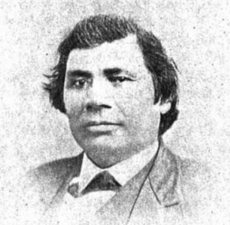
Read Biographical Sketch of Vincent Roy, Jr. manuscript for a different perspective on their meeting the President.
The second day following this Senator Briggs informed me that the President desired another interview that day, in accordance with which request we went to the White House soon after dinner and meeting the President, he told the, delegation in a brief speech that he would countermand the removal order and that the annuity payments would be made at La Pointe as before and hoped that in the future there would be no further cause for complaint. At this he handed to Buffalo a written instrument which he said would explain to his people when interpreted the promises he had made as to the removal order and payment of annuities at La Pointe and hoped when he had returned home he would call his chiefs together and have all the statements therein contained explained fully to them as the words of their great father at Washington.
The reader can imagine the great load that was then removed from my shoulders for it was a pleasing termination of the long and tedious struggle I had made in behalf of the untutored but trustworthy savage.

Downtown St. Paul, Minnesota, circa 1857.
~ Minnesota Historical Society
On June 28th, 1852, we started on our return trip, going by cars to La Crosse, Wis., thence by steamboat to St. Paul, thence by Indian trail across the country to Lake Superior. On our way from St. Paul we frequently met bands of Indians of the Chippewa tribe to whom we explained our mission and its results, which caused great rejoicing, and before leaving these bands Buffalo would tell their chief to send a delegation, at the expiration of two moons, to meet him in grand council at La Pointe, for there was many things he wanted to say to them about what he had seen and the nice manner in which he had been received and treated by the great father.
At the time appointed by Buffalo for the grand council at La Pointe, the delegates assembled and the message given Buffalo by President Filmore was interpreted, which gave the Indians great satisfaction. Before the grand council adjourned word was received that their annuities would be given to them at La Pointe about the middle of October, thus giving them time to get together to receive them. A number of messengers was immediately sent out to all parts of the territory to notify them and by the time the goods arrived, which was about October 15th, the remainder of the Indians had congregated at La Pointe. On that date the Indians were enrolled and the annuities paid and the most perfect satisfaction was apparent among all concerned. The jubilee that was held to express their gratitude to the delegation that had secured a countermanding order in the removal matter was almost extravagantly profuse. The letter of the great father was explained to them all during the progress of the annuity payments and Chief Buffalo explained to the convention what he had seen; how the pipe of peace had been smoked in the great father’s wigwam and as that pipe was the only emblem and reminder of their duties yet to come in keeping peace with his white children, he requested that the pipe be retained by me. He then went on and said that there was yet one more treaty to be made with the great father and he hoped in making it they would be more careful and wise than they had heretofore been and reserve a part of their land for themselves and their children. It was here that he told his people that he had selected and adopted, me as his son and that I would hereafter look to treaty matters and see that in the next treaty they did not sell them selves out and become homeless ; that as he was getting old and must soon leave his entire cares to others, he hoped they would listen to me as his confidence in his adopted son was great and that when treaties were presented for them to sign they would listen to me and follow my advice, assuring them that in doing so they would not again be deceived.

Map of Lake Superior Chippewa territories ceded in 1836, 1837, 1842, and 1854.
~ Great Lakes Indian Fish & Wildlife Commission
After this gathering of the Indians there was not much of interest in the Indian country that I can recall until the next annual payment in 1853. This payment was made at La Pointe and the Indians had been notified that commissioners would be appointed to make another treaty with them for the remainder of their territory. This was the territory lying in Minnesota west of Lake Superior; also east and west of the Mississippi river north to the territory belonging to the Boisfort and Pillager tribe, who are a part of the Chippewa nation, but through some arrangement between themselves, were detached from the main or more numerous body. It was at this payment that the Chippewa Indians proper desired to have one dollar each taken from their annuities to recompense me for the trouble and expense I had been to on the trip to Washington in their behalf, but I refused to accept it by reason of their very impecunious condition.
It was sometime in August, 1854, before the commissioners arrived at LaPointe to make the treaty and pay the annuities of that year. Messengers were despatched to notify all Indians of the fact that the great father had sent for them to come to La Pointe to get their money and clothing and to meet the government commissioners who wished to make another treaty with them for the territory lying west of Lake Superior and they were further instructed to have the Indians council among themselves before starting that those who came could be able to tell the wishes of any that might remain away in regards to a further treaty and disposition of their lands. Representatives came from all parts of the Chippewa country and showed a willingness to treat away the balance of their country. Henry C. Gilbert, the Indian agent at La Pointe, formerly of Ohio, and David B. Herriman, the agent for the Chippewas of the Mississippi country, were the commissioners appointed by the government to consumate this treaty.

Mackinac Indian Agent
Henry C. Gilbert
~ Branch County Photographs
While we were waiting the arrival of the interior Indians I had frequent talks with the commissioners and learned what their instructions were and about what they intended to offer for the lands which information I would communicate to Chief Buffalo and other head men in our immediate vicinity, and ample time was had to perfect our plans before the others should arrive, and when they did put in an appearance we were ready to submit to them our views for approval or rejection. Knowing as I did the Indians’ unwillingness to give up and forsake their old burying grounds I would not agree to any proposition that would take away the remainder of their lands without a reserve sufficient to afford them homes for themselves and posterity, and as fast as they arrived I counselled with them upon this subject and to ascertain where they preferred these reserves to be located. The scheme being a new one to them it required time and much talk to get the matter before them in its proper light. Finally it was agreed by all before the meeting of the council that no one would sign a treaty that did not give them reservations at different points of the country that would suit their convenience, that should afterwards be considered their bona-fide home. Maps were drawn of the different tracts that had been selected by the various chiefs for their reserve and permanent home. The reservations were as follows :
One at L’Anse Bay, one at Ontonagon, one at Lac Flambeau, one at Court O’Rilles, one at Bad River, one at Red Cliff or Buffalo Bay, one at Fond du Lac, Minn., and one at Grand Portage, Minn.

Joseph Stoddard (photo c.1941) worked on the 1854 survey of the Bad River Reservation exterior boundaries, and shared a different perspective about these surveys.
~ Bad River Tribal Historic Preservation Office
The boundaries were to be as near as possible by metes and bounds or waterways and courses. This was all agreed to by the Lake Superior Indians before the Mississippi Chippewas arrived and was to be brought up in the general council after they had come in, but when they arrived they were accompanied by the American Fur Company and most of their employees, and we found it impossible to get them to agree to any of our plans or to come to any terms. A proposition was made by Buffalo when all were gathered in council by themselves that as they could not agree as they were, a division should be drawn, dividing the Mississippi and the Lake Superior Indians from each other altogether and each make their own treaty After several days of counselling the proposition was agreed to, and thus the Lake Superiors were left to make their treaty for the lands mouth of Lake Superior to the Mississippi and the Mississippis to make their treaty for the lands west of the Mississippi. The council lasted several days, as I have stated, which was owing to the opposition of the American Fur Company, who were evidently opposed to having any such division made ; they yielded however, but only when they saw further opposition would not avail and the proposition of Buffalo became an Indian law. Our side was now ready to treat with the commissioners in open council. Buffalo, myself and several chiefs called upon them and briefly stated our case but were informed that they had no instructions to make any such treaty with us and were only instructed to buy such territory as the Lake Superiors and Mississippis then owned. Then we told them of the division the Indians had agreed upon and that we would make our own treaty, and after several days they agreed to set us off the reservations as previously asked for and to guarantee that all lands embraced within those boundaries should belong to the Indians and that they would pay them a nominal sum for the remainder of their possessions on the north shores. It was further agreed that the Lake Superior Indians should have two- thirds of all money appropriated for the Chippewas and the Mississippi contingent the other third. The Lake Superior Indians did not seem, through all these councils, to care so much for future annuities either in money or goods as they did for securing a home for themselves and their posterity that should be a permanent one. They also reserved a tract of land embracing about 100 acres lying across and along the Eastern end of La Pointe or Madeline Island so that they would not be cut off from the fishing privilege.
It was about in the midst of the councils leading up to the treaty of 1854 that Buffalo stated to his chiefs that I had rendered them services in the past that should be rewarded by something more substantial than their thanks and good wishes, and that at different times the Indians had agreed to reward me from their annuity money but I had always refused such offers as it would be taking from their necessities and as they had had no annuity money for the two years prior to 1852 they could not well afford to pay me in this way.
“And now,” continued Buffalo, “I have a proposition to make to you. As he has provided us and our children with homes by getting these reservations set off for us, and as we are about to part with all the lands we possess, I have it in my power, with your consent, to provide him with a future home by giving him a piece of ground which we are about to part with. He has agreed to accept this as it will take nothing from us and makes no difference with the great father whether we reserve a small tract of our territory or not, and if you agree I will proceed with him to the head of the lake and there select the piece of ground I desire him to have, that it may appear on paper when the treaty has been completed.”
The chiefs were unanimous in their acceptance of the proposition and told Buffalo to select a large piece that his children might also have a home in future as has been provided for ours.

Kiskitawag (Giishkitawag: “Cut Ear”) signed earlier treaties as a warrior of the Ontonagon Band and became associated with the La Pointe Band at Odanah.
~C.M. Bell, Smithsonian Digital Collections
This council lasted all night and just at break of day the old chief and myself, with four braves to row the boat, set out for the head of Lake Superior and did not stop anywhere only long enough to make and drink some tea, until we reached the head of St. Louis Bay. We landed our canoe by the side of a flat rock quite a distance from the shore, among grass and rushes. Here we ate our lunch and when completed Buffalo and myself, with another chief, Kish-ki-to-uk, waded ashore and ascended the bank to a small level plateau where we could get a better view of the bay. Here Buffalo turned to me, saying: .
“Are you satisfied with this location? I want to reserve the shore of this bay from the mouth of St. Louis river. How far that way do you you want it to go?” pointing southeast, or along the south shore of the lake.
I told him we had better not try to make it too large for if we did the great father’s officers at Washington might throw it out of the treaty and said:
“I will be satisfied with one mile square, and let it start from the rock which we have christened Buffalo rock, running easterly in the direction of Minnesota Point, taking in a mile square immediately northerly from the head of St. Louis Bay”
As there was no other way of describing it than by metes and bounds we tried to so describe it in the treaty, but Agent Gilbert, whether by mistake or not I am unable to say, described it differently. He described it as follows: “Starting from a rock immediately above and adjoining Minnesota Point, etc.”
We spent an hour or two here in looking over the plateau then went back to our canoe and set out for La Pointe. We traveled night and day until we reached home.
During our absence some of the chiefs had been talking more or less with the commissioners and immediately on our return all the Indians met in a grand council when Buffalo explained to them what he had done on the trip and how and where he had selected the piece of land that I was to have reserved in the treaty for my future home and in payment for the services I had rendered them in the past. The balance of the night was spent in preparing ourselves for the meeting with the treaty makers the next day, and about 10 o’clock next morning we were in attendance before the commissioners all prepared for a big council.
Mackinac Indian Agent
Henry Clark Gilbert
~ Branch County Photographs
Agent Gilbert started the business by beginning a speech interpreted by the government interpreter, when Buffalo interrupted him by saying that he did not want anything interpreted to them from the English language by any one except his adoped son for there had always been things told to the Indians in the past that proved afterwards to be untrue, whether wrongly interpreted or not, he could not say;
“and as we now feel that my adopted son interprets to us just what you say, and we can get it correctly, we wish to hear your words repeated by him, and when we talk to you our words can be interpreted by your own interpreter, and in this way one interpreter can watch the other and correct each other should there be mistakes. We do not want to be deceived any more as we have in the past. We now understand that we are selling our lands as well as the timber and that the whole, with the exception of what we shall reserve, goes to the great father forever.”

Bureau of Indian Affairs Director
George Washington Manypenny
~ Commons.Wikimedia.org
Commissioner of Indian affairs. Col. Manypenny, then said to Buffalo:
“What you have said meets my own views exactly and I will now appoint your adopted son your interpreter and John Johnson, of Sault Ste. Marie, shall be the interpreter on the part of the government,” then turning to the commissioners said, “how does that suit you, gentlemen.”
They at once gave their consent and the council proceeded.
Buffalo informed the commissioners of what he had done in regard to selecting a tract of land for me and insisted that it become a part of the treaty and that it should be patented to me directly by the government without any restrictions. Many other questions were debated at this session but no definite agreements were reached and the council was adjourned in the middle of the afternoon. Chief Buffalo asking for the adjournment that he might talk over some matters further with his people, and that night the subject of providing homes for their half-breed relations who lived in different parts of the country was brought up and discussed and all were in favor of making such a provision in the treaty. I proposed to them that as we had made provisions for ourselves and children it would be only fair that an arrangement should be made in the treaty whereby the government should provide for our mixed blood relations by giving to each person the head of a family or to each single person twenty-one years of age a piece of land containing at least eighty acres which would provide homes for those now living and in the future there would be ample room on the reservations for their children, where all could live happily together. We also asked that all teachers and traders in the ceded territory who at that time were located there by license and doing business by authority of law, should each be entitled to 160 acres of land at $1.25 per acre. This was all reduced to writing and when the council met next morning we were prepared to submit all our plans and requests to the commissioners save one, which we required more time to consider. Most of this day was consumed in speech-making by the chiefs and commissioners and in the last speech of the day, which was made by Mr. Gilbert, he said:
“We have talked a great deal and evidently understand one another. You have told us what you want, and now we want time to consider your requests, while you want time as you say to consider another matter, and so we will adjourn until tomorrow and we, with your father. Col. Manypenny, will carefully examine and consider your propositions and when we meet to-morrow we will be prepared to answer you with an approval or rejection.”

Julius Austrian purchased the village of La Pointe and other interests from the American Fur Company in 1853. He entered his Town Plan of La Pointe on August 29th of 1854. He was the highest paid claimant of the 1854 Treaty at La Pointe. His family hosted the 1855 Annuity Payments at La Pointe.
~ Photograph of Austrian from the Madeline Island Museum
That evening the chiefs considered the other matter, which was to provide for the payment of the debts of the Indians owing the American Fur Company and other traders and agreed that the entire debt could not be more than $90,000 and that that amount should be taken from the Indians in bulk and divided up among their creditors in a pro-rata manner according to the amount due to any person or firm, and that this should wipe out their indebtedness. The American Fur Company had filed claims which, in the aggregate, amounted to two or three times this sum and were at the council heavily armed for the purpose of enforcing their claim by intimidation. This and the next day were spent in speeches pro and con but nothing was effected toward a final settlement.
Col. Manypenny came to my store and we had a long private interview relating to the treaty then under consideration and he thought that the demands of the Indians were reasonable and just and that they would be accepted by the commissioners. He also gave me considerable credit for the manner in which I had conducted the matter for Indians, considering the terrible opposition I had to contend with. He said he had claims in his possession which had been filed by the traders that amounted to a large sum but did not state the amount. As he saw the Indians had every confidence in me and their demands were reasonable he could see no reason why the treaty could not be speedily brought to a close. He then asked if I kept a set of books. I told him I only kept a day book or blotter showing the amount each Indian owed me. I got the books and told him to take them along with him and that he or his interpreter might question any Indian whose name appeared thereon as being indebted to me and I would accept whatever that Indian said he owed me whether it be one dollar or ten cents. He said he would be pleased to take the books along and I wrapped them up and went with him to his office, where I left them. He said he was certain that some traders were making claims for far more than was due them. Messrs. Gilbert and Herriman and their chief clerk, Mr. Smith, were present when Mr. Manypenny related the talk he had with me at the store. He considered the requests of the Indians fair and just, he said, and he hoped there would be no further delays in concluding the treaty and if it was drawn up and signed with the stipulations and agreements that were now understood should be incorporated in it, he would strongly recommend its ratification by the President and senate.

Naagaanab of Fond Du Lac
~ Minnesota Historical Society
The day following the council was opened by a speech from Chief Na-gon-ab in which he cited considerable history.
“My friends,” he said, “I have been chosen by our chief, Buffalo, to speak to you. Our wishes are now on paper before you. Before this it was not so. We have been many times deceived. We had no one to look out for us. The great father’s officers made marks on paper with black liquor and quill. The Indian can not do this. We depend upon our memory. We have nothing else to look to. We talk often together and keep your words clear in our minds. When you talk we all listen, then we talk it over many times. In this way it is always fresh with us. This is the way we must keep our record. In 1837 we were asked to sell our timber and minerals. In 1842 we were asked to do the same. Our white brothers told us the great father did not want the land. We should keep it to hunt on. Bye and bye we were told to go away; to go and leave our friends that were buried yesterday. Then we asked each other what it meant. Does the great father tell the truth? Does he keep his promises? We cannot help ourselves! We try to do as we agree in treaty. We ask you what this means? You do not tell from memory! You go to your black marks and say this is what those men put down; this is what they said when they made the treaty. The men we talk with don’t come back; they do not come and you tell us they did not tell us so! We ask you where they are? You say you do not know or that they are dead and gone. This is what they told you; this is what they done. Now we have a friend who can make black marks on paper When the council is over he will tell us what we have done. We know now what we are doing! If we get what we ask our chiefs will touch the pen, but if not we will not touch it. I am told by our chief to tell you this: We will not touch the pen unless our friend says the paper is all right.”
Na-gon-ab was answered by Commissioner Gilbert, saying:
“You have submitted through your friend and interpreter the terms and conditions upon which you will cede away your lands. We have not had time to give them all consideration and want a little more time as we did not know last night what your last proposition would be. Your father. Col. Manypenny, has ordered some beef cattle killed and a supply of provisions will be issued to you right away. You can now return to your lodges and get a good dinner and talk matters over among yourselves the remainder of the day and I hope you will come back tomorrow feeling good natured and happy, for your father, Col. Manypenny, will have something to say to you and will have a paper which your friend can read and explain to you.”
When the council met next day in front of the commissioners’ office to hear what Col. Manypenny had to say a general good feeling prevailed and a hand-shaking all round preceded the council, which Col. Manypenny opened by saying:
“My friends and children: I am glad to see you all this morning looking good natured and happy and as if you could sit here and listen to what I have to say. We have a paper here for your friend to examine to see if it meets your approval. Myself and the commissioners which your great father has sent here have duly considered all your requests and have concluded to accept them. As the season is passing away and we are all anxious to go to our families and you to your homes, I hope when you read this treaty you will find it as you expect to and according to the understandings we have had during the council. Now your friend may examine the paper and while he is doing so we will take a recess until afternoon.”

Detail of Benjamin Armstrong from a photograph by Matthew Brady
~ Minnesota Historical Society
Chief Buffalo, turning to me, said:
“My son, we, the chiefs of all the country, have placed this matter entirely in your hands. Go and examine the paper and if it suits you it will suit us.”
Then turning to the chiefs, he asked,
“what do you all say to that?”
The ho-ho that followed showed the entire circle were satisfied.
I went carefully through the treaty as it had been prepared and with a few exceptions found it was right. I called the attention of the commissioners to certain parts of the stipulations that were incorrect and they directed the clerk to make the changes.
The following day the Indians told the commissioners that as their friend had made objections to the treaty as it was they requested that I might again examine it before proceeding further with the council. On this examination I found that changes had been made but on sheets of paper not attached to the body of the instrument, and as these sheets contained some of the most important items in the treaty, I again objected and told the commissioners that I would not allow the Indians to sign it in that shape and not until the whole treaty was re-written and the detached portions appeared in their proper places. I walked out and told the Indians that the treaty was not yet ready to sign and they gave up all further endeavors until next day. I met the commissioners alone in their office that afternoon and explained the objectionable points in the treaty and told them the Indians were already to sign as soon as those objections were removed. They were soon at work putting the instrument in shape.

“One version of the boundaries for Chief Buffalo’s reservation is shown at the base of Minnesota Point in a detail from an 1857 map preserved in the National Archives in Washington, D.C. Other maps show a larger and more irregularly shaped versions of the reservation boundary, though centered on the same area.”
~ DuluthStories.net
The next day when the Indians assembled they were told by the commissioners that all was ready and the treaty was laid upon a table and I found it just as the Indians had wanted it to be, except the description of the mile square. The part relating to the mile square that was to have been reserved for me read as follows:
“Chief Buffalo, being desirous of providing for some of his relatives who had rendered them important services, it is agreed that he may select one mile square of the ceded territory heretofore described.”
“Now,” said the commissioner,
“we want Buffalo to designate the person or persons to whom he wishes the patents to issue.”
Buffalo then said:
“I want them to be made out in the name of my adopted son.”
This closed all ceremony and the treaty was duly signed on the 30th day of September, 1854. This done the commissioners took a farewell shake of the hand with all the chiefs, hoping to meet them again at the annuity payment the coming year. They then boarded the steamer North Star for home. In the course of a few days the Indians also disappeared, some to their interior homes and some to their winter hunting grounds and a general quiet prevailed on the island.

Portrait of the Steamer North Star from American Steam Vessels, by Samuel Ward Stanton, page 40.
~ Wikimedia.org
About the second week in October, 1854, I went from La Pointe to Ontonagon in an open boat for the purpose of purchasing my winter supplies as it had got too late to depend on getting them from further below. While there a company was formed for the purpose of going into the newly ceded territory to make claims upon lands that would be subject to entry as soon as the late treaty should be ratified. The company consisted of Samuel McWaid, William Whitesides, W. W. Kingsbury, John Johnson, Oliver Melzer, John McFarland, Daniel S. Cash, W. W. Spaulding, all of Ontonagon, and myself. The two last named gentlemen, Daniel S. Cash and W. W. Spaulding, agreeing to furnish the company with supplies and all necessaries, including money, to enter the lands for an equal interest and it was so stipulated that we were to share equally in all that we, or either of us, might obtain. As soon as the supplies could be purchased and put aboard the schooner Algonquin we started for the head of the lake, stopping at La Pointe long enough for me to get my family aboard and my business matters arranged for the winter. I left my store at La Pointe in charge of Alex. Nevaux, and we all sailed for the head of Lake Superior, the site of which is now the city of Duluth. Reaching there about the first week in December—the bay of Superior being closed by ice—we were compelled to make our landing at Minnesota Point and take our goods from there to the main land on the north’ shore in open boats, landing about one and-one half miles east of Minnesota Point at a place where I desired to make a preemption for myself and to establish a trading post for the winter. Here I erected a building large enough for all of us to live in, as we expected to make this our headquarters for the winter, and also a building for a trading post. The other members of the company made claims in other places, but I did no more land looking that winter.

Detail of Superior City townsite at the head of Lake Superior from the 1854 U.S. General Land Office survey by Stuntz and Barber.
About January 20th, 1855, I left my place at the head of the lake to go back to La Pointe and took with me what furs I had collected up to that time, as I had a good place at La Pointe to dry and keep them. I took four men along to help me through and two dog trains. As we were passing down Superior Bay and when just in front of the village of West Superior a man came to us on the ice carrying a small bundle on his back and asked me if I had any objections to his going through in my company. He said the snow was deep and the weather cold and it was bad for one man to travel alone. I told him I had no objections provided he would take his turn with the other men in breaking the road for the dogs. We all went on together and camped that night at a place well known as Flag River. We made preparations for a cold night as the thermometer must have been twenty-five or thirty degrees below zero and the snow fully two feet deep. As there were enough of us we cut and carried up a large quantity of wood, both green and dry, and shoveled the snow away to the ground with our snow shoes and built a large fire. We then cut evergreen boughs and made a wind break or bough camp and concluded we could put in a very comfortable night. We then cooked and ate our supper and all seemed happy. I unrolled a bale of bear skins and spread them out on the ground for my bed, filled my pipe and lay down to rest while the five men with me were talking and smoking around the camp fire. I was very tired and presume I was not long in falling asleep. How long I slept I cannot tell, but was awakened by something dropping into my face, which felt like a powdered substance. I sprang to my feet for I found something had got into my eyes and was smarting them badly. I rushed for the snow bank that was melting from the heat and applied handful after handful to my eyes and face. I found the application was peeling the skin off my face and the pain soon became intense. I woke up the crew and they saw by the firelight the terrible condition I was in. In an hour’s time my eyeballs were so swollen that I could not close the lids and the pain did not abate. I could do nothing more than bathe my eyes until morning, which I did with tea-grounds. It seemed an age before morning came and when it did come I could not realize it, for I was totally blind. The party started with me at early dawn for La Pointe. The man who joined us the day before went no further, but returned to Superior, which was a great surprise to the men of our party, who frequently during the day would say:
“There is something about this matter that is not right,”
and I never could learn afterward of his having communicated the fact of my accident to any one or to assign any reason or excuse for turning back, which caused us to suspect that he had a hand in the blinding, but as I could get no proof to establish that suspicion, I could do nothing in the matter. This man was found dead in his cabin a few months afterwards.
At La Pointe I got such treatment as could be procured from the Indians which allayed the inflamation but did not restore the sight. I remained at La Pointe about ten days, and then returned home with dog train to my family, where I remained the balance of the winter, when not at Superior for treatment. When the ice moved from the lake in the spring I abandoned everything there and returned to La Pointe and was blind or nearly so until the winter of 1861.
Returning a little time to the north shore I wish to relate an incident of the death of one of our Ontonagon company. Two or three days after I had reached home from La Pointe, finding my eyes constantly growing worse I had the company take me to Superior where I could get treatment. Dr. Marcellus, son of Prof. Marcellus, of an eye infirmary in Philadelphia, who had just then married a beautiful young wife, and come west to seek his fortune, was engaged to treat me. I was taken to the boarding house of Henry Wolcott, where I engaged rooms for the winter as I expected to remain there until spring. I related to the doctor what had befallen me and he began treatment. At times I felt much better but no permanent relief seemed near. About the middle February my family required my presence at home, as there was some business to be attended to which they did not understand. My wife sent a note to me by Mr. Melzer, stating that it was necessary for me to return, and as the weather that day was very pleasant, she hoped that I would come that afternoon. Mr. Melzer delivered me the note, which I requested him to read. It was then 11 a. m. and I told him we would start right after dinner, and requested him to tell the doctor that I wished to see him right away, and then return and get his dinner, as it would be ready at noon, to which he replied:
“If I am not here do not wait for me, but I will be here at the time you are ready for home.”
Mr. Melzer did return shortly after we had finished our dinner and I requested him to eat, as I would not be ready to start for half an hour, but he insisted he was not hungry. We had no conveyance and at 1 p. m. we set out for home. We went down a few steps to the ice, as Mr. Wolcott’s house stood close to the shore of the bay, and went straight across Superior Bay to Minnesota Point, and across the point six or eight rods and struck the ice on Lake Superior. A plain, hard beaten road led from here direct to my home. After we had proceeded about 150 yards, following this hard beaten road, Melzer at once stopped and requested me to go ahead, as I could follow the beaten road without assistance, the snow being deep on either side.
“Now,” he says go ahead, for I must go back after a drink.”
I followed the road quite well, and when near the house my folks came out to meet me, their first inquiry being:
“Where is Melzer?”
I told them the circumstances of his turning back for a drink of water. Reaching the bank on which my house stood, some of my folks, looking back over the road I had come, discovered a dark object apparently floundering on the ice. Two or three of our men started for the spot and there found the dead body of poor Melzer. We immediately notified parties in Superior of the circumstances and ordered a post-mortem examination of the body. The doctors found that his stomach was entirely empty and mostly gone from the effects of whisky and was no thicker than tissue paper and that his heart had burst into three pieces. We gave him a decent burial at Superior and peace to his ashes, His last act of kindness was in my behalf.
To be continued in Chapter III…
Early Life among the Indians: Chapter I
September 26, 2017
By Amorin Mello

Early Life among the Indians
by Benjamin Green Armstrong

Early Indian History.
—
CHAPTER I.
—
The First Treaty.—The Removal Order.— Treaties of 1837 and 1842.—A Trip to Washington.—In New York City with Only One Dime.—At the Broker’s Residence.
My earliest recollections in Northern Wisconsin and Minnesota territories date back to 1835, at which time Gen. Cass and others on the part of the Government, with different tribes of Indians, viz : Potawatomies, Winnebagos, Chippewas, Saux and Foxes and the Sioux, at Prairie du Chien, met in open council, to define and agree upon boundary lines between the Saux and Foxes and the Chippewas. The boundary or division of territory as agreed upon and established by this council was the Mississippi River from Prairie du Chien north to the mouth of of Crow Wing River, thence to its source. The Saux and Foxes and the Sioux were recognized to be the owners of all territory lying west of the Mississippi and south of the Crow Wing River. The Chippewas, by this treaty, were recognized as the owners of all lands east of the Mississippi in the territory of Wisconsin and Minnesota, and north of the Crow Wing River on both sides of the Mississippi to the British Possessions, also Lake Superior country on both sides of the lake to Sault Ste. Marie and beyond. The other tribes mentioned in this council had no interest in the above divided territory from the fact that their possessions were east and south of the Chippewa Country, and over their title there was no dispute. The division lines were agreed to as described and a treaty signed. When all shook hands and covenanted with each other to live in peace for all time to come.
In 1837 the Government entered into a treaty with the Chippewas of the Mississippi and St. Croix Rivers at St. Peter, Minnesota, Col. Snelling, of the army, and Maj. Walker, of Missouri, being the commissioners on the part of the Government, and it appears that at the commencement of this council the anxiety on the part of the commissioners to perfect a treaty was so great that statements were made by them favorable to the Indians, and understood perfectly by them, that were not afterwards incorporated in the treaty. The Indians were told by these commissioners that the great father had sent them to buy their pine timber and their minerals that were hidden in the earth, and that the great father was very anxious to dig the mineral, for of such material he made guns and knives for the Indians, and copper kettles in which to boil their sugar sap.
“The timber you make but little use of is the pine your great father wants to build many steamboats, to bring your goods to you and to take you to Washington bye-and-bye to see your great father and meet him face to face. He does not want your lands, it is too cold up here for farming. He wants just enough of it to build little towns where soldiers stop, mining camps for miners, saw mill sites and logging camps. The timber that is best for you the great father does not care about. The maple tree that you make your sugar from, the birch tree that you get bark from for your canoes and from which you make pails for your sugar sap, the cedar from which you get material for making canoes, oars and paddles, your great father cares nothing for. It is the pine and minerals that he wants and he has sent us here to make a bargain with you for it,” the commissioners said.
And further, the Indians were told and distinctly understood that they were not to be disturbed in the possession of their lands so long as their men behaved themselves. They were told also that the Chippewas had always been good Indians and the great father thought very much of them on that account, and with these promises fairly and distinctly understood they signed the treaty that ceded to the government all their territory lying east of the Mississippi, embracing the St. Croix district and east to the Chippewa River, but to my certain knowledge the Indians never knew that they had ceded their lands until 1849, when they were asked to remove therefrom.

Robert Stuart was an American Fur Company agent and Acting Superintendent on Mackinac Island.
~ Wikipedia.org
In 1842 Robert Stewart, on the part of the government, perfected a treaty at La Pointe, on Lake Superior, in which the Chippewas of the St. Croix and Superior country ceded all that portion of their territory, from the boundary of the former treaty of 1837, with the Chippewas of the Mississippi and St. Croix Indians, east and along the south shore of the lake to the Chocolate River, Michigan, territory. No conversation that was had at this time gave the Indians an inkling or caused them to mistrust that they were ceding away their lands, but supposed that they were simply selling the pine and minerals, as they had in the treaty of 1837, and when they were told, in 1849, to move on and thereby abandon their burying grounds — the dearest thing to an Indian known— they began to hold councils and to ask each as to how they had understood the treaties, and all understood them the same, that was : That they were never to be disturbed if they behaved themselves. Messengers were sent out to all the different bands in every part of their country to get the understanding of all the people, and to inquire if any depredations had been committed by any of their young men, or what could be the reason for this sudden order to move. This was kept up for a year, but no reason could be assigned by the Indians for the removal order.
The treaty of 1842 made at La Pointe stipulated that the Indians should receive their annuities at La Pointe for a period of twenty-five years. Now by reason of a non-compliance with the order to move away, the annuity payment at La Pointe had been stopped and a new agency established at Sandy Lake, near the Mississippi River, and their annuities taken there, and the Indians told to go there for them, and to bring along their women and children, and to remain there, and all that did not would be deprived of their pay and annuities.
In the fall of 1851, and after all the messengers had returned that had been sent out to inquire after the cause for the removal orders, the chiefs gathered in council, and after the subject had been thoroughly canvassed, agreed that representatives from all parts of the country should be sent to the new agency and see what the results of such a visit would be. A delegation was made up, consisting of about 500 men in all. They reached the new agency about September 10th of that year. The agent there informed them that rations should be furnished to them until such time as he could get the goods and money from St. Paul.
Some time in the latter part of the month we were surprised to hear that the new agency had burned down, and, as the word came to us,
“had taken the goods and money into the ashes.”
The agent immediately started down the river, and we saw no more of him for some time. Crowds of Indians and a few white men soon gathered around the burnt remains of the agency and waited until it should cool down, when a thorough search was made in the ashes for melted coin that must be there if the story was true that goods and money had gone down together. They scraped and scratched in vain All that was ever found in that ruin in the shape of metal was two fifty cent silver pieces. The Indians, having no chance to talk with the agent, could find out nothing of which they wished to know. They camped around the commissary department and were fed on the very worst class of sour, musty pork heads, jaws, shoulders and shanks, rotten corned beef and the poorest quality of flour that could possibly be milled. In the course of the next month no fewer than 150 Indians had died from the use of these rotten provisions, and the remainder resolved to stay no longer, and started back for La Pointe.
At Fond du Lac, Minnesota, some of the employees of the American Fur Co. urged the Indians to halt there and wait for the agent to come, and finally showed them a message from the agent requesting them to stop at Fond du Lac, and stated that he had procured money and goods and would pay them off at that point, which he did during the winter of 1851. About 500 Indians gathered there and were paid, each one receiving four dollars in money and a very small goods annuity. Before preparing to leave for home the Indians wanted to know of the agent, John S. Waters, what he was going to do with the remainder of the money and goods. He answered that he was going to keep it and those who should come there for it would get their share and those that did not would get nothing. The Indians were now thoroughly disgusted and discouraged, and piling their little bundles of annuity goods into two piles agreed with each other that a game of lacrosse should be played on the ice for the whole stock. The Lake Superior Indians were to choose twenty men from among them and the interior Indians the same number. The game was played, lasting three days, and resulting in a victory for the interiors. During all this time councils were being held and dissatisfaction was showing itself on every hand. Threats were freely indulged in by the younger and more resolute members of the band, who thought while they tamely submitted, to outrage their case would never grow better. But the older and more considerate ones could not see the case as they did, but all plainly saw there was no way of redress at present and they were compelled to put up with just such treatment as the agent saw fit to inflict upon them. They now all realized that they had been induced to sign treaties that they did not understand, and had been imposed upon. They saw that when the annuities were brought and they were asked to touch the pen, they had only received what the agent had seen fit to give them, and certainly not what was their dues. They had lost 150 warriors on this one trip alone by being fed on unwholesome provisions, and they reasoned among themselves :
Is this what our great father intended? If so we may as well go to our old home and there be slaughtered where we can be buried by the side of our relatives and friends.
These talks were kept up after they had returned to La Pointe. I attended many of them, and being familiar with the language, I saw that great trouble was brewing and if something was not quickly done trouble of a serious nature would soon follow. At last I told them if they would stop where they were I would take a party of chiefs, or others, as they might elect, numbering five or six, and go to Washington, where they could meet the great father and tell their troubles to his face. Chief Buffalo and other leading chieftains of the country at once agreed to the plan, and early in the spring a party of six men were selected, and April 5th, 1852, was appointed as the day to start. Chiefs Buffalo and O-sho-ga, with four braves and myself, made up the party. On the day of starting, and before noon, there were gathered at the beach at old La Pointe, Indians by the score to witness the departure. We left in a new birch bark canoe which was made for the occasion and called a four fathom boat, twenty-four feet long with six paddles. The four braves did most of the paddling, assisted at times by O-sho-ga and sometimes by Buffalo. I sat at the stern and directed the course of the craft. We made the mouth of the Montreal River, the dividing line between Wisconsin and Michigan, the first night, where we went ashore and camped, without covering, except our blankets. We carried a small amount of provisions with us, some crackers, sugar and coffee, and depended on game and fish for meat. The next night, having followed along the beach all day, we camped at Iron River. No incidents of importance happened, and on the third day out from La Pointe, at 10 a. m. we landed our bark at Ontonagon, where we spent two days in circulating a petition I had prepared, asking that the Indians might be left and remain in their own country, and the order for their removal be reconsidered. I did not find a single man who refused to sign it, which showed the feeling of the people nearest the Indians upon the subject. From Ontonagon we went to Portage Lake, Houghton and Hancock, and visited the various copper mines, and all there signed the petition. Among the signers I would occasionally meet a man who claimed personal acquaintance with the President and said the President would recognize the signature when he saw it, which I found to be so on presenting the petition to President Filmore. Among them was Thomas Hanna, a merchant at Ontonagon, Capt. Roberts, of the Minnesota mine, and Douglas, of the firm of Douglas & Sheldon, Portage Lake. Along the coast from Portage Lake we encountered a number of severe storms which caused us to go ashore, and we thereby lost considerable time. Stopping at Marquette I also circulated the petition and procured a great many signatures. Leaving there nothing was to be seen except the rocky coast until we reached Sault Ste. Marie, where we arrived in the afternoon and remained all the next day, getting my petition signed by all who were disposed. Among others who signed it was a Mr. Brown, who was then editing a paper there. He also claimed personal acquaintance with the President and gave me two or three letters of introduction to parties in New York City, and requested me to call on them when I reached the city, saying they would be much pleased to see the Indian chieftains from this country, and that they would assist me in case I needed assistance, which I found to be true.

The second day at the “Soo” the officers from the fort came to me with the inteligence that no delegation of Indians would be allowed to go to Washington without first getting permission from the government to do so, as they had orders to stop and turn back all delegations of Indians that should attempt to come this way en-route to Washington. This was to me a stunner. In what a prediciment I found myself. To give up this trip would be to abandon the last hope of keeping that turbulent spirit of the young warriors within bounds. Now they were peacably inclined and would remain so until our mission should decide their course. They were now living on the hope that our efforts would obtain for them the righting of a grievous wrong, but to return without anything accomplished and with the information that the great father’s officers had turned us back would be to rekindle the fire that was smoldering into an open revolt for revenge. I talked with the officers patiently and long and explained the situation of affairs in the Indian country, and certainly it was no pleasant task for me to undertake, without pay or hope of reward, to take this delegation through, and that I should never have attempted it if I had not considered it necessary to secure the safety of the white settlers in that country, and that although I would not resist an officer or disobey an order of the government, I should go as far as I could with my Indians, and until I was stopped by an officer, then I would simply say to the Indians,
“I am prevented from going further. I have done all I can. I will send you as near home, as I can get conveyances for you, but for the present I shall remain away from that country,”
The officers at the “Soo” finally told me to go on, but they said,
“you will certainly be stopped at some place, probably at Detroit. The Indian agent there and the marshall will certainly oppose your going further.”

More than one Steamer Northerner was on the Great Lakes in 1852. This may have been the one Chief Buffalo’s delegation rode on.
~ Great Lakes Maritime Database
But I was determined to try, and as soon as I could get a boat for Detroit we started. It was the steamer Northerner, and when we landed in Detroit, sure enough, we were met by the Indian agent and told that we could go no further, at any rate until next day, or until he could have a talk with me at his office. He then sent us to a hotel, saying he would see that our bill was paid until next day. About 7:30 that evening I was called to his office and had a little talk with him and the marshall. I stated to them the facts as they existed in the northwest, and our object in going to Washington, and if we were turned back I did not consider that a white man’s life would long be safe in the Indian country, under the present state of excitement; that our returning without seeing the President would start a fire that would not soon be quenched. They finally consented to my passing as they hardly thought they could afford to arrest me, considering the petitions I had and the circumstances I had related.
“But,” they also added, “we do not think you will ever reach Washington with your delegation.”
I thanked them for allowing us to proceed and the next morning sailed for Buffalo, where we made close connections with the first railroad cars any of us had ever seen and proceeded to Albany, at which place we took the Steamer Mayflower, I think. At any rate the boat we took was burned the same season and was commanded by Capt. St. John.

Lecture Room (theater) at Barnum’s American Museum circa 1853.
~ Commons.Wikimedia.org
We landed in New York City without mishap and I had just and only one ten-cent silver piece of money left. By giving the ‘bus driver some Indian trinkets I persuaded him to haul the party and baggage to the American House, which then stood a block or so from Barnum’s Theatre. Here I told the landlord of my financial embarrassment and that we must stay over night at any rate and in some way the necessary money to pay the bill should be raised. I found this landlord a prince of good fellows and was always glad that I met him. I told him of the letters I had to parties in the city and should I fail in getting assistance from them I should exhibit my fellows and in this way raise the necessary funds to pay my bill and carry us to our destination. He thought the scheme a good one, and that himself and me were just the ones to carry it out. Immediately after supper I started out in search of the parties to whom I had letters of introduction, and with the landlord’s help in giving me directions, I soon found one of them, a stock broker, whose name I cannot remember, or the street on which he lived. He returned with me to the hotel, and after looking the Indians over, he said,
“You are all right. Stay where you are and I will see that you have money to carry you through.”
The next day I put the Indians on exhibition at the hotel, and a great many people came to see them, most of whom contributed freely to the fund to carry us to our destination. On the second evening of the exhibition this stock broker came with his wife to the show, and upon taking his leave, invited me to bring the delegation to his house the next afternoon, where a number of ladies of their acquaintance could see them without the embarrassment they would feel at the show room. To this I assented, and the landlord being present, said he would assist by furnishing tho conveyance. But when the ‘bus was brought up in front of the house the next day for the purpose of taking the Indians aboard, the crowd became so dense that it was found impossible to get them into it, and it was with some difficulty that they were gotten back to their room. We saw it would not be possible to get them across the city on foot or by any method yet devised. I despatched a note to the broker stating how matters stood, and in less than half an hour himself and wife were at the hotel, and the ready wit of this little lady soon had a plan arranged by which the Indians could be safely taken from the house and to her home without detection or annoyance. The plan was to postpone the supper she had arranged for in the afternoon until evening, and that after dark the ‘bus could be placed in the alley back of the hotel and the Indians got into it without being observed. The plan was carefully carried out by the landlord. The crowd was frustrated and by 9 p. m. we were whirling through the streets with shaded ‘bus windows to the home of the broker, which we reached without any interruption, and were met at the door by the little lady whose tact had made the visit possible, and I hope she may now be living to read this account of that visit, which was nearly thirty-nine years ago. We found some thirty or forty young people present to see us, and I think a few old persons. The supper was prepared and all were anxious to see the red men of the forest at a white man’s table. You can imagine my own feelings on this occasion, for, like the Indians, I had been brought up in a wilderness, entirely unaccustomed to the society of refined and educated people, and here I was surrounded by them and the luxuries of a finished home, and with the conduct of my wards to be accounted for, I was forced to an awkward apology, which was, however, received with that graciousness of manner that made me feel almost at home. Being thus assured and advised that our visit was contemplated for the purpose of seeing us as nearly in our native ways and customs as was possible, and that no offense would be taken at any breach of etiquette, but, on the contrary, they should be highly gratified if we would proceed in all things as was our habit in the wilderness, and the hostess, addressing me, said it was the wish of those present that in eating their supper the Indians would conform strictly to their home habits, to insure which, as supper was then being put in readiness for them, I told the Indians that when the meal had been set before them on the table, they should rise up and pushing their chairs back, seat themselves upon the floor, taking with them only the plate of food and the knife. They did this nicely, and the meal was taken in true Indian style, much to the gratification of the assemblage. When the meal was completed each man placed his knife and plate back upon the table, and, moving back towards the walls of the room, seated himself upon the floor in true Indian fashion.
As the party had now seen enough to furnish them with tea table chat, they ate their supper and after they had finished requested a speech from the Indians, at least that each one should say something that they might hear and which I could interpret to the party. Chief O-sha-ga spoke first, thanking the people for their kindness. Buffalo came next and said he was getting old and was much impressed by the manner of white people and showed considerable feeling at the nice way in which they had been treated there and generally upon the route.
Our hostess, seeing that I spoke the language fluently, requested that I make them a speech in the Chippewa tongue. To do this so they would understand it best I told them a story in the Indian tongue. It was a little story about a monkey which I had often told the Indians at home and it was a fable that always caused great merriment among them, for a monkey was, in their estimation, the cutest and most wonderful creature in the world, an opinion which they hold to the present time. This speech proved to be the hit of the evening, for I had no sooner commenced (though my conversation was directed to the white people), than the Indians began to laugh and cut up all manner of pranks, which, combined with the ludicrousness of the story itself, caused a general uproar of laughter by all present and once, if never again, the fashionably dressed and beautiful ladies of New York City vied with each other and with the dusky aborigines of the west in trying to show which one of all enjoyed best the festivities. The rest of the evening and until about two o’clock next morning was spent in answering questions about our western home and its people, when we returned to the hotel pleased and happy over the evening’s entertainment.
 Chequamegon History