Joseph Bell and the “Lost Tribe” of Saint Croix River
August 24, 2026
Collected & edited by Amorin Mello
United States. Works Progress Administration:
Chippewa Indian Historical Project Records 1936-1942
(Northland Micro 5; Micro 532)
Reel 1, Envelope 12, Item 3
EARLY EXPERIENCES
Statement of Joseph Bell, 80 yrs
Interviewed by Dan Morrison
I am in no position to give you much of a story that anyone would care to read, as I am not educated. During my childhood days we did not have the opportunity of going to school that the children now have, and all that I know is what I picked up myself. I have a few things in mind, however, that may be of interest to the present and succeeding generations, pertaining to some old people who were brought up at La Pointe on Madeline Island.
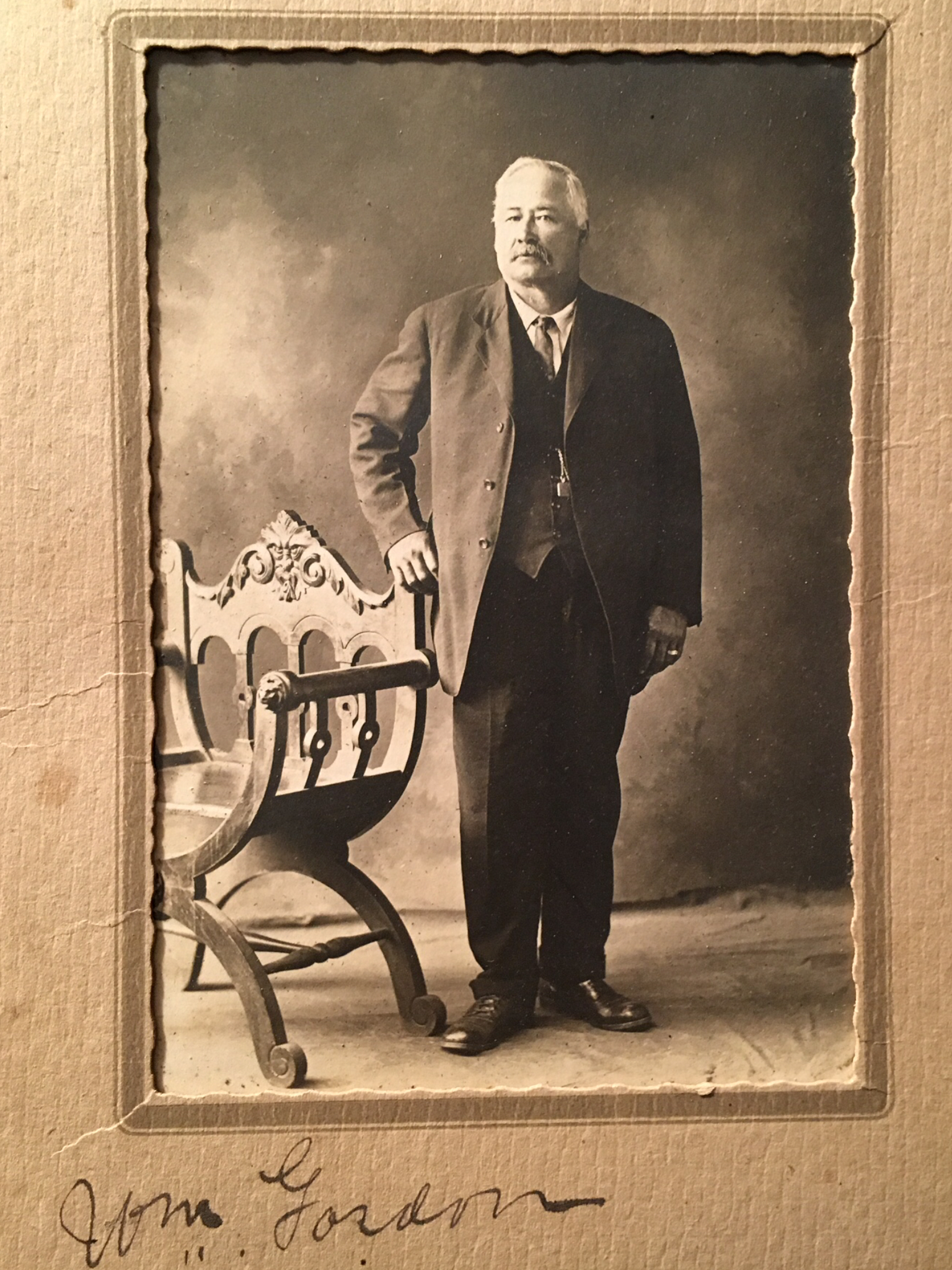
William Daniel Gordon
(1850-1943)
was a son of Antoine Gordon & Sarah Dingley.
~ Findagrave.com
I will tell you about William Gordon’s father raised on Madeline Island, who belongs to the Lake Superior Band of Chippewa Indians. In the very early days when the United States Government caused roads to be built for the purposes of opening up the country, one of the first roads to be constructed ran from Bayfield to Eau Claire Lakes. This road opened up a vast section of the country, and when new roads were built in those times, people, as a rule, followed in quest for new locations and homes. William Gordon’s father did just this. He followed the road from its starting point at Bayfield running south for some distance, then west to what they call Moose Lake. This was known as the first station and stopping place. The second station or stopping place was Moon Lake. The third station was at Spider Lake, known now as Silver Lake. The fourth place was Gordon, where William Gordon’s father settled. The present town of Gordon represents the first settlement of William Gordon’s father. The fifth stopping place was Yellow River; the sixth, Grantsburg and the seventh, was St. Croix Falls. This was the last stopping place as far as I can remember.
As I said before, these roads opened up a beautiful section of the country, full of wild game, plenty of fur-bearing animals, with many lakes and rivers where fishing was at its best. One could easily make a good living by hunting and trapping, and there was always plenty to eat. Many of the Indians who lived at La Pointe or Madeline Island left the island, following the direction of the newly constructed road. Though they were members of the La Pointe Band of the Lake Superior Chippewa, many remained in the new settlements, and the Indians remaining along the St. Croix River and other adjacent places finally lost their identity as the La Pointe Band and were later known as the “Lost Tribe.”
My great grandfather told us that the Chippewa lived at the south side of Lake St. Croix and the Sioux Indians lived on the north side, both claiming ownership of the St. Croix River. The question of full right of the St. Croix River kindled a feeling of animosity between the two tribes, and failing to arrive at any suitable agreement, war was declared between them, the aim of which was to settle the ownership of the river once and for all. In these encounters the Chippewa conquered the Sioux, driving them out of the country entirely. In their retreat, the Sioux followed a westerly direction, finally stopping where the city of St. Paul stands today.
Reel 1, Envelope 12, Item 4
RECOLLECTIONS OF JOSEPH BELL,
MEMBER OF LOST TRIBE
By W. P. Bigboy
From the time I was old enough to accompany my grandfather wherever he went, I was his constant companion. As I now recall, about all the older men of those days did, was to get together in somebody’s wigwam to discuss past, present, and future eventualities. The topic that stands out in my mind most clearly today, and which was discussed over and over again by my father and his friends was the Treaty of 1854, and the possibilities of the Indian ever deriving any of its benefits.
When I was nine years old, a messenger from Chief Mush-ko-da Be-she-ki, or Buffalo, arrived from Red Cliff with the tidings that any Interior Chippewa (Indians living away from the shores of Lake Superior were known as Interior Indians), wishing to move and make a home on the Red Cliff Reservation could do so, and that they would be given all the assistance necessary to start, such as lumber for houses, farm implements, some live stock, and enough land when cleared to permit the planting and raising of sufficient foodstuff, so that there would never be hunger for them any more.
This announcement caused the people of our camp to do a lot of thinking, and they finally agreed to accept the offer.

Shegog, Kemewan, Ozawwawmik, Mawbezhashe, & Shawwanomeda received 1861 Annuity Payments as Headmen of the St. Croix Band.
~ Theresa Schenck Papers
All the Chippewa Indians living along the St. Croix and Yellow Rivers, as far south as Yellow Lake, were notified of this opportunity, and four leaders finally got their bands together. They were, Chief Gimiwun, Chief Kitche Majesiway, Chief Checog, and Chief Ozawaccagigig. Chief Naganub from the Fond du Lac reservation, had earlier taken advantage of the offer, and on our arrival there had a home, and one of his daughters, Louisa, also had a home built.
Our band, under Chief Checog, consisted of about thirty-five families. The group was assembled from the areas where Gordon now stands at the junction of the St. Croix and Eau Claire Rivers. The band started on its journey for Red Cliff during the month of May —-. I cannot remember the year, but I was nine years old then, and I was 83 years old last February 17, it must have been around the year 1865. The journey was made on foot and it took several days, as there were many women and children like myself. On this trip I also carried a pack. I packed my grandfather’s medicine bag, which contained only his medicinal herbs, so the pack was not heavy. An incident occurred which brought a laugh from the group whenever it was mentioned in later years.

Shigag and Gimiwan from the St. Croix Band received 1872 Annuity Payments as Red Cliff Chiefs.
~ Theresa Schenck Papers
Cattle Sold at Bayfield and Ashland
The settlers from the St. Croix river and falls sold most of their cattle to markets in the Chequamegon Bay area, and the only means of getting them there was by driving them afoot. To save time, these settlers would pool their stock into one herd and then drive them to Bayfield or Ashland. Well, while on the way to Red Cliff a herd overtook us, and not being accustomed to seeing so many cattle at one time I became so frightened that I climbed a young pine near by, and hung on for dear life, and though the pack was almost choking me, not until the cattle had passed, would I climb down. After a few moments of ridiculing and laughter, we continued on our way. In a few days we arrived at Red Cliff (Misabicong), not where the Red Cliff of today stands, but three miles farther north, the place or bay where the Indian Pageant was held in 1925.
Red Cliff or “Misabicong” was the center of all activities at that time. Indians were scattered on both sides of the little creek known as “Misabicongsing,” and along the shore north and south.
Checog Creek North of Catholic Church
As the groups arrived, the leaders were shown the locations where they were to keep their subjects. Our chief, Checog, selected the site from a creek now known as Checog Creek, a few rods north from where the Catholic church and school stands, thence north towards old Red Cliff.

St. Francis Indian School in Red Cliff.
~ National Archives – College Park
Chief Given Log House
As soon as the location was agreed upon, the chief’s home was erected near the mouth of the creek. The rest of his subjects built temporary wigwams until enough lumber would be available to build houses for all the families who wished to settle there.
No planting was done that year because by the time the families had built their wigwams and cleared a space for the next season’s gardening, it was already winter.
Indian Agent as Early as 1865 or ‘66
Most of the men were given employment by the Indian Agent who was in charge of the reservation, getting timber out for the sawmill. The unexpected acceptance of Chief Buffalo’s offer by such a large number of Interior Indians caused a shortage of food-stuff, especially of flour and potatoes, and most of these Indians subsisted mainly on fish throughout the winter. This fact alone caused many of the Indians to return to their former homes along the St. Croix and Yellow rivers. These Indians were afterwards known as “The Lost Tribe.”
The following spring, my brother, John Wolf, Paul Soulier, and myself were given employment on a government garden by the Government Farmer. The garden was planted that year mainly “in potatoes,” with the view that enough seed would be on hand the following spring to supply all the Indians with seed patches for planting.
Sawmill.
A sawmill had been erected prior to our arrival there, and being too young to ask when the mill was built, I cannot furnish the exact date of its establishment, but I had been told that the mill belonged to the Indians, and all lumber manufactured would be used in building Indian homes.
Frank Chingway, Indian Sawyer
One early spring a white man came to prepare the mill for its spring cutting of the logs that had been cut and hauled during the winter by the Indians. This white man trained one Indian, Frank Chingway, to run the saw. It was not long before this Indian had full charge of the sawing. While Frank was learning, I worked behind the saw, taking away the slabs and piling them. When he began to saw, was promoted to the carriage; and my job then was to spin the wheel that regulated the thickness of the lumber to be cut. I still remember that to make an inch cut, I had to spin the wheel five times. Later the white men substituted a notched affair that made the setting easier.
Rate of Pay and Manner
While working in the mill, I received $2.00 per day. In payment for my labor I was given a grocery order for $7.00, and good in the stores of Bayfield, and the balance of $5.00 has never been paid. I believe that those who worked in the mill with me hold I.O.U.’s to this day.
The mill ran for about two months to complete the sawing of the timber. Many piles of lumber were made, and the Indians were delighted by the thought that soon they would have homes to live in.
Making Stores, Building Dock and Warehouse

Red Cliff Indian Agency Buildings
~ National Archives – College Park
After the mill closed for the season, the men [illegible] hired to make staves for barrels from the choicest white pine that was so handy and plentiful. Regardless of the enormity of the sawmill’s cut-cut, there was always a lack of lumber for the construction of Indian homes.
A number of men were employed in cutting hemlock of a certain size to be used for dock cribbing. This work took considerable time, but by spring a nice dock was finished, and the mill ran again that spring. As the cutting operation continued, the lumber yard accordingly increased in size. A large warehouse was then constructed near the dock about the same time.
Arrival of Steamboat with Provisions
During the summer, after the completion of the dock and warehouse, a steamboat stopped at the bay and began to take soundings towards the dock. When it finally reached the dock, it was made fast and men were hired to help unload its cargo.
The entire cargo was for the Indians, and consisted of barrels of flour, pork, sugar, and condiments. These commodities were not doled out but were sold to the Indians. Nothing that I can remember was ever given to the Indians gratis, but they were obliged to work for whatever they received. This feature did not exactly coincide with the promise made with the Interior Indians. Naturally, many were expecting some form of relief from the government, and the arrival of the steamship with its cargo of foodstuffs led many to believe that at last the government was beginning to fulfill its many promises made under former treaties.
On completion of the unloading, the men who helped were hired to load the boat with cordwood and lumber, which in those days was used to fuel all steamships. I might add here that in those early days anyone who had a place on which to cut cordwood had a ready market for all he could produce. If he were near a deep bay or cove, or if he had a short dock, he was constantly busy supplying the demand, when once it was known that fuel could be secured at such a place. The price for the wood was low, and men hired to cut cordwood were paid one dollar per cord. Some Indians were able to chop (not saw) from four to six cords daily.
Taking More Lumber
It was not long after the first boat sailed that another boat arrived. This boat came light and it was immediately loaded with more of the Indian lumber and cordwood.
Antoine Day, Carpenter and Boat Builder
Antoine Day was able to persuade the U. S. Indian Agent to reserve a few of the remaining piles of lumber. He was a carpenter and boat builder. Out of this lumber he built some nice sail boats, and from the larger pieces he was able to build some homes. After the sawmill machinery was taken away, he used the old mill building for a carpenter shop and boat house.
Work Not Scarce
Work was not scarce around the Red Cliff vicinity for anyone who wished to be occupied steadily. Even at my young age, I was kept busy continuously, urged on by necessity, since I was the sole support of my mother and sister. My wages equalled those of the older men in the settlement, and when not engaged in the mill or woods, I was employed by fishermen who operated in the vicinity.
First Homes Constructed

John Buffalo’s House and Family in Red Cliff.
~ National Archives – College Park
After waiting several years for the promised house for each family that settled in Red Cliff, my mother’s dream of a house began to assume reality. As for [illegible] [illegible], Antoine Day persuaded the Indian Agent to reserve several piles of the remaining lumber, and in connection with his boat-building operations he took charge of the housing program. In spite of the many obstacles confronting it, the project went steadily ahead.
Whenever he had the material, Mr. Day would cut out the lumber and a helper would take it out to the site where a house was to be erected. This helper, with the assistance of the members of the family for whom the house was erected, would nail the parts together and soon another home would be ready for occupancy.
Seeing that my mother had a home at last and that work was scarce since the closing of the Indian-owned sawmill, I decided that I wanted to see some of the world. The world to me then was our former home near the headwaters of the St. Croix, Gordon, Wisconsin.
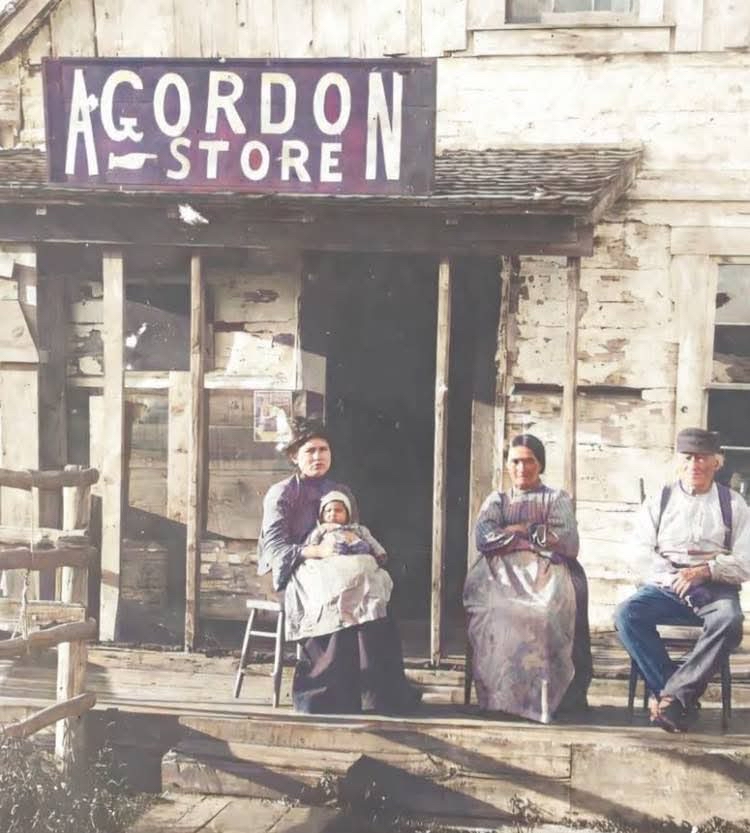
Antoine Gordon and Sarah (Dingley) Gordon at their house in the Town of Gordon with their son William’s wife Atagekwe Sarah Nekinse and baby Joe.
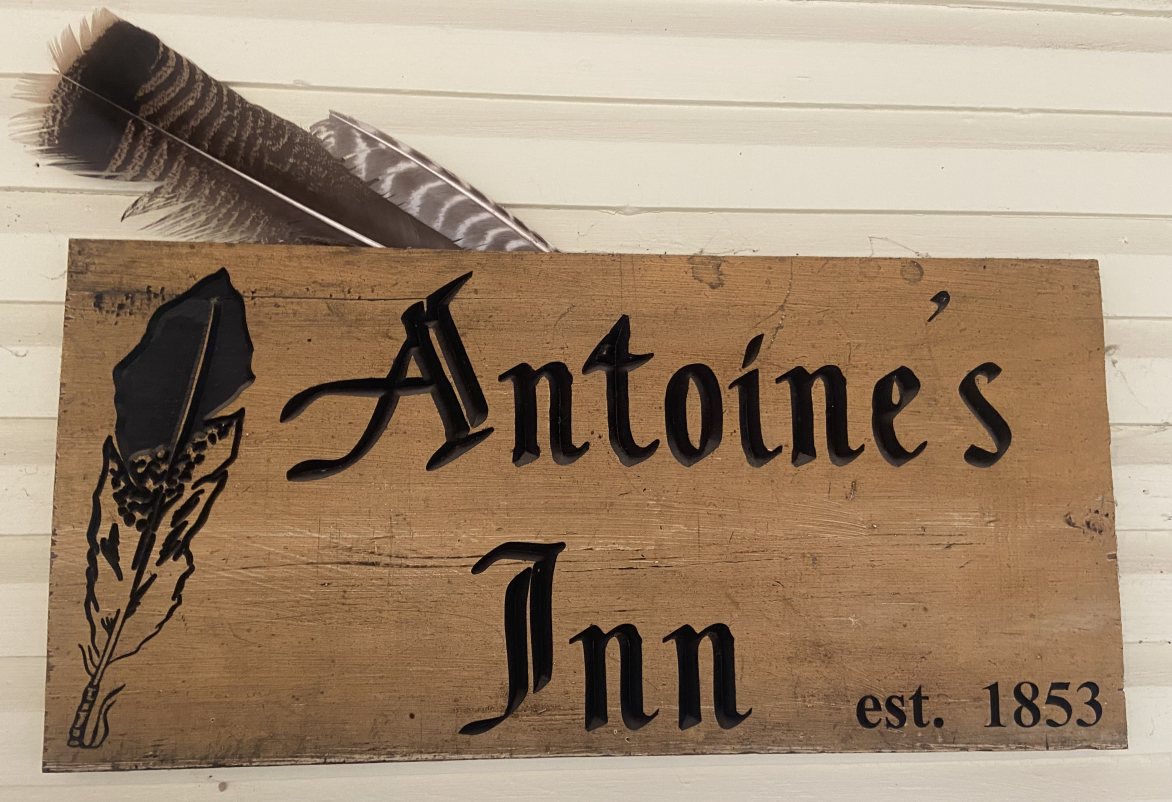
The Antoine and Sarah Gordon House was established in 1853 and listed in the State Registry of Historic Places in 2021.
After celebrating my nineteenth birthday at our new home in the month of February, I left for Gordon, Wisconsin. The purpose of this trip was to visit our relatives who had remained there, and at the same time to keep an eye open for work. I was successful in this, on my first day in Gordon.
A party of surveyors arrived at Gordon on their way to Bayfield. At that time the village was a stopping point for travelers going to points east or west. This party hired a team of horses and wanted axemen to accompany them to chop and remove blown-down trees across the road to which extended through some heavily timbered sections between Gordon and Bayfield. This trip took two days, and on arriving at Bayfield I was rehired to accompany the party into Michigan. This offer gave me the chance to fulfill my dream of seeing the world. We left Bayfield aboard a steamship and disembarked at Marquette, Michigan, where we remained for a number of days, while the engineers transacted the business which brought them to that city.
From Marquette we started overland with a team of horses hauling the party and our equipment to the headwaters of the Wisconsin river, thence to its mouth on the Mississippi. We traveled upstream untill we reached the St. Croix, finally ending our expedition at Stillwater, where I was paid off and released. I returned home by boat and by team to Bayfield.
The next spring found me again on my way from Red Cliff to the St. Croix country, where I remained until 1914, when I came to Odanah. In 1933 I paid my first visit to Red Cliff after an absence of fifty-five years.

