The 1856 Reservation for Chief Buffalo’s Estate
November 5, 2025
Collected & edited by Amorin Mello
This is one of many posts on Chequamegon History exploring the original La Pointe Band Reservations of La Pointe County on Chequamegon Bay, now known as the Bad River and Red Cliff Reservations. Specifically, today’s post is about the 1856 Reservation for Chief Buffalo’s subdivision of the La Pointe Band and how it got selected in accordance with the Sixth Clause of the Second Article of the 1854 Treaty with the Chippewa at La Pointe:
1854 Treaty with the Chippewa at La Pointe
…

Map of La Pointe Band Reservations:
334 – Bad River Reservation
335 – La Pointe Fishing Reservation
341 – Chief Buffalo’s Reservation
342 – Red Cliff Reservation
18th Annual Report of the Bureau of American Ethnology to the Secretary of the Smithsonian Institution 1896-’97
Printed by U.S. Congress in 1899
ARTICLE 2. The United States agree to set apart and withhold from sale, for the use of the Chippewas of Lake Superior, the following-described tracts of land, viz:
…
6th [Clause]. The Ontonagon band and that subdivision of the La Pointe band of which Buffalo is chief, may each select, on or near the lake shore, four sections of land, under the direction of the President, the boundaries of which shall be defined hereafter. And being desirous to provide for some of his connections who have rendered his people important services, it is agreed that the chief Buffalo may select one section of land, at such place in the ceded territory as he may see fit, which shall be reserved for that purpose, and conveyed by the United States to such person or persons as he may direct.
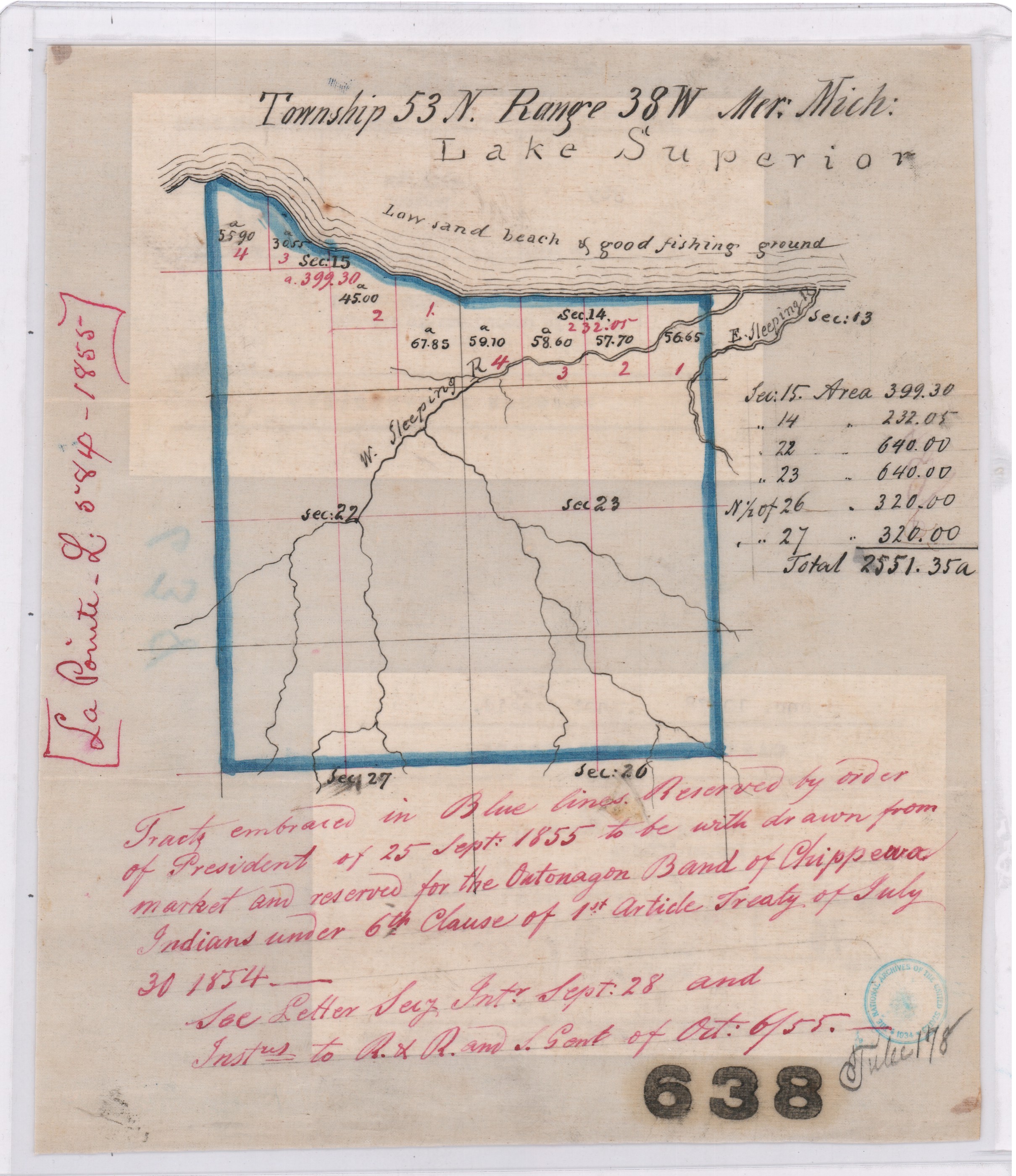
Map of “Tract embraced in blue lines reserved by order of President of 25 September 1855 to be withdrawn from market and reserved for the Ontonagon Band of Chippewa Indians“ on a “low sand beach & good fishing ground”.
Central Map File No. 638 (Tube No. 138)
NAID: 232923886 cites “La Pointe L.584-1855”.
The Ontonagon Band and Chief Buffalo’s Subdivision of the La Pointe Band got lumped together in this clause, so let’s review the Ontonagon Band first. Less than one year after the 1854 Treaty, the Ontonagon Band selected four square miles for their Reservation as approved by President Franklin Pierce’s Executive Order of September 25, 1855. Today the Ontonagon Band Reservation still has its original shape and size from 1855 despite heavy “checkerboarding” of its landownership over time.
In comparison to the Ontonagon Band Reservation, the history of how Chief Buffalo’s Reservation got selected is not so straightforward. Despite resisting and surviving the Sandy Lake Tragedy and Ojibwe Removal, making an epic trip to meet the President at Washington D.C., and securing Reservations as permanent homelands for the Chippewa Bands in the 1854 Treaty, Chief Buffalo of La Pointe died in 1855 before being able to select four square miles for his Subdivsion of the La Pointe Bands.
Fortunately, President Franklin Pierce’s Executive Order of February 21, 1856 withheld twenty-two square miles of land near the Apostle Islands from federal public land sales, allowing Chief Buffalo’s Estate to select four of those twenty-two square miles for their Reservation without competition from squatters and other land speculators, while other prime real estate in the ceded territory of La Pointe County was being surveyed and sold to private landowners by the United States General Land Office.
This 1856 Reservation of twenty-two square miles for Chief Buffalo’s Estate set the stage for what would eventually become the Red Cliff Reservation. We will return to this 1856 Reservation for Chief Buffalo’s Estate in several upcoming posts exploring more records about Red Cliff and the other La Pointe Band Reservations.

Maps marked “A” showing certain lands reserved by the 1854 Treaty:
Central Map File No. 793 (Tube 446)
NAID: 232924228 cites “La Pointe L.579-1855″.
Central Map File No. 816 (Tube 298)
NAIDs: 232924272 & 50926136 cites “Res. Chippewa L.516-1855”.

1878 Copy of President Franklin Pierce’s Executive Order of February 26, 1856 for Chief Buffalo’s Subdivision (aka “Red Cliff”).
NAID: 117092990
Office of Indian Affairs.
(Miscellaneous)
L.801.17.1878
Copy of Ex. Order of Feby. 21. 1856.
Chippewas (Red Cliff.)
Wisconsin.
Enc. in G.L.O. letter of Nov 23, 1878 (above file mark.)
in answer to office letter of Nov. 18, 1878.
Ex. Order File.

Secretary of the Interior
Robert McClelland
Department of the Interior
February 21, 1856
Sir,
I herewith return the diagram enclosed in your letter of the 20th inst, covering duplicates of documents which accompanied your letter of the 6th Sept. last, as well as a copy of the latter, the originals of which were submitted to the President in letter from the Department of the 8th Sept. last and cannot now be found.
You will find endorsements on said diagram explanatory of the case and an order of the President of this date for the withdrawal of the land in question for Indian purposes as recommended.
Respectfully
Your obt. Servt
R McClelland
Secretary
To
Hon Thos A Hendrick
Commissioner of the
General Land Office
(Copy)
General Land Office
September 6, 1855
Hon R. McClelland
Sec. of Interior
Sir:
Enclosed I have the honor to submit an abstract from the Acting Commissioner of Indian Affairs letter of the 5th instant, requesting the withdrawal of certain lands for the Chippewa Indians in Wisconsin, under the Treaty of September 30th, 1854, referred by the Department to this office on the 5th. instant, with orders to take immediate steps for the withdrawal of the lands from sale.
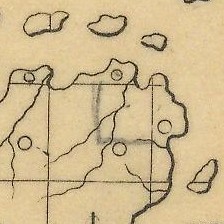
Detail of 1856 Reservation in pencil on “a map marked A.“
Central Map File No. 816 (Tube 298)
NAIDs: 232924272 & 50926136 cites “Res. Chippewa L.516-1855”.
In obedience to the above order I herewith enclose a map marked A. Showing by the blue shades thereon, the Townships and parts of Townships desired to be reserved, no portion of which are yet in market, to wit:
Township 51 N. of Range 3 West 4th Prin. Mer. Wis.
N.E. ¼ of Town 51 N ” 4 ” ” ” “.
Township 52 ” ” 3 & 4 ” ” ” “.
For the reservation of which, until the contemplated Selections under the 6th Clause of the Chippewa Treaty of 30th September 1854 can be made, I respectfully recommend that the order of the President may be obtained.
The requisite reports on the subject of the new surveys, and respecting preemption claims, referred to in the same order, will be prepared and communicated at an early day.
I am respectfully
Your Ob’t Serv’t
Thos. A. Hendricks
Commissioner
Department of the Interior
Feb. 20. 1856
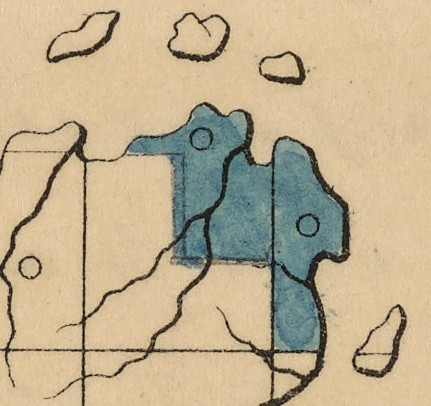
Detail of 1856 Reservation in blue on “duplicate of the original“.
NAID: 117092990
This plat represents by the blue shade, certain land to be withdrawn with a view to a reservation, under Chippewa Treaty of 30 Sept 1854, and as more particularly described in Commissioner of the General Land Office in letter of 6th Sept 1855. The subject was referred to the President for his sanction of the recommendation made in Secretary’s letter of 8th Sept 1855 and the original papers cannot now be found. This is a duplicate of the original, received in letter of Comm’r of the General Land Office of this date and is recommended to the President for his sanction of the withdrawal desired.
R. McClelland
Secretary

1856 Reservation in red and modern Red Cliff in brown. Although different in shape, both are roughly twenty-two square miles in size.
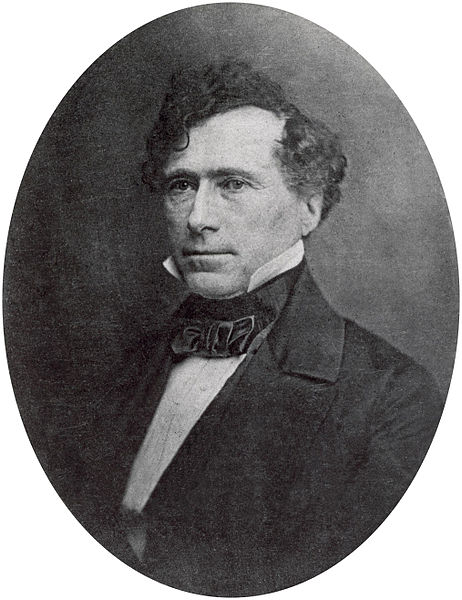
14th United States President
Franklin Pierce
February 21st 1856
Let the withdrawal be made as recommended.
Franklin Pierce
1854 Treaty of La Pointe Appropriations
November 29, 2017
By Amorin Mello

House Documents, Volume 112
By United States House of Representatives
33d Congress,
2nd Session.
Ex. Doc. No. 61.
TREATY WITH CHIPPEWA INDIANS.
————————
MESSAGE
FROM
THE PRESIDENT OF THE UNITED STATES,
United States President
Franklin Pierce
circa 1855
~ Commons.Wikimedia.com
TRANSMITTING
Estimates of appropriations for carrying into effect the treaty with the Chippewa Indians &c.
————————
February 8, 1855.—Laid upon the table and ordered to be printed.
————————
To the Senate and House of Representatives of the United States:
I communicate to Congress the following letter from the Secretary of the Interior, with its enclosure, on the subject of a treaty between the United States and the Chippewa Indians of Lake Superior, and recommend that the appropriations therein asked for may be made.
FRANLIN PEIRCE.
Washington, February 7, 1855.
Department Of The Interior,
Washington, February 6,1855.
Secretary of the Interior
Robert McClelland
circa 1916
~ Commons.Wikipedia.com
SIR: I have the honor to transmit to you, herewith, a copy of a communication from the Commissioner of Indian Affairs, dated the 5th instant, calling my attention to the subject of a treaty made at La Pointe, Wisconsin, by Henry C. Gilbert and Daniel B. Herriman, commissioners on the part of the United States, and the Chippewa Indians of Lake Superior; and, to enable this department to carry the treaty into effect, recommend that Congress be requested to make the appropriations specified in the letter of the Commissioner, and which will be immediately required for that purpose.
I am, sir, very respectfully, your obedient servant,
R. McCLELLAND,
Secretary.
To the President.
Department Of The Interior,
Office Indian Affairs, February 5, 1855.

Mackinac Indian Agent
Henry Clark Gilbert
~ Branch County Photographs
Sir: Having received the official information on the 24th ultimo of the approval and ratification, by the President and Senate, of the articles of agreement and convention made and entered into at La Pointe, in the State of Wisconsin, by Henry C. Gilbert and Daniel B. Herriman, commissioners on the part of the United States, and the Chippewa Indians of Lake Superior and Mississippi, I have the honor now to call your attention to the appropriations that will be required immediately to enable the department to carry the treaty into effect, viz:
For fulfilling treaties with the Chippewas of Lake Superior.
- For expenses (in part) of selecting reservations, and surveying and marking the boundaries thereof, per 2d, 3d, and 12th articles of the treaty of September 30, 1854 …….. $3,000
- For the payment of the first of twenty instalments in coin, goods, &c, agricultural implements, &c, and education, &c, per 4th article of the treaty of September 30, 1854 …….. 19,000
- For the purchase of clothing and other articles to be given to the young men at the next annuity payment, as per 4th article of the treaty of September 30, 1854 …….. 4,800
- For the purchase of agricultural implements and other articles, as presents for the mixed bloods, per 4th article of the treaty of September 30, 1854 …….. 6,000
- For the payment of such debts as may be directed by the chiefs in open council, and found to be just and correct by the Secretary of the Interior, per 4th article of the treaty of September 30, 1854 …….. 90,000
- For the payment of such debts of the Bois Forte bands as may be directed by their chiefs, and found lo be just and correct by the Secretary of the Interior, per 12th article of the treaty of September 30, 1844 …….. 10,000
- For the payment of the first of five instalments in blankets, cloth, &c, to the Bois Forte band, per 12th article of the treaty of September 30, 1854 …….. 2,000
- For the first of twenty instalments for the pay of six smiths and assistants, per 5th and 2d articles of the treaty of September 30, 1854 …….. 5,040
- For the first of twenty instalments for the support of six smith shops, per 5th and 2d articles of the treaty of September 30, 1854 …….. 1,320
It will be observed that the treaty of September 30, 1854, recognized the Chippewas of Lake Superior as a branch of the nation, and that the pecuniary and beneficiary stipulations therein are for their exclusive use.
By the fifth article of the treaty the Lake Superior Chippewas are to have six blacksmiths and assistants, and they relinquish, by the same article, all other employés to which they might otherwise have been entitled under former treaties.
The Chippewas of the Mississippi are, by the eighth article of the treaty, entitled to one-third of the benefits of treaties prior to 1847; and, by consequence, retain an interest of one-third in the stipulations for smith shops, &c., and farmers, &c, per second article of the treaty of July 29, 1837; and in the farmers, and carpenters, and smiths, &c., mentioned in the fourth article of the treaty of October 4, 1842.
On an examination of the condition of existing appropriations to fulfil the stipulations just mentioned, it is found that the balances in the treasury are sufficient to sustain these employés and otherwise meet the requirements of the stipulations referred to, so far as the Chippewas of the Mississippi are interested, during the next fiscal year.
In case appropriations are made by Congress, in pursuance of the foregoing estimates, it will be perceived that the following items of the Indian appropriation bill now before Congress might, with propriety, be stricken out, viz:
House bill 555, reported, with amendments, January 16, 1855:
- Page 4, lines 68, 69, 70, and 71, “three thousand dollars,” ($3,000.)
- Page 4, lines 72, 73, 74, 75, and 76, “one thousand dollars,” ($1,000.)
- Page 5, lines 89, 90, 91, 92, and 93, “two thousand dollars,” ($2,000.)
- Page 5, lines 94, 95, and 96, “one thousand dollars,” ($1,000.) Page 5, lines 97, 98, and 99, “one thousand two hundred dollars,” ($1,200.)

Director of of the Bureau of Indian Affairs
George Washington Manypenny
circa 1886
~ Commons.Wikimedia.org
As it is not deemed necessary, I do not therefore submit, at present an estimate for appropriations to pay employés for the Bois Forte band, as per twelfth article of the treaty of September 30, 1854, or to liquidate a balance, should any be found due to these Indians by the investigation, which it is provided by the ninth article of the same treaty shall be made.
Should the foregoing estimates and suggestions be approved by you, I respectfully recommend that they be laid before Congress as early as practicable.
Very respectfully, your obedient servant,
GEO. W. MANYPENNY,
Commissioner.
Hon. R. McCLELLAND,
Secretary of the Interior.
Land Office Frauds
March 25, 2016
By Amorin Mello
New York Times
December 9, 1858
—~~~0~~~—
Land Office Frauds.
—~~~0~~~—
AGRICULTURAL CAPABILITIES HEREABOUT – LOCAL AMUSEMENTS AND EXCITEMENTS – SETTLEMENTS OF SUPERIOR CITY – A CONTROVERSY, AND SECRETARY M’CLELLAND’S ADJUDICATION OF IT – SECRETARY THOMPSON’S REVERSAL OF THAT JUDGEMENT – ITS CONSEQUENCES – LAND-STEALING RAMPANT – INSTRUCTIONS FOR THE ENTRY OF SUPERIOR CITY – THE LAND OFFICE REPEALS THE LAW OF THE LAND – A CASE FOR INVESTIGATION.
Correspondence of the New-York Times.
SUPERIOR CITY, Wis., Thursday, Nov. 25.

I am booked here for another winter, but fortunately with no fear of starvation this time. We have been most successful the last Summer in our Agricultural labors. The clay soils about here has proved marvelously fruitful, and where we expected little or nothing it has turned out huge potatoes that almost dissolve under the steaming process, and open as white as the inside of a cocoa-nut ; mammoth turnips, as good as turnips can be ; cabbages of enormous size ; and cauliflowers, that queen of vegetables, weighing as much as a child a year old. There is no reason to fear for the future of this country, now that we can show such vegetable products, and talk of our gardens as well as of our mines, forests, furs, and fisheries.
We are not without our excitements here, too ; though we have no model artists, or theatrical exhibitions, to treat our friends with. But our little city is now in a state of commotion produced by causes which often agitate frontier life, and sometimes reach the great center with their echo or reverberation. The Land Office is the great point of interest to frontier men, and the land law is the only jurisprudence save Lynch law, in which we are particularly interested. And as we have no means of reaching the great Federal legislature, through our Local Presses, we are always glad of an opportunity to be heard through the Atlantic organs, which are heard all over the country, and strike a note which the wind takes up and carries not only to San Francisco, but up here to the mouth of the St. Louis River, the hereafter great local point of Pacific and Atlantic intercommunication.

The Eye of the Northwest, pg. 8: James Stinson; Benjamin Thompson; W. W. Corcoran; U. S. Senator Robert J Walker; George W Cass; and Horace S Walbridge.
Five or six years ago a few American pioneers – stalwart backwoodsmen, undertook to select a town site out here, and did select one in good faith, and with clubs and muskets in had fought off from their premises a gang of Indians who were claiming to preëmpt it as “American citizens.” The Indians, however, were backup up by a Canadian white man by the name of STINSON, and some of the great speculators who were engaged in another town enterprise alongside here, and this “Indian war” was protracted in the local and general Land Offices some two or three years, when Mr. M’CLELLAND, then Secretary of the Interior, made a final adjudication of all the legal questions involved in the controversy, and sent it back to the Land Office to ascertain and apply the facts to the law as settled, on great deliberation by himself and Mr. CUSHING.
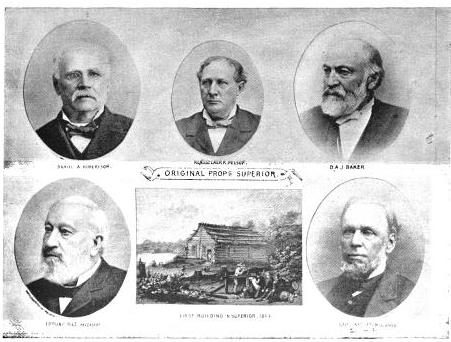
More Proprietors of Superior from The Eye of the North-west
, pg. 9: [names are illegible]
Meanwhile the original settlers and occupants maintained their adverse possession against the Indians and all the world, and expended a good deal of money in erecting buildings and a pier, and in cutting out streets and in laying out their town, and in carrying on their litigation, which was by no means inexpensive. M’CLELLAND’s determination of the law in their favor encouraged them to go on and incur additional expenses ; and they parted with diverse interests in the town site, some by assignment to persons who advanced money, and some by sale on quit-claim to persons who covenanted to make improvements. They made application to the proper office to enter the site, and nobody objected but the Indians – and the Indians were nowhere. So things stood when the case went back to the General Land Office, and to Mr. Secretary THOMPSON. The worthy Secretary, for some cause altogether unaccountable, adopted the extraordinary (and under the decision of the Supreme Court illegal) course of reversing the final judgement of his predecessor in this very case, (an exercise of power entirely unheard of in a case of mere private right,) and of rejecting the claim of the original occupants and settlers, though it was not contested by somebody who had a better right.
You may well imagine that this decision excited no little astonishment here. All the land stealers looked upon Superior City as vacant ground. They thought the men who selected and settled the town site were outlawed, and had no interests. Some supposed that the Land Office would put the ground up at auction. A chap by the name of SWEETZER came on here fresh from the General Land Office, and undertook to lay Sioux scrip on the whole site. Another – one JOHN GRANT – made application to preëmpt a portion of the site – and, what is the most remarkable feature about this business, GRANT was permitted to enter it as a preëmptor, though it was notoriously a selected town site, and in the adverse possession of town claimants half a year before GRANT ever saw it. This outrage created a great excitement for a small place. The Register, Mr. DANIEL SHAW, excuses himself by saying that he was almost expressly ordered by HENDRICKS to issue the certificate to GRANT, but this we do not believe in these parts. SHAW is clever, and covers his tracks, but nobody here supposes that the Commissioner ever countenanced such a gross violation of a public statute, without a motive. And what motive could the Commissioner have?
But, besides these movements, one of the Indians – ROY by name, who was defeated as one of the claimants by preëmeption – is now seeking to locate his Chippewa scrip on the town-site, and it is supposed that the same influences which urged him as an American citizen will support his claim as an Indian. A white man by the name of KINGSBURY, encouraged by the disregard of law exhibited by the local office, has made a claim on another part of the town-site. This purports to have originated in the fourth year of a litigation between the town claimants and the illegal preëmptors, and is supposed to be stimulated and encouraged by the Register.![Vincent Roy, Jr., portrait from "Short biographical sketch of Vincent Roy, [Jr.,]" in Life and Labors of Rt. Rev. Frederic Baraga, by Chrysostom Verwyst, 1900, pages 472-476.](https://chequamegonhistory.com/wp-content/uploads/2016/03/vincent-roy-jr.jpg)
Subsequently to his original rejection of the town-site claim, Mr. Secretary THOMPSON issued instructions to permit the entry, and the County Judge made application on the 18th instant, under the law of the United States, May 23, 1844. On this being known, some of the persons heretofore claiming under the original settlers and occupants (who had selected the town and paid all the expenses of the settlement) came together and formed an organization as a city, under a recent law of Wisconsin, the object of which they declare to be secure to themselves a title from the United States to the lots they specially occupy, and to sell the balance to defray their expenses in entering and alloting the land! The men whose rights vested under the absolute decision of Secretary MCCLELLAND, and who did all that they could do to enter the land, and paid the money for it more than two years ago, – the men whose “respective INTERESTS” the statute of 1844 recognizes and was designed to protect, – these men are all ruled off the course, and the men claiming under them have conspired to divide the land and its proceeds among themselves.
Of course these iniquitous and illegal proceedings are all within the reach of the Courts – but they are the legitimate consequence of Mr. JACOB THOMPSON’s repeal of so much of the Preëmption Law of 1841 as excludes from preëmption those portions of the public lands that have been “selected as the site of a city or town.” Mr. THOMPSON has overruled all his predecessors, all the Attorney-General, all the local offices, all the lexicographers, and the English language generally, by deciding solemnly that “selection” does not mean “selection,” but means something else – or more particularly nothing at all. Because, says he, if adverse “selection” excluded a preëmptor, then a preëmptor might be excluded by a false allegation of selection. Was there ever such an argal since Dogberry’s time? The Secretary has discovered an equally efficient “dispensing power” with that of King JAMES of blessed memory, and one which his brethren in the Cabinet may use very efficiently, if Congress does not look into the subject and fix some limits to it. For now, not only the Secretary, but the Commissioner, and the Register and Receiver, all think that they are at liberty to treat the repeal by the Secretary as an effective nullification of the law of the land.
If Congress would amuse their leisure a little by looking at these land office operations on the verge of civilization, they would strike a placer of corruption. Let them open the books and call for the documents, and see what Dr. T. RUSH SPENSER, late Register of the Willow River District, says of his predecessor and successor, Mr. JOHN O. HENNING, and then ascertain by what influences HENNING has been reappointed, and SPENSER transferred to Superior. Let them find out what Receiver DEAN said of Register SHAW, and what Register SHAW said of Receiver DEAN, and why DEAN was dismissed and why SHAW was retained. It will be rare fun for somebody. The country ought to know something about the Land Offices, and such an investigation as this would enlighten the country very materially. I hope it will be made, and that the country will learn how it is that more land has been entered in this district by Indians, foreigners, and minors than by qualified preëmptors, and all for the benefit of a few favored speculators.
 Chequamegon History