Ruelle Chagouamigon du Vieux-Montréal
October 25, 2025
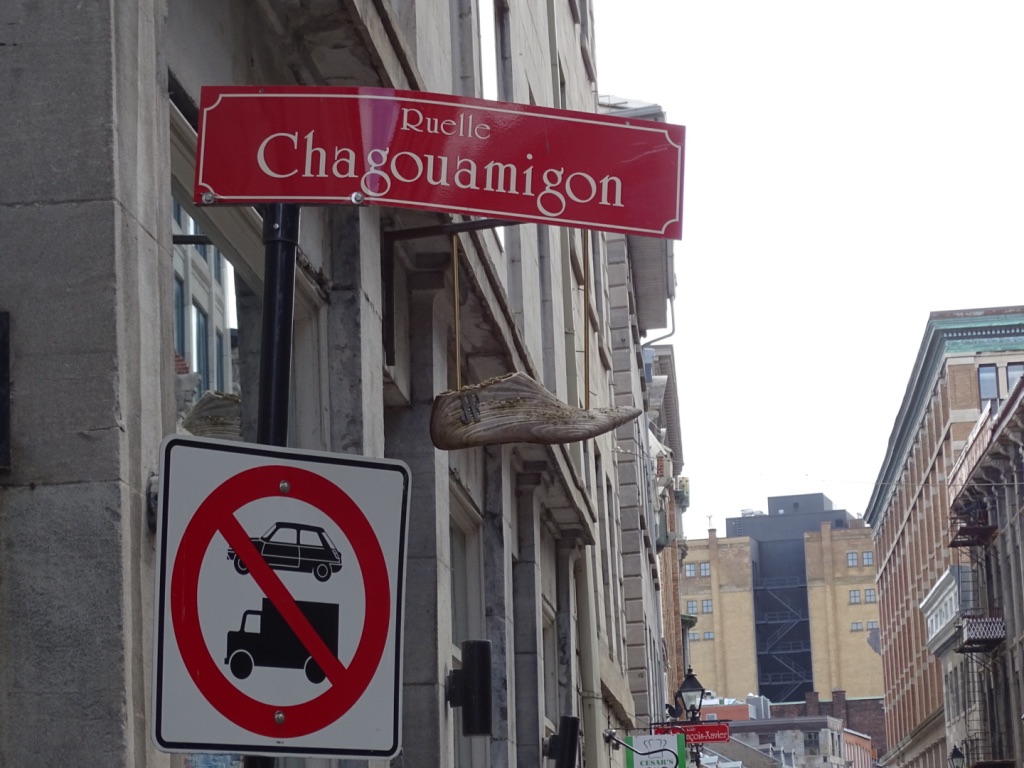
Photo taken by David Trudeau at Ruelle Chagouamigon, 2019.
A Street named for Chequamegon in Montreal.
Guest post by David Trudeau
French North America at the dawn of the 18th century was a vast network of French and Indigenous trading outposts spanning the entire Mississippi and St. Lawrence-Great Lakes watersheds with Montreal as its main hub. Chequamegon was a part of that network, and so notable, that a street in old Montreal was called “Rue Chagouamigon.”
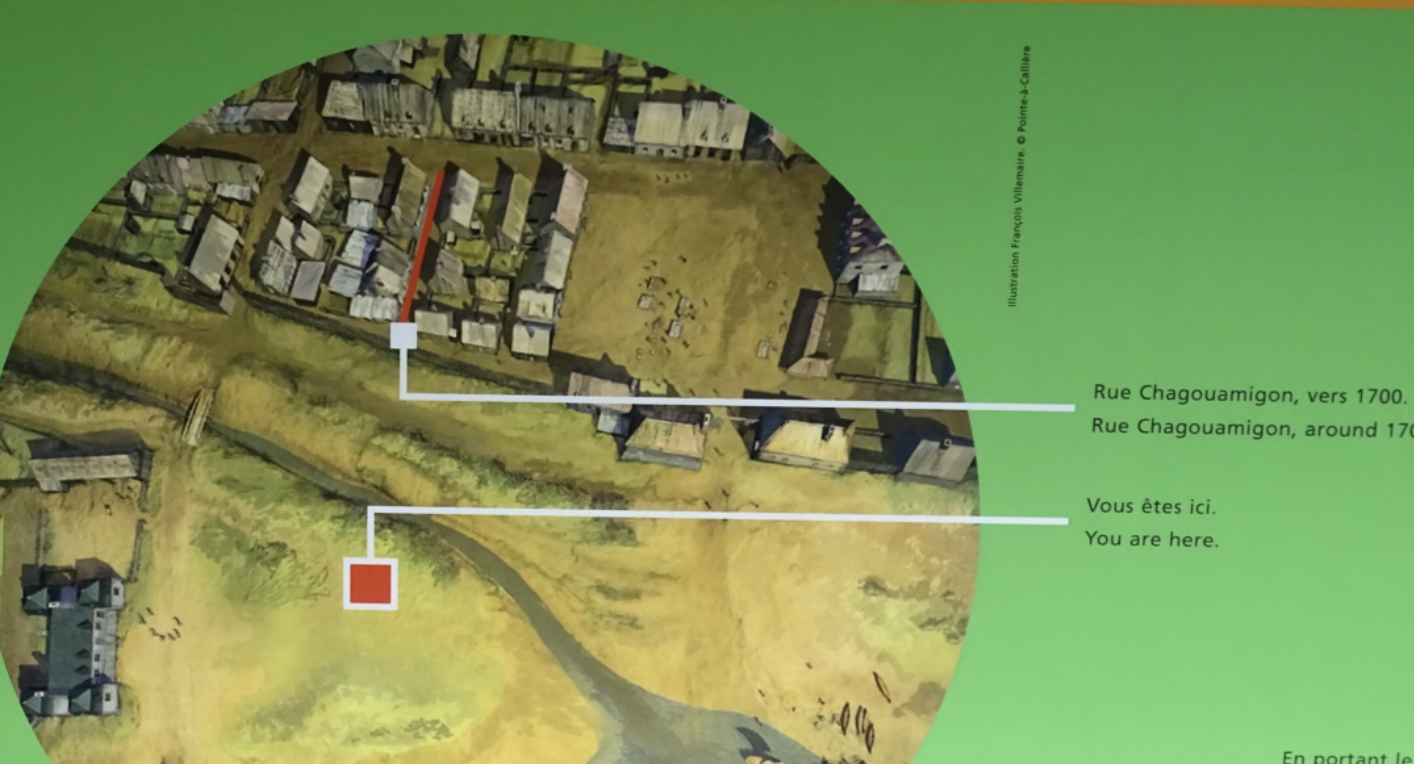
Model of Rue Chagouamigon circa 1700. Photo taken by David Trudeau at the Pointe-à-Callière Museum, 2019.
Madeline Island is approximately 1200 miles from Montreal, a journey of about 6 hours by plane — or one of up to two months by canoe and portage across Superior and Huron and down the Ottawa river. In the days of the voyageurs, the trip of trade goods to Lapointe and the return trip to Montreal of bundled beaver pelts was typically a once a season event. Circa 1700 “Chagouamigon” was a well enough known place in old Montreal to merit a street name.
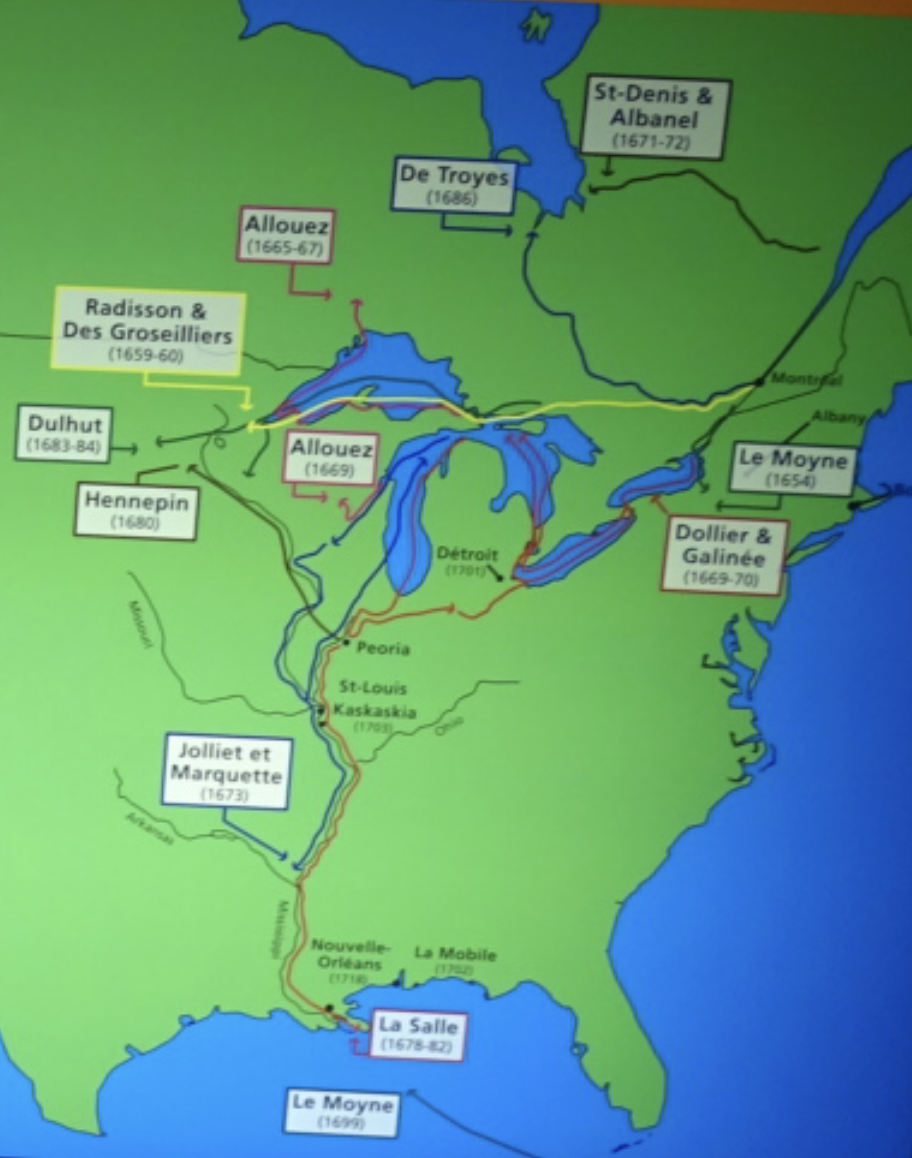
Map of Montreal’s fur trade routes circa late 1600s. Photo taken by David Trudeau at the Pointe-à-Callière Museum, 2019.
The place name is French spelling of the Ojibwe term for “soft beaver dam”1 and a reference to Chequamegon point, so named by a local Ojibwe legend about a giant beaver dam (Long Island) and how the Apostle Islands archipelago was created. Was the name of the street whimsically chosen because of its beaver reference or was it more likely a reference to a place becoming well known to the fur trade. Today the street still exists in the in Vieux-Montreal, the old town. Time has changed its route to a mere one block, and it is now known as a “Ruelle,” a little street. There is a special mention of Ruelle Chagouamigon in the Pointe-à-Callière Museum, built on and incorporating the archaeologic remains of Ville-Marie, the beginnings of Montreal started in 1642.
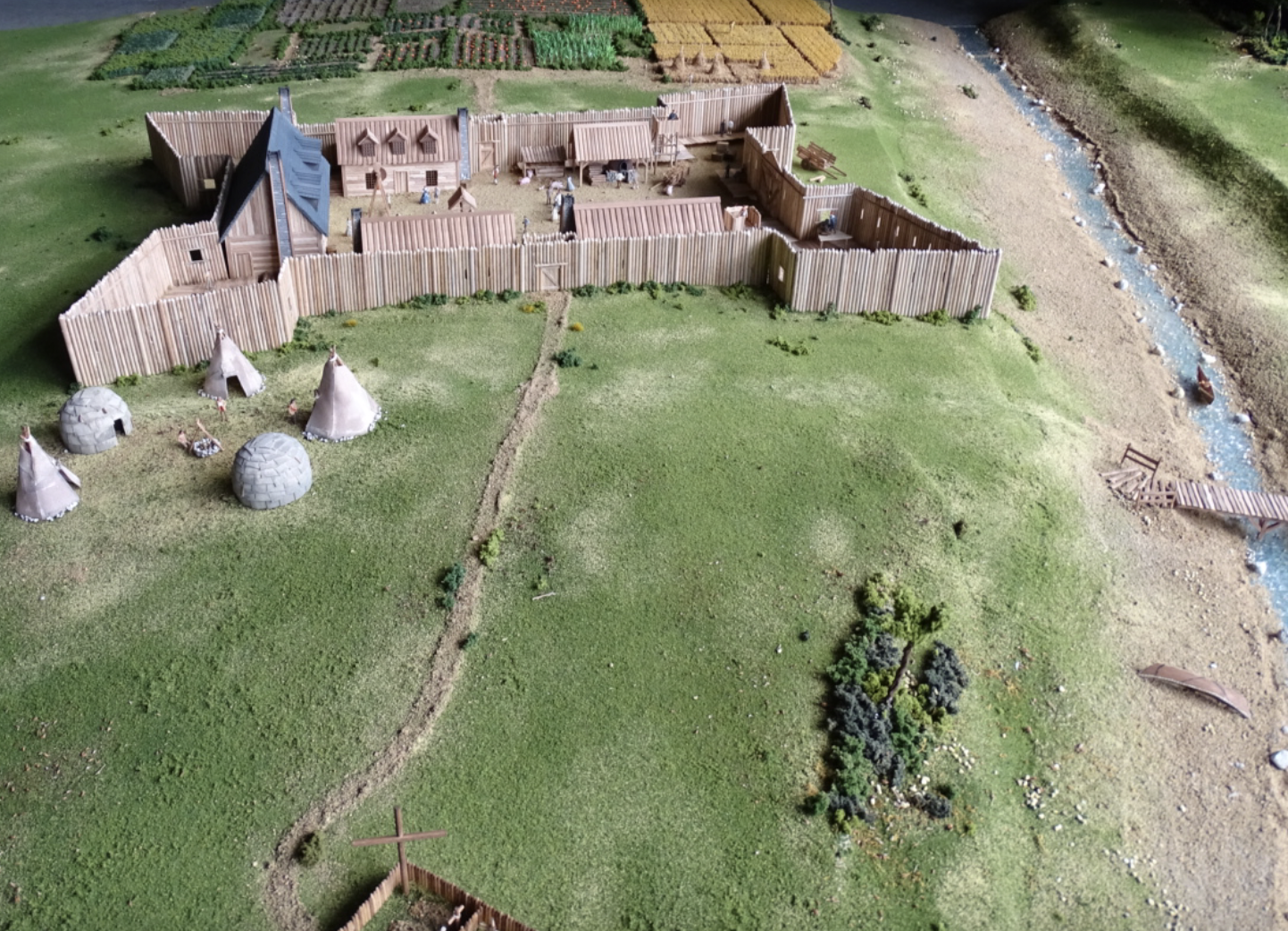
Model of Ville Marie circa 1643. Photo taken by David Trudeau at the Pointe-à-Callière Museum, 2019.

Photo of wife taken by David Trudeau at Ruelle Chagouamigon, 2019.
As I visited the Pointe-à-Callière in May of 2019, researching and learning about my French colonial ancestors who were among Montreal’s founders, I was thrilled to find the exhibit showing the street. I was equally thrilled to walk right up to it as it exists today, and take a photo of my wife Karen on the street. Karen is not a big person, but the tiny narrow street makes her look enormous.

Excavated timbers beneath the Pointe-à-Callière Museum. Photo taken by Amorin Mello, 2023.
Montreal began as a mission outpost, Ville-Marie, founded in 1642 by a lay missionary society, with the objective of building a hospital to care for Indigenous people, and establishing a mission. Many of the missions early contacts and converts were Algonquin speakers. The excavations inside the museum show original posts and timbers of Ville-Marie likely laid out by carpenter Gilbert Barbier, my 8x great grandfather.2
Ville-Marie’s existence was touch and go because of constant predation by Mohawk Haudenosaunee. By 1685, Ville-Marie was home to some 600 colonists, most of them living in modest wooden houses. Ville-Marie became a centre for the fur trade and a base for further exploration3. Etienne Truteau, my 7x great grandfather, arrived in 1659, and had 13 sons with his wife Adrianne Barbier. Many of their boys worked the fur trade routes when they were younger – usually from age 15 to 25. They saved up and bought land and married about age 25.
~ Quebec Commission de Toponymie
~ Montreal.ca
~ WalkMontreal.com
Their son, my 6x great grandfather Pierre, spent 10 years contracted between Montreal, Mackinac and Green Bay. On July 31, 16884, Pierre Truteau dit Barbier (1669-1740), the second son of Etienne, joined Nicolas Perrot for the Outaouais (Ottawa), which probably led him to Baie des Puants (Green Bay, Wisconsin)5. Alone or with other companions, over the next decade, Pierre contracted no less than seven times to equip himself for trading, going to the Maskutins (Sac) of western Lake Michigan, the Huron of Lake Huron and the Ottawa at Michilimackinac. He abandoned the fur trade in 1698 to marry and cultivate the land of his grandfather Gilbert Barbier at Côte Saint-François (Longue-Pointe).6 His nephew Toussaint (1716-1782), a blacksmith and cutter by trade, committed for a period of three years in 17367 to Messrs De la Ronde and Guillory, to go to the post of “Chagouamigon” and help paddle a canoe of trade goods up to the De la Ronde post on Madeline Island and bring it down again loaded with furs. He traveled again in 17488 for the society of Sieurs De Clignancourt, L’Échelle and Monière, on Lake Michigan, namely to the post at Baie des Puants, as part of a group of thirty-eight men in six canoes.9
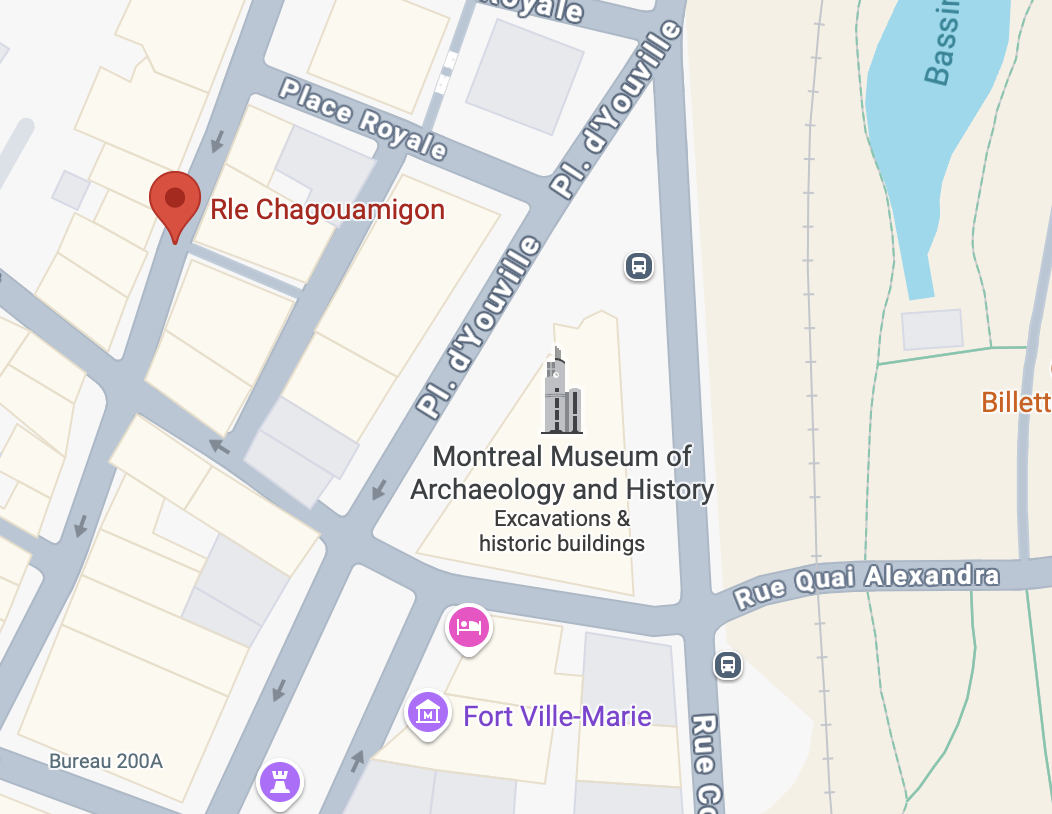
Google Map of Ruelle Chagouamigon and the Pointe-à-Callière Museum in Vieux-Montréal.

La ruelle Chagouamigon (Ebook)
Histoire de Montréal: édition 375e anniversaire de la fondation de Montréal by Yvon Codère, 2016.
Today Montreal is a huge metro area, but in its oldest part there is a tiny street, a block long and so narrow that it is restricted from cars and trucks. The street commemorates Montreal’s historic connections to Chequamegon Bay. And as a personal note, there are also traces there of my French ancestors who arrived almost 400 years ago, some of whom made the long paddle with many portages up the Ottawa and across the great lakes to Madeline Island. They were able to do so only because their friends and trading partners, the Algonkian peoples, showed them the way to survive on the journey, and provided them with food and canoes. I find it amazing that I live in the Chequamegon Bay area and share a surname with long ago Montreal ancestors who are connected to a tiny street there named for the area I call home.
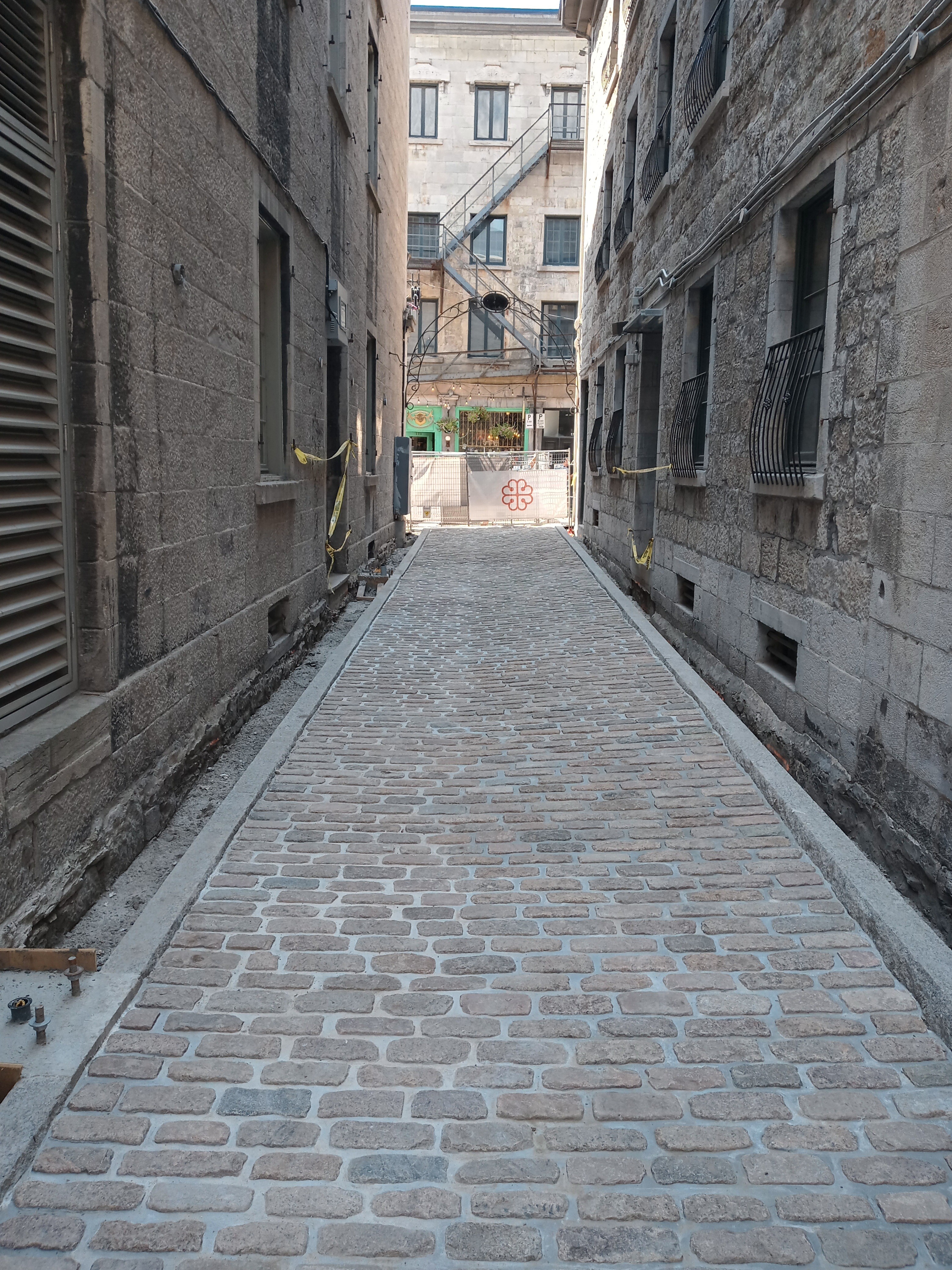
Ruelle Chagouamigon after being completely excavated for archaeological research and rebuilt. Photo taken by Francis Hervieux of the Pointe-à-Callière Museum in 2025.
—————
1 https://chequamegonhistory.com/about/.
2 Dollier de Casson, François (1636-1702) A History of Montreal 1640—1672 from the French of Dollier de Casson, translated and edited with a Life of the Author by Ralph Flenly, 1928. London & Toronto, J. M. Dent & sons, Ltd.; New York, E. P. Dutton & co. p. 103.
3 Miquelon, Dale. “Ville-Marie (Colony)“. The Canadian Encyclopedia. Archived from the original on December 3, 2013. Retrieved 22 October 2025.
4 Notary Antoine Adhémar, Library and Archives nationales du Québec (BANQ).
5 Claude Perrault “PERROT, NICOLAS”, in Dictionary of Canadian Biography, vol. 2, Laval University / University of Toronto, 2003.
6 Louise Trudeau “The History Page” Voyageur Sons Le Charpente December Volume 10 No 3, 2017.
7 Notary François Le Pallieur, Minute # 1022, Library and Archives nationales du Québec (BANQ).
8 Notary Louis-Claude Danré of Blanzy, BANQ.
9 Notary Louis-Claude Danré of Blanzy, BANQ.
Bishop Baraga Crosses Lake Superior
February 18, 2025
Collected & edited by Amorin Mello

Bishop Irenaeus Frederic Baraga
~ Madeline Island Museum
This post features oral legends recorded about two of Bishop Irenaeus Frederick Baraga’s traverses from La Pointe across Lake Superior:
A) to Minnesota’s Cross River by canoe.
B) to Michigan’s Ontonagon River by ice.
In chronological order of publication, the first record was from a German traveloguer, the next two were from Catholic missionaries, and the last two were from Bad River tribal members.
- Kitchi-Gami, by Johann Georg Kohl, 1859/1860.
- Life and Labors of Bishop Baraga, by Rev. Chrysostom Verwyst, 1896.
- Life and Labors of Rt. Rev. Frederick Baraga, by Rev. Verwyst, 1900.
- Chippewa Indian Historical Project, by United States WPA, 1936-1942.
- Chippewa Indian Historical Project, by United States WPA, 1936-1942.

Originally published in German as
Kitschi-Gami; Oder, Erzählungen Vom Obern See
by Johann Georg Kohl, 1859.
Translated and republished in English as
Kitch-Gami: Wanderings Round Lake Superior,
By Johann Georg Kohl, 1860,
Pages 180-183.

German traveloguer
Johann Georg Kohl
Du Roy: “Do you known the summer voyage our most reverend friend, your companion, once made in a birch-bark canoe right across Lake Superior? Ah! that is a celebrated voyage, which everybody round the lake is acquainted with. Indeed, there is hardly a locality on the lake which is not connected with the history of his life, either because he built a chapel there, or wrote a pious book, or founded an Indian parish, or else underwent danger and adventures there, in which he felt that Heaven was protecting him.
“The aforesaid summer voyage, which I will tell you here as companion to his winter journey, was as follows:
“He was staying at that time on one of the Islands of the Apostles, and heard that his immediate presence was required at one of the little Indian missions or stations on the northern shore of the lake. As he is always ready to start at a moment, he walked with his breviary in his hand, dressed in his black robe, and with his gold cross fastened on his breast – he always travels in this solemn garb, on foot or on horseback, on show-shoes or in a canoe – he walked, I say, with his breviary in his hand and his three-corned hat on his head, into the hut of my cousin a well-known Voyageur, and said to him: ‘Dubois, I must cross the lake, direct from here to the northern shore. Hast thou a boat ready?’
” ‘My boat is here,’ said my cousin, ‘but how can I venture to go with you straight across the lake? It is seventy miles, and the weather does not look very promising. No one ever yet attempted this “traverse” in small boats. Our passage to the north shore is made along the coast, and we usually employ eight days in it.’
” ‘Dubois, that is too long; it cannot be. I repeat it to thee. I am called. I must go straight across the lake. Take thy paddle and “couverte,” and come!’ And our reverend friend took his seat in the canoe, and waited patiently till my obedient cousin (who, I grant, opened his eyes very wide, and shook his head at times) packed up his traps, sprang after him and pushed the canoe on the lake.
“Now you are aware, monsieur, that we Indians and Voyageurs rarely make greater traverses across the lake than fifteen miles from cape to cape, so that we may be easily able to pull our boats ashore in the annoying caprices of our weather and water. A passage of twenty-five or thirty miles we call a ‘grand traverse,’ and one of seventy miles is a impossibility. Such a traverse was never made before, and only performed this once. My cousin, however, worked away obediently and cheerfully, and they were soon floating in their nutshell in the middle of the lake like a loon, without compass and out of sight of land. Very soon, too, they had bad weather.
“It began to grow stormy, and the water rose in high waves. My cousin remarked that he had prophesied this, but his pious, earnest passenger read on in his breviary quietly, and only now and then addressed a kind word of encouragement to my cousin, saying that he had not doubted his prophecy about the weather, but he replied to it that he was called across the lake, and God would guide them both to land.
“They toiled all night through the storm and waves, and, as the wind was fortunately with them, they moved along very rapidly, although their little bark danced like a feather on the waters. The next morning they sighted the opposite shore. But how? With a threatening front. Long rows of dark rocks on either side, and at their base a white stripe, the dashing surf of the terribly excited waves. There was no opening in there, no haven, no salvation.
” ‘We are lost, your reverence,’ my cousin said, ‘for it is impossible for me to keep the canoe balanced in those double and triple breakers; and a return is equally impossible, owing to the wind blowing so stiffly against us.’
” ‘Paddle on, dear Dubois – straight on. We must get through, and a way will offer itself.’
“My cousin shrugged his shoulder, made his last prayers, and paddled straight on, he hardly knew how. Already they heard the surf dashing near them; they could no longer understand what they said to each other, owing to the deafening noise, and my cousin slipped his couverte from his shoulders, so as to be ready for a swim, when, all at once, a dark spot opened out in the white edge of the surf, which soon widened. At the same time the violent heaving of the canoe relaxed, it glided on more tranquilly, and entered in perfect safety the broad mouth of a stream, which they had not seen in the distance, owing to the rocks that concealed it.
” ‘Did I not say, Dubois, that I was called across, that I must go, and that thou wouldst be saved with me? Let us pray!’ So the man of God spoke to the Voyageur after they had stepped ashore, and drawn their canoe comfortably on the beach. They then went into the forest, cut down a couple of trees, and erected a cross on the spot where they landed, as a sign of their gratitude.
“Then they went on their way to perform their other duties. Later, however, a rich merchant, a fur trader, came along the same road, and hearing of this traverse, which had become celebrated, he set his men to work, and erected at his own expense, on the same spot, but on a higher rock, a larger and more substantial cross, which now can be seen a long distance on the lake, and which the people call ‘the Cross of —–‘s Traverse.’”

Historical Collections and Researches of Michigan Pioneer and Historical Society: Vol. XXVI,
by Michigan State Historical Society, 1896,
pages 541-542.
LIFE AND LABORS OF BISHOP BARAGA
A short sketch of the life and labors of Bishop Baraga
The Great Indian Apostle of the Northwest.
By Rev. Chrysostom Verwyst O.S.F. of Ashland, Wis.
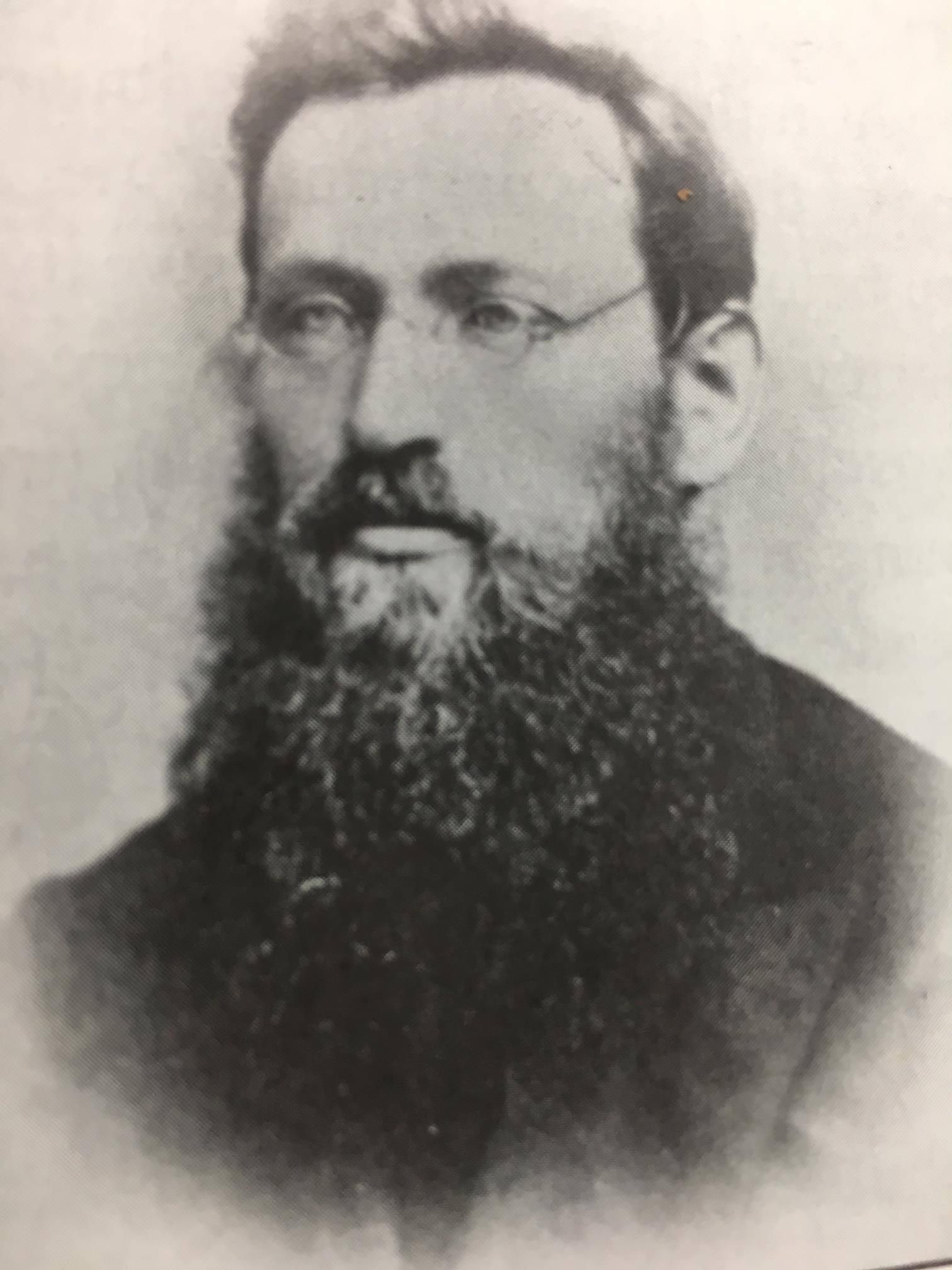
Father John Chebul arrived on Lake Superior at the Sault in October 1859 to assist his fellow Slovanian Bishop Baraga. Chebul spent the winter at Ontonagon with miners before arriving at La Pointe in May 1860.
On another occasion Father Baraga went to Ontonagon from La Pointe. We will relate the incident as told to the writer by Rev. John Cebul, of Newberry, Mich. He was well acquainted with Bishop Baraga, being a fellow countryman who had been sent to La Pointe in 1860, where he labored amongst the Chippewas of that island and Bayfield, Bad River Reserve, Superior and other places, for about thirteen years, being universally loved and esteemed by all. He says:
Bishop Baraga was intending to go on the ice to Ontonagon. He was accompanied by a man from the island. The reason they took to the ice was because it was much nearer and the walking a great deal better than on the main land. During March and April the ice on Lake Superior becomes honey-combed and rotten. If a strong wind blows, it cracks and moves from the shore if the wind blows from the land. Such fields of ice does not notice that he is in danger till he comes to the edge of the ice and then to his horror discovers a large expanse of open water between him and the mainland. Should the ice float out towards the middle of the lake or break up, he is lost. Father Baraga and his companion had traveled on the ice for some time, thinking all was right. All at once they came to the edge of the ice and saw it was impossible to reach land, as the wind had driven the ice from the shore out into the Lake. His companion became greatly alarmed. Father Baraga remained calm, praying, no doubt, fervently to Him who alone could save them. Finally the wind changed and drove the cake of ice on which they were floating to the shore. They landed at Cadotte point, about 20 or 30 miles from Ontonagon, having been carried by the wind on their ice raft about sixty miles. “See,” said the good priest to his companion, “we have traveled a great distance and yet have not labored.” It seems the good God wanted to save the saintly missionary a long and painful walk, by giving him a ride of sixty miles on a cake of ice.

Life and labors of Rt. Rev. Frederic Baraga
by P. Chrysostomus Verwyst, 1900,
pages 219-222.
“Louis Gaudin“ was one of several legendary children born to Jean Baptiste Gaudin, Sr. and Awenishen (a sister of Hole-in-the-day):
– Antoine Gordon
– Elizabeth (Gordon) Belanger
– Louison Gordon, Sr.
– Harriet (Gordon) Lemon
– John Baptiste Gordon, Jr.
– Angelique Gordon
– Joseph GordonLouison Gordon, Sr. (1814-1899) married Julia Brebant, whose sisters were married to Henry Bresette and Judge John W. Bell.Wizon is an objibwecized form of the francophone name Louison.
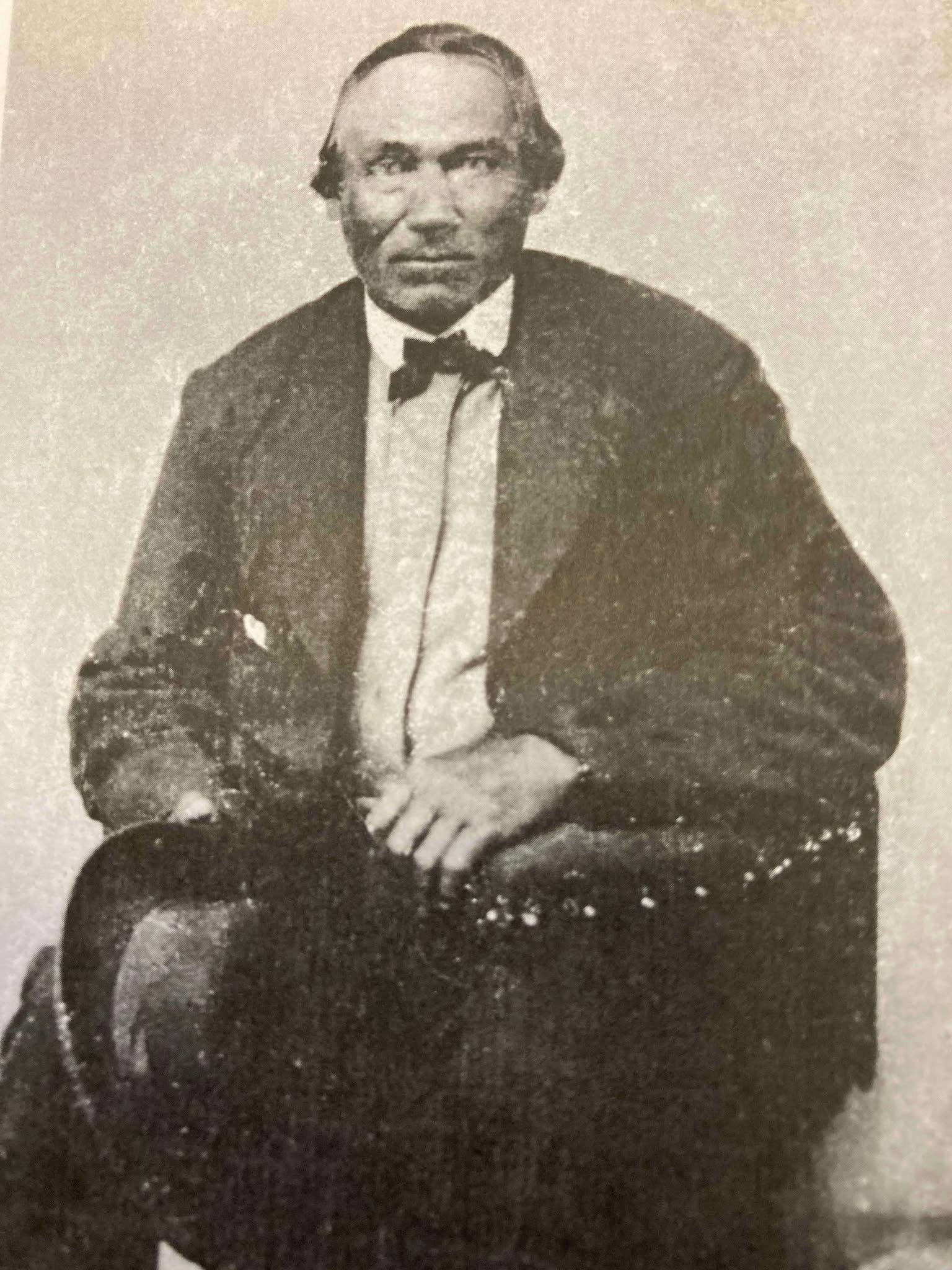
Undated photo from the Gordon Museum thought to be a brother of Antoine Gordon:
possibly Louis Gordon?

Chippewa Entrepreneur
Antoine Gordon
~ Noble Lives of a Noble Race (pg. 207) published by the St. Mary’s Industrial School in Odanah, 1909.
We learn from F. Baraga’s letter, written in October, 1845, that he intended to go to Grand Portage, Minn., the next fall to build a church there. It is, therefore, highly probable that he made that trip in the fall of 1846. He first went to La Pointe, where, no doubt, he spent some time attending to the spiritual wants of the good people. He then engaged a half-breed Indian, named Louis Gaudin, to go with him to Grand Portage. They had but a small fishing boat with a mast and sail, without keel or centre-board. Such a boat might do on a river or small lake, but would be very unsafe on a large lake, where it would easily founder or be driven lake a cork before the wind. The boat was but eighteen feet long. When they started from La Pointe, the people laughed at them for attempting to make the journey. They said it would take them a month to make the voyage, as they would have to keep close to the shore all the way, going first west some seventy miles to the end of the lake and then, doubling, turn northward, coasting along the northern shore of Lake Superior. this would make the distance about two hundred miles, perhaps even more.
However, Father Baraga and his guide set out on their perilous journey. At Sand Island they awaited a favorable wind to cross the lake, which is about forty miles wide at that place. By so doing they would save from eight to one hundred miles, but would expose themselves to great danger, as a high wind might arise, whilst they were out on the open lake, and engulf their frail bark.
They set sail on an unusually calm day. Father Baraga steered and Louis rowed the boat. Before they got midway a heavy west wind arose and the lake grew very rough. They were constantly driven leeward and when they finally reached the north shore they were at least thirty miles east of their intended landing place, having made a very perilous sail of seventy miles during that day.
While in the height of the storm, in mid-ocean, it might be said, Louis became frightened and exclaimed in Chippewa to the Father, who was lying on his back in the boat, reciting his office in an unconcerned manner: “Nosse, ki ga-nibomin, gananbatch” – Father, perhaps we are going to perish!” The Father answered quietly: “Kego segisiken, Wizon” (Chippewa for Louis) – “Don’t be afraid, Wizon; the priest will not die in the water. If he died here in the water the people on the other shore, whither we are going, would be unfortunate.”
When nearing the north shore the danger was even greater than out on the open water, for there were huge breakers ahead. Louis asked the Father whither to steer, and, as if following a certain inspiration, F. Baraga told him to steer straight ahead for the land. Through a special disposition of Divine Providence watching over the precious life of the saintly missionary, they passed through the breakers unharmed and ran their boat into the mouth of a small river, heretofore unnamed, but now called Cross River.
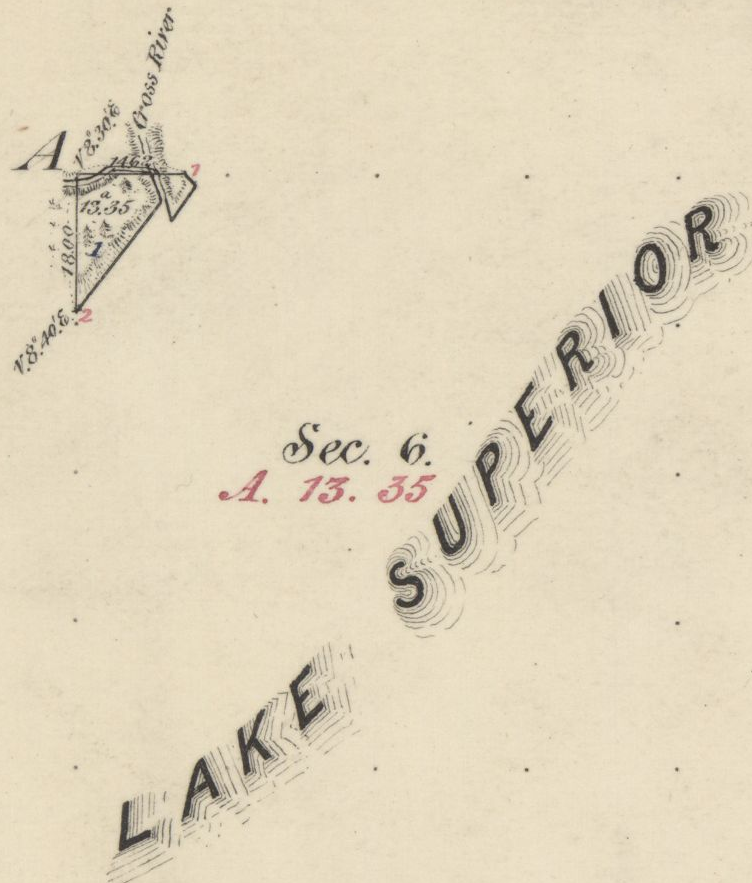
1859 PLSS detail of trees at the mouth of “Cross River”.
Full of gratitude for their miraculous escape, they at once proceeded to erect a cross. Hewing a tree in a rough manner, they cut off the top as far up as they could reach, and taking a shorter piece, they nailed it cross-wise to the tree. “Wizon,” said the Father, “let us make a cross here that the Christian Indians may know that the priest coming from La Pointe landed here.” The cross was, it is true, unartistic, but it was emblem of their holy faith and it gave the name, Tchibaiatigo-Sibi, “Cross River,” to the little stream where they landed.
They arrived none too soon. Ascending an eminence and looking out on the immense lake they saw that the storm was increasing every moment; high waves with white caps, which would surely have engulfed their little bark. They landed about six o’clock in the evening. Having spent the night there, they continued their journey next day, and in two days arrived at Grand Portage, having made the whole journey in three days. May we not think with Louis Gaudin that their safe passage across the stormy lake, and their deliverance from a watery grave, was due to a special intervention of Divine Providence in favor of the saintly missionary?

Missionary Labors of Fathers Marquette, Menard and Allouez, in the Lake Superior Region by Rev. Chrysostom Verwyst of Bayfield, 1886.
In 1667 Father Claude Allouez, S. J., then stationed at the mission of the Holy Ghost at the head of Chequamegon Bay, made the voyage across the lake from Sand Island. He made the voyage in a birch-canoe with three Indians. He remarks that they paddled their canoe all day as hard as they could without intermission, for fear of losing any of the beautiful calm weather they had. It took them twelve hours to make the trip across. The Father was then on his way to visit some Christian Indians residing at Lake Nipigon – “Animibigong” in Chippewa. For the particulars of this journey we refer the reader to “Missionary Labors of Fathers Marquette, Allouez, and Menard in the Lake Superior Region.”
The following narrative is not to be found in any of Baraga’s published letters, but the writers has it from the mouth of trustworthy persons, among whom is Father Chebul, a countryman of F. Baraga, who was stationed at Bayfield for many years. We will give the account, as we have it from Rev. F. Chebul.
Francois Newago, Sr. is the “man named Newagon” from Madeline Island, as his children were still young teenagers then.One time F. Baraga was going to Ontonagon in company with an Indian half-breed in the month of March or April. At that season of the year the ice, though thick, becomes honey-combed and rotten. Some say that Baraga’s companion was a man named Newagon. They went on the ice at La Pointe Island. As the walking on the sandy beach would have been very fatiguing and long, they determined to make straight for Ontonagon over the ice. By so doing they would not only have better walking, but also shorten their way a great deal.
A strong southwest wind was blowing at the time, and the ice, becoming detached from the shore, began drifting lakeward. After they had traveled for some time, they became aware of what hat happened, for they could see the blue waters between them and the shore. Newagon became greatly alarmed, for almost certain death stared them in the face. Had the wind continued blowing in the same direction, the ice would have been driven far out into the lake and broken up into small fragments. They would surely have perished.
To encourage the drooping spirit of his companion, F. Baraga kept telling him that they would escape all right and that they must trust in God, their loving Father and Protector. He also sang Chippewa hymns to divert Newagon’s attention and calm his excitement. Finally the wind shifted and blew the field of ice back towards the shore.
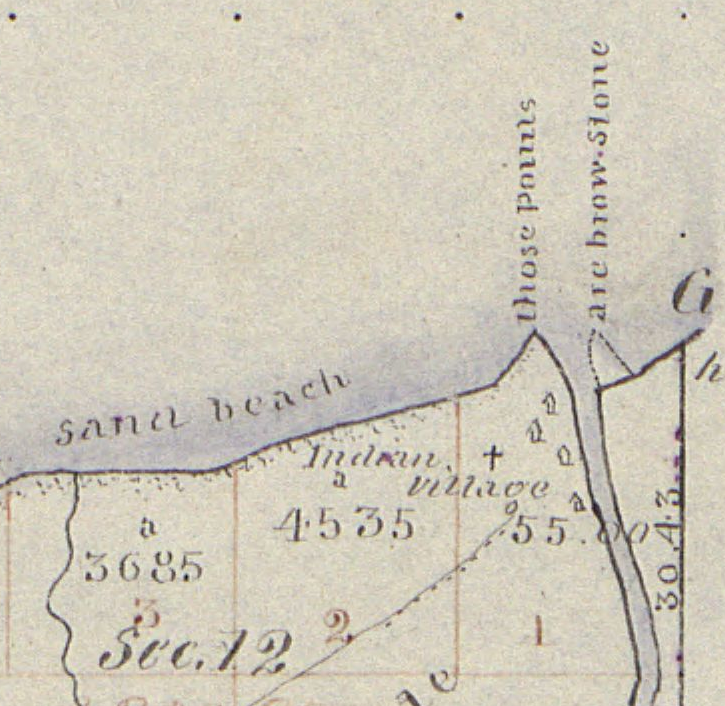
1847 PLSS detail of brownstone points, village, cross, and trailhead at the mouth of Iron River.
“Cadotte Point, near Union Bay“
appears to be located at what is now Silver City at the mouth of Iron River and eastern trailhead to the Porcupine Mountains.Michel Cadotte, Sr. ran a trading post by the Old French Fort on Madeline Island around 1800 and smaller stations scattered along the Wisconsin / Michigan shoreline of Lake Superior. Cadotte first worked for the British North West Company and later the American Fur Company after The War of 1812.They landed near Cadotte Point, near Union Bay, a short distance from Ontonagon, which they reached that same day. “See,” said the missionary to his companion, “we have traveled a great distance and have worked little.” The distance from La Pointe to Ontonagon is about sixty or seventy miles by an air line. Had they been obliged to walk the whole distance around the bend of the lake, it would probably have taken them two or three days of very hard and fatiguing traveling. So what at first seemed to threaten certain death was used by God’s fatherly providence to shorten and facilitate the saintly priest’s journey.
United States. Works Progress Administration:
Chippewa Indian Historical Project Records 1936-1942
(Northland Micro 5; Micro 532)
Reel 1, Envelop 3, Item 5
BISHOP BARAGA’S TRIP TO ONTONAGON
As related by William Obern to John Teeple.
Francois Belanger, Sr.
and Elizabeth (Gordon) Belanger. The Belanger Settlement was founded by their son Frank Belanger, Jr. and Elizabeth (Morrow) Belanger.
The journey I am about to describe is taken from the many experiences of Bishop Baraga, which were related to me by my grandfather. It deals with a journey made at an almost impossible time for ice travel on any of the Great Lakes, and portrays the important part the elements can play in a man’s life, for good or bad, for weal or for woe, as well as Bishop Baraga’s unfaltering confidence in Divine Providence.
The season of the year in which this incident took place was in the spring – along in April. Bishop Baraga and his faithful guide, Louis Gordon, started from LaPointe enroute to Ontonagon, Michigan, a distance of some eighty or ninety miles from LaPointe, straight across as the crow flies over the frozen water of Lake Superior. Dogs were used to a very large extent in those days for the purpose of transportation.
On account of the prevailing soft weather, the ice on the lake was not very solid, and with the right kind of wind, a general break-up was apt to occur at any time. In this instance, when the Bishop and his guide were about ten miles from LaPointe a south-west wind began to blow, increasing in velocity with each passing hour. The ice broke away from the shore, and began drifting outward into the open waters of Lake Superior, carrying its passengers with it. The guide, seeing the danger, suggested to the Bishop that they land on one of the islands, but the Bishop told him not to worry and to keep going in the direction of Ontonagon; that with the help of God they would reach their destination in safety.
With the coming of night the wind increased, and the two travelers were drifting out into the open waters with considerable speed. Soon the mainland was lost to view, and the guide knew that to remain on the ice mean ultimate death by freezing or drowning, but it was too late to do anything now. They had passed up the opportunity of getting off.
The missionary told Louis to look out for the dogs, and after taking a lunch, he wrapped himself up and went to sleep. He advised the guide to do likewise. The guide wrapped himself up, but he did not sleep. He kept constant vigil; about midnight the wind changed, coming from the opposite direction.
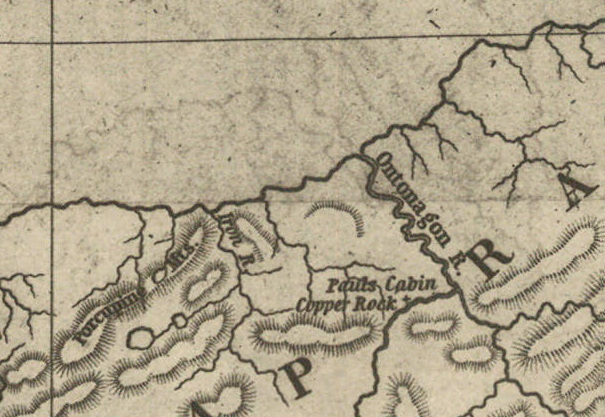
Detail of Porcupine Mountains, Iron River and Ontonagon River on the Map of the Mineral Lands Upon Lake Superior Ceded to the United States by the Treaty of 1842 With the Chippeway Indians, 1845.
The guide woke Bishop Baraga, telling him that the wind had changed. The priest asked his guide from what direction it was blowing, and upon being told that it was coming from the north-east remarked, “It is just what I hoped for and suspected.” He again told his guide to lie down and go to sleep, but the guide fearing that the plate of ice they were on might break up, would not sleep. They began to drift back almost in the same direction they had come, and when daylight came the outline of the Porcupine Mountains could be plainly seen in the distance. They were traveling at a very high rate of speed, and about mid afternoon they landed on the south shore of Lake Superior, one mile from Ontonagon, their destination.
“There,” said the bishop after they got off the ice and stepped on to the mainland, “this is just what I expected.”
At the time of this narrative, Ontonagon was a small settlement of Indians with but a few white men, who were engaged in the fur trade with the Indians and represented the American Fur Company.
* According to the description furnished by the guide, the piece of ice they were on was about one hundred by two hundred feet.
United States. Works Progress Administration:
Chippewa Indian Historical Project Records 1936-1942
(Northland Micro 5; Micro 532)
Reel 1, Envelop 3, Item 6
Cross River
ORIGIN OF THE NAME
Related by William Obern
To John Teeple.

Ojibwe, Activist, Priest
The Life of Father Philip Bergin Gordon, Tibishkogijik
by Tadeusz Lewandowski, 2019.
The story I am about to relate deals with an incident of one of the many experiences of Bishop Baraga. The narrative was related to me by my grandmother, Elizabeth Bellanger, who before her marriage was Elizabeth Gordon. She was a blood relative of Father Philip Gordon. The Gordon family consisted of the parents; sons, John, Louis and Antoine, and daughters My grandmother (Elizabeth) and Angelique.
Louis Gordon acted as the guide and all-around servant of Bishop Baraga, the missionary priest. The latter had a very large territory to cover; the northern and southern shores of Lake Superior, thence to the Dakotas and down to the waters known as Chippewa River, which emptied into the Mississippi below St. Paul.
Louis Gordon, the guide, (my grand-uncle) told of many of the experiences he had on these trips with Bishop Baraga. In speaking of my grand-uncle, Louis Gordon, I wish to state first, upon my honor as a gentleman, that he was a Christian in every sense of the word; he never took a drink of intoxicating liquor in his life; and never used profane language.
The stories related to me by my grandmother I well remember, and coming from a man like my grand-uncle, I believe them.
One day Bishop Baraga and his guide, Louis Gordon, started from LaPointe, on the western end of Lake Superior, near the place now known as Bayfield, on the shore of the lake, and about twenty-five miles from the present city of Ashland. At the time of this incident there were no white settlements to speak of at the western end of Lake Superior and the “head of the lakes” region. Bayfield, Washburn, Ashland, Superior and Duluth did not exist in those days. There were few white men among the Indians, and those few represented the American Fur Company. A few, mostly Frenchmen, had in former years settled in Minnesota and Wisconsin.
As formerly stated the trip started from LaPointe. It was to be made by water, and the boat used by the missionary and his guide, from the description given, could not have been more than 16 or 18 feet long. It was just large enough to accommodate the Bishop and his guide and to take care of their camping equipment, and although small, it came out the victor in many storms, proving itself quite seaworthy. These voyagers had a make-shift sail, which furnished them power when the wind was fair, probably a blanket which was raised on a pole; but in calm weather, or when the seas became too rough, the craft was usually propelled with oars. Wind and weather conditions in those days controlled lake travel largely, and when the lake became too rough and the seas too choppy, the voyageurs usually made a landing in some bay or stream outlet.
In this instance, the missionary and his guide were headed for Grand Marias, on the north shore of Lake Superior, a distance of fifty or fifty-five miles from the group of islands known as “Apostle Islands.” Leaving LaPointe, it was necessary for them to cross Lake Superior, traveling directly North. In the event of a severe storm, there is, of course, no place for shelter in the open waters of Lake Superior, and when once started it was necessary for them to continue their voyage until they reached Grand Marias, the point of their destination.
When the Bishop and his guide were about to leave the Apostle Islands, Louis Gordon, the guide, said to Bishop Baraga: “No-say,” (meaning father in Chippewa), “it would not be safe for us to cross the lake in this small boat today. The wind is from the south-west, and it is getting stronger. The lake will become very rough, the seas high, and I am afraid we may perish if we venture out in this wind. We had better not leave this island today, or else follow the south shore around to the end of the lake, so we can find a place to land should the seas become too rough.”
Bishop Baraga replied, “My son, have faith in God. Across that lake my Indians are waiting they must be expecting me, and it is my duty to get there as soon as possible. It would be a waste of time for us to go along the south shore, then along the north shore from the St. Louis River to Grand Marias, when we can cross here and save many miles of hard rowing and precious time. We will trust in God and make the crossing in safety.”
So, Louis Gordon, having unbounded faith in the Bishop, obeyed him, and they began their voyage across the lake, notwithstanding the fact that the wind was increasing in fury and the seas becoming higher and rougher with each passing moment. After they got into the open waters, the guide had considerable difficulty in manning the boat and keeping it from being swamped by the breaking seas. He stood up, and turning to Bishop Baraga said, “No-say, we will never reach the shore.” The Bishop was sitting at the stern of the boat, reciting his breviary. “Louis,” he said, “do not lose faith in God; fear not, He is with us.” The guide was kept busy in keeping the boat in its course, and bailing it out, to prevent it from being filled as the white caps would break over it. He headed it to a point west of Grand Marias in order that he might be better able to ride the crest of the seas, praying and hoping that when they reached the shore, which he hoped would be before dark, they would find a place to land in safety.
I wish to state here that I have seen the north shore of Lake Superior. After leaving Duluth, going east along the north shore, one will find a very rugged shore, ledges of rock from 20 to 200 feet in height standing perpendicularly along the shore line. In these rock ledges are great caves that have been fashioned by angry waves of Lake Superior during centuries. To fully appreciate this story it is well for the reader to know a little concerning the dangers of Lake Superior. Salt-water sailors who have been on the five oceans prefer to be on the ocean in a storm rather than on Lake Superior. The fact that Lake Superior is more dangerous than the oceans is conceded by sailors generally, particularly in the fall of the year. In the ocean, the billows are longer with great spaces between them; while on Lake Superior they are short, choppy, and heavy; and create much more hazard.
Night overtook the missionary and the guide before they reached the north shore; the wind became stronger and the billows higher. The only light they had to guide them was the distant glimmer of the stars, and the guide was able to keep his course by keeping his craft nosed in the direction of the North Star.
After many hours of hard pulling on the oars, the guide knew that they were reaching the shore because he was familiar with the shoreline, and knew that the noise which was all but deafening was created by the breakers dashing against the rock-bound shore.
The guide said to his companion, “No-say, we are nearing the shore, but I am sure we are many miles from Grand Marias. There is no river known in this region and on account of the precipitous formation of the shore line, we have no place to land in safety in this storm.” Bishop Baraga answered, “My son, do as I say, and we will make a landing in safety.” The guide obeyed. His hand were blistered; his strength was leaving his body, but he managed to keep up his struggle against the angry seas. The back-wash created by the billows dashing against the perpendicular rocks of the shore-line made conditions more perilous. The guide said, “Father, there is nothing but certain death ahead of us. We cannot survive this storm.” The noise was so great that it was impossible for the two voyagers to hear each other without shouting, though they were only fifteen or sixteen feet apart; but the Bishop simply said, “Louis, keep going straight ahead.”
Much water had entered their little boat, and it was coming in faster now that they were nearing the ledges of rocks, and the seas, augmented by the back-wash, were becoming rougher, so that destruction seemed imminent. Then amid the tumult and tossing of the boat upon the choppy seas, the boat was suddenly driven from the rough sea into tranquil waters, seemingly guided by some supernatural power. The guide knew that the craft was not being directed by his efforts, and that they were nearing the shore with each sweep of the waves. To his amazement, the boat grounded, and by feeling the depth of the water with his oar he knew that they were in shallow water, but he was unable to determine whether they were in a cave or at the mouth of some stream.
“Father,” Louis cried delightedly, “it seems to me that we are in a cave or at the mouth of some stream, because by feeling around with my oar I can feel a current coming from the land direction.” The missionary then told him to take out their bundle, and light the lantern so that they could see where they were and explore their surroundings.
After lighting the lantern, they made a survey of their surroundings and found that they were at the mouth of a large stream. They climbed out of the river and to higher ground, and there made their camp for the night.
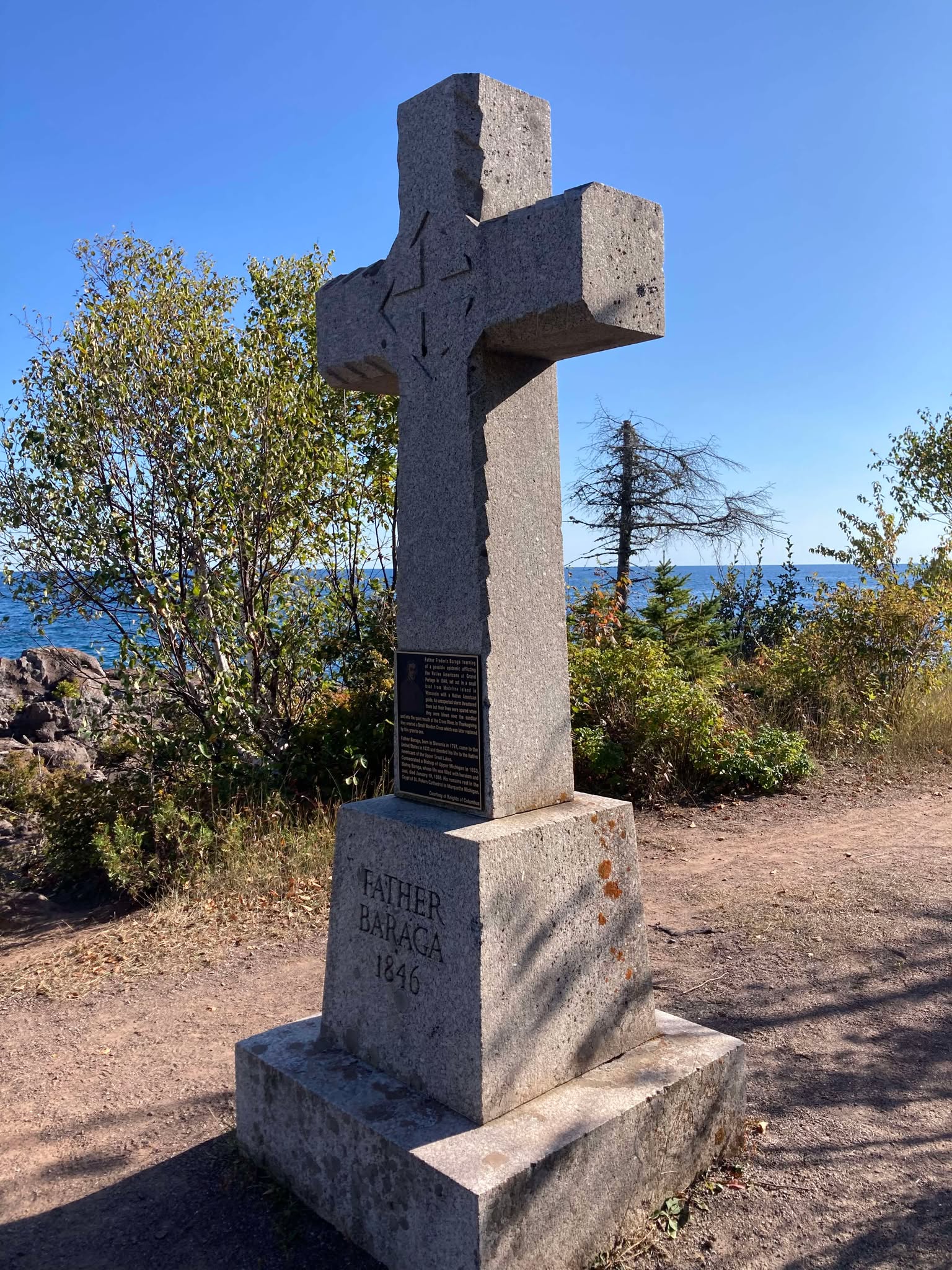
Cross River Historical Marker
Photo by Brian Finstad, 2024.
The following morning, Bishop Baraga told his guide that they would stay there that day, that they would construct and erect a cross in token of thanksgiving to God for his help and guidance to safety. So, all that day they worked. They cut down some large cedar trees and erected a large cedar cross, which they set up on the shore at the mouth of the stream. The next morning Bishop Baraga and his guide went down to the site of the cross they had erected, and again offered thanks to God for their safe deliverance. The missionary told his guide: “Hereafter this stream shall be known as “Cross River”. It has been thus known from that time on.
About twenty or twenty-five years ago, a large number of people from Duluth, Superior, and other towns and cities in the Lake Superior region, regardless of creed, made a trip to Cross River and erected a substantial cross there in place of the old cedar cross set up by Bishop Baraga and his guide, Louis Gordon, in thanksgiving to God for the wonderful guidance and loving care of his servants who landed safely at the mouth of this stream after such a perilous voyage.
Bishop Baraga stopped at Superior on their way back from the North Shore. They did not venture another lake-crossing. This zealous Lake Superior Chippewa Indian Missionary died at Marquette, Michigan, on January 19, 1868.
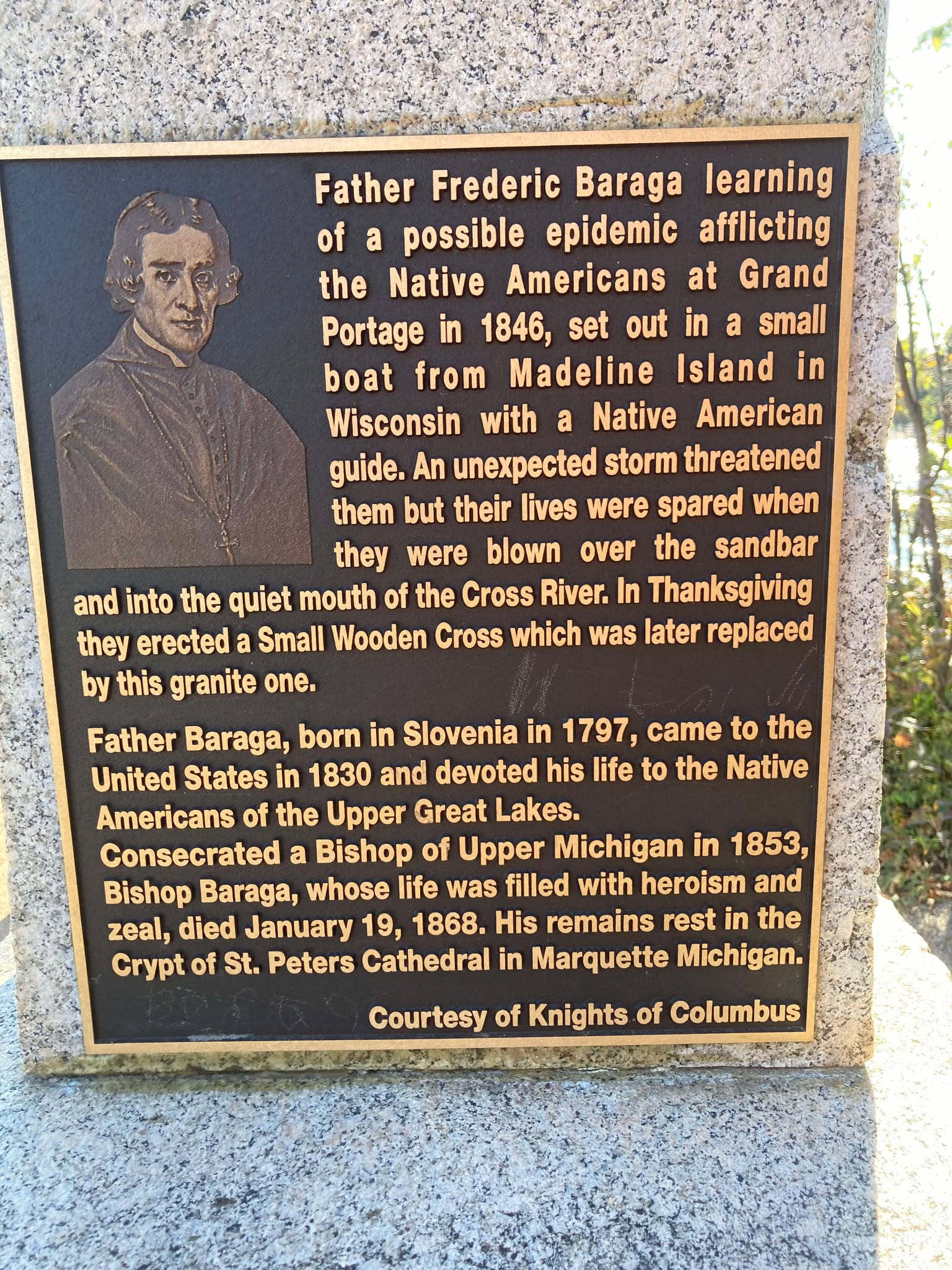
Cross River Historical Marker
Photo by Brian Finstad, 2024.
Judge Bell Incidents: King of the Apostle Islands
January 30, 2025
Collected & edited by Amorin Mello
This post is the first of a series featuring The Ashland News items about La Pointe’s infamous Judge John William Bell, written mainly by his son-in-law George Francis Thomas née Gilbert Fayette Thomas a.k.a G.F.T.
 Wednesday, September 30, 1885, page 2.
ON HISTORICAL GROUND.

James Chapman
~ Madeline Island Museum

Judge Joseph McCloud
~ Madeline Island Museum
Saturday last, says The Bayfield Press, the editor had the pleasure of visiting Judge John W. Bell at his home at La Pointe, accompanied by Major Wing, James Chapman and Judge Joseph McCloud. The judge, now in his 81st year, still retains much of that indomitable energy that made him for many years a veritable king of the Apostle Islands. Owing, however, to a fractured limb and an irritating ulcer on his foot he is mostly confined to his chair. His recollection of the early history of this country is vivid, while his fund of anecdotes of his early associates is apparently inexhaustible and renders a visit to this remarkable pioneer at once full of pleasure and instruction. The part played by Judge Bell in the early history of this country is one well worthy of preservation and in the hands of competent parties could be made not the least among the many historical sketches of the pioneers of the great northwest. The judge’s present home is a large, roomy house, located in the center of a handsome meadow whose sloping banks are kissed by the waters of the lake he loves so well. Here, surrounded by children and grand-children, cut off from the noise and bustle of the outside world, his sands of life are peacefully passing away.
Leaving La Pointe our little party next visited the site of the Apostle Islands Improvement company’s new summer resort and found it all the most vivid fancy could have painted. Here, also, we met Peter Robedeaux, the oldest surviving voyager of the Hudson Bay Fur Co. Mr. Robedeaux is now in his 89th year, and is as spry as any man not yet turned fifty. He was born near Montreal in 1796, and when only fourteen years of age entered the employ of the Hudson Bay Fur Co., and visited the then far distant waters of the Columbia river, in Washington Territory. He remained in the employ of this company for twenty-five years and then entered the employ of the American Fur company, with headquarters at La Pointe. For fifty years this man has resided on Madeline Island, and the streams tributary to the great lake not visited by him can be numbered by the fingers on one’s hand. His life until the past few years has been one crowded with exciting incidents, many of which would furnish ample material for the ground-work of a novel after the Leather Stocking series style.
Wednesday, June 30, 1886, page 2.
GOLDEN WEDDING.
About thirty of the old settlers of Ashland and Bayfield went over to La Pointe on Saturday to celebrate the golden wedding anniversary of Judge John W. Bell and wife, who were married in the old church at La Pointe June 26th, 1836, fifty years ago. The party took baskets containing their lunch with them, the old couple having no knowledge of the intended visit. After congratulations had been extended the table was spread, and during the meal many reminiscences of olden times were called up.
Judge Bell is in his eighty-third year, and is becoming quite feeble. Mrs. Bell is perhaps ten or twelve years younger. Judge Bell came to La Pointe in 1834, and has lived there constantly ever since. La Pointe used to be the county seat of Ashland county, and prior to the year 1872 Judge Bell performed the duties of every office of the county. In fact he was virtually king of the island.
The visitors took with them some small golden tokens of regard for the aged couple, the coins left with them aggregating between $75 and $100.
Wednesday, July 20, 1887, page 6.
REMINISCENCES OF OLD LA POINTE
(Written for The Ashland News)
Visitors to this quiet and delapidated old town on Madeline Island, Lake Superior, about whom early history and traditions so much has been published, are usually surprised when told that less than forty years have passed since there flourished at this point a city of about 2,500 people. Now not more than thirty families live upon the entire island. Thirty-five years ago neither Bayfield, Ashland nor Washburn was thought of, and La Pointe was the metropolis of Northern Wisconsin.
Since interesting himself in the island the writer has often been asked: Why, if there were so many inhabitants there as late as forty years ago, are there so few now? In reply a great number of reasons present themselves, chief among which are natural circumstances, but in the writer’s mind the imperfect land titles clouding old La Pointe for the last thirty years have tended materially to hastening its downfall.

Captain John Daniel Angus
~ Madeline Island Museum
Of the historic data of La Pointe, of which the writer has almost an unlimited supply, much that seems romance is actual fact, and the witnesses of occurrences running back over fifty years are still here upon the island and can be depended upon for the truthfulness of their reminiscences. There are no less than five very old men yet living here who have made their homes upon the island for over fifty years. Judge John W. Bell, or “Squire,” as he is familiarly called, has lived here since the year 1835, coming from the “Soo,” on the brig, John Jacob Astor, in company with another old pioneer of the place known as Capt. John Angus. Mr. Bell contracted with the American Fur Co., and Capt. Angus sailed the “Big Sea” over. Mr. Bell is now eighty three years of age, and is crippled from the effects of a fall received while attending court in Ashland, in Jan. 1884. He is a man of iron constitution and might have lived – and may yet for all we know – to become a centenarian. The hardships of pioneer life endured by the old Judge would have killed an ordinary man long ago. He is a cripple and an invalid, but he has never missed a meal of victuals nor does he show any sign of weakening of his wonderful mind. He delights to relate reminiscences of early days, and will talk for hours to those who prove congenial. Once in his career, Mr. Bell had in his employ the famous “Wilson, the Hermit,” whose romantic history is one of the interesting features sought after by tourists when they visit the islands.
~ History of Northern Wisconsin, by the Western Historical Co., 1881.
Once Mr. Bell started an opposition fur company having for his field of operations that portion of Northern Wisconsin and Michigan now included within the limits of the great Gogebic and Penokee iron ranges, and had in his employ several hundred trappers and carriers. Later Mr. Bell became a prominent explorer, joining numerous parties in the search for gold, silver and copper; iron being considered too inferior a metal for the attention of the popular mind in those days.
Almost with his advent on the island Mr. Bell became a leader in the local political field, during his residence of fifty-two years holding almost continually some one of the various offices within the gift the people. He was also employed at various times by the United States government in connection with Indian affairs, he having a great influence with the natives.

Ramsay Crooks
~ Madeline Island Museum
The American Fur Co., with Ramsay Crooks at its head gave life and sustenance to La Pointe a half century ago, and for several years later, but when a private association composed of Borup, Oakes and others purchased the rights and effects of the American Fur Co., trade at La Pointe began to fall away. The halcyon days were over. The wild animals were getting scarce, and the great west was inducing people to stray. The new fur company eventually moved to St. Paul, where even now their descendants can be found.

Julius Austrian
~ Madeline Island Museum
Prior to the final extinction of the fur trade at La Pointe and in the early days of steamboating on the great lakes, the members of the well-known firm of Leopold & Austrian settled here, and soon gathered about them a number of their relatives, forming quite a Jewish colony. They all became more or less interested in real estate, Julius and Joseph Austrian entering from the government at $1.25 per acre all the lands upon which the village was situated, some 500 acres.

Joseph Austrian
~ Jennifer Barber Family
The original patent issued by the government, of which a copy exists in the office of the register of deeds in Ashland, is a literary curiosity, as are also many other title papers issued in early days. Indeed if any one will examine the records and make a correct abstract or title history of old La Pointe, the writer will make such person a present of one of the finest corner lots on the island. Such a thing can not be done simply from the records. A large portion of the original deeds for village lots were simply worthless, but the people in those days never examined into the details, taking every man to be honest, hence errors and wrongs were not found out.
Now the lots are not worth the taxes and interest against them, and the original purchaser will never care whether his title was good or otherwise. The county of Ashland bought almost the whole town site for taxes many years ago and has had an expensive load to carry until the writer at last purchased the tax titles of the village, which includes many of the old buildings. The writer has now shouldered the load, and proposes to preserve the old relics that tourists may continue to visit the island and see a town of “Ye olden times.”
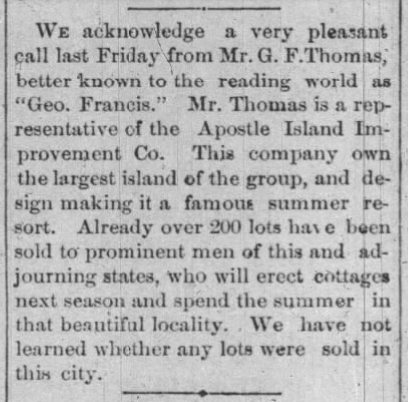
~ The Boscobel Dial
September 29, 1885.
Originally the intention was to form a syndicate to purchase the old town. An association of prominent citizens of Ashland and Bayfield, at one time came very near securing it, and the writer still has hopes of such an association some day controlling the historical spot. The scheme, however, has met with considerable opposition from a few who desire no changes to be made in the administration of affairs on the island. The principal opponent is Julius Austrian, of St. Paul, who still owns one-sixth part of La Pointe, and is expecting to get back another portion of lots, which have been sold for taxes and deeded by the county ever since 1874. He would like no doubt, to make Ashland county stand the taxes on the score of illegality. As a mark of affection for the place, he has lately removed the old warehouse which has stood so many years a prominent landmark in La Pointe’s most beautiful harbor. Tourists from every part of the world who have visited the old town will join in regretting the loss and despise the action.
G. F. T.
To be continued in King No More…
Edwin Ellis Incidents: Number VIII
February 11, 2024
Collected & edited by Amorin Mello

Originally published in the September 1st, 1877, issue of The Ashland Press.
Transcribed with permission from Ashland Narratives by K. Wallin and published in 2013 by Straddle Creek Co.
… continued from Number VII.
My Dear Press: – Among the early names associated with Ashland, I must not omit to mention a few others.
1. E. F. Prince

came to Ashland early in 1857. He was brother-in-law to Martin Beaser and was induced by him to come from Buffalo to this place. He had been employed as clerk in a large ship building establishment, and when he left the employees of the yard showed their regard for him by presenting to him an elaborate and valuable set of silver service. He erected, in the same year, the house in which he now lives, on Main Street, in Beaser’s Division. From 1861 to 1872, he resided in Ontonagon and Duluth, but upon the commencement of work on the W.C.R.R., at Ashland, he returned to his old home, where he now resides.
Though still young and vigorous, he is entitled to be reckoned as one of the “Old Folk” of Ashland.
2. Oliver St. Germain
came to this place in 1856, and built a home on Main Street, adjoining Mr. Prince’s place. The house, with all its contents, was burnt down in the spring of 1858, inflicting a heavy loss upon Mr. St. Germain. He pre-empted a quarter section of land adjoining the town site, and cleared about twenty acres in 1858. The railroad passes through this clearing about a mile from town.
In the general wreck which followed the crash of 1857, he was compelled to abandon his Ashland home, and for some fifteen years lived at Ontonagon, Carp Lake, and Superior City. In 1872 he returned to his early home, and was among the first to build a house in Vaughn’s Division, in which he now resides. Though like the rest of us, he has encountered hard times, still, in the midst of discouragements, he is ever cheerful and hopeful, and determined never to give up, as long as a plank is left in the ship.
3.
I approach with reluctance another name, for I am conscious of my inability to do justice to his memory; nor fairly exhibit to this generation, his manly social, and religious character; nor make clear, in its true extent, the important part he acted in moulding and elevating the society, not of Ashland alone, but of the Counties of Ashland and Bayfield. In the annals of that History recorded by God himself, upon the tablets of Eternity, I doubt not his name will eclipse in true greatness and glory, those of Caesar and Napoleon.
I allude to
Rev. Hemenway Wheeler.

Reverend Leonard Hemenway Wheeler of the ABCFM Mission.
He was a native of Vermont, educated at Middlebury College, and at Andover Theological Seminary.

Reverend Sherman Hall of the ABCFM Mission.
~ Madeline Island Museum
Bishop Frederick Baraga of the Catholic Mission.
~ Madeline Island Museum
At the time of the completion of his course in theology, he had nearly decided to devote his life to the foreign mission field, in which he had near relatives. At this juncture, his attention was directed to the condition of the Chippewa Indians on Lake Superior. He offered his services to the American Board of Foreign Missions, who, besides the foreign work, had charge of the missions among the American Indians. His offer was accepted, and he was directed to join the Mission at La Pointe, then one of the stations of the Board, under the care of Rev. Sherman Hall, who still survives, at a very advanced age, at Sauk Rapids, in the state of Minnesota. Mr. Wheeler, in the early part of 1841, was married to Miss Harriet Wood, of Lowell, Mass., a refined and cultivated young lady, who, like her husband, was thoroughly imbued with the spirit of missions, and with true heroism, she left her cultivated home, and society, and went into what seemed banishment from civilization. We of this day, with our numerous steamboats, from Chicago, Detroit, Cleveland and Buffalo, – with the iron horse, drinking the waters of the lake at our very doors, and with the streams of commerce, and of social life sweeping by and among us in a constant flow, can have no idea of what it involved to come here for a life work, forty years ago.
At that time, there was a small settlement at the Sault. The site of the present beautiful and substantial city of Marquette was Indian hunting grounds. L’Anse, Houghton, Hancock, Calumet, Eagle harbor, Eagle River, Ontonagon, Ashland, Bayfield, Superior and Duluth were then in the unknown future. La Pointe was at that time the most important town on the Great Lakes. It had, in the 17th century, attracted the notice of the French explorers, and of the Jesuit missionaries, who made choice of it, as a trading post and as a mission station. The mission had been continued for near two centuries, and the trading post still held, though now under another race of men, was now the headquarters of the American Fur Company, where a factor resided, and where great warehouses were erected for the reception of the vast supplies of goods to be used in the Indian trade, which were brought once a year in the company’s vessel. From La Pointe these goods were distributed to various trading posts, scattered around the basin of Lake Superior, for more than four hundred miles, and extending inland indefinitely. Among these posts may be mentioned L’Anse and Iron River, in Michigan; Lake Flambeau, Montreal River, Lac Court Oreille, and St. Croix, in Wisconsin; Fond du Lac, Grand Portage, Vermillion Lake and Crow Wing, in the Territory of Minnesota, thus embracing the largest part of the waters flowing into the gulf.

View of La Pointe, circa 1843.
“American Fur Company with both Mission churches. Sketch purportedly by a Native American youth. Probably an overpainted photographic copy enlargement. Paper on a canvas stretcher.”
~ Wisconsin Historical Society
La Pointe was the emporium, the metropolitan city of this vast extent of country. It was the Mecca of the Ojibwas, occupying the extensive country I have named. To reach La Pointe and be buried there, was to be close to the gate of entrance to the “happy hunting grounds.” It was to him the “sweet Island of the blest.” With joy he hailed its sight, as he emerged from the forests in which months had been spent, gathering his pack of furs; and with regret he turned his lingering look upon it, as he again plunged into the wild wastes for his solitary hunt of half a year.

“Boardwalk leading to St. Joseph’s Catholic Church in La Pointe.” Photograph by Whitney & Zimmerman, circa 1870.
~ Wisconsin Historical Society
It was the scene of some of the most important treaties made with the Chippewas of the Northwest, by which they ceded to the United States, lands in extent sufficient to form respectable states. It was also the gathering place where the annual Indian payments were made for many years, and where the native chiefs, with their braves, delighted to hold their great councils.
Fifty years ago, no other place in this part of the West afforded access to so large a number of natives as did La Pointe. The truths made known to these “untutored minds,” and the light flashed into their dark understandings, by the preaching of the simple story of the Cross, could soon be carried to the head waters of the Mississippi, or to the dwellers on the tributaries of Hudson’s Bay, or of the Arctic Ocean. As a central point for carrying on this work of benevolence and love, it was unsurpassed.

Undated photograph of Hall & Wheeler’s ABCFM Mission Church at it’s original location on Sandy Bay (Middleport) before it was moved uphill onto Mission Hill.
~ Madeline Island Museum
It was the consideration of these facts that induced the American Board to establish a mission station at La Pointe, and to send thither for this purpose, about fifty years ago, the Rev. Sherman Hall. He had successfully planted the mission, and established a school at the time of the arrival of Mr. Wheeler.
Mr. Wheeler immediately entered actively upon his life work devoting himself to learning the Ojibwa language, and preaching by means of an interpreter, teaching in the school, and striving, in every way, to promote the spiritual and material welfare of the people.
To be continued in Number IX…
American Fur Company: 1834 Reinvention of La Pointe
October 4, 2023
Collected & edited by Amorin Mello
The below image from the Wisconsin Historical Society is a storymap showing La Pointe in 1834 as abstract squiggles on an oversized Madeline Island surrounded by random other Apostle Islands, Bayfield Peninsula, Houghton Point, Chequamegon Bay, Long Island, Bad River, Saxon Harbor, and Montreal River.

“Map of La Pointe”
“L M Warren”
“~ 1834 ~”
Wisconsin Historical Society
citing an original map at the New York Historical Society
My original (ongoing) goal for publishing this post is to find an image of the original 1834 map by Lyman Marcus Warren at the New York Historical Society to explore what all of his squiggles at La Pointe represented in 1834. Instead of immediately achieving my original goal, this post has become the first of a series exploring letters in the American Fur Company Papers by/to/about Warren at La Pointe.
New York Historical Society
American Fur Company Papers: 1831-1849
America’s First Business Monopoly
#16,582

Map of Lapointe
by L M Warren
~ 1834 ~
New York Historical Society
scanned as Gale Document Number GALE|SC5110110218
#36
Ramsay Crooks
~ Madeline Island Museum
Lapointe Lake Superior
September 20th ’34
Ramsey Crooks Esqr
Dear Sir
Starting in 1816, the American Fur Company (AFC) operated a trading post by the “Old Fort” of La Pointe near older trading posts built by the French in 1693 and the British in 1793.
In 1834, John Jacob Astor sold his legendary AFC to Ramsay Crooks and other trading partners, who in turn decided to relocate the AFC’s base of operations at Mackinac Island to Madeline Island, where our cartographer Lyman Marcus Warren was employed as the AFC’s trader at La Pointe.
Instead of improving any of the older trading posts on Madeline Island, Warren decided to move La Pointe to the “New Fort” of 1834 to build new infrastructure for growing business demands.

GLO PLSS 1852 survey detail of the “Am Fur Co Old Works” near Old Fort.
on My Way In as Mr Warren was was detained So Long at Mackinac I did not Wait for him at this Place as time was of So Much Consequence to me to Get my People Into the County that I Proceeded Immediately to Fond Du Lac with the Intention with the Intention of Returning to this Place When I Had Sent the Outfit off but When I Got There I Had News from the Interior Which Required me to Go In and Settle the Business there; the [appearance?] In the Interior for [????] is tolerable. Good Provision there is [none?] Whatever I [have?] Seen the [Country?] [So?] Destitute. The Indians at [Fort?] [?????] Disposed to give me Some trouble when they found they have to Get no Debts and buy their amunition and tobacco and not Get it For Nothing as usual but at Length quieted down [?????] and have all gone off to their Haunts as usual.
I Received your Instructions contained in your Circular and will be very Particular In Following them. The outfits were all off when I Received them but the men’s acts and the Invoices of the Goods Had all been Settled according to your Wishes and Every Care Will be taken not to allow the men to get In Debt the Clerks Have Strict orders on the Subject and it is made known to them that they will be Held for any of the Debts the men may Incur.
I Enclose to you the Bonds Signed and all the Funds we Received from Mr Johnston Excepting those Which Had been given to the Clerks and I could not Get them Back In time to Send them on at Present.
Mr Warren And myself Have Committed on What is to be done at this Place and I am certain all that Can be done Will be done by him. I leave here tomorrow For the Interior of Fond Du Lac Where I must be as Soon as possible.
I have written to Mr Schoolcraft as he Inquested me. Mr Brewster’s men would not Give up their [??????] and [???] [????] is [??] [?????] [????] [????] [to?] [???????] [?????] [to?] [persuade?] [more?] People for Keeping [his?] [property?] [Back?] [and] [then?] [???] by some [???] ought to be sent out of the Country [??] they are [under?] [the?] [???] [?] and [Have?] [no?] [Right?] to be [????] [????] they are trouble [????] [???] [their?] [tongues?].

GLO PLSS 1852 survey detail of the AFC’s new “La Point” (New Fort) and the ABCFM’s “Mission” (Middleport).
The Site Selected Here For the Buildings by Mr Warren is the Best there is the Harbour is good and I believe the work will go on well.
as For the Fishing we Will make Every Inquiry on the Subject and I Have no Doubt on My Mind of Fairly present that it will be more valuable than the Fur trade.
In the Month of January I will Write you Every particular How our affairs stand from St Peters. Bailly Still Continues to Give our Indians Credits and they Bring Liquor from that Place which they Say they Get from Him.
Please let Me know as Early as possible with Regard to the Price of Furs as it will Help me In the trade. the Clerks all appear anxious to do their Duty this year as the wind is now Falling and I am In Haste I Will Write you Every particular of our Business In January.
Wishing that God may Long Prosper you and your family.
In health and happiness.
I remain most truly,
and respectfully
yours $$
William A. Aitken
#42
Lake Superior
LaPointe Oct 16 1834
Ramsey Crooks Esqr
Agent American Fur Co
Honoured Sir
Your letter dated Mackinac Sept [??] reached me by Mr Chapman’s boat today.-
I will endeavour to answer it in such a manner as will give you my full and unreserved opinion on the different subjects mentioned in it.
I feel sorry to see friend Holiday health so poor, and am glad that you have provided him a comfortable place at the Sault. As you remark it is a fortunate circumstance that we have no opposition this year or we would certainly have made a poor resistance. I can see no way on which matters would be better arranged under existing circumstances than the way in which you have arranged it. If Chaboillez, and George will act in unison and according to your instructions, they will do well, but I am somewhat affeared, that this will not be the case, as I think George might perhaps from jealously refuse to obey Chaboillez or give him the proper help. Our building business prevents me from going there myself. I suppose you have now received my letter of last Sept, in which I mentioned that I had kept the Doctor here. I shall send him in a few days to see how matters comes on at the Ance. The Davenports are wanted at present in FDLac should it be necessary to make any alteration. I shall leave the Doctor at the Ance.
Undated photograph of the ABCFM Presbyterian Mission Church at it’s original 1830s location along the shoreline of Sandy Bay.
~ Madeline Island Museum
Reverend Sherman Hall
~ Madeline Island Museum
In addition to the AFC’s new La Pointe, Warren was also committed to the establishment of a mission for the American Board of Commissioners for Foreign Missions (ABCFM) as a condition of his 1827 Deed for Old La Pointe from his Chippewa wife’s parents; Madeline & Michel Cadotte.
Starting in 1830, the ABCFM built a Mission at La Pointe’s Middleport (second French fort of 1718), where they were soon joined by a new Catholic Mission in 1835.
Madeline Island was still unceded territory until the 1842 Treaty of La Pointe. The AFC and ABCFM had obtained tribal permissions to build here via Warren’s deed, while the Catholics were apparently grandfathered in through French bloodlines from earlier centuries.
I think we will want about 2 Coopers but as you suggest I if they may be got cheaper than the [????] [????]. The Goods Mr Hall has got is for his own use that is to say to pay his men [??]. The [??] [??????] [has?] to pay for a piece of land they bot from an Indian woman at Leech Lake. As far as my information goes the Missionaries have never yet interfered with our trade. Mr Hall’s intention is to have his establishment as much disconnected with regular business as he possibly can and he gets his supplies from us.
[We?] [have?] received the boxes [Angus?] [??] [???]. [You?] mention also a box, but I have not yet received it. Possible it is at the Ance.
The report about Dubay has no doubt been exaggerated. When with me at the Ance he mentioned to me that Mr Aitkin told him he had better tell the Indians not to kill their beaver entirely off and thereby ruin their country. The idea struck me as a good one and as far as I recollect I told him, it would perhaps be good to tell them so. I have not yet heard from any one, that he has tried to prevent the Indians from paying their old Debts and I should not be astonished to fend the whole is one of those falsehoods which Indians are want to use to free themselves from paying old Debts. I consider Dubay a pretty active man, but the last years extravagancies have made it necessary to have an eye upon him to prevent him from squandering.

“The Doctor” Charles William Wulff Borup, M.D.
~ Madeline Island Museum
My health had been somewhat impaired by my voyage from the Sault to this place. Instead of going to Lac Du Flambeau myself as I intended I sent the Doctor. He has just now returned and tells me that Dubay gets along pretty well, though there were some small difficulties which toke place, but which the Dr settled. The prospect are very discouraging, particularly on a/c of provisions. We have plenty opposition and all of them with liquor in great abundance. It is provoking to see ourselves restricted by the laws from taking in liquor while our opponents deal in it as largely as ever. The traders names are as far as could be ascertained Francois Charette and [Chapy?]. The liquor was at Lac du Flambeau while the Doctor was there. I have furnished Dubay with means to procure provisions, as there is actually not 1 Sack of Corn or Rice to be got.
The same is the case on Lac Courtoreilie and Folleavoigne no provisions and a Mr Demarais on the Chippeway River gives liquor to the Indians.
You want my ideas upon the fishing business. If reliance can be put in Mr Aitkin’s assertions we will at least want the quantity of Net thread mentioned in our order. Besides this we will want for our fishing business 200 Barrels Flour, [??] Barrels Pork, 10 Kegs Butter, 1000 Bushels Corn, [??] Barrels Lard, 10 or 11 Barrels Tallow.

Undated photograph of the ABCFM mission house built in 1832.
~ Madeline Island Museum
Besides this we want over and above the years supply an extra supply for our summer Establishments. say about 80 Barrels Flour, 30 Barrels Pork, 1500 # Butter, 400 Bushels Corn, 5 Barrels Lard, 5 Barrels Tallow. This will is partly to sell. be sold.
Mr Roussain will be as good as any if not better in my opinion for our business than Holiday. Ambrose Davenport might take the charge of the Ance but Roussain will be more able on account of his knowledge in fishing. I would recommend to take him as a partner. say take Holidays share if he could not be got for less.
I have not done much yet toward building. The greatest part of my men have been in the exterior to assist our people to get in. But they have now all arrived. We have got about 4 acres of land cleared, a wintering house put up and a considerable quantity of boards sawed. Mr Aitkin did not supply me with two Carpenters as he promised at Mackinac. I will try to get along as well as I can without them. I engaged Jos Dufault and Mr Aitkin brot me one of Abbott’s men, who he engaged. But I will still be under the necessity of hiring Mr Campbell of the mission to make our windows sashes and to superintend The framing of the buildings. Mr Aitkins have done us considerable damage by not fulfilling his promise in this respect. I told you in Mackinac that Mr Aitkin was far from being exact in business. Your letter to him I will forward by the first opportunity. I think it will have a good effect and you do right in being thus plain in stating your views. His contract deserves censure, and I will hope that your plain dealing with him will not be lost upon him. Shall I beg you to be as faithfull to me by giving me the earliest information whenever you might disapprove of any transaction of mine.
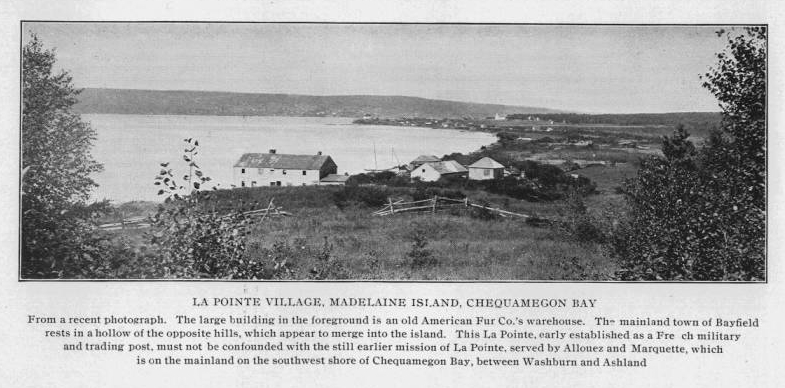
Photograph of La Pointe from Mission Hill circa 1902.
~ Wisconsin Historical Collections, Volume XVI, page 80.
I have received a supply of provisions from Mr Chapmann which will enable me to get through this season. The [?] [of?] [???] [next?], the time you have set for the arrival of the Schooner, will be sufficient, early for our business. The Glass and other materials for finishing of the buildings would be required to be sent up in the first trip but if [we?] [are?] [??] better to have them earlier. If these articles could be sent to the Sault early in the Spring a boat load might be formed of [Some?] and Provisions and sent to the Ance. From there men could be spared at that season of the year to bring the load to this place. In that way there would be no heavy expense incurred and I would be able to have the buildings in greater forwardness.
If the plan should meet your approbation please let me know by the winter express. While Mr Aitkin was here we planned out our buildings. The House will be 86 feet by 26 feet in the clear, the two stores will be put up agreeable to your Draft. We do not consider them to large.
I am afraid I shall not be able to build a wharf in season, but shall do my best to accomplish all that can be done with the means I have.

Undated photograph of Captain John Daniel Angus’ boat at the ABCFM mission dock.
~ Madeline Island Museum
I would wish to call your attention towards a few of the articles in our trade. I do not know how you have been accustomed to buy the Powder whether by the Keg or pound. If a keg is estimated at 50#, there is a great deception for some of our kegs do not contain more than 37 or 40 #s.
Our Guns are very bad particularly the barrels. They splint in the inside after been fired once or twice.
Our Holland twine is better this year than it has been for Years. One dz makes about 20 fathoms, more than last year. But it would be better if it was bleached. The NW Company and old Mr Ermantinger’s Net Thread was always bleached. It nits better and does not twist up when put into the water. Our maitre [??] [???] are some years five strand. Those are too large we have to untwist them and take 2 strands out. Our maitre this year are three strand they are rather coarse but will answer. They are not durable nor will they last as long as the nets of course they have to be [renewed?]. The best maitres are those we make of Sturgeon twine. We [?????] the twine and twist it a little. They last twice as long as our imported maitres. The great object to be gained is to have the maitres as small as possible if they be strong enough. Three coarse strands of twisted together is bulky and soon nits.
Our coarse Shoes are not worth bringing into the country. Strong sewed shoes would cost a little more but they would last longer. The [Booties?] and fine Shoes are not much better.
Our Teakettles used to have round bottoms. This year they are flat. They Indians always prefer the round bottom.
In regard to the observations you have made concerning the Doctor’s deviating from the instructions I gave him on leaving Mackinac, I must in justice to him say that I am now fully convinced in my own mind that he misunderstood me entirely, merely by an expression of mine which was intended by me in regard to his voyage from Mackinac to the Sault but by him was mistaken for the route through Lake Superior. The circumstances has hurt his feelings much and as he at all times does his best for the Interest of the Outfit I ought to have mentioned in my last letter, but it did not strike my mind at that time.

Detail from Carte des lacs du Canada by Jacques Nicolas Bellin in 1744.
When Mr Aitkin was here he mentioned to me some information he had obtained from somebody in Fond du Lac who had been in the NW Co service relating to a remarkable good white fish fishery on the “Milleau” or “Millons” Islands (do not know exactly the proper name). They lay right opposite to Point Quiwinau. a vessel which passes between the island and the point can see both. Among Mr Chapmann’s crew here there is an old man who tells me that he knew the place well, he says the island is large, say 50 or 60 miles. The Indian used to make their hunts there on account of the great quantity of Beaver and Reindeer. It is he says where the NWest Co used to make their fishing for Fort William. There is an excellent harbour for the vessel it is there where the largest white fish are caught in Lake Superior. Furthermore the old man says the island is nearer the American shore than the English. Some information might be obtained from Capt. McCargo. If it proves that we can occupy the grounds I have the most sanguine hopes that we shall succeed in the fisheries upon a large scale.
I hope you will gather all the information you can on the subject. Particular where the line runs. If it belongs to the Americans we must make a permanent post on the Island next year under the charge of an active person to conduct the fisheries upon a large scale.
Jh Chevallier one of the men I got in Mackinac is a useless man, he has always been sick since he left Sault. Mr Aitkin advised me to send him back in Chapman’s Boat. I have therefore send him out to the care of Mr Franchere.
By the Winter Express I will to give you all the informations that I may be able to give. I will close by wishing you great health and prosperity. Please present my Respects to Mr Clapp.
I remain Dear Sir.
Very Respectfully Yours
Most Obedient Servant
Lyman M. Warren
To be Continued in 1835…
1827 Deed for Old La Pointe
December 27, 2022
Collected & edited by Amorin Mello
Chief Buffalo and other principal men for the La Pointe Bands of Lake Superior Chippewa began signing treaties with the United States at the 1825 Treaty of Prairie Du Chien; followed by the 1826 Treaty of Fond Du Lac, which reserved Tribal Trust Lands for Chippewa Mixed Bloods along the St. Mary’s River between Lake Superior and Lake Huron:
ARTICLE 4.
The Indian Trade & Intercourse Act of 1790 was the United States of America’s first law regulating tribal land interests:
SEC. 4. And be it enacted and declared, That no sale of lands made by any Indians, or any nation or tribe of Indians the United States, shall be valid to any person or persons, or to any state, whether having the right of pre-emption to such lands or not, unless the same shall be made and duly executed at some public treaty, held under the authority of the United States.
It being deemed important that the half-breeds, scattered through this extensive country, should be stimulated to exertion and improvement by the possession of permanent property and fixed residences, the Chippewa tribe, in consideration of the affection they bear to these persons, and of the interest which they feel in their welfare, grant to each of the persons described in the schedule hereunto annexed, being half-breeds and Chippewas by descent, and it being understood that the schedule includes all of this description who are attached to the Government of the United States, six hundred and forty acres of land, to be located, under the direction of the President of the United States, upon the islands and shore of the St. Mary’s river, wherever good land enough for this purpose can be found; and as soon as such locations are made, the jurisdiction and soil thereof are hereby ceded. It is the intention of the parties, that, where circumstances will permit, the grants be surveyed in the ancient French manner, bounding not less than six arpens, nor more than ten, upon the river, and running back for quantity; and that where this cannot be done, such grants be surveyed in any manner the President may direct. The locations for Oshauguscodaywayqua and her descendents shall be adjoining the lower part of the military reservation, and upon the head of Sugar Island. The persons to whom grants are made shall not have the privilege of conveying the same, without the permission of the President.
The aforementioned Schedule annexed to the 1826 Treaty of Fond du Lac included (among other Chippewa Mixed Blood families at La Pointe) the families of Madeline & Michel Cadotte, Sr. and their American son-in-laws, the brothers Truman A. Warren and Lyman M. Warren:
-
To Michael Cadotte, senior, son of Equawaice, one section.
-
To Equaysay way, wife of Michael Cadotte, senior, and to each of her children living within the United States, one section.
-
To each of the children of Charlotte Warren, widow of the late Truman A. Warren, one section.
-
To Ossinahjeeunoqua, wife of Michael Cadotte, Jr. and each of her children, one section.
-
To each of the children of Ugwudaushee, by the late Truman A. Warren, one section.
-
To William Warren, son of Lyman M. Warren, and Mary Cadotte, one section.

Detail of Michilimackinac County circa 1818 from Michigan as a territory 1805-1837 by C.A. Burkhart, 1926.
~ UW-Milwaukee Libraries
Now, if it seems odd for a Treaty in Minnesota (Fond du Lac) to give families in Wisconsin (La Pointe) lots of land in Michigan (Sault Ste Marie), just remember that these places were relatively ‘close’ to each other in the sociopolitical fabric of Michigan Territory back in 1827. All three places were in Michilimackinac County (seated at Michilimackinac) until 1826, when they were carved off together as part of the newly formed Chippewa County (seated at Sault Ste Marie). Lake Superior remained Unceded Territory until later decades when land cessions were negotiated in the 1836, 1837, 1842, and 1854 Treaties.
Ultimately, the United States removed the aforementioned Schedule from the 1826 Treaty before ratification in 1827.
Several months later, at Michilimackinac, Madeline & Michel Cadotte, Sr. recorded the following Deed to reserve 2,000 acres surrounding the old French Forts of La Pointe to benefit future generations of their family.
Register of Deeds
Michilimackinac County
Book A of Deeds, Pages 221-224

Michel Cadotte and
Magdalen Cadotte
to
Lyman M. Warren
~Deed.
Received for Record
July 26th 1827 at two Six O’Clock A.M.
J.P. King
Reg’r Probate

Bizhiki (Buffalo), Gimiwan (Rain), Kaubuzoway, Wyauweenind, and Bikwaakodowaanzige (Ball of Dye) signed the 1826 Treaty of Fond Du Lac as the Chief and principal men of La Pointe.
“Copy of 1834 map of La Pointe by Lyman M. Warren“ at Wisconsin Historical Society. Original map (not shown here) is in the American Fur Company papers of the New York Historical Society.
Whereas the Chief and principal men of the Chippeway Tribe of indians, residing on and in the parts adjacent to the island called Magdalen in the western part of Lake Superior, heretofore released and confirmed by Deed unto Magdalen Cadotte a Chippeway of the said tribe, and to her brothers and sisters as tenants in common, thereon, all that part of the said Island called Magdalen, lying south and west of a line commencing on the eastern shore of said Island in the outlet of Great Wing river, and running directly thence westerly to the centre of Sandy bay on the western side of said Island;
and whereas the said brothers and sisters of said Magdalen Cadotte being tenants in common of the said premises, thereafterwards, heretofore, released, conveyed and confirmed unto their sister, the said Magdalen Cadotte all their respective rights title, interest and claim in and to said premises,
and whereas the said Magdalen Cadotte is desirous of securing a portion of said premises to her five grand children viz; George Warren, Edward Warren and Nancy Warren children of her daughter Charlotte Warren, by Truman A. Warren late a trader at said island, deceased, and William Warren and Truman A. Warren children of her daughter Mary Warren by Lyman M. Warren now a trader at said Island;
and whereas the said Magdalen Cadotte is desirous to promote the establishment of a mission on said Island, by and under the direction, patronage and government of the American board of commissioners for foreign missions, according to the plan, wages, and principles and purposes of the said Board.

William Whipple Warren was one of the beneficiary grandchildren named in this Deed.
Now therefore, Know all men by these presents that we Michael Cadotte and Magdalen Cadotte, wife of the said Michael, of said Magdalen Island, in Lake Superior, for and in consideration of one dollar to us in hand paid by Lyman M. Warren, the receipt whereof is hereby acknowledged, and for and in consideration of the natural love and affection we bear to our Grandchildren, the said George, Edward, Nancy, William W., and Truman A. Warren, children of our said daughters Charlotte and Mary;
and the further consideration of our great desire to promote the establishment of a mission as aforesaid, under and by the direction, government and patronage of Board aforesaid, have granted, bargained, sold, released, conveyed and confirmed, and by these presents do grant, bargain, sell, release, convey and confirm unto the said Lyman M. Warren his heirs and assigns, out of the aforerecited premises and as part and parcel thereof a certain tract of land on Magdalen Island in Lake Superior, bounded as follows,
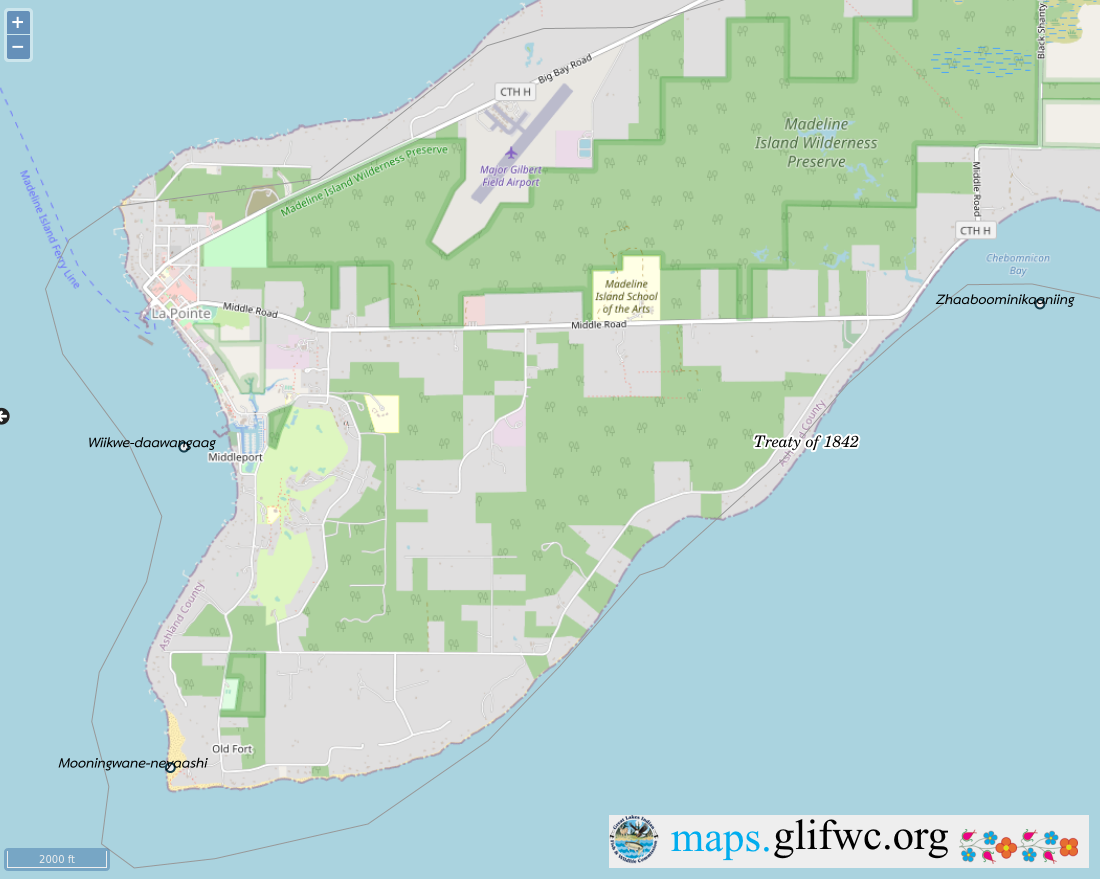
Detail of Ojibwemowin placenames on GLIFWC’s webmap.
that is to say, beginning at the most southeasterly corner of the house built and now occupied by said Lyman M. Warren, on the south shore of said Island between this tract and the land of the grantor, thence on the east by a line drawn northerly until it shall intersect at right angles a line drawn westerly from the mouth of Great Wing River to the Centre of Sandy Bay, thence on the north by the last mentioned line westward to a Point in said line, from which a line drawn southward and at right angles therewith would fall on the site of the old fort, so called on the southerly side of said Island; thence on the west by a line drawn from said point and parallel to the eastern boundary of said tract, to the Site of the old fort, so called, thence by the course of the Shore of old Fort Bay to the portage; thence by a line drawn eastwardly to the place of beginning, containing by estimation two thousand acres, be the same more or less, with the appurtenances, hereditaments, and privileges thereto belonging.
To have and to hold the said granted premises to him the said Lyman M. Warren his heirs and assigns: In Trust, Nevertheless, and upon this express condition, that whensoever the said American Board of Commissioners for foreign missions shall establish a mission on said premises, upon the plan, usages, principles and purposes as aforesaid, the said Lyman M. Warren shall forthwith convey unto the american board of commissioners for foreign missions, not less than one quarter nor more than one half of said tract herein conveyed to him, and to be divided by a line drawn from a point in the southern shore of said Island, northerly and parallel with the east line of said tract, and until it intersects the north line thereof.

Roughly 2,100 acres lies south of Middle Road.
And as to the residue of the said Estate, the said Lyman M. Warren shall divided the same equally with and amongst the said five children, as tenants in common, and not as joint tenants; and the grantors hereby authorize the said Lyman M. Warren with full powers to fulfil said trust herein created, hereby ratifying and confirming the deed and deeds of said premises he may make for the purpose ~~~
In witness whereof we have hereunto set our respective hands, this twenty fifth day of july A.D. one thousand eight hundred and twenty seven, of Independence the fifty first.
(Signed) Michel Cadotte {Seal}
Magdalen Cadotte X her mark {Seal}
Signed, Sealed and delivered
in presence of us }
Daniel Dingley
Samuel Ashman
Wm. M. Ferry
(on the third page and ninth line from the top the word eastwardly was interlined and from that word the three following lines and part of the fourth to the words “to the place” were erased before the signing & witnessing of this instrument.)
~~~~~~
Territory of Michigan }
County of Michilimackinac }
Be it known that on the twenty sixth day of July A.D. 1827, personally came before me, the subscriber, one of the Justices of the Peace for the County of Michilimackinac, Michel Cadotte and Magdalen Cadotte, wife of the said Michel Cadotte, and the said Magdalen being examined separate and apart from her said husband, each severally acknowledged the foregoing instrument to be their voluntary act and deed for the uses and purposes therein expressed.
(Signed) J. P. King
Just. peace
Cxd
fees Paid $2.25
Indian Agency’s Instructions for the 1854 Treaty
September 26, 2020
Collected and edited by Amorin Mello
Indian Agency’s Instructions to
Henry C. Gilbert and David B. Herriman
for the 1854 Treaty at La Pointe
from Office of Indian Affairs federal archives
Department of the Interior
Office Indian Affairs
August 11, 1854

Indian Agent
Henry C. Gilbert
~ Branch County Photographs
Gilbert, Henry C.
Indian Agent
Detroit, Michigan
Sir:
The Bill to provide for the Extinguishment of the title of the Chippewas to the lands owned and claimed by them in Wisconsin and Minnesota, which passed the House early in the Sessions, failed in the Senate.
In view however of the importance of extinguishing the Indian title to portions of the Chippewa Country, it is deemed proper to confide to you certain conditional instructions, to the end that if in your judgement it be practicable to conclude a treaty at the period when you assemble the Indians to pay them their annuities this fall, that object may be accomplished.
You will therefore consider yourself in conjunction with Major Herriman as the Officers of the Indian Department designated to make a treaty with the Chippewa Indians of Lake Superior and the Mississippi.
~ Indian Agent Gilbert’s Explanation after the 1854 Treaty
When you arrive at La Pointe, if you are satisfied that you can send a runner over to the Mississippi & have Major Herriman come over immediately, with the principal Chief and three or four of the Headmen of each of the bands who receive pay at the Agency, and who reside on or near the Mississippi, or between that stream & the Lake, you will do so. The design is that the principal Chief and Head Men to the number stated of all the bands, other than those to be paid by you, be present on the Occasion. The latter will of course be represented.
I am informed that that the Mississippi Indians can be brought over in the way I suggest, as soon as you can assemble yours. If you are satisfied of this fact you are authorized to send over the runner, but it is not my wish that any attempt be made, and a failure follow.
If delegates from all the bands can be assembled and negotiations had with them, you are authorized to offer the Chippewas the sum of $500,000 for all the country they now own or claim in the territory of Minnesota, the state of Wisconsin or elsewhere excepting and reserving for the future home of said Indians a quantity of land equal to 743,000 acres which may be selected in one body or in two or three locations, as the Indians may desire, and if the reservations be selected in more than one locality, the quantity of land fixed upon, as the Maximum amount of the reserve must be divided between the different locations of the Indians according to the population of the bands who may elect to inhabit such reservation or reservations. If the Indians could all be placed on one reserve, so that an Agent could always have a perfect Oversight over them it would be much better for their future interests; but if this cannot be effected, the several sub-reserves should be located in such proximity to each other, as to enable the Agent to exercise a watchful care over the Indians.
The future home or reserves should not be in the avenues by which the white population will approach the ceded country, or embrace any of the mineral lands which are now becoming desirable.
I send herewith a copy of the instructions of the Secretary of War of the date of 4th of June 1847, when a former Commission attempted to treat with these Indians, but failed. According to the Estimates of this Office, the Chippewas own about 10,743,000 Acres of land, the greater part of which is of no value to them, and never will be. Some portions of it will be valuable to the White population.
Nevertheless, the condition of Affairs with the Chippewas is such that it is the duty of the Government to Offer them an Opportunity to dispose of their tenure to their Country, and in lieu thereof, to give them a small tract as a permanent home, with such means of support & neutral & moral improvement, as may be of great advantage to them.
I transmit herewith a copy of the bill alluded to and also a copy of a recent treaty with the Ottoe & Missouri Indians, remarking that if a provision is inserted for allowing individual reservations within the general reservations that Eighty Acres to the family, as provided in the bill is deemed ample. These documents may be useful as affording you indications of the views of the Department and of such provisions as it may be desirable to have incorporated in a treaty.
In view of the fact that it is necessary to enter upon this business without permitting those adverse influences, which are always at work to thwart the purposes, and objects of the Government, in its efforts to treat with the Indians, you will not divulge the nature of your instructions, or indeed say any thing about them to any person.
Julius Austrian
~ Madeline Island Museum
When you get to La Point, if you conclude to send for Maj. Herriman, and the principal Men of his bands, you can do so, leaving the impression on those who may be privy to it, that their presence is necessary, in order that a better understanding may exist as to a proper disposition of the present annuities between the Lake bands and those on the Mississippi.
Mr. Austrian who resides at La Point, and who was here last winter, tendered his services to the Office in collecting Indians etc. etc. at any time, and he is recommended to me as a faithful man. He would perhaps be a faithful man to whom to confide the message to Major Herriman.
I have caused a remittance, to be made to you, by requisition of this date for the sum of $1900 as follows:
Provisions for Indians $1500
Presents for 100 $300
Contingencies $100
$1900
which will be applicable to this object, but to be used only in case negotiations are had with the Chippewas. Except so far as the provisions & expenses of a runner may be necessary.
As far as these amounts are expended, to be accounted for under the proper heads of account.

George Washington Manypenny
~ Commons.Wikimedia.org
Very Respect’y Your Ob’t Servant
Geo. W. Manypenny
Commissioner
N.B. I learn that a boat leaves the Sault of St Marie on the 21st instant for Lapoint. If so you should avail yourself of the opportunity to go forward. The enclosed communication to Maj Herriman, you will forward to him by the runner, if you determine to send one, and be satisfied that the expedition will be successful before you send it states the whole matter to Major H. From the instructions to the Commissioners of June 4th 1847, and the Ottoe & Missouri treaty, you will form an idea of the necessary stipulations for the payment of the purchase money, the amount of it that should be invested etc. and the necessary provisions for Stock, Agricultural Implements etc. etc. in place of money. A map showing the country of the Chippewas is also herewith.
Geo. W. Manypenny
Commissioner
Department of the Interior
Office Indian Affairs
August 12th, 1854
Gilbert, H. C.
Indian Agent
Detroit, Michigan
Sir:
Referring to my letter of instruction to you of the 11th instant, I have to remark that should you succeed in having the proposed negotiations with the Chippewas, and a treaty be made, you will provide to pay the $500,000 as follows:
One hundred thousand dollars to be invested at five percent interest, which interest shall be expended annually under the President’s direction for purposes of Education, and the moral improvement of the Indians. The residue to be paid say in twenty annual installments of twenty thousand dollars each without interest, or these deferred payments may be extended over twenty five or thirty years, all of them however to be subject to the President’s discretion, as in Article 4 of the Ottoe & Missouri treaty.
If necessary to accomplish the object, although $500,000 is deemed the value of the Chippewa tenure to the land, you may go as high as $600,000 payments as above.
Should a treaty be made, it is submitted whether the new locations reserved & to the Indians, may not be of such a character as to render some of the smiths, farmers etc. stipulated for under former treaties of no use, and if so, that provisions be inserted cancelling such of these provisions, under former treaties, as can be dispensed with, and providing that a sum equal to the amount, now paid annually for such, may be appropriated for the unexpired term of former treaty stipulations to be expended by the President, for the use of the Indians, as other funds are provided to be expended.
Very Respectfully
Your Ob’t Servant
Geo. W. Manypenny
Commissioner
Department of the Interior
Office Indian Affairs
August 14, 1854
Gilbert, H. C.
Indian Agent
Detroit, Michigan
Sir:
~ Indian Agent Gilbert’s Explanation after the 1854 Treaty
Referring to my letters of instruction of the 11th & 12th instant, both of which were prepared in great haste, I am inclined to the opinion that a state of things may exist that you might feel embarrassed at the suggestions that if the land reserved by the Indians was located in more than one tract the several sub-reserves should be in such close proximity as to enable the agent to have a constant oversight over all the Indians. It may however occur that there may be partialities and predilections among the different bands for different and widely separated districts, and that these partialities cannot be overcome. I am clearly of the opinion that all the land reserved should be in one body and every reasonable effort should be employed to impress the Indians with this view; and if it fail the fewest sub-reserves that can be got along with should be allowed and if possible they should be in the same region of Country; but if the Indians have the predilections alluded to, and they cannot be changed in their views, you will accede to their wishes to a reasonable extent in this particular. And if it should so happen that they select locations widely distant from each other so that it would be more for their interests that one portion might be under one Agent and another under another, it would be well perhaps to adjust all matters between the bands thus located, naming all of them by bands which select a reservation. Setting apart according to the population their portion of such reserved land, and providing to pay them by the same rule, their proportion of the purchase money at their reserve, and so with the bands on each of the reserves. And indeed a clause might be inserted, adjusting and dividing by population to the Indians of each reserve the annuities to become due under former treaties, whether of money or in kind so that no difficulties could hereafter arise provided one part should be in one agency and others in another.
Several members of the Indian Committee of the Senate having expressed a wish that a clause or article of the following import should be inserted in all treaties hereafter made. You will please put it in the treaty which I hope you may be able to enter into with the Chippewas. It is thus:
“The United States agree that an examination shall be made, and all sums that may be found equitably due to the Indians, for arrearages of annuity or other thing, under the provisions of former treaties, shall be paid as the chiefs may direct.”
And; It is agreed between the United States and the said Chippewa Indians, that should it at any time hereafter be considered necessary, and for the benefit of said Indians, it shall be discretionary with the President by & with the advise and consent of the Senate to change the annuities herein provided for or any part thereof into a fund establishing farms among and for them.
Very Respectfully
Your Ob’t Servant
Geo. W. Manypenny
Commissioner
Wheeler Papers: 1854 La Pointe before the Treaty
August 7, 2017
By Amorin Mello
Selected letters from the
Wheeler Family Papers,
Box 3, Folders 11-12; La Pointe County.
Crow-wing, Min. Ter.
Jan. 9th 1854
Brother Wheeler,

Reverend Leonard Hemenway Wheeler ~ In Unnamed Wisconsin by Silas Chapman, 1895, cover image.
Though not indebted to you just now on the score of correspondence, I will venture to intrude upon you a few lines more. I will begin by saying we are all tolerably well. But we are somewhat uncomfortable in some respects. Our families are more subject to colds this winter than usual. This probably may be attributed in part at least to our cold and open houses. We were unable last fall to do any thing more than fix ourselves temporarily, and the frosts of winter find a great many large holes to creep in at. Some days it is almost impossible for us to keep warm enough to be comfortable.
Our prospects for accomplishing much for the Indians here I do not think look more promising than they did last fall. There are but few Indians here. These get drunk every time they can get whiskey, of which there is an abundance nearby. Among the white people here, none are disposed to attend meetings much except Mr. [Welton?]. He and his wife are discontented and unhappy here, and will probably get away as soon as they can. We hear not a word from the Indian Department. Why they are minding us in this manner I cannot tell. But I should like it much better, if they would tell us at once to be gone. I have got enough of trying to do anything for Indians in connection with the Government. We can put no dependence upon any thing they will do. I have tried the experiment till I am satisfied. I think much more could be done with a boarding school in the neighborhood of Lapointe than here And my opinion is, that since things have turned out as they have here, we had better get out of it as soon as we can. With such an agent as we now have, nothing will prosper here. He is enough to poison everything, and will do more moral evil in such a community, as this, than a half a dozen missionaries can do good. My opinion is, that if they knew at Washington how things are and have been managed here, there would be a change. But I do not feel certain of this. For I sometimes am tempted to adopt the opinion that they do not care much there how things go here. But should there be a change, I have little hope that is would would make things materially better. The moral and social improvement of the Indians, I fear, has little to do with the appointment of agents and superintendents. I do not think I ought to remain here very long and keep my family here, as things are now going. If we were not involved with the Government with regard to the school matter, I would advise the Committee to quit here as soon as we can find a place to go to. My health is not very good. The scenes, and labors and attacks of sickness which I have passed through during the past two years have made almost a wreck of my constitution. It might rally under some circumstances. But I do not think it will while I stay here, so excluded from society, and so harassed with cares and perplexities as I have been and as I am likely to be in future, should we go on and try to get up a school. My wife is in no better spirits than I am. She has had several quite ill turns this winter. the children all wish to get away from here, and I do not know that I shall have power to keep them here, even if I am to stay.
But what to do I do not know. The Committee say they do not wish to abandon the Ojibwas. I cannot in future favor the removal of the lake Indians. I believe that all the aid they will receive from the Government will never civilize or materially benifit them. I judge from the manner in which things have been managed here. Our best hope is to do what we can to aid them where they are to live peaceably with the whites, and to improve and become citizens. The idea of the Government sending infidels and heathens here to civilize and Christianize the Indians is rediculous.
I always thought it doubtful whether the experiment we are trying would succeed. In that case it was my intention to remove somewhere below here, and try to get a living, either by raising my potatoes or by trying to preach to white people, or by uniting both. but I do not hardly feel strong enough to begin entirely anew in the wilderness to make me a home. I suppose my family would be as happy at Lapointe, as they would any where in the new and scattered settlements for fifty or a hundred miles below here. And if thought I could support myself then, I might think of going back there. There are our old friends for whose improvement we have laborred so many years. I feel almost as much attachment for them as for my won children. And I do not think they ought to be left like sheep upon the mountains without a shepherd. And if the Board think it best to expend money and labor for the Ojibwas, they had better expend it there than here, as things now are at least. I think we were exerting much much more influence there before we left, then we have here or are likely to exert. I have no idea that the lake Indians will ever remove to this place, or to this region.
Reverend Sherman Hall
~ Madeline Island Museum
What do you think of recommending to the Board to day to exert a greater influence on the people in the neighborhood of Lapointe[?/!] I feel reluctant to give up the Indians. And if I could get a living at Lapointe, and could get there, I should be almost disposed to go back and live among those few for whom I have labored so long, if things turn out here as I expect they will. I have not much funds to being life with now, nor much strength to dig with. But still I shall have to dig somewhere. The land is easier tilled in this region than that about the lake. But wood is more scarce. My family do not like Minesota. Perhaps they would, if they should get out of the Indian country. Edwin says he will get out of it in the spring, and Miles says he will not stay in such a lonesome place. I shall soon be alone as to help from my children. My boys must take care of themselves as soon as they arrive at a suitable age, and will leave me to take care of myself. We feel very unsettled. Our affairs here must assume a different aspect, or we cannot remain here many months longer. Is there enough to do at Lapointe; or is there a prospect that there will soon be business to draw people enough then, to make it an object to try to establish the institution of the gospel there? Write me and let me know your views on such subjects as these.
[Unsigned, but appears to be from Sherman Hall]
Crow-wing Feb. 10th 1854
Brother Wheeler:
I received your letter of jan. 16th yesterday, and consequently did not sleep as much as usual last night. We were glad to hear that you are all well and prosperous. We too are well which we consider a great blessing, as sickness in present situation would be attended with great inconvenience. Our house is exceedingly cold and has been uncomfortable during some of the severe cold weather have had during the last months. Yet we hope to get through the winter without suffering severely. In many respects our missionary spirit has been put to a severer test than at any previous time since we have been in the Indian country, during the past year. We feel very unsettled, and of course somewhat uneasy. The future does not look very bright. We cannot get a word from the Indian Department whether we may go on or not. If we cannot get some answer from them before long I shall be taking measures to retire. We have very little to hope, I apprehend, from all the aid the Government will render to words the civilization and moral and intellectual improvement of the Indians. For missionaries or Indians to depend on them, is to depend on a broken staff.
~ Minnesota Historical Society
“The American Fur Company therefore built a ‘New Fort’ a few miles farther north, still upon the west shore of the island, and to this place, the present village, the name La Pointe came to be transferred. Half-way between the ‘Old fort’ and the ‘New fort,’ Mr. Hall erected (probably in 1832) ‘a place for worship and teaching,’ which came to be the centre of Protestant missionary work in Chequamegon Bay.”
~ The Story of Chequamegon Bay
I do not see that our house is so divided against itself, that it is in any great danger of falling at present. My wife never did wish to leave Lapointe and we have ever, both of us, thought that the station ought not to be abandoned, unless the Indians were removed. But this seemed not to be the opinion of the committee or of our associates, if I rightly understood them. I had a hard struggle in my mind whether to retire wholly from the service of the Board among the Indians, or to come here and make a further experiment. I felt reluctant to leave them, till we had tried every experiment which held out any promise of success. When I remove my family here our way ahead looked much more clear than it does now. I had completed an arrangement for the school which had the approval of Gov. Ramsey, and which fell through only in consequence of a little informality on his part, and because a new set of officers just then coming into power must show themselves a little wiser than their predecessors. Had not any associates come through last summer, so as to relieve me of some of my burdens and afford some society and counsel in my perplexities I could not have sustained the burden upon me in the state of my health at that time. A change of officers here too made quite an unfavorable change in our prospects. I have nothing to reproach myself with in deciding to come here, nor in coming when we did, though the result of our coming may not be what we hoped it would be. I never anticipated any great pleasure in being connected with a school connected in any way with the Government, nor did I suppose I should be long connected with it, even if it prospered. I have made the effort and now if it all falls, I shall feel that Providence has not a work for us to do here. The prospects of the Indians look dark, what is before me in the future I do not know. My health is not good, though relief from some of the pressure I had to sustain for a time last fall and the cold season has somewhat [?????] me for the time being. But I cannot endure much excitement, and of course our present unsettled affairs operate unfavorably upon it. I need for a time to be where I can enjoy rest from everything exciting, and when I can have more society that I have here, and to be employed moderately in some regular business.
Antoine Gordon [Gaudin]
~ Noble Lives of a Noble Race by the St. Mary’s Industrial School (Bad River Indian Reservation), 1909, page 207.

Charles Henry Oakes
~ Findagrave.com
As to your account I have not had time to examine it, but will write you something about it by & by. As to any account which Antoine Gaudin has against me, I wish you would have him send it to me in detail before you pay it. I agreed with Mr. Nettleton to settle with him, and paid him the balance due to Antoine as I had the account. I suppose he made the settlement, when he was last at Lapointe. As to the property at Lapointe, I shall immediately write to Mr. Oakes about it. But I suppose in the present state of affairs, it will be perhaps, a long time before it will be settled so as to know who does own it. It is impossible for me to control it, but you had better keep posession of it at present. I cannot send Edwin [??] through to cultivate the land & take care of it. He will be of age in the spring, and if he were to go there I must hire him. He will probably leave us in the spring. Please give my best regards to all. Write me often.
Yours truly
S. Hall
Crow-wing, Min. Ter.
Feb. 21st 1854
Brother Wheeler,
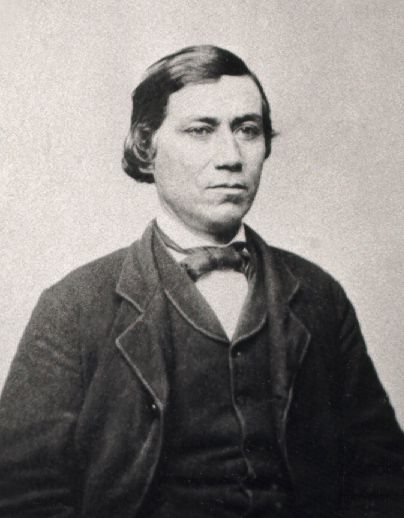
Paul Hudon Beaulieu
~ FamilySearch.org
I wrote you a few days ago, and at the same time I wrote to Mr. Oakes inquiring whether he had got possession of the Lapointe property. I have not yet got a reply from him, but Mr. Beaulieu tells me that he heard the same report which you mentioned in your letter, and that he inquired of Mr. Oakes about it when he saw him on a recent visit to St. Paul, and finds that it is all a humbug. Oakes has nothing to do with it. Mr. Beaulieu said that the sale of last spring has been confirmed, and that Austrian will hold Lapointe. So farewell to all the inhabitants’ claims then, and to anything being done for the prosperity of the peace for the present, unless it gets out of his hands.
I have written to Austrian to try to get something for our property if we can. But I fear there is not much hope. If he goes back to Lapointe in the spring, do the best you can to make him give us something. I feel sorry for the inhabitants there that they are left at his mercy. He may treat them fairly, but it is hardly to be expected.

Clement Hudon Beaulieu
~ TreatiesMatter.org
As to our affairs here, there has been no particular change in their aspects since I wrote a few days ago. There must be a crisis, I think, in a few weeks. We must either go on or break up, I think, in the spring. We are trying to get a decision. I understand our agent has been threatened with removal if he carries on as he has done. I believe there is no hope of reformation in his case, and we may get rid of him. Perhaps God sent us here to have some influence in some such matters, so intimately connected with the welfare of the Indians. I have never thought I [????] can before I was sent in deciding to come here. Some trials and disappointments have grown out of my coming, but I feel conscious of having acted in accordance with my convictions of duty at this time.
If all falls through, I know not what to do in the future. The Home Missionary Society have got more on their hands now than they have funds to pay, if I were disposed to offer myself to labor under them. I may be obliged to build me a shanty somewhere on some little unoccupied piece of land and try to dig out a living. In these matters the Lord will direct by his providence.
You must be on your guard or some body will trip you up and get away your place. There are enough unprincipled fellows who would take all your improvements and send you and all the Indians into the Lake if they could make a dollar by it. I should not enlarge much, without getting a legal claim to the land. Neither would I advise you to carry on more family than is necessary to keep what team you must have, and to supply your family with milk and vegetables. It will be advantage/disadvantage to you in a pecuniary point of view, it will load you with and tend to make you worldly minded, and give your establishment the air of secularity in the eyes of the world. If I were to go back again to my old field, I would make my establishment as small as I could & have enough to live comfortable. I with others have thought that your tendency was rather towards going to largely into farming. I do not say these things because I wish to dictate or meddle with your affairs. Comparing views sometimes leads to new investigations in regard to duty.
May the Lord bless you and yours, and give you success and abundant prosperity in your labours of love and efforts to Save the Souls around you.
Give my best regards to Mrs. W., the children, Miss S and all.
Yours truly,
S. Hall
I forgot to say that we are all well. Henry and his family have enjoyed better health here, then they used to enjoy at Lapointe.
Feb 27
Brother Wheeler.
My delay to answer your note may require an explanation. I have not had time at command to attend to it conveniently at an earlier period. As to your first questions. I suppose there will be no difference of opinion between us as to the correctness of the following remarks.
- The Gospel requires the members of a church to exercise a spirit of love, meekness and forbearance towards an offending brother. They are not to use unnecessary severity in calling him to account for his errors. Ga. 6:1.
- The Object of Church discipline is, not only to [pursue/preserve?] the Church pure in doctrine & morals, that the contrary part may have no evil thing to say of them; but also to bring the offender to a right State of mind, with regard this offense, and gain him back to duty and fidelity.
- If prejudice exist in the mind of the offender towards his brethren for any reason, the spirit of the gospel requires that he be so approached if possible as to allay that prejudice, otherwise we can hardly expect to gain a candid hearing with him.
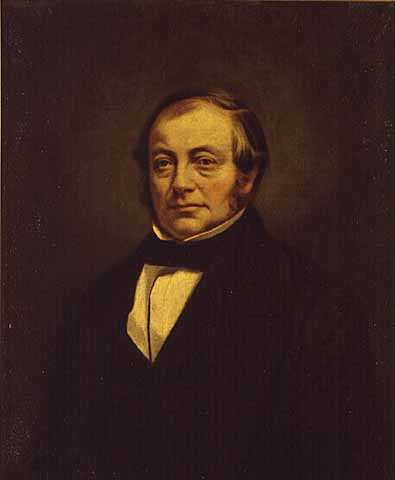
Charles William Wulff Borup, M.D. ~ Minnesota Historical Society
I consider that these remarks have some bearing on the case before us. If it was our object to gain over Dr. B. to our views of the Sabbath, and bring him to a right State of mind with regard this Sabbath breaking, the manner of approaching him would have, in my view, much to do with the offence. He may be approached in a Kind and [forbearing?] manner, when one of sternness and dictation will only repel him from you. I think we ought, if possible, and do our duty, avoid a personal quarrel with him. To have brought the subject before the Church & made a public affair of it, before [this/then?] and more private means have been tried to get satisfaction, would, I am sure, have resulted in this. I found from my own interviews with him, that there was hope, if the rest of the brethren would pursue a similar course. I felt pretty sure they would obtain satisfaction. IF they had [commenced?] by a public prosecution before the church, it would only have made trouble without doing any good. The peace of our whole community would have been disturbed. I thought one step was gained when I conversed with him, and another when you met him on the subject. I knew also that prejudices existed both in his mind towards us, & in our minds towards him which were likely to affect the settlement of this affair, and which as I thought, would be much allayed by individuals going to him and speaking face to face on this subject in private. He evidently expected they would do so. Mutual conversations and explanations allay these feelings very much. At least it has been so in my experience.

Reverend Edmund Franklin Ely.
~ Duluth Public Library
As to your second question. I do not say that it was Mr. Ely’s duty to open the subject to Doc. Borup at the preparatory lecture. If he had done so, it would have been only a private interview; for there [was?] not enough present to transact business. All I meant to affirm respecting that occasion is, that it afforded a good opportunity to do so, if he wishes, and that Dr. B. expected he would have done so, as I afterwards learnt, if he has any objection to make against his coming to the communion.
As to your third question. I have no complaint to make of the church, that I have urged them to the performance of any “duties“ in this case they have refused to perform.
And now permit me to ask in my turn.
What “duties” have they urged me to perform in this case, which I “have been unwilling, or manifested a reluctance to perform?”
Did you intend by anything which wrote to me or said verbally, to request me to commence a public prosecution of Doc. Borup before the Church?
Will you have the goodness to state in writing, the substance of what you said to me in your study as to your opinion and that of others suspecting my delinquency in maintaining church discipline.
A reply to these questions would be gratefully received.
Your brother in Christ
S. Hall
Crow Wing. March 12th 1854
Brother Wheeler:
Your letter of Feb 17th came to hand by our last mail; and though I wrote you but a short time ago, I will say a few words in relation to one or two topics to which you allude. Shortly after I received your former letter I wrote to Mr. Oakes enquiring about the property at Lapointe. In reply, says that himself and some others purchased Mr. Austrian’s rights at Lapointe of Old Hughes on the strength of a power of attorney which he held. Austrian asserts the power of attorney to be fraudulent, and that they cannot hold the property. Oakes writes as if he did not expect to hold it. Some time ago I wrote to Mr. Austrian on the same subject, and said to him that if I could get our old place back, I might go back to Lapointe. He says in reply —
Julius Austrian
~ Madeline Island Museum
“I should feel much gratified to see you back at Lapointe again, and can hold out to you the same inducements and assurances as I have done to all other inhabitants, that is, I shall be at Lapointe early in the spring and will have my land surveyed and laid out into lots, and then I shall be ready to give to every one a deed for the lot he inhabits, at a reasonable price, not paying me a great deal more than cost trouble, and time. But with you, my dear Sir, will be no trouble, as I have always known you a just and upright man, and have provided ways to be kind towards us, therefore take my assurance that I will congratulate myself to see you back again; and it shall not be my fault if you do not come. If you come to Lapointe, at our personal interview, we will arrange the matter no doubt satisfactory.”
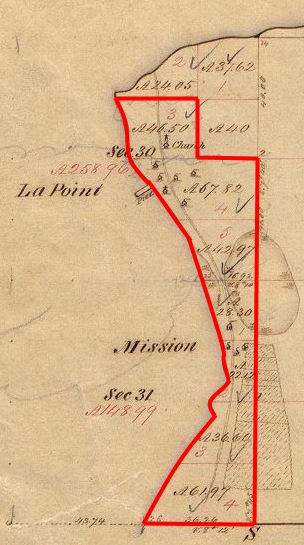
“The property” from the James Hughes Affair is outlined in red. This encompassed the Church at La Pointe (New Fort) and the Mission (Middleport) of Madeline Island. 1852 PLSS survey map by General Land Office.
I suppose Austrian will hold the property and probably we shall never realize anything for our improvements. You must do the best you can. Make your appeal to his honor, if he has any. It will avail nothing to reproach him with his dishonesty. I do not know what more I can do to save anything, or for any others whose property is in like circumstances with ours.
You speak discouragingly of my going back to Lapointe. I do not think the Home Miss. Soc. would send a missionary there only for the few he could reach in the English language. If the people want a Methodist, encourage them to get one. It is painful to me to see the place abandoned to irreligion and vices of every Kind, and the labours I have expended there thrown away. I can hardly feel that it was right to give up the station when we did. If I thought I could support myself there by working one half the time and devoting the rest to ministerial labors for the good of those I still love there, I should still be willing to go back, if could get there & had a shelter for my head, unless there is a prospect of being more useful here. But the land at Lapointe is so hard to subdue that I am discouraged about making an attempt to get a living there by farming. I am not much of a fisherman. There is some prospect that we may be allowed to go on here. Mr. Treat has been to Washington, and says he expects soon to get a decision from the Department. We have got our school farm plowed, and the materials are drawn out of the woods for fencing it. If I have no orders to the contrary, I intend to go on & plant a part of it, enough to raise some potatoes. We may yet get our school established. If we can go ahead, I shall remain here, but if not, I think it is not my duty to remain here another year, as I have the past. In other circumstances, I could do more towards supporting myself and do more good probably.
I have felt much concerned for the people of Lapointe and Bad River on account of the small pox. May the Lord stay this calamity from spreading among you. Write us every mail and tell us all. It is now posted here today that the Old Chief [Kibishkinzhugon?] is dead. I hardly credit the report, though I should suppose he might be one of the first victims of the disease.
I can write no more now. We are all very well now. Give my love to all your family and all others.
Tell Robert how the matters stands about the land. It stands him in how to be on good terms with the Jew just now.
Yours truly,
S. Hall
The snow is nearly all off the ground and the weather for two or three weeks has been as mild as April.
Crow Wing M.H. Apr. 1 1854
Dear Br. & Sr. Wheeler.
I have received a letter from you since I wrote to you & am therfore in your debt in that matter. I have also read your letters to Br. & Sr. Welton I suppose you have received my letter of the 13th of Feb. if so, you have some idea of our situation & I need say no more of that now; & will only say that we are all well as usual & have been during the winter. Mrs. P_ is considerably troubled with her old spinal difficulty. She has got over her labors here last summer * fall. Harriet is not well I fear never will be, because the necessary means are not likely to be used, she has more or less pain in her back & side all the time, but she works on as usual & appears just as she did at LaPointe, if she could be freed from work so as to do no more than she could without injury & pursue uninterruptedly & proper medical course I think she might regain pretty good health. (Do not, any of you, send back these remarks it would not be pleasing to her or the family.) We have said what we think it best to say) –
Br. Hall is pretty well but by no means the vigorous man he once was. He has a slight – hacking cough which I suppose neither he nor his family have hardly noticed, but Mrs. P_ says she does not like the sound of it. His side troubles him some especially when he is a good deal confined at writing. Mr. & Mrs. W_ are in usual health. Henry’s family have gone to the bush. They are all quite well. He stays here to assist br. H_ in the revision & keeps one or two of his children with him. They are now in Hebrews, with the Revision. Henry I suppose still intends to return to Lapointe in the spring. –
Now, you ask, in br. Welton’s letter, “are you all going to break up there in the spring.” Not that I know of. It would seem to me like running away rather prematurely. When the question is settled, that we can do nothing here, then I am willing to leave, & it may be so decided, but it is not yet. We have not had a whisper from Govt. yet. Wherefore I cannot say.
It looks now as if we must stay this season if no longer. Dr. Borup writes to br. Hall to keep up good courage, that all will come out right by & by, that he is getting into favor with Gov. Gorman & will do all he can to help us. (Br. Hall’s custom is worth something you know).
Henry C. Gilbert
~ Branch County Photographs
By advise of the Agent, we got out (last month) tamarack rails enough to fence the school farm (which was broke last summer) of some 80 acres & it will be put up immediately. Our great father turned out the money to pay for the job. These things look some like our staying awhile I tell br H_ I think we had better go as far as we can, without incurring expense to the Board (except for our support) & thus show our readiness to do what we can. if we should quit here I do not know what will be done with us. Br Hall would expect to have the service of the Board I suppose. Should they wish us to return to Bad River we should not say nay. We were much pleased with what we have heard of your last fall’s payment & I am as much gratified with the report of Mr. H. C. Gilbert which I have read in the Annual Report of the Com. of Indian Affairs. He recommends that the Lake Superior Indians be included in his Agency, that they be allowed to remain where they are & their farmers, blacksmith & carpenter be restored to them. If they come under his influence you may expect to be aided in your efforts, not thwarted , by his influence. I rejoice with you in your brightening prospects, in your increased school (day & Sabbath) & the increased inclination to industry in those around you. May the lord add his blessing, not only upon the Indians but upon your own souls & your children, then will your prosperity be permanent & real. Do not despise the day of small things, nor overlook especially neglect your own children in any respect. Suffer them not to form idle habits, teach them to be self reliant, to help themselves & especially you, they can as well do it as not & better too, according to their ability & strength, not beyond it, to fear God & keep his commandments & to be kind to one another (Pardon me these words, I every day see the necessity of what I have said.) We sympathize with you in your situation being alone as you are, but remember you have one friend always near who waits to [commence?] with you, tell Him & all with you from Abby clear down to Freddy.
Affectionately yours
C. Pulsifer
Write when you can.
Crow wing Min. Ter.
April 3d 1854
Brother Wheeler

George E. Nettleton and his brother William Nettleton were pioneers, merchants, and land speculators at what is now Duluth and Superior.
~ Image from The Eye of the North-west: First Annual Report of the Statition of Superior, Wisconsin by Frank Abial Flower, 1890, page 75.
Since I wrote you a few days ago, I have received a letter from Mr. G. E. Nettleton, in which he says, that when he was at Lapointe in December last, he was very much hurried and did not make a full settlement with Antoine. He says further, that he showed him my account, and told him I had settled with him, and that he would see the matter right with Antoine. A. replied that all was right. I presume therefore all will be made satisfactory when Mr. N. comes up in the Spring, and that you will have need to make yourself no further trouble about this matter.
I have also received a short note from Mr. Treat in which he says,
“I have not replied to your letters, because I have been daily expecting something decisive from Washington. When I was there, I had the promise of immediate action; but I have not heard a word from them”.
“I go to Washington this Feb, once more. I shall endeavor to close up the whole business before I return. I intend to wait till I get a decision. I shall propose to the Department to give up the school, if they will indemnify us. If I can get only a part of what we lose, I shall probably quit the concern”.
Thus our business with the Government stood on March the 9th, I have lost all confidence in the Indian Department of our Government under this administration, to say nothing of the rest of it. If the way they have treated us is an index to their general management, I do not think they stand very high for moral honesty. The prospects for the Indians throughout all our territories look dark in the extreme. The measures of the Government in relation to them are not such as will benefit and save many of them. They are opening the floodgates of vice and destruction upon them in every quarter. The most solemn guarantees that they shall be let alone in the possession of domains expressly granted them mean nothing.
Our prospects here look dark. For some time past I have been rather anticipating that we should soon get loose and be able to go on. But all is thrown into the dark again. What I am to do in future to support my family, I do not know. If we are ordered to quit here and turn over the property, it would turn [illegible] out of doors.
Mr. Austrian expects us back to Lapointe in the Spring & Mr. Nettleton proposes to us to go to Fond du Lac, (at the Entry). He says there will be a large settlement then next season. A company is chartered to build a railroad through from the Southern boundary of this territory to that place. It is probable that Company [illegible] will make a grant of land for that purpose. If so, it will probably be done in a few years. That will open the lake region effectually. I feel the need of relaxation and rest before I do anything to get established anywhere.
We are still working away at the Testament, it is hard work, and we make lately but slow progress. There is a prospect that the Bible Society will publish it but it is not fully decided. I wish I could be so situated that I could finish the grammar.
But I suppose I am repeating what I have said more than once before. We are generally in good health and spirits. We hope to hear from by next mail.
Yours truly
S. Hall
What do you think about the settlements above Lapointe and above the head of the Lake?
Detroit July 10th 1854
Rev. Dr. Bro.
At your request and in fulfilment of my promise made at LaPointe last fall so after so long a time I write: And besides “to do good & to communicate” as saith the Apostle “forget not, for with such sacrifices God is well pleased.”
We did not close up our Indian payments of last year until the middle of the following January, the labors, exposures and excitements of which proved too much for me and I went home to New York sick & nearly used up about the last of February & continued so for two months. I returned here about a week ago & am now preparing for the fall pay’ts.
The Com’sr. has sent in the usual amounts of Goods for the LaPointe Indians to Mr. Gilbert & I presume means to require him to make the payment at La P. that he did last fall, although we have received nothing from the Dep’t. on the subject.
“George Washington Manypenny (1808-1892) was the Director of the Bureau of Indian Affairs of the United States from 1853 to 1857.”
~ Wikipedia.org
In regard to the Treaty with the Chipp’s of La Sup’r & the Miss’i, the subject is still before Congress and if one is made this fall it has been more than intimated that Com’r Manypenny will make it himself, either at LaP’ or at F. Dodge or perhaps at some place farther west. Of course I do not speak from authority or any of the points mentioned above, for all is rumour & inference beyond the mere arrival here of the Goods to Mr G’s care.
From various sources I learn that you have passed a severe winter and that much sickness has been among the Indians and that many of them have been taken away by the Small Pox.
This is sad and painful intelligence enough and I can but pray God to bless & overrule all to the goods of his creasures and especially to the Missionaries & their families.
Notwithstanding I have not written before be assured that I have often [???] of and prayed for you and yours and while in [Penn.?] you made your case my own so far as to represent it to several of our Christian brethren and the friends of missions there and who being actuated by the benevolent principles of the Gospel, have sent you some substanted relief and they promise to do more.
The Elements of the political world both here and over the waters seem to be in fearful & [?????] commotion and what will come of it all none but the high & holy one can know. The anti Slavery Excitement with us at the North and the Slavery excitement at the South is augmenting fact and we I doubt not will soon be called upon to choose between Slavery & freedom.
If I do not greatly misjudge the blessed cause of our holy religion is or seems to be on the wane. I trust I am mistaken, but the Spirit of averice, pride, sensuality & which every where prevails makes me think otherwise. The blessed Christ will reign [recenth-den?] and his kingdom will yet over all prevail; and so may it be.
Let us present to him daily the homage of a devout & grateful heart for his tender mercies [tousward?] and see to it that by his grace we endure unto the end that we may be saved.
My best regards to Mrs. W. to Miss Spooner to each of the dear children and to all the friends & natives to each of whom I desire to be remembered as opportunity occurs.
The good Lord willing I may see you again this fall. If I do not, nor never see you again in this world, I trust I shall see and meet you in that world of pure delight where saints immortal reign.
May God bless you & yours always & ever
I am your brother
In faith Hope & Charity
Rich. M. Smith
Rev Leonard H. Wheeler
LaPointe
Lake Superior
Miss. House Boston
Augt’ 31, 1854
Rev. L. H. Wheeler,
Lake Superior
Dear Brother
Yours of July 31 I laid before the Com’sr at our last meeting. They have formally authorized the transfer of Mr & Mrs Pulsifer to the Lake, & also that of Henry Blatchford.

Robert Stuart was formerly an American Fur Company agent and Acting Superintendent on Mackinac Island during the first Treaty at La Pointe in 1842.
~ Wikipedia.org
In regard to the “claims” their feeling is that if the Govt’ will give land to your station, they have nothing to say as to the quantity. But if they are to pay the usual govt’ price, the question requires a little caution. We are clear that we may authorize you to enter & [???] take up so much land as shall be necessary for the convenience of the [mission?] families; but we do not see how we can buy land for the Indians. Will you have the [fondness?] to [????] [????] on these points. How much land do you propose to take up in all? How much is necessary for the convenience of the mission families?
Perhaps you & others propose to take up the lands with private funds. With that we have nothing to do, so long as you, Mr P. & H. do not become land speculators; of which, I presume, there is no danger.
As to the La Pointe property, Mr Stuart wrote you some since, as you know already I doubt not, and replied adversely to making any bargain with Austrian. I took up the opinion of the Com’sr after receiving your letter of July 31, & they think it the wise course. I hope Mr Stewart will get this matter in some shape in due time.
I will write to him in reference to the Bad River land, asking him to see it once if the gov’ will do any thing.
Affectionate regards to Mrs W. & Miss Spooner & all.
Fraternally Yours
S. B. Treat
P.S. Your report of July 31 came safely to hand, as you will & have seen from the Herald.
Ashland, Wisconsin: Its Early Days
November 29, 2016
By Amorin Mello

Magazine of Western History Illustrated
November 1888
as republished in
Magazine of Western History: Volume IX, No. 1, pages 12-17.
—
ASHLAND, WISCONSIN:
ITS EARLY AND PRESENT DAYS.
—
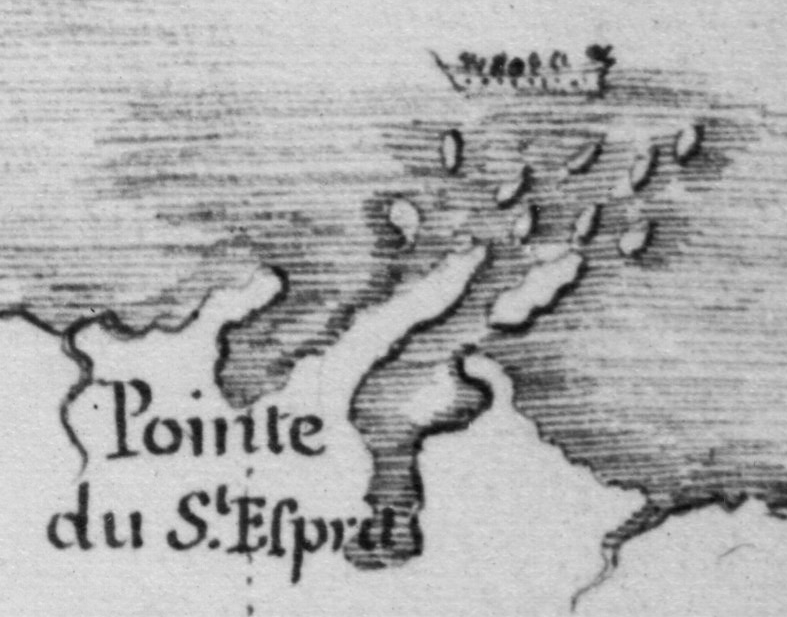
Detail of Lapointe du Saint Espirit and Mission du Saint Espirit from Claude Allouez Map of New France, 1669.
~ Research Laboratories of Archaeology
If the reader will look at the map of the United States, he will see on its northern boundary the largest body of fresh water in the world – Lake Superior, called by the Ojibways Kitche Gumi, “The Big Water.” It lies between 46 and 47 degrees north latitude, and stretches east and west through eight degrees of longitude. Its coast-line is nearly two thousand miles in extent, forming some of the finest natural harbors in the world. Its surface is six hundred and thirty feet above the ocean level, while its bottom in the deepest parts is four hundred feet below the level of the tide-waters. As you come from the east end of the lake, St. Mary’s river, approaching its western extremity, you will, from the deck of the steamer, notice a group of beautiful islands – the same islands which, more than two hundred years ago, met the gaze of Fathers Marquette, Allouez and Mesnard, and which, in their religious zeal, they named the “Apostles’ Islands,” thinking that in number they corresponded with the number of our Savior’s disciples. One of these they named “Madeline,” from a favorite saint of their own “Belle France,” and to commemorate one of the most noted churches of Paris.

Detail of “The 12 Apostles” from Captain Jonathan Carver’s journal of his travels with maps and drawings, 1766.
~ Boston Public Library
These islands in ancient times were doubtless a part of the main, as was also the land now lying under Ashland bay. Underlying them was sandstone, rising from twenty to one hundred feet above the water, and horizontal. The great glaciers coming from the north, and moving in a southwest direction, cut channels in the sandstone, forming these islands, and scooping out of the solid rock the large basin which, in after years, received the name of Chaquamegon bay, and which is now known as Ashland bay. This was the first prophecy of the city of Ashland. In the times, millions of years before this, the vast deposits of iron ore had been upheaved and stored along the south shore of the lake, to subserve the designs of the Mighty Builder in the development of that commerce of which we now see but the earliest down, and of whose future extent we can form but a faint comprehension. Chaquamegon, Le Anse and Marquette bays are the natural outlets on Lake Superior for the rich mineral deposits which line its southern shore.
The formation of Ashland bay was therefore not accidental, but in harmony with Eternal plans. It is protected from the storms of the lake by a long, low, sandy point, and also by the Apostles’ islands. Into it open from the lake three broad channels, with a depth of water ample for the largest vessels, called the North, Middle and South channels. Under these islands, vessels coming from the wild storms of the open lake are secure. It is the sailor’s haven of safety.
1834 Map of LaPointe by Lyman Warren for the American Fur Company.
~ Wisconsin Historical Society
The first settlement on the bay was made by the American Fur company in the early part of the present century, on the beautiful Madeline island, and named La Pointe. It continued for many years the headquarters of a flourishing fur and fishing trade. About 1830 a Protestant and, soon after, a Catholic mission were established there, and churches built by them, in which devoted missionaries labored to Christianize and civilize the Indians whose homes were here and in the surrounding country. Here toiled Rev. Sherman Hall, a missionary of the American board, and Rev. L. H. Wheeler, and also that devoted man, now known to us as Bishop Baraga. These have all passed away. La Pointe, then the most populous and active village on the lake, is now, alas, “The deserted village,” and is visited alone in veneration of its past memories.

Map inset of Chequamegon Bay with Houghton, LaPointe, Bayfield, Ashland, and Bay City.
~ Wisconsin Historical Society
On the west shore of the bay, opposite La Pointe, is the beautiful town of Bayfield, founded by Honorable Henry. M. Rice in 1856. It is the terminus of the C., St. P., M. & O. railroad and the headquarters of a flourishing fish and lumber trade, and one of the most charming summer resorts on the lake.
On the west shore of the bay is also the flourishing town of Washburn – named in honor of Wisconsin’s governor, Cadwallader C. Washburn. It is the favorite town of the Omaha railroad, and has several large saw-mills, and is an active and enterprising town.
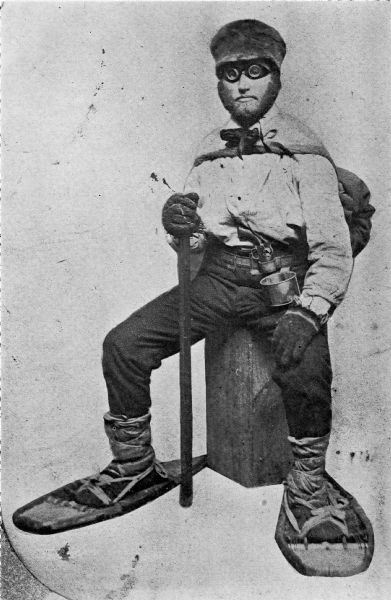
Asaph Whittlesey circa 1860.
~ Wisconsin Historical Society
The first settlement on the spot where Ashland now stands was made, in 1854, by Asaph Whittlesey and George Kilborn, both natives of the Western Reserve, Ohio. The lands were not as yet surveyed, so that they could not preëmpt them, and there was as yet no Homestead law. For this reason they, with Martin Beaser, then living in Ontonagon, Michigan, laid claim, under the “Town Site” law, to about three hundred acres, embracing their log houses and small clearing. They platted this into town lots in 1855, and subsequently were allowed to enter their lands as claimed, and in due course received their title. In February, 1855, Edwin Ellis, a graduate in medicine, in the University of the City of New York, of the class of 1846, came on foot through the woods from St. Paul to the bay. He had been engaged in the practice of his profession in his native state – Maine – till 1854, when, attracted by the prospect of wider fields for enterprise in the new west, and by the advice of Judge D. A. J. Baker, his brother-in-law, then living in St. Paul, he came to Minnesota.

Edwin Ellis, M.D.
~ Commemorative Biographical Record of the Upper Lake Region by J.H. Beers & Co., 1905, pages 16-18.
The years 1853 to 1857 were years of wild speculation. The states of Wisconsin and Minnesota especially were covered with rising cities – at least on paper. Fabulous stories of rich silver, copper and iron mines on the south shore of Lake Superior attracted a multitude of active young men from the eastern states. The city of Superior had been laid out, and its lots were selling for fabulous prices. The penniless young man of to-day became the millionaire to-morrow. The consequent excitement was great, and in the event demoralizing.
The Bay of Ashland, stretching far in-land, the known vast deposits of iron near the Penokee Gap, whose natural route to market was evidently by Chaquamegon bay, indicated with moral certainty that at its head would rise a commercial mart which should command a wide extent of country. The vast forests of pine were then hardly thought of, and no efforts made to obtain them. The lands were unsurveyed, and all the “squatters” were, in the eye of the law, trespassers. Nevertheless, the new-comers ran “spotted” lines around their claims and built log-cabins to hold them, and began to clear up the land. In June, 1855, Dr. Ellis went on foot to St. Paul, and thence to Dubuque, Iowa, and secured from the surveyor-general an order to survey four townships about the bay, embracing the site of the present city of Ashland. In the meantime, many settlers had come in and preëmpted lands in the neighborhood. In the fall of 1855 many of them were enabled to prove up and get titles to their lands.
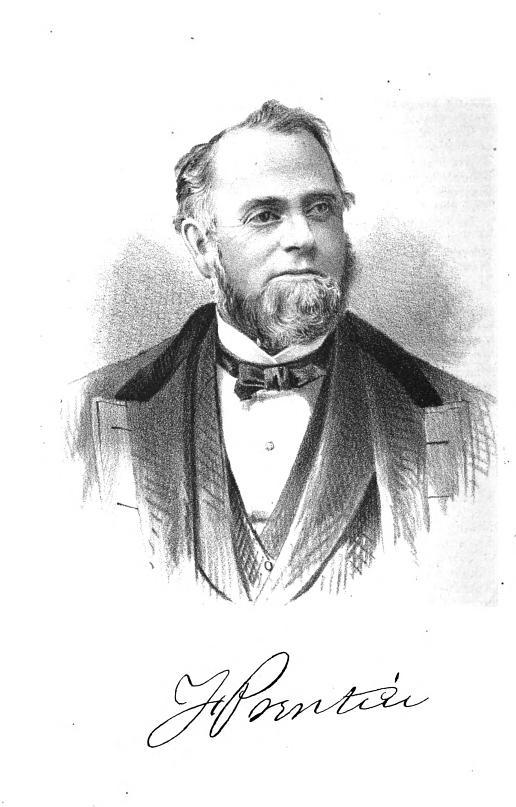
Portrait and biography of Frederick Prentice; the “first white child born in … Toledo.”
~ History of the Maumee Valley by Horace S Knapp, 1872, pages 560-562.
In the winter of 1855 Lusk, Prentice & Company, who had a trading-post within the present limits of Ellis’ division of Ashland, built a dock for the accommodation of the settlers coming to the new town. It was built of cribs, made of round logs sunk in the water about twenty feet apart. From one crib to another were stringers, made of logs, flattened on the upper surface, all covered with small logs to make a roadway. On the docks were piled several hundred cords of wood for the purpose of “holding” the dock from floating away, and to be sold in the summer to the steamboats which should come to bring supplies and begin the commerce of the town. The evening of the second day of April, 1855, saw the bay full of ice, slightly detached for a few feet from the shore, but with no sign of an immediate opening of navigation.

Portrait of Martin Beaser on page 24.
The next morning no ice was in sight, nor a vestige of the dock to be seen. Floating timber and cord-wood covered the bay. Till then the settlers had no idea the power of the floating ice moved by the tide of the bay. But they were not discouraged. The following winter two other docks were constructed – one by Martin Beaser, at the foot of what is now called “Beaser Avenue,” and the other by Edwin Ellis, near where Seyler’s foundry now stands.
These were also crib-docks, but the effort was made to anchor the cribs. There were no rocks to be had on the side of the bay where the docks were built, for which reason Mr. Beaser filled his cribs with clay, dug out of the banks. Dr. Ellis hauled stone across the bay, and filled as many of his cribs as possible, and on the top of the dock also piled several hundred cords of wood, and the settlers with anxious faces watched the departure of the ice. The shock came, and the docks afforded little resistance. The cribs filled with clay were easily carried. Those filled with stone stood better, but that part of those above water, and near the outer end, were swept away. The labors of many weary days and much money was thus swept away. There was, however, enough of the Ellis dock left to afford a landing to the few boats that came with supplies for the people.

Survey of Frederick Prentice‘s Addition of Ashland near the Gichi-wiikwedong village.
“It is in this addition, that, the Chippewa River and the St. Croix Indian trails reach the Bay, and for the purpose of accomodating the trade, already flowing in on their routes, a commodious store has just been built”
~ Wisconsin Historical Society
Translates as “Big Bay” in Ojibwemowin.
Traditional place-name for Ashland, WI.
Anglicized version of Gichi-wiikwedong.
Prentice Park and Maslowski Beach.
Area is famous for artesian wells.
“This was all Indian land then, but [Asaph] Whittlesey believed in take time for the forelock, looking he said, for a place that ‘might prove to be the most available point for a town, at or near Equadon (pronounced E Quay don, the second syllable emphasized.) The word ‘Equadon,’ is the Chippewa word meaning ‘settlement near the head of the bay.'”
~ The Ashland Daily Press, July 6, 1933, by Guy M. Burnham, reproduced on TurtleTrack.org. Read the full article for an interesting stories about how the town-site for Ashland was allegedly negotiated between Reverend Wheeler and Little Current.
During the years 1855, ’56 and ’57 many settlers had come to Ashland and built homes, and were all young men full of bright hopes for the future. In the spring of 1856 a township organization was formed, embracing more than forty townships of six miles square, and was called Bayport. The usual township officers were elected. The year 1857 opened with bright prospects. In Ashland streets were cleared and several frame houses were built. A steam saw-mill was begun and brought near completion. But in September of that year the great financial storm came, involving the whole country in ruin. The little village of Ashland was overwhelmed. The people had but little money, and in making their improvements had contracted debts which they could not at once pay. There had been so such speculation that the settlers had paid but little attention to the cultivation of the soil, depending upon supplies brought by water a thousand miles. We had no wagon roads nor railroads within three hundred miles. Winter was coming on, and many of the settlers – in truth, all who could get away – left the place. The few who remained saw hard times, whose memory is not pleasant to recall. Some of them, in making improvements, had assumed liabilities which well-nigh ruined them. If the county had then been organized for judicial purposes, so that judgements and execution could have been easily obtained, scarcely anyone would have saved a dollar from the wreck. But this fortunate circumstance gave them time, and their debts were finally paid, and they had their land left; but it then was without value in the market. Town lots in the village, which are now selling for five thousand to six thousand dollars, could then be sold for enough to buy a barrel of flour. The years following “’57” were hard years, and the settlers, one by one, moved away, so that in 1862 only two remained – Martin Beaser and Martin Roehn. In 1866 Mr. Beaser undertook to come alone from Bayfield to Ashland in an open sail-boat. It was a stormy day, and he never reached home. His boat was found soon afterwards at the head of the bay, and his body was found the following spring on the beach on the west side of the bay. Ashland was now left desolate and alone. Mr. Roehn, with a few cows, migrated backward and forward between Ashland and the Marengo river, finding hay and pasture for his cows, selling his produce and butter at Bayfield and La Pointe, and thus eked out an existence. The first railroad to reach Ashland was the Wisconsin Central, completed in 1877, connecting Ashland with Milwaukee. Work at the Ashland end was begun in 1872, and in 1873 finished to Penokee, twenty-nine miles south from Ashland. It had been built from the south to within about eighty-five miles of Ashland, and then came the panic of 1873, and all work stopped. The building in 1872 in Ashland was quite extensive, and village property sold at good prices, and everybody was hopeful. But the crisis of 1873 coming on, all enterprises at once stopped. Not till 1877 was the railroad completed. Its completion established Ashland on a substantial basis. In 1877 the Wisconsin Central company completed the Chaquamegon hotel, one of the finest in the country, which has added greatly to the attractions of Ashland.
The building of the Chicago, St. Paul, Minneapolis & Omaha road to this place, in 1883, gave a short outlet to the west and southwest, greatly benefiting the lumber trade.
The Northern Pacific, whose eastern terminus is at Ashland, soon after completed, gave it new importance as in the direct line of transcontinental commerce.
But the advent of the Milwaukee, Lake Shore & Western railroad had done more, perhaps to stimulate the growth of Ashland than any one of its great enterprises.
It runs northerly from Milwaukee to Manitowoc, where, turning in northwesterly course, it traverses vast tracts of valuable timber and farming lands, running for fifty miles along the Gogebic range – the richest iron region in the world.
This company has built two large and costly ore docks for the shipment of the vast amount of iron ore which it brings over its road.
South From Ashland
“The promoters decided to make Ashland the north end of their iron. It was a mere clearing, in the woods in 1870, formerly known as Equadon which was founded in 1854 and abandoned in 1863. The Ashland site was located on the bank of a splendid natural harbor called Cheguamegon Bay.”
…
“The clearing, grubbing and grading of the 30-mile Ashland-Penokee Gap Division had been practically complete in 1872. The iron rails were not laid into the Gap until October 1873, and there the railroad stopped for 4 long years.”
…
“Penokee Gap, 1000 feet above Lake Superior, is a break in the rough country, a regular gap where the Bad River breaks through the Iron Range Hills on its way to Lake Superior. The Gap is an historic pathway through which the copper workers from Mexico and South America came to Lake Superior centuries ago enroute to the copper deposits on Isle Royal in Lake Superior.”
~ History of the Soo Line, by James Lyden.
The Wisconsin Central Railroad company has also built a very fine ore dock, over which it ships the iron brought from the same range by its own line – the “Penokee Railroad” – built easterly along the northern base of the Gogebic range to Bessemer, in Michigan.
Notwithstanding the depression in the iron trade, more than a million tons of ore will be shipped from Ashland the present season.
Ashland has also two coal docks – one operated by the Ohio Coal company and the other by the Columbus & Hocking Valley Coal company – both of whom are doing a large business. The Lake Shore railroad and the Wisconsin Central obtain their coal for their engines, on the northern two hundred miles, by their docks at Ashland. The same rates for coal going west prevail as from Duluth and Washburn, and a large trade is springing up over the Omaha & Northern Pacific lines.
Ashland has three National and one private bank, all of which are conservative and carefully managed. It has also a street railway, two miles in length, with six fine cars and about forty horses, and is rendering very satisfactory service. We have also a “Gas and Electric Light Plant,” which affords abundant light for the streets, stores, dwellings and the ore docks. Ashland has also the Holly system of water-works, with about two miles of pipe laid, affording ample protection against fire and an abundant supply of water for domestic purposes. The pump-house has two ponderous engines, one being kept in reserve in case of accident.
As a point for the distribution of manufactured goods of all kinds, Ashland stands among the foremost. With practically the same rates as by the roads leading from Duluth west, it is prepared to compete with that lively town for part of the trade of the great northwest – now in its infancy but destined soon to attain great proportions; whose beginnings we can measure, but whose vast results we cannot now comprehend.
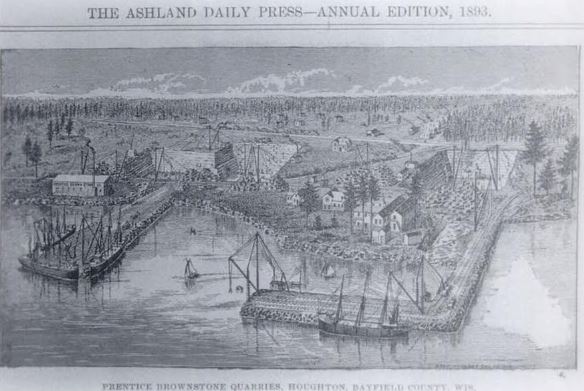
Portrait of Prentice’s brownstone quarries at Houghton Point.
~ Ashland Daily Press, circa 1893.
A Great Brownstone Industry Established At Houghton Point.
What Frederick Prentice Has Accomplished During The Season.“
~ Ashland Daily Press article in the Washburn Itemizer, October 18, 1888, reproduced on BattleAxCamp.tripod.com
One industry on Ashland bay is the brown stone, which exists along the water’s edge for many miles on the shore of the mainland and on the islands. It can be quarried in inexhaustible quantities within a few hundred feet of navigable waters of Lake Superior. It is of fine texture and beautiful color, and hardens by exposure. Large quantities have already been shipped and the demand is rapidly increasing. It can be shipped by rail at about four dollars per ton to Cincinnati. This stone, used for trimmings in buildings built of white brick, makes a very beautiful appearance.
The vast quantities of pine and hardwood timber in the vicinity of Ashland, and its advantages as a point of distribution for manufactured articles in wood, render it one of the best locations for manufacturing industries. For tanneries its location is unrivaled; the supply of hemlock bark is ample, while hides can be cheaply brought from Minnesota and the northwest, and the products can be shipped in all directions at low rates.
The schools of Ashland afford the best of opportunities for the education of our youth. Our school buildings are large, new and commodious, with all modern improvements. Our schools are graded and the attendance is large.
In the churches, most denominations are represented. The Catholic is the finest church edifice in the city, built of our own brown stone at a cost of over thirty thousand dollars. There are Presbyterian, Congregational, Episcopal, Baptist, Methodist, Lutheran and several Scandinavian churches.
As a summer resort, Ashland and the Apostles’ islands afford unrivaled attractions. Sail-boats, tugs and steamboats make daily excursions in all directions. They busy men from Chicago, St. Louis, St. Paul, Cincinnati and other cities can, in one day, escape from the sweltering heat and sleep on the cool ore of Lake Superior, and with our lines of railroad and telegraph stretching in all directons, they can be in constant and instant communication with their counting-rooms a thousand miles away. Its advantages in this line are already drawing many persons of wealth and leisure, as well as invalids, who come here to spend the hot season and at the close of the summer return home with new health and vigor.

Portrait of Edwin Ellis, M.D. on page 20.
Ashland has just two daily and three weekly newspapers, models of enterprise and very newsy, contributing much to the prosperity of the city.
The population of Ashland is about fifteen thousand, composed principally of persons under thirty-five years of age, and full of push and activity, who have come to stay and built up fortunes.
With all these and many other advantages Ashland seems to have a bright future, and many of us think it bids fair, in the near future, to become the second city in the state of Wisconsin. And we will labor that she shall be worthy of her rank.
EDWIN ELLIS.
Two Months In The Copper Region
May 21, 2016
By Amorin Mello
This is a reproduction of Colonel Charles W. Whittlesey’s article, “Two Months in the Copper Region,” as published in the National Magazine and Industrial Record, Volume II., Number IX., February 1846, by Redwood Fisher, pages 816-846. For more information about these places and people, please refer to Copper Harbor, The Copper Region, and Copper Harbor Redux in the Wisconsin Territory Delegation, which occurred only a few weeks previous to Whittlesey’s experience.
TWO MONTHS IN THE COPPER REGION.
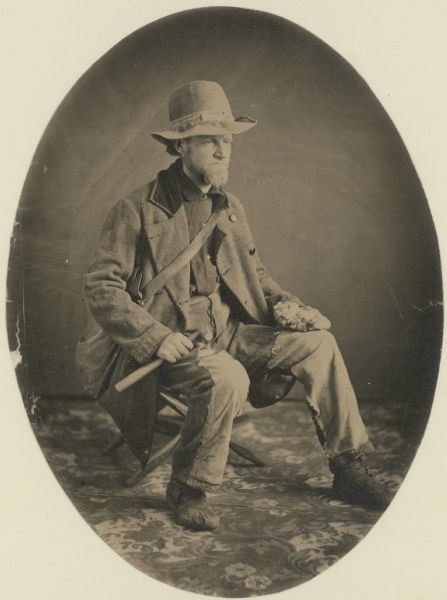
“Studio portrait of geologist Charles Whittlesey dressed for a field trip.” Circa 1858.
~ Wisconsin Historical Society
It was on the 14th day of August, 1845, that our party went on board a light and well-built yawl, of about four tons, moored in the still water above the rapids of the St. Mary’s river. We were venturing upon an experiment. We could not learn that such a craft had ever put forth alone upon the waters of Lake Superiour, and our intention was, to follow the south coast as far as the season would permit. For hundreds of years this lake had been navigated by the bark canoe, and parties were setting off every day for Copper Harbour, La Pointe, and other remote points, in these apparently frail vessels, but which the experience of centuries, in these apparently frail vessels, but which the experience of centuries had demonstrated to be the safest conveyance known. The Mackinaw boat had long traversed these shores, transporting goods to the Fur Company’s posts, and returning with furs.
These long, narrow, flat-bottomed boats, carry a heavy burden, go well before the wind, and are easily drawn ashore. The bark canoe, as well as the Mackinaw boat, has no keel, and the safety of both consists in being able to make a harbour of every sand beach, in case of a storm. The expert voyager, has a kind of second sight in regard to weather, smelling a storm while it is yet a great way off. It is only when a great saving may be made, and the weather is perfectly fair, that he ventures to leave the vicinity of the shore, and cross from point to point, in the open sea. These passages are called “traverses;” and such si the suddenness with which storms arise, that a traverse of 10 or 15 miles, even in fair weather, and while every indication is favourable, is regarded as a hazardous operation. Some daring boatmen make them of 30 miles.
Of course, the birch canoe and the Mackinaw boat, being without keels, cannot sail upon the wind. Our yawl, with a keel of four inches, having nine men and about a ton of provisions aboard, sank about 16 inches in the water. She was provided with a cotton square-sail, containing about 40 square yards, and had row-locks for six oars. How she would row – how she would sail, and how she would brave the storm, we could only surmise, and the surmises were rather against the little vessel.
The portage, over which goods now pass, from the level of Lake Huron to that of Lake Superiour, is a flat, wet, marshy piece of land, about three-fourths of a mile across. To the westward, the country appears to be low and swampy, as far as the view extends; which, however, is limited by the thick timber, principally spruce, pine, white cedar, birch, and hemlock. But a walk of one mile, in that direction, brought me to a low eminence, rising out of a cedar swamp, composed of masses of rolled granite and other primitive rocks, in size from a small pebble to a diameter of ten feet. The timber among them had been lately blackened by a raging fire. The trunks of these charred trees, some standing erect, some leaning against others, and many prostrate on the rocks, contrasted hideously with the white and nakedness of those immense granite boulders, which covered the surface.
![Detail of Sault Ste Marie from Carver [Jonathan], Captain. Journal of his travels with maps and drawings, 1766. ~ Boston Public Library](https://chequamegonhistory.com/wp-content/uploads/2016/05/carver-detail-of-sault-ste-marie.jpg)
Detail of Sault Ste Marie from Carver [Jonathan], Captain. Journal of his travels with maps and drawings, 1766.
~ Boston Public Library
Our tents were struck at 7 o’clock, A.M., and the journey began. There were other parties scattered about the open space at the warehouse; some had regular tents, some sheltered themselves under a broad piece of India rubber cloth, stretched over a pole like the roof of a house. One party had a conical tent, with an upright pole in the centre, the canvass spread out around the foot; and another, in default of other covering, lay snoring under a cotton bedtick, stretched across the bushes. A party of surveyors were encamped near the landing, from a cruise of three months in the interiour. This party had run a tier of townships, from Mackinaw, northward, into sections of one mile square. These men encamped a few days at this place, to recruit their tattered garments, of which only the shreds and fragments remained. In enterprises of this sort, it is only by physical energy, and great powers of endurance, that the contractor can realize any thing from the prices allowed by Government for its original surveys. They provision themselves, by carrying all on their backs, from the depots on the shore. The thickets through which they pursue their work, week after week, and month after month, would be declared absolutely impracticable to a person not trained in that school, especially in the vicinity of the lake. No beast of burden could pass without bridges, even in case a pathway should be cut through the matted evergreens that cover the ground. To make a path for a horse or mule, would consume more time and labour per mile than the survey itself. There is a hardy class of Frenchmen and half-breeds, cousin-german to the Canadian voyageur, called “packers;” they were bred in the service of the Fur Companies, to carry goods from the nearest landing to the trading post, and return with a pack of furs. The surveyors found these packers indispensable to their operations. They will carry from 50 to 70 pounds, and can travel along in the recesses of the forest, without fear of losing their way.
They are patient, cheerful, and obedient; in fact, they are on land what the voyageur is upon the water. His capacity for food corresponds with his ability to endure fatigue, and his great care is to secure it in sufficient quantity. He makes, with a little instruction, an excellent axeman and chainman. If circumstances prevent a return to the camp, or the rendezvous, he can lie down at the foot of a tree, sleep till daybreak, and resume his tramp without complaint.
The party which joined our encampment here, was a subject for Catlin, the Indian sketcher. More hale, hearty, and jovial fellows, never broke into the limits of civilization. The northern atmosphere had tinged their cheeks with red, they were all young and active men, glowing with that high animal life, that extreme buoyancy of spirits, which is a stranger to the inhabitants of cities – to those who toss upon feather beds, and live upon soups and comfits.
This rugged company, full of fun and frolic, with beards of three months’ cultivation, in red flannel shirts, and fustian trowsers in shreds, white beaver hats, less the border, some in shoes, some in moccasins, and some in boots, from all of which various toes were looking out surprised even the worthy burghers of the Sault. The Sault St. Marie has been a trading post more than two hundred years. The good Catholics Ramboult and Jonges, preached preentance to the Nodowessies, or Sioux, on this spot, in 1641, whom the French traders immediately followed. Here it may be said the borders of civilization have been fixed for two centuries. In consequence, a mixed race has arisen, neither the representatives of refinement nor of barbarism, but of a medium state. It may well be supposed, that a band of jolly fellows, habited as we have described these hardy surveyors, axemen, chainmen, and packers, would not attract here that attention which they would in New-York, or in London. But they appeared to be objects of no little interest and curiosity to the worthy inhabitants of the Sault, especially as some of them were so disfigured that their old friends did not recognize them.
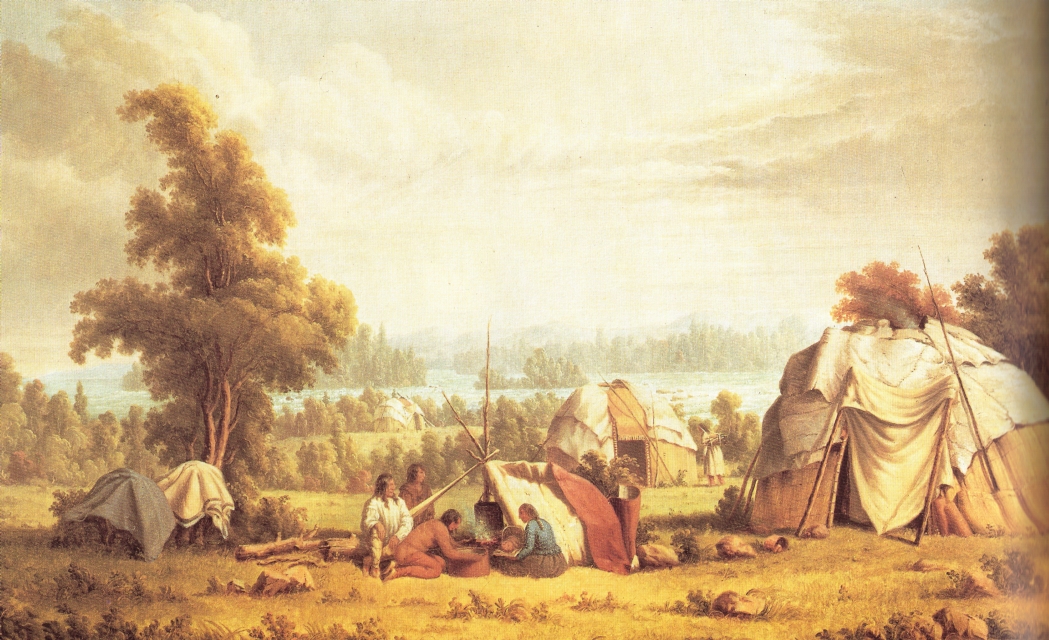
“Ojibwa village near Sault Ste Marie” by Paul Kane in 1845.
~ Commons.Wikimedia.org
Looking back from the water, upon the collection of tents and lodges, we had a view of the group at one glance, and the scene from the new point of observation suggested ideas that had not presented themselves while we formed a part of it. Around some of the camp-fires were gentlemen from the Atlantic shores, with genteel caps and surtouts, shivering in the raw wind of the morning. Poor fellows ! impelled by the hope of wealth to be found in the copper region, they had rushed, at steamboat rates, to the extremity of navigation, of taverns, and permanent habitations.
The reality of copper exploration had now commenced. A night of drizzling rain and fog had been passed, in a cold tent, on wet ground. Among them were seated voyageurs and half-breeds, as happy as a plenty of grub could take them. The raw wind was no annoyance to them, so long as there was a flint and steel to start a fire, and a plentiful stock of provisions. Between the cap and surtout, and the flannel shirt and canvass trousers, was every grade of men represented by a grade of habiliments.
In front of this motley collection of persons and things, lay the frame of a large schooner, on which fifty workmen were laying the plank – all its timbers and lumber brought from the lower lakes; and in the open level space beyond, along a track cleared through the swamp, stood the spars of a vessel, advancing on solid land towards the basin above the falls. This labour and expense of bringing vessels over land, or the timber to construct them with, is unavoidable. As far as known, there is not ship timber enough on Lake Superiour to build a schooner.
The rock which causes the rapids is a close, fine-grained, red sandstone, in thin layers, pitching to the northward. There has been much diversity of opinion among geologists, about the geological position of this rock. As I proceed, I shall again notice this rock, and its analogue, which occupies almost the entire south coast of this lake.

Map of Ohio including the Connecticut Western Reserve, the First Principal Meridian, and the Base Line. Drawn by Jerome S. Higgins, 1887.
~ Wikipedia.org
The 1st principal meridian of the U. States surveys, comes out on the waters of St. Marie’s, at the ship yard, just above the rapids. This is a true meridian, run with great care from the base line, which is about 12 miles north of Detroit. The 1st meridian is about 30 miles west of Detroit, and passing up through the peninsula of Michigan, crosses the straits near Mackinaw. By the Government system of rectangular co-ordinates, referred always to a given base and meridian, an observer knows his exact position, wherever he may be, in the surveyed portions of the U. States. Every township is six miles square, every section one mile square, every quarter section half a mile square. Every section [corner] has permanent marks on some adjacent tree, which gives the situation of that corner from its proper base and meridian. I make this explanation, to give light upon terms that I shall use hereafter. In traversing the American shore of Lake Superiour, we found, as far as the Porcupine Mountains, west of the Ontanagon, that the surveyors had preceded us. During the present and the past year they had extended the township lines to this distance along the coast, and for a part of this distance had subdivided the townships into sections. These surveys had been carried to different distances, interiour. From the base, near Detroit, numbering northward, St. Marie’s is in township No. 47 North, range No. 1 East. But our point of embarkment was on the west side of the meridian, in town 47 North, range 1 West, or 282 miles north of the base line.
We are now fairly under way, and shall be able to keep our reckoning. The river expands, as we ascend against a very gentle current; the shores are low and swampy, or sandy, and covered with stunted pines. In an hour and a half, so easily did our boat row, we were at “Point Aux Pins,” on the British side. At ten o’clock, we were on shore at the “Gros Cap,” looking up a spar, and clambering the red granite ridge, which here projects towards the American shore – the extremity of that range of mountains in view from the rapids, to the eastward. From the height of 500 feet, we could see the continuation of this range, westward, into Michigan, until its summit were lost int eh mist. The western extremity of the American range is “Point Iroquois,” nearly opposite “Gros Cap,” where the Chippeways, by their ancestors, fought a great battle with the Iroquois, long before the French came into these waters. The range is called the “Tequamenon Mountains,” overlooking for some 20 miles a deep bay, known as the Tequamenon Bay. The waters about “Gros Cap” are so clear that the bottom is seen from 50 to 60 feet below the surface.
Before leaving this inhospitable crag, we set fire to a windfall about about two years of age, and consequently in a fine state for a conflagration. This was not done through any republican contempt of the British Queen, or her territory, but from pure benevolence towards subsequent travellers exploring “Gros Cap.” It lay between the ridge and the bay, in a swamp so thickly covered with prostrate trees that one might go a quarter of a mile on them without touching the ground, unless an unlucky misstep should precipitate him into the mud beneath. At one o’clock, we were at “Isle Parisien,” a low island, five miles long, cooking a dinner, and procuring a better spar.
We succeeded here so well in fitting our sail, that the traverse of 15 miles to “White-Fish Point,” ordinarily a hazardous voyage, was safely and pleasantly made, a little after dark; and the wind, though light, being still fair, we ran into the lake without landing, and made along the shore. We were now upon the largest body of fresh water on the globe; called by the Indians, Kitche-goming, by the French, Superieur, or Upper, and corrupted by the English into “Superiour.”
The moon shone dimly through a heavy sky, the water was merely ruffled by a warm southern breeze, and in the distance the flame of the burning windfall shone conspicuously above the mountains. On the Michigan side, several large tracts of burning timbers were seen on the hills, at the head of Tequamenon Bay. It was determined to proceed as long as the wind continued favourable, but in a short time it failed altogether, and we went ashore at half-past eleven, and encamped. The ground here lay in a series of low sand ridges, with scattered pines. Distance from the Sault, 45 miles.
At sunrise every thing was on board, and the sail spread before a fair wind. Along the beach, the surf has piled a ridge of water-washed granitic gravel, five to six feet high, the deep water holding out quite to the shore. In coasting, in an open boat, the traveller must resign all hope of regularity of hours, of meals, and of sleep. His sovereign is the weather: when that is calm, he may proceed with the “white ash queen,” as the sailors say: when the wind is ahead, he can take his ease – provided he is safe on shore! But, when it is fair, he must always be before it. The prevailing winds along this shore are from the west, at this season; and, consequently, they are ahead as you go up the lake.
Breakfast on board, upon cold beans, cold pork, and hard bread.
Towards evening, the wind came so strong ahead as to oblige us to put into the mouth of “Two-Heart” river, a stream sufficiently deep to float a large vessel inside the bar, but not deep enough to carry the yawl with her load. Of the streams discharging into the lake from the south, only two or three are known with open mouths. At most of them it was necessary to lighten the boat and haul her over, with about the same labour and discomfort as though there was no channel; but once inside, a quiet harbour was always found. These mouths are so completely sealed up, and concealed by sand ridges, tat persons may pass them within ten rods of shore, and not discover that a creek is there.
The shore is composed of low monotonous sand ridges; with stunted pines. The bluff is from 50 to 80 feet high, presenting a stratified edge of sand, inclined gently to the east, not exceeding 10 feet in a mile. The ridges run from the interiour nearly perpendicular to the direction of the shore.
We passed several fishing huts, now deserted, with a plenty of empty salt barrels and fish scales scattered around.
A little east of the mouth of the creek we observed, in toiling up, several picketed enclosures, among the pines, on a beautiful ridge. They were Indian graves, thus strongly guarded to keep out the beasts of prey. There are those who doubt whether the Indian is susceptible to the delights of taste – whether he enjoys a bright morning, a clear and moonlight night, a mountain, a vale, or a beautiful river. Was it mere accident that placed this burying-ground upon so enchanting a spot? The lake is about 40 rods distant in front, and about as many feet below the site of the graves. Through the open trees you see its waters, as plainly as if there was no intervening timber – while the shade of its branches is perpetual upon the spot. Even the lowest ripple on the beach reaches the ear as distinctly as the angriest roar of the waves. Every breath of air that moves to and from the lake – the evening and the morning breeze, as well as the northern tempest, plays audibly upon the long and evergreen leaves of these ancient pines. At the head of each grave is a flat shingle or board, with emblems, painted in red, or rudely carved with a knife. On one, there are tree red cross-bows, and two human figures – representing a man and a woman, (doubtless a husband and wife,) with clasped hands. On the reverse, a bear – probably the sign or token of the deceased. On the top, three eagle quills. Some have crosses – indicating that a good Catholic sleeps below.
At an early hour on the morning of the 16th we got out of “Two-Heart” river through a light sea, determined to try the “ash breeze” against the west wind; but, after a couple of miles hard rowing, the regular breeze prevailed: we could no longer make headway, and put about.
Notwithstanding the sand-flies and moschetoes, it was comfortable to lie down once more upon the green grass and fragrant wintergreens of that shore. The weather was warm and heavy. Some wandered through the sand-hills and stumps; some, wrapped in blankets as a defence against the flies, sought in vain for sleep; others, with the fishhook and artificial fly, rowed up the creek in pursuit of speckled trout. A good dinner and supper of these fish was the result of the expedition.
At 8 P.M. the wind became more favourable, and the boat was headed up the coast. At 10 the weather became thick, and running ashore at random, we had the first trial at hauling our craft out of the water by main force. She proved to be as easily handled on land as a Mackinaw of the same capacity; only requiring more care. In camp, we turned her over – one gunwale resting on the sand, about thirty feet from the surf; the other set upon sticks, after the fashion of a trap. Under this we all crawled, spread our blankets, and some of the party went to sleep.
“[Martin] engaged in sailing on Lake Erie from Buffalo to Detroit until 1847, when he went in the interest of a company in the latter city to Lake Superior for the purpose of exploring the copper ranges in the northern peninsula of Michigan. He coasted from Sault Ste. Marie to Ontonagon in a bateau. Remaining in the employ of the company about a year, he then engaged in a general forwarding and commission business for himself.”
Mr. J. R. Dorr, of Detroit, the principal of the expedition, had seen something of this kind of life. Mr. D. P. Bushnell , of the same place, had long been Indian agent at La Pointe; and was, of course, familiar with the country and this mode of travelling. Another gentlemen, well known on the lakes for his wit and vivacity, qualities that generally attend an excitable temperament, not being accustomed to tents, boats, and camps, found it rather uncomfortable. The sand, so soft and yielding to the foot, was as hard as a rock to the bones. The grinding of the gravel, thrown incessantly about by the waves, gave out a grating sound that had no tendency to sooth a man to rest; especially one who had been accustomed to the quiet of the third story of a boarding-house. Besides, there was some chance of the props giving out, and the trap springing upon the legs, arms and bodies projecting from beneath. Mike, an old soldier who officiated as cook; Martin, a sailor just from the whaling grounds of the Northwest Coast; Charley, a giant from the Low Countries, and Patrick, the other hand seemed to pay no attention to the hard bed, the cold wind, the noisy waves, or to the doubtful props. A sprightly young clerk of the company, fresh from the counter, though swollen and tormented by the poison of the sand-flies, took the matter like a veteran, and slept like an opium-eater.
About noon the next day we passed the “Grand Marais,” a Bay 40 miles from White-Fish Point, with six feet water on the bar, and a fine harbour.
Two men had left St. Marie’s the day before we did, in a small, but neat and clinker-built boat, with two masts and a wide keel. They were wholly unacquainted with the difficulties that lay before them; yet one of them, by the name of Axtel, had been exposed in the same boat 48 hours to the fury of a Lake Michigan storm, and therefore felt a confidence in fate. neither of them had been on Lake Superiour, and therefore knew little of its harbours, rocks, and storms. Their supplies were salt pork and bread, their furniture a camp-kettle.
Passing Grand Marais, before a smart breeze, we saw their fire in the harbour, and shortly their sail, coming up astern. Here the low, regular, dear shore of sand, suddenly changed to a lofty wall of the same material, rising from the water’s edge, as steep as it will lie, to the height of 400 feet. For 20 miles back, there had been seen near the water’s edge a stratum of pebbles, inclined, with the sandy stratum above it, to the eastward. Now the strata of sand rest on a bed of clay, with the same inclination, but only a few feet in the mile. The Grand Sable struck us with the more force, because of the sudden transition, from a low, uninteresting shore, to a bold, lofty, regular scarp, four times the height of the tallest trees. But there were upon this Sable no trees or other vegetation, either on the face towards the lake, which was nearly perpendicular, or upon the summit – all was one black pile of sand; yet so clear, so regularly stratified, and so beautifully variegated, by colours, white and red, that the prospect was not deary, but rather sublime. Imagine a straight wall of pure sand, four miles long, and four hundred feet high; the base lashed by a rough sea, its top enveloped in a heavy mist, through which rounded hillocks of white wind-blown drift occasionally rise, as the eye reaches, mile after mile, over the country behind. To me, this sight was more grand and curious than the Pictured Rocks. Whence came this mass of sand? Its upper portion has apparently been moved about by winds; its lower portions appear to be too solid to be thus moved. Was it not in remote ages, like the low sands we have passed, but extending much further into the lake. A prevailing north wind, with sufficient force to move the sand at the surface, would overcome vegetation, and, like the current of a river, transport the particles incessantly in one direction. By this means the sand would pile higher and higher, and the lake always encroaching at the foot, would increase the height of the bluff shore.
The “Sable” overlies, on the west, a variegated sand rock, coarse grained, and easily broken, pitching slightly to the eastward. This is the first rock west of White-Fish Point. The stratification is imperfect, the colour, an irregular mixture of grey and red.
Turning one of the rocky points west of the “Grand Sable,” a stiff gale from the west put an end to further progress, and gave warning of a storm. The only expedient in such an emergency, is, to beach the boat, and draw her out of the reach of the waves. It is an operation not always agreeable; because, while loaded, she cannot be run upon dry ground; and, to be unloaded, the goods must be taken through the water to the shore. On this occasion the wetting process had been gone through with, two hours before, during a heavy fall of rain.
Our baggage was scarcely safe on land when the wind blew furiously, and our two friends in the sail-boat appeared, endeavouring to make the shore, as the sea had risen so much, that a landing was at this moment not only uncomfortable, but a little hazardous.
As the storm increased, our fires began to burn brightly. Near the boats, was a little dell, sheltered by a low ridge of sand, where our tents were pitched, and all made dry and comfortable, while the gale heightened into a tempest.
On the next day, progress was impracticable, and being well provided, we determined to give an entertainment. our friends were invited at 1, P.M. They had bean soup, boiled ham, tea and coffee, bread, and pickles. The quantity consumed, probably exceeded that of ordinary dinners, as much as it does at the annual meals of the Aldermen of New York, and London. As to style, there were tin cups and pewter platters, knives and spoons. For tables, there were the knees of the guests and a spare box; forseats, camp stools and bundles. The entertainment continued with great glee about two hours, and passed off with as much sociability and mirth as though it had been given at the Astor.
After the first hour had been spent in the enjoyment of this cheer, our guests began to refuse dishes, by way of politeness; but the ex-Indian agent put all such hesitation aside, by relating what he had done and seen in the Indian country. There was one example of an Indian eating half a bushel of wild rice at a meal. Another, of a half-breed, who was sent out to bring in a deer that had been killed some miles from the post. The half-breed lost his way, and slept in the woods one night. The next day, in the afternoon, he came in without the deer. He was asked where he had left it. “Ugh ! got him – do you s’pose a man is to starve.”
One thing is certain – in this high latitude, with its pure and healthy climate, where the enervating effects of heat upon digestion are unknown, men may eat with impunity what would be fatal to them at the south.
In commemoration of the feast, a little trout brook, which empties there, was named “Pickle Creek,” and the names of the party, neatly carved on a neighbouring birch.
False Imprisonment
One of the our guests is the son of a former sheriff in Canada, who made the journey from St. Marie’s to Fort William, by land, in the winter of 1816. The object of this trip, through a region so rough and forbidding, in the severity of the cold season, was the execution of a warrant upon Lord Selkirk, then in possession of that post. Fort William is situated about the middle of the north shore, nearly opposite the east end of Isle Royal. The warrant was issued from the King’s Bench, and had reference to some of those acts of violence that occurred between the “Hudson’s Bay Company” and the “Northwest Company.” The sheriff, whose name was [Smith], at last reached the fort, with ten men. Selkirk professed to hold, and to fight, under the ancient chartered rights of his ancestors; and when Smith presented his authority for the arrest, Selkirk fell back on his charter. Smith offered the authority of the King’s Bench; Selkirk claimed to be outside of all civil jurisdiction, and replied: “If you do not believe in my charter, here is my authority,” pointing to about 50 men, who were ready to do battle in such emergencies. He continued: “Instead of my being your prisoner, you are mine. I will treat you and your men well, yet you must take quarters in the block-house till I leave here.”
Accordingly, the sheriff was obliged to remain in custody about five months, until the opening of the season.
The timber about Pickle Creek is black and white birch, a few stunted white maples, white and yellow pine, mountain ash, spruce, balsam of fir, balsam of spruce, white cedar, and hemlock; none of it large enough to be valuable.
The next morning at 4, with a fair wind, we were on the water, having Grand Island in sight, at daybreak. This island is high and bold, like the Pictured Rocks, which lie on the mainland opposite. It bears sugar maple in profusion, and has one family (that of Mr. Williams) residing upon it; he is a thrifty farmer and trader. The variegated sandstone, as well as I could determine, here plunges to the west, and passes under the strata which compose the Pictured Rocks. The lamented Dr. Houghton regarded the red or variegated sandstone of Lake Superiour, as older than the “old red sandstone.” The Pictured Rock stratum he considered the equivalent of the “Pottsdam sandstone” of the New York Reports. This rock comes to the shore, about twenty miles in length, and has a thickness of at least five hundred feet. Grand Island is an outlier on the north.
The following is a section from the water’s edge upward, taken by the eye, at the highest point, which, according to Captain Bayfield, is 300 feet.

It will now be readily seen, how the perpendicular faces of rock are caused, which have given this passage such a frightful aspect. Vertical walls of smooth, gray rock, 200 to 300 feet high, passing to unknown depths beneath the surface; in places worn into large caverns, in others, coloured in fantastic, yet grim figures, half real and half imaginary, yellow, green, and black; shapes neither animal, nor in the likeness of any thing else that is natural, but so near the natural, as to give rise to the idea of monsters, griffins, and genii. Such are the Pictured Rocks, before which the Indian thinks of his Manitou, and the Frenchman crosses himself with profound reverence.
The soft conglomerate (No. 1) yields to the incessant wear of the wave, which, rolling from deep water, strikes with great power. When the undermining process has extended a few yards, the hard stratum next above falls, and with it the superincumbent mass. Much of this dissolves away in time, leaving the fragments of No. 2 visible, in great blocks, at various depths beneath the surface. The colours are furnished by the dripping solutions of iron, in the state of oxyde, carbonate, and sulphate; by moss growing upon the face of the rocks, and probably by the green carbonate of copper. The niches, caves, and angles, follow naturally from a rock of different degrees of hardness, acted upon by the same disintegrating force. At the mouth of a creek, where the trail from “Bay De Noquet,” (called Bodenock,) on Lake Michigan, strikes this lake, there is a hard silicious slate, approaching to flint, dark in colour, and imperfectly stratified. This bed, which appears to be limited, lies low, near the water.
Passing these dreaded rocks, the principal harbour of Grand Island, and the farm of Mr. Williams, come in view. For refuge in bad weather, this island must, in future time, be of great advantage to vessels. It has several large and deep harbours, and of itself forms a good lee, in almost all weather. On the mainland, opposite Mr. William’s, is a solitary cabin, the agency of the American Fur Company.
Between Grand Island, on the west, and the shore at Train River Point, there are two low islands, that appear to be formed of the red sandstone. At the point, this rock forms the shore, and has a rapid dip to the eastward, say 150 feet in the mile; evidently running under the Pictured Rocks, and therefore an older formation. Here it enclosed occasional pebbles of quartz, agates, and fine-grained sandstone.
The wind, which had been fair all day, on turning the point came strong ahead, against which we had hard pulling about five miles, to the mouth of Train river. our craft proved to be a fast sailer, easily beating the little clinker of our friends, before the wind; but those dauntless fellows did not rest, until, at the end of the day, they drew her into the same harbour with us. Train river, like many others, has deep water inside, but only a few inches at the entrance. Wherever we set foot on shore, the remains of previous travellers were seen. Here, the poles of many Indian lodges were standing, and the bones of a bear lay around, indicative of a feast. There were, also, dwarf cherries and whortleberries.

“Geological Map of the District Between Keweenaw Bay and Chocolate River, Lake Superior, Michigan.” By John Wells Foster, circa 1849-1854.
~ Huntington Digital Library
Passing out of the bay, in the morning, a range of mountains were visible, the ends presenting themselves near at hand, and the principal range extending westward, toward Chocolate river. From the outline, I conjecture that they are composed of primitive rocks. At the shore, the strata are still the variegated sandstone, very much tilted with thin beds of shale interstratified; apparent dip, to the northward. Making a long traverse from Train River Bay, at 5, P.M., we entered a magnificient harbour, between projecting points of granite rocks; and coasting along inside some islands, soon saw that there was a very safe and spacious shelter for shipping still further inland, accessible in any wind, with deep and quiet water inside. This bay is sometimes called Presque Isle. It commences about two miles north of the mouth of “Riviere des Morts,” six or seven miles northwest of Chocolate river, and extends to Granite Point.
Mr. Dorr being quite ill, our party remained a day. The boat anchored in a quiet nook of the harbour. Granite rocks were projecting on all sides, through the red sandstone, scorched and whitened at the points of contact. In the rear, were seen rugged mountains, covered with evergreens. This was regarded as the commencement of the copper region. Accordingly, myself and Martin sallied forth in the morning, to spy out the mineral wealth of the spot. On the south point of the bay, to our great satisfaction, we discovered a piece of green carbonate, about the size of a pea, in the hard, green stone trap; but a little further on, found, also, evidences of prior occupation, in a log cabin covered with birch bark, a small patch of chopped land, and a pen made of poles, which enclosed two or three hills of potatoes, and some stalks of green peas. Pursuing our way along the shore, to Dead Men’s river, we found a permanent fishing establishment, and two comfortable houses, now deserted and locked up.
The country adjacent, for two or three miles, is low and swampy, with sand ridges between the swales; and at the mouth of the river, heaps of granite rocks. It was soon evident that the surveyors had been this way, and that very recently. At the south point of the bay, was a stake, on the dividing line between sections Nos. 1 and 2, town 48 north, range 25 west; showing that we were one town, or six miles north of St. Mary’s, and 25 towns, or 150 miles west.
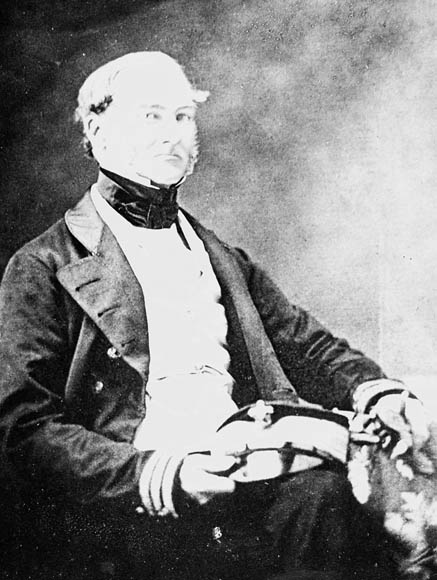
Bayfield, Wisconsin, was named in honor of Admiral Henry Wolsey Bayfield, who surveyed Lake Superior between 1823-1825. His map of Chequamegon Bay is available online here. Photograph from Dictionary of Canadian Biography.
In making the traverse from Train River Bay, to Presque Isle Bay, a singular object was visible to the right, long before the shore opposite to it came in sight. Under the effect of refraction, it rose and fell, dilated and contracted, changing continually from a tall spire to a flat belt of land. By the glass, it was seen to be almost destitute of trees, and Mr. Bushnell began to regard it as one of the peaks of Point Kewena. There is no map of this lake, upon which a navigator can rely, except a British one, from the survey of Capt. Bayfield, (Royal Navy,) made about 20 years ago. We had what purported to be a copy, but soon found that it was not a true one. We could neither recognise from it, the harbour, the points, nor the rivers, where we were. At Chocolate river the coast, from a westerly course, makes almost a right angle to the northward; but at that time, whether we were at Chocolate, or Dead Men’s river, we could not tell.
The isolated object seen in the north proved to be the “Granite Rock,” situated about 10 miles from the shore, 50 to 80 feet in height, and a few acres in extent. Along this shore, huge masses of this recent granite rise through the water, and may be seen in its clear depths. From the section stake just mentioned the Granite Rock bears north, 10 or 12 miles distant. It must not be confounded with “Standard’s Rock,” which is in the track of vessels from Point Kewena to St. Mary’s, 30 miles from land. That these granite rocks are more recent than the sedimentary sandstone which rests upon them, is evident from observation. The metamorphic rocks have protruded through the sandstone, distorting and breaking up the strata. If the red, or variegated sandstone, had been deposited after the upheaval, this disturbance would not have been visible, nor would there have been seen the discolouration and semi-vitrification at the junction, or contact of the two formations.
The mountainous country, which here comes quite to the lake, extends in east and west ranges, beyond the sources of the Huron river and Kewena Bay, and appears to have been formed by the same volcanic effort. The spacious and beautiful harbour where we lay, is formed by four granitic islands, three of them now connected with the shore by sand-bars, forming as many “Presque Isles.”
Our next day’s sail ended at a small creek, represented on the map as the St. John’s river, but by the voyageurs called Cypress river, from the adjacent forest of cypress timber, as it is called. This tree is an evergreen, with rough bark, resembling a tamarack, but the leaves are more like the hemlock. At 15 miles from Presque Isle Harbour, the shore made again to the westward, the sandstone bluff being more elevated and perpendicular; its strata somewhat rolling, but the general dip appeared to be westward. The knobs of Point Kewena were now distinctly in sight, from 40 to 50 miles distant, in the north. Mr. Door, being quite sick with a bilious fever, we determined to make a long traverse on the next day, across the bay, to Inverse Island, and thence, with all dispatch, to Copper Harbour. But after putting out, in the face of a stiff breeze, early in the day, we found it impossible to weather the next point, and returned to camp. The river called the St. John’s by us, is known to the French as the “Chien-Jaun,” or Yellow Dog river, corrupted, in the first instance, to “Shannejone,” and Thence to St. John. It is, on the map, laid down as about 30 miles long. In this country the creek is never used, but the French term “riviere,” is applied to all its streams, which is Anglicised river. Being now wind-bound for the day, I took our trusty and intelligent whaler, Martin, who had already shown himself a good woodsman, as well as a first-rate sialor, and followed the creek into the interiour. At the end of two miles of still, deep water, our canoe was obstructed by flood-wood, and at three-fourths of a mile further, by a fall of 8 or 10 feet, over sand rock. Above the fall was a beautiful lake, overlooked by granitic mountains on the west, with an opening at the south. This led us to a second lake, and this to a third – strictly speaking, only branches of the same water – in all, about four miles long. On the wast and south were gentle ridges, sustaining the first valuable pines we had seen; on the west, lofty hills. In the low grounds, at the water level, were thousands of large white cedars, forming a perfect abattis, or barrier, against our progress. There were pheasants and ducks in abundance – red squirrels, and whortleberries. On the whole, there was present so much of the New England scenery and productions, that I have written on my sketch of these ponds the name of “New England Lakes.” This is the termination of our 30 mile river.
On the succeeding day, the wind being still adverse to a direct passage to Copper Harbour, we thought only of proceeding along the coast, to the westward, and reached the mouth of Huron river, in a few hours. The health of our invalid having improved, we hauled the boat over the sand-bar, at the mouth of this river, and finding deep and wide water, ascended about two miles, and encamped. The reports of other exploring parties, were highly favourable to the Huron region, as a mineral location; but after expending two days of rainy weather, in the mountains between the Little and the Big Huron, and finding the signs of valuable copper not promising, we set forward for the “Anse.”

Map of the Mineral Lands Upon Lake Superior Ceded to the United States by the Treaty of 1842 With the Chippeway Indians.
~ Wisconsin Historical Society
During our stay, we had made an excursion, by water, into a bay about 15 miles deep, called after the adjacent islands and river, Huron Bay. The shores are low, and the extremity, or head, swampy, and filled with a labyrinth of wet islands, covered with white cedar. On the south, the Huron range overlooks the bay, at a height of 500 to 600 feet. This inlet is in the form of a pocket, gathered at the middle; and if necessary, though shallow, would accommodate a great number of vessels. When we were fairly at the bottom of the pocket, the wind came square in, and preventing our departure that night, we were under the necessity of encamping, without blankets, in a lodge lately occupied by the surveyors. A lodge is a temporary habitation, erected by those who have no tents, to be occupied for the night, or, for some days if the weather is bad. It is made of evergreen boughs, pine, hemlock, or balsam, cut short. The frame-work consists of two crotches, and a pole between them. On the side towards the wind poles are laid, like rafters, one end on the ground, the other on the cross-pole, in the crotches. On these the small brush is laid, like shingles, beginning at the ground, and each course overlapping the last. The ends are stopped in the same way, and the fire built in front. They serve to keep off the dew, snow, and wind, but are of little avail in heavy rains.
The promontory between Huron Bay and Kewena Bay is called “Point Obang,” a corruption of “Point Abaye.” It is a low, flat tract of land, which bears some sugar maple, and has a good soil, capable of cultivation. The range line between ranges 29 and 30 west, comes to the lake a short distance west of the mouth of Huron river. The northwest corner of Section 18, T. 52 No., R. 29 W., is about a mile from the shore – showing a progress to the westward of St. Marie’s of 29 towns, and to the northward five towns.
About six miles from the shore is a collection of granitic islands, called the Huron Islands, inhabited by rabbits in great numbers. Soon after casting loose from the Islands, our fitful breeze again settled into the west, where she tumbled and pitched all night and all the next day, our faithful whaler sleeping on board. In the evening, a calm enabled us to work with oars, and to reach the mission at the “Anse” about daybreak.
This term, is the French for a small bay, and is used to designate the place, as well as the head or extremity of Kewena Bay. Here the Abbe Mésnard preached to the Sioux, in 1660, and impelled by the missionary spirit, proceeded towards “Chegoimegon,” the modern La Pointe. He is said to have perished in the wilds beyond the Ontonagon, for he was seen no more.
There is yet a Catholic mission on the north side of the bay, which, with its collection of log cabins, and chapel, presents at a distance, a very pretty view. On the south side is the Fur Company’s agency, now comparatively desolate, and the Methodist mission for the Chippeways. Dr. Johnson, the carpenter, and Mr. Brockway, the blacksmith and farmer, of this mission, showed our party great kindness, which is more to be considered, when it is known that the spirit of copper speculation had attracted many people to the country, all of whom received the good offices of the establishment.
The mission farm produces good grass, very heavy crops of potatoes and turnips, good oats, barley, and rye. They are now trying the wheat crop, with little doubt of success.
Those who have spent the winter here, do not complain of its severity, although snow lies from one to four feet deep, from December till May. The bay furnishes inexhaustible supplies of white fish, that are taken almost the entire year. Every night, except Sunday, the water is dotted with the canoes of the squaws and Indians, planting their gill nets; and again, at daylight in the morning, these female fishermen are seen overhauling the net for their morning meal. The two missions appear to divide the band about equally. At this moment, the principal portion of both flocks are absent at La Pointe, receiving their annuities, each under the watchful care of their respective pastors.
From the Anse to the mouth of the Ontanagon, direct by land, is a very practicable route for a road, the distance about 45 miles. It is from this place, also, that the winter trail to Green Bay leads off to the southward, and which must always be the approach from the States by land. To reach the Ontanagon by water, the distance is about 160 miles, following the shore around Point Kewena. But about 12 miles from the Catholic mission there is a river, called the Portage river, that communicates with the Portage Lakes, which extend across the base of Point Kewena, to within one mile and a half of the northern shore. For bark canoes and light craft this portage is practicable, and usually made. About 60 miles of navigation is thus avoided.
Having feasted a couple of days upon the good things of the Anse, to wit: potatoes, turnips, sweet milk, and fresh bread, we departed for Copper Harbour, and arrived there in ten days. The sand rock of the south shore of Kewena Bay continued around on the northern side to “Bay de Gris.” A little beyond this, a different rock made its appearance, but probably the geological equivalent of the red and variegated sand rock. it is a very coarse, but stratified conglomerate, with pebbles of gate, quartz trap, amygdaloid trap, red granite, &c., many of them larger than a man could lift. It is raised in uplifts, corresponding with the subordinate trap, and contains fissures like the trap, which are filled with spar. The general course of the uplifts is southwest by west, and the course of the fissures or veins, both of the trap and conglomerate, is nearly at right angles to the face of the uplifts. It is in these veins that the native copper and its ores are found.
The line of greatest elevation runs near the middle of the point, forming an anticlinal axis, from which the rocks pitch each way, at various angles, from 20 to 60 deg. But it must not be supposed that the descent is regular from the summit towards the lake. In the volcanic convulsions that generated and raised the trap rocks, they were greatly broken and fractured; and consequently, the overlying rocks, the conglomerate and sandstones, were dislocated in the same way. They now lie in the form of vast steps; the broken faces of the conglomerate and trap nearly perpendicular, and the slopes at the angles above stated. The veins of the stratified and the unstratified rocks appear to be of the same age, to have been formed by the same cause, after the enclosing rocks had taken the form and position they now have. Upon the manner of the formation of these veins there are various conjectures, which I have not space to notice. When they pass from the conglomerate to the harder and more compact trap rock, they are said to diminish in width, sand the material of the vein changes. They carry, in general, beautiful calcareous spar, and also other substances besides copper, such as quartz and barytes.

Painting of Douglass Houghton by Robert Thom. Houghton first explored the south shore of Lake Superior in 1840. Houghton died on Lake Superior during a storm on October 13, 1845. Chequamegon Bay’s City of Houghton was named in his honor, and is now known as Houghton Falls State Natural Area.
From the Manitou Islands, at the extremity of Point Kewena, to the Portage Lakes, the most elevated mountain range, or rather succession of knobs, is nearer to the north than the south shore, and from 100 to 800 feet in height. It is a very rough region to explore, with precipitous rocks, thick cedar swamps, and tangled evergreens, in every part. But, Dr. Hougton, with five companies of explorers and surveyors, has subdivided all the land east of the Portage Lakes into sections, during the past summer, except one fractional township. The labour and exposure attending this work cannot be understood by any except those who have been upon the ground, and seen its mountains and swamps. This survey was undertaken to demonstrate the practicability and value of a favourite system of Dr. Houghton’s. He had, as geologist of the State of Michigan, spent several years in this desert region, and knew its mineral worth. He felt, as every exploring geologist feels, the necessity of exact topographical and lineal surveys, in order to give his reports that character of perfect accuracy of which the science is capable. in truth, a large portion of the results of mineral explorations is geographical, topographical, and mathematical matter. The thickness, extent, and dip of rocks, when found, constitute a perfect measurement of the country. Dr. Houghton contracted with the Government to make the lineal survey of this region, and at the same time a geological one; and labouring upon it as the great undertaking of his life, had, as I have remarked, nearly completed the most difficult portion – that of Point Kewena. His melancholy fate is well known.

Detail of Copper Harbor and Fort Wilkins from “Survey of Location No. 4 for the Pittsburgh & Boston Copper Harbor Mining Co.” Image digitized by the Detroit Public Library Burton Historical Collection for The Cliff Mine Archeology Project Blog.
By these surveys, Fort Wilkins and Copper Harbour are situated near the southwest corner of town 59 north, range 28 west, or 12 towns north, and 28 towns west of St. Mary’s.
The returns of the Government surveys of this region will not show any of the coasts and water-courses, in connexion with towns and section lines, but will give the elevation and depression – what public surveys hitherto have not – of the country, taken at every change, by the barometer. They will, further, exhibit the exact limit and character of the mineral region. Such a system, introduced into all the public surveys, with modifications suitable to the agricultural districts, such as the analysis of soils, collection of plants and marls, would be of immense advantage to the settler, and honourable to the nation.
The maps and papers of the mineral agency at Porter’s Island, in Copper Harbour, showed about 500 locations, of one mile square, each. The War Department has, by usage, the control of the mineral lands of the United States. It is doubtful whether there is any law that covers the case of the copper mines of Lake Superiour. The President has, however, reposed the power of leasing these and other mineral lands in the War Department, which confides their management to the Bureau of Ordnance, which acts by local agents. The Secretary of War, or the local agents, grant permits of search and location, and the location being made, a lease is granted to the locator. in this lease, there are covenants to render the Government six per cent. of the mineral raised, for three years, and after that time, the Government have power to require ten per cent. for the next six years.
At first, the permits including three miles square, or nine square miles; but were, early last spring, reduced to one square mile, and given upon every application, without fees. About 70 permits were now laid in the neighbourhood of Dead Men’s river, and 8 or 10 about the mouth of Huron river. The Point Kewena, proper, that is to say, that portion east of the Portage Lakes, was mostly covered, and various other large tracts on the waters of Elm river, the Ontonagon, Iron river, and even on the Brulé, beyond La Pointe.
In order, therefore, to locate our permits, it became necessary to go westward, and explore some of the vacant regions beyond the Portage Lakes. We therefore left Copper Harbour, touching at Agate Harbour, Eagle Harbour, and Eagle river, and proceeded to the mouth of Salmon Trout river, in township 55 north, range 35 west.
Mr. Bushnell, and myself, and two men, here took to the woods, and striking the range line between 34 and 35, followed it south, to the southeast corner of township 53 north, range 35 west, being about 17 miles interiour. To our surprise, instead of finding a rugged mineral region, we had passed through a handsome rolling country, tolerably well watered, with a good loamy soil, producing an abundance of sugar maple. Along the margin of the lake, owing probably to the harsh and moist winds from the water, nothing bu birch, balsam, pine, hemlock, spruce, and white cedar, is seen; but to the distance of two to five miles, interiour, the forest growth changes entirely. There is an occasional white pine, with a lofty, straight, and majestic trunk, some scattering elms, linns, and black oaks, but the reigning tree is the sugar maple.
On the left, lay the valley of the Portage Lakes and of Sturgeon river, which we had just crossed. Turning westward, we soon encountered one of those eye-sores to the explorer and surveyor, a cedar swamp, in which a progress of a mile an hour is considered rapid travelling. The white cedar lives to a great age before it beings to decline. It finally rots at the root, and is blown down by the northern tempest. But this is by no means its end; its prostrate trunk sends up live branches, that draw sustenance through the roots of the parent, of new prongs went by itself below, among the buried trunks of preceding centuries. In after ages, when it has at length matured, and, weakened by time, has yielded to the winds, another sprout from its side keeps the family stock in perpetual being. Beneath the accumulated bodies of these trees, some dead and some living, the water, in which they delight, stands the year through, flowing gradually towards some stream of the vicinity. What is remarkable, the water of these swamps, so little and slow is the decay of the cedar tree, is clear, pure and cool.
I hope I have been able to convey to the reader, a just idea of a white cedar swamp, because without a correct conception of this, he will never be able to realize the great difficulty of travelling in this new country. After he has penetrated one of them forty rods, the view is equally extensive in every direction, whether it is only forty rods to the other side, or whether it is two miles. In addition to the network of logs, and the thicket of leaves that never fall, it is necessary to thin of numberless dry, sharp, and stiff prongs, the imperishable arms and limbs of dead and fallen trees. It is then to be remembered that every man carries more or less of a load upon his back; his blanket, his tin cup, probably some implement, a hatchet, or a hammer, with specimens, and a few pounds of provisions.
The second night found us advanced about one mile into a noble cedar swamp. Climbing a tree extended somewhat the range of the eye, but it met only the sombre and half naked trunks of the white cedar, in every direction. A camp-bed was formed beneath a tall and beautiful larch, or tamarack, and a fire made at its root. The bed was made made as usual of branches, kept out of the water in this instance by brush and poles. This white cedar has the merit of burning readily, as well as of durability, and made to-night a bright fire, flaming gaily upwards against the straight and stately larch. When had such an illumination shone there before? The owl gave utterance to his surprise in hideous screams, and hooted for his mate. The larch, as it swayed to and fro in the night breeze, seemed to creek and groan because of the fire, which was scorching its sinews and boiling its life-blood in its veins. No doubt, before many seasons pass by, he will sicken and die, and from a tall prince, overlooking the humble cedars, will come heavily down, perhaps in the stillness of night, and lay his body along side of theirs.
In the morning, after passing a cold and comfortless night, a few minutes’ travel cleared the swamp, and rising some very high land, we found the stratified sandstone again, and inclined towards the lake.
At the southeast corner of township 53 north, range 36 west, the trap ranges again made their appearance, from whose summits the mountains of the Huron river were visible, in the south, beyond the Anse.

John Harris Kinzie
~ Wikipedia.org
We were now on the head waters of Elm river, on ground located for many miles around. Most of them are what are called office locations, made without visiting the spot, and in consequence of some locations made by Mr. Kenzie, of Chicago, from actual observation, of which favourable reports were in circulation.
That night we should have met two of our men at a rendezvous with supplies; but neither party had sought the right spot, so indefinite were the descriptions given us of localities. As it was some miles from the coast to the mineral ranges, the boat passed slowly along the shore, sending out provisions, from time to time, to the exploring party. It was not then known how far west the township lines were surveyed, consequently the points of meeting were fixed at the forks of some stream, or some old camp, and in finding these many errours might be committed. In this case a day was consumed in uniting the two parties, which would not have been of so much consequence, had not the stock of eatables began to fail. But most of the disagreeable effects of a short allowance were avoided by the capture of a porcupine, of which we made, by long boiling in the camp-kettle, very palatable soup.
On the 20th of September, at a distance of 20 miles from the coast, there were a few flakes of snow, succeeding a cold rain. On the 21st and 22d, rain. The ground passed over during this week, is drained by the Salmon Trout river, (a creek,) Elm river, Misery river, Sturgeon, and Flint Steel rivers. Every member of the party was delighted with its soil, its beautiful and heavy timber, and the unsurpassed purity, plenty, and coldness of its waters. We passed several small clear lakes, the sources of many streams. These streams are in general but few miles in length, enlarging very fast as you follow them downward from the head, alive with the famous speckled trout, rapid in their descent, and so uniform in the flow of water, that water power is every where abundant. Many a time did Patrick and Charley select their future farms, on the border of some quiet pool, from which a tumbling brook issued, bearing its faithful tribute into the reservoir of the Father of Lakes.
The cedar swamps, so hateful to the explorer, will be necessary to the farmer for his supply of rails; the tall, round pines, scattered here and there among the sugar trees, now so green and majestic, will supply him with lumber; the straight and beautiful balsam, with timber.
Hitherto, the mineral trap rocks that rise occasionally through the sandstone stratum, do not greatly interfere with the use of the land for tillage. This rock, when fully disintegrated, gives a light soil that produces well. In this vicinity, the trap rises suddenly out of the plain land, sometimes with one perpendicular face and one gentle slope; sometimes like an island with a bluff all around, and flat, rich land on the top; and sometimes in irregular peaks, standing among the timber like cones and pyramids. At the sources of Flint Steel river we saw, interspersed with protruding summits of trap, peaks of conglomerate shooting up from flat land, to the height of 50, 70, and 100 feet.
Pursuing a southwesterly course, about noon, on the 26th, we entered the ravines that lead into the Ontanagon. From Elm river to the Ontanagon, the sand rock is covered from 10 to 400 feet in depth, with a stratified deposite of red clay and sand, very fine. It is commonly called clay, but contains more silex than alumine, though tit is so minutely divided as to have the appearance of clay. I saw nowhere true clay beds, but it is possible some of this deposite will harden in the fire, so as to make bricks.
This great sand-bed is easily washed out by running water. From the Falls, the Ontanagon has hollowed out for itself a channel 300 to 400 feet deep, and from a half a mile to two miles wide. The lateral gullies are very numerous, deep, and steep. Every permanent rill, operating for ages, has excavated a narrow trough, the bottom of which descends towards the river, in the inverse proportion to its length, and the sides remain as nearly a perpendicular as the earth will lie. The low grounds, not so wet as to cause cypress and cedar swamps, are everywhere inclined to produce hemlock and balsam. It is the same in the prairies; cold, moisture, and a confined atmosphere, causing the growth of evergreens, and also of cedars.
It will be easy to judge of the facilities of travelling in the region of the gullies. To cross them, rising one slippery face and sliding down the next, is very exhausting to men loaded with packs. To follow down one of the ravines, so narrow, deep, and shaded, as almost to exclude the sun at noon, is much like the change “from the frying pan into the fire.” The timber of the sides has fallen inward, into and across the contracted pathway of the rivulet, so thick, and so much entangled, that the mind is in a constant state of exercise, determining whether it is easier to crawl under, or climb over the next log.
In such regions, as you approach the common discharge of all these ravines, as a creek, a lake, or, as in this case, a river, the number of lateral gullies diminish, and it is sometimes preferable to take the crest of the gulf, and follow it towards the mouth. We did so; and coming along a narrow backbone, scarcely wide enough for two to walk abreast, suddenly came to its termination, with the river far below us. It was noon of a lovely day, such as are called the Indian summer. In the distance, to the north 12 or 15 miles, a thick haze covered the lake; the sides and bottom of the valley of the Ontonagon, were brilliant in the mellow sunlight, mottled with yellow and green; the golden tops of the sugar tree mingled with the dark summits of the pine and the balsam. The rough gorges that enter the valley on both sides, were now concealed by the dense foliage of the trees, partly gorgeous, and partly sombre, made yet richer by the contrast, so that the surface of the wood, as seen from our elevation, in fact from the waving top of a trim balsam which I had ascended, lay like a beautifully worked and colored carpet, ready for our feet.
On this promontory, jutting into the valley, we kindled a fire in the dry and hollow trunk of a hemlock, as a beacon to our companions, who were to be at the foot of the rapids with the boat.
On the left or inland side, the valley at some miles distant is seen to divide, corresponding with the two branches of the river. In this direction are elevated peaks, several hundred feet higher than our position, but partly hid in the mist of the atmosphere. We had now spent as much time in scene gazing as was profitable, and taking up our packs, tumbled down the bluff to the river. There stood the tents, and there lay the boat, with our comrades lounging about in the sun. The meeting brought forth three hearty shouts all around, and such congratulations of genuine good will, as none but woodsmen and sailors know.
We were now at the foot of the rapids, one mile north of the correction base, which is also the line between towns 50 and 51 north, and one mile east of the range line between ranges 39 and 40 west.
On the next day, after washing, drying, and mending, some of the most needed garments, Patrick, our faithful Irishman, and myself, crossed the river, and went west along the correction line. This course carried us constantly nearer the lake, because the direction of the shore is south of west. The timber was, as might have been expected, on approaching the lake, more hemlock, birch, and balsam; but the soil appeared as good as that we had passed over from Salmon Trout river, in range 35 west. In range 41 west, we turned to the left, and soon found that no surveys had been made south of the correction line. The same day a rain set in, that lasted, with little intermission, four days and five nights. In the trap region, the magnetic needle is subject to great fluctuations. When the sky is overcast, as it was in this case, from morning to night, the sun, the principal guide, is of course lost. If the traveller loses his confidence in the compass, that instrument is the same as lost, and he is compelled to rely upon judgement, or rather the woodsman’s instinct. This judgement is, sometimes, a very uncertain reliance. The streams and ridges of land are so irregular that little information can be drawn from them. There is a great difference in persons, in the accuracy of their calculations, guided by the “make of the country,” as its general topography is called. In this region, none but the oldest hunters and trappers feel safe, when the compass begins to play false, and the sun withdraws himself. If the consumption of provisions could cease for the time, it would always be safer and wiser to stop and encamp until clear weather comes; but the appetite does not seem to know that circumstances alter cases. With the mind in a state of perplexity, the fatigue of travelling is greater than usual, and excessive fatigue, in turn weakens, not only the power of exertion, but of resolution, also. The wanderer is finally overtaken with an indescribable sensation—one that must be experienced to be understood —that of lostness. At the moment when all his faculties, instincts, and perceptions, are in full demand, he finds them all confused, irregular, and weak. When every physical power is required to carry him forward, his limbs seem to be yielding to the disorder of his mind; he is filled with an impressive sense of his inefficiency, with an indefinite idea of alarm, apprehension, and dismay; he reasons, but trusts to no conclusion: he decides upon the preponderance of reason and fact, as he supposes, and is sure to decide wrong. If he stumbles into a trail he has passed before, or even passed within a few hours, he does not recognise it; or if he should at last, and conclude to follow it, a fatal lunacy impels him to take the wrong end. His own tracks are the prints of the feet of some other man, and if the sun should at last penetrate the fogs and clouds that envelop his path, the world seems for a time to be turned end for end; the sun is out of place — perhaps it is, to his addled brain, far in the north, coursing around to the south, or in the west, moving towards the east. At length, like a dream, the delusion wears away; objects put on their natural dress; the sun takes up its usual track; streams run towards their mouths; the compass points to the northward; dejection and weakness give place to confidence and elasticity of mind.
I have twice experienced what I have here attempted to describe. It is a species of delirium. It oppresses and injures every faculty, like any other intense and overwhelming action. The greatest possible care should be taken to prevent the occasion for its return. Two men, last summer, were exploring on Elm river, and without compass or food, started for a vein a few rods from camp. They got entangled among swamps and hills, and wandered forty-eight hours in the woods, bewildered and lost. By accident, they struck the lake shore, and their senses returned. It is not prudent to be a moment without the means of striking a fire, without food for a day or two, and a plenty of clothing, or without a compass. Our man Martin, and myself, went out in the morning, from Salmon Trout river, intending to go three miles and return. He had neither coat, nor vest, nor stockings, because the weather was mild. A rain soon come on, and a thick mist; steering for the camp, we struck the creek two miles above the mouth and the camp. The ground in the vicinity of the lake has a low, evergreen bush, with a leaf like the hemlock, which lies flat on the surface, entangling the feet at every step. It was dark when we struck the creek, and began to follow it down stream. The sloughs, logs,ground hemlocks, and cedar brush, were so bad, that it would have been difficult to make much progress in daylight, and it was now pitch dark. We took to the water-course to avoid the brush and bluffs of either bank, and waded along the channel. But the waters of these streams are always cold, and Martin, though a stout fellow, and full of resolution, began to be numb with cold and wet. We took nothing to eat; our matches were wet; the gun could not be fired off. There was but one course to pursue. The stream would take us to camp, but how far distant that desirable spot lay, we could not conjecture. But the chilly water must be avoided, and the brush and logs, wet, slippery, and numberless as they were, must be surmounted. “We have crossed that log before,” says Martin. “What, are we lost? Impossible; we have not left the stream a moment—it cannot be.” Crooked and winding as it was, it is not possible that we should travel twice over the same ground. But there was the log, to all appearance the same we had crossed half an hour before. Both of us would swear to the identity of the log—the same timber, the same size, the same splinters at the root; the bark off in the same way; and still it was more probable that two such logs should be found, than that we had passed twice over the same spot.
We crawled around, filled with the mystery—and it is not to this hour any thing else than a mystery. In about two hours my companion gave an exclamation of hope and joy. He had been up the creek the day before, shooting ducks and fishing for trout. He recognised the spot where the canoe was obstructed by flood-wood, half a mile from the tents. We now knew where there was a trail, and in a few minutes beheld the sparks of the camp-fire ascending gaily among the trees.
With fire works better secured, with more attention to clothing on the part of Martin, and to blankets by both of us, especially with ordinary prudence in regard to provisions, the discomfort and exertion, the bruises, chills, and exhaustion of this day, so injurious to the constitution, whether felt immediately or not, might have been entirely avoided. It may be thought that such vexations might be prevented by a rational foresight, and this is no doubt true ; but in practice they occur frequently to woodsmen, and they are in general as keen in the examination of chances as any class of men. Even Indians and Indian guides become bewildered, miscalculate their position, make false reckonings of distances, lose courage, and abandon themselves to despair and to tears.
The maps for the copper region, instead of assisting the explorer, were for the interiour so erroneous—a fault worse than deficiency—that mistakes equal to a day’s travel frequently resulted from a reliance upon them.
On the office map there was noted a lake not far above the forks of the Ontanagon—on the west fork. Leaving the “correction base” at the southwest corner of town 51 N., range 40 W., we should have struck that lake in the distance of ten miles; but, instead of a lake, found ourselves involved in the marshes at the sources of the Cranberry and Iron rivers, the lake itself being about fifteen miles distant. The forks of the Ontanagon appeared from the map, and the best information within reach, to be about four miles by river above the foot of the rapids. This was made a point in our return, to which a packer was sent with pork and beans. Instead of making the rendezvous in one day’s travel, as was expected, he reports the distance at fifteen miles by river, and seven or eight in a direct line. The delay occasioned by bad weather and mistakes, amounted on our part to two days; the packer, who had at last reached the forks, after spending two nights in a cold rain, without fire, had left, and carried back his provisions. Patrick had, by mistake, taken salt pork for three men, instead of two. When we arrived at the Forks, only one meal of bread and beans remained, with a little tea and sugar; but the pork was sufficient for two days more. It was necessary to alter our route, and employ those two days in reaching the agency at the mouth of the river. This is an instance of hazard and disappointment, and it is difficult to see how it could have been avoided. With the greatest sagacity and forethought, small parties, who do not survey and mark their courses and distances, cannot avoid occasional perils.

Photograph by Ian Shackleford, 2011, of the Ontonagon Copper Boulder off display at the Smithsonian Institution National Museum of Natural History.
~ Wikipedia.org
The circumstances in which we were placed, did not allow of as much observation upon that interesting region, the Falls of the Ontanagon, as I desired. The greatest fall is on the west branch, and occupies a distance of at least two miles, with a descent of about eighty feet. It was at the head of this succession of cataracts, that the “Copper Rock” was found, which is now at Washington city. It lay when first discovered, on the brink of the river, in the red deposite, of which I have spoken, although mountains of trap, sandstone, and conglomerate, rise on all sides. The rock was removed from its place upon a temporary railway, constructed through the woods, about four miles, to a point on the river where it could be floated. This road crossed deep ravines, and a steep mountain 300 feet high. The rock was hauled along on a car, and up the mountain, by a capstan and ropes. Its weight is a little over 3,000 pounds.
It is now eighty years since this copper rock obtained notoriety among white men. Mr. Alexander Henry,- an adventurous Englishman, and an agreeable writer, who entered the Indian country immediately after the peace of 1763, gives a description of the rock, which is worthy of being repeated.
“On the 19th of August, (1765,) we reached the mouth of the river Ontanagon, one of the largest on the south side of the lake. At the mouth was an Indian village, and at three leagues above, a fall, at the foot of which sturgeon were at this season so abundant, that a month’s subsistence for a regiment, could have been taken in a few hours. But I found this river chiefly remarkable for the abundance of virgin copper which is on its banks and in its neighbourhood, and of which the reputation is at present (1809) more generally spread, than it was at the time of this, my first visit. The copper presented itself to the eye in masses of various weight. The Indians showed me one of twenty pounds. They were used to manufacture this metal into spoons and bracelets for themselves. In the perfect state in which they found it, it required nothing but to be beat into shape. The ‘Pi-wa-tic,’ or Iron river, enters the lake to the westward of the Ontanagon, and here it is pretended silver was found, while the country was in the possession of the French.”—Part 1, pp. 194-5.
“On my way (1776) I encamped a second time at the mouth of the Ontanagon, and now took the opportunity of going ten miles up the river, with Indian guides. The object which 1 went most expressly to see, and to which I had the satisfaction of being led, was a mass of copper, of the weight, according to my estimate, of no less than five tons. Such was its pure and malleable state, that, with an axe, I was able to cut off a portion weighing a hundred pounds. On viewing the surrounding surface, I conjectured that the mass, at some period or other, had rolled from the side of a lofty hill which rises at its back.”—p. 203.
I quote extensively from Mr. Henry’s interesting book, because it is now out of print, and very rare. Capt. Jonathan Carver, also, travelled in the Lake Superiour and Mississippi country, in 1766, of whom,-after the manner of succeeding travellers, speaking of their predecessors, Mr. Henry says, “and he falls into other errours.” The Chippeways told Carver, that being once driven by a storm to the Isle de Maurepas, (now Michipicoten,) they had found large quantities of shining earth, “which must have been gold dust.” They put some of it into their canoes, but had not moved far from the land, when a spirit sixty feet in height strode into the water, and ordered them to bring every particle of it back to the island. This of course they did, and never ventured again to the haunted island.
![Detail of Lake Superior from Carver [Jonathan], Captain. Journal of his travels with maps and drawings, 1766. ~ Boston Public Library](https://chequamegonhistory.com/wp-content/uploads/2016/05/jonathan-carver-lake-superior-detail.jpg)
Detail of Lake Superior from [Jonathan] Carver, Captain. Journal of his travels with maps and drawings, 1766.
~ Boston Public Library
In the spring of 1769, Mr. Henry, excited by this and other reports of the Indians, visited the islands, expecting to find “shining rocks and stones of rare description,” but found only a mass of rock, rising into barren mountains, with veins of spar. The Indians then insisted upon going to another island to the south, (Caribeau) as it was the true island of the “golden sands;” but the weather prevented this visit at that time. In 1770, Mr. Baxter, Mr. Bostwick, and Mr. Henry, were constituted members of a company for working mines on Lake Superiour.
“We passed the winter together at Sault de Sainte Marie, and built a barge fit for the navigation of the lake; at the same time laying the keel of a sloop of forty tons. Early in May, 1771, we departed from Point aux Pins, our shipyard, and sailed for the island of Yellow Sands, promising ourselves to make our fortunes, in defiance of the serpents. I was the first to land, carrying with me my loaded gun, resolved to meet with courage the guardians of the gold.
“A stay of three days did not enable us to find gold, or even yellow sands ; and no serpents appeared to terrify us, not even the smallest and most harmless snake.
“On the fourth day, after drying our Caribeau meat, we sailed for Nanibason, (on the north shore,) which we reached in eighteen hours, with a fair breeze. On the next day, the miners examined the coast of Nanibasou, and found several veins of copper and lead ; and after this returned to Point aux Pins, where we erected an air furnace. The assayer made a report on the ores which we had collected, stating that the lead ore contained silver in the proportion of forty ounces to the ton; but the copper ore only in very small proportion indeed.”
~ A Brief Account of the Lake Superior Copper Company, 1845, page 13.
The party now start for the Ontanagon, having in company a Mr. Norberg, an officer in the 60th regiment, then stationed at Mackinaw, old fort. At Point Iroquois, he found among the loose stones, one “of eight pounds, of a blue colour, and semi-transparent,” which he deposited in the British Museum at London, and which, it is said, contained sixty per cent, of silver.
“Hence we coasted westward, but found nothing till we reached the Ontanagon, where, besides the detached masses of copper formerly mentioned, we saw much of the same metal imbedded in stone. Proposing to ourselves to make a trial on the hill, till we were better able to go to work on the solid rock, we built a house, and sent to the Sault de Sainte Marie for provisions. At the spot pitched upon for the commencement of our preparations, a green coloured water, which tinged iron of a copper colour, issued from the hill, and this the miners called a leader. In digging, they found frequent masses of copper, some of which were of three pounds weight. Having arranged every thing for the accommodation of the miners during the winter, we returned to the Sault. Early in the spring of 1772, we sent a boat load of provisions, but it came back on the 20th day of June, bringing with it, to our surprise, the whole establishment of miners. They reported that in the course of the winter they had penetrated forty feet into the hill, but that on the arrival of the thaw, the clay on which, on account of its stiffness, they had relied, and neglected to secure by supports, had fallen in ; that from the detached masses of metal which to the last had daily presented themselves, they supposed there might be ultimately reached some body of the same, but could form no conjecture of its distance. Here our operations in this quarter ended It was never for the exportation-of copper that our company was formed but always with a view to the silver which it was hoped the ores, whether of copper or lead, might in sufficient quantity contain.”—pp. 227,233.
“In the following August we launched our sloop, and carried the miners to the vein of copper ore on the north side of the lake, (probably at Nanibasou, about one day’s sail from Michipicoten.) Little was done during the winter; but by dint of labour, performed between the commencement of the spring of 1773, and the ensuing month of September, they penetrated thirty feet into the solid rock. The rock was blasted with great difficulty, and the vein which at the beginning was of the breadth of four feet, had in the progress contracted into four inches. Under these circumstances we desisted, and carried the miners back to the Sault. What copper ore we had collected, we took to England; but the next season we were informed that the partners there declined entering into further expenses. In the interim, we had carried the miners along the north shore, as far as the river Pic, making, however, no discovery of importance. This year, therefore, (1774,) Mr. Baxter disposed of the sloop and other effects of the company, and paid its debts. The partners in England were his Royal Highness the Duke of Gloucester, Mr. Secretary Townshend, Sir Samuel Tucket, Baronet, Mr. Baxter, Consul of the Empress of Russia, and Mr. Cruikshank. In America, Sir William Johnson, Baronet, Mr. Bostwick, Mr. Baxter, and myself. A charter had been petitioned for and obtained, but owing to our ill success, it was never taken from the seal office.”—pp. 234-5.
Detail of Ontonagon River, “Paul’s Cabin,” the Ontonagon Boulder, and the Porcupine Mountains from Map of the Mineral Lands Upon Lake Superior Ceded to the United States by the Treaty of 1842 With the Chippeway Indians.
~ Wisconsin Historical Society
There is living an old chief who, when a boy, saw this company of English miners at the falls of the Ontanagon. He represents the manager as a stout, burly man, with a red face. There are near the spot where the great copper rock was found, remains of a chimney, supposed to belong to the house spoken of by Henry. The timber around the spot was of a second growth; now cut away by Mr. James Paul, who has lived there, and located a three-mile permit. He told me that an aspen, eighteen inches in diameter, had blown down near his cabin, and a copper kettle was found, flattened and corroded, beneath its roots. There are also the remains of ancients pits, still visible; and in the sand and clay deposite, by digging, lumps of native copper are now found. There can, therefore, be no doubt but this is the spot visited by the English company, before the American Revolution, and now become again an object of hope and notoriety.
This region is singularly wild and disordered. The Falls, which are distinct from the “Rapids,” are caused by the irregular upheaval of trap, sandstone, and conglomerate, thrown about in grand confusion. To the miner and geologist such points possess not only the greatest interest, but the greatest practical value.
Here appears to be one of those great centres of convulsion, which raised and tossed about the metalliferous rocks. Another may be seen to the eastward of the Portage Lakes. From the central point in such direction along the line of action, that is to say, in a northeasterly and southwesterly course, the height of the upheaval and the extent of the distortion gradually becomes less on each side. The effect of the subterranean forces being very much the same upon the overlying sand rock, as that of a projecting point of rock upon the ice of an estuary of the sea when the tide falls away. The trap uplifts represent the rock, itself rising instead of the sandstone stratum settling. The resemblance is not perfect, but only illustrative. The field of ice subsiding upon a sharp point of rock, in a bay of quiet waters, will break and crack equally in all directions. But the uprising trap, though it has a centre, does not act equally on all sides; for there is a line of upheaval, along which the force operates, giving rise to an elevated ridge, which is highest at the centre, or focus. It has a breadth of 5 to 15 miles, and a length of 50 or 60. The trap rock intruding from below has within itself a certain regularity, which I have noticed before ; throwing up long parallel faces, looking inward towards the line of greatest elevation.
Of this fact I have from observation a knowledge of only a portion of the northern half of the trap range ; from the Manitou Islands to Sun river, a distance of about 120 miles. I did not cross the range far enough to ascertain the position of the south half, and give this statement of its organization upon the representation of other explorers, whom I have no reason to doubt.
These ranges are not- in every case parallel to the great anticlinal line, but generally they are so. There are cases of spurs, or lateral ranges, of limited extent, branching off from the main pile. Both the trap and the overlying conglomerate rocks, are very hard to work. The trap is the most compact, but is more uniform in its texture. The conglomerate encloses pebbles of all sizes, and of many different rocks, most of them very hard. This want of homogenity prevents the blast from producing that effect, which it would on a close, uniform, tight rock. I think there can be little doubt but Mr. Henry’s conjecture respecting the source of the copper rock of the Ontanagon, and the many copper boulders found in the red clay deposite, is correct. That they were loosened from their position in a neighboring vein, by the disentegration of the enclosing rock, and by the force of gravity and that agent, whatever it may have been, which brought on the red sand and clay deposite, they have been scattered around. The red deposite is evidently younger than the sandstone and the trap, for it is horizontal. The sandstone it is equally evident is older than the trap, for the latter has shot up through it, tilting it outward from the line of uplift. The copper boulders are found imbedded in the red loam, as it may be called, and must have been loosened from the vein at and before the period when it (the loam) was brought on.
The native copper, which is the principal ore of the country, (if metal can be called an ore,) exists in the veins, in all sizes and shapes; from the weight of the point of a pin to 20, 40, 100, 1,000 and 1,500 pounds. A boulder was found this season near the mouth of Elm river, weighing over 1,500 pounds, which is now at New Haven. I saw an irregular mass in a vein near Agate Harbour, about one mile east, which might with great care have been taken out, weighing 800 to 1000 pounds. It was removed in one body, to the amount of about 400 pounds; but to procure such specimens there is great trouble and expense, in securing all the prongs against damage by the blast. These boulders are found in the water-worn pebbles of the shore, and of various sizes, from 1 to 40 and 100 pounds. They are also found far to the southward, in Wisconsin—giving rise to great hopes and speculations—transported by that universal power, (whatever it was,) which covered the northern hemisphere with drift from the north.
It may then be suggested whether the great copper rock and its satellites, of the Falls of the Ontanagon, were not carried thither in the same manner. There is certainly room for such a doubt. But no matter how far these masses of copper have been transported, or how short the distance they have been moved, they must have originally been derived from veins. Here we find not the particular veins from which the boulder was extracted, but find in the country veins containing exactly such masses. They may have been dragged from regions farther north, where similar veins probably exist, but as there is no necessity for going to sogreat a distance in search of their origin, so there is not a.s great a probability of finding their original seat far from their present position. The difficulty of transporting such heavy material is a strong reason against distance, though not a conclusive one.
But in the case of the great rock, the number of attending fragments is so numerous—so much more so than is known anywhere else at a distance from the veins, that little doubt remains that they are from a nest not very far off. In the gold region, and in the lead mines, where loose metal is found, the miner begins to search in all directions to ascertain from whence it came. If he finds it more abundant on one side than another, he famines more closely the soil of that side; and if found to increase as he proceeds, he is convinced that he is on the trail. As he follows this, the evidences multiply, and at last he arrives at the parent vein, from which the scattered fragments were driven. It is probable that time, money, and enterprise, will finish what the English company began; and at last disclose a prominent vein within hearing of the cataracts of the west branch.
The mouth of the Ontanagon is one of those commanding points that strike the observer at first glance. As Henry says, it is the principal river of the south shore, and the only one except the Chocolate river and Grand Marais, where a vessel can enter. There is now, in a low stage of the lake, six feet water on the bar, and deep water several miles up the stream, which is about 300 feet wide. It is the natural outlet of a large fanning region, which the surveyors say extends 50 or GO miles interiour, and 40 or 50 each way along the shore. The mineral belt occupies several miles in width, at this point 10 or 12 miles from the shore, and parallel with it; but at the mouth of Sun, Black, and Montreal rivers, it comes down to the waters of the lake. On each side of this range, and even among the Porcupine Mountains, the agricultural resources of the country are only limited by the shortness of the seasons. The soil is good— the climate without an equal for health and strength, and the lake and streams abound in fish. The swamps and the flat lands produce wild grass in abundance, showing the tendency of the soil to that production. Potatoes, turnips, and all roots grow here in the greatest perfection; and oats and barley do well. I have little doubt but it will also be found an excellent wheat region.
We found the rich bottom-lands of the Ontanagon already dotted with the cabins of pre-emption claimants, for several miles up the river. The Indians have a tradition about the name of Ontanagon, as about almost every thing else, and say it is truly “Nindinagan.” That an old woman, long ago, was cooking on the shore at the mouth, and her dish slipped into the current and was carried out into the lake. She exclaimed, “Oh! there goes my dish,” the Indian of which is said to be Nindinagan.
The site at its mouth is rather low and swampy. On the west the Porcupine Mountains rise boldly out of the water, at the distance of 20 miles, presenting that peculiar outline of the trap uplifts by which they may be recognised afar off, almost as well as by inspection. A cross-section, which would also correspond with the end view, from the Ontanagon may be compared to the notches or teeth of a mill-saw, laid upon its back, one edge straight and vertical, the other sloping. If the expectations of mineral locators are realized, the prosecution of the mining business will of itself create a place of some importance here. To the fanner of New England there will be great inducements, as soon as the mining operations are placed upon a sure footing; for the products most congenial to the region are such as are bulky, and cost much in their transportation, to wit: potatoes and roots, hay and oats. It is well known that miners never till the soil to much purpose. A garden and a little pasture suffice for them. This must be done by the practical farmer. The mineral and the agricultural districts are here so admirably situated as mutually to render to each interest the greatest assistance. When the navigation shall be completed around the rapids of the St. Mary’s, the emigrant and miner, placing himself at any harbour of any of the lakes, may take his passage to any part of Lake Superiour, with his family and effects. The hardy son of Vermont and New Hampshire will find here his own climate and mountains; his own trout streams, and a good substitute for the shad and salmon of the ocean ; and a soil equal to most parts of the West, without the fever and ague of the more southern portions. The facility of making roads to the interiour is great, and along the shore they are practicable. Of course, on the immediate east, ravines are too frequent to cross without expensive bridges. But a few miles inland the country rises, the valleys of the streams diminish, and a very favourable country is found as far east as the Portage Lakes and the Anse. Here the swamps and lakes form the only serious obstacles, and they are avoided by good selections of routes. The difficulty of making roads in the Ontanagon region is far less than it was in the first settlement of Ohio.
Until the night of the 5th of October I had not observed any frost, although the leaves were already coloured with the hues of autumn, and falling from their stems hid begun to cover the ground. The winds and ruins that occurred between the 5th and the 10th left the branches of the trees almost as naked as in winter, and the snow began to fall. We were received at the Agency house with that liberality of hospitality which can be found nowhere more full and hearty than among the backwoodsmen of the West. Major Campbell, the agent, was absent in search of a copper rock, in the neighbourhood of “Lake Vieux Desert,” about 150 miles distant. In the evening Mr. Paul, who has been three years in the country, and who had joined in the wild-goose chase after the copper rock, on the faith of an Indian, came in, and amused the company till a late hour by reciting the stratagems and effrontery of their Indian guide.
Since the whites have shown such an intense curiosity about copper rocks, they have sprung up on all sides. Every Indian knows where one may be found. It can be had of any size or shape, and generally for the price of a few dollars and provisions for the trip. It is generally seven, ten, or twelve days’ journey to it. The Great Spirit and the tribe will destroy or otherwise injure him who shows it to the white man, but they will lead him to the vicinity, and he can do the rest. In this case a monster was to be found, and the price was to correspond; but $50 or $60 was somehow procured in advance. The Indian lived in the neighbourhood of the rock and had shown it to but one other mortal; a half breed now dead. After great labour and vexation the party approached the sacred place. There are four trees marked with Porcupines, done in charcoal; according to the description. They were far from any trap ranges, in a low, swampy country. The Indian fixes his eyes in a given direction, and all are elated with the certainty of success. They scour the woods in that direction, but no rock is found. The Indian and his boy wish to be left to pursue the search by themselves, and still the rock hides itself. He is watched, and they find that he only moves around in a limited circle, and returns to the camp. Hesitating between the apprehension that he is duped, and the realization of his hopes, the agent becomes impatient. The Indian at length points his finger to the spot, but the Great Spirit had sunk the rock deep into the earth. The Indian is calm and immovable. “Hou, hou—marchez wigwam” he says, in the usual tone. “What does he say?” inquires the agent. “He says we had better go to his wigwam,” replies the interpreter. The scene changes from the highest expectations to the highest rage. “Give him a hundred lashes—break every bone in his body—kill him!” and expressions of this sort, are now heard, with gestures to match. The Indian could not understand English, but knew enough to be sensible that some cursing was going on, and that he was the object. He now began to kindle with wrath. The first motion was to throw down his pack, and in this he was followed by the boy, and two or three other Indians of the party. What was the agent, the surveyor, and the interpreter to do, here in this wilderness, deserted by their packers and guides. Paul, who had long known the Indian’s cunning, saw at once the position of affairs, laughed at the agent, and offered the Indians a half dollar to take up their packs. They had, in the mean time, proceeded from anger to mockery. They had paraded themselves in advance of the party, strutting along with some small willow sticks on their shoulders, in derision of the many loads under which the whites were groaning. The latter were obliged not only to pocket the insult, but to employ the old man, his boy, wife, and canoe, to cross some lakes that lay in their route home.
Coming in they met another party of whites, with the usual complement of Indians, also in search of a copper rock, said to exist in the region of Lake Vieux Desert. If such rock were actually visible, no Indian would show it, so long as he can get one-half of his yearly support from it as a guide. Those who know them best, say that it matters little to the explorer whether such boulders exist or not, the Indians will never be guilty of showing one to a white man. There is a superstition upon the subject, and it is also a rule that the proceeds of a found rock should be divided, and a large portion go to the chief. In case an Indian actually knew of one, he would not disclose its position, unless he was sure the fact would never be made known to his tribe.
On the morning of the second day the square-sail of our boat, which had been to La Pointe, appeared at the foot of the Porcupine Mountains, bright in the light of the rising sun. At eleven it entered the river, before a bountiful breeze, and the company was once more together.
“Algonquin Company of Detroit.”
~ Reports of Wm. A. Burt and Bela Hubbard, by J. Houghton Jr and T. W. Bristol, 1846, page 97.
The mining company for which we were acting is called the “Algonquin,” and is composed principally of citizens of Detroit. Our locations were made, four in number, upon the waters of Flint Steel river, and we were now on the way thither, to make preparations for the men who were to stay through the winter. Towards evening, we entered the mouth of Flint Steel river, which is six miles east of the Ontanagon. Dragging the boat over the bar, and rowing it two miles up the stream, we landed. From thence to the locations, is about twelve miles, over a beautiful rolling country of sugar maple. The copper found here is chiefly native, and is enclosed in the trap rock. We brought away a piece weighing seven pounds, that lay in a vein near the surface.
On the 13th, we were again at the boat, working out of the river. For several days there had been snow, and indications of the close of the season. The snow was still falling as we proceeded down the lake, after dark, with a view of reaching Elm river. But the water was calm, and the oarsmen were making good speed. A little after 9 o’clock, we passed the mouth of Misery river, a bleak and desert place, without firewood, and some of the party fancying they saw a light at the old camp, or Elm, the boat was kept on her course. It was difficult to the see shore at the distance of twenty rods, on account of the falling snow.
About half past 9, a light puff of wind came on from the northwest, which aroused the attention of Martin at once. “If the next one (says he) is stiffer than that, we must put about for Misery river.” A sharp flaw followed his words, and the boat was put about. But it was scarcely before the breeze, when it came in short, irregular blasts, and the water became agitated. Martin was our oracle on the water. He said we must make the shore instantly, and the craft bounding and splashing, was headed for a light streak that appeared to be a sand beach, but above which frowned a dark line like a bluff! Before she struck, the sharp, irregular waves combed freely over the sides and the stern of the boat.
“Charley, Patrick, Mike, and all hands, throw your oars and jump ashore!” Every man was in the water in a moment, holding her by the head. “Keep her stern off; heave, ho! heave, ho! Now she sticks. Throw out the luggage before she fills. Keep her stern off; heave, ho! Now she rests; take a line to that root.” It would seem that not more than five minutes had passed, since we were quietly moving over that water, from which we were now thankful to seek relief on land. The storm had already become a tempest, roaring through the woods and over the waves, like a tornado. There stood the giant frame of Charley at the stern of the boat, the waves dashing over him, lifting and pushing her towards the shore; the others grasping her by the sides, assisted to work her further on, but she was too much loaded with water, to be moved by main strength; Martin soon rigged the halyards into a purchase with two blocks, by which advantage she was drawn beyond the reach of the sea, that seemed to grow more angry as we rescued the boat from that element.
There is generally within hailing distance a birch tree to be found, and the ragged outside bark, that rolls up like paper, in tatters, will burn at the touch of fire. No matter whether the tree is green or dry, or the day has been wet or dry, there is some side of a birch tree from which there can be pulled a handful of these paper-like shreds, to kindle a fire. These, with a few small dead cedar limbs, will always, with due care, give the foundation of a camp-fire. But to be more certain, voyageurs usually carry a roll of peeled birch bark, the remains of some bark canoe, and this, broken and split into strips, burns at once. Groping about among the balsams and pines, that stood thick on the beach, no birch could be found. The roll in the boat had been washed out, and though found at last, was coarse and wet. The wind and snow which penetrated every nook and corner, added to the difficulty of starting a blaze, and some of the party began to yield to the influence of cold and exhaustion, when we found a piece of dry pine board, and cutting it into shavings, had the satisfaction to see it flame up brightly at the root of a tree. A dish of hot tea rivived every one, and at 1 o’clock, the whole party were as sound asleep as ever, in a little hollow, back from the shore. But the storm raged on until the morning after the succeeding day, when we ventured to put ourselves before it, and reached Copper Harbour, sixty miles distant, in eleven hours, without landing. As we passed Eagle river, a number of people were seen along the coast, where the spray still dashed over the rocks, in search, as we afterwards learned, of the body of Dr. Houghton, who with two of his men, were lost there as the gale arose. It is remarkable that no more persons were shipwrecked on that dreadful night. A birch canoe, with an Indian and his boy, and a white man, put out from Agate Harbour, and sailed in the height of the storm to Eagle Harbour, several miles. Other boats were exposed at various points, but by seeking the shore in season, escaped the danger. Dr. H. had the misfortune to be opposite a forbidding coast, with rocks extending into the water, and shallow for some distance out. It was not his misfortune alone, but that of science, and the nation. The boat did not, as it appears from the survivors, capsize, so capable is a well-built sail boat of resisting severe weather; but was sent end over end, probably by hitting the bottom, while in a trough of the sea.
~ James Hall Jr., 1811–1898, A Biographical Memoir by Robert H. Dott Jr., 2005
In September, a boat of about the same size, made the passage from Isle Royal to Copper Harbour, direct across the open lake, with a bark canoe in tow, before a severe gale. A party of seven men, among whom was Mr. Hall, of the New York survey, were on the island, and short of provisions. The vessel which was expected to take them off had missed the rendezvous, and they were driven to attempt the passage in their open boats. When fairly out on the lake, the wind, which was fair, increased to a gale, in which they gave themselves up for lost. About midway from the two shores the canoe and two men went adrift, and it became necessary to put about and take them again in tow. When it is considered how much the lug of a canoe impedes and endangers a small sail boat in bad weather, it will be regarded as a miracle of preservation that these men completed their voyage in safety.
I intended to give a brief notice of the mines now in operation, but have already made a much longer article, as I fear, than will suit a magazine reader.
“Lake Superior Company”
~ Reports of Wm. A. Burt and Bela Hubbard, by J. Houghton Jr and T. W. Bristol, 1846, page 92.
The most extensive works are those belonging to the “Lake Superiour Company,” at Eagle river, under the superintendence of Col. C. H. Gratiot. There were here about 120 workmen, and, in September, near 800 tons of ore, ready for the stamping or crushing machine. This machine is a very nice piece of mechanism, that works by water, and crushes ten tons of the rock in a day. The principal shaft, then 70 feet deep, was in a vein or dyke, about 11 feet wide, one-half of which bears native silver in such quantities as to be an object without regarding the copper. Whether it is a true vein, or an irregular mass, I find geologist do not agree; but for practical purposes, it is regular and extensive.
“Pittsburgh and Boston Copper Harbor Company”
~ Reports of Wm. A. Burt and Bela Hubbard, by J. Houghton Jr and T. W. Bristol, 1846, page 92.
“New York and Lake Superior Company”
~ Reports of Wm. A. Burt and Bela Hubbard, by J. Houghton Jr and T. W. Bristol, 1846, pages 93-94.

“Boston Mining Company”
~ Copper Country Reflections
About four miles southwest from this, the “Pittsburg Company” are working a vein about four feet wide, which bears silver also, but its value is not as well tested as the Lake Superiour Company’s bed. Eagle river is only a brook, coming down from the mountains, which a Ynan may cross by ten steps at low water. The shaft and pounding mill is about one and a half miles from the shore, and their landing is five or six miles east. At Eagle Harbour, they have a saw mill and many buildings. The celebrity of the mines, and the scarcity of places of shelter, have caused a great many persons to visit the spot during the past season. The superintendent and his assistants have, however, always shown visiters that attention and hospitality, which could nowhere be esteemed more highly. About three miles east of Eagle river, is the Henshaw location, not as yet much worked. On the west side of Eagle Harbour, at Sprague’s location, I procured a handsome specimen of silver, which appeared to be abundant. On the east side is the Bailey location, not worked, but which is well spoken of. On Agate Harbour, the “New York and Lake Superiour Company” had sunk three shafts without hitting the metallic vein. The “Boston Company” have an establishment at the east end of the harbour. Within two miles, on the east, there are two veins, from one of which a piece of native copper, weighing about 400 pounds, was taken by Mr. Hempstead, and in the other a valuable sulphuret of copper has since been discovered. A vein of sulphuret is also known on the waters of Mineral creek, a few miles west of the Ontanagon.
“Massachusetts Company”
~ Reports of Wm. A. Burt and Bela Hubbard, by J. Houghton Jr and T. W. Bristol, 1846, pages 101.
“Isle Royale Company”
~ Reports of Wm. A. Burt and Bela Hubbard, by J. Houghton Jr and T. W. Bristol, 1846, pages 94.
The “Massachusetts Company” have commenced works about a mile west of the extremity of Copper Harbour, where several veins, apparently rich, and said to carry silver, have been opened on the coast. At the Harbour, the “Pittsburgh Company” have two shafts, from which they have taken several tons of the rich black oxyde. A mile east, is a location of the ” Isle Royal Company,” under the charge of Mr. Cyrus Mendenhall, employing ten or fifteen hands.
There are probably now in the country 600 persons engaged in mining, as labourers, agents, clerks, superintendents, and mining engineers.
Communication is kept up with them during the winter, by a semimonthly mail from Green Bay, taken on the back of a man, by way of the Menominee river and the Anse, to the post-office at Fort Wilkins. This does not allow the carriage of newspapers, or heavy packages, but only letters. Although the winter is severe, it is so uniform that those who have tried it do not complain, and even pursue their journeys with more facility by land than they can in summer. If a road were open to Green Bay, the journey would be made in four or five days, over a road which, once trod, would be perfect for several months. From the best information derived from mail carriers, and gentlemen who have made the trip on snow-shoes, it is not an expensive route for a road.
Judge William Austin Burt
~ Wikipedia.org
I have spoken frequently of the fluctuations of the needle, and of its variations. The surveys in this region can be made only with the solar compass, or some instrument of that nature. The one used by Judge Burt, who has run all the township lines west of the Sault, is of his own invention. It is now made in England for exportation to this country. This compass is placed in the meridian by an apparatus always directed on the sun, and as it carries a needle, shows the variation every time it is set.
At the Sault the regular variation was given 2 deg. east, which, at every section corner on the town lines, is written with red chalk on the stake. At southwest corner section 19, range 35 west, T. 55 north, variation 7 deg. 15 min. east; 6 miles directly south, 5 deg. 15 min. east. One mile north of southeast corner of T_ 52 north, range 36 west, variation 5 deg. 5 min.; one mile west, 6 deg. 5 min. At south corner of T. 52, range 37, variation 5 deg. 15 min. east; one mile north, 1 deg. 10 min.; two miles west, 1 deg. 35 min.; three miles further west, 8 deg. 15 min. At middle of south line of T. 51 north, range 40 west, variation 5 deg. 35 min. east.
For game we saw pheasants, or as some call them partridges, in great numbers, and also red squirrels. No turkeys, deer, or black squirrels. There are bears, moose, and reindeer; yet they are not numerous. There is also an animal of the wild-cat species, called a lynx, whose tracks we saw. For reptiles, we saw none but a few feeble garter snakes. There are owls, mice, and rabbits in abundance. We saw no insects of consequence, except spiders, and these were sufficiently numerous to be troublesome. During the latter part of June, and the whole of July, in the woods and low places, there are countless myriads of moschetoes and sand-flies. They are said not to be troublesome on the coast.
Much of the comfort of a trip in this region depends on the outfit. Arrangements should be made for a supply of at least two pounds of solid food per day for each man, and a surplus for friends who are less provident.
The cheapest, least weighty and bulky, as well as the best for health and relish, are hard bread, beans, and salt pork, of the very best quality. Tea, coffee, and sugar, are in such cases not necessaries, but are, for the expense and trouble, the greatest and cheapest luxuries that can be had under any circumstances. To every two men there must be a small camp-kettle, and if in a boat, a large kettle and frying-pan. In the woods, a hatchet to every two men, and a strong tin cup for each, with a surplus of one-half these articles to make up for losses. Knives, forks, and spoons disappear so fast that two setts to each man will be none to many. Salt and pepper are indispensable for the game you may kill; and if there are a plenty of horse-pistols, a great many pheasants may be shot without much loss of time. But these are not to be taken into account for supplies.
A pocket compass is necessary to each party. For a pack there is nothing better than a knapsack and straps, without the boards. Ordinary clothing is of no use, for it will disappear in a short time. The surveyors wear trousers made of heavy cotton ticking, and a sort of pea-jacket made of the same. This or medium cotton duck will stand wear, and although moisture comes through, the rains do not. It thickens when wet, and turns long storms better than any thing except oil-cloth. A supply of thick flannel shirts should be procured without fail, and flannel or Canton flannel under-clothes. A vest is unnecessary, and instead of suspenders the pantaloons are kept up by a broad belt, on which the tin-cup may be strung. A low, round-crowned, white beaver hat is much worn, but perhaps a light cap, of oiled silk, made soft and impervious to rain, is better. For the feet, moccasins or light brogans, made of good leather, and plenty of woollen stockings. In the wet season, cowhide boots, made of good but not heavy leather, and very large, but in the shape of the foot. A flint and steel for emergencies, and matches for ordinary use to strike a fire. Without something water-proof around them, the matches will acquire moisture in long spells of wet weather. If you carry a map case, they may be put in a second case, around which the map is rolled. A belt with a leather pouch and a buckle, to carry the hatchet in, is a very great convenience; for nothing is so likely to be lost as a hatchet. We were three days without one in very bad weather, having dropped it on the route.
Tents are not indispensible, but comfortable, especially along the shore and in very warm weather, when moschetoes are plenty.
A good, large, heavy Mackinaw blanket is beyond comparison the most necessary article to the voyageur and woodsman. With all these preparations, the lover of exercise and adventure may count upon as much enjoyment, on a trip through the Lake Superior country, as he will find at home. If he is badly provided, he will be inefficient and uneasy – will suffer many privations, and perhaps injure his health.
 Chequamegon History