American Fur Company: 1834 Reinvention of La Pointe
October 4, 2023
Collected & edited by Amorin Mello
The below image from the Wisconsin Historical Society is a storymap showing La Pointe in 1834 as abstract squiggles on an oversized Madeline Island surrounded by random other Apostle Islands, Bayfield Peninsula, Houghton Point, Chequamegon Bay, Long Island, Bad River, Saxon Harbor, and Montreal River.

“Map of La Pointe”
“L M Warren”
“~ 1834 ~”
Wisconsin Historical Society
citing an original map at the New York Historical Society
My original (ongoing) goal for publishing this post is to find an image of the original 1834 map by Lyman Marcus Warren at the New York Historical Society to explore what all of his squiggles at La Pointe represented in 1834. Instead of immediately achieving my original goal, this post has become the first of a series exploring letters in the American Fur Company Papers by/to/about Warren at La Pointe.
New York Historical Society
American Fur Company Papers: 1831-1849
America’s First Business Monopoly
#16,582

Map of Lapointe
by L M Warren
~ 1834 ~
New York Historical Society
scanned as Gale Document Number GALE|SC5110110218
#36

Ramsay Crooks
~ Madeline Island Museum
Lapointe Lake Superior
September 20th ’34
Ramsey Crooks Esqr
Dear Sir
Starting in 1816, the American Fur Company (AFC) operated a trading post by the “Old Fort” of La Pointe near older trading posts built by the French in 1693 and the British in 1793.
In 1834, John Jacob Astor sold his legendary AFC to Ramsay Crooks and other trading partners, who in turn decided to relocate the AFC’s base of operations at Mackinac Island to Madeline Island, where our cartographer Lyman Marcus Warren was employed as the AFC’s trader at La Pointe.
Instead of improving any of the older trading posts on Madeline Island, Warren decided to move La Pointe to the “New Fort” of 1834 to build new infrastructure for growing business demands.

GLO PLSS 1852 survey detail of the “Am Fur Co Old Works” near Old Fort.
on My Way In as Mr Warren was was detained So Long at Mackinac I did not Wait for him at this Place as time was of So Much Consequence to me to Get my People Into the County that I Proceeded Immediately to Fond Du Lac with the Intention with the Intention of Returning to this Place When I Had Sent the Outfit off but When I Got There I Had News from the Interior Which Required me to Go In and Settle the Business there; the [appearance?] In the Interior for [????] is tolerable. Good Provision there is [none?] Whatever I [have?] Seen the [Country?] [So?] Destitute. The Indians at [Fort?] [?????] Disposed to give me Some trouble when they found they have to Get no Debts and buy their amunition and tobacco and not Get it For Nothing as usual but at Length quieted down [?????] and have all gone off to their Haunts as usual.
I Received your Instructions contained in your Circular and will be very Particular In Following them. The outfits were all off when I Received them but the men’s acts and the Invoices of the Goods Had all been Settled according to your Wishes and Every Care Will be taken not to allow the men to get In Debt the Clerks Have Strict orders on the Subject and it is made known to them that they will be Held for any of the Debts the men may Incur.
I Enclose to you the Bonds Signed and all the Funds we Received from Mr Johnston Excepting those Which Had been given to the Clerks and I could not Get them Back In time to Send them on at Present.
Mr Warren And myself Have Committed on What is to be done at this Place and I am certain all that Can be done Will be done by him. I leave here tomorrow For the Interior of Fond Du Lac Where I must be as Soon as possible.
I have written to Mr Schoolcraft as he Inquested me. Mr Brewster’s men would not Give up their [??????] and [???] [????] is [??] [?????] [????] [????] [to?] [???????] [?????] [to?] [persuade?] [more?] People for Keeping [his?] [property?] [Back?] [and] [then?] [???] by some [???] ought to be sent out of the Country [??] they are [under?] [the?] [???] [?] and [Have?] [no?] [Right?] to be [????] [????] they are trouble [????] [???] [their?] [tongues?].

GLO PLSS 1852 survey detail of the AFC’s new “La Point” (New Fort) and the ABCFM’s “Mission” (Middleport).
The Site Selected Here For the Buildings by Mr Warren is the Best there is the Harbour is good and I believe the work will go on well.
as For the Fishing we Will make Every Inquiry on the Subject and I Have no Doubt on My Mind of Fairly present that it will be more valuable than the Fur trade.
In the Month of January I will Write you Every particular How our affairs stand from St Peters. Bailly Still Continues to Give our Indians Credits and they Bring Liquor from that Place which they Say they Get from Him.
Please let Me know as Early as possible with Regard to the Price of Furs as it will Help me In the trade. the Clerks all appear anxious to do their Duty this year as the wind is now Falling and I am In Haste I Will Write you Every particular of our Business In January.
Wishing that God may Long Prosper you and your family.
In health and happiness.
I remain most truly,
and respectfully
yours $$
William A. Aitken
#42
Lake Superior
LaPointe Oct 16 1834
Ramsey Crooks Esqr
Agent American Fur Co
Honoured Sir
Your letter dated Mackinac Sept [??] reached me by Mr Chapman’s boat today.-
I will endeavour to answer it in such a manner as will give you my full and unreserved opinion on the different subjects mentioned in it.
I feel sorry to see friend Holiday health so poor, and am glad that you have provided him a comfortable place at the Sault. As you remark it is a fortunate circumstance that we have no opposition this year or we would certainly have made a poor resistance. I can see no way on which matters would be better arranged under existing circumstances than the way in which you have arranged it. If Chaboillez, and George will act in unison and according to your instructions, they will do well, but I am somewhat affeared, that this will not be the case, as I think George might perhaps from jealously refuse to obey Chaboillez or give him the proper help. Our building business prevents me from going there myself. I suppose you have now received my letter of last Sept, in which I mentioned that I had kept the Doctor here. I shall send him in a few days to see how matters comes on at the Ance. The Davenports are wanted at present in FDLac should it be necessary to make any alteration. I shall leave the Doctor at the Ance.

Undated photograph of the ABCFM Presbyterian Mission Church at it’s original 1830s location along the shoreline of Sandy Bay.
~ Madeline Island Museum

Reverend Sherman Hall
~ Madeline Island Museum
In addition to the AFC’s new La Pointe, Warren was also committed to the establishment of a mission for the American Board of Commissioners for Foreign Missions (ABCFM) as a condition of his 1827 Deed for Old La Pointe from his Chippewa wife’s parents; Madeline & Michel Cadotte.
Starting in 1830, the ABCFM built a Mission at La Pointe’s Middleport (second French fort of 1718), where they were soon joined by a new Catholic Mission in 1835.
Madeline Island was still unceded territory until the 1842 Treaty of La Pointe. The AFC and ABCFM had obtained tribal permissions to build here via Warren’s deed, while the Catholics were apparently grandfathered in through French bloodlines from earlier centuries.
I think we will want about 2 Coopers but as you suggest I if they may be got cheaper than the [????] [????]. The Goods Mr Hall has got is for his own use that is to say to pay his men [??]. The [??] [??????] [has?] to pay for a piece of land they bot from an Indian woman at Leech Lake. As far as my information goes the Missionaries have never yet interfered with our trade. Mr Hall’s intention is to have his establishment as much disconnected with regular business as he possibly can and he gets his supplies from us.
[We?] [have?] received the boxes [Angus?] [??] [???]. [You?] mention also a box, but I have not yet received it. Possible it is at the Ance.
The report about Dubay has no doubt been exaggerated. When with me at the Ance he mentioned to me that Mr Aitkin told him he had better tell the Indians not to kill their beaver entirely off and thereby ruin their country. The idea struck me as a good one and as far as I recollect I told him, it would perhaps be good to tell them so. I have not yet heard from any one, that he has tried to prevent the Indians from paying their old Debts and I should not be astonished to fend the whole is one of those falsehoods which Indians are want to use to free themselves from paying old Debts. I consider Dubay a pretty active man, but the last years extravagancies have made it necessary to have an eye upon him to prevent him from squandering.

“The Doctor” Charles William Wulff Borup, M.D.
~ Madeline Island Museum
My health had been somewhat impaired by my voyage from the Sault to this place. Instead of going to Lac Du Flambeau myself as I intended I sent the Doctor. He has just now returned and tells me that Dubay gets along pretty well, though there were some small difficulties which toke place, but which the Dr settled. The prospect are very discouraging, particularly on a/c of provisions. We have plenty opposition and all of them with liquor in great abundance. It is provoking to see ourselves restricted by the laws from taking in liquor while our opponents deal in it as largely as ever. The traders names are as far as could be ascertained Francois Charette and [Chapy?]. The liquor was at Lac du Flambeau while the Doctor was there. I have furnished Dubay with means to procure provisions, as there is actually not 1 Sack of Corn or Rice to be got.
The same is the case on Lac Courtoreilie and Folleavoigne no provisions and a Mr Demarais on the Chippeway River gives liquor to the Indians.
You want my ideas upon the fishing business. If reliance can be put in Mr Aitkin’s assertions we will at least want the quantity of Net thread mentioned in our order. Besides this we will want for our fishing business 200 Barrels Flour, [??] Barrels Pork, 10 Kegs Butter, 1000 Bushels Corn, [??] Barrels Lard, 10 or 11 Barrels Tallow.

Undated photograph of the ABCFM mission house built in 1832.
~ Madeline Island Museum
Besides this we want over and above the years supply an extra supply for our summer Establishments. say about 80 Barrels Flour, 30 Barrels Pork, 1500 # Butter, 400 Bushels Corn, 5 Barrels Lard, 5 Barrels Tallow. This will is partly to sell. be sold.
Mr Roussain will be as good as any if not better in my opinion for our business than Holiday. Ambrose Davenport might take the charge of the Ance but Roussain will be more able on account of his knowledge in fishing. I would recommend to take him as a partner. say take Holidays share if he could not be got for less.
I have not done much yet toward building. The greatest part of my men have been in the exterior to assist our people to get in. But they have now all arrived. We have got about 4 acres of land cleared, a wintering house put up and a considerable quantity of boards sawed. Mr Aitkin did not supply me with two Carpenters as he promised at Mackinac. I will try to get along as well as I can without them. I engaged Jos Dufault and Mr Aitkin brot me one of Abbott’s men, who he engaged. But I will still be under the necessity of hiring Mr Campbell of the mission to make our windows sashes and to superintend The framing of the buildings. Mr Aitkins have done us considerable damage by not fulfilling his promise in this respect. I told you in Mackinac that Mr Aitkin was far from being exact in business. Your letter to him I will forward by the first opportunity. I think it will have a good effect and you do right in being thus plain in stating your views. His contract deserves censure, and I will hope that your plain dealing with him will not be lost upon him. Shall I beg you to be as faithfull to me by giving me the earliest information whenever you might disapprove of any transaction of mine.
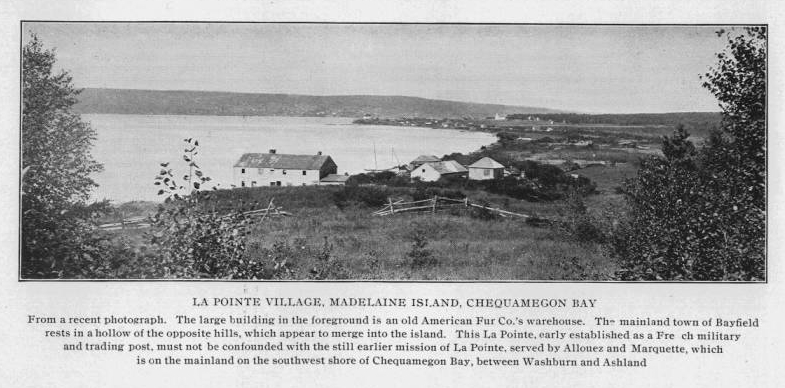
Photograph of La Pointe from Mission Hill circa 1902.
~ Wisconsin Historical Collections, Volume XVI, page 80.
I have received a supply of provisions from Mr Chapmann which will enable me to get through this season. The [?] [of?] [???] [next?], the time you have set for the arrival of the Schooner, will be sufficient, early for our business. The Glass and other materials for finishing of the buildings would be required to be sent up in the first trip but if [we?] [are?] [??] better to have them earlier. If these articles could be sent to the Sault early in the Spring a boat load might be formed of [Some?] and Provisions and sent to the Ance. From there men could be spared at that season of the year to bring the load to this place. In that way there would be no heavy expense incurred and I would be able to have the buildings in greater forwardness.
If the plan should meet your approbation please let me know by the winter express. While Mr Aitkin was here we planned out our buildings. The House will be 86 feet by 26 feet in the clear, the two stores will be put up agreeable to your Draft. We do not consider them to large.
I am afraid I shall not be able to build a wharf in season, but shall do my best to accomplish all that can be done with the means I have.

Undated photograph of Captain John Daniel Angus’ boat at the ABCFM mission dock.
~ Madeline Island Museum
I would wish to call your attention towards a few of the articles in our trade. I do not know how you have been accustomed to buy the Powder whether by the Keg or pound. If a keg is estimated at 50#, there is a great deception for some of our kegs do not contain more than 37 or 40 #s.
Our Guns are very bad particularly the barrels. They splint in the inside after been fired once or twice.
Our Holland twine is better this year than it has been for Years. One dz makes about 20 fathoms, more than last year. But it would be better if it was bleached. The NW Company and old Mr Ermantinger’s Net Thread was always bleached. It nits better and does not twist up when put into the water. Our maitre [??] [???] are some years five strand. Those are too large we have to untwist them and take 2 strands out. Our maitre this year are three strand they are rather coarse but will answer. They are not durable nor will they last as long as the nets of course they have to be [renewed?]. The best maitres are those we make of Sturgeon twine. We [?????] the twine and twist it a little. They last twice as long as our imported maitres. The great object to be gained is to have the maitres as small as possible if they be strong enough. Three coarse strands of twisted together is bulky and soon nits.
Our coarse Shoes are not worth bringing into the country. Strong sewed shoes would cost a little more but they would last longer. The [Booties?] and fine Shoes are not much better.
Our Teakettles used to have round bottoms. This year they are flat. They Indians always prefer the round bottom.
In regard to the observations you have made concerning the Doctor’s deviating from the instructions I gave him on leaving Mackinac, I must in justice to him say that I am now fully convinced in my own mind that he misunderstood me entirely, merely by an expression of mine which was intended by me in regard to his voyage from Mackinac to the Sault but by him was mistaken for the route through Lake Superior. The circumstances has hurt his feelings much and as he at all times does his best for the Interest of the Outfit I ought to have mentioned in my last letter, but it did not strike my mind at that time.

Detail from Carte des lacs du Canada by Jacques Nicolas Bellin in 1744.
When Mr Aitkin was here he mentioned to me some information he had obtained from somebody in Fond du Lac who had been in the NW Co service relating to a remarkable good white fish fishery on the “Milleau” or “Millons” Islands (do not know exactly the proper name). They lay right opposite to Point Quiwinau. a vessel which passes between the island and the point can see both. Among Mr Chapmann’s crew here there is an old man who tells me that he knew the place well, he says the island is large, say 50 or 60 miles. The Indian used to make their hunts there on account of the great quantity of Beaver and Reindeer. It is he says where the NWest Co used to make their fishing for Fort William. There is an excellent harbour for the vessel it is there where the largest white fish are caught in Lake Superior. Furthermore the old man says the island is nearer the American shore than the English. Some information might be obtained from Capt. McCargo. If it proves that we can occupy the grounds I have the most sanguine hopes that we shall succeed in the fisheries upon a large scale.
I hope you will gather all the information you can on the subject. Particular where the line runs. If it belongs to the Americans we must make a permanent post on the Island next year under the charge of an active person to conduct the fisheries upon a large scale.
Jh Chevallier one of the men I got in Mackinac is a useless man, he has always been sick since he left Sault. Mr Aitkin advised me to send him back in Chapman’s Boat. I have therefore send him out to the care of Mr Franchere.
By the Winter Express I will to give you all the informations that I may be able to give. I will close by wishing you great health and prosperity. Please present my Respects to Mr Clapp.
I remain Dear Sir.
Very Respectfully Yours
Most Obedient Servant
Lyman M. Warren
To be Continued in 1835…
1837 Petitions from La Pointe to the President
January 29, 2023
Collected & edited by Amorin Mello
Letters Received by the Office of Indian Affairs:
La Pointe Agency 1831-1839
National Archives Identifier: 164009310
O. I. A. La Pointe J171.
Hon Geo. W. Jones
Ho. of Reps. Jany 9, 1838
Transmits petition dated 31st Augt 1837, from Michel Cadotte & 25 other Chip. Half Breeds, praying that the amt to be paid them, under the late Chip. treaty, be distributed at La Pointe, and submitting the names of D. P. Bushnell, Lyman M. Warren, for the appt of Comsr to make the distribution.
Transmits it, that it may receive such attention as will secure the objects of the petitioners, says as the treaty has not been satisfied it may be necessary to bring the subject of the petition before the Comsr Ind Affrs of the Senate.
Recd 10 Jany 1838
file
[?] File.
House of Representatives Jany 9th 1838

Sir
I hasten to transmit the inclosed petition, with the hope, that the subject alluded to, may receive such attention, as to secure the object of the petitioners. As the Chippewa Treaty has not yet been ratified it may be necessary to bring the subject of the petition before the Committee of Indian Affairs of the Senate.
I am very respectfully
Your obt svt
Geo W. Jones
C. A. Harris Esqr
Comssr of Indian Affairs
War Department

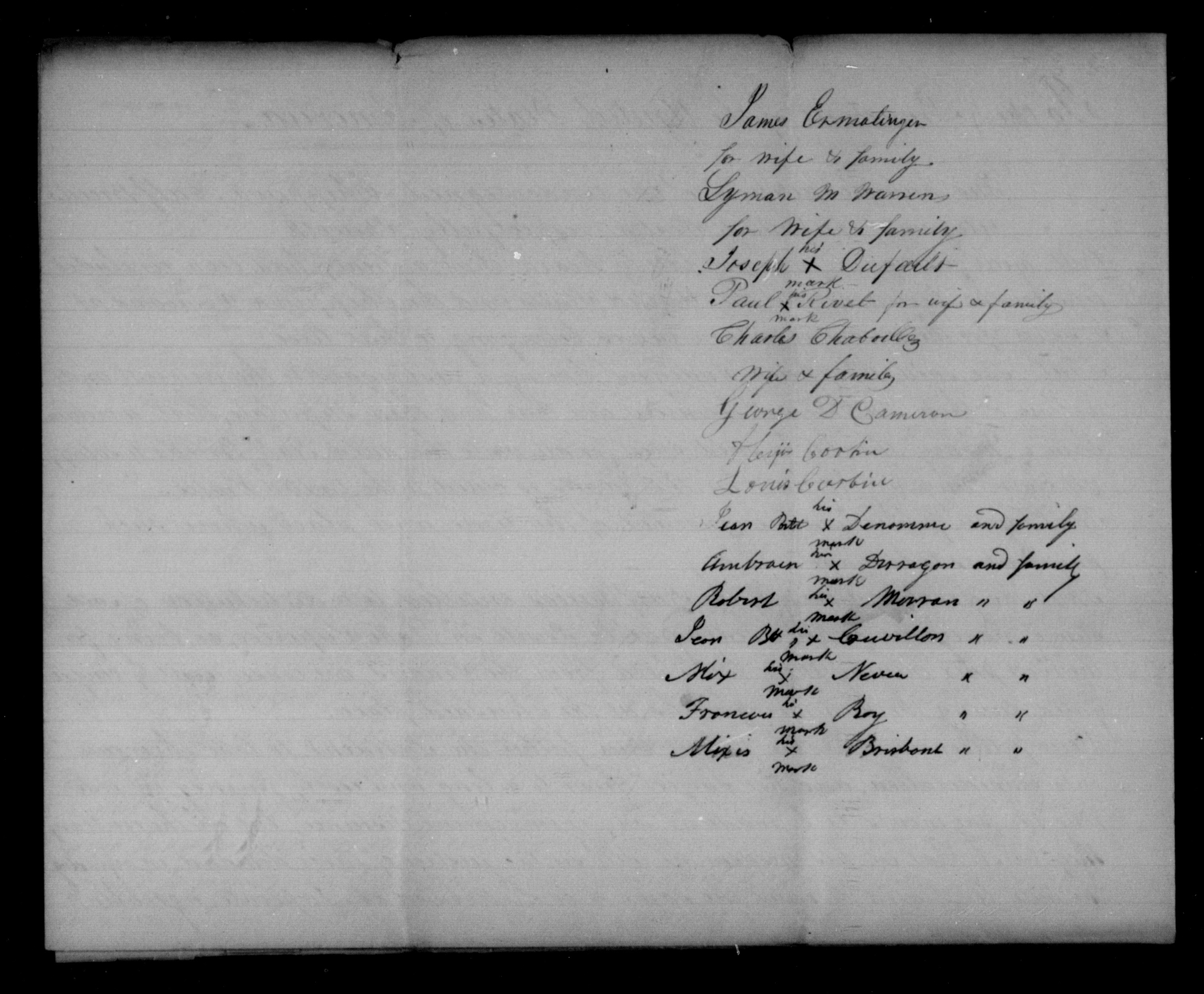
To the President of the United States of America
The humble petition of the undersigned Chippewa Half-Breeds citizens of the United Sates, respectfully Shareth:

Bizhiki (Buffalo), Dagwagaane (Two Lodges Meet), and Jechiikwii’o (Snipe, aka Little Buffalo) signed the 1837 Treaty of St Peters for the La Pointe Band.
That, your petitioners having lately heard that a Treaty had been concluded between the Government of the United Sates and the Chippewa Indians at St Peters, for the cession of certain lands belonging to that tribe:
ARTICLE 3.
“The sum of one hundred thousand dollars shall be paid by the United States, to the half-
breeds of the Chippewa nation, under the direction of the President. It is the wish of the
Indians that their two sub-agents Daniel P. Bushnell, and Miles M. Vineyard, superintend
the distribution of this money among their half-breed relations.”
That, the said Chippewa Indians X, having a just regard to the interest and welfare of their Half Breed brethren, did there and then stipulate; that, a certain sum of money should be paid once for all unto the said Half-Breeds, to satisfy all claim they might have on the lands so ceded to the United States.
That, your petitioners are ignorant of the time and place where such payment is to be made.
That the great majority of the Half-Breeds entitled to a distribution of said sum of money, are either residing at La Pointe on Lake Superior, or being for the most part earning their livelihood from the Traders, are consequently congregated during the summer months at the aforesaid place.
Your petitioners humbly solicit their father the President, to take their case into consideration, and not subject them to a long and costly journey in ordering the payments to be made at any inconvenient distance, but on the contrary they trust that in his wisdom he will see the justice of their demand in requiring he will be pleased to order the same to be distributed at Lapointe agreeable to their request.
Your petitioners would also intimate that, although they are fully aware that the Executive will make a judicious choice in the appointment of the Commissioners who will be selected to carry into effect the Provisions of said Treaty, yet, they would humbly submit to the President, that they have full confidence in the integrity of D. P. Bushnell Esqr. resident Indian Agent for the United States at this place and Lyman M Warren Esquire, Merchant.
Your petitioners entertain the flattering hope, that, their petition will not be made in vain, and as in duty bound will ever pray.
La Pointe, Lake Superior,
Territory of Wisconsin 31st August 1837
Michel Cadotte
Michel Bosquet X his mark
Seraphim Lacombe X his mark
Joseph Cadotte X his mark
Antoine Cadotte X his mark
Chs W Borup for wife & Children
A Morrison for wife & children
Pierre Cotte
Henry Cotte X his mark
Frances Roussan X his mark
James Ermatinger for wife & family
Lyman M Warren for wife & family
Joseph Dufault X his mark
Paul Rivet X his mark for wife & family
Charles Chaboullez wife & family
George D. Cameron
Alixis Corbin
Louis Corbin
Jean Bste Denomme X his mark and family
Ambrose Deragon X his mark and family
Robert Morran X his mark ” “
Jean Bst Couvillon X his mark ” “
Alix Neveu X his mark ” “
Frances Roy X his mark ” “
Alixis Brisbant X his mark ” “
Signed in presence of G. Pauchene
John Livingston
O.I.A. La Pointe W424.
Governor of Wisconsin
Mineral Pt. Feby 19, 1838
Transmits the talk of “Buffalo,” a Chip. Chief, delivered at the La Pointe SubAgt, Dec. 9, 1837, asking that the am. due the half-breeds under the late Treaty, be divided fairly among them, & paid them there, as they will not go to St Peters for it, &c.
Says Buffalo has great influence with his tribe, & is friendly to the whites; his sentiments accord with most of those of the half-breeds & Inds in that part of the country.
File
Recd 13 March 1838
[?] File.
Superintendency of Indian Affairs
for the Territory of Wisconsin
Mineral Point, Feby 19, 1838

Sir,
I have the honor to inclose the talk of “Buffalo,” a principal chief of the Chippewa Indians in the vicinity of La Pointe, delivered on the 9th Dec’r last before Mr Bushnell, sub-agent of the Chippewas at that place. Mr. Bushnell remarks that the speech is given with as strict an adherence to the letter as the language will admit, and has no doubt the sentiments expressed by this Chief accord with those of most of the half-breeds and Indians in that place of the Country. The “Buffalo” is a man of great influence among his tribe, and very friendly to the whites.
Very respectfully,
Your obed’t sevt.
Henry Dodge
Supt Ind Affs
Hon C. A. Harris
Com. of Ind. Affairs
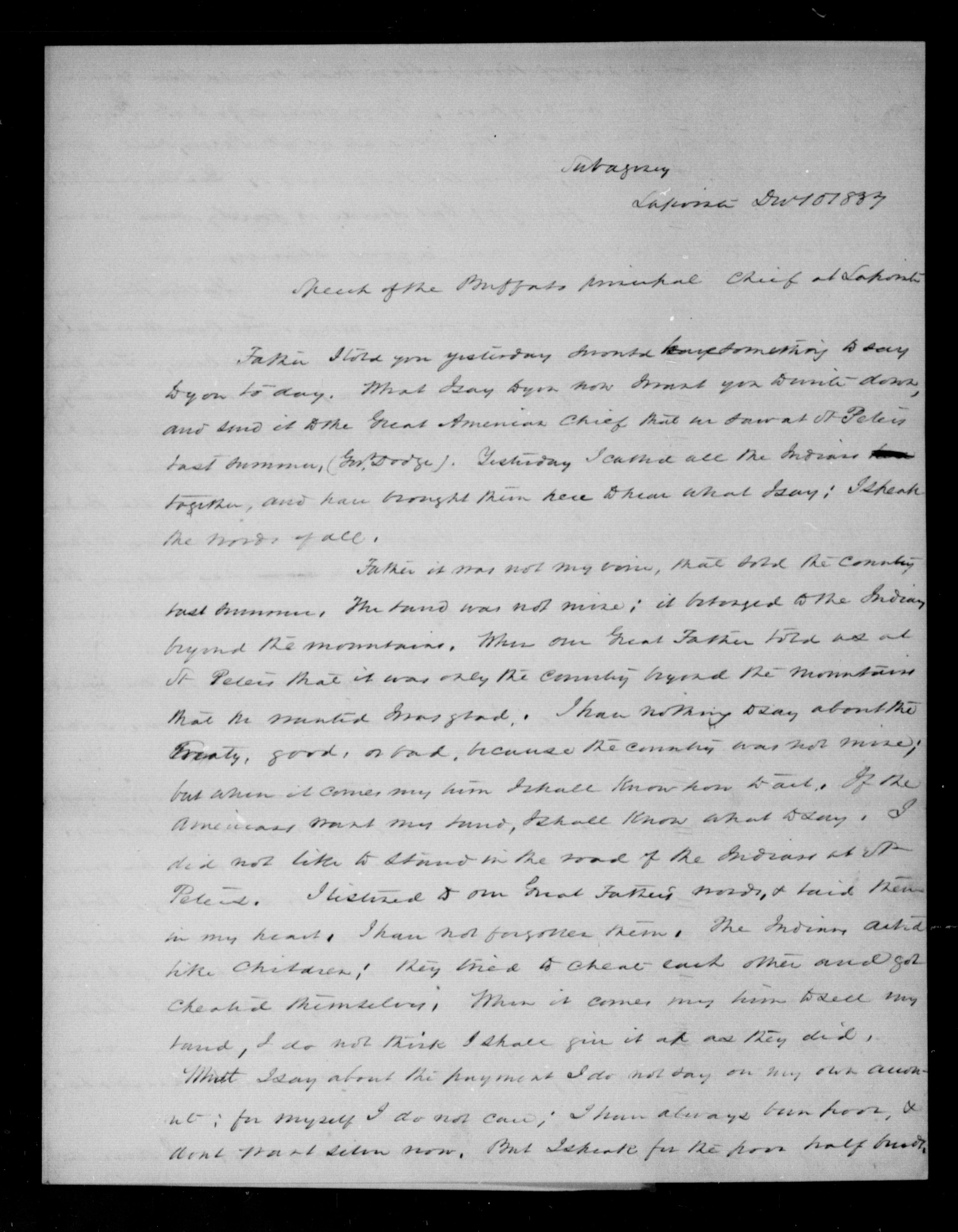
Subagency
Lapointe Dec 10 1837
Speech of the Buffalo principal Chief at Lapointe
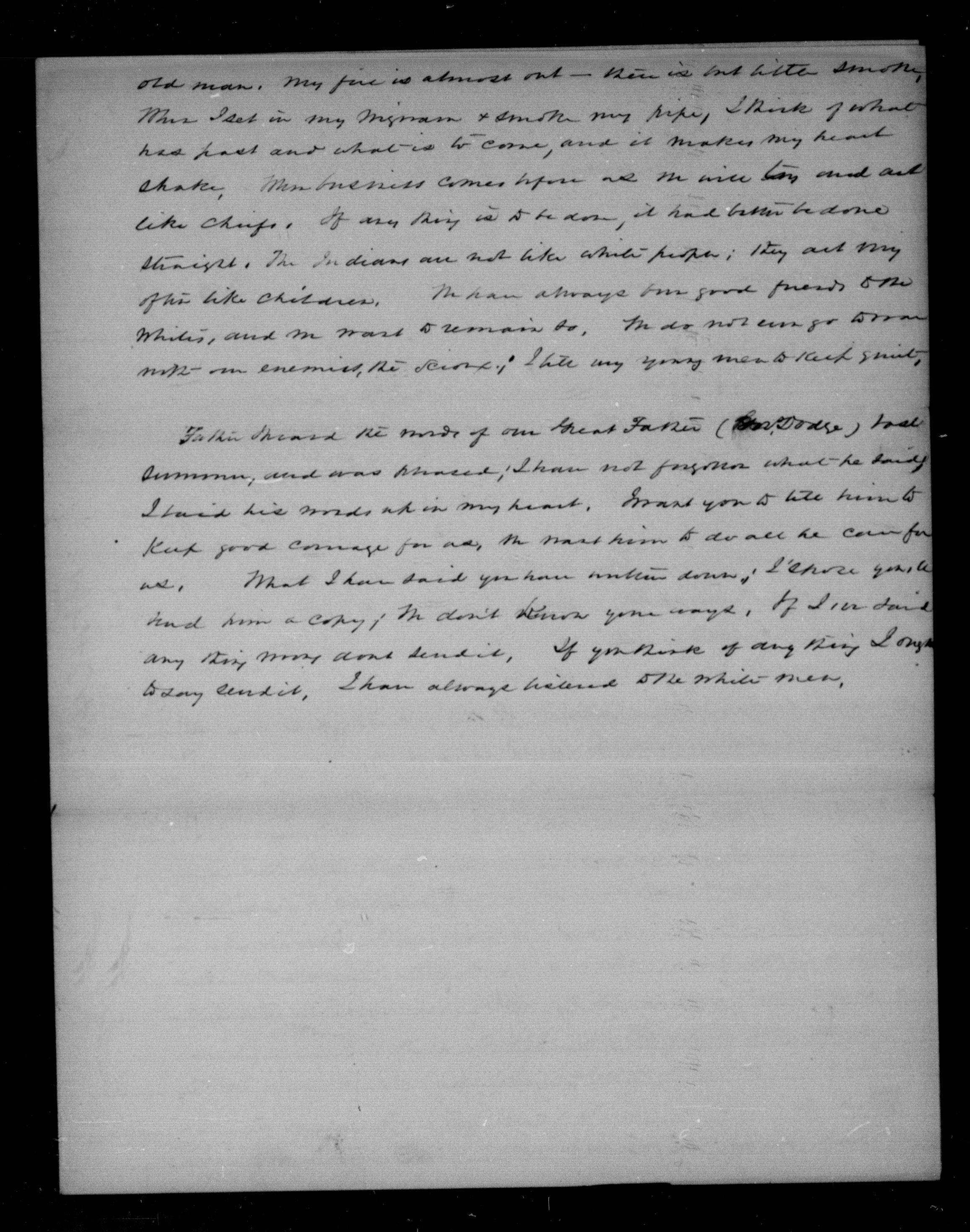
Father I told you yesterday I would have something to say to you today. What I say to you now I want you to write down, and send it to the Great American Chief that we saw at St Peters last summer, (Gov. Dodge). Yesterday, I called all the Indians together, and have brought them here to hear what I say; I speak the words of all.
ARTICLE 1.
“The said Chippewa nation cede to the United States all that tract of country included
within the following boundaries:
[…]
thence to and along the dividing ridge between the waters of Lake Superior and those of the Mississippi
[…]“
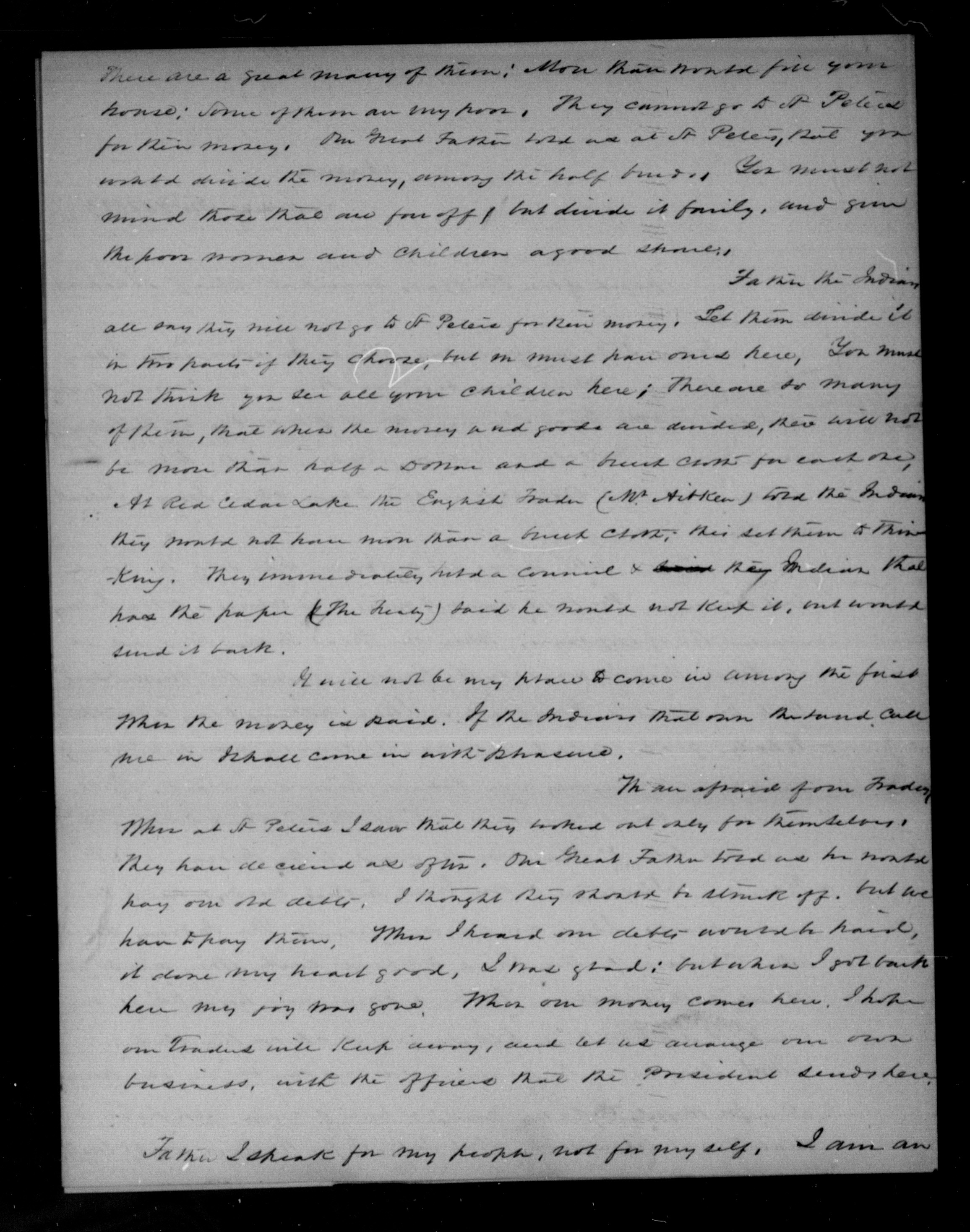
Father it was not my voice, that sold the country last summer. The land was not mine; it belonged to the Indians beyond the mountains. When our Great Father told us at St Peters that it was only the country beyond the mountains that he wanted I was glad. I have nothing to say about the Treaty, good, or bad, because the country was not mine; but when it comes my time I shall know how to act. If the Americans want my land, I shall know what to say. I did not like to stand in the road of the Indians at St Peters. I listened to our Great Father’s words, & said them in my heart. I have not forgotten them. The Indians acted like children; they tried to cheat each other and got cheated themselves. When it comes my time to sell my land, I do not think I shall give it up as they did.
What I say about the payment I do not say on my own account; for myself I do not care; I have always been poor, & don’t want silver now. But I speak for the poor half breeds.
There are a great many of them; more than would fill your house; some of them are very poor They cannot go to St Peters for their money. Our Great Father told us at St Peters, that you would divide the money, among the half breeds. You must not mind those that are far off, but divide it fairly, and give the poor women and children a good share.
Father the Indians all say they will not go to St Peters for their money. Let them divide it in this parts if they choose, but one must have ones here. You must not think you see all your children here; there are so many of them, that when the money and goods are divided, there will not be more than half a Dollar and a breech cloth for each one. At Red Cedar Lake the English Trader (W. Aitken) told the Indians they would not have more than a breech cloth; this set them to thinking. They immediately held a council & their Indian that had the paper (The Treaty) said he would not keep it, and would send it back.
It will not be my place to come in among the first when the money is paid. If the Indians that own the land call me in I shall come in with pleasure.
ARTICLE 4.
“The sum of seventy thousand dollars shall be applied to the payment, by the United States, of certain claims against the Indians; of which amount twenty eight thousand dollars shall, at their request, be paid to William A. Aitkin, twenty five thousand to Lyman M. Warren, and the balance applied to the liquidation of other just demands against them—which they acknowledge to be the case with regard to that presented by Hercules L. Dousman, for the sum of five thousand dollars; and they request that it be paid.“
We are afraid of one Trader. When at St Peters I saw that they worked out only for themselves. They have deceived us often. Our Great Father told us he would pay our old debts. I thought they should be struck off, but we have to pay them. When I heard our debts would be paid, it done my heart good. I was glad; but when I got back here my joy was gone. When our money comes here, I hope our Traders will keep away, and let us arrange our own business, with the officers that the President sends here.
Father I speak for my people, not for myself. I am an old man. My fire is almost out – there is but little smoke. When I set in my wigwam & smoke my pipe, I think of what has past and what is to come, and it makes my heart shake. When business comes before us we will try and act like chiefs. If any thing is to be done, it had better be done straight. The Indians are not like white people; they act very often like children. We have always been good friends to the whites, and we want to remain so. We do not [even?] go to war with our enemies, the Sioux; I tell my young men to keep quiet.
Father I heard the words of our Great Father (Gov. Dodge) last summer, and was pleased; I have not forgotten what he said. I have his words up in my heart. I want you to tell him to keep good courage for us, we want him to do all he can for us. What I have said you have written down; I [?] you to hand him a copy; we don’t know your ways. If I [?] said any thing [?] dont send it. If you think of any thing I ought to say send it. I have always listened to the white men.
O.I.A. Lapointe, B.458
D. P. Bushnell
Lapointe, March 8, 1838
At the request of some of the petitioners, encloses a petition dated 7 March 1838, addressed to the Prest, signed by 167 Chip. half breeds, praying that the amt stipulated by the late Chip. Treaty to be paid to the half breeds, to satisfy all claims they ma have on the lands ceded by this Treaty, may be distributed at Lapointe.
Hopes their request will be complied with; & thinks their annuity should likewise be paid at Lapointe.
File
Recd 2nd May, 1838
Subagency
Lapointe Mch 6 1838
Sir
I have the honor herewith to enclose a petition addressed to the President of the United States, handed to me with a request by several of the petitioners that I would forward it. The justice of the demand of these poor people is so obvious to any one acquainted with their circumstances, that I cannot omit this occasion to second it, and to express a sincere hope that it will be complied with. Indeed, if the convenience and wishes of the Indians are consulted, and as the sum they receive for their country is so small, these should, I conciev, be principle considerations, their annuity will likewise as paid here; for it is a point more convenient of access for the different bands, that almost any other in their own country, and one moreover, where they have interests been in the habit of assembling in the summer months.
I am sir, with great respect,
your most obt servant,
D. P. Bushnell
O. I. A.
C. A. Harris Esqr.
Comr Ind. Affs
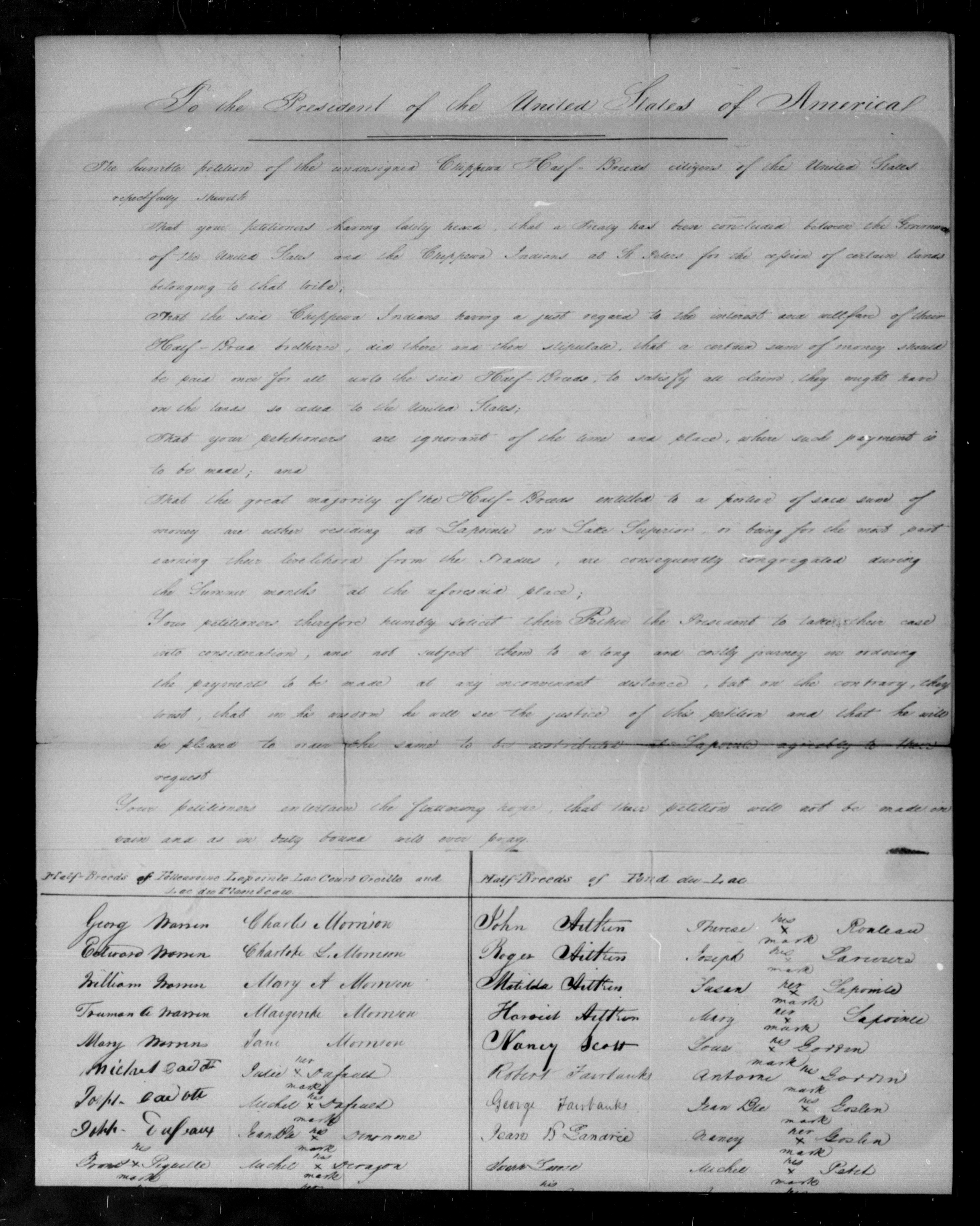
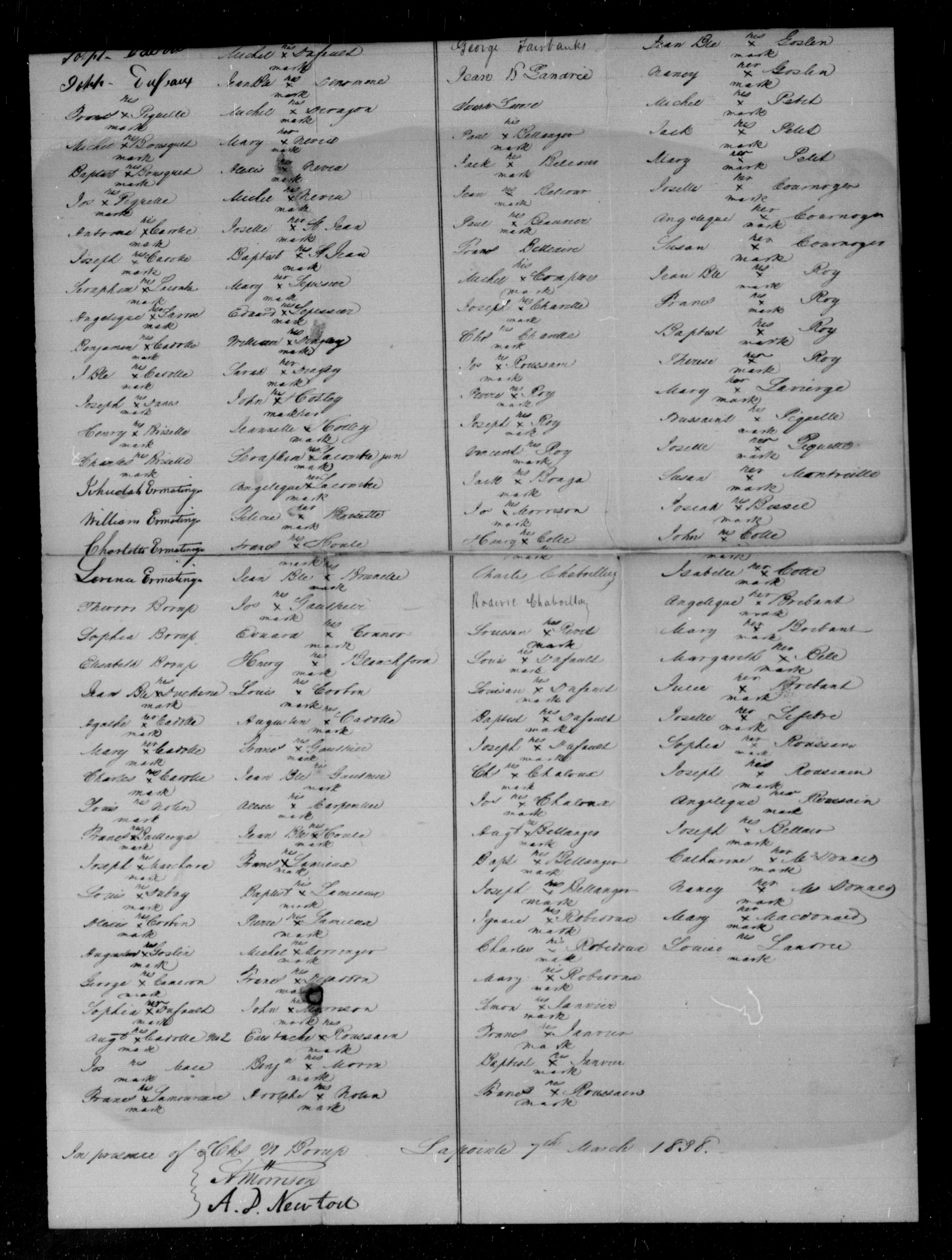
To the President of the United States of America
The humble petition of the undersigned Chippewa Half-Breeds citizens of the United States respectfully shareth
That your petitioners having lately heard, that a Treaty has been concluded between the Government of the United States and the Chippewa Indians at St Peters for the cession of certain lands belonging to that tribe;
That the said Chippewa Indians having a just regard to the interest and wellfare of their Half-Breed brethern, did there and then stipulate, that a certain sum of money should be paid once for all unto the said Half-Breeds, to satisfy all claims, they might have on the lands so ceded to the United States;
That your petitioners are ignorant of the time and place, where such payment is to be made; and
That the great majority of the Half-Breeds entitled to a portion of said sum of money are either residing at Lapointe on Lake Superior, or being for the most part earning their livelihood from the Traders, are consequently congregated during the summer months at the aforesaid place;
Your petitioners therefore humbly solicit their Father the President to take their case into consideration, and not subject them to a long and costly journey on ordering the payment to be made at any convenient distance, but on the contrary, they wish, that in his wisdom he will see the justice of this petition and that he will be pleased to order the same to be distributed at Lapointe agreeably to their request.
Your petitioners entertain the flattering hope, that their petition will not be made in vain and as in duly bound will ever pray.
Half Breeds of Folleavoine Lapointe Lac Court Oreilles and Lac du Flambeau
Georg Warren
Edward Warren
William Warren
Truman A Warren
Mary Warren
Michel Cadott
Joseph Cadotte
Joseph Dufault
Frances Piquette X his mark
Michel Bousquet X his mark
Baptiste Bousquet X his mark
Jos Piquette X his mark
Antoine Cadotte X his mark
Joseph Cadotte X his mark
Seraphim Lacombre X his mark
Angelique Larose X her mark
Benjamin Cadotte X his mark
J Bte Cadotte X his mark
Joseph Danis X his mark
Henry Brisette X his mark
Charles Brisette X his mark
Jehudah Ermatinger
William Ermatinger
Charlotte Ermatinger
Larence Ermatinger
Theodore Borup
Sophia Borup
Elisabeth Borup
Jean Bte Duchene X his mark
Agathe Cadotte X her mark
Mary Cadotte X her mark
Charles Cadotte X his mark
Louis Nolin _ his mark
Frances Baillerge X his mark
Joseph Marchand X his mark
Louis Dubay X his mark
Alexis Corbin X his mark
Augustus Goslin X his mark
George Cameron X his mark
Sophia Dufault X her mark
Augt Cadotte No 2 X his mark
Jos Mace _ his mark
Frances Lamoureau X his mark
Charles Morrison
Charlotte L. Morrison
Mary A Morrison
Margerike Morrison
Jane Morrison
Julie Dufault X her mark
Michel Dufault X his mark
Jean Bte Denomme X his mark
Michel Deragon X his mark
Mary Neveu X her mark
Alexis Neveu X his mark
Michel Neveu X his mark
Josette St Jean X her mark
Baptist St Jean X his mark
Mary Lepessier X her mark
Edward Lepessier X his mark
William Dingley X his mark
Sarah Dingley X her mark
John Hotley X his mark
Jeannette Hotley X her mark
Seraphim Lacombre Jun X his mark
Angelique Lacombre X her mark
Felicia Brisette X her mark
Frances Houle X his mark
Jean Bte Brunelle X his mark
Jos Gauthier X his mark
Edward Connor X his mark
Henry Blanchford X his mark
Louis Corbin X his mark
Augustin Cadotte X his mark
Frances Gauthier X his mark
Jean Bte Gauthier X his mark
Alexis Carpentier X his mark
Jean Bte Houle X his mark
Frances Lamieux X his mark
Baptiste Lemieux X his mark
Pierre Lamieux X his mark
Michel Morringer X his mark
Frances Dejaddon X his mark
John Morrison X his mark
Eustache Roussain X his mark
Benjn Morin X his mark
Adolphe Nolin X his mark
Half-Breeds of Fond du Lac
John Aitken
Roger Aitken
Matilda Aitken
Harriet Aitken
Nancy Scott
Robert Fairbanks
George Fairbanks
Jean B Landrie
Joseph Larose
Paul Bellanges X his mark
Jack Belcour X his mark
Jean Belcour X his mark
Paul Beauvier X his mark
Frances Belleaire
Michel Comptois X his mark
Joseph Charette X his mark
Chl Charette X his mark
Jos Roussain X his mark
Pierre Roy X his mark
Joseph Roy X his mark
Vincent Roy X his mark
Jack Bonga X his mark
Jos Morrison X his mark
Henry Cotte X his mark
Charles Chaboillez
Roderic Chaboillez
Louison Rivet X his mark
Louis Dufault X his mark
Louison Dufault X his mark
Baptiste Dufault X his mark
Joseph Dufault X his mark
Chs Chaloux X his mark
Jos Chaloux X his mark
Augt Bellanger X his mark
Bapt Bellanger X his mark
Joseph Bellanger X his mark
Ignace Robidoux X his mark
Charles Robidoux X his mark
Mary Robidoux X her mark
Simon Janvier X his mark
Frances Janvier X his mark
Baptiste Janvier X his mark
Frances Roussain X his mark
Therese Rouleau X his mark
Joseph Lavierire X his mark
Susan Lapointe X her mark
Mary Lapointe X her mark
Louis Gordon X his mark
Antoine Gordon X his mark
Jean Bte Goslin X his mark
Nancy Goslin X her mark
Michel Petit X his mark
Jack Petit X his mark
Mary Petit X her mark
Josette Cournoyer X her mark
Angelique Cournoyer X her mark
Susan Cournoyer X her mark
Jean Bte Roy X his mark
Frances Roy X his mark
Baptist Roy X his mark
Therese Roy X her mark
Mary Lavierge X her mark
Toussaint Piquette X his mark
Josette Piquette X her mark
Susan Montreille X her mark
Josiah Bissel X his mark
John Cotte X his mark
Isabelle Cotte X her mark
Angelique Brebant X her mark
Mary Brebant X her mark
Margareth Bell X her mark
Julie Brebant X her mark
Josette Lefebre X her mark
Sophia Roussain X her mark
Joseph Roussain X his mark
Angelique Roussain X her mark
Joseph Bellair X his mark
Catharine McDonald X her mark
Nancy McDonald X her mark
Mary Macdonald X her mark
Louise Landrie X his mark
In presence of
Chs W Borup
A Morrison
A. D. Newton
Lapointe 7th March 1838
Audit of the 1854 Treaty Claims
January 18, 2018
By Amorin Mello
This is one of many posts on Chequamegon History that feature the $90,000 of Indian trader debts that were debated during the 1854 Treaty and the 1855 Annuity Payments at La Pointe.
In summary, the Chiefs of the Chippewas made it a condition of the treaty that they would be granted $90,000 to settle outstanding debts with Indian traders, under the condition that a Council of Chiefs would determine which debts claimed by the traders were fair and accurate. The following quote is the fourth article of the 1854 Treaty of La Pointe, with the sentence about the $90,000 underlined for emphasis:
ARTICLE 4. In consideration of and payment for the country hereby ceded, the United States agree to pay to the Chippewas of Lake Superior, annually, for the term of twenty years, the following sums, to wit: five thousand dollars in coin; eight thousand dollars in goods, household furniture and cooking utensils; three thousand dollars in agricultural implements and cattle, carpenter’s and other tools and building materials, and three thousand dollars for moral and educational purposes, of which last sum, three hundred dollars per annum shall be paid to the Grand Portage band, to enable them to maintain a school at their village. The United States will also pay the further sum of ninety thousand dollars, as the chiefs in open council may direct, to enable them to meet their present just engagements. Also the further sum of six thousand dollars, in agricultural implements, household furniture, and cooking utensils, to be distributed at the next annuity payment, among the mixed bloods of said nation. The United States will also furnish two hundred guns, one hundred rifles, five hundred beaver traps, three hundred dollars’ worth of ammunition, and one thousand dollars’ worth of ready made clothing, to be distributed among the young men of the nation, at the next annuity payment.
~ 1854 Treaty with the Chippewa at La Pointe
Indian Affairs: Laws and Treaties; Volume II by Charles Kappler, 1904
This $90,000 appear to have been an unexpected expense that the United States government incurred in order to successfully negotiate this Treaty. Indian Agent Henry Clark Gilbert was a commissioner of the Treaty, and was obliged to explain this $90,000 to his superiors at the Office of Indian Affairs in Washington D.C. The following is his explanation written a few weeks after the 1854 Treaty of La Pointe was concluded:
The Chiefs who were notified to attend brought with them in every instance their entire bands. We made a careful estimate of the number present and found there were about 4,000. They all had to be fed and taken care of, thus adding greatly to the expenses attending the negotiations.
A great number of traders and claim agents were also present as well as some of the persons from St. Paul’s who I had reason to believe attended for the purpose of preventing if possible the consummation of the treaty. The utmost precautions were taken by me to prevent a knowledge of the fact that negotiations were to take place from being public. The Messenger sent by me to Mr Herriman was not only trust worthy but was himself totally ignorant of the purport of the dispatches to Major Herriman. Information however of the fact was communicated from some source and the persons present in consequence greatly embarrassed our proceedings.
~ Treaty Commissioner Henry C. Gilbert’s explanation of the treaty concluded in 1854 with the assistance of David B. Herriman
Transactions of the Wisconsin Academy of Sciences, Arts and Letters: Volume 79, No. 1, Appendix 5
Indian Agent Gilbert’s explanation suggests that there was some effort on his behalf to preemptively avoid the subject of outstanding debts from occuring during the Treaty negotiations. In January of 1855, a few months after the Treaty was negotiated, President Franklin Pierce budgeted for this $90,000 in the fund appropriated for fulfilling the terms of the Treaty:
For the payment of such debts as may be directed by the chiefs in open council, and found to be just and correct by the Secretary of the Interior, per 4th article of the treaty of September 30, 1854…….. 90,000
~ United States House of Representatives Documents, Volume 11, 33d Congress, 2nd Session, Ex. Doc. No. 61.
1854 Treaty of La Pointe Appropriations
As quoted above, the $90,000 negotiated during the treaty were to be distributed by a Council of the Chiefs following the treaty. How the $90,000 were actually distributed did not honor the intent or terms of the treaty. The following is a public notice from Indian Agent Gilbert that invited Indian traders with claims against Tribe to come forth with their claims before or during the 1855 Annuity, and makes no mention of any distribution to be determined by a Council of Chiefs:
PUBLIC NOTICE.
OFFICE MICHIGAN INDIAN AGENT,
DETROIT, June 12, 1855.ALL PERSONS having just and legal claims against the Chippewa Indians of Lake Superior are hereby notified that all such claims must be presented without delay to the undersigned, for investigation. Each claim must be accompanied by such evidence of its justice and legality as the claimant may be able to furnish; and in all cases where the idebtedness claimed is on book account, or is composed of aggregated items, transcripts of such accounts specifying the items in detail, with the charge for each item, and the name of the person to whom, and time when, the same was furnished, must accompany the claims submitted. The original books of entry must also in all cases be prepared for examination.
Claims may be presented at any time prior to the close of the next annuity payment at La Pointe, which will take place in the month of August next; but after that time they will not be received or acted upon.
This notice is given in accordance with instructions received from the United States Commissioner of Indian Affairs.
HENRY C. GILBERT.
Indian Agent.
jy 10 4t~ Superior Chronicle newspaper, July 10th, 1855
Library of Congress
The distribution of this $90,000 was hotly debated by Blackbird and other members of the Council of Chiefs during the 1855 Annuity Payments. It is clear from the speeches transcribed from this important event that the Council was not being allowed to determine the distribution of this $90,000. The following is one of many speeches that touched upon this subject:
In what Blackbird said he expressed the mind of a majority of the chiefs now present. We wish the stipulations of the treaty to be carried out to the very letter.
I wish to say our word about our reserves. Will these reserves made for each of our bands, be our homes forever?
When we took credits of our trader last winter, and took no furs to pay him, and wish to get hold of this 90,000 dollars, that we may pay him off of that. This is all we came here for. We want the money in our own hands & we will pay our own traders. We do not think it is right to pay what we do not owe. I always know how I stand my acct. and we can pay our own debts. From what I have now said I do not want you to think that we want the money to cheat our creditors, but to do justice to them I owe. I have my trader & know how much I owe him, & if the money is paid into the hands of the Indians we can pay our own debts.
~ Adikoons, Chief of Grand Portage Band
(Wheeler to Smith, 18 Jan. 1856)
Blackbird’s Speech at the 1855 Payment
With the above quotes as an introduction to this subject, we will now investigate what exactly happened to the $90,000 to be disbursed as “directed by the chiefs in open council”. What we have found so far appears to suggest that the federal government did not honor their Trust responsibility to the Tribe:
Senate Documents, Volume 112


[Page 295 of audit]
Indian Disbursements
Statement containing a list of the names of all persons to whom goods, money, or effects have been delivered, from July 1, 1856, to June 30, 1857, specifying the amounts and objects for which they were intended, the amount accounted for, and the balances under each specified head still remaining in their hands; prepared in obedience to an act of Congress of June 30, 1834, entitled “An act to provide for the organization of the department of Indian affairs.”
[Pages 303-305 of audit]
Fulfilling treaties with Chippewas of Lake Superior, September 30, 1854
| When issued | To whom issued. | For what purpose. | Amount of requisition. | Am’t accounted for. |
Amount unaccounted for.
|
| 1856 | |||||
| July 3 | John B. Jacobs | Fulfilling Treaties, (due) | $1,718.73 | $1,718.73 | |
| 22 | Henry C. Gilbert | …do… | $7,000.00 | $7,000.00 | |
| Do | …do… | $5,000.00 | $5,000.00 | ||
| Aug. 14 | Henry E. Leman | …do…(due)… | $1,412.50 | $1,412.50 | |
| 18 | Ramsey Crooks | …do…do… | $6,617.64 | $6,617.64 | |
| Adam Noongoo | …do…do… | $66.00 | $66.00 | ||
| Wm. Parsons | …do…do… | $28.50 | $28.50 | ||
| Erwin Leiky | …do…do… | $119.75 | $119.75 | ||
| Robert Morrin | …do…do… | $163.56 | $163.56 | ||
| Charles Bellisle | …do…do… | $191.00 | $191.00 | ||
| Posh-qway-gin | …do…do… | $47.88 | $47.88 | ||
| 22 | W. A. Pratt | …do…do… | $50.00 | $50.00 | |
| John G. Kittson | …do…do… | $1,280.93 | $1,280.93 | ||
| Asaph Whittlesey | …do…do… | $25.00 | $25.00 | ||
| Louis Bosquet | …do…do… | $72.00 | $72.00 | ||
| David King | …do…do… | $100.00 | $100.00 | ||
| P. O. Johnson | …do…do… | $10.12 | $10.12 | ||
| Henry Elliott | …do…do… | $399.02 | $399.02 | ||
| McCullough & Elliott | …do…do… | $475.78 | $475.78 | ||
| Edward Assinsece | …do…do… | $50.00 | $50.00 | ||
| John Southwind | …do…do… | $21.00 | $21.00 | ||
| Kay-kake | …do…do… | $35.00 | $35.00 | ||
| Goff & Co. | …do…do… | $556.21 | $556.21 | ||
| Jame Halliday | …do…do… | $67.88 | $67.88 | ||
| Peter Crebassa | …do…do… | $1,013.99 | $1,013.99 | ||
| S. L. Vaugh | …do…do… | $57.08 | $57.08 | ||
| David King | …do…do… | $191.72 | $191.72 | ||
| Peter B. Barbean | …do…do… | $1,200.00 | $1,200.00 | ||
| 23 | Antoine Gaudine | …do…do… | $3,250.94 | $3,250.94 | |
| Peter Markman | …do…do… | $300.00 | $300.00 | ||
| Pat L. Philan | …do…do… | $90.08 | $90.08 | ||
| Treasurer of township of Lapointe | …do…do… | $224.77 | $224.77 | ||
| Michael Bosquet | …do…do… | $219.63 | $219.63 | ||
| James Ermatinger | …do…do… | $2,000.00 | $2,000.00 | ||
| Louison Demaris | …do…do… | $2,000.00 | $2,000.00 | ||
| Joseph Morrison | …do…do… | $250.00 | $250.00 | ||
| John W. Bell | …do…do… | $253.11 | $253.11 | ||
| 27 | Paul H. Beaubien | …do…do… | $600.00 | $600.00 | |
| R. Sheldon & Co. | …do…do… | $1,124.71 | $1,124.71 | ||
| Abraham Place | …do…do… | $450.00 | $450.00 | ||
| Michael James | …do…do… | $195.00 | $195.00 | ||
| R. J. Graveract | …do…do… | $269.19 | $269.19 | ||
| Reuben Chapman | …do…do… | $71.11 | $71.11 | ||
| Miller Wood | …do…do… | $38.50 | $38.50 | ||
| Robert Reed | …do…do… | $21.60 | $21.60 | ||
| Louis Gurno | …do…do… | $179.00 | $179.00 | ||
| Gregory S. Bedel | …do…do… | $142.63 | $142.63 | ||
| Geo. R. Stuntz | …do…do… | $537.41 | $537.41 | ||
| Usop & Hoops | …do…do… | $49.43 | $49.43 | ||
| May-yan-wash | …do…do… | $45.50 | $45.50 | ||
| John Hartley | …do…do… | $41.01 | $41.01 | ||
| B. F. Rathbun | …do…do… | $8.07 | $8.07 | ||
| W. W. Spaulding | …do…do… | $258.92 | $258.92 | ||
| Stephen Bonge | …do…do… | $40.00 | $40.00 | ||
| Abel Hall | …do…do… | $160.00 | $160.00 | ||
| Louis Cadotte | …do…do… | $200.00 | $200.00 | ||
| John Senter & Co. | …do…do… | $17.00 | $17.00 | ||
| John B. Roy | …do…do… | $150.00 | $150.00 | ||
| L. Y. B. Birchard | …do…do… | $26.00 | $26.00 | ||
| Peter Roy | …do…do… | $250.00 | $250.00 | ||
| Jacob F. Shaffer | …do…do… | $150.00 | $150.00 | ||
| Peter Vandeventer | …do…do… | $216.31 | $216.31 | ||
| Sept. 4 | John Hotley, jr. | …do…do… | $538.48 | $538.48 | |
| G. B. Armstrong | …do…do… | $950.00 | $950.00 | ||
| Lathrop Johnson | …do…do… | $376.00 | $376.00 | ||
| 6 | Wm. Mathews | …do…do… | $1,741.50 | $1,741.50 | |
| Cronin, Hurxthal & Sears | …do…do… | $4,583.77 | $4,583.77 | ||
| 13 | Henry C. Gilbert | …do… | $12,500.00 | ||
| 24 | B. W. Brisbois | …do…(due)… | $4,000.00 | $4,000.00 | |
| 27 | John Brunet | …do…do… | $2,000.00 | $2,000.00 | |
| John B. Roy | …do…do… | $80.00 | $80.00 | ||
| Edward Connor | …do…do… | $600.00 | $600.00 | ||
| Alexis Corbin | …do…do… | $1,000.00 | $1,000.00 | ||
| Louis Corbin | …do…do… | $1,108.47 | $1,108.47 | ||
| Vincent Roy | …do…do… | $645.36 | $645.36 | ||
| Abner Sherman | …do…do… | $568.00 | $568.00 | ||
| John B. Landry | …do…do… | $502.64 | $502.64 | ||
| Thomas Conner | …do…do… | $1,050.00 | $1,050.00 | ||
| Augustus Corbin | …do…do… | $238.50 | $238.50 | ||
| Julius Austrain | …do…do… | $6,000.00 | $6,000.00 | ||
| Do… | …do…do… | $1,876.86 | $1,876.86 | ||
| John B. Corbin | …do…do… | $750.00 | $750.00 | ||
| Cruttenden & Lynde | …do…do… | $1,300.00 | $1,300.00 | ||
| Orrin W. Rice | …do…do… | $358.09 | $358.09 | ||
| Francis Ronissaie | …do…do… | $817.74 | $817.74 | ||
| Dec. 6 | W. G. and G. W. Ewing | …do…do… | $787.02 | $787.02 | |
| 1857 | |||||
| Jan. 2 | Henry C. Gilbert | …do… | $674.73 | $674.73 | |
| Feb 21 | Do | …do… | $8,133.33 | $8,133.33 | |
| 24 | John B. Cadotte | …do…(due)… | $1,265.00 | $1,265.00 | |
| Cruttenden & Lynde | …do…do… | $1,615.00 | $1,615.00 | ||
| J. B. Landry | …do…do… | $560.00 | $560.00 | ||
| P. Chouteau, jr., & Co. | …do…do… | $935.00 | $935.00 | ||
| Vincent Roy | …do…do… | $5,000.00 | $5,000.00 | ||
| Northern Fur Company | …do…do… | $625.00 | $625.00 | ||
| J. B. Landry | …do…do… | $90.00 | $90.00 | ||
| $105,071.70 | $84,363.64 | $20,708.06 |
Many of the Indian traders listed above make regular appearances in other primary documents of Chequamegon History. Some of the names are misspelled but still recognizable to regular readers. In summary let’s take a closer look at the top ten Indian traders that received the most disbursements related to the 1854 Treaty of La Pointe:
9½.) James Ermatinger
$2,000.00
James Ermatinger was involved with the American Fur Company in earlier years. He seems to have become an independent Indian trader in later years leading up to the 1854 Treaty:
James founded Jim Falls, Wis., arriving by canoe from La Pointe, Wis. where he was involved in fur trading. He settled in Jim Falls, initially managing a trading post there for the American Fur Company. Others in the Ermatinger family were prominent fur traders in Canada, the Upper Peninsula of Michigan, and Wisconsin.
9½.) Louison Demaris
$2,000.00
According to Theresa Schenck’s research in her book All Our Relations, Louison Demarais may have been a son of Jean Baptiste Demarais who was an interpreter for Alexander Henry the Younger’s North West Company on the Red River:
Louison Desmarais residing at Chippewa River a ½ breed Chippewa 50 yrs of age born at Pembina and remained in the North until 9 years back when he came to Chippewa river where he has resided since claims for himself and wfie Angelique a ½ breed, 35 yrs of age born at Fond du Lac where she remained until she was married 23 years since when she went to the North with her husband and has since lived with him.
~ 1839 Mixed Blood Census
All Our Relations by Theresa M. Schenck, 2010, page 60
8.) Cruttenden & Lynde
$1,615.00 + $1,300.00 = $2,915.00

“Here lie the remains of Hon. J. W. Lynde Killed by Sioux Indians Aug. 18.1862″
~ Findagrave.com
James William Lynde was an Indian Agent, Senator, and first casualty of 1862 Sioux Uprising. Mr. Lynde was also a signatory of the 1854 Treaty, which may be a conflict of interest:
Hon. James W. Lynd was a native of Baltimore, born in 1830, but was reared and educated at Cincinnati. He had received a college education at Woodward College, having attended from 1842 – 1844. He was a man of accomplishments and ability. He thoroughly mastered the Indian language, married successively two Indian wives, and spent years in the study of the history and general character of the Sioux or Dakota tribe. For some time prior to his death he had been engaged in revising for publication the manuscript of an elaborate work containing the results of his studies and researches. Under the circumstances the greater part of this manuscript was lost. He was a young man, of versatile talents had been an editor, lecturer, public speaker, and was a member of the Minnesota State Senate in 1861.
~ Sketches: Historical and Descriptive of the Monuments and Tablets Erected by the Minnesota Valley Historical Society in Renville and Redwood Counties, Minnesota by the Minnesota Valley Historical Society, 1902, page 6
Joel D. Cruttenden was Mr. Lynch’s business partner:
Col. Cruttenden, of whom I have spoken briefly in another place, left St. Louis in 1846 and removed to Prairie du Chien, where he was employed by Brisbois & Rice. In 1848 he came to ST. PAUL and remained up to 1850, when he took up his residence in St. Anthony and engaged in business with R. P. Russel. He then went to Crow Wing and was connected with Maj. J. W. Lynde. In 1857 he was elected to the House of Representatives, and on the breaking out of the war was commissioned Captain Assistant Quartermaster; was taken prisoner, and on being exchanged rose to the rank of Colonel. At the close of the war he was honorably discharged, and soon after removed to Bayfield, Wisconsin, where he has held many offices and is greatly esteemed. He is a pleasant, genial gentleman, well known and well liked.
~ Pen Pictures of St. Paul, Minnesota, and Biographical Sketches of Old Settlers: Volume 1, by Thomas McLean Newson, 1886, page 95
7.) Antoine Gaudine
$3,250.94

~ Antoine Gordon
~ Noble Lives of a Noble Race by the St. Mary’s Industrial School (Odanah), page 207
Antoine Gaudine (a.k.a. Gordon) as one of those larger-than-life mixed-blood members of the La Pointe Band leading up to the 1854 Treaty and beyond:
Mr Gordon was the founder of the village of Gordon and for years had a trading post there which was the only store there. It is but a few years since he discontinued this store. He was a full-blooded Chippewa Indian, and came here from Madelaine Island, where he ran a post years ago. He was formerly the owner of the famous Algonquin, the first ship to come through the Soo locks, and used her in the lumber trade.
~ Eau Claire Leader newspaper, May 8, 1907
6.) B. W. Brisbois
$4,000.00
Bernard Walter Brisbois was a son of Michael Brisbois, Sr.:
Bernard Brisbois was born in Prairie du Chien, Wisconsin, in 1808, to Michel Brisbois, a French-Canadian voyageur, and his second wife Domitelle (Madelaine) Gautier de Verville.
Like his father, Brisbois also began his career in the fur trade, working as agent for the American Fur Company. Bernard married Therese LaChappelle [daughter of metis Pélagie LaPointe (herself the daughter of Pierre LaPointe and Etoukasahwee) and Antoine LaChapelle]. Later he engaged in the mercantile business in Prairie du Chien until 1873 when he was appointed consul at Verviers, Belgium. He returned to Prairie du Chien in 1874 and lived there until his death in 1885.
5.) Cronin, Hurxthal & Sears
$4,583.77
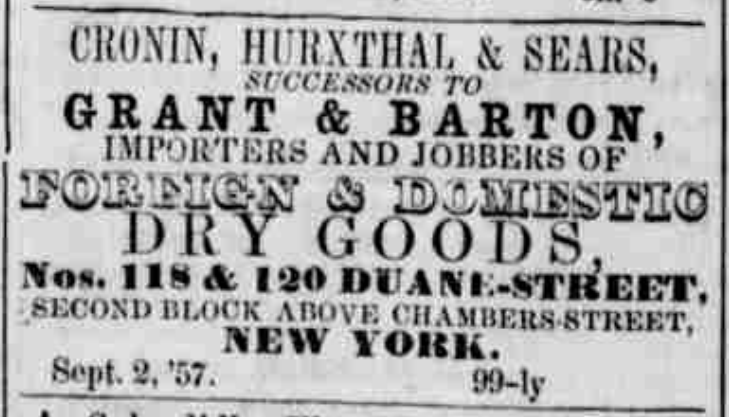
Advertisement of Cronin, Hurxthal & Sears
~ The Prairie News (Okolona, Miss.), April 15, 1858, page 4
According to a receipt from this company, the partners behind this firm were John B. Cronin, Ben. Hurxthal and J. Newton Sears. No further biographical information could be found about these individuals, who are presumed to have been New York City businessmen. In general they appear to have been involved with trades associated with slavery and Indians. Per their advertisement, they were the successors to the firm of Grant and Barton:
Grant and Barton nevertheless remained active in the [Texas] region, winning government contracts to supply the Bureau of Indian affairs with “blankets and dry goods” in the late 1840s and early 1850s…
~ The Business of Slavery and the Rise of American Capitalism, 1815-1860, by Calvin Schermerhorn, 2015, page 225
4.) Vincent Roy
$5,000.00 + $645.36 = $5,645.36

Vincent Roy, Jr. (III)
~ Life and Labors of Rt. Rev. Frederic Baraga, by Chrysostom Verwyst, 1900, pages 472-476
Vincent Roy, Sr. (II) and his son Vincent Roy, Jr. (III) were prominent members of the La Pointe Band mixed-bloods. Sr. was recognized by Gilbert as the Head of the Mixed Bloods of the La Pointe Band of Lake Superior Chippewas. Jr. was allegedly an interpreter at the 1854 Treaty, but is not identified in the Treaty itself and cannot find primary source. Jr. is described as a skilled trader in many sources, including this one:
“Leopold and Austrian (Jews) doing a general merchandize and fur-trading business at LaPointe were not slow in recognizing ‘their man.’ Having given employment to Peter Roy, who by this time quit going to school, they also, within the first year of his arrival at this place, employed Vincent to serve as handy-man for all kind of things, but especially, to be near when indians from the woods were coming to trade, which was no infrequent occurrence. After serving in that capacity about two years, and having married, he managed (from 1848 to 1852) a trading post for the same Leopold and Austrian; at first a season at Fond du Lac, Minn., then at Vermillion Lake, and finally again at Fond du Lac.”
~ Miscellaneous materials related to Vincent Roy, 1861-1862, 1892, 1921
3.) R. Crooks
$6,617.64
Ramsay Crooks
~ Madeline Island Museum
Ramsey Crooks enjoyed a long history with the American Fur Company outfit at La Pointe in the decades leading up to the 1854 Treaty:
“Ramsey Crooks (also spelled Ramsay) was born in Scotland in 1787. He immigrated to Canada in 1803 where he worked as a fur trader and explorer around the Great Lakes. He began working for the American Fur Company, which was started by John Jacob Astor, America’s first multi-millionaire, and made an expedition to the Oregon coast from 1809-1813 for the company. By doing so he also became a partner in the Pacific Fur Company. In 1834 he became acting president of the American Fur Company following Astor’s retirement to New York. A great lakes sailing vessel the Ramsey Crooks was constructed in 1836 by the American Fur Co. A nearly identical sister ship was built in the same year and was called the Astor. Both ships were sold by the dissolving fur company in 1850. Ramsay Crooks passed away in 1859, but had made a name for himself in the fur trade not only in Milwaukee and the Great Lakes, but all the way to the Pacific Ocean.”
2.) J. Austrian
$ 6,000.00 + $1,876.86 = $7,876.86

Julius Austrian
~ Madeline Island Museum
Julius Austrian was competitor and successor of the American Fur Company during the decade immediately leading up to the 1854 Treaty. Chequamegon History’s research has explored the previously uncovered circumstances of Austrian’s purchase of the Village of La Pointe from American Fur Company in 1853, being the unnamed and de facto host of the 1854 Treaty of La Pointe, being the host of the 1855 Annuities at La Pointe, and the host of the 1855 High Holy Days at La Pointe:
“In 1855 a number of Jewish Indian traders met on an island in Lake Superior in the frontier village of La Pointe, Wisconsin. The Indians were assembled there to collect their annuities and the Jews were present to dun their debtors before they dispersed. There were enough Jews for a minyan and a service was held. That was the beginning and the end of La Pointe Jewry.”
~ United States Jewry 1776-1985: Vol. 2; the Germanic Period, Part 1 by Jacob Rader Marcus Wayne State University Press , 1991, page 196
1.) Henry C. Gilbert
$0.00 ?

Henry Clark Gilbert
~ Branch County Photographs
Mackinac Indian Agent Henry Clark Gilbert was the Commissioner of the 1854 Treaty of La Pointe along with David B. Herriman.
Gilbert submitted requisitions for $5,000.00, $7,000.00, $12,500.00, $674.73, and $8,133.33; which is a total amount of $33,308.06. The amount accounted for in his name is $0.00, but his total amount unaccounted for is $20,808.06. The difference between the total amount Gilbert requisitioned and his total amount unaccounted for is $12,500, which is the same amount that Gilbert requisitioned for on September 4th, 1856.
A closer look at all of the 1854 Treaty accounts as a whole suggests that Gilbert was paid his $12,500.00 despite what is shown on paper. The total amount accounted for is actually $71,763.64; which is $12,600.00 less than the total amount on paper. The total amount unaccounted for is $20,808.06; which is $100 greater than the total amount on paper (all of which was in Gilbert’s name). We are left with a puzzle missing some pieces. Did Gilbert obtain his $12,500.00 fraudulently? Was the extra $100 accounted for taken from the unaccounted amounts by someone else as a bribe?
Did Gilbert abuse his Trust responsibility to the 1854 Treaty of La Pointe? Or was this simply a case of sloppy reporting by a federal clerk?
 Chequamegon History