The 1856 Reservation for Chief Buffalo’s Estate
November 5, 2025
Collected & edited by Amorin Mello
This is one of many posts on Chequamegon History exploring the original La Pointe Band Reservations of La Pointe County on Chequamegon Bay, now known as the Bad River and Red Cliff Reservations. Specifically, today’s post is about the 1856 Reservation for Chief Buffalo’s subdivision of the La Pointe Band and how it got selected in accordance with the Sixth Clause of the Second Article of the 1854 Treaty with the Chippewa at La Pointe:
1854 Treaty with the Chippewa at La Pointe
…

Map of La Pointe Band Reservations:
334 – Bad River Reservation
335 – La Pointe Fishing Reservation
341 – Chief Buffalo’s Reservation
342 – Red Cliff Reservation
18th Annual Report of the Bureau of American Ethnology to the Secretary of the Smithsonian Institution 1896-’97
Printed by U.S. Congress in 1899
ARTICLE 2. The United States agree to set apart and withhold from sale, for the use of the Chippewas of Lake Superior, the following-described tracts of land, viz:
…
6th [Clause]. The Ontonagon band and that subdivision of the La Pointe band of which Buffalo is chief, may each select, on or near the lake shore, four sections of land, under the direction of the President, the boundaries of which shall be defined hereafter. And being desirous to provide for some of his connections who have rendered his people important services, it is agreed that the chief Buffalo may select one section of land, at such place in the ceded territory as he may see fit, which shall be reserved for that purpose, and conveyed by the United States to such person or persons as he may direct.
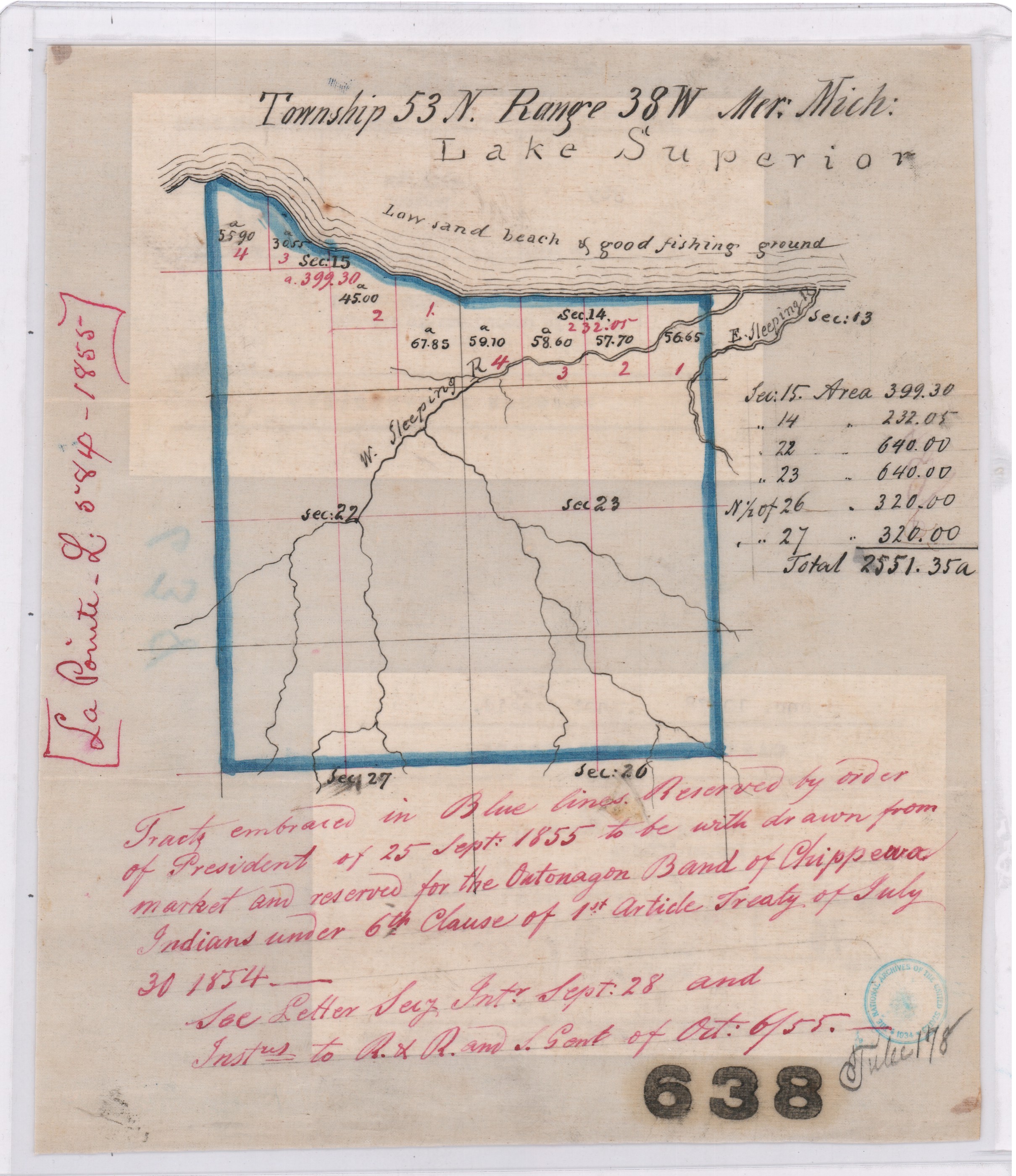
Map of “Tract embraced in blue lines reserved by order of President of 25 September 1855 to be withdrawn from market and reserved for the Ontonagon Band of Chippewa Indians“ on a “low sand beach & good fishing ground”.
Central Map File No. 638 (Tube No. 138)
NAID: 232923886 cites “La Pointe L.584-1855”.
The Ontonagon Band and Chief Buffalo’s Subdivision of the La Pointe Band got lumped together in this clause, so let’s review the Ontonagon Band first. Less than one year after the 1854 Treaty, the Ontonagon Band selected four square miles for their Reservation as approved by President Franklin Pierce’s Executive Order of September 25, 1855. Today the Ontonagon Band Reservation still has its original shape and size from 1855 despite heavy “checkerboarding” of its landownership over time.
In comparison to the Ontonagon Band Reservation, the history of how Chief Buffalo’s Reservation got selected is not so straightforward. Despite resisting and surviving the Sandy Lake Tragedy and Ojibwe Removal, making an epic trip to meet the President at Washington D.C., and securing Reservations as permanent homelands for the Chippewa Bands in the 1854 Treaty, Chief Buffalo of La Pointe died in 1855 before being able to select four square miles for his Subdivsion of the La Pointe Bands.
Fortunately, President Franklin Pierce’s Executive Order of February 21, 1856 withheld twenty-two square miles of land near the Apostle Islands from federal public land sales, allowing Chief Buffalo’s Estate to select four of those twenty-two square miles for their Reservation without competition from squatters and other land speculators, while other prime real estate in the ceded territory of La Pointe County was being surveyed and sold to private landowners by the United States General Land Office.
This 1856 Reservation of twenty-two square miles for Chief Buffalo’s Estate set the stage for what would eventually become the Red Cliff Reservation. We will return to this 1856 Reservation for Chief Buffalo’s Estate in several upcoming posts exploring more records about Red Cliff and the other La Pointe Band Reservations.

Maps marked “A” showing certain lands reserved by the 1854 Treaty:
Central Map File No. 793 (Tube 446)
NAID: 232924228 cites “La Pointe L.579-1855″.
Central Map File No. 816 (Tube 298)
NAIDs: 232924272 & 50926136 cites “Res. Chippewa L.516-1855”.

1878 Copy of President Franklin Pierce’s Executive Order of February 26, 1856 for Chief Buffalo’s Subdivision (aka “Red Cliff”).
NAID: 117092990
Office of Indian Affairs.
(Miscellaneous)
L.801.17.1878
Copy of Ex. Order of Feby. 21. 1856.
Chippewas (Red Cliff.)
Wisconsin.
Enc. in G.L.O. letter of Nov 23, 1878 (above file mark.)
in answer to office letter of Nov. 18, 1878.
Ex. Order File.

Secretary of the Interior
Robert McClelland
Department of the Interior
February 21, 1856
Sir,
I herewith return the diagram enclosed in your letter of the 20th inst, covering duplicates of documents which accompanied your letter of the 6th Sept. last, as well as a copy of the latter, the originals of which were submitted to the President in letter from the Department of the 8th Sept. last and cannot now be found.
You will find endorsements on said diagram explanatory of the case and an order of the President of this date for the withdrawal of the land in question for Indian purposes as recommended.
Respectfully
Your obt. Servt
R McClelland
Secretary
To
Hon Thos A Hendrick
Commissioner of the
General Land Office
(Copy)
General Land Office
September 6, 1855
Hon R. McClelland
Sec. of Interior
Sir:
Enclosed I have the honor to submit an abstract from the Acting Commissioner of Indian Affairs letter of the 5th instant, requesting the withdrawal of certain lands for the Chippewa Indians in Wisconsin, under the Treaty of September 30th, 1854, referred by the Department to this office on the 5th. instant, with orders to take immediate steps for the withdrawal of the lands from sale.
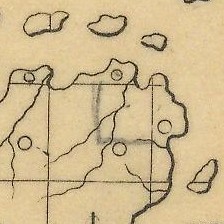
Detail of 1856 Reservation in pencil on “a map marked A.“
Central Map File No. 816 (Tube 298)
NAIDs: 232924272 & 50926136 cites “Res. Chippewa L.516-1855”.
In obedience to the above order I herewith enclose a map marked A. Showing by the blue shades thereon, the Townships and parts of Townships desired to be reserved, no portion of which are yet in market, to wit:
Township 51 N. of Range 3 West 4th Prin. Mer. Wis.
N.E. ¼ of Town 51 N ” 4 ” ” ” “.
Township 52 ” ” 3 & 4 ” ” ” “.
For the reservation of which, until the contemplated Selections under the 6th Clause of the Chippewa Treaty of 30th September 1854 can be made, I respectfully recommend that the order of the President may be obtained.
The requisite reports on the subject of the new surveys, and respecting preemption claims, referred to in the same order, will be prepared and communicated at an early day.
I am respectfully
Your Ob’t Serv’t
Thos. A. Hendricks
Commissioner
Department of the Interior
Feb. 20. 1856
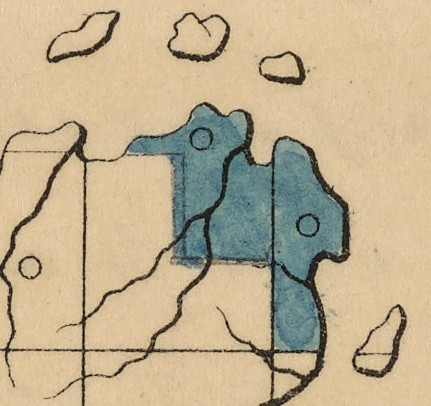
Detail of 1856 Reservation in blue on “duplicate of the original“.
NAID: 117092990
This plat represents by the blue shade, certain land to be withdrawn with a view to a reservation, under Chippewa Treaty of 30 Sept 1854, and as more particularly described in Commissioner of the General Land Office in letter of 6th Sept 1855. The subject was referred to the President for his sanction of the recommendation made in Secretary’s letter of 8th Sept 1855 and the original papers cannot now be found. This is a duplicate of the original, received in letter of Comm’r of the General Land Office of this date and is recommended to the President for his sanction of the withdrawal desired.
R. McClelland
Secretary

1856 Reservation in red and modern Red Cliff in brown. Although different in shape, both are roughly twenty-two square miles in size.
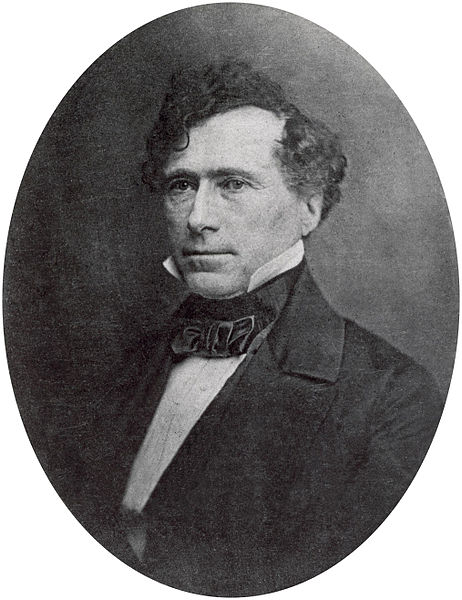
14th United States President
Franklin Pierce
February 21st 1856
Let the withdrawal be made as recommended.
Franklin Pierce
Audit of the 1854 Treaty Claims
January 18, 2018
By Amorin Mello
This is one of many posts on Chequamegon History that feature the $90,000 of Indian trader debts that were debated during the 1854 Treaty and the 1855 Annuity Payments at La Pointe.
In summary, the Chiefs of the Chippewas made it a condition of the treaty that they would be granted $90,000 to settle outstanding debts with Indian traders, under the condition that a Council of Chiefs would determine which debts claimed by the traders were fair and accurate. The following quote is the fourth article of the 1854 Treaty of La Pointe, with the sentence about the $90,000 underlined for emphasis:
ARTICLE 4. In consideration of and payment for the country hereby ceded, the United States agree to pay to the Chippewas of Lake Superior, annually, for the term of twenty years, the following sums, to wit: five thousand dollars in coin; eight thousand dollars in goods, household furniture and cooking utensils; three thousand dollars in agricultural implements and cattle, carpenter’s and other tools and building materials, and three thousand dollars for moral and educational purposes, of which last sum, three hundred dollars per annum shall be paid to the Grand Portage band, to enable them to maintain a school at their village. The United States will also pay the further sum of ninety thousand dollars, as the chiefs in open council may direct, to enable them to meet their present just engagements. Also the further sum of six thousand dollars, in agricultural implements, household furniture, and cooking utensils, to be distributed at the next annuity payment, among the mixed bloods of said nation. The United States will also furnish two hundred guns, one hundred rifles, five hundred beaver traps, three hundred dollars’ worth of ammunition, and one thousand dollars’ worth of ready made clothing, to be distributed among the young men of the nation, at the next annuity payment.
~ 1854 Treaty with the Chippewa at La Pointe
Indian Affairs: Laws and Treaties; Volume II by Charles Kappler, 1904
This $90,000 appear to have been an unexpected expense that the United States government incurred in order to successfully negotiate this Treaty. Indian Agent Henry Clark Gilbert was a commissioner of the Treaty, and was obliged to explain this $90,000 to his superiors at the Office of Indian Affairs in Washington D.C. The following is his explanation written a few weeks after the 1854 Treaty of La Pointe was concluded:
The Chiefs who were notified to attend brought with them in every instance their entire bands. We made a careful estimate of the number present and found there were about 4,000. They all had to be fed and taken care of, thus adding greatly to the expenses attending the negotiations.
A great number of traders and claim agents were also present as well as some of the persons from St. Paul’s who I had reason to believe attended for the purpose of preventing if possible the consummation of the treaty. The utmost precautions were taken by me to prevent a knowledge of the fact that negotiations were to take place from being public. The Messenger sent by me to Mr Herriman was not only trust worthy but was himself totally ignorant of the purport of the dispatches to Major Herriman. Information however of the fact was communicated from some source and the persons present in consequence greatly embarrassed our proceedings.
~ Treaty Commissioner Henry C. Gilbert’s explanation of the treaty concluded in 1854 with the assistance of David B. Herriman
Transactions of the Wisconsin Academy of Sciences, Arts and Letters: Volume 79, No. 1, Appendix 5
Indian Agent Gilbert’s explanation suggests that there was some effort on his behalf to preemptively avoid the subject of outstanding debts from occuring during the Treaty negotiations. In January of 1855, a few months after the Treaty was negotiated, President Franklin Pierce budgeted for this $90,000 in the fund appropriated for fulfilling the terms of the Treaty:
For the payment of such debts as may be directed by the chiefs in open council, and found to be just and correct by the Secretary of the Interior, per 4th article of the treaty of September 30, 1854…….. 90,000
~ United States House of Representatives Documents, Volume 11, 33d Congress, 2nd Session, Ex. Doc. No. 61.
1854 Treaty of La Pointe Appropriations
As quoted above, the $90,000 negotiated during the treaty were to be distributed by a Council of the Chiefs following the treaty. How the $90,000 were actually distributed did not honor the intent or terms of the treaty. The following is a public notice from Indian Agent Gilbert that invited Indian traders with claims against Tribe to come forth with their claims before or during the 1855 Annuity, and makes no mention of any distribution to be determined by a Council of Chiefs:
PUBLIC NOTICE.
OFFICE MICHIGAN INDIAN AGENT,
DETROIT, June 12, 1855.ALL PERSONS having just and legal claims against the Chippewa Indians of Lake Superior are hereby notified that all such claims must be presented without delay to the undersigned, for investigation. Each claim must be accompanied by such evidence of its justice and legality as the claimant may be able to furnish; and in all cases where the idebtedness claimed is on book account, or is composed of aggregated items, transcripts of such accounts specifying the items in detail, with the charge for each item, and the name of the person to whom, and time when, the same was furnished, must accompany the claims submitted. The original books of entry must also in all cases be prepared for examination.
Claims may be presented at any time prior to the close of the next annuity payment at La Pointe, which will take place in the month of August next; but after that time they will not be received or acted upon.
This notice is given in accordance with instructions received from the United States Commissioner of Indian Affairs.
HENRY C. GILBERT.
Indian Agent.
jy 10 4t~ Superior Chronicle newspaper, July 10th, 1855
Library of Congress
The distribution of this $90,000 was hotly debated by Blackbird and other members of the Council of Chiefs during the 1855 Annuity Payments. It is clear from the speeches transcribed from this important event that the Council was not being allowed to determine the distribution of this $90,000. The following is one of many speeches that touched upon this subject:
In what Blackbird said he expressed the mind of a majority of the chiefs now present. We wish the stipulations of the treaty to be carried out to the very letter.
I wish to say our word about our reserves. Will these reserves made for each of our bands, be our homes forever?
When we took credits of our trader last winter, and took no furs to pay him, and wish to get hold of this 90,000 dollars, that we may pay him off of that. This is all we came here for. We want the money in our own hands & we will pay our own traders. We do not think it is right to pay what we do not owe. I always know how I stand my acct. and we can pay our own debts. From what I have now said I do not want you to think that we want the money to cheat our creditors, but to do justice to them I owe. I have my trader & know how much I owe him, & if the money is paid into the hands of the Indians we can pay our own debts.
~ Adikoons, Chief of Grand Portage Band
(Wheeler to Smith, 18 Jan. 1856)
Blackbird’s Speech at the 1855 Payment
With the above quotes as an introduction to this subject, we will now investigate what exactly happened to the $90,000 to be disbursed as “directed by the chiefs in open council”. What we have found so far appears to suggest that the federal government did not honor their Trust responsibility to the Tribe:
Senate Documents, Volume 112


[Page 295 of audit]
Indian Disbursements
Statement containing a list of the names of all persons to whom goods, money, or effects have been delivered, from July 1, 1856, to June 30, 1857, specifying the amounts and objects for which they were intended, the amount accounted for, and the balances under each specified head still remaining in their hands; prepared in obedience to an act of Congress of June 30, 1834, entitled “An act to provide for the organization of the department of Indian affairs.”
[Pages 303-305 of audit]
Fulfilling treaties with Chippewas of Lake Superior, September 30, 1854
| When issued | To whom issued. | For what purpose. | Amount of requisition. | Am’t accounted for. |
Amount unaccounted for.
|
| 1856 | |||||
| July 3 | John B. Jacobs | Fulfilling Treaties, (due) | $1,718.73 | $1,718.73 | |
| 22 | Henry C. Gilbert | …do… | $7,000.00 | $7,000.00 | |
| Do | …do… | $5,000.00 | $5,000.00 | ||
| Aug. 14 | Henry E. Leman | …do…(due)… | $1,412.50 | $1,412.50 | |
| 18 | Ramsey Crooks | …do…do… | $6,617.64 | $6,617.64 | |
| Adam Noongoo | …do…do… | $66.00 | $66.00 | ||
| Wm. Parsons | …do…do… | $28.50 | $28.50 | ||
| Erwin Leiky | …do…do… | $119.75 | $119.75 | ||
| Robert Morrin | …do…do… | $163.56 | $163.56 | ||
| Charles Bellisle | …do…do… | $191.00 | $191.00 | ||
| Posh-qway-gin | …do…do… | $47.88 | $47.88 | ||
| 22 | W. A. Pratt | …do…do… | $50.00 | $50.00 | |
| John G. Kittson | …do…do… | $1,280.93 | $1,280.93 | ||
| Asaph Whittlesey | …do…do… | $25.00 | $25.00 | ||
| Louis Bosquet | …do…do… | $72.00 | $72.00 | ||
| David King | …do…do… | $100.00 | $100.00 | ||
| P. O. Johnson | …do…do… | $10.12 | $10.12 | ||
| Henry Elliott | …do…do… | $399.02 | $399.02 | ||
| McCullough & Elliott | …do…do… | $475.78 | $475.78 | ||
| Edward Assinsece | …do…do… | $50.00 | $50.00 | ||
| John Southwind | …do…do… | $21.00 | $21.00 | ||
| Kay-kake | …do…do… | $35.00 | $35.00 | ||
| Goff & Co. | …do…do… | $556.21 | $556.21 | ||
| Jame Halliday | …do…do… | $67.88 | $67.88 | ||
| Peter Crebassa | …do…do… | $1,013.99 | $1,013.99 | ||
| S. L. Vaugh | …do…do… | $57.08 | $57.08 | ||
| David King | …do…do… | $191.72 | $191.72 | ||
| Peter B. Barbean | …do…do… | $1,200.00 | $1,200.00 | ||
| 23 | Antoine Gaudine | …do…do… | $3,250.94 | $3,250.94 | |
| Peter Markman | …do…do… | $300.00 | $300.00 | ||
| Pat L. Philan | …do…do… | $90.08 | $90.08 | ||
| Treasurer of township of Lapointe | …do…do… | $224.77 | $224.77 | ||
| Michael Bosquet | …do…do… | $219.63 | $219.63 | ||
| James Ermatinger | …do…do… | $2,000.00 | $2,000.00 | ||
| Louison Demaris | …do…do… | $2,000.00 | $2,000.00 | ||
| Joseph Morrison | …do…do… | $250.00 | $250.00 | ||
| John W. Bell | …do…do… | $253.11 | $253.11 | ||
| 27 | Paul H. Beaubien | …do…do… | $600.00 | $600.00 | |
| R. Sheldon & Co. | …do…do… | $1,124.71 | $1,124.71 | ||
| Abraham Place | …do…do… | $450.00 | $450.00 | ||
| Michael James | …do…do… | $195.00 | $195.00 | ||
| R. J. Graveract | …do…do… | $269.19 | $269.19 | ||
| Reuben Chapman | …do…do… | $71.11 | $71.11 | ||
| Miller Wood | …do…do… | $38.50 | $38.50 | ||
| Robert Reed | …do…do… | $21.60 | $21.60 | ||
| Louis Gurno | …do…do… | $179.00 | $179.00 | ||
| Gregory S. Bedel | …do…do… | $142.63 | $142.63 | ||
| Geo. R. Stuntz | …do…do… | $537.41 | $537.41 | ||
| Usop & Hoops | …do…do… | $49.43 | $49.43 | ||
| May-yan-wash | …do…do… | $45.50 | $45.50 | ||
| John Hartley | …do…do… | $41.01 | $41.01 | ||
| B. F. Rathbun | …do…do… | $8.07 | $8.07 | ||
| W. W. Spaulding | …do…do… | $258.92 | $258.92 | ||
| Stephen Bonge | …do…do… | $40.00 | $40.00 | ||
| Abel Hall | …do…do… | $160.00 | $160.00 | ||
| Louis Cadotte | …do…do… | $200.00 | $200.00 | ||
| John Senter & Co. | …do…do… | $17.00 | $17.00 | ||
| John B. Roy | …do…do… | $150.00 | $150.00 | ||
| L. Y. B. Birchard | …do…do… | $26.00 | $26.00 | ||
| Peter Roy | …do…do… | $250.00 | $250.00 | ||
| Jacob F. Shaffer | …do…do… | $150.00 | $150.00 | ||
| Peter Vandeventer | …do…do… | $216.31 | $216.31 | ||
| Sept. 4 | John Hotley, jr. | …do…do… | $538.48 | $538.48 | |
| G. B. Armstrong | …do…do… | $950.00 | $950.00 | ||
| Lathrop Johnson | …do…do… | $376.00 | $376.00 | ||
| 6 | Wm. Mathews | …do…do… | $1,741.50 | $1,741.50 | |
| Cronin, Hurxthal & Sears | …do…do… | $4,583.77 | $4,583.77 | ||
| 13 | Henry C. Gilbert | …do… | $12,500.00 | ||
| 24 | B. W. Brisbois | …do…(due)… | $4,000.00 | $4,000.00 | |
| 27 | John Brunet | …do…do… | $2,000.00 | $2,000.00 | |
| John B. Roy | …do…do… | $80.00 | $80.00 | ||
| Edward Connor | …do…do… | $600.00 | $600.00 | ||
| Alexis Corbin | …do…do… | $1,000.00 | $1,000.00 | ||
| Louis Corbin | …do…do… | $1,108.47 | $1,108.47 | ||
| Vincent Roy | …do…do… | $645.36 | $645.36 | ||
| Abner Sherman | …do…do… | $568.00 | $568.00 | ||
| John B. Landry | …do…do… | $502.64 | $502.64 | ||
| Thomas Conner | …do…do… | $1,050.00 | $1,050.00 | ||
| Augustus Corbin | …do…do… | $238.50 | $238.50 | ||
| Julius Austrain | …do…do… | $6,000.00 | $6,000.00 | ||
| Do… | …do…do… | $1,876.86 | $1,876.86 | ||
| John B. Corbin | …do…do… | $750.00 | $750.00 | ||
| Cruttenden & Lynde | …do…do… | $1,300.00 | $1,300.00 | ||
| Orrin W. Rice | …do…do… | $358.09 | $358.09 | ||
| Francis Ronissaie | …do…do… | $817.74 | $817.74 | ||
| Dec. 6 | W. G. and G. W. Ewing | …do…do… | $787.02 | $787.02 | |
| 1857 | |||||
| Jan. 2 | Henry C. Gilbert | …do… | $674.73 | $674.73 | |
| Feb 21 | Do | …do… | $8,133.33 | $8,133.33 | |
| 24 | John B. Cadotte | …do…(due)… | $1,265.00 | $1,265.00 | |
| Cruttenden & Lynde | …do…do… | $1,615.00 | $1,615.00 | ||
| J. B. Landry | …do…do… | $560.00 | $560.00 | ||
| P. Chouteau, jr., & Co. | …do…do… | $935.00 | $935.00 | ||
| Vincent Roy | …do…do… | $5,000.00 | $5,000.00 | ||
| Northern Fur Company | …do…do… | $625.00 | $625.00 | ||
| J. B. Landry | …do…do… | $90.00 | $90.00 | ||
| $105,071.70 | $84,363.64 | $20,708.06 |
Many of the Indian traders listed above make regular appearances in other primary documents of Chequamegon History. Some of the names are misspelled but still recognizable to regular readers. In summary let’s take a closer look at the top ten Indian traders that received the most disbursements related to the 1854 Treaty of La Pointe:
9½.) James Ermatinger
$2,000.00
James Ermatinger was involved with the American Fur Company in earlier years. He seems to have become an independent Indian trader in later years leading up to the 1854 Treaty:
James founded Jim Falls, Wis., arriving by canoe from La Pointe, Wis. where he was involved in fur trading. He settled in Jim Falls, initially managing a trading post there for the American Fur Company. Others in the Ermatinger family were prominent fur traders in Canada, the Upper Peninsula of Michigan, and Wisconsin.
9½.) Louison Demaris
$2,000.00
According to Theresa Schenck’s research in her book All Our Relations, Louison Demarais may have been a son of Jean Baptiste Demarais who was an interpreter for Alexander Henry the Younger’s North West Company on the Red River:
Louison Desmarais residing at Chippewa River a ½ breed Chippewa 50 yrs of age born at Pembina and remained in the North until 9 years back when he came to Chippewa river where he has resided since claims for himself and wfie Angelique a ½ breed, 35 yrs of age born at Fond du Lac where she remained until she was married 23 years since when she went to the North with her husband and has since lived with him.
~ 1839 Mixed Blood Census
All Our Relations by Theresa M. Schenck, 2010, page 60
8.) Cruttenden & Lynde
$1,615.00 + $1,300.00 = $2,915.00

“Here lie the remains of Hon. J. W. Lynde Killed by Sioux Indians Aug. 18.1862″
~ Findagrave.com
James William Lynde was an Indian Agent, Senator, and first casualty of 1862 Sioux Uprising. Mr. Lynde was also a signatory of the 1854 Treaty, which may be a conflict of interest:
Hon. James W. Lynd was a native of Baltimore, born in 1830, but was reared and educated at Cincinnati. He had received a college education at Woodward College, having attended from 1842 – 1844. He was a man of accomplishments and ability. He thoroughly mastered the Indian language, married successively two Indian wives, and spent years in the study of the history and general character of the Sioux or Dakota tribe. For some time prior to his death he had been engaged in revising for publication the manuscript of an elaborate work containing the results of his studies and researches. Under the circumstances the greater part of this manuscript was lost. He was a young man, of versatile talents had been an editor, lecturer, public speaker, and was a member of the Minnesota State Senate in 1861.
~ Sketches: Historical and Descriptive of the Monuments and Tablets Erected by the Minnesota Valley Historical Society in Renville and Redwood Counties, Minnesota by the Minnesota Valley Historical Society, 1902, page 6
Joel D. Cruttenden was Mr. Lynch’s business partner:
Col. Cruttenden, of whom I have spoken briefly in another place, left St. Louis in 1846 and removed to Prairie du Chien, where he was employed by Brisbois & Rice. In 1848 he came to ST. PAUL and remained up to 1850, when he took up his residence in St. Anthony and engaged in business with R. P. Russel. He then went to Crow Wing and was connected with Maj. J. W. Lynde. In 1857 he was elected to the House of Representatives, and on the breaking out of the war was commissioned Captain Assistant Quartermaster; was taken prisoner, and on being exchanged rose to the rank of Colonel. At the close of the war he was honorably discharged, and soon after removed to Bayfield, Wisconsin, where he has held many offices and is greatly esteemed. He is a pleasant, genial gentleman, well known and well liked.
~ Pen Pictures of St. Paul, Minnesota, and Biographical Sketches of Old Settlers: Volume 1, by Thomas McLean Newson, 1886, page 95
7.) Antoine Gaudine
$3,250.94

~ Antoine Gordon
~ Noble Lives of a Noble Race by the St. Mary’s Industrial School (Odanah), page 207
Antoine Gaudine (a.k.a. Gordon) as one of those larger-than-life mixed-blood members of the La Pointe Band leading up to the 1854 Treaty and beyond:
Mr Gordon was the founder of the village of Gordon and for years had a trading post there which was the only store there. It is but a few years since he discontinued this store. He was a full-blooded Chippewa Indian, and came here from Madelaine Island, where he ran a post years ago. He was formerly the owner of the famous Algonquin, the first ship to come through the Soo locks, and used her in the lumber trade.
~ Eau Claire Leader newspaper, May 8, 1907
6.) B. W. Brisbois
$4,000.00
Bernard Walter Brisbois was a son of Michael Brisbois, Sr.:
Bernard Brisbois was born in Prairie du Chien, Wisconsin, in 1808, to Michel Brisbois, a French-Canadian voyageur, and his second wife Domitelle (Madelaine) Gautier de Verville.
Like his father, Brisbois also began his career in the fur trade, working as agent for the American Fur Company. Bernard married Therese LaChappelle [daughter of metis Pélagie LaPointe (herself the daughter of Pierre LaPointe and Etoukasahwee) and Antoine LaChapelle]. Later he engaged in the mercantile business in Prairie du Chien until 1873 when he was appointed consul at Verviers, Belgium. He returned to Prairie du Chien in 1874 and lived there until his death in 1885.
5.) Cronin, Hurxthal & Sears
$4,583.77
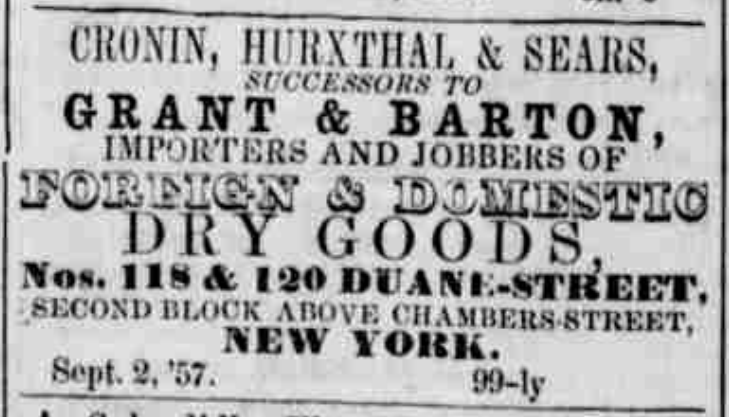
Advertisement of Cronin, Hurxthal & Sears
~ The Prairie News (Okolona, Miss.), April 15, 1858, page 4
According to a receipt from this company, the partners behind this firm were John B. Cronin, Ben. Hurxthal and J. Newton Sears. No further biographical information could be found about these individuals, who are presumed to have been New York City businessmen. In general they appear to have been involved with trades associated with slavery and Indians. Per their advertisement, they were the successors to the firm of Grant and Barton:
Grant and Barton nevertheless remained active in the [Texas] region, winning government contracts to supply the Bureau of Indian affairs with “blankets and dry goods” in the late 1840s and early 1850s…
~ The Business of Slavery and the Rise of American Capitalism, 1815-1860, by Calvin Schermerhorn, 2015, page 225
4.) Vincent Roy
$5,000.00 + $645.36 = $5,645.36

Vincent Roy, Jr. (III)
~ Life and Labors of Rt. Rev. Frederic Baraga, by Chrysostom Verwyst, 1900, pages 472-476
Vincent Roy, Sr. (II) and his son Vincent Roy, Jr. (III) were prominent members of the La Pointe Band mixed-bloods. Sr. was recognized by Gilbert as the Head of the Mixed Bloods of the La Pointe Band of Lake Superior Chippewas. Jr. was allegedly an interpreter at the 1854 Treaty, but is not identified in the Treaty itself and cannot find primary source. Jr. is described as a skilled trader in many sources, including this one:
“Leopold and Austrian (Jews) doing a general merchandize and fur-trading business at LaPointe were not slow in recognizing ‘their man.’ Having given employment to Peter Roy, who by this time quit going to school, they also, within the first year of his arrival at this place, employed Vincent to serve as handy-man for all kind of things, but especially, to be near when indians from the woods were coming to trade, which was no infrequent occurrence. After serving in that capacity about two years, and having married, he managed (from 1848 to 1852) a trading post for the same Leopold and Austrian; at first a season at Fond du Lac, Minn., then at Vermillion Lake, and finally again at Fond du Lac.”
~ Miscellaneous materials related to Vincent Roy, 1861-1862, 1892, 1921
3.) R. Crooks
$6,617.64

Ramsay Crooks
~ Madeline Island Museum
Ramsey Crooks enjoyed a long history with the American Fur Company outfit at La Pointe in the decades leading up to the 1854 Treaty:
“Ramsey Crooks (also spelled Ramsay) was born in Scotland in 1787. He immigrated to Canada in 1803 where he worked as a fur trader and explorer around the Great Lakes. He began working for the American Fur Company, which was started by John Jacob Astor, America’s first multi-millionaire, and made an expedition to the Oregon coast from 1809-1813 for the company. By doing so he also became a partner in the Pacific Fur Company. In 1834 he became acting president of the American Fur Company following Astor’s retirement to New York. A great lakes sailing vessel the Ramsey Crooks was constructed in 1836 by the American Fur Co. A nearly identical sister ship was built in the same year and was called the Astor. Both ships were sold by the dissolving fur company in 1850. Ramsay Crooks passed away in 1859, but had made a name for himself in the fur trade not only in Milwaukee and the Great Lakes, but all the way to the Pacific Ocean.”
2.) J. Austrian
$ 6,000.00 + $1,876.86 = $7,876.86

Julius Austrian
~ Madeline Island Museum
Julius Austrian was competitor and successor of the American Fur Company during the decade immediately leading up to the 1854 Treaty. Chequamegon History’s research has explored the previously uncovered circumstances of Austrian’s purchase of the Village of La Pointe from American Fur Company in 1853, being the unnamed and de facto host of the 1854 Treaty of La Pointe, being the host of the 1855 Annuities at La Pointe, and the host of the 1855 High Holy Days at La Pointe:
“In 1855 a number of Jewish Indian traders met on an island in Lake Superior in the frontier village of La Pointe, Wisconsin. The Indians were assembled there to collect their annuities and the Jews were present to dun their debtors before they dispersed. There were enough Jews for a minyan and a service was held. That was the beginning and the end of La Pointe Jewry.”
~ United States Jewry 1776-1985: Vol. 2; the Germanic Period, Part 1 by Jacob Rader Marcus Wayne State University Press , 1991, page 196
1.) Henry C. Gilbert
$0.00 ?

Henry Clark Gilbert
~ Branch County Photographs
Mackinac Indian Agent Henry Clark Gilbert was the Commissioner of the 1854 Treaty of La Pointe along with David B. Herriman.
Gilbert submitted requisitions for $5,000.00, $7,000.00, $12,500.00, $674.73, and $8,133.33; which is a total amount of $33,308.06. The amount accounted for in his name is $0.00, but his total amount unaccounted for is $20,808.06. The difference between the total amount Gilbert requisitioned and his total amount unaccounted for is $12,500, which is the same amount that Gilbert requisitioned for on September 4th, 1856.
A closer look at all of the 1854 Treaty accounts as a whole suggests that Gilbert was paid his $12,500.00 despite what is shown on paper. The total amount accounted for is actually $71,763.64; which is $12,600.00 less than the total amount on paper. The total amount unaccounted for is $20,808.06; which is $100 greater than the total amount on paper (all of which was in Gilbert’s name). We are left with a puzzle missing some pieces. Did Gilbert obtain his $12,500.00 fraudulently? Was the extra $100 accounted for taken from the unaccounted amounts by someone else as a bribe?
Did Gilbert abuse his Trust responsibility to the 1854 Treaty of La Pointe? Or was this simply a case of sloppy reporting by a federal clerk?
1854 Treaty of La Pointe Appropriations
November 29, 2017
By Amorin Mello

House Documents, Volume 112
By United States House of Representatives
33d Congress,
2nd Session.
Ex. Doc. No. 61.
TREATY WITH CHIPPEWA INDIANS.
————————
MESSAGE
FROM
THE PRESIDENT OF THE UNITED STATES,
United States President
Franklin Pierce
circa 1855
~ Commons.Wikimedia.com
TRANSMITTING
Estimates of appropriations for carrying into effect the treaty with the Chippewa Indians &c.
————————
February 8, 1855.—Laid upon the table and ordered to be printed.
————————
To the Senate and House of Representatives of the United States:
I communicate to Congress the following letter from the Secretary of the Interior, with its enclosure, on the subject of a treaty between the United States and the Chippewa Indians of Lake Superior, and recommend that the appropriations therein asked for may be made.
FRANLIN PEIRCE.
Washington, February 7, 1855.
Department Of The Interior,
Washington, February 6,1855.
Secretary of the Interior
Robert McClelland
circa 1916
~ Commons.Wikipedia.com
SIR: I have the honor to transmit to you, herewith, a copy of a communication from the Commissioner of Indian Affairs, dated the 5th instant, calling my attention to the subject of a treaty made at La Pointe, Wisconsin, by Henry C. Gilbert and Daniel B. Herriman, commissioners on the part of the United States, and the Chippewa Indians of Lake Superior; and, to enable this department to carry the treaty into effect, recommend that Congress be requested to make the appropriations specified in the letter of the Commissioner, and which will be immediately required for that purpose.
I am, sir, very respectfully, your obedient servant,
R. McCLELLAND,
Secretary.
To the President.
Department Of The Interior,
Office Indian Affairs, February 5, 1855.
Mackinac Indian Agent
Henry Clark Gilbert
~ Branch County Photographs
Sir: Having received the official information on the 24th ultimo of the approval and ratification, by the President and Senate, of the articles of agreement and convention made and entered into at La Pointe, in the State of Wisconsin, by Henry C. Gilbert and Daniel B. Herriman, commissioners on the part of the United States, and the Chippewa Indians of Lake Superior and Mississippi, I have the honor now to call your attention to the appropriations that will be required immediately to enable the department to carry the treaty into effect, viz:
For fulfilling treaties with the Chippewas of Lake Superior.
- For expenses (in part) of selecting reservations, and surveying and marking the boundaries thereof, per 2d, 3d, and 12th articles of the treaty of September 30, 1854 …….. $3,000
- For the payment of the first of twenty instalments in coin, goods, &c, agricultural implements, &c, and education, &c, per 4th article of the treaty of September 30, 1854 …….. 19,000
- For the purchase of clothing and other articles to be given to the young men at the next annuity payment, as per 4th article of the treaty of September 30, 1854 …….. 4,800
- For the purchase of agricultural implements and other articles, as presents for the mixed bloods, per 4th article of the treaty of September 30, 1854 …….. 6,000
- For the payment of such debts as may be directed by the chiefs in open council, and found to be just and correct by the Secretary of the Interior, per 4th article of the treaty of September 30, 1854 …….. 90,000
- For the payment of such debts of the Bois Forte bands as may be directed by their chiefs, and found lo be just and correct by the Secretary of the Interior, per 12th article of the treaty of September 30, 1844 …….. 10,000
- For the payment of the first of five instalments in blankets, cloth, &c, to the Bois Forte band, per 12th article of the treaty of September 30, 1854 …….. 2,000
- For the first of twenty instalments for the pay of six smiths and assistants, per 5th and 2d articles of the treaty of September 30, 1854 …….. 5,040
- For the first of twenty instalments for the support of six smith shops, per 5th and 2d articles of the treaty of September 30, 1854 …….. 1,320
It will be observed that the treaty of September 30, 1854, recognized the Chippewas of Lake Superior as a branch of the nation, and that the pecuniary and beneficiary stipulations therein are for their exclusive use.
By the fifth article of the treaty the Lake Superior Chippewas are to have six blacksmiths and assistants, and they relinquish, by the same article, all other employés to which they might otherwise have been entitled under former treaties.
The Chippewas of the Mississippi are, by the eighth article of the treaty, entitled to one-third of the benefits of treaties prior to 1847; and, by consequence, retain an interest of one-third in the stipulations for smith shops, &c., and farmers, &c, per second article of the treaty of July 29, 1837; and in the farmers, and carpenters, and smiths, &c., mentioned in the fourth article of the treaty of October 4, 1842.
On an examination of the condition of existing appropriations to fulfil the stipulations just mentioned, it is found that the balances in the treasury are sufficient to sustain these employés and otherwise meet the requirements of the stipulations referred to, so far as the Chippewas of the Mississippi are interested, during the next fiscal year.
In case appropriations are made by Congress, in pursuance of the foregoing estimates, it will be perceived that the following items of the Indian appropriation bill now before Congress might, with propriety, be stricken out, viz:
House bill 555, reported, with amendments, January 16, 1855:
- Page 4, lines 68, 69, 70, and 71, “three thousand dollars,” ($3,000.)
- Page 4, lines 72, 73, 74, 75, and 76, “one thousand dollars,” ($1,000.)
- Page 5, lines 89, 90, 91, 92, and 93, “two thousand dollars,” ($2,000.)
- Page 5, lines 94, 95, and 96, “one thousand dollars,” ($1,000.) Page 5, lines 97, 98, and 99, “one thousand two hundred dollars,” ($1,200.)

Director of of the Bureau of Indian Affairs
George Washington Manypenny
circa 1886
~ Commons.Wikimedia.org
As it is not deemed necessary, I do not therefore submit, at present an estimate for appropriations to pay employés for the Bois Forte band, as per twelfth article of the treaty of September 30, 1854, or to liquidate a balance, should any be found due to these Indians by the investigation, which it is provided by the ninth article of the same treaty shall be made.
Should the foregoing estimates and suggestions be approved by you, I respectfully recommend that they be laid before Congress as early as practicable.
Very respectfully, your obedient servant,
GEO. W. MANYPENNY,
Commissioner.
Hon. R. McCLELLAND,
Secretary of the Interior.
By Amorin Mello
In our Penoka Survey Incidents series earlier this year, we followed some of the adventures and schemes of Albert Conrad Stuntz circa 1857. The legacy of Albert’s influential survey still defines the geopolitical landscape of the Penokee Mountains to this day. However, Albert’s work during the late 1850s was relatively minor in comparison to that of his brother, George Riley Stuntz, during the early 1850s. The surveying work of George and his employees started in 1852 and enabled the infamous land speculators and townsite promotors of Superior City to manifest their schemes by early 1854 (months before the Treaty of La Point occurred later that year).
Among the men that worked with George was Augustus Hamilton Barber. Sometime around 1850, Augustus had followed his Grandparents, Aunts, Uncles, and Cousins from the Barber family of Lamoille County, Vermont, to Lancaster in Grant County, Wisconsin. After a short career as a school teacher in Grant County, Augustus came to Lake Superior in 1852 employed by George as a Chainman under his contract with the United States General Land Office to survey lands at the Head of Lake Superior.
Before taking a closer look at the Barber Papers, let’s examine the lives and affairs of other surveyors and speculators along the southwest shore of Lake Superior, starting with George Riley Stuntz and his production of these Exterior Field Notes (June of 1852):


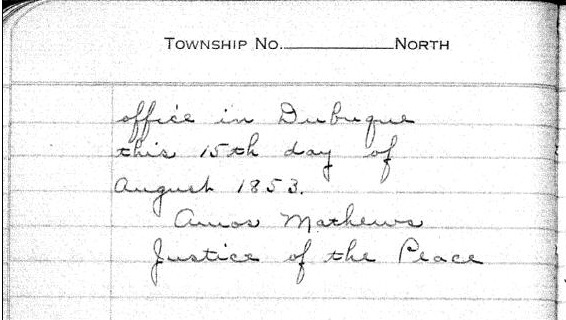
Duluth and St. Louis County, Minnesota;
Their Story and People
By Walter Van Brunt, 1921, pages 64-65.

Portrait of George Nettleton’s cabin on Minnesota Point in 1852 on page 75.
First Settler.– The honor, for both Superior and Duluth, must presumably go to George R. Stuntz. He came in 1852, and settled in 1853. Several were earlier of course, but can hardly be considered to have been legitimate independent settlers. Carlton had been on the ground, at Fond du Lac, for some years, but he was Indian agent; Borup and Oaks had spent their time between La Pointe and Fond du Lac, but were then at St. Paul, and mainly interested in the development of that city, and in fur trading. Wm. R. Marshall stated that he “was on the lake as early as 1848,” but not to settle and he did not come again until 1857. Wm. R. Marshall and George R. Stuntz were fellow-surveyors, in federal pay, “back in the ’40s,” but Marshall did not seek to take the place of Stuntz as premier pioneer at the head of Lake Superior. As a matter of fact, although “on the lake as early as “1848,” Marshall did not then get nearer to Duluth than La Pointe, where he met “Borup and Oaks, the principal traders, Truman Warren, George Nettleton, Cruttenden, Wattrous, Rev. Sherman Hall, E. F. Ely and others.” It is quite possible that Stuntz was with Marshall in 1848, for that was the year in which Stuntz first entered Minnesota territory “having charge of a surveying party that was working near Lake Pepin and in what is now Washington County.”
The “Heart of the Continent.”– George R. Stuntz prepared the way for the first attempt at white settlement at the head of Lake Superior. He surveyed the land on the Wisconsin side, within a year of beginning which survey, in 1852, the first settlers began to appear. George R. Stuntz came by direction of George B. Sargent, who at the time was surveyor-general of the Iowa, Wisconsin and Minnesota district for the federal government, his headquarters being at Davenport, Iowa. In that year, states Carey, “he surveyed and definitely located a portion of the northeastern boundary line between Minnesota and Wisconsin, starting from the head of navigation on the St. Louis River, at Fond du Lac, and running south to the St. Croix River.” Stuntz himself stated: “I came in 1852. I saw the advantages of this point (Minnesota Point) as clearly then as I do now (1892). On finishing the survey for the government, I went away to make a report, and returned the next spring and came for good. I saw as surely then as I do now that this was the heart of the continent commercially, and so I drove my stakes.”
![Group of people, including a number of Ojibwe at Minnesota Point, Duluth, Minnesota [featuring William Howenstein] ~ University of Minnesota Duluth, Kathryn A. Martin Library](https://chequamegonhistory.com/wp-content/uploads/2015/06/howenstein-minnesota-point.jpg)
Group of people, including a number of Ojibwe at Minnesota Point, Duluth, Minnesota [featuring William Howenstein in 1872?] ~ University of Minnesota Duluth
The Vanguard.– He did not come alone, needing of course assistants in the work of surveying, but he was in charge of the work, Gand necessarily takes first place in the accounting. William C. Sargent, son of George B. Sargent, stated in 1916, that his father “came here (Duluth) first in 1852 with George R. Stuntz and Bill Howenstein,” and goes on to state “a word of those two grand men, George R. Stuntz and Bill Howenstein.” He believed that “to George R. Stuntz, more than to any other man belongs the honor (of) opening up that region,” and of Howenstein, he said: “And old Bill Howenstein, one of the best ever, and always my very good friend, a kindly body, with a quaint dry humor unsurpassed and seldom met with in these later days. I had many an interesting chat with him, in his home on Minnesota Point, that he built in 1852, and lived in until his death, some years ago.” Bill Howenstein, undoubtedly was of Stuntz’ party in 1852, but it is doubtful whether he built a log house on Minnesota Point in that year. As to General Sargent’s visit in 1852. If he did come then, it was probably only a flying visit. His interest in the head of Lake Superior in 1852 reached only to the extent of directing Stuntz to survey it. He, himself, had the surveying business of three states to attend to.
The New York Times
[December 11, 1852]
The Region about the Southwest End of Lake Superior.
Mr. Stuntz, of Grant County, Wis., has been deputed by the general Land Surveyor of this Northwest District to lay off such a tract of land about the southwest point of the lake into townships and sections, as emigrants will earliest require. He returned via La Pointe and Stillwater last week. We have obtained from him some new views of that region. From Fond du Lac, a trading post situated 11 miles inland on the St. Louis River, eastward, for perhaps 50 miles, the margin of the lake is a flat strip of land reaching back to a rocky ridge about 11 miles off. The soil of this flat land is a rich red clay. The wood is white cedar and pine of the most magnificent growth. The American line is beyond the mouth of the St. Louis and Pigeon rivers. It evidently abounds in copper, iron and silver. The terrestrial compass cannot be used there, so strong is the attraction to the earth. The needle rears and plunges “like mad.” Points of survey have to be fixed by the solar compass.
The Indian and half breed packmen have astonishing strength. One Indian, who is described by the others as being as large as two men, carried for a company of 11 men provisions for ten days, viz: one barrel of flour, half barrel of pork and something else, beside the utensils. Mirage is a common phenomenon is Spring and Summer. For the bays not opening as soon as the main lake, or not cooling so early, an object out on the lake, is viewed from the shore, through a dense medium of air and a thin medium. Hence is a refraction of rays which gives so many wonderful sights that the Chippewas call that the spirit or enchanted land. Sail vessels which are really 40 miles off, are seen flapping and bellying about almost within touch. Turreted Islands, look heavy and toppling towards the zenith. Forests seem to leap from their stems and go a soaring like thistles for the very sport of it.
The ice did not leave some of the bays till the 10th of June. The fish are delicious, especially the salmon trout. But little land game. Mr. Stunts calculates on wonderful enterprises in that country after the opening of the Saut Canal.
Mr. S. describes La Pointe a town of the Lake, as being situated at the head of a bay some 25 miles from the high lake, and secluded from the lake by several islands. He saw there a warehouse 300 feet long, built of tamarac poles, and roofed with bark. This building is very much warped by the pressure of age ; it is entered by a wooden railway. The town is dingy and dreary. He saw a most luxurious garden by the former residence of Dr. Borup. It contained a variety of fruit trees and shrubs, such as plums, cherries, apples, pears, currants, &c.

Cover of Stuntz’s Exterior Field Notes (August-October 1852) ~ Wisconsin Public Land Survey Records: Original Field Notes and Plat Maps

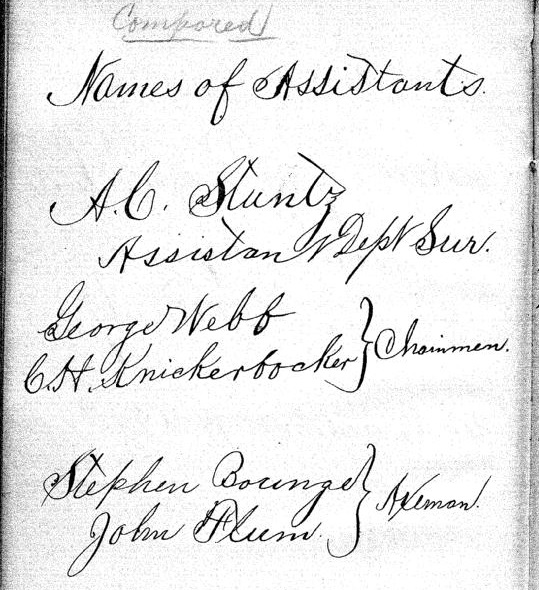
George Riley Stuntz was also assisted by his brother Albert Conrad Stuntz as well as the African-Chippewa mixed-blood Stephen Bonga employed as an Axeman. To learn more about the interesting Bonga (Bonza) family and Stephen as “the first white child born at the head of Lake Superior,” read pages 39-41 of The Black West by William Loren Katz (1971), and pages 131-34 of Black Indians also by Katz (2012).
The Eye of the North-west: First Annual Report of the Statistician of Superior, Wisconsin
By Frank Abial Flower, 1890

Portrait of Stephen Bonga, page 7.
GEORGE R. STUNTZ, DEPUTY U. S. SURVEYOR [pages 50-52]

Portrait of George Riley Stuntz, page 26.
In 1852 George R. Stuntz took a contract to run the township lines in this part of the country, including the state boundary, and filed with the land-office at Dubuque a rude map of the head of the lake, on the Wisconsin side, in December of that year. He took a new contract and returned in the spring of 1853 to survey the copper range around Black River, a few miles south of Superior. He brought seeds with him and planting them on the Namdji, raised a quantity of vegetables; they grew to great size. he also built a trading-post on Minnesota point near the present light-house, and a mill on Iron River in Bayfield county. In respect of these operations W. W. Ward writes from Morley, Mo.:
The first lumber of any description produced locally, other than by “Whip sawing”, was at Iron River, Wisconsin about forty miles from Superior on the South Shore of Lake Superior.
George R. Stuntz with William C. Howenstein, Andrew Reefer and George Falkner built and operated a water power “up and down” sawmill at the falls on Iron River about a half a mile from the Lake, capable of cutting three thousand feet of lumber a day. The writer has several 1 1/4 inch absolutely “clear” White Pine boards 24 and 26 inches wide and 18 feet long that were originally stored in a loft to be used in building a skiff. This mill was built in 1854 and the lumber was floated up the Lake to Superior, Oneota and Fond du Lac…
~ Superior, Wisconsin, papers, 1831-1942 ([unpublished])
From “A Pioneer of Old Superior” by Lillian Kimball Stewart
“In the summer of ’54 the Sam Ward plying between the Sault and any port on Lake Superior, brought on every trip a goodly number of emigrants, speculators, and tourists, bent on seeing the new “city” of Superior. Stuntz’s dock was located near an Indian village, so that every traveler as well as every piece of freight or baggage was subject to inspection by braves, squaws, and papooses before receiving a passport to the shore across the bay…”
~ Superior, Wisconsin, papers, 1831-1942 ([unpublished])
“It was in the spring of 1853 that Mr. Stuntz, Deputy U. S. Surveyor, received his second contract to survey and run the township lines taking in the range around Black River Falls, a portion of Left-hand River country and that part where Superior now is. In the latter part of April that year he organized a party – viz., Nat. W. Kendall, James McKinzie, Pain Bradt, James McBride, Harvey Fargo, Wm. H. Reed, John Chisholm, Joseph Latham, Augustus Barber, and your humble servant. Procured three birch-bark canoes and supplies at Stillwater, Minn.: left there the first day of May, passed up the St. Croix River to its head, made a portage of about two and a half miles into the headwaters of the Brule River, down said river into Lake Superior, thence up the lake to what was called the entry of St. Louis Bay [now Superior Bay], and landed on Minnesota Point in the early part of June. At that time there were no white settlers in this end of the lake – all Chippewa Indians and ‘breeds’ – scarcely a stick missing on that side of the bay where Superior City now stands. We finished the surveying contract and went in early fall down to Iron River, built a double log-shanty, and made other preparations for the construction of a saw mill. Here the first lumber was made at the head of the lake and the first road opened through to the settlement on the St. Croix. The following February, Mr. Stuntz having a trading-post on Minnesota Point [then Stuntz’s Point], I went there and assisted in building a block-house and steamboat pier, and found improvements and a few log-shanties built where old Superior now is located.”
[…]
HUSTLING FOR TOWNSITES [pages 58-60]
Vincent Roy Jr. ~ Life and Labors of Rt. Rev. Frederic Baraga by Chrysostom Verwyst,
VI. – Superior.
Vincent [Roy Jr.] had barely emerged from the trouble just described when it was necessary for him to exert himself in another direction. A year or so previously he had taken up a claim of land at the headwaters of Lake Superior and there was improvement now on foot for that part of the country, and danger for his interests.
The ship canal at Sault St Marie was in course of construction and it was evidently but a question of days that boats afloat on Lakes Huron and Michigan would be able to run up and unload their cargo for regions further inland somewhere on the shore at the further end of Lake Superior, at which a place, no doubt, a city would be built. The place now occupied by the city of Superior was suitable for the purposes in view but to set it in order and to own the greatest possible part of it, had become all at the same time the cherished idea of too many different elements as that developments could go on smoothly. Three independent crews were struggling to establish themselves at the lower or east end of the bay when a fourth crew approached at the upper or west end, with which Vincent, his brother Frank, and others of LaPointe had joined in. As this crew went directly to and began operations at the place where Vincent had his property it seems to have been guided by him, though it was in reality under the leadership of Wm. Nettleton who was backed by Hon. Henry M. Rice of St. Paul. Without delay the party set to work surveying the land and “improving” each claim, as soon as it was marked off, by building some kind of a log-house upon it. The hewing of timber may have attracted the attention of the other crews at the lower end about two or three miles off, as they came up about noon to see what was going on. The parties met about halfway down the bay at a place where a small creek winds its way through a rugged ravine and falls into the bay. Prospects were anything but pleasant at first at the meeting; for a time it seemed that a battle was to be fought, which however did not take place but the parceling out of ‘claims’ was for the time being suspended. This was in March or April 1854. Hereafter some transacting went on back the curtain, and before long it came out that the interests of the town-site of Superior, as far as necessary for efficient action, were united into a land company of which public and prominent view of New York, Washington, D.C. and other places east of the Mississippi river were the stockholders. Such interests as were not represented in the company were satisfied which meant for some of them that they were set aside for deficiency of right or title to a consideration. The townsite of the Superior of those days was laid out on both sides of the Nemadji river about two or three miles into the country with a base along the water edge about half way up Superior bay, so that Vincent with his property at the upper end of the bay, was pretty well out of the way of the land company, but there were an way such as thought his land a desirable thing and they contested his title in spite of his holding it already for a considerable time. An argument on hand in those days was, that persons of mixed blood were incapable of making a legal claim of land. The assertion looks more like a bugaboo invented for the purpose to get rid of persons in the way than something founded upon law and reason, yet at that time some effect was obtained with it. Vincent managed, however, to ward off all intrusion upon his property, holding it under every possible title, ‘preemption’ etc., until the treaty of LaPointe in the following September, when it was settled upon his name by title of United States scrip so called, that is by reason of the clause, as said above, entered into the second article of that treaty.
The subsequent fate of the piece of land here in question was that Vincent held it through the varying fortune of the ‘head of the lake’ for a period of about thirty six years until it had greatly risen in value, and when the west end was getting pretty much the more important complex of Superior, an English syndicate paid the sum of twenty five thousand dollars, of which was then embodied in a tract afterwards known as “Roy’s Addition”.
~ Biographical Sketch – Vincent Roy Jr; Vincent Roy Jr. Papers.
Up to the time of the survey in the spring of 1854 all was chaos as to lands west of the claims of Robertson, Nelson, Baker and their party. There could be no titles or bona fide purchases, as only the mouth of the Nemadji had been surveyed. There were really three “townsite” companies— Robertson, Nelson and Baker, with their associates J. A. Bullen, J. T. Morgan, E. Y. Shelly, August Zachau, C. G. Pettys, Abraham Emmett, and perhaps others, forming one which had the surveyed lands next to the Nemadji. West of them were Francis Roy, Benjamin Cadotte, Robert Bothwick, Basil Dennis, Charles Knowlton and nearly a dozen half-breeds, mostly brought from Crow Wing by Nettleton in the interest of what was known as the “Hollinshead crowd”—Edmund and Henry M. Rice, George L. Becker, Wm. and George W. Nettleton, Benjamin Thompson, James Stinson and W. H. Newton. Still farther west were Benjamin W. Brunson, A. A. Parker, R. F. Slaughter, C. D. Kimball, Rev. E. F. Ely, George R. Stuntz, Bradley Salter, Joseph Kimball, Calvin Hood, and others who proposed to call their town Endion—”Ahn-dy-yon,” the Chippewa for “home.”
B. W. Brunson, still a resident of St. Paul, has described the contest in writing. He says:
“Believing Superior would become of importance I went there in February, 1854, with R. F. Slaughter. We found some Ontonagon parties had claimed on the bay and we bought an interest in their claims and began to lay out a city and make improvements. While surveying the town, and when we had the same so far completed as to make a plat of it, the township having been subdivided by a good surveyor, then it was that Vincent Roy, Basil Dennis, Charles Brissette and Antoine Warren, accompanied by twenty-one other half-breeds and some four or five white men, headed, led and directed by one Stinson and one Thompson, who were acting for themselves and as agents of the company, came upon the lands to make their claims and avail themselves of pre-emption rights as citizens of the United States. These men were in the employ of the company for the purpose of making claims, and there was a claimant for each and every quarter-section as fast as the surveyor set the quarter-post. They had commenced the day before, with or at the same time the surveyor commenced his work. The timber being dense and there being a strong force, they were able to build an 8×10 cabin and cover it with boughs, upon each quarter, and then overtake the surveyor before he could establish the next quarter, thus taking the land as they went, and in that manner were progressing when they came upon the land marked out and occupied by us.“
The meeting of the two hostile parties occurred on the banks of the deep slough in what is now called Central Park. Nothing but the timidity of the half-breeds prevented bloodshed. Brunson was armed and intended to, and did stand his ground. Thompson, one of the pluckiest of men, was also armed, having two revolvers, and was prepared and intended to proceed. The Indians, not being armed, did not wish to engage in a battle where the leaders only were prepared to fight; and so there was no physical conflict, though a state of chaos and bad feeling continued for some time. Several cabins were demolished, Brunson’s party entirely cutting in pieces a house built by Basil Dennis on the ground now occupied by Dr. Conan’s fine residence.
A long legal contest followed. Finally in 1862-63 patents issued from the government to three men—S. W. Smith, Lars Lenroot and Oliver Lemerise—chosen as trustees of the townsite for the benefit of actual occupants. Thus those who claimed to be proprietors of, but not settlers on the townsite, lost their lands as well as their labor. In the winter of 1853-54 Henry M. Rice asked the Commissioner of the General Land Office whether, when lands which had not been surveyed were claimed for a townsite they would be liable to pre-emption as soon as the survey should be made. The answer was in favor of pre-emption; and that is how those who with Brunson put money into Superior City townsite lost it. The actual settlers got the townsite, the patent being made to the three trustees named who divided the plat, containing 240 acres with riparian rights in Superior Bay, and deeded lots to occupants and purchasers. It may be proper to mention here that a little plat of thirty-four acres, with riparian rights in the bay, and known as Middletown, went through a similar siege of litigation and was finally patented to three trustees —Urguelle Gouge, Louis Morrisette and Nicholas Poulliott—for the benefit of actual occupants. These decisions did not come until the “city” had collapsed and the land become nearly worthless.
The New York Times
[June 19th, 1858]
WESTERN LAND FRAUDS.
More Blood in the Body than Shows in the Face – Land Frauds in the Northwest – The Superior City Controversy – Pre-emptions by Swedes and Indians
Washington, Thursday, June 17, 1858.
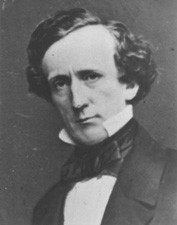
Senator Henry Mower Rice
~ United States Senate Historical Office
There are some interesting matters here besides what takes place in Congress, and I propose from time to time to touch upon them. An expenditure of $60,000,000 per annum does not cover all the pickings and stealings that “prevail” in our hereabouts. Senator RICE did not tell all he knew about land-office operations, when he testified to the value of the Fort Snelling property. Nobody is better aware than he that the tract would be much better to cut up into town lots than Bayfield was when he bought it for a few cents an acre, and sold it for hundreds of dollars. If we could find out all that Senator BRIGHT knows of these matters, one could learn how to become a millionaire at very small expense of brains or labor. Indian treaties and land-office jobbing have made more men rich than care to tell of it – ask General CASS if this is not so.
Seeing a bushel-basket of papers in the Interior Department the other day, I was curious to know what the kernel might be to all that rind, and made inquiry in the premises. I was told that they enveloped the case of Superior City. I cast my eye over some of them, and noticed that an argument was filed on behalf of one of the parties by Mr. Senator BRIGHT – or rather with Senator BRIGHT’S indorsement. This whetted my desire of knowledge, and I ran my eye over the paper in question, which was from the pen of a Minnesota Judge and was without exception the richest document I ever saw intended for a judicial or administrative tribunal. The substance of it was that the opinion of the Attorney-General CUSHING in the case was absurd, the adoption of his views by the Interior Department preposterous, and the action of the local Land office at Superior, in defining the status of certain half-breed Indians on the most abundant testimony, corrupt. It was clear enough that such a document required at least a senatorial indorsement to justify its reception. Nobody can suppose for a moment that Senator BRIGHT has any interest in the result of the case, or that he expected to influence the judgement of his friend, HENDRICKS, (Commissioner of the General Land Office,) by appearing in it. That would be too strong an inference to draw from so meek a fact ; and yet the malicious might suggest it as an apprehension.

Original Proprietors of Superior featuring James Stinson, Benjamin Thomson, Dr. W.W. Coran, U.S. Senator Robert J Walker, George W. Cass, and Horace Bridge. Featured in The Eye of the North-west, pg. 8.
From the printed argument of Senator BRIGHT’S friend, and from a private abstract of the testimony in the case, and a few items I have picked up in the Land Office, I think it will be in my power to indite an epistle that may excite some attention. At the Southwestern extremity of Lake Superior, there is a tract of land, which is expected some day to become the cite of a large city. Being aware of its great advantages for this purpose, a St. Paul speculator by the name of THOMPSON, and a Canadian operator by the name of STINSON, undertook to possess themselves of it as long as as in the early part of General PIERCE‘S administration, by vicarious preemptions. In this plan they were assisted by some official gentlement, who shared in the spoils, and patents were ground out in double-quick time, or certificates issued to Swedes and Indians for the benefit of this STINSON and THOMPSON, and their associate speculators.
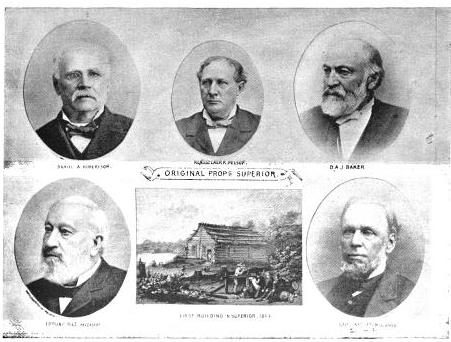
More Proprietors of Supeior from The Eye of the North-west, pg. 9.
In the Summer of 1854, this Mr. STINSON, headed a gang of Swedes and led them from Swede Lake, in the Territory of Minnesota, to Lake Superior, guiding them in person to the tracts he wished them to preempt. These men were ignorant of our language and of our laws, and were used by STINSON to “settle” their tracts, “prove up” their claims, and “convey” to him, the said STINSON, without knowing either the frauds they were practicing, or the rights which they might have secured to themselves if they had been acting in good faith. In the Land Office at Hudson, where these frauds were perpetrated, there was a notary public, who drew the deeds to STINSON, got the signatures of the Swedes to them and took the acknowledgements, immediately after the preemption oath had been administered – the Swedes thinking the whole operation a part of the preemption process. The terms were said to be $30 a month, and a bonus of $15 on the consummation of the bargain. The names of these Swedes were Aaron Peterson, Martin Larson, Peter Nelson, John Johnson, Sven Magnassan, Lorenz Johnson, Peter Norell, Sven Larson, Andreas Senson, Johannes Helon, Johannes Peterson, and Peter Erickson. These “preemptors,” for their own benefit, all “proved up” at Hudson, and the very same day they made conveyances to STINSON. The same thing is true of another Swedish invasion that was made in the Summer of 1855. In that year three Swedes – Old Westerland, Andrew Walmart, and Israel Janssen – commenced their settlements June 11, proved up June 22, and conveyed to STINSON June 22 – eleven days being sufficient for the whole operation. The records of the Land Office at Superior, and of the Register of Deeds of Douglas County, show these facts. They are well known in the General Land Office.
But Mr. STINSON did not operate through Swedes alone. He and his friend THOMPSON worked with half-breed Indians also. In March, 1854, he and THOMPSON followed up the Government Surveys with a gang of Chippewa half-breed Indians. The whole gang made preemptions in Douglas County, under the guidance of THOMPSON and STINSON, who hired them at La Pointe, and convered a large portion of a township with their fraudulent pre-emptions, which were proved up simultaneously, and simultaneously conveyed to the attorney of THOMPSON and STINSON. The names of all of this gang appear on the tract books in the General Land Office. These were Joseph Lamoureaux, Joseph Defaut, Joseph Dennis, Joseph Gauthier, Francis Decoteau, John B. Goslin, George D. Morrison and Levi B. Coffee, all preemptors for these land-sharks. There were three or four more half-breeds in the gang, who ran foul of some eight or ten American citizens who were seeking to save a slice of this Territory from Swedish and Indian preemption, and lay out a town site there under the law. This was the origin of the Superior City controversy, which has been pending some three or four years in the various land offices, and which has accumulated the basket of papers which first drew my attention to a case of such interesting dimensions. The contest is nominally between three or four Chippewa half-breeds claiming some three hundred acres as a town site. But the Indians are not merely bogus citizens, they are bogus pre-emptors in the bargain, for they were the hired men of THOMPSON & STINSON.
Mr. CUSHING decided in this controversy, before it was so settled by the Dred Scott case, that a half-breed Indian, receiving annuities as such, recognized as a dependent of a tribe, and the beneficiary of treaty stipulations, could become a citizen of the United States only by some positive act of Federal legislation ; that he could not, of his own volition, or by the laws of a State, change his condition from that of an Indian to that of a Federal citizen. Strange as it may seem, it appears that this part of the Dred Scott is repudiated by Mr. Commissioner HENDRICKS, who thinks a state cannot make a Federal citizen of a man with a drop of negro blood in his veins, but that the Commissioner of the General Land Office may naturalize Indians, ad libitum, without statute or judgement to sustain him.
I am curious to see how this controversy will be decided. The General Land Office upheld STINTSON’S Swedish preemption, on the ground that the frauds were discovered too late for the Commissioner to interefere. Whether or not STINSON hasmade any negro preemptions does not appear. It was too cold at the end of the lake for negroes to flourish much. But now it is to be settled in a case where the attempted frauds have been seasonably discovered, whether or not a Canadian adventurer can preempt whole townships of the Public Lands by the agency of a gang of half-breed Indians, and procure patents for them when the facts are known to the Federal authorities.
The pre-emptive right. Homesteads.
~ Superior, Wisconsin, papers, 1831-1942 ([unpublished])

Detail of Superior City townsite at the head of Lake Superior from Stuntz’s 1854 Plat Map of Township 49 North Range 14 West.
Early history of Superior should make mention of this right of acquisition, since there under, titles to government land were derived. Any qualified person might acquire title to one hundred and sixty acres of land by settling thereon, erecting a dwelling and making other improvements. Such person was to be twenty-one years of age, either male or female, or the head of a family whether man or woman.
Proof of each settlement was required to be made on a certain day at the United State Land Office and upon the payment of two hundred dollars with the taking of a required oath, the preemptioner got his one hundred and sixty acres of land.
But the whole proceeding, was far from straight, as a general thing, and in fact often amounted to a fraud.
“In the first place, Superior was backed by a powerful company of Democratic politicians and Government bankers in Washington, while the northern and northeastern portions of the state were still held by the Indians. This Superior company sought a connection with the Mississippi river, to obtain which they urged in congress the passage of a land grant bill, offering ten sections to the mile to aid in the construction of a railroad from Milwaukee to some point on Lake St. Croix, on the western boundary of the state of Wisconsin.”
~ History of Duluth and St. Louis County, Past and Present,
Volume 1, page 230.
Hence the whole country, in and about Superior, was dotted with preemption cabins, which were little more than logs piles up in walls, without floors, or windows, often with brush for a roof, a hole therein for a chimney and perhaps for a door. A slashing of half an acre or so of trees was the “improvement” so called. A very barbarous travesty, it was, upon a white man’s home and farm. Here is an instance, where as was said, a certain doctor of divinity laid claim to a quarter section of land, now in the midst of this city.
One day he sought “to prove up” his preemption, and one Alfred Allen was his witness, and they asked Allen, “Was the pre-emptions shanty good to live in?“, the law requiring a good habitable house on the claim. And Alf said “Yes, good for mosquitoes.” The Reverend said “Pshaw! Pshaw!” Meanding to upbraid or caution the witness who thereupon only protested and adjured the harder. The difficulty was somehow smoothed over, through some mending of the proofs, and perhaps connivance on the part of persons charged with administration of the United States land laws.
Nevertheless, it is interesting to member that upon rude and rough proceedings, such as are herein alluded to, rest at bottom the titles and claims to everything we own in the nature of lots, blocks, and land.
From: Statements of Hiram Hayes. Mr. Hayes came to Superior in 1854.
History of Duluth and St. Louis County, Past and Present, Volume 1
By Dwight Edwards Woodbridge, et al, 1910
GEORGE R. STUNTZ. [pages 229-231]
One of the earliest settlers at the head of the lakes was Mr. George E. Stuntz, who a short time ago joined the great majority. Before his death Mr. Stuntz wrote of his pioneer experiences as follows:
“In July, 1852, I came to the head of Lake Superior to run the land lines and subdivide certain townships. When I arrived at the head of the lakes there was nothing in Duluth or Superior. There was no settlement. The old American Fur Company had a post at La Pointe, at the west side of Madeline Island.
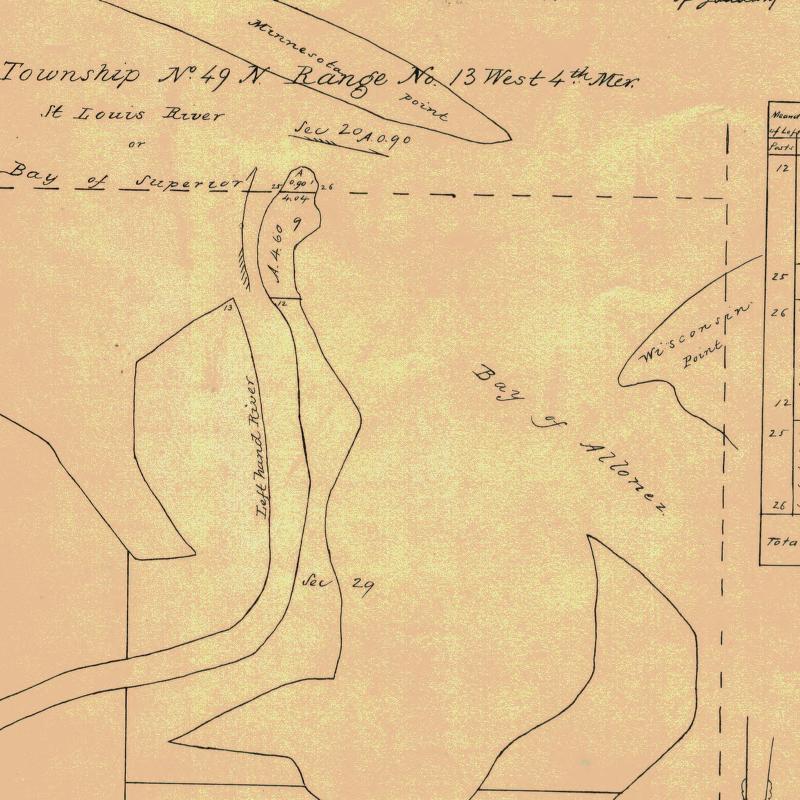
Detail of Minnesota Point from Stuntz’s Exterior Field Notes (August-October of 1852).
“In 1853 I got the range subdivided, and also in Superior, townsite 49, range 13. During the same year, later, in my absence, there came parties from the copper district of upper Michigan and located claims upon the range. They were principally miners. During the same year I built a residence on Minnesota Point under treaty license before the territory was sold to the Government. At that time there were only missionaries or license traders in the tract, as it belonged to the original Indian territory. In 1852, at Fond du Lac, there was a trading post and warehouse, in which I stored my goods on my arrival. In the fall of 1853 I bought three yoke of cattle and two cows at St. Croix Falls and brought them to the mouth of the Iron river, and had to cut a road thirty miles through the dense forest so as to get the oxen, cows and cart through. Later in the fall of 1853 I came through with an extra yoke of oxen, buying provisions, etc., and on coming up to Superior I found quite a settlement of log cabins. These settlers were anxious to get to the United States land office, then at Hudson, Wis. A dense forest intervened. We organized a volunteer company in January, 1854, to cut a road from old Superior to the nearest lumber camp on the St. Croix river, I furnishing two barrels of flour, provisions, pony and dog train, necessary to carry the provisions for a gang of seventeen men. The road was completed in twenty days, the snow being at that time two feet deep. This cut through a direct road to Taylor’s Falls and Stillwater. In 1854 I completed a mill on the Iron river and employed a man to superintend it, and I remained at Minnesota Point, my trading post, where I had first taken out the license. In the same year I took a contract to subdivide two townships located in Superior, townships 48-49, range 15, and afterward I attended the treaty at the time the Indians sold this country to the Government.
Before the 1854 Treaty of La Pointe could be ratified in Washington, D.C., the oral description agreed upon during the negotiations for exterior boundaries of the Chippewa treaties had to be surveyed with the tribe, documented, and delivered to Washington, D.C. before 1855. It is not clear who was involved with the exterior boundaries of these reservations; whether it was Stuntz, Barber, and/or others from their party.
“There were 5,000 Indians present with their chiefs. It was the biggest assemblage of Indians ever held at Lake Superior at this period of the country’s history. It took a month to pacify the troubles that grew among the different tribes in regard to their proportionate rights. This treaty was sent to congress September [30], 1854, and was ratified and became law in January, 1855.
To be continued in 1854…
The Enemy of my Enemy: The 1855 Blackbird-Wheeler Alliance
November 29, 2013
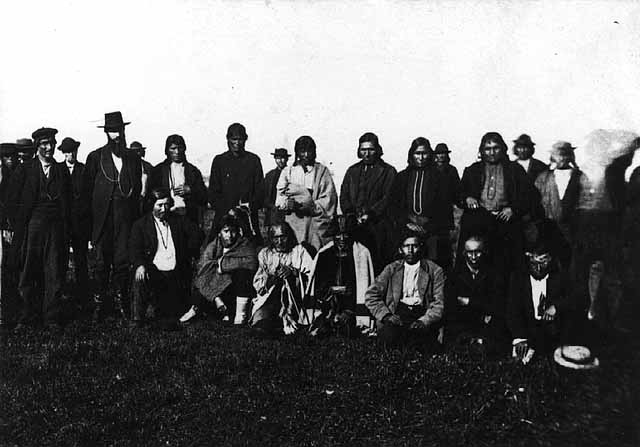
Identified by the Minnesota Historical Society as “Scene at Indian payment, probably at Odanah, Wisconsin. c. 1865.” by Charles Zimmerman. Judging by the faces in the crowd, this is almost certainly the same payment as the more-famous image that decorates the margins of the Chequamegon History site (Zimmerman MNHS Collections)
A staunch defender of Ojibwe sovereignty, and a zealous missionary dedicating his life’s work to the absolute destruction of the traditional Ojibwe way of life, may not seem like natural political allies, but as Shakespeare once wrote, “Misery acquaints a man with strange bedfellows.”
In October of 1855, two men who lived near Odanah, were miserable and looking for help. One was Rev. Leonard Wheeler who had founded the Protestant mission at Bad River ten years earlier. The other was Blackbird, chief of the “Bad River” faction of the La Pointe Ojibwe, that had largely deserted La Pointe in the 1830s and ’40s to get away from the men like Wheeler who pestered them relentlessly to abandon both their religion and their culture.
Their troubles came in the aftermath of the visit to La Pointe by George Manypenny, Commissioner of Indian Affairs, to oversee the 1855 annuity payments. Many readers may be familiar with these events, if they’ve read Richard Morse’s account, Chief Buffalo’s obituary (Buffalo died that September while Manypenny was still on the island), or the eyewitness account by Crockett McElroy that I posted last month. Taking these sources together, some common themes emerge about the state of this area in 1855:
- After 200 years, the Ojibwe-European relationship based on give and take, where the Ojibwe negotiated from a position of power and sovereignty, was gone. American government and society had reached the point where it could by impose its will on the native peoples of Lake Superior. Most of the land was gone and with it the resource base that maintained the traditional lifestyle, Chief Buffalo was dead, and future chiefs would struggle to lead under the paternalistic thumb of the Indian Department.
- With the creation of the reservations, the Catholic and Protestant missionaries saw an opportunity, after decades of failures, to make Ojibwe hunters into Christian farmers.
- The Ojibwe leadership was divided on the question of how to best survive as a people and keep their remaining lands. Some chiefs favored rapid assimilation into American culture while a larger number sought to maintain traditional ways as best as possible.
- The mix-blooded Ojibwe, who for centuries had maintained a unique identity that was neither Native nor European, were now being classified as Indians and losing status in the white-supremacist American culture of the times. And while the mix-bloods maintained certain privileges denied to their full-blooded relatives, their traditional voyageur economy was gone and they saw treaty payments as one of their only opportunities to make money.
- As with the Treaties of 1837 and 1842, and the tragic events surrounding the attempted removals of 1850 and 1851, there was a great deal of corruption and fraud associated with the 1855 payments.
This created a volatile situation with Blackbird and Wheeler in the middle. Before, we go further, though, let’s review a little background on these men.
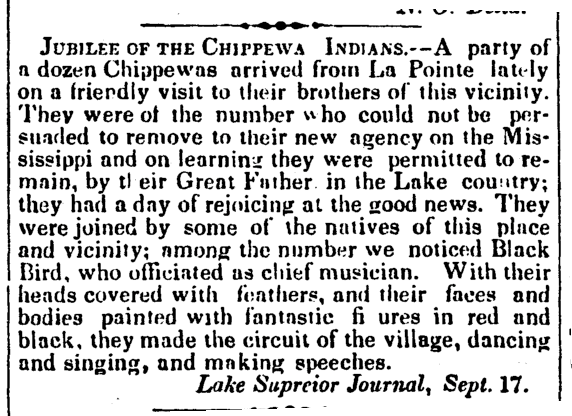
This 1851 reprint from Lake Superior Journal of Sault Ste. Marie shows how strongly Blackbird resisted the Sandy Lake removal efforts and how he was a cultural leader as well as a political leader. (New Albany Daily Ledger, October 9, 1851. Pg. 2).
Who was Blackbird?
Makadebineshii, Chief Blackbird, is an elusive presence in both the primary and secondary historical record. In the 1840s, he emerges as the practical leader of the largest faction of the La Pointe Band, but outside of Bad River, where the main tribal offices bear his name, he is not a well-known figure in the history of the Chequamegon area at all.
Unlike, Chief Buffalo, Blackbird did not sign many treaties, did not frequently correspond with government officials, and is not remembered favorably by whites. In fact, his portrayal in the primary sources is often negative. So then, why did the majority of the Ojibwe back Blackbird at the 1855 payment? The answer is probably the same reason why many whites disliked him. He was an unwavering defender of Ojibwe sovereignty, he adhered to his traditional culture, and he refused to cooperate with the United States Government when he felt the land and treaty rights of his people were being violated.
One needs to be careful drawing too sharp a contrast between Blackbird and Buffalo, however. The two men worked together at times, and Blackbird’s son James, later identified his father as Buffalo’s pipe carrier. Their central goals were the same, and both labored hard on behalf of their people, but Buffalo was much more willing to work with the Government. For instance, Buffalo’s response in the aftermath of the Sandy Lake Tragedy, when the fate of Ojibwe removal was undecided, was to go to the president for help. Blackbird, meanwhile, was part of the group of Ojibwe chiefs who hoped to escape the Americans by joining Chief Zhingwaakoons at Garden River on the Canadian side of Sault Ste. Marie.
Still, I hesitate to simply portray Blackbird and Buffalo as rivals. If for no other reason, I still haven’t figured out what their exact relationship was. I have not been able to find any reference to Blackbird’s father, his clan, or really anything about him prior to the 1840s. For a while, I was working under the hypothesis that he was the son of Dagwagaane (Tugwaganay/Goguagani), the old Crane Clan chief (brother of Madeline Cadotte), who usually camped by Bad River, and was often identified as Buffalo’s second chief.
However, that seems unlikely given this testimony from James Blackbird that identifies Oshkinawe, a contemporary of the elder Blackbird, as the heir of Guagain (Dagwagaane):
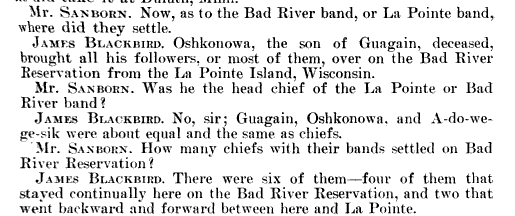
Statement of James Blackbird: Condition of Indian affairs in Wisconsin: hearings before the Committee on Indian Affairs, United States Senate, [61st congress, 2d session], on Senate resolution, Issue 263. pg 203. (Digitized by Google Books).
It seems Commissioner Manypenny left La Pointe before the issue was entirely settled, because a month later, we find a draft letter from Blackbird to the Commissioner transcribed in Wheeler’s hand:
Mushkesebe River Oct. 1855
Blackbird. Principal chief of the Mushkisibi-river Indians to Hon. G. Manepenny Com. of Indian Affairs Washington City.
Father; Although I have seen you face to face, & had the privilege to talking freely with you, we did not do all that is to be attended to about our affairs. We have not forgotten the words you spoke to us, we still keep them in our minds. We remember you told us not to listen to all the foolish stories that was flying about–that we should listen to what was good, and mind nothing about anything else. While we listened to your advice we kept one ear open and the other shut, & [We?] kept retained all you spoke said in our ears, and. Your words are still ringing in our ears. The night that you left the sound of the paddles in boat that carried you away from us was had hardly gone ceased before the minds of some of the chiefs was were tuned by the traders from the advice you gave, but we did not listen to them. Ja-jig-wy-ong, (Buffalo’s son) son says that he & Naganub asked Mr. Gilbert if they could go to Washington to see about the affairs of the Indians. Now father, we are sure you opened your heart freely to us, and did not keep back anything from us that is for our good. We are sure you had a heart to feel for us & sympathise with us in our trials, and we think that if there is any important business to be attended to you would not have kept it secret & hid it from us, we should have knew it. If I am needed to go to Washington, to represent the interests of our people, I am ready to go. The ground that we took against about our old debts, I am ready to stand shall stand to the last. We are now in Mr. Wheelers house where you told us to go, if we had any thing to say, as Mr. W was our friend & would give us good advice. We have done so. All the chiefs & people for whom I spoke, when you were here, are of the same mind. They all requested before they left that I should go to Washington & be sure & hold on to Mr. Wheeler as one to go with me, because he has always been our steadfast friend and has al helped us in our troubles. There is another thing, my father, which makes us feel heavy hearted. This is about our reservation. Although you gave us definite instructions about it, there are some who are trying to shake our reserve all to pieces. A trader is already here against our will & without any authority from Govt, has put him up a store house & is trading with our people. In open council also at La Pointe when speaking for our people, I said we wanted Mr. W to be our teacher, but now another is come which whom we don’t want, and is putting up a house. We supposed when you spoke to us about a teacher being permitted to live among us, you had reference to the one we now have, one is enough, we do not wish to have any more, especially of the kind of him who has just come. We forbid him to build here & showed him the paper you gave us, but he said that paper permitted him rather than forbid him to come. If the chiefs & young men did not remember what you told them to keep quiet there would already be have been war here. There is always trouble when there two religions come together. Now we are weak and can do nothing and we want you to help us extend your arms to help us. Your arms can extend even to us. We want you to pity & help us in our trouble. Now we wish to know if we are wanted, or are permitted, three or four of us to come to which Washington & see to our interests, and whether our debts will be paid. We would like to have you write us immediately & let us know what your will is, when you will have us come, if at all. One thing further. We do not want any account to be allowed that was not presented to us for us to pass our opin us to pass judgement on, we hear that some such accounts have been smuggled in without our knowledge or consent.
The letter is unsigned, lacks a specific date, and has numerous corrections, which indicate it was a draft of the actual letter sent to Manypenny. This draft is found in the Wheeler Family Papers in the collections of the Wisconsin Historical Society at the Northern Great Lakes Visitor Center. As interesting as it is, Blackbird’s letter raises more questions than answers. Why is the chief so anxious to go to Washington? What are the other chiefs doing? What are these accounts being smuggled in? Who are the people trying to shake the reservation to pieces and what are they doing? Perhaps most interestingly, why does Blackbird, a practitioner of traditional religion, think he will get help from a missionary?
For the answer to that last question, let’s take a look at the situation of Leonard H. Wheeler. When Wheeler, and his wife, Harriet came here in 1841, the La Pointe mission of Sherman Hall was already a decade old. In a previous post, we looked at Hall’s attitudes toward the Ojibwe and how they didn’t earn him many converts. This may have been part of the reason why it was Wheeler, rather than Hall, who in 1845 spread the mission to Odanah where the majority of the La Pointe Band were staying by their gardens and rice beds and not returning to Madeline Island as often as in the past.
When compared with his fellow A.B.C.F.M. missionaries, Sherman Hall, Edmund Ely, and William T. Boutwell, Wheeler comes across as a much more sympathetic figure. He was as unbending in his religion as the other missionaries, and as committed to the destruction of Ojibwe culture, but in the sources, he seems much more willing than Hall, Ely, or Boutwell to relate to Ojibwe people as fellow human beings. He proved this when he stood up to the Government during the Sandy Lake Tragedy (while Hall was trying to avoid having to help feed starving people at La Pointe). This willingness to help the Ojibwe through political difficulties is mentioned in the 1895 book In Unnamed Wisconsin by John N. Davidson, based on the recollections of Harriet Wheeler:

From In Unnamed Wisconsin pg. 170 (Digitized by Google Books).
So, was Wheeler helping Blackbird simply because it was the right thing to do? We would have to conclude yes, if we ended it here. However, Blackbird’s letter to Manypenny was not alone. Wheeler also wrote his own to the Commissioner. Its draft is also in the Wheeler Family Papers, and it betrays some ulterior motives on the part of the Odanah-based missionary:
example not to meddle with other peoples business.
Mushkisibi River Oct. 1855
L.H. Wheeler to Hon. G.W. Manypenny
Dear Sir. In regard to what Blackbird says about going to Washington, his first plan was to borrow money here defray his expenses there, & have me start on. Several of the chiefs spoke to me before soon after you left. I told them about it if it was the general desire. In regard to Black birds Black Bird and several of the chiefs, soon after you left, spoke to me about going to Washington. I told them to let me know what important ends were to be affected by going, & how general was the desire was that I should accompany such a delegation of chiefs. The Indians say it is the wish of the Grand Portage, La Pointe, Ontonagun, L’anse, & Lake du Flambeaux Bands that wish me to go. They say the trader is going to take some of their favorite chiefs there to figure for the 90,000 dollars & they wish to go to head them off and save some of it if possible. A nocturnal council was held soon after you left in the old mission building, by some of the traders with some of the Indians, & an effort was made to get them Indians to sign a paper requesting that Mr. H.M. Rice be paid $5000 for goods sold out of the 90,000 that be the Inland Indians be paid at Chippeway River & that the said H.M. Rice be appointed agent. The Lake du Flambeau Indians would not come into the [meeting?] & divulged the secret to Blackbird. They wish to be present at [Shington?] to head off [sail?] in that direction. I told Blackbird I thought it doubtful whether I could go with him, was for borrowing money & starting immediately down the Lake this fall, but I advised him to write you first & see what you thought about the desirability of his going, & know whether his expenses would be born. Most of the claimants would be dread to see him there, & of course would not encourage his going. I am not at all certain certain that I will be [considered?] for me to go with Blackbird, but if the Dept. think it desirable, I will take it into favorable consideration. Mr. Smith said he should try to be there & thought I had better go if I could. The fact is there is so much fraud and corruption connected with this whole matter that I dread to have anything to do with it. There is hardly a spot in the whole mess upon which you can put your finger without coming in contact with the deadly virus. In regard to the Priest’s coming here, The trader the Indians refer to is Antoine [Gordon?], a half breed. He has erected a small store house here & has brought goods here & acknowledges that he has sold them and defies the Employees. Mssrs. Van Tassel & Stoddard to help [themselves?] if they can. He is a liquer-seller & a gambler. He is now putting up a house of worship, by contract for the Catholic Priest. About what the Indians said about his coming here is true. In order to ascertain the exact truth I went to the Priest myself, with Mr. Stoddard, Govt [S?] man Carpenter. His position is that the Govt have no right to interfere in matters of religion. He says he has a right to come here & put up a church if there are any of his faith here, and they permit him to build on his any of their claims. He says also that Mr. Godfrey got permission of Mr. Gilbert to come here. I replied to him that the Commissioner told me that it was not the custom of the Gov. to encourage but one denomination of Christians in a place. Still not knowing exactly the position of Govt upon the subject, I would like to ask the following questions.
1. When one Missionary Society has already commenced labors a station among a settlement of Indians, and a majority of the Indians people desire to have him for their religious teacher, have missionaries of another denomination a right to come in and commence a missionary establishment in the same settlement?
Have they a right to do it against the will of a majority of the people?
Have they a right to do it in any case without the permission of the Govt?
Has any Indian a right, by sold purchase, lease or otherwise a right to allow a missionary to build on or occupy a part of his claim? Or has the same missionary a right to arrange with several missionaries Indians for to occupy by purchase or otherwise a part of their claims severally? I ask these questions, not simply with reference to the Priest, but with regard to our own rights & privileges in case we wish to commence another station at any other point on the reserve. The coming of the Catholic Priest here is a [mere stroke of policy, concocted?] in secret by such men as Mssrs. Godfrey & Noble to destroy or cripple the protestant mission. The worst men in the country are in favor of the measure. The plan is under the wing of the priest. The plan is to get in here a French half breed influence & then open the door for the worst class of men to come in and com get an influence. Some of the Indians are put up to believe that the paper you gave Blackbird is a forgery put up by the mission & Govt employ as to oppress their mission control the Indians. One of the claimants, for whom Mr. Noble acts as attorney, told me that the same Mr. Noble told him that the plan of the attorneys was to take the business of the old debts entirely out of your hands, and as for me, I was a fiery devil they when they much[?] tell their report was made out, & here what is to become of me remains to be seen. Probably I am to be hung. If so, I hope I shall be summoned to Washington for [which purpose?] that I may be held up in [t???] to all missionaries & they be [warned?] by my […]
The dramatic ending to this letter certainly reveals the intensity of the situation here in the fall of 1855. It also reveals the intensity of Wheeler’s hatred for the Roman Catholic faith, and by extension, the influence of the Catholic mix-blood portion of the La Pointe Band. This makes it difficult to view the Protestant missionary as any kind of impartial advocate for justice. Whatever was going on, he was right in the middle of it.
So, what did happen here?
From Morse, McElroy, and these two letters, it’s clear that Blackbird was doing whatever he could to stop the Government from paying annuity funds directly to the creditors. According to Wheeler, these men were led by U.S. Senator and fur baron Henry Mower Rice. It’s also clear that a significant minority of the Ojibwe, including most of the La Pointe mix-bloods, did not want to see the money go directly to the chiefs for disbursement.
I haven’t uncovered whether the creditors’ claims were accepted, or what Manypenny wrote back to Blackbird and Wheeler, but it is not difficult to guess what the response was. Wheeler, a Massachusetts-born reformist, had been able to influence Indian policy a few years earlier during the Whig administration of Millard Fillmore, and he may have hoped for the same with the Democrats. But this was 1855. Kansas was bleeding, the North was rapidly turning toward “Free Soil” politics, and the Dred Scott case was only a few months away. Franklin Pierce, a Southern-sympathizer had won the presidency in a landslide (losing only Massachusetts and three other states) in part because he was backed by Westerners like George Manypenny and H. M. Rice. To think the Democratic “Indian Ring,” as it was described above, would listen to the pleas coming from Odanah was optimistic to say the least.
“[E]xample not to meddle with other peoples business” is written at the top of Wheeler’s draft. It is his handwriting, but it is much darker than the rest of the ink and appears to have been added long after the fact. It doesn’t say it directly, but it seems pretty clear Wheeler didn’t look back on this incident as a success. I’ll keep looking for proof, but for now I can say with confidence that the request for a Washington delegation was almost certainly rejected outright.
So who are the good guys in this situation?
If we try to fit this story into the grand American narrative of Manifest Destiny and the systematic dispossession of Indian peoples, then we would have to conclude that this is a story of the Ojibwe trying to stand up for their rights against a group of corrupt traders. However, I’ve never had much interest in this modern “Dances With Wolves” version of Indian victimization. Not that it’s always necessarily false, but this narrative oversimplifies complex historical events, and dehumanizes individual Indians as much as the old “hostile savages” framework did. That’s why I like to compare the Chequamegon story more to the Canadian narrative of Louis Riel and company than to the classic American Little Bighorn story. The dispossession and subjugation of Native peoples is still a major theme, but it’s a lot messier. I would argue it’s a lot more accurate and more interesting, though.
So let’s evaluate the individuals involved rather than the whole situation by using the most extreme arguments one could infer from these documents and see if we can find the truth somewhere in the middle:

Henry Mower Rice (Wikimedia Images)
Henry M. Rice
The case against: H. M. Rice was businessman who valued money over all else. Despite his close relationship with the Ho-Chunk people, he pressed for their 1847 removal because of the enormous profits it brought. A few years later, he was the driving force behind the Sandy Lake removal of the Ojibwe. Both of these attempted removals came at the cost of hundreds of lives. There is no doubt that in 1855, Rice was simply trying to squeeze more money out of the Ojibwe.
The case for: H. M. Rice was certainly a businessman, and he deserved to be paid the debts owed him. His apparent actions in 1855 are the equivalent of someone having a lien on a house or car. That money may have justifiably belonged to him. As for his relationship with the Ojibwe, Rice continued to work on their behalf for decades to come, and can be found in 1889 trying to rectify the wrongs done to the Lake Superior bands when the reservations were surveyed.
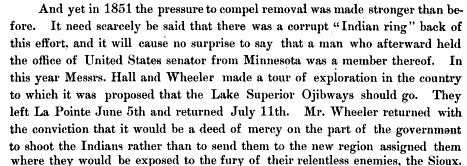
From In Unnamed Wisconsin pg. 168. It’s not hard to figure out which Minnesota senator is being referred to here in this 1895 work informed by Harriet Wheeler. (Digitized by Google Books).
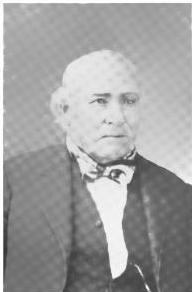
Antoine Gordon from Noble Lives of a Noble Race (pg. 207) published by the St. Mary’s Industrial School in Odanah.
Antoine Gordon
The case against: Antoine Gaudin (Gordon) was an unscrupulous trader and liquor dealer who worked with H. M. Rice to defraud his Ojibwe relatives during the 1855 annuities. He then tried to steal land and illegally squat on the Bad River Reservation against the expressed wishes of Chief Blackbird and Commissioner Manypenny.
The case for: Antoine Gordon couldn’t have been working against the Ojibwe since he was an Ojibwe man himself. He was a trader and was owed debts in 1855, but most of the criticism leveled against him was simply anti-Catholic libel from Leonard Wheeler. Antoine was a pious Catholic, and many of his descendants became priests. He built the church at Bad River because there were a number of people in Bad River who wanted a church. Men like Gordon, Vincent Roy Jr., and Joseph Gurnoe were not only crucial to the development of Red Cliff (as well as Superior and Gordon, WI) as a community, they were exactly the type of leaders the Ojibwe needed in the post-1854 world.
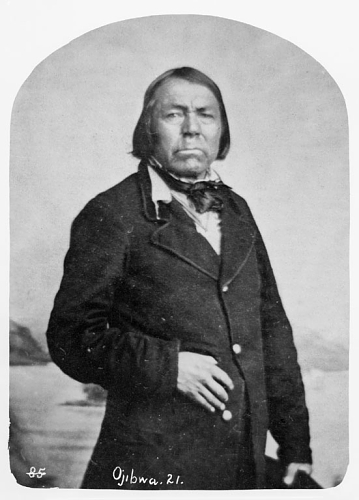
Portrait of Naw-Gaw-Nab (The Foremost Sitter) n.d by J.E. Whitney of St. Paul (Smithsonian)
Naaganab
The case against: Chiefs like Naaganab and Young Buffalo sold their people out for a quick buck. Rather than try to preserve the Ojibwe way of life, they sucked up to the Government by dressing like whites, adopting Catholicism, and using their favored position for their own personal gain and to bolster the position of their mix-blooded relatives.
The case for: If you frame these events in terms of Indians vs. Traders, you then have to say that Naaganab, Young Buffalo, and by extension Chief Buffalo were “Uncle Toms.” The historical record just doesn’t support this interpretation. The elder Buffalo and Naaganab each lived for nearly a century, and they each strongly defended their people and worked to preserve the Ojibwe land base. They didn’t use the same anti-Government rhetoric that Blackbird used at times, but they were working for the same ends. In fact, years later, Naaganab abandoned his tactic of assimilation as a means to equality, telling Rice in 1889:
“We think the time is past when we should take a hat and put it on our heads just to mimic the white man to adopt his custom without being allowed any of the privileges that belong to him. We wish to stand on a level with the white man in all things. The time is past when my children should stand in fear of the white man and that is almost all that I have to say (Nah-guh-nup pg. 192).”
Leonard H. Wheeler

L. H. Wheeler (WHS Image ID 66594)
The case against: Leonard Wheeler claimed to be helping the Ojibwe, but really he was just looking out for his own agenda. He hated the Catholic Church and was willing to do whatever it took to keep the Catholics out of Bad River including manipulating Blackbird into taking up his cause when the chief was the one in need. Wheeler couldn’t mind his own business. He was the biggest enemy the Ojibwe had in terms of trying to maintain their traditions and culture. He didn’t care about Blackbird. He just wanted the free trip to Washington.
The case for: In contrast to Sherman Hall and some of the other missionaries, Leonard Wheeler was willing to speak up forcefully against injustice. He showed this during the Sandy Lake removal and again during the 1855 payment. He saw the traders trying to defraud the Ojibwe and he stood up against it. He supported Blackbird in the chief’s efforts to protect the territorial integrity of the Bad River reservation. At a risk to his own safety, he chose to do the right thing.
Blackbird
The case against: Blackbird was opportunist trying to seize power after Buffalo’s death by playing to the outdated conservative impulses of his people at a time when they should have been looking to the future rather than the past. This created harmful factional differences that weakened the Ojibwe position. He wanted to go to Washington because it would make him look stronger and he manipulated Wheeler into helping him.
The case for: From the 1840s through the 1860s, the La Pointe Ojibwe had no stronger advocate for their land, culture, and justice than Chief Blackbird. While other chiefs thought they could work with a government that was out to destroy them, Blackbird never wavered, speaking consistently and forcefully for land and treaty rights. The traders, and other enemies of the Ojibwe, feared him and tried to keep their meetings and Washington trip secret from him, but he found out because the majority of the people supported him.
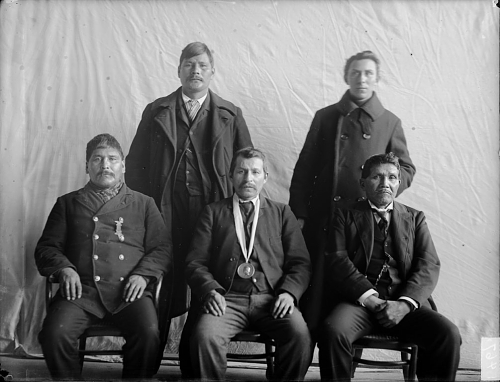
I’ve yet to find a picture of Blackbird, but this 1899 Bad River delegation to Washington included his son James (bottom right) along with Henry and Jack Condecon, George Messenger, and John Medegan–all sons and/or grandsons of signers of the Treaty of 1854 (Photo by De Lancey Gill; Smithsonian Collections).
Final word for now…
An entire book could be written about the 1855 annuity payments, and like so many stories in Chequamegon History, once you start the inquiry, you end up digging up more questions than answers. I can’t offer a neat and tidy explanation for what happened with the debts. I’m inclined to think that if Henry Rice was involved it was probably for his own enrichment at the expense of the Ojibwe, but I have a hard time believing that Buffalo, Jayjigwyong, Naaganab, and most of the La Pointe mix-bloods would be doing the same. Blackbird seems to be the hero in this story, but I wouldn’t be at all surprised if there was a political component to his actions as well. Wheeler deserves some credit for his defense of a position that alienated him from most area whites, but we have to take anything he writes about his Catholic neighbors with a grain of salt.
As for the Blackbird-Wheeler relationship, showcasing these two fascinating letters was my original purpose in writing this post. Was Blackbird manipulating Wheeler, was Wheeler manipulating Blackbird, or was neither manipulating the other? Could it be that the zealous Christian missionary and the stalwart “pagan” chief, were actually friends? What do you think?
Sources:
Davidson, J. N., and Harriet Wood Wheeler. In Unnamed Wisconsin: Studies in the History of the Region between Lake Michigan and the Mississippi. Milwaukee, WI: S. Chapman, 1895. Print.
Ely, Edmund Franklin, and Theresa M. Schenck. The Ojibwe Journals of Edmund F. Ely, 1833-1849. Lincoln: University of Nebraska, 2012. Print.
McElroy, Crocket. “An Indian Payment.” Americana v.5. American Historical Company, American Historical Society, National Americana Society Publishing Society of New York, 1910 (Digitized by Google Books) pages 298-302.
Morse, Richard F. “The Chippewas of Lake Superior.” Collections of the State Historical Society of Wisconsin. Ed. Lyman C. Draper. Vol. 3. Madison: State Historical Society of Wisconsin, 1857. 338-69. Print.
Paap, Howard D. Red Cliff, Wisconsin: A History of an Ojibwe Community. St. Cloud, MN: North Star, 2013. Print.
Pupil’s of St. Mary’s, and Franciscan Sisters of Perpetual Adoration. Noble Lives of a Noble Race. Minneapolis: Brooks, 1909. Print.
Satz, Ronald N. Chippewa Treaty Rights: The Reserved Rights of Wisconsin’s Chippewa Indians in Historical Perspective. Madison, WI: Wisconsin Academy of Sciences, Arts and Letters, 1991. Print.
Vincent Roy Jr. (From Life and Labors of Rt. Rev. Frederic Baraga by Chrysostom Verwyst: Digitized by Google Books)
Chief Buffalo’s 1852 delegation to Washington D.C. is an iconic moment in the history of the Chequamegon region. As the story goes, the 92 year-old chief made the difficult journey by canoe, steamship, rail and foot all the way to the capital city, met with President Millard Fillmore, and came back with an order to stop the removal of the Wisconsin Ojibwe. Despite its continuing popularity, and its special importance to the Red Cliff community, recent scholarship has called into question several key details of this story. Central to this controversy is whether or not Buffalo actually met the president. However, I recently found a document in the archives of an early Red Cliff resident, Vincent Roy Jr. It confirms what Red Cliff residents already know. Chief Buffalo did travel to Washington and met the president in June of 1852.
Benjamin Armstrong
According to the popular Buffalo story, some of the young men of the La Pointe Band were ready to fight the United States in early 1852. The government removal efforts that led to the Sandy Lake Tragedy in the fall of 1850 were ongoing, and the future of the Ojibwe bands in Wisconsin was in doubt. To maintain the peace, and gain title to reservations in Wisconsin, Buffalo and a small group of chiefs and headmen (including Oshogay Buffalo’s speaker and Benjamin Armstrong his interpreter), left La Pointe that spring. They encountered bad weather and negative government officials along the way, but they were able to gather signatures on their petition from several prominent Lake Superior whites. In New York and Washington, they ran short on money and had to count on the kindness of wealthy Americans who were amazed by the culture and appearance of the Ojibwe from the western country. In Washington, the Indian Affairs department refused to hear their petition and ordered them to return to La Pointe, but through luck, they met a congressman who arranged a special meeting with the president. As the story goes, Buffalo smoked with Fillmore and Oshogay delivered a long speech laying out the Ojibwe grievances. In a second meeting, Fillmore declared the removal efforts over. The delegation then returned to La Pointe via St. Paul and stopped at several Ojibwe villages causing “great rejoicing” as they announced the news. Two years later the Treaty of La Pointe (1854) confirmed forever the promises made to Buffalo by Fillmore.

Washington Delegation, June 22 1852: The man in the upper right is assumed to be Armstrong. (Engraved from unknown photograph by Marr and Richards Co. for B. Armstrong Early Life Among the Indians). Look for an upcoming post about this image
The hero, along with Buffalo, in this version story is often Benjamin Armstrong. That shouldn’t be too surprising because all the details of it come from Armstrong’s 1891 memoir Early Life Among the Indians. This entire work is freely available online on the website of the Wisconsin Historical Society. Another well-made website, chiefbuffalo.com, has several additional primary documents related to Buffalo and Armstrong. I consider Early Life required reading for anyone who lives in the Chequamegon Bay area. However, the reader has to be careful with Armstrong. As I mentioned in the post on Hanging Cloud, the female warrior of the Chippewa River country, the memoir should be treated like a work of literature rather than scholarly piece. It wasn’t unusual for 19th-century autobiographies to contain fictional parts, and Early Life is no exception. The details that the elderly Armstrong (who admitted to a fuzzy memory) dictated to Thomas P. Wentworth in 1891, don’t always match the details found in the documents of the 1850s. This is the case with the Buffalo-Fillmore story.
Recent Scholarly Work and Primary Sources about the 1852 Delegation
In his extremely thorough scholarly overview of the pro-Treaty Rights position, Chippewa Treaty Rights (1991), Ronald Satz admitted that “Armstrong’s reminiscences contain some factual errors” and that anti-Treaty Rights anthropologist James Clifton attacked Armstrong’s credibility in an attempt to undermine the Treaty Rights argument. Still, Satz’ story of the 1852 delegation is straight out of Armstrong with the admission that “Scholars have not located a decree by Fillmore specifically rescinding President Taylor’s removal order.” Patty Loew’s Indian Nations of Wisconsin (2001) also gives the story Chief Buffalo’s journey largely the way it appeared in Armstrong. At that time, it appeared that the popular story, the Armstrong story, and the mainstream scholarship all matched up.
However, recent years have seen a shift in the interpretation of the Buffalo story Bruce M. White’s The Regional Context of the Removal Order of 1850, published in Fish in the Lakes, Wild Rice, and Game in Abundance: Testimony on Behalf of Mille Lacs Ojibwe Hunting and Fishing Rights (2000; Michigan State University Press), is a highly comprehensive account of the time period and the players involved. He devotes an entire chapter to the 1852 delegation. He does not dismiss Armstrong entirely, writing:
Some questions have been raised about the accuracy of Armstrong’s account. Some details, including dates, in Armstrong’s memories of events that had occurred 40 years before, appear to be mistaken. This, of course, is true of many autobiographical accounts written without the benefit of written documentation. Nonetheless, many key features of Armstrong’s account find corroboration in Indian office records, though not always in the exact way or order in which Armstrong describes them. (pg. 245)
Despite this nod to Armstrong, White’s examination of historical records from the National Archives, the American Board of Commissioners of Foreign Missions, Minnesota Territorial records, and other sources, paint a different picture from that in Early Life Among the Indians. He produces letters from federal officials saying the Indian Office sent the delegation home “with a flea in their ear,” while John Watrous, the Indian Agent the delegation came to complain about, received “flying colors.” White also uncovered a letter that Bad River missionary Leonard Wheeler wrote after Buffalo’s return to La Pointe. It stated the delegation “accomplished nothing.” Most significantly, on page 253, White reproduces a letter from Buffalo and Oshogay to Minnesota Territorial governor Alexander Ramsey. The letter is written in July 1852, after the delegation returned. The chiefs inform the governor that the decision is his whether or not to remove the Ojibwe. They plead with Ramsey to let them stay on the lake shore. This a far cry from the situation described by Armstrong where Buffalo received a promise from Fillmore and spread “rejoicing” to all the Ojibwe bands.
In fact, the very existence of the Buffalo-Fillmore meeting is called into question. For all the documents White produces saying the delegation was unsuccessful, he fails to produce one that even speaks of a meeting with the president. He leaves the possibility open for such a meeting, using some notations indicating chain of custody of the delegation’s petition as circumstantial evidence. However he uses language like “Whether or not the Ojibwe actually met with Fillmore…” for an important symbolic event taken for granted in Ojibwe history up until that point.
If White’s investigation of the original sources calls into question the success of the delegation and its ability to meet the president, Theresa Schenck’s William W. Warren: The Life, Letters, and Times of an Ojibwe Leader (2007; U. of Nebraska Press) makes one question Armstrong’s importance in the group. In Early Life Among the Indians, Armstrong is the star of the show. He claims the delegation was his idea, that he conducted it, made all the arrangements along the way, and was generally responsible for its success. The historical record does not back these claims up. Even before the Sandy Lake Tragedy, Ojibwe chiefs were doubting the truth of the removal order as stated by Agent Watrous and Governor Ramsey. They demanded to hear it directly from the president himself. By the end of 1852, after seeing hundreds of their fellow Ojibwe die in two botched removal attempts, and having missed out on two crucial years of annuity payments, the demands of the chiefs for a meeting with the president grew louder. It was William Warren who wanted to lead and interpret for an officially-sanctioned delegation. As Ramsey used stalling tactics, Warren’s health failed, and the hope of official approval waned, Buffalo took matters into his own hands and arranged his own delegation. The elderly chief wanted to bring Leonard Wheeler along, but the missionary objected to the inclusion of a certain “half-breed” who was “incapable of doing justice to their affairs.” White speculates that Wheeler meant Armstrong, but Armstrong was a white man from Alabama. A June 24, 1852 letter, from William Warren to his cousin George, reveals who the mix-blooded interpreter likely was. This letter, as quoted in Schenck (2007) reads:
…Old Beauf [Buffalo] with others having V. Roy Jr for Intpr have gone on to Washington. All nonsense. They can effect nothing going off like fools with poor interpreters and representing only the Lapointe band (pg. 162).
Warren had included Vincent Roy Jr. in his original plan for a Washington delegation, so it seems his objections to Buffalo’s choice of interpreter have more to do with the chief not following Warren’s plan than on any reflection on the merits of Roy himself. Roy, who later in life was described as a man of outstanding character, may have earned the enmity of Wheeler because he was a strong Catholic. Wheeler and the other ABCFM missionaries were working intensely at this time to counter Roman Catholic influence in the area. In either case, Armstrong isn’t even mentioned. Though his presence isn’t supported by these documents, I believe the details of Armstrong’s memoir show he was part of the delegation. However, the claims that he “conducted” it seem grossly exaggerated.
Local Response to the Questioning of the Chief Buffalo Story
Bruce White’s primary goal was to argue the Mille Lacs Treaty-Rights case rather than maintain the popular history of this area, and Theresa Schenck has never been one to shy away from challenging long-cherished myths, but what do scholars with a bigger stake in the Chief Buffalo story say?
On the Chequamegon History website, I’ve written a lot on Buffalo, and I’ve taken part in various projects related to Buffalo’s trip, so I was disappointed when I first heard from Dr. Schenck that our region’s defining historical event may have never happened. Unfortunately, my primary research only seemed to confirm that the 1852 trip was a failure. The only new document I could find was an untranslated German travelogue Reisen in Nordamerika in den Jahren 1852 and 1853 (Travels in North America in the Years 1852 and 1853) by the noted Austrian travel writers Moritz Wagner and Karl Ritter von Scherzer. On page 336 of Volume 2, Wagner and Scherzer describe meeting Buffalo. I don’t read German, so I had to work through Google Translate:
From page 336 of Reisen in Nordamerika Vol. 2 by Wagner and Scherzer. Look for an upcoming post with more from this obscure 19th-century travelogue (Digitized by Google Books).
“The Indian chief, worthy by his age, heredity, and his imposing figure, told us he was born near the island and left the area only once to travel in the matters of his tribe to the Great Father [president] in Washington. His stay was accompanied by words of comfort but little success.” (My rough Google-aided translation of above)
This source, combined with the work of Schenck and White, and other issues I’ve had with Armstrong, led me to believe that perhaps the Chief Buffalo story was just a myth. Then, this summer saw two locally-linked authors publish works.
This summer, Patty Loew released an updated version of her fantastic introduction to Wisconsin Indian history, Indian Nations of Wisconsin. It revises the Armstrong-based section on the 1852 trip from the first edition to admit that Buffalo may not have met the president. Loew lives in Madison but is a Bad River tribal member and a Chief Buffalo fan.
Howard Paap, who is married into the Red Cliff community, has written extensively about it. His new book, Red Cliff, Wisconsin: A History of an Ojibwe Community, also came out this summer. He extends White’s arguments and thoroughly evaluates Armstrong’s story against the other primary sources. Paap’s conclusions are bold for someone writing a history on behalf of a reservation community established for Buffalo’s descendants:
We are left with the question of whether or not the Buffalo and Oshaga delegation really did have an audience with President Fillmore in the summer of 1852, and if so, what actually transpired during such a meeting…
…perhaps the easiest solution to the question of whether or not such a meeting occurred is to believe Benjamin Armstrong’s recollections, along with contemporary Ojibwe oral traditions about the trip, and leave it at that.
However, given the reality of the errors in Armstrong’s memoir, and much more importantly, the hard evidence of the trip’s paper trail as recently uncovered by Charles Cleland and Bruce White, we are confronted with a dilemma. In today’s popular history the scene of Buffalo and President Fillmore standing eye to eye, as crafted in the Carl Gawboy painting wherein Fillmore is handing Buffalo a paper canceling the removal order, is compelling, but the surviving papers that document another scenario cannot be ignored (pg. 241).
Paap goes on to describe the Buffalo story as “folkloric,” but he suggests that while the 1852 delegation did not single-handedly end the threat of Ojibwe removal, the most symbolic part of the myth remains the meeting with the president. Following White, Paap admits the possibility that the Buffalo-Fillmore meeting happened, reiterating that primary sources suggested the delegation did not achieve its objectives, but there was nothing that explicitly said there was no meeting with the president.
The Vincent Roy Jr. Account of the 1852 Trip
In browsing the online catalog of the Wisconsin Historical Society archives this spring, I discovered the society had some of Vincent Roy Jr.’s papers. The catalog description mentioned a fur trade journal, a description of early ships on Lake Superior, and some manuscript biographies of Roy from some Catholic priests. Roy, who was raised in an Ojibwe-French mix-blood family, was a fur trader and government interpreter in his early years. Still a young man at the time of the Treaty of 1854, he lived into the 20th century and was notable for several reasons including making multiple trips to Washington with Ojibwe delegations, being the namesake of Roy’s Point in Red Cliff, leading area mix-blooded Ojibwe in the cause of the “half-breed land claims,” and being one of the earliest and wealthiest settlers of Superior. He was a commanding figure in the Catholic Church and Democratic Party of Wisconsin, and there is a lot out there about him.
The wonderful staff at Wisconsin Historical Society Research Center in Ashland agreed to have the papers sent up from Madison for me. The arrived in early August, mere days after I had the chance to read Paap and Loew. Since the scope of Chequamegon History is pre-1860, I went in mostly interested in seeing the fur trade journal. I assumed the biography would be identical to the biographical information about Roy published in Life and Labors of Rt. Rev. Frederic Baraga by Chrysostom Verwyst. The Holland-born Verwyst was a priest who knew Roy personally and considered him “The Greatest Indian of the Northwest.” I didn’t think there would be anything new in this part of the archive, but I was wrong:
[Letter accompanying manuscript biography written in Verwyst’s hand]
St. Agnes’ Church
205 E. FRONT ST.
Ashland, Wis., June 27, 1903
Reuben G. Thwaites,
Sec. Wis. Hist. Soc. Madison, Wis.
Dear Sir,
I herewith send you personal memories of Hon. Vincent Roy, lately deceased, as put together by Rev. Father Valentine O.F.M. Should your society find them of sufficient historical interest to warrant their publication, you will please correct them properly before getting them printed.
Yours very respectfully,
Fr Chrysostom Verwyst O.F.M.
[From Page one of manuscript biography in Valentine’s handwriting]
~ Biographical Sketch – Vincent Roy ~
~ T. Apr. 2. 1896 – Superior Wis. ~
[Sections 1-3 (Roy’s early years) omitted. Transcription picks up on page 5 (section 4). Valentine lists his sources in the left margin. I will put them in parentheses before each paragraph].
(Mr. Roy to V.)
IV. His first Visit to Washington, D.C. – The Treaty of La Pointe.
At the instance of Chief Buffalo and in his company Vincent made his first trip to Washington, D.C. It was in the spring of the year 1852. Buffalo (Kechewaishke), head chief of the Lake Superior Ojibways had seen the day when his people, according to indian estimation, was wealthy and powerful, but now he was old and his people sickly and starving poor. Vincent referring once to the incidents of that time spoke about in this way “He (Buffalo) and the other old men of the tribe, his advisers, saw quite well that things could not go on much longer in the way they had done. The whites were crowding in upon them from all sides and the U.S. government said and did nothing. It appeared to these indians their land might be taken from them without they ever getting anything for it. They were scant of food and clothing and the annuities resulting from the sale of their land might keep them alive yet for a while. The desire became loud that it might be tried to push the matter at Washington admitting that they had to give up the land but insisting they be paid for it. Buffalo was willing to go but there was no one to go with him. He asked me to go with him. As I had no other business just then on hand I went along.”
(Sources: Cournoyer or Mr. Roy to V.) [Vincent Cournoyer was V. Roy’s brother-in-law]
They went by way of the lakes. Arriving in Washington, they found the City and the capitol in a garb of mourning and business suspended. Henry Clay, the great statesman and orator, had died (June 29) and his body was lying in state. Vincent said: “we shook hands and spoke with the President (Fillmore) and with some of the headmen of the government. They told us that they could not do anything at the moment, but that our petition should be attended to as soon as possible. Unable to obtain any more, we looked around a few days and returned home.” The trip had entailed a considerable drain on their private purses and the result towards the point at issue for them, the selling of the land of the indians, was not very apparent.
(the treaty doct.)
After repeated urging and an interval of over two years, during which Franklin Pierce had become President of the United States, the affairs of these Indians were at last taken up and dealt with at La Pointe by Henry C. Gilbert and David B. Herriman, commissioners on the part of the United States. A treaty was concluded, September 30th 1854. The Lake Superior Ojibways thereby relinquished their last claims to the soil of north west Michigan, north east Wisconsin, and an adjoining part of Minnesota, and, whilst it was understood that the reserves at L’Anse Michigan, Odanah, Court Oreille Wisconsin and Fondulac Minnesota were set apart for them, they received in consideration of the rest the aggregate sum of about four hundred and seventy five thousand dollars, which, specified as to money and material, ran into twenty years rations.
(Cournoyer)
Chief Buffalo in consideration of services rendered was allowed his choice of a section of land anywhere in the ceded terrain. The choice he made, it is said, were the heights of the city of Duluth, but never complying with the incident law formalities, it matters little that the land became the site of a city, his heirs never got the benefit of it. Of Vincent who had been also of service to the indians from the first to the last of the deal, it can only be said that he remained not just without all benefit from it. A clause was inserted in the treaty (Art. 2. n. 7.) by which heads of families and single persons over twenty one years of mixed blood were each entitled to take and hold free of further charge eighty acres of the ceded lands:- this overruled in a simple and direct way the difficulties Vincent had met with of late in trying to make good his claim to such a property. The advantages here gained was however common to others with him. For the sacrifices he made of time and money in going with Chief Buffalo to Washington he was not reimbursed, so it is believed, and is very likely true judgeing from what was the case when later on he made the same trip a second time.
[End of Section 4, middle of page 7 of Valentine’s manuscript]
In my mind, this document is proof that the Buffalo-Fillmore meeting did happen. We know Roy went on the trip, and his account (unlike Armstrong’s) supports rather than contradicts the documents from the time period. It wasn’t two scheduled ceremonial meetings that permanently settled the removal question. In fact, it may have only been a handshake and a few words, but the central image of the two leaders, ogimaa and president, meeting remains part of the Chief Buffalo story.

Identified as Vincent Cournoyer and Vincent Roy Jr. c. 1880 in photo at Bayfield Library. See the Photos, Photos, Photos post for an alternative identification. (Charles Bell, Washington: Collections of the Smithsonian Institution)
For Vincent Roy Jr., I hope this inquiry will lead to more attention. His life spanned two key eras in Ojibwe history and he was often at the center of it. His name is all over the primary sources, but compared with Armstrong, the Warrens, and the Beaulieus, we don’t see him much in the secondary scholarship.
For Benjamin Armstrong, I think the Roy documents require us to take a fresh look at Early Life Among the Indians. If the Fillmore meeting can be verified after a long look, there’s a good chance some of the other details in the memoir can be as well. I’m a Benjamin Armstrong fan, and he’s taken a beating in this post and some of the recent scholarship, but I still maintain that there is a lot of truth in Early Life.
For Chief Buffalo, it is gratifying to find out that the 1852 meeting with the president isn’t complete fiction. Buffalo may not have been satisfied with the results of his trip, but I feel the ultimate appeal of his story is the fight to keep an Ojibwe homeland in Wisconsin. We may not be able to point to a single event and say, “That’s where the removal died,” but ultimately, the Ojibwe leadership prevailed. For that reason, we should continue to celebrate the 1852 delegation, all the people who were part of it, and all those who were part of the larger struggle for justice it represented.
Sources:
Armstrong, Benj G., and Thomas P. Wentworth. Early Life among the Indians: Reminiscences from the Life of Benj. G. Armstrong : Treaties of 1835, 1837, 1842 and 1854 : Habits and Customs of the Red Men of the Forest : Incidents, Biographical Sketches, Battles, &c. Ashland, WI: Press of A.W. Bowron, 1892. Print.
Loew, Patty. Indian Nations of Wisconsin: Histories of Endurance and Renewal. Madison: Wisconsin Historical Society, 2001. Print.
———— Indian Nations of Wisconsin: Histories of Endurance and Renewal. 2nd ed. Madison: Wisconsin Historical Society, 2013. Print.
McClurken, James M., and Charles E. Cleland. Fish in the Lakes, Wild Rice, and Game in Abundance: Testimony on Behalf of Mille Lacs Ojibwe Hunting and Fishing Rights / James M. McClurken, Compiler ; with Charles E. Cleland … [et Al.]. East Lansing, MI: Michigan State UP, 2000. Print.
Paap, Howard D. Red Cliff, Wisconsin: A History of an Ojibwe Community. St. Cloud, MN: North Star, 2013. Print.
Satz, Ronald N. Chippewa Treaty Rights: The Reserved Rights of Wisconsin’s Chippewa Indians in Historical Perspective. Madison, WI: Wisconsin Academy of Sciences, Arts and Letters, 1991. Print.
Schenck, Theresa M. William W. Warren: The Life, Letters, and times of an Ojibwe Leader. Lincoln: University of Nebraska, 2007. Print.
Verwyst, Chrysostom and Father Valentine. Biographical Sketch – Vincent Roy Jr. 1896-1903. MS. Vincent Roy Jr. Papers. Wisconsin Historical Society Archives, n.p.
Verwyst, Chrysostom. Life and Labors of Rt. Rev. Frederic Baraga: First Bishop of Marquette, Mich., to Which Are Added Short Sketches of the Lives and Labors of Other Indian Missionaries of the Northwest. Milwaukee, WI: M.H. Wiltzius, 1900. Print.
Wagner, Moritz, and Karl Von Scherzer. Reisen in Nordamerika in Den Jahren 1852 Und 1853. Leipzig: Arnold, 1854. Print.
Warren, William W., and Theresa M. Schenck. History of the Ojibway People. St. Paul: Minnesota Historical Society, 2009. Print.
Thank you to Theresa Schenck, Howard Paap, Linda Mittlestadt, Pam Ekholm, Larry Balber, and Betty Johnson for help and encouragement in this research.
Chief Buffalo Picture Search: The Capitol Busts
July 17, 2013
This post is one of several that seek to determine how many images exist of Great Buffalo, the famous La Pointe Ojibwe chief who died in 1855. To learn why this is necessary, please read this post introducing the Great Chief Buffalo Picture Search.
Posts on Chequamegon History are generally of the obscure variety and are probably only interesting to a handful of people. I anticipate this one could cause some controversy as it concerns an object that holds a lot of importance to many people who live in our area. All I can say about that is that this post represents my research into original historical documents. I did not set out to prove anybody right or wrong, and I don’t think this has to be the last word on the subject. This post is simply my reasoned conclusions based on the evidence I’ve seen. Take from it what you will.

Be sheekee, or Buffalo by Francis Vincenti, Marble, Modeled 1855, Carved 1856 (United States Senate)
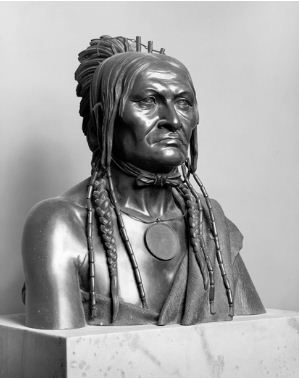
Be Sheekee: A Chippewa Warrior from the Sources of the Mississippi, bronze, by Joseph Lassalle after Francis Vincenti, House wing of the United States Capitol (U.S. Capitol Historical Society).
“A Chippewa Warrior from the Sources of the Mississippi”
There is no image that has been more widely identified with Chief Buffalo from La Pointe than the marble bust and bronze copy in the U.S. Capitol Building in Washington D.C. Red Cliff leaders make a point of visiting the statues on trips to the capital city, the tribe uses the image in advertising and educational materials, and literature from the United States Senate about the bust includes a short biography of the La Pointe chief.
I can trace the connection between the bust and the La Pointe chief to 1973, when John O. Holzhueter, editor of the Wisconsin Magazine of History wrote an article for the magazine titled Chief Buffalo and Other Wisconsin-Related Art in the National Capitol. From Holzhueterʼs notes we can tell that in 1973, the rediscovery of the story of the La Pointe Buffalo was just beginning at the Wisconsin Historical Society (the publisher of the magazine). Holzhueter deserves credit for helping to rekindle interest in the chief. However, he made a critical error.

English: Aysh-ke-bah-ke-ko-zhay ojibwa chief (Photo credit: Wikipedia)
In the article he briefly discusses Eshkibagikoonzhe (Flat Mouth), the chief of the Leech Lake or Pillager Ojibwe from northern Minnesota. Roughly the same age as Buffalo, Flat Mouth is as prominent a chief in the history of the upper Mississippi as Buffalo is for the Lake Superior bands. Had Holzhueter investigated further into the life of Flat Mouth, he may have discovered that at the time the bust was carved, the Pillagers had another leader who had risen to prominence, a war chief named Buffalo.
Holzhueter clearly was not aware that there was more than one Buffalo, and thus, he had to invent facts to make the history fit the art. According to the article (and a book published by Holzhueter the next year) the La Pointe Buffalo visited President Pierce in Washington in January of 1855. Buffalo did visit Washington in 1852 in the aftermath of the Sandy Lake Tragedy, but the old chief was nowhere near Washington in 1855. In fact, he was at home on the island in declining health having secured reservations for his people in Wisconsin the previous summer. He would die in September of 1855. The Buffalo who met with Pierce, of course, was the war chief from Leech Lake.
“He wore in his headdress 5 war-eagle feathers“
The Pillager Buffalo was in Washington for treaty negotiations that would transfer most of the remaining Ojibwe land in northern Minnesota to the United States and create reservations at the principal villages. The minutes of the February 1855 negotiations between the Minnesota chiefs and Indian Commissioner George Manypenny are filled with Ojibwe frustration at Manypennyʼs condescending tone. The chiefs, included the powerful young Hole-in-the-Day, the respected elder Flat Mouth, and Buffalo, who was growing in experience and age, though he was still considerably younger than Flat Mouth or the La Pointe Buffalo. The men were used to being called “red children” in communications with their “fathers” in the government, but Manypennyʼs paternalism brought it to a new low. Buffalo used his clothing to communicate to the commissioner that his message of assimilation to white ways was not something that all Ojibwes desired. Manypennyʼs words and Buffaloʼs responses as interpreted by the mix- blooded trader Paul Beaulieu follow:
The commissioner remarked to Buffalo, that if he was a young man he would insist upon his dispensing with his headdress of feathers, but that, as he was old, he would not disturb a custom which habit had endeared to him.
Buffalo repoled ithat the feathered plume among the Chippewas was a badge of honor. Those who were successful in fighting with or conquering their enemies were entitled to wear plumes as marks of distinction, and as the reward of meritorious actions.The commissioner asked him how old he was.
Buffalo said that was a question which he could not answer exactly. If he guessed right, however, he supposed he was about fifty. (He looked, and was doubtless, much
older).Commissioner. I would think, my firend, you were older than that. I would like to philosophise with you about that headdress, and desired to know if he had a farm, a house, stock, and other comforts about him.
Buffalo. I have none of those things which you have mentioned. I live like other members of the tribe.
Commissioner. How long have you been in the habit of painting—thirty years or more?
Buffalo. I can not tell the number of years. It may have been more or it may have been less. I have distinguished myself in war as well as in peace among my people and the whites, and am entitled to the distinction which the practice implies.
Commissioner. While you, my firend, have been spending your time and money in painting your face, how many of your white brothers have started without a dollar in the world and acquired all those things mentioned so necessary to your comfort and independent support. The paint, with the exception of what is now on my friend’s face, has disappeared, but the white persons to whom I alluded by way of contrast are surrounded by all the comforts of life, the legitimate fruits of their well-directed industry. This illustrates the difference between civilized and savage life, and the importance of our red brothers changing their habits and pursuits for those of the white.

Major General Montgomery C. Meigs was a Captain before the Civil War and was in charge of the Capitol restoration, As with Thomas McKenney in the 1820s, Meigs was hoping to capture the look of the “vanishing Indian.” He commissioned the busts of the Leech Lake chiefs during the 1855 Treaty negotiations. (Wikimedia Images)
While Manypenny clearly did not like the Ojibwe way of life or Buffaloʼs style of dress, it did catch the attention of the authorities in charge of building an extension on the U.S. Capitol. Captain Montgomery Meigs, the supervisor, had hired numerous artists and much like Thomas McKenney two decades earlier, was looking for examples of the indigenous cultures that were assumed to be vanishing. On February 17th, Meigs received word from Seth Eastman that the Ojibwe delegation was in town.
The Captain met Bizhiki and described him in his journal:
“He is a fine-looking Indian, with character strongly marked. He wore in his headdress 5 war-eagle feathers, the sign of that many enemies put to death by his hand, and sat up, an old murderer, as proud of his feathers as a Frenchman of his Cross of the Legion of Honor. He is a leading warrior rather than a chief, but he has a good head, one which would not lead one, if he were in the Senate, to think he was not fit to be the companion of the wise of the land.”
Buffalo was paid $5.00 and sat for three days with the skilled Italian sculptor Francis Vincenti. Meigs recorded:
“Vincenti is making a good likeness of a fine bust of Buffalo. I think I will have it put into marble and placed in a proper situation in the Capitol as a record of the Indian culture. 500 years hence it will be interesting.”
Vincenti first formed clay models of both Buffalo and Flat Mouth. The marbles would not be finished until the next year. A bronze replica of Buffalo was finished by Joseph Lassalle in 1859. The marble was put into the Senate wing of the Capitol, and the bronze was placed in the House wing.
Clues in the Marble
The sculptures themselves hold further clues that the man depicted is not the La Pointe Buffalo. Multiple records describe the La Pointe chief as a very large man. In his obituary, recorded the same year the statue was modeled, Morse writes:
Any one would recognize in the person of the Buffalo chief, a man of superiority. About the middle height, a face remarkably grave and dignified, indicating great thoughtfulness; neat in his native attire; short neck, very large head, and the most capacious chest of any human subject we ever saw.
At the time of his death, he was thought to have been over ninety years old. The man in the sculpture is lean and not ninety. In addition, there is another clue that got by Holzhueter even though he printed it in his article. There is a medallion around the neck of the bronze bust that reads, “Beeshekee, the BUFFALO; A Chippewa Warrior from the Sources of the Mississippi…” This description works for a war chief from Leech Lake, but makes no sense for a civil chief and orator from La Pointe.
Another Image of the Leech Lake Bizhiki

Be-She-Kee (Buffalo), Head Chief of the Leech Lake Chippewas (Whitney and Zimmerman St. Paul)
The Treaty of 1855 was signed on February 22, and the Leech Lake chiefs returned to Minnesota. By the outbreak of the Civil War, Flat Mouth had died leaving Buffalo as the most prominent Pillager chief. Indian-White relations in Minnesota grew violent in 1862 as the U.S.- Dakota War (also called the Sioux Uprising) broke out in the southern part of the state. The Gull Lake chief, Hole in the Day, who had claimed the title of head of the Ojibwes, was making noise about an Ojibwe uprising as well. When he tried to use the Pillagers in his plan, Buffalo voiced skepticism and Hole in the Dayʼs plans petered out. In 1863, Buffalo returned to Washington for a new treaty. Ironically, he was still very much alive in the midst of complicated politics in a city where his bust was on display as monument to the vanishing race.
At some point during these years, the Pillager Buffalo had his photograph taken by Whitneyʼs Gallery in St. Paul. Although the La Pointe Buffalo was dead by this time, internet sites will occasional connect it with him even with an original caption that reads “Head Chief of the Leech Lake Chippewas.”
The Verdict
Although it wasn’t the outcome I was hoping for, my research leads me to definitively conclude that the busts in the U.S. Capitol are of Buffalo the Leech Lake war chief. It’s disappointing for our area to lose this Washington connection, but our loss it Leech Lake’s gain. Though less well-known than the La Pointe band’s chief, their chief Buffalo should also be remembered for his role in history.
Not Chief Buffalo from La Pointe: This is Chief Buffalo from Leech Lake.

Not Chief Buffalo from La Pointe: This is Chief Buffalo from Leech Lake.
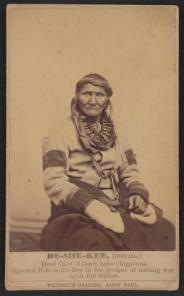
Not Chief Buffalo from La Pointe: This is Chief Buffalo from Leech Lake.
 Chequamegon History