American Fur Company: 1834 Reinvention of La Pointe
October 4, 2023
Collected & edited by Amorin Mello
The below image from the Wisconsin Historical Society is a storymap showing La Pointe in 1834 as abstract squiggles on an oversized Madeline Island surrounded by random other Apostle Islands, Bayfield Peninsula, Houghton Point, Chequamegon Bay, Long Island, Bad River, Saxon Harbor, and Montreal River.

“Map of La Pointe”
“L M Warren”
“~ 1834 ~”
Wisconsin Historical Society
citing an original map at the New York Historical Society
My original (ongoing) goal for publishing this post is to find an image of the original 1834 map by Lyman Marcus Warren at the New York Historical Society to explore what all of his squiggles at La Pointe represented in 1834. Instead of immediately achieving my original goal, this post has become the first of a series exploring letters in the American Fur Company Papers by/to/about Warren at La Pointe.
New York Historical Society
American Fur Company Papers: 1831-1849
America’s First Business Monopoly
#16,582

Map of Lapointe
by L M Warren
~ 1834 ~
New York Historical Society
scanned as Gale Document Number GALE|SC5110110218
#36

Ramsay Crooks
~ Madeline Island Museum
Lapointe Lake Superior
September 20th ’34
Ramsey Crooks Esqr
Dear Sir
Starting in 1816, the American Fur Company (AFC) operated a trading post by the “Old Fort” of La Pointe near older trading posts built by the French in 1693 and the British in 1793.
In 1834, John Jacob Astor sold his legendary AFC to Ramsay Crooks and other trading partners, who in turn decided to relocate the AFC’s base of operations at Mackinac Island to Madeline Island, where our cartographer Lyman Marcus Warren was employed as the AFC’s trader at La Pointe.
Instead of improving any of the older trading posts on Madeline Island, Warren decided to move La Pointe to the “New Fort” of 1834 to build new infrastructure for growing business demands.

GLO PLSS 1852 survey detail of the “Am Fur Co Old Works” near Old Fort.
on My Way In as Mr Warren was was detained So Long at Mackinac I did not Wait for him at this Place as time was of So Much Consequence to me to Get my People Into the County that I Proceeded Immediately to Fond Du Lac with the Intention with the Intention of Returning to this Place When I Had Sent the Outfit off but When I Got There I Had News from the Interior Which Required me to Go In and Settle the Business there; the [appearance?] In the Interior for [????] is tolerable. Good Provision there is [none?] Whatever I [have?] Seen the [Country?] [So?] Destitute. The Indians at [Fort?] [?????] Disposed to give me Some trouble when they found they have to Get no Debts and buy their amunition and tobacco and not Get it For Nothing as usual but at Length quieted down [?????] and have all gone off to their Haunts as usual.
I Received your Instructions contained in your Circular and will be very Particular In Following them. The outfits were all off when I Received them but the men’s acts and the Invoices of the Goods Had all been Settled according to your Wishes and Every Care Will be taken not to allow the men to get In Debt the Clerks Have Strict orders on the Subject and it is made known to them that they will be Held for any of the Debts the men may Incur.
I Enclose to you the Bonds Signed and all the Funds we Received from Mr Johnston Excepting those Which Had been given to the Clerks and I could not Get them Back In time to Send them on at Present.
Mr Warren And myself Have Committed on What is to be done at this Place and I am certain all that Can be done Will be done by him. I leave here tomorrow For the Interior of Fond Du Lac Where I must be as Soon as possible.
I have written to Mr Schoolcraft as he Inquested me. Mr Brewster’s men would not Give up their [??????] and [???] [????] is [??] [?????] [????] [????] [to?] [???????] [?????] [to?] [persuade?] [more?] People for Keeping [his?] [property?] [Back?] [and] [then?] [???] by some [???] ought to be sent out of the Country [??] they are [under?] [the?] [???] [?] and [Have?] [no?] [Right?] to be [????] [????] they are trouble [????] [???] [their?] [tongues?].

GLO PLSS 1852 survey detail of the AFC’s new “La Point” (New Fort) and the ABCFM’s “Mission” (Middleport).
The Site Selected Here For the Buildings by Mr Warren is the Best there is the Harbour is good and I believe the work will go on well.
as For the Fishing we Will make Every Inquiry on the Subject and I Have no Doubt on My Mind of Fairly present that it will be more valuable than the Fur trade.
In the Month of January I will Write you Every particular How our affairs stand from St Peters. Bailly Still Continues to Give our Indians Credits and they Bring Liquor from that Place which they Say they Get from Him.
Please let Me know as Early as possible with Regard to the Price of Furs as it will Help me In the trade. the Clerks all appear anxious to do their Duty this year as the wind is now Falling and I am In Haste I Will Write you Every particular of our Business In January.
Wishing that God may Long Prosper you and your family.
In health and happiness.
I remain most truly,
and respectfully
yours $$
William A. Aitken
#42
Lake Superior
LaPointe Oct 16 1834
Ramsey Crooks Esqr
Agent American Fur Co
Honoured Sir
Your letter dated Mackinac Sept [??] reached me by Mr Chapman’s boat today.-
I will endeavour to answer it in such a manner as will give you my full and unreserved opinion on the different subjects mentioned in it.
I feel sorry to see friend Holiday health so poor, and am glad that you have provided him a comfortable place at the Sault. As you remark it is a fortunate circumstance that we have no opposition this year or we would certainly have made a poor resistance. I can see no way on which matters would be better arranged under existing circumstances than the way in which you have arranged it. If Chaboillez, and George will act in unison and according to your instructions, they will do well, but I am somewhat affeared, that this will not be the case, as I think George might perhaps from jealously refuse to obey Chaboillez or give him the proper help. Our building business prevents me from going there myself. I suppose you have now received my letter of last Sept, in which I mentioned that I had kept the Doctor here. I shall send him in a few days to see how matters comes on at the Ance. The Davenports are wanted at present in FDLac should it be necessary to make any alteration. I shall leave the Doctor at the Ance.

Undated photograph of the ABCFM Presbyterian Mission Church at it’s original 1830s location along the shoreline of Sandy Bay.
~ Madeline Island Museum

Reverend Sherman Hall
~ Madeline Island Museum
In addition to the AFC’s new La Pointe, Warren was also committed to the establishment of a mission for the American Board of Commissioners for Foreign Missions (ABCFM) as a condition of his 1827 Deed for Old La Pointe from his Chippewa wife’s parents; Madeline & Michel Cadotte.
Starting in 1830, the ABCFM built a Mission at La Pointe’s Middleport (second French fort of 1718), where they were soon joined by a new Catholic Mission in 1835.
Madeline Island was still unceded territory until the 1842 Treaty of La Pointe. The AFC and ABCFM had obtained tribal permissions to build here via Warren’s deed, while the Catholics were apparently grandfathered in through French bloodlines from earlier centuries.
I think we will want about 2 Coopers but as you suggest I if they may be got cheaper than the [????] [????]. The Goods Mr Hall has got is for his own use that is to say to pay his men [??]. The [??] [??????] [has?] to pay for a piece of land they bot from an Indian woman at Leech Lake. As far as my information goes the Missionaries have never yet interfered with our trade. Mr Hall’s intention is to have his establishment as much disconnected with regular business as he possibly can and he gets his supplies from us.
[We?] [have?] received the boxes [Angus?] [??] [???]. [You?] mention also a box, but I have not yet received it. Possible it is at the Ance.
The report about Dubay has no doubt been exaggerated. When with me at the Ance he mentioned to me that Mr Aitkin told him he had better tell the Indians not to kill their beaver entirely off and thereby ruin their country. The idea struck me as a good one and as far as I recollect I told him, it would perhaps be good to tell them so. I have not yet heard from any one, that he has tried to prevent the Indians from paying their old Debts and I should not be astonished to fend the whole is one of those falsehoods which Indians are want to use to free themselves from paying old Debts. I consider Dubay a pretty active man, but the last years extravagancies have made it necessary to have an eye upon him to prevent him from squandering.

“The Doctor” Charles William Wulff Borup, M.D.
~ Madeline Island Museum
My health had been somewhat impaired by my voyage from the Sault to this place. Instead of going to Lac Du Flambeau myself as I intended I sent the Doctor. He has just now returned and tells me that Dubay gets along pretty well, though there were some small difficulties which toke place, but which the Dr settled. The prospect are very discouraging, particularly on a/c of provisions. We have plenty opposition and all of them with liquor in great abundance. It is provoking to see ourselves restricted by the laws from taking in liquor while our opponents deal in it as largely as ever. The traders names are as far as could be ascertained Francois Charette and [Chapy?]. The liquor was at Lac du Flambeau while the Doctor was there. I have furnished Dubay with means to procure provisions, as there is actually not 1 Sack of Corn or Rice to be got.
The same is the case on Lac Courtoreilie and Folleavoigne no provisions and a Mr Demarais on the Chippeway River gives liquor to the Indians.
You want my ideas upon the fishing business. If reliance can be put in Mr Aitkin’s assertions we will at least want the quantity of Net thread mentioned in our order. Besides this we will want for our fishing business 200 Barrels Flour, [??] Barrels Pork, 10 Kegs Butter, 1000 Bushels Corn, [??] Barrels Lard, 10 or 11 Barrels Tallow.

Undated photograph of the ABCFM mission house built in 1832.
~ Madeline Island Museum
Besides this we want over and above the years supply an extra supply for our summer Establishments. say about 80 Barrels Flour, 30 Barrels Pork, 1500 # Butter, 400 Bushels Corn, 5 Barrels Lard, 5 Barrels Tallow. This will is partly to sell. be sold.
Mr Roussain will be as good as any if not better in my opinion for our business than Holiday. Ambrose Davenport might take the charge of the Ance but Roussain will be more able on account of his knowledge in fishing. I would recommend to take him as a partner. say take Holidays share if he could not be got for less.
I have not done much yet toward building. The greatest part of my men have been in the exterior to assist our people to get in. But they have now all arrived. We have got about 4 acres of land cleared, a wintering house put up and a considerable quantity of boards sawed. Mr Aitkin did not supply me with two Carpenters as he promised at Mackinac. I will try to get along as well as I can without them. I engaged Jos Dufault and Mr Aitkin brot me one of Abbott’s men, who he engaged. But I will still be under the necessity of hiring Mr Campbell of the mission to make our windows sashes and to superintend The framing of the buildings. Mr Aitkins have done us considerable damage by not fulfilling his promise in this respect. I told you in Mackinac that Mr Aitkin was far from being exact in business. Your letter to him I will forward by the first opportunity. I think it will have a good effect and you do right in being thus plain in stating your views. His contract deserves censure, and I will hope that your plain dealing with him will not be lost upon him. Shall I beg you to be as faithfull to me by giving me the earliest information whenever you might disapprove of any transaction of mine.
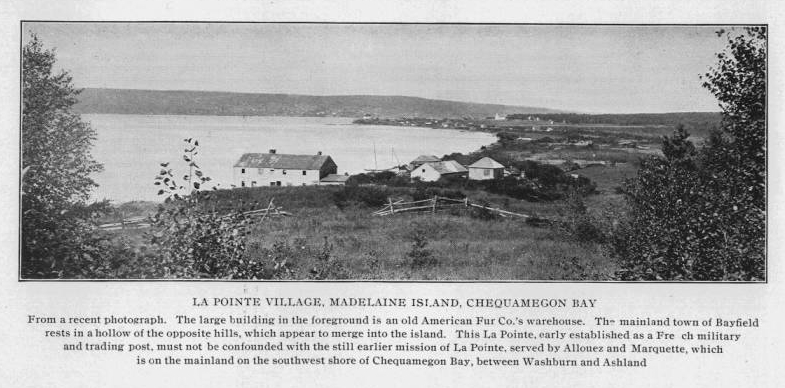
Photograph of La Pointe from Mission Hill circa 1902.
~ Wisconsin Historical Collections, Volume XVI, page 80.
I have received a supply of provisions from Mr Chapmann which will enable me to get through this season. The [?] [of?] [???] [next?], the time you have set for the arrival of the Schooner, will be sufficient, early for our business. The Glass and other materials for finishing of the buildings would be required to be sent up in the first trip but if [we?] [are?] [??] better to have them earlier. If these articles could be sent to the Sault early in the Spring a boat load might be formed of [Some?] and Provisions and sent to the Ance. From there men could be spared at that season of the year to bring the load to this place. In that way there would be no heavy expense incurred and I would be able to have the buildings in greater forwardness.
If the plan should meet your approbation please let me know by the winter express. While Mr Aitkin was here we planned out our buildings. The House will be 86 feet by 26 feet in the clear, the two stores will be put up agreeable to your Draft. We do not consider them to large.
I am afraid I shall not be able to build a wharf in season, but shall do my best to accomplish all that can be done with the means I have.

Undated photograph of Captain John Daniel Angus’ boat at the ABCFM mission dock.
~ Madeline Island Museum
I would wish to call your attention towards a few of the articles in our trade. I do not know how you have been accustomed to buy the Powder whether by the Keg or pound. If a keg is estimated at 50#, there is a great deception for some of our kegs do not contain more than 37 or 40 #s.
Our Guns are very bad particularly the barrels. They splint in the inside after been fired once or twice.
Our Holland twine is better this year than it has been for Years. One dz makes about 20 fathoms, more than last year. But it would be better if it was bleached. The NW Company and old Mr Ermantinger’s Net Thread was always bleached. It nits better and does not twist up when put into the water. Our maitre [??] [???] are some years five strand. Those are too large we have to untwist them and take 2 strands out. Our maitre this year are three strand they are rather coarse but will answer. They are not durable nor will they last as long as the nets of course they have to be [renewed?]. The best maitres are those we make of Sturgeon twine. We [?????] the twine and twist it a little. They last twice as long as our imported maitres. The great object to be gained is to have the maitres as small as possible if they be strong enough. Three coarse strands of twisted together is bulky and soon nits.
Our coarse Shoes are not worth bringing into the country. Strong sewed shoes would cost a little more but they would last longer. The [Booties?] and fine Shoes are not much better.
Our Teakettles used to have round bottoms. This year they are flat. They Indians always prefer the round bottom.
In regard to the observations you have made concerning the Doctor’s deviating from the instructions I gave him on leaving Mackinac, I must in justice to him say that I am now fully convinced in my own mind that he misunderstood me entirely, merely by an expression of mine which was intended by me in regard to his voyage from Mackinac to the Sault but by him was mistaken for the route through Lake Superior. The circumstances has hurt his feelings much and as he at all times does his best for the Interest of the Outfit I ought to have mentioned in my last letter, but it did not strike my mind at that time.

Detail from Carte des lacs du Canada by Jacques Nicolas Bellin in 1744.
When Mr Aitkin was here he mentioned to me some information he had obtained from somebody in Fond du Lac who had been in the NW Co service relating to a remarkable good white fish fishery on the “Milleau” or “Millons” Islands (do not know exactly the proper name). They lay right opposite to Point Quiwinau. a vessel which passes between the island and the point can see both. Among Mr Chapmann’s crew here there is an old man who tells me that he knew the place well, he says the island is large, say 50 or 60 miles. The Indian used to make their hunts there on account of the great quantity of Beaver and Reindeer. It is he says where the NWest Co used to make their fishing for Fort William. There is an excellent harbour for the vessel it is there where the largest white fish are caught in Lake Superior. Furthermore the old man says the island is nearer the American shore than the English. Some information might be obtained from Capt. McCargo. If it proves that we can occupy the grounds I have the most sanguine hopes that we shall succeed in the fisheries upon a large scale.
I hope you will gather all the information you can on the subject. Particular where the line runs. If it belongs to the Americans we must make a permanent post on the Island next year under the charge of an active person to conduct the fisheries upon a large scale.
Jh Chevallier one of the men I got in Mackinac is a useless man, he has always been sick since he left Sault. Mr Aitkin advised me to send him back in Chapman’s Boat. I have therefore send him out to the care of Mr Franchere.
By the Winter Express I will to give you all the informations that I may be able to give. I will close by wishing you great health and prosperity. Please present my Respects to Mr Clapp.
I remain Dear Sir.
Very Respectfully Yours
Most Obedient Servant
Lyman M. Warren
To be Continued in 1835…
1837 Petitions from La Pointe to the President
January 29, 2023
Collected & edited by Amorin Mello
Letters Received by the Office of Indian Affairs:
La Pointe Agency 1831-1839
National Archives Identifier: 164009310
O. I. A. La Pointe J171.
Hon Geo. W. Jones
Ho. of Reps. Jany 9, 1838
Transmits petition dated 31st Augt 1837, from Michel Cadotte & 25 other Chip. Half Breeds, praying that the amt to be paid them, under the late Chip. treaty, be distributed at La Pointe, and submitting the names of D. P. Bushnell, Lyman M. Warren, for the appt of Comsr to make the distribution.
Transmits it, that it may receive such attention as will secure the objects of the petitioners, says as the treaty has not been satisfied it may be necessary to bring the subject of the petition before the Comsr Ind Affrs of the Senate.
Recd 10 Jany 1838
file
[?] File.
House of Representatives Jany 9th 1838

Sir
I hasten to transmit the inclosed petition, with the hope, that the subject alluded to, may receive such attention, as to secure the object of the petitioners. As the Chippewa Treaty has not yet been ratified it may be necessary to bring the subject of the petition before the Committee of Indian Affairs of the Senate.
I am very respectfully
Your obt svt
Geo W. Jones
C. A. Harris Esqr
Comssr of Indian Affairs
War Department

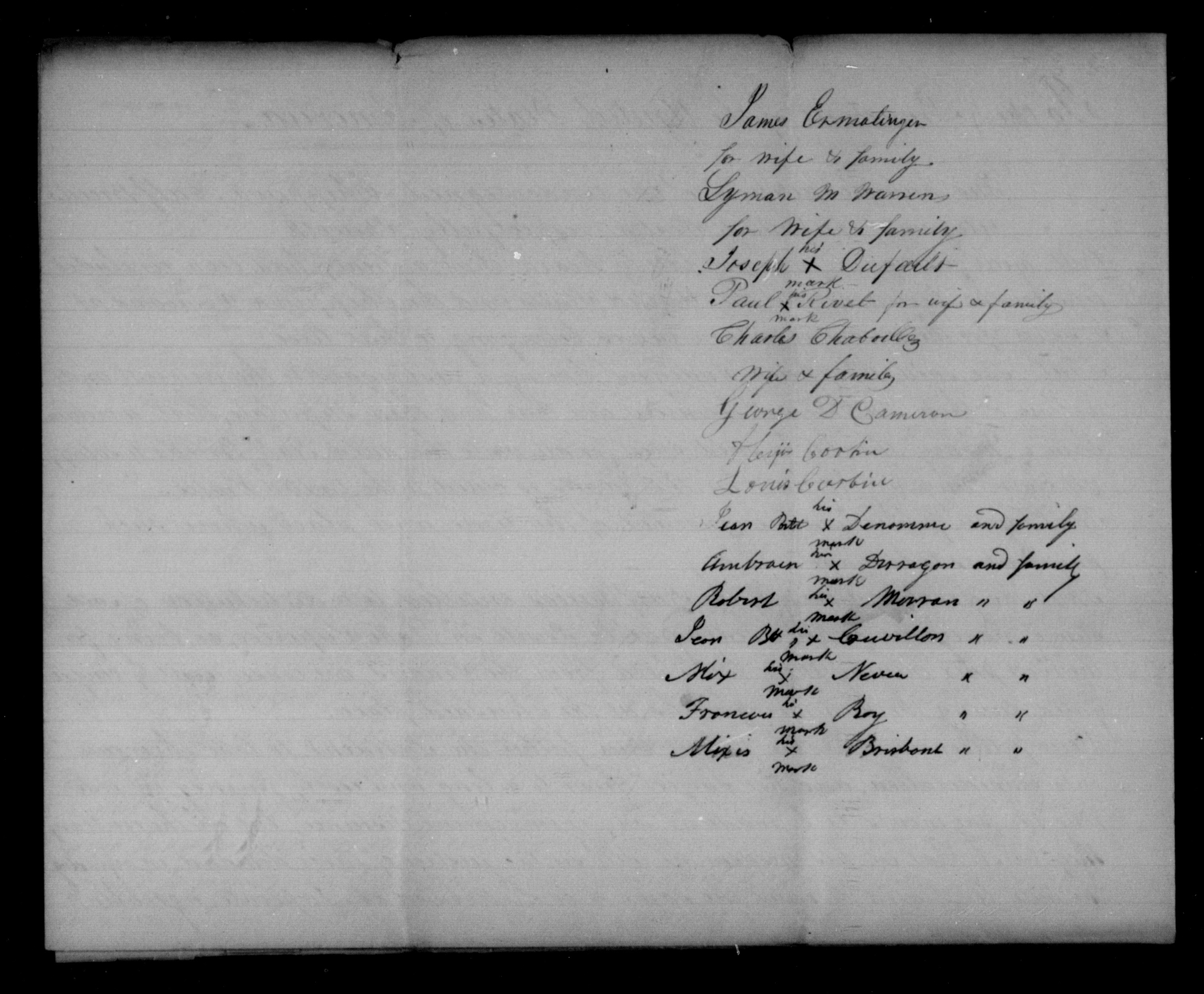
To the President of the United States of America
The humble petition of the undersigned Chippewa Half-Breeds citizens of the United Sates, respectfully Shareth:

Bizhiki (Buffalo), Dagwagaane (Two Lodges Meet), and Jechiikwii’o (Snipe, aka Little Buffalo) signed the 1837 Treaty of St Peters for the La Pointe Band.
That, your petitioners having lately heard that a Treaty had been concluded between the Government of the United Sates and the Chippewa Indians at St Peters, for the cession of certain lands belonging to that tribe:
ARTICLE 3.
“The sum of one hundred thousand dollars shall be paid by the United States, to the half-
breeds of the Chippewa nation, under the direction of the President. It is the wish of the
Indians that their two sub-agents Daniel P. Bushnell, and Miles M. Vineyard, superintend
the distribution of this money among their half-breed relations.”
That, the said Chippewa Indians X, having a just regard to the interest and welfare of their Half Breed brethren, did there and then stipulate; that, a certain sum of money should be paid once for all unto the said Half-Breeds, to satisfy all claim they might have on the lands so ceded to the United States.
That, your petitioners are ignorant of the time and place where such payment is to be made.
That the great majority of the Half-Breeds entitled to a distribution of said sum of money, are either residing at La Pointe on Lake Superior, or being for the most part earning their livelihood from the Traders, are consequently congregated during the summer months at the aforesaid place.
Your petitioners humbly solicit their father the President, to take their case into consideration, and not subject them to a long and costly journey in ordering the payments to be made at any inconvenient distance, but on the contrary they trust that in his wisdom he will see the justice of their demand in requiring he will be pleased to order the same to be distributed at Lapointe agreeable to their request.
Your petitioners would also intimate that, although they are fully aware that the Executive will make a judicious choice in the appointment of the Commissioners who will be selected to carry into effect the Provisions of said Treaty, yet, they would humbly submit to the President, that they have full confidence in the integrity of D. P. Bushnell Esqr. resident Indian Agent for the United States at this place and Lyman M Warren Esquire, Merchant.
Your petitioners entertain the flattering hope, that, their petition will not be made in vain, and as in duty bound will ever pray.
La Pointe, Lake Superior,
Territory of Wisconsin 31st August 1837
Michel Cadotte
Michel Bosquet X his mark
Seraphim Lacombe X his mark
Joseph Cadotte X his mark
Antoine Cadotte X his mark
Chs W Borup for wife & Children
A Morrison for wife & children
Pierre Cotte
Henry Cotte X his mark
Frances Roussan X his mark
James Ermatinger for wife & family
Lyman M Warren for wife & family
Joseph Dufault X his mark
Paul Rivet X his mark for wife & family
Charles Chaboullez wife & family
George D. Cameron
Alixis Corbin
Louis Corbin
Jean Bste Denomme X his mark and family
Ambrose Deragon X his mark and family
Robert Morran X his mark ” “
Jean Bst Couvillon X his mark ” “
Alix Neveu X his mark ” “
Frances Roy X his mark ” “
Alixis Brisbant X his mark ” “
Signed in presence of G. Pauchene
John Livingston
O.I.A. La Pointe W424.
Governor of Wisconsin
Mineral Pt. Feby 19, 1838
Transmits the talk of “Buffalo,” a Chip. Chief, delivered at the La Pointe SubAgt, Dec. 9, 1837, asking that the am. due the half-breeds under the late Treaty, be divided fairly among them, & paid them there, as they will not go to St Peters for it, &c.
Says Buffalo has great influence with his tribe, & is friendly to the whites; his sentiments accord with most of those of the half-breeds & Inds in that part of the country.
File
Recd 13 March 1838
[?] File.
Superintendency of Indian Affairs
for the Territory of Wisconsin
Mineral Point, Feby 19, 1838

Sir,
I have the honor to inclose the talk of “Buffalo,” a principal chief of the Chippewa Indians in the vicinity of La Pointe, delivered on the 9th Dec’r last before Mr Bushnell, sub-agent of the Chippewas at that place. Mr. Bushnell remarks that the speech is given with as strict an adherence to the letter as the language will admit, and has no doubt the sentiments expressed by this Chief accord with those of most of the half-breeds and Indians in that place of the Country. The “Buffalo” is a man of great influence among his tribe, and very friendly to the whites.
Very respectfully,
Your obed’t sevt.
Henry Dodge
Supt Ind Affs
Hon C. A. Harris
Com. of Ind. Affairs
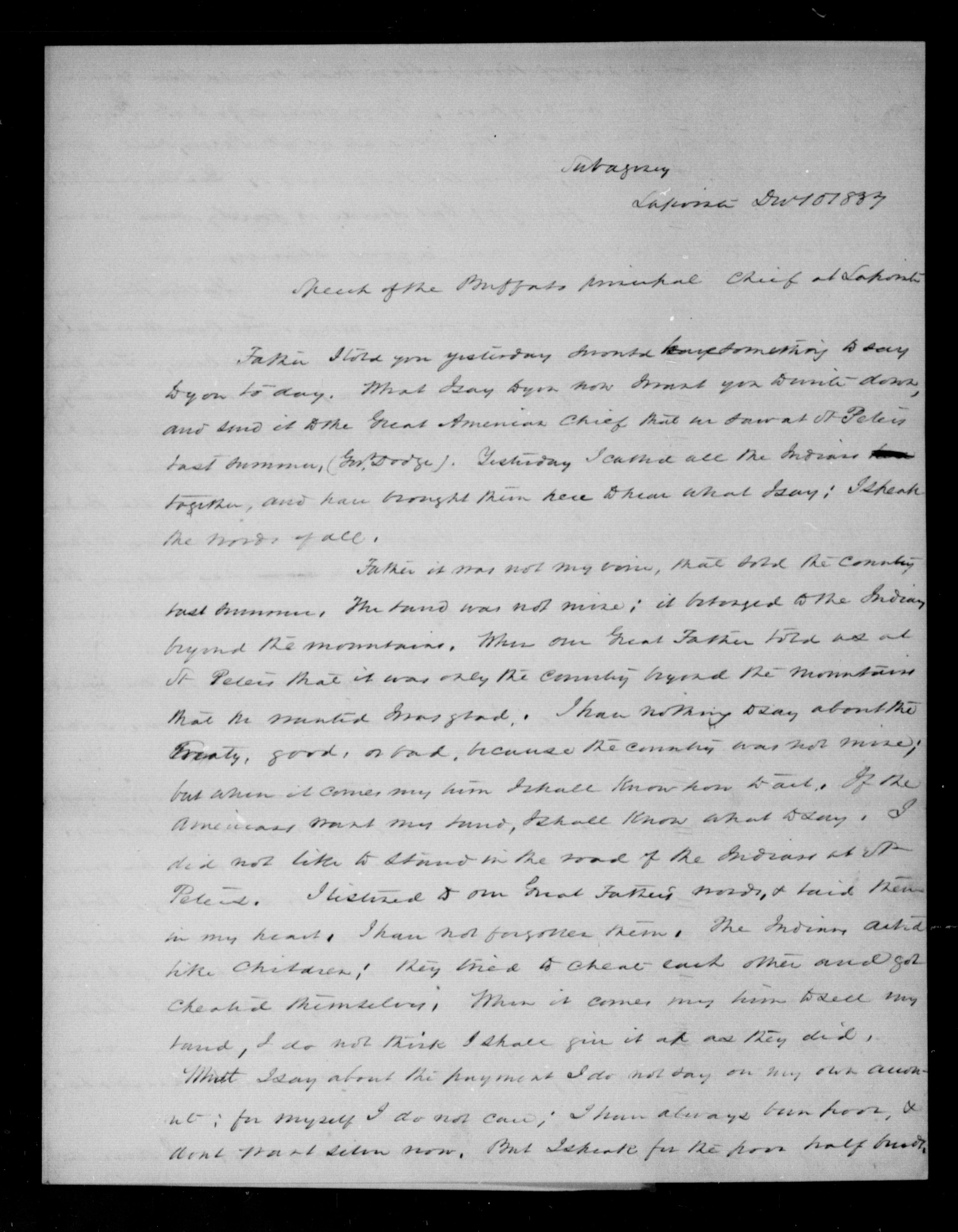
Subagency
Lapointe Dec 10 1837
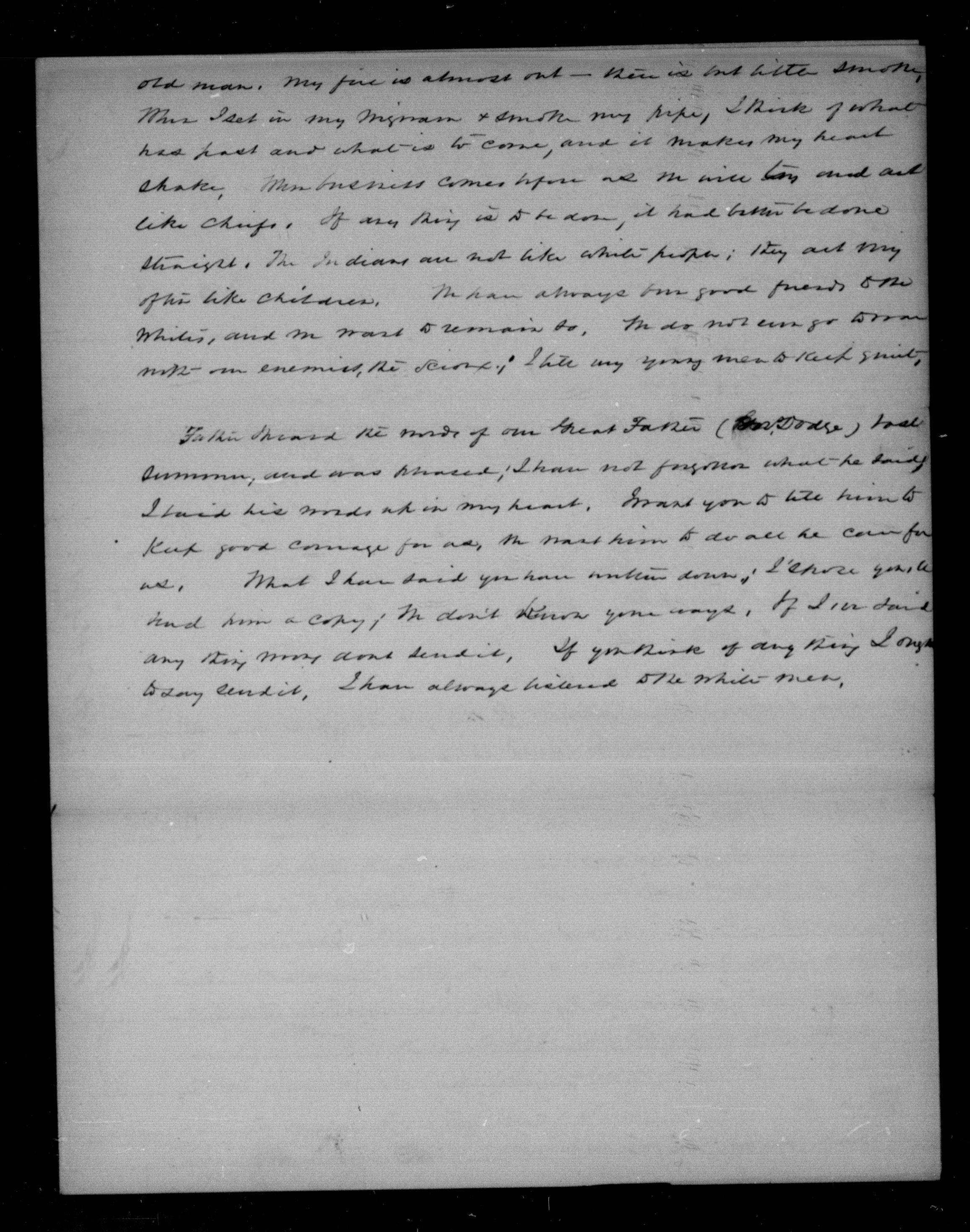
Speech of the Buffalo principal Chief at Lapointe
Father I told you yesterday I would have something to say to you today. What I say to you now I want you to write down, and send it to the Great American Chief that we saw at St Peters last summer, (Gov. Dodge). Yesterday, I called all the Indians together, and have brought them here to hear what I say; I speak the words of all.
ARTICLE 1.
“The said Chippewa nation cede to the United States all that tract of country included
within the following boundaries:
[…]
thence to and along the dividing ridge between the waters of Lake Superior and those of the Mississippi
[…]“
Father it was not my voice, that sold the country last summer. The land was not mine; it belonged to the Indians beyond the mountains. When our Great Father told us at St Peters that it was only the country beyond the mountains that he wanted I was glad. I have nothing to say about the Treaty, good, or bad, because the country was not mine; but when it comes my time I shall know how to act. If the Americans want my land, I shall know what to say. I did not like to stand in the road of the Indians at St Peters. I listened to our Great Father’s words, & said them in my heart. I have not forgotten them. The Indians acted like children; they tried to cheat each other and got cheated themselves. When it comes my time to sell my land, I do not think I shall give it up as they did.
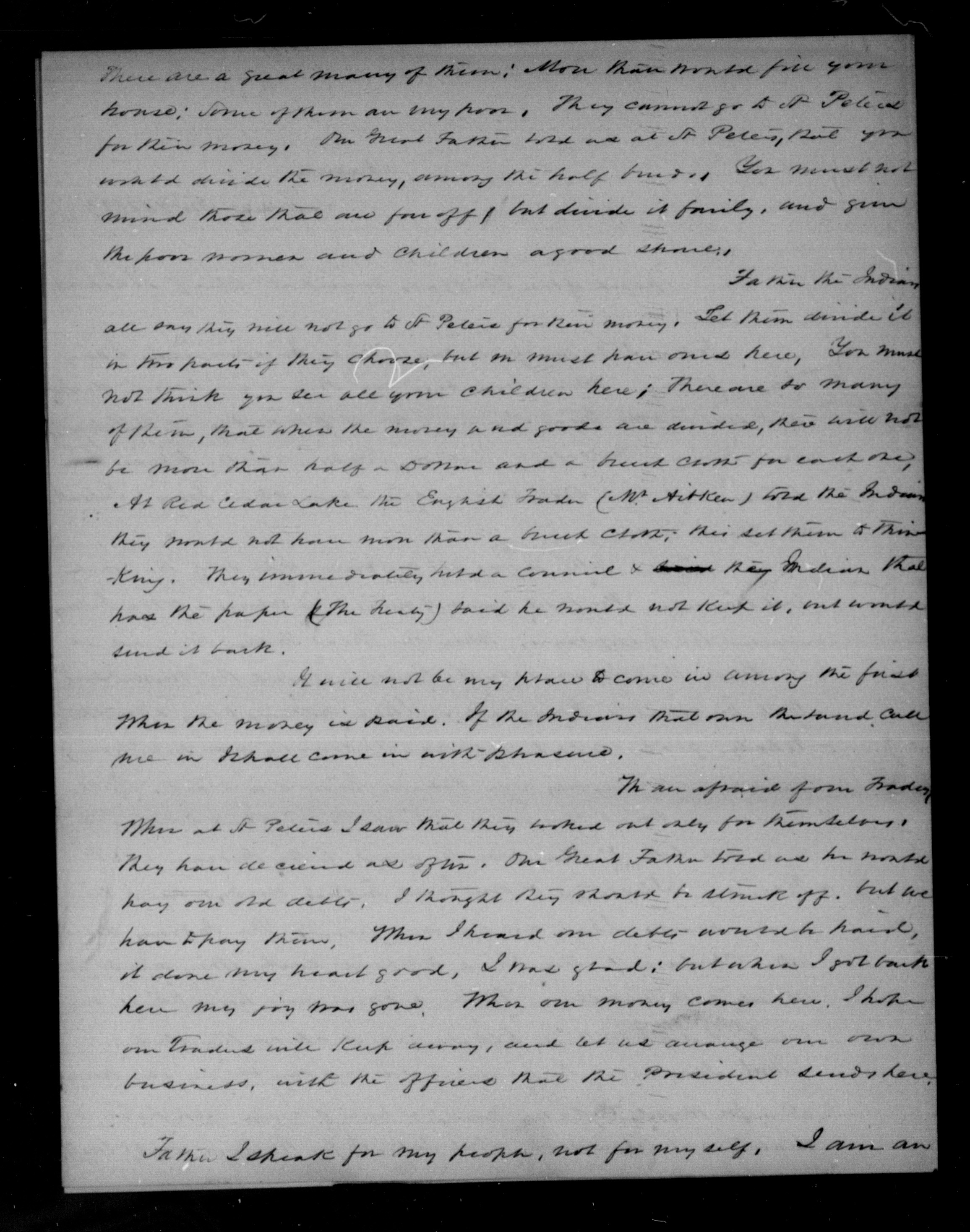
What I say about the payment I do not say on my own account; for myself I do not care; I have always been poor, & don’t want silver now. But I speak for the poor half breeds.
There are a great many of them; more than would fill your house; some of them are very poor They cannot go to St Peters for their money. Our Great Father told us at St Peters, that you would divide the money, among the half breeds. You must not mind those that are far off, but divide it fairly, and give the poor women and children a good share.
Father the Indians all say they will not go to St Peters for their money. Let them divide it in this parts if they choose, but one must have ones here. You must not think you see all your children here; there are so many of them, that when the money and goods are divided, there will not be more than half a Dollar and a breech cloth for each one. At Red Cedar Lake the English Trader (W. Aitken) told the Indians they would not have more than a breech cloth; this set them to thinking. They immediately held a council & their Indian that had the paper (The Treaty) said he would not keep it, and would send it back.
It will not be my place to come in among the first when the money is paid. If the Indians that own the land call me in I shall come in with pleasure.
ARTICLE 4.
“The sum of seventy thousand dollars shall be applied to the payment, by the United States, of certain claims against the Indians; of which amount twenty eight thousand dollars shall, at their request, be paid to William A. Aitkin, twenty five thousand to Lyman M. Warren, and the balance applied to the liquidation of other just demands against them—which they acknowledge to be the case with regard to that presented by Hercules L. Dousman, for the sum of five thousand dollars; and they request that it be paid.“
We are afraid of one Trader. When at St Peters I saw that they worked out only for themselves. They have deceived us often. Our Great Father told us he would pay our old debts. I thought they should be struck off, but we have to pay them. When I heard our debts would be paid, it done my heart good. I was glad; but when I got back here my joy was gone. When our money comes here, I hope our Traders will keep away, and let us arrange our own business, with the officers that the President sends here.
Father I speak for my people, not for myself. I am an old man. My fire is almost out – there is but little smoke. When I set in my wigwam & smoke my pipe, I think of what has past and what is to come, and it makes my heart shake. When business comes before us we will try and act like chiefs. If any thing is to be done, it had better be done straight. The Indians are not like white people; they act very often like children. We have always been good friends to the whites, and we want to remain so. We do not [even?] go to war with our enemies, the Sioux; I tell my young men to keep quiet.
Father I heard the words of our Great Father (Gov. Dodge) last summer, and was pleased; I have not forgotten what he said. I have his words up in my heart. I want you to tell him to keep good courage for us, we want him to do all he can for us. What I have said you have written down; I [?] you to hand him a copy; we don’t know your ways. If I [?] said any thing [?] dont send it. If you think of any thing I ought to say send it. I have always listened to the white men.
O.I.A. Lapointe, B.458
D. P. Bushnell
Lapointe, March 8, 1838
At the request of some of the petitioners, encloses a petition dated 7 March 1838, addressed to the Prest, signed by 167 Chip. half breeds, praying that the amt stipulated by the late Chip. Treaty to be paid to the half breeds, to satisfy all claims they ma have on the lands ceded by this Treaty, may be distributed at Lapointe.
Hopes their request will be complied with; & thinks their annuity should likewise be paid at Lapointe.
File
Recd 2nd May, 1838
Subagency
Lapointe Mch 6 1838
Sir
I have the honor herewith to enclose a petition addressed to the President of the United States, handed to me with a request by several of the petitioners that I would forward it. The justice of the demand of these poor people is so obvious to any one acquainted with their circumstances, that I cannot omit this occasion to second it, and to express a sincere hope that it will be complied with. Indeed, if the convenience and wishes of the Indians are consulted, and as the sum they receive for their country is so small, these should, I conciev, be principle considerations, their annuity will likewise as paid here; for it is a point more convenient of access for the different bands, that almost any other in their own country, and one moreover, where they have interests been in the habit of assembling in the summer months.
I am sir, with great respect,
your most obt servant,
D. P. Bushnell
O. I. A.
C. A. Harris Esqr.
Comr Ind. Affs
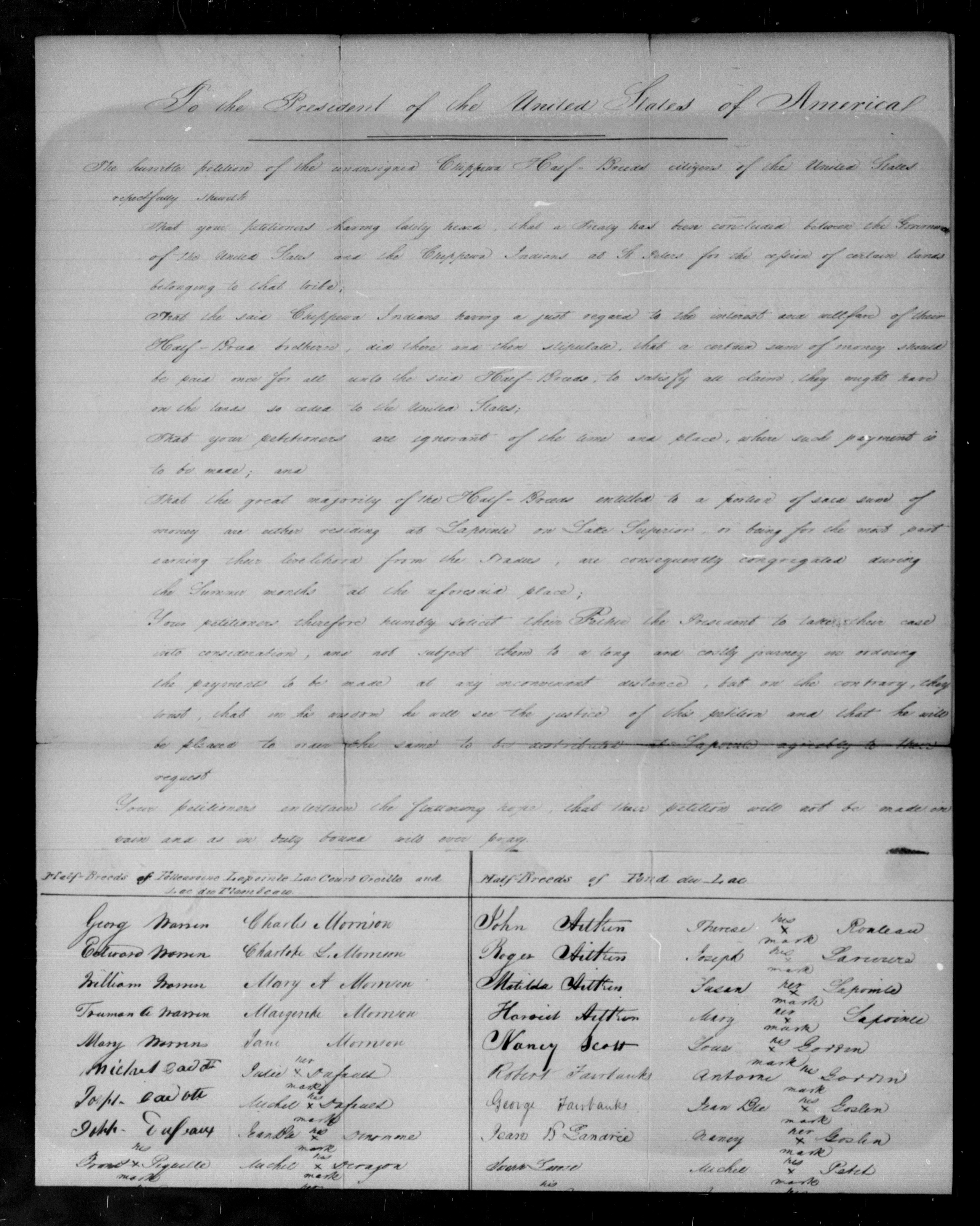
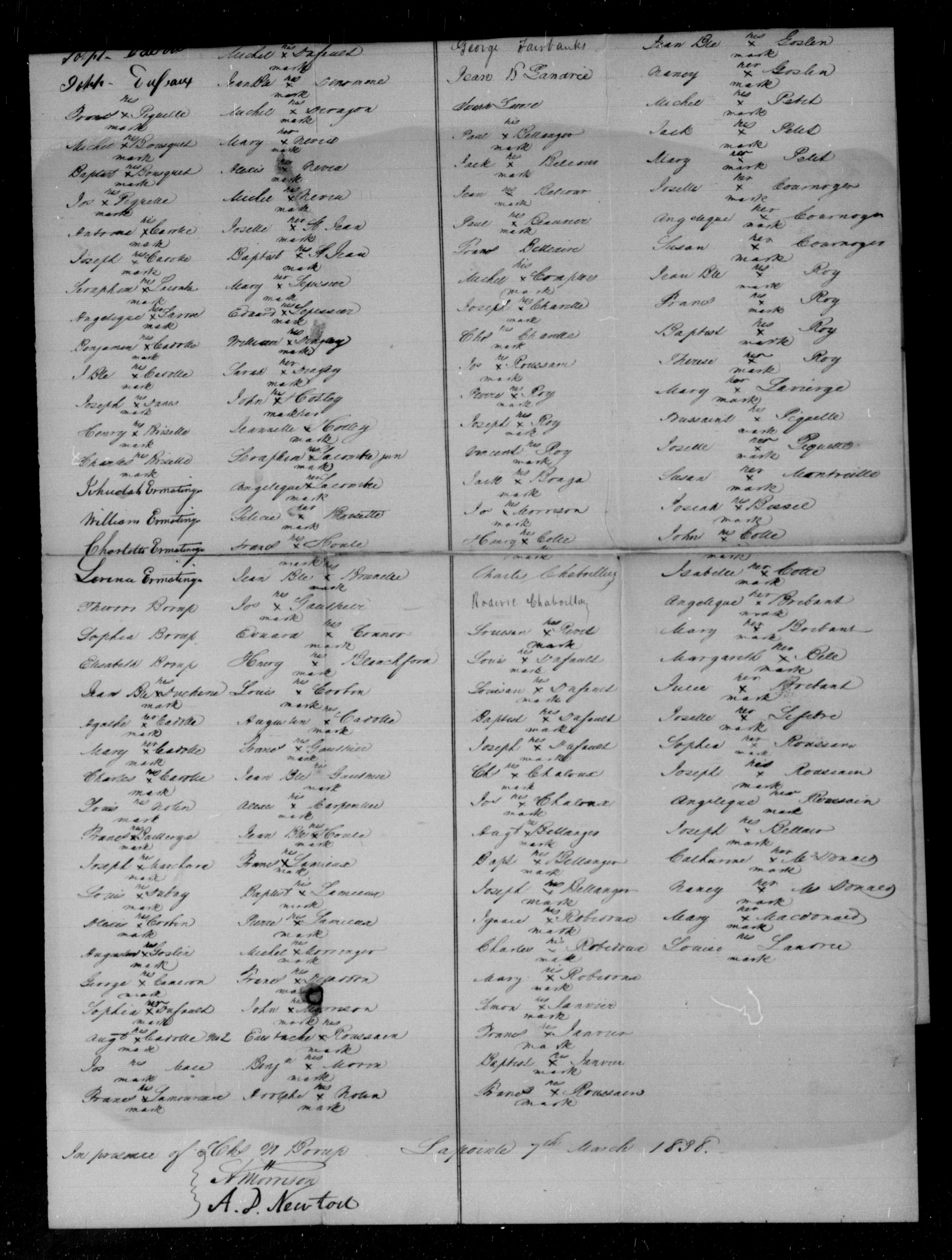
To the President of the United States of America
The humble petition of the undersigned Chippewa Half-Breeds citizens of the United States respectfully shareth
That your petitioners having lately heard, that a Treaty has been concluded between the Government of the United States and the Chippewa Indians at St Peters for the cession of certain lands belonging to that tribe;
That the said Chippewa Indians having a just regard to the interest and wellfare of their Half-Breed brethern, did there and then stipulate, that a certain sum of money should be paid once for all unto the said Half-Breeds, to satisfy all claims, they might have on the lands so ceded to the United States;
That your petitioners are ignorant of the time and place, where such payment is to be made; and
That the great majority of the Half-Breeds entitled to a portion of said sum of money are either residing at Lapointe on Lake Superior, or being for the most part earning their livelihood from the Traders, are consequently congregated during the summer months at the aforesaid place;
Your petitioners therefore humbly solicit their Father the President to take their case into consideration, and not subject them to a long and costly journey on ordering the payment to be made at any convenient distance, but on the contrary, they wish, that in his wisdom he will see the justice of this petition and that he will be pleased to order the same to be distributed at Lapointe agreeably to their request.
Your petitioners entertain the flattering hope, that their petition will not be made in vain and as in duly bound will ever pray.
Half Breeds of Folleavoine Lapointe Lac Court Oreilles and Lac du Flambeau
Georg Warren
Edward Warren
William Warren
Truman A Warren
Mary Warren
Michel Cadott
Joseph Cadotte
Joseph Dufault
Frances Piquette X his mark
Michel Bousquet X his mark
Baptiste Bousquet X his mark
Jos Piquette X his mark
Antoine Cadotte X his mark
Joseph Cadotte X his mark
Seraphim Lacombre X his mark
Angelique Larose X her mark
Benjamin Cadotte X his mark
J Bte Cadotte X his mark
Joseph Danis X his mark
Henry Brisette X his mark
Charles Brisette X his mark
Jehudah Ermatinger
William Ermatinger
Charlotte Ermatinger
Larence Ermatinger
Theodore Borup
Sophia Borup
Elisabeth Borup
Jean Bte Duchene X his mark
Agathe Cadotte X her mark
Mary Cadotte X her mark
Charles Cadotte X his mark
Louis Nolin _ his mark
Frances Baillerge X his mark
Joseph Marchand X his mark
Louis Dubay X his mark
Alexis Corbin X his mark
Augustus Goslin X his mark
George Cameron X his mark
Sophia Dufault X her mark
Augt Cadotte No 2 X his mark
Jos Mace _ his mark
Frances Lamoureau X his mark
Charles Morrison
Charlotte L. Morrison
Mary A Morrison
Margerike Morrison
Jane Morrison
Julie Dufault X her mark
Michel Dufault X his mark
Jean Bte Denomme X his mark
Michel Deragon X his mark
Mary Neveu X her mark
Alexis Neveu X his mark
Michel Neveu X his mark
Josette St Jean X her mark
Baptist St Jean X his mark
Mary Lepessier X her mark
Edward Lepessier X his mark
William Dingley X his mark
Sarah Dingley X her mark
John Hotley X his mark
Jeannette Hotley X her mark
Seraphim Lacombre Jun X his mark
Angelique Lacombre X her mark
Felicia Brisette X her mark
Frances Houle X his mark
Jean Bte Brunelle X his mark
Jos Gauthier X his mark
Edward Connor X his mark
Henry Blanchford X his mark
Louis Corbin X his mark
Augustin Cadotte X his mark
Frances Gauthier X his mark
Jean Bte Gauthier X his mark
Alexis Carpentier X his mark
Jean Bte Houle X his mark
Frances Lamieux X his mark
Baptiste Lemieux X his mark
Pierre Lamieux X his mark
Michel Morringer X his mark
Frances Dejaddon X his mark
John Morrison X his mark
Eustache Roussain X his mark
Benjn Morin X his mark
Adolphe Nolin X his mark
Half-Breeds of Fond du Lac
John Aitken
Roger Aitken
Matilda Aitken
Harriet Aitken
Nancy Scott
Robert Fairbanks
George Fairbanks
Jean B Landrie
Joseph Larose
Paul Bellanges X his mark
Jack Belcour X his mark
Jean Belcour X his mark
Paul Beauvier X his mark
Frances Belleaire
Michel Comptois X his mark
Joseph Charette X his mark
Chl Charette X his mark
Jos Roussain X his mark
Pierre Roy X his mark
Joseph Roy X his mark
Vincent Roy X his mark
Jack Bonga X his mark
Jos Morrison X his mark
Henry Cotte X his mark
Charles Chaboillez
Roderic Chaboillez
Louison Rivet X his mark
Louis Dufault X his mark
Louison Dufault X his mark
Baptiste Dufault X his mark
Joseph Dufault X his mark
Chs Chaloux X his mark
Jos Chaloux X his mark
Augt Bellanger X his mark
Bapt Bellanger X his mark
Joseph Bellanger X his mark
Ignace Robidoux X his mark
Charles Robidoux X his mark
Mary Robidoux X her mark
Simon Janvier X his mark
Frances Janvier X his mark
Baptiste Janvier X his mark
Frances Roussain X his mark
Therese Rouleau X his mark
Joseph Lavierire X his mark
Susan Lapointe X her mark
Mary Lapointe X her mark
Louis Gordon X his mark
Antoine Gordon X his mark
Jean Bte Goslin X his mark
Nancy Goslin X her mark
Michel Petit X his mark
Jack Petit X his mark
Mary Petit X her mark
Josette Cournoyer X her mark
Angelique Cournoyer X her mark
Susan Cournoyer X her mark
Jean Bte Roy X his mark
Frances Roy X his mark
Baptist Roy X his mark
Therese Roy X her mark
Mary Lavierge X her mark
Toussaint Piquette X his mark
Josette Piquette X her mark
Susan Montreille X her mark
Josiah Bissel X his mark
John Cotte X his mark
Isabelle Cotte X her mark
Angelique Brebant X her mark
Mary Brebant X her mark
Margareth Bell X her mark
Julie Brebant X her mark
Josette Lefebre X her mark
Sophia Roussain X her mark
Joseph Roussain X his mark
Angelique Roussain X her mark
Joseph Bellair X his mark
Catharine McDonald X her mark
Nancy McDonald X her mark
Mary Macdonald X her mark
Louise Landrie X his mark
In presence of
Chs W Borup
A Morrison
A. D. Newton
Lapointe 7th March 1838
Photos, Photos, Photos
February 10, 2014
The queue of Chequamegon History posts that need to be written grows much faster than my ability to write them. Lately, I’ve been backed up with mysteries surrounding a number of photographs. Many of these photos are from after 1860, so they are technically outside the scope of this website (though they involve people who were important in the pre-1860 era too.
Photograph posts are some of the hardest to write, so I decided to just run through all of them together with minimal commentary other than that needed to resolve the unanswered questions. I will link all the photos back to their sources where their full descriptions can be found. Here it goes, stream-of-consciousness style:

Ojibwa Delegation by C.M. Bell. Washington D.C. 1880 (NMAI Collections)
This whole topic started with a photo of a delegation of Lake Superior Ojibwe chiefs that sits on the windowsill of the Bayfield Public Library. Even though it is clearly after 1860, some of the names in the caption: Oshogay, George Warren, and Vincent Roy Jr. caught my attention. These men, looking past their prime, were all involved in the politics of the 1850s that I had been studying, so I wanted to find out more about the picture.
As I mentioned in the Oshogay post, this photo is also part of the digital collections of the Smithsonian, but the people are identified by different names. According to the Smithsonian, the picture was taken in Washington in 1880 by the photographer C.M. Bell.
I found a second version of this photo as well. If it wasn’t for one of the chiefs in front, you’d think it was the same picture:
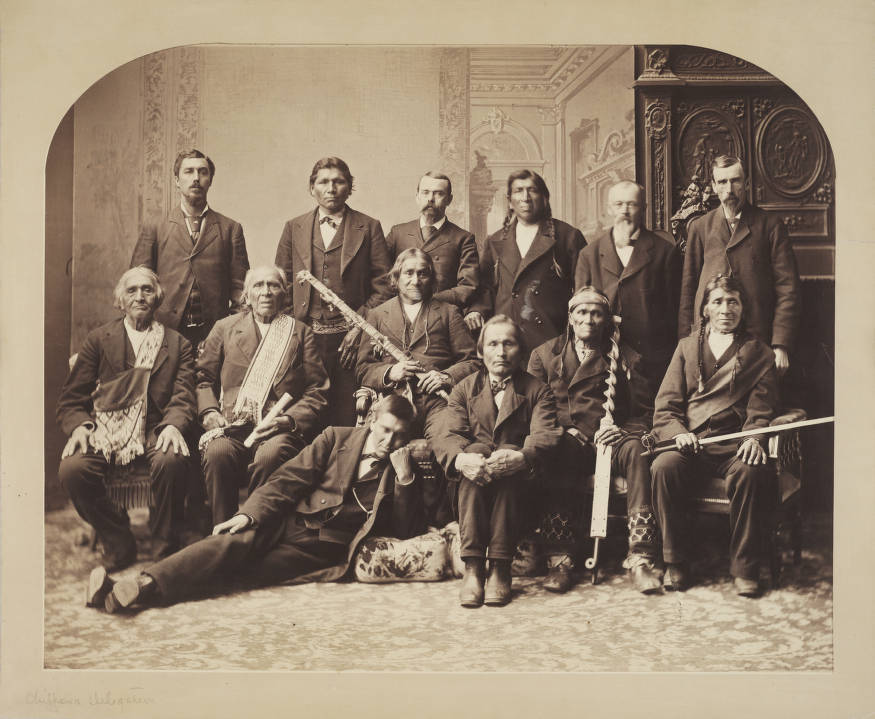
Chippewa Delegation (Denver Public Library Digital Collections)
While my heart wanted to believe the person, probably in the early 20th century, who labelled the Bayfield photograph, my head told me the photographer probably wouldn’t have known anything about the people of Lake Superior, and therefore could only have gotten the chiefs’ names directly from them. Plus, Bell took individual photos:
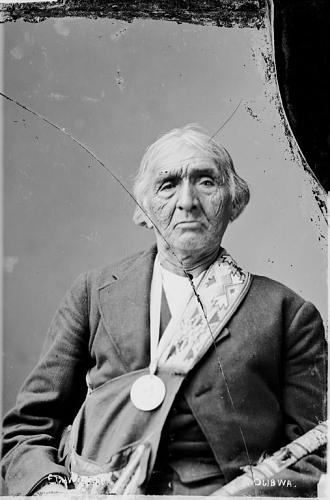
Edawigijig (Edawi-giizhig “Both Sides of the Sky”), Bad River chief and signer of the Treaty of 1854 (C.M. Bell, Smithsonian Digital Collections)
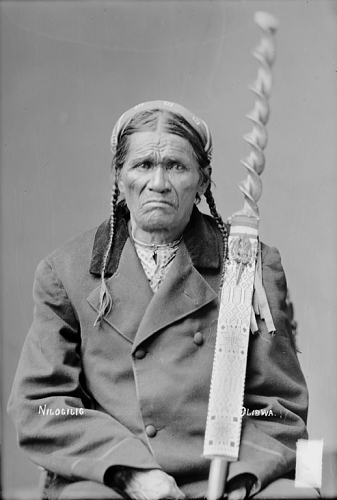
Niizhogiizhig: “Second Day,” (C.M. Bell, Smithsonian Digital Collections)
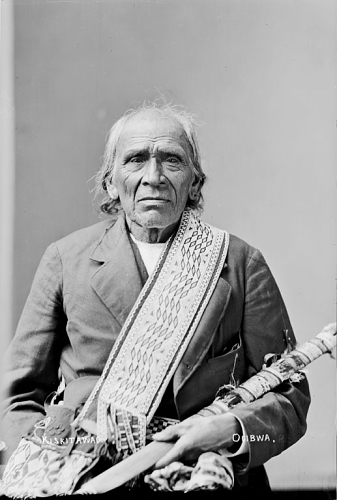
Kiskitawag (Giishkitawag: “Cut Ear”) signed multiple treaties as a warrior of the Ontonagon Band but afterwards was associated with the Bad River Band (C.M. Bell, Smithsonian Digital Collections).
By cross-referencing the individual photos with the names listed with the group photo, you can identify nine of the thirteen men. They are chiefs from Bad River, Lac Courte Oreilles, and Lac du Flambeau.
 According to this, the man identified by the library caption as Vincent Roy Jr., was in fact Ogimaagiizhig (Sky Chief). He does have a resemblance to Roy, so I’ll forgive whoever it was, even if it means having to go back and correct my Vincent Roy post:
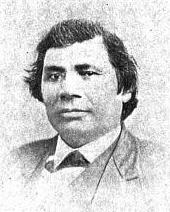
Vincent Roy Jr. From C. Verwyst’s Life and Labors of Rt. Rev. Frederic Baraga, First Bishop of Marquette, Mich: To which are Added Short Sketches of the Lives and Labors of Other Indian Missionaries of the Northwest (Digitized by Google Books)

Top: Frank Roy, Vincent Roy, E. Roussin, Old Frank D.o., Bottom: Peter Roy, Jos. Gourneau (Gurnoe), D. Geo. Morrison. The photo is labelled Chippewa Treaty in Washington 1845 by the St. Louis Hist. Lib and Douglas County Museum, but if it is in fact in Washington, it was probably the Bois Forte Treaty of 1866, where these men acted as conductors and interpreters (Digitized by Mary E. Carlson for The Sawmill Community at Roy’s Point).
So now that we know who went on the 1880 trip, it begs the question of why they went. The records I’ve found haven’t been overly clear, but it appears that it involved a bill in the senate for “severalty” of the Ojibwe reservations in Wisconsin. A precursor to the 1888 Allotment Act of Senator Henry Dawes, this legislation was proposed by Senator Thaddeus C. Pound of Wisconsin. It would divide the reservations into parcels for individual families and sell the remaining lands to the government, thereby greatly reducing the size of the reservations and opening the lands up for logging.
Pound spent a lot of time on Indian issues and while he isn’t as well known as Dawes or as Richard Henry Pratt the founder of the Carlisle Indian School, he probably should be. Pound was a friend of Pratt’s and an early advocate of boarding schools as a way to destroy Native cultures as a way to uplift Native peoples.
I’m sure that Pound’s legislation was all written solely with the welfare of the Ojibwe in mind, and it had nothing to do with the fact that he was a wealthy lumber baron from Chippewa Falls who was advocating damming the Chippewa River (and flooding Lac Courte Oreilles decades before it actually happened). All sarcasm aside, if any American Indian Studies students need a thesis topic, or if any L.C.O. band members need a new dartboard cover, I highly recommend targeting Senator Pound.
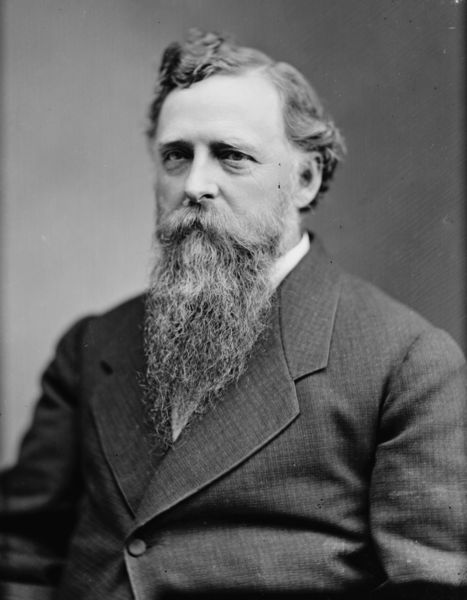
Like many self-proclaimed “Friends of the Indian” in the 1880s, Senator Thaddeus C. Pound of Wisconsin thought the government should be friendly to Indians by taking away more of their land and culture. That he stood to make a boatload of money out of it was just a bonus (Brady & Handy: Wikimedia Commons).
While we know Pound’s motivations, it doesn’t explain why the chiefs came to Washington. According to the Indian Agent at Bayfield they were brought in to support the legislation. We also know they toured Carlisle and visited the Ojibwe students there. There are a number of potential explanations, but without having the chiefs’ side of the story, I hesitate to speculate. However, it does explain the photograph.
Now, let’s look at what a couple of these men looked like two decades earlier:
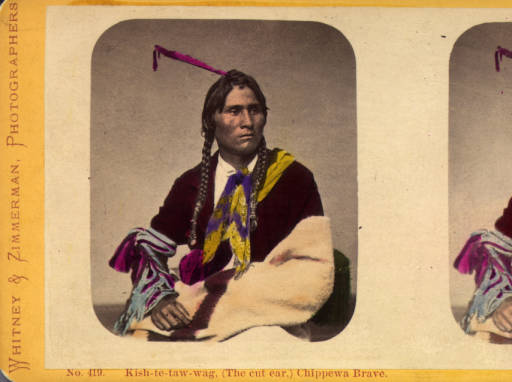
This stereocard of Giishkitawag was produced in the early 1870s, but the original photo was probably taken in the early 1860s (Denver Public Library).

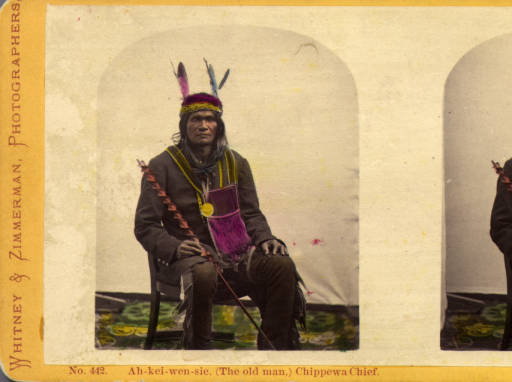
By the mid 1850s, Akiwenzii (Old Man) was the most prominent chief of the Lac Courte Oreilles Band. This stereocard was made by Whitney and Zimmerman c.1870 from an original possibly by James E. Martin in the late 1850s or early 1860s (Denver Public Library).
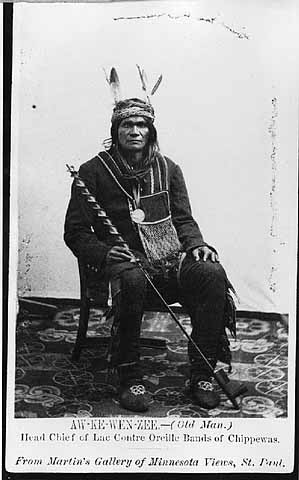
Giishkitawag and Akiwenzii are seem to have aged quite a bit between the early 1860s, when these photos were taken, and 1880 but they are still easily recognized. The earlier photos were taken in St. Paul by the photographers Joel E. Whitney and James E. Martin. Their galleries, especially after Whitney partnered with Charles Zimmerman, produced hundreds of these images on cards and stereoviews for an American public anxious to see real images of Indian leaders.
Giishkitawag and Akiwenzii were not the only Lake Superior chiefs to end up on these souvenirs. Aamoons (Little Bee), of Lac du Flambeau appears to have been a popular subject:

Aamoons (Little Bee) was a prominent chief from Lac du Flambeau (Denver Public Library).
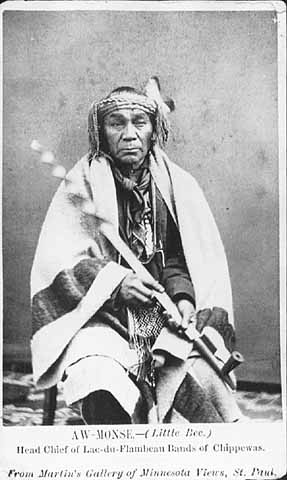
As the images were reproduced throughout the 1870s, it appears the studios stopped caring who the photos were actually depicting:

One wonders what the greater insult to Aamoons was: reducing him to being simply “Chippewa Brave” as Whitney and Zimmerman did here, or completely misidentifying him as Na-gun-ub (Naaganab) as a later stereo reproduction as W. M. McLeish does here:
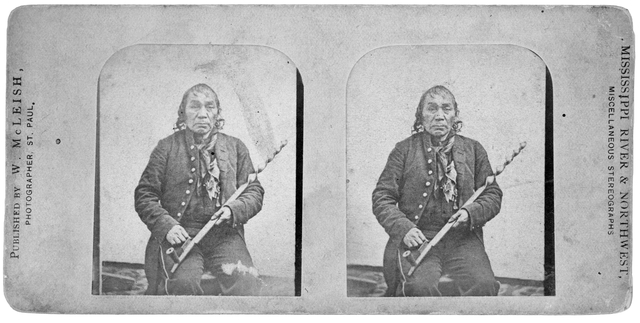
Chief identified as Na-gun-ub (Minnesota Historical Society)
Aamoons and Naaganab don’t even look alike…

Naaganab (Minnesota Historical Society)
…but the Lac du Flambeau and Fond du Lac chiefs were probably photographed in St. Paul around the time they were both part of a delegation to President Lincoln in 1862.

Chippewa Delegation 1862 by Matthew Brady? (Minnesota Historical Society)
Naaganab (seated middle) and Aamoons (back row, second from left) are pretty easy to spot, and if you look closely, you’ll see Giishkitawag, Akiwenzii, and a younger Edawi-giizhig (4th, 5th, and 6th from left, back row) were there too. I can’t find individual photos of the other chiefs, but there is a place we can find their names.
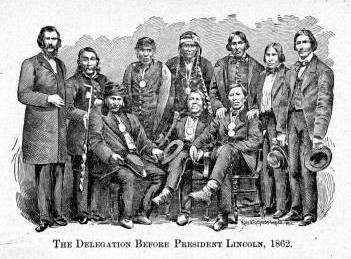
(From Early Life Among the Indians by Benjamin Armstrong)
Benjamin Armstrong, who interpreted for the delegation, included a version of the image in his memoir Early Life Among the Indians. He identifies the men who went with him as:
Ah-moose (Little Bee) from Lac Flambeau Reservation, Kish-ke-taw-ug (Cut Ear) from Bad River Reservation, Ba-quas (He Sews) from Lac Courte O’Rielles Reservation, Ah-do-ga-zik (Last Day) from Bad River Reservation, O-be-quot (Firm) from Fond du Lac Reservation, Sing-quak-onse (Little Pine) from La Pointe Reservation, Ja-ge-gwa-yo (Can’t Tell) from La Pointe Reservation, Na-gon-ab (He Sits Ahead) from Fond du Lac Reservation, and O-ma-shin-a-way (Messenger) from Bad River Reservation.
It appears that Armstrong listed the men according to their order in the photograph. He identifies Akiwenzii as “Ba-quas (He Sews),” which until I find otherwise, I’m going to assume the chief had two names (a common occurrence) since the village is the same. Aamoons, Giishkitawag, Edawi-giizhig and Naaganab are all in the photograph in the places corresponding to the order in Armstrong’s list. That means we can identify the other men in the photo.
I don’t know anything about O-be-quot from Fond du Lac (who appears to have been moved in the engraving) or S[h]ing-guak-onse from Red Cliff (who is cut out of the photo entirely) other than the fact that the latter shares a name with a famous 19th-century Sault Ste. Marie chief. Travis Armstrong’s outstanding website, chiefbuffalo.com, has more information on these chiefs and the mission of the delegation.
Seated to the right of Naaganab, in front of Edawi-giizhig is Omizhinawe, the brother of and speaker for Blackbird of Bad River. Finally, the broad-shouldered chief on the bottom left is “Ja-ge-gwa-yo (Can’t Tell)” from Red Cliff. This is Jajigwyong, the son of Chief Buffalo, who signed the treaties as a chief in his own right. Jayjigwyong, sometimes called Little Chief Buffalo, was known for being an early convert to Catholicism and for encouraging his followers to dress in European style. Indeed, we see him and the rest of the chiefs dressed in buttoned coats and bow-ties and wearing their Lincoln medals.
Wait a minute… button coats?… bow-ties?… medals?…. a chief identified as Buffalo…That reminds me of…
This image is generally identified as Chief Buffalo (Wikimedia Commons)

Anyway, with that mystery solved, we can move on to the next one. It concerns a photograph that is well-known to any student of Chequamegon-area history in the mid 19th century (or any Chequamegon History reader who looks at the banners on the side of this page).Noooooo!!!!!!! I’ve been trying to identify the person in The above “Chief Buffalo” photo for years, and the answer was in Armstrong all along! Now I need to revise this post among others. I had already begun to suspect it was Jayjigwyong rather than his father, but my evidence was circumstantial. This leaves me without a doubt. This picture of the younger Chief Buffalo, not his more-famous father.
The photo showing an annuity payment, must have been widely distributed in its day, because it has made it’s way into various formats in archives and historical societies around the world. It has also been reproduced in several secondary works including Ronald Satz’ Chippewa Treaty Rights, Patty Loew’s Indian Nations of Wisconsin, Hamilton Ross’ La Pointe: Village Outpost on Madeline Island, and in numerous other pamphlets, videos, and displays in the Chequamegon Region. However, few seem to agree on the basic facts:
When was it taken?
Where was it taken?
Who was the photographer?
Who are the people in the photograph?
We’ll start with a cropped version that seems to be the most popular in reproductions:
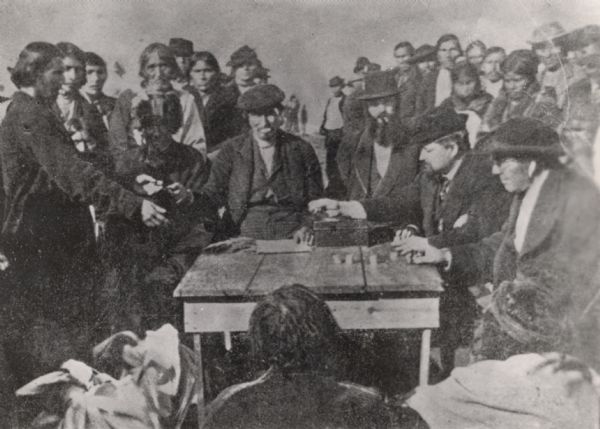
According to Hamilton Ross and the Wisconsin Historical Society: “Annuity Payment at La Pointe: Indians receiving payment. Seated on the right is John W. Bell. Others are, left to right, Asaph Whittlesey, Agent Henry C. Gilbert, and William S. Warren (son of Truman Warren).” 1870. Photographer Charles Zimmerman (more info).
In the next one, we see a wider version of the image turned into a souvenir card much like the ones of the chiefs further up the post:
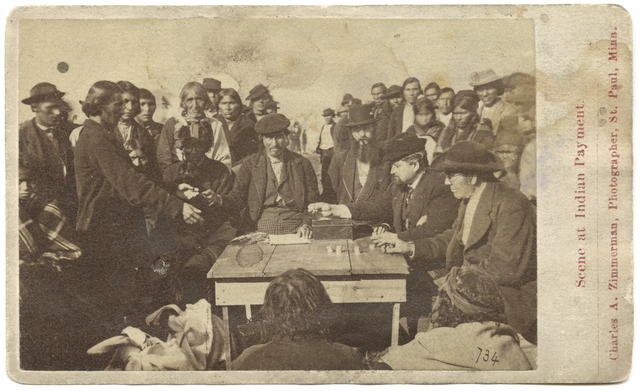
According to the Minnesota Historical Society “Scene at Indian payment, Wisconsin; man in black hat, lower right, is identified as Richard Bardon, Superior, Wisconsin, then acting Indian school teacher and farmer” c.1871 by Charles Zimmerman (more info).
In this version, we can see more foreground and the backs of the two men sitting in front.

According to the Library of Congress: “Cherokee payments(?). Several men seated around table counting coins; large group of Native Americans stand in background.” Published 1870-1900 (more info).
The image also exists in engraved forms, both slightly modified…

According to Benjamin Armstrong: “Annuity papment [sic] at La Pointe 1852” (From Armstrong’s Early Life Among the Indians)
…and greatly-modified.
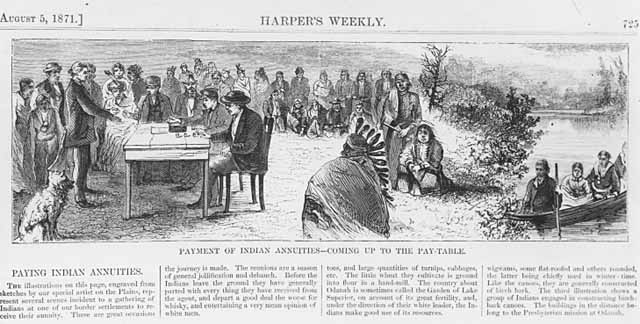
Harper’s Weekly August 5, 1871: “Payment of Indian Annuities–Coming up to the Pay Table.” (more info)
It should also be mentioned that another image exists that was clearly taken on the same day. We see many of the same faces in the crowd:
Scene at Indian payment, probably at Odanah, Wisconsin. c.1865 by Charles Zimmerman (more info)
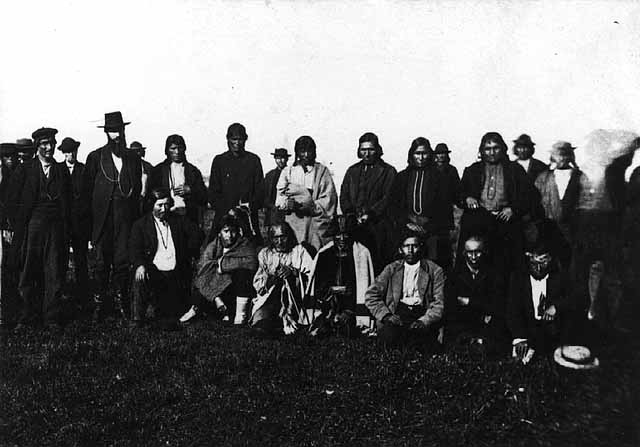
We have a lot of conflicting information here. If we exclude the Library of Congress Cherokee reference, we can be pretty sure that this is an annuity payment at La Pointe or Odanah, which means it was to the Lake Superior Ojibwe. However, we have dates ranging from as early as 1852 up to 1900. These payments took place, interrupted from 1850-1852 by the Sandy Lake Removal, from 1837 to 1874.
Although he would have attended a number of these payments, Benjamin Armstrong’s date of 1852, is too early. A number of secondary sources have connected this photo to dates in the early 1850s, but outside of Armstrong, there is no evidence to support it.
Charles Zimmerman, who is credited as the photographer when someone is credited, became active in St. Paul in the late 1860s, which would point to the 1870-71 dates as more likely. However, if you scroll up the page and look at Giishkitaawag, Akiwenzii, and Aamoons again, you’ll see that these photos, (taken in the early 1860s) are credited to “Whitney & Zimmerman,” even though they predate Zimmerman’s career.
What happened was that Zimmerman partnered with Joel Whitney around 1870, eventually taking over the business, and inherited all Whitney’s negatives (and apparently those of James Martin as well). There must have been an increase in demand for images of Indian peoples in the 1870s, because Zimmerman re-released many of the earlier Whitney images.
So, we’re left with a question. Did Zimmerman take the photograph of the annuity payment around 1870, or did he simply reproduce a Whitney negative from a decade earlier?
I had a hard time finding any primary information that would point to an answer. However, the Summer 1990 edition of the Minnesota History magazine includes an article by Bonnie G. Wilson called Working the Light: Nineteenth Century Professional Photographers in Minnesota. In this article, we find the following:
“…Zimmerman was not a stay-at-home artist. He took some of his era’s finest landscape photos of Minnesota, specializing in stereographs of the Twin Cities area, but also traveling to Odanah, Wisconsin for an Indian annuity payment…”
In the footnotes, Wilson writes:
“The MHS has ten views in the Odanah series, which were used as a basis for engravings in Harper’s Weekly, Aug. 5, 1871. See also Winona Republican, Oct. 12, 1869 p.3;”
Not having access to the Winona Republican, I tried to see how many of the “Odanah series” I could track down. Zimmerman must have sold a lot of stereocards, because this task was surprisingly easy. Not all are labelled as being in Odanah, but the backgrounds are similar enough to suggest they were all taken in the same place. Click on them to view enlarged versions at various digital archives.
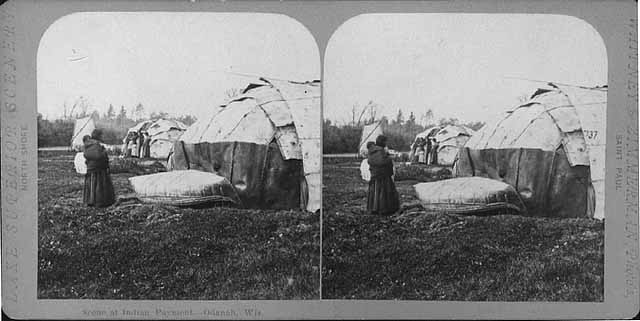
Scene at Indian Payment, Odanah Wisconsin (Minnesota Historical Society)


Chippewa Wedding (British Museum)

Domestic Life–Chippewa Indians (British Museum)
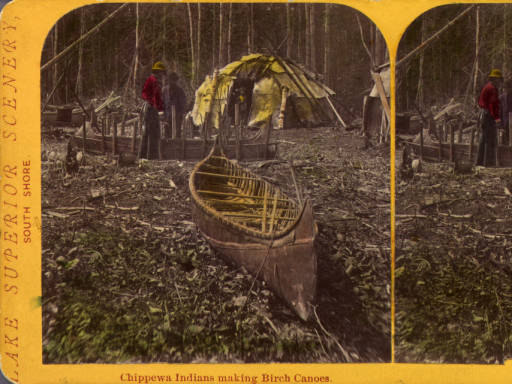
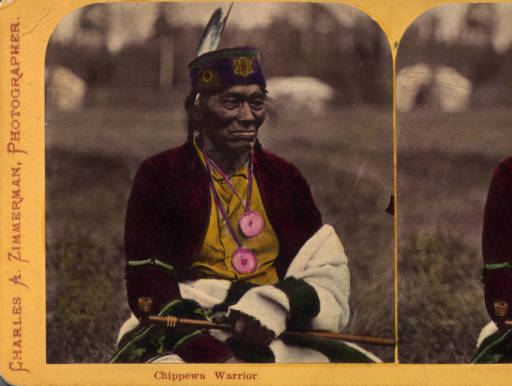

Chippewa Wedding (British Museum)

Finally…

Scene at Indian Payment–Odanah, Wis. (Wikimedia Images)
So, if Zimmerman took the “Odanah series” in 1869, and the pay table image is part of it, then this is a picture of the 1869 payment. To be absolutely certain, we should try to identify the men in the image.
This task is easier than ever because the New York Public Library has uploaded a high-resolution scan of the Whitney & Zimmerman stereocard version to Wikimedia Commons. For the first time, we can really get a close look at the men and women in this photo.
They say a picture tells a thousand words. I’m thinking I could write ten-thousand and still not say as much as the faces in this picture.


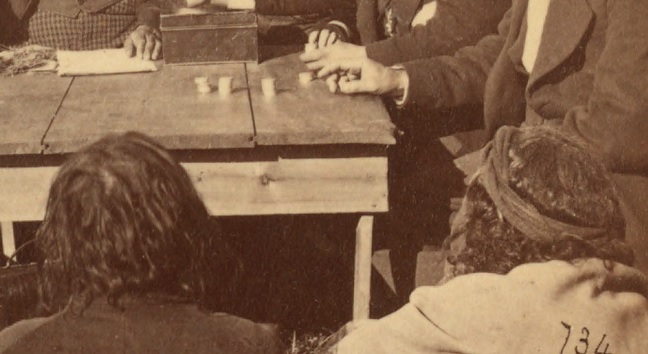
To try to date the photo, I decided to concentrate the six most conspicuous men in the photo:
1) The chief in the fur cap whose face in the shadows.
2) The gray-haired man standing behind him.
3) The man sitting behind the table who is handing over a payment.
4) The man with the long beard, cigar, and top hat.
5) The man with the goatee looking down at the money sitting to the left of the top-hat guy (to the right in our view)
6) The man with glasses sitting at the table nearest the photographer
According to Hamilton Ross, #3 is Asaph Whittlesey, #4 is Agent Henry Gilbert, #5 is William S. Warren (son of Truman), and #6 is John W. Bell. While all four of those men could have been found at annuity payments as various points between 1850 and 1870, this appears to be a total guess by Ross. Three of the four men appear to be of at least partial Native descent and only one (Warren) of those identified by Ross was Ojibwe. Chronologically, it doesn’t add up either. Those four wouldn’t have been at the same table at the same time. Additionally, we can cross-reference two of them with other photos.

Asaph Whittlesey was an interesting looking dude, but he’s not in the Zimmerman photo (Wisconsin Historical Society).

Henry C. Gilbert was the Indian Agent during the Treaty of 1854 and oversaw the 1855 annuity payment, but he was dead by the time the “Zimmerman” photo was taken (Branch County Photographs)
Whittlesey and Gilbert are not in the photograph.
The man who I label as #5 is identified by Ross as William S. Warren. This seems like a reasonable guess, though considering the others, I don’t know that it’s based on any evidence. Warren, who shares a first name with his famous uncle William Whipple Warren, worked as a missionary in this area.
The man I label #6 is called John W. Bell by Ross and Richard Bardon by the Minnesota Historical Society. I highly doubt either of these. I haven’t found photos of either to confirm, but the Ireland-born Bardon and the Montreal-born Bell were both white men. Mr. 6 appears to be Native. I did briefly consider Bell as a suspect for #4, though.
Neither Ross nor the Minnesota Historical Society speculated on #1 or #2.
At this point, I cannot positively identify Mssrs. 1, 2, 3, 5, or 6. I have suspicions about each, but I am not skilled at matching faces, so these are wild guesses at this point:
#1 is too covered in shadows for a clear identification. However, the fact that he is wearing the traditional fur headwrap of an Ojibwe civil chief, along with a warrior’s feather, indicates that he is one of the traditional chiefs, probably from Bad River but possibly from Lac Courte Oreilles or Lac du Flambeau. I can’t see his face well enough to say whether or not he’s in one of the delegation photos from the top of the post.
#2 could be Edawi-giizhig (see above), but I can’t be certain.
#3 is also tricky. When I started to examine this photo, one of the faces I was looking for was that of Joseph Gurnoe of Red Cliff. You can see him in a picture toward the top of the post with the Roy brothers. Gurnoe was very active with the Indian Agency in Bayfield as a clerk, interpreter, and in other positions. Comparing the two photos I can’t say whether or not that’s him. Leave a comment if you think you know.
#5 could be a number of different people.
#6 I don’t have a solid guess on either. His apparent age, and the fact that the Minnesota Historical Society’s guess was a government farmer and schoolteacher, makes me wonder about Henry Blatchford. Blatchford took over the Odanah Mission and farm from Leonard Wheeler in the 1860s. This was after spending decades as Rev. Sherman Hall’s interpreter, and as a teacher and missionary in La Pointe and Odanah area. When this photo was taken, Blatchford had nearly four decades of experience as an interpreter for the Government. I don’t have any proof that it’s him, but he is someone who is easy to imagine having a place at the pay table.
Finally, I’ll backtrack to #4, whose clearly identifiable gray-streaked beard allows us to firmly date the photo. The man is Col. John H. Knight, who came to Bayfield as Indian Agent in 1869.
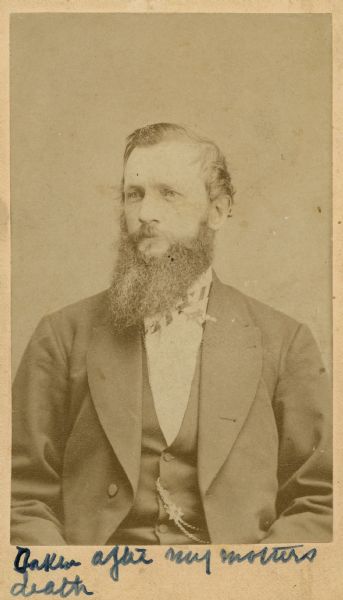
Col. John H. Knight (Wisconsin Historical Society)
Knight oversaw a couple of annuity payments, but considering the other evidence, I’m confident that the popular image that decorates the sides of the Chequamegon History site was indeed taken at Odanah by Charles Zimmerman at the 1869 annuity payment.
Do you agree? Do you disagree? Have you spotted anything in any of these photos that begs for more investigation? Leave a comment.
As for myself, it’s a relief to finally get all these photo mysteries out of my post backlog. The 1870 date on the Zimmerman photo reminds me that I’m spending too much time in the later 19th century. After all, the subtitle of this website says it’s history before 1860. I think it might be time to go back for a while to the days of the old North West Company or maybe even to Pontiac. Stay tuned, and thanks for reading,
 Chequamegon History