Chief Buffalo Picture Search: Coda
June 1, 2024
My last post ended up containing several musings on the nature of primary-source research and how to acknowledge mistakes and deal with uncertainty in the historical record. This was in anticipation of having to write this post. It’s a post I’ve been putting off for years.
Amorin forced the issue with his important work on the speeches at the 1842 Treaty negotiations. While working on it, he sent me a message that read something like, “Hey, the article quotes Chief Buffalo and describes him in a blue military coat with epaulets. Is the world ready for that picture that Smithsonian guy sent us years ago?”
This was the image in question:

Henry Inman, Big Buffalo (Chippewa), 1832-1833, oil on canvas, frame: 39 in. × 34 in. × 2 1/4 in. (99.1 × 86.4 × 5.7 cm), Smithsonian American Art Museum, Gift of Gerald and Kathleen Peters, 2019.12.2
We first learned of this image from a Chequamegon History comment by Patrick Jackson of the Smithsonian asking what we knew about the image and whether or not it was Chief Buffalo from La Pointe.
We had never seen it before.
This was our correspondence with Mr. Jackson at the time:
July 17, 2019
Hello, my name is Patrick, and I am an intern at the Smithsonian American Art Museum. I’m working on researching a recent acquisition: a painting which came to us identified as a Henry Inman portrait of “Big Buffalo Ke-Che-Wais-Ke, The Great Renewer (1759-1855) (Chippewa).” We have run into some confusion about the identification of the portrait, as it came to us identified as stated above, yet at Harvard Peabody Museum, who was previously the owner of the portrait, it was listed as an unidentified sitter. Seeing as you’ve written a few posts about the identification of images of the three different Chief Buffalos, I thought you might be able to give some insight into perhaps who is or isn’t in the portrait we have. Thank you for your time.
July 17, 2019
Hello,
I would be happy to comment. Can you send a photo to this email?
I am pretty sure Inman painted a copy of Charles Bird King’s portrait of Pee-che-kir.
Doe it resemble that portrait? Pee-che-kir (Bizhiki) means Buffalo in Ojibwe (Chippewa). From my research, I am fairly certain that King’s portrait is not of Kechewaiske, but of another chief named Buffalo who lived in the same era.
Leon Filipczak
July 17, 2019
Dear Leon,
I have attached our portrait—it’s not the best scan, but hopefully there’s enough detail for you to work with. I’ve compared it with the Peechikir in McKenney & Hall, as well as to the Chief Buffalo painted ambrotype and the James Otto Lewis portrait of Pe-schick-ee. The ambrotype has a close resemblance, as does the Peecheckir, though if that is what Charles Bird King painted I have doubts that Inman would make such drastic changes in clothing and pose.
The identification as Big Buffalo/Ke-Che-Wais-Ke/The Great Renewer, as far as I understand, refers to the La Pointe Bizhiki/Buffalo rather than the St. Croix or Leech Lake Buffalos, though of course that is a questionable identification considering Kechewaiske did not (I think) visit Washington until after Inman’s death in January of 1846. McKenney, however, did visit the Ojibwe/Chippewa for the negotiations for the Treaty of Fond du Lac in 1825/1826, and could feasibly have met multiple Chief Buffalos. Perhaps a local artist there would be responsible for the original? Another possibility is, since the identification was not made at the Peabody, who had the portrait since the 1880s, is that it has been misidentified entirely and is unrelated to any of the Ojibwe/Chippewa chiefs. Though this, to me, would seem unlikely considering the strong resemblance of the figure in our portrait to the Peechikir portrait and Chief Buffalo ambrotype.
Thank you again for the help.
Sincerely,
Patrick
July 22, 2019
Hello Patrick,
This is a head-scratcher. Your analysis is largely what I would come up with. My first thought when I saw it was, “Who identified it as someone named Buffalo? When? and using what evidence?” Whoever associated the image with the text “Ke-Che-Wais-Ke, The Great Renewer (1759-1855)” did so decades after the painting could be assumed to be created. However, if the tag “Big Buffalo” can be attached to this image in the era it was created, then we may be onto something. This is what I know:
1) During his time as Superintendent of Indian Affairs (late 1820s), Thomas McKenney amassed a large collection of portraits of Indian chiefs for what he called the “Indian Gallery” in the War Department. He sought the portraits out wherever and whenever he could. When chiefs would come to Washington, he would have Charles Bird King do the work, but he also received portraits from the interior via artists like James Otto Lewis.
2) In 1824, Bizhiki (Buffalo) from the St. Croix River (not Great Buffalo from La Pointe), visited Washington and was painted by King. This painting is presumed to have been destroyed in the Smithsonian fire that took out most of the Indian Gallery.
3) In 1825 at Prairie du Chien and in 1826 at Fond du Lac (where McKenney was present) James Otto Lewis painted several Ojibwe chiefs, and these paintings also ended up in the Indian Gallery. Both chief Buffalos were present at these treaties.
4) A team of artists copied each others’ work from these originals. King, for example remade several of Lewis’ portraits to make the faces less grotesque. Inman copied several Indian Gallery portraits (mostly King’s) to be sent to other institutions. These are the ones that survived the Smithsonian fire.
5) In the late 1830s, 10+ years after most of the portraits were painted, Lewis and McKenney sold competing lithograph collections to the American public. McKenney’s images were taken from the Indian Gallery. Lewis’ were from his works (some of which were in the Indian Gallery, often redone by King). While the images were printed with descriptions, the accuracy of the descriptions leaves something to be desired. A chief named Bizhiki appears in both Lewis and McKenney-Hall. In both, the chiefs are dressed in white and faced looking left, but their faces look nothing alike. One is very “Lewis-grotesque.” and the other is not at all. There are Lewis-based lithographs in both competing works, and they are usually easy to spot.
6) Not every image from the Indian Gallery made it into the published lithographic collections. Brian Finstad, a historian of the upper-St. Croix country, has shown me an image of Gaa-bimabi (Kappamappa, Gobamobi), a close friend/relative of the La Pointe Chief Buffalo, and upstream neighbor of the St. Croix Buffalo. This image is held by Harvard and strongly resembles the one you sent me in style. I suspect it is an Inman, based on a Lewis (possibly with a burned-up King copy somewhere in between).
7) “Big Buffalo” would seemingly indicate Buffalo from La Pointe. The word gichi is frequently translated as both “great” and “big” (i.e. big in size or big in power). Buffalo from La Pointe was both. However, the man in the painting you sent is considerably skinnier and younger-looking than I would expect him to appear c.1826.
My sense is that unless accompanying documentation can be found, there is no way to 100% ID these pictures. I am also starting to worry that McKenney and the Indian Gallery artists, themselves began to confuse the two chief Buffalos, and that the three originals (two showing St. Croix Buffalo, and one La Pointe Buffalo) burned. Therefore, what we are left with are copies that at best we are unable to positively identify, and at worst are actually composites of elements of portraits of two different men. The fact that King’s head study of Pee-chi-kir is out there makes me wonder if he put the face from his original (1824 portrait of St. Croix Buffalo?) onto the clothing from Lewis’ portrait of Pe-shick-ee when it was prepared for the lithograph publication.
A few weeks later, Patrick sent a follow-up message that he had tracked down a second version and confirmed that Inman’s portrait was indeed a copy of a Charles Bird King portrait, based on a James Otto Lewis original. It included some critical details.

Portrait of Big Buffalo, A Chippewa, 1827 Charles Bird King (1785-1862), signed, dated and inscribed ‘Odeg Buffalo/Copy by C King from a drawing/by Lewis/Washington 1826’ (on the reverse) oil on panel 17 1⁄2 X 13 3⁄4 in. (44.5 x 34.9 cm.) Last sold by Christie’s Auction House for $478,800 on 26 May 2022
The date of 1826 makes it very likely that Lewis’ original was painted at the Treaty of Fond du Lac. Chief Buffalo of La Pointe would have been in his 60s, which appears consistent with the image of Big Buffalo. Big Buffalo also does not appear as thin in King’s intermediate version as he does in Inman’s copy, lessening the concerns that the image does not match written descriptions of the chief.
Another clue is that it appears Lewis used the word Odeg to disambiguate Big Buffalo from the two other chiefs named Buffalo present at Fond du Lac in 1826. This may be the Ojibwe word Andeg (“crow”). Although I have not seen any other source that calls the La Pointe chief Andeg, it was a significant name in his family. He had multiple close relatives with Andeg in their names, which may have all stemmed from the name of Buffalo’s grandfather Andeg-wiiyaas (Crow’s Meat). As hereditary chief of the Andeg-wiiyaas band, it’s not unreasonable to think the name would stay associated with Buffalo and be used to distinguish him from the other Buffalos. However, this is speculative.
So, there we were. After the whole convoluted Chief Buffalo Picture Search, did we finally have an image we could say without a doubt was Chief Buffalo of La Pointe? No. However, we did have one we could say was “likely” or even “probably” him. I considered posting at the time, but a few things held me back.
In the earliest years of Chequamegon History, 2013 and 2014, many of the posts involved speculation about images and me trying to nitpick or disprove obvious research mistakes of others. Back then, I didn’t think anyone was reading and that the site would only appeal to academic types. Later on, however, I realized that a lot of the traffic to the site came from people looking for images, who weren’t necessarily reading all the caveats and disclaimers. This meant we were potentially contributing to the issue of false information on the internet rather than helping clear it up. So by 2019, I had switched my focus to archiving documents through the Chequamegon History Source Archive, or writing more overtly subjective and political posts.
So, the Smithsonian image of Big Buffalo went on the back burner, waiting to see if more information would materialize to confirm the identity of the man one way or the other. None did, and then in 2020 something happened that gave the whole world a collective amnesia that made those years hard to remember. When Amorin asked about using the image for his 1842 post, my first thought was “Yeah, you should, but we should probably give it its own post too.” My second thought was, “Holy crap! It’s been five years!”
Anyway, here is Chequamegon History’s statement on the identity of the man in Henry Inman’s 1832-33 portrait of Big Buffalo (Chippewa).
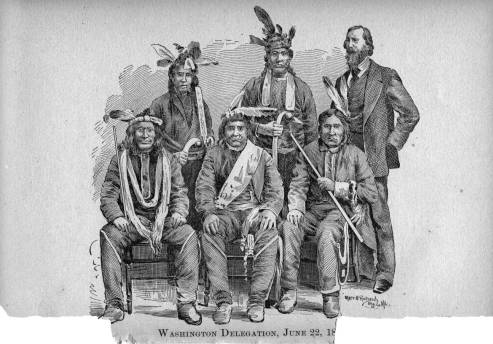
Likely Chief Buffalo of La Pointe: We are not 100% certain, but we are more certain than we have been about any other image featured in the Chief Buffalo Picture Search. This is a copy of a copy of a missing original by James Otto Lewis. Lewis was a self-taught artist who struggled with realistic facial features. Charles Bird King and Henry Inman, who made the first and second copies, respectively, had more talent for realism. However, they did not travel to Lake Superior themselves and were working from Lewis’ original. Therefore, the appearance of Big Buffalo may accurately show his clothing, but is probably less accurate in showing his actual physical appearance.
And while we’re on the subject of correcting misinformation related to images, I need to set the record straight on another one and offer my apologies to a certain Benjamin Green Armstrong. I promise, it relates indirectly to the “Big Buffalo” painting.
An engraving of the image in question appears in Armstrong’s Early Life Among the Indians.
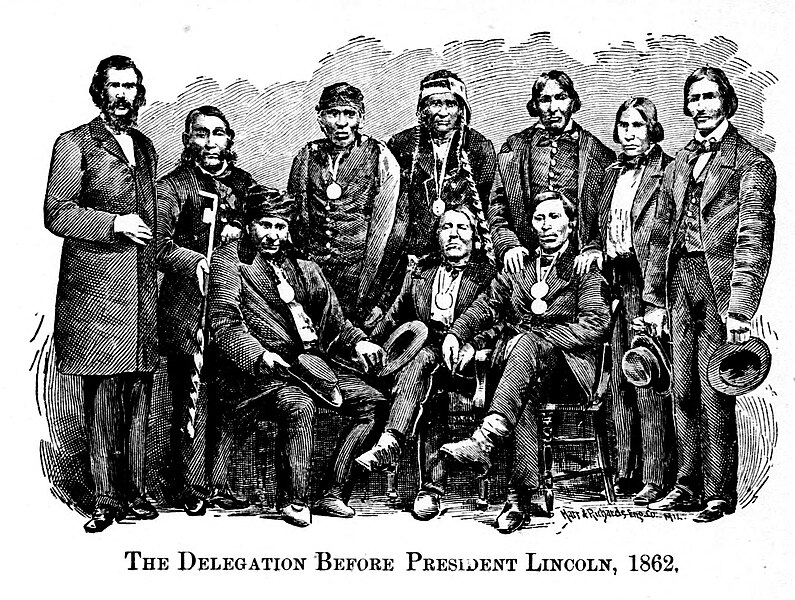
Ah-moose (Little Bee) from Lac Flambeau Reservation, Kish-ke-taw-ug (Cut Ear) from Bad River Reservation, Ba-quas (He Sews) from Lac Courte O’Rielles Reservation, Ah-do-ga-zik (Last Day) from Bad River Reservation, O-be-quot (Firm) from Fond du Lac Reservation, Sing-quak-onse (Little Pine) from La Pointe Reservation, Ja-ge-gwa-yo (Can’t Tell) from La Pointe Reservation, Na-gon-ab (He Sits Ahead) from Fond du Lac Reservation, and O-ma-shin-a-way (Messenger) from Bad River Reservation.
In this post, we contested these identifications on the grounds that Ja-ge-gwa-yo (Little Buffalo) from La Pointe Reservation died in 1860 and therefore could not have been part of the delegation to President Lincoln. In the comments on that post, readers from Michigan suggested that we had several other identities wrong, and that this was actually a group of chiefs from the Keweenaw region. We commented that we felt most of Armstrong’s identifications were correct, but that the picture was probably taken in 1856 in St. Paul.
Since then, a document has appeared that confirms Armstrong was right all along.
[Antoine Buffalo, Naagaanab, and six other chiefs to W.P. Dole, 6 March 1863
National Archives M234-393 slide 14
Transcribed by L. Filipczak 12 April 2024]
To Our Father,
Hon W P. Dole
Commissioner of Indian Affairs–
We the undersigned chiefs of the chippewas of Lake Superior, now present in Washington, do respectfully request that you will pay into the hands of our Agent L. E. Webb, the sum of Fifteen Hundred Dollars from any moneys found due us under the head of “Arrearages in Annuity” the said money to be expended in the purchase of useful articles to be taken by us to our people at home.
Antoine Buffalo His X Mark | A daw we ge zhig His X Mark
Naw gaw nab His X Mark | Obe quad His X Mark
Me zhe na way His X Mark | Aw ke wen zee His X Mark
Kish ke ta wag His X Mark | Aw monse His X Mark
I certify that I Interpreted the above to the chiefs and that the same was fully understood by them
Joseph Gurnoe
U.S. Interpreter
Witnessed the above Signed } BG Armstrong
Washington DC }
March 6th 1863 }
There were eight Lake Superior chiefs, an interpreter, and a witness in Washington that spring, for a total of ten people. There are ten people in the photograph. Chequamegon History is confident that this document confirms they are the exact ten identified by Benjamin Armstrong.
The Lac Courte Oreilles chief Ba-quas is the same person as Akiwenzii. It was not unusual for an Ojibwe chief to have more than one name. Chief Buffalo, Gaa-bimaabi, Zhingob the Younger, and Hole-in-the-Day the Younger are among the many examples.
The name “Sing-quak-onse (Little Pine) from La Pointe Reservation” seems to be absent from the letter, but he is there too. Let’s look at the signature of the interpreter, Joseph Gurnoe.

Gurnoe’s beautiful looping handwriting will be familiar to anyone who has studied the famous 1864 bilingual petition. We see this same handwriting in an 1879 census of Red Cliff. In this document, Gurnoe records his own Ojibwe name as Shingwākons, The young Pine tree.

So the man standing on the far right is Gurnoe. This can be confirmed by looking at other known photos of him.
Finally, it confirms that the chief seated on the bottom left is not Jechiikwii’o (Little Buffalo), but rather his son Antoine, who inherited the chieftainship of the Buffalo Band after the death of his father two years earlier. Known to history as Chief Antoine Buffalo, in his lifetime he was often called Antoine Tchetchigwaio (or variants thereof), using his father’s name as a surname rather than his grandfather’s.

So, now we need to address the elephant in the room that unites the Henry Inman portrait of Big Buffalo with the photograph of the 1862-63 Delegation to Washington:

Wisconsin Historical Society
This is the “ambrotype” referenced by Patrick Jackson above. It’s the image most associated with Chief Buffalo of La Pointe. It’s also one for which we have the least amount of background information. We have not been able to determine who the original photographer/painter was or when the image was created.
The resemblance to the portrait of “Big Buffalo” is undeniable.
However, if it is connected to the 1862-63 image of Chief Antoine Buffalo, it would support Hamilton Nelson Ross’s assertions on the Wisconsin Historical Society copy.
Clearly, multiple generations of the Buffalo family wore military jackets.
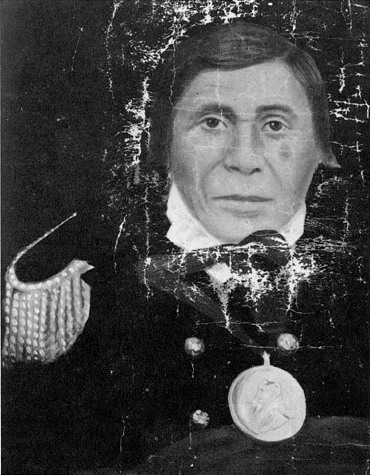
Inconclusive: uncertainty is no fun, but at this point Chequamegon History cannot determine which Chief Buffalo is in the ambrotype. However, the new evidence points more toward the grandfather (Great Buffalo) and grandson (Antoine) than it does to the son (Little Buffalo).
We will keep looking.
Early Life among the Indians: Chapter II
March 21, 2018
By Amorin Mello

Early life among the Indians
by Benjamin Green Armstrong
continued from Chapter I.
CHAPTER II
In Washington.—Told to Go Home.—Senator Briggs, of New York.—The Interviews with President Fillmore.—Reversal of the Removal Order.—The Trip Home.—Treaty of 1854 and the Reservations.—The Mile Square.—The Blinding. »
After a fey days more in New York City I had raised the necessary funds to redeem the trinkets pledged with the ‘bus driver and to pay my hotel bills, etc., and on the 22d day of June, 1852, we had the good fortune to arrive in Washington.

“Washington Delegation, June 22, 1852“
Engraved from an unknown photograph by Marr and Richards Co. for Benjamin Armstrong’s Early Life Among the Indians. Chief Buffalo, his speaker Oshogay, Vincent Roy, Jr., two other La Pointe Band members, and Armstrong are assumed to be in this engraving.
I took my party to the Metropolitan Hotel and engaged a room on the first floor near the office for the Indians, as they said they did not like to get up to high in a white man’s house. As they required but a couple mattresses for their lodgings they were soon made comfortable. I requested the steward to serve their meals in their room, as I did not wish to take them into the dining room among distinguished people, and their meals were thus served.

Undated postcard of the Metropolitan Hotel, formerly known as Brown’s India Queen Hotel.
~ StreetsOfWashington.com
The morning following our arrival I set out in search of the Interior Department of the Government to find the Commissioner of Indian Affairs, to request an interview with him, which he declined to grant and said :
“I want you to take your Indians away on the next train west, as they have come here without permission, and I do not want to see you or hear of your Indians again.”
I undertook to make explanations, but he would not listen to me and ordered me from his office. I went to the sidewalk completely discouraged, for my present means was insufficient to take them home. I paced up and down the sidewalk pondering over what was best to do, when a gentleman came along and of him I inquired the way to the office of the Secretary of the Interior. He passed right along saying,
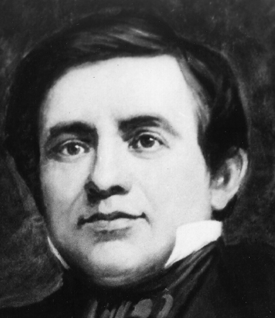
Secretary of the Interior
Alexander Hugh Holmes Stuart
~ Department of the Interior
“This way, sir; this way, sir;” and I followed him.
He entered a side door just back of the Indian Commissioner’s office and up a short flight of stairs, and going in behind a railing, divested himself of hat and cane, and said :
“What can I do for you sir.”
I told him who I was, what my party consisted of, where we came from and the object of our visit, as briefly as possible. He replied that I must go and see the Commissioner of Indian Affairs just down stairs. I told him I had been there and the treatment I had received at his hands, then he said :
“Did you have permission to come, and why did you not go to your agent in the west for permission?”
I then attempted to explain that we had been to the agent, but could get no satisfaction; but he stopped me in the middle of my explanation, saying :
“I can do nothing for you. You must go to the Indian Commissioner,”
and turning, began a conversation with his clerk who was there when we went in.
I walked out more discouraged than ever and could not imagine what next I could do. I wandered around the city and to the Capitol, thinking I might find some one I had seen before, but in this I failed and returned to the hotel, where, in the office I found Buffalo surrounded by a crowd who were trying to make him understand them and among them was the steward of the house. On my entering the office and Buffalo recognizing me, the assemblage, seeing I knew him, turned their attention to me, asking who he was, etc., to all of which questions I answered as briefly as possible, by stating that he was the head chief of of the Chippewas of the Northwest. The steward then asked:
“Why don’t you take him into the dining room with you? Certainly such a distinguished man as he, the head of the Chippewa people, should have at least that privilege.”

United States Representative George Briggs
~ Library of Congress
I did so and as we passed into the dining room we were shown to a table in one corner of the room which was unoccupied. We had only been seated a few moments when a couple of gentlemen who had been occupying seats in another part of the dining room came over and sat at our table and said that if there were no objections they would like to talk with us. They asked about the party, where from, the object of the visit, etc. I answered them briefly, supposing them to be reporters and I did not care to give them too much information. One of these gentlemen asked what room we had, saying that himself and one or two others would like to call on us right after dinner. I directed them where to come and said I would be there to meet them.
About 2 o’clock they came, and then for the first time I knew who those gentlemen were. One was Senator Briggs, of New York, and the others were members of President Filmore’s cabinet, and after I had told them more fully what had taken me there, and the difficulties I had met with, and they had consulted a little while aside. Senator Briggs said :
“We will undertake to get you and your people an interview with the President, and will notify you here when a meeting can be arranged. ”
During the afternoon I was notified that an interview had been arranged for the next afternoon at 3 o’clock. During the evening Senator Briggs and other friends called, and the whole matter was talked over and preparations made for the interview the following day, which were continued the next day until the hour set for the interview.

United States President
Millard Fillmore.
~ Library of Congress
When we were assembled Buffalo’s first request was that all be seated, as he had the pipe of peace to present, and hoped that all who were present would partake of smoke from the peace pipe. The pipe, a new one brought for the purpose, was filled and lighted by Buffalo and passed to the President who took two or three draughts from it, and smiling said, “Who is the next?” at which Buffalo pointed out Senator Briggs and desired he should be the next. The Senator smoked and the pipe was passed to me and others, including the Commissioner of Indian Affairs, Secretary of the Interior and several others whose names I did not learn or cannot recall. From them, to Buffalo, then to O-sho-ga, and from him to the four braves in turn, which completed that part of the ceremony. The pipe was then taken from the stem and handed to me for safe keeping, never to be used again on any occasion. I have the pipe still in my possession and the instructions of Buffalo have been faithfully kept. The old chief now rose from his seat, the balance following his example and marched in single file to the President and the general hand-shaking that was began with the President was continued by the Indians with all those present. This over Buffalo said his under chief, O-sha-ga, would state the object of our visit and he hoped the great father would give them some guarantee that would quiet the excitement in his country and keep his young men peaceable. After I had this speech thoroughly interpreted, O-sha-ga began and spoke for nearly an hour. He began with the treaty of 1837 and showed plainly what the Indians understood the treaty to be. He next took up the treaty of 1842 and said he did not understand that in either treaty they had ceded away the land and he further understood in both cases that the Indians were never to be asked to remove from the lands included in those treaties, provided they were peaceable and behaved themselves and this they had done. When the order to move came Chief Buffalo sent runners out in all directions to seek for reasons and causes for the order, but all those men returned without finding a single reason among all the Superior and Mississippi Indians why the great father had become displeased. When O-sha-ga had finished his speech I presented the petition I had brought and quickly discovered that the President did recognize some names upon it, which gave me new courage. When the reading and examination of it had been concluded the meeting was adjourned, the President directing the Indian Commissioner to say to the landlord at the hotel that our hotel bills would be paid by the government. He also directed that we were to have the freedom of the city for a week.
Read Biographical Sketch of Vincent Roy, Jr. manuscript for a different perspective on their meeting the President.
The second day following this Senator Briggs informed me that the President desired another interview that day, in accordance with which request we went to the White House soon after dinner and meeting the President, he told the, delegation in a brief speech that he would countermand the removal order and that the annuity payments would be made at La Pointe as before and hoped that in the future there would be no further cause for complaint. At this he handed to Buffalo a written instrument which he said would explain to his people when interpreted the promises he had made as to the removal order and payment of annuities at La Pointe and hoped when he had returned home he would call his chiefs together and have all the statements therein contained explained fully to them as the words of their great father at Washington.
The reader can imagine the great load that was then removed from my shoulders for it was a pleasing termination of the long and tedious struggle I had made in behalf of the untutored but trustworthy savage.

Downtown St. Paul, Minnesota, circa 1857.
~ Minnesota Historical Society
On June 28th, 1852, we started on our return trip, going by cars to La Crosse, Wis., thence by steamboat to St. Paul, thence by Indian trail across the country to Lake Superior. On our way from St. Paul we frequently met bands of Indians of the Chippewa tribe to whom we explained our mission and its results, which caused great rejoicing, and before leaving these bands Buffalo would tell their chief to send a delegation, at the expiration of two moons, to meet him in grand council at La Pointe, for there was many things he wanted to say to them about what he had seen and the nice manner in which he had been received and treated by the great father.
At the time appointed by Buffalo for the grand council at La Pointe, the delegates assembled and the message given Buffalo by President Filmore was interpreted, which gave the Indians great satisfaction. Before the grand council adjourned word was received that their annuities would be given to them at La Pointe about the middle of October, thus giving them time to get together to receive them. A number of messengers was immediately sent out to all parts of the territory to notify them and by the time the goods arrived, which was about October 15th, the remainder of the Indians had congregated at La Pointe. On that date the Indians were enrolled and the annuities paid and the most perfect satisfaction was apparent among all concerned. The jubilee that was held to express their gratitude to the delegation that had secured a countermanding order in the removal matter was almost extravagantly profuse. The letter of the great father was explained to them all during the progress of the annuity payments and Chief Buffalo explained to the convention what he had seen; how the pipe of peace had been smoked in the great father’s wigwam and as that pipe was the only emblem and reminder of their duties yet to come in keeping peace with his white children, he requested that the pipe be retained by me. He then went on and said that there was yet one more treaty to be made with the great father and he hoped in making it they would be more careful and wise than they had heretofore been and reserve a part of their land for themselves and their children. It was here that he told his people that he had selected and adopted, me as his son and that I would hereafter look to treaty matters and see that in the next treaty they did not sell them selves out and become homeless ; that as he was getting old and must soon leave his entire cares to others, he hoped they would listen to me as his confidence in his adopted son was great and that when treaties were presented for them to sign they would listen to me and follow my advice, assuring them that in doing so they would not again be deceived.

Map of Lake Superior Chippewa territories ceded in 1836, 1837, 1842, and 1854.
~ Great Lakes Indian Fish & Wildlife Commission
After this gathering of the Indians there was not much of interest in the Indian country that I can recall until the next annual payment in 1853. This payment was made at La Pointe and the Indians had been notified that commissioners would be appointed to make another treaty with them for the remainder of their territory. This was the territory lying in Minnesota west of Lake Superior; also east and west of the Mississippi river north to the territory belonging to the Boisfort and Pillager tribe, who are a part of the Chippewa nation, but through some arrangement between themselves, were detached from the main or more numerous body. It was at this payment that the Chippewa Indians proper desired to have one dollar each taken from their annuities to recompense me for the trouble and expense I had been to on the trip to Washington in their behalf, but I refused to accept it by reason of their very impecunious condition.
It was sometime in August, 1854, before the commissioners arrived at LaPointe to make the treaty and pay the annuities of that year. Messengers were despatched to notify all Indians of the fact that the great father had sent for them to come to La Pointe to get their money and clothing and to meet the government commissioners who wished to make another treaty with them for the territory lying west of Lake Superior and they were further instructed to have the Indians council among themselves before starting that those who came could be able to tell the wishes of any that might remain away in regards to a further treaty and disposition of their lands. Representatives came from all parts of the Chippewa country and showed a willingness to treat away the balance of their country. Henry C. Gilbert, the Indian agent at La Pointe, formerly of Ohio, and David B. Herriman, the agent for the Chippewas of the Mississippi country, were the commissioners appointed by the government to consumate this treaty.

Mackinac Indian Agent
Henry C. Gilbert
~ Branch County Photographs
While we were waiting the arrival of the interior Indians I had frequent talks with the commissioners and learned what their instructions were and about what they intended to offer for the lands which information I would communicate to Chief Buffalo and other head men in our immediate vicinity, and ample time was had to perfect our plans before the others should arrive, and when they did put in an appearance we were ready to submit to them our views for approval or rejection. Knowing as I did the Indians’ unwillingness to give up and forsake their old burying grounds I would not agree to any proposition that would take away the remainder of their lands without a reserve sufficient to afford them homes for themselves and posterity, and as fast as they arrived I counselled with them upon this subject and to ascertain where they preferred these reserves to be located. The scheme being a new one to them it required time and much talk to get the matter before them in its proper light. Finally it was agreed by all before the meeting of the council that no one would sign a treaty that did not give them reservations at different points of the country that would suit their convenience, that should afterwards be considered their bona-fide home. Maps were drawn of the different tracts that had been selected by the various chiefs for their reserve and permanent home. The reservations were as follows :
One at L’Anse Bay, one at Ontonagon, one at Lac Flambeau, one at Court O’Rilles, one at Bad River, one at Red Cliff or Buffalo Bay, one at Fond du Lac, Minn., and one at Grand Portage, Minn.

Joseph Stoddard (photo c.1941) worked on the 1854 survey of the Bad River Reservation exterior boundaries, and shared a different perspective about these surveys.
~ Bad River Tribal Historic Preservation Office
The boundaries were to be as near as possible by metes and bounds or waterways and courses. This was all agreed to by the Lake Superior Indians before the Mississippi Chippewas arrived and was to be brought up in the general council after they had come in, but when they arrived they were accompanied by the American Fur Company and most of their employees, and we found it impossible to get them to agree to any of our plans or to come to any terms. A proposition was made by Buffalo when all were gathered in council by themselves that as they could not agree as they were, a division should be drawn, dividing the Mississippi and the Lake Superior Indians from each other altogether and each make their own treaty After several days of counselling the proposition was agreed to, and thus the Lake Superiors were left to make their treaty for the lands mouth of Lake Superior to the Mississippi and the Mississippis to make their treaty for the lands west of the Mississippi. The council lasted several days, as I have stated, which was owing to the opposition of the American Fur Company, who were evidently opposed to having any such division made ; they yielded however, but only when they saw further opposition would not avail and the proposition of Buffalo became an Indian law. Our side was now ready to treat with the commissioners in open council. Buffalo, myself and several chiefs called upon them and briefly stated our case but were informed that they had no instructions to make any such treaty with us and were only instructed to buy such territory as the Lake Superiors and Mississippis then owned. Then we told them of the division the Indians had agreed upon and that we would make our own treaty, and after several days they agreed to set us off the reservations as previously asked for and to guarantee that all lands embraced within those boundaries should belong to the Indians and that they would pay them a nominal sum for the remainder of their possessions on the north shores. It was further agreed that the Lake Superior Indians should have two- thirds of all money appropriated for the Chippewas and the Mississippi contingent the other third. The Lake Superior Indians did not seem, through all these councils, to care so much for future annuities either in money or goods as they did for securing a home for themselves and their posterity that should be a permanent one. They also reserved a tract of land embracing about 100 acres lying across and along the Eastern end of La Pointe or Madeline Island so that they would not be cut off from the fishing privilege.
It was about in the midst of the councils leading up to the treaty of 1854 that Buffalo stated to his chiefs that I had rendered them services in the past that should be rewarded by something more substantial than their thanks and good wishes, and that at different times the Indians had agreed to reward me from their annuity money but I had always refused such offers as it would be taking from their necessities and as they had had no annuity money for the two years prior to 1852 they could not well afford to pay me in this way.
“And now,” continued Buffalo, “I have a proposition to make to you. As he has provided us and our children with homes by getting these reservations set off for us, and as we are about to part with all the lands we possess, I have it in my power, with your consent, to provide him with a future home by giving him a piece of ground which we are about to part with. He has agreed to accept this as it will take nothing from us and makes no difference with the great father whether we reserve a small tract of our territory or not, and if you agree I will proceed with him to the head of the lake and there select the piece of ground I desire him to have, that it may appear on paper when the treaty has been completed.”
The chiefs were unanimous in their acceptance of the proposition and told Buffalo to select a large piece that his children might also have a home in future as has been provided for ours.

Kiskitawag (Giishkitawag: “Cut Ear”) signed earlier treaties as a warrior of the Ontonagon Band and became associated with the La Pointe Band at Odanah.
~C.M. Bell, Smithsonian Digital Collections
This council lasted all night and just at break of day the old chief and myself, with four braves to row the boat, set out for the head of Lake Superior and did not stop anywhere only long enough to make and drink some tea, until we reached the head of St. Louis Bay. We landed our canoe by the side of a flat rock quite a distance from the shore, among grass and rushes. Here we ate our lunch and when completed Buffalo and myself, with another chief, Kish-ki-to-uk, waded ashore and ascended the bank to a small level plateau where we could get a better view of the bay. Here Buffalo turned to me, saying: .
“Are you satisfied with this location? I want to reserve the shore of this bay from the mouth of St. Louis river. How far that way do you you want it to go?” pointing southeast, or along the south shore of the lake.
I told him we had better not try to make it too large for if we did the great father’s officers at Washington might throw it out of the treaty and said:
“I will be satisfied with one mile square, and let it start from the rock which we have christened Buffalo rock, running easterly in the direction of Minnesota Point, taking in a mile square immediately northerly from the head of St. Louis Bay”
As there was no other way of describing it than by metes and bounds we tried to so describe it in the treaty, but Agent Gilbert, whether by mistake or not I am unable to say, described it differently. He described it as follows: “Starting from a rock immediately above and adjoining Minnesota Point, etc.”
We spent an hour or two here in looking over the plateau then went back to our canoe and set out for La Pointe. We traveled night and day until we reached home.
During our absence some of the chiefs had been talking more or less with the commissioners and immediately on our return all the Indians met in a grand council when Buffalo explained to them what he had done on the trip and how and where he had selected the piece of land that I was to have reserved in the treaty for my future home and in payment for the services I had rendered them in the past. The balance of the night was spent in preparing ourselves for the meeting with the treaty makers the next day, and about 10 o’clock next morning we were in attendance before the commissioners all prepared for a big council.
Mackinac Indian Agent
Henry Clark Gilbert
~ Branch County Photographs
Agent Gilbert started the business by beginning a speech interpreted by the government interpreter, when Buffalo interrupted him by saying that he did not want anything interpreted to them from the English language by any one except his adoped son for there had always been things told to the Indians in the past that proved afterwards to be untrue, whether wrongly interpreted or not, he could not say;
“and as we now feel that my adopted son interprets to us just what you say, and we can get it correctly, we wish to hear your words repeated by him, and when we talk to you our words can be interpreted by your own interpreter, and in this way one interpreter can watch the other and correct each other should there be mistakes. We do not want to be deceived any more as we have in the past. We now understand that we are selling our lands as well as the timber and that the whole, with the exception of what we shall reserve, goes to the great father forever.”

Bureau of Indian Affairs Director
George Washington Manypenny
~ Commons.Wikimedia.org
Commissioner of Indian affairs. Col. Manypenny, then said to Buffalo:
“What you have said meets my own views exactly and I will now appoint your adopted son your interpreter and John Johnson, of Sault Ste. Marie, shall be the interpreter on the part of the government,” then turning to the commissioners said, “how does that suit you, gentlemen.”
They at once gave their consent and the council proceeded.
Buffalo informed the commissioners of what he had done in regard to selecting a tract of land for me and insisted that it become a part of the treaty and that it should be patented to me directly by the government without any restrictions. Many other questions were debated at this session but no definite agreements were reached and the council was adjourned in the middle of the afternoon. Chief Buffalo asking for the adjournment that he might talk over some matters further with his people, and that night the subject of providing homes for their half-breed relations who lived in different parts of the country was brought up and discussed and all were in favor of making such a provision in the treaty. I proposed to them that as we had made provisions for ourselves and children it would be only fair that an arrangement should be made in the treaty whereby the government should provide for our mixed blood relations by giving to each person the head of a family or to each single person twenty-one years of age a piece of land containing at least eighty acres which would provide homes for those now living and in the future there would be ample room on the reservations for their children, where all could live happily together. We also asked that all teachers and traders in the ceded territory who at that time were located there by license and doing business by authority of law, should each be entitled to 160 acres of land at $1.25 per acre. This was all reduced to writing and when the council met next morning we were prepared to submit all our plans and requests to the commissioners save one, which we required more time to consider. Most of this day was consumed in speech-making by the chiefs and commissioners and in the last speech of the day, which was made by Mr. Gilbert, he said:
“We have talked a great deal and evidently understand one another. You have told us what you want, and now we want time to consider your requests, while you want time as you say to consider another matter, and so we will adjourn until tomorrow and we, with your father. Col. Manypenny, will carefully examine and consider your propositions and when we meet to-morrow we will be prepared to answer you with an approval or rejection.”

Julius Austrian purchased the village of La Pointe and other interests from the American Fur Company in 1853. He entered his Town Plan of La Pointe on August 29th of 1854. He was the highest paid claimant of the 1854 Treaty at La Pointe. His family hosted the 1855 Annuity Payments at La Pointe.
~ Photograph of Austrian from the Madeline Island Museum
That evening the chiefs considered the other matter, which was to provide for the payment of the debts of the Indians owing the American Fur Company and other traders and agreed that the entire debt could not be more than $90,000 and that that amount should be taken from the Indians in bulk and divided up among their creditors in a pro-rata manner according to the amount due to any person or firm, and that this should wipe out their indebtedness. The American Fur Company had filed claims which, in the aggregate, amounted to two or three times this sum and were at the council heavily armed for the purpose of enforcing their claim by intimidation. This and the next day were spent in speeches pro and con but nothing was effected toward a final settlement.
Col. Manypenny came to my store and we had a long private interview relating to the treaty then under consideration and he thought that the demands of the Indians were reasonable and just and that they would be accepted by the commissioners. He also gave me considerable credit for the manner in which I had conducted the matter for Indians, considering the terrible opposition I had to contend with. He said he had claims in his possession which had been filed by the traders that amounted to a large sum but did not state the amount. As he saw the Indians had every confidence in me and their demands were reasonable he could see no reason why the treaty could not be speedily brought to a close. He then asked if I kept a set of books. I told him I only kept a day book or blotter showing the amount each Indian owed me. I got the books and told him to take them along with him and that he or his interpreter might question any Indian whose name appeared thereon as being indebted to me and I would accept whatever that Indian said he owed me whether it be one dollar or ten cents. He said he would be pleased to take the books along and I wrapped them up and went with him to his office, where I left them. He said he was certain that some traders were making claims for far more than was due them. Messrs. Gilbert and Herriman and their chief clerk, Mr. Smith, were present when Mr. Manypenny related the talk he had with me at the store. He considered the requests of the Indians fair and just, he said, and he hoped there would be no further delays in concluding the treaty and if it was drawn up and signed with the stipulations and agreements that were now understood should be incorporated in it, he would strongly recommend its ratification by the President and senate.

Naagaanab of Fond Du Lac
~ Minnesota Historical Society
The day following the council was opened by a speech from Chief Na-gon-ab in which he cited considerable history.
“My friends,” he said, “I have been chosen by our chief, Buffalo, to speak to you. Our wishes are now on paper before you. Before this it was not so. We have been many times deceived. We had no one to look out for us. The great father’s officers made marks on paper with black liquor and quill. The Indian can not do this. We depend upon our memory. We have nothing else to look to. We talk often together and keep your words clear in our minds. When you talk we all listen, then we talk it over many times. In this way it is always fresh with us. This is the way we must keep our record. In 1837 we were asked to sell our timber and minerals. In 1842 we were asked to do the same. Our white brothers told us the great father did not want the land. We should keep it to hunt on. Bye and bye we were told to go away; to go and leave our friends that were buried yesterday. Then we asked each other what it meant. Does the great father tell the truth? Does he keep his promises? We cannot help ourselves! We try to do as we agree in treaty. We ask you what this means? You do not tell from memory! You go to your black marks and say this is what those men put down; this is what they said when they made the treaty. The men we talk with don’t come back; they do not come and you tell us they did not tell us so! We ask you where they are? You say you do not know or that they are dead and gone. This is what they told you; this is what they done. Now we have a friend who can make black marks on paper When the council is over he will tell us what we have done. We know now what we are doing! If we get what we ask our chiefs will touch the pen, but if not we will not touch it. I am told by our chief to tell you this: We will not touch the pen unless our friend says the paper is all right.”
Na-gon-ab was answered by Commissioner Gilbert, saying:
“You have submitted through your friend and interpreter the terms and conditions upon which you will cede away your lands. We have not had time to give them all consideration and want a little more time as we did not know last night what your last proposition would be. Your father. Col. Manypenny, has ordered some beef cattle killed and a supply of provisions will be issued to you right away. You can now return to your lodges and get a good dinner and talk matters over among yourselves the remainder of the day and I hope you will come back tomorrow feeling good natured and happy, for your father, Col. Manypenny, will have something to say to you and will have a paper which your friend can read and explain to you.”
When the council met next day in front of the commissioners’ office to hear what Col. Manypenny had to say a general good feeling prevailed and a hand-shaking all round preceded the council, which Col. Manypenny opened by saying:
“My friends and children: I am glad to see you all this morning looking good natured and happy and as if you could sit here and listen to what I have to say. We have a paper here for your friend to examine to see if it meets your approval. Myself and the commissioners which your great father has sent here have duly considered all your requests and have concluded to accept them. As the season is passing away and we are all anxious to go to our families and you to your homes, I hope when you read this treaty you will find it as you expect to and according to the understandings we have had during the council. Now your friend may examine the paper and while he is doing so we will take a recess until afternoon.”

Detail of Benjamin Armstrong from a photograph by Matthew Brady
~ Minnesota Historical Society
Chief Buffalo, turning to me, said:
“My son, we, the chiefs of all the country, have placed this matter entirely in your hands. Go and examine the paper and if it suits you it will suit us.”
Then turning to the chiefs, he asked,
“what do you all say to that?”
The ho-ho that followed showed the entire circle were satisfied.
I went carefully through the treaty as it had been prepared and with a few exceptions found it was right. I called the attention of the commissioners to certain parts of the stipulations that were incorrect and they directed the clerk to make the changes.
The following day the Indians told the commissioners that as their friend had made objections to the treaty as it was they requested that I might again examine it before proceeding further with the council. On this examination I found that changes had been made but on sheets of paper not attached to the body of the instrument, and as these sheets contained some of the most important items in the treaty, I again objected and told the commissioners that I would not allow the Indians to sign it in that shape and not until the whole treaty was re-written and the detached portions appeared in their proper places. I walked out and told the Indians that the treaty was not yet ready to sign and they gave up all further endeavors until next day. I met the commissioners alone in their office that afternoon and explained the objectionable points in the treaty and told them the Indians were already to sign as soon as those objections were removed. They were soon at work putting the instrument in shape.

“One version of the boundaries for Chief Buffalo’s reservation is shown at the base of Minnesota Point in a detail from an 1857 map preserved in the National Archives in Washington, D.C. Other maps show a larger and more irregularly shaped versions of the reservation boundary, though centered on the same area.”
~ DuluthStories.net
The next day when the Indians assembled they were told by the commissioners that all was ready and the treaty was laid upon a table and I found it just as the Indians had wanted it to be, except the description of the mile square. The part relating to the mile square that was to have been reserved for me read as follows:
“Chief Buffalo, being desirous of providing for some of his relatives who had rendered them important services, it is agreed that he may select one mile square of the ceded territory heretofore described.”
“Now,” said the commissioner,
“we want Buffalo to designate the person or persons to whom he wishes the patents to issue.”
Buffalo then said:
“I want them to be made out in the name of my adopted son.”
This closed all ceremony and the treaty was duly signed on the 30th day of September, 1854. This done the commissioners took a farewell shake of the hand with all the chiefs, hoping to meet them again at the annuity payment the coming year. They then boarded the steamer North Star for home. In the course of a few days the Indians also disappeared, some to their interior homes and some to their winter hunting grounds and a general quiet prevailed on the island.

Portrait of the Steamer North Star from American Steam Vessels, by Samuel Ward Stanton, page 40.
~ Wikimedia.org
About the second week in October, 1854, I went from La Pointe to Ontonagon in an open boat for the purpose of purchasing my winter supplies as it had got too late to depend on getting them from further below. While there a company was formed for the purpose of going into the newly ceded territory to make claims upon lands that would be subject to entry as soon as the late treaty should be ratified. The company consisted of Samuel McWaid, William Whitesides, W. W. Kingsbury, John Johnson, Oliver Melzer, John McFarland, Daniel S. Cash, W. W. Spaulding, all of Ontonagon, and myself. The two last named gentlemen, Daniel S. Cash and W. W. Spaulding, agreeing to furnish the company with supplies and all necessaries, including money, to enter the lands for an equal interest and it was so stipulated that we were to share equally in all that we, or either of us, might obtain. As soon as the supplies could be purchased and put aboard the schooner Algonquin we started for the head of the lake, stopping at La Pointe long enough for me to get my family aboard and my business matters arranged for the winter. I left my store at La Pointe in charge of Alex. Nevaux, and we all sailed for the head of Lake Superior, the site of which is now the city of Duluth. Reaching there about the first week in December—the bay of Superior being closed by ice—we were compelled to make our landing at Minnesota Point and take our goods from there to the main land on the north’ shore in open boats, landing about one and-one half miles east of Minnesota Point at a place where I desired to make a preemption for myself and to establish a trading post for the winter. Here I erected a building large enough for all of us to live in, as we expected to make this our headquarters for the winter, and also a building for a trading post. The other members of the company made claims in other places, but I did no more land looking that winter.

Detail of Superior City townsite at the head of Lake Superior from the 1854 U.S. General Land Office survey by Stuntz and Barber.
About January 20th, 1855, I left my place at the head of the lake to go back to La Pointe and took with me what furs I had collected up to that time, as I had a good place at La Pointe to dry and keep them. I took four men along to help me through and two dog trains. As we were passing down Superior Bay and when just in front of the village of West Superior a man came to us on the ice carrying a small bundle on his back and asked me if I had any objections to his going through in my company. He said the snow was deep and the weather cold and it was bad for one man to travel alone. I told him I had no objections provided he would take his turn with the other men in breaking the road for the dogs. We all went on together and camped that night at a place well known as Flag River. We made preparations for a cold night as the thermometer must have been twenty-five or thirty degrees below zero and the snow fully two feet deep. As there were enough of us we cut and carried up a large quantity of wood, both green and dry, and shoveled the snow away to the ground with our snow shoes and built a large fire. We then cut evergreen boughs and made a wind break or bough camp and concluded we could put in a very comfortable night. We then cooked and ate our supper and all seemed happy. I unrolled a bale of bear skins and spread them out on the ground for my bed, filled my pipe and lay down to rest while the five men with me were talking and smoking around the camp fire. I was very tired and presume I was not long in falling asleep. How long I slept I cannot tell, but was awakened by something dropping into my face, which felt like a powdered substance. I sprang to my feet for I found something had got into my eyes and was smarting them badly. I rushed for the snow bank that was melting from the heat and applied handful after handful to my eyes and face. I found the application was peeling the skin off my face and the pain soon became intense. I woke up the crew and they saw by the firelight the terrible condition I was in. In an hour’s time my eyeballs were so swollen that I could not close the lids and the pain did not abate. I could do nothing more than bathe my eyes until morning, which I did with tea-grounds. It seemed an age before morning came and when it did come I could not realize it, for I was totally blind. The party started with me at early dawn for La Pointe. The man who joined us the day before went no further, but returned to Superior, which was a great surprise to the men of our party, who frequently during the day would say:
“There is something about this matter that is not right,”
and I never could learn afterward of his having communicated the fact of my accident to any one or to assign any reason or excuse for turning back, which caused us to suspect that he had a hand in the blinding, but as I could get no proof to establish that suspicion, I could do nothing in the matter. This man was found dead in his cabin a few months afterwards.
At La Pointe I got such treatment as could be procured from the Indians which allayed the inflamation but did not restore the sight. I remained at La Pointe about ten days, and then returned home with dog train to my family, where I remained the balance of the winter, when not at Superior for treatment. When the ice moved from the lake in the spring I abandoned everything there and returned to La Pointe and was blind or nearly so until the winter of 1861.
Returning a little time to the north shore I wish to relate an incident of the death of one of our Ontonagon company. Two or three days after I had reached home from La Pointe, finding my eyes constantly growing worse I had the company take me to Superior where I could get treatment. Dr. Marcellus, son of Prof. Marcellus, of an eye infirmary in Philadelphia, who had just then married a beautiful young wife, and come west to seek his fortune, was engaged to treat me. I was taken to the boarding house of Henry Wolcott, where I engaged rooms for the winter as I expected to remain there until spring. I related to the doctor what had befallen me and he began treatment. At times I felt much better but no permanent relief seemed near. About the middle February my family required my presence at home, as there was some business to be attended to which they did not understand. My wife sent a note to me by Mr. Melzer, stating that it was necessary for me to return, and as the weather that day was very pleasant, she hoped that I would come that afternoon. Mr. Melzer delivered me the note, which I requested him to read. It was then 11 a. m. and I told him we would start right after dinner, and requested him to tell the doctor that I wished to see him right away, and then return and get his dinner, as it would be ready at noon, to which he replied:
“If I am not here do not wait for me, but I will be here at the time you are ready for home.”
Mr. Melzer did return shortly after we had finished our dinner and I requested him to eat, as I would not be ready to start for half an hour, but he insisted he was not hungry. We had no conveyance and at 1 p. m. we set out for home. We went down a few steps to the ice, as Mr. Wolcott’s house stood close to the shore of the bay, and went straight across Superior Bay to Minnesota Point, and across the point six or eight rods and struck the ice on Lake Superior. A plain, hard beaten road led from here direct to my home. After we had proceeded about 150 yards, following this hard beaten road, Melzer at once stopped and requested me to go ahead, as I could follow the beaten road without assistance, the snow being deep on either side.
“Now,” he says go ahead, for I must go back after a drink.”
I followed the road quite well, and when near the house my folks came out to meet me, their first inquiry being:
“Where is Melzer?”
I told them the circumstances of his turning back for a drink of water. Reaching the bank on which my house stood, some of my folks, looking back over the road I had come, discovered a dark object apparently floundering on the ice. Two or three of our men started for the spot and there found the dead body of poor Melzer. We immediately notified parties in Superior of the circumstances and ordered a post-mortem examination of the body. The doctors found that his stomach was entirely empty and mostly gone from the effects of whisky and was no thicker than tissue paper and that his heart had burst into three pieces. We gave him a decent burial at Superior and peace to his ashes, His last act of kindness was in my behalf.
To be continued in Chapter III…
Early Life among the Indians: Chapter I
September 26, 2017
By Amorin Mello

Early Life among the Indians
by Benjamin Green Armstrong

Early Indian History.
—
CHAPTER I.
—
The First Treaty.—The Removal Order.— Treaties of 1837 and 1842.—A Trip to Washington.—In New York City with Only One Dime.—At the Broker’s Residence.
My earliest recollections in Northern Wisconsin and Minnesota territories date back to 1835, at which time Gen. Cass and others on the part of the Government, with different tribes of Indians, viz : Potawatomies, Winnebagos, Chippewas, Saux and Foxes and the Sioux, at Prairie du Chien, met in open council, to define and agree upon boundary lines between the Saux and Foxes and the Chippewas. The boundary or division of territory as agreed upon and established by this council was the Mississippi River from Prairie du Chien north to the mouth of of Crow Wing River, thence to its source. The Saux and Foxes and the Sioux were recognized to be the owners of all territory lying west of the Mississippi and south of the Crow Wing River. The Chippewas, by this treaty, were recognized as the owners of all lands east of the Mississippi in the territory of Wisconsin and Minnesota, and north of the Crow Wing River on both sides of the Mississippi to the British Possessions, also Lake Superior country on both sides of the lake to Sault Ste. Marie and beyond. The other tribes mentioned in this council had no interest in the above divided territory from the fact that their possessions were east and south of the Chippewa Country, and over their title there was no dispute. The division lines were agreed to as described and a treaty signed. When all shook hands and covenanted with each other to live in peace for all time to come.
In 1837 the Government entered into a treaty with the Chippewas of the Mississippi and St. Croix Rivers at St. Peter, Minnesota, Col. Snelling, of the army, and Maj. Walker, of Missouri, being the commissioners on the part of the Government, and it appears that at the commencement of this council the anxiety on the part of the commissioners to perfect a treaty was so great that statements were made by them favorable to the Indians, and understood perfectly by them, that were not afterwards incorporated in the treaty. The Indians were told by these commissioners that the great father had sent them to buy their pine timber and their minerals that were hidden in the earth, and that the great father was very anxious to dig the mineral, for of such material he made guns and knives for the Indians, and copper kettles in which to boil their sugar sap.
“The timber you make but little use of is the pine your great father wants to build many steamboats, to bring your goods to you and to take you to Washington bye-and-bye to see your great father and meet him face to face. He does not want your lands, it is too cold up here for farming. He wants just enough of it to build little towns where soldiers stop, mining camps for miners, saw mill sites and logging camps. The timber that is best for you the great father does not care about. The maple tree that you make your sugar from, the birch tree that you get bark from for your canoes and from which you make pails for your sugar sap, the cedar from which you get material for making canoes, oars and paddles, your great father cares nothing for. It is the pine and minerals that he wants and he has sent us here to make a bargain with you for it,” the commissioners said.
And further, the Indians were told and distinctly understood that they were not to be disturbed in the possession of their lands so long as their men behaved themselves. They were told also that the Chippewas had always been good Indians and the great father thought very much of them on that account, and with these promises fairly and distinctly understood they signed the treaty that ceded to the government all their territory lying east of the Mississippi, embracing the St. Croix district and east to the Chippewa River, but to my certain knowledge the Indians never knew that they had ceded their lands until 1849, when they were asked to remove therefrom.

Robert Stuart was an American Fur Company agent and Acting Superintendent on Mackinac Island.
~ Wikipedia.org
In 1842 Robert Stewart, on the part of the government, perfected a treaty at La Pointe, on Lake Superior, in which the Chippewas of the St. Croix and Superior country ceded all that portion of their territory, from the boundary of the former treaty of 1837, with the Chippewas of the Mississippi and St. Croix Indians, east and along the south shore of the lake to the Chocolate River, Michigan, territory. No conversation that was had at this time gave the Indians an inkling or caused them to mistrust that they were ceding away their lands, but supposed that they were simply selling the pine and minerals, as they had in the treaty of 1837, and when they were told, in 1849, to move on and thereby abandon their burying grounds — the dearest thing to an Indian known— they began to hold councils and to ask each as to how they had understood the treaties, and all understood them the same, that was : That they were never to be disturbed if they behaved themselves. Messengers were sent out to all the different bands in every part of their country to get the understanding of all the people, and to inquire if any depredations had been committed by any of their young men, or what could be the reason for this sudden order to move. This was kept up for a year, but no reason could be assigned by the Indians for the removal order.
The treaty of 1842 made at La Pointe stipulated that the Indians should receive their annuities at La Pointe for a period of twenty-five years. Now by reason of a non-compliance with the order to move away, the annuity payment at La Pointe had been stopped and a new agency established at Sandy Lake, near the Mississippi River, and their annuities taken there, and the Indians told to go there for them, and to bring along their women and children, and to remain there, and all that did not would be deprived of their pay and annuities.
In the fall of 1851, and after all the messengers had returned that had been sent out to inquire after the cause for the removal orders, the chiefs gathered in council, and after the subject had been thoroughly canvassed, agreed that representatives from all parts of the country should be sent to the new agency and see what the results of such a visit would be. A delegation was made up, consisting of about 500 men in all. They reached the new agency about September 10th of that year. The agent there informed them that rations should be furnished to them until such time as he could get the goods and money from St. Paul.
Some time in the latter part of the month we were surprised to hear that the new agency had burned down, and, as the word came to us,
“had taken the goods and money into the ashes.”
The agent immediately started down the river, and we saw no more of him for some time. Crowds of Indians and a few white men soon gathered around the burnt remains of the agency and waited until it should cool down, when a thorough search was made in the ashes for melted coin that must be there if the story was true that goods and money had gone down together. They scraped and scratched in vain All that was ever found in that ruin in the shape of metal was two fifty cent silver pieces. The Indians, having no chance to talk with the agent, could find out nothing of which they wished to know. They camped around the commissary department and were fed on the very worst class of sour, musty pork heads, jaws, shoulders and shanks, rotten corned beef and the poorest quality of flour that could possibly be milled. In the course of the next month no fewer than 150 Indians had died from the use of these rotten provisions, and the remainder resolved to stay no longer, and started back for La Pointe.
At Fond du Lac, Minnesota, some of the employees of the American Fur Co. urged the Indians to halt there and wait for the agent to come, and finally showed them a message from the agent requesting them to stop at Fond du Lac, and stated that he had procured money and goods and would pay them off at that point, which he did during the winter of 1851. About 500 Indians gathered there and were paid, each one receiving four dollars in money and a very small goods annuity. Before preparing to leave for home the Indians wanted to know of the agent, John S. Waters, what he was going to do with the remainder of the money and goods. He answered that he was going to keep it and those who should come there for it would get their share and those that did not would get nothing. The Indians were now thoroughly disgusted and discouraged, and piling their little bundles of annuity goods into two piles agreed with each other that a game of lacrosse should be played on the ice for the whole stock. The Lake Superior Indians were to choose twenty men from among them and the interior Indians the same number. The game was played, lasting three days, and resulting in a victory for the interiors. During all this time councils were being held and dissatisfaction was showing itself on every hand. Threats were freely indulged in by the younger and more resolute members of the band, who thought while they tamely submitted, to outrage their case would never grow better. But the older and more considerate ones could not see the case as they did, but all plainly saw there was no way of redress at present and they were compelled to put up with just such treatment as the agent saw fit to inflict upon them. They now all realized that they had been induced to sign treaties that they did not understand, and had been imposed upon. They saw that when the annuities were brought and they were asked to touch the pen, they had only received what the agent had seen fit to give them, and certainly not what was their dues. They had lost 150 warriors on this one trip alone by being fed on unwholesome provisions, and they reasoned among themselves :
Is this what our great father intended? If so we may as well go to our old home and there be slaughtered where we can be buried by the side of our relatives and friends.
These talks were kept up after they had returned to La Pointe. I attended many of them, and being familiar with the language, I saw that great trouble was brewing and if something was not quickly done trouble of a serious nature would soon follow. At last I told them if they would stop where they were I would take a party of chiefs, or others, as they might elect, numbering five or six, and go to Washington, where they could meet the great father and tell their troubles to his face. Chief Buffalo and other leading chieftains of the country at once agreed to the plan, and early in the spring a party of six men were selected, and April 5th, 1852, was appointed as the day to start. Chiefs Buffalo and O-sho-ga, with four braves and myself, made up the party. On the day of starting, and before noon, there were gathered at the beach at old La Pointe, Indians by the score to witness the departure. We left in a new birch bark canoe which was made for the occasion and called a four fathom boat, twenty-four feet long with six paddles. The four braves did most of the paddling, assisted at times by O-sho-ga and sometimes by Buffalo. I sat at the stern and directed the course of the craft. We made the mouth of the Montreal River, the dividing line between Wisconsin and Michigan, the first night, where we went ashore and camped, without covering, except our blankets. We carried a small amount of provisions with us, some crackers, sugar and coffee, and depended on game and fish for meat. The next night, having followed along the beach all day, we camped at Iron River. No incidents of importance happened, and on the third day out from La Pointe, at 10 a. m. we landed our bark at Ontonagon, where we spent two days in circulating a petition I had prepared, asking that the Indians might be left and remain in their own country, and the order for their removal be reconsidered. I did not find a single man who refused to sign it, which showed the feeling of the people nearest the Indians upon the subject. From Ontonagon we went to Portage Lake, Houghton and Hancock, and visited the various copper mines, and all there signed the petition. Among the signers I would occasionally meet a man who claimed personal acquaintance with the President and said the President would recognize the signature when he saw it, which I found to be so on presenting the petition to President Filmore. Among them was Thomas Hanna, a merchant at Ontonagon, Capt. Roberts, of the Minnesota mine, and Douglas, of the firm of Douglas & Sheldon, Portage Lake. Along the coast from Portage Lake we encountered a number of severe storms which caused us to go ashore, and we thereby lost considerable time. Stopping at Marquette I also circulated the petition and procured a great many signatures. Leaving there nothing was to be seen except the rocky coast until we reached Sault Ste. Marie, where we arrived in the afternoon and remained all the next day, getting my petition signed by all who were disposed. Among others who signed it was a Mr. Brown, who was then editing a paper there. He also claimed personal acquaintance with the President and gave me two or three letters of introduction to parties in New York City, and requested me to call on them when I reached the city, saying they would be much pleased to see the Indian chieftains from this country, and that they would assist me in case I needed assistance, which I found to be true.

The second day at the “Soo” the officers from the fort came to me with the inteligence that no delegation of Indians would be allowed to go to Washington without first getting permission from the government to do so, as they had orders to stop and turn back all delegations of Indians that should attempt to come this way en-route to Washington. This was to me a stunner. In what a prediciment I found myself. To give up this trip would be to abandon the last hope of keeping that turbulent spirit of the young warriors within bounds. Now they were peacably inclined and would remain so until our mission should decide their course. They were now living on the hope that our efforts would obtain for them the righting of a grievous wrong, but to return without anything accomplished and with the information that the great father’s officers had turned us back would be to rekindle the fire that was smoldering into an open revolt for revenge. I talked with the officers patiently and long and explained the situation of affairs in the Indian country, and certainly it was no pleasant task for me to undertake, without pay or hope of reward, to take this delegation through, and that I should never have attempted it if I had not considered it necessary to secure the safety of the white settlers in that country, and that although I would not resist an officer or disobey an order of the government, I should go as far as I could with my Indians, and until I was stopped by an officer, then I would simply say to the Indians,
“I am prevented from going further. I have done all I can. I will send you as near home, as I can get conveyances for you, but for the present I shall remain away from that country,”
The officers at the “Soo” finally told me to go on, but they said,
“you will certainly be stopped at some place, probably at Detroit. The Indian agent there and the marshall will certainly oppose your going further.”

More than one Steamer Northerner was on the Great Lakes in 1852. This may have been the one Chief Buffalo’s delegation rode on.
~ Great Lakes Maritime Database
But I was determined to try, and as soon as I could get a boat for Detroit we started. It was the steamer Northerner, and when we landed in Detroit, sure enough, we were met by the Indian agent and told that we could go no further, at any rate until next day, or until he could have a talk with me at his office. He then sent us to a hotel, saying he would see that our bill was paid until next day. About 7:30 that evening I was called to his office and had a little talk with him and the marshall. I stated to them the facts as they existed in the northwest, and our object in going to Washington, and if we were turned back I did not consider that a white man’s life would long be safe in the Indian country, under the present state of excitement; that our returning without seeing the President would start a fire that would not soon be quenched. They finally consented to my passing as they hardly thought they could afford to arrest me, considering the petitions I had and the circumstances I had related.
“But,” they also added, “we do not think you will ever reach Washington with your delegation.”
I thanked them for allowing us to proceed and the next morning sailed for Buffalo, where we made close connections with the first railroad cars any of us had ever seen and proceeded to Albany, at which place we took the Steamer Mayflower, I think. At any rate the boat we took was burned the same season and was commanded by Capt. St. John.

Lecture Room (theater) at Barnum’s American Museum circa 1853.
~ Commons.Wikimedia.org
We landed in New York City without mishap and I had just and only one ten-cent silver piece of money left. By giving the ‘bus driver some Indian trinkets I persuaded him to haul the party and baggage to the American House, which then stood a block or so from Barnum’s Theatre. Here I told the landlord of my financial embarrassment and that we must stay over night at any rate and in some way the necessary money to pay the bill should be raised. I found this landlord a prince of good fellows and was always glad that I met him. I told him of the letters I had to parties in the city and should I fail in getting assistance from them I should exhibit my fellows and in this way raise the necessary funds to pay my bill and carry us to our destination. He thought the scheme a good one, and that himself and me were just the ones to carry it out. Immediately after supper I started out in search of the parties to whom I had letters of introduction, and with the landlord’s help in giving me directions, I soon found one of them, a stock broker, whose name I cannot remember, or the street on which he lived. He returned with me to the hotel, and after looking the Indians over, he said,
“You are all right. Stay where you are and I will see that you have money to carry you through.”
The next day I put the Indians on exhibition at the hotel, and a great many people came to see them, most of whom contributed freely to the fund to carry us to our destination. On the second evening of the exhibition this stock broker came with his wife to the show, and upon taking his leave, invited me to bring the delegation to his house the next afternoon, where a number of ladies of their acquaintance could see them without the embarrassment they would feel at the show room. To this I assented, and the landlord being present, said he would assist by furnishing tho conveyance. But when the ‘bus was brought up in front of the house the next day for the purpose of taking the Indians aboard, the crowd became so dense that it was found impossible to get them into it, and it was with some difficulty that they were gotten back to their room. We saw it would not be possible to get them across the city on foot or by any method yet devised. I despatched a note to the broker stating how matters stood, and in less than half an hour himself and wife were at the hotel, and the ready wit of this little lady soon had a plan arranged by which the Indians could be safely taken from the house and to her home without detection or annoyance. The plan was to postpone the supper she had arranged for in the afternoon until evening, and that after dark the ‘bus could be placed in the alley back of the hotel and the Indians got into it without being observed. The plan was carefully carried out by the landlord. The crowd was frustrated and by 9 p. m. we were whirling through the streets with shaded ‘bus windows to the home of the broker, which we reached without any interruption, and were met at the door by the little lady whose tact had made the visit possible, and I hope she may now be living to read this account of that visit, which was nearly thirty-nine years ago. We found some thirty or forty young people present to see us, and I think a few old persons. The supper was prepared and all were anxious to see the red men of the forest at a white man’s table. You can imagine my own feelings on this occasion, for, like the Indians, I had been brought up in a wilderness, entirely unaccustomed to the society of refined and educated people, and here I was surrounded by them and the luxuries of a finished home, and with the conduct of my wards to be accounted for, I was forced to an awkward apology, which was, however, received with that graciousness of manner that made me feel almost at home. Being thus assured and advised that our visit was contemplated for the purpose of seeing us as nearly in our native ways and customs as was possible, and that no offense would be taken at any breach of etiquette, but, on the contrary, they should be highly gratified if we would proceed in all things as was our habit in the wilderness, and the hostess, addressing me, said it was the wish of those present that in eating their supper the Indians would conform strictly to their home habits, to insure which, as supper was then being put in readiness for them, I told the Indians that when the meal had been set before them on the table, they should rise up and pushing their chairs back, seat themselves upon the floor, taking with them only the plate of food and the knife. They did this nicely, and the meal was taken in true Indian style, much to the gratification of the assemblage. When the meal was completed each man placed his knife and plate back upon the table, and, moving back towards the walls of the room, seated himself upon the floor in true Indian fashion.
As the party had now seen enough to furnish them with tea table chat, they ate their supper and after they had finished requested a speech from the Indians, at least that each one should say something that they might hear and which I could interpret to the party. Chief O-sha-ga spoke first, thanking the people for their kindness. Buffalo came next and said he was getting old and was much impressed by the manner of white people and showed considerable feeling at the nice way in which they had been treated there and generally upon the route.
Our hostess, seeing that I spoke the language fluently, requested that I make them a speech in the Chippewa tongue. To do this so they would understand it best I told them a story in the Indian tongue. It was a little story about a monkey which I had often told the Indians at home and it was a fable that always caused great merriment among them, for a monkey was, in their estimation, the cutest and most wonderful creature in the world, an opinion which they hold to the present time. This speech proved to be the hit of the evening, for I had no sooner commenced (though my conversation was directed to the white people), than the Indians began to laugh and cut up all manner of pranks, which, combined with the ludicrousness of the story itself, caused a general uproar of laughter by all present and once, if never again, the fashionably dressed and beautiful ladies of New York City vied with each other and with the dusky aborigines of the west in trying to show which one of all enjoyed best the festivities. The rest of the evening and until about two o’clock next morning was spent in answering questions about our western home and its people, when we returned to the hotel pleased and happy over the evening’s entertainment.
To be continued in Chapter II…
An Old-Time Trip
September 10, 2016
By Amorin Mello
This is a reproduction of “An Old-Time Trip” from Report of the Pioneer Society of the State of Michigan together with Reports of County Pioneer Societies: Volume IX, 1886, pages 108-118.
An Old-Time Trip
by F. R. Stebbins
Thirty-five years ago. These words awaken in the minds of the young people of to-day, no personal memories of the past, and have to them only the significance of a mention of the times of “long ago,” the times away back of their first look upon this fair land, the region of the great lakes.
Francis R. Stebbins was either the brother or grandson of Cortland Bliss Stebbins; an editor of The Adrian Michigan Expositor.
Our children listen to the simple story of our experiences thirty, forty and fifty years ago, with great interest, but can never realize the full import of our narratives; but to such of us as have been, during these years, the actors in this labor of moulding and working out, in fact largely creating the great material, social, and political grandeur of this fair home of ours, which we found a wilderness, these words awaken many memories. How does the mention of these years bring to our minds a flood of recollections, of the sorrows and the joys, the failures and the successes, the toils of all, and the resting from their labors of so many, who once aided us in this great work of founding a new and noble State. Now, as we look around our well furnished homes, our smiling farms, our stores, our manufactories, our schools, and school-houses, and churches, our railroads and wagon roads, the memories of the times of forty and fifty years ago seem a dream only, and a record of those times, as they pass, only a page from the romance of the novelist; and yet how that page glows and enlarges, and how even romance is dimmed by the stranger realities, as the individual experiences of those years are related in the many volumes of our pioneer collections, you all know. I have, in this paper, no strange tale to tell, no startling romance, and perhaps very little interesting reality to record; but, thinking that the incidents of a trip to our truly great lakes in 1851 might not be entirely devoid of interest, I present them on this occasion.
~ Report of the Internal Commerce of the United States for the year 1891, by S. G. Brock, Chief of the United States Bureau of Statistics, Treasury Department, appendix 1, page 19.
Early in the month of August, 1851, it was my good fortune, through the kindness of Sheldon McKnight, in company with my wife and two young daughters, to find myself and family pleasantly settled in a good stateroom on board the steamer London, one of McKnight’s line of boats, at Detroit, bound for Sault Ste. Marie, where we were to be transferred to a “propeller” of his line on Lake Superior. The charm of such a trip to these then new and wild sections of our State, for the first time, to our party, can hardly be described: but that such a tour, with quiet water on the lake, was one of pure enjoyment, I have no doubt many pioneers present, who have taken such a trip, can easily believe. The few isolated settlements, with their rude wharves, and scattered and cheaply-constructed houses along the St. Clair River, and the land on the south and west shores of Lake Huron, to our eyes gave little promise of their present beauty and population, Port Huron was just beginning to be recognized as a stopping place of a few of the lake steamers, and Lexington and Sand Beach were of no account to mariners, with Forester, Forestville, and other points, now visited by nearly all the coasting steamers, either having no existence at all, or being usually avoided as dangerous localities for steamers.
On the west shore of the lake, beyond Saginaw Bay, the wilderness was still more unbroken. Where now stands Alpena, with its thousands of population, and its great lumber and’fishing enterprises, a solitary pioneer, or fisherman’s shanty, marked the spot—the Indians having prevented all attempts of settlement—and there, as along the coast, the great pine forests came down to the water’s edge. All was unbroken wilderness, with its wealth of timber. A small and very rude settlement only at Cheboygan and Duncans.

John “Jack” Wilson was Captain of the propeller Monticello.
~ Portrait from Frank Leslie’s Illustrated Newspaper, September 22, 1860.
What a world of memories of the traditions and the romantic histories of the far-famed Mackinaw region came over us as we steamed by beautiful Bois Blanc, and came out in view of old Mackinaw, Point St. Ignace, and the gem of all, the peerless Mackinaw Island. All was new to many of our company, and save the fort and framed houses, and the rude wharf and modern vessels, instead of Indian wigwams, and the beach lined with bark canoes, much the same as when Marquette first looked upon the same scenery nearly two hundred years before. It did not detract from the interest I took in this beautiful island, when I remembered how, in my boyhood, in the old school-house spelling bees, in Vermont, so many of us used to wrestle with the old name “Michilimackinack,” and I am not sure that I can spell the word correctly even now. After a short stop we steamed away for Detour, and entered the river St. Mary. By this time our passengers became pretty well acquainted with each other, and we could call the roll for the then Governor John S. Barry, Auditor General John Swegles, John Harmon, a State senator, A. Harvie, Mr. Harris, editor of the Cleveland Herald, and we were joined at the Sault by Hon. Mr. Henry, from Vermont, and Hon. Truman Smith, U. S. Senator from Connecticut. The fact that four of us were staunch whigs, and four dyed-in-the-wool democrats, did not mar in the least our pleasant intercourse during the trip. Governor Barry, from his sedate countenance, in the early voyage, had been set down by the stranger passengers as a missionary to the Indians, on the way to join his charge, and we had to joke the governor on his missionary work, all of which he took without offense. To those of us who knew John Harmon in those days, I need not say he was not taken for an assistant missionary, although a listener might sometimes hear him exclaim, “I assist.”
May 13, 1851
“THE ‘SOO.’ – The London, Capt. Watts, came in last evening with a full freight of the commodities of Lake Superior, copper from the Cliff Mine, &c. The new steamer Monticello, of McKnight’s line, was on the ways, and the most active exertions making to launch her across the Portage to take her place along the line on Lake Superior. The London carried up 250 passengers, and considerable interest seems to be exhibited in relation to the copper mines. The Railroad across the Portage is in full operation, with all it can do. If a pleasure trip is desired, let a passage be taken on the favorite steamer London, via Mackinaw to the Sault and back. She leaves for the above places on Wednesday morning.”
June 17, 1851
“The propeller MONTICELLO has been taken over the portage—and was launched in the water of Lake Superior Monday week.”
At the ‘”Soo” we left the London and took quarters at the hotel, waiting a day or two for the arrival down of the propeller Monticello, upon which we were to take our voyage on Lake Superior. During our stop I had the pleasure of catching a string of speckled trout, in the rapids, fishing from the shore. The population of the village of Sault Ste. Marie at that time was made up largely of Chippewa Indians and French and Indian halfbreeds, and a few soldiers at the United States military post, and contained very little enterprise or trade beyond saloons, and stores for Indian supplies. There was no canal, and all transit to Lake Superior, and from the lake to the river, around the rapids, was overland about one mile, by teams, or by a tram railway, with platform cars; and the two and only steam vessels on Lake Superior had been taken over this portage from St. Mary’s river. What a contrast with to-day, when it is stated, on good authority, that the tonnage of grain, metals, ores, merchandise, etc., through the great locks at St. Mary’s, was during the last year, larger than that passing through that great world’s highway, the Suez canal. The next morning, after leaving the Sault, we were in sight of the Pictured Rocks. And who can describe the sensation of a traveler whose eyes for the first time rest upon these wonderful pictures of nature’s handiwork? And who shall describe the pictures as they appear? Weird, wonderful, beautiful is all we can exclaim. Passing Pictured Rocks, we tied up to the shore of Grand Island. Here was one house and a little clearing, where a solitary family was struggling for a living, by cultivating a few vegetables and furnishing fuel for the propellers on Lake Superior.
Gov. Barry was here taken with a fainting attack; but he was taken on board and soon recovered, and we proceeded on our way.

Peter White, circa 1860’s.
~ The Honorable Peter White: a biographical sketch of the Lake Superior iron country, by Ralph D. Williams, 1907, page 146.
Our next landing was at the present site of Marquette, then called “Carp River.” A settlement had just commenced here, but the bluff was covered with pine and spruce trees, with a few modest cabins, the whole presenting as dismal a looking pioneer beginning as one could find anywhere. A little iron ore had been quarried and smelted there, but the greatness of this industry and mineral wealth, since developed under the fostering care of protection to home industry, was not dreamed of. even by the most sanguine of the enterprising men who even then saw great things for the newly discovered mineral wealth of the Lake Superior region. Seeing Marquette, as I did then as Carp River, with no wharf, almost no settled population, a mere opening in the wilderness, I was not prepared for the wonderful change I saw when I visited it some thirty years afterwards, in the great ore docks, and an almost continuous line of cars, discharging into the boats the rich ore from Negaunee and Ishpeming, and the busy, beautiful city, with its brick blocks, costly residences and iron works, and other industries. To no one man, probably, has Marquette more reason to be grateful for her wonderful growth and prosperity, than to a member of this society, and one who has often added to its interest in recitals of accidents connected with the early settlement of the Upper Peninsula, the Hon. Peter White.
Giving Carp River a parting gun from a small cannon on our deck, we steamed away up the lake to Eagle Harbor. This was also a very small beginning of a settlement, with a few rude buildings scattered among the pine trees. Our next stop was at Eagle River. Here was no harbor and no wharf, and the steamer anchored some distance from shore, and the passengers went ashore in row boats. Here the steamer “landed” some cattle, which was done by pushing them overboard at the gangway, the cattle swimming ashore. Eagle River was the landing place for the Cliff and North American copper mines, which were located some three miles away, the road to the mines passing over a high land ridge some six or seven hundred feet in height. The Cliff mine that year was thought to have done a great work in the shipment of 1200 tons of copper. Another mine, since that, has shipped 18,000 tons in one year.
Marine Review, Volume 32, July 27, 1905, pages 44-45.
Another parting gun, and we headed direct for La Pointe. Soon after starting, we met and saluted heartily the other steamer on the lake, the propeller Manhattan, little dreaming of the coming events of our next meeting.
Our approach to La Pointe was one of great interest to many of our party, the larger part having never before visited the region of the Apostle islands.
On shore we saw the old mission house, a large trading house, a few other buildings, with a large sprinkling of Indian wigwams. From all parts of the little settlement we saw coming towards the landing a few white men, and a motley crowd of Indians, including squaws, and young and older children, all clad in Indian costume, or a mixture of Indian and white men’s clothing, the advent of a steamboat being at that time an uncommon event at La Pointe.
We were much pleased to learn that old Chief Buffalo was at home, and that a hundred or more wild Chippewas were encamped in the woods nearby, adding no little interest to our visit. We were soon all on shore, and exploring the settlement.
Of course the first objective point, for a few of us, was the Indian wigwams, made either of skins or bark, with the usual architecture of Indian skill, and the usual decoration of dirty blankets, kettles, and skins. Meanwhile the dancing portion of our party were entertaining a large party of the natives with a white man’s dance, in the trading house, which soon suggested an Indian dance; the first intimation of which I received by the arrival of the lord of a wigwam, the interior of which I was inspecting, who turned me out of his “castle,” peremptorily, with the excuse, imparted mostly by signs, that he wished to dress for the war dance. We found when we recognized the gentleman of the woods later, at the dance, that his “dressing” consisted in taking off what few clothes he usually wore, and painting his body with all manner of devices, rudely made with his several fingers for a paint brush.
We all lost no time in gathering at the mission house before which, on a wide lawn of short grass, the dance was to be held. Ere long we heard in the direction of the woods, where the wild Indians were encamped, the peculiar thump of the “tom-tom,” or Indian drum.
Detail of Benjamin Armstrong from a photograph by Matthew Brady (Minnesota Historical Society). See our Armstrong Engravings post for more information.
The excitement of the white tourists now became intense. We all knew we were to look upon a genuine war dance—all but the war—not by some mountebank company, but principally by the woods Indians, who so far had refused to be civilized and Christianized into doubtful saints, at the Jesuit mission stations. We all moved outside, and arranged on the wide platform in front of the house, which from a gentle elevation afforded a fine view of the dance ground. On one part of the platform were placed chief Buffalo, seated in the only arm chair to be found, with Governor Barry and the other dignitaries on either side of him. Chief Buffalo could only express himself through an interpreter, and he sat in stoical silence, without a movement of facial muscle during the whole dance. The rest of our party were standing on the other part of the platform, with our ladies in front, all in eager anticipation of the appearance of the Indians; and certainly not the least interested in the coming procession were our tourists who enjoyed the front seats, where nothing could obstruct a free vision of the warriors. On came the red men. First is seen the motion of the elevated staff adorned with large eagle feathers, borne by an aged warrior; next an old torn American flag; and soon, with steady tread, to the measured beatings of the Indian drum, the whole band comes in view. Now came a new sensation. The ladies had not been informed of the peculiar features of the elaborate ball dress of the Indians, and no sooner had the much-painted warriors come in sight, than the longest-sighted lady, shading her eyes with her hand for a moment, to get a better view of the details, was suddenly taken ill, and, hastily pushing our rear ranks of gentlemen asunder, she fled into the house, Nearer came the Indians, and another lady was attacked with the same disorder, and escaped inside. Thump, thump, louder sounded the tom-tom, nearer and nearer came the Indians, when another lady was attacked with the strange contagious disease, and then another, and another, quickly followed by a stampede of every lady on the platform, for which was made an open rank movement, and we, the men, were left alone on the platform to admire Indian warriors’ toilets. Now the motley band halted before us, the tom-tom ceased, and the naked loveliness of these forest dancers appeared, even to the most short-sighted beholder. Notwithstanding our great interest in the display, we could not help being anxious about our ladies, in the house, whose sudden illness was depriving them of an equal share in the entertainment. Our great regrets were uncalled for; and if we had in those earlier years of life known what riper experience has taught us, that the ladies, although timid at the start, on any great and unusual display of strange forces will always find a way to overcome the timidity, and push again to the front, and be the last to leave the conflict, our anxiety for these would have been less. And so it was on this occasion. My mind, reverting in sympathy to the unfortunate indisposition of our ladies, I naturally cast my eyes back towards the windows of the room in which they were concealed, just as the drum commenced to beat again for the grand dance; and what was my astonishment to see six distinct female faces instantly dodge back from six window panes, they were plainly and closely pressing. Soon, another fair face appeared, looking over the shoulders of the gentlemen in the doorway. The gentlemen naturally made way for the fair one to get a better view, and the lady improved the kindness. Another lady filled her place, and soon, in her turn, advanced for a better view; occupying the place of the first lady, who had now moved on nearer the front, and this movement went on by the ladies, until, in succession, as quickly, as they had been attacked by the Strange disorder, the invalids were all recovered, taking their old positions in the front, “fighting bravely until the last gun was fired,” and then complaining that the battle of the “breech-cloths” did not last longer.

John Quincy Adams “Indian Peace Medal” distributed at the 1825 Treaty at Prairie Du Chien. Buffalo was a signatory of this Treaty on behalf of the La Pointe Band.
~ Smithsonian Institute

Reverse side of “Indian Peace Medal” from the 1825 Treaty at Prairie Du Chien was reproduced from the 1801 Thomas Jefferson medal (pictured).
~ Smithsonian Institute
The warriors in this dance, as they moved around in a circle in close single file, presented a variety of dress enough to suit anyone. Very many of them had no dress, save the breech-cloth, and paint. One old warrior was dressed in a wolf skin, with the wolf head forming a head covering. Another, with spare spindle shanks, trotted around with a bright scarlet shawl on his shoulders, worn folded, with the corner points dangling at his heels. One nobly-formed savage wore, suspended on his bare breast, two large silver medals, presented by the U. S. Government in 1825, one stamped “peace and friendship,” the other, “John Quincy Adams, President of the United States.” The old men simply gave an occasional grunt, as they moved around with measured tread of spare and tawny limbs unclothed, in solemn dignity. The younger braves were profuse in grotesque postures and whoopings, barkings, wolf howlings and discharging their guns in the air. Some were dressed only in deer-skin breeches, with the usual ornaments of beads, tassels and feathers, and some had red shirts only.
After the dance the great Buffalo signified his desire to have a talk with Gov. Barry. State Senator Harvie introduced the Governor, who said: “The great chief of Michigan is glad to meet the great chief of the Chippewas. He desires to meet him as a friend and a brother, but not to confer upon political subjects. Let this meeting be one of friendship between the people of the great chief of Michigan and the people of the great chief of the Chippewas, and nothing more.” This was repeated to Buffalo in the Chippewa language, sentence by sentence, by the interpreter.
The great Buffalo replied, through the interpreter, as follows:
Buffalo was a signatory of the 1826 Treaty at Fond Du Lac:
“ARTICLE 5. In consideration of the poverty of the Chippewas, and of the sterile nature of the country they inhabit, unfit for cultivation, and almost destitute of game, and as a proof of regard on the part of the United States, it is agreed that an annuity of two thousand dollars, in money or goods, as the President may direct, shall be paid to the tribe, at the Sault St. Marie. But this annuity shall continue only during the pleasure of the Congress of the United States.”Buffalo was a signatory of the 1842 Treaty at La Pointe, which ceded the greater La Pointe region to the United States. Bagone-giizhig (Hole-In-The-Day) the Younger was the first signatory listed on this treaty. While La Pointe, Mille Lacs, and other Chippewa Bands did not recognize Bagone-giizhig as a leader, the United States did.“My father, I am glad to meet you here, on this land where my fathers lived, and the land which they have left me, and where their bones repose. Especially am I glad to meet you at this time, when on account of some things, my heart is sad. I was told I should be paid off here, in this place, twenty-five years ago; and now, before the time is half gone, I am told I must go to Sault Ste. Marie. It is a great way; I am old and cannot go. The man who sold these lands was but a child. Buffalo did not do it. My father knows the ways of the white man and the ways of the red man. In view of all this, the great Buffalo feels sad. I wish you to look at these papers.”
Here the chief took from beneath his dress a copy of a treaty with the Chippewas and handed it to the Governor, who, after looking at the title, handed the papers back to the chief, and replied:
“The chief of Michigan is only chief of another great tribe, and has no power in the matter of this treaty. He will do all in his power to promote justice and right, and he advises the great Buffalo to do as his great father, the President, directs, as he will do right.”
The same old “taffy,” as the boys now call it, always dealt out so liberally to the Indians. The “great father” at Washington no doubt “did right.” by enforcing the wrong in the bogus treaty with the “child,” of whom Buffalo spoke. As Buffalo told Gov. Barry, “he knew the ways of the white man.” I think we all know pretty well of the wrongs so many times enforced in accordance with the terms of fraudulently obtained treaties with the Indians by the government, which the wronged natives are told “always does right.”
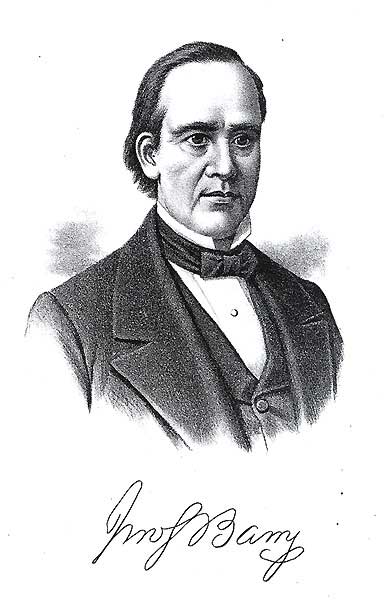
Governor John Stewart Barry
~ Commons.Wikimedia.org
The pipe of peace was then passed around, and the “talk”‘ was over. At this point John Harmon and the mercurial Senator Harvie had concluded the scheme of a little joke upon a peculiar financial characteristic of Gov. Barry. It was well known that the Governor, although wealthy, was very prudent with his means, in his expenditures of money, and it required very adroit management to open his purse strings on any common occasion. But here was a very uncommon call, and when John Harmon suggested to the Governor that it was customary in such cases to make some small present to the Indians, the Governor, thrown off his guard by the excitement of the dance, and the words small present, in Harmon’s suggestion, replied: ‘”Very well, gentlemen, make them such a present as you think suitable for me.” Harmon and Harvie sped away to the trader’s store, and the small present speedily distributed to the red men and their squaws would have insured the Governor at least six votes each from the braves had they resided in Chicago or New York at the next election. But when, just before we were to embark for our departure, the bill, to the amount of some forty or fifty dollars, was presented to the Governor, those of you who knew him can imagine the pent up wrath which his dignity, before another great chief, restrained from explosion; but it cast over his dark features a look which reminded one of a black thunder cloud which seemed just ready to burst asunder with terrific lightning and thunder. He paid the bill in portentious silence, and said not a word; but had he, about that time, caught John Harmon and Senator Harvie alone, I think I would decline to record the merited rebuke he would have given them in his well known vigorous language, when occasion called for it. The clouds of the affair hung over him a long time; and when we landed at Ontonagon, the Governor would not go ashore, for fear, I suppose, of more Indians, to receive “small presents.”
We left La Pointe with regret, having our time so much occupied by the red men that we had no time to thoroughly explore the locality where Marquette was located about 1669, when only thirty years of age.
We were obliged to anchor nearly a quarter of a mile from shore, at Ontonagon, on account of the shoal water; and a part of our company went ashore in row boats. An old barn-like warehouse, a low double log house, one or two other log cabins, and a small frame house in process of construction, was all there was of Ontonagon; and we were soon on board and steaming down the lake.
Friday, August 8, 1851
“The Lake Superior Journal gives the following particulars of the collision between the Propellers MANHATTAN and MONTICELLO:- The accident occurred at midnight, about five miles this side of White Fish Point, and thirty five miles above the Sault, the MANHATTAN being bound up, and the MONTICELLO, bound down. There was a large pleasure party on board the MONTICELLO, and many of the passengers, were up at the time and were out on deck to see the other boat pass; but by some unaccountable mistake or misapprehension of the part of one or both, they came in collision; the MONTICELLO striking the MANHATTAN on the starboard side, about midships, and cutting through the narrow guard into the hull, so far that she filled and sunk to her upper deck in less than ten minutes.
The passengers on the MANHATTAN were generally asleep, but by most wonderful good fortune they all succeeded in getting on board the MONTICELLO, and it is not known that a single person was lost or was seriously injured. The MANHATTAN had just left port on an upward trip, and had a large quantity of wood and pine lumber in her hold, and on her lower deck, which prevented her from sinking altogether. In this condition she was towed back to a small bay at the mouth of the river, where she now lies. The most of the passengers left their baggage on the lower deck, which with much valuable property was lost, or buried for the present, several feet beneath the water.
Capt. Wilson is spoken of in high terms of praise for his conduct on this occasion, in affording every accommodation in his power to the distressed crowd of passengers from the wrecked vessel.”
We made two other landings on our way back, and as the last sunset we would be able to enjoy on Lake Superior bade us a golden good night, we gathered around the cabin lights, and congratulated each other upon the unvarying beautiful weather for the entire week we had passed upon this great water; and retired to our state rooms for peaceful rest, and the landing in the morning at the Sault. It was a beautiful starlight night, and when about five miles off Whitefish point, at midnight, we were all awakened by a terrific crash, and concussion of the boat, which nearly threw us out of our berths. Such of us as were thus rudely awakened, supposed we had struck a rock. On entering the cabin from my state room, I found the floor around the dining room table strewn with broken crockery, food, and glassware, which the collision had thrown from a table where the captain and the choice spirits of the passengers were having a farewell supper; and the passengers were running to and fro in great alarm. We soon found we had come in collision with the other and opposition steamer on the lake, the Manhattan, but did not know for a short time of intense suspense if one or both steamers would go to the bottom,’which was soon found to be beyond soundings. Very soon, we heard our captain, Jack Wilson, call out to Capt. Colwell, of the other steamer, “For God’s sake hurry your passengers aboard my boat, for you are sinking.”
In the midst of intense excitement, the few men, women, and children, were hurried from the sinking Manhattan, and lifted from the small boats on board the Monticello, nearly all of them in their night clothes, barely escaping with their other garments in their hands.
We saw the doomed steamer gradually sinking deeper and deeper in the water, and waited with anxious eyes for the moment, soon expected, when she would take the final plunge. She was soon down to the upper deck, and just as we held our breath to see the water engulf her, some one cried out, “She floats!” And so it proved. The boat was heavily loaded with lumber and wood, and, just sinking to her upper deck floor, floated, from the buoyancy of the loading. We took the wreck in tow, and the next morning, within a few miles of the landing at the Sault, I saw her keel plow into the sand bottom, in twenty-two feet of water, and the rest of that season, “our line” had no opposition.
It is often very amusing, even in the midst of events full of ruin and disaster, to witness the ludicrous acts of individuals.
A lady was brought on board our boat, who sank upon the cabin floor, in her night clothes, and, clasping her hands as if in utter despair, exclaimed, “Oh, dear! my trunks are all lost, and my two new silk dresses in them, and I have been way down to Massachusetts to get them; but I don’t care if I can get my new teeth! I left two new sets in my state room, and I must have them! Do tell somebody to get my teeth before the boat sinks. If I can only get my teeth, I don’t care for anything else!” One man came through the cabin, crying out to the passengers, “Get out of the way; she has powder on board, and will explode in a minute!”
As we all knew that powder was, at that time, ten feet under water, he did not alarm us much. But it was very touching to see the mothers clasp their children in their arms, when they realized their safety, and with tears streaming down their cheeks, thank God for their deliverance from the sinking boat. There were many tearful eyes in that cabin, besides those of the rescued. Before we left the wreck aground, I went aboard and found the stem of our boat had struck the Manhattan about midship, and almost at right angle, cutting completely into her hull and deck some seven or eight feet. As a piece of naval war practice, this collision would have been a great success. But as a peaceful meeting, on the broad, deep lake, on a bright, starlit night, I suppose the courts must have decided on its merits. I never learned the subsequent fate of the Manhattan.
We found the London at the wharf, below the St. Mary’s Rapids, and the tram railway soon transferred us to the new quarters on board. We took a direct course for Detroit from Mackinaw, in the face of a strong wind; and the next morning, when somewhere off Thunder Bay, it was blowing a gale, and the waves made our boat groan in every joint. The captain very prudently put about and made for Presque Isle harbor, where we remained all day, until the storm subsided. There was one board dwelling house at Presque Isle, and the old unbroken forest came down to the lake shore.
A pleasant ride down to Lake Huron, and we entered the River St. Clair, at Fort Gratiot, in the afternoon, well contented to enjoy the beautiful quiet waters of the river, after the somewhat uncertain waters of the lake; and at night we went to our state room for our last sleep on the steamer, before we should again walk the streets of Detroit, with its already known dignity as a city, and rejoicing that on our now fast closing tour we had safely escaped all the perils of collisions, the wild Indians, and wilder waves of the great lakes. But events proved it is not judicious to balance your books before your accounts are all posted. In my berth that night, while quietly enjoying the steady movement of our boat in the still water, I heard a low grating sound coming up from the bottom of the boat, and by a little attention soon discovered it was the keel of the boat scraping acquaintance with the gravel of the shoals in Lake St. Clair, and I was rather enjoying the novel entertainment, when, all at once, there came a crash below our room that shook the boat as if a torpedo had been exploded under us.
You may well believe the satisfaction I felt, at that moment, in the knowledge that the solid earth was not six inches below our boat’s keel was of no little magnitude, and as the wheels soon began to move, and the boat evidently was again on her course, we kept our berths, and slept until morning, counting two collisions on one trip of no small importance in the list of our adventures, for we found, in the morning, we had collided with the bowsprit of a large schooner, breaking it off, and it in return completely wrecking the cook room and pantry of the steamer.
The pleasant memories of that two weeks’ trip to Lake Superior, in 1851, are green in my memory yet; but with them is mingled the sad reflection that of the twelve persons of our party mentioned in this paper, only three remain, John Harmon, my oldest daughter, Mrs. Colvin, of Adrian, and myself. Oh how our pathway through the departed years is shaded by the many willows we have planted along the way, over the graves of our friends and loved companions. Fellow pioneers, our turn to stop and rest, as these have done, is not far away. May our lives be such that when it comes, kind hands may plant the cypress and the willow over our resting places with the same sincere regard we have cherished for the dear ones who have gone before us. On through the coming years we seem to see the unclouded brightness of the pathway, for those who shall fill our places; but let our children remember that an unbroken line of the cypress and the willow will follow them, as it has followed us, as the years move on, until we all gather on that shore, where there can be no shadows, because there is no sun; “for the Lord our God is the light thereof.”
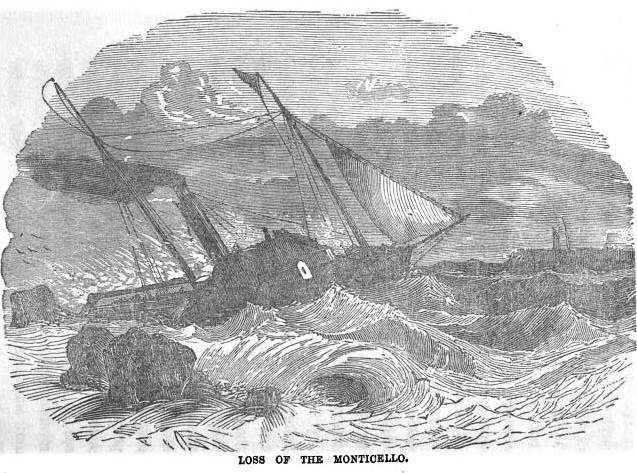
The Monticello also sank a few weeks later circa September 25th, 1851. Portrait from “Shipwreck of the Monticello” from Thrilling Adventures by Land and Sea, by James O. Brayman, 1852, pages 292-304.
The Removal Order of 1849
March 12, 2016
By Amorin Mello
United States. Works Progress Administration:
Chippewa Indian Historical Project Records 1936-1942
(Northland Micro 5; Micro 532)

12th President Zachary Taylor gave the 1849 Removal Order while he was still in office. During 1852, Chief Buffalo and his delegation met 13th President Millard Fillmore in Washington, D.C., to petition against this Removal Order.
~ 1848 presidential campaign poster from the Library of Congress
Reel 1; Envelop 1; Item 14.
The Removal Order of 1849
By Jerome Arbuckle
After the war of 1812 the westward advance of the people of the United States of was renewed with vigor. These pioneers were imbued with the idea that the possessions of the Indian tribes, with whom they came in contact, were for their convenience and theirs for the taking. Any attempt on the part of the aboriginal owners to defend their ancestral homes were a signal for a declaration of war, or a punitive expedition, which invariably resulted in the defeat of the Indians.
“Peace Treaties,” incorporating terms and stipulations suitable particularly to the white man’s government, were then negotiated, whereby the Indians ceded their lands, and the remnants of the dispossessed tribe moved westward. The tribes to the south of the Great Lakes, along the Ohio Valley, were the greatest sufferers from this system of acquisition.
Another system used with equal, if less sanguinary success, was the “treaty system.” Treaties of this type were actually little more than receipt signed by the Indian, which acknowledged the cessions of huge tracts of land. The language of the treaties, in some instances, is so plainly a scheme for the dispossession and removal of the Indians that it is doubtful if the signers for the Indians understood the true import of the document. Possibly, and according to the statements handed down from the Indians of earlier days to the present, Indians who signed the treaties were duped and were the victims of treachery and collusion.
By the terms of the Treaties of 1837 and 1842, the Indians ceded to the Government all their territory lying east of the Mississippi embracing the St. Croix district and eastward to the Chocolate River. The Indians, however, were ignorant of the fact that they had ceded these lands. According to the terms, as understood by them, they were permitted to remain within these treaty boundaries and continue to enjoy the privileges of hunting, fishing, ricing and the making of maple sugar, provided they did not molest their white neighbors; but they clearly understood that the Government was to have the right to use the timber and minerals on these lands.

Entitled “Chief Buffalo’s Petition to the President“ by the Wisconsin Historical Society, the story behind this now famous symbolic petition is actually unrelated to Chief Buffalo from La Pointe, and was created before the Sandy Lake Tragedy. It is a common error to mis-attribute this to Chief Buffalo’s trip to Washington D.C., which occurred after that Tragedy. See Chequamegon History’s original post for more information.
Detail of Benjamin Armstrong from a photograph by Matthew Brady (Minnesota Historical Society). See our Armstrong Engravings post for more information.
Their eyes were opened when the Removal Order of 1849 came like a bolt from the blue. This order cancelled the Indians’ right to hunt and fish in the territory ceded, and gave notification for their removal westward. According to Verwyst, the Franciscan Missionary, many left by reason of this order, and sought a refuge among the westernmost of their tribe who dwelt in Minnesota.
Many of the full bloods, who naturally had a deep attachment for their home soil, refused to budge. The chiefs who signed the treaty were included in this action. They then concluded that they were duped by the Treaty Commissioners and were given a faulty interpretation of the treaty passages. Although the Chippewa realized the futility of armed resistance, those who chose to remain unanimously decided to fight it out. A few white men who were true friends of the Indians, among these was Ben Armstrong, the adopted son of the Head Chief, Buffalo, and he cautioned the Indians against any show of hostility.
At a council, Armstrong prevailed upon the chiefs to make a trip to Washington. Accordingly, preparations for the trip were made, a canoe of special make being constructed for the journey. After cautioning the tribesmen to remain calm, pending their return, they set out for Washington in April, 1852. The party was composed of Buffalo, the head Chief, and several sub-chiefs, one of whom was Oshoga, who later became a noted man among the Chippewa. Armstrong was the interpreter and director of the party. The delegation left La Pointe and proceeded by way of the Great Lakes as far as Buffalo, N. Y., and then by rail to Washington. They stopped at the white settlements along the route and their leader, Mr. Armstrong, circulated a petition among the white people. This petition, which was to be presented to the President, urged that the Chippewa be permitted to remain in their own country and the Removal Order reconsidered. Many signatures were obtained, some of the signers being acquaintances of the President, whose signatures he later recognized.
Despite repeated attempts of arbitrary agents, who were employed by the government to administer Indian affairs, and who endeavored to return them back or discourage the trip, they resolutely persisted. The party arrived at Buffalo, New York, practically penniless. By disposing of some Indian trinkets, and by putting the chief on exhibition, they managed to acquire enough money to defray their expenses until they finally arrived at Washington.
Here it seemed their troubles were to begin. They were refused an audience with those persons who might have been able to assist them. Through the kind assistance of Senator Briggs of New York, they eventually managed to arrange for an interview with President Fillmore.
United States Representative George Briggs was helpful in getting an audience with President Millard Fillmore.
~ Library of Congress
At the appointed time they assembled for the interview and after smoking the peace pipe offered by Chief Buffalo, the “Great White Father” listened to their story of conditions in the Northwest. Their petition was presented and read and the meeting adjourned. President Fillmore, deeply impressed by his visitors, directed that their expenses should be paid by the Government and that they should have the freedom of the city for a week.
![Vincent Roy, Jr., portrait from "Short biographical sketch of Vincent Roy, [Jr.,]" in Life and Labors of Rt. Rev. Frederic Baraga, by Chrysostom Verwyst, 1900, pages 472-476.](https://chequamegonhistory.com/wp-content/uploads/2016/03/vincent-roy-jr.jpg)
Vincent Roy, Jr., was also on this famous trip to Washington, D.C. For more information, see this excerpt from Vincent Roy Jr’s biography.
Their mission was accomplished and all were happy. They had achieved what they sought. An uprising of their people had been averted in which thousands of human lives might have been cruelly slaughtered; so with light hearts they prepared for their homeward trip. Their fare was paid and they returned by rail by way of St. Paul, Minnesota, which was as near as they could get by rail to their homes. From St. Paul they traveled overland, a distance of over two hundred miles, overland. Along the route they frequently met with bands of Chippewa, whom they delighted with the information of the successes of their trip. These groups they instructed to repair to Madeline Island for the treaty at the time stipulated.
Upon their arrival at their own homes, the successes of the delegation was hailed with joy. Runners were dispatched to notify the entire Chippewa nation. As a consequence, many who had left their homes in compliance with the Removal Order now returned.
When the time for the treaty drew near, the Chippewa began to arrive at the Island from all directions. Finally, after careful deliberations, the treaty of 1854 was concluded. This treaty provided for several reservations within the ceded territory. These were Ontonagon and L’Anse, in the present state of Michigan, Lac du Flambeau, Bad River or La Pointe, Red Cliff, and Lac Courte Oreille, in Wisconsin, and Fond du Lac and Grand Portage in Minnesota.
It was at this time that the Chippewa mutually agreed to separate into two divisions, making the Mississippi the dividing line between the Mississippi Chippewa and the Lake Superior Chippewa, and allowing each division the right to deal separately with the Government.
Barber Papers: “Houghton” Fall of 1857
February 17, 2016
By Amorin Mello
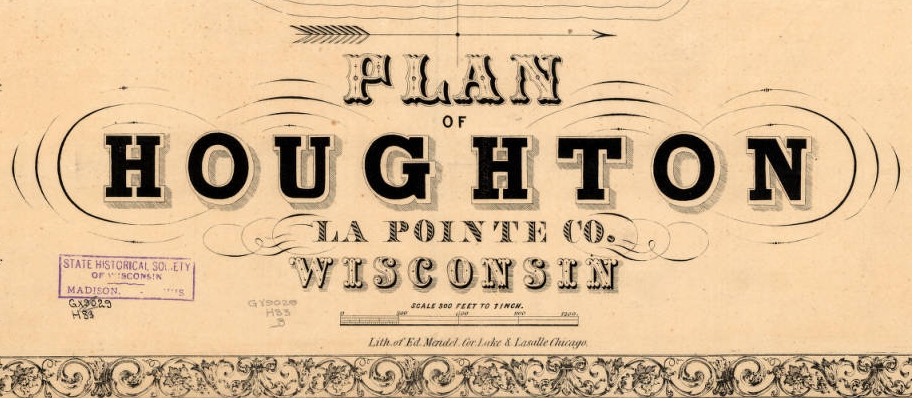
Selected letters of the Joel Allen Barber Papers
… continued from the Summer of 1857.
Sandusky Oct 24th 1857
Dear Son
At length your father and I have both reached this place but how soon we shall be able to leave it is uncertain. He arrived here last Monday night in a most miserable state. I did not get here ’till Wednesday morning when I found him much worse than I had supposed he had been, and I believe worse than he had been at any time with his lameness. He probably exerted himself too much and produced a relapse of his fever and swelling of the limbs.
He got to Detroit Thursday at night – when he got ashore he found his carpet sack was missing – he being to sick to bring it off himself. Friday morning he sent round to the hotels to look for it but got no trace and concluded to go without it – but found he was a few minutes too late for the boat. Saturday morning he went down to the wharf, then the driver pretended, or was told, that the boat would not come and go that morning but at 4 P.M. so he was carried back the house again and paid the scamp 50 cts. Soon after he saw a bill posted saying the “Bay City” would leave that day at 7 oclock but before he could get to it, they told him it was gone so he was obligated to remain over till Monday.

Michigan Exchange Hotel in Detroit, circa 1884.
~ Burton Historical Collection.
He put up at the Michigan Exchange where he was on the second floor and had to climb stairs until his limb became very lame and considerably swollen the whole length. He had some fever and no appetite all the way after leaving La P. and probably when he started. The day after he got here Hamilton procured a Homeopathic Physician who has called to “treat” him every day since. He had intermitent fever all the time. Broke a fever every afternoon and night till yesterday and today, when it seems to be leaving him – his appetite is returning. I think tho he is very weak and can bear but very little food and the of the simplest kind. The Dr thinks he will get up soon if he can get the pain out of his limbs, but that will probably take some time to conquer. Says it is probably a rheumatic affliction and might have been produced by taking Quinine. But he is decidedly better now than three days since – in all respects I believe that had he called an Alopathic Dr, he would surely had a Typhoid fever, but if he is quiet and patient I think he will escape this time. But I fear it will take a long time for him to recover sufficiently to go home in cold weather. He had set up a little the last three days but cannot get off nor on the bed without help, and cannot walk without great paid to his limbs – indeed, he has not walked a step since Wednesday. It has certainly been a very unfortunate season with him and with us all, but I must consider it very fortunate that he has fallen in to so good a place to be be sick, and is in the care of an experienced Homeopathist, who I believe will cure him.
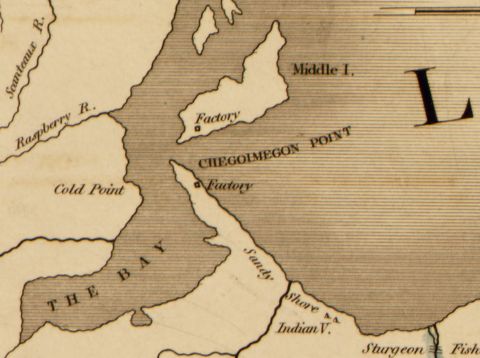
Houghton Point aka “Cold Point”,“Stony Pointe” , and “Point Prospect”.
~ Detail of Map of Michigan & Part of Wisconsin Territory, Exhibiting the Post Offices, Post Roads, Canals, Rail Roads, &c from the 1839 Burr Atlas of Postal Maps.
It is very strange you did not receive any letters from me before father came away as I had sent, certainly three – some of which you may have got before now. And I got but two short letters from you and none from your father after you left me. He wrote to Mr Burr when first taken sick and I heard nothing more from him untill one reached us of Oct 3d saying he wished me to meet him at Sandusky as he was too sick to get to L. Of course, I suffered a good deal of anxiety to know what had become of him and how I was to get home alone – supposing he had gone home without sending me word – I had been so long waiting to hear from him that I had concluded to start in company with Miss Julia Hyde, when I rec’d his letter.

Detail of early settlements and footpaths near Houghton Point from the Barber brothers’ 1855 survey of Chequamegon Bay. Giles and Allen lived with the Maddocks family during 1856 and 1857 at what is now the Houghton Falls State Natural Area.
I had promised a visit to Mrs. Baker at Janesville, so not knowing how soon he would be here, or that he was much ill then, I concluded to stop there and I started Thursday morning from L – and spent three days at Ja – left there Monday at Midnight – that being the express train expecting to get here the next eve but did not till Wed Morning 4O.C.. There being but no train each day from Toledo to this place. I got along very well alone – without losing any thing of consequence. I am afraid that carpet-sack of father’s will never be found tho. Uncle H has written to some one who was on the boat – whom he knows and perhaps it may come again. If not it will be one more loss added to the many we have suffered within two years. When the tide of misfortune will turn with us is yet in the anxious and uncertain future. I yet hope our lives will all be spared to meet again. When I left Lancaster many people were having a sort of influence which they called “colds”. Grandpa – Thode Burr and Mary B. had it and since reaching here Martha has sent a letter saying that Addison – Mame. Lil and Em. in her house – Mother and Lucy – Lib and the two youngest children, and Mary Parker – and Father at Allen’s, Mr. Phelp’s son quite sick; and about half the people in town had the disease. I had the good luck to escape it entirely, tho’ I rode to Boscobel in the stage the worst day there has been this fall. I am afraid we shall not be able to go home without exposing father so much that he will be very sick. I am sure he cannot recover sufficiently to start with safety in less than four weeks if he has very good luck and no relapse on account of the season. But if good nursing & good medicine can cure him he will be well before winter.
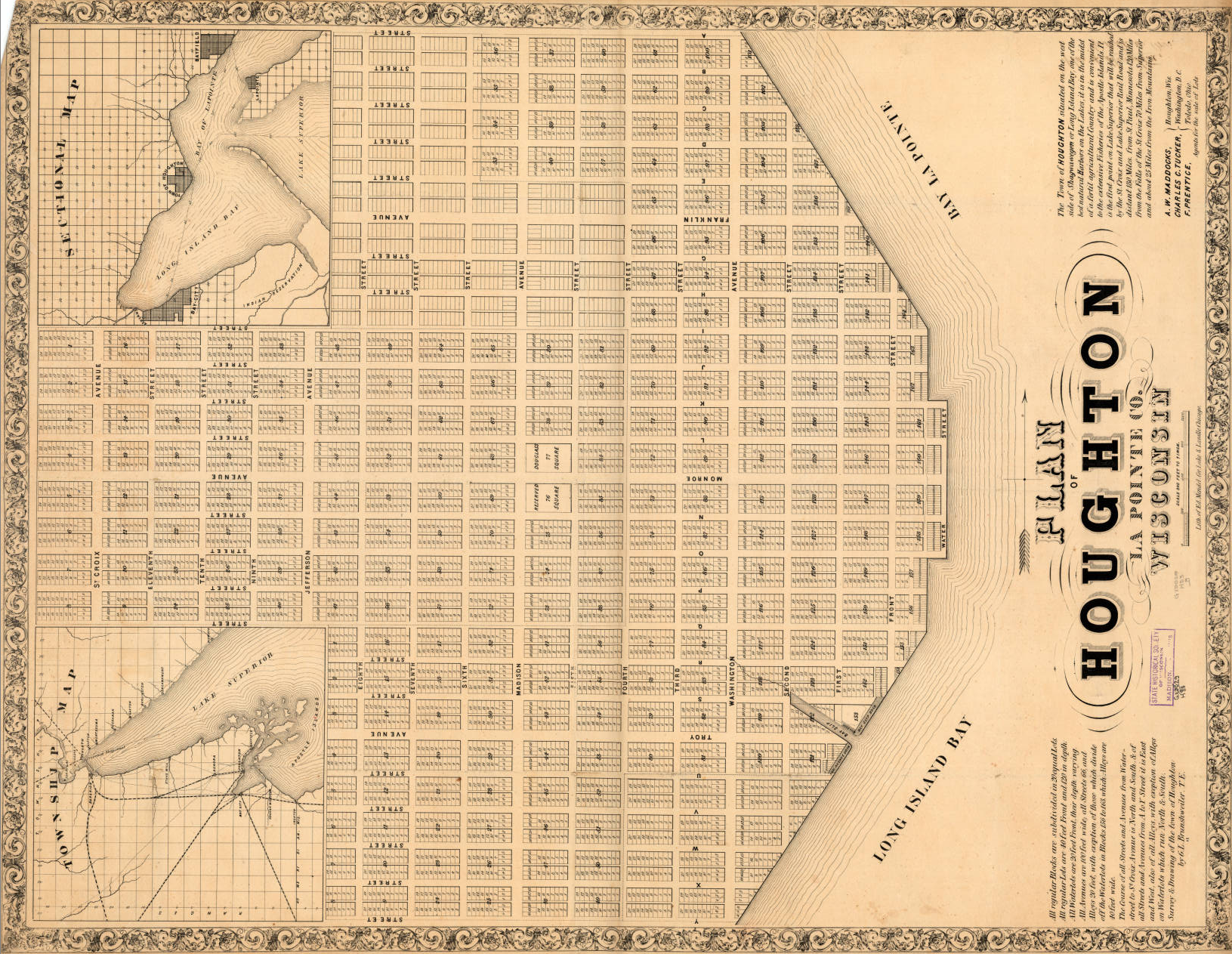
Plan of Houghton, La Pointe County, Wisconsin, 1858.
~ Wisconsin Historical Society
Aunt Emeline is absent, with Frank at Columbus, but the rest of the family are here and show us every kindness. This is a most delightful – comfortable and convenient place to be sick in, if one must be sick. How I wish I could think of our house as possessing half the attractions for a family residence that this does. But, poor as it is I should be very glad to see it once more and be where I could call it home.
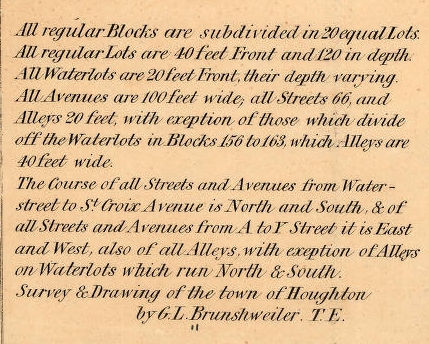
“Survey & Drawing of the town of Houghton
by G. L. Brunschweiler, T.E.”
I am sorry to hear that you have had to wait so long for your money – consequently could not go on with your work. I do hope you will not try to stay there through the winter unless you are sure of money, and that there will be plenty of provisions to be got at. What could have been the reason that your money did not come to you? I did not know that Uncle Sam has suspended payment or lost by the failure of the banks. Perhaps you did not keep reminding them of your case or give them your “address”.
You must write oftener to me and give me an account of your affairs – of all your pleasures and your pains – your disappointments and vexations and be assured no one can feel a deeper interest or more truely sympathize in all that concerns her you than your affectionate parents.
G. A. Barber and M. G. Barber
“A. W. Maddocks – Houghton, Wis.
Charles C. Tucker – Washington, D.C.
F. Prentice – Toledo, Ohio.”
Your father wishes you to say to Mrs. Maddocks that he feels under infinite obligations to her for the kindness shown him while sick at her house – that he wishes to express a thousand times more thanks than he was able, when parting from her in the Steam boat, to do. I congratulate you on having the privilege of making it your home at so nice and comfortable a place, with such kind people as father describes those to be. May you have the good fortune or good taste and disposition to make your presence in that, or any other kind hearted family, agreeable – is the wish of your Mother.
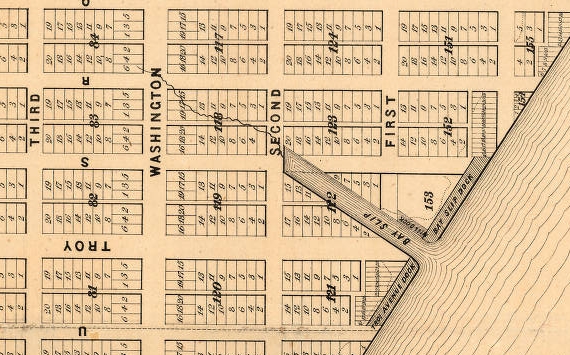
Houghton Falls State Natural Area within the Town of Houghton.
Monday morning
Your father rested better last night than before and had no fever thro the night but sweat a good deal as before – is very cool and comfortable this morning. Has some appetite – does not like to get up as it hurts his limbs. But much less than when I first came here.
Sandusky Nov 1st 1857
Dear Son,
Last sunday I wrote you about your father’s sickness and hope you have rec’d it, or will in good time; but as my letters of the past summer have failed wholey to reach you, perhaps the last has also failed. I shall continue to write to you often while he continues sick – and unless while navigation lasts and you may direct yours here until the last boat leaves your place as I see no prospects now of your father’s being able to move on for some time to come. I told you about the chill he had which made me fear he had got a regular chill fever but he did not have another tho he had pretty severe intermittent fever for three days last week. – indeed it continues somewhat yet, but much lighter. But his lameness is much worse than when he left you – that is – he cannot walk or step because his limbs are so painful and much weaker than when he had more fever. I believe he would never have got here alive had he not been sustained by tonics and morphine, but they would never have cured him, and I do think that had he fallen too sick to get here and had employed another Alopathist he would have gone into a typhoid fever and probably have died, as did the hon. R.C. Benton Sen. a short time since – at Rockford Ill. I met his son – our Johnson teacher one at Janesville who told me the sad news. – He was informed of his father’s sickness but did not reach there ’till after his death. His body was carried to Vt. for interment.
Nov. 2
~ “Business Directory” published in the Superior Chronicle, June 26th, 1855.
Your father wishes to ask you if you know anything about that Geo Perry concern – the present shape of it. And if you have heard any thing farther from the Aminacon claim?
Did you get the money of Jack so as to save your compass? If so – how does it prove? Has Herbert got home since yet? If so, how do the boys fare – do they get any money of him? Does old Whacken let John have his paper? Do you hear anything from your money?
When father left the boat at Detroit he told the porter to get his Carpet bag in his room and send it ashore with his trunk – showing him the trunk. – but when he got to the Michigan Exchange it was not to be found – neither at that house nor any other in the city. In looking for it he was detained so as to lose the boat for Sandusky, Friday morning – Saturday he started in a carriage but was told at the wharf by the driver that the boat would not go – (had not arrived) till afternoon, so he was taken back again when soon word came that it had came, but before he could get started – he being unable to walk – it was off again, so he was obliged to stay ’till Monday.
Thus he was detained nearly four days – sick and lame and obliged to climb a long flight of stairs and take long walks to his meals and other necessities, which all together brought on his fever and rheumatism in the muscles worse than ever. He thinks it almost a miracle that he got through so long a journey – sick as he was when he left you, and without any one to assist or care for him – alive. His lameness is now in the left limb – the other being quite free from pain when kept in a horizontal position, but both pain him extremely yet if put down so that he does not attempt to step on his feet. Ham, Jay, and I brought him up stairs last Saturday where we have every thing we need for convenience and family are all as kind and attentive to one wants as people can be. I do not believe there is any better family, or one happier, than this. It is two weeks today since father came here and I know not how many more he may have to stay – the prospect looks rather dark for a speedy departure.

The “Geo Perry concern” related to Albert McEwen’s death and fraud during the 1856 LaPointe County election. This was investigated by the Wisconsin Assembly.
~ Journal of the Assembly of Wisconsin, Volume 9, 1857, page 191.
We got a letter from Am. Saturday in answer to one from me here, says he is well but I should judge he had not done much this fall but watch and wait for us. I do not wonder the poor boy is out patience as well as every things else, as he says.
Write often to your afflicted parents.
G.A.B. and M.G.B.
Sandusky Friday Nov 13 – 1857
Dear Son.
You will at once perceive that we are stationary since I wrote you last. And when we shall be able to move on, is as much a question of uncertainty as ever. Your father remains sick yet – and I cannot – dare not say that he is even convalescent, tho’ I have a little more courage to think that the medicine now being administered is breaking up his fever. He has had a most singular sickness – having – as I think – more or less fever – with or without chills every day – probably since he was first taking – certainly since coming here. [??] the Dr would not acknowledge – or believe it because his visits would be in the forenoon when the intermissions would occur. But the past week he convinced him that chills and fever do actually exist as he has been [presedest?] to break it up. His sickness is so unlike anything in the experience of the Dr. that he appears to be entirely mistified with [reward?] to the proper course to pursue. I have, and do, doubt his judgement – and sometimes have even put a harsher construction upon his course and doubted his honesty. But he has all along said he had not the least doubt of his ultimate recovery tho it would take considerable time to entirely remove his lameness. As to that lameness I hardly know what to say. He is now free from soreness and only his feet swolen; but he cannot straighten his knees as the cords appear to be contracted and are painful when strained and if his feet are brought lower than his body it brings on the same old tearing pain in the muscles.
But I believe that when his fever leaves him and he begins to gain strength his limbs will improve fast. This week past I have felt more discouraged than ever, as the chills would come on every day about noon – continue an hour – sometimes with a hearty shake – then fever – pulse 120 hr. m. – then a hot sweat most of the night with pulse at 85 at the least pain.
This lasted about 5 days – But the Dr has at length “come in with a Tonic” which appears to work right. It is the most powerful sweating medicine I ever saw. He has taken it two nights and one day – and now the 2nd day – 3 P.M. – he has fairly escaped the chill and fever. I feel greatly encouraged – that he is in a way to recover. He has all the time been quite confined to his bed except as he could manage to get into a great chair once a day and sit up – from two hours to half an hour – this several days he has not got in the chair as he was unwilling to exert himself so much. I have been with him – his only nurse – night and day for 3½ weeks, and I hope and expect to granted health and strength to continue to perform the duties of nurse so long as he shall need my assistance. I cannot but think that he was in just as good condition to receive the medicine, which is working so well over two weeks ago – when the billious fever first left him, as he was two days ago. But the Dr thought not, as his limbs were so bad then, and it might make them worse. It has been altogether an unique case, and the Dr has appeared liked one groping in the dark.
I told you in my letter of last week that father lost his carpet-bag – and intended to tell you to see if it was not returned to La Pointe and left there – he thinks the label on it directed there – tho’ at first he said it was to Lancaster. He can hear nothing from it since and I fear it was stolen by the darkies on the boat. This has truely been an unfortunate year for us as well as for thousands of others.
1872 cartoon of Wisconsinite Carl Schurz by Thomas Nast.
Wikipedia.com definition of a Carpetbagger:
In United States history, a carpetbagger was a Northerner who moved to the South after the American Civil War, during the Reconstruction era (1865–1877). White Southerners denounced them fearing they would loot and plunder the defeated South. Sixty Carpetbaggers were elected to Congress, and they included a majority of Republican governors in the South during Reconstruction. Historian Eric Foner argues:
“… most carpetbaggers probably combine the desire for personal gain with a commitment to taking part in an effort “to substitute the civilization of freedom for that of slavery”. … Carpetbaggers generally supported measures aimed at democratizing and modernizing the South – civil rights legislation, aid to economic development, the establishment of public school systems.”
“Carpetbagger” was a pejorative term referring to the carpet bags (a form of cheap luggage at the time) which many of these newcomers carried. The term came to be associated with opportunism and exploitation by outsiders. The term is still used today to refer to a parachute candidate, an outsider who runs for public office in an area where he or she does not have deep community ties, or has lived only for a short time.
We get nothing yet from you. Why is it that you remain so silent? I think it probable we may have to stay here four weeks longer – waiting for him to get well. You may direct here if you send by return mail or by any boat.
You cannot know, nor be told the amount of distress in the country this money panic has produced. I presume you do not see the papers so often as we do, and perhaps do not realize at all. You father warns you to be careful what you do this winter. – not to meddle with any thing – in Ironton shares – or any kind of property – even if you can buy it for a “song” – Every thing is “dead broke” and the less you have to do with Lake Superior property, the better.
Father sends his best love along with mine to you and his respects to Mrs. Maddocks and family.
I am very sorry to think that you will stay up in that wilderness this winter. I wish you could get your money – settle up every thing – come down here and go home with us. It would be a great relief to us to have your assistance for your father if he should continue too lame to walk without help.
We are under a great many obligations to Uncle H. and family for their kindness.
It is growing dark, so good night
Mother
Sandusky Dec 6th 1857
My Dear Son.
Yesterday we rec’d a letter from Am. containing one from you. I was greatly surprised and grieved to learn that you had not got one of my letters since you left Lancaster. I have sent you three from there and as many from here. Neither had you rec’d your draft. I am really suspicious that some one watches the mails and steals your letters hoping to get money or the draft – which, it is possible he has taken out – forged your name &c and taken the money out. In such case you might not discover the theft for a long time – and would be subjected to a great deal of trouble in consequence. I shall have a deal of anxiety in your account this winter, or until I hear that your money has reached you and that provisions are to be had at reasonable prices – which I fear they will and be this since the loss of that new boat must make quite a difference with that region in supplies.

American carpetbag circa 1860; wool with leather handles.
~ Wikimedia.org
I have before written you an account of your father’s journey and continued sickness which you may have yet [??] now. Lest you have not I will briefly say that he got safely to Detroit where he lost his carpet-sack – was detained there three days – arrived here Monday night 19th ult. Oct. 19th where he has remained ever since, confined to his bed. The fatigue of the journey probably somewhat increased his lameness which has been very severe, and he has not been entirely free from chills and fever and sweats until the last week. He has been improving fast for a few days, but just now he is having a little more fever which I presume is caused by some impending diet – either in quantity or quality.
His disease – a very uncommon one – is, in fact, inflamation of the veins extending from the Loins throug the whole limbs – the left much the most – to the toes. He has not been able to put his feet to the floor without extreme pain since he got here, until the last week, and even now, but a few minutes at a time. The cords under the knees have been considerably constrainted but are getting relaxed a little so that his legs make nearly straightened, tho he cannot begin to bear his weight on them.
The disease has been so complicated and so badly treated before he got here that the Dr has been very much perplexed with it. If you have not got my former letters you do not know that we have had a Homeopathist – one whom Uncle H. and Aunt B. think knows enough for all cases but we think that had he possessed a knowledge of anatomy equal to his partner in business who has called twice with him of late, he would have discovered the seat of the disease at first from the symptoms then apparent. But for four weeks he seemed to be in a state of uncertainty, and baffled at every step. But since he discovered the seat of it he has treated it with very good success.
Your father is much reduced in flesh and strength. I cannot now give you a full description of his case but when he gets able to write much I presume he will amuse himself by giving you the particulars if you should feel interested in the subject. Uncle H and family are very kind and obliging and we have every thing our necesities demand at present, but that does not make me contented to remain so long from home. I wish to be in my own house, but it is impossible to leave here until he can walk enough to help himself a little. We have been here 7 weeks, and I fear it will be many more before it will be safe for him to leave or proper for me to leave him for others to wait on. My health is very good so that no one has had to assist me day or night, in nursing.
Your Aff’nt Mother
I suppose this will never reach you unless I direct to some other person for you.
All well at Lancaster last Sunday. Monday morning Aunt Lucy saw a fine little daughter added to her family.
Sandusky Dec 18th 1857
Dear Son
~ Wikipedia.com
You will see that we are here yet, now nearly 9 weeks since I landed here in an almost insensible state from the effects of morphine which I had to take constantly to allay or drown the pain in my limbs. I have been quite sick much of the time. Three or four weeks were spent in treating my sore before the [rest seat became?] of my disease was ascertained, since which time there has been steady progress toward health. My legs had become crooked at the knees, absent at an angle of 45*. My ankles and feet swollen, white, cold & as useless as though made of putty, but I found the pain that had so long affected them was gone & by much exertion, rubbing &c I got so as to bear any weights, & [thoutes who?] crutches, & I have now got so that I can go twice the width of the house at a time on them. My appetite has returned & I am gaining rapidly. My real disease was what is called Spormator [hea?] or a disease of the Spormation vessels or cord on the left side of my body, which the Drs & your Uncle Ham think was the origin of my sickness & all my pain. Sir Astley Cooper [in thing?] authority, giving all the symptoms of my case. We hope to be able in a week or two to go home to Vt. Your mother wants to start in my present helpless condition when I cannot stand alone in a minute without support to save my life, but I have sworn that I will not go to be jostled around & in the can till I am better able to take of my self than now. I cannot get up or down stairs or sit at all weight with crutches, & as neither of my legs are reliable I assure you it is ticklish business to dare go on them (the crutches).
Echo Dells at Houghton Falls State Natural Area.
~ Shared under Creative Commons from Aaron Carlson © 2011
Coming down the lakes from La Pointe I had a pretty hard time of it, was quite sick, had chills, kept my berth most of the time, & when I got to Detroit I was detained by losing my carpet bag and one thing & another because I was unable to help myself, from Thursday P.M. ill Monday A.M. when I came here. Lucky that I had such a refuge to [want?] to in my extremity, had I tried to reach home, my life would have paid the forfeit of I might have had a long sickness among strangers without any of the comforts or conveniences I now enjoy, and insured an enormous train of affection.

Map inset of Chequamegon Bay with Town of Houghton, LaPointe, Bayfield, Ashland, Bay City, and the LaPointe Indian Reservation.
We get letters from Amherst occasionally, he is well & in good spirits boarding at Mr Griswolds, is very anxious for our return to Vermont. By him I learn that Ambrose Chase died after about an hour illness in Nov, & that John Burcham of Johnson died still more suddenly being found dead in the privy. Old Mr Dorsker died lately & that is all he has told of to us. On opening my new trunk here I find some books are missing. Who do you suppose is the rogue? I hope he will russ some amusements & instruction from the books, if so I am content.
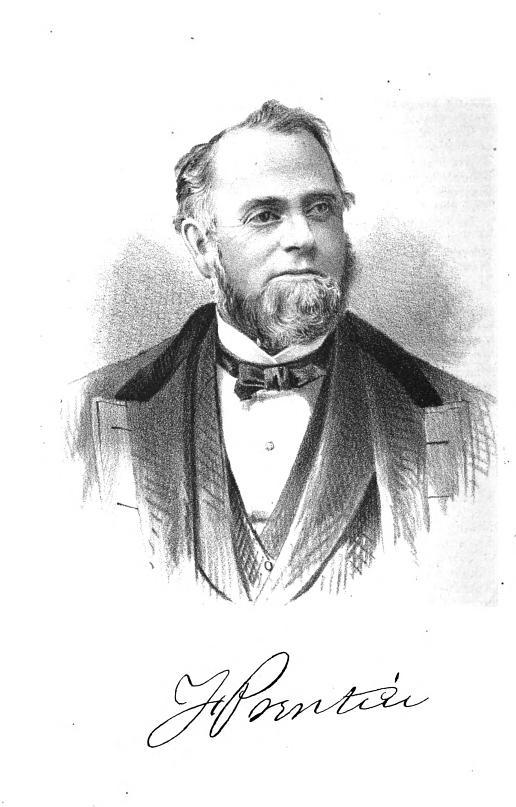
Frederick Prentice (“Man of Money and Mystery”) was an “Indian interpreter for Indian agents and traders”, and owned extensive properties in the Chequamegon Bay region during the 1850s. Prentice started the City of Houghton around the same time he cofounded Bay City (Ashland) during 1854, purchased the Buffalo Tract (Duluth) from Benjamin Armstrong during 1856, and cofounded the City of Houghton (near Washburn) during 1857. Prentice returned to Houghton in 1887 and organized the Prentice Brownstone Company, becoming “the most famous quarryman in northern Wisconsin”. Houghton had a “population of about 250 people, a school house and a sawmill with 25,000 foot capacity” by 1888.
~ This portrait and a profile of Frederick Prentice (the “first white child born” in Toledo, Ohio) is available from History of the Maumee Valley by Horace S Knapp, 1872, pages 560-563.
~ “Business Directory” published in the Superior Chronicle, June 26th, 1855.
August 22nd, 1857
“John H Osborn,
Banker and Land Agent,
And Dealer in Exchange, Superior, Wis.
REFERENCES, — J. B. Ramsay & Co., Cincinnati; J. R. Morton & Co., do; E. Jenkins & Son, Baltimore; A. R. Van Nest & Co., N. Y.; Heston & Druckla, Phila; Holiday & Coburn, St. Louis; John H. Richmon, Esq., Maysville, Kentucky.”
Have you recd your draft yet? Was your compass saved to you? Have you got at work on the reservation yet? If so how do you prosper? How does Herbert make it, does he still remain agent? Does he sell any shares, if so, for how much? Is the work still going on at the City of Houghton, or has the news of the general crash and prostration of all kinds of business failed of reaching Stony Pointe? I recd a letter from Prentiss last week who says, there are some going from Toledo next spring to live there, & he appeared to feel as well as ever.
He said he sent 50 bbls Ham & a lot of Pork to Detroit to go up, but it arrived too late for the last boat to Lake Superior. I have written to Hayes that if the Ammanicon case is decided against me to take an appeal to Washington at once & I will go there & see if testimony has been supplied or any unfair things have been done by the clerks in the office.
I have now sat up [little?] hours, read Douglas’ speech & written this much to you but I feel that I have over taxed my powers and must go to my heated bed for rest. Douglas has come out against the Administration policy toward Kansas & will make a split in the party not easily healed. I will send you his speech.
Tell Mr. Maddock’s folks that Judge John Fitch of Toledo was shot yesterday [????] once of his family by one T.G. Mellon, the ball entering his mouth, lodging in the back of his neck, some hopes are entertained of his life. If this is a ½ sheet it is as long as your letters. Be careful of yourself. I remain your affectionate father.
G.A. Barber
Give my respects to Mr & Mrs Maddocks, & to John Cosborn.
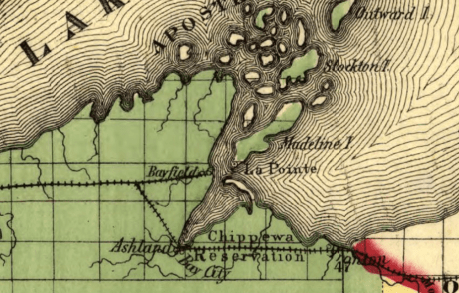
Detail from the 1857 “Township map of Wisconsin showing The Milwaukee & Horicon Rail Road and its connections“. The town-sites of LaPointe County shown here are Ironton, Boyd’s at Old Fort (mislabeled as “La Pointe”), Bay City, Ashland, and Houghton (mislabeled here as “Bayfield” and later as “Lower Bayfield” in the 1865 Colton Atlas). The railroad shown on the LaPointe Indian Reservation correlates to Barber/Wheeler/Stuntz details from “the Gardens“.
~ Library of Congress
To be continued in the Winter of 1858…
Barber Papers: “Poor McEwen” Spring of 1857
January 29, 2016
By Amorin Mello
Selected letters of the Joel Allen Barber Papers
… continued from Winter of 1857.
Cambridge Sunday April 12th 1857
Dear Son
It is some weeks since I have written a word to you, for the reason, that after I learned that you had gone to Superior & might be coming down to Lancaster, all my letters to you might fail of ever reaching you, so I have held on till I should learn something further from you. We have recd several letters from you, since your arrival at Superior, for which we were thankful, & I trust that when you got back again to La Pointe our old friend Esq Bell had a lot of my letters for you that would take a long time to read, i.e. if you should have patience enough to read them all through I wrote you last on the 8th of March & next day letters from you, one dated at La Pointe & one for Amherst dated at Fargo’s. Since that time nothing any important has occurred within the circle of your acquaintance. Every thing has jogged on in the old beaten track. We are all three well, & it is a remarkably healthy time all around us. There have been but 3 or 4 deaths in town since I came home. Deacon Reynolds aged 90 Lyman Seeley’s wife & Walter Wheeler [???s] wife & a boy of D.R. Evan’s. In Johnson no deaths that I can think of except old Mrs Hunt who died last week. The marriages in this town have been very few & none that you will know any thing about except Susan Harvey who was married last week. In Johnson very few, Calvin Whiting has lately married the widow W. (Albe‘s Mother).
This has been a remarkable sugar season thus far, but we are probably through or nearly so for this year. Dow has made about 1150 lbs & has a lot more to sugar off. Amherst has tapped 15 trees where Mr Harvey who used to make sugar in our woods and has made about 250 lbs of the kindest sugar ever made in Vt as he used tin milkpans to catch his sap & boil in the great caldron kettle & every thing is done up scientifically. It would amuse you to see how the “Hops” put into it, as he goes into the woods at 7 a.m. gathers his work, over 3 or 4 times boils it down & draws it down on the handsled in the largest wine keg, at night, often after dark, & half the way in deep mud, sometimes breaking his draw ropes & nearly blistering his hands by drawing on the rope. Amherst has got to be a great swarthy half breed 5 feet 5 ½ inches high in his stockings & weighs 140 lbs as well & free from every ail as one could wish & if you do not see him soon you will never be able to handle him again.
We had a great flood last week as high as I have ever seen it, save a very few times tearing the banks terribly, carrying off fences, bridges, & doing all sorts of mischief generally. Our meadow will part with a slice from the trees just below the house to the large trees on our bank [????] the creeping rock about ½ a rod wide. You will be surprised to see how the meadow is going off, the more it wears, the faster it goes next time & it will not be long before it will go all off entirely. If it were like all other meadows, that gained in some other place as fast as it last elsewhere it would be more tolerable. But we shall have to grin & bear it, awhile, till we all make up our minds to let somebody else have it & try what they can do to save it. Another great objection to our meadow is its liability to have the soil carried off & great holes washed out, if plowed, & there is 1/3 or nearly of the meadow in this state & for want of plowing it does not produce more than 1/3 of what it should do.
Dow is still on the place, though he & wife are bad enough I do not see as I can do better. Jonathan Nichols has got back with his family to Cambridge, Irving sold out in Al. but on?? is homesick to get back again.
You will get a letter from me with a copy of a notice from the Land Office at Mineral Point, & probably you will get a copy of the law as passed by Congress, before this reaches you, or I can cut it out and send it in this letter so that you can see it for yourself which I think the best way & you can also see Oscar’s [???], & as you have lately written to your Uncle Allen I suppose he will give you all needful advise on the subject.
On further reflection I will not send you the Law, you will get it in William’s Paper of March 21st if it now goes to La Pointe as his father said he should direct it [???] Nov 20th then. I think will be no trouble in your case, as you will see that all entries under that act
“where the purchaser has made affidavit & paid the purchase money as required by [?d] [a?] & the instructions issued & in force & in the hands of the Regent at the time of making said entry, are hereby legalised & [???] shall issue to the parties respectively, Excepting those entries under said act, which the Commissioner of the Gen. Land Office may ascertain to have been fraudulently, or evasively made.”
This is all the law governing your case & I think there will be no difficulty whatever about it. Your entry was made in good faith & you went to the Lake to earn something with which to improve your land & have forfeited nothing there. I was thinking that if you came to Lancaster I would go there & take you with me to the Lake via the Sault when I go up there in May or June. However if you do come I know it as soon as you get there, & if you do not I shall expect to find you at or around La Pointe in health & in good spirits I hope, & probably glad to see one from below, but not gladder than we should be to see you here.
I am surprised to learn that you are going to survey islands so late in the season. Nothing that I can now say will avail any thing else I would caution against trusting too long to the treacherous covering over the dark blue waters. I hope you will have good success and get through without any fatal accidents to your self or to any one of your party. I shall feel great anxiety on your account, till I hear from you again, but shall try to comfort myself with the assurance you gave us in a late letter that you were careful to avoid all danger as much as possible, not only on your own account but on that “of your parents & dear brother.” I cannot expect to get answer to this before it is time to go up to the Lake, but that need not deter you from writing, if you do not come below, & if you do come to Lancaster you may expect to see your Mother there forthwith & possibly Amherst & myself. I do not yet know what I shall do with Amherst this season whether continue him at school put him in a store or to some trade. He would like to be a printer well enough, & it is not a bad business. Whether it would be best to have him go through college is matter of uncertainty with me. There are half as many spoiled by going to college as there benefitted by it. But I do want you to close up all your business around that Lake & come to your Uncle’s Office to study Law. Thode Burr thinks of it & his Uncle wants to have him. I wish you to take the matter into consideration. May God preserve your life & health and prosper you in all lawful undertakings
I remain your Affectionate father
Giles A. Barber
Amherst has shot 3 muskrats to day, prices better now from 15 to 25 ¢.
I am very sorry for the fate of poor McEwen. I fear he is dead & that his fate will never be known. I think he was abandoned by his guides & perished alone.
Mr Young is still alive I suppose, have heard lately that he was worse.
You will see that Buchanan is the worst patron of Border Ruffians & the meanest tool of slave holders that has yet cursed the nation, appointing the worst fire eaters and none else to office in Kansas, & doing all the dirty work of the south crushing out freedom & establishing slavery all over the [?????] if possible.
Superior Chronicle
April 14th, 1857
SUPPOSED MURDER.

“Supposed Murder” was a newspaper article published in the Superior Chronicle issue of April 14th, 1857.
“I am much alarmed for the safety of Friend McEwen & think the prospect of his being alive is very small. The case deserves a rigid investigation to ascertain whether he was murdered by his guides, or was deserted by them & left to perish in the wilderness. The weather was favorable about that time & for some days after. I think he left La Pointe Oct. 14th the day I got back from Montreal River. ‘Poor Mc’”.
Considerable anxiety is felt by the people of La Pointe county in regard to the whereabouts of Mr. Albert McEwen, a citizen of that county, who started overland for St. Paul sometime during the months of October or November of last year; and of whom nothing has since been heard. Strong suspicions that he was murdered are entertained by his friends. The circumstances, as near as we can learn them, are as follows:
by Western Historical Co., 1881
“Ironton, which was settled at the time of the iron excitement, was situated on the south shore of the lake, one-half mile west of the Montreal River. The village was platted in 1856-7, by McEwan [Albert McEwen], Herbert, Mandlebaum, and others. Warehouses and docks were built, and the place thrived for about four years, when it was abandoned.”
Mr. McEwen, a gentleman from Detroit connected with the Indian Agency, and several persons from La Pointe county, with half-breed packers, started together last fall to go across the country, and traveled in company until reaching the head waters of the St. Croix. Here McEwen and the gentleman from Detroit procured canoes and, with two half-breed yoyaguers, determined to descend the river, while the remainder of the party took the land route. When the latter party reached Yellow Lake they found the half-breeds there, but could learn nothing definite in regard to McEwen and his companion; nor could the learn anything in St. Paul, where both these gentlemen had business engagements.
McEwen was known to have about $600 in notes and drafts on his person, and his companion $1,000 in gold. The half-breeds were seen a short time after in St. Paul in possession of large sums of money, principally gold. It is believed that they murdered these gentlemen while descending the river. The circumstances are strongly in favor of this belief.
Mr. McEwen had resided in and about LaPointe for several years, and owns considerable property in that county. He was an explorer; and is well and favorably known throughout the lake region. The other gentleman was in the employ of Mr. Gilbert, superintendent of the Lake Superior Indians; and was returning to Detroit from La Pointe, where he had been on business connected with the agency.
At latest advices a party were organizing at La Pointe to go to the St. Croix and arrest the half-breeds, and if possible learn the fate of the missing persons.
Early Life among the Indians:
by Benjamin Armstrong
CHAPTER XVII.
A Murder on a Trial at Yellow Lake.——Yet a Mystery.——Collar and Sleeve Buttons of the Murdered Man.——An Introduction to the Bear Family.
~ Early Life Among The Indians by Benjamin Armstrong, Chapter XVII.
North Woods River:
The St. Croix River in Upper Midwest History
By Eileen M. McMahon, Theodore J. Karamanski, pages 64-66.
“Among the unsavory traders who entered the St. Croix at this time was Joe Covillion. He was a Metis who took over the former mission school at Yellow Lake and used it for his post. Located on the Yellow River just where it leaves Little Yellow Lake, the trading house was the scene of many drunken reveries and a key location in the first murder mystery in the St. Croix valley. In 1845 [sic] Albert McEwen hired Covillion to guide him to timberlands in the Yellow Lake region. McEwen had a large amount of gold coin he hoped to use to secure title to lands upon which a profitable speculation might be made. McEwen never returned from the trip. Covillion explained that he had actually not been with McEwen and he cast suspicion on a Chippewa who was alleged to have actually served as guide. Not long afterwards McEwen’s body was found stuffed in a hallow tree about ten miles from Covilion’s post. Preliminary investigation revealed that Covillion had in his possession a large amount of gold coins, McEwen’s watch, and a fist full of land warrants. Calmly the trader explained that he obtained these from the Chippewa in trade. Later that winter the Indian whom Covillion had claimed guided McEwen was found dead in his camp. Covillion, the owner of ‘considerable property’ retired to Taylor’s Falls, where he died in 1877.”
It seems that McEwen had written to a partner of his in St. Paul prior to his departure that he would arrive there about a certain time, and that his partner had become anxious about him after the time had expired. He wrote to me. I answered him telling all I could, which was his start and arrival at Yellow Lake. In a short time after this friend of McEwen‘s, whose name I cannot remember, came to La Pointe to ferrit out the mystery. I gave him what information I could and he set out, promising to let me know from Yellow Lake what success he was having. He did so, saying that McEwen had arrived at Yellow Lake and remained there two nights and the men that I had sent returned the next morning. I then sent two men to Yellow Lake, who could talk both English and Chippewa, and instructed them to talk with whites and Indians and get all the information they could and the route he had taken and follow it and find out if possible what had became of the man. They ascertained at Yellow Lake from the Indians that Cobaux had sent a man with him by way of Clam Lake trail. The men followed. At Clam Lake they found where they had a fire and had cooked a meal. The next sign they found was at Wood Lake where they had occupied an old lumber camp. Here they found blood stains but a thorough search of the camp only revealed a tin box in which McEwen had carried his papers and minutes of land descriptions. The streams and lakes were now frozen over and snow had fallen and further search had to be abandoned until spring. A search was instituted then which resulted in finding his body in a little lake at the head of Wood Lake proper. The head had been cut with an axe or hatchet on the back part of it. Nothing by which he could be identified was left except his clothing. His collar button and shirt studs and a valuable finger ring, which he told me were made of gold he had dug himself, were missing. I do not think McEwen had any money about him except what might have been left from ten dollars which he borrowed from me. The collar button and Shirt studs, or similar ones, were afterward seen in a shirt worn by a trader at St. Croix Falls, but there being no one who could identify them to a certainty, we were compelled to be satisfied with our own conclusions, but from what we had seen of them and what he had said of them, we were more than satisfied that they were the property of Mr. McEwen.
In the spring of 1841 my first real good introduction to the bear family took place. It was in the logging camp of Mr. Page and less than one mile from the present city of Hudson, Wis. The camp had been pretty well cleared out of its supplies, theyhaving been moved down to the place where the drive would begin. Only a few papers, scalers rule and time book and a keg part full of molasses were left behind. One afternoon after the landings had been broken and booming about completed, Mr. Page requested me to take a man and go to the camp and return in the morning, bringing the rule and papers and have the man bring along the keg of molasses. I took a young Indian about twenty years of age, named Wa-sa-je-zik, and started for the camp. It was nearly dark when we started and we had a mile to walk over a muddy trail. The boy stripped some birch bark from an old wigwam near the road and made a torch to use as a light when we reached the shany. When near he handed me the torch and picked up some wood to make a fire. I lit the torch at the cabin and found the door partly open but went in followed by the boy and dashed his armful of wood down at the fire place. At this we heard a rush along side the camp at our left that nearly scared the life out of us and raising the torch we beheld two bears, who had doubtlessly been attracted to the cabin by the scent of the molasses. They made a rush for the door where they entered but it was closed and wheeling about they faced us, their eyes shining with a lustre that we would much rather have seen in a painting.

Plate “Imprisoned with Two Bears” between pages 238 and 239.
But we were there; no door but the one the bears were guarding and no window where we could escape. We stood like statues for awhile eyeing our companions, while the torch was fast burning away. The roof was made of shakes and the eaves were about four feet from the ground. Escape we must or we would soon be in the dark with our black companions. We expected every moment to be pounced upon, for every spring bears, as a usual thing, are very hungry. It occurred to me that perhaps I could move the shakes enough to crawl through and handing the now shortened torch to the boy and at the same time instructing him to keep it waving to hold bruin at bay, I made a dash for the shakes and soon had a hole through which I could crawl and did crawl and shouted to Wa-sa-je-zik to come. The lad went through that hole like an arrow, and he was none too quick, for the bear espied the light of Heaven through the hole I had made and dashed for it, but missed his footing and fell back. By this time we had the shakes kicked back to place and Messrs. Bruin were our prisoners. We camped outside that night and in the morning got a rifle and killed them both. We took the hides and the best of the meat to the boys on the drive and had a regular pow-wow and feast to celebrate our adventure.
I had several experiences with bears after this but never again was caught in their den. A black bear is harmless except when wounded or cornered and then they are a wicked foe. I once wounded one and before I could reload my gun he was almost upon me and we had a lively promenade around an old pine stub until I got my hunting hatchet from my belt and dealt him several blows when he gave up the fight and we had no quarrels over gate receipts. He started away uttering an occasional growl. I picked up my gun and finished loading it and I soon had his hide as a trophy.
Cambridge, April 22nd 1857
My Dear Son

“IN MEMORY OF AUGUSTUS H. BARBER of Cambridge, Vt. U.S. Deputy Surveyor who was drowned in Montreal River Apr. 22. A.D. 1856 Aged 24 yrs. & 8 ms.” ~ FindAGrave.com
This has been a sorgawful day to me, feeling more impressed with the awful calamity that befel over dear lamented Augustus and all our family in his loss One year ago to day.
I wanted to immerse myself in solitary seclusion from every body & every thing and mourn my sad bereavements, but that was impossible in the house so I went on the hill with Amherst & have been at work with him where we had none to molest or make us afraid. Time has done nothing toward healing the wound, though perhaps something in habituating me to my affliction, so that if my grief is not so fresh & new it is still none the less severe. There are many painful reflections & questions that are suggested by this calamity & 1st whether it was an act of providence in thus snatching him from this life the only way of which we have any certainty & that naturally brings up the question, why was it? Was it for his good? or for the good of any other persons in the world? I know there are those who see, or pretend to see, some intended good in whatever they term the dealings of an [in?????] Providence, but my faith is not so strong in such things as to afford me any consolation in my affliction.
Could I be satisfied that an overruling Providence has removed our dear Augustus from this life, it would not be as painful to bear as it now is, for I should then be satisfied that it was not without wise & sufficient cause, whatever the cause might be, & I should humbly bow to that disposation however distressing it might be
It must remain a sealed book to us, how Augustus was hurried out of the woods, and why it was so ordained if there, was any ordination about it, till we meet him in another world, which I devoutly hope we may do though I am sorry to say more hoping than expecting. Could that blessed assurance, that we shall meet him in the future state of existence, pervade our minds, how death would be show of his greatest terrors. That we may all be enlightened, and be enabled to discover the truths, and guided in the path of wisdom & duty is my daily prayer.
It has been a great sugar season beyond any thing for a dozen years. Dow has made over 1600 lbs. Buck on the Carlston farm 2500 lbs. Some have over 2000 & some over 3000 lbs. Amherst has made some over 300 lbs with 74 milkpans & 4 buckets. We are surfeited with sweet this spring.
It is still a general time of health all around us.
I got a letter from our Aunt Martha a few days ago, saying that Mr Burr was then at Lancaster, was still no better satisfied with the place than when there before, but he was in progress of a trade, buying out your Uncle Thode’s interest in the firm of Howe & Barber, taking an inventory of the goods &c. He sent Thode home soon after getting there, on a visit I suppose, he Thode went to Brooklyn & brought Emily home from thence. Mrs B. feels rather unpleasantly about going to L. “because Thode has done so miserably there, yet knows it is all his fault”. I expect to hear from him again soon, possibly to night. Alvira promised to come up and make us a story of some time this spring, but a letter recd to day from her informed us that she cannot come at present. She is going in a few days to her husband within 10 miles of N.Y. City & has so much work to fit up a gal that is to be married next week that she cannot come wisely concluding that we can bear the disappointment better than the gal could that of not getting married just now while she is in the fit of it though she had seen her intended but 2 or 3 times & had not been acquainted with him over 4 weeks. Alvira enquires for you & says “how I would like to see him”
23rd
I suppose it is about time to begin to prepare for my journey to the Great Lake & I am so perplexed about that & other matters so that I at times hardly know how to turn myself.
Your mother has so many schemes that I consider unwise & impractical that are daily urged upon me that I find there is no way but to take the course I think best under all circumstances. One is to hire out the farm & every thing on it for a term of years and move enough of our effects to Lancaster to keep house with & then go to building & improving the farm, at the same time leaving this place to go to hell faster if possible, than it has done for the 5 years that it has been farmed by somebody else, nor can any thing I say, convince her that whoever rented the place would do his utmost to skin it and rob it of every thing that could be taken from it. (& now she having read the last two or three lines is accusing me of committing this very stripping & robbery myself saying that I take every thing for other purposes & put nothing on the farm again by way of repairs &c) The fact is this. The expensive journey taken by me last year is set down by her as a pleasure trip & I am continually reminded of spending all I can get in traveling back & forth between here & Wisconsin as though I do it for the purpose of wasting the money & nothing else.
If I ever go to Lancaster to live on that little farm I want to make it a pleasant and attractive home. This considering the expense of building & fencing will require some money more than I shall have left in my pockets after I have got the family there, & to think of building without that means would be no wise & consistent as many other plans I hear daily “pro–pos–ed.” One of which to build on the scanty remainders (here my patience gave way). The trouble is, she wants to be present whenever anything is to be done, so as to exercise her undoubted & undisputed [p???ation] to “Benjamin” the business fully confident of her superior judgement & experience in all out-of-door work or mechanical or [????????] operations.
I recd a letter last evening from your Uncle Allen in relation to your land in Little Grant. He writes the substance of the act of March 2nd 1857 as recd by him from Squires, & who concludes by saying “all entries will be reqarded as regular & in good faith untill there is proof to the contrary.” Your Uncle says “who will therefore see that it is not necessary for Allen to take immediate steps to settle &c & for this reason I have taken no steps about Lumber.”
I had written to him to purchase lumber enough to build a house, thinking you would be down and need it to save your place. Whether you come down or not I want to hear from you again before I leave home for the west. Your Mother talks of going to Lancaster, but at times, especially at this minute, she talks as though she should not go, & that is the way the scale vibrates. Amherst & I went yesterday to cutting the small spruces that have sprung up over the pasture & grows to be pretty good sized trees some 6 or 7 inches through & we shall probably try it again to day. Amherst has now [?] rat skins having killed three this morning before breakfast, but one floated into the stream so that he would not get it by following it to the dry hill. He is doing great things with the little old gun, will work in the woods till supper & then go ball over the meadow till dark. My time is up. Give my love to the boys & believe me your ever affectionate father
G.A. Barber
Cambridge Sunday May 3rd 1857
Dear Son
I again sit down to say a few words to you after a pause from April 22nd to this time.
Not really knowing whether you are coming down to Lancaster, or not, I have not been so punctual as previously on account of the uncertainty of your getting my letters so that you must not impute my [rumapneps?] in waiting to any [dririmestion?] of parental affection or anxiety for your welfare. The last letter from you was dated at Superior March 15th and though I have great fears for your safety I shall hope to receive more of your ever welcome letters assuring us of your life being preserved & health also. We are well at home, Amherst has gone to St Albans to day with Mr Kingsbury to return again to morrow. Our Alvira is here with us on a visit & we should have a good time of it, if we could only make her feel contented & happy. She came up last Thursday & says she must return this week. Her husband is at Spuyten Duyvil creek 11 miles above N.Y. on the East bank of the Hudson and she is soon going to join him. Your Uncle Burr has been to Lancaster & bought out T.M.B.’s interest in the stores & has come out in the Herald with the new firm of Howe & Burr, so that they are all bound to go to Wisconsin to live. I think I wrote you in my last that Thode had come home for a visit but I do not know whether he has gone back again. Your Uncle Allen writes me about your land &c, & I wrote you the substance of his letter. He also sent word by Mr Burr to me, that I need have no uneasiness about it, as he thought all was right now.
I recd a letter from Mr Hayes a few days ago Saying that M. S. Bright had returned from Washington, was told by Mr Stevens the Lawyer there that there was no doubt of our land suit being decided in our favor, there being no trouble in the case.
I am fearful that the expense of obtaining it will be half as Enough as it is all worth. Still I shall not regret having done all in my power to hold it, as I think it was carrying out what Augustus would have wished could he have permitted to foresee his untimely death, & given directions.
Our spring has been unusually cold and backwards, so that Hay is in great request, though not very dear. Dow has bought 2 loads at $8.00 per ton & may have to buy some more. Very little has been done at springs work yet, the roads have been badly torn & what grieves me most of all is, the banks of the river are wearing away so fast on our meadow & is [??] going off like shot & in a few years we think have no meadow left, but every body’s meadows are suffering more or less this spring. Well, let them slide, in 100 years from now I shall not care what becomes of them, for I hope now of my posterity will be situated so that it will affect them.
I have to day been to the funeral of Elias Chadwick’s mother. The old Meeting house was pretty full of old familiar faces, they had very good singing and preaching some like [Bes/Mrs?] Peet’s. I have been trying to get Alvira to write something in this letter to you but she declines, saying if she writes to you she wants to write a good long letter. How do you get along with your survey of the Islands? Are Baker, Jo & William with you? if so give them my best [????] respects & tell them I will be with them in a short time, & am some better of my lameness so that I work about on the hills some, cutting up the everlasting growth of small spruces that have sprung up.
They are quite thick in some places, especially in that part of the pasture toward [P????] where they make quite a forest. Some that I cut down will have limbs 4 feet long lying upon the ground and all the [??????] 12 or 15 ft shortening toward the top & when I get them off I find a good deal of good pasture reclaimed. Amherst works with me and is quite strong and happy, and generally ready & willing to do almost any thing if he can work with me. I am at a loss what to do with him this summer, think some of taking him to Pointe aux Tremble where the Dougherty girls went a year or two ago, about 10 miles below Montreal on the left bank of the St Lawrence. He would acquire more French there in 4 months than in 9 months at any of our Academies, and the expense would be no greater.
The new Dr. (Deming) has just gone by returning from Johnson where he has been to see [Du??] Dow who is very sick & probably cannot live through it. There has been but 4 funerals in this town before to day since I got home Dec 25th which I think is very well for as large a population as ours. We had a great [?????] in Feb. & two very great floods this spring, and now we are getting the water over the meadows again to night and probably we shall have one or two more before planting is over by the time the floods are over our meadow will be pretty well whittled down. I hope there will be a little left.
May 4th
All alive yet. Some angry debate last night, because I said I should go to Lancaster if you came down there & then go up to the Lake in company with you. The intention being to put you through to Superior on a bee line, let what will happen, & that was what I had calculated on doing, so that I should not be more than a week or then days in reaching La Pointe, unless you should be down at Lancaster when I should go there & join you.
Another theme of warm debate is concerning the disposition of the farm. No 1 contends to have it rented for an annual rent with the cows, oxen, horses & every thing for 5 years & we all go to Lancaster to live on the farm there leaving this to be stripped of every thing the cattle & horses to die out and every thing on this place even if we are to sell it, & then go to Lancaster where there are no buildings, & have to build without [m?????].
May 5th
I went up to Johnson to Mead’s & N. Hydepark yesterday & it began to rain hard & steady while there & kept it up till I got home bringing a load of lumber with me. Amherst came home & in the rain all the way from that Conglomerate Ledge 16 miles & when he got home you may be assured he made a sorry figure. He found Thode Burr at home, & all the family well as usual. They are not determined whether they will move to Lancaster in June or wait till fall, but rather thought to go in June. Thode & two of the Girls will be here to day, or to morrow, & then I shall know more about the matter. Amherst carried down this 13 pelts and realized $2.23 from them.. Am shot an owl up in the woods one of the large kind, wounded his wing so that he could not fly, had brought him down & kept him two weeks when he got away & went to the woods again. Alvira has gone up to Sylvia’s & to Johnson & is coming back in a few days. Amherst & Kingsbury saw Ryan Ballard yesterday, who Land he should come out & see me soon & probably send up some small articles to Hiram when I go up there. I am yet undecided as to the time of starting for your country. Take good care of yourself, and ever rely upon the paternal affection and solicitude of an affectionate father
G. A. Barber
J. Allen Barber Esq.

“Laura [?] Burr” in “her writing” is signed on the top margin of this letter.
Cambridge May 10th 1857
Dear Son
Again I sit down to give you the the assurance that we are all well, and are not unmindful of you our dear son. Especially do we feel the loss of your society to day & yesterday as Thode Burr, Emily, & Laura are here & we all feel how much our pleasure would be enhanced, were you of our number. Nor would your company have been less agreeable last week when Alvira was here & Hannah, Amy, Charlotte, & Levi..
11th
I got broke off last night by the coming in of Dave Griswold Mary Ann Chadwick & Jim who has just got home from Wisconsin.. Mr Burrs folks are going in June to Lancaster for good. Thode goes one week from to day. He is going into your Uncle’s Office to read Laws, & how much I wish you would feel disposed to do the same & where now ready to begin with Thode, but says the objector (Mother) “There are 3rd & 4th rate lawyers enough now, more than can get a living,” “Every boy should learn a trade,” &c &c, all too tedious to mention. But I would advise you now, to so shape your matters that you can enter the office certainly this next fall, and go through with the study of Law as soon as practicable. I do think it best for you, or I would not advise it, at any rate a year or two or even three devoted to the study of Law would be far from time & labor lost, even if you should then never practice any but follow farming or any other kind of business. I do wish you would think of it, and if you can make up your mind, to try it, I think it will be the best thing you can do. I do not want to have confined to such a dog’s life as [??] you are getting around Lake Superior.
I would certainly try to convince that famous objector that 3rd & 4th rate lawyers would never be more numerous for any thing you had to [??] with the Law, but of this be your own judge. Amherst got home from St A. in the rain (I think I mentioned it in my last) and next day posted off to Johnson on foot to the exhibition a schedule of which I forward you, was there two nights & then came home on foot going down to Whitten’s after you r gloves making 4 miles extra travel 12 in all & then went to the top of the Gooseberry hill for snow, to warm sugar on for we melted some & cooked for By. who got back here some day. But with Amhersts hard work this spring; hs exposure, & tramps he is getting worn down thin and has a bad cold on him. Amherst heard at Johnson that Sis Hunt had left the Country to avoid the impertinent profanity of a Waterville girl. Certain it is Sim carried Sis down one Sunday & went back two days afterward without him, & he has gone suddenly away leaving his shop and business, & if that is not the reason, none can tell what is. The rumor at Johnson was, that he had vamosed to induce said female to bestow her billings gate or naughty words upon somebody else. Poor Sister! Though the rebellion caused snivelling, it did not wholly eradicate the old Adam, & perhaps his fall from grace was not so far as to break any of his bones… How are the Mighty fallen. The ground was covered with snow this morning, the weather cold & unpleasant so that T.A.B. & the girls have not gone from to day & of cards, which for mental discipline is the best game of cards I know of. Thode is the same old coon sitting on a rail. Daniel [?] Dow died last Sunday making 5 that have died in [??????] street with in a year & none in any other part of the village next old Mrs Hunt, while we lived there B [?????????????] in all the rest of the village.
Since my last letter we have had a [???????] the 3rd this spring & 4th since Feb 12th & this last one has raised the very [????] with the meadows & banks, doing more damage than then meadow will repay in a long time. I have not been down to ours yet & scarcely dare to do so, for fear my feelings may suffer. I got a letter from Father dated May 1st saying Cyrus had sown the wheat on my land, set out some apple trees; & was plowing for corn. There is where I want to be with means to erect suitable buildings & if we have anything more it will yield more profit there at interest than here in meadow land that is constantly giving us proofs of it fugacious nature.
12th
This letter did not get finished so as to “get to go” up to this time. Thode & Laura & Emily left here this morning for home in high spirits, it is most likely the last visit they will ever make to Cambridge but if we all live to gether in Wis. it will answer every purpose.
Amherst & I went up to cutting spruce bushes as soon as Thode went away & “wrought [son?],” till 4 o’clock this P.m without dinner or any rest. We have so hard colds both of us, that we are unfit for labor, but the farther we get from the house the pleasanter it is, & this is the main reason why I am pursuing the bushes with such a vengeance.
I am afraid you would not be any better off if I should go on & fill out the sheet, & as Mother wants to go down to the store to night I will dry up.
Give my respects to all friends & accept of the best wishes for your welfare of your affectionate father
G. A. Barber
To be continued in the Summer of 1857…
La Pointe Bands Part 1
April 19, 2015
By Leo Filipczak

(Click to Enlarge)
On March 8th, I posted a map of Ojibwe people mentioned in the trade journals of Perrault, Curot, Nelson, and Malhoit as a starting point to an exploration of this area at the dawn of the 19th Century. Later the map was updated to include the journal of John Sayer.
In these journals, a number of themes emerge, some of which challenge conventional wisdom about the history of the La Pointe Band. For one, there is very little mention of a La Pointe Band at all. The traders discuss La Pointe as the location of Michel Cadotte’s trading depot, and as a central location on the lakeshore, but there is no mention of a large Ojibwe village there. In fact, the journals suggest that the St. Croix and Chippewa River basins as the place where the bulk of the Lake Superior Ojibwe could be found at this time.
In the post, I repeated an argument that the term “Band” in these journals is less identifiable with a particular geographical location than it is with a particular chief or extended family. Therefore, it makes more sense to speak of “Giishkiman’s Band,” than of the “Lac du Flambeau Band,” because Giishkiman (Sharpened Stone) was not the only chief who had a village near Lac du Flambeau and Giishkiman’s Band appears at various locations in the Chippewa and St. Croix country in that era.
In later treaties and United State’s Government relations, the Ojibwe came to be described more often by village names (La Pointe, St. Croix, Fond du Lac, Lac du Flambeau, Lac Courte Oreilles, Ontonagon, etc.), even though these oversimplified traditional political divisions. However, these more recent designations are the divisions that exist today and drive historical scholarship.
So what does this mean for the La Pointe Band, the political antecedent of the modern-day Bad River and Red Cliff Bands? This is a complicated question, but I’ve come across some little-known documents that may shed new light on the meaning and chronology of the “La Pointe Band.” In a series of posts, I will work through these documents.
This series is not meant to be an exhaustive look at the Ojibwe at Chequamegon. The goal here is much narrower, and if it can be condensed into one line of inquiry, it is this:
Fourteen men signed the Treaty of 1854 as chiefs and headmen of the La Pointe Band:
Ke-che-waish-ke, or the Buffalo, 1st chief, his x mark. [L. S.]
Chay-che-que-oh, 2d chief, his x mark. [L. S.]
A-daw-we-ge-zhick, or Each Side of the sky, 2d chief, his x mark. [L. S.]
O-ske-naw-way, or the Youth, 2d chief, his x mark. [L. S.]
Maw-caw-day-pe-nay-se, or the Black Bird, 2d chief, his x mark. [L. S.]
Naw-waw-naw-quot, headman, his x mark. [L. S.]
Ke-wain-zeence, headman, his x mark. [L. S.]
Waw-baw-ne-me-ke, or the White Thunder, 2d chief, his x mark. [L. S.]
Pay-baw-me-say, or the Soarer, 2d chief, his x mark. [L. S.]
Naw-waw-ge-waw-nose, or the Little Current, 2d chief, his x mark. [L. S.]
Maw-caw-day-waw-quot, or the Black Cloud, 2d chief, his x mark. [L. S.]
Me-she-naw-way, or the Disciple, 2d chief, his x mark. [L. S.]
Key-me-waw-naw-um, headman, his x mark. [L. S.]
She-gog headman, his x mark. [L. S.]
If we consider a “band” as a unit of kinship rather than a unit of physical geography, how many bands do those fourteen names represent? For each of those bands (representing core families at Red Cliff and Bad River), what is the specific relationship to the Ojibwe villages at Chequamegon in the centuries before the treaty?
The Fitch-Wheeler Letter
Chequamegon History spends a disproportionately large amount of time on Ojibwe annuity payments. These payments, which spanned from the late 1830s to the mid-1870s were large gatherings, which produced colorful stories (dozens from the 1855 payment alone), but also highlighted the tragedy of colonialism. This is particularly true of the attempted removal of the payments to Sandy Lake in 1850-1851. Other than the Sandy Lake years, the payments took place at La Pointe until 1855 and afterward at Odanah.
The 1857 payment does not necessarily stand out from the others the way the 1855 one does, but for the purposes of our investigation in this post, one part of it does. In July of that year, the new Indian Agent at Detroit, A.W. Fitch, wrote to Odanah missionary Leonard Wheeler for aid in the payment:
Office Michn Indn Agency
Detroit July 8th 1857
Sir,
I have fixed upon Friday August 21st for the distribution of annuities to the Chippewa Indians of Lake Supr. at Bad River for the present year. A schedule of the Bands which are to be paid there is appended.
I will thank you to apprise the LaPointe Indians of the time of payment, so that they should may be there on the day. It is not necessary that they should be there before the day and I prefer that they should not.
And as there was, according to my information a partial failure in the notification of the Lake De Flambeau and Lake Court Oreille Indians last year, I take the liberty to entrust their notification this year to you and would recommend that you dispatch two trusty Messengers at once, to their settlements to notify them to be at Bad River by the 21st of August and to urge them forward with all due diligence.
It is not necessary for any of these Indians to come but the Chiefs, their headmen and one representative for each family. The women and children need not come. Two Bands of these Indians, that is Negicks & Megeesee’s you will notice are to be notified by the same Messengers to be at L’Anse on the 7th of September that they may receive their pay there instead of Bad River.
I presume that Messengers can be obtained at your place for a Dollar a day each & perhaps less and found and you will please be particular about giving them their instructions and be sure that they understand them. Perhaps you had better write them down, as it is all important that there should be no misunderstanding nor failure in the matter and furthermore you will charge the Messenger to return to Bad River immediately, so that you may know from them, what they have done.
It is my purpose to land the Goods at the mo. of Bad River somewhere about the 1st of Aug. (about which I will write you again or some one at your place) and proceed at once to my Grand Portage and Fond Du Lac payments & then return to Bad River.
Schedule of the Bands of Chipps. of Lake Supr. to be notified of the payment at Bad River, Wisn to be made Friday August 21st for the year 1854.
____________________________
La Pointe Bands.
__________
Maw kaw-day pe nay se [Blackbird]
Chay, che, qui, oh, [Little Buffalo/Plover]
Maw kaw-day waw quot [Black Cloud]
Waw be ne me ke [White Thunder]
Me she naw way [Disciple]
Aw, naw, quot [Cloud]
Naw waw ge won. [Little Current]
Key me waw naw um [Canoes in the Rain] {This Chief lives some distance away}
A, daw, we ge zhick [Each Side of the Sky]
Vincent Roy Sen. {head ½ Breeds.}
Lakes De Flambeau & Court Oreille Bands.
__________
Keynishteno [Cree]
Awmose [Little Bee]
Oskawbaywis [Messenger]
Keynozhance [Little Pike]
Iyawbanse [Little Buck]
Oshawwawskogezhick [Blue Sky]
Keychepenayse [Big Bird]
Naynayonggaybe [Dressing Bird]
Awkeywainze [Old Man]
Keychewawbeshayshe [Big Marten]
Aishquaygonaybe–[End Wing Feather]
Wawbeshaysheence [Little Marten] {I do not know where this Band is but notify it.}
__________
And Negick’s [Otter] & Megeesee’s [Eagle] Bands, which (that is Negicks and Megeesees Bands only) are to be notified by the same Messengers to go to L’Anse the 7th of Sept. for their payt.
Very respectfully
Your Obedt Servt,
A W Fitch
Indn. Agent
Rev. L H Wheeler
Bad River msn.
Source: Wheeler Family Papers, Wisconsin Historical Society, Ashland, WI
This letter reveals that in 1857, three years after the Treaty of La Pointe called for the creation of reservations for the La Pointe, Lac du Flambeau, and Lac Courte Oreilles Bands, the existence of these bands as singular political entities was still dubious. The most meaningful designation attached to the bands in the instructions to Wheeler is that of the chief’s name.
Canoes in the Rain and Little Marten clearly live far from the central villages named in the treaty, and Nigig (Otter) and Migizi (Eagle) whose villages at this time were near Lac Vieux Desert or Mole Lake aren’t depicted as attached to any particular reservation village.

Edawigijig (Edawi-giizhig “Both Sides of the Sky”), 1880 (C.M. Bell, Smithsonian Digital Collections)
Additionally, Fitch makes no distinction between Red Cliff and Bad River. Jechiikwii’o (Little Buffalo) and Vincent Roy Sr. representing the La Pointe mix-bloods could be considered “Red Cliff” chiefs while the rest would be “Bad River.” However, these reservation-based divisions are clearly secondary to the kinship/leadership divisions.
This indicates that we should conceptualize the “La Pointe Band” for the entire pre-1860 historical period as several bands that were not necessarily all tied to Madeline Island at all times. This means of thinking helps greatly in sorting out the historical timeline of this area.
This is highlighted in a curious 1928 statement by John Cloud of Bad River regarding the lineage of his grandfather Edawi-giizhig (Each Side of the Sky), one of the chiefs who signed the 1854 Treaty), to E. P. Wheeler, the La Pointe-born son of Leonard Wheeler:
AN ABRAHAM LINCOLN INDIAN MEDAL
Theodore T. Brown
This medal was obtained by Rev. E. P. Wheeler during the summer of 1928 at Odanah, on the Bad River Indian Reservation, from John Cloud, Zah-buh-deece, a Chippewa Indian, whose grandfather had obtained it from President Abraham Lincoln. His grandfather, A-duh-wih-gee-zhig, was a chief of the La Pointe band of Chippewa. His name signifies “on both sides of the sky or day.” His father was Mih-zieh, meaning a “fish without scales.” The chieftain- ship of A-duh-wih-gee-zhig was certified to by the U. S. Commissioner of Indian Affairs on March 22, 1880.
His father, Mih-zieh, was one of the three chiefs who led the original migration of the Chippewa to Chequamegon Bay, the others being Uh-jih-jahk, the Crane, and Gih-chih-way-shkeenh, or the “Big Plover.” The latter was also sometimes known as Bih-zih-kih, or the “Buffalo.”
A-duh-wih-gee-zhig was a member of the delegation of Lake Superior Chippewa chiefs who went to Washington to see President Lincoln under the guidance of Benjamin G. Armstrong, during the winter of 1861…
~WISCONSIN ARCHEOLOGIST. Vol. 8, No. 3 pg.103
The three chiefs mentioned as leading the “original migration” are well known to history. Waabajijaak, the White Crane, was the father of Ikwezewe or Madeline Cadotte, the namesake of Madeline Island. According to his great-grandson, William Warren, White Crane was in the direct Crane Clan lineage that claimed chieftainship over the entire Ojibwe nation.
Mih-zieh, or Mizay (Lawyerfish) was a prominent speaker for the La Pointe band in the early 19th Century. According to Janet Chute’s research, he was the brother of Chief Buffalo, and he later settled at Garden River, the village of the great “British” Ojibwe chief Zhingwaakoons (Little Pine) on the Canadian side of the Sault.
Bizhiki, of course, is Chief Buffalo, the most famous of the La Pointe chiefs, who died in 1855. Gichi-Weshkii, his other name, is usually translated meaning something along the lines of “Great First Born,” “Great Hereditary Chief,” or more literally as “Great New One.” John Cloud and E. P. Wheeler identify him as the “Big Plover,” which is interesting. Buffalo’s doodem (clan) was the Loon, but his contemporary Zhingwaakoons was of the Plover doodem (Jiichiishkwenh in Ojibwe). How this potentially relates to the name of Buffalo’s son Jechiikwii’o (identified as “Snipe” by Charles Lippert) is unclear but worthy of further investigation.
The characterization of these three chiefs leading the “original migration” to Chequamegon stands at odds with everything we’ve ever heard about the first Ojibwe arrival at La Pointe. The written record places the Ojibwe at Chequamegon at least a half century before any of these chiefs were born, and many sources would suggest much earlier date. Furthermore, Buffalo and White Crane are portrayed in the works of William Warren and Henry Schoolcraft as heirs to the leadership of the “ancient capital” of the Ojibwes, La Pointe.
Warren and Schoolcraft knew Buffalo personally, and Warren’s History of the Ojibways even includes a depiction of Buffalo and Daagwagane (son of White Crane, great uncle of Warren) arguing over which of their ancestors first reached Chequamegon in the mists of antiquity. Buffalo and Daawagane’s exchange would have taken a much different form if they had been alive to see this “original migration.”
Still, Cloud and Wheeler’s statement may contain a grain of truth, something I will return to after filling in a little background on the controversies and mysteries surrounding the timeline of the Ojibwe bands at La Pointe.
TO BE CONTINUED
By Leo Filipczak
When we last checked in with Joseph Austrian, or Doodooshaaboo (milk) as he was known in these parts, we saw some interesting stories and insights about La Pointe in 1851. The later La Pointe stories, however, are where the really good stuff is.
Austrian’s brief stay on the island came at arguably one of the most important periods in our area’s history, spanning from a few months after the Sandy Lake Tragedy, until just after Chief Buffalo’s return from Washington D.C. Whether young Joseph realized it or not, he recorded some valuable history. In his memoir, we see information about white settlement and land speculation prior to the Treaty of 1854, as well as corroborating accounts of the La Pointe and Bayfield stories found in the works of Carl Scherzer and Benjamin Armstrong.
Most importantly, there is a dramatic scene of a showdown between the Lake Superior chiefs and Agent John Watrous, one of the architects of the Sandy Lake removal. In this, we are privileged to read the most direct and succinct condemnation of the government, I’ve ever seen from Chief Buffalo. It is a statement that probably deserves to be memorialized alongside Flat Mouth’s scathing letter to Governor Ramsey.
So, without further ado, here is the second and final installment of Joseph Austrian’s memoirs of La Pointe, and fifth of this series. Enjoy:
~~~~~~~~~~~~~~~~~~~~~~~~~~~~~~~~~~~~~~~~~~~~~~~~~~
Memoirs of Doodooshaboo
… continued from La Pointe 1851-1852 (Part 1).
Scherzer, Noted Traveller Pays Us a Visit. 1851.

Carl Scherzer and his companion Moritz Wagner recorded their travels in Reisen in Nordamerkia in der Jahren 1852 und 1853. An e-translation of Chapter 21 appeared in English for the first time this fall on the Chequamegon History website. You can read it here, here, and here. The second installment records his time with Joseph Austrian. From Austrian’s account, it appears Wagner did not accompany Scherzer through the Lake Superior country. (Wikimedia Images)
During this summer a noted Austrian traveler Carl Scherzer arrived one Sept. night. He had been commissioned by the “Academy of Science” of Vienna (a Government Institution) to make a tour of America to familiarize himself with the country and gather information to write a book for the Academy. This interesting book which he wrote is called “Scherzer’s Reisen.” Mr. S. sent me a copy of this book which I have in my library. In this book, mention is made of me and my cordial reception of him and his travelling companion, an Attache of the French Legation of Washington who accompanied him on his trip. Scherzer was a highly educated gentleman, cultured and charming, tall and of imposing appearance. Scherzer arrived at La Pointe at midnight coming from Ontonagan 90 miles in a small row boat. To his dismay, he found that there was not a hotel in the place. The boatman told him that he thought that one Austrian might give him shelter for the night, so he came to the house and knocked at the door. Henry Schmitz, my fellow employee, who roomed with me opened the door and called out “Joe step auf freund von below sind da,” whereupon I cordially invited them to enter and made them as comfortable as possible. They remained with us about three days and profoundly appreciated our hospitality. Even making mention of it later on in his book. Once on going to a fishing boat for our supply of fish, Scherzer went with me and begged the privilege of carrying two of the large fine white fish, one suspended from each hand. He much enjoyed meeting the good Father Skolla, his country-mate, also an Austrian, and from him obtained more valuable and authentic information concerning that part of Lake Superior country that he could have otherwise gained. From La Point Scherzer planned to go to St. Paul. There were no railroads here at that time. There were but two roads leading to St. Paul. One was simply a footpath of several hundred miles through the woods. The other led via St. Croix [Brule?] & St. Croix river shortening the foot travel considerably. Scherzer chose the latter road. I fitted out for him, at his request, a birch bark canoe and utensils and all necessary for the trip and Scherzer and his companion started on their way to St. Paul.
He had engaged one “Balange” their voyageur who had brought them from Ontonoagan and a friend of his to take them through. They were well acquainted with the route which at times necessitated their carrying the canoes around through the woods across the portage, where the river was inaccessible through rapids, obstacles and otherwise. Scherzer arrived at St. Paul safely and wrote thanking me for my assistance and requesting me to send him a copy of the wording of a French rowing song (the oarsmen usually sang keeping time with their oars). I sent it to him and received a letter of thanks from New Orleans whence he had gone from St. Paul by steamer via the Mississippi River. This song is embodied in his book also.
A Steamer was a rare occurrence at La Point and when one did come, we often got up an Indian war dance or other Indian exhibit for the amusement of its passengers, and which they enjoyed greatly. In the fall of the year steamers were sometimes driven there by the storms prevailing on the lakes, as the harbor offered the best of shelter. We kept a good supply of cord wood on the dock which we sold to the steamers when they needed fuel.
Indians Decline to be Removed by Gov. I attend Grand Council. 1851.
During the first summer of my stay at La Point, the Indian Agent, Mr. Watrous was directed by the Secretary of the Indian Dept. at Washington to summon the chiefs of that part of the Chippewa tribe residing in the vicinity of Bad River, Bayfield, & Red River for a council. The Agent accordingly sent runners around to the chiefs of the different lodges some of which were quite remote, summoning them to meet him on a certain day at La Point. They came in obedience to the summons many bringing their squaws, papooses and their Indians of their lodges with them. Near the lake shore the put up their wigwams, which were made of birch bark leaving an opening over hung with a blanket which served as a doorway. It made an interesting Indian settlement. The meeting was held on the appointed day, in my brother’s store which was a long wooden structure. When the meeting opened the chiefs sat on the floor arranged along the left side of the room, with their blankets wrapped around them, and each one smoking a long stemmed pipe, which they make themselves, the sign of peace, many ornamented with paint and feathers. On the other side of the room was seated the Indian Agent with an interpreter who translated what either had said.
I naturally felt greatly interested in witnessing their proceedings. The President of the U. S. was known by the Indians as the Great Father and the Agent addressed them telling them what the Great Father wanted of them; namely that they remove from their reservations to interior points in order to make room for while settlers; pointing out to them that the proposed location was more suited for them, there being good fishing and hunting grounds. The government offered to pay them besides certain annuities, partly in money and partly in Indian goods–such as blankets, cotton, beads, provisions, etc. The proposition of the Government was met with murmurs of disapproval by the chiefs & Indians present, and Chief Buffalo made a most eloquent and impassioned speech saying,
“Go back to the ‘Great Father’ and tell him to keep the money and his goods. We do not want them but we wish to be left in peace. Tell him we will not move from the land that is our own, that we have always been peaceable and were always happy until the white man came among our people and sold ‘Matchie Mushkiki [majimashkiki (bad medicine)]’ (poison-whiskey) to them.“
(The real name of whiskey in Indian is “Ushkota wawa [ishkodewaaboo]” – fire water).
The Indians did remain and to this day are still occupying the same land. I was present at this meeting and it so impressed me, that although it took place over fifty years ago it is still vivid in my mind. Later on the Government encouraged the same Indians to engage in farming work on the reservation, and furnishing them with implements and seeds for that purpose, and in the course of a few years they had their own little farms on which they raised potatoes and other vegetables easily cultivated. Schools also were established by the Government. One of their large settlements today is on Bad River, and not far from Ashland Wis., known by the name of Odana.
Brother Marx Experience with Indians. 1851 .
Our blind brother Marx Austrian with brother Julius’ assistance at that time, preempted 160 acres of land near Bayfield from La Point, complying with preemption laws. He built a small log house living there with his wife. One night during their first winter in their new house, there was a knock at the door, and when opened they were confronted by a number of Indians, who were evidently under the influence of liquor and who swinging their tomahawks vigorously, making all sorts of threatening demands. An old Indian who knew Marx interceded and enabled him and his wife to escape without injury who thoroughly scared fled panic stricken in the dark about two miles at night, over the ice, on the Bay which was covered with a foot of snow to La Point for safety. The poor woman having the hazardous task of leading her blind husband over this long and difficult road, not to come back again and glad to escape with their lives and thus abandoning their right of preemption. This place was later on platted and is now known as the Bayfield Addition.
My Experience in Lumbering
Brother Julius had a small saw mill operated by water power about two miles back of Bayfield on Pike’s Creek, near which were Pine lands. In the winter I was sent with some woodsmen to look after the cutting and hauling of Pine logs for the mill. These logs were hauled by ox teams to the mill. In the spring I was again sent there to assist in the sawing of these logs into lumber. We lived in a little log hut near by. When the snow melted toward spring time, the creek was high and swollen. One day the force of the waters burst through the dam, carrying it away and the great volume of water rushing down cut a new channel in the bed of which had become a river, and undermining to foundation of our little log house causing it to topple over into it, also carrying away the logs, many of which floated down into Lake Superior and were lost.
Pg. 218-219 (Armstrong, Benj G., and Thomas P. Wentworth. Early Life among the Indians: Reminiscences from the Life of Benj. G. Armstrong : Treaties of 1835, 1837, 1842 and 1854 : Habits and Customs of the Red Men of the Forest : Incidents, Biographical Sketches, Battles, &c. Ashland, WI: Press of A.W. Bowron, 1892).
In the winter when logging was going on, once I was sent across from La Point with a heavy load of provisions and supplies for the men. This was loaded on a so called “Canadian flat sleigh.” The road on the way to the mill led down a very steep high hill which half way down had a sharp bend and at this curve stood a tree. After having started down the hill, the horse was not strong enough to hold back the load, which got the better of him, and pushed him swiftly down the hill with his hind legs dragging after him wedging him against and partly into the tree with his front legs up in the air. I could not move the heavily laden sleigh with the horse wedged in so tightly I found it impossible to extricate him, and had to go to the mill for assistance. The sled had to be unloaded before we could free the horse. See Armstrong’s book in which mention and illustration is given of this as “Austrian up the tree.” The book is in my library.
Ferrying Oxen Across the Bay in Row Boat.
My brother Julius had also a large tract of meadow land on Bad River, where he had a number of men employed in making hay, in order to gather this hay for stacking, a span of cattle and a wagon were needed to haul it. There being no other means of ferrying them across the bay, one of the large Mackinaw boats of about twenty-five feet keel by six feet beam had to be used to get these over to the other side across a distance of about three miles to the mainland from where they could be driven to the meadow. I was commissioned to attend to this assisted by four competent boatmen, we finally managed with coaxing and skill to get the two big oxen into the boat, standing them crosswise in it. We tied their horns to the opposite side of the boat. The width of the boat was not sufficient to allow them to stand in their natural position which made them restless. The first thing we knew one of the oxen raised his hind leg and stuck it out over the side of the boat into the water, his other leg soon followed and we had aboard an ox half in the boat, with the weight of his body resting on and threatening to capsize the boat. We quickly cut the rope which held his head and he fell backward overboard floundering in the water. Little did I think that we would see the ox alive again. Imagine my surprise on my return to the Island to find he had swam back to shore safe and sound. When the other ox saw his mate go overboard, he tried to follow and it required much coaxing and extra feeding to restrain him and finally landed him all right on the opposite shore.
Lost in the Woods
I returned to the Island and the next morning I started for the meadow fields in a birch bark canoe with a Mr. Lehigh who had a little saw mill about five miles up Bad River. We were obliged to sit in the bottom of the little boat in a most uncomfortable and cramped position, having been warned by the boatman in charge not to move as the least motion is apt to cause the frail craft to capsize. On arrival at the meadow I found the men busily at work. They were about to take dinner and I gladly consented to join them, and being hungry relished the spread of fried pork, crackers, and tea. My companion Mr. Lehigh was bound for his little saw mill up the river where he lived, and I having business to attend to there started with him on a foot trail through the woods. He loitered on the way picking wild raspberries, just ripe and tempting, but musquitos were thick and vicious and pestered us terribly. I not being accustomed suffered more than my companion. Asking him the distance we were still to go, and on his telling me three miles, I became impatient and went ahead alone to get away from the musquitos. After walking on some time I came to a potato field into which the trail led, but was concealed by the high vines. Crossing the field I struck a trail on the other side and took for granted it was the one leading to the mill. On and on I went when it struck me that I had gone further than the three miles, and it dawned on me that I must have taken the wrong path from the potato field and I concluded to turn back and try to reach the meadow. The sun had gone down, it grew dusk very soon amongst the tall pine and maple trees, in the dense forrest. It grew so dark that I could not see my trail and became entangled in the underbrush and roots of trees, tripping and falling many times. I had with me my double barrel shot gun, both barrels being loaded I shot these off to attract Lehigh’s attention. I listened breathlessly for some answer but there was no sign of a human soul and I became thoroughly frightened at the prospect of being lost in the woods but resolved to make the best of it. I stumbled around and found a log hut near by, which had been put up for temporary use by the Indians in sugar making time. I had neither matches nor ammunition, by feeling around, I discovered that what had been the doorway was closed up with birch bark. By climbing up I also discovered that the roof had been taken off the hut and I let myself down to see what might be inside. I found there three rolls of birch bark and a rude bench made of rough poles laid along on one side lengthwise about a foot along the floor, which served as seats for the Indians while boiling the maple sap. Being tired out I laid down on the rough bench and tried to rest, tying a handkerchief over my face, and with each hand up in the boot sleeves to protect myself from large and ravenous musquitos which tortured me nigh to desperation. Having no matches with me to kindle a fire or create a smoke I was entirely at their mercy. Presently I heard a noise on the outside as though of something stealthily climbing over the wall. The moon was then shining brightly, the sky was clear and on looking up I saw the outlines of a young bear sticking his head over the wall looking down on me. I sprang up and as I did so the bear jumped back and ran off. No doubt the odor of the sugar attracted him more than I did. Under these circumstances rest was out of the question. I climbed out of the hut and made another attempt to find the lost trail by moonlight, crawling on hands and feet in some places. In doing so, I placed my gun against a tree and had a hard time to find it again. I decided there was no use to trip further and climbed back in the hut to stay there till day-light, then with renewed effort after repeated disappointment I finally struck a trail, but at this point I was confused and at a loss to know which direction to take. I reached a steep hill that I did not remember having passed the day before. As a last resort I ran up this hill and hallowed & yelled. An answer came from the valley, from me working there. Following the sound I reached the meadow. My face was so swollen from the musquito bites that I was a sight to behold. After resting and partaking of some food, I again started out for Lehigh’s place one of the me volunteering to show me the way and I arrived there a couple of hours after, and found that it was only one mile from the potato field where I had lost the trail.
For many miles in all other directions in this dense forrest there was not a single habitation nor likelihood of meeting with a soul and here a short time ago a man had been lost and never heard from again. Hence I was lucky indeed to have found my way out of the woods. Lehigh cooly informed me that when I saw him that he heard the report of my gun, but had paid no heed to it thinking I would eventually turn up.
Lost on the Ice and Night
One time during the winter Brother Julius sent me with his trusted Frenchman Alexis, to look up certain Indians who owed him for goods and whom he thought would have considerable fur. This tramp meant about ten miles each way through the woods on an Indian trail the ground being covered with snow. Taking our faithful dog, who had been trained to hauling with the little toboggan sled, on which to bring back the fur which he hoped to get in payment for our debt. We started from La Point, and I met with good success gathering quite a little fur. On our return we reached the Bay shore late in the evening from where we had four or five miles to cross on the ice in order to reach the Island. We rested for about an hour at an Indian wigwam and partook of some tea (such as it was) that the Indian squaw made for us and then started on. Alexis, acting as pilot went ahead, followed by the dog & then by me. It was a clear cold night the moon shown brightly, but about half an hour afterwards snow clouds sprang up shutting out the moonlight, Still we pushed ahead. Soon however Alexis lost his bearings and was uncertain as to direction, but on we went for several hours without reaching the Island. Presently we encountered ice roughly broken and piled high by the force of a gale from the open lake, which indicated that we were too near the open water and that we had gone too far around the Island instead of the straight for La Point. We stumbled along, and after having been out about two hours on the ice, with continued walking we managed to reach the shore and with guidance of Alexis tramped along toward La Point reaching there two hours afterwards almost exhausted by the hardships we had endured.
Trip to Ontonagon in Row Boat for Winter Supplies. 1851
It was in 1851 when brother Julius expected the last boat of the season would touch at La Point which was usually the case and deliver all his supplies but the quantity was not sufficient to induce the Captain to run in there and consequently he skipped La Pointe, thus leaving us short of necessary provisions for the winter, hence it was necessary to procure the same as best we could. I was commissioned by my brother Julius to undertake the job which I did by manning a mackinaw boat with five voyageurs. The boat was loaded with as many barrels of fish as we could carry. We started for Ontonagon about the middle of November, intending to trade the fish for supplies required. It was cold, the ground frozen and covered with snow. The wind was fair. We hoisted our two sails and made good time reaching Montreal River late in the evening where we ran in and tied up for the night. We had no tent with us but found a deserted log house by the river in which we spent the night. There was a large open fire place, and my man cutting down a dry tree kindled a brisk wood fire in the fire place. I slipped into a rough bunk in the room wrapped myself in my blankets and tried to sleep, but in vain. The smoke from the fire was so dense it nearly suffocated me. My met lighting a few tallow candles amused themselves playing cards until late at night.
The next morning early, we set sail and again had fair wind, reaching Iron River about noon and Ontonagon that night, next day succeeded in exchanging my fish for provisions and the following day started on our return trip to La Point. We had mostly fair wind and reached there on the third day in good shape.
Another Trip to Ontonagon for Provisions. 1852.
The following year, in 1852, I agains made a similar trip for like reasons but did not have nearly as good luck as on the previous trip. It was fraught with some danger and combined with a great deal of hardship. The distance from La Point to Ontonagon is nearly 100 miles, all exposed to the storms of Lake Superior which in the Fall are generally very severe. On our first day out we encountered a severe snow storm, which compelled us to make a landing near the mouth of Bad River to save the boat, which was threatened to be dashed to pieces on the shore or carried out into the open lake. So she had to be beached and in order to do this her cargo of fish had all to be thrown overboard when we touched the beach, to lighten her and when this was done she was hauled up on the beach with a block and tackle and fastened to stump of a tree. The boatmen had to go almost waist deep in the water and roll the heavy barrels up on the beach. After completing the landing we sought shelter in the nearby woods from the raging storm, we were not equipped for camping, so we took the sail from the boat and stretched it over as far as it would reach for our own protection. As before the men cut down a dead tree kindled a fire, hanging over it our camp kettle, made tea, tried some pork and this together with some crackers with which we were supplied composed our supper. To get further away from the wind and snow we had gone further back into the woods to find some protection and there we rolled ourselves in our grey blankets and laid down keeping our faces under the protection of the sail as much as possible. Being very much exhausted, we fell asleep, in spite of unfavorable conditions. Toward morning when I awoke I tried to pull my blanket over me a little more but found I could not move it, and discovered that the snow had drifted over us to such an extent that we were fairly buried in it, nothing visible but part of our faces, our breath having kept that free for the time. After daybreak we again started a fire, and this made things worse as the heat melted the snow on the trees around and water dripped down on our blankets, getting them wet. We had to hang them near the fire to dry as we collected them later on. They fairly steamed and we were delayed a whole day in getting arrangements completed to start again on our trip. Toward morning the wind had subsided considerably, and the snow storm had abated somewhat and again we ventured on our trip. After going through the same routine of reloading as on our previous occasion. At 10 A.m. we started on our perilous voyage making good head way, the wind being favorable. We reached Iron River after midnight. We detected an Indian wigwam near by, thinking we might be able to get something to eat. We tied up and investigated. We peeped into the wigwam and found the same occupied with an Indian family. The Indian squaw and papooses all tight asleep. Not wishing to arouse them or to lose further time we moved on stopping early the next morning in a small bay on our route. Kindling a fire as previously described, preparing a meager breakfast , the best scant supplies would permit. These boatmen were accustomed to cooking (such as it was) as well as boating it being often a necessity, as they were accustomed to make long coasting trips in the pioneer days of the Lake Superior regions, which was sparsely settled and vessels were very scarce. Supplies and all merchandise had to be transported all the way from Detroit to Lake Superior on those small Mackinaw boats. After breakfast we set sail and continued our journey with fair wind enabling us to make good time, but it had grown bitterly cold and as we were but poorly protected for such severe weather. It cost us untold suffering.
We finally reached Ontonagon River after dark, and to our great consternation found that the river was frozen over about an inch thick with ice. This was not easy to break through with flimsy craft, but desperation gave strength to our men and they were equal to the situation. With their heavy oars they pounded and broke the ice managing finally to get inside of the river to the dock of the merchant with whom I expected to do my trading in the town of Ontonagon, which was the Lakeport for the Minnesota and other copper mines in that vicinity, at that time being just developed. On the following morning I attended to the selling of the load of fish, purchased our supplies and intending to start back for La Point the next morning.
Ordered to go to Eagle River. 1852.
In the meantime the propeller Napoleon arrived from there bringing for me a letter from brother Julius, instructing me if still in Ontonagon to take this steamer for Eagle River and to enter the employ of Mr. Henry Leopold, who had a small store there. His man had left suddenly and he was anxious for my services. I started for Eagle River just as I was and not until the following spring did I get my trunk. I began working for Mr. Leopold as bookkeeper and general clerk, and thus abruptly terminated my business career at La Point. My boatmen under direction of Mr. Henry Schmitz started without me on their return trip to La Point as planned when between Montreal River and Bad River, they encountered a terrific gale and snow storm. It was so severe that to remain outside meant to be lost, and as a last resort, they ran their boat through the breakers, trying to beach her. She was swamped with all the supplies, and tossed up on the beach and had to be abandoned for the time being. Later on another boat was sent on from La Point to get the damaged cargo. The Napoleon got abreast of Eagle River, this place being on the open shore of Lake Superior without any protection, it being too rough there for the boat to make a landing, therefore she went on to Eagle Harbor, about nine miles distant, where she could safely land. On arrival there I put up at Charley King boarding house for the night.
To be continued after La Pointe 1852-1854…
~~~~~~~~~~~~~~~~~~~~~~~~~~~~~~~~~~~~~~~~~~~~~~~~~~~~~~~~
Special thanks to Amorin Mello and Joseph Skulan for sharing this document and their important research on the Austrian brothers and their associates with me. It is to their credit that these stories see the light of day. This is the end of the La Pointe section, but the original handwritten memoir of Joseph Austrian is held by the Chicago History Museum and contains many interesting stories from the life of this brief resident of La Pointe.
Error Correction: Photo Mystery Still Unsolved
April 27, 2014
This post is outdated. We’ll leave it up, but for the latest research, see Chief Buffalo Picture Search: Coda

According to Benjamin Armstrong, the men in this photo are (back row L to R) Armstrong, Aamoons, Giishkitawag, Ba-quas (identified from other photos as Akiwenzii), Edawi-giizhig, O-be-quot, Zhingwaakoons, (front row L to R) Jechiikwii’o, Naaganab, and Omizhinawe in an 1862 delegation to President Lincoln. However, Jechiikwii’o (Jayjigwyong) died in 1860.
In the Photos, Photos, Photos post of February 10th, I announced a breakthrough in the Great Chief Buffalo Picture Search. It concerned this well-known image of “Chief Buffalo.”

(Wisconsin Historical Society)
The image, long identified with Gichi-weshkii, also called Bizhiki or Buffalo, the famous La Pointe Ojibwe chief who died in 1855, has also been linked to the great chief’s son and grandson. In the February post, I used Benjamin Armstrong’s description of the following photo to conclude that the man seated on the left in this group photograph was in fact the man in the portrait. That man was identified as Jechiikwii’o, the oldest son of Chief Buffalo (a chief in his own right who was often referred to as Young Buffalo).
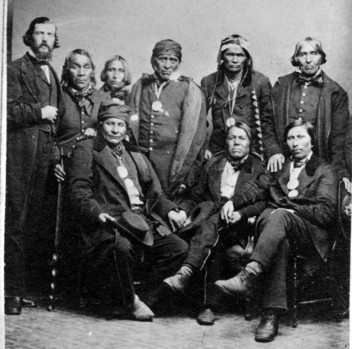
Another error in the February post is the claim that this photo was modified for and engraving in Armstrong’s book, Early Life Among the Indians. In fact, the engraving is derived from a very similar photo seen at the top of this post (Minnesota Historical Society).

(Marr & Richards Co. for Armstrong)
The problem with this conclusion is that it would have been impossible for Jechiikwii’o to visit Lincoln in the White House. The sixteenth president was elected shortly after the following report came from the Red Cliff Agency:

Drew, C.K. Report on the Chippewas of Lake Superior. Red Cliff Agency. 29 Oct. 1860. Pg. 51 of Annual Report of the Commissioner of Indian Affairs. Bureau of Indian Affairs. 1860. (Digitized by Google Books).
This was a careless oversight on my part, considering this snippet originally appeared on Chequamegon History back in November. Jechiikwii’o is still a likely suspect for the man in the photo, but this discrepancy must be settled before we can declare the mystery solved.
The question comes down to where Armstrong made the mistake. Is the man someone other than Jechiikwii’o, or is the photo somewhere other than the Lincoln White House?
If it isn’t Jechiikwii’o, the most likely candidate would be his son, Antoine Buffalo. If you remember this post, Hamilton Ross did identify the single portrait as a grandson of Chief Buffalo. Jechiikwii’o, a Catholic, gave his sons Catholic names: Antoine, Jean-Baptiste, Henry. Ultimately, however, they and their descendants would carry their grandfather’s name as a surname: Antoine Buffalo, John Buffalo, Henry Besheke, etc., so one would expect Armstrong (who was married into the family) to identify Antoine as such, and not by his father’s name.
However, I was recently sent a roster of La Pointe residents involved in stopping the whiskey trade during the 1855 annuity payment. Among the names we see:
…Antoine Ga Ge Go Yoc
John Ga Ge Go Yoc…[Read the first two Gs softly and consider that “Jayjigwyong” was Leonard Wheeler’s spelling of Jechiikwii’o]
So, Antoine and John did carry their father’s name for a time.
Regardless, though, the age and stature of the man in the group photograph, Armstrong’s accuracy in remembering the other chiefs, and the fact that Armstrong was married into the Buffalo family still suggest it’s Jechiikwii’o in the picture.
Fortunately, there are enough manuscript archives out there related to the 1862 delegation that in time I am confident someone can find the names of all the chiefs who met with Lincoln. This should render any further speculation irrelevant and will hopefully settle the question once and for all.
Until then, though, we have to reflect again on why Benjamin Armstrong’s Early Life Among the Indians is simultaneously the most accurate and least accurate source on the history of this area. It must be remembered that Armstrong himself admitted his memory was fuzzy when he dictated the work in his final years. Still, the level of accuracy in the small details is unsurpassed and confirms his authenticity even as the large details can be way off the mark.
 Chequamegon History