The 1856 Reservation for Chief Buffalo’s Estate
November 5, 2025
Collected & edited by Amorin Mello
This is one of many posts on Chequamegon History exploring the original La Pointe Band Reservations of La Pointe County on Chequamegon Bay, now known as the Bad River and Red Cliff Reservations. Specifically, today’s post is about the 1856 Reservation for Chief Buffalo’s subdivision of the La Pointe Band and how it got selected in accordance with the Sixth Clause of the Second Article of the 1854 Treaty with the Chippewa at La Pointe:
1854 Treaty with the Chippewa at La Pointe
…

Map of La Pointe Band Reservations:
334 – Bad River Reservation
335 – La Pointe Fishing Reservation
341 – Chief Buffalo’s Reservation
342 – Red Cliff Reservation
18th Annual Report of the Bureau of American Ethnology to the Secretary of the Smithsonian Institution 1896-’97
Printed by U.S. Congress in 1899
ARTICLE 2. The United States agree to set apart and withhold from sale, for the use of the Chippewas of Lake Superior, the following-described tracts of land, viz:
…
6th [Clause]. The Ontonagon band and that subdivision of the La Pointe band of which Buffalo is chief, may each select, on or near the lake shore, four sections of land, under the direction of the President, the boundaries of which shall be defined hereafter. And being desirous to provide for some of his connections who have rendered his people important services, it is agreed that the chief Buffalo may select one section of land, at such place in the ceded territory as he may see fit, which shall be reserved for that purpose, and conveyed by the United States to such person or persons as he may direct.
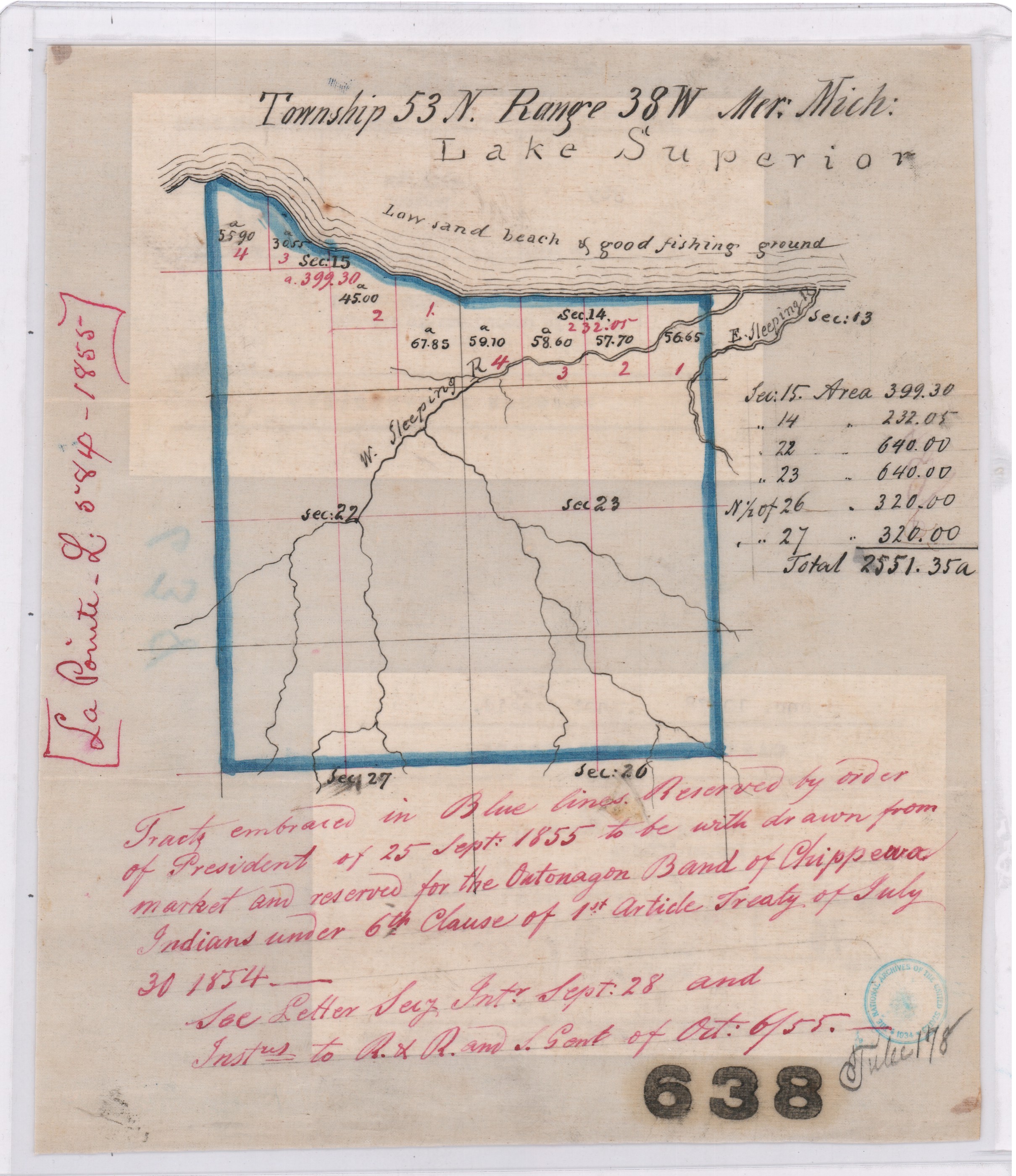
Map of “Tract embraced in blue lines reserved by order of President of 25 September 1855 to be withdrawn from market and reserved for the Ontonagon Band of Chippewa Indians“ on a “low sand beach & good fishing ground”.
Central Map File No. 638 (Tube No. 138)
NAID: 232923886 cites “La Pointe L.584-1855”.
The Ontonagon Band and Chief Buffalo’s Subdivision of the La Pointe Band got lumped together in this clause, so let’s review the Ontonagon Band first. Less than one year after the 1854 Treaty, the Ontonagon Band selected four square miles for their Reservation as approved by President Franklin Pierce’s Executive Order of September 25, 1855. Today the Ontonagon Band Reservation still has its original shape and size from 1855 despite heavy “checkerboarding” of its landownership over time.
In comparison to the Ontonagon Band Reservation, the history of how Chief Buffalo’s Reservation got selected is not so straightforward. Despite resisting and surviving the Sandy Lake Tragedy and Ojibwe Removal, making an epic trip to meet the President at Washington D.C., and securing Reservations as permanent homelands for the Chippewa Bands in the 1854 Treaty, Chief Buffalo of La Pointe died in 1855 before being able to select four square miles for his Subdivsion of the La Pointe Bands.
Fortunately, President Franklin Pierce’s Executive Order of February 21, 1856 withheld twenty-two square miles of land near the Apostle Islands from federal public land sales, allowing Chief Buffalo’s Estate to select four of those twenty-two square miles for their Reservation without competition from squatters and other land speculators, while other prime real estate in the ceded territory of La Pointe County was being surveyed and sold to private landowners by the United States General Land Office.
This 1856 Reservation of twenty-two square miles for Chief Buffalo’s Estate set the stage for what would eventually become the Red Cliff Reservation. We will return to this 1856 Reservation for Chief Buffalo’s Estate in several upcoming posts exploring more records about Red Cliff and the other La Pointe Band Reservations.

Maps marked “A” showing certain lands reserved by the 1854 Treaty:
Central Map File No. 793 (Tube 446)
NAID: 232924228 cites “La Pointe L.579-1855″.
Central Map File No. 816 (Tube 298)
NAIDs: 232924272 & 50926136 cites “Res. Chippewa L.516-1855”.

1878 Copy of President Franklin Pierce’s Executive Order of February 26, 1856 for Chief Buffalo’s Subdivision (aka “Red Cliff”).
NAID: 117092990
Office of Indian Affairs.
(Miscellaneous)
L.801.17.1878
Copy of Ex. Order of Feby. 21. 1856.
Chippewas (Red Cliff.)
Wisconsin.
Enc. in G.L.O. letter of Nov 23, 1878 (above file mark.)
in answer to office letter of Nov. 18, 1878.
Ex. Order File.

Secretary of the Interior
Robert McClelland
Department of the Interior
February 21, 1856
Sir,
I herewith return the diagram enclosed in your letter of the 20th inst, covering duplicates of documents which accompanied your letter of the 6th Sept. last, as well as a copy of the latter, the originals of which were submitted to the President in letter from the Department of the 8th Sept. last and cannot now be found.
You will find endorsements on said diagram explanatory of the case and an order of the President of this date for the withdrawal of the land in question for Indian purposes as recommended.
Respectfully
Your obt. Servt
R McClelland
Secretary
To
Hon Thos A Hendrick
Commissioner of the
General Land Office
(Copy)
General Land Office
September 6, 1855
Hon R. McClelland
Sec. of Interior
Sir:
Enclosed I have the honor to submit an abstract from the Acting Commissioner of Indian Affairs letter of the 5th instant, requesting the withdrawal of certain lands for the Chippewa Indians in Wisconsin, under the Treaty of September 30th, 1854, referred by the Department to this office on the 5th. instant, with orders to take immediate steps for the withdrawal of the lands from sale.
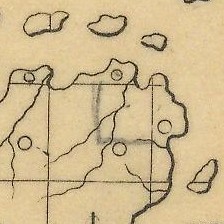
Detail of 1856 Reservation in pencil on “a map marked A.“
Central Map File No. 816 (Tube 298)
NAIDs: 232924272 & 50926136 cites “Res. Chippewa L.516-1855”.
In obedience to the above order I herewith enclose a map marked A. Showing by the blue shades thereon, the Townships and parts of Townships desired to be reserved, no portion of which are yet in market, to wit:
Township 51 N. of Range 3 West 4th Prin. Mer. Wis.
N.E. ¼ of Town 51 N ” 4 ” ” ” “.
Township 52 ” ” 3 & 4 ” ” ” “.
For the reservation of which, until the contemplated Selections under the 6th Clause of the Chippewa Treaty of 30th September 1854 can be made, I respectfully recommend that the order of the President may be obtained.
The requisite reports on the subject of the new surveys, and respecting preemption claims, referred to in the same order, will be prepared and communicated at an early day.
I am respectfully
Your Ob’t Serv’t
Thos. A. Hendricks
Commissioner
Department of the Interior
Feb. 20. 1856
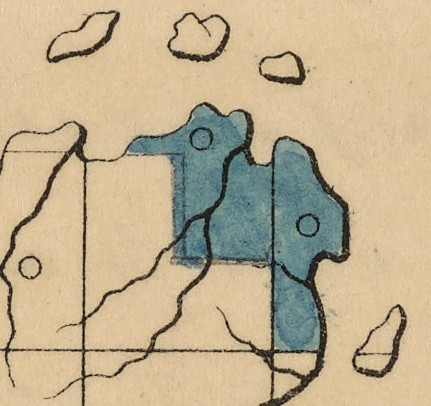
Detail of 1856 Reservation in blue on “duplicate of the original“.
NAID: 117092990
This plat represents by the blue shade, certain land to be withdrawn with a view to a reservation, under Chippewa Treaty of 30 Sept 1854, and as more particularly described in Commissioner of the General Land Office in letter of 6th Sept 1855. The subject was referred to the President for his sanction of the recommendation made in Secretary’s letter of 8th Sept 1855 and the original papers cannot now be found. This is a duplicate of the original, received in letter of Comm’r of the General Land Office of this date and is recommended to the President for his sanction of the withdrawal desired.
R. McClelland
Secretary

1856 Reservation in red and modern Red Cliff in brown. Although different in shape, both are roughly twenty-two square miles in size.
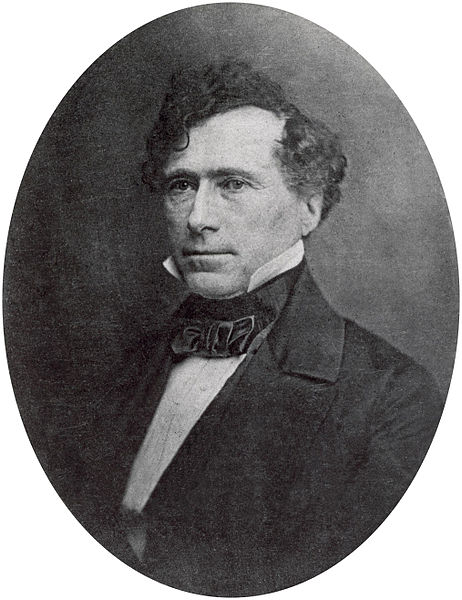
14th United States President
Franklin Pierce
February 21st 1856
Let the withdrawal be made as recommended.
Franklin Pierce
Indian Agency’s Instructions for the 1854 Treaty
September 26, 2020
Collected and edited by Amorin Mello
Indian Agency’s Instructions to
Henry C. Gilbert and David B. Herriman
for the 1854 Treaty at La Pointe
from Office of Indian Affairs federal archives
Department of the Interior
Office Indian Affairs
August 11, 1854

Indian Agent
Henry C. Gilbert
~ Branch County Photographs
Gilbert, Henry C.
Indian Agent
Detroit, Michigan
Sir:
The Bill to provide for the Extinguishment of the title of the Chippewas to the lands owned and claimed by them in Wisconsin and Minnesota, which passed the House early in the Sessions, failed in the Senate.
In view however of the importance of extinguishing the Indian title to portions of the Chippewa Country, it is deemed proper to confide to you certain conditional instructions, to the end that if in your judgement it be practicable to conclude a treaty at the period when you assemble the Indians to pay them their annuities this fall, that object may be accomplished.
You will therefore consider yourself in conjunction with Major Herriman as the Officers of the Indian Department designated to make a treaty with the Chippewa Indians of Lake Superior and the Mississippi.
~ Indian Agent Gilbert’s Explanation after the 1854 Treaty
When you arrive at La Pointe, if you are satisfied that you can send a runner over to the Mississippi & have Major Herriman come over immediately, with the principal Chief and three or four of the Headmen of each of the bands who receive pay at the Agency, and who reside on or near the Mississippi, or between that stream & the Lake, you will do so. The design is that the principal Chief and Head Men to the number stated of all the bands, other than those to be paid by you, be present on the Occasion. The latter will of course be represented.
I am informed that that the Mississippi Indians can be brought over in the way I suggest, as soon as you can assemble yours. If you are satisfied of this fact you are authorized to send over the runner, but it is not my wish that any attempt be made, and a failure follow.
If delegates from all the bands can be assembled and negotiations had with them, you are authorized to offer the Chippewas the sum of $500,000 for all the country they now own or claim in the territory of Minnesota, the state of Wisconsin or elsewhere excepting and reserving for the future home of said Indians a quantity of land equal to 743,000 acres which may be selected in one body or in two or three locations, as the Indians may desire, and if the reservations be selected in more than one locality, the quantity of land fixed upon, as the Maximum amount of the reserve must be divided between the different locations of the Indians according to the population of the bands who may elect to inhabit such reservation or reservations. If the Indians could all be placed on one reserve, so that an Agent could always have a perfect Oversight over them it would be much better for their future interests; but if this cannot be effected, the several sub-reserves should be located in such proximity to each other, as to enable the Agent to exercise a watchful care over the Indians.
The future home or reserves should not be in the avenues by which the white population will approach the ceded country, or embrace any of the mineral lands which are now becoming desirable.
I send herewith a copy of the instructions of the Secretary of War of the date of 4th of June 1847, when a former Commission attempted to treat with these Indians, but failed. According to the Estimates of this Office, the Chippewas own about 10,743,000 Acres of land, the greater part of which is of no value to them, and never will be. Some portions of it will be valuable to the White population.
Nevertheless, the condition of Affairs with the Chippewas is such that it is the duty of the Government to Offer them an Opportunity to dispose of their tenure to their Country, and in lieu thereof, to give them a small tract as a permanent home, with such means of support & neutral & moral improvement, as may be of great advantage to them.
I transmit herewith a copy of the bill alluded to and also a copy of a recent treaty with the Ottoe & Missouri Indians, remarking that if a provision is inserted for allowing individual reservations within the general reservations that Eighty Acres to the family, as provided in the bill is deemed ample. These documents may be useful as affording you indications of the views of the Department and of such provisions as it may be desirable to have incorporated in a treaty.
In view of the fact that it is necessary to enter upon this business without permitting those adverse influences, which are always at work to thwart the purposes, and objects of the Government, in its efforts to treat with the Indians, you will not divulge the nature of your instructions, or indeed say any thing about them to any person.

Julius Austrian
~ Madeline Island Museum
When you get to La Point, if you conclude to send for Maj. Herriman, and the principal Men of his bands, you can do so, leaving the impression on those who may be privy to it, that their presence is necessary, in order that a better understanding may exist as to a proper disposition of the present annuities between the Lake bands and those on the Mississippi.
Mr. Austrian who resides at La Point, and who was here last winter, tendered his services to the Office in collecting Indians etc. etc. at any time, and he is recommended to me as a faithful man. He would perhaps be a faithful man to whom to confide the message to Major Herriman.
I have caused a remittance, to be made to you, by requisition of this date for the sum of $1900 as follows:
Provisions for Indians $1500
Presents for 100 $300
Contingencies $100
$1900
which will be applicable to this object, but to be used only in case negotiations are had with the Chippewas. Except so far as the provisions & expenses of a runner may be necessary.
As far as these amounts are expended, to be accounted for under the proper heads of account.

George Washington Manypenny
~ Commons.Wikimedia.org
Very Respect’y Your Ob’t Servant
Geo. W. Manypenny
Commissioner
N.B. I learn that a boat leaves the Sault of St Marie on the 21st instant for Lapoint. If so you should avail yourself of the opportunity to go forward. The enclosed communication to Maj Herriman, you will forward to him by the runner, if you determine to send one, and be satisfied that the expedition will be successful before you send it states the whole matter to Major H. From the instructions to the Commissioners of June 4th 1847, and the Ottoe & Missouri treaty, you will form an idea of the necessary stipulations for the payment of the purchase money, the amount of it that should be invested etc. and the necessary provisions for Stock, Agricultural Implements etc. etc. in place of money. A map showing the country of the Chippewas is also herewith.
Geo. W. Manypenny
Commissioner
Department of the Interior
Office Indian Affairs
August 12th, 1854
Gilbert, H. C.
Indian Agent
Detroit, Michigan
Sir:
Referring to my letter of instruction to you of the 11th instant, I have to remark that should you succeed in having the proposed negotiations with the Chippewas, and a treaty be made, you will provide to pay the $500,000 as follows:
One hundred thousand dollars to be invested at five percent interest, which interest shall be expended annually under the President’s direction for purposes of Education, and the moral improvement of the Indians. The residue to be paid say in twenty annual installments of twenty thousand dollars each without interest, or these deferred payments may be extended over twenty five or thirty years, all of them however to be subject to the President’s discretion, as in Article 4 of the Ottoe & Missouri treaty.
If necessary to accomplish the object, although $500,000 is deemed the value of the Chippewa tenure to the land, you may go as high as $600,000 payments as above.
Should a treaty be made, it is submitted whether the new locations reserved & to the Indians, may not be of such a character as to render some of the smiths, farmers etc. stipulated for under former treaties of no use, and if so, that provisions be inserted cancelling such of these provisions, under former treaties, as can be dispensed with, and providing that a sum equal to the amount, now paid annually for such, may be appropriated for the unexpired term of former treaty stipulations to be expended by the President, for the use of the Indians, as other funds are provided to be expended.
Very Respectfully
Your Ob’t Servant
Geo. W. Manypenny
Commissioner
Department of the Interior
Office Indian Affairs
August 14, 1854
Gilbert, H. C.
Indian Agent
Detroit, Michigan
Sir:
~ Indian Agent Gilbert’s Explanation after the 1854 Treaty
Referring to my letters of instruction of the 11th & 12th instant, both of which were prepared in great haste, I am inclined to the opinion that a state of things may exist that you might feel embarrassed at the suggestions that if the land reserved by the Indians was located in more than one tract the several sub-reserves should be in such close proximity as to enable the agent to have a constant oversight over all the Indians. It may however occur that there may be partialities and predilections among the different bands for different and widely separated districts, and that these partialities cannot be overcome. I am clearly of the opinion that all the land reserved should be in one body and every reasonable effort should be employed to impress the Indians with this view; and if it fail the fewest sub-reserves that can be got along with should be allowed and if possible they should be in the same region of Country; but if the Indians have the predilections alluded to, and they cannot be changed in their views, you will accede to their wishes to a reasonable extent in this particular. And if it should so happen that they select locations widely distant from each other so that it would be more for their interests that one portion might be under one Agent and another under another, it would be well perhaps to adjust all matters between the bands thus located, naming all of them by bands which select a reservation. Setting apart according to the population their portion of such reserved land, and providing to pay them by the same rule, their proportion of the purchase money at their reserve, and so with the bands on each of the reserves. And indeed a clause might be inserted, adjusting and dividing by population to the Indians of each reserve the annuities to become due under former treaties, whether of money or in kind so that no difficulties could hereafter arise provided one part should be in one agency and others in another.
Several members of the Indian Committee of the Senate having expressed a wish that a clause or article of the following import should be inserted in all treaties hereafter made. You will please put it in the treaty which I hope you may be able to enter into with the Chippewas. It is thus:
“The United States agree that an examination shall be made, and all sums that may be found equitably due to the Indians, for arrearages of annuity or other thing, under the provisions of former treaties, shall be paid as the chiefs may direct.”
And; It is agreed between the United States and the said Chippewa Indians, that should it at any time hereafter be considered necessary, and for the benefit of said Indians, it shall be discretionary with the President by & with the advise and consent of the Senate to change the annuities herein provided for or any part thereof into a fund establishing farms among and for them.
Very Respectfully
Your Ob’t Servant
Geo. W. Manypenny
Commissioner
Indian Agency’s Explanation of the 1854 Treaty
December 13, 2017
By Amorin Mello
Treaty Commissioner Henry C. Gilbert’s
Explanation of the Treaty Concluded in 1854
with the Assistance of David B. Herriman
Transactions of the Wisconsin Academy of Sciences, Arts and Letters:
Volume 79, No. 1, Appendix 5
Office Michigan Indian Agency
Detroit October 17th, 1854
Sir
Mackinac Indian Agent
Henry Clark Gilbert
~ Branch County Photographs
I transmit herewith a treaty concluded at LaPointe on the 30th Ultimo between Mr. Herriman and myself as Commissioners on the part of the United States and the Chippewas of Lake Superior and the Mississippi.
On receiving your letters of August 10th, 12th, and 14th, relative to this treaty, I immediately dispatched a special messenger from this place by way of Chicago, Galena and St. Paul to Mr. Herriman at the Crow wing Chippewa Agency transmitting to him your letter requesting him to meet me at LaPointe with the Chiefs and Headmen of his Agency at as early a day as possible. I adopted this course in preference to sending a messenger from La Pointe on my arrival there for the purpose of saving time and I was thus enabled to secure the attendance of Mr Herriman and the Mississippi Chiefs some 10 or 12 days earlier than I could otherwise have done.
I left for LaPointe on the 26th of August last and arrived there the 1st day of September – Mr Herriman meeting me there the 14th of the same Month.
By this time a large number of Indians had assembled – including not only those entitled to payment but all those from the Interior who live about Lakes de Flambeau and Lake Courteilles. The Chiefs who were notified to attend brought with them in every instance their entire bands. We made a careful estimate of the number present and found there were about 4,000. They all had to be fed and taken care of, thus adding greatly to the expenses attending the negotiations.

Charles William Wulff Borup and Charles Henry Oakes married into the La Pointe mixed blood Beaulieu family; built the American Fur Company’s new La Pointe outfit during the 1830’s; sold La Pointe to Julius Austrian during 1853; and started the first bank in Minnesota during 1854 at St. Paul.
~ 1854 banknote from HeritageAuctions.com
A great number of traders and claim agents were also present as well as some of the persons from St. Paul’s who I had reason to believe attended for the purpose of preventing if possible the consummation of the treaty. The utmost precautions were taken by me to prevent a knowledge of the fact that negotiations were to take place from being public. The Messenger sent by me to Mr Herriman was not only trust worthy but was himself totally ignorant of the purport of the dispatches to Major Herriman. Information however of the fact was communicated from some source and the persons present in consequence greatly embarrassed our proceedings.
After Major Herriman’s arrival we soon found that the Mississippi Indians could not be induced to sell their land on any terms. Much jealousy and ill feeling existed between them and the Lake Superior Indians and they could not even be prevailed upon to meet each other in council. They were all however anxious that a division should be made of the payments to become due under former existing treaties and a specific apportionment made between the Mississippi and the Lake Superior Indians and places of payment designated.
Taking advantage of this feeling we proposed to them a division of the country between them and the establishment of a boundary line, on one side of which the country should belong exclusively to the Lake Superior and on the other side to the Mississippi Indians. We had but little difficulty in inducing them to agree to this proposition and after much negotiation the line designated in the treaty was agreed upon.
We then obtained from the Lake Indians a cession of their portion of the Country on the terms stated in the treaty. The district ceded embraces all the mineral region bordering on Lake Superior and Pigeon river & is supposed to be by far the most valuable portion of their country. But a small portion of the amount agreed to be paid in annuities is payable in coin. The manner of payment is such as in our judgement would most tend to promote the permanent welfare and hasten the civilization of the Indians.
We found the points most strenuously insisted upon by them were first the privilege of remaining in the country where they reside and next the appropriation of land for their future homes. Without yielding these points, it was idle for us to talk about a treaty. We therefore agreed to the selection of lands for them in territory heretofore ceded.
The tract for the Ance and Vieux Desert bands is a the head of Ke, wa, we naw Bay Michigan and is at present occupied by them. I estimate the quantity at about 60,000 acres.
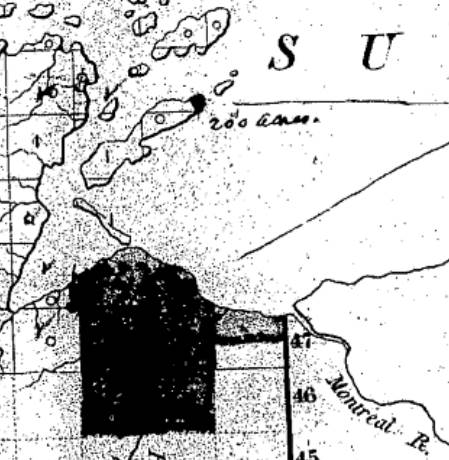
Detail of La Pointe Indian Reservation survey boundaries including Gichi-ziibiiwishenhnyan from a letter dated March 30th, 1855, written by the Commissioner John Wilson of the General Land Office to General Surveyor Warner Lewis.
~ National Archives Microfilm Publications; Microcopy No. 27; Roll 16; Volume 16.
These reservations are located in Wisconsin, the principal of which is for the LaPointe Band on Bad river – A large number of Indians now reside there and I presume it will ultimately become the home of most of the Chippewas residing in that state. It is a tract of land well adapted for Agricultural purposes and includes the present Missionary Station under the care of the American Board of Commissioners for Foreign Missions. About one third of the land however lying on the Lake Superior is swamp and valueless, except as it gives them access to the Lake for fishing purposes.
The other Wisconsin reservations lie on Lac de Flambeau and Lac Courteirelle in the Interior and the whole amount of land reserved in that state I estimate at about 200,000 acres exclusive of the Swamp land included in the LaPointe reservation. in the ceded Country there are two tracts set apart for the Indians – one on St Louis river of 100,000 acres for the Fond DuLac bands and one embracing the point bounded by the Lake and Pigeon river and containing about 120,000 acres.
There are two or three other small reservations to be hereafter selected under the direction of the President. The whole quantity of land embrace within all the tracts set apart we estimate at about 486,000 acres – No portion of the reserved lands are occupied by whites except the Missionary establishment on Bad river.
The provision going to each Half Breed family 80 acres of land was most strenuously insisted upon by the Indians. There are about 200 such families on my pay roll and allowing as many more to the Interior Indians which is a very liberal estimate, the amount of land required will be about 32,000 acres.
A principal source of embarrassment was the provision setting aside a portion of the consideration to be paid as the Chiefs might direct &c. In other words to pay their debts with. We had much difficulty in reducing the amount insisted upon to the sum stated in the treaty. I have no doubt that there are many just claims upon these Indians. The regular payment of their annuities was so long withheld that they were forced to depend to a great extent upon their traders. There claims that were all disposed to acknowledge and insisted upon providing for their payment and without the insertion of the provision referred to, we could not have concluded the treaty.
I regret very much that we could not have purchased the whole country and made the treaty in every particular within the limit of your instructions. But this was absolutely impossible and we were forced to the alternative of abandoning the attempt to treaty or of making the concessions detailed in the treaty.
Bureau of Indian Affairs Director
George W. Manypenny
~ Commons.Wikimedia.org
There are many points respecting which I should like much to make explanations, and for that purpose and in order to make a satisfactory settlement of the accounts for treaty purposes and in order to make a satisfactory settlement of the accounts for treaty expenses I respectfully request the privilege of attending at Washington at such time after making my other annuity payments as you may think proper.
Very Respectfully
Your Obt. Servt.
Henry C. Gilbert
Commissioner
Hon. Geo. W. Manypenny
Com. Ind. Affs.
Washington D.C.
1854 Treaty of La Pointe Appropriations
November 29, 2017
By Amorin Mello

House Documents, Volume 112
By United States House of Representatives
33d Congress,
2nd Session.
Ex. Doc. No. 61.
TREATY WITH CHIPPEWA INDIANS.
————————
MESSAGE
FROM
THE PRESIDENT OF THE UNITED STATES,
United States President
Franklin Pierce
circa 1855
~ Commons.Wikimedia.com
TRANSMITTING
Estimates of appropriations for carrying into effect the treaty with the Chippewa Indians &c.
————————
February 8, 1855.—Laid upon the table and ordered to be printed.
————————
To the Senate and House of Representatives of the United States:
I communicate to Congress the following letter from the Secretary of the Interior, with its enclosure, on the subject of a treaty between the United States and the Chippewa Indians of Lake Superior, and recommend that the appropriations therein asked for may be made.
FRANLIN PEIRCE.
Washington, February 7, 1855.
Department Of The Interior,
Washington, February 6,1855.
Secretary of the Interior
Robert McClelland
circa 1916
~ Commons.Wikipedia.com
SIR: I have the honor to transmit to you, herewith, a copy of a communication from the Commissioner of Indian Affairs, dated the 5th instant, calling my attention to the subject of a treaty made at La Pointe, Wisconsin, by Henry C. Gilbert and Daniel B. Herriman, commissioners on the part of the United States, and the Chippewa Indians of Lake Superior; and, to enable this department to carry the treaty into effect, recommend that Congress be requested to make the appropriations specified in the letter of the Commissioner, and which will be immediately required for that purpose.
I am, sir, very respectfully, your obedient servant,
R. McCLELLAND,
Secretary.
To the President.
Department Of The Interior,
Office Indian Affairs, February 5, 1855.
Mackinac Indian Agent
Henry Clark Gilbert
~ Branch County Photographs
Sir: Having received the official information on the 24th ultimo of the approval and ratification, by the President and Senate, of the articles of agreement and convention made and entered into at La Pointe, in the State of Wisconsin, by Henry C. Gilbert and Daniel B. Herriman, commissioners on the part of the United States, and the Chippewa Indians of Lake Superior and Mississippi, I have the honor now to call your attention to the appropriations that will be required immediately to enable the department to carry the treaty into effect, viz:
For fulfilling treaties with the Chippewas of Lake Superior.
- For expenses (in part) of selecting reservations, and surveying and marking the boundaries thereof, per 2d, 3d, and 12th articles of the treaty of September 30, 1854 …….. $3,000
- For the payment of the first of twenty instalments in coin, goods, &c, agricultural implements, &c, and education, &c, per 4th article of the treaty of September 30, 1854 …….. 19,000
- For the purchase of clothing and other articles to be given to the young men at the next annuity payment, as per 4th article of the treaty of September 30, 1854 …….. 4,800
- For the purchase of agricultural implements and other articles, as presents for the mixed bloods, per 4th article of the treaty of September 30, 1854 …….. 6,000
- For the payment of such debts as may be directed by the chiefs in open council, and found to be just and correct by the Secretary of the Interior, per 4th article of the treaty of September 30, 1854 …….. 90,000
- For the payment of such debts of the Bois Forte bands as may be directed by their chiefs, and found lo be just and correct by the Secretary of the Interior, per 12th article of the treaty of September 30, 1844 …….. 10,000
- For the payment of the first of five instalments in blankets, cloth, &c, to the Bois Forte band, per 12th article of the treaty of September 30, 1854 …….. 2,000
- For the first of twenty instalments for the pay of six smiths and assistants, per 5th and 2d articles of the treaty of September 30, 1854 …….. 5,040
- For the first of twenty instalments for the support of six smith shops, per 5th and 2d articles of the treaty of September 30, 1854 …….. 1,320
It will be observed that the treaty of September 30, 1854, recognized the Chippewas of Lake Superior as a branch of the nation, and that the pecuniary and beneficiary stipulations therein are for their exclusive use.
By the fifth article of the treaty the Lake Superior Chippewas are to have six blacksmiths and assistants, and they relinquish, by the same article, all other employés to which they might otherwise have been entitled under former treaties.
The Chippewas of the Mississippi are, by the eighth article of the treaty, entitled to one-third of the benefits of treaties prior to 1847; and, by consequence, retain an interest of one-third in the stipulations for smith shops, &c., and farmers, &c, per second article of the treaty of July 29, 1837; and in the farmers, and carpenters, and smiths, &c., mentioned in the fourth article of the treaty of October 4, 1842.
On an examination of the condition of existing appropriations to fulfil the stipulations just mentioned, it is found that the balances in the treasury are sufficient to sustain these employés and otherwise meet the requirements of the stipulations referred to, so far as the Chippewas of the Mississippi are interested, during the next fiscal year.
In case appropriations are made by Congress, in pursuance of the foregoing estimates, it will be perceived that the following items of the Indian appropriation bill now before Congress might, with propriety, be stricken out, viz:
House bill 555, reported, with amendments, January 16, 1855:
- Page 4, lines 68, 69, 70, and 71, “three thousand dollars,” ($3,000.)
- Page 4, lines 72, 73, 74, 75, and 76, “one thousand dollars,” ($1,000.)
- Page 5, lines 89, 90, 91, 92, and 93, “two thousand dollars,” ($2,000.)
- Page 5, lines 94, 95, and 96, “one thousand dollars,” ($1,000.) Page 5, lines 97, 98, and 99, “one thousand two hundred dollars,” ($1,200.)
Director of of the Bureau of Indian Affairs
George Washington Manypenny
circa 1886
~ Commons.Wikimedia.org
As it is not deemed necessary, I do not therefore submit, at present an estimate for appropriations to pay employés for the Bois Forte band, as per twelfth article of the treaty of September 30, 1854, or to liquidate a balance, should any be found due to these Indians by the investigation, which it is provided by the ninth article of the same treaty shall be made.
Should the foregoing estimates and suggestions be approved by you, I respectfully recommend that they be laid before Congress as early as practicable.
Very respectfully, your obedient servant,
GEO. W. MANYPENNY,
Commissioner.
Hon. R. McCLELLAND,
Secretary of the Interior.
 Chequamegon History