Kohl, J. G. “Remarks on the Conversion of the Canadian Indians and some Stories of Conversion” Part 1 of 2
June 11, 2018
By Leo
Part 1|Part 2
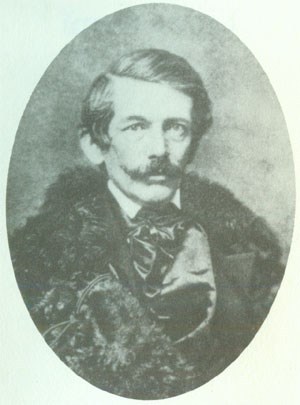
Four years ago, while searching for buried treasure in the archives of Google Books, I stumbled on an article, Bemerkungen über die Bekehrung canadischer zum Christenthum und einige Bekehrungsgeschichten (1859) (Remarks on the Conversion of the Canadian Indians and some Stories of Conversion), by Johann Georg Kohl published in the Augsburg-based, German-language magazine, Das Ausland. Since I neither read nor speak German, to understand the content of the article, I used the laborious process of artificial translation. This was done by pasting the article, paragraph by paragraph, into Google Translate, reinserting the original punctuation, and then clearing up the grammar.
At the time, I chose to only translate the first 900 words, or so, of the 14,000-word article and published it here on Chequamegon History as the bulk of the April 2014 post Chief Buffalo’s Death and Conversion: A new perspective. Recently, a friend of the site asked when the rest of the article would appear online. I resisted, knowing how much work it would be, and used the excuse that the article was not directly about the Chequamegon area. Apparently, I could not resist the lure of Kohl for very long.
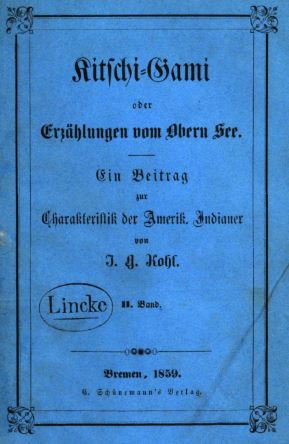
J. G. Kohl (1808-1878) was a German travel writer and pioneering ethnographer, best known in the United States for his 1859 work, Kitchi-Gami: Life Among the Lake Superior Ojibway, a highly-detailed description of travels to La Pointe, L’Anse, and Garden River/Sault Ste. Marie in the summer of 1855. Regular readers of Chequamegon History will know excerpts of this work from Maangozid’s Family Tree, Blackbird’s Speech at the 1855 Payment, Steamboats, Celebrities, Soo Shipping, and Superior Speculation, and other posts.
Kohl’s reputation among scholars of American Indian studies is largely positive. Considering the sheer level of detail he provides in his observations on Ojibwe life, he is perceived as being rare among 19th-century writers for his comparative lack of prejudice of Indian peoples and practices. Robert E. Bieder, in his introduction to the 1985 reprint published by the Minnesota Historical Society, outlines this perception.
The ethnology of Kohl was a sharp contrast to that of Schoolcraft. Kohl seemed to have an empathy for Indian cultures that the American lacked. As Kohl noted in Travels in Canada, “When I was in Europe, and I knew them [Indians] only from books, I must own I considered them rude, cold-blooded, rather uninteresting people, but when I had once shaken hands with them, I felt that they were ‘men and brothers,’ and had a good portion of warm blood and sound understanding, and I could feel as much sympathy for them as for any other human creatures. (Bieder in Kohl, xxxi)”
Racist is a term that comes with a lot of baggage, complexity, and controversy in 2018. As a white man whose primary interest is in collecting old documents, I can quickly get in over my head when it comes to questions of philosophy, sociology, and theories of race. At a bare minimum, however, my definition of non-racist is one who can acknowledge the humanity of other humans when they look or act differently from oneself.
The contrast between Kohl’s writing and that of his contemporaries: Schoolcraft, Ely, Boutwell, etc. is what initially attracted me to Kitchi-Gami. More than once, I have recommended the book to friends as, “The least-racist 19th-century book about the Chequamegon area.” The German’s unbiased outsider perspective comes as a breath of fresh air, even in comparison to Ojibwe ethnographers like Warren and Copway who were very much caught up in the politics of their times:
Kohl’s objective was to produce an ethnological account of a rich and unique culture. In his preface to the German edition of Kitchi-Gami, Kohl explained, “I only take credit for having endeavored to understand them [Ojibway stories and ways of life] correctly and to present them clearly…(xxxii-xxxiii)”
Kohl is especially given credit for his treatment of Ojibwe religion:
The differences between Kohl and Schoolcraft are quickly evident in a comparison of how each described Ojibway religion. Schoolcraft saw Ojibway religious practices as the “darkest and gloomiest picture of Indian life”… Kohl, in contrast, was willing to see much of value in Ojibway practices that compared favorably with the teachings of Christianity…
Where Schoolcraft found “a body of subtile [sic–noted by Bieder] superstitions, and widely-spread popular error … ” Kohl found merely another way of approaching the unknown…(xxxi-xxxii)
Bieder was clearly struck, as I was the first time reading Kitchi-Gami, by how modern it seemed to be:
In short, people behaved in different ways not only because of racial variations but also because they lived in different environments. While several of these assumptions today seem rather commonplace, in the mid-nineteenth century, when many believed race determined a people’s culture and capability, such thinking proved controversial (xxxiv).
Bieder does not completely let Kohl off the hook for his racial attitudes–taking particular issue with the romantic and flowery nature of the prose and his speaking of all Indian nations in general terms–but his final assessment of the author is very positive. This is the same impression I have heard from several others.
Kohl also sometimes saw cultural traits in racial terms. This is not surprising, however, when one considers ethnological assumptions at mid-century, when some German ethnologists like Bastian believed in polygenism and others like Ritter could talk about “passive-indolent” races and “active-energetic” ones. Yet with this said about Kitchi-Gami, one is struck by Kohl’s rather modern notion of the acculturation process. In general, Kohl portrayed Ojibway culture with great sensitivity and found among the Ojibway people beauty, honor, and integrity (xxxvi).
So, with most of what we know about Johann Kohl coming from Kitchi-Gami, questions remain. Do his progressive racial and religious attitudes show up in all his writings from that era? Was he truly as modern and unbiased in his thinking as we have widely been led to believe?
These were the questions I wrestled with while translating Remarks on the Conversion of the Canadian Indians and some Stories of Conversion. In many ways, it read like an bonus chapter of Kitchi-Gami (the two texts were published in the same year). In other ways, the reader will have to decide:

Das Ausland.
Eine Wochenschrift Fur Kunde des geistigen und sittlichen Lebens der Völker
[The Foreign Lands: A weekly for scholars of the moral and intellectual lives of foreign nations]
Augsburg. Nr. 2. 8 January 1859
Remarks on the Conversion of the Canadian Indians and some Stories of Conversion
By J.G. Kohl
A few years ago, when I was at “La Pointe,” one of the so-called “Apostle Islands” in the western corner of the great Lake Superior, an old chief of the local Indians, the Chippeway or Ojibbeway people. His name was “Buffalo,” a man “of nearly a hundred years.” He himself was still a pagan, but many of his children, grandchildren and closest relatives, were already Christians.
I was told that even the aged old Buffalo himself ébranlé, and that his state of mind was wavering. “He thinks highly of the Christian religion,” they told me, “To him, it’s not right that he and his family be of a different faith. He is afraid that they will be separated in death. He knows he will not be near them, and that not only his body should be brought to another cemetery but also he believes his spirit shall go into another paradise away from his children.”
From page 419 of Kohl’s Reisen im Nordwesten der Vereinigten Staaten (1857): “The chiefs [at La Pointe] seemed to have assumed a kind of supremacy over the rest of the Lake Chippewas. Here was an old chief, called Buffalo, who made pretensions to master a very wide stretch of land. The small tribe led by him was now called the La Pointe Band by the Americans.”
William W. Warren, in his History of the Ojibway People, argued that the Crane Totem provided the hereditary chiefs, and that the Loons were made chiefs by the French. See page 51 of the 2009 Second Edition edited by Theresa Schenck.
But Buffalo was the main representative of his people, the living embodiment, so to speak, of the old traditions and stories of his tribe, which once ranged over the whole group of the Apostle Islands and far and wide across the hunting grounds of mainland northern Wisconsin. His ancestors and his family, “the Totem of the Loons” (from the diver)* make claim to be the most distinguished chiefly family of the Ojibwes. Indeed, they believe that from them and their village, a far-reaching dominion once reached across all the tribes of the Ojibbeway Nation. In a word, a kind of monarchy existed with them at the center.
(*The Loon, or Diver, is a well-known large North American bird).
Old Buffalo, or Le Boeuf, as the French call him, or Pishiki, his Indian name, was like the last reflection of that long-vanished glory. He was stuck too deep in the old superstition. He was too intertwined with the Medä Order, the Wabanos, and the Jossakids, or priesthood, of his people. A conversion to Christianity would have destroyed his influence in a still mostly-pagan tribe. It would have been the equivalent of voluntarily stepping down from the throne. Therefore, in spite of his “doubting” state of mind, he could not decide to accept the act of baptism.
One evening, I visited old Buffalo in his bark lodge and found in him grayed and stooped by the years, but nevertheless still quite a sprightly old man. Who knows what kind of fate he had as an old Indian chief on Lake Superior, passing his whole life near the Sioux, and trading with the North West Company, with the British and later with the Americans. With the Wabanos and Jossakids (priests and sorcerers) he conjured for his people, and communed with the sky, but here, people would call him an “old sinner.”
But still, due to his advanced age I harbored a certain amount of respect for him. He took me in, so kindly, and never forgot afterwards, promising to remember my visit as if it had been an honor for him. He told me much of the old glory of his tribe, of the origin of his people, and of his religion from the East. I gave him tobacco, and he, much more generously, gave me a beautiful fife. I later learned from the newspapers that my old host, being ill, departed from this earth soon after my departure from the island. I was seized by a genuine sorrow and grieved for him. Those papers, however, reported a certain cause for consolation, in that Buffalo had said on his deathbed that he desired to be buried in a Christian way. Therefore, shortly before his death, he received Christianity and the Lord’s Supper from the Catholic missionaries, along with the last rites of the Church, a church funeral, and a burial in the Catholic cemetery, where in addition to those already resting, his family would be buried.
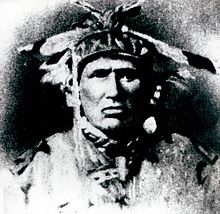 On page 383 of Kitchi-Gami, Kohl expresses very similar sentiments regarding the late-life conversion of the well-known Garden River chief, Zhingwaakoons (Shingwaukonse) to the Anglican faith. Image Source: Wikipedia
The story and end of the old Buffalo are not unique. Rather, it was something rather common for the ancient pagan to proceed only on his deathbed to Christianity, and it starts not only with the elderly adults on their deathbeds, but with their Indian families beginning with their young children. The parents are won over by the children. For the children, while they are young and largely without religion, the betrayal of the old gods and laws is not so great. Therefore, the parents allow it more easily. You yourself are probably already convinced that there is something fairly good behind Christianity, and that your children “could do quite well.” They desire for their children to attain the blessing of the great Christian God and therefore often lead them to the missionaries, though, they themselves may not decide to give up their own ingrained heathen beliefs. The Christians, therefore, also prefer to first contact the youth, and know well that if they have this first, the parents will follow sooner or later because they will not long endure the idea that they are separated from their children in the faith. Because they believe that baptism is “good medicine” for the children, they bring them very often to the missionaries when they are sick.
I was extremely interested in the stories told me about the conversion of children, and then through them, of parents and grandparents. A Protestant clergyman informed me of one instance, which shows it seems to me, that such a conversion often does not take place without fierce resistance in the minds of the Indian converts and other difficulties. It follows:
A pagan Indian, a man of good mind, had been several times to mission Baptist Church and was attentive and solemn while in attendance at the service. Finally, one day, he presented himself to the head of the Mission, which was also a school for the education of Indian children. He came accompanied by his two sons, boys from 8 to 10 years old. He expressed the wish that the eldest should be taken to school and educated in Christianity. He thought it would do his son good. At the same time, he requested that the younger brother stay with him for a while. They were so accustomed to each other that he feared the separation might be too difficult for his eldest. For the time being, however, the younger man did not attend school. He wanted to see how the other would get along. After a little while under this arrangement, the younger was supposed to return to his family in the forest, for the father could not spare both boys for long.
So it happened as desired. The father came to the institution from time to time to see how his son was doing and was pleased with his progress in the arts and sciences. After two years, the education in reading, writing, and arithmetic, etc. was considered complete. The father then brought his second son, and at the same time the third, but again only for the time being “for company” but also to give him a small taste.
Thus, in the end, all three of his sons were brought up in Christianity and in all kinds of useful skills. I was assured that the education had lasted. The three Indian boys had not yet forgotten what they learned in the two years and were until the present still quite literate from their reading, which was eagerly made use of by happy fur traders in a trading post by the lake
But before they became that, and while the youngest of them was still at school, once every autumn, the pagan father came to see the teacher and preacher and told them to say goodbye to him for a while, thinking that his approaching hunts would take him far into the woods on a grand expedition and that he would hardly be able to see them before the spring.
He left, but against all expectations, he was back in the middle of winter, a few weeks after Christmas. He brought with him a great wealth of furs and animal skins, all negotiated and sold at good prices. He came to the preacher and told him that he was right all along. He walked day by day, week after week, in the woods of the interior chasing and checking his traps, alone. He had the fortunate misfortune to have not have killed anything at all. Perhaps, thoughts of his children were disturbing him. He may have continued to think of them and how much good they learned from the Christians. His sleep would be very restless, and he would not have had a good hunting dream. He would have drummed his medicine bag once again, and sang his Wabano songs alone, but no deer, no beaver, no bear, appeared. One evening, having set up his night fire and tent on the bank of a wild stream, and having been taken again by very gloomy and pessimistic ideas, he suddenly jumped up, dug a deep hole for his otter bag and buried it with all its content and magic. Then, he prayed to the Great Spirit, and promised he would become a Christian. That night, he had nothing but bright dreams in which his sons played the leading role, and the next morning, when he was refreshed, he scarcely went a hundred paces and was met by a big moose that he was soon to kill. Driven by longing, he then started on the way back to the mission. On this way back, he shot one animal after the other, day by day, and arrived there with a rich harvest. He now thought that as soon as he could get his wife to baptize herself, he would also be married to his wife in the Christian way. He arranged a time with the preacher, and with this assurance, he took leave of his Christian friend.
It seemed to this good preacher, though, that it took a while before the man reappeared to fulfill his promise. He inquired after him here and there, and heard his Indian was still undecided in relation to conversion to Christianity.
“What do I hear?” said the preacher to him when he once met him, “Have you changed your mind, you are not coming to baptism, do not see your sons anymore, what is that?” “Give me some time,” replied the Indian seriously. “My mind is not yet completely calm, and after some time, I want to tell you everything. “The thing was that the Indians had decided for themselves in favor of Christianity, for the Christianity of the Baptists. But upon the discovery of this resolution, external obstacles, trials, and conflicts appeared, as they, more or less, occur in every transition from one religion to another, and they do not fail to appear in the conversions of these forest children.
Many of his pagan relatives had sought his resolve, and this made him fickle.
 The presence of the Baptists suggests this took place at Garden River, Ontario, (one of Kohl’s stops) where the Anglican church was the dominant Protestant sect, but Baptist Rev. Abel Bingham had a nearby mission. See Chute, Janet E. The Legacy of Shinguakonse: A Century of Native Leadership. U of Toronto Press, 1998. Image Source: findagrave.com
Another, more-powerful Christian Protestant influence, but a non-Baptist one, also appeared. Enemies of the Baptists had told the Indian that he should become a Christian, and a Protestant, but not a Baptist. They even threatened him with confiscation, exclusion from taking part in tribute, and such things, if he would join that sect. The poor man, whose soul was devoted to the Baptists because of his children, had not been able to find his way through everything.
After four weeks, however, he reappeared to his son’s teacher and said that he was now ready. He said that after arranging all his business, he went again to the forest, “to avoid the voices of men,” and to think and pray there alone to the Great Spirit. He went deeper and deeper into the forest, always praying more and more zealously, and became very firm in his convictions. He came directly from the interior, saw and spoke to no one, brought his wife to the preacher, and now wanted to baptize and marry her.
And so it happened, and nobody had cause to regret it afterwards. In the end, the “enemies” stopped threatening, and the sons, as I have already mentioned, prospered.
 The Ven. Bishop Frederic Baraga is Kohl’s likely informant for this and other stories of Catholic mission work in this article. (St. Peter Cathedral, Marquette)
Another story of conversion was shared with me by an excellent friend* from the rich treasury of his experiences. It belongs here as well, and is also characteristic, in many respects, of the local conditions.
(*It was a Catholic missionary.)
An Indian family, consisting of a father, mother and five children, lived far north of Lake Superior on the banks of “Long Lake,” which leads to Hudson’s Bay. They were pagans, like most of the Indian of these lands where a missionary is rarely found.
The oldest of the five children, a boy, fell ill, to the great distress and despair of his parents. The illness reached a dangerous crisis. The terrified parents stayed up all night, with the little boy in feverish dreams, in their lap. Finally, he fell asleep. Gently, he opened his eyes the next morning and said that he felt better and was recovering.
“A splendid dream,” said the boy, “healed him.” “A wind,” he said, “came from the north, going down south to Lake Superior,” and from the wind, a soft voice spoke to him: “The drumming* was not good, and the spells were not good. They do not help. The Indians should refrain from them. The prayer is far better, and only prayer, alone, can help them and comfort them in misfortune, illness, and suffering.” He had a deep longing for hearing the kind voice of the Christ, whom the whites worshiped, and he fervently vowed to obey him, and immediately thereafter he slept gently, and now he was healed.
(*As the Indians accompany all their magic songs and religious performances with drums, the drumming here represents the pagan faith.)
The parents attentively listened to the miracle of their son as he went hunting with them. After a short time, they decided they wanted to immediately obey the voice in his dream and all be baptized. For that purpose, the next spring, they went to Lake Superior, descending southwards in the direction of the dream wind. Over the winter, they collected some provisions, and when spring came, they made their journey of several weeks.
For the further explanation of the matter, I will say as an aside, that Indian parents pay much attention to the dreams of their children, who they love so much, and that in many ways they follow them. For example, it is not uncommon for a good son to assist his father in a bear hunt “with his dreams.” “Father,” the son speaks one morning to the hunter, who may have been unhappy for a long time on the hunt and brought home nothing, “Father I dreamed of a bear for you this night.” “Tell my child.” “Yes, I have only seen him vaguely in the distance, but there by that lake on the banks of that river he must roam about.” The father goes to the designated area, searches the whole day at the river or lake mentioned by the son, but finds nothing and comes back tired in the evening, without prey. “Dream again my son,” speaks the father, “Dream better my child.” The good son lies down on his ear and speaks the next morning, “Father I have again dreamed of the bear. Now I have seen him quite clearly. Oh, it is a big and beautiful animal. It is a female, and she has a cub. Now I know the place where they are. You must search on the southern shore of the lake.” The father gets up again and ransacks the whole south shore of the lake, but in the evening, he comes home again and speaks as before, ”I bring nothing yet my child, although I have seen the footprints of a bear. My son’s dreams are getting better!” In the meantime, the little boy has been fasting, his face is painted a jet-black, and he beats the drum all day and sings all the magic songs he knows. He goes back to sleep. Before the sun comes up, he wakes up and cries out, “Father! Father! The bear! The bear! This time, he came very close to me. I collided with him, head to head, and mouth to muzzle. Run! If you go around here and there and come to that rock, then you will find the bear and her cub on the corner. They dig their roots.” The little one immediately turns his face black again, beats the drum, refuses his breakfast–as hungry as he may be, and again fasts all day to assist his father from afar
In the meantime, the father goes to the corner of the rock. He finds the bears at the ditch, hunts them, brings both home, and now lets his brave and obedient little dreamer have a wonderful meal, and all the rest of the family too: neighbors and relatives, and so on–in general, the whole village.
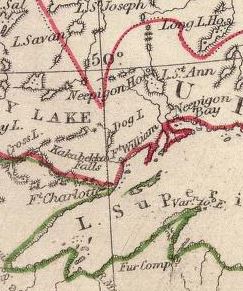 Longlac (Long Lake) appears in the upper-right corner of this 1836 Map of British North America, about 100 miles northeast of Nipigon.
Curious as these things may seem to a European, they are not uncommon in Indian life. At least, I heard of such things all along the way. It will therefore be said, quite understandably and naturally, that our Indians of Long Lake, immediately after the dream of their boy, decided to be baptized and undertook the arduous journey to Lake Superior. They had heard that on the north shore of this lake, at a certain time in spring, a Christian priest was passing to see the sheep of his little flock.
This priest–who was the friend who told me this whole story–sometimes travels in his own canoe and sometimes with a small schooner from the Hudson’s Bay Company. He sails to the north shore of the lake, to those from the northern Indians who descend at appointed dates to the various stations to trade their fur supplies. The merchant ship now carries the missionary, because this is the most certain way to meet with the nomadic Indians, who are otherwise hard to locate.
It annoys me that I did not catch the names of those good Long Lake Indians. “The Long Lake family”–unfortunately, I cannot call them anything else–with their five children had been sitting in their hut of birch bark for five or six weeks, on a promontory overlooking the lake from which they could see far. They did not know the date of arrival of the “Black Robe” of whom they regarded like a savior. Their eagerness to miss nothing had brought them down too early. Their small supplies of dried meat and flour were soon consumed and the fishing at the chosen station was not very productive either.
So when my friend, the good black robe*, finally arrived in his own canoe, he found them all very thin and starving. They had only a handful of flour. The missionary, himself, did not have much and could not help them as abundantly as he might have wished. Yet the people had endured and held fast to their purpose and were glad the expected messenger of God had arrived. In the midst of mutual their poverty, both parties began to work as far as circumstances permitted. The clergyman prepared his catechumens with instruction and prayer, and then at last performed the holy act of baptism on the recovering boy who had the vision, and then on the whole family, leading seven souls at once into the bosom of the church.
(*”Black Robes” is the name the Indians often give to Catholic missionaries.)
Because his labors soon ordered him to hurry along the shore, where still others longed for his soul’s appetite, he had to leave his new candidates after a short time. But when he said goodbye, he did not forget to give them a piece of paper on which a Christian calendar was printed, and a pin.
This gift is common in Catholic conversions and its meaning and purpose can be said as follows. The baptized go right back into the woods, in groups of a few families, to hunt and fish all year round for food and to win some furs for the next trading period with the Hudson’s Bay Company. Since it is naturally impossible for them to meet their pastor before the next year, when they return to the Lake, a calendar serves them as a magnet and guidepost through the passage of a year in the Christian version, and a way to set up an ecclesiastical way of life. I own such a curious calendar page or “Book of Days*,” as the Indians call it, and want to describe it.
(*Gijiyado masinai yan, literally, “paper of the days”)
It is, on one hand, a scheme or a brief survey of all the days of the year, with the outline of the months, and with the description of the ordinary and extraordinary festive or high-festive significance of each day. Every Sunday, or as they say here every “day of prayer” (jour de prière) has a cross (a crooked cross). Every typical day of everyday life has a dash. Every high-feast day of the church has two crooked crosses. Every fasting Friday has a zero, every other ordinary fasting day an asterisk, every other strict fasting day two asterisks, etc. On the other side of the paper, these signs and the names of the months are explained in Anishinabemong (Indian), Wemitikoschimong (French), and Jaganaschimong (English).
Of course, for the full use of such a calendar, an Indian should also be able to at least read what is given. However, during the course of the year, the calendar owner comes in contact with Frenchmen, Englishmen and half-Indians who help him interpret the signs, if he forgot them, from the instructions of the printed reminder.
Partly, however, it helps the Indian to have the same pin that was given to him along with the calendar. With this, the clergyman dabs the day when he had to leave his converts to themselves, and then instructs them in a similar way, to punctuate or stroke each succeeding day, and thus mark through the whole year, from Sunday to Sunday, from feast day to feast day.
Usually, the Indians conscientiously carry out this laborious way of determining the date while in their forests, and find their way to fast at the right time, and pray at the right hour.
But sometimes, it happens that their calendars get out of order. An example was told to me that two days had been lost to an Indian family, and that when they returned to the lake in the spring, it turned out that for the previous six months, they had taken Friday for Sunday and Sunday for Tuesday. Something like this happens to sailors when they arrive at the antipodes after circling the world.

As shown here in Bruegel the Elder’s Netherlandish Proverbs (1559) “looking through your fingers” is a proverb in several European languages that is equivalent to the English, “turn a blind eye.” According to this article from the Catholic News Agency, the Vatican has historically “looked through its fingers” by labeling several semi-aquatic American tetrapods: beaver, muskrat, capybara, iguana, alligator, and puffin as fish for Lenten purposes (Wikipedia).
The Catholic clergy should not be overly strict about observing fasts here. You have to “look through your fingers.” For example, they can not make a crime of it if Indians, during Lent, enjoy various animals instead of only fish, because sometimes they have nothing else, and cannot catch any fish. Our fasting rules are made in cities where the markets offer a wealth of things. Also, our fasting rules are made only in reference to our European animals and food. For some American animals, an appeal had to be made to Rome for an interpretation. And if I am not mistaken, this happened in particular with regard to the frequently-consumed water animal, the beaver, which was then equated by the pope with the fish. The Loon and the Canadian duck were allowed during fast, but not the Canards de France (the common French duck which also occurs in America). Also, one must allow the Indians to check their beaver traps on Sunday because such an omission could bring substantial harm.
In the manner I described, my good Indian family was taught and equipped. They took leave of their stalwart teacher, the Black Robe, and returned to their northern deserts. They roamed the woods, hunting. Through the following year and a second year, they roamed to Hudson’s Bay and on. They were unhappy in the hunt, and had not been able to gain enough furs to make a journey south to Lake Superior rewarding or even possible. They were only able to happily make a return journey after two years, and by the second spring, they were sitting on their promontory again. After waiting for several weeks, their Habit Noir returned to examine them.
Now the missionary wanted them to confess their sins. First they did not understand what that meant, and the father had to explain to them that he wanted to know if they had done any harm in the meantime.They had not seen a priest in all that time. Nonetheless, the calendar, was dotted twice a day for two years of days was completely in line with that of the priest. They had precisely marked every half and every whole fast day and every day of prayer. Even the Ten Commandments, which they had to learn before their baptism, were memorized word for word, and they had taught them to all their children and often repeated them for themselves.
“Did you,” said he, “speak nothing wrong of your neighbor?” “No!” they said, “We have no neighbors. Only a couple of times, in the two years, did hunters come to us who were even poorer and more hungry than we were, and we gave them plenty to eat.”
“Did not you rob or steal something from someone else?” “What?” they said quite indignantly, “that would be most disgusting! Father, how is it possible that you can ask such things to us? Are there any people who could do such things after you gave them teachings and laws, and after they had known Christ? How can you do this to us?”
In short, the Father had to give up his attempt to hold confession, so that he would not discredit himself with his children. He left them quite content, conversing with them on other Christian matters during the following evenings, telling them some new beautiful, unforgettable stories of Christ, the apostles and the prophets, Moses, and Adam, sending them back to the forest with them so that the seeds of divinity might make their way through their simple minds.
This remarkable story is by no means isolated. The missionaries, could otherwise still tell some similar ones. Of course, one has to keep in mind, as I do, that these stories play out in the north of the big freshwater sea. There, the Indians are more frank than ever, as frank, true, open, and– “as impartial as children.”
Taken as a whole, it can be said that the farther away they are from the whites, the more indigenous and better all Indians are. Yes, they are more receptive to Christianity and more pious. I have heard it from many Catholic and Protestant missionaries here, as well as from the Mississippi, that they greatly prefer the conversion of a wild and untouched tribe to the further cultivation of a field which is already riddled or “infected” with so-called civilization. Examples, especially from earlier times, were told of entire Indian tribes that adopted Christianity with eagerness and jubilation, and even more so than the Christian doctrine itself, the Christian legends and stories, especially those of the Old Testament. They were at times so engrossed in these stories that greedy Canadian voyageurs or fur traders charged considerable prices for narrating such a story. For “the story of Adam” they charged a few beaver pelts. If the Indians were charmed by it and demanded more, they took advantage of this excited passion, and “the story of Noah” cost some more beaver-skins or a few gracefully-designed decorated pipes. If the Indians wanted more stories, they would have to give a horse. The story of Joseph’s imprisonment in Egypt cost a horse. It went just the same in the trade with fire water. The inebriated would have to pay for each subsequent glass twice the price of the previous cup.
Indeed, those vile traders even went as far, as I have been told by distinguished men, that at times they made a shameful usury, selling single sayings and words from the Bible. They wrote the name “Noah” or “Adam” or “Mani” (Mary) on a piece of paper and took the furs, while the Indians carried around the paper with the name in an amulet.
But these are probably events of comparatively old age. I have already given an example of how these names and stories then remain as traditions–of course as altered and highly-distorted traditions among the Indians.
From the history of the ancient missions of Canada, it is well-known, that heartfelt and touching desires have sometimes been expressed by Indian tribes to have a missionary among them, and that Indians have undertaken laborious journeys to Montreal and Quebec to invite a Habit noir to lead them into triumph.
 A quick glance through online published works of Fr. Pierre De Smet mention the request by the Bitterroot Salish (Flathead) for a Jesuit missionary, but I was unable to locate any mention of the dream of the white stag (Wikipedia).
But even in recent times, there have been isolated instances of this kind, and it is not uncommon for the desire for a clergyman to be instilled into a whole tribe through a dream, as was the case with my just-described Long Lake family. I was told, as a completely new example, the case of the well-known missions donated by the Jesuit father De Smett in the Rocky Mountains and Oregon among the Flatheads. Even when these dreams occur, though, the missions have much to do.
The so-called Flatheads are one of the most well-educated Indian tribes. They are faithful to the whites, and even other Indians praise them as one of the best tribes. Twenty-five years ago, among these Flatheads, there was an old Jossakid*, who in a dream visited a ghost in the form of a white stag who revealed that the Flatheads were to become Christians and to invite a missionary to join them. As the white stag often repeated this admonition, they finally held a council and sent a deputation to travel across the Rocky Mountains, and all the way down the Missouri to St. Louis to request that the authorities inform the Jesuit Collegium. But the deputies did not come down. On the way they endured so much distress, hunger, misery, and bad winter weather, that as a group, they succumbed to their tribulations.
(*Prophet, sorcerer)
After some time, as the white deer continued to admonish, they sent a second deputation over the 2,000-mile road. But even this did not reach the destination. The enemies of the Flatheads, the Blackfeet, took them by surprise and killed them all.
The whole nation of the Flatheads, however, was inspired by such a longing for a Christian missionary that they still had a counsel, and once again, six young people came forward under the guidance of an elder, and again– of such true martyrs one can hardly speak of in Christianity–offered to go down the thorny path to St. Louis out of the desire for these untasted blessings.
This third deputation finally arrived in that city, bringing their yearning, and that famous father, De Smett, decided to go up to them and become their apostle. That they had really arrived, and that “the missionary” in his suit was coming, was hard-baked into this tribe of the mountains, for one night the white stag reappeared to that old Jossakid and told him he was coming for the last time. He would not return because he clearly saw the Habits Noirs on the Missouri and that salvation was close to them.
It is scarcely necessary, however, to remark that such a desire among an Indian people is not merely a pure thirst for the salvation of their souls, and that no other account is added to it. Sometimes, there are a lot of politics and selfish considerations in the game. The Catholic missionaries, especially the French, know how to conform to the customs and habits of the Indians to a high degree. They live entirely among and with them. They walk with them around the prairies. They go with them on the buffalo hunts. They pray with them for rain or sunshine if either is missing. They perform their masses and devotions with them on the prairies, and ask Heaven for auspicious success and a rich harvest before attacking the buffaloes. They mingle in their tribal and family disputes and seek to balance and reconcile them with much care and effort. They have all the women, children, and elders on their side because with the appearance of a missionary in the village, the lot of these classes always improves significantly. By virtue of the institution of the confessional in their church, they conveniently know everything in advance and are in a position to head off impending threats.
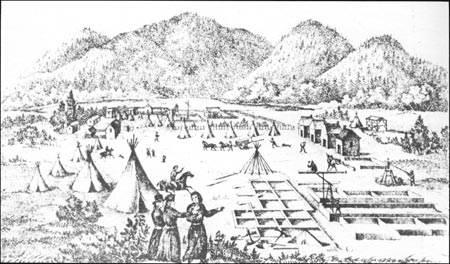 De Smet seems like most likely suspect as the author of this diary. His Bitterroot St. Mary’s Mission was initially successful, but the Salish (Flathead) became disillusioned with the Jesuit, in part due to his attempts to convert the Blackfeet. It’s possible, that De Smet’s contemporary, Baraga, allowed Kohl to view the manuscript diary but did not give permission for Kohl to share it with the public. Image Source: National Park Service
Once, I read an excellent unpublished diary of a Catholic missionary of his 10 years of missionary work and deeds among the Indians. It was full of the most admirable traits and was evidence of the dedication and sacrifice of the author to his profession, and full of the strangest and most interesting contributions to the knowledge of the traits of the Indian character. The good father also illustrated the whole thing with cute pictures and depictions of the Mariancapelle he built, the tents the Flatheads built and adorned, with “flower altars” he erected on the prairies, of the masses and blessings which he gave to the tribe when they went out with him to attack the buffaloes, and of his consultations with hostile tribes with whom he smoked the peace-pipe. I have never seen such nice printed matter, and would still share more if I did not consider it inappropriate for a variety of reasons.
How well the Catholic missionaries, through the means of their confessional, had an effect upon the Indians, I was told of many colorful examples by a Protestant gentleman. Once an Indian woman had lost a richly-embroidered and variegated shawl. No one could discover where it had been. Finally, after many years, one day she found to her great joy her precious cloth again in her tent on her bed. Soon afterwards, her neighbor asked her for a silent and secret conversation in which she confessed to being the thief. The beautiful cloth had her eyes so blinded, she wished very much to possess it. She had stolen it from her at that time, but had never been able to use it for fear of being discovered. She kept it locked in her box and only looked at it at times. Recently, however, she had become ill and had to make such a cumbersome confession to the Catholic priest of all her previous actions that she could no longer conceal the theft. He must have reproached her severely, punished her with a severe penance, and at the same time ordered the cloth to be returned to her neighbor to try to win her forgiveness and otherwise offer her compensation. The Protestant clergyman could hardly have resolved this whole affair so quietly and easily.
Now, if an Indian sees that a neighboring tribe has a beneficial-seeming missionary, under whose mediation things flourish, wandering with his people for weeks in the prairies and praying until the buffalos finally appear, he would like also have something like that. Often, they are even inclined to take away the missionaries from each other, and cases of war for the possession of missionaries have actually occurred.
~~~~~~~
anami’aa– to pray or be a Christian. nindanami’aa– I pray/am a Christian. anami’aad- they pray. anami’aasiig- they do not pray. (Ojibwe People’s Dictionary)
A baptized Indian is usually called by the Canadians un Indian de la prière (a praying Indian). Originally the expression was probably invented by the Indians themselves. The silent reading of the breviary and solitary prayer on the knees, were the first religious acts they observed among their missionaries. The first acts that were required of them when they were converted were the bending of the knee, the folding of the hands, and the worship of God before the cross and before the images of the saints. Therefore they called the Christians “the praying men” (in the Ojibwe, anamiad*) and their religion “the praying” (anamiawin). In contrast to this, the pagans afterward called themselves the “non-praying” (anamiassig).
(*The word comes from nind anamia, “I pray.”)
The French Canadians have faithfully translated and used this saying of the Indians. Of a convert, they say, il s’est mis prière, (he has joined the prayer) and of a pagan, il n’est pas de la prière (he is not yet of the prayers). I have also heard the phrase the praying Indians from the English.
For a long time (probably 150 years), the Indians of these areas saw only one Christian religion. But when the British conquered Canada (in the middle of the last century), they became acquainted with a different kind of Christian with completely different religious customs and ceremonies. They therefore made a distinction between the “French” and the “English” religion. With the first name, they call the Catholics, and with the second, the Protestants.*
(*In Ojibwe, the first is Wemitigodschi-anamiewin, and the second is Jaganashi-anamiewin.)
If an Indian “joins the prayer,” that is to say, is baptized, he is first of all required to renounce all his old pagan superstition. His “medicine bag” and its whole content of magic remedies, amulets, and birchbark scriptures, if not already burned or buried, is destroyed when his decision to become a worshiper is fulfilled.
At times, the clergy have the opportunity to gather up many of these pagan curiosities, but they burn up or eliminate them quickly, often too quickly for the avid ethnographer. I have rarely been able to find any of these things in the places where I visited, not even of the interesting pictures Indians put on birch bark. These should be kept, collected, and donated to science.
But of course, this is easier said than done. In the first place, the Indians, when they become Christians, quite often give their old bark-books to their pagan friends, as they are eager to trade them or give them away. And then, when a clergyman gets his hands on them, it’s not up to him to collect objects that he considers unholy and evil, and are the very thing he takes away from the Indians. A conscientious clergyman must not subordinate the serious demands of religion to the desires of science, and he is almost forced to burn such things. This is how, at the mercy of those bishops in Mexico, the whole heap of splendid old Aztec writings was burned.
Usually the conversion of an Indian “to prayer” is associated with some changes in his personal appearance. In particular, he must renounce the coloring and painting of his face. This coloring cannot be considered as meaningless a pleasure as the makeup of our ladies. Their wild warriors prefer to paint for their religious ceremonies and magic dances. The colors, therefore, are too reminiscent of paganism, and it is de rigueur that a praying Indian should wash himself, and deliver his “vermillion tin,” his green, blue, and yellow paint-powder, and his brush and pallet to the priest.
Finally, he has to wear and comb his hair like a Christian. The pagan Indians have their hair arranged differently. Some cut all around except for a tuft or knotted tuft (a scalp lock) in the middle. The local Ojibwes mostly wear two long thick braids like our Croats. The Canadians call these braids cornettes. Our Croats and Slavonians, when they became Christians, were not asked to renounce this ornament. That one requires it of the Indians may have its reason in that those hairstyles are not of so innocent a nature. They were most likely grown to hold the bloody eagle feathers, the scalps of their enemies, and other military badges reminiscent of their unchristian deeds. Therefore, they must be cut off at baptism, as a sign of the renunciation of the pagan warrior craft.*
(*A Canadian, with whom I discussed these things, told in the following unique way of the changes that a pagan must make to his person upon baptism:
1) On leur coupe les “cornettes” les deux queues qu’ils portent à la tête, et qu’ils appellent dans leur language “Otokoschaman.”
2) On les fait renoncer au Vermillon et à toute autre terre et couleur.
3) Aussi a la danse sauvage et aux jeux payens.
4) De méme à tout ce quientre dans leurs sacs et à toute autre médicine, qui fait du tort à leurs semblables.
5) Finalement ils renoncent aussi au commandement de leurs chefs, c’est à dire quant à la guerre et pour la médicine: mais pas pour les annuités et pas pour la police.)
(To be continued)
Remarks on the Conversion of the Canadian Indians and some Stories of Conversion was published in two consecutive issues of Das Ausland. Each section is about 7000 words. Read Part 2 for the rest of the article and some final thoughts.
Part 1|Part 2
Penokee Mixed-Blood Allotments Shakedown Scam of 1858
April 21, 2018
By Amorin Mello
This is one of several posts on Chequamegon History featuring the Mixed-Blood Allotments of the Penokee Mountains overlooking Chequamegon Bay, such as the Sioux Scrip scams during the Penokee Survey Incidents. This post illustrates the curious circumstances that occurred at the U.S. General Land Office in the City of Superior during 1858 as a large group of Chippewa Mixed-Blood Allotments were located along the Penokee Mountains via the seventh clause of the second article of the 1854 Treaty of La Pointe:
ARTICLE 2.
The United States agree to set apart and withhold from sale, for the use of the Chippewas of Lake Superior, the following-described tracts of land, viz:
[…]
7th. Each head of a family, or single person over twenty-one years of age at the present time of the mixed bloods, belonging to the Chippewas of Lake Superior, shall be entitled to eighty acres of land, to be selected by them under the direction of the President, and which shall be secured to them by patent in the usual form.
Selected affidavits from the National Archives:
Interior Department appointment papers, 1849-1907.
Roll 6, Superior Land Office 1854-1860.
May 1, 1858
State of Wisconsin
County of Douglas
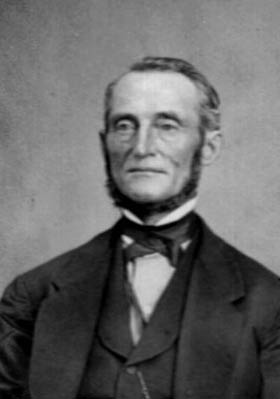
John Dow Howard (photograph from the Duluth Public Library) later owned large areas of land in both Superior and Duluth.
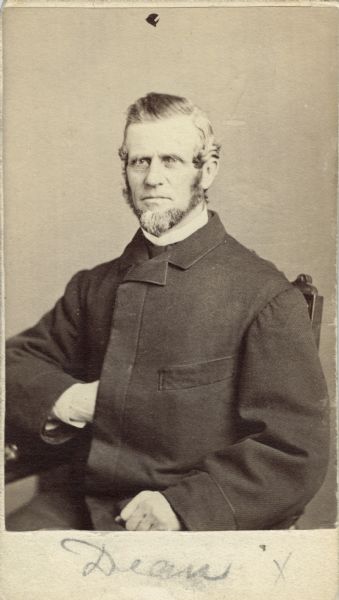
Eliab Byram Dean, Jr. (photo from Wisconsin Historical Society) was a Madison businessman and Wisconsin State Senator.
John D. Howard being duly sworn says, that he resides in Superior, Douglas County, Wisconsin, and that he is acquainted with Eliab B. Dean Jr, the Receiver of the U. S. Land office at Superior aforesaid; that sometime during the month of January or February 1858 the said Dean stated to affiant that he said Dean had an object in view whereby an investment could be made at a profitable rate, and if affiant could command the sum of one thousand or fifteen hundred dollars, he said Dean would give the affiant a proportion of the profits that might accrue therefrom, representing to the affiant that it was a matter he did not feel disposed to disclose fully the substance of [tile?] a future period, and that in the mean time affiant should follow his, Dean’s, instructions to -not- provide means to purchase Half-Breed Scrip and hold his Dean’s proportion secretly – saying he Dean did not wish to be known in the transaction. Subsequently, affiant was informed by Dean that the Half Breed Scrip was to be laid by affiant under power of attorney from Half-Breeds on lands in the Superior Land District, known as the “Iron Range” near Ashland, which lands had been filed upon by settlers under a pre-emption law of the United States that said Dean showed the affiant a list of the persons claiming the said land by pre emption which list was contained in the Register’s abstract of Declaratory statements, and told the affiant that these were the land he proposed to enter with the said scrip. For the purpose of enabling affiant to purchase genuine scrip the said Dean showed to affiant an official list of the Half-Breeds who were entitled to receive scrip from the Government. In this arrangement Dean proposed to affiant that he Dean and affiant should enter into a combination to contest the right to the land with the pre-emption. The said Dean further informed affiant that he had secured such influence at Washington that beyond a doubt he and affiant would be able to secure the land. And the said Dean wished affiant to keep Dean’s interest in the location of the Scrip a secret; and to do all the business in affiant’s name and after the title of the lands was secured, affiant was to convey to Dean, or for Dean’s benefit such portion of the lands as Dean by the agreement should be entitled to.

Ad from the Superior Chronicle, July 10, 1855.
And this affiant further says that said arrangement was not consummated in consequence of affiant’s determination not to purchase the scrip, and further says not.
J. D. Howard
Sworn to & subscribed before me this 1st day of May A.D. 1858
Geo. W. Perry
Notary Public
Douglas County
May 2 1858
State of Wisconsin
County of Douglas

Julius Austrian (photo from the Madeline Island Museum) was accused of obtaining fraudulent power-of-attorney over Chippewa Mixed-Bloods as the U.S. Postmaster at La Pointe.
“I think I have told you that E. B. Dean is removed. For this we must thank Austrian. The Com. gave him 30 days in which to answer the charge against him, and he was round here a long time trying to get Austrian to retract and even offered him $2000.00 to clear him but no go The Jew was determined to have his revenge.”
Julius Austrian being duly sworn says that he resides in the County of LaPointe, Wisconsin and that he is acquainted with Eliab B. Dean Jr Receiver of the U. S. Land Office at Superior Wisconsin; that on the first day of March A.D. 1858, this affiant applied at said Land Office to locate certain Chippewa Half Breed Scrip, under Power of Attorney to this affiant from the Half Breeds to whom said Scrip was issued, that the application of this affiant under such Power of Attorney was made in due and proper form, and signed by the Register of said Land Office, who told and that this affiant requested the Receiver (the said Dean) to sign the same, but that said Dean delayed signing the same, and would not talk with the affiant in the Land Office, but compelled this affiant to meet him said Dean at various places under various pretexts, until finally the said Dean told this affiant that he (Dean) would not sign the said applications unless this affiant should first pay him (the said Dean) the sum of Five hundred Dollars, and that this affiant being pressed for time and anxious to perfect the location of the said Scrip, after some demur, paid to the said Dean the said sum of $500.00 so demanded to the said Land Office, and signed the said applications as Receiver of said Land Office.
Julius Austrian
Sworn and subscribed before me
this 2nd day of May A.D. 1858
Geo. W. Perry
Notary Public
Douglas County
General Land Office
May 21, 1858
Sir,
Land Office Frauds
“If Congress would amuse their leisure a little by looking at these land office operations on the verge of civilization, they would strike a placer of corruption. […] Let them find out what Receiver DEAN said of Register SHAW, and what Register SHAW said of Receiver DEAN, and why DEAN was dismissed and why SHAW was retained. It will be rare fun for somebody. The country ought to know something about the Land Offices, and such an investigation as this would enlighten the country very materially. I hope it will be made, and that the country will learn how it is that more land has been entered in this district by Indians, foreigners, and minors than by qualified preëmptors, and all for the benefit of a few favored speculators.”
I have the honor to submit herewith a letter from Daniel Shaw Esq.~ Register at Superior Wisconsin, covering charges against E. B. Dean Jr., Receiver at that place, as follows:
1) Refusing to sign an application of Julius Austrian to locate certain Half breed scrip, under power of Attorney, said Dean refused to sign the applications unless Austrian paid $500, after some demur A. paid the $500 and Dean signed the papers in his official capacity as Receiver.
2) Agreeing to permit one Honsinger, for a consideration, to enter the pre-emption claim of a man named Cotas advising Honsinger what means to take to enter Cotas claim; these measures however were defeated by the Register.
3) Making an agreement with Jas. D. Ray, to purchase land of a pre-emption after he had proved up, and furnishing funds from the public safe to pay for the land so purchased.
4) Proposing to John D. Howard, a secret partnership for the purpose of speculating in half breed Scrip, and entering lands therewith, which Lands had been filed upon by settlers under the pre-emption law. Dean exhibited to Howard a list of persons claiming these lands, also exhibiting the Official list of half breeds; which list this Office directed should be kept confidentially from all persons.
Superior, Wisconsin
May 22, 1859
Sir;
You will oblige me by informing me whether my removal from the Office of Register at this place was in consequence of any charges [referred?] against me; and, if so; whether it appears from the record that I have have an opportunity for defence.
Very Respectfully
Your Obt. Servt,
Daniel Shaw.
Hon. Thos. A. Hendricks,
Comr. Genl. Land Office,
Washington, D.C.
Early Life among the Indians: Chapter II
March 21, 2018
By Amorin Mello

Early life among the Indians
by Benjamin Green Armstrong
continued from Chapter I.
CHAPTER II
In Washington.—Told to Go Home.—Senator Briggs, of New York.—The Interviews with President Fillmore.—Reversal of the Removal Order.—The Trip Home.—Treaty of 1854 and the Reservations.—The Mile Square.—The Blinding. »
After a fey days more in New York City I had raised the necessary funds to redeem the trinkets pledged with the ‘bus driver and to pay my hotel bills, etc., and on the 22d day of June, 1852, we had the good fortune to arrive in Washington.

“Washington Delegation, June 22, 1852“
Engraved from an unknown photograph by Marr and Richards Co. for Benjamin Armstrong’s Early Life Among the Indians. Chief Buffalo, his speaker Oshogay, Vincent Roy, Jr., two other La Pointe Band members, and Armstrong are assumed to be in this engraving.
I took my party to the Metropolitan Hotel and engaged a room on the first floor near the office for the Indians, as they said they did not like to get up to high in a white man’s house. As they required but a couple mattresses for their lodgings they were soon made comfortable. I requested the steward to serve their meals in their room, as I did not wish to take them into the dining room among distinguished people, and their meals were thus served.

Undated postcard of the Metropolitan Hotel, formerly known as Brown’s India Queen Hotel.
~ StreetsOfWashington.com
The morning following our arrival I set out in search of the Interior Department of the Government to find the Commissioner of Indian Affairs, to request an interview with him, which he declined to grant and said :
“I want you to take your Indians away on the next train west, as they have come here without permission, and I do not want to see you or hear of your Indians again.”
I undertook to make explanations, but he would not listen to me and ordered me from his office. I went to the sidewalk completely discouraged, for my present means was insufficient to take them home. I paced up and down the sidewalk pondering over what was best to do, when a gentleman came along and of him I inquired the way to the office of the Secretary of the Interior. He passed right along saying,
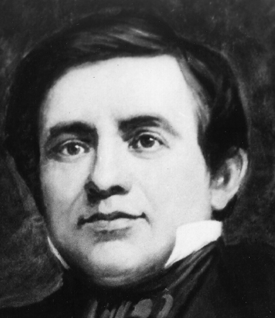
Secretary of the Interior
Alexander Hugh Holmes Stuart
~ Department of the Interior
“This way, sir; this way, sir;” and I followed him.
He entered a side door just back of the Indian Commissioner’s office and up a short flight of stairs, and going in behind a railing, divested himself of hat and cane, and said :
“What can I do for you sir.”
I told him who I was, what my party consisted of, where we came from and the object of our visit, as briefly as possible. He replied that I must go and see the Commissioner of Indian Affairs just down stairs. I told him I had been there and the treatment I had received at his hands, then he said :
“Did you have permission to come, and why did you not go to your agent in the west for permission?”
I then attempted to explain that we had been to the agent, but could get no satisfaction; but he stopped me in the middle of my explanation, saying :
“I can do nothing for you. You must go to the Indian Commissioner,”
and turning, began a conversation with his clerk who was there when we went in.
I walked out more discouraged than ever and could not imagine what next I could do. I wandered around the city and to the Capitol, thinking I might find some one I had seen before, but in this I failed and returned to the hotel, where, in the office I found Buffalo surrounded by a crowd who were trying to make him understand them and among them was the steward of the house. On my entering the office and Buffalo recognizing me, the assemblage, seeing I knew him, turned their attention to me, asking who he was, etc., to all of which questions I answered as briefly as possible, by stating that he was the head chief of of the Chippewas of the Northwest. The steward then asked:
“Why don’t you take him into the dining room with you? Certainly such a distinguished man as he, the head of the Chippewa people, should have at least that privilege.”

United States Representative George Briggs
~ Library of Congress
I did so and as we passed into the dining room we were shown to a table in one corner of the room which was unoccupied. We had only been seated a few moments when a couple of gentlemen who had been occupying seats in another part of the dining room came over and sat at our table and said that if there were no objections they would like to talk with us. They asked about the party, where from, the object of the visit, etc. I answered them briefly, supposing them to be reporters and I did not care to give them too much information. One of these gentlemen asked what room we had, saying that himself and one or two others would like to call on us right after dinner. I directed them where to come and said I would be there to meet them.
About 2 o’clock they came, and then for the first time I knew who those gentlemen were. One was Senator Briggs, of New York, and the others were members of President Filmore’s cabinet, and after I had told them more fully what had taken me there, and the difficulties I had met with, and they had consulted a little while aside. Senator Briggs said :
“We will undertake to get you and your people an interview with the President, and will notify you here when a meeting can be arranged. ”
During the afternoon I was notified that an interview had been arranged for the next afternoon at 3 o’clock. During the evening Senator Briggs and other friends called, and the whole matter was talked over and preparations made for the interview the following day, which were continued the next day until the hour set for the interview.

United States President
Millard Fillmore.
~ Library of Congress
When we were assembled Buffalo’s first request was that all be seated, as he had the pipe of peace to present, and hoped that all who were present would partake of smoke from the peace pipe. The pipe, a new one brought for the purpose, was filled and lighted by Buffalo and passed to the President who took two or three draughts from it, and smiling said, “Who is the next?” at which Buffalo pointed out Senator Briggs and desired he should be the next. The Senator smoked and the pipe was passed to me and others, including the Commissioner of Indian Affairs, Secretary of the Interior and several others whose names I did not learn or cannot recall. From them, to Buffalo, then to O-sho-ga, and from him to the four braves in turn, which completed that part of the ceremony. The pipe was then taken from the stem and handed to me for safe keeping, never to be used again on any occasion. I have the pipe still in my possession and the instructions of Buffalo have been faithfully kept. The old chief now rose from his seat, the balance following his example and marched in single file to the President and the general hand-shaking that was began with the President was continued by the Indians with all those present. This over Buffalo said his under chief, O-sha-ga, would state the object of our visit and he hoped the great father would give them some guarantee that would quiet the excitement in his country and keep his young men peaceable. After I had this speech thoroughly interpreted, O-sha-ga began and spoke for nearly an hour. He began with the treaty of 1837 and showed plainly what the Indians understood the treaty to be. He next took up the treaty of 1842 and said he did not understand that in either treaty they had ceded away the land and he further understood in both cases that the Indians were never to be asked to remove from the lands included in those treaties, provided they were peaceable and behaved themselves and this they had done. When the order to move came Chief Buffalo sent runners out in all directions to seek for reasons and causes for the order, but all those men returned without finding a single reason among all the Superior and Mississippi Indians why the great father had become displeased. When O-sha-ga had finished his speech I presented the petition I had brought and quickly discovered that the President did recognize some names upon it, which gave me new courage. When the reading and examination of it had been concluded the meeting was adjourned, the President directing the Indian Commissioner to say to the landlord at the hotel that our hotel bills would be paid by the government. He also directed that we were to have the freedom of the city for a week.
Read Biographical Sketch of Vincent Roy, Jr. manuscript for a different perspective on their meeting the President.
The second day following this Senator Briggs informed me that the President desired another interview that day, in accordance with which request we went to the White House soon after dinner and meeting the President, he told the, delegation in a brief speech that he would countermand the removal order and that the annuity payments would be made at La Pointe as before and hoped that in the future there would be no further cause for complaint. At this he handed to Buffalo a written instrument which he said would explain to his people when interpreted the promises he had made as to the removal order and payment of annuities at La Pointe and hoped when he had returned home he would call his chiefs together and have all the statements therein contained explained fully to them as the words of their great father at Washington.
The reader can imagine the great load that was then removed from my shoulders for it was a pleasing termination of the long and tedious struggle I had made in behalf of the untutored but trustworthy savage.

Downtown St. Paul, Minnesota, circa 1857.
~ Minnesota Historical Society
On June 28th, 1852, we started on our return trip, going by cars to La Crosse, Wis., thence by steamboat to St. Paul, thence by Indian trail across the country to Lake Superior. On our way from St. Paul we frequently met bands of Indians of the Chippewa tribe to whom we explained our mission and its results, which caused great rejoicing, and before leaving these bands Buffalo would tell their chief to send a delegation, at the expiration of two moons, to meet him in grand council at La Pointe, for there was many things he wanted to say to them about what he had seen and the nice manner in which he had been received and treated by the great father.
At the time appointed by Buffalo for the grand council at La Pointe, the delegates assembled and the message given Buffalo by President Filmore was interpreted, which gave the Indians great satisfaction. Before the grand council adjourned word was received that their annuities would be given to them at La Pointe about the middle of October, thus giving them time to get together to receive them. A number of messengers was immediately sent out to all parts of the territory to notify them and by the time the goods arrived, which was about October 15th, the remainder of the Indians had congregated at La Pointe. On that date the Indians were enrolled and the annuities paid and the most perfect satisfaction was apparent among all concerned. The jubilee that was held to express their gratitude to the delegation that had secured a countermanding order in the removal matter was almost extravagantly profuse. The letter of the great father was explained to them all during the progress of the annuity payments and Chief Buffalo explained to the convention what he had seen; how the pipe of peace had been smoked in the great father’s wigwam and as that pipe was the only emblem and reminder of their duties yet to come in keeping peace with his white children, he requested that the pipe be retained by me. He then went on and said that there was yet one more treaty to be made with the great father and he hoped in making it they would be more careful and wise than they had heretofore been and reserve a part of their land for themselves and their children. It was here that he told his people that he had selected and adopted, me as his son and that I would hereafter look to treaty matters and see that in the next treaty they did not sell them selves out and become homeless ; that as he was getting old and must soon leave his entire cares to others, he hoped they would listen to me as his confidence in his adopted son was great and that when treaties were presented for them to sign they would listen to me and follow my advice, assuring them that in doing so they would not again be deceived.

Map of Lake Superior Chippewa territories ceded in 1836, 1837, 1842, and 1854.
~ Great Lakes Indian Fish & Wildlife Commission
After this gathering of the Indians there was not much of interest in the Indian country that I can recall until the next annual payment in 1853. This payment was made at La Pointe and the Indians had been notified that commissioners would be appointed to make another treaty with them for the remainder of their territory. This was the territory lying in Minnesota west of Lake Superior; also east and west of the Mississippi river north to the territory belonging to the Boisfort and Pillager tribe, who are a part of the Chippewa nation, but through some arrangement between themselves, were detached from the main or more numerous body. It was at this payment that the Chippewa Indians proper desired to have one dollar each taken from their annuities to recompense me for the trouble and expense I had been to on the trip to Washington in their behalf, but I refused to accept it by reason of their very impecunious condition.
It was sometime in August, 1854, before the commissioners arrived at LaPointe to make the treaty and pay the annuities of that year. Messengers were despatched to notify all Indians of the fact that the great father had sent for them to come to La Pointe to get their money and clothing and to meet the government commissioners who wished to make another treaty with them for the territory lying west of Lake Superior and they were further instructed to have the Indians council among themselves before starting that those who came could be able to tell the wishes of any that might remain away in regards to a further treaty and disposition of their lands. Representatives came from all parts of the Chippewa country and showed a willingness to treat away the balance of their country. Henry C. Gilbert, the Indian agent at La Pointe, formerly of Ohio, and David B. Herriman, the agent for the Chippewas of the Mississippi country, were the commissioners appointed by the government to consumate this treaty.

Mackinac Indian Agent
Henry C. Gilbert
~ Branch County Photographs
While we were waiting the arrival of the interior Indians I had frequent talks with the commissioners and learned what their instructions were and about what they intended to offer for the lands which information I would communicate to Chief Buffalo and other head men in our immediate vicinity, and ample time was had to perfect our plans before the others should arrive, and when they did put in an appearance we were ready to submit to them our views for approval or rejection. Knowing as I did the Indians’ unwillingness to give up and forsake their old burying grounds I would not agree to any proposition that would take away the remainder of their lands without a reserve sufficient to afford them homes for themselves and posterity, and as fast as they arrived I counselled with them upon this subject and to ascertain where they preferred these reserves to be located. The scheme being a new one to them it required time and much talk to get the matter before them in its proper light. Finally it was agreed by all before the meeting of the council that no one would sign a treaty that did not give them reservations at different points of the country that would suit their convenience, that should afterwards be considered their bona-fide home. Maps were drawn of the different tracts that had been selected by the various chiefs for their reserve and permanent home. The reservations were as follows :
One at L’Anse Bay, one at Ontonagon, one at Lac Flambeau, one at Court O’Rilles, one at Bad River, one at Red Cliff or Buffalo Bay, one at Fond du Lac, Minn., and one at Grand Portage, Minn.

Joseph Stoddard (photo c.1941) worked on the 1854 survey of the Bad River Reservation exterior boundaries, and shared a different perspective about these surveys.
~ Bad River Tribal Historic Preservation Office
The boundaries were to be as near as possible by metes and bounds or waterways and courses. This was all agreed to by the Lake Superior Indians before the Mississippi Chippewas arrived and was to be brought up in the general council after they had come in, but when they arrived they were accompanied by the American Fur Company and most of their employees, and we found it impossible to get them to agree to any of our plans or to come to any terms. A proposition was made by Buffalo when all were gathered in council by themselves that as they could not agree as they were, a division should be drawn, dividing the Mississippi and the Lake Superior Indians from each other altogether and each make their own treaty After several days of counselling the proposition was agreed to, and thus the Lake Superiors were left to make their treaty for the lands mouth of Lake Superior to the Mississippi and the Mississippis to make their treaty for the lands west of the Mississippi. The council lasted several days, as I have stated, which was owing to the opposition of the American Fur Company, who were evidently opposed to having any such division made ; they yielded however, but only when they saw further opposition would not avail and the proposition of Buffalo became an Indian law. Our side was now ready to treat with the commissioners in open council. Buffalo, myself and several chiefs called upon them and briefly stated our case but were informed that they had no instructions to make any such treaty with us and were only instructed to buy such territory as the Lake Superiors and Mississippis then owned. Then we told them of the division the Indians had agreed upon and that we would make our own treaty, and after several days they agreed to set us off the reservations as previously asked for and to guarantee that all lands embraced within those boundaries should belong to the Indians and that they would pay them a nominal sum for the remainder of their possessions on the north shores. It was further agreed that the Lake Superior Indians should have two- thirds of all money appropriated for the Chippewas and the Mississippi contingent the other third. The Lake Superior Indians did not seem, through all these councils, to care so much for future annuities either in money or goods as they did for securing a home for themselves and their posterity that should be a permanent one. They also reserved a tract of land embracing about 100 acres lying across and along the Eastern end of La Pointe or Madeline Island so that they would not be cut off from the fishing privilege.
It was about in the midst of the councils leading up to the treaty of 1854 that Buffalo stated to his chiefs that I had rendered them services in the past that should be rewarded by something more substantial than their thanks and good wishes, and that at different times the Indians had agreed to reward me from their annuity money but I had always refused such offers as it would be taking from their necessities and as they had had no annuity money for the two years prior to 1852 they could not well afford to pay me in this way.
“And now,” continued Buffalo, “I have a proposition to make to you. As he has provided us and our children with homes by getting these reservations set off for us, and as we are about to part with all the lands we possess, I have it in my power, with your consent, to provide him with a future home by giving him a piece of ground which we are about to part with. He has agreed to accept this as it will take nothing from us and makes no difference with the great father whether we reserve a small tract of our territory or not, and if you agree I will proceed with him to the head of the lake and there select the piece of ground I desire him to have, that it may appear on paper when the treaty has been completed.”
The chiefs were unanimous in their acceptance of the proposition and told Buffalo to select a large piece that his children might also have a home in future as has been provided for ours.

Kiskitawag (Giishkitawag: “Cut Ear”) signed earlier treaties as a warrior of the Ontonagon Band and became associated with the La Pointe Band at Odanah.
~C.M. Bell, Smithsonian Digital Collections
This council lasted all night and just at break of day the old chief and myself, with four braves to row the boat, set out for the head of Lake Superior and did not stop anywhere only long enough to make and drink some tea, until we reached the head of St. Louis Bay. We landed our canoe by the side of a flat rock quite a distance from the shore, among grass and rushes. Here we ate our lunch and when completed Buffalo and myself, with another chief, Kish-ki-to-uk, waded ashore and ascended the bank to a small level plateau where we could get a better view of the bay. Here Buffalo turned to me, saying: .
“Are you satisfied with this location? I want to reserve the shore of this bay from the mouth of St. Louis river. How far that way do you you want it to go?” pointing southeast, or along the south shore of the lake.
I told him we had better not try to make it too large for if we did the great father’s officers at Washington might throw it out of the treaty and said:
“I will be satisfied with one mile square, and let it start from the rock which we have christened Buffalo rock, running easterly in the direction of Minnesota Point, taking in a mile square immediately northerly from the head of St. Louis Bay”
As there was no other way of describing it than by metes and bounds we tried to so describe it in the treaty, but Agent Gilbert, whether by mistake or not I am unable to say, described it differently. He described it as follows: “Starting from a rock immediately above and adjoining Minnesota Point, etc.”
We spent an hour or two here in looking over the plateau then went back to our canoe and set out for La Pointe. We traveled night and day until we reached home.
During our absence some of the chiefs had been talking more or less with the commissioners and immediately on our return all the Indians met in a grand council when Buffalo explained to them what he had done on the trip and how and where he had selected the piece of land that I was to have reserved in the treaty for my future home and in payment for the services I had rendered them in the past. The balance of the night was spent in preparing ourselves for the meeting with the treaty makers the next day, and about 10 o’clock next morning we were in attendance before the commissioners all prepared for a big council.
Mackinac Indian Agent
Henry Clark Gilbert
~ Branch County Photographs
Agent Gilbert started the business by beginning a speech interpreted by the government interpreter, when Buffalo interrupted him by saying that he did not want anything interpreted to them from the English language by any one except his adoped son for there had always been things told to the Indians in the past that proved afterwards to be untrue, whether wrongly interpreted or not, he could not say;
“and as we now feel that my adopted son interprets to us just what you say, and we can get it correctly, we wish to hear your words repeated by him, and when we talk to you our words can be interpreted by your own interpreter, and in this way one interpreter can watch the other and correct each other should there be mistakes. We do not want to be deceived any more as we have in the past. We now understand that we are selling our lands as well as the timber and that the whole, with the exception of what we shall reserve, goes to the great father forever.”

Bureau of Indian Affairs Director
George Washington Manypenny
~ Commons.Wikimedia.org
Commissioner of Indian affairs. Col. Manypenny, then said to Buffalo:
“What you have said meets my own views exactly and I will now appoint your adopted son your interpreter and John Johnson, of Sault Ste. Marie, shall be the interpreter on the part of the government,” then turning to the commissioners said, “how does that suit you, gentlemen.”
They at once gave their consent and the council proceeded.
Buffalo informed the commissioners of what he had done in regard to selecting a tract of land for me and insisted that it become a part of the treaty and that it should be patented to me directly by the government without any restrictions. Many other questions were debated at this session but no definite agreements were reached and the council was adjourned in the middle of the afternoon. Chief Buffalo asking for the adjournment that he might talk over some matters further with his people, and that night the subject of providing homes for their half-breed relations who lived in different parts of the country was brought up and discussed and all were in favor of making such a provision in the treaty. I proposed to them that as we had made provisions for ourselves and children it would be only fair that an arrangement should be made in the treaty whereby the government should provide for our mixed blood relations by giving to each person the head of a family or to each single person twenty-one years of age a piece of land containing at least eighty acres which would provide homes for those now living and in the future there would be ample room on the reservations for their children, where all could live happily together. We also asked that all teachers and traders in the ceded territory who at that time were located there by license and doing business by authority of law, should each be entitled to 160 acres of land at $1.25 per acre. This was all reduced to writing and when the council met next morning we were prepared to submit all our plans and requests to the commissioners save one, which we required more time to consider. Most of this day was consumed in speech-making by the chiefs and commissioners and in the last speech of the day, which was made by Mr. Gilbert, he said:
“We have talked a great deal and evidently understand one another. You have told us what you want, and now we want time to consider your requests, while you want time as you say to consider another matter, and so we will adjourn until tomorrow and we, with your father. Col. Manypenny, will carefully examine and consider your propositions and when we meet to-morrow we will be prepared to answer you with an approval or rejection.”
Julius Austrian purchased the village of La Pointe and other interests from the American Fur Company in 1853. He entered his Town Plan of La Pointe on August 29th of 1854. He was the highest paid claimant of the 1854 Treaty at La Pointe. His family hosted the 1855 Annuity Payments at La Pointe.
~ Photograph of Austrian from the Madeline Island Museum
That evening the chiefs considered the other matter, which was to provide for the payment of the debts of the Indians owing the American Fur Company and other traders and agreed that the entire debt could not be more than $90,000 and that that amount should be taken from the Indians in bulk and divided up among their creditors in a pro-rata manner according to the amount due to any person or firm, and that this should wipe out their indebtedness. The American Fur Company had filed claims which, in the aggregate, amounted to two or three times this sum and were at the council heavily armed for the purpose of enforcing their claim by intimidation. This and the next day were spent in speeches pro and con but nothing was effected toward a final settlement.
Col. Manypenny came to my store and we had a long private interview relating to the treaty then under consideration and he thought that the demands of the Indians were reasonable and just and that they would be accepted by the commissioners. He also gave me considerable credit for the manner in which I had conducted the matter for Indians, considering the terrible opposition I had to contend with. He said he had claims in his possession which had been filed by the traders that amounted to a large sum but did not state the amount. As he saw the Indians had every confidence in me and their demands were reasonable he could see no reason why the treaty could not be speedily brought to a close. He then asked if I kept a set of books. I told him I only kept a day book or blotter showing the amount each Indian owed me. I got the books and told him to take them along with him and that he or his interpreter might question any Indian whose name appeared thereon as being indebted to me and I would accept whatever that Indian said he owed me whether it be one dollar or ten cents. He said he would be pleased to take the books along and I wrapped them up and went with him to his office, where I left them. He said he was certain that some traders were making claims for far more than was due them. Messrs. Gilbert and Herriman and their chief clerk, Mr. Smith, were present when Mr. Manypenny related the talk he had with me at the store. He considered the requests of the Indians fair and just, he said, and he hoped there would be no further delays in concluding the treaty and if it was drawn up and signed with the stipulations and agreements that were now understood should be incorporated in it, he would strongly recommend its ratification by the President and senate.

Naagaanab of Fond Du Lac
~ Minnesota Historical Society
The day following the council was opened by a speech from Chief Na-gon-ab in which he cited considerable history.
“My friends,” he said, “I have been chosen by our chief, Buffalo, to speak to you. Our wishes are now on paper before you. Before this it was not so. We have been many times deceived. We had no one to look out for us. The great father’s officers made marks on paper with black liquor and quill. The Indian can not do this. We depend upon our memory. We have nothing else to look to. We talk often together and keep your words clear in our minds. When you talk we all listen, then we talk it over many times. In this way it is always fresh with us. This is the way we must keep our record. In 1837 we were asked to sell our timber and minerals. In 1842 we were asked to do the same. Our white brothers told us the great father did not want the land. We should keep it to hunt on. Bye and bye we were told to go away; to go and leave our friends that were buried yesterday. Then we asked each other what it meant. Does the great father tell the truth? Does he keep his promises? We cannot help ourselves! We try to do as we agree in treaty. We ask you what this means? You do not tell from memory! You go to your black marks and say this is what those men put down; this is what they said when they made the treaty. The men we talk with don’t come back; they do not come and you tell us they did not tell us so! We ask you where they are? You say you do not know or that they are dead and gone. This is what they told you; this is what they done. Now we have a friend who can make black marks on paper When the council is over he will tell us what we have done. We know now what we are doing! If we get what we ask our chiefs will touch the pen, but if not we will not touch it. I am told by our chief to tell you this: We will not touch the pen unless our friend says the paper is all right.”
Na-gon-ab was answered by Commissioner Gilbert, saying:
“You have submitted through your friend and interpreter the terms and conditions upon which you will cede away your lands. We have not had time to give them all consideration and want a little more time as we did not know last night what your last proposition would be. Your father. Col. Manypenny, has ordered some beef cattle killed and a supply of provisions will be issued to you right away. You can now return to your lodges and get a good dinner and talk matters over among yourselves the remainder of the day and I hope you will come back tomorrow feeling good natured and happy, for your father, Col. Manypenny, will have something to say to you and will have a paper which your friend can read and explain to you.”
When the council met next day in front of the commissioners’ office to hear what Col. Manypenny had to say a general good feeling prevailed and a hand-shaking all round preceded the council, which Col. Manypenny opened by saying:
“My friends and children: I am glad to see you all this morning looking good natured and happy and as if you could sit here and listen to what I have to say. We have a paper here for your friend to examine to see if it meets your approval. Myself and the commissioners which your great father has sent here have duly considered all your requests and have concluded to accept them. As the season is passing away and we are all anxious to go to our families and you to your homes, I hope when you read this treaty you will find it as you expect to and according to the understandings we have had during the council. Now your friend may examine the paper and while he is doing so we will take a recess until afternoon.”

Detail of Benjamin Armstrong from a photograph by Matthew Brady
~ Minnesota Historical Society
Chief Buffalo, turning to me, said:
“My son, we, the chiefs of all the country, have placed this matter entirely in your hands. Go and examine the paper and if it suits you it will suit us.”
Then turning to the chiefs, he asked,
“what do you all say to that?”
The ho-ho that followed showed the entire circle were satisfied.
I went carefully through the treaty as it had been prepared and with a few exceptions found it was right. I called the attention of the commissioners to certain parts of the stipulations that were incorrect and they directed the clerk to make the changes.
The following day the Indians told the commissioners that as their friend had made objections to the treaty as it was they requested that I might again examine it before proceeding further with the council. On this examination I found that changes had been made but on sheets of paper not attached to the body of the instrument, and as these sheets contained some of the most important items in the treaty, I again objected and told the commissioners that I would not allow the Indians to sign it in that shape and not until the whole treaty was re-written and the detached portions appeared in their proper places. I walked out and told the Indians that the treaty was not yet ready to sign and they gave up all further endeavors until next day. I met the commissioners alone in their office that afternoon and explained the objectionable points in the treaty and told them the Indians were already to sign as soon as those objections were removed. They were soon at work putting the instrument in shape.

“One version of the boundaries for Chief Buffalo’s reservation is shown at the base of Minnesota Point in a detail from an 1857 map preserved in the National Archives in Washington, D.C. Other maps show a larger and more irregularly shaped versions of the reservation boundary, though centered on the same area.”
~ DuluthStories.net
The next day when the Indians assembled they were told by the commissioners that all was ready and the treaty was laid upon a table and I found it just as the Indians had wanted it to be, except the description of the mile square. The part relating to the mile square that was to have been reserved for me read as follows:
“Chief Buffalo, being desirous of providing for some of his relatives who had rendered them important services, it is agreed that he may select one mile square of the ceded territory heretofore described.”
“Now,” said the commissioner,
“we want Buffalo to designate the person or persons to whom he wishes the patents to issue.”
Buffalo then said:
“I want them to be made out in the name of my adopted son.”
This closed all ceremony and the treaty was duly signed on the 30th day of September, 1854. This done the commissioners took a farewell shake of the hand with all the chiefs, hoping to meet them again at the annuity payment the coming year. They then boarded the steamer North Star for home. In the course of a few days the Indians also disappeared, some to their interior homes and some to their winter hunting grounds and a general quiet prevailed on the island.

Portrait of the Steamer North Star from American Steam Vessels, by Samuel Ward Stanton, page 40.
~ Wikimedia.org
About the second week in October, 1854, I went from La Pointe to Ontonagon in an open boat for the purpose of purchasing my winter supplies as it had got too late to depend on getting them from further below. While there a company was formed for the purpose of going into the newly ceded territory to make claims upon lands that would be subject to entry as soon as the late treaty should be ratified. The company consisted of Samuel McWaid, William Whitesides, W. W. Kingsbury, John Johnson, Oliver Melzer, John McFarland, Daniel S. Cash, W. W. Spaulding, all of Ontonagon, and myself. The two last named gentlemen, Daniel S. Cash and W. W. Spaulding, agreeing to furnish the company with supplies and all necessaries, including money, to enter the lands for an equal interest and it was so stipulated that we were to share equally in all that we, or either of us, might obtain. As soon as the supplies could be purchased and put aboard the schooner Algonquin we started for the head of the lake, stopping at La Pointe long enough for me to get my family aboard and my business matters arranged for the winter. I left my store at La Pointe in charge of Alex. Nevaux, and we all sailed for the head of Lake Superior, the site of which is now the city of Duluth. Reaching there about the first week in December—the bay of Superior being closed by ice—we were compelled to make our landing at Minnesota Point and take our goods from there to the main land on the north’ shore in open boats, landing about one and-one half miles east of Minnesota Point at a place where I desired to make a preemption for myself and to establish a trading post for the winter. Here I erected a building large enough for all of us to live in, as we expected to make this our headquarters for the winter, and also a building for a trading post. The other members of the company made claims in other places, but I did no more land looking that winter.

Detail of Superior City townsite at the head of Lake Superior from the 1854 U.S. General Land Office survey by Stuntz and Barber.
About January 20th, 1855, I left my place at the head of the lake to go back to La Pointe and took with me what furs I had collected up to that time, as I had a good place at La Pointe to dry and keep them. I took four men along to help me through and two dog trains. As we were passing down Superior Bay and when just in front of the village of West Superior a man came to us on the ice carrying a small bundle on his back and asked me if I had any objections to his going through in my company. He said the snow was deep and the weather cold and it was bad for one man to travel alone. I told him I had no objections provided he would take his turn with the other men in breaking the road for the dogs. We all went on together and camped that night at a place well known as Flag River. We made preparations for a cold night as the thermometer must have been twenty-five or thirty degrees below zero and the snow fully two feet deep. As there were enough of us we cut and carried up a large quantity of wood, both green and dry, and shoveled the snow away to the ground with our snow shoes and built a large fire. We then cut evergreen boughs and made a wind break or bough camp and concluded we could put in a very comfortable night. We then cooked and ate our supper and all seemed happy. I unrolled a bale of bear skins and spread them out on the ground for my bed, filled my pipe and lay down to rest while the five men with me were talking and smoking around the camp fire. I was very tired and presume I was not long in falling asleep. How long I slept I cannot tell, but was awakened by something dropping into my face, which felt like a powdered substance. I sprang to my feet for I found something had got into my eyes and was smarting them badly. I rushed for the snow bank that was melting from the heat and applied handful after handful to my eyes and face. I found the application was peeling the skin off my face and the pain soon became intense. I woke up the crew and they saw by the firelight the terrible condition I was in. In an hour’s time my eyeballs were so swollen that I could not close the lids and the pain did not abate. I could do nothing more than bathe my eyes until morning, which I did with tea-grounds. It seemed an age before morning came and when it did come I could not realize it, for I was totally blind. The party started with me at early dawn for La Pointe. The man who joined us the day before went no further, but returned to Superior, which was a great surprise to the men of our party, who frequently during the day would say:
“There is something about this matter that is not right,”
and I never could learn afterward of his having communicated the fact of my accident to any one or to assign any reason or excuse for turning back, which caused us to suspect that he had a hand in the blinding, but as I could get no proof to establish that suspicion, I could do nothing in the matter. This man was found dead in his cabin a few months afterwards.
At La Pointe I got such treatment as could be procured from the Indians which allayed the inflamation but did not restore the sight. I remained at La Pointe about ten days, and then returned home with dog train to my family, where I remained the balance of the winter, when not at Superior for treatment. When the ice moved from the lake in the spring I abandoned everything there and returned to La Pointe and was blind or nearly so until the winter of 1861.
Returning a little time to the north shore I wish to relate an incident of the death of one of our Ontonagon company. Two or three days after I had reached home from La Pointe, finding my eyes constantly growing worse I had the company take me to Superior where I could get treatment. Dr. Marcellus, son of Prof. Marcellus, of an eye infirmary in Philadelphia, who had just then married a beautiful young wife, and come west to seek his fortune, was engaged to treat me. I was taken to the boarding house of Henry Wolcott, where I engaged rooms for the winter as I expected to remain there until spring. I related to the doctor what had befallen me and he began treatment. At times I felt much better but no permanent relief seemed near. About the middle February my family required my presence at home, as there was some business to be attended to which they did not understand. My wife sent a note to me by Mr. Melzer, stating that it was necessary for me to return, and as the weather that day was very pleasant, she hoped that I would come that afternoon. Mr. Melzer delivered me the note, which I requested him to read. It was then 11 a. m. and I told him we would start right after dinner, and requested him to tell the doctor that I wished to see him right away, and then return and get his dinner, as it would be ready at noon, to which he replied:
“If I am not here do not wait for me, but I will be here at the time you are ready for home.”
Mr. Melzer did return shortly after we had finished our dinner and I requested him to eat, as I would not be ready to start for half an hour, but he insisted he was not hungry. We had no conveyance and at 1 p. m. we set out for home. We went down a few steps to the ice, as Mr. Wolcott’s house stood close to the shore of the bay, and went straight across Superior Bay to Minnesota Point, and across the point six or eight rods and struck the ice on Lake Superior. A plain, hard beaten road led from here direct to my home. After we had proceeded about 150 yards, following this hard beaten road, Melzer at once stopped and requested me to go ahead, as I could follow the beaten road without assistance, the snow being deep on either side.
“Now,” he says go ahead, for I must go back after a drink.”
I followed the road quite well, and when near the house my folks came out to meet me, their first inquiry being:
“Where is Melzer?”
I told them the circumstances of his turning back for a drink of water. Reaching the bank on which my house stood, some of my folks, looking back over the road I had come, discovered a dark object apparently floundering on the ice. Two or three of our men started for the spot and there found the dead body of poor Melzer. We immediately notified parties in Superior of the circumstances and ordered a post-mortem examination of the body. The doctors found that his stomach was entirely empty and mostly gone from the effects of whisky and was no thicker than tissue paper and that his heart had burst into three pieces. We gave him a decent burial at Superior and peace to his ashes, His last act of kindness was in my behalf.
To be continued in Chapter III…

Audit of the 1854 Treaty Claims
January 18, 2018
By Amorin Mello
This is one of many posts on Chequamegon History that feature the $90,000 of Indian trader debts that were debated during the 1854 Treaty and the 1855 Annuity Payments at La Pointe.
In summary, the Chiefs of the Chippewas made it a condition of the treaty that they would be granted $90,000 to settle outstanding debts with Indian traders, under the condition that a Council of Chiefs would determine which debts claimed by the traders were fair and accurate. The following quote is the fourth article of the 1854 Treaty of La Pointe, with the sentence about the $90,000 underlined for emphasis:
ARTICLE 4. In consideration of and payment for the country hereby ceded, the United States agree to pay to the Chippewas of Lake Superior, annually, for the term of twenty years, the following sums, to wit: five thousand dollars in coin; eight thousand dollars in goods, household furniture and cooking utensils; three thousand dollars in agricultural implements and cattle, carpenter’s and other tools and building materials, and three thousand dollars for moral and educational purposes, of which last sum, three hundred dollars per annum shall be paid to the Grand Portage band, to enable them to maintain a school at their village. The United States will also pay the further sum of ninety thousand dollars, as the chiefs in open council may direct, to enable them to meet their present just engagements. Also the further sum of six thousand dollars, in agricultural implements, household furniture, and cooking utensils, to be distributed at the next annuity payment, among the mixed bloods of said nation. The United States will also furnish two hundred guns, one hundred rifles, five hundred beaver traps, three hundred dollars’ worth of ammunition, and one thousand dollars’ worth of ready made clothing, to be distributed among the young men of the nation, at the next annuity payment.
~ 1854 Treaty with the Chippewa at La Pointe
Indian Affairs: Laws and Treaties; Volume II by Charles Kappler, 1904
This $90,000 appear to have been an unexpected expense that the United States government incurred in order to successfully negotiate this Treaty. Indian Agent Henry Clark Gilbert was a commissioner of the Treaty, and was obliged to explain this $90,000 to his superiors at the Office of Indian Affairs in Washington D.C. The following is his explanation written a few weeks after the 1854 Treaty of La Pointe was concluded:
The Chiefs who were notified to attend brought with them in every instance their entire bands. We made a careful estimate of the number present and found there were about 4,000. They all had to be fed and taken care of, thus adding greatly to the expenses attending the negotiations.
A great number of traders and claim agents were also present as well as some of the persons from St. Paul’s who I had reason to believe attended for the purpose of preventing if possible the consummation of the treaty. The utmost precautions were taken by me to prevent a knowledge of the fact that negotiations were to take place from being public. The Messenger sent by me to Mr Herriman was not only trust worthy but was himself totally ignorant of the purport of the dispatches to Major Herriman. Information however of the fact was communicated from some source and the persons present in consequence greatly embarrassed our proceedings.
~ Treaty Commissioner Henry C. Gilbert’s explanation of the treaty concluded in 1854 with the assistance of David B. Herriman
Transactions of the Wisconsin Academy of Sciences, Arts and Letters: Volume 79, No. 1, Appendix 5
Indian Agent Gilbert’s explanation suggests that there was some effort on his behalf to preemptively avoid the subject of outstanding debts from occuring during the Treaty negotiations. In January of 1855, a few months after the Treaty was negotiated, President Franklin Pierce budgeted for this $90,000 in the fund appropriated for fulfilling the terms of the Treaty:
For the payment of such debts as may be directed by the chiefs in open council, and found to be just and correct by the Secretary of the Interior, per 4th article of the treaty of September 30, 1854…….. 90,000
~ United States House of Representatives Documents, Volume 11, 33d Congress, 2nd Session, Ex. Doc. No. 61.
1854 Treaty of La Pointe Appropriations
As quoted above, the $90,000 negotiated during the treaty were to be distributed by a Council of the Chiefs following the treaty. How the $90,000 were actually distributed did not honor the intent or terms of the treaty. The following is a public notice from Indian Agent Gilbert that invited Indian traders with claims against Tribe to come forth with their claims before or during the 1855 Annuity, and makes no mention of any distribution to be determined by a Council of Chiefs:
PUBLIC NOTICE.
OFFICE MICHIGAN INDIAN AGENT,
DETROIT, June 12, 1855.ALL PERSONS having just and legal claims against the Chippewa Indians of Lake Superior are hereby notified that all such claims must be presented without delay to the undersigned, for investigation. Each claim must be accompanied by such evidence of its justice and legality as the claimant may be able to furnish; and in all cases where the idebtedness claimed is on book account, or is composed of aggregated items, transcripts of such accounts specifying the items in detail, with the charge for each item, and the name of the person to whom, and time when, the same was furnished, must accompany the claims submitted. The original books of entry must also in all cases be prepared for examination.
Claims may be presented at any time prior to the close of the next annuity payment at La Pointe, which will take place in the month of August next; but after that time they will not be received or acted upon.
This notice is given in accordance with instructions received from the United States Commissioner of Indian Affairs.
HENRY C. GILBERT.
Indian Agent.
jy 10 4t~ Superior Chronicle newspaper, July 10th, 1855
Library of Congress
The distribution of this $90,000 was hotly debated by Blackbird and other members of the Council of Chiefs during the 1855 Annuity Payments. It is clear from the speeches transcribed from this important event that the Council was not being allowed to determine the distribution of this $90,000. The following is one of many speeches that touched upon this subject:
In what Blackbird said he expressed the mind of a majority of the chiefs now present. We wish the stipulations of the treaty to be carried out to the very letter.
I wish to say our word about our reserves. Will these reserves made for each of our bands, be our homes forever?
When we took credits of our trader last winter, and took no furs to pay him, and wish to get hold of this 90,000 dollars, that we may pay him off of that. This is all we came here for. We want the money in our own hands & we will pay our own traders. We do not think it is right to pay what we do not owe. I always know how I stand my acct. and we can pay our own debts. From what I have now said I do not want you to think that we want the money to cheat our creditors, but to do justice to them I owe. I have my trader & know how much I owe him, & if the money is paid into the hands of the Indians we can pay our own debts.
~ Adikoons, Chief of Grand Portage Band
(Wheeler to Smith, 18 Jan. 1856)
Blackbird’s Speech at the 1855 Payment
With the above quotes as an introduction to this subject, we will now investigate what exactly happened to the $90,000 to be disbursed as “directed by the chiefs in open council”. What we have found so far appears to suggest that the federal government did not honor their Trust responsibility to the Tribe:
Senate Documents, Volume 112


[Page 295 of audit]
Indian Disbursements
Statement containing a list of the names of all persons to whom goods, money, or effects have been delivered, from July 1, 1856, to June 30, 1857, specifying the amounts and objects for which they were intended, the amount accounted for, and the balances under each specified head still remaining in their hands; prepared in obedience to an act of Congress of June 30, 1834, entitled “An act to provide for the organization of the department of Indian affairs.”
[Pages 303-305 of audit]
Fulfilling treaties with Chippewas of Lake Superior, September 30, 1854
| When issued | To whom issued. | For what purpose. | Amount of requisition. | Am’t accounted for. |
Amount unaccounted for.
|
| 1856 | |||||
| July 3 | John B. Jacobs | Fulfilling Treaties, (due) | $1,718.73 | $1,718.73 | |
| 22 | Henry C. Gilbert | …do… | $7,000.00 | $7,000.00 | |
| Do | …do… | $5,000.00 | $5,000.00 | ||
| Aug. 14 | Henry E. Leman | …do…(due)… | $1,412.50 | $1,412.50 | |
| 18 | Ramsey Crooks | …do…do… | $6,617.64 | $6,617.64 | |
| Adam Noongoo | …do…do… | $66.00 | $66.00 | ||
| Wm. Parsons | …do…do… | $28.50 | $28.50 | ||
| Erwin Leiky | …do…do… | $119.75 | $119.75 | ||
| Robert Morrin | …do…do… | $163.56 | $163.56 | ||
| Charles Bellisle | …do…do… | $191.00 | $191.00 | ||
| Posh-qway-gin | …do…do… | $47.88 | $47.88 | ||
| 22 | W. A. Pratt | …do…do… | $50.00 | $50.00 | |
| John G. Kittson | …do…do… | $1,280.93 | $1,280.93 | ||
| Asaph Whittlesey | …do…do… | $25.00 | $25.00 | ||
| Louis Bosquet | …do…do… | $72.00 | $72.00 | ||
| David King | …do…do… | $100.00 | $100.00 | ||
| P. O. Johnson | …do…do… | $10.12 | $10.12 | ||
| Henry Elliott | …do…do… | $399.02 | $399.02 | ||
| McCullough & Elliott | …do…do… | $475.78 | $475.78 | ||
| Edward Assinsece | …do…do… | $50.00 | $50.00 | ||
| John Southwind | …do…do… | $21.00 | $21.00 | ||
| Kay-kake | …do…do… | $35.00 | $35.00 | ||
| Goff & Co. | …do…do… | $556.21 | $556.21 | ||
| Jame Halliday | …do…do… | $67.88 | $67.88 | ||
| Peter Crebassa | …do…do… | $1,013.99 | $1,013.99 | ||
| S. L. Vaugh | …do…do… | $57.08 | $57.08 | ||
| David King | …do…do… | $191.72 | $191.72 | ||
| Peter B. Barbean | …do…do… | $1,200.00 | $1,200.00 | ||
| 23 | Antoine Gaudine | …do…do… | $3,250.94 | $3,250.94 | |
| Peter Markman | …do…do… | $300.00 | $300.00 | ||
| Pat L. Philan | …do…do… | $90.08 | $90.08 | ||
| Treasurer of township of Lapointe | …do…do… | $224.77 | $224.77 | ||
| Michael Bosquet | …do…do… | $219.63 | $219.63 | ||
| James Ermatinger | …do…do… | $2,000.00 | $2,000.00 | ||
| Louison Demaris | …do…do… | $2,000.00 | $2,000.00 | ||
| Joseph Morrison | …do…do… | $250.00 | $250.00 | ||
| John W. Bell | …do…do… | $253.11 | $253.11 | ||
| 27 | Paul H. Beaubien | …do…do… | $600.00 | $600.00 | |
| R. Sheldon & Co. | …do…do… | $1,124.71 | $1,124.71 | ||
| Abraham Place | …do…do… | $450.00 | $450.00 | ||
| Michael James | …do…do… | $195.00 | $195.00 | ||
| R. J. Graveract | …do…do… | $269.19 | $269.19 | ||
| Reuben Chapman | …do…do… | $71.11 | $71.11 | ||
| Miller Wood | …do…do… | $38.50 | $38.50 | ||
| Robert Reed | …do…do… | $21.60 | $21.60 | ||
| Louis Gurno | …do…do… | $179.00 | $179.00 | ||
| Gregory S. Bedel | …do…do… | $142.63 | $142.63 | ||
| Geo. R. Stuntz | …do…do… | $537.41 | $537.41 | ||
| Usop & Hoops | …do…do… | $49.43 | $49.43 | ||
| May-yan-wash | …do…do… | $45.50 | $45.50 | ||
| John Hartley | …do…do… | $41.01 | $41.01 | ||
| B. F. Rathbun | …do…do… | $8.07 | $8.07 | ||
| W. W. Spaulding | …do…do… | $258.92 | $258.92 | ||
| Stephen Bonge | …do…do… | $40.00 | $40.00 | ||
| Abel Hall | …do…do… | $160.00 | $160.00 | ||
| Louis Cadotte | …do…do… | $200.00 | $200.00 | ||
| John Senter & Co. | …do…do… | $17.00 | $17.00 | ||
| John B. Roy | …do…do… | $150.00 | $150.00 | ||
| L. Y. B. Birchard | …do…do… | $26.00 | $26.00 | ||
| Peter Roy | …do…do… | $250.00 | $250.00 | ||
| Jacob F. Shaffer | …do…do… | $150.00 | $150.00 | ||
| Peter Vandeventer | …do…do… | $216.31 | $216.31 | ||
| Sept. 4 | John Hotley, jr. | …do…do… | $538.48 | $538.48 | |
| G. B. Armstrong | …do…do… | $950.00 | $950.00 | ||
| Lathrop Johnson | …do…do… | $376.00 | $376.00 | ||
| 6 | Wm. Mathews | …do…do… | $1,741.50 | $1,741.50 | |
| Cronin, Hurxthal & Sears | …do…do… | $4,583.77 | $4,583.77 | ||
| 13 | Henry C. Gilbert | …do… | $12,500.00 | ||
| 24 | B. W. Brisbois | …do…(due)… | $4,000.00 | $4,000.00 | |
| 27 | John Brunet | …do…do… | $2,000.00 | $2,000.00 | |
| John B. Roy | …do…do… | $80.00 | $80.00 | ||
| Edward Connor | …do…do… | $600.00 | $600.00 | ||
| Alexis Corbin | …do…do… | $1,000.00 | $1,000.00 | ||
| Louis Corbin | …do…do… | $1,108.47 | $1,108.47 | ||
| Vincent Roy | …do…do… | $645.36 | $645.36 | ||
| Abner Sherman | …do…do… | $568.00 | $568.00 | ||
| John B. Landry | …do…do… | $502.64 | $502.64 | ||
| Thomas Conner | …do…do… | $1,050.00 | $1,050.00 | ||
| Augustus Corbin | …do…do… | $238.50 | $238.50 | ||
| Julius Austrain | …do…do… | $6,000.00 | $6,000.00 | ||
| Do… | …do…do… | $1,876.86 | $1,876.86 | ||
| John B. Corbin | …do…do… | $750.00 | $750.00 | ||
| Cruttenden & Lynde | …do…do… | $1,300.00 | $1,300.00 | ||
| Orrin W. Rice | …do…do… | $358.09 | $358.09 | ||
| Francis Ronissaie | …do…do… | $817.74 | $817.74 | ||
| Dec. 6 | W. G. and G. W. Ewing | …do…do… | $787.02 | $787.02 | |
| 1857 | |||||
| Jan. 2 | Henry C. Gilbert | …do… | $674.73 | $674.73 | |
| Feb 21 | Do | …do… | $8,133.33 | $8,133.33 | |
| 24 | John B. Cadotte | …do…(due)… | $1,265.00 | $1,265.00 | |
| Cruttenden & Lynde | …do…do… | $1,615.00 | $1,615.00 | ||
| J. B. Landry | …do…do… | $560.00 | $560.00 | ||
| P. Chouteau, jr., & Co. | …do…do… | $935.00 | $935.00 | ||
| Vincent Roy | …do…do… | $5,000.00 | $5,000.00 | ||
| Northern Fur Company | …do…do… | $625.00 | $625.00 | ||
| J. B. Landry | …do…do… | $90.00 | $90.00 | ||
| $105,071.70 | $84,363.64 | $20,708.06 |
Many of the Indian traders listed above make regular appearances in other primary documents of Chequamegon History. Some of the names are misspelled but still recognizable to regular readers. In summary let’s take a closer look at the top ten Indian traders that received the most disbursements related to the 1854 Treaty of La Pointe:
9½.) James Ermatinger
$2,000.00
James Ermatinger was involved with the American Fur Company in earlier years. He seems to have become an independent Indian trader in later years leading up to the 1854 Treaty:
James founded Jim Falls, Wis., arriving by canoe from La Pointe, Wis. where he was involved in fur trading. He settled in Jim Falls, initially managing a trading post there for the American Fur Company. Others in the Ermatinger family were prominent fur traders in Canada, the Upper Peninsula of Michigan, and Wisconsin.
9½.) Louison Demaris
$2,000.00
According to Theresa Schenck’s research in her book All Our Relations, Louison Demarais may have been a son of Jean Baptiste Demarais who was an interpreter for Alexander Henry the Younger’s North West Company on the Red River:
Louison Desmarais residing at Chippewa River a ½ breed Chippewa 50 yrs of age born at Pembina and remained in the North until 9 years back when he came to Chippewa river where he has resided since claims for himself and wfie Angelique a ½ breed, 35 yrs of age born at Fond du Lac where she remained until she was married 23 years since when she went to the North with her husband and has since lived with him.
~ 1839 Mixed Blood Census
All Our Relations by Theresa M. Schenck, 2010, page 60
8.) Cruttenden & Lynde
$1,615.00 + $1,300.00 = $2,915.00

“Here lie the remains of Hon. J. W. Lynde Killed by Sioux Indians Aug. 18.1862″
~ Findagrave.com
James William Lynde was an Indian Agent, Senator, and first casualty of 1862 Sioux Uprising. Mr. Lynde was also a signatory of the 1854 Treaty, which may be a conflict of interest:
Hon. James W. Lynd was a native of Baltimore, born in 1830, but was reared and educated at Cincinnati. He had received a college education at Woodward College, having attended from 1842 – 1844. He was a man of accomplishments and ability. He thoroughly mastered the Indian language, married successively two Indian wives, and spent years in the study of the history and general character of the Sioux or Dakota tribe. For some time prior to his death he had been engaged in revising for publication the manuscript of an elaborate work containing the results of his studies and researches. Under the circumstances the greater part of this manuscript was lost. He was a young man, of versatile talents had been an editor, lecturer, public speaker, and was a member of the Minnesota State Senate in 1861.
~ Sketches: Historical and Descriptive of the Monuments and Tablets Erected by the Minnesota Valley Historical Society in Renville and Redwood Counties, Minnesota by the Minnesota Valley Historical Society, 1902, page 6
Joel D. Cruttenden was Mr. Lynch’s business partner:
Col. Cruttenden, of whom I have spoken briefly in another place, left St. Louis in 1846 and removed to Prairie du Chien, where he was employed by Brisbois & Rice. In 1848 he came to ST. PAUL and remained up to 1850, when he took up his residence in St. Anthony and engaged in business with R. P. Russel. He then went to Crow Wing and was connected with Maj. J. W. Lynde. In 1857 he was elected to the House of Representatives, and on the breaking out of the war was commissioned Captain Assistant Quartermaster; was taken prisoner, and on being exchanged rose to the rank of Colonel. At the close of the war he was honorably discharged, and soon after removed to Bayfield, Wisconsin, where he has held many offices and is greatly esteemed. He is a pleasant, genial gentleman, well known and well liked.
~ Pen Pictures of St. Paul, Minnesota, and Biographical Sketches of Old Settlers: Volume 1, by Thomas McLean Newson, 1886, page 95
7.) Antoine Gaudine
$3,250.94

~ Antoine Gordon
~ Noble Lives of a Noble Race by the St. Mary’s Industrial School (Odanah), page 207
Antoine Gaudine (a.k.a. Gordon) as one of those larger-than-life mixed-blood members of the La Pointe Band leading up to the 1854 Treaty and beyond:
Mr Gordon was the founder of the village of Gordon and for years had a trading post there which was the only store there. It is but a few years since he discontinued this store. He was a full-blooded Chippewa Indian, and came here from Madelaine Island, where he ran a post years ago. He was formerly the owner of the famous Algonquin, the first ship to come through the Soo locks, and used her in the lumber trade.
~ Eau Claire Leader newspaper, May 8, 1907
6.) B. W. Brisbois
$4,000.00
Bernard Walter Brisbois was a son of Michael Brisbois, Sr.:
Bernard Brisbois was born in Prairie du Chien, Wisconsin, in 1808, to Michel Brisbois, a French-Canadian voyageur, and his second wife Domitelle (Madelaine) Gautier de Verville.
Like his father, Brisbois also began his career in the fur trade, working as agent for the American Fur Company. Bernard married Therese LaChappelle [daughter of metis Pélagie LaPointe (herself the daughter of Pierre LaPointe and Etoukasahwee) and Antoine LaChapelle]. Later he engaged in the mercantile business in Prairie du Chien until 1873 when he was appointed consul at Verviers, Belgium. He returned to Prairie du Chien in 1874 and lived there until his death in 1885.
5.) Cronin, Hurxthal & Sears
$4,583.77
Advertisement of Cronin, Hurxthal & Sears
~ The Prairie News (Okolona, Miss.), April 15, 1858, page 4
According to a receipt from this company, the partners behind this firm were John B. Cronin, Ben. Hurxthal and J. Newton Sears. No further biographical information could be found about these individuals, who are presumed to have been New York City businessmen. In general they appear to have been involved with trades associated with slavery and Indians. Per their advertisement, they were the successors to the firm of Grant and Barton:
Grant and Barton nevertheless remained active in the [Texas] region, winning government contracts to supply the Bureau of Indian affairs with “blankets and dry goods” in the late 1840s and early 1850s…
~ The Business of Slavery and the Rise of American Capitalism, 1815-1860, by Calvin Schermerhorn, 2015, page 225
4.) Vincent Roy
$5,000.00 + $645.36 = $5,645.36

Vincent Roy, Jr. (III)
~ Life and Labors of Rt. Rev. Frederic Baraga, by Chrysostom Verwyst, 1900, pages 472-476
Vincent Roy, Sr. (II) and his son Vincent Roy, Jr. (III) were prominent members of the La Pointe Band mixed-bloods. Sr. was recognized by Gilbert as the Head of the Mixed Bloods of the La Pointe Band of Lake Superior Chippewas. Jr. was allegedly an interpreter at the 1854 Treaty, but is not identified in the Treaty itself and cannot find primary source. Jr. is described as a skilled trader in many sources, including this one:
“Leopold and Austrian (Jews) doing a general merchandize and fur-trading business at LaPointe were not slow in recognizing ‘their man.’ Having given employment to Peter Roy, who by this time quit going to school, they also, within the first year of his arrival at this place, employed Vincent to serve as handy-man for all kind of things, but especially, to be near when indians from the woods were coming to trade, which was no infrequent occurrence. After serving in that capacity about two years, and having married, he managed (from 1848 to 1852) a trading post for the same Leopold and Austrian; at first a season at Fond du Lac, Minn., then at Vermillion Lake, and finally again at Fond du Lac.”
~ Miscellaneous materials related to Vincent Roy, 1861-1862, 1892, 1921
3.) R. Crooks
$6,617.64

Ramsay Crooks
~ Madeline Island Museum
Ramsey Crooks enjoyed a long history with the American Fur Company outfit at La Pointe in the decades leading up to the 1854 Treaty:
“Ramsey Crooks (also spelled Ramsay) was born in Scotland in 1787. He immigrated to Canada in 1803 where he worked as a fur trader and explorer around the Great Lakes. He began working for the American Fur Company, which was started by John Jacob Astor, America’s first multi-millionaire, and made an expedition to the Oregon coast from 1809-1813 for the company. By doing so he also became a partner in the Pacific Fur Company. In 1834 he became acting president of the American Fur Company following Astor’s retirement to New York. A great lakes sailing vessel the Ramsey Crooks was constructed in 1836 by the American Fur Co. A nearly identical sister ship was built in the same year and was called the Astor. Both ships were sold by the dissolving fur company in 1850. Ramsay Crooks passed away in 1859, but had made a name for himself in the fur trade not only in Milwaukee and the Great Lakes, but all the way to the Pacific Ocean.”
2.) J. Austrian
$ 6,000.00 + $1,876.86 = $7,876.86
Julius Austrian
~ Madeline Island Museum
Julius Austrian was competitor and successor of the American Fur Company during the decade immediately leading up to the 1854 Treaty. Chequamegon History’s research has explored the previously uncovered circumstances of Austrian’s purchase of the Village of La Pointe from American Fur Company in 1853, being the unnamed and de facto host of the 1854 Treaty of La Pointe, being the host of the 1855 Annuities at La Pointe, and the host of the 1855 High Holy Days at La Pointe:
“In 1855 a number of Jewish Indian traders met on an island in Lake Superior in the frontier village of La Pointe, Wisconsin. The Indians were assembled there to collect their annuities and the Jews were present to dun their debtors before they dispersed. There were enough Jews for a minyan and a service was held. That was the beginning and the end of La Pointe Jewry.”
~ United States Jewry 1776-1985: Vol. 2; the Germanic Period, Part 1 by Jacob Rader Marcus Wayne State University Press , 1991, page 196
1.) Henry C. Gilbert
$0.00 ?
Henry Clark Gilbert
~ Branch County Photographs
Mackinac Indian Agent Henry Clark Gilbert was the Commissioner of the 1854 Treaty of La Pointe along with David B. Herriman.
Gilbert submitted requisitions for $5,000.00, $7,000.00, $12,500.00, $674.73, and $8,133.33; which is a total amount of $33,308.06. The amount accounted for in his name is $0.00, but his total amount unaccounted for is $20,808.06. The difference between the total amount Gilbert requisitioned and his total amount unaccounted for is $12,500, which is the same amount that Gilbert requisitioned for on September 4th, 1856.
A closer look at all of the 1854 Treaty accounts as a whole suggests that Gilbert was paid his $12,500.00 despite what is shown on paper. The total amount accounted for is actually $71,763.64; which is $12,600.00 less than the total amount on paper. The total amount unaccounted for is $20,808.06; which is $100 greater than the total amount on paper (all of which was in Gilbert’s name). We are left with a puzzle missing some pieces. Did Gilbert obtain his $12,500.00 fraudulently? Was the extra $100 accounted for taken from the unaccounted amounts by someone else as a bribe?
Did Gilbert abuse his Trust responsibility to the 1854 Treaty of La Pointe? Or was this simply a case of sloppy reporting by a federal clerk?
Porcupine Mountains Incidents
December 30, 2017
By Amorin Mello
The following is our transcription of Andrew Rundel’s original handwritten manuscript describing his time spent exploring for copper along the south shore of Lake Superior during the summer of 1846, particularly in the Porcupine Mountains. Andrew Rundel’s original handwritten manuscript is available online through the Wisconsin Historical Society’s Turning Points series.
Wisconsin Historical Society
Andrew Rundel Journal
“Andrew Rundel left Indiana in July of 1846 to prospect for copper on Lake Superior. His journal of the trip was probably kept for his family, and includes more about traveling than mining. From Chicago he sailed up the Wisconsin shore of Lake Michigan, and describes Racine, Mackinac, and the south shore of Lake Superior. Rundel appears only to have gone as far west as the Porcupine Mountains, but we include his account here for its descriptions of travel on the Great Lakes at the time the mining boom was beginning. This is his original handwritten manuscript; a printed version was published in Michigan History, June, 1949.”

1846
On the 11th of July with valliece in hand I left my wife and children for the far west I went on foot to Chicago. After swetting and toiling for two days I reached the city the weather was most excessive hot which rendered it very fatiguing walking. I put up at the farmers hotel but was soon sick of my bargain as a more filthy place I never stoped at and I would advise any one that may see this never to stop at the farmers hotel unless it has changed hands since I was there.
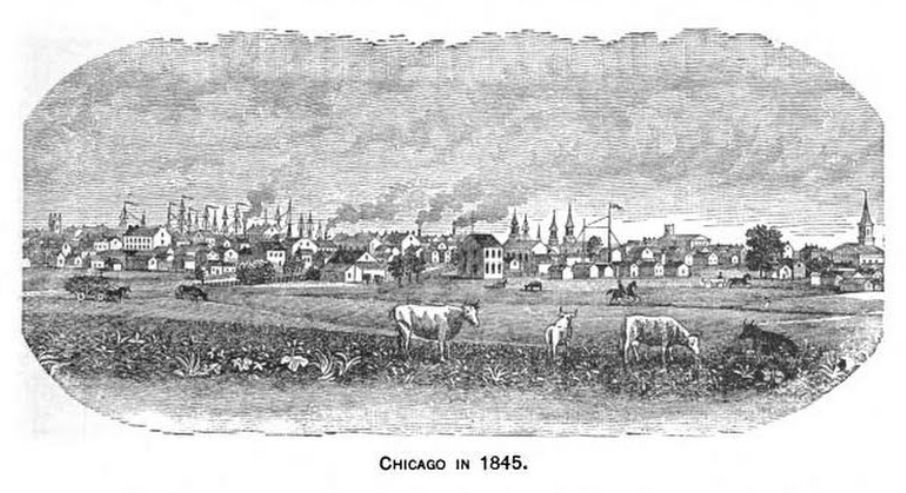
“Chicago in 1845.”
~ Marquis’ Hand-book of Chicago: A Complete History, Reference Book, and Guide to the City by Albert Nelson Marquis, 1885, page 17.
I remain’d in Chicago from Sunday night until monday at 9 Oclock in the morning when I went on board the S.B. James Madison for Mackinaw. The Madison is a good boat but not the first class. We were soon under way and on the broad bosoms on Lake Michigan.
Our boat stood up the Illinois side of the lake we passed, Little Port, Racine, Milwaukee and Che-boy-a-gon and then stood for the Michigan shore. All the above ports we stop’d at – Racine 25 or 30 miles before reaching Milwaukie is a beautifull place being elevated on a high pice of ground that overlooks the lake. The buildings all new and some of them handsome gave it a fine prospect appearance it has a population of near two thousand inhabitants. Milwaukee is also a fine business place and has a population of about five thousand. Soon after leaving the west shore of the lake we were out of sight of land this was the first time I ever was out of sight I had never form’d a correct Idea of the lake before nothing on every side but water the heavens above and earth beneath perhaps 900 or 1000 feet below.
We now had a head wind so heavy that our boat began to labour heavy to make head way. And now after six or seven hours that land could not be seen we came in sight of the Manitoe Islands, the wind increas’d until we had a pretty good gail. We were six hours in gaining the Island twelve miles distance here we lay until sometime in the night we put out for Mackinaw. The Island and all of the Michigan shore as far as I could see present a baran and gloomy appearance the country is covered with dwarf pine or stunted cedar or hemlock and to me had anything but a pleasant appearance. Some of the passengers tried to see beauty in the Manatue Islands and the evergreen that covered every thing but I must confess it was but little beauty I could get out of it. Soon after geting up the morning after leaving the Manitoe Mackinac was in view as we approached the Island the fort with its white walls and buildings on the summit of the hill became visible. The water of the straits were so clear that we could see the bottom when the water was thirty or forty feet deep. We are now from the best account four hundred and eighty five miles from Chicago. The harbour and straits of Mackinaw are verry pretty here you may see the Indian with his bark canoe as he glides over the pure waters of the bay like a sea-bird. Here are several different tribes of Indians the Chippeways are the most numerous and in fact they appear to be the strongest tribe in the whole N. Western country their territory is very extencive extending from this to the Mississippi and taking the whole of L.S. The Manomone or wild rice eaters inhabit the country wash’d by the Manomone River this river empties in to Green bay there is also the Winebago Indians that some times come to this place to trade and perhaps others.
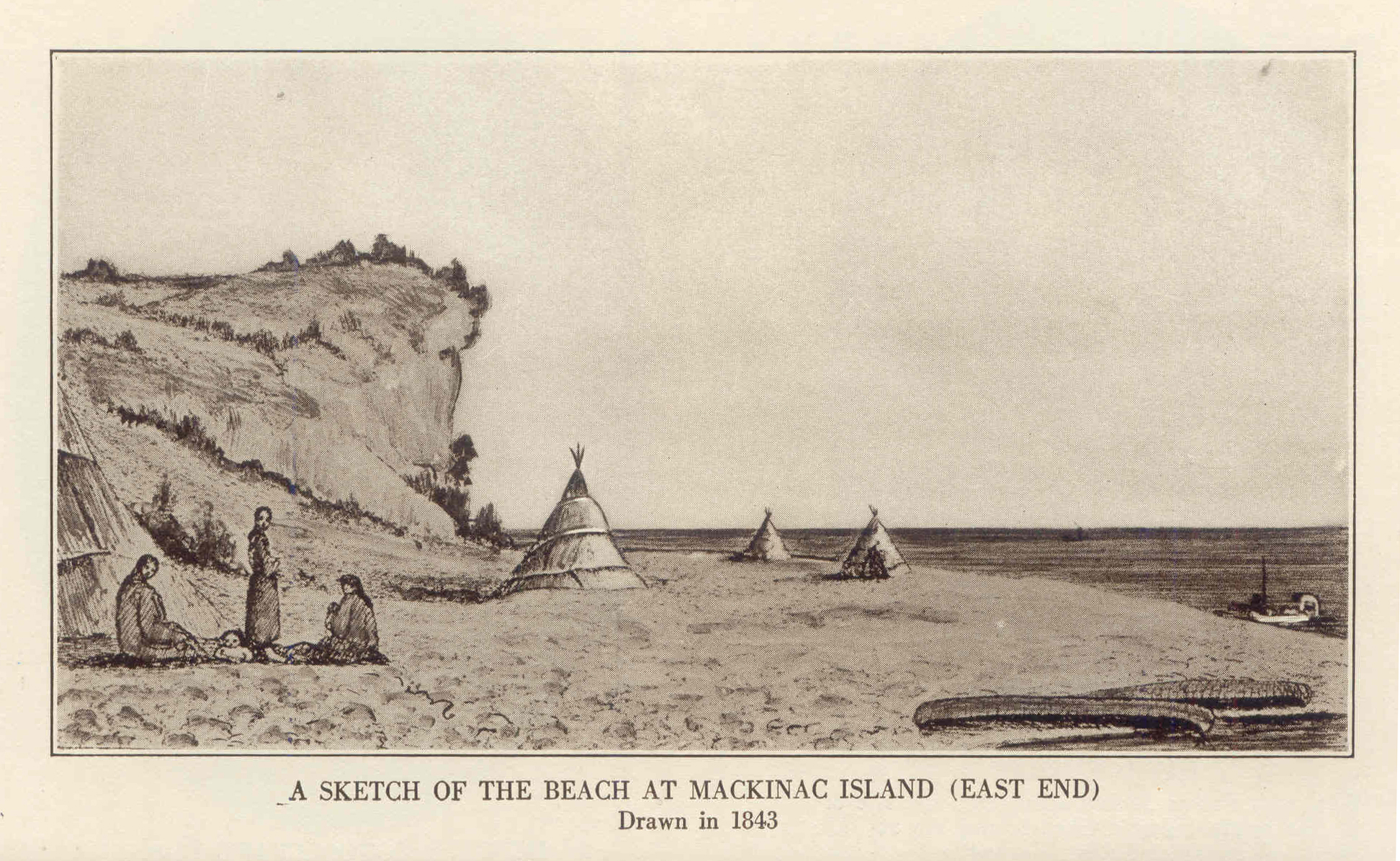
1843 Drawing of Mission Point Beach at Mackinac Island, Michigan
~ Historic Mackinac, Volume 1, by Edwin Orin Wood, 1918, facing-page 367.
The great variety of fishing boats and bark canoes with their sails and oars that constantly cover the water gives to Mackinaw a very beautifull appearance some of the boats coming in with fish others going out some palled by squaws and others by french and in fact here you see every boddy. I mean by that – people from every clime for I never saw so mixed a population in my life. Every thing appears to be mix’d on half-breeds. Although there appears to be blood from almost every nation it certainly appears to have a small coulering of Indians with it.
Mackinaw is a very interesting place in many perticulars, certainly for situation, history and wild scenery it is the most interesting Island in our country. I will quote from travelers its appearance as it is approach’d from lake Huron “We approach it through an armor of Islands, Drummond and Manitoulin [dainly?] seen” on our east and Boisblane and Round in our western side. Stretching across our path in front is Mackinaw painted against the clear blue skie. The Island of Mackinaw or Mackinac or Michilimackinac is a high and bold bluff of limestone about three hundred feet above the water covered with evergreen principally stunted pine and hemlock.
Its name signifies in the Indian tongue big turtle as it is something in shape of this animal. At the foot of the bluff are strewd the buildings of the town.

Painting of Fort Mackinac by Seth Eastman in 1761.
~ United States Army Center of Military History
The United States fort is verry pretty and verry conspicuous as we approach it from either way in the distance it has much the appearance of a row of white buildings lineing the summit of the hill. The stars and stripes of our country waved over the fort. And the booming sound of a cannon now rolls over the waters of the straits. I had to remain here until the next day, and it gave me an opportunity of visiting or rambling over the Island. On the summit and north of the fort is a natural bridge of white limestone rock stretching a cross a deep chasm, from this we could look down in to the waters of lake Huron. I saw many curiosities here which I cannot here give. This place was settled by the French as early as sixteen hundred and seventy three.
It is very singular that the Indians would allow the French to come among them and even marry with them, but when any other nation came among them they were masacreed or driven from the country.
On the opposite shore is to be seen the old fort of Mackinaw in ruins. It was built by the English before the revolutio and man’d as a garison. This fort was taken by the Indians under the command of their chief Pontiac by stratagem, and every person was masacre’d. After the masacree of fort Mackinaw the Indians march’d immediately for Detroit where was also a fort held by English but the commander mistrusted them and saved the fort.
Again I went on board the S. B. Gen’l Scott for the Sault which is ninety miles distant. As we pass out of the straits for the sault we find our selves on the waters of Lake Huron Islands are to be seen on every side. The distant to the river from Mackinaw I think is not far from thirty miles. It is a beautiful evening and the sun sets in lake Huron and to me it was grand beyond any thing I ever saw.
Detail of Sault Ste Marie from Carver [Jonathan], Captain. Journal of his travels with maps and drawings, 1766.
~ Boston Public Library
Mackinaw The river St. Maries, as you approach it appears like a group of Island and would be different for an inexperianced hand to tell where to find the river and in fact after you are farely in the river there is one continued group of Islands and small lakes the most of the way to the Sault. These Islands are mostly covered with a stunted growth of evergreen trees of which the hemlock is predominant. This is the general character of the timber although I notised in some places a fine growth of sugar maple. The Lakes in this river, or that this river runs through are very prety and abound with fish in great abundence some of the lakes are several miles long and from one to two miles wide. Around these lakes and at different points an the river Indian wigwams are seen and occasionally Squaws in their bark canoes may be seen gliding across the river with as much grace and eas as tho they were the godesses of those sylvan retreats. While on our passage ther was an englishman came on board with two squaws. I learned he was the british Indian agent and that one of the squaws was his wife he appeared to possess wealth and his two squaws were trimed out in fine stile and no doubt wer a source of curiosity and amusement to some southern ladies and gentlemen that were on board on a trip of pleasure to spend the heat of summer at the north.
Our boat took a schooner in toe for the sault as the water is too rappid for schooner in places unless they have a very fair wind. Thus armed we arrived at the Sault after having been on board twenty four hours the boat however lay by over night in the river on account of the dificulty of the channel.
“Ojibwa village near Sault Ste Marie” by Paul Kane in 1845.
~ Wikipedia.org
The inhabitants of the Sault ar like those of Mackinaw a perfect mix’d mixed set of inhabitants every thing appears mixed except the whitefish which are pure and the finest I ever saw. The population perhaps may be two hundred. There is nothing remarkable at this place except the rappids or shute which is a fall of about twenty two feet in the distance of three fourths of a mile here is fine fishing and the most of the fish are taken by the Indians and consider themselves the rightfull owners of this outlet of Lake Superior.
I was fortunate in finding an excellent Schooner just ready to sail for the copper region of Lake Superior. We were soon under way and gliding up to the lake from the Sault. I was surprised to see so many vessels on the waters of Lake Superior not less than eight were in sight one propeller and the Julia Palmer S. B. now send out their steam on this lake.
Our vessel stood directly for Copper harvour which is 225 miles from the Sault we wer soon out of sight of land Lake Superior appears like an ocean to a land lubber like my self, to be twenty hours out of sight of land with a fair wind gives me an Idea of the vastness of this lake I never had before. Pigeons came on board and sat in the riggins and could scarcely be indus’d to leave the vessel. They were lost in the fog.
Stanards rock lays nearly on the track from Copper harbour to the Sault and is a very dangerous rock raising not more than two feet out of the water in a calm and when the sea is rough the water runns entire over it so that in a fog or in a dark night vessels might easy run on to it. The rock is only a five feet square above the water or in sight and to run on to it would be inevitable destruction this rock is thirty or forty miles from any land. On one side of this rock a line has been let down twelve hundred feet and no bottom found on the other it passes off gradual. The rock is said to be Traprock. After passing this rock we soon came in sight of the Manitoe Islands and then Keweenaw point. Copper harbour is situated on this point. As we approached Copper harbour the scenery appears bold and rock and no enterance can bee seen to the harbour until we actually enter where the harbour spreads out and we soon find our selves in a beautifull harbour safe from the sea in any direction.
…
“Cleveland North Western Lake Company was formed by Messrs. Cyrus Mendenhall, Samuel Richardson, Horatio W. Converse and James A. Converse.”
~ OldAlgonquin.net
Mendenhall ran his vessel the Algonquin in to this harbour a few years ago (I think in ’40) in a gale the first vessel that ever entered this beautiful harbour. Six or eight vessels may now be seen at a time.
Ft. Wilkins is situated here and was man’d by a small garison until the last summer when the troops were ordered to Texas.
Lake Fanne hoe lays back of Copper harbour and passes entirely around the fort except a few rods at each end of the lake.
The general apperances of the country at this place has a barren rocky aspect. Nothing can grow here but stunted cedar, pine and hemlock and these must depend mostly on the rocks for the support of I saw no place wher soil enough could be got for a potatoe patch. The rock is Trap and is traversed by veins of white spar which contrast finely with the dark Trap rock. The copper men of this neighbourhood have not been verry successfull. Mendenhall has charge of a location and some interest in it which he thinks will be valuable.
Detail of Porter’s Island and Fort Wilkins at Copper Harbor along the tip of the Keweenaw Peninsula from Map of the Mineral Lands Upon Lake Superior Ceded to the United States by the Treaty of 1842 With the Chippeway Indians.
~ Wisconsin Historical Society
As we leve Copper harbour and pass up the lake there is the same general appearance. We pass Aggate harbour and Eagle harbour and arrive at Eagle River twenty miles from Copper harbour. Here is the famous Eagle Cliff mine said to be the richest mine in the world. Whether such will prove to be the fact or not I am not a competent judge. Mendenhall has a considerable interest in this mine but do not know to what extent. Not far from this is the Copper falls river where the great copper rock is found this piece of pure copper is of many tons weight I suppose no one knows how arge as they have not found its size the last accounts.
There ar many valuable mines in this vicinity. In the At Eagle river and vicinity the whole forest appear’d to have suffered from fire the whole country was black. The fire raged with such fury that it appears to me every tree must be killed for miles around several houses were burned and other damages sustained.
Keewenaw point which I have just been describing is a point of land that runs nearly in to the middle of the lake from the south side.
After leaving copper harbour (which is situated directly on the point) the cost bears a little S. of W. for twenty miles and then bears S. W. so that after passing up the lake sixty or seventy miles it cannot be more than twenty five miles across to the lake. Directly east from Copper harbour down the lake the cost bears almost south. So that this point may be called a peninsula.
Portage lake crosses this peninsula so that small boats may cross with a portage of about one mile. The distance across here may be 20 miles and to go round would be not less than 90 miles.
As we pass up the lake the coast changes its appearance insted of a Trapcrock cost we find the shore generally lined with a redish sand stone though in places there is a beautifull sand beach. At Portage lake I first found Mendenhall and here I took my first lesson in exploring soon after I arrived Mendenhall left and left me in charg of the company of explorers.
Our company consisted of five men besides my self six in all one of the men staid at the camp and acted as cook when our work lay back from the lake 9 or 10 miles as some of it did. Each man took his blanket and provisions to last several days. Our blankets were done up in the form of a pack with our provisions in it each man having a good collar for the purpose thus equipt we were ready for our work. After searching all day for copper we generally camped by the side of some stream, built a five, cooked our supper, took our blanket, and lay down for the night, with the heavens for our curtains, and the earth for our pillow, and thus we continued until our provisions run out, when we would again return to camp and renew our stock and repeat the same thing over. I have been thus perticular in describing our manner of exploring, it being descriptive of all of our exploring.
After spending about a month her among Hirnas Wolverenes and Jackalanters and floundering among swamps and moors and climbing hills we left these diggins and went up to Misery river thirty miles farther up the lake to repeat the same thing over. I might say here we found no copper at the portag but several Beaver habitations. There is no game in the woods except Beaver and Porcupines scarcely a bird except pheasents no wild fruit no flowers no nothing except cedar swamps of the worst kind. After leaving this we soon found the coast rocky. Walls of red sandstone rose from the waters edg or directly out of the water to the heighth of a hundred feet perpendicular here we had a beatifull view of these rocks as our traveling is in a Batteau and must keep close to the shore for safety. (I might here state the only way of traveling in summer is in Batteaus with sail and oars we coast along from place to place as business calls. These rocks have a beautifull appearance caverns are wash’d and worn in to the base of these rocks and looks as tho some sea nymph might have had her pallace here. My mind became so much excited I almost expected to see some of those fabled beauties pressing out at us as we passed along from some of those windows or loopholes in the wall or see them sitting on the point of some prominent rock, attending to her toilet but I didn’t see any though, nor did I hear them sing. Rivulets of clear pure water came rolling over these rocks from the adjacent high land and form’d beautifull cascades inviting the traveler to view and admire their pur waters before forever lost in the mighty Superior. Some of these waterfalls appear to leap from the top of the rock, and plunge in the lake several feet from their base while others cling to the rock until they reach the waters of the lake. I regret much I cannot visit the pictured rocks which are farther down the lake than where we first touched on the south side. They are said to be beautiful when view’d at a short distance from the water, presenting a vast wall of red sandstone rocks most beautifully pictured. The Indians have some superstitious notions of these rocks of which I know but little.
Nor shall I be able to visit those stupenduous monuments on the north shore of the lake. These rocks are trap and are said to rais perpendicularly out of the water to the great heighth of thirteen hundred feet. These rocks have undoubtedly been thrown up by some volcanic action.
It is the common received opinion that this entire trap range has been thrown up by some violent eruption and has burst up through the upper layer of sandstone. Veins of which spar travers these Trap rocks in every direction and nearly all copper is found in them. Occasionally however veins of oars are traced some distance from the Trap into the Conglomoret rock wher the two unite.
The oars that are formed are the Red, Black and Grey Oxides also, Red, Black, Grey, and Yellow Sulpherets but in many places large quantities of Native copper is found. Pieces or bolders of pure copper is sometimes found weighing many tons. Of these copper rocks the one at Copper falls mine is most remarkable of which I have already mentioned. I saw one from the Ontonagon river weighing over Sixty hundred. This piece of copper had a good deal of pure silver in it. These copper bolders sometimes lay in veins in the rock and sometimes they are found loose on the surface of the ground at a distance from any vein yet discovered. They appear as though they had been melted and run into masses without any form, and of course rough enough.
I will now return and pursue our course up the lake the cost is rough and rocky most of the way from Portage up to the mouth of Misery river. There is but one stream of any note and that is Graverod river. This is a small stream large enough for a good mill stream and furnishes a toelerable good boat harbour. We ran our boat into this tream with a pretty good sea at our heals, and got well wet as all hands had to jump in to the water to save our boat from breaking on the rocks. Here we camp’d for the night nor did we get away the next day the sea being to rough for our small boat.
~ History of the Upper Peninsula of Michigan by The Western Historical Company, 1883 (transcribed by Debi Hanes).
Misery river is a muddy sluggish looking stream different from any water I have seen since I came on the lake it is however a good boat harbour and is a point where most boats stop in passing up or down after landing at the mouth of Misery, securing our boat and getting all things ready. We started for our work which lay back about ten miles from the lake. Here we repeated the same thing over as at the Portage. And with no better success. After spending near a month here we again pact all things up and started for the mouth of Misery. As we pass up the lake we pass Sleeping river Flint Steel and firesteel rivers all of which are small streams but furnish good boat harbours and arrive at the Ontonagon about twenty miles distant. The Ontonagon is a fine stream and the only stream that I have seen that deserves the name of river. It is 75 or 100 yds wide at its mouth and is a good harbour for small vessels having a depth of water on the bar of about seven or eight feet. This place must always be a place of conciderable importance it is in the middle of the mining destrict and the largest river that empties in to the south side of the lake. I understand there has been a new County form’d and this place is lix’d on as the County seat, at present the mouth of the river is held by one Jim Paul and claims the most eligable cite for a town by preemption and prevents any other one from improving it. He is a notorious character he has two small houses one he pretends to keep as a tavern and the other as a dogery to sell liquors. It goes by the name of Paul’s dedfall. It is one of the most miserable places I ever saw. I can scarcely repress my feelings at the insult given by it to the entire waters of Lake Superior. I hope the time is not far distant when this stain will be wash’d from the shores of the lake. Mendenhalls mine lays up the river, and as we pass up we find rich bottom bands covered with a luxurient growth of vegitation quite diferent from the shore of the lake. The scenery is beautifull, amongst the trees that line the banks of the streams is the mountain ash one of the most beautifull ornament trees I ever saw, they were loaded with brillient red fruit and are said to retain its fruit all winter.
Detail of Ontonagon River, “Paul’s Cabin,” the Ontonagon Copper Boulder, and the Porcupine Mountains from Map of the Mineral Lands Upon Lake Superior Ceded to the United States by the Treaty of 1842 With the Chippeway Indians.
~ Wisconsin Historical Society
The stream is broad and deep the distance I have been up which is about five miles from its mouth. The indians have fine sugar camps on this stream but the pail faces or Che-moco-man are beginning to occupy them and the red man must leave.
At this point (five miles from the lake) Mendenhall has a warehouse where all of the goods and supplies for the Mendenhall location are landed.
~ mindat.org
The location is five or six miles from the river. Here are the best improvements I have ever seen since I have been on the lake. He has seven or eight buildings for different purposes and several acres of land cleared last season he rais’d potatoes and Turnips enough for the use of the location. They also had plenty of cucumbers and squashes with some other garden vegetables. This mine is conducted with order and every thing has a business appearance.
They have a chaplain and preaching every sunday. Their preacher works in the mine weekdays and preaches on sundays. The miners are all english men from the cornish mines of England. The Ontonagon destrict, it is thought will become one of the best mineing destricts on the lake.
Iron river fifteen miles up from the mouth of the Ontonagon is a considerable of a stream next in size to the Ontonagon that I have seen this is a good boat harbour but not large enough for vessel. It is a great resort for Indians.
From Iron river to the Purcupine mountains the coast is mostly rocky and rather dangerous costing. For further description of this cost see Note book.
From Iron river to the Porcupine mountains or to the Lone Rock is fifteen miles. Lone Rock is a detach’d rock situated about 1/4 of a mile from the main land and raises out of the water perhaps twenty feet. Nothing grows on the rock except some wild roses which are said to be beautifull. This rock is trap and is fill’d with veins of white spar it is known to all voyagers as a point in counting distances. The Indians call it Me-ne-sawbic. This rock is the corner of the location I have been on this winter and the mine is call’d the lone rock mine.
The Porcupine Mountains ar ranges of mountains or hills runn paralell to the lake or nearly so at this place they approach verry near the lake. And are several ridges laying paralell to each other.
The first ridg is Conglomerate, the second is Trap and also the third. They rais by steps the first not being so high as the next and the third being higher still so that a person on the top of the third range can overlook the others and see the lake. These hills or mountains have a gradual incline to the north and are not very steep, but their south side is verry abrupt and form perpendicular walls of rock from one to three hundred feet high. In the vally between the second and third range Carp River winds its way to the lake running parallel to it for many miles. This river is a small stream of pure water of sufficient size for mill purposes. It abounds with Trout in great abundance. Here is also plenty of Beaver on it. The scenery is bold and grand for him who can enjoy mountain scenery.
The view from some of the higher points of the mountains where Lake Superior is spread out before you on one side and the mountains with their eternal rocks and deep vallies with their small rivers and mountain lakes, on the other presents certainly one of the most grand, and sublime pictures I ever witness’d. I have recently visited the Bellmont mine about five miles from the Lone Rock mine. Here I find the upheave to be greater than I have seen at any other part of the range being as near as I can judg seven or eight hundred feet nearly perpendicular. It is also the highest point of the second range of mountains or second ridg from the lake. Being 1000 feet above Lake Superior. Myself in company with Geo Rice in the evening assended the highest point where we had a beautifull view of the surrounding country and of Lake Superior which was now calm and smooth as a mirror. How shall I paint that sunset scene on Lake Superior as view’d from the top of the Porcupine Mountains. I have been toss’d on Enis billows, I have heard the thunder of Lake Michigan as she in her magesty lash’d her impenetrable barier but never have I seen nature in all her georgeous beauty until I viewed her at evening from these mountains. As the sun approach’d the christal floor of Lake Superior the blue waters were painted and ting’d with every possible hue and sparkled like diamonds shortly the brilliants appeared to concentrate until there was but one bright path from us to the sun and formed a beautiful bridg from earth to heaven. I had always been accustomed to seeing the sun abov me but now it was below near the water, on the water, and under the water, and now the sun sleeps in Lake Superior. The whole western skies are painted with rose and yellow and green and reflected back on the blue waters of the lake as though nature was determin’d to try her hand at fancy work once more before returning to rest.
We lingered here until one star made its appearance soon follow’d by all the bright lights of Heaven (if I may be allowed to quote from Scripture) until the whole deep blue was set with Jewells.
This reminds me of that pretty vers my litl girls us’d to repeat
Twinkle twinkle pretty star
Cant you tell us where you are
Up above the world so high
Like a diamond in the skie
We lingered here until the hour reminded us we must try to find our way down to the cabbin.
This was the last time I expect to visit this part of the mountains I therefor determin’d to assend thos lofty cliffs and have a morning view. Soon a darling radiance sot up from behind the mountains and the King of day made his appearance as if to greet his favorurite lake.
Deep in the vally lay that beautifull mountain lake with the wild ducks sporting on its bosom or whirling in gracefull circles over its shining waters. After spending an hour or two I bid adieu to this grand and magnificent Observatory of nature probably forever.

Hand-drawn chart of Lake Superior in Andrew Rundel Journal.
Indian Agency’s Explanation of the 1854 Treaty
December 13, 2017
By Amorin Mello
Treaty Commissioner Henry C. Gilbert’s
Explanation of the Treaty Concluded in 1854
with the Assistance of David B. Herriman
Transactions of the Wisconsin Academy of Sciences, Arts and Letters:
Volume 79, No. 1, Appendix 5
Office Michigan Indian Agency
Detroit October 17th, 1854
Sir
Mackinac Indian Agent
Henry Clark Gilbert
~ Branch County Photographs
I transmit herewith a treaty concluded at LaPointe on the 30th Ultimo between Mr. Herriman and myself as Commissioners on the part of the United States and the Chippewas of Lake Superior and the Mississippi.
On receiving your letters of August 10th, 12th, and 14th, relative to this treaty, I immediately dispatched a special messenger from this place by way of Chicago, Galena and St. Paul to Mr. Herriman at the Crow wing Chippewa Agency transmitting to him your letter requesting him to meet me at LaPointe with the Chiefs and Headmen of his Agency at as early a day as possible. I adopted this course in preference to sending a messenger from La Pointe on my arrival there for the purpose of saving time and I was thus enabled to secure the attendance of Mr Herriman and the Mississippi Chiefs some 10 or 12 days earlier than I could otherwise have done.
I left for LaPointe on the 26th of August last and arrived there the 1st day of September – Mr Herriman meeting me there the 14th of the same Month.
By this time a large number of Indians had assembled – including not only those entitled to payment but all those from the Interior who live about Lakes de Flambeau and Lake Courteilles. The Chiefs who were notified to attend brought with them in every instance their entire bands. We made a careful estimate of the number present and found there were about 4,000. They all had to be fed and taken care of, thus adding greatly to the expenses attending the negotiations.

Charles William Wulff Borup and Charles Henry Oakes married into the La Pointe mixed blood Beaulieu family; built the American Fur Company’s new La Pointe outfit during the 1830’s; sold La Pointe to Julius Austrian during 1853; and started the first bank in Minnesota during 1854 at St. Paul.
~ 1854 banknote from HeritageAuctions.com
A great number of traders and claim agents were also present as well as some of the persons from St. Paul’s who I had reason to believe attended for the purpose of preventing if possible the consummation of the treaty. The utmost precautions were taken by me to prevent a knowledge of the fact that negotiations were to take place from being public. The Messenger sent by me to Mr Herriman was not only trust worthy but was himself totally ignorant of the purport of the dispatches to Major Herriman. Information however of the fact was communicated from some source and the persons present in consequence greatly embarrassed our proceedings.
After Major Herriman’s arrival we soon found that the Mississippi Indians could not be induced to sell their land on any terms. Much jealousy and ill feeling existed between them and the Lake Superior Indians and they could not even be prevailed upon to meet each other in council. They were all however anxious that a division should be made of the payments to become due under former existing treaties and a specific apportionment made between the Mississippi and the Lake Superior Indians and places of payment designated.
Taking advantage of this feeling we proposed to them a division of the country between them and the establishment of a boundary line, on one side of which the country should belong exclusively to the Lake Superior and on the other side to the Mississippi Indians. We had but little difficulty in inducing them to agree to this proposition and after much negotiation the line designated in the treaty was agreed upon.
We then obtained from the Lake Indians a cession of their portion of the Country on the terms stated in the treaty. The district ceded embraces all the mineral region bordering on Lake Superior and Pigeon river & is supposed to be by far the most valuable portion of their country. But a small portion of the amount agreed to be paid in annuities is payable in coin. The manner of payment is such as in our judgement would most tend to promote the permanent welfare and hasten the civilization of the Indians.
We found the points most strenuously insisted upon by them were first the privilege of remaining in the country where they reside and next the appropriation of land for their future homes. Without yielding these points, it was idle for us to talk about a treaty. We therefore agreed to the selection of lands for them in territory heretofore ceded.
The tract for the Ance and Vieux Desert bands is a the head of Ke, wa, we naw Bay Michigan and is at present occupied by them. I estimate the quantity at about 60,000 acres.
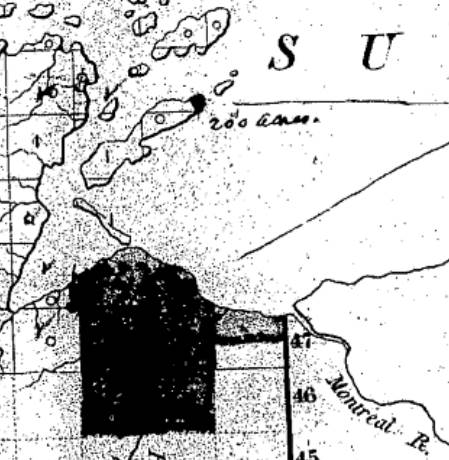
Detail of La Pointe Indian Reservation survey boundaries including Gichi-ziibiiwishenhnyan from a letter dated March 30th, 1855, written by the Commissioner John Wilson of the General Land Office to General Surveyor Warner Lewis.
~ National Archives Microfilm Publications; Microcopy No. 27; Roll 16; Volume 16.
These reservations are located in Wisconsin, the principal of which is for the LaPointe Band on Bad river – A large number of Indians now reside there and I presume it will ultimately become the home of most of the Chippewas residing in that state. It is a tract of land well adapted for Agricultural purposes and includes the present Missionary Station under the care of the American Board of Commissioners for Foreign Missions. About one third of the land however lying on the Lake Superior is swamp and valueless, except as it gives them access to the Lake for fishing purposes.
The other Wisconsin reservations lie on Lac de Flambeau and Lac Courteirelle in the Interior and the whole amount of land reserved in that state I estimate at about 200,000 acres exclusive of the Swamp land included in the LaPointe reservation. in the ceded Country there are two tracts set apart for the Indians – one on St Louis river of 100,000 acres for the Fond DuLac bands and one embracing the point bounded by the Lake and Pigeon river and containing about 120,000 acres.
There are two or three other small reservations to be hereafter selected under the direction of the President. The whole quantity of land embrace within all the tracts set apart we estimate at about 486,000 acres – No portion of the reserved lands are occupied by whites except the Missionary establishment on Bad river.
The provision going to each Half Breed family 80 acres of land was most strenuously insisted upon by the Indians. There are about 200 such families on my pay roll and allowing as many more to the Interior Indians which is a very liberal estimate, the amount of land required will be about 32,000 acres.
A principal source of embarrassment was the provision setting aside a portion of the consideration to be paid as the Chiefs might direct &c. In other words to pay their debts with. We had much difficulty in reducing the amount insisted upon to the sum stated in the treaty. I have no doubt that there are many just claims upon these Indians. The regular payment of their annuities was so long withheld that they were forced to depend to a great extent upon their traders. There claims that were all disposed to acknowledge and insisted upon providing for their payment and without the insertion of the provision referred to, we could not have concluded the treaty.
I regret very much that we could not have purchased the whole country and made the treaty in every particular within the limit of your instructions. But this was absolutely impossible and we were forced to the alternative of abandoning the attempt to treaty or of making the concessions detailed in the treaty.
Bureau of Indian Affairs Director
George W. Manypenny
~ Commons.Wikimedia.org
There are many points respecting which I should like much to make explanations, and for that purpose and in order to make a satisfactory settlement of the accounts for treaty purposes and in order to make a satisfactory settlement of the accounts for treaty expenses I respectfully request the privilege of attending at Washington at such time after making my other annuity payments as you may think proper.
Very Respectfully
Your Obt. Servt.
Henry C. Gilbert
Commissioner
Hon. Geo. W. Manypenny
Com. Ind. Affs.
Washington D.C.
1854 Treaty of La Pointe Appropriations
November 29, 2017
By Amorin Mello

House Documents, Volume 112
By United States House of Representatives
33d Congress,
2nd Session.
Ex. Doc. No. 61.
TREATY WITH CHIPPEWA INDIANS.
————————
MESSAGE
FROM
THE PRESIDENT OF THE UNITED STATES,
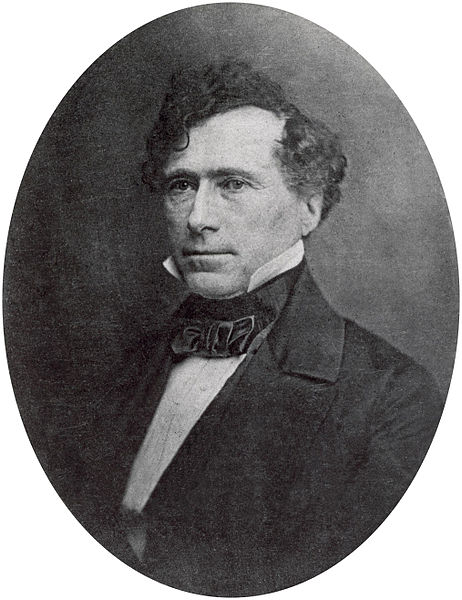
United States President
Franklin Pierce
circa 1855
~ Commons.Wikimedia.com
TRANSMITTING
Estimates of appropriations for carrying into effect the treaty with the Chippewa Indians &c.
————————
February 8, 1855.—Laid upon the table and ordered to be printed.
————————
To the Senate and House of Representatives of the United States:
I communicate to Congress the following letter from the Secretary of the Interior, with its enclosure, on the subject of a treaty between the United States and the Chippewa Indians of Lake Superior, and recommend that the appropriations therein asked for may be made.
FRANLIN PEIRCE.
Washington, February 7, 1855.
Department Of The Interior,
Washington, February 6,1855.

Secretary of the Interior
Robert McClelland
circa 1916
~ Commons.Wikipedia.com
SIR: I have the honor to transmit to you, herewith, a copy of a communication from the Commissioner of Indian Affairs, dated the 5th instant, calling my attention to the subject of a treaty made at La Pointe, Wisconsin, by Henry C. Gilbert and Daniel B. Herriman, commissioners on the part of the United States, and the Chippewa Indians of Lake Superior; and, to enable this department to carry the treaty into effect, recommend that Congress be requested to make the appropriations specified in the letter of the Commissioner, and which will be immediately required for that purpose.
I am, sir, very respectfully, your obedient servant,
R. McCLELLAND,
Secretary.
To the President.
Department Of The Interior,
Office Indian Affairs, February 5, 1855.
Mackinac Indian Agent
Henry Clark Gilbert
~ Branch County Photographs
Sir: Having received the official information on the 24th ultimo of the approval and ratification, by the President and Senate, of the articles of agreement and convention made and entered into at La Pointe, in the State of Wisconsin, by Henry C. Gilbert and Daniel B. Herriman, commissioners on the part of the United States, and the Chippewa Indians of Lake Superior and Mississippi, I have the honor now to call your attention to the appropriations that will be required immediately to enable the department to carry the treaty into effect, viz:
For fulfilling treaties with the Chippewas of Lake Superior.
- For expenses (in part) of selecting reservations, and surveying and marking the boundaries thereof, per 2d, 3d, and 12th articles of the treaty of September 30, 1854 …….. $3,000
- For the payment of the first of twenty instalments in coin, goods, &c, agricultural implements, &c, and education, &c, per 4th article of the treaty of September 30, 1854 …….. 19,000
- For the purchase of clothing and other articles to be given to the young men at the next annuity payment, as per 4th article of the treaty of September 30, 1854 …….. 4,800
- For the purchase of agricultural implements and other articles, as presents for the mixed bloods, per 4th article of the treaty of September 30, 1854 …….. 6,000
- For the payment of such debts as may be directed by the chiefs in open council, and found to be just and correct by the Secretary of the Interior, per 4th article of the treaty of September 30, 1854 …….. 90,000
- For the payment of such debts of the Bois Forte bands as may be directed by their chiefs, and found lo be just and correct by the Secretary of the Interior, per 12th article of the treaty of September 30, 1844 …….. 10,000
- For the payment of the first of five instalments in blankets, cloth, &c, to the Bois Forte band, per 12th article of the treaty of September 30, 1854 …….. 2,000
- For the first of twenty instalments for the pay of six smiths and assistants, per 5th and 2d articles of the treaty of September 30, 1854 …….. 5,040
- For the first of twenty instalments for the support of six smith shops, per 5th and 2d articles of the treaty of September 30, 1854 …….. 1,320
It will be observed that the treaty of September 30, 1854, recognized the Chippewas of Lake Superior as a branch of the nation, and that the pecuniary and beneficiary stipulations therein are for their exclusive use.
By the fifth article of the treaty the Lake Superior Chippewas are to have six blacksmiths and assistants, and they relinquish, by the same article, all other employés to which they might otherwise have been entitled under former treaties.
The Chippewas of the Mississippi are, by the eighth article of the treaty, entitled to one-third of the benefits of treaties prior to 1847; and, by consequence, retain an interest of one-third in the stipulations for smith shops, &c., and farmers, &c, per second article of the treaty of July 29, 1837; and in the farmers, and carpenters, and smiths, &c., mentioned in the fourth article of the treaty of October 4, 1842.
On an examination of the condition of existing appropriations to fulfil the stipulations just mentioned, it is found that the balances in the treasury are sufficient to sustain these employés and otherwise meet the requirements of the stipulations referred to, so far as the Chippewas of the Mississippi are interested, during the next fiscal year.
In case appropriations are made by Congress, in pursuance of the foregoing estimates, it will be perceived that the following items of the Indian appropriation bill now before Congress might, with propriety, be stricken out, viz:
House bill 555, reported, with amendments, January 16, 1855:
- Page 4, lines 68, 69, 70, and 71, “three thousand dollars,” ($3,000.)
- Page 4, lines 72, 73, 74, 75, and 76, “one thousand dollars,” ($1,000.)
- Page 5, lines 89, 90, 91, 92, and 93, “two thousand dollars,” ($2,000.)
- Page 5, lines 94, 95, and 96, “one thousand dollars,” ($1,000.) Page 5, lines 97, 98, and 99, “one thousand two hundred dollars,” ($1,200.)
Director of of the Bureau of Indian Affairs
George Washington Manypenny
circa 1886
~ Commons.Wikimedia.org
As it is not deemed necessary, I do not therefore submit, at present an estimate for appropriations to pay employés for the Bois Forte band, as per twelfth article of the treaty of September 30, 1854, or to liquidate a balance, should any be found due to these Indians by the investigation, which it is provided by the ninth article of the same treaty shall be made.
Should the foregoing estimates and suggestions be approved by you, I respectfully recommend that they be laid before Congress as early as practicable.
Very respectfully, your obedient servant,
GEO. W. MANYPENNY,
Commissioner.
Hon. R. McCLELLAND,
Secretary of the Interior.
Early Life among the Indians: Chapter I
September 26, 2017
By Amorin Mello

Early Life among the Indians
by Benjamin Green Armstrong

Early Indian History.
—
CHAPTER I.
—
The First Treaty.—The Removal Order.— Treaties of 1837 and 1842.—A Trip to Washington.—In New York City with Only One Dime.—At the Broker’s Residence.
My earliest recollections in Northern Wisconsin and Minnesota territories date back to 1835, at which time Gen. Cass and others on the part of the Government, with different tribes of Indians, viz : Potawatomies, Winnebagos, Chippewas, Saux and Foxes and the Sioux, at Prairie du Chien, met in open council, to define and agree upon boundary lines between the Saux and Foxes and the Chippewas. The boundary or division of territory as agreed upon and established by this council was the Mississippi River from Prairie du Chien north to the mouth of of Crow Wing River, thence to its source. The Saux and Foxes and the Sioux were recognized to be the owners of all territory lying west of the Mississippi and south of the Crow Wing River. The Chippewas, by this treaty, were recognized as the owners of all lands east of the Mississippi in the territory of Wisconsin and Minnesota, and north of the Crow Wing River on both sides of the Mississippi to the British Possessions, also Lake Superior country on both sides of the lake to Sault Ste. Marie and beyond. The other tribes mentioned in this council had no interest in the above divided territory from the fact that their possessions were east and south of the Chippewa Country, and over their title there was no dispute. The division lines were agreed to as described and a treaty signed. When all shook hands and covenanted with each other to live in peace for all time to come.
In 1837 the Government entered into a treaty with the Chippewas of the Mississippi and St. Croix Rivers at St. Peter, Minnesota, Col. Snelling, of the army, and Maj. Walker, of Missouri, being the commissioners on the part of the Government, and it appears that at the commencement of this council the anxiety on the part of the commissioners to perfect a treaty was so great that statements were made by them favorable to the Indians, and understood perfectly by them, that were not afterwards incorporated in the treaty. The Indians were told by these commissioners that the great father had sent them to buy their pine timber and their minerals that were hidden in the earth, and that the great father was very anxious to dig the mineral, for of such material he made guns and knives for the Indians, and copper kettles in which to boil their sugar sap.
“The timber you make but little use of is the pine your great father wants to build many steamboats, to bring your goods to you and to take you to Washington bye-and-bye to see your great father and meet him face to face. He does not want your lands, it is too cold up here for farming. He wants just enough of it to build little towns where soldiers stop, mining camps for miners, saw mill sites and logging camps. The timber that is best for you the great father does not care about. The maple tree that you make your sugar from, the birch tree that you get bark from for your canoes and from which you make pails for your sugar sap, the cedar from which you get material for making canoes, oars and paddles, your great father cares nothing for. It is the pine and minerals that he wants and he has sent us here to make a bargain with you for it,” the commissioners said.
And further, the Indians were told and distinctly understood that they were not to be disturbed in the possession of their lands so long as their men behaved themselves. They were told also that the Chippewas had always been good Indians and the great father thought very much of them on that account, and with these promises fairly and distinctly understood they signed the treaty that ceded to the government all their territory lying east of the Mississippi, embracing the St. Croix district and east to the Chippewa River, but to my certain knowledge the Indians never knew that they had ceded their lands until 1849, when they were asked to remove therefrom.

Robert Stuart was an American Fur Company agent and Acting Superintendent on Mackinac Island.
~ Wikipedia.org
In 1842 Robert Stewart, on the part of the government, perfected a treaty at La Pointe, on Lake Superior, in which the Chippewas of the St. Croix and Superior country ceded all that portion of their territory, from the boundary of the former treaty of 1837, with the Chippewas of the Mississippi and St. Croix Indians, east and along the south shore of the lake to the Chocolate River, Michigan, territory. No conversation that was had at this time gave the Indians an inkling or caused them to mistrust that they were ceding away their lands, but supposed that they were simply selling the pine and minerals, as they had in the treaty of 1837, and when they were told, in 1849, to move on and thereby abandon their burying grounds — the dearest thing to an Indian known— they began to hold councils and to ask each as to how they had understood the treaties, and all understood them the same, that was : That they were never to be disturbed if they behaved themselves. Messengers were sent out to all the different bands in every part of their country to get the understanding of all the people, and to inquire if any depredations had been committed by any of their young men, or what could be the reason for this sudden order to move. This was kept up for a year, but no reason could be assigned by the Indians for the removal order.
The treaty of 1842 made at La Pointe stipulated that the Indians should receive their annuities at La Pointe for a period of twenty-five years. Now by reason of a non-compliance with the order to move away, the annuity payment at La Pointe had been stopped and a new agency established at Sandy Lake, near the Mississippi River, and their annuities taken there, and the Indians told to go there for them, and to bring along their women and children, and to remain there, and all that did not would be deprived of their pay and annuities.
In the fall of 1851, and after all the messengers had returned that had been sent out to inquire after the cause for the removal orders, the chiefs gathered in council, and after the subject had been thoroughly canvassed, agreed that representatives from all parts of the country should be sent to the new agency and see what the results of such a visit would be. A delegation was made up, consisting of about 500 men in all. They reached the new agency about September 10th of that year. The agent there informed them that rations should be furnished to them until such time as he could get the goods and money from St. Paul.
Some time in the latter part of the month we were surprised to hear that the new agency had burned down, and, as the word came to us,
“had taken the goods and money into the ashes.”
The agent immediately started down the river, and we saw no more of him for some time. Crowds of Indians and a few white men soon gathered around the burnt remains of the agency and waited until it should cool down, when a thorough search was made in the ashes for melted coin that must be there if the story was true that goods and money had gone down together. They scraped and scratched in vain All that was ever found in that ruin in the shape of metal was two fifty cent silver pieces. The Indians, having no chance to talk with the agent, could find out nothing of which they wished to know. They camped around the commissary department and were fed on the very worst class of sour, musty pork heads, jaws, shoulders and shanks, rotten corned beef and the poorest quality of flour that could possibly be milled. In the course of the next month no fewer than 150 Indians had died from the use of these rotten provisions, and the remainder resolved to stay no longer, and started back for La Pointe.
At Fond du Lac, Minnesota, some of the employees of the American Fur Co. urged the Indians to halt there and wait for the agent to come, and finally showed them a message from the agent requesting them to stop at Fond du Lac, and stated that he had procured money and goods and would pay them off at that point, which he did during the winter of 1851. About 500 Indians gathered there and were paid, each one receiving four dollars in money and a very small goods annuity. Before preparing to leave for home the Indians wanted to know of the agent, John S. Waters, what he was going to do with the remainder of the money and goods. He answered that he was going to keep it and those who should come there for it would get their share and those that did not would get nothing. The Indians were now thoroughly disgusted and discouraged, and piling their little bundles of annuity goods into two piles agreed with each other that a game of lacrosse should be played on the ice for the whole stock. The Lake Superior Indians were to choose twenty men from among them and the interior Indians the same number. The game was played, lasting three days, and resulting in a victory for the interiors. During all this time councils were being held and dissatisfaction was showing itself on every hand. Threats were freely indulged in by the younger and more resolute members of the band, who thought while they tamely submitted, to outrage their case would never grow better. But the older and more considerate ones could not see the case as they did, but all plainly saw there was no way of redress at present and they were compelled to put up with just such treatment as the agent saw fit to inflict upon them. They now all realized that they had been induced to sign treaties that they did not understand, and had been imposed upon. They saw that when the annuities were brought and they were asked to touch the pen, they had only received what the agent had seen fit to give them, and certainly not what was their dues. They had lost 150 warriors on this one trip alone by being fed on unwholesome provisions, and they reasoned among themselves :
Is this what our great father intended? If so we may as well go to our old home and there be slaughtered where we can be buried by the side of our relatives and friends.
These talks were kept up after they had returned to La Pointe. I attended many of them, and being familiar with the language, I saw that great trouble was brewing and if something was not quickly done trouble of a serious nature would soon follow. At last I told them if they would stop where they were I would take a party of chiefs, or others, as they might elect, numbering five or six, and go to Washington, where they could meet the great father and tell their troubles to his face. Chief Buffalo and other leading chieftains of the country at once agreed to the plan, and early in the spring a party of six men were selected, and April 5th, 1852, was appointed as the day to start. Chiefs Buffalo and O-sho-ga, with four braves and myself, made up the party. On the day of starting, and before noon, there were gathered at the beach at old La Pointe, Indians by the score to witness the departure. We left in a new birch bark canoe which was made for the occasion and called a four fathom boat, twenty-four feet long with six paddles. The four braves did most of the paddling, assisted at times by O-sho-ga and sometimes by Buffalo. I sat at the stern and directed the course of the craft. We made the mouth of the Montreal River, the dividing line between Wisconsin and Michigan, the first night, where we went ashore and camped, without covering, except our blankets. We carried a small amount of provisions with us, some crackers, sugar and coffee, and depended on game and fish for meat. The next night, having followed along the beach all day, we camped at Iron River. No incidents of importance happened, and on the third day out from La Pointe, at 10 a. m. we landed our bark at Ontonagon, where we spent two days in circulating a petition I had prepared, asking that the Indians might be left and remain in their own country, and the order for their removal be reconsidered. I did not find a single man who refused to sign it, which showed the feeling of the people nearest the Indians upon the subject. From Ontonagon we went to Portage Lake, Houghton and Hancock, and visited the various copper mines, and all there signed the petition. Among the signers I would occasionally meet a man who claimed personal acquaintance with the President and said the President would recognize the signature when he saw it, which I found to be so on presenting the petition to President Filmore. Among them was Thomas Hanna, a merchant at Ontonagon, Capt. Roberts, of the Minnesota mine, and Douglas, of the firm of Douglas & Sheldon, Portage Lake. Along the coast from Portage Lake we encountered a number of severe storms which caused us to go ashore, and we thereby lost considerable time. Stopping at Marquette I also circulated the petition and procured a great many signatures. Leaving there nothing was to be seen except the rocky coast until we reached Sault Ste. Marie, where we arrived in the afternoon and remained all the next day, getting my petition signed by all who were disposed. Among others who signed it was a Mr. Brown, who was then editing a paper there. He also claimed personal acquaintance with the President and gave me two or three letters of introduction to parties in New York City, and requested me to call on them when I reached the city, saying they would be much pleased to see the Indian chieftains from this country, and that they would assist me in case I needed assistance, which I found to be true.

The second day at the “Soo” the officers from the fort came to me with the inteligence that no delegation of Indians would be allowed to go to Washington without first getting permission from the government to do so, as they had orders to stop and turn back all delegations of Indians that should attempt to come this way en-route to Washington. This was to me a stunner. In what a prediciment I found myself. To give up this trip would be to abandon the last hope of keeping that turbulent spirit of the young warriors within bounds. Now they were peacably inclined and would remain so until our mission should decide their course. They were now living on the hope that our efforts would obtain for them the righting of a grievous wrong, but to return without anything accomplished and with the information that the great father’s officers had turned us back would be to rekindle the fire that was smoldering into an open revolt for revenge. I talked with the officers patiently and long and explained the situation of affairs in the Indian country, and certainly it was no pleasant task for me to undertake, without pay or hope of reward, to take this delegation through, and that I should never have attempted it if I had not considered it necessary to secure the safety of the white settlers in that country, and that although I would not resist an officer or disobey an order of the government, I should go as far as I could with my Indians, and until I was stopped by an officer, then I would simply say to the Indians,
“I am prevented from going further. I have done all I can. I will send you as near home, as I can get conveyances for you, but for the present I shall remain away from that country,”
The officers at the “Soo” finally told me to go on, but they said,
“you will certainly be stopped at some place, probably at Detroit. The Indian agent there and the marshall will certainly oppose your going further.”

More than one Steamer Northerner was on the Great Lakes in 1852. This may have been the one Chief Buffalo’s delegation rode on.
~ Great Lakes Maritime Database
But I was determined to try, and as soon as I could get a boat for Detroit we started. It was the steamer Northerner, and when we landed in Detroit, sure enough, we were met by the Indian agent and told that we could go no further, at any rate until next day, or until he could have a talk with me at his office. He then sent us to a hotel, saying he would see that our bill was paid until next day. About 7:30 that evening I was called to his office and had a little talk with him and the marshall. I stated to them the facts as they existed in the northwest, and our object in going to Washington, and if we were turned back I did not consider that a white man’s life would long be safe in the Indian country, under the present state of excitement; that our returning without seeing the President would start a fire that would not soon be quenched. They finally consented to my passing as they hardly thought they could afford to arrest me, considering the petitions I had and the circumstances I had related.
“But,” they also added, “we do not think you will ever reach Washington with your delegation.”
I thanked them for allowing us to proceed and the next morning sailed for Buffalo, where we made close connections with the first railroad cars any of us had ever seen and proceeded to Albany, at which place we took the Steamer Mayflower, I think. At any rate the boat we took was burned the same season and was commanded by Capt. St. John.

Lecture Room (theater) at Barnum’s American Museum circa 1853.
~ Commons.Wikimedia.org
We landed in New York City without mishap and I had just and only one ten-cent silver piece of money left. By giving the ‘bus driver some Indian trinkets I persuaded him to haul the party and baggage to the American House, which then stood a block or so from Barnum’s Theatre. Here I told the landlord of my financial embarrassment and that we must stay over night at any rate and in some way the necessary money to pay the bill should be raised. I found this landlord a prince of good fellows and was always glad that I met him. I told him of the letters I had to parties in the city and should I fail in getting assistance from them I should exhibit my fellows and in this way raise the necessary funds to pay my bill and carry us to our destination. He thought the scheme a good one, and that himself and me were just the ones to carry it out. Immediately after supper I started out in search of the parties to whom I had letters of introduction, and with the landlord’s help in giving me directions, I soon found one of them, a stock broker, whose name I cannot remember, or the street on which he lived. He returned with me to the hotel, and after looking the Indians over, he said,
“You are all right. Stay where you are and I will see that you have money to carry you through.”
The next day I put the Indians on exhibition at the hotel, and a great many people came to see them, most of whom contributed freely to the fund to carry us to our destination. On the second evening of the exhibition this stock broker came with his wife to the show, and upon taking his leave, invited me to bring the delegation to his house the next afternoon, where a number of ladies of their acquaintance could see them without the embarrassment they would feel at the show room. To this I assented, and the landlord being present, said he would assist by furnishing tho conveyance. But when the ‘bus was brought up in front of the house the next day for the purpose of taking the Indians aboard, the crowd became so dense that it was found impossible to get them into it, and it was with some difficulty that they were gotten back to their room. We saw it would not be possible to get them across the city on foot or by any method yet devised. I despatched a note to the broker stating how matters stood, and in less than half an hour himself and wife were at the hotel, and the ready wit of this little lady soon had a plan arranged by which the Indians could be safely taken from the house and to her home without detection or annoyance. The plan was to postpone the supper she had arranged for in the afternoon until evening, and that after dark the ‘bus could be placed in the alley back of the hotel and the Indians got into it without being observed. The plan was carefully carried out by the landlord. The crowd was frustrated and by 9 p. m. we were whirling through the streets with shaded ‘bus windows to the home of the broker, which we reached without any interruption, and were met at the door by the little lady whose tact had made the visit possible, and I hope she may now be living to read this account of that visit, which was nearly thirty-nine years ago. We found some thirty or forty young people present to see us, and I think a few old persons. The supper was prepared and all were anxious to see the red men of the forest at a white man’s table. You can imagine my own feelings on this occasion, for, like the Indians, I had been brought up in a wilderness, entirely unaccustomed to the society of refined and educated people, and here I was surrounded by them and the luxuries of a finished home, and with the conduct of my wards to be accounted for, I was forced to an awkward apology, which was, however, received with that graciousness of manner that made me feel almost at home. Being thus assured and advised that our visit was contemplated for the purpose of seeing us as nearly in our native ways and customs as was possible, and that no offense would be taken at any breach of etiquette, but, on the contrary, they should be highly gratified if we would proceed in all things as was our habit in the wilderness, and the hostess, addressing me, said it was the wish of those present that in eating their supper the Indians would conform strictly to their home habits, to insure which, as supper was then being put in readiness for them, I told the Indians that when the meal had been set before them on the table, they should rise up and pushing their chairs back, seat themselves upon the floor, taking with them only the plate of food and the knife. They did this nicely, and the meal was taken in true Indian style, much to the gratification of the assemblage. When the meal was completed each man placed his knife and plate back upon the table, and, moving back towards the walls of the room, seated himself upon the floor in true Indian fashion.
As the party had now seen enough to furnish them with tea table chat, they ate their supper and after they had finished requested a speech from the Indians, at least that each one should say something that they might hear and which I could interpret to the party. Chief O-sha-ga spoke first, thanking the people for their kindness. Buffalo came next and said he was getting old and was much impressed by the manner of white people and showed considerable feeling at the nice way in which they had been treated there and generally upon the route.
Our hostess, seeing that I spoke the language fluently, requested that I make them a speech in the Chippewa tongue. To do this so they would understand it best I told them a story in the Indian tongue. It was a little story about a monkey which I had often told the Indians at home and it was a fable that always caused great merriment among them, for a monkey was, in their estimation, the cutest and most wonderful creature in the world, an opinion which they hold to the present time. This speech proved to be the hit of the evening, for I had no sooner commenced (though my conversation was directed to the white people), than the Indians began to laugh and cut up all manner of pranks, which, combined with the ludicrousness of the story itself, caused a general uproar of laughter by all present and once, if never again, the fashionably dressed and beautiful ladies of New York City vied with each other and with the dusky aborigines of the west in trying to show which one of all enjoyed best the festivities. The rest of the evening and until about two o’clock next morning was spent in answering questions about our western home and its people, when we returned to the hotel pleased and happy over the evening’s entertainment.
To be continued in Chapter II…
Wheeler Papers: 1854 La Pointe before the Treaty
August 7, 2017
By Amorin Mello
Selected letters from the
Wheeler Family Papers,
Box 3, Folders 11-12; La Pointe County.
Crow-wing, Min. Ter.
Jan. 9th 1854
Brother Wheeler,

Reverend Leonard Hemenway Wheeler ~ In Unnamed Wisconsin by Silas Chapman, 1895, cover image.
Though not indebted to you just now on the score of correspondence, I will venture to intrude upon you a few lines more. I will begin by saying we are all tolerably well. But we are somewhat uncomfortable in some respects. Our families are more subject to colds this winter than usual. This probably may be attributed in part at least to our cold and open houses. We were unable last fall to do any thing more than fix ourselves temporarily, and the frosts of winter find a great many large holes to creep in at. Some days it is almost impossible for us to keep warm enough to be comfortable.
Our prospects for accomplishing much for the Indians here I do not think look more promising than they did last fall. There are but few Indians here. These get drunk every time they can get whiskey, of which there is an abundance nearby. Among the white people here, none are disposed to attend meetings much except Mr. [Welton?]. He and his wife are discontented and unhappy here, and will probably get away as soon as they can. We hear not a word from the Indian Department. Why they are minding us in this manner I cannot tell. But I should like it much better, if they would tell us at once to be gone. I have got enough of trying to do anything for Indians in connection with the Government. We can put no dependence upon any thing they will do. I have tried the experiment till I am satisfied. I think much more could be done with a boarding school in the neighborhood of Lapointe than here And my opinion is, that since things have turned out as they have here, we had better get out of it as soon as we can. With such an agent as we now have, nothing will prosper here. He is enough to poison everything, and will do more moral evil in such a community, as this, than a half a dozen missionaries can do good. My opinion is, that if they knew at Washington how things are and have been managed here, there would be a change. But I do not feel certain of this. For I sometimes am tempted to adopt the opinion that they do not care much there how things go here. But should there be a change, I have little hope that is would would make things materially better. The moral and social improvement of the Indians, I fear, has little to do with the appointment of agents and superintendents. I do not think I ought to remain here very long and keep my family here, as things are now going. If we were not involved with the Government with regard to the school matter, I would advise the Committee to quit here as soon as we can find a place to go to. My health is not very good. The scenes, and labors and attacks of sickness which I have passed through during the past two years have made almost a wreck of my constitution. It might rally under some circumstances. But I do not think it will while I stay here, so excluded from society, and so harassed with cares and perplexities as I have been and as I am likely to be in future, should we go on and try to get up a school. My wife is in no better spirits than I am. She has had several quite ill turns this winter. the children all wish to get away from here, and I do not know that I shall have power to keep them here, even if I am to stay.
But what to do I do not know. The Committee say they do not wish to abandon the Ojibwas. I cannot in future favor the removal of the lake Indians. I believe that all the aid they will receive from the Government will never civilize or materially benifit them. I judge from the manner in which things have been managed here. Our best hope is to do what we can to aid them where they are to live peaceably with the whites, and to improve and become citizens. The idea of the Government sending infidels and heathens here to civilize and Christianize the Indians is rediculous.
I always thought it doubtful whether the experiment we are trying would succeed. In that case it was my intention to remove somewhere below here, and try to get a living, either by raising my potatoes or by trying to preach to white people, or by uniting both. but I do not hardly feel strong enough to begin entirely anew in the wilderness to make me a home. I suppose my family would be as happy at Lapointe, as they would any where in the new and scattered settlements for fifty or a hundred miles below here. And if thought I could support myself then, I might think of going back there. There are our old friends for whose improvement we have laborred so many years. I feel almost as much attachment for them as for my won children. And I do not think they ought to be left like sheep upon the mountains without a shepherd. And if the Board think it best to expend money and labor for the Ojibwas, they had better expend it there than here, as things now are at least. I think we were exerting much much more influence there before we left, then we have here or are likely to exert. I have no idea that the lake Indians will ever remove to this place, or to this region.

Reverend Sherman Hall
~ Madeline Island Museum
What do you think of recommending to the Board to day to exert a greater influence on the people in the neighborhood of Lapointe[?/!] I feel reluctant to give up the Indians. And if I could get a living at Lapointe, and could get there, I should be almost disposed to go back and live among those few for whom I have labored so long, if things turn out here as I expect they will. I have not much funds to being life with now, nor much strength to dig with. But still I shall have to dig somewhere. The land is easier tilled in this region than that about the lake. But wood is more scarce. My family do not like Minesota. Perhaps they would, if they should get out of the Indian country. Edwin says he will get out of it in the spring, and Miles says he will not stay in such a lonesome place. I shall soon be alone as to help from my children. My boys must take care of themselves as soon as they arrive at a suitable age, and will leave me to take care of myself. We feel very unsettled. Our affairs here must assume a different aspect, or we cannot remain here many months longer. Is there enough to do at Lapointe; or is there a prospect that there will soon be business to draw people enough then, to make it an object to try to establish the institution of the gospel there? Write me and let me know your views on such subjects as these.
[Unsigned, but appears to be from Sherman Hall]
Crow-wing Feb. 10th 1854
Brother Wheeler:
I received your letter of jan. 16th yesterday, and consequently did not sleep as much as usual last night. We were glad to hear that you are all well and prosperous. We too are well which we consider a great blessing, as sickness in present situation would be attended with great inconvenience. Our house is exceedingly cold and has been uncomfortable during some of the severe cold weather have had during the last months. Yet we hope to get through the winter without suffering severely. In many respects our missionary spirit has been put to a severer test than at any previous time since we have been in the Indian country, during the past year. We feel very unsettled, and of course somewhat uneasy. The future does not look very bright. We cannot get a word from the Indian Department whether we may go on or not. If we cannot get some answer from them before long I shall be taking measures to retire. We have very little to hope, I apprehend, from all the aid the Government will render to words the civilization and moral and intellectual improvement of the Indians. For missionaries or Indians to depend on them, is to depend on a broken staff.
~ Minnesota Historical Society
“The American Fur Company therefore built a ‘New Fort’ a few miles farther north, still upon the west shore of the island, and to this place, the present village, the name La Pointe came to be transferred. Half-way between the ‘Old fort’ and the ‘New fort,’ Mr. Hall erected (probably in 1832) ‘a place for worship and teaching,’ which came to be the centre of Protestant missionary work in Chequamegon Bay.”
~ The Story of Chequamegon Bay
I do not see that our house is so divided against itself, that it is in any great danger of falling at present. My wife never did wish to leave Lapointe and we have ever, both of us, thought that the station ought not to be abandoned, unless the Indians were removed. But this seemed not to be the opinion of the committee or of our associates, if I rightly understood them. I had a hard struggle in my mind whether to retire wholly from the service of the Board among the Indians, or to come here and make a further experiment. I felt reluctant to leave them, till we had tried every experiment which held out any promise of success. When I remove my family here our way ahead looked much more clear than it does now. I had completed an arrangement for the school which had the approval of Gov. Ramsey, and which fell through only in consequence of a little informality on his part, and because a new set of officers just then coming into power must show themselves a little wiser than their predecessors. Had not any associates come through last summer, so as to relieve me of some of my burdens and afford some society and counsel in my perplexities I could not have sustained the burden upon me in the state of my health at that time. A change of officers here too made quite an unfavorable change in our prospects. I have nothing to reproach myself with in deciding to come here, nor in coming when we did, though the result of our coming may not be what we hoped it would be. I never anticipated any great pleasure in being connected with a school connected in any way with the Government, nor did I suppose I should be long connected with it, even if it prospered. I have made the effort and now if it all falls, I shall feel that Providence has not a work for us to do here. The prospects of the Indians look dark, what is before me in the future I do not know. My health is not good, though relief from some of the pressure I had to sustain for a time last fall and the cold season has somewhat [?????] me for the time being. But I cannot endure much excitement, and of course our present unsettled affairs operate unfavorably upon it. I need for a time to be where I can enjoy rest from everything exciting, and when I can have more society that I have here, and to be employed moderately in some regular business.
Antoine Gordon [Gaudin]
~ Noble Lives of a Noble Race by the St. Mary’s Industrial School (Bad River Indian Reservation), 1909, page 207.

Charles Henry Oakes
~ Findagrave.com
As to your account I have not had time to examine it, but will write you something about it by & by. As to any account which Antoine Gaudin has against me, I wish you would have him send it to me in detail before you pay it. I agreed with Mr. Nettleton to settle with him, and paid him the balance due to Antoine as I had the account. I suppose he made the settlement, when he was last at Lapointe. As to the property at Lapointe, I shall immediately write to Mr. Oakes about it. But I suppose in the present state of affairs, it will be perhaps, a long time before it will be settled so as to know who does own it. It is impossible for me to control it, but you had better keep posession of it at present. I cannot send Edwin [??] through to cultivate the land & take care of it. He will be of age in the spring, and if he were to go there I must hire him. He will probably leave us in the spring. Please give my best regards to all. Write me often.
Yours truly
S. Hall
Crow-wing, Min. Ter.
Feb. 21st 1854
Brother Wheeler,
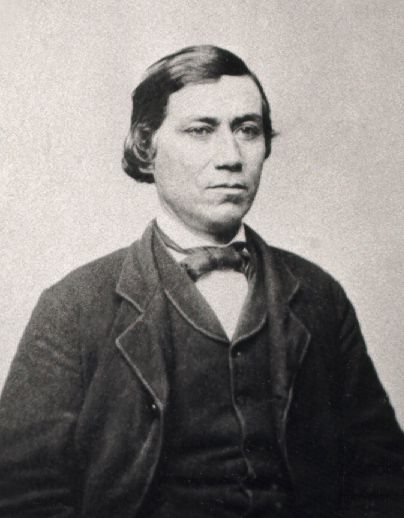
Paul Hudon Beaulieu
~ FamilySearch.org
I wrote you a few days ago, and at the same time I wrote to Mr. Oakes inquiring whether he had got possession of the Lapointe property. I have not yet got a reply from him, but Mr. Beaulieu tells me that he heard the same report which you mentioned in your letter, and that he inquired of Mr. Oakes about it when he saw him on a recent visit to St. Paul, and finds that it is all a humbug. Oakes has nothing to do with it. Mr. Beaulieu said that the sale of last spring has been confirmed, and that Austrian will hold Lapointe. So farewell to all the inhabitants’ claims then, and to anything being done for the prosperity of the peace for the present, unless it gets out of his hands.
I have written to Austrian to try to get something for our property if we can. But I fear there is not much hope. If he goes back to Lapointe in the spring, do the best you can to make him give us something. I feel sorry for the inhabitants there that they are left at his mercy. He may treat them fairly, but it is hardly to be expected.

Clement Hudon Beaulieu
~ TreatiesMatter.org
As to our affairs here, there has been no particular change in their aspects since I wrote a few days ago. There must be a crisis, I think, in a few weeks. We must either go on or break up, I think, in the spring. We are trying to get a decision. I understand our agent has been threatened with removal if he carries on as he has done. I believe there is no hope of reformation in his case, and we may get rid of him. Perhaps God sent us here to have some influence in some such matters, so intimately connected with the welfare of the Indians. I have never thought I [????] can before I was sent in deciding to come here. Some trials and disappointments have grown out of my coming, but I feel conscious of having acted in accordance with my convictions of duty at this time.
If all falls through, I know not what to do in the future. The Home Missionary Society have got more on their hands now than they have funds to pay, if I were disposed to offer myself to labor under them. I may be obliged to build me a shanty somewhere on some little unoccupied piece of land and try to dig out a living. In these matters the Lord will direct by his providence.
You must be on your guard or some body will trip you up and get away your place. There are enough unprincipled fellows who would take all your improvements and send you and all the Indians into the Lake if they could make a dollar by it. I should not enlarge much, without getting a legal claim to the land. Neither would I advise you to carry on more family than is necessary to keep what team you must have, and to supply your family with milk and vegetables. It will be advantage/disadvantage to you in a pecuniary point of view, it will load you with and tend to make you worldly minded, and give your establishment the air of secularity in the eyes of the world. If I were to go back again to my old field, I would make my establishment as small as I could & have enough to live comfortable. I with others have thought that your tendency was rather towards going to largely into farming. I do not say these things because I wish to dictate or meddle with your affairs. Comparing views sometimes leads to new investigations in regard to duty.
May the Lord bless you and yours, and give you success and abundant prosperity in your labours of love and efforts to Save the Souls around you.
Give my best regards to Mrs. W., the children, Miss S and all.
Yours truly,
S. Hall
I forgot to say that we are all well. Henry and his family have enjoyed better health here, then they used to enjoy at Lapointe.
Feb 27
Brother Wheeler.
My delay to answer your note may require an explanation. I have not had time at command to attend to it conveniently at an earlier period. As to your first questions. I suppose there will be no difference of opinion between us as to the correctness of the following remarks.
- The Gospel requires the members of a church to exercise a spirit of love, meekness and forbearance towards an offending brother. They are not to use unnecessary severity in calling him to account for his errors. Ga. 6:1.
- The Object of Church discipline is, not only to [pursue/preserve?] the Church pure in doctrine & morals, that the contrary part may have no evil thing to say of them; but also to bring the offender to a right State of mind, with regard this offense, and gain him back to duty and fidelity.
- If prejudice exist in the mind of the offender towards his brethren for any reason, the spirit of the gospel requires that he be so approached if possible as to allay that prejudice, otherwise we can hardly expect to gain a candid hearing with him.
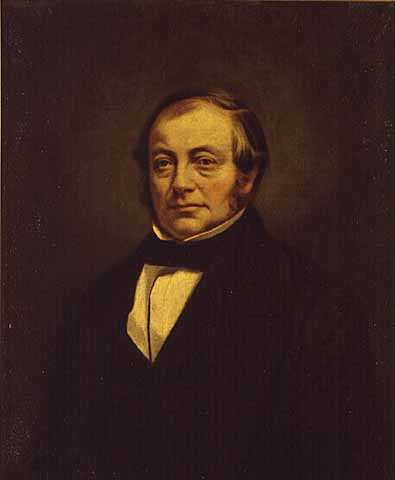
Charles William Wulff Borup, M.D. ~ Minnesota Historical Society
I consider that these remarks have some bearing on the case before us. If it was our object to gain over Dr. B. to our views of the Sabbath, and bring him to a right State of mind with regard this Sabbath breaking, the manner of approaching him would have, in my view, much to do with the offence. He may be approached in a Kind and [forbearing?] manner, when one of sternness and dictation will only repel him from you. I think we ought, if possible, and do our duty, avoid a personal quarrel with him. To have brought the subject before the Church & made a public affair of it, before [this/then?] and more private means have been tried to get satisfaction, would, I am sure, have resulted in this. I found from my own interviews with him, that there was hope, if the rest of the brethren would pursue a similar course. I felt pretty sure they would obtain satisfaction. IF they had [commenced?] by a public prosecution before the church, it would only have made trouble without doing any good. The peace of our whole community would have been disturbed. I thought one step was gained when I conversed with him, and another when you met him on the subject. I knew also that prejudices existed both in his mind towards us, & in our minds towards him which were likely to affect the settlement of this affair, and which as I thought, would be much allayed by individuals going to him and speaking face to face on this subject in private. He evidently expected they would do so. Mutual conversations and explanations allay these feelings very much. At least it has been so in my experience.

Reverend Edmund Franklin Ely.
~ Duluth Public Library
As to your second question. I do not say that it was Mr. Ely’s duty to open the subject to Doc. Borup at the preparatory lecture. If he had done so, it would have been only a private interview; for there [was?] not enough present to transact business. All I meant to affirm respecting that occasion is, that it afforded a good opportunity to do so, if he wishes, and that Dr. B. expected he would have done so, as I afterwards learnt, if he has any objection to make against his coming to the communion.
As to your third question. I have no complaint to make of the church, that I have urged them to the performance of any “duties“ in this case they have refused to perform.
And now permit me to ask in my turn.
What “duties” have they urged me to perform in this case, which I “have been unwilling, or manifested a reluctance to perform?”
Did you intend by anything which wrote to me or said verbally, to request me to commence a public prosecution of Doc. Borup before the Church?
Will you have the goodness to state in writing, the substance of what you said to me in your study as to your opinion and that of others suspecting my delinquency in maintaining church discipline.
A reply to these questions would be gratefully received.
Your brother in Christ
S. Hall
Crow Wing. March 12th 1854
Brother Wheeler:
Your letter of Feb 17th came to hand by our last mail; and though I wrote you but a short time ago, I will say a few words in relation to one or two topics to which you allude. Shortly after I received your former letter I wrote to Mr. Oakes enquiring about the property at Lapointe. In reply, says that himself and some others purchased Mr. Austrian’s rights at Lapointe of Old Hughes on the strength of a power of attorney which he held. Austrian asserts the power of attorney to be fraudulent, and that they cannot hold the property. Oakes writes as if he did not expect to hold it. Some time ago I wrote to Mr. Austrian on the same subject, and said to him that if I could get our old place back, I might go back to Lapointe. He says in reply —
Julius Austrian
~ Madeline Island Museum
“I should feel much gratified to see you back at Lapointe again, and can hold out to you the same inducements and assurances as I have done to all other inhabitants, that is, I shall be at Lapointe early in the spring and will have my land surveyed and laid out into lots, and then I shall be ready to give to every one a deed for the lot he inhabits, at a reasonable price, not paying me a great deal more than cost trouble, and time. But with you, my dear Sir, will be no trouble, as I have always known you a just and upright man, and have provided ways to be kind towards us, therefore take my assurance that I will congratulate myself to see you back again; and it shall not be my fault if you do not come. If you come to Lapointe, at our personal interview, we will arrange the matter no doubt satisfactory.”
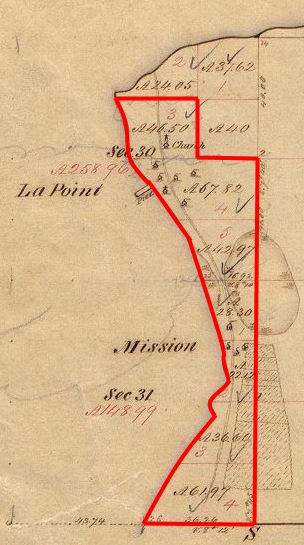
“The property” from the James Hughes Affair is outlined in red. This encompassed the Church at La Pointe (New Fort) and the Mission (Middleport) of Madeline Island. 1852 PLSS survey map by General Land Office.
I suppose Austrian will hold the property and probably we shall never realize anything for our improvements. You must do the best you can. Make your appeal to his honor, if he has any. It will avail nothing to reproach him with his dishonesty. I do not know what more I can do to save anything, or for any others whose property is in like circumstances with ours.
You speak discouragingly of my going back to Lapointe. I do not think the Home Miss. Soc. would send a missionary there only for the few he could reach in the English language. If the people want a Methodist, encourage them to get one. It is painful to me to see the place abandoned to irreligion and vices of every Kind, and the labours I have expended there thrown away. I can hardly feel that it was right to give up the station when we did. If I thought I could support myself there by working one half the time and devoting the rest to ministerial labors for the good of those I still love there, I should still be willing to go back, if could get there & had a shelter for my head, unless there is a prospect of being more useful here. But the land at Lapointe is so hard to subdue that I am discouraged about making an attempt to get a living there by farming. I am not much of a fisherman. There is some prospect that we may be allowed to go on here. Mr. Treat has been to Washington, and says he expects soon to get a decision from the Department. We have got our school farm plowed, and the materials are drawn out of the woods for fencing it. If I have no orders to the contrary, I intend to go on & plant a part of it, enough to raise some potatoes. We may yet get our school established. If we can go ahead, I shall remain here, but if not, I think it is not my duty to remain here another year, as I have the past. In other circumstances, I could do more towards supporting myself and do more good probably.
I have felt much concerned for the people of Lapointe and Bad River on account of the small pox. May the Lord stay this calamity from spreading among you. Write us every mail and tell us all. It is now posted here today that the Old Chief [Kibishkinzhugon?] is dead. I hardly credit the report, though I should suppose he might be one of the first victims of the disease.
I can write no more now. We are all very well now. Give my love to all your family and all others.
Tell Robert how the matters stands about the land. It stands him in how to be on good terms with the Jew just now.
Yours truly,
S. Hall
The snow is nearly all off the ground and the weather for two or three weeks has been as mild as April.
Crow Wing M.H. Apr. 1 1854
Dear Br. & Sr. Wheeler.
I have received a letter from you since I wrote to you & am therfore in your debt in that matter. I have also read your letters to Br. & Sr. Welton I suppose you have received my letter of the 13th of Feb. if so, you have some idea of our situation & I need say no more of that now; & will only say that we are all well as usual & have been during the winter. Mrs. P_ is considerably troubled with her old spinal difficulty. She has got over her labors here last summer * fall. Harriet is not well I fear never will be, because the necessary means are not likely to be used, she has more or less pain in her back & side all the time, but she works on as usual & appears just as she did at LaPointe, if she could be freed from work so as to do no more than she could without injury & pursue uninterruptedly & proper medical course I think she might regain pretty good health. (Do not, any of you, send back these remarks it would not be pleasing to her or the family.) We have said what we think it best to say) –
Br. Hall is pretty well but by no means the vigorous man he once was. He has a slight – hacking cough which I suppose neither he nor his family have hardly noticed, but Mrs. P_ says she does not like the sound of it. His side troubles him some especially when he is a good deal confined at writing. Mr. & Mrs. W_ are in usual health. Henry’s family have gone to the bush. They are all quite well. He stays here to assist br. H_ in the revision & keeps one or two of his children with him. They are now in Hebrews, with the Revision. Henry I suppose still intends to return to Lapointe in the spring. –
Now, you ask, in br. Welton’s letter, “are you all going to break up there in the spring.” Not that I know of. It would seem to me like running away rather prematurely. When the question is settled, that we can do nothing here, then I am willing to leave, & it may be so decided, but it is not yet. We have not had a whisper from Govt. yet. Wherefore I cannot say.
It looks now as if we must stay this season if no longer. Dr. Borup writes to br. Hall to keep up good courage, that all will come out right by & by, that he is getting into favor with Gov. Gorman & will do all he can to help us. (Br. Hall’s custom is worth something you know).
Henry C. Gilbert
~ Branch County Photographs
By advise of the Agent, we got out (last month) tamarack rails enough to fence the school farm (which was broke last summer) of some 80 acres & it will be put up immediately. Our great father turned out the money to pay for the job. These things look some like our staying awhile I tell br H_ I think we had better go as far as we can, without incurring expense to the Board (except for our support) & thus show our readiness to do what we can. if we should quit here I do not know what will be done with us. Br Hall would expect to have the service of the Board I suppose. Should they wish us to return to Bad River we should not say nay. We were much pleased with what we have heard of your last fall’s payment & I am as much gratified with the report of Mr. H. C. Gilbert which I have read in the Annual Report of the Com. of Indian Affairs. He recommends that the Lake Superior Indians be included in his Agency, that they be allowed to remain where they are & their farmers, blacksmith & carpenter be restored to them. If they come under his influence you may expect to be aided in your efforts, not thwarted , by his influence. I rejoice with you in your brightening prospects, in your increased school (day & Sabbath) & the increased inclination to industry in those around you. May the lord add his blessing, not only upon the Indians but upon your own souls & your children, then will your prosperity be permanent & real. Do not despise the day of small things, nor overlook especially neglect your own children in any respect. Suffer them not to form idle habits, teach them to be self reliant, to help themselves & especially you, they can as well do it as not & better too, according to their ability & strength, not beyond it, to fear God & keep his commandments & to be kind to one another (Pardon me these words, I every day see the necessity of what I have said.) We sympathize with you in your situation being alone as you are, but remember you have one friend always near who waits to [commence?] with you, tell Him & all with you from Abby clear down to Freddy.
Affectionately yours
C. Pulsifer
Write when you can.
Crow wing Min. Ter.
April 3d 1854
Brother Wheeler

George E. Nettleton and his brother William Nettleton were pioneers, merchants, and land speculators at what is now Duluth and Superior.
~ Image from The Eye of the North-west: First Annual Report of the Statition of Superior, Wisconsin by Frank Abial Flower, 1890, page 75.
Since I wrote you a few days ago, I have received a letter from Mr. G. E. Nettleton, in which he says, that when he was at Lapointe in December last, he was very much hurried and did not make a full settlement with Antoine. He says further, that he showed him my account, and told him I had settled with him, and that he would see the matter right with Antoine. A. replied that all was right. I presume therefore all will be made satisfactory when Mr. N. comes up in the Spring, and that you will have need to make yourself no further trouble about this matter.
I have also received a short note from Mr. Treat in which he says,
“I have not replied to your letters, because I have been daily expecting something decisive from Washington. When I was there, I had the promise of immediate action; but I have not heard a word from them”.
“I go to Washington this Feb, once more. I shall endeavor to close up the whole business before I return. I intend to wait till I get a decision. I shall propose to the Department to give up the school, if they will indemnify us. If I can get only a part of what we lose, I shall probably quit the concern”.
Thus our business with the Government stood on March the 9th, I have lost all confidence in the Indian Department of our Government under this administration, to say nothing of the rest of it. If the way they have treated us is an index to their general management, I do not think they stand very high for moral honesty. The prospects for the Indians throughout all our territories look dark in the extreme. The measures of the Government in relation to them are not such as will benefit and save many of them. They are opening the floodgates of vice and destruction upon them in every quarter. The most solemn guarantees that they shall be let alone in the possession of domains expressly granted them mean nothing.
Our prospects here look dark. For some time past I have been rather anticipating that we should soon get loose and be able to go on. But all is thrown into the dark again. What I am to do in future to support my family, I do not know. If we are ordered to quit here and turn over the property, it would turn [illegible] out of doors.
Mr. Austrian expects us back to Lapointe in the Spring & Mr. Nettleton proposes to us to go to Fond du Lac, (at the Entry). He says there will be a large settlement then next season. A company is chartered to build a railroad through from the Southern boundary of this territory to that place. It is probable that Company [illegible] will make a grant of land for that purpose. If so, it will probably be done in a few years. That will open the lake region effectually. I feel the need of relaxation and rest before I do anything to get established anywhere.
We are still working away at the Testament, it is hard work, and we make lately but slow progress. There is a prospect that the Bible Society will publish it but it is not fully decided. I wish I could be so situated that I could finish the grammar.
But I suppose I am repeating what I have said more than once before. We are generally in good health and spirits. We hope to hear from by next mail.
Yours truly
S. Hall
What do you think about the settlements above Lapointe and above the head of the Lake?
Detroit July 10th 1854
Rev. Dr. Bro.
At your request and in fulfilment of my promise made at LaPointe last fall so after so long a time I write: And besides “to do good & to communicate” as saith the Apostle “forget not, for with such sacrifices God is well pleased.”
We did not close up our Indian payments of last year until the middle of the following January, the labors, exposures and excitements of which proved too much for me and I went home to New York sick & nearly used up about the last of February & continued so for two months. I returned here about a week ago & am now preparing for the fall pay’ts.
The Com’sr. has sent in the usual amounts of Goods for the LaPointe Indians to Mr. Gilbert & I presume means to require him to make the payment at La P. that he did last fall, although we have received nothing from the Dep’t. on the subject.
“George Washington Manypenny (1808-1892) was the Director of the Bureau of Indian Affairs of the United States from 1853 to 1857.”
~ Wikipedia.org
In regard to the Treaty with the Chipp’s of La Sup’r & the Miss’i, the subject is still before Congress and if one is made this fall it has been more than intimated that Com’r Manypenny will make it himself, either at LaP’ or at F. Dodge or perhaps at some place farther west. Of course I do not speak from authority or any of the points mentioned above, for all is rumour & inference beyond the mere arrival here of the Goods to Mr G’s care.
From various sources I learn that you have passed a severe winter and that much sickness has been among the Indians and that many of them have been taken away by the Small Pox.
This is sad and painful intelligence enough and I can but pray God to bless & overrule all to the goods of his creasures and especially to the Missionaries & their families.
Notwithstanding I have not written before be assured that I have often [???] of and prayed for you and yours and while in [Penn.?] you made your case my own so far as to represent it to several of our Christian brethren and the friends of missions there and who being actuated by the benevolent principles of the Gospel, have sent you some substanted relief and they promise to do more.
The Elements of the political world both here and over the waters seem to be in fearful & [?????] commotion and what will come of it all none but the high & holy one can know. The anti Slavery Excitement with us at the North and the Slavery excitement at the South is augmenting fact and we I doubt not will soon be called upon to choose between Slavery & freedom.
If I do not greatly misjudge the blessed cause of our holy religion is or seems to be on the wane. I trust I am mistaken, but the Spirit of averice, pride, sensuality & which every where prevails makes me think otherwise. The blessed Christ will reign [recenth-den?] and his kingdom will yet over all prevail; and so may it be.
Let us present to him daily the homage of a devout & grateful heart for his tender mercies [tousward?] and see to it that by his grace we endure unto the end that we may be saved.
My best regards to Mrs. W. to Miss Spooner to each of the dear children and to all the friends & natives to each of whom I desire to be remembered as opportunity occurs.
The good Lord willing I may see you again this fall. If I do not, nor never see you again in this world, I trust I shall see and meet you in that world of pure delight where saints immortal reign.
May God bless you & yours always & ever
I am your brother
In faith Hope & Charity
Rich. M. Smith
Rev Leonard H. Wheeler
LaPointe
Lake Superior
Miss. House Boston
Augt’ 31, 1854
Rev. L. H. Wheeler,
Lake Superior
Dear Brother
Yours of July 31 I laid before the Com’sr at our last meeting. They have formally authorized the transfer of Mr & Mrs Pulsifer to the Lake, & also that of Henry Blatchford.
Robert Stuart was formerly an American Fur Company agent and Acting Superintendent on Mackinac Island during the first Treaty at La Pointe in 1842.
~ Wikipedia.org
In regard to the “claims” their feeling is that if the Govt’ will give land to your station, they have nothing to say as to the quantity. But if they are to pay the usual govt’ price, the question requires a little caution. We are clear that we may authorize you to enter & [???] take up so much land as shall be necessary for the convenience of the [mission?] families; but we do not see how we can buy land for the Indians. Will you have the [fondness?] to [????] [????] on these points. How much land do you propose to take up in all? How much is necessary for the convenience of the mission families?
Perhaps you & others propose to take up the lands with private funds. With that we have nothing to do, so long as you, Mr P. & H. do not become land speculators; of which, I presume, there is no danger.
As to the La Pointe property, Mr Stuart wrote you some since, as you know already I doubt not, and replied adversely to making any bargain with Austrian. I took up the opinion of the Com’sr after receiving your letter of July 31, & they think it the wise course. I hope Mr Stewart will get this matter in some shape in due time.
I will write to him in reference to the Bad River land, asking him to see it once if the gov’ will do any thing.
Affectionate regards to Mrs W. & Miss Spooner & all.
Fraternally Yours
S. B. Treat
P.S. Your report of July 31 came safely to hand, as you will & have seen from the Herald.
 Chequamegon History