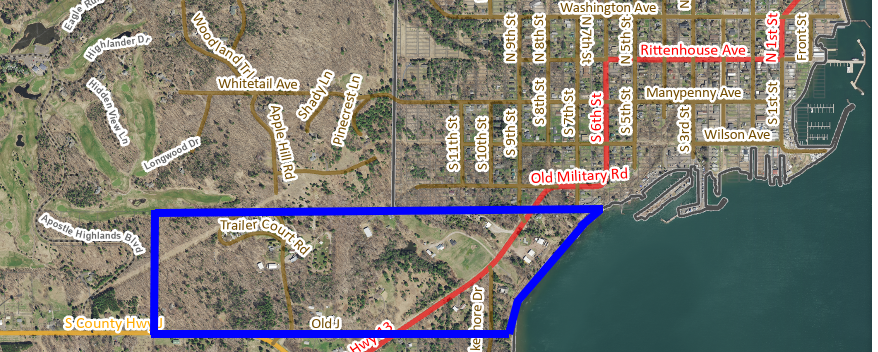
The 1856 Reservation for Chief Buffalo’s Estate
November 5, 2025
Collected & edited by Amorin Mello
This is one of many posts on Chequamegon History exploring the original La Pointe Band Reservations of La Pointe County on Chequamegon Bay, now known as the Bad River and Red Cliff Reservations. Specifically, today’s post is about the 1856 Reservation for Chief Buffalo’s subdivision of the La Pointe Band and how it got selected in accordance with the Sixth Clause of the Second Article of the 1854 Treaty with the Chippewa at La Pointe:
1854 Treaty with the Chippewa at La Pointe
…

Map of La Pointe Band Reservations:
334 – Bad River Reservation
335 – La Pointe Fishing Reservation
341 – Chief Buffalo’s Reservation
342 – Red Cliff Reservation
18th Annual Report of the Bureau of American Ethnology to the Secretary of the Smithsonian Institution 1896-’97
Printed by U.S. Congress in 1899
ARTICLE 2. The United States agree to set apart and withhold from sale, for the use of the Chippewas of Lake Superior, the following-described tracts of land, viz:
…
6th [Clause]. The Ontonagon band and that subdivision of the La Pointe band of which Buffalo is chief, may each select, on or near the lake shore, four sections of land, under the direction of the President, the boundaries of which shall be defined hereafter. And being desirous to provide for some of his connections who have rendered his people important services, it is agreed that the chief Buffalo may select one section of land, at such place in the ceded territory as he may see fit, which shall be reserved for that purpose, and conveyed by the United States to such person or persons as he may direct.
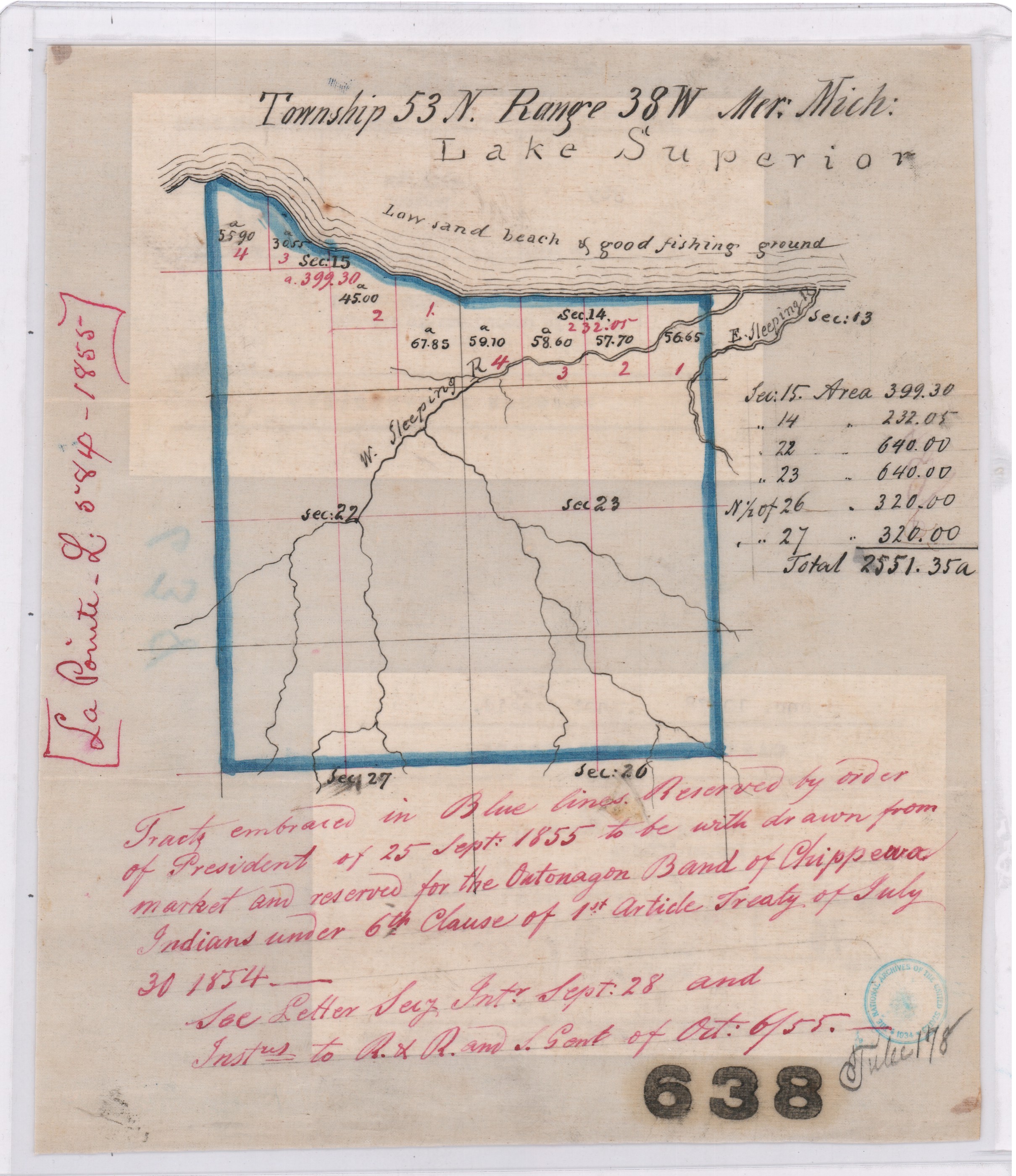
Map of “Tract embraced in blue lines reserved by order of President of 25 September 1855 to be withdrawn from market and reserved for the Ontonagon Band of Chippewa Indians“ on a “low sand beach & good fishing ground”.
Central Map File No. 638 (Tube No. 138)
NAID: 232923886 cites “La Pointe L.584-1855”.
The Ontonagon Band and Chief Buffalo’s Subdivision of the La Pointe Band got lumped together in this clause, so let’s review the Ontonagon Band first. Less than one year after the 1854 Treaty, the Ontonagon Band selected four square miles for their Reservation as approved by President Franklin Pierce’s Executive Order of September 25, 1855. Today the Ontonagon Band Reservation still has its original shape and size from 1855 despite heavy “checkerboarding” of its landownership over time.
In comparison to the Ontonagon Band Reservation, the history of how Chief Buffalo’s Reservation got selected is not so straightforward. Despite resisting and surviving the Sandy Lake Tragedy and Ojibwe Removal, making an epic trip to meet the President at Washington D.C., and securing Reservations as permanent homelands for the Chippewa Bands in the 1854 Treaty, Chief Buffalo of La Pointe died in 1855 before being able to select four square miles for his Subdivsion of the La Pointe Bands.
Fortunately, President Franklin Pierce’s Executive Order of February 21, 1856 withheld twenty-two square miles of land near the Apostle Islands from federal public land sales, allowing Chief Buffalo’s Estate to select four of those twenty-two square miles for their Reservation without competition from squatters and other land speculators, while other prime real estate in the ceded territory of La Pointe County was being surveyed and sold to private landowners by the United States General Land Office.
This 1856 Reservation of twenty-two square miles for Chief Buffalo’s Estate set the stage for what would eventually become the Red Cliff Reservation. We will return to this 1856 Reservation for Chief Buffalo’s Estate in several upcoming posts exploring more records about Red Cliff and the other La Pointe Band Reservations.

Maps marked “A” showing certain lands reserved by the 1854 Treaty:
Central Map File No. 793 (Tube 446)
NAID: 232924228 cites “La Pointe L.579-1855″.
Central Map File No. 816 (Tube 298)
NAIDs: 232924272 & 50926136 cites “Res. Chippewa L.516-1855”.

1878 Copy of President Franklin Pierce’s Executive Order of February 26, 1856 for Chief Buffalo’s Subdivision (aka “Red Cliff”).
NAID: 117092990
Office of Indian Affairs.
(Miscellaneous)
L.801.17.1878
Copy of Ex. Order of Feby. 21. 1856.
Chippewas (Red Cliff.)
Wisconsin.
Enc. in G.L.O. letter of Nov 23, 1878 (above file mark.)
in answer to office letter of Nov. 18, 1878.
Ex. Order File.

Secretary of the Interior
Robert McClelland
Department of the Interior
February 21, 1856
Sir,
I herewith return the diagram enclosed in your letter of the 20th inst, covering duplicates of documents which accompanied your letter of the 6th Sept. last, as well as a copy of the latter, the originals of which were submitted to the President in letter from the Department of the 8th Sept. last and cannot now be found.
You will find endorsements on said diagram explanatory of the case and an order of the President of this date for the withdrawal of the land in question for Indian purposes as recommended.
Respectfully
Your obt. Servt
R McClelland
Secretary
To
Hon Thos A Hendrick
Commissioner of the
General Land Office
(Copy)
General Land Office
September 6, 1855
Hon R. McClelland
Sec. of Interior
Sir:
Enclosed I have the honor to submit an abstract from the Acting Commissioner of Indian Affairs letter of the 5th instant, requesting the withdrawal of certain lands for the Chippewa Indians in Wisconsin, under the Treaty of September 30th, 1854, referred by the Department to this office on the 5th. instant, with orders to take immediate steps for the withdrawal of the lands from sale.
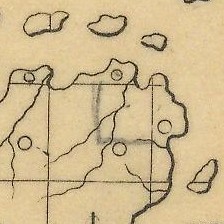
Detail of 1856 Reservation in pencil on “a map marked A.“
Central Map File No. 816 (Tube 298)
NAIDs: 232924272 & 50926136 cites “Res. Chippewa L.516-1855”.
In obedience to the above order I herewith enclose a map marked A. Showing by the blue shades thereon, the Townships and parts of Townships desired to be reserved, no portion of which are yet in market, to wit:
Township 51 N. of Range 3 West 4th Prin. Mer. Wis.
N.E. ¼ of Town 51 N ” 4 ” ” ” “.
Township 52 ” ” 3 & 4 ” ” ” “.
For the reservation of which, until the contemplated Selections under the 6th Clause of the Chippewa Treaty of 30th September 1854 can be made, I respectfully recommend that the order of the President may be obtained.
The requisite reports on the subject of the new surveys, and respecting preemption claims, referred to in the same order, will be prepared and communicated at an early day.
I am respectfully
Your Ob’t Serv’t
Thos. A. Hendricks
Commissioner
Department of the Interior
Feb. 20. 1856
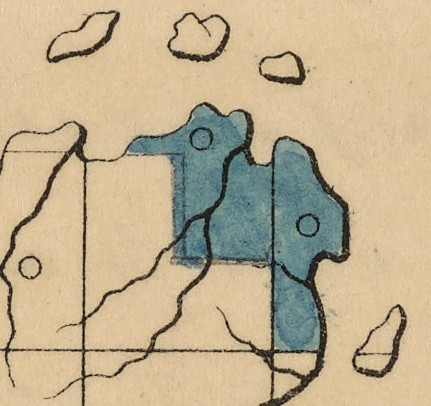
Detail of 1856 Reservation in blue on “duplicate of the original“.
NAID: 117092990
This plat represents by the blue shade, certain land to be withdrawn with a view to a reservation, under Chippewa Treaty of 30 Sept 1854, and as more particularly described in Commissioner of the General Land Office in letter of 6th Sept 1855. The subject was referred to the President for his sanction of the recommendation made in Secretary’s letter of 8th Sept 1855 and the original papers cannot now be found. This is a duplicate of the original, received in letter of Comm’r of the General Land Office of this date and is recommended to the President for his sanction of the withdrawal desired.
R. McClelland
Secretary

1856 Reservation in red and modern Red Cliff in brown. Although different in shape, both are roughly twenty-two square miles in size.
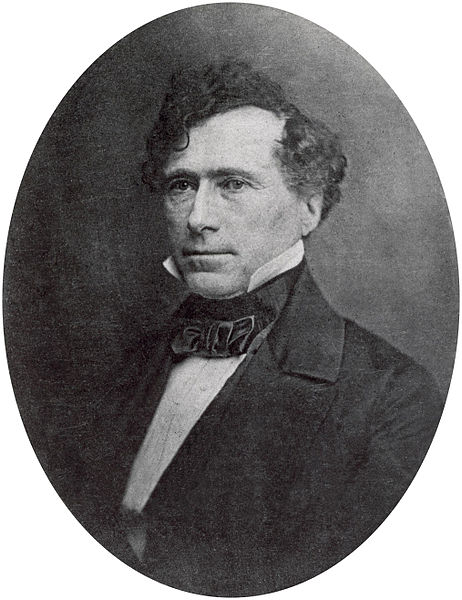
14th United States President
Franklin Pierce
February 21st 1856
Let the withdrawal be made as recommended.
Franklin Pierce
Judge Bell Incidents: Fooled the Austrian Brothers
October 30, 2025
Collected & edited by Amorin Mello
This is the third post in a series featuring The Ashland News items about La Pointe’s infamous Judge John William Bell, written mainly by his son-in-law George Francis Thomas née Gilbert Fayette Thomas a.k.a G.F.T. In today’s post we explore stories about real estate transactions negotiated between Judge Bell and Julius Austrian.
… continued from King No More.

The Ashland News
Wednesday, January 11, 1888, Page 5
STORIES OF JUDGE BELL
HOW HE FOOLED THE AUSTRIAN BROTHERS IN A LAND DEAL.
“Incidents in the life of Judge John W. Bell. – A Half Century in Old La Pointe – by Geo. Francis Thomas.”
Such is the proposed title to a forth-coming historical work which will prove wonderfully interesting, especially to the older residents in this vicinity. The author begins with the year 1835, when the brig “John Jacob Astor,” the first vessel built upon the shores of Lake Superior, first cast her anchor in the bay at La Pointe, and ends with the death of the old pioneer, John W. Bell, which occurred but a few days since. In speaking of the pioneer the author says:
“From the day that Mr. Bell stepped ashore at La Pointe from ‘The Astor,’ June 23, 1835, to the day of his death, he was a character possessing a most positive individuality; and it was not until his later years, and then when he had become financially distressed, that his wonderful spirit became at all broken; but even then he was never known to as a favor.”
The old judge, or “Squire” as he was usually called, was always ready to relate some incident of early days in which he was usually a participant. There are also a great many equally interesting incidents related by others, where the old judge would not justify his telling the story himself. The author says:

Detail from Julius Austrian’s 1854 Plan of the Town of La Pointe with Judge Bell’s Block 35 and four small Lots.
~ Wisconsin Historical Society
“[…] except a small portion in the North West Corner claimed and enclosed by Edwin Connor, and so much of the South West Corner as is claimed by P. B. Vanderventer, and the enclosure of Barboo & Meletle in the South East Corner”
“The old man always liked to have things done on the square, so when Julius Austrian was platting the village of La Pointe and proposed to Mr. Bell to give him the block he already occupied for a nominal consideration, Mr. Bell insisted that his block, number thirty-five, be exactly square – all the four streets crossing at right angles. A square block or lot was quite a novelty where each squatter’s garden-patch had been fenced in and called a lot, regardless of street lines or quantity of land.”
Memoirs of Doodooshaaboo: Joseph Austrian’s Time at La Pointe 1851-52 (Pt. 2)
“Our blind brother Marx Austrian with brother Julius’ assistance at that time, preempted 160 acres of land near Bayfield from La Point, complying with preemption laws. He built a small log house living there with his wife. One night during their first winter in their new house, there was a knock at the door, and when opened they were confronted by a number of Indians, who were evidently under the influence of liquor and who swinging their tomahawks vigorously, making all sorts of threatening demands. An old Indian who knew Marx interceded and enabled him and his wife to escape without injury who thoroughly scared fled panic stricken in the dark about two miles at night, over the ice, on the Bay which was covered with a foot of snow to La Point for safety. The poor woman having the hazardous task of leading her blind husband over this long and difficult road, not to come back again and glad to escape with their lives and thus abandoning their right of preemption. This place was later on platted and is now known as the Bayfield Addition.”
Mr. Bell was an acute judge of human nature, and made it an invariable rule to deal with his fellowmen according to each one’s individual peculiarity. Before Bayfield was located, or in fact thought of as a town site, a Hebrew by the name of Marx Austrian pre-empted the 126 acres of land now known as Austrian’s clearing, and which adjoins Bayfield on the south. After a short residence upon the claim Mr. Austrian’s family became sick, and in order that proper care might be given them they were compelled to move to La Pointe, where a physician could be had. A speculator, noticing the apparent irregularity, tried to jump the claim. The case was taken to Superior for trial, and Mr. Bell, being the only available witness, the Austrian brothers and Louis Leopold proposed to give him a one-fourth interest in the land as compensation for making the trip to Superior. Mr. Bell accordingly accompanied the party, to Superior, and on arriving at the hotel as was his custom, he immediately began to make himself at home with the guests of the house, most of whom he was well acquainted with. At length when the case was called, Mr. Bell seemed so entirely unconcerned that he was urged to come forward by some one of the interested parties; but Mr. Bell carelessly said,
“Oh! I believe I will not attend court today.”

Julius Austrian
~ Madeline Island Museum
The Austrians wildly expostulated, and at last agreed to pay all the old “Judge’s” expenses for the trip, besides giving him a one-fourth interest in the 126 acres of land. This brought him all right and Marx Austrian gained his point. A few years later, when the town of Bayfield was laid out by the Hon. Henry M. Rice, the Austrians, Julius and Marx, concluded that they ought to buy back the one-fourth interest in the 126 acres held by “Squire” Bell, and accordingly Julius approached him on the subject. Mr. Bell was a man of few words and no give-in to his dictum. He told Austrian that $1,000 would buy his interest if taken by noon the next day. Austrian claimed the price was exorbitant but finally went off to get the cash. on the morrow at noon, or a few minutes before, Austrian called on Bell and said he could only give him $800. Mr Bell insisted on $1,000, which Julius Austrian finally agreed to pay;
“but,” says Mr. Bell, “now you are too late. It is fully a minute past the time which I specified, now I will not take less than $1,250, and that must be forthcoming within two hours from now.”
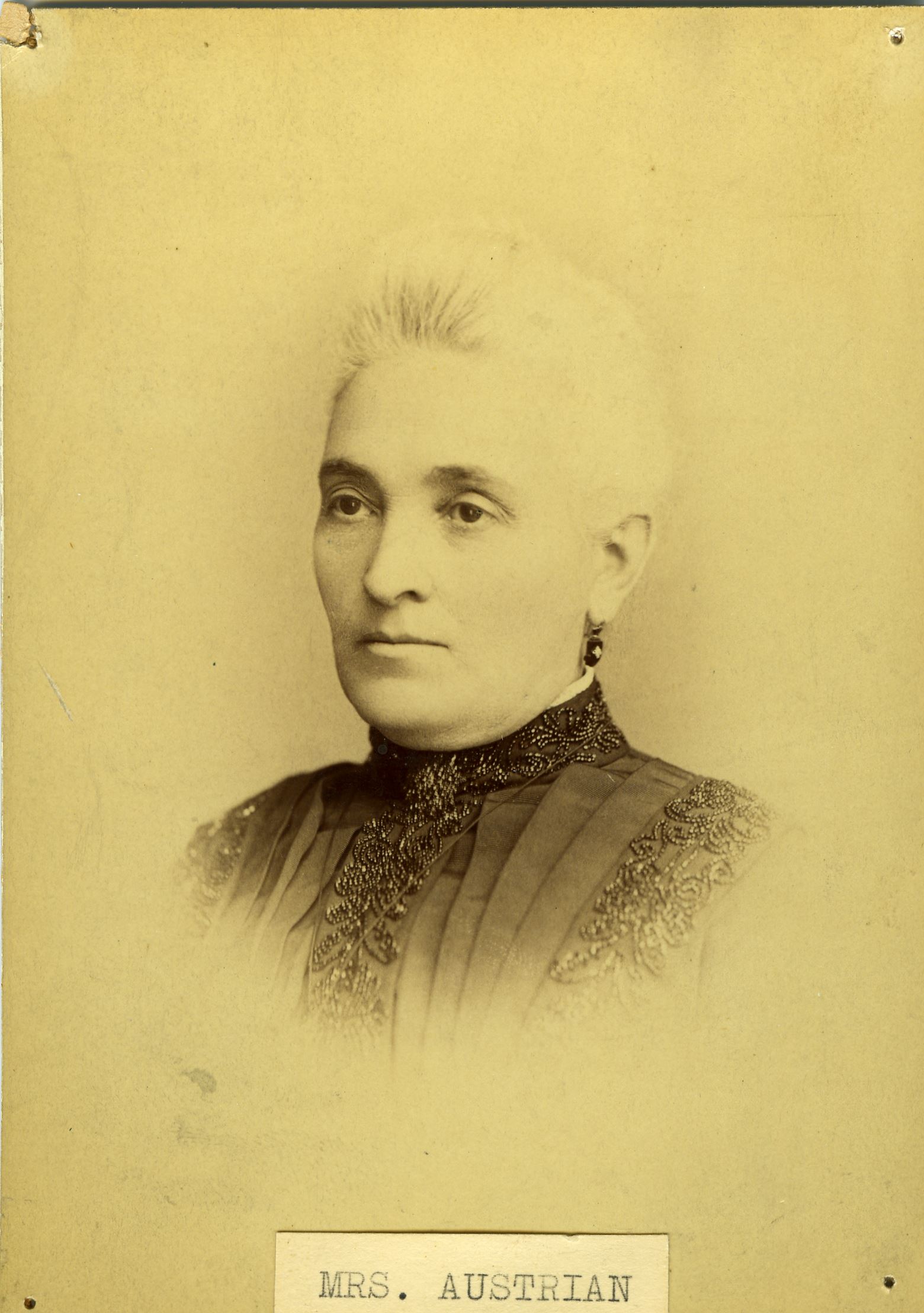
Hannah Leopold Austrian
~ Madeline Island Museum.
This time Austrian kept away, thinking Mr. Bell would go back to his $1,000 offer if he did not seem too anxious. In that Mr. Austrian misjudged his man, for when Austrian again approached the “squire” his price was $1,500 spot cash. Things now looked dubious to the Austrians, a conference was held with Mrs. Hannah Austrian and together they raised $1,300, all the cash which was available at that moment. This they handed over to Mr. Bell with a sight due bill for $200, secured by a deposit of all Mrs. Austrian’s jewels, including her diamond earrings. They got back the one quarter interest in the 126 acres, and they have paid taxes on it ever since, yet the whole is hardly worth now what the quarter cost them.
“This recalls an incident back in ’61 or ’62,” said one of the jurymen at a recent trial in this city. “It was a case against a trader who was accused of selling whiskey to an Indian. The jury was drawn, and after hearing the evidence they retired to a back room to determine on a verdict. It was about four o’clock in the afternoon. At six o’clock the jury was about evenly divided. About midnight, after continuous balloting, the vote stood ten for acquittal and two for conviction. There was no fire in the room, and it was very cold. The ten jurors who stood for acquittal made one final request to the other two to vote with them, but they persistently refused. The ten then got a long pine board and laying it across two stools proceeded to play an interesting game of freeze-out. About two o’clock one of the two came over on the other side and joined the rest in the game of freezing out the other juror. At three o’clock in the morning he gave up.”
To be continued…
Judge Bell Incidents: King No More
October 16, 2025
Collected & edited by Amorin Mello
This post is the second of a series featuring newspaper items about La Pointe’s infamous Judge John William Bell. Today we explore obituaries of Judge Bell that described his life at La Pointe. Future posts of this series will feature articles about the late Judge Bell written by his son-in-law George Francis Thomas née Gilbert Fayette Thomas a.k.a G.F.T.
… continued from King of the Apostle Islands.

Wisconsin State Journal
Saturday, December 31, 1887, Page 1
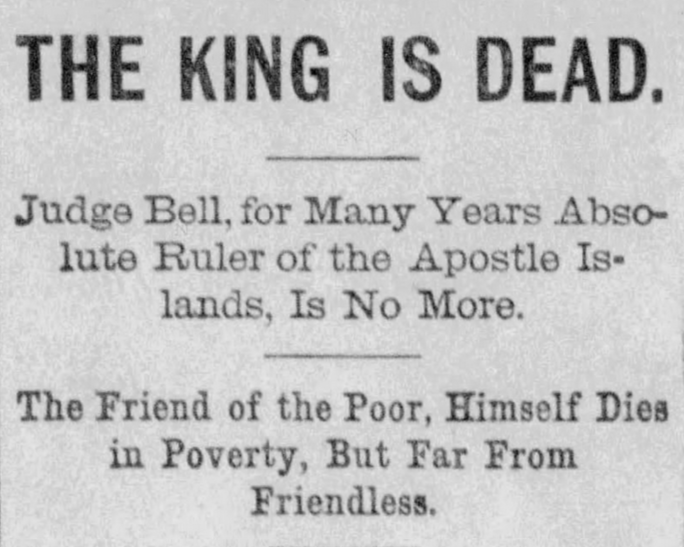
King of the Apostle Islands No More
ASHLAND, Wis., Dec. 31. – Judge Bell, known far and wide as “King of the Apostle Islands,” died yesterday. For nearly half a century he governed what was practically a little monarchy in the wilderness. He was 83 years old, and was the oldest living settler on the historic spot where Marquette founded his mission, two hundred years ago.

The Saint Paul Globe
Saturday, December 31, 1887, Page 1
KING OF THE ISLANDS.
Judge Bell,
“King of the Apostle Islands,”
Has Given Up His Crown.
The Oldest Living Pioneer
of the Historic Spot
Dies in Apparent Poverty,
Special to the Globe.

San Francisco Examiner
Wednesday, January 3, 1888, Page 2
ASHLAND, Wis., – “The king of the Apostle islands” is dead. He passed away at an early hour this morning at La Pointe, on Madeline, the largest of the group, where he has lived for forty-four years, the oldest living pioneer of the historic spot where Pere Marquette founded his little Indian mission 200 years ago. Judge Bell was a character in the early history of the Lake Superior region, known far and wide as the “king” of the country known as La Pointe, which was organized in 1846 by Judge Bell. The area of the country was as large as many states of the Union, its borders including nearly all of Wisconsin north of the Chippewa river, the Apostle islands and to an almost
ENDLESS DISTANCE WEST.

Wisconsin Historical Society’s copy of Lyman Warren’s 1834 “Map of La Pointe” from the American Fur Company Papers at New York Historical Society.
The population of whites consisted only of a small handful of French voyagers, traders and trappers, most of whom rendezvous at La Pointe. The country was hardly known by the state, and Bell’s county was practically a young monarchy. He bossed everything and everybody, but in such a way that every Indian and every white was his friend and follower. Judge Bell came here in 1832, from Canada, in the employ of the American Fur company, which at that time was a power here. He had rarely left the island, except in years gone by to make occasional pilgrimages through the settlements. During his eventful life he held every office in the county, and for many years, served as county judge. He was a man of great native ability, possessed of a courage that controlled the rough element which surrounded him in the early days when there was no law except his will. He was honest, fearless,
A NATURAL-BORN RULER
Fargo Daily Argus
Sunday, January 1, 1888, Page 1
of men, and through his efforts the poor and needy were cared for, and in no instance did he fail to befriend them. For this reason among those who survive him, and who lived in the good old pioneer days, all were his firm friends. His power departed only when the advance guard of civilization reached the great inland sea, through the medium of the iron horse, and opened a new era in the history of the new Wisconsin. For many years he has been old and feeble and has suffered for the comforts of life, having become a charge upon the town. He squandered thousands for the people and died poor but not friendless. He was eighty-three years of age.
The Ashland News
Wednesday, January 4, 1888, Page 7
ANOTHER PIONEER GONE
DEATH OF “SQUIRE” BELL, “THE KING OF LAPOINTE.”
Sketch of the Life of the Oldest Settler in the Lake Superior Region.
He comes to La Pointe With John Jacob Astor for the American Fur Co.
Judge John W. Bell died Friday morning at seven o’clock at his home at La Pointe, on Madeline Island, aged eighty-four years.
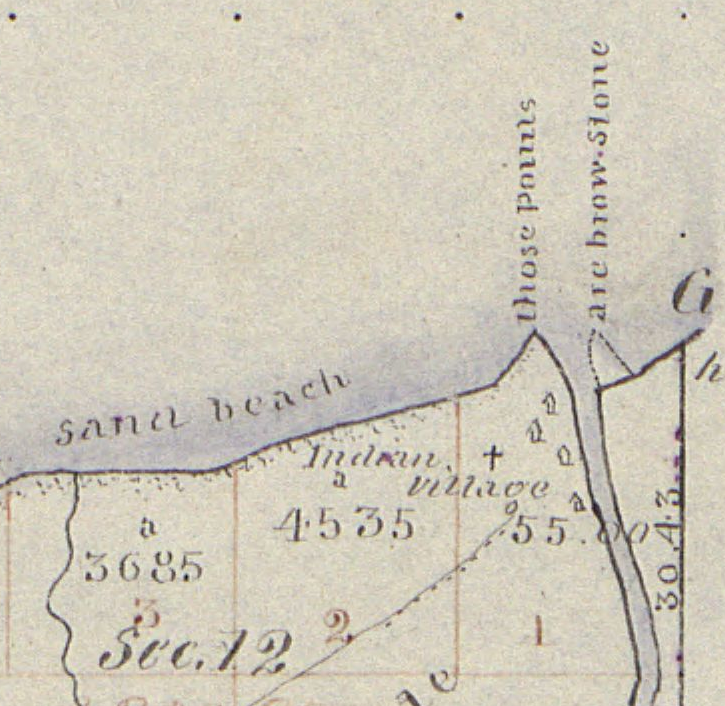
1847 PLSS survey map detailing the mouth of Iron River at what is now Silver City, Michigan along the east entrance to the Porcupine Mountains.
John W. Bell was born in New York City on May 3, 1803, and was consequently eighty-four years and seven months old. He learnt the trade of a cooper, and in this capacity in the year 1835, he came to the Lake superior country for the United States Fur company. He first settled at the mouth of Iron river, in Michigan, about twenty miles west of Ontonagon. Here, at that time, was one of the principal trading and fishing posts of the American Fur company, La Pointe being its headquarters. Remaining at Iron river for a few years, he came to La Pointe about 1840, where he continued to reside till the time of his death.

1845 United States map by John Dower, with the northernmost area of Wisconsin Territory that became La Pointe County.
At the time he came upon this lake its shores were an unbroken wilderness. At the Sault was a United States fort, but from the foot of Lake Superior to the Pacific ocean, no white settlement existed. The American and Northwest Fur companies were lords of this vast empire, and their trading posts and a few mission stations connected with them, held control. A small detachment of United States soldiers formed the distant outposts of Ft. Snelling. The state of Wisconsin had not been organized. No municipal government existed upon this lake. It was many years before Wisconsin was organized.
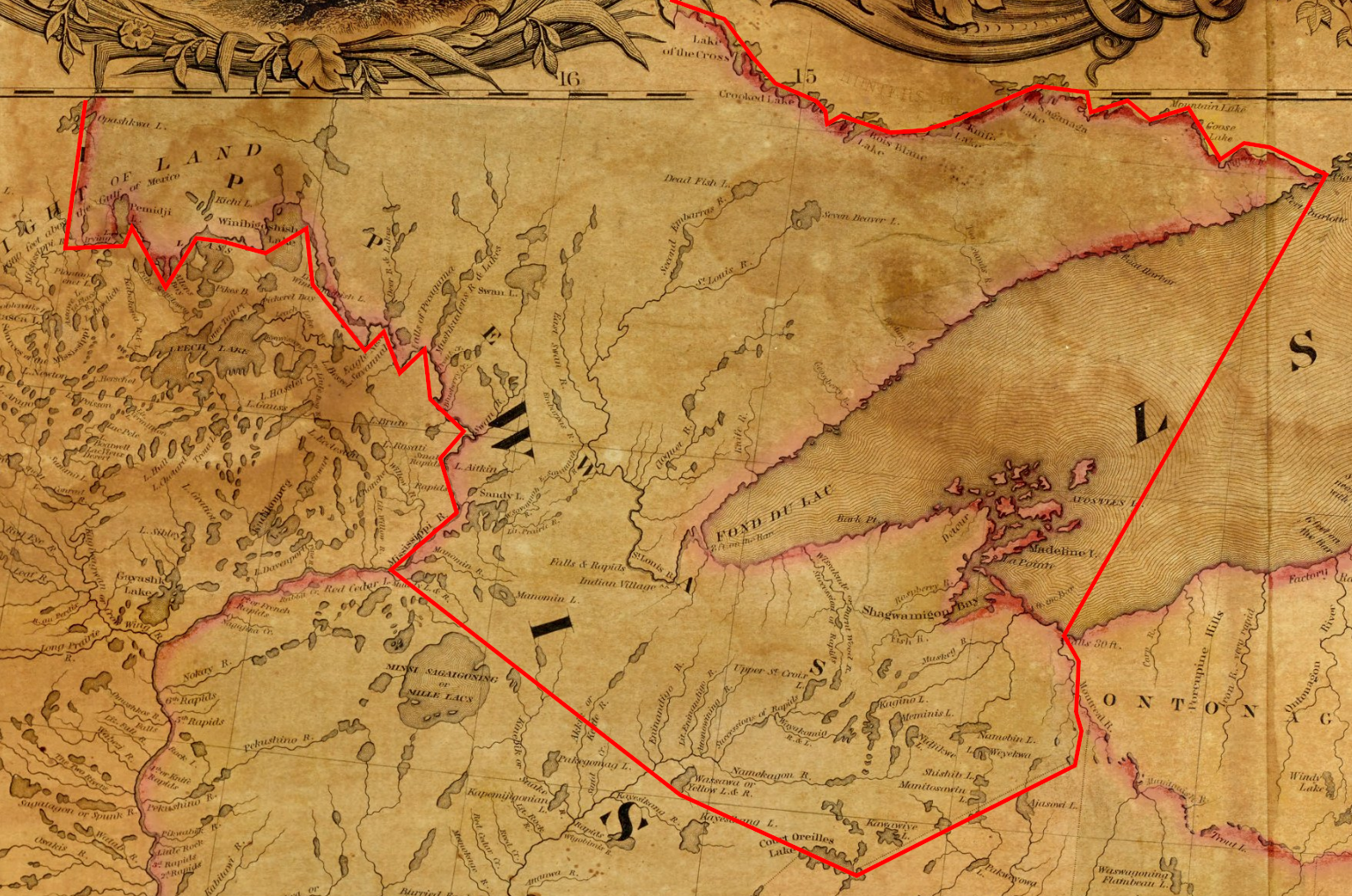
1845 United States map by J. Calvin Smith, with the original 1845 boundaries of La Pointe County added in red outline.
“beginning at the mouth of Muddy Island river [on the Mississippi River], thence running in a direct line to Yellow Lake, and from thence to Lake Courterille, so to intersect the eastern boundary line at that place, of the county of St Croix, thence to the nearest point on the west fork of Montreal river, thence down said river to Lake Superior.”
Finally the county of La Pointe was formed, embracing all Wisconsin bordering upon the lake and extending to town forty north. “Squire Bell,” as he was always called, became one of the county as well as town officers of the town and county of La Pointe, and for more than thirty years continued to hold office, being at different times chairman of supervisors, register of deeds, justice of the peace, clerk of the circuit court and county judge. This last office he held for many years.
He was a man of genial nature and robust frame. About four years ago, while in Ashland he fell and fractured his thigh, and was never able to walk again. His sufferings from this accident were great and his pleasant face was never seen again in Ashland. He enjoyed the esteem and friendship of his neighbors, so far as is known without exception. He was clear headed and of commanding appearance. His influence among the Indians and the French who for many years were the only inhabitants in the country was very great, and continued to the last. For years his dictum was the last resort for the settlement of the quarrels in this primitive community, and it seems to have been just and satisfactory. He was often called “The King of La Pointe,” and for years no one disputed his supremacy.

Edwin Ellis, M.D.
Dr. Edwin Ellis, of this city, said in speaking of the dead old pioneer:
“Thus one by one the early settlers are passing away, and ere long an entirely new generation will occupy the old haunts. He will rest upon the beautiful isle overlooking Chequamegon bay, where the landscape has been familiar to him for more than a generation. We a little longer linger on the shores of time, waiting the summons to cross the river. While we consign the body of an old friend to the earth we will in all heartfelt sorrow say: ‘Requiescat in Pace.'”

Superior Times
Saturday, January 7, 1888, Page 2
The Lake Superior Monarch
Judge Bell, the ‘king of the Apostle islands,’ who died the other day on Madeline Island at the age of eighty-three, was a conspicuous character in the early history of the Lake Superior region. He was the “king” of the county known as La Pointe, which was organized in 1846 by himself. The county was as large as many states of the Union, its borders including nearly all of Wisconsin north of the Chippewa river, the Apostle islands, and to an almost endless distance west. The white population consisted of a handful of French voyagers, traders and trappers, most of whom made their rendezvous at La Pointe. The country was hardly known by the state, and Bell’s realm was practically a little monarchy. He “bossed” everything and everybody, but in such a way that every Indian and every white was his friend and follower. Judge Bell rarely left the island except to make occasional pilgrimages through the settlements. During his eventful life he held every office in the county, and of late years had served as county judge. He was a man of great native ability, and was possessed of a courage that controlled the rough element that surrounded him in the early days when there was no law except his will. He was an honest, fearless, natural-born ruler of men. Through his efforts the poor and needy were cared for. His power departed only when the advanced guard of civilization reached the great inland sea. For many years he had been feeble, and of late had become a charge upon the town. He spent thousands upon the people.
To be continued in Fooled the Austrian Brothers…
Chequamegon History Event: Trails & Towns Before Washburn
March 31, 2025

Join Amorin Mello at the Bayfield Heritage Association for a fun afternoon exploring maps and stories about Ancient Trails and Ghost Towns before the City of Washburn was founded in 1883.
2pm Sunday April 27, 2025 at the Bayfield Heritage Association.
Sponsored by the Apostle Islands Historic Preservation Conservancy.
Judge Bell Incidents: King of the Apostle Islands
January 30, 2025
Collected & edited by Amorin Mello
This post is the first of a series featuring The Ashland News items about La Pointe’s infamous Judge John William Bell, written mainly by his son-in-law George Francis Thomas née Gilbert Fayette Thomas a.k.a G.F.T.
Wednesday, September 30, 1885, page 2.
ON HISTORICAL GROUND.

James Chapman
~ Madeline Island Museum

Judge Joseph McCloud
~ Madeline Island Museum
Saturday last, says The Bayfield Press, the editor had the pleasure of visiting Judge John W. Bell at his home at La Pointe, accompanied by Major Wing, James Chapman and Judge Joseph McCloud. The judge, now in his 81st year, still retains much of that indomitable energy that made him for many years a veritable king of the Apostle Islands. Owing, however, to a fractured limb and an irritating ulcer on his foot he is mostly confined to his chair. His recollection of the early history of this country is vivid, while his fund of anecdotes of his early associates is apparently inexhaustible and renders a visit to this remarkable pioneer at once full of pleasure and instruction. The part played by Judge Bell in the early history of this country is one well worthy of preservation and in the hands of competent parties could be made not the least among the many historical sketches of the pioneers of the great northwest. The judge’s present home is a large, roomy house, located in the center of a handsome meadow whose sloping banks are kissed by the waters of the lake he loves so well. Here, surrounded by children and grand-children, cut off from the noise and bustle of the outside world, his sands of life are peacefully passing away.
Leaving La Pointe our little party next visited the site of the Apostle Islands Improvement company’s new summer resort and found it all the most vivid fancy could have painted. Here, also, we met Peter Robedeaux, the oldest surviving voyager of the Hudson Bay Fur Co. Mr. Robedeaux is now in his 89th year, and is as spry as any man not yet turned fifty. He was born near Montreal in 1796, and when only fourteen years of age entered the employ of the Hudson Bay Fur Co., and visited the then far distant waters of the Columbia river, in Washington Territory. He remained in the employ of this company for twenty-five years and then entered the employ of the American Fur company, with headquarters at La Pointe. For fifty years this man has resided on Madeline Island, and the streams tributary to the great lake not visited by him can be numbered by the fingers on one’s hand. His life until the past few years has been one crowded with exciting incidents, many of which would furnish ample material for the ground-work of a novel after the Leather Stocking series style.
Wednesday, June 30, 1886, page 2.
GOLDEN WEDDING.
About thirty of the old settlers of Ashland and Bayfield went over to La Pointe on Saturday to celebrate the golden wedding anniversary of Judge John W. Bell and wife, who were married in the old church at La Pointe June 26th, 1836, fifty years ago. The party took baskets containing their lunch with them, the old couple having no knowledge of the intended visit. After congratulations had been extended the table was spread, and during the meal many reminiscences of olden times were called up.
Judge Bell is in his eighty-third year, and is becoming quite feeble. Mrs. Bell is perhaps ten or twelve years younger. Judge Bell came to La Pointe in 1834, and has lived there constantly ever since. La Pointe used to be the county seat of Ashland county, and prior to the year 1872 Judge Bell performed the duties of every office of the county. In fact he was virtually king of the island.
The visitors took with them some small golden tokens of regard for the aged couple, the coins left with them aggregating between $75 and $100.
Wednesday, July 20, 1887, page 6.
REMINISCENCES OF OLD LA POINTE
(Written for The Ashland News)

Visitors to this quiet and delapidated old town on Madeline Island, Lake Superior, about whom early history and traditions so much has been published, are usually surprised when told that less than forty years have passed since there flourished at this point a city of about 2,500 people. Now not more than thirty families live upon the entire island. Thirty-five years ago neither Bayfield, Ashland nor Washburn was thought of, and La Pointe was the metropolis of Northern Wisconsin.
Since interesting himself in the island the writer has often been asked: Why, if there were so many inhabitants there as late as forty years ago, are there so few now? In reply a great number of reasons present themselves, chief among which are natural circumstances, but in the writer’s mind the imperfect land titles clouding old La Pointe for the last thirty years have tended materially to hastening its downfall.

Captain John Daniel Angus
~ Madeline Island Museum
Of the historic data of La Pointe, of which the writer has almost an unlimited supply, much that seems romance is actual fact, and the witnesses of occurrences running back over fifty years are still here upon the island and can be depended upon for the truthfulness of their reminiscences. There are no less than five very old men yet living here who have made their homes upon the island for over fifty years. Judge John W. Bell, or “Squire,” as he is familiarly called, has lived here since the year 1835, coming from the “Soo,” on the brig, John Jacob Astor, in company with another old pioneer of the place known as Capt. John Angus. Mr. Bell contracted with the American Fur Co., and Capt. Angus sailed the “Big Sea” over. Mr. Bell is now eighty three years of age, and is crippled from the effects of a fall received while attending court in Ashland, in Jan. 1884. He is a man of iron constitution and might have lived – and may yet for all we know – to become a centenarian. The hardships of pioneer life endured by the old Judge would have killed an ordinary man long ago. He is a cripple and an invalid, but he has never missed a meal of victuals nor does he show any sign of weakening of his wonderful mind. He delights to relate reminiscences of early days, and will talk for hours to those who prove congenial. Once in his career, Mr. Bell had in his employ the famous “Wilson, the Hermit,” whose romantic history is one of the interesting features sought after by tourists when they visit the islands.
~ History of Northern Wisconsin, by the Western Historical Co., 1881.
Once Mr. Bell started an opposition fur company having for his field of operations that portion of Northern Wisconsin and Michigan now included within the limits of the great Gogebic and Penokee iron ranges, and had in his employ several hundred trappers and carriers. Later Mr. Bell became a prominent explorer, joining numerous parties in the search for gold, silver and copper; iron being considered too inferior a metal for the attention of the popular mind in those days.
Almost with his advent on the island Mr. Bell became a leader in the local political field, during his residence of fifty-two years holding almost continually some one of the various offices within the gift the people. He was also employed at various times by the United States government in connection with Indian affairs, he having a great influence with the natives.

Ramsay Crooks
~ Madeline Island Museum
The American Fur Co., with Ramsay Crooks at its head gave life and sustenance to La Pointe a half century ago, and for several years later, but when a private association composed of Borup, Oakes and others purchased the rights and effects of the American Fur Co., trade at La Pointe began to fall away. The halcyon days were over. The wild animals were getting scarce, and the great west was inducing people to stray. The new fur company eventually moved to St. Paul, where even now their descendants can be found.
Julius Austrian
~ Madeline Island Museum
Prior to the final extinction of the fur trade at La Pointe and in the early days of steamboating on the great lakes, the members of the well-known firm of Leopold & Austrian settled here, and soon gathered about them a number of their relatives, forming quite a Jewish colony. They all became more or less interested in real estate, Julius and Joseph Austrian entering from the government at $1.25 per acre all the lands upon which the village was situated, some 500 acres.

Joseph Austrian
~ Jennifer Barber Family
The original patent issued by the government, of which a copy exists in the office of the register of deeds in Ashland, is a literary curiosity, as are also many other title papers issued in early days. Indeed if any one will examine the records and make a correct abstract or title history of old La Pointe, the writer will make such person a present of one of the finest corner lots on the island. Such a thing can not be done simply from the records. A large portion of the original deeds for village lots were simply worthless, but the people in those days never examined into the details, taking every man to be honest, hence errors and wrongs were not found out.
Now the lots are not worth the taxes and interest against them, and the original purchaser will never care whether his title was good or otherwise. The county of Ashland bought almost the whole town site for taxes many years ago and has had an expensive load to carry until the writer at last purchased the tax titles of the village, which includes many of the old buildings. The writer has now shouldered the load, and proposes to preserve the old relics that tourists may continue to visit the island and see a town of “Ye olden times.”
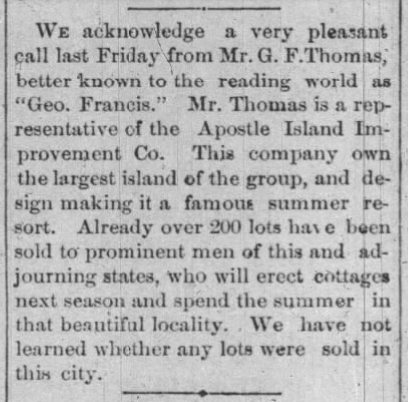
~ The Boscobel Dial
September 29, 1885.
Originally the intention was to form a syndicate to purchase the old town. An association of prominent citizens of Ashland and Bayfield, at one time came very near securing it, and the writer still has hopes of such an association some day controlling the historical spot. The scheme, however, has met with considerable opposition from a few who desire no changes to be made in the administration of affairs on the island. The principal opponent is Julius Austrian, of St. Paul, who still owns one-sixth part of La Pointe, and is expecting to get back another portion of lots, which have been sold for taxes and deeded by the county ever since 1874. He would like no doubt, to make Ashland county stand the taxes on the score of illegality. As a mark of affection for the place, he has lately removed the old warehouse which has stood so many years a prominent landmark in La Pointe’s most beautiful harbor. Tourists from every part of the world who have visited the old town will join in regretting the loss and despise the action.
G. F. T.
To be continued in King No More…
Diplomacy in the Time of Cholera: why there was no Ojibwe delegation to President Taylor in the winter of 1849-50
December 15, 2024
By Leo
At Chequamegon History, we deal mostly in the micro. By limiting our scope to a particular time and place, we are all about the narrow picture. Don’t come here for big universal ideas. The more specific and obscure a story, the more likely it is to appear on this website.
Madeline Island and the Chequamegon region are perfect for the specific and obscure. In the 1840s, most Americans would have thought of La Pointe as remote frontier wilderness, beyond the reach of worldwide events. Most of us still look at our history this way.
We are wrong. No man is an island, and Madeline Island–though literally an island–was no island.
This week, I was reminded of this fact while doing research for a project that has nothing to do with Chequamegon History. While scrolling through the death records of the Greek-Catholic church of my ancestral village in Poland, I noticed something strange. The causes of deaths are usually a mishmash of medieval sounding ailments, all written in Latin, or if the priest isn’t feeling creative or curious, the death is just listed as ordinaria.
In the summer of 1849, however, there was a noticeable uptick in death rate. It seemed my 19th-century cousins, from age 7 to 70, were all dying of the same thing:

Cause of death in right column. Akta stanu cywilnego Parafii Greckokatolickiej w Olchowcach (1840-1879). Księga zgonów dla miejscowości Olchowce. https://www.szukajwarchiwach.gov.pl/en/jednostka/-/jednostka/22431255
Cholera is a word people my age first learned on our Apple IIs back in elementary school:

At Herbster School in 1990, we pronounced it “Cho-lee-ra.” It was weird the first time someone said “Caller-uh.” You can play online at https://www.visitoregon.com/the-oregon-trail-game-online/
It is no coincidence. If you note the date of leaving Matt’s General Store in Independence Missouri, Oregon Trail takes place in 1848.
Diseases thrive in times of war, upheaval, famine, and migration, and 1848 and 1849 certainly had plenty of all of those. A third year of potato blight and oppressive British policies plunged the Irish poor deeper into squalor and starvation. The millions who were able to, left Ireland. Meanwhile, the British conquest of the Punjab and the “Springtime of Nations” democratic revolutions across central Europe meant army and refugee camps (notorious vectors of disease) popped up across the Eurasian continent.
North America had seen war as well. The Treaty of Guadalupe-Hidalgo (1848) ended the Mexican-American War and delivered half of Mexico over to Manifest Destiny. The discovery of gold in California, part of this cession, brought thousands of Chinese workers to the West Coast, while millions of Irish and Germans arrived on the East Coast. Some of those would also find their way west along the aforementioned Oregon Trail.
Closer to home, these German immigrants meant statehood for Wisconsin and the shifting of Wisconsin’s Indian administration west to Minnesota Territory. Eyeing profits, Minnesota and Mississippi River interests were increasingly calling for the removal of the Lake Superior Ojibwe bands from Wisconsin and Michigan. This caused great alarm and uncertainty at La Pointe.
All of these seemingly disparate events of 1848 and 1849 are, in fact, related. One of the most obvious manifestations was that displaced people from all these places impacted by war, poverty, and displacement carried cholera. The disease arrived in the United States multiple times, but the worst outbreak came up Mississippi from New Orleans in the summer of 1849. It ravaged St. Louis, then the Great Lakes, and reached Sault Ste, Marie and Lake Superior by August.
Longtime Chequamegon History readers will know my obsession with the Ojibwe delegation that left La Pointe in October 1848 and visited Washington D.C. in February 1849. It is a fascinating story of a group of chiefs who brought petitions (some pictographic) laying out their arguments against removal to President James K. Polk and Congress. The chiefs were well-received, but ultimately the substance of their petitions was not acted upon. They arrived after the 1848 elections. Polk and the members of Congress were lame ducks. General Zachary Taylor had been elected president, though he wasn’t inaugurated until the day after the delegation left Washington.
If you’ve read through our DOCUMENTS RELATED TO THE OJIBWE DELEGATION AND PETITIONS TO PRESIDENT POLK AND CONGRESS 1848-1849, you’ll know that both Polk and the Ojibwe delegation’s translator and alleged ringleader, the colorful Jean-Baptiste Martell of Sault Ste. Marie, died of cholera that summer.
So, in this post, we’re going to evaluate three new documents, just added to the collection, and look at how the cholera epidemic partially led to the disastrous removal of 1850, commonly known as the Sandy Lake Tragedy.
The first document is from just after the delegation’s arrival in Washington. It describes the meeting with Polk in great detail, lays out the Ojibwe grievances, and importantly, records Polk’s reaction. I have not been able to find the name of the correspondent, but this article is easily the best-reported of all the many, many newspaper accounts of the 1848-49 delegation–most of which use patronizing racist language and focus on the more trivial, “fish out of water” element of Lake Superior chiefs in the capital city.
New York Daily Tribune, 6 February 1849, Page 1
The Indians of the North-West–Their Wrongs–Chiefs in Washington
Correspondence of The Tribune
WASHINGTON, 3d Feb 1849.
Yesterday (Friday) the Chiefs representing the Chippewa Tribe of Indians located on the borders of Lake Superior and drawing their pay at La Pointe, representing 16 bands, which comprise about 9,000 Indians, after remaining here for the last ten days, were presented to the President.– The Secretary of War and Commissioner of Indian Affairs were also present. One of the Chiefs who appeared to be the eldest, first addressed the President, for a period of twenty minutes. The address was interpreted by John B. Martell, a half-breed, who was born and has always continued among them. He appears a shrewd, sensible man, and interprets with much fluency. This Chief was followed by two others in addresses occupying the same length of time. They all addressed the President as “Our Great Father,” and spoke with much energy, dignity and fluency, preserving throughout a respectful manner and evincing an earnest sincerity of purpose, that bespoke their mission to be one of no ordinary character. They represented their grievances under which their tribes were laboring: the trials and privations they had undergone to reach here, and the separation from their families, with much emotion and in truly touching and eloquent terms.
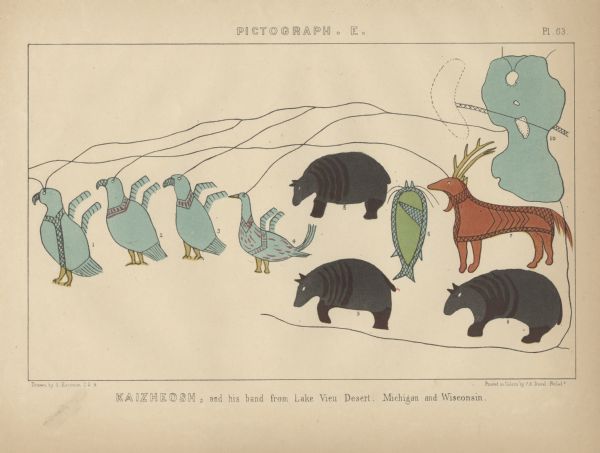
The oldest chief was Gezhiiyaash (his pictographic petition above) or “Swift Sailor” from Lac Vieux Desert. The two other chiefs were likely Oshkaabewis “Messenger” from Wisconsin River, and Naagaanab “Foremost Sitter” from Fond du Lac.
They represented that their annuities under their Treaty of La Pointe, made about the year 1843, were payable in the month of July in each year and not later, because by that time the planting season would be over; beside, it would be the best time and the least dangerous to pass the Great Lake and return to their homes in time to gather wild rice, on which they mainly depended during the hard winters. The first payment was made later than the time agreed upon. The agent, upon being notified, promised to comply with the terms of the Treaty, but every year since the payments have been made later, and that of last year did not take place until about the middle of October, in consequence of which they have been subjected to much suffering.– They assemble at the place for payment designated in the treaty. It is then the traders take advantage of them–being three hundred miles from home, without money, and without provisions; and when their money is received it must all be paid for their subsistence during the long delay they have been subjected to; and sickness frequently breaks out among them from being obliged to use salt provisions, which they are not accustomed to. By leaving their homes at any other time than in the month of July they neglect their harvesting–rice and potato crops, and if they neglect those they must starve to death; therefore it would be better for them to lose their annuities altogether. And without their blankets, procured at the Pointe, they are liable to freeze to death when passing the stormy lake; and the tradespeople influence the Agent to send for them a month before the payment is made, and when they arrive the Agent accepts orders from them for provisions which they are obliged to purchase at a great price–one dollar for 15 lbs of flour, and in proportion for other articles. They have assembled frequently in regard to these things, and can only conclude that their complaints have never reached their “Great Father,” and they have now come to see him in person, and take him by the hand.
In regard to the Half-Breeds at La Pointe, who draw pay with them, they say: That in the Treaty concluded between Governor Dodge and the Chippewas at St. Peters, provision was made for the half-breeds to draw their share all in one payment, and it was paid them accordingly, $258.50 each, which was a mere gift on the part of the tribe; a payment which they had no right to, but was given them as a present. Induced by some subsequent representations by the half-breeds, they were taken into their pay list, and the consequence has been that almost all the half breeds, as well as the French who are married to Indian women, are in the employ of, or dependent upon one of the principal trading houses, (Dr. Bourop’s) at La Pointe, with whom their goods and provisions are stored; and that they are thus enabled to select and appropriate to themselves the choice portion of all the goods designed for them–in many cases not leaving them a blanket to start with upon their journey of two or three hundred miles distant to their homes. After many other details, to which we will make reference in future articles, they urged that owing to the faithlessness of the half-breeds to them, and to the Government, that they be stricken from the pay list.
One half the goods furnished are of no use to them. The articles they most need are guns, kettles, blankets and a greater supply of provisions, &c.
They are under heavy expense, and no money to pay their board. They have undertaken this long journey for the benefit of their whole people, and at their earnest solicitations. They have been absent from their families nearly one year. It has cost them $1,400 to get here. Half of that sum has been raised from exhibitions. The other half has been borrowed from kind people on the route they have traveled. They wish to repay the money advanced them and to procure money to return home with. They want clothes and things to take to their families, and ask an appropriation of $6,000 on their annuity money.
They have before made a communication to the President, to be laid before the present Congress, for the acquisition of lands and the naturalization of their bands–propositions which they urged with great force.
All the Chiefs represented to the President that their interpreter, Mr. Martel, was living in very comfortable circumstances at home, and was induced to accompany them by the urgent solicitations of all their people who confided in his integrity and looked upon him as their friend.

The paternalistic ritual kinship (“Great Father”) language used here by James K. Polk, can be off-putting to the modern reader. However, it had a long tradition in Ojibwe “fur trade theater” rhetoric. Gezhiiyaash was no meek schoolboy, as evidenced by his words in this document (White House)
Their supplicating–though forcible, intelligent, and pathetic appeal, to be permitted to live upon the spot of their nativity, where the morning and noon of their days had been past, and the night time of their existence has reached them, was, too, and irresistible appeal to the justice, generosity and magnanimity of that boasted “civilization” that pleads mercy to the conquered, and was calculated to leave an impress upon every honest heart who claims to be a “freeman.”
The President, in answer to the several addresses, requested the interpreter to state to them that their Great Father was happy to have met with them; and as they had made allusion to written documents which they placed in his hands, as containing an expression of their views and wishes, he would carefully read them and communicate his answer to the Secretary of War and the Commissioner of Indian Affairs, assuring them of kindly feelings on the part of the Government, and terminating with some expressions very like a schoolmaster’s enjoinder upon his scholars that if they behaved themselves they might expect good treatment in future.
The fact that they met Polk was not new information, but we hadn’t been previously aware of just how long the meeting went. It is important to note the president’s use of “kindly feelings” and “behaved themselves.” Those phrases would come up frequently in subsequent years.
One could argue that Polk was a lame duck, and would be dead of cholera within a few months, so his words didn’t mean much. One could argue the problem was that the Ojibwe didn’t understand that in the American political system–that the incoming Whig administration might not feel bound by the words and “kindly feelings” of the outgoing Democratic administration.
However, the next document shows that the chiefs did feel the need to cover their bases and stuck around Washington long enough meet the next president. To us, at least, this was new information:
National Era v. III. No. 14, pg. 56 April 5, 1849
For the National Era
THE CHIPPEWA CHIEFS AND GENERAL TAYLOR
On the third day after the arrival of General Taylor at Washington, the Indian chiefs requested me to seek an interview for them, as they were about to leave for their homes, on Lake Superior, and greatly desired to see the new President before their departure.
It was accordingly arranged by the General to see them the next morning at 9 o’clock, before the usual reception hour.
Fitted out in their very best, with many items of finery which their taste for the imposing had added to their wardrobe, the delegation and their interpreter accompanied me to the reception room, and were cordially taken by the hand by the plain but benevolent-looking old General. One of the chiefs arose, and addressed the President elect nearly as follows:
“Father! We are glad to see you, and we are pleased to see you so well after your long journey.
“Father! We are the representatives of about twenty thousand of your red children, and are just about leaving for our homes, far off on Lake Superior, and we are very much gratified, that, before our departure, we have the opportunity of shaking hands with you.
“Father! You have conquered your country’s enemies in war; may you subdue the enemies of your Administration while you are President of the United States and govern this great country, like the great father, Washington, before you, with wisdom and in peace.
“Father! This our visit through the country and to the cities of your white children, and the wonderful things that we have seen, impress us with awe, and cause us to think that the white man is the favored of the Great Spirit.
“Father! In the midst of the great blessings with which you and your white children are favored of the Great Spirit, we ask of you, while you are in power, not to forget your less fortunate red children. They are now few, and scattered, and poor. You can help them.
“Father! Although a successful warrior, we have heard of your humanity! And now that we see you face to face, we are satisfied that you have a heart to feel for your poor red children.
“Father Farewell”
The tall, manly-looking chief having finished and shaken hands, General Taylor asked him to be seated, and, rising himself, replied nearly as follows”
“My Red Children: I am very happy to have this interview with you. What you have said I have listened to with interest. It is the more appreciated by me, as I am no stranger to your people. I resided for a length of time on your borders, and have been witness to your privations, and am acquainted with many of your wants.
“Peace must be established and maintained between yourselves and the neighboring tribes of the red men, and you need in the next place the means of subsistence.
“My Red Children: I thank you for your kind wishes for me personally, and as President of the United States.
“While I am in office, I shall use my influence to keep you at peace with the Sioux, between whom and the Chippewas there has always been a most deadly hostility, fatal to the prosperity of both nations. I shall also recommend that you be provided with the means of raising corn and the other necessaries of life.
“My Red Children: I hope that you have met with success in your present visit, and that you may return to your homes without an accident by the way; and I bid you say to your red brethren that I cordially wish them health and prosperity. Farewell.”
This interesting interview closed with a general shaking of hands and during the addresses, it is creditable to the parties to say, that the feelings were reached. Tears glistened in the eyes of the Indians and General Taylor evinced sufficient emotion, during the address of the chief, to show that he possesses a heart that may be touched. The old veteran was heard to remark, as the delegation left the room, “What fine looking men they are!”
Major Martell, the half-breed interpreter, acquitted himself handsomely throughout. The Indians came away declaring that “General Taylor talked very good.”
The General’s family and suite, evidently not prepared for the visit; were not dressed to receive company at so early an hour; nevertheless, they soon came in, en dishabille, and looked on with interest.
P.
One of the lingering questions I’ve had about the 1848-49 Delegation has been whether or not the Ojibwe leadership viewed it as a success. This document shows that the answer was unequivocally yes. It also shows why the chiefs felt so blindsided and disbelieving in the spring of 1850 when the government agents at La Pointe told them that Taylor had ordered them to remove. They didn’t have to go back to 1842 for the Government’s promises. They had heard them only a year earlier from both the president and the president-elect!
It also explains why during and after the removal, the chiefs number-one priority was sending another delegation. One would eventually go in 1852, led by Chief Buffalo of La Pointe. This would help secure the reservations sought by the first delegation, but that was only after two failed removal attempts and hundreds of deaths.
If the cholera epidemic had not come, Chief Buffalo and other prominent chiefs, would have likely gone back to Taylor in the winter of 1849-50. They may have been able to secure new treaty negotiations, reservations on the ceded territory, or at the very least have been more prepared for the upcoming removal:
George Johnston to Henry Schoolcraft, 5 October 1849, MS Papers of Henry Rowe Schoolcraft: General Correspondence, 1806-1864, BOX 51.
Saut Ste Maries
Oct 5th 1849
My Dear sir,
Your favor of Sep. 14th, I have just now received and will lose no time in answering. Since I wrote to you on the subject of an intended delegation of Chippewa Chiefs desiring to visit the seat of Govt., I visited Lapointe and remained there during the payment, and I had an opportunity of seeing & talking with the chiefs. They held a council with their agent Dr. Livermore and expressed their desire to visit Washington this season, and they laid the matter before him with open frankness, and Dr. Livermore answered them in the same strain, advising them at the same time, to relinquish their intended visit this year, as it would be dangerous for them, to travel in the midst of sickness which was so prevalent & so widely spread in the land, and that if they should still feel desirous to go on the following year that he would then permit them to do so, and that he would have no objections, this appearing so reasonable to the chiefs, that they assented to it.
I will write to the chiefs and express to them the subject of your letter, and direct them to address Mr. Babcock at Detroit.
You will herein find enclosed copy of Mr. Ballander’s letter to me, a gentleman of the Hon. Hudson’s Bay Co. & Chief factor at Fort Garry in the Red river region, it is very kind & his sympathy, devotes a feeling heart.– Mr. Mitchell of Green Bay to whom I have written in the early part of this summer, to make enquiries relative to certain reports of Tanner’s existence among the sioux, he has not as yet returned an answer to may communication and I feel the neglect with some degree of asperity which I cannot control.
Very Truly yours
Geo. Johnston
Henry R. Schoolcraft Esq.
Washington
It is hard to say how differently history may have turned out if a second delegation had been able to go with George Johnston. There is a good chance it would have been a lot more successful. Johnston was much more of an insider than Martell–who had had a lot of difficulty convincing the American authorities of his credentials. One of those who stood in Martell’s way was Henry Schoolcraft. Schoolcraft, was regarded by the American establishment as the foremost authority on Ojibwe affairs and was Johnston’s brother-in-law.
It may not have worked. The inertia of United States Indian Policy was still with removal. Any attempt to reverse Manifest Destiny and convince the government to cede land back to Indian nations east of the Mississippi was going to be an uphill battle. The Minnesota trade interests were strong.
Also, Schoolcraft was a Democrat, so he would have had less influence with the Whig Taylor–though agreements on Western issues sometimes crossed party lines. However, one can imagine George Johnston sitting around a table in Washington with his “Uncle” Buffalo, his brother-in-law Schoolcraft, and the U.S. President, working out the contours of a new treaty avoiding the removal entirely. Because of the cholera, however, we’ll never know.
For more on how the fallout from the Mexican War impacted Ojibwe removal, see Slavery, Debt Default, and the Sandy Lake Tragedy
For more on the 1848-49 Delegation, see: this post, this post, and this post
Memoirs of Doodooshaboo: Joseph Austrian at Eagle River 1854-1859
November 2, 2024
By Amorin Mello
This post is the seventh of our Memoirs of Doodooshaboo series reproducing the memoirs of Joseph Austrian at the Chicago History Museum. The previous post began in 1852 when the Leopold & Austrian family transferred Joseph from their La Pointe store to work at their other store in Eagle River on the Keweenaw Peninsula, and ended up spending the Winter of 1853 at the family headquarters in Cleveland to greet his mother and siblings upon their arrival immigrating from Bavaria.
This post begins in 1854 upon Joseph’s return from Cleveland to Eagle River to continue the family business at their new storefront, and provides insights into the growing pains of the pioneering copper mining companies on the Keweenaw Peninsula, Joseph somehow fails to mention much else about life on Lake Superior during 1854-1859.
1854-1859 were the boom and bust years of La Pointe County land speculation, which arose from the La Pointe Treaty of 1854 and Soo Locks of 1855, and crashed with the 1857 Financial Panic of 1857 and American Civil War of 1861. It is unfortunate how Joseph’s memoirs do not mention anything about his Leopold & Austrian family’s business at La Pointe during 1854-1859, when they were capitalizing on Chippewa Treaty Allotments in the Penokee Mountains to form the La Pointe Iron Company.
Some of that story can be told through other records in our Austrian Papers and upcoming posts on Chequamegon History. Until then, we’ll continue with Joseph’s memoirs.
Memoirs of Doodooshaboo
… continued from after La Pointe 1852-54.
Partner of Leopolds in Eagle River Store. 1854.
Louis Leopold & Babette Austrian;
Hannah Leopold & Julius Austrian.
On our arrival in Eagle River, May 1854, I found the work on the store had not been properly finished by the contractor, and I had my hands full to get the new store in shape quickly for business without unnecessary delay. Henry Leopold & wife (my sister Ida) occupied the apartment over the store and I boarded with them as soon as they started housekeeping, which as a matter of course was a great improvement over our former mode of living, and fresh meat was no longer scarce.

Sketch of the Cliff Mine, 1849.
~ The Cliff Mine Archeology Project Blog
The additional store now permitted us to add, various new departments in; grain, heavy provisions, hard ware, &c. We also opened up in connection with our business a meat market located at the Cliff Mine, managed by Henry F. Leopold with a branch at Eagle River. I took sole charge of the Eagle River business making the daily rounds to the Cliff and other near by mines, boarding houses and miners homes, soliciting orders. In the evenings I worked at the books, as I had no one to assist me in this work.
Sam went to Mackinaw to wind up the old business affairs of his brother Louis, then he went to New York and settled with his creditors. After this he went to Eagle River in the fall and we jointly attended to the business. He went to New York every season to buy goods, consisting of clothing, dry goods, boots & shoes & mens furnishing goods.
During the second winter of our settling at Eagle River, he went to Europe and became engaged to Babette Guttman, a cousin of mine, and the following winter he went to Europe again to be married and returned in the Spring with his wife. A Mr. Henry Guttman, Babette’s brother who had been interested with us in the meat market at the Cliff Mine assisted me in our store during Sam’s absence.
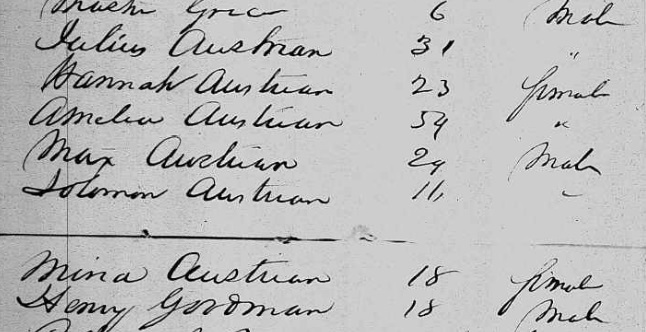
Henry Guttman (Goodman) immigrated with the Austrians.
~ 17 October 1853 passenger manifest of the steamer Atlantic.
Business Increases.
Later on I found it necessary to engage a book keeper owing to the rapid growth of our business, and for that purpose I engaged a Mr. Moses Hanauer, a son of the teacher in the native place of the Leopolds.
I made it my duty to solicit orders and deliver goods, and went the rounds in a delivery wagon daily, soliciting new orders. Of course I had a hostler to attend to the horses & wagons and who assisted in loading the goods. By the next year our store had again become too small and I contracted for a new wing to be added, which made a great improvement and gave us better facilities for carrying on our business.
Phoenix Mining Company’s Drafts Protested.
By an arrangement with the Phoenix Mining Co. we agreed to attend to the payment of their miners, taking the drafts of the Company’s agent in Boston in settlement each month. We did this on account of the business which came to us through it.

~ The Mining Magazine: Devoted to Mines, Mining Operations, Metallurgy, &c., &c., Volume 2, 1854, pg. 404.
After this thing had gone on for some time, the several drafts had amounted to a big sum, and unexpectedly to our consternation the drafts came back protested.
We had quite a struggle and wrangle trying to get them to make good their drafts. Finally Sam Leopold went to Boston and proposed that we would take the mine in payment of their debt if they though it was not worth the protested drafts. This proposition brought them to their senses and they made immediate arrangements then for funds by calling an assessment on the Stockholders to satisfy our claim.
The success we had met with in the Eagle River business in course of years gave us sufficient capital for new enterprises.
To be continued on the Keweenaw Range 1860-1864…
When we die, we will lay our bones at La Pointe.
March 20, 2024
By Leo
From individual historical documents, it can be hard to sequence or make sense of the efforts of the United States to remove the Lake Superior Ojibwe from ceded territories of Wisconsin and Upper Michigan in the years 1850 and 1851. Most of us correctly understand that the Sandy Lake Tragedy was caused an alliance of government and trading interests. Through greed, deception, racism, and callous disregard for human life, government officials bungled the treaty payment at Sandy Lake on the Mississippi River in the fall and winter of 1850-51, leading to hundreds of deaths. We also know that in the spring of 1852, Chief Buffalo and a delegation of La Pointe Ojibwe chiefs travelled to Washington D.C. to oppose the removal. It is what happened before and between those events, in the summers of 1850 and 1851, where things get muddled.

Confusion arises because the individual documents can contradict our narrative. A particular trader, who we might want to think is one of the villains, might express an anti-removal view. A government agent, who we might wish to assign malicious intent, instead shows merely incompetence. We find a quote or letter that seems to explain the plans and sentiments leading to the disaster at Sandy Lake, but then we find the quote is dated after the deaths had already occurred.
Therefore, we are fortunate to have the following letter, written in November of 1851, which concisely summarizes the events up to that point. We are even more fortunate that the letter is written by chiefs, themselves. It is from the Office of Indian Affairs archives, but I found a copy in the Theresa Schenck papers. It is not unknown to Lake Superior scholarship, but to my knowledge it has not been reproduced in full.
The context is that Chief Buffalo, most (but not all) of the La Pointe chiefs, and some of their allies from Ontonagon, L’Anse, Upper St. Croix Lake, Chippewa River and St. Croix River, have returned to La Pointe. They have abandoned the pay ground at Fond du Lac in November 1851, and returned to La Pointe. This came after getting confirmation that the Indian Agent, John S. Watrous, has been telling a series of lies in order to force a second Sandy Lake removal–just one year removed from the tragedy. This letter attempts to get official sanction for a delegation of La Pointe chiefs to visit Washington. The official sanction never came, but the chiefs went anyway, and the rest is history.
La Pointe, Lake Superior, Nov. 6./51
To the Hon Luke Lea
Commissioner of Indian Affairs Washington D.C.
Our Father,
We send you our salutations and wish you to listen to our words. We the Chiefs and head men of the Chippeway Tribe of Indians feel ourselves aggrieved and wronged by the conduct of the U.S. Agent John S. Watrous and his advisors now among us. He has used great deception towards us, in carrying out the wishes of our Great Father, in respect to our removal. We have ever been ready to listen to the words of our Great Father whenever he has spoken to us, and to accede to his wishes. But this time, in the matter of our removal, we are in the dark. We are not satisfied that it is the President that requires us to remove. We have asked to see the order, and the name of the President affixed to it, but it has not been shewn us. We think the order comes only from the Agent and those who advise with him, and are interested in having us remove.
Kicheueshki. Chief. X his mark
Gejiguaio X “
Kishkitauʋg X “
Misai X “
Aitauigizhik X “
Kabimabi X “
Oshoge, Chief X “
Oshkinaue, Chief X “
Medueguon X “
Makudeua-kuʋt X “
Na-nʋ-ʋ-e-be, Chief X “
Ka-ka-ge X “
Kui ui sens X “
Ma-dag ʋmi, Chief X “
Ua-bi-shins X “
E-na-nʋ-kuʋk X “
Ai-a-bens, Chief X “
Kue-kue-Kʋb X “
Sa-gun-a-shins X “
Ji-bi-ne-she, Chief X “
Ke-ui-mi-i-ue X “
Okʋndikʋn, Chief X “
Ang ua sʋg X “
Asinise, Chief X “
Kebeuasadʋn X “
Metakusige X “
Kuiuisensish, Chief X “
Atuia X “
Gete-kitigani[inini? manuscript torn]
L. H. Wheeler
We the undersigned, certify, on honor, that the above document was shown to us by the Buffalo, Chief of the Lapointe band of Chippeway Indians and that we believe, without implying and opinion respecting the subjects of complaint contained in it, that it was dictated by, and contains the sentiments of those whose signatures are affixed to it.
S. Hall
C. Pulsifer
H. Blatchford
When I started Chequamegon History in 2013, the WordPress engine made it easy to integrate their features with some light HTML coding. In recent years, they have made this nearly impossible. At some point, we’ll have to decide whether to get better at coding or overhaul our signature “blue rectangle” design format. For now, though, I can’t get links or images into the blue rectangles like I used to, so I will have to list them out here:
Joseph Austrian’s description of the same
Boutwell’s acknowledgement of the suspension of the removal order, and his intent to proceed anyway
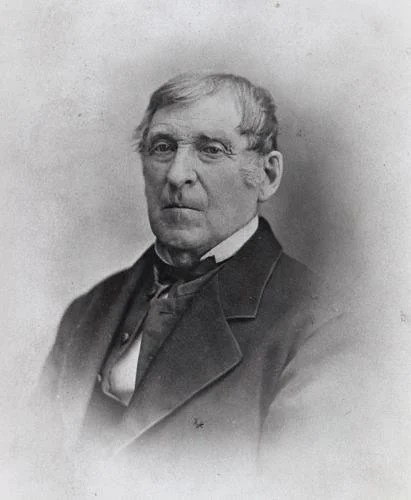
Chequamegon History has looked into the “Great Father” fur trade theater language of ritual kinship before in our look at Blackbird’s speech at the 1855 Payment. You may have noticed Makadebines (Blackbird) didn’t sign this letter. He was working on a different plant to resist removal. Look for a related post soon.
If you’re really interested in why the president was Gichi-noos (Great Father), read these books:

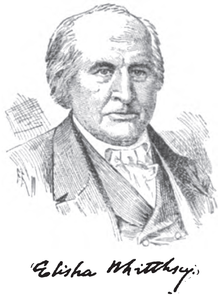
Watrous, and many of the Americans who came to the Lake Superior country at this time, were from northeastern Ohio. Watrous was able to obtain and keep his position as agent because his family was connected to Elisha Whittlesey.
In the summer and fall of 1851, Watrous was determined to get soldiers to help him force the removal. However, by that point, Washington was leaning toward letting the Lake Bands stay in Wisconsin and Michigan.
Last spring, during one of the several debt showdowns in Congress, I wrote on how similar antics in Washington contributed to the disaster of 1850. My earliest and best understanding of the 1850-1852 timeline, and the players involved, comes from this book:

We know that Kishkitauʋg (Cut Ear), and Oshoge (Heron) went to Washington with Buffalo in 1852. Benjamin Armstrong’s account is the most famous, but the delegation’s other interpreter, Vincent Roy Jr., also left his memories, which differ slightly in the details.

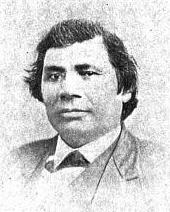
One of my first posts on the blog involved some Sandy Lake material in the Wheeler Family Papers, written by Sherman Hall. Since then, having seen many more of their letters, I would change some of the initial conclusions. However, I still see Hall as having committing a great sin of omission for not opposing the removal earlier. Even with the disclaimer, however, I have to give him credit for signing his name to the letter this post is about. Although they shared the common goal of destroying Ojibwe culture and religion and replacing it with American evangelical Protestantism, he A.B.C.F.M. mission community was made up of men and women with very different personalities. Their internal disputes were bizarre and fascinating.
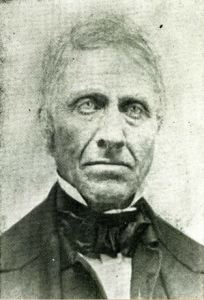

Edwin Ellis Incidents: Number VIII
February 11, 2024
Collected & edited by Amorin Mello

Originally published in the September 1st, 1877, issue of The Ashland Press.
Transcribed with permission from Ashland Narratives by K. Wallin and published in 2013 by Straddle Creek Co.
… continued from Number VII.
My Dear Press: – Among the early names associated with Ashland, I must not omit to mention a few others.
1. E. F. Prince


came to Ashland early in 1857. He was brother-in-law to Martin Beaser and was induced by him to come from Buffalo to this place. He had been employed as clerk in a large ship building establishment, and when he left the employees of the yard showed their regard for him by presenting to him an elaborate and valuable set of silver service. He erected, in the same year, the house in which he now lives, on Main Street, in Beaser’s Division. From 1861 to 1872, he resided in Ontonagon and Duluth, but upon the commencement of work on the W.C.R.R., at Ashland, he returned to his old home, where he now resides.
Though still young and vigorous, he is entitled to be reckoned as one of the “Old Folk” of Ashland.
2. Oliver St. Germain
came to this place in 1856, and built a home on Main Street, adjoining Mr. Prince’s place. The house, with all its contents, was burnt down in the spring of 1858, inflicting a heavy loss upon Mr. St. Germain. He pre-empted a quarter section of land adjoining the town site, and cleared about twenty acres in 1858. The railroad passes through this clearing about a mile from town.
In the general wreck which followed the crash of 1857, he was compelled to abandon his Ashland home, and for some fifteen years lived at Ontonagon, Carp Lake, and Superior City. In 1872 he returned to his early home, and was among the first to build a house in Vaughn’s Division, in which he now resides. Though like the rest of us, he has encountered hard times, still, in the midst of discouragements, he is ever cheerful and hopeful, and determined never to give up, as long as a plank is left in the ship.
3.
I approach with reluctance another name, for I am conscious of my inability to do justice to his memory; nor fairly exhibit to this generation, his manly social, and religious character; nor make clear, in its true extent, the important part he acted in moulding and elevating the society, not of Ashland alone, but of the Counties of Ashland and Bayfield. In the annals of that History recorded by God himself, upon the tablets of Eternity, I doubt not his name will eclipse in true greatness and glory, those of Caesar and Napoleon.
I allude to
Rev. Hemenway Wheeler.

Reverend Leonard Hemenway Wheeler of the ABCFM Mission.
He was a native of Vermont, educated at Middlebury College, and at Andover Theological Seminary.

Reverend Sherman Hall of the ABCFM Mission.
~ Madeline Island Museum

Bishop Frederick Baraga of the Catholic Mission.
~ Madeline Island Museum
At the time of the completion of his course in theology, he had nearly decided to devote his life to the foreign mission field, in which he had near relatives. At this juncture, his attention was directed to the condition of the Chippewa Indians on Lake Superior. He offered his services to the American Board of Foreign Missions, who, besides the foreign work, had charge of the missions among the American Indians. His offer was accepted, and he was directed to join the Mission at La Pointe, then one of the stations of the Board, under the care of Rev. Sherman Hall, who still survives, at a very advanced age, at Sauk Rapids, in the state of Minnesota. Mr. Wheeler, in the early part of 1841, was married to Miss Harriet Wood, of Lowell, Mass., a refined and cultivated young lady, who, like her husband, was thoroughly imbued with the spirit of missions, and with true heroism, she left her cultivated home, and society, and went into what seemed banishment from civilization. We of this day, with our numerous steamboats, from Chicago, Detroit, Cleveland and Buffalo, – with the iron horse, drinking the waters of the lake at our very doors, and with the streams of commerce, and of social life sweeping by and among us in a constant flow, can have no idea of what it involved to come here for a life work, forty years ago.
At that time, there was a small settlement at the Sault. The site of the present beautiful and substantial city of Marquette was Indian hunting grounds. L’Anse, Houghton, Hancock, Calumet, Eagle harbor, Eagle River, Ontonagon, Ashland, Bayfield, Superior and Duluth were then in the unknown future. La Pointe was at that time the most important town on the Great Lakes. It had, in the 17th century, attracted the notice of the French explorers, and of the Jesuit missionaries, who made choice of it, as a trading post and as a mission station. The mission had been continued for near two centuries, and the trading post still held, though now under another race of men, was now the headquarters of the American Fur Company, where a factor resided, and where great warehouses were erected for the reception of the vast supplies of goods to be used in the Indian trade, which were brought once a year in the company’s vessel. From La Pointe these goods were distributed to various trading posts, scattered around the basin of Lake Superior, for more than four hundred miles, and extending inland indefinitely. Among these posts may be mentioned L’Anse and Iron River, in Michigan; Lake Flambeau, Montreal River, Lac Court Oreille, and St. Croix, in Wisconsin; Fond du Lac, Grand Portage, Vermillion Lake and Crow Wing, in the Territory of Minnesota, thus embracing the largest part of the waters flowing into the gulf.

View of La Pointe, circa 1843.
“American Fur Company with both Mission churches. Sketch purportedly by a Native American youth. Probably an overpainted photographic copy enlargement. Paper on a canvas stretcher.”
~ Wisconsin Historical Society
La Pointe was the emporium, the metropolitan city of this vast extent of country. It was the Mecca of the Ojibwas, occupying the extensive country I have named. To reach La Pointe and be buried there, was to be close to the gate of entrance to the “happy hunting grounds.” It was to him the “sweet Island of the blest.” With joy he hailed its sight, as he emerged from the forests in which months had been spent, gathering his pack of furs; and with regret he turned his lingering look upon it, as he again plunged into the wild wastes for his solitary hunt of half a year.

“Boardwalk leading to St. Joseph’s Catholic Church in La Pointe.” Photograph by Whitney & Zimmerman, circa 1870.
~ Wisconsin Historical Society
It was the scene of some of the most important treaties made with the Chippewas of the Northwest, by which they ceded to the United States, lands in extent sufficient to form respectable states. It was also the gathering place where the annual Indian payments were made for many years, and where the native chiefs, with their braves, delighted to hold their great councils.
Fifty years ago, no other place in this part of the West afforded access to so large a number of natives as did La Pointe. The truths made known to these “untutored minds,” and the light flashed into their dark understandings, by the preaching of the simple story of the Cross, could soon be carried to the head waters of the Mississippi, or to the dwellers on the tributaries of Hudson’s Bay, or of the Arctic Ocean. As a central point for carrying on this work of benevolence and love, it was unsurpassed.

Undated photograph of Hall & Wheeler’s ABCFM Mission Church at it’s original location on Sandy Bay (Middleport) before it was moved uphill onto Mission Hill.
~ Madeline Island Museum
It was the consideration of these facts that induced the American Board to establish a mission station at La Pointe, and to send thither for this purpose, about fifty years ago, the Rev. Sherman Hall. He had successfully planted the mission, and established a school at the time of the arrival of Mr. Wheeler.
Mr. Wheeler immediately entered actively upon his life work devoting himself to learning the Ojibwa language, and preaching by means of an interpreter, teaching in the school, and striving, in every way, to promote the spiritual and material welfare of the people.
 Chequamegon History