Tyler’s Fork Location: Copper Lands
March 19, 2016
By Amorin Mello

“Map and Section Showing the Formations at the Junction of Bad River and Tylers Fork” by R. D. Irving, 1873. Reproduced from the Geology of Wisconsin: Volume III.
LETTER OF J. A. BAILEY, ESQ.,
IN REFERENCE TO THE
TYLER’S FORK PROPERTY.
———–
Office of Ashland Copper Mining Company,
Ashland County, Wis., Oct. 20, 1864.
Messrs. A. Whittlesey F. W. Bartlett,
Gentlemen:
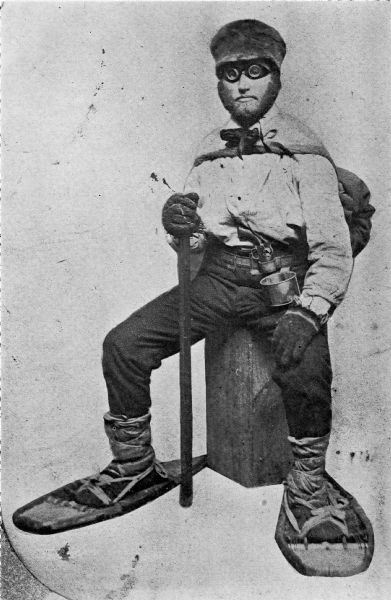
“Asaph Whittlesey dressed for his journey from Ashland to Madison, Wisconsin, to take up his seat in the state legislature. Whittlesey is attired for the long trek in winter gear including goggles, a walking staff, and snowshoes.” Circa 1860.
~ Wisconsin Historical Society
I have made an examination of the trap beds exposed between this and your location, upon the Copper Range, in Sections 15, 16 and 21, Town 45, North, Range 2, West, in this County, and have collected specimens (which are herewith forwarded) from the Ashland Company’s location, and from various points Eastward to your location.
The accompanying sketch of the territory referred to will assist you in locating the several points from which these specimens were taken, the figures upon the sketch indicating the points referred to.

Detail of the Ashland Copper Mine from 1873; located around what is now the main picnic area within Copper Falls State Park.
The specimens No. 1, are from the rocks in place in the bed of the West branch of Bad River, above the falls, near shaft No. 1, and contain a good per centage of native Copper. The copper bearing belt, exposed here across the formation, embraces a breadth of about 500 feet.
Specimens No. 2, are vein rock, from the transverse vein, in which our shaft No. 1 is being sunk. This shaft is now 35 feet deep, carrying small quantities of fine Copper all the way.
Specimens No. 3, are from the outcrop of the Herbert vein, near the junction of the East and West branches of Bad River, containing “gray ore,” or “gray sulphuret of copper.”
Specimens Nos. 4, 5 and 6 are of trap, taken from the rock in place, along Tyler’s Fork, at the points indicated on the sketch of corresponding numbers.
My explorations and survey have been extended only to a short distance East of the Section line dividing Sections 16 and 17.
The surveys have been carefully made with theodolite and chain, with the view to determine the true course of the copper bearing belt through the “Ashland Company’s” property, and that adjoining on the East; and as near as I can determine from the measurements and the character of the rocks exposed, the course of this belt is East and West, or nearly so, through Section 17, with indications of a curve to the Northward, as we approach to, and enter Section 16.
I have indicated on the sketch the position of what I consider the North line of the outcrop of the copper bearing belt. The South line is not determined, the rocks being covered by drift, sand, &c.
It will be proper for me to add that the productive trap formation, found in place above the falls, in the West branch, corresponds fully with the formation at the same elevation in Tyler’s Fork, on the Western boundary of Section 16; and I am clearly of the opinion that at that point the trap formation, when penetrated to a depth corresponding to that at the falls of the West branch, will be alike productive of copper, and that the most productive veins will be found running parallel with the formation.
Very respectfully, Yours, &c.,
J. A. BAILEY,
Supt. & Engineer A. C. M. Co.
—————-
A letter from Mr. E. Leehy, of Bad River Falls, dated Jan’y 6, 1865, states that in shaft No. 2, on the Ashland mine, several hundred feet South of No. 1, and in the productive belt, the copper rock was reached at 20 feet in depth, and the first blast threw out several pounds of native copper in pieces from the size of an egg down.

“Property on which ‘Silver Lead’ has recently been discovered.”
TYLER’S FORK LOCATION.
——-~~0~~——-
COPPER LANDS,
IN
SECTIONS 15 16 AND 21, TOWN 45, NORTH, RANGE 2, WEST.
640 ACRES.
ASHLAND COUNTY, WISCONSIN.

Detail of Township 45 North, Range 2 West, from Charles Whittlesey’s 1860 Geological Map of the Penokie Range.
This location covers a great part, if not all of the breadth of the productive trap formation. The outcrop of the strata is here nearly East and West, with a curve to the North-Eastward on or near this land. The greatest length of the location is North and South, and therefore crosses the formation nearly at right angles. At the Northern end, is the conglomerate and sand rock, which overlies the trap beds. These beds are better exposed at the West, in Section 17, on the Ashland Copper Company’s land, where they are now working and whatever developments may be made there will apply to this property. The strata have a sharp dip to the North, and are thus exposed at the edges, being nearly vertical. Next below, and South of the conglomerate, is a band of black and red trap, of a compact and rather flinty structure, about three hundred (300) feet thick, in which there are numerous transverse veins, cutting the strata at various angles. These are visible in a deep gulf formed on both forks of Bad River, that unite in Section 17. Somme of these cross veins carry copper, both native and as an ore in the form of grey sulphuret. They also carry as vein matter, chlorite, cale, spar, and flucan, or red and green magnesian clay. There are also narrow beds of trap, interstratified with the hard ores, which are softer, owing to a large portion of laumonite. I do not regard the true veins in the upper beds, as likely to furnish mining ground; but as highly valuable indications, which are to be followed into the more promising strata lower down in the system. Next below the hard beds, to the South, is a belt of trap rocks, whose composition and texture I regard as highly favorable.
The Ashland Company is sinking on a cross or transverse vein, at the Southern border of the hard beds; which in the course of 75 or 100 feet along their inclined shaft, will enter what I consider productive ground. The thickness of this ground is not determined, but what I have seen in the branches of the river exceeds half a mile. It is not, however, all alike, as there are in it layers possessing different characters, corresponding in this respect other parts of the trap range in Michigan and Wisconsin.
The stratum at the head of the falls, on the West fork, where the Ashland Company is at work, has been closely examined over a breadth of about 50 feet, and carries small pieces or nuggets of native copper throughout. It is a soft brown amyglaloid, which small bunches of chlorite, spar and laumonite; some prehnite and quartz, in which the copper is found. Lumps weighing one to two pounds have been obtained from this bed away from any appearances of a vein. This is the general character of the mineral belt on Section 17, which I consider as the true mining ground of this part of the range. All these beds are embraced in our location, at a distance of ¼ to ⅓ of a mile on the East. In Sections 16 and 21, the exposure of rock is not as extensive as it is upon 17, for the rocks are covered by drift clay, sand and gravel, except in the streams.
There is no canoe navigation on Tyler’s Fork, or the Upper Bad River, so swift is the current and narrow and crooked are the channels.
Tyler’s Fork comes out of the mountains about twelve miles southeast by south from Woods’s [at Leihy’s Saw Mill], in a chasm, two hundred feet deep deep, in the red sand-rock and conglomerate. The junction of its ten branches takes place in this narrow gulf or ‘cañon,’ the eastern branch making a plunge of forty-two feet, succeeded, as you ascend, by a series of chutes over trap-rocks forty feet in one-fourth of a mile. Mr. D. Tyler, of the Charter Oak Company, made a location here, and built a rude cabin at the edge of the falls.”
Geological Report on That Portion of Wisconsin Bordering on the South Shore of Lake Superior. Surveyed in the Year 1849, Under the Direction of David Dale Owen, United States Geologist, by Charles Whittlesey, Head of Sub-Corps, page 433.
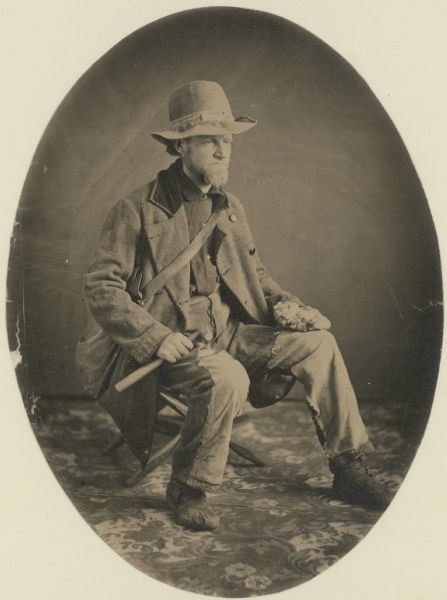
“Studio portrait of geologist Charles Whittlesey dressed for a field trip.” Circa 1858.
~ Wisconsin Historical Society
The East, or “Tyler’s” Fork, shows the trap beds in its channel a large part of the way through Section 16; and they are visible in the small creek that empties into it on Section 21, from the South. To examine the metal-bearing bed, of which I have spoken, after it reaches this location, the rocks must be uncovered by trenches or shafts in the sand and gravel, after having determined the true course of the bed. The search for cross veins can be easily made in the channel of Tyler’s Fork. This is a stream of considerable value for water power, the fall in your property being sufficient for two dams, and the flow of water sufficient for a saw mill. The Exploration of the porous laumonite beds, will be somewhat tedious; but the close proximity to those on the Ashland Company’s property will be of great assistance. As soon as it is demonstrated that these deposits of fine and nugget copper are remunerative at one point on the range, it gives new value to the whole system. Copper deposited in this mode, in other mining districts, has been found to be more uniform over long distances, than it is in veins; because these ores are liable to pass out of the property formations, and into a diabase rock. These copper-bearing longitudinal courses should therefore be most thoroughly searched. In this region, stamp mills can be worked in most cases by water power; a heavy and regular bed can be stoped and broken up ready for the mill, at a much cheaper rate per fathom, than vein matter. The improved stamps, crushers and washers, have of late years much reduced the expence of working mineral-bearing rock. The absence of masses of native copper in the Ashland district, is not now so important as it was when the first explorers made their location here. On this property, the length of the copper-bearing beds is something over a mile, and their breadth at least half a mile. As they extend to a greater depth than any mine can be worked, there is no fear of exhaustion.
CHAS. WHITTLESEY
Geologist and Mining Engineer.
Cleveland, Ohio, Jan. 1st, 1865.
Barber Papers: “Houghton” Fall of 1857
February 17, 2016
By Amorin Mello
Selected letters of the Joel Allen Barber Papers
… continued from the Summer of 1857.
Sandusky Oct 24th 1857
Dear Son
At length your father and I have both reached this place but how soon we shall be able to leave it is uncertain. He arrived here last Monday night in a most miserable state. I did not get here ’till Wednesday morning when I found him much worse than I had supposed he had been, and I believe worse than he had been at any time with his lameness. He probably exerted himself too much and produced a relapse of his fever and swelling of the limbs.
He got to Detroit Thursday at night – when he got ashore he found his carpet sack was missing – he being to sick to bring it off himself. Friday morning he sent round to the hotels to look for it but got no trace and concluded to go without it – but found he was a few minutes too late for the boat. Saturday morning he went down to the wharf, then the driver pretended, or was told, that the boat would not come and go that morning but at 4 P.M. so he was carried back the house again and paid the scamp 50 cts. Soon after he saw a bill posted saying the “Bay City” would leave that day at 7 oclock but before he could get to it, they told him it was gone so he was obligated to remain over till Monday.

Michigan Exchange Hotel in Detroit, circa 1884.
~ Burton Historical Collection.
He put up at the Michigan Exchange where he was on the second floor and had to climb stairs until his limb became very lame and considerably swollen the whole length. He had some fever and no appetite all the way after leaving La P. and probably when he started. The day after he got here Hamilton procured a Homeopathic Physician who has called to “treat” him every day since. He had intermitent fever all the time. Broke a fever every afternoon and night till yesterday and today, when it seems to be leaving him – his appetite is returning. I think tho he is very weak and can bear but very little food and the of the simplest kind. The Dr thinks he will get up soon if he can get the pain out of his limbs, but that will probably take some time to conquer. Says it is probably a rheumatic affliction and might have been produced by taking Quinine. But he is decidedly better now than three days since – in all respects I believe that had he called an Alopathic Dr, he would surely had a Typhoid fever, but if he is quiet and patient I think he will escape this time. But I fear it will take a long time for him to recover sufficiently to go home in cold weather. He had set up a little the last three days but cannot get off nor on the bed without help, and cannot walk without great paid to his limbs – indeed, he has not walked a step since Wednesday. It has certainly been a very unfortunate season with him and with us all, but I must consider it very fortunate that he has fallen in to so good a place to be be sick, and is in the care of an experienced Homeopathist, who I believe will cure him.
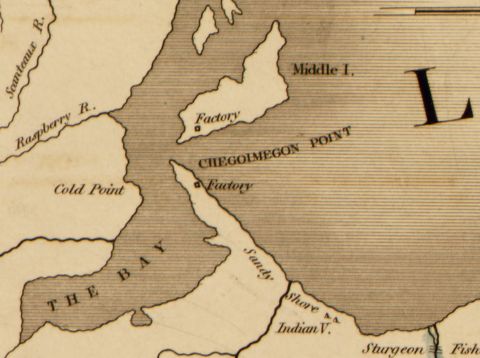
Houghton Point aka “Cold Point”,“Stony Pointe” , and “Point Prospect”.
~ Detail of Map of Michigan & Part of Wisconsin Territory, Exhibiting the Post Offices, Post Roads, Canals, Rail Roads, &c from the 1839 Burr Atlas of Postal Maps.
It is very strange you did not receive any letters from me before father came away as I had sent, certainly three – some of which you may have got before now. And I got but two short letters from you and none from your father after you left me. He wrote to Mr Burr when first taken sick and I heard nothing more from him untill one reached us of Oct 3d saying he wished me to meet him at Sandusky as he was too sick to get to L. Of course, I suffered a good deal of anxiety to know what had become of him and how I was to get home alone – supposing he had gone home without sending me word – I had been so long waiting to hear from him that I had concluded to start in company with Miss Julia Hyde, when I rec’d his letter.

Detail of early settlements and footpaths near Houghton Point from the Barber brothers’ 1855 survey of Chequamegon Bay. Giles and Allen lived with the Maddocks family during 1856 and 1857 at what is now the Houghton Falls State Natural Area.
I had promised a visit to Mrs. Baker at Janesville, so not knowing how soon he would be here, or that he was much ill then, I concluded to stop there and I started Thursday morning from L – and spent three days at Ja – left there Monday at Midnight – that being the express train expecting to get here the next eve but did not till Wed Morning 4O.C.. There being but no train each day from Toledo to this place. I got along very well alone – without losing any thing of consequence. I am afraid that carpet-sack of father’s will never be found tho. Uncle H has written to some one who was on the boat – whom he knows and perhaps it may come again. If not it will be one more loss added to the many we have suffered within two years. When the tide of misfortune will turn with us is yet in the anxious and uncertain future. I yet hope our lives will all be spared to meet again. When I left Lancaster many people were having a sort of influence which they called “colds”. Grandpa – Thode Burr and Mary B. had it and since reaching here Martha has sent a letter saying that Addison – Mame. Lil and Em. in her house – Mother and Lucy – Lib and the two youngest children, and Mary Parker – and Father at Allen’s, Mr. Phelp’s son quite sick; and about half the people in town had the disease. I had the good luck to escape it entirely, tho’ I rode to Boscobel in the stage the worst day there has been this fall. I am afraid we shall not be able to go home without exposing father so much that he will be very sick. I am sure he cannot recover sufficiently to start with safety in less than four weeks if he has very good luck and no relapse on account of the season. But if good nursing & good medicine can cure him he will be well before winter.
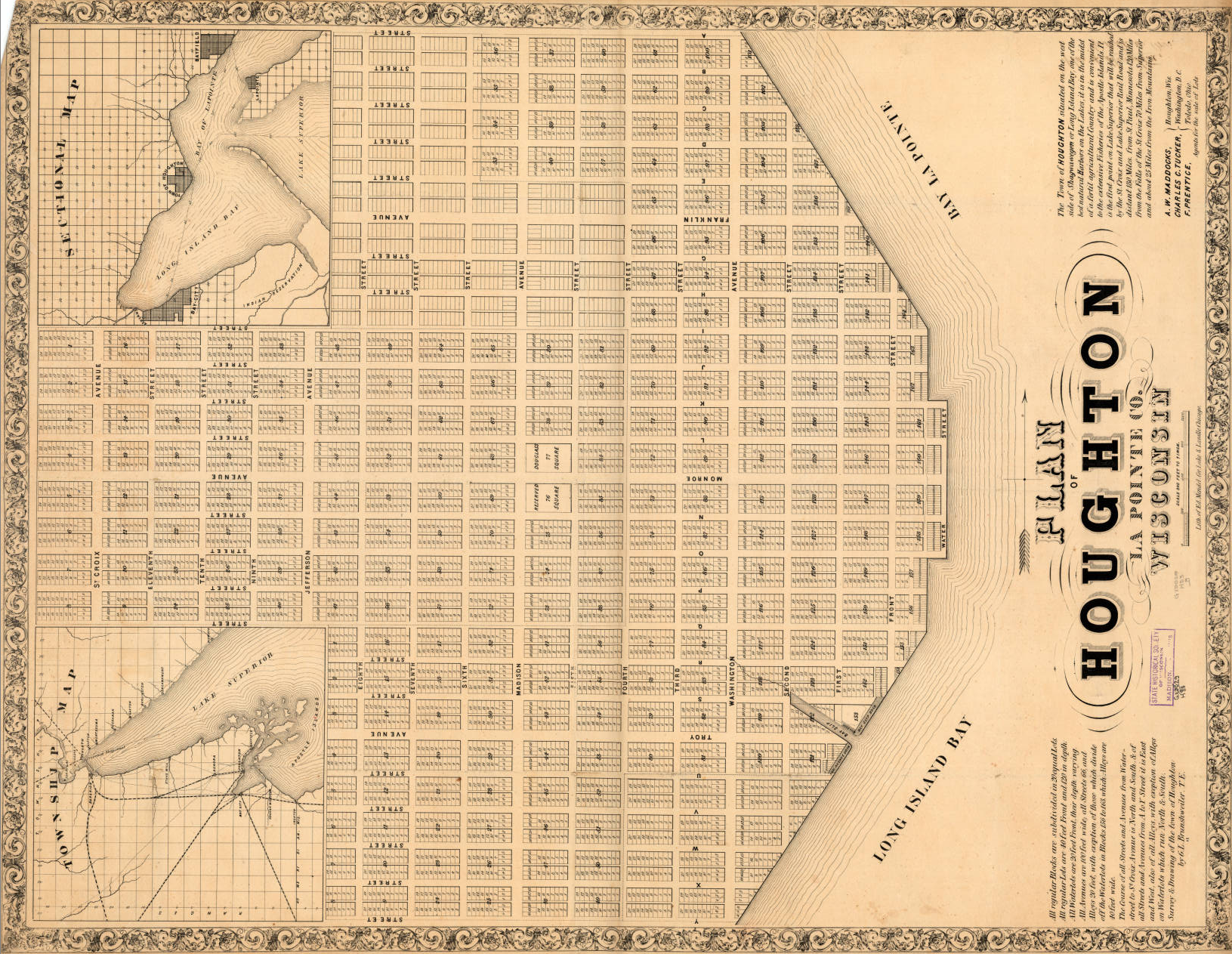
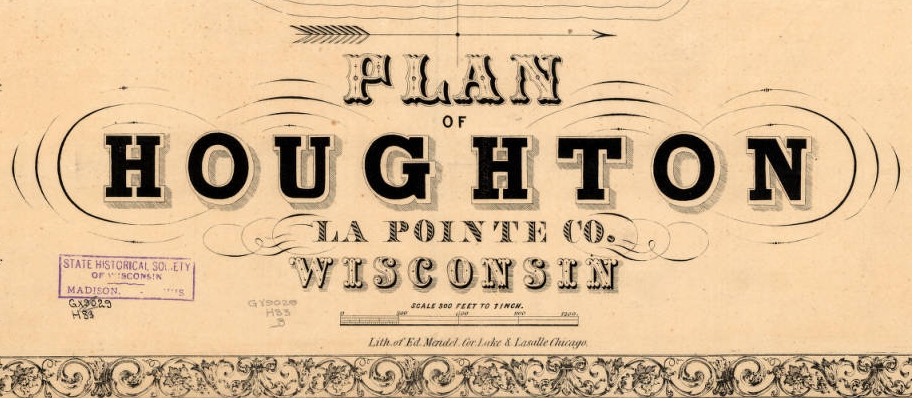
Plan of Houghton, La Pointe County, Wisconsin, 1858.
~ Wisconsin Historical Society
Aunt Emeline is absent, with Frank at Columbus, but the rest of the family are here and show us every kindness. This is a most delightful – comfortable and convenient place to be sick in, if one must be sick. How I wish I could think of our house as possessing half the attractions for a family residence that this does. But, poor as it is I should be very glad to see it once more and be where I could call it home.
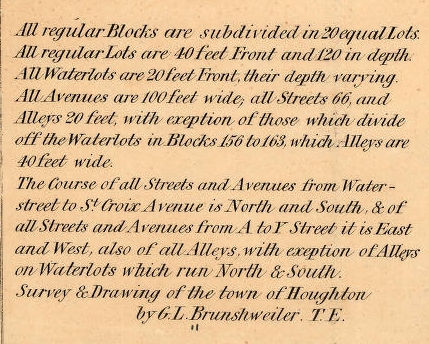
“Survey & Drawing of the town of Houghton
by G. L. Brunschweiler, T.E.”
I am sorry to hear that you have had to wait so long for your money – consequently could not go on with your work. I do hope you will not try to stay there through the winter unless you are sure of money, and that there will be plenty of provisions to be got at. What could have been the reason that your money did not come to you? I did not know that Uncle Sam has suspended payment or lost by the failure of the banks. Perhaps you did not keep reminding them of your case or give them your “address”.
You must write oftener to me and give me an account of your affairs – of all your pleasures and your pains – your disappointments and vexations and be assured no one can feel a deeper interest or more truely sympathize in all that concerns her you than your affectionate parents.
G. A. Barber and M. G. Barber
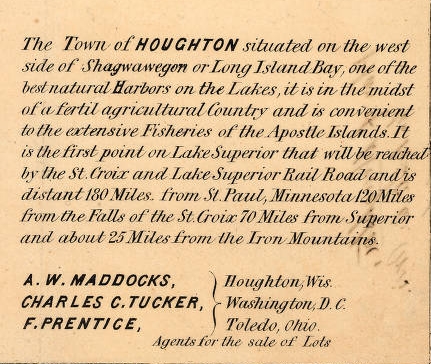
“A. W. Maddocks – Houghton, Wis.
Charles C. Tucker – Washington, D.C.
F. Prentice – Toledo, Ohio.”
Your father wishes you to say to Mrs. Maddocks that he feels under infinite obligations to her for the kindness shown him while sick at her house – that he wishes to express a thousand times more thanks than he was able, when parting from her in the Steam boat, to do. I congratulate you on having the privilege of making it your home at so nice and comfortable a place, with such kind people as father describes those to be. May you have the good fortune or good taste and disposition to make your presence in that, or any other kind hearted family, agreeable – is the wish of your Mother.
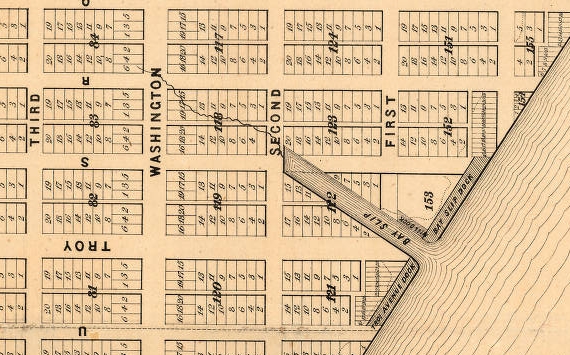
Houghton Falls State Natural Area within the Town of Houghton.
Monday morning
Your father rested better last night than before and had no fever thro the night but sweat a good deal as before – is very cool and comfortable this morning. Has some appetite – does not like to get up as it hurts his limbs. But much less than when I first came here.
Sandusky Nov 1st 1857
Dear Son,
Last sunday I wrote you about your father’s sickness and hope you have rec’d it, or will in good time; but as my letters of the past summer have failed wholey to reach you, perhaps the last has also failed. I shall continue to write to you often while he continues sick – and unless while navigation lasts and you may direct yours here until the last boat leaves your place as I see no prospects now of your father’s being able to move on for some time to come. I told you about the chill he had which made me fear he had got a regular chill fever but he did not have another tho he had pretty severe intermittent fever for three days last week. – indeed it continues somewhat yet, but much lighter. But his lameness is much worse than when he left you – that is – he cannot walk or step because his limbs are so painful and much weaker than when he had more fever. I believe he would never have got here alive had he not been sustained by tonics and morphine, but they would never have cured him, and I do think that had he fallen too sick to get here and had employed another Alopathist he would have gone into a typhoid fever and probably have died, as did the hon. R.C. Benton Sen. a short time since – at Rockford Ill. I met his son – our Johnson teacher one at Janesville who told me the sad news. – He was informed of his father’s sickness but did not reach there ’till after his death. His body was carried to Vt. for interment.
Nov. 2
~ “Business Directory” published in the Superior Chronicle, June 26th, 1855.
Your father wishes to ask you if you know anything about that Geo Perry concern – the present shape of it. And if you have heard any thing farther from the Aminacon claim?
Did you get the money of Jack so as to save your compass? If so – how does it prove? Has Herbert got home since yet? If so, how do the boys fare – do they get any money of him? Does old Whacken let John have his paper? Do you hear anything from your money?
When father left the boat at Detroit he told the porter to get his Carpet bag in his room and send it ashore with his trunk – showing him the trunk. – but when he got to the Michigan Exchange it was not to be found – neither at that house nor any other in the city. In looking for it he was detained so as to lose the boat for Sandusky, Friday morning – Saturday he started in a carriage but was told at the wharf by the driver that the boat would not go – (had not arrived) till afternoon, so he was taken back again when soon word came that it had came, but before he could get started – he being unable to walk – it was off again, so he was obliged to stay ’till Monday.
Thus he was detained nearly four days – sick and lame and obliged to climb a long flight of stairs and take long walks to his meals and other necessities, which all together brought on his fever and rheumatism in the muscles worse than ever. He thinks it almost a miracle that he got through so long a journey – sick as he was when he left you, and without any one to assist or care for him – alive. His lameness is now in the left limb – the other being quite free from pain when kept in a horizontal position, but both pain him extremely yet if put down so that he does not attempt to step on his feet. Ham, Jay, and I brought him up stairs last Saturday where we have every thing we need for convenience and family are all as kind and attentive to one wants as people can be. I do not believe there is any better family, or one happier, than this. It is two weeks today since father came here and I know not how many more he may have to stay – the prospect looks rather dark for a speedy departure.

The “Geo Perry concern” related to Albert McEwen’s death and fraud during the 1856 LaPointe County election. This was investigated by the Wisconsin Assembly.
~ Journal of the Assembly of Wisconsin, Volume 9, 1857, page 191.
We got a letter from Am. Saturday in answer to one from me here, says he is well but I should judge he had not done much this fall but watch and wait for us. I do not wonder the poor boy is out patience as well as every things else, as he says.
Write often to your afflicted parents.
G.A.B. and M.G.B.
Sandusky Friday Nov 13 – 1857
Dear Son.
You will at once perceive that we are stationary since I wrote you last. And when we shall be able to move on, is as much a question of uncertainty as ever. Your father remains sick yet – and I cannot – dare not say that he is even convalescent, tho’ I have a little more courage to think that the medicine now being administered is breaking up his fever. He has had a most singular sickness – having – as I think – more or less fever – with or without chills every day – probably since he was first taking – certainly since coming here. [??] the Dr would not acknowledge – or believe it because his visits would be in the forenoon when the intermissions would occur. But the past week he convinced him that chills and fever do actually exist as he has been [presedest?] to break it up. His sickness is so unlike anything in the experience of the Dr. that he appears to be entirely mistified with [reward?] to the proper course to pursue. I have, and do, doubt his judgement – and sometimes have even put a harsher construction upon his course and doubted his honesty. But he has all along said he had not the least doubt of his ultimate recovery tho it would take considerable time to entirely remove his lameness. As to that lameness I hardly know what to say. He is now free from soreness and only his feet swolen; but he cannot straighten his knees as the cords appear to be contracted and are painful when strained and if his feet are brought lower than his body it brings on the same old tearing pain in the muscles.
But I believe that when his fever leaves him and he begins to gain strength his limbs will improve fast. This week past I have felt more discouraged than ever, as the chills would come on every day about noon – continue an hour – sometimes with a hearty shake – then fever – pulse 120 hr. m. – then a hot sweat most of the night with pulse at 85 at the least pain.
This lasted about 5 days – But the Dr has at length “come in with a Tonic” which appears to work right. It is the most powerful sweating medicine I ever saw. He has taken it two nights and one day – and now the 2nd day – 3 P.M. – he has fairly escaped the chill and fever. I feel greatly encouraged – that he is in a way to recover. He has all the time been quite confined to his bed except as he could manage to get into a great chair once a day and sit up – from two hours to half an hour – this several days he has not got in the chair as he was unwilling to exert himself so much. I have been with him – his only nurse – night and day for 3½ weeks, and I hope and expect to granted health and strength to continue to perform the duties of nurse so long as he shall need my assistance. I cannot but think that he was in just as good condition to receive the medicine, which is working so well over two weeks ago – when the billious fever first left him, as he was two days ago. But the Dr thought not, as his limbs were so bad then, and it might make them worse. It has been altogether an unique case, and the Dr has appeared liked one groping in the dark.
I told you in my letter of last week that father lost his carpet-bag – and intended to tell you to see if it was not returned to La Pointe and left there – he thinks the label on it directed there – tho’ at first he said it was to Lancaster. He can hear nothing from it since and I fear it was stolen by the darkies on the boat. This has truely been an unfortunate year for us as well as for thousands of others.
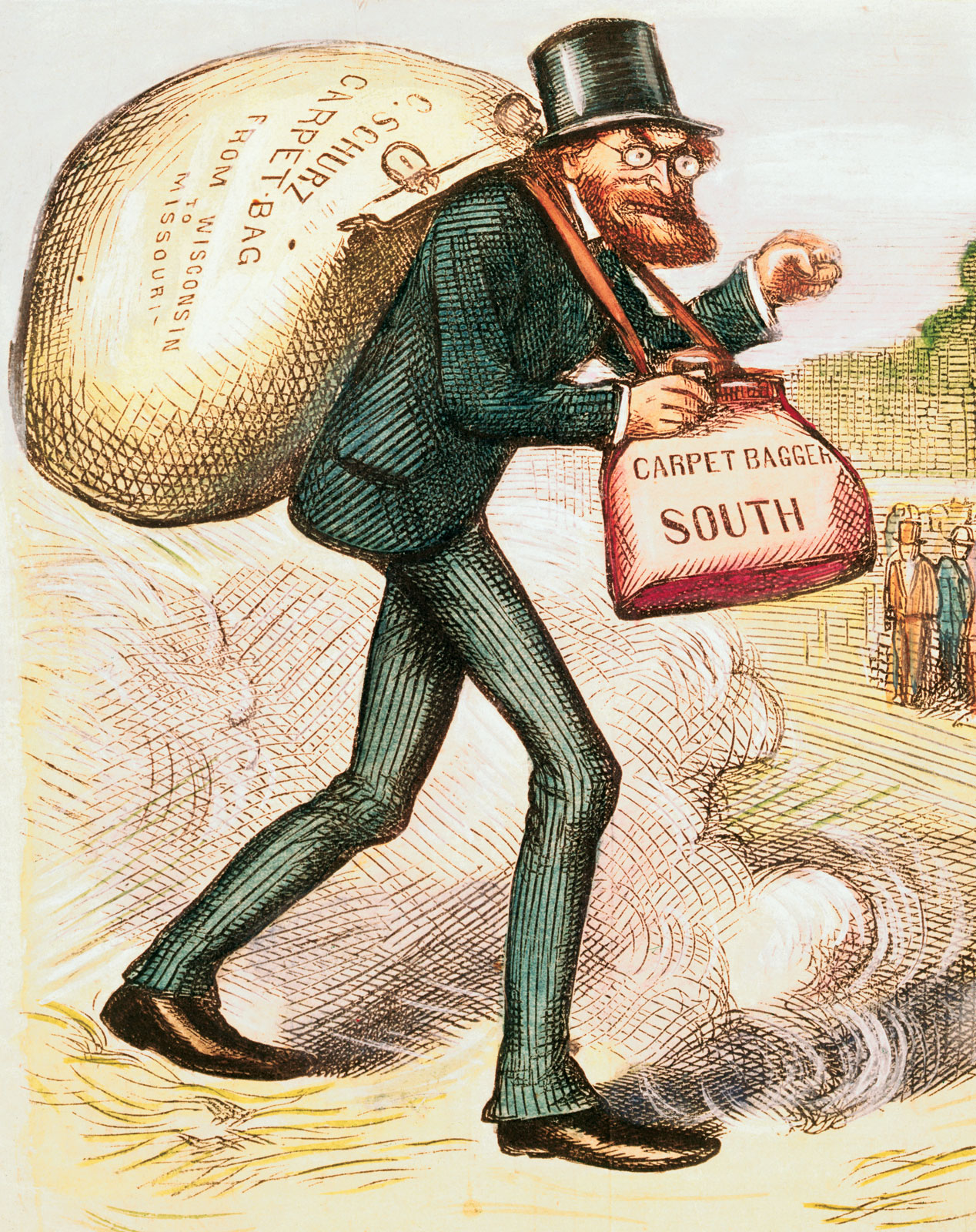
1872 cartoon of Wisconsinite Carl Schurz by Thomas Nast.
Wikipedia.com definition of a Carpetbagger:
In United States history, a carpetbagger was a Northerner who moved to the South after the American Civil War, during the Reconstruction era (1865–1877). White Southerners denounced them fearing they would loot and plunder the defeated South. Sixty Carpetbaggers were elected to Congress, and they included a majority of Republican governors in the South during Reconstruction. Historian Eric Foner argues:
“… most carpetbaggers probably combine the desire for personal gain with a commitment to taking part in an effort “to substitute the civilization of freedom for that of slavery”. … Carpetbaggers generally supported measures aimed at democratizing and modernizing the South – civil rights legislation, aid to economic development, the establishment of public school systems.”
“Carpetbagger” was a pejorative term referring to the carpet bags (a form of cheap luggage at the time) which many of these newcomers carried. The term came to be associated with opportunism and exploitation by outsiders. The term is still used today to refer to a parachute candidate, an outsider who runs for public office in an area where he or she does not have deep community ties, or has lived only for a short time.
We get nothing yet from you. Why is it that you remain so silent? I think it probable we may have to stay here four weeks longer – waiting for him to get well. You may direct here if you send by return mail or by any boat.
You cannot know, nor be told the amount of distress in the country this money panic has produced. I presume you do not see the papers so often as we do, and perhaps do not realize at all. You father warns you to be careful what you do this winter. – not to meddle with any thing – in Ironton shares – or any kind of property – even if you can buy it for a “song” – Every thing is “dead broke” and the less you have to do with Lake Superior property, the better.
Father sends his best love along with mine to you and his respects to Mrs. Maddocks and family.
I am very sorry to think that you will stay up in that wilderness this winter. I wish you could get your money – settle up every thing – come down here and go home with us. It would be a great relief to us to have your assistance for your father if he should continue too lame to walk without help.
We are under a great many obligations to Uncle H. and family for their kindness.
It is growing dark, so good night
Mother
Sandusky Dec 6th 1857
My Dear Son.
Yesterday we rec’d a letter from Am. containing one from you. I was greatly surprised and grieved to learn that you had not got one of my letters since you left Lancaster. I have sent you three from there and as many from here. Neither had you rec’d your draft. I am really suspicious that some one watches the mails and steals your letters hoping to get money or the draft – which, it is possible he has taken out – forged your name &c and taken the money out. In such case you might not discover the theft for a long time – and would be subjected to a great deal of trouble in consequence. I shall have a deal of anxiety in your account this winter, or until I hear that your money has reached you and that provisions are to be had at reasonable prices – which I fear they will and be this since the loss of that new boat must make quite a difference with that region in supplies.

American carpetbag circa 1860; wool with leather handles.
~ Wikimedia.org
I have before written you an account of your father’s journey and continued sickness which you may have yet [??] now. Lest you have not I will briefly say that he got safely to Detroit where he lost his carpet-sack – was detained there three days – arrived here Monday night 19th ult. Oct. 19th where he has remained ever since, confined to his bed. The fatigue of the journey probably somewhat increased his lameness which has been very severe, and he has not been entirely free from chills and fever and sweats until the last week. He has been improving fast for a few days, but just now he is having a little more fever which I presume is caused by some impending diet – either in quantity or quality.
His disease – a very uncommon one – is, in fact, inflamation of the veins extending from the Loins throug the whole limbs – the left much the most – to the toes. He has not been able to put his feet to the floor without extreme pain since he got here, until the last week, and even now, but a few minutes at a time. The cords under the knees have been considerably constrainted but are getting relaxed a little so that his legs make nearly straightened, tho he cannot begin to bear his weight on them.
The disease has been so complicated and so badly treated before he got here that the Dr has been very much perplexed with it. If you have not got my former letters you do not know that we have had a Homeopathist – one whom Uncle H. and Aunt B. think knows enough for all cases but we think that had he possessed a knowledge of anatomy equal to his partner in business who has called twice with him of late, he would have discovered the seat of the disease at first from the symptoms then apparent. But for four weeks he seemed to be in a state of uncertainty, and baffled at every step. But since he discovered the seat of it he has treated it with very good success.
Your father is much reduced in flesh and strength. I cannot now give you a full description of his case but when he gets able to write much I presume he will amuse himself by giving you the particulars if you should feel interested in the subject. Uncle H and family are very kind and obliging and we have every thing our necesities demand at present, but that does not make me contented to remain so long from home. I wish to be in my own house, but it is impossible to leave here until he can walk enough to help himself a little. We have been here 7 weeks, and I fear it will be many more before it will be safe for him to leave or proper for me to leave him for others to wait on. My health is very good so that no one has had to assist me day or night, in nursing.
Your Aff’nt Mother
I suppose this will never reach you unless I direct to some other person for you.
All well at Lancaster last Sunday. Monday morning Aunt Lucy saw a fine little daughter added to her family.
Sandusky Dec 18th 1857
Dear Son
~ Wikipedia.com
You will see that we are here yet, now nearly 9 weeks since I landed here in an almost insensible state from the effects of morphine which I had to take constantly to allay or drown the pain in my limbs. I have been quite sick much of the time. Three or four weeks were spent in treating my sore before the [rest seat became?] of my disease was ascertained, since which time there has been steady progress toward health. My legs had become crooked at the knees, absent at an angle of 45*. My ankles and feet swollen, white, cold & as useless as though made of putty, but I found the pain that had so long affected them was gone & by much exertion, rubbing &c I got so as to bear any weights, & [thoutes who?] crutches, & I have now got so that I can go twice the width of the house at a time on them. My appetite has returned & I am gaining rapidly. My real disease was what is called Spormator [hea?] or a disease of the Spormation vessels or cord on the left side of my body, which the Drs & your Uncle Ham think was the origin of my sickness & all my pain. Sir Astley Cooper [in thing?] authority, giving all the symptoms of my case. We hope to be able in a week or two to go home to Vt. Your mother wants to start in my present helpless condition when I cannot stand alone in a minute without support to save my life, but I have sworn that I will not go to be jostled around & in the can till I am better able to take of my self than now. I cannot get up or down stairs or sit at all weight with crutches, & as neither of my legs are reliable I assure you it is ticklish business to dare go on them (the crutches).
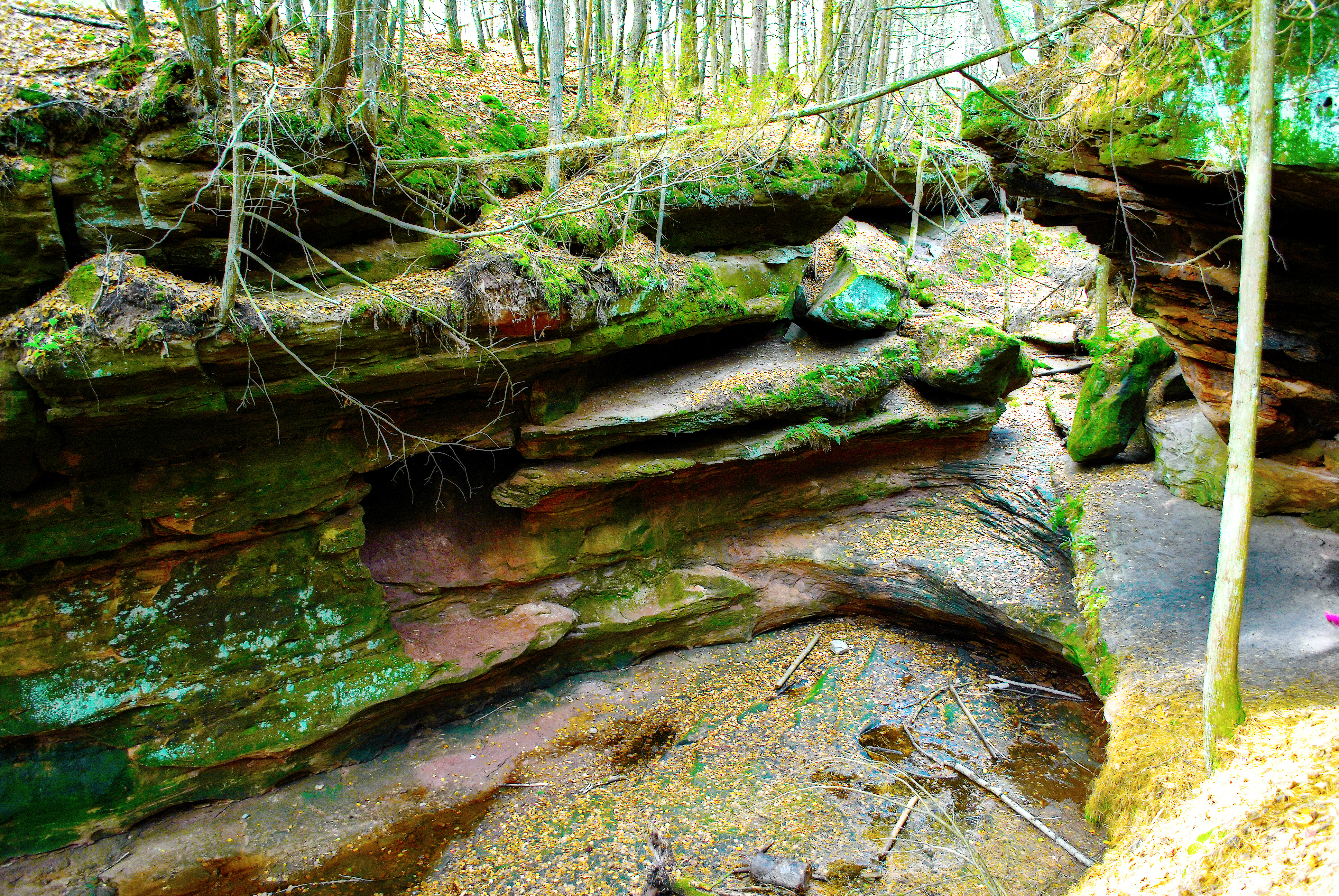
Echo Dells at Houghton Falls State Natural Area.
~ Shared under Creative Commons from Aaron Carlson © 2011
Coming down the lakes from La Pointe I had a pretty hard time of it, was quite sick, had chills, kept my berth most of the time, & when I got to Detroit I was detained by losing my carpet bag and one thing & another because I was unable to help myself, from Thursday P.M. ill Monday A.M. when I came here. Lucky that I had such a refuge to [want?] to in my extremity, had I tried to reach home, my life would have paid the forfeit of I might have had a long sickness among strangers without any of the comforts or conveniences I now enjoy, and insured an enormous train of affection.

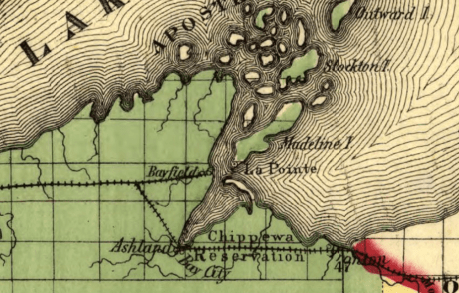
Map inset of Chequamegon Bay with Town of Houghton, LaPointe, Bayfield, Ashland, Bay City, and the LaPointe Indian Reservation.
We get letters from Amherst occasionally, he is well & in good spirits boarding at Mr Griswolds, is very anxious for our return to Vermont. By him I learn that Ambrose Chase died after about an hour illness in Nov, & that John Burcham of Johnson died still more suddenly being found dead in the privy. Old Mr Dorsker died lately & that is all he has told of to us. On opening my new trunk here I find some books are missing. Who do you suppose is the rogue? I hope he will russ some amusements & instruction from the books, if so I am content.
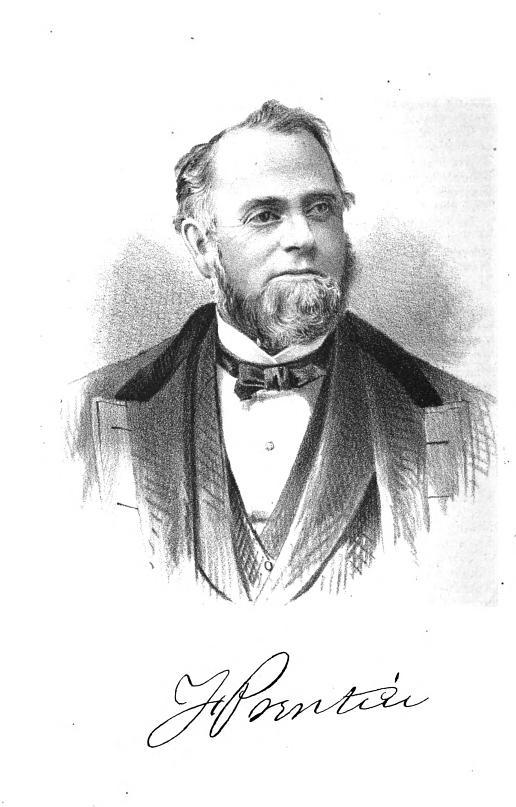
Frederick Prentice (“Man of Money and Mystery”) was an “Indian interpreter for Indian agents and traders”, and owned extensive properties in the Chequamegon Bay region during the 1850s. Prentice started the City of Houghton around the same time he cofounded Bay City (Ashland) during 1854, purchased the Buffalo Tract (Duluth) from Benjamin Armstrong during 1856, and cofounded the City of Houghton (near Washburn) during 1857. Prentice returned to Houghton in 1887 and organized the Prentice Brownstone Company, becoming “the most famous quarryman in northern Wisconsin”. Houghton had a “population of about 250 people, a school house and a sawmill with 25,000 foot capacity” by 1888.
~ This portrait and a profile of Frederick Prentice (the “first white child born” in Toledo, Ohio) is available from History of the Maumee Valley by Horace S Knapp, 1872, pages 560-563.
~ “Business Directory” published in the Superior Chronicle, June 26th, 1855.
August 22nd, 1857
“John H Osborn,
Banker and Land Agent,
And Dealer in Exchange, Superior, Wis.
REFERENCES, — J. B. Ramsay & Co., Cincinnati; J. R. Morton & Co., do; E. Jenkins & Son, Baltimore; A. R. Van Nest & Co., N. Y.; Heston & Druckla, Phila; Holiday & Coburn, St. Louis; John H. Richmon, Esq., Maysville, Kentucky.”
Have you recd your draft yet? Was your compass saved to you? Have you got at work on the reservation yet? If so how do you prosper? How does Herbert make it, does he still remain agent? Does he sell any shares, if so, for how much? Is the work still going on at the City of Houghton, or has the news of the general crash and prostration of all kinds of business failed of reaching Stony Pointe? I recd a letter from Prentiss last week who says, there are some going from Toledo next spring to live there, & he appeared to feel as well as ever.
He said he sent 50 bbls Ham & a lot of Pork to Detroit to go up, but it arrived too late for the last boat to Lake Superior. I have written to Hayes that if the Ammanicon case is decided against me to take an appeal to Washington at once & I will go there & see if testimony has been supplied or any unfair things have been done by the clerks in the office.
I have now sat up [little?] hours, read Douglas’ speech & written this much to you but I feel that I have over taxed my powers and must go to my heated bed for rest. Douglas has come out against the Administration policy toward Kansas & will make a split in the party not easily healed. I will send you his speech.
Tell Mr. Maddock’s folks that Judge John Fitch of Toledo was shot yesterday [????] once of his family by one T.G. Mellon, the ball entering his mouth, lodging in the back of his neck, some hopes are entertained of his life. If this is a ½ sheet it is as long as your letters. Be careful of yourself. I remain your affectionate father.
G.A. Barber
Give my respects to Mr & Mrs Maddocks, & to John Cosborn.
Detail from the 1857 “Township map of Wisconsin showing The Milwaukee & Horicon Rail Road and its connections“. The town-sites of LaPointe County shown here are Ironton, Boyd’s at Old Fort (mislabeled as “La Pointe”), Bay City, Ashland, and Houghton (mislabeled here as “Bayfield” and later as “Lower Bayfield” in the 1865 Colton Atlas). The railroad shown on the LaPointe Indian Reservation correlates to Barber/Wheeler/Stuntz details from “the Gardens“.
~ Library of Congress
To be continued in the Winter of 1858…
Barber Papers: “Apostle Islands” Summer of 1857
February 13, 2016
By Amorin Mello
Selected letters of the Joel Allen Barber Papers
… continued from the Spring of 1857.
This season (Summer of 1857) of the Barber Papers begins with this editorial commentary from Chequamegon History because the Barber Papers do not contain much information about events that occurred during this time period. Fortunately, letters from Giles Addison Barber preceding this season indicate that he had planned to take his second trip west from Vermont to Lake Superior in order to rejoin his son Joel Allen Barber during the Summer of 1857.
Giles’ first trip in the Spring of 1856 was tragically disrupted by the death of his first son Augustus Hamilton Barber, and was unprepared to reconcile Augustus’ unfinished copper claims, land speculations, and U.S. General Land Office survey contracts during that trip. The vocabulary Giles used to describe employees and politics at the U.S. General Land Office in Superior City were not admirable. Giles sought reconciliation by applying pressure upon national politicians in his social network (particularly Alvah Sabin; U.S. Representative from Vermont), and began preparations for this second trip.
Augustus Hamilton Barber had begun to work closely with George Riley Stuntz earlier in 1852 to survey the far northwestern region of the Wisconsin Territory; their most recent survey together before the Summer of 1857 had been at the Gardens in Odanah of the LaPointe Indian Reservation during the Fall of 1856. Stuntz’s nephew Albert Conrad Stuntz began surveying the Gogebic Iron Range of La Pointe County during the Summer of 1857. Lysander “Gray Devil” Cutler moved to Ironton during the Summer of 1857 as the new managing agent on the Gogebic Iron Range for the Wisconsin & Lake Superior Mining & Smelting Company to operate in collusion with Stuntz’s survey of the Gogebic Iron Range for the U.S. General Land Office.
“Mr. Cutler was appointed the managing agent of this prospective Wisconsin bonanza, at a fair salary, to which was added a liberal amount of the stock of the company. His first task was to perfect the title to the property, and the first step toward it was to take a personal view of the situation and the property. It was a somewhat arduous undertaking, not unfraught with danger. Excepting two or three traders and surveyors, who had stock in the company, the population, which consisted mostly of Indians and half-breeds, viewed this incursion of wealth-hunters from the lower lakes with suspicion and distrust. To add to the difficulties of the situation, other parties owning Sioux script were endeavoring to acquire a title to the mineral range. One man working in the interest of the company the year before, had been discovered, after being missed for some weeks, dead in the forest, near the range. Bruises and other indications of violence on the body gave strong ground for the belief that he had been murdered. Altogether it was a position, the applications for which were not numerous. His [Cutler’s] first trip was made in the Summer of 1857.”
~ History of Milwaukee, Wisconsin:
From Prehistoric Times to the Present Date
Milwaukee Genealogical Society, 1881, page 790.

“IN MEMORY OF
AUGUSTUS H. BARBER
of Cambridge, Vt. U.S. Deputy Surveyor
who was drowned in
Montreal River
Apr. 22. A.D. 1856
Aged 24 yrs. & 8 ms.”
~ FindAGrave.com
The death of this unnamed managing agent that Cutler replaced corresponds with the timing of Augustus’ death in the Spring of 1856. Augustus’ last letters reveal that he had gotten into “A Little Trouble“ and decided to “Let ‘Em Rip“ shortly before his death. Augustus was reported to have drowned below Superior Falls near Ironton and the Mouth of the Montreal River. However, a confidential letter written by Giles to Allen on the first year anniversary of Augustus’ death reveals that the location actually occurred further inland under secret circumstances:
“It must remain a sealed book to us, how Augustus was hurried out of the woods, and why it was so ordained if there, was any ordination about it, till we meet him in another world, which I devoutly hope we may do though I am sorry to say more hoping than expecting.”
Augustus is suspected to have been the unnamed managing agent found dead near the Gogebic Iron Range that Cutler replaced. There was a footpath between the Gogebic Iron Range and Ironton, which supports this speculation. James Smith Buck was an elected official of La Pointe County during the Summer of 1857, and wrote memoirs about working in the Penokee Survey Incidents with Cutler and Stuntz. Buck’s memoirs glorified another traumatic event at Ironton which involved Cutler and his management approach to disciplining the mining company’s Lake Superior Chippewa employees at these locations. Buck did not make any references to the Barbers in his memoirs; however, Asaph Whittlesey published a public retort to Buck’s memoirs with a cryptic allusion to “the Siege of Barlisle“. Whittlesey’s reference is suspected to have been about the murder of Augustus Hamilton Barber.
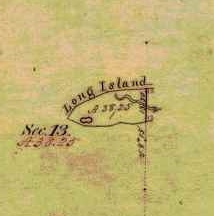
Detail of Chequamegon Point included in the Barber brother’s survey of T47N R4W during the Summer of 1855.
Without further speculation about how the Barber family may have been involved with the 1857 Stuntz/Cutler survey of the Gogebic Iron Range, the rest of this will be dedicated to the 1857 Barber survey of we can focus on the Barber brothers’ survey of what is now the Apostle Islands National Lakeshore.
Joel Allen Barber and his brother Augustus Hamilton Barber began their work to survey the Apostle Islands at Chequamegon Point on Long Island during the Summer of 1855. Augustus and Allen continued their survey of the Apostle Islands during the Winter of 1856:
“We shall go back in a few days and commence surveying around the islands. Now don’t fancy that we cannot survey in the winter, for we have tried it and know better.”
After Augustus’ death, Allen rewrote their original field notes of the Apostle Islands survey during the Winter of 1857, per instructions from their father:
“Keep a strict acct of all the expense of resurveying on the last winters contract, if you get a new one & undertake it, as I am informed that I can get relief from Congress by a special act, paying me all that it will cost to do the work over again, which will be as much for you interest as anybody’s of this please say nothing to any one.”
Allen then renewed their contract for this survey during the Spring of 1857, causing much anxiety for their father despite giving instructions to do this:
“I am surprised to learn that you are going to survey islands so late in the season. Nothing that I can now say will avail any thing else I would caution against trusting too long to the treacherous covering over the dark blue waters. I hope you will have good success and get through without any fatal accidents to your self or to any one of your party.”
The Barbers’ survey field notes were finally accepted as complete by the U.S. General Land Office during this season; the Summer of 1857.
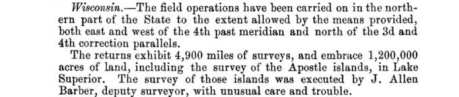
“… the survey of the Apostle Islands, in Lake Superior. The survey of those islands was executed by J. Allen Barber, deputy surveyor, with unusual care and trouble.”
~ Message of the President of the Untied States to the Two Houses of Congress at the Commencement of the Second Session of the Thirty-Fifth Congress, 1858, page 119.
The following documents are the original surveys notes of the Apostle Islands as submitted by Deputy Surveyor Joel Allen Barber during the Summer of 1857. Augustus Hamilton Barber’s former role in these surveys during 1855 and 1856 was not mentioned anywhere in his brother’s survey notes. In lieu, Joel Allen Barber identified three assistants during these surveys:
- William W Ward
- Alexander Aiken
- Louis Nevioux
Aiken and Neveau are familiar surnames in Lake Superior Chippewa communities.
Our transcriptions of selected letters from the Joel Allen Barber Papers are continued below without further editorial commentary:
Exterior Field Notes
Township 51 North, Range 2 West
Township 52 North, Range 1 West
Township 52 North, Range 2 West
Township 53 North, Range 1 East
Township 53 North, Range 1 West
Township 53 North, Range 2 West
April 1857
Notebook ID: EXT27501
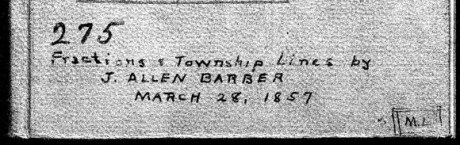
Joel Allen Barber received this survey contract on March 28th, 1857, from Warner Lewis at the General Land Office in Dubuque, Iowa.
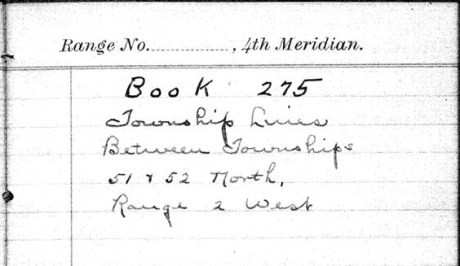
“Township Lines Between Townships 51 & 52 North, Range 2 West”
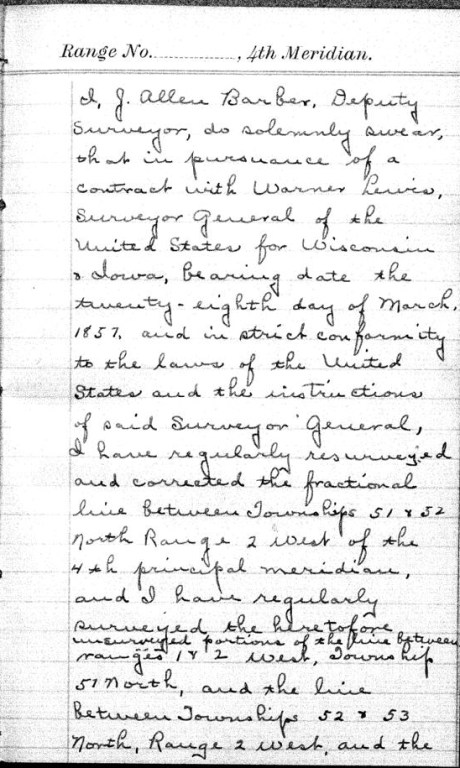
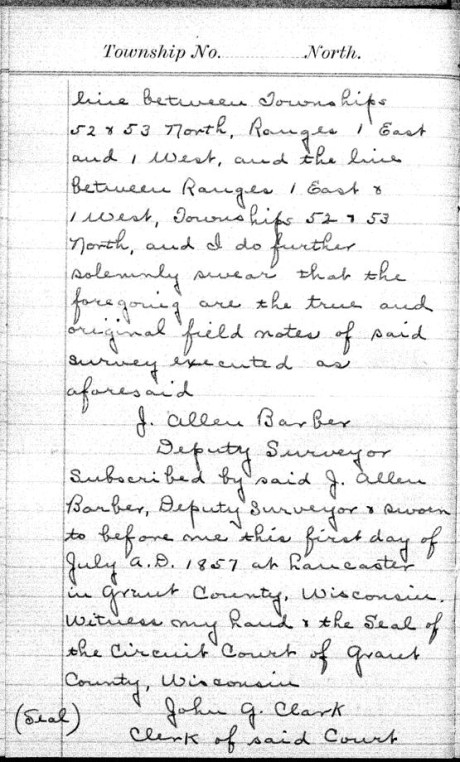
These survey notes were originally sealed in Lancaster, Grant County, on July 1st, 1857.


Interior Field Notes
Barber, J. Allen
Mar. 1857
Notebook ID: INT011E03

“No. 11 T. 46-47-52-&53. R. 1. East”
Township 46 North, Range 1 East
[Joel Allen Barber’s survey notes for this township are referenced by the the Wisconsin Public Land Survey Records, but is are omitted from the General Land Office Records. A survey map published by Charles Whittlesey in 1860 reveals diverse geology, one mineral claim, and part of the ancient Flambeau Trail were documented in this township.]

Detail of T46N-R1E and the surrounding region from Charles Whittlesey’s Geological Map of the Penokie Range, 1860.
Township 47 North, Range 1 East
[One more minor Chequamegon History editorial commentary: Joel Allen Barber’s survey notes of this township are referenced by the Wisconsin Public Land Survey Records, but are omitted from the General Land Office Records. This township is featured in the above detail of Whittlesey’s 1860 map. It is near Ironton; and contains the Mouth of the Montreal River, Superior Falls, and Saxon Falls.]

Superior Falls at the mouth of the Montreal River, as featured in the stereograph “View on Montreal River” by Whitney & Zimmerman from St. Paul, circa 1870.
~ Wikimedia Commons
Township 52 North, Range 1 East
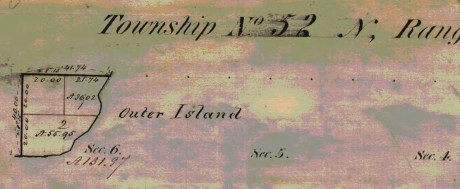
Barber’s survey of T52N R1E included the southeast corner of Outer Island, the rest of this township is occupied by Lake Superior. There are no survey notes available for this township, it was included in the survey of T53N R1E for convenience.
Township 53 North, Range 1 East

Barber’s survey of T53N R1E features the east half of Outer Island, the rest of this township is occupied by Lake Superior.
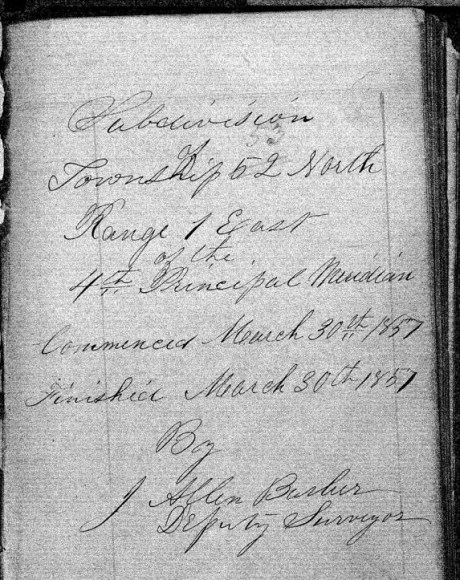
“Commenced March 30th, 1857. Finished March 30th, 1857.”

Barber’s assistants were William W. Ward, Alexander Aiken, and Louis Nevioux.

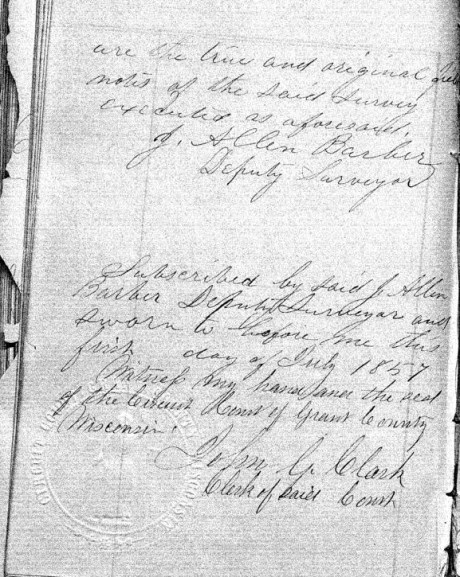
These survey notes were sealed in Lancaster, Grant County, on July 1st, 1857. Barber’s assistants were not signatories.
Interior Field Notes
Township 51 North, Range 1 West
Barber, J. Allen
Apr. 1857
Notebook ID: INT010W04

Barber’s survey of T51N R1W included Michigan Island, Gull Island, and a corner of “Presque Island” (Stockton Island).
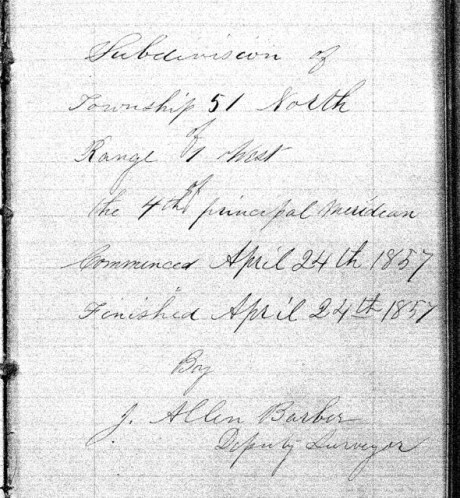
“Commenced April 24th, 1857, and finished on April 28th, 1857.”

Barber’s assistants were William W. Ward, Alexander Aiken, and Louis Nevioux.
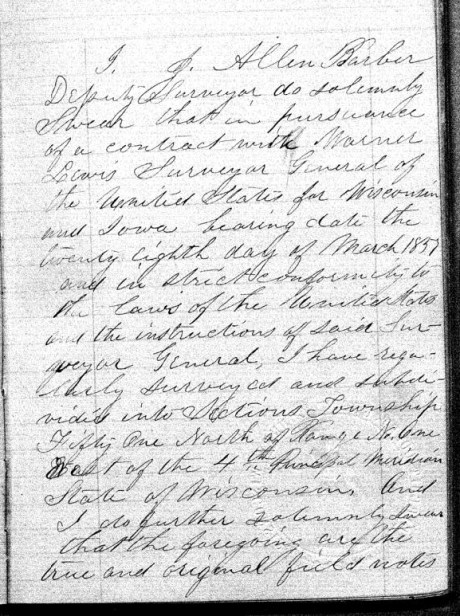

These survey notes were sealed in Lancaster, Grant County, on July 1st, 1857. Barber’s assistants were not signatories.
Interior Field Notes
Township 52 North Range 1 West
Barber, J. Allen
Apr. 1857
Notebook ID: INT010W05
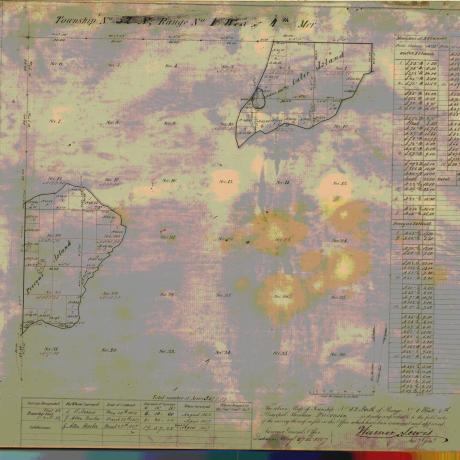
Barber’s survey of T52N R1W included the northeastern end of “Presque Island” (Stockton Island) and the south western end of Outer Island.

“Commenced March 28th, 1857. Finished March 31st, 1857.”

Barber’s assistants were William W Ward, Alexander Aiken, and Louis Nevioux.
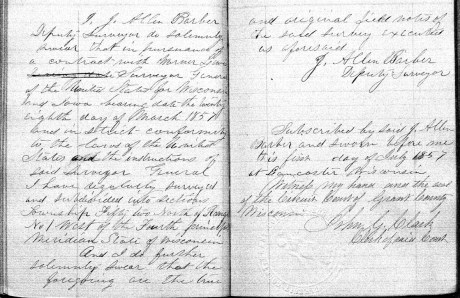
These survey notes were sealed in Lancaster, Grant County, on July 1st, 1857. Barber’s assistants were not signatories.
Interior Field Notes
Township 53 North Range 1 West
Barber, J. Allen
Apr. 1857
Notebook ID: INT010W06

Barber’s survey of T53N R1W included the northwestern part of Outer Island. The rest of this township is covered by Lake Superior.

“Commenced March 29th, 1857. Finished March 30th, 1857.”

Barber’s assistants were William W Ward, Alexander Aiken, and Louis Nevioux.
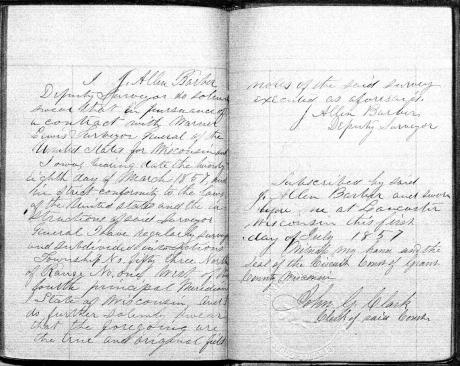
These survey notes were sealed in Lancaster, Grant County, on July 1st, 1857. Barber’s assistants were not signatories.
Interior Field Notes
Township 50 North Range 2 West
Barber, J. Allen
Apr. 1857
Notebook ID: INT019W04

Barber’s survey of T51 R2W included part of Madeline Island.

“Commenced April 22nd, 1857. Finished April 23rd, 1857.”
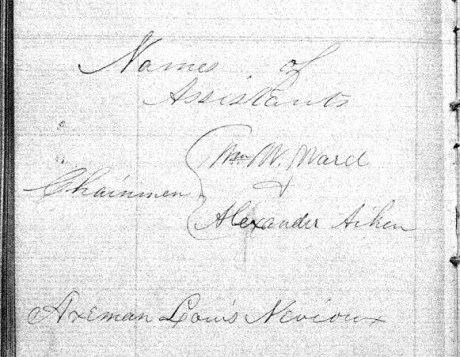
Barber’s assistants were William W Ward, Alexander Aiken, and Louis Nevioux.
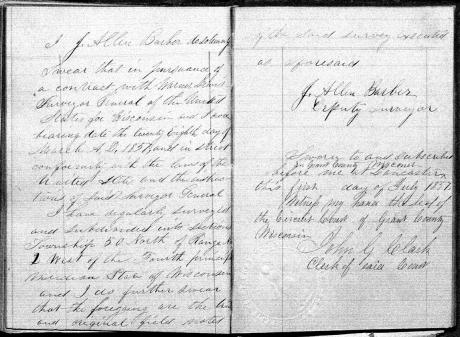
These survey notes were sealed in Lancaster, Grant County, on July 1st, 1857. Barber’s assistants were not signatories.
Interior Field Notes
Township 51 North Range 2 West
Barber, J. Allen
Apr. 1857
Notebook ID: INT019W02

Barber’s survey of T51N R2W included the LaPointe Indian Reservation Fishing Grounds on the north end of Madeline Island, and parts of “Wilson’s Island” (Hermit Island) and “Presque Island” (Stockton Island).

“Commenced April 17th, 1857, and finished April 23rd, 1857.”

Barber’s assistants were William W Ward, Alexander Aiken, and Louis Nevioux.
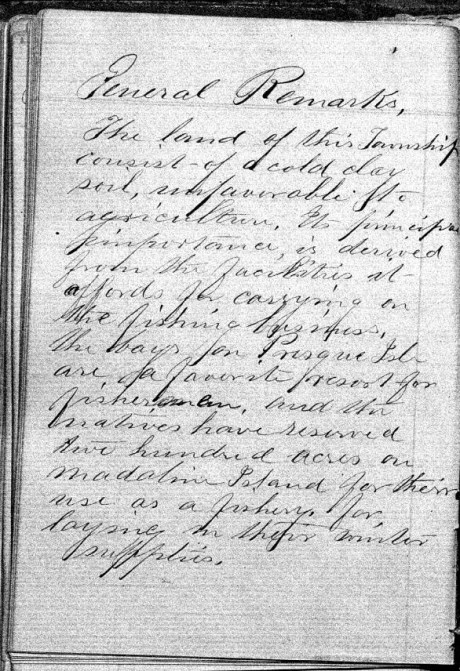
“The land of this Township consists of a cold clay soil, unfavorable to agriculture. It’s principle importance is derived from the facilities it afford for carrying on the fishing business, the bays for Presque Isle are a favorite resort for fishermen, and the natives have reserved two hundred acres on Madeline Island for their use as a fishery, for laying in their winter supplies.”


These survey notes were sealed in Bayfield on May 30th, 1857, by Samuel Stuart Vaughn as Justice of the Peace for LaPointe County. Alexander Aiken was not a signatory, yet William W Ward and Louis Nevioux (“his X mark”) were included as signatories. This nuance was not explained.

There appears to be something written or drawn behind the smaller sheet in this scan of Barber’s original survey field notes.
Interior Field Notes
Township 52 North Range 2 West
Barber, J. Allen
Apr. 1857
Notebook ID: INT019W03
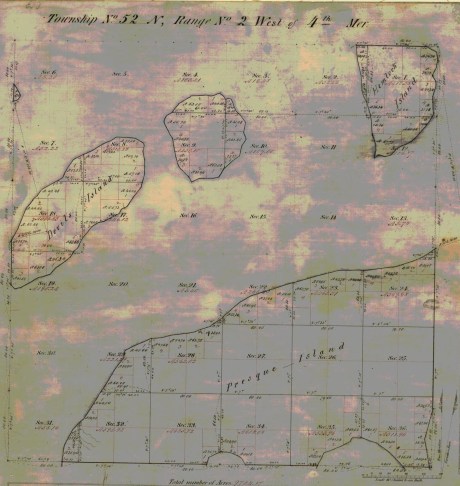
Barber’s survey of T52N R2W included “Devil’s Island” (Manitou Island), an unnamed island (Ironwood Island), and parts of “Hemlock Island” (Cat Island), and “Preque Island” (Stockton Island).
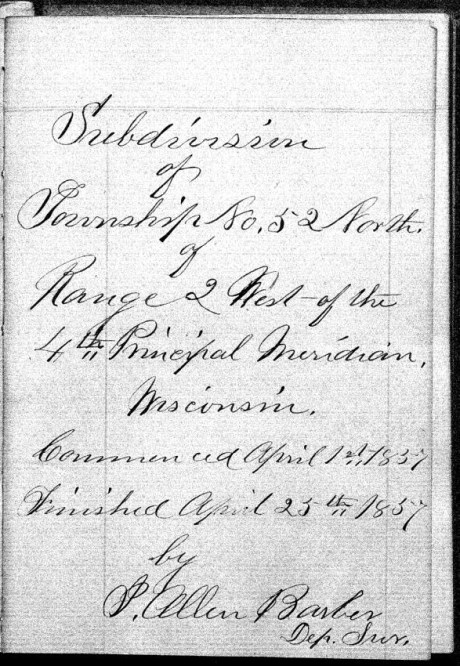
“Commenced April 1st, 1857. Finished April 25th, 1857.”

“There is but little good land in this Township, the greater part being of a very inferior quality, there is some good White Pine on Presque & Hemlock Islands.”
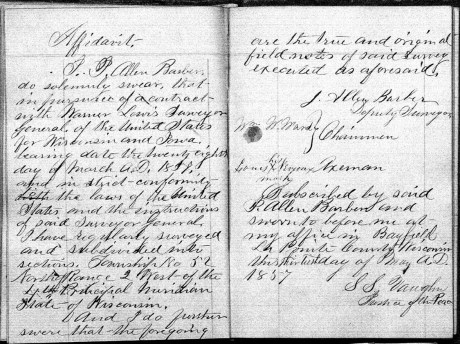
These survey notes were sealed in Bayfield on May 30th, 1857, by Samuel Stuart Vaughn as Justice of the Peace for LaPointe County. Alexander Aiken was not a signatory, yet William W Ward and Louis Nevioux (“his X mark”) were signatories. This nuance was not explained.
Interior Field Notes
Township 53 North Range 2 West
Barber, J. Allen
Apr. 1857
Notebook ID: INT019W05
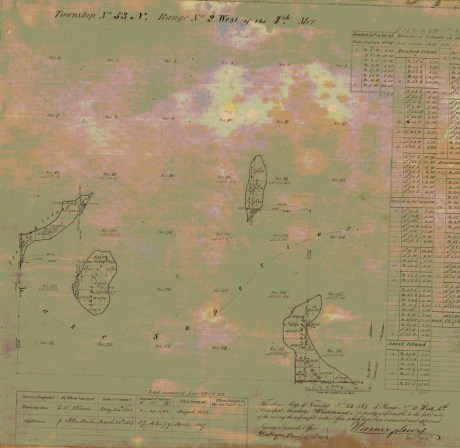
Barber’s survey of T53N R2W included “Shoal Island” (South Twin Island), an unnamed island (North Twin Island), the north end of “Hemlock Island” (Cat Island), and the east end of “Ironwood Island” (Rocky Island).

Barber’s assistants were William W Ward, Alexander Aiken, and Louis Nevioux.
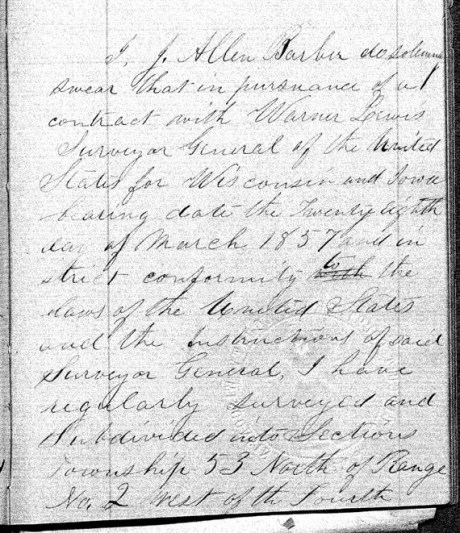
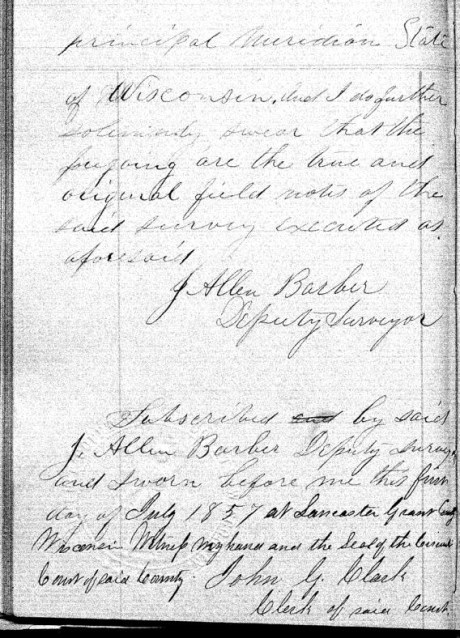
These survey notes were sealed in Lancaster, Grant County on July 1st, 1857. Barber’s assistants were not signatories.
Interior Field Notes
Township 51 North Range 3 West
Barber, J. Allen
Apr. 1857
Notebook ID: INT030W06

Barber’s survey of T51N R3W included parts of “Bass Island” (Basswood Island), “Wilson’s Island” (Hermit Island), Oak Island, and the mainland where the Red Cliff Band of Lake Superior Chippewa was located six years later in 1863.

“Commenced April 14th, 1857. Finished April 28th, 1857.”

Barber’s assistants were William W Ward and Alexander Aiken, and Louis Nevieux.

“The land in this Township is all high and rolling and is pretty well adapted to agricultural pursuits, the soil is gravelly and in some places stony. The poorest portions are Wilson’s and Bass Islands, which contain more clay. Much good White Pine & Hemlock are found on the Main shore near the Lake.”

These survey notes were sealed by Samuel Stuart Vaughn at Bayfield on May 30th, 1857, by Samuel Stuart Vaughn as Justice of the Peace for LaPointe County. Alexander Aiken was not signatories.
Interior Field Notes
Township 52 North Range 3 West
Barber, J. Allen
Apr. 1857
Notebook ID: INT030W07
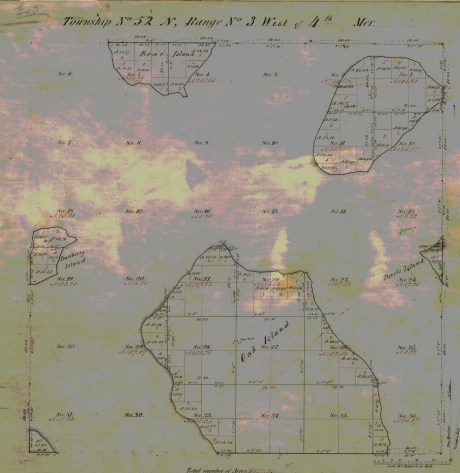
Barber’s survey of T52N R3W included parts of Oak Island, “Devil’s Island” (Manitou Island), Bear Island, “Cranberry Island” (Raspberry Island), an unnamed island (Otter Island), and the mainland where the Red Cliff Band of Lake Superior Chippewa were located six years later in 1863.

“Commenced April 4th, 1857. Finished April 29th, 1857.”
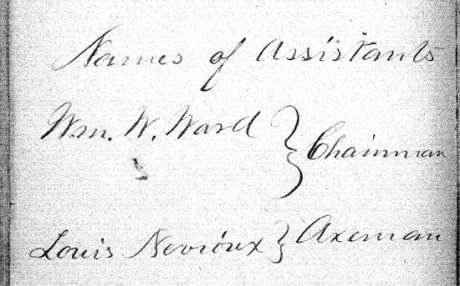
Barber’s assistants were William W Ward, and Louis Nevioux. Alexander Aiken is not identified as an assistant in this survey.

“The principal part of the land of this Township is of good quality. Oak & Bear Islands are very high and rolling with a good soil. The Island in the N.E. part of the Township is more level, but it soil is of a good quality.”
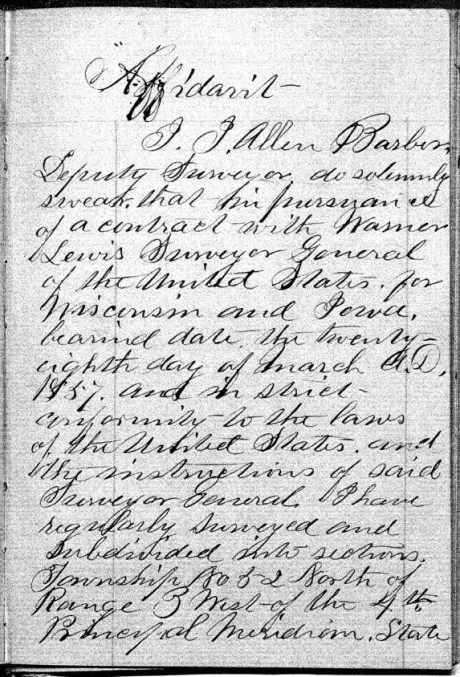

These survey notes were sealed by Samuel Stuart Vaughn in Bayfield on May 30th, 1857, as Justice of Peace for LaPointe County.
Interior Field Notes
Township 53 North Range 3 West
Barber, J. Allen
Apr. 1857
Notebook ID: INT030W08

Barber’s survey of T53N R3W included an unnamed island (Devils Island), the west end of “Ironwood Island” (Rocky Island), and the north end of Bear Island.

“Commenced Apr 4th, 1857. Finished Apr. 7th, 1857.”
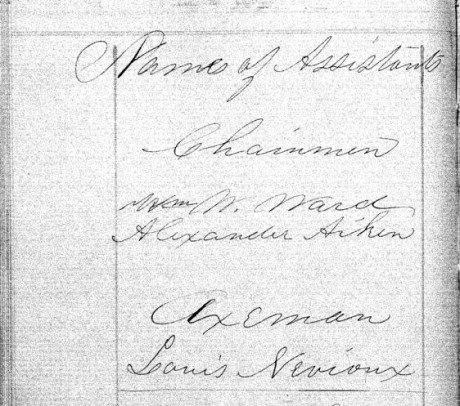
Barber’s assistants were William W Ward, Alexander Aiken, and Louis Nevioux.
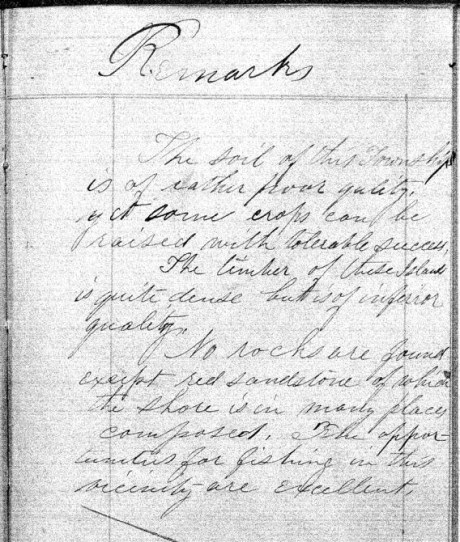
“The soil of this Township is of rather poor quality, yet some crops can be raised with tolerable success. The timber of these Islands is quite dense but is of inferior quality. No rocks are found except red sandstone of which the shore is in many places composed. The opportunities for fishing in this vicinity are excellent.”

These survey notes were sealed in Lancaster, Grant County on July 1st, 1857. Barber’s assistants were not signatories.
Interior Field Notes
Township 51 North Range 4 West
Barber, J. Allen
Apr. 1857
Notebook ID: INT040W04

Barber’s survey of T51N R4W on the mainland was used to locate the Red Cliff Reservation years later in 1863

“Commenced April 30th, 1857. Finished May 8th, 1857.”

Barber’s assistants were William W Ward, Alexander Aiken, and Loius Nevioux.
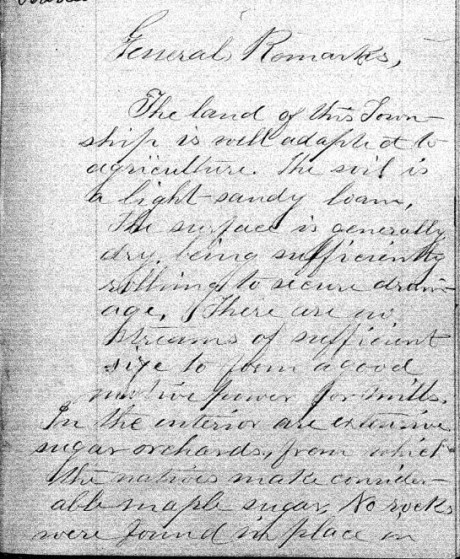
“The land of this Township is well adapted to agriculture. The soil is a light-sandy loam. The surface is generally dry, being sufficiently rolling to secure drainage. There are no streams of sufficient size to power a good motive power for mills. In the interior are extensive sugar orchards, from which the natives make considerable maple sugar. No wells were found in place in …”

“… this Township, but it belongs to the sand-stone formation and is overlaid by drift,- in some places to the depth of several hundred feet. No houses or other improvements were noticed.”


These survey notes were sealed in Bayfield on May 30th, 1857, by Samuel Stuart Vaughn as Justice of Peace for LaPointe County. Alexander Aiken was not a signatory, yet William W Ward and Louis Nevioux (“his X mark”) were signatories. This nuance was not explained.
Interior Field Notes
Township 52 North Range 4 West
Barber, J. Allen
Apr. 1857
Notebook ID: INT040W05

Barber’s survey of T52N R4W included Point Detour on the mainland, an unnamed island (York Island), the west end of “Cranberry Island” (Raspberry Island), and the east end of “Sand River Island” (Sand Island).

“Commenced April 8th, 1857. Finished April 12th, 1857.”
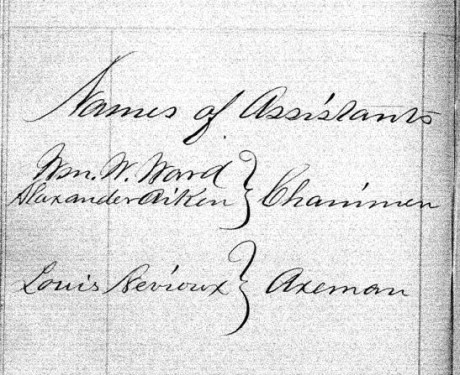
Barber’s assistants were William W Ward, Alexander Aiken, and Louis Nevioux.
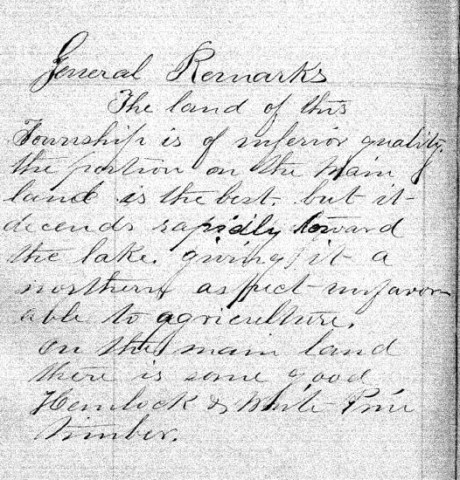
“The land of this Township is of inferior quality, the portion on the main land is the best, but it descends rapidly toward the lake, giving it a northern aspect – unfavorable to agriculture. On the main land there is some good Hemlock & White Pine timber.”


This survey contract was at Bayfield on May 30th, 1857, by Samuel Stuart Vaughn as Justice of Peace for LaPointe County. Alexander Aiken was not a signatory, yet William W Ward and Louis Nevioux (“his X mark”) were signatories. This nuance was not explained.
Interior Field Notes
Township 52 North Range 5 West
Barber, J. Allen
Apr. 1857
Notebook ID: INT050W04

Barber’s survey of T52N R5W included “Steamboat Island” (Eagle Island), “Little Steamboat Island” (no longer exists), and most of Sand Island.
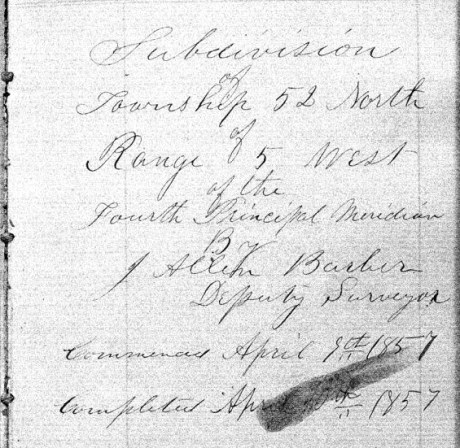
“Commenced April 8th, 1857. Finished April 10th, 1857.”

Barber’s assistants were William W Ward, Alexander Aiken, and Louis Nevioux.
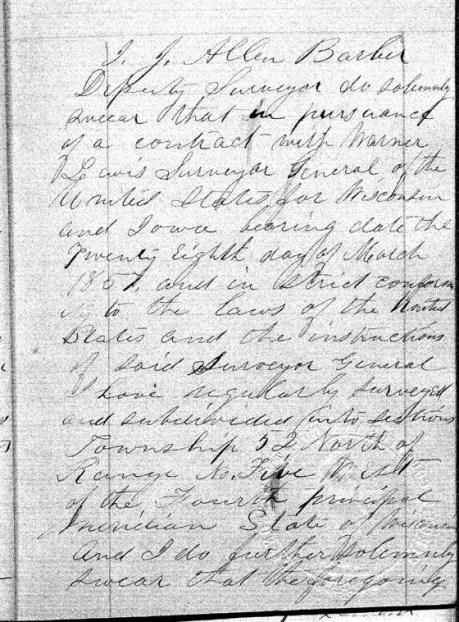
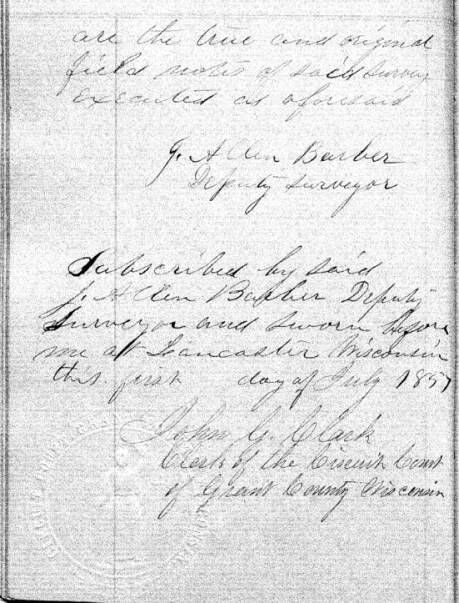
These survey notes were sealed in Lancaster, Grant County on July 1st, 1857. Barber’s assistants were not signatories.

Bayfield Mercury, August 22, 1857.
IRONTON
The Barbers did business with William Herbert and others at Ironton. The activities of “the company“ during the Summer of 1857 are detailed the Penokee Survey Incidents.
“… Wm. Herbutt, was here in 1847-48 prospecting for copper for the American Fur Company.”
Report of the City Statistician, Volume 1, page 58.
Week before last we took a trip to Ironton and the interior in company with Mr. HERBERT, the Agent of the town, and several others, and promised to give our readers an account of the the town and country back of it, but inasmuch as some kind friend took the liberty of abstracting our memorandum book from our pocket, we cannot give as definite an account as we would like.
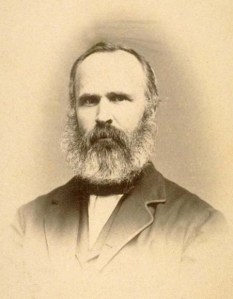
Lake Superior surveyor, American geologist, and Harvard University professor Josiah Dwight Whitney. ~ Portrait of Whitney by Silas Selleck, 1863.
Ironton is situated on the South shore about 20 miles from this place and three fourths of a mile from the mouth of the Montreal river, which is the State line between this State and Michigan. Its harbor is good and the water is of sufficient depth for any of the largest class of steamers. The company are building a splended pier, 400 feet long, and when finished it probably will be one of the most substantial piers on the Lake, and will cost about $5000. They have also erected a large Hotel, two stories high, and we also noticed the materials on the ground for putting up several frame buildings, and arrangemnts has been made for the erection of a steam sawmill with 40 horse power, which is to be completed this summer, and will cost from $10,000 to $12,000. The lots are 40 x 125, except on 1st and 2nd streets which are 40 x 128.
The site of the town is beautiful, — about a third of it is on a nice level next to the Lake, and then it ascends gradually in benches back for one or two miles. Its near proximity to the Copper mines on the Montreal river and the Iron range back, together with the farming lands, which by the bye is not equalled on Lake Superior, must needs make Ironton a town of no small importance. The company are cutting out a good road from Ironton to the Iron range some 16 miles in length.
While there we visited the Falls on the Montreal river, the scenery of which cannot be surpassed on the Lakes. The lower falls are 60 feet high and the upper falls are 80 feet. They are about three miles apart. The indication of mineral between the two falls and especially on Mr. WHITNEY’s claim, bids as fair for large deposits of copper as any that has yet been discovered and certainly has a good surface show as had any of the mines that are now being developed.
We could say much more about the Iron range and surrounding country, but defer it until another time. The town was only laid out in February last, and it already bids fair for a bright future. Go on gentlemen, we hope you will build up a large town, and help develop the vast resources of the Great Northwest, and we will aid you what we can.
Lancaster Aug 30th 1857
Dear Son.
Maria Green Barber. She came to Lancaster to visit her in-laws, and to consider relocating there from Vermont.
A week or more since I rec’d a letter from [you?] at Bayfield by [????] I am happy a safe arrival for which I am very thankful. But in it you don’t say where your father is. [??? ???ably] return or whether he intends to come here, or go home, or other ways expecting me to go along [???? ?? ?? ????? ????] I have not had a letter from him since you left but father Barber goes on some other which road. I have not [?????] to [????????] as [????????????] about [?? ???] there to get it. Mr Burr [??????] last [??? ???] – I did not know what to do about going but as the friends here so I Pray [??? ???] he would come this way to see to his produce [????????] was out state with [???] that time I thought but to wait a little longer. [?? ??? ????] an [????] I wished I would stay with this while [?? ??? ???] as they are rather homesick [???] the [???? ??? ??? ??? ????? ??????] [????? ??? ??????] I enjoy myself better with them than of [???? other affect?] as it is such a pleasant family and very young so comfortable quilt – Last evening the Bank came up here to give me a seranade. They had intended to come [???] and were expected and They were invited in and treated to Coffee, pie, and cake and the girls gave them the best music – as they said – on the Piano they ever heard – Then they all joined in several songs They went to nearly every house in the town “to wake them up.” Yesterday Miss Barber got in another exhibition – that is, had them (her exhibit) & had something to speak – had a stage in [??????] grove where they exhibited had a pre-mer. I tried to get some – singing – pretty much failed in that – tried to get out there hard and wholely failed – and on the whole, not “[????? ???????]” they say.
It is quite [??????] here [????????? ???? ????] several others of summer complained. There has been hot months but, [???? ?????? ???? ????? ????? ?????] Esq [M????] wife are considered [????? ??? ????]
I wish I knew what [???? ? ??? ???? ????] as your father would write [??????? ??????? ????? ??? ???] to go home without [???????] at last. Got a line from [Albe?] last week. Suppose he [????] to as he does not [?????] to [???????????????????] but “lying ‘round longer.” [??? ??] very sorry he was not that [winter?] the government and instruction of some one who would have taught him something useful and kept in a study.
It is beautiful weather now for gathering the grain [????? ???? ????? ????????? ????] will be plenty of them but very little fruit of any kind this year.
I expect father will come this week without fail if he comes at all. Have heard nothing more about going to Cassville. Uncle Allen is building a large office and Cyrus and Thode are building the Evert house fence. Write often, till you come, to your
Mother
Johnson Sept 20 /57
Friend Allen
May I call you friend? I will venture for if I recollect right we were once very good friends and I hope that we are so still although we are far distant from each other, and may never meet again in this world, have you forgotten Hattie? I have not forgotten Allen and probably never shall, and were I even disposed I have a small gillon badge laid safely away which brings forcably to my mind an old friend who much resembles you, when I once knew. Amherst said he presumed you would not think I was very naughty to dare to write to you, so I thought I would take the liberty. I have written enough so I will close by saying please don’t forget the Johnson people for we shall never forget you.
Good night
Hattie C.
P.S.
Beware of those pretty squaws out there.
Allen,
I want you to understand that Miss Hattie & Miss Hastings & Carls & I have spent the evening here together at Mr. Caldwells upstairs & have had all sorts of good times. That is, as far as I am concerned. (I do not speak for the ladies) & I have enjoyed myself “excruciatingly” (as Hattie suggests) considering the company & the advantages I had.
That’s all
Am
Lancaster Sept 20th 1857
Dear Son.

Portrait of George Riley Stuntz. ~ The Eye of the North-west: First Annual Report of the Statistican of Superior, Wisconsin by Frank Abial Flower, 1890, page 26.
I will venture to write once more to you tho I have no evidence that my letters ever reach you. I have had two letters from you but not one from father since you left here. One from him to Mr Burr of Sept 15-6th appears to be the only one he has sent here since you arrival. Why he has not written to me to let me know what to do about going home I cannot understand, but here I am yet, and shall stay, until he either comes or writes he is not coming. I should have written several times to him, had I not expected him every week [??????????] letter [????] that you had not [??????] from [???????] I had not gone home with Mr B. Mr Stunts [visited?] here, and said he was going [??????] to La Pointe [???? ??????] you have learned the state of affairs before this. Mr [??] returned home last night having been about now a few weeks, had a fortunate trip tho on Lake Ontario there was a high wind and every passenger very sick. I am thankful to have escaped that, but something else may happen to us when I do go. Oh how I do dread the journeys.
I am confident that your father will be here this week, that is if he is not still too sick to come – which I greatly fear he is. If he is still there when this arrives he may [c??????] it as much to him as to you. How I wish you would confide to travel there this fall and to remain with [me?] [?????] to me the [??????????] and remain there this winter [?????????????????????????????????????????????????????]
There will be a County Fair held here this week – the grounds in full view of Uncle Jay’s where I am now stopping. I shall probably see some of the best food [ration?] of this great country. I went, two weeks since to McCartney and Cassville with Allen and family. Had a pleasant ride, but it was very warm and dusty. Mc has a beautiful place, the largest orchard in the county, I suppose, as they will have 500 bushels this fall. It is on the highest land 2 miles east of the Miss. river. But perhaps you have been there, if not you have seen the river at other points. I was wishing to see the “great river” and went to Cassville for that purpose. It is certainly worth the trouble of going to see. Aunt Sa’h pointed out to me a high sharp bluff which Augustus climbed and left his name out on the white bark of a [tree?]. To me, how interesting – almost sacred does every thing appear where he has left the impress of his work. There is nothing can bring so forcibly to our minds a dear departed friend, as a sight of the productions of his hands or his mind. So, if we would be remembered with pleasure and gratitude we must do something for the good of every being with whom we have to do.
“IN MEMORY OF
AUGUSTUS H. BARBER
of Cambridge, Vt. U.S. Deputy Surveyor
who was drowned in
Montreal River
Apr. 22. A.D. 1856
Aged 24 yrs. & 8 ms.”
~ FindAGrave.com
I hope your father has placed the marble he sent me enclosed the grave of the dear one who lies on the land here, I feared shall never have the melancholy satisfaction of visiting the cursed spot. It hardly know whether I can wish to behold the terrible scene where he lost his prime life. I cannot but fear that those of my family now in that inhospitable shore may be laid beside that line [??] bed grave that we may all live to [???? ???? ?????].
And land flowing with milk and sugar – than which no better can be found, at least I have yet found a place better adapted in all respects to make life comfortable. With labor and care we can have all that is desirable there – without those we can h should have little enjoyment here unless we are content to live in poverty and filth. One thing alone would discourage me from coming to this Western world, where in the great uncertainty or procuring a constant convenient supply of good soft water. Here, at Jay’s, their Cistern leaks and they have to fix up the pump and have to draw it from the bottom where it [????? ?? ???] with a pail and string, as they do at Allen’s and Thode’s you know there is no cistern and they manage to catch some in tubs to wash with.
It would almost kill Marth and the girls to bring enough from the spring near as it is, based on when they get it, it is good for nothing to wash with in that it is cleansed with [??? ?? ???]. I never yet saw water so convenient, plenty and good as it is at our old home.
Mr. Harris [?????] died about 3 weeks since, and Mrs. Mills is not expected to live but a few days – perhaps hours. It has been very healthy most of the [senses?] People from other places come here to spent the summer on account of the known healthfulness of the place. One gentleman from Cleveland, with consumption, and the Drs said, come – at the end of the 1 week, he had gained 12 lbs – Says he will buy property and stay here. [Sherman Page?] is here – has commenced a select school.
I have no more to [??????????????????????????]
your Mother
Aunt Lucy is unwell to day and I have [????] the [?????].
All friends well but Allen who has his old complaint.
Am sorry this ink is not black & you can read it.
To be continued in the Fall of 1857…
Barber Papers: “A Southern Confederacy” Winter of 1857
January 27, 2016
By Amorin Mello
Selected letters of the Joel Allen Barber Papers
… continued from the Fall of 1856.
Sandusky Dec 22nd 1856
My dear Son
You will see by date of this letter, that I have progressed somewhat towards home.

Portrait of U.S. Representative James Meacham from the History of the Town of Middlebury: In the Country of Addison, Vermont by Samuel Swift, 1859, after page 388. “Much to my astonishment I now find that Mr Meacham is a habitual private tippler and is often such a condition from drink as to occasion general notice and remark […] Is it not wonderful our state has had a long list of such members, Mallory, Nole, Buck, Phelps, &c.” from 1856 letter in the University of Vermont Libraries’ Center for Digital Initiative.

U.S. Representative Alvah Sabin was mentioned earlier in the Barber Papers during the Spring and Summer of 1855. ~ Eighty-Three Years a Servant, or, the Life of Rev. Alvah Sabin by Alvah Sabin Hobart, 1885
I left Lancaster in company with E. D. Lowry for Galena last Wednesday morning & on getting to Galena found that the cars had not run for 5 days on account of snow, but they got in toward morning & at 9 AM I started & only got through to Chicago next day at night, when not running we were in snow drifts. I arrived here Saturday evening & am having a very comfortable visit with your Uncle’s family. Shall leave at 7 tonight for the East & shall make all speed for Vermont. Your Uncle’s folks are looking for Jay house tomorrow night to spend the holiday & then return again. There is something in the Tribune of last week concerning the termination of the Eastern RailRoad on the Northern boundary & laying it down as pretty certain that the road would be carried to the Mouth of Montreal River. If I can find the paper before mailing this, I will send you the article, & did I know that the road would be run to your town I would take all possible means to apprise you of the fact so that you might not dispose of your interest in the great haste. If you have sold none, when this reaches you, I trust you will act in reference to the above information, and I would advise you to keep dark, till further advice, & as fast as I can learn anything relative to your interests I will communicate the same to you. I have heard nothing from you yet, since parting with you at La Pointe, but hope to get letters from you when I get home. I have left money with Cyrus to pay your taxes, & will have him pay on Jo’s. Tell Mr. Wheeler, that I have learned the trouble concerning Hon Jas. Meacham that he & I talked about at his house. He had become a confirmed & miserable drunkard & drank himself out of the world. This is from one of his colleagues Hon A. Sabin, and is but too true.
Reverend Leonard Wheeler & Government Carpenter John Stoddard lived at the Gardens.
Give my last respects to Mr. Wheeler & family also to Mr. & Mrs. Stoddard & tell them that I have not escaped a hard winter as [?????? ?????? ??????] but do not fear starvation like I did on L. Superior.
I expect you are all buried in deep snows by this time, so that you can do nothing at Surveying. The Snow was 2 ft deep at Lancaster when I left, but it rained all day Friday like July Showers & the ground is entirely bare about this place. Her Bay is frozen over. Keep a strict acct of all the expense of resurveying on the last winters contract, if you get a new one & undertake it, as I am informed that I can get relief from Congress by a special act, paying me all that it will cost to do the work over again, which will be as much for you interest as anybody’s of this please say nothing to any one.
Now My dear Son I again implore you to be careful of your life & health. Do provide yourself with enough to make yourself comfortable & easy & above all good warm clothing & bedding, be careful of exposing yourself, where you there is danger of being lost & freezing, or of getting through the ice. Do my son heed the requests of your parents & only brother who feel more interest for you than you are aware of, & who are in hopes to yet enjoy your society in a more genial soil & climate.
I think that one visit to Lancaster will be sufficient to wean you from the frozen, famine stricken, regions around the Great Lake. I overhauled my agates yesterday giving lots of them to the children, also specimens &c. I gave them some chrorastrolites & shall give them some more. They prize them very high. The stone that Jo gave Lucy & she to your Uncle, has been cut & set in two rings. 1 for Aunt Em & 1 for Lina… Aunt E’s ring cost $12.00 besides the stone. It is a splendid affair.
Do write as often as you can, for be assured that your letters will be always joyfully rec’d & read by your parents & Hiram.
Farewell my dear Son & may God preserve your life & health
G. A. Barber
Respect to the boys.
Cambridge Dec 29th 1856
My dear Son
It is now about 2 months since I left you at La Pointe, since which time I have not heard one word from you, whether you were in the land of the living, or had got cast away on your journey to Montreal River. I was very anxious to get intelligence from you while at Lancaster & could not feel reconciled to come away till I had heard from you. But having left directions with our friends there to forward your letters, if any came, to me. I finally ventured to start for Vermont. I stopped over 48 hours at Sandusky, & wrote you from there, on matters pertaining to Ironton, which will reach you long before this does. If you have not sold any shares, it would be best to rest easy till you see how the matter turns, but if the road is likely to terminate at the Mouth of Montreal River, some shark will be after all the shares he can get, & at the lowest prices. I left Sandusky Monday night (22nd) at 7, was in Buffalo at 7 next morning & Albany at 10 P.M. Rutland at [morn?] Wednesday. Called on Mrs. Temple & Nancy Green, got to Burlington at 8 P.M. on the 24th & home on Christmas at sunset, found all well and tired out with looking for me. Every thing looks as natural as ever, except that our Prairies are more rolling & the bottoms greatly shrunken in dimensions.
[…]
Mr. Whiting had a partner, B. E. Fullington, an honest, God-fearing, upright man, and their plan was to engage in farming–raising corn for the Government post at Fort Riley. Mr. Fullington soon became disgusted with the meager success that attended their efforts, and after one season returned East, leaving Mr. Whiting to conduct the business. Mr. Fullington agreed to furnish the capital while Mr. Whiting was to manage the business connected with the partnership. But Kansas looked better to Mr. Fullington after he got to Vermont and he came back the next spring to spend a long and useful life here.”
~ A Standard History of Kansas and Kansans by William E. Connelley, 1918, transcribed by Baxter Springs Middle School students, 1997.
While on the platform at Essex Junction, who should I run into again? but Mr. Bradly & Fullington direct from Kansas when he left Albe! Left him well, on the land they had claimed, another man a neighbor had gone into the shanty with Albe to [book/back?] it together this winter, & take care of their cattle
Matters are more quiet there now. Gov. Geary proves a better man than was anticipated. Prospects for Terr. Kansas are brightening. I sent you the message of the infamous Frank Pierce, from Lancaster, & hope your patience permitted you to read it through. Still it is the meanest vilest paper that ever emanated from our Government and will go down to posterity with its author excerated by all good & honest persons. Folks are well around. Levi & Oscar were here last night till after 9. Of course I gave them some specimens of copper, agates &c. Mary Buck from Galesburgh Ill. sister to Mrs. Kingsbury keeps the school, from 6 to 10 scholars, & enough for such a “marm.” Ed. Bryant teaches the best school at the Center. Pat Coldwell is in a Store at Waterbury. Dr. C.L. Fisher is teaching in Johnson. Helen Whiting is about going to “Kaintucky” to teach in a family. I do not mean of her own, but in a private school.
~ Collections of the Kansas State Historical Society, Volume 12, by Kansas State Historical Society, page 119.
I am going to Johnson to day & must be brief but will perhaps do better another time. If mails are regular you will get as many as one letter per week, while I have ability to scribble for I have learned by experience how good it seems to have letters from “friends & sacred home.” Again I caution you to take care of yourself, you can read my back letters for particulars. Your mother will write soon now when she knows where you are, & I will make Amherst do likewise.
Your affectionate father
G. A. Barber
[ca. 1856]
My Dear Son.
I hardly know whether to write again to you before hearing or knowing something of your situation.
It seems too much like writing to the dear departed. But I know that if it were possible you would have sent us news of your self before now. I feel assured that it is not your fault that we do not get letters.
I often imagine you shut in from the world by deep snows – perhaps you and your party frozen – disabled from work or even from the use of the pen. But the thought of the good Christian Missionary near you makes me hope that you would not be allowed to perish with cold or hunger and that, should any great misfortune happens to you he would inform us of it. How very long and tedious must the winter have been to you all and how often the vainly have I wished you had complied with our wishes and returned to spend the winter at home. Oh! How much more pleasure and comfort might we all have then.
I mentioned in a former letter my wish to go to Lan. next summer and my great desire to meet you there. I do not know that I will take the trouble and incur the expense of such a journey if I must come back without seeing you, so do not let me be disappointed. If you will If I felt sure that you would meet me there and would return with us to spend next winter I should feel that I had something to live for. But the thought of going there and returning to live in this old, desolate, neglected, forsaken looking place without you, with no prospect if there ever being any improvement in its appearance under the present administration makes me quite indifferent to life. I am very sorry that we cannot get another woman here – one who would be agreeable and friendly with me, or whom I could confide in as a good and honest dairy woman. I should then feel quite satisfied to leave the business with her, and less unwilling to return again. But your father will not let any one else come – tho he has had some very good offers.
How I do wish that you would come and live with me and befriend me & I really need to have one friend.
Good night
Mother
Cambridge Jan 6th 1857
Dear Son
I have determined to wait in hopes to hear from you, before writing back again. It really seems strange, that we do not get something from you in all this long time, your last being dated Nov-. Your Mother & I wrote repeatedly while at Sandusky & I hope you get the letters, but why do I not get something from you?
I am extremely anxious to know how you are & how you are getting along this winter, whether you have yet recd that long expected draft & whether you have done anything at surveying the Indian Reservation whether you are boarding at Mr Maddock’s yet, or what you are doing & have spending the long & hard winter. The date of this will show you that I have once more got home, and am now a dweller among the G. Mountains.
After being at your Uncle’s in Sandusky 10 weeks and I had so far recovered that I could walk across the river your Mother was away to have me start for home & I was hurried away before I was sufficiently strong to endure the fatigues of such a journey. On Sunday 27th ult I first ventured out of doors Monday 28th was stormy so that I could not go out & yet I had to start Tuesday, or trouble would endear, so I was off and that night at Midnight I was in Buffalo (leaving station at noon). Left B. at 9 A.M. & was in Albany 10 ½ P.M next Morning started at 7 & was snugly quartered at the Lomied of N.E.N’ Esq on the [????] by the college on Burlington. My feet & legs [???] badly swollen all the way caused by debility I remained there 2 nights & spent [???????] with them. Saturday we continued in the stage with [Sen/Tom?] Andrews to the Centre where we [??? ?????? ??? ??????? ???] house unfit to occupy, as his had “Batnies” all over the floor drying your Brother & I went to Mr Wetherby’s (in the Miner house) & stayed till next day when Mr Green brought his woman here & she & Amherst worked at the house while Mr G. went to the centre for your Mother. I was brought up toward night, and am a close prisoner ever since on account of my swelled legs & lameness but I am free from that infernal pain that troubled me at La Pointe & only feel a soreness in my walking apparature.
I could scarcely believe the fact was so, when I found I could put my legs feet down on the floor without excruciating pain, but I have reason to hope I have seen the last of that tormentor. My appetite is shrunk so much, my strength is returning & when I shall regain part of my flesh and my legs get sound I shall be nearly as good as new. I was reduced almost to a shadow by the “little gobbel,” but they did not make me any sicker than before as the Allopathic Medicines would have done. Their effect was produced silently, and though I was run down pretty low & weak I at no time felt any distressing sickness save in my legs till I imprudently ate too many preserved tomatoes that distressed me 2 or 4 days. But my greatest gratification was to get Amherst home with me once more, after he had been a wanderer & outcast for months in his own neighborhood. We found him living at Griswold’s where he was enjoying himself tolerably well & was useful about the storm & handed &c. He was all [?????] at our [????] house by the shore [devil?] that [punished?] in the [Kitchen?]
He always found a welcome at Atwood’s & was urged to stay there & too at [Supuien’s?] but Mrs P. in the woods wanted take paints to make him understand that they did not want him to consume much of their grub, I always knew she was a stingy old satan & now I think I shall request her whenever a good opportunity offers. I think he was as glad to see us, as we to see him, & that we will take as much solid comfort together as the nature of the case will present.
7th
I shall look earnestly for a letter from you till I get one & though my letters may be a long time in reaching you I shall keep a stream of them running to your country that you may have something once in a while to refresh your memory of home and those so dear to you who are now sojourning here. There have been but few changes by death or marriage that I hear of since my leaving last spring. I wrote to you of the death of Mr Chase Old Mr John Safford died in Dec aged 92 years & old Mrs Darker also very aged. David Griswold & Mary Ann Chadwick were yoked at Christmas. I do not hear of any others in town, who have got married, that you know, but I will tell you if your patience will permit, a little something of one Rodney [Casde?] whom you will recollect. He was living with [Gad?] on the Mirriam farm & by chance became enamored of [Clena?] Scott & she as much of him, they were thick, & had the time set for marriage, but she finding some of his great [fertensing?], doubtful, flared up & was off entirely, whereupon he threatened 1st to go to her door & spill his heart blood on the door stones, next he threatened a suit for breach of promise, went down to Burlington to consult Lawyers & Morrisville & finally gave it up and fizzled out.
The poor boy is doubly consorted since, for he has got religious & been baptised into the Methodist Church, and has at last got married to somebody in Stowe. The tragedy is all over.
Major Watrous, Speaker of the Minnesota House of Representatives, was in the cars with me from Sandusky to Cleveland & from him I heard some things from the great Lake later than I had formerly known. He was on his way to Washington, having his chair temporarily filled during his absence. He is dead against old Buchanan & his southern Masters on the Kansas question & probably uttered the sentiment of the party in the territory.
The winter except a few days of the latter part of Nov that were unusually severe has been remarkably mild with no snow to do any good till Jan 1st. There is now a sufficient quantity of 8 or 10 in. & sleighing is 1st rate so that there are from 50 to 100 sleighs whirling by us daily, without giving us a chance to see their pretty faces, or knowing them. Your Mother is more than ever troubled & careful about many things, nothing suits. She says we are the poorest off of any family in town except Ed Davis’ folks, she wants to stay here & not have the farm let another year, but you know she is for lack of strength & power of endurance wholly uncapably of carrying on the dairy & there is not much prospect of my being capable of much labor. Dow is the best tenant after all that we can get, if I find him honest when I settle with him but his wife is a (but his wife is a) little tough and withal “narrow” home there can be that little peace in the funerals department of the house.
Amherst has promised to write something to go with this.
I remain your affectionate father
Giles A. Barber
Do write often about yourself your affairs & about everything that will interest me
Give my respects to all friends
Especially to Mr Maddocks
Cambridge Jan 10th Saturday night 1857
My Dear Son
Contrary to my intention, I have let slip One Sunday without writing to you. My excuse for it is just this Your Uncle & Aunt Burr were here over Sunday and I could really find no very good time to write. But I will make amends as far as I can by being more punctual in future. We are all three quite well, have removed our quarters from the west room to the East room which as well as the west room is now papered and looks com-fort-a-ble.
Since I got home Dow has killed one 5.00 lbs [quarter?] & sold it at 8 ½ $42.50 & the Alcorn Cow very fat, & I wish you & your party had part of it instead of your everlasting “salt [rusty?] pork”. We sold 812 ½ bs Butter this week at 21 ¢ & yesterday I sold our oxen that we have had so long for $140.00 to be delivered tomorrow morning.
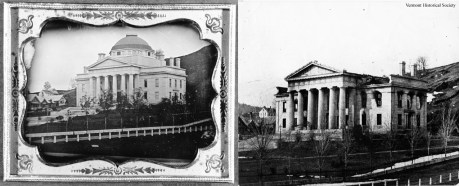
The second Vermont State House before and after the fire. “However, on the night of January 6, 1857, disaster struck. A special session to revise the Vermont Constitution had been scheduled for the following day. The stove was loaded with wood and left to warm the building before the legislators arrived the next morning. By evening the stove became so hot that the timbers near it caught fire. The flames quickly spread to the rest of the capitol destroying all but the granite sections.” ~ Vermont Historical Society
The State House at Montpelier was burned down last Tuesday. The fire taking around the furnace & getting such hold that all efforts to save the edifice were unavailing. The Library & State archives & most of the furniture were saved, the walls are not badly injured. The House was being warmed up for the constitutional Convention which was to occupy the Representatives Hall the next day, but they have gone into the Court House to hold their session.
Sunday 11th
I have not been to any meeting since leaving Superior where I enjoyed the labors of brothers Peet and McCorkle. Did think of going to day to hear Mr Whitney an old Methodist man who preached here some years ago, but finally concluded it would not pay. Rebellions are the order of the day & they are trying hard to inaugurate one at the Centre, but I believe without any success thus far. They are doing a tolerable business at the Borough & at Johnson.
They have tried their best for some weeks, have secured Old Man Daniels and made Sissy Hunt snivel once or twice. Old Benton says they can never make a one horse rebellion do anything in Johnson, & I am of nearly the same mind. The fact is, the people, (I mean those of any mind, at all) are becoming every year more loyal, & less liable to be excited to meeting & open rebellion. Mother finds fault with what I am here said about revival. I do not wish to be understood as discarding all religious notions whatever, far from it. I feel that we are called upon every moment of our lives for deep heartfelt gratitude to the great Author of our existence who crowns our lives with the richest blessings, that to feel our dependence upon him & realize that it is from him that we receive all, every comfort, and all that we have, & do toward our fellow men as we would wish to have them do unto us. This I say in my opinion is, as good religion to live by as any of their newly patented article, obtained at modern rebellions & I cannot but think it will be much better to light our feet through the dark valley that we must all pass, sooner or later.
Of all the profession of religion, especially men, How many are there, who by their deal with their neighbors, or their every day walk, would evince any superiority of Character or better show for happiness hereafter than the calm stoid person who adores his God and submits himself & all he has into his care & keeping? Amherst has just returned from Meeting & says he read in a Montpelier paper that the collection of the State Naturalist was destroyed, but it was thought that the House could be rebuilt by filling up the inside, walls all good. I went to the Borough yesterday and sat as sole referee in a case between Jonas Gobs & school district & also between S. Stratton Jr & same, did not decide as there were 2 law questions involved in such case & I wanted time to look it over.
The winter has been pretty severe in Vermont thus far, down to 20* & 24* below zero. There is not much snow in the fields. The ground all covering but not deep. Sleighing good as ever was. Went up to Johnson last Monday & staid at Judge Tom’s over night & had B.E. Fullington told his story about Kansas to a crowded room (the Valley). Col Ferner, Col Stoddard, Tom Baker, Judge Caldwell & old Homer teased him with foolish questions, & would have kept him on the stand all night if they could, to learn whether wild game were plenty, whether [frungh him?] grow well & [??] the ladies were contented &c &c. Mr F. thinks Kansas will be free in any confident it will be so. I presented Herman’s wife with the handsomest Chorastrolite. I brought home with me the little fine spackled one that had a ball on the backside & I gave Aunt Ellen a very nice one both on condition that this would get them set in rings. I gave your Aunt Martha her [???] in all but one sent some to the little girls with some agates. I saw the stone out & set that Jo gave to your Aunt Lucy, & it is the right ring I have seen. I made up a package of specimens & sent up to the old Dr last week but have heard nothing from him.
Amherst is in extacy with his Embroidered Shirt & wears it all the time & to all places, Meeting, Lycum, & to work in every day. I have bought materials for another he will soon long rejoice in a pair of them.
The school is rather a feeble concern in our district this winter.
Kept (I cannot say taught) by a Miss Buck sister to Mrs Kingsbury on the Wetherby farm. Attendance of Scholars from 2 to 7 or 5. By the way we have some excellent neighbors Mr & Mrs K. both young and better mates for you & Am than for old people. Miss Buck’s folks at the foot of the hill are also very good neighbors so your mother says. At Old Grim farm there is Lucy & her 4 boys. Mr Green is on his place but is going off it, having let it out. Dow wants this place again.
Have just had a good supper of hogs face with we could have had you to make even our number. Oh Allen I will not answer to how you remain up in that miserable frozen region longer than till you can so arrange your affairs so as to get away advantageously.
Your mother in constant alarm about you, at times thinking you gone to join our dear lost Augustus & no more to bless us with with your presence here, but to day she has prepared 4 blinds for you & your comrades to wear in the gloom of Feb & March. We got a short letter from you dated Nov 9th saying that you & 4 others were to start that day for your work on Bad River. I saw by the papers that the Old Manhattan was wrecked on one of the piers at the mouth of the Harbor in Cleveland, total loss. This makes two of your regular boats of the 3 that used to churn the sight of the dwellers of Lake Superior now gone to ruin. ([????]) I saw that among the saved on the Superior was a Foster. I suppose the young surveyor you & I conversed with on our passage down to La Pointe. But there was a [??????] Foster lost whether wife, or sister to him or none related I knew not. I am going to send you a paper – when I can get one. I now send you Life Illustrated, this letter one from Amherst for this time. Hope to do better thereafter. I think it would be condusive to the interests of us all to sell the farm & place a good share of the proceeds at interest in Wisconsin. What say you? Do you want to come & help carry it on? The Secretary of the Interior recommends that the clauses for the graduation law requiring residence on the land be reproofed, which if done, will be all in your favor. I shall watch the Tribune eagerly for anything interesting to you & communicate all valuable information immediately.
Do my dear son be careful & prudent, father G.A. Barber
My respects to the boys, Mr Wheeler’s & Mr Stoddard’s families.
Write.
Cambridge Jan 18th 1857
My dear Son
Since writing you last Sunday I have recd two letters from you, one dated Nov 9th directed to me at Lancaster & forwarded by father & the other dated Nov 22nd directed to your mother. You may bet high that your letters were gladly recd & that our minds were much easier about you than before. Still we should feel much better, were you here with us, to have a good warm bed to sleep on, and enough of the best that Vermont produces to satisfy your appetite, and with all the genial influence of our eastern society that I should think in some respects preferable to the general run of society about L. Superior. Still further there are rebellions in progress on all sides of us, and an interest in some of them would be quite an item in the adventures of the east over the west. They have broken out considerably with it at the centre, but I fear the infection is not genuine, and that it will not result in anything very good. They have got enough to talk in meeting so far as this “if there is anything on religion I am determined to get it” &c. Elias C. & wife & Mrs F. Wetherby and some others have had something to say, & the Minister has labored very hard to get all creation on his anxious seats. Mad. Heath is on tiptoe among them, almost an apostle. I went down yesterday to the Borough to give my decision in an arbitration, carried your mother down to Thode’s where we staid all night & went to Meeting to day A.M. to Meth. Chapel P.M. to Cong. House. They are getting hot among the Methodists & trying to do something judging from the groans & grunts of one of the ministers while the other was hoping rumbling the howls of distressed or enraged wild animals.
John Chase got home yesterday from California have not seen him, but understand that he talks of going back again in March. Did you ever hear what Emily Ellsworth did with herself? I never heard till a few days ago that she married a Doran one of the [Paddis?] out in “Senate Ireland” nearly two years ago.
I have got the watch repaired by Scott, who says it is now as good as ever it was. I would be glad if I could get it into your hands. Furs are monstrous dear this winter as you have doubtless seen by the papers. Mink skins [Prim?] are worth $4.00 a piece. Muskrat from 10 ¢ to 20 ¢. Martins must be worth $5.00 or $6.00. How if you had the [Shonis?] to purchase some furs this winter & spring you might buy some at prices that would pay you a good sound profit. I have no doubt but you could get Sable for 1.50 to 2.00 & mink for 1.00. Otter skins are generally called about here $1.00 per foot measuring from the nose to the end of the tail. They ought to be cheaper there.
Our district school wound up yesterday for want of scholars having had but 2 the last week. Julius G. & Martin P. & in day Julius alone. The teacher was the greatest failure of all.
We are getting very cold weather about now, but how cold I cannot say, as our thermometer has got broken by your Mother’s hanging it up on the side of the house for the wind to blow down, instead of hanging it inside the door casing where I had kept it so long. I feel lost without it & shall get one when I go down to St Albans which will probably be within one or two weeks. Think to day the coldest of the winter so far, at any rate it was cold enough for comfort coming up from Thode’s to night.
Monday Morning Jan 19th 1857
We are having a great snow storm to day, so thick as to make it quite dark.
We are all well, living very com-fort-a-ble in our close quarters & expect to be more so soon for I got 5 new curtains Saturday & you know they are always essential.
Your Mother says you must get some kind of fur and cover your mittens & also fur as much as you can to keep out the pinching frost. I am afraid you will suffer for clothes socks &c (by the way, you had better save the tops of all your socks, that are new and good down as far as they are good & have them footed up again & if you are short for yarn to mend with you can ravel some). The Stage will be here soon & I must close.
Have I told you that Charley Turner & Helen Sabin are married? Even so, & they are in [clover?].
Give my respects to the boys & you may rest assured of my eternal regard and paternal solicitude.
Giles A. Barber
Cambridge Jan 26th 1857
My dear Son
I wrote you yesterday one good long letter & because there was something in it about the 1 horse “Rebellion” at the Centre and some other things to tedious to mention your Mother destroyed it last night after I went to bed. So I have to repair the damage as well as I can this morning, but writing in such a hurry I cannot think of half I want to write, & shall only send you a small apology for a letter this time. I have suffered much in my mind on your account for a few days, fearing that you & your party must have undergone great distress from cold weather. It has been colder within a few days than ever before known in Cambridge. At 11 o’clock last Friday night the mercury was at 40* below 0, next Morning at 38* below. And you may be assured I should have felt much better if you had been at home with us in good quarters. Oh Allen I hope you will not find it necessary to spend another winter in that region of frost and famine, but will spend your winters henceforth in a country of more genial in climate, society, & Grub.
If I were assured of our safety from freezing & suffering for want of clothing, blankets, or provisions, I should rest much easier about you than I now do. Still I know you are in a party of good fellows & in the midst of kind friends who will be ready to befriend you.
Everything remains about as usual in Cambridge. On the whole I think the town about holds its own. The dairymen are growing rich on the high prices that Butter & Cheese are selling for, & well they may. Dr Safford has sold $150.00 worth of Butter from 3 cows & supplied his family with Milk & Butter beside. H. Montague at North Bend has realized $50. per head from his cows (20) but to make this out he counts his calves, & [Pork?] made from the dairy. Our dairy has done better this season than ever before but as I have not settled with Dow I cannot yet state the nett proceeds.
The rebels convicted are as yet only two, Mr.s E Chadwick & George Reynolds, they have a few more on trial, & are seeking indictments against lots of others. Mr Dow takes this & will probably mail it at Richmond so do not think strange of that. I wish to say one word of Amherst. He is at home & does not much, but chops all the wood we burn, runs about to mill & too meeting.
He is attending the Lycum at the Centre & writes some very good pieces for them which exercises I think worth a good deal to him. He grows like a weed & will soon be as large as you. I persuaded him to write to you, as you will see if the letter soon reaches you. I had nearly forgotten to tell you that we are all well, living cozily in the East Room secure from cold & hunger, & only wanting your presence to enable us to feel quite at home again. I said wrong. There is one gone from us forever in the world. I cannot yet feel as though any place was home so long as he is gone. But my time is up and I must close by writing you, health & prosperity.
G.A.B.
Cambridge Feb 1st 1857
Dear Son
Another Sunday gives me an opportunity to sit down to give you a brief narration of things transpiring in this outer world. Though you will see that nothing really worth mentioning occurs from week to week, yet to you who are without the visible world & the pale of comparison almost any thing from the old home of your childhood will be interesting. Within the past week the weather has been much milder & even quite pleasant till yesterday, when we had a terrific storm of wind & snow, but from what quarter I could not determine, as the wind blew all ways. The roads are all full & traveling almost suspended. Amherst & I got all ready to go to St. Albans but the storm increased so fast that we did not start, so we went over & staid with Oscar till this morning & I went down & made Mr Heath a visit, found him just as he was one year ago, unable to speak except in a low whisper, says he under goes much pain in the region of the heart. I went to see Uncle Enoch, how he progressed in the divine life, for there has been a desperate effort made to enlist him on the side of “the Lord” & much said about his being in deep distress &c &c found no changes, except that he is ready to talk candidly & give his views on religious matters.
Our last letter from you was dated Nov 22nd & we are growing very uneasy at not hearing anything from you in all this long time & especially when we consider what an awful cold winter we are having. Oh Allen my heart is pained when I think of you at times, when the sky is convulsed with storms & when it is so cold that mercury congeals, that you should be up there suffering for aught I know, when you could be so much better off elsewhere.
The Rebellion here blown over, almost a failure. 2 or 3 concerts as they are called & as many backsliders reclaimed, constitutes the amount of damage done to the Kingdom of darkness, rather small potatoes when we consider who have been here at work for the salvation of souls, for we have the word of the good folks that no less a person than the 2nd on the glorious [Frinsty?] has been here for weeks at work, to say nothing of 3 methodist ministers & Luther [Brevoter?]. When will men & women cease to insult the God that made them by their impious & blasphemous fooleries to cheat mortals into this or that church under the specious pretext of saving their souls.
Marm says of this last sentence, that it shows that I am in a some what excited state or I would not write to you so much on the subject. Kinni butch, I do not know how to spell this word, but you do, but I claim to be tolerably free from believing & falling in with every new thing that comes nor am I greatly given to running after every new minister, lecturer, or concert singer that happens to favor the world with their marvellous works. “Oh the folly of Sinners” & (I wish Saints were wholly divested of the article) I was up in Johnson last Wednesday, saw some of the old familiar faces. There are some sick, more in that village now than in La Pointe & Douglas Counties in 6 months, & yet when the west is mentioned a Johnsonian will start with alarm at the bare thought or name of so sickly a place. Mrs Tracy is soon to wind up her pilgrimage, (consumption). She had been sick, was getting smart, a girl in the house, broke a [flaid?] lamp, set her clothes on fire, Mr & Mrs T. got their hands burned in putting out the fire. Mrs T. held hers in cold water all night, & took such a cold that she must die in consequence. Poor Helen Pillsbury whose health has not been the finest for 2 years, was still able to work & keep about her usual [????tions], till this winter feeling it her duty to “come up to the help of the Lord against the mighty” in their feeble rebellion. She overdid herself or exposed her health, so that it is found that her life will be the penalty. Poor Girl, she is going as I fear the way of Merrill & Mary, & yet that damnable, mean, thievish help “Vet” must live to be a curse to his parents & to the world.

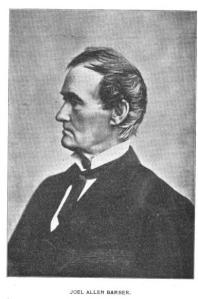
Joel Allen Barber’s uncle U.S. Representative Joel Allen Barber was a member of the State Senate in 1856-57.
It is an economy of Providence that I cannot comprehend why such persons who bid fair for usefulness in the world, who are a pride & blessing to their friends & all who know them should be removed from this world, while others who are a pest to their friends & the world & not worth the powder to shoot them, should remain as secure, as though death could not reach them. But God knows, & perhaps we may hereafter, understand what to us now appears so dark and mysterious. I see by the Tribune that your Uncle Allen was not elected U.S. Senator, but J.R. Doolittle was. I know not whether I wrote to you what your Grand father wrote about your Uncle, that he was going to take Thode Burr to Madison with him & get him a place as assistant Clerk if he could, & further that he (Father) was afraid that Allen would never get home alive, his health was such, but I should have more hopes of him while there than when at home, for he would be more likely to do something for himself & get better Medical advice. I hope he will do something in season. Amherst & I shall go to St Albans to morrow or next day & stay a day or two & make a call or two on the way in Georgia & Fairfax. I expect Mr Burr is going to Lancaster this month, to determine upon his future course whether to finally go there to reside & go into business, or to give up all thoughts of it, and settle himself down quietly in this country for woe or weal.
It is yet a matter of uncertainty what I shall do with the farm another year. Dow wants it another year & in some respects he is as good a man as I can get, and on some accounts he is quite objectionable. He is a very industrious man & a good hand to take care of the stock, make pork &c his wife is not 1st rate for Butter & cheese, but middling. Dow is too much disposed to [skin?] the farm, or keep, more land under the place than can be manured & is rather too tight & [fizzish?] while his woman is quite & altogether too much so besides your Mother & she have been at variance almost through the entire year, & in this case I think Mrs. D was very much in the wrong, & that she is a little stingy nervous, wilful jade. It would be idle to think of ever living in the house with them another year.
Think some of hiring a good Man & girl & carrying on the whole ourselves. This is your Mother’s notion but I have before now heard her declare that she would not be burdened with the care of so much work. I would so far as I am concerned rather sell the farm cows & all and go to Lancaster to live on our little farm, where our dear Augustus did so much to make it valuable & attractive. When Offered $35. per acre for the place, I looked at those young apple trees planted by his hands expressly for our advantage & comfort & said to myself that $50. per acre shall not deprive me of it at present. I shall like to know your mind upon these matters, but of course cannot in season for the coming spring. I have some thoughts of getting Mr Perry to take the farm if he will do so. Then I should feel all safe. Your Mother & Am are drawing a pattern for his embroidered shirt that is now making, & after his is made, you are to have two made. Am is toasting cheese & stuffing himself with it. I wish you had a shake in that, as well as your abundance of good fat beef pork sausages, butter & milk. Oh My Son, I think of you whenever it is cold or stormy, & when I lay me down at night in a warm bed or sit down at home or abroad to a good regular meal of victuals gotten up by the hand of a woman, other than Nancy.
Am is doing quite a business in peeling muskrats, he shot & caught 17 in the fall & sold them for 10 ¢ each. He has just peeled 3 more & is on the qui vive for more. They are worth 20 or 25 now. If I get to St Albans I will start a paper or two off for you, and some for others in your country.
May God bless & preserve you
G. A. Barber
Cambridge Feb 8th 1857
Dear Son
Another Sunday has come around & I am again trying to place on this sheet a few scratches, that you may know that we are all well at home, & that we are not forgetting you our poor exiled son.
Joseph Alcorn
William W Ward
Larry Marston
Edward L Baker
We were very glad to receive a letter from you day before yesterday, that had been nearly two months on the passage, dated Dec 13th at Mr Stoddard’s. We have felt much uneasiness on your account for a long time it has been so very cold, & have been afraid that you must have suffered; but our fears are happily relieved by learning that you are doing so well and survived but such a band of invincibles. Who could have fears for such a crowd as Jo, William, Larry Marston’s? I am very happy to add Baker too! I am really glad to hear Mr. Baker has got back with you again & hope it may be for his advantage, that he braves the perils of another polar winter, & I am confident it will be for yours. You will see that I was mistaken about your Uncle Allen’s being elected Senator. But I was not more so than many others. I see by the Grant Co Herald that there is a bill introduced into Congress, to make good all entries under the Graduation Law without any further requirements, & there is little doubt of its passage.
This will be a good thing for you, if it becomes a law…

U.S. Representative Augustus Young ~ Findagrave.com
Amherst & I went down to St Albans last Monday & drove Kitty and got home Friday, had to stay longer than we expected on account of storms, winds, drifts &c found all the folks well at Mr Burr’s. Went down to the Bay & found all well there but Mr Young, who was quite feeble, but much better than I had expected to find him. He is now confined to the house during the cold weather, but I should think he might get some better in the spring. I would like to see him in LaPointe County about two months next spring & witness the effect of that climate on him, & I would see it if he was alive & I were able to take him there. I carried down some specimens to him that pleased him much. Little Augustus Stevens is living with Mr Young now & will probably remain with him while he lives.
Uncle Amherst W. willed $100.00 a year to Mr Young during his natural life, and $50.00 a year to your Aunt Betsey as long as she lives. The rest of his property is given to various benevolent purposes. The interest of $10,000.00 to the Episcopal Institute at Burlington. The interest of $1,000.00 to the Brattleborough Insane Asslyum. & the use of remainder principally to support Preaching at East B. All this is well enough. If he thought a few thousand could pave the way to heaven, it was his duty to down with the dust when he found he could hold it no longer himself.
While at St Albans I took the Ambrotype copy that your Aunt Martha had taken from our daguerreotype of Augustus & had a good likeness taken, that I have done up for my Mother & shall send to Morrow also One on Mira that is set in a gold pin for your Mother, one other put up in a case, both good copies, & 10 other copies all ambrotypes one of which I shall enclose in this letter for you, that you can keep till we can furnish you with a larger one in a case. That Daguerreotype taken by Merrill & Wilson you know was good & these copies are most of them copies are equally so.
~ Zenith City Weekly
I got a letter from Mr Hayes last Friday saying that he had called in November and tendered the 120 acre warrant & $58. in gold to the Land Officer & was told that they would attend to it. So as to send off the entry in their returns that Month, & again in Dec. he called and wiged repeatedly that it should be done & was all along told that it should be attended to, but at or near Jan 1st when again pressing the subject upon them, he was told that an appeal was taken by the Dutchman and sent to Washington for a hearing there. This is the state of the case. I had some little confidence in Mr Shaw as an Officer but but cannot have much now, since he has conducted in such a manner in my Land Suit. As to E. B. Dean I was always satisfied that he was a d‘d scoundrel any way it could be fixed, & the history of his transactions in Madison goes very far to justify such an opinion.
I feel as though in duty bound to go to Washington to see to having every thing done there to protect our rights, that can be done, I am fully satisfied that somebody beside the little Dutchman is the person or persons in interest now pushing it up to Washington where they hope by some trick to cheat us out of the Land. I wrote yesterday to Elder Sabin to have him attend to it for me but he his now Lawyer & may not have time to do anything… Mr Hayes has written to a Lawyer in Washington but who knows how far a Lawyer in Washington may be trusted, when sure of a fee on one side & perhaps a double one on the other, & there is no doubt, that who ever carries that case to D.C. will have nothing continued to effect his purposes. I am surprised to find that all that has been done, goes for naught & that the case is yet undated. Still if I have a fair chance I should not fear, but if there was anything unfair, or any undue advantage being taken, I ought to be there, I suppose it would cost about $40.00 to go.
All is very quiet in the religious world at present. The rebellion has not amounted to any thing serious after all the noise & confusion in the Saint’s Camp. Madison Heath is bent on pulling down strongholds and setting up the standard of the Cross, & as one of the first steps in the warfare he & his frau came up & made us a visit last Friday night & undertook to [sumed?] me upon matters of faith, doctrine, &c. I am thankful for his good intentions, but would prefer to listen to him “after a little” than now, when it is a new thing to him, & he scarce knows what he is about. We are having a great thaw, the snow is nearly gone in the fields and pretty well done to in the roads.
The river is very high & threatens to break up.
Mr Burr talks of going to Lancaster two weeks from to morrow, but is very faithless about liking the place well enough to ever go there to live. If he does not like, he will take Thode home with him, and go into business of some kind in St. Albans. He is in great purplexity. When at St Albans the other day I got some papers and sent to you, P.B. Van, Esq Felt, Charly Post, H Fargo & Pat O’Brian, and a new Ballou’s Pictorial to my good young friend Stick in The Mud. I have many other good friends about the Lake that I remember with much pleasure, and would be glad to recompense for their uniform kindness toward me.
Ballou’s Pictorial was published during the 1850s in Boston, Massachusetts. ~ HistoricNewEngland.org
I am glad that you make your quarters with Mr Stoddard some of the time. You could find no better place in that country. Give my respects to him & wife, also to Mr Wheeler & family & Mr Davis & family if there. Give my best respects to Mr Baker & all the other boys & be assured of the best wishes for your welfare & happiness, and success in business, of your ever affectionate Father
Giles A. Barber
Has Gen. Lewis even sent you that contract?
Cambridge Feb 12th 1858
Dear Son
This week is about gone & have not yet written one word to you. I hope you will pardon the neglect. I have not much to write that you will care about reading. Still I intend to furnish you with some thing from home every week, i.e. if it ever reaches you.
The most important item of news is that we are all well as usual (myself excepted) & that has been so long stereotype that it has ceased to be news, & yet I presume it is none the less welcome to you. My health & strength are gradually on the gain, & for a week past my swelled legs have been much better.
I went up to Dr Chamberlin (as I wrote you I intended) last week Wednesday and stayed close in his house till the next Sunday night, & recd great benefit from his ministrations.
He pronounced my trouble, as wholly arising from debility & torpor of the small veins and absorbment in my feet & legs & immediately applied bandages & a wash of Alcohol & [Garm My sch?] I was well satisfied with the Dr’s performance & think he did as well as any who make more noise in the world. It was very gratifying to him, having a patient from a distance. Consequently his steps, always very short when in good spirits, were reduced ⅓ in length and quickened ¼.
Many “good old fellows“ of the village called to see me & I had a very agreeable time of it, besides being greatly benefitted by the long protracted visit.
I have been improving since I came home! Amherst is my Dr now he rubs & bathes my legs 4 times a day and applies the bandages with considerable skill & alacrity.
Amherst chops the wood at the door & is quite a chopper his time is occupied with that, Skating, playing pasteboard, & backgammon, reading & some study. I have promised him that when he gets the front yard filled with good stove wood I will go with him to Georgia & visit every body there, from Hon A. Sabin, down to those little ones growing up around my old associates & friends. Such a visit will be very pleasant to me & would do him no harm, but if my legs do not get well or better than now I am afraid “I cannot get to go” this winter.
There is a great temperance agitation throughout the State this winter, & hired lecturers are traversing it in all directions “but as the movement” began before I got home, & I have been unable to attend, any meetings, it it is impossible for me to tell what particular object of the temperance people are driving at.
I think that in Johnson & this town those who formerly were most open & vindictive against the cause, have no subsided into acqueiscince with public opinion, and have become ashamed to be seen tippling or opposing the law. Even Uncle Enoch has ceased to rail constantly about the abridgement of his liberties, and would give his old hat if it (alcohol) could be kept for ever from George, who has now got to be a complete sot when he can obtain the “outter” so as to go to bed before noon or hide himself in the haymow. Last fall he George set out in the evening for Montpelier with his skin full of rotgut & about 10 oclock he was found lying in a puddle near Morgan’s Store by Graw who alarmed the villagers. George was got into the tavern & his horse & sulky were found near by the Academy. The horse feeding quietly in the Morning George came to & to put the best look on the [can pisned?] himself sick, went to bed & had physicians attend him all day.
There are rebellions progressing in a few places about the country. St Albans Bay, Bakersfield, the South East part of the town and that neighborhood in what was once Sterling near Sanford Waterman’s. Ralph Lasell is said to be one of the trophies they boast about.
The most curious thing aster is the strange predicament in which Judge Stowell of the Borough finds himself, he being a widower has for some over a year been playing [policies?] with one widow Goodrich a daughter & only child of David [T?????] & the day of the wedding twice fed upon the cake made & [Risd?] engaged but his precocious son Henry threatens wonderful things if his father marries the widow.. A suit is threatened but he Judge contending to worry the young widow & keep her easy so that she will not move in the matter, although Frank her father is swift for compelling him to marry or fork over. Stowell is in trouble. The ravings of French about town amaze him.
13th
Yesterday I went up to Mr Green’s visiting & drove my own team (Kate 2nd but my hands and arms are so weak that I shall not dare to try it again. I could do just nothing at holding a horse that was disposed to go too fast, or where I did not wish to have it. Kitty as we call the mare, is a larger nice beast, strong as a Moose, a good traveler, kind & true in every place, & would be just the creature we should want to carry on the little farm in Lancaster, for with her could every thing be done easily. But then shall we ever occupy that farm? Or shall we always have to clamber up rocks & hills, so long as I live? There is manifested in a certain quarter the same disposition to withhold any opinions or wish in regard to that question as there, save when it is known to be in direct conflict with mine.
(Night.)
I have been down to Mr Heath’s this afternoon & made a short visit, found him about as he was last winter, still unable to speak louder than a whisper. He is able to be up most of the time and to ride about some when Madison can go & drive for him… Mad has a fine fat gal baby, a perfect wonder to its grand parents. Marion has no such good luck (or all luck ) to boast of. The weather has been very mild till day before yesterday when the Ther. was down -12* Yesterday it was -24* & this Morning -16* & prospect of a cold night again. Sleighing that has been poor most of the winter is now tolerable & teams are constantly passing as in older times.
14th
Last evening Uri Perry & woman made us a visit. Martin & Jot living at home with them. Wyman is still in Ill. Susan lives at North Bend, & Amanda married last fall to a young man named Bosworth son of a rich Merchant in Boston, so the story goes.
The Defendant & wife have just made us a short call, their boy now able to talk, is a very fine looking smart fellow. We have been having some talk about Weston’s coming here to work for me next season. I shall see him again & ascertain what we can do in the way of agreement. I got a letter from Cyrus last monday asking about the disposition of the little farm another year. He says he put up 166 baskets of corn for me the basket ½ Bus which would be so many Bus of shell corn. There were [??] Bus of wheat for me, which Cyrus got ground at your mothers request & sold at the store at 24 pr lb for which he account to me.

Honorable James Buchanan Jr was the newly-elected fifteenth President of the United States (1857-1861). Buchanan’s vice president John Cabell Breckinridge was already involved in Chequamegon land speculations. ~ U.S. National Archives and Records Administration
It is still a source of unhappiness to me that you are doomed to pass the long gloomy winter around that gloomy Lake. I should feel much better if you were down at Lancaster or in the good little State of Vermont, where you could enjoy your friends and some of the comforts [???] I could wish all the comforts of civilized life. But you are Surveying and prosperous I know you are making a better winters job of it than you could any where else were it not for the sufferings you must [??????????] made go in [isading?] in the snow [?? ?? ?? ??? ????ing ????] of sleeping at [??????] Such cold nights & mornings as the last week has given us makes me humble for you & your party, and perhaps miles from any lands or aid in case of any [????] of prusing or seeking to which you are in your situation. So [??????????ly] exposed [?????????] I am anxiously waiting for more letters from you to know how you are braving the perils of your third polar winter, & I had thought that [?????] you went up to Superior i.e. if you have to go there for your drafts, you would just do us a ½ a doz letters to make up for past remissness in little writing. I wrote a while ago to E.R. Bradford of Superior for information in relation to Superior [????] Starving populations I want to hear from there once in a dog’s age even if I do not like the inhabitants quite so well. I have been in hopes that some of your paper would get along so that I could by them learn what was going on in the copper regions but as yet none have reached me, & probably will not this winter. I hope Mr Tylor & his friends will be able to sustain themselves & their paper too, in spite of the combined powers of hell & its minions on earth, Buchanan, & all the unterrified & unwashed & E. B. Dean in [???] to the bargain.
Amen.
Summary of the Topeka Constitution, aka “the Kansas struggle”, from CivilWarOnTheWesternBorder.org:
- Date originally drafted: October 1855
- Stance on slavery: prohibited
- Suffrage for women: none
- Suffrage for African Americans: none
- Suffrage for Native Americans: “every civilized male Indian who has adopted the habits of the white man”
- Settlement by free African Americans: prohibited by an “exclusion clause” that was approved by Kansas voters
- Status: failed to achieve federal recognition by January 1857

U.S. Senator Stephen Arnold Douglas ~ Library of Congress
The Kansas struggle seems drawing to a close. Matters have arrived at that stage when a final settlement of the great issue is most able. The prospection now favorable for the cause of freedom & for the abolishment of human bondage from the territory forever, & if that glorious result is finally obtained, it will be through the influence & talents of Douglas, the Northern Senator, who was mainly instrumental in opening the country to the inroad of Slavery, nor is it certain now that his [???????? ???? ?????] in his espousal of the Kansas Free State cause than long were in 1854. Still whatever may be his policy in things on the right side over in his political compass, I am thankful enough for such aid in this time of need. Probably no other man could have caused the [???????] to abandon the President as he has done when the d’d old [??????? ??? ????] is fairly laid on his back & the darling [??????] of his administration by which he had hoped to secure to himself the adoration and support of the entire south [??????] in wild as of the great unterrified & unwashed of the few states then if Douglas will conduct himself properly I should not care so much if he was the [????????] aspirant for the Presidency. Senator said lately in the Senate that within the year there would be 19 Free States to 15 Slave States, by the admission of Minnesota, Kansas, & [???????], as [????? ????] states. The Southern [??????] are alarming and talk loudly of a Southern Confederacy. The Democracy generally throughout the Southern states are in opposition to their stupid Presidents on the Kansas question, & nothing but Douglas’ carrying his point will save this party from utter defeat & ruin. While at the same time the party will be rid of its most obsiquious satans of southern [????] if the Poor devils and find any place to go to. Perhaps they may get up a [????] of Secession party to catch the scum of the Democracy.
Do write as often as you can and as long as you can. That is one great fault with your letters. They are too short & do not tell [??] half about yourself business & prospects, that we would be glad to learn.
~ Fifty Years in the Northwest by Elijah Evan Edwards, page 250.
When you are at leisure you must begin and write little by little, till you would get a respectable letter [?????] size & length. Anything would be interesting from the lake region even to the health of any of the Indians or half breeds, how my old Sombre friends [Chochiguenion?] Newaga & old [Renase?] & George Day ([?????]) are & how my Superior stranded friends are passing the winter. Does the Judge indulge in a good drink occasionally? Are Mr Maddock’s people all well? Does Mr M work with his gang on the Pointe this winter? Is Houghton stock rising? Have you got your $800. [?????] begun yet? I trust you will know too much to be drawn into [???????] arguments, I am willing he should make as much as pleases out of his wildcat town, but I do not want you should have anything to do with it any way or any how. How does Dr Ellis get along with his Mill? Do the hard times pinch operations & speculations around you this winter? Is there any less Whiskey consumed than previously? Does Dawson deal out the stuff with remembering to wet his own whistle? Is Herbert blasting around La Pointe or is he down at Ironton? & finally how are things in general all around you? When you are engaged in surveying I cannot expect you to have much spare time for writing, but I repeat the request that when you have the time to spare, you will give us longer letters so you must remember to write as often as you conveniently can, and when you do write, give us a letter long as a strong or as long as Amhert’s [???????] whiplash.
15th
“IN MEMORY OF AUGUSTUS H. BARBER of Cambridge, Vt. U.S. Deputy Surveyor who was drowned in Montreal River Apr. 22. A.D. 1856 Aged 24 yrs. & 8 ms.” ~ FindAGrave.com
Yesterday a little sister of Ballard’s was buried. She died of Scarlet fever, that is prevailing in N [????]. Ballard is at homer’s tells great stories how he sold property in those new towns [Samtagia?] & [San Colana?] (that he was concerned in taking up test summer with [????] her, ward [???]) in N.Y. City & how he recd payments in real estate in Brooklyn. If he got any such property in Brooklyn, it must have been when the tide plains on some very distant part of a salt marsh for it does not look very [??? ????] that he would [? ?? ?? ??? ???] The eyes of Brights his so as to sell paper [??? lots for [???] valuable [?? ???????] I [??? ?????? ??? ???? ???? ??? ???? ???? ??? ????] make my visit to my old [???? ] in [??? ???] as I now contemplate doing. You have [??? ??? ???? ????] your [???????] should for you or [????? ???] you [???? ???? ?????????] to have along [???? ????? ?? ???? ?? ????] How have you informed me [??? ??? ??? ??????? ?? ????] & [???? ?? ??] the grave of your dear Augustus. How [??? ??? ???] his previous remains are at Lancaster. [? ???] in Cambridge & [???] I would [????] I could prevent on you to leave there, never wish to see the Lake again or anything about it, but so long as Augustus is buried on the shore of that [???????? ????] I shall feel as though there is as some thing that [???? ?? ??] and [?????? ?? ??] have it so long as I stay.
This very long letter may be dismal for you to take at one dose. So if you find your strength failing before you are through, reserve parts for another time when you feel better able to wade through these 8 pages. Give my respects to all friends. Tell John [C?????] I give my respect to his good old father, & to tell him that I do not forget my old friends. Tell Mrs Maddock I wish I could convey one of my large cheeses to her. I think cheese would suit you very well [?????] and prosperity & believe me your ever affectionate and anxious father
G. A. Barber
Cambridge Sunday Feb 15 1857
My dear Son
I again sit down to give you a short history of matters & things in this glorious land of liberty, of laws, Bibles, & Sabbaths. In the 1st place we are all well, & when I write that word, that means so much, I cannot but wish that I knew, it could with equal truth be applied to you. Our last from you was dated Dec 13th & in that two months following, so very cold here, how much you have suffered, or how you have endured the cold, fatigues, & privations of a surveyor’s life, is a subject of much solicitude in your paternal mansion, as well as among your numerous friends in Lamoille County. But I hope soon to get another letter from you assuring us of your safety & welfare, down to a much later period. I hope the winter has broken in your region as it has here, & that you will have a better time for prosecuting your surveys.
Last week I wrote something about those who had purchased under the graduation law having their titles confirmed without further requirement, & that such a law would probably pass, but now it looks “like” it would not pass that the purchasers would be held strait up to the mark &c. Your Uncle Allen says you had better build a house, for that is what you need, & will add to the value of the farm all it will cost, & save your paying out the [??? ?????] to save what you have already paid which would be $201.38 if I have figured right & then you would have no house or improvement. Perhaps the Law may be passed or some relief granted to the many who would suffer severely if the Law as it now stands is enforced.
Your friend Levi with Oscar have been over here a good share of the day, & have been viewing by day light the agates & curiosities I brought home with me.
This is the 3rd good visit from Levi since I got home. His health is much better now than formerly, but if he is not well this spring I will try to have him go up & visit you.
Our winter is on its wane & spring like days are upon us & yet I have not settled what will or shall be done with the farm. Dow wishes to remain, & would so far as he is concerned be as good a man as I could expect to find any where but his little woman is a small specimen of she tiger as venomous as hell, to all whom she dislikes.
There is now talk of having Mr Perry & Wyman for tenants though nothing certain yet, shall know soon.
I wrote you last week of the appeal having been taken from the Superior Land Office. I have since written to Elder Sabin again enquiring how it stands now, when there will be a hearing in the case & whether my being present would be of any advantage &c. If the Officers at at Superior have done anything to my prejudice, have left out anything material to my side of the case, or presented anything on the Dutchman’s side that should not be in or in any way connived to wrong me out of the Land why then I ought to be on the spot ready to meet it. I want to prevail in that suit, after all the opposition, delay & rascality I have encountered from the other side. I would sooner trust a dog with my dinner than any of my rights or interests in the hands of such a man as E. B. Dean & I know not as Shaw is any better.
When I wrote to you last we were having a heavy thaw that broke up the Hudson and did $2,000,000 damage in the City of Albany alone & immense damage at Troy & other places on the river & on all the rivers south as far as heard from including Cincinnati where there was great damage done, by crushing boats &c.
That thaw took cold Sunday night, & it has been down to 20* below 0. since, but to day we are having another thaw & raining so that sleighing will be “pone” after this if there is any. The Legislature Extra Session convenes at Montpelier next Wednesday to do something to provide for a place in which to hold their future sessions, & such a stripe as will be manifested the present week, the state never saw. Among the towns claiming the future State house are Montpelier Burlington Northfield St Johnsbury, Rutland Woodstock Windsor & Bellows Falls. The principal stripe will be between Montpelier & Burlington & I should not wonder if the latter should carry the day. Of course all below Hydepark are for B. & a general desire through the state has long been expressed for a removal of the Capitol from M, but possibly a sympathy for M. may operate on the minds of the Members thinking it hard to take it away when they have built & spread themselves so much thinking their fine Granite house was as durable as the Green Mountains. On the Contrary it can be said that M. has had the S. House 50 years and that is a long time, & should be the reason of giving to some other town. When I write next Sunday I may be able to tell you more about it, though it is not likely the question will be settled by that time.
I sent you in my letter of last Sunday a beautiful Ambrotype copy, from the Daguerrotype of Augustus, which I hope will reach you in safety. I sent one to my Mother in a good case & one to Alvira like yours, & Am. is going to send one to Helen Whiting, who has written him some of the most touching & beautiful letters in relation to the death of our dear unfortunate Augustus. I knew she was a girl great powers of mind, but did not think she would interest herself so much in the griefs of our family. I wish you could read her letters to Amherst. She is now at Greenupsburg write to her Greenups Co. Ky. in the extreme N.E. part of the State, teaching in a family school.
I got a letter from your Grand Pa last Friday by which we are advised of the continued good health of all the good folks in Lancaster up to Feb 4th He says that they are now talking of building an Academy there. Mr Myers who married Marthy Phelps has offered to give $150.00. and teach German & French two years. He is a wealthy, educated & refined Gentleman from the faderland & by his liberality I should think would shame some of the close fisted skinflints who might by such liberality have made Lancaster a “heap” smarter place than it is now.
16th
You cannot imagine how Hiram enjoys his new Red embroidered shirts, they can keep him him warm enough in winter weather without anything else. Hoping to hear from you soon I will defer writing more till another Sunday unless something “turns up.” You have so many letters sent & so few mails, they must come in chunks or gobs as Jo Doane says. Give my respects to all the boys & friends in La Pointe Co!
Your father Giles A Barber
Cambridge Sunday Feb 22 1857
My Dear Son
I will continue to trouble you with my letters, if I do not get anything from you & I hope to have you receive as many letters during your prolonged, painful absence from home as there are weeks, and though I am unable to fill them with matter interesting to you. Still I know from experience that when in exile, in a distant strange land, any such mementoes from home & those dear to us, bring all the familiar faces of friends visibly to mind & for a moment almost make us forget [????] the distance that stretches out between us. I suppose there is no item of news that gives you more pleasure than the two short words “All well” when you understand that it applies to our family & yet you have had it so often reiterated, that were it anything else, it would have become quite stale, if not absolutely painful. We want to get such news from you oftener than we do, or rather we would be very happy to know of your continued well being & be so near you that the knowledge would be more direct, than hearsay.
Your Mother is constantly apprehensive of dire misfortunes to you, of suffering, from cold, hunger, fatigue & privations. Yet, after all, I cannot help feeling much solicitude for your welfare fearful of the effect of this unprecented cold winter upon your health as well as comfort & convenience. Still no letter from you of later date than Dec 13th. Hope to get one very soon, with good news from you & the young men of your party.
For about 3 weeks the thaws have been so severe as to carry off all the snow except a little in the woods & the mud was like April, but we have some snow fallen again that has laid an embargo on waggons. The river has run over the meadows during the past week.. A thing unusual in winter.
As yet we have made no disposition of the farm for the coming year. Mr Dow has done much better in a pecuniary point of view, than either other tenant. I was looking over matters with him last night & find that the product of the Dairy, &c has been sold for $616.00 to say nothing of 18 Bu’s Wheat, 150 Bus Potatos, a good lot of corn & Oats 7 yearlings the cold, &c &c. The cold is a very good one, worth as much as any one I ever knew of its gender, but as I may have to pay Dow for ½ of him I am confident about “letting on.” So far as I can see, the man has been honest enough, is a very careful man with cattle & horses, a good judge of both, is a sober, temperate, cool, calculating Yankee. And yet his wife is a different sort of woman from what I should like to have around, & has not treated your mother & Amherst as she should considering the obligations she was under to do otherwise. She is a little waspied, petulant, conceited, niggardly body, as one would meet in a summer’s day, not strictly confined within the limits of truth, somewhat nervous & in case of trouble in domestic matters rather inclined to sick headache & hysterias. But she keeps things in much better shape than Mrs Dickinson did, every way & in the main, would wish to pass off for a very nice little woman. It is hard to think of having her another year, after all her insulting talk to your Mother, & perhaps equally hard for her to ask to stay, after so often saying that she would not do so, on any consideration. I have no trouble with her & will not with her or her husband while they are around, or I have any thing to do with them.. Another Man Harrison Putnam cousin to Aaron was here yesterday while I was gone to Johnson, wishing to take the farm, but whether the change would be advantagous is problematical. One thing I have set down as a fixed fact, it is one of the last places in which I would look for perfection, in a tenant, & as all are wide of the mark it only remains to take them making the [????] affirmation.
Our Extra Session of the Legislature is battling for a location for the future State house, with what success I do not learn since the 2nd day, when an informal ballot was taken in the senate, each Senator giving his ballot with the name of the town he would prefer for State Capitol written on it, whole number voting 29, of which Burlington took 12, Montpelier 11, the remaining 6 for 6 different towns. I fear that a foolish sympathy for M. because they have had the capitol so long inducing them to build extravagantly will induce many to vote against removal, without considering that Burlington has never had but 1 Session of the Legislature (in 1802) while Montpelier has had it in uninterrupted succession 49 years, or a half century. “Let her rip” I hope to survive it, let it go either way, but my [??inx’] are for Burlington.
“Plain truth to speak” there is nothing of consequence to write, any how either about Cambridge or Johnson folks.. Times are barren of news I take the Semi Weekly Tribune in which we have murder & robberies committed in the latest fashion, by the garrote applied to the victim. Some humorous articles entitled “Witches of New York” in numbers the last of which recd is 9. They bear evident marks of coming from the pen of Mortimer Thompson author of Doesticks.
Oh there is one thing you will rejoice to hear & I should have informed you since. The sugar that you & Mother prepared for the N.Y. Market has been sold & the cash recd when I was at St Albans on the [??d] inst from Mr Ladd. It shows how much better it is to do things scientifically than otherwise for this sugar something about 300 [??] brought the astonishing sum of $15.00 after paying freight & Mr Ladd had hard work to get that. Such Sugar as that is now worth up to 12% [cts?] here at home. I got a letter from Mr Sabin Friday relative to that land claim now before the General Office at Washington, expect another soon to let me know when a hearing may be had.
I suspended writing till Amherst had returned from the P.O. in hopes he would bring a letter from you but disappointed in that I go at it again to finish it up ready for the mail. I ought to correct an improper that I got on my mind & imparted to you, was that young Chadwick was an infamous character. He is on the one that Mr Lowry had seen in Milwaukee, as he has never lived there but is & has been in Chicago ever since he went there three years ago. I know not but I have made this correction before. Give my respect to all my friends in Siberia. Be a good boy, keep a stiff upper lip and take good care of yourself. Write whenever you can. Remember that unless Congress passes some law for the relief of Graduation purchases, you will have to come down & build a house on your land, sure as fate.
May God bless and preserve you
G.A. Barber
Dear Son
I take it for granted that if you live till spring you will go to Lancaster as it will probably be necessary for you to attend to your land as soon as possible. Now if you do not think you can come home after you have been there, I feel as tho’ I must go there myself and see you. I do not see any thing to prevent my doing so, now, and if nothing happens to prevent I hope to have the pleasure of seeing you.
If you can come here next summer I should defer my visit until some future time ‘tho I should like much to see L. and some of its inhabitants before long as I may like the place well enough to wish to stay. Tell me what you think of the place.
Your affectionate Mother
Cambridge Sunday March 1st 1857
My Dear Son
Do you get any letters from home this long cold winter? If you do you are more fortunate than we have been, for since my parting with you we have had but 4 letters 2 dated Nov 9th 1 Nov 22 & 1 Dec 13th & now there is a tedious period of 77 days in which we have known nothing of your health, your welfare or sufferings, or even of your existence. You may be assured that we are growing very impatient to get letters from you, & think they will arrive soon, & in the meantime will console ourselves with the thought or rather hopes that you are yet alive & well, that we shall yet have good tidings from you, when the mail are to be carried around the shores of the Lake & through the forests.
There is nothing new, to write to you to day, only the same old story that we are all three well as could be expected under the circumstances. Our snow went off the 1st week in Feb and we have only a few days good traveling since.
The snow is gone in the woods so that we can get around with perfect ease anywhere, & the prospect is that it will be the best season for Sugaring that we have had for 10 years. Amherst & I are thinking of rigging up another small sugar place up in the woods east of the Gooseberry Hill, & making a few pounds of the delicious article. Sugar is now worth from 10 to 12 ½ cts and they are ready to contract for it at 10 ½ now. There has been some made the last week, though but few have commenced as yet.
Wyman Perry talks of starting in a few days for the Great West, he is here now, & I am advising him to go to Lancaster, thinking there will be a land call for Carpenters [?????] to build all the Buildings that are to dot the graduated lands.
I have just been reading three of the last letters written by our dear Augustus home, & to see the high hopes he had of doing well there & the indomitable energy that led him on, as he & any body else might have supposed, to affluence & and an honorable position in the world, and then to see all those bright hopes & prospects crushed in an hour & what is infinetely and painfully worse to lose him who was the light & hopes of us all. Oh the thought that he who was suffering such hardships and privations in hopes of seeing brighter & happier days should be stricken down in a strange land, far from friends [?????] home, called in a moment to bid adieu to this bright earth, to all hopes of seeing friends & home & keep to the dark watery grave & into that unknown future world, where realms are forever sealed from the knowledge of the living, the thought I say is almost insupportable. May God keep you from such a fate my dear Son. Do be careful of your precious life & health & if our dear Augustus is gone where we may never see him again, we have his good examples, his virtues, & his valuable letters & papers, that are worthy of our highest regard & from which we may still derive instruction & benefit though he is as I [?????] believe in a happier state of being.
I do believe there was never any young man or any man in Cambridge whose death caused such a profound grief throughout the entire circle of his acquaintances as did the Melancholy death of our dear departed one, & well may humanity mourn his loss for he was one of [???] noblest specimens, & the loss of one such is more to be lamented than that of a regiment of senseless fops & rowdies who are suffered to curse the earth with their hated presence. That we may all meet him, in another & better world is a fond hope to which I most fondly cling.
Monday 2nd March
I believe this is somebody’s birth day. Oh that you were here to spend it with your parents & surviving brother. How much joy it would be to us all, yourself included I trust. We had a letter from Alvira last week by which we learn that She has been something of a rambler since September 1st for she says that with her husband she went to Wis. as far as Beaver Dam, thence back to Chicago & from there to Quincy Ill. down on the Miss 200 or 300 miles below Galena where they remained till into January when they returned, to Winooski. Brink has since gone to Troy N.Y. to work & [??] is boarding, talkings of coming up here to stay a while this spring in sugaring. Would not you like to be here with us. We are all hands going to getting in at the Cruping Rock to fill an ice house at Bush on the Carlston [???] to day, & that brings to mind the changed condition of our neighborhood. Kingsbury owns the Wetherby farm & lives in the farther house, & two French families live in the Wetherby house. George Busk owns & lives on the Carlston place. Mr Green has let out his farm and moves away this spring. Atwood does not keep a boat so that all communication with them is cut off except by ice (I went over there last night with Am. crossing on a small ice bridge yet remaining at the road & Oscar returned with us) & by wading as Am & Oscar used to do last summer to get together. The school has all dwindled out, there not being more than 20 scholars in the district, beside French children, & taken altogether it does not seem like a very desirable place to spend a long & happy life.
The river is taking off the banks at an alarming rate & within a few years will have carried the whole meadow away.
If this reaches you & the many more I have sent out on Monday Mornings you will have some reading to do & I hope it may stimulate you to write oftener to your
Anxious and Affectionate father
G.A. Barber
It is now in contemplation to build you some good substantial clothing from the beset of [Gibon?] a business coat some pants & a vest, shirts, socks, mitts gloves &c &c & I am going to have about 12 or 15 pr of good stout pants made to carry up for such as may prefer to buy good articles, rather than the twice or thrice ground over rag cloth that scarcely lasts a fellow home. If you come down to Lancaster you will find your & Augustus clothes there to make you a decent rig up while you remain there. I believe I will write to Norman Washburn to engage some lumber for you to use about your house. He lives on the [??????] & is an agent for some body who deals in lumber about 10 miles from your land… Perhaps I will engage a quantity for myself to use at some future day on our pretty little farm at the village.
The Mail will be along soon, so I must have this ready. Once more I say be careful of your life & health. May a Merciful Providence protect you & bless you in all your lawful undertakings.
Giles A. Barber
My respects to the boys & all friends
Cambridge Sunday March 8th 1857
Dear Son Allen.
Why do we get no letters or word from you? It does seem as though we should have had something from you, within 85 days if you had been in the land of the living.
Are you still alive & well? If so, why do you not write? Or are there no mails from where you are, to the habitable portions of the globe? How does this long silence happen? I write these questions as though you could answer them in a few days time, not realising that it may be a month or two before they reach you & that ere that time I may get letters from you fully explaining all the delay of letters & tidings from that winter isolated region of the earth… I have great fears for the safety of yourself & party, the snows have been so deep and the cold so intense, & that if you are alive and well you have been unable to make any progress in the survey for the above reasons. I see by the G. C. Herald that a party of “Engineers on the N.W. Land Grant R.R. have suspended work till spring the great depth of snow & intense cold of the winter offering insurmountable obstacles to their progress.“
I also see an article in relation to graduation lands that is favorable to you, I will cut it out & enclose it to you. By it, you will see that if the law passes, it will have to be shown that the Lands were not entered in good faith, before they can deprive you of yours, & that you will probably have no trouble with having to comply with any requisitions whatever unless perhaps you may deem it best to show that almost from the time of the entry of [?] lands you have been engaged in surveying on the Public Domain & have even designed to improve & reside upon the lands by you entered.
Mr Caleb Blake has just called and staid 2 ½ hours, on his way from the Borough to Lowell where he & family reside. Jo is in New Jersey in an architects office & is going to rival old Greece & Rome in the building art. Mrs Blake is yet living & enjoying a tolerable degree of health, for one who has been sick as long as she has. Tom Edwards came in here last night about sunset & was very sick, greatly distressed with [Albe?], thought he would have to stay all night, but finally went home preferring to get there while he could, have heard nothing from him since, presume he will do a good days work to morrow. Last Sunday [L?????] Parker daughter of Otis Parker (usually called “Cienta”) was buried, she having cut her throat with a case knife, cause probably insanity from severe pain in the back of the head & in the neck. The family is now residing in Belviders.
I got a letter last Tuesday from your Aunt Martha, who says that Mr B. had not gone to Wis. yet, had written to have Thode come home, was waiting till he came, so as not to pass him on the way & then it would chiefly depend on Thode whether they even went west or not, as they are very anxious to settle down somewhere, & have him willing & contented to stay with them. I expect Thode will be at home soon & have that matter settled. It will hard for the poor boy to leave his dear Miss P. & come to Vermont, & that very thing may have some influence in determining their residence. I wrote yesterday by Mail & to day by Kingsbury to St. Albans & by to morrow night shall get answers to them, & to 3 o’clock, the folks i.e. Marm & Am have just got home from Meeting. I chose to send him hoping he would imbibe more good than I could expect to do. He wears the embroidered Red shirt as bold as any half breed to meeting to mills.
I know not but you are tired of receiving so many letters from me, but I do not yet believe “that receiving so many letters will make them of less value than they would be if recd more seldom”, as have heard argued this very day, but it would not be proper for me to state by whom, whether Am. or some body else that thought so much of saving 3 ¢ postage, nor did I think “He (yourself) is not concerned about us & needs not to hear from home so often.” I have written every week but one, since getting home & if there has been great delay of mails, you will get letters by the bundle when they do come & then perhaps you will need a good stock of patience & time to enable you to ever get through them. One thing you may rely upon, the perusal will not pay a great profit.. but you will see that you are not forgotten, if you are out the civilised world. Especially by your
Affectionate father G.A. Barber
Do be careful of yourself
My respects to your companions
And to all friends & acquaintances
Write! Write!! Write!!! oftener if you can.
March 9th 5 o’clock a.m.
All well. Weather cold.
Hard South East Wind. Got Sabrina Chase last night to make you some clothes, & some pants to take up to your country to sell. Mrs Tracy of Johnson was buried yesterday. Deacon Reynolds father to Harry Reynolds died a few days ago aged 91 years.
When shall I hear from you again????
Allen.
We wish very much that we could hear from you to know what you are up to & how you passed this winter & spring. But we hope to get some thing from you soon. I wish you could be here to make sugar with me this spring. I intend to tap a lot of trees a way back in the woods & care it on my self. Wouldn’t that be fun!
Should you wish not be bashful about going to help the squaws that sugar there shall you? I cannot write any thing more at present but I will write when we hear from you.
A.W.B.
Cambridge March 19th 1857
Dear Son
We were happily surprised last night at receiving two letters from you, one a good long one to me dated at La Pointe Feb 13th & the other to Amherst dated at Mr Fargo’s new house on the 22nd ult.
I rec’d also 3 other letters one from your uncle Allen, one from your Aunt Martha & one from Hyde back on business. I am much alarmed for the safety of Friend McEwen & think the prospect of his being alive is very small. The case deserves a rigid investigation to ascertain whether he was murdered by his guides, or was deserted by them & left to perish in the wilderness. The weather was favorable about that time & for some days after. I think he left La Pointe Oct. 14th the day I got back from Montreal River. ‘Poor Mc’
In your Uncle Allen’s letter I find a notice from J. C. Squire Register of the Land Office at Mineral Point dated March 2nd in which he says
“you are hereby called upon to produce testimony to perfect your title to the land entered by you on the 25th day of May 1857 at this office for Certificate of purchase No 25532 for actual settlement & cultivation under the provisions of the act of Congress &c &c. If such testimony be not produced at this Office before the 1st day of June 1857, it will be regarded as an abandonment of your claim to the Land & the case will be reported at the General Land Office, in order that steps may be taken for throwing the land into Market again after proper notice.”
Your Uncle says
“I presume Allen had better make some improvements on his land before June 1st or by making [affe?] that he does not intend immediately to settle & that he desires to pay the bal. $75cts per a & enter in the land, he can do so. I presume some one has complained, who wishes to get the land.
— Congress passed an act authorising patents to issue in all cases where complaints is not made before June as I understand. If Allen will come down & make some improvement probably that would be the cheapest & besides he would have the money on his land.”
Now you have the sum & substance of the matter i.e. if you ever receive this & you will probably do in relation thereto as you deem most expedient.
Cyrus has P. the taxes on your land this winter $15.50 & says “a School house tax has been raised in that neighborhood the cause of it being so much.” Your land will be worth enough more to pay for it. Thode Burr has not got home yet he is in Howe & Barber’s store. Mr Burr has not gone out there as yet but started for N.Y. yesterday with Emily on business for some other man when E. will stay 3 or 4 weeks. Sugaring has begun & it is very nasty rainy weather today.
While in Congress (from March 4, 1853 to March 3, 1857), Honorable Alvah Sabin served as chairman for the Committee on Revisal and Unfinished Business in the Thirty-fourth Congress.
“The Committee on Revisal and Unfinished Business monitored the business of Congress during its early years when unfinished business was terminated at the end of each session, and it recommended procedures to accomplish the work of Congress leaving as little unfinished business as possible.”
~ Guide to House Records
I am glad to learn that Mr Hayes has got through with that Land Claim, if it be really so. But why should he write me that an appeal was taken & cause me the trouble of getting Mr Sabin to attend to it for me in Washington? I have got 1 bag [pr,?] good [Gihow?] pants made to carry up to the lake. Cut & made in the best manner, lined with heavy cotton, pockets of sout drilling. Shall have 2 coats made for you 1 a very fine [Gihow Prown?] & I do [Grey?] for work. If anybody wants good durable pants they will do well to see of me.
I have not much of consequence to write at this time more than you will find in the foregoing. We are all well & com-fort-a-ble.
I have a lame knee, made some worn by going to the top of Billings hill with Amherst & Oscar last Sunday. They were going & wanted one to go to point out to them the different places to be seen from there, & as it was one of the prettiest days in town I went with them.
Amherst is going to carry on a small sugar place where Mr Harvey used to make sugar. Them is a great stripe for making sweet, by everybody who are snatching for Buckets & everything pertaining to the business.
It is about mail time & I must dry up.
Give my inputs to all friends.
Affectionately yours
G. A. Barber
To be continued in the Spring of 1857…
Penokee Survey Incidents: Number IV
February 22, 2015
By Amorin Mello

December 8, 1877.
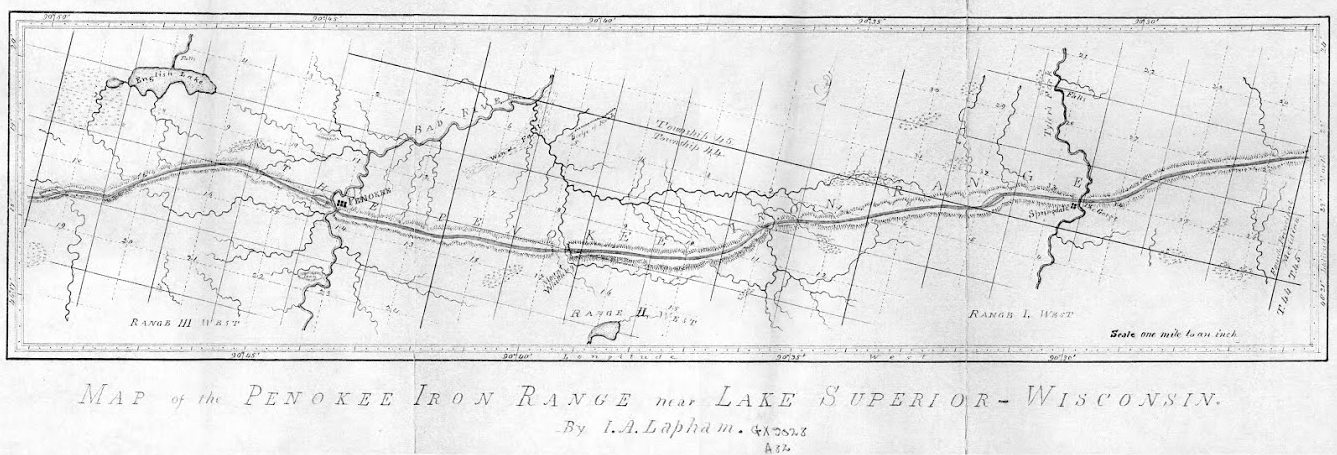
Increase Allen Lapham surveyed the Penokee Iron Range in September of 1858 for the Wisconsin & Lake Superior Mining and Smelting Company. Years later, Lapham’s experience was published as “Mountain of Iron Ore: The buried wealth of Northern Wisconsin“ in the Milwaukee Evening Wisconsin newspaper on February 21, 1887. (Image courtesy of the University of Wisconsin Geography Department)
~ 1978 Marsden Report for US Steel.
~ Railroad History, Issues 54-58, pg. 26
The Penoka Iron Range consists, as is well known, of a sharp ridge, some fifteen miles in length, by from one to one and one half in breadth, with a mean elevation of 700 feet above Lake Superior, from which is a distance about twenty-two miles, as the crow flies, its general trend being nearly east and west, it is densely covered with timber consisting of sugar maple, (of which nearly every tree is birdseye or curly) elm, red cedar, black, or yellow birch, some of which are of an enormous girth, among which are intermixed a few white pine and balsams, for it is traversed from north to south at three different points, by running streams, upon each of which the company had a station, the western being known in the vernacular of the company, as Palmer’s, (now Penoka); the center, as Lockwood’s, in honor of John Lockwood, who was at the time a prominent member of the Company, and upon its executive board; and the eastern, as Sidebotham’s, or “The Gorge.” These were the principal stations or centers, where supplies and men were always kept, and as which, as before stated, more or less work had been done the previous year. Penoka, as which the most work had been done, being considered by far the most valuable. This post was, at the time of my first visit, by charge of S.R. Marston, of whom mention was made in my last, and two young boys from Portsmouth, N.H., who had come west on exhibition, I should say, from the way they acted. They soon left, however, too many mosquitoes for them. “Lockwood’s,” as previously stated, was garrisoned by one man, whose name I have forgotten, and although a great amount of work had been done here as yet, it was nevertheless considered a very valuable claim, on account of the feasibility with which it could be reached by the rail Mr. Herbert had in contemplation to build from Ironton, and which would, in passing along the north side of the Range, come in close proximity to this station; besides, it had the additional advantages of a fine water power. At the east end were two half-breeds employed by the company, and George Chase, a young man from Derby, Vermont, a nephew of ex-Mayor Horace, and Dr. Enoch Chase, of Milwaukee, an employee of Stuntz, who, with James Stephenson, was awaiting the return of Gen. Cutler with reinforcements, in order to continue the survey. Chase subsequently made a claim which he was successful in securing – selling it finally to the Mr. Cogswell, of Milwaukee.
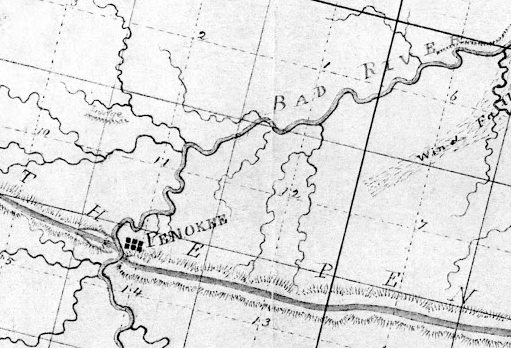
Penoka, aka Penokee, is Palmer’s station near the Bad River Gap.
It is also proper to state in addition to what has been already mentioned, that at, or about this time, a road was opened by Mr. Herbert’s order, from the Hay Marsh, six miles out from Ironton, to which point one had been previously opened, to the Range, which it struck about midway between Sidebotham’s and Lockwood’s Stations, over which, I suppose, the 50,000 tons as previously mentioned, was to find its way to Ironton, (in a horn). For this work, however, the Company refused to pay, as they had not authorized it; neither had Mr. Herbert, at that time, any authority to contract for it, except at his own risk; his appointment as agent having already been revoked; although his accounts had not, as yet, been fully settled. This work, which was without doubt, intended to commit the company still further in favor of Ironton as an outlet for the iron, was done by Samuel Champner, a then resident of Ashland and who if living is probably that much out of pocket today. No use was ever made of this road by the Company, not one of their employees, to my knowledge, ever passing over it.

The location of Lockwood’s station was not mapped by Lapham or by Stuntz. City Creek and Ballou Creek are the two water gaps on either side of Mount Whittlesey, midway between the gaps of Bad River and Tyler’s Fork.
This description will, I think, give your readers a very good understanding of the condition as well as the true inwardness of the affairs of the Wisconsin & Lake Superior Mining and Smelting Co., in the month of June, 1857.
At length, after remaining on the Range nearly three weeks, awaiting, Micawber like, for something to turn up, a change came with the arrival of Gen. Cutler from Milwaukee with the expected reinforcements. Mr. Herbert at once left the Range, went to Milwaukee and settled up with the Company, after which, to use a scriptural expression, “he walked no more with us.”

Springdale is Sidebotham’s station at The Gorge of Tyler Fork’s River.
“A special defense in contract law to allow a person to avoid having to respect a contract that she or he signed because of certain reasons such as a mistake as to the kind of contract.”
~ Duhaime.org
Wheelock, Smith, and McClellan were at once placed upon claims – McClellan in the interest of John Cummings, (whose name by an oversight was also omitted from the list of stockholders, given in my first paper), and Wheelock and Smith for the Company generally. Subsequently, A.S. Stacy, of Canada, was also employed to hold a claim. How well he performed this duty, will be seen further on. This done, the improvements necessary to be made in order to entitle us to the benefits of the preemption law were at once commenced. These improvements consisted of log cabins, principally, of which some twenty in all were erected upon the different claims. These cabins would have been a study for Michel Angelo, or Sir Christopher Wren. They had more angles than the Forty-seventh Problem of Euclid, with an average inclination of fifteen degrees to the Ecliptic. O, but they were “fearfully and wonderfully made,” were these cabins. Their construction embodied all the principle points of architecture in the Ancient as well as Modern–Milesian-Greek, mixed with the “hoop skirt” and Heathen Chimee. Probably ten dollars a month would have been considered a high rent for any of them. No such cabins as those were in exhibition at the Centennial, no sir. Rome was not built in a day, but most of these cabins were. I built four myself near the Gorge, in a day, with the assistance of two halfbreeds, but was not able to find them a week afterwards. This is not only a mystery but a conundrum. I think some traveling showman must have stolen them; but although they were non est we could swear that we had built them, and did.
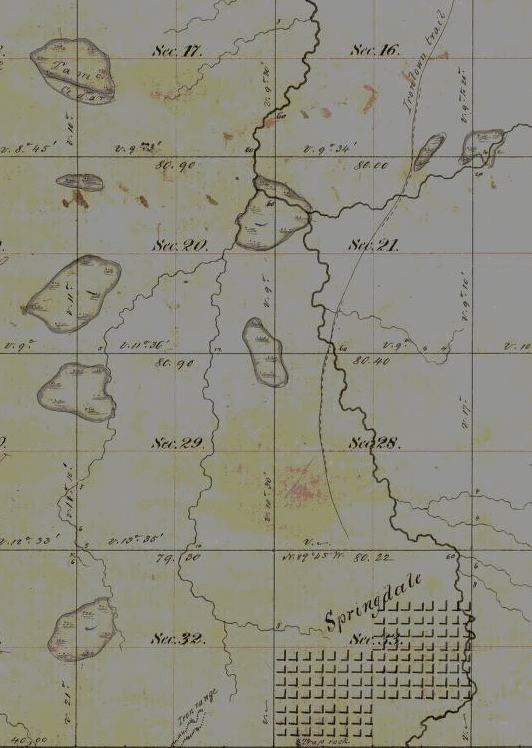
Springdale townsite plan at Sidebotham’s station by The Gorge of Tyler’s Fork in close proximity to the Ironton Trail and Iron Range. (Detail of Stuntz’s survey during August of 1857.)
Three were accordingly platted — one at Penoka, one at Lockwood‘s and one at the Gorge. And in order that it might be done without interfering with the regular survey, Gen. Cutler decided to place S.R. Marston who, in addition to his other accomplishments, claimed to be a full-fledged surveyor, in charge of the work, assisted by Wheelock, Smith and myself. He commenced at the Gorge, run three lines and quit, fully satisfied that he had greatly overestimated his abilities. We were certainly satisfied that he had. A drunken man could have reeled it off in the dark and come nearer the corner than he did. He was a complete failure in every thing he undertook. He left in the fall after the failure of the Sioux Scrip plot. Where he went I never knew. George E. Stuntz was subsequently put upon the work, which he was not long in doing, after which he rejoined Albert on the main work. This main work, however, for the completion of which we were all so anxious, was very much delayed, the cause for which we did not at the time fully understand, but we did afterwards. J.S.B.
Penokee Survey Incidents: Number III
February 15, 2015
By Amorin Mello
December 1, 1877
The Survey of the Penoka Range and Incidents Connected with its Early History.
—
Number III.
~ Detroit Free Press, June 5, 1857
(MarinetimeHistoryoftheGreatLakes.ca)
Friend Fifield:- Upon the first arrival of Mr. Sidebotham and myself at La Pointe, in May, ’57, as previously stated, we took lodging at the “Hotel Angus,” the hospitalities of which we were forced to enjoy until some means could be found to communicate with Gen. Cutler. The Bay, as well as the Lake, was full of ice. In fact, we had been compelled to fight out way from the Sault to La Pointe, through heavy masses of ice, nearly the whole distance – and while upon this subject, I will say, that incredible as the statement may appear to many, yes it is a fact, that ice bergs were aground in front of Austrian’s Warehouse, at La Pointe, on the 4th day of July, 1857, in 36 feet of water, while at the same time a field of floating ice was visible from the Range, beyond which, no water could be seen. I verily believe that the lake was not wholly free from ice that summer.
~ Madeline Island Ferry Line
At length, after remaining at the hotel some eight or ten days, during which Mrs. Angus made us as happy as she could by her kindness and attention, Gen. Cutler came, accompanied by Mr. Herbert. This was the first time that either of us had ever seen Gen. Cutler, but on being informed who we were, he seemed overjoyed to see us, and at once made the proposition to me to take charge of the work, and let him return to Milwaukee, so thoroughly disgusted had he become with the whole thing. To this, however, I would not consent, whereupon he decided to remain, and at once directed Mr. Herbert, who was at that time still in our employ, to return at once to Ironton, taking a part of the supplies, which came up with us, of which they were in great need, Mr. Sidebotham accompanying him, leaving the General and myself at La Pointe. After a long consultation, the General decided to go below, after men and money, wherewith to complete the work; which he did, I following Mr. Sidebotham to Ironton, which place I reached in time to join Mr. Herbert’s party, just starting for the Range, which we reached the second day after leaving Ironton.
During its existence the taxable real estate in the Town of Bayport had increased from nothing to several hundred thousand dollars, principally through entry of pine lands in the south and western portions of the township and also by extensive entries of mineral properties on the Iron Range.”
~ The Lake Superior Country in History and in Story by Guy M Burnham, pg. 179
Omission was made in the list of stockholders given in my first chapter, of Mr. Herbert, whom name should have been included. His stock was, however, by special agreement, unassessable, as it was through his instrumentality, in part, that the existence of this most wonderful metallic deposit was first brought to the knowledge of the Company, and the work of surveying and locating is undertaken. It was this, together with the knowledge that his long residence in the country was supposed to give him, as to the best mode of conducting such an enterprise, that procured for him this aqucession, as well as the appointment of Agent. In justice, however, to Mr. Herbert, it is proper to state, that besides the work done, and money spent at Ironton, the place selected by him as the future shipping point for the iron, (50,000 tons of which he contemplated bringing there that season, at least he stated) considerable work had also been done upon the range during his administration; mostly, however, at Penoka, where a log cabin, yet standing, had been erected, and some thirty acres cleared, the timber being cut into cordwood, to be used in the manufacture of charcoal iron, for the making of which it was contemplated to erect the proper furnaces in the near future. Neither is it any injustice to say, that although perhaps he did the best he could, situated as he was, yet the work did not progress as fast as the company thought it should, the force, while under his control had became badly demoralized. The idea had obtained, if not with him it had with them, that they were working for a company of bloated bondholders,- had a soft thing, and meant to make the most of it; but with the advent of Gen. Cutler, a change came over the spirit of their dreams. Order was quickly brought out of chaos, and the discovery made that a master hand held the reins. Up to this time, May, ’57, the Range had never been visited by any of the company except Messrs. Palmer, Greves and Ripley, those visiting ’56 was one of exploration only, and as Gen. Cutler, Mr. Sidebotham and myself were the only ones that went up there in ’57, or who, in fact, over performed any work there, a short sketch of them will perhaps not be inappropriate in this connection, while awaiting, metaphorically speaking, the arrival of the expected reinforcements from below. And first of Gen. Cutler:

Lysander Cutler of Wisc. (Library of Congress Prints and Photographs Division, Washington, D.C.)
The Order of the County Board creating the Town of Bayport was made March 11, 1856, and the store of Schuyler Goff, in Bay City (Ellis Division) was designated as the place for holding the first election for town officers, the election to be held Tuesday, April 1, 1856.
The Town of Bayport comprised all that portion of LaPointe county (since changed to Ashland County) lying south of the north line of Town 48 North; in all over sixty-eight Townships, including the Bad River reservation, which was, on the 8th day of November, 1859, made a precinct by itself.
At the first election held April 1, 1856, there were 24 votes cast — resulting as follows; for Chairman of the Town Board, Schuyler Goff (later appointed County Judge, an office he held for a year or more). The other members of the town board being J.T. Welton and Asaph Whittlesey. Schuyler Goff, chairman elect, was the first officer to qualify, his oath of office being administered by Asaph Whittlesey, Justice of the Peace.”
~ The Lake Superior Country in History and in Story by Guy M. Burnham, pg. 179
Gen. Lysander L. Cutler was, in many respects, a remarkable man. In person he was rather above the medium height, large head, large, dark eyes, heavy eyebrows, a sure indication of a good memory, as well as firmness, dark hair, inclined to stand erect; walked, usually with a slow and dignified step, with his eyes apparently fixed upon the ground, as if in deep thought, leading an observer to suppose that he was not cognizant of what was being enacted around him. This, however, was a mistake; nothing escaped his observation. In fact, he seemed to know your very thoughts; neither could anyone be in his presence ten minutes without feeling the magnetic influence of his iron will. Was any dangerous work to be undertaken, he would, if within call, be the first one consulted, and appointed to take charge of it. He was a born leader. He was not only one of the best business men I ever knew, but he was also a leader in politics. A good judge of men, sharp and keen, and who ever undertook to circumvent him was sure to some grief, as some of the people who went about the Range did that summer, have no doubt, an abiding recollection. I refer now to Hall, of St. Paul, Minnesota, who undertook, with the assistance of S.R. Marston, a treacherous employee of the Company, and Schuyler Goff, of Racine, at that time a resident of La Pointe, to beat us out of our rights, by entering the lands upon the Range with Sioux Scrip, in which nefarious attempt they would no doubt have succeeded, but for him. He was more than a match for all of them, and they finally retired from the contest in disgrace. Such was Gen. L.L. Cutler, a firm friend, but an uncompromising enemy. Never will the writer forget the happy days spent with him upon the Range in the summer of 1857. We were like brothers, and our friendship was never interrupted by even a passing cloud. We fraternized at once upon our first meeting, and fought the battle for the possession of the Range together, never doubting our ultimately winning the prize. He has gone to his reward, in that bright world beyond the River; yet “in memory’s ever sleepless eye” he is often present with me.
Mr. Sidebotham, however, who was by birth an Englishman, and by occupation a cabinet maker, was of a different mould, and although an honest man, was by his habits of life, wholly unfitted for such an undertaking, and of no practical use whatever, and although not constantly at the Range, he was while there, an actual incumbrance, some one having to remain with him constantly; he could not accustom himself to the woods and its annoyance; was always complaining of his food, which of course soon brought him into contempt with the men. One of his peculiarities was a great fondness for sugar, particularly in his tea, which he could not, or thought he could not, drink without it, and as this was an article not always plenty, the boys would sometimes hide it, in order to see him hunt for it, which he would do most persistently until he found it. I remember on one occasion they hid it in a tree, and as he could not climb or chip, although in plain sight he could not get it. They had, as they expressed it, the “dead wood” on him that time. He finally became so afflicted with boils, on account of his sedentary habits and change of food, that it was with the utmost difficulty we were able to get him from the Range to Ashland, in December, where he remained until sufficiently recovered to be able to travel, after which he reached home in safety. He was the last to sell his stock, which, however, he finally did, to the late Simeon N. Small, claiming that as it was through much tribulation he had obtained it, he would not part with it except at his own price, which I believe he got. This purchase, although it gave Mr. Small a controlling interest in the stock, was ultimately the cause of his financial ruin. J.S.B.
[from same issue of The Ashland Press]
Whittlesey on Early Times in Ashland.
—
~ The Monthly Magazine; A Monthly Journal of American History, Volume 9, 1888, pg. 18
Editor Ashland Press.- In your last issue of the 24th inst., your correspondent “J.S.B.,” in his Early Recollections of Ashland, makes very portient reference to two of Ashland’s prominent citizens of early days, known as “Sibley” and “Lazarus,” stating that in laziness they were competitors for the belt. My own recollection tells me that of this same Sibley had gained some notoriety for telling big yarns, but in this I think he ultimately gave way to John Beck. On one occasion, Sibley arrived in town on foot and alone, and entering a crowd of the boys, addressing himself to Lazarus, said: “Lazarus, I want you to go and help me get my team into town. It now stands in the mud near the head of Main St.” to which Lazarus replied, “I’ll go, if you will first tell us the biggest lie you ever told.” Sibley responded, “Lazarus, I don’t lie.” Lazarus says, “That will do, I’ll go and help you.” I am personally knowing to the fact that this same Lazarus has been known at several different times when he was “keeping back” in cold winters, to remain in beds two nights and the intervening day, to avoid the necessity of cutting wood and cooking a meal; nevertheless, “George E.,” as Lazarus was otherwise known, was a man of much more than usual ability, and was a surveyor had few superiors. We were all glad to have him show himself, and to witness his alacrity in getting upon the “off side” of any proposition that might be submitted.
I hope that brother “J.S.B.” may be heard from again, and that he may tell us more in regard to the crowd of pre-emptors imported by himself and others, (modesty forbids me to mention who,) tending almost invariably to bankruptcy. You, sir, were at the head of some “noble boys,” and you, too, had your share of tough cases. Should I sufficiently recover my strength to enable me to do so, I may hereafter open out on my “Early Recollections” of the place, and if I do attempt it, let all “stand from under,” for “At the siege of Barlisle, I was there all the while.”
W.
Bayfield, Wis., Nov. 24, 1877.
Penokee Survey Incidents: Number I
February 8, 2015
By Amorin Mello
The Ashland Weekly Press is now the Ashland Daily Press.
November 10, 1877
For the Ashland Press
The Survey of the Penoka Iron Range and Incidents Connected With Its Early History.
—
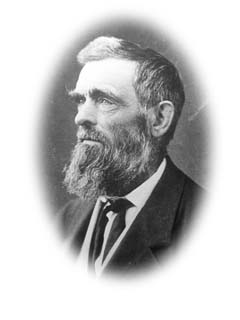
James Smith Buck (1812-92) “For 19 years, Buck was a building contractor, erecting many of the city’s earliest structures. He is best known for his writings on early Milwaukee history. From 1876 to 1886, he published a four-volume History of Milwaukee, filled with pioneer biographies and reminiscences.” (Forest Home Cemetery)
Friend Fifield:- Being one of the patrons and readers of your valuable paper, and having within the past year noticed several very interesting and well written articles entitled “Early Recollections of Ashland” in its columns, and more particularly one from a Milwaukee correspondent, in a recent number, in which my name, with others, was mentioned as having done some pioneer work in connection with your young city, I thought that a few lines in the way of a “Reminiscence” from me as to how and by whom the Penoka Range was first surveyed and located, might be interesting to some of your readers,- if you think so, please give this a place in your paper and oblige.
Truly Yours,
J.S. Buck.
I first visited Lake Superior in the month of May, 1857, in the interest of the Wisconsin and Lake Superior Mining and Smelting Co., a charter for the organization of which had been procured the previous winter.– This company was composed of the following gentlemen: Edwin Palmer, Gen. Lysander Cutler, Horatio Hill, Jas. F. Hill, Dr. J.P. Greves, John Lockwood, John L. Harris, John Sidebotham, Franklin J. Ripley and myself. Edwin Palmer, President, J. F. Hill, Secretary – with a capital of (I think) $60,000. Our first agent was Mr. Milliam Herbert, with headquarters at Ironton, where some five thousand dollars of the company’s money was invested in the erection of a block-house and a couple of cribs intended as a nucleus for a pier – and in other ways – all of which was subsequently abandoned and lost – the place having no natural advantages, or unnatural either, for that matter.– But so it is ever with the first and often with the second installments that such greenies as we were, invest in a new country; for so little did we know of the way work was done in that country that we actually supposed the whole thing would be completed in three months and the lands in our possession. But what we lacked in wisdom, we made up in pluck — neither did we “lay down the shubble and de hoe,” until the goal was reached and the Penoka Iron Range secured – costing us over two years time and $25,000 in money.
The company not being satisfied with Mr. Herbert as agent, he was removed and Gen. Cutler appointed in his place, who quickly selected Ashland as headquarters, to which place all the personal property, consisting of merchandise principally, was removed during the summer by myself upon Gen. C.’s order – and Ironton abandoned to its fate.
~ Captain Robinson Derling Pike (Bayfield 50th anniversary celebrations)
The company at this time having become not only aware of the magnitude of the work they had undertaken, but were also satisfied that Ashland was the most feasible point from which to reach the Range, as well as the place where the future Metropolis of the Lake Superior country must surely be — notwithstanding the “and to Bayfield“ clause in that wonderful charter of H.M. Rice.
The cost of getting provisions to the Range was enormous – it being for the first season all carried by packers – every pound transported from Ashland to the Range costing from five to eight cents as freight.
This was my first experience at surveying as well as Mr. Sidebotham’s, and although I took to it easily and enjoyed it, he never could. He was no woodsman; could not travel easily, while on the other hand I could outwalk any white man except S.S. Vaughn in the country. He was then in his prime and one of the most vigorous and muscular men I ever met; but I think he will tell you that in me he found his match.
By our contract with Albert Stuntz we were not only to pay him a bonus equal to what he received per mile from Government, but we were also to furnish men for the work and see him through. In accordance with this agreement some eighteen men and boys, to be used as axemen and chainmen, were brought up from Milwaukee who were as “green as gaugers” and as the sequel proved, about as honest. A nice looking lot they were, when landed upon the dock at La Pointe, out of which to make woodsmen. I think I see them now, shining boots,– plug hats, with plug ugly heads in them, (at least some of them had), the notorious Frank Gale, Mat. Ward and one or two other noted characters being of the number. Their pranks astonished the good people of La Pointe not a little, but they astonished Stuntz more. One half day in the woods satisfied them – they were afraid of getting lost. In less than two weeks they had nearly all deserted and the work had to be delayed until a new squad could be obtained from below.
But I must close. In my next I will give you an account of my life on the Range. J.S.B.
 Chequamegon History