When we die, we will lay our bones at La Pointe.
March 20, 2024
By Leo
From individual historical documents, it can be hard to sequence or make sense of the efforts of the United States to remove the Lake Superior Ojibwe from ceded territories of Wisconsin and Upper Michigan in the years 1850 and 1851. Most of us correctly understand that the Sandy Lake Tragedy was caused an alliance of government and trading interests. Through greed, deception, racism, and callous disregard for human life, government officials bungled the treaty payment at Sandy Lake on the Mississippi River in the fall and winter of 1850-51, leading to hundreds of deaths. We also know that in the spring of 1852, Chief Buffalo and a delegation of La Pointe Ojibwe chiefs travelled to Washington D.C. to oppose the removal. It is what happened before and between those events, in the summers of 1850 and 1851, where things get muddled.

Confusion arises because the individual documents can contradict our narrative. A particular trader, who we might want to think is one of the villains, might express an anti-removal view. A government agent, who we might wish to assign malicious intent, instead shows merely incompetence. We find a quote or letter that seems to explain the plans and sentiments leading to the disaster at Sandy Lake, but then we find the quote is dated after the deaths had already occurred.
Therefore, we are fortunate to have the following letter, written in November of 1851, which concisely summarizes the events up to that point. We are even more fortunate that the letter is written by chiefs, themselves. It is from the Office of Indian Affairs archives, but I found a copy in the Theresa Schenck papers. It is not unknown to Lake Superior scholarship, but to my knowledge it has not been reproduced in full.
The context is that Chief Buffalo, most (but not all) of the La Pointe chiefs, and some of their allies from Ontonagon, L’Anse, Upper St. Croix Lake, Chippewa River and St. Croix River, have returned to La Pointe. They have abandoned the pay ground at Fond du Lac in November 1851, and returned to La Pointe. This came after getting confirmation that the Indian Agent, John S. Watrous, has been telling a series of lies in order to force a second Sandy Lake removal–just one year removed from the tragedy. This letter attempts to get official sanction for a delegation of La Pointe chiefs to visit Washington. The official sanction never came, but the chiefs went anyway, and the rest is history.
La Pointe, Lake Superior, Nov. 6./51
To the Hon Luke Lea
Commissioner of Indian Affairs Washington D.C.
Our Father,
We send you our salutations and wish you to listen to our words. We the Chiefs and head men of the Chippeway Tribe of Indians feel ourselves aggrieved and wronged by the conduct of the U.S. Agent John S. Watrous and his advisors now among us. He has used great deception towards us, in carrying out the wishes of our Great Father, in respect to our removal. We have ever been ready to listen to the words of our Great Father whenever he has spoken to us, and to accede to his wishes. But this time, in the matter of our removal, we are in the dark. We are not satisfied that it is the President that requires us to remove. We have asked to see the order, and the name of the President affixed to it, but it has not been shewn us. We think the order comes only from the Agent and those who advise with him, and are interested in having us remove.
Kicheueshki. Chief. X his mark
Gejiguaio X “
Kishkitauʋg X “
Misai X “
Aitauigizhik X “
Kabimabi X “
Oshoge, Chief X “
Oshkinaue, Chief X “
Medueguon X “
Makudeua-kuʋt X “
Na-nʋ-ʋ-e-be, Chief X “
Ka-ka-ge X “
Kui ui sens X “
Ma-dag ʋmi, Chief X “
Ua-bi-shins X “
E-na-nʋ-kuʋk X “
Ai-a-bens, Chief X “
Kue-kue-Kʋb X “
Sa-gun-a-shins X “
Ji-bi-ne-she, Chief X “
Ke-ui-mi-i-ue X “
Okʋndikʋn, Chief X “
Ang ua sʋg X “
Asinise, Chief X “
Kebeuasadʋn X “
Metakusige X “
Kuiuisensish, Chief X “
Atuia X “
Gete-kitigani[inini? manuscript torn]
L. H. Wheeler
We the undersigned, certify, on honor, that the above document was shown to us by the Buffalo, Chief of the Lapointe band of Chippeway Indians and that we believe, without implying and opinion respecting the subjects of complaint contained in it, that it was dictated by, and contains the sentiments of those whose signatures are affixed to it.
S. Hall
C. Pulsifer
H. Blatchford
When I started Chequamegon History in 2013, the WordPress engine made it easy to integrate their features with some light HTML coding. In recent years, they have made this nearly impossible. At some point, we’ll have to decide whether to get better at coding or overhaul our signature “blue rectangle” design format. For now, though, I can’t get links or images into the blue rectangles like I used to, so I will have to list them out here:
Joseph Austrian’s description of the same
Boutwell’s acknowledgement of the suspension of the removal order, and his intent to proceed anyway
Chequamegon History has looked into the “Great Father” fur trade theater language of ritual kinship before in our look at Blackbird’s speech at the 1855 Payment. You may have noticed Makadebines (Blackbird) didn’t sign this letter. He was working on a different plant to resist removal. Look for a related post soon.
If you’re really interested in why the president was Gichi-noos (Great Father), read these books:

Watrous, and many of the Americans who came to the Lake Superior country at this time, were from northeastern Ohio. Watrous was able to obtain and keep his position as agent because his family was connected to Elisha Whittlesey.
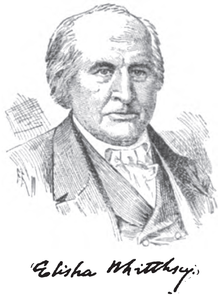
In the summer and fall of 1851, Watrous was determined to get soldiers to help him force the removal. However, by that point, Washington was leaning toward letting the Lake Bands stay in Wisconsin and Michigan.
Last spring, during one of the several debt showdowns in Congress, I wrote on how similar antics in Washington contributed to the disaster of 1850. My earliest and best understanding of the 1850-1852 timeline, and the players involved, comes from this book:

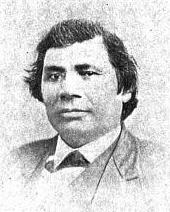
We know that Kishkitauʋg (Cut Ear), and Oshoge (Heron) went to Washington with Buffalo in 1852. Benjamin Armstrong’s account is the most famous, but the delegation’s other interpreter, Vincent Roy Jr., also left his memories, which differ slightly in the details.

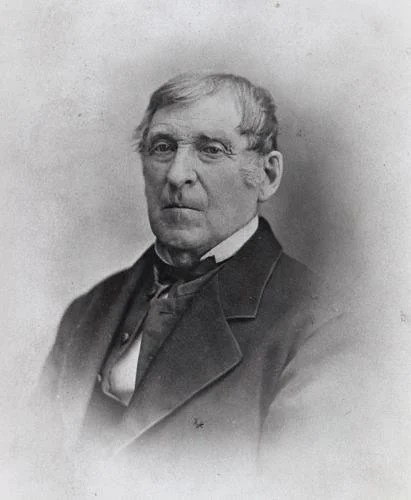
One of my first posts on the blog involved some Sandy Lake material in the Wheeler Family Papers, written by Sherman Hall. Since then, having seen many more of their letters, I would change some of the initial conclusions. However, I still see Hall as having committing a great sin of omission for not opposing the removal earlier. Even with the disclaimer, however, I have to give him credit for signing his name to the letter this post is about. Although they shared the common goal of destroying Ojibwe culture and religion and replacing it with American evangelical Protestantism, he A.B.C.F.M. mission community was made up of men and women with very different personalities. Their internal disputes were bizarre and fascinating.

1838 more Petitions from La Pointe to the President
April 16, 2023
Collected & edited by Amorin Mello
Letters Received by the Office of Indian Affairs:
La Pointe Agency 1831-1839
National Archives Identifier: 164009310
O.I.A. Lapointe W.692.
Governor of Wisconsin
Mineral Pt. 15 Oct. 1838.
Encloses two communications
from D. P. Bushnell; one,
to speech of Jean B. DuBay, a half
breed Chippewa, delivered Aug. 15, ’38,
on behalf of the half breeds then assembled,
protesting against the decision
of the U.S. Court on the subject of the
murder of Alfred Aitkin by an Ind,
& again demanding the murderer;
with Mr Bushnell’s reply: the other,
dated 14 Aug. 1838, being a Report
in reference to the intermeddling of
any foreign Gov’t or its officers, with
the Ind’s within the limits of the U.S.
[Sentence in light text too faint to read]
12 April 1839.
Rec’d 17 Nov 1838.
See letter of 7 June 39 to Hon Lucius Lyon
Ans’d 12 April, 1839
W Ward
Superintendency of Indian Affairs
for the Territory of Wisconsin
Mineral Point Oct 15, 1838.

Henry Dodge
Sir:
I have the honor to enclose herewith two communications from D. P. Bushnell Esq, Subagent of the Chippewas at La Pointe; the first, being the Speech of Jean B. DuBay, a half breed Chippewa, on behalf of the half-breeds assembled at La Pointe, on the 15th august last, in relation to the decision of the U.S. Court on the subject of the murder of Alfred Aitkin by an Indian; the last, in reference to the intermeddling of any foreign government, or the officers thereof, with the Indians within the limits of the United States.
Very respectfully
Your obed’t serv’t.
Henry Dodge
Sup’t Ind. Affs.
Hon. C. A. Harris
Com of Ind. Affairs.
D. P. Bushnell Aug. 14, 1838
W692
Subagency
La Pointe Aug 14th 1838
Sir
I have the honor to acknowledge the receipt of your communication dated 7 ultimo enclosing an extract from a Resolution of the House of the Representatives of the 19th of March, 1838. No case of intermeddling by any foreign government on the officers, or subject thereof with the Indians under my charge or any others, directly , or indirectly, has come to my knowledge. It is believed that the English government has been in the Habit of distributing presents at a point on Lake Huron below Drummonds Island to the Chippewa for a series of years.
The Indians from this region, until recently, visited that place for their share of the annual distribution. But the Treaty made last summer between them and the United States, and the small distribution of presents that has been made within the Last Year, under the direction of our government, have had the effect to permit any of them from visiting, the English Territory this year. These Indians have generally manifested a desire to live upon terms of friendship with the American people. All of the Chiefs from the region of Lake Superior have expressed a desire to visit the seat of Gov’t where none of them have yet been. There is no doubt, but such a visit with the distribution of a few presents among them would be productive: of much good, and render their attachment to our Gov’t still stronger.
Very Resp’y
yr ms ob sev’t
D. P. Bushnell.
I. O. A.
To
His Excellency Henry Dodge
Ter, Wisconsin Sup’t Ind Affs
Half breed Speech
Speech of Jean B. DuBay,
a half breed Chippewa, on behalf of the half breeds assembled in a numerous body at the United States Sub Indian Agency office at La Pointe, on the 15th day of August 1838.
Father. We have come to you for the purpose of speaking on the subject of the murder that was committed two years ago by an Indian on one of our Brothers. I allude to Alfred Aitken. We have always considered ourselves Subject to the Laws of the United States and have consequently relied upon their protection. But it appears by the decision of the United Sates court in this case. “That it was an Indian Killed an Indian, on Indian ground, and died not therefore come under its jurisdiction,” that we have hitherto laboured under a delusion, and that a resort to the laws can avail nothing. We come therefore to you, at the agent of the Government here, to tell you that we have councilled with the Indians and, have declared to them and we have solemnly pledged ourselves in your presence, to each other, that we will enforce in the Indian Country, the Indian Law, Blood for Blood.
We pay taxes, and in the Indian Country are held amenable to the Laws, but appeal to them in vain for protection. Sir we will protect ourselves. We take the case into our own hands. Blood shall be shed! We will have justice and who can be answerable for the consequences? Our brother was a gentlemanly young man. He was educated at a Seminary in Louville in the State of New York. He was dear to us. We remember him as the companion of our childhood. The voice of his Blood now cries to us from the ground for vengence! But the stain left by his you shall be washed out by one of a deeper dye!
For injuries committed upon the persons or property of whites, although within the Indian Country we are still willing to be held responsible to the Laws of the United States, notwithstanding the decision of a United States Court that we are Indians. And for like injuries committed upon us by whites we will appeal to the same tribunal.
Sir our attachments to the American Government and people was great. But they have cast us off. The Half breeds muster strong on the northwestern frontier & we Know no distinction of tribes. In one thing at least we are all united. We might muster into the service of the United States in case of a war and officered by Americans would compose in frontier warfare a formidable corps. We can fight the Indian or white man, in his own manner, & would pledge ourselves to Keep peace among the different Indian tribes.
Sir we will do nothing rashly. We once more ask from your hands the murder of Mr. Aitken. We wish you to represent our case to the President and we promise to remain quiet for one year, giving ample time for his decision to be made Known. Let the Government extend its protection to us and we will be found its staunchest friends. If it persists in abandoning us the most painful consequences may ensue.
Sir we will listen to your reply, and shall be Happy to avail ourselves of your advice.
Reply of the Subagent.
My friends, I have lived several years on the frontier & have Known many half breeds. They have to my Knowledge paid taxes, & held offices under State, Territorial, and United States authorities, been treated in every respect by the Laws as American Citizens; and I have hitherto supposed they were entitled to the protection of the Laws. The decision of the court is this case, if court is a virtual acknowledgement of your title to the Indians as land, in common with the Indians & I see no other way for you to obtain satisfaction then to enforce the Indian Law. Indeed your own safety requires it. in the meantime I think the course you have adopted, in awaiting the results of this appeal is very proper, and cannot injure your cause although made in vain. At your request I will forward the words of your speaker, through the proper channel to the authorities at Washington. In the event of your being compelled to resort to the Indian mode of obtaining satisfaction it is to be hoped you will not wage an indiscriminate warfare. If you punish the guilty only, the Indians can have no cause for complaint, neither do I think they will complain. Any communication that may be made to me on this subject I will make Known to you in due time.
O.I.A. Lapointe. D.333.
Hon. Ja’s D. Doty.
New York. 25 March, 1839
Encloses Petition, dated
20 Dec. last, of Michel Nevou & 111
others, Chippewa Half Breeds, to the
President, complaining of the delay
in the payment of the sum granted
them, by Treaty of 29 July, 1837,
protesting against its payments on the
St Croix river, & praying that it be
paid at La Pointe on Lake Superior.
Recommends that the payment
be made at this latter place,
for reasons stated.
Rec’d 28 March, 1839.
Ans 29 Mch 1839.
(see over)
Mr Ward
D.100 3 Mch 28
Mch 38, 1839.
Indian Office.
The within may be
an [?] [?] [?] –
[guest?]. in fact will be
in accordance with [?]
[lat?] opinions and not of
the department.
W. Ward
New York
March 25, 1839
The Hon.
J.R. Pointsett
Secy of War
Sir,
I have the honour to submit to you a petition from the Half-breeds of the Chippewa Nation, which has just been received.
It must be obvious to you Sir, that the place from which the Indian Trade is prosecuted in the Country of that Nation is the proper place to collect the Half Breeds to receive their allowance under the Treaty. A very large number being employed by the Traders, if they are required to go to any other spot than La Pointe, they must lose their employment for the season. Three fourths of them visit La Pointe annually, in the course of the Trade. Very few either live or are employed on the St. Croix.
As an act of justice, and of humanity, to them I respectfully recommend that the payment be made to them under the Treaty at La Pointe.
I remain Sir, with very great respect
Your obedient Servant.
J D Doty
[D333-39.LA POINTE]
Hon.
J. D. Doty
March 29, 1839
Recorded in N 26
Page 192
[WD?] OIA
Mch 29, 1839
Sir
I have the honor to acknowledge the receipt of your letter of the 25th with the Petition of the Chippewa half breeds.
It is only necessary for me to observe his reply that it had been previously determined that the appropriation for them should be distributed at Lapointe, & the instructions with be given accordingly.
Very rcy
Hon.
J.D. Doty
New York
D100
D.333.

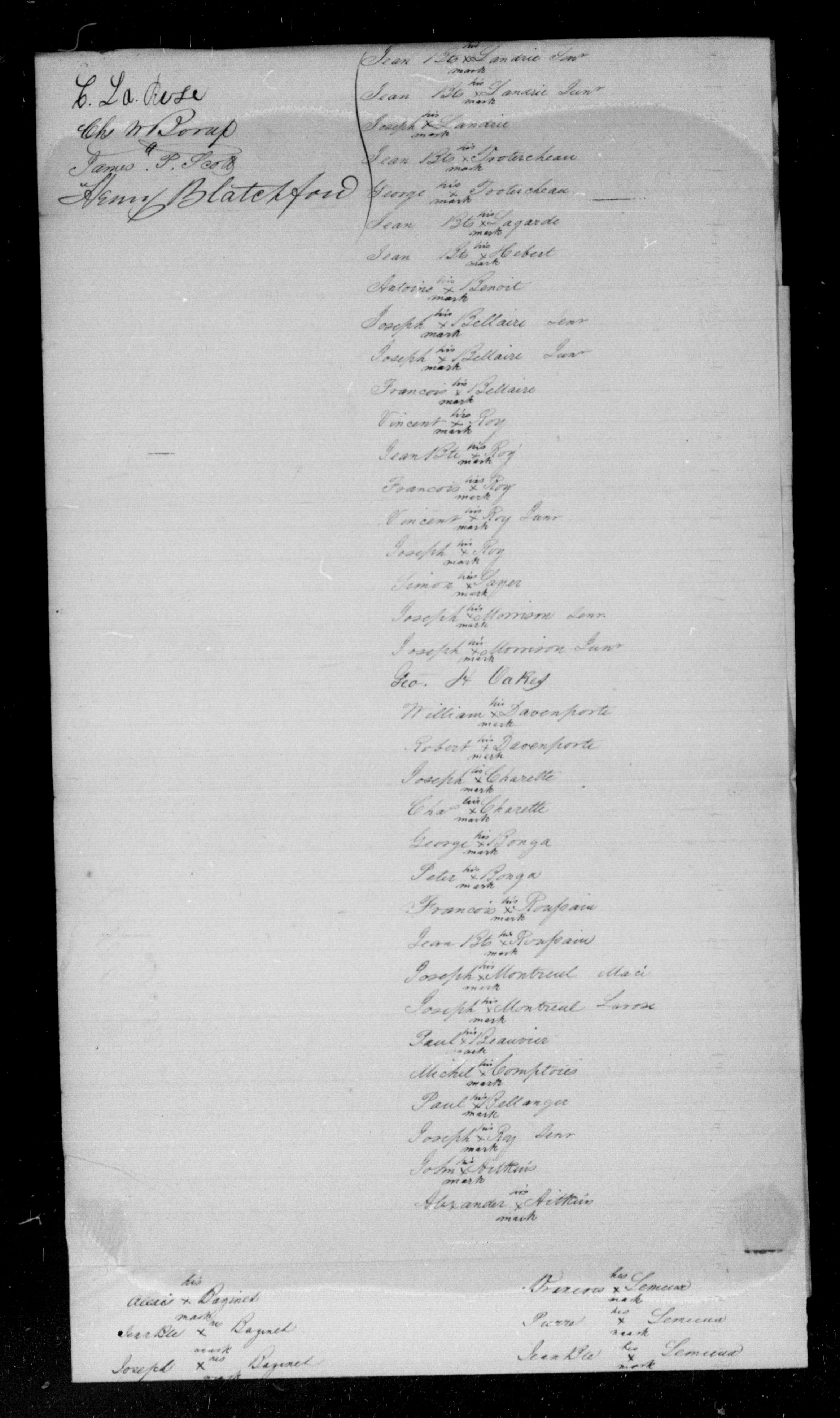

To the President of the United States of America
The Petition of the Half Breeds of the Chippewa nation respectfully shareth.
That we, Half Breeds of the Chippewa Nation, have recently learned, that the payment of the sum granted to the Chippewa Half Breeds, by virtue of the Treaty of 29th July 1837, has been deferred to next Spring, and, that the St Croix River has been selected as the place of payment.
That the delay in not having received our share of the above grant to the Chippewa Half Breeds, last summer, has caused us much loss, by keeping us from our regular vocations for several months, and by leaving many of us without means of support during winter, and that the arrangement of having the payment made next spring on the St Croix, will oblige us to perform a long and expensive Journey, leaving our families in our absence without any means of subsistance, and depriving us of all chance of being employed either in the Indian Trade or at fishing, by which means alone, we are able to earn our daily bread.
Your Petitioners with great deference and implicit submission to the pleasure of the President of the United States, respectfully pray, that an alteration may be made in the place assigned for payment and that Lapointe on Lake Superior may be fixed upon as the place of payment that place being the annual rendezvous of the Chippewa Half Breeds and the Chippewa Indians Traders, by whom we are employed.
And your Petitioners as in duty bound shall ever pray &c. &c.
Lake Superior Lapointe Dec. 20th 1838
Michel Neveu X his mark
Louis Neveu X his mark
Newel Neveu X his mark
Alexis Neveu X his mark
Joseph Danis X his mark
Benjamin Danis X his mark
Jean Bts Landrie Sen’r X his mark
Jean Bts Landrie Jun’r X his mark
Joseph Landrie X his mark
Jean Bts Trotercheau X his mark
George Trotercheau X his mark
Jean Bts Lagarde X his mark
Jean Bts Herbert X his mark
Antoine Benoit X his mark
Joseph Bellaire Sen’r X his mark
Joseph Bellaire Jun’r X his mark
Francois Bellaire X his mark
Vincent Roy X his mark
Jean Bts Roy X his mark
Francois Roy X his mark
Vincent Roy Jun’r X his mark
Joseph Roy X his mark
Simon Sayer X his mark
Joseph Morrison Sen’r X his mark
Joseph Morrison Jun’r X his mark
Geo. H Oakes
William Davenporte X his mark
Robert Davenporte X his mark
Joseph Charette X his mark
Chas Charette X his mark
George Bonga X his mark
Peter Bonga X his mark
Francois Roussain X his mark
Jean Bts Roussain X his mark
Joseph Montreal Maci X his mark
Joseph Montreal Larose X his mark
Paul Beauvier X his mark
Michel Comptories X his mark
Paul Bellanger X his mark
Joseph Roy Sen’r X his mark
John Aitkins X his mark
Alexander Aitkins X his mark
Alexis Bazinet X his mark
Jean Bts Bazinet X his mark
Joseph Bazinet X his mark
Michel Brisette X his mark
Augustin Cadotte X his mark
Joseph Gauthier X his mark
Isaac Ermatinger X his mark
Alexander Chaboillez X his mark
Michel Bousquet X his mark
Louis Bousquet X his mark
Antoine Cournoyer X his mark
Francois Bellanger X his mark
John William Bell, Jun’r
Jean Bts Robidoux X his mark
Robert Morin X his mark
Michel Petit Jun X his mark
Joseph Petit X his mark
Michel Petit Sen’r X his mark
Pierre Forcier X his mark
Jean Bte Rouleaux X his mark
Antoine Cournoyer X his mark
Louis Francois X his mark
Francois Lamoureaux X his mark
Francois Piquette X his mark
Benjamin Rivet X his mark
Robert Fairbanks X his mark
Benjamin Fairbanks X his mark
Antoine Maci X his mark
Joseph Maci X his mark
Edward Maci X his mark
Alexander Maci X his mark
Joseph Montreal Jun. X his mark
Peter Crebassa X his mark
Ambrose Davenporte X his mark
George Fairbanks X his mark
Francois Lemieux X his mark
Pierre Lemieux X his mark
Jean Bte Lemieux X his mark
Baptist St. Jean X his mark
Francis St Jean X his mark
Francis Decoteau X his mark
Jean Bte Brisette X his mark
Henry Brisette X his mark
Charles Brisette X his mark
Jehudah Ermatinger X his mark
Elijah Eramtinger X his mark
Jean Bte Cadotte X his mark
Charles Morrison X his mark
Louis Cournoyer X his mark
Jack Hotley X his mark
John Hotley X his mark
Gabriel Lavierge X his mark
Alexis Brebant X his mark
Eunsice Childes
Etienne St Martin X his mark
Eduard St Arnaud X his mark
Paul Rivet X his mark
Louisan Rivet X his mark
John Fairbanks X his mark
William Fairbanks X his mark
Theodor Borup
James P Scott
Bazil Danis X his mark
Alexander Danis X his mark
Joseph Danis X his mark
Souverain Danis X his mark
Frances Dechonauet
Joseph La Pointe X
Joseph Dafault X his mark
Antoine Cadotte X his mark
Signed in Presnce of
John Angus
John Wood
John William Bell Sen’r
Antoine Perinier
Grenville T. Sproat
Jay P. Childes
C. La Rose
Chs W. Borup
James P. Scott
Henry Blatchford
1837 Petitions from La Pointe to the President
January 29, 2023
Collected & edited by Amorin Mello
Letters Received by the Office of Indian Affairs:
La Pointe Agency 1831-1839
National Archives Identifier: 164009310
O. I. A. La Pointe J171.
Hon Geo. W. Jones
Ho. of Reps. Jany 9, 1838
Transmits petition dated 31st Augt 1837, from Michel Cadotte & 25 other Chip. Half Breeds, praying that the amt to be paid them, under the late Chip. treaty, be distributed at La Pointe, and submitting the names of D. P. Bushnell, Lyman M. Warren, for the appt of Comsr to make the distribution.
Transmits it, that it may receive such attention as will secure the objects of the petitioners, says as the treaty has not been satisfied it may be necessary to bring the subject of the petition before the Comsr Ind Affrs of the Senate.
Recd 10 Jany 1838
file
[?] File.
House of Representatives Jany 9th 1838

Sir
I hasten to transmit the inclosed petition, with the hope, that the subject alluded to, may receive such attention, as to secure the object of the petitioners. As the Chippewa Treaty has not yet been ratified it may be necessary to bring the subject of the petition before the Committee of Indian Affairs of the Senate.
I am very respectfully
Your obt svt
Geo W. Jones
C. A. Harris Esqr
Comssr of Indian Affairs
War Department

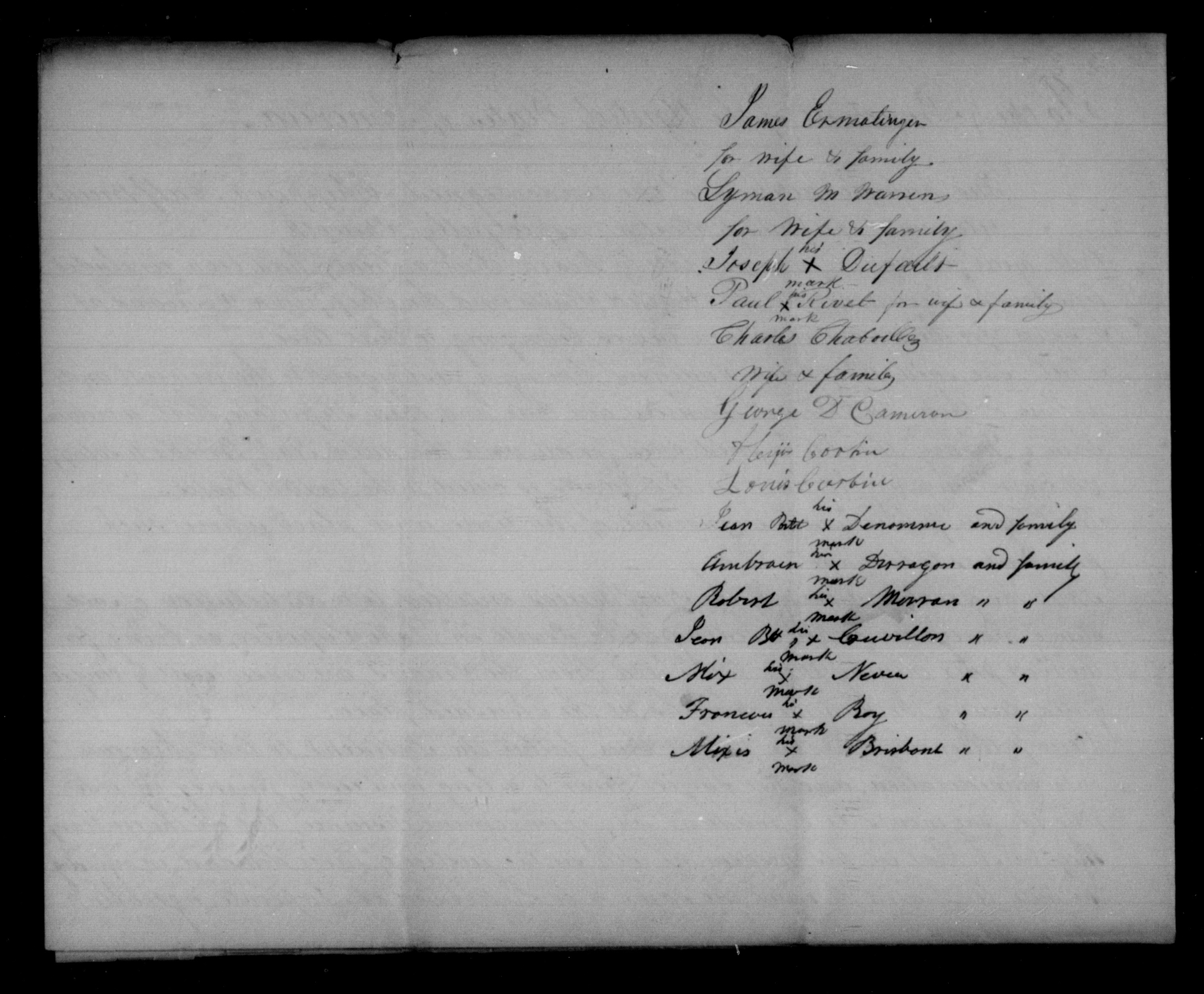
To the President of the United States of America
The humble petition of the undersigned Chippewa Half-Breeds citizens of the United Sates, respectfully Shareth:

Bizhiki (Buffalo), Dagwagaane (Two Lodges Meet), and Jechiikwii’o (Snipe, aka Little Buffalo) signed the 1837 Treaty of St Peters for the La Pointe Band.
That, your petitioners having lately heard that a Treaty had been concluded between the Government of the United Sates and the Chippewa Indians at St Peters, for the cession of certain lands belonging to that tribe:
ARTICLE 3.
“The sum of one hundred thousand dollars shall be paid by the United States, to the half-
breeds of the Chippewa nation, under the direction of the President. It is the wish of the
Indians that their two sub-agents Daniel P. Bushnell, and Miles M. Vineyard, superintend
the distribution of this money among their half-breed relations.”
That, the said Chippewa Indians X, having a just regard to the interest and welfare of their Half Breed brethren, did there and then stipulate; that, a certain sum of money should be paid once for all unto the said Half-Breeds, to satisfy all claim they might have on the lands so ceded to the United States.
That, your petitioners are ignorant of the time and place where such payment is to be made.
That the great majority of the Half-Breeds entitled to a distribution of said sum of money, are either residing at La Pointe on Lake Superior, or being for the most part earning their livelihood from the Traders, are consequently congregated during the summer months at the aforesaid place.
Your petitioners humbly solicit their father the President, to take their case into consideration, and not subject them to a long and costly journey in ordering the payments to be made at any inconvenient distance, but on the contrary they trust that in his wisdom he will see the justice of their demand in requiring he will be pleased to order the same to be distributed at Lapointe agreeable to their request.
Your petitioners would also intimate that, although they are fully aware that the Executive will make a judicious choice in the appointment of the Commissioners who will be selected to carry into effect the Provisions of said Treaty, yet, they would humbly submit to the President, that they have full confidence in the integrity of D. P. Bushnell Esqr. resident Indian Agent for the United States at this place and Lyman M Warren Esquire, Merchant.
Your petitioners entertain the flattering hope, that, their petition will not be made in vain, and as in duty bound will ever pray.
La Pointe, Lake Superior,
Territory of Wisconsin 31st August 1837
Michel Cadotte
Michel Bosquet X his mark
Seraphim Lacombe X his mark
Joseph Cadotte X his mark
Antoine Cadotte X his mark
Chs W Borup for wife & Children
A Morrison for wife & children
Pierre Cotte
Henry Cotte X his mark
Frances Roussan X his mark
James Ermatinger for wife & family
Lyman M Warren for wife & family
Joseph Dufault X his mark
Paul Rivet X his mark for wife & family
Charles Chaboullez wife & family
George D. Cameron
Alixis Corbin
Louis Corbin
Jean Bste Denomme X his mark and family
Ambrose Deragon X his mark and family
Robert Morran X his mark ” “
Jean Bst Couvillon X his mark ” “
Alix Neveu X his mark ” “
Frances Roy X his mark ” “
Alixis Brisbant X his mark ” “
Signed in presence of G. Pauchene
John Livingston
O.I.A. La Pointe W424.
Governor of Wisconsin
Mineral Pt. Feby 19, 1838
Transmits the talk of “Buffalo,” a Chip. Chief, delivered at the La Pointe SubAgt, Dec. 9, 1837, asking that the am. due the half-breeds under the late Treaty, be divided fairly among them, & paid them there, as they will not go to St Peters for it, &c.
Says Buffalo has great influence with his tribe, & is friendly to the whites; his sentiments accord with most of those of the half-breeds & Inds in that part of the country.
File
Recd 13 March 1838
[?] File.
Superintendency of Indian Affairs
for the Territory of Wisconsin
Mineral Point, Feby 19, 1838
Sir,
I have the honor to inclose the talk of “Buffalo,” a principal chief of the Chippewa Indians in the vicinity of La Pointe, delivered on the 9th Dec’r last before Mr Bushnell, sub-agent of the Chippewas at that place. Mr. Bushnell remarks that the speech is given with as strict an adherence to the letter as the language will admit, and has no doubt the sentiments expressed by this Chief accord with those of most of the half-breeds and Indians in that place of the Country. The “Buffalo” is a man of great influence among his tribe, and very friendly to the whites.
Very respectfully,
Your obed’t sevt.
Henry Dodge
Supt Ind Affs
Hon C. A. Harris
Com. of Ind. Affairs
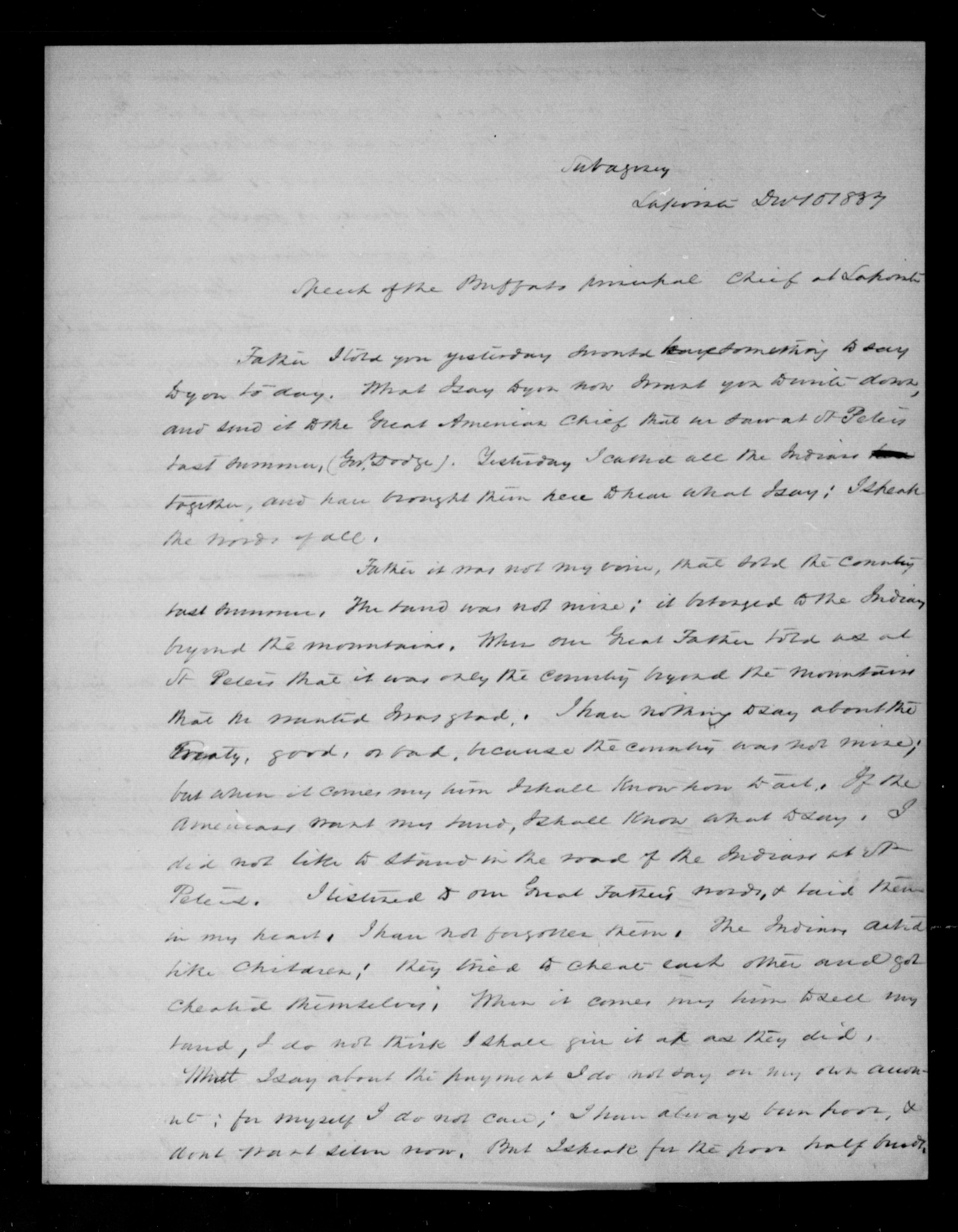
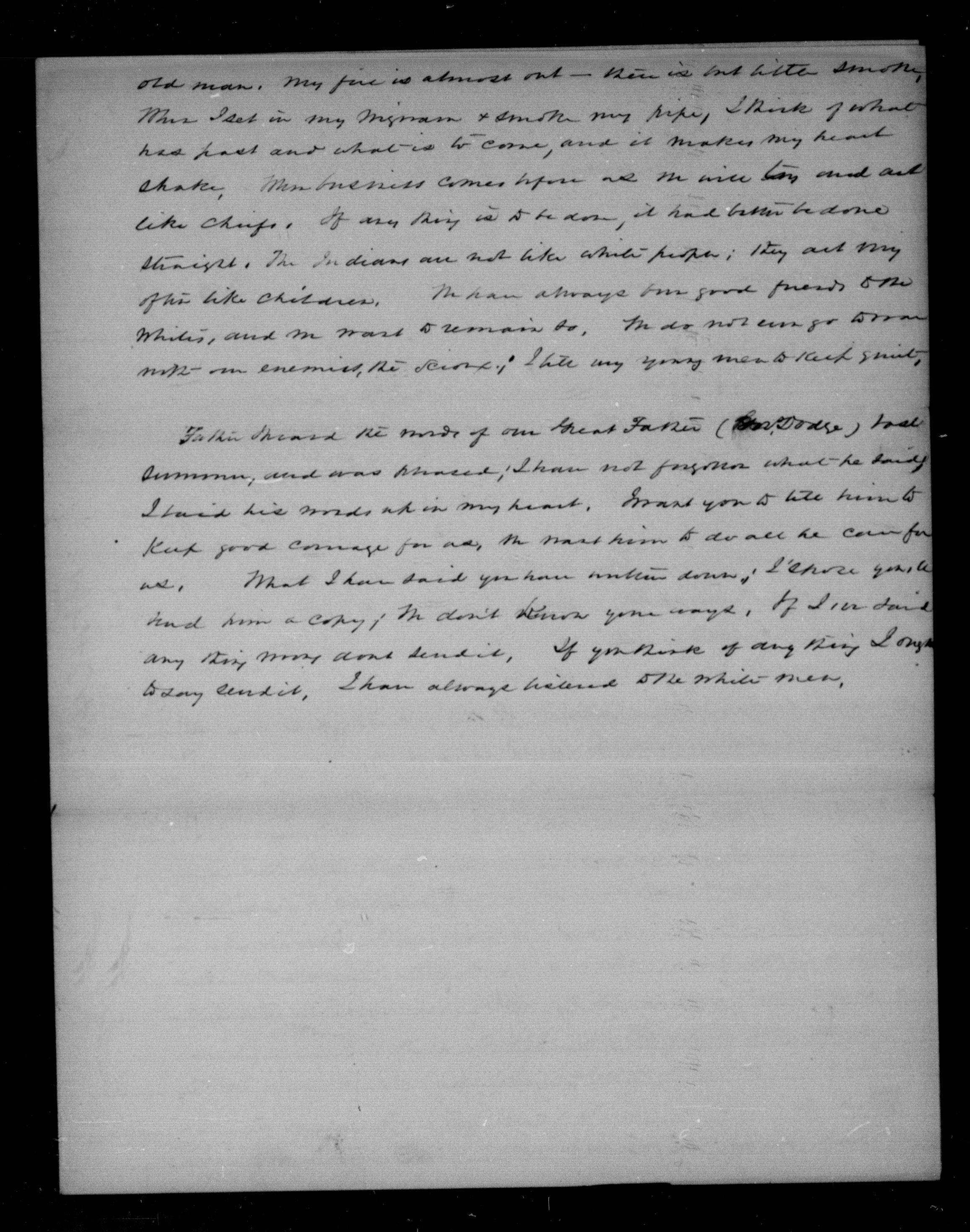
Subagency
Lapointe Dec 10 1837
Speech of the Buffalo principal Chief at Lapointe
Father I told you yesterday I would have something to say to you today. What I say to you now I want you to write down, and send it to the Great American Chief that we saw at St Peters last summer, (Gov. Dodge). Yesterday, I called all the Indians together, and have brought them here to hear what I say; I speak the words of all.
ARTICLE 1.
“The said Chippewa nation cede to the United States all that tract of country included
within the following boundaries:
[…]
thence to and along the dividing ridge between the waters of Lake Superior and those of the Mississippi
[…]“
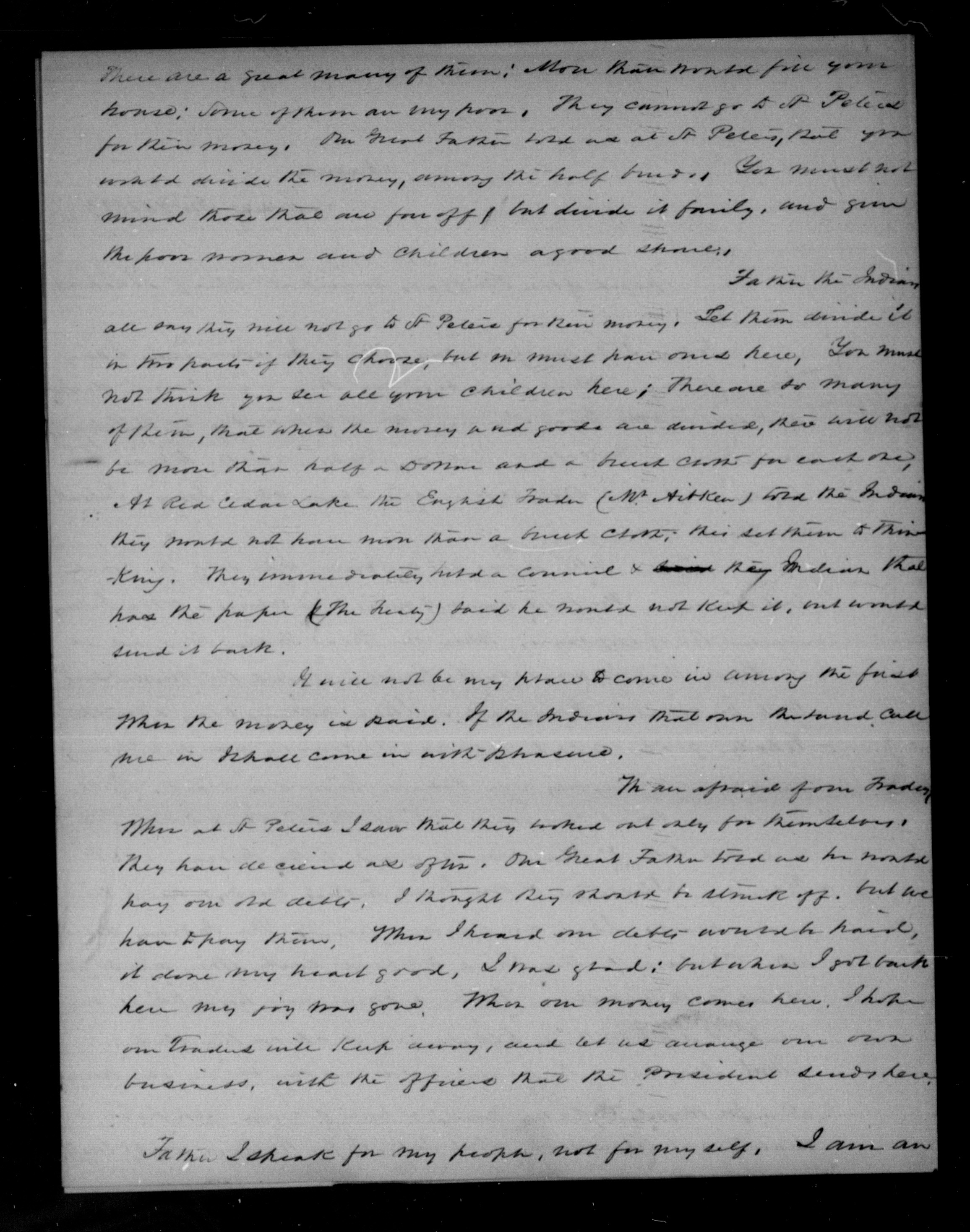
Father it was not my voice, that sold the country last summer. The land was not mine; it belonged to the Indians beyond the mountains. When our Great Father told us at St Peters that it was only the country beyond the mountains that he wanted I was glad. I have nothing to say about the Treaty, good, or bad, because the country was not mine; but when it comes my time I shall know how to act. If the Americans want my land, I shall know what to say. I did not like to stand in the road of the Indians at St Peters. I listened to our Great Father’s words, & said them in my heart. I have not forgotten them. The Indians acted like children; they tried to cheat each other and got cheated themselves. When it comes my time to sell my land, I do not think I shall give it up as they did.
What I say about the payment I do not say on my own account; for myself I do not care; I have always been poor, & don’t want silver now. But I speak for the poor half breeds.
There are a great many of them; more than would fill your house; some of them are very poor They cannot go to St Peters for their money. Our Great Father told us at St Peters, that you would divide the money, among the half breeds. You must not mind those that are far off, but divide it fairly, and give the poor women and children a good share.
Father the Indians all say they will not go to St Peters for their money. Let them divide it in this parts if they choose, but one must have ones here. You must not think you see all your children here; there are so many of them, that when the money and goods are divided, there will not be more than half a Dollar and a breech cloth for each one. At Red Cedar Lake the English Trader (W. Aitken) told the Indians they would not have more than a breech cloth; this set them to thinking. They immediately held a council & their Indian that had the paper (The Treaty) said he would not keep it, and would send it back.
It will not be my place to come in among the first when the money is paid. If the Indians that own the land call me in I shall come in with pleasure.
ARTICLE 4.
“The sum of seventy thousand dollars shall be applied to the payment, by the United States, of certain claims against the Indians; of which amount twenty eight thousand dollars shall, at their request, be paid to William A. Aitkin, twenty five thousand to Lyman M. Warren, and the balance applied to the liquidation of other just demands against them—which they acknowledge to be the case with regard to that presented by Hercules L. Dousman, for the sum of five thousand dollars; and they request that it be paid.“
We are afraid of one Trader. When at St Peters I saw that they worked out only for themselves. They have deceived us often. Our Great Father told us he would pay our old debts. I thought they should be struck off, but we have to pay them. When I heard our debts would be paid, it done my heart good. I was glad; but when I got back here my joy was gone. When our money comes here, I hope our Traders will keep away, and let us arrange our own business, with the officers that the President sends here.
Father I speak for my people, not for myself. I am an old man. My fire is almost out – there is but little smoke. When I set in my wigwam & smoke my pipe, I think of what has past and what is to come, and it makes my heart shake. When business comes before us we will try and act like chiefs. If any thing is to be done, it had better be done straight. The Indians are not like white people; they act very often like children. We have always been good friends to the whites, and we want to remain so. We do not [even?] go to war with our enemies, the Sioux; I tell my young men to keep quiet.
Father I heard the words of our Great Father (Gov. Dodge) last summer, and was pleased; I have not forgotten what he said. I have his words up in my heart. I want you to tell him to keep good courage for us, we want him to do all he can for us. What I have said you have written down; I [?] you to hand him a copy; we don’t know your ways. If I [?] said any thing [?] dont send it. If you think of any thing I ought to say send it. I have always listened to the white men.
O.I.A. Lapointe, B.458
D. P. Bushnell
Lapointe, March 8, 1838
At the request of some of the petitioners, encloses a petition dated 7 March 1838, addressed to the Prest, signed by 167 Chip. half breeds, praying that the amt stipulated by the late Chip. Treaty to be paid to the half breeds, to satisfy all claims they ma have on the lands ceded by this Treaty, may be distributed at Lapointe.
Hopes their request will be complied with; & thinks their annuity should likewise be paid at Lapointe.
File
Recd 2nd May, 1838
Subagency
Lapointe Mch 6 1838
Sir
I have the honor herewith to enclose a petition addressed to the President of the United States, handed to me with a request by several of the petitioners that I would forward it. The justice of the demand of these poor people is so obvious to any one acquainted with their circumstances, that I cannot omit this occasion to second it, and to express a sincere hope that it will be complied with. Indeed, if the convenience and wishes of the Indians are consulted, and as the sum they receive for their country is so small, these should, I conciev, be principle considerations, their annuity will likewise as paid here; for it is a point more convenient of access for the different bands, that almost any other in their own country, and one moreover, where they have interests been in the habit of assembling in the summer months.
I am sir, with great respect,
your most obt servant,
D. P. Bushnell
O. I. A.
C. A. Harris Esqr.
Comr Ind. Affs
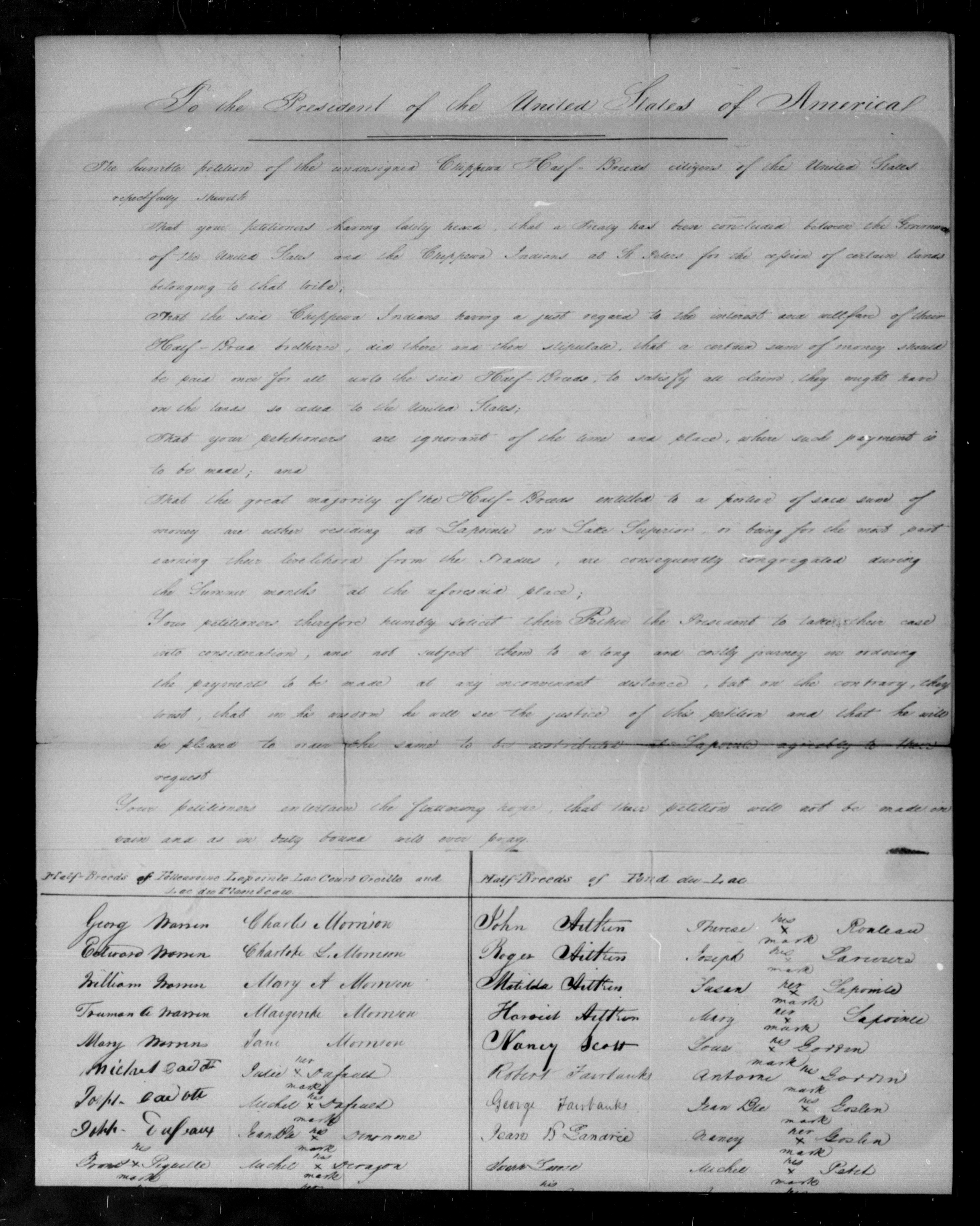
To the President of the United States of America
The humble petition of the undersigned Chippewa Half-Breeds citizens of the United States respectfully shareth
That your petitioners having lately heard, that a Treaty has been concluded between the Government of the United States and the Chippewa Indians at St Peters for the cession of certain lands belonging to that tribe;
That the said Chippewa Indians having a just regard to the interest and wellfare of their Half-Breed brethern, did there and then stipulate, that a certain sum of money should be paid once for all unto the said Half-Breeds, to satisfy all claims, they might have on the lands so ceded to the United States;
That your petitioners are ignorant of the time and place, where such payment is to be made; and
That the great majority of the Half-Breeds entitled to a portion of said sum of money are either residing at Lapointe on Lake Superior, or being for the most part earning their livelihood from the Traders, are consequently congregated during the summer months at the aforesaid place;
Your petitioners therefore humbly solicit their Father the President to take their case into consideration, and not subject them to a long and costly journey on ordering the payment to be made at any convenient distance, but on the contrary, they wish, that in his wisdom he will see the justice of this petition and that he will be pleased to order the same to be distributed at Lapointe agreeably to their request.
Your petitioners entertain the flattering hope, that their petition will not be made in vain and as in duly bound will ever pray.
Half Breeds of Folleavoine Lapointe Lac Court Oreilles and Lac du Flambeau
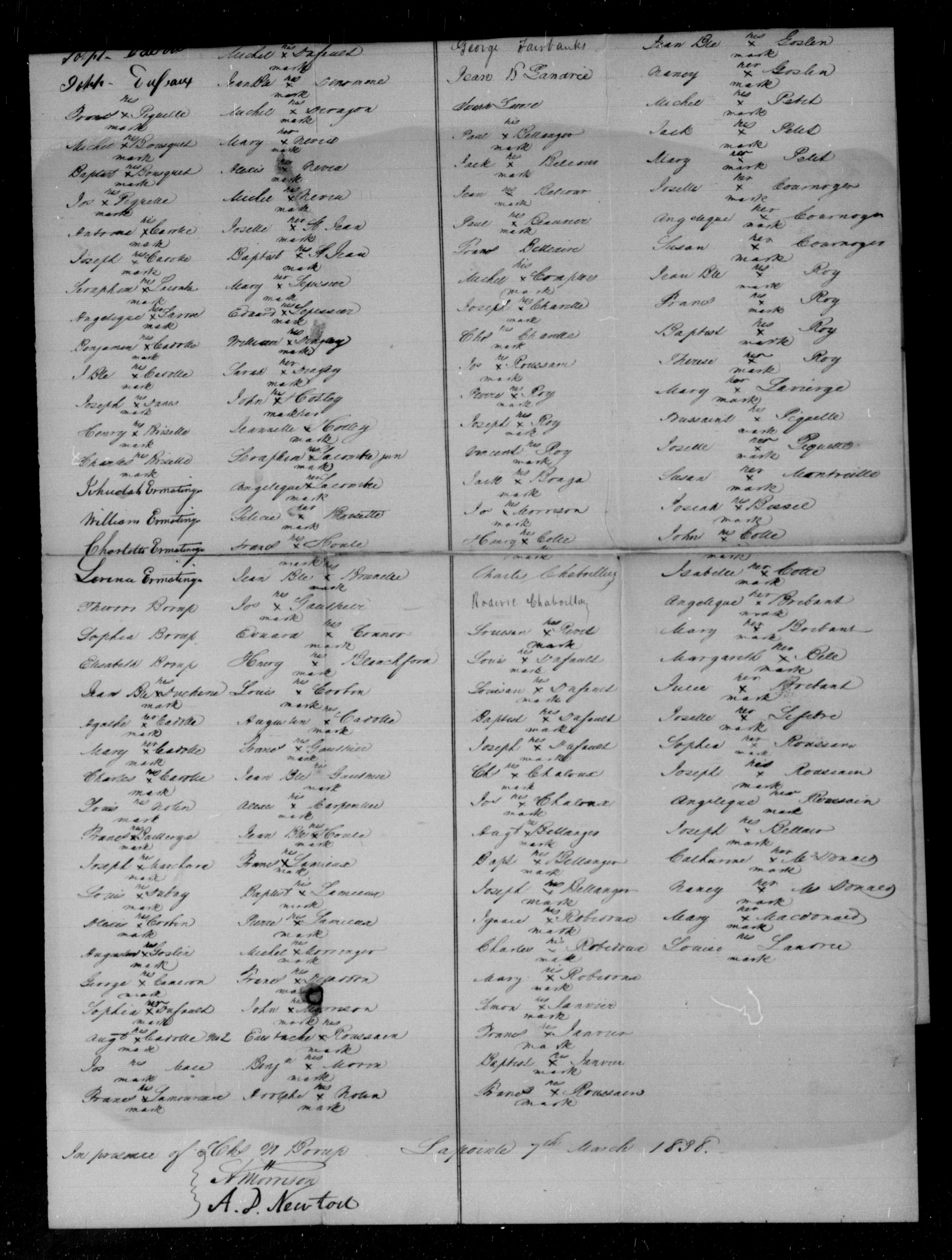
Georg Warren
Edward Warren
William Warren
Truman A Warren
Mary Warren
Michel Cadott
Joseph Cadotte
Joseph Dufault
Frances Piquette X his mark
Michel Bousquet X his mark
Baptiste Bousquet X his mark
Jos Piquette X his mark
Antoine Cadotte X his mark
Joseph Cadotte X his mark
Seraphim Lacombre X his mark
Angelique Larose X her mark
Benjamin Cadotte X his mark
J Bte Cadotte X his mark
Joseph Danis X his mark
Henry Brisette X his mark
Charles Brisette X his mark
Jehudah Ermatinger
William Ermatinger
Charlotte Ermatinger
Larence Ermatinger
Theodore Borup
Sophia Borup
Elisabeth Borup
Jean Bte Duchene X his mark
Agathe Cadotte X her mark
Mary Cadotte X her mark
Charles Cadotte X his mark
Louis Nolin _ his mark
Frances Baillerge X his mark
Joseph Marchand X his mark
Louis Dubay X his mark
Alexis Corbin X his mark
Augustus Goslin X his mark
George Cameron X his mark
Sophia Dufault X her mark
Augt Cadotte No 2 X his mark
Jos Mace _ his mark
Frances Lamoureau X his mark
Charles Morrison
Charlotte L. Morrison
Mary A Morrison
Margerike Morrison
Jane Morrison
Julie Dufault X her mark
Michel Dufault X his mark
Jean Bte Denomme X his mark
Michel Deragon X his mark
Mary Neveu X her mark
Alexis Neveu X his mark
Michel Neveu X his mark
Josette St Jean X her mark
Baptist St Jean X his mark
Mary Lepessier X her mark
Edward Lepessier X his mark
William Dingley X his mark
Sarah Dingley X her mark
John Hotley X his mark
Jeannette Hotley X her mark
Seraphim Lacombre Jun X his mark
Angelique Lacombre X her mark
Felicia Brisette X her mark
Frances Houle X his mark
Jean Bte Brunelle X his mark
Jos Gauthier X his mark
Edward Connor X his mark
Henry Blanchford X his mark
Louis Corbin X his mark
Augustin Cadotte X his mark
Frances Gauthier X his mark
Jean Bte Gauthier X his mark
Alexis Carpentier X his mark
Jean Bte Houle X his mark
Frances Lamieux X his mark
Baptiste Lemieux X his mark
Pierre Lamieux X his mark
Michel Morringer X his mark
Frances Dejaddon X his mark
John Morrison X his mark
Eustache Roussain X his mark
Benjn Morin X his mark
Adolphe Nolin X his mark
Half-Breeds of Fond du Lac
John Aitken
Roger Aitken
Matilda Aitken
Harriet Aitken
Nancy Scott
Robert Fairbanks
George Fairbanks
Jean B Landrie
Joseph Larose
Paul Bellanges X his mark
Jack Belcour X his mark
Jean Belcour X his mark
Paul Beauvier X his mark
Frances Belleaire
Michel Comptois X his mark
Joseph Charette X his mark
Chl Charette X his mark
Jos Roussain X his mark
Pierre Roy X his mark
Joseph Roy X his mark
Vincent Roy X his mark
Jack Bonga X his mark
Jos Morrison X his mark
Henry Cotte X his mark
Charles Chaboillez
Roderic Chaboillez
Louison Rivet X his mark
Louis Dufault X his mark
Louison Dufault X his mark
Baptiste Dufault X his mark
Joseph Dufault X his mark
Chs Chaloux X his mark
Jos Chaloux X his mark
Augt Bellanger X his mark
Bapt Bellanger X his mark
Joseph Bellanger X his mark
Ignace Robidoux X his mark
Charles Robidoux X his mark
Mary Robidoux X her mark
Simon Janvier X his mark
Frances Janvier X his mark
Baptiste Janvier X his mark
Frances Roussain X his mark
Therese Rouleau X his mark
Joseph Lavierire X his mark
Susan Lapointe X her mark
Mary Lapointe X her mark
Louis Gordon X his mark
Antoine Gordon X his mark
Jean Bte Goslin X his mark
Nancy Goslin X her mark
Michel Petit X his mark
Jack Petit X his mark
Mary Petit X her mark
Josette Cournoyer X her mark
Angelique Cournoyer X her mark
Susan Cournoyer X her mark
Jean Bte Roy X his mark
Frances Roy X his mark
Baptist Roy X his mark
Therese Roy X her mark
Mary Lavierge X her mark
Toussaint Piquette X his mark
Josette Piquette X her mark
Susan Montreille X her mark
Josiah Bissel X his mark
John Cotte X his mark
Isabelle Cotte X her mark
Angelique Brebant X her mark
Mary Brebant X her mark
Margareth Bell X her mark
Julie Brebant X her mark
Josette Lefebre X her mark
Sophia Roussain X her mark
Joseph Roussain X his mark
Angelique Roussain X her mark
Joseph Bellair X his mark
Catharine McDonald X her mark
Nancy McDonald X her mark
Mary Macdonald X her mark
Louise Landrie X his mark
In presence of
Chs W Borup
A Morrison
A. D. Newton
Lapointe 7th March 1838
Early Life among the Indians: Chapter II
March 21, 2018
By Amorin Mello

Early life among the Indians
by Benjamin Green Armstrong
continued from Chapter I.
CHAPTER II
In Washington.—Told to Go Home.—Senator Briggs, of New York.—The Interviews with President Fillmore.—Reversal of the Removal Order.—The Trip Home.—Treaty of 1854 and the Reservations.—The Mile Square.—The Blinding. »
After a fey days more in New York City I had raised the necessary funds to redeem the trinkets pledged with the ‘bus driver and to pay my hotel bills, etc., and on the 22d day of June, 1852, we had the good fortune to arrive in Washington.

“Washington Delegation, June 22, 1852“
Engraved from an unknown photograph by Marr and Richards Co. for Benjamin Armstrong’s Early Life Among the Indians. Chief Buffalo, his speaker Oshogay, Vincent Roy, Jr., two other La Pointe Band members, and Armstrong are assumed to be in this engraving.
I took my party to the Metropolitan Hotel and engaged a room on the first floor near the office for the Indians, as they said they did not like to get up to high in a white man’s house. As they required but a couple mattresses for their lodgings they were soon made comfortable. I requested the steward to serve their meals in their room, as I did not wish to take them into the dining room among distinguished people, and their meals were thus served.

Undated postcard of the Metropolitan Hotel, formerly known as Brown’s India Queen Hotel.
~ StreetsOfWashington.com
The morning following our arrival I set out in search of the Interior Department of the Government to find the Commissioner of Indian Affairs, to request an interview with him, which he declined to grant and said :
“I want you to take your Indians away on the next train west, as they have come here without permission, and I do not want to see you or hear of your Indians again.”
I undertook to make explanations, but he would not listen to me and ordered me from his office. I went to the sidewalk completely discouraged, for my present means was insufficient to take them home. I paced up and down the sidewalk pondering over what was best to do, when a gentleman came along and of him I inquired the way to the office of the Secretary of the Interior. He passed right along saying,
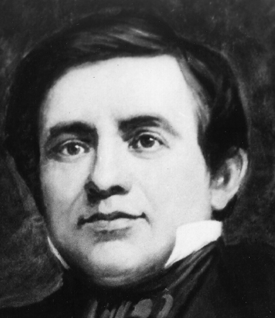
Secretary of the Interior
Alexander Hugh Holmes Stuart
~ Department of the Interior
“This way, sir; this way, sir;” and I followed him.
He entered a side door just back of the Indian Commissioner’s office and up a short flight of stairs, and going in behind a railing, divested himself of hat and cane, and said :
“What can I do for you sir.”
I told him who I was, what my party consisted of, where we came from and the object of our visit, as briefly as possible. He replied that I must go and see the Commissioner of Indian Affairs just down stairs. I told him I had been there and the treatment I had received at his hands, then he said :
“Did you have permission to come, and why did you not go to your agent in the west for permission?”
I then attempted to explain that we had been to the agent, but could get no satisfaction; but he stopped me in the middle of my explanation, saying :
“I can do nothing for you. You must go to the Indian Commissioner,”
and turning, began a conversation with his clerk who was there when we went in.
I walked out more discouraged than ever and could not imagine what next I could do. I wandered around the city and to the Capitol, thinking I might find some one I had seen before, but in this I failed and returned to the hotel, where, in the office I found Buffalo surrounded by a crowd who were trying to make him understand them and among them was the steward of the house. On my entering the office and Buffalo recognizing me, the assemblage, seeing I knew him, turned their attention to me, asking who he was, etc., to all of which questions I answered as briefly as possible, by stating that he was the head chief of of the Chippewas of the Northwest. The steward then asked:
“Why don’t you take him into the dining room with you? Certainly such a distinguished man as he, the head of the Chippewa people, should have at least that privilege.”

United States Representative George Briggs
~ Library of Congress
I did so and as we passed into the dining room we were shown to a table in one corner of the room which was unoccupied. We had only been seated a few moments when a couple of gentlemen who had been occupying seats in another part of the dining room came over and sat at our table and said that if there were no objections they would like to talk with us. They asked about the party, where from, the object of the visit, etc. I answered them briefly, supposing them to be reporters and I did not care to give them too much information. One of these gentlemen asked what room we had, saying that himself and one or two others would like to call on us right after dinner. I directed them where to come and said I would be there to meet them.
About 2 o’clock they came, and then for the first time I knew who those gentlemen were. One was Senator Briggs, of New York, and the others were members of President Filmore’s cabinet, and after I had told them more fully what had taken me there, and the difficulties I had met with, and they had consulted a little while aside. Senator Briggs said :
“We will undertake to get you and your people an interview with the President, and will notify you here when a meeting can be arranged. ”
During the afternoon I was notified that an interview had been arranged for the next afternoon at 3 o’clock. During the evening Senator Briggs and other friends called, and the whole matter was talked over and preparations made for the interview the following day, which were continued the next day until the hour set for the interview.

United States President
Millard Fillmore.
~ Library of Congress
When we were assembled Buffalo’s first request was that all be seated, as he had the pipe of peace to present, and hoped that all who were present would partake of smoke from the peace pipe. The pipe, a new one brought for the purpose, was filled and lighted by Buffalo and passed to the President who took two or three draughts from it, and smiling said, “Who is the next?” at which Buffalo pointed out Senator Briggs and desired he should be the next. The Senator smoked and the pipe was passed to me and others, including the Commissioner of Indian Affairs, Secretary of the Interior and several others whose names I did not learn or cannot recall. From them, to Buffalo, then to O-sho-ga, and from him to the four braves in turn, which completed that part of the ceremony. The pipe was then taken from the stem and handed to me for safe keeping, never to be used again on any occasion. I have the pipe still in my possession and the instructions of Buffalo have been faithfully kept. The old chief now rose from his seat, the balance following his example and marched in single file to the President and the general hand-shaking that was began with the President was continued by the Indians with all those present. This over Buffalo said his under chief, O-sha-ga, would state the object of our visit and he hoped the great father would give them some guarantee that would quiet the excitement in his country and keep his young men peaceable. After I had this speech thoroughly interpreted, O-sha-ga began and spoke for nearly an hour. He began with the treaty of 1837 and showed plainly what the Indians understood the treaty to be. He next took up the treaty of 1842 and said he did not understand that in either treaty they had ceded away the land and he further understood in both cases that the Indians were never to be asked to remove from the lands included in those treaties, provided they were peaceable and behaved themselves and this they had done. When the order to move came Chief Buffalo sent runners out in all directions to seek for reasons and causes for the order, but all those men returned without finding a single reason among all the Superior and Mississippi Indians why the great father had become displeased. When O-sha-ga had finished his speech I presented the petition I had brought and quickly discovered that the President did recognize some names upon it, which gave me new courage. When the reading and examination of it had been concluded the meeting was adjourned, the President directing the Indian Commissioner to say to the landlord at the hotel that our hotel bills would be paid by the government. He also directed that we were to have the freedom of the city for a week.
Read Biographical Sketch of Vincent Roy, Jr. manuscript for a different perspective on their meeting the President.
The second day following this Senator Briggs informed me that the President desired another interview that day, in accordance with which request we went to the White House soon after dinner and meeting the President, he told the, delegation in a brief speech that he would countermand the removal order and that the annuity payments would be made at La Pointe as before and hoped that in the future there would be no further cause for complaint. At this he handed to Buffalo a written instrument which he said would explain to his people when interpreted the promises he had made as to the removal order and payment of annuities at La Pointe and hoped when he had returned home he would call his chiefs together and have all the statements therein contained explained fully to them as the words of their great father at Washington.
The reader can imagine the great load that was then removed from my shoulders for it was a pleasing termination of the long and tedious struggle I had made in behalf of the untutored but trustworthy savage.

Downtown St. Paul, Minnesota, circa 1857.
~ Minnesota Historical Society
On June 28th, 1852, we started on our return trip, going by cars to La Crosse, Wis., thence by steamboat to St. Paul, thence by Indian trail across the country to Lake Superior. On our way from St. Paul we frequently met bands of Indians of the Chippewa tribe to whom we explained our mission and its results, which caused great rejoicing, and before leaving these bands Buffalo would tell their chief to send a delegation, at the expiration of two moons, to meet him in grand council at La Pointe, for there was many things he wanted to say to them about what he had seen and the nice manner in which he had been received and treated by the great father.
At the time appointed by Buffalo for the grand council at La Pointe, the delegates assembled and the message given Buffalo by President Filmore was interpreted, which gave the Indians great satisfaction. Before the grand council adjourned word was received that their annuities would be given to them at La Pointe about the middle of October, thus giving them time to get together to receive them. A number of messengers was immediately sent out to all parts of the territory to notify them and by the time the goods arrived, which was about October 15th, the remainder of the Indians had congregated at La Pointe. On that date the Indians were enrolled and the annuities paid and the most perfect satisfaction was apparent among all concerned. The jubilee that was held to express their gratitude to the delegation that had secured a countermanding order in the removal matter was almost extravagantly profuse. The letter of the great father was explained to them all during the progress of the annuity payments and Chief Buffalo explained to the convention what he had seen; how the pipe of peace had been smoked in the great father’s wigwam and as that pipe was the only emblem and reminder of their duties yet to come in keeping peace with his white children, he requested that the pipe be retained by me. He then went on and said that there was yet one more treaty to be made with the great father and he hoped in making it they would be more careful and wise than they had heretofore been and reserve a part of their land for themselves and their children. It was here that he told his people that he had selected and adopted, me as his son and that I would hereafter look to treaty matters and see that in the next treaty they did not sell them selves out and become homeless ; that as he was getting old and must soon leave his entire cares to others, he hoped they would listen to me as his confidence in his adopted son was great and that when treaties were presented for them to sign they would listen to me and follow my advice, assuring them that in doing so they would not again be deceived.

Map of Lake Superior Chippewa territories ceded in 1836, 1837, 1842, and 1854.
~ Great Lakes Indian Fish & Wildlife Commission
After this gathering of the Indians there was not much of interest in the Indian country that I can recall until the next annual payment in 1853. This payment was made at La Pointe and the Indians had been notified that commissioners would be appointed to make another treaty with them for the remainder of their territory. This was the territory lying in Minnesota west of Lake Superior; also east and west of the Mississippi river north to the territory belonging to the Boisfort and Pillager tribe, who are a part of the Chippewa nation, but through some arrangement between themselves, were detached from the main or more numerous body. It was at this payment that the Chippewa Indians proper desired to have one dollar each taken from their annuities to recompense me for the trouble and expense I had been to on the trip to Washington in their behalf, but I refused to accept it by reason of their very impecunious condition.
It was sometime in August, 1854, before the commissioners arrived at LaPointe to make the treaty and pay the annuities of that year. Messengers were despatched to notify all Indians of the fact that the great father had sent for them to come to La Pointe to get their money and clothing and to meet the government commissioners who wished to make another treaty with them for the territory lying west of Lake Superior and they were further instructed to have the Indians council among themselves before starting that those who came could be able to tell the wishes of any that might remain away in regards to a further treaty and disposition of their lands. Representatives came from all parts of the Chippewa country and showed a willingness to treat away the balance of their country. Henry C. Gilbert, the Indian agent at La Pointe, formerly of Ohio, and David B. Herriman, the agent for the Chippewas of the Mississippi country, were the commissioners appointed by the government to consumate this treaty.

Mackinac Indian Agent
Henry C. Gilbert
~ Branch County Photographs
While we were waiting the arrival of the interior Indians I had frequent talks with the commissioners and learned what their instructions were and about what they intended to offer for the lands which information I would communicate to Chief Buffalo and other head men in our immediate vicinity, and ample time was had to perfect our plans before the others should arrive, and when they did put in an appearance we were ready to submit to them our views for approval or rejection. Knowing as I did the Indians’ unwillingness to give up and forsake their old burying grounds I would not agree to any proposition that would take away the remainder of their lands without a reserve sufficient to afford them homes for themselves and posterity, and as fast as they arrived I counselled with them upon this subject and to ascertain where they preferred these reserves to be located. The scheme being a new one to them it required time and much talk to get the matter before them in its proper light. Finally it was agreed by all before the meeting of the council that no one would sign a treaty that did not give them reservations at different points of the country that would suit their convenience, that should afterwards be considered their bona-fide home. Maps were drawn of the different tracts that had been selected by the various chiefs for their reserve and permanent home. The reservations were as follows :
One at L’Anse Bay, one at Ontonagon, one at Lac Flambeau, one at Court O’Rilles, one at Bad River, one at Red Cliff or Buffalo Bay, one at Fond du Lac, Minn., and one at Grand Portage, Minn.

Joseph Stoddard (photo c.1941) worked on the 1854 survey of the Bad River Reservation exterior boundaries, and shared a different perspective about these surveys.
~ Bad River Tribal Historic Preservation Office
The boundaries were to be as near as possible by metes and bounds or waterways and courses. This was all agreed to by the Lake Superior Indians before the Mississippi Chippewas arrived and was to be brought up in the general council after they had come in, but when they arrived they were accompanied by the American Fur Company and most of their employees, and we found it impossible to get them to agree to any of our plans or to come to any terms. A proposition was made by Buffalo when all were gathered in council by themselves that as they could not agree as they were, a division should be drawn, dividing the Mississippi and the Lake Superior Indians from each other altogether and each make their own treaty After several days of counselling the proposition was agreed to, and thus the Lake Superiors were left to make their treaty for the lands mouth of Lake Superior to the Mississippi and the Mississippis to make their treaty for the lands west of the Mississippi. The council lasted several days, as I have stated, which was owing to the opposition of the American Fur Company, who were evidently opposed to having any such division made ; they yielded however, but only when they saw further opposition would not avail and the proposition of Buffalo became an Indian law. Our side was now ready to treat with the commissioners in open council. Buffalo, myself and several chiefs called upon them and briefly stated our case but were informed that they had no instructions to make any such treaty with us and were only instructed to buy such territory as the Lake Superiors and Mississippis then owned. Then we told them of the division the Indians had agreed upon and that we would make our own treaty, and after several days they agreed to set us off the reservations as previously asked for and to guarantee that all lands embraced within those boundaries should belong to the Indians and that they would pay them a nominal sum for the remainder of their possessions on the north shores. It was further agreed that the Lake Superior Indians should have two- thirds of all money appropriated for the Chippewas and the Mississippi contingent the other third. The Lake Superior Indians did not seem, through all these councils, to care so much for future annuities either in money or goods as they did for securing a home for themselves and their posterity that should be a permanent one. They also reserved a tract of land embracing about 100 acres lying across and along the Eastern end of La Pointe or Madeline Island so that they would not be cut off from the fishing privilege.
It was about in the midst of the councils leading up to the treaty of 1854 that Buffalo stated to his chiefs that I had rendered them services in the past that should be rewarded by something more substantial than their thanks and good wishes, and that at different times the Indians had agreed to reward me from their annuity money but I had always refused such offers as it would be taking from their necessities and as they had had no annuity money for the two years prior to 1852 they could not well afford to pay me in this way.
“And now,” continued Buffalo, “I have a proposition to make to you. As he has provided us and our children with homes by getting these reservations set off for us, and as we are about to part with all the lands we possess, I have it in my power, with your consent, to provide him with a future home by giving him a piece of ground which we are about to part with. He has agreed to accept this as it will take nothing from us and makes no difference with the great father whether we reserve a small tract of our territory or not, and if you agree I will proceed with him to the head of the lake and there select the piece of ground I desire him to have, that it may appear on paper when the treaty has been completed.”
The chiefs were unanimous in their acceptance of the proposition and told Buffalo to select a large piece that his children might also have a home in future as has been provided for ours.

Kiskitawag (Giishkitawag: “Cut Ear”) signed earlier treaties as a warrior of the Ontonagon Band and became associated with the La Pointe Band at Odanah.
~C.M. Bell, Smithsonian Digital Collections
This council lasted all night and just at break of day the old chief and myself, with four braves to row the boat, set out for the head of Lake Superior and did not stop anywhere only long enough to make and drink some tea, until we reached the head of St. Louis Bay. We landed our canoe by the side of a flat rock quite a distance from the shore, among grass and rushes. Here we ate our lunch and when completed Buffalo and myself, with another chief, Kish-ki-to-uk, waded ashore and ascended the bank to a small level plateau where we could get a better view of the bay. Here Buffalo turned to me, saying: .
“Are you satisfied with this location? I want to reserve the shore of this bay from the mouth of St. Louis river. How far that way do you you want it to go?” pointing southeast, or along the south shore of the lake.
I told him we had better not try to make it too large for if we did the great father’s officers at Washington might throw it out of the treaty and said:
“I will be satisfied with one mile square, and let it start from the rock which we have christened Buffalo rock, running easterly in the direction of Minnesota Point, taking in a mile square immediately northerly from the head of St. Louis Bay”
As there was no other way of describing it than by metes and bounds we tried to so describe it in the treaty, but Agent Gilbert, whether by mistake or not I am unable to say, described it differently. He described it as follows: “Starting from a rock immediately above and adjoining Minnesota Point, etc.”
We spent an hour or two here in looking over the plateau then went back to our canoe and set out for La Pointe. We traveled night and day until we reached home.
During our absence some of the chiefs had been talking more or less with the commissioners and immediately on our return all the Indians met in a grand council when Buffalo explained to them what he had done on the trip and how and where he had selected the piece of land that I was to have reserved in the treaty for my future home and in payment for the services I had rendered them in the past. The balance of the night was spent in preparing ourselves for the meeting with the treaty makers the next day, and about 10 o’clock next morning we were in attendance before the commissioners all prepared for a big council.
Mackinac Indian Agent
Henry Clark Gilbert
~ Branch County Photographs
Agent Gilbert started the business by beginning a speech interpreted by the government interpreter, when Buffalo interrupted him by saying that he did not want anything interpreted to them from the English language by any one except his adoped son for there had always been things told to the Indians in the past that proved afterwards to be untrue, whether wrongly interpreted or not, he could not say;
“and as we now feel that my adopted son interprets to us just what you say, and we can get it correctly, we wish to hear your words repeated by him, and when we talk to you our words can be interpreted by your own interpreter, and in this way one interpreter can watch the other and correct each other should there be mistakes. We do not want to be deceived any more as we have in the past. We now understand that we are selling our lands as well as the timber and that the whole, with the exception of what we shall reserve, goes to the great father forever.”

Bureau of Indian Affairs Director
George Washington Manypenny
~ Commons.Wikimedia.org
Commissioner of Indian affairs. Col. Manypenny, then said to Buffalo:
“What you have said meets my own views exactly and I will now appoint your adopted son your interpreter and John Johnson, of Sault Ste. Marie, shall be the interpreter on the part of the government,” then turning to the commissioners said, “how does that suit you, gentlemen.”
They at once gave their consent and the council proceeded.
Buffalo informed the commissioners of what he had done in regard to selecting a tract of land for me and insisted that it become a part of the treaty and that it should be patented to me directly by the government without any restrictions. Many other questions were debated at this session but no definite agreements were reached and the council was adjourned in the middle of the afternoon. Chief Buffalo asking for the adjournment that he might talk over some matters further with his people, and that night the subject of providing homes for their half-breed relations who lived in different parts of the country was brought up and discussed and all were in favor of making such a provision in the treaty. I proposed to them that as we had made provisions for ourselves and children it would be only fair that an arrangement should be made in the treaty whereby the government should provide for our mixed blood relations by giving to each person the head of a family or to each single person twenty-one years of age a piece of land containing at least eighty acres which would provide homes for those now living and in the future there would be ample room on the reservations for their children, where all could live happily together. We also asked that all teachers and traders in the ceded territory who at that time were located there by license and doing business by authority of law, should each be entitled to 160 acres of land at $1.25 per acre. This was all reduced to writing and when the council met next morning we were prepared to submit all our plans and requests to the commissioners save one, which we required more time to consider. Most of this day was consumed in speech-making by the chiefs and commissioners and in the last speech of the day, which was made by Mr. Gilbert, he said:
“We have talked a great deal and evidently understand one another. You have told us what you want, and now we want time to consider your requests, while you want time as you say to consider another matter, and so we will adjourn until tomorrow and we, with your father. Col. Manypenny, will carefully examine and consider your propositions and when we meet to-morrow we will be prepared to answer you with an approval or rejection.”

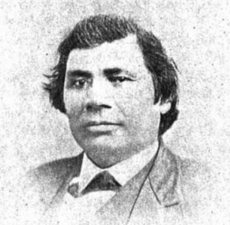
Julius Austrian purchased the village of La Pointe and other interests from the American Fur Company in 1853. He entered his Town Plan of La Pointe on August 29th of 1854. He was the highest paid claimant of the 1854 Treaty at La Pointe. His family hosted the 1855 Annuity Payments at La Pointe.
~ Photograph of Austrian from the Madeline Island Museum
That evening the chiefs considered the other matter, which was to provide for the payment of the debts of the Indians owing the American Fur Company and other traders and agreed that the entire debt could not be more than $90,000 and that that amount should be taken from the Indians in bulk and divided up among their creditors in a pro-rata manner according to the amount due to any person or firm, and that this should wipe out their indebtedness. The American Fur Company had filed claims which, in the aggregate, amounted to two or three times this sum and were at the council heavily armed for the purpose of enforcing their claim by intimidation. This and the next day were spent in speeches pro and con but nothing was effected toward a final settlement.
Col. Manypenny came to my store and we had a long private interview relating to the treaty then under consideration and he thought that the demands of the Indians were reasonable and just and that they would be accepted by the commissioners. He also gave me considerable credit for the manner in which I had conducted the matter for Indians, considering the terrible opposition I had to contend with. He said he had claims in his possession which had been filed by the traders that amounted to a large sum but did not state the amount. As he saw the Indians had every confidence in me and their demands were reasonable he could see no reason why the treaty could not be speedily brought to a close. He then asked if I kept a set of books. I told him I only kept a day book or blotter showing the amount each Indian owed me. I got the books and told him to take them along with him and that he or his interpreter might question any Indian whose name appeared thereon as being indebted to me and I would accept whatever that Indian said he owed me whether it be one dollar or ten cents. He said he would be pleased to take the books along and I wrapped them up and went with him to his office, where I left them. He said he was certain that some traders were making claims for far more than was due them. Messrs. Gilbert and Herriman and their chief clerk, Mr. Smith, were present when Mr. Manypenny related the talk he had with me at the store. He considered the requests of the Indians fair and just, he said, and he hoped there would be no further delays in concluding the treaty and if it was drawn up and signed with the stipulations and agreements that were now understood should be incorporated in it, he would strongly recommend its ratification by the President and senate.

Naagaanab of Fond Du Lac
~ Minnesota Historical Society
The day following the council was opened by a speech from Chief Na-gon-ab in which he cited considerable history.
“My friends,” he said, “I have been chosen by our chief, Buffalo, to speak to you. Our wishes are now on paper before you. Before this it was not so. We have been many times deceived. We had no one to look out for us. The great father’s officers made marks on paper with black liquor and quill. The Indian can not do this. We depend upon our memory. We have nothing else to look to. We talk often together and keep your words clear in our minds. When you talk we all listen, then we talk it over many times. In this way it is always fresh with us. This is the way we must keep our record. In 1837 we were asked to sell our timber and minerals. In 1842 we were asked to do the same. Our white brothers told us the great father did not want the land. We should keep it to hunt on. Bye and bye we were told to go away; to go and leave our friends that were buried yesterday. Then we asked each other what it meant. Does the great father tell the truth? Does he keep his promises? We cannot help ourselves! We try to do as we agree in treaty. We ask you what this means? You do not tell from memory! You go to your black marks and say this is what those men put down; this is what they said when they made the treaty. The men we talk with don’t come back; they do not come and you tell us they did not tell us so! We ask you where they are? You say you do not know or that they are dead and gone. This is what they told you; this is what they done. Now we have a friend who can make black marks on paper When the council is over he will tell us what we have done. We know now what we are doing! If we get what we ask our chiefs will touch the pen, but if not we will not touch it. I am told by our chief to tell you this: We will not touch the pen unless our friend says the paper is all right.”
Na-gon-ab was answered by Commissioner Gilbert, saying:
“You have submitted through your friend and interpreter the terms and conditions upon which you will cede away your lands. We have not had time to give them all consideration and want a little more time as we did not know last night what your last proposition would be. Your father. Col. Manypenny, has ordered some beef cattle killed and a supply of provisions will be issued to you right away. You can now return to your lodges and get a good dinner and talk matters over among yourselves the remainder of the day and I hope you will come back tomorrow feeling good natured and happy, for your father, Col. Manypenny, will have something to say to you and will have a paper which your friend can read and explain to you.”
When the council met next day in front of the commissioners’ office to hear what Col. Manypenny had to say a general good feeling prevailed and a hand-shaking all round preceded the council, which Col. Manypenny opened by saying:
“My friends and children: I am glad to see you all this morning looking good natured and happy and as if you could sit here and listen to what I have to say. We have a paper here for your friend to examine to see if it meets your approval. Myself and the commissioners which your great father has sent here have duly considered all your requests and have concluded to accept them. As the season is passing away and we are all anxious to go to our families and you to your homes, I hope when you read this treaty you will find it as you expect to and according to the understandings we have had during the council. Now your friend may examine the paper and while he is doing so we will take a recess until afternoon.”

Detail of Benjamin Armstrong from a photograph by Matthew Brady
~ Minnesota Historical Society
Chief Buffalo, turning to me, said:
“My son, we, the chiefs of all the country, have placed this matter entirely in your hands. Go and examine the paper and if it suits you it will suit us.”
Then turning to the chiefs, he asked,
“what do you all say to that?”
The ho-ho that followed showed the entire circle were satisfied.
I went carefully through the treaty as it had been prepared and with a few exceptions found it was right. I called the attention of the commissioners to certain parts of the stipulations that were incorrect and they directed the clerk to make the changes.
The following day the Indians told the commissioners that as their friend had made objections to the treaty as it was they requested that I might again examine it before proceeding further with the council. On this examination I found that changes had been made but on sheets of paper not attached to the body of the instrument, and as these sheets contained some of the most important items in the treaty, I again objected and told the commissioners that I would not allow the Indians to sign it in that shape and not until the whole treaty was re-written and the detached portions appeared in their proper places. I walked out and told the Indians that the treaty was not yet ready to sign and they gave up all further endeavors until next day. I met the commissioners alone in their office that afternoon and explained the objectionable points in the treaty and told them the Indians were already to sign as soon as those objections were removed. They were soon at work putting the instrument in shape.

“One version of the boundaries for Chief Buffalo’s reservation is shown at the base of Minnesota Point in a detail from an 1857 map preserved in the National Archives in Washington, D.C. Other maps show a larger and more irregularly shaped versions of the reservation boundary, though centered on the same area.”
~ DuluthStories.net
The next day when the Indians assembled they were told by the commissioners that all was ready and the treaty was laid upon a table and I found it just as the Indians had wanted it to be, except the description of the mile square. The part relating to the mile square that was to have been reserved for me read as follows:
“Chief Buffalo, being desirous of providing for some of his relatives who had rendered them important services, it is agreed that he may select one mile square of the ceded territory heretofore described.”
“Now,” said the commissioner,
“we want Buffalo to designate the person or persons to whom he wishes the patents to issue.”
Buffalo then said:
“I want them to be made out in the name of my adopted son.”
This closed all ceremony and the treaty was duly signed on the 30th day of September, 1854. This done the commissioners took a farewell shake of the hand with all the chiefs, hoping to meet them again at the annuity payment the coming year. They then boarded the steamer North Star for home. In the course of a few days the Indians also disappeared, some to their interior homes and some to their winter hunting grounds and a general quiet prevailed on the island.

Portrait of the Steamer North Star from American Steam Vessels, by Samuel Ward Stanton, page 40.
~ Wikimedia.org
About the second week in October, 1854, I went from La Pointe to Ontonagon in an open boat for the purpose of purchasing my winter supplies as it had got too late to depend on getting them from further below. While there a company was formed for the purpose of going into the newly ceded territory to make claims upon lands that would be subject to entry as soon as the late treaty should be ratified. The company consisted of Samuel McWaid, William Whitesides, W. W. Kingsbury, John Johnson, Oliver Melzer, John McFarland, Daniel S. Cash, W. W. Spaulding, all of Ontonagon, and myself. The two last named gentlemen, Daniel S. Cash and W. W. Spaulding, agreeing to furnish the company with supplies and all necessaries, including money, to enter the lands for an equal interest and it was so stipulated that we were to share equally in all that we, or either of us, might obtain. As soon as the supplies could be purchased and put aboard the schooner Algonquin we started for the head of the lake, stopping at La Pointe long enough for me to get my family aboard and my business matters arranged for the winter. I left my store at La Pointe in charge of Alex. Nevaux, and we all sailed for the head of Lake Superior, the site of which is now the city of Duluth. Reaching there about the first week in December—the bay of Superior being closed by ice—we were compelled to make our landing at Minnesota Point and take our goods from there to the main land on the north’ shore in open boats, landing about one and-one half miles east of Minnesota Point at a place where I desired to make a preemption for myself and to establish a trading post for the winter. Here I erected a building large enough for all of us to live in, as we expected to make this our headquarters for the winter, and also a building for a trading post. The other members of the company made claims in other places, but I did no more land looking that winter.

Detail of Superior City townsite at the head of Lake Superior from the 1854 U.S. General Land Office survey by Stuntz and Barber.
About January 20th, 1855, I left my place at the head of the lake to go back to La Pointe and took with me what furs I had collected up to that time, as I had a good place at La Pointe to dry and keep them. I took four men along to help me through and two dog trains. As we were passing down Superior Bay and when just in front of the village of West Superior a man came to us on the ice carrying a small bundle on his back and asked me if I had any objections to his going through in my company. He said the snow was deep and the weather cold and it was bad for one man to travel alone. I told him I had no objections provided he would take his turn with the other men in breaking the road for the dogs. We all went on together and camped that night at a place well known as Flag River. We made preparations for a cold night as the thermometer must have been twenty-five or thirty degrees below zero and the snow fully two feet deep. As there were enough of us we cut and carried up a large quantity of wood, both green and dry, and shoveled the snow away to the ground with our snow shoes and built a large fire. We then cut evergreen boughs and made a wind break or bough camp and concluded we could put in a very comfortable night. We then cooked and ate our supper and all seemed happy. I unrolled a bale of bear skins and spread them out on the ground for my bed, filled my pipe and lay down to rest while the five men with me were talking and smoking around the camp fire. I was very tired and presume I was not long in falling asleep. How long I slept I cannot tell, but was awakened by something dropping into my face, which felt like a powdered substance. I sprang to my feet for I found something had got into my eyes and was smarting them badly. I rushed for the snow bank that was melting from the heat and applied handful after handful to my eyes and face. I found the application was peeling the skin off my face and the pain soon became intense. I woke up the crew and they saw by the firelight the terrible condition I was in. In an hour’s time my eyeballs were so swollen that I could not close the lids and the pain did not abate. I could do nothing more than bathe my eyes until morning, which I did with tea-grounds. It seemed an age before morning came and when it did come I could not realize it, for I was totally blind. The party started with me at early dawn for La Pointe. The man who joined us the day before went no further, but returned to Superior, which was a great surprise to the men of our party, who frequently during the day would say:
“There is something about this matter that is not right,”
and I never could learn afterward of his having communicated the fact of my accident to any one or to assign any reason or excuse for turning back, which caused us to suspect that he had a hand in the blinding, but as I could get no proof to establish that suspicion, I could do nothing in the matter. This man was found dead in his cabin a few months afterwards.
At La Pointe I got such treatment as could be procured from the Indians which allayed the inflamation but did not restore the sight. I remained at La Pointe about ten days, and then returned home with dog train to my family, where I remained the balance of the winter, when not at Superior for treatment. When the ice moved from the lake in the spring I abandoned everything there and returned to La Pointe and was blind or nearly so until the winter of 1861.
Returning a little time to the north shore I wish to relate an incident of the death of one of our Ontonagon company. Two or three days after I had reached home from La Pointe, finding my eyes constantly growing worse I had the company take me to Superior where I could get treatment. Dr. Marcellus, son of Prof. Marcellus, of an eye infirmary in Philadelphia, who had just then married a beautiful young wife, and come west to seek his fortune, was engaged to treat me. I was taken to the boarding house of Henry Wolcott, where I engaged rooms for the winter as I expected to remain there until spring. I related to the doctor what had befallen me and he began treatment. At times I felt much better but no permanent relief seemed near. About the middle February my family required my presence at home, as there was some business to be attended to which they did not understand. My wife sent a note to me by Mr. Melzer, stating that it was necessary for me to return, and as the weather that day was very pleasant, she hoped that I would come that afternoon. Mr. Melzer delivered me the note, which I requested him to read. It was then 11 a. m. and I told him we would start right after dinner, and requested him to tell the doctor that I wished to see him right away, and then return and get his dinner, as it would be ready at noon, to which he replied:
“If I am not here do not wait for me, but I will be here at the time you are ready for home.”
Mr. Melzer did return shortly after we had finished our dinner and I requested him to eat, as I would not be ready to start for half an hour, but he insisted he was not hungry. We had no conveyance and at 1 p. m. we set out for home. We went down a few steps to the ice, as Mr. Wolcott’s house stood close to the shore of the bay, and went straight across Superior Bay to Minnesota Point, and across the point six or eight rods and struck the ice on Lake Superior. A plain, hard beaten road led from here direct to my home. After we had proceeded about 150 yards, following this hard beaten road, Melzer at once stopped and requested me to go ahead, as I could follow the beaten road without assistance, the snow being deep on either side.
“Now,” he says go ahead, for I must go back after a drink.”
I followed the road quite well, and when near the house my folks came out to meet me, their first inquiry being:
“Where is Melzer?”
I told them the circumstances of his turning back for a drink of water. Reaching the bank on which my house stood, some of my folks, looking back over the road I had come, discovered a dark object apparently floundering on the ice. Two or three of our men started for the spot and there found the dead body of poor Melzer. We immediately notified parties in Superior of the circumstances and ordered a post-mortem examination of the body. The doctors found that his stomach was entirely empty and mostly gone from the effects of whisky and was no thicker than tissue paper and that his heart had burst into three pieces. We gave him a decent burial at Superior and peace to his ashes, His last act of kindness was in my behalf.
To be continued in Chapter III…
Audit of the 1854 Treaty Claims
January 18, 2018
By Amorin Mello
This is one of many posts on Chequamegon History that feature the $90,000 of Indian trader debts that were debated during the 1854 Treaty and the 1855 Annuity Payments at La Pointe.
In summary, the Chiefs of the Chippewas made it a condition of the treaty that they would be granted $90,000 to settle outstanding debts with Indian traders, under the condition that a Council of Chiefs would determine which debts claimed by the traders were fair and accurate. The following quote is the fourth article of the 1854 Treaty of La Pointe, with the sentence about the $90,000 underlined for emphasis:
ARTICLE 4. In consideration of and payment for the country hereby ceded, the United States agree to pay to the Chippewas of Lake Superior, annually, for the term of twenty years, the following sums, to wit: five thousand dollars in coin; eight thousand dollars in goods, household furniture and cooking utensils; three thousand dollars in agricultural implements and cattle, carpenter’s and other tools and building materials, and three thousand dollars for moral and educational purposes, of which last sum, three hundred dollars per annum shall be paid to the Grand Portage band, to enable them to maintain a school at their village. The United States will also pay the further sum of ninety thousand dollars, as the chiefs in open council may direct, to enable them to meet their present just engagements. Also the further sum of six thousand dollars, in agricultural implements, household furniture, and cooking utensils, to be distributed at the next annuity payment, among the mixed bloods of said nation. The United States will also furnish two hundred guns, one hundred rifles, five hundred beaver traps, three hundred dollars’ worth of ammunition, and one thousand dollars’ worth of ready made clothing, to be distributed among the young men of the nation, at the next annuity payment.
~ 1854 Treaty with the Chippewa at La Pointe
Indian Affairs: Laws and Treaties; Volume II by Charles Kappler, 1904
This $90,000 appear to have been an unexpected expense that the United States government incurred in order to successfully negotiate this Treaty. Indian Agent Henry Clark Gilbert was a commissioner of the Treaty, and was obliged to explain this $90,000 to his superiors at the Office of Indian Affairs in Washington D.C. The following is his explanation written a few weeks after the 1854 Treaty of La Pointe was concluded:
The Chiefs who were notified to attend brought with them in every instance their entire bands. We made a careful estimate of the number present and found there were about 4,000. They all had to be fed and taken care of, thus adding greatly to the expenses attending the negotiations.
A great number of traders and claim agents were also present as well as some of the persons from St. Paul’s who I had reason to believe attended for the purpose of preventing if possible the consummation of the treaty. The utmost precautions were taken by me to prevent a knowledge of the fact that negotiations were to take place from being public. The Messenger sent by me to Mr Herriman was not only trust worthy but was himself totally ignorant of the purport of the dispatches to Major Herriman. Information however of the fact was communicated from some source and the persons present in consequence greatly embarrassed our proceedings.
~ Treaty Commissioner Henry C. Gilbert’s explanation of the treaty concluded in 1854 with the assistance of David B. Herriman
Transactions of the Wisconsin Academy of Sciences, Arts and Letters: Volume 79, No. 1, Appendix 5
Indian Agent Gilbert’s explanation suggests that there was some effort on his behalf to preemptively avoid the subject of outstanding debts from occuring during the Treaty negotiations. In January of 1855, a few months after the Treaty was negotiated, President Franklin Pierce budgeted for this $90,000 in the fund appropriated for fulfilling the terms of the Treaty:
For the payment of such debts as may be directed by the chiefs in open council, and found to be just and correct by the Secretary of the Interior, per 4th article of the treaty of September 30, 1854…….. 90,000
~ United States House of Representatives Documents, Volume 11, 33d Congress, 2nd Session, Ex. Doc. No. 61.
1854 Treaty of La Pointe Appropriations
As quoted above, the $90,000 negotiated during the treaty were to be distributed by a Council of the Chiefs following the treaty. How the $90,000 were actually distributed did not honor the intent or terms of the treaty. The following is a public notice from Indian Agent Gilbert that invited Indian traders with claims against Tribe to come forth with their claims before or during the 1855 Annuity, and makes no mention of any distribution to be determined by a Council of Chiefs:
PUBLIC NOTICE.
OFFICE MICHIGAN INDIAN AGENT,
DETROIT, June 12, 1855.ALL PERSONS having just and legal claims against the Chippewa Indians of Lake Superior are hereby notified that all such claims must be presented without delay to the undersigned, for investigation. Each claim must be accompanied by such evidence of its justice and legality as the claimant may be able to furnish; and in all cases where the idebtedness claimed is on book account, or is composed of aggregated items, transcripts of such accounts specifying the items in detail, with the charge for each item, and the name of the person to whom, and time when, the same was furnished, must accompany the claims submitted. The original books of entry must also in all cases be prepared for examination.
Claims may be presented at any time prior to the close of the next annuity payment at La Pointe, which will take place in the month of August next; but after that time they will not be received or acted upon.
This notice is given in accordance with instructions received from the United States Commissioner of Indian Affairs.
HENRY C. GILBERT.
Indian Agent.
jy 10 4t~ Superior Chronicle newspaper, July 10th, 1855
Library of Congress
The distribution of this $90,000 was hotly debated by Blackbird and other members of the Council of Chiefs during the 1855 Annuity Payments. It is clear from the speeches transcribed from this important event that the Council was not being allowed to determine the distribution of this $90,000. The following is one of many speeches that touched upon this subject:
In what Blackbird said he expressed the mind of a majority of the chiefs now present. We wish the stipulations of the treaty to be carried out to the very letter.
I wish to say our word about our reserves. Will these reserves made for each of our bands, be our homes forever?
When we took credits of our trader last winter, and took no furs to pay him, and wish to get hold of this 90,000 dollars, that we may pay him off of that. This is all we came here for. We want the money in our own hands & we will pay our own traders. We do not think it is right to pay what we do not owe. I always know how I stand my acct. and we can pay our own debts. From what I have now said I do not want you to think that we want the money to cheat our creditors, but to do justice to them I owe. I have my trader & know how much I owe him, & if the money is paid into the hands of the Indians we can pay our own debts.
~ Adikoons, Chief of Grand Portage Band
(Wheeler to Smith, 18 Jan. 1856)
Blackbird’s Speech at the 1855 Payment
With the above quotes as an introduction to this subject, we will now investigate what exactly happened to the $90,000 to be disbursed as “directed by the chiefs in open council”. What we have found so far appears to suggest that the federal government did not honor their Trust responsibility to the Tribe:
Senate Documents, Volume 112


[Page 295 of audit]
Indian Disbursements
Statement containing a list of the names of all persons to whom goods, money, or effects have been delivered, from July 1, 1856, to June 30, 1857, specifying the amounts and objects for which they were intended, the amount accounted for, and the balances under each specified head still remaining in their hands; prepared in obedience to an act of Congress of June 30, 1834, entitled “An act to provide for the organization of the department of Indian affairs.”
[Pages 303-305 of audit]
Fulfilling treaties with Chippewas of Lake Superior, September 30, 1854
| When issued | To whom issued. | For what purpose. | Amount of requisition. | Am’t accounted for. |
Amount unaccounted for.
|
| 1856 | |||||
| July 3 | John B. Jacobs | Fulfilling Treaties, (due) | $1,718.73 | $1,718.73 | |
| 22 | Henry C. Gilbert | …do… | $7,000.00 | $7,000.00 | |
| Do | …do… | $5,000.00 | $5,000.00 | ||
| Aug. 14 | Henry E. Leman | …do…(due)… | $1,412.50 | $1,412.50 | |
| 18 | Ramsey Crooks | …do…do… | $6,617.64 | $6,617.64 | |
| Adam Noongoo | …do…do… | $66.00 | $66.00 | ||
| Wm. Parsons | …do…do… | $28.50 | $28.50 | ||
| Erwin Leiky | …do…do… | $119.75 | $119.75 | ||
| Robert Morrin | …do…do… | $163.56 | $163.56 | ||
| Charles Bellisle | …do…do… | $191.00 | $191.00 | ||
| Posh-qway-gin | …do…do… | $47.88 | $47.88 | ||
| 22 | W. A. Pratt | …do…do… | $50.00 | $50.00 | |
| John G. Kittson | …do…do… | $1,280.93 | $1,280.93 | ||
| Asaph Whittlesey | …do…do… | $25.00 | $25.00 | ||
| Louis Bosquet | …do…do… | $72.00 | $72.00 | ||
| David King | …do…do… | $100.00 | $100.00 | ||
| P. O. Johnson | …do…do… | $10.12 | $10.12 | ||
| Henry Elliott | …do…do… | $399.02 | $399.02 | ||
| McCullough & Elliott | …do…do… | $475.78 | $475.78 | ||
| Edward Assinsece | …do…do… | $50.00 | $50.00 | ||
| John Southwind | …do…do… | $21.00 | $21.00 | ||
| Kay-kake | …do…do… | $35.00 | $35.00 | ||
| Goff & Co. | …do…do… | $556.21 | $556.21 | ||
| Jame Halliday | …do…do… | $67.88 | $67.88 | ||
| Peter Crebassa | …do…do… | $1,013.99 | $1,013.99 | ||
| S. L. Vaugh | …do…do… | $57.08 | $57.08 | ||
| David King | …do…do… | $191.72 | $191.72 | ||
| Peter B. Barbean | …do…do… | $1,200.00 | $1,200.00 | ||
| 23 | Antoine Gaudine | …do…do… | $3,250.94 | $3,250.94 | |
| Peter Markman | …do…do… | $300.00 | $300.00 | ||
| Pat L. Philan | …do…do… | $90.08 | $90.08 | ||
| Treasurer of township of Lapointe | …do…do… | $224.77 | $224.77 | ||
| Michael Bosquet | …do…do… | $219.63 | $219.63 | ||
| James Ermatinger | …do…do… | $2,000.00 | $2,000.00 | ||
| Louison Demaris | …do…do… | $2,000.00 | $2,000.00 | ||
| Joseph Morrison | …do…do… | $250.00 | $250.00 | ||
| John W. Bell | …do…do… | $253.11 | $253.11 | ||
| 27 | Paul H. Beaubien | …do…do… | $600.00 | $600.00 | |
| R. Sheldon & Co. | …do…do… | $1,124.71 | $1,124.71 | ||
| Abraham Place | …do…do… | $450.00 | $450.00 | ||
| Michael James | …do…do… | $195.00 | $195.00 | ||
| R. J. Graveract | …do…do… | $269.19 | $269.19 | ||
| Reuben Chapman | …do…do… | $71.11 | $71.11 | ||
| Miller Wood | …do…do… | $38.50 | $38.50 | ||
| Robert Reed | …do…do… | $21.60 | $21.60 | ||
| Louis Gurno | …do…do… | $179.00 | $179.00 | ||
| Gregory S. Bedel | …do…do… | $142.63 | $142.63 | ||
| Geo. R. Stuntz | …do…do… | $537.41 | $537.41 | ||
| Usop & Hoops | …do…do… | $49.43 | $49.43 | ||
| May-yan-wash | …do…do… | $45.50 | $45.50 | ||
| John Hartley | …do…do… | $41.01 | $41.01 | ||
| B. F. Rathbun | …do…do… | $8.07 | $8.07 | ||
| W. W. Spaulding | …do…do… | $258.92 | $258.92 | ||
| Stephen Bonge | …do…do… | $40.00 | $40.00 | ||
| Abel Hall | …do…do… | $160.00 | $160.00 | ||
| Louis Cadotte | …do…do… | $200.00 | $200.00 | ||
| John Senter & Co. | …do…do… | $17.00 | $17.00 | ||
| John B. Roy | …do…do… | $150.00 | $150.00 | ||
| L. Y. B. Birchard | …do…do… | $26.00 | $26.00 | ||
| Peter Roy | …do…do… | $250.00 | $250.00 | ||
| Jacob F. Shaffer | …do…do… | $150.00 | $150.00 | ||
| Peter Vandeventer | …do…do… | $216.31 | $216.31 | ||
| Sept. 4 | John Hotley, jr. | …do…do… | $538.48 | $538.48 | |
| G. B. Armstrong | …do…do… | $950.00 | $950.00 | ||
| Lathrop Johnson | …do…do… | $376.00 | $376.00 | ||
| 6 | Wm. Mathews | …do…do… | $1,741.50 | $1,741.50 | |
| Cronin, Hurxthal & Sears | …do…do… | $4,583.77 | $4,583.77 | ||
| 13 | Henry C. Gilbert | …do… | $12,500.00 | ||
| 24 | B. W. Brisbois | …do…(due)… | $4,000.00 | $4,000.00 | |
| 27 | John Brunet | …do…do… | $2,000.00 | $2,000.00 | |
| John B. Roy | …do…do… | $80.00 | $80.00 | ||
| Edward Connor | …do…do… | $600.00 | $600.00 | ||
| Alexis Corbin | …do…do… | $1,000.00 | $1,000.00 | ||
| Louis Corbin | …do…do… | $1,108.47 | $1,108.47 | ||
| Vincent Roy | …do…do… | $645.36 | $645.36 | ||
| Abner Sherman | …do…do… | $568.00 | $568.00 | ||
| John B. Landry | …do…do… | $502.64 | $502.64 | ||
| Thomas Conner | …do…do… | $1,050.00 | $1,050.00 | ||
| Augustus Corbin | …do…do… | $238.50 | $238.50 | ||
| Julius Austrain | …do…do… | $6,000.00 | $6,000.00 | ||
| Do… | …do…do… | $1,876.86 | $1,876.86 | ||
| John B. Corbin | …do…do… | $750.00 | $750.00 | ||
| Cruttenden & Lynde | …do…do… | $1,300.00 | $1,300.00 | ||
| Orrin W. Rice | …do…do… | $358.09 | $358.09 | ||
| Francis Ronissaie | …do…do… | $817.74 | $817.74 | ||
| Dec. 6 | W. G. and G. W. Ewing | …do…do… | $787.02 | $787.02 | |
| 1857 | |||||
| Jan. 2 | Henry C. Gilbert | …do… | $674.73 | $674.73 | |
| Feb 21 | Do | …do… | $8,133.33 | $8,133.33 | |
| 24 | John B. Cadotte | …do…(due)… | $1,265.00 | $1,265.00 | |
| Cruttenden & Lynde | …do…do… | $1,615.00 | $1,615.00 | ||
| J. B. Landry | …do…do… | $560.00 | $560.00 | ||
| P. Chouteau, jr., & Co. | …do…do… | $935.00 | $935.00 | ||
| Vincent Roy | …do…do… | $5,000.00 | $5,000.00 | ||
| Northern Fur Company | …do…do… | $625.00 | $625.00 | ||
| J. B. Landry | …do…do… | $90.00 | $90.00 | ||
| $105,071.70 | $84,363.64 | $20,708.06 |
Many of the Indian traders listed above make regular appearances in other primary documents of Chequamegon History. Some of the names are misspelled but still recognizable to regular readers. In summary let’s take a closer look at the top ten Indian traders that received the most disbursements related to the 1854 Treaty of La Pointe:
9½.) James Ermatinger
$2,000.00
James Ermatinger was involved with the American Fur Company in earlier years. He seems to have become an independent Indian trader in later years leading up to the 1854 Treaty:
James founded Jim Falls, Wis., arriving by canoe from La Pointe, Wis. where he was involved in fur trading. He settled in Jim Falls, initially managing a trading post there for the American Fur Company. Others in the Ermatinger family were prominent fur traders in Canada, the Upper Peninsula of Michigan, and Wisconsin.
9½.) Louison Demaris
$2,000.00
According to Theresa Schenck’s research in her book All Our Relations, Louison Demarais may have been a son of Jean Baptiste Demarais who was an interpreter for Alexander Henry the Younger’s North West Company on the Red River:
Louison Desmarais residing at Chippewa River a ½ breed Chippewa 50 yrs of age born at Pembina and remained in the North until 9 years back when he came to Chippewa river where he has resided since claims for himself and wfie Angelique a ½ breed, 35 yrs of age born at Fond du Lac where she remained until she was married 23 years since when she went to the North with her husband and has since lived with him.
~ 1839 Mixed Blood Census
All Our Relations by Theresa M. Schenck, 2010, page 60
8.) Cruttenden & Lynde
$1,615.00 + $1,300.00 = $2,915.00

“Here lie the remains of Hon. J. W. Lynde Killed by Sioux Indians Aug. 18.1862″
~ Findagrave.com
James William Lynde was an Indian Agent, Senator, and first casualty of 1862 Sioux Uprising. Mr. Lynde was also a signatory of the 1854 Treaty, which may be a conflict of interest:
Hon. James W. Lynd was a native of Baltimore, born in 1830, but was reared and educated at Cincinnati. He had received a college education at Woodward College, having attended from 1842 – 1844. He was a man of accomplishments and ability. He thoroughly mastered the Indian language, married successively two Indian wives, and spent years in the study of the history and general character of the Sioux or Dakota tribe. For some time prior to his death he had been engaged in revising for publication the manuscript of an elaborate work containing the results of his studies and researches. Under the circumstances the greater part of this manuscript was lost. He was a young man, of versatile talents had been an editor, lecturer, public speaker, and was a member of the Minnesota State Senate in 1861.
~ Sketches: Historical and Descriptive of the Monuments and Tablets Erected by the Minnesota Valley Historical Society in Renville and Redwood Counties, Minnesota by the Minnesota Valley Historical Society, 1902, page 6
Joel D. Cruttenden was Mr. Lynch’s business partner:
Col. Cruttenden, of whom I have spoken briefly in another place, left St. Louis in 1846 and removed to Prairie du Chien, where he was employed by Brisbois & Rice. In 1848 he came to ST. PAUL and remained up to 1850, when he took up his residence in St. Anthony and engaged in business with R. P. Russel. He then went to Crow Wing and was connected with Maj. J. W. Lynde. In 1857 he was elected to the House of Representatives, and on the breaking out of the war was commissioned Captain Assistant Quartermaster; was taken prisoner, and on being exchanged rose to the rank of Colonel. At the close of the war he was honorably discharged, and soon after removed to Bayfield, Wisconsin, where he has held many offices and is greatly esteemed. He is a pleasant, genial gentleman, well known and well liked.
~ Pen Pictures of St. Paul, Minnesota, and Biographical Sketches of Old Settlers: Volume 1, by Thomas McLean Newson, 1886, page 95
7.) Antoine Gaudine
$3,250.94

~ Antoine Gordon
~ Noble Lives of a Noble Race by the St. Mary’s Industrial School (Odanah), page 207
Antoine Gaudine (a.k.a. Gordon) as one of those larger-than-life mixed-blood members of the La Pointe Band leading up to the 1854 Treaty and beyond:
Mr Gordon was the founder of the village of Gordon and for years had a trading post there which was the only store there. It is but a few years since he discontinued this store. He was a full-blooded Chippewa Indian, and came here from Madelaine Island, where he ran a post years ago. He was formerly the owner of the famous Algonquin, the first ship to come through the Soo locks, and used her in the lumber trade.
~ Eau Claire Leader newspaper, May 8, 1907
6.) B. W. Brisbois
$4,000.00
Bernard Walter Brisbois was a son of Michael Brisbois, Sr.:
Bernard Brisbois was born in Prairie du Chien, Wisconsin, in 1808, to Michel Brisbois, a French-Canadian voyageur, and his second wife Domitelle (Madelaine) Gautier de Verville.
Like his father, Brisbois also began his career in the fur trade, working as agent for the American Fur Company. Bernard married Therese LaChappelle [daughter of metis Pélagie LaPointe (herself the daughter of Pierre LaPointe and Etoukasahwee) and Antoine LaChapelle]. Later he engaged in the mercantile business in Prairie du Chien until 1873 when he was appointed consul at Verviers, Belgium. He returned to Prairie du Chien in 1874 and lived there until his death in 1885.
5.) Cronin, Hurxthal & Sears
$4,583.77
Advertisement of Cronin, Hurxthal & Sears
~ The Prairie News (Okolona, Miss.), April 15, 1858, page 4
According to a receipt from this company, the partners behind this firm were John B. Cronin, Ben. Hurxthal and J. Newton Sears. No further biographical information could be found about these individuals, who are presumed to have been New York City businessmen. In general they appear to have been involved with trades associated with slavery and Indians. Per their advertisement, they were the successors to the firm of Grant and Barton:
Grant and Barton nevertheless remained active in the [Texas] region, winning government contracts to supply the Bureau of Indian affairs with “blankets and dry goods” in the late 1840s and early 1850s…
~ The Business of Slavery and the Rise of American Capitalism, 1815-1860, by Calvin Schermerhorn, 2015, page 225
4.) Vincent Roy
$5,000.00 + $645.36 = $5,645.36

Vincent Roy, Jr. (III)
~ Life and Labors of Rt. Rev. Frederic Baraga, by Chrysostom Verwyst, 1900, pages 472-476
Vincent Roy, Sr. (II) and his son Vincent Roy, Jr. (III) were prominent members of the La Pointe Band mixed-bloods. Sr. was recognized by Gilbert as the Head of the Mixed Bloods of the La Pointe Band of Lake Superior Chippewas. Jr. was allegedly an interpreter at the 1854 Treaty, but is not identified in the Treaty itself and cannot find primary source. Jr. is described as a skilled trader in many sources, including this one:
“Leopold and Austrian (Jews) doing a general merchandize and fur-trading business at LaPointe were not slow in recognizing ‘their man.’ Having given employment to Peter Roy, who by this time quit going to school, they also, within the first year of his arrival at this place, employed Vincent to serve as handy-man for all kind of things, but especially, to be near when indians from the woods were coming to trade, which was no infrequent occurrence. After serving in that capacity about two years, and having married, he managed (from 1848 to 1852) a trading post for the same Leopold and Austrian; at first a season at Fond du Lac, Minn., then at Vermillion Lake, and finally again at Fond du Lac.”
~ Miscellaneous materials related to Vincent Roy, 1861-1862, 1892, 1921
3.) R. Crooks
$6,617.64

Ramsay Crooks
~ Madeline Island Museum
Ramsey Crooks enjoyed a long history with the American Fur Company outfit at La Pointe in the decades leading up to the 1854 Treaty:
“Ramsey Crooks (also spelled Ramsay) was born in Scotland in 1787. He immigrated to Canada in 1803 where he worked as a fur trader and explorer around the Great Lakes. He began working for the American Fur Company, which was started by John Jacob Astor, America’s first multi-millionaire, and made an expedition to the Oregon coast from 1809-1813 for the company. By doing so he also became a partner in the Pacific Fur Company. In 1834 he became acting president of the American Fur Company following Astor’s retirement to New York. A great lakes sailing vessel the Ramsey Crooks was constructed in 1836 by the American Fur Co. A nearly identical sister ship was built in the same year and was called the Astor. Both ships were sold by the dissolving fur company in 1850. Ramsay Crooks passed away in 1859, but had made a name for himself in the fur trade not only in Milwaukee and the Great Lakes, but all the way to the Pacific Ocean.”
2.) J. Austrian
$ 6,000.00 + $1,876.86 = $7,876.86
Julius Austrian
~ Madeline Island Museum
Julius Austrian was competitor and successor of the American Fur Company during the decade immediately leading up to the 1854 Treaty. Chequamegon History’s research has explored the previously uncovered circumstances of Austrian’s purchase of the Village of La Pointe from American Fur Company in 1853, being the unnamed and de facto host of the 1854 Treaty of La Pointe, being the host of the 1855 Annuities at La Pointe, and the host of the 1855 High Holy Days at La Pointe:
“In 1855 a number of Jewish Indian traders met on an island in Lake Superior in the frontier village of La Pointe, Wisconsin. The Indians were assembled there to collect their annuities and the Jews were present to dun their debtors before they dispersed. There were enough Jews for a minyan and a service was held. That was the beginning and the end of La Pointe Jewry.”
~ United States Jewry 1776-1985: Vol. 2; the Germanic Period, Part 1 by Jacob Rader Marcus Wayne State University Press , 1991, page 196
1.) Henry C. Gilbert
$0.00 ?
Henry Clark Gilbert
~ Branch County Photographs
Mackinac Indian Agent Henry Clark Gilbert was the Commissioner of the 1854 Treaty of La Pointe along with David B. Herriman.
Gilbert submitted requisitions for $5,000.00, $7,000.00, $12,500.00, $674.73, and $8,133.33; which is a total amount of $33,308.06. The amount accounted for in his name is $0.00, but his total amount unaccounted for is $20,808.06. The difference between the total amount Gilbert requisitioned and his total amount unaccounted for is $12,500, which is the same amount that Gilbert requisitioned for on September 4th, 1856.
A closer look at all of the 1854 Treaty accounts as a whole suggests that Gilbert was paid his $12,500.00 despite what is shown on paper. The total amount accounted for is actually $71,763.64; which is $12,600.00 less than the total amount on paper. The total amount unaccounted for is $20,808.06; which is $100 greater than the total amount on paper (all of which was in Gilbert’s name). We are left with a puzzle missing some pieces. Did Gilbert obtain his $12,500.00 fraudulently? Was the extra $100 accounted for taken from the unaccounted amounts by someone else as a bribe?
Did Gilbert abuse his Trust responsibility to the 1854 Treaty of La Pointe? Or was this simply a case of sloppy reporting by a federal clerk?
Asaph Whittlesey Incidents: Number I
February 9, 2017
By Amorin Mello

Originally published in the February 16, 1878, issue of The Ashland Press. Transcribed with permission from Ashland Narratives by K. Wallin and published in 2013 by Straddle Creek Co.
Early Recollections of Ashland: Number I
by Asaph Whittlesey
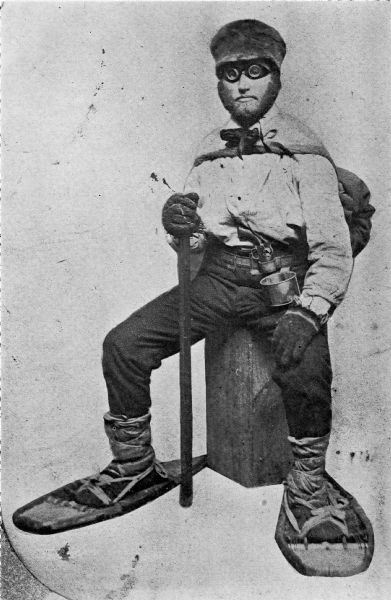
Photograph of Asaph Whittlesey from the Wisconsin Historical Society.
Our first arrival at La Pointe being so intimately associated with the settlement of Ashland, I have determined to make our arrival there the subject of my first letter.
It was among the first days of June, 1854, that George Kilburn, Jr., myself and wife and only child, Eugenia, (then some eighteen months old,) made a landing at La Pointe with a view to remain permanently in the country. Well do I remember the beautiful “town,” spread before us as we merged from the “old log warehouse” through which we passed in reaching the shore, while the general appearance was that of neatness and comfort.
Photograph of Julius Austrian from the Madeline Island Museum.
We had already made the acquaintance of Mr. and Mrs. Julius Austrian, having had the pleasure of their company up the Lakes, and had made many inquiries of them as to the place of our destination. From this time forward we found Mr. and Mrs. Austrian to be most agreeable neighbors and associates, and these young “brides” spent much of their time together, and not unfrequently did the evening air carry to listening crowds our notes of “Good old Colony times,” and “There’s no place like home,” still fresh in our memory.
La Pointe at this time was the second in importance of towns upon the Lakes, Ontonagon taking the lead.
Within a few days after our landing, we were fully organized as “house keepers,” under the same roof with Mr. and Mrs. George Starks, now residents of Bayfield; who proved to be most excellent neighbors, and never did a single roof cover a more harmonious trio of families.
We had, however, a common “foe” to encounter, visions of which filled our dreams and harassed our waking moments. This “foe” was the everlasting “bed bug,” more numerous and more determined in their onslaught than is the “Russian Army;” while this mixture of Dutch and Yankee blood served to satisfy their ravenous appetites. We had heard of this race before, but this was the first time we had met in open combat, face to face. It was our custom regularly before retiring to rest to go into combat with them armed with “wooden spads,” with which we slaughtered them by the quart. Our plan was to remain awake an hour or so after retiring to bed, when we would strike a light which was a signal for a field fight. It was an exciting scene to witness their ranks surrounding us on every hand, while the sheets of our bed seemed dyed in human blood. One means of our defense was to have the bed posts stand in molasses; but this only put them to the trouble of marching to the ceiling above from which they dropped upon us like hail; of course all these contingencies helped to make my wife good natured, and strengthen her attachments to the country. This condition of things lasted while we remained occupants of the building, and when we, in our weakness from loss of blood, staggered forth to make us a home elsewhere, we were filled with anxiety as to the safety of our German neighbors.
“Dr. Borup, the agent for the American Fur Company, (who have an extensive trading-post at this place,) has a superb garden. In walking through it with him, I saw very fine crops of the usual garden vegetables growing in it. His red currant bushes were literally bent down beneath their weight of ripe fruit. His cherry-trees had also borne well. Gooseberries also succeed well. The doctor also had some young apple-trees, that were in a thriving condition. Poultry, likewise, does well. Mrs. B. had her yard well stocked with turkeys, geese, ducks, and chickens.”
~ “Morgan“ at La Pointe during 1845.
As I have before stated, the general appearance of the island was most attractive. The garden of Mr. Austrian was laid out most tastily. We found there a large variety of fruit trees, apples, plums, cherries, etc. Also large quantities of currants and strawberries; but the crowning attraction was the “grape bower,” affording a most attractive lounging place. Here also a merry party, consisting, so far as my recollection serves me, of the following persons: Mr. and Mrs. Julius Austrian, Rev. John Chebohm, (who, I remember, asked the blessing at the table,) Marks Austrian, Mr. H. Mandelbaum, Henry Smit, Mr. and Mrs. Hocksteiner, Mr. and Mrs. George Starks, old Mr. and Mrs. Perinier, Mr. and Mrs. Asaph Whittlesey, and I think Mrs. William Herbert, and a Mr. Roy, celebrated the
“FORTH OF JULY,” 1854.
Being a curious mixture of Americans, Jews, Germans, French and Austrians, no two of whom could carry on a very extensive conversation, for want of a knowledge of the languages, so that our toasts were mainly received in silence, nevertheless the day was passed most pleasantly, while the reading of the Declaration of Independence by Asaph Whittlesey, marked it as a day for national celebration.
To be continued in Number II…
1855 Yom Kippur at La Pointe
December 18, 2016
By Amorin Mello
Photograph of Julius Austrian from the Madeline Island Museum
One of the more colorful figures from primary sources of Chequamegon History is Julius Austrian at La Pointe. Austrian is also one of the more elusive, as he is often overlooked and omitted from secondary sources.
My research of Austrian is what originally inspired me to begin contributing to Chequamegon History. I have been working behind the scenes on a series of stories about Austrian featuring extensive collections of primary documents to shed more light on his life at La Pointe during the 1850’s, and look forward to publishing them at a later date.
One story in particular is about Austrian’s, and his family’s, involvement with the 1855 La Pointe annuity payment, one of the most colorful events in Chequamegon History. A brief introduction to the 1855 La Pointe annuity payment is needed for context, so I refer to a quote from Leo in an earlier post of his: A real bona fide, unmitigated Irishman:
“Regular readers will know that the 1855 La Pointe annuity payment to the Lake Superior Chippewa bands is a frequent subject on Chequamegon History. […] The 1855 payment produced dozens of interesting stories and anecdotes: some funny, some tragic, some heroic, some bizarre, and many complicated. We’ve covered everything from Chief Buffalo’s death, to Hanging Cloud the female warrior, to Chief Blackbird’s great speech, to the random arrival of several politicians, celebrities, and dignitaries on Madeline Island.”
At this moment in Chequamegon History, Austrian was a powerful resident at La Pointe in terms of private land ownership and political savvy. Austrian was a signatory of the 1847 Treaty at Fond du Lac, but not a signatory of the 1854 Treaty at La Pointe. However, primary sources reveal that Austrian was the owner of La Pointe during the 1854 Treaty, and received financial reimbursement from the Department of Interior for services related it. A letter from Reverend Leonard Wheeler at Odanah dated January 18, 1856, asserts that the 1855 annuity payment at La Pointe was hosted by Austrian:
“The following is the substance of my notes taken at the Indian council at La Pointe a copy of which you requested. Council held in front of Mr. Austrian’s store house Aug 30. 1855.”
I have come across secondary sources that allude to Austrian’s role as the host of the 1855 Yom Kippur at La Pointe immediately after the annuity payments, but have not yet been able to locate any primary sources. This post cites secondary sources in hopes that another researcher may review them and help me find primary sources. Having a background in Jewish studies would be helpful, as it is possible primary sources about the 1855 Yom Kippur at La Pointe were written in the Hebrew language rather than in English. Please contact Chequamegon History if you can help find and translate primary sources.
Without further ado, here are secondary sources about the 1855 Yom Kippur at La Pointe listed chronologically by their publication dates.
The Beth El Story: With a History of the Jews in Michigan before 1850
by Irving I. Katz
Wayne University Press (1955)
ISBN-10: 0-7837-3584-7
ISBN-13: 978-0-7837-3584-9
Pages 53-54:
“Lewis F. Leopold, whose name was Freudenthaler in his native Baden, Germany, his wife, Babette, who was a member of the Oesterreicher (Austrian) family, their infant son, Lewis’ sister, Hannah, and Lewis’ brother, Samuel, were located on the Island of Mackinac in 1845. The brothers became the first pioneers in this locality in the fishery business and were soon shipping a thousand barrels of salted fish to Cleveland each season. This business, together with the sale of supplies to fishermen, Indian trading and the purchase of furs, laid the foundation for an extensive business and they became prominent as owners of Lake Michigan vessels and merchants in the ports of the Great Lakes.
“Samuel Leopold left Mackinac in 1853 to join his two other brothers and Julius Austrian, who had married Hannah Leopold in 1849, in their recently undertaken business enterprises at La Pointe and Fond du Lac, Wisconsin, where they were among the first white settlers. Lewis Leopold officiated as cantor at the first High Holy Day services held at La Pointe in the fall of 1855. Within a few years after 1850, the Leopolds and Austrians established leading stores in Michigan, at Eagle River, Eagle Harbor, the Cliff Mine, Calumet, and at Hancock, Joseph Austrian having selected the latter place as the site for his first store and warehouse.”
Mount Zion, 1856-1956: The First Hundred Years
by W. Gunther Plaut
North Central Publishing Company (1956)
ASIN: B0007DEZ4W
Page 24:
Minnesota Pioneer article about Julius Austrian and his Chippewa mixed-blood employee Vincent Roy, Jr. in Saint Paul as republished in The Daily Crescent (New Orleans, LA), February 24th, 1851. Roy also worked for Austrian and Leopold at La Pointe, Fond du Lac, and Vermillion Lake.
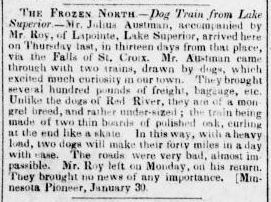
“Julius Austrian was perhaps one of the most colorful figures not merely in the history of the Congregation but in the larger Minnesota community as well. His wife, the former Hannah Leopold (in Germany, the name had been Freudenthaler), at once became an undisputed leader among the Jewish women. The couple had married in 1849 and were among the first white settlers at La Pointe and at Fond du Lac, Wisconsin. Others of the family joined them later. High Holy day services are recorded at Fond du Lac as early as 1855. Austrian laid claim to mineral rights and lands in what later became part of Duluth. 1851 he once made the trek south to St. Paul in the dead of the winter – and arrived in St. Paul with two dog trains and several hundred pounds of freight. The Minnesota Pioneer duly reported that this ‘excited much curiosity in our town.’ The Austrians and Leopolds, who may be reckoned as among the earliest pioneers of the region, later had stores in a number of Michigan towns; and when Julius and Hannah moved to St. Paul, their reputation had preceded them. But unlike his wife, Julius Austrian preferred the quiet, behind-the-scenes type of leadership. When funds were low, he would make up the deficit; and at least on one occasion, so the minute book records, he guaranteed the Rabbi’s salary. He wrote a fine hand, both in English and in Hebrew, as is attested by the cemetery records which he kept for many years.”
The Jews in Minnesota: The First Seventy-Five Years
by W. Gunther Plaut
American Jewish Historical Society (1959)
ISBN:
Pages 12-14:
“When Abram Elfelt became Vice-President of the new Minnesota Lodge No. 157, B’nai B’rith, his fellow officer and treasurer was a man by the name of Julius Austrian. The two had known each other for many years, for while Austrian did not come to St. Paul until after the Civil War he, too, had been in the Territory when it was still part of Wisconsin.

Julius Austrian (Oestreicher) immigrated with his sister Babette Austrian (Babet Oestreicher) (wife of Louis F. Leopold) and their brother-in-law Henry F. Leopold (Heinr Freudenthal).
~ “New York Passenger Lists, 1820-1891,” image 19 of 895; NARA microfilm publication M237 (Washington D.C.: National Archives and Records Administration, n.d.).
“Austrian was one of five brothers. In the old country, their name had been Oesterreicher or Oestreicher. Julius must have had an adequate Jewish education, for he could write Hebrew with a sure hand and had deep and definite religious convictions. In the late forties he, his brother Marx, and Lewis Leopold had gone up to LaPointe, Wisconsin, on Lake Superior, where they were among the first white settlers. As early as 1855, they held Holy Day services in this outpost of civilization.
“In 1849, Julius had married his partner’s sister, Hannah Leopold, a girl who was then not quite nineteen years old. Their business prospered; stores were established on the northernmost part of Michigan’s Upper Peninsula: in Eagle River, Eagle harbor, Cliff Mine, Calumet and Hancock, where their store and warehouse were located.
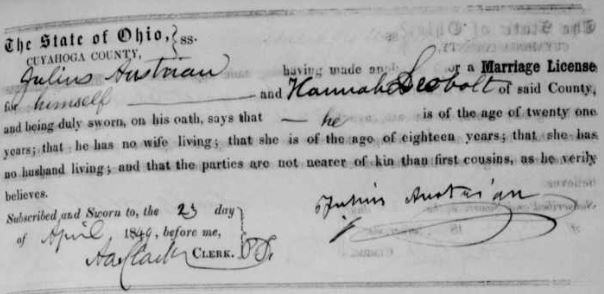
Marriage license application for Julius Austrian and Hannah Leopold.
~ “Ohio, County Marriages, 1789-2013,” image 47 of 229.
“The Austrians and Leopolds traded throughout the area and soon extended their contacts into Minnesota. Even during the summer, it was quite a journey to St. Paul, but only the hardiest person would gather enough courage to make it during the winter. No wonder, therefore, when Julius Austrian dared it in January, 1851, the press recorded that his arrival ‘excited much curiosity in our town.’ He came with another person from Lake Superior via the Falls of St. Croix. Their mode of transportation was the northern dog-train. In their two sleds they brought several hundred pounds of freight for trading.
“Austrian soon became a land owner in Minnesota. He acquired mineral rights at Lake Superior on a site where later the city of Duluth was built. In the late sixties, he and his brother Marx moved to St. Paul where Julius and Hannah at once became two of the leading Jewish citizens. For they soon proved their strong Jewish loyalties and unusual leadership qualities.
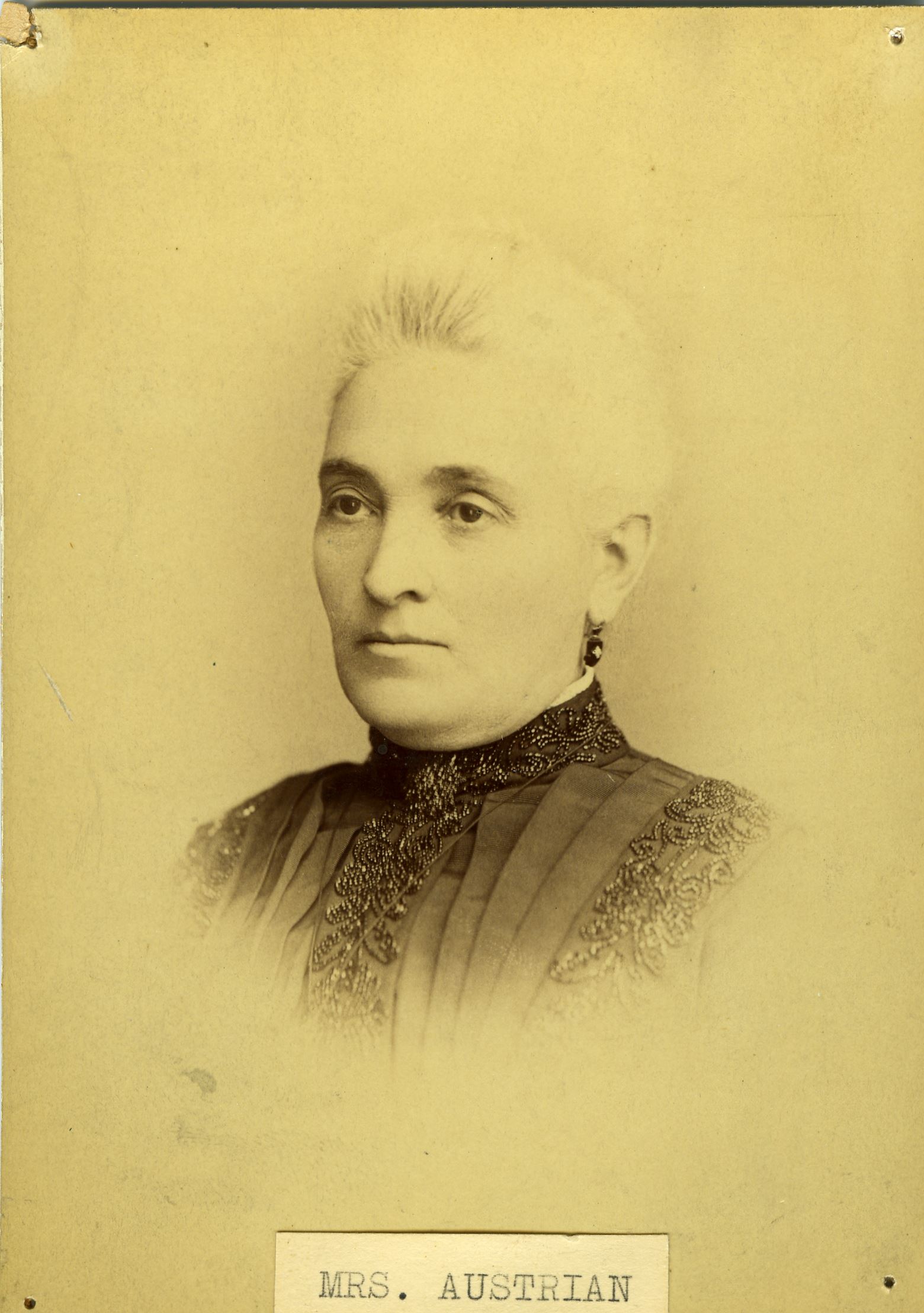
Photograph of Hannah Leopold Austrian from the Madeline Island Museum.
“When they came to St. Paul, the Civil War was over, and whatever little Jewish institutional life there had been in Minnesota was left in very poor circumstances. The two Austrians were soon engaged in building up the congregation. They helped to find the means for erecting the young state’s first synagogue. Hannah founded its first women’s group and headed it in its work for the Temple and in its increasingly ambitious welfare and social enterprises until after the turn of the century. Under her presidency Mount Zion’s women founded the St. Paul Neighborhood House. In 1897, she was feted lavishly on her twenty-fifth anniversary as president of the Temple auxiliary. She was a stocky woman, coupled with a wonderful sense of humor. She died in ripe old age in Chicago, where she had gone to live with her daughter, who had married Amiel Hart. Hannah’s passing was noted with great sorrow in her old community to which she had given so much.
“The Austrians were moderate in their outlook; they were Reformers, but of the evolutionary kind. Julius was, until his death in 1891, a mainstay of Mount Zion Hebrew Congregation. More retiring than his wife, he preferred a trusteeship or vice-presidency to the chair itself. He was responsible for bringing Leopold Wintner was the first ordained Rabbi to Minnesota; for when his fellow members were fearful of committing themselves to a contract he personally agreed to underwrite it. His special concern was the cemetery of Mount Zion, the first Jewish burial ground in the state. He kept its records in English and Hebrew, and some of the social background of the earlier days can be read in his private obituary notes.
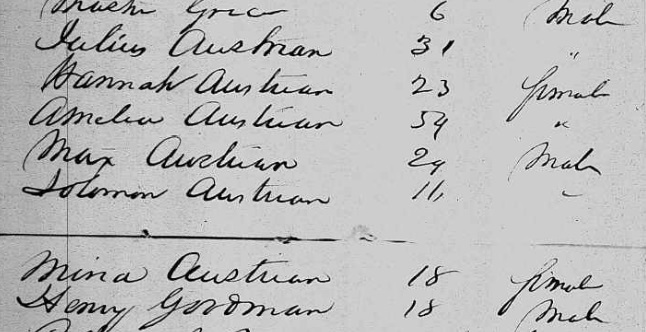
Marx Austrian immigrated to the United States during 1853 with his mother, several of his siblings, and cousin Henry Guttman (Goodman).
~ “New York Passenger Lists, 1820-1891,” image 499 of 671; NARA microfilm publication M237 (Washington D.C.: National Archives and Records Administration, n.d.).
“His brother Marx (more often he was known as Max) was blind from early youth on. Still he pioneered with the rest of the family, and the Indians at Lake Superior loved the handicapped white man. In St. Paul, whither he removed with Julius and Hannah in 1869, he was known as a man of dignity and piety. For many years he blew the shofar at Mt. Zion’s Holy Day services. He outlived Julius by twelve years.”
United States Jewry 1776-1985.
Vol. 2: the Germanic Period, Part 1
by Jacob Rader Marcus
Wayne State University Press (1991)
ISBN-10: 0-8143-2187-9
ISBN-13: 978-0-8143-2187-4
Page 196:
“By the 1850’s America was studded with Jewish societies, one even on the High Plains. How rapid was the organizing process? In general a whole generation elapsed, possibly two, after the coming of the pioneers before the first communal society came into being. In some states, as in Florida and Connecticut, it would take decades before the Jews would established a congregation. There are some striking exceptions. In 1855 a number of Jewish Indian traders met on an island in Lake Superior in the frontier village of La Pointe, Wisconsin. The Indians were assembled there to collect their annuities and the Jews were present to dun their debtors before they dispersed. There were enough Jews for a minyan and a service was held. That was the beginning and the end of La Pointe Jewry. Another historical accident is the “instant” community. The Jews of Savannah arrived from London in 1733 already organized as a congregation; San Francisco Jewry of the Gold Rush was able to establish two religious groups without delay and Oklahoma City and Guthrie were born overnight during the 1889 ‘run.’ All this is completely atypical.”
Jewish Pioneers of Saint Paul: 1849-1874
by Gene H. Rosenblum
Arcadia Publishing (2001)
ISBN-10: 0-7385-1862-X
ISBN-13: 978-0738518626
Page 75:
“Julius Austrian was one of the more influential and colorful Jewish pioneers. In 1849, he and his wife Hannah Leopold Austrian were among the first white settlers in La Pointe and Fon Du Lac, Wisconsin, at a time when the Minnesota Territory was part of the Wisconsin Territory. In 1855, they had participated in the Jewish High Holiday services in La Pointe. He was already a successful businessman when he and his family came to St. Paul in 1869 from Wisconsin. He had a string of successful stores throughout the Upper Michigan Peninsula. He also had already acquired claims in mineral rights around Lake Superior, where the city of Duluth now stands. He was a man of great generosity, and when the fledgling Mt. Zion Synagogue was unable to hire its first rabbi, he guaranteed payment. He also was a moving force in the failed attempt to establish the Painted woods colony in North Dakota.”
Page 79:
~ Mount Zion Temple
~ Mount Zion Temple
“Two significant events took place in 1869 that had a permanent impact on the pattern of communal life within the St. Paul Jewish community. The first event involved the more orthodox of the settlers. Dissatisfied with Mt. Zion, they began to gather together for private prayers in a frame house on Payne Avenue near Seventh Street in the Dayton’s Bluff near East Side area. They were the roots for the first strictly orthodox synagogue in Minnesota and established what later became the Sons of Jacob Synagogue. At this point, Mt. Zion began its slow evolution toward Reform Judaism. The second event involved a husband and wife team who were to have far reaching influence. Julius Austrian and his wife Hannah arrived in St. Paul in 1869 when the Jewish communal institutions were in very poor circumstances.
“Julius Austrian was one of five brothers. In the old country their name was Oestrreicher. In the late 1840s, his older brothers, Marx Austrian and Lewis Leopold, had gone to La Pointe, Wisconsin, on Lake Superior, where they were among the first white settlers. As early as 1855 they held High Holy Day (Yom Kippur) services in La Pointe, Wisconsin. In 1849, Julius married Lewis Leopold’s sister Hannah, who was not quite 19. In 1851, he made a trip south to St. Paul in the dead of winter and arrived with two dog trains and several hundred pounds of freight.”
Among The Otchipwees: II
June 4, 2016
By Amorin Mello
… continued from Among The Otchipwees: I
Magazine of Western History Illustrated
No. 3 January 1885
as republished in
Magazine of Western History: Volume I, pages 177-192.
AMONG THE OTCHIPWEES.
II.
In the fall of 1849, the Bad Water band were in excellent condition, and therefore very happy. Deer were then very abundant on the Menominee. They are nimble animals, able to leap gracefully over obstructions as high as a man’s head standing. But they do not like such efforts, unless there is a necessity for it. The Indians discovered this long ago, and built long brush fences across their trails to the water. When the unsuspecting animal has finished browsing, he goes for a drink with the regularity of an habitué of a saloon. Seeing the obstruction, he walks leisurely along it, expecting to find a low place, or the end of it. The dark eye of the Chippewa is fixed upon him from the top of a tree. This is much the best position, because the deer is not likely to look up, and the wind is less likely to bear his odor to the delicate nostrils of the game. At such close quarters every shot is fatal. Its throat is cut, its legs tied together, and thrown over the head and shoulders of the hunter, its body resting on his back, and he starts for the village. Here the squaws strip off the hide and prepare the carcass for the kettle. With a tin cup full of flour or a pound of pork, we often purchased a saddle of venison, and both parties were satisfied with the trade.
Naagaanab
~ Minnesota Historical Society
~ Executive Documents of the State of Minnesota for the Year 1886, Volume V.: Minnesota Geographical Names Derived from the Chippewa Language, by Reverend Joseph Alexander Gilfillan, 1887, page 457.
“Akwaakwaa” refers to “go a certain distance in the woods.”
~ General Geology: Miscellaneous Papers, Volume 1: A Report of Explorations in the Mineral Regions of Minnesota During the Years 1848, 1859 and 1864 by Colonel Charles Whittlesey, 1866, page 44.
Of course the man of the woods has a preference as to what he shall eat; but when he is suffering from hunger, as he is a large part of his days, he is not very particular. Fresh venison, bear meat, buffalo, moose, caribou, porcupine, wild geese, ducks, rabbits, pigeons, or fish, relish better than gulls, foxes, or skunks. The latter do very well while he is on the verge of starvation, and even owls, crows, dead horses and oxen. The lakes of the interior of Minnesota and Wisconsin produce wild rice spontaneously. When parched it is more palatable than southern rice, and more nutritious. Potatoes grow well everywhere in the north country; varieties of corn ripen as far north as Red Lake. Nothing but a disinclination to labor hinders the Chippewa from always having enough to eat. With the wild rice, sugar, and the fat of animals, well mixed, they make excellent rations, which will sustain life longer than any preparation known to white men. A packer will carry on his back enough to last him forty days. He needs only a tin cup in which to warm water, with which it makes a rich soup. Pemmican is less palatable, and sooner becomes rancid. This is made of smoke or jerked meat pulverized, saturated with fat and pressed into cakes or blocks. Sturgeon are numerous and large, and when well smoked and well pulverized they furnish palatable food even without salt, and keep indefinitely. Voyagers mix it with sugar and water in their cups. In the large lakes, white fish, siskowit, and lake trout are abundant. In the smaller lakes and rivers there are many varieties of fish. With so many resources supplied by nature, if the natives suffer from hunger it is solely caused by indolence. His implicit reliance upon the Great Spirit, which is his good Providence, no doubt encourages improvidence. Nanganob was apparently very desirous to have a garden at Ashkebwaka, for which I sent him a barrel of seed potatoes, corn, pumpkins, and a general assortment of seeds. Precisely what was done with the parcel I do not know, but none of it went into the ground. In most cases everything eatable went into their stomachs as soon as they were hungry. Even after potatoes had been planted, they have been dug out and eaten, and squashes when they were merely out of bloom. If the master of a lodge should be inclined to preserve the seed and a hungry brother came that way, their hospitality required that the garden should be sacrificed. Their motto is that the morrow will take care of itself. After being well fed, they are especially worthless. When corn has been issued to them to carry to their home, they have been known to throw it away and go off as happy as children.

Detail of the Saint Louis River with the Artichoke River (unlabeled) between the Knife Portage and East Savannah River from Hydrographical Basin of the Upper Mississippi River from Astronomical and Barometrical Observations Surveys and Information by Joseph Nicolas Nicollet, 1843.
~ David Rumsey Map Collection
No footgear is more comfortable, especially in winter, than the moccasin. The Indian knows nothing of cold feet, though he has no shoes or even socks. His light loose moccasin is large enough to allow a wrap of one or more thickness of pieces of blankets, called “nepes.” In times of extreme cold, wisps of hay are put in around the “nepes.” In winter the snow is dry, and the rivers and swamps everywhere covered with ice, which is a thorough protection against wet feet. As they are never pinched by the devices of shoemakers, the blood circulates freely. The well tanned deer skin is soft and a good nonconductor, which cannot be said of the footgear of civilization. In summer the moccasin is light and easy to the foot, but is no protection against water. At night it is not dried at the camp-fire only wrung out to be put on wet in the morning. Like the bow and the arrow, these have nearly disappeared since Europeans have furnished bullets, powder and guns. Before that time the war club was a very important weapon. It was of wood, having a strong handle, with a ball or knot at the end. If the Chippewas used battleaxes of stone, they could not have been common. I have rarely seen a light war club with an iron spike well fastened in the knot or ball at the end. In ancient days, when their arrows and daggers were tipped with flint, their battles were like those of all rude people – personal encounters of the most desperate character. The sick are possessed of evil spirits which are driven out by incantations loud and prolonged enough to kill a well person. Their acquaintance with medical herbs is very complete.
One of the customs of the country is that of concubinage as well as polygamy, resembling in this respect the ancient Hebrews and other Eastern nations. The parents of a girl – on proper application and the payment of a blanket, some tobacco and other et ceteras, amounting to “ten pieces” – bestowing their daughter for such a period as her new master may choose. A further consideration is understood that she is to be clothed and fed, and when the parents visit the traders’ post they expect some pork and flour. To a maiden – who, as an Indian wife or in her father’s house is not only a drudge but a slave, compelled to row the canoe, to cut and bring wood, put up the lodge and take it down, and always to carry some burden – this situation is a very agreeable one. If she wishes to marry afterwards, her reputation does not suffer. While Mr. B. was conversing with the Hudson’s Bay man on the bank, some of the girls came coquettishly down to them frisking about in their rabbit skin blankets well saturated with grease. One of them managed to keep in view what she considered a special attraction – a fine pewter ring on her finger. These Chippewas damsels had in some way acquired the art of insinuation belonging to the sex without the aid of a boarding school.
The Indian agent at La Pointe killed a deer of about medium size, which he left in the woods. He engaged an Indian to bring it in. Night came and the next day before the man returned without the deer. “Where is my deer?” “Eat him, don’t suppose me to eat nothing.” Probably that meal lasted him a week. There is among them no regular time for meals or other occupations. If there are provisions in the lodge, each one helps himself; and if a visitor comes, he is offered what he can eat as long as it lasts. This is their view of hospitality. The lazy and worthless are never refused. To do this to the meanest professional dead beat would be the ruin of the character of the host.
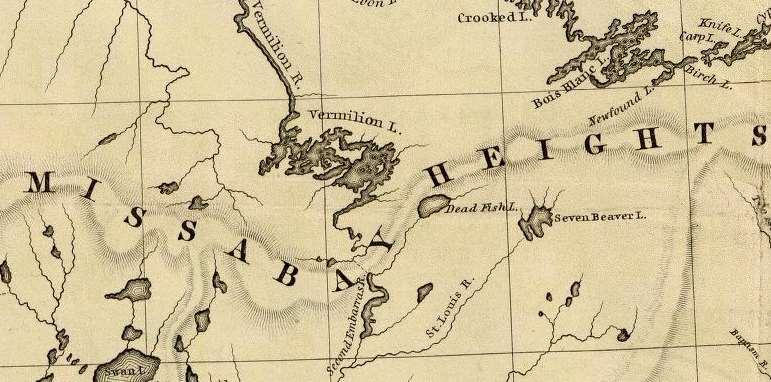
Detail of portage between Lake Vermillion and the Saint Louis River headwaters from Hydrographical Basin of the Upper Mississippi River from Astronomical and Barometrical Observations Surveys and Information by Joseph Nicolas Nicollet, 1843.
~ David Rumsey Map Collection
“Vincent Roy Sr. was born at Leech Lake Minn. in the year 1779 1797, and died at Superior, Wis. Feb. 18th 1872. He was a son of a Canadian Frenchman by the same name as his son bears. When V. Roy, Sr was about 17 or 18 years old, they emigrated to Fort Frances, Dominion of Canada, where he was engaged by the North-West Fur Co. as a trader until the two Companies (the North-West and the Hudson Bay Co joined together) he still worked for the consolidated Company for 12 or 15 years. When the American Traders came out at the Vermillion Lake country in Minnesota Three or four years afterwards he joined the American Traders. For several years he went to Mackinaw, buying goods and supplies for the Bois Fortes bands of Chippeways on Rainy and Vermillion Lake Country. About the year 1839 he came out to the Lake Superior Country and located his family at La Pointe. In winters he went out to Leech Lake Minn., trading for the American Fur Co. For several years until in the year of 1847 when the Hon. H. M. Rice, now of St. Paul, came to this country representing the Pierre Choteau Co. as a fur trading company. V. Roy, Sr. engaged to Pierre Choteau & Co. to trade with his former Indians at Vermillion Lake Country for two years, and then went for the American Fur Company again for one year. After a few years he engaged as a trader again for Peter E. Bradshaw & Co. and went to Red Lake, Minn. for several years. In 1861 he went to Nipigon (on Canadian side) trading for the same company. In a few years, he again went back to his old post at Vermillion Lake, Minn., where he contracted a very severe sickness, in two years afterwards he died at Superior among his Children as stated before &c.”
~ Minnesota Historical Society: Henry M. Rice and Family Papers, 1824-1966; Box 4; Sketches folder; Item “Roy, Vincent, 1797-1872”
Among the Chippewas we hear of man eaters, from the earliest travelers down to this day. Mr. Bushnell, formerly Indian agent at La Pointe, described one whom he saw who belonged on the St. Louis River and Vermillion Lake. The Indians have a superstitious dread of them, and will flee when one enters the lodge. They are hated, but it is supposed they cannot be killed, and no one ventures to make the experiment. it is only by a bullet such as the man eater himself shall designate that his body can be pierced. He is frequently a lunatic, spending days and nights alone in the woods in mid winter without food, traveling long spaces to present himself unexpectedly among distant bands. Whatever he chooses to eat is left for him, and right glad are the inmates of a lodge to get rid of him on such easy terms. The practice is not acquired from choice, but from the terrible necessities of hunger which happen every winter among the northern Indians. Like shipwrecked parties at sea, the weaker first falls a prey to the stronger, and their flesh goes to sustain life a little longer among the remainder. The Chippewas think that after one has tasted human food he has an uncontrollable longing for it, and that it is not safe to leave children alone with them. They say a man eater has red eyes and he looks upon the fat papoose with a demonical glance, and says: “How tender he would be.” One miserable object on the St. Louis River eat off his own lips, and finally became such a source of consternation that one Indian more courageous than the rest buried a tomahawk in his head. Another one who had the reputation of having killed all of his own family, came to the winter fishing ground on Rainy Lake, where Mr. Roy was trading with the Indians. He stayed on the ice trying to take some fish, but without success. Not one of the band dared go out to fish, although they were suffering from hunger. Mr. Roy and all the Indians requested him to go away, but he would not unless he had something to eat. no one but the trader could give him anything, and he was not inclined to do so. Things remained thus during three days, no squaw daring to go on the ice to fish for fear of the man eater. Mr. Roy urged them to kill him, but they said it would be of no use to shoot at him. The man eater dared them to fire. The trader at length lost patience with the cannibal and the terrified Bois Forts. He took his gun and warned the fellow that he would be shot if he remained on the ice. The faith of the savage appears to have been strong in the charm that surrounded his person, for he only replied by a laugh of derision. On the other side Mr. Roy had great faith in his rifle, and discharging it at the body of the man, he fell dead, as might have been expected. The Indians were at once relieved of a dreadful load, and sallied out to fish. No one, however, dared to touch the corpse.
No one of either party can go into the country of the other, and not be discovered. Their moccasins differ and their mode of walking. Their canoes and paddles are not alike, and their camp-fires as well as their lodges differ. The Chippewa lodge or wigwam is made by a circular or oblong row of small poles set in the ground, bending the tops over and fastening them with bark. They carry everywhere rolls of birch bark, which unroll like a carpet. These are wound on the poles next the ground course, and overlapping this a second and third, so as to shed rain. On one side is a low opening covered by a blanket, and at the top a circular place for the smoke to escape. The fire is on the ground at the centre. The work of putting up the lodge is done by the squaws, who gather wood for the fire, spread the mats, and proceed to cook their meals, provided there is anything to cook.

Stereograph of “Chippewa Indians and Wigwams” by Martin’s Art Gallery, circa 1862-1875, shows that they used more than one type of wigwam.
~ Commons.Wikimedia.org
A Sioux lodge is the model of the Sibley tent, with a pole at the centre and others set around in a circle, leaning against the central one at the top, forming a cone. This they cover with skins of the buffalo, deer, elk or moose, wound around like the Chippewa rolls of bark, leaving a space at the top for the smoke to escape, and an entrance at the side. This is stronger and more compact than the Chippewa wigwam, and withstands the fiercest storms of the prairies. In winter, earth is occasionally piled around the base, which makes it firmer and warmer.
We were coming down the Rum River, late in the fall of 1848, when one of our voyageurs discovered the track of a Sioux in the sand. It was at least three weeks old, but nothing could induce him to stay with us, not even an hour. He was not sure but a mortal enemy was then tracking us for the purpose of killing him.
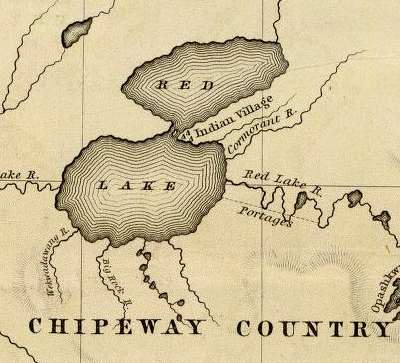
Detail of Red Lake from Hydrographical Basin of the Upper Mississippi River from Astronomical and Barometrical Observations Surveys and Information by Joseph Nicolas Nicollet, 1843.
~ David Rumsey Map Collection
Earlier in the season we were at Red Lake. A cloud of smoke came up from the west, which caused a commotion in the village and mission at the south end of the lake. A war party was then out on a Sioux raid. The chief had lost a son, killed by them. He had managed to get the hand of a Sioux, which he had planted at the head of his son’s grave. But this did not satisfy his revenge nor appease the spirit of his son. He organized a war party to get more scalps, which was then out. A warrior chief or medicine man gains his principal control of the warriors by means of a prophecy, which he must make in detail. If the first of his predictions should fail, the party may desert him entirely. In this case, on a certain day they would meet a bear. When they met the enemy, if they were to be victorious, a cloud of smoke would obscure the sun. It was this darkening of the sky that excited the hopes of the Red Lake band. They were sure there had been a battle and that the Sioux were defeated.
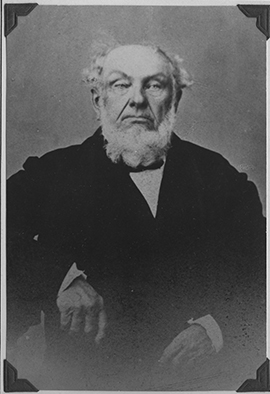
Judge Samuel Ashmun
~ Chippewa County Historical Society
The late Judge Ashmun, of Sault Ste. Marie, while he was a minor, wandered off from his nativity in Vermont to Lake Superior, through it to Fond du Lac, and thence by way of the St. Louis River to Sandy Lake on the Mississippi. Somewhere in that region he was put in charge of one of Astor’s trading posts. In the early winter of 1818 he went on a hunt with a party of seventeen indiscreet young braves, against the advice of the sachems, apparently in a southwesterly direction on the Sioux border, or neutral land. Far from being neutral, it was very bloody ground. At the end of the third day they were about fifty miles from the post. On the morning of each day a rendezvous was fixed upon for the next camp. Each one then commenced the hunt for the day, taking what route pleased himself. The ice on the lakes and marshes was strong and the snow not uncomfortably deep. The principal game was deer, with some pheasants, prairie hens, rabbits and porcupines. What a hunter could not carry he hung upon trees to be carried home upon their return. Their last camp was on the border of a lake in thick woods, with tall dry grass on the margin of the lake. Having killed all the deer they could carry, it was determined to begin the return march the next day. It was not a war party, but they were prepared for their Sioux enemies, of whom no signs had been discerned. There was no whiskey in the camp, but when the stomach of an Indian is filled to its enormous capacity with fresh venison he is always jolly. It was too numerous a party to shelter themselves by a roof of boughs over the fire, but they had made a screen against the wind of branches of pine, hemlock or balsam. Around the fire was a circle of boughs on which they sat, ate and slept. Some were mending their moccasins, other smoking tobacco and kinnikinic, playing practical jokes, telling stories, singing songs and gambling. Mr. Ashmun could get so little sleep that he took Wa-ne-jo, who had a boy of thirteen years, and they made a separate camp. This man going to the lake to drink, was certain that he heard the tramp and felt the vibrations of a party going over the ice, who could be no other than the Sioux. He returned, and after some hesitation Mr. Ashmun reported the news to the main camp. “Oh, Wa-ne-jo is a liar, nobody believes him,” was the universal response. Mr. Ashmun, however, gave credit to the repot. They immediately put out the fire at his bivouac. Even war parties do not place sentinels, because attacks are never made until break of day. In the isolated camp they waited impatiently for the first glimpse of morning. Most of the other party fell asleep with a feeling of security, for which they took no steps to verify. One of them lay down without his moccasins. Mr. Ashmun and his man were just ready to jump for the tall grass when a volley was poured into the other camp, accompanied by the usual savage yell. The darkness and stillness of a faint morning twilight made this burst of war still more terrific. Taking the boy between them, they commenced the race for life under the guidance of Wa-ne-jo, in a direction directly opposite to their home. He well knew the Sioux all night long had been creeping stealthily over the snow and through the thicket, and had formed a line behind the main camp. The Chippewas made a brave defence, giving back their howls of defiance and fighting as they dispersed through the woods. Eight were killed near the camp and a wounded one at some distance, where he had secreted himself. Two fo the wounded were helped away according to custom, and also the barefooted man, whose feet were soon frozen. All clung to their guns, and the frightened boy to his hatchet. They estimated the Sioux party to have been one hundred and thirty, of whom they killed four and wounded seven, but brought in no scalps.

Indians Canoeing in the Rapids painting by Cornelius Krieghoff, 1856.
~ Commons.Wikimedia.org
In his way, the Chippewa is quite religious. He believes in a future world where there is a happy place for good Indians. If he is paddling his canoe against a head wind and can afford it, he throws overboard a piece of tobacco, the most precious thing he has. With this offering there is a short invocation to the good manitou for a fair breeze, when he can raise a blanket for a sail, stop rowing and take a smoke. At the head of many a rapid which it is dangerous to run, are seen pieces of tobacco on the rocks, which were laid there with a brief prayer that they may go safely through. Some of them, which are frightful to white men, they pass habitually. These offerings are never disturbed, for they are sacred. He endeavors also to appease the evil spirit Nonibojan. Fire, rocks, waterfalls, mountains and animals are alive with spirits good and bad. The medicine man, who is prophet, physician, priest and warrior, is an object of reverence and admiration. His prayers are for success in the hunt, accompanied by incantations.

George Bonga
~ Wikipedia.org
Among the stories of a thousand camp-fires, was one by Charlie, a stalwart, half-breed Indian and negro, whose father was an escaped slave. On the shores of Sandy Lake, a party of Chippewas had crossed on the ice in midwinter, and encamped in the woods not far from the north shore. One of them went to the Lake with a kettle of water, and a hatchet to cut the ice. After he filled his kettle, he lay down to drink. The water was not entirely quiet, which attracted his attention at once. His suspicions were aroused, and placing his ear to the ice, he discerned regular pulsations, which his wits, sharpened by close attention to every sight and every sound, interpreted to be the tramp of men. They could be no other than Sioux, and there must be a party larger than their own. Their fire was instantly put out, and they separated to meet at daylight at a place several miles distant. All their conclusions were right. One band of savages outwitted another, having instincts of danger that civilized men would have allowed to pass unnoticed. The Sioux found only the embers of a deserted camp, and saw the tracks of their enemies diverge in so many directions that it was useless to pursue.
In 1839 the Chippewas on the upper Mississippi were required to come to Fort Snelling to receive their payments. That post was in Sioux territory, and the order gave offense to both nations. It required the presence of the United States troops to prevent murders even on the reservation. On the way home at Sunrise River, the Chippewas were surprised by a large force of Sioux, and one hundred and thirty-six were killed.
At the mouth of Crow Wing River, on the east bank of the Mississippi, is a ridge of gravel, on which there were shallow pits. The Indians said that, about fifteen years before, a war party of Sioux was above there on the river to attack the Sandy Lake band. A party of Chippewas concealed themselves in these pits, awaiting the descent of their enemies. The affair was so well managed that the surprise was complete. When the uncautious Sioux floated along within close range of their guns, the Chippewa warriors rose and delivered their fire into the canoes. Some got ashore and escaped through the woods to the westward, but a large portion were killed.
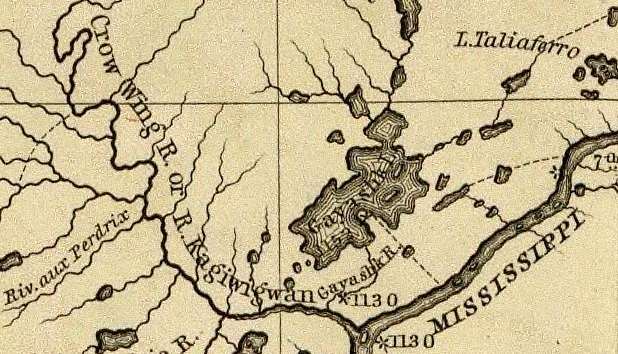
Detail of Crow Wing River from Hydrographical Basin of the Upper Mississippi River from Astronomical and Barometrical Observations Surveys and Information by Joseph Nicolas Nicollet, 1843.
~ David Rumsey Map Collection
While crossing the Elk River, between the falls of St. Anthony and those of St. Cloud, a squaw ran into the water, screaming furiously, followed by a man with a club. This was her lord and master, bent on giving her a taste of discipline very common in Indian life. She succeeded in escaping this time by going into deep water. Her nose had been disfigured by cutting away most of the fleshy portions, as a punishment for unfaithfulness to a husband, who was probably worse than herself.
At the mouth of Crow Wing River was an Indian skipping about with the skin of a skunk tied to one of his ankles. There was also in a camp near the post another Chippewa, who had murdered a brother of the lively man. There is no criminal law among them but that of retaliation. Any member of the family may execute this law at such time and manner as he shall decide. This badge of skunk’s skin was a notice to the murderer that the avenger was about, and that his mission was not fulfilled. Once the guilty man had been shot through the thigh, as a foretaste of what was to follow. The avenger seemed to enjoy badgering his enemy, whom he informed that although he might be occasionally wounded, it was not the intention at present to kill him outright. If the victim should kill his persecutor, he well knew that some other relative would have executed full retaliation.
~ The Assassination of Hole In The Day [the Younger] by Anton Treuer, 2010.
Hole In The Day the Younger
aka Kue-wee-sas (Gwiiwizens [Boy or Lad])
(1825-1868)
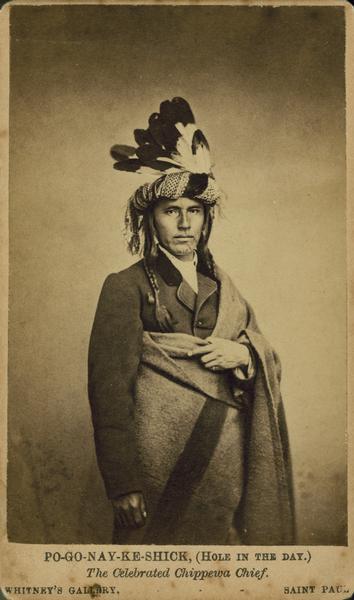
Bagone-giizhig the Younger
~ Wisconsin Historical Society
This Chippewa brave, Bug-on-a-ke-dit, lived on a knoll overlooking the Mississippi River, four miles above Little Rock, where he had a garden. He appeared at the payment at La Pointe, in 1848, with a breech cloth and scanty leggings. This was partially for showing off a very perfect figure, tall, round and lithe, the Apollo of the woods. His scanty dress enabled him to exhibit his trophies in war. The dried ears of his foes, a part of whom were women, were suspended at his neck. Around his tawny arms were bright brass bands, but there was nothing of which he was more proud than a bullet hole just below the right breast. The place of the wound was painted black, and around it circles of red, yellow and purple; other marks on the chest, arms and face told of the numbers he had slain and scalped, in characters well understood by all Chippewas. The numbers of eagle feathers in his hair informed the savage crowd how many battles he had fought. He was not, like Grizzly Bear, a great orator, but resembled him in getting drunk at every opportunity. He managed to procure a barrel of whiskey, which he carried to his lodge. While it was being unloaded it fell upon and crushed him to death. Looking up a grass clad hill, a dingy flag was seen (1848) fluttering on a pole where he was buried. He often repeated with great zest the mode by which the owners of two of the desecrated ears were killed. His party of four braves discovered some Sioux lodges on the St. Peters, from which all the men were absent. The squaws lodged their hereditary enemies over night with their accustomed hospitality. Bug-on-a-ke-dit and his party concealed themselves during the day, and at dark each one attacked a lodge. Seven women and children were slaughtered. His son Kue-wee-sas, or Po-go-noy-ke-schik, was a much more respectable and influential chief.
An hundred years since, the Sioux had an extensive burial ground, on the outlet of Sandy Lake, a few miles east of the Mississippi River. Their dead were encased in bark coffins and placed on scaffolds supported by four cedar posts, five or six feet high. This was done to prevent wolves from destroying the bodies. Thirty years since some of these coffins were standing in a perfect condition, but most of them were broken or wholly fallen, only the posts standing well whitened by age. The Chippewas wrap the corpse in a blanket and a roll of birch bark, and dig a shallow grave in which the dead are laid. A warrior is entitled to have his bow and arrow, sometimes a gun and and a kettle, laid beside him with his trinkets. Over the mound a roof of cedar bark is firmly set up, and the whole fenced with logs or protected in some way against wolves and other wild animals. There is a hole at one or both ends of the bark shelter, in which is friends place various kinds of food. Their belief in a spirit world hereafter is universal. If it is a hunter or warrior, he will need his arms to kill game or to slay his enemies. Their theory is that the dog may go to the spiritual country, as a spirit, also his weapons, and the food which is provided for the journey. To him every thing has its spiritual as well as its material existence. Over all is the great spirit or kitchi-manitou, looking after the happiness of his children here and hereafter.

Stephen Bonga
~ Wisconsin Historical Society
Winter travelling in those northern regions is by no means so uncomfortable as white men imagine. By means of snow shoes the Indian can move in a straight course towards his village, without regard to the trail. In the short days of winter he starts at day break and travels util dark. Stephen said he made fifty miles a day in that way, which is more than he could have done in summer.
At night they endeavor to find a thicket where there is a screen against the wind and plenty of wood. They scoop away the snow with their shoes and start a fire at the bottom of the pit. Around this they spread branches of pine, balsam or cedar, and over head make a shelter of brush to keep off the falling snow. Probably they have a team or more of dogs harnessed to sledges, who take their places around the fire. Here they cook and eat an enormous meal, when they wrap themselves in blankets for a profound sleep. Long before day another heavy meal is eaten. Everything is put in its proper package ready to start as soon as there is light enough to keep their course.
– Freelang Ojibwe-English by Weshki-ayaad, Charles Lippert and Guy T. Gambill
– Ojibwe People’s Dictionary by the Department of American Indian Studies at the University of Minnesota
Many Indian words have originated since the white people came among them. A large proportion of their proper names are very apt expressions of something connected with the person, lake, river, or mountain to which they are applied. This people, in their primitive state, knew nothing of alcohol, coffee, tea, fire-arms, money, iron, and hundreds of other things to which they gave names, generally very appropriate ones. A negro is black meat; coffee is black medicine drink; tea, red medicine drink; iron, black metal; gold, yellow metal. I was taking the altitude of the sun at noon near Red Lake Mission with a crowd of Chippewas standing around greatly interested. They had not seen the liquid metal mercury, used for an artificial horizon in such observations, which excited their especial astonishment, and they had no name for it. One of them said something which caused a general expression of delight, for which I enquired the reason. He had coined a word for mercury on the spot, which means silver water.
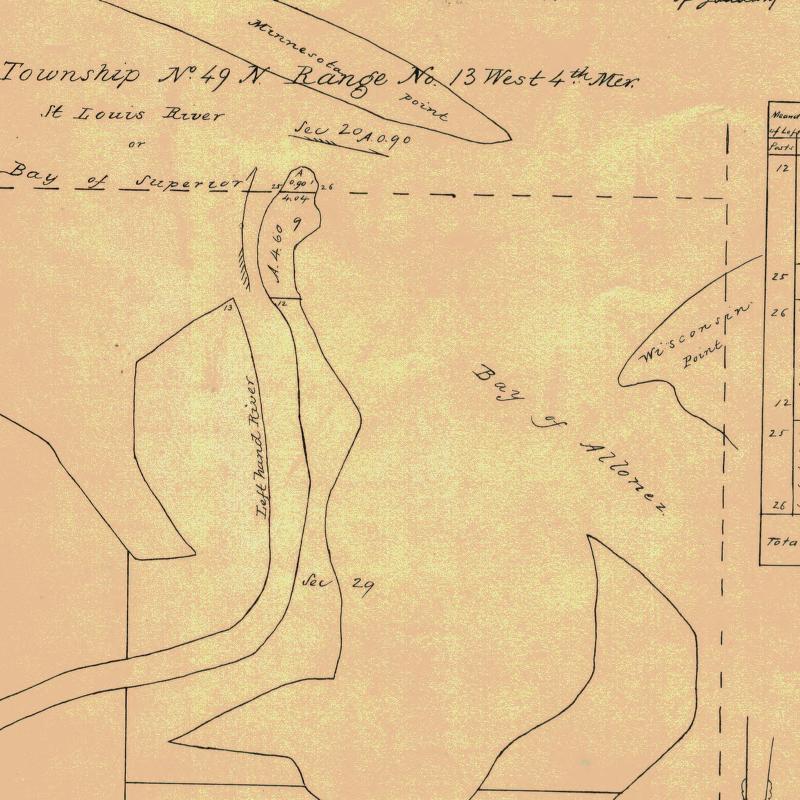
Detail of Minnesota Point during George Stuntz’s survey contract during August-October of 1852.
~ Barber Papers (prologue): Stuntz Surveys Superior City 1852-1854

This family’s sugar bush was located at or near Silver Creek (T53N-R10W).
~ General Land Office Records
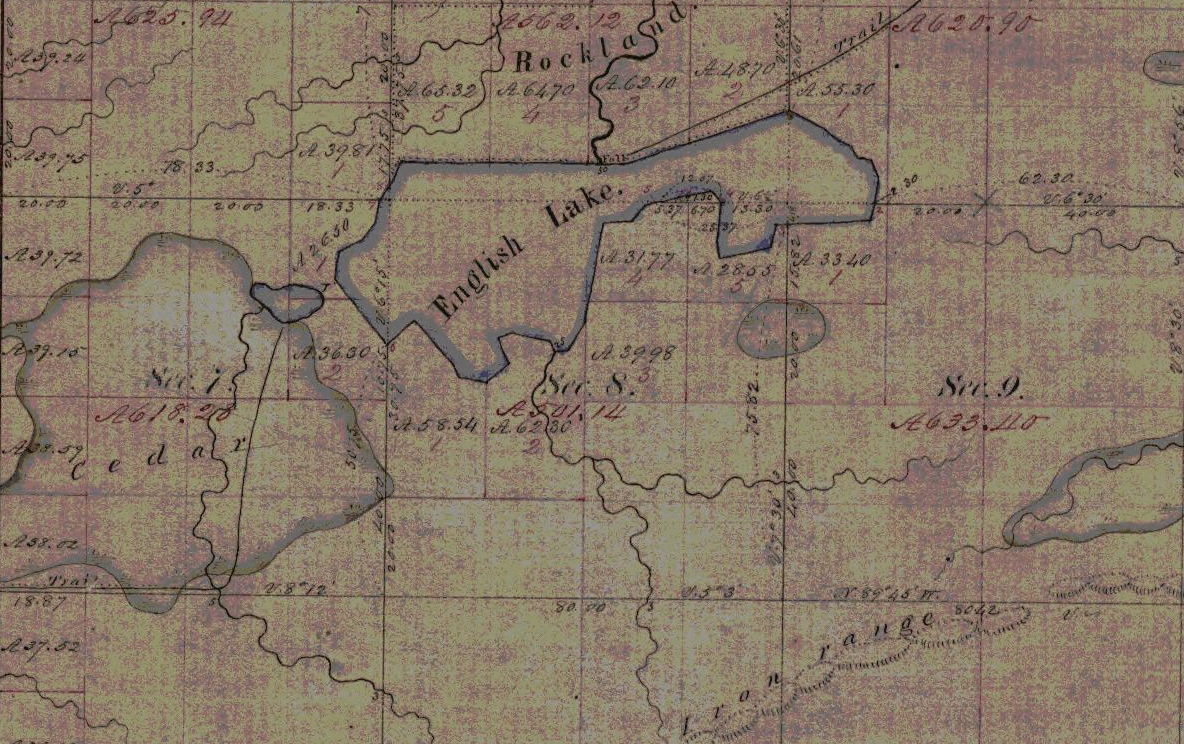
Indian trail to Rockland townsite overlooking English/Mineral Lake and Gogebic Iron Range.
~ Penokee Survey Incidents: Number V
Coasting along the beach northward from the mouth of the St. Louis River, on Minnesota Point, I saw a remarkable mark in the sand and went ashore to examine it. The heel and after part was clearly human. At the toes there was a cleft like the letter V and on each side some had one, others two human toes. Not far distant were Indians picking berries under the pine trees, which then covered the point in its entire length. We asked the berrypickers what made those tracks. They smiled and offered to sell us berries, of which they had several bushels, some in mokoks of birch bark, others in their greasy blankets. An old man had taken off his shirt, tied the neck and arms, and filled it half full of huckleberries. By purchasing some, (not from the shirt or blanket) we obtained an explanation of the nondescript tracks. There was a large family, all girls, whose feet were deformed in that manner. It was as though their feet had been split open when young halfway to the instep, and some of the toes lost. They had that spring met with a great loss by the remorseless bear. On the north shore, thirty miles east of Duluth, they had a fine sugar orchard, and had made an unusual quantity of sugar. A part was brought away, and a part was stored high up in trees in mokoks. There is nothing more tempting than sugar and whiskey to a bear. When this hard working family returned for their sugar and dried apples, moistened with whiskey, to lure bruin on to his ruin. A trap fixed with a heavy log is set up across a pen of logs, in the back end of which this bait is left, very firmly tied between two pieces of wood. This is fastened to a wooden deadfall, supporting one end of a long piece of round timber that has another piece under it. The bear smells the bait from afar, goes recklessly into the pen, and commences to gnaw the pieces of wood; before he gets much of the bait the upper log falls across his back, crushing him upon the lower one, where, if he is not killed, his hind legs are paralyzed. These deadly pens are found everywhere in the western forests. Two bears ranging along the south shore of English Lake, in Ashland County, Wisconsin, discovered some kegs of whiskey which contraband dealers had concealed there. With blows from their heavy paws they broke in the heads of the kegs and licked up the contents. They were soon in a very maudlin state, rolling about on the ground, embracing each other in an affectionate manner and vainly trying to go up the trees. Before the debauch was ended they were easily captured by a party of half-breeds. There are Indians who acknowledge the bear to be a relation, and profess a dislike to kill them. When they do they apologize, and say they do it because they are “buckoda,” or because it is necessary.

Detail of the Porcupine Mountains between the Montreal River and Ontonagon River from Map of the Mineral Lands Upon Lake Superior Ceded to the United States by the Treaty of 1842 With the Chippeway Indians.
~ Wisconsin Historical Society
At Ontonagon, a very sorry looking young Indian came out of a lodge on the west side of the river and expressed a desire to take passage in our boat. There had been a great drunk in that lodge the day before. The squaws were making soup of the heads of white fish thrown away by the white fishermen. Some of the men were up, others oblivious to everything. Our passenger did not become thoroughly sober until towards evening. We passed the Lone Rock and encamped abreast of the Porcupine Mountains. Here he recovered his appetite. The next day, near the Montreal River, a squaw was seen launching her canoe and steering for us. She accosted the young fellow, demanding a keg of whiskey. He said nothing. She had given him furs enough to purchase a couple of gallons and he had made the purchase, but between himself and his friends it had completely disappeared. The old hag was also fond of whiskey. The fraud and disappointment put her into a rage that was absolutely fiendish. Her haggard face, long, coarse, greasy, black hair, voluble tongue and shrill voice perfected that character.
Turning into the mouth of the river we found a party from Lake Flambeau fishing in the pool at the foot of the Great Fall. Their success had not been good, and of course they were hungry. One of our men spilled some flour on the sand, of which he could save but little. The Flambeaus were delighted, and, gathering up sand and flour together, put the mixture in their kettle. The sand settled at the bottom, and the flour formed an excellent porridge for hungry aboriginees.
~ Wisconsin Historical Society
Mushinnewa and Waubannika, Chippewas, lived at Bad River, near Odana. Mushinnewa had a very bad reputation among his tribe. He was not only quarrelsome when drunk, but was not peaceable when sober. He broke Waubannika’s canoe into fragments, which was resented by the wife of the latter on the spot. She made use of the awl with which she was sewing the bark on another canoe, as a weapon, and stabbed old Mushinnewa in several places so severely that it was thought he would die. He threatened to kill her, and she fled with her husband to Lake Flambeau. But Mushinnewa did not die. He had a son as little liked by the Odana band as himself. In a drunken affray at Ontonagon another Indian killed him. The murderer then took the body in his canoe, brought it to Bad River and delivered it to old Mushinnewa. According to custom the Indian handed the enraged father the knife with which his son was killed, and baring his breast told him to strike. The villagers were happy to be rid of the young villain, and took the knife from the hand of his legal avenger. A barrel of flour covered the body, and before night Mushinnewa adopted the Indian as his son.
Two varieties of willow, the red and the yellow, grow on the low land, at the margin of swamps and streams, which have the name of kinnekinic. During the day’s journey, a few sticks are cut and carried to the camp. The outer bark is scraped away from the inner bark, which curls in a fringe around the stick, which is forced in the ground before a hot fire, and occasionally turned. In the morning it is easily crumpled in the hands, and put into the tobacco pouch. If they are rich enough to mix a little tobacco with the kinnekinic, it is a much greater luxury. As they spend a large part of their leisure time in smoking, they are compelled to be content with common willow bark, which is a very weak narcotic. Tobacco is not grown as far north as the country of the Chippewas, but it is probable they had it through traffic with the tribes of Virginia, North Carolina and the Gulf States, in times very remote. Pipes are found in the works of the mounds builders that are very ancient, showing that they had something to smoke, which must have been a vegetable.
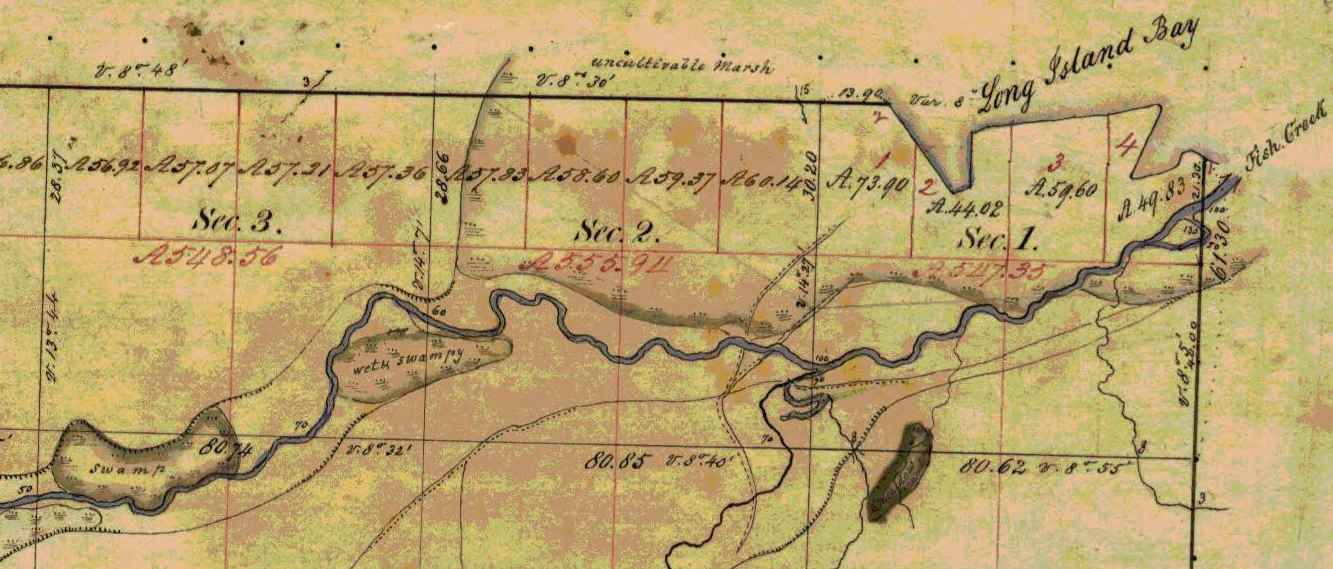
Detail of where the “Lake Long” [Lake Owen] and St. Croix foot paths start along Fish Creek.
~ Barber Papers: “Barbers Camp” Fall of 1855
~ History of the Upper Peninsula of Michigan, by Western Historical Co., 1883, page 276
Staggering around in a drunken crowd at La Pointe was a handsome Chippewa buck, as happy as whiskey can make any one. The tomahawk pipe is not an instrument of war, though it has that form. Its external aspect is that of a real tomahawk, intended to let out the brains of the foe. It is made of cast iron, with a round hollow poll, about the size of a pipe. The helm or handle is the stem, frequently decorated in the height of savage art, with ribbons, porcupine quills, paint and feathers. One thoroughly adorned in this manner has aperatures through the handle cross wise, so large and numerous that it is a mechanical wonder how the smoke can be drawn through it to the mouthpiece. No Indian is without a pipe of some kind, very likely one that is an heirloom from his ancestors. It is only in a passion that his knife or tomahawk pipe becomes dangerous. This genial buck had been struck with the poll of such a pipe when all hands were fighting drunk. It had cut a clear round hole in his head, hear the top, sinking a piece of skull with the skin and hair well into his brains. A surgeon with his instrument could not have made a more perfect incision. Inflammation had not set in and he was too busy with his boon companions to think of the wound. It was about twenty-four hours after it occurred when he stepped into his canoe and departed. When Mr. Beasley went up the Fish River, a few days afterwards a funeral was going on at the intersection of the Lake Long and the St. Croix trails, and the corpse had a cut in the head made by the pole of a tomahawk. From this event, no doubt, a family quarrel commenced that may continue till the race is extinct. The injured spirit of the fallen Indian demands revenge. In the exercise of retaliation it may be carried by his relations a little beyond retaliating justice, which will call on the other side for a victim, and so on to other generations.
In a lodge between the agency and the mission there was a young girl very sick. Probably it is my duty to say that she was not only young but beautiful, but at this time she was only wretched. Whether in her best health and estate the term beauty could be applied I very much doubt, as such cases are extremely rare among Indians, compared by our standard. A “grand medicine” had been got up expressly for the purpose of curing her. The medicine lodge was about thirty feet in length, made of green boughs. The feast, without which no evil spirit would budge one inch, had been swallowed, and the dance was at its height, in which some women were mingled with the men. Their shrieks, yelling and gesticulations should have frightened away all the matchi-manitous at La Pointe. The mother of the girl seemed to be full of joy, the bad spirit which afflicted her child was so near being expelled. As they made the circuit of the dance they thrust a large knife into the air towards the northwest, by which they gave the departing demon a stab as he made his escape from the lodge. This powow raged around the poor girl all the afternoon and till midnight, when the medicine man pronounced her safe. Before sundown the next day we saw them law her in a shallow grave, covered with cedar bark.

Father Nicolas Perrot
~ Wikipedia.org
Father Perret, who was among the Natches as far back as 1730, gives a portrait of a medicine man of that tribe at that time. It answers so well for those I have seen among the Chippewas that I give his description at length. For the Chippewa juggler I must except, however, the practice of abstinence and also the danger of losing his head. A feast is the first thing and the most essential.
“This nation, like all others, has its medicine man. They are generally old men, who, without study or science, undertake to cure all complaints. All their art consists in different jugglings, that is to say, they sing and dance night and day about the sick man, and smoke without ceasing, swallowing the smoke of the tobacco. These jugglers eat scarcely anything while engaged with the sick, but their chants and dances are accompanied by contortions so violent that, although they are entirely naked and should suffer from cold, they are always foaming at the mouth. They have a little basket in which they keep what they call their spirits, that is to say, roots of different kinds, heads of owls, parcels of the hair of deer, teeth of animals, pebbles and other trifles. To restore health to the sick they invoke without ceasing something they have in their basket. Sometimes they cut with a flint the part afflicted, suck out the blood, and in returning it immediately to the disk they spit out a piece of wood, straw or leather, which they have concealed under their tongue. Drawing the attention of the sick man, ‘there,’ they say, ‘is the cause of his sickness.’ These medicine men are always paid in advance. If the sick man recovers their gain is considerable, but if he dies they are sure to have their heads cut off by his relations.”

“Osawgee Beach. Superior, Wis.” postcard, circa 1920:
“Ojibwe chief Joseph Osawgee was born in Michigan in 1802 and came to Wisconsin Point as a young boy. There he established Superior’s first shipyard—a canoe-making outfit along the Nemadji River near Wisconsin Point. His birch bark canoes supplied transportation for both Ojibwe trappers and French Voyageurs. Chief Osawgee signed the 1854 Treaty of La Pointe on behalf of the Fond du Lac Ojibwe—and subsequently lost his land. He died in Solon Springs, Wisconsin, in 1876.”
~ Zenith City Online

Joseph Ozaagii
~ Geni.com
~ Indian Country Today Media Network
“Chief O-sau-gie Built First ‘Ships’ in City of Superior (He Was Head of Small Chippewa Band when Superior was Tiny Spot)”
As a rare example of the industry and probity among northern Indians, I take pleasure in recording the name of Osagi. His hunting ground and sugar camp lay to the west of La Pointe, on Cranberry River, where he had a cabin. In traversing that region I had as a guide a rude map and sketch of the streams made by him on a sheet of post office paper with a red pencil. Osagi was never idle and never drunk. Dr. Livermore was at this time the agent for the tribes at the west end of Lake Superior, and related the following instance of attention and generosity which is worthy of being reported. Osagi frequently made the agency presents, and Dr. Livermore, of course, did the same to his Otchipwee friends. Late in the fall, as the fishing season was about to close, he sent a barrel of delicious trout and white fish to the agency, which, by being hung up separately, would in this cool climate remain good all winter. The interpreter left a message from the donor with the fish, that he did not want any present in return, because in such a case there would be on his part no gifts, and he wished to make a gift. Dr. Livermore assented, but replied that if Osagi should ever be in need the agent expected to be informed of it. During the next winter a message came to Dr. Livermore stating that his friend wanted nothing, but that a young man, his cousin, was just in from Vermillion Lake, where he lived. The young man’s father and family could no longer take fish at Vermillion, and had started for Fonddulac. The old man was soon attacked by rheumatism, and for many days the whole party had been without provisions. Would the agent make his uncle a present of some flour? Of course this was done, and the young messenger started with a horse load of eatables for the solitary lodge of his father, on the St. Louis River, two hundred miles distant. This exemplary Indian, by saving his annuities, and by his economy, had accumulated money enough to buy a piece of land, and placed it in the hands of the agent. when the surveyors had subdivided the township opposite La Pointe, on the mainland, he bought a fraction and removed his family to it as a permanent home. In a few months the small pox swept off every member of that family but the mother.
[CHARLES WHITTLESEY.]
To be continued in Among The Otchipwees: III…
Land Office Frauds
March 25, 2016
By Amorin Mello
New York Times
December 9, 1858
—~~~0~~~—
Land Office Frauds.
—~~~0~~~—
AGRICULTURAL CAPABILITIES HEREABOUT – LOCAL AMUSEMENTS AND EXCITEMENTS – SETTLEMENTS OF SUPERIOR CITY – A CONTROVERSY, AND SECRETARY M’CLELLAND’S ADJUDICATION OF IT – SECRETARY THOMPSON’S REVERSAL OF THAT JUDGEMENT – ITS CONSEQUENCES – LAND-STEALING RAMPANT – INSTRUCTIONS FOR THE ENTRY OF SUPERIOR CITY – THE LAND OFFICE REPEALS THE LAW OF THE LAND – A CASE FOR INVESTIGATION.
Correspondence of the New-York Times.
SUPERIOR CITY, Wis., Thursday, Nov. 25.
I am booked here for another winter, but fortunately with no fear of starvation this time. We have been most successful the last Summer in our Agricultural labors. The clay soils about here has proved marvelously fruitful, and where we expected little or nothing it has turned out huge potatoes that almost dissolve under the steaming process, and open as white as the inside of a cocoa-nut ; mammoth turnips, as good as turnips can be ; cabbages of enormous size ; and cauliflowers, that queen of vegetables, weighing as much as a child a year old. There is no reason to fear for the future of this country, now that we can show such vegetable products, and talk of our gardens as well as of our mines, forests, furs, and fisheries.
We are not without our excitements here, too ; though we have no model artists, or theatrical exhibitions, to treat our friends with. But our little city is now in a state of commotion produced by causes which often agitate frontier life, and sometimes reach the great center with their echo or reverberation. The Land Office is the great point of interest to frontier men, and the land law is the only jurisprudence save Lynch law, in which we are particularly interested. And as we have no means of reaching the great Federal legislature, through our Local Presses, we are always glad of an opportunity to be heard through the Atlantic organs, which are heard all over the country, and strike a note which the wind takes up and carries not only to San Francisco, but up here to the mouth of the St. Louis River, the hereafter great local point of Pacific and Atlantic intercommunication.

The Eye of the Northwest, pg. 8: James Stinson; Benjamin Thompson; W. W. Corcoran; U. S. Senator Robert J Walker; George W Cass; and Horace S Walbridge.
Five or six years ago a few American pioneers – stalwart backwoodsmen, undertook to select a town site out here, and did select one in good faith, and with clubs and muskets in had fought off from their premises a gang of Indians who were claiming to preëmpt it as “American citizens.” The Indians, however, were backup up by a Canadian white man by the name of STINSON, and some of the great speculators who were engaged in another town enterprise alongside here, and this “Indian war” was protracted in the local and general Land Offices some two or three years, when Mr. M’CLELLAND, then Secretary of the Interior, made a final adjudication of all the legal questions involved in the controversy, and sent it back to the Land Office to ascertain and apply the facts to the law as settled, on great deliberation by himself and Mr. CUSHING.
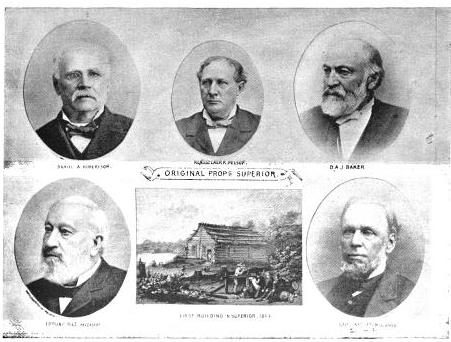
More Proprietors of Superior from The Eye of the North-west
, pg. 9: [names are illegible]
Meanwhile the original settlers and occupants maintained their adverse possession against the Indians and all the world, and expended a good deal of money in erecting buildings and a pier, and in cutting out streets and in laying out their town, and in carrying on their litigation, which was by no means inexpensive. M’CLELLAND’s determination of the law in their favor encouraged them to go on and incur additional expenses ; and they parted with diverse interests in the town site, some by assignment to persons who advanced money, and some by sale on quit-claim to persons who covenanted to make improvements. They made application to the proper office to enter the site, and nobody objected but the Indians – and the Indians were nowhere. So things stood when the case went back to the General Land Office, and to Mr. Secretary THOMPSON. The worthy Secretary, for some cause altogether unaccountable, adopted the extraordinary (and under the decision of the Supreme Court illegal) course of reversing the final judgement of his predecessor in this very case, (an exercise of power entirely unheard of in a case of mere private right,) and of rejecting the claim of the original occupants and settlers, though it was not contested by somebody who had a better right.
You may well imagine that this decision excited no little astonishment here. All the land stealers looked upon Superior City as vacant ground. They thought the men who selected and settled the town site were outlawed, and had no interests. Some supposed that the Land Office would put the ground up at auction. A chap by the name of SWEETZER came on here fresh from the General Land Office, and undertook to lay Sioux scrip on the whole site. Another – one JOHN GRANT – made application to preëmpt a portion of the site – and, what is the most remarkable feature about this business, GRANT was permitted to enter it as a preëmptor, though it was notoriously a selected town site, and in the adverse possession of town claimants half a year before GRANT ever saw it. This outrage created a great excitement for a small place. The Register, Mr. DANIEL SHAW, excuses himself by saying that he was almost expressly ordered by HENDRICKS to issue the certificate to GRANT, but this we do not believe in these parts. SHAW is clever, and covers his tracks, but nobody here supposes that the Commissioner ever countenanced such a gross violation of a public statute, without a motive. And what motive could the Commissioner have?
But, besides these movements, one of the Indians – ROY by name, who was defeated as one of the claimants by preëmeption – is now seeking to locate his Chippewa scrip on the town-site, and it is supposed that the same influences which urged him as an American citizen will support his claim as an Indian. A white man by the name of KINGSBURY, encouraged by the disregard of law exhibited by the local office, has made a claim on another part of the town-site. This purports to have originated in the fourth year of a litigation between the town claimants and the illegal preëmptors, and is supposed to be stimulated and encouraged by the Register.Subsequently to his original rejection of the town-site claim, Mr. Secretary THOMPSON issued instructions to permit the entry, and the County Judge made application on the 18th instant, under the law of the United States, May 23, 1844. On this being known, some of the persons heretofore claiming under the original settlers and occupants (who had selected the town and paid all the expenses of the settlement) came together and formed an organization as a city, under a recent law of Wisconsin, the object of which they declare to be secure to themselves a title from the United States to the lots they specially occupy, and to sell the balance to defray their expenses in entering and alloting the land! The men whose rights vested under the absolute decision of Secretary MCCLELLAND, and who did all that they could do to enter the land, and paid the money for it more than two years ago, – the men whose “respective INTERESTS” the statute of 1844 recognizes and was designed to protect, – these men are all ruled off the course, and the men claiming under them have conspired to divide the land and its proceeds among themselves.
Of course these iniquitous and illegal proceedings are all within the reach of the Courts – but they are the legitimate consequence of Mr. JACOB THOMPSON’s repeal of so much of the Preëmption Law of 1841 as excludes from preëmption those portions of the public lands that have been “selected as the site of a city or town.” Mr. THOMPSON has overruled all his predecessors, all the Attorney-General, all the local offices, all the lexicographers, and the English language generally, by deciding solemnly that “selection” does not mean “selection,” but means something else – or more particularly nothing at all. Because, says he, if adverse “selection” excluded a preëmptor, then a preëmptor might be excluded by a false allegation of selection. Was there ever such an argal since Dogberry’s time? The Secretary has discovered an equally efficient “dispensing power” with that of King JAMES of blessed memory, and one which his brethren in the Cabinet may use very efficiently, if Congress does not look into the subject and fix some limits to it. For now, not only the Secretary, but the Commissioner, and the Register and Receiver, all think that they are at liberty to treat the repeal by the Secretary as an effective nullification of the law of the land.
If Congress would amuse their leisure a little by looking at these land office operations on the verge of civilization, they would strike a placer of corruption. Let them open the books and call for the documents, and see what Dr. T. RUSH SPENSER, late Register of the Willow River District, says of his predecessor and successor, Mr. JOHN O. HENNING, and then ascertain by what influences HENNING has been reappointed, and SPENSER transferred to Superior. Let them find out what Receiver DEAN said of Register SHAW, and what Register SHAW said of Receiver DEAN, and why DEAN was dismissed and why SHAW was retained. It will be rare fun for somebody. The country ought to know something about the Land Offices, and such an investigation as this would enlighten the country very materially. I hope it will be made, and that the country will learn how it is that more land has been entered in this district by Indians, foreigners, and minors than by qualified preëmptors, and all for the benefit of a few favored speculators.
The Removal Order of 1849
March 12, 2016
By Amorin Mello
United States. Works Progress Administration:
Chippewa Indian Historical Project Records 1936-1942
(Northland Micro 5; Micro 532)

12th President Zachary Taylor gave the 1849 Removal Order while he was still in office. During 1852, Chief Buffalo and his delegation met 13th President Millard Fillmore in Washington, D.C., to petition against this Removal Order.
~ 1848 presidential campaign poster from the Library of Congress
Reel 1; Envelop 1; Item 14.
The Removal Order of 1849
By Jerome Arbuckle
After the war of 1812 the westward advance of the people of the United States of was renewed with vigor. These pioneers were imbued with the idea that the possessions of the Indian tribes, with whom they came in contact, were for their convenience and theirs for the taking. Any attempt on the part of the aboriginal owners to defend their ancestral homes were a signal for a declaration of war, or a punitive expedition, which invariably resulted in the defeat of the Indians.
“Peace Treaties,” incorporating terms and stipulations suitable particularly to the white man’s government, were then negotiated, whereby the Indians ceded their lands, and the remnants of the dispossessed tribe moved westward. The tribes to the south of the Great Lakes, along the Ohio Valley, were the greatest sufferers from this system of acquisition.
Another system used with equal, if less sanguinary success, was the “treaty system.” Treaties of this type were actually little more than receipt signed by the Indian, which acknowledged the cessions of huge tracts of land. The language of the treaties, in some instances, is so plainly a scheme for the dispossession and removal of the Indians that it is doubtful if the signers for the Indians understood the true import of the document. Possibly, and according to the statements handed down from the Indians of earlier days to the present, Indians who signed the treaties were duped and were the victims of treachery and collusion.
By the terms of the Treaties of 1837 and 1842, the Indians ceded to the Government all their territory lying east of the Mississippi embracing the St. Croix district and eastward to the Chocolate River. The Indians, however, were ignorant of the fact that they had ceded these lands. According to the terms, as understood by them, they were permitted to remain within these treaty boundaries and continue to enjoy the privileges of hunting, fishing, ricing and the making of maple sugar, provided they did not molest their white neighbors; but they clearly understood that the Government was to have the right to use the timber and minerals on these lands.

Entitled “Chief Buffalo’s Petition to the President“ by the Wisconsin Historical Society, the story behind this now famous symbolic petition is actually unrelated to Chief Buffalo from La Pointe, and was created before the Sandy Lake Tragedy. It is a common error to mis-attribute this to Chief Buffalo’s trip to Washington D.C., which occurred after that Tragedy. See Chequamegon History’s original post for more information.
Detail of Benjamin Armstrong from a photograph by Matthew Brady (Minnesota Historical Society). See our Armstrong Engravings post for more information.
Their eyes were opened when the Removal Order of 1849 came like a bolt from the blue. This order cancelled the Indians’ right to hunt and fish in the territory ceded, and gave notification for their removal westward. According to Verwyst, the Franciscan Missionary, many left by reason of this order, and sought a refuge among the westernmost of their tribe who dwelt in Minnesota.
Many of the full bloods, who naturally had a deep attachment for their home soil, refused to budge. The chiefs who signed the treaty were included in this action. They then concluded that they were duped by the Treaty Commissioners and were given a faulty interpretation of the treaty passages. Although the Chippewa realized the futility of armed resistance, those who chose to remain unanimously decided to fight it out. A few white men who were true friends of the Indians, among these was Ben Armstrong, the adopted son of the Head Chief, Buffalo, and he cautioned the Indians against any show of hostility.
At a council, Armstrong prevailed upon the chiefs to make a trip to Washington. Accordingly, preparations for the trip were made, a canoe of special make being constructed for the journey. After cautioning the tribesmen to remain calm, pending their return, they set out for Washington in April, 1852. The party was composed of Buffalo, the head Chief, and several sub-chiefs, one of whom was Oshoga, who later became a noted man among the Chippewa. Armstrong was the interpreter and director of the party. The delegation left La Pointe and proceeded by way of the Great Lakes as far as Buffalo, N. Y., and then by rail to Washington. They stopped at the white settlements along the route and their leader, Mr. Armstrong, circulated a petition among the white people. This petition, which was to be presented to the President, urged that the Chippewa be permitted to remain in their own country and the Removal Order reconsidered. Many signatures were obtained, some of the signers being acquaintances of the President, whose signatures he later recognized.
Despite repeated attempts of arbitrary agents, who were employed by the government to administer Indian affairs, and who endeavored to return them back or discourage the trip, they resolutely persisted. The party arrived at Buffalo, New York, practically penniless. By disposing of some Indian trinkets, and by putting the chief on exhibition, they managed to acquire enough money to defray their expenses until they finally arrived at Washington.
Here it seemed their troubles were to begin. They were refused an audience with those persons who might have been able to assist them. Through the kind assistance of Senator Briggs of New York, they eventually managed to arrange for an interview with President Fillmore.
United States Representative George Briggs was helpful in getting an audience with President Millard Fillmore.
~ Library of Congress
At the appointed time they assembled for the interview and after smoking the peace pipe offered by Chief Buffalo, the “Great White Father” listened to their story of conditions in the Northwest. Their petition was presented and read and the meeting adjourned. President Fillmore, deeply impressed by his visitors, directed that their expenses should be paid by the Government and that they should have the freedom of the city for a week.
Vincent Roy, Jr., was also on this famous trip to Washington, D.C. For more information, see this excerpt from Vincent Roy Jr’s biography.
Their mission was accomplished and all were happy. They had achieved what they sought. An uprising of their people had been averted in which thousands of human lives might have been cruelly slaughtered; so with light hearts they prepared for their homeward trip. Their fare was paid and they returned by rail by way of St. Paul, Minnesota, which was as near as they could get by rail to their homes. From St. Paul they traveled overland, a distance of over two hundred miles, overland. Along the route they frequently met with bands of Chippewa, whom they delighted with the information of the successes of their trip. These groups they instructed to repair to Madeline Island for the treaty at the time stipulated.
Upon their arrival at their own homes, the successes of the delegation was hailed with joy. Runners were dispatched to notify the entire Chippewa nation. As a consequence, many who had left their homes in compliance with the Removal Order now returned.
When the time for the treaty drew near, the Chippewa began to arrive at the Island from all directions. Finally, after careful deliberations, the treaty of 1854 was concluded. This treaty provided for several reservations within the ceded territory. These were Ontonagon and L’Anse, in the present state of Michigan, Lac du Flambeau, Bad River or La Pointe, Red Cliff, and Lac Courte Oreille, in Wisconsin, and Fond du Lac and Grand Portage in Minnesota.
It was at this time that the Chippewa mutually agreed to separate into two divisions, making the Mississippi the dividing line between the Mississippi Chippewa and the Lake Superior Chippewa, and allowing each division the right to deal separately with the Government.
 Chequamegon History