Tonight’s presentation: Trails & Towns before Washburn
February 6, 2024
Join us LIVE in person on Tuesday night to learn about the Ancient Trails and Ghost Towns that were here before Washburn was founded in 1883.
Presented by Chequamegon History’s Amorin Mello.
Hosted by the Washburn Heritage Association for the 13th Annual Tony Woiak Winter History Festival.
Apologies for the very short notice!
1856 Inquest on the Body of Jerry Sullivan
March 18, 2017
By Amorin Mello

Wheeler Family Papers: Box 3, Folder 12;
La Pointe County, 1849-1862
Papers Relating to an
Inquest on the Body of
Jerry Sullivan
~~~
State of Wisconsin
County of Lapointe
To any Constable of said County.
In the name of the State of Wisconsin you are hereby commanded to Summon Joseph Lapointe Oskinawa and [Cotonse for I have?] son of the little chief named [Jegequaon?] to be and appear at my office in Lapointe and give Evedince on an Inquest then & there to be held on the body of P Jerry Sullivan found frozen to death how and by what means he came to his death.
Given under my hand this 10th day of March AD 1856.
J. W. Bell
Justice of the Peace
State of Wisconsin.
To any Constable of the County of Lapointe
You are hereby required immediately to summon six good and lawfull men of the County of Lapointe to appear forthwith before me at my office in the town of Lapointe to enquire upon the view of the Dead Body of Patrick Jerry Sullivan there being dead, how and by what means he came to his death.
Given under my hand this 10th day of March 1856.
J. W. Bell
Justice of the Peace
– – – – – – – – – –
Served the within by Summoning the following Individuals and producing them in Court.
Antoine Perrinier
John Cochran
John Bono
Marks Mandelbaum
JB. Roy
Batiste Gaudin
& Edward Fornier
Antoine Cournoyer Sr. was a French-Canadian and father of a mixed-blood family in the La Pointe Band.
A. (his X mark) Cournier
Constable
Fees 50 cts
Inquest on the Body of Jerry Sullivan.
Patrick Sullivan
being duly sworn says that last Thursday evening

Captain John Daniel Angus first settled at La Pointe in 1835.
~ Madeline Island Museum
Oskinawa came to my house, and there a pair of Boots and Blanket and two quilts belonging to the deseased and was going away My little Boy seen him do so. My wife went out of Doors and asked him where the old man was, I heard them talking and I went out. I asked Oskinawa if the old man had left Angus and if he was coming to night, he replied that he did leave him the old man some where on the Ice. I went to see Oskinawa the next day and he told me that an Indian had come across and told him that the old man was sick in a house on the opposite side. I started on Saturday morning in search of the old man and called at the different houses but could get no information of him I also searched along the shore. John Morrison told me that on thursday he seen him with Oskinawa abreast of his place away a good distance from shore on his way to Lapointe. I went to Capt Angus that night to Enquire, Capt Angus told me that he had made an arrangement with Joseph Lapointe to bring the old man home with him as he was coming to Lapointe with a horse and train and he would pay him for it. on Monday afternoon after searching I found the Deseased lying on his back frozen lying on the beach about a mile or more from Lapointe and brought him home and requested that an Inquest should be held over him.
Sworn & subscribed to before me this 10th day of March 1856
J W Bell
Justice of the Peace
Inquest on the Body of Jerry Sullivan
Oskinawe
being duly sworn Says that he knows deceased. Deseased left the Bay to come to lapointe on foot thursday at about half past two o’clock PM.
I overtook him on the road Shortly after I requested the diseased to come along with me as I wanted to get ahead of horse that was going to Lapointe. Mr. Angus had given me the Old Man’s things to bring to Lapointe I had a dog and a train with me the Old Man deseased could not keep up with me and I left him. I overtook the horse at Stoney point and came home in company with the horse Joseph Lapointe had the horse. I could still see the Old Man coming after us when I was this side of the Stoney point.
Sworn to March 10th 1856 before me
J W Bell Justice
– – – – – – – – – –
John [Degequaon?]
being duly sworn says, that on Saturday last he went to the Bay & Capt Angus enquired of him if the old Man had got home.
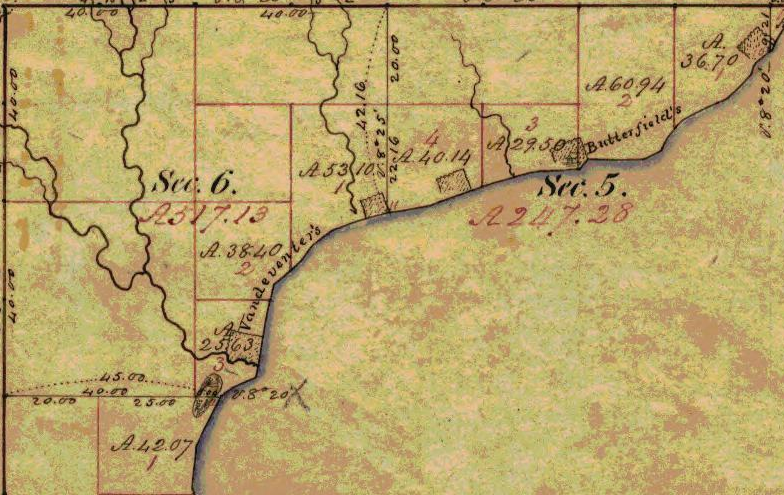
Captains Angus and Butterfield were south of Houghton Point, in what is now the City of Washburn. Detail from the Barber Brothers’ survey during August of 1855.
I answered in the negative. Capt Angus told me that he had told Joseph Lapointe on his sleigh and that he would pay him for it. Steven Butterfield told me that he heard Capt Angus tell Joseph Lapointe to take the Old Man on his sleigh. in the Evening I told Mrs Lapointe the Mother of Joseph and she said her son was very foolish in not taken the old man in his sleigh, but that she had herself told him not to take any person on his sleigh before he was paid for it as he had been cheated so often, and perhaps her son had refused the old man for the reason that the old man had once refused to lend him a bucket to water his horse.
Sworn on March 10th 1856 before me
J W Bell Justice.
– – – – –
Joseph Lapointe
duly sworn says, that he left the Bay with his horse to come to Lapointe on thursday afternoon that the deseased wanted to come over with him in his sleigh that he offered the deseased to bring him over to Lapointe with his things for half a Dollar but the Deseased would not agree to give it to him.
I then turned my horse and came away, on the road he broke an Iron pin and went back to Mr Angus to get it repaired that the Deseased was still there that Mr Angus did not say any thing to him at all in regard to bringing the old man over. Mr Angus never asked him to bring the old man over.
Says that the reason that he did not want any thing in his sleigh was because he wanted to get to Lapointe and back the same day.
Sworn to before me this 10th day of March 1856,
J W Bell Justice
An inquisition taken at Lapointe in the County of Lapointe, on the 10th day of March 1856 before J W Bell one of the Justices of the peace of said County, upon the view of the Body of Jerry Sullivan there dead by the Jurors whose names are hereunto Subscribed, who being duly sworn to Enquire on behalf of the people of this State when, in what manner, and by what means the said Jerry Sullivan came to his death upon their Oaths do say, that from the Evedince produced on their inquest that they Exempt any person from blame, and that owing to the late hour of starting the deceased came to his Death by freezing in making an effort to reach home.
In testimony whereof the said Justice of the Peace and the Jurors of this inquest have hereunto set their hands the day and year aforesaid.
John W. Bell
Justice of the Peace
W. J. Cochran
M. H. Mandelbaum
John Bono
Antoine Perrinier
Edward Fornier
John B. Roy~ Jury ~
Patrick Sullivan
Son of the diseased being duly sworn Says that Deseased was not possesed of any real Estate, and all the personal Estate that he knows of was
Money to the amount of 35.00 which he left with my wife, 7.00 which he lent me, 6 cents was found in his pocket after his disease and 1 Barrel of Flour which I got of him valued at 20.00. Making $62.06. He told me that Captain Angus Owed him for some labor, likewise he had some potatoes hid in the ground and some wood in the woods cut. the Diseased made my house his principal home. he had a due Bill on Mr
J haveAustrian for the Sum of 3.75. Total in Money & due Bills 65.81. also 5.00 worth of meal. 70.81Incidental Expenses paid by me out of the above for
holding an Inquest and Burrial rites, Church Rites &cExpenses of Inquest Jury fees & witnesses &c $8.37
Paid for Coffin & Outer Box 9.38
Paid the Preist for a Mass 5.00
To 4 Men looking for Diseased 4.00
Paid Paul Souliere 2.00
Henry Brissette 1.00
Michael Brissette for teaming 1.00
two Indian Boys for bringing Deseased 2.00
John Cochran two Days. 3.00
Hauling Sand for grave 4.50
[Bisson?] 1 Day searching for diseased 1.00
Ten Dollars for a Railing round the Grave 10.00
Grave Stone 5.00
To Massers to be said hereafter 15.00
Decided that Patrick Sullivan is the proper person to collect and settle all affairs of the diseased. and what remain he is entitled to for his trouble.
Penokee Survey Incidents: Number VI
March 14, 2015
By Amorin Mello

December 22, 1877.
The Survey of the Penoka Range and Incidents Connected with its Early History.
—
Number VI.
At length, somewhere about the 25th of October, the General returned from below, accompanied by his son, Joseph Cutler, George Spaulding, a young man who had formerly been in his employ in Maine, and Henry C. Palmer of Milwaukee, a son of President Palmer, who all came to hold claims for the Company, if wanted. He also brought two cook stoves and two metal kettles, the stoves for housekeeping, the kettles for sugar making. Both of the kettles and one of the stoves were subsequently sent to the Range, where they did good service during the winter and following spring, and are no doubt in use somewhere in the country today.
Houghton was a small settlement in the Town of BayPort, located northeast of what is now the City of Washburn. Captain Steven Butterfield and Peter B Vanderventer lived at what is now Washburn. (Detail from Augustus H. Barber’s survey during August of 1855)

Antoine Gordon from Noble Lives of a Noble Race (pg. 207) published by the St. Mary’s Industrial School in Odanah.
These kettles and stoves came very near sending Gen. Cutler, myself and Mr. Sidebotham, who had been stopping at La Pointe for several weeks, awaiting events, to a watery grave, during the run from that place to Ashland, in the Jane, a large two-masted boat formerly used by the Government upon the lake coast survey. Nothing but the coolness and skill of Captain Steve Butterfield, who was at the helm, saved us from going to the bottom. It was a long time before the recollections of that November day ceased to haunt us. The idea of going down in 150 feet of water with such a load, was not a pleasant thing to contemplate. Mr. Sidebotham was wholly unconscious, until after he reached the shore, of the peril we were in, owing to his ignorance of nautical affairs, but not so the General. He realized it as keenly as I did, not a word was spoken for over an hour, but in that hour we lived a lifetime. At length we succeeded in reaching the land at Houghton, where the high rocky shore furnished a lee. I shall never forget that ride while I live. We stopped for dinner at Antoine Gordon‘s, who lived at that time a little to the westward of Houghton, after which we ran down the shore to Pete Vanderventer‘s old place before venturing to cross the Bay to Ashland, which however, we finally did, reaching there in safety about sunset. Here we left Mr. Sidebotham to remain until wanted, and with J. Cutler, Palmer, and Spaulding, started the next morning for the Range, reaching there the second day at noon. Immediately upon our arrival, an interview was had with Stuntz, who informed us that if the fine weather we were then enjoying should continue for three weeks more, the survey to complete which he was making every possible exertion, would be finalized. This was to us indeed joyful news, as we were getting very anxious to return to our homes for the winter; whereupon all of our spare men were at once detailed to assist him, leaving me alone at Penoka, the General, in the meantime, visiting the different locations, and arranging for the winter, during which a blockhouse was to be built at Penoka, and one at the Gorge, which was done, the lumber for both being manufactured upon the ground, with a whip saw. Up to this time there had been no snow except the usual light fall we had every year, about the 1st of November. This, however, had all disappeared in three days after it fell, after which the weather was beautiful. In this way the time passed along, I seeing no one except Gen. Cutler, who came occasionally, or some of Stuntz’s men, who came for supplies, which were at this time kept mostly at Penoka, until the 12th of November, when it being certain that one week more would finish the survey, General Cutler left for Ashland, after Mr. Sidebotham, who by the requirements of the pre-emption law, must sleep upon his claim the 30th, in order to hold it, at least we so understood it at the time, leaving me entirely alone.
The weather continued fair up to the 18th, when there came a change. Saturday, the 17th, was as fine an Indian summer day as I ever saw, nearly all of which I slept seated upon a log in front of the cabin, listening to the singing of the birds, many of them not yet having left us for their homes in the south, and watching them as they were fitting around me, in search of food. At length old Sol sunk in the west, and night once more spread her dark mouth over the surrounding landscape. A strange feeling of loneliness, such as I had never felt before, crept over me as I closed the door of the cabin for the night, and sought my couch of balsam boughs, where I slept soundly until 6 o’clock the following morning, when presto! what a change met my eye! The air so soft and clear the previous evening, was now filled with snow, while upon the ground it was two and a half feet in depth, and increasing rapidly. You can easily imagine that I was not a little startled at the outlook, as being snowed in upon Lake Superior was no joke; and from the rapidity with which it was falling, it was apparent that it would be six feet in depth in twenty-four hours, if it kept on. I quickly saw that the first thing to be done was to lay in a supply of wood, the nearest pile of which was thirty rods distant. To this a track was quickly made, and the work of moving it commenced; neither did it stop until 2 P.M., at which time the whole pile, one and a half cords was in the cabin. The snow was now three feet in depth, but very light. My wood secured, I proceeded to cook some food, of which I felt the need, after which my thoughts began to wander after Stuntz and party, who were fifteen miles south. Neither did they reach the Range until the fourth day, as they had but one mile to run, in order to complete, when the storm came. This done, they started, and were three days in making that fifteen miles, during one of which, the last, they had nothing to eat, and one of them, Wilhelm Goetzenburg, literally nothing to wear, being clad in duck pants, hickory shirt, and stoga boots, no stockings, coat or vest. They were all badly used up when they got in; Stevens, in particular, who gave out when within only three miles of the Range, where he remained until his companions had reached the cabin, and two of them returned to him with some food, after which he came in, but as weak as to render it necessary to lead him. It was several days before he fully recovered his former strength. Goetzenburg, although nearly naked, stood it the best of them all. Perhaps a short sketch of this curious mortal, who certainly exhibited upon this occasion, powers of endurance equal to the gay and festive mule may not be inopportune, in this connection, before closing this article.
Wilhelm Goetzenburg, or Gutsenburg, as George Miller once spelt it when directing a letter for him to his “bruder” in Ontonagon, was not an Adonis, in the strict sense of the term. No sir! his keel was laid for a jumping jack, but from some unexplained cause, that plan was abandoned by his builder, who finally modeled him after the tubs the performing elephants use in the circus, broad at the base; in fact, his basement story was the largest part of him, in fact, nearly all of him; his legs, which were bowed, were short; his arms were long; his chest was short, and shaped like the dummies we see in the windows of ladies’ furnishing stores; his shoulders were broad, upon which a head covered with a thick mat of coarse hair, in color like that of a North Carolina clay-eater; a short nose, and a mouth that if open would have fooled a badger. Taken as a whole, he looked like a mixture of Low Dutch, Esquimaux and New Zealander combined. But beneath that iron frame, beat as honest a heart as ever beat in Ashland, or any other land. Good luck to thee, honest Wilhelm, I shall never see thy like again, but wherever thou arts or goest, may beans be plenty and clothing cheap. But en resume.
The fifth day brought Gen. Cutler from Ashland, accompanied by Mr. Sidebotham, George Kilburn, Sibley, Steve Sanborn, and George Miller, with the pack horses, who all came to break the road, except Sanborn, who came to stay through the winter. The boys had also now got in from the different claims, and the old cabin was full. Here they all remained for two days, when there came a thaw and melted the snow, after which Uncle George and Sibley returned to the Marengo, and George Miller with the horses to Ashland. The rest remained until the 30th, when their claims secured, and the arrangements for the winter completed. Mr. Arthur E. Wheelock was placed in charge of the week with J. Culter, Palmer, Steve Sanborn, Spaulding, and Elie Valliant, a French Canuck, formerly a resident at Ironton, a ship and house carpenter by trade, as companions. This done, Gen. Cutler and myself, Sidebotham, McClelland, Chase, and Al. Stevens accompanied by two of Stuntz’s men, whose names I have forgotten, left for home. We camped the first night at the Marengo, where the boys, as usual, hid the sugar from Mr. Sidebotham, reaching Ashland the second day. Here we remained for two days, when leaving Mr. Sidebotham, as previous stated, we took our departure, going directly across the bay upon the ice, for Pete Vanderventer’s. Before reaching the shore, however, Chase, who led the party, broke in, and came very near drowning, as in addition to his pack and snowshoes, which were also carried, he had on rubber boots, the legs of which held water enough to run a milk factory for a week. He was finally pulled out and inverted a few moments to let him drain, after which we proceeded, reaching Antoine Gordon’s at dark, and reached Bayfield the second day, the last six miles being made in an open boat, obtained, from the Indians at Sioux River, which was returned by Wheelock and William Pell, who had accompanied us thus far on the way.
From Bayfield to Superior City on snow shoes, occupied seven days, during which we camped on the snow every night. This, although a hard tramp, was very much enjoyed by all. The last three days our route lay along the shore of the lake, where many laughable scenes occurred in the way of tumbles from the ice bergs that lined the shore. From Superior City via St. Paul and La Crosse, to New Lisbon by stage, occupied nine days. From New Lisbon by cars to Milwaukee, one day, reaching that place Dec. 25, 1857. J.S.B.
 Chequamegon History