Diplomacy in the Time of Cholera: why there was no Ojibwe delegation to President Taylor in the winter of 1849-50
December 15, 2024
By Leo
At Chequamegon History, we deal mostly in the micro. By limiting our scope to a particular time and place, we are all about the narrow picture. Don’t come here for big universal ideas. The more specific and obscure a story, the more likely it is to appear on this website.
Madeline Island and the Chequamegon region are perfect for the specific and obscure. In the 1840s, most Americans would have thought of La Pointe as remote frontier wilderness, beyond the reach of worldwide events. Most of us still look at our history this way.
We are wrong. No man is an island, and Madeline Island–though literally an island–was no island.
This week, I was reminded of this fact while doing research for a project that has nothing to do with Chequamegon History. While scrolling through the death records of the Greek-Catholic church of my ancestral village in Poland, I noticed something strange. The causes of deaths are usually a mishmash of medieval sounding ailments, all written in Latin, or if the priest isn’t feeling creative or curious, the death is just listed as ordinaria.
In the summer of 1849, however, there was a noticeable uptick in death rate. It seemed my 19th-century cousins, from age 7 to 70, were all dying of the same thing:

Cause of death in right column. Akta stanu cywilnego Parafii Greckokatolickiej w Olchowcach (1840-1879). Księga zgonów dla miejscowości Olchowce. https://www.szukajwarchiwach.gov.pl/en/jednostka/-/jednostka/22431255
Cholera is a word people my age first learned on our Apple IIs back in elementary school:

At Herbster School in 1990, we pronounced it “Cho-lee-ra.” It was weird the first time someone said “Caller-uh.” You can play online at https://www.visitoregon.com/the-oregon-trail-game-online/
It is no coincidence. If you note the date of leaving Matt’s General Store in Independence Missouri, Oregon Trail takes place in 1848.
Diseases thrive in times of war, upheaval, famine, and migration, and 1848 and 1849 certainly had plenty of all of those. A third year of potato blight and oppressive British policies plunged the Irish poor deeper into squalor and starvation. The millions who were able to, left Ireland. Meanwhile, the British conquest of the Punjab and the “Springtime of Nations” democratic revolutions across central Europe meant army and refugee camps (notorious vectors of disease) popped up across the Eurasian continent.
North America had seen war as well. The Treaty of Guadalupe-Hidalgo (1848) ended the Mexican-American War and delivered half of Mexico over to Manifest Destiny. The discovery of gold in California, part of this cession, brought thousands of Chinese workers to the West Coast, while millions of Irish and Germans arrived on the East Coast. Some of those would also find their way west along the aforementioned Oregon Trail.
Closer to home, these German immigrants meant statehood for Wisconsin and the shifting of Wisconsin’s Indian administration west to Minnesota Territory. Eyeing profits, Minnesota and Mississippi River interests were increasingly calling for the removal of the Lake Superior Ojibwe bands from Wisconsin and Michigan. This caused great alarm and uncertainty at La Pointe.
All of these seemingly disparate events of 1848 and 1849 are, in fact, related. One of the most obvious manifestations was that displaced people from all these places impacted by war, poverty, and displacement carried cholera. The disease arrived in the United States multiple times, but the worst outbreak came up Mississippi from New Orleans in the summer of 1849. It ravaged St. Louis, then the Great Lakes, and reached Sault Ste, Marie and Lake Superior by August.
Longtime Chequamegon History readers will know my obsession with the Ojibwe delegation that left La Pointe in October 1848 and visited Washington D.C. in February 1849. It is a fascinating story of a group of chiefs who brought petitions (some pictographic) laying out their arguments against removal to President James K. Polk and Congress. The chiefs were well-received, but ultimately the substance of their petitions was not acted upon. They arrived after the 1848 elections. Polk and the members of Congress were lame ducks. General Zachary Taylor had been elected president, though he wasn’t inaugurated until the day after the delegation left Washington.
If you’ve read through our DOCUMENTS RELATED TO THE OJIBWE DELEGATION AND PETITIONS TO PRESIDENT POLK AND CONGRESS 1848-1849, you’ll know that both Polk and the Ojibwe delegation’s translator and alleged ringleader, the colorful Jean-Baptiste Martell of Sault Ste. Marie, died of cholera that summer.
So, in this post, we’re going to evaluate three new documents, just added to the collection, and look at how the cholera epidemic partially led to the disastrous removal of 1850, commonly known as the Sandy Lake Tragedy.
The first document is from just after the delegation’s arrival in Washington. It describes the meeting with Polk in great detail, lays out the Ojibwe grievances, and importantly, records Polk’s reaction. I have not been able to find the name of the correspondent, but this article is easily the best-reported of all the many, many newspaper accounts of the 1848-49 delegation–most of which use patronizing racist language and focus on the more trivial, “fish out of water” element of Lake Superior chiefs in the capital city.
New York Daily Tribune, 6 February 1849, Page 1
The Indians of the North-West–Their Wrongs–Chiefs in Washington
Correspondence of The Tribune
WASHINGTON, 3d Feb 1849.
Yesterday (Friday) the Chiefs representing the Chippewa Tribe of Indians located on the borders of Lake Superior and drawing their pay at La Pointe, representing 16 bands, which comprise about 9,000 Indians, after remaining here for the last ten days, were presented to the President.– The Secretary of War and Commissioner of Indian Affairs were also present. One of the Chiefs who appeared to be the eldest, first addressed the President, for a period of twenty minutes. The address was interpreted by John B. Martell, a half-breed, who was born and has always continued among them. He appears a shrewd, sensible man, and interprets with much fluency. This Chief was followed by two others in addresses occupying the same length of time. They all addressed the President as “Our Great Father,” and spoke with much energy, dignity and fluency, preserving throughout a respectful manner and evincing an earnest sincerity of purpose, that bespoke their mission to be one of no ordinary character. They represented their grievances under which their tribes were laboring: the trials and privations they had undergone to reach here, and the separation from their families, with much emotion and in truly touching and eloquent terms.
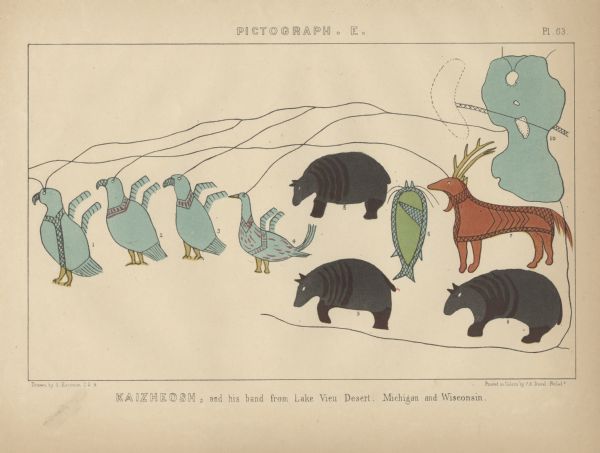
The oldest chief was Gezhiiyaash (his pictographic petition above) or “Swift Sailor” from Lac Vieux Desert. The two other chiefs were likely Oshkaabewis “Messenger” from Wisconsin River, and Naagaanab “Foremost Sitter” from Fond du Lac.
They represented that their annuities under their Treaty of La Pointe, made about the year 1843, were payable in the month of July in each year and not later, because by that time the planting season would be over; beside, it would be the best time and the least dangerous to pass the Great Lake and return to their homes in time to gather wild rice, on which they mainly depended during the hard winters. The first payment was made later than the time agreed upon. The agent, upon being notified, promised to comply with the terms of the Treaty, but every year since the payments have been made later, and that of last year did not take place until about the middle of October, in consequence of which they have been subjected to much suffering.– They assemble at the place for payment designated in the treaty. It is then the traders take advantage of them–being three hundred miles from home, without money, and without provisions; and when their money is received it must all be paid for their subsistence during the long delay they have been subjected to; and sickness frequently breaks out among them from being obliged to use salt provisions, which they are not accustomed to. By leaving their homes at any other time than in the month of July they neglect their harvesting–rice and potato crops, and if they neglect those they must starve to death; therefore it would be better for them to lose their annuities altogether. And without their blankets, procured at the Pointe, they are liable to freeze to death when passing the stormy lake; and the tradespeople influence the Agent to send for them a month before the payment is made, and when they arrive the Agent accepts orders from them for provisions which they are obliged to purchase at a great price–one dollar for 15 lbs of flour, and in proportion for other articles. They have assembled frequently in regard to these things, and can only conclude that their complaints have never reached their “Great Father,” and they have now come to see him in person, and take him by the hand.
In regard to the Half-Breeds at La Pointe, who draw pay with them, they say: That in the Treaty concluded between Governor Dodge and the Chippewas at St. Peters, provision was made for the half-breeds to draw their share all in one payment, and it was paid them accordingly, $258.50 each, which was a mere gift on the part of the tribe; a payment which they had no right to, but was given them as a present. Induced by some subsequent representations by the half-breeds, they were taken into their pay list, and the consequence has been that almost all the half breeds, as well as the French who are married to Indian women, are in the employ of, or dependent upon one of the principal trading houses, (Dr. Bourop’s) at La Pointe, with whom their goods and provisions are stored; and that they are thus enabled to select and appropriate to themselves the choice portion of all the goods designed for them–in many cases not leaving them a blanket to start with upon their journey of two or three hundred miles distant to their homes. After many other details, to which we will make reference in future articles, they urged that owing to the faithlessness of the half-breeds to them, and to the Government, that they be stricken from the pay list.
One half the goods furnished are of no use to them. The articles they most need are guns, kettles, blankets and a greater supply of provisions, &c.
They are under heavy expense, and no money to pay their board. They have undertaken this long journey for the benefit of their whole people, and at their earnest solicitations. They have been absent from their families nearly one year. It has cost them $1,400 to get here. Half of that sum has been raised from exhibitions. The other half has been borrowed from kind people on the route they have traveled. They wish to repay the money advanced them and to procure money to return home with. They want clothes and things to take to their families, and ask an appropriation of $6,000 on their annuity money.
They have before made a communication to the President, to be laid before the present Congress, for the acquisition of lands and the naturalization of their bands–propositions which they urged with great force.
All the Chiefs represented to the President that their interpreter, Mr. Martel, was living in very comfortable circumstances at home, and was induced to accompany them by the urgent solicitations of all their people who confided in his integrity and looked upon him as their friend.

The paternalistic ritual kinship (“Great Father”) language used here by James K. Polk, can be off-putting to the modern reader. However, it had a long tradition in Ojibwe “fur trade theater” rhetoric. Gezhiiyaash was no meek schoolboy, as evidenced by his words in this document (White House)
Their supplicating–though forcible, intelligent, and pathetic appeal, to be permitted to live upon the spot of their nativity, where the morning and noon of their days had been past, and the night time of their existence has reached them, was, too, and irresistible appeal to the justice, generosity and magnanimity of that boasted “civilization” that pleads mercy to the conquered, and was calculated to leave an impress upon every honest heart who claims to be a “freeman.”
The President, in answer to the several addresses, requested the interpreter to state to them that their Great Father was happy to have met with them; and as they had made allusion to written documents which they placed in his hands, as containing an expression of their views and wishes, he would carefully read them and communicate his answer to the Secretary of War and the Commissioner of Indian Affairs, assuring them of kindly feelings on the part of the Government, and terminating with some expressions very like a schoolmaster’s enjoinder upon his scholars that if they behaved themselves they might expect good treatment in future.
The fact that they met Polk was not new information, but we hadn’t been previously aware of just how long the meeting went. It is important to note the president’s use of “kindly feelings” and “behaved themselves.” Those phrases would come up frequently in subsequent years.
One could argue that Polk was a lame duck, and would be dead of cholera within a few months, so his words didn’t mean much. One could argue the problem was that the Ojibwe didn’t understand that in the American political system–that the incoming Whig administration might not feel bound by the words and “kindly feelings” of the outgoing Democratic administration.
However, the next document shows that the chiefs did feel the need to cover their bases and stuck around Washington long enough meet the next president. To us, at least, this was new information:
National Era v. III. No. 14, pg. 56 April 5, 1849
For the National Era
THE CHIPPEWA CHIEFS AND GENERAL TAYLOR
On the third day after the arrival of General Taylor at Washington, the Indian chiefs requested me to seek an interview for them, as they were about to leave for their homes, on Lake Superior, and greatly desired to see the new President before their departure.
It was accordingly arranged by the General to see them the next morning at 9 o’clock, before the usual reception hour.
Fitted out in their very best, with many items of finery which their taste for the imposing had added to their wardrobe, the delegation and their interpreter accompanied me to the reception room, and were cordially taken by the hand by the plain but benevolent-looking old General. One of the chiefs arose, and addressed the President elect nearly as follows:
“Father! We are glad to see you, and we are pleased to see you so well after your long journey.
“Father! We are the representatives of about twenty thousand of your red children, and are just about leaving for our homes, far off on Lake Superior, and we are very much gratified, that, before our departure, we have the opportunity of shaking hands with you.
“Father! You have conquered your country’s enemies in war; may you subdue the enemies of your Administration while you are President of the United States and govern this great country, like the great father, Washington, before you, with wisdom and in peace.
“Father! This our visit through the country and to the cities of your white children, and the wonderful things that we have seen, impress us with awe, and cause us to think that the white man is the favored of the Great Spirit.
“Father! In the midst of the great blessings with which you and your white children are favored of the Great Spirit, we ask of you, while you are in power, not to forget your less fortunate red children. They are now few, and scattered, and poor. You can help them.
“Father! Although a successful warrior, we have heard of your humanity! And now that we see you face to face, we are satisfied that you have a heart to feel for your poor red children.
“Father Farewell”
The tall, manly-looking chief having finished and shaken hands, General Taylor asked him to be seated, and, rising himself, replied nearly as follows”
“My Red Children: I am very happy to have this interview with you. What you have said I have listened to with interest. It is the more appreciated by me, as I am no stranger to your people. I resided for a length of time on your borders, and have been witness to your privations, and am acquainted with many of your wants.
“Peace must be established and maintained between yourselves and the neighboring tribes of the red men, and you need in the next place the means of subsistence.
“My Red Children: I thank you for your kind wishes for me personally, and as President of the United States.
“While I am in office, I shall use my influence to keep you at peace with the Sioux, between whom and the Chippewas there has always been a most deadly hostility, fatal to the prosperity of both nations. I shall also recommend that you be provided with the means of raising corn and the other necessaries of life.
“My Red Children: I hope that you have met with success in your present visit, and that you may return to your homes without an accident by the way; and I bid you say to your red brethren that I cordially wish them health and prosperity. Farewell.”
This interesting interview closed with a general shaking of hands and during the addresses, it is creditable to the parties to say, that the feelings were reached. Tears glistened in the eyes of the Indians and General Taylor evinced sufficient emotion, during the address of the chief, to show that he possesses a heart that may be touched. The old veteran was heard to remark, as the delegation left the room, “What fine looking men they are!”
Major Martell, the half-breed interpreter, acquitted himself handsomely throughout. The Indians came away declaring that “General Taylor talked very good.”
The General’s family and suite, evidently not prepared for the visit; were not dressed to receive company at so early an hour; nevertheless, they soon came in, en dishabille, and looked on with interest.
P.
One of the lingering questions I’ve had about the 1848-49 Delegation has been whether or not the Ojibwe leadership viewed it as a success. This document shows that the answer was unequivocally yes. It also shows why the chiefs felt so blindsided and disbelieving in the spring of 1850 when the government agents at La Pointe told them that Taylor had ordered them to remove. They didn’t have to go back to 1842 for the Government’s promises. They had heard them only a year earlier from both the president and the president-elect!
It also explains why during and after the removal, the chiefs number-one priority was sending another delegation. One would eventually go in 1852, led by Chief Buffalo of La Pointe. This would help secure the reservations sought by the first delegation, but that was only after two failed removal attempts and hundreds of deaths.
If the cholera epidemic had not come, Chief Buffalo and other prominent chiefs, would have likely gone back to Taylor in the winter of 1849-50. They may have been able to secure new treaty negotiations, reservations on the ceded territory, or at the very least have been more prepared for the upcoming removal:
George Johnston to Henry Schoolcraft, 5 October 1849, MS Papers of Henry Rowe Schoolcraft: General Correspondence, 1806-1864, BOX 51.
Saut Ste Maries
Oct 5th 1849
My Dear sir,
Your favor of Sep. 14th, I have just now received and will lose no time in answering. Since I wrote to you on the subject of an intended delegation of Chippewa Chiefs desiring to visit the seat of Govt., I visited Lapointe and remained there during the payment, and I had an opportunity of seeing & talking with the chiefs. They held a council with their agent Dr. Livermore and expressed their desire to visit Washington this season, and they laid the matter before him with open frankness, and Dr. Livermore answered them in the same strain, advising them at the same time, to relinquish their intended visit this year, as it would be dangerous for them, to travel in the midst of sickness which was so prevalent & so widely spread in the land, and that if they should still feel desirous to go on the following year that he would then permit them to do so, and that he would have no objections, this appearing so reasonable to the chiefs, that they assented to it.
I will write to the chiefs and express to them the subject of your letter, and direct them to address Mr. Babcock at Detroit.
You will herein find enclosed copy of Mr. Ballander’s letter to me, a gentleman of the Hon. Hudson’s Bay Co. & Chief factor at Fort Garry in the Red river region, it is very kind & his sympathy, devotes a feeling heart.– Mr. Mitchell of Green Bay to whom I have written in the early part of this summer, to make enquiries relative to certain reports of Tanner’s existence among the sioux, he has not as yet returned an answer to may communication and I feel the neglect with some degree of asperity which I cannot control.
Very Truly yours
Geo. Johnston
Henry R. Schoolcraft Esq.
Washington
It is hard to say how differently history may have turned out if a second delegation had been able to go with George Johnston. There is a good chance it would have been a lot more successful. Johnston was much more of an insider than Martell–who had had a lot of difficulty convincing the American authorities of his credentials. One of those who stood in Martell’s way was Henry Schoolcraft. Schoolcraft, was regarded by the American establishment as the foremost authority on Ojibwe affairs and was Johnston’s brother-in-law.
It may not have worked. The inertia of United States Indian Policy was still with removal. Any attempt to reverse Manifest Destiny and convince the government to cede land back to Indian nations east of the Mississippi was going to be an uphill battle. The Minnesota trade interests were strong.
Also, Schoolcraft was a Democrat, so he would have had less influence with the Whig Taylor–though agreements on Western issues sometimes crossed party lines. However, one can imagine George Johnston sitting around a table in Washington with his “Uncle” Buffalo, his brother-in-law Schoolcraft, and the U.S. President, working out the contours of a new treaty avoiding the removal entirely. Because of the cholera, however, we’ll never know.
For more on how the fallout from the Mexican War impacted Ojibwe removal, see Slavery, Debt Default, and the Sandy Lake Tragedy
For more on the 1848-49 Delegation, see: this post, this post, and this post
Chief Buffalo Picture Search: Coda
June 1, 2024
My last post ended up containing several musings on the nature of primary-source research and how to acknowledge mistakes and deal with uncertainty in the historical record. This was in anticipation of having to write this post. It’s a post I’ve been putting off for years.
Amorin forced the issue with his important work on the speeches at the 1842 Treaty negotiations. While working on it, he sent me a message that read something like, “Hey, the article quotes Chief Buffalo and describes him in a blue military coat with epaulets. Is the world ready for that picture that Smithsonian guy sent us years ago?”
This was the image in question:

Henry Inman, Big Buffalo (Chippewa), 1832-1833, oil on canvas, frame: 39 in. × 34 in. × 2 1/4 in. (99.1 × 86.4 × 5.7 cm), Smithsonian American Art Museum, Gift of Gerald and Kathleen Peters, 2019.12.2
We first learned of this image from a Chequamegon History comment by Patrick Jackson of the Smithsonian asking what we knew about the image and whether or not it was Chief Buffalo from La Pointe.
We had never seen it before.
This was our correspondence with Mr. Jackson at the time:
July 17, 2019
Hello, my name is Patrick, and I am an intern at the Smithsonian American Art Museum. I’m working on researching a recent acquisition: a painting which came to us identified as a Henry Inman portrait of “Big Buffalo Ke-Che-Wais-Ke, The Great Renewer (1759-1855) (Chippewa).” We have run into some confusion about the identification of the portrait, as it came to us identified as stated above, yet at Harvard Peabody Museum, who was previously the owner of the portrait, it was listed as an unidentified sitter. Seeing as you’ve written a few posts about the identification of images of the three different Chief Buffalos, I thought you might be able to give some insight into perhaps who is or isn’t in the portrait we have. Thank you for your time.
July 17, 2019
Hello,
I would be happy to comment. Can you send a photo to this email?
I am pretty sure Inman painted a copy of Charles Bird King’s portrait of Pee-che-kir.
Doe it resemble that portrait? Pee-che-kir (Bizhiki) means Buffalo in Ojibwe (Chippewa). From my research, I am fairly certain that King’s portrait is not of Kechewaiske, but of another chief named Buffalo who lived in the same era.
Leon Filipczak
July 17, 2019
Dear Leon,
I have attached our portrait—it’s not the best scan, but hopefully there’s enough detail for you to work with. I’ve compared it with the Peechikir in McKenney & Hall, as well as to the Chief Buffalo painted ambrotype and the James Otto Lewis portrait of Pe-schick-ee. The ambrotype has a close resemblance, as does the Peecheckir, though if that is what Charles Bird King painted I have doubts that Inman would make such drastic changes in clothing and pose.
The identification as Big Buffalo/Ke-Che-Wais-Ke/The Great Renewer, as far as I understand, refers to the La Pointe Bizhiki/Buffalo rather than the St. Croix or Leech Lake Buffalos, though of course that is a questionable identification considering Kechewaiske did not (I think) visit Washington until after Inman’s death in January of 1846. McKenney, however, did visit the Ojibwe/Chippewa for the negotiations for the Treaty of Fond du Lac in 1825/1826, and could feasibly have met multiple Chief Buffalos. Perhaps a local artist there would be responsible for the original? Another possibility is, since the identification was not made at the Peabody, who had the portrait since the 1880s, is that it has been misidentified entirely and is unrelated to any of the Ojibwe/Chippewa chiefs. Though this, to me, would seem unlikely considering the strong resemblance of the figure in our portrait to the Peechikir portrait and Chief Buffalo ambrotype.
Thank you again for the help.
Sincerely,
Patrick
July 22, 2019
Hello Patrick,
This is a head-scratcher. Your analysis is largely what I would come up with. My first thought when I saw it was, “Who identified it as someone named Buffalo? When? and using what evidence?” Whoever associated the image with the text “Ke-Che-Wais-Ke, The Great Renewer (1759-1855)” did so decades after the painting could be assumed to be created. However, if the tag “Big Buffalo” can be attached to this image in the era it was created, then we may be onto something. This is what I know:
1) During his time as Superintendent of Indian Affairs (late 1820s), Thomas McKenney amassed a large collection of portraits of Indian chiefs for what he called the “Indian Gallery” in the War Department. He sought the portraits out wherever and whenever he could. When chiefs would come to Washington, he would have Charles Bird King do the work, but he also received portraits from the interior via artists like James Otto Lewis.
2) In 1824, Bizhiki (Buffalo) from the St. Croix River (not Great Buffalo from La Pointe), visited Washington and was painted by King. This painting is presumed to have been destroyed in the Smithsonian fire that took out most of the Indian Gallery.
3) In 1825 at Prairie du Chien and in 1826 at Fond du Lac (where McKenney was present) James Otto Lewis painted several Ojibwe chiefs, and these paintings also ended up in the Indian Gallery. Both chief Buffalos were present at these treaties.
4) A team of artists copied each others’ work from these originals. King, for example remade several of Lewis’ portraits to make the faces less grotesque. Inman copied several Indian Gallery portraits (mostly King’s) to be sent to other institutions. These are the ones that survived the Smithsonian fire.
5) In the late 1830s, 10+ years after most of the portraits were painted, Lewis and McKenney sold competing lithograph collections to the American public. McKenney’s images were taken from the Indian Gallery. Lewis’ were from his works (some of which were in the Indian Gallery, often redone by King). While the images were printed with descriptions, the accuracy of the descriptions leaves something to be desired. A chief named Bizhiki appears in both Lewis and McKenney-Hall. In both, the chiefs are dressed in white and faced looking left, but their faces look nothing alike. One is very “Lewis-grotesque.” and the other is not at all. There are Lewis-based lithographs in both competing works, and they are usually easy to spot.
6) Not every image from the Indian Gallery made it into the published lithographic collections. Brian Finstad, a historian of the upper-St. Croix country, has shown me an image of Gaa-bimabi (Kappamappa, Gobamobi), a close friend/relative of the La Pointe Chief Buffalo, and upstream neighbor of the St. Croix Buffalo. This image is held by Harvard and strongly resembles the one you sent me in style. I suspect it is an Inman, based on a Lewis (possibly with a burned-up King copy somewhere in between).
7) “Big Buffalo” would seemingly indicate Buffalo from La Pointe. The word gichi is frequently translated as both “great” and “big” (i.e. big in size or big in power). Buffalo from La Pointe was both. However, the man in the painting you sent is considerably skinnier and younger-looking than I would expect him to appear c.1826.
My sense is that unless accompanying documentation can be found, there is no way to 100% ID these pictures. I am also starting to worry that McKenney and the Indian Gallery artists, themselves began to confuse the two chief Buffalos, and that the three originals (two showing St. Croix Buffalo, and one La Pointe Buffalo) burned. Therefore, what we are left with are copies that at best we are unable to positively identify, and at worst are actually composites of elements of portraits of two different men. The fact that King’s head study of Pee-chi-kir is out there makes me wonder if he put the face from his original (1824 portrait of St. Croix Buffalo?) onto the clothing from Lewis’ portrait of Pe-shick-ee when it was prepared for the lithograph publication.
A few weeks later, Patrick sent a follow-up message that he had tracked down a second version and confirmed that Inman’s portrait was indeed a copy of a Charles Bird King portrait, based on a James Otto Lewis original. It included some critical details.

Portrait of Big Buffalo, A Chippewa, 1827 Charles Bird King (1785-1862), signed, dated and inscribed ‘Odeg Buffalo/Copy by C King from a drawing/by Lewis/Washington 1826’ (on the reverse) oil on panel 17 1⁄2 X 13 3⁄4 in. (44.5 x 34.9 cm.) Last sold by Christie’s Auction House for $478,800 on 26 May 2022
The date of 1826 makes it very likely that Lewis’ original was painted at the Treaty of Fond du Lac. Chief Buffalo of La Pointe would have been in his 60s, which appears consistent with the image of Big Buffalo. Big Buffalo also does not appear as thin in King’s intermediate version as he does in Inman’s copy, lessening the concerns that the image does not match written descriptions of the chief.
Another clue is that it appears Lewis used the word Odeg to disambiguate Big Buffalo from the two other chiefs named Buffalo present at Fond du Lac in 1826. This may be the Ojibwe word Andeg (“crow”). Although I have not seen any other source that calls the La Pointe chief Andeg, it was a significant name in his family. He had multiple close relatives with Andeg in their names, which may have all stemmed from the name of Buffalo’s grandfather Andeg-wiiyaas (Crow’s Meat). As hereditary chief of the Andeg-wiiyaas band, it’s not unreasonable to think the name would stay associated with Buffalo and be used to distinguish him from the other Buffalos. However, this is speculative.
So, there we were. After the whole convoluted Chief Buffalo Picture Search, did we finally have an image we could say without a doubt was Chief Buffalo of La Pointe? No. However, we did have one we could say was “likely” or even “probably” him. I considered posting at the time, but a few things held me back.
In the earliest years of Chequamegon History, 2013 and 2014, many of the posts involved speculation about images and me trying to nitpick or disprove obvious research mistakes of others. Back then, I didn’t think anyone was reading and that the site would only appeal to academic types. Later on, however, I realized that a lot of the traffic to the site came from people looking for images, who weren’t necessarily reading all the caveats and disclaimers. This meant we were potentially contributing to the issue of false information on the internet rather than helping clear it up. So by 2019, I had switched my focus to archiving documents through the Chequamegon History Source Archive, or writing more overtly subjective and political posts.
So, the Smithsonian image of Big Buffalo went on the back burner, waiting to see if more information would materialize to confirm the identity of the man one way or the other. None did, and then in 2020 something happened that gave the whole world a collective amnesia that made those years hard to remember. When Amorin asked about using the image for his 1842 post, my first thought was “Yeah, you should, but we should probably give it its own post too.” My second thought was, “Holy crap! It’s been five years!”
Anyway, here is Chequamegon History’s statement on the identity of the man in Henry Inman’s 1832-33 portrait of Big Buffalo (Chippewa).
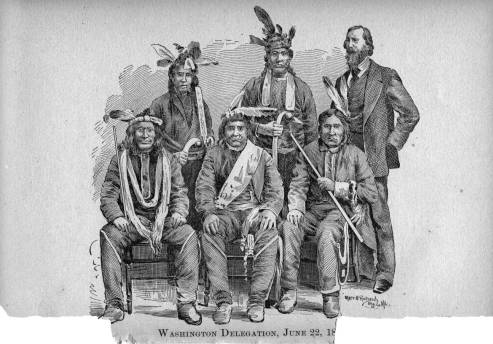
Likely Chief Buffalo of La Pointe: We are not 100% certain, but we are more certain than we have been about any other image featured in the Chief Buffalo Picture Search. This is a copy of a copy of a missing original by James Otto Lewis. Lewis was a self-taught artist who struggled with realistic facial features. Charles Bird King and Henry Inman, who made the first and second copies, respectively, had more talent for realism. However, they did not travel to Lake Superior themselves and were working from Lewis’ original. Therefore, the appearance of Big Buffalo may accurately show his clothing, but is probably less accurate in showing his actual physical appearance.
And while we’re on the subject of correcting misinformation related to images, I need to set the record straight on another one and offer my apologies to a certain Benjamin Green Armstrong. I promise, it relates indirectly to the “Big Buffalo” painting.
An engraving of the image in question appears in Armstrong’s Early Life Among the Indians.
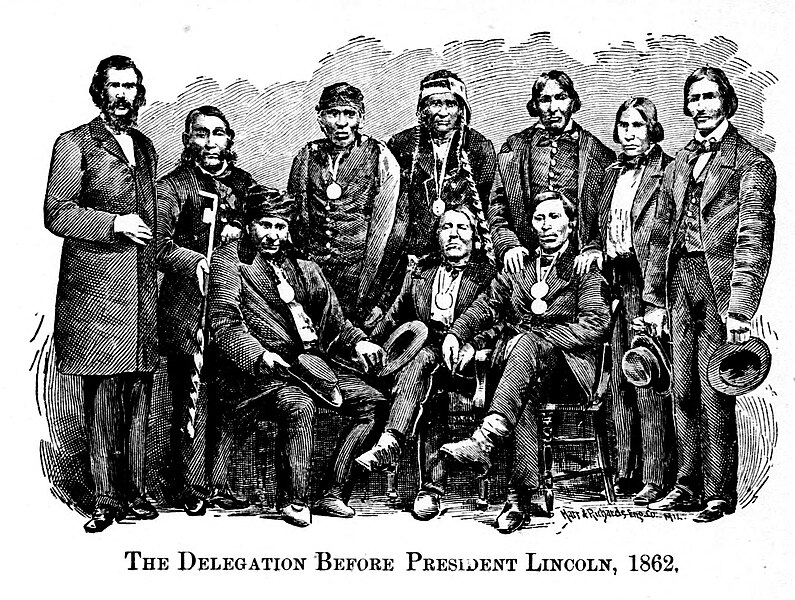
Ah-moose (Little Bee) from Lac Flambeau Reservation, Kish-ke-taw-ug (Cut Ear) from Bad River Reservation, Ba-quas (He Sews) from Lac Courte O’Rielles Reservation, Ah-do-ga-zik (Last Day) from Bad River Reservation, O-be-quot (Firm) from Fond du Lac Reservation, Sing-quak-onse (Little Pine) from La Pointe Reservation, Ja-ge-gwa-yo (Can’t Tell) from La Pointe Reservation, Na-gon-ab (He Sits Ahead) from Fond du Lac Reservation, and O-ma-shin-a-way (Messenger) from Bad River Reservation.
In this post, we contested these identifications on the grounds that Ja-ge-gwa-yo (Little Buffalo) from La Pointe Reservation died in 1860 and therefore could not have been part of the delegation to President Lincoln. In the comments on that post, readers from Michigan suggested that we had several other identities wrong, and that this was actually a group of chiefs from the Keweenaw region. We commented that we felt most of Armstrong’s identifications were correct, but that the picture was probably taken in 1856 in St. Paul.
Since then, a document has appeared that confirms Armstrong was right all along.
[Antoine Buffalo, Naagaanab, and six other chiefs to W.P. Dole, 6 March 1863
National Archives M234-393 slide 14
Transcribed by L. Filipczak 12 April 2024]
To Our Father,
Hon W P. Dole
Commissioner of Indian Affairs–
We the undersigned chiefs of the chippewas of Lake Superior, now present in Washington, do respectfully request that you will pay into the hands of our Agent L. E. Webb, the sum of Fifteen Hundred Dollars from any moneys found due us under the head of “Arrearages in Annuity” the said money to be expended in the purchase of useful articles to be taken by us to our people at home.
Antoine Buffalo His X Mark | A daw we ge zhig His X Mark
Naw gaw nab His X Mark | Obe quad His X Mark
Me zhe na way His X Mark | Aw ke wen zee His X Mark
Kish ke ta wag His X Mark | Aw monse His X Mark
I certify that I Interpreted the above to the chiefs and that the same was fully understood by them
Joseph Gurnoe
U.S. Interpreter
Witnessed the above Signed } BG Armstrong
Washington DC }
March 6th 1863 }
There were eight Lake Superior chiefs, an interpreter, and a witness in Washington that spring, for a total of ten people. There are ten people in the photograph. Chequamegon History is confident that this document confirms they are the exact ten identified by Benjamin Armstrong.
The Lac Courte Oreilles chief Ba-quas is the same person as Akiwenzii. It was not unusual for an Ojibwe chief to have more than one name. Chief Buffalo, Gaa-bimaabi, Zhingob the Younger, and Hole-in-the-Day the Younger are among the many examples.
The name “Sing-quak-onse (Little Pine) from La Pointe Reservation” seems to be absent from the letter, but he is there too. Let’s look at the signature of the interpreter, Joseph Gurnoe.

Gurnoe’s beautiful looping handwriting will be familiar to anyone who has studied the famous 1864 bilingual petition. We see this same handwriting in an 1879 census of Red Cliff. In this document, Gurnoe records his own Ojibwe name as Shingwākons, The young Pine tree.

So the man standing on the far right is Gurnoe. This can be confirmed by looking at other known photos of him.
Finally, it confirms that the chief seated on the bottom left is not Jechiikwii’o (Little Buffalo), but rather his son Antoine, who inherited the chieftainship of the Buffalo Band after the death of his father two years earlier. Known to history as Chief Antoine Buffalo, in his lifetime he was often called Antoine Tchetchigwaio (or variants thereof), using his father’s name as a surname rather than his grandfather’s.

So, now we need to address the elephant in the room that unites the Henry Inman portrait of Big Buffalo with the photograph of the 1862-63 Delegation to Washington:

Wisconsin Historical Society
This is the “ambrotype” referenced by Patrick Jackson above. It’s the image most associated with Chief Buffalo of La Pointe. It’s also one for which we have the least amount of background information. We have not been able to determine who the original photographer/painter was or when the image was created.
The resemblance to the portrait of “Big Buffalo” is undeniable.
However, if it is connected to the 1862-63 image of Chief Antoine Buffalo, it would support Hamilton Nelson Ross’s assertions on the Wisconsin Historical Society copy.
Clearly, multiple generations of the Buffalo family wore military jackets.
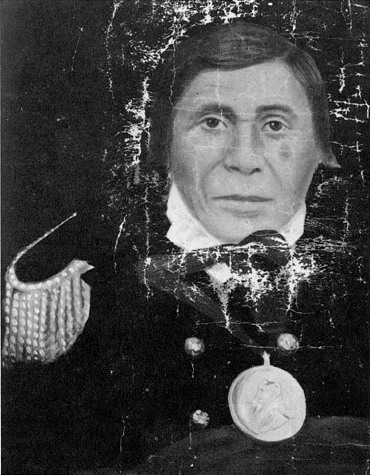
Inconclusive: uncertainty is no fun, but at this point Chequamegon History cannot determine which Chief Buffalo is in the ambrotype. However, the new evidence points more toward the grandfather (Great Buffalo) and grandson (Antoine) than it does to the son (Little Buffalo).
We will keep looking.
1842 Treaty Speeches at La Pointe in the News
May 15, 2024
Collected by Amorin Mello & edited by Leo Filipczak

Green Bay Republican:
Saturday, November 5, 1842, Page 2.

Robert Stuart was a top official in Astor’s American Fur Company in the upper Great Lakes region. Apparently, it was not a conflict of interest for him to also be U.S. Commissioner for a treaty in which the Fur Company would be a major beneficiary.
A gentleman who has recently returned from a visit to the Lake Superior Indian country, has furnished us with the particulars of a Treaty lately negotiated at La Pointe, during his sojourn at that place, by ROBERT STUART, Esq., Commissioner of Indian Affairs for the district of Michigan, on the part of the United States, and by the Chiefs and Braves of the Chippeway Indian nation on their own behalf and their people. From 3 to 4000 Indians were present, and the scene presented an imposing appearance. The object of the Government was the purchase of the Chippeway country for its valuable minerals, and to adopt a policy which is practised by Great Britain, i.e. of keeping intercourse with these powerful neighbors from year to year by paying them annuities and cultivating their friendship. It is a peculiar trait in the Indian character of being very punctual in regard to the fulfillment of any contract into which they enter, and much dissatisfaction has arisen among the different tribes toward our Government, in consequence of not complying strictly to the obligations on their part to the Indians, in the time of making the payments, for they are not generally paid until after the time stipulated in the treaty, and which has too often proven to be the means of losing their confidence and friendship.
On the 30th of September last, Mr. Stuart opened the Council, standing himself and some of his friends under an awning prepared for the occasion, and the vast assembly of the warlike Chippeways occupying seats which were arranged for their accommodation. A keg of Tobacco was rolled out and opened as a present to the Indians, and was distributed among them; when Mr. Stuart addressed them as follows:-
The Passenger Pigeon (Ectopistes migratorius) was a metaphor for infinite abundance in 1842. In less than 75 years, the species would be extinct. What that means for Stuart’s metaphor is hard to say (Biodiversity Heritage Library).
The chiefs who had been to Washington were the St. Croix chiefs Noodin (pictured below) and Bizhiki. They were brought to the capital as part of a multi-tribal delegation in 1824, which among other things, toured American military facilities.I am very glad to meet and shake hands with so many of my old friends in good health; last winter I visited your Great Father in Washington, and talked with him about you. He knows you are poor and have but little for your women and children, and that your lands are poor. He pities your condition, and has sent me here to see what can be done for you; some of your Bands get money, goods, and provisions by former Treaty, others get none because the Great Council at Washington did not think your lands worth purchasing. By the treaty you made with Gov. Cass, several years ago, you gave to your lands all the minerals; so the minerals belong no longer to you, and the white men are asking him permission to take the minerals from the land. But your Great Father wishes to pay you something for your lands and minerals before he will allow it. He knows you are needy and can be made comfortable with goods, provisions, and tobacco, some Farmers, Carpenters to aid in building your houses, and Blacksmiths to mend your guns, traps, &c., and something for schools to learn your children to read and write, and not grow up in ignorance. I hear you have been unpleased about your Farmers and Blacksmiths. If there is anything wrong I wish you would tell me, and I will write all your complaints to your Great Father, who is ever watchful over your welfare. I fear you do not esteem your teachers who come among you, and the schools which are among you, as you ought. Some of you seem to think you can learn as formerly, but do you not see that the Great Spirit is changing things all around you. Once the whole land was owned by you and other Indian Nations. Now the white men have almost the whole country, and they are as numerous as the Pigeons in the spring. You who have been in Washington know this; but the poor Indians are dying off with the use of whiskey, while others are sent off across the Mississippi to make room for the white men. Not because the Great Spirit loves the white men more than the Indians, but because the white men are wise and send their children to school and attend to instructions, so as to know more than you do. They become wise and rich while you are poor and ignorant, but if you send your children to school they may become wise like the white men; they will also learn to worship the Great Spirit like the whites, and enjoy the prosperity they enjoy. I hope, and he, that you will open your ears and hearts to receive this advice, and you will soon get great light. But said he, I am afraid of you, I see but few of you go to listen to the Missionaries, who are now preaching here every night; they are anxious that you should hear the word of the Great Spirit and learn to be happy and wise, and to have peace among yourselves.
The 1837 Treaty of St. Peters was mostly negotiated by Maajigaabaw or “La Trappe” of Leech Lake and other chiefs from outside the territory ceded by that treaty. The chiefs from the ceded lands were given relatively few opportunities to speak. This created animosity between the Lake Superior and Mississippi Bands.Your Great Father is very sorry to learn that there are divisions among his red children. You cannot be happy in this way. Your Great Father hopes you will live in peace together, and not do wrong to your white neighbors, so that no reports will be made against you, or pay demanded for damages done by you. These things when they occur displease him very much, and I myself am ashamed of such things when I hear them. Your Great Father is determined to put a stop to them, and he looks that the Chiefs and Braves will help him, so that all the wicked may be brought to justice; then you can hold up your heads, and your Great Father will be proud of you. Can I tell him that he can depend upon his Chippeway children acting in this way.
One other thing, your Great Father is grieved that you drink whiskey, for it makes you sick, poor, and miserable, and takes away your senses. He is determined to punish those men who bring whiskey among you, and of this I will talk more at another time.
Stuart would become irritated after the treaty when the Ojibwe argued they did not cede Isle Royale in 1842. This lead to further negotiations and an addendum in 1844. The Grand Portage Band, who lived closest to Isle Royale, was not party to the 1842 negotiations.When I was in New York about three moons ago I found 800 blankets which were due you last year, which by some mismanagement you did not get. Your Great Father was very angry about it, and wished me to bring them to you, and they will be given you at the payment. He is determined to see that you shall have justice done you, and to dismiss all improper agents. He despises all who would do you wrong. Now I propose to buy your lands from Fond du Lac, at the head of Lake Superior, down Lake Superior to Chocolate River near Grand Island, including all the Islands in the limits of the United States, in the Lake, making the boundary on Lake Superior about 250 miles in extent, and extending back into the country on Lake Superior about 100 miles. Mr. Stuart showed the Chiefs the boundary on the map, and said you must not suppose that your Great Father is very anxious to buy your lands, the principal object is the minerals, as the white people will not want to make homes upon them. Until the lands are wanted you will be permitted to live upon them as you now do. They may be wanted hereafter, and in this event your Great Father does not wish to leave you without a home. I propose that the Fond du Lac lands and the Sandy Lake tract (which embrace a tract 150 miles long by 100 miles deep) be left you for a home for all the bands, as only a small part of the Fond du Lac lands are to be included in the present purchase. Think well on the subject and counsel among yourselves, but allow no black birds to disturb you, your Great Father is now willing and can do you great good if you will, but if not you must take the consequences. To-morrow at the fire of the gun you can come to the Council ground and tell me whether the proposal I make in the name of your Great Father is agreeable to you; if so I will do what I can for you, you have known me to be your friend for many years. I would not do you wrong if I could, but desire to assist you if you allow me to do so. If you now refuse it will be long before you have another offer.

October 1st. At the sound of the Cannon the Council met, and when all were ready for business, Shingoop, the head Chief of the Fond du Lac band, with his 2d and 3d Chiefs, came forward and shook hands with the Commissioner and others associated with him, then spoke as follows:
Zhingob (Balsam), also known as Nindibens, signed the 1837, 1842, and 1854 treaties as chief or head chief of Fond du Lac. The Zhingob on earlier treaties is his father. See Ely, ed. Schenck, The Ojibwe Journals of Edmund F. ElyNaagaanab (Foremost Sitter) is likely the 2nd Fond du Lac chief mentioned here.
My friend, we now know the purpose you came for and we don’t want to displease you. I am very glad there are so many Indians here to hear me. I wish to speak of the lands you want to buy of me. I don’t wish to displease the Traders. I don’t wish to displease the half-breeds; so I don’t wish to say at once, right off. I want to know what our Great Father will give us for them, then I will think and tell you what I think. You must not tell a lie, but tell us what our Great Father will give us for our lands. I want to ask you again, my Father. I want to see the writing, and who it is that gave our Great Father permission to take our minerals. I am well satisfied of what you said about Blacksmiths, Carpenters, Schools, Teachers, &c., as to what you said about whiskey, I cannot speak now. I do not know what the other Chiefs will say about it. I want to see the treaty and the name of the Chiefs who signed. The Chief answered that the Indians had been deceived, that they did not so understand it when they signed it.
Mr. Stuart replied that this was all talk for nothing, that the Government had a right to the minerals under former treaty, yet their Great Father wishes now to pay for the minerals and purchase their lands.
The Chief said he was satisfied. All shook hands again and the Chief retired.
The next Chief who came forward was the “Great Buffalo” Chief of the La Pointe band. Had heavy epaulettes on his shoulders and a hat trimmed with tinsel, with a heavy string of bear claws about his neck, and said:-
“Big Buffalo (Chippewa),” 1832-33 by Henry Inman, after J.O. Lewis (Smithsonian).
My father, I don’t speak for myself only, but for my Chiefs. What you said here yesterday when you called us your children, is what I speak about. I shall not say what the other Chief has said, that you have heard already.

He then made some remarks about the Missionaries who were laboring in their country and thought as yet, little had been done. About the Carpenters, he said, that he could not tell how it would work, as he had not tried it yet.
We have not decided yet about the Farmers, but we are pleased at your proposal about Blacksmiths. Can it be supposed that we can complete our deliberations in one night. We will think on the subject and decide as soon as we can.
The great Antonaugen Chief came next, observing the usual ceremony of shaking hands, and surrounded by his inferior Chiefs, said:-
The great Ontonagon Chief is almost certainly Okandikan (Buoy), depicted here in a reproduction of an 1848 pictograph carried to Washington and reproduced by Seth Eastman. Okandikan is depicted as his totem symbol, the eagle (largest, with wing extended in the center of the image).
My father and all the people listen and I call upon my Great Father in Heaven to bear witness to the rectitude of my intentions. It is now five years since we have listened to the Missionaries, yet I feel that we are but children as to our abilities. I will speak about the lands of our band, and wish to say what is just and honorable in relation to the subject. You said we are your children. We feel that we are still, most of us, in darkness, not able fully to comprehend all things on account of our ignorance. What you said about our becoming enlightened I am much pleased; you have thrown light on the subject into my mind, and I have found much delight and pleasure thereby. We now understand your proposition from our Great Father the President, and will now wait to hear what our Great Father will give us for our lands, then we will answer. This is for the Antannogens and Ance bands.

Mr. Stuart now said, that he came to treat with the whole Chippeway Nation and look upon them all as one Nation, and said
I am much pleased with those who have spoken; they are very fine orators; the only difficulty is, they do not seem to know whether they will sell their lands. If they have not made up their minds, we will put off the Council.
Lac du Flambeau Chief, “the Great Crow,” came forward with the strict Indian formalities but had but little to say, as he did not come expecting to have any part in the treaty, but wished to receive his payment and go home.
The 2d Chief of this band wished to speak. He was painted red with black spots on each cheek to set off his beauty, his forehead was painted blue, and when he came to speak, he said:-
What the last Chief has said is all I have to say. We will wait to hear what your proposals are and will answer at a proper time.
Next came forward “Noden,” or the “Great Wind,” Chief of the Mill Lac band, and said:-

Noodin (Wind) is mentioned here as representing the Mille Lacs Band, though his village was usually on Snake River of the St. Croix.
I have talked with my Great Father in Washington. It was a pity that I did not speak at the St. Peters treaty. My father, you said you had come to do justice. We do not wish to do injustice to our relations, the half-breeds, who are also our friends. I have a family and am in a hurry to get home, if my canoes get destroyed I shall have to go on foot. My father, I am hurry, I came for my payment. We have left our wives and children and they are impatient to have us return. We come a great distance and wish to do our business as soon as we can. I hope you will be as upright as our former agent. I am sorry not to see him seated with you. I fear it will not go as well as it would. I am hurry.
Mr Stuart now said that he considered them all one nation, and he wished to know whether they wished to sell their lands; until they gave this answer he could do nothing, and as it regards any thing further he could say nothing, and said they might now go away until Monday, at the firing of the Cannon they might come and tell him whether they would sell their country to their Great Father.
We intend giving the remainder of the proceedings of the treaty in our next.
Green Bay Republican:
SATURDAY, NOVEMBER 12, 1842, Page 2.
(Treaty with the Chippeways Concluded.)
Monday morning three guns were fired as a signal to open the Treaty. When all things were in readiness, Mr. Stuart said:
I am glad you have now had time for reflection, and I hope you are now ready like a band of brothers to answer the question which I have proposed. I want to see the Nation of one heart and of one mind.
Shingoop, Chief of the Fond du Lac band, came forward with full Indian ceremony, supported on each side by the inferior Chiefs. He addressed the Chippeway nation first, which was not fully interpreted; then he turned to the Commissioner and said:
in this Treaty which we are about to make, it is in my heart to say that I want our friends the traders, who have us in charge provided for. We want to provide also for our friends the half-breeds – we wish to state these preliminaries. Now we will talk of what you will give us for our country. There is a kind of justice to be done towards the traders and half-breeds. If you will do justice to us, we are ready to-morrow to sign the treaty and give up our lands. The 2d Chief of the band remarked, that he considered it the understanding that the half-breeds and traders were to be provided for.
The Great Buffalo, of La Pointe band, and his associate Chiefs came next, and the Buffalo said:
My Father, I want you to listen to what I say. You have heard what one Chief has said. I wish to say I am hurry on account of keeping so many men and women here away from their homes in this late season of the year, so I will say my answer is in the affirmative of your request; this is the mind of my Chiefs and braves and young men. I believe you are a correct man and have a heart to do justice, as you are sent here by our Great Father, the President. Father, our traders are so related to us that we cannot pass a winter without them. I want justice to be done them. I want you and our Great Father to assist us in doing them justice, likewise our half-breed children – the children of our daughters we wish provided for. It seems to me I can see your heart, and you are inclined to do so. We now come to the point for ourselves. We wish to know what you will give us for our country. Tell us, then we will advise with our friends. A part of the Antaunogens band are with me, the other part are turned Christians and gone with the Methodist band, (meaning the Ance band at Kewawanon) these are agreed in what I say.
The Bird, Chief of the Ance band, called Penasha, came forward in the usual form and said:
My Father, now listen to what I have to say. I agree with those who have spoken as far as our lands are concerned. What they say about our traders and half-breeds, I say the same. I speak for my band, they make use of my tongue to say what they would say and to express their minds. My Father, we listen to what you will offer for our country, then we will say what we have to say. We are ready to sell our country if your proposals are agreeable. All shook hands – equal dignity was maintained on each side – there was no inclination of the head or removing the hat – the Chiefs took their seats.
The White Crow next appeared to speak to the Great Father, and said:-
White Crow is apparently unaware that in the eyes of the United States, his lands, (Lac du Flambeau) were already sold five years earlier at St. Peters. Clearly, the notion of buying and selling land was not understood by him in the same way it was understood by Stuart.
Listen to what I say. I speak to the Great Father, to the Chiefs, Traders, and Half-breeds. You told us there was no deceit in what you say. You may think I am troublesome, but the way the treaty was made at St. Peters, we think was wrong. We want nothing of the kind again. We think you are a just man. You have listened to those Chiefs who live on Lake Superior. What I say is for another portion of country. It appears you are not anxious to buy the lands where I live, but you prefer the mineral country. I speak for the half-breeds, that they may be provided for: they have eaten out of the same dish with us: they are the children of our sisters and daughters. You may think there is something wrong in what I say. As to the traders, I am not the same mind with some. The old traders many years ago, charged us high and ought to pay us back, instead of bringing us in debt. I do not wish to provide for them; but of late years they have had looses and I wish those late debts to be paid. We do not consider that we sell our lands by saying we will sell them, so we consent to sell if your proposals are agreeable. We will listen and hear what they are.
Several others of the Chiefs spoke well on the subject, but the substance of all is contained in the above.
Hole-in-the-day, who is at once an orator and warrior, came forward; he had an Arkansas tooth pick in his hand which would weigh one or two pounds, and is evidently the greatest and most intelligent man in the nation, as fine a form of body, head and face, as perhaps could be found in any country.
Father, said he, I arise to speak. I have listened with pleasure to your proposal. I have come to tie the knot. I have come to finish this part of the treaty, and consent to sell our country if the offers of the President please us. Then addressing the Chiefs of the several bands he said, the knot is now tied, and so far the treaty is complete, not to be changed.

Zhaagobe (“Little” Six) signed as first chief from Snake River, and he is almost certainly the “Big Six” mentioned here. Several Ojibwe and Dakota chiefs from that region used that name (sometimes rendered in Dakota as Shakopee).
Big Six now addressed the whole Nation in a stream of eloquence which called down thunders of applause; he stands next to Hole-in-the-day in consequence and influence in the nation. His motions were graceful, his enunciation rather rapid for a fine speaker. He evidently possesses a good mind, though in person and form he is quite inferior to Hole-in-the-day. His speech was not interpreted, but was said to be in favor of selling the Chippeway country if the offer of the Government should meet their expectations, and that he took a most enlightened view of the happiness which the nation would enjoy if they would live in peace together and attend to good counsel.
Mr. Stuart now said,
I am very happy that the Chippewa nation are all of one mind. It is my great desire that they should continue to for it is the only way for them to be happy and wise. I was afraid our “White Crow” was going to fly away, but am happy to see him come back to the flock, so that you are all now like one man. Nothing can give me greater pleasure than to do all for you I can, as far as my instructions from your Great Father will allow me. I am sorry you had any cause to complain of the treaty at St. Peters. I don’t believe the Commissioner intended to do you wrong, but perhaps he did not know your wants and circumstances so as to suit. But in making this treaty we will try to reconcile all differences and make all right. I will now proceed to offer you all I can give you for your country at once. You must not expect me to alter it, I think you will be pleased with the offer. If some small things do not suit you, you can pass them over. The proposal I now make is better than the Government has given any other nation of Indians for their lands, when their situations are considered. Almost double the amount paid to the Mackinaw Indians for their good lands. I offer more than I at first intended as I find there are so many of you, and because I see you are so friendly to our Government, and on account of your kind feelings for the traders and half-breeds, and because you wish to comply with the wishes of your Great Father, and because I wish to unite you all together. At first I thought of making your annuities for only twenty years but I will make them twenty-five years. For twenty-five years I will offer you the following and some items for one year only.
$12,500 in specie each year for 25 years, $312,500
10,500 in goods ” ” ” ” ” 262,500
2,000 in provisions and tobacco, do. 50,000$625,000
This amount will be connected with the annuity paid to a part of the bands on the St. Peters treaty, and the whole amount of both treaties will be equally distributed to all the bands so as to make but one payment of the whole, so that you will be but one nation, like one happy family, and I hope there will be no bad heart to wish it otherwise. This is in a manner what you are to get for your lands, but your Great Father and the great Council at Washington are still willing to do more for you as I will now name, which you will consider as a kind of present to you, viz:
2 Blacksmiths, 25 years, $2000, $50,000
2 Farmers, ” ” 1200, 30,000
2 Carpenters, ” ” 1200, 30,000
For Schools, ” ” 2000, 50,000
For Plows, Glass, Nails, &c. for one year only, 5000
For Credits for one year only, 75,000
For Half-breeds ” ” ” 15,000$255,000
Total $880,000
With regards to the claims. I will not allow any claim previous to 1822; none which I deem unjust or improper. I will endeavor to do you justice, and if the $75,000 is not all required to pay your honest debts, the balance shall be paid to you; and if but a part of your debts are paid your Great Father requires a receipt in full, and I hope you will not get any more credits hereafter. I hope you have wisdom enough to see that this is a good offer. The white people do not want to settle on the lands now and perhaps never will, so you will enjoy your lands and annuities at the same time. My proposal is now before you.
The Fond du Lac Chief said, we will come to-morrow and give our answer.
October 4th, Mr. Stuart opened the Council.
Clement Hudon Beaulieu, was about thirty at this time and working his way up through the ranks of the American Fur Company at the beginning of what would be a long and lucrative career as an Ojibwe trader. His influence would have been very useful to Stuart as he was a close relative of Chief Gichi-Waabizheshi. He may have also been related to the Lac du Flambeau chiefs–though probably not a grandson of White Crow as some online sources suggest.
We have now met said he, under a clear sun, and I hope all darkness will be driven away. i hope there is not a half-breed whose heart is bad enough to prevent the treaty, no half-breed would prevent he treaty unless he is either bad at heart or a fool. But some people are so greedy that they are never satisfied. I am happy to see that there is one half-breed (meaning Mr. Clermont Bolio) who has heart enough to advise what is good; it is because he has a good heart, and is willing to work for his living and not sponge it out of the Indians.

We now heard the yells and war whoops of about one hundred warriors, ornamented and painted in a most fantastic manner, jumping and dancing, attended with the wild music usual in war excursions. They came on to the Council ground and arrested for a time the proceedings. These braves were opposed to the treaty, and had now come fully determined to stop the treaty and prevent the Chiefs from signing it. They were armed with spears, knives, bows and arrows, and had a feather flag flying over ten feet long. When they were brought to silence, Mr. Stuart addressed them appropriately and they soon became quiet, so that the business of the treaty proceeded. Several Chiefs spoke by way of protecting themselves from injustice, and then all set down and listened to the treaty, and Mr. Stuart said he hoped they would understand it so as to have no complaints to make afterwards.
The provisions of the treaty are the same as made in the proposals as to the amount and the manner of payment. The Indians are to live on the lands until they are wanted by the Government. They reserve a tract called the Fond du Lac and Sandy Lake country, and the lands purchased are those already named in the proposals. The payment on this treaty and that of the St. Peters treaty are to be united, and equal payments made to all the bands and families included in both treaties. This was done to unite the nation together. All will receive payments alike. The treaty was to be binding when signed by the President and the great Council at Washington. All the Chiefs signed the treaty, the name of Hole-in-the-day standing at the head of the list, and it is said to be the greatest price paid for Indian lands by the United States, their situation considered, though the minerals are said to be very valuable.
The Commissioner is said to have conducted the treaty in a very just, impartial and honorable manner, and the Indians expressed the kindest feelings towards him, and the greatest respect for all associated with him in negotiating the treaty and the best feelings towards their Agent now about leaving the country, and for the Agents of the American Fur Company and for the traders. The most of them expressed the warmest kind of feelings toward the Missionaries, who had come to their country to instruct them out of the word of the Great Spirit. The weather was very pleasant, and the scene presented was very interesting.
Early Life among the Indians: Chapter II
March 21, 2018
By Amorin Mello

Early life among the Indians
by Benjamin Green Armstrong
continued from Chapter I.
CHAPTER II
In Washington.—Told to Go Home.—Senator Briggs, of New York.—The Interviews with President Fillmore.—Reversal of the Removal Order.—The Trip Home.—Treaty of 1854 and the Reservations.—The Mile Square.—The Blinding. »
After a fey days more in New York City I had raised the necessary funds to redeem the trinkets pledged with the ‘bus driver and to pay my hotel bills, etc., and on the 22d day of June, 1852, we had the good fortune to arrive in Washington.

“Washington Delegation, June 22, 1852“
Engraved from an unknown photograph by Marr and Richards Co. for Benjamin Armstrong’s Early Life Among the Indians. Chief Buffalo, his speaker Oshogay, Vincent Roy, Jr., two other La Pointe Band members, and Armstrong are assumed to be in this engraving.
I took my party to the Metropolitan Hotel and engaged a room on the first floor near the office for the Indians, as they said they did not like to get up to high in a white man’s house. As they required but a couple mattresses for their lodgings they were soon made comfortable. I requested the steward to serve their meals in their room, as I did not wish to take them into the dining room among distinguished people, and their meals were thus served.

Undated postcard of the Metropolitan Hotel, formerly known as Brown’s India Queen Hotel.
~ StreetsOfWashington.com
The morning following our arrival I set out in search of the Interior Department of the Government to find the Commissioner of Indian Affairs, to request an interview with him, which he declined to grant and said :
“I want you to take your Indians away on the next train west, as they have come here without permission, and I do not want to see you or hear of your Indians again.”
I undertook to make explanations, but he would not listen to me and ordered me from his office. I went to the sidewalk completely discouraged, for my present means was insufficient to take them home. I paced up and down the sidewalk pondering over what was best to do, when a gentleman came along and of him I inquired the way to the office of the Secretary of the Interior. He passed right along saying,
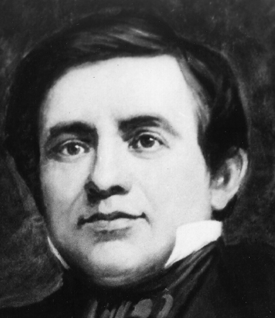
Secretary of the Interior
Alexander Hugh Holmes Stuart
~ Department of the Interior
“This way, sir; this way, sir;” and I followed him.
He entered a side door just back of the Indian Commissioner’s office and up a short flight of stairs, and going in behind a railing, divested himself of hat and cane, and said :
“What can I do for you sir.”
I told him who I was, what my party consisted of, where we came from and the object of our visit, as briefly as possible. He replied that I must go and see the Commissioner of Indian Affairs just down stairs. I told him I had been there and the treatment I had received at his hands, then he said :
“Did you have permission to come, and why did you not go to your agent in the west for permission?”
I then attempted to explain that we had been to the agent, but could get no satisfaction; but he stopped me in the middle of my explanation, saying :
“I can do nothing for you. You must go to the Indian Commissioner,”
and turning, began a conversation with his clerk who was there when we went in.
I walked out more discouraged than ever and could not imagine what next I could do. I wandered around the city and to the Capitol, thinking I might find some one I had seen before, but in this I failed and returned to the hotel, where, in the office I found Buffalo surrounded by a crowd who were trying to make him understand them and among them was the steward of the house. On my entering the office and Buffalo recognizing me, the assemblage, seeing I knew him, turned their attention to me, asking who he was, etc., to all of which questions I answered as briefly as possible, by stating that he was the head chief of of the Chippewas of the Northwest. The steward then asked:
“Why don’t you take him into the dining room with you? Certainly such a distinguished man as he, the head of the Chippewa people, should have at least that privilege.”

United States Representative George Briggs
~ Library of Congress
I did so and as we passed into the dining room we were shown to a table in one corner of the room which was unoccupied. We had only been seated a few moments when a couple of gentlemen who had been occupying seats in another part of the dining room came over and sat at our table and said that if there were no objections they would like to talk with us. They asked about the party, where from, the object of the visit, etc. I answered them briefly, supposing them to be reporters and I did not care to give them too much information. One of these gentlemen asked what room we had, saying that himself and one or two others would like to call on us right after dinner. I directed them where to come and said I would be there to meet them.
About 2 o’clock they came, and then for the first time I knew who those gentlemen were. One was Senator Briggs, of New York, and the others were members of President Filmore’s cabinet, and after I had told them more fully what had taken me there, and the difficulties I had met with, and they had consulted a little while aside. Senator Briggs said :
“We will undertake to get you and your people an interview with the President, and will notify you here when a meeting can be arranged. ”
During the afternoon I was notified that an interview had been arranged for the next afternoon at 3 o’clock. During the evening Senator Briggs and other friends called, and the whole matter was talked over and preparations made for the interview the following day, which were continued the next day until the hour set for the interview.

United States President
Millard Fillmore.
~ Library of Congress
When we were assembled Buffalo’s first request was that all be seated, as he had the pipe of peace to present, and hoped that all who were present would partake of smoke from the peace pipe. The pipe, a new one brought for the purpose, was filled and lighted by Buffalo and passed to the President who took two or three draughts from it, and smiling said, “Who is the next?” at which Buffalo pointed out Senator Briggs and desired he should be the next. The Senator smoked and the pipe was passed to me and others, including the Commissioner of Indian Affairs, Secretary of the Interior and several others whose names I did not learn or cannot recall. From them, to Buffalo, then to O-sho-ga, and from him to the four braves in turn, which completed that part of the ceremony. The pipe was then taken from the stem and handed to me for safe keeping, never to be used again on any occasion. I have the pipe still in my possession and the instructions of Buffalo have been faithfully kept. The old chief now rose from his seat, the balance following his example and marched in single file to the President and the general hand-shaking that was began with the President was continued by the Indians with all those present. This over Buffalo said his under chief, O-sha-ga, would state the object of our visit and he hoped the great father would give them some guarantee that would quiet the excitement in his country and keep his young men peaceable. After I had this speech thoroughly interpreted, O-sha-ga began and spoke for nearly an hour. He began with the treaty of 1837 and showed plainly what the Indians understood the treaty to be. He next took up the treaty of 1842 and said he did not understand that in either treaty they had ceded away the land and he further understood in both cases that the Indians were never to be asked to remove from the lands included in those treaties, provided they were peaceable and behaved themselves and this they had done. When the order to move came Chief Buffalo sent runners out in all directions to seek for reasons and causes for the order, but all those men returned without finding a single reason among all the Superior and Mississippi Indians why the great father had become displeased. When O-sha-ga had finished his speech I presented the petition I had brought and quickly discovered that the President did recognize some names upon it, which gave me new courage. When the reading and examination of it had been concluded the meeting was adjourned, the President directing the Indian Commissioner to say to the landlord at the hotel that our hotel bills would be paid by the government. He also directed that we were to have the freedom of the city for a week.
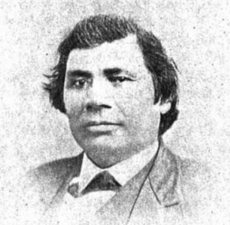
Read Biographical Sketch of Vincent Roy, Jr. manuscript for a different perspective on their meeting the President.
The second day following this Senator Briggs informed me that the President desired another interview that day, in accordance with which request we went to the White House soon after dinner and meeting the President, he told the, delegation in a brief speech that he would countermand the removal order and that the annuity payments would be made at La Pointe as before and hoped that in the future there would be no further cause for complaint. At this he handed to Buffalo a written instrument which he said would explain to his people when interpreted the promises he had made as to the removal order and payment of annuities at La Pointe and hoped when he had returned home he would call his chiefs together and have all the statements therein contained explained fully to them as the words of their great father at Washington.
The reader can imagine the great load that was then removed from my shoulders for it was a pleasing termination of the long and tedious struggle I had made in behalf of the untutored but trustworthy savage.

Downtown St. Paul, Minnesota, circa 1857.
~ Minnesota Historical Society
On June 28th, 1852, we started on our return trip, going by cars to La Crosse, Wis., thence by steamboat to St. Paul, thence by Indian trail across the country to Lake Superior. On our way from St. Paul we frequently met bands of Indians of the Chippewa tribe to whom we explained our mission and its results, which caused great rejoicing, and before leaving these bands Buffalo would tell their chief to send a delegation, at the expiration of two moons, to meet him in grand council at La Pointe, for there was many things he wanted to say to them about what he had seen and the nice manner in which he had been received and treated by the great father.
At the time appointed by Buffalo for the grand council at La Pointe, the delegates assembled and the message given Buffalo by President Filmore was interpreted, which gave the Indians great satisfaction. Before the grand council adjourned word was received that their annuities would be given to them at La Pointe about the middle of October, thus giving them time to get together to receive them. A number of messengers was immediately sent out to all parts of the territory to notify them and by the time the goods arrived, which was about October 15th, the remainder of the Indians had congregated at La Pointe. On that date the Indians were enrolled and the annuities paid and the most perfect satisfaction was apparent among all concerned. The jubilee that was held to express their gratitude to the delegation that had secured a countermanding order in the removal matter was almost extravagantly profuse. The letter of the great father was explained to them all during the progress of the annuity payments and Chief Buffalo explained to the convention what he had seen; how the pipe of peace had been smoked in the great father’s wigwam and as that pipe was the only emblem and reminder of their duties yet to come in keeping peace with his white children, he requested that the pipe be retained by me. He then went on and said that there was yet one more treaty to be made with the great father and he hoped in making it they would be more careful and wise than they had heretofore been and reserve a part of their land for themselves and their children. It was here that he told his people that he had selected and adopted, me as his son and that I would hereafter look to treaty matters and see that in the next treaty they did not sell them selves out and become homeless ; that as he was getting old and must soon leave his entire cares to others, he hoped they would listen to me as his confidence in his adopted son was great and that when treaties were presented for them to sign they would listen to me and follow my advice, assuring them that in doing so they would not again be deceived.

Map of Lake Superior Chippewa territories ceded in 1836, 1837, 1842, and 1854.
~ Great Lakes Indian Fish & Wildlife Commission
After this gathering of the Indians there was not much of interest in the Indian country that I can recall until the next annual payment in 1853. This payment was made at La Pointe and the Indians had been notified that commissioners would be appointed to make another treaty with them for the remainder of their territory. This was the territory lying in Minnesota west of Lake Superior; also east and west of the Mississippi river north to the territory belonging to the Boisfort and Pillager tribe, who are a part of the Chippewa nation, but through some arrangement between themselves, were detached from the main or more numerous body. It was at this payment that the Chippewa Indians proper desired to have one dollar each taken from their annuities to recompense me for the trouble and expense I had been to on the trip to Washington in their behalf, but I refused to accept it by reason of their very impecunious condition.
It was sometime in August, 1854, before the commissioners arrived at LaPointe to make the treaty and pay the annuities of that year. Messengers were despatched to notify all Indians of the fact that the great father had sent for them to come to La Pointe to get their money and clothing and to meet the government commissioners who wished to make another treaty with them for the territory lying west of Lake Superior and they were further instructed to have the Indians council among themselves before starting that those who came could be able to tell the wishes of any that might remain away in regards to a further treaty and disposition of their lands. Representatives came from all parts of the Chippewa country and showed a willingness to treat away the balance of their country. Henry C. Gilbert, the Indian agent at La Pointe, formerly of Ohio, and David B. Herriman, the agent for the Chippewas of the Mississippi country, were the commissioners appointed by the government to consumate this treaty.

Mackinac Indian Agent
Henry C. Gilbert
~ Branch County Photographs
While we were waiting the arrival of the interior Indians I had frequent talks with the commissioners and learned what their instructions were and about what they intended to offer for the lands which information I would communicate to Chief Buffalo and other head men in our immediate vicinity, and ample time was had to perfect our plans before the others should arrive, and when they did put in an appearance we were ready to submit to them our views for approval or rejection. Knowing as I did the Indians’ unwillingness to give up and forsake their old burying grounds I would not agree to any proposition that would take away the remainder of their lands without a reserve sufficient to afford them homes for themselves and posterity, and as fast as they arrived I counselled with them upon this subject and to ascertain where they preferred these reserves to be located. The scheme being a new one to them it required time and much talk to get the matter before them in its proper light. Finally it was agreed by all before the meeting of the council that no one would sign a treaty that did not give them reservations at different points of the country that would suit their convenience, that should afterwards be considered their bona-fide home. Maps were drawn of the different tracts that had been selected by the various chiefs for their reserve and permanent home. The reservations were as follows :
One at L’Anse Bay, one at Ontonagon, one at Lac Flambeau, one at Court O’Rilles, one at Bad River, one at Red Cliff or Buffalo Bay, one at Fond du Lac, Minn., and one at Grand Portage, Minn.

Joseph Stoddard (photo c.1941) worked on the 1854 survey of the Bad River Reservation exterior boundaries, and shared a different perspective about these surveys.
~ Bad River Tribal Historic Preservation Office
The boundaries were to be as near as possible by metes and bounds or waterways and courses. This was all agreed to by the Lake Superior Indians before the Mississippi Chippewas arrived and was to be brought up in the general council after they had come in, but when they arrived they were accompanied by the American Fur Company and most of their employees, and we found it impossible to get them to agree to any of our plans or to come to any terms. A proposition was made by Buffalo when all were gathered in council by themselves that as they could not agree as they were, a division should be drawn, dividing the Mississippi and the Lake Superior Indians from each other altogether and each make their own treaty After several days of counselling the proposition was agreed to, and thus the Lake Superiors were left to make their treaty for the lands mouth of Lake Superior to the Mississippi and the Mississippis to make their treaty for the lands west of the Mississippi. The council lasted several days, as I have stated, which was owing to the opposition of the American Fur Company, who were evidently opposed to having any such division made ; they yielded however, but only when they saw further opposition would not avail and the proposition of Buffalo became an Indian law. Our side was now ready to treat with the commissioners in open council. Buffalo, myself and several chiefs called upon them and briefly stated our case but were informed that they had no instructions to make any such treaty with us and were only instructed to buy such territory as the Lake Superiors and Mississippis then owned. Then we told them of the division the Indians had agreed upon and that we would make our own treaty, and after several days they agreed to set us off the reservations as previously asked for and to guarantee that all lands embraced within those boundaries should belong to the Indians and that they would pay them a nominal sum for the remainder of their possessions on the north shores. It was further agreed that the Lake Superior Indians should have two- thirds of all money appropriated for the Chippewas and the Mississippi contingent the other third. The Lake Superior Indians did not seem, through all these councils, to care so much for future annuities either in money or goods as they did for securing a home for themselves and their posterity that should be a permanent one. They also reserved a tract of land embracing about 100 acres lying across and along the Eastern end of La Pointe or Madeline Island so that they would not be cut off from the fishing privilege.
It was about in the midst of the councils leading up to the treaty of 1854 that Buffalo stated to his chiefs that I had rendered them services in the past that should be rewarded by something more substantial than their thanks and good wishes, and that at different times the Indians had agreed to reward me from their annuity money but I had always refused such offers as it would be taking from their necessities and as they had had no annuity money for the two years prior to 1852 they could not well afford to pay me in this way.
“And now,” continued Buffalo, “I have a proposition to make to you. As he has provided us and our children with homes by getting these reservations set off for us, and as we are about to part with all the lands we possess, I have it in my power, with your consent, to provide him with a future home by giving him a piece of ground which we are about to part with. He has agreed to accept this as it will take nothing from us and makes no difference with the great father whether we reserve a small tract of our territory or not, and if you agree I will proceed with him to the head of the lake and there select the piece of ground I desire him to have, that it may appear on paper when the treaty has been completed.”
The chiefs were unanimous in their acceptance of the proposition and told Buffalo to select a large piece that his children might also have a home in future as has been provided for ours.

Kiskitawag (Giishkitawag: “Cut Ear”) signed earlier treaties as a warrior of the Ontonagon Band and became associated with the La Pointe Band at Odanah.
~C.M. Bell, Smithsonian Digital Collections
This council lasted all night and just at break of day the old chief and myself, with four braves to row the boat, set out for the head of Lake Superior and did not stop anywhere only long enough to make and drink some tea, until we reached the head of St. Louis Bay. We landed our canoe by the side of a flat rock quite a distance from the shore, among grass and rushes. Here we ate our lunch and when completed Buffalo and myself, with another chief, Kish-ki-to-uk, waded ashore and ascended the bank to a small level plateau where we could get a better view of the bay. Here Buffalo turned to me, saying: .
“Are you satisfied with this location? I want to reserve the shore of this bay from the mouth of St. Louis river. How far that way do you you want it to go?” pointing southeast, or along the south shore of the lake.
I told him we had better not try to make it too large for if we did the great father’s officers at Washington might throw it out of the treaty and said:
“I will be satisfied with one mile square, and let it start from the rock which we have christened Buffalo rock, running easterly in the direction of Minnesota Point, taking in a mile square immediately northerly from the head of St. Louis Bay”
As there was no other way of describing it than by metes and bounds we tried to so describe it in the treaty, but Agent Gilbert, whether by mistake or not I am unable to say, described it differently. He described it as follows: “Starting from a rock immediately above and adjoining Minnesota Point, etc.”
We spent an hour or two here in looking over the plateau then went back to our canoe and set out for La Pointe. We traveled night and day until we reached home.
During our absence some of the chiefs had been talking more or less with the commissioners and immediately on our return all the Indians met in a grand council when Buffalo explained to them what he had done on the trip and how and where he had selected the piece of land that I was to have reserved in the treaty for my future home and in payment for the services I had rendered them in the past. The balance of the night was spent in preparing ourselves for the meeting with the treaty makers the next day, and about 10 o’clock next morning we were in attendance before the commissioners all prepared for a big council.
Mackinac Indian Agent
Henry Clark Gilbert
~ Branch County Photographs
Agent Gilbert started the business by beginning a speech interpreted by the government interpreter, when Buffalo interrupted him by saying that he did not want anything interpreted to them from the English language by any one except his adoped son for there had always been things told to the Indians in the past that proved afterwards to be untrue, whether wrongly interpreted or not, he could not say;
“and as we now feel that my adopted son interprets to us just what you say, and we can get it correctly, we wish to hear your words repeated by him, and when we talk to you our words can be interpreted by your own interpreter, and in this way one interpreter can watch the other and correct each other should there be mistakes. We do not want to be deceived any more as we have in the past. We now understand that we are selling our lands as well as the timber and that the whole, with the exception of what we shall reserve, goes to the great father forever.”

Bureau of Indian Affairs Director
George Washington Manypenny
~ Commons.Wikimedia.org
Commissioner of Indian affairs. Col. Manypenny, then said to Buffalo:
“What you have said meets my own views exactly and I will now appoint your adopted son your interpreter and John Johnson, of Sault Ste. Marie, shall be the interpreter on the part of the government,” then turning to the commissioners said, “how does that suit you, gentlemen.”
They at once gave their consent and the council proceeded.
Buffalo informed the commissioners of what he had done in regard to selecting a tract of land for me and insisted that it become a part of the treaty and that it should be patented to me directly by the government without any restrictions. Many other questions were debated at this session but no definite agreements were reached and the council was adjourned in the middle of the afternoon. Chief Buffalo asking for the adjournment that he might talk over some matters further with his people, and that night the subject of providing homes for their half-breed relations who lived in different parts of the country was brought up and discussed and all were in favor of making such a provision in the treaty. I proposed to them that as we had made provisions for ourselves and children it would be only fair that an arrangement should be made in the treaty whereby the government should provide for our mixed blood relations by giving to each person the head of a family or to each single person twenty-one years of age a piece of land containing at least eighty acres which would provide homes for those now living and in the future there would be ample room on the reservations for their children, where all could live happily together. We also asked that all teachers and traders in the ceded territory who at that time were located there by license and doing business by authority of law, should each be entitled to 160 acres of land at $1.25 per acre. This was all reduced to writing and when the council met next morning we were prepared to submit all our plans and requests to the commissioners save one, which we required more time to consider. Most of this day was consumed in speech-making by the chiefs and commissioners and in the last speech of the day, which was made by Mr. Gilbert, he said:
“We have talked a great deal and evidently understand one another. You have told us what you want, and now we want time to consider your requests, while you want time as you say to consider another matter, and so we will adjourn until tomorrow and we, with your father. Col. Manypenny, will carefully examine and consider your propositions and when we meet to-morrow we will be prepared to answer you with an approval or rejection.”

Julius Austrian purchased the village of La Pointe and other interests from the American Fur Company in 1853. He entered his Town Plan of La Pointe on August 29th of 1854. He was the highest paid claimant of the 1854 Treaty at La Pointe. His family hosted the 1855 Annuity Payments at La Pointe.
~ Photograph of Austrian from the Madeline Island Museum
That evening the chiefs considered the other matter, which was to provide for the payment of the debts of the Indians owing the American Fur Company and other traders and agreed that the entire debt could not be more than $90,000 and that that amount should be taken from the Indians in bulk and divided up among their creditors in a pro-rata manner according to the amount due to any person or firm, and that this should wipe out their indebtedness. The American Fur Company had filed claims which, in the aggregate, amounted to two or three times this sum and were at the council heavily armed for the purpose of enforcing their claim by intimidation. This and the next day were spent in speeches pro and con but nothing was effected toward a final settlement.
Col. Manypenny came to my store and we had a long private interview relating to the treaty then under consideration and he thought that the demands of the Indians were reasonable and just and that they would be accepted by the commissioners. He also gave me considerable credit for the manner in which I had conducted the matter for Indians, considering the terrible opposition I had to contend with. He said he had claims in his possession which had been filed by the traders that amounted to a large sum but did not state the amount. As he saw the Indians had every confidence in me and their demands were reasonable he could see no reason why the treaty could not be speedily brought to a close. He then asked if I kept a set of books. I told him I only kept a day book or blotter showing the amount each Indian owed me. I got the books and told him to take them along with him and that he or his interpreter might question any Indian whose name appeared thereon as being indebted to me and I would accept whatever that Indian said he owed me whether it be one dollar or ten cents. He said he would be pleased to take the books along and I wrapped them up and went with him to his office, where I left them. He said he was certain that some traders were making claims for far more than was due them. Messrs. Gilbert and Herriman and their chief clerk, Mr. Smith, were present when Mr. Manypenny related the talk he had with me at the store. He considered the requests of the Indians fair and just, he said, and he hoped there would be no further delays in concluding the treaty and if it was drawn up and signed with the stipulations and agreements that were now understood should be incorporated in it, he would strongly recommend its ratification by the President and senate.

Naagaanab of Fond Du Lac
~ Minnesota Historical Society
The day following the council was opened by a speech from Chief Na-gon-ab in which he cited considerable history.
“My friends,” he said, “I have been chosen by our chief, Buffalo, to speak to you. Our wishes are now on paper before you. Before this it was not so. We have been many times deceived. We had no one to look out for us. The great father’s officers made marks on paper with black liquor and quill. The Indian can not do this. We depend upon our memory. We have nothing else to look to. We talk often together and keep your words clear in our minds. When you talk we all listen, then we talk it over many times. In this way it is always fresh with us. This is the way we must keep our record. In 1837 we were asked to sell our timber and minerals. In 1842 we were asked to do the same. Our white brothers told us the great father did not want the land. We should keep it to hunt on. Bye and bye we were told to go away; to go and leave our friends that were buried yesterday. Then we asked each other what it meant. Does the great father tell the truth? Does he keep his promises? We cannot help ourselves! We try to do as we agree in treaty. We ask you what this means? You do not tell from memory! You go to your black marks and say this is what those men put down; this is what they said when they made the treaty. The men we talk with don’t come back; they do not come and you tell us they did not tell us so! We ask you where they are? You say you do not know or that they are dead and gone. This is what they told you; this is what they done. Now we have a friend who can make black marks on paper When the council is over he will tell us what we have done. We know now what we are doing! If we get what we ask our chiefs will touch the pen, but if not we will not touch it. I am told by our chief to tell you this: We will not touch the pen unless our friend says the paper is all right.”
Na-gon-ab was answered by Commissioner Gilbert, saying:
“You have submitted through your friend and interpreter the terms and conditions upon which you will cede away your lands. We have not had time to give them all consideration and want a little more time as we did not know last night what your last proposition would be. Your father. Col. Manypenny, has ordered some beef cattle killed and a supply of provisions will be issued to you right away. You can now return to your lodges and get a good dinner and talk matters over among yourselves the remainder of the day and I hope you will come back tomorrow feeling good natured and happy, for your father, Col. Manypenny, will have something to say to you and will have a paper which your friend can read and explain to you.”
When the council met next day in front of the commissioners’ office to hear what Col. Manypenny had to say a general good feeling prevailed and a hand-shaking all round preceded the council, which Col. Manypenny opened by saying:
“My friends and children: I am glad to see you all this morning looking good natured and happy and as if you could sit here and listen to what I have to say. We have a paper here for your friend to examine to see if it meets your approval. Myself and the commissioners which your great father has sent here have duly considered all your requests and have concluded to accept them. As the season is passing away and we are all anxious to go to our families and you to your homes, I hope when you read this treaty you will find it as you expect to and according to the understandings we have had during the council. Now your friend may examine the paper and while he is doing so we will take a recess until afternoon.”

Detail of Benjamin Armstrong from a photograph by Matthew Brady
~ Minnesota Historical Society
Chief Buffalo, turning to me, said:
“My son, we, the chiefs of all the country, have placed this matter entirely in your hands. Go and examine the paper and if it suits you it will suit us.”
Then turning to the chiefs, he asked,
“what do you all say to that?”
The ho-ho that followed showed the entire circle were satisfied.
I went carefully through the treaty as it had been prepared and with a few exceptions found it was right. I called the attention of the commissioners to certain parts of the stipulations that were incorrect and they directed the clerk to make the changes.
The following day the Indians told the commissioners that as their friend had made objections to the treaty as it was they requested that I might again examine it before proceeding further with the council. On this examination I found that changes had been made but on sheets of paper not attached to the body of the instrument, and as these sheets contained some of the most important items in the treaty, I again objected and told the commissioners that I would not allow the Indians to sign it in that shape and not until the whole treaty was re-written and the detached portions appeared in their proper places. I walked out and told the Indians that the treaty was not yet ready to sign and they gave up all further endeavors until next day. I met the commissioners alone in their office that afternoon and explained the objectionable points in the treaty and told them the Indians were already to sign as soon as those objections were removed. They were soon at work putting the instrument in shape.

“One version of the boundaries for Chief Buffalo’s reservation is shown at the base of Minnesota Point in a detail from an 1857 map preserved in the National Archives in Washington, D.C. Other maps show a larger and more irregularly shaped versions of the reservation boundary, though centered on the same area.”
~ DuluthStories.net
The next day when the Indians assembled they were told by the commissioners that all was ready and the treaty was laid upon a table and I found it just as the Indians had wanted it to be, except the description of the mile square. The part relating to the mile square that was to have been reserved for me read as follows:
“Chief Buffalo, being desirous of providing for some of his relatives who had rendered them important services, it is agreed that he may select one mile square of the ceded territory heretofore described.”
“Now,” said the commissioner,
“we want Buffalo to designate the person or persons to whom he wishes the patents to issue.”
Buffalo then said:
“I want them to be made out in the name of my adopted son.”
This closed all ceremony and the treaty was duly signed on the 30th day of September, 1854. This done the commissioners took a farewell shake of the hand with all the chiefs, hoping to meet them again at the annuity payment the coming year. They then boarded the steamer North Star for home. In the course of a few days the Indians also disappeared, some to their interior homes and some to their winter hunting grounds and a general quiet prevailed on the island.

Portrait of the Steamer North Star from American Steam Vessels, by Samuel Ward Stanton, page 40.
~ Wikimedia.org
About the second week in October, 1854, I went from La Pointe to Ontonagon in an open boat for the purpose of purchasing my winter supplies as it had got too late to depend on getting them from further below. While there a company was formed for the purpose of going into the newly ceded territory to make claims upon lands that would be subject to entry as soon as the late treaty should be ratified. The company consisted of Samuel McWaid, William Whitesides, W. W. Kingsbury, John Johnson, Oliver Melzer, John McFarland, Daniel S. Cash, W. W. Spaulding, all of Ontonagon, and myself. The two last named gentlemen, Daniel S. Cash and W. W. Spaulding, agreeing to furnish the company with supplies and all necessaries, including money, to enter the lands for an equal interest and it was so stipulated that we were to share equally in all that we, or either of us, might obtain. As soon as the supplies could be purchased and put aboard the schooner Algonquin we started for the head of the lake, stopping at La Pointe long enough for me to get my family aboard and my business matters arranged for the winter. I left my store at La Pointe in charge of Alex. Nevaux, and we all sailed for the head of Lake Superior, the site of which is now the city of Duluth. Reaching there about the first week in December—the bay of Superior being closed by ice—we were compelled to make our landing at Minnesota Point and take our goods from there to the main land on the north’ shore in open boats, landing about one and-one half miles east of Minnesota Point at a place where I desired to make a preemption for myself and to establish a trading post for the winter. Here I erected a building large enough for all of us to live in, as we expected to make this our headquarters for the winter, and also a building for a trading post. The other members of the company made claims in other places, but I did no more land looking that winter.

Detail of Superior City townsite at the head of Lake Superior from the 1854 U.S. General Land Office survey by Stuntz and Barber.
About January 20th, 1855, I left my place at the head of the lake to go back to La Pointe and took with me what furs I had collected up to that time, as I had a good place at La Pointe to dry and keep them. I took four men along to help me through and two dog trains. As we were passing down Superior Bay and when just in front of the village of West Superior a man came to us on the ice carrying a small bundle on his back and asked me if I had any objections to his going through in my company. He said the snow was deep and the weather cold and it was bad for one man to travel alone. I told him I had no objections provided he would take his turn with the other men in breaking the road for the dogs. We all went on together and camped that night at a place well known as Flag River. We made preparations for a cold night as the thermometer must have been twenty-five or thirty degrees below zero and the snow fully two feet deep. As there were enough of us we cut and carried up a large quantity of wood, both green and dry, and shoveled the snow away to the ground with our snow shoes and built a large fire. We then cut evergreen boughs and made a wind break or bough camp and concluded we could put in a very comfortable night. We then cooked and ate our supper and all seemed happy. I unrolled a bale of bear skins and spread them out on the ground for my bed, filled my pipe and lay down to rest while the five men with me were talking and smoking around the camp fire. I was very tired and presume I was not long in falling asleep. How long I slept I cannot tell, but was awakened by something dropping into my face, which felt like a powdered substance. I sprang to my feet for I found something had got into my eyes and was smarting them badly. I rushed for the snow bank that was melting from the heat and applied handful after handful to my eyes and face. I found the application was peeling the skin off my face and the pain soon became intense. I woke up the crew and they saw by the firelight the terrible condition I was in. In an hour’s time my eyeballs were so swollen that I could not close the lids and the pain did not abate. I could do nothing more than bathe my eyes until morning, which I did with tea-grounds. It seemed an age before morning came and when it did come I could not realize it, for I was totally blind. The party started with me at early dawn for La Pointe. The man who joined us the day before went no further, but returned to Superior, which was a great surprise to the men of our party, who frequently during the day would say:
“There is something about this matter that is not right,”
and I never could learn afterward of his having communicated the fact of my accident to any one or to assign any reason or excuse for turning back, which caused us to suspect that he had a hand in the blinding, but as I could get no proof to establish that suspicion, I could do nothing in the matter. This man was found dead in his cabin a few months afterwards.
At La Pointe I got such treatment as could be procured from the Indians which allayed the inflamation but did not restore the sight. I remained at La Pointe about ten days, and then returned home with dog train to my family, where I remained the balance of the winter, when not at Superior for treatment. When the ice moved from the lake in the spring I abandoned everything there and returned to La Pointe and was blind or nearly so until the winter of 1861.
Returning a little time to the north shore I wish to relate an incident of the death of one of our Ontonagon company. Two or three days after I had reached home from La Pointe, finding my eyes constantly growing worse I had the company take me to Superior where I could get treatment. Dr. Marcellus, son of Prof. Marcellus, of an eye infirmary in Philadelphia, who had just then married a beautiful young wife, and come west to seek his fortune, was engaged to treat me. I was taken to the boarding house of Henry Wolcott, where I engaged rooms for the winter as I expected to remain there until spring. I related to the doctor what had befallen me and he began treatment. At times I felt much better but no permanent relief seemed near. About the middle February my family required my presence at home, as there was some business to be attended to which they did not understand. My wife sent a note to me by Mr. Melzer, stating that it was necessary for me to return, and as the weather that day was very pleasant, she hoped that I would come that afternoon. Mr. Melzer delivered me the note, which I requested him to read. It was then 11 a. m. and I told him we would start right after dinner, and requested him to tell the doctor that I wished to see him right away, and then return and get his dinner, as it would be ready at noon, to which he replied:
“If I am not here do not wait for me, but I will be here at the time you are ready for home.”
Mr. Melzer did return shortly after we had finished our dinner and I requested him to eat, as I would not be ready to start for half an hour, but he insisted he was not hungry. We had no conveyance and at 1 p. m. we set out for home. We went down a few steps to the ice, as Mr. Wolcott’s house stood close to the shore of the bay, and went straight across Superior Bay to Minnesota Point, and across the point six or eight rods and struck the ice on Lake Superior. A plain, hard beaten road led from here direct to my home. After we had proceeded about 150 yards, following this hard beaten road, Melzer at once stopped and requested me to go ahead, as I could follow the beaten road without assistance, the snow being deep on either side.
“Now,” he says go ahead, for I must go back after a drink.”
I followed the road quite well, and when near the house my folks came out to meet me, their first inquiry being:
“Where is Melzer?”
I told them the circumstances of his turning back for a drink of water. Reaching the bank on which my house stood, some of my folks, looking back over the road I had come, discovered a dark object apparently floundering on the ice. Two or three of our men started for the spot and there found the dead body of poor Melzer. We immediately notified parties in Superior of the circumstances and ordered a post-mortem examination of the body. The doctors found that his stomach was entirely empty and mostly gone from the effects of whisky and was no thicker than tissue paper and that his heart had burst into three pieces. We gave him a decent burial at Superior and peace to his ashes, His last act of kindness was in my behalf.
To be continued in Chapter III…
Among The Otchipwees: III
July 20, 2016
By Amorin Mello
… continued from Among The Otchipwees: II

Magazine of Western History Illustrated
No. 4 February 1885
as republished in
Magazine of Western History: Volume I, pages 335-342.
AMONG THE OTCHIPWEES.
III.
The Northern tribes have nothing deserving the name of historical records. Their hieroglyphics or pictorial writings on trees, bark, rocks and sheltered banks of clay relate to personal or transient events. Such representations by symbols are very numerous but do not attain to a system.
Their history prior to their contact with the white man has been transmitted verbally from generation to generation with more accuracy than a civilized people would do. Story-telling constitutes their literature. In their lodges they are anything but a silent people. When their villages are approached unawares, the noise of voices is much the same as in the camps of parties on pic-nic excursions. As a voyageur the pure blood is seldom a success, and one of the objections to him is a disposition to set around the camp-fire and relate his tales of war or of the hunt, late into the night. This he does with great spirit, “suiting the action to the word” with a varied intonation and with excellent powers of description. Such tales have come down orally from old to young many generations, but are more mystical than historical. The faculty is cultivated in the wigwam during long winter nights, where the same story is repeated by the patriarchs to impress it on the memory of the coming generation. With the wild man memory is sharp, and therefore tradition has in some cases a semblance to history. In substance, however, their stories lack dates, the subjects are frivolous or merely romantic, and the narrator is generally given to embellishment. He sees spirits everywhere, the reality of which is accepted by the child, who listens with wonder to a well-told tale, in which he not only believes, but is preparing to be a professional story-teller himself.
Indian picture-writings and inscriptions, in their hieroglyphics, are seen everywhere on trees, rocks and pieces of bark, blankets and flat pieces of wood. Above Odanah, on Bad River, is a vertical bank of clay, shielded from storms by a dense group of evergreens. On this smooth surface are the records of many generations, over and across each other, regardless of the rights of previous parties. Like most of their writings, they relate to trifling events of the present, such as the route which is being traveled; the game killed; or the results of a fight. To each message the totem or dodem of the writer is attached, by which he is at once recognized. But there are records of some consequence, though not strictly historical.

Charles Whittlesey also reproduced Okandikan’s autobiography in Western Reserve Historical Society Tract 41.
Before a young man can be considered a warrior, he must undergo an ordeal of exposure and starvation. He retires to a mountain, a swamp, or a rock, and there remains day and night without food, fire or blankets, as long as his constitution is able to endure the exposure. Three or four days is not unusual, but a strong Indian, destined to be a great warrior, should fast at least a week. One of the figures on this clay bank is a tree with nine branches and a hand pointing upward. This represents the vision of an Indian known to one of my voyagers, which he saw during his seclusion. He had fasted nine days, which naturally gave him an insight of the future, and constituted his motto, or chart of life. In tract No. 41 (1877), of the Western Reserve Historical Society, I have represented some of the effigies in this group; and also the personal history of Kundickan, a Chippewa, whom I saw in 1845, at Ontonagon. This record was made by himself with a knife, on a flat piece of wood, and is in the form of an autobiography. In hundreds of places in the United States such inscriptions are seen, of the meaning of which very little is known. Schoolcraft reproduced several of them from widely separated localities, such as the Dighton Boulder, Rhode Island; a rock on Kelley’s Island, Lake Erie, and from pieces of birch bark, conveying messages or memoranda to aid an orator in his speeches.
~ New Sources of Indian History, 1850-1891: The Ghost Dance and the Prairie Sioux, A Miscellany by Stanley Vestal, 2015, page 269.
The “Indian rock” in the Susquehanna River, near Columbia, Pennsylvania; the God Rock, on the Allegheny, near Brady’s Bend; inscriptions on the Ohio River Rocks, near Wellsville, Ohio, and near the mouth of the Guyandotte, have a common style, but the particular characters are not the same. Three miles west of Barnsville, in Belmont County, Ohio, is a remarkable group of sculptured figures, principally of human feet of various dimensions and uncouth proportions. Sitting Bull gave a history of his exploits on sheets of paper, which he explained to Dr. Kimball, a surgeon in the army, published in fascimile in Harper’s Weekly, July 1876. Such hieroglyphics have been found on rocky faces in Arizona, and on boulders in Georgia.

Pointe De Froid is the northwestern extremity of La Pointe on Madeline Island. Map detail from 1852 PLSS survey.
~ Report of a geological survey of Wisconsin, Iowa, and Minnesota: and incidentally of a portion of Nebraska Territory, by David Dale Owen, 1852, page 420.
~ Geology of Wisconsin: Paleontology by R. P. Whitfield, 1880, page 58.
While pandemonium was let loose at La Pointe towards the close of the payment we made a bivouac on the beach, between the dock and the mission house. The voyageurs were all at the great finale which constitutes the paradise of a Chippewa. One of my local assistants was playing the part of a detective on the watch for whisky dealers. We had seen one of them on the head waters of Brunscilus River, who came through the woods up the Chippewa River. Beyond the village of La Pointe, on a sandy promontory called Pointe au Froid, abbreviated to Pointe au Fret or Cold Point, were about twenty-five lodges, and probably one hundred and fifty Indians excited by liquor. For this, diluted with more than half water, they paid a dollar for each pint, and the measure was none too large – neither pressed down nor running over. Their savage yells rose on the quiet moon-lit atmosphere like a thousand demons. A very little weak whisky is sufficient to work wonders in the stomach of a backwoods Indian, to whom it is a comparative stranger. About midnight the detective perceived our traveler from the Chippewa River quietly approaching the dock, to which he tied his canoe and went among the lodges. To the stern there were several kegs of fire-water attached, but weighted down below the surface of the water. It required but a few minutes to haul them in and stave the heads of all of them. Before morning there appeared to be more than a thousand savage throats giving full play to their powerful lungs. Two of them were staggering along the beach toward where I lay, with one man by my side. he said we had better be quiet, which, undoubtedly, was good advice. They were nearly naked, locked arm in arm, their long hair spread out in every direction, and as they swayed to and fro between the water line and the bushes, no imagination could paint a more complete representation of the demon. There was a yell to every step – apparently a bacchanalian song. They were within two yards before they saw us, and by one leap cleared everything, as though they were as much surprised as we were. The song, or howl, did not cease. It was kept up until they turned away from the beach into the mission road, and went on howling over the hill toward the old fort. It required three days for half-breed and full-blood alike to recover from the general debauch sufficiently to resume the oar and pack. As we were about to return to the Penoka Mountains, a Chippewa buck, with a new calico shirt and a clean blanket, wished to know if the Chemokoman would take him to the south shore. He would work a paddle or an oar. Before reaching the head of the Chegoimegon Bay there was a storm of rain. He pulled off his shirt, folded it and sat down upon it, to keep it dry. The falling rain on his bare back he did not notice.

Portrait of Stephen Bonga
~ Wisconsin Historical Society
We had made the grand portage of nine miles from the foot of the cataract of the St. Louis, above Fond du Lac, and encamped on the river where the trail came to it below the knife portage. In the evening Stephen Bungo, a brother of Charles Bungo, the half-breed negro and Chippewa, came into our tent. He said he had a message from Naugaunup, second chief of the Fond du Lac band, whose home as at Ash-ke-bwau-ka, on the river above. His chief wished to know by what authority we came through the country without consulting him. After much diplomatic parley Stephen was given some pequashigon and went to his bivouac.

Joseph Granville Norwood
~ Wikipedia.org
Portrait of Naagaanab
~ Minnesota Historical Society
The next morning he intimated that we must call at Naugaunup’s lodge on the way up, where probably permission might be had, by paying a reasonable sum, to proceed. We found him in a neat wigwam with two wives, on a pleasant rise of the river bluff, clear of timber, where there had been a village of the same name. His countenance was a pleasant one, very closely resembling that of Governor Corwin, of Ohio, but his features were smaller and also his stature. Dr. Norwood informed him that we had orders from the Great Father to go up the St. Louis to its source, thence to the waters running the other way to the Canada line. Nothing but force would prevent us from doing this, and if he was displeased he should make a complaint to the Indian agent at La Pointe, and he would forward it to Washington. We heard no more of the invasion of his territory, and he proceeded to do what very few Chippewas will do, offered to show us valuable minerals. In the stream was a pinnacle of black sale, about sixty feet high. Naugaunup soon appeared from behind it, near the top, in a position that appeared to be inaccessible, a very picturesque object pointing triumphantly to some veins of white quartz, which are very common in metamorphic slate.
Those who have heard him, say that he was a fine orator, having influence over his band, a respectable Indian, and a good negotiator. If he imagined there was value in those seams of quartz it is quite remarkable and contrary to universal practice among Chippewas that he should show them to white men. They claim that all minerals belong to the tribe. An Indian who received a price for showing them, and did not give every one his share, would be in danger of his life. They had also a superstitious dread of some great evil if they disclosed anything of the kind. Some times they promise to do so, but when they arrive at the spot, with some verdant white man, expecting to become suddenly rich, the Great Spirit or the Bad Manitou has carried it away. I have known more than one such instance, where persons have been sustained by hopeful expectation after many days of weary travel into the depths of the forest. The editor of the Ontonagon Miner gives one of the instances in his experience:
“Many years ago when Iron River was one of the fur stations, of John Jacob Astor and the American Fur Company, the Indians were known to have silver in its native state in considerable quantities.”
Men are now living who have seen them with chunks of the size of a man’s fist, but no one ever succeeded in inducing them to tell or show where the hidden treasure lay. A mortal dread clung to them, that if they showed white men a deposit of mineral the Great Manitou would punish them with death.
Several years since a half-breed brought in very fine specimens of vein rock, carrying considerable quantities of native silver. His report was that his wife had found it on the South Range, where they were trapping. To test his story he was sent back for more. In a few days he returned bringing with him quite a chunk from which was obtained eleven and one-half ounces of native silver. He returned home, went among the Flambeaux Indians and was killed. His wife refused to listen to any proposals or temptation from friend or foe to show the location of this vein, clinging with religious tenacity to the superstitious fears of her tribe.
When the British had a fort on St. Joseph’s Island in the St. Mary’s River, in the War of 1812, an Indian brought in a rich piece of copper pyrites. The usual mode of getting on good terms with him, by means of whisky, failed to get from him the location of the mineral. Goods were offered him; first a bundle, then a pile, afterwards a canoe-load, and finally enough to load a Mackinaw boat. No promise to disclose the place, no description or hint could be extorted. It was probably a specimen from the veins on the Bruce or Wellington mining property, only about twenty miles distant on the Canadian shore.
Detail of John Beargrease the Younger from stereograph “Lake Superior winter mail line” by B. F. Childs, circa 1870s-1880s.
~ Commons.Wikimedia.org
Crossing over the portage from the St. Louis River to Vermillion River, one of the voyageurs heard the report of a distant shot. They had expected to meet Bear’s Grease, with his large family, and fired a gun as a signal to them. The ashes of their fire were still warm. After much shouting and firing, it was evident that we should have no Indian society at that time. That evening, around an ample camp fire, we heard the history of the old patriarch. His former wives had borne him twenty-four children; more boys than girls. Our half-breed guide had often been importuned to take one of the girls. The old father recommended her as a good worker, and if she did not work he must whip her. Even a moderate beating always brought her to a sense of her duties. All he expected was a blanket and a gun as an offset. He would give a great feast on the occasion of the nuptials. Over the summit to Vermillion, through Vermillion Lake, passing down the outlet among many cataracts to the Crane Lake portage, there were encamped a few families, most of them too drunk to stand alone. There were two traders, from the Canada side, with plenty of rum. We wanted a guide through the intricacies of Rainy Lake. A very good-looking savage presented himself with a very unsteady gait, his countenance expressing the maudlin good nature of Tam O’Shanter as he mounted Meg. Withal, he appeared to be honest. “Yes, I know that way, but, you see, I’m drunk; can’t you wait till to-morrow.” A young squaw who apparently had not imbibed fire-water, had succeeded in acquiring a pewter ring. Her dress was a blanket of rabbit skins, made of strips woven like a rag carpet. It was bound around her waist with a girdle of deer’s hide, answering the purpose of stroud and blanket. No city belle could exhibit a ring of diamonds more conspicuously and with more self-satisfaction than this young squaw did her ring of pewter.
As we were all silently sitting in the canoes, dripping with rain, a sudden halloo announced the approach of living men. It was no other than Wau-nun-nee, the chief of the Grand Fourche bands, who was hunting for ducks among the rice. More delicious morsels never gladdened the palate than these plump, fat, rice-fed ducks. Old Wau-nun-nee is a gentleman among Indian chiefs. His band had never consented to sell their land, and consequently had no annuities. He even refused to receive a present from the Government as one of the head men of the tribe, preferring to remain wholly independent. We soon came to his village on Ash-ab-ash-kaw Lake. No band of Indians in our travels appeared as comfortable or behaved as well as this. Their country is well supplied with rice and tolerably good hunting ground. The American fur dealers (I mean the licensed ones) do not sell liquor to the Indians, and use their influence to aid Government in keeping it from them. Wau-nun-nee’s baliwick was seldom disturbed by drunken brawls. His Indians had more pleasant countenances than any we had seen, with less of the wild and haggard look than the annuity Indians. It was seldom they left their grounds, for they seldom suffered from hunger. They were comfortably clothed, made no importunities for kokoosh or pequashigon, and in gratifying their savage curiosity about our equipments they were respectful and pleasant. In his lodge the chief had teacups and saucers, with tea and sugar for his white guests, which he pressed us to enjoy. But we had no time for ceremonials, and had tea and sugar of our own. Our men recognized numerous acquaintances among the women, and as we encamped near a second village at Round Lake they came to make a draft on our provision chest. We here laid in a supply of wild rice in exchange for flour. Among this band we saw bows and arrows used to kill game. They have so little trade with the whites, and are so remote from the depots of Indian goods, that powder and lead are scarce, and guns also. For ducks and geese the bow and arrow is about as effectual as powder and shot. In truth, the community of which Wau-nun-nee was the patriarch came nearer to the pictures of Indians which poets are fond of drawing than any we saw. The squaws were more neatly clad, and their hair more often combed and braided and tied with a piece of ribbon or red flannel, with which their pappooses delighted to sport. There were among them fewer of those distinguished smoke-dried, sore-eyed creatures who present themselves at other villages.
By my estimate the channel, as we followed it to the head of the Round Lake branch, is two hundred and two mile in length, and the rise of the stream one hundred and eight feet. The portage to a stream leading into the Mississippi is one mile.
At Round Lake we engaged two young Indians to help over the portage in Jack’s place. Both of them were decided dandies, and one, who did not overtake us till late the next morning, gave an excuse that he had spent the night in courting an Indian damsel. This business is managed with them a little differently than with us. They deal largely in charms, which the medicine men furnish. This fellow had some pieces of mica, which he pulverized, and was managing to cause his inamorata to swallow. If this was effected his cause was sure to succeed. He had also some ochery, iron ore and an herb to mix with the mica. Another charm, and one very effectual, is composed of a hair from the damsel’s head placed between two wooden images. Our Lothario had prepared himself externally so as to produce a most killing effect. His hair was adorned with broad yellow ribbons, and also soaked in grease. On his cheeks were some broad jet black stripes that pointed, on both sides, toward his mouth; in his ears and nose, some beads four inches long. For a pouch and medicine bag he had the skin of a swan suspended from his girdle by the neck. His blanket was clean, and his leggings wrought with great care, so that he exhibited a most striking collection of colors.
At Round Lake we overtook the Cass Lake band on their return from the rice lakes. This meeting produced a great clatter of tongues between our men and the squaws, who came waddling down a slippery bank where they were encamped. There was a marked difference between these people and those at Ash-ab-ash-kaw. They were more ragged, more greasy, and more intrusive.
CHARLES WHITTLSEY.
Among The Otchipwees: II
June 4, 2016
By Amorin Mello
… continued from Among The Otchipwees: I
Magazine of Western History Illustrated
No. 3 January 1885
as republished in
Magazine of Western History: Volume I, pages 177-192.
AMONG THE OTCHIPWEES.
II.
In the fall of 1849, the Bad Water band were in excellent condition, and therefore very happy. Deer were then very abundant on the Menominee. They are nimble animals, able to leap gracefully over obstructions as high as a man’s head standing. But they do not like such efforts, unless there is a necessity for it. The Indians discovered this long ago, and built long brush fences across their trails to the water. When the unsuspecting animal has finished browsing, he goes for a drink with the regularity of an habitué of a saloon. Seeing the obstruction, he walks leisurely along it, expecting to find a low place, or the end of it. The dark eye of the Chippewa is fixed upon him from the top of a tree. This is much the best position, because the deer is not likely to look up, and the wind is less likely to bear his odor to the delicate nostrils of the game. At such close quarters every shot is fatal. Its throat is cut, its legs tied together, and thrown over the head and shoulders of the hunter, its body resting on his back, and he starts for the village. Here the squaws strip off the hide and prepare the carcass for the kettle. With a tin cup full of flour or a pound of pork, we often purchased a saddle of venison, and both parties were satisfied with the trade.
Naagaanab
~ Minnesota Historical Society
~ Executive Documents of the State of Minnesota for the Year 1886, Volume V.: Minnesota Geographical Names Derived from the Chippewa Language, by Reverend Joseph Alexander Gilfillan, 1887, page 457.
“Akwaakwaa” refers to “go a certain distance in the woods.”
~ General Geology: Miscellaneous Papers, Volume 1: A Report of Explorations in the Mineral Regions of Minnesota During the Years 1848, 1859 and 1864 by Colonel Charles Whittlesey, 1866, page 44.
Of course the man of the woods has a preference as to what he shall eat; but when he is suffering from hunger, as he is a large part of his days, he is not very particular. Fresh venison, bear meat, buffalo, moose, caribou, porcupine, wild geese, ducks, rabbits, pigeons, or fish, relish better than gulls, foxes, or skunks. The latter do very well while he is on the verge of starvation, and even owls, crows, dead horses and oxen. The lakes of the interior of Minnesota and Wisconsin produce wild rice spontaneously. When parched it is more palatable than southern rice, and more nutritious. Potatoes grow well everywhere in the north country; varieties of corn ripen as far north as Red Lake. Nothing but a disinclination to labor hinders the Chippewa from always having enough to eat. With the wild rice, sugar, and the fat of animals, well mixed, they make excellent rations, which will sustain life longer than any preparation known to white men. A packer will carry on his back enough to last him forty days. He needs only a tin cup in which to warm water, with which it makes a rich soup. Pemmican is less palatable, and sooner becomes rancid. This is made of smoke or jerked meat pulverized, saturated with fat and pressed into cakes or blocks. Sturgeon are numerous and large, and when well smoked and well pulverized they furnish palatable food even without salt, and keep indefinitely. Voyagers mix it with sugar and water in their cups. In the large lakes, white fish, siskowit, and lake trout are abundant. In the smaller lakes and rivers there are many varieties of fish. With so many resources supplied by nature, if the natives suffer from hunger it is solely caused by indolence. His implicit reliance upon the Great Spirit, which is his good Providence, no doubt encourages improvidence. Nanganob was apparently very desirous to have a garden at Ashkebwaka, for which I sent him a barrel of seed potatoes, corn, pumpkins, and a general assortment of seeds. Precisely what was done with the parcel I do not know, but none of it went into the ground. In most cases everything eatable went into their stomachs as soon as they were hungry. Even after potatoes had been planted, they have been dug out and eaten, and squashes when they were merely out of bloom. If the master of a lodge should be inclined to preserve the seed and a hungry brother came that way, their hospitality required that the garden should be sacrificed. Their motto is that the morrow will take care of itself. After being well fed, they are especially worthless. When corn has been issued to them to carry to their home, they have been known to throw it away and go off as happy as children.

Detail of the Saint Louis River with the Artichoke River (unlabeled) between the Knife Portage and East Savannah River from Hydrographical Basin of the Upper Mississippi River from Astronomical and Barometrical Observations Surveys and Information by Joseph Nicolas Nicollet, 1843.
~ David Rumsey Map Collection
No footgear is more comfortable, especially in winter, than the moccasin. The Indian knows nothing of cold feet, though he has no shoes or even socks. His light loose moccasin is large enough to allow a wrap of one or more thickness of pieces of blankets, called “nepes.” In times of extreme cold, wisps of hay are put in around the “nepes.” In winter the snow is dry, and the rivers and swamps everywhere covered with ice, which is a thorough protection against wet feet. As they are never pinched by the devices of shoemakers, the blood circulates freely. The well tanned deer skin is soft and a good nonconductor, which cannot be said of the footgear of civilization. In summer the moccasin is light and easy to the foot, but is no protection against water. At night it is not dried at the camp-fire only wrung out to be put on wet in the morning. Like the bow and the arrow, these have nearly disappeared since Europeans have furnished bullets, powder and guns. Before that time the war club was a very important weapon. It was of wood, having a strong handle, with a ball or knot at the end. If the Chippewas used battleaxes of stone, they could not have been common. I have rarely seen a light war club with an iron spike well fastened in the knot or ball at the end. In ancient days, when their arrows and daggers were tipped with flint, their battles were like those of all rude people – personal encounters of the most desperate character. The sick are possessed of evil spirits which are driven out by incantations loud and prolonged enough to kill a well person. Their acquaintance with medical herbs is very complete.
One of the customs of the country is that of concubinage as well as polygamy, resembling in this respect the ancient Hebrews and other Eastern nations. The parents of a girl – on proper application and the payment of a blanket, some tobacco and other et ceteras, amounting to “ten pieces” – bestowing their daughter for such a period as her new master may choose. A further consideration is understood that she is to be clothed and fed, and when the parents visit the traders’ post they expect some pork and flour. To a maiden – who, as an Indian wife or in her father’s house is not only a drudge but a slave, compelled to row the canoe, to cut and bring wood, put up the lodge and take it down, and always to carry some burden – this situation is a very agreeable one. If she wishes to marry afterwards, her reputation does not suffer. While Mr. B. was conversing with the Hudson’s Bay man on the bank, some of the girls came coquettishly down to them frisking about in their rabbit skin blankets well saturated with grease. One of them managed to keep in view what she considered a special attraction – a fine pewter ring on her finger. These Chippewas damsels had in some way acquired the art of insinuation belonging to the sex without the aid of a boarding school.
The Indian agent at La Pointe killed a deer of about medium size, which he left in the woods. He engaged an Indian to bring it in. Night came and the next day before the man returned without the deer. “Where is my deer?” “Eat him, don’t suppose me to eat nothing.” Probably that meal lasted him a week. There is among them no regular time for meals or other occupations. If there are provisions in the lodge, each one helps himself; and if a visitor comes, he is offered what he can eat as long as it lasts. This is their view of hospitality. The lazy and worthless are never refused. To do this to the meanest professional dead beat would be the ruin of the character of the host.
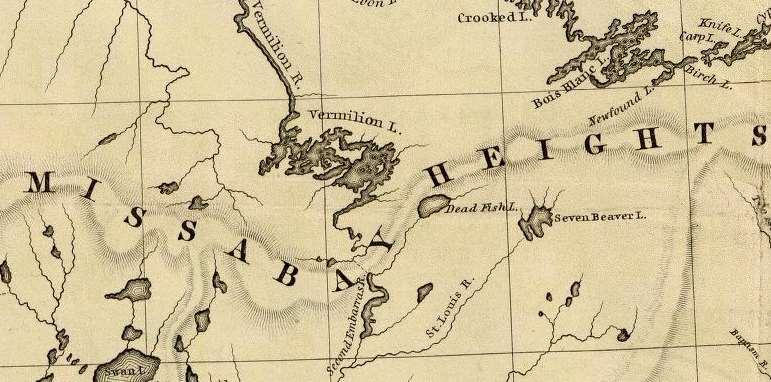
Detail of portage between Lake Vermillion and the Saint Louis River headwaters from Hydrographical Basin of the Upper Mississippi River from Astronomical and Barometrical Observations Surveys and Information by Joseph Nicolas Nicollet, 1843.
~ David Rumsey Map Collection
“Vincent Roy Sr. was born at Leech Lake Minn. in the year 1779 1797, and died at Superior, Wis. Feb. 18th 1872. He was a son of a Canadian Frenchman by the same name as his son bears. When V. Roy, Sr was about 17 or 18 years old, they emigrated to Fort Frances, Dominion of Canada, where he was engaged by the North-West Fur Co. as a trader until the two Companies (the North-West and the Hudson Bay Co joined together) he still worked for the consolidated Company for 12 or 15 years. When the American Traders came out at the Vermillion Lake country in Minnesota Three or four years afterwards he joined the American Traders. For several years he went to Mackinaw, buying goods and supplies for the Bois Fortes bands of Chippeways on Rainy and Vermillion Lake Country. About the year 1839 he came out to the Lake Superior Country and located his family at La Pointe. In winters he went out to Leech Lake Minn., trading for the American Fur Co. For several years until in the year of 1847 when the Hon. H. M. Rice, now of St. Paul, came to this country representing the Pierre Choteau Co. as a fur trading company. V. Roy, Sr. engaged to Pierre Choteau & Co. to trade with his former Indians at Vermillion Lake Country for two years, and then went for the American Fur Company again for one year. After a few years he engaged as a trader again for Peter E. Bradshaw & Co. and went to Red Lake, Minn. for several years. In 1861 he went to Nipigon (on Canadian side) trading for the same company. In a few years, he again went back to his old post at Vermillion Lake, Minn., where he contracted a very severe sickness, in two years afterwards he died at Superior among his Children as stated before &c.”
~ Minnesota Historical Society: Henry M. Rice and Family Papers, 1824-1966; Box 4; Sketches folder; Item “Roy, Vincent, 1797-1872”
Among the Chippewas we hear of man eaters, from the earliest travelers down to this day. Mr. Bushnell, formerly Indian agent at La Pointe, described one whom he saw who belonged on the St. Louis River and Vermillion Lake. The Indians have a superstitious dread of them, and will flee when one enters the lodge. They are hated, but it is supposed they cannot be killed, and no one ventures to make the experiment. it is only by a bullet such as the man eater himself shall designate that his body can be pierced. He is frequently a lunatic, spending days and nights alone in the woods in mid winter without food, traveling long spaces to present himself unexpectedly among distant bands. Whatever he chooses to eat is left for him, and right glad are the inmates of a lodge to get rid of him on such easy terms. The practice is not acquired from choice, but from the terrible necessities of hunger which happen every winter among the northern Indians. Like shipwrecked parties at sea, the weaker first falls a prey to the stronger, and their flesh goes to sustain life a little longer among the remainder. The Chippewas think that after one has tasted human food he has an uncontrollable longing for it, and that it is not safe to leave children alone with them. They say a man eater has red eyes and he looks upon the fat papoose with a demonical glance, and says: “How tender he would be.” One miserable object on the St. Louis River eat off his own lips, and finally became such a source of consternation that one Indian more courageous than the rest buried a tomahawk in his head. Another one who had the reputation of having killed all of his own family, came to the winter fishing ground on Rainy Lake, where Mr. Roy was trading with the Indians. He stayed on the ice trying to take some fish, but without success. Not one of the band dared go out to fish, although they were suffering from hunger. Mr. Roy and all the Indians requested him to go away, but he would not unless he had something to eat. no one but the trader could give him anything, and he was not inclined to do so. Things remained thus during three days, no squaw daring to go on the ice to fish for fear of the man eater. Mr. Roy urged them to kill him, but they said it would be of no use to shoot at him. The man eater dared them to fire. The trader at length lost patience with the cannibal and the terrified Bois Forts. He took his gun and warned the fellow that he would be shot if he remained on the ice. The faith of the savage appears to have been strong in the charm that surrounded his person, for he only replied by a laugh of derision. On the other side Mr. Roy had great faith in his rifle, and discharging it at the body of the man, he fell dead, as might have been expected. The Indians were at once relieved of a dreadful load, and sallied out to fish. No one, however, dared to touch the corpse.
No one of either party can go into the country of the other, and not be discovered. Their moccasins differ and their mode of walking. Their canoes and paddles are not alike, and their camp-fires as well as their lodges differ. The Chippewa lodge or wigwam is made by a circular or oblong row of small poles set in the ground, bending the tops over and fastening them with bark. They carry everywhere rolls of birch bark, which unroll like a carpet. These are wound on the poles next the ground course, and overlapping this a second and third, so as to shed rain. On one side is a low opening covered by a blanket, and at the top a circular place for the smoke to escape. The fire is on the ground at the centre. The work of putting up the lodge is done by the squaws, who gather wood for the fire, spread the mats, and proceed to cook their meals, provided there is anything to cook.

Stereograph of “Chippewa Indians and Wigwams” by Martin’s Art Gallery, circa 1862-1875, shows that they used more than one type of wigwam.
~ Commons.Wikimedia.org
A Sioux lodge is the model of the Sibley tent, with a pole at the centre and others set around in a circle, leaning against the central one at the top, forming a cone. This they cover with skins of the buffalo, deer, elk or moose, wound around like the Chippewa rolls of bark, leaving a space at the top for the smoke to escape, and an entrance at the side. This is stronger and more compact than the Chippewa wigwam, and withstands the fiercest storms of the prairies. In winter, earth is occasionally piled around the base, which makes it firmer and warmer.
We were coming down the Rum River, late in the fall of 1848, when one of our voyageurs discovered the track of a Sioux in the sand. It was at least three weeks old, but nothing could induce him to stay with us, not even an hour. He was not sure but a mortal enemy was then tracking us for the purpose of killing him.
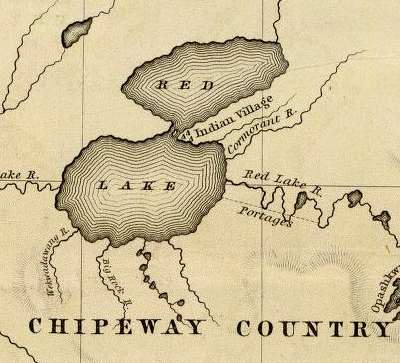
Detail of Red Lake from Hydrographical Basin of the Upper Mississippi River from Astronomical and Barometrical Observations Surveys and Information by Joseph Nicolas Nicollet, 1843.
~ David Rumsey Map Collection
Earlier in the season we were at Red Lake. A cloud of smoke came up from the west, which caused a commotion in the village and mission at the south end of the lake. A war party was then out on a Sioux raid. The chief had lost a son, killed by them. He had managed to get the hand of a Sioux, which he had planted at the head of his son’s grave. But this did not satisfy his revenge nor appease the spirit of his son. He organized a war party to get more scalps, which was then out. A warrior chief or medicine man gains his principal control of the warriors by means of a prophecy, which he must make in detail. If the first of his predictions should fail, the party may desert him entirely. In this case, on a certain day they would meet a bear. When they met the enemy, if they were to be victorious, a cloud of smoke would obscure the sun. It was this darkening of the sky that excited the hopes of the Red Lake band. They were sure there had been a battle and that the Sioux were defeated.
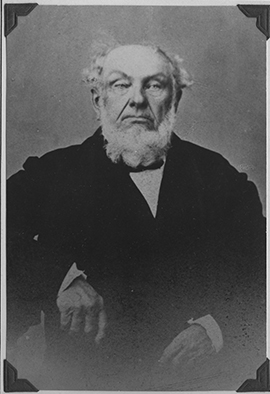
Judge Samuel Ashmun
~ Chippewa County Historical Society
The late Judge Ashmun, of Sault Ste. Marie, while he was a minor, wandered off from his nativity in Vermont to Lake Superior, through it to Fond du Lac, and thence by way of the St. Louis River to Sandy Lake on the Mississippi. Somewhere in that region he was put in charge of one of Astor’s trading posts. In the early winter of 1818 he went on a hunt with a party of seventeen indiscreet young braves, against the advice of the sachems, apparently in a southwesterly direction on the Sioux border, or neutral land. Far from being neutral, it was very bloody ground. At the end of the third day they were about fifty miles from the post. On the morning of each day a rendezvous was fixed upon for the next camp. Each one then commenced the hunt for the day, taking what route pleased himself. The ice on the lakes and marshes was strong and the snow not uncomfortably deep. The principal game was deer, with some pheasants, prairie hens, rabbits and porcupines. What a hunter could not carry he hung upon trees to be carried home upon their return. Their last camp was on the border of a lake in thick woods, with tall dry grass on the margin of the lake. Having killed all the deer they could carry, it was determined to begin the return march the next day. It was not a war party, but they were prepared for their Sioux enemies, of whom no signs had been discerned. There was no whiskey in the camp, but when the stomach of an Indian is filled to its enormous capacity with fresh venison he is always jolly. It was too numerous a party to shelter themselves by a roof of boughs over the fire, but they had made a screen against the wind of branches of pine, hemlock or balsam. Around the fire was a circle of boughs on which they sat, ate and slept. Some were mending their moccasins, other smoking tobacco and kinnikinic, playing practical jokes, telling stories, singing songs and gambling. Mr. Ashmun could get so little sleep that he took Wa-ne-jo, who had a boy of thirteen years, and they made a separate camp. This man going to the lake to drink, was certain that he heard the tramp and felt the vibrations of a party going over the ice, who could be no other than the Sioux. He returned, and after some hesitation Mr. Ashmun reported the news to the main camp. “Oh, Wa-ne-jo is a liar, nobody believes him,” was the universal response. Mr. Ashmun, however, gave credit to the repot. They immediately put out the fire at his bivouac. Even war parties do not place sentinels, because attacks are never made until break of day. In the isolated camp they waited impatiently for the first glimpse of morning. Most of the other party fell asleep with a feeling of security, for which they took no steps to verify. One of them lay down without his moccasins. Mr. Ashmun and his man were just ready to jump for the tall grass when a volley was poured into the other camp, accompanied by the usual savage yell. The darkness and stillness of a faint morning twilight made this burst of war still more terrific. Taking the boy between them, they commenced the race for life under the guidance of Wa-ne-jo, in a direction directly opposite to their home. He well knew the Sioux all night long had been creeping stealthily over the snow and through the thicket, and had formed a line behind the main camp. The Chippewas made a brave defence, giving back their howls of defiance and fighting as they dispersed through the woods. Eight were killed near the camp and a wounded one at some distance, where he had secreted himself. Two fo the wounded were helped away according to custom, and also the barefooted man, whose feet were soon frozen. All clung to their guns, and the frightened boy to his hatchet. They estimated the Sioux party to have been one hundred and thirty, of whom they killed four and wounded seven, but brought in no scalps.

Indians Canoeing in the Rapids painting by Cornelius Krieghoff, 1856.
~ Commons.Wikimedia.org
In his way, the Chippewa is quite religious. He believes in a future world where there is a happy place for good Indians. If he is paddling his canoe against a head wind and can afford it, he throws overboard a piece of tobacco, the most precious thing he has. With this offering there is a short invocation to the good manitou for a fair breeze, when he can raise a blanket for a sail, stop rowing and take a smoke. At the head of many a rapid which it is dangerous to run, are seen pieces of tobacco on the rocks, which were laid there with a brief prayer that they may go safely through. Some of them, which are frightful to white men, they pass habitually. These offerings are never disturbed, for they are sacred. He endeavors also to appease the evil spirit Nonibojan. Fire, rocks, waterfalls, mountains and animals are alive with spirits good and bad. The medicine man, who is prophet, physician, priest and warrior, is an object of reverence and admiration. His prayers are for success in the hunt, accompanied by incantations.

George Bonga
~ Wikipedia.org
Among the stories of a thousand camp-fires, was one by Charlie, a stalwart, half-breed Indian and negro, whose father was an escaped slave. On the shores of Sandy Lake, a party of Chippewas had crossed on the ice in midwinter, and encamped in the woods not far from the north shore. One of them went to the Lake with a kettle of water, and a hatchet to cut the ice. After he filled his kettle, he lay down to drink. The water was not entirely quiet, which attracted his attention at once. His suspicions were aroused, and placing his ear to the ice, he discerned regular pulsations, which his wits, sharpened by close attention to every sight and every sound, interpreted to be the tramp of men. They could be no other than Sioux, and there must be a party larger than their own. Their fire was instantly put out, and they separated to meet at daylight at a place several miles distant. All their conclusions were right. One band of savages outwitted another, having instincts of danger that civilized men would have allowed to pass unnoticed. The Sioux found only the embers of a deserted camp, and saw the tracks of their enemies diverge in so many directions that it was useless to pursue.
In 1839 the Chippewas on the upper Mississippi were required to come to Fort Snelling to receive their payments. That post was in Sioux territory, and the order gave offense to both nations. It required the presence of the United States troops to prevent murders even on the reservation. On the way home at Sunrise River, the Chippewas were surprised by a large force of Sioux, and one hundred and thirty-six were killed.
At the mouth of Crow Wing River, on the east bank of the Mississippi, is a ridge of gravel, on which there were shallow pits. The Indians said that, about fifteen years before, a war party of Sioux was above there on the river to attack the Sandy Lake band. A party of Chippewas concealed themselves in these pits, awaiting the descent of their enemies. The affair was so well managed that the surprise was complete. When the uncautious Sioux floated along within close range of their guns, the Chippewa warriors rose and delivered their fire into the canoes. Some got ashore and escaped through the woods to the westward, but a large portion were killed.
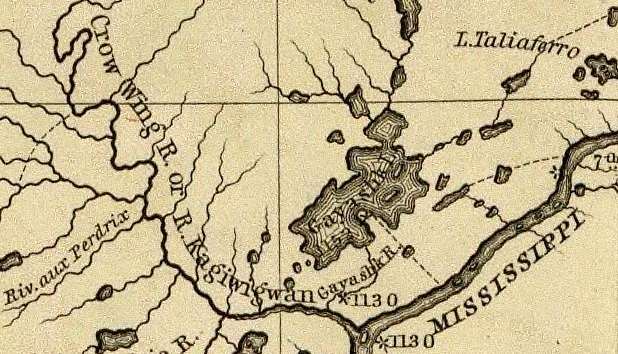
Detail of Crow Wing River from Hydrographical Basin of the Upper Mississippi River from Astronomical and Barometrical Observations Surveys and Information by Joseph Nicolas Nicollet, 1843.
~ David Rumsey Map Collection
While crossing the Elk River, between the falls of St. Anthony and those of St. Cloud, a squaw ran into the water, screaming furiously, followed by a man with a club. This was her lord and master, bent on giving her a taste of discipline very common in Indian life. She succeeded in escaping this time by going into deep water. Her nose had been disfigured by cutting away most of the fleshy portions, as a punishment for unfaithfulness to a husband, who was probably worse than herself.
At the mouth of Crow Wing River was an Indian skipping about with the skin of a skunk tied to one of his ankles. There was also in a camp near the post another Chippewa, who had murdered a brother of the lively man. There is no criminal law among them but that of retaliation. Any member of the family may execute this law at such time and manner as he shall decide. This badge of skunk’s skin was a notice to the murderer that the avenger was about, and that his mission was not fulfilled. Once the guilty man had been shot through the thigh, as a foretaste of what was to follow. The avenger seemed to enjoy badgering his enemy, whom he informed that although he might be occasionally wounded, it was not the intention at present to kill him outright. If the victim should kill his persecutor, he well knew that some other relative would have executed full retaliation.
~ The Assassination of Hole In The Day [the Younger] by Anton Treuer, 2010.
Hole In The Day the Younger
aka Kue-wee-sas (Gwiiwizens [Boy or Lad])
(1825-1868)
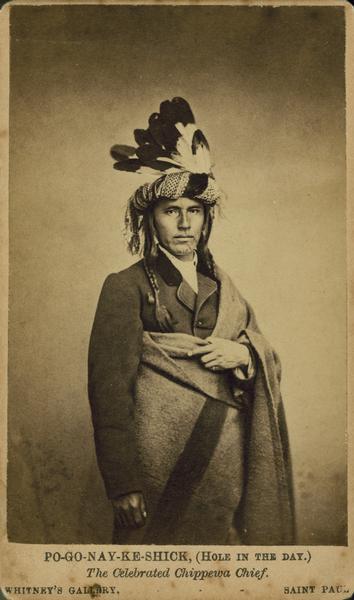
Bagone-giizhig the Younger
~ Wisconsin Historical Society
This Chippewa brave, Bug-on-a-ke-dit, lived on a knoll overlooking the Mississippi River, four miles above Little Rock, where he had a garden. He appeared at the payment at La Pointe, in 1848, with a breech cloth and scanty leggings. This was partially for showing off a very perfect figure, tall, round and lithe, the Apollo of the woods. His scanty dress enabled him to exhibit his trophies in war. The dried ears of his foes, a part of whom were women, were suspended at his neck. Around his tawny arms were bright brass bands, but there was nothing of which he was more proud than a bullet hole just below the right breast. The place of the wound was painted black, and around it circles of red, yellow and purple; other marks on the chest, arms and face told of the numbers he had slain and scalped, in characters well understood by all Chippewas. The numbers of eagle feathers in his hair informed the savage crowd how many battles he had fought. He was not, like Grizzly Bear, a great orator, but resembled him in getting drunk at every opportunity. He managed to procure a barrel of whiskey, which he carried to his lodge. While it was being unloaded it fell upon and crushed him to death. Looking up a grass clad hill, a dingy flag was seen (1848) fluttering on a pole where he was buried. He often repeated with great zest the mode by which the owners of two of the desecrated ears were killed. His party of four braves discovered some Sioux lodges on the St. Peters, from which all the men were absent. The squaws lodged their hereditary enemies over night with their accustomed hospitality. Bug-on-a-ke-dit and his party concealed themselves during the day, and at dark each one attacked a lodge. Seven women and children were slaughtered. His son Kue-wee-sas, or Po-go-noy-ke-schik, was a much more respectable and influential chief.
An hundred years since, the Sioux had an extensive burial ground, on the outlet of Sandy Lake, a few miles east of the Mississippi River. Their dead were encased in bark coffins and placed on scaffolds supported by four cedar posts, five or six feet high. This was done to prevent wolves from destroying the bodies. Thirty years since some of these coffins were standing in a perfect condition, but most of them were broken or wholly fallen, only the posts standing well whitened by age. The Chippewas wrap the corpse in a blanket and a roll of birch bark, and dig a shallow grave in which the dead are laid. A warrior is entitled to have his bow and arrow, sometimes a gun and and a kettle, laid beside him with his trinkets. Over the mound a roof of cedar bark is firmly set up, and the whole fenced with logs or protected in some way against wolves and other wild animals. There is a hole at one or both ends of the bark shelter, in which is friends place various kinds of food. Their belief in a spirit world hereafter is universal. If it is a hunter or warrior, he will need his arms to kill game or to slay his enemies. Their theory is that the dog may go to the spiritual country, as a spirit, also his weapons, and the food which is provided for the journey. To him every thing has its spiritual as well as its material existence. Over all is the great spirit or kitchi-manitou, looking after the happiness of his children here and hereafter.
Stephen Bonga
~ Wisconsin Historical Society
Winter travelling in those northern regions is by no means so uncomfortable as white men imagine. By means of snow shoes the Indian can move in a straight course towards his village, without regard to the trail. In the short days of winter he starts at day break and travels util dark. Stephen said he made fifty miles a day in that way, which is more than he could have done in summer.
At night they endeavor to find a thicket where there is a screen against the wind and plenty of wood. They scoop away the snow with their shoes and start a fire at the bottom of the pit. Around this they spread branches of pine, balsam or cedar, and over head make a shelter of brush to keep off the falling snow. Probably they have a team or more of dogs harnessed to sledges, who take their places around the fire. Here they cook and eat an enormous meal, when they wrap themselves in blankets for a profound sleep. Long before day another heavy meal is eaten. Everything is put in its proper package ready to start as soon as there is light enough to keep their course.
– Freelang Ojibwe-English by Weshki-ayaad, Charles Lippert and Guy T. Gambill
– Ojibwe People’s Dictionary by the Department of American Indian Studies at the University of Minnesota
Many Indian words have originated since the white people came among them. A large proportion of their proper names are very apt expressions of something connected with the person, lake, river, or mountain to which they are applied. This people, in their primitive state, knew nothing of alcohol, coffee, tea, fire-arms, money, iron, and hundreds of other things to which they gave names, generally very appropriate ones. A negro is black meat; coffee is black medicine drink; tea, red medicine drink; iron, black metal; gold, yellow metal. I was taking the altitude of the sun at noon near Red Lake Mission with a crowd of Chippewas standing around greatly interested. They had not seen the liquid metal mercury, used for an artificial horizon in such observations, which excited their especial astonishment, and they had no name for it. One of them said something which caused a general expression of delight, for which I enquired the reason. He had coined a word for mercury on the spot, which means silver water.
Detail of Minnesota Point during George Stuntz’s survey contract during August-October of 1852.
~ Barber Papers (prologue): Stuntz Surveys Superior City 1852-1854

This family’s sugar bush was located at or near Silver Creek (T53N-R10W).
~ General Land Office Records
Indian trail to Rockland townsite overlooking English/Mineral Lake and Gogebic Iron Range.
~ Penokee Survey Incidents: Number V
Coasting along the beach northward from the mouth of the St. Louis River, on Minnesota Point, I saw a remarkable mark in the sand and went ashore to examine it. The heel and after part was clearly human. At the toes there was a cleft like the letter V and on each side some had one, others two human toes. Not far distant were Indians picking berries under the pine trees, which then covered the point in its entire length. We asked the berrypickers what made those tracks. They smiled and offered to sell us berries, of which they had several bushels, some in mokoks of birch bark, others in their greasy blankets. An old man had taken off his shirt, tied the neck and arms, and filled it half full of huckleberries. By purchasing some, (not from the shirt or blanket) we obtained an explanation of the nondescript tracks. There was a large family, all girls, whose feet were deformed in that manner. It was as though their feet had been split open when young halfway to the instep, and some of the toes lost. They had that spring met with a great loss by the remorseless bear. On the north shore, thirty miles east of Duluth, they had a fine sugar orchard, and had made an unusual quantity of sugar. A part was brought away, and a part was stored high up in trees in mokoks. There is nothing more tempting than sugar and whiskey to a bear. When this hard working family returned for their sugar and dried apples, moistened with whiskey, to lure bruin on to his ruin. A trap fixed with a heavy log is set up across a pen of logs, in the back end of which this bait is left, very firmly tied between two pieces of wood. This is fastened to a wooden deadfall, supporting one end of a long piece of round timber that has another piece under it. The bear smells the bait from afar, goes recklessly into the pen, and commences to gnaw the pieces of wood; before he gets much of the bait the upper log falls across his back, crushing him upon the lower one, where, if he is not killed, his hind legs are paralyzed. These deadly pens are found everywhere in the western forests. Two bears ranging along the south shore of English Lake, in Ashland County, Wisconsin, discovered some kegs of whiskey which contraband dealers had concealed there. With blows from their heavy paws they broke in the heads of the kegs and licked up the contents. They were soon in a very maudlin state, rolling about on the ground, embracing each other in an affectionate manner and vainly trying to go up the trees. Before the debauch was ended they were easily captured by a party of half-breeds. There are Indians who acknowledge the bear to be a relation, and profess a dislike to kill them. When they do they apologize, and say they do it because they are “buckoda,” or because it is necessary.

Detail of the Porcupine Mountains between the Montreal River and Ontonagon River from Map of the Mineral Lands Upon Lake Superior Ceded to the United States by the Treaty of 1842 With the Chippeway Indians.
~ Wisconsin Historical Society
At Ontonagon, a very sorry looking young Indian came out of a lodge on the west side of the river and expressed a desire to take passage in our boat. There had been a great drunk in that lodge the day before. The squaws were making soup of the heads of white fish thrown away by the white fishermen. Some of the men were up, others oblivious to everything. Our passenger did not become thoroughly sober until towards evening. We passed the Lone Rock and encamped abreast of the Porcupine Mountains. Here he recovered his appetite. The next day, near the Montreal River, a squaw was seen launching her canoe and steering for us. She accosted the young fellow, demanding a keg of whiskey. He said nothing. She had given him furs enough to purchase a couple of gallons and he had made the purchase, but between himself and his friends it had completely disappeared. The old hag was also fond of whiskey. The fraud and disappointment put her into a rage that was absolutely fiendish. Her haggard face, long, coarse, greasy, black hair, voluble tongue and shrill voice perfected that character.
Turning into the mouth of the river we found a party from Lake Flambeau fishing in the pool at the foot of the Great Fall. Their success had not been good, and of course they were hungry. One of our men spilled some flour on the sand, of which he could save but little. The Flambeaus were delighted, and, gathering up sand and flour together, put the mixture in their kettle. The sand settled at the bottom, and the flour formed an excellent porridge for hungry aboriginees.
~ Wisconsin Historical Society
Mushinnewa and Waubannika, Chippewas, lived at Bad River, near Odana. Mushinnewa had a very bad reputation among his tribe. He was not only quarrelsome when drunk, but was not peaceable when sober. He broke Waubannika’s canoe into fragments, which was resented by the wife of the latter on the spot. She made use of the awl with which she was sewing the bark on another canoe, as a weapon, and stabbed old Mushinnewa in several places so severely that it was thought he would die. He threatened to kill her, and she fled with her husband to Lake Flambeau. But Mushinnewa did not die. He had a son as little liked by the Odana band as himself. In a drunken affray at Ontonagon another Indian killed him. The murderer then took the body in his canoe, brought it to Bad River and delivered it to old Mushinnewa. According to custom the Indian handed the enraged father the knife with which his son was killed, and baring his breast told him to strike. The villagers were happy to be rid of the young villain, and took the knife from the hand of his legal avenger. A barrel of flour covered the body, and before night Mushinnewa adopted the Indian as his son.
Two varieties of willow, the red and the yellow, grow on the low land, at the margin of swamps and streams, which have the name of kinnekinic. During the day’s journey, a few sticks are cut and carried to the camp. The outer bark is scraped away from the inner bark, which curls in a fringe around the stick, which is forced in the ground before a hot fire, and occasionally turned. In the morning it is easily crumpled in the hands, and put into the tobacco pouch. If they are rich enough to mix a little tobacco with the kinnekinic, it is a much greater luxury. As they spend a large part of their leisure time in smoking, they are compelled to be content with common willow bark, which is a very weak narcotic. Tobacco is not grown as far north as the country of the Chippewas, but it is probable they had it through traffic with the tribes of Virginia, North Carolina and the Gulf States, in times very remote. Pipes are found in the works of the mounds builders that are very ancient, showing that they had something to smoke, which must have been a vegetable.
Detail of where the “Lake Long” [Lake Owen] and St. Croix foot paths start along Fish Creek.
~ Barber Papers: “Barbers Camp” Fall of 1855
~ History of the Upper Peninsula of Michigan, by Western Historical Co., 1883, page 276
Staggering around in a drunken crowd at La Pointe was a handsome Chippewa buck, as happy as whiskey can make any one. The tomahawk pipe is not an instrument of war, though it has that form. Its external aspect is that of a real tomahawk, intended to let out the brains of the foe. It is made of cast iron, with a round hollow poll, about the size of a pipe. The helm or handle is the stem, frequently decorated in the height of savage art, with ribbons, porcupine quills, paint and feathers. One thoroughly adorned in this manner has aperatures through the handle cross wise, so large and numerous that it is a mechanical wonder how the smoke can be drawn through it to the mouthpiece. No Indian is without a pipe of some kind, very likely one that is an heirloom from his ancestors. It is only in a passion that his knife or tomahawk pipe becomes dangerous. This genial buck had been struck with the poll of such a pipe when all hands were fighting drunk. It had cut a clear round hole in his head, hear the top, sinking a piece of skull with the skin and hair well into his brains. A surgeon with his instrument could not have made a more perfect incision. Inflammation had not set in and he was too busy with his boon companions to think of the wound. It was about twenty-four hours after it occurred when he stepped into his canoe and departed. When Mr. Beasley went up the Fish River, a few days afterwards a funeral was going on at the intersection of the Lake Long and the St. Croix trails, and the corpse had a cut in the head made by the pole of a tomahawk. From this event, no doubt, a family quarrel commenced that may continue till the race is extinct. The injured spirit of the fallen Indian demands revenge. In the exercise of retaliation it may be carried by his relations a little beyond retaliating justice, which will call on the other side for a victim, and so on to other generations.
In a lodge between the agency and the mission there was a young girl very sick. Probably it is my duty to say that she was not only young but beautiful, but at this time she was only wretched. Whether in her best health and estate the term beauty could be applied I very much doubt, as such cases are extremely rare among Indians, compared by our standard. A “grand medicine” had been got up expressly for the purpose of curing her. The medicine lodge was about thirty feet in length, made of green boughs. The feast, without which no evil spirit would budge one inch, had been swallowed, and the dance was at its height, in which some women were mingled with the men. Their shrieks, yelling and gesticulations should have frightened away all the matchi-manitous at La Pointe. The mother of the girl seemed to be full of joy, the bad spirit which afflicted her child was so near being expelled. As they made the circuit of the dance they thrust a large knife into the air towards the northwest, by which they gave the departing demon a stab as he made his escape from the lodge. This powow raged around the poor girl all the afternoon and till midnight, when the medicine man pronounced her safe. Before sundown the next day we saw them law her in a shallow grave, covered with cedar bark.

Father Nicolas Perrot
~ Wikipedia.org
Father Perret, who was among the Natches as far back as 1730, gives a portrait of a medicine man of that tribe at that time. It answers so well for those I have seen among the Chippewas that I give his description at length. For the Chippewa juggler I must except, however, the practice of abstinence and also the danger of losing his head. A feast is the first thing and the most essential.
“This nation, like all others, has its medicine man. They are generally old men, who, without study or science, undertake to cure all complaints. All their art consists in different jugglings, that is to say, they sing and dance night and day about the sick man, and smoke without ceasing, swallowing the smoke of the tobacco. These jugglers eat scarcely anything while engaged with the sick, but their chants and dances are accompanied by contortions so violent that, although they are entirely naked and should suffer from cold, they are always foaming at the mouth. They have a little basket in which they keep what they call their spirits, that is to say, roots of different kinds, heads of owls, parcels of the hair of deer, teeth of animals, pebbles and other trifles. To restore health to the sick they invoke without ceasing something they have in their basket. Sometimes they cut with a flint the part afflicted, suck out the blood, and in returning it immediately to the disk they spit out a piece of wood, straw or leather, which they have concealed under their tongue. Drawing the attention of the sick man, ‘there,’ they say, ‘is the cause of his sickness.’ These medicine men are always paid in advance. If the sick man recovers their gain is considerable, but if he dies they are sure to have their heads cut off by his relations.”

“Osawgee Beach. Superior, Wis.” postcard, circa 1920:
“Ojibwe chief Joseph Osawgee was born in Michigan in 1802 and came to Wisconsin Point as a young boy. There he established Superior’s first shipyard—a canoe-making outfit along the Nemadji River near Wisconsin Point. His birch bark canoes supplied transportation for both Ojibwe trappers and French Voyageurs. Chief Osawgee signed the 1854 Treaty of La Pointe on behalf of the Fond du Lac Ojibwe—and subsequently lost his land. He died in Solon Springs, Wisconsin, in 1876.”
~ Zenith City Online

Joseph Ozaagii
~ Geni.com
~ Indian Country Today Media Network
“Chief O-sau-gie Built First ‘Ships’ in City of Superior (He Was Head of Small Chippewa Band when Superior was Tiny Spot)”
As a rare example of the industry and probity among northern Indians, I take pleasure in recording the name of Osagi. His hunting ground and sugar camp lay to the west of La Pointe, on Cranberry River, where he had a cabin. In traversing that region I had as a guide a rude map and sketch of the streams made by him on a sheet of post office paper with a red pencil. Osagi was never idle and never drunk. Dr. Livermore was at this time the agent for the tribes at the west end of Lake Superior, and related the following instance of attention and generosity which is worthy of being reported. Osagi frequently made the agency presents, and Dr. Livermore, of course, did the same to his Otchipwee friends. Late in the fall, as the fishing season was about to close, he sent a barrel of delicious trout and white fish to the agency, which, by being hung up separately, would in this cool climate remain good all winter. The interpreter left a message from the donor with the fish, that he did not want any present in return, because in such a case there would be on his part no gifts, and he wished to make a gift. Dr. Livermore assented, but replied that if Osagi should ever be in need the agent expected to be informed of it. During the next winter a message came to Dr. Livermore stating that his friend wanted nothing, but that a young man, his cousin, was just in from Vermillion Lake, where he lived. The young man’s father and family could no longer take fish at Vermillion, and had started for Fonddulac. The old man was soon attacked by rheumatism, and for many days the whole party had been without provisions. Would the agent make his uncle a present of some flour? Of course this was done, and the young messenger started with a horse load of eatables for the solitary lodge of his father, on the St. Louis River, two hundred miles distant. This exemplary Indian, by saving his annuities, and by his economy, had accumulated money enough to buy a piece of land, and placed it in the hands of the agent. when the surveyors had subdivided the township opposite La Pointe, on the mainland, he bought a fraction and removed his family to it as a permanent home. In a few months the small pox swept off every member of that family but the mother.
[CHARLES WHITTLESEY.]
To be continued in Among The Otchipwees: III…
Barber Papers: “In a Little Trouble” Winter of 1856
October 9, 2015
By Amorin Mello
Selected letters of the Joel Allen Barber Papers
… continued from Fall of 1855.
Minnesota Point Jan [23rd?] 1856
Dear Parents
It is sometime since I have wrote to you and for a fortnight or more
[???] [two lines on this copy are illegible] [??? ?????]
On arriving at Lapoint we found sheets from home and a good lot of newspapers.
We left Lapoint Thursday afternoon [on a firm of ?????? ? ?? head?] of [?????????] Nagonup the principal chief of all the Chippewas, Augustus and myself [??? ??? ?????] drawn by by two dogs on a dogtrain. At [????? ???????] were joined by one of Nagonup’s [??????].
Photograph of Naagaanab (Minnesota Historical Society).
They were on their way to Washington. Several of them are going accompanied by a gentleman from Lapointe as interpreter. The first night out we stayed in a wigwam with old Chingoon and his interesting family. Friday night we camped. Saturday reached Iron river. Sunday left and [comfortable?] – Monday came here. Augustus has a sore througt, not severe – otherwise we are well as usual notwithstanding our tramp of over [100?] miles. I must now quit writing and try to find one of our dogs which has strayed over to [???].
Under the old permit system, many locations, three miles square, were made on Lake Superior;- several on and near the Montreal river – some on Bad River, south of La Pointe – three on the main land, opposite La Pointe – two or three were made near Superior City, on the Nemadji, or Left Hand river, and one settler’s claim about twenty miles north of Superior.”
~ Mineral Regions of Lake Superior: As Known From Their First Discovery to 1865, by Henry Mower Rice, 1865[?].
Perhaps you wonder what we have made this journey for – perhaps you hope we are going below but that is not the case. Why should we [?????]. It is warmer here than at many places two or three hundred miles south of here. True – one or two thermometers froze up at this place but others did not while at Fort Snelling, the spirit thermometer inside the walls indicated 44 degrees below zero. Augustus wanted to see to his preemption and I had nothing to do but to come along with him. I also wanted to find out a few things concerning a place that I should like to preempt. I suppose there is not a better copper show on the south shore of the lake, but the land is not surveyed and my only sure way to get it is to settle on it and stick to it until it can be legally claimed.
The town lines will be run next summer.
Augustus is in a little trouble about his claim. It appears his declatory statement never reached the land office. But I guess it will all be explained and made right. The dutchman who was to contest his claim has left the country and would stand no chance if he was here. We have a land office here now which saves a great many journeys to Hudson near St. Paul. We shall go back in a few days and commence surveying around the islands. Now don’t fancy that we cannot survey in the winter, for we have tried it and know better.
Detail from the Stuntz/Barber survey of T47N R14W.
“J.H. Bardon, a Superior pioneer, stated that ‘at Copper Creek and Black River Falls, twelve or fifteen miles south of Superior, and also near the Brule River, a dozen miles back from Lake Superior, Mr. Stuntz found evidences of mining and exploring for copper on a considerable scale carried on by the American Fur Company, under the direction of Borup and Oaks of La Pointe, in 1845-46. A tote road for the mines was opened from a point ten miles up the Nemadji River to Black River Falls.‘”
~ Duluth and St. Louis County, Minnesota; Their Story and People: An Authentic Narrative of the Past, with Particular Attention to the Modern Era in the Commercial, Industrial, Educational, Civic and Social Development, Volume 1, by Walter Van Brunt, 1921, page 66.
At Bad river we were at work during the coldest weather, and only lost two or three days because of cold but when the thermometer was up to 20* below zero we worked right ahead – sometimes in swamps where we stepped through the snow into the water,
[last line on this page of this copy is cut off]
The weather for a week or more has been fine. Cold enough to cover us with frost but not severe.
Provisions are very scarce – no flour or pork can be had.
They will begin to bring them through from St. Paul in a few days. Flour it is hoped can then be bought for $20 per barrel. Fish are not exactly plenty but they can be obtained for money or labor which is not the case with anything else. The country is flooded with dry goods, [p??y] articles and everything but provisions because they can be bought on time but eatables could only be got by paying cash down.
Geology of Wisconsin: Survey of 1873-1879,
Volume III, 1880, page 342[?].

Geology of Wisconsin: Volume 3, page 341.
Geology of Wisconsin: Volume 3, page 345.
The Fon du Lac mine has commenced operations with tolerable fair prospects. It is the only mine in operation this side of Montreal river. Augustus’ claim is on the same vein and for aught anyone knows just as good besides having abundance of water power. All the copper excitement since I come to the country has been directed toward the north shore. This morning I signed 2 petitions, one to congress for the early survey of the north shore and another for a road down that way. I have made a little map of the islands and last summers survey and some other things that I will enclose.
The Fond du Lac copper prospect was located near a small tributary of the Left Hand River on this map detail from T47N R14W, near Pattison State Park. Augustus’ claim was along the same vein of copper but had not been surveyed yet; perhaps it was at Amnicon Falls State Park.
Augustus has begun a letter to send with this. He has just come home with letters now about his claim.
No more at present from
Your affectionate son
J. Allen Barber
Direct to Lapoint
Minnesota Point
Superior County
Minn. Terr.
Sunday Feb 10th 1856
Dear Mother
Augustus has written a letter, and left it for me to enclose and dispatch so I thought I would ship in a few lines before sending it off.
Augustus started today with a young man and two dogs for Lapointe. I shall probably go there in a two or three weeks to return immediately. There are two men going down with a tamlins pony team with provisions from St. Paul for Augustus. The men are going to work for him and I shall probably bring the team back and use it a while. I have at last fixed my mind on a place that I mean to claim. The location is a point at the mouth of Left hand river, known as Left hand point. It contains only 5 or 6 acres in low & swampy and covered only with bushes coarse grass and floodwood. Nothing but the fact of its being a part of Superior city is of any value whatever.

Barber’s sketch of his land claim at the mouth of Left Hand River. This location is now an industrial neighborhood of Superior on the Nemandji River.
As it is $1,000.00 per acre is not an overestimate of its marketable price at present. It joins or is part of the grounds intended for the Railroad buildings when the survey was made here this point was cut off by the meander lines instead of meandered. Therefore according to the [rearns/records?] no such land exists.

A resurvey is to be made and I mean to fasten it by a preemption which is the only way to obtain it before the land sale. I may get cheated out of it and I may throw away my time and money but such chances are scarce and should it transpire that my claim is good I want to have my dish right side up for once. I have written for Uncle Allen’s advice and should I ever find it advisable to drop the matter I can do so without forfeiting my preemption right.
The Eye of the North-west, page 9.
The Superior Company with Company with which I shall probably have to contend is rich, influential, and on good terms with the administration. All that can be done by fair means or foul to defeat any claim will probably be done, but some things can be done as well as others, at any rate we shall see what we shall see.
So my head is so full of business just [snow?] you will please excuse the shortness of this letter and look for more when I have more time.
Your affectionate son
J Allen Barber
Superior Feb. 17th 1856
Dear Brother
It is sometime since I have written anything to you but you have heard of me so often that I suppose it makes no particular difference. It will be nearly sugaring time when you get this.

Makak: a semi-rigid or rigid container: a basket (especially one of birch bark), a box (Ojibwe People’s Dictionary) Photo: Densmore Collection; Smithsonian
I have once more got into a country where sugar is made but not by white men. The Indians make pretty good sugar which is generally done hard and [sinted?] dry and put into birch bark “mo’kucks” holding from 50 to 75 lbs. This bark is also used exclusively for buckets, store trays, gathering pails, &c. The timber in this country is not as equally distributed as in Vermont. The land is mostly covered with evergreens but there are some located portions of country where maple abounds. These “sugar bushes” as they are called are often quite extensive covering several sections and and [they?] only at intervals of 8 or 10 miles, but this is just as well for the Indians are both migratory and gregarious in their habits.
Detail of an Lake Superior Chippewa “sugar bush” from the Barber brothers’ survey of T48N R5W.
I hope you will eat plenty of sugar next spring and take some of the girls to a sugar party or two like I used to. I am doing nothing now most of the time but shall have business enough in a few days when I begin to build my house that is if I conclude to grab for the price of land I am now watching. I am waiting to hear from Uncle Allen and for some other things to transpire. There is not a man in the country whom I could trust that could give me any reliable information such as I want. I want you to hurry and become of age as soon as possible and come out here this spring and make a preemption.
There are some good places left yet, but don’t get married before you make a preemption for it might not be convenient to take your wife out into the woods 30 or 40 miles to live on the place as you would have to do in order to “prove up.” I am going to get up an ice boat before long which will be very useful as I mean to do considerable boating yet this winter, and I might use it to carry lumber and other things up and down the lake. With such winds as we have had a few days ago I could easily go to Lapointe and back in two days. I suppose Augustus got a party started by this time and he will be at it himself in a few days. I am living with a man named Fargo, you have heard of him before. We are living in Stuntz’ store. Board at the hotel is ten dollars per week. Old Steven Bonga is living on the point, he has been something of a traveller having been to Montreal, Hudson Bay, [Oregon?], Prairie du Chien, and all intermediate places.
He is half indian and half negro so you may suppose he is not very white.
Portrait of Stephen Bonga (USDA Forest Service). Additional information about Bonga is available from the Wisconsin Historical Society.
A railroad has been laid out from here to St. Paul and my claim covers the terminus at this end. There have two or three new towns started into existence along its route in imagination. Perhaps they are [surveyed?]. This making towns in a new country is a great business.
What happened in your good town on Christmas and New years eve
Were there any stockings left.
I want to inquire about lots of girls and boys in Johnson and Cambridge but I conclude you will tell me as much as you can in your next letter so with respects to all enquiring friends I remain
Your affectionate brother
Allen
Superior, Douglas Co. Feb. 25th 56
Dear Parents
Detail of Superior City from T49N R1W.
Night before last I got a letter and some papers from Augustus also 2 letters from home which he had read. They were dated Dec. [21st?] & Jan 2nd.
Sad and startling was the news of the death of George Hill. Who could have thought three years ago that such a dark future lay before that family. Every day some sad event warns me of the uncertainty of life. Men have died here who had no friends to mourn their loss, and their death is hardly noticed. I always ask myself why was it not me instead of them and will not my turn come soon. Yes, let it come soon or late as the world reckon, and it will be soon to me.
There is just as much danger or accidents in this country as in any other and no more but as to health there is no better place in the world than this. You seem shocked at the idea of surveying in the winter, but it will be nothing but fun to survey during the rest of the winter. It has been moderate pleasant weather now about two weeks. The snow is going off a little lately and it seems a little like spring. We had some pretty cold weather about new years but we shall have no more such. The lake is more open than it ever was known to be at this season before.
It sometimes freezes across at Lapointe but now it is open within six or eight miles of here. Flour is only $20 per bbl‑ with prospect of falling lower. The Indians chiefs have returned having only been to St. Paul where they found a letter telling them to delay their visit a while.
Poor creatures! They are fooled around by traders and speculators who are with the government in robbing and dwindling them. Any thing like a full account of their wrongs would astonish even them. About my claim I have not [???] today. There is another man after it and it will be no easy thing to carry my point.
Valuable property is troublesome stuff in this country. There is a townsight three miles from there now in litigation for which there is a standing offer of $200,000.
I am still living with Fargo on Minnesota point. I expect to go to Lapointe before long with Albert Stuntz who is going down with some supplies for Augustus which he brought from St. Paul.
It is too dark to write
Good bye
Allen
Superior, March 4th 56
Dear Parents
Not much has happened in this vicinity worth recording. The principle circumstances of note is the burning of a house and all the worldly possessions of a poor [Indian?].
Detail of Left Hand River from Stuntz’s survey; where Barber’s land claim was located.
I have heard nothing of Augustus since writing last but expect to when anybody comes up the lake. About my claim I can say but little my chance is but dull still I don’t mean to give up so large a prize without good reasons.
I have had it surveyed and the notes sent to the Surveyor General with a memorial stating the facts and asking him to [appraise?] the [notes?].
The price contains over 8 acres (8.695).
Perhaps it occurred to you that I am was 22 years old last Sunday. Well such is unquestionably the case although nothing was done to celebrate the day only I had my hair cut for the third time after leaving Vermont. I think I shall have to go to Lancaster this spring but unless I get ousted here it will be difficult to leave.
I wish I could multiply myself by about a dozen in order to hold several valuable claims which are not occupied by any one who can legally hold them. I can’t write here two children [pretting?] and several people [telling?] Albert Stuntz and family are here today. I am perched on a sawhorse writing on a work bench loaded with all manner of [marbles?].
Evening – quiet once more since dark I have written a letter to the Surveyor General to accompany a memorial that I have been circulating. O I wish there was a person in the country that I could depend on to assist me in regard to that claim. There are one or two that I counsel with who know no more than I do and then I do as I think best.
I expect [Lowener?] to find out I have no show, and that will be the last of it I shall [not feel?] that I had lost it for I never had it, but if I don’t get it some body else will get 15 or 20 thousand dollars worth of land that I want.
Provisions are still high and will be higher again before navigation opens which cannot be expected before the 1st of May. Flour is $20/barrel, fresh pork 18 ¾ cents per lb, beef 20 cts milk 20 to 25 cts per qt. &c, &c. Eatables must be higher because there will be little or no sleighing after this over the barrens between here and St. Paul. My mind has been on the [rock?] so much today that I am not in a mood to think much about home so please excuse the shortness and dryness of this letter.
I remain your affectionate son
J Allen Barber
Went to Iron River Thursday 13
Returned 15th
Superior , Douglas Co. March 11 1856
Dear Parents
Yesterday I read a package of letters from Augustus containing one from him & from home one from Albe and one from [Caldridge?]. As Augustus was in town (Lapointe) when he recd. your letters I suppose he has answered them so I cannot tell you much news about him. I am still staying with Fargo – not doing much but hoping to get pay for my time and expense by securing the prize I am after. There is some excitement in town about it, but mighty little is said to me. The Register at the land office gives me good encouragement and says a preemption will hold it. I have taken some steps toward building on it. Today I bought a sack of flour ½ barrel for 12 dollars, I shall get some fish from Lapoint where they are very plenty and cheap and then I shall be almost ready to try housekeeping alone.

I am sorry to hear of the disastrous results of the low price of hops. Although farmers must suffer in consequence yet I believe speculators will make fortunes out of it. If I was in the business of raising them I should stick to it. No articles is so liable to fluctuations in prices as hops but it is well known that the risk fails once in five years on an average so they must come up sometime.
I see you are inclined to believe our country and climate are more in hospitable & forbidding than yours. Such I believe is not the case. We have had some very cold weather but the changes are so moderate and so seldom that we pay but little attention to the weather – in fact we call most all of it very fine weather, as it is. The lake is a great equalizer of temperatures and our cool lake atmosphere in summer causes showers to fall from all the warm, sweaty winds that come here to wash their faces in this big blue pond. People in this country go much better prepared for cold than they ever do in Vermont. I have not worn a boot since leaving Lancaster. We wear shoes in the summer and moccasins in winter.
Boots won’t do for surveyors – they carry too much water unless we stop to empty them after crossing every stream or marsh.
While speaking of clothes perhaps I might as well go on with a few more items of the same sort.
Shoes for this country should have no lining or binding as they are quicker and ae not as stiffwhen dry. We never apply anything to soften them and nothing can preserve them from wearing out in about two months of hard service. They [sell?] about $1.50 per pair. We can get plenty of wool hats which are the only ones we wear.
All manners of shirts can be bought, even the very best quality of red flannel ones, which are universally warm, outside, i.e. by common folks.
The gentry of Superior dress most distressingly.
It is difficult to get good socks any where on the country. I have worn out 6 or 7 pair this summer and lost some more – they cost high bests we don’t wear. I have none. The only cost I have is of [Gihon?] cloth and made by Mrs. Sheldon. Cost are not much more except as an extra garment to wear occasionally.
Good durable pants I find it difficult to get. They are generally poor [ashnet?] and not half put together. Good your mittens would be very acceptable but for want thereof buckskin or blanket mittens are generally warm.
You speak about bringing Kate [in?] to Wisconsin. My advice is to it without fail if you intend coming out to live, nothing should prevent it if I were in your place. The horse that Uncle [Jay?] brought out with him is smarter and tougher than any one he can find to use with him. There is nothing that I regard as more necessary for a family than a first rate horse. I think [Kelty?] will be a very good serviceable animal for work besides being one that you might be proud to ride [after?] over the prairies. Probably Augustus has told you what he thinks about Amherst and other boys coming out here to survey. Butler was so badly disappointed in this country that I have had but little thoughts of [enough?] any one else to come here. Such a disappointment I think would be the fate of 4 out of every 5 that try the business.
A person to be a surveyor must be able to travel all day through the woods and sometimes carry a pack. I would not prevent any from coming here as there is generally business enough besides surveying. A surveyor can make no greater mistake than by hiring any but the best of men. Perhaps Augustus has not told you that he will be out of the business as soon as his present job is done and will devote his time to the improvement of his claim &c. I should like very much to [have?] Amherst here but I dislike to have my parents left entirely alone. As I have [???] two half [sheets?] – when I only [illegible] mind up for the [present?].
[Incomplete copy of letter]
To be continued in the Spring of 1856…
Error Correction: Photo Mystery Still Unsolved
April 27, 2014
This post is outdated. We’ll leave it up, but for the latest research, see Chief Buffalo Picture Search: Coda

According to Benjamin Armstrong, the men in this photo are (back row L to R) Armstrong, Aamoons, Giishkitawag, Ba-quas (identified from other photos as Akiwenzii), Edawi-giizhig, O-be-quot, Zhingwaakoons, (front row L to R) Jechiikwii’o, Naaganab, and Omizhinawe in an 1862 delegation to President Lincoln. However, Jechiikwii’o (Jayjigwyong) died in 1860.
In the Photos, Photos, Photos post of February 10th, I announced a breakthrough in the Great Chief Buffalo Picture Search. It concerned this well-known image of “Chief Buffalo.”

(Wisconsin Historical Society)
The image, long identified with Gichi-weshkii, also called Bizhiki or Buffalo, the famous La Pointe Ojibwe chief who died in 1855, has also been linked to the great chief’s son and grandson. In the February post, I used Benjamin Armstrong’s description of the following photo to conclude that the man seated on the left in this group photograph was in fact the man in the portrait. That man was identified as Jechiikwii’o, the oldest son of Chief Buffalo (a chief in his own right who was often referred to as Young Buffalo).
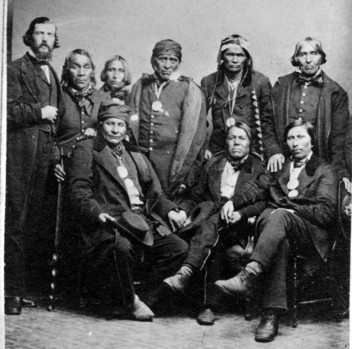
Another error in the February post is the claim that this photo was modified for and engraving in Armstrong’s book, Early Life Among the Indians. In fact, the engraving is derived from a very similar photo seen at the top of this post (Minnesota Historical Society).

(Marr & Richards Co. for Armstrong)
The problem with this conclusion is that it would have been impossible for Jechiikwii’o to visit Lincoln in the White House. The sixteenth president was elected shortly after the following report came from the Red Cliff Agency:

Drew, C.K. Report on the Chippewas of Lake Superior. Red Cliff Agency. 29 Oct. 1860. Pg. 51 of Annual Report of the Commissioner of Indian Affairs. Bureau of Indian Affairs. 1860. (Digitized by Google Books).
This was a careless oversight on my part, considering this snippet originally appeared on Chequamegon History back in November. Jechiikwii’o is still a likely suspect for the man in the photo, but this discrepancy must be settled before we can declare the mystery solved.
The question comes down to where Armstrong made the mistake. Is the man someone other than Jechiikwii’o, or is the photo somewhere other than the Lincoln White House?
If it isn’t Jechiikwii’o, the most likely candidate would be his son, Antoine Buffalo. If you remember this post, Hamilton Ross did identify the single portrait as a grandson of Chief Buffalo. Jechiikwii’o, a Catholic, gave his sons Catholic names: Antoine, Jean-Baptiste, Henry. Ultimately, however, they and their descendants would carry their grandfather’s name as a surname: Antoine Buffalo, John Buffalo, Henry Besheke, etc., so one would expect Armstrong (who was married into the family) to identify Antoine as such, and not by his father’s name.
However, I was recently sent a roster of La Pointe residents involved in stopping the whiskey trade during the 1855 annuity payment. Among the names we see:
…Antoine Ga Ge Go Yoc
John Ga Ge Go Yoc…[Read the first two Gs softly and consider that “Jayjigwyong” was Leonard Wheeler’s spelling of Jechiikwii’o]
So, Antoine and John did carry their father’s name for a time.
Regardless, though, the age and stature of the man in the group photograph, Armstrong’s accuracy in remembering the other chiefs, and the fact that Armstrong was married into the Buffalo family still suggest it’s Jechiikwii’o in the picture.
Fortunately, there are enough manuscript archives out there related to the 1862 delegation that in time I am confident someone can find the names of all the chiefs who met with Lincoln. This should render any further speculation irrelevant and will hopefully settle the question once and for all.
Until then, though, we have to reflect again on why Benjamin Armstrong’s Early Life Among the Indians is simultaneously the most accurate and least accurate source on the history of this area. It must be remembered that Armstrong himself admitted his memory was fuzzy when he dictated the work in his final years. Still, the level of accuracy in the small details is unsurpassed and confirms his authenticity even as the large details can be way off the mark.
Thank you to Charles Lippert for providing the long awaited translation and transliteration of Jechiikwii’o into the modern Ojibwe alphabet. Amorin Mello kindly shared the 1855 La Pointe documents, transcribed and submitted to the Michigan Family History website by Patricia Hamp, and Travis Armstrong’s ChiefBuffalo.com remains an outstanding bank of primary sources on the Buffalo and Armstrong families.
Photos, Photos, Photos
February 10, 2014
The queue of Chequamegon History posts that need to be written grows much faster than my ability to write them. Lately, I’ve been backed up with mysteries surrounding a number of photographs. Many of these photos are from after 1860, so they are technically outside the scope of this website (though they involve people who were important in the pre-1860 era too.
Photograph posts are some of the hardest to write, so I decided to just run through all of them together with minimal commentary other than that needed to resolve the unanswered questions. I will link all the photos back to their sources where their full descriptions can be found. Here it goes, stream-of-consciousness style:

Ojibwa Delegation by C.M. Bell. Washington D.C. 1880 (NMAI Collections)
This whole topic started with a photo of a delegation of Lake Superior Ojibwe chiefs that sits on the windowsill of the Bayfield Public Library. Even though it is clearly after 1860, some of the names in the caption: Oshogay, George Warren, and Vincent Roy Jr. caught my attention. These men, looking past their prime, were all involved in the politics of the 1850s that I had been studying, so I wanted to find out more about the picture.
As I mentioned in the Oshogay post, this photo is also part of the digital collections of the Smithsonian, but the people are identified by different names. According to the Smithsonian, the picture was taken in Washington in 1880 by the photographer C.M. Bell.
I found a second version of this photo as well. If it wasn’t for one of the chiefs in front, you’d think it was the same picture:
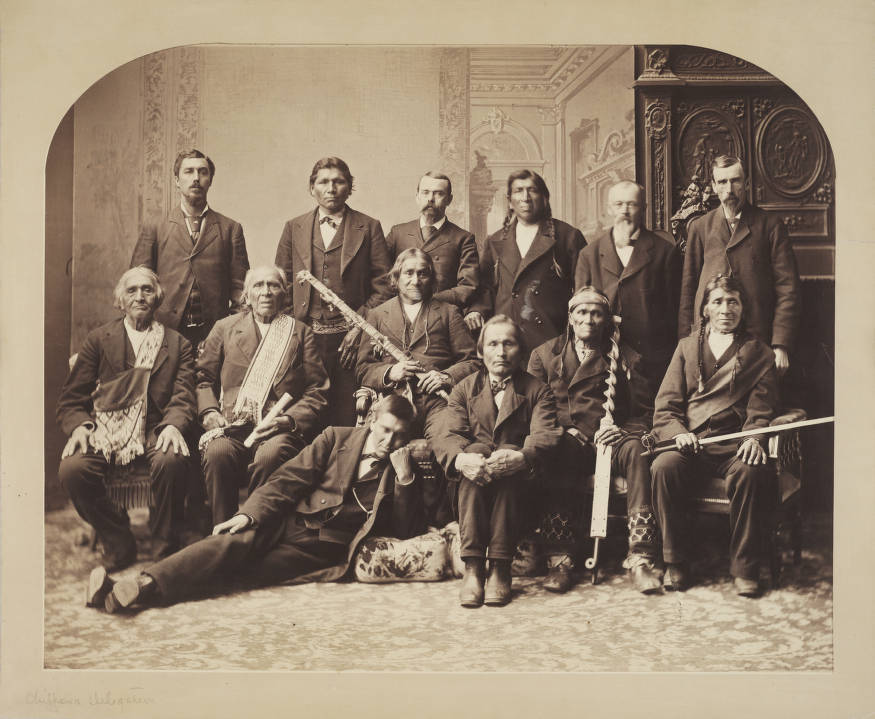
Chippewa Delegation (Denver Public Library Digital Collections)
While my heart wanted to believe the person, probably in the early 20th century, who labelled the Bayfield photograph, my head told me the photographer probably wouldn’t have known anything about the people of Lake Superior, and therefore could only have gotten the chiefs’ names directly from them. Plus, Bell took individual photos:
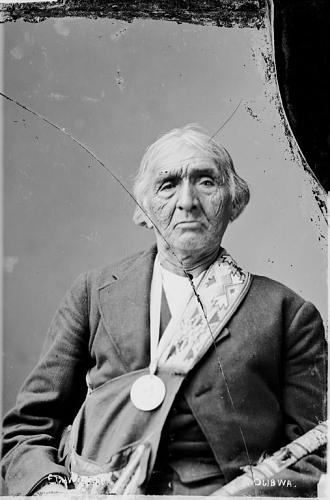
Edawigijig (Edawi-giizhig “Both Sides of the Sky”), Bad River chief and signer of the Treaty of 1854 (C.M. Bell, Smithsonian Digital Collections)
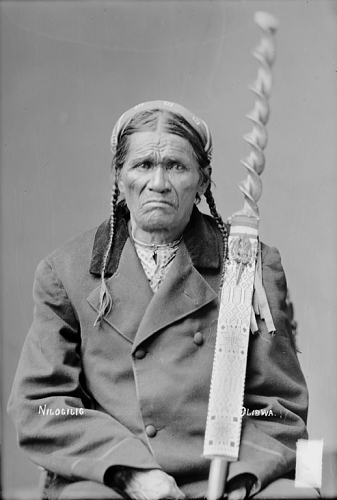
Niizhogiizhig: “Second Day,” (C.M. Bell, Smithsonian Digital Collections)
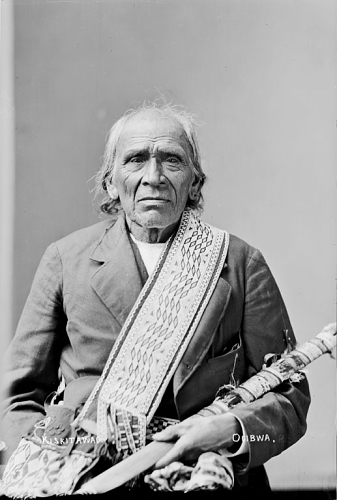
Kiskitawag (Giishkitawag: “Cut Ear”) signed multiple treaties as a warrior of the Ontonagon Band but afterwards was associated with the Bad River Band (C.M. Bell, Smithsonian Digital Collections).
By cross-referencing the individual photos with the names listed with the group photo, you can identify nine of the thirteen men. They are chiefs from Bad River, Lac Courte Oreilles, and Lac du Flambeau.
 According to this, the man identified by the library caption as Vincent Roy Jr., was in fact Ogimaagiizhig (Sky Chief). He does have a resemblance to Roy, so I’ll forgive whoever it was, even if it means having to go back and correct my Vincent Roy post:
Vincent Roy Jr. From C. Verwyst’s Life and Labors of Rt. Rev. Frederic Baraga, First Bishop of Marquette, Mich: To which are Added Short Sketches of the Lives and Labors of Other Indian Missionaries of the Northwest (Digitized by Google Books)

Top: Frank Roy, Vincent Roy, E. Roussin, Old Frank D.o., Bottom: Peter Roy, Jos. Gourneau (Gurnoe), D. Geo. Morrison. The photo is labelled Chippewa Treaty in Washington 1845 by the St. Louis Hist. Lib and Douglas County Museum, but if it is in fact in Washington, it was probably the Bois Forte Treaty of 1866, where these men acted as conductors and interpreters (Digitized by Mary E. Carlson for The Sawmill Community at Roy’s Point).
So now that we know who went on the 1880 trip, it begs the question of why they went. The records I’ve found haven’t been overly clear, but it appears that it involved a bill in the senate for “severalty” of the Ojibwe reservations in Wisconsin. A precursor to the 1888 Allotment Act of Senator Henry Dawes, this legislation was proposed by Senator Thaddeus C. Pound of Wisconsin. It would divide the reservations into parcels for individual families and sell the remaining lands to the government, thereby greatly reducing the size of the reservations and opening the lands up for logging.
Pound spent a lot of time on Indian issues and while he isn’t as well known as Dawes or as Richard Henry Pratt the founder of the Carlisle Indian School, he probably should be. Pound was a friend of Pratt’s and an early advocate of boarding schools as a way to destroy Native cultures as a way to uplift Native peoples.
I’m sure that Pound’s legislation was all written solely with the welfare of the Ojibwe in mind, and it had nothing to do with the fact that he was a wealthy lumber baron from Chippewa Falls who was advocating damming the Chippewa River (and flooding Lac Courte Oreilles decades before it actually happened). All sarcasm aside, if any American Indian Studies students need a thesis topic, or if any L.C.O. band members need a new dartboard cover, I highly recommend targeting Senator Pound.
Like many self-proclaimed “Friends of the Indian” in the 1880s, Senator Thaddeus C. Pound of Wisconsin thought the government should be friendly to Indians by taking away more of their land and culture. That he stood to make a boatload of money out of it was just a bonus (Brady & Handy: Wikimedia Commons).
While we know Pound’s motivations, it doesn’t explain why the chiefs came to Washington. According to the Indian Agent at Bayfield they were brought in to support the legislation. We also know they toured Carlisle and visited the Ojibwe students there. There are a number of potential explanations, but without having the chiefs’ side of the story, I hesitate to speculate. However, it does explain the photograph.
Now, let’s look at what a couple of these men looked like two decades earlier:
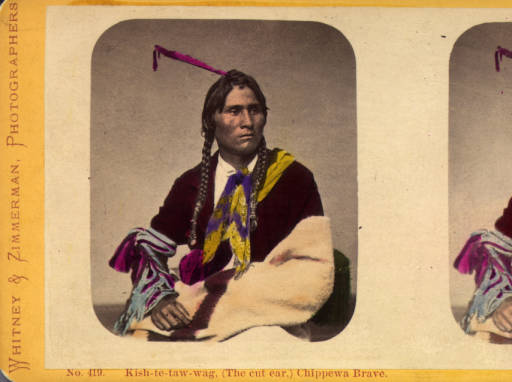
This stereocard of Giishkitawag was produced in the early 1870s, but the original photo was probably taken in the early 1860s (Denver Public Library).

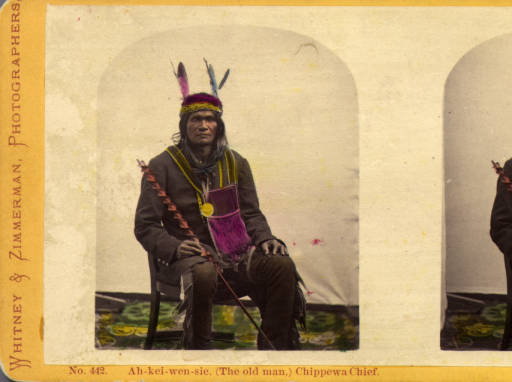
By the mid 1850s, Akiwenzii (Old Man) was the most prominent chief of the Lac Courte Oreilles Band. This stereocard was made by Whitney and Zimmerman c.1870 from an original possibly by James E. Martin in the late 1850s or early 1860s (Denver Public Library).
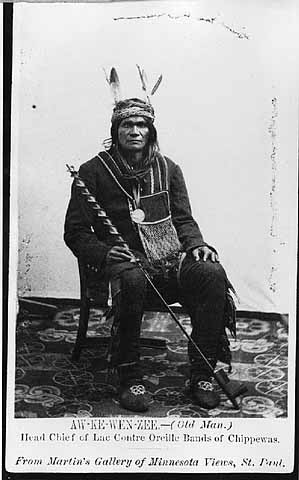
Giishkitawag and Akiwenzii are seem to have aged quite a bit between the early 1860s, when these photos were taken, and 1880 but they are still easily recognized. The earlier photos were taken in St. Paul by the photographers Joel E. Whitney and James E. Martin. Their galleries, especially after Whitney partnered with Charles Zimmerman, produced hundreds of these images on cards and stereoviews for an American public anxious to see real images of Indian leaders.
Giishkitawag and Akiwenzii were not the only Lake Superior chiefs to end up on these souvenirs. Aamoons (Little Bee), of Lac du Flambeau appears to have been a popular subject:

Aamoons (Little Bee) was a prominent chief from Lac du Flambeau (Denver Public Library).
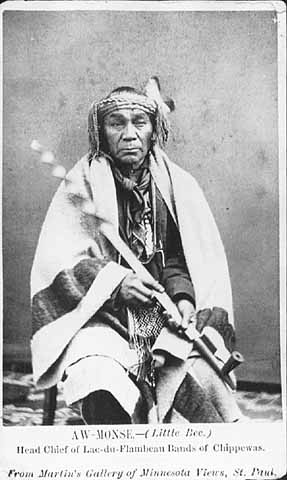
As the images were reproduced throughout the 1870s, it appears the studios stopped caring who the photos were actually depicting:

One wonders what the greater insult to Aamoons was: reducing him to being simply “Chippewa Brave” as Whitney and Zimmerman did here, or completely misidentifying him as Na-gun-ub (Naaganab) as a later stereo reproduction as W. M. McLeish does here:
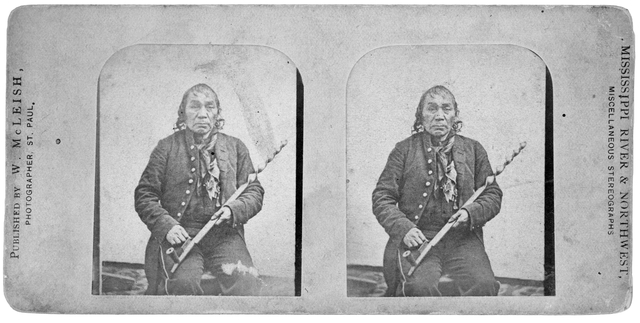
Chief identified as Na-gun-ub (Minnesota Historical Society)
Aamoons and Naaganab don’t even look alike…

Naaganab (Minnesota Historical Society)
…but the Lac du Flambeau and Fond du Lac chiefs were probably photographed in St. Paul around the time they were both part of a delegation to President Lincoln in 1862.

Chippewa Delegation 1862 by Matthew Brady? (Minnesota Historical Society)
Naaganab (seated middle) and Aamoons (back row, second from left) are pretty easy to spot, and if you look closely, you’ll see Giishkitawag, Akiwenzii, and a younger Edawi-giizhig (4th, 5th, and 6th from left, back row) were there too. I can’t find individual photos of the other chiefs, but there is a place we can find their names.
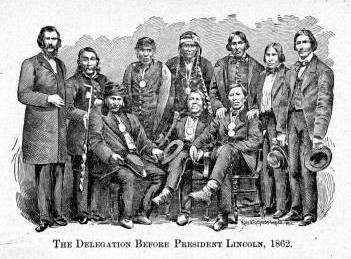
(From Early Life Among the Indians by Benjamin Armstrong)
Benjamin Armstrong, who interpreted for the delegation, included a version of the image in his memoir Early Life Among the Indians. He identifies the men who went with him as:
Ah-moose (Little Bee) from Lac Flambeau Reservation, Kish-ke-taw-ug (Cut Ear) from Bad River Reservation, Ba-quas (He Sews) from Lac Courte O’Rielles Reservation, Ah-do-ga-zik (Last Day) from Bad River Reservation, O-be-quot (Firm) from Fond du Lac Reservation, Sing-quak-onse (Little Pine) from La Pointe Reservation, Ja-ge-gwa-yo (Can’t Tell) from La Pointe Reservation, Na-gon-ab (He Sits Ahead) from Fond du Lac Reservation, and O-ma-shin-a-way (Messenger) from Bad River Reservation.
It appears that Armstrong listed the men according to their order in the photograph. He identifies Akiwenzii as “Ba-quas (He Sews),” which until I find otherwise, I’m going to assume the chief had two names (a common occurrence) since the village is the same. Aamoons, Giishkitawag, Edawi-giizhig and Naaganab are all in the photograph in the places corresponding to the order in Armstrong’s list. That means we can identify the other men in the photo.
I don’t know anything about O-be-quot from Fond du Lac (who appears to have been moved in the engraving) or S[h]ing-guak-onse from Red Cliff (who is cut out of the photo entirely) other than the fact that the latter shares a name with a famous 19th-century Sault Ste. Marie chief. Travis Armstrong’s outstanding website, chiefbuffalo.com, has more information on these chiefs and the mission of the delegation.
Seated to the right of Naaganab, in front of Edawi-giizhig is Omizhinawe, the brother of and speaker for Blackbird of Bad River. Finally, the broad-shouldered chief on the bottom left is “Ja-ge-gwa-yo (Can’t Tell)” from Red Cliff. This is Jajigwyong, the son of Chief Buffalo, who signed the treaties as a chief in his own right. Jayjigwyong, sometimes called Little Chief Buffalo, was known for being an early convert to Catholicism and for encouraging his followers to dress in European style. Indeed, we see him and the rest of the chiefs dressed in buttoned coats and bow-ties and wearing their Lincoln medals.
Wait a minute… button coats?… bow-ties?… medals?…. a chief identified as Buffalo…That reminds me of…
This image is generally identified as Chief Buffalo (Wikimedia Commons)

Anyway, with that mystery solved, we can move on to the next one. It concerns a photograph that is well-known to any student of Chequamegon-area history in the mid 19th century (or any Chequamegon History reader who looks at the banners on the side of this page).Noooooo!!!!!!! I’ve been trying to identify the person in The above “Chief Buffalo” photo for years, and the answer was in Armstrong all along! Now I need to revise this post among others. I had already begun to suspect it was Jayjigwyong rather than his father, but my evidence was circumstantial. This leaves me without a doubt. This picture of the younger Chief Buffalo, not his more-famous father.
The photo showing an annuity payment, must have been widely distributed in its day, because it has made it’s way into various formats in archives and historical societies around the world. It has also been reproduced in several secondary works including Ronald Satz’ Chippewa Treaty Rights, Patty Loew’s Indian Nations of Wisconsin, Hamilton Ross’ La Pointe: Village Outpost on Madeline Island, and in numerous other pamphlets, videos, and displays in the Chequamegon Region. However, few seem to agree on the basic facts:
When was it taken?
Where was it taken?
Who was the photographer?
Who are the people in the photograph?
We’ll start with a cropped version that seems to be the most popular in reproductions:
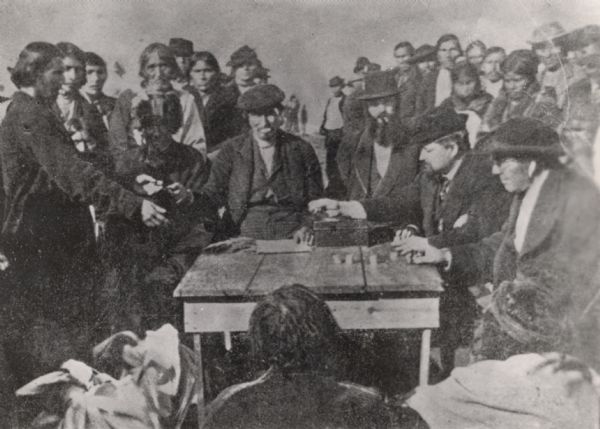
According to Hamilton Ross and the Wisconsin Historical Society: “Annuity Payment at La Pointe: Indians receiving payment. Seated on the right is John W. Bell. Others are, left to right, Asaph Whittlesey, Agent Henry C. Gilbert, and William S. Warren (son of Truman Warren).” 1870. Photographer Charles Zimmerman (more info).
In the next one, we see a wider version of the image turned into a souvenir card much like the ones of the chiefs further up the post:
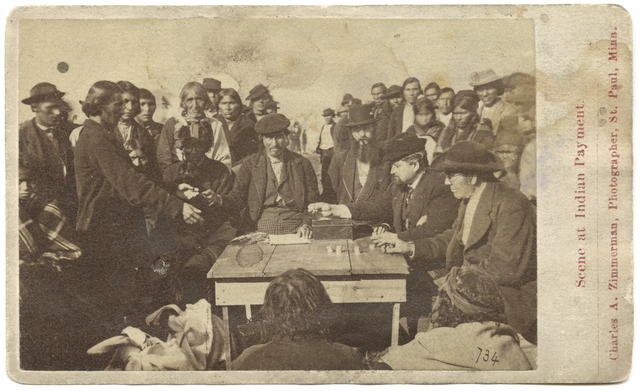
According to the Minnesota Historical Society “Scene at Indian payment, Wisconsin; man in black hat, lower right, is identified as Richard Bardon, Superior, Wisconsin, then acting Indian school teacher and farmer” c.1871 by Charles Zimmerman (more info).
In this version, we can see more foreground and the backs of the two men sitting in front.

According to the Library of Congress: “Cherokee payments(?). Several men seated around table counting coins; large group of Native Americans stand in background.” Published 1870-1900 (more info).
The image also exists in engraved forms, both slightly modified…

According to Benjamin Armstrong: “Annuity papment [sic] at La Pointe 1852” (From Armstrong’s Early Life Among the Indians)
…and greatly-modified.
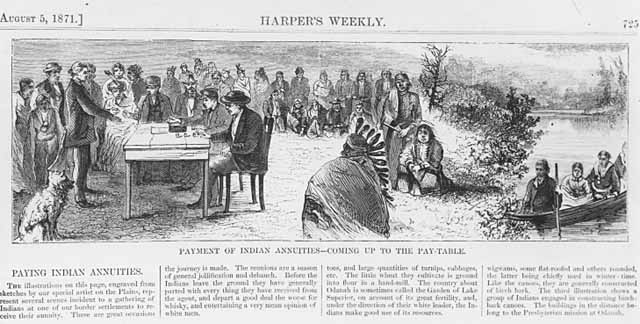
Harper’s Weekly August 5, 1871: “Payment of Indian Annuities–Coming up to the Pay Table.” (more info)
It should also be mentioned that another image exists that was clearly taken on the same day. We see many of the same faces in the crowd:
Scene at Indian payment, probably at Odanah, Wisconsin. c.1865 by Charles Zimmerman (more info)
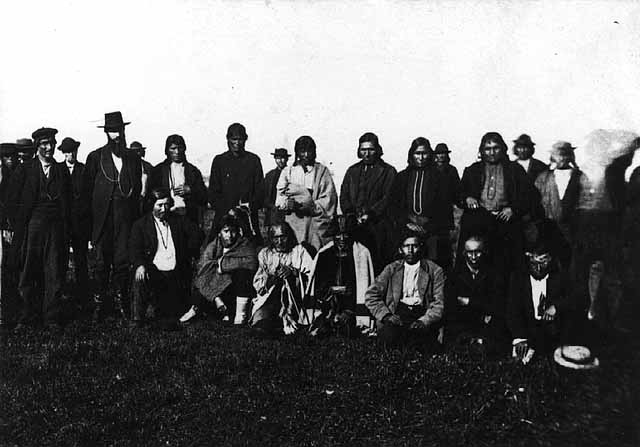
We have a lot of conflicting information here. If we exclude the Library of Congress Cherokee reference, we can be pretty sure that this is an annuity payment at La Pointe or Odanah, which means it was to the Lake Superior Ojibwe. However, we have dates ranging from as early as 1852 up to 1900. These payments took place, interrupted from 1850-1852 by the Sandy Lake Removal, from 1837 to 1874.
Although he would have attended a number of these payments, Benjamin Armstrong’s date of 1852, is too early. A number of secondary sources have connected this photo to dates in the early 1850s, but outside of Armstrong, there is no evidence to support it.
Charles Zimmerman, who is credited as the photographer when someone is credited, became active in St. Paul in the late 1860s, which would point to the 1870-71 dates as more likely. However, if you scroll up the page and look at Giishkitaawag, Akiwenzii, and Aamoons again, you’ll see that these photos, (taken in the early 1860s) are credited to “Whitney & Zimmerman,” even though they predate Zimmerman’s career.
What happened was that Zimmerman partnered with Joel Whitney around 1870, eventually taking over the business, and inherited all Whitney’s negatives (and apparently those of James Martin as well). There must have been an increase in demand for images of Indian peoples in the 1870s, because Zimmerman re-released many of the earlier Whitney images.
So, we’re left with a question. Did Zimmerman take the photograph of the annuity payment around 1870, or did he simply reproduce a Whitney negative from a decade earlier?
I had a hard time finding any primary information that would point to an answer. However, the Summer 1990 edition of the Minnesota History magazine includes an article by Bonnie G. Wilson called Working the Light: Nineteenth Century Professional Photographers in Minnesota. In this article, we find the following:
“…Zimmerman was not a stay-at-home artist. He took some of his era’s finest landscape photos of Minnesota, specializing in stereographs of the Twin Cities area, but also traveling to Odanah, Wisconsin for an Indian annuity payment…”
In the footnotes, Wilson writes:
“The MHS has ten views in the Odanah series, which were used as a basis for engravings in Harper’s Weekly, Aug. 5, 1871. See also Winona Republican, Oct. 12, 1869 p.3;”
Not having access to the Winona Republican, I tried to see how many of the “Odanah series” I could track down. Zimmerman must have sold a lot of stereocards, because this task was surprisingly easy. Not all are labelled as being in Odanah, but the backgrounds are similar enough to suggest they were all taken in the same place. Click on them to view enlarged versions at various digital archives.
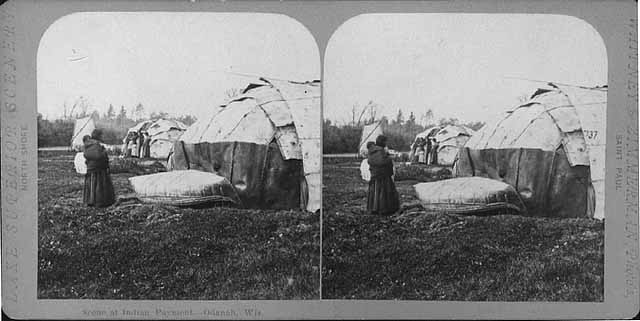
Scene at Indian Payment, Odanah Wisconsin (Minnesota Historical Society)


Chippewa Wedding (British Museum)

Domestic Life–Chippewa Indians (British Museum)

Chippewa Wedding (British Museum)

Finally…

Scene at Indian Payment–Odanah, Wis. (Wikimedia Images)
So, if Zimmerman took the “Odanah series” in 1869, and the pay table image is part of it, then this is a picture of the 1869 payment. To be absolutely certain, we should try to identify the men in the image.
This task is easier than ever because the New York Public Library has uploaded a high-resolution scan of the Whitney & Zimmerman stereocard version to Wikimedia Commons. For the first time, we can really get a close look at the men and women in this photo.
They say a picture tells a thousand words. I’m thinking I could write ten-thousand and still not say as much as the faces in this picture.


To try to date the photo, I decided to concentrate the six most conspicuous men in the photo:
1) The chief in the fur cap whose face in the shadows.
2) The gray-haired man standing behind him.
3) The man sitting behind the table who is handing over a payment.
4) The man with the long beard, cigar, and top hat.
5) The man with the goatee looking down at the money sitting to the left of the top-hat guy (to the right in our view)
6) The man with glasses sitting at the table nearest the photographer
According to Hamilton Ross, #3 is Asaph Whittlesey, #4 is Agent Henry Gilbert, #5 is William S. Warren (son of Truman), and #6 is John W. Bell. While all four of those men could have been found at annuity payments as various points between 1850 and 1870, this appears to be a total guess by Ross. Three of the four men appear to be of at least partial Native descent and only one (Warren) of those identified by Ross was Ojibwe. Chronologically, it doesn’t add up either. Those four wouldn’t have been at the same table at the same time. Additionally, we can cross-reference two of them with other photos.

Asaph Whittlesey was an interesting looking dude, but he’s not in the Zimmerman photo (Wisconsin Historical Society).

Henry C. Gilbert was the Indian Agent during the Treaty of 1854 and oversaw the 1855 annuity payment, but he was dead by the time the “Zimmerman” photo was taken (Branch County Photographs)
Whittlesey and Gilbert are not in the photograph.
The man who I label as #5 is identified by Ross as William S. Warren. This seems like a reasonable guess, though considering the others, I don’t know that it’s based on any evidence. Warren, who shares a first name with his famous uncle William Whipple Warren, worked as a missionary in this area.
The man I label #6 is called John W. Bell by Ross and Richard Bardon by the Minnesota Historical Society. I highly doubt either of these. I haven’t found photos of either to confirm, but the Ireland-born Bardon and the Montreal-born Bell were both white men. Mr. 6 appears to be Native. I did briefly consider Bell as a suspect for #4, though.
Neither Ross nor the Minnesota Historical Society speculated on #1 or #2.
At this point, I cannot positively identify Mssrs. 1, 2, 3, 5, or 6. I have suspicions about each, but I am not skilled at matching faces, so these are wild guesses at this point:
#1 is too covered in shadows for a clear identification. However, the fact that he is wearing the traditional fur headwrap of an Ojibwe civil chief, along with a warrior’s feather, indicates that he is one of the traditional chiefs, probably from Bad River but possibly from Lac Courte Oreilles or Lac du Flambeau. I can’t see his face well enough to say whether or not he’s in one of the delegation photos from the top of the post.
#2 could be Edawi-giizhig (see above), but I can’t be certain.
#3 is also tricky. When I started to examine this photo, one of the faces I was looking for was that of Joseph Gurnoe of Red Cliff. You can see him in a picture toward the top of the post with the Roy brothers. Gurnoe was very active with the Indian Agency in Bayfield as a clerk, interpreter, and in other positions. Comparing the two photos I can’t say whether or not that’s him. Leave a comment if you think you know.
#5 could be a number of different people.
#6 I don’t have a solid guess on either. His apparent age, and the fact that the Minnesota Historical Society’s guess was a government farmer and schoolteacher, makes me wonder about Henry Blatchford. Blatchford took over the Odanah Mission and farm from Leonard Wheeler in the 1860s. This was after spending decades as Rev. Sherman Hall’s interpreter, and as a teacher and missionary in La Pointe and Odanah area. When this photo was taken, Blatchford had nearly four decades of experience as an interpreter for the Government. I don’t have any proof that it’s him, but he is someone who is easy to imagine having a place at the pay table.
Finally, I’ll backtrack to #4, whose clearly identifiable gray-streaked beard allows us to firmly date the photo. The man is Col. John H. Knight, who came to Bayfield as Indian Agent in 1869.
Col. John H. Knight (Wisconsin Historical Society)
Knight oversaw a couple of annuity payments, but considering the other evidence, I’m confident that the popular image that decorates the sides of the Chequamegon History site was indeed taken at Odanah by Charles Zimmerman at the 1869 annuity payment.
Do you agree? Do you disagree? Have you spotted anything in any of these photos that begs for more investigation? Leave a comment.
As for myself, it’s a relief to finally get all these photo mysteries out of my post backlog. The 1870 date on the Zimmerman photo reminds me that I’m spending too much time in the later 19th century. After all, the subtitle of this website says it’s history before 1860. I think it might be time to go back for a while to the days of the old North West Company or maybe even to Pontiac. Stay tuned, and thanks for reading,
Blackbird’s Speech at the 1855 Payment
January 20, 2014
“We sold our land for our graves–that we might have a home, where the bones of our fathers are buried. We were not willing to sell the ashes of our relatives which are so dear to us. This was the reason why we sold our lands. It was not to pay debts over and over again, but to benefit the living, those of us who yet remain upon earth, our young men & women & children.”
~Makade-binesi (Blackbird)

Scene at Indian Payment–Odanah, Wis. This image is from a later payment than the one described below (Whitney & Zimmerman c.1870)
Most of us have heard Chief Joseph’s “Fight No More Forever” speech and Chief Seattle’s largely-fictional plea for the environment, but very few will know that a outstanding example of Native American oratory took place right here in the Chequamegon Region in the summer of 1855.
It was exactly eleven months after the Lake Superior Ojibwe bands gave up the Arrowhead region of Minnesota, in their final treaty with the United States, in exchange for permanent reservations. Already, the American government was trying to back out of a key provision of the agreement. It concerned a clause in Article Four of the 1854 Treaty of La Pointe that reads:
The United States will also pay the further sum of ninety thousand dollars, as the chiefs in open council may direct, to enable them to meet their present just engagements.
The inclusion of clauses to pay off trade debts was nothing new in Ojibwe treaties. In 1837, $70,000 went to pay off debts, and in 1842 another $75,000 went to the traders. Personal debts would often be paid out of annuity funds by the government directly to the creditors and certain Ojibwe families would never see their money. However, from the beginning there were accusations that these debts were inflated or illegitimate, and that it was the traders rather than the Ojibwe themselves, who profited from the sale of the lands. Therefore, in 1854, when $90,000 in claims were inserted in the treaty, the chiefs demanded that they be the ones to address the claims of the creditors.
However, less than a year later, at the first post-1854 payment, the government was pressured to back off of the language in the treaty. George Manypenny, the Commissioner of Indian Affairs, came to La Pointe to oversee the payment where he was asked by Indian Agent Henry Gilbert to let the Agency oversee the disbursement of the $90,000. Most white inhabitants, and many of the white tourists in town to view the spectacle that was the 1855 payment, supported the agent’s plan, as did most of the mix-blooded Ojibwe (most of whom were employed in the trading business in one way or another) and a substantial minority of the full-bloods.
However, the clear majority of the Lake Superior chiefs insisted they keep the right to handle their own debt claims. As we saw in this post, the Odanah-based missionary Leonard Wheeler also felt the Government needed to honor its treaties to the letter. This larger faction of Ojibwe rallied around one chief. He was from the La Pointe Band and was entrusted to speak for Ojibwe with one voice. From this description, you might assume it was Chief Buffalo. However, Buffalo, in the final days of his life, found himself in the minority on this issue. The speaker for the majority was the Bad River chief Blackbird, and he may have delivered one of the greatest speeches ever given in the Chequamegon Bay region.
Unfortunately, the Ojibwe version of the speech has not survived, and it’s English version, originally translated by Paul Bealieu, exists in pieces recorded by multiple observers. None of these accounts captures all the nuances of the speech, so it is necessary to read all of them and then analyze the different passages to see its true brilliance.
The first reference to Blackbird’s speech I remember seeing appeared in the eyewitness account of Dr. Richard F. Morse of Detroit who visited La Pointe that summer specifically to see the payment. His article, The Chippewas of Lake Superior appeared in the third volume of the Collections of the State Historical Society of Wisconsin. As you’ll read, it doesn’t speak very highly of Blackbird or the speech, celebrating instead the oratory of Naaganab, the Fond du Lac chief who was part of the minority faction and something of a celebrity among the visiting whites in 1855:


From Morse’s clear bias against Ojibwe culture, I thought there may have been more to this story, but my suspicions weren’t confirmed until I transcribed another account of the payment for Chequamegon History. An Indian Payment written by another eyewitness, Crocket McElroy, paints a different picture of Blackbird and quotes part of his speech:

Paul H. Beaulieu translated the speeches at the 1855 annuity payment (Minnesota Historical Society Collections).
In August 1855 about three thousand Chippewa Indians gathered at the village of Lapointe, on Lapointe Island, Lake Superior, for an Indian Payment and also to hold a council with the commissioner of Indian affairs, who at that time was George W. Monypenny of Ohio. The Indians selected for their orator a chief named Blackbird, and the choice was a good one, as Blackbird held his own well in a long discussion with the commissioner. Blackbird was not one of the haughty style of Indians, but modest in his bearing, with a good command of language and a clear head. In his speeches he showed much ingenuity and ably pleaded the cause of his people. He spoke in Chippewa stopping frequently to give the interpreter time to translate what he said into English. In beginning his address he spoke substantially as follows:
“My great white father, we are pleased to meet you and have a talk with you We are friends and we want to remain friends. We expect to do what you want us to do, and we hope that you will deal kindly with us. We wish to remind you that we are the source from which you have derived all your riches. Our furs, our timber, our lands, everything that we have goes to you; even the gold out of which that chain was forged (pointing to a heavy watch chain that the commissioner carried) came from us, and now we hope that you will not use that chain to bind us.”
These conflicting accounts of the largely-unremembered Bad River chief’s speech made me curious, and after I found the Blackbird-Wheeler-Manypenny letters written after the payment, I knew I needed to learn more about the speech. Luckily, digging further into the Wheeler Papers uncovered the following. To my knowledge, this is the first time it has been transcribed or published in any form.
[Italics, line breaks, and quotation marks added by transcriber to clearly differentiate when Wheeler is quoting a speaker. Blackbird’s words are in blue.]
O-da-nah Jan 18, 1856.
L. H. Wheeler to Richard M. Smith
Dear Sir,
The following is the substance of my notes taken at the Indian council at La Pointe a copy of which you requested. Council held in front of Mr. Austrian’s store house Aug 30. 1855.
Short speech first from Kenistino of Lac du Flambeau.
My father, I have a little to say to you & to the Indians. There is no difference between myself and the other chiefs in regard to the subject upon which we wish to speak. Our chiefs and young men & old men & even the women & children are all of the same mind. Blackbird our chief will speak for us & express our sentiments.
The Commissioner, Col Manypenny replied as follows.
My children I suppose you have come to reply to what I said to you day before yesterday. Is this what you have come for?
“Ah;” or yes, was the reply.
I am happy to see you, but would suggest whether you had not better come tomorrow. It is now late in the day and is unpleasant & you have a great deal to say and will not have time to finish, but if you will come tomorrow we shall have time to hear all you have to say. Don’t you think this will be the best way?
“Ah!” yes was the response.
Think well about what you want to say and come prepared to speak freely & fully about all you wish to say. I would like not only to hear the chiefs and old men speak, but the young men talk, and even the women, if they wish to come, let them come and listen too. I want the women to understand all that is said and done. I understand that some of the Indians were drunk last night with the fire-water. I hope we shall hear nothing more of it. If any body gives you liquor let me know it and I will deal with him as he deserves. I hope we shall have a good time tomorrow and be able to explain all about your affairs.
Aug 31. Commissioner opened the council by saying that he wanted all to keep order.
Let the whites and others sit down on the ground and we will have a pleasant time. If you have anything to say I hope you will speak to the point.
Black Bird. To the Indians.
My brother chiefs, head men & young men & children. I have listened well to all the men & women & others who have spoken in our councils and shall now tell it to my father. I shall have but one mouth to speak your will.
Nose [noose (no-say) “my father”]. My father. We present you our salutations in your heart. We salute you in the name of our great father the President, whose representative you are. We want the Great Spirit now to bless us. The Day is clear, and we hope our thoughts will be clear too. My intention is to tell you what the owner of life has done for us. He has provided for the life of us all. When the Lord made us he provided for us here upon earth he invested it (ie, he made provision for our wants) in the running streams, in the woods & lakes which abound with fish and in the wild animals. We regard you as if men like a spirit, perhaps it is because of your education, because you are so much wiser than we, but if we can trace our tradition right the Great Spirit has not made the white man to cheat us. There is a difference of opinion as it regards different colors among, as to which shall have the preeminence, but the Great Spirit made us to be happy before you discovered us.
I will now tell you about how it was with us before our payments, and before we sold any land. Our furs that we took we sold to our traders. We were then paid 4 martin skins for a dollar. 4 bears skins also & 4 beaver skins for $1.00 too. Can you wonder that we are poor? I say this to show you what our condition was before we had any payments. I[t] was by our treaties that we learned the use of money. I see you White men that sit here how you are dressed. I see your watch chains & seals and your rich clothing. Now I will tell you how it is with our traders. When they first came among us they were very poor, but by & by they became very fat & rich, and wear rich clothing and had their watches & gold chains such as I see you wear. But they got their things out of us. They were made rich at our expense. My father, you told us to bring our women here too. Here they are, and now behold them in their poverty, and pity their condition (at this juncture in the speech several old women stood dressed in their worn out blankets and tattered garments as if designed to appeal to his humanity[)].
My father, I am now coming to the point. We are here to protect our own interests. Our land which we got from our forefathers is ours & we must get what we can for it. Our traders step between us & our father to controll our interests, and we have been imposed upon. Mr. Gilbert was the one I shook hands with last year when he was sent here to treat for our lands. He was the one who was sent to uphold us in our poverty. We are thankful to see you both here to attend to our interests, and that we are permitted to express to you our wants. Last year you came here to treat for our lands we are now speaking about. We sold them because we were poor. We thank our father for bringing clothing to pay for them. We sold our land for our graves–that we might have a home, where the bones of our fathers are buried. We were not willing to sell the ashes of our relatives which are so dear to us. This was the reason why we sold our lands. It was not to pay debts over and over again, but to benefit the living, those of us who yet remain upon earth, our young men & women & children.
You said you wanted to see them. They have been sent for and are now here. Behold them in their poverty & see how poor they look.
They are poor because so much of our money is taken to pay old debts. We want the 90,000 dollars to be paid as we direct. We know that it is just and right that it should be so. We want to have the money paid in our own hands, and we will see that our just debts are paid. We want the 90,000 to feed our poor women, and after paying our just debts we want the remainder to buy what we want. This is the will of all present. The chiefs, & young men & old men & the women & children.
Let what I have now said, my father, enter your head & heart; and let it enter the head of our great father the President, that it may be as we have now said. We own no more land. We must hereafter provide for ourselves. We want to profit by all the provisions of the treaty we have now made. We want the whole annuity paid to us as stipulated in the treaty. I am now done. After you have spoken, perhaps there are others who would like to speak.
This is the first time my father that I have appeared dressed in a coat & pants & I must confess I feel a little awkward.
The Commissioner replied as follows
We have all heard & noted down what you have said. If any others wish to speak they had better speak first and I will reply to all at once.
The Grand Portage Indian [Adikoons] then spoke as follows.
My father, I have a few words to say, and I wish to speak what I think. We have long coveted the privilege of seeing our Great Father. Why not now embrace the opportunity to speak freely while he is here? This man will speak my mind. He is old enough to speak and is a man endowed with good sense. He will speak our minds without reserve.
When we look around us, we think of our God who is the maker of us all. You have come here with the laws of that God we have talked about, and you profess to be a Christian and acknowledge the authority of God. The word of God ought to be obeyed not only by the Indians, but by all. When we see you, we think you must respect that word of God, who gives life to all. Your advice is like the law of God. Those who listen to his law are like God–firm as a rock, (not fickle and vacilating). When the word of the Great Spirit ends. When there is an end to life, we are all pleased with the advice you have given us, and intend to act in accord with it. If we are one here, and keep the word of the Great Spirit we shall be one here after. In what Blackbird said he expressed the mind of a majority of the chiefs now present. We wish the stipulations of the treaty to be carried out to the very letter.
I wish to say our word about our reserves. Will these reserves made for each of our bands, be our homes forever?
When we took credits of our trader last winter, and took no furs to pay him, and wish to get hold of this 90,000 dollars, that we may pay him off of that. This is all we came here for. We want the money in our own hands & we will pay our own traders. We do not think it is right to pay what we do not owe. I always know how I stand my acct. and we can pay our own debts. From what I have now said I do not want you to think that we want the money to cheat our creditors, but to do justice to them I owe. I have my trader & know how much I owe him, & if the money is paid into the hands of the Indians we can pay our own debts.
Naganub.
We have 90,000 dollars set apart to pay our traders, for my part I think it is just that the money should go for this object. We all know that the traders help us. We could not well do without them.
Buffalo.
We who live here are ready to pay our just debts. Some have used expressions as though these debts were not just. I have lived here many years and been very poor. There are some here who have been pleased to assist me in my poverty. They have had pity on me. Those we justly owe I don’t think ought to be defrauded. The trader feeds our women & children. We cannot live one winter without him. This is all I have to say.
 [Wheeler does not identify a new speaker here, but marks a a star (right). Kohl (below) attributes the line about the “came out of the water” to Blackbird, but the line about the copper diggings contradicts Blackbird’s earlier statement, in Kohl, about not knowing their value. This, and Wheeler’s marking of Blackbird as the one who spoke after this speech would indicate this is Buffalo still talking].
Our rights ought to be protected. When commissioners have come here to treat for our lands, we have always listened well to their words. Not because we did not know ourselves the worth of our lands. We have noticed the ancient copper diggings, and know their worth. We have never refused to listen to the words of our Great Father. He it is true has had the power but we have made him rich. The traders have always wanted pay for what we do not remember to have bought. At Crow [W]ing River when our lands were ceded there, then there was a large sum demanded to pay old debts. We have always paid our traders we have acted fair on our part. At St. Peters also there was a large amount of old debts to be paid–many of them came from places unknown–for what I know they came out of the water. We think many of them came out of the same bag, and are many of them paid over & over again at every treaty.
Black Bird.
I get up no[w] to finish what you have put into my heart. The night would be heavy on my breast should I retain any of the words of them with whom I have councilled & for whom I speak. I speak no[w] of farmers, carpenters, & other employees of Govt. Where is the money gone to for them? We have not had these laborers for several years that has been appropriated. Where is the money that has been set apart to pay them? You will not probably see your Red Children again in after years to council with them. So we protest by the present opportunity to speak to you of our wants & grievances. We regard you as standing in the place of our great father at Washington, and your judgement must be correct. This is all I have to say about our arrearages, we have not two tongues.
As exciting as it was to have the full speech, as I transcribed some of the passages, some of them seemed very familiar. Sure enough, on page 53 of Johann Georg Kohl’s Kitchi-Gami: Life Among the Lake Superior Ojibway, there is another whole version. Kitchi-Gami is one of the standards of Ojibwe cultural history, and I use it for reference fairly often, but it had been so long since I had read the book cover to cover that I forgot that Kohl had been another witness that August day in 1855:


When one considers that Paul Beaulieu, the man giving the official English translation was probably speaking in his third language, after Ojibwe and Metis-French, and that Kohl was a native German speaker who understood English but may have been relying on his own mix-blood translator, it is remarkable how similar these two accounts are. This makes the parts where they differ all the more fascinating. Undoubtedly there are key parts of this speech that we could only understand if we had the original Ojibwe version and a full understanding of the complicated artistry of Ojibwe rhetoric with all its symbolism and metaphor. Even so, there are enough outstanding passages here for me to call it a great speech.
“My father…great Father…We regard you as if men like a spirit, perhaps it is because of your education, because you are so much wiser than we…”
The ritual language of kinship and humility in traditional Ojibwe rhetoric can be off-putting to those who haven’t read many Ojibwe speeches, and can be mistaken as by-product of American arrogance and paternalism toward Native people. However, the language of “My Father” predates the Americans, going all the way back to New France, and does not necessarily indicate any sort weakness or submission on the part of the speaker. Richard White, Michael Witgen, and Howard Paap, much smarter men than I, have dedicated pages to what Paap calls “fur-trade theater,” so I won’t spend too much time on it other than to say that 1855 was indeed a low point in Ojibwe power, but Blackbird is only acting the ritual part of the submissive child here in a long-running play. He is not grovelling.
On the contrary, I think Blackbird is playing Manypenny here a little bit. George Manypenny’s rise to the head of Indian Affairs coincided with the end of American removal policy and the ushering in of the reservation era. In the short term, this was to the political advantage of the Lake Superior Ojibwe. In Manypenny the Ojibwe got a “Father” who would allow them to stay in their homelands, but they also got a zealous believer in the superiority of white culture who wanted to exterminate Indian cultures as quickly as possible.
In a future post about the 1855 treaty negotiations with the Minnesota Ojibwe we will see how Commissioner Manypenny viewed the Ojibwe, including masterful politicians like Flat Mouth and Hole in the Day, as having the intelligence of children. Blackbird shows himself a a savvy politician here by playing into these prejudices as a way to get the Commissioner off his guard. Other parts of the speech lead me to doubt that Blackbird sincerely believed that the Americans were “so much wiser” than he was.
My intention is to tell you what the owner of life has done for us. He has provided for the life of us all. When the Lord made us he provided for us here upon earth he invested it (ie, he made provision for our wants) in the running streams, in the woods & lakes which abound with fish and in the wild animals… There is a Great Spirit from whom all good things here on earth come. He has given them to mankind–to the white as to the red man; for He sees no distinction of colour…but if we can trace our tradition right the Great Spirit has not made the white man to cheat us. There is a difference of opinion as it regards different colors among, as to which shall have the preeminence, but the Great Spirit made us to be happy before you discovered us…
This part varies slightly between Wheeler and Kohl, but in both it is very eloquent and similar in style to many Ojibwe speeches of the time. One item that piqued my interest was the line about the “difference of opinion.” Many Americans at the time understood the expansion of the United States and the dispossession of Native peoples in religious terms. It was Manifest Destiny. The Ojibwe also sought answers for their hardships in prophecy. On pages 117 and 118 of History of the Ojibwe People, William Warren relates the following:

Warren, writing in the late 1840s and early 1850s, contrasts this tradition with the popularity of the prophecies of Tenskwatawa, brother of Tecumseh, in Ojibwe country forty years earlier. Tenskwatawa taught that Indians would inherit North America and drive whites from the continent. Blackbird seems to be suggesting that in 1855 this question of prophecy was not settled among the Lake Superior Ojibwe. Presumably there would have been fertile ground for a charismatic millenarian Native spiritual leader along the lines of Neolin, Tenskwatawa, or Wovoka to gain adherents among the Lake Superior Ojibwe at that time.

Johann Georg Kohl recorded Blackbird’s speech in his well known account of Lake Superior in the Summer of 1855, Kitchi-Gami: Life Among the Lake Superior Ojibway.
Our furs, our timber, our lands, everything that we have goes to you; even the gold out of which that chain was forged…Now I will tell you how it is with our traders. When they first came among us they were very poor, but by & by they became very fat & rich, and wear rich clothing and had their watches & gold chains such as I see you wear. But they got their things out of us. They were made rich at our expense…and now we hope that you will not use that chain to bind us…
The gold chain appears in each of McElroy, Wheeler, and Kohl’s accounts. It acts as a symbol on multiple levels. To Blackbird, the gold represents the immense wealth produced during the fur trade on the backs of Indian trappers. By 1855, with the fur trade on its last legs, some of the traders are very wealthy while the Ojibwe are much poorer than they were when the trade started. The gold also stands in for the value of the ceded territory itself, specifically the lakeshore lands (ceded in 1842), which thirteen years later were producing immense riches from that other shiny metal, copper. Finally, in McElroy’s account, we also see the chain acting as the familiar symbol of bondage.
…We sold our land for our graves–that we might have a home, where the bones of our fathers are buried…Our debts we will pay. But our land we will keep. As we have already given away so much, we will, at least, keep that land you have left us, and which is reserved for us. Answer us, if thou canst, this question. Assure us, if thou canst, that this piece of land reserved for us, will really always be left to us…
This passage of Blackbird’s speech, and a similar statement by the “Grand Portage Indian” (identified by Morse as Adikoons or Little Caribou), indicate that perhaps, the actual disbursement of the $90,000 was a secondary to the need to hold Agent Gilbert and the Government to their word. It was very important to the Ojibwe that words of the Treaty of 1854 be rock-solid, not for a need to pay off debts or to get annuity payments, but because the Government absolutely needed to keep its promise to grant reservations around the ancestral villages. The memory of the Sandy Lake Tragedy, less than five years earlier, cast a long shadow over this decade. Paap argues in Red Cliff, Wisconsin that the singular goal of the treaty, from the Ojibwe perspective, was to end the removal talk forever, a goal that had seemingly been accomplished. To hear the Government trying to weasel out of a provision of the 1854 Treaty must have been very frightening to those who heard Robert Stuart’s promises in 1842. This time, the chiefs had to make sure a promise of a permanent homeland for their people wouldn’t turn out to be another lie.
This is the first time my father that I have appeared dressed in a coat & pants & I must confess I feel a little awkward.
You can argue that a great speech can’t end with the line, “I must confess I feel a little awkward.” However, I will argue that this might be the best line of all. It is another example of the political brilliance of Blackbird. The Bad River chief knew who his allies were, knew who his opponents were, and knew how to take advantage of the Commissioner’s prejudices. Clothing played a role in all of this.
George Manypenny despised Indian cultures. In fact, the whole council had almost derailed a few days before the speeches when the Commissioner refused to smoke the pipe presented to him by the chiefs in open ceremony. He remedied this insult somewhat by smoking it later while indoors, but he let it be known that he had no use for Ojibwe songs, dances, rituals or clothing. This put Blackbird, an unapologetic traditionalist and practitioner of the midewiwin at a distinct disadvantage, when compared with chiefs like Naaganab who were known to wear European clothes and profess to be Christians.
Although he had the majority of the people behind him, Blackbird had very little negotiating power. He had to persuade Manypenny that he was in the right. He had no chance unless he could appear to the Commissioner that he was trying to become “civilized” and was therefore worthy enough to be listened to. However, by wearing European clothes, he ran the risk of alienating the majority of the people in the crowd who preferred traditional ways and dress. Furthermore, the chiefs most likely to oppose him, Naaganab and Jayjigwyong (Little Buffalo) had been dressing like whites (I would argue also largely for political reasons) for years and were much more likely to come across as “civilized” in the Commissioner’s eyes.
How did the chief solve these dilemmas? In the same way he turned Manypenny’s request to see the Ojibwe women to his advantage, he used the clothing to demonstrate that he had gone out of his way to work with the Commissioner’s wishes, while still solidifying the backing of the traditional Ojibwe majority and putting his opponents on the defensive all with one well-timed joke. Although this joke seems to have gone over Wheeler’s head, and likely Manypenny’s as well, Kohl’s mention of the “applauding laughter of the entire assembly,” shows it reached its target audience. So, contrary to first appearances, the crack about the awkward pants is anything but an awkward ending to this speech.
Conclusion
In the 1840s and early 1850s, Blackbird rarely appears in the historical record. Here and there he is mentioned as a second chief to Chief Buffalo or as leading the village at Bad River. Many mentions of him by English-speaking authors are negative. He is referred to as a rascal, scoundrel, or worse, and I’ve yet to find any mention of his father or other family members as being prominent chiefs.
However, in the late 1850s and early 1860s, he was clearly the most important speaker for not just the La Pointe Band, but for the other Lake Superior Bands as well. This was a mystery to me. I temporarily hypothesized his rise was due to the fact that Chequamegon was seen as the center of the nation and that when Buffalo died, Blackbird succeeded to the position by default. However, this view doesn’t really fit what I understood as Ojibwe leadership.
This speech puts that interpretation to rest. Blackbird earned his position by merit and by the will of the people.
He did not, however, win on the question of the $90,000. A Chequamegon History reader recently sent me a document showing it was eventually paid to the creditors directly by the Agent. However, if my argument is correct, the more important issue was that the Government keep its word that the reservations would belong to the Ojibwe forever. The land question wasn’t settled overnight, and it required many leaders over the last 160 years to hold the United States to its word. But today, Blackbird’s descendants still live beside the swamps of Mashkiziibii at least partially because of the determination of their great ogimaa.
 Chequamegon History