1839 Petitions against Payments at La Pointe
October 10, 2025
Collected & edited by Amorin Mello
Previously we featured 1837 Petitions from La Pointe to the President about $100,000 Payments to Chippewa Mixed-Bloods from the 1837 Treaty of Saint Peters, and 1838 more Petitions from La Pointe to the President about relocating the Payments from St. Croix River to Lake Superior. Those earlier Petitions were from Chief Buffalo and dozens of Mixed-Bloods from the Lake Superior Chippewa Bands, setting precedence for La Pointe to host the 1842 Treaty and 1854 Treaty in later decades.
Today’s post features 1839 Petitions against Payments at La Pointe. These petitioners appear to be looking to get a competitive edge against the American Fur Company monopoly at La Pointe, by moving the payments south across the Great Divide into the Mississippi River Basin.
For more information about the $100,000 Payments at La Pointe in 1839, we strongly recommend Theresa M. Schenck’s excellent book All Our Relations: Chippewa Mixed-Bloods and the Treaty of 1837.
Letters Received by the Office of Indian Affairs:
La Pointe Agency 1831-1839
National Archives Identifier: 164009310

April 9, 1839
from Joseph Rolette at Prairie du Chien
to the Superintendent of Indian Affairs
Received April 27, 1839
Prairie du Chiene 9th April 1839
T.H. Crawford Esq’r
Commissioner of Ind’n affairs
Washington
You must excuse the liberty I take in addressing you once more – presuming you are not well acquainted yet with this Country, I am requested by the Chippewaw half Breeds that remain in this Country, that it is with regret they have heard that the payment allowed to them in the treaty of the 29th July 1837 is to be made on Lake Superior. They have to State, that it will be impossible for them to reach that place as the American Fur Co. are the only Co. who have vessels on Lake Superior & Notwithstanding they could procure on Passage Gratis on the Lake.
This distance between Sault Ste Mary, and the Mississippi is great and expensive. They also represent that the half Breeds born on Lake Superior are not entitled to any Share of the money allowed.
Whereas if the Payment was made at the Falls of St. Croix, there would be Competition amongst traders, whereas in Lake Superior they can be done none. They humbly beseech that you will have Mercy on them and not allow them to be deprived by intrigue of the Sum due them. So Justly to go in other hands but the real owners.
Respectfully
your most obd’t Serv’t
Joseph Rolette
on behalf of the Chippewaw
Half Breeds of
Prairie du Chiens

June 21, 1839
from the Indian Agent at Saint Peters
via the Governor of Wisconsin Territory
to the Superintendent of Indian Affairs
Received July 16, 1839
Answered July 24, 1839
Superintendency of Indn Affairs
for the Territory of Wisconsin
Mineral Point June 20, 1839
Sir,

Henry Dodge
Governor of Wisconsin Territory
I have the honor to transmit, enclosed herewith, three letters from Major Taliaferro, Indian Agent at St Peters, dated 10th, 16th, & 17th inst, with two Indian talks of 3rd & 14th, for the information of the Department.
Very respectfully
Yours obedt sevt
Henry Dodge
Supt Ind Agy
T Hartley Crawford Esq
Com. of Indian Affairs
North Western Agency St Peters
Upper Mississippi June 10th 1839
Governor,
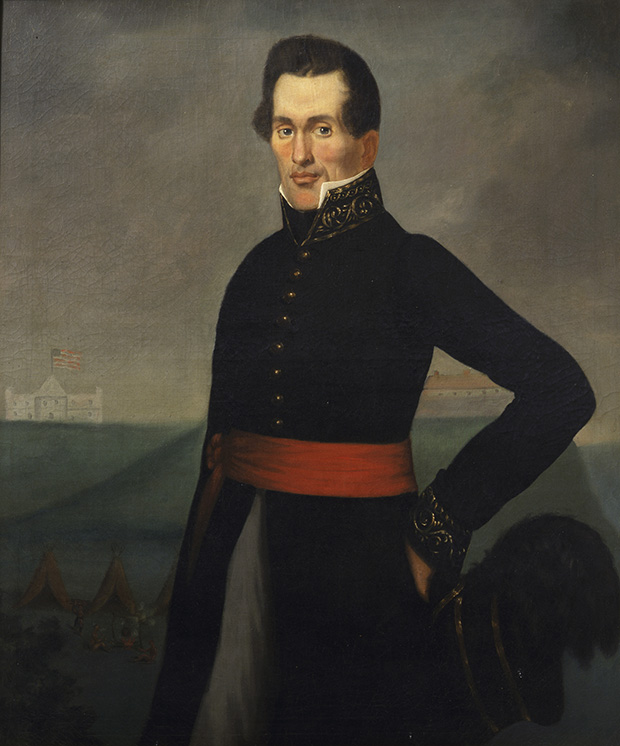
Lawrence Taliaferro
Indian Agent at Fort Snelling
I deem it to be most adviseable that the enclosed paper, addressed to the Agent, and Commanding Officer on this Station from the Chippewa Chief “Hole in the Day” should be forwarded to you, the Indians addressing us being within your Excellency’s Superintendency. It may be well to add that a similar document proceeding from the Chippewa Chiefs of St Croix was on the 4th inst forwarded for the information of the Office of Indian Affairs at Washington.
The consolidation of the two Chippewa Sub Agencies and located at Lapointe, it is feared may lead to rather unpleasant results. I know the Chippewas well, and may have as much influence with those of the Mississippi particularly as most men, yet were I to say “you are not to have an agent in your Country, and you must go to Lapointe in all time to come for your Annuity, and treaty Stipulations.” I should not expect to hold their confidence for one day.
With high respect Sir
Your mo obt Serv
Law Taliaferro
Indian Agent
at S. Peters
His Excellency
Governor Henry Dodge
Suprt of Indi Affairs
at Mineral Point
For Wisconsin
North Western Agency S. Peters
Upper Mississippi June 16th, 1839
Governor
I have been earnestly selected by a number of the respectable half breed Chippewas resident, and others of the Mississippi, interested in the $100,000 set apart in the treaty of July 29, 1837 of S. Peters, to ask for such information as to their final disposal of this Sum, as may be in your possession.
The claimants referred to have learned through the medium of an unofficial letter from the Hon Lucius Lyon to H. H. Sibley Esqr. of this Post, that the funds in question as well as the Debts of the Chippewas to the traders was to be distributed by him as the Commissioner of the United States at Lapointe on Lake Superior, and for this purpose should reach that place on or about the 10th of July. The individuals Seeking this information are those who were were so greatly instrumental in bungling your labours at the treaty aforesaid to a successful issue in opposition to the combinations formed to defeat the objects of the government.
There remains 56,000$ in specie at this post being the one half of the sum appropriated or applicable to the objects in contemplation, and upon which the authorities here have had as yet no official instructions to transfer some special information would relieve the minds of a miserably poor class of people and who fear the entire loss of their just claims.
With high respect, Sir
your mo obt Sevt
Law Taliaferro
Indn Agent
at S. Peters
His Excellency
Gov Henry Dodge
Suprt of Ind. Affairs
for Wisconsin
North Western Agency S. Peters
Upper Mississippi June 17th 1839
Governor
On the 20th of May past I dispatched Peter Quin Express to the Chippewas of the Upper Mississippi with a letter from Maj D. P. Bushnell agent for this tribe at Lapointe notifying the Indians, and half breeds that they would be paid at Lapointe hereafter, and at an earlier period than the last year. I informed you of the result of his mission on the 10th inst. enclosing at the same time the written sentiments of the principle Chief for his people. I now forward by Express a second communication from the Same Source received late last night. I would make a plain copy, but have not time. So the original is Sent.
In four days there will be a large body of Chippwas here, and they cannot be Stopped. There are now also 880 Sioux from remote Sections of the Country at this Post and of course we may calculate on some difficulty between these old enemies. Your presence is deemed essential, or such instructions as may soothe the Angry feelings of the Chippewas, on account of the direction given to their annuity, & treaty Stipulations.
With high respect Sir
Your mo ob Sevt
Law Taliaferro
Indn Agent
at S Peters
His Excellency
Governor Henry Dodge
Suprt of Indi Affairs
Mineral Point
(NB) The Chippewas are to be understood as to the point of payment indicated to be the St.Croix, and not the S.Peters, as deemed by the written Talks. It never could be admited in the present state of the Tribes to pay the Chippewas at this Post, but they might with safety to all parties be paid at or above the Falls of S.Croix, by an agent who they ought to have or some special person assigned to this duty.
Elk River, June 3rd 1839
Maj Toliver. Maj Plimpton.
My respects to you both, and my hand: I am to let you know that I intend to pay you a visit, with my chiefs as braves, the principle of my warriors are verry anxious to pay you a visit.
The above mentioned men are verry anxious to see Gov. Dodge with whom we made the treaty, that we may have a talk with him. It was with him commissioner of the United-States we made the treaty, and we are verry much disappointed to hear the newes, we hear this day (IE that we must go to Lake Sup. for our pay) which we have this day decided we will not do; that we had rather die first: it is on this account we wish to pay you a visit, and have a talk with Gov. Dodge. You sir, Maj Toliver know verry well our situation, and that the distance is so great for us to go to Lake Sup. for to get our pay &c. or even a gun repaired; that it is inconsistent for such a thing to be required of us; even if we did literally place the matter in the hands of Government. We are all living yet that was present at the treaty when we ceded the land to the Unitedstates, and remember well what was our understanding in the agreement.
We now wish Maj Toliver; to mention to your children that it is a fals report that we had any intention to have more difficulty with the Sioux, as our Missionaries can attest as far as they understand us. We will be at the Fort in seventeen days to pay you a friendly visit as soon as we received the news; we sent expressed to our brethren to meet us at the mouth of Rum Riv. and accompany us to the Fort.
It is my desire that Maj Plimpton would keep fast hold of the money appropriated for my children the half breeds, in this section, and not let it go to Lake Sup. as they are like ourselves and it would cost them a great deal to go there for it.
Pah-ko-ne-ge-zeck or Hole in the Day
Maj Toliver
Maj Plimpton

Elk River June 14 1839
Maj L. Toliphero,
My hand, It is twelve dayes since we have the newes and are all qouiet yet. My father I shall not forget what was promiced us below, I think of what you promiced us when you were buing our lands.
My father this is the thing that you & we me to take care of when you bougt our lands & I remember all that you said to me. My father I am the cheif of all the Indians that sold there land and this is the time when all of your children are coming down to receive their payment where you promiced to pay us.
My father I am the cheif and hold the paper containing the promices that you made us. The Gov. D. promised us that in one year from the date of the treaty that we should receive our first payment and so continue anually.
My father; I have done for manny years what the white men have told me and have done well, and now I must look before we are to know what I have to do.
When I buy anything I pay immediately the Great Spirit knows this Now when we get below we are expecting all that you promiced us Ministers and Black Smiths and cattle.
I say my father that we want our payment at St Peters where you promiced us. I said that I wanted the half breeds to be payed there with us. I told you that when the half breeds were payed that there was some French that should have something ((ie) of the half breed money) because they had lived with us for many years and allways gave us some thing to eat when we went to their houses.
My father all of your children are displeased because you are to pay us in another place and not at St Peters it is to hard and far for us to be payed at Lapointe.
My father I did not know that the payment was to be made at Lapointe until we heard by Mr Quin.
My father it is so far to Lapointe that we should lose all of our children before we could get their and if we should brake our Gun we may throw it in the water for we cannot go there to get it mended, and if we have a [illegible] holding a coppy of the Treaty in his hand
Black Smith we want him here and not at Lapoint.
My father I want that you should tell me who it was told you that we all wanted our payment at Lapoint. All of the Cheifs are alive that hear what you said to us below. You Mr Toliphero hear me ask Gov Do’ for an Agen and to have him located here and he promiced that it should be so. I want that the Agent should be here because our enemies come here sometimes and if he was here perhaps they would not come. My father we are all of us very sorry that we did not ask you to come and be our Agent. I don’t know who made all of the nois about our being payed at Lapoint. I don’t look above where we should all starve for our payment but below where the Treaty was made.
My father give my compliments to all of the officers at the Fort.
Hole in The Day X
Maj L Toliphereo
Diplomacy in the Time of Cholera: why there was no Ojibwe delegation to President Taylor in the winter of 1849-50
December 15, 2024
By Leo
At Chequamegon History, we deal mostly in the micro. By limiting our scope to a particular time and place, we are all about the narrow picture. Don’t come here for big universal ideas. The more specific and obscure a story, the more likely it is to appear on this website.
Madeline Island and the Chequamegon region are perfect for the specific and obscure. In the 1840s, most Americans would have thought of La Pointe as remote frontier wilderness, beyond the reach of worldwide events. Most of us still look at our history this way.
We are wrong. No man is an island, and Madeline Island–though literally an island–was no island.
This week, I was reminded of this fact while doing research for a project that has nothing to do with Chequamegon History. While scrolling through the death records of the Greek-Catholic church of my ancestral village in Poland, I noticed something strange. The causes of deaths are usually a mishmash of medieval sounding ailments, all written in Latin, or if the priest isn’t feeling creative or curious, the death is just listed as ordinaria.
In the summer of 1849, however, there was a noticeable uptick in death rate. It seemed my 19th-century cousins, from age 7 to 70, were all dying of the same thing:

Cause of death in right column. Akta stanu cywilnego Parafii Greckokatolickiej w Olchowcach (1840-1879). Księga zgonów dla miejscowości Olchowce. https://www.szukajwarchiwach.gov.pl/en/jednostka/-/jednostka/22431255
Cholera is a word people my age first learned on our Apple IIs back in elementary school:

At Herbster School in 1990, we pronounced it “Cho-lee-ra.” It was weird the first time someone said “Caller-uh.” You can play online at https://www.visitoregon.com/the-oregon-trail-game-online/
It is no coincidence. If you note the date of leaving Matt’s General Store in Independence Missouri, Oregon Trail takes place in 1848.
Diseases thrive in times of war, upheaval, famine, and migration, and 1848 and 1849 certainly had plenty of all of those. A third year of potato blight and oppressive British policies plunged the Irish poor deeper into squalor and starvation. The millions who were able to, left Ireland. Meanwhile, the British conquest of the Punjab and the “Springtime of Nations” democratic revolutions across central Europe meant army and refugee camps (notorious vectors of disease) popped up across the Eurasian continent.
North America had seen war as well. The Treaty of Guadalupe-Hidalgo (1848) ended the Mexican-American War and delivered half of Mexico over to Manifest Destiny. The discovery of gold in California, part of this cession, brought thousands of Chinese workers to the West Coast, while millions of Irish and Germans arrived on the East Coast. Some of those would also find their way west along the aforementioned Oregon Trail.
Closer to home, these German immigrants meant statehood for Wisconsin and the shifting of Wisconsin’s Indian administration west to Minnesota Territory. Eyeing profits, Minnesota and Mississippi River interests were increasingly calling for the removal of the Lake Superior Ojibwe bands from Wisconsin and Michigan. This caused great alarm and uncertainty at La Pointe.
All of these seemingly disparate events of 1848 and 1849 are, in fact, related. One of the most obvious manifestations was that displaced people from all these places impacted by war, poverty, and displacement carried cholera. The disease arrived in the United States multiple times, but the worst outbreak came up Mississippi from New Orleans in the summer of 1849. It ravaged St. Louis, then the Great Lakes, and reached Sault Ste, Marie and Lake Superior by August.
Longtime Chequamegon History readers will know my obsession with the Ojibwe delegation that left La Pointe in October 1848 and visited Washington D.C. in February 1849. It is a fascinating story of a group of chiefs who brought petitions (some pictographic) laying out their arguments against removal to President James K. Polk and Congress. The chiefs were well-received, but ultimately the substance of their petitions was not acted upon. They arrived after the 1848 elections. Polk and the members of Congress were lame ducks. General Zachary Taylor had been elected president, though he wasn’t inaugurated until the day after the delegation left Washington.
If you’ve read through our DOCUMENTS RELATED TO THE OJIBWE DELEGATION AND PETITIONS TO PRESIDENT POLK AND CONGRESS 1848-1849, you’ll know that both Polk and the Ojibwe delegation’s translator and alleged ringleader, the colorful Jean-Baptiste Martell of Sault Ste. Marie, died of cholera that summer.
So, in this post, we’re going to evaluate three new documents, just added to the collection, and look at how the cholera epidemic partially led to the disastrous removal of 1850, commonly known as the Sandy Lake Tragedy.
The first document is from just after the delegation’s arrival in Washington. It describes the meeting with Polk in great detail, lays out the Ojibwe grievances, and importantly, records Polk’s reaction. I have not been able to find the name of the correspondent, but this article is easily the best-reported of all the many, many newspaper accounts of the 1848-49 delegation–most of which use patronizing racist language and focus on the more trivial, “fish out of water” element of Lake Superior chiefs in the capital city.
New York Daily Tribune, 6 February 1849, Page 1
The Indians of the North-West–Their Wrongs–Chiefs in Washington
Correspondence of The Tribune
WASHINGTON, 3d Feb 1849.
Yesterday (Friday) the Chiefs representing the Chippewa Tribe of Indians located on the borders of Lake Superior and drawing their pay at La Pointe, representing 16 bands, which comprise about 9,000 Indians, after remaining here for the last ten days, were presented to the President.– The Secretary of War and Commissioner of Indian Affairs were also present. One of the Chiefs who appeared to be the eldest, first addressed the President, for a period of twenty minutes. The address was interpreted by John B. Martell, a half-breed, who was born and has always continued among them. He appears a shrewd, sensible man, and interprets with much fluency. This Chief was followed by two others in addresses occupying the same length of time. They all addressed the President as “Our Great Father,” and spoke with much energy, dignity and fluency, preserving throughout a respectful manner and evincing an earnest sincerity of purpose, that bespoke their mission to be one of no ordinary character. They represented their grievances under which their tribes were laboring: the trials and privations they had undergone to reach here, and the separation from their families, with much emotion and in truly touching and eloquent terms.
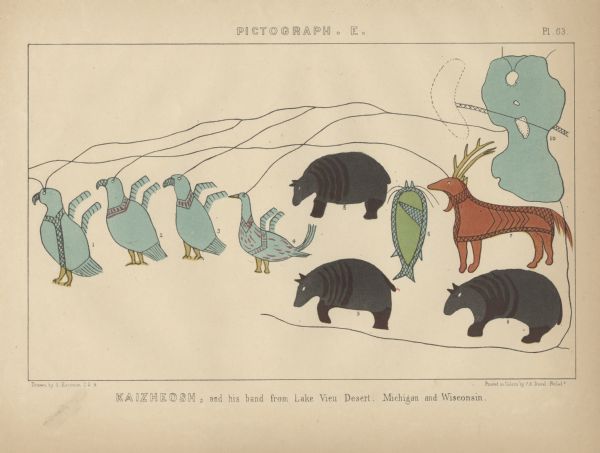
The oldest chief was Gezhiiyaash (his pictographic petition above) or “Swift Sailor” from Lac Vieux Desert. The two other chiefs were likely Oshkaabewis “Messenger” from Wisconsin River, and Naagaanab “Foremost Sitter” from Fond du Lac.
They represented that their annuities under their Treaty of La Pointe, made about the year 1843, were payable in the month of July in each year and not later, because by that time the planting season would be over; beside, it would be the best time and the least dangerous to pass the Great Lake and return to their homes in time to gather wild rice, on which they mainly depended during the hard winters. The first payment was made later than the time agreed upon. The agent, upon being notified, promised to comply with the terms of the Treaty, but every year since the payments have been made later, and that of last year did not take place until about the middle of October, in consequence of which they have been subjected to much suffering.– They assemble at the place for payment designated in the treaty. It is then the traders take advantage of them–being three hundred miles from home, without money, and without provisions; and when their money is received it must all be paid for their subsistence during the long delay they have been subjected to; and sickness frequently breaks out among them from being obliged to use salt provisions, which they are not accustomed to. By leaving their homes at any other time than in the month of July they neglect their harvesting–rice and potato crops, and if they neglect those they must starve to death; therefore it would be better for them to lose their annuities altogether. And without their blankets, procured at the Pointe, they are liable to freeze to death when passing the stormy lake; and the tradespeople influence the Agent to send for them a month before the payment is made, and when they arrive the Agent accepts orders from them for provisions which they are obliged to purchase at a great price–one dollar for 15 lbs of flour, and in proportion for other articles. They have assembled frequently in regard to these things, and can only conclude that their complaints have never reached their “Great Father,” and they have now come to see him in person, and take him by the hand.
In regard to the Half-Breeds at La Pointe, who draw pay with them, they say: That in the Treaty concluded between Governor Dodge and the Chippewas at St. Peters, provision was made for the half-breeds to draw their share all in one payment, and it was paid them accordingly, $258.50 each, which was a mere gift on the part of the tribe; a payment which they had no right to, but was given them as a present. Induced by some subsequent representations by the half-breeds, they were taken into their pay list, and the consequence has been that almost all the half breeds, as well as the French who are married to Indian women, are in the employ of, or dependent upon one of the principal trading houses, (Dr. Bourop’s) at La Pointe, with whom their goods and provisions are stored; and that they are thus enabled to select and appropriate to themselves the choice portion of all the goods designed for them–in many cases not leaving them a blanket to start with upon their journey of two or three hundred miles distant to their homes. After many other details, to which we will make reference in future articles, they urged that owing to the faithlessness of the half-breeds to them, and to the Government, that they be stricken from the pay list.
One half the goods furnished are of no use to them. The articles they most need are guns, kettles, blankets and a greater supply of provisions, &c.
They are under heavy expense, and no money to pay their board. They have undertaken this long journey for the benefit of their whole people, and at their earnest solicitations. They have been absent from their families nearly one year. It has cost them $1,400 to get here. Half of that sum has been raised from exhibitions. The other half has been borrowed from kind people on the route they have traveled. They wish to repay the money advanced them and to procure money to return home with. They want clothes and things to take to their families, and ask an appropriation of $6,000 on their annuity money.
They have before made a communication to the President, to be laid before the present Congress, for the acquisition of lands and the naturalization of their bands–propositions which they urged with great force.
All the Chiefs represented to the President that their interpreter, Mr. Martel, was living in very comfortable circumstances at home, and was induced to accompany them by the urgent solicitations of all their people who confided in his integrity and looked upon him as their friend.

The paternalistic ritual kinship (“Great Father”) language used here by James K. Polk, can be off-putting to the modern reader. However, it had a long tradition in Ojibwe “fur trade theater” rhetoric. Gezhiiyaash was no meek schoolboy, as evidenced by his words in this document (White House)
Their supplicating–though forcible, intelligent, and pathetic appeal, to be permitted to live upon the spot of their nativity, where the morning and noon of their days had been past, and the night time of their existence has reached them, was, too, and irresistible appeal to the justice, generosity and magnanimity of that boasted “civilization” that pleads mercy to the conquered, and was calculated to leave an impress upon every honest heart who claims to be a “freeman.”
The President, in answer to the several addresses, requested the interpreter to state to them that their Great Father was happy to have met with them; and as they had made allusion to written documents which they placed in his hands, as containing an expression of their views and wishes, he would carefully read them and communicate his answer to the Secretary of War and the Commissioner of Indian Affairs, assuring them of kindly feelings on the part of the Government, and terminating with some expressions very like a schoolmaster’s enjoinder upon his scholars that if they behaved themselves they might expect good treatment in future.
The fact that they met Polk was not new information, but we hadn’t been previously aware of just how long the meeting went. It is important to note the president’s use of “kindly feelings” and “behaved themselves.” Those phrases would come up frequently in subsequent years.
One could argue that Polk was a lame duck, and would be dead of cholera within a few months, so his words didn’t mean much. One could argue the problem was that the Ojibwe didn’t understand that in the American political system–that the incoming Whig administration might not feel bound by the words and “kindly feelings” of the outgoing Democratic administration.
However, the next document shows that the chiefs did feel the need to cover their bases and stuck around Washington long enough meet the next president. To us, at least, this was new information:
National Era v. III. No. 14, pg. 56 April 5, 1849
For the National Era
THE CHIPPEWA CHIEFS AND GENERAL TAYLOR
On the third day after the arrival of General Taylor at Washington, the Indian chiefs requested me to seek an interview for them, as they were about to leave for their homes, on Lake Superior, and greatly desired to see the new President before their departure.
It was accordingly arranged by the General to see them the next morning at 9 o’clock, before the usual reception hour.
Fitted out in their very best, with many items of finery which their taste for the imposing had added to their wardrobe, the delegation and their interpreter accompanied me to the reception room, and were cordially taken by the hand by the plain but benevolent-looking old General. One of the chiefs arose, and addressed the President elect nearly as follows:
“Father! We are glad to see you, and we are pleased to see you so well after your long journey.
“Father! We are the representatives of about twenty thousand of your red children, and are just about leaving for our homes, far off on Lake Superior, and we are very much gratified, that, before our departure, we have the opportunity of shaking hands with you.
“Father! You have conquered your country’s enemies in war; may you subdue the enemies of your Administration while you are President of the United States and govern this great country, like the great father, Washington, before you, with wisdom and in peace.
“Father! This our visit through the country and to the cities of your white children, and the wonderful things that we have seen, impress us with awe, and cause us to think that the white man is the favored of the Great Spirit.
“Father! In the midst of the great blessings with which you and your white children are favored of the Great Spirit, we ask of you, while you are in power, not to forget your less fortunate red children. They are now few, and scattered, and poor. You can help them.
“Father! Although a successful warrior, we have heard of your humanity! And now that we see you face to face, we are satisfied that you have a heart to feel for your poor red children.
“Father Farewell”
The tall, manly-looking chief having finished and shaken hands, General Taylor asked him to be seated, and, rising himself, replied nearly as follows”
“My Red Children: I am very happy to have this interview with you. What you have said I have listened to with interest. It is the more appreciated by me, as I am no stranger to your people. I resided for a length of time on your borders, and have been witness to your privations, and am acquainted with many of your wants.
“Peace must be established and maintained between yourselves and the neighboring tribes of the red men, and you need in the next place the means of subsistence.
“My Red Children: I thank you for your kind wishes for me personally, and as President of the United States.
“While I am in office, I shall use my influence to keep you at peace with the Sioux, between whom and the Chippewas there has always been a most deadly hostility, fatal to the prosperity of both nations. I shall also recommend that you be provided with the means of raising corn and the other necessaries of life.
“My Red Children: I hope that you have met with success in your present visit, and that you may return to your homes without an accident by the way; and I bid you say to your red brethren that I cordially wish them health and prosperity. Farewell.”
This interesting interview closed with a general shaking of hands and during the addresses, it is creditable to the parties to say, that the feelings were reached. Tears glistened in the eyes of the Indians and General Taylor evinced sufficient emotion, during the address of the chief, to show that he possesses a heart that may be touched. The old veteran was heard to remark, as the delegation left the room, “What fine looking men they are!”
Major Martell, the half-breed interpreter, acquitted himself handsomely throughout. The Indians came away declaring that “General Taylor talked very good.”
The General’s family and suite, evidently not prepared for the visit; were not dressed to receive company at so early an hour; nevertheless, they soon came in, en dishabille, and looked on with interest.
P.
One of the lingering questions I’ve had about the 1848-49 Delegation has been whether or not the Ojibwe leadership viewed it as a success. This document shows that the answer was unequivocally yes. It also shows why the chiefs felt so blindsided and disbelieving in the spring of 1850 when the government agents at La Pointe told them that Taylor had ordered them to remove. They didn’t have to go back to 1842 for the Government’s promises. They had heard them only a year earlier from both the president and the president-elect!
It also explains why during and after the removal, the chiefs number-one priority was sending another delegation. One would eventually go in 1852, led by Chief Buffalo of La Pointe. This would help secure the reservations sought by the first delegation, but that was only after two failed removal attempts and hundreds of deaths.
If the cholera epidemic had not come, Chief Buffalo and other prominent chiefs, would have likely gone back to Taylor in the winter of 1849-50. They may have been able to secure new treaty negotiations, reservations on the ceded territory, or at the very least have been more prepared for the upcoming removal:
George Johnston to Henry Schoolcraft, 5 October 1849, MS Papers of Henry Rowe Schoolcraft: General Correspondence, 1806-1864, BOX 51.
Saut Ste Maries
Oct 5th 1849
My Dear sir,
Your favor of Sep. 14th, I have just now received and will lose no time in answering. Since I wrote to you on the subject of an intended delegation of Chippewa Chiefs desiring to visit the seat of Govt., I visited Lapointe and remained there during the payment, and I had an opportunity of seeing & talking with the chiefs. They held a council with their agent Dr. Livermore and expressed their desire to visit Washington this season, and they laid the matter before him with open frankness, and Dr. Livermore answered them in the same strain, advising them at the same time, to relinquish their intended visit this year, as it would be dangerous for them, to travel in the midst of sickness which was so prevalent & so widely spread in the land, and that if they should still feel desirous to go on the following year that he would then permit them to do so, and that he would have no objections, this appearing so reasonable to the chiefs, that they assented to it.
I will write to the chiefs and express to them the subject of your letter, and direct them to address Mr. Babcock at Detroit.
You will herein find enclosed copy of Mr. Ballander’s letter to me, a gentleman of the Hon. Hudson’s Bay Co. & Chief factor at Fort Garry in the Red river region, it is very kind & his sympathy, devotes a feeling heart.– Mr. Mitchell of Green Bay to whom I have written in the early part of this summer, to make enquiries relative to certain reports of Tanner’s existence among the sioux, he has not as yet returned an answer to may communication and I feel the neglect with some degree of asperity which I cannot control.
Very Truly yours
Geo. Johnston
Henry R. Schoolcraft Esq.
Washington
It is hard to say how differently history may have turned out if a second delegation had been able to go with George Johnston. There is a good chance it would have been a lot more successful. Johnston was much more of an insider than Martell–who had had a lot of difficulty convincing the American authorities of his credentials. One of those who stood in Martell’s way was Henry Schoolcraft. Schoolcraft, was regarded by the American establishment as the foremost authority on Ojibwe affairs and was Johnston’s brother-in-law.
It may not have worked. The inertia of United States Indian Policy was still with removal. Any attempt to reverse Manifest Destiny and convince the government to cede land back to Indian nations east of the Mississippi was going to be an uphill battle. The Minnesota trade interests were strong.
Also, Schoolcraft was a Democrat, so he would have had less influence with the Whig Taylor–though agreements on Western issues sometimes crossed party lines. However, one can imagine George Johnston sitting around a table in Washington with his “Uncle” Buffalo, his brother-in-law Schoolcraft, and the U.S. President, working out the contours of a new treaty avoiding the removal entirely. Because of the cholera, however, we’ll never know.
For more on how the fallout from the Mexican War impacted Ojibwe removal, see Slavery, Debt Default, and the Sandy Lake Tragedy
For more on the 1848-49 Delegation, see: this post, this post, and this post
1838 more Petitions from La Pointe to the President
April 16, 2023
Collected & edited by Amorin Mello
Letters Received by the Office of Indian Affairs:
La Pointe Agency 1831-1839
National Archives Identifier: 164009310
O.I.A. Lapointe W.692.
Governor of Wisconsin
Mineral Pt. 15 Oct. 1838.
Encloses two communications
from D. P. Bushnell; one,
to speech of Jean B. DuBay, a half
breed Chippewa, delivered Aug. 15, ’38,
on behalf of the half breeds then assembled,
protesting against the decision
of the U.S. Court on the subject of the
murder of Alfred Aitkin by an Ind,
& again demanding the murderer;
with Mr Bushnell’s reply: the other,
dated 14 Aug. 1838, being a Report
in reference to the intermeddling of
any foreign Gov’t or its officers, with
the Ind’s within the limits of the U.S.
[Sentence in light text too faint to read]
12 April 1839.
Rec’d 17 Nov 1838.
See letter of 7 June 39 to Hon Lucius Lyon
Ans’d 12 April, 1839
W Ward
Superintendency of Indian Affairs
for the Territory of Wisconsin
Mineral Point Oct 15, 1838.
Henry Dodge
Sir:
I have the honor to enclose herewith two communications from D. P. Bushnell Esq, Subagent of the Chippewas at La Pointe; the first, being the Speech of Jean B. DuBay, a half breed Chippewa, on behalf of the half-breeds assembled at La Pointe, on the 15th august last, in relation to the decision of the U.S. Court on the subject of the murder of Alfred Aitkin by an Indian; the last, in reference to the intermeddling of any foreign government, or the officers thereof, with the Indians within the limits of the United States.
Very respectfully
Your obed’t serv’t.
Henry Dodge
Sup’t Ind. Affs.
Hon. C. A. Harris
Com of Ind. Affairs.
D. P. Bushnell Aug. 14, 1838
W692
Subagency
La Pointe Aug 14th 1838
Sir
I have the honor to acknowledge the receipt of your communication dated 7 ultimo enclosing an extract from a Resolution of the House of the Representatives of the 19th of March, 1838. No case of intermeddling by any foreign government on the officers, or subject thereof with the Indians under my charge or any others, directly , or indirectly, has come to my knowledge. It is believed that the English government has been in the Habit of distributing presents at a point on Lake Huron below Drummonds Island to the Chippewa for a series of years.
The Indians from this region, until recently, visited that place for their share of the annual distribution. But the Treaty made last summer between them and the United States, and the small distribution of presents that has been made within the Last Year, under the direction of our government, have had the effect to permit any of them from visiting, the English Territory this year. These Indians have generally manifested a desire to live upon terms of friendship with the American people. All of the Chiefs from the region of Lake Superior have expressed a desire to visit the seat of Gov’t where none of them have yet been. There is no doubt, but such a visit with the distribution of a few presents among them would be productive: of much good, and render their attachment to our Gov’t still stronger.
Very Resp’y
yr ms ob sev’t
D. P. Bushnell.
I. O. A.
To
His Excellency Henry Dodge
Ter, Wisconsin Sup’t Ind Affs
Half breed Speech
Speech of Jean B. DuBay,
a half breed Chippewa, on behalf of the half breeds assembled in a numerous body at the United States Sub Indian Agency office at La Pointe, on the 15th day of August 1838.
Father. We have come to you for the purpose of speaking on the subject of the murder that was committed two years ago by an Indian on one of our Brothers. I allude to Alfred Aitken. We have always considered ourselves Subject to the Laws of the United States and have consequently relied upon their protection. But it appears by the decision of the United Sates court in this case. “That it was an Indian Killed an Indian, on Indian ground, and died not therefore come under its jurisdiction,” that we have hitherto laboured under a delusion, and that a resort to the laws can avail nothing. We come therefore to you, at the agent of the Government here, to tell you that we have councilled with the Indians and, have declared to them and we have solemnly pledged ourselves in your presence, to each other, that we will enforce in the Indian Country, the Indian Law, Blood for Blood.
We pay taxes, and in the Indian Country are held amenable to the Laws, but appeal to them in vain for protection. Sir we will protect ourselves. We take the case into our own hands. Blood shall be shed! We will have justice and who can be answerable for the consequences? Our brother was a gentlemanly young man. He was educated at a Seminary in Louville in the State of New York. He was dear to us. We remember him as the companion of our childhood. The voice of his Blood now cries to us from the ground for vengence! But the stain left by his you shall be washed out by one of a deeper dye!
For injuries committed upon the persons or property of whites, although within the Indian Country we are still willing to be held responsible to the Laws of the United States, notwithstanding the decision of a United States Court that we are Indians. And for like injuries committed upon us by whites we will appeal to the same tribunal.
Sir our attachments to the American Government and people was great. But they have cast us off. The Half breeds muster strong on the northwestern frontier & we Know no distinction of tribes. In one thing at least we are all united. We might muster into the service of the United States in case of a war and officered by Americans would compose in frontier warfare a formidable corps. We can fight the Indian or white man, in his own manner, & would pledge ourselves to Keep peace among the different Indian tribes.
Sir we will do nothing rashly. We once more ask from your hands the murder of Mr. Aitken. We wish you to represent our case to the President and we promise to remain quiet for one year, giving ample time for his decision to be made Known. Let the Government extend its protection to us and we will be found its staunchest friends. If it persists in abandoning us the most painful consequences may ensue.
Sir we will listen to your reply, and shall be Happy to avail ourselves of your advice.
Reply of the Subagent.
My friends, I have lived several years on the frontier & have Known many half breeds. They have to my Knowledge paid taxes, & held offices under State, Territorial, and United States authorities, been treated in every respect by the Laws as American Citizens; and I have hitherto supposed they were entitled to the protection of the Laws. The decision of the court is this case, if court is a virtual acknowledgement of your title to the Indians as land, in common with the Indians & I see no other way for you to obtain satisfaction then to enforce the Indian Law. Indeed your own safety requires it. in the meantime I think the course you have adopted, in awaiting the results of this appeal is very proper, and cannot injure your cause although made in vain. At your request I will forward the words of your speaker, through the proper channel to the authorities at Washington. In the event of your being compelled to resort to the Indian mode of obtaining satisfaction it is to be hoped you will not wage an indiscriminate warfare. If you punish the guilty only, the Indians can have no cause for complaint, neither do I think they will complain. Any communication that may be made to me on this subject I will make Known to you in due time.
O.I.A. Lapointe. D.333.
Hon. Ja’s D. Doty.
New York. 25 March, 1839
Encloses Petition, dated
20 Dec. last, of Michel Nevou & 111
others, Chippewa Half Breeds, to the
President, complaining of the delay
in the payment of the sum granted
them, by Treaty of 29 July, 1837,
protesting against its payments on the
St Croix river, & praying that it be
paid at La Pointe on Lake Superior.
Recommends that the payment
be made at this latter place,
for reasons stated.
Rec’d 28 March, 1839.
Ans 29 Mch 1839.
(see over)
Mr Ward
D.100 3 Mch 28
Mch 38, 1839.
Indian Office.
The within may be
an [?] [?] [?] –
[guest?]. in fact will be
in accordance with [?]
[lat?] opinions and not of
the department.
W. Ward
New York
March 25, 1839
The Hon.
J.R. Pointsett
Secy of War
Sir,
I have the honour to submit to you a petition from the Half-breeds of the Chippewa Nation, which has just been received.
It must be obvious to you Sir, that the place from which the Indian Trade is prosecuted in the Country of that Nation is the proper place to collect the Half Breeds to receive their allowance under the Treaty. A very large number being employed by the Traders, if they are required to go to any other spot than La Pointe, they must lose their employment for the season. Three fourths of them visit La Pointe annually, in the course of the Trade. Very few either live or are employed on the St. Croix.
As an act of justice, and of humanity, to them I respectfully recommend that the payment be made to them under the Treaty at La Pointe.
I remain Sir, with very great respect
Your obedient Servant.
J D Doty
[D333-39.LA POINTE]
Hon.
J. D. Doty
March 29, 1839
Recorded in N 26
Page 192
[WD?] OIA
Mch 29, 1839
Sir
I have the honor to acknowledge the receipt of your letter of the 25th with the Petition of the Chippewa half breeds.
It is only necessary for me to observe his reply that it had been previously determined that the appropriation for them should be distributed at Lapointe, & the instructions with be given accordingly.
Very rcy
Hon.
J.D. Doty
New York
D100
D.333.

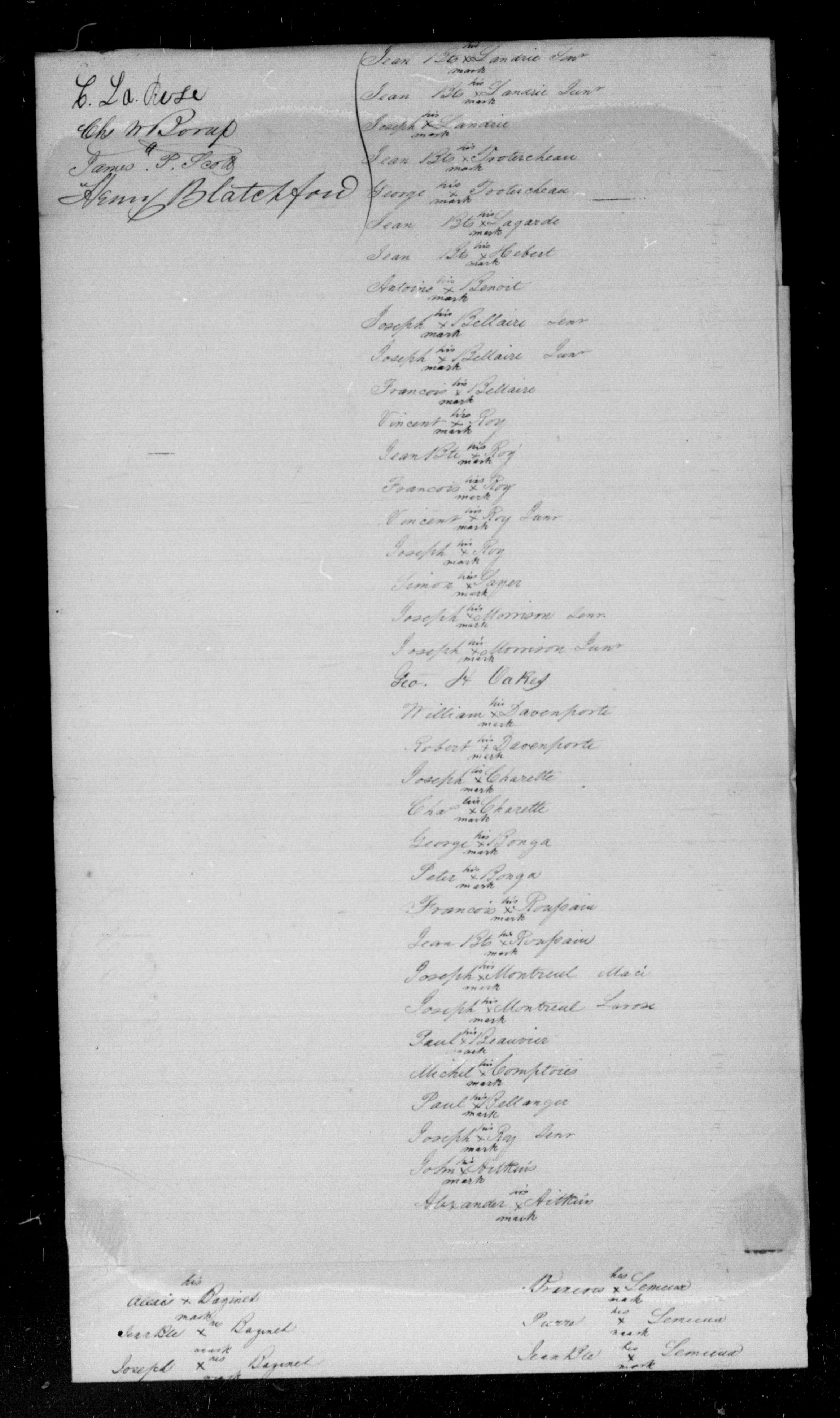

To the President of the United States of America
The Petition of the Half Breeds of the Chippewa nation respectfully shareth.
That we, Half Breeds of the Chippewa Nation, have recently learned, that the payment of the sum granted to the Chippewa Half Breeds, by virtue of the Treaty of 29th July 1837, has been deferred to next Spring, and, that the St Croix River has been selected as the place of payment.
That the delay in not having received our share of the above grant to the Chippewa Half Breeds, last summer, has caused us much loss, by keeping us from our regular vocations for several months, and by leaving many of us without means of support during winter, and that the arrangement of having the payment made next spring on the St Croix, will oblige us to perform a long and expensive Journey, leaving our families in our absence without any means of subsistance, and depriving us of all chance of being employed either in the Indian Trade or at fishing, by which means alone, we are able to earn our daily bread.
Your Petitioners with great deference and implicit submission to the pleasure of the President of the United States, respectfully pray, that an alteration may be made in the place assigned for payment and that Lapointe on Lake Superior may be fixed upon as the place of payment that place being the annual rendezvous of the Chippewa Half Breeds and the Chippewa Indians Traders, by whom we are employed.
And your Petitioners as in duty bound shall ever pray &c. &c.
Lake Superior Lapointe Dec. 20th 1838
Michel Neveu X his mark
Louis Neveu X his mark
Newel Neveu X his mark
Alexis Neveu X his mark
Joseph Danis X his mark
Benjamin Danis X his mark
Jean Bts Landrie Sen’r X his mark
Jean Bts Landrie Jun’r X his mark
Joseph Landrie X his mark
Jean Bts Trotercheau X his mark
George Trotercheau X his mark
Jean Bts Lagarde X his mark
Jean Bts Herbert X his mark
Antoine Benoit X his mark
Joseph Bellaire Sen’r X his mark
Joseph Bellaire Jun’r X his mark
Francois Bellaire X his mark
Vincent Roy X his mark
Jean Bts Roy X his mark
Francois Roy X his mark
Vincent Roy Jun’r X his mark
Joseph Roy X his mark
Simon Sayer X his mark
Joseph Morrison Sen’r X his mark
Joseph Morrison Jun’r X his mark
Geo. H Oakes
William Davenporte X his mark
Robert Davenporte X his mark
Joseph Charette X his mark
Chas Charette X his mark
George Bonga X his mark
Peter Bonga X his mark
Francois Roussain X his mark
Jean Bts Roussain X his mark
Joseph Montreal Maci X his mark
Joseph Montreal Larose X his mark
Paul Beauvier X his mark
Michel Comptories X his mark
Paul Bellanger X his mark
Joseph Roy Sen’r X his mark
John Aitkins X his mark
Alexander Aitkins X his mark
Alexis Bazinet X his mark
Jean Bts Bazinet X his mark
Joseph Bazinet X his mark
Michel Brisette X his mark
Augustin Cadotte X his mark
Joseph Gauthier X his mark
Isaac Ermatinger X his mark
Alexander Chaboillez X his mark
Michel Bousquet X his mark
Louis Bousquet X his mark
Antoine Cournoyer X his mark
Francois Bellanger X his mark
John William Bell, Jun’r
Jean Bts Robidoux X his mark
Robert Morin X his mark
Michel Petit Jun X his mark
Joseph Petit X his mark
Michel Petit Sen’r X his mark
Pierre Forcier X his mark
Jean Bte Rouleaux X his mark
Antoine Cournoyer X his mark
Louis Francois X his mark
Francois Lamoureaux X his mark
Francois Piquette X his mark
Benjamin Rivet X his mark
Robert Fairbanks X his mark
Benjamin Fairbanks X his mark
Antoine Maci X his mark
Joseph Maci X his mark
Edward Maci X his mark
Alexander Maci X his mark
Joseph Montreal Jun. X his mark
Peter Crebassa X his mark
Ambrose Davenporte X his mark
George Fairbanks X his mark
Francois Lemieux X his mark
Pierre Lemieux X his mark
Jean Bte Lemieux X his mark
Baptist St. Jean X his mark
Francis St Jean X his mark
Francis Decoteau X his mark
Jean Bte Brisette X his mark
Henry Brisette X his mark
Charles Brisette X his mark
Jehudah Ermatinger X his mark
Elijah Eramtinger X his mark
Jean Bte Cadotte X his mark
Charles Morrison X his mark
Louis Cournoyer X his mark
Jack Hotley X his mark
John Hotley X his mark
Gabriel Lavierge X his mark
Alexis Brebant X his mark
Eunsice Childes
Etienne St Martin X his mark
Eduard St Arnaud X his mark
Paul Rivet X his mark
Louisan Rivet X his mark
John Fairbanks X his mark
William Fairbanks X his mark
Theodor Borup
James P Scott
Bazil Danis X his mark
Alexander Danis X his mark
Joseph Danis X his mark
Souverain Danis X his mark
Frances Dechonauet
Joseph La Pointe X
Joseph Dafault X his mark
Antoine Cadotte X his mark
Signed in Presnce of
John Angus
John Wood
John William Bell Sen’r
Antoine Perinier
Grenville T. Sproat
Jay P. Childes
C. La Rose
Chs W. Borup
James P. Scott
Henry Blatchford
By Leo
In April, the Supreme Court heard arguments in the case Department of Commerce v. New York and could render a decision any day on whether or not the 2020 federal census should include a question asking about citizenship status. In January, a Federal District Court in New York ruled that commerce secretary, Wilbur Ross, violated the law by pushing for that question.
Those in agreement with the District ruling suggest that the Trump administration wants to add the question as a way of discouraging immigrants from participating in the census, thereby diminishing the political power of immigrant communities. This, they say, would violate the Constitution on the grounds that the census must be an “actual enumeration” of all persons within the United States, not only citizens.
Proponents of the citizenship question counter that citizenship status is a perfectly natural question to ask in the census, that any government would want to know how many citizens it has, and that several past iterations of the 10-year count have included similar questions.
It remains to be seen how the Supreme Court will rule, but chances are it will not be the last time an issue of race, identity, or citizenship pops up in the politics of the census. From its creation by the Constitution as a way to apportion seats in congress according to populations of the states, the count has always begged tricky questions that essentially boil down to:
Who is a real American? Who isn’t? Who is a citizen? Who is three-fifths of a human being? Who might not be human at all? What does it mean to be White? To be Colored? To be civilized? How do you classify the myriad of human backgrounds, cultures and stories into finite, discrete “races?”
The Civil War and Fourteenth Amendment helped shed light on some of these questions, but it would be a mistake to think that they belong to the past. The NPR podcast Codeswitch has done an excellent series on census, and this episode from last August gives a broad overview of the history.
Here at Chequamegon History, though, we aren’t in the business broad overviews. We are going to drill down right into the data. We’ll comb through the 1850 federal census for La Pointe County and compare it with the 1860 data for La Pointe and Ashland Counties. Just for fun, we’ll compare both with the 1855 Wisconsin State Census for La Pointe County, then double back to the 1840 federal census for western St. Croix County. Ultimately, the hope is to help reveal how the population of the Chequamegon region viewed itself, and ultimately how that differed from mainstream America’s view. With luck, that will give us a framework for more stories like Amorin’s recent post on the killing of Louis Gurnoe.
Background
 Judge Daniel Harris Johnson of Prairie du Chien had no apparent connection to Lake Superior when he was appointed to travel northward to conduct the census for La Pointe County in 1850. The event made an impression on him. It gets a mention in his short memorial biography in the 1902 Proceedings of the State Bar Association.
Two years after statehood, Lake Superior’s connection to the rest of Wisconsin was hardly existent. This was long before Highways 51 and 53 were built, and commerce still flowed west to east. Any communication to or from Madison was likely to first go through Michigan via Mackinaw and Sault Ste. Marie, or through Minnesota Territory via St. Paul, Stillwater, and Sandy Lake. La Pointe County had been created in 1845, and when official business had to happen, a motley assortment of local residents who could read and write English: Charles Oakes, John W. Bell, Antoine Gordon, Alexis Carpentier, Julius Austrian, Leonard Wheeler, etc. would meet to conduct the business.
It is unclear how much notice the majority Ojibwe and French-patois speaking population took of this or of the census generally. To them, the familiar institutions of American power, the Fur Company and the Indian Agency, were falling apart at La Pointe and reorganizing in St. Paul with dire consequences for the people of Chequamegon. When Johnson arrived in September, the Ojibwe people of Wisconsin had already been ordered to remove to Sandy Lake in Minnesota Territory for their promised annual payments for the sale of their land. That fall, the government would completely botch the payment, and by February, hundreds of people in the Lake Superior Bands would be dead from starvation and disease.
So, Daniel Johnson probably found a great deal of distraction and anxiety among the people he was charged to count. Indians, thought of by the United States as uncivilized federal wards and citizens of their own nations, were typically not enumerated. However, as I wrote about in my last post, race and identity were complicated at La Pointe, and the American citizens of the Chequamegon region also had plenty to lose from the removal.
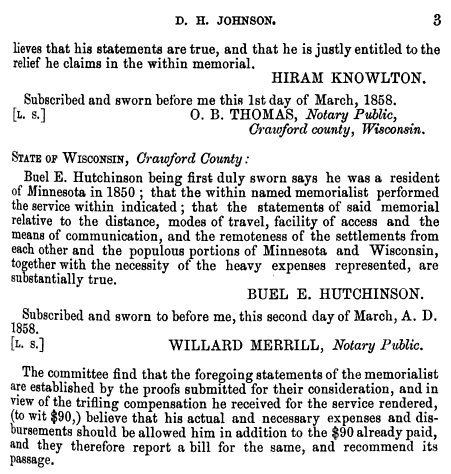
Madison, for its part, largely ignored this remote, northern constituency and praised the efforts to remove the Ojibwe from the state. It isn’t clear how much Johnson was paying attention to these larger politics, however. He had his own concerns:


House Documents, Volume 119, Part 1. U.S. Government Printing Office, 1859. Google Books.
So, in “that thinly settled and half civilized region,” Johnson only found a population of about 500, “exclusive of Indians.” He didn’t think 500 was a lot, but by some counts, that number would have seemed very high. Take the word of a European visitor to La Pointe:
Among 200 Indians, only a few white families live there. One of the boatmen gave us a name, with which we found Mr. Austrian.
And, from this Mr. Austrian, himself:
There were only about 6 white American inhabitants on the Island, about 50 Canadian Frenchmen who were married to squaws, and a number of full blooded Indians, among whom was chief Buffalo who was a descendant of chiefs & who was a good Indian and favorably regarded by the people.
~Joseph Austrian, Brother of Julius and La Pointe resident 1851-52
Who lived around La Pointe in 1850?
In her biography, William W. Warren: the Life, Letters, and Times of an Ojibwe Leader, Theresa Schenck describes the short life of an ambitious young man from La Pointe. William Whipple Warren (1825-1853) grew up on the Island speaking Ojibwe as his first language. His father was a Yankee fur trader from New York. His mother was a daughter of Michel and Madeline Cadotte. In his famous History of the Ojibways Warren describes the Ojibwe as people with whom he readily claims kinship, but he doesn’t write as if he is an Ojibwe person himself. However, he helped interpret the Treaty of 1847 which had definitively made him an Indian in the eyes of the United States (a fact he was willing to use for economic gain). Still, a few years later, when he became a legislator in Minnesota Territory he dismissed challenges to his claims of whiteness.
If he were alive today, Warren might get a chuckle out of this line from the South African comedian Trevor Noah.
People mocked me. Gave me names like mixed breed, half caste — I hate that term ‘half’. Why half? Why not double? Or twice as nice, I don’t know.
— Trevor Noah
William Warren did not see himself as quite the walking contradiction we might see him as today. He was a product of the time and place he came from: La Pointe. By 1850, he had left that place, but his sister and a few hundred of his cousins still lived there. Many of them were counted in the census.
What is Metis?
Half-breeds, Mixed-bloods, Frenchmen, Wiisakodewininiwag, Mitif, Creoles, Metis, Canadiens, Bois Brules, Chicots, French-of-the-country, etc.–at times it seems each of these means the same thing. At other times each has a specific meaning. Each is ambiguous in its own way. In 1850, roughly half the families in the Chequamegon area fit into this hard-to-define category.


Kohl, J. G. Kitchi-Gami: Wanderings around Lake Superior. London: Chapman and Hall, 1860. pg. 260-61.
We were accompanied on our trip throughout the lakes of western Canada by half-Indians who had paternal European blood in their veins. Yet so often, a situation would allow us to spend a night inside rather than outdoors, but they always asked us to choose to Irish camp outside with the Indians, who lived at the various places. Although one spoke excellent English, and they were drawn more to the great American race, they thought, felt, and spoke—Indian! ~Carl Scherzer
In describing William Warren’s people, Dr. Schenck writes,
Although the most common term for people of mixed Indian and European ancestry in the nineteenth century was “half-breed,” the term “mixed blood” was also used. I have chosen to use the latter term, which is considered less offensive, although biologically inaccurate, today. The term “métis” was not in usage at the time, except to refer to a specific group of people of mixed ancestry in the British territories to the north. “Wissakodewinini,” the word used by the Ojibwe, meant “burned forest men,” or bois brulés in French, so called because half-breeds were like the wood of a burned forest, which is often burned on one side, and light on the other (pg. xv).
Schenck is correct in pointing out that mixed-blood was far more commonly used in 19th-century sources than Metis (though the latter term did exist). She is also correct in saying that the term is more associated with Canada and the Red River Country. There is an additional problem with Metis, in that 21st-century members of the Wannabe Tribe have latched onto the term and use it, incorrectly, to refer to anyone with partial Native ancestry but with no affiliation to a specific Indian community.
That said, I am going to use Metis for two reasons. The first is that although blood (i.e. genetic ancestry) seemed to be ubiquitous topic of conversation in these communities, I don’t think “blood” is what necessarily what defined them. The “pure-blooded French Voyageur” described above by Kohl clearly saw himself as part of Metis, rather than “blanc” society. There were also people of fully-Ojibwe ancestry who were associated more with Metis society than with traditional Ojibwe society (see my post from April). As such, I find Metis the more versatile and accurate term, given that it means “mixed,” which can be just as applicable to a culture and lifestyle as it is to a genetic lineage.
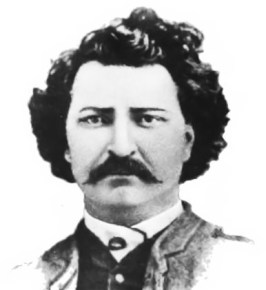
One time Canadian pariah turned national hero, Louis Riel and his followers had cousins at La Pointe (Photo: Wikipedia)
The second reason I prefer Metis is precisely because of the way it’s used in Manitoba. Analogous to the mestizo nations of Latin America, Metis is not a way of describing any person with Native and white ancestry. The Metis consider themselves a creole-indigenous nation unto themselves, with a unique culture and history. This history, already two centuries old by 1850, represents more than simply a borrowed blend of two other histories. Finally, the fur-trade families of Red River came from Sault Ste. Marie, Mackinac, Grand Portage, and La Pointe. There were plenty of Cadottes, Defaults, Roys, Gurnoes, and Gauthiers among them. There was even a Riel family at La Pointe. They were the same nation
Metis and Ojibwe Identity in the American Era
When the 1847 Treaty of Fond du Lac “stipulated that the half or mixed bloods of the Chippewas residing with them shall be considered Chippewa Indians, and shall, as such, be allowed to participate in all annuities which shall hereafter be paid…” in many ways, it contradicted two centuries of tradition. Metis identity, in part, was dependent on not being Indian. They were a minority culture within a larger traditional Anishinaabe society. This isn’t to say that Metis people were necessarily ashamed of their Native ancestors–expressions of pride are much easier to find than expressions shame–they were just a distinct people. This was supposedly based in religion and language, but I would argue it came mostly from paternal lineage (originating from highly-patriarchal French and Ojibwe societies) and with the nature of men’s work. For women, the distinction between Ojibwe and Metis was less stark.
The imposition of American hegemony over the Chequamegon region was gradual. With few exceptions, the Americans who came into the region from 1820 to 1850 were adult men. If new settlers wanted families, they followed the lead of American and British traders and married Metis and Ojibwe women.
Still, American society on the whole did not have a lot of room for the racial ambiguity present in Mexico or even Canada. A person was “white” or “colored.” Race mixing was seen as a problem that affected particular individuals. It was certainly not the basis for an entire nation. In this binary, if Metis people weren’t going to be Indian, they had to be white.
The story of the Metis and American citizenship is complicated and well-studied. There is risk of overgeneralizing, but let’s suffice to say that in relation to the United States government, Metis people did feel largely entitled to the privileges of citizenship (synonymous with whiteness until 1865), as well as to the privileges of Ojibwe citizenship. There wasn’t necessarily a contradiction.
Whatever qualms white America might have had if they’d known about it, Metis people voted in American elections, held offices, and were counted by the census.
Ojibwe “Full-bloods” and the United States Census
Representatives and direct Taxes shall be apportioned among the several States which
may be included within this Union, according to their respective Numbers, which shall be determined by adding to the whole Number of free Persons, including those bound to Service for a Term of Years, and excluding Indians not taxed, three fifths of all other Persons. The actual Enumeration shall be made within three Years after the first Meeting of the Congress of the United States, and within every subsequent Term of ten Years, in such Manner as they shall by Law direct.~Excerpt from Article I Section II, U. S. Constitution
As I argued in the April post, our modern conception of “full-blood” and “mixed-blood” has been shaped by the “scientific” racism of the late 19th and early 20th centuries. The distinction, while very real in a cultural sense, was not well-grounded in biology.
The relationship of Indians (i.e. full-bloods or those living a traditional lifestyle) to American society and citizenship was possibly more contradictory then that of the Metis. In one sense, America saw Indians as foreigners on their own continent: either as enemies to be exterminated, or as domestic-dependent ward nations to be “protected.” The constitutional language about the census calls for slaves to be counted as three-fifths of a person. It says Indians shouldn’t be counted at all.
In another sense, however, the path to personhood in America was somewhat clearer for Indians than it was for African Americans. Many New England liberals saw exodus to Liberia as the only viable future for free blacks. These same voices felt that Indians could be made white if only they were separated from their religions, cultures, and tribal identities. In 1834, to avoid a second removal, the Brothertown Indians of Wisconsin petitioned congress for citizenship and the termination of collective title to their tribal lands. In 1839, their request was granted. In the eyes of the law, they had effectively become white. Other communities would follow suit. However, most Native people did not gain any form of American citizenship until 1924.
How did that play out for the Ojibwe people of Chequamegon, and how did it impact the 1850 census? Well, it’s complicated.
Race, the Census, and Classifying Households
The enumeration forms Daniel H. Johnson carried to La Pointe had more rows and columns than ever. The Seventh Census was the first to count everyone in the household by name (previous versions only listed the Head of Household with tally marks). It was also the first census to have a box for “color.” Johnson’s choices for color were “white,” “black,” and “mulatto,” forcing him to make some decisions.
He seems to have tried to follow the Indians not taxed clause strictly. 40-50% of households in the region were headed by a full-blood Ojibwe person, possibly only two of them were enumerated. You won’t find Chief Buffalo, Makadebinesi (Blackbird), Oshkinaawe, Omizhinaawe, Edawegiizhig, and their immediate families in the 1850 census. Jechiikwii’o (often called Little Buffalo) is not in the document, even though he was an early Catholic convert, dressed in “white” clothing, and counted more Metis Ojibwe among his followers than full-bloods. However, his son, Antoine Buffalo Sr. (Antoine Jachequaon) is counted. Antoine, along with George Day, were counted as white heads of household by the census, though it is unclear if they had any European ancestry (Sources conflict. If anyone has genealogical information for the Buffalo and Day families, feel free to comment on the post). A handful of individuals called full-bloods in other sources, were listed as white. This includes 90-year old Madeline Cadotte, Marie Bosquet, and possibly the Wind sisters (presumably descendants of Noodin, one of the St. Croix chiefs who became Catholic and relocated to La Pointe around this time). They were married to Metis men or lived in Metis households. All Metis were listed as white.
Johnson did invent new category for five other Ojibwe people: “Civilized Indian,” which he seemed to use arbitrarily. Though also living in Metis households, Mary Ann Cadotte, Osquequa Baszina, Marcheoniquidoque, Charlotte Houle, and Charles Loonsfoot apparently couldn’t be marked white the way Madeline Cadotte was. These extra notations by Johnson and other enumeration marshals across the country are why the Seventh Federal Census is sometimes referred to as the first to count Native Americans.

So, out of 470 individuals enumerated at La Pointe and Bad River (I’ve excluded Fond du Lac from my study) Johnson listed 465 (99%) as white. By no definition, contemporary or modern, was the Chequamegon area 99% white in 1850. The vast majority of names on the lines had Ojibwe ancestry, and as Chippewas of Lake Superior, were receiving annuities from the treaties.
There were a few white American settlers. The Halls had been at La Pointe for twenty years. The Wheelers were well-established at Odanah. Junius and Jane Welton had arrived by then. George Nettleton was there, living with a fellow Ohioan James Cadwell. The infamous Indian agent, John Watrous, was there preparing the disastrous Sandy Lake removal. Less easy to describe as American settlers, but clearly of European origins, Fr. Otto Skolla was the Catholic priest, and Julius Austrian was the richest man it town.
There were also a handful of American bachelors who had drifted into the region and married Metis women. These first-wave settlers included government workers like William VanTassel, entrepreneurs like Peter VanderVenter, adventurers with an early connection to the region like Bob Boyd and John Bell, and homesteaders like Ervin Leihy.
It is unclear how many of French-surnamed heads of household were Chicots (of mixed ancestry) and how many were Canadiens (of fully-French ancestry). My sense is that it is about half and half. Some of this can be inferred from birthplace (though a birthplace of Canada could indicate across the river at Sault Ste. Marie as easily it could a farm in the St. Lawrence Valley). Intense genealogical study of each family might provide some clarifications, but I am going to follow Kohl’s voyageurs and not worry too much about it. Whether it was important or not to Jean Baptiste Denomie and Alexis Carpentier that they had no apparent Indian ancestry and that they had come from “the true homeland” of Quebec, for all intents and purposes they had spent their whole adult lives in “the Upper Country,” and their families were “of the Country.” They were Catholic and spoke a form of French that wasn’t taught in the universities. American society would not see them as white in the way it saw someone like Sherman Hall as white.
So, by my reckoning, 435 of the 470 people counted at La Pointe (92.5%) were Metis, full-blood Ojibwe living in Metis households, or Canadians in Metis families. Adding the five “Civilized Indians” and the six Americans married into Metis families, the number rises to 95%. I am trying to track down accurate data on the of Indians not taxed (i.e. non-enumerated full-bloods) living at or near La Pointe/Bad River at this time. My best estimates would put it roughly the same as the number of Metis. So, when Johnson describes a land with a language and culture foreign to English-speaking Americans, he’s right.
Birthplace, Age, and Gender
Ethnic composition is not the only data worth looking at if we want to know what this area was like 169 years ago. The numbers both challenge and confirm assumptions of how things worked.
Let’s take mobility for example:

The young voyageur quoted by Kohl may have felt like he didn’t have a home other than en voyage, but 86% of respondents reported being born in Wisconsin. Except for ten missionary children, all of these were Metis or “Civilized Indian.” Wisconsin could theoretically mean Lac du Flambeau, Rice Lake, or even Green Bay, this but this number still seemed high to me. I’m guessing more than 14% of 21st-century Chequamegon residents were born outside the state, and 19th-century records are all about commerce, long-distance travel, and new arrivals in new lands. We have to remember that most of those records are coming from that 14%.
In September of 1850 the federal government was telling the Ojibwe of Wisconsin they needed to leave Wisconsin forever. How the Metis fit into the story of the Sandy Lake Tragedy has always been somewhat fuzzy, but this data would indicate that for a clear majority, it meant a serious uprooting.
For those born outside Wisconsin, more than two-thirds reported being born in Michigan, Canada, or Minnesota Territory. These are overwhelmingly Metis or in the case of Anglo-Canadians like Robert Morrin, heads of Metis households from areas with a fur-trade tradition. Only eighteen individuals reported being born in the eastern United States. Only three reported Europe.
I had more questions than assumptions about the gender and age breakdown of the population. Would there be more women than men because of the dangerous jobs done by men or would mortality from childbirth balance that out? Or maybe widows wouldn’t be counted if they returned to the wigwams of their mothers? How would newcomers skew the age and gender demographics of the area?
Let’s take a look:
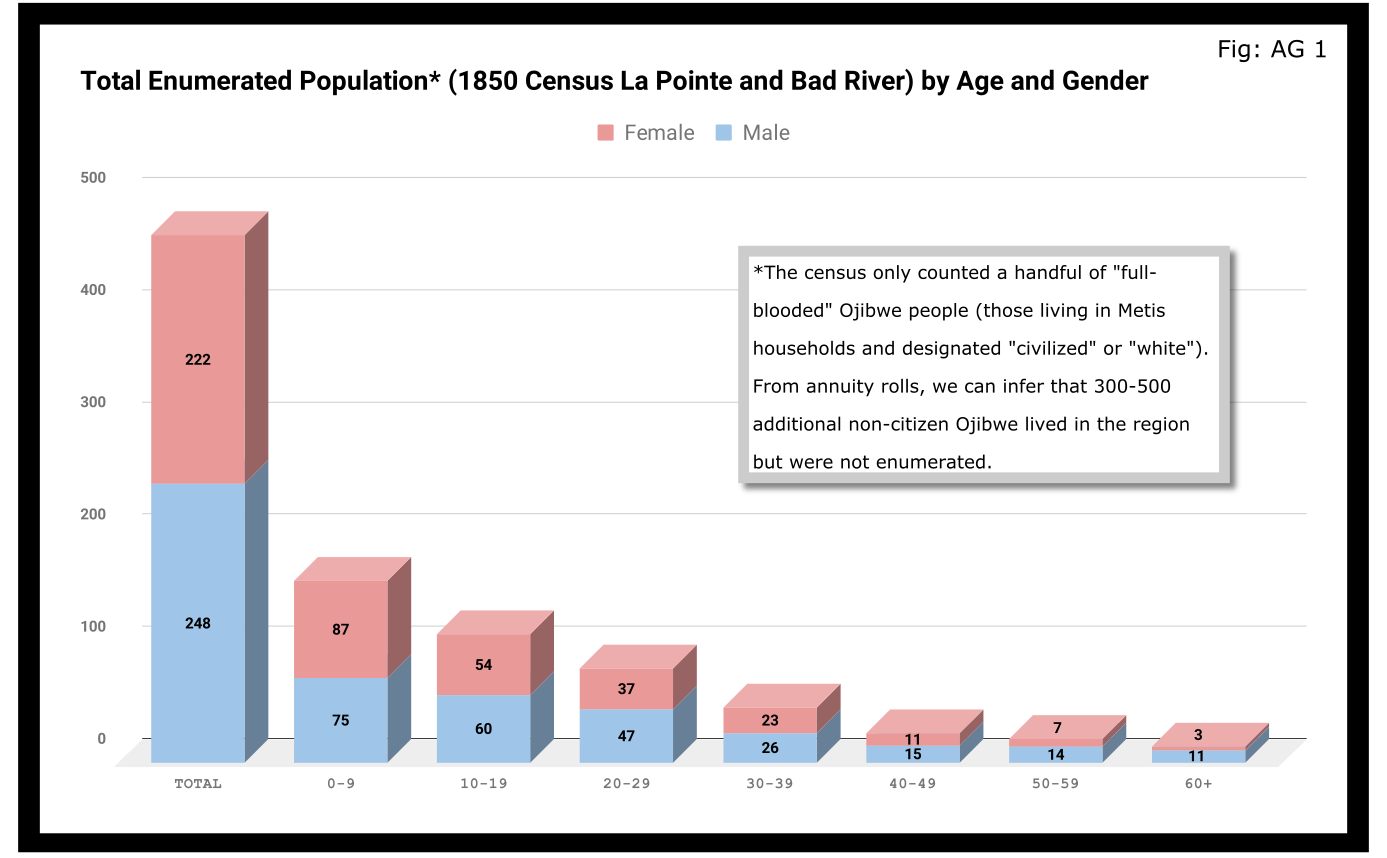
A quick glance at Figure AG 1 shows that the population skewed male 248-222 and skewed very young (61% under 20 years old). On the eve of Sandy Lake, the natural increase in the population seemed to be booming.

The hypotheses that women had higher mortality rates and were more likely to be undercounted looked good until we limit the data to the Wisconsin-born population. In Figure AG 2, we see that the male majority disappears entirely. The youthful trend, indicating large families and a growing population, continues with 66% of the Wisconsin-born population being under 20.

The male skew of the total population was entirely due to those born outside Wisconsin. This is not surprising given how much we’ve emphasized the number of men who came into the Lake Superior country to marry local women.
A look at the oldest residents in chart AG 2 and AG 3 hints at another story. Madeline Cadotte is the only Wisconsin-born person over seventy to be counted. The oldest men all came from Michigan and Canada. Why? My hypothesis is that between the fall of New France in 1759 and the establishment of Michel Cadotte’s post sometime around 1800, there wasn’t a large population or a very active fur trade around La Pointe proper. That meant Cadotte’s widow and other full bloods were the oldest locally-born residents in 1850. Their Metis contemporaries didn’t come over from the Soo or down from Grand Portage until 1810 or later.
Economics
Before the treaties, the economy of this area was built on two industries: foraging and trade. Life for Ojibwe people revolved around the seasonal harvest of fish, wild rice, game, maple sugar, light agriculture, and other forms of gathering food directly from the land. Trade did not start with the French, and even after the arrival of European goods into the region, the primary purpose of trade seemed to be for cementing alliances and for the acquisition of luxury goods and sacred objects. Richard White, Theresa Schenck, and Howard Paap have all challenged the myth of Ojibwe “dependence” on European goods for basic survival, and I find their arguments persuasive.
Trade, though, was the most important industry for Metis men and La Pointe was a center of this activity. The mid-19th century saw a steep decline in trade, however, to be replaced by a toxic cycle of debts, land sales, and annuity payments. The effects of this change on the Metis economy and society seem largely understudied. The fur trade though, was on its last legs. Again, the Austrian travel writer Carl Scherzer, who visited La Pointe in 1852:
After this discussion of the of the rates of the American Fur Company and its agents, we want to add some details about the men whose labor and time exerted such a great influence on the fate and culture of the Indian tribes. We wish to add a few explanatory words about the sad presence on La Pointe of the voyageurs or courriers du bois.
This peculiar class of people, which is like a vein of metal that suddenly disappears within the bedrock and reappears many hundreds of miles away under the same geological conditions, their light reaches the borders of the eastern Canadas. The British people, with their religion and customs, reappeared on the shores of these northern lakes only in 1808 with the Fur Company. For labor they drew on those who could carry their wares across the lakes and communicate with the Indians.
Many young men of adventurous natures left the old wide streets of Montreal and moved into the trackless primeval forests of the West. Young and strong as laborers, they soon started to adopt the lifestyle and language of the aborigines. They married with the Indians and inhabit small settlements scattered throughout those mighty lands which begin at Mackinow Island and come up the upper lake to the region of Minnesota. They almost all speak the Canadian patois along with the language of the Chippewas, the tribe with which they came into kinship. We found only a few, even among the younger generation, who understood English.
Since then, every day the population of the otherwise deserted shore of Lake Superior increases with the discovery of copper mines. The animals driven away by the whirlwind of civilization toward the west, attract the Indians with their sensitive guns, leaving La Pointe, abandoned by the Company for their headquarters at St. Paul in Minnesota. Most voyageurs left the island, having seen their business in ruins and lacking their former importance. Just a few families remain here, making a meager livelihood of hunting, fishing, and the occasional convoy of a few travelers led by business, science, or love of nature who purchase their limited resources.
From Scherzer’s description, two things are clear. It’s pretty clear from the flowery language of the Viennese visitor.Washington Irving and other Romantic-Era authors had already made the Voyageur into the stock stereotypical character we all know today. Th only change, though, is these days voyageurs are often depicted as representatives of white culture, but that’s a post for another time.
The second item, more pertinent to this post, is that a lot of voyageurs were out of work. This is especially relevant when we look at our census data. Daniel Johnson recorded the occupations of all males fifteen or over:
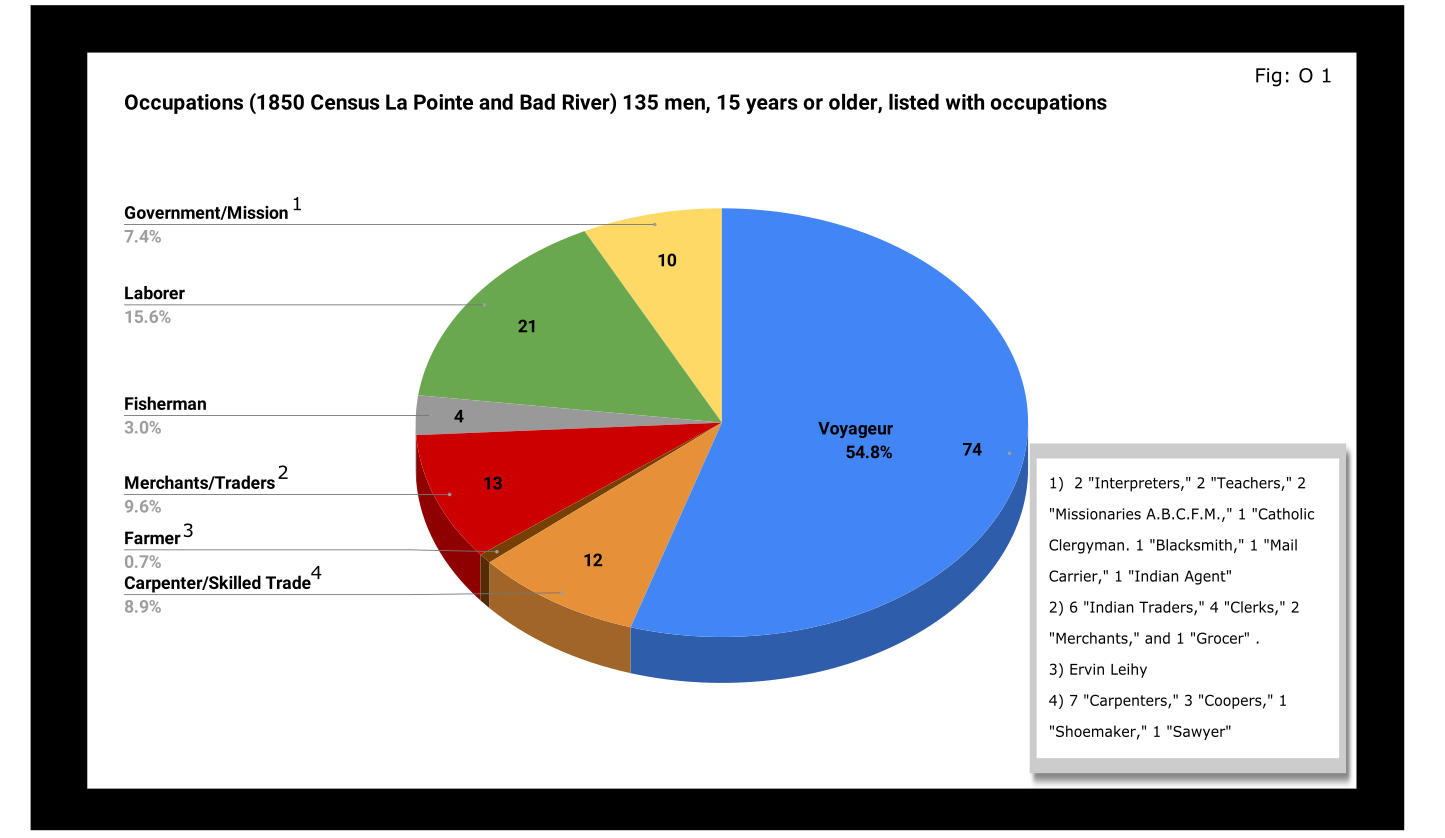
A full 55% of enumerated men fifteen and older still identified themselves as voyageurs in 1850. This included teenagers as well as senior citizens. All were from Metis households, though aside from farmer, all of the other occupation categories in Figure O 1 included Metis people.

A look at household sizes did not show voyageurs having to support significantly larger or smaller families when compared to the other occupation categories.
The other piece of economic data collected was value of real estate. Here we see some interesting themes:

If real estate is a good proxy for wealth in a farming community, it is an imperfect one in the Chequamegon area of 1850. If a voyageur had no home but the river and portage, then we might not expect him to put his coin into land and buildings. A teacher or Indian agent might draw a consistent salary but then live in supplied housing before moving on. With that caveat, let’s dig into the data.
Excluding the single farmer, men in the merchant/trader group controlled the most wealth in real estate, with Julius Austrian controlling as much as the other merchants combined. Behind them were carpenters and men with specific trades like cooper or shoemaker. Those who reported their occupation generally as “laborer” were not far behind the tradesmen. I suspect their real estate holdings may be larger and less varied than expected because of the number of sons and close relatives of Michel Cadotte Sr. who identified themselves as laborers. Government and mission employees held relatively little real estate, but the institutions they represented certainly weren’t lacking in land or power. Voyageurs come in seventh, just behind widows and ahead of fishermen of which there were only four in each category.
It is interesting, though, that the second and third richest men (by real estate) were both voyageurs, and voyageur shows a much wider range of households than some of the other categories: laborers in particular. With the number of teenagers calling themselves voyageurs, I suspect that the job still had more social prestige attached to it, in 1850, than say farmer or carpenter.
With hindsight we know that after 1854, voyageurs would be encouraged to take up farming and commercial fishing. It is striking, however, how small these industries were in 1850. Despite the American Fur Company’s efforts to push its Metis employees into commercial fishing in the 1830s, and knowing how many of the family names in Figure O 3 are associated with the industry, commercial fishing seemed neither popular nor lucrative in 1850. I do suspect, however, that the line between commercial and subsistence fishing was less defined in those days and that fishing in general was seen as falling back on the Indian gathering lifestyle. It wouldn’t be surprised if all these families were fishing alongside their Ojibwe relatives but didn’t really see fishing (or sugaring, etc.) as an occupation in the American sense.
Finally, it could not have escaped the voyageurs notice that while they were struggling, their former employers and their employers educated sons were doing pretty well. They also would have noticed that it was less and less from furs. Lump annuity payments for Ojibwe land sales brought large amounts of cash into the economy one day a year. It must have felt like piranhas with blood in the water. Alongside their full-blood cousins, Metis Ojibwe received these payments after 1847, but they had more of a history with money and capitalism. Whether to identify with the piranha or the prey would have depended on all sorts of decisions, opportunities and circumstances.
Education and Literacy
The census also collected data on education and literacy, asking whether children had attended school within the year, and whether adults over twenty could read and write. The history of white education efforts in this area are fairly well documented. The local schools in 1850 were run by the American Board of Commissioners of Foreign Missions (A.B.C.F.M.) at the La Pointe and Odanah missions, and an entire generation had come of age at La Pointe in the years since Rev. Sherman Hall first taught out of Lyman Warren’s storehouse in 1831. These Protestant ministers and teachers railed against the papists and heathens in their writings, but most of their students were Catholic or traditional Ojibwe in religion. Interestingly, much of the instruction was done in the Ojibwe language. Unfortunately, however, the census does not indicate the language an individual is literate in. I highly recommend The Ojibwe Journals of Edmund F. Ely, 1833-1849 if you are interested in these topics.
To start with, though, let’s look at how many people were going to school:

Thirty-nine students had gone to school in the previous year. There is a lot of sample-size noise in the data, but it seems like ages 7-11 (what we would call the upper-elementary years) were the prime years to attend school.
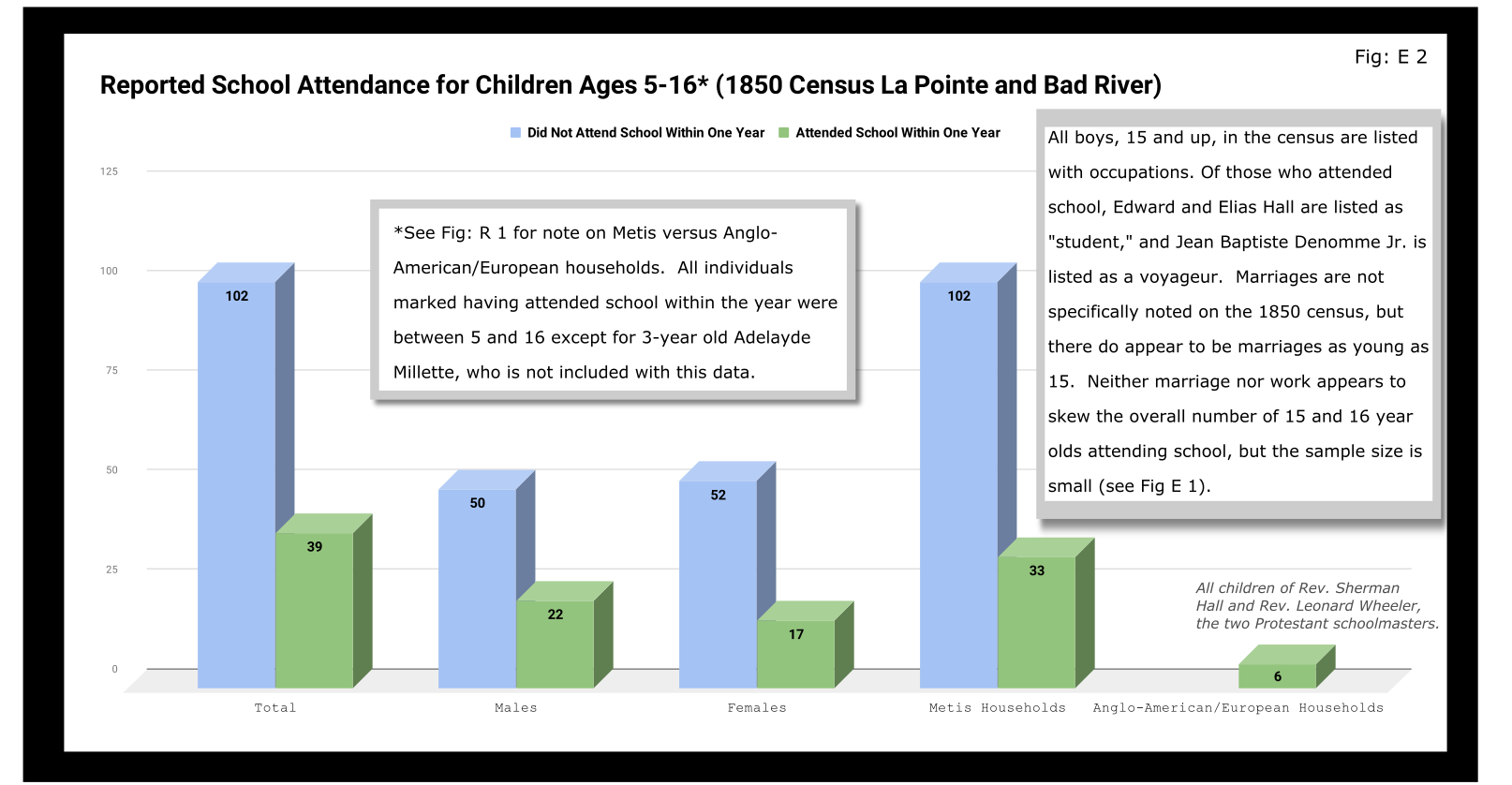
Overall, most children had not attended school within the year. Attendance rates were slightly higher for boys than for girls. White children, all from two missionary families, had a 100% attendance rate compared to 24% for the Metis and “Civilized Indian” children.
We should remember, however, that not attending school within the year is not the same as having never attended school. Twelve-year-old Eliza Morrin (later Morrison) is among the number that didn’t attend school, but she was educated enough to write her memoirs in English, which was her second language. They were published in 2002 as A Little History of My Forest Life, a fascinating account of Metis life in the decades following 1854.
Eliza’s parents were among the La Pointe adults who could read and write. Her aunt, uncle, and adult cousins in the neighboring Bosquet (Buskey) house were not. Overall, just over half of adults over 20 were illiterate without a significant gender imbalance. Splitting by birthplace, however, shows the literacy rate for Wisconsin-born (i.e. Metis and “Civilized Indian”) was only 30%, down from the overall male literacy rate of 48%. For Wisconsin-born women, the drop is only three points, from 47% to 44%. This suggests Metis women were learning to read while their husbands and brothers (perhaps en voyage) were not.

And this is exactly what the data say when we split by occupation. The literacy rate for voyageurs was only 13%. This beats fisherman–all four were illiterate–but lagged far behind all other types of work.
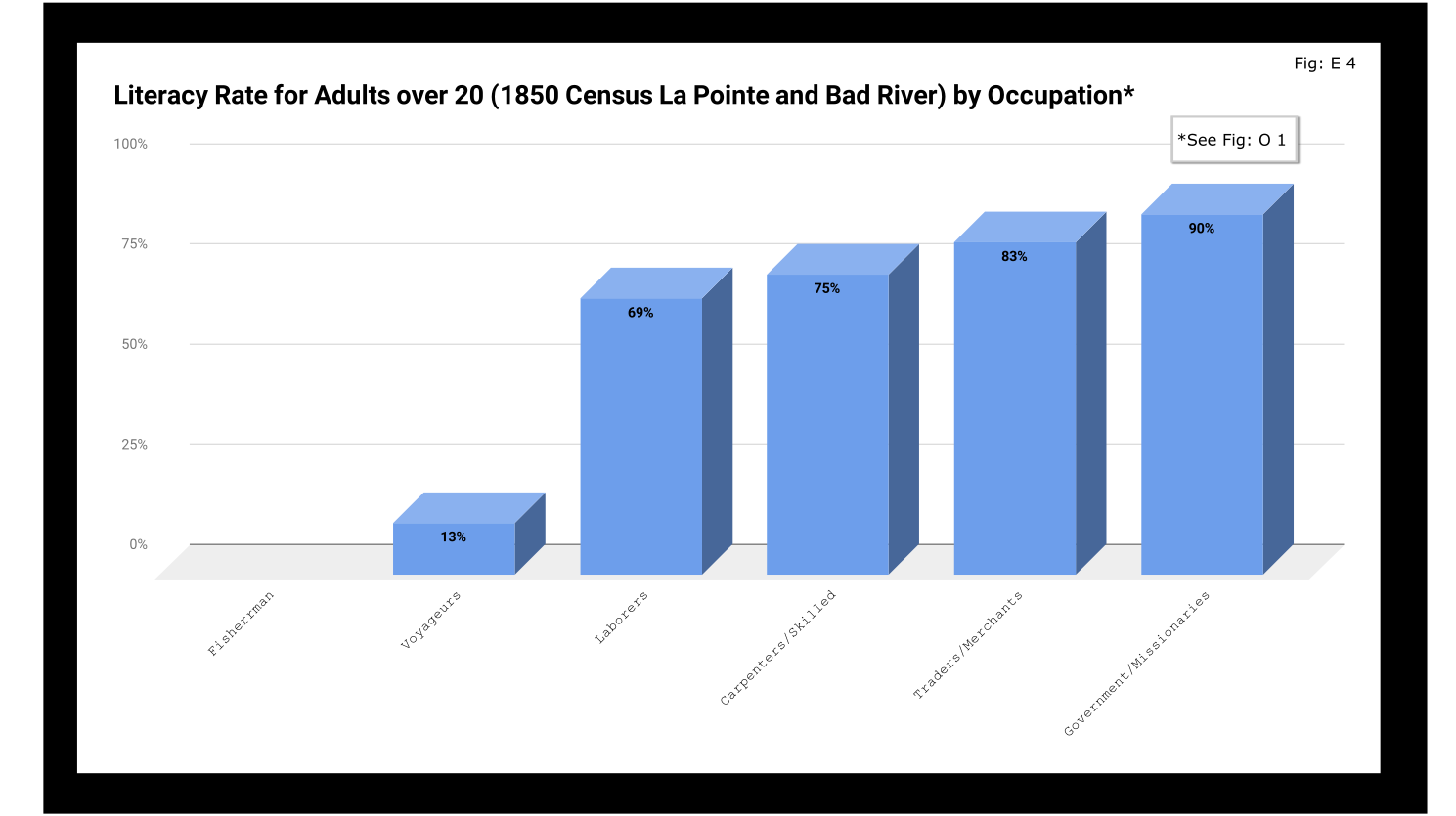
If education was going to be a factor in the economic mobility of unemployed voyageurs, the trends weren’t looking good.
Odds and Ends
Two marriages were reported as occurring in the year previous to the census: Peter and Caroline Vanderventer and Pierre and Marguerite Robideaux (ak.a. Peter and Margaret Rabideaux). Though married, however, Caroline was not living with her husband, a 32-year old grocer from New York. She (along with their infant daughter) was still in the home of her parents Benjamin and Margaret Moreau (Morrow). The Vanderventers eventually built a home together and went on to have several more children. It appears their grandson George Vanderventer married Julia Rabideaux, the granddaughter of Peter and Margaret.
I say appears in the case of George and Julia, because Metis genealogy can be tricky. It requires lots of double and triple checking. Here’s what I came across when I once tried to find an unidentified voyageur known only as Baptiste:

Sometimes it feels like for every Souverain Denis or Argapit Archambeau, there are at least 15 Jean-Baptiste Cadottes, 12 Charles Bresettes, 10 Francois Belangers and 8 Joseph DeFoes. Those old Canadian names had a way of persisting through the generations. If you were a voyageur at La Pointe in 1850, there was nearly a 30% chance your name was Jean-Baptiste. To your friends you might be John-Baptist, Shabadis, John, JB, or Battisens, and you might be called something else entirely when the census taker came around.
The final column on Daniel Johnson’s census asked whether the enumerated person was “deaf and dumb, blind, insane, idiotic, pauper, or convict.” 20 year-old Isabella Tremble, living in the household of Charles Oakes, received the unfortunate designation of idiotic. 26-year-old Francois DeCouteau did not have a mark in that column, but had “Invalid” entered in for his occupation. It’s fair to say we’ve made some progress in the treatment of people with disabilities.
Final Thoughts
I am not usually a numbers person when it comes to history. I’ll always prefer a good narrative story, to charts, tables, and cold numbers. Sometimes, though, the numbers help tell the story. They can help us understand why when Louis Gurnoe was killed, no one was held accountable. At the very least, they can help show us that the society he lived in was under significant stress, that the once-prestigious occupation of his forefathers would no longer sustain a family, and that the new American power structure didn’t really understand or care who his people were.
Ultimately, the census is about America describes itself. From the very beginning, it’s never been entirely clear if in E. pluribus unum we should emphasize the pluribus or the unum. We struggled with that in 1850, and we still struggle today. To follow the Department of Commerce v. New York citizenship case, I recommend Scotusblog. For more census posts about this area in the 19th century, keep following Chequamegon History.
Sources, Data, and Further Reading
-
Paap, Howard D. Red Cliff, Wisconsin a History of an Ojibwe Community ; Volume 1 The Earliest Years: the Origin to 1854. North Star Press of St. Cloud, Inc., 1854.
-
Satz, Ronald N. Chippewa Treaty Rights: the Reserved Rights of Wisconsin’s Chippewa Indians in Historical Perspective. University of Wisconsin Press, 1997.
-
Original Census Act of May 23, 1850 (includes form and instructions for marshals). (PDF)
-
Compiled data spreadsheets (Google Drive Folder) I’ll make these a lot more user friendly in future census posts. By the time it occurred to me that I should include my tables in this post, most of them were already done in tally marks on scrap paper.
-
Finally, these are the original pages, scanned from microfilm by FamilySearch.com. I included the image for Fond du Lac (presumably those living on the Wisconsin side of the St. Louis River) even though I did not include it in any of the data above.
-

- Bad River
-
- Fond du Lac (not included in above data)





La Pointe Bands Part 1
April 19, 2015
By Leo Filipczak

(Click to Enlarge)
On March 8th, I posted a map of Ojibwe people mentioned in the trade journals of Perrault, Curot, Nelson, and Malhoit as a starting point to an exploration of this area at the dawn of the 19th Century. Later the map was updated to include the journal of John Sayer.
In these journals, a number of themes emerge, some of which challenge conventional wisdom about the history of the La Pointe Band. For one, there is very little mention of a La Pointe Band at all. The traders discuss La Pointe as the location of Michel Cadotte’s trading depot, and as a central location on the lakeshore, but there is no mention of a large Ojibwe village there. In fact, the journals suggest that the St. Croix and Chippewa River basins as the place where the bulk of the Lake Superior Ojibwe could be found at this time.
In the post, I repeated an argument that the term “Band” in these journals is less identifiable with a particular geographical location than it is with a particular chief or extended family. Therefore, it makes more sense to speak of “Giishkiman’s Band,” than of the “Lac du Flambeau Band,” because Giishkiman (Sharpened Stone) was not the only chief who had a village near Lac du Flambeau and Giishkiman’s Band appears at various locations in the Chippewa and St. Croix country in that era.
In later treaties and United State’s Government relations, the Ojibwe came to be described more often by village names (La Pointe, St. Croix, Fond du Lac, Lac du Flambeau, Lac Courte Oreilles, Ontonagon, etc.), even though these oversimplified traditional political divisions. However, these more recent designations are the divisions that exist today and drive historical scholarship.
So what does this mean for the La Pointe Band, the political antecedent of the modern-day Bad River and Red Cliff Bands? This is a complicated question, but I’ve come across some little-known documents that may shed new light on the meaning and chronology of the “La Pointe Band.” In a series of posts, I will work through these documents.
This series is not meant to be an exhaustive look at the Ojibwe at Chequamegon. The goal here is much narrower, and if it can be condensed into one line of inquiry, it is this:
Fourteen men signed the Treaty of 1854 as chiefs and headmen of the La Pointe Band:
Ke-che-waish-ke, or the Buffalo, 1st chief, his x mark. [L. S.]
Chay-che-que-oh, 2d chief, his x mark. [L. S.]
A-daw-we-ge-zhick, or Each Side of the sky, 2d chief, his x mark. [L. S.]
O-ske-naw-way, or the Youth, 2d chief, his x mark. [L. S.]
Maw-caw-day-pe-nay-se, or the Black Bird, 2d chief, his x mark. [L. S.]
Naw-waw-naw-quot, headman, his x mark. [L. S.]
Ke-wain-zeence, headman, his x mark. [L. S.]
Waw-baw-ne-me-ke, or the White Thunder, 2d chief, his x mark. [L. S.]
Pay-baw-me-say, or the Soarer, 2d chief, his x mark. [L. S.]
Naw-waw-ge-waw-nose, or the Little Current, 2d chief, his x mark. [L. S.]
Maw-caw-day-waw-quot, or the Black Cloud, 2d chief, his x mark. [L. S.]
Me-she-naw-way, or the Disciple, 2d chief, his x mark. [L. S.]
Key-me-waw-naw-um, headman, his x mark. [L. S.]
She-gog headman, his x mark. [L. S.]
If we consider a “band” as a unit of kinship rather than a unit of physical geography, how many bands do those fourteen names represent? For each of those bands (representing core families at Red Cliff and Bad River), what is the specific relationship to the Ojibwe villages at Chequamegon in the centuries before the treaty?
The Fitch-Wheeler Letter
Chequamegon History spends a disproportionately large amount of time on Ojibwe annuity payments. These payments, which spanned from the late 1830s to the mid-1870s were large gatherings, which produced colorful stories (dozens from the 1855 payment alone), but also highlighted the tragedy of colonialism. This is particularly true of the attempted removal of the payments to Sandy Lake in 1850-1851. Other than the Sandy Lake years, the payments took place at La Pointe until 1855 and afterward at Odanah.
The 1857 payment does not necessarily stand out from the others the way the 1855 one does, but for the purposes of our investigation in this post, one part of it does. In July of that year, the new Indian Agent at Detroit, A.W. Fitch, wrote to Odanah missionary Leonard Wheeler for aid in the payment:
Office Michn Indn Agency
Detroit July 8th 1857
Sir,
I have fixed upon Friday August 21st for the distribution of annuities to the Chippewa Indians of Lake Supr. at Bad River for the present year. A schedule of the Bands which are to be paid there is appended.
I will thank you to apprise the LaPointe Indians of the time of payment, so that they should may be there on the day. It is not necessary that they should be there before the day and I prefer that they should not.
And as there was, according to my information a partial failure in the notification of the Lake De Flambeau and Lake Court Oreille Indians last year, I take the liberty to entrust their notification this year to you and would recommend that you dispatch two trusty Messengers at once, to their settlements to notify them to be at Bad River by the 21st of August and to urge them forward with all due diligence.
It is not necessary for any of these Indians to come but the Chiefs, their headmen and one representative for each family. The women and children need not come. Two Bands of these Indians, that is Negicks & Megeesee’s you will notice are to be notified by the same Messengers to be at L’Anse on the 7th of September that they may receive their pay there instead of Bad River.
I presume that Messengers can be obtained at your place for a Dollar a day each & perhaps less and found and you will please be particular about giving them their instructions and be sure that they understand them. Perhaps you had better write them down, as it is all important that there should be no misunderstanding nor failure in the matter and furthermore you will charge the Messenger to return to Bad River immediately, so that you may know from them, what they have done.
It is my purpose to land the Goods at the mo. of Bad River somewhere about the 1st of Aug. (about which I will write you again or some one at your place) and proceed at once to my Grand Portage and Fond Du Lac payments & then return to Bad River.
Schedule of the Bands of Chipps. of Lake Supr. to be notified of the payment at Bad River, Wisn to be made Friday August 21st for the year 1854.
____________________________
La Pointe Bands.
__________
Maw kaw-day pe nay se [Blackbird]
Chay, che, qui, oh, [Little Buffalo/Plover]
Maw kaw-day waw quot [Black Cloud]
Waw be ne me ke [White Thunder]
Me she naw way [Disciple]
Aw, naw, quot [Cloud]
Naw waw ge won. [Little Current]
Key me waw naw um [Canoes in the Rain] {This Chief lives some distance away}
A, daw, we ge zhick [Each Side of the Sky]
Vincent Roy Sen. {head ½ Breeds.}
Lakes De Flambeau & Court Oreille Bands.
__________
Keynishteno [Cree]
Awmose [Little Bee]
Oskawbaywis [Messenger]
Keynozhance [Little Pike]
Iyawbanse [Little Buck]
Oshawwawskogezhick [Blue Sky]
Keychepenayse [Big Bird]
Naynayonggaybe [Dressing Bird]
Awkeywainze [Old Man]
Keychewawbeshayshe [Big Marten]
Aishquaygonaybe–[End Wing Feather]
Wawbeshaysheence [Little Marten] {I do not know where this Band is but notify it.}
__________
And Negick’s [Otter] & Megeesee’s [Eagle] Bands, which (that is Negicks and Megeesees Bands only) are to be notified by the same Messengers to go to L’Anse the 7th of Sept. for their payt.
Very respectfully
Your Obedt Servt,
A W Fitch
Indn. Agent
Rev. L H Wheeler
Bad River msn.
Source: Wheeler Family Papers, Wisconsin Historical Society, Ashland, WI
This letter reveals that in 1857, three years after the Treaty of La Pointe called for the creation of reservations for the La Pointe, Lac du Flambeau, and Lac Courte Oreilles Bands, the existence of these bands as singular political entities was still dubious. The most meaningful designation attached to the bands in the instructions to Wheeler is that of the chief’s name.
Canoes in the Rain and Little Marten clearly live far from the central villages named in the treaty, and Nigig (Otter) and Migizi (Eagle) whose villages at this time were near Lac Vieux Desert or Mole Lake aren’t depicted as attached to any particular reservation village.

Edawigijig (Edawi-giizhig “Both Sides of the Sky”), 1880 (C.M. Bell, Smithsonian Digital Collections)
Additionally, Fitch makes no distinction between Red Cliff and Bad River. Jechiikwii’o (Little Buffalo) and Vincent Roy Sr. representing the La Pointe mix-bloods could be considered “Red Cliff” chiefs while the rest would be “Bad River.” However, these reservation-based divisions are clearly secondary to the kinship/leadership divisions.
This indicates that we should conceptualize the “La Pointe Band” for the entire pre-1860 historical period as several bands that were not necessarily all tied to Madeline Island at all times. This means of thinking helps greatly in sorting out the historical timeline of this area.
This is highlighted in a curious 1928 statement by John Cloud of Bad River regarding the lineage of his grandfather Edawi-giizhig (Each Side of the Sky), one of the chiefs who signed the 1854 Treaty), to E. P. Wheeler, the La Pointe-born son of Leonard Wheeler:
AN ABRAHAM LINCOLN INDIAN MEDAL
Theodore T. Brown
This medal was obtained by Rev. E. P. Wheeler during the summer of 1928 at Odanah, on the Bad River Indian Reservation, from John Cloud, Zah-buh-deece, a Chippewa Indian, whose grandfather had obtained it from President Abraham Lincoln. His grandfather, A-duh-wih-gee-zhig, was a chief of the La Pointe band of Chippewa. His name signifies “on both sides of the sky or day.” His father was Mih-zieh, meaning a “fish without scales.” The chieftain- ship of A-duh-wih-gee-zhig was certified to by the U. S. Commissioner of Indian Affairs on March 22, 1880.
His father, Mih-zieh, was one of the three chiefs who led the original migration of the Chippewa to Chequamegon Bay, the others being Uh-jih-jahk, the Crane, and Gih-chih-way-shkeenh, or the “Big Plover.” The latter was also sometimes known as Bih-zih-kih, or the “Buffalo.”
A-duh-wih-gee-zhig was a member of the delegation of Lake Superior Chippewa chiefs who went to Washington to see President Lincoln under the guidance of Benjamin G. Armstrong, during the winter of 1861…
~WISCONSIN ARCHEOLOGIST. Vol. 8, No. 3 pg.103
The three chiefs mentioned as leading the “original migration” are well known to history. Waabajijaak, the White Crane, was the father of Ikwezewe or Madeline Cadotte, the namesake of Madeline Island. According to his great-grandson, William Warren, White Crane was in the direct Crane Clan lineage that claimed chieftainship over the entire Ojibwe nation.
Mih-zieh, or Mizay (Lawyerfish) was a prominent speaker for the La Pointe band in the early 19th Century. According to Janet Chute’s research, he was the brother of Chief Buffalo, and he later settled at Garden River, the village of the great “British” Ojibwe chief Zhingwaakoons (Little Pine) on the Canadian side of the Sault.
Bizhiki, of course, is Chief Buffalo, the most famous of the La Pointe chiefs, who died in 1855. Gichi-Weshkii, his other name, is usually translated meaning something along the lines of “Great First Born,” “Great Hereditary Chief,” or more literally as “Great New One.” John Cloud and E. P. Wheeler identify him as the “Big Plover,” which is interesting. Buffalo’s doodem (clan) was the Loon, but his contemporary Zhingwaakoons was of the Plover doodem (Jiichiishkwenh in Ojibwe). How this potentially relates to the name of Buffalo’s son Jechiikwii’o (identified as “Snipe” by Charles Lippert) is unclear but worthy of further investigation.
The characterization of these three chiefs leading the “original migration” to Chequamegon stands at odds with everything we’ve ever heard about the first Ojibwe arrival at La Pointe. The written record places the Ojibwe at Chequamegon at least a half century before any of these chiefs were born, and many sources would suggest much earlier date. Furthermore, Buffalo and White Crane are portrayed in the works of William Warren and Henry Schoolcraft as heirs to the leadership of the “ancient capital” of the Ojibwes, La Pointe.
Warren and Schoolcraft knew Buffalo personally, and Warren’s History of the Ojibways even includes a depiction of Buffalo and Daagwagane (son of White Crane, great uncle of Warren) arguing over which of their ancestors first reached Chequamegon in the mists of antiquity. Buffalo and Daawagane’s exchange would have taken a much different form if they had been alive to see this “original migration.”
Still, Cloud and Wheeler’s statement may contain a grain of truth, something I will return to after filling in a little background on the controversies and mysteries surrounding the timeline of the Ojibwe bands at La Pointe.
TO BE CONTINUED
 Chequamegon History