1838 Arrests at La Pointe
April 4, 2024
Collected & edited by Amorin Mello
The legendary Gichi-miishen (Michel Cadotte, Sr.) passed away days before the 1837 Treaty of St Peters was signed. One year later his son Michel Cadotte, Jr. and son-in-law Lyman M. Warren were both publicly arrested at the 1838 Annuity Payments in La Pointe, clouding their families’ 1827 Deed for Old La Pointe and 1834 Reinvention of La Pointe.
Letters Received by the Office of Indian Affairs:
La Pointe Agency 1831-1839
National Archives Identifier: 164009310

April 6, 1836
from La Pointe Indian Sub-agency
via Fort Snelling
to Commissioner of Indian Affairs
Received May 21, 1838
Answered May 22, 1838
Lapointe
April 6, 1838
C. A. Harris Esq’r
Com’r In Affs
Sir
I take the liberty of addressing you to ask whether in your opinion there is a probability that my salary can be increased by an act of Congress, or otherwise. I make this enquiry because I feel desirous of keeping this office, and unless the salary can be increased I shall be compelled to resign; the great distance of this place from any market and the expenses of transporting property hither, together [with] the prohibition of entering into trade rendering it at present altogether insufficient. A speedy answer is respectfully solicited.
I am sir with great
Respect your most obdt servant
D. P. Bushnell

American Fur Company public notice in newspapers nationwide about Lyman M. Warren being removed from La Pointe.

October 27, 1838
from Governor of Wisconsin Territory
to Commissioner of Indian Affairs
received November 19, 1838
Superintendency of Indian Affairs
for the Territory of Wisconsin
Mineral Point Oct. 27 1838.
Hon C. A. Harris
Com. of Ind. Affs.
Sir:

Henry Dodge
I have the honor to transmit the report of E. F. Ely, Esq. Sup’t of a school at Fond du Lac, Lake Superior, forwarded by Mr D. P. Bushnell, Sub agent at La Pointe, which had not been received at the time the other reports were transmitted.
Mr. Bushnell also informs me under date of the 18th Sept. that he has caused Lyman M. Warren, an American citizen, and Michel Cadotte, a half-breed, to be removed from the Indian Country, and has furnished the Dist. Attorney at Green Bay with the necessary evidence and requested him to commence suits against them, for violations of the 12th, 13th & 15th Sections of the act of June 30, 1834. Mr Warren is now here, and suits have been instituted upon the representations of the sub-agent. Further information will be furnished to you as soon as received.
Very respectfully
Your obed’t serv’t
Henry Dodge
Supt Ind. Affs

November 23, 1838
from Lyman M. Warren of La Pointe
via Governor of Wisconsin Territory
to Commissioner of Indian Affairs
Received December 15, 1838
Answered December 22, 1838
Superintendency of Indian Affairs
for the Territory of Wisconsin
Mineral Point Nov 23, 1838.
T. Hartley Crawford Esq’r
Com. of Indian Affairs
Washington
Sir:

Copy of 1834 “Map of La Pointe” by Lyman M. Warren.
I have the honor to transmit enclosed herewith, a communication from Lyman M. Warren, recently of La Pointe, Lake Superior, who, upon charges of a violation of the 12th, 13th & 15th Sections of the “Act to regulate trade and intercourse with the Indian tribes &c,” was removed from the Indian Country. Mr Warren has been long in the service of the American Fur Company at that post, and extensively engaged in Indian trade; and, from the hurried manner in which he was taken from the country, much of his business remains unsettled. He now asks from the Department, for the reasons given in his letter, that he be permitted to return to La Pointe next Spring for the purpose only of settling his business; an indulgence which I think may be safely granted. Mr Warren was the bearer of the information to the Dist. Attorney of the United States at this place, upon which suits were instituted against him, which fact, with that of his previous good standing and the respectability of his connection in this Territory, warrants me in the opinion that no detriment can arise to the Government from a compliance with his request. I have also consulted with the Sub-agent at that station, Mr. Bushnell, who admits the propriety of permitting him to return to the country, for the purposes expressed in his letter, if the agent be not absent. In case the Department should feel disposed to accede to his request, it would be well to instruct the District Attorney not to take any advantage of his absence at the Spring term of the Court, at which he is recognized to answer.
Very respectfully
Your obed’t Servant
Henry Dodge
Supt. Ind. Affs.
Prairie du Chein 7th Nov. 1838
To His Excellency
Henry Doge
Governor of Wisconsin
And Superintendent of
Indian affairs
Sir
Since Michel Cadotte and myself have arrived at this place and been served with process in the various suits brought against us in the name of the United States and given bail for our appearance at the May Term of the Crawford District Court in the Cases where bail was required, I have thought proper to address your Excellency in relation to the course that has been taken against me, and to request through your Excellency, some indulgence from the Department in the management of the Cases from the peculiar circumstances of my situation.
Your Excellency is aware that I was arrested at Lapointe on Lake Superior among the Chippewa Indians by a Military force, without legal process, and brought from thence by the way of the Sault Ste Marys, Mackinac and Green Bay to Fort Winebago from which place I came voluntarily and brought to the complaint against me to your Excellency that after giving bail in one Case at Mineral Point I came to this place whither the Deputy Marshall was sent to execute other process on me and Michel Cadotte. I was arrested and brought away from Lapointe at a time when private business of the greatest importance required my presence there, and my arrest and removal and consequent losses have almost ruined me. On my way I was robbed of upwards of One Thousand Dollars in Cash which is one of the consequences to me of the proceedings that have been commenced against me. I believe that your Excellency is fully aware that if I had been disposed to disregard the laws and authorities of the Country and to set them at defiance the force which was sent for me was not sufficient to bring me away. In fact the Indians in the vicinity were disposed to resists and to prevent my removal, and would have done so if I had not used my influence to restrain them. I mention this as an evidence of my disposition to submit to the laws and authorities of the Government, rather than to oppose or violate either.
I have been a Trader in extensive business among the Chippeways on Lake Superior for upwards of twenty one years, an can appeal with confidence to all intelligent Gentlemen who have been acquainted with my course of conduct throughout that period for testimony that I have always conformed my conduct to the laws of Congress, and the regulations of the Department, when known and understood. I have never knowingly violated either, and if I have ever in any case gone contrary to either, it has been when the law or regulation had not been made known at my remote and far distant station.
No one could expect that so far removed as I have been from settlements and civilization with so little intercourse with either, I could be so well and promptly made acquainted with the legislation and regulations of the Government as those who enjoyed the advantage of a residence within the more immediate sphere of its action and opperations. In the present Case I feel perfectly conscious, that I am free from all blame, and believe that it will be found upon investigation, that the proceedings against me originated in malice.
It is expected I believe that the Half breeds of the Chippeways on Lake Superior will be paid their share of the money donated to them by Treaty, some time early next Spring. It is of great importance to me and to others that I should be present at that payment. I have of my own a large family of children who are interested in the expected payment. Besides I am guardian of an estate which will require my personal presence at that place, in order that it may be settled.
Cadotte is also interested in the payment on his own account, and that of his children. It will be impossible for us to go up in the Spring and return to the Spring terms of the Court at Mineral Point and this place. I would therefore request it as a favor of the Department, if sufficient reason does not appear for dismissing the prosecutions altogether, that I may be permitted with Cadotte to attend at La Pointe in the next Spring season at the contemplated payment, or when ever the same may be made, and that no steps may be taken in the prosecution of the suits against us in our absence, and that the Attorney for the Territory may be directed not to take any default against us in any of the Cases either for want of bail, or plea, or other necessary propositions for our defense, while we may be absent on such business.
I hope that your Excellency will perceive the great importance to me of obtaining this indulgence, and sufficient reason to induce the kind interposition of your Excellency’s good offices to have it granted to me.
With great respect
I am your
Excellency’s Obedient Servant
L. M. Warren
W.718.

December 15, 1838
from Solicitor of the Treasury
to Commissioner of Indian Affairs
Received December 17, 1838
Answered December 22, 1838
and returned papers
from US Attorney Moses McCure Strong
dated November 25, 1838
Office of the Solicitor
of the Treasury
December 15, 1838
T. H. Crawford Esqr.
Comm’r of Indian Affairs.
Sir,
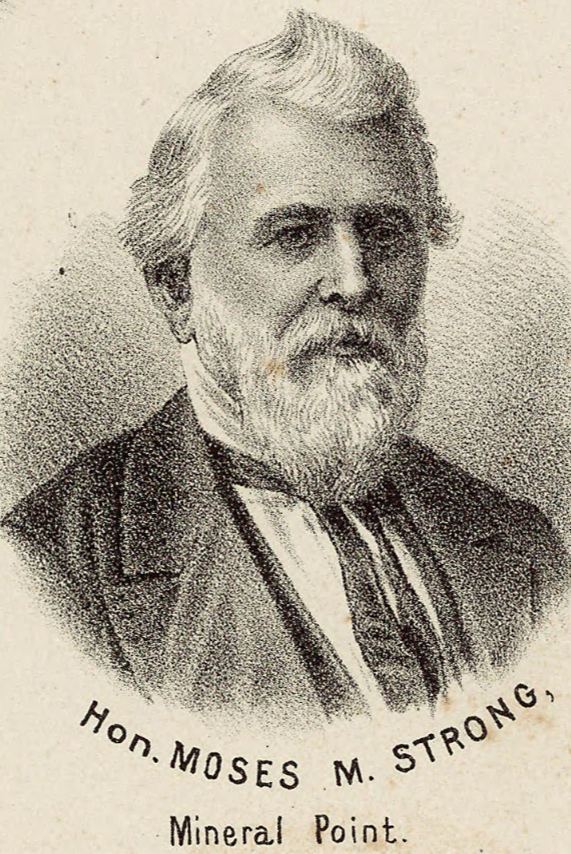
Moses McCure Strong
~ 1878 Historical Atlas of Wisconsin
I have the honor to inclose to you herewith a letter received by this morning’s mail from Messr Strong, United States Attorney for the Territory of Wisconsin, with a copy of one addressed to him by D. P. Burchnell, Indian Sub-agent at Mineral Point, Wisconsin, in relation to sundry suits commenced by him, to recover the penalty incurred for the violation of the 12, 13, & 15 sections of the act of Congress of of 30 June 1834 intitled “an act to regulate trade and intercourse with indian tribes, and to procure peace on the frontiers.”; which suits he states were commenced at the request of Mr. Burchnell.
To enable me to reply to the District Attorney’s letter I shall be obliged by your informing me at your earliest convenience, whether you wish any particular [directions?] given to him on the subject. Please return the District Attorney’s letter with its inclosure.
very respectfully Yours
H. D. Gilpin
Solicitor of the Treasury
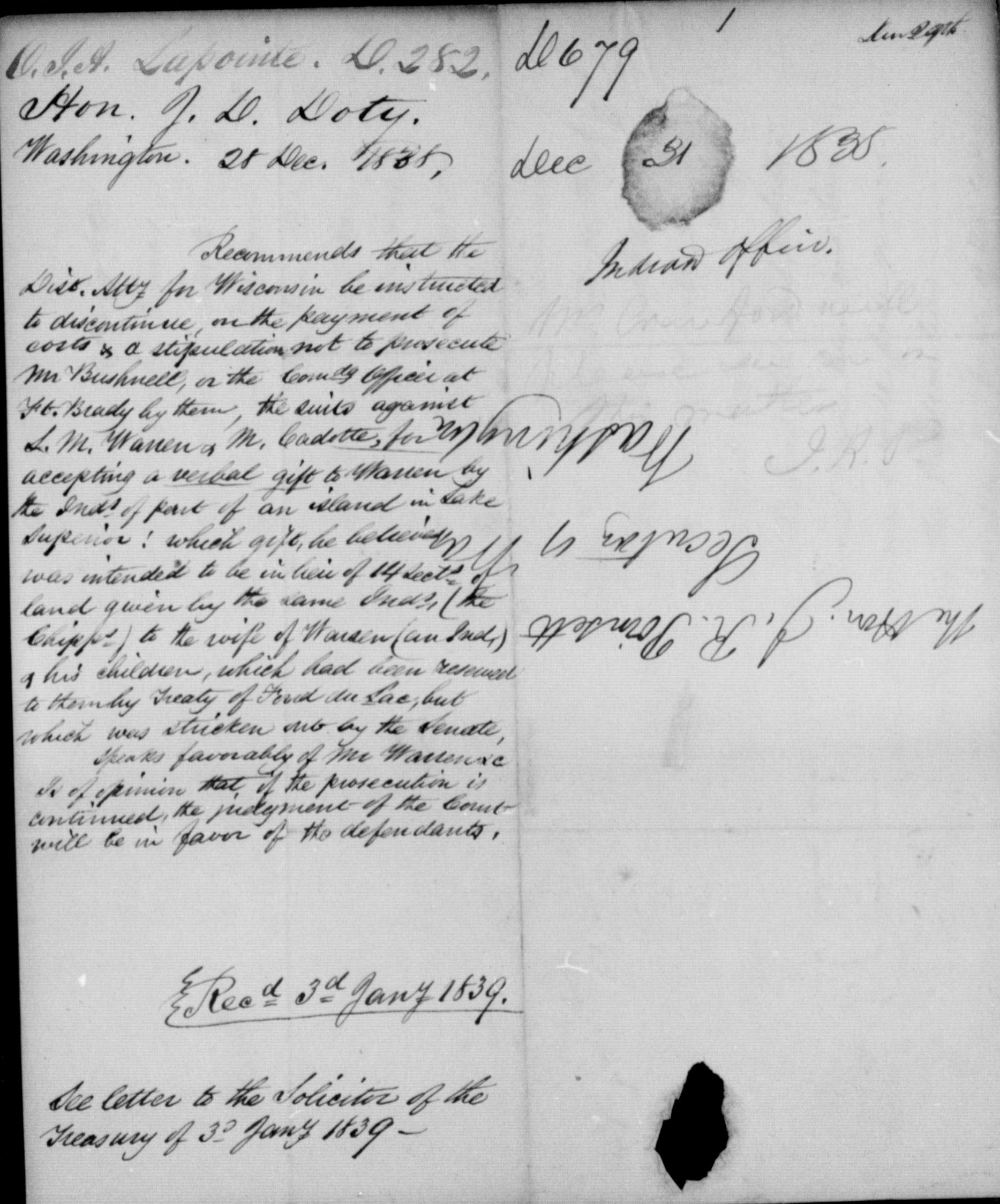
December 28, 1838
from James Duane Doty
to Commissioner of Indian Affairs
forwarded to Secretary of War December 31, 1838
Received January 3, 1839
See letter to Solicitor of the Treasury dated January 3, 1838.
Washington
Dec. 28 1838.
The Hon. J. R. Poinsett
Secy of War
Sir,

1827 Deed for Old La Pointe from Madeline and Michel Cadotte, Sr. to Lyman M. Warren for 2,000 acres of unceded tribal land on Madeline Island to be held in trust for the Cadotte/Warren grandchildren and future generations.
A prosecution was commenced last fall by the Indian Department against Lyman M. Warren, a licensed Trader at Lapointe, Lake Superior and a half Indian by the name of Michel Cadotte, for accepting of a verbal gift to Warren by the Indians of a part of an Island in Lake Superior. This gift I believe was intended to be in lieu of 14 sections of land given by the same Indians to the wife of Warren (an Indian woman, and his children, which had been reserved to them in the Treaty of Fond du Lac, but which was I am informed, stricken out, with other reservations of land, by the Senate.
It appears that Warren was ignorant of the act of Congress on this subject, and that so soon as he was informed, he desisted. Some months afterwards, and without anything new having secured, the sub-agent (then 300 miles from Lapointe) obtained a military force to be sent from Fort Brady to arrest Warren and his interpreter Cadotte. They made no resistance but voluntarily came with the soldiers to the Sault Ste Marie, and thence to Mineral Point 600 miles further.
Mr. Warren has been a Trader in that Country for the last 20 years, and I have personally known him there since the year 1820. During this long period he has been much respected as an upright Trader, submissive to the laws, and at all times disposed to extend the power of this government over the Northern Indians, who it is well known have been most inclined to visit and listen to the British authorities. I do not think there is another Indian Trader in the North West who has a greater influence with those Tribes than Mr. Warren.
The sub-agent, Mr. Bushnell, was a stranger in that country, but recently appointed, and, I cannot but think, has caused Mr. Warren to be arrested without a due examination of the facts of the case, or without giving a proper consideration to the effect it will be likely to have with the Indians of that country.
If Mr. Warren is compelled to defend this suit, whether it results in his favour or not, it must ruin him and his family, and I think the government will lose more than it will gain by continuing the prosecution.
From my knowledge of the parties, the facts of the case and the condition of the country I would respectfully recommend that the District Attorney be directed to discontinue the prosecutions against Warren & Cadotte upon the payment of costs and a stipulation not to prosecute Bushnell and the Commanding Officer at Fort Brady. I have no hesitation in expressing to you the opinion, that if the prosecution is continued the judgement of the Court will be in favour of the defendants.
With much respect I am Sir your obdt svt
J. D. Doty
The 19th Ojibwe Journal of Edmund F. Ely
July 9, 2023
By Leo and Amorin
The Ojibwe Journals of Edmund F. Ely, 1833-1849, compiled and edited by Theresa Schenck, and published by University of Nebraska Press in 2012, are a fascinating window into Ojibwe Country at a pivotal time in history. Chequamegon History frequently cites this work, which consists of eighteen journals kept by a Protestant missionary during his largely unsuccessful labors among the Ojibwe people of western Lake Superior and the upper Mississippi country. In it, Dr. Schenck alludes to a nineteenth journal, not published in the book, dealing with the liquor trade at La Pointe in the years 1847 and 1848.  The original manuscripts are held by the Northeast Minnesota Historical Center at the University of Minnesota-Duluth. Other historical societies hold transcripts made by Grace Lee Nute and Veronica Houle in the 1930s. Here we present our own transcription of Journal 19.Unlike numbers 1-18, Journal 19 is less a personal diary and more an official log of incidents related liquor trafficking and drunkenness on Madeline Island and surrounding regions. During those years, Ely was a teacher at the La Pointe Mission under Rev. Sherman Hall and also provided assistance to Rev. Leonard Wheeler at the Bad River Mission. These missionaries came from the New England evangelical tradition of the Second Great Awakening, which in addition to trying to convert the peoples of the world, also produced movements for Abolitionism, Women’s Suffrage, and Temperance. Letters indicate that some form of La Pointe Temperance Society was created in the late 1840s. Journal 19 references papers on file, indicating that the document may actually be the official log of the Temperance Society, probably having the intent to produce evidence against illegal liquor traders.
The use of alcohol in the fur trade goes back four centuries, to the earliest French presence on Lake Superior. Government and church efforts to suppress that trade go back almost as far. These measures, however, were never successful in fully eliminating liquor from the trade. By 1847, the laws related to alcohol at La Pointe were somewhat ambiguous. The Intercourse Acts of the United States prohibited the sale of liquor to Indians and on Indian lands. Enforcement, therefore, was the responsibility of the Government Sub-Agent. However, there were questions over whether his jurisdiction extended to non-Natives, to mix-blood Ojibwe people with American citizenship, or to transactions completed on the water of Lake Superior. Suffice it to say, both Federal laws and local ordinances prohibiting alcohol were enforced irregularly. The missionaries found this maddening.
Edmund F. Ely was perfect for the job of professional tattletale. For one thing, he was good at being disliked. He had numerous enemies in both the Ojibwe and the non-Native population. Around the time he was driven out of Fond du Lac by the chiefs of that community, he even went so far as to compile a list of reasons why the Fond du Lac Ojibwe disliked him. He would later go on to alienate several of the early settlers of Superior and Duluth during the McCracken-Ludden Affair, and he often sent complaints about his fellow missionaries back to headquarters in Boston.
We, today, are also fortunate that Ely had this job. Most accounts from this era, about the destructive power of alcohol in the Laker Superior trade are very similar in nature. We get a lot of righteous screeds, emphasizing only sensational violence. These are long on moralizing and short on interesting detail. Ely is certainly moralistic to the point of sanctimony, and some of his accounts are extremely violent. However, Journal 19 preserves the same types of details and idiosyncratic observations that makes the earlier journals so compelling. Because of this, we get a true window into the nuances of 1840s La Pointe society. Despite lax or selective enforcement of liquor laws, we arguably see a community less affected by alcohol than the nearby white settlements at St. Croix and Ontonagon. Finally, we get to see familiar characters, learn of their triumphs and failures, and hear stories both horrific and humorous, but seemingly very real.
The Ojibwe Journals of Edmund F. Ely:
LaPointe 1847-1848
Journal # 19
1847
May.
Adams of Ontonagon came to Bad River with goods & Whiskey, for trade with the Indians. He first past into the Bay behind Shagouamik & the whiskey was secreted near the sand cut. Mr. Hayes (Sub-Agt) Learning of this movement went in search, & destroyed [it at once. 50 to 80 Quarts sold.]
Aug.
The Sail Boat “Flying Indian” [came ashore for sale] with whiskey & secreted it [illeg.]
“
Schooner “Fur Trader” searched by the Sub Agent & [33] qua [btls] of Liquour in bottles destroyed.
“
[omitted or illegible sentence]
“
Steam Boat “Julia Palmer” boarded and searched at the [Sault] [illeg.] of [illeg.]

Martin Beaser,a prominent name in early Ashland history, got his start here as an illegal liquor trader. These late summer incidents, in both 1847 and 1848, coincide with the La Pointe annuity payments
Augt.
Martin Beser, of Ontonagon arrived in a Yawl–with a few others, reported as passengers. Journalist has been informed that she brought part of the load (whiskey) of the Flying Indian. Probably had considerable whiskey of belonging to Beser & the Passengers.
— Besor’s boat with himself, Chas. Rowley & a stranger on board (all intoxicated) was upset in a squall while cruis about Eleven o clk P.M. while cruising about the harbour. Wind Northerly. They drifted on to Shagouamik & struck some distance off the point on the shoal in about 4ft water. Men lay on the side of the boat, benumbed, helpless, & almost speechless & inconscious.
—It being surmised from certain movements, by a member of the Temp. Socy. that a Bbl of Whiskey would be removed from the Island to Shagouamik. Mr. Hayes was informed, who sent off Mr. Smith & two strikers, before day break, to keep a look-out. Mr. Smith discovered Besor’s boat–took off the men & brought them to Cadottes–where they were seen by Messrs Wheeler & Johnson & others.
“–Sab.
Besor’s boat left, and were obliged to put in to Bad River where were encamped the Lac du Flambeau Wisconsin Indians Indians returning from payment. There was liquor enough onboard to commence a trade. The Indians were supplied & became intoxicated. The wife of White Bird (mother of Kebebizindų) was present, who states that an Ind rec’d a bottle from one of the men on board, in exchange for a Blanket, but as ascertaining it contained only water went to take his Blanket again, whereupon Besor resisted him & knocked him down with a Rifle. The Ind’s were roused by the report that the white men were killing the man, & as the boat shoved off the shore, fired upon it, shot & ball, one Ball passed through the post of the ship keel [cent]. & struck lodged in the arm of James Dorman, who had thrown himself there off place of safety. Boat put back to Warren’s for surgical help–left Dorman & went off same day (Sunday)
[perpendicular to beginning of struck-out statement]Incorrect
[in margin at beginning of struck-out statement]
Sab previous
[perpendicular to ending of struck-out statement]This statement is incorrect see Whitebird’s wife’s statement on file.
On the last two days of the payment,
Bottles of liquor were smuggled ashore in the pockets of dealers, & sold for $1, per bottle, or exchanged for blankets. Some bottles were found to contain only water. The trade in bottles was carried on, (it is believed) through the windows of the Julia Palmer. Capt. Wood, of the steamer was detected in the night, landing his yawl, with bottles of whiskey in possession. Some two or three Bbls, (in different sized casks) were found & destroyed by Govt.
Nov.
Francois Boudrie of Ontonagon arrived here with whiskey. Evidence was obtained of his having infringed the law in selling to Indians & also of selling without licence. Mr. Austrian lodged a complaint with Justice Bell & Boudrie was brought to trial, but from his supposed inability to pay the fine, & there being no prison, at the was set at liberty on securing an amount of $5 for costs, without bonds “to keep the peace” being required to enter into Bonds to keep the peace.
— Jejiguaio complained to Justice Bell against Millette for selling whiskey to Indians in exchange for paymt. goods. Case not examined–
— gave Mr. Oakes a list of goods, traded for whiskey with Millette. Indian was dissatisfied needed his goods & wished to get them again.
May 13.
Francis Boudrie of Ontonagon brought whiskey to Bad River for trade with the Inds. B. confessed his crime to Messrs. Wood & Wheeler. An officer warrant was issued by Justice Bell, but the officer arrived too late to arrest him, he having left the Territory.
May 6.
Propeller Independence arrived from Sault St. Maries. Not known that any intoxicating liquor was landed save 2 Bbls cider for Mr. Watrous.
19th
Chas. Brissett states that Henry Beaulieu told him he (Henry) bought one bottle of liquor of Watrous for $1. (Whh Henry denies) Some observed Henry to be, in their estimation, a little excited from drink.
May 23.
Propeller Independence arrived today from Sault St. Maries. Dr. Borup & fam, & J. P. Hayes Esq. passengers.
Items gathered at Ance Kiueonaui. In Oct Last, 3 young men (Indian) from the methodist Station, went across the bay to Meniclear’s, got whiskey, & returned drunk. One of them lay on the shore & died in the night. A coroner’s Inquest was held on the body. (P.O. Johnson)
Some time in Nov. or Dec.
A canadian came through from Green Bay in company with J. Paull of Ontonagon, got liquor of Geo. Burkett, & was drunk some days, was then attacked (with pluerisy probably) & died (P.O. Johnson)
In Jany.
3 miners came from Copper Harbour, on their way to Green Bay, with considerable money. They stopped at Meniclear’s & gave themselves to drinking one or two days, during which, one did a severe wound in the hand, and another found himself minus about $100. (Johnson)
There are 5 traders at L’Ance, viz.
P. Crebassa no whiskey
Meniclear Whiskey & drinker
Geo. Burkett. do – do
Sherman do – do
Sheldon do – do
2 of the above drinkers, also abuse their families.
Some time in the fall of 1847,
John Champaigne, in the Employment of Doct. Kane, on their way up the ontonagon was seized with delirium tremens, & died. Had been drinking at the mouth of Ontonagon.–
March 2nd, 1848.
Jas. Landergrun was found in a dying state on the Ice, Ontonagon River, for particulars see the letter of Mr. Saml O. Knapp (on file)
Feb 7. 1847.
Henry Rust was killed shot by a shot from an Nodin or his son in law, at Dicks Drakes trading house on Snake River St. Croix, Co. Drake & another man were drunk & were fired upon they were too drunk to know much about the circumstances for particulars, see statement of J. P. Hayes Esq (on file)
May 1848.
–Drake shot dead killed by a shot Bapt. Robideau– Liquor the cause.
June 19.
Schooner Swallow arrived from Sault St. Maries. freight for Messrs Hyde, Leopoled & N. Fur Co.
March.
Mr. Cash of Ontonagon stated to Journalist that Martin Besor, after his return from Lapoint last fall offered to sell him any number of Indian Blankets, whh he (Cash) might be disposed to buy.
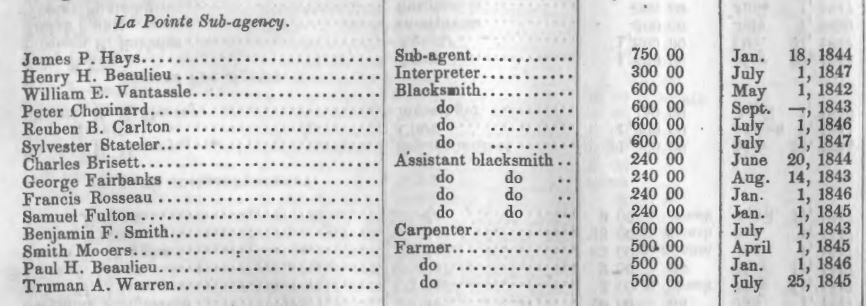
List of mid-late 1840s employees at the La Pointe Indian Sub-Agency including James P. Hayes and others.
~ Thirtieth Congress – First Session. Ex. Doc. No. 26. House of Representatives. Persons Employed In The Indian Department. Letter from The Secretary of War, Transmitting a statement of persons employed in the Indian Department. January 26, 1848.
June 22.
Jas. P. Hayes Esq. U. S. Sub Agt. recd his dismission & left in the Schooner Swallow– cause, Intemperance
July.
Fr. Boudrie arrived from Ontonagon with a cask of whiskied Cider– was prosecuted–a search warrant was issued & Peter Vandeventer was deputized to serve it. Van deventer After allowing abundant time for the service, Mr. Justice Bell & Van Tasell went to the building under search, & detected Van deventer in secreting a part of the cider. The whole was seized & destroyed by the owner–
Aug 28.
Propeller Independence arrived. Considerable intoxication among french & Half breeds.
“ 29
Schooner Napoleon, Clarke arrived with Govt provisions. Passengers Hyde, Wolcott & Martell
In discharging some bbls. of corn from the Propeller, on bbl. burst, & revealed a number of bottles of Liquor secreted among the Corn. The bbls were expressed back to the Sault. They have since been ascertained to belong have shipped by Martell of Sault St Maries. It was also reported by a passenger on the propeller, that the Napoleon was supposed to have on board a Bbl of Liquor belonging to Wolcott.
A number of Indians are reported to have had liquor about the time the Propeller left.
— An Indian was instigated by a Wht. man named Mills to murder two Americans living on Apple River–liquor was used in carry out Mills’s plans. The Ind was arrested & Hung, without judicial trial, at the Falls of St Croix.
— Majise shot killed in a drunken frolic on the St Croix. died next day–
— An old woman had her arm broken at the mouth of the Brule by a drunken son in law–Liquor furnished by Aug. Cadotte.
Sept 11.
Wood Smith & Vantassell Govt men, found 2 Kegs (about 12 [gal]) whiskey near the camp of Fr. Boudrie belonging to him, concealed in the ground–they immediately destroyed it.
6th
The sailboat Flying Indian arrived in the night of [Sunday] [day] last.
Sept 13.
Schooner Algonquin arrived from Sault St. Maries ~~~~~~~~~~~~~~~~~~~~~~~~~~~~~~~~~~~~~~~~~~~~~~~~~~~~~~~~~~~~~~~~~~~~~~~~~~~~~~~~~~~~~~~~~~~~~~~~~ Further information about the challenges of enforcing liquor laws at La Pointe can be found in the following:
“A real bona fide, unmitigated Irishman”
Reisen in Nordamerika: From Ontonagon to the mouth of the Bois-brule (Part 3)
1855 Inquest on the Body of Louis Gurnoe
1856 Inquest on the Body of Jerry Sullivan
~~~~~~~~~~~~~~~~~~~~~~~~~~~~~~~~~~~~~~~~~~~~~~~~~~~~~~~~~~~~~~~~~~~~~~~~~~~~~~~~~~~~~~~~~~~~~~~~~
Ely, Edmund Franklin, and Theresa M. Schenck. The Ojibwe Journals of Edmund F. Ely, 1833-1849. Lincoln: University of Nebraska, 2012. Print.
Folsom, William H. C., and E. E. Edwards. Fifty Years in the Northwest. St. Paul: Pioneer, 1888. Print.
Paap, Howard D. Red Cliff, Wisconsin: A History of an Ojibwe Community. St. Cloud, MN: North Star, 2013. Print.
Schenck, Theresa M. William W. Warren: The Life, Letters, and times of an Ojibwe Leader. Lincoln: University of Nebraska, 2007. Print.
Special thanks to Dr. Schenck for making this post possible.
1837 Petitions from La Pointe to the President
January 29, 2023
Collected & edited by Amorin Mello
Letters Received by the Office of Indian Affairs:
La Pointe Agency 1831-1839
National Archives Identifier: 164009310
O. I. A. La Pointe J171.
Hon Geo. W. Jones
Ho. of Reps. Jany 9, 1838
Transmits petition dated 31st Augt 1837, from Michel Cadotte & 25 other Chip. Half Breeds, praying that the amt to be paid them, under the late Chip. treaty, be distributed at La Pointe, and submitting the names of D. P. Bushnell, Lyman M. Warren, for the appt of Comsr to make the distribution.
Transmits it, that it may receive such attention as will secure the objects of the petitioners, says as the treaty has not been satisfied it may be necessary to bring the subject of the petition before the Comsr Ind Affrs of the Senate.
Recd 10 Jany 1838
file
[?] File.
House of Representatives Jany 9th 1838

Sir
I hasten to transmit the inclosed petition, with the hope, that the subject alluded to, may receive such attention, as to secure the object of the petitioners. As the Chippewa Treaty has not yet been ratified it may be necessary to bring the subject of the petition before the Committee of Indian Affairs of the Senate.
I am very respectfully
Your obt svt
Geo W. Jones
C. A. Harris Esqr
Comssr of Indian Affairs
War Department

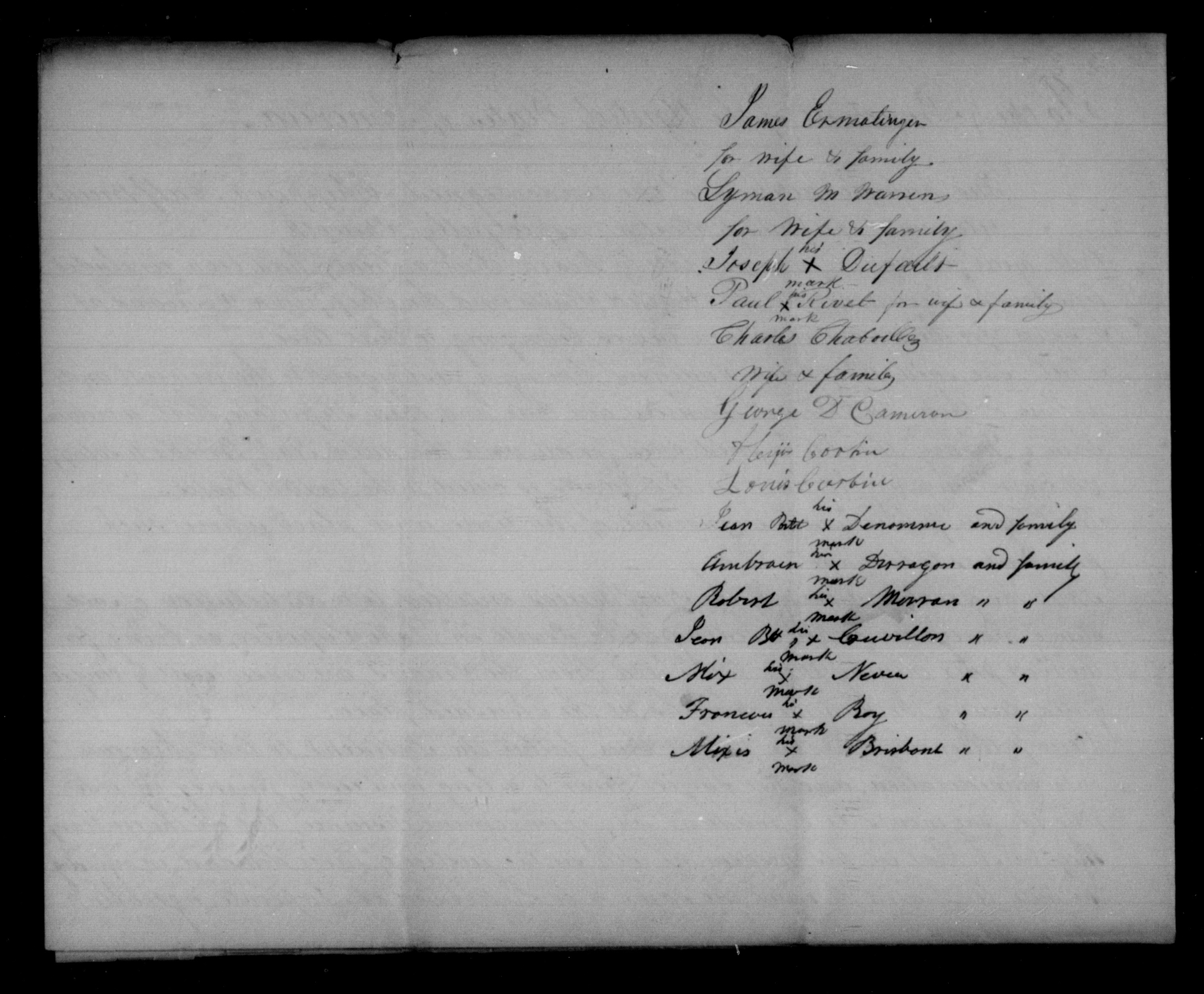
To the President of the United States of America
The humble petition of the undersigned Chippewa Half-Breeds citizens of the United Sates, respectfully Shareth:

Bizhiki (Buffalo), Dagwagaane (Two Lodges Meet), and Jechiikwii’o (Snipe, aka Little Buffalo) signed the 1837 Treaty of St Peters for the La Pointe Band.
That, your petitioners having lately heard that a Treaty had been concluded between the Government of the United Sates and the Chippewa Indians at St Peters, for the cession of certain lands belonging to that tribe:
ARTICLE 3.
“The sum of one hundred thousand dollars shall be paid by the United States, to the half-
breeds of the Chippewa nation, under the direction of the President. It is the wish of the
Indians that their two sub-agents Daniel P. Bushnell, and Miles M. Vineyard, superintend
the distribution of this money among their half-breed relations.”
That, the said Chippewa Indians X, having a just regard to the interest and welfare of their Half Breed brethren, did there and then stipulate; that, a certain sum of money should be paid once for all unto the said Half-Breeds, to satisfy all claim they might have on the lands so ceded to the United States.
That, your petitioners are ignorant of the time and place where such payment is to be made.
That the great majority of the Half-Breeds entitled to a distribution of said sum of money, are either residing at La Pointe on Lake Superior, or being for the most part earning their livelihood from the Traders, are consequently congregated during the summer months at the aforesaid place.
Your petitioners humbly solicit their father the President, to take their case into consideration, and not subject them to a long and costly journey in ordering the payments to be made at any inconvenient distance, but on the contrary they trust that in his wisdom he will see the justice of their demand in requiring he will be pleased to order the same to be distributed at Lapointe agreeable to their request.
Your petitioners would also intimate that, although they are fully aware that the Executive will make a judicious choice in the appointment of the Commissioners who will be selected to carry into effect the Provisions of said Treaty, yet, they would humbly submit to the President, that they have full confidence in the integrity of D. P. Bushnell Esqr. resident Indian Agent for the United States at this place and Lyman M Warren Esquire, Merchant.
Your petitioners entertain the flattering hope, that, their petition will not be made in vain, and as in duty bound will ever pray.
La Pointe, Lake Superior,
Territory of Wisconsin 31st August 1837
Michel Cadotte
Michel Bosquet X his mark
Seraphim Lacombe X his mark
Joseph Cadotte X his mark
Antoine Cadotte X his mark
Chs W Borup for wife & Children
A Morrison for wife & children
Pierre Cotte
Henry Cotte X his mark
Frances Roussan X his mark
James Ermatinger for wife & family
Lyman M Warren for wife & family
Joseph Dufault X his mark
Paul Rivet X his mark for wife & family
Charles Chaboullez wife & family
George D. Cameron
Alixis Corbin
Louis Corbin
Jean Bste Denomme X his mark and family
Ambrose Deragon X his mark and family
Robert Morran X his mark ” “
Jean Bst Couvillon X his mark ” “
Alix Neveu X his mark ” “
Frances Roy X his mark ” “
Alixis Brisbant X his mark ” “
Signed in presence of G. Pauchene
John Livingston
O.I.A. La Pointe W424.
Governor of Wisconsin
Mineral Pt. Feby 19, 1838
Transmits the talk of “Buffalo,” a Chip. Chief, delivered at the La Pointe SubAgt, Dec. 9, 1837, asking that the am. due the half-breeds under the late Treaty, be divided fairly among them, & paid them there, as they will not go to St Peters for it, &c.
Says Buffalo has great influence with his tribe, & is friendly to the whites; his sentiments accord with most of those of the half-breeds & Inds in that part of the country.
File
Recd 13 March 1838
[?] File.
Superintendency of Indian Affairs
for the Territory of Wisconsin
Mineral Point, Feby 19, 1838
Sir,
I have the honor to inclose the talk of “Buffalo,” a principal chief of the Chippewa Indians in the vicinity of La Pointe, delivered on the 9th Dec’r last before Mr Bushnell, sub-agent of the Chippewas at that place. Mr. Bushnell remarks that the speech is given with as strict an adherence to the letter as the language will admit, and has no doubt the sentiments expressed by this Chief accord with those of most of the half-breeds and Indians in that place of the Country. The “Buffalo” is a man of great influence among his tribe, and very friendly to the whites.
Very respectfully,
Your obed’t sevt.
Henry Dodge
Supt Ind Affs
Hon C. A. Harris
Com. of Ind. Affairs
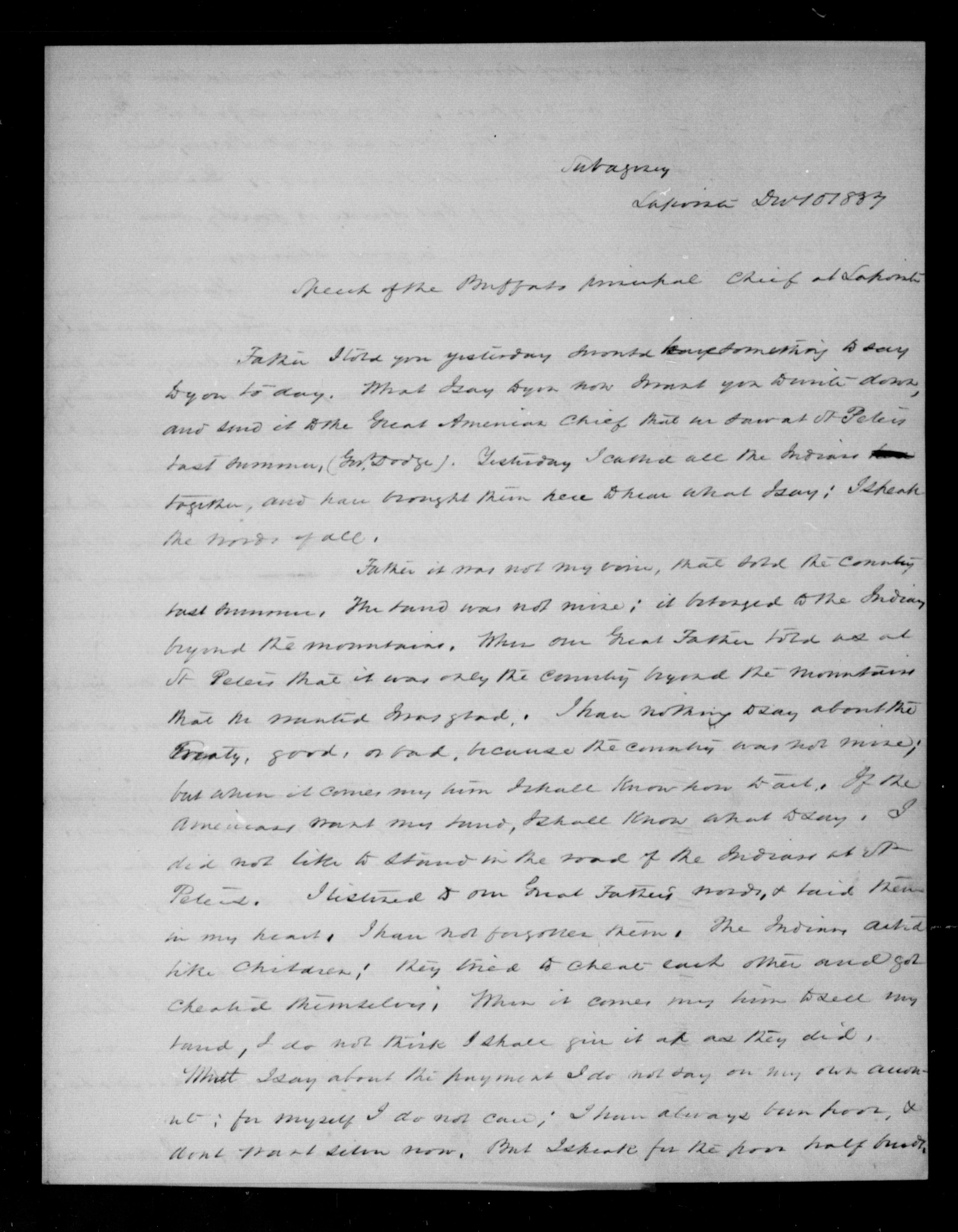
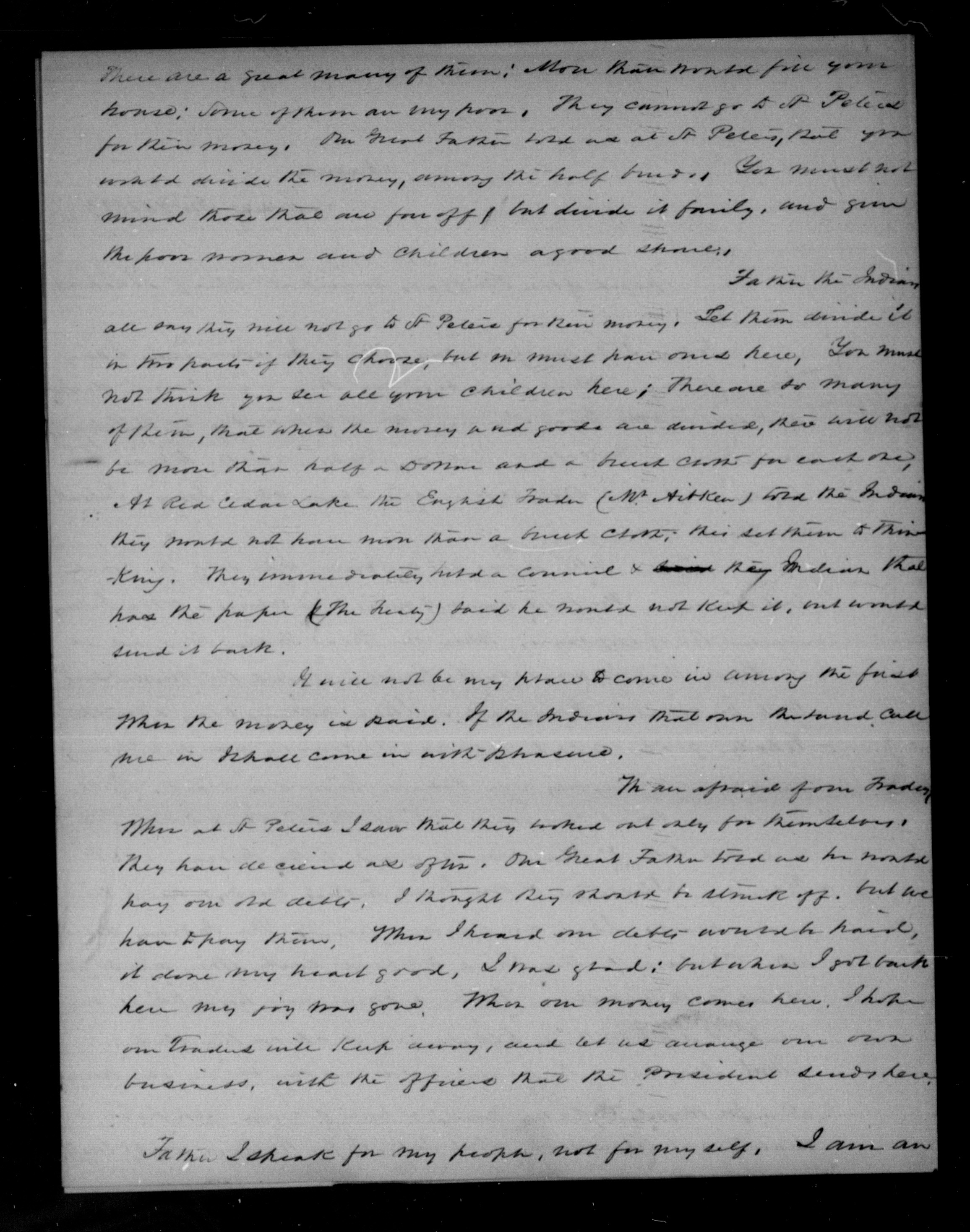
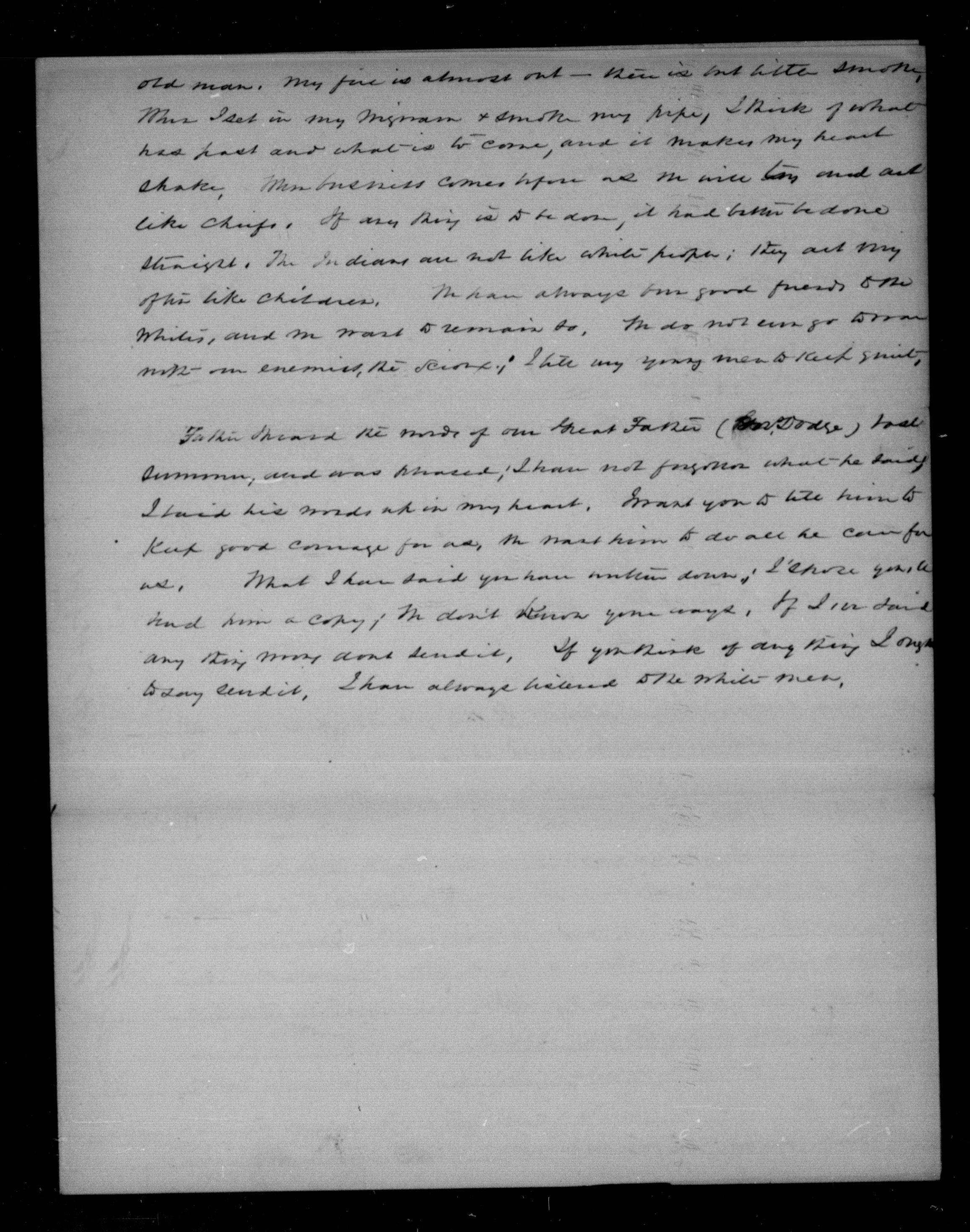
Subagency
Lapointe Dec 10 1837
Speech of the Buffalo principal Chief at Lapointe
Father I told you yesterday I would have something to say to you today. What I say to you now I want you to write down, and send it to the Great American Chief that we saw at St Peters last summer, (Gov. Dodge). Yesterday, I called all the Indians together, and have brought them here to hear what I say; I speak the words of all.
ARTICLE 1.
“The said Chippewa nation cede to the United States all that tract of country included
within the following boundaries:
[…]
thence to and along the dividing ridge between the waters of Lake Superior and those of the Mississippi
[…]“
Father it was not my voice, that sold the country last summer. The land was not mine; it belonged to the Indians beyond the mountains. When our Great Father told us at St Peters that it was only the country beyond the mountains that he wanted I was glad. I have nothing to say about the Treaty, good, or bad, because the country was not mine; but when it comes my time I shall know how to act. If the Americans want my land, I shall know what to say. I did not like to stand in the road of the Indians at St Peters. I listened to our Great Father’s words, & said them in my heart. I have not forgotten them. The Indians acted like children; they tried to cheat each other and got cheated themselves. When it comes my time to sell my land, I do not think I shall give it up as they did.
What I say about the payment I do not say on my own account; for myself I do not care; I have always been poor, & don’t want silver now. But I speak for the poor half breeds.
There are a great many of them; more than would fill your house; some of them are very poor They cannot go to St Peters for their money. Our Great Father told us at St Peters, that you would divide the money, among the half breeds. You must not mind those that are far off, but divide it fairly, and give the poor women and children a good share.
Father the Indians all say they will not go to St Peters for their money. Let them divide it in this parts if they choose, but one must have ones here. You must not think you see all your children here; there are so many of them, that when the money and goods are divided, there will not be more than half a Dollar and a breech cloth for each one. At Red Cedar Lake the English Trader (W. Aitken) told the Indians they would not have more than a breech cloth; this set them to thinking. They immediately held a council & their Indian that had the paper (The Treaty) said he would not keep it, and would send it back.
It will not be my place to come in among the first when the money is paid. If the Indians that own the land call me in I shall come in with pleasure.
ARTICLE 4.
“The sum of seventy thousand dollars shall be applied to the payment, by the United States, of certain claims against the Indians; of which amount twenty eight thousand dollars shall, at their request, be paid to William A. Aitkin, twenty five thousand to Lyman M. Warren, and the balance applied to the liquidation of other just demands against them—which they acknowledge to be the case with regard to that presented by Hercules L. Dousman, for the sum of five thousand dollars; and they request that it be paid.“
We are afraid of one Trader. When at St Peters I saw that they worked out only for themselves. They have deceived us often. Our Great Father told us he would pay our old debts. I thought they should be struck off, but we have to pay them. When I heard our debts would be paid, it done my heart good. I was glad; but when I got back here my joy was gone. When our money comes here, I hope our Traders will keep away, and let us arrange our own business, with the officers that the President sends here.
Father I speak for my people, not for myself. I am an old man. My fire is almost out – there is but little smoke. When I set in my wigwam & smoke my pipe, I think of what has past and what is to come, and it makes my heart shake. When business comes before us we will try and act like chiefs. If any thing is to be done, it had better be done straight. The Indians are not like white people; they act very often like children. We have always been good friends to the whites, and we want to remain so. We do not [even?] go to war with our enemies, the Sioux; I tell my young men to keep quiet.
Father I heard the words of our Great Father (Gov. Dodge) last summer, and was pleased; I have not forgotten what he said. I have his words up in my heart. I want you to tell him to keep good courage for us, we want him to do all he can for us. What I have said you have written down; I [?] you to hand him a copy; we don’t know your ways. If I [?] said any thing [?] dont send it. If you think of any thing I ought to say send it. I have always listened to the white men.
O.I.A. Lapointe, B.458
D. P. Bushnell
Lapointe, March 8, 1838
At the request of some of the petitioners, encloses a petition dated 7 March 1838, addressed to the Prest, signed by 167 Chip. half breeds, praying that the amt stipulated by the late Chip. Treaty to be paid to the half breeds, to satisfy all claims they ma have on the lands ceded by this Treaty, may be distributed at Lapointe.
Hopes their request will be complied with; & thinks their annuity should likewise be paid at Lapointe.
File
Recd 2nd May, 1838
Subagency
Lapointe Mch 6 1838
Sir
I have the honor herewith to enclose a petition addressed to the President of the United States, handed to me with a request by several of the petitioners that I would forward it. The justice of the demand of these poor people is so obvious to any one acquainted with their circumstances, that I cannot omit this occasion to second it, and to express a sincere hope that it will be complied with. Indeed, if the convenience and wishes of the Indians are consulted, and as the sum they receive for their country is so small, these should, I conciev, be principle considerations, their annuity will likewise as paid here; for it is a point more convenient of access for the different bands, that almost any other in their own country, and one moreover, where they have interests been in the habit of assembling in the summer months.
I am sir, with great respect,
your most obt servant,
D. P. Bushnell
O. I. A.
C. A. Harris Esqr.
Comr Ind. Affs
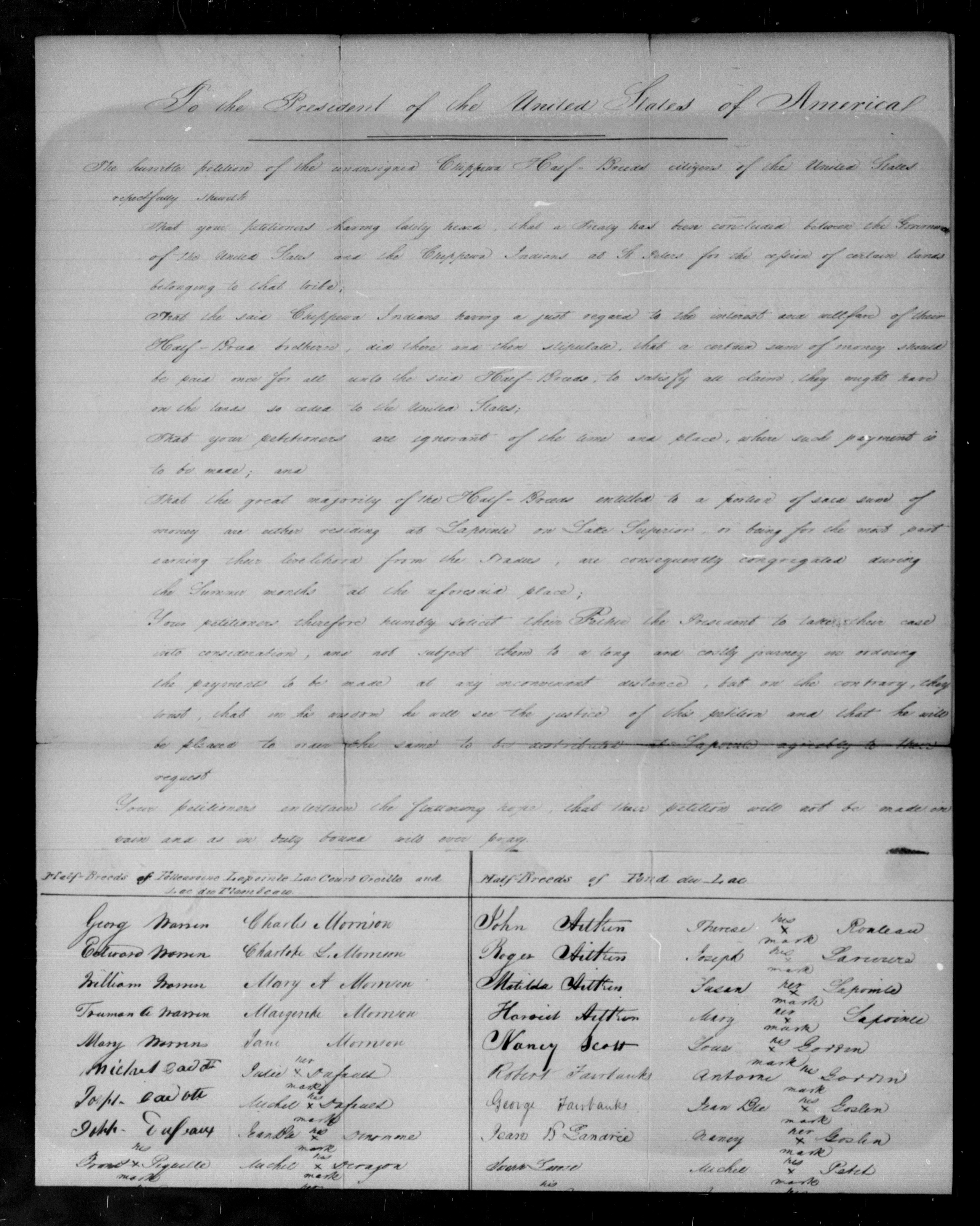
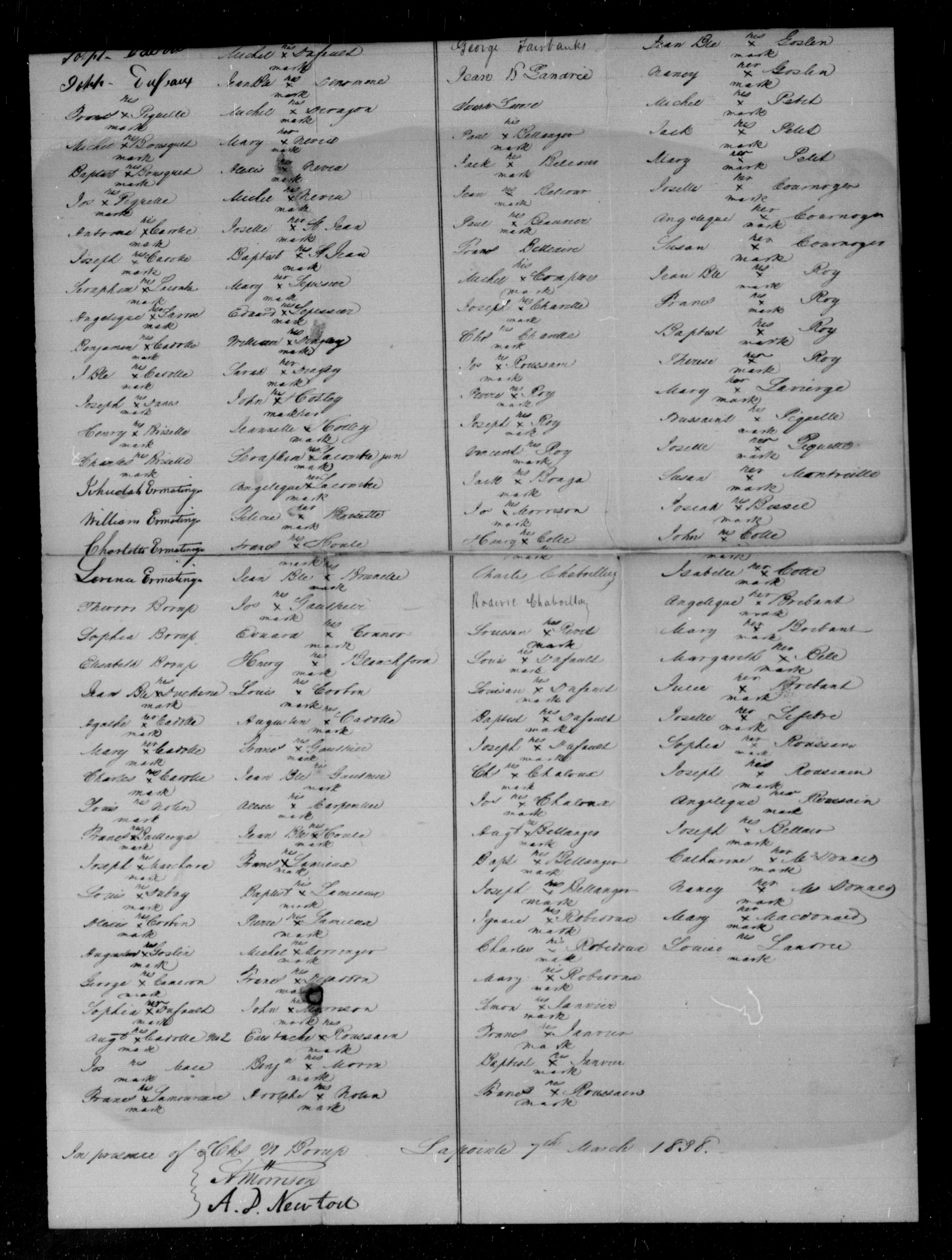
To the President of the United States of America
The humble petition of the undersigned Chippewa Half-Breeds citizens of the United States respectfully shareth
That your petitioners having lately heard, that a Treaty has been concluded between the Government of the United States and the Chippewa Indians at St Peters for the cession of certain lands belonging to that tribe;
That the said Chippewa Indians having a just regard to the interest and wellfare of their Half-Breed brethern, did there and then stipulate, that a certain sum of money should be paid once for all unto the said Half-Breeds, to satisfy all claims, they might have on the lands so ceded to the United States;
That your petitioners are ignorant of the time and place, where such payment is to be made; and
That the great majority of the Half-Breeds entitled to a portion of said sum of money are either residing at Lapointe on Lake Superior, or being for the most part earning their livelihood from the Traders, are consequently congregated during the summer months at the aforesaid place;
Your petitioners therefore humbly solicit their Father the President to take their case into consideration, and not subject them to a long and costly journey on ordering the payment to be made at any convenient distance, but on the contrary, they wish, that in his wisdom he will see the justice of this petition and that he will be pleased to order the same to be distributed at Lapointe agreeably to their request.
Your petitioners entertain the flattering hope, that their petition will not be made in vain and as in duly bound will ever pray.
Half Breeds of Folleavoine Lapointe Lac Court Oreilles and Lac du Flambeau
Georg Warren
Edward Warren
William Warren
Truman A Warren
Mary Warren
Michel Cadott
Joseph Cadotte
Joseph Dufault
Frances Piquette X his mark
Michel Bousquet X his mark
Baptiste Bousquet X his mark
Jos Piquette X his mark
Antoine Cadotte X his mark
Joseph Cadotte X his mark
Seraphim Lacombre X his mark
Angelique Larose X her mark
Benjamin Cadotte X his mark
J Bte Cadotte X his mark
Joseph Danis X his mark
Henry Brisette X his mark
Charles Brisette X his mark
Jehudah Ermatinger
William Ermatinger
Charlotte Ermatinger
Larence Ermatinger
Theodore Borup
Sophia Borup
Elisabeth Borup
Jean Bte Duchene X his mark
Agathe Cadotte X her mark
Mary Cadotte X her mark
Charles Cadotte X his mark
Louis Nolin _ his mark
Frances Baillerge X his mark
Joseph Marchand X his mark
Louis Dubay X his mark
Alexis Corbin X his mark
Augustus Goslin X his mark
George Cameron X his mark
Sophia Dufault X her mark
Augt Cadotte No 2 X his mark
Jos Mace _ his mark
Frances Lamoureau X his mark
Charles Morrison
Charlotte L. Morrison
Mary A Morrison
Margerike Morrison
Jane Morrison
Julie Dufault X her mark
Michel Dufault X his mark
Jean Bte Denomme X his mark
Michel Deragon X his mark
Mary Neveu X her mark
Alexis Neveu X his mark
Michel Neveu X his mark
Josette St Jean X her mark
Baptist St Jean X his mark
Mary Lepessier X her mark
Edward Lepessier X his mark
William Dingley X his mark
Sarah Dingley X her mark
John Hotley X his mark
Jeannette Hotley X her mark
Seraphim Lacombre Jun X his mark
Angelique Lacombre X her mark
Felicia Brisette X her mark
Frances Houle X his mark
Jean Bte Brunelle X his mark
Jos Gauthier X his mark
Edward Connor X his mark
Henry Blanchford X his mark
Louis Corbin X his mark
Augustin Cadotte X his mark
Frances Gauthier X his mark
Jean Bte Gauthier X his mark
Alexis Carpentier X his mark
Jean Bte Houle X his mark
Frances Lamieux X his mark
Baptiste Lemieux X his mark
Pierre Lamieux X his mark
Michel Morringer X his mark
Frances Dejaddon X his mark
John Morrison X his mark
Eustache Roussain X his mark
Benjn Morin X his mark
Adolphe Nolin X his mark
Half-Breeds of Fond du Lac
John Aitken
Roger Aitken
Matilda Aitken
Harriet Aitken
Nancy Scott
Robert Fairbanks
George Fairbanks
Jean B Landrie
Joseph Larose
Paul Bellanges X his mark
Jack Belcour X his mark
Jean Belcour X his mark
Paul Beauvier X his mark
Frances Belleaire
Michel Comptois X his mark
Joseph Charette X his mark
Chl Charette X his mark
Jos Roussain X his mark
Pierre Roy X his mark
Joseph Roy X his mark
Vincent Roy X his mark
Jack Bonga X his mark
Jos Morrison X his mark
Henry Cotte X his mark
Charles Chaboillez
Roderic Chaboillez
Louison Rivet X his mark
Louis Dufault X his mark
Louison Dufault X his mark
Baptiste Dufault X his mark
Joseph Dufault X his mark
Chs Chaloux X his mark
Jos Chaloux X his mark
Augt Bellanger X his mark
Bapt Bellanger X his mark
Joseph Bellanger X his mark
Ignace Robidoux X his mark
Charles Robidoux X his mark
Mary Robidoux X her mark
Simon Janvier X his mark
Frances Janvier X his mark
Baptiste Janvier X his mark
Frances Roussain X his mark
Therese Rouleau X his mark
Joseph Lavierire X his mark
Susan Lapointe X her mark
Mary Lapointe X her mark
Louis Gordon X his mark
Antoine Gordon X his mark
Jean Bte Goslin X his mark
Nancy Goslin X her mark
Michel Petit X his mark
Jack Petit X his mark
Mary Petit X her mark
Josette Cournoyer X her mark
Angelique Cournoyer X her mark
Susan Cournoyer X her mark
Jean Bte Roy X his mark
Frances Roy X his mark
Baptist Roy X his mark
Therese Roy X her mark
Mary Lavierge X her mark
Toussaint Piquette X his mark
Josette Piquette X her mark
Susan Montreille X her mark
Josiah Bissel X his mark
John Cotte X his mark
Isabelle Cotte X her mark
Angelique Brebant X her mark
Mary Brebant X her mark
Margareth Bell X her mark
Julie Brebant X her mark
Josette Lefebre X her mark
Sophia Roussain X her mark
Joseph Roussain X his mark
Angelique Roussain X her mark
Joseph Bellair X his mark
Catharine McDonald X her mark
Nancy McDonald X her mark
Mary Macdonald X her mark
Louise Landrie X his mark
In presence of
Chs W Borup
A Morrison
A. D. Newton
Lapointe 7th March 1838
Perrault, Curot, Nelson, and Malhoit
March 8, 2014

Click to enlarge (it can only be read when the image is full size).
I’ve been getting lazy, lately, writing all my posts about the 1850s and later. It’s easy to find sources about that because they are everywhere, and many are being digitized in an archival format. It takes more work to write a relevant post about the earlier eras of Chequamegon History. The sources are sparse, scattered, and the ones that are digitized or published have largely been picked over and examined by other researchers. However, that’s no excuse. Those earlier periods are certainly as interesting as the mid-19th Century. I needed to just jump in and do a project of some sort.
I’m someone who needs to know the names and personalities involved to truly wrap my head around a history. I’ve never been comfortable making inferences and generalizations unless I have a good grasp of the specific. This doesn’t become easy in the Lake Superior country until after the Cass Expedition in 1820.
But what about a generation earlier?
The dawn of the 19th-century was a dynamic time for our region. The fur trade was booming under the British North West Company. The Ojibwe were expanding in all directions, especially to west, and many of familiar French surnames that are so common in the area arrived with Canadian and Ojibwe mix-blooded voyageurs. Admittedly, the pages of the written record around 1800 are filled with violence and alcohol, but that shouldn’t make one lose track of the big picture. Right or wrong, sustainable or not, this was a time of prosperity for many. I say this from having read numerous later nostalgic accounts from old chiefs and voyageurs about this golden age.
We can meet some of the bigger characters of this era in the pages of William W. Warren and Henry Schoolcraft. In them, men like Mamaangazide (Mamongazida “Big Feet”) and Michel Cadotte of La Pointe, Beyazhig (Pay-a-jick “Lone Man) of St. Croix, and Giishkiman (Keeshkemun “Sharpened Stone”) of Lac du Flambeau become titans, covered with glory in trade, war, and influence. However, there are issues with these accounts. These two authors, and their informants, are prone toward glorifying their own family members. Considering that Schoolcraft’s (his mother-in law, Ozhaawashkodewike) and Warren’s (Flat Mouth, Buffalo, Madeline and Michel Cadotte Jr., Jean Baptiste Corbin, etc.) informants were alive and well into adulthood by 1800, we need to keep things in perspective.
The nature of Ojibwe leadership wasn’t different enough in that earlier era to allow for a leader with any more coercive power than that of the chiefs in 1850s. Mamaangazide and his son Waabojiig may have racked up great stories and prestige in hunting and war, but their stature didn’t get them rich, didn’t get them out of performing the same seasonal labors as the other men in the band, and didn’t guarantee any sort of power for their descendants. In the pages of contemporary sources, the titans of Warren and Schoolcraft are men.
Finally, it should be stated that 1800 is comparatively recent. Reading the journals and narratives of the Old North West Company can make one feel completely separate from the American colonization of the Chequamegon Region in the 1840s and ’50s. However, they were written at a time when the Americans had already claimed this area for over a decade. In fact, the long knife Zebulon Pike reached Leech Lake only a year after Francois Malhoit traded at Lac du Flambeau.
The Project
I decided that if I wanted to get serious about learning about this era, I had to know who the individuals were. The most accessible place to start would be four published fur-trade journals and narratives: those of Jean Baptiste Perrault (1790s), George Nelson (1802-1804), Michel Curot (1803-1804), and Francois Malhoit (1804-1805).
The reason these journals overlap in time is that these years were the fiercest for competition between the North West Company and the upstart XY Company of Sir Alexander MacKenzie. Both the NWC traders (such as Perrault and Malhoit) and the XY traders (Nelson and Curot) were expected to keep meticulous records during these years.
I’d looked at some of these journals before and found them to be fairly dry and lacking in big-picture narrative history. They mostly just chronicle the daily transactions of the fur posts. However, they do frequently mention individual Ojibwe people by name, something that can be lacking in other primary records. My hope was that these names could be connected to bands and villages and then be cross-referenced with Warren and Schoolcraft to fill in some of the bigger story. As the project took shape, it took the form of a map with lots of names on it. I recorded every Ojibwe person by name and located them in the locations where they met the traders, unless they are mentioned specifically as being from a particular village other than where they were trading.
I started with Perrault’s Narrative and tried to record all the names the traders and voyageurs mentioned as well. As they were mobile and much less identified with particular villages, I decided this wasn’t worth it. However, because this is Chequamegon History, I thought I should at least record those “Frenchmen” (in quotes because they were British subjects, some were English speakers, and some were mix-bloods who spoke Ojibwe as a first language) who left their names in our part of the world. So, you’ll see Cadotte, Charette, Corbin, Roy, Dufault (DeFoe), Gauthier (Gokee), Belanger, Godin (Gordon), Connor, Bazinet (Basina), Soulierre, and other familiar names where they were encountered in the journals. I haven’t tried to establish a complete genealogy for either, but I believe Perrault (Pero) and Malhoit (Mayotte) also have names that are still with us.
For each of the names on the map, I recorded the narrative or journal they appeared in:
JBP= Jean Baptiste Perrault
GN= George Nelson
MC= Michel Curot
FM= Francois Malhoit

Red Lake-Pembina area: By this time, the Ojibwe had started to spread far beyond the Lake Superior forests and into the western prairies. Perrault speaks of the Pillagers (Leech Lake Band) being absent from their villages because they had gone to hunt buffalo in the west. Vincent Roy Sr. and his sons later settled at La Pointe, but their family maintained connections in the Canadian borderlands. Jean Baptiste Cadotte Jr. was the brother of Michel Cadotte (Gichi-Mishen), the famous La Pointe trader.

Leech Lake and Sandy Lake area: The names that jump out at me here are La Brechet or Gaa-dawaabide (Broken Tooth), the great Loon-clan chief from Sandy Lake (son of Bayaaswaa mentioned in this post) and Loon’s Foot (Maangozid). The Maangozid we know as the old speaker and medicine man from Fond du Lac (read this post) was the son of Gaa-dawaabide. He would have been a teenager or young man at the time Perrault passed through Sandy Lake.

Fond du Lac and St. Croix: Augustin Belanger and Francois Godin had descendants that settled at La Pointe and Red Cliff. Jean Baptiste Roy was the father of Vincent Roy Sr. I don’t know anything about Big Marten and Little Marten of Fond du Lac or Little Wolf of the St. Croix portage, but William Warren writes extensively about the importance of the Marten Clan and Wolf Clan in those respective bands. Bayezhig (Pay-a-jick) is a celebrated warrior in Warren and Giishkiman (Kishkemun) is credited by Warren with founding the Lac du Flambeau village. Buffalo of the St. Croix lived into the 1840s. I wrote about his trip to Washington in this post.
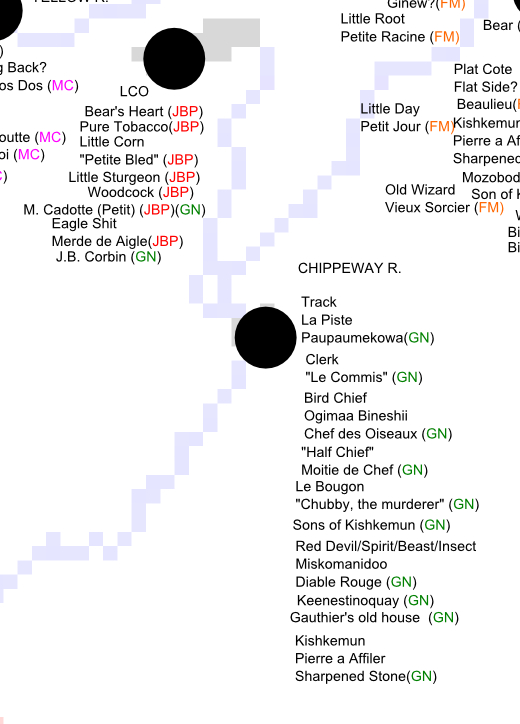
Lac Courte Oreilles and Chippewa River: Many of the men mentioned at LCO by Perrault are found in Warren. Little (Petit) Michel Cadotte was a cousin of the La Pointe trader, Big (Gichi/La Grande) Michel Cadotte. The “Red Devil” appears in Schoolcraft’s account of 1831. The old, respected Lac du Flambeau chief Giishkiman appears in several villages in these journals. As the father of Keenestinoquay and father-in-law of Simon Charette, a fur-trade power couple, he traded with Curot and Nelson who worked with Charette in the XY Company.

La Pointe: Unfortunately, none of the traders spent much time at La Pointe, but they all mention Michel Cadotte as being there. The family of Gros Pied (Mamaangizide, “Big Feet”) the father of Waabojiig, opened up his lodge to Perrault when the trader was waylaid by weather. According to Schoolcraft and Warren, the old war chief had fought for the French on the Plains of Abraham in 1759.

Lac du Flambeau: Malhoit records many of the same names in Lac du Flambeau that Nelson met on the Chippewa River. Simon Charette claimed much of the trade in this area. Mozobodo and “Magpie” (White Crow), were his brothers-in-law. Since I’ve written so much about chiefs named Buffalo, I should point out that there’s an outside chance Le Taureau (presumably another Bizhiki) could be the famous Chief Buffalo of La Pointe.

L’Anse, Ontonagon, and Lac Vieux Desert: More Cadottes and Roys, but otherwise I don’t know much about these men.

At Mackinac and the Soo, Perrault encountered a number of names that either came from “The West,” or would find their way there in later years. “Cadotte” is probably Jean Baptiste Sr., the father of “Great” Michel Cadotte of La Pointe.

Malhoit meets Jean Baptiste Corbin at Kaministiquia. Corbin worked for Michel Cadotte and traded at Lac Courte Oreilles for decades. He was likely picking up supplies for a return to Wisconsin. Kaministiquia was the new headquarters of the North West Company which could no longer base itself south of the American line at Grand Portage.
Initial Conclusions
There are many stories that can be told from the people listed in these maps. They will have to wait for future posts, because this one only has space to introduce the project. However, there are two important concepts that need to be mentioned. Neither are new, but both are critical to understanding these maps:
1) There is a great potential for misidentifying people.
Any reading of the fur-trade accounts and attempts to connect names across sources needs to consider the following:
- English names are coming to us from Ojibwe through French. Names are mistranslated or shortened.
- Ojibwe names are rendered in French orthography, and are not always transliterated correctly.
- Many Ojibwe people had more than one name, had nicknames, or were referenced by their father’s names or clan names rather than their individual names.
- Traders often nicknamed Ojibwe people with French phrases that did not relate to their Ojibwe names.
- Both Ojibwe and French names were repeated through the generations. One should not assume a name is always unique to a particular individual.
So, if you see a name you recognize, be careful to verify it’s reall the person you’re thinking of. Likewise, if you don’t see a name you’d expect to, don’t assume it isn’t there.
2) When talking about Ojibwe bands, kinship is more important than physical location.
In the later 1800s, we are used to talking about distinct entities called the “St. Croix Band” or “Lac du Flambeau Band.” This is a function of the treaties and reservations. In 1800, those categories are largely meaningless. A band is group made up of a few interconnected families identified in the sources by the names of their chiefs: La Grand Razeur’s village, Kishkimun’s Band, etc. People and bands move across large areas and have kinship ties that may bind them more closely to a band hundreds of miles away than to the one in the next lake over.
I mapped here by physical geography related to trading posts, so the names tend to group up. However, don’t assume two people are necessarily connected because they’re in the same spot on the map.
On a related note, proximity between villages should always be measured in river miles rather than actual miles.
Going Forward
I have some projects that could spin out of these maps, but for now, I’m going to set them aside. Please let me know if you see anything here that you think is worth further investigation.
Sources:
Curot, Michel. A Wisconsin Fur Trader’s Journal, 1803-1804. Edited by Reuben Gold Thwaites. Wisconsin Historical Collections, vol. XX: 396-472, 1911.
Malhoit, Francois V. “A Wisconsin Fur Trader’s Journal, 1804-05.” Collections of the State Historical Society of Wisconsin. Ed. Reuben Gold Thwaites. Vol. 19. Madison: State Historical Society of Wisconsin, 1910. 163-225. Print.
Nelson, George, Laura L. Peers, and Theresa M. Schenck. My First Years in the Fur Trade: The Journals of 1802-1804. St. Paul, MN: Minnesota Historical Society, 2002. Print.
Perrault, Jean Baptiste. Narrative of The Travels And Adventures Of A Merchant Voyager In The Savage Territories Of Northern America Leaving Montreal The 28th of May 1783 (to 1820) ed. and Introduction by, John Sharpless Fox. Michigan Pioneer and Historical Collections. vol. 37. Lansing: Wynkoop, Hallenbeck, Crawford Co., 1900.
Schoolcraft, Henry Rowe. Information Respecting The History,Condition And Prospects OF The Indian Tribes Of The United States. Illustrated by Capt. S. Eastman. Published by the Authority of Congress. Part III. Philadelphia: Lippincott, Grambo & Company, 1953.
Schoolcraft, Henry Rowe, and Philip P. Mason. Expedition to Lake Itasca; the Discovery of the Source of the Mississippi. East Lansing: Michigan State UP, 1958. Print.
Warren, William W., and Theresa M. Schenck. History of the Ojibway People. St. Paul: Minnesota Historical Society, 2009. Print.
Oshogay
August 12, 2013
At the most recent count, Chief Buffalo is mentioned in over two-thirds of the posts here on Chequamegon History. That’s the most of anyone listed so far in the People Index. While there are more Buffalo posts on the way, I also want to draw attention to some of the lesser known leaders of the La Pointe Band. So, look for upcoming posts about Dagwagaane (Tagwagane), Mizay, Blackbird, Waabojiig, Andeg-wiiyas, and others. I want to start, however, with Oshogay, the young speaker who traveled to Washington with Buffalo in 1852 only to die the next year before the treaty he was seeking could be negotiated.
I debated whether to do this post, since I don’t know a lot about Oshogay. I don’t know for sure what his name means, so I don’t know how to spell or pronounce it correctly (in the sources you see Oshogay, O-sho-ga, Osh-a-ga, Oshaga, Ozhoge, etc.). In fact, I don’t even know how many people he is. There were at least four men with that name among the Lake Superior Ojibwe between 1800 and 1860, so much like with the Great Chief Buffalo Picture Search, the key to getting Oshogay’s history right is dependent on separating his story from those who share his name.
In the end, I felt that challenge was worth a post in its own right, so here it is.
Getting Started
According to his gravestone, Oshogay was 51 when he died at La Pointe in 1853. That would put his birth around 1802. However, the Ojibwe did not track their birthdays in those days, so that should not be considered absolutely precise. He was considered a young man of the La Pointe Band at the time of his death. In my mind, the easiest way to sort out the information is going to be to lay it out chronologically. Here it goes:
1) Henry Schoolcraft, United States Indian Agent at Sault Ste. Marie, recorded the following on July 19, 1828:
Oshogay (the Osprey), solicited provisions to return home. This young man had been sent down to deliver a speech from his father, Kabamappa, of the river St. Croix, in which he regretted his inability to come in person. The father had first attracted my notice at the treaty of Prairie du Chien, and afterwards received a small medal, by my recommendation, from the Commissioners at Fond du Lac. He appeared to consider himself under obligations to renew the assurance of his friendship, and this, with the hope of receiving some presents, appeared to constitute the object of his son’s mission, who conducted himself with more modesty and timidity before me than prudence afterwards; for, by extending his visit to Drummond Island, where both he and his father were unknown, he got nothing, and forfeited the right to claim anything for himself on his return here.
I sent, however, in his charge, a present of goods of small amount, to be delivered to his father, who has not countenanced his foreign visit.
Oshogay is a “young man.” A birth year of 1802 would make him 26. He is part of Gaa-bimabi’s (Kabamappa’s) village in the upper St. Croix country.
2) In June of 1834, Edmund Ely and W. T. Boutwell, two missionaries, traveled from Fond du Lac (today’s Fond du Lac Reservation near Cloquet) down the St. Croix to Yellow Lake (near today’s Webster, WI) to meet with other missionaries. As they left Gaa-bimabi’s (Kabamappa’s) village near the head of the St. Croix and reached the Namekagon River on June 28th, they were looking for someone to guide them the rest of the way. An old Ojibwe man, who Boutwell had met before at La Pointe, and his son offered to help. The man fed the missionaries fish and hunted for them while they camped a full day at the mouth of the Namekagon since the 29th was a Sunday and they refused to travel on the Sabbath. On Monday the 30th, the reembarked, and Ely recorded in his journal:
The man, whose name is “Ozhoge,” and his son embarked with us about 1/2 past 9 °clk a.m. The old man in the bow and myself steering. We run the rapids safely. At half past one P. M. arrived at the mouth of Yellow River…
Ozhoge is an “old man” in 1834, so he couldn’t have been born in 1802. He is staying on the Namekagon River in the upper St. Croix country between Gaa-bimabi and the Yellow Lake Band. He had recently spent time at La Pointe.
3) Ely’s stay on the St. Croix that summer was brief. He was stationed at Fond du Lac until he eventually wore out his welcome there. In the 1840s, he would be stationed at Pokegama, lower on the St. Croix. During these years, he makes multiple references to a man named Ozhogens (a diminutive of Ozhoge). Ozhogens is always found above Yellow River on the upper St. Croix.
Ozhogens has a name that may imply someone older (possibly a father or other relative) lives nearby with the name Ozhoge. He seems to live in the upper St. Croix country. A birth year of 1802 would put him in his forties, which is plausible.

Ke-che-wask keenk (Gichi-weshki) is Chief Buffalo. Gab-im-ub-be (Gaa-bimabi) was the chief Schoolcraft identified as the father of Oshogay. Ja-che-go-onk was a son of Chief Buffalo.
4) On August 2, 1847, the United States and the Mississippi and Lake Superior Ojibwe concluded a treaty at Fond du Lac. The US Government wanted Ojibwe land along the nation’s border with the Dakota Sioux, so it could remove the Ho-Chunk people from Wisconsin to Minnesota.
Among the signatures, we find O-sho-gaz, a warrior from St. Croix. This would seem to be the Ozhogens we meet in Ely.
Here O-sho-gaz is clearly identified as being from St. Croix. His identification as a warrior would probably indicate that he is a relatively young man. The fact that his signature is squeezed in the middle of the names of members of the La Pointe Band may or may not be significant. The signatures on the 1847 Treaty are not officially grouped by band, but they tend to cluster as such.
5) In 1848 and 1849 George P. Warren operated the fur post at Chippewa Falls and kept a log that has been transcribed and digitized by the University of Wisconsin Eau Claire. He makes several transactions with a man named Oshogay, and at one point seems to have him employed in his business. His age isn’t indicated, but the amount of furs he brings in suggests that he is the head of a small band or large family. There were multiple Ojibwe villages on the Chippewa River at that time, including at Rice Lake and Lake Shatac (Chetek). The United States Government treated with them as satellite villages of the Lac Courte Oreilles Band.
Based on where he lives, this Oshogay might not be the same person as the one described above.
6) In December 1850, the Wisconsin Supreme Court ruled in the case Oshoga vs. The State of Wisconsin, that there were a number of irregularities in the trial that convicted “Oshoga, an Indian of the Chippewa Nation” of murder. The court reversed the decision of the St. Croix County circuit court. I’ve found surprisingly little about this case, though that part of Wisconsin was growing very violent in the 1840s as white lumbermen and liquor salesmen were flooding the country.

Pg 56 of Containing cases decided from the December term, 1850, until the organization of the separate Supreme Court in 1853: Volume 3 of Reports of Cases Argued and Determined in the Supreme Court of the State of Wisconsin: With Tables of the Cases and Principal Matters, and the Rules of the Several Courts in Force Since 1838, Wisconsin. Supreme Court Authors: Wisconsin. Supreme Court, Silas Uriah Pinney (Google Books).
The man killed, Alexander Livingston, was a liquor dealer himself.
Alexander Livingston, a man who in youth had had excellent advantages, became himself a dealer in whisky, at the mouth of Wolf creek, in a drunken melee in his own store was shot and killed by Robido, a half-breed. Robido was arrested but managed to escape justice.
~From Fifty Years in the Northwest by W.H.C Folsom
Several pages later, Folsom writes:
At the mouth of Wolf creek, in the extreme northwestern section of this town, J. R. Brown had a trading house in the ’30s, and Louis Roberts in the ’40s. At this place Alex. Livingston, another trader, was killed by Indians in 1849. Livingston had built him a comfortable home, which he made a stopping place for the weary traveler, whom he fed on wild rice, maple sugar, venison, bear meat, muskrats, wild fowl and flour bread, all decently prepared by his Indian wife. Mr. Livingston was killed by an Indian in 1849.
Folsom makes no mention of Oshoga, and I haven’t found anything else on what happened to him or Robido (Robideaux?).
It’s hard to say if this Oshoga is the Ozhogen’s of Ely’s journals or the Oshogay of Warren’s. Wolf Creek is on the St. Croix, but it’s not far from the Chippewa River country either, and the Oshogay of Warren seems to have covered a lot of ground in the fur trade. Warren’s journal, linked in #4, contains a similar story of a killing and “frontier justice” leading to lynch mobs against the Ojibwe. To escape the violence and overcrowding, many Ojibwe from that part of the country started to relocate to Fond du Lac, Lac Courte Oreilles, or La Pointe/Bad River. La Pointe is also where we find the next mention of Oshogay.
7) From 1851 to 1853, a new voice emerged loudly from the La Pointe Band in the aftermath of the Sandy Lake Tragedy. It was that of Buffalo’s speaker Oshogay (or O-sho-ga), and he spoke out strongly against Indian Agent John Watrous’ handling of the Sandy Lake payments (see this post) and against Watrous’ continued demands for removal of the Lake Superior Ojibwe. There are a number of documents with Oshogay’s name on them, and I won’t mention all of them, but I recommend Theresa Schenck’s William W. Warren and Howard Paap’s Red Cliff, Wisconsin as two places to get started.
Chief Buffalo was known as a great speaker, but he was nearing the end of his life, and it was the younger chief who was speaking on behalf of the band more and more. Oshogay represented Buffalo in St. Paul, co-wrote a number of letters with him, and most famously, did most of the talking when the two chiefs went to Washington D.C. in the spring of 1852 (at least according to Benjamin Armstrong’s memoir). A number of secondary sources suggest that Oshogay was Buffalo’s son or son-in-law, but I’ve yet to see these claims backed up with an original document. However, all the documents that identify by band, say this Oshogay was from La Pointe.
The Wisconsin Historical Society has digitized four petitions drafted in the fall of 1851 and winter of 1852. The petitions are from several chiefs, mostly of the La Pointe and Lac Courte Oreilles/Chippewa River bands, calling for the removal of John Watrous as Indian Agent. The content of the petitions deserves its own post, so for now we’ll only look at the signatures.

November 6, 1851 Letter from 30 chiefs and headmen to Luke Lea, Commissioner of Indian Affairs: Multiple villages are represented here, roughly grouped by band. Kijiueshki (Buffalo), Jejigwaig (Buffalo’s son), Kishhitauag (“Cut Ear” also associated with the Ontonagon Band), Misai (“Lawyerfish”), Oshkinaue (“Youth”), Aitauigizhik (“Each Side of the Sky”), Medueguon, and Makudeuakuat (“Black Cloud”) are all known members of the La Pointe Band. Before the 1850s, Kabemabe (Gaa-bimabi) and Ozhoge were associated with the villages of the Upper St. Croix.

November 8, 1851, Letter from the Chiefs and Headmen of Chippeway River, Lac Coutereille, Puk-wa-none, Long Lake, and Lac Shatac to Alexander Ramsey, Superintendent of Indian Affairs: This letter was written from Sandy Lake two days after the one above it was written from La Pointe. O-sho-gay the warrior from Lac Shatac (Lake Chetek) can’t be the same person as Ozhoge the chief unless he had some kind of airplane or helicopter back in 1851.

Undated (Jan. 1852?) petition to “Our Great Father”: This Oshoga is clearly the one from Lake Chetek (Chippewa River).

Undated (Jan. 1852?) petition: These men are all associated with the La Pointe Band. Osho-gay is their Speaker.
In the early 1850s, we clearly have two different men named Oshogay involved in the politics of the Lake Superior Ojibwe. One is a young warrior from the Chippewa River country, and the other is a rising leader among the La Pointe Band.

Washington Delegation July 22, 1852 This engraving of the 1852 delegation led by Buffalo and Oshogay appeared in Benjamin Armstrong’s Early Life Among the Indians. Look for an upcoming post dedicated to this image.
8) In the winter of 1853-1854, a smallpox epidemic ripped through La Pointe and claimed the lives of a number of its residents including that of Oshogay. It had appeared that Buffalo was grooming him to take over leadership of the La Pointe Band, but his tragic death left a leadership vacuum after the establishment of reservations and the death of Buffalo in 1855.
Oshogay’s death is marked in a number of sources including the gravestone at the top of this post. The following account comes from Richard E. Morse, an observer of the 1855 annuity payments at La Pointe:
The Chippewas, during the past few years, have suffered extensively, and many of them died, with the small pox. Chief O-SHO-GA died of this disease in 1854. The Agent caused a suitable tomb-stone to be erected at his grave, in La Pointe. He was a young chief, of rare promise and merit; he also stood high in the affections of his people.
Later, Morse records a speech by Ja-be-ge-zhick or “Hole in the Sky,” a young Ojibwe man from the Bad River Mission who had converted to Christianity and dressed in “American style.” Jabegezhick speaks out strongly to the American officials against the assembled chiefs:
…I am glad you have seen us, and have seen the folly of our chiefs; it may give you a general idea of their transactions. By the papers you have made out for the chiefs to sign, you can judge of their ability to do business for us. We had but one man among us, capable of doing business for the Chippewa nation; that man was O-SHO-GA, now dead and our nation now mourns. (O-SHO-GA was a young chief of great merit and much promise; he died of small-pox, February 1854). Since his death, we have lost all our faith in the balance of our chiefs…
This O-sho-ga is the young chief, associated with the La Pointe Band, who went to Washington with Buffalo in 1852.
9) In 1878, “Old Oshaga” received three dollars for a lynx bounty in Chippewa County.

Report of the Wisconsin Office of the Secretary of State, 1878; pg. 94 (Google Books)
It seems quite possible that Old Oshaga is the young man that worked with George Warren in the 1840s and the warrior from Lake Chetek who signed the petitions against Agent Watrous in the 1850s.
10) In 1880, a delegation of Bad River, Lac Courte Oreilles, and Lac du Flambeau chiefs visited Washington D.C. I will get into their purpose in a future post, but for now, I will mention that the chiefs were older men who would have been around in the 1840s and ’50s. One of them is named Oshogay. The challenge is figuring out which one.

Ojibwe Delegation c. 1880 by Charles M. Bell. [Identifying information from the Smithsonian] Studio portrait of Anishinaabe Delegation posed in front of a backdrop. Sitting, left to right: Edawigijig; Kis-ki-ta-wag; Wadwaiasoug (on floor); Akewainzee (center); Oshawashkogijig; Nijogijig; Oshoga. Back row (order unknown); Wasigwanabi; Ogimagijig; and four unidentified men (possibly Frank Briggs, top center, and Benjamin Green Armstrong, top right). The men wear European-style suit jackets and pants; one man wears a peace medal, some wear beaded sashes or bags or hold pipes and other props.(Smithsonian Institution National Museum of the American Indian).
- Upper row reading from the left.
- 1. Vincent Conyer- Interpreter 1,2,4,5 ?, includes Wasigwanabi and Ogimagijig
- 2. Vincent Roy Jr.
- 3. Dr. I. L. Mahan, Indian Agent Frank Briggs
- 4. No Name Given
- 5. Geo P. Warren (Born at LaPointe- civil war vet.
- 6. Thad Thayer Benjamin Armstrong
- Lower row
- 1. Messenger Edawigijig
- 2. Na-ga-nab (head chief of all Chippewas) Kis-ki-ta-wag
- 3. Moses White, father of Jim White Waswaisoug
- 4. No Name Given Akewainzee
- 5. Osho’gay- head speaker Oshawashkogijig or Oshoga
- 6. Bay’-qua-as’ (head chief of La Corrd Oreilles, 7 ft. tall) Nijogijig or Oshawashkogijig
- 7. No name given Oshoga or Nijogijig
The Smithsonian lists Oshoga last, so that would mean he is the man sitting in the chair at the far right. However, it doesn’t specify who the man seated on the right on the floor is, so it’s also possible that he’s their Oshoga. If the latter is true, that’s also who the unknown writer of the library caption identified as Osho’gay. Whoever he is in the picture, it seems very possible that this is the same man as “Old Oshaga” from number 9.
11) There is one more document I’d like to include, although it doesn’t mention any of the people we’ve discussed so far, it may be of interest to someone reading this post. It mentions a man named Oshogay who was born before 1860 (albeit not long before).
For decades after 1854, many of the Lake Superior Ojibwe continued to live off of the reservations created in the Treaty of La Pointe. This was especially true in the St. Croix region where no reservation was created at all. In the 1910s, the Government set out to document where various Ojibwe families were living and what tribal rights they had. This process led to the creation of the St. Croix and Mole Lake reservations. In 1915, we find 64-year-old Oshogay and his family living in Randall, Wisconsin which may suggest a connection to the St. Croix Oshogays. As with number 6 above, this creates some ambiguity because he is listed as enrolled at Lac Courte Oreilles, which implies a connection to the Chippewa River Oshogay. For now, I leave this investigation up to someone else, but I’ll leave it here for interest.

United States. Congress. House. Committee on Indian Affairs. Indian Appropriation Bill: Supplemental Hearings Before a Subcommittee. 1919 (Google Books).
This is not any of the Oshogays discussed so far, but it could be a relative of any or all of them.
In the final analysis
These eleven documents mention at least four men named Oshogay living in northern Wisconsin between 1800 and 1860. Edmund Ely met an old man named Oshogay in 1834. He is one. A 64-year old man, a child in the 1850s, was listed on the roster of “St. Croix Indians.” He is another. I believe the warrior from Lake Chetek who traded with George Warren in the 1840s could be one of the chiefs who went to Washington in 1880. He may also be the one who was falsely accused of killing Alexander Livingston. Of these three men, none are the Oshogay who went to Washington with Buffalo in 1852.
That leaves us with the last mystery. Is Ozhogens, the young son of the St. Croix chief Gaa-bimabi, the orator from La Pointe who played such a prominent role in the politics of the early 1850s? I don’t have a smoking gun, but I feel the circumstantial evidence strongly suggests he is. If that’s the case, it explains why those who’ve looked for his early history in the La Pointe Band have come up empty.
However, important questions remain unanswered. What was his connection to Buffalo? If he was from St. Croix, how was he able to gain such a prominent role in the La Pointe Band, and why did he relocate to La Pointe anyway? I have my suspicions for each of these questions, but no solid evidence. If you do, please let me know, and we’ll continue to shed light on this underappreciated Ojibwe leader.
Sources:
Armstrong, Benj G., and Thomas P. Wentworth. Early Life among the Indians: Reminiscences from the Life of Benj. G. Armstrong : Treaties of 1835, 1837, 1842 and 1854 : Habits and Customs of the Red Men of the Forest : Incidents, Biographical Sketches, Battles, &c. Ashland, WI: Press of A.W. Bowron, 1892. Print.
Ely, Edmund Franklin, and Theresa M. Schenck. The Ojibwe Journals of Edmund F. Ely, 1833-1849. Lincoln: University of Nebraska, 2012. Print.
Folsom, William H. C., and E. E. Edwards. Fifty Years in the Northwest. St. Paul: Pioneer, 1888. Print.
KAPPLER’S INDIAN AFFAIRS: LAWS AND TREATIES. Ed. Charles J. Kappler. Oklahoma State University Library, n.d. Web. 12 August 2013. <http:// digital.library.okstate.edu/Kappler/>.
Nichols, John, and Earl Nyholm. A Concise Dictionary of Minnesota Ojibwe. Minneapolis: University of Minnesota, 1995. Print.
Paap, Howard D. Red Cliff, Wisconsin: A History of an Ojibwe Community. St. Cloud, MN: North Star, 2013. Print.
Redix, Erik M. “The Murder of Joe White: Ojibwe Leadership and Colonialism in Wisconsin.” Diss. University of Minnesota, 2012. Print.
Schenck, Theresa M. The Voice of the Crane Echoes Afar: The Sociopolitical Organization of the Lake Superior Ojibwa, 1640-1855. New York: Garland Pub., 1997. Print.
———–William W. Warren: The Life, Letters, and times of an Ojibwe Leader. Lincoln: University of Nebraska, 2007. Print.
Schoolcraft, Henry Rowe. Personal Memoirs of a Residence of Thirty Years with the Indian Tribes on the American Frontiers: With Brief Notices of Passing Events, Facts, and Opinions, A.D. 1812 to A.D. 1842. Philadelphia, [Pa.: Lippincott, Grambo and, 1851. Print.
Warren, William W., and Theresa M. Schenck. History of the Ojibway People. St. Paul: Minnesota Historical Society, 2009. Print.
 Chequamegon History