American Fur Company: 1834 Reinvention of La Pointe
October 4, 2023
Collected & edited by Amorin Mello
The below image from the Wisconsin Historical Society is a storymap showing La Pointe in 1834 as abstract squiggles on an oversized Madeline Island surrounded by random other Apostle Islands, Bayfield Peninsula, Houghton Point, Chequamegon Bay, Long Island, Bad River, Saxon Harbor, and Montreal River.

“Map of La Pointe”
“L M Warren”
“~ 1834 ~”
Wisconsin Historical Society
citing an original map at the New York Historical Society
My original (ongoing) goal for publishing this post is to find an image of the original 1834 map by Lyman Marcus Warren at the New York Historical Society to explore what all of his squiggles at La Pointe represented in 1834. Instead of immediately achieving my original goal, this post has become the first of a series exploring letters in the American Fur Company Papers by/to/about Warren at La Pointe.
New York Historical Society
American Fur Company Papers: 1831-1849
America’s First Business Monopoly
#16,582

Map of Lapointe
by L M Warren
~ 1834 ~
New York Historical Society
scanned as Gale Document Number GALE|SC5110110218
#36

Ramsay Crooks
~ Madeline Island Museum
Lapointe Lake Superior
September 20th ’34
Ramsey Crooks Esqr
Dear Sir
Starting in 1816, the American Fur Company (AFC) operated a trading post by the “Old Fort” of La Pointe near older trading posts built by the French in 1693 and the British in 1793.
In 1834, John Jacob Astor sold his legendary AFC to Ramsay Crooks and other trading partners, who in turn decided to relocate the AFC’s base of operations at Mackinac Island to Madeline Island, where our cartographer Lyman Marcus Warren was employed as the AFC’s trader at La Pointe.
Instead of improving any of the older trading posts on Madeline Island, Warren decided to move La Pointe to the “New Fort” of 1834 to build new infrastructure for growing business demands.

GLO PLSS 1852 survey detail of the “Am Fur Co Old Works” near Old Fort.
on My Way In as Mr Warren was was detained So Long at Mackinac I did not Wait for him at this Place as time was of So Much Consequence to me to Get my People Into the County that I Proceeded Immediately to Fond Du Lac with the Intention with the Intention of Returning to this Place When I Had Sent the Outfit off but When I Got There I Had News from the Interior Which Required me to Go In and Settle the Business there; the [appearance?] In the Interior for [????] is tolerable. Good Provision there is [none?] Whatever I [have?] Seen the [Country?] [So?] Destitute. The Indians at [Fort?] [?????] Disposed to give me Some trouble when they found they have to Get no Debts and buy their amunition and tobacco and not Get it For Nothing as usual but at Length quieted down [?????] and have all gone off to their Haunts as usual.
I Received your Instructions contained in your Circular and will be very Particular In Following them. The outfits were all off when I Received them but the men’s acts and the Invoices of the Goods Had all been Settled according to your Wishes and Every Care Will be taken not to allow the men to get In Debt the Clerks Have Strict orders on the Subject and it is made known to them that they will be Held for any of the Debts the men may Incur.
I Enclose to you the Bonds Signed and all the Funds we Received from Mr Johnston Excepting those Which Had been given to the Clerks and I could not Get them Back In time to Send them on at Present.
Mr Warren And myself Have Committed on What is to be done at this Place and I am certain all that Can be done Will be done by him. I leave here tomorrow For the Interior of Fond Du Lac Where I must be as Soon as possible.
I have written to Mr Schoolcraft as he Inquested me. Mr Brewster’s men would not Give up their [??????] and [???] [????] is [??] [?????] [????] [????] [to?] [???????] [?????] [to?] [persuade?] [more?] People for Keeping [his?] [property?] [Back?] [and] [then?] [???] by some [???] ought to be sent out of the Country [??] they are [under?] [the?] [???] [?] and [Have?] [no?] [Right?] to be [????] [????] they are trouble [????] [???] [their?] [tongues?].

GLO PLSS 1852 survey detail of the AFC’s new “La Point” (New Fort) and the ABCFM’s “Mission” (Middleport).
The Site Selected Here For the Buildings by Mr Warren is the Best there is the Harbour is good and I believe the work will go on well.
as For the Fishing we Will make Every Inquiry on the Subject and I Have no Doubt on My Mind of Fairly present that it will be more valuable than the Fur trade.
In the Month of January I will Write you Every particular How our affairs stand from St Peters. Bailly Still Continues to Give our Indians Credits and they Bring Liquor from that Place which they Say they Get from Him.
Please let Me know as Early as possible with Regard to the Price of Furs as it will Help me In the trade. the Clerks all appear anxious to do their Duty this year as the wind is now Falling and I am In Haste I Will Write you Every particular of our Business In January.
Wishing that God may Long Prosper you and your family.
In health and happiness.
I remain most truly,
and respectfully
yours $$
William A. Aitken
#42
Lake Superior
LaPointe Oct 16 1834
Ramsey Crooks Esqr
Agent American Fur Co
Honoured Sir
Your letter dated Mackinac Sept [??] reached me by Mr Chapman’s boat today.-
I will endeavour to answer it in such a manner as will give you my full and unreserved opinion on the different subjects mentioned in it.
I feel sorry to see friend Holiday health so poor, and am glad that you have provided him a comfortable place at the Sault. As you remark it is a fortunate circumstance that we have no opposition this year or we would certainly have made a poor resistance. I can see no way on which matters would be better arranged under existing circumstances than the way in which you have arranged it. If Chaboillez, and George will act in unison and according to your instructions, they will do well, but I am somewhat affeared, that this will not be the case, as I think George might perhaps from jealously refuse to obey Chaboillez or give him the proper help. Our building business prevents me from going there myself. I suppose you have now received my letter of last Sept, in which I mentioned that I had kept the Doctor here. I shall send him in a few days to see how matters comes on at the Ance. The Davenports are wanted at present in FDLac should it be necessary to make any alteration. I shall leave the Doctor at the Ance.

Undated photograph of the ABCFM Presbyterian Mission Church at it’s original 1830s location along the shoreline of Sandy Bay.
~ Madeline Island Museum

Reverend Sherman Hall
~ Madeline Island Museum
In addition to the AFC’s new La Pointe, Warren was also committed to the establishment of a mission for the American Board of Commissioners for Foreign Missions (ABCFM) as a condition of his 1827 Deed for Old La Pointe from his Chippewa wife’s parents; Madeline & Michel Cadotte.
Starting in 1830, the ABCFM built a Mission at La Pointe’s Middleport (second French fort of 1718), where they were soon joined by a new Catholic Mission in 1835.
Madeline Island was still unceded territory until the 1842 Treaty of La Pointe. The AFC and ABCFM had obtained tribal permissions to build here via Warren’s deed, while the Catholics were apparently grandfathered in through French bloodlines from earlier centuries.
I think we will want about 2 Coopers but as you suggest I if they may be got cheaper than the [????] [????]. The Goods Mr Hall has got is for his own use that is to say to pay his men [??]. The [??] [??????] [has?] to pay for a piece of land they bot from an Indian woman at Leech Lake. As far as my information goes the Missionaries have never yet interfered with our trade. Mr Hall’s intention is to have his establishment as much disconnected with regular business as he possibly can and he gets his supplies from us.
[We?] [have?] received the boxes [Angus?] [??] [???]. [You?] mention also a box, but I have not yet received it. Possible it is at the Ance.
The report about Dubay has no doubt been exaggerated. When with me at the Ance he mentioned to me that Mr Aitkin told him he had better tell the Indians not to kill their beaver entirely off and thereby ruin their country. The idea struck me as a good one and as far as I recollect I told him, it would perhaps be good to tell them so. I have not yet heard from any one, that he has tried to prevent the Indians from paying their old Debts and I should not be astonished to fend the whole is one of those falsehoods which Indians are want to use to free themselves from paying old Debts. I consider Dubay a pretty active man, but the last years extravagancies have made it necessary to have an eye upon him to prevent him from squandering.

“The Doctor” Charles William Wulff Borup, M.D.
~ Madeline Island Museum
My health had been somewhat impaired by my voyage from the Sault to this place. Instead of going to Lac Du Flambeau myself as I intended I sent the Doctor. He has just now returned and tells me that Dubay gets along pretty well, though there were some small difficulties which toke place, but which the Dr settled. The prospect are very discouraging, particularly on a/c of provisions. We have plenty opposition and all of them with liquor in great abundance. It is provoking to see ourselves restricted by the laws from taking in liquor while our opponents deal in it as largely as ever. The traders names are as far as could be ascertained Francois Charette and [Chapy?]. The liquor was at Lac du Flambeau while the Doctor was there. I have furnished Dubay with means to procure provisions, as there is actually not 1 Sack of Corn or Rice to be got.
The same is the case on Lac Courtoreilie and Folleavoigne no provisions and a Mr Demarais on the Chippeway River gives liquor to the Indians.
You want my ideas upon the fishing business. If reliance can be put in Mr Aitkin’s assertions we will at least want the quantity of Net thread mentioned in our order. Besides this we will want for our fishing business 200 Barrels Flour, [??] Barrels Pork, 10 Kegs Butter, 1000 Bushels Corn, [??] Barrels Lard, 10 or 11 Barrels Tallow.

Undated photograph of the ABCFM mission house built in 1832.
~ Madeline Island Museum
Besides this we want over and above the years supply an extra supply for our summer Establishments. say about 80 Barrels Flour, 30 Barrels Pork, 1500 # Butter, 400 Bushels Corn, 5 Barrels Lard, 5 Barrels Tallow. This will is partly to sell. be sold.
Mr Roussain will be as good as any if not better in my opinion for our business than Holiday. Ambrose Davenport might take the charge of the Ance but Roussain will be more able on account of his knowledge in fishing. I would recommend to take him as a partner. say take Holidays share if he could not be got for less.
I have not done much yet toward building. The greatest part of my men have been in the exterior to assist our people to get in. But they have now all arrived. We have got about 4 acres of land cleared, a wintering house put up and a considerable quantity of boards sawed. Mr Aitkin did not supply me with two Carpenters as he promised at Mackinac. I will try to get along as well as I can without them. I engaged Jos Dufault and Mr Aitkin brot me one of Abbott’s men, who he engaged. But I will still be under the necessity of hiring Mr Campbell of the mission to make our windows sashes and to superintend The framing of the buildings. Mr Aitkins have done us considerable damage by not fulfilling his promise in this respect. I told you in Mackinac that Mr Aitkin was far from being exact in business. Your letter to him I will forward by the first opportunity. I think it will have a good effect and you do right in being thus plain in stating your views. His contract deserves censure, and I will hope that your plain dealing with him will not be lost upon him. Shall I beg you to be as faithfull to me by giving me the earliest information whenever you might disapprove of any transaction of mine.
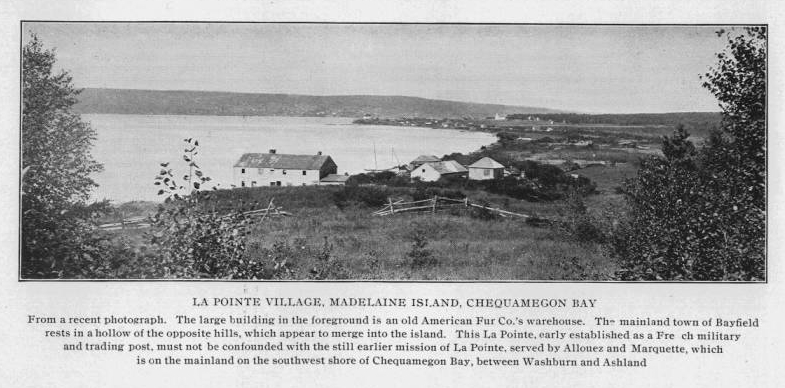
Photograph of La Pointe from Mission Hill circa 1902.
~ Wisconsin Historical Collections, Volume XVI, page 80.
I have received a supply of provisions from Mr Chapmann which will enable me to get through this season. The [?] [of?] [???] [next?], the time you have set for the arrival of the Schooner, will be sufficient, early for our business. The Glass and other materials for finishing of the buildings would be required to be sent up in the first trip but if [we?] [are?] [??] better to have them earlier. If these articles could be sent to the Sault early in the Spring a boat load might be formed of [Some?] and Provisions and sent to the Ance. From there men could be spared at that season of the year to bring the load to this place. In that way there would be no heavy expense incurred and I would be able to have the buildings in greater forwardness.
If the plan should meet your approbation please let me know by the winter express. While Mr Aitkin was here we planned out our buildings. The House will be 86 feet by 26 feet in the clear, the two stores will be put up agreeable to your Draft. We do not consider them to large.
I am afraid I shall not be able to build a wharf in season, but shall do my best to accomplish all that can be done with the means I have.

Undated photograph of Captain John Daniel Angus’ boat at the ABCFM mission dock.
~ Madeline Island Museum
I would wish to call your attention towards a few of the articles in our trade. I do not know how you have been accustomed to buy the Powder whether by the Keg or pound. If a keg is estimated at 50#, there is a great deception for some of our kegs do not contain more than 37 or 40 #s.
Our Guns are very bad particularly the barrels. They splint in the inside after been fired once or twice.
Our Holland twine is better this year than it has been for Years. One dz makes about 20 fathoms, more than last year. But it would be better if it was bleached. The NW Company and old Mr Ermantinger’s Net Thread was always bleached. It nits better and does not twist up when put into the water. Our maitre [??] [???] are some years five strand. Those are too large we have to untwist them and take 2 strands out. Our maitre this year are three strand they are rather coarse but will answer. They are not durable nor will they last as long as the nets of course they have to be [renewed?]. The best maitres are those we make of Sturgeon twine. We [?????] the twine and twist it a little. They last twice as long as our imported maitres. The great object to be gained is to have the maitres as small as possible if they be strong enough. Three coarse strands of twisted together is bulky and soon nits.
Our coarse Shoes are not worth bringing into the country. Strong sewed shoes would cost a little more but they would last longer. The [Booties?] and fine Shoes are not much better.
Our Teakettles used to have round bottoms. This year they are flat. They Indians always prefer the round bottom.
In regard to the observations you have made concerning the Doctor’s deviating from the instructions I gave him on leaving Mackinac, I must in justice to him say that I am now fully convinced in my own mind that he misunderstood me entirely, merely by an expression of mine which was intended by me in regard to his voyage from Mackinac to the Sault but by him was mistaken for the route through Lake Superior. The circumstances has hurt his feelings much and as he at all times does his best for the Interest of the Outfit I ought to have mentioned in my last letter, but it did not strike my mind at that time.

Detail from Carte des lacs du Canada by Jacques Nicolas Bellin in 1744.
When Mr Aitkin was here he mentioned to me some information he had obtained from somebody in Fond du Lac who had been in the NW Co service relating to a remarkable good white fish fishery on the “Milleau” or “Millons” Islands (do not know exactly the proper name). They lay right opposite to Point Quiwinau. a vessel which passes between the island and the point can see both. Among Mr Chapmann’s crew here there is an old man who tells me that he knew the place well, he says the island is large, say 50 or 60 miles. The Indian used to make their hunts there on account of the great quantity of Beaver and Reindeer. It is he says where the NWest Co used to make their fishing for Fort William. There is an excellent harbour for the vessel it is there where the largest white fish are caught in Lake Superior. Furthermore the old man says the island is nearer the American shore than the English. Some information might be obtained from Capt. McCargo. If it proves that we can occupy the grounds I have the most sanguine hopes that we shall succeed in the fisheries upon a large scale.
I hope you will gather all the information you can on the subject. Particular where the line runs. If it belongs to the Americans we must make a permanent post on the Island next year under the charge of an active person to conduct the fisheries upon a large scale.
Jh Chevallier one of the men I got in Mackinac is a useless man, he has always been sick since he left Sault. Mr Aitkin advised me to send him back in Chapman’s Boat. I have therefore send him out to the care of Mr Franchere.
By the Winter Express I will to give you all the informations that I may be able to give. I will close by wishing you great health and prosperity. Please present my Respects to Mr Clapp.
I remain Dear Sir.
Very Respectfully Yours
Most Obedient Servant
Lyman M. Warren
To be Continued in 1835…
Wisconsin Territory Delegation: La Pointe
April 23, 2016
By Amorin Mello
A curious series of correspondences from “Morgan”
… continued from The Copper Region.
The Daily Union (Washington D.C.)
“Liberty, The Union, And The Constitution.”
August 9, 1845.
La Pointe, Lake Superior
July 26, 1845
To the Editor of the Union:

View of La Pointe, circa 1843.
“American Fur Company with both Mission churches. Sketch purportedly by a Native American youth. Probably an overpainted photographic copy enlargement. Paper on a canvas stretcher.”
~ Wisconsin Historical Society
I have just time to state that, having spent five days at Copper Harbor, examining the copper mine, &c. at that place, and having got everything in readiness, we set off for this place, along the coast, in an open Mackinac boat, travelling by day, and camping out at night. We reached this post on yesterday, the 25th instant. We have now been under tents 21 nights. In coming up the shore of the lake, we on one occasion experienced a tremendous rain accompanied with thunder, which wetted our things to a considerable extent, and partly filled the boat with water.
On our way we spent a good part of a day at Eagle river, and examined the mine in the process of being worked at that place, but found it did not equal our expectations.
We also stopped at the Ontonagon, the mineral region bordering which, some fifteen miles from the lake, promises to be as good as any other portion of the mineral region, if not better.
I have not time at present to enter fully into the results of observations I have made, or to describe the incidents and adventures of the long journey I have performed along the lake shore for the distance of about 500 miles, from Sault Ste. Marie to La Pointe. There are many things I wish to say, and to describe, &c.; but as the schooner “Uncle Tom,” by which I write, is just about leaving, I have not time at present. I must reserve these things for a future opportunity.
I am, very respectfully,
Your obedient servant,
MORGAN.
P.S. – I set off in a day or two for the Mississippi and Falls of St. Anthony, via the Brulé and St. Croix rivers.
Yours, &c., M.
The Daily Union (Washington D.C.)
“Liberty, The Union, And The Constitution.”
August 25, 1845
EDITOR’S CORRESPONDENCE
—
[From our regular Northern correspondant.]
La Pointe, Lake Superior,
July 28, 1845.

Map of the Mineral Lands Upon Lake Superior Ceded to the United States by the Treaty of 1842 With the Chippeway Indians.
~ Wisconsin Historical Society
In what I said in my last letter of this date, in relation to the extent, value, and prospects of the copper-mines opened on Lake Superior, I had no wish to dampen the ardor, would the feelings or injure the interest of any one concerned. My only wish is to state facts. This, in all cases, I feel it my duty to do; although, in so doing, as in the present case, my individual interest suffers thereby. Could I have yielded to the impulses and influences prevailing in the copper region, I might have been greatly benefited in a pecuniary point of view by pursuing a different course ; but, knowing those whom I represented, as well as the public and the press for which I write, wanted the truth, the whole truth, and nothing but the truth, I could do nothing less than make the statement I did. Previous to visiting the country, I could, of course, know nothing of its real character. I had to judge, like others, from published reports of its mineral wealth, accompanied with specimens, &c., which appeared very flattering; but which, I am now convinced, have been rather overdrawn, and the mineral region set out larger and richer than it really is. The authors of the reports were, doubtlessly, actuated by pure motives. They, no doubt, had a wish, in laying down the boundaries of the mineral region, so to extend it as to leave out no knoll or range of trap-rock, or other formation, if any indicative of mineral deposites, which usually appear in connexion with them, occurred.
I consider, in conclusion, that the result thus far is this: that the mines opened may possibly, in their prosecution, lead to rich and permanent veins; and probably pay or yield something, in some cases, while exploring them. But, however rich the specimens of one raised, at present there is nothing in them, geologically speaking, that indicates, conclusively, that they have reached a vein, or that the mines will continue permanently as rich as they are at present. This would be my testimony, according to the best of “my knowledge and belief,” on the witness’s stand, under oath.
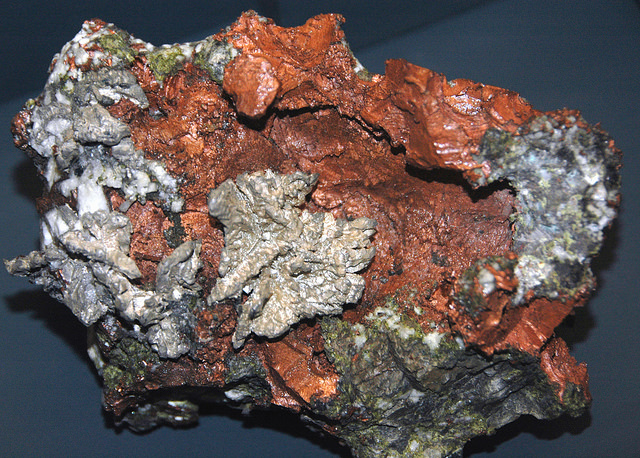
“The remarkable copper-silver ‘halfbreed’ specimen shown above comes from northern Michigan’s Portage Lake Volcanic Series, an extremely thick, Precambrian-aged, flood-basalt deposit that fills up an ancient continental rift valley.”
~ Creative Commons from James St. John
That the region, as before said, is rich in copper and silver ores, cannot be denied. And I think the indications that veins may or do exist somewhere in great richness, are sufficiently evident to justify continued explorations in search of them, by those who have the means and leisure to follow them up for several years. To find the veins, and most permanent deposites, must be the work of time; and as the season is short, on Lake Superior, for such operations, several years may be necessary before a proper and practical examination can be made of the country.
The general features of Lake Superior are very striking, and differ very much in appearance from what I have ever met with in any other part of the continent. The vastness and depth of such a body of pure fresh cold water so far within the continent, is an interesting characteristic. When we consider it is over 900 feet deep, with an area of over 30,000 square miles, and yet that, throughout its whole extent, it presents as pure and as fresh-tasted water as though it were taken from a mountain brook, the question naturally arises, Where can such a vast supply of pure water come from? It is true, it has great many streams flowing into it, but they are nearly all quite small, and would seem to be wholly inadequate to supply such a vast mass of water, and preserve it in such a state of purity. The water supplied by most of the rivers is far less pure than that in the lake itself. East of Keweena point, we found the water of the rivers discolored, being tinged by pine and other roots, clay, &c., often resembling the hue of New England rum. Such rivers, or all combined, would seem to be inadequate to supply such a vast quantity of pure clear water as fills this inland ocean!
~ United States Geological Survey
It is possible that this great lake is freely supplied with water from subterranean springs opening into it from below. The river St. Mary’s also seems inadequate, from its size, to discharge as much water as comes into the lake from the rivers which it receives. In this case, evaporation may be so great as to diminish the water that would otherwise pass out at it.
As relates to tides in the other lakes, we have nothing to say; but, as far as Lake Superior is concerned, we feel assured, from observation, as well as from the reports of others upon whom we can rely, that there are tides in it – variously estimated at from 8 to 12 inches; influenced, we imagine, by the point of observation, and the season of the year at which such tides are noticed.
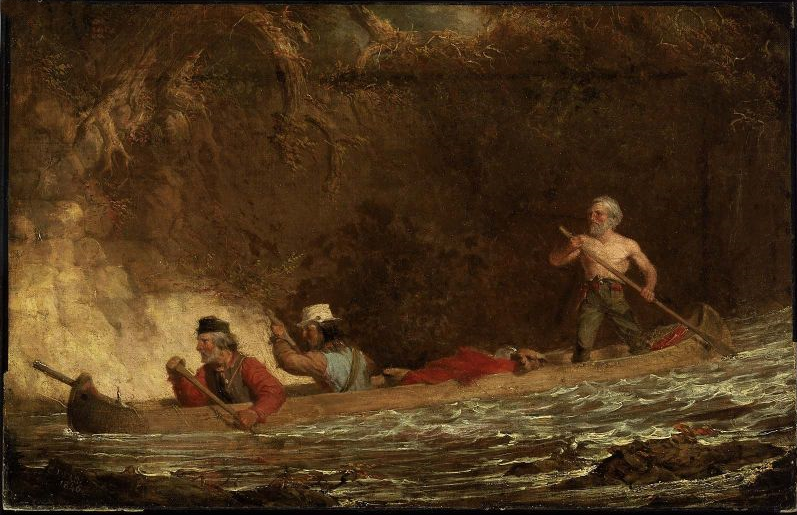
The Voyageurs (1846) by Charles Deas.
~ Commons.Wikimedia.org
What strikes the voyageur with the most interest, in the way of scenery, is the wild, high, bold, and precipitous coast of the southern shore, for such much of the whole distance between Grand Sable and La Pointe, and, indeed, for some distance beyond La Pointe ; the picturesque appearance of which often seemed heightened to us, as on a clear morning, or late afternoon, or voyageurs would conduct our boat for miles near their bases. Above us, the cliffs would rise in towering heights, while the bald eagle would be soaring in grand circular flights above their summits; our voyageurs, at the same time, chanting in chorus many of their wildest boat songs, as we glided along on the smooth and silent bosom of the lake. I have heard songs among various nations, and in various parts of the world; but, whether it was the wild scenery resting in solemn grandeur before me, with the ocean-like waste of water around us, which lent wilderness to the song, I never listened to any which appeared to sing a verse in solo, and then repeat a chorus, in which the whole crew would join. This would often be continued for several miles at a time, as the boat glided forward over smooth water, or danced along over the gentle swells of a moderate sea; the voyageurs, at the same moment, keeping time with their oars.
Jean Baptiste, our pilot, had an excellent voice, full, loud, and strong. He generally led off, in singing; the others falling in at the choruses. All their songs were in French, sometimes sentimental or pathetic, sometimes comic, and occasionally extempore, made, as sung, from the occurrences of the preceding day, or suggested by passing scenes.
The Chippewa Indians are poor singers; yet they have songs (such as they are) among them; one of which is a monotonous air repeated at their moccasin games.
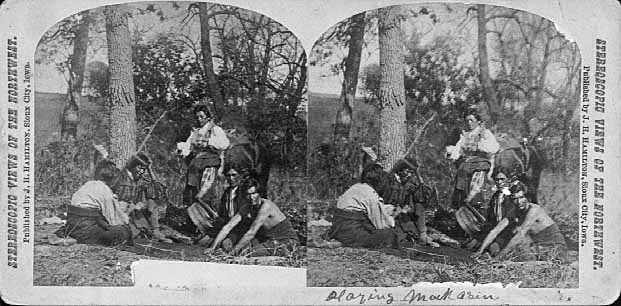
Stereographic view of a moccasin game, by J. H. Hamilton, 1880.
~ University of Minnesota Duluth
Next to the love of liquor, many of the Indians have a most unconquerable passion for gambling. While at La Pointe, I had an opportunity of seeing them play their celebrated moccasin game. They were to the number of two, or three aside, seated on the ground opposite to each other, which a blanket spread out between them, on which were placed four or five moccasins. The had two lead bullets, one of which was made rough, while the other remained smooth. Two f the gamesters were quite young men, with their faces painted with broad horizontal red and blue stripes, their eyelashes at the same time being dyed of a dark color. They played the game, won and lost, with as much sang froid as old and experienced gamblers. Those who sat opposite, especially one of them, was much older, but no means a match, at the time of my visit, for the young rascals, his antagonists. One takes the balls in his hands, keeps his eye directly on the countenance of the opposite party, at the same time tossing the balls in his hands, and singing, in a changing voice, words which sound somewhat like “He-he-hy-er-he-he-hy-er-haw-haw-haw-yer. He-he-hy-er,” &c. During which he keeps raising, shifting, and putting down the moccasins, till, finally, he raises his hands, having succeeded in concealing the balls under two of the moccasins, for which the other proceeds to search; and if he succeeds, on the first trial, in finding the rough ball, he wins. Then he takes the balls to hide, and commences singing himself. If he fails, he loses; and the first party repeats the song and the secretion of the balls. They hold in their hands small bundles of splinters of wood. When one loses, he gives to the winner so many sticks of wood. A certain number of them gained by any one of the party, wins the game. When I saw them, they had staked up their beads, belts, garters, knife-cases, &c. Their love of gaming is so strong, as to cause them to bet and lose everything they possess in the world – often stripping the last blanket from their naked backs, to stake on the game. It is said that some Indians acquire so much dexterity at this game, that others addicted to it refuse to play with them. In playing the game, they keep up a close watch on each other’s eyes, as being the best index to the movement of the hands. The song is repeated, no doubt, to diver the attention of the antagonists.
Among other peculiarities of Lake Superior, and one of its greatest recommendations, is the abundance and superiority of its fish, consisting of trout of large size, white fish, siskomit, ( a species of salmon,) and bass. The trout and siskomit are the finest and noblest fresh-water fish I ever saw. Almost every day we could catch trout by trailing a hook and line in the water behind out boat. In this way we caught one fine siskomit. Its meat, when fresh-cooked, we found about the color of salmon. The fish itself is about as heavy as a common-sized salmon, but less flat, being more round in form.

Detail of “The 12 Apostles” from Captain Jonathan Carver’s journal of his travels with maps and drawings, 1766.
~ Boston Public Library
If you will look at a map of Lake Superior, you will find, near its upper end, a labyrinth of islands, called by the early French voyageurs, of whom P. Charlevoix was one, (a Jesuit,) “the Madelaine islands.” They are sometimes called “the Twelve Apostles.” The largest island is now generally known as “the Madelaine island” – being the largest of the group. Just inside, and near its southern extremity, at the head of a large, regular bay, with a sandy beach, with an open and gently-rising scattered pine and spruce land in the rear of the beach, stands La Pointe – one of the most pleasant, beautiful, and desirable places for a residence on Lake Superior, and the very place where Fort Wilkins should have been placed, instead of its present location, which must be conceded, by every impartial person, to be among the very worst that could have been selected on the whole lake.
The garrison at Copper harbor, located, as it is, upon the rocky surface of trap conglomerate, affording a surface so scantily supplied with soil amidst masses of pebbly rock and trap fragments as to be wholly unfit for any sort of cultivation whatever, is altogether out of place. It is wholly inaccessible by land, and can only be reached by water in summer. It is at a spot where Indians usually never passed within forty miles of it, till since its occupation.
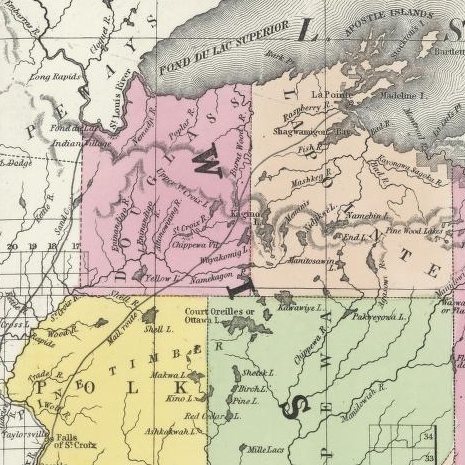
Detail of the Indian trail or “mail route” between La Pointe and St. Anthony Falls.
~ A new map of the State of Wisconsin, by Thomas, Cowperthwait & Co., 1850
The very next Congress should direct its prompt removal to La Pointe. Here, from the foot of the bay in front of the Madelaine island, there is an Indian trail, connecting La Pointe with St. Anthony’s Falls, and over which the mail is carried in winter by voyageurs on foot. La Pointe is the favorite resort of the Indians. Their lodges, in villages, bark canoes, &c. are found here the year round.
They delight to paddle and sail their canoes about the beautiful bays, harbors, &c. of these islands, employing their time in canoe building, hunting, fishing, &c. At every annual payment of their annuities, they flock to La Pointe in great numbers. Not only is that section of the great Chippewa nation sharing in the annuities brought together, but large parties of the same tribe, who receive no annuity, come at the same time from the British possessions to the north of Pigeon river. The Chippewas, called the “Pillageurs,” (so called from their thievish propensities,) inhabiting the country about Mille and Leech lakes, also attend – to meet relations, to traffic , and, perhaps, to steal a little. The great advantage of a government outpost is felt in the moral effect it exercises over the Indians. I know of no place where this influence would be more decidedly and beneficially exerted than at La Pointe. here should be daily unfurled the “stars and stripes,” and the sound of the evening gun be heard over the beautiful bays, and along the shores of the Twelve Apostles, which the Indians would learn to reverence with little less respect than they do the voice of the Manitou – the guardian spirit of the mines, embowelled in the dark trap hills of the lake.
Here, too, is an exceedingly healthy place, a good soil, and every convenience for raising the finest potatoes, turnips, and every kind of garden stuff.

1856 oil painting of Doctor Charles William Wulff Borup, a native of Copenhagen, Denmark. Borup married Elizabeth Beaulieu, a Lake Superior Chippewa daughter of Bazil Hudon Beaulieu and Ogimaagizzhigokwe. Borup and his brothers-in-law Charles Henry Oakes and Clement Hudon Beaulieu were co-signers of the 1842 Treaty with the Chippewa at La Pointe. Borup and Oakes became the first bankers of Minnesota.
Dr. Borup, the agent for the American Fur Company, (who have an extensive trading-post at this place,) has a superb garden. In walking through it with him, I saw very fine crops of the usual garden vegetables growing in it. His red currant bushes were literally bent down beneath their weight of ripe fruit. His cherry-trees had also borne well. Gooseberries also succeed well. The doctor also had some young apple-trees, that were in a thriving condition. Poultry, likewise, does well. Mrs. B. had her yard well stocked with turkeys, geese, ducks, and chickens. There was also a good garden at the mission-house of the American board.
However infinitely better is such a place for a United States garrison than Copper harbor, located, as it were, on a barren rock, where no Indians are seen, unless induced to go there by the whites – where there is nothing to protect – where intercourse is cut off in winter, and food can only reach it in summer – where there is no soil on which to raise a potato or a cabbage. I can only say that a greater blunder, in the location of a military post, was probably never committed. And if made (of which I am assured it was not) by a military man, he ought to be court-martialed and cashiered.
The mouth of the Ontonagon river is a far better spot for the fort than Copper harbor. It has a good soil, and a beautiful site for a fort. Furthermore, the country between it and Fort Winnebago, on the Wisconsin river, is favorable to the construction of a military road, which ought, at no distant day, to be opened. Another road should be cut from Fort Snelling, near the falls of St. Anthony, to La Pointe. In cutting these roads, it would seem to me as if the United States soldiers themselves might be usefully employed.
~ FortWiki.com
While at Copper harbor, I frequently visited Fort Wilkins, in command of Captain Cleary, whom I consider in every way an ornament and an honor to the service. In the brief space of time he has been at this post, and with the slender materials at command afforded by the country, he has nevertheless succeeded in making an “oasis” in a wilderness. He has erected one of the neatest, most comfortable, and best-planned garrisons it has been my lot to enter on the western frontier. He keeps all in excellent condition. His men look clean, healthy, and active. He drills them daily, and keeps them under most excellent discipline. He seems to take both pleasure and ride in the service. He says he never has any difficulty with is soldiers while he can exclude ardent spirits from them, as he succeeds in doing here, notwithstanding the great number of visitors to Copper harbor this summer.
To all travellers who are interested in objects of leading curiosity, the character of the Indians they fall in with cannot fail to arrest a share of attention.
The Chippewas are the only Indians now met with from the Sault Ste. Marie and Mackinac, extending from thence west along the southern shore of Lake Superior, to Fond du Lac, and from thence, in the same direction, to the Mississippi river. Within the United States they extend over the country south from the British boundary, to the country low down on the St. Croix and Chippewa rivers. The same tribe extends from our boundary northwest of the lake, entirely around its northern shore on British territory, till they reach the Sault Ste. Marie, opposite the American shore. It is said this tribe, spread over such a vast tract of country, is a branch of the powerful race of the Algonquins. They are sometimes called O-jib-was. They do not exist as a consolidated nation, or strictly as a confederation of bands. The entire nation on both sides of the line is divided into a great number of bands, with a chief at the head of each, which not uncommonly go by his name, such as “Old Martin’s band,” “Hole in the Day’s band,” &c.
The chief’s son, especially if he exhibits the right qualities, is expected to succeed his father at the head of the band; but very frequently the honor is reached by usurpation. The whole nation, which widely differ in circumstances, according to the part of the country they inhabit, nevertheless all speak the Chippewa language, and have extensive connexion by marriage, &c. The bands inhabiting the southern shore of Lake Superior are by far the best of any others. Though polygamy still prevails among them, and especially among their chiefs, it is nevertheless said to be becoming less common, especially where they are much influenced by Catholic and other missions. While at La Pointe, an Indian wedding was consummated, being conducted according to the ceremonies of the Catholic church, and performed by the missionary priest of that persuasion stationed at the Pointe.
There is one trait of character possessed by the Chippewas, (if we except, perhaps, the band of “pillageurs,” who have a kind of “Bedouin Arab” reputation among their countrymen,) which, I am sorry to say, the whites do not possess in an equal degree – that is, “very great honesty.”
White men can travel among them with the most perfect safety as to life and property. I will venture to say, that a man may carry baskets filled with gold and silver, and set them down in Indian villages, or leave them lying where he likes, or go to sleep by them, with Indians encamped all around him, and not one cent will be touched. Such a thing as a house being broken open and robbed at a Chippewa Indian trading-post was never heard of – within between two and three years’ intercourse with them – in time of peace. Dr. Borup said he would not be afraid, if concealed to look on, to leave his store door open all night; and the fact alone of its being left open, might be made known to the Indians at the Pointe. He would expect to see no Indian enter the store, nor would he expect to lose anything; such was his confidence in their honesty!!
Last winter, flour at the Pointe rose to $40 per barrel. The poor Indians were nearly famished for bread, but were unable to purchase it at such a price. They knew the American Fur Company had a considerable lot in store, guarded by nothing stronger than a padlock, yet they never offered the least violence towards the company’s agents or store! Would white people have acted as honestly? The poor Indians, by nature honest, have too often known the whites by the wrongs inflicted upon them, which God can forgive, but time can never blot out! They are very superstitious, but not as basely and insanely so, but a great deal, as the Mormons, Millerites, and other moon-stricken sects among the whites. They believe in one Great and Good Spirit, or a Being who can at will inflict good or evil on mankind; and there’s an end of it. They often denominate the mysterious spirit of evil import the Manitou, making him to dwell in the wild hills, islands, grottoes, and caves of Lake Superior.
From these huge birds the Indians obtained their first knowledge of fire, which they kindled with fire-sticks. These mythical birds were the most powerful of the animal deities of the Indians of the woodlands and of the plains. When the weather was stormy they flew about high in the heavens. When they flapped their great wings, one heard the crashes of thunder, when they opened and closed their eyes flashes of lightning were seen. Some carried lakes of water on their backs, these slopped over and caused downpours of rain. Their arrows, or thunderbolts, were the eggs which they dropped in their flight. These shattered the rocks and set fire to the forests and prairies.
A Chippewa Indian hunter, who was carried away to his nest by a Thunderer, saved his life by killing one of the young birds and flying back to earth in its feathered hide.
In the Smoky Mountains, a wild and rugged region in the southwestern part of Bayfield County, was the home of Winneboujou (Nenebozho), the fabled hero of the Ojibwa Indians. This all-powerful manitou was a blacksmith, and had his forge on the flat top of the highest mountain. Here he shaped the native copper of the Lake Superior region into useful implements for his Indian children. Much of his work at his forge was done at night, and the ringing blows of his great hammer could be heard throughout the Brule Valley and Lake Superior region. The fire of his forge reddened the sky. When he was not busy at his forge he was away hunting or seeking other adventures. Many stories of the exploits of this giant manitou have been told by the Chippewa and other Wisconsin Algonquian tribes.”
~ Legends of the Hills of Wisconsin by Dorothy Moulding Brown; The Wisconsin Archaeologist, Volume 18, Number 1, 1937, pages 20-21.
At times, it is said, a peculiar noise issues from the Porcupine mountains, and from the high hills on the main land, both east and west of La Pointe, some distance off. It is said to resemble the distant discharge of ordnance, or thunder. At one time, they said it was so loud and frequent, that they mistook it for signal guns fired from the brig Astor, which they thought might be in distress, and actually sent out a boat in search of her.
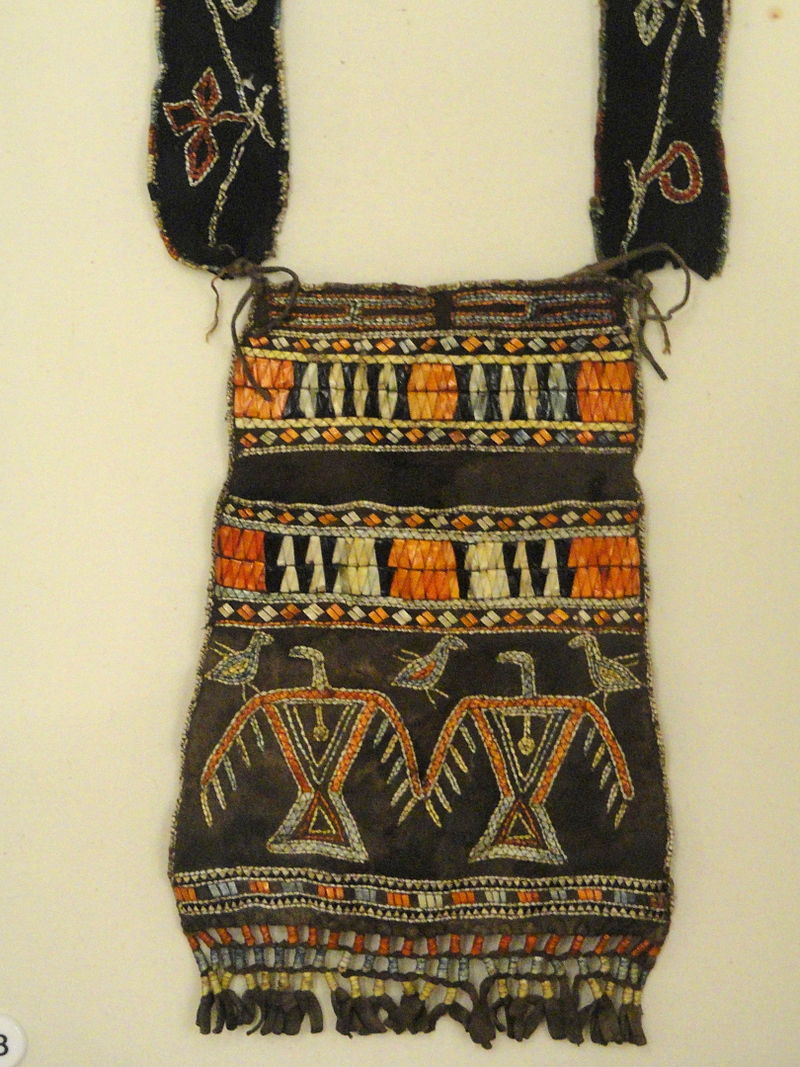
“Ojibwe shoulder pouch depicting two thunderbirds in quillwork, Peabody Museum, Harvard University.”
~ Commons.Wikimedia.org
These sounds the Indians believe to be the voice of the spirit “Manitou,” who guards the deposites of mineral wealth embowelled beneath the hills, and to whom any attempt made to dig them up, and carry them off, would be highly offensive, and followed by some kind of punishment. I have never yet heard of an Indian’s leading a white man to a locality of copper, or telling where he has found a piece when picked up!
Some have supposed that the noise in question arises from volcanic action; but, as no vibration is felt in the earth, and no other proof exists of such being the case, we are led to believe that the noise is produced by the lashing of the waves of the lake after a storm, as they are driven forward into the grottoes, caves, &c. of the tall sandstone cliffs, formed at their bases by the disintegrating effects of water and ice. Some distance east of La Pointe, about the Little Girl’s Point and Montreal river, as well as west of the same place, some fifteen or twenty miles, high red sandstone cliffs occur. At their bases, near the water’s edge, a great many curiously-shaped caves and grottoes appeared. In places, the sandstone had been so cut away, that only pillars remained standing at some ten or fifteen feet in the lake, from the top of which a high rude arch would extend to the main shore, and beneath which boats could easily pass. This was particularly the case near where the islands are parted with going west up the southern shore of the lake. Some caves, with small openings for mouths, run for a long distance back beneath the hills, expanding, likely, into large halls with high vaulted roofs, &c. After a storm, a heavy sea continues to roll into these grottoes and caverns, the waves lashing themselves against their sides and roofs – thus producing sounds resembling those heard at La Pointe, &c.
As the weather is generally calm after a storm, before the sea goes down, it is likely at such times these sounds are heard.
We had occasion to pass these places when a considerable sea would be on, close to the cliffs, and could hear the hollow heavy sounds of the waves as they broke into the caverns within the cliffs and hills. Every day, while we remained, parties of Indians continued to arrive, to be present at the payment.
We finally became prepared to leave for the Mississippi, having bought two bark canoes, and hired four new voyageurs – two for each canoe – one Indian, one half-breed, and two descendants of Canadian French; and, with a stock of provisions, we were ready to be off. From this place, I sent back three voyageurs to the Sault Ste. Marie, all that I hired to come as far as La Pointe. So, after paying our respects to Mr. Hays, our worthy Indian agent, and to Dr. Borup, (to both of whom I had borne letters of introduction,) and having many “bon voyages” heaped upon us by our friends and the friends of the voyageurs, we bade adieu to La Pointe.
You will not hear from me again till I reach the Falls of St. Croix.
I am yours, very truly, &c.
MORGAN.
To be continued in Saint Croix Falls…
By Amorin Mello
A curious series of correspondences from “Morgan”
… continued from To The Far West.
The Daily Union (Washington D.C.)
“Liberty, The Union, And The Constitution.”
July 7, 1845.
MADISON, (W.T.,) June 26, 1845.
To the Editor of the Union:
SIR: Our democratic territorial convention has this day nominated the Hon. Morgan L. Martin, of the county of Brown, as the candidate for the delegacy, to succeed Governor Dodge. Mr. Martin is one of our ablest and most reliable democrats, and there is but little doubt of his election by a triumphant majority. Mr. Martin has been fourteen years in the upper branch of our territorial legislature, and has been the presiding officer of that body at four sessions. The democrats of the Territory will go into the canvass in the best possible spirits, and with the fullest confidence of success; for they are well united, and have a candidate worthy of the cause and their most zealous support.

Henry Dodge
~ Wikipedia.org
More than twice the number of immigrants are arriving here daily, this season, than have ever come at any previous season. The administration of Governor Dodge is very popular with all parties, and so are the measures of the national administration, and particularly its course on those two great questions – the annexation of Texas, and the maintenance of our rights to Oregon.
The convention was very fully attended; and, although there was some division when it assembled, as to who the nominee should be, the members left here in the best possible spirits. In haste.
Yours, truly,
J. A. N.

The Daily Union (Washington D.C.)
“Liberty, The Union, And The Constitution.”
July 8, 1845.
[From our regular correspondent.]
MACKINAC, June 29, 1845.
This small town stands on a narrow slip of land sloping from the foot of elevated bluff hills in the rear, to the water. The second and highest elevation is about three-quarters of a mile in the rear of the town, and is three hundred feet above the level of the lake or straits, and nine hundred feet above the level of the ocean. The site of the town winds in a crescent form around a small harbor, indented in the southeastern part of the island.

Painting of Fort Mackinac by Seth Eastman in 1761.
~ United States Army Center of Military History
The old Fort Mackinac stood on an extreme northern point, putting out into the strait from the southern main land, some 10 or 15 miles to the southward of this place. It was first settled upon as a French missionary station, and a fort erected. When Carver visited it in 1756-’57, the fort was garrisoned by the English, who came into possession of it with the conquest of Canada, a few years before. It then contained 30 houses, and had one hundred men in garrison, besides a government-house, &c. In 1763, the various northwestern tribes of Indians who had long known the French as the first Europeans they had ever formed friendly intercourse with, became highly dissatisfied with the change from French to English rule. A powerful league was, therefore, formed between the Ottowas, Chippewas, the Hurons, Menomonees, &c.; and the celebrated Pontiac was their leader, who bore a deadly hostility to the English.
!["No authentic images of Pontiac [also known as Obwandiyag] are known to exist. This interpretation was painted by John Mix Stanley." ~ Wikipedia.org](https://chequamegonhistory.com/wp-content/uploads/2016/04/pontiac-chief-artist-impression-414px.jpg)
“No authentic images of Pontiac [also known as Obwandiyag] are known to exist. This interpretation was painted by John Mix Stanley.”
~ Wikipedia.org
After peace was made with Pontiac, the fort came again into the occupancy of the English, who transferred it to us, under the treaty of peace, at the close of the revolutionary war. When the late war broke out, the British took both old Fort Mackinac and the fort at this town, and held them up to the treaty of Ghent; and if war were to begin soon, they would inevitably fall into their hands again, owing to our neglect to fortify them in a proper manner. The old site we have abandoned, and erected a small and well-built fort on the hill, just in the rear of the town, on the island, which is about one hundred and fifty feet high above the level of the lake, or strait. About three-quarters of a mile behind the fort, there is a high hill – the highest on the island – with its steep face looking towards the fort and harbor, while its eastern and northern section extends over a narrow plateau, or level, which could be completely raked by guns stationed on the walls of a fort, which should, by all means, be erected near the brow of the hill. This high point of land overlooks and completely commands the fort our troops (two companies) at present occupy.
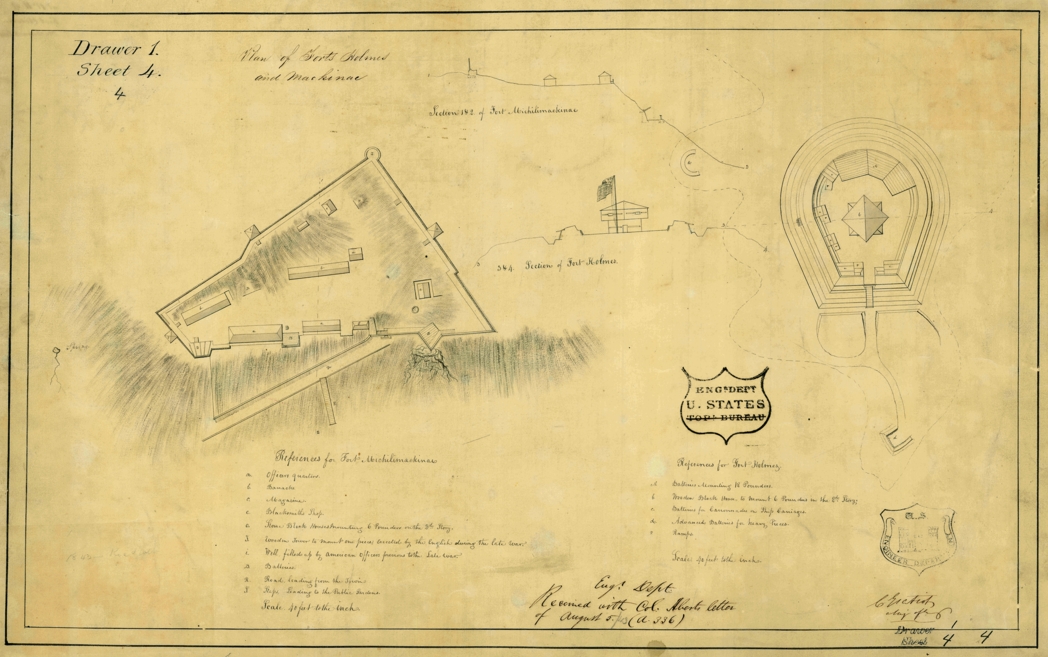
“Major Charles Gratiot visited Mackinac Island in 1817, using his trained engineer’s eye to carefully record the design of Fort Holmes in these detailed plans. The fort’s blockhouse, walls, and gun platforms are clearly visible on Gratiot’s drawings”
~ Mackinac State Historic Parks
The first news the people heard of the declaration of war in 1812 in Mackinac, was the appearance of a large body of English and Indians on the high hill, who commanded the surrender of the fort, then garrisoned by some fifty or sixty men which was complied with. The English entrenched this high ground, planted some batteries on its ramparts, and named it “Fort Holmes,” which it still bears.
This point is the main key to those important straits which connect two of the great lakes. It is now just in the state of ruins in which the British left it in 1814-’15; and why our government have not strongly fortified it, seems inexplicable. If this hill were strongly fortified, with armed outposts at some other points about the straits, the military defences of this place would be wholly impregnable – even stronger, if anything, than the rock of Gibraltar. The position is a most important one and government should lose no time in putting it in a complete state of defence.
The only communication by water, between the two great lakes of Michigan and Huron, is directly in view of the heights of this harbor.
From the hill of Fort Holmes, there is a most magnificent view. The great sheets of water in the straits, with the islands, distant main-land, &c., are all in full view. The approach of a steamer or vessel can be seen when from twelve to fifteen miles distant, in the eastern or western offing.
This post was first settled in 1764 – the year after the fall of old Mackinac. In 1796 it was conveyed by the English to St. Clair. It has long been a celebrated Indian trading-point, and is so yet; large numbers of whom constantly visit the place in the birch-bark canoes, encamping beneath bark wigwams (or shanties) on the stony beach along the shore.
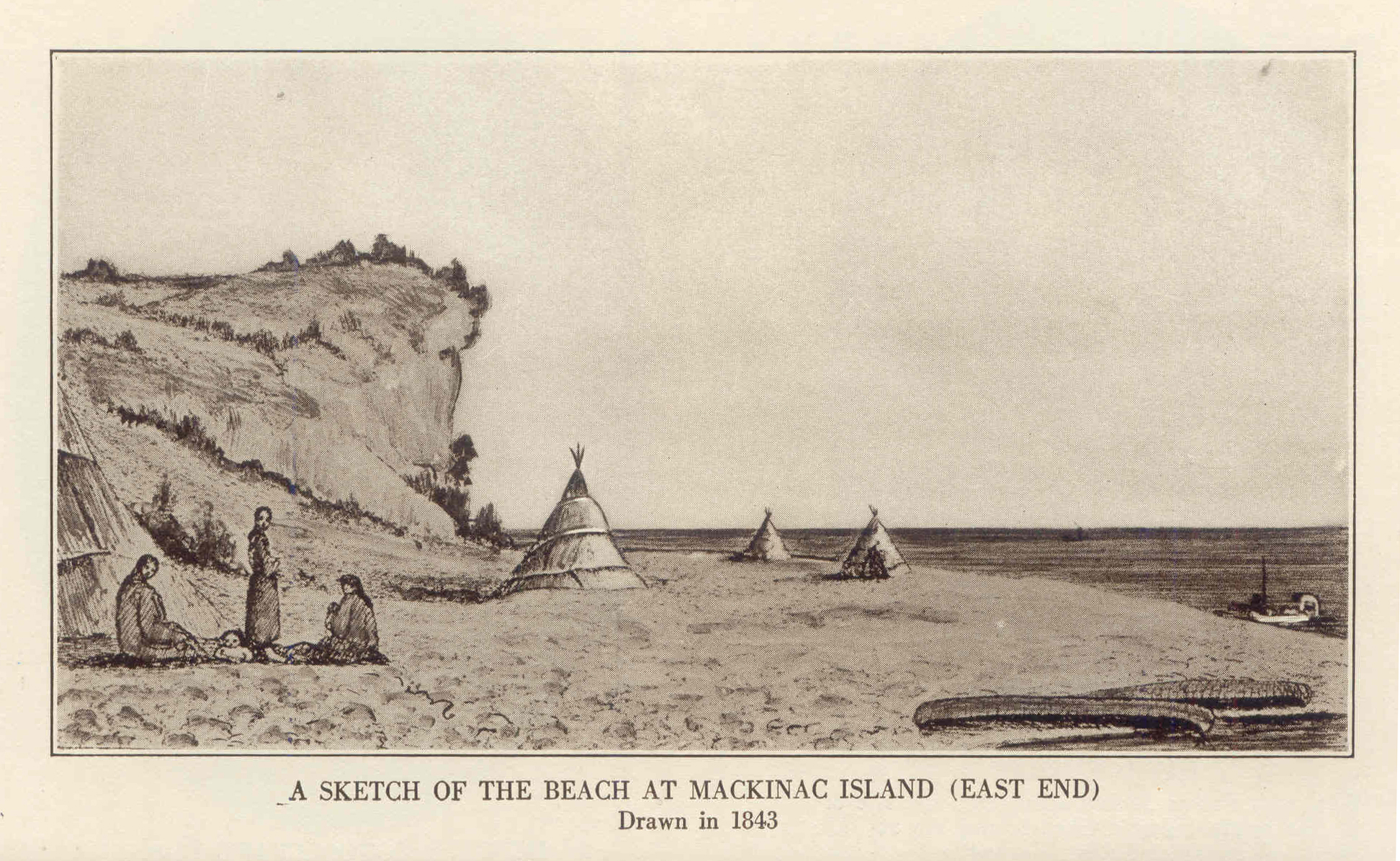
1843 Drawing of Mission Point Beach at Mackinac Island, Michigan
~ Historic Mackinac, Volume 1, facing-page 367.
This is also a great point for catching lake trout, or salmon-trout, white fish, &c., which are salted down in barrels, and shipped to market, selling for about seven dollars per barrel, on average. This business is in the hands of Indians, half-breed Indians, and French fishermen, who go out into the lakes in Mackinac boats, properly prepared with seines, hooks, &c.

Photograph of Arch Rock on Mackinac Island, by n8huckins, shared under Creative Commons.
~ Wikipedia.org
The island of Mackinac is about 9 miles in circumference, and contains several natural curiosities among which, is the Giant’s Arch, or Rock, about a mile northeast of the town. It is 100 feet high – the natural arch having a span of 45 feet wide.
Nearer the centre of the island is Henry’s cave, at which, it is said, this traveller once saved his life from the fury of drunken Indians, by secreting himself in it. It was then full of bones, which have since disappeared.
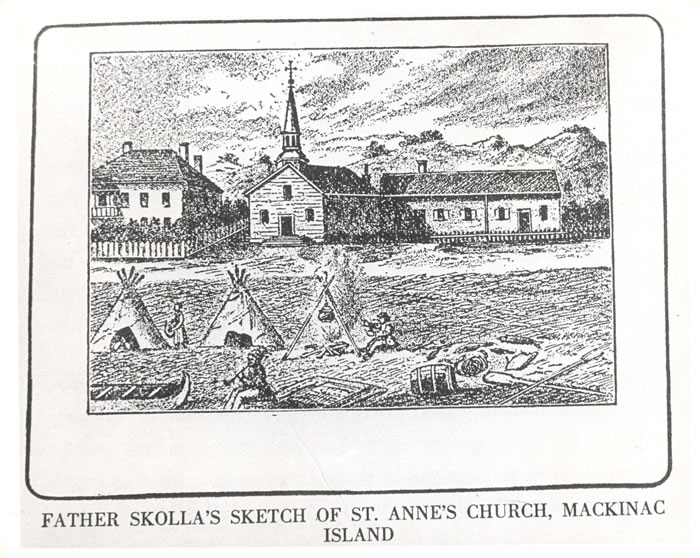
In the town of Mackinac, there are two small churches, the most ancient of which is a Catholic chapel, connected with a Catholic mission at the point. The other is a small Protestant church, originally built in connexion with an extensive mission-house founded by the Presbyterian Board of Foreign Missions. They have since changed the establishment to the shores of Lake Superior. The mission-house is now occupied by Mr. Herrick, lately from Detroit, who has converted it into a large and commodious tavern, at which we are staying. There is also another comfortable hotel in the place.
I know of no place on the continent that can make a more delightful summer residence than Mackinac. The heat of the summer is scarcely felt here at all. You can sleep under a blanket every night throughout the summer.
The drinking water is equal to, if not better than, any which ever gushed from the hill-sides of the Alleghany mountains. The fish are abundant and delicious. Large steamers running between Buffalo and Chicago pass twice daily, touching in each case.
The American Fur Company have an agent here. The United States government have an Indian sub-agent, also resident at this place.
I went to a small Catholic church to-day, where I heard a short sermon in French. The auditory consisted of French descendants, Indians, half-breeds, and some few Americans.
This island is called the county of Mackinac and Sate of Michigan. I believe, in addition to a State court, the United States district judge occasionally holds a court here.
We leave to-morrow, on the steamboat General Scott, expected up to-night from Green bay, for the Sault de Ste. Marie – the place of rendezvous for persons bound up Lake Superior, on which then is no craft at present, except two or three schooners sailing up the lake from the Sault to Copper Harbor, &c.
When I arrive at the Sault (pronounced Soo) Ste. Marie, I will write you again.
I remain yours, very respectfully.
MORGAN.
The Daily Union (Washington D.C.)
“Liberty, The Union, And The Constitution.”
July 16, 1845.
EDITOR’S CORRESPONDENCE.
—
[From our regular correspondent.]
SAULT STE. MARIE,
Near Lake Superior, July 2, 1845.
We left Mackinaw yesterday, the 1st July, about a quarter-past eight , a.m.; our course for forty miles to the “detour” lying through the open and upper part of Lake Huron, which exposed our little boat to a very heavy rolling sea- the result of the previous day or two’s severe blow on the lakes. Many of the passengers, as usual on such occasions, became severely sea-sick. At half-past 12, p.m., we rounded into St. Mary’s river, where we had smoother water.

“A painting by Paul Kane depicts an encampment on the shores of Lake Huron in about 1845.”
~ The Granger Collection, New York
The river at first appeared very wide, with a low and sandy beach on each side, and a flat swampy country running back into the interior. As we progressed, however, the stream grew more narrow, and again expanded into two smart lakes – the first called Great George, and the latter Little George’s lake. Leaving these lakes, the river fifteen or twenty miles below the Sault again contracted, and turned about among high hills a little distance off, while its margin was skirted with low, falt, gravelly ground, covered with white cedar and other rather dwarfed forest trees. These highlands showed steep hills or knobs of old red sandstone.
It was not long after passing the hills, before we hove in sight of the white and frothy rapids, at the foot of which stands the small village of the Sault, at the principal pier of which we landed – it being 60 miles from the lake.
The town exhibits a collection of wooden log-houses, roofed and weather-boarded with birch bark, gathered along the river at the foot of the falls, here and there showing small framed painted houses, one of which is an hotel, at present overflowing with people bound for the mineral lands of Lake Superior.
The Sault contains, besides the houses noticed, a small United States garrison; the slender wooden stockade defences of which, with officers’ quarters, are almost in a state of dilapidation. There is also a small missionary station and school-house belonging to the Methodists, and a U. S. Indian agency.
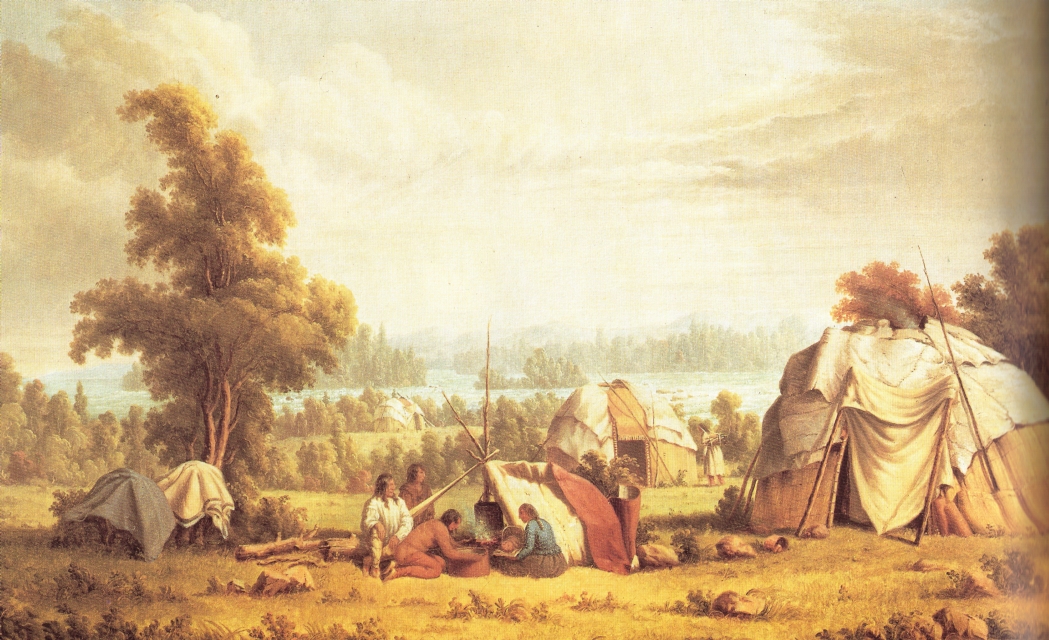
A painting of an Ojibwa village near Sault Ste Marie; also by Paul Kane in 1845.
~ Wikipedia.org
There is a collector of the port on each side of the river, which is here about a mile wide, between us and Canada. I imagine there is very little business to do by either functionary. The American Fur Company have a station at the Sault. The Hudson Bay Company have a factory, or station, on the opposite side of the river. I paid a visit to the latter yesterday, having a note of introduction to a Mr. Blenden, their agent, whom I found busy in packing up for a voyage up the Canada side of Lake Superior. He is bound on a tour among the posts towards Hudson’s Bay to the north. Mr. B. received me very politely. He informed me that he intended to carry his children with him, whom he expected to send in the care of friends across to Hudson’s Bay, where they would embark on one of the company’s ships for London, and be from thence conveyed to Edinburgh, to be placed at school. He told me Sir George Simpson, the governor of the company, had passed up the lake not long since, accompanied by his boats, &c. he was bound for the valley of the Red river of the North, where he expected to meet a kind of convention of the authorities of the company’s territories in that quarter – among whom would be the representatives of Selkirk’s colony, the population of which is about 5,000. They produce more grain, &c., than they can find means of having conveyed to market: hence there is some emigration from their colony to the valley of the Mississippi, within the States.
Mr. B. states that the Hudson Bay Company employ about seven ships in their trade – two or three of which, every summer, visit Hudson’s Bay; three double Cape Horn, and ascent the Columbia river; and one or two others are employed at other points. He states that their charter gives them ample territorial jurisdiction over all the lands, mines, &c., on the high lands to the north and west of Lake Superior, but not over the lands immediately along the shore. He states that a geologist, Dr. Logan, is engaged in surveying the country of Upper Canada, and is now employed between Lake Ontario and Lake Huron, or the inlet of the latter lake, called Lake Georgina Bay. He is expected up this summer, to examine the northern shore of Lake Superior, which is supposed to be as rich in copper ore, at certain points, as the southern shore.
The two fur companies (American and Hudson Bay) are on the best possible understanding; which has a very favorable influence on the northwestern tribe of Indians.
In 1830, they mutually agreed to exclude all intoxicating drinks, in their traffic and intercourse, from them. The Indians, in consequence of this wise and humane compact, are everywhere, within their bounds more inoffensive and peaceable. It is just as safe, if not more so, to travel among them, than among the whites. They have a considerable number of birch-bark lodges at the Sault, employing their time in catching fish at the foot of the falls, in their gill-nets. They belong almost exclusively to the Chippewa tribe. The Sault is the greatest place for catching fish I ever saw. They can take ten times as many white fish, salmon-trout, brook-trout, bass, &c., as can be disposed of. The Indians push their canoes up into the foam of the falls, cast forward their nets, and draw it as the current carries the boat down again. Our staple article of food at the Sault is fresh fish.
The falls here, or rapids, have only a descent of about 18 to 21 feet in a mile; while the ground is very favorable to the construction of a ship-canal – the length of which need only be a mile. On the Canada side, the length of the rapids is only about three-quarters of a mile long. It is very likely, if our government refuses to construct a canal on our side, that the English may, ere long, make one on their side; which will be only three-quarters of a mile long.

“Hudson Bay Fort, Sault Ste. Marie. By J.S. Hallam.”
~ Sault Ste. Marie Public Library
The fort at this place, in time of war, should be erected on a considerable hill, about three-quarters of a mile in the rear of the Sault, called Coal-pit hill; which commands a fine view of the falls, river, &c.
There are several schooners (say three or four) on Lake Superior, plying between the head of the falls and Lapointe, Copper Harbor, &c. They have been drawn around the falls on rollers. There is some talk of having a steamer carried around by the same means. A fine new vessel is on the stocks at the head of the falls, which is about half done. It will be launched about the 1st of August. She is building by Newbury & Co.; to be rigged as a fore-and-aft schooner.
At the Sault, a Catholic station was founded from one to two centuries ago, being fixed upon as a missionary station. next to Quebec and Montreal, it is said to be the oldest point settled upon by Europeans in Canada. It has always been an important point for the Indian trade. Here goods are carried round the falls, and sent up Lake Superior to be distributed to various Indian trading-posts, far in the northwestern region of the continent.
The early Catholic Jesuits, or priests, who first explored the far distant, cold, and deary regions bordering the shores and streams of the upper lakes, must have been animated with a deal of perseverance, and influenced by the dictates (to them) of an all-powerful religion. They at every prominent point throughout this vast country erected the cross among the savage tribes, and impressed their minds with the solemn and imposing ceremonies of the religion they professed. Their success among the savage tribes of North America has never been surpassed, if equalled, by more modern and persevering denominations. They acquired an influence over the Indians, which nearly a century of British and American domination has not been sufficeint to efface. Even at this day, the frail wooden cross seen standing in the humble grave-yards of the Indians, sufficiently attests the remaining influence of the Catholic religion. French and Indian have also intermarried more than the Anglo-Saxon and Indian. The latter also more commonly speak French. Indians never, in early times, fought Frenchmen. Our earliest accounts of the vast interior western and northwester regions of this continent were derived from Catholic priests, such as Father Hennespin, &c.
The first Englishmen who explored the upper lakes after the fall of Canada, were Henry and Carver, between the years 1766 and 1775-’76. Their works contain many interesting details relative to the country.
In alluding, in a former letter, to our loss of Hunters’ island by the treaty of Washington, I underrated its size. It is greater in area than the vaunted Isle Royale; being about 50 miles long, instead of 40, and about 40 wide.
A gross error prevails with regard to Isle Royale. It is supposed by some that we acquired it by the Lake Washington treaty, when it has always been ours, since the treaty of peace after the revolution. We have, therefore, given away important territory on Pigeon river, without receiving any equivalent, that I know of.
We have been wind-bound at the Sault for two or three days, by reason of a strong northwester, blowing directly down the river. It has been blowing about a half a gale on the upper lakes for nearly two months past; and, from all indications, the gale may last all summer. The weather in this latitude 46 degrees 30 minutes) is very cold. We have to wear thick woollens and sleep under blankets – it being difficult, on the 2d day of July, 1845, to keep warm at that! The soil produces fine Irish potatoes – better than I have tasted anywhere else – some oats, barley, turnips, rye, and wheat, &c. The soil is miserably bad, back in the interior. The population depends chiefly upon fishing, for a support; which, to all appearance, is a never-failing resource.
From this point, I expect to coast the southern lake shore in an open boat, with five or six “voyageurs;” or send them on, and go up to Copper Harbor in the schooner Swallow.
I shall pass to where mail facilities cease, and where the reduction of postage affords no benefit; and it may be some days before you can get another letter from me.
During the late war, the Americans, under command of Major Holmes, burnt down the Hudson Bay Company’s fur agency, or factor, on the opposite site of the river.
Almost the only tribe of Indians visiting or living about the Sault, belong to the Chippewa tribe – which, on the average, are good-locking Indians, and apparently comfortably clad, &c. Many of the half-breeds are really beautiful; and, in regularity of features, figure, and size of hands and feet, would do credit to more civilized life. They seem to me to be more industrious than more southern tribes of Indians among whom I have travelled, and far more inoffensive and civil to the whites. Some of the men are exceedingly tall and fine-looking fellows. I saw yesterday the son of a chief from the Canada side, who stood between six and seven feet high, and was as straight as an arrow. He could not speak a syllable of English. I saw him examining, with much attention, the new schooner building at the head of the falls.

The USS Michigan was launched in 1843, and later renamed as the USS Wolverine in 1905.
~ Wikipedia.org
The names of Indians are often very curious, and, in a measure, put at defiance the power of the English language to express them. I saw a tall man of the Chippewas at Mackinac, as he stood gazing at the United States steamship Michigan. Mr. Biddle, an old resident trader of the place, who spoke Chippewa, was standing near him. he wished to know of Mr. Biddle what sort of a vessel she was; who explained to him that she belong to “his great father, the President, who, if necessary, would use it against his enemies.” This Indian’s name, translated into English, was nothing less than “A Corpse,” or “A Dead Man” – an unusual name, I should think, even for an Indian!
The Indians always keep an abundant supply of dogs, which, about the Sault, seem uniformly to be a cross of the common cur with the wolf, and seem of little use, except to keep up an eternal barking at night about their bark lodges. This is a remarkably fine climate for the Newfoundland dog, some fine specimens of which I have seen in the possession of the whites about the Sault. At Mackinac, and other places in the northwest, the half-breeds especially make draught animals of dogs, in drawing water on trucks, and in performing other labor.
The dogs used by the Indians about Hudson’s Bay are said to be larger and more savage, and used to a greater extent as animals of labor.
The Chippewas, it is said, make no scruple of eating dogs, which they often esteem as a delicacy. This, however, I cannot vouch for.
Yours, very respectfully,
MORGAN.
To be continued in Copper Harbor…
Wisconsin Territory Delegation: To The Far West
April 4, 2016
By Amorin Mello
The Daily Union was a newspaper in Washington, D.C., now archived online at the Library of Congress, that published a curious series of correspondences with the pen name “Morgan” during 1845. In this series, “Morgan” included a remarkable and vicarious description of his experiences on Lake Superior and at La Pointe. Based on the circumstances and narrative, the identity of “Morgan” is assumed to be Morgan Lewis Martin.

Portrait of Morgan L. Martin Painted by Samuel Marsden Brookes (1816-1892) and Thomas H. Stevenson. Oil on canvas, 1856.
(Wisconsin Historical Museum object #1942.37.) WHI 2786
—
“From the time of his arrival in Green Bay in 1827, Morgan Lewis Martin (1805-1887) was an important figure in Wisconsin. Martin was an organizer of the Wisconsin Democratic Party, a member of the territorial and state legislatures, a delegate to Congress, and a Civil War paymaster. He played a key role in the early development of Milwaukee and for almost fifty years promoted various Fox and Wisconsin River improvement projects. Brookes and Stevenson, a Milwaukee-based partnership, executed this portrait of Martin during a two-month visit to Green Bay in the summer of 1856.”
According to the Biographical Directory of the United States Government:
MARTIN, Morgan Lewis, (cousin of James Duane Doty), a Delegate from the Territory of Wisconsin; born in Martinsburg, Lewis County, N.Y., March 31, 1805; attended the common schools and was graduated from Hamilton College, Clinton, N.Y., in 1824; studied law; was admitted to the bar and commenced practice in Detroit, Mich.; moved to Green Bay, Wis., in 1827 (then a part of Michigan Territory); member of the Michigan Territorial legislature 1831-1835; member of the Wisconsin Territorial legislature 1838-1844 and served as president in 1842 and 1843; elected as a Democrat to the Twenty-ninth Congress (March 4, 1845-March 3, 1847); president of the second State constitutional convention in 1847 and 1848; again elected to the State assembly in 1855; member of the State senate in 1858 and 1859; served in the Union Army as paymaster with the rank of major 1861-1865; Indian agent 1866-1869; unsuccessful candidate for election in 1866 to the Fortieth Congress; resumed the practice of his profession; elected judge of Brown County in 1875, in which capacity he served until his death at Green Bay, Brown County, Wis., December 10, 1887; interment in Woodlawn Cemetery.
Shortly before Morgan Lewis Martin was elected to the 29th Congress, the Territory of Wisconsin passed the following Joint Resolution:
JOINT RESOLUTION relative to Mail Routes.
Resolved by the Council and House of Representatives of the Territory of Wisconsin:
That our Delegate in Congress be requested to procure the establishment of a mail route from Janesville to Racine on the United States road between those places; also one from Racine to Prairie Village in Millwaukee county; and also one from Wheatland to Racine both in the county of Racine; also one from Mineral Point in Iowa county by way of Shullsburg and New Diggings to White Oak Springs in Iowa county, also one from Madison in Dane county via Sun Prairie, Columbus, and Beaver. 113 dam to Waupun in Fond du Lac county; also one from the falls of St. Croix [to] La Point on Lake Superior; also one from Prairieville in Milwaukee county by the way of Lisbon to Limestone in Washington county; also one from Potosi by way of Hurricane and Cassville to Patch Grove in Grant county; also one from Fond du Lac, Fond du Lac county, by the way of Ceresco and Green Lake to Fort Winnebago in Portage cou nty; also one from Madison to Prairie du Chien in Crawford county -by the most direct route; also, one from Plattville in Grant county by Jamestown to Fairplay, and from Fairplay by Hazel Green to White Oak Springs in Iowa county; also, one from Millwaukee by Lisbon, Warren, Oconomewoc, Watertown and Sun Prairie to Madison ; and also, one. from Milwaukee by Hustis Rapids to Fort Winnebago; also, one from Milwaukee via Whitewater and McFadden, on Sugar River to Mineral Point.
APPROVED, February 15, 1845.
The Daily Union (Washington D.C.)
“Liberty, The Union, And The Constitution.”
June 19, 1845.
EDITOR’S CORRESPONDENCE
—
[From our regular correspondent.]
NEW YORK, June 16, 1845.
We have had two arrivals from China, bringing dates as late as the 13th of March; but the papers received are said to contain little news of interest. Trade was represented as dull, except for gray cotton cloth and yarn.

Photographic copy of an 1845 daguerreotype featuring 78 year-old Andrew Jackson (seventh President of the United States) shortly before his death. ~ Commons.WikiMedia.org
The announcement of General Jackson’s death reached this city yesterday afternoon, and produced the deepest feelings of regret among thousands of people. The flags on the shipping in port, and at all the places of public resort, were immediately hoisted at half-mast, as the news spread by extra newspapers over the city like an electric shock. No doubt, arrangements will be speedily made to commemorate his death, and to express the sorrow of the people for the fall of so great a patriot, by every kind of suitable demonstration.
It is seldom in the annals of history that such men as Gen. Jackson rise up and stand out so prominently from the mass of mankind. Whatever else may be thought of him, his devoted love of country, his integrity of purpose, his Christian purity and benevolence can never be questioned by any one.
I have no general news of importance to note. Trade and stocks are dull; without material change in either since my last. Indeed, we have no change to expect till the arrival of the news by the Boston and Liverpool steamer, which is now daily looked for.
I must make my letter brief to-day, as I am about getting ready for a trip to the “far West,” and when you hear from me again, it will be en route towards sunset.
Yours, very truly and respectfully,
MORGAN.
The Daily Union (Washington D.C.)
“Liberty, The Union, And The Constitution.”
June 24, 1845.
EDITOR’S CORRESPONDENCE
—
[From our regular correspondent.]
BUFFALO, N. Y., June 19, 1845.

“Niagara, Hudson River steamboat built 1845.” Painting by James Bard.
I left New York at 7, a.m. yesterday morning, on board the splendid new steamboat called “Niagara,” on her first trip to Albany as a day-boat. She is 275 feet long on her keel, and 285 long on her main deck. Her large engine has a stroke of 11 feet; the main cylinder is 72 inches in diameter. She is fitted up like a palace. She ran the distance from New York to West Point, about 55 or 60 miles, in six minutes less than three hours. No boat runs as well when perfectly new, as when the portions of machinery subject to much friction have been worn smooth. The “Niagara” put us down in Albany a little before 5, p.m. Here we had to wait till 8, p.m., before a train left carrying us west towards Buffalo. We travelled all night, and reached the latter place, 584 or 585 miles, in 36 hours from New York; or, subtracting delays, in the remarkable short space of 30 hours, running time!
I slept as well as I could in the cars; and am here, at half-past 10, p.m., after a fatiguing thirty-six hours’ travel, sitting down trying to indite something for the “Union;” but, from a heavy feeling in my eye-lids, I fear I may make a drowsy affair of it.

“Map of the rail roads, from Rome to Albany and Troy, by one of the engineers who assisted in constructing, prepared from actual survey.” By Levi William, 1845. Digitized by the Library of Congress.
I found the western part of New York, and especially the country west of Utica, much better than I anticipated. The country looked new, for one of the old thirteen. As populous as the State is, western New York contains still much virgin soil to come into cultivation.
The staple productions appear to be wheat, rye, oats, potatoes, barley, &c. The first article is the greatest of all. The valley of the Mohawk is an interesting section of New York; but I think the country lying on the Genesee valley, and bordering the lakes of Cayuga, Seneca, and Canadaigua, c., by far the most interesting – and that portion especially about Seneca Falls, Waterloo, &c. The crops looked remarkably well in color, &c.; but seemed generally rather backward for the season. Wheat has headed very well, but does not appear very high, or to stand very thick on the ground, except in places, as the English farmers express it, I think “the heads of grain may be large and full,” if nothing happens; but “the straw will be light.”
After leaving Albany, the first place we stopped at of any note was Utica – 93 miles west of that town. It contains about 12,000 inhabitants, and is quite a well-built and pretty place. It is in Oneida county, much of which has been settled by industrious Welsh farmers. The county cast a majority of about 700 votes for the democratic electoral ticket last November.
As it was 3 o’clock at night when we reached Utica, we walked out to look at the place by moonlight, and were much pleased with its appearance.
From Utica we pushed on from village to village, bearing a variety of ancient Indian, Greek, and Roman names, till we were set down at this point.
As the country is familiar to many, and has been often described, I may have, in my next, to say something more about it. At present, I must close, or fall asleep over the paper.
Yours, very respectfully,
MORGAN.
P.S. I visit Niagara Falls to-morrow, and expect to return the same day, in time to take a boat (the St. Louis) at seven in the evening for Detroit, Michigan.
The Daily Union (Washington D.C.)
“Liberty, The Union, And The Constitution.”
July 1, 1845.
[From our regular correspondent.]
DETROIT, MICHIGAN, June 24, 1845.
On the next day after I wrote to you from Buffalo, I visited the falls of Niagara, over a railroad of 22 miles in length, running parallel with Niagara river. We passed Black Rock, a small scattered village, which the British captured, and, whose fort they destroyed in 1813. Schlosser was the next point of greatest notoriety, opposite the lower end of Navy island. It now contains only two houses- an old wooden warehouse and pier, (from which the Caroline was cut out,) with one small farm-house, standing, it is said, on the site of the old French fort, erected there prior to the conquest of Canada by the English. Schlosser is within two and a half miles of the falls.
I have not time to describe what has been so often and so well done; the character, appearances, points of view, &c., of these stupendous and wonderful cascades. They forcibly impress upon the mind of the beholder a sense of natural awe and sublimity, probably nowhere else, over this whole earth, to be equalled.
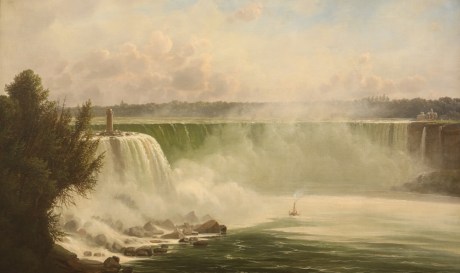
“Niagara Falls Terrapin Point” by Ferdinand Reichardt, 1856.
~ Buffalo History Museum
I crossed the river just below the falls, to the Canada side, and visited the battle-ground of Lundy’s Lane. A village has since sprung up at this place, called Drummondsville, named in honor of the British general who commanded the English troops on that occasion. Most of the battle-ground is now covered by orchards and fields.
I went with Anderson, the guide, (who says he was in the battle as a British soldier,) into an old grave-yard situated near where the British artillery stood, which Col. Miller took at the point of the bayonet. In this grave-yard, Anderson pointed out two graves which he says contains the remains of eighteen American officers. Why cannot American patriotism place some memorial over the graves of these brave men? The only memorial I saw of this kind, on our side, was a painted wooden board, with a simple epitaph, inscribing the name of Captain Hull, of the United States army, stating he had bravely fallen in this battle. Another board of a similar description, erected by the bounty of a corporal and a few privates, over the remains of an English officer, with a tomb-stone placed over Col. Cecil Bishop, of the English forces, who died of wounds received at Black Rock, are all the memorials seen at this burial-ground of Lundy’s Lane, who fell in that action.
~ Niagara Historical Society No. 22 Some Graves on Lundy’s Lane By Ernest Green, page 13.
Col. Gordon, buried in the same ground, lies without a stone. He belonged to the Royal Scotch Highlanders. This battle cost the contending parties over 800 aside, in killed and wounded.
Having seen all worthy of note about the falls, I returned to Buffalo, and sailed at 7 p.m. the same day, on board the St. Louis, for Detroit.
We had on board a large number of emigrants and cabin passengers. The tide of emigration setting west by the lake route is prodigious. Wisconsin, Illinois, Iowa, and Indiana, seem to be the great points of attraction just now.
Having touched at Fair Port and Cleveland, we reached this place on the 22d, early in the morning; having passed Fort Malden some twenty miles below.
Detroit is a handsome and well-laid-off town, and growing continually in population and commercial importance. It is situated on the west bank of the Detroit river, which never overflows or has any material rise or fall. Its water, as well as that of the lakes, affords the most delicious drinking water.
This town is connected in its history with many important scenes. Being early settled by the French, it became involved in the English and French Canadian war; and even before it became a part of the United States, it had changed its flag five times. it was once captured by the Indians, and was burnt down in 1803. In 1805, by the ignominious and disgraceful surrender of Gen. Hull, it fell into the hands of the English. This even took place in the southern part of this town, the spot still being pointed out by old settlers who witnessed the transaction. In 1813, Detroit was retaken by the Americans, when a government was reorganized, and Gen. Lewis Cass appointed its governor.
About fifty miles below this, the river Raisin empties into the lake, at a point called Monroe. It was on this river the bloody massacre of the brave Kentuckians by Indians was perpetrated by the non-interference of the English, under whose protection they had placed themselves as prisoners of war.
At Monroe, a most fiendish and cold-blooded crime was recently committed. it seems, a Mr. Hall, cashier of a bank at Monroe, was decoyed into the woods at night, by a man by the name of Wells, of this place, who was extremely intimate with Hall; when he shot him – once in the back of the head, and once in the back of his body. The deed, it is believed, was committed with the diabolical design of obtaining the keys of the bank from Hall, and robbing it. Young Hall has both balls in him, but still survives; and, strange to say, walked out a day or two since. Wells is in prison, and, like other persons guilty of such horrid crimes, professes “insanity.”

“Hydrographical basin of the upper Mississippi River from astronomical and barometrical observations, surveys, and information,” by Joseph Nicolas Nicollet, et al; published by order of the United States Senate, 1843.
Having a copy of M. Nicollet’s map of the upper basin of the Mississippi with me, I have been led to trace our boundary between this country and England, west from the northwestern shore of Lake Superior, beginning at the mouth of Pigeon river, by the late treaty of Washington; and find we have been most severely cheated in the new line, running from the point indicated to the Lake of the Woods. Soon after parting from Lake Superior, ascending Pigeon river, we come to Hunter’s island, about the size of a large county in one of the States. At the northwest point of this island, Pigeon river divides into two streams – one making an extensive turn to the north, while the other makes a bend to the south, uniting again at the foot of the island. Now, by the old line of boundary, the navigation of the entire river belonged to us, with Hunter’s and other islands. These, with the channel north of the island, which is the deepest, have, by the treaty of Washington, by some unaccountable means, been transferred to the English! Formerly, they yielded up the Pigeon river to our traders, &c., and moved their fort from the mouth of the river some forty miles up the lake, to Thunder Bay, where they built Fort William. They have now again come down (as they have a right to do) to Pigeon river, and interrupt the transit of our traders and people up and down its navigable channels and principal portages. Besides Hunter’s island, we have yielded Isle La Croix, still higher up the river. Hunter’s island is about forty miles long by thirty miles wide, with the deep channel on its northern side. Isle La Croix is about ten miles by fifteen miles in diameter. The line from La Croix west, is made to follow the southern chain of lakes, on the most southern part of Pigeon river, till it reaches the river above them. It then passes to the Lake of the Woods, and from thence to the 49th degree of north latitude, and so on west. What pretext there was for changing our boundary northwest of Lake Superior up Pigeon river, where there never was a boundary in dispute, and where the Pigeon river and Hunter’s island had for years been laid down in British maps as our property, is more than I can tell. Those who negotiated the treaty on our side, must have been grossly ignorant of geography, or they must have been woefully overreached by the British minister.
Thomas Douglas, 5th Earl of Selkirk, was a Scottish peer from the Royal Society of London, and established the Red River Colony along Hudson Bay (1811). This is neither the same person nor place as Alexander Selkirk’s colony on Más-a-Tierra Island, Chile, which inspired Daniel Defoe’s novel, Robinson Crusoe (1719).
The boundary line, stretching across from Lake Superior, along the Pigeon river, to the Lake of the Woods, Red river, &c., is the weakest and most exposed section of the United States. On the Red river of the North, and north of the Pigeon river, is a large body of hardy half-breed Indians, mixed with the Scotch and Germans, who have descended from Alexander Selkirk’s colony, founded near Hudson’s Bay. These people have about six thousand men capable of performing military duty. They come down to the head-waters of the St. Peter’s and Mississippi rivers every season, for the purpose of hunting buffalo, accompanied with their wagons and teams, which, when they have loaded with buffalo meat, they return to their own country. it is said, these men, with the warriors of the Indian tribes stretching west and north of the United States boundary line, number some twenty thousand fighting men, all of whom are under the control of the Hudson Bay (English) Company. In time of war these forces might be organized and brought to bear with destructive effect upon our new upper settlements in Wisconsin and Iowa, and other portions of our northwestern territory. To guard this weak point on our northwestern frontier, our forts are wrongly placed. The forts Snelling, Winnebago, and Wilkins, are too far in the interior.
Government ought, as early as practicable, to adopt measures to build a strong fort at the junction of Pigeon river with Lake Superior, and then to erect detached forts along our entire line of frontier, up Pigeon river to the Lake of the Woods, and from thence along to the Red river, west. These forts would serve to protect our northwestern settlements, and to keep the British and half-breed Indians, with Selkirk’s descendants, in check.
Let any man carefully examine a map of the country we have described, and he will see the propriety of our suggestion.
I leave here in a day or two for Mackinaw, from whence I will write again.
I am very respectfully and truly, yours,
MORGAN.
The Daily Union (Washington D.C.)
“Liberty, The Union, And The Constitution.”
July 5, 1845.
[From our regular correspondent.]
ON BOARD THE STEAMBOAT WISCONSIN,
Bound from Detroit to Mackinac,
June 27, 1845.
After spending some three or four days in Detroit, where I met with the friendly hospitality of a number of friends and acquaintances, I prepared to leave for Mackinac, at the head of Lake Huron.

“Bank of Michigan Building, SW corner of Jefferson and Griswold, built 1836”
~ History of Detroit and Michigan, by Silas Farmer, 1890.
While I was in Detroit, the United States circuit court was in session, Judges McLean and Wilkins presiding. This tribunal now occupies a very neat stone building, formerly erected and owned by the Bank of Michigan. This bank, in winding up its affairs, fell into debt some forty thousand dollars on their interest account, which, after meeting other liabilities, they were unable to discharge. The government, therefore, purchased this house from them at $40,000, and converted it to its present use.
A Presbyterian convention was also in session for a part of the time during my visit.
The large steamboats plying between Buffalo and the upper lakes, all touch at Detroit, to the number of two a day. Many of these are large and splendid structures of their kind. At this season of the year, they run very full of passengers, and, when bound west, carry out a great many emigrants, who are hunting homes in Wisconsin, Iowa, and Illinois. The principal tide is drifting towards Wisconsin at the present, generally landing at Milwaukie, and pushing out into the interior. The boats running on the upper lakes, are at present united in a combination to regular prices. From Buffalo to Chicago, they charge as follows: for cabin passage, 12 dollars; for deck passage, 6 dollars. Cabin to Detroit, 6 dollars; deck, 3 dollars. From Detroit to Mackinac: cabin, 7 dollars; for deck, 4 dollars. Meals for deck passengers charged 25 cents each, extra.
We found the Wisconsin pretty well crowded with passengers when we went on board. Among the deck people were several farmers’ families from Sussex, in England, bound out to Wisconsin, intending to land at Milwaukie, and proceed from thence some little distance into the interior.
On the 26th instant, the United States steam-ship Michigan, and the United States garrison near Detroit, fired minute-guns during the day, in obedience to general orders, and in respect to the memory of Gen. Jackson.
The single ten-inch gun fired from the bow of the Michigan made a loud report, which reverberated along the Canadian shore, as well as along the streets of Detroit.
“Map of the Great Western Railway of Canada, and Connections.” Circa 1879.
~ TrainWeb.org
Should the projected railroad to extend from Lake Ontario to Windsor, opposite Detroit, and that now in progress from the latter place to St. Joseph, on Lake Michigan, be completed, it will have a tendency to make this city a great thoroughfare for travellers, &c., going west.
Leaving Detroit about 9 a.m., we continued up the river till we came to Lake St. Clair. In our progress through it, we could see, by the aid of the glass, the bay formed on its eastern or Canadian side by the entrance of the river Thames, some distance up which, the celebrated battle was fought, which resulted in the death of Tecumseh. Gen. Cass, who now resides in Detroit, dispensing kindness and hospitality to his friends, was in that action, with Gen. Harrison.
From Lake St. Clair, we entered St. Clair river, which is a beautiful stream, forming the southern outlet to Lake Huron. It has cut itself a beautiful canal, on a large scale, through a level country, like Detroit river, leaving gravelly banks, of moderate elevation, on either side. The banks of this river, and especially on the American side, are pretty thickly settled. For some distance in the interior, on the Canada side, the Indians still remain in considerable numbers. At one point, we passed a village of theirs, on the river. At various points, we saw considerable parties of them, either engaged in fishing or travelling, or encamped.
In the afternoon we passed a village on the American side, called Palmer, where a Michigan volunteer company were out on parade, whose band of music greeted us with some lively airs. Near the head of the river, we passed a missionary school and station on the English side; and near the foot of Lake Huron, Fort Gratiot.
For a mile after the St. Clair leaves Lake Huron, the current has a force of six or seven miles per hour. Sail-vessels find it very difficult to stem it; and can only do so, when bound up, by the aid of stiff southerly winds. This river and rapids area serious obstacle to the passage of sail-vessels from the lower to the upper lakes. They are said often to remain wind-bound for a week or more in this river, and at the foot of the rapids. By aid of a tow-path along the shore, on the American side, a mile long, the length of the strongest current, I should think vessels might be pulled up by horse-power into the lake at any time.
“A painting by Paul Kane depicts an encampment on the shores of Lake Huron in about 1845.”
~ The Granger Collection, New York
Late in the afternoon of yesterday, we entered Lake Huron, a huge inland sea. On our right was a vast sheet of water, meeting the horizon, shutting out all sight of land in that direction. We still, however, kept in sight of the western, or American shore; although, at the distance at which we sailed from it, we could see only a small settlement now and then.
The wind, with some clouds and rain, sprung up from the NNE., and threatened a stormy night; but, as the sun went down, the wind fell, the clouds dispersed, and we had a clear, cool, and beautiful starlight night. With conversation, and listening to some music on a piano in the saloon, the evening passed off pleasantly.
The sun this morning rose bright and clear, from the pure bosom of the lake, bringing us a fine and pleasant day.
There is no better tasted, or purer drinking-water found in the world, than that found in these lakes – and especially in the upper lakes. They are, in fact, nothing more than pure fresh-water ocean springs. Your coolest wells in Washington, the Croton in New York, or Schuylkill of Philadelphia, bear scarcely any comparison to this lake water. There is one advantage to mariners navigating these inland seas – under no circumstances are they likely to suffer from a scarcity of drinking-water.
About half-past 2 to 3 p.m., we landed at Mackinac; which I found to be one of the most picturesque and beautiful places I have seen since leaving New York.
As I shall have another opportunity of writing to you from this place, I will say no more at present; but remain your very obedient and humble servant,
MORGAN.
To be continued in Mackinac and Sault Ste Marie…
Baash-ki-taa-go-zi, the Firecracker
March 5, 2016
By Amorin Mello

Original sketch of Detroit’s flag, by David Emil Heineman, 1907.
~ Detroit Historical Society
This is a reproduction of biographical sketches from “Jewish Beginnings in Michigan Before 1850,” by Hon. David Emil Heineman. It was transcribed from Publications of the American Jewish Historical Society: Number 13, 1905, pages 57-63. The author’s father, E. S. Heineman, and Kanter were business partners. For more information about Kanter while working for the Leopolds and Austrians families, see the Edward Kanter Papers, 1847-1848.

——-
Jewish Beginnings in Michigan Before 1850
——-
Beginnings Of The Immigration Preceding The Year 1850.
An account of the Jews who came to Michigan in the years immediately succeeding 1850 would be of secondary interest to a society such as this. Such an account would be more proper for a local than a national society; it would deal with the extensive immigration, principally German, of that period, and be made up of long lists of names, birthplaces, and dates of arrival. It would be a recital common at a somewhat earlier date to most of the then Western States telling of the humble beginnings of prosperous merchants, successful professional men, and communal leaders, in largest measure, valuable and valued citizens. The beginnings of congregations would be accurately set down and the memory of man would still suffice to amend the errors due to a neglect of local history. Inasmuch as there has hitherto been a woeful neglect of proper investigation, the writer does not hesitate to enlarge upon the commencement of this immigration and upon a few pioneers therein, all prior to 1850.
The Leopold And Austrian Families.

1843 Drawing of Mission Point Beach at Mackinac Island, Michigan ~ Wikimedia.org
We again recur to Mackinac, and in 1845 find at this point members of the Leopold and Austrian families1 which afterwards became prominent as owners of Lake Michigan vessels and merchants in the ports of the Great Lakes. Lewis F. Leopold, his wife, who was a Miss Babette Austrian,and their son of less than a year old, together with his sister Hannah and his brother Samuel, were located at the island in the year mentioned. Samuel F. Leopold soon after his arrival at Mackinac purchased a one-mast sloop, the “Agate,” with which he gathered up the product of the different fishing points, becoming the first pioneer at this locality in the fishery business, which since that time has grown to such a great industry. The brothers sent down to Cleveland a thousand barrels of salted fish each season, no insignificant industry for those days. This venture, together with the sale of supplies to fishermen, Indian trading, and the purchase of furs, laid the foundations for an extensive business. Samuel F. Leopold left Mackinac in 1853, joining his brothers, Henry and Aaron, and Julius Austrian, who had married Miss Hannah Leopold in 1849, in their recently undertaken business ventures at La Pointe and Fond du Lac, Wisconsin, where they were among the first white settlers.
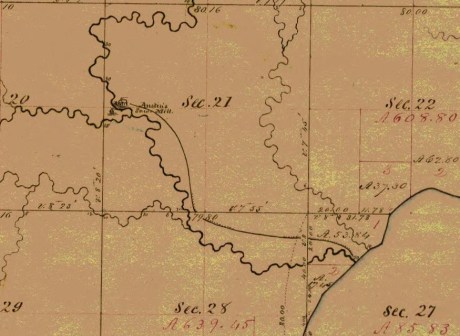
Detail of the “Austrian’s Saw Mill” (formerly the American Fur Company’s sawmill) on Pike’s Creek in the Town of Bayfield, La Pointe County, circa 1852. ~ Wisconsin Public Land Survey Records
Stories about the Austrians’ sawmill and home in Bayfield are shared in Joseph Austrian’s Memoir, and in Benjamin Armstrong’s Memoir.
The town of Bayfield, Wisconsin, was platted shortly thereafter, Marks and Julius Austrian being the preemptors, and Mrs. Julius Austrian the first white woman resident at that place. The history of these enterprising and prominent families, it will thus be seen, falls properly to Wisconsin, but in addition to what has been mentioned, it should be stated that within a few years after 1850 they had established leading stores in Michigan, at Eagle River, Eagle Harbor, the Cliff Mine, Calumet, and at Hancock, Mr. Joseph Austrian having selected at the latter place the site for its first store and warehouse. The Leopolds came from Baden where their name was Freudenthaler; the Austrians, whose name originally was Oesterreicher, came from Wittelshofen, Bavaria. As is obvious, the name in each instance was changed purely for convenience.

Map of the City of Bayfield, La Pointe Co., Wisconsin : Showing the Situation of Lands of Lyman C. Dayton of St. Paul, Minnesota, in and Adjoining the Same, drawn by Wellman and Johnson, surveyors, circa 1856. ~ Wisconsin Historical Society
Sketch Of Edward Kanter.2
There was a young man at Mackinac who in 1846 worked for the parties just mentioned and whose name was Edward Kanter. He had come to Detroit in the fall of 1844 and remained a citizen of Michigan until his death, 52 years later. Always a modest man, he never, in spite of his prominence as a citizen, permitted the publication of his biography and the interesting facts of his career certainly deserve such preservation as the records of this Society afford. They are here set forth for the first time.
Edward Kanter “Photo published in Katz, Irving I. The Jewish Soldier from Michigan in the Civil War. Detroit, Mich.: Wayne State University Press, 1962. Page 8. Kanter served as vice-president of a Detroit soldier recruitment organization and was the first Jewish member of the Michigan Legislature. Added by: Hebrew Heritage Foundation”
~ Findagrave.com
Edward Kanter was related to German Parliamentarian Eduard Lasker (originally Jizchak Lasker).
~ Wikipedia.org
Edward Kanter was born in Breslau in 1824. His father was Louis Kanter, a prosperous linen merchant and a member of the Linen Merchants’ Guild. His mother was Helena Lasker, a near kinswoman of Edward Lasker, the German Parliamentarian, of whose birthplace she was also a native. Young Kanter graduated from the Breslau Gymnasium, equipped among other things with a knowledge of Greek, Latin, German, English, French, and Hebrew. In later years he was often heard to remark that it was his education above all things which helped him out in emergencies. A wild spirit of adventure seized him early in life with the result that he ran away from home and made his way to Paris where his knowledge of the language obtained him employment in a lawyer’s office. Six months later saw him at Havre where, as he was strolling about the wharves, a sudden impulse prompted him to go aboard a vessel bound for New Orleans. He hid behind a coil of rope until well out at sea when he was discovered and at once given a further taste of the rope accompanied by an assortment of curses in several languages. As he was able to turn away wrath with soft answers in all of the respective tongues, it instantly dawned upon the mate at the other end of the rope that he had found a much-needed interpreter for the immigrants of various nations with whom the ship was crowded. The rest of the trip was pleasant sailing for the young stowaway.
The Occident and American Jewish Advocate, Vol. IX. No. 8: Elul 5611, September 1851
——-
“Isaac Hart, Esq., of New Orleans.—We lately intimated that Mr. Hart would be presented with a token of regard from the congregation over which he had been president for several years. The presentation took place on Sunday, the 21st of September, and the following extract from the New Orleans Bee will give our readers all the particulars which have reached us:
Presentation of a Silver Pitcher.— On Sunday last, we were witness of a highly-interesting ceremony. Everybody knows Mr. Isaac Hart, of Canip Street, and most persons are aware that he is an active, zealous, and intelligent member of the German Hebrew Congregation of this city. To his unwearied exertions, his liberality, and his unflagging energy, that Congregation is indebted, in a great degree, for its present prosperity, and for the possession of a spacious and beautiful Temple for the worship of the GOD of Israel. Mr. HART retained the honorable post of President of the Congregation, devoting himself to its welfare, until its leading objects were secured. He then resigned his office, leaving to his successors a noble example of the successful fruits of diligence, religious faith, and indefatigable perseverance.
The members of the congregation, desirous of testifying their grateful appreciation of the efforts of their ex-president, subscribed toward the construction of a massive silver pitcher of exquisite workmanship, having on one side an appropriate inscription, and on the other a beautiful representation of the German Synagogue, and enriched all over with tasteful devices. On Sunday, the officers of the Congregation assembled at Mr. Hart’s residence, and Mr. George G. Levi, on behalf of that body, tendered the pitcher to that gentleman, accompanying the gift with some feeling and eloquent remarks, in which he set forth the valuable services of Mr. Hart, and the high sense of his merits entertained by the association of which he had been selected the interpreter. The donee, in accepting the splendid token, responded warmly and sincerely. He sketched the history and progress of the Congregation, from the days when, obscure and almost nameless, it first struggled into existence, up to the present time, when its members assemble weekly in a noble edifice, consecrated to the Almighty, to solemnize their Sabbath and offer up devotion and prayer to the Most High. He claimed little merit for himself, but said, that like a general in battle, he only led his soldiers, while they had won the victory by their courage and resolution. At the conclusion of the ceremony, the gentlemen and ladies present were conducted by Mr. Hart into another room, where they were entertained with cordial and profuse hospitality.”
On arriving at New Orleans, he found himself with but a single shilling which he gave to be changed to one of the sailors on the ship. The sailor did not return and so the lad landed on the soil of America with literally not a single penny in his pocket. Hardly ashore, he was laid low with yellow fever. He was taken care of by a relief committee of Jewish citizens of New Orleans, among them Mr. Isaac Hart, afterwards a resident of Detroit, a gentleman most kindly remembered by Detroiters. Upon his recovery, the same committee set him to peddling cigars until a congenial place was found for him in a drug store. The place was too congenial; he was much given to chemical experiments, reminiscences perhaps of the Breslau Gymnasium. Presently one of the experiments resulted in a bad explosion of the drug store, from the wreck of which the young scientist rushed terrified to the levee. He went aboard the first boat which happened to need a waiter. Because of his excellent penmanship he was soon promoted to the position of clerk and as such he continued to sail up and down the Red River until one day the boat happened to blow up opposite Helena. He swam ashore, worked his way to St. Louis, took a steamer to Pekin, Illinois, and walked thence to Chicago, where he shipped on the steamer Wisconsin until the close of navigation, 1844. He was now only twenty years of age, but had certainly obtained a few lessons in the larger university of life.
Jewish Virtual Library: Detroit
——-
“German Jews arrived in Detroit in significant numbers in the 1840s. Charles E. Bresler, a settler of the Ann Arbor-Ypsilanti area in the 1830s, moved to Detroit in 1844. He dealt in horses, furs, and wool, and made a fortune importing steel pens. He was one of the incorporators of Detroit’s first Jewish congregation, Temple Beth El. Edward Kanter arrived in Detroit that same year, moving to Mackinac the following year where he was employed by the American Fur Company. Later he worked for the Leopold Brothers, pioneers on the island of Mackinac in the fishery business, and fur traders. Kanter returned to Detroit in 1852 and became Detroit’s first Jewish banker and the first Michigan Jew to serve in the state legislature. Kanter Street is named after him.”
He spent the winter of 1844 in Detroit. The English he had learned at Breslau had always given him trouble, or more properly speaking, had always given trouble to those to whom he spoke, and so he profited by his stay in Detroit to take some lessons from Chas. E. Bresler, a Jewish resident of Michigan, originally from the same part of Europe as Kanter. The ensuing spring saw him again on the lakes, this time as clerk of the steamer Illinois. He left this position, however, taking employment the same year at Mackinac as clerk and interpreter for the American Fur Company, the successor to John Jacob Aster’s venture. Here again his French and English stood him in good stead. His remarkable faculty for languages revealed itself in the rapidity with which he picked up the Indian tongues. In a short time he had mastered the Huron, Chippewa, and Pottawatomie languages and even in later life could on occasion unconcernedly carry on a fluent conversation in any of them. He visited at this time Duluth and the Apostle Islands and was a passenger on the first trip of the “Julia Palmer,” the second boat to be carried on rollers around the Falls at Sault Ste. Marie.
In 1846, as has been stated, he worked for the Leopolds and Austrians. The following year he had been placed in charge of a stock of goods at the island by some eastern parties who suddenly decamped without notice to their creditors. When the latter arrived, they were so impressed by the honesty and zeal wherewith young Kanter had guarded their interests that they voluntarily turned the entire stock and store over to him on easy terms of payment, and so in July, 1847, he opened his books with a cash capital of $200. On these prospects he married a month later the daughter of former State Senator Lyman Granger of the neighboring Bois Blanc Island. He remained at Mackinac until 1852. In that year the late Mr. E. S. Heineman,3 father of the writer, recently arrived at Detroit, was sent to Mackinac to be present at the Indian payment. Mr. Kanter and he immediately became warm friends. The Indians had given Mr. Kanter, because of his bustling activity, the name of “Bosh-bish-gay-bish-gon-sen,” meaning “Fire Cracker,” and Mr. Heineman being somewhat shorter in stature than Mr. Kanter, but of equal activity, was immediately dubbed “Little Firecracker.”
Edward Kanter’s father-in-law was Senator Lyman Granger.
~ Findagrave.com
The red men always had a great liking for Mr. Kanter; they never missed an opportunity to call on him in Detroit or to send greetings to him. The merchants of Detroit in the early 60’s were at a loss one day to account for a circle of Indians gravely squatted in front of Mr. Kanter’s store on the chief business street, Mr. Kanter making one of the circle, the whole company smoking and maintaining a dense silence, until they were informed that a delegation of chiefs on their way to see the Great Father at Washington would not pass through Detroit without smoking a pipe of peace with “Firecracker.”
Julius Austrian also went to Germany during 1853 to liquidate his recently deceased father’s estate, and to bring the rest of his family back to settle upon the Great Lakes. Did Edward Kanter travel with the Austrian family?

German-American Bank, possibly Detroit, circa 1900-1920.
~ Library of Congress
In 1853 Mr. Kanter visited his parents in Europe. On his return he continued his successful business career. He became the founder of the German-American Bank, of which one of his sons continues at present to be a principal officer. He entered actively into political life at about this time. He was elected to the legislature of 1857, and though not a member of the prevailing party, presented and so persistently drove home a minority report on certain wrongdoings in the State treasury that the matter ended with the guilty party’s being sent to prison. He was twice made a candidate for the office of State Treasurer, but being a Democrat, the nomination was against hopeless odds. Mr. Kanter was long and conspicuously connected with the Democratic party organization. In the sixties he was Secretary of the Democratic State Central Committee; he was a delegate to the National Convention that nominated Tilden, for eight years was the member from Michigan of the Democratic National Committee. He was Commissioner from Michigan to the New Orleans Exposition, a member of the Board of the House of Correction of Detroit, and in general a constant and valuable participator in public affairs. He was Vice-President and Treasurer of Congregation Beth El in Detroit in 1855 and an unfailing contributor towards its needs. He died in June, 1896. Respected by all who knew him, he left a name synonymous with strict integrity.

“German American Bank, Detroit. Organized February 3, 1883.”
~ Annual Report of the Commissioner of the Banking Dept
By Michigan. Banking Dept, 1891, page 56.
Detail from Congregation Beth El
by Temple Beth El (Detroit, Mich.), 1900, page 54.
1 Data obtained through the kindness of our fellow-member, Rev. Dr. Jos. Stolz, from Mrs. Julius Austrian (Hannah Leopold), and other members of the Austrian family.
2 Data supplied mainly by Hon. Henry L. Kanter of Detroit, son of Edward Kanter.
3 Farmer’s History of Detroit, Vol. II, p. 1155. The friendship of these two young men, thus meeting on this distant and savage island, was a most natural one. Both had been born in the same year, both had received a superior education in Europe, and both had left homes of comfort and luxury, having been equally unfitted by temperament to endure the political and other conditions then prevailing abroad. Their friendship endured until 1896, being terminated by death, Mr. Kanter surviving his friend only a few days.
An Interesting Family History
February 2, 2015
By Amorin Mello

1856 Colton Map of Prussia and Saxony, Germany (WikiMedia.org).
This is a reproduction of “An Interesting Family History” from The Jews of Illinois : their religious and civic life, their charity and industry, their patriotism and loyalty to American institutions, from their earliest settlement in the State unto the present time, by Herman Eliassof, Lawrence J. Gutter Collection of Chicagoana (University of Illinois at Chicago), 1901, pages 383-386:
The goal of this post is to provide genealogical information about the illustrious Austrian and Leopold families as a companion to the Joseph Austrian Memoir and as a reference for future stories. In this post, we will explore events within and outside of the Chequamegon region for context about this family’s history. We recommend reading this Opinion by Andrew Muchin, director for the Wisconsin Small Jewish Communities History Project, for more information about Jewish immigration to Wisconsin in general. Coming soon to Chequamegon History, we will explore some of Julius Austrian’s adventures and his impact upon the Village of La Pointe, the La Pointe Iron Company of the Penokee Mountains, and the Lake Superior Chippewa.
——-
AN INTERESTING FAMILY HISTORY.
——-
The two families of Austrian and Leopold have been prominent in Chicago for many years. They came to Chicago from the Lake Superior region and formed the Lake Michigan and Lake Superior Transportation Co., engaging in freight and passenger transportation on Lake Michigan and Lake Superior, to Mackinac, Sault Ste. Marie and Duluth and did an extensive business. For a number of years, until recently, their luxuriously furnished passenger boat, Manitou, has been extensively patronized by summer pleasure seekers, who wished to enjoy the cool and delightful climate of the Lake Superior region. The boat was then sold to a company, in which Mr. Nathan F. Leopold still holds the largest interest. Mr. N. F. Leopold is the son of one of the Leopold brothers who settled in Mackinac in the early forties, and were the first Jews in that region. He married a daughter of the late Mr. Gerhard Foreman, who is related to the Greenebaum family, and who was a prominent banker of Chicago, the founder of the Foreman Bros. Banking Co., a. very popular financial institution of today.
The history of this old Jewish family, favorably known as successful merchants in the Lake Superior region and in Chicago, appeared in 1866, in the Portage, Mich., Gazette, and was copied in the American Israelite under date of April 13th, 1866. We believe that the history of this popular and highly respected family will be read with interest by their many relatives and friends, and we therefore publish it here. They were brave, honest and upright business men, and the story of their pioneer life in a sparsely settled region, of their struggles, hardships and ultimate success will serve as an encouraging example for many a young beginner.
Following is their history as we find it in the American Israelite:
A BAND OF BROTHERS.
Dissolution of the Oldest Merchant Firm on Lake Superior – The Leopold Brothers – Sketch of their Operations – A Pioneer History.
Abraham Isaac Oestreicher &
Malka Heule
Falk Austrian
Julius Austrian
Marx Austrian
Babette Austrian
Joseph Austrian
Ida Austrian
Fanny Austrian
Samuel Solomon Austrian
Bernard Austrian
Mina Austrian
Jette H.S.H Freudenthaler
Louis F. Leopold
Aaron F. Leopold
Henry F. Leopold
Samuel F. Leopold
Hannah Leopold
Karolina Freudenthaler
Ascher Freudenthaler
In our last issue we made a brief notice of the dissolution of the well known firm of Leopold & Brothers, doing business in Hancock, Chicago and Eagle River, the oldest business firm on Lake Superior after a successful existence of over twenty years. The firm has been composed of Louis F., Henry F., Aaron F., and Samuel F. Leopold and Joseph, Julius and Samuel Austrian, the latter being the last admitted partner, and not so intimately connected with the history of the firm. From the very inception of business transactions within the wilds of Lake Superior down to the present day, the firm of the brothers has been identified with the struggles, hardships, successes, and all the varying interests of the country, have participated with its good and ill fortunes, many times carrying burdens that less confident competitors shrank from bearing; never once fearing that all would be well in the end, and after gathering a rich reward retired from the field, leaving an untarnished history, and brilliant record as an incentive to their successors.
~ Joseph Austrian Memoir
Louis Leopold + Babette Austrian
Hannah Leopold + Julius Austrian
Henry Leopold + Ida Austrian
Samuel Leopold + Babette Guttman
Joseph Austrian + Mary Mann
Solomon Austrian + Julia Mann
The Messrs. Leopold are natives of the little town of Richen, in the Great Duchy of Baden, Germany, and there received the elementary education which fitted them to become the shrewd and successful merchants they have proven to be. They first began business life as clerks in an ordinary country store, as it may not be inaptly termed, as Richen was but a small place, having a less population than either Hancock or Houghton, here on Portage Lake.
Early in the year 1842, Louis, the elder brother, who has since become the “father” of the firm, left his home to try his fortunes in the New World, with a stout heart, and but a very moderate amount of means whereon to build up a fortune, upon arriving in this country he very shrewdly foresaw that the great West, then but just attracting attention, was the most promising field for men of enterprise and limited capital, and instead of joining in the precarious struggle for position and existence, even so peculiar to the crowded cities of the Eastern states, he at once wended his way to Michigan, then considered one of the Western states.
~ Joseph Austrian Memoir, pg. 9
Early in the year 1843 he opened a small depot for fishermen’s supplies on the island of Mackinac, providing for them provisions, salt, barrels, etc., and purchasing the fish caught, and forwarding them by vessels to better markets. The business could not have been a very extensive one, for when joined by his brothers three years afterward, their united capital is stated as being but little more than $3,000, but which has since been increased by their energy, prudence and foresight, at least one hundred fold.
In the year 1844, Louis was joined by his brother Henry (Aaron and Samuel serving their time in the store of Richen), who for a short time became his assistant at Mackinac. At that time there was but one steamboat plying on the headwaters of Lake Huron and Michigan, the old General Scott, which made regular trips between Mackinac and Sault Ste. Marie.
By the 1850’s the Leopolds, Samuel, Henry, and Aaron, and their brother-in-law Julius Austrian had moved westward from Mackinac into Lake Superior and had settled in the Wisconsin island town of La Pointe, not too far from present-day Duluth. They helped also to found the nearby mainland town of Bayfield. Nevertheless the Leopolds and Austrians were not Wisconsin’s Jewish pioneers; Jacob Franks of Montreal had bought peltries and traded with the Indians since the early 1790’s using Green Bay as his base. The town, the oldest in that part of the country, was strategically located on the water highways linking the Mississippi to the Great Lakes and the eastern tidewater. At first Franks was an agent for a Canadian firm; by 1797 he was on his own. He enjoyed several years of prosperity before the game, the furs, and the Indians began to fade away and before he had to cope with the competition of John Jacob Astor’s formidable American Fur Company. Franks was an innovative entrepreneur. Around the turn of the century he built a blacksmith shop, a dam for water power, a saw and grist mill, ran a farm and began a family of Indian children, before he finally went back to Mackinac and then to Montreal where he rejoined his Jewish wife.”
~ United States Jewry, 1776-1985, Volumes 1-2 by Jacob Rader Marcus, pg. 94
Shortly after his arrival at Mackinac, Henry conceived the idea of going to La Pointe with a small stock of goods, and attending the Indian payment, an enterprise never before undertaken by a trader from below the Sault. At that time Lapointe was a much larger place than it is now, was the principal station of Lake Superior, of the American Fur Company and the leading business point above the Sault. Every fall, the government disbursed among the Indians some $40,000 to $50,000, which before the arrival of the Leopold Brothers found its way almost entirely into the coffers of the Fur Company.
In the latter part of the spring the brothers left Mackinac on the old General Scott, and went to the Sault with their goods, and after much difficulty succeeded in chartering the schooner Chippewa, Captain Clark, to take them to Lapointe for $300. There were but four small schooners on Lake Superior that season, the Chippewa, Uncle Sam, Allegonquin and Swallow. The trip from the Sault to Lapointe occupied some three weeks, but one stop being made at Copper Harbor, which was then beginning its existence. The building of Ft. Wilkins was then going on. Little or no thought of mining then occurred to the inhabitants, and did not until two or three years subsequently.
Arrived safely at Lapointe, they at once opened a store in opposition to that of the Fur Company, and were, much to the surprise of the latter, the first white traders who undertook an opposition trade with the Indians. They sold their goods for furs, fish, etc., and prospered well. In the fall they were joined by Julius Austrian (now at Eagle River) and Louis leaving him with Henry, returned to Mackinac.
Before Minnesota became a territory in 1849 it was for a time part of Wisconsin and Iowa territories. In Minnesota as in most states there was a wave of Jewish pioneers who came early, often a decade or more before some form of Jewish institutional life made its appearance. Jewish fur traders roamed in the territory from the 1840’s on, bartering with the Indians on the rivers and on the reservations. They were among the first white settlers in Minnesota. Julius Austrian had a trading post in Minnesota in the 1840’s and he may once have owned the land on which Duluth now stands. In 1851 in the dead of winter he drove a dog sled team loaded with hundreds of pounds of supplies into St. Paul; his arrival created a sensation.”
~ United States Jewry, 1776-1985, Volumes 1-2 by Jacob Rader Marcus, pg. 100-1
In the summer of 1845 Henry also returned to Mackinac, leaving Julius to attend to the business at Lapointe. He remained in Mackinac until the year 1846, when Aaron and Samuel came out from Germany and joined them at that place. The four brothers at once united their fortunes; in fact in all their business career they do not appear to have thought of dividing them. Everything they had was, from the outset, common property, and each labored for the general welfare. They appeared to have fully understood the truthfulness of the adage, that, in “Unity there is strength,” and however varied and scattered may have been their operations, the profits went into the general fund.
In the season of 1846 Henry and Samuel went to Green Bay, and opened a store in Follett’s block, remained there until early in 1848, but did not succeed as well as they anticipated. Green Bay was then a miserable place in comparison with what it is now, and its growth very much retarded by the grasping policy of the site owners, John Jacob Astor and Mr. Whitney, a brother of the present postmaster. They would not sell lots at anything near what was considered a reasonable figure, and the result was that after many vain endeavors to secure property very many business men left for other places, holding out better inducements for settlement. While at Green Bay, Samuel began the study of the English language, under the tutelage of a young Methodist minister who considered himself liberally rewarded by return instruction in the German language.

“This represents the home of Julius and Hannah Austrian, after their marriage in the spring of 1848. Premises located at La Pointe, Madeline Island, Lake Superior. Resided there 19 years, happy and contented among Indians, Half-breeds and two Missionaries who represented the inhabitants of the island. Photograph taken summer of 1850.”
~ Julius Austrian Papers (Madeline Island Museum)
Solomon Austrian“also went up to La Pointe by advice of brother Julius where he stayed but a short time…”
~ Joseph Austrian Memoir, pg. 76
Early in 1847, Joseph Austrian, the subsequent brother-in-law of the Leopolds, came out from Germany, and joined his brother, Julius, at Lapointe, where he remained until the next spring, when he joined Henry Leopold at Eagle River, who had opened a small store in an old stable, the habitation of one cow. A partition was put up, and about two-thirds of her ladyship’s parlor fitted up for the sale of dry goods, groceries, etc. The shanty stood on the lot now owned by John Hocking, the second from the corner in the turn of the road down to the old bridge across Eagle River.
Was Simon Mandelbaum of Eagle River related to M.H. Mandelbaum of Bayfield?
There was then but one opposition store in Eagle River, that of Messrs. Senter and Mandlebaum, with whom Henry and Joe entered into lively competition for the trade of the place.
The same season Samuel joined Aaron and Louis at Mackinac, where their business had materially increased, and remained there until the season of 1855, when they left and returned to Lake Superior. Louis had previously left and established himself at Cleveland, where he remained until he went to Chicago in the fall of 1862. During this period he acted as the purchasing agent of the brothers on the lake.
Stories about the early days of the Keweenaw copper mining industry are told in the Memoirs of Doodooshaboo (Joseph Austrian).
In the fall of 1855 Samuel started a branch store at Eagle Harbor in a small shanty not more than twenty feet square, situated on the lot now owned by Hoffenbecker, and the shanty now forms a part of his building. At the time there were five mines working in that vicinity, as follows: Copper Falls, S. W. Hill, agent; Northwestern (Pennsylvania), M. Hopkins, agent; Summit (Madison), Jonathan Cox, agent; Connecticut (Amygdaloid), C. B. Petrie, agent.
The Copper Falls and Northwest were the two great mines of the District, the others doing but little beyond exploration at that time.
In 1856 Samuel bought out Upson and Hoopes, who had been doing a good business in the building now occupied by Messrs. Raley, Shapley & Co., and was that season joined by Aaron, who, since leaving Mackinac, had been spending his time with Louis, in Cleveland. Samuel was appointed postmaster at Eagle Harbor, and acceptably filled the office till his departure in 1859.
Julius Austrian advertisements
(Bayfield Mercury, August 22nd, 1857)

The three brothers, Henry, Samuel and Aaron, and their brother-in-law, Jos. Austrian, might now be said to be operating in the same field with the elder brother, Louis, at Cleveland, as their ever wide-awake purchasing agent. For a year or two they prospered as well as they could desire, but the hard times of 1857-8 tried them pretty severely, but by the most adroit management they came through safely. At Eagle River, in 1857, there were four mines at work, the Garden City, Phoenix, Bay State and Cliff. This was after the great silver excitement at the Phoenix, and when the reaction had fully set in. The assessments were grudgingly paid, if at all, and the workmen at the mine that winter were paid in orders on Leopold Brothers, who paid them in goods and currency. To enable the company to get along as easily as possible they took thirty day drafts on the treasurer in Boston, which were paid when due and presented. As the winter passed, the time of the drafts were extended from thirty to sixty, ninety, and finally to one hundred and twenty days, and in the spring, the firm was astonished by a notification that the drafts had gone to protest. The mine then owed them about $20,000, a large sum, especially when it is considered that they were also carrying nearly $10,000 for the Garden City Mine, which was also struggling along like the Phoenix.
The first news received by the public of the protesting of the drafts was communicated by the clerk of one of the steamboats, and created no small amount of excitement, especially among the employees of the mine, who naturally became fearful and clamorous for their back pay. The Leopold Brothers told them to go on and work, and they would be responsible for their pay. This quieted them, and the work of the mine continued as before.
Upon receiving information of the protesting of the Phoenix drafts, Samuel was at once dispatched to Boston to consult with the company about their payment. To secure themselves they could have attached the mining property, improvements and machinery, but such was their confidence in the integrity of the agent, Mr. Farwell, President, Mr. Jackson, and Secretary, and Treasurer, Mr. Coffin, that this was not done. Upon his arrival in Boston, Samuel found that Mr. Farwell had held a consultation with the Directors, and in his most emphatic manner demanded that Messrs. Leopold should be reimbursed the money they had advanced for the mine.
~ The Mining Magazine: Devoted to Mines, Mining Operations, Metallurgy, &c., &c., Volume 2, 1854, pg. 404.
Another meeting was called and Samuel presented a statement of the amount due his firm, and inquired what they intended to do. It was difficult for them to say, and after many long consultations no definite course of action was decided upon. Believing that delays were dangerous Samuel proposed that he and his brothers would take the property in satisfaction of their demand, pay off the Company’s indebtedness, amounting to nearly $10,000, and perhaps pay them a few thousand dollars on the head of the bargain.
Another consultation followed this offer, and it was finally concluded that if a merchant firm considered the property sufficiently valuable to pay therefor nearly $40,000, it must be worth at least that much to the company. Some three thousand shares of Phoenix stock had been forfeited for the non-payment of an assessment of $1.50 per share, and these shares were offered Mr. Leopold in satisfaction of his claim. He, of course, declined, saying he would take the whole property, or nothing. Another consultation was held and a meeting of stockholders was called, an assessment was levied and In a few days enough paid in to liquidate his demands, and he started for home mentally determining that in future the Phoenix should give sight drafts for all. future orders, and that they would no longer assume, or be identified with its obligations. It required no small amount of finesse to make the discouraged stockholders of the Phoenix believe that there was a sufficiently valuable property to further advance $2 or $3 per share on its stock, but the cool offer to take its property for its indebtedness, completely assured them and saved the Messrs. Leopold their $20,000.
But it is said ill fortune never comes singly; and this was true of the affairs of Leopold & Brothers. Samuel had scarcely arrived in Cleveland when Louis informed him that their Garden City drafts had been protested and the same night he hurried on to Chicago to provide security for the indebtedness. Arriving there he did not find the Company as tractable as the Phoenix, and after much parleying found the best they were willing to do was to give him a mortgage on their stamp mill, as security for the $10,000. Very correctly deeming this insufficient, he returned home, and got out an attachment for the whole property of the Company. This had the desired effect, and the claim was secured by a mortgage and the attachment withdrawn. Shortly afterward the mine passed into the hands of a new party of men, with Judge Canton at their head, and in a short time the claim was satisfactorily adjusted.
Julius Austrian, along with Martin Beaser and John W. Bell, attended the New State Convention of Lake Superior to represent La Pointe County ~ Superior Chronicle, August 3rd, 1858.
In 1858, the firm had much difficulty in collecting their orders on the mines in the vicinity of Eagle Harbor, and it was finally determined to sell out their store and build up a business elsewhere. S. W. Hill, Esq., had then left the Copper Falls and assumed the direction of the Quincy Mine here at this place. He foresaw that Portage Lake, possessing as it did so many natural advantages, would eventually become the grand business point or the copper region, and with his accustomed energy began the laying out of the town site now occupied by the village of Hancock. Soon after this was done he wrote to the Messrs. Leopold, urging them to come over and open a store there, but they did not give the offer much consideration that year, as nearly everybody in Keweenaw County ridiculed the idea of Portage Lake ever becoming anything of a place.
That year, however, they sold out their business at Eagle Harbor, and removed to Eagle River, where Samuel was for the second time appointed Postmaster, and their business conducted by him and Jos. Austrian. Their present store site at Eagle River had been previously purchased, and additions annually made to their main building, as their business demanded, until they were of a much greater extent than the original frame.
Aaron Leopold was the first Tyler of the Quincy Lodge No. 135 in Hancock. M.H. Mandelbaum was a member.
In the summer of 1859, Jos. Austrian, who was the building man of the firm, came over from Eagle River to Hancock with Geo. D. Emerson, C. E., and selected a site for their new store, and chose the lots on which now stands the Mason House and the Congregational Church, and the dock front now owned by Little, Heyn & Eytenbenz, but Louis, who came up about that time, changed to the present site, deeming the other too remote from what would be the business center of the town. This was judged from the line of the road coming down from the mine, and the location of the Stamp Mill, around which he naturally concluded the workmen’s dwellings would cluster. In this he was slightly mistaken, though the real difference was unimportant; we give it merely to show how easily the most careful and calculating men may make a mistake.
Transactions of the Grand Lodge of Free and Accepted Masons, of the State of Michigan, at Its Annual Communication, 1861, pg. 71.
After the site was determined upon, building was commenced, but as their faith in the future growth of the place was small, they did not propose to erect a large store, or even construct a substantial cellar underneath. Mr. Hill, hearing of their intention, at once paid them a visit and strongly protested against it. “This is going to be a leading town,” he said, “and I want a good large store, and a stone cellar underneath it.” He carried the day, and a larger building was completed, which two years afterward was too small for the business, even with the addition of a large warehouse for storing additional supplies.
As soon as the building was commenced, Louis began to send up goods from Cleveland, and Aaron came over from Eagle River to take charge of the new business. He scarcely reached here before the goods arrived, and were stored in the building before it was closed in, and he for several weeks had to make his bed on the goods virtually in the open air. As this was in the fall of the year, it was not pleasant, as may be at first supposed. Since then their principal business has been done at Hancock, the old head concern at Eagle River having been a branch.
Additional sources about this festive celebration for the Freudenthaler family in Richen have not been located yet.
In the fall of 1861, Aaron concluded to visit his home in Germany, to attend the golden wedding anniversary of his parents, and Samuel came over from Eagle River to take his place in the store. The celebration of the golden wedding was the grandest event which had happened in the little town of Richen for fully one hundred years, and, probably, will not be equaled in the present century. It would be impossible within the limits of this article to give a full description of the proceedings on that festival occasion, suffice it to say, that all the inhabitants of Richen and the neighboring towns, to the number of full five thousand assembled, and under the guidance of the mayor and municipal officers, for three days kept up a continuous round of merry-making and rejoicing. On the anniversary wedding day a procession over a mile in length waited upon the “happy couple,” and escorted them to the church, where appropriate and imposing services were performed. In the name of his brothers Aaron presented the church with a copy of the Sacred Writings, beautifully engrossed on parchment, which, with its ornamented silver case, cost over $600. All the halls and hotels were opened to the public, where for three days and nights they feasted, drank and danced without intermission and free of expense. The celebration of this golden wedding cost the brothers over $5,000, but which they rightfully considered the grandest event in their history.

In the fall of 1862, Joseph Austrian joined the firm at Hancock, and Louis removed from Cleveland to Chicago, which point they had concluded would soon monopolize the trade of Lake Superior. In the spring of 1864 he commenced a shipping business in that city, and early in the following winter was joined by Jos. Austrian, and the purchase of the propeller Ontonagon effected, and a forwarding and commission business regularly organized. Lately they have purchased the light-draft propeller Norman, intending it to run in connection with the Ontonagon.
While this was the end of Julius Austrian’s presence at La Pointe, he was still attached to the region for the remainder of this life by social ties and legal affairs. Julius eventually moved to St. Paul and became President of the Mount Zion Temple.“The Austrians retained their generous spirit even after moving to St. Paul for it was on a mission to the poor with a cutter full of good things to eat that Mr. Austrian was run over by a beer wagon (we don’t have them nowadays) and killed.”
~ The Lake Superior Country in History and in Story by Guy M. Burnham, 1996, pg. 288As aforementioned, Moses Hanauer was son to Moritz Hanauer, elementary educator of the Leopold brothers in their hometown of Richen. Moses’ brother-in-law was Henry Smitz of La Pointe.
In 1862 their branch house at Lapointe was given up, and Julius Austrian returned to Eagle River, and, in connection with Solomon, conducted the branch at that place. The firm now is composed of Solomon and Julius Austrian and Moses G. Hanauer, who for several years has acted as bookkeeper for the firm, under the firm name of S. Austrian & Co. The Hancock firm is composed of H. F. Leopold, Joseph and Solomon Austrian, under the title of Leopold, Austrian & Bro. The Chicago firm is composed of L. F. Leopold and Joseph Austrian, under the name of Leopold & Austrian. Mr. S. F. Leopold will return to Germany, upon the opening of navigation, and spend a year in pleasure and relaxation, which he certainly merits after twenty years constant labor. Aaron will remain here during the coming summer, and in the fall will go below and establish a wholesale business in Detroit, where it is probable he will be joined by Samuel after his return from Europe.
“CHICAGO AND LAKE SUPERIOR LINE.
This line is owned in Chicago, but is included in our list with other lines plying between Michigan ports. Those enterprising and well known gentlemen, Leopold & Austrian, for many years proprietors of this line, have consolidated their navigation interests with those of the Spencer, Lake Michigan and Lake Superior Transportation Co., their boats running between Chicago and Duluth, touching at all intermediate ports in Illinois, Michigan and Wisconsin. The steamers are the Peerless, J. L. Hurd, City of Duluth, City of Fremont and barge Whiting.”
~ Tackabury’s atlas of the State of Michigan : including statistics and descriptions of its topography, hydrography, climate, natural and civil history, railway and steam boat history, educational institutions, material resources, etc. (1884), pg. 23Louis F. Leopold and his sons, Asa F. and Henry F. Jr, started the first mercantile house in Duluth in 1869. Asa and Henry were the first Jewish residents in Duluth and enjoyed success as prominent businessmen.
That the Messrs. Leopold have been more than ordinarily successful in their mercantile career of over twenty years is made evident from the extent and variety of their business transactions within the past five years, and the very large amount of capital required to carry it on successfully and properly. We feel confident that the joint capital of $3,000, with which they commenced business in 1843, had been increased one hundred times by the close of the past year, and we should not be surprised if it had augmented even more than that. It has been the result of no particularly good fortune, but of persistent application in one direction, and the only exception to the ordinary course of operation which can be said to have contributed to their success, has been the remarkable unity which has pervaded all their business transactions, whether located at Mackinac, Green Bay, Lapointe, Eagle River, Cleveland, Eagle Harbor, Portage Lake or Chicago, each member of the firm has labored, not for his benefit alone, but that of the whole brotherhood.
“S. Solomon Austrian, a merchant from the copper country of Upper Michigan married Julia R. Mann, ten years his junior and not yet out of school, of Natchez, Mississippi, about 1866. Their first home was in Hancock, Michigan. In writing of her mother at a later time, Delia describes the young wife’s inexperience as she entered this strange new country, and the difficulties she had learning homemaking from her pioneer neighbors, along with her fear of Indians. Here, their first child, Bertha, was born. After two years of residence, they moved to Cleveland. In 1870, a son, Alfred S., was born in Chicago, but there is no evidence to show they were residents of that city at the time. However, they were still living in Cleveland in 1874 when twin daughters, Celia and Delia, were born.”
~ Guide to the Celia and Delia Austrian Papers 1921-1932, Special Collections Research Center, University of Chicago Library.
And at this partial termination of their active associations, it is with a pride which but few firms experience after so long connection, they can say that in all their twenty years’ relation with each other there has never been a disagreement to mar the harmony and unity of their operations. Whatever has been done by one, even though it did not result as anticipated, has met with the immediate sanction of the others, who had unlimited confidence in the integrity of his intentions to benefit them all. Until now there has been no division of the accumulated profits; all has been placed in one general fund, from which each has drawn as the wants or exigencies of their business demanded. Neither of them have indulged in any private outside investments or speculations, the profits of which has resulted to his own pecuniary benefit. Profit and loss has been shared alike by them all. Such unanimity of action is very rarely to be met with, especially In these modern days of “every man for himself and the devil take the hindmost,” and is, therefore, the more commendable. Although nominally dissolved, at present, we are of the opinion that after S. F. Leopold has returned from his vacation in Europe the old order of things will again prevail, for, after such a lengthy and intimate association, it will be difficult for either of them to operate independent of the rest, after such a practical verification of the truthfulness of the adage on which they founded their business existence, that “In union there is strength.”
We also copy the following letter, which, in our estimation, forms a part of and belongs to the history of the Leopold family. We understand that the son of whose birth the writer of the letter to the “Israelite” speaks, was the first Jewish child born in the northern region of Michigan:
Chicago, July 18, 1863.
Editor of The Israelite:
I have just now returned from Lake Superior, where I have found all my brothers and friends and the readers of The Israelite and Deborah in perfect good health. I cannot refrain from giving you a little history of a very noble act, the fruit of which in hereby enclosed, being a draft for $30, which you will please to appropriate to the purpose for which it has been destined, namely at a Berith which took place on a child of my brother at his house in Hancock, Lake Superior. After about forty participants had done justice to a very luxurious dinner, with the permission of Mr. Hoffman of Cleveland, the operator, a motion was made that the saying of grace should be sold, and the proceeds appropriated to some charitable purpose, whereupon Brother Samuel made an amendment that the proceeds should be sent to Dr. Wise of Cincinnati, to be appropriated by him for the monument to be erected for Dr. Rothenhelm; the sheriff, Mr. Fechheimer, seconded the motion, and the same was unanimously carried. Brother A. F. was the last bidder with $30, consequently he was the lucky purchaser, and bestowed the honor on your humble correspondent.
The act is worth imitating, and if you think it worth mentioning you may give it publicity in The Israelite and Deborah.
Yours truly,
L. F. Leopold.
 Chequamegon History