19th-Century Deer in the Headlights
January 18, 2015
By Leo

Deer Hunting by Torchlight in Bark Canoes 1846-1848 by George Catlin (Smithsonian American Art Museum)
Chequamegon History doesn’t usually deal with current events, preferring to stay in the 18th and 19th centuries, but I heard a radio program last week that prompted me to dig out some old sources related to a timely topic: off-reservation deer hunting at night by the Lake Superior Chippewa bands.
The State of Wisconsin’s January 7th, 2015 decision to appeal a lower-court decision in favor of Chippewa off-reservation night hunting prompted an edition of Wisconsin Public Radio’s Central Time on the topic that aired later that afternoon. The Ojibwe case in favor of night hunting is briefly, but thoughtfully, presented by the hosts, by Brandon Thoms for the Lac du Flambeau Band and by Richard Monette, Director of the Great Lakes Indian Law Center at UW-Madison.
Though Monette and Thoms touched briefly on the historical and ethical role in Ojibwe communities, the program wasn’t long enough for them to go into much depth. Since night hunting is something that brings controversy, and with it misinformation, I am hoping these historical documents can help promote three points of understanding among those of us who live in the ceded territory of the 21st century.
1. Ojibwe hunters used bright light as a means to harvest deer at night long before the creation of the current reservations.
2. Hunting at night was historically an efficient and effective means of obtaining food.
3. Controversy over the ethics of “shining” stems more from differences in historical and cultural hunting values than on real environmental values and sustainable practices.
“Modern” Technology
In Northern Wisconsin, the idea of night-hunting deer is often associated with the term “shining.” Often used pejoratively, the word tends to conjure up the image of hunters shooting deer out the windows of mud-covered trucks equipped with high-powered electrical spotlights.
Since deer tend to freeze in place when bright light is shone in their eyes, this makes it possible to get close enough to make an accurate shot in darkness. I’ve heard the argument that “shining” relies on modern technology and therefore isn’t fair to the deer.
However, this argument isn’t true. North American hunters used bright light as a means to harvest deer long before the invention of electric spotlights. An 1804 journal entry from the British-Canadian fur-trader George Nelson explains how it worked. Nelson, a teenager trading on the Chippewa River under Simon Charette for the XY Company, participated in such a hunt with his Ojibwe companions just south of Clam Lake. This entry appears on page 158-160 of the 2002 Minnesota Historical Press Edition of the Nelson journals, edited by Laura Lynn Peers and Theresa Schenck:
Monday 29th [May 1804] Sorel & I go to get our small canoe that we left above in this small river not being able to bring it down with our fish upon our backs the river being too rapidous. As soon as we arrived at our camp we set off & encamped at a small portage not very distant. We had no sooner carried our things across the Portage, then I embarked with the indian to hunt deer to night with a Candle[*]. We ascended the river about 2 leagues further than our encampment where we seen a large Buck which we frightened away by sneezing – : However at dusk we light our candle & about an hour after hearing something puddling in the water we let ourselves drift ’till within 8 or ten yards when we found it to be several deer, the indian wounded one & the others immediately run off – we debarked & seen much blood having our candle, dispairing however of finding it we reembarked – but misfortunately we upset our canoe just getting in, consequently our candle not being well secured fell over board & a terrible shower of rain falling just at this momment obliged us to shelter ourselves under a large pine (Epinette) ’till next morning when after some search we found the deer dead – We returned to our people [–& then continued our course up this same river]
At the end of this journal, Nelson added the following (in footnote on same pages of the published edition):
*(To Page 29 – May 29th) The indians from about the 15th of May ’till about the 20th of August kill a great number of deer every night by this means, the skins of which they gather & sell or trade them in the fall with the traders – The means they employ are these, they raise about 4 foot long of pine, elm, or any other strong bark which they double in such a manner as to make the lower part serve as a shelf & upon this the Candle rests, while the rest or upper part off the bark serves as a kind of screen behind which they set unperceived; for the candle that is upon the lower part of the shelf does not leave any part of the canoe visable for it is fastened to the bow of the canoe between the first bar & the curve – it is tied fast & high enough to put the Gun under below. When there is any deer (for they never fail coming every night to the borders of the small lakes & rivers where they eat weeds & remain in the water on account of the muskatas that are no less numerous than troublesome) it is easily known; for indians in General have as sharp an ear as their sight; & can tell where to direct when he hears the least puddling in the water. The deer whenever they see a light of this kind never stir but keep looking upon it ’till sometimes they are not more than three yards distant when the indian shoots them with shot, but if the least noise be made, by striking upon the canoe or its bars, sneezing, caughing, or even by touching your paddle upon a stone or stick in the bottom of the river they scamper off immediately…
And in a later consolidation of his journals, he added this to the account:
…At another place, a young indian & I went out to hunt deer. We made a Candle by chewing tallow, of which we had plenty & wrapped over a piece of cotton shirt as a wick, & placed it conveniently in the bow of the Canoe, where a screen had been erected with a piece of Spruce bark so large as to completely cover the indian, yet so as he could see what was going on before. We saw Several Deer. At dark, we drifted down -frightened off one party of deer. We soon found another, who attracted by the Candles, kept staring upon it alone: we drifted slowly only the lad shot one, & off the others ran…
Similar accounts can be found in other sources, and it seems this method of hunting was widespread and the most common way to hunt deer in spring and summer. The practice almost certainly predates the arrival of whites in the Lake Superior country, and hopefully these journals can put to bed the idea that night-hunting only became possible with the advent of electricity.
The Sport in Shining

Sir Edward Robert Sullivan, 5th Baronet, as depicted by Carlo Pelligrini for Vanity Fair in 1885 (National Portrait Gallery; London)
Some criticism of night hunting comes from the idea that it is too easy, and therefore, not sporting or fair to the deer. An 1850 account from the St. Croix River near present-day Gordon shows some of this sentiment. Sir Edward Robert Sullivan Bart., an English noble came here during a trip throughout the Americas described in the 1852 work, Rambles and Scrambles in North and South America. Although it comes two years before Carl Scherzer’s account of La Pointe (translated into English for the time first here on Chequamegon History) the Brule and the St. Croix, Rambles and Scrambles is not nearly as interesting as the German work. Sullivan took the same route to Stillwater, and even engaged the same La Pointe voyageur (Souverain Denis) as a guide, but the work is generally disappointing. Rather than Scherzer’s curiosity and deep ethnographic detail, Sullivan’s text is largely filled with the haughty superiority one might expect from the most stereotypical Victorian gentleman colonialist.

pg. 76

pg. 77
This account of Ojibwe hunting contrasts humorously with Sullivan’s earlier account from the lakeshore (probably near Sand Bay) of his own attempt at hunting the Northwoods:

pg. 67

pg. 68
The image of the pompous British gentleman hunter walking in panicked circles, is made all the more hilarious by the fact that one of his companions would do the exact same thing the next evening at Iron River. One imagines the thoughts going through the minds of the Ojibwe-French mix-blood guides as they had to rescue two mighty Zhaaganash sportsmen out of the woods in two days.
And that brings me to my point. As hard as it may be to admit, much of the prevailing American conservation ethic comes from this British notion of hunting for sport. This comes from a time in Europe when hunting was forbidden to the common people. A peasant might be arrested for poaching a deer to feed his family, while the gamekeepers kept the forests preserved so men like Sullivan could bring home trophies. In such a viewpoint, something like shining might be condemned for being too easy, effective, and unromantic.
On the other hand, the Ojibwe husband and wife on the St. Croix were not looking for a splendid evening of recreation. They needed venison to feed the village. It didn’t matter if it was summer and the buck’s antlers weren’t as impressive as they might get in November. Hunting was necessary work for survival, and it was done using the most efficient and effective means possible. In describing the Ojibwe idea of the afterlife five years later in 1855, the German ethnographer Johann Kohl writes:
…But, even if we wished to represent the buffalo-covered prairies as a paradise for the hunter, it is still questionable to me whether hunting forms a material feature of the Indian paradise. To us Europeans hunting is more or less an amusement, but to the Indian it is a toil, and frequently a most fatiguing mode of life. In many Indian dialects the words “hunter” and “hunting” are synonymous with “work” and “working.” A good hunter is a clever and industrious workman. As, then, the idea entertained by most nations of paradise is, that it will be without toil or labour, it is to me more than doubtful whether they regard the chase as an element of their paradisiac existence. Among the Ojibbeways I never heard that they held such a view. I once asked a man of their tribe, who was describing paradise to me, and did not at all allude to hunting, “And then you will go every day to hunt and kill a countless number of animals?” “Oh no!” he replied, dryly, “there is no hunting or labour in paradise (212-13).”
I would argue that most deer hunters in Northern Wisconsin today, both Native and non-Native, derive food, pleasure, and a sense of tradition from hunting. However, the relative importance of each can vary greatly from hunter to hunter in both communities.
I know many white hunters who hunt mainly to fill the freezer rather rather than for sport, and with it, there is a certain conservation ethic that has descended from those peasant poachers. In this viewpoint, you respect and value the lives of animals because they gave their lives to keep you alive, not because you came up with some convoluted “sporting” method of harvesting them. The ethics that would have you break the law to keep and eat a dying undersized fish aren’t the same ethics of the Teddy Roosevelts and Ernest Hemingways of the world, but they are conservation ethics nonetheless.
In my mind, these two viewpoints on the role and purpose of hunting are central to the debate over “shining,” and I think examination of history might find Ojibwe and non-Ojibwe residents of the ceded territory having more in common with each other than they do with Scott Walker and his Deer Czar.
Environmental Impact of Night Hunting
While on the subject of conservation, it is worth looking at whether or not night hunting is bad for the environment. Let’s put aside for a minute the fact that the off-reservation night harvest would be minuscule compared to the regular Wisconsin deer hunt or the amount of deer who die at night after being inadvertently “shined” on the highways. And let’s forget for a minute how “divide and conquer” politicians in the eighties used the environment as red herring to turn whites and Indians against each other over the issue of spearfishing or how the walleye populations in the ceded territory are kept up in large part by tribal conservation efforts. Finally, let’s stop puzzling over how Native people managed to survive on this continent for tens of thousands of years before whites came to teach them how to manage resources. Yes, let’s forget about those things and go back to the historical record.
If Nelson’s journals show that hunting out of a canoe by torchlight was well established at the outset of the 1800s, and Sullivan’s Rambles and Scrambles, show it being used at mid-century, we can close out the 19th century with an account from Minnesota.
Reverend Joseph Gillfillan, was a Christian missionary to the Ojibwe people in the areas around Red, Cass, and Leech lakes. In an 1895 letter to the Minnesota Forestry Department and a subsequent article, The Ojibways in Minnesota, presented in 1896 and published in 1901, we hear a familiar story.
Gillfillan doesn’t describe the Lake Superior Chippewa cessions, specifically, but it shows that Ojibwe hunters continued to night at hunt, by canoe, on off-reservation ceded territory:


pg. 100
This account, well into the reservation period, is highly critical of Ojibwe hunting techniques. In it, we see parallels to the earlier elite European hunting ethic and today’s concerns over shining. However, we must remember that the goal of Christian missionaries at that time was not only spreading Christianity but also the assimilation of Native people into white culture. Gillfillan sees success at hunting as an impediment to the settled agricultural life he desires. “The Great Spirit always provid[ing] for their wants,” is a direct threat to his mission. So, rather than admit that maybe the increasing deer population was due to sustainable hunting practices, he tries to come up with outside explanations while condemning the hunt as wasteful.
Changing the Narrative
In presenting these historical documents, I’m not necessarily trying to convince people to change their views on off-reservation night hunting. However, I do want people to have their facts straight. The use of bright lights at the bow of a canoe was a traditional Ojibwe technique for hunting deer long before the land was ceded, and it continues to be to this day.
In my opinion, whether it is a wooden torch or a battery-powered flashlight shining at the deer is immaterial. It serves the same ends.
I don’t expect this to end the conversation on night hunting. I didn’t bring up the safety argument, which is a key part of the State’s opposition (though the DNR has sanctioned other types of night hunting with firearms). I will say, however, that despite its widespread use, I haven’t found any examples of the torch technique being dangerous (unless you count George Nelson capsizing his canoe). I will post one if I come across it.
So, as the ethics of “shining” continue to be debated, I call on those of both sides of this argument to examine where their personal conservation ethics come from. Is hunting primarily for sport or food? How traditional is night hunting, and how sustainable is it? Finally, how have those in power used similar issues in the past to divide different groups of hunters and fishermen, and what motives do they have for doing so?
Think about it.
~LF
~~~~~~~~~~~~~~~~~~~~~~~~~~~~~~~~~~~~~~~~~~~~~~~~~~~~~~~~~~~
While I can’t promise this post will lead to more writing from Leo anytime soon, Chequamegon History will keep producing! Amorin Mello has agreed to contribute a series of articles related to the original land claims, frauds, and mining operations in the Penokee Mountains. For a fascinating preview of what’s coming, check out 0:37-1:24 of this video clip from Indian Country Television’s coverage of the recent Penokee conference at Legendary Waters in Red Cliff. Thank you Amorin for this outstanding research, for the upcoming posts, and for giving Chequamegon History its first mention on TV!
Sources
Gilfillan, Rev. Joseph A. The Ojibways in Minnesota, Collections of the Minnesota Historical Society, Vol. 9 (St. Paul: Minnesota Historical Society, 1901) 72.
Kohl, J. G. Kitchi-Gami: Life among the Lake Superior Ojibway. St. Paul: Minnesota Historical Society, 1985. Print.
Minnesota. Forestry Commissioner. Forestry. Annual Report. N.p.: n.p., 1895. Print.
Nelson, George, Laura L. Peers, and Theresa M. Schenck. My First Years in the Fur Trade: The Journals of 1802-1804. St. Paul, MN: Minnesota Historical Society, 2002. Print.
Sullivan, Edward Robert. Rambles and Scrambles in North and South America. London: R. Bentley, 1852. Print.
Reconstructing the “Martell” Delegation through Newspapers
November 2, 2013

Symbolic Petition of the Chippewa Chiefs: This pictographic petition was brought to Washington D.C. by a delegation of Ojibwe chiefs and their interpreter J.B. Martell. This one, representing the band of Chief Oshkaabewis, is the most famous, but their were several others copied from birch bark by Seth Eastman and published in the works of Henry Schoolcraft. For more, follow this link.
Henry Schoolcraft. William W. Warren. George Copway. These names are familiar to any scholar of mid-19th-century Ojibwe history. They are three of the most referenced historians of the era, and their works provide a great deal of historical material that is not available in any other written sources. Copway was Ojibwe, Warren was a mix-blood Ojibwe, and Schoolcraft was married to the granddaughter of the great Chequamegon chief Waabojiig, so each is seen, to some extent, as providing an insider’s point of view. This could lead one to conclude that when all three agree on something, it must be accurate. However, there is a danger in over-relying on these early historians in that we forget that they were often active participants in the history they recorded.
This point was made clear to me once again as I tried to sort out my lingering questions about the 1848-49 “Martell” Delegation to Washington. If you are a regular reader, you may remember that this delegation was the subject of the first post on this website. You may also remember from this post, that the group did not have money to get to Washington and had to reach out to the people they encountered along the way.
The goal of the Martell Delegation was to get the United States to cede back title to the lands surrounding the major Lake Superior Ojibwe villages. The Ojibwe had given this land up in the Treaty of 1842 with the guarantee that they could remain on it. However, by 1848 there were rumors of removal of all the bands east of the Mississippi to unceded land in Minnesota. That removal was eventually attempted, in 1850-51, in what is now called the Sandy Lake Tragedy.
The Martell Delegation remains a little-known part of the removal story, although the pictographs remain popular. Those petitions are remembered because they were published in Henry Schoolcrafts’ Historical and statistical information respecting the history, condition, and prospects of the Indian tribes of the United States (1851) along with the most accessible primary account of the delegation:
In the month of January, 1849, a delegation of eleven Chippewas, from Lake Superior, presented themselves at Washington, who, amid other matters not well digested in their minds, asked the government for a retrocession of some portion of the lands which the nation had formerly ceded to the United States, at a treaty concluded at Lapointe, in Lake Superior, in 1842. They were headed by Oshcabawiss, a chief from a part of the forest-country, called by them Monomonecau, on the head-waters of the River Wisconsin. Some minor chiefs accompanied them, together with a Sioux and two boisbrules, or half-breeds, from the Sault Ste. Marie, Michigan. The principal of the latter was a person called Martell, who appeared to be the master-spirit and prime mover of the visit, and of the motions of the entire party. His motives in originating and conducting the party, were questioned in letters and verbal representations from persons on the frontiers. He was freely pronounced an adventurer, and a person who had other objects to fulfil, of higher interest to himself than the advancement of the civilization and industry of the Indians. Yet these were the ostensible objects put forward, though it was known that he had exhibited the Indians in various parts of the Union for gain, and had set out with the purpose of carrying them, for the same object, to England. However this may be, much interest in, and sympathy for them, was excited. Officially, indeed, their object was blocked up. The party were not accredited by their local agent. They brought no letter from the acting Superintendent of Indian Affairs on that frontier. The journey had not been authorized in any manner by the department. It was, in fine, wholly voluntary, and the expenses of it had been defrayed, as already indicated, chiefly from contributions made by citizens on the way, and from the avails of their exhibitions in the towns through which they passed; in which, arrayed in their national costume, they exhibited their peculiar dances, and native implements of war and music. What was wanting, in addition to these sources, had been supplied by borrowing from individuals.
Engraving of Henry Schoolcraft by Wellstood and Peters (Photo credit: Wikipedia)
Martell, who acted as their conductor and interpreter, brought private letters from several persons to members of Congress and others, which procured respect. After a visit, protracted through seven or eight weeks, an act was passed by Congress to defray the expenses of the party, including the repayment of the sums borrowed of citizens, and sufficient to carry them back, with every requisite comfort, to their homes in the north-west. While in Washington, the presence of the party at private houses, at levees, and places of public resort, and at the halls of Congress, attracted much interest; and this was not a little heightened by their aptness in the native ceremonies, dancing, and their orderly conduct and easy manners, united to the attraction of their neat and well-preserved costume, which helped forward the object of their mission.
The visit, although it has been stated, from respectable sources, to have had its origin wholly in private motives, in the carrying out of which the natives were made to play the part of mere subordinates, was concluded in a manner which reflects the highest credit on the liberal feelings and sentiments of Congress. The plan of retrocession of territory, on which some of the natives expressed a wish to settle and adopt the modes of civilized life, appeared to want the sanction of the several states in which the lands asked for lie. No action upon it could therefore be well had, until the legislatures of these states could be consulted (pg. 414-416, pictographic plates follow).

I have always had trouble with Schoolcraft’s interpretation of these events. It wasn’t that I had evidence to contradict his argument, but rather that I had a hard time believing that all these chiefs would make so weighty a decision as to go to Washington simply because their interpreter was trying to get rich. The petitions asked for a permanent homeland in the traditional villages east of the Mississippi. This was the major political goal of the Lake Superior Ojibwe leadership at that time and would remain so in all the years leading up to 1854. Furthermore, chiefs continued to ask for, or go “uninvited” on, diplomatic missions to the president in the years that followed.
I explored some of this in the post about the pictograph, but a number of lingering questions remained:
What route did this group take to Washington?
Who was Major John Baptiste Martell?
Did he manipulate the chiefs into working for him, or was he working for them?
Was the Naaganab who went with this group the well-known Fond du Lac chief or the warrior from Lake Chetek with the same name?
Did any chiefs from the La Pointe band go?
Why was Martell criticized so much? Did he steal the money?
What became of Martell after the expedition?
How did the “Martell Expedition” of 1848-49 impact the Ojibwe removal of 1850-51?
Lacking access to the really good archives on this subject, I decided to focus on newspapers, and since this expedition received so much attention and publicity, this was a good choice. Enjoy:
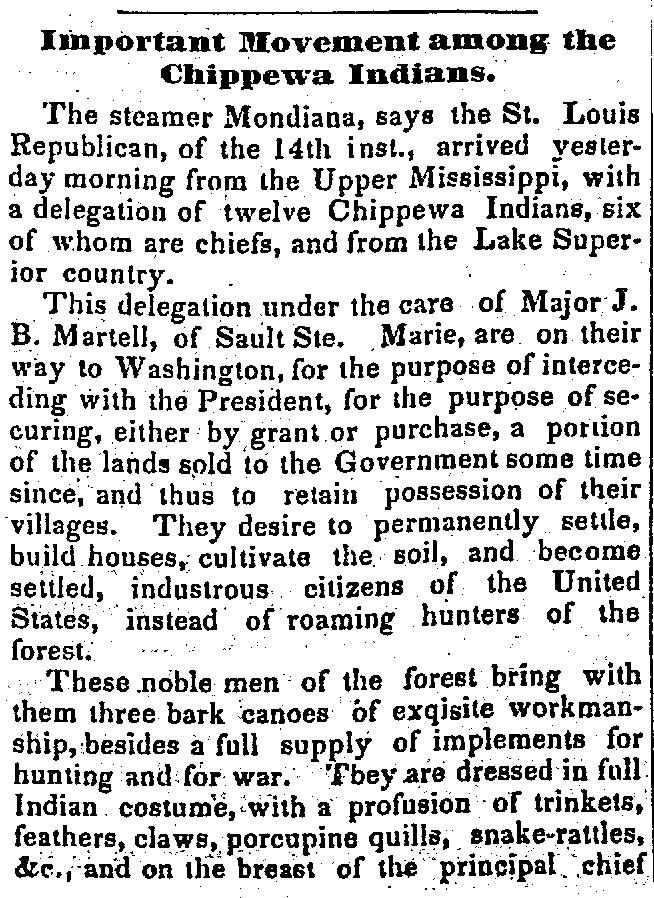
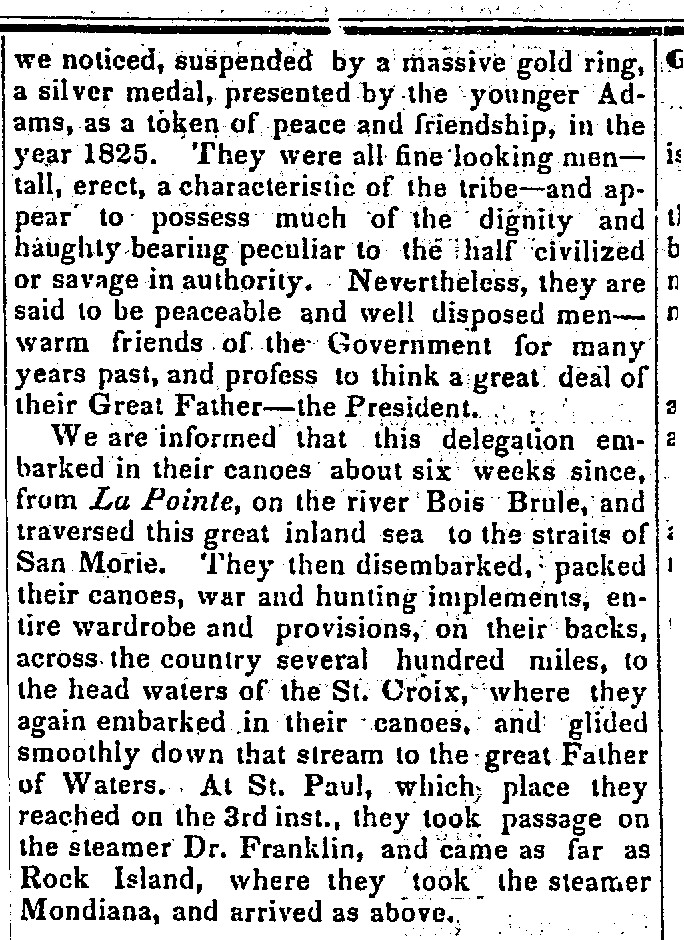
Indiana Palladium. Vevay, IN. Dec. 2, 1848
Capt. Seth Eastman of the U.S. Army took note of the delegation as it traveled down the Mississippi from Fort Snelling to St. Louis. Eastman, a famous painter of American Indians, copied the birch bark petitions for publication in the works of his collaborator Henry Schoolcraft. At least one St. Louis paper also noticed these unique pictographic documents.
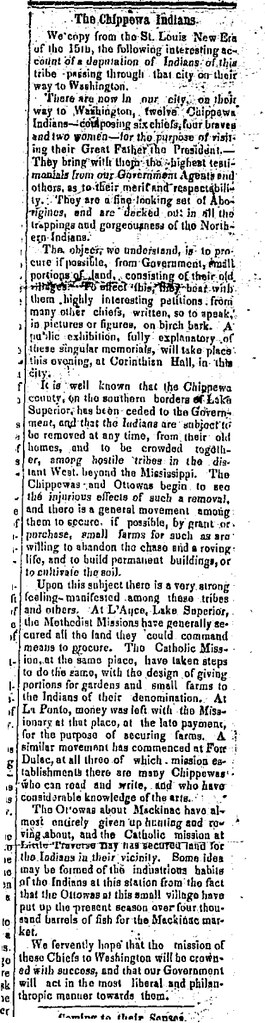 Lafayette Courier. Lafayette, IN. Dec. 8, 1848.
The delegation made its way up the Ohio River to Cincinnati, where Gezhiiyaash’s illness led to a chance encounter with some Ohio Freemasons. I won’t repeat it here, but I covered this unusual story in this post from August.
At Cincinnati, they left the river and headed toward Columbus. Just east of that city, on the way to Pittsburgh, one of the Ojibwe men offered some sound advice to the women of Hartford, Ohio, but he received only ridicule in return.
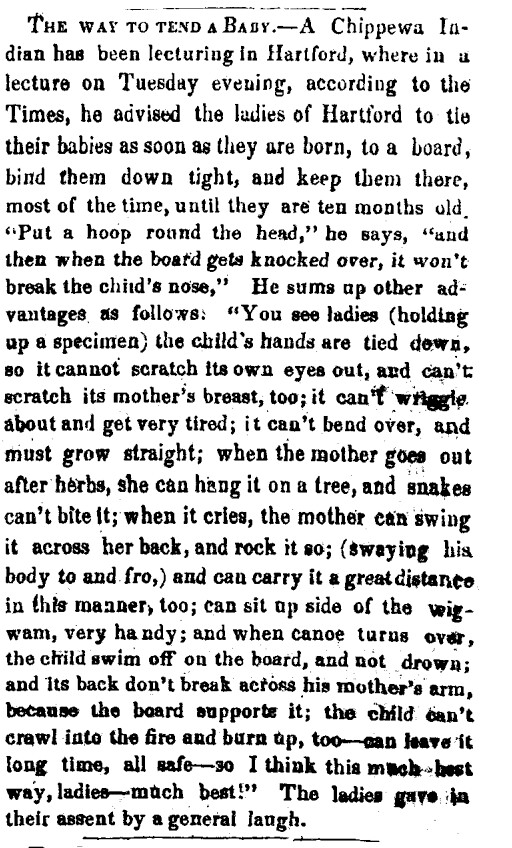
Madison Weekly Courier. Madison, IN. Jan. 24, 1849

It’s unclear how quickly reports of the delegation came back to the Lake Superior country. William Warren’s letter to his cousin George, written in March after the delegation had already left Washington, still spoke of St. Louis:
William W. Warren (Wikimedia Images)
“…About Martells Chiefs. They were according to last accounts dancing the pipe dance at St. Louis. They have been making monkeys of themselves to fill the pockets of some cute Yankee who has got hold of them. Black bird returned from Cleveland where he caught scarlet fever and clap. He has behaved uncommon well since his return…” (Schenck, pg. 49)

From this letter, we learn that Blackbird, the La Pointe chief, was originally part of the group. In evaluating Warren’s critical tone, we must remember that he was working closely with the very government officials who withheld their permission. Of the La Pointe chiefs, Blackbird was probably the least accepting of American colonial power. However, we see in the obituary of Naaganab, Blackbird’s rival at the 1855 annuity payment, that the Fond du Lac chief was also there.
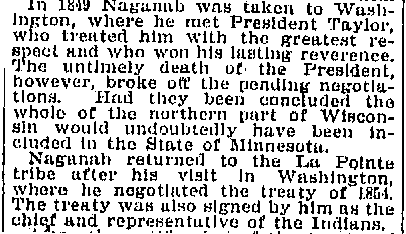
New York World. New York. July 22, 1894
Before finding this obituary, I had thought that the Naaganab who signed the petition was more likely the headman from Lake Chetek. Instead, this information suggests it was the more famous Fond du Lac chief. This matters because in 1848, Naaganab was considered the speaker for his cousin Zhingob, the leading chief at Fond du Lac. Blackbird, according to his son James, was the pipe carrier for Buffalo. While these chiefs had their differences with each other, it seems likely that they were representing their bands in an official capacity. This means that the support for this delegation was not only from “minor chiefs” as Schoolcraft described them, or “Martells Chiefs” as Warren did, from Lac du Flambeau and Michigan. I would argue that the presence of Blackbird and Naaganab suggests widespread support from the Lake Superior bands. I would guess that there was much discussion of the merits of a Washington delegation by Buffalo and others during the summer of 1848, and that the trip being a hasty money-making scheme by Martell seems much less likely.
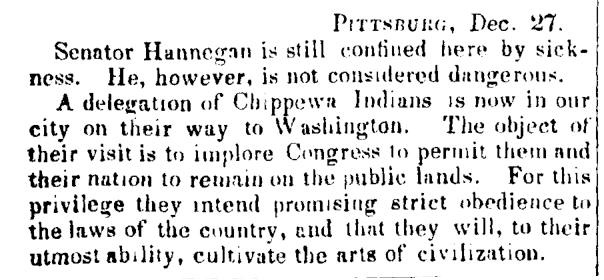
Madison Daily Banner. Madison, IN. Jan. 3, 1849.
From Pittsburgh, the delegation made it to Philadelphia, and finally Washington. They attracted a lot of attention in the nation’s capital. Some of their adventures and trials: Oshkaabewis and his wife Pammawaygeonenoqua losing an infant child, the group hunting rabbits along the Potomac, and the chiefs taking over Congress, are included this post from March, so they aren’t repeated here.
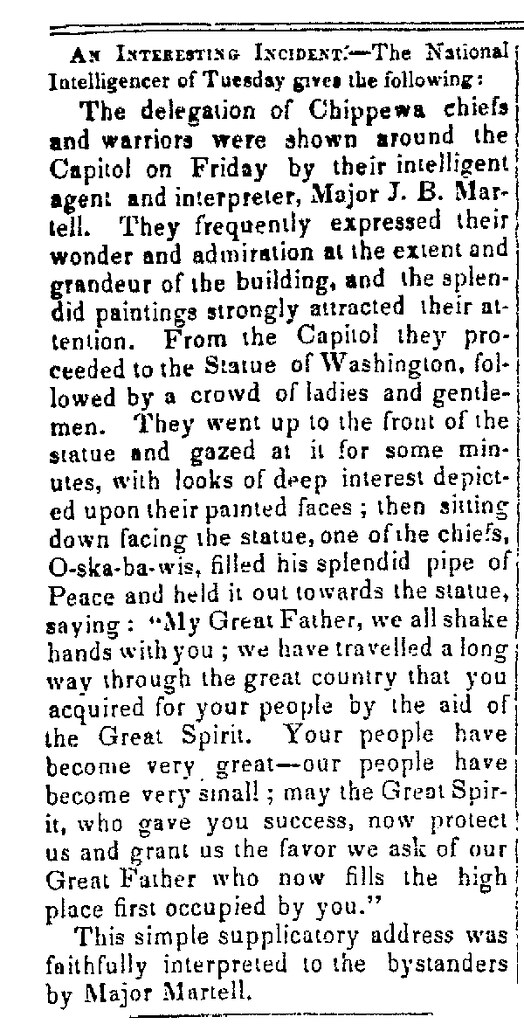
Adams Sentinel. Gettysburg, PA. Feb. 5, 1849.
According to Ronald Satz, the delegation was received by both Congress and President Polk with “kindly feelings” and the expectation of “good treatment in the future” if they “behaved themselves (Satz 51).” Their petition was added to the Congressional Record, but the reservations were not granted at the time. However, Congress did take up the issue of paying for the debts accrued by the Ojibwe along the way.


George Copway (Wikimedia Commons)
Kah-Ge-Ga-Gah-Bowh (George Copway), a Mississauga Ojibwe and Methodist missionary, was the person “belonging to one of the Canada Bands of Chippewas,” who wrote the anti-Martell letter to Indian Commissioner William Medill. This is most likely the letter Schoolcraft referred to in 1851. In addition to being upset about the drinking, Copway was against reservations in Wisconsin. He wanted the government to create a huge pan-Indian colony at the headwaters of the Missouri River.

William Medill (Wikimedia Commons)
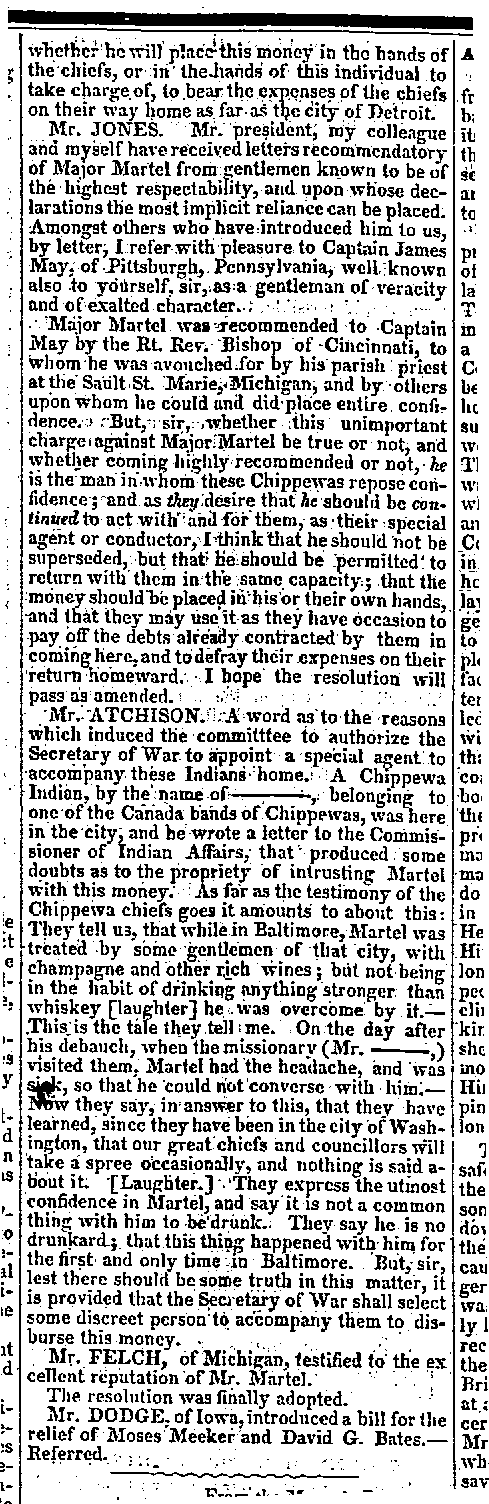
Iowa State Gazette. Burlington, IA. April 4, 1849
~~~~~~~~~~~~~~~~~~
~~~~~~~~~~~~~~~~~~~~~~~~~~~~~~~~~~~~~~~~~~~~~~~~~~~~~~~~~
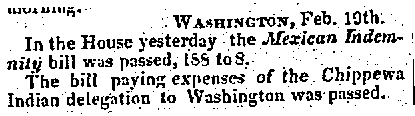 Weekly Wisconsin. Milwaukee. Feb. 28, 1849.
With $6000 (or did they only get $5000?), a substantial sum for the antebellum Federal Government, the group prepared to head back west with the ability to pay back their creditors.
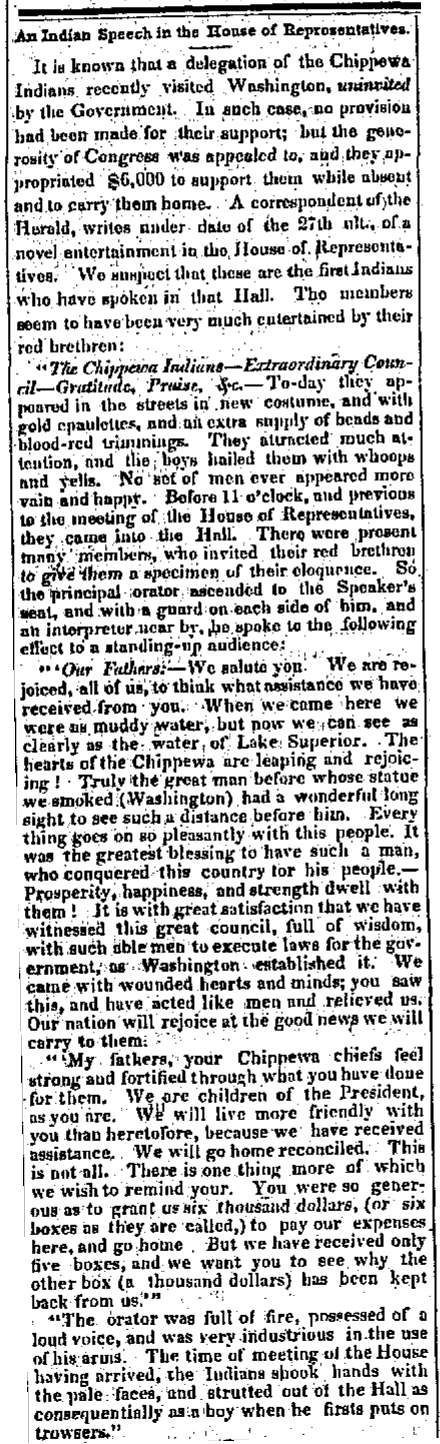
It appears the chiefs returned to their villages by going back though the Great Lakes to Green Bay and then overland.
The Chippewa Delegation, who have been on a visit to see their “great fathers” in Washington, passed through this place on Saturday last, on their way to their homes near Lake Superior. From the accounts of the newspapers, they have been lionized during their whole journey, and particularly in Washington, where many presents were made them, among the most substantial of which was six boxed of silver ($6,000) to pay their expenses. They were loaded with presents, and we noticed one with a modern style trunk strapped to his back. They all looked well and in good spirits (qtd. in Paap, pg. 205).
Green Bay Gazette. April 4, 1849
So, it hardly seems that the Ojibwe chiefs returned to their villages feeling ripped off by their interpreter. Martell himself returned to the Soo, and found a community about to be ravaged by a epidemic of cholera.
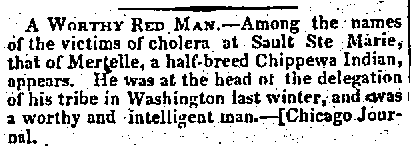
Weekly Wisconsin. Milwaukee. Sep. 5, 1849.
Martell appears in the 1850 census on the record of those deceased in the past year. Whether he was a major in the Mexican War, whether he was in the United States or Canadian military, or whether it was even a real title, remains a mystery. His death record lists his birthplace as Minnesota, which probably connects him to the Martells of Red Lake and Red River, but little else is known about his early years. And while we can’t say for certain whether he led the group purely out of self-interest, or whether he genuinely supported the cause, John Baptiste Martell must be remembered as a key figure in the struggle for a permanent Ojibwe homeland in Wisconsin and Michigan. He didn’t live to see his fortieth birthday, but he made the 1848-49 Washington delegation possible.
So how do we sort all this out?
To refresh, my unanswered questions from the other posts about this delegation were:
1) What route did this group take to Washington?
2) Who was Major John Baptiste Martell?
3) Did he manipulate the chiefs into working for him, or was he working for them?
4) Was the Naaganab who went with this group the well-known Fond du Lac chief or the warrior from Lake Chetek with the same name?
5) Did any chiefs from the La Pointe band go?
6) Why was Martell criticized so much? Did he steal the money?
7) What became of Martell after the expedition?
8) How did the “Martell Expedition” of 1848-49 impact the Ojibwe removal of 1850-51?
We’ll start with the easiest and work our way to the hardest. We know that the primary route to Washington was down the Brule, St. Croix, and Mississippi to St. Louis, and from there up the Ohio. The return trip appears to have been via the Great Lakes.
We still don’t know how Martell became a major, but we do know what became of him after the diplomatic mission. He didn’t survive to see the end of 1849.
The Fond du Lac chief Naaganab, and the La Pointe chief Blackbird, were part of the group. This indicates that a wide swath of the Lake Superior Ojibwe leadership supported the delegation, and casts serious doubt on the notion that it was a few minor chiefs in Michigan manipulated by Martell.
Until further evidence surfaces, there is no reason to support Schoolcraft’s accusations toward Martell. Even though these allegations are seemingly validated by Warren and Copway, we need to remember how these three men fit into the story. Schoolcraft had moved to Washington D.C. by this point and was no longer Ojibwe agent, but he obviously supported the power of the Indian agents and favored the assimilation of his mother-in-law’s people. Copway and Warren also worked closely with the Government, and both supported removal as a way to separate the Ojibwe from the destructive influences of the encroaching white population. These views were completely opposed to what the chiefs were asking for: permanent reservations at the traditional villages. Because of this, we need to consider that Schoolcraft, Warren, and Copway would be negatively biased toward this group and its interpreter.
Finally there’s the question Howard Paap raises in Red Cliff, Wisconsin. How did this delegation impact the political developments of the early 1850s? In one sense the chiefs were clearly pleased with the results of the trip. They made many friends in Congress, in the media, and in several American cities. They came home smiling with gifts and money to spread to their people. However, they didn’t obtain their primary goal: reservations east of the Mississippi, and for this reason, the following statement in Schoolcraft’s account stands out:
The plan of retrocession of territory, on which some of the natives expressed a wish to settle and adopt the modes of civilized life, appeared to want the sanction of the several states in which the lands asked for lie. No action upon it could therefore be well had, until the legislatures of these states could be consulted.
“Kindly feelings” from President Polk didn’t mean much when Zachary Taylor and a new Whig administration were on the way in. Meanwhile, Congress and the media were so wrapped up in the national debate over slavery that they forgot all about the concerns of the Ojibwes of Lake Superior. This allowed a handful of Indian Department officials, corrupt traders, and a crooked, incompetent Minnesota Territorial governor named Alexander Ramsey to force a removal in 1850 that resulted in the deaths of 400 Ojibwe people in the Sandy Lake Tragedy.
It is hard to know how the chiefs felt about their 1848-49 diplomatic mission after Sandy Lake. Certainly their must have been a strong sense that they were betrayed and abandoned by a Government that had indicated it would support them, but the idea of bypassing the agents and territorial officials and going directly to the seat of government remained strong. Another, much more famous, “uninvited” delegation brought Buffalo and Oshogay to Washington in 1852, and ultimately the Federal Government did step in to grant the Ojibwe the reservations. Almost all of the chiefs who made the journey, or were shown in the pictographs, signed the Treaty of 1854 that made them.
Sources:
McClurken, James M., and Charles E. Cleland. Fish in the Lakes, Wild Rice, and Game in Abundance: Testimony on Behalf of Mille Lacs Ojibwe Hunting and Fishing Rights / James M. McClurken, Compiler ; with Charles E. Cleland … [et Al.]. East Lansing, MI: Michigan State UP, 2000. Print.
Paap, Howard D. Red Cliff, Wisconsin: A History of an Ojibwe Community. St. Cloud, MN: North Star, 2013. Print.
Satz, Ronald N. Chippewa Treaty Rights: The Reserved Rights of Wisconsin’s Chippewa Indians in Historical Perspective. Madison, WI: Wisconsin Academy of Sciences, Arts and Letters, 1991. Print.
Schenck, Theresa M. William W. Warren: The Life, Letters, and times of an Ojibwe Leader. Lincoln: University of Nebraska, 2007. Print.
Schoolcraft, Henry Rowe, and Seth Eastman. Historical and Statistical Information Respecting the History, Condition, and Prospects of the Indian Tribes of the United States: Collected and Prepared under the Direction of the Bureau of Indian Affairs per Act of Congress of March 3rd, 1847. Philadelphia: Lippincott, Grambo, 1851. Print.
Sandy Lake Letters: Sherman Hall to the Wheelers
July 11, 2013

“Chippewa Indians Fishing on the Ice” (Digitized by New York Public Library from Heroes and hunters of the West : comprising sketches and adventures of Boone, Kenton, Brady, Logan, Whetzel, Fleehart, Hughes, Johnston, etc. Philadelphia : H. C. Peck & Theo. Bliss, 1859.)
On June 9th, I transcribed and posted two letters related to the Sandy Lake Tragedy (the attempted removal of the Lake Superior Ojibwe in the fall of 1850, which claimed as many as 400 innocent lives). The letters, digitized by the Wisconsin Historical Society, were from the Warren Family Papers. One was from missionary Leonard Wheeler to William Warren before the tragedy, and another was from Indian Agent John Watrous to Warren during a second removal attempt a year later.
That post sought to assess how much responsibility Warren and Watrous bear for the 400 deaths. It also touched on the role of the Protestant A.B.C.F.M. missionaries in the region. This post continues those thoughts. This time, we’re looking at two more letters and evaluating one of the missionaries himself.
Both of these letters are from the Wheeler Family Papers, held by the Wisconsin Historical Society at the Ashland Area Research Center. I went directly to the original documents for these, and while I’ve seen them referenced in published works, I believe this is the first time these particular letters have been transcribed or posted online.
The first is from Sherman Hall, the founder of the La Pointe Mission, to his colleague Leonard Wheeler, who operated the satellite mission at Odanah. Hall traveled to Sandy Lake for the annuity payments and sent this letter to Wheeler, who was visiting family back in Massachusetts, after returning to La Pointe.
Lapointe. Dec. 28th 1850
Brother Wheeler:
I wrote you while at Sandy Lake and promised to write again when I should reach Lapointe. That promise I now redeem. I started from Sandy Lake on the fourth inst. and reached home on the 16th having been absent from home just eight weeks. I was never more heartily glad to leave a place than I was Sandy Lake, nor more glad to reach home after an absence. Of course winter here has justly begun. The snow was some ten inches deep on the Savannah Portage. On reaching the East Savannah River we found the ice good and clear of snow and water. This continued to be the case most of the way to the Grand Portage at Fond du Lac. From Fond du Lac to Lapointe the traveling most of the way was hard, and it was not till the seventh day from F. du L. that I reached home. Besides bad traveling I had to carry a pack which I found, when I got home weighed 60 pounds. With this however I found it not difficult to keep up with most of my traveling companions who were much heavier loaded than I. This is my first experience of carrying a heavy pack on a long journey and I am fully satisfied with the experiment. I had no alternative however, bet either to throw away my blankets and clothes, or carry them. Every body was loaded with a heavy pack, and I could employ no one. I however got through well—did not get lame as many others did, nor do I feel any furious[?] by ill effects of my journey since my arrival.
I found the mission family well on my arrival. They had felt somewhat lonesome while so many were absent from this place. Things in the community here are generally in a quiet state at present. I apprehend that there will be considerable pinching for provisions before spring. It has been a very windy and stormy fall. The people have taken but little fish. Many nets have been lost. The traders have but a small quantity of provisions, and if they had the people have but little to buy with. The bay opposite to this island is now principally covered with ice so that the Indians are on the ice some to spear fish. The ice has once broken up since it first closed, and a heavy wind would break it up again, as it is yet very thin, and the weather mild. If the lake is frozen the Inds will probably get considerable fish; but if it should be open they must suffer.
Our Indian meetings are pretty well attended, and I feel that there is ground for encouragement. Simon I think is exerting a good influence. His Catholic friends have tried to draw him back to their church; but seems stable. His oldest brother, who has recently lost his wife, has expressed a wish to hear the word of God. I hope he will yet become a sincere listener.
Our English exercises are attended by a smaller number than formerly since many have left this place. I think however for our own good, as well as on account of others, we ought to keep them up. Mr. Van Tassel has returned to remain here till spring. I have heard nothing from Bad River for some time past. I had formed a design to go there this week, but have been prevented by the state of the ice. I intend going as soon as the ice gets a little stronger. I suppose there are very few Indians there. More are about the Lake.
I heard that Mr. Leihy has lost both his horses which will be a serious inconvenience to him in this mill enterprise I presume.
Mr. Pulsifer has received one letter from you, and by our last mail he heard through his correspondent at Lowell that you had arrived at that place.
I suppose you find some changes have taken place in the wide world during the times you have been shut up in the wilderness. Do you find calls enough to keep you busy? I have been expecting a letter from you. I want to hear what you have to say about the things you see, and how you like visiting, etc.
I have just had a letter from Mr. Ely, who says, “We are [snugly by quarters?] in St. Paul. My home is full of music—am employed as choir leader in Mr. [Mill’s?] (Prs.) church—sing two evenings a week at Stillwater, and the rest of my time is well filled with the private scholars & tuning Pianos, of which there are 7 or 8 at St. Paul.” Perhaps Br. Ely will find this a more lucrative business than cutting and hauling pine logs. I am glad he has found employment.
Our children all attend school except Harriet. Marydoes very well. Please give my regards to your friends at Lowell. I am writing to Mr. Treat by this opportunity. [Wish?] kind regards to Mrs. W. I remain
yours
S. Hall.
 The Old Mission Church, La Pointe, Madeline Island. (Wisconsin Historical Society Image ID: 24827)
 Harriet Wheeler, pictured about forty years after receiving this letter. (Wisconsin Historical Society: Image ID 36771)
“…your note to Harriet” Harriet Hall was Sherman’s oldest daughter, about 19 years old at this time.
 Many Ojibwe leaders, including Hole in the Day, blamed the rotten pork and moldy flour distributed at Sandy Lake for the disease that broke out. The speech in St. Paul is covered on pages 101-109 of Theresa Schenck’s William W. Warren: The Life, Letters, and Times of an Ojibwe Leader, my favorite book about this time period. (Photo from Whitney’s Gallery of St. Paul: Wisconsin Historical Society Image ID 27525)
 Mary Warren (1835-1925), was a teenager at the time of the Sandy Lake Tragedy. She is pictured here over seventy years later. Mary, the sister of William Warren, had been living with the Wheelers but stayed with Hall during their trip east. (Photo found on University of Connecticut Radio website, scanned from Frances Densmore photos in the Smithsonian Bureau of Ethnology)
Lapointe, Feb. 24th 1851.
Mrs. Wheeler,
By our last mail I wrote to Mr Wheeler, and by this I will address a few lines to you. From your note to Harriet I suppose you are happy among your friends. I am glad you are so, and hope you will not only spend your winter pleasantly, but that you will find the present season of relaxation from the severe duties of your station here, the occasion of reconnecting[?] your health and spirits.
I do not feel that the time has yet come when the churches ought to close their efforts to save these Indians. I do not think they are entirely beyond the reach of hope. The prospect however looks dark. But I think the greatest cause of discouragement arises from their character, and not from their present political condition. Generally they do not want to improve their condition. They are satisfied with their ignorance and degradation. All they think of is to supply for their present wants without their own exertions, while they wish to live in idleness and sin. This is the cause of their keeping so much aloof from the influence of the missions. Their minds are dreadfully dark respecting the things of the future world. They seem to have no ideas of happiness superior to that derives from the gratification of the lowest animal appetites and passions. This is the reason why the truths of the gospel so little effect on them. These things present to my mind much stronger grounds of discouragement than their present political difficulties, though those at present are not inconsiderable.
But as stupid as is the conscience, and as dark as is the understanding and the heart, and as much as they are given up to [?]ality and sin, I believe there is a Power that can quicken them into life. My only hope is that He who has made them, and has power to save them, will come and add his blessing to the preaching of his own gospel, and make it to them the power and wisdom of God. Thousands of others as dead in trespasses and sins, have been saved. Why may not they be saved? Come back home and let us try still to do something for them. Tell Christians to remember them and pray for them, that the word of God among them may have free course and be glorified.
It is a time of great scarcity of food among the Indians. There is some one in our houses almost every hour of the day begging for food. Very few get more than a meal a day; many not half of one. I have been told by several individuals, that they have tried three or four days in succession to catch fish, and have been obliged to return to their starving families each night with nothing for them. I am frequently importuned to spare a little provisions till I am obliged to go away out of sight to get rid of their pleading. I have spared the last potatoes I dare let go. Corn we have none. We have but a small quantity of flour over what will be required to sustain our families till we can expect to obtain a new supply. For a long time I have not known fish so scarce as the present winter. That is almost the only dependence of this people. For a month to come there will be many hungry ones. Many of the French and half-breeds are but little better off than the Indians. All we can do is to divide a little morsel with the hungry ones who come to beg. We have not much to give to those who importune for something to carry to their families. But as long as they continue to waste their summers in idleness they must starve in the winter.
The young Hole-in-the-day has been down to St Paul and there made a public speech in which he attributes the sickness at the payment last fall to the bad provisions which were dealt out to the Indians, and imparts much blame to the officers of the government for the way in which they [were with?]. In time they had some flour dealt out to them which was much damaged. But I think there were other causes for the sickness which prevailed besides the bad provisions. I think however that in some [aspects?] the Indians were wronged. Treaty stipulations were not carried out. H is very confident that many of the Indians are not satisfied with the manner in which they have been dealt with, and recent events have not served to strengthen their attachment to the Government.
We had our communion yesterday. I think there is a [?]ably good state of feeling among the native church members at this time. Simon has been frequently sick this winter. But his trials appear to bring nearer to God. He appears to be growing in the knowledge of God and in piety.
You will probably recollect Mo-ko-kun-ens-ish, an Indian with a bunch[?] between his shoulders, married into the family of the Little-current. He is, by profession, a Catholic. About a week ago, he made me a visit, and said his priest had offended him, and he wished to join us. A short time since he lost a child, and when the priest came to bury it, he said he “scolded him” because he had not cleaned away the snow from the gate of the burying yard, and made a better path for him to come to the grave. He told a long story. I suspected his object was to get some provisions of me. I told him we should be happy to see him at our meetings, and told him where and when they would be held. He said he should attend only sometimes he might be obliged to fish to get something to eat, and be occasionally away. I said a few words to him on religious subjects, and he left without asking for anything. The next day he came with a small piece of cloth and asked me to give him provisions for it. I told I had not provisions to trade. He then enquired about meeting. I told him we were to hold one that evening in the school-house. He said he should attend. The evening came, the meeting was held—but he was not there. Nor have we seen him at any other meeting. Such are the methods the heathens & Catholics take to deceive us. We could make many converts with flour and pork, especially at this time.
Yours Truly,
S. Hall
[Written in margins]
All send love though I have not room to write it.
Mary goes to school and is doing very well.

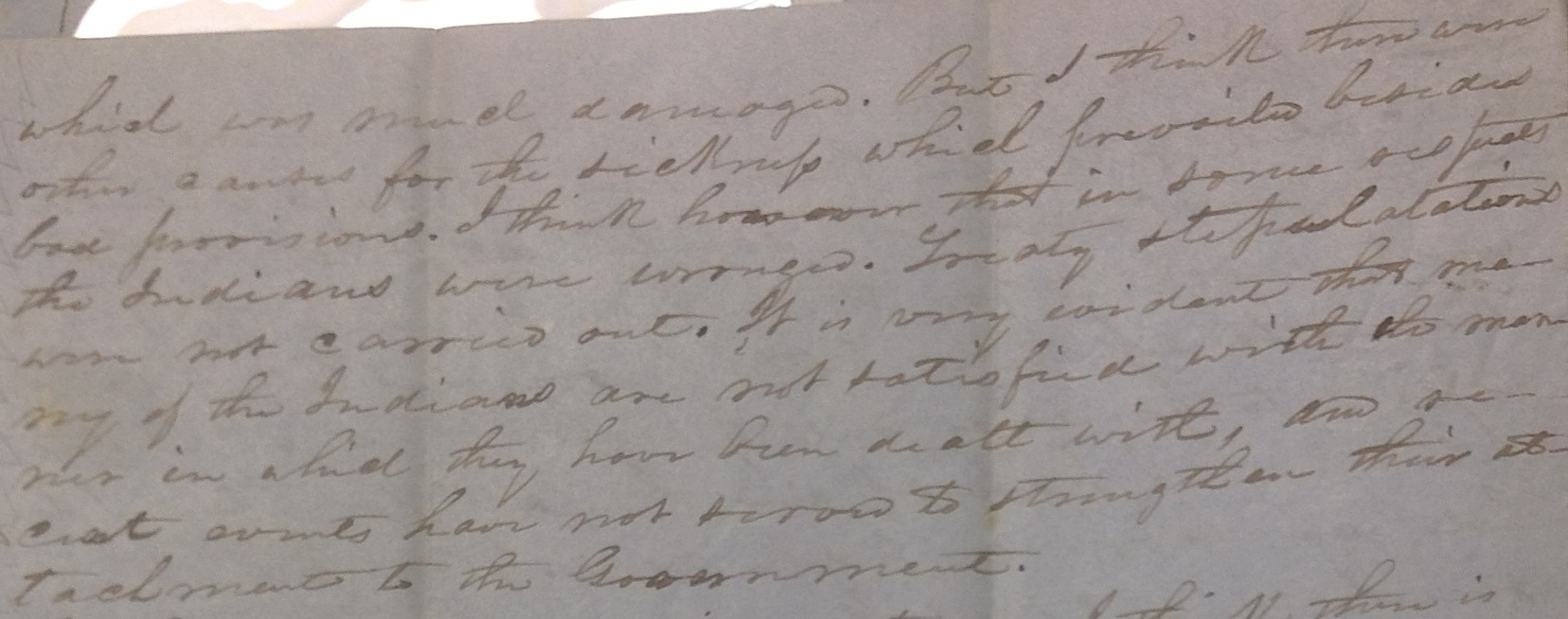
These are the originals of the paragraph about Hole in the Day’s speech in St. Paul. I couldn’t quite decipher all of it. Let me know what you see (Wheeler Family Papers, Personal Correspondence 1851, Wisconsin Historical Society Ashland Area Research Center).
In the June 9th post, we tried to determine how much William Warren and John S. Watrous were at fault for the deaths resulting from the 1850 Sandy Lake removal attempt. In this post, we will do the same for Sherman Hall.
Before we begin, it’s worth reviewing the facts. By 1850, Hall had lived at La Pointe for twenty years. He knew the people who lived here, and he knew the promises the Ojibwe were given at the Treaty of 1842. He was certainly aware of the Ojibwe position on the removal.
Rev. Hall did not order the removal. Compared with the government and Fur Company officials, he was fairly powerless within the Lake Superior region. However, he had a power of a different sort. As the primary voice of the ABCFM in Ojibwe country, he had powerful friends in the eastern states. Many Americans perceived the missionaries as the only neutral voice in the area. Hall admits in the December 28th letter that the Ojibwe were wronged. He could have advocated for their cause in the summer of 1850 as the illegal removal was unfolding. Instead, he largely went along with government efforts.
To his credit, in other letters Hall did blame the government for the failure of the Sandy Lake payment. The best book I’ve encountered about this time period is William W. Warren: The Life, Letters, and Times of an Ojibwe Leader by Theresa Schenck (Nebraska UP, 2007). On page 94, Dr. Schenck quotes a letter from Hall to ABCFM Secretary S.B. Treat. It is dated December 30, and is probably the letter referred to in the letter to Leonard Wheeler above. Hall is honest about Ojibwe feelings on the removal and seems to empathize somewhat. On page 155, Schenck details how the La Pointe mission did eventually turn against government removal efforts later in 1851.
So, it probably seems that I am defending Sherman Hall. Why? Truthfully, it’s because I want to have some balance in this post because, quite frankly, these two letters are some of the most disgusting, horrifying documents I’ve ever read. I felt especially sick typing up the February 24th letter to Harriet Wheeler. For a man who claimed to be “saving” the Ojibwe to be so heartless in the midst of so much suffering is appalling.
Was the mission running low on food? Sure, but doesn’t true Christian charity demand sharing to the last?
Should Hall’s language be judged by the standards of the racist times he lived in? Absolutely, but to say the things he says about human beings, his neighbors of twenty years, is inexcusable in any time period.
Is it possible he was traumatized by his experience at Sandy Lake, and this was a way of dealing with his personal guilt? This is possible. He does seem to be speaking to himself in the letter as much as he is to the Wheelers.
There is a danger in judging too much from just two letters, but I think Hall needs to be held to the same standard as Warren and Watrous were in the June 9th post. He could have spoken out against the removal to begin with. He didn’t. He was an eyewitness to Sandy Lake. He knew what the Ojibwe had been promised, and he saw the consequences of the government breaking those promises. His letters to the Wheelers in Boston could have been used to help right those wrongs by uniting the missions behind the Ojibwe cause. Instead, he chose to blame the people who had been wronged to the point of 400 deaths. For these reasons, I think when we list the villains of Sandy Lake, the Reverend Sherman Hall needs to be among them.
Sources:
Densmore, Frances. Chippewa Customs. Washington: U.S. G.P.O., 1929. Print.
Ely, Edmund Franklin, and Theresa M. Schenck. The Ojibwe Journals of Edmund F. Ely, 1833-1849. Lincoln: University of Nebraska, 2012. Print.
KAPPLER’S INDIAN AFFAIRS: LAWS AND TREATIES. Ed. Charles J. Kappler. Oklahoma State University Library, n.d. Web. 21 June 2012. <http:// digital.library.okstate.edu/Kappler/>.
Satz, Ronald N. Chippewa Treaty Rights: The Reserved Rights of Wisconsin’s Chippewa Indians in Historical Perspective. Madison, WI: Wisconsin Academy of Sciences, Arts and Letters, 1991. Print.
Schenck, Theresa M. William W. Warren: The Life, Letters, and times of an Ojibwe Leader. Lincoln: University of Nebraska, 2007. Print.
Warren, William W., and Theresa M. Schenck. History of the Ojibway People. St. Paul: Minnesota Historical Society, 2009. Print.
Chief Buffalo Picture Search: Introduction
May 26, 2013
Click the question mark under the picture to see if it shows Chief Buffalo.


 ?
?


Buffalo, the 19th-century chief of the La Pointe Ojibwe, is arguably the most locally-famous person in history of the Chequamegon region. He is best known for his 1852 trip to Washington D.C., undertaken when he was thought to be over ninety years old. Buffalo looms large in the written records of the time, and makes many appearances on this website.
He is especially important to the people of Red Cliff. He is the founding father of their small community at the northern tip of Wisconsin in the sense that in the Treaty of 1854, he negotiated for Red Cliff (then called the Buffalo Estate or the Buffalo Bay Reservation) as a separate entity from the main La Pointe Band reservation at Bad River. Buffalo is a direct ancestor to several of the main families of Red Cliff, and many tribal members will proudly tell of how they connect back to him. Finally, Buffaloʼs fight to keep the Ojibwe in Wisconsin, in the face of a government that wanted to move them west, has served as an inspiration to those who try to maintain their cultural traditions and treaty rights. It is unfortunate, then, that through honest mistakes and scholarly carelessness, there is a lot of inaccurate information out there about him.
During the early twentieth century, the people of Red Cliff maintained oral traditions about about his life while the written records were largely being forgotten by mainstream historians. However, the 1960s and ʻ70s brought a renewed interest in American Indian history and the written records came back to light. With them came no fewer than seven purported images of Buffalo, some of them vouched for by such prestigious institutions as the State Historical Society of Wisconsin and the U.S. Capitol. These images, ranged from well-known lithographs produced during Buffaloʼs lifetime, to a photograph taken five years after he died, to a symbolic representation of a clan animal originally drawn on birch bark. These images continue to appear connected to Buffalo in both scholarly and mainstream works. However, there is no proof that any of them show the La Pointe chief, and there is clear evidence that several of them do not show him.
The problem this has created is not merely one of mistaken identity in pictures. To reconcile incorrect pictures with ill-fitting facts, multiple authors have attempted to create back stories where none exist, placing Buffalo where he wasnʼt, in order for the pictures to make sense. This spiral of compounding misinformation has begun to obscure the legacy of this important man, and therefore, this study attempts to sort it out.
Bizhikiwag
The confusion over the images stems from the fact that there was more than one Ojibwe leader in the mid-nineteenth century named Bizhiki (Buffalo). Because Ojibwe names are descriptive, and often come from dreams, visions, or life experiences, one can be lead to believe that each name was wholly unique. However, this is not the case. Names were frequently repeated within families or even outside of families. Waabojiig (White Fisher) and Bugone-Giizhig (Hole in the Day) are prominent examples of names from Buffaloʼs lifetime that were given to unrelated men from different villages and clans. Buffalo himself carried two names, neither of which was particularly unique. Whites usually referred to him as Buffalo, Great Buffalo, or LaBoeuf, translations of his name Bizhiki. In Ojibwe, he is just as often recorded by the name Gichi-Weshkii. Weshkii, literally “new one,” was a name often given to firstborn sons in Ojibwe families. Gichi is a prefix meaning “big” or “great,” both of which could be used to describe Buffalo.

Nichols and Nyholm translate Bizhiki (Besheke, Peezhickee, Bezhike, etc.) as both “cow” and “buffalo.” Originally it meant “buffalo” in Ojibwe. As cattle became more common in Ojibwe country, the term expanded to include both animals to the point where the primary meaning of the word today is “cow” in some dialects. These dialects will use Mashkodebizhiki (Prairie Cow) to mean buffalo. However, this term is a more recent addition to the language and was not used by individuals named Buffalo in the mid- nineteenth century. (National Park Service photo)
One glance at the 1837 Treaty of St. Peters shows three Buffalos. Pe-zhe-kins (Bizhikiins) or “Young Buffalo” signed as a warrior from Leech Lake. “Pe-zhe-ke, or the Buffalo” was the first chief to sign from the St. Croix region. Finally, the familiar Buffalo is listed as the first name under those from La Pointe on Lake Superior. It is these two other Buffalos, from St. Croix and Leech Lake, whose faces grace several of the images supposedly showing Buffalo of La Pointe. All three of these men were chiefs, all three were Ojibwe, and all three represented their people in Washington D.C. Because they share a name, their histories have unfortunately been mashed together.
Who were these three men?

Treaty of St. Peters (1837) For more on Dagwagaane (Ta-qua-ga-na), check out the People Index.
The familiar Buffalo was born at La Pointe in the middle of the 18th century. He was a member of the Loon Clan, which had become a chiefly clan under the leadership of his grandfather Andeg-wiiyas (Crowʼs Meat). Although he was already elderly by the time the Lake Superior Ojibwe entered into their treaty relationship with the United States, his skills as an orator were such that by the Treaty of 1854, one year before his death, Buffalo was the most influential leader not only of La Pointe, but of the whole Lake Superior country.
Treaty of St. Peters (1837) For more on Gaa-bimabi (Ka-be-ma-be), check out the People Index.
William Warren, describes the St. Croix Buffalo as a member of the Bear Clan who originally came to the St. Croix from Sault Ste. Marie after committing a murder. He goes on to declare that this Buffaloʼs chieftainship came only as a reward from traders who appreciated his trapping skills. Warren does admit, however, that Buffaloʼs influence grew and surpassed that of the hereditary St. Croix leaders.

Treaty of St. Peters (1837) For more on Flat Mouth, check out the People Index.
The “Young Buffalo,” of the Pillager or Leech Lake Ojibwe of northern Minnesota was a war chief who also belonged to the Bear Clan and was considerably younger than the other two Buffalos (the La Pointe and St. Croix chiefs were about the same age). As Biizhikiins grew into his later adulthood, he was known simply as Bizhiki (Buffalo). His mark on history came largely after the La Pointe Buffaloʼs death, during the politics surrounding the various Ojibwe treaties in Minnesota and in the events surrounding the US-Dakota War of 1862.
The Picture Search
In the coming months, I will devote several posts to analyzing the reported images of Chief Buffalo that I am aware of. The first post on this site can be considered the first in the series. Keep checking back for more.
Sources:
KAPPLER’S INDIAN AFFAIRS: LAWS AND TREATIES. Ed. Charles J. Kappler. Oklahoma State University Library, n.d. Web. 21 June 2012. <http:// digital.library.okstate.edu/Kappler/>.
Nichols, John, and Earl Nyholm. A Concise Dictionary of Minnesota Ojibwe. Minneapolis: University of Minnesota, 1995. Print.
Schoolcraft, Henry R. Personal Memoirs of a Residence of Thirty Years with the Indian Tribes on the American Frontiers: With Brief Notices of Passing Events, Facts, and Opinions, A.D. 1812 to A.D. 1842. Philadelphia: Lippincott, Grambo and, 1851. Print.
Treuer, Anton. The Assassination of Hole in the Day. St. Paul, MN: Borealis, 2010. Print.
Warren, William W., and Theresa M. Schenck. History of the Ojibway People. St. Paul: Minnesota Historical Society, 2009. Print.
No Princess Zone: Hanging Cloud, the Ogichidaakwe
May 12, 2013

This image of Aazhawigiizhigokwe (Hanging Cloud) was created 35 years after the battle depicted by Marr and Richards Engraving of Milwaukee for use in Benjamin Armstrong’s Early Life Among the Indians (Wikimedia Images).
Here is an interesting story I’ve run across a few times. Don’t consider this exhaustive research on the subject, but it’s something I thought was worth putting on here.
In late 1854 and 1855, the talk of northern Wisconsin was a young woman from from the Chippewa River around Rice Lake. Her name was Ah-shaw-way-gee-she-go-qua, which Morse (below) translates as “Hanging Cloud.” Her father was Nenaa’angebi (Beautifying Bird) a chief who the treaties record as part of the Lac Courte Oreilles band. His band’s territory, however, was further down the Chippewa from Lac Courte Oreilles, dangerously close to the territories of the Dakota Sioux. The Ojibwe and Dakota of that region had a long history of intermarriage, but the fallout from the Treaty of Prairie du Chien (1825) led to increased incidents of violence. This, along with increased population pressures combined with hunting territory lost to white settlement, led to an intensification of warfare between the two nations in the mid-18th century.
As you’ll see below, Hanging Cloud gained her fame in battle. She was an ogichidaakwe (warrior). Unfortunately, many sources refer to her as the “Chippewa Princess.” She was not a princess. Her father was not a king. She did not sit in a palace waited on hand and foot. Her marriageability was not her only contribution to her people. Leave the princesses in Europe. Hanging Cloud was an ogichidaakwe. She literally fought and killed to protect her people.
 Americans have had a bizarre obsession with the idea of Indian princesses since Pocahontas. Engraving of Pocahontas by Simon van de Passe (1616) Wikimedia Images
In An Infinity of Nations, Michael Witgen devotes a chapter to America’s ongoing obsession with the concept of the “Indian Princess.” He traces the phenomenon from Pocahontas down to 21st-century white Americans claiming descent from mythical Cherokee princesses. He has some interesting thoughts about the idea being used to justify the European conquest and dispossession of Native peoples. I’m going to try to stick to history here and not get bogged down in theory, but am going to declare northern Wisconsin a “NO PRINCESS ZONE.”
Ozhaawashkodewekwe, Madeline Cadotte, and Hanging Cloud were remarkable women who played a pivotal role in history. They are not princesses, and to describe them as such does not add to their credit. It detracts from it.
Anyway, rant over, the first account of Hanging Cloud reproduced here comes from Dr. Richard E. Morse of Detroit. He observed the 1855 annuity payment at La Pointe. This was the first payment following the Treaty of 1854, and it was overseen directly by Indian Affairs Commissioner George Manypenny. Morse records speeches of many of the most prominent Lake Superior Ojibwe chiefs at the time, records the death of Chief Buffalo in September of that year, and otherwise offers his observations. These were published in 1857 as The Chippewas of Lake Superior in the third volume of the State Historical Society’s Wisconsin Historical Collections. This is most of pages 349 to 354:
“The “Princess”–AH-SHAW-WAY-GEE-SHE-GO-QUA–The Hanging Cloud.
The Chippewa Princess was very conspicuous at the payment. She attracted much notice; her history and character were subjects of general observation and comment, after the bands, to which she was, arrived at La Pointe, more so than any other female who attended the payment.
She was a chivalrous warrior, of tried courage and valor; the only female who was allowed to participate in the dancing circles, war ceremonies, or to march in rank and file, to wear the plumes of the braves. Her feats of fame were not long in being known after she arrived; most persons felt curious to look upon the renowned youthful maiden.
 Nenaa’angebi as depicted on the cover of Benjamin Armstrong’s Early Life Among the Indians (Wikimedia Images).
She is the daughter of Chief NA-NAW-ONG-GA-BE, whose speech, with comments upon himself and bands, we have already given. Of him, who is the gifted orator, the able chieftain, this maiden is the boast of her father, the pride of her tribe. She is about the usual height of females, slim and spare-built, between eighteen and twenty years of age. These people do not keep records, nor dates of their marriages, nor of the birth of their children.
This female is unmarried. No warrior nor brave need presume to win her heart or to gain her hand in marriage, who cannot prove credentials to superior courage and deeds of daring upon the war-path, as well as endurance in the chase. On foot she was conceded the fleetest of her race. Her complexion is rather dark, prominent nose, inclining to the Roman order, eyes rather large and very black, hair the color of coal and glossy, a countenance upon which smiles seemed strangers, an expression that indicated the ne plus ultra of craft and cunning, a face from which, sure enough, a portentous cloud seemed to be ever hanging–ominous of her name. We doubt not, that to plunge the dagger into the heart of an execrable Sioux, would be more grateful to her wish, more pleasing to her heart, than the taste of precious manna to her tongue…
…Inside the circle were the musicians and persons of distinction, not least of whom was our heroine, who sat upon a blanket spread upon the ground. She was plainly, though richly dressed in blue broad-cloth shawl and leggings. She wore the short skirt, a la Bloomer, and be it known that the females of all Indians we have seen, invariably wear the Bloomer skirt and pants. Their good sense, in this particular, at least, cannot, we think, be too highly commended. Two plumes, warrior feathers, were in her hair; these bore devices, stripes of various colored ribbon pasted on, as all braves have, to indicate the number of the enemy killed, and of scalps taken by the wearer. Her countenance betokened self-possession, and as she sat her fingers played furtively with the haft of a good sized knife.
The coterie leaving a large kettle hanging upon the cross-sticks over a fire, in which to cook a fat dog for a feast at the close of the ceremony, soon set off, in single file procession, to visit the camp of the respective chiefs, who remained at their lodges to receive these guests. In the march, our heroine was the third, two leading braves before her. No timid air and bearing were apparent upon the person of this wild-wood nymph; her step was proud and majestic, as that of a Forest Queen should be.
The party visited the various chiefs, each of whom, or his proxy, appeared and gave a harangue, the tenor of which, we learned, was to minister to their war spirit, to herald the glory of their tribe, and to exhort the practice of charity and good will to their poor. At the close of each speech, some donation to the beggar’s fun, blankets, provisions, &c., was made from the lodge of each visited chief. Some of the latter danced and sung around the ring, brandishing the war-club in the air and over his head. Chief “LOON’S FOOT,” whose lodge was near the Indian Agents residence, (the latter chief is the brother of Mrs. Judge ASHMAN at the Soo,) made a lengthy talk and gave freely…
…An evening’s interview, through an interpreter, with the chief, father of the Princess, disclosed that a small party of Sioux, at a time not far back, stole near unto the lodge of the the chief, who was lying upon his back inside, and fired a rifle at him; the ball grazed his nose near his eyes, the scar remaining to be seen–when the girl seizing the loaded rifle of her father, and with a few young braces near by, pursued the enemy; two were killed, the heroine shot one, and bore his scalp back to the lodge of NA-NAW-ONG-GA-BE, her father.
At this interview, we learned of a custom among the Chippewas, savoring of superstition, and which they say has ever been observed in their tribe. All the youths of either sex, before they can be considered men and women, are required to undergo a season of rigid fasting. If any fail to endure for four days without food or drink, they cannot be respected in the tribe, but if they can continue to fast through ten days it is sufficient, and all in any case required. They have then perfected their high position in life.
This Princess fasted ten days without a particle of food or drink; on the tenth day, feeble and nervous from fasting, she had a remarkable vision which she revealed to her friends. She dreamed that at a time not far distant, she accompanied a war party to the Sioux country, and the party would kill one of the enemy, and would bring home his scalp. The war party, as she had dreamed, was duly organized for the start.
Against the strongest remonstrance of her mother, father, and other friends, who protested against it, the young girl insisted upon going with the party; her highest ambition, her whole destiny, her life seemed to be at stake, to go and verify the prophecy of her dream. She did go with the war party. They were absent about ten or twelve days, the had crossed the Mississippi, and been into the Sioux territory. There had been no blood of the enemy to allay their thirst or to palliate their vengeance. They had taken no scalp to herald their triumphant return to their home. The party reached the great river homeward, were recrossing, when lo! they spied a single Sioux, in his bark canoe near by, whom they shot, and hastened exultingly to bear his scalp to their friends at the lodges from which they started. Thus was the prophecy of the prophetess realized to the letter, and herself, in the esteem of all the neighboring bands, elevated to the highest honor in all their ceremonies. They even hold her in superstitious reverence. She alone, of the females, is permitted in all festivities, to associate, mingle and to counsel with the bravest of the braves of her tribe…”
 Benjamin Armstrong
Benjamin Armstrong’s memoir Early Life Among the Indians also includes an account of the warrior daughter of Nenaa’angebi. In contrast to Morse, the outside observer, Armstrong was married to Buffalo’s niece and was the old chief’s personal interpreter. He lived in this area for over fifty years and knew just about everyone. His memoir, published over 35 years after Hanging Cloud got her fame, contains details an outsider wouldn’t have any way of knowing.
Unfortunately, the details don’t line up very well. Most conspicuously, Armstrong says that Nenaa’angebi was killed in the attack that brought his daughter fame. If that’s true, then I don’t know how Morse was able to record the Rice Lake chief’s speeches the following summer. It’s possible these were separate incidents, but it is more likely that Armstrong’s memories were scrambled. He warns us as much in his introduction. Some historians refuse to use Armstrong at all because of discrepancies like this and because it contains a good deal of fiction. I have a hard time throwing out Armstrong completely because he really does have the insider’s knowledge that is lacking in so many primary sources about this area. I don’t look at him as a liar or fraud, but rather as a typical northwoodsman who knows how to run a line of B.S. when he needs to liven up a story. Take what you will of it, these are pages 199-202 of Early Life Among the Indians.
“While writing about chiefs and their character it may not be amiss to give the reader a short story of a chief‟s daughter in battle, where she proved as good a warrior as many of the sterner sex.
In the ’50’s there lived in the vicinity of Rice Lake, Wis. a band of Indians numbering about 200. They were headed by a chief named Na-nong-ga-bee. This chief, with about seventy of his people came to La Point to attend the treaty of 1854. After the treaty was concluded he started home with his people, the route being through heavy forests and the trail one which was little used. When they had reached a spot a few miles south of the Namekagon River and near a place called Beck-qua-ah-wong they were surprised by a band of Sioux who were on the warpath and then in ambush, where a few Chippewas were killed, including the old chief and his oldest son, the trail being a narrow one only one could pass at a time, true Indian file. This made their line quite long as they were not trying to keep bunched, not expecting or having any thought of being attacked by their life long enemy.
The chief, his son and daughter were in the lead and the old man and his son were the first to fall, as the Sioux had of course picked them out for slaughter and they were killed before they dropped their packs or were ready for war. The old chief had just brought the gun to his face to shoot when a ball struck him square in the forehead. As he fell, his daughter fell beside him and feigned death. At the firing Na-nong-ga-bee’s Band swung out of the trail to strike the flanks of the Sioux and get behind them to cut off their retreat, should they press forward or make a retreat, but that was not the Sioux intention. There was not a great number of them and their tactic was to surprise the band, get as many scalps as they could and get out of the way, knowing that it would be but the work of a few moments, when they would be encircled by the Chippewas. The girl lay motionless until she perceived that the Sioux would not come down on them en-masse, when she raised her father‟s loaded gun and killed a warrior who was running to get her father‟s scalp, thus knowing she had killed the slayer of her father, as no Indian would come for a scalp he had not earned himself. The Sioux were now on the retreat and their flank and rear were being threatened, the girl picked up her father‟s ammunition pouch, loaded the rifle, and started in pursuit. Stopping at the body of her dead Sioux she lifted the scalp and tucked it under her belt. She continued the chase with the men of her band, and it was two days before they returned to the women and children, whom they had left on the trail, and when the brave little heroine returned she had added two scalps to the one she started with.
She is now living, or was, but a few years ago, near Rice Lake, Wis., the wife of Edward Dingley, who served in the war of rebellion from the time of the first draft of soldiers to the end of the war. She became his wife in 1857, and lived with him until he went into the service, and at this time had one child, a boy. A short time after he went to the war news came that all the party that had left Bayfield at the time he did as substitutes had been killed in battle, and a year or so after, his wife, hearing nothing from him, and believing him dead, married again. At the end of the war Dingley came back and I saw him at Bayfield and told him everyone had supposed him dead and that his wife had married another man. He was very sorry to hear this news and said he would go and see her, and if she preferred the second man she could stay with him, but that he should take the boy. A few years ago I had occasion to stop over night with them. And had a long talk over the two marriages. She told me the circumstances that had let her to the second marriage. She thought Dingley dead, and her father and brother being dead, she had no one to look after her support, or otherwise she would not have done so. She related the related the pursuit of the Sioux at the time of her father‟s death with much tribal pride, and the satisfaction she felt at revenging herself upon the murder of her father and kinsmen. She gave me the particulars of getting the last two scalps that she secured in the eventful chase. The first she raised only a short distance from her place of starting; a warrior she espied skulking behind a tree presumably watching for some one other of her friends that was approaching. The other she did not get until the second day out when she discovered a Sioux crossing a river. She said: “The good luck that had followed me since I raised my father‟s rifle did not now desert me,” for her shot had proved a good one and she soon had his dripping scalp at her belt although she had to wade the river after it.”
At this point, this is all I have to offer on the story of Hanging Cloud the ogichidaakwe. I’ll be sure to update if I stumble across anything else, but for now, we’ll have to be content with these two contradictory stories.
Sources:
Armstrong, Benj G., and Thomas P. Wentworth. Early Life among the Indians: Reminiscences from the Life of Benj. G. Armstrong : Treaties of 1835, 1837, 1842 and 1854 : Habits and Customs of the Red Men of the Forest : Incidents, Biographical Sketches, Battles, &c. Ashland, WI: Press of A.W. Bowron, 1892. Print.
Morse, Richard F. “The Chippewas of Lake Superior.” Collections of the State Historical Society of Wisconsin. Ed. Lyman C. Draper. Vol. 3. Madison: State Historical Society of Wisconsin, 1857. 338-69. Print.
Warren, William W., and Theresa M. Schenck. History of the Ojibway People. St. Paul: Minnesota Historical Society, 2009. Print.
Witgen, Michael J. An Infinity of Nations: How the Native New World Shaped Early North America. Philadelphia: University of Pennsylvania, 2012. Print.
…a donation of twenty-four sections of land covering the graves of our fathers, our sugar orchards, and our rice lakes and rivers…
March 29, 2013

Symbolic Petition of Chippewa Chiefs: Original birch bark petition of Oshkaabewis copied by Seth Eastman and printed in “Historical and statistical information respecting the history, condition, and prospects of the Indian tribes of the United States” by Henry Rowe Schoolcraft (1851). Digitized by University of Wisconsin Libraries Wisconsin Electronic Reader project (1998).
For the first post on Chequamegon History, I thought I’d share my research into an image that has been circulating around the area for several years now. The image shows seven Ojibwe chiefs by their doodemag (clan symbols), connected by heart and mind to Lake Superior and to some smaller lakes. The clans shown are the Crane, Marten, Bear, Merman, and Bullhead.
All the interpretations I’ve heard agree that this image is a copy of a birch bark pictograph, and that it represents a unity among the several chiefs and their clans against Government efforts to remove the Lake Superior bands to Minnesota.
While there is this agreement on the why question of this petition’s creation, the who and when have been a source of confusion. Much of this confusion stems from efforts to connect this image to the famous La Pointe chief, Buffalo (Bizhiki/Gichi-weshkii).
In 2007, the Great Lakes Indian Fish and Wildlife Commission (GLIFWC) released the short documentary Mikwendaagoziwag: They Are Remembered. While otherwise a very good overview of the Lake Superior Ojibwe in this era, it incorrectly uses this image to describe Buffalo going to Washington D.C. in 1849. Buffalo is famous for a trip to Washington in 1852, but he was not part of the 1849 group.
At the time the GLIFWC film was released, the Wisconsin Historical Society website referred to this pictograph as, “Chief Buffaloʼs Petition to the President,” and identified the crane as Buffalo. Citing oral history from Lac Courte Oreilles, the Society dated the petition after the botched 1850-51 removal to Sandy Lake, Minnesota that resulted in hundreds of Ojibwe deaths from disease and starvation due to negligence, greed, and institutional racism on the part of government officials. The Historical Society has since revised its description to re-date the pictograph at 1848-49, but it still incorrectly lists Buffalo, a member of the Loon Clan, as being depicted by the crane. The Sandy Lake Tragedy, has deservedly gained coverage by historians in recent years, but the pictographic petition came earlier and was not part of it.
If the Historical Society had contacted Chief Buffaloʼs descendants in Red Cliff, they would have known that Buffalo was from the Loon Clan. The relationship between the Loons and the Cranes, as far as which clan can claim the hereditary chieftainship of the La Pointe Band, is very interesting and covered extensively in Warrenʼs History of the Ojibwe People. It would make a good subject for a future post.
After looking into the history of this image, I can confidently say that Buffalo is not one of the chiefs represented. It was created before Sandy Lake and Buffalo’s journey, but it is related to those events. Here is the story:
In late 1848, a group of Ojibwe chiefs went to Washington. They wanted to meet directly with President James K. Polk to ask for a permanent reservations in Wisconsin and Michigan. At that time the Ojibwe did not hold title to any part of the newly-created state of Wisconsin or Upper Michigan, having ceded these lands in the treaties in 1837 and 1842. In signing the treaties, they had received guarantees that they could stay in their traditional villages and hunt, fish, and gather throughout the ceded territory. However, by 1848, rumors were flying of removal of all Ojibwe to unceded lands on the Mississippi River in Minnesota Territory. These chiefs were trying to stop that from happening.
John Baptist Martell, a mix-blood, acted as their guide and interpreter. The government officials and Indian agents in the west were the ones actively promoting removal, so they did not grant permission (or travel money) for the trip. The chiefs had to pay their way as they went by putting themselves on display and dancing as they went from town to town.
Martell was accused by government officials of acting out of self interest, but the written petition presented to congress asked for, “a donation of twenty-four sections of land covering the graves of our fathers, our sugar orchards, and our rice lakes and rivers, at seven different places now occupied by us at villages…” The chiefs claimed to be acting on behalf of the chiefs of all the Lake Superior bands, and there is reason to believe them given that their request is precisely what Chief Buffalo and other leaders continued to ask for up until the Treaty of 1854.


This written petition accompanied the pictographic petitions. It clearly states the goal of the the chiefs was to secure permanent reservations around the traditional villages east of the Mississippi.
The visiting Ojibwes made a big impression on the nationʼs capital and positive accounts of the chiefs, their families, and their interpreter appeared in the magazines of the day. Congress granted them $6000 for their expenses, which according to their critics was a scheme by Martell. However, it is likely they were vilified by government officials for working outside the colonial structure and for trying to stop the removal rather than for any ill-intentions of the part of their interpreter. A full scholarly study of the 1848-49 trip remains to be done, however.
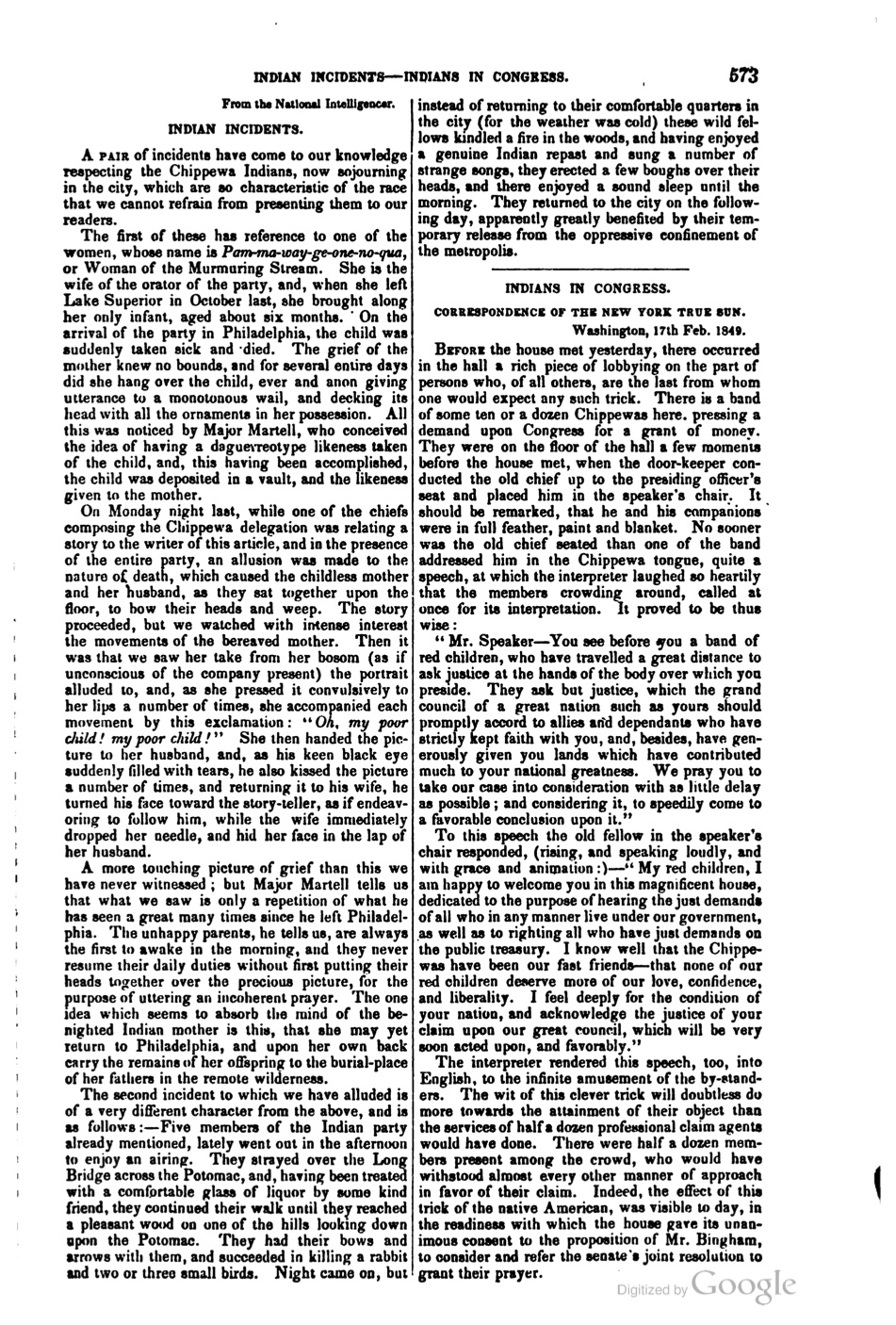
Amid articles on the end of the slave trade, the California Gold Rush, and the benefits of the “passing away of the Celt” during the Great Irish Famine, two articles appeared in Littell’s Living Age magazine about the 1849 delegation. The first is tragic, and the second is comical.
Along with written letters and petitions supporting the Ojibwe cause, the chiefs carried not only the one, but several birchbark pictographs. The pictographs show the clan animals of several chiefs and leading men from several small villages from the mouth of the Ontonagon River to Lac Vieux Desert in Upper Michigan and smaller satellite communities in Wisconsin. After seeing these petitions, the artist Seth Eastman copied them on paper and gave them to Henry Schoolcraft who printed and explained them alongside his criticism of the trip. They appear in his 1851 Historical and statistical information respecting the history, condition, and prospects of the Indian tribes of the United States.
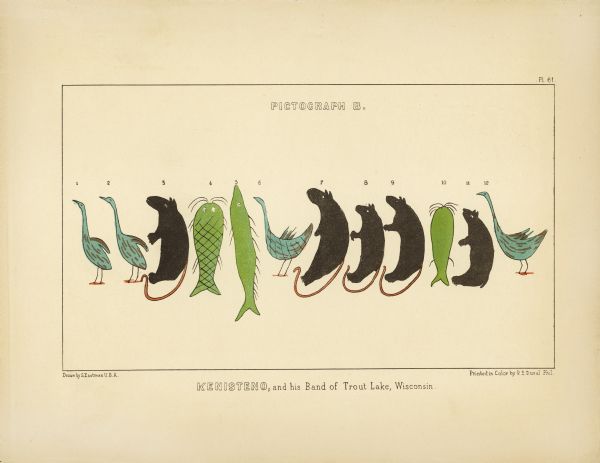
Kenisteno, and his Band of Trout Lake, Wisconsin
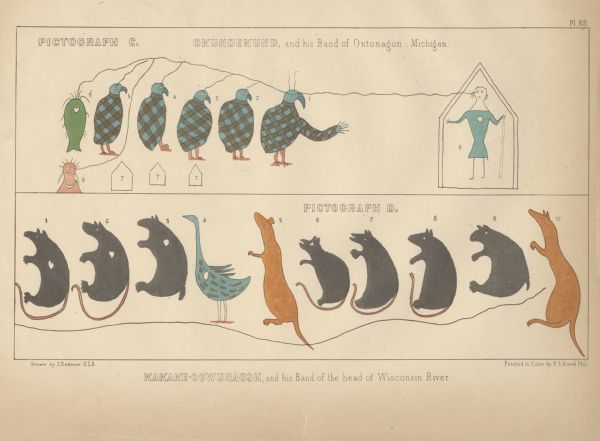
Okundekund, and his Band of Ontonagon, Michigan (Upper) Kakake-ogwunaosh, and his Band of the head of Wisconsin River (Lower)
According to Schoolcraft, the crane in the most famous pictograph is Oshkaabewis, a Crane-clan chief from Lac Vieux Desert, and the leader of the 1848-49 expedition. In the Treaty of 1854, he is listed as a first chief from Lac du Flambeau in nearby Wisconsin. It makes sense that someone named Oshkaabewis would lead a delegation since the word oshkaabewis is used to describe someone who carries messages and pipes for a civil chief.
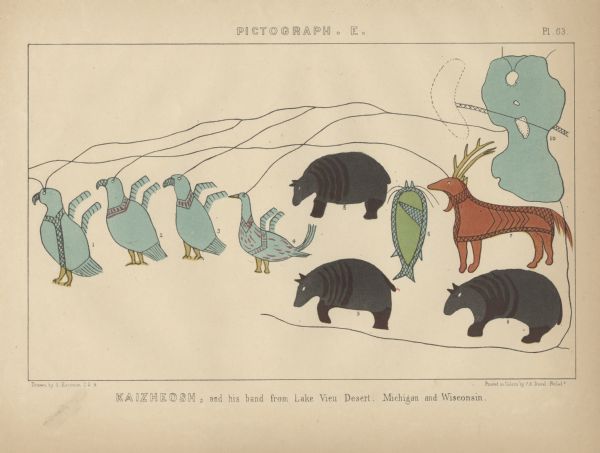
Kaizheosh [Gezhiiyaash], and his band from Lake Vieu Desert, Michigan and Wisconsin (University of Nebraska Libraries)
Long Story Short…
This is not Chief Buffalo or anyone from the La Pointe Band, and it was created before the Sandy Lake Tragedy. However it is totally appropriate to use the image in connection with those topics because it was all part of the efforts of the Lake Superior Ojibwe to resist removal in the late 1840s and early 1850s. However, when you do, please remember to credit the Lac Vieux Desert/Ontonagon chiefs who created these remarkable documents.
 Chequamegon History