Early Life among the Indians: Chapter II
March 21, 2018
By Amorin Mello

Early life among the Indians
by Benjamin Green Armstrong
continued from Chapter I.
CHAPTER II
In Washington.—Told to Go Home.—Senator Briggs, of New York.—The Interviews with President Fillmore.—Reversal of the Removal Order.—The Trip Home.—Treaty of 1854 and the Reservations.—The Mile Square.—The Blinding. »
After a fey days more in New York City I had raised the necessary funds to redeem the trinkets pledged with the ‘bus driver and to pay my hotel bills, etc., and on the 22d day of June, 1852, we had the good fortune to arrive in Washington.

“Washington Delegation, June 22, 1852“
Engraved from an unknown photograph by Marr and Richards Co. for Benjamin Armstrong’s Early Life Among the Indians. Chief Buffalo, his speaker Oshogay, Vincent Roy, Jr., two other La Pointe Band members, and Armstrong are assumed to be in this engraving.
I took my party to the Metropolitan Hotel and engaged a room on the first floor near the office for the Indians, as they said they did not like to get up to high in a white man’s house. As they required but a couple mattresses for their lodgings they were soon made comfortable. I requested the steward to serve their meals in their room, as I did not wish to take them into the dining room among distinguished people, and their meals were thus served.

Undated postcard of the Metropolitan Hotel, formerly known as Brown’s India Queen Hotel.
~ StreetsOfWashington.com
The morning following our arrival I set out in search of the Interior Department of the Government to find the Commissioner of Indian Affairs, to request an interview with him, which he declined to grant and said :
“I want you to take your Indians away on the next train west, as they have come here without permission, and I do not want to see you or hear of your Indians again.”
I undertook to make explanations, but he would not listen to me and ordered me from his office. I went to the sidewalk completely discouraged, for my present means was insufficient to take them home. I paced up and down the sidewalk pondering over what was best to do, when a gentleman came along and of him I inquired the way to the office of the Secretary of the Interior. He passed right along saying,
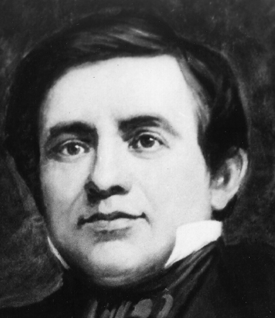
Secretary of the Interior
Alexander Hugh Holmes Stuart
~ Department of the Interior
“This way, sir; this way, sir;” and I followed him.
He entered a side door just back of the Indian Commissioner’s office and up a short flight of stairs, and going in behind a railing, divested himself of hat and cane, and said :
“What can I do for you sir.”
I told him who I was, what my party consisted of, where we came from and the object of our visit, as briefly as possible. He replied that I must go and see the Commissioner of Indian Affairs just down stairs. I told him I had been there and the treatment I had received at his hands, then he said :
“Did you have permission to come, and why did you not go to your agent in the west for permission?”
I then attempted to explain that we had been to the agent, but could get no satisfaction; but he stopped me in the middle of my explanation, saying :
“I can do nothing for you. You must go to the Indian Commissioner,”
and turning, began a conversation with his clerk who was there when we went in.
I walked out more discouraged than ever and could not imagine what next I could do. I wandered around the city and to the Capitol, thinking I might find some one I had seen before, but in this I failed and returned to the hotel, where, in the office I found Buffalo surrounded by a crowd who were trying to make him understand them and among them was the steward of the house. On my entering the office and Buffalo recognizing me, the assemblage, seeing I knew him, turned their attention to me, asking who he was, etc., to all of which questions I answered as briefly as possible, by stating that he was the head chief of of the Chippewas of the Northwest. The steward then asked:
“Why don’t you take him into the dining room with you? Certainly such a distinguished man as he, the head of the Chippewa people, should have at least that privilege.”

United States Representative George Briggs
~ Library of Congress
I did so and as we passed into the dining room we were shown to a table in one corner of the room which was unoccupied. We had only been seated a few moments when a couple of gentlemen who had been occupying seats in another part of the dining room came over and sat at our table and said that if there were no objections they would like to talk with us. They asked about the party, where from, the object of the visit, etc. I answered them briefly, supposing them to be reporters and I did not care to give them too much information. One of these gentlemen asked what room we had, saying that himself and one or two others would like to call on us right after dinner. I directed them where to come and said I would be there to meet them.
About 2 o’clock they came, and then for the first time I knew who those gentlemen were. One was Senator Briggs, of New York, and the others were members of President Filmore’s cabinet, and after I had told them more fully what had taken me there, and the difficulties I had met with, and they had consulted a little while aside. Senator Briggs said :
“We will undertake to get you and your people an interview with the President, and will notify you here when a meeting can be arranged. ”
During the afternoon I was notified that an interview had been arranged for the next afternoon at 3 o’clock. During the evening Senator Briggs and other friends called, and the whole matter was talked over and preparations made for the interview the following day, which were continued the next day until the hour set for the interview.

United States President
Millard Fillmore.
~ Library of Congress
When we were assembled Buffalo’s first request was that all be seated, as he had the pipe of peace to present, and hoped that all who were present would partake of smoke from the peace pipe. The pipe, a new one brought for the purpose, was filled and lighted by Buffalo and passed to the President who took two or three draughts from it, and smiling said, “Who is the next?” at which Buffalo pointed out Senator Briggs and desired he should be the next. The Senator smoked and the pipe was passed to me and others, including the Commissioner of Indian Affairs, Secretary of the Interior and several others whose names I did not learn or cannot recall. From them, to Buffalo, then to O-sho-ga, and from him to the four braves in turn, which completed that part of the ceremony. The pipe was then taken from the stem and handed to me for safe keeping, never to be used again on any occasion. I have the pipe still in my possession and the instructions of Buffalo have been faithfully kept. The old chief now rose from his seat, the balance following his example and marched in single file to the President and the general hand-shaking that was began with the President was continued by the Indians with all those present. This over Buffalo said his under chief, O-sha-ga, would state the object of our visit and he hoped the great father would give them some guarantee that would quiet the excitement in his country and keep his young men peaceable. After I had this speech thoroughly interpreted, O-sha-ga began and spoke for nearly an hour. He began with the treaty of 1837 and showed plainly what the Indians understood the treaty to be. He next took up the treaty of 1842 and said he did not understand that in either treaty they had ceded away the land and he further understood in both cases that the Indians were never to be asked to remove from the lands included in those treaties, provided they were peaceable and behaved themselves and this they had done. When the order to move came Chief Buffalo sent runners out in all directions to seek for reasons and causes for the order, but all those men returned without finding a single reason among all the Superior and Mississippi Indians why the great father had become displeased. When O-sha-ga had finished his speech I presented the petition I had brought and quickly discovered that the President did recognize some names upon it, which gave me new courage. When the reading and examination of it had been concluded the meeting was adjourned, the President directing the Indian Commissioner to say to the landlord at the hotel that our hotel bills would be paid by the government. He also directed that we were to have the freedom of the city for a week.
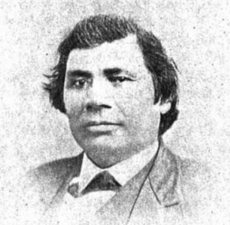
Read Biographical Sketch of Vincent Roy, Jr. manuscript for a different perspective on their meeting the President.
The second day following this Senator Briggs informed me that the President desired another interview that day, in accordance with which request we went to the White House soon after dinner and meeting the President, he told the, delegation in a brief speech that he would countermand the removal order and that the annuity payments would be made at La Pointe as before and hoped that in the future there would be no further cause for complaint. At this he handed to Buffalo a written instrument which he said would explain to his people when interpreted the promises he had made as to the removal order and payment of annuities at La Pointe and hoped when he had returned home he would call his chiefs together and have all the statements therein contained explained fully to them as the words of their great father at Washington.
The reader can imagine the great load that was then removed from my shoulders for it was a pleasing termination of the long and tedious struggle I had made in behalf of the untutored but trustworthy savage.

Downtown St. Paul, Minnesota, circa 1857.
~ Minnesota Historical Society
On June 28th, 1852, we started on our return trip, going by cars to La Crosse, Wis., thence by steamboat to St. Paul, thence by Indian trail across the country to Lake Superior. On our way from St. Paul we frequently met bands of Indians of the Chippewa tribe to whom we explained our mission and its results, which caused great rejoicing, and before leaving these bands Buffalo would tell their chief to send a delegation, at the expiration of two moons, to meet him in grand council at La Pointe, for there was many things he wanted to say to them about what he had seen and the nice manner in which he had been received and treated by the great father.
At the time appointed by Buffalo for the grand council at La Pointe, the delegates assembled and the message given Buffalo by President Filmore was interpreted, which gave the Indians great satisfaction. Before the grand council adjourned word was received that their annuities would be given to them at La Pointe about the middle of October, thus giving them time to get together to receive them. A number of messengers was immediately sent out to all parts of the territory to notify them and by the time the goods arrived, which was about October 15th, the remainder of the Indians had congregated at La Pointe. On that date the Indians were enrolled and the annuities paid and the most perfect satisfaction was apparent among all concerned. The jubilee that was held to express their gratitude to the delegation that had secured a countermanding order in the removal matter was almost extravagantly profuse. The letter of the great father was explained to them all during the progress of the annuity payments and Chief Buffalo explained to the convention what he had seen; how the pipe of peace had been smoked in the great father’s wigwam and as that pipe was the only emblem and reminder of their duties yet to come in keeping peace with his white children, he requested that the pipe be retained by me. He then went on and said that there was yet one more treaty to be made with the great father and he hoped in making it they would be more careful and wise than they had heretofore been and reserve a part of their land for themselves and their children. It was here that he told his people that he had selected and adopted, me as his son and that I would hereafter look to treaty matters and see that in the next treaty they did not sell them selves out and become homeless ; that as he was getting old and must soon leave his entire cares to others, he hoped they would listen to me as his confidence in his adopted son was great and that when treaties were presented for them to sign they would listen to me and follow my advice, assuring them that in doing so they would not again be deceived.

Map of Lake Superior Chippewa territories ceded in 1836, 1837, 1842, and 1854.
~ Great Lakes Indian Fish & Wildlife Commission
After this gathering of the Indians there was not much of interest in the Indian country that I can recall until the next annual payment in 1853. This payment was made at La Pointe and the Indians had been notified that commissioners would be appointed to make another treaty with them for the remainder of their territory. This was the territory lying in Minnesota west of Lake Superior; also east and west of the Mississippi river north to the territory belonging to the Boisfort and Pillager tribe, who are a part of the Chippewa nation, but through some arrangement between themselves, were detached from the main or more numerous body. It was at this payment that the Chippewa Indians proper desired to have one dollar each taken from their annuities to recompense me for the trouble and expense I had been to on the trip to Washington in their behalf, but I refused to accept it by reason of their very impecunious condition.
It was sometime in August, 1854, before the commissioners arrived at LaPointe to make the treaty and pay the annuities of that year. Messengers were despatched to notify all Indians of the fact that the great father had sent for them to come to La Pointe to get their money and clothing and to meet the government commissioners who wished to make another treaty with them for the territory lying west of Lake Superior and they were further instructed to have the Indians council among themselves before starting that those who came could be able to tell the wishes of any that might remain away in regards to a further treaty and disposition of their lands. Representatives came from all parts of the Chippewa country and showed a willingness to treat away the balance of their country. Henry C. Gilbert, the Indian agent at La Pointe, formerly of Ohio, and David B. Herriman, the agent for the Chippewas of the Mississippi country, were the commissioners appointed by the government to consumate this treaty.

Mackinac Indian Agent
Henry C. Gilbert
~ Branch County Photographs
While we were waiting the arrival of the interior Indians I had frequent talks with the commissioners and learned what their instructions were and about what they intended to offer for the lands which information I would communicate to Chief Buffalo and other head men in our immediate vicinity, and ample time was had to perfect our plans before the others should arrive, and when they did put in an appearance we were ready to submit to them our views for approval or rejection. Knowing as I did the Indians’ unwillingness to give up and forsake their old burying grounds I would not agree to any proposition that would take away the remainder of their lands without a reserve sufficient to afford them homes for themselves and posterity, and as fast as they arrived I counselled with them upon this subject and to ascertain where they preferred these reserves to be located. The scheme being a new one to them it required time and much talk to get the matter before them in its proper light. Finally it was agreed by all before the meeting of the council that no one would sign a treaty that did not give them reservations at different points of the country that would suit their convenience, that should afterwards be considered their bona-fide home. Maps were drawn of the different tracts that had been selected by the various chiefs for their reserve and permanent home. The reservations were as follows :
One at L’Anse Bay, one at Ontonagon, one at Lac Flambeau, one at Court O’Rilles, one at Bad River, one at Red Cliff or Buffalo Bay, one at Fond du Lac, Minn., and one at Grand Portage, Minn.

Joseph Stoddard (photo c.1941) worked on the 1854 survey of the Bad River Reservation exterior boundaries, and shared a different perspective about these surveys.
~ Bad River Tribal Historic Preservation Office
The boundaries were to be as near as possible by metes and bounds or waterways and courses. This was all agreed to by the Lake Superior Indians before the Mississippi Chippewas arrived and was to be brought up in the general council after they had come in, but when they arrived they were accompanied by the American Fur Company and most of their employees, and we found it impossible to get them to agree to any of our plans or to come to any terms. A proposition was made by Buffalo when all were gathered in council by themselves that as they could not agree as they were, a division should be drawn, dividing the Mississippi and the Lake Superior Indians from each other altogether and each make their own treaty After several days of counselling the proposition was agreed to, and thus the Lake Superiors were left to make their treaty for the lands mouth of Lake Superior to the Mississippi and the Mississippis to make their treaty for the lands west of the Mississippi. The council lasted several days, as I have stated, which was owing to the opposition of the American Fur Company, who were evidently opposed to having any such division made ; they yielded however, but only when they saw further opposition would not avail and the proposition of Buffalo became an Indian law. Our side was now ready to treat with the commissioners in open council. Buffalo, myself and several chiefs called upon them and briefly stated our case but were informed that they had no instructions to make any such treaty with us and were only instructed to buy such territory as the Lake Superiors and Mississippis then owned. Then we told them of the division the Indians had agreed upon and that we would make our own treaty, and after several days they agreed to set us off the reservations as previously asked for and to guarantee that all lands embraced within those boundaries should belong to the Indians and that they would pay them a nominal sum for the remainder of their possessions on the north shores. It was further agreed that the Lake Superior Indians should have two- thirds of all money appropriated for the Chippewas and the Mississippi contingent the other third. The Lake Superior Indians did not seem, through all these councils, to care so much for future annuities either in money or goods as they did for securing a home for themselves and their posterity that should be a permanent one. They also reserved a tract of land embracing about 100 acres lying across and along the Eastern end of La Pointe or Madeline Island so that they would not be cut off from the fishing privilege.
It was about in the midst of the councils leading up to the treaty of 1854 that Buffalo stated to his chiefs that I had rendered them services in the past that should be rewarded by something more substantial than their thanks and good wishes, and that at different times the Indians had agreed to reward me from their annuity money but I had always refused such offers as it would be taking from their necessities and as they had had no annuity money for the two years prior to 1852 they could not well afford to pay me in this way.
“And now,” continued Buffalo, “I have a proposition to make to you. As he has provided us and our children with homes by getting these reservations set off for us, and as we are about to part with all the lands we possess, I have it in my power, with your consent, to provide him with a future home by giving him a piece of ground which we are about to part with. He has agreed to accept this as it will take nothing from us and makes no difference with the great father whether we reserve a small tract of our territory or not, and if you agree I will proceed with him to the head of the lake and there select the piece of ground I desire him to have, that it may appear on paper when the treaty has been completed.”
The chiefs were unanimous in their acceptance of the proposition and told Buffalo to select a large piece that his children might also have a home in future as has been provided for ours.

Kiskitawag (Giishkitawag: “Cut Ear”) signed earlier treaties as a warrior of the Ontonagon Band and became associated with the La Pointe Band at Odanah.
~C.M. Bell, Smithsonian Digital Collections
This council lasted all night and just at break of day the old chief and myself, with four braves to row the boat, set out for the head of Lake Superior and did not stop anywhere only long enough to make and drink some tea, until we reached the head of St. Louis Bay. We landed our canoe by the side of a flat rock quite a distance from the shore, among grass and rushes. Here we ate our lunch and when completed Buffalo and myself, with another chief, Kish-ki-to-uk, waded ashore and ascended the bank to a small level plateau where we could get a better view of the bay. Here Buffalo turned to me, saying: .
“Are you satisfied with this location? I want to reserve the shore of this bay from the mouth of St. Louis river. How far that way do you you want it to go?” pointing southeast, or along the south shore of the lake.
I told him we had better not try to make it too large for if we did the great father’s officers at Washington might throw it out of the treaty and said:
“I will be satisfied with one mile square, and let it start from the rock which we have christened Buffalo rock, running easterly in the direction of Minnesota Point, taking in a mile square immediately northerly from the head of St. Louis Bay”
As there was no other way of describing it than by metes and bounds we tried to so describe it in the treaty, but Agent Gilbert, whether by mistake or not I am unable to say, described it differently. He described it as follows: “Starting from a rock immediately above and adjoining Minnesota Point, etc.”
We spent an hour or two here in looking over the plateau then went back to our canoe and set out for La Pointe. We traveled night and day until we reached home.
During our absence some of the chiefs had been talking more or less with the commissioners and immediately on our return all the Indians met in a grand council when Buffalo explained to them what he had done on the trip and how and where he had selected the piece of land that I was to have reserved in the treaty for my future home and in payment for the services I had rendered them in the past. The balance of the night was spent in preparing ourselves for the meeting with the treaty makers the next day, and about 10 o’clock next morning we were in attendance before the commissioners all prepared for a big council.
Mackinac Indian Agent
Henry Clark Gilbert
~ Branch County Photographs
Agent Gilbert started the business by beginning a speech interpreted by the government interpreter, when Buffalo interrupted him by saying that he did not want anything interpreted to them from the English language by any one except his adoped son for there had always been things told to the Indians in the past that proved afterwards to be untrue, whether wrongly interpreted or not, he could not say;
“and as we now feel that my adopted son interprets to us just what you say, and we can get it correctly, we wish to hear your words repeated by him, and when we talk to you our words can be interpreted by your own interpreter, and in this way one interpreter can watch the other and correct each other should there be mistakes. We do not want to be deceived any more as we have in the past. We now understand that we are selling our lands as well as the timber and that the whole, with the exception of what we shall reserve, goes to the great father forever.”

Bureau of Indian Affairs Director
George Washington Manypenny
~ Commons.Wikimedia.org
Commissioner of Indian affairs. Col. Manypenny, then said to Buffalo:
“What you have said meets my own views exactly and I will now appoint your adopted son your interpreter and John Johnson, of Sault Ste. Marie, shall be the interpreter on the part of the government,” then turning to the commissioners said, “how does that suit you, gentlemen.”
They at once gave their consent and the council proceeded.
Buffalo informed the commissioners of what he had done in regard to selecting a tract of land for me and insisted that it become a part of the treaty and that it should be patented to me directly by the government without any restrictions. Many other questions were debated at this session but no definite agreements were reached and the council was adjourned in the middle of the afternoon. Chief Buffalo asking for the adjournment that he might talk over some matters further with his people, and that night the subject of providing homes for their half-breed relations who lived in different parts of the country was brought up and discussed and all were in favor of making such a provision in the treaty. I proposed to them that as we had made provisions for ourselves and children it would be only fair that an arrangement should be made in the treaty whereby the government should provide for our mixed blood relations by giving to each person the head of a family or to each single person twenty-one years of age a piece of land containing at least eighty acres which would provide homes for those now living and in the future there would be ample room on the reservations for their children, where all could live happily together. We also asked that all teachers and traders in the ceded territory who at that time were located there by license and doing business by authority of law, should each be entitled to 160 acres of land at $1.25 per acre. This was all reduced to writing and when the council met next morning we were prepared to submit all our plans and requests to the commissioners save one, which we required more time to consider. Most of this day was consumed in speech-making by the chiefs and commissioners and in the last speech of the day, which was made by Mr. Gilbert, he said:
“We have talked a great deal and evidently understand one another. You have told us what you want, and now we want time to consider your requests, while you want time as you say to consider another matter, and so we will adjourn until tomorrow and we, with your father. Col. Manypenny, will carefully examine and consider your propositions and when we meet to-morrow we will be prepared to answer you with an approval or rejection.”

Julius Austrian purchased the village of La Pointe and other interests from the American Fur Company in 1853. He entered his Town Plan of La Pointe on August 29th of 1854. He was the highest paid claimant of the 1854 Treaty at La Pointe. His family hosted the 1855 Annuity Payments at La Pointe.
~ Photograph of Austrian from the Madeline Island Museum
That evening the chiefs considered the other matter, which was to provide for the payment of the debts of the Indians owing the American Fur Company and other traders and agreed that the entire debt could not be more than $90,000 and that that amount should be taken from the Indians in bulk and divided up among their creditors in a pro-rata manner according to the amount due to any person or firm, and that this should wipe out their indebtedness. The American Fur Company had filed claims which, in the aggregate, amounted to two or three times this sum and were at the council heavily armed for the purpose of enforcing their claim by intimidation. This and the next day were spent in speeches pro and con but nothing was effected toward a final settlement.
Col. Manypenny came to my store and we had a long private interview relating to the treaty then under consideration and he thought that the demands of the Indians were reasonable and just and that they would be accepted by the commissioners. He also gave me considerable credit for the manner in which I had conducted the matter for Indians, considering the terrible opposition I had to contend with. He said he had claims in his possession which had been filed by the traders that amounted to a large sum but did not state the amount. As he saw the Indians had every confidence in me and their demands were reasonable he could see no reason why the treaty could not be speedily brought to a close. He then asked if I kept a set of books. I told him I only kept a day book or blotter showing the amount each Indian owed me. I got the books and told him to take them along with him and that he or his interpreter might question any Indian whose name appeared thereon as being indebted to me and I would accept whatever that Indian said he owed me whether it be one dollar or ten cents. He said he would be pleased to take the books along and I wrapped them up and went with him to his office, where I left them. He said he was certain that some traders were making claims for far more than was due them. Messrs. Gilbert and Herriman and their chief clerk, Mr. Smith, were present when Mr. Manypenny related the talk he had with me at the store. He considered the requests of the Indians fair and just, he said, and he hoped there would be no further delays in concluding the treaty and if it was drawn up and signed with the stipulations and agreements that were now understood should be incorporated in it, he would strongly recommend its ratification by the President and senate.

Naagaanab of Fond Du Lac
~ Minnesota Historical Society
The day following the council was opened by a speech from Chief Na-gon-ab in which he cited considerable history.
“My friends,” he said, “I have been chosen by our chief, Buffalo, to speak to you. Our wishes are now on paper before you. Before this it was not so. We have been many times deceived. We had no one to look out for us. The great father’s officers made marks on paper with black liquor and quill. The Indian can not do this. We depend upon our memory. We have nothing else to look to. We talk often together and keep your words clear in our minds. When you talk we all listen, then we talk it over many times. In this way it is always fresh with us. This is the way we must keep our record. In 1837 we were asked to sell our timber and minerals. In 1842 we were asked to do the same. Our white brothers told us the great father did not want the land. We should keep it to hunt on. Bye and bye we were told to go away; to go and leave our friends that were buried yesterday. Then we asked each other what it meant. Does the great father tell the truth? Does he keep his promises? We cannot help ourselves! We try to do as we agree in treaty. We ask you what this means? You do not tell from memory! You go to your black marks and say this is what those men put down; this is what they said when they made the treaty. The men we talk with don’t come back; they do not come and you tell us they did not tell us so! We ask you where they are? You say you do not know or that they are dead and gone. This is what they told you; this is what they done. Now we have a friend who can make black marks on paper When the council is over he will tell us what we have done. We know now what we are doing! If we get what we ask our chiefs will touch the pen, but if not we will not touch it. I am told by our chief to tell you this: We will not touch the pen unless our friend says the paper is all right.”
Na-gon-ab was answered by Commissioner Gilbert, saying:
“You have submitted through your friend and interpreter the terms and conditions upon which you will cede away your lands. We have not had time to give them all consideration and want a little more time as we did not know last night what your last proposition would be. Your father. Col. Manypenny, has ordered some beef cattle killed and a supply of provisions will be issued to you right away. You can now return to your lodges and get a good dinner and talk matters over among yourselves the remainder of the day and I hope you will come back tomorrow feeling good natured and happy, for your father, Col. Manypenny, will have something to say to you and will have a paper which your friend can read and explain to you.”
When the council met next day in front of the commissioners’ office to hear what Col. Manypenny had to say a general good feeling prevailed and a hand-shaking all round preceded the council, which Col. Manypenny opened by saying:
“My friends and children: I am glad to see you all this morning looking good natured and happy and as if you could sit here and listen to what I have to say. We have a paper here for your friend to examine to see if it meets your approval. Myself and the commissioners which your great father has sent here have duly considered all your requests and have concluded to accept them. As the season is passing away and we are all anxious to go to our families and you to your homes, I hope when you read this treaty you will find it as you expect to and according to the understandings we have had during the council. Now your friend may examine the paper and while he is doing so we will take a recess until afternoon.”

Detail of Benjamin Armstrong from a photograph by Matthew Brady
~ Minnesota Historical Society
Chief Buffalo, turning to me, said:
“My son, we, the chiefs of all the country, have placed this matter entirely in your hands. Go and examine the paper and if it suits you it will suit us.”
Then turning to the chiefs, he asked,
“what do you all say to that?”
The ho-ho that followed showed the entire circle were satisfied.
I went carefully through the treaty as it had been prepared and with a few exceptions found it was right. I called the attention of the commissioners to certain parts of the stipulations that were incorrect and they directed the clerk to make the changes.
The following day the Indians told the commissioners that as their friend had made objections to the treaty as it was they requested that I might again examine it before proceeding further with the council. On this examination I found that changes had been made but on sheets of paper not attached to the body of the instrument, and as these sheets contained some of the most important items in the treaty, I again objected and told the commissioners that I would not allow the Indians to sign it in that shape and not until the whole treaty was re-written and the detached portions appeared in their proper places. I walked out and told the Indians that the treaty was not yet ready to sign and they gave up all further endeavors until next day. I met the commissioners alone in their office that afternoon and explained the objectionable points in the treaty and told them the Indians were already to sign as soon as those objections were removed. They were soon at work putting the instrument in shape.

“One version of the boundaries for Chief Buffalo’s reservation is shown at the base of Minnesota Point in a detail from an 1857 map preserved in the National Archives in Washington, D.C. Other maps show a larger and more irregularly shaped versions of the reservation boundary, though centered on the same area.”
~ DuluthStories.net
The next day when the Indians assembled they were told by the commissioners that all was ready and the treaty was laid upon a table and I found it just as the Indians had wanted it to be, except the description of the mile square. The part relating to the mile square that was to have been reserved for me read as follows:
“Chief Buffalo, being desirous of providing for some of his relatives who had rendered them important services, it is agreed that he may select one mile square of the ceded territory heretofore described.”
“Now,” said the commissioner,
“we want Buffalo to designate the person or persons to whom he wishes the patents to issue.”
Buffalo then said:
“I want them to be made out in the name of my adopted son.”
This closed all ceremony and the treaty was duly signed on the 30th day of September, 1854. This done the commissioners took a farewell shake of the hand with all the chiefs, hoping to meet them again at the annuity payment the coming year. They then boarded the steamer North Star for home. In the course of a few days the Indians also disappeared, some to their interior homes and some to their winter hunting grounds and a general quiet prevailed on the island.

Portrait of the Steamer North Star from American Steam Vessels, by Samuel Ward Stanton, page 40.
~ Wikimedia.org
About the second week in October, 1854, I went from La Pointe to Ontonagon in an open boat for the purpose of purchasing my winter supplies as it had got too late to depend on getting them from further below. While there a company was formed for the purpose of going into the newly ceded territory to make claims upon lands that would be subject to entry as soon as the late treaty should be ratified. The company consisted of Samuel McWaid, William Whitesides, W. W. Kingsbury, John Johnson, Oliver Melzer, John McFarland, Daniel S. Cash, W. W. Spaulding, all of Ontonagon, and myself. The two last named gentlemen, Daniel S. Cash and W. W. Spaulding, agreeing to furnish the company with supplies and all necessaries, including money, to enter the lands for an equal interest and it was so stipulated that we were to share equally in all that we, or either of us, might obtain. As soon as the supplies could be purchased and put aboard the schooner Algonquin we started for the head of the lake, stopping at La Pointe long enough for me to get my family aboard and my business matters arranged for the winter. I left my store at La Pointe in charge of Alex. Nevaux, and we all sailed for the head of Lake Superior, the site of which is now the city of Duluth. Reaching there about the first week in December—the bay of Superior being closed by ice—we were compelled to make our landing at Minnesota Point and take our goods from there to the main land on the north’ shore in open boats, landing about one and-one half miles east of Minnesota Point at a place where I desired to make a preemption for myself and to establish a trading post for the winter. Here I erected a building large enough for all of us to live in, as we expected to make this our headquarters for the winter, and also a building for a trading post. The other members of the company made claims in other places, but I did no more land looking that winter.

Detail of Superior City townsite at the head of Lake Superior from the 1854 U.S. General Land Office survey by Stuntz and Barber.
About January 20th, 1855, I left my place at the head of the lake to go back to La Pointe and took with me what furs I had collected up to that time, as I had a good place at La Pointe to dry and keep them. I took four men along to help me through and two dog trains. As we were passing down Superior Bay and when just in front of the village of West Superior a man came to us on the ice carrying a small bundle on his back and asked me if I had any objections to his going through in my company. He said the snow was deep and the weather cold and it was bad for one man to travel alone. I told him I had no objections provided he would take his turn with the other men in breaking the road for the dogs. We all went on together and camped that night at a place well known as Flag River. We made preparations for a cold night as the thermometer must have been twenty-five or thirty degrees below zero and the snow fully two feet deep. As there were enough of us we cut and carried up a large quantity of wood, both green and dry, and shoveled the snow away to the ground with our snow shoes and built a large fire. We then cut evergreen boughs and made a wind break or bough camp and concluded we could put in a very comfortable night. We then cooked and ate our supper and all seemed happy. I unrolled a bale of bear skins and spread them out on the ground for my bed, filled my pipe and lay down to rest while the five men with me were talking and smoking around the camp fire. I was very tired and presume I was not long in falling asleep. How long I slept I cannot tell, but was awakened by something dropping into my face, which felt like a powdered substance. I sprang to my feet for I found something had got into my eyes and was smarting them badly. I rushed for the snow bank that was melting from the heat and applied handful after handful to my eyes and face. I found the application was peeling the skin off my face and the pain soon became intense. I woke up the crew and they saw by the firelight the terrible condition I was in. In an hour’s time my eyeballs were so swollen that I could not close the lids and the pain did not abate. I could do nothing more than bathe my eyes until morning, which I did with tea-grounds. It seemed an age before morning came and when it did come I could not realize it, for I was totally blind. The party started with me at early dawn for La Pointe. The man who joined us the day before went no further, but returned to Superior, which was a great surprise to the men of our party, who frequently during the day would say:
“There is something about this matter that is not right,”
and I never could learn afterward of his having communicated the fact of my accident to any one or to assign any reason or excuse for turning back, which caused us to suspect that he had a hand in the blinding, but as I could get no proof to establish that suspicion, I could do nothing in the matter. This man was found dead in his cabin a few months afterwards.
At La Pointe I got such treatment as could be procured from the Indians which allayed the inflamation but did not restore the sight. I remained at La Pointe about ten days, and then returned home with dog train to my family, where I remained the balance of the winter, when not at Superior for treatment. When the ice moved from the lake in the spring I abandoned everything there and returned to La Pointe and was blind or nearly so until the winter of 1861.
Returning a little time to the north shore I wish to relate an incident of the death of one of our Ontonagon company. Two or three days after I had reached home from La Pointe, finding my eyes constantly growing worse I had the company take me to Superior where I could get treatment. Dr. Marcellus, son of Prof. Marcellus, of an eye infirmary in Philadelphia, who had just then married a beautiful young wife, and come west to seek his fortune, was engaged to treat me. I was taken to the boarding house of Henry Wolcott, where I engaged rooms for the winter as I expected to remain there until spring. I related to the doctor what had befallen me and he began treatment. At times I felt much better but no permanent relief seemed near. About the middle February my family required my presence at home, as there was some business to be attended to which they did not understand. My wife sent a note to me by Mr. Melzer, stating that it was necessary for me to return, and as the weather that day was very pleasant, she hoped that I would come that afternoon. Mr. Melzer delivered me the note, which I requested him to read. It was then 11 a. m. and I told him we would start right after dinner, and requested him to tell the doctor that I wished to see him right away, and then return and get his dinner, as it would be ready at noon, to which he replied:
“If I am not here do not wait for me, but I will be here at the time you are ready for home.”
Mr. Melzer did return shortly after we had finished our dinner and I requested him to eat, as I would not be ready to start for half an hour, but he insisted he was not hungry. We had no conveyance and at 1 p. m. we set out for home. We went down a few steps to the ice, as Mr. Wolcott’s house stood close to the shore of the bay, and went straight across Superior Bay to Minnesota Point, and across the point six or eight rods and struck the ice on Lake Superior. A plain, hard beaten road led from here direct to my home. After we had proceeded about 150 yards, following this hard beaten road, Melzer at once stopped and requested me to go ahead, as I could follow the beaten road without assistance, the snow being deep on either side.
“Now,” he says go ahead, for I must go back after a drink.”
I followed the road quite well, and when near the house my folks came out to meet me, their first inquiry being:
“Where is Melzer?”
I told them the circumstances of his turning back for a drink of water. Reaching the bank on which my house stood, some of my folks, looking back over the road I had come, discovered a dark object apparently floundering on the ice. Two or three of our men started for the spot and there found the dead body of poor Melzer. We immediately notified parties in Superior of the circumstances and ordered a post-mortem examination of the body. The doctors found that his stomach was entirely empty and mostly gone from the effects of whisky and was no thicker than tissue paper and that his heart had burst into three pieces. We gave him a decent burial at Superior and peace to his ashes, His last act of kindness was in my behalf.
To be continued in Chapter III…
Lake Superior in 1840
September 1, 2016
By Amorin Mello
“Soon after removing to Detroit, Bela Hubbard became acquainted with Douglas[s] Houghton, then State Geologist of Michigan, and in 1837, was appointed Assistant Geologist on the State Geological Survey, a position which he held until 1841. He accompanied Douglass Houghton on an important expedition to the southern shore of Lake Superior, in 1840, an account of which is given in his ‘Memorials of half a century.’ It is this book more than anything else that will preserve the memory of its author. It is his most fitting and most enduring monument and entitles the name of Bela Hubbard to a place on the short list of American authors who may be justly termed ‘nature writers.'”
Quote from Report of the Michigan Academy of Science, Volume 4,
by Michigan Academy of Science Council, 1904, page 163.

This is a reproduction of “Lake Superior in 1840” and illustrations from Memorials of a Half-Century, by Bela Hubbard, 1887, pages 21-62.
LAKE SUPERIOR IN 1840.*
* Read before the Detroit Pioneer Society, Jan., 1874.
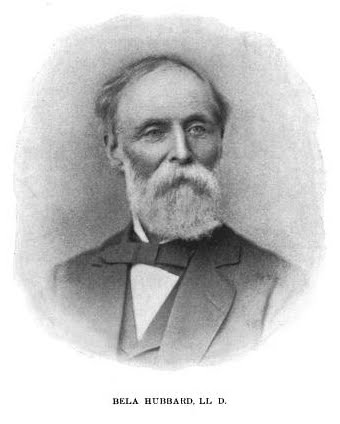
Portrait and biographic sketch of Bela Hubbard are available in Report of the Michigan Academy of Science, Volume 4, by Michigan Academy of Science Council, 1904, pages 163-165. See the Bela Hubbard Papers: 1837-1893 for more information.
Among the pleasantest of all my reminiscences of travel is that of the exploration, in connection with the geological survey of Michigan, of the coasts of our upper peninsula, in 1840.

Portrait and biographic sketch of Douglass Houghton are available in Report of the Michigan Academy of Science, Volume 4, by Michigan Academy of Science Council, 1904, pages 160-162. See the Douglass Houghton Papers: 1829-1845 for more information.
The party for this expedition was composed of the State geologist, Dr. Douglass Houghton; his two assistants, C. C. Douglass and myself; Fredk. Hubbard, in charge of instrumental observations; and, for a part of the way, H. Thielson, a civil engineer, and Charles W. Penny, a young merchant of Detroit, supernumeraries.
We left Detroit in the steamer “Illinois,” arriving at Mackinac, May 23. Here two boat crews were made up, consisting of six Canadians. These belonged to that class so famous in the palmy days of the fur trade and the French régime, now extinct, and known to history as “coureurs de bois.” They were of mixed blood, in some, the French, in others, the Indian, predominating. Bred to the business, they would row without fatigue from daybreak until dark,—twelve or fourteen hours,—unlade the boats, pitch the tents for the bourgeois, pile up the baggage, prepare the evening meal, and then creep under their blankets in the open air and enjoy the sound sleep that labor bestows.
The principal dependence of these voyageurs for food—we had no leisure for hunting and little for fishing— was upon a soup of beans, with a most liberal supply of water, into which a piece of pork was dropped. A cake of hard-bread was allowed to each.
The boats for the passage of the Sault were each about twenty feet long by four broad, lightly constructed of pine and cedar, with sharp bows, and were drawn out of the water at night. At the Sault, to which provisions had been forwarded, one of these boats was exchanged for a “Mackinac barge,” sufficiently large to carry two months’ provisions and all our baggage.
A voyage to and upon our great lake at the time of my story was by no means the easy journey it is now. North of Mackinac, no steamers and no regular line of sail-vessels traversed the waters. The ship-canal around the waters of the Sault had not then been projected. Furs and fish constituted the only commerce, and the latter found too few customers to make the trade profitable. The American Fur Company had its headquarters at Sault Ste. Marie, where was a village of some twenty or thirty houses, mostly of logs, and the United States maintained a garrison. On the opposite shore was a small English settlement, consisting of a few white-washed cabins and Episcopal and Baptist mission establishments. Here also the Hudson’s Bay Company had a post.
At L’Anse had been established for many years a factory of the American Fur Company, the only buildings being a log house, storehouse, and barn, and near by a Baptist mission, consisting of a dozen neat huts of logs and bark. Near the extreme west end of the lake this company had another factory or trading-post, at La Pointe.
These were the only white settlements on the south shore of this great lake. At two or three points, transient fishing-camps might be met with. Else, all this region was wild and solitary almost as when, a century earlier, it was traversed by the canoe of the Jesuit missionary or echoed to the rude songs of the wild employees of the fur traders. In a large part of the country, on the southern border, within the territory of the United States, the Indian title had not been extinguished. But the settlements of the aboriginal race were rare; probably the whole region did not number 1000 souls.
Apart from the scientific animus of the expedition, our party, in the ardor of youth, could not but look forward to the new and strange scenes which awaited us with somewhat of the enthusiasm that inspired the first explorers of this region of vast forests and inland seas. We were to voyage almost in the same mode as those travellers, to witness scenes as yet little changed, and partaking of the same character of solitude and mystery.
Though I wander from my narrative, I must linger a moment over the impression produced by the romantic island which was our starting-point, Michilimackinac.
Connected with the story of the early wanderings of the French, their perilous missions in the far wilderness, the fur trade, with its fort, its agents, its coureurs de bois and numerous employees, its bustle, show, and dissipation, its traffic and its enormous profits, and with the numerous native tribes which here rendezvoused,—no place in the North-west possesses greater historic and traditionary interest. The town retained, as it still does, much of its old-time character. The crescent bay in front was still a lounging-place for the American Ishmaelite, whose huts often covered the beach; and this was the last place on the frontier where the Mackinac barge might manned and equipped, as a century ago, by a motley crew of half-breed voyageurs.
The natural beauties and wildness of the island, its situation, enthroned at the apex of the peninsula of Michigan and embracing magnificent views of water and island, its lake breezes and pure cold air, and the excellence of its white-fish and trout, have long made it one of the most attractive of watering-places. The proposal to conserve it as a national park is worthy of its character, and it is to be hoped that thus its natural beauties, and what remains of its woods, will be preserved forever to the nation.
On the morning of May 26 we took our departure from Mackinac, with a moderate breeze and a clear sky,—a thing to be noted where fogs are so frequent,—and coasting by St. Martin’s Island, entered les Cheneaux.
The river, or more properly Strait of Ste. Marie, is a series of channels, winding amid innumerable islands. Some of these, as St. Joseph and Drummond, cover many square miles, but the greater number are much smaller, and often occupy only a few acres. They line the whole northern coast of Lake Huron, and are occasioned by the junction between the silurian lime rocks and the azoic or primary rocks of Canada.
These islands are but little elevated above the water, and are wooded to the edge with cedar, fir and birch. The evergreen trees are completely shrouded in a tapestry of parasitic moss. This is a true lichen, and is not allied to the great Southern epiphyte which it so strongly resembles. It hangs in long festoons, giving the woods a fantastic and gloomy appearance, but the effect is very beautiful. What are called “les Cheneaux” are passages among islands of this description. They are seldom wide enough to admit any but the smallest craft, and so intricate as to form a perfect labyrinth, where any but the practised mariner might wander long, “in endless mazes lost.”
To the north and east of St. Joseph Island the Ste. Marie parts the two systems of rocks, and an instant change takes place in the character of the scenery. Instead of low, timbered shores, the islands rise in abrupt cones, rounded and water-worn, to the height of twenty to one hundred feet, presenting bare knobs of hornblende and quartz. The surfaces are worn smooth, by the action of glaciers, and are frequently covered with a thick carpet of lichens. Among these is, in profusion, the beautiful reindeer moss. A few miles to the right, in Canada, hills of granite rise to a height of 500 to 1000 feet, and form a background to the view.
To the geologist these low hills and rounded knobs have an absorbing interest. Agassiz tells us that America has been falsely denominated the new world; that “hers was the first dry land lifted out of the waters; hers the first shore washed by the ocean that enveloped all the earth beside.” The antiquary finds in this portion of America a very respectable antiquity. To its known civil history he adds evidence of the existence of a race of men familiar with this region ages before its discovery by the French, who were by no means despicable cultivators of the arts, and he infers a human history—could he but gather the full record—possibly as ancient as the pyramids. But science points a period infinitely more remote. We had reached and stood upon what was the skeleton of our earth, when but a crust above the seething fires beneath, not only ages before man had a being upon its surface, but probably ages before what we call the “Old World” had been raised by the forces of nature above the universal ocean. Here was antiquity unmeasured by any human standard. Time itself was young then. This backbone of the earliest continent still stretches unbroken, from the Atlantic to the western plains. During the unnumbered years in which the surface of the earth has been changed by successive upheavals and depressions it has stood unmoved.
Around the base of these low granite and metamorphic hills, in the bed of the river, lies a sandstone rock, which we shall find rising into cliffs along the coast of the lake above. It is the lowest of the paleozoic series, the first rock which brings to our eyes evidence of life upon this continent, and, if geologists speak truth, the first which bears witness to the dawn of life upon our earth. Of the earliest forms of organic life two only have with certainty been found in this rock, the lingula and the trilobite. And these, in the perfection and adaptation of their structure, equal the most perfect beings of their kind which exist at the present day. Thus the first record of the earliest life, upon the most ancient sea beach which the earth affords, is in apparent condemnation of the development hypothesis of Darwin. Are they then evidence of sudden and independent creation, or must we believe that these forms had their origin in some yet more remote and obscure past, and that we behold in these silurian rocks only their perfect development?
Following the northerly channel, the Ste. Marie soon expands into a broad and lovely sheet of water, twelve miles long, called Lake St. George. We have escaped from the labyrinth of rocky isles, the southern shores are again densely wooded, while the azoic rocks are seen on the Canada side, stretching off to the north-west, and terminating in a series of mountainous knobs,—the vertebræ of the world before the Flood. To this lake the Narrows succeed, and here for the first time the Ste. Marie assumes the appearance of a river, being contracted to less than 1000 feet, with a current and occasional rapids.
We passed frequent memorials of the Indian inhabitants. It is not to be wondered at that this region abounds with them, since with an eye to natural beauty this poetical race selects the loveliest spots for the resting-places, both of the living and the dead. The graves were close cabins of logs, thatched with bark, and the places selected are among the most beautiful and elevated sites, as if the souls of the departed braves could hear the echoing paddle and watch the approach of the distant canoe. The burial-place of the chief is designated by a picketed enclosure, and here it is customary for the voyaging Indian to stop, kindle his camp-fire at the head of the grave, and, on departing, to leave within the enclosure a small portion of the provisions he has cooked, for the use of the occupant. A flat cedar stake at the head exhibits in red paint the figure of some bird or brute,—the family totem of the deceased. Often is seen a small cross, erected as an emblem of his faith in Holy Catholic Church, while close by, in strange contrast, is that evidence of his unalterable attachment to the creed of his fathers,—the basket of provisions that is to support his journeying to the land of spirits.
The camping-ground of the voyageur has been that of the Indian from time immemorial. The wigwam poles are recognized from a distance, in some open glade along the shore, left standing after the vagabond inmates have departed. And there is often to be found an old canoe, a camp-kettle, a cradle swinging from the poles, and invariably a litter of picked bones and dirty rags, completely covering the spot, with the burnt brands and ashes of the cabin fire in the midst. Sometimes we meet a rude altar of stones, on which are laid bits of tobacco and other petty offerings to the Manitou. Sometimes the scene is varied by the cabin of a Canadian Frenchman, who, unable to resist the charm of savage life, is bringing up his family of half-breed children in a condition little akin to civilization.
Early on the morning of May 30 we reached the Sault, and proceeded to encamp at the head of the rapids. This required a portage of several rods. The remainder of the day was spent at the village, in witnessing the novel mode of fishing, and other sights pertaining to this remote frontier post.

Page 29: “Sault Ste. Marie, from the Canada shore.”
Preparations for our expedition being completed, on the first of June we took our departure from the head of the rapids. Here lay at anchor a beautiful light brig belonging to the American Fur Company, and which bore the name of its founder, John Jacob Astor. Close by its side was a schooner, which had been built by the Ohio Fishing and Mining Company, at Cleveland, and had just made the portage around the rapids. Another vessel was preparing for a similar transportation. With three such crafts floating on its bosom, our great lake seemed to have already lost something of its old-time character, when, a wide waste of waters, it was traversed only by the canoe of the Indian and voyageur. Its importance as a great commercial highway had thus begun to be foreshadowed, but, in fact, its waters still laved a savage wilderness.*
* The immense commerce since built up will appear from the statement, that in 1886 the number of vessels which passed through the Ste. Mary’s Falls Canal was 6203, carrying 3,701,000 tons and over 50,000 passengers.
Some natural phenomena pertaining to a high northern latitude had begun to exhibit what were marvels to our unaccustomed eyes. One of these was the lengthened twilight, the sun continuing to irradiate the horizon with a bright flash, until nearly midnight. In fact, it was quite possible to tell the hour of the night at any time, by the light which indicated the sun’s position. The Auroras, too, were surpassingly brilliant; often the electric rays streamed up from every point of the horizon, meeting at the zenith and waving like flame. I note these simple and common phenomena because they were novel to us, and it is only those who travel and encamp in the open air who enjoy to the full such scenes of beauty and wonder.
A summer temperature had now set in, and we witnessed another characteristic of this high latitude,—the sudden advance of the season. During the three days of our stay at this place, vegetation, which a week before had hardly commenced, sprung into active life. Trees then bare were now in full leaf. This phenomenon, though common to our side of the Atlantic, we had nowhere else seen so conspicuously displayed.
Time will not permit a narrative of our journey, a two-months’ coasting voyage along the whole southern side of Lake Superior. Nor can I speak, except briefly, of the beauties of the scenery, most of which is now so well known; of Gros Cap and Point Iroquois, those rock-built pillars of Hercules that guard the entrance, and
“like giants stand, To sentinel enchanted land;”
of White-fish Point and its surroundings; of the grand, wild and varied rocky coast; of the many beautiful streams, flashing with cascades, and filled with the speckled trout; or of our scientific researches and observations. I will venture only to relate an occasional incident, and to delineate some features of the coast scenery which seem to me to have been to little noticed or too imperfectly described by others.
Westward from White-fish Point stretch for many miles broad beaches of sand and gravel, backed by hills clothed with Norway-pines, spruce, hemlock, cedar, and birch. These beaches form extensive fishing-grounds, of which parties had already availed themselves. Every one knows the superiority of Lake Superior white-fish, in size and flavor, over those of the lower waters. Yet in relating the following experience I am aware of the risk which I run of being set down as the retailer of a “fish story.”
As we were rowing along the beach, some object was descried at a distance, making out of the water. All, at once, gave vigorous chase. On our near approach, the animal, which proved to be an otter, dropped upon the sand a fish which he had just hauled out, and retreated into the lake. This fish, which was scarcely dead, was of a size so extraordinary that it might truly be called—the fish, not the story—a whopper! It measured two and a half feet in length, and one foot five inches in circumference. We had no accurate means of weighing, but its weight was fairly estimated at fifteen pounds! The flesh was delicious in proportion, and made our whole party several capital meals.
These beaches terminate at a deep harbor called the Grand Marais. Hitherto the hills of dunes of sand have been of no great elevation. But now occurs a phenomenon which, though it seems not to have been classed among the wonders of this region, nor described in any books of travel, so far as I am aware, may well be called extraordinary, and worthy a place among the scenic wonders of America. It is a miniature Sahara, several miles in extent, and in many of its peculiar features resembling those lifeless, sandy deserts which are so distinguishing phenomena in some parts of the world. It is known to the French voyageurs as “Le Grand Sable.”

Page 33: “Grandes Sables.”
Steep cliffs are first observed rising from the water with a very uniform face, of about 200 feet in height, beyond which are visible barren dunes, rising still higher in the distance. On our approach the whole appeared like lofty hills enveloped in fog. This proved to be nothing less than clouds of sand, which the winds were constantly sweeping towards the lake, and which formed a mist so dense as to conceal completely the real character of the coast.
On ascending these steep and wasting cliffs, a scene opens to view which has no parallel except in the great deserts. For an extent of many miles nothing is visible but a waste of sand; not under the form of a monotonous plain, but rising into lofty cones, sweeping in graceful curves, hurled into hollows and spread into long-extended valleys. A few grass roots and small shrubs in some places find a feeble subsistence, and are the only vegetation. But thrusting through the sand are several tops of half-buried pines, barkless, and worn dry and craggy by the drifting soil, while below the surface their bodies appear to be in perfect preservation. To our imagination they seem the time-worn columns of an antique temple, whose main structure has long ago tumbled into dust, or been buried, like the ruins of Egypt, beneath the drift of many centuries.
The surface sand is mostly packed quite hard, and may be trod as a solid floor. This, in many places, is strewed thickly with pebbles; the deep hollows present vast beds of them. Among these are a great variety of precious stones common to the rocks of the country; agates, chalcedony, jasper, quartz of every shade of color and transparency, with hornstone, trap, and other minerals. All are worn smooth, and often beautifully polished by the sharp, drifting sands, and many rich specimens were obtained. We were reminded of the valley of diamonds in the Arabian tales, which it was the fortune of Sinbad to discover, in a scarcely less singular depository.
In the rear of this desert, about two miles from the coast, timber is again met with. Here, just at the edge of the wood, a small and beautiful lake lies embosomed; on the one side, a rich tract of maple forest; on the other, barren and shifting sand. It broke on our view, from amidst the realm of desolation, as did the unexpected fountain to which Saladin led the weary cavalier, Sir Kenneth, over the sandy plains of Palestine, as told in the magic pages of Scott. We named it, not inaptly, I think, “the diamond of the desert.” Around this sheet of water we found snow, on the tenth of June, in large quantities, buried beneath a few inches of sand.
From the diamond lake issues a small stream, which, after making its way through the sand, reaches the clay that constitutes the base of these dunes, and tumbles a perfect cascade into the greater lake. This rivulet separates the dense maple forest which lies on the east from cliffs of driven sand, which rise abruptly to a height that far overlooks the woodland, and are the commencement of the grand and leafless sables.
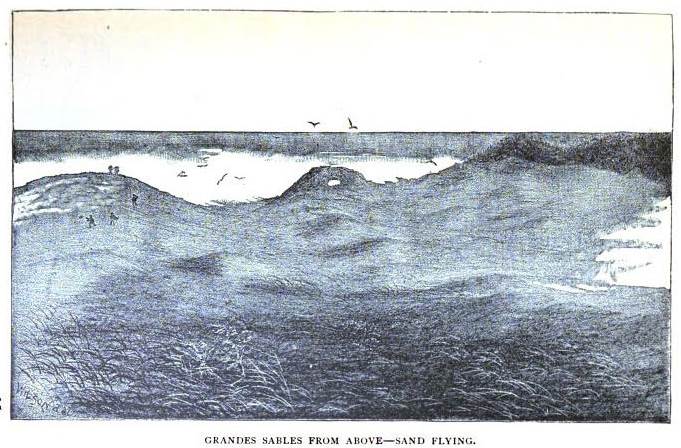
Page 35: “Grandes Sables from above – sand flying.”
The view on ascending these is most entrancing. On the one side stretches beneath, and far away, the verdant forest; while, by a transition as sudden as it is opposite in character, on the other side every feature of the landscape seems as if buried beneath hills of snow. The desert surface might be likened to that of an angry ocean, only that the undulations are far more vast, and the wave crests more lofty than the billows of the sea in its wildest commotion. Looking upward from one of these immense basins, where only the sandwave meets the sky, the beholder is impressed with a sublimity of a novel kind, unmixed with the terror which attends a storm upon the Alps or on the ocean. The scene, wild and unique, may well claim this brief praise, though hitherto unsung, and lacking the charm of historical association,—“the consecration and the poet’s dream.”
Twelve miles beyond this singular region the beaches terminate, and the sand-rock makes its appearance on the coast, in a range of abrupt cliffs. These are “The Pictured Rocks.” They have been often described, but no description that I have seen conveys to my mind a satisfactory impression of their bold, wild, and curious features. In attempting to convey some dear comprehension of them, I can only hope to impart a faithful, though it be a feeble conception of the peculiar features of this marvel of the Northern Lakes.
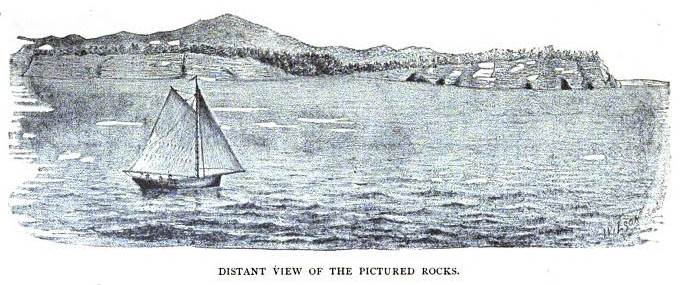
Page 37: “Distant view of the Pictured Rocks.”
These cliffs are composed of the same gray-and-red sand-rock which I have alluded to as the lowest of the paleozoic or silurian rocks. It appears in many places on the coast, and probably forms a large part of the bed of the lake. The cliffs here rise into a mural precipice, springing perpendicularly from the deep waters to the height of from 80 to 250 feet; and for the distance of fifteen miles, except in one or two places, are destitute of a beach upon which even a canoe may be landed. So dangerous is the coast that vessels all give it a wide berth, passing at too great distance for accurate view. A small boat that lingers runs imminent risks, from the liability of this lake to sudden gales, and the traverse is attempted only during a perfect calm. The sandrock lies in thick strata of varying degrees of hardness, from a coarse crag of the hardest cemented pebbles to a friable rock of aggregated sand. The predominant color is gray, sometimes light, often dark and rusty, and stained by oxides of iron and copper, with which the materials are charged. Bearing in mind these characteristics, the variety of aspects and the strange forms that these cliffs assume will find a ready explanation.
The great diversity of hues that give so beautiful and variegated an appearance to large portions of the surface, and from which the cliffs derive their name, are owing to the metallic oxides which have filtered through the porous stone in watery solutions and left their stains upon the surface. Beautiful as is the effect, it is due to candor to say that to my eyes there appeared but very imperfect representations of those various forms in the vegetable and animal kingdoms which figure in the highly-colored and fanciful descriptions in travellers’ tales. Too extravagant an idea could scarcely be conveyed of the exceeding brilliancy of the coloring; but in regard to what artists style the “laying on,” the picture presented a much closer resemblance to a house-painter’s bucket, upon the outside of which paints of all colors have trickled down in tapering streams. They represent not so much the picture which Nature has painted, as the palette upon which she has cleaned her pencils. Every hue of the rainbow, besides black and white, and in every possible circumstance of shade and alternation, are drawn in long lines, covering thousands of feet of surface.
Near the western extremity of the range, these colors assume a surpassing brilliancy, with a metallic lustre. Streaming over a gracefully curved surface, having an area of several thousand yards, they mimic, on a gigantic scale, the stripes on our national flag, as it waves in the breeze; or, passing down a fractured ledge, are contorted into long zigzag lines.
Upon close examination, these colors are found to proceed from slimy exudations, and to retain their brilliance only while fresh. When the face of the cliff has become dry, they possess a more faint and often mottled appearance. Then may sometimes be found depicted, upon a background of white, yellow or dun, as if rudely dabbed in by the artist, those vague similitudes, in which the imagination may realize verdant landscapes or fierce battle scenes; perhaps, if sufficiently vivid, a full set of Raphael’s Cartoons. As a whole, the general effect of the coloring is so striking, that the appellation conferred upon these cliffs is well deserved. Thus strangely drawn, upon as strange a canvas, they add, at least, wonderful beauty and effect to the greater wonders which Nature has here displayed.
But color is far from being the most notable feature of the Pictured Rocks. The disintegrating material of which the rock is composed renders it very susceptible to the effects of the elements. These cliffs present indubitable evidence that the lake once washed them at a height many feet above its present level. And as the strata are of differing degrees of hardness, they have been worn by the waves into a variety of forms. Huge cavernous fissures penetrate the massive wall, often to the distance of several hundred feet, piercing through its great projecting buttresses, and leaving the solid mountain supported by bare pillars. These, in turn, are worn by the eddying waters into cylindrical columns, connected by arches that sometimes spring with great regularity to a vast height.

Page 41: “La Portaille.”
An immense angular projection of the cliff, known to voyageurs as “La Portaille,” exhibits on its three sides arches of this construction, one of which springs to a height of about 150 feet. The openings form passages into a great cavern, or more properly a vestibule, the roof of which is beyond the reach of our longest oars, and which conducts through the entire projecting mass,—a distance of not less than 500 feet. Entering with our boat into this natural rock-built hall, its yawning caverns and overhanging walls strike a sudden awe into the soul. Echo gives back the voice in loud reverberations, and the discharge of a musket produces a roar like a clap of thunder. “Even the slight motion of the waves,” writes Governor Cass, “which in the most profound calm agitates these internal seas, swept through the deep caverns with a noise of distant thunder, and died upon the ear, as it rolled forward in the dark recesses inaccessible to human observation; no sound more melancholy or more awful ever vibrated upon human nerves. Resting in a frail canoe, upon the limpid waters, we seemed almost suspended in air, so pellucid is the element upon which we floated. In gazing upon the towering battlements which impended over us, and from which the smallest fragment would have destroyed us, we felt, and felt intensely, our own insignificance. No splendid cathedral, no temple built with human hands, no pomp of worship, could ever impress the spectator with such deep humility, and so strong a conviction of the immense distance between him and the Almighty Architect.”* Enthusiastic language! and yet it cannot be deemed exaggerated.
* Discourse before Detroit Historical Society.
The number and perfection of the wave-created pillars meeting the eye at every turn,— and which seem formed to support the immense weight above,—the various forms of the arches and of the overhanging rock, bear a close resemblance to the orders of human architecture. The rotundity of the columns is, in general, well preserved, and their tops swell into capitals. The supported mass, which is seldom less than 100 feet in thickness, often assumes characteristic forms, corresponding to the mock design. In one instance, for nearly half a mile, it resembles a vast entablature, of which the cornice,—jutting at least 20 feet, with a curve whose grace is not excelled by the best sculpture,—the pictured frieze, the mouldings, metopes, medallions, and other of those forms which pertain to Grecian architecture, are struck out, with a master, but giant hand, in magnificent relief, and with a perfection truly admirable. A portion of the structure had fallen, and lay at the base in heaps of ruins. But even the imperfections appear as if due to the gradual process of decay. It requires little stretch of the imagination to conceive the whole fabric to be an enormous edifice, the grandest of man’s construction, of which the main body has by some convulsion been suck and engulfed in the waters. We thought of these monuments of ancient art which the volcanic rain of Vesuvius has overwhelmed; but such a temple as this would have enclosed half of Pompeii!!

Page 43: “The gothic rock.”
The mind naturally inquires, Are the beautiful forms of ancient architecture the result of long and laborious study, or was some marvel like this exhibited in that distant era, from which cunning sculptors borrowed those designs that immortalized the Parthenon? And if—as the learned have supposed—the marble structures of that age received the addition of a coat of glowing colors,—of which time has left some traces—we here view the prototype, not only of the graceful forms upon which they labored so successfully, but of the overlay of colorings, in the glory of their original freshness!
These are but single features in the scenic display. The line of cliffs is not uniformly regular, but curves gradually to the south-west, and presents many angles and projecting points. Passing on to harder portions of the rock, the voyageur may encounter at the next angle a vertical and unbroken wall, rearing its solid front from the bed of the lake to the height of from 200 to 300 feet above the surface. The sharpness of the angular projection equals that created by the square and plummet; while the immense thickness of the strata causes the wall to appear as laid in immense blocks, a hundred feet in length. No such blocks were built into their mausolea by the proudest of the Pharaohs.
New changes present themselves as the traveller proceeds. Suddenly he is before the walls of an impregnable fortress, complete with glacis, bastion, and towers. The western cape of Miner’s River exhibits a curious display of this kind. It resembles the dilapidated tower of some timeworn castle. The base rests upon a series of short columns, connected by groined arches, through many of which a boat may pass with ease. There are eight or ten of these pillars; several have large entrances above, and the tower rears its broken battlements to the height of 120 feet.

Page 45: “La Chapelle, from the Lake.”
Among the characteristic features, none is more extra-ordinary than one to which the French voyageurs have appropriately given the name of “La Chapelle.” This rock was originally part of the solid cliff, of which the greater portion has been swept away, causing a valley about half a mile in breadth, through which a considerable stream enters the lake, falling over the rocks in a sheet of foam. Close by, reared upon the rocky platform, about twenty feet above the lake, and conspicuous from its isolation, stands the chapel. It consists of a tabular mass of sandstone, raised upon five columns, whose capitals swell into a uniform arch and support the ceiling or dome of the edifice. Its whole height is 56 feet. The pillars are somewhat irregular in form and position; including their bases, they are about 25 feet in height, and from 4 to 6 feet diameter in the swell. Regular proportion are not altogether preserved, for in most of them the central portion has the smallest diameter, like an hour-glass. Two uphold the front, and from these the arch springs to the height of 30 feet, allowing to the roof a thickness of five or six feet. The span of this arch is 32 feet, as viewed from the water, in which direction the spectator looks completely through the temple into the woodland beyond. The strength of the roof thus upheld must be considerable, since it is clothed with timber, and from the very centre shoots, spire-like, a lofty pine. The cliff on which the edifice stands forms a proportionate pedestal, ascending from the water in steps, which may be easily mounted.
This solemn natural temple might contain a congregation of several hundred persons. Nor are the usual accommodations for the preacher wanting. A column, the upper half of which has been broken, projects from a recess in the walls, and is worn into a curve behind, like the half of a letter S, creating a stand which would serve the purpose as admirably as it strikingly resembles the old-fashioned pulpit, the base of the column affording convenient steps.
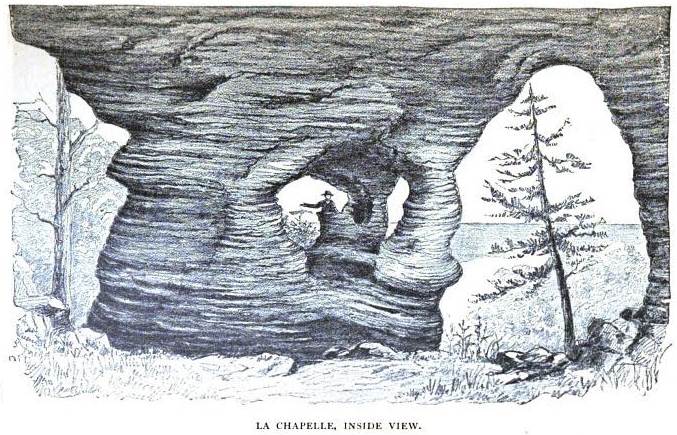
Page 47: “La Chapelle, inside view.”
Upon the cliff, just without, a column stands detached, and worn into the form of an urn, no bad representation of the baptismal font.
At what epoch of the world, or for what class of worshippers, this almost perfect temple was created, we might ask in vain of geologist or theologian. Certainly it is well designed to raise in the beholders thoughts of adoration for its all-skillful Architect, while they assign to it a chief place among the wonders of his workmanship.
An urn-shaped mass, similar to the one here observed, of great regularity and beauty of form, and not less than 50 feet in height, may ben seen at another point of the coast. Several rills of water leap from the very top of these precipitous cliffs, and add much to the charm of the view. Indeed, taken in connection with the wide-sweeping lake, the distant mountain ranges, and the woodland, crowning the cliff, the scene presented is of the most picturesque and wildest character.
“Where’er we gaze, around, above, below, What rainbow tints, what magic charms are found! Rock, river, forest, mountain, all abound, And bluest skies that harmonize the whole; Beneath, the distant torrent’s rushing sound Tells where the volumed cataract doth roll, Between those hanging rocks, that shock yet please the soul.”
Against these huge ramparts in the hour of the storm the billows of this impetuous lake dash with terrific fury, rumbling beneath the open arches, until, from the hollow caverns within, the sounds return like distant echoes, and at times their spray is thrown to the very summits of the cliff. Woe betide the bark that is overtaken by the tempest before these hopeless barriers!
But when the winds are down, lulling the lake to gentlest murmurs, the cautious boatman piles along the lone rampart, and with beating heart ventures to explore its awe-inspiring recesses, those.
“Worn and wild receptacles, Worked by the storms, yet work’d as it were planned, In hollow halls, with sparry roof and cells.”
From this sketch some correct idea may perhaps be gathered of a few of those strange forms which Nature, in her sportive hours, has here carved out of the solid fabric of the globe, as if in mockery of the efforts of man, gigantic monuments of that immeasurable Power who formed the wonders of the universe.
Thirty miles west form the Pictured Rocks, at Chocolate and Carp rivers, we first met, in their approach to the shore, the azoic or primary rocks, which from here onward constitute so interesting and important a feature in the geology of the country. Of their scientific or their economical character it is not my purpose to speak, further than to say that to them belong the iron beds, which are such a mine of wealth to our State. Here, a few years after our visit, sprang into being the busy and thriving city of Marquette. But at the time of which I speak, all was a solitude.
From hence to Keweenaw Bay ranges of granite knobs rise into considerable hills, and around them lie a series of quartzites, slates, and metamorphosed sandstones. The granites are pierced by dykes of trap, which in some cases form straight, narrow, and often lofty walls, in others have overflowed in irregular masses. Here Pluto, not Neptune, has been the controlling spirit, and has left the witness of his rule upon the face of the country. Ascending the knobs of granite and quartz, the change is most striking. To the east the eye embraces a tract lying in immense broad steppes of the sandstone, extending beyond the Pictured Rocks; while to the west are seen only rolling hills and knobs, terminating in the Huron Mountains.
I can add nothing to what is so well known of the mineral riches of this part of the country. But there is in its building-stones a wealth that is hardly yet begun to be realized. No more beautiful and serviceable material than the easily-worked and variously-tinted sandstones is found in the West; and her granites, already broken by natural forces into convenient block, and as yet untried, will command a market in the time coming, when the solid and durable shall be regarded a chief requisites to good architecture.
Following our westerly direction to Point Keweenaw, we find the dominion of Pluto established on a most magnificent scale. Not only is his energy displayed in the stern and rock-bound coast, but in the lofty ranges of trap, which rise into rugged hills of from 400 to 900 feet above the lake. Within these are secreted, but scarcely concealed, those wonderful veins of native copper, here quarried rather than mined, in masses such as the world has nowhere else produced.
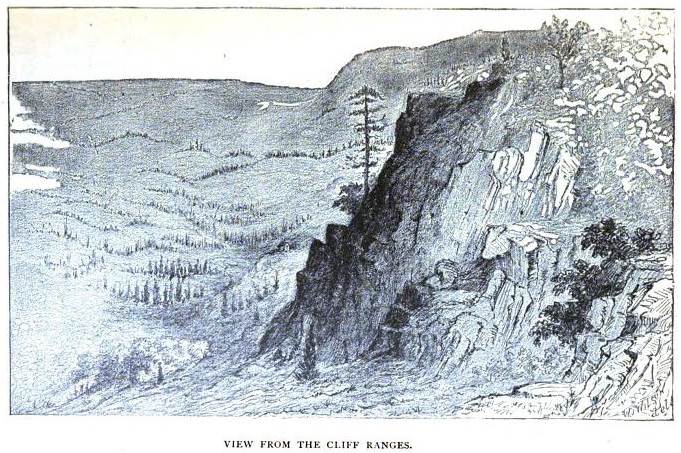
Page 51: “View from the cliff ranges.”
But of all this wealth nothing was then known, except that traces of copper were visible at a few places along the coast, and that a large mass of the native metal lay in the bed of Ontonagon River, long revered by the Indians as a Manitou, and mentioned in the relations of the early French historians.
I will but add, as the result of this season’s explorations, that the report of the State geologist, published the ensuing winter, unravelled the whole subject of the mode of occurrence of the copper and its associated minerals, in the most complete and scientific manner. It first made known the immense value which Michigan possessed in its hitherto despised Upper Peninsula; and its immediate effect was to arouse an interest in this then wild and uninhabited Indian territory, which has led to the opening up of its mines, and its present teeming prosperity.
On the third of July we encamped at Copper Harbor, and spent several days in exploration of the surrounding country, and in blasting for ores. Several blasts were got ready for the great national jubilee, which we commemorated in the noisy manner usual with Americans, by a grand discharge from the rocks. We succeeded in producing a tremendous report, and the echo, resounding from the placid water as from a sounding-board, pealed forth in corresponding reverberations for several minutes. Later in the day we retired to our camp and partook of an equally grand dinner. It consisted of pigeons, fried and stewed, corn and bean soup, short-cake and hard-tack, pork, and—last but not least—a can of fine oysters, which had been brought along for the occasion. Truly a sumptuous repast for a party of wilderness vagrants, even on a Fourth of July anniversary!
But time warns me to hasten my journey. I will therefore proceed at once to the Ontonagon, where an adventure befel, which it becomes a true knight-errant to relate. It was our purpose to pass up this river to the large mass of copper already alluded to. As we landed at the mouth there were noticed, on the opposite side of the river, several Indian lodges. As soon as we had dined, a few of the occupants crossed over in canoes, shook hands with us, giving the usual greeting of “Bo jou,” and received a small gift of tobacco and bread. Accompanying were half a dozen young boys, some of whom had remarkably fine features. We could not but notice, as an usual circumstance, that several of the men were painted black. One athletic fellow in particular, in this grimy coloring, and naked except the clout, made a very grotesque though savage appearance. The devil himself, however, is said not to be so black as he is painted, and this fellow seemed rather to act the buffoon than the noble warrior.
~ Douglass Houghton Papers: 1829-1845
“It is at this place, the Chegoimegon of early writers, that tradition places the ancient council fire of the Chippewa nation. […] The present chieftain, Chi Waishki, alias Pizhickee, or the Buffalo, is the representative of this line. He said to the Indian Agent, who, by direction of the commissioners at the treaty of Fond du Lac, in 1826, invested him with a silver medal. “What need I of this! It is known whence I am descended. […] Chi Waishki, the chief above alluded to, was met at Keweena, on his way to visit the Agency.”
~ Narrative of an expedition through the upper Mississippi to Itasca Lake, the actual source of this river : embracing an exploratory trip through the St. Croix and Burntwood (or Broule) Rivers, in 1832, by Henry Rowe Schoolcraft, 1834, pages 20-21.
The party proved to belong to the Buffaloes, whose chief we had met at River Tequamenon, near the eastern end of the lake, and were under the command of the son of that chief. The latter was a resolute-looking fellow, of about 26 or 30 years of age. His face was painted red, and he wore a medal bearing the likeness of John Quincy Adams. We paid little attention to the Indians, although aware that on several occasions exploring parties had been stopped at the mouth of this river and turned back.
We had made but two of three miles progress up the stream when the rapid stroke of paddles was heard, and a canoe, manned with Indians, shot quickly around a bend below and came into slight. The savages were seated, as their custom is, in the bottom of their bark, so that only heads and shoulders were visible. As each applied his whole strength the canoe skimmed over the surface like a young duck, while the dashing of so many paddles caused her to seem propelled by a water-wheel.
“”By a comparison of the number of Indians vaccinated upon the borders of Lake Superior, with the actual population, it will be seen that the proportion who have passed through the vaccine disease is so great as to secure them against any general prevalence of the small-pox; and perhaps it is sufficient to prevent the introduction of the disease to the bands beyond, through this channel. But in the Folle Avoine country it is not so. Of the large bands of Indians residing in that section of country, only a small fraction of been vaccinated; while of other bands not a single person has passed through the disease.”
~ Narrative of an expedition through the upper Mississippi to Itasca Lake, the actual source of this river : embracing an exploratory trip through the St. Croix and Burntwood (or Broule) Rivers, in 1832, by Henry Rowe Schoolcraft, 1834, page 253.
Our leader’s boat, which was ahead, immediately lay to and raised her American flag. “If they want to fight,” said the Doctor, “we’ll give them a chance.” Our two boats moved into line, and the doctor’s assistants armed themselves, one with a revolver, the other with a rusty shot-gun, our entire military resource. The canoe was soon alongside, and the heads and shoulders proved to belong the bodies of eight stout natives, headed by the young chief. Dr. Houghton held out his hand to be shaken as before. He then asked, through an interpreter, if they recollected the man who had put something into their arms when they were sick, a number of years ago. This something was vaccine for the small-pox, Doctor H. having accompanied the Schoolcraft expedition, in the capacity of physician and botanist. To this the chief, who doubtless well knew, made no reply, but demanded our errand up the river, and said that he and his men had been stationed at the mouth by his father, the head of the tribe, with orders to allow no boat to pass up without that chief’s permission. He added further, that we had not paid him, the son, the respect that was his due, by calling at his lodge and leaving a present. Our leader replied that he was sent hither by their great Father, whose instructions he should obey; that he should ascend the river as far as suited him, and that he did not recognize in them any authority to stop him.

Is this a photo of Jechiikwii’o wearing the 1826 medal in 1856-7? You be the judge.
~ Error Correction: Photo Mystery Still Unsolved
Chief. You must wait at the mouth until the Buffalo comes up. Else I and my band shall go with you, and see that you take nothing.
Doctor. I have been here before, and shall go now, as I am ordered by your great Father. I know the country and do not need a guide.
Chief. This country belongs to us.
Doctor. I know that the country is Indian territory, but the treaty of 1826 allows citizens of the United States to visit it. Neither shall I ask consent of the chief to take what I please. But, being acquainted with the Buffalo, I have no objection to showing him what I bring away.
At this stage of the alteration another canoe came in sight, which proved to contain the boys. By this time two of the Indians had made free to step into our small boat, where they seated themselves with great appearance of familiarity. The affair would have had enough of the ludicrous mingled with its serious aspect to warrant us in making light of it, and holding no further parley, but for two considerations, which we could not afford to overlook. Owing to the numerous rapids, the barge, which contained our whole stock, could be got up only ten miles, while we had to proceed to the forks, twenty miles further, in our smaller boat, and thence five miles by foot. And in case of a trial of strength with the Indians, no dependence could be placed upon our hired voyageurs, most of whom were allied to the opposite party, both in blood and training.
Pointing to a bend in the river, our detainers now said, “We are determined that you shall not go beyond that point to-night.” This audacious order determined us to at once break off all conference, so asserting our intention to be no longer hindered or delayed, we prepared for immediate departure. After some consultation among themselves, the chief answered, that if we would then and there make them a present of a keg of pork and a barrel of flour we would be allowed to proceed, but should be expected to bestow a further present to the head chief on our return.
To this bold demand, which plainly appeared to be a levy of blackmail, an act of piracy, Dr. Houghton replied that he would give them as a present such things as they stood in immediate need of, but nothing more. Nor should he recognize the shadow of a right to demand even that. Accordingly, a bag filled with flour, and some pork and tobacco were offered, and the leader agreed to accept his present in powder, lead, and provisions at La Pointe, whither we were bound.
The parley being at an end, we drew off and pushed up the stream. The hostiles remained awhile in consultation, and then withdrew in the opposite direction. A few miles above we encamped for the night.
It was a necessity, as I have stated, to leave our barge behind with all our stores, while the exploring party were absent for two days and a night. Of course this dilemma was known to the enemy. Holding a council of war the next morning, it was resolved to leave with our goods four of the men, together with the gun. They received most positive orders to fire upon the first Indian who touched the baggage, in case any of them should return, as we had reason to expect. And our captain added with solemn emphasis, that if any man failed in fidelity, his own life should pay the forfeit. Having thus played upon their fears, we pursued our laborious journey, reached the Copper Rock at nightfall, and tired with the day’s toils, laid down beneath the cover of the forest and slept soundly.
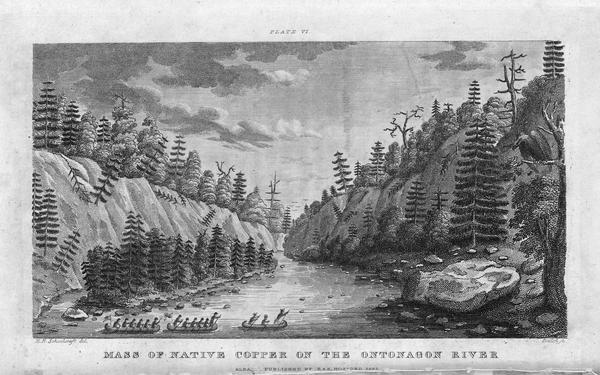
“Engraving depicting the [1820] Schoolcraft expedition crossing the Ontonagon River to investigate a copper boulder.”
~ Wisconsin Historical Society
But to conclude the narrative: on reaching camp, on our return, we learned that the chief, with several of this band, had been there, but had touched nothing, and according to his own account, had taken the trail for Lake Flambeau, in order to join a war-party, then organizing, of the Chippewas against the Sioux. Notwithstanding this story we fully expected to meet these fellows again at the mouth, and to whip them there if we could. But when we reached the place all was silent, and the lodges deserted.

Page 57: “Falls at the mouth of Montreal River.”
I will only add to this long story, that our captain’s order was never presented. We learned further, on reaching La Pointe, that the party which waylaid us had known of our journey from the first; that they had “smoked over it,” had dogged us the whole way up the lake, subsisting themselves by fishing, and that when we met they were nearly starved.
I will take my hearers but one stage further before closing this excursive ramble.
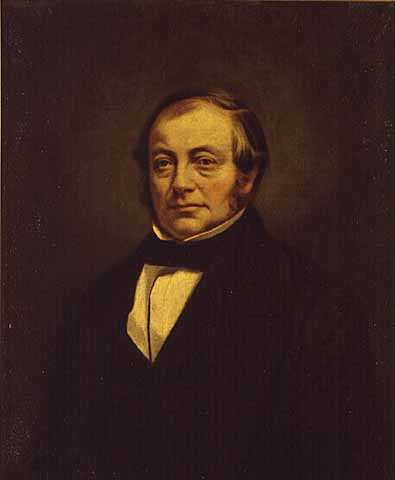
Charles William Wulff Borup
~ Minnesota Historical Society

Charles Henry Oakes
~ Findagrave.com
A few days brought us to the islands called by Carver “The Apostles.” On one of the largest of these, Madeline, at La Pointe, is located a general depot of the American Fur Company, for all the western parts of the lake, and the chain of lakes and rivers leading into it. It had become, in consequence, an asylum for all the old traders of that part of the country, and the temporary abode to great numbers of Indians. After pitching our tents on the beach, in front of the fort, amid a crowd of Indians and equally idle half-breeds, we were welcomed by the company’s factor, Dr. Borup, Mr. Oakes, the factor from Fond-dulac, and Mr. Bushnell, the Indian agent, and invited to all the hospitalities of the place.
During our whole voyage from the Sault we had not seen the face of a white man, except at the mission of L’Anse, and a casual fishing party. But here, at the end of our wandering, far from what we had been accustomed to consider the limits of civilization, we were greeted, in the families of these gentlemen, not only by features to which we had been so long strangers, but by all the attendant civilized refinements. The dress and manners of the East, the free converse with friendly voices of our own and the gentler sex, the music of a piano, the sound of the church-going bell and Christian services, seemed to us rather like a return to our homes than the extreme of a two-months’ journey in the wilderness.
It may interest my hearer to know in more detail what composed a post so remote, and which was to me so much a surprise.
La Pointe at that period was one of those peculiar growths known only to a era which has long passed away, or been banished to regions still more remote. What is called the company’s “fort” consisted of two large stores painted red, a long storehouse for fish, at the wharf, and row of neat frame buildings painted white. The latter were occupied by the half dozen families in the company’s employ. These dwellings, with the two stores, formed opposite sides of a broad street, in the centre square of which was planted a large flag-pole. Upon this street also clustered sundry smaller and unpainted log tenements of the French and half-breeds. Half a mile from the fort were the Protestant and Catholic missions. The former boasted a good frame mansion of two stories, attached to which was a school, numbering thirty scholars. The Catholic mission had a large number of followers, including the French and Indians. In all, the settlement contained about fifty permanent tenements. Beside these were perhaps an equal number of Indian lodges, irregularly disposed in vacant spaces, and adding to the size and picturesque character of the village. Several hundred Indians usually found constant employ in the fisheries at this place.
This was the oldest, as well as most remote, of the Jesuit missions in the North-west, having been established by Father Allouez, in 1665. It was then a gathering place of many Indian nations, and was hundreds of miles from the nearest French settlement.
It has additional interest from the fact that it witnessed the youthful and zealous labors of Pere Marquette, who came, in 1669, to take the place of Father Allouez, among the Ottawas, Hurons, and other tribes of the neighborhood. It was at La Pointe that Marquette planned that voyage of first discovery, exploration and missionary enterprise down the Mississippi which has rendered his name illustrious.

Page 61: “Pere Marquette. (From the statue at City Hall, Detroit.)”
In the families I have mentioned might be detected an intermixture of Indian blood, which detracts little even from the fairness of the daughters, and the ladies as well as the gentlemen are intelligent and highly educated. Their lives, when not occupied in business, are spent in reading and music; and during the long, cold winter, frequent rides are taken on the ice, upon which they pass from island to island in sledges drawn by dogs.
I could not but picture to my mind, outside of this intelligent circle, the festivities which marked this distant post, at that season, in the more palmy days of the fur trade; when it would be crowded with the hangers-on of such an establishment, returned-returned from their sojourn in the trapping grounds, or their toilsome voyages to and from Montreal and Quebec, bent on lavishing away their season’s earnings in days of idleness or debauch, and in “long nights of revelry and ease.”
Much of this old-time character still remained. The motley population, the unique village, the fisheries and furs, the Indian dances and pow-wows, the mixture of civilization and barbarism, the isolation, broken only be occasional and irregular arrivals from the world below,—made up a scene for which we were little prepared, which will not be easily forgotten, but of which I can give only this meagre description.
Among The Otchipwees: III
July 20, 2016
By Amorin Mello
… continued from Among The Otchipwees: II

Magazine of Western History Illustrated
No. 4 February 1885
as republished in
Magazine of Western History: Volume I, pages 335-342.
AMONG THE OTCHIPWEES.
III.
The Northern tribes have nothing deserving the name of historical records. Their hieroglyphics or pictorial writings on trees, bark, rocks and sheltered banks of clay relate to personal or transient events. Such representations by symbols are very numerous but do not attain to a system.
Their history prior to their contact with the white man has been transmitted verbally from generation to generation with more accuracy than a civilized people would do. Story-telling constitutes their literature. In their lodges they are anything but a silent people. When their villages are approached unawares, the noise of voices is much the same as in the camps of parties on pic-nic excursions. As a voyageur the pure blood is seldom a success, and one of the objections to him is a disposition to set around the camp-fire and relate his tales of war or of the hunt, late into the night. This he does with great spirit, “suiting the action to the word” with a varied intonation and with excellent powers of description. Such tales have come down orally from old to young many generations, but are more mystical than historical. The faculty is cultivated in the wigwam during long winter nights, where the same story is repeated by the patriarchs to impress it on the memory of the coming generation. With the wild man memory is sharp, and therefore tradition has in some cases a semblance to history. In substance, however, their stories lack dates, the subjects are frivolous or merely romantic, and the narrator is generally given to embellishment. He sees spirits everywhere, the reality of which is accepted by the child, who listens with wonder to a well-told tale, in which he not only believes, but is preparing to be a professional story-teller himself.
Indian picture-writings and inscriptions, in their hieroglyphics, are seen everywhere on trees, rocks and pieces of bark, blankets and flat pieces of wood. Above Odanah, on Bad River, is a vertical bank of clay, shielded from storms by a dense group of evergreens. On this smooth surface are the records of many generations, over and across each other, regardless of the rights of previous parties. Like most of their writings, they relate to trifling events of the present, such as the route which is being traveled; the game killed; or the results of a fight. To each message the totem or dodem of the writer is attached, by which he is at once recognized. But there are records of some consequence, though not strictly historical.

Charles Whittlesey also reproduced Okandikan’s autobiography in Western Reserve Historical Society Tract 41.
Before a young man can be considered a warrior, he must undergo an ordeal of exposure and starvation. He retires to a mountain, a swamp, or a rock, and there remains day and night without food, fire or blankets, as long as his constitution is able to endure the exposure. Three or four days is not unusual, but a strong Indian, destined to be a great warrior, should fast at least a week. One of the figures on this clay bank is a tree with nine branches and a hand pointing upward. This represents the vision of an Indian known to one of my voyagers, which he saw during his seclusion. He had fasted nine days, which naturally gave him an insight of the future, and constituted his motto, or chart of life. In tract No. 41 (1877), of the Western Reserve Historical Society, I have represented some of the effigies in this group; and also the personal history of Kundickan, a Chippewa, whom I saw in 1845, at Ontonagon. This record was made by himself with a knife, on a flat piece of wood, and is in the form of an autobiography. In hundreds of places in the United States such inscriptions are seen, of the meaning of which very little is known. Schoolcraft reproduced several of them from widely separated localities, such as the Dighton Boulder, Rhode Island; a rock on Kelley’s Island, Lake Erie, and from pieces of birch bark, conveying messages or memoranda to aid an orator in his speeches.
~ New Sources of Indian History, 1850-1891: The Ghost Dance and the Prairie Sioux, A Miscellany by Stanley Vestal, 2015, page 269.
The “Indian rock” in the Susquehanna River, near Columbia, Pennsylvania; the God Rock, on the Allegheny, near Brady’s Bend; inscriptions on the Ohio River Rocks, near Wellsville, Ohio, and near the mouth of the Guyandotte, have a common style, but the particular characters are not the same. Three miles west of Barnsville, in Belmont County, Ohio, is a remarkable group of sculptured figures, principally of human feet of various dimensions and uncouth proportions. Sitting Bull gave a history of his exploits on sheets of paper, which he explained to Dr. Kimball, a surgeon in the army, published in fascimile in Harper’s Weekly, July 1876. Such hieroglyphics have been found on rocky faces in Arizona, and on boulders in Georgia.

Pointe De Froid is the northwestern extremity of La Pointe on Madeline Island. Map detail from 1852 PLSS survey.
~ Report of a geological survey of Wisconsin, Iowa, and Minnesota: and incidentally of a portion of Nebraska Territory, by David Dale Owen, 1852, page 420.
~ Geology of Wisconsin: Paleontology by R. P. Whitfield, 1880, page 58.
While pandemonium was let loose at La Pointe towards the close of the payment we made a bivouac on the beach, between the dock and the mission house. The voyageurs were all at the great finale which constitutes the paradise of a Chippewa. One of my local assistants was playing the part of a detective on the watch for whisky dealers. We had seen one of them on the head waters of Brunscilus River, who came through the woods up the Chippewa River. Beyond the village of La Pointe, on a sandy promontory called Pointe au Froid, abbreviated to Pointe au Fret or Cold Point, were about twenty-five lodges, and probably one hundred and fifty Indians excited by liquor. For this, diluted with more than half water, they paid a dollar for each pint, and the measure was none too large – neither pressed down nor running over. Their savage yells rose on the quiet moon-lit atmosphere like a thousand demons. A very little weak whisky is sufficient to work wonders in the stomach of a backwoods Indian, to whom it is a comparative stranger. About midnight the detective perceived our traveler from the Chippewa River quietly approaching the dock, to which he tied his canoe and went among the lodges. To the stern there were several kegs of fire-water attached, but weighted down below the surface of the water. It required but a few minutes to haul them in and stave the heads of all of them. Before morning there appeared to be more than a thousand savage throats giving full play to their powerful lungs. Two of them were staggering along the beach toward where I lay, with one man by my side. he said we had better be quiet, which, undoubtedly, was good advice. They were nearly naked, locked arm in arm, their long hair spread out in every direction, and as they swayed to and fro between the water line and the bushes, no imagination could paint a more complete representation of the demon. There was a yell to every step – apparently a bacchanalian song. They were within two yards before they saw us, and by one leap cleared everything, as though they were as much surprised as we were. The song, or howl, did not cease. It was kept up until they turned away from the beach into the mission road, and went on howling over the hill toward the old fort. It required three days for half-breed and full-blood alike to recover from the general debauch sufficiently to resume the oar and pack. As we were about to return to the Penoka Mountains, a Chippewa buck, with a new calico shirt and a clean blanket, wished to know if the Chemokoman would take him to the south shore. He would work a paddle or an oar. Before reaching the head of the Chegoimegon Bay there was a storm of rain. He pulled off his shirt, folded it and sat down upon it, to keep it dry. The falling rain on his bare back he did not notice.

Portrait of Stephen Bonga
~ Wisconsin Historical Society
We had made the grand portage of nine miles from the foot of the cataract of the St. Louis, above Fond du Lac, and encamped on the river where the trail came to it below the knife portage. In the evening Stephen Bungo, a brother of Charles Bungo, the half-breed negro and Chippewa, came into our tent. He said he had a message from Naugaunup, second chief of the Fond du Lac band, whose home as at Ash-ke-bwau-ka, on the river above. His chief wished to know by what authority we came through the country without consulting him. After much diplomatic parley Stephen was given some pequashigon and went to his bivouac.

Joseph Granville Norwood
~ Wikipedia.org
Portrait of Naagaanab
~ Minnesota Historical Society
The next morning he intimated that we must call at Naugaunup’s lodge on the way up, where probably permission might be had, by paying a reasonable sum, to proceed. We found him in a neat wigwam with two wives, on a pleasant rise of the river bluff, clear of timber, where there had been a village of the same name. His countenance was a pleasant one, very closely resembling that of Governor Corwin, of Ohio, but his features were smaller and also his stature. Dr. Norwood informed him that we had orders from the Great Father to go up the St. Louis to its source, thence to the waters running the other way to the Canada line. Nothing but force would prevent us from doing this, and if he was displeased he should make a complaint to the Indian agent at La Pointe, and he would forward it to Washington. We heard no more of the invasion of his territory, and he proceeded to do what very few Chippewas will do, offered to show us valuable minerals. In the stream was a pinnacle of black sale, about sixty feet high. Naugaunup soon appeared from behind it, near the top, in a position that appeared to be inaccessible, a very picturesque object pointing triumphantly to some veins of white quartz, which are very common in metamorphic slate.
Those who have heard him, say that he was a fine orator, having influence over his band, a respectable Indian, and a good negotiator. If he imagined there was value in those seams of quartz it is quite remarkable and contrary to universal practice among Chippewas that he should show them to white men. They claim that all minerals belong to the tribe. An Indian who received a price for showing them, and did not give every one his share, would be in danger of his life. They had also a superstitious dread of some great evil if they disclosed anything of the kind. Some times they promise to do so, but when they arrive at the spot, with some verdant white man, expecting to become suddenly rich, the Great Spirit or the Bad Manitou has carried it away. I have known more than one such instance, where persons have been sustained by hopeful expectation after many days of weary travel into the depths of the forest. The editor of the Ontonagon Miner gives one of the instances in his experience:
“Many years ago when Iron River was one of the fur stations, of John Jacob Astor and the American Fur Company, the Indians were known to have silver in its native state in considerable quantities.”
Men are now living who have seen them with chunks of the size of a man’s fist, but no one ever succeeded in inducing them to tell or show where the hidden treasure lay. A mortal dread clung to them, that if they showed white men a deposit of mineral the Great Manitou would punish them with death.
Several years since a half-breed brought in very fine specimens of vein rock, carrying considerable quantities of native silver. His report was that his wife had found it on the South Range, where they were trapping. To test his story he was sent back for more. In a few days he returned bringing with him quite a chunk from which was obtained eleven and one-half ounces of native silver. He returned home, went among the Flambeaux Indians and was killed. His wife refused to listen to any proposals or temptation from friend or foe to show the location of this vein, clinging with religious tenacity to the superstitious fears of her tribe.
When the British had a fort on St. Joseph’s Island in the St. Mary’s River, in the War of 1812, an Indian brought in a rich piece of copper pyrites. The usual mode of getting on good terms with him, by means of whisky, failed to get from him the location of the mineral. Goods were offered him; first a bundle, then a pile, afterwards a canoe-load, and finally enough to load a Mackinaw boat. No promise to disclose the place, no description or hint could be extorted. It was probably a specimen from the veins on the Bruce or Wellington mining property, only about twenty miles distant on the Canadian shore.
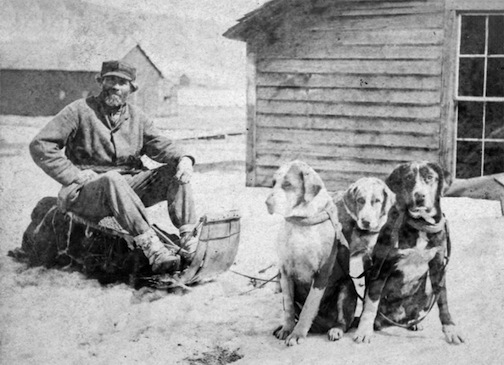
Detail of John Beargrease the Younger from stereograph “Lake Superior winter mail line” by B. F. Childs, circa 1870s-1880s.
~ Commons.Wikimedia.org
Crossing over the portage from the St. Louis River to Vermillion River, one of the voyageurs heard the report of a distant shot. They had expected to meet Bear’s Grease, with his large family, and fired a gun as a signal to them. The ashes of their fire were still warm. After much shouting and firing, it was evident that we should have no Indian society at that time. That evening, around an ample camp fire, we heard the history of the old patriarch. His former wives had borne him twenty-four children; more boys than girls. Our half-breed guide had often been importuned to take one of the girls. The old father recommended her as a good worker, and if she did not work he must whip her. Even a moderate beating always brought her to a sense of her duties. All he expected was a blanket and a gun as an offset. He would give a great feast on the occasion of the nuptials. Over the summit to Vermillion, through Vermillion Lake, passing down the outlet among many cataracts to the Crane Lake portage, there were encamped a few families, most of them too drunk to stand alone. There were two traders, from the Canada side, with plenty of rum. We wanted a guide through the intricacies of Rainy Lake. A very good-looking savage presented himself with a very unsteady gait, his countenance expressing the maudlin good nature of Tam O’Shanter as he mounted Meg. Withal, he appeared to be honest. “Yes, I know that way, but, you see, I’m drunk; can’t you wait till to-morrow.” A young squaw who apparently had not imbibed fire-water, had succeeded in acquiring a pewter ring. Her dress was a blanket of rabbit skins, made of strips woven like a rag carpet. It was bound around her waist with a girdle of deer’s hide, answering the purpose of stroud and blanket. No city belle could exhibit a ring of diamonds more conspicuously and with more self-satisfaction than this young squaw did her ring of pewter.
As we were all silently sitting in the canoes, dripping with rain, a sudden halloo announced the approach of living men. It was no other than Wau-nun-nee, the chief of the Grand Fourche bands, who was hunting for ducks among the rice. More delicious morsels never gladdened the palate than these plump, fat, rice-fed ducks. Old Wau-nun-nee is a gentleman among Indian chiefs. His band had never consented to sell their land, and consequently had no annuities. He even refused to receive a present from the Government as one of the head men of the tribe, preferring to remain wholly independent. We soon came to his village on Ash-ab-ash-kaw Lake. No band of Indians in our travels appeared as comfortable or behaved as well as this. Their country is well supplied with rice and tolerably good hunting ground. The American fur dealers (I mean the licensed ones) do not sell liquor to the Indians, and use their influence to aid Government in keeping it from them. Wau-nun-nee’s baliwick was seldom disturbed by drunken brawls. His Indians had more pleasant countenances than any we had seen, with less of the wild and haggard look than the annuity Indians. It was seldom they left their grounds, for they seldom suffered from hunger. They were comfortably clothed, made no importunities for kokoosh or pequashigon, and in gratifying their savage curiosity about our equipments they were respectful and pleasant. In his lodge the chief had teacups and saucers, with tea and sugar for his white guests, which he pressed us to enjoy. But we had no time for ceremonials, and had tea and sugar of our own. Our men recognized numerous acquaintances among the women, and as we encamped near a second village at Round Lake they came to make a draft on our provision chest. We here laid in a supply of wild rice in exchange for flour. Among this band we saw bows and arrows used to kill game. They have so little trade with the whites, and are so remote from the depots of Indian goods, that powder and lead are scarce, and guns also. For ducks and geese the bow and arrow is about as effectual as powder and shot. In truth, the community of which Wau-nun-nee was the patriarch came nearer to the pictures of Indians which poets are fond of drawing than any we saw. The squaws were more neatly clad, and their hair more often combed and braided and tied with a piece of ribbon or red flannel, with which their pappooses delighted to sport. There were among them fewer of those distinguished smoke-dried, sore-eyed creatures who present themselves at other villages.
By my estimate the channel, as we followed it to the head of the Round Lake branch, is two hundred and two mile in length, and the rise of the stream one hundred and eight feet. The portage to a stream leading into the Mississippi is one mile.
At Round Lake we engaged two young Indians to help over the portage in Jack’s place. Both of them were decided dandies, and one, who did not overtake us till late the next morning, gave an excuse that he had spent the night in courting an Indian damsel. This business is managed with them a little differently than with us. They deal largely in charms, which the medicine men furnish. This fellow had some pieces of mica, which he pulverized, and was managing to cause his inamorata to swallow. If this was effected his cause was sure to succeed. He had also some ochery, iron ore and an herb to mix with the mica. Another charm, and one very effectual, is composed of a hair from the damsel’s head placed between two wooden images. Our Lothario had prepared himself externally so as to produce a most killing effect. His hair was adorned with broad yellow ribbons, and also soaked in grease. On his cheeks were some broad jet black stripes that pointed, on both sides, toward his mouth; in his ears and nose, some beads four inches long. For a pouch and medicine bag he had the skin of a swan suspended from his girdle by the neck. His blanket was clean, and his leggings wrought with great care, so that he exhibited a most striking collection of colors.
At Round Lake we overtook the Cass Lake band on their return from the rice lakes. This meeting produced a great clatter of tongues between our men and the squaws, who came waddling down a slippery bank where they were encamped. There was a marked difference between these people and those at Ash-ab-ash-kaw. They were more ragged, more greasy, and more intrusive.
CHARLES WHITTLSEY.
Indian Records of Ontonagon and Bad River
June 11, 2016
By Amorin Mello
![This is a partial reproduction of<strong> <br /> <em>Western Reserve and Northern Ohio</em></strong><br /> <em> <strong> Historical Society</strong></em><br /> <em><strong>[Tract] Number 41</strong></em><br /> <em> <strong> Ancient Earthworks - Northern Ohio</strong></em><br /> by Charles Whittlesey, circa 1877<br /> as published in<br /> <a href="https://books.google.com/books?id=EawKAAAAIAAJ" target="_blank"><strong><span style="text-decoration: underline;">Western Reserve Historical Society Publication, Volume 2</span>,</strong></a><br /> pages 38-39.](https://chequamegonhistory.com/wp-content/uploads/2016/06/wrhs-tract-41.jpg)
This is a partial reproduction of
Western Reserve and Northern Ohio Historical Society
[Tract] Number 41: Ancient Earthworks – Northern Ohio
by Colonel Charles W. Whittlesey, circa 1877,
as republished in
Western Reserve Historical Society Publication, Volume 2,
pages 38-39.
INDIAN RECORDS.
Autobiography of Okandikan
Autobiography of Kundickan, a Chippeway Indian.
The subjoined pictorial record of his life, was made many years since by a Chippeway of Lake Superior. He delivered it to the Hon. A. C. Davis, of Detroit, who placed it in the Museum of the Natural Science Association of that place where it is now. The tracing was made in October, 1875, by Bela Hubbard, of Detroit. The engraving is from a photograph by E. Decker of Cleveland, reduced to one-third the original size.
The signs or characters are cut with a knife on both sides of a flat piece of sugar maple wood, less than one-fourth of an inch thick, wrought out by the Indian himself, for this purpose. The upright lines at a, a, a, appear to be divisions in the narrative, for the purpose of grouping events. He explained to Mr. Davis that this board contained the principal occurrences of his life, which any other Chippeway could read. How it should be read, whether from right to left or the reverse, or whether the inverted parts are to be taken in connection with those below, is not settled. The partitions A and B are colored vermillion red. It corresponds with the general character of the Indian pictorial writing, of which numerous examples are given by Schoolcraft, and shows a close relation to the rock inscriptions of the United States. It embraces the usual variety of uncouth men, animals, and implements which characterize the rock sculptures. Between the two sides of the board there does not appear to be any connection in regard to the sentences or paragraphs, though there must be as to dates. They are all, without much doubt, the work of people in the condition of savages. I saw this Indian on the Ontonagon river in 1845. He purported to have seen Alexander Henry in that region in 1769-70, who was engaged there in mining for copper and silver.

“Pictograph C. Okundekund and his Band of Ontonagon – Michigan,” as reproduced from birch bark by Seth Eastman, and published as Plate 62 in Historical and Statistical Information Respecting the History, Condition, and Prospects of the Indian Tribes of the United States, Volume I., by Henry Rowe Schoolcraft, 1851. Okandian’s pictograph petition was one of several from the 1849 Martell delegation:
“By this scroll, the chief Kun-de-kund of the Eagle totem of the river Ontonagon, of Lake Superior, and certain individuals of his band, are represented as uniting in the object of their visit of Oshcabewis. He is depicted by the figure of an eagle, Number 1. The two small lines ascending from the head of the bird denote authority or power generally. The human arm extended from the breast of the bird, with the open hand, are symbolic of friendship. By the light lines connecting the eye of each person with the chief, and that of the chief with the President, (Number 8,) unity of views or purpose, the same as in pictography Number 1, is symbolized. Number 2, 3, 4, and 5, are warriors of his own totem and kindred. Their names, in their order, are On-gwai-sug, Was-sa-ge-zhig, or The Sky that lightens, Kwe-we-ziash-ish, or the Bad-boy, and Gitch-ee-man-tau-gum-ee, or the great sounding water. Number 6. Na-boab-ains, or Little Soup, is a warrior of his band of the Catfish totem. Figure Number 7, repeated, represents dwelling-houses, and this device is employed to deonte that the persons, beneath whose symbolic totem it is respectively drawn, are inclined to live in houses and become civilized, in other words, to abandon the chase. Number 8 depicts the President of the United States standing in his official residence at Washington. The open hand extended is employed as a symbol of friendship, corresponding exactly, in this respect, with the same feature in Number 1. The chief whose name is withheld at the left hand of the inferior figures of the scroll, is represented by the rays on his head, (Figure 9,) as, apparently, possessing a higher power than Number 1, but is still concurring, by the eye-line, with Kundekund in the purport of pictograph Number 1.”
Inscriptions on Clay Banks, Bad River, Ashland County, Wis.

2

1
A few representations of recently inscribed figures are given for the purpose of comparison with ancient stone inscriptions. A short distance below the portage, across a long, loop-like bend of the Mashkeg or Bad river, above the Odanah Mission, is a perpendicular bluff of clay, on the west bank of the stream. Steep clay and sand bluffs are common through the flat country below the Falls of Bad River. This one has been sheltered by a thick fringe of growing trees, from the wearing effects of storms. It presents quite a smooth, upright face of dry clay; that is easily cut with a knife, about fifty feet long, and about ten to fifteen feet long, and about ten to fifteen feet high. This space is completely covered with picture records, made by the Chippeways. No doubt many of them are old, but most of them have been made recently, or by men now living, often obliterating or cutting new inscriptions over old ones.

4

3
In my explorations on the waters of Bad river in 1846, 1849, and 1860, I passed them repeatedly, but having other objects in view, made only a few sketches. The effigies are grotesque outlines of animals, canoes, birds, fishes, men, women, trees, and other objects, animate and inanimate. My Indians and some of the half-breed voyageurs, professed to be able to read them. They said it was expected that every young man, when he was old enough to become a warrior, should retire to some solitary place and undergo a fast. The length of time he could do without food was a test of his bravery. Sometimes he perched in a tree, day and night, or sat on a rock or on a high mountain, without fire or shelter, in order to show his contempt of pain and exposure. In due time he naturally had visions, in which his destiny or chart of life, was disclosed. Weak constitutions are unable to fast more than three or four days. When the incipient warrior had satisfied himself that his mission on earth was fully disclosed to him, he returned to the tribe and was received a man. Their version of this ceremony, and its consequences agrees generally with that of Chingwauk to Mr. Schoolcraft in 1839, as related in vol. 1, pages 13-14, of his “North American Indians.” The symbols of his destiny were generally put upon record, in such a manner and in such a place as he saw fit, but generally on trees or rocks, along a traveled route. In some cases a full statement of the vision or visions, was written out in this pictorial mode, with his dodem or “totem” attached. I remember the meaning of only one, of which figure No. 2 forms a part. The tree with nine branches, and a hand pointing upward, signifies that the party making it had fasted nine days.

5
There is nothing in their customs to prevent other messages being left in such places. Their records include nothing historical in regards to the nations or their chiefs. Such matters are perpetuated by repetition from the old to the young, until every young man is thoroughly crammed. General story telling, and the recital of their traditions, is the literary life work of an Indian. His memory is a mental record, transmitted from generation to generation. The fidelity of such records is, however, very far from reliable.
Figures one to five are random copies from a large number of the Bad river effigies, not made to scale, but they are fair representatives of Indian pictography.
Among The Otchipwees: II
June 4, 2016
By Amorin Mello
… continued from Among The Otchipwees: I

Magazine of Western History Illustrated
No. 3 January 1885
as republished in
Magazine of Western History: Volume I, pages 177-192.
AMONG THE OTCHIPWEES.
II.
In the fall of 1849, the Bad Water band were in excellent condition, and therefore very happy. Deer were then very abundant on the Menominee. They are nimble animals, able to leap gracefully over obstructions as high as a man’s head standing. But they do not like such efforts, unless there is a necessity for it. The Indians discovered this long ago, and built long brush fences across their trails to the water. When the unsuspecting animal has finished browsing, he goes for a drink with the regularity of an habitué of a saloon. Seeing the obstruction, he walks leisurely along it, expecting to find a low place, or the end of it. The dark eye of the Chippewa is fixed upon him from the top of a tree. This is much the best position, because the deer is not likely to look up, and the wind is less likely to bear his odor to the delicate nostrils of the game. At such close quarters every shot is fatal. Its throat is cut, its legs tied together, and thrown over the head and shoulders of the hunter, its body resting on his back, and he starts for the village. Here the squaws strip off the hide and prepare the carcass for the kettle. With a tin cup full of flour or a pound of pork, we often purchased a saddle of venison, and both parties were satisfied with the trade.
Naagaanab
~ Minnesota Historical Society
~ Executive Documents of the State of Minnesota for the Year 1886, Volume V.: Minnesota Geographical Names Derived from the Chippewa Language, by Reverend Joseph Alexander Gilfillan, 1887, page 457.
“Akwaakwaa” refers to “go a certain distance in the woods.”
~ General Geology: Miscellaneous Papers, Volume 1: A Report of Explorations in the Mineral Regions of Minnesota During the Years 1848, 1859 and 1864 by Colonel Charles Whittlesey, 1866, page 44.
Of course the man of the woods has a preference as to what he shall eat; but when he is suffering from hunger, as he is a large part of his days, he is not very particular. Fresh venison, bear meat, buffalo, moose, caribou, porcupine, wild geese, ducks, rabbits, pigeons, or fish, relish better than gulls, foxes, or skunks. The latter do very well while he is on the verge of starvation, and even owls, crows, dead horses and oxen. The lakes of the interior of Minnesota and Wisconsin produce wild rice spontaneously. When parched it is more palatable than southern rice, and more nutritious. Potatoes grow well everywhere in the north country; varieties of corn ripen as far north as Red Lake. Nothing but a disinclination to labor hinders the Chippewa from always having enough to eat. With the wild rice, sugar, and the fat of animals, well mixed, they make excellent rations, which will sustain life longer than any preparation known to white men. A packer will carry on his back enough to last him forty days. He needs only a tin cup in which to warm water, with which it makes a rich soup. Pemmican is less palatable, and sooner becomes rancid. This is made of smoke or jerked meat pulverized, saturated with fat and pressed into cakes or blocks. Sturgeon are numerous and large, and when well smoked and well pulverized they furnish palatable food even without salt, and keep indefinitely. Voyagers mix it with sugar and water in their cups. In the large lakes, white fish, siskowit, and lake trout are abundant. In the smaller lakes and rivers there are many varieties of fish. With so many resources supplied by nature, if the natives suffer from hunger it is solely caused by indolence. His implicit reliance upon the Great Spirit, which is his good Providence, no doubt encourages improvidence. Nanganob was apparently very desirous to have a garden at Ashkebwaka, for which I sent him a barrel of seed potatoes, corn, pumpkins, and a general assortment of seeds. Precisely what was done with the parcel I do not know, but none of it went into the ground. In most cases everything eatable went into their stomachs as soon as they were hungry. Even after potatoes had been planted, they have been dug out and eaten, and squashes when they were merely out of bloom. If the master of a lodge should be inclined to preserve the seed and a hungry brother came that way, their hospitality required that the garden should be sacrificed. Their motto is that the morrow will take care of itself. After being well fed, they are especially worthless. When corn has been issued to them to carry to their home, they have been known to throw it away and go off as happy as children.

Detail of the Saint Louis River with the Artichoke River (unlabeled) between the Knife Portage and East Savannah River from Hydrographical Basin of the Upper Mississippi River from Astronomical and Barometrical Observations Surveys and Information by Joseph Nicolas Nicollet, 1843.
~ David Rumsey Map Collection
No footgear is more comfortable, especially in winter, than the moccasin. The Indian knows nothing of cold feet, though he has no shoes or even socks. His light loose moccasin is large enough to allow a wrap of one or more thickness of pieces of blankets, called “nepes.” In times of extreme cold, wisps of hay are put in around the “nepes.” In winter the snow is dry, and the rivers and swamps everywhere covered with ice, which is a thorough protection against wet feet. As they are never pinched by the devices of shoemakers, the blood circulates freely. The well tanned deer skin is soft and a good nonconductor, which cannot be said of the footgear of civilization. In summer the moccasin is light and easy to the foot, but is no protection against water. At night it is not dried at the camp-fire only wrung out to be put on wet in the morning. Like the bow and the arrow, these have nearly disappeared since Europeans have furnished bullets, powder and guns. Before that time the war club was a very important weapon. It was of wood, having a strong handle, with a ball or knot at the end. If the Chippewas used battleaxes of stone, they could not have been common. I have rarely seen a light war club with an iron spike well fastened in the knot or ball at the end. In ancient days, when their arrows and daggers were tipped with flint, their battles were like those of all rude people – personal encounters of the most desperate character. The sick are possessed of evil spirits which are driven out by incantations loud and prolonged enough to kill a well person. Their acquaintance with medical herbs is very complete.
One of the customs of the country is that of concubinage as well as polygamy, resembling in this respect the ancient Hebrews and other Eastern nations. The parents of a girl – on proper application and the payment of a blanket, some tobacco and other et ceteras, amounting to “ten pieces” – bestowing their daughter for such a period as her new master may choose. A further consideration is understood that she is to be clothed and fed, and when the parents visit the traders’ post they expect some pork and flour. To a maiden – who, as an Indian wife or in her father’s house is not only a drudge but a slave, compelled to row the canoe, to cut and bring wood, put up the lodge and take it down, and always to carry some burden – this situation is a very agreeable one. If she wishes to marry afterwards, her reputation does not suffer. While Mr. B. was conversing with the Hudson’s Bay man on the bank, some of the girls came coquettishly down to them frisking about in their rabbit skin blankets well saturated with grease. One of them managed to keep in view what she considered a special attraction – a fine pewter ring on her finger. These Chippewas damsels had in some way acquired the art of insinuation belonging to the sex without the aid of a boarding school.
The Indian agent at La Pointe killed a deer of about medium size, which he left in the woods. He engaged an Indian to bring it in. Night came and the next day before the man returned without the deer. “Where is my deer?” “Eat him, don’t suppose me to eat nothing.” Probably that meal lasted him a week. There is among them no regular time for meals or other occupations. If there are provisions in the lodge, each one helps himself; and if a visitor comes, he is offered what he can eat as long as it lasts. This is their view of hospitality. The lazy and worthless are never refused. To do this to the meanest professional dead beat would be the ruin of the character of the host.
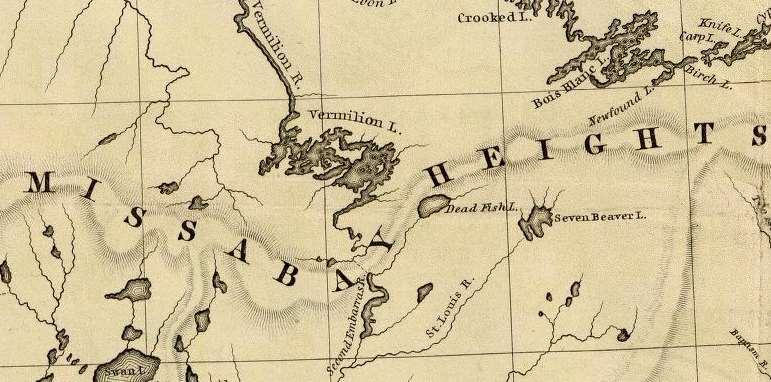
Detail of portage between Lake Vermillion and the Saint Louis River headwaters from Hydrographical Basin of the Upper Mississippi River from Astronomical and Barometrical Observations Surveys and Information by Joseph Nicolas Nicollet, 1843.
~ David Rumsey Map Collection
“Vincent Roy Sr. was born at Leech Lake Minn. in the year 1779 1797, and died at Superior, Wis. Feb. 18th 1872. He was a son of a Canadian Frenchman by the same name as his son bears. When V. Roy, Sr was about 17 or 18 years old, they emigrated to Fort Frances, Dominion of Canada, where he was engaged by the North-West Fur Co. as a trader until the two Companies (the North-West and the Hudson Bay Co joined together) he still worked for the consolidated Company for 12 or 15 years. When the American Traders came out at the Vermillion Lake country in Minnesota Three or four years afterwards he joined the American Traders. For several years he went to Mackinaw, buying goods and supplies for the Bois Fortes bands of Chippeways on Rainy and Vermillion Lake Country. About the year 1839 he came out to the Lake Superior Country and located his family at La Pointe. In winters he went out to Leech Lake Minn., trading for the American Fur Co. For several years until in the year of 1847 when the Hon. H. M. Rice, now of St. Paul, came to this country representing the Pierre Choteau Co. as a fur trading company. V. Roy, Sr. engaged to Pierre Choteau & Co. to trade with his former Indians at Vermillion Lake Country for two years, and then went for the American Fur Company again for one year. After a few years he engaged as a trader again for Peter E. Bradshaw & Co. and went to Red Lake, Minn. for several years. In 1861 he went to Nipigon (on Canadian side) trading for the same company. In a few years, he again went back to his old post at Vermillion Lake, Minn., where he contracted a very severe sickness, in two years afterwards he died at Superior among his Children as stated before &c.”
~ Minnesota Historical Society: Henry M. Rice and Family Papers, 1824-1966; Box 4; Sketches folder; Item “Roy, Vincent, 1797-1872”
Among the Chippewas we hear of man eaters, from the earliest travelers down to this day. Mr. Bushnell, formerly Indian agent at La Pointe, described one whom he saw who belonged on the St. Louis River and Vermillion Lake. The Indians have a superstitious dread of them, and will flee when one enters the lodge. They are hated, but it is supposed they cannot be killed, and no one ventures to make the experiment. it is only by a bullet such as the man eater himself shall designate that his body can be pierced. He is frequently a lunatic, spending days and nights alone in the woods in mid winter without food, traveling long spaces to present himself unexpectedly among distant bands. Whatever he chooses to eat is left for him, and right glad are the inmates of a lodge to get rid of him on such easy terms. The practice is not acquired from choice, but from the terrible necessities of hunger which happen every winter among the northern Indians. Like shipwrecked parties at sea, the weaker first falls a prey to the stronger, and their flesh goes to sustain life a little longer among the remainder. The Chippewas think that after one has tasted human food he has an uncontrollable longing for it, and that it is not safe to leave children alone with them. They say a man eater has red eyes and he looks upon the fat papoose with a demonical glance, and says: “How tender he would be.” One miserable object on the St. Louis River eat off his own lips, and finally became such a source of consternation that one Indian more courageous than the rest buried a tomahawk in his head. Another one who had the reputation of having killed all of his own family, came to the winter fishing ground on Rainy Lake, where Mr. Roy was trading with the Indians. He stayed on the ice trying to take some fish, but without success. Not one of the band dared go out to fish, although they were suffering from hunger. Mr. Roy and all the Indians requested him to go away, but he would not unless he had something to eat. no one but the trader could give him anything, and he was not inclined to do so. Things remained thus during three days, no squaw daring to go on the ice to fish for fear of the man eater. Mr. Roy urged them to kill him, but they said it would be of no use to shoot at him. The man eater dared them to fire. The trader at length lost patience with the cannibal and the terrified Bois Forts. He took his gun and warned the fellow that he would be shot if he remained on the ice. The faith of the savage appears to have been strong in the charm that surrounded his person, for he only replied by a laugh of derision. On the other side Mr. Roy had great faith in his rifle, and discharging it at the body of the man, he fell dead, as might have been expected. The Indians were at once relieved of a dreadful load, and sallied out to fish. No one, however, dared to touch the corpse.
No one of either party can go into the country of the other, and not be discovered. Their moccasins differ and their mode of walking. Their canoes and paddles are not alike, and their camp-fires as well as their lodges differ. The Chippewa lodge or wigwam is made by a circular or oblong row of small poles set in the ground, bending the tops over and fastening them with bark. They carry everywhere rolls of birch bark, which unroll like a carpet. These are wound on the poles next the ground course, and overlapping this a second and third, so as to shed rain. On one side is a low opening covered by a blanket, and at the top a circular place for the smoke to escape. The fire is on the ground at the centre. The work of putting up the lodge is done by the squaws, who gather wood for the fire, spread the mats, and proceed to cook their meals, provided there is anything to cook.

Stereograph of “Chippewa Indians and Wigwams” by Martin’s Art Gallery, circa 1862-1875, shows that they used more than one type of wigwam.
~ Commons.Wikimedia.org
A Sioux lodge is the model of the Sibley tent, with a pole at the centre and others set around in a circle, leaning against the central one at the top, forming a cone. This they cover with skins of the buffalo, deer, elk or moose, wound around like the Chippewa rolls of bark, leaving a space at the top for the smoke to escape, and an entrance at the side. This is stronger and more compact than the Chippewa wigwam, and withstands the fiercest storms of the prairies. In winter, earth is occasionally piled around the base, which makes it firmer and warmer.
We were coming down the Rum River, late in the fall of 1848, when one of our voyageurs discovered the track of a Sioux in the sand. It was at least three weeks old, but nothing could induce him to stay with us, not even an hour. He was not sure but a mortal enemy was then tracking us for the purpose of killing him.
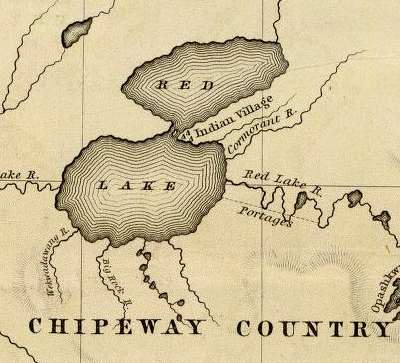
Detail of Red Lake from Hydrographical Basin of the Upper Mississippi River from Astronomical and Barometrical Observations Surveys and Information by Joseph Nicolas Nicollet, 1843.
~ David Rumsey Map Collection
Earlier in the season we were at Red Lake. A cloud of smoke came up from the west, which caused a commotion in the village and mission at the south end of the lake. A war party was then out on a Sioux raid. The chief had lost a son, killed by them. He had managed to get the hand of a Sioux, which he had planted at the head of his son’s grave. But this did not satisfy his revenge nor appease the spirit of his son. He organized a war party to get more scalps, which was then out. A warrior chief or medicine man gains his principal control of the warriors by means of a prophecy, which he must make in detail. If the first of his predictions should fail, the party may desert him entirely. In this case, on a certain day they would meet a bear. When they met the enemy, if they were to be victorious, a cloud of smoke would obscure the sun. It was this darkening of the sky that excited the hopes of the Red Lake band. They were sure there had been a battle and that the Sioux were defeated.
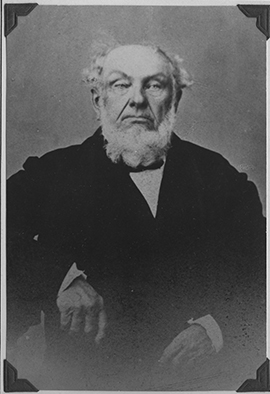
Judge Samuel Ashmun
~ Chippewa County Historical Society
The late Judge Ashmun, of Sault Ste. Marie, while he was a minor, wandered off from his nativity in Vermont to Lake Superior, through it to Fond du Lac, and thence by way of the St. Louis River to Sandy Lake on the Mississippi. Somewhere in that region he was put in charge of one of Astor’s trading posts. In the early winter of 1818 he went on a hunt with a party of seventeen indiscreet young braves, against the advice of the sachems, apparently in a southwesterly direction on the Sioux border, or neutral land. Far from being neutral, it was very bloody ground. At the end of the third day they were about fifty miles from the post. On the morning of each day a rendezvous was fixed upon for the next camp. Each one then commenced the hunt for the day, taking what route pleased himself. The ice on the lakes and marshes was strong and the snow not uncomfortably deep. The principal game was deer, with some pheasants, prairie hens, rabbits and porcupines. What a hunter could not carry he hung upon trees to be carried home upon their return. Their last camp was on the border of a lake in thick woods, with tall dry grass on the margin of the lake. Having killed all the deer they could carry, it was determined to begin the return march the next day. It was not a war party, but they were prepared for their Sioux enemies, of whom no signs had been discerned. There was no whiskey in the camp, but when the stomach of an Indian is filled to its enormous capacity with fresh venison he is always jolly. It was too numerous a party to shelter themselves by a roof of boughs over the fire, but they had made a screen against the wind of branches of pine, hemlock or balsam. Around the fire was a circle of boughs on which they sat, ate and slept. Some were mending their moccasins, other smoking tobacco and kinnikinic, playing practical jokes, telling stories, singing songs and gambling. Mr. Ashmun could get so little sleep that he took Wa-ne-jo, who had a boy of thirteen years, and they made a separate camp. This man going to the lake to drink, was certain that he heard the tramp and felt the vibrations of a party going over the ice, who could be no other than the Sioux. He returned, and after some hesitation Mr. Ashmun reported the news to the main camp. “Oh, Wa-ne-jo is a liar, nobody believes him,” was the universal response. Mr. Ashmun, however, gave credit to the repot. They immediately put out the fire at his bivouac. Even war parties do not place sentinels, because attacks are never made until break of day. In the isolated camp they waited impatiently for the first glimpse of morning. Most of the other party fell asleep with a feeling of security, for which they took no steps to verify. One of them lay down without his moccasins. Mr. Ashmun and his man were just ready to jump for the tall grass when a volley was poured into the other camp, accompanied by the usual savage yell. The darkness and stillness of a faint morning twilight made this burst of war still more terrific. Taking the boy between them, they commenced the race for life under the guidance of Wa-ne-jo, in a direction directly opposite to their home. He well knew the Sioux all night long had been creeping stealthily over the snow and through the thicket, and had formed a line behind the main camp. The Chippewas made a brave defence, giving back their howls of defiance and fighting as they dispersed through the woods. Eight were killed near the camp and a wounded one at some distance, where he had secreted himself. Two fo the wounded were helped away according to custom, and also the barefooted man, whose feet were soon frozen. All clung to their guns, and the frightened boy to his hatchet. They estimated the Sioux party to have been one hundred and thirty, of whom they killed four and wounded seven, but brought in no scalps.

Indians Canoeing in the Rapids painting by Cornelius Krieghoff, 1856.
~ Commons.Wikimedia.org
In his way, the Chippewa is quite religious. He believes in a future world where there is a happy place for good Indians. If he is paddling his canoe against a head wind and can afford it, he throws overboard a piece of tobacco, the most precious thing he has. With this offering there is a short invocation to the good manitou for a fair breeze, when he can raise a blanket for a sail, stop rowing and take a smoke. At the head of many a rapid which it is dangerous to run, are seen pieces of tobacco on the rocks, which were laid there with a brief prayer that they may go safely through. Some of them, which are frightful to white men, they pass habitually. These offerings are never disturbed, for they are sacred. He endeavors also to appease the evil spirit Nonibojan. Fire, rocks, waterfalls, mountains and animals are alive with spirits good and bad. The medicine man, who is prophet, physician, priest and warrior, is an object of reverence and admiration. His prayers are for success in the hunt, accompanied by incantations.

George Bonga
~ Wikipedia.org
Among the stories of a thousand camp-fires, was one by Charlie, a stalwart, half-breed Indian and negro, whose father was an escaped slave. On the shores of Sandy Lake, a party of Chippewas had crossed on the ice in midwinter, and encamped in the woods not far from the north shore. One of them went to the Lake with a kettle of water, and a hatchet to cut the ice. After he filled his kettle, he lay down to drink. The water was not entirely quiet, which attracted his attention at once. His suspicions were aroused, and placing his ear to the ice, he discerned regular pulsations, which his wits, sharpened by close attention to every sight and every sound, interpreted to be the tramp of men. They could be no other than Sioux, and there must be a party larger than their own. Their fire was instantly put out, and they separated to meet at daylight at a place several miles distant. All their conclusions were right. One band of savages outwitted another, having instincts of danger that civilized men would have allowed to pass unnoticed. The Sioux found only the embers of a deserted camp, and saw the tracks of their enemies diverge in so many directions that it was useless to pursue.
In 1839 the Chippewas on the upper Mississippi were required to come to Fort Snelling to receive their payments. That post was in Sioux territory, and the order gave offense to both nations. It required the presence of the United States troops to prevent murders even on the reservation. On the way home at Sunrise River, the Chippewas were surprised by a large force of Sioux, and one hundred and thirty-six were killed.
At the mouth of Crow Wing River, on the east bank of the Mississippi, is a ridge of gravel, on which there were shallow pits. The Indians said that, about fifteen years before, a war party of Sioux was above there on the river to attack the Sandy Lake band. A party of Chippewas concealed themselves in these pits, awaiting the descent of their enemies. The affair was so well managed that the surprise was complete. When the uncautious Sioux floated along within close range of their guns, the Chippewa warriors rose and delivered their fire into the canoes. Some got ashore and escaped through the woods to the westward, but a large portion were killed.
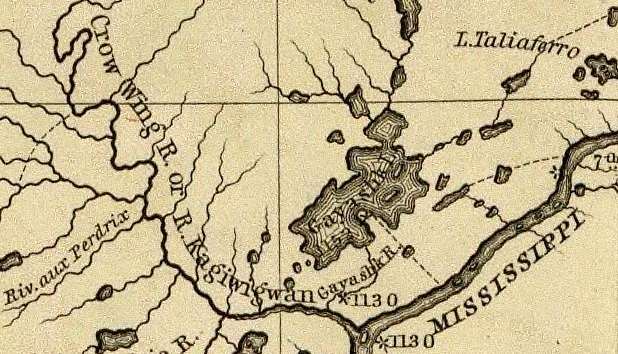
Detail of Crow Wing River from Hydrographical Basin of the Upper Mississippi River from Astronomical and Barometrical Observations Surveys and Information by Joseph Nicolas Nicollet, 1843.
~ David Rumsey Map Collection
While crossing the Elk River, between the falls of St. Anthony and those of St. Cloud, a squaw ran into the water, screaming furiously, followed by a man with a club. This was her lord and master, bent on giving her a taste of discipline very common in Indian life. She succeeded in escaping this time by going into deep water. Her nose had been disfigured by cutting away most of the fleshy portions, as a punishment for unfaithfulness to a husband, who was probably worse than herself.
At the mouth of Crow Wing River was an Indian skipping about with the skin of a skunk tied to one of his ankles. There was also in a camp near the post another Chippewa, who had murdered a brother of the lively man. There is no criminal law among them but that of retaliation. Any member of the family may execute this law at such time and manner as he shall decide. This badge of skunk’s skin was a notice to the murderer that the avenger was about, and that his mission was not fulfilled. Once the guilty man had been shot through the thigh, as a foretaste of what was to follow. The avenger seemed to enjoy badgering his enemy, whom he informed that although he might be occasionally wounded, it was not the intention at present to kill him outright. If the victim should kill his persecutor, he well knew that some other relative would have executed full retaliation.
~ The Assassination of Hole In The Day [the Younger] by Anton Treuer, 2010.
Hole In The Day the Younger
aka Kue-wee-sas (Gwiiwizens [Boy or Lad])
(1825-1868)
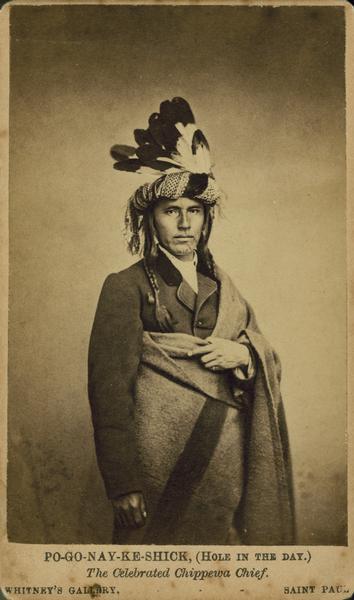
Bagone-giizhig the Younger
~ Wisconsin Historical Society
This Chippewa brave, Bug-on-a-ke-dit, lived on a knoll overlooking the Mississippi River, four miles above Little Rock, where he had a garden. He appeared at the payment at La Pointe, in 1848, with a breech cloth and scanty leggings. This was partially for showing off a very perfect figure, tall, round and lithe, the Apollo of the woods. His scanty dress enabled him to exhibit his trophies in war. The dried ears of his foes, a part of whom were women, were suspended at his neck. Around his tawny arms were bright brass bands, but there was nothing of which he was more proud than a bullet hole just below the right breast. The place of the wound was painted black, and around it circles of red, yellow and purple; other marks on the chest, arms and face told of the numbers he had slain and scalped, in characters well understood by all Chippewas. The numbers of eagle feathers in his hair informed the savage crowd how many battles he had fought. He was not, like Grizzly Bear, a great orator, but resembled him in getting drunk at every opportunity. He managed to procure a barrel of whiskey, which he carried to his lodge. While it was being unloaded it fell upon and crushed him to death. Looking up a grass clad hill, a dingy flag was seen (1848) fluttering on a pole where he was buried. He often repeated with great zest the mode by which the owners of two of the desecrated ears were killed. His party of four braves discovered some Sioux lodges on the St. Peters, from which all the men were absent. The squaws lodged their hereditary enemies over night with their accustomed hospitality. Bug-on-a-ke-dit and his party concealed themselves during the day, and at dark each one attacked a lodge. Seven women and children were slaughtered. His son Kue-wee-sas, or Po-go-noy-ke-schik, was a much more respectable and influential chief.
An hundred years since, the Sioux had an extensive burial ground, on the outlet of Sandy Lake, a few miles east of the Mississippi River. Their dead were encased in bark coffins and placed on scaffolds supported by four cedar posts, five or six feet high. This was done to prevent wolves from destroying the bodies. Thirty years since some of these coffins were standing in a perfect condition, but most of them were broken or wholly fallen, only the posts standing well whitened by age. The Chippewas wrap the corpse in a blanket and a roll of birch bark, and dig a shallow grave in which the dead are laid. A warrior is entitled to have his bow and arrow, sometimes a gun and and a kettle, laid beside him with his trinkets. Over the mound a roof of cedar bark is firmly set up, and the whole fenced with logs or protected in some way against wolves and other wild animals. There is a hole at one or both ends of the bark shelter, in which is friends place various kinds of food. Their belief in a spirit world hereafter is universal. If it is a hunter or warrior, he will need his arms to kill game or to slay his enemies. Their theory is that the dog may go to the spiritual country, as a spirit, also his weapons, and the food which is provided for the journey. To him every thing has its spiritual as well as its material existence. Over all is the great spirit or kitchi-manitou, looking after the happiness of his children here and hereafter.
Stephen Bonga
~ Wisconsin Historical Society
Winter travelling in those northern regions is by no means so uncomfortable as white men imagine. By means of snow shoes the Indian can move in a straight course towards his village, without regard to the trail. In the short days of winter he starts at day break and travels util dark. Stephen said he made fifty miles a day in that way, which is more than he could have done in summer.
At night they endeavor to find a thicket where there is a screen against the wind and plenty of wood. They scoop away the snow with their shoes and start a fire at the bottom of the pit. Around this they spread branches of pine, balsam or cedar, and over head make a shelter of brush to keep off the falling snow. Probably they have a team or more of dogs harnessed to sledges, who take their places around the fire. Here they cook and eat an enormous meal, when they wrap themselves in blankets for a profound sleep. Long before day another heavy meal is eaten. Everything is put in its proper package ready to start as soon as there is light enough to keep their course.
– Freelang Ojibwe-English by Weshki-ayaad, Charles Lippert and Guy T. Gambill
– Ojibwe People’s Dictionary by the Department of American Indian Studies at the University of Minnesota
Many Indian words have originated since the white people came among them. A large proportion of their proper names are very apt expressions of something connected with the person, lake, river, or mountain to which they are applied. This people, in their primitive state, knew nothing of alcohol, coffee, tea, fire-arms, money, iron, and hundreds of other things to which they gave names, generally very appropriate ones. A negro is black meat; coffee is black medicine drink; tea, red medicine drink; iron, black metal; gold, yellow metal. I was taking the altitude of the sun at noon near Red Lake Mission with a crowd of Chippewas standing around greatly interested. They had not seen the liquid metal mercury, used for an artificial horizon in such observations, which excited their especial astonishment, and they had no name for it. One of them said something which caused a general expression of delight, for which I enquired the reason. He had coined a word for mercury on the spot, which means silver water.
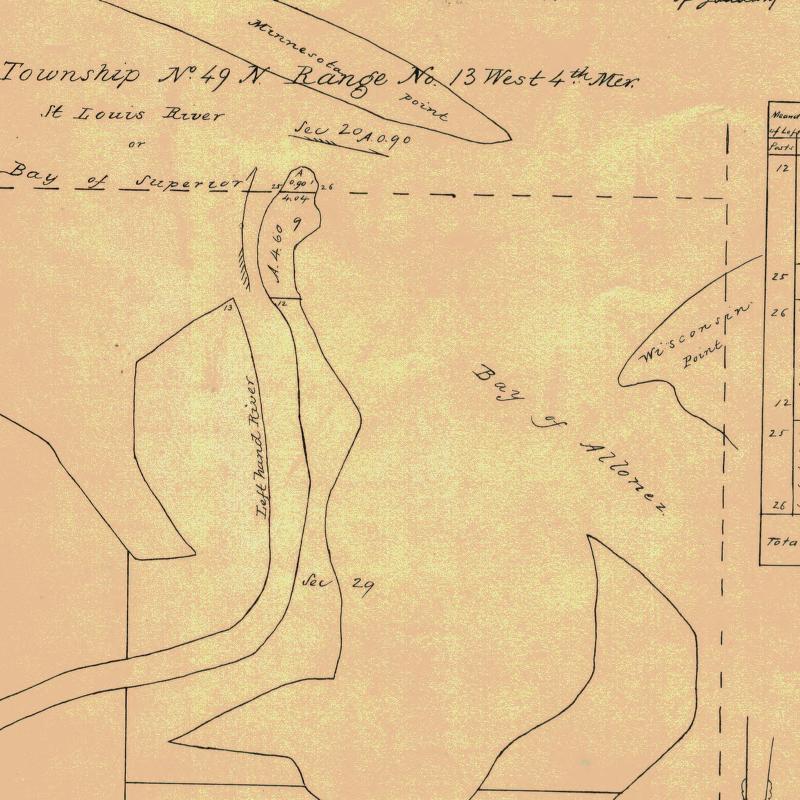
Detail of Minnesota Point during George Stuntz’s survey contract during August-October of 1852.
~ Barber Papers (prologue): Stuntz Surveys Superior City 1852-1854

This family’s sugar bush was located at or near Silver Creek (T53N-R10W).
~ General Land Office Records
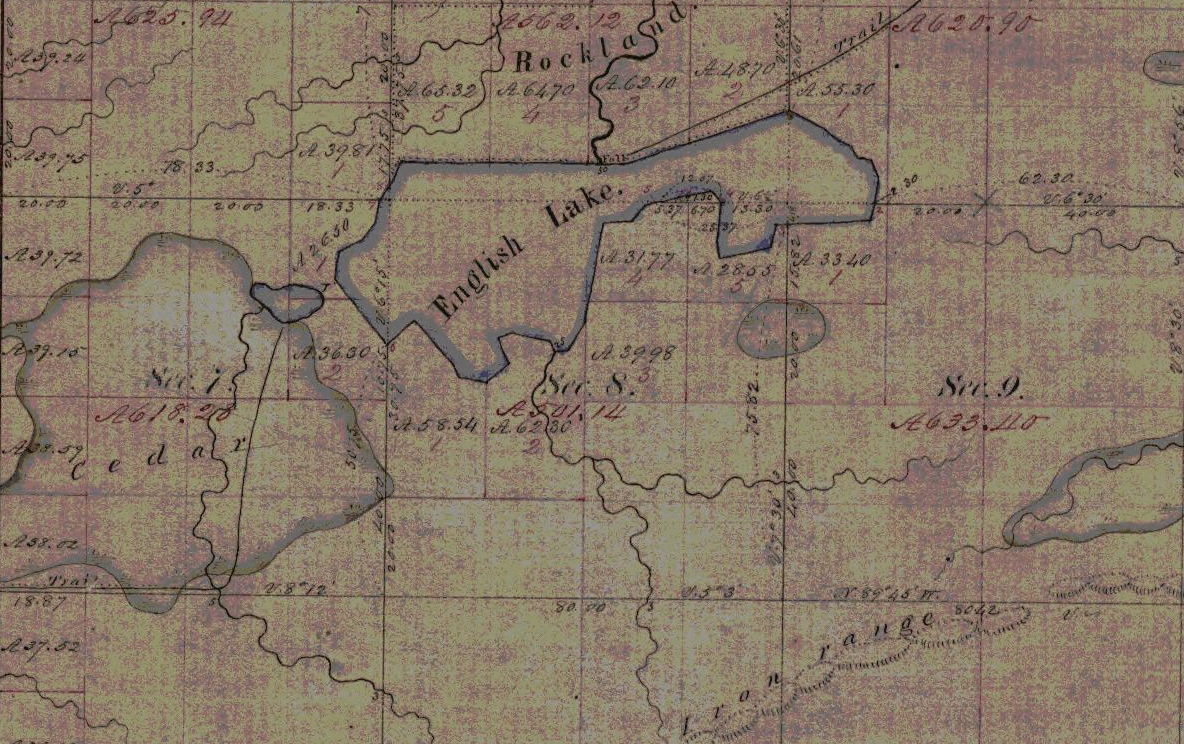
Indian trail to Rockland townsite overlooking English/Mineral Lake and Gogebic Iron Range.
~ Penokee Survey Incidents: Number V
Coasting along the beach northward from the mouth of the St. Louis River, on Minnesota Point, I saw a remarkable mark in the sand and went ashore to examine it. The heel and after part was clearly human. At the toes there was a cleft like the letter V and on each side some had one, others two human toes. Not far distant were Indians picking berries under the pine trees, which then covered the point in its entire length. We asked the berrypickers what made those tracks. They smiled and offered to sell us berries, of which they had several bushels, some in mokoks of birch bark, others in their greasy blankets. An old man had taken off his shirt, tied the neck and arms, and filled it half full of huckleberries. By purchasing some, (not from the shirt or blanket) we obtained an explanation of the nondescript tracks. There was a large family, all girls, whose feet were deformed in that manner. It was as though their feet had been split open when young halfway to the instep, and some of the toes lost. They had that spring met with a great loss by the remorseless bear. On the north shore, thirty miles east of Duluth, they had a fine sugar orchard, and had made an unusual quantity of sugar. A part was brought away, and a part was stored high up in trees in mokoks. There is nothing more tempting than sugar and whiskey to a bear. When this hard working family returned for their sugar and dried apples, moistened with whiskey, to lure bruin on to his ruin. A trap fixed with a heavy log is set up across a pen of logs, in the back end of which this bait is left, very firmly tied between two pieces of wood. This is fastened to a wooden deadfall, supporting one end of a long piece of round timber that has another piece under it. The bear smells the bait from afar, goes recklessly into the pen, and commences to gnaw the pieces of wood; before he gets much of the bait the upper log falls across his back, crushing him upon the lower one, where, if he is not killed, his hind legs are paralyzed. These deadly pens are found everywhere in the western forests. Two bears ranging along the south shore of English Lake, in Ashland County, Wisconsin, discovered some kegs of whiskey which contraband dealers had concealed there. With blows from their heavy paws they broke in the heads of the kegs and licked up the contents. They were soon in a very maudlin state, rolling about on the ground, embracing each other in an affectionate manner and vainly trying to go up the trees. Before the debauch was ended they were easily captured by a party of half-breeds. There are Indians who acknowledge the bear to be a relation, and profess a dislike to kill them. When they do they apologize, and say they do it because they are “buckoda,” or because it is necessary.

Detail of the Porcupine Mountains between the Montreal River and Ontonagon River from Map of the Mineral Lands Upon Lake Superior Ceded to the United States by the Treaty of 1842 With the Chippeway Indians.
~ Wisconsin Historical Society
At Ontonagon, a very sorry looking young Indian came out of a lodge on the west side of the river and expressed a desire to take passage in our boat. There had been a great drunk in that lodge the day before. The squaws were making soup of the heads of white fish thrown away by the white fishermen. Some of the men were up, others oblivious to everything. Our passenger did not become thoroughly sober until towards evening. We passed the Lone Rock and encamped abreast of the Porcupine Mountains. Here he recovered his appetite. The next day, near the Montreal River, a squaw was seen launching her canoe and steering for us. She accosted the young fellow, demanding a keg of whiskey. He said nothing. She had given him furs enough to purchase a couple of gallons and he had made the purchase, but between himself and his friends it had completely disappeared. The old hag was also fond of whiskey. The fraud and disappointment put her into a rage that was absolutely fiendish. Her haggard face, long, coarse, greasy, black hair, voluble tongue and shrill voice perfected that character.
Turning into the mouth of the river we found a party from Lake Flambeau fishing in the pool at the foot of the Great Fall. Their success had not been good, and of course they were hungry. One of our men spilled some flour on the sand, of which he could save but little. The Flambeaus were delighted, and, gathering up sand and flour together, put the mixture in their kettle. The sand settled at the bottom, and the flour formed an excellent porridge for hungry aboriginees.
~ Wisconsin Historical Society
Mushinnewa and Waubannika, Chippewas, lived at Bad River, near Odana. Mushinnewa had a very bad reputation among his tribe. He was not only quarrelsome when drunk, but was not peaceable when sober. He broke Waubannika’s canoe into fragments, which was resented by the wife of the latter on the spot. She made use of the awl with which she was sewing the bark on another canoe, as a weapon, and stabbed old Mushinnewa in several places so severely that it was thought he would die. He threatened to kill her, and she fled with her husband to Lake Flambeau. But Mushinnewa did not die. He had a son as little liked by the Odana band as himself. In a drunken affray at Ontonagon another Indian killed him. The murderer then took the body in his canoe, brought it to Bad River and delivered it to old Mushinnewa. According to custom the Indian handed the enraged father the knife with which his son was killed, and baring his breast told him to strike. The villagers were happy to be rid of the young villain, and took the knife from the hand of his legal avenger. A barrel of flour covered the body, and before night Mushinnewa adopted the Indian as his son.
Two varieties of willow, the red and the yellow, grow on the low land, at the margin of swamps and streams, which have the name of kinnekinic. During the day’s journey, a few sticks are cut and carried to the camp. The outer bark is scraped away from the inner bark, which curls in a fringe around the stick, which is forced in the ground before a hot fire, and occasionally turned. In the morning it is easily crumpled in the hands, and put into the tobacco pouch. If they are rich enough to mix a little tobacco with the kinnekinic, it is a much greater luxury. As they spend a large part of their leisure time in smoking, they are compelled to be content with common willow bark, which is a very weak narcotic. Tobacco is not grown as far north as the country of the Chippewas, but it is probable they had it through traffic with the tribes of Virginia, North Carolina and the Gulf States, in times very remote. Pipes are found in the works of the mounds builders that are very ancient, showing that they had something to smoke, which must have been a vegetable.
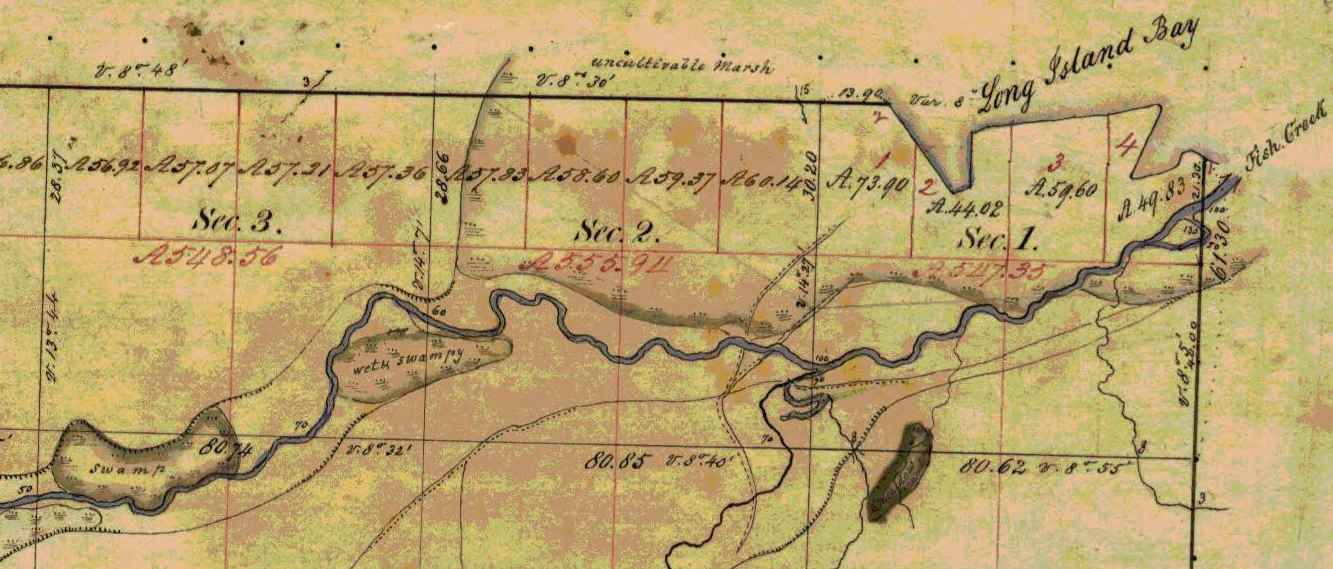
Detail of where the “Lake Long” [Lake Owen] and St. Croix foot paths start along Fish Creek.
~ Barber Papers: “Barbers Camp” Fall of 1855
~ History of the Upper Peninsula of Michigan, by Western Historical Co., 1883, page 276
Staggering around in a drunken crowd at La Pointe was a handsome Chippewa buck, as happy as whiskey can make any one. The tomahawk pipe is not an instrument of war, though it has that form. Its external aspect is that of a real tomahawk, intended to let out the brains of the foe. It is made of cast iron, with a round hollow poll, about the size of a pipe. The helm or handle is the stem, frequently decorated in the height of savage art, with ribbons, porcupine quills, paint and feathers. One thoroughly adorned in this manner has aperatures through the handle cross wise, so large and numerous that it is a mechanical wonder how the smoke can be drawn through it to the mouthpiece. No Indian is without a pipe of some kind, very likely one that is an heirloom from his ancestors. It is only in a passion that his knife or tomahawk pipe becomes dangerous. This genial buck had been struck with the poll of such a pipe when all hands were fighting drunk. It had cut a clear round hole in his head, hear the top, sinking a piece of skull with the skin and hair well into his brains. A surgeon with his instrument could not have made a more perfect incision. Inflammation had not set in and he was too busy with his boon companions to think of the wound. It was about twenty-four hours after it occurred when he stepped into his canoe and departed. When Mr. Beasley went up the Fish River, a few days afterwards a funeral was going on at the intersection of the Lake Long and the St. Croix trails, and the corpse had a cut in the head made by the pole of a tomahawk. From this event, no doubt, a family quarrel commenced that may continue till the race is extinct. The injured spirit of the fallen Indian demands revenge. In the exercise of retaliation it may be carried by his relations a little beyond retaliating justice, which will call on the other side for a victim, and so on to other generations.
In a lodge between the agency and the mission there was a young girl very sick. Probably it is my duty to say that she was not only young but beautiful, but at this time she was only wretched. Whether in her best health and estate the term beauty could be applied I very much doubt, as such cases are extremely rare among Indians, compared by our standard. A “grand medicine” had been got up expressly for the purpose of curing her. The medicine lodge was about thirty feet in length, made of green boughs. The feast, without which no evil spirit would budge one inch, had been swallowed, and the dance was at its height, in which some women were mingled with the men. Their shrieks, yelling and gesticulations should have frightened away all the matchi-manitous at La Pointe. The mother of the girl seemed to be full of joy, the bad spirit which afflicted her child was so near being expelled. As they made the circuit of the dance they thrust a large knife into the air towards the northwest, by which they gave the departing demon a stab as he made his escape from the lodge. This powow raged around the poor girl all the afternoon and till midnight, when the medicine man pronounced her safe. Before sundown the next day we saw them law her in a shallow grave, covered with cedar bark.

Father Nicolas Perrot
~ Wikipedia.org
Father Perret, who was among the Natches as far back as 1730, gives a portrait of a medicine man of that tribe at that time. It answers so well for those I have seen among the Chippewas that I give his description at length. For the Chippewa juggler I must except, however, the practice of abstinence and also the danger of losing his head. A feast is the first thing and the most essential.
“This nation, like all others, has its medicine man. They are generally old men, who, without study or science, undertake to cure all complaints. All their art consists in different jugglings, that is to say, they sing and dance night and day about the sick man, and smoke without ceasing, swallowing the smoke of the tobacco. These jugglers eat scarcely anything while engaged with the sick, but their chants and dances are accompanied by contortions so violent that, although they are entirely naked and should suffer from cold, they are always foaming at the mouth. They have a little basket in which they keep what they call their spirits, that is to say, roots of different kinds, heads of owls, parcels of the hair of deer, teeth of animals, pebbles and other trifles. To restore health to the sick they invoke without ceasing something they have in their basket. Sometimes they cut with a flint the part afflicted, suck out the blood, and in returning it immediately to the disk they spit out a piece of wood, straw or leather, which they have concealed under their tongue. Drawing the attention of the sick man, ‘there,’ they say, ‘is the cause of his sickness.’ These medicine men are always paid in advance. If the sick man recovers their gain is considerable, but if he dies they are sure to have their heads cut off by his relations.”

“Osawgee Beach. Superior, Wis.” postcard, circa 1920:
“Ojibwe chief Joseph Osawgee was born in Michigan in 1802 and came to Wisconsin Point as a young boy. There he established Superior’s first shipyard—a canoe-making outfit along the Nemadji River near Wisconsin Point. His birch bark canoes supplied transportation for both Ojibwe trappers and French Voyageurs. Chief Osawgee signed the 1854 Treaty of La Pointe on behalf of the Fond du Lac Ojibwe—and subsequently lost his land. He died in Solon Springs, Wisconsin, in 1876.”
~ Zenith City Online

Joseph Ozaagii
~ Geni.com
~ Indian Country Today Media Network
“Chief O-sau-gie Built First ‘Ships’ in City of Superior (He Was Head of Small Chippewa Band when Superior was Tiny Spot)”
As a rare example of the industry and probity among northern Indians, I take pleasure in recording the name of Osagi. His hunting ground and sugar camp lay to the west of La Pointe, on Cranberry River, where he had a cabin. In traversing that region I had as a guide a rude map and sketch of the streams made by him on a sheet of post office paper with a red pencil. Osagi was never idle and never drunk. Dr. Livermore was at this time the agent for the tribes at the west end of Lake Superior, and related the following instance of attention and generosity which is worthy of being reported. Osagi frequently made the agency presents, and Dr. Livermore, of course, did the same to his Otchipwee friends. Late in the fall, as the fishing season was about to close, he sent a barrel of delicious trout and white fish to the agency, which, by being hung up separately, would in this cool climate remain good all winter. The interpreter left a message from the donor with the fish, that he did not want any present in return, because in such a case there would be on his part no gifts, and he wished to make a gift. Dr. Livermore assented, but replied that if Osagi should ever be in need the agent expected to be informed of it. During the next winter a message came to Dr. Livermore stating that his friend wanted nothing, but that a young man, his cousin, was just in from Vermillion Lake, where he lived. The young man’s father and family could no longer take fish at Vermillion, and had started for Fonddulac. The old man was soon attacked by rheumatism, and for many days the whole party had been without provisions. Would the agent make his uncle a present of some flour? Of course this was done, and the young messenger started with a horse load of eatables for the solitary lodge of his father, on the St. Louis River, two hundred miles distant. This exemplary Indian, by saving his annuities, and by his economy, had accumulated money enough to buy a piece of land, and placed it in the hands of the agent. when the surveyors had subdivided the township opposite La Pointe, on the mainland, he bought a fraction and removed his family to it as a permanent home. In a few months the small pox swept off every member of that family but the mother.
[CHARLES WHITTLESEY.]
To be continued in Among The Otchipwees: III…
First Sawmills on the Bad River Reservation
March 5, 2016
By Amorin Mello
United States. Works Progress Administration:
Chippewa Indian Historical Project Records 1936-1942
(Northland Micro 5; Micro 532)

Abstract
“Records of a WPA project to collect Chippewa Indian folklore sponsored by the Great Lakes Indian Agency and directed by Sister M. Macaria Murphy of St. Mary’s Indian School, Odanah, Wisconsin. Included are narrative and statistical reports, interview outlines, and operational records; and essays concerning Chippewa religious beliefs and rituals, food, liquor, transportation, trade, clothing, games and dances, and history. Also includes copies of materials from the John A. Bardon collection concerning the Superior, Wisconsin region, La Pointe baptismal records, the family tree of Qui-ka-ba-no-kwe, and artwork of Peter Whitebird.”
Reel 1; Envelope 8; Item 4.
FIRST SAWMILLS ON THE BAD RIVER RESERVATION
By Jerome Arbuckle

Detail of Ervin Leihy’s sawmill at Bad River Falls omitted by the General Land Office.
– Ervin Leihy, one of the first white settlers to come to the northern part of Wisconsin died at his home in this city last week. He was born in Oswego county, N. Y., October 12, 1822. His early life was passed on a farm and at 18 moved to Illinois. Later he bought a farm at Bad River, Ashland county, and in 1846 moved onto it. In 1870 he moved to Bayfield, built his present home and opened a general store which he conducted for a number of years. While living at Bad River he was a member of the town and county boards of Ashland county for a number of years and in 1871 and 1872 was a member of the town board of Bayfield. Besides these he held numerous other offices. He was a public-spirited man, had plenty of means and was always ready to assist in anything that would tend to advance the interests of the town in which he resided.”
~ Wisconsin Weekly Advocate, June 6, 1901.
The first sawmill on the Bad River Reservation was operated by a Mr. Leihy at the rapids of Bad River, which is approximately fifteen miles from the village of Odanah. The power was furnished by a paddle-wheel which was propelled by the force of the stream. The saw was of the old vertical style. With these rude methods, the sawing of six to ten logs into lumber was considered a good daily average. Mr. Leihy was known to the Indians as “Nig-gig-goons” or “Little Otter”. He married a woman of Indian blood, and he apparently enjoyed great favor among the Indians of this region.
The lumber was placed on rafts made of large cedar logs and guided down Bad River when the conditions for such a venture were favorable. A long oar or sculler was used in the stern to assist in propelling the raft and to act as a rudder.
From the mouth of Bad River the raft emerged into Lake Superior provided the wind conditions were favorable, then along the shore line to Chequamegon point and thence across to Madeline Island. The channel between the point and the island was considerably narrower at the time than it is at the present. The lumber thus landed was carried to other points on the Lake by sailboats.

Detail of Albert “Wabi-gog” McEwen‘s sawmill on the White River omitted by the General Land Office.
According to the oldest residents of Odanah, another sawmill was located some distance up the White River. This mill was operated by a man known to the Chippewa as “Wabi-gog” or “The White Porcupine.” This mill was operated practically the same as the Leihy mill. The lumber was also rafted down White River to the confluence with Bad River, thence to Lake Superior and to Madeline Island. During the winter the lumber from this mill was hauled on sleighs by oxen to what is now the city of Ashland.
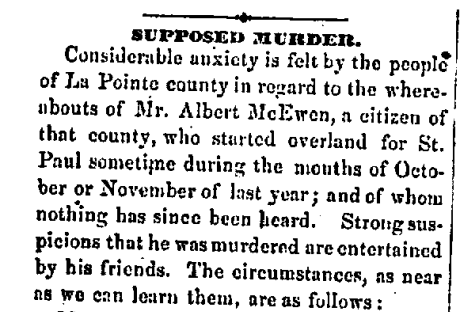
Read about Benjamin Armstrong’s investigation of Wabi-gog‘s supposed murder in Poor McEwen.
“Wabi-gog” was in the habit of making trips on foot to St. Paul, where he purchased the necessaries for his project. He used a trail that intersected what was known as the “Military Road” which led to St. Paul.
On one of these trips he failed to arrive at his destination and no trace of him was ever found. It was surmised that he had been waylaid and murdered, as he usually carried a considerable sum of money on his person.
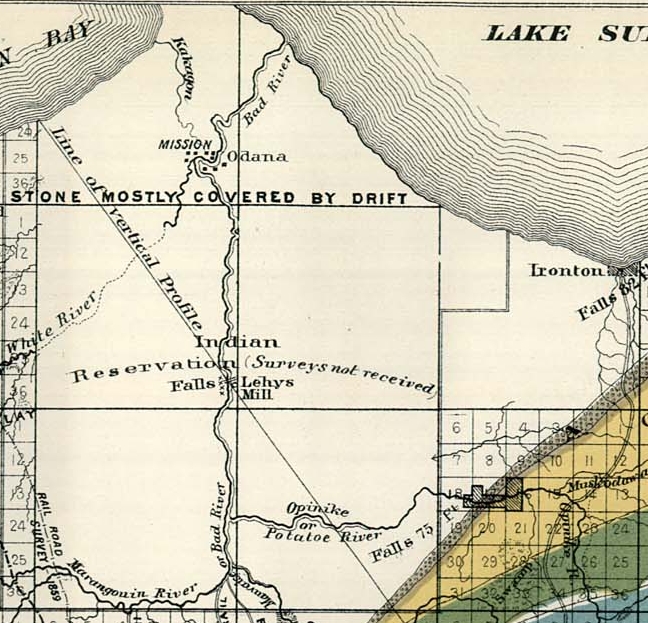
Detail of the La Pointe Indian Reservation from Charles Whittlesey‘s 1860 “Geological Map of the Penokie Range“ from Geology of Wisconsin, Volume III, plate XX-214: “Lehys Mill” is identified at the Falls on the “Mauvaise or Bad River”. The White River was partly surveyed upstream from the Mission at “Odana”, up to Albert “Wabi-gog” McEwen‘s sawmill, but did not identify it. Whittlesey may have had a copy of Joel Allen Barber’s missing 1856 survey of The Gardens at Odanah.
Barber Papers: “A Southern Confederacy” Winter of 1857
January 27, 2016
By Amorin Mello
Selected letters of the Joel Allen Barber Papers
… continued from the Fall of 1856.
Sandusky Dec 22nd 1856
My dear Son
You will see by date of this letter, that I have progressed somewhat towards home.

Portrait of U.S. Representative James Meacham from the History of the Town of Middlebury: In the Country of Addison, Vermont by Samuel Swift, 1859, after page 388. “Much to my astonishment I now find that Mr Meacham is a habitual private tippler and is often such a condition from drink as to occasion general notice and remark […] Is it not wonderful our state has had a long list of such members, Mallory, Nole, Buck, Phelps, &c.” from 1856 letter in the University of Vermont Libraries’ Center for Digital Initiative.

U.S. Representative Alvah Sabin was mentioned earlier in the Barber Papers during the Spring and Summer of 1855. ~ Eighty-Three Years a Servant, or, the Life of Rev. Alvah Sabin by Alvah Sabin Hobart, 1885
I left Lancaster in company with E. D. Lowry for Galena last Wednesday morning & on getting to Galena found that the cars had not run for 5 days on account of snow, but they got in toward morning & at 9 AM I started & only got through to Chicago next day at night, when not running we were in snow drifts. I arrived here Saturday evening & am having a very comfortable visit with your Uncle’s family. Shall leave at 7 tonight for the East & shall make all speed for Vermont. Your Uncle’s folks are looking for Jay house tomorrow night to spend the holiday & then return again. There is something in the Tribune of last week concerning the termination of the Eastern RailRoad on the Northern boundary & laying it down as pretty certain that the road would be carried to the Mouth of Montreal River. If I can find the paper before mailing this, I will send you the article, & did I know that the road would be run to your town I would take all possible means to apprise you of the fact so that you might not dispose of your interest in the great haste. If you have sold none, when this reaches you, I trust you will act in reference to the above information, and I would advise you to keep dark, till further advice, & as fast as I can learn anything relative to your interests I will communicate the same to you. I have heard nothing from you yet, since parting with you at La Pointe, but hope to get letters from you when I get home. I have left money with Cyrus to pay your taxes, & will have him pay on Jo’s. Tell Mr. Wheeler, that I have learned the trouble concerning Hon Jas. Meacham that he & I talked about at his house. He had become a confirmed & miserable drunkard & drank himself out of the world. This is from one of his colleagues Hon A. Sabin, and is but too true.
Reverend Leonard Wheeler & Government Carpenter John Stoddard lived at the Gardens.
Give my last respects to Mr. Wheeler & family also to Mr. & Mrs. Stoddard & tell them that I have not escaped a hard winter as [?????? ?????? ??????] but do not fear starvation like I did on L. Superior.
I expect you are all buried in deep snows by this time, so that you can do nothing at Surveying. The Snow was 2 ft deep at Lancaster when I left, but it rained all day Friday like July Showers & the ground is entirely bare about this place. Her Bay is frozen over. Keep a strict acct of all the expense of resurveying on the last winters contract, if you get a new one & undertake it, as I am informed that I can get relief from Congress by a special act, paying me all that it will cost to do the work over again, which will be as much for you interest as anybody’s of this please say nothing to any one.
Now My dear Son I again implore you to be careful of your life & health. Do provide yourself with enough to make yourself comfortable & easy & above all good warm clothing & bedding, be careful of exposing yourself, where you there is danger of being lost & freezing, or of getting through the ice. Do my son heed the requests of your parents & only brother who feel more interest for you than you are aware of, & who are in hopes to yet enjoy your society in a more genial soil & climate.
I think that one visit to Lancaster will be sufficient to wean you from the frozen, famine stricken, regions around the Great Lake. I overhauled my agates yesterday giving lots of them to the children, also specimens &c. I gave them some chrorastrolites & shall give them some more. They prize them very high. The stone that Jo gave Lucy & she to your Uncle, has been cut & set in two rings. 1 for Aunt Em & 1 for Lina… Aunt E’s ring cost $12.00 besides the stone. It is a splendid affair.
Do write as often as you can, for be assured that your letters will be always joyfully rec’d & read by your parents & Hiram.
Farewell my dear Son & may God preserve your life & health
G. A. Barber
Respect to the boys.
Cambridge Dec 29th 1856
My dear Son
It is now about 2 months since I left you at La Pointe, since which time I have not heard one word from you, whether you were in the land of the living, or had got cast away on your journey to Montreal River. I was very anxious to get intelligence from you while at Lancaster & could not feel reconciled to come away till I had heard from you. But having left directions with our friends there to forward your letters, if any came, to me. I finally ventured to start for Vermont. I stopped over 48 hours at Sandusky, & wrote you from there, on matters pertaining to Ironton, which will reach you long before this does. If you have not sold any shares, it would be best to rest easy till you see how the matter turns, but if the road is likely to terminate at the Mouth of Montreal River, some shark will be after all the shares he can get, & at the lowest prices. I left Sandusky Monday night (22nd) at 7, was in Buffalo at 7 next morning & Albany at 10 P.M. Rutland at [morn?] Wednesday. Called on Mrs. Temple & Nancy Green, got to Burlington at 8 P.M. on the 24th & home on Christmas at sunset, found all well and tired out with looking for me. Every thing looks as natural as ever, except that our Prairies are more rolling & the bottoms greatly shrunken in dimensions.
[…]
Mr. Whiting had a partner, B. E. Fullington, an honest, God-fearing, upright man, and their plan was to engage in farming–raising corn for the Government post at Fort Riley. Mr. Fullington soon became disgusted with the meager success that attended their efforts, and after one season returned East, leaving Mr. Whiting to conduct the business. Mr. Fullington agreed to furnish the capital while Mr. Whiting was to manage the business connected with the partnership. But Kansas looked better to Mr. Fullington after he got to Vermont and he came back the next spring to spend a long and useful life here.”
~ A Standard History of Kansas and Kansans by William E. Connelley, 1918, transcribed by Baxter Springs Middle School students, 1997.
While on the platform at Essex Junction, who should I run into again? but Mr. Bradly & Fullington direct from Kansas when he left Albe! Left him well, on the land they had claimed, another man a neighbor had gone into the shanty with Albe to [book/back?] it together this winter, & take care of their cattle
Matters are more quiet there now. Gov. Geary proves a better man than was anticipated. Prospects for Terr. Kansas are brightening. I sent you the message of the infamous Frank Pierce, from Lancaster, & hope your patience permitted you to read it through. Still it is the meanest vilest paper that ever emanated from our Government and will go down to posterity with its author excerated by all good & honest persons. Folks are well around. Levi & Oscar were here last night till after 9. Of course I gave them some specimens of copper, agates &c. Mary Buck from Galesburgh Ill. sister to Mrs. Kingsbury keeps the school, from 6 to 10 scholars, & enough for such a “marm.” Ed. Bryant teaches the best school at the Center. Pat Coldwell is in a Store at Waterbury. Dr. C.L. Fisher is teaching in Johnson. Helen Whiting is about going to “Kaintucky” to teach in a family. I do not mean of her own, but in a private school.
~ Collections of the Kansas State Historical Society, Volume 12, by Kansas State Historical Society, page 119.
I am going to Johnson to day & must be brief but will perhaps do better another time. If mails are regular you will get as many as one letter per week, while I have ability to scribble for I have learned by experience how good it seems to have letters from “friends & sacred home.” Again I caution you to take care of yourself, you can read my back letters for particulars. Your mother will write soon now when she knows where you are, & I will make Amherst do likewise.
Your affectionate father
G. A. Barber
[ca. 1856]
My Dear Son.
I hardly know whether to write again to you before hearing or knowing something of your situation.
It seems too much like writing to the dear departed. But I know that if it were possible you would have sent us news of your self before now. I feel assured that it is not your fault that we do not get letters.
I often imagine you shut in from the world by deep snows – perhaps you and your party frozen – disabled from work or even from the use of the pen. But the thought of the good Christian Missionary near you makes me hope that you would not be allowed to perish with cold or hunger and that, should any great misfortune happens to you he would inform us of it. How very long and tedious must the winter have been to you all and how often the vainly have I wished you had complied with our wishes and returned to spend the winter at home. Oh! How much more pleasure and comfort might we all have then.
I mentioned in a former letter my wish to go to Lan. next summer and my great desire to meet you there. I do not know that I will take the trouble and incur the expense of such a journey if I must come back without seeing you, so do not let me be disappointed. If you will If I felt sure that you would meet me there and would return with us to spend next winter I should feel that I had something to live for. But the thought of going there and returning to live in this old, desolate, neglected, forsaken looking place without you, with no prospect if there ever being any improvement in its appearance under the present administration makes me quite indifferent to life. I am very sorry that we cannot get another woman here – one who would be agreeable and friendly with me, or whom I could confide in as a good and honest dairy woman. I should then feel quite satisfied to leave the business with her, and less unwilling to return again. But your father will not let any one else come – tho he has had some very good offers.
How I do wish that you would come and live with me and befriend me & I really need to have one friend.
Good night
Mother
Cambridge Jan 6th 1857
Dear Son
I have determined to wait in hopes to hear from you, before writing back again. It really seems strange, that we do not get something from you in all this long time, your last being dated Nov-. Your Mother & I wrote repeatedly while at Sandusky & I hope you get the letters, but why do I not get something from you?
I am extremely anxious to know how you are & how you are getting along this winter, whether you have yet recd that long expected draft & whether you have done anything at surveying the Indian Reservation whether you are boarding at Mr Maddock’s yet, or what you are doing & have spending the long & hard winter. The date of this will show you that I have once more got home, and am now a dweller among the G. Mountains.
After being at your Uncle’s in Sandusky 10 weeks and I had so far recovered that I could walk across the river your Mother was away to have me start for home & I was hurried away before I was sufficiently strong to endure the fatigues of such a journey. On Sunday 27th ult I first ventured out of doors Monday 28th was stormy so that I could not go out & yet I had to start Tuesday, or trouble would endear, so I was off and that night at Midnight I was in Buffalo (leaving station at noon). Left B. at 9 A.M. & was in Albany 10 ½ P.M next Morning started at 7 & was snugly quartered at the Lomied of N.E.N’ Esq on the [????] by the college on Burlington. My feet & legs [???] badly swollen all the way caused by debility I remained there 2 nights & spent [???????] with them. Saturday we continued in the stage with [Sen/Tom?] Andrews to the Centre where we [??? ?????? ??? ??????? ???] house unfit to occupy, as his had “Batnies” all over the floor drying your Brother & I went to Mr Wetherby’s (in the Miner house) & stayed till next day when Mr Green brought his woman here & she & Amherst worked at the house while Mr G. went to the centre for your Mother. I was brought up toward night, and am a close prisoner ever since on account of my swelled legs & lameness but I am free from that infernal pain that troubled me at La Pointe & only feel a soreness in my walking apparature.
I could scarcely believe the fact was so, when I found I could put my legs feet down on the floor without excruciating pain, but I have reason to hope I have seen the last of that tormentor. My appetite is shrunk so much, my strength is returning & when I shall regain part of my flesh and my legs get sound I shall be nearly as good as new. I was reduced almost to a shadow by the “little gobbel,” but they did not make me any sicker than before as the Allopathic Medicines would have done. Their effect was produced silently, and though I was run down pretty low & weak I at no time felt any distressing sickness save in my legs till I imprudently ate too many preserved tomatoes that distressed me 2 or 4 days. But my greatest gratification was to get Amherst home with me once more, after he had been a wanderer & outcast for months in his own neighborhood. We found him living at Griswold’s where he was enjoying himself tolerably well & was useful about the storm & handed &c. He was all [?????] at our [????] house by the shore [devil?] that [punished?] in the [Kitchen?]
He always found a welcome at Atwood’s & was urged to stay there & too at [Supuien’s?] but Mrs P. in the woods wanted take paints to make him understand that they did not want him to consume much of their grub, I always knew she was a stingy old satan & now I think I shall request her whenever a good opportunity offers. I think he was as glad to see us, as we to see him, & that we will take as much solid comfort together as the nature of the case will present.
7th
I shall look earnestly for a letter from you till I get one & though my letters may be a long time in reaching you I shall keep a stream of them running to your country that you may have something once in a while to refresh your memory of home and those so dear to you who are now sojourning here. There have been but few changes by death or marriage that I hear of since my leaving last spring. I wrote to you of the death of Mr Chase Old Mr John Safford died in Dec aged 92 years & old Mrs Darker also very aged. David Griswold & Mary Ann Chadwick were yoked at Christmas. I do not hear of any others in town, who have got married, that you know, but I will tell you if your patience will permit, a little something of one Rodney [Casde?] whom you will recollect. He was living with [Gad?] on the Mirriam farm & by chance became enamored of [Clena?] Scott & she as much of him, they were thick, & had the time set for marriage, but she finding some of his great [fertensing?], doubtful, flared up & was off entirely, whereupon he threatened 1st to go to her door & spill his heart blood on the door stones, next he threatened a suit for breach of promise, went down to Burlington to consult Lawyers & Morrisville & finally gave it up and fizzled out.
The poor boy is doubly consorted since, for he has got religious & been baptised into the Methodist Church, and has at last got married to somebody in Stowe. The tragedy is all over.
Major Watrous, Speaker of the Minnesota House of Representatives, was in the cars with me from Sandusky to Cleveland & from him I heard some things from the great Lake later than I had formerly known. He was on his way to Washington, having his chair temporarily filled during his absence. He is dead against old Buchanan & his southern Masters on the Kansas question & probably uttered the sentiment of the party in the territory.
The winter except a few days of the latter part of Nov that were unusually severe has been remarkably mild with no snow to do any good till Jan 1st. There is now a sufficient quantity of 8 or 10 in. & sleighing is 1st rate so that there are from 50 to 100 sleighs whirling by us daily, without giving us a chance to see their pretty faces, or knowing them. Your Mother is more than ever troubled & careful about many things, nothing suits. She says we are the poorest off of any family in town except Ed Davis’ folks, she wants to stay here & not have the farm let another year, but you know she is for lack of strength & power of endurance wholly uncapably of carrying on the dairy & there is not much prospect of my being capable of much labor. Dow is the best tenant after all that we can get, if I find him honest when I settle with him but his wife is a (but his wife is a) little tough and withal “narrow” home there can be that little peace in the funerals department of the house.
Amherst has promised to write something to go with this.
I remain your affectionate father
Giles A. Barber
Do write often about yourself your affairs & about everything that will interest me
Give my respects to all friends
Especially to Mr Maddocks
Cambridge Jan 10th Saturday night 1857
My Dear Son
Contrary to my intention, I have let slip One Sunday without writing to you. My excuse for it is just this Your Uncle & Aunt Burr were here over Sunday and I could really find no very good time to write. But I will make amends as far as I can by being more punctual in future. We are all three quite well, have removed our quarters from the west room to the East room which as well as the west room is now papered and looks com-fort-a-ble.
Since I got home Dow has killed one 5.00 lbs [quarter?] & sold it at 8 ½ $42.50 & the Alcorn Cow very fat, & I wish you & your party had part of it instead of your everlasting “salt [rusty?] pork”. We sold 812 ½ bs Butter this week at 21 ¢ & yesterday I sold our oxen that we have had so long for $140.00 to be delivered tomorrow morning.
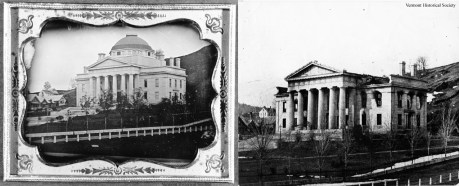
The second Vermont State House before and after the fire. “However, on the night of January 6, 1857, disaster struck. A special session to revise the Vermont Constitution had been scheduled for the following day. The stove was loaded with wood and left to warm the building before the legislators arrived the next morning. By evening the stove became so hot that the timbers near it caught fire. The flames quickly spread to the rest of the capitol destroying all but the granite sections.” ~ Vermont Historical Society
The State House at Montpelier was burned down last Tuesday. The fire taking around the furnace & getting such hold that all efforts to save the edifice were unavailing. The Library & State archives & most of the furniture were saved, the walls are not badly injured. The House was being warmed up for the constitutional Convention which was to occupy the Representatives Hall the next day, but they have gone into the Court House to hold their session.
Sunday 11th
I have not been to any meeting since leaving Superior where I enjoyed the labors of brothers Peet and McCorkle. Did think of going to day to hear Mr Whitney an old Methodist man who preached here some years ago, but finally concluded it would not pay. Rebellions are the order of the day & they are trying hard to inaugurate one at the Centre, but I believe without any success thus far. They are doing a tolerable business at the Borough & at Johnson.
They have tried their best for some weeks, have secured Old Man Daniels and made Sissy Hunt snivel once or twice. Old Benton says they can never make a one horse rebellion do anything in Johnson, & I am of nearly the same mind. The fact is, the people, (I mean those of any mind, at all) are becoming every year more loyal, & less liable to be excited to meeting & open rebellion. Mother finds fault with what I am here said about revival. I do not wish to be understood as discarding all religious notions whatever, far from it. I feel that we are called upon every moment of our lives for deep heartfelt gratitude to the great Author of our existence who crowns our lives with the richest blessings, that to feel our dependence upon him & realize that it is from him that we receive all, every comfort, and all that we have, & do toward our fellow men as we would wish to have them do unto us. This I say in my opinion is, as good religion to live by as any of their newly patented article, obtained at modern rebellions & I cannot but think it will be much better to light our feet through the dark valley that we must all pass, sooner or later.
Of all the profession of religion, especially men, How many are there, who by their deal with their neighbors, or their every day walk, would evince any superiority of Character or better show for happiness hereafter than the calm stoid person who adores his God and submits himself & all he has into his care & keeping? Amherst has just returned from Meeting & says he read in a Montpelier paper that the collection of the State Naturalist was destroyed, but it was thought that the House could be rebuilt by filling up the inside, walls all good. I went to the Borough yesterday and sat as sole referee in a case between Jonas Gobs & school district & also between S. Stratton Jr & same, did not decide as there were 2 law questions involved in such case & I wanted time to look it over.
The winter has been pretty severe in Vermont thus far, down to 20* & 24* below zero. There is not much snow in the fields. The ground all covering but not deep. Sleighing good as ever was. Went up to Johnson last Monday & staid at Judge Tom’s over night & had B.E. Fullington told his story about Kansas to a crowded room (the Valley). Col Ferner, Col Stoddard, Tom Baker, Judge Caldwell & old Homer teased him with foolish questions, & would have kept him on the stand all night if they could, to learn whether wild game were plenty, whether [frungh him?] grow well & [??] the ladies were contented &c &c. Mr F. thinks Kansas will be free in any confident it will be so. I presented Herman’s wife with the handsomest Chorastrolite. I brought home with me the little fine spackled one that had a ball on the backside & I gave Aunt Ellen a very nice one both on condition that this would get them set in rings. I gave your Aunt Martha her [???] in all but one sent some to the little girls with some agates. I saw the stone out & set that Jo gave to your Aunt Lucy, & it is the right ring I have seen. I made up a package of specimens & sent up to the old Dr last week but have heard nothing from him.
Amherst is in extacy with his Embroidered Shirt & wears it all the time & to all places, Meeting, Lycum, & to work in every day. I have bought materials for another he will soon long rejoice in a pair of them.
The school is rather a feeble concern in our district this winter.
Kept (I cannot say taught) by a Miss Buck sister to Mrs Kingsbury on the Wetherby farm. Attendance of Scholars from 2 to 7 or 5. By the way we have some excellent neighbors Mr & Mrs K. both young and better mates for you & Am than for old people. Miss Buck’s folks at the foot of the hill are also very good neighbors so your mother says. At Old Grim farm there is Lucy & her 4 boys. Mr Green is on his place but is going off it, having let it out. Dow wants this place again.
Have just had a good supper of hogs face with we could have had you to make even our number. Oh Allen I will not answer to how you remain up in that miserable frozen region longer than till you can so arrange your affairs so as to get away advantageously.
Your mother in constant alarm about you, at times thinking you gone to join our dear lost Augustus & no more to bless us with with your presence here, but to day she has prepared 4 blinds for you & your comrades to wear in the gloom of Feb & March. We got a short letter from you dated Nov 9th saying that you & 4 others were to start that day for your work on Bad River. I saw by the papers that the Old Manhattan was wrecked on one of the piers at the mouth of the Harbor in Cleveland, total loss. This makes two of your regular boats of the 3 that used to churn the sight of the dwellers of Lake Superior now gone to ruin. ([????]) I saw that among the saved on the Superior was a Foster. I suppose the young surveyor you & I conversed with on our passage down to La Pointe. But there was a [??????] Foster lost whether wife, or sister to him or none related I knew not. I am going to send you a paper – when I can get one. I now send you Life Illustrated, this letter one from Amherst for this time. Hope to do better thereafter. I think it would be condusive to the interests of us all to sell the farm & place a good share of the proceeds at interest in Wisconsin. What say you? Do you want to come & help carry it on? The Secretary of the Interior recommends that the clauses for the graduation law requiring residence on the land be reproofed, which if done, will be all in your favor. I shall watch the Tribune eagerly for anything interesting to you & communicate all valuable information immediately.
Do my dear son be careful & prudent, father G.A. Barber
My respects to the boys, Mr Wheeler’s & Mr Stoddard’s families.
Write.
Cambridge Jan 18th 1857
My dear Son
Since writing you last Sunday I have recd two letters from you, one dated Nov 9th directed to me at Lancaster & forwarded by father & the other dated Nov 22nd directed to your mother. You may bet high that your letters were gladly recd & that our minds were much easier about you than before. Still we should feel much better, were you here with us, to have a good warm bed to sleep on, and enough of the best that Vermont produces to satisfy your appetite, and with all the genial influence of our eastern society that I should think in some respects preferable to the general run of society about L. Superior. Still further there are rebellions in progress on all sides of us, and an interest in some of them would be quite an item in the adventures of the east over the west. They have broken out considerably with it at the centre, but I fear the infection is not genuine, and that it will not result in anything very good. They have got enough to talk in meeting so far as this “if there is anything on religion I am determined to get it” &c. Elias C. & wife & Mrs F. Wetherby and some others have had something to say, & the Minister has labored very hard to get all creation on his anxious seats. Mad. Heath is on tiptoe among them, almost an apostle. I went down yesterday to the Borough to give my decision in an arbitration, carried your mother down to Thode’s where we staid all night & went to Meeting to day A.M. to Meth. Chapel P.M. to Cong. House. They are getting hot among the Methodists & trying to do something judging from the groans & grunts of one of the ministers while the other was hoping rumbling the howls of distressed or enraged wild animals.
John Chase got home yesterday from California have not seen him, but understand that he talks of going back again in March. Did you ever hear what Emily Ellsworth did with herself? I never heard till a few days ago that she married a Doran one of the [Paddis?] out in “Senate Ireland” nearly two years ago.
I have got the watch repaired by Scott, who says it is now as good as ever it was. I would be glad if I could get it into your hands. Furs are monstrous dear this winter as you have doubtless seen by the papers. Mink skins [Prim?] are worth $4.00 a piece. Muskrat from 10 ¢ to 20 ¢. Martins must be worth $5.00 or $6.00. How if you had the [Shonis?] to purchase some furs this winter & spring you might buy some at prices that would pay you a good sound profit. I have no doubt but you could get Sable for 1.50 to 2.00 & mink for 1.00. Otter skins are generally called about here $1.00 per foot measuring from the nose to the end of the tail. They ought to be cheaper there.
Our district school wound up yesterday for want of scholars having had but 2 the last week. Julius G. & Martin P. & in day Julius alone. The teacher was the greatest failure of all.
We are getting very cold weather about now, but how cold I cannot say, as our thermometer has got broken by your Mother’s hanging it up on the side of the house for the wind to blow down, instead of hanging it inside the door casing where I had kept it so long. I feel lost without it & shall get one when I go down to St Albans which will probably be within one or two weeks. Think to day the coldest of the winter so far, at any rate it was cold enough for comfort coming up from Thode’s to night.
Monday Morning Jan 19th 1857
We are having a great snow storm to day, so thick as to make it quite dark.
We are all well, living very com-fort-a-ble in our close quarters & expect to be more so soon for I got 5 new curtains Saturday & you know they are always essential.
Your Mother says you must get some kind of fur and cover your mittens & also fur as much as you can to keep out the pinching frost. I am afraid you will suffer for clothes socks &c (by the way, you had better save the tops of all your socks, that are new and good down as far as they are good & have them footed up again & if you are short for yarn to mend with you can ravel some). The Stage will be here soon & I must close.
Have I told you that Charley Turner & Helen Sabin are married? Even so, & they are in [clover?].
Give my respects to the boys & you may rest assured of my eternal regard and paternal solicitude.
Giles A. Barber
Cambridge Jan 26th 1857
My dear Son
I wrote you yesterday one good long letter & because there was something in it about the 1 horse “Rebellion” at the Centre and some other things to tedious to mention your Mother destroyed it last night after I went to bed. So I have to repair the damage as well as I can this morning, but writing in such a hurry I cannot think of half I want to write, & shall only send you a small apology for a letter this time. I have suffered much in my mind on your account for a few days, fearing that you & your party must have undergone great distress from cold weather. It has been colder within a few days than ever before known in Cambridge. At 11 o’clock last Friday night the mercury was at 40* below 0, next Morning at 38* below. And you may be assured I should have felt much better if you had been at home with us in good quarters. Oh Allen I hope you will not find it necessary to spend another winter in that region of frost and famine, but will spend your winters henceforth in a country of more genial in climate, society, & Grub.
If I were assured of our safety from freezing & suffering for want of clothing, blankets, or provisions, I should rest much easier about you than I now do. Still I know you are in a party of good fellows & in the midst of kind friends who will be ready to befriend you.
Everything remains about as usual in Cambridge. On the whole I think the town about holds its own. The dairymen are growing rich on the high prices that Butter & Cheese are selling for, & well they may. Dr Safford has sold $150.00 worth of Butter from 3 cows & supplied his family with Milk & Butter beside. H. Montague at North Bend has realized $50. per head from his cows (20) but to make this out he counts his calves, & [Pork?] made from the dairy. Our dairy has done better this season than ever before but as I have not settled with Dow I cannot yet state the nett proceeds.
The rebels convicted are as yet only two, Mr.s E Chadwick & George Reynolds, they have a few more on trial, & are seeking indictments against lots of others. Mr Dow takes this & will probably mail it at Richmond so do not think strange of that. I wish to say one word of Amherst. He is at home & does not much, but chops all the wood we burn, runs about to mill & too meeting.
He is attending the Lycum at the Centre & writes some very good pieces for them which exercises I think worth a good deal to him. He grows like a weed & will soon be as large as you. I persuaded him to write to you, as you will see if the letter soon reaches you. I had nearly forgotten to tell you that we are all well, living cozily in the East Room secure from cold & hunger, & only wanting your presence to enable us to feel quite at home again. I said wrong. There is one gone from us forever in the world. I cannot yet feel as though any place was home so long as he is gone. But my time is up and I must close by writing you, health & prosperity.
G.A.B.
Cambridge Feb 1st 1857
Dear Son
Another Sunday gives me an opportunity to sit down to give you a brief narration of things transpiring in this outer world. Though you will see that nothing really worth mentioning occurs from week to week, yet to you who are without the visible world & the pale of comparison almost any thing from the old home of your childhood will be interesting. Within the past week the weather has been much milder & even quite pleasant till yesterday, when we had a terrific storm of wind & snow, but from what quarter I could not determine, as the wind blew all ways. The roads are all full & traveling almost suspended. Amherst & I got all ready to go to St. Albans but the storm increased so fast that we did not start, so we went over & staid with Oscar till this morning & I went down & made Mr Heath a visit, found him just as he was one year ago, unable to speak except in a low whisper, says he under goes much pain in the region of the heart. I went to see Uncle Enoch, how he progressed in the divine life, for there has been a desperate effort made to enlist him on the side of “the Lord” & much said about his being in deep distress &c &c found no changes, except that he is ready to talk candidly & give his views on religious matters.
Our last letter from you was dated Nov 22nd & we are growing very uneasy at not hearing anything from you in all this long time & especially when we consider what an awful cold winter we are having. Oh Allen my heart is pained when I think of you at times, when the sky is convulsed with storms & when it is so cold that mercury congeals, that you should be up there suffering for aught I know, when you could be so much better off elsewhere.
The Rebellion here blown over, almost a failure. 2 or 3 concerts as they are called & as many backsliders reclaimed, constitutes the amount of damage done to the Kingdom of darkness, rather small potatoes when we consider who have been here at work for the salvation of souls, for we have the word of the good folks that no less a person than the 2nd on the glorious [Frinsty?] has been here for weeks at work, to say nothing of 3 methodist ministers & Luther [Brevoter?]. When will men & women cease to insult the God that made them by their impious & blasphemous fooleries to cheat mortals into this or that church under the specious pretext of saving their souls.
Marm says of this last sentence, that it shows that I am in a some what excited state or I would not write to you so much on the subject. Kinni butch, I do not know how to spell this word, but you do, but I claim to be tolerably free from believing & falling in with every new thing that comes nor am I greatly given to running after every new minister, lecturer, or concert singer that happens to favor the world with their marvellous works. “Oh the folly of Sinners” & (I wish Saints were wholly divested of the article) I was up in Johnson last Wednesday, saw some of the old familiar faces. There are some sick, more in that village now than in La Pointe & Douglas Counties in 6 months, & yet when the west is mentioned a Johnsonian will start with alarm at the bare thought or name of so sickly a place. Mrs Tracy is soon to wind up her pilgrimage, (consumption). She had been sick, was getting smart, a girl in the house, broke a [flaid?] lamp, set her clothes on fire, Mr & Mrs T. got their hands burned in putting out the fire. Mrs T. held hers in cold water all night, & took such a cold that she must die in consequence. Poor Helen Pillsbury whose health has not been the finest for 2 years, was still able to work & keep about her usual [????tions], till this winter feeling it her duty to “come up to the help of the Lord against the mighty” in their feeble rebellion. She overdid herself or exposed her health, so that it is found that her life will be the penalty. Poor Girl, she is going as I fear the way of Merrill & Mary, & yet that damnable, mean, thievish help “Vet” must live to be a curse to his parents & to the world.

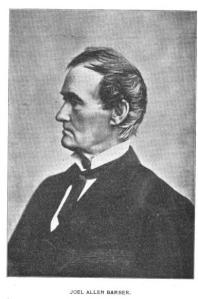
Joel Allen Barber’s uncle U.S. Representative Joel Allen Barber was a member of the State Senate in 1856-57.
It is an economy of Providence that I cannot comprehend why such persons who bid fair for usefulness in the world, who are a pride & blessing to their friends & all who know them should be removed from this world, while others who are a pest to their friends & the world & not worth the powder to shoot them, should remain as secure, as though death could not reach them. But God knows, & perhaps we may hereafter, understand what to us now appears so dark and mysterious. I see by the Tribune that your Uncle Allen was not elected U.S. Senator, but J.R. Doolittle was. I know not whether I wrote to you what your Grand father wrote about your Uncle, that he was going to take Thode Burr to Madison with him & get him a place as assistant Clerk if he could, & further that he (Father) was afraid that Allen would never get home alive, his health was such, but I should have more hopes of him while there than when at home, for he would be more likely to do something for himself & get better Medical advice. I hope he will do something in season. Amherst & I shall go to St Albans to morrow or next day & stay a day or two & make a call or two on the way in Georgia & Fairfax. I expect Mr Burr is going to Lancaster this month, to determine upon his future course whether to finally go there to reside & go into business, or to give up all thoughts of it, and settle himself down quietly in this country for woe or weal.
It is yet a matter of uncertainty what I shall do with the farm another year. Dow wants it another year & in some respects he is as good a man as I can get, and on some accounts he is quite objectionable. He is a very industrious man & a good hand to take care of the stock, make pork &c his wife is not 1st rate for Butter & cheese, but middling. Dow is too much disposed to [skin?] the farm, or keep, more land under the place than can be manured & is rather too tight & [fizzish?] while his woman is quite & altogether too much so besides your Mother & she have been at variance almost through the entire year, & in this case I think Mrs. D was very much in the wrong, & that she is a little stingy nervous, wilful jade. It would be idle to think of ever living in the house with them another year.
Think some of hiring a good Man & girl & carrying on the whole ourselves. This is your Mother’s notion but I have before now heard her declare that she would not be burdened with the care of so much work. I would so far as I am concerned rather sell the farm cows & all and go to Lancaster to live on our little farm, where our dear Augustus did so much to make it valuable & attractive. When Offered $35. per acre for the place, I looked at those young apple trees planted by his hands expressly for our advantage & comfort & said to myself that $50. per acre shall not deprive me of it at present. I shall like to know your mind upon these matters, but of course cannot in season for the coming spring. I have some thoughts of getting Mr Perry to take the farm if he will do so. Then I should feel all safe. Your Mother & Am are drawing a pattern for his embroidered shirt that is now making, & after his is made, you are to have two made. Am is toasting cheese & stuffing himself with it. I wish you had a shake in that, as well as your abundance of good fat beef pork sausages, butter & milk. Oh My Son, I think of you whenever it is cold or stormy, & when I lay me down at night in a warm bed or sit down at home or abroad to a good regular meal of victuals gotten up by the hand of a woman, other than Nancy.
Am is doing quite a business in peeling muskrats, he shot & caught 17 in the fall & sold them for 10 ¢ each. He has just peeled 3 more & is on the qui vive for more. They are worth 20 or 25 now. If I get to St Albans I will start a paper or two off for you, and some for others in your country.
May God bless & preserve you
G. A. Barber
Cambridge Feb 8th 1857
Dear Son
Another Sunday has come around & I am again trying to place on this sheet a few scratches, that you may know that we are all well at home, & that we are not forgetting you our poor exiled son.
Joseph Alcorn
William W Ward
Larry Marston
Edward L Baker
We were very glad to receive a letter from you day before yesterday, that had been nearly two months on the passage, dated Dec 13th at Mr Stoddard’s. We have felt much uneasiness on your account for a long time it has been so very cold, & have been afraid that you must have suffered; but our fears are happily relieved by learning that you are doing so well and survived but such a band of invincibles. Who could have fears for such a crowd as Jo, William, Larry Marston’s? I am very happy to add Baker too! I am really glad to hear Mr. Baker has got back with you again & hope it may be for his advantage, that he braves the perils of another polar winter, & I am confident it will be for yours. You will see that I was mistaken about your Uncle Allen’s being elected Senator. But I was not more so than many others. I see by the Grant Co Herald that there is a bill introduced into Congress, to make good all entries under the Graduation Law without any further requirements, & there is little doubt of its passage.
This will be a good thing for you, if it becomes a law…

U.S. Representative Augustus Young ~ Findagrave.com
Amherst & I went down to St Albans last Monday & drove Kitty and got home Friday, had to stay longer than we expected on account of storms, winds, drifts &c found all the folks well at Mr Burr’s. Went down to the Bay & found all well there but Mr Young, who was quite feeble, but much better than I had expected to find him. He is now confined to the house during the cold weather, but I should think he might get some better in the spring. I would like to see him in LaPointe County about two months next spring & witness the effect of that climate on him, & I would see it if he was alive & I were able to take him there. I carried down some specimens to him that pleased him much. Little Augustus Stevens is living with Mr Young now & will probably remain with him while he lives.
Uncle Amherst W. willed $100.00 a year to Mr Young during his natural life, and $50.00 a year to your Aunt Betsey as long as she lives. The rest of his property is given to various benevolent purposes. The interest of $10,000.00 to the Episcopal Institute at Burlington. The interest of $1,000.00 to the Brattleborough Insane Asslyum. & the use of remainder principally to support Preaching at East B. All this is well enough. If he thought a few thousand could pave the way to heaven, it was his duty to down with the dust when he found he could hold it no longer himself.
While at St Albans I took the Ambrotype copy that your Aunt Martha had taken from our daguerreotype of Augustus & had a good likeness taken, that I have done up for my Mother & shall send to Morrow also One on Mira that is set in a gold pin for your Mother, one other put up in a case, both good copies, & 10 other copies all ambrotypes one of which I shall enclose in this letter for you, that you can keep till we can furnish you with a larger one in a case. That Daguerreotype taken by Merrill & Wilson you know was good & these copies are most of them copies are equally so.
~ Zenith City Weekly
I got a letter from Mr Hayes last Friday saying that he had called in November and tendered the 120 acre warrant & $58. in gold to the Land Officer & was told that they would attend to it. So as to send off the entry in their returns that Month, & again in Dec. he called and wiged repeatedly that it should be done & was all along told that it should be attended to, but at or near Jan 1st when again pressing the subject upon them, he was told that an appeal was taken by the Dutchman and sent to Washington for a hearing there. This is the state of the case. I had some little confidence in Mr Shaw as an Officer but but cannot have much now, since he has conducted in such a manner in my Land Suit. As to E. B. Dean I was always satisfied that he was a d‘d scoundrel any way it could be fixed, & the history of his transactions in Madison goes very far to justify such an opinion.
I feel as though in duty bound to go to Washington to see to having every thing done there to protect our rights, that can be done, I am fully satisfied that somebody beside the little Dutchman is the person or persons in interest now pushing it up to Washington where they hope by some trick to cheat us out of the Land. I wrote yesterday to Elder Sabin to have him attend to it for me but he his now Lawyer & may not have time to do anything… Mr Hayes has written to a Lawyer in Washington but who knows how far a Lawyer in Washington may be trusted, when sure of a fee on one side & perhaps a double one on the other, & there is no doubt, that who ever carries that case to D.C. will have nothing continued to effect his purposes. I am surprised to find that all that has been done, goes for naught & that the case is yet undated. Still if I have a fair chance I should not fear, but if there was anything unfair, or any undue advantage being taken, I ought to be there, I suppose it would cost about $40.00 to go.
All is very quiet in the religious world at present. The rebellion has not amounted to any thing serious after all the noise & confusion in the Saint’s Camp. Madison Heath is bent on pulling down strongholds and setting up the standard of the Cross, & as one of the first steps in the warfare he & his frau came up & made us a visit last Friday night & undertook to [sumed?] me upon matters of faith, doctrine, &c. I am thankful for his good intentions, but would prefer to listen to him “after a little” than now, when it is a new thing to him, & he scarce knows what he is about. We are having a great thaw, the snow is nearly gone in the fields and pretty well done to in the roads.
The river is very high & threatens to break up.
Mr Burr talks of going to Lancaster two weeks from to morrow, but is very faithless about liking the place well enough to ever go there to live. If he does not like, he will take Thode home with him, and go into business of some kind in St. Albans. He is in great purplexity. When at St Albans the other day I got some papers and sent to you, P.B. Van, Esq Felt, Charly Post, H Fargo & Pat O’Brian, and a new Ballou’s Pictorial to my good young friend Stick in The Mud. I have many other good friends about the Lake that I remember with much pleasure, and would be glad to recompense for their uniform kindness toward me.
Ballou’s Pictorial was published during the 1850s in Boston, Massachusetts. ~ HistoricNewEngland.org
I am glad that you make your quarters with Mr Stoddard some of the time. You could find no better place in that country. Give my respects to him & wife, also to Mr Wheeler & family & Mr Davis & family if there. Give my best respects to Mr Baker & all the other boys & be assured of the best wishes for your welfare & happiness, and success in business, of your ever affectionate Father
Giles A. Barber
Has Gen. Lewis even sent you that contract?
Cambridge Feb 12th 1858
Dear Son
This week is about gone & have not yet written one word to you. I hope you will pardon the neglect. I have not much to write that you will care about reading. Still I intend to furnish you with some thing from home every week, i.e. if it ever reaches you.
The most important item of news is that we are all well as usual (myself excepted) & that has been so long stereotype that it has ceased to be news, & yet I presume it is none the less welcome to you. My health & strength are gradually on the gain, & for a week past my swelled legs have been much better.
I went up to Dr Chamberlin (as I wrote you I intended) last week Wednesday and stayed close in his house till the next Sunday night, & recd great benefit from his ministrations.
He pronounced my trouble, as wholly arising from debility & torpor of the small veins and absorbment in my feet & legs & immediately applied bandages & a wash of Alcohol & [Garm My sch?] I was well satisfied with the Dr’s performance & think he did as well as any who make more noise in the world. It was very gratifying to him, having a patient from a distance. Consequently his steps, always very short when in good spirits, were reduced ⅓ in length and quickened ¼.
Many “good old fellows“ of the village called to see me & I had a very agreeable time of it, besides being greatly benefitted by the long protracted visit.
I have been improving since I came home! Amherst is my Dr now he rubs & bathes my legs 4 times a day and applies the bandages with considerable skill & alacrity.
Amherst chops the wood at the door & is quite a chopper his time is occupied with that, Skating, playing pasteboard, & backgammon, reading & some study. I have promised him that when he gets the front yard filled with good stove wood I will go with him to Georgia & visit every body there, from Hon A. Sabin, down to those little ones growing up around my old associates & friends. Such a visit will be very pleasant to me & would do him no harm, but if my legs do not get well or better than now I am afraid “I cannot get to go” this winter.
There is a great temperance agitation throughout the State this winter, & hired lecturers are traversing it in all directions “but as the movement” began before I got home, & I have been unable to attend, any meetings, it it is impossible for me to tell what particular object of the temperance people are driving at.
I think that in Johnson & this town those who formerly were most open & vindictive against the cause, have no subsided into acqueiscince with public opinion, and have become ashamed to be seen tippling or opposing the law. Even Uncle Enoch has ceased to rail constantly about the abridgement of his liberties, and would give his old hat if it (alcohol) could be kept for ever from George, who has now got to be a complete sot when he can obtain the “outter” so as to go to bed before noon or hide himself in the haymow. Last fall he George set out in the evening for Montpelier with his skin full of rotgut & about 10 oclock he was found lying in a puddle near Morgan’s Store by Graw who alarmed the villagers. George was got into the tavern & his horse & sulky were found near by the Academy. The horse feeding quietly in the Morning George came to & to put the best look on the [can pisned?] himself sick, went to bed & had physicians attend him all day.
There are rebellions progressing in a few places about the country. St Albans Bay, Bakersfield, the South East part of the town and that neighborhood in what was once Sterling near Sanford Waterman’s. Ralph Lasell is said to be one of the trophies they boast about.
The most curious thing aster is the strange predicament in which Judge Stowell of the Borough finds himself, he being a widower has for some over a year been playing [policies?] with one widow Goodrich a daughter & only child of David [T?????] & the day of the wedding twice fed upon the cake made & [Risd?] engaged but his precocious son Henry threatens wonderful things if his father marries the widow.. A suit is threatened but he Judge contending to worry the young widow & keep her easy so that she will not move in the matter, although Frank her father is swift for compelling him to marry or fork over. Stowell is in trouble. The ravings of French about town amaze him.
13th
Yesterday I went up to Mr Green’s visiting & drove my own team (Kate 2nd but my hands and arms are so weak that I shall not dare to try it again. I could do just nothing at holding a horse that was disposed to go too fast, or where I did not wish to have it. Kitty as we call the mare, is a larger nice beast, strong as a Moose, a good traveler, kind & true in every place, & would be just the creature we should want to carry on the little farm in Lancaster, for with her could every thing be done easily. But then shall we ever occupy that farm? Or shall we always have to clamber up rocks & hills, so long as I live? There is manifested in a certain quarter the same disposition to withhold any opinions or wish in regard to that question as there, save when it is known to be in direct conflict with mine.
(Night.)
I have been down to Mr Heath’s this afternoon & made a short visit, found him about as he was last winter, still unable to speak louder than a whisper. He is able to be up most of the time and to ride about some when Madison can go & drive for him… Mad has a fine fat gal baby, a perfect wonder to its grand parents. Marion has no such good luck (or all luck ) to boast of. The weather has been very mild till day before yesterday when the Ther. was down -12* Yesterday it was -24* & this Morning -16* & prospect of a cold night again. Sleighing that has been poor most of the winter is now tolerable & teams are constantly passing as in older times.
14th
Last evening Uri Perry & woman made us a visit. Martin & Jot living at home with them. Wyman is still in Ill. Susan lives at North Bend, & Amanda married last fall to a young man named Bosworth son of a rich Merchant in Boston, so the story goes.
The Defendant & wife have just made us a short call, their boy now able to talk, is a very fine looking smart fellow. We have been having some talk about Weston’s coming here to work for me next season. I shall see him again & ascertain what we can do in the way of agreement. I got a letter from Cyrus last monday asking about the disposition of the little farm another year. He says he put up 166 baskets of corn for me the basket ½ Bus which would be so many Bus of shell corn. There were [??] Bus of wheat for me, which Cyrus got ground at your mothers request & sold at the store at 24 pr lb for which he account to me.

Honorable James Buchanan Jr was the newly-elected fifteenth President of the United States (1857-1861). Buchanan’s vice president John Cabell Breckinridge was already involved in Chequamegon land speculations. ~ U.S. National Archives and Records Administration
It is still a source of unhappiness to me that you are doomed to pass the long gloomy winter around that gloomy Lake. I should feel much better if you were down at Lancaster or in the good little State of Vermont, where you could enjoy your friends and some of the comforts [???] I could wish all the comforts of civilized life. But you are Surveying and prosperous I know you are making a better winters job of it than you could any where else were it not for the sufferings you must [??????????] made go in [isading?] in the snow [?? ?? ?? ??? ????ing ????] of sleeping at [??????] Such cold nights & mornings as the last week has given us makes me humble for you & your party, and perhaps miles from any lands or aid in case of any [????] of prusing or seeking to which you are in your situation. So [??????????ly] exposed [?????????] I am anxiously waiting for more letters from you to know how you are braving the perils of your third polar winter, & I had thought that [?????] you went up to Superior i.e. if you have to go there for your drafts, you would just do us a ½ a doz letters to make up for past remissness in little writing. I wrote a while ago to E.R. Bradford of Superior for information in relation to Superior [????] Starving populations I want to hear from there once in a dog’s age even if I do not like the inhabitants quite so well. I have been in hopes that some of your paper would get along so that I could by them learn what was going on in the copper regions but as yet none have reached me, & probably will not this winter. I hope Mr Tylor & his friends will be able to sustain themselves & their paper too, in spite of the combined powers of hell & its minions on earth, Buchanan, & all the unterrified & unwashed & E. B. Dean in [???] to the bargain.
Amen.
Summary of the Topeka Constitution, aka “the Kansas struggle”, from CivilWarOnTheWesternBorder.org:
- Date originally drafted: October 1855
- Stance on slavery: prohibited
- Suffrage for women: none
- Suffrage for African Americans: none
- Suffrage for Native Americans: “every civilized male Indian who has adopted the habits of the white man”
- Settlement by free African Americans: prohibited by an “exclusion clause” that was approved by Kansas voters
- Status: failed to achieve federal recognition by January 1857

U.S. Senator Stephen Arnold Douglas ~ Library of Congress
The Kansas struggle seems drawing to a close. Matters have arrived at that stage when a final settlement of the great issue is most able. The prospection now favorable for the cause of freedom & for the abolishment of human bondage from the territory forever, & if that glorious result is finally obtained, it will be through the influence & talents of Douglas, the Northern Senator, who was mainly instrumental in opening the country to the inroad of Slavery, nor is it certain now that his [???????? ???? ?????] in his espousal of the Kansas Free State cause than long were in 1854. Still whatever may be his policy in things on the right side over in his political compass, I am thankful enough for such aid in this time of need. Probably no other man could have caused the [???????] to abandon the President as he has done when the d’d old [??????? ??? ????] is fairly laid on his back & the darling [??????] of his administration by which he had hoped to secure to himself the adoration and support of the entire south [??????] in wild as of the great unterrified & unwashed of the few states then if Douglas will conduct himself properly I should not care so much if he was the [????????] aspirant for the Presidency. Senator said lately in the Senate that within the year there would be 19 Free States to 15 Slave States, by the admission of Minnesota, Kansas, & [???????], as [????? ????] states. The Southern [??????] are alarming and talk loudly of a Southern Confederacy. The Democracy generally throughout the Southern states are in opposition to their stupid Presidents on the Kansas question, & nothing but Douglas’ carrying his point will save this party from utter defeat & ruin. While at the same time the party will be rid of its most obsiquious satans of southern [????] if the Poor devils and find any place to go to. Perhaps they may get up a [????] of Secession party to catch the scum of the Democracy.
Do write as often as you can and as long as you can. That is one great fault with your letters. They are too short & do not tell [??] half about yourself business & prospects, that we would be glad to learn.
~ Fifty Years in the Northwest by Elijah Evan Edwards, page 250.
When you are at leisure you must begin and write little by little, till you would get a respectable letter [?????] size & length. Anything would be interesting from the lake region even to the health of any of the Indians or half breeds, how my old Sombre friends [Chochiguenion?] Newaga & old [Renase?] & George Day ([?????]) are & how my Superior stranded friends are passing the winter. Does the Judge indulge in a good drink occasionally? Are Mr Maddock’s people all well? Does Mr M work with his gang on the Pointe this winter? Is Houghton stock rising? Have you got your $800. [?????] begun yet? I trust you will know too much to be drawn into [???????] arguments, I am willing he should make as much as pleases out of his wildcat town, but I do not want you should have anything to do with it any way or any how. How does Dr Ellis get along with his Mill? Do the hard times pinch operations & speculations around you this winter? Is there any less Whiskey consumed than previously? Does Dawson deal out the stuff with remembering to wet his own whistle? Is Herbert blasting around La Pointe or is he down at Ironton? & finally how are things in general all around you? When you are engaged in surveying I cannot expect you to have much spare time for writing, but I repeat the request that when you have the time to spare, you will give us longer letters so you must remember to write as often as you conveniently can, and when you do write, give us a letter long as a strong or as long as Amhert’s [???????] whiplash.
15th

“IN MEMORY OF AUGUSTUS H. BARBER of Cambridge, Vt. U.S. Deputy Surveyor who was drowned in Montreal River Apr. 22. A.D. 1856 Aged 24 yrs. & 8 ms.” ~ FindAGrave.com
Yesterday a little sister of Ballard’s was buried. She died of Scarlet fever, that is prevailing in N [????]. Ballard is at homer’s tells great stories how he sold property in those new towns [Samtagia?] & [San Colana?] (that he was concerned in taking up test summer with [????] her, ward [???]) in N.Y. City & how he recd payments in real estate in Brooklyn. If he got any such property in Brooklyn, it must have been when the tide plains on some very distant part of a salt marsh for it does not look very [??? ????] that he would [? ?? ?? ??? ???] The eyes of Brights his so as to sell paper [??? lots for [???] valuable [?? ???????] I [??? ?????? ??? ???? ???? ??? ???? ???? ??? ????] make my visit to my old [???? ] in [??? ???] as I now contemplate doing. You have [??? ??? ???? ????] your [???????] should for you or [????? ???] you [???? ???? ?????????] to have along [???? ????? ?? ???? ?? ????] How have you informed me [??? ??? ??? ??????? ?? ????] & [???? ?? ??] the grave of your dear Augustus. How [??? ??? ???] his previous remains are at Lancaster. [? ???] in Cambridge & [???] I would [????] I could prevent on you to leave there, never wish to see the Lake again or anything about it, but so long as Augustus is buried on the shore of that [???????? ????] I shall feel as though there is as some thing that [???? ?? ??] and [?????? ?? ??] have it so long as I stay.
This very long letter may be dismal for you to take at one dose. So if you find your strength failing before you are through, reserve parts for another time when you feel better able to wade through these 8 pages. Give my respects to all friends. Tell John [C?????] I give my respect to his good old father, & to tell him that I do not forget my old friends. Tell Mrs Maddock I wish I could convey one of my large cheeses to her. I think cheese would suit you very well [?????] and prosperity & believe me your ever affectionate and anxious father
G. A. Barber
Cambridge Sunday Feb 15 1857
My dear Son
I again sit down to give you a short history of matters & things in this glorious land of liberty, of laws, Bibles, & Sabbaths. In the 1st place we are all well, & when I write that word, that means so much, I cannot but wish that I knew, it could with equal truth be applied to you. Our last from you was dated Dec 13th & in that two months following, so very cold here, how much you have suffered, or how you have endured the cold, fatigues, & privations of a surveyor’s life, is a subject of much solicitude in your paternal mansion, as well as among your numerous friends in Lamoille County. But I hope soon to get another letter from you assuring us of your safety & welfare, down to a much later period. I hope the winter has broken in your region as it has here, & that you will have a better time for prosecuting your surveys.
Last week I wrote something about those who had purchased under the graduation law having their titles confirmed without further requirement, & that such a law would probably pass, but now it looks “like” it would not pass that the purchasers would be held strait up to the mark &c. Your Uncle Allen says you had better build a house, for that is what you need, & will add to the value of the farm all it will cost, & save your paying out the [??? ?????] to save what you have already paid which would be $201.38 if I have figured right & then you would have no house or improvement. Perhaps the Law may be passed or some relief granted to the many who would suffer severely if the Law as it now stands is enforced.
Your friend Levi with Oscar have been over here a good share of the day, & have been viewing by day light the agates & curiosities I brought home with me.
This is the 3rd good visit from Levi since I got home. His health is much better now than formerly, but if he is not well this spring I will try to have him go up & visit you.
Our winter is on its wane & spring like days are upon us & yet I have not settled what will or shall be done with the farm. Dow wishes to remain, & would so far as he is concerned be as good a man as I could expect to find any where but his little woman is a small specimen of she tiger as venomous as hell, to all whom she dislikes.
There is now talk of having Mr Perry & Wyman for tenants though nothing certain yet, shall know soon.
I wrote you last week of the appeal having been taken from the Superior Land Office. I have since written to Elder Sabin again enquiring how it stands now, when there will be a hearing in the case & whether my being present would be of any advantage &c. If the Officers at at Superior have done anything to my prejudice, have left out anything material to my side of the case, or presented anything on the Dutchman’s side that should not be in or in any way connived to wrong me out of the Land why then I ought to be on the spot ready to meet it. I want to prevail in that suit, after all the opposition, delay & rascality I have encountered from the other side. I would sooner trust a dog with my dinner than any of my rights or interests in the hands of such a man as E. B. Dean & I know not as Shaw is any better.
When I wrote to you last we were having a heavy thaw that broke up the Hudson and did $2,000,000 damage in the City of Albany alone & immense damage at Troy & other places on the river & on all the rivers south as far as heard from including Cincinnati where there was great damage done, by crushing boats &c.
That thaw took cold Sunday night, & it has been down to 20* below 0. since, but to day we are having another thaw & raining so that sleighing will be “pone” after this if there is any. The Legislature Extra Session convenes at Montpelier next Wednesday to do something to provide for a place in which to hold their future sessions, & such a stripe as will be manifested the present week, the state never saw. Among the towns claiming the future State house are Montpelier Burlington Northfield St Johnsbury, Rutland Woodstock Windsor & Bellows Falls. The principal stripe will be between Montpelier & Burlington & I should not wonder if the latter should carry the day. Of course all below Hydepark are for B. & a general desire through the state has long been expressed for a removal of the Capitol from M, but possibly a sympathy for M. may operate on the minds of the Members thinking it hard to take it away when they have built & spread themselves so much thinking their fine Granite house was as durable as the Green Mountains. On the Contrary it can be said that M. has had the S. House 50 years and that is a long time, & should be the reason of giving to some other town. When I write next Sunday I may be able to tell you more about it, though it is not likely the question will be settled by that time.
I sent you in my letter of last Sunday a beautiful Ambrotype copy, from the Daguerrotype of Augustus, which I hope will reach you in safety. I sent one to my Mother in a good case & one to Alvira like yours, & Am. is going to send one to Helen Whiting, who has written him some of the most touching & beautiful letters in relation to the death of our dear unfortunate Augustus. I knew she was a girl great powers of mind, but did not think she would interest herself so much in the griefs of our family. I wish you could read her letters to Amherst. She is now at Greenupsburg write to her Greenups Co. Ky. in the extreme N.E. part of the State, teaching in a family school.
I got a letter from your Grand Pa last Friday by which we are advised of the continued good health of all the good folks in Lancaster up to Feb 4th He says that they are now talking of building an Academy there. Mr Myers who married Marthy Phelps has offered to give $150.00. and teach German & French two years. He is a wealthy, educated & refined Gentleman from the faderland & by his liberality I should think would shame some of the close fisted skinflints who might by such liberality have made Lancaster a “heap” smarter place than it is now.
16th
You cannot imagine how Hiram enjoys his new Red embroidered shirts, they can keep him him warm enough in winter weather without anything else. Hoping to hear from you soon I will defer writing more till another Sunday unless something “turns up.” You have so many letters sent & so few mails, they must come in chunks or gobs as Jo Doane says. Give my respects to all the boys & friends in La Pointe Co!
Your father Giles A Barber
Cambridge Sunday Feb 22 1857
My Dear Son
I will continue to trouble you with my letters, if I do not get anything from you & I hope to have you receive as many letters during your prolonged, painful absence from home as there are weeks, and though I am unable to fill them with matter interesting to you. Still I know from experience that when in exile, in a distant strange land, any such mementoes from home & those dear to us, bring all the familiar faces of friends visibly to mind & for a moment almost make us forget [????] the distance that stretches out between us. I suppose there is no item of news that gives you more pleasure than the two short words “All well” when you understand that it applies to our family & yet you have had it so often reiterated, that were it anything else, it would have become quite stale, if not absolutely painful. We want to get such news from you oftener than we do, or rather we would be very happy to know of your continued well being & be so near you that the knowledge would be more direct, than hearsay.
Your Mother is constantly apprehensive of dire misfortunes to you, of suffering, from cold, hunger, fatigue & privations. Yet, after all, I cannot help feeling much solicitude for your welfare fearful of the effect of this unprecented cold winter upon your health as well as comfort & convenience. Still no letter from you of later date than Dec 13th. Hope to get one very soon, with good news from you & the young men of your party.
For about 3 weeks the thaws have been so severe as to carry off all the snow except a little in the woods & the mud was like April, but we have some snow fallen again that has laid an embargo on waggons. The river has run over the meadows during the past week.. A thing unusual in winter.
As yet we have made no disposition of the farm for the coming year. Mr Dow has done much better in a pecuniary point of view, than either other tenant. I was looking over matters with him last night & find that the product of the Dairy, &c has been sold for $616.00 to say nothing of 18 Bu’s Wheat, 150 Bus Potatos, a good lot of corn & Oats 7 yearlings the cold, &c &c. The cold is a very good one, worth as much as any one I ever knew of its gender, but as I may have to pay Dow for ½ of him I am confident about “letting on.” So far as I can see, the man has been honest enough, is a very careful man with cattle & horses, a good judge of both, is a sober, temperate, cool, calculating Yankee. And yet his wife is a different sort of woman from what I should like to have around, & has not treated your mother & Amherst as she should considering the obligations she was under to do otherwise. She is a little waspied, petulant, conceited, niggardly body, as one would meet in a summer’s day, not strictly confined within the limits of truth, somewhat nervous & in case of trouble in domestic matters rather inclined to sick headache & hysterias. But she keeps things in much better shape than Mrs Dickinson did, every way & in the main, would wish to pass off for a very nice little woman. It is hard to think of having her another year, after all her insulting talk to your Mother, & perhaps equally hard for her to ask to stay, after so often saying that she would not do so, on any consideration. I have no trouble with her & will not with her or her husband while they are around, or I have any thing to do with them.. Another Man Harrison Putnam cousin to Aaron was here yesterday while I was gone to Johnson, wishing to take the farm, but whether the change would be advantagous is problematical. One thing I have set down as a fixed fact, it is one of the last places in which I would look for perfection, in a tenant, & as all are wide of the mark it only remains to take them making the [????] affirmation.
Our Extra Session of the Legislature is battling for a location for the future State house, with what success I do not learn since the 2nd day, when an informal ballot was taken in the senate, each Senator giving his ballot with the name of the town he would prefer for State Capitol written on it, whole number voting 29, of which Burlington took 12, Montpelier 11, the remaining 6 for 6 different towns. I fear that a foolish sympathy for M. because they have had the capitol so long inducing them to build extravagantly will induce many to vote against removal, without considering that Burlington has never had but 1 Session of the Legislature (in 1802) while Montpelier has had it in uninterrupted succession 49 years, or a half century. “Let her rip” I hope to survive it, let it go either way, but my [??inx’] are for Burlington.
“Plain truth to speak” there is nothing of consequence to write, any how either about Cambridge or Johnson folks.. Times are barren of news I take the Semi Weekly Tribune in which we have murder & robberies committed in the latest fashion, by the garrote applied to the victim. Some humorous articles entitled “Witches of New York” in numbers the last of which recd is 9. They bear evident marks of coming from the pen of Mortimer Thompson author of Doesticks.
Oh there is one thing you will rejoice to hear & I should have informed you since. The sugar that you & Mother prepared for the N.Y. Market has been sold & the cash recd when I was at St Albans on the [??d] inst from Mr Ladd. It shows how much better it is to do things scientifically than otherwise for this sugar something about 300 [??] brought the astonishing sum of $15.00 after paying freight & Mr Ladd had hard work to get that. Such Sugar as that is now worth up to 12% [cts?] here at home. I got a letter from Mr Sabin Friday relative to that land claim now before the General Office at Washington, expect another soon to let me know when a hearing may be had.
I suspended writing till Amherst had returned from the P.O. in hopes he would bring a letter from you but disappointed in that I go at it again to finish it up ready for the mail. I ought to correct an improper that I got on my mind & imparted to you, was that young Chadwick was an infamous character. He is on the one that Mr Lowry had seen in Milwaukee, as he has never lived there but is & has been in Chicago ever since he went there three years ago. I know not but I have made this correction before. Give my respect to all my friends in Siberia. Be a good boy, keep a stiff upper lip and take good care of yourself. Write whenever you can. Remember that unless Congress passes some law for the relief of Graduation purchases, you will have to come down & build a house on your land, sure as fate.
May God bless and preserve you
G.A. Barber
Dear Son
I take it for granted that if you live till spring you will go to Lancaster as it will probably be necessary for you to attend to your land as soon as possible. Now if you do not think you can come home after you have been there, I feel as tho’ I must go there myself and see you. I do not see any thing to prevent my doing so, now, and if nothing happens to prevent I hope to have the pleasure of seeing you.
If you can come here next summer I should defer my visit until some future time ‘tho I should like much to see L. and some of its inhabitants before long as I may like the place well enough to wish to stay. Tell me what you think of the place.
Your affectionate Mother
Cambridge Sunday March 1st 1857
My Dear Son
Do you get any letters from home this long cold winter? If you do you are more fortunate than we have been, for since my parting with you we have had but 4 letters 2 dated Nov 9th 1 Nov 22 & 1 Dec 13th & now there is a tedious period of 77 days in which we have known nothing of your health, your welfare or sufferings, or even of your existence. You may be assured that we are growing very impatient to get letters from you, & think they will arrive soon, & in the meantime will console ourselves with the thought or rather hopes that you are yet alive & well, that we shall yet have good tidings from you, when the mail are to be carried around the shores of the Lake & through the forests.
There is nothing new, to write to you to day, only the same old story that we are all three well as could be expected under the circumstances. Our snow went off the 1st week in Feb and we have only a few days good traveling since.
The snow is gone in the woods so that we can get around with perfect ease anywhere, & the prospect is that it will be the best season for Sugaring that we have had for 10 years. Amherst & I are thinking of rigging up another small sugar place up in the woods east of the Gooseberry Hill, & making a few pounds of the delicious article. Sugar is now worth from 10 to 12 ½ cts and they are ready to contract for it at 10 ½ now. There has been some made the last week, though but few have commenced as yet.
Wyman Perry talks of starting in a few days for the Great West, he is here now, & I am advising him to go to Lancaster, thinking there will be a land call for Carpenters [?????] to build all the Buildings that are to dot the graduated lands.
I have just been reading three of the last letters written by our dear Augustus home, & to see the high hopes he had of doing well there & the indomitable energy that led him on, as he & any body else might have supposed, to affluence & and an honorable position in the world, and then to see all those bright hopes & prospects crushed in an hour & what is infinetely and painfully worse to lose him who was the light & hopes of us all. Oh the thought that he who was suffering such hardships and privations in hopes of seeing brighter & happier days should be stricken down in a strange land, far from friends [?????] home, called in a moment to bid adieu to this bright earth, to all hopes of seeing friends & home & keep to the dark watery grave & into that unknown future world, where realms are forever sealed from the knowledge of the living, the thought I say is almost insupportable. May God keep you from such a fate my dear Son. Do be careful of your precious life & health & if our dear Augustus is gone where we may never see him again, we have his good examples, his virtues, & his valuable letters & papers, that are worthy of our highest regard & from which we may still derive instruction & benefit though he is as I [?????] believe in a happier state of being.
I do believe there was never any young man or any man in Cambridge whose death caused such a profound grief throughout the entire circle of his acquaintances as did the Melancholy death of our dear departed one, & well may humanity mourn his loss for he was one of [???] noblest specimens, & the loss of one such is more to be lamented than that of a regiment of senseless fops & rowdies who are suffered to curse the earth with their hated presence. That we may all meet him, in another & better world is a fond hope to which I most fondly cling.
Monday 2nd March
I believe this is somebody’s birth day. Oh that you were here to spend it with your parents & surviving brother. How much joy it would be to us all, yourself included I trust. We had a letter from Alvira last week by which we learn that She has been something of a rambler since September 1st for she says that with her husband she went to Wis. as far as Beaver Dam, thence back to Chicago & from there to Quincy Ill. down on the Miss 200 or 300 miles below Galena where they remained till into January when they returned, to Winooski. Brink has since gone to Troy N.Y. to work & [??] is boarding, talkings of coming up here to stay a while this spring in sugaring. Would not you like to be here with us. We are all hands going to getting in at the Cruping Rock to fill an ice house at Bush on the Carlston [???] to day, & that brings to mind the changed condition of our neighborhood. Kingsbury owns the Wetherby farm & lives in the farther house, & two French families live in the Wetherby house. George Busk owns & lives on the Carlston place. Mr Green has let out his farm and moves away this spring. Atwood does not keep a boat so that all communication with them is cut off except by ice (I went over there last night with Am. crossing on a small ice bridge yet remaining at the road & Oscar returned with us) & by wading as Am & Oscar used to do last summer to get together. The school has all dwindled out, there not being more than 20 scholars in the district, beside French children, & taken altogether it does not seem like a very desirable place to spend a long & happy life.
The river is taking off the banks at an alarming rate & within a few years will have carried the whole meadow away.
If this reaches you & the many more I have sent out on Monday Mornings you will have some reading to do & I hope it may stimulate you to write oftener to your
Anxious and Affectionate father
G.A. Barber
It is now in contemplation to build you some good substantial clothing from the beset of [Gibon?] a business coat some pants & a vest, shirts, socks, mitts gloves &c &c & I am going to have about 12 or 15 pr of good stout pants made to carry up for such as may prefer to buy good articles, rather than the twice or thrice ground over rag cloth that scarcely lasts a fellow home. If you come down to Lancaster you will find your & Augustus clothes there to make you a decent rig up while you remain there. I believe I will write to Norman Washburn to engage some lumber for you to use about your house. He lives on the [??????] & is an agent for some body who deals in lumber about 10 miles from your land… Perhaps I will engage a quantity for myself to use at some future day on our pretty little farm at the village.
The Mail will be along soon, so I must have this ready. Once more I say be careful of your life & health. May a Merciful Providence protect you & bless you in all your lawful undertakings.
Giles A. Barber
My respects to the boys & all friends
Cambridge Sunday March 8th 1857
Dear Son Allen.
Why do we get no letters or word from you? It does seem as though we should have had something from you, within 85 days if you had been in the land of the living.
Are you still alive & well? If so, why do you not write? Or are there no mails from where you are, to the habitable portions of the globe? How does this long silence happen? I write these questions as though you could answer them in a few days time, not realising that it may be a month or two before they reach you & that ere that time I may get letters from you fully explaining all the delay of letters & tidings from that winter isolated region of the earth… I have great fears for the safety of yourself & party, the snows have been so deep and the cold so intense, & that if you are alive and well you have been unable to make any progress in the survey for the above reasons. I see by the G. C. Herald that a party of “Engineers on the N.W. Land Grant R.R. have suspended work till spring the great depth of snow & intense cold of the winter offering insurmountable obstacles to their progress.“
I also see an article in relation to graduation lands that is favorable to you, I will cut it out & enclose it to you. By it, you will see that if the law passes, it will have to be shown that the Lands were not entered in good faith, before they can deprive you of yours, & that you will probably have no trouble with having to comply with any requisitions whatever unless perhaps you may deem it best to show that almost from the time of the entry of [?] lands you have been engaged in surveying on the Public Domain & have even designed to improve & reside upon the lands by you entered.
Mr Caleb Blake has just called and staid 2 ½ hours, on his way from the Borough to Lowell where he & family reside. Jo is in New Jersey in an architects office & is going to rival old Greece & Rome in the building art. Mrs Blake is yet living & enjoying a tolerable degree of health, for one who has been sick as long as she has. Tom Edwards came in here last night about sunset & was very sick, greatly distressed with [Albe?], thought he would have to stay all night, but finally went home preferring to get there while he could, have heard nothing from him since, presume he will do a good days work to morrow. Last Sunday [L?????] Parker daughter of Otis Parker (usually called “Cienta”) was buried, she having cut her throat with a case knife, cause probably insanity from severe pain in the back of the head & in the neck. The family is now residing in Belviders.
I got a letter last Tuesday from your Aunt Martha, who says that Mr B. had not gone to Wis. yet, had written to have Thode come home, was waiting till he came, so as not to pass him on the way & then it would chiefly depend on Thode whether they even went west or not, as they are very anxious to settle down somewhere, & have him willing & contented to stay with them. I expect Thode will be at home soon & have that matter settled. It will hard for the poor boy to leave his dear Miss P. & come to Vermont, & that very thing may have some influence in determining their residence. I wrote yesterday by Mail & to day by Kingsbury to St. Albans & by to morrow night shall get answers to them, & to 3 o’clock, the folks i.e. Marm & Am have just got home from Meeting. I chose to send him hoping he would imbibe more good than I could expect to do. He wears the embroidered Red shirt as bold as any half breed to meeting to mills.
I know not but you are tired of receiving so many letters from me, but I do not yet believe “that receiving so many letters will make them of less value than they would be if recd more seldom”, as have heard argued this very day, but it would not be proper for me to state by whom, whether Am. or some body else that thought so much of saving 3 ¢ postage, nor did I think “He (yourself) is not concerned about us & needs not to hear from home so often.” I have written every week but one, since getting home & if there has been great delay of mails, you will get letters by the bundle when they do come & then perhaps you will need a good stock of patience & time to enable you to ever get through them. One thing you may rely upon, the perusal will not pay a great profit.. but you will see that you are not forgotten, if you are out the civilised world. Especially by your
Affectionate father G.A. Barber
Do be careful of yourself
My respects to your companions
And to all friends & acquaintances
Write! Write!! Write!!! oftener if you can.
March 9th 5 o’clock a.m.
All well. Weather cold.
Hard South East Wind. Got Sabrina Chase last night to make you some clothes, & some pants to take up to your country to sell. Mrs Tracy of Johnson was buried yesterday. Deacon Reynolds father to Harry Reynolds died a few days ago aged 91 years.
When shall I hear from you again????
Allen.
We wish very much that we could hear from you to know what you are up to & how you passed this winter & spring. But we hope to get some thing from you soon. I wish you could be here to make sugar with me this spring. I intend to tap a lot of trees a way back in the woods & care it on my self. Wouldn’t that be fun!
Should you wish not be bashful about going to help the squaws that sugar there shall you? I cannot write any thing more at present but I will write when we hear from you.
A.W.B.
Cambridge March 19th 1857
Dear Son
We were happily surprised last night at receiving two letters from you, one a good long one to me dated at La Pointe Feb 13th & the other to Amherst dated at Mr Fargo’s new house on the 22nd ult.
I rec’d also 3 other letters one from your uncle Allen, one from your Aunt Martha & one from Hyde back on business. I am much alarmed for the safety of Friend McEwen & think the prospect of his being alive is very small. The case deserves a rigid investigation to ascertain whether he was murdered by his guides, or was deserted by them & left to perish in the wilderness. The weather was favorable about that time & for some days after. I think he left La Pointe Oct. 14th the day I got back from Montreal River. ‘Poor Mc’
In your Uncle Allen’s letter I find a notice from J. C. Squire Register of the Land Office at Mineral Point dated March 2nd in which he says
“you are hereby called upon to produce testimony to perfect your title to the land entered by you on the 25th day of May 1857 at this office for Certificate of purchase No 25532 for actual settlement & cultivation under the provisions of the act of Congress &c &c. If such testimony be not produced at this Office before the 1st day of June 1857, it will be regarded as an abandonment of your claim to the Land & the case will be reported at the General Land Office, in order that steps may be taken for throwing the land into Market again after proper notice.”
Your Uncle says
“I presume Allen had better make some improvements on his land before June 1st or by making [affe?] that he does not intend immediately to settle & that he desires to pay the bal. $75cts per a & enter in the land, he can do so. I presume some one has complained, who wishes to get the land.
— Congress passed an act authorising patents to issue in all cases where complaints is not made before June as I understand. If Allen will come down & make some improvement probably that would be the cheapest & besides he would have the money on his land.”
Now you have the sum & substance of the matter i.e. if you ever receive this & you will probably do in relation thereto as you deem most expedient.
Cyrus has P. the taxes on your land this winter $15.50 & says “a School house tax has been raised in that neighborhood the cause of it being so much.” Your land will be worth enough more to pay for it. Thode Burr has not got home yet he is in Howe & Barber’s store. Mr Burr has not gone out there as yet but started for N.Y. yesterday with Emily on business for some other man when E. will stay 3 or 4 weeks. Sugaring has begun & it is very nasty rainy weather today.
While in Congress (from March 4, 1853 to March 3, 1857), Honorable Alvah Sabin served as chairman for the Committee on Revisal and Unfinished Business in the Thirty-fourth Congress.
“The Committee on Revisal and Unfinished Business monitored the business of Congress during its early years when unfinished business was terminated at the end of each session, and it recommended procedures to accomplish the work of Congress leaving as little unfinished business as possible.”
~ Guide to House Records
I am glad to learn that Mr Hayes has got through with that Land Claim, if it be really so. But why should he write me that an appeal was taken & cause me the trouble of getting Mr Sabin to attend to it for me in Washington? I have got 1 bag [pr,?] good [Gihow?] pants made to carry up to the lake. Cut & made in the best manner, lined with heavy cotton, pockets of sout drilling. Shall have 2 coats made for you 1 a very fine [Gihow Prown?] & I do [Grey?] for work. If anybody wants good durable pants they will do well to see of me.
I have not much of consequence to write at this time more than you will find in the foregoing. We are all well & com-fort-a-ble.
I have a lame knee, made some worn by going to the top of Billings hill with Amherst & Oscar last Sunday. They were going & wanted one to go to point out to them the different places to be seen from there, & as it was one of the prettiest days in town I went with them.
Amherst is going to carry on a small sugar place where Mr Harvey used to make sugar. Them is a great stripe for making sweet, by everybody who are snatching for Buckets & everything pertaining to the business.
It is about mail time & I must dry up.
Give my inputs to all friends.
Affectionately yours
G. A. Barber
To be continued in the Spring of 1857…
Barber Papers: “The Gardens” Fall of 1856
December 29, 2015
By Amorin Mello
Selected letters of the Joel Allen Barber Papers
… continued from the Summer of 1856.
Lapoint Oct. 12th 1856
Dear Mother
This afternoon I returned from Bad River where I have been attending an Indian payment. Father will tell you all about it. I will only say I had a good time, saw many old friends and made some acquaintances among the government officials that I deem very portinate. I also got a contract from the Indian agent on which I ought to make more than a thousand dollars.
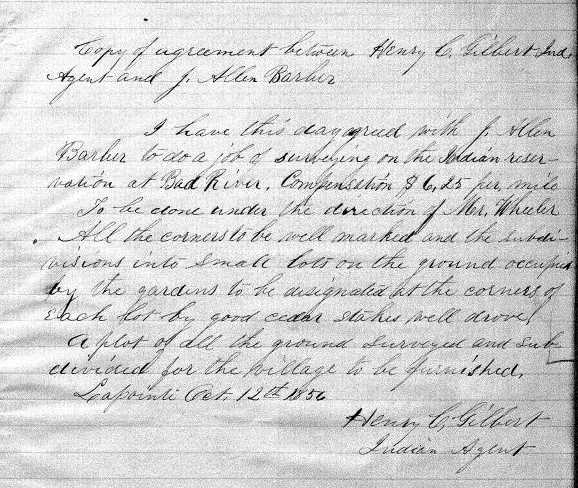
Copy of contract between the LaPointe Indian Agency and Joel Allen Barber to survey the LaPointe Indian Reservation and “the gardens” town-site (Old Odanah), to be done under the direction of Reverend Leonard Wheeler.
~ Board of Commissioners of Public Lands
~ History of Northern Wisconsin, page 64.
I could easily if I had means to carry it on to my liking. It is surveying at $6.25 per mile.
Father has gone to Ironton. I could not go as I wished to stay and conclude my business with the agent.
[You might?] I have been offered $50.00 per share for Ironton I took on which I have only paid 25 dollars per share, but I refused to take it. It may cause you pain to see that I am everyday becoming more and more fastened to this country but I cannot think of deserting it yet. As yet I have not realized one cent for my sojourn in the wilderness but I am far from being discouraged. I have seen fortunes made and have seen men make tens of thousands by taking chances that I might as well have had but I was green and could not read the future.
I am not in a mood for writing my thoughts to you [see rum?] principally upon many matters. Perhaps that is because I have been to payment and and because there is a gambling table in full opperation in the room where I am writing.
It is strange that father never told you the facts in regards to the $600.
There was never any mystery about it to me. Stuntz & Dr. Ellis had the money and returned over $400 of it. It is all right or will be. I nearly forgot to mention that I just got a letter from you to Father of Sept. 25th.
We are both well. Please excuse haste and carelessness.
Your affectionate Son
Allen
[Incomplete copy of letter]
~ Scope and Summary of Joel Allen Barber Papers
There is a young Englishman aboard who has been quite a tourist. He was in the Crimeran? army, went East of there to Ferlizand through Syria to their Holy land to Jerusalem to Egypt the Pyramids the Catacombs. Through all the Country in the South of Europe and northward through Scotland to the [Shetwood Jelas?], has been travelling in the U.S. the past season & is now returning from Superior, got there the day we left [songs her?] visited that poor [Ratefu?] that lost his foot every day till he died. He is a rich land lord & nobleman as I suppose and has a happy way of communicating information upon all subjects especially upon Geology, Mineralogy, Geography [overrated spy?] as well as all other “ologies” He is laying [w/a Speciation?] & [conavasated ??? ??? from?] to England.

1860 photograph of the Paddle Steamboat “Lady Elgin”.
~ Ship-Wrecks.net
The boat has just put to the Canal & [???? ? ????] Do be careful of your life & health and let us hear from you as often as you can.
May God bless and preserve you for many
yearsG. A. Barber
Give my respect to Jo & William.
Interior Field Notes
La Pointe Indian Reservation
Township 47 North, Range 2 West
Notebook ID: [N/a]

Contract awarded by La Pointe Indian Agency to Joel Allen Barber on October 12th, 1856. These survey notes are not available from the General Land Office or the Wisconsin Board of Commissioners of Public Lands.
Lapoint Nov 9th 1856
Dear Mother
I start today for Bad river with four others to commence my job of surveying on the reserve. I am well and in pretty good spirits. Father left on the S.b. Lady Elgin last week.
I am in such a hurry that I can scarcely write legibly. I was elected county Surveyor of this county last Tuesday. My term of office commences Jan 2nd.
I would not like to have this known in Lancaster as it might cause me a little difficulty. I am writing this in a [gragshop?] where there are several men talking so I couldn’t write very sensibly so you must excuse levity. I will write as often as possible but don’t expect me every week as the mails are very irregular and it will be very inconvenient for me to write sometimes. I expect to have a good time this winter. Shall not be far from the very best kind of folks about the Mission and I beg of you don’t grieve because I remain here this winter.
I am very anxious to go home but you see I had something to stay for.
With best love to Am, Aunt Betsy and yourself.
I remain your affectionate Son
Allen
Lapoint Wis. Nov. 9th 1856
Dear Father
Joel Allen Barber;
William W Ward;
Larry Marston;
Joseph Latham.
I expect to get away today for Bad River with one party – Bill & I Larry Marston and Joseph Latham.
I went to Ironton on Saturday before election so I was not there on that interesting day. That mound of earth has scarcely changed at all and will not materially in years. Business is going on pretty well at Ironton. The house is probably up [?? this?].
Joel Allen Barber;
Asaph Whittlesey;
Major McAboy;
[Fremont?];
James Buck;
and others.
The election came off here all right as far as I am concerned. Whittlesey 11 or 12 and McAboy 1. Whole number of votes 108. [Fremont?] got ten votes. The Buck ticket was carried throughout. We only start with one party because no steamboat has come yet and it is doubtful where we shall get a large supply of provisions.
We are all well and prospering. Give my love to all friends in Lancaster
Your affectionate Son
Allen
Excuse haste.
Interior Field Notes
La Pointe Indian Reservation
Township 48 North, Range 2 West
Notebook ID: [N/a]

Contract awarded by La Pointe Indian Agency to Joel Allen Barber on October 12th, 1856. These survey notes are not available from the General Land Office or the Wisconsin Board of Commissioners of Public Lands.
Cambridge Nov 9th 1856
Dear Son.
Now that your father has left you I suppose you will be very glad to hear from Am and me sometimes; at least I hope you have not so much forgotten us that you do not look for a letter whenever the boat arrives and have one prepared to send home by every one. But I forgot that there will be no boats for 5 or 6 long tedious months to come and I fear we shall hear from you but seldom. Let me entreat you to have a letter ready to send to me at least by every visit that leaves your region. I cannot imagine how any one can think of surveying in the deep, dark forest during the winter months to be exposed to storms, day and night without shelter – how you lived do tell me. I am sure no one could live here through the winter in the woods without a pretty warm house and a good fire. Were it not that I know you have had some experience in the business & manner of living I should feel certain you would be frozen or perish in some way. But I suppose you have no such fears.
I have sent 2 or 3 letters for you and father to Lancaster supposing he would be there and hoping you would also. In one I mentioned the happy marriage of M. C. Heath to a most excellent pious young lady who taught school in the village center last summer named Mott. No one suspected his intention – not even his own family till he brought her home and presented her as his wife. Every body is much pleased at the matter.
Mr. J Woodruff has departed this life after lingering and suffering much longer than his friends expected. He tried every possible remedy, but nothing – not even Dr. Hunter’s boasted inhaling method could arrest the fated disease. The latter remedy has been tried in several cases of Consumption in Johnson and equally failed in every case.
You have never said any thing about the trouble in your head and throught since you left home. How is it – does it increase or has that climate proved beneficial in that affliction, as in other respects, to your health?
I am pained to have to announce the death of one more of your dear friends and school mates. Julia Whiting has gone to the spirit world to join the happy throng of the young the beautiful and the good who have passed on before. This is the fourth daughter that afflicted family have been called to mourn – they have but one left. I mentioned the sickness of the rest of the family before – at last Julia was taken unwell with slow fever – then Typhoid symptoms which ended in death. We heard of it the morning of the funeral and Amherst and I went to J to attend it, and do some errands.
I have had a little good fortune –. Mr. Pike has at length drawn a small sum from the pensions office for me on account of my father’s services so [Serjeant?]. He only drew 80 dollars a year as private when he was entitled to 100 dollars as [Serjeant?]. The sum drawn was $209.86 out of which Pike takes about 25.00 for the expenses of getting it. I never expected to get so much if I get anything – but trouble and expense.
If you stay at the lake this winter what will become of your title to the land you bought in Grant? You will have to improve it some before June or you will lose it. I wrote to you about Lewis Wilson. I understand he has gone into the Blake house for this winter but has bought nothing. I have not seen him since I wrote you but would go to see them if we had a horse we could drive. “Old Grey” is so lame in her fore foot she cannot go farther than a walk so we do not drive her far and [Fate?] has a bad trick of starting and turning short about when she is a little frightened so that Dow thinks her unsafe for Am or I to drive. She is a large, beautiful beast and perfectly gentle when not mad.
Oh, how I do wish you were going to spend the winter at home – you would have such nice times riding about and visiting the young people here. There are several young ladies still single that would no doubt like to take a side. There is not a large number to be sure but some of them are worthy of the attention of any good young man. There is Miss Anna Bryant who is said to be a prodigy of learning and good sense – and Carry C – your old school mate – lovely as a rose – accomplished in all domestic affairs, and, as you well know, an excellent schollar. But of all those with which we are acquainted there is no one so perfectly amiable and good – who would, if I am not deceived and misinformed be so desirable a companion for life as Miss C Griswold. I believe she is beloved by old and young – one of the excellent of the earth. And M. A. Chadwick who is always with her. But I suppose none but little David can come near her.
According to your father’s description of the people in your country, you must see a great deal of vice – drunkenness, gambling, quarreling, and I should expect fighting. But I hope and pray with a strong faith that you in no way participate in such scenes. With all my fears for your personal safety I have never had the sorrow of knowing or fearing that my dear sons would be tempted from the path of virtue.
What must be the agony of parents who have vicious children. I believe that whenever a man conforms to the will of his Maker by using all in his own power – through the exercise of all his faculties he may safely trust in his protection.
That you may be as protected is the prayer of your affectionate Mother
Nov 10th 56
Dear brother Allen,
I have but little to write at this time but I thought I would put in a few lines to let you know that I still read [lest?] you & can write to you. We suppose by father’s letters that you are yet to remain at the lake through the winter. We were in hopes that you would go to Lancaster, or come home with father, but I don’t know but it will be best that you stay there. But I wish you were to spend the winter in some more congenial & convenient situation if possible. It is already pretty cold weather here & it freezes considerably. Mother & I have been living in the old west room pretty comfortably this fall. I have provided wood as fast as we needed it but I guess Dow will have to get it for us after this. I am going to the Centre school now and enjoy it quite well. Mr. Ed. Bryant, my teacher, is very well liked here, & is going to stay & teach select school through the winter. We have a tolerable good [Scycum?] here now & I have some speaking & writing to do for it. Last week was appointed to get up a dissertation, which I am now writing. My subject is Noses. There is not much going on here but the school & [Scycum?]. & it’s pretty dull times now. Hardly any one here will talk polities except the business of whom there are 74 in town. We got partial returns from election Saturday night which set the Democrats all right greatly. That day we heard cannon all over the country.
Atwood’s folks are over here occasionally; all is well as usual; & Levi is I think improving in health as he works considerably now. The Johnson school is flourishing nicely under their new teacher. Old Bent, the former preceptor is now 2nd clerk of the Senate at Montpelier. Mother & things at Johnson are getting along about as usual & the same in Cambridge. Allen, I have not written near as much as I ought, but some other time I’ll write a longer & better letter. Now father is gone do let us hear from you often. We will write you often.
Good bye
A. W. Barber
Lancaster 13th Nov 1856
Dear Son
I [improve?] this 1st Mail to inform you of my safe arrival here night before last at 8 P.M. & that all the friends here are well &c &c
November 25, 1856
“Nov. 11 – The Steamer Lady Elgin, which left the St. Mary’s River for Chicago, Nov. 1st, had not, at latest advices, reached her port or been heard from elsewhere.”
~ MarinetimeHistoryOfTheGreatLakes.ca
I wrote you from the Sault by which you will learn my progress to that place. Left there at 1 P.M. & ran down the river 40 miles when wind & fog threatened an unpleasant night & the Capt ran to a Sawmill dock & tied up for the night. Next morning showed the wisdom of stopping for it was that awful snow storm Election day. We land there 2 nights & on Wednesday started again stopped at Mackinaw 3 hours & then put out again against a dead head wind that increased in violence till 3 next morning when the Capt put about & ran 15 miles back for shelter under the North Manitou where we laid till 7 o’clock drifting down the shore & then storming up to the head of the Island. Anchor was then thrown over & held untill 2 next morning when the boat drifted off with the anchor & we drifted down & steamed up the east shore till toward night when we made the dock on the Island the wind heaving about & changed from South to N.E. & blew like the D’l till just night next day (Saturday) when we started again for the [west?] shore of the Lake & [p????ed] our voyage till we reached Chicago toward might Sunday night.

These locations are on a page of this letter to Allen from his Father.
The handwriting appears to be of Allen’s, not of his Father’s:
“Lot 1 Sec 19 Town 48 R 4 con 44.37
Lot 1 39.99 and NE 1/4 of NE 1/4 39.99
Sec 24 Town 48 R 5 W containing 40.00
Lots 124.36
Lots 1 and 2 Sec 36 and NE 1/4 of SE 1/4
And SE 1/4 of NE 1/4 Sec 25 Town 48 R 5 West”
These locations are along the shoreline of Barksdale on either side of Boyd Creek (and underneath Chequamegon Bay). Was this “Barbers Camp“?
Monday I came to [Galena?]. Found on the [car?] John [Muskler?] & Sarah [Le???] on her way to live with Mr. L.O. Stevens in Iowa. From them I heard direct from Johnson. There is much sickness there this fall. Dexter Whiting had been sick unto death of Typhoid fever but was getting well but had his upper lip all eaten off. Mrs. W had also been sick & poor Julian was sick & died of some fever rather unexpectedly. She had been asleep 30 hours & died [?] Sarah said she saw Mother & Amherst at the Funeral. Mr. Woodruff died 3 or 4 weeks ago. It is about Mail time & I cannot be brief. Tell Jo that Jay paid his taxes last spring so that he is all right there.
Algebra equations on the backside of a sheet from this letter.
“Dexter Ward was born in Chittenden VT and came to Grant County on February 8, 1843. He settled in Lancaster where he was a carpenter and builder. He was elected Counstable in 1857 (? Possibly 1847) and held that job for 5 years. He was a deputy sheriff under Matthew Woods and George Stuntz.”
~ GrantCountySheriffWisconsin.com
Take good care of your life & health and do as well as you can for yourself. I will write you again before leaving for VT. You may be [apsment?] that it looks rather better about here where there are [lesasy?] crops all about me than about the Lake where there is nothing. I called at the Sherriffs & left William’s letter, found all well.
In haste your affectionate father
G. A. Barber
Interior Field Notes
Odanah Townsite aka “The Gardens”
La Pointe Indian Reservation
Township 48 North, Range 3 West
November, 1856
Notebook ID: [N/a?]
!["For Plat of Townsite Odanah LaPointe Indian Reservation [...] See Large Plat Book [s]Next to last page[/s] Middle of Book" ~ Board of Commissioners of Public Lands](https://chequamegonhistory.com/wp-content/uploads/2015/12/1856-odanah-town-plat.jpg)
“For Plat of Townsite Odanah
LaPointe Indian Reservation
and Resurvey of Sec 23, 24, 25, 26, 35, & 36
See Large Plat BookNext to last page
Middle of Book”
~ Board of Commissioners of Public Lands

“*Note Sections 23, 24, 25, 26, 35 & 36 having been previous surveyed by Mr George R Stuntz have been omitted by J. Allen Barber Dept. Surveyor, under Henry C. Gilbert, Indian Agent, so says Mr Barber but no evidence can be found to support his declaration either in the Gen’l L. Office or Indian Bureau. Secs 23, 24, 25, 26, 35 & 36 were recently surveyed by A.C. Stuntz so says the Comm’r Indian Affairs in his letter of Feb’y 6, 1865, inclosing a diagram thereof.”
~ General Land Office Records
LaPoint Nov. 22nd 1856
Dear Mother

Detail of the “Chippewa Gardens” at Odanah from Summary narrative of an exploratory expedition to the sources of the Mississippi River, in 1820, by Henry Rowe Schoolcraft, page 105.
—
The steamer Superior was lost near Grand Island, Lake Superior, October 29, 1856, during a violent storm. Her rudder was carried away and the boat fell into the trough of the sea. She commenced making, the fires were put out and she struck the rocks, soon after going to pieces. Thirty-five lives, including 11 passengers, were lost, and 16, including five passengers, were saved. Capt. Hiram J. Jones was among the lost. The Superior was considered one of the best sea boats in the trade, and had lived through many a storm. She left Chicago October 25, loaded principally with supplies for miners.”
~ History of the Great Lakes, Chapter 37.
Yesterday I arrived here from Bad River in a Macinaw boat with two fair men, we have been surveying nearly two weeks although we have scarcely made a beginning. Thus far we have been at work at “the Gardens” as the settlement at Bad River is called to layout out an Indian Village. I was over to Bay City [???] Wednesday to see about getting provisions for the winter but got [clism?] appointed and found others in the same fix. Mr. Stuntz had promised to furnish us with provisions but all his supplies were last on the Superior. You have probably seen an account of that said disaster. The boat was last on the pictured rocks in the night, 45 or 50 lives were lost, only 16 saved. As for us I have heard no one was lost that I know personally. No one may prove Superior with [3 Sisters?] were lost. [This?] father lived in Superior – his name is [Mentar?]. I have not much news to make. I think my prospects [to get?] surveying are pretty fair. I have been successful in getting a fair supply of provisions and if anything happened I believe we will do a pretty fair lot of work within the next month or two. My provisions are not thought to be scarce but so navigation is closed prices will be high.
Pork is 30 dollars per Barrel, Sugar 15 or 15 cents per pound.
I have not yet decided when to go below but I should probably see Lancaster before many months.
Last night I attended a half breed ball – not as a participant but as a spectator. The balls are rather an important affair as they generally last three days.
Last night was the third night and was necessarily the last as the ball was very suddenly “broken” by the Catholic priest about 8 o’clock. The priest and Bishop came to the door and demanded admittance and the priest went in and after asking a few questions commanded them to disperse and you may depend on it there was a scattering.
Ironton is prospering finally. Today I sold 6 shares at $60 per share. They were sold to two men who are at work for me and are good men. I am writing this in Squire Bell’s office and the others present are getting [warm?] and it is getting dark so I will fold this up.
Your affectionate Son
Allen
Interior Field Notes
La Pointe Indian Reservation
Township 47 North, Range 3 West
December, 1856
Notebook ID: [N/a]
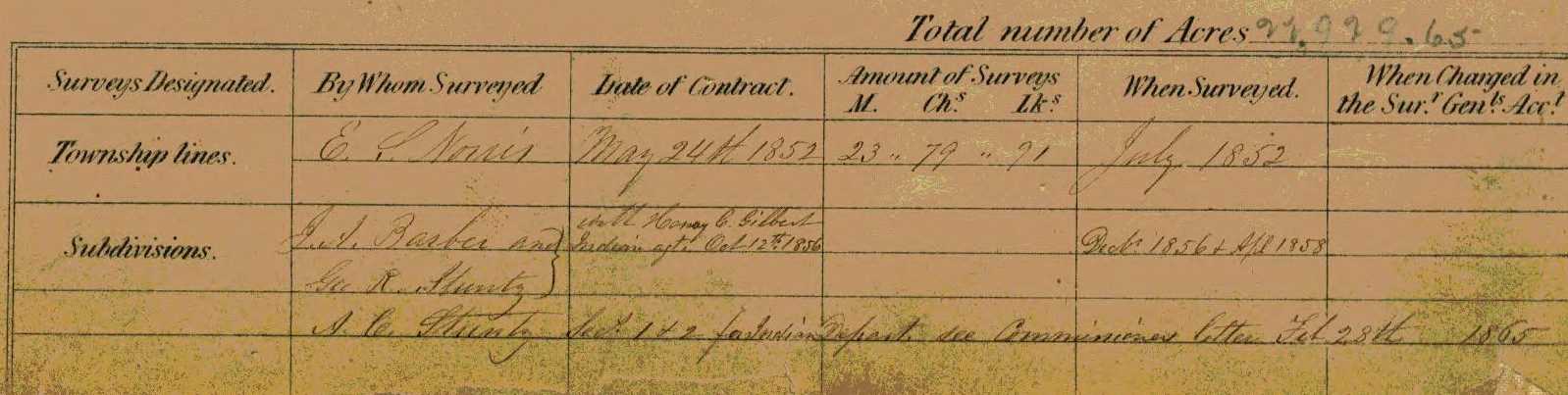
Contract awarded by La Pointe Indian Agency to Joel Allen Barber and George R Stuntz on October 12th, 1856. Survey partially completed by Barber and Stuntz during December, 1856. These survey notes are not available from the General Land Office or the Wisconsin Board of Commissioners of Public Lands.
Detail of Sturgeon Falls on the Bad River omitted from Barber’s resurvey during 1858.
Detail of the White River omitted from Barber’s resurvey during 1858.
Lancaster, Sunday Dec 7th 1856
Dear Son Allen
Here I am yet, amid my friends in this beautiful country. It was far from my intention to have spent so long a time here, but one hindrance after another has prevented my getting away. It is my design to leave the present week & stop at Sandusky probably over next Sunday. I have now passed by my friends three times, and feel as though to do so any more would look like studied neglect of them.
My disappointment at not getting any thing from you up to this time is great, & I now begin to hope you have sent a letter or two to Vermont instead of here, & that I shall find them all right when I get there. Though to tell the truth I am in some concern for your safety, fearing that you have been wrecked on your journey from La Pointe to Ironton or Bad River. I am still in hopes to get a letter from you tomorrow or before I leave the place. Your friends are all well hereabouts, and everything carry on swimmingly.
Thode Burr was dismissed from Ryland & Swab’s employment last Monday, not for any fault but because Ryland has got well enough to work in the Store “[the St Louis?]” are able to do all their business. He is doing nothing at present though he could have $30.00 per Month to go into a school at [Baserbol?]. I mistake perhaps in saying that he is doing nothing, for he is attending [any/my?] [earnestly?] to his [hymn?] & nothing else.
George Parker & Lincoln of [Midden?] (you know him) are in DTP [stom?]. Lincoln was in College 2 years & had to quit on account of sore eyes after trying to resume study twice. He gave me the following items concerning some of the Johnson Boys.
[Thuler?] was expelled last June for participating in the annual mock training contrary to the command of the College Officers. He talked of going to [knive Coll. Schunistudy?], but has not yet. Hotchkiss had to quit College & has gone to work on the farm. [Spurr?] is Married to a Miss [Denny?] of [Largage?] a real visage and was teaching in Mass. receiving $1000. for his & his wife’s services for [canninor?].
This is all that he told me of them. Had there been any thing else worthy of note, he would have told of it.
I wrote you about the Small pox being in the town & that there had been some deaths. Whether there have been any since my last I cannot say. Only 3 in all. There are no new cases for some 10 days or more & it is hoped that it will spread no further. Mr. James Mc[Gonigal?] brother to William from Tennessee was was buried last Sunday. He was taken sick of fever the Sunday previous, & went to bed saying, that was the last time, & was expecting to die untill he breathed his last on Friday night at 10’o’clock. He was a very fine young man, had lost a wife & only child, before he came here, & has been clerk for D.T.P. for some time.
Wm Carter & Miss [Rawdon?] were married last Thursday.
I should feel much better if you were living in this country than I do now, when my mind is constantly worried by thoughts of you suffering from cold, fatigue, hunger & all sorts of privations, to say nothing of being deprived of all society congenial to your natural taste.
I cannot sit down to a good meal or get into one of the warm soft comfortable beds, without thinking of my poor son who is where all such things are unknown, and may be suffering for want of the comforts that here so much abound and especially did I think of you last Sunday when there was the worst storm of snow from the N.E. ever known in the Western part of Wisconsin, so said by all the badgers. Snow fell 18 in deep in the timber, but it piled up in the roads & streets like it does in Vermont. The snow was drifted into one place East of Galena 40 feet on the track with a freight train beneath. They got the [cars?] through yesterday. The weather has been very cold here for this time of the year. Thursday Morning 4th Therm 11* below 0, Friday 14* below 0, & Saturday 6th at 14* below 0. I do not believe Vermont ever beat that in the 1st week of December, & in all that time I have been thinking how you & your company must suffer if out in the woods surveying.
I hope you keep warm nights, if so, you can do enough in the day to keep from suffering. My greatest fears at present for your [sloping?].
Allen Hyde has been very swift to purchase the little farm and has offered $35.00 per acre by my taking $415.00 of it in two lots of land. One of five acres South of the burying grounds at $315, & directly opposite the new schoolhouse. The other is a meadow of 8 acres out towards where [Sprader?] used to live at $[6.00/600?] which is cheap for either place. But I shall not be in great haste about selling for I should prefer that that little piece of land should remain in the family even if I do not live to come on it myself. There is quite a stir about farms at present. There was a Mr. Hayward from N.Y. State wishing to purchase & bartered for Jay’s farm & I think would have paid $50.00 per acre for it but Jay would not sale without he could put in his 2 ½ acres of an out lot with it. Mr. H. offered Frank Hyde $36.40 per acre for his land, East of Hollaway’s & did buy Hyde’s new brick house built the summer past near Esq. Philp’s new house, at $1,000.
Tell Jo that I think I shall want to buy his land when I can see him. I went to it soon after I got here, but I was sick all the time so I could scarcely move, consequently did not see much of it & cared very little for what I did see. Tell Wm. W. Ward that I did as I promised to do, & went to his Father’s and had a good meal that would astonish any body from Lake Superior. I have been there three times since I came, I wish you boys could have had some of the chicken din & other fixings… Wm’s eldest sister played on the [a Melodron?] & sang a number of [piren?]… Mr. Richard [Myers?], an old country Dutchman who married Martha Phelps’ sister to your Aunt [Lucy?], is erecting a steam Sawmill just across the brook due East from your Uncle Allen’s & intends to have it ready for business in the spring & Mr. [Kirke?] of Philadelphia talks of coming here to erect a Steam Gristmill in the springs.
Some things are as dear here as in the country around you. Coffe 6 lbs per $1.00. Sugar 7 lbs per 1 doll. Butter 25¢ for [good/gevd?] but Pork sells for 5. to 5.50 [gevd?] fat beef rather better than [Cousin?] Ox for [?] for [foze grs?] & 5. for Hind do. Flour $2.50 per 100 lbs, &c. Venison is brought in and sold frequently & on the whole I think there is more comfort in living here than there you can be on the Lake.
I find considerable difficulty in settling off with Old Black for the proceeds of the little farm but shall get through with him tomorrow I now hope he has drawn some [manners?] on the orchard & and done some [plervisy?] for [Sish?] he charges exorbitantly, all done before I came & he had harvested most of the corn, but I am confident the dishonest whelp will cheat me out of a good deal any way I can fix it, but I will get shut of him some way and remain so ever afterward. He has sold his tavern stand today & taken a farm 4 miles north of the Village in payment of a Mr. Wilhinson. There is a new store opened in the [forver?] East of the Burnett House where J. M. Otis over traded by two men under the firm of Baily & Carroll who are giving the build a new Gristmill below Handall’s Sawmill.

Portrait of Uncle Joel Allen Barber from page 199 of the Proceedings of the State Bar Association of Wisconsin, Volume 1900.
The prospect now is that your Uncle Allen will be elected U.S. Senator for the next 6 years after the 4th March next. I would not write this had I not good reasons for believing that it will be so. And now in regard to yourself, I do hope you will be careful of your life and health, that you will avoid exposure to the dangers of the cold & the treacherous ice as much as possible. That you will not trust yourself on the ice, long distances in the cold or storms, or alone. Finally I beseech you to take all possible care of yourself. If you have not got blankets enough to keep you sufficiently warm nights do so & get more & not suffer or be uncomfortable without or for want of them. I do not feel reconciled to the thought of going home without hearing from you, & knowing that you are alive & well. I overhauled the trunk of our dear lamented Augustus yesterday and [leave?] nearly every thing as I found it. There are some good clothes, that may be of service to you, should God spare you to ever come down here. I have rec’d a number of letters from home since I got here, but none lately, as they are probably expecting me home about this time, all were well. I do not know whether I mentioned in my letter to you that your mother had drawn $209. from Government additional pension money.
Adieu my dear son.
That our Heavenly father will bless and preserve you is the daily prayer of your affectionate as well as afflicted father.
Giles A. Barber
To be continued in the Winter of 1857…
Barber Papers: “Ironton” Summer of 1856
December 16, 2015
By Amorin Mello
This summer was a time of trauma for the Barber family immediately following the death of Augustus Hamilton Barber at the mouth of the Montreal River near his town-site claim of Ironton during the Spring of 1856. Augustus had unfinished business on Lake Superior, which was being attended to by his brother Allen and father Giles in mourning.

Item from the Superior Chronicle, August 19th, 1856. Ironton was platted during February of 1856 according to the Bayfield Mercury, August 15th, 1857.
The Summer of 1857 was also a when the town-site claims of Ashland and Ironton were being established and platted by merchants near the east and west borders of the Bad River Indian Reservation. Several memoirs about the early days of Ashland and Ironton will be featured in this post to provide context due to copies of certain letters being missing from the Barber Papers. Only one letter was archived from the Summer of 1856 in the Joel Allen Barber Papers, located at the end of this post.
Oral history traditions from the Lake Superior Chippewa tell about how the language describing the exterior boundaries of the LaPointe Indian Reservation were changed sometime between the 1854 Treaty of LaPointe negotiations and when it was ratified by Congress in 1855. According to at least one oral history, both Ashland and Ironton were located within the boundaries negotiated at the treaty.
The Ashland Press
January 4, 1873
—
Ashland! It’s Growth During the Year 1872
A Quarter of a Million Dollars Expended in Improvements.
A Full List Of Buildings—Docks—And Railroad Work
ALL HAIL TO THE IRON CITY
The history of Ashland, full and complete, would require more space, and more labor in its preparation, than we can possibly give it at this time. Nor is it necessary in connection with this summary of its growth during the first year of its regenerated existence, to enter into an elaborate or extended article upon its past fortunes, but merely to give an outline showing its first organization, and a few of the most important items incident to its early settlement. This much we shall endeavor to do in this article, and no more, leaving other and better informed persons to give a full and accurate historical record, hereafter.
July 6, 1933
by Guy M. Burnham
“During the month of February 1854, Leonard Wheeler, the missionary and an Odanah Indian met at Odanah, where Mr. Wheeler then lived, and drove on the ice along the south shore of the Chequamegon Bay, from Kakagon to Fish Creek. It was the year of the great treaty, in which the Indians agreed to cede most of their lands to the United States and to reserve tracts for their permanent homes. The Indians were glad to do this, for only four years before; the government had decided to move the Chippewa to the Minnesota country. William Whipple Warren led a large delegation to Minnesota but like all others who were interested, they much preferred Wisconsin. Leonard Wheeler himself, took up the cudgel of his wards, and practically led the fight to prevent the removal of the Chippewas from Wisconsin, but in 1854, it was understood that some sort of agreement was going to have to be reached, for white settlers were looking to the north, and they need an outlet to Lake Superior. The Indians realized that they would have to do something so Wheeler, the missionary and Little Current [aka Naawajiwanose], the Chippewa, were delegated to look over the south shore of Chequamegon Bay. William Wheeler who was a small boy accompanied his father and the Indian on the trip, says that the Indians furnished the pony and the missionary the cutter, and they drove down past where Ashland now stands, to the extreme head of the bay. From the head of the bay region, at Fish Creek to nearly where Whittlesey afterwards built his first house, there was a straggling Indian settlement, which the Indians called Equadon.
Every foot of land from Fish Creek to Odanah was Indian Land. It was in this settlement or village, which the wife of Robert Boyd, Jr., told me her father, lived in Equadon, near the many flowing springs, which we now call Prentice Park. The Indians thought the western limits of the proposed reservation of Bad River, should be the west end of the bay, but the missionary pointed out that that would keep the white men from building a city on the south shore of the bay, and that it would be advantageous to the Indians to have such a city built, as it would furnish a market for their furs and other products they might have for sale. Little Current agreed to this, and then and there, the agreed on the western limits of the Bad River Reservation should begin at the Kakagon just as it is now, extending the reservation far enough south to make up for the loss of the frontage from Kakagon to Fish Creek. Asaph Whittlesey frequently talked with Leonard Wheeler about good sites along the south shore and so about four months after the momentous trip of Leonard Wheeler and Little Current, near the end of February. Asaph Whittlesey and George Kilbourne rowed a boat over from Bayfield and felled the first tree, built the first house, establishing the settlement, which was to be known for about six years as Whittlesey. When Whittlesey felled the first tree on July 5, 1854, the land still belonged to the Indians. Three months later, on September 30, 1854, the Treaty of La Pointe was signed, under which Bad River, Lac Courte Oreilles, Red Cliff, the tip of Madeline Island, and Lac du Flambeau were reserved, but it was not until January 10, 1855, that the Senate ratified the treaty, which became a law by proclamation of President Franklin Pierce, on January 29, 1855.
Although Whittlesey built his first house on land, which still belonged to the Indians, there was little danger of the Wheeler-Little Current agreement being disturbed, and Whittlesey became Ashland in 1860. The head of the bay, which then, as well as now, swarmed with fish and game, became a part of the white man’s domain, and this included the Place of Many Springs, Prentice Park.”
~ TurtleTrack.org
Old Ashland, to be properly written up, should be woven into the history of all the country extending from the head of Lake Superior to Ontonagon. This section from the beginning of the first settlements has been intimately connected in all its various fortunes, and its people of that date should be considered as one, and spoken of as the early day pioneers on the Lake. Scarcely an enterprise was attempted that a majority were not more or less interested in, and the early Ashlander was not satisfied with being limited to one small portion as the place of his adoption, but generally considered himself honored only when credited with being a citizen of the “Superior Country,” or as many term it, “of Lake Superior.” Like the old fashioned “Queen’s arm” the early settlers “scattered” terribly, and hence we find them at the present day, posessors of corner lots in exploded townsites, parchment mining stocks, iron lands, copper mines, mineral claims and silver veins, in almost every section of the south shore that has been explored. To enumerate all the enterprises attempted by these enterprising, pushing-ahead, speculating men, would be too great an undertaking for us, but a book, well written, giving a thorough history of their operations, would not only be intensely interesting, but posess a value scarcely to be enumerated. But it is not our purpose to digress. We have to do with Ashland only, and chiefly with its present growth and future prospects.
The Ashland of to-day was formerly Bay City, St. Mark and Ashland, two distinct townsites, located but half a mile apart, the intervening territory being that platted as St. Mark, best known as Vaughn’s Division. Each of these divisions has a history of its own, though of course more or less connected with each other in common interests. These three divisions have, since the new enterprise sprang into existence, been joined together and now constitutes the city of Ashland, all parties interested working harmoniously for the common interest and a general prosperity.
August 28, 1920
“Mr. [William] Wheeler was born at the mission at Odanah and remembers distinctly of a trip he made with his father [Leonard Wheeler] and one of the Indian Chiefs [Little Current aka Naawajiwanose], into the country to establish the boundary limes of the Bad River reservation. The Indians wanted the boundary line at Fish Creek but Rev. Wheeler told them to leave a site where the present city not stands, for he was certain that a big city would grow up and big boats from the outer world would sail into the harbor and that the people would furnish a market for the Indian’s products.”
~ Wisconsin Historical Society
On the 5th day of July, 1854, Asaph Whittlesey and George Kilbourn landed on the bank of Ashland bay, and immediately commenced the erection of a claim shanty, within fifty feet of the west line of Section 5, Town 47 north, Range 4 west, in Ashland proper. The first tree was felled by Mr. Whittlesey, on that day, and by night the first log house, 14×16, was commenced. On the 27th day of August this building was occupied by Mr. Whittlesey’s family. It was used many years after for various purposes, and its ruins can still be found on the bank of the bay. During the same season the small log house near the present residence of James A. Wilson, Esq., on lot 6, block 6 was built, and in November of the same year the largest of the three log houses now standing on the same lot was completed and became the residence of Mr. Whittlesey, which he occupied until the fall of 1857. This house has quite a history. It has witnessed many an exciting and tragic scene, as well as many a pleasant and happy gathering. If its walls could speak, and possessed the genius of a Shakspeare, they would tell a story that would out rival in magic fascination any work of fiction. It was within its walls that the first permanent white settlers in Ashland dwelt. In its spacious room in the winter of 1854, the man of God, the missionary in the cause of Christ, preached the first sermon ever preached on the town-site. The minister was the late Rev. L.H. Wheeler, founder of the Odanah Mission, and a man known as a good and earnest Christian missionary, loved and respected by all the border settlement. It was here that the first ball was given in 1854; the first Fourth of July celebrated, in 1855, some thirty persons participating. It was the first post office, established in March, 1855, with Mr. Whittlesey as P.M. It was here too, that the first election was held, in the spring of 1856, at which time the town of Bayport, (which included Ashland and Bay City and all the surrounding county,) was organized. It was also the scene of a sad tragedy, when Henry Cross, in self defense, shot and killed Robert D. Boyd in 1858. The first Sabbath School was organized in this house in 1858, by Ingraham Fletcher, Esq. It was also, May 31st, 1856, the birth place of Miss Delia E. Whittlesey, the second white child born in the town, the first birth being that of Katherine Goeltz, early in the same month. Many other interesting events might be enumerated as belonging to its history, but space forbids. The old house still remains a monument of Ashland’s former glory.
The first freight ever landed from a steamer in our harbor, was in September, 1854. The steamer “Sam Ward,” Capt. Exsterbrook, brought the household goods of Mr. Whittlesey to Ashland at that time, and they were landed in small boats in the ravine near the foot of Main street.
“The first marriage in the town was that of Martin Roehm to Mrs. Modska, in the fall of 1859, John W. Bell officiating, (music furnished by Conrad Goeltz,)” and a good time generally indulged in by all who participated in the festivities. And here let us state that Ashland was never forsaken by this sturdy veteran pioneer couple. They stood by the place with characteristic German fidelity, king and queen of the deserted village, corner lots and all until the dawn of the new era commenced.
The Indian in his might
Roamed monarch of this wild domain,
With none to bar his right.
Excepting fearless Martin Rhoem.
The first government survey of the territory around the head of the bay was made in 1848, when the township lines were run by S.C. Norris, deputy U.S. Surveyor. It was not subdivided, however, until 1856. The town-site of Ashland, embracing lots 1, 2 and 3, and the N. half of the S.W. quarter, N.W. quarter of S.E. quarter and N.E. quarter Section 5, Town 47, Range 4, was surveyed and platted by G.L. Brunschweiler in 1854, and entered at the United Stated Land Office, at Superior, by Schuyler Goff, County Judge, under the laws then governing the location of town-sites on Lake Superior, December 11th, 1856, for the use and benefit of the owners and occupants thereof, viz: “Asaph Whittlesey, George Kilbourne and Martin Beaser.”
Succeeding the first settlement above mentioned, the population of Ashland increased quite rapidly. During the year 1854 several families moved in. Among the new corners were Martin Beaser, J. P. S. Haskell, Austin Cousen, John Cousen, Conrad Goeltz, A. J. Barclay, Capt. J. D. Angus, G. L. Brunschweiler, Frederic Prentice, Adam Goeltz, John Donaldson, David Lusk and Albert Little. Of these a few remained only a short time, coming merely for temporary purposes. 1855 brought a still larger increase of inhabitants, among them M. H. Mandlebaum (now a resident of Hancocck, Mich.), Augustus Barber (who was drowned at Montreal River in 1856), Benj. Hoppenyan, Chas. Day, Geo R. Stuntz, George E. Stuntz, Dr. Edwin Ellis, Martin Roehm, Col. Lysander Cutler, J. S. Buck, Ingraham Fletcher, Hon. J. R. Nelson, Hon. D. A. J. Baker, Mrs. Conrad Goeltz, Henry Drixler (father of Mrs. Conrad Goeltz, who died in 1857, his being the first death in town), and Henry Palmer. In 1856, Mrs. Beaser (now Mrs. James A. Wilson) arrived, also Oliver St. Germain and family, still here; Mrs. J.D. Angus and family, John Beck and family, Schuyler Goff (afterwards County Judge) and Chas. E. Tucker. In 1857, Mr. Eugene F. Prince and family, A. C. Stuntz and family, Wm. Goetzenberger, Geo. Tucker and others arrived.
On the 25th of October, 1856, Hon. S.S. Vaughn pre-empted Lot 1, Section 32, Town 48, Range 4, and the East half of the N.E. quarter and the N.E. quarter of the S.E. quarter Section 5, Town 47, Range 4, the same being now Vaughn’s Division of Ashland. In 1856 Bay City was surveyed and platted, the town-site being owned by a stock company, of which Dr. Edwin Ellis was the agent. Under his direction a large clearing was made, a store, hotel and several substantial buildings created. A saw mill was also commenced, the frame of which is now standing near the east end of the new bridge across Bay Creek creek. During the same year and the next following improvements were being rapidly made in old Ashland. Martin Beaser, Esq., who was the leading business man and property holder of the place, gave it its name, (after the homestead of Henry Clay, he being an ardent admirer of that eminent statesman,) and erected the store and residence now occupied by James A. Wilson, Esq. Eugene F. Prince built his present residence, and quite a number of dwellings were put up, several of which are still standing and have been fitted up and occupied, while others have been destroyed or fallen into decay. Temporary docks were built both at Bay City and Ashland.
The Ashland dock was built by Martin Beaser and cost about $4,000. Both however were allowed to rot down and wash away. Main street and a portion of what is now Second street, as well as a number of avenues were opened and improved. Additions were also platted, and most prominent being ”Prentice’s Addition,” in 1856, and the Ashland of that day presented a live and vigorous aspect, containing as it did a thrifty and energetic class of citizens.
“With the continuing reports of minerals in the area and some mining being done, another group of hopefuls sought recognition as a corporation and received charter to begin mining. This corporation was formed in Milwaukee and was known as the Wisconsin & Lake Superior Mining & Smelting Co. Its charter was granted in 1856 by the State of Wisconsin, and with the charter the company was granted about 1,900 acres of land in the Penokee Range, some of which is now in Iron County and some in Ashland County.”
[…]
“The other two villages planned for their mining venture were Springdale and Lockwood.”
[…]
“Ironton was the headquarters for the officers for only a short time. They moved their office duties to Ashland shortly after getting established.
The names of some of the merchants from Ashland who planned to be the suppliers for these villages included McElwin [McEwen], Herbert and Mandelbaum. Herbert’s name is mentioned in other areas as well as the name of Mandelbaum, who is mentioned in the history of Ontonagon also.”
~ A Historical and Archaeological Reconnaissance of the Saxon Harbor area, Iron County, Wisconsin by John F Wackman et al, pages 57-58.
This was in an era of speculation and Lake Superior the theatre of many a town-site and mining operation, The Penoka Iron Range had begun to attract the attention of eastern capitalists, while the Copper Range and the mineral regions of the Porcupine Mountains had drawn thither a number of daring adventurers, who sought their fortunes in the discovery of valuable metals. Railroads too were projected then, and the brave surveyors with their compass and chains were penetrating the forest and engineering a path through a trackless wilderness to the land of civilization that lay far away to the south. Ashland then, as now, was the center of attraction, and to possess corner lots and broad acres was to realize one’s fortune.
But Ashland was not alone in its glory. Superior City, at the head of the Lake; Red Cliff, Bayfield, Houghton and La Pointe, among the Apostle harbors; Ironton, near the mouth of Montreal river on Raymond Bay; and Ontonagon, Copper Harbor, Eagle River, Hancock, Houghton and Marquette, on the peninsula of Michigan, were each points of interest and struggling for an existence, their claims being urged by their proprietors with characteristic energy. Money was lavishly expended; mining both of copper and iron largely engaged in and the whole country was apparently undergoing that rapid development that leads to general prosperity and thrift.
[…]
The Ashland Press
February 26, 1926
—
CITY OF ASHLAND IS 72 YEARS OLD TODAY
May 3, 1910
“In the year 1855, Dr. Edwin Ellis located upon land to the eastward of Whittleseys. Instead of locating under the town site laws, Mr. Ellis entered a homestead and began to literally hue out his path to civilization. Several of the doctor’s friends joined him and located on adjacent land and soon there was a plat filed of the town of ‘Bayport.’ After a few years of continuous hardships and disappointments, the hardy pioneers became disheartened and some even moved away. The plat of ‘Bayport’ was declared vacated, but when business began to revive and new settlers came in 1872, the old town plat was revived and reinstated by Dr. Ellis as Ellis Division of the city of Ashland.”
~ Wisconsin Historical Society
The city of Ashland is seventy-two years old today, for on Feb. 24, 1854, Dr. Edwin Ellis landed in Ashland, at a spot where Whittesey Avenue now is located. Dr. and Mrs. Ellis had come from Maine and stopped at St. Paul, with Mrs. Ellis’ brother. From St. Paul, Dr. Ellis walked all the way to Superior. Then to Bayfield, then to La Pointe, in the ice, and then on to Ashland. He constructed the first log cabin at what is now Whittlesey Avenue. Asaph Whittlesey and Kilbourn, the next white men to come to this part of the country, arrived in June or July of the same year.
In 1855, Dr. Ellis walked to Dubuque, Iowa to file a petition to have this country surveyed. The trail which he took was know as the St. Croix Falls and from there Dr. Ellis took a steamer down the river to Dubuque. In 1856 he went to St. Paul and brought Mrs. Ellis and the two girls back with him.
The American Fur Company was situated at La Pointe, at this time but had very little to do with the mainland. The people in the early days sent to Chicago for their supplies. As there was always somebody walking to St. Paul they would send their orders by one of these men and from there the mail was taken to Chicago. The suppliers would come up on the last boat which came up Lake Michigan to what is now the Soo Canal.
Twice the boats on their last trip were wrecked and the early settlers would be without supplies for the winter.
The principal food was fish. Deer at that time always left the country during the winter.
Martin Beaser and party arrived here a short time after the Ellis’ but the Beasers settled on the shore where Beaser Avenue is now situated. This whole country was a mass of woods and the Beaser home. which is now the Jack Harris home, was practically the only house at what is called Old Ashland. When the Ellis Family visited the Beasers they had to hitch up the oxen and go through the dense woods.
Scott Ellis was born August 24, 1824, which is also the birthday of Queen Victoria. He died May 3, 1903, at Ashland, after watching the city grow from a dense forest to the present city.

July 28, 1877
Recollections of Ashland
“OF WHICH I WAS A PART”
Number V
This memoir was ghostwritten for The Ashland Press by Doctor Edwin Ellis.
Mr. Dear Press: – As has been already stated, the land on which Ashland now stands, had not, at the time of its first settlement, in 1854, been surveyed. The town lines had only been laying off the country into blocks six miles square.
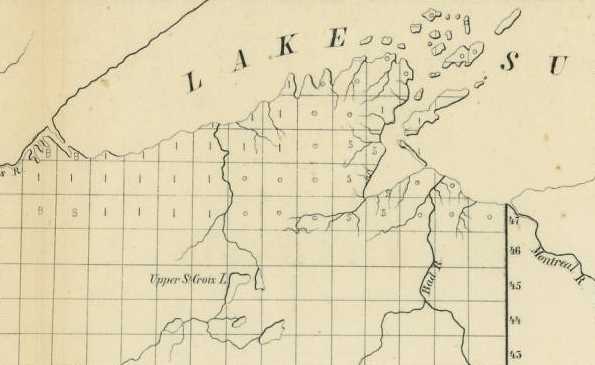
Detail from Sketch of the Public Surveys in Wisconsin and Territory of Minnesota by the Surveyor General’s Office (Warner Lewis), Dubuque, Oct. 21, 1854.

“In 1845 [Warnen Lewis] was appointed Register of the United States Land Office at Dubuque. In 1853 he was appointed by President Pierce Surveyor-General for Iowa, Wisconsin and Minnesota and at the expiration of his term was reappointed by President Buchanan.”
~ The Iowa Legislature
Wisconsin, Iowa, and Minnesota, then were embraced in one Surveyor’s District, with the office at Dubuque, Iowa. It was the duty of the Surveyor General to provide for the details of the Government Surveys in his district, as fast as the settlement of the country might require. Gen’l. Warner Lewis was then Surveyor General of this District.
~ The National Magazine; A Monthly Journal of American History, Volume 9, page 23.
No steps having been taken or any order given for the survey of the shore of Chequamegon Bay, in June 1855, Dr. Ellis left in an open boat for Superior, then on foot through the wilderness to St. Paul, following not far from the route over which many years later was constructed the Lake Superior & Mississippi R.R., – then an early settlement here induced Gen. Lewis to order an immediate subdivision of Towns 47 and 48, North of Range 4 and 5 West, both sides of our bay, and all the lands on which squatters had settled.
Early in September of that year, (1855), Augustus H. Barber began the survey and pushed the work rapidly, so that he had completed 47 and 48 of Range 4 in October, and the returns had been made and plats prepared and forwarded to the local land office by the first of December.
The Pre-emptors now, for the first time, could file claims to their lands and receive assurance that they were likely to be the owners of their homes.
During December many pre-emption claims were filed, and during the closing days of the year and in the first days of 1856, quite a number proved up those claims and received duplicates, upon which patents were afterwards issued. These were the earliest titles to the present site of Ashland. Unlike many towns in the West at that period our site was not cursed with complicating claims, and it is cause for congratulation that Ashland property has no cloud upon its title and that every buyer may, with little trouble, assure himself o this fact. The title to a portion of the site of Superior was bitterly contested involving years of delay and thousands of dollars of cost and much acrimony of feeling; and it is possible that this may have had its influence in carrying the railroad to Duluth rather than to Superior. Quarrels over title are a curse to any town, especially a new one.

“IN MEMORY OF
AUGUSTUS H. BARBER
of Cambridge, Vt.
U.S. Deputy Surveyor
who was drowned in Montreal River.
Apr. 22. A.D. 1856
Aged 24 yrs. & 8 ms.”
~ FindAGrave.com
Of Augustus Barber the early Surveyor of this vicinity, who is unknown to a larger part of this generation, a few words ought to be said:
He was a native of Vermont of an excellent family. At this time he was 22 years of age, well educated, gentle as a lady, refined and easy in his manners and very amiable in his temper. Like many other young men from the east, of active enterprising habits, he had come into this outer verge of civilization to make this his home and to grow up with its institutions. He was the nephew of Hon. J. Allen Barber, of Lancaster, in this State, who once represented his District in Congress. He continued in the surveys of this part of the Lake until in the summer or fall of 1856, when he, with others, conceived of the idea of founding a city at the mouth of the Montreal River – the dividing line between Wisconsin and Michigan about thirty miles east of Ashland.
“According to the Bureau of Public Lands, Department of the Interior, the land surveys were not completed in that area [Ironton] of Wisconsin nor offered for sale to the public until November 18, 1866.
[…]
“A practical location for an operating headquarters was chosen at the site of the Indian settlement on the shore of Lake Superior on that piece of level ground where there were mountains on three sides and through which a creek ran. The village at this location was named Ironton, and because of the activities planned for it and two other mining locations farther inland a group of merchants from Ashland assisted in building up this boat landing and supply headquarters. A dock was built and several buildings for warehouses and some living quarters.”
~ A Historical and Archaeological Reconnaissance of the Saxon Harbor area, Iron County, Wisconsin by John F Wackman et al, pages 57-58.
The iron range approaches nearer the Lake at that point than it does at Ashland. And though the country is much rougher and more difficult for construction of roads than between Ashland and the Range, yet the shorter route, it was argued, would more than compensate for the heavier grades. –The town was laid out and platted by Mr. Barber.
As indication of its future chief industry, as the entry point of the iron range – it was called “Ironton,” with the accent on the second syllable. Great expectations were entertained of the future importance of the place, and much land was entered in the vicinity.
The Montreal, not far from its mouth, leaps down a perpendicular descent of nearly a hundred feet presenting a wild and picturesque view. Being an enthusiastic lover of the beautiful of nature and desiring to reach a position underneath the falls, Mr. Barber in a canoe with two companions, approaching too close, were drawn in by the eddying whirlpool, the canoe was capsized, and before help could reach him he and one of his boatmen were drowned. his body was recovered and was buried on a sand hillock near the mouth of the same river in whose waters he met his death. Ironton has long been deserted, and Barber’s grave with its marble headstone, is the sole mark of that civilization, which twenty years ago there essayed to lay the foundation of a mart of commerce.
The surf of the waves of the lake in summer and fierce driving snow storms in winter, with solitude presiding over the grand orchestra, are perpetually chanting his mournful requiem, while a fond father and mother on the slopes of the distant Green Mountains are mourning bitterly the early death of their first born son.
Interior Field Notes
Ironton Townsite
La Pointe Indian Reservation
Township 47 North, Range 1 West
November, 1856
Notebook ID: [N/a]
This survey is mentioned by multiple sources, however, the Barber Brothers’ field notes and plat map for Ironton from 1856 are not available from the General Land Office Records or from theWisconsin Public Lands Survey Records. Did Warner Lewis receive them at the General Land Office in Dubuque, Iowa? The search for these survey notes continues.
Selected letters of the Joel Allen Barber Papers
… continued from Spring of 1856.
Superior City Sept 15th 1856
Dear Mother
“Ironton’s potential was very promising. While all the activity was taking place for a mining center, plans were being made by the Milwaukee & Superior Railroad to extend its line northward from Stevens Point to a terminus at Ironton at the shore of Lake Superior, then to continue west to Bay City (now Ashland).”[…]
“Besides the officers of the mining company, several businessmen of Ashland became interested in a railroad between Ashland Penokee Gap.
Some of these men were J.S. Beisch, Martin Beaser, John S. Harriss, I.A. Lapham, J.C. Cutler, Edwin Ellis and T.C. Dousman. This railroad was to be the Ashland & Iron Mountain Railroad. A lot of planning and some work was being done when quite suddenly the Panic of 1857 came on bursting many bubbles and bringing to a halt all of the mining activities, causing an exodus of many workers and a large number of potential settlers.”
~ A Historical and Archaeological Reconnaissance of the Saxon Harbor area, Iron County, Wisconsin by John F Wackman et al, page 60.
I wrote a few words to you a few days ago when I was unwell and had to be rather short. I have since recovered my usual health and will try to write a longer letter, but I am afraid it will be of little interest. I see you are anxious that I should quit the lake. It is not strange that you should wish dread to have me remain here. You wish me to come to [?] to Lancaster or any where but here.
Now to tell the truth I am as much attached to this lake as to any other place and I don’t know how to leave it. I know its disadvantages and privations as well as any one. I know the sweets of a more social life and much do I long for them. I know the luxury of living on a fertile soil in a genial climate and hope some day to enjoy it, but still if my life is spared Lake Superior will probably see me occasionally for a number of years.
You ask me my opinion in preference between a good farm in Grant County and ten miles of forest in this country and be bound to it. But I should not be bound to it if I owned [40/41?] miles and there are many farms about here worth more money than any farm on Lamoille river of twice the size.

Detail of Ironton property with trails to Odanah and the Penokee Mountains from T47N-R1W. This survey map was from Elisha S Norris during 1861.
I hope to visit Lancaster this fall but the middle of winter will see me threading my way back to this wild country. I would like extremely to visit Vermont next winter if possible but I expect my engagements will render it impossible.
I hope you will not dwell too much on the terrors of his country and fancy I am suffering all imaginable hardships. I am never hungry and seldom cold or over fatigued. I like the climate about as well any south of here and would sooner emigrate North west than South East, were I not bound by social ties. Were I to follow agriculture as a source of profit I would not go to Vermont or Grant County.
In regard to my Ironton property I have no hopes of getting you to think as you do.
Hon. D. A. J. Baker was introduced as an early resident of Ashland in our Penokee Survey Incidents series. Baker appears to be in business with the Barbers at Ironton.
“A trail between “Penokee” and Ashland is shown on Stuntz’s map of 1858. An Indian trail between Ironton and Odanah was improved for transportation and communication when land travel was preferred to lake travel or when the lake could not be used. During that same time the trail between Odanah and Ashland was being improved to accommodate heavier traffic. (This road later became a part of Old U.S. 10 and now is Ashland County Truck “A”.)
The original Ironton to Odanah trail began on the west side of the village, ascending the highlands at that point, then followed a southwesterly course paralleling the Oronto Creek but avoiding the obstacles of lowlands or ravines until it reached a point where the headwaters of both Oronto Creek and Graveyard Creek were but a few yards apart. As it passed this narrow strip of land and headed both streams it swung sharply to the west towards Odanah.”
A Historical and Archaeological Reconnaissance of the Saxon Harbor area, Iron County, Wisconsin by John F Wackman et al, page 59.
I may be obliged to sacrifice the whole of it, but it will not be my fault. Mr. Baker sold five shares a few days ago for city lots here which will soon be worth 500 dollars. The opinion of explorers and speculars expressed in deeds as well as words confirm my opinion of the place. I suppose Father writes everything concerning his business here so I will depend on him for that and not repeat it.
I would set a time to come home but the future is so uncertain I fear I should only disappoint you and myself. I never yet planned anything as it turns out. I intended to return to Lancaster last fall but did not. I intended to go down last spring but was prevented by the death of Augustus. If I wait untill next spring before going down I shall go to Vermont at the same time probably. “Man proposes and God disposes.” I can only guess how God will dispose my affairs.
I see that you and Amherst feel rather bitter towards [Dow’s?] folks. I am sorry that is so. It is unavoidable that you should see a great many things that you don’t approve but the sum of my advice is “Let em rip.”
I hope to go to Lapointe and Ashland before long where I am about as well acquainted as at any place I ever lived at.
I am now engaged on the field notes of Augustus’ work – [fitting?] them for the office.
With love for yourself and Amherst I remain
Your affectionate son
Allen
To be continued in the Fall of 1856…
Barber Papers: “In a Little Trouble” Winter of 1856
October 9, 2015
By Amorin Mello
Selected letters of the Joel Allen Barber Papers
… continued from Fall of 1855.
Minnesota Point Jan [23rd?] 1856
Dear Parents
It is sometime since I have wrote to you and for a fortnight or more
[???] [two lines on this copy are illegible] [??? ?????]
On arriving at Lapoint we found sheets from home and a good lot of newspapers.
We left Lapoint Thursday afternoon [on a firm of ?????? ? ?? head?] of [?????????] Nagonup the principal chief of all the Chippewas, Augustus and myself [??? ??? ?????] drawn by by two dogs on a dogtrain. At [????? ???????] were joined by one of Nagonup’s [??????].
Photograph of Naagaanab (Minnesota Historical Society).
They were on their way to Washington. Several of them are going accompanied by a gentleman from Lapointe as interpreter. The first night out we stayed in a wigwam with old Chingoon and his interesting family. Friday night we camped. Saturday reached Iron river. Sunday left and [comfortable?] – Monday came here. Augustus has a sore througt, not severe – otherwise we are well as usual notwithstanding our tramp of over [100?] miles. I must now quit writing and try to find one of our dogs which has strayed over to [???].
Under the old permit system, many locations, three miles square, were made on Lake Superior;- several on and near the Montreal river – some on Bad River, south of La Pointe – three on the main land, opposite La Pointe – two or three were made near Superior City, on the Nemadji, or Left Hand river, and one settler’s claim about twenty miles north of Superior.”
~ Mineral Regions of Lake Superior: As Known From Their First Discovery to 1865, by Henry Mower Rice, 1865[?].
Perhaps you wonder what we have made this journey for – perhaps you hope we are going below but that is not the case. Why should we [?????]. It is warmer here than at many places two or three hundred miles south of here. True – one or two thermometers froze up at this place but others did not while at Fort Snelling, the spirit thermometer inside the walls indicated 44 degrees below zero. Augustus wanted to see to his preemption and I had nothing to do but to come along with him. I also wanted to find out a few things concerning a place that I should like to preempt. I suppose there is not a better copper show on the south shore of the lake, but the land is not surveyed and my only sure way to get it is to settle on it and stick to it until it can be legally claimed.
The town lines will be run next summer.
Augustus is in a little trouble about his claim. It appears his declatory statement never reached the land office. But I guess it will all be explained and made right. The dutchman who was to contest his claim has left the country and would stand no chance if he was here. We have a land office here now which saves a great many journeys to Hudson near St. Paul. We shall go back in a few days and commence surveying around the islands. Now don’t fancy that we cannot survey in the winter, for we have tried it and know better.
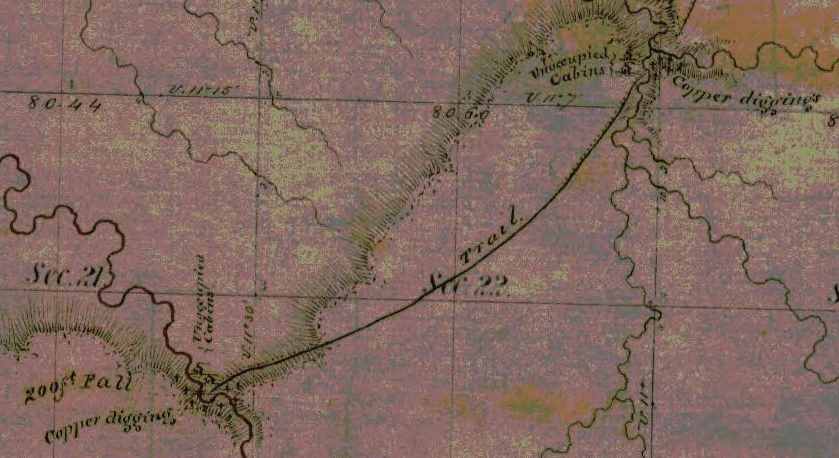
Detail from the Stuntz/Barber survey of T47N R14W.
“J.H. Bardon, a Superior pioneer, stated that ‘at Copper Creek and Black River Falls, twelve or fifteen miles south of Superior, and also near the Brule River, a dozen miles back from Lake Superior, Mr. Stuntz found evidences of mining and exploring for copper on a considerable scale carried on by the American Fur Company, under the direction of Borup and Oaks of La Pointe, in 1845-46. A tote road for the mines was opened from a point ten miles up the Nemadji River to Black River Falls.‘”
~ Duluth and St. Louis County, Minnesota; Their Story and People: An Authentic Narrative of the Past, with Particular Attention to the Modern Era in the Commercial, Industrial, Educational, Civic and Social Development, Volume 1, by Walter Van Brunt, 1921, page 66.
At Bad river we were at work during the coldest weather, and only lost two or three days because of cold but when the thermometer was up to 20* below zero we worked right ahead – sometimes in swamps where we stepped through the snow into the water,
[last line on this page of this copy is cut off]
The weather for a week or more has been fine. Cold enough to cover us with frost but not severe.
Provisions are very scarce – no flour or pork can be had.
They will begin to bring them through from St. Paul in a few days. Flour it is hoped can then be bought for $20 per barrel. Fish are not exactly plenty but they can be obtained for money or labor which is not the case with anything else. The country is flooded with dry goods, [p??y] articles and everything but provisions because they can be bought on time but eatables could only be got by paying cash down.
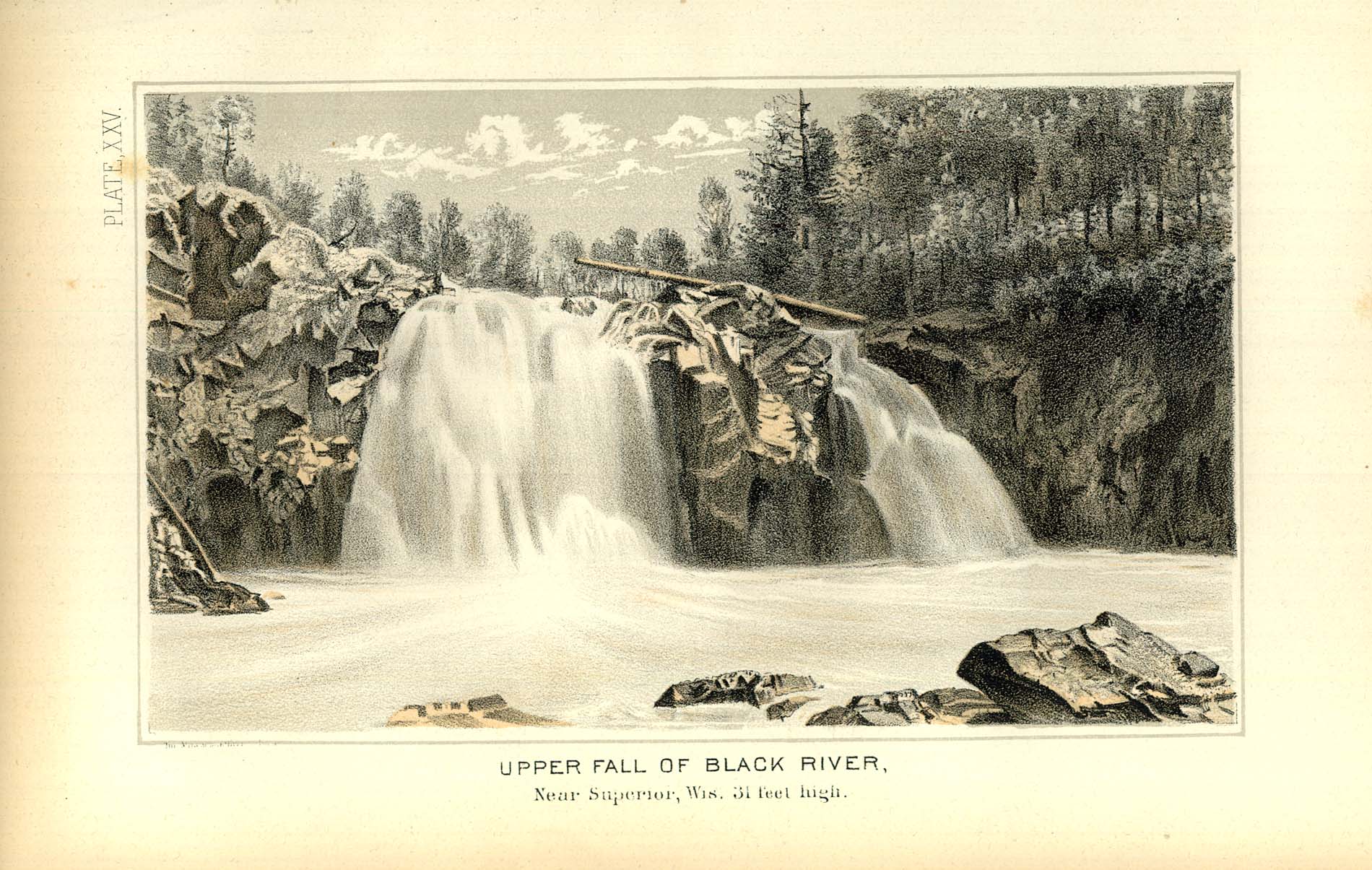
Geology of Wisconsin: Survey of 1873-1879,
Volume III, 1880, page 342[?].

Geology of Wisconsin: Volume 3, page 341.
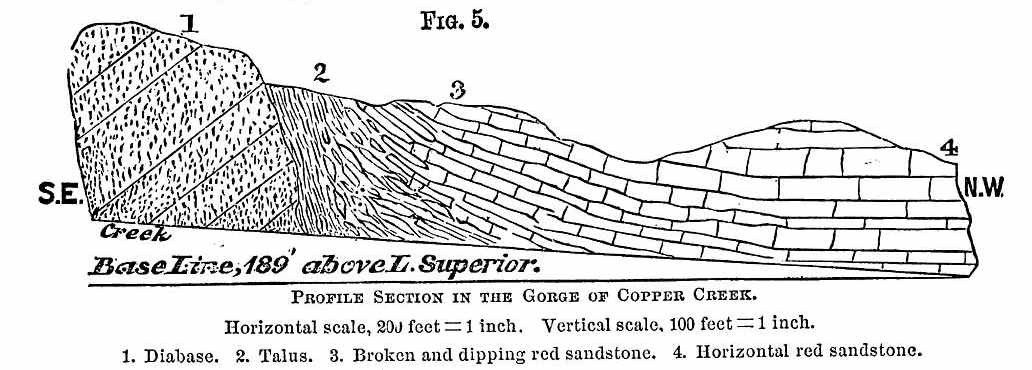
Geology of Wisconsin: Volume 3, page 345.
The Fon du Lac mine has commenced operations with tolerable fair prospects. It is the only mine in operation this side of Montreal river. Augustus’ claim is on the same vein and for aught anyone knows just as good besides having abundance of water power. All the copper excitement since I come to the country has been directed toward the north shore. This morning I signed 2 petitions, one to congress for the early survey of the north shore and another for a road down that way. I have made a little map of the islands and last summers survey and some other things that I will enclose.
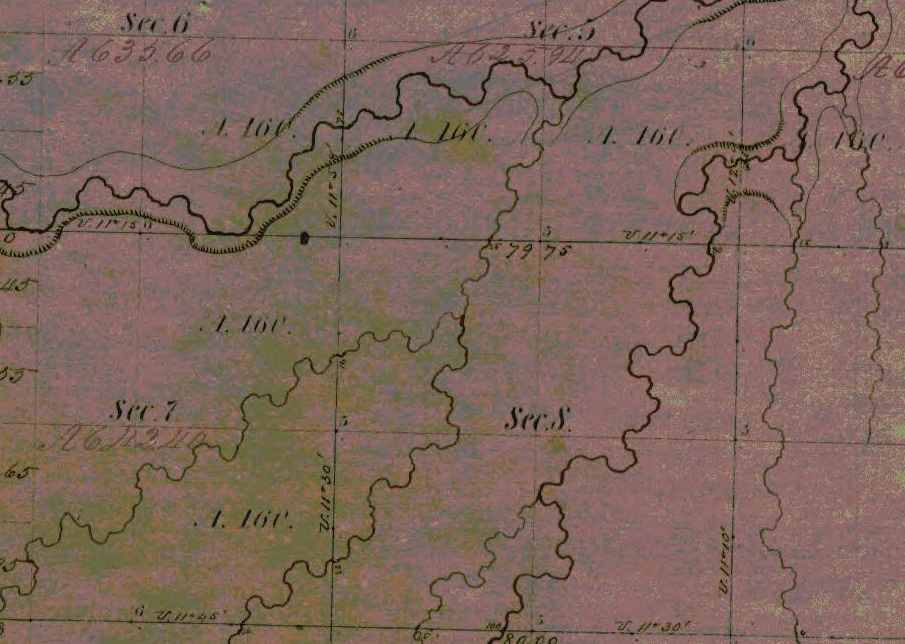
The Fond du Lac copper prospect was located near a small tributary of the Left Hand River on this map detail from T47N R14W, near Pattison State Park. Augustus’ claim was along the same vein of copper but had not been surveyed yet; perhaps it was at Amnicon Falls State Park.
Augustus has begun a letter to send with this. He has just come home with letters now about his claim.
No more at present from
Your affectionate son
J. Allen Barber
Direct to Lapoint
Minnesota Point
Superior County
Minn. Terr.
Sunday Feb 10th 1856
Dear Mother
Augustus has written a letter, and left it for me to enclose and dispatch so I thought I would ship in a few lines before sending it off.
Augustus started today with a young man and two dogs for Lapointe. I shall probably go there in a two or three weeks to return immediately. There are two men going down with a tamlins pony team with provisions from St. Paul for Augustus. The men are going to work for him and I shall probably bring the team back and use it a while. I have at last fixed my mind on a place that I mean to claim. The location is a point at the mouth of Left hand river, known as Left hand point. It contains only 5 or 6 acres in low & swampy and covered only with bushes coarse grass and floodwood. Nothing but the fact of its being a part of Superior city is of any value whatever.

Barber’s sketch of his land claim at the mouth of Left Hand River. This location is now an industrial neighborhood of Superior on the Nemandji River.
As it is $1,000.00 per acre is not an overestimate of its marketable price at present. It joins or is part of the grounds intended for the Railroad buildings when the survey was made here this point was cut off by the meander lines instead of meandered. Therefore according to the [rearns/records?] no such land exists.

A resurvey is to be made and I mean to fasten it by a preemption which is the only way to obtain it before the land sale. I may get cheated out of it and I may throw away my time and money but such chances are scarce and should it transpire that my claim is good I want to have my dish right side up for once. I have written for Uncle Allen’s advice and should I ever find it advisable to drop the matter I can do so without forfeiting my preemption right.
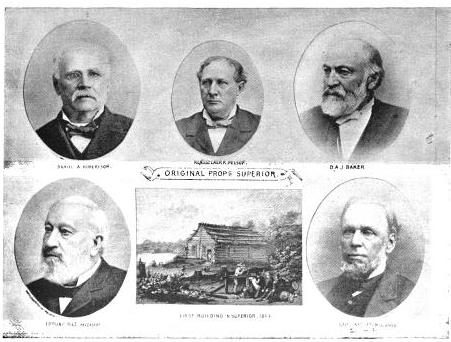
The Eye of the North-west, page 9.
The Superior Company with Company with which I shall probably have to contend is rich, influential, and on good terms with the administration. All that can be done by fair means or foul to defeat any claim will probably be done, but some things can be done as well as others, at any rate we shall see what we shall see.
So my head is so full of business just [snow?] you will please excuse the shortness of this letter and look for more when I have more time.
Your affectionate son
J Allen Barber
Superior Feb. 17th 1856
Dear Brother
It is sometime since I have written anything to you but you have heard of me so often that I suppose it makes no particular difference. It will be nearly sugaring time when you get this.

Makak: a semi-rigid or rigid container: a basket (especially one of birch bark), a box (Ojibwe People’s Dictionary) Photo: Densmore Collection; Smithsonian
I have once more got into a country where sugar is made but not by white men. The Indians make pretty good sugar which is generally done hard and [sinted?] dry and put into birch bark “mo’kucks” holding from 50 to 75 lbs. This bark is also used exclusively for buckets, store trays, gathering pails, &c. The timber in this country is not as equally distributed as in Vermont. The land is mostly covered with evergreens but there are some located portions of country where maple abounds. These “sugar bushes” as they are called are often quite extensive covering several sections and and [they?] only at intervals of 8 or 10 miles, but this is just as well for the Indians are both migratory and gregarious in their habits.
Detail of an Lake Superior Chippewa “sugar bush” from the Barber brothers’ survey of T48N R5W.
I hope you will eat plenty of sugar next spring and take some of the girls to a sugar party or two like I used to. I am doing nothing now most of the time but shall have business enough in a few days when I begin to build my house that is if I conclude to grab for the price of land I am now watching. I am waiting to hear from Uncle Allen and for some other things to transpire. There is not a man in the country whom I could trust that could give me any reliable information such as I want. I want you to hurry and become of age as soon as possible and come out here this spring and make a preemption.
There are some good places left yet, but don’t get married before you make a preemption for it might not be convenient to take your wife out into the woods 30 or 40 miles to live on the place as you would have to do in order to “prove up.” I am going to get up an ice boat before long which will be very useful as I mean to do considerable boating yet this winter, and I might use it to carry lumber and other things up and down the lake. With such winds as we have had a few days ago I could easily go to Lapointe and back in two days. I suppose Augustus got a party started by this time and he will be at it himself in a few days. I am living with a man named Fargo, you have heard of him before. We are living in Stuntz’ store. Board at the hotel is ten dollars per week. Old Steven Bonga is living on the point, he has been something of a traveller having been to Montreal, Hudson Bay, [Oregon?], Prairie du Chien, and all intermediate places.
He is half indian and half negro so you may suppose he is not very white.
Portrait of Stephen Bonga (USDA Forest Service). Additional information about Bonga is available from the Wisconsin Historical Society.
A railroad has been laid out from here to St. Paul and my claim covers the terminus at this end. There have two or three new towns started into existence along its route in imagination. Perhaps they are [surveyed?]. This making towns in a new country is a great business.
What happened in your good town on Christmas and New years eve
Were there any stockings left.
I want to inquire about lots of girls and boys in Johnson and Cambridge but I conclude you will tell me as much as you can in your next letter so with respects to all enquiring friends I remain
Your affectionate brother
Allen
Superior, Douglas Co. Feb. 25th 56
Dear Parents
Detail of Superior City from T49N R1W.
Night before last I got a letter and some papers from Augustus also 2 letters from home which he had read. They were dated Dec. [21st?] & Jan 2nd.
Sad and startling was the news of the death of George Hill. Who could have thought three years ago that such a dark future lay before that family. Every day some sad event warns me of the uncertainty of life. Men have died here who had no friends to mourn their loss, and their death is hardly noticed. I always ask myself why was it not me instead of them and will not my turn come soon. Yes, let it come soon or late as the world reckon, and it will be soon to me.
There is just as much danger or accidents in this country as in any other and no more but as to health there is no better place in the world than this. You seem shocked at the idea of surveying in the winter, but it will be nothing but fun to survey during the rest of the winter. It has been moderate pleasant weather now about two weeks. The snow is going off a little lately and it seems a little like spring. We had some pretty cold weather about new years but we shall have no more such. The lake is more open than it ever was known to be at this season before.
It sometimes freezes across at Lapointe but now it is open within six or eight miles of here. Flour is only $20 per bbl‑ with prospect of falling lower. The Indians chiefs have returned having only been to St. Paul where they found a letter telling them to delay their visit a while.
Poor creatures! They are fooled around by traders and speculators who are with the government in robbing and dwindling them. Any thing like a full account of their wrongs would astonish even them. About my claim I have not [???] today. There is another man after it and it will be no easy thing to carry my point.
Valuable property is troublesome stuff in this country. There is a townsight three miles from there now in litigation for which there is a standing offer of $200,000.
I am still living with Fargo on Minnesota point. I expect to go to Lapointe before long with Albert Stuntz who is going down with some supplies for Augustus which he brought from St. Paul.
It is too dark to write
Good bye
Allen
Superior, March 4th 56
Dear Parents
Not much has happened in this vicinity worth recording. The principle circumstances of note is the burning of a house and all the worldly possessions of a poor [Indian?].
Detail of Left Hand River from Stuntz’s survey; where Barber’s land claim was located.
I have heard nothing of Augustus since writing last but expect to when anybody comes up the lake. About my claim I can say but little my chance is but dull still I don’t mean to give up so large a prize without good reasons.
I have had it surveyed and the notes sent to the Surveyor General with a memorial stating the facts and asking him to [appraise?] the [notes?].
The price contains over 8 acres (8.695).
Perhaps it occurred to you that I am was 22 years old last Sunday. Well such is unquestionably the case although nothing was done to celebrate the day only I had my hair cut for the third time after leaving Vermont. I think I shall have to go to Lancaster this spring but unless I get ousted here it will be difficult to leave.
I wish I could multiply myself by about a dozen in order to hold several valuable claims which are not occupied by any one who can legally hold them. I can’t write here two children [pretting?] and several people [telling?] Albert Stuntz and family are here today. I am perched on a sawhorse writing on a work bench loaded with all manner of [marbles?].
Evening – quiet once more since dark I have written a letter to the Surveyor General to accompany a memorial that I have been circulating. O I wish there was a person in the country that I could depend on to assist me in regard to that claim. There are one or two that I counsel with who know no more than I do and then I do as I think best.
I expect [Lowener?] to find out I have no show, and that will be the last of it I shall [not feel?] that I had lost it for I never had it, but if I don’t get it some body else will get 15 or 20 thousand dollars worth of land that I want.
Provisions are still high and will be higher again before navigation opens which cannot be expected before the 1st of May. Flour is $20/barrel, fresh pork 18 ¾ cents per lb, beef 20 cts milk 20 to 25 cts per qt. &c, &c. Eatables must be higher because there will be little or no sleighing after this over the barrens between here and St. Paul. My mind has been on the [rock?] so much today that I am not in a mood to think much about home so please excuse the shortness and dryness of this letter.
I remain your affectionate son
J Allen Barber
Went to Iron River Thursday 13
Returned 15th
Superior , Douglas Co. March 11 1856
Dear Parents
Yesterday I read a package of letters from Augustus containing one from him & from home one from Albe and one from [Caldridge?]. As Augustus was in town (Lapointe) when he recd. your letters I suppose he has answered them so I cannot tell you much news about him. I am still staying with Fargo – not doing much but hoping to get pay for my time and expense by securing the prize I am after. There is some excitement in town about it, but mighty little is said to me. The Register at the land office gives me good encouragement and says a preemption will hold it. I have taken some steps toward building on it. Today I bought a sack of flour ½ barrel for 12 dollars, I shall get some fish from Lapoint where they are very plenty and cheap and then I shall be almost ready to try housekeeping alone.

I am sorry to hear of the disastrous results of the low price of hops. Although farmers must suffer in consequence yet I believe speculators will make fortunes out of it. If I was in the business of raising them I should stick to it. No articles is so liable to fluctuations in prices as hops but it is well known that the risk fails once in five years on an average so they must come up sometime.
I see you are inclined to believe our country and climate are more in hospitable & forbidding than yours. Such I believe is not the case. We have had some very cold weather but the changes are so moderate and so seldom that we pay but little attention to the weather – in fact we call most all of it very fine weather, as it is. The lake is a great equalizer of temperatures and our cool lake atmosphere in summer causes showers to fall from all the warm, sweaty winds that come here to wash their faces in this big blue pond. People in this country go much better prepared for cold than they ever do in Vermont. I have not worn a boot since leaving Lancaster. We wear shoes in the summer and moccasins in winter.
Boots won’t do for surveyors – they carry too much water unless we stop to empty them after crossing every stream or marsh.
While speaking of clothes perhaps I might as well go on with a few more items of the same sort.
Shoes for this country should have no lining or binding as they are quicker and ae not as stiffwhen dry. We never apply anything to soften them and nothing can preserve them from wearing out in about two months of hard service. They [sell?] about $1.50 per pair. We can get plenty of wool hats which are the only ones we wear.
All manners of shirts can be bought, even the very best quality of red flannel ones, which are universally warm, outside, i.e. by common folks.
The gentry of Superior dress most distressingly.
It is difficult to get good socks any where on the country. I have worn out 6 or 7 pair this summer and lost some more – they cost high bests we don’t wear. I have none. The only cost I have is of [Gihon?] cloth and made by Mrs. Sheldon. Cost are not much more except as an extra garment to wear occasionally.
Good durable pants I find it difficult to get. They are generally poor [ashnet?] and not half put together. Good your mittens would be very acceptable but for want thereof buckskin or blanket mittens are generally warm.
You speak about bringing Kate [in?] to Wisconsin. My advice is to it without fail if you intend coming out to live, nothing should prevent it if I were in your place. The horse that Uncle [Jay?] brought out with him is smarter and tougher than any one he can find to use with him. There is nothing that I regard as more necessary for a family than a first rate horse. I think [Kelty?] will be a very good serviceable animal for work besides being one that you might be proud to ride [after?] over the prairies. Probably Augustus has told you what he thinks about Amherst and other boys coming out here to survey. Butler was so badly disappointed in this country that I have had but little thoughts of [enough?] any one else to come here. Such a disappointment I think would be the fate of 4 out of every 5 that try the business.
A person to be a surveyor must be able to travel all day through the woods and sometimes carry a pack. I would not prevent any from coming here as there is generally business enough besides surveying. A surveyor can make no greater mistake than by hiring any but the best of men. Perhaps Augustus has not told you that he will be out of the business as soon as his present job is done and will devote his time to the improvement of his claim &c. I should like very much to [have?] Amherst here but I dislike to have my parents left entirely alone. As I have [???] two half [sheets?] – when I only [illegible] mind up for the [present?].
[Incomplete copy of letter]
 Chequamegon History