American Fur Company: 1834 Reinvention of La Pointe
October 4, 2023
Collected & edited by Amorin Mello
The below image from the Wisconsin Historical Society is a storymap showing La Pointe in 1834 as abstract squiggles on an oversized Madeline Island surrounded by random other Apostle Islands, Bayfield Peninsula, Houghton Point, Chequamegon Bay, Long Island, Bad River, Saxon Harbor, and Montreal River.

“Map of La Pointe”
“L M Warren”
“~ 1834 ~”
Wisconsin Historical Society
citing an original map at the New York Historical Society
My original (ongoing) goal for publishing this post is to find an image of the original 1834 map by Lyman Marcus Warren at the New York Historical Society to explore what all of his squiggles at La Pointe represented in 1834. Instead of immediately achieving my original goal, this post has become the first of a series exploring letters in the American Fur Company Papers by/to/about Warren at La Pointe.
New York Historical Society
American Fur Company Papers: 1831-1849
America’s First Business Monopoly
#16,582

Map of Lapointe
by L M Warren
~ 1834 ~
New York Historical Society
scanned as Gale Document Number GALE|SC5110110218
#36

Ramsay Crooks
~ Madeline Island Museum
Lapointe Lake Superior
September 20th ’34
Ramsey Crooks Esqr
Dear Sir
Starting in 1816, the American Fur Company (AFC) operated a trading post by the “Old Fort” of La Pointe near older trading posts built by the French in 1693 and the British in 1793.
In 1834, John Jacob Astor sold his legendary AFC to Ramsay Crooks and other trading partners, who in turn decided to relocate the AFC’s base of operations at Mackinac Island to Madeline Island, where our cartographer Lyman Marcus Warren was employed as the AFC’s trader at La Pointe.
Instead of improving any of the older trading posts on Madeline Island, Warren decided to move La Pointe to the “New Fort” of 1834 to build new infrastructure for growing business demands.

GLO PLSS 1852 survey detail of the “Am Fur Co Old Works” near Old Fort.
on My Way In as Mr Warren was was detained So Long at Mackinac I did not Wait for him at this Place as time was of So Much Consequence to me to Get my People Into the County that I Proceeded Immediately to Fond Du Lac with the Intention with the Intention of Returning to this Place When I Had Sent the Outfit off but When I Got There I Had News from the Interior Which Required me to Go In and Settle the Business there; the [appearance?] In the Interior for [????] is tolerable. Good Provision there is [none?] Whatever I [have?] Seen the [Country?] [So?] Destitute. The Indians at [Fort?] [?????] Disposed to give me Some trouble when they found they have to Get no Debts and buy their amunition and tobacco and not Get it For Nothing as usual but at Length quieted down [?????] and have all gone off to their Haunts as usual.
I Received your Instructions contained in your Circular and will be very Particular In Following them. The outfits were all off when I Received them but the men’s acts and the Invoices of the Goods Had all been Settled according to your Wishes and Every Care Will be taken not to allow the men to get In Debt the Clerks Have Strict orders on the Subject and it is made known to them that they will be Held for any of the Debts the men may Incur.
I Enclose to you the Bonds Signed and all the Funds we Received from Mr Johnston Excepting those Which Had been given to the Clerks and I could not Get them Back In time to Send them on at Present.
Mr Warren And myself Have Committed on What is to be done at this Place and I am certain all that Can be done Will be done by him. I leave here tomorrow For the Interior of Fond Du Lac Where I must be as Soon as possible.
I have written to Mr Schoolcraft as he Inquested me. Mr Brewster’s men would not Give up their [??????] and [???] [????] is [??] [?????] [????] [????] [to?] [???????] [?????] [to?] [persuade?] [more?] People for Keeping [his?] [property?] [Back?] [and] [then?] [???] by some [???] ought to be sent out of the Country [??] they are [under?] [the?] [???] [?] and [Have?] [no?] [Right?] to be [????] [????] they are trouble [????] [???] [their?] [tongues?].

GLO PLSS 1852 survey detail of the AFC’s new “La Point” (New Fort) and the ABCFM’s “Mission” (Middleport).
The Site Selected Here For the Buildings by Mr Warren is the Best there is the Harbour is good and I believe the work will go on well.
as For the Fishing we Will make Every Inquiry on the Subject and I Have no Doubt on My Mind of Fairly present that it will be more valuable than the Fur trade.
In the Month of January I will Write you Every particular How our affairs stand from St Peters. Bailly Still Continues to Give our Indians Credits and they Bring Liquor from that Place which they Say they Get from Him.
Please let Me know as Early as possible with Regard to the Price of Furs as it will Help me In the trade. the Clerks all appear anxious to do their Duty this year as the wind is now Falling and I am In Haste I Will Write you Every particular of our Business In January.
Wishing that God may Long Prosper you and your family.
In health and happiness.
I remain most truly,
and respectfully
yours $$
William A. Aitken
#42
Lake Superior
LaPointe Oct 16 1834
Ramsey Crooks Esqr
Agent American Fur Co
Honoured Sir
Your letter dated Mackinac Sept [??] reached me by Mr Chapman’s boat today.-
I will endeavour to answer it in such a manner as will give you my full and unreserved opinion on the different subjects mentioned in it.
I feel sorry to see friend Holiday health so poor, and am glad that you have provided him a comfortable place at the Sault. As you remark it is a fortunate circumstance that we have no opposition this year or we would certainly have made a poor resistance. I can see no way on which matters would be better arranged under existing circumstances than the way in which you have arranged it. If Chaboillez, and George will act in unison and according to your instructions, they will do well, but I am somewhat affeared, that this will not be the case, as I think George might perhaps from jealously refuse to obey Chaboillez or give him the proper help. Our building business prevents me from going there myself. I suppose you have now received my letter of last Sept, in which I mentioned that I had kept the Doctor here. I shall send him in a few days to see how matters comes on at the Ance. The Davenports are wanted at present in FDLac should it be necessary to make any alteration. I shall leave the Doctor at the Ance.

Undated photograph of the ABCFM Presbyterian Mission Church at it’s original 1830s location along the shoreline of Sandy Bay.
~ Madeline Island Museum

Reverend Sherman Hall
~ Madeline Island Museum
In addition to the AFC’s new La Pointe, Warren was also committed to the establishment of a mission for the American Board of Commissioners for Foreign Missions (ABCFM) as a condition of his 1827 Deed for Old La Pointe from his Chippewa wife’s parents; Madeline & Michel Cadotte.
Starting in 1830, the ABCFM built a Mission at La Pointe’s Middleport (second French fort of 1718), where they were soon joined by a new Catholic Mission in 1835.
Madeline Island was still unceded territory until the 1842 Treaty of La Pointe. The AFC and ABCFM had obtained tribal permissions to build here via Warren’s deed, while the Catholics were apparently grandfathered in through French bloodlines from earlier centuries.
I think we will want about 2 Coopers but as you suggest I if they may be got cheaper than the [????] [????]. The Goods Mr Hall has got is for his own use that is to say to pay his men [??]. The [??] [??????] [has?] to pay for a piece of land they bot from an Indian woman at Leech Lake. As far as my information goes the Missionaries have never yet interfered with our trade. Mr Hall’s intention is to have his establishment as much disconnected with regular business as he possibly can and he gets his supplies from us.
[We?] [have?] received the boxes [Angus?] [??] [???]. [You?] mention also a box, but I have not yet received it. Possible it is at the Ance.
The report about Dubay has no doubt been exaggerated. When with me at the Ance he mentioned to me that Mr Aitkin told him he had better tell the Indians not to kill their beaver entirely off and thereby ruin their country. The idea struck me as a good one and as far as I recollect I told him, it would perhaps be good to tell them so. I have not yet heard from any one, that he has tried to prevent the Indians from paying their old Debts and I should not be astonished to fend the whole is one of those falsehoods which Indians are want to use to free themselves from paying old Debts. I consider Dubay a pretty active man, but the last years extravagancies have made it necessary to have an eye upon him to prevent him from squandering.

“The Doctor” Charles William Wulff Borup, M.D.
~ Madeline Island Museum
My health had been somewhat impaired by my voyage from the Sault to this place. Instead of going to Lac Du Flambeau myself as I intended I sent the Doctor. He has just now returned and tells me that Dubay gets along pretty well, though there were some small difficulties which toke place, but which the Dr settled. The prospect are very discouraging, particularly on a/c of provisions. We have plenty opposition and all of them with liquor in great abundance. It is provoking to see ourselves restricted by the laws from taking in liquor while our opponents deal in it as largely as ever. The traders names are as far as could be ascertained Francois Charette and [Chapy?]. The liquor was at Lac du Flambeau while the Doctor was there. I have furnished Dubay with means to procure provisions, as there is actually not 1 Sack of Corn or Rice to be got.
The same is the case on Lac Courtoreilie and Folleavoigne no provisions and a Mr Demarais on the Chippeway River gives liquor to the Indians.
You want my ideas upon the fishing business. If reliance can be put in Mr Aitkin’s assertions we will at least want the quantity of Net thread mentioned in our order. Besides this we will want for our fishing business 200 Barrels Flour, [??] Barrels Pork, 10 Kegs Butter, 1000 Bushels Corn, [??] Barrels Lard, 10 or 11 Barrels Tallow.

Undated photograph of the ABCFM mission house built in 1832.
~ Madeline Island Museum
Besides this we want over and above the years supply an extra supply for our summer Establishments. say about 80 Barrels Flour, 30 Barrels Pork, 1500 # Butter, 400 Bushels Corn, 5 Barrels Lard, 5 Barrels Tallow. This will is partly to sell. be sold.
Mr Roussain will be as good as any if not better in my opinion for our business than Holiday. Ambrose Davenport might take the charge of the Ance but Roussain will be more able on account of his knowledge in fishing. I would recommend to take him as a partner. say take Holidays share if he could not be got for less.
I have not done much yet toward building. The greatest part of my men have been in the exterior to assist our people to get in. But they have now all arrived. We have got about 4 acres of land cleared, a wintering house put up and a considerable quantity of boards sawed. Mr Aitkin did not supply me with two Carpenters as he promised at Mackinac. I will try to get along as well as I can without them. I engaged Jos Dufault and Mr Aitkin brot me one of Abbott’s men, who he engaged. But I will still be under the necessity of hiring Mr Campbell of the mission to make our windows sashes and to superintend The framing of the buildings. Mr Aitkins have done us considerable damage by not fulfilling his promise in this respect. I told you in Mackinac that Mr Aitkin was far from being exact in business. Your letter to him I will forward by the first opportunity. I think it will have a good effect and you do right in being thus plain in stating your views. His contract deserves censure, and I will hope that your plain dealing with him will not be lost upon him. Shall I beg you to be as faithfull to me by giving me the earliest information whenever you might disapprove of any transaction of mine.
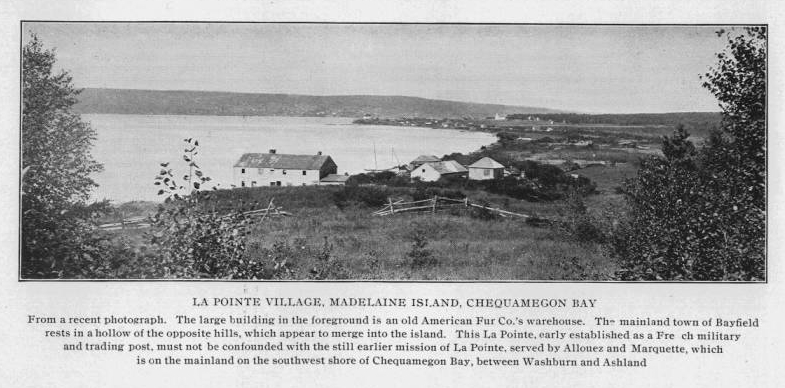
Photograph of La Pointe from Mission Hill circa 1902.
~ Wisconsin Historical Collections, Volume XVI, page 80.
I have received a supply of provisions from Mr Chapmann which will enable me to get through this season. The [?] [of?] [???] [next?], the time you have set for the arrival of the Schooner, will be sufficient, early for our business. The Glass and other materials for finishing of the buildings would be required to be sent up in the first trip but if [we?] [are?] [??] better to have them earlier. If these articles could be sent to the Sault early in the Spring a boat load might be formed of [Some?] and Provisions and sent to the Ance. From there men could be spared at that season of the year to bring the load to this place. In that way there would be no heavy expense incurred and I would be able to have the buildings in greater forwardness.
If the plan should meet your approbation please let me know by the winter express. While Mr Aitkin was here we planned out our buildings. The House will be 86 feet by 26 feet in the clear, the two stores will be put up agreeable to your Draft. We do not consider them to large.
I am afraid I shall not be able to build a wharf in season, but shall do my best to accomplish all that can be done with the means I have.

Undated photograph of Captain John Daniel Angus’ boat at the ABCFM mission dock.
~ Madeline Island Museum
I would wish to call your attention towards a few of the articles in our trade. I do not know how you have been accustomed to buy the Powder whether by the Keg or pound. If a keg is estimated at 50#, there is a great deception for some of our kegs do not contain more than 37 or 40 #s.
Our Guns are very bad particularly the barrels. They splint in the inside after been fired once or twice.
Our Holland twine is better this year than it has been for Years. One dz makes about 20 fathoms, more than last year. But it would be better if it was bleached. The NW Company and old Mr Ermantinger’s Net Thread was always bleached. It nits better and does not twist up when put into the water. Our maitre [??] [???] are some years five strand. Those are too large we have to untwist them and take 2 strands out. Our maitre this year are three strand they are rather coarse but will answer. They are not durable nor will they last as long as the nets of course they have to be [renewed?]. The best maitres are those we make of Sturgeon twine. We [?????] the twine and twist it a little. They last twice as long as our imported maitres. The great object to be gained is to have the maitres as small as possible if they be strong enough. Three coarse strands of twisted together is bulky and soon nits.
Our coarse Shoes are not worth bringing into the country. Strong sewed shoes would cost a little more but they would last longer. The [Booties?] and fine Shoes are not much better.
Our Teakettles used to have round bottoms. This year they are flat. They Indians always prefer the round bottom.
In regard to the observations you have made concerning the Doctor’s deviating from the instructions I gave him on leaving Mackinac, I must in justice to him say that I am now fully convinced in my own mind that he misunderstood me entirely, merely by an expression of mine which was intended by me in regard to his voyage from Mackinac to the Sault but by him was mistaken for the route through Lake Superior. The circumstances has hurt his feelings much and as he at all times does his best for the Interest of the Outfit I ought to have mentioned in my last letter, but it did not strike my mind at that time.

Detail from Carte des lacs du Canada by Jacques Nicolas Bellin in 1744.
When Mr Aitkin was here he mentioned to me some information he had obtained from somebody in Fond du Lac who had been in the NW Co service relating to a remarkable good white fish fishery on the “Milleau” or “Millons” Islands (do not know exactly the proper name). They lay right opposite to Point Quiwinau. a vessel which passes between the island and the point can see both. Among Mr Chapmann’s crew here there is an old man who tells me that he knew the place well, he says the island is large, say 50 or 60 miles. The Indian used to make their hunts there on account of the great quantity of Beaver and Reindeer. It is he says where the NWest Co used to make their fishing for Fort William. There is an excellent harbour for the vessel it is there where the largest white fish are caught in Lake Superior. Furthermore the old man says the island is nearer the American shore than the English. Some information might be obtained from Capt. McCargo. If it proves that we can occupy the grounds I have the most sanguine hopes that we shall succeed in the fisheries upon a large scale.
I hope you will gather all the information you can on the subject. Particular where the line runs. If it belongs to the Americans we must make a permanent post on the Island next year under the charge of an active person to conduct the fisheries upon a large scale.
Jh Chevallier one of the men I got in Mackinac is a useless man, he has always been sick since he left Sault. Mr Aitkin advised me to send him back in Chapman’s Boat. I have therefore send him out to the care of Mr Franchere.
By the Winter Express I will to give you all the informations that I may be able to give. I will close by wishing you great health and prosperity. Please present my Respects to Mr Clapp.
I remain Dear Sir.
Very Respectfully Yours
Most Obedient Servant
Lyman M. Warren
To be Continued in 1835…
By Amorin Mello
The original handwritten memoir of Joseph Austrian is held by the Chicago History Museum. We saw some interesting stories and insights about La Pointe in Part I through the eyes of Doodooshaaboo (milk) as Joseph was known there during 1851 and 1852. The later La Pointe stories in Part II, however, are where the really good stuff is about white settlement and land speculation prior to the Treaty of 1854. When we last checked in with Joseph, he had just been ordered by brother-in-law Louis F. Leopold to terminate his business career at brother Julius Austrian’s Indian trading post at La Pointe, and to immediately relocate to Keweenaw Peninsula to co-manage brother-in-law Henry F. Leopold’s store in Eagle River.

Joseph Austrian’s land purchase at La Pointe during 1852.
~ General Land Office Records
In this installment we follow pages 66-78 of Joseph Austrian’s memoir about his reassignment to Eagle River. While there he engages with the Leopolds’ business affairs with copper mines and miners of the Keweenaw Peninsula before the opening of the Soo Locks. Joseph is quick to succeed in his new position as a trusted business partner during 1852-54.
A mysterious omission from this memoir is the fact that, during the summer of 1852, Doodooshaboo purchased 183 acres in La Pointe from the U.S. General Land Office in Willow River. In other words, this was the first federal sale of any land in La Pointe County. We will take a closer look at this critical shift in La Pointe’s political landscape as the subject of a future post on Chequamegon History. But for now, Joseph’s stories about 1852-54 provide us with glimpses of the Austrian family’s affairs at La Pointe during these pivotal years before the 1854 Treaty of La Pointe.
Memoirs of Doodooshaboo
… continued from La Pointe 1851-1852 (Part 2).

Outline Map showing the position of the ancient mine-pits of Point Keweenaw, Michigan.
~ Ancient Mining on the Shores of Lake Superior, by Charles Whittlesey
Reached Eagle River by Sleigh. 1852.
~ CopperCountryExplorer.com
Mr. H. F. Leopold, who hearing that the boat had passed by during the night and expecting me on her, came over with a sleigh for me. Eagle River was a small settlement of not over one hundred inhabitants situated in Houghton County, Michigan. It depended entirely for its business patronage on the adjacent copper mines, principally the Cliff Mine, North American, Phoenix & Garden City mines, some of which at that time were just in course of development. In the place there were but two stores the smaller one 18 x 24 situated on top of a hill facing the Lake was Leopolds. The other larger store was owned by Tenter and Mandelbaum. There were a number of saloons and boarding houses combined and this constituted the business portion of the town.

Simon Mandelbaum was an employee of the Phoenix Mine, the successor of the the Lake Superior Copper Company (the first regularly organized corporation to engage in Lake Superior Copper mining).
~ Annual Report by the Michigan Department of Mineral Statistics, 1900, pg. 240-41
Started Work at Eagle River. 1852.
I was at once installed in my work after my arrival, and the next day went to the Cliff Mine to attend to some collections. Mr. H. F. Leopold was an uneducated man not able to read or write English, the business correspondence and keeping of accounts therefore devolved entirely on me.
After becoming thoroughly acquainted with the business I resolved to enlarge the same and my efforts to do so succeeded well. A short time after my arrival at Eagle River a letter was received by the Leopolds containing the sad news of the death of my father. He died suddenly Sept 17th, 1852 from a stroke of apoplexy at the age of 75 years. This was naturally a cause of great grief and worry to me, as there was besides my mother, my blind brother Marx, a younger sister and brother at home to be cared for.
The next spring a larger stock was ordered than had ever been carried before and new departments added, namely: groceries, grain, and provisions, heretofore, only dry goods had been carried, from this time on the business as a matter of course showed a decided increase, and at the next annual inventory the profits showed a much better result than ever before. We boarded at Joseph Lang’s place who had a saloon in connection with his boarding house and poor as it was we had no choice to better ourselves. Mr. Leopold spent his evenings generally at the boarding house enjoying a game of cards with some of his friends, while I had to pass my evenings alone at the store playing watchman. We had no fire insurance on the store or on its contents, as firstly there were no insurance companies taking risks there at the time, and secondly even if they had I doubt that we could had placed any, owing to the dangerous condition of the heating apparatus. The store was heated by a box wood stove with the pipe running through the entire length of the store to the chimney, and it was necessary to be very careful and watchful under the circumstances. The store was hard to get comfortably warm, and I often sat there cold and shivering wrapped up in a blanket waiting for Mr. Leopold to come in for the night.
We slept up stairs over the store, and here it was most cheerless and dismal, not being heated at all.
The winters were very severe and extremely cold which did not add to our comfort and during our first winter there we had to put up with many hardships.
Dug Tunnel Under Snow to Stable.
We had frequently severe blizzards one I well remember, it lasted over a week. The depth of the snow that fell at that time was so great that with the drifts it reached high as the roof of the stable and we had to dig a tunnel through the snow to get from the store to the stable, and the horses were led out some weeks through this tunnel. Our store was exposed to the full force of the severe Lake Superior gales which some times shook the building threatening to demolish it.
Tough Boarding House Experiences.
During the winter there was no fresh meat to be had. In the Fall the boats would bring some, but having no refrigerators it was hung up on the boom of the Schooner to preserve it during transportation and when it reached the table it was anything but tempting. However, it was kept and used for weeks after, strong vinegar was used in preparing it by our land lord’s cook to hide the flavor. When this “so called” fresh meat gave out for the rest of the winter they substituted salted meat.
The Cliff Mine store had a large supply which it had had on hand for several years, our land lord bought of this firstly because it was cheap and secondly because he could not get any other. Eggs were not to be had either and turnips and potatoes were about the only vegetable procurable. This diet caused scurvy more or less. In the Spring when navigation opened, the first boat of the season was hailed with delight it was the signal for eggs and other delicacies we had been deprived of so long. Our land lord bought a barrel of eggs and fed us on them three times a day, while they lasted. During the summer we were also regaled with a variety of fresh vegetables and some fresh meat that could be had at times.
Brother Julius Brings our Family to America. 1853.
Secretary of State
Office of Indian Affairs
June 30th, 1853
Dear Sir,
In the absence of the Commissioner of Indian Affairs, to whom the bearer, Mr. Julius Austrian of Cleveland, Ohio, has letters of introduction and whose business here pertains to your Department in connection with an intended visit to Europe with his family, I beg leave respectfully to salient for him such courtesies as the case demands.
I have the honor to be
Very respectfully
Your obedient
Charles E. Mix
Acting Comm.”
~ Ancestry.com
Things went on satisfactorily in the business and in the summer of 1853 brother Julius, who was stationed at La Point started with his wife, a sister of the Leopolds, for Germany in accordance with a conclusion we had come to, to bring mother and the rest of the family to this country, and at the same time to visit the native village of his wife – “Rḯchen,” in the Grand Dukedom of Baden. It was a mission combined with a great deal of hardship and trouble for Julius, as it meant for him to convert all the real & personal property of my late father’s estate into money, which was in itself very difficult besides getting the family ready for this long voyage for their destination in the new world after having lived all their lifetime in Wittelshofen. Brother Marx especially was disinclined to go on account of his affliction from loss of eyesight.
My mother not having any special ties there to keep her, was in a measure glad to go where the most of her children were living, and did everything in her power to get ready without unnecessary delay.
They had a safe voyage and arrived at Cleveland Sept 1853.

U.S.M. Steamship Atlantic, James West, Commander.
~ Library of Congress Prints and Photographs Division Washington, D.C.
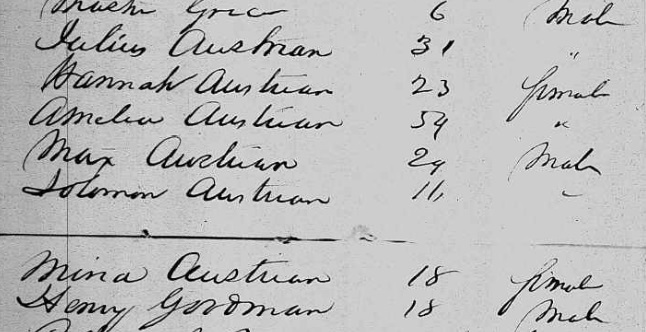
Julius Austrian returned from Europe on the U.S.M. Steamer Atlantic to America on October 17th, 1853 with his family: Hannah Leopold Austrian (Wife); Malka Heule Austrian (Mother); Marx Austrian (Brother); Samuel Solomon Austrian (Brother); Mina (Sister); and Henry Guttman aka Goodman (Cousin).
~ New York, Passenger Lists, 1820-1891, pg. 499, FamilySearch.org
Mother took a small house in Cleveland on Ohio St. and started house keeping with my sister Mina and necessary help when she was comfortably located. My brother Sol for the time being lived with my sister Babette. During this winter my sister Mina became engaged to Levi Jordan of Baltimore, where he was in business. He came from the same place where we were born, and therefore the families were well acquainted. Their marriage took place the next summer (1854) and afterward they resided in Baltimore.
Store Sold by Mistake.
The business had kept on increasing steadily. Mr. Louis F. Leopold had removed from Mackinaw and was living in Cleveland Ohio. In sending the annual inventory to Mr. L. F. L., through a mistake of his, he did not think the result satisfactory and peremptorily ordered his brother Henry to close out the business in Eagle River and sell the store. Henry boy like regardless of his own individual ideas and judgement at once obeyed his controlling brother, and sold out to his competitor, Mandelbaum, but soon regretted having done so.
I Spend Winter of 1853 in Cleveland.
After selling the store Henry Leopold and I went to Cleveland. I was anxious to meet my mother and the rest of the family from Germany. That winter I spent in Cleveland visiting my mother and the others. One of the first things we did was to get brother Solomon (then about 13 yrs- old) to learn a trade, and decided on shoe making as he was also eager to do something. We arranged for him to go into the service of a certain Weidenthal who agreed to instruct him in the trade at a small remuneration.
He took his place at once, living for the time being with our sister Babette. He took a good hold of the work and progressed very well in the trade to the entire satisfaction of his employer.
During the winter my brother Julius came through from Lake Superior, also Aaron and Sam F. Leopold for a conference between the Leopold brothers and me about the future program of our business. We all decided it had been a mistake to sell the store as the profits when correctly viewed was quite satisfactory with good prospects ahead. It was ascertained that Mr. Louis F. Leopold had taken it for granted that the inventory sent him showed him the result of two years profit since the business had existed; whereas it in reality was a statement of the one year of my management. We all agreed to open up again in the Spring on a larger scale. During the winter I contracted with a carpenter at Eagle River, and had the store enlarged to more than double its size and had the second story fitted up as living rooms, and a good cellar put under the store.
During this winter my sister Ida was engaged to Henry F. Leopold, and Jan 23rd, 1854, was married to him. The wedding was an enjoyable family affair.
As soon as navigation opened up in Spring, in May 1854, Henry Leopold, his wife, and I returned to Eagle River with a good stock of goods.
“We had already made the acquaintance of Mr. and Mrs. Julius Austrian, having had the pleasure of their company up the Lakes, and had made many inquiries of them as to the place of our destination. From this time forward we found Mr. and Mrs. Austrian to be most agreeable neighbors and associates, and
these young ‘brides’ spent much of their time together…”
~ The Ashland Press, Feb. 16, 1878.
At this time brother Julius and wife returned to La Point taking Brother Marx with them, who about a year later married Caroline Milner of Cleveland, and settled for the time being in La Pointe. That same year I sent him a small amount of goods from Eagle River, which enabled him to do a little something in trading with the same to the Indians for furs. After the episode with the Indians as I have previously narrated Marx was anxious to get away from La Point, and I had him and his wife come to Eagle River where I built them a cottage, conveniently arranged for him to live in with a small crockery store attached which he and his wife attended.
Some years later when brother Julius moved to St. Paul by his advice Marx and his wife went there also, and lived in a house next to Julius which he had had fitted up for the purpose. As far as business is concerned he acquired an interest in a butcher shop there.
After brother Solomon had finished his apprenticeship in the shoe business, the following year he also went up to La Pointe by advice of brother Julius where he stayed but a short time and then went to Hancock & opened a shoe store in which he did a good business.
To be continued at Eagle Harbor 1854-1859…
An Interesting Family History
February 2, 2015
By Amorin Mello

1856 Colton Map of Prussia and Saxony, Germany (WikiMedia.org).
This is a reproduction of “An Interesting Family History” from The Jews of Illinois : their religious and civic life, their charity and industry, their patriotism and loyalty to American institutions, from their earliest settlement in the State unto the present time, by Herman Eliassof, Lawrence J. Gutter Collection of Chicagoana (University of Illinois at Chicago), 1901, pages 383-386:
The goal of this post is to provide genealogical information about the illustrious Austrian and Leopold families as a companion to the Joseph Austrian Memoir and as a reference for future stories. In this post, we will explore events within and outside of the Chequamegon region for context about this family’s history. We recommend reading this Opinion by Andrew Muchin, director for the Wisconsin Small Jewish Communities History Project, for more information about Jewish immigration to Wisconsin in general. Coming soon to Chequamegon History, we will explore some of Julius Austrian’s adventures and his impact upon the Village of La Pointe, the La Pointe Iron Company of the Penokee Mountains, and the Lake Superior Chippewa.
——-
AN INTERESTING FAMILY HISTORY.
——-
The two families of Austrian and Leopold have been prominent in Chicago for many years. They came to Chicago from the Lake Superior region and formed the Lake Michigan and Lake Superior Transportation Co., engaging in freight and passenger transportation on Lake Michigan and Lake Superior, to Mackinac, Sault Ste. Marie and Duluth and did an extensive business. For a number of years, until recently, their luxuriously furnished passenger boat, Manitou, has been extensively patronized by summer pleasure seekers, who wished to enjoy the cool and delightful climate of the Lake Superior region. The boat was then sold to a company, in which Mr. Nathan F. Leopold still holds the largest interest. Mr. N. F. Leopold is the son of one of the Leopold brothers who settled in Mackinac in the early forties, and were the first Jews in that region. He married a daughter of the late Mr. Gerhard Foreman, who is related to the Greenebaum family, and who was a prominent banker of Chicago, the founder of the Foreman Bros. Banking Co., a. very popular financial institution of today.
The history of this old Jewish family, favorably known as successful merchants in the Lake Superior region and in Chicago, appeared in 1866, in the Portage, Mich., Gazette, and was copied in the American Israelite under date of April 13th, 1866. We believe that the history of this popular and highly respected family will be read with interest by their many relatives and friends, and we therefore publish it here. They were brave, honest and upright business men, and the story of their pioneer life in a sparsely settled region, of their struggles, hardships and ultimate success will serve as an encouraging example for many a young beginner.
Following is their history as we find it in the American Israelite:
A BAND OF BROTHERS.
Dissolution of the Oldest Merchant Firm on Lake Superior – The Leopold Brothers – Sketch of their Operations – A Pioneer History.
Abraham Isaac Oestreicher &
Malka Heule
Falk Austrian
Julius Austrian
Marx Austrian
Babette Austrian
Joseph Austrian
Ida Austrian
Fanny Austrian
Samuel Solomon Austrian
Bernard Austrian
Mina Austrian
Jette H.S.H Freudenthaler
Louis F. Leopold
Aaron F. Leopold
Henry F. Leopold
Samuel F. Leopold
Hannah Leopold
Karolina Freudenthaler
Ascher Freudenthaler
In our last issue we made a brief notice of the dissolution of the well known firm of Leopold & Brothers, doing business in Hancock, Chicago and Eagle River, the oldest business firm on Lake Superior after a successful existence of over twenty years. The firm has been composed of Louis F., Henry F., Aaron F., and Samuel F. Leopold and Joseph, Julius and Samuel Austrian, the latter being the last admitted partner, and not so intimately connected with the history of the firm. From the very inception of business transactions within the wilds of Lake Superior down to the present day, the firm of the brothers has been identified with the struggles, hardships, successes, and all the varying interests of the country, have participated with its good and ill fortunes, many times carrying burdens that less confident competitors shrank from bearing; never once fearing that all would be well in the end, and after gathering a rich reward retired from the field, leaving an untarnished history, and brilliant record as an incentive to their successors.
~ Joseph Austrian Memoir
Louis Leopold + Babette Austrian
Hannah Leopold + Julius Austrian
Henry Leopold + Ida Austrian
Samuel Leopold + Babette Guttman
Joseph Austrian + Mary Mann
Solomon Austrian + Julia Mann
The Messrs. Leopold are natives of the little town of Richen, in the Great Duchy of Baden, Germany, and there received the elementary education which fitted them to become the shrewd and successful merchants they have proven to be. They first began business life as clerks in an ordinary country store, as it may not be inaptly termed, as Richen was but a small place, having a less population than either Hancock or Houghton, here on Portage Lake.
Early in the year 1842, Louis, the elder brother, who has since become the “father” of the firm, left his home to try his fortunes in the New World, with a stout heart, and but a very moderate amount of means whereon to build up a fortune, upon arriving in this country he very shrewdly foresaw that the great West, then but just attracting attention, was the most promising field for men of enterprise and limited capital, and instead of joining in the precarious struggle for position and existence, even so peculiar to the crowded cities of the Eastern states, he at once wended his way to Michigan, then considered one of the Western states.
~ Joseph Austrian Memoir, pg. 9
Early in the year 1843 he opened a small depot for fishermen’s supplies on the island of Mackinac, providing for them provisions, salt, barrels, etc., and purchasing the fish caught, and forwarding them by vessels to better markets. The business could not have been a very extensive one, for when joined by his brothers three years afterward, their united capital is stated as being but little more than $3,000, but which has since been increased by their energy, prudence and foresight, at least one hundred fold.
In the year 1844, Louis was joined by his brother Henry (Aaron and Samuel serving their time in the store of Richen), who for a short time became his assistant at Mackinac. At that time there was but one steamboat plying on the headwaters of Lake Huron and Michigan, the old General Scott, which made regular trips between Mackinac and Sault Ste. Marie.
By the 1850’s the Leopolds, Samuel, Henry, and Aaron, and their brother-in-law Julius Austrian had moved westward from Mackinac into Lake Superior and had settled in the Wisconsin island town of La Pointe, not too far from present-day Duluth. They helped also to found the nearby mainland town of Bayfield. Nevertheless the Leopolds and Austrians were not Wisconsin’s Jewish pioneers; Jacob Franks of Montreal had bought peltries and traded with the Indians since the early 1790’s using Green Bay as his base. The town, the oldest in that part of the country, was strategically located on the water highways linking the Mississippi to the Great Lakes and the eastern tidewater. At first Franks was an agent for a Canadian firm; by 1797 he was on his own. He enjoyed several years of prosperity before the game, the furs, and the Indians began to fade away and before he had to cope with the competition of John Jacob Astor’s formidable American Fur Company. Franks was an innovative entrepreneur. Around the turn of the century he built a blacksmith shop, a dam for water power, a saw and grist mill, ran a farm and began a family of Indian children, before he finally went back to Mackinac and then to Montreal where he rejoined his Jewish wife.”
~ United States Jewry, 1776-1985, Volumes 1-2 by Jacob Rader Marcus, pg. 94
Shortly after his arrival at Mackinac, Henry conceived the idea of going to La Pointe with a small stock of goods, and attending the Indian payment, an enterprise never before undertaken by a trader from below the Sault. At that time Lapointe was a much larger place than it is now, was the principal station of Lake Superior, of the American Fur Company and the leading business point above the Sault. Every fall, the government disbursed among the Indians some $40,000 to $50,000, which before the arrival of the Leopold Brothers found its way almost entirely into the coffers of the Fur Company.
In the latter part of the spring the brothers left Mackinac on the old General Scott, and went to the Sault with their goods, and after much difficulty succeeded in chartering the schooner Chippewa, Captain Clark, to take them to Lapointe for $300. There were but four small schooners on Lake Superior that season, the Chippewa, Uncle Sam, Allegonquin and Swallow. The trip from the Sault to Lapointe occupied some three weeks, but one stop being made at Copper Harbor, which was then beginning its existence. The building of Ft. Wilkins was then going on. Little or no thought of mining then occurred to the inhabitants, and did not until two or three years subsequently.
Arrived safely at Lapointe, they at once opened a store in opposition to that of the Fur Company, and were, much to the surprise of the latter, the first white traders who undertook an opposition trade with the Indians. They sold their goods for furs, fish, etc., and prospered well. In the fall they were joined by Julius Austrian (now at Eagle River) and Louis leaving him with Henry, returned to Mackinac.
Before Minnesota became a territory in 1849 it was for a time part of Wisconsin and Iowa territories. In Minnesota as in most states there was a wave of Jewish pioneers who came early, often a decade or more before some form of Jewish institutional life made its appearance. Jewish fur traders roamed in the territory from the 1840’s on, bartering with the Indians on the rivers and on the reservations. They were among the first white settlers in Minnesota. Julius Austrian had a trading post in Minnesota in the 1840’s and he may once have owned the land on which Duluth now stands. In 1851 in the dead of winter he drove a dog sled team loaded with hundreds of pounds of supplies into St. Paul; his arrival created a sensation.”
~ United States Jewry, 1776-1985, Volumes 1-2 by Jacob Rader Marcus, pg. 100-1
In the summer of 1845 Henry also returned to Mackinac, leaving Julius to attend to the business at Lapointe. He remained in Mackinac until the year 1846, when Aaron and Samuel came out from Germany and joined them at that place. The four brothers at once united their fortunes; in fact in all their business career they do not appear to have thought of dividing them. Everything they had was, from the outset, common property, and each labored for the general welfare. They appeared to have fully understood the truthfulness of the adage, that, in “Unity there is strength,” and however varied and scattered may have been their operations, the profits went into the general fund.
In the season of 1846 Henry and Samuel went to Green Bay, and opened a store in Follett’s block, remained there until early in 1848, but did not succeed as well as they anticipated. Green Bay was then a miserable place in comparison with what it is now, and its growth very much retarded by the grasping policy of the site owners, John Jacob Astor and Mr. Whitney, a brother of the present postmaster. They would not sell lots at anything near what was considered a reasonable figure, and the result was that after many vain endeavors to secure property very many business men left for other places, holding out better inducements for settlement. While at Green Bay, Samuel began the study of the English language, under the tutelage of a young Methodist minister who considered himself liberally rewarded by return instruction in the German language.

“This represents the home of Julius and Hannah Austrian, after their marriage in the spring of 1848. Premises located at La Pointe, Madeline Island, Lake Superior. Resided there 19 years, happy and contented among Indians, Half-breeds and two Missionaries who represented the inhabitants of the island. Photograph taken summer of 1850.”
~ Julius Austrian Papers (Madeline Island Museum)
Solomon Austrian“also went up to La Pointe by advice of brother Julius where he stayed but a short time…”
~ Joseph Austrian Memoir, pg. 76
Early in 1847, Joseph Austrian, the subsequent brother-in-law of the Leopolds, came out from Germany, and joined his brother, Julius, at Lapointe, where he remained until the next spring, when he joined Henry Leopold at Eagle River, who had opened a small store in an old stable, the habitation of one cow. A partition was put up, and about two-thirds of her ladyship’s parlor fitted up for the sale of dry goods, groceries, etc. The shanty stood on the lot now owned by John Hocking, the second from the corner in the turn of the road down to the old bridge across Eagle River.
Was Simon Mandelbaum of Eagle River related to M.H. Mandelbaum of Bayfield?
There was then but one opposition store in Eagle River, that of Messrs. Senter and Mandlebaum, with whom Henry and Joe entered into lively competition for the trade of the place.
The same season Samuel joined Aaron and Louis at Mackinac, where their business had materially increased, and remained there until the season of 1855, when they left and returned to Lake Superior. Louis had previously left and established himself at Cleveland, where he remained until he went to Chicago in the fall of 1862. During this period he acted as the purchasing agent of the brothers on the lake.
Stories about the early days of the Keweenaw copper mining industry are told in the Memoirs of Doodooshaboo (Joseph Austrian).
In the fall of 1855 Samuel started a branch store at Eagle Harbor in a small shanty not more than twenty feet square, situated on the lot now owned by Hoffenbecker, and the shanty now forms a part of his building. At the time there were five mines working in that vicinity, as follows: Copper Falls, S. W. Hill, agent; Northwestern (Pennsylvania), M. Hopkins, agent; Summit (Madison), Jonathan Cox, agent; Connecticut (Amygdaloid), C. B. Petrie, agent.
The Copper Falls and Northwest were the two great mines of the District, the others doing but little beyond exploration at that time.
In 1856 Samuel bought out Upson and Hoopes, who had been doing a good business in the building now occupied by Messrs. Raley, Shapley & Co., and was that season joined by Aaron, who, since leaving Mackinac, had been spending his time with Louis, in Cleveland. Samuel was appointed postmaster at Eagle Harbor, and acceptably filled the office till his departure in 1859.
Julius Austrian advertisements
(Bayfield Mercury, August 22nd, 1857)

The three brothers, Henry, Samuel and Aaron, and their brother-in-law, Jos. Austrian, might now be said to be operating in the same field with the elder brother, Louis, at Cleveland, as their ever wide-awake purchasing agent. For a year or two they prospered as well as they could desire, but the hard times of 1857-8 tried them pretty severely, but by the most adroit management they came through safely. At Eagle River, in 1857, there were four mines at work, the Garden City, Phoenix, Bay State and Cliff. This was after the great silver excitement at the Phoenix, and when the reaction had fully set in. The assessments were grudgingly paid, if at all, and the workmen at the mine that winter were paid in orders on Leopold Brothers, who paid them in goods and currency. To enable the company to get along as easily as possible they took thirty day drafts on the treasurer in Boston, which were paid when due and presented. As the winter passed, the time of the drafts were extended from thirty to sixty, ninety, and finally to one hundred and twenty days, and in the spring, the firm was astonished by a notification that the drafts had gone to protest. The mine then owed them about $20,000, a large sum, especially when it is considered that they were also carrying nearly $10,000 for the Garden City Mine, which was also struggling along like the Phoenix.
The first news received by the public of the protesting of the drafts was communicated by the clerk of one of the steamboats, and created no small amount of excitement, especially among the employees of the mine, who naturally became fearful and clamorous for their back pay. The Leopold Brothers told them to go on and work, and they would be responsible for their pay. This quieted them, and the work of the mine continued as before.
Upon receiving information of the protesting of the Phoenix drafts, Samuel was at once dispatched to Boston to consult with the company about their payment. To secure themselves they could have attached the mining property, improvements and machinery, but such was their confidence in the integrity of the agent, Mr. Farwell, President, Mr. Jackson, and Secretary, and Treasurer, Mr. Coffin, that this was not done. Upon his arrival in Boston, Samuel found that Mr. Farwell had held a consultation with the Directors, and in his most emphatic manner demanded that Messrs. Leopold should be reimbursed the money they had advanced for the mine.
~ The Mining Magazine: Devoted to Mines, Mining Operations, Metallurgy, &c., &c., Volume 2, 1854, pg. 404.
Another meeting was called and Samuel presented a statement of the amount due his firm, and inquired what they intended to do. It was difficult for them to say, and after many long consultations no definite course of action was decided upon. Believing that delays were dangerous Samuel proposed that he and his brothers would take the property in satisfaction of their demand, pay off the Company’s indebtedness, amounting to nearly $10,000, and perhaps pay them a few thousand dollars on the head of the bargain.
Another consultation followed this offer, and it was finally concluded that if a merchant firm considered the property sufficiently valuable to pay therefor nearly $40,000, it must be worth at least that much to the company. Some three thousand shares of Phoenix stock had been forfeited for the non-payment of an assessment of $1.50 per share, and these shares were offered Mr. Leopold in satisfaction of his claim. He, of course, declined, saying he would take the whole property, or nothing. Another consultation was held and a meeting of stockholders was called, an assessment was levied and In a few days enough paid in to liquidate his demands, and he started for home mentally determining that in future the Phoenix should give sight drafts for all. future orders, and that they would no longer assume, or be identified with its obligations. It required no small amount of finesse to make the discouraged stockholders of the Phoenix believe that there was a sufficiently valuable property to further advance $2 or $3 per share on its stock, but the cool offer to take its property for its indebtedness, completely assured them and saved the Messrs. Leopold their $20,000.
But it is said ill fortune never comes singly; and this was true of the affairs of Leopold & Brothers. Samuel had scarcely arrived in Cleveland when Louis informed him that their Garden City drafts had been protested and the same night he hurried on to Chicago to provide security for the indebtedness. Arriving there he did not find the Company as tractable as the Phoenix, and after much parleying found the best they were willing to do was to give him a mortgage on their stamp mill, as security for the $10,000. Very correctly deeming this insufficient, he returned home, and got out an attachment for the whole property of the Company. This had the desired effect, and the claim was secured by a mortgage and the attachment withdrawn. Shortly afterward the mine passed into the hands of a new party of men, with Judge Canton at their head, and in a short time the claim was satisfactorily adjusted.
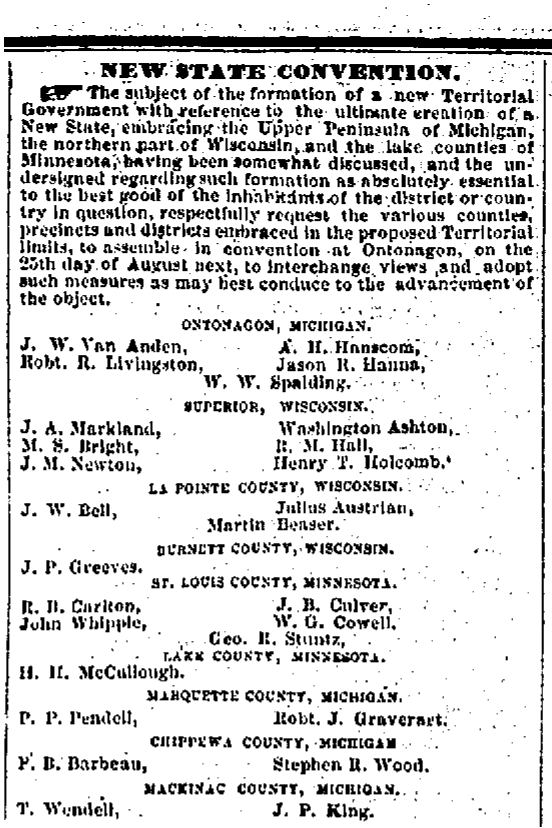
Julius Austrian, along with Martin Beaser and John W. Bell, attended the New State Convention of Lake Superior to represent La Pointe County ~ Superior Chronicle, August 3rd, 1858.
In 1858, the firm had much difficulty in collecting their orders on the mines in the vicinity of Eagle Harbor, and it was finally determined to sell out their store and build up a business elsewhere. S. W. Hill, Esq., had then left the Copper Falls and assumed the direction of the Quincy Mine here at this place. He foresaw that Portage Lake, possessing as it did so many natural advantages, would eventually become the grand business point or the copper region, and with his accustomed energy began the laying out of the town site now occupied by the village of Hancock. Soon after this was done he wrote to the Messrs. Leopold, urging them to come over and open a store there, but they did not give the offer much consideration that year, as nearly everybody in Keweenaw County ridiculed the idea of Portage Lake ever becoming anything of a place.
That year, however, they sold out their business at Eagle Harbor, and removed to Eagle River, where Samuel was for the second time appointed Postmaster, and their business conducted by him and Jos. Austrian. Their present store site at Eagle River had been previously purchased, and additions annually made to their main building, as their business demanded, until they were of a much greater extent than the original frame.
Aaron Leopold was the first Tyler of the Quincy Lodge No. 135 in Hancock. M.H. Mandelbaum was a member.
In the summer of 1859, Jos. Austrian, who was the building man of the firm, came over from Eagle River to Hancock with Geo. D. Emerson, C. E., and selected a site for their new store, and chose the lots on which now stands the Mason House and the Congregational Church, and the dock front now owned by Little, Heyn & Eytenbenz, but Louis, who came up about that time, changed to the present site, deeming the other too remote from what would be the business center of the town. This was judged from the line of the road coming down from the mine, and the location of the Stamp Mill, around which he naturally concluded the workmen’s dwellings would cluster. In this he was slightly mistaken, though the real difference was unimportant; we give it merely to show how easily the most careful and calculating men may make a mistake.
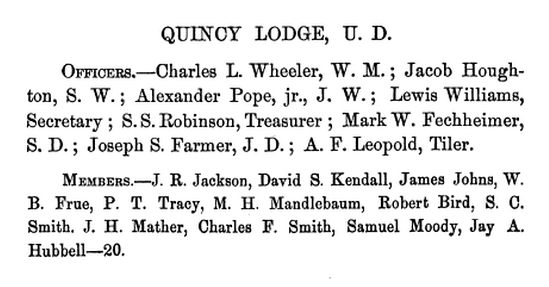
Transactions of the Grand Lodge of Free and Accepted Masons, of the State of Michigan, at Its Annual Communication, 1861, pg. 71.
After the site was determined upon, building was commenced, but as their faith in the future growth of the place was small, they did not propose to erect a large store, or even construct a substantial cellar underneath. Mr. Hill, hearing of their intention, at once paid them a visit and strongly protested against it. “This is going to be a leading town,” he said, “and I want a good large store, and a stone cellar underneath it.” He carried the day, and a larger building was completed, which two years afterward was too small for the business, even with the addition of a large warehouse for storing additional supplies.
As soon as the building was commenced, Louis began to send up goods from Cleveland, and Aaron came over from Eagle River to take charge of the new business. He scarcely reached here before the goods arrived, and were stored in the building before it was closed in, and he for several weeks had to make his bed on the goods virtually in the open air. As this was in the fall of the year, it was not pleasant, as may be at first supposed. Since then their principal business has been done at Hancock, the old head concern at Eagle River having been a branch.
Additional sources about this festive celebration for the Freudenthaler family in Richen have not been located yet.
In the fall of 1861, Aaron concluded to visit his home in Germany, to attend the golden wedding anniversary of his parents, and Samuel came over from Eagle River to take his place in the store. The celebration of the golden wedding was the grandest event which had happened in the little town of Richen for fully one hundred years, and, probably, will not be equaled in the present century. It would be impossible within the limits of this article to give a full description of the proceedings on that festival occasion, suffice it to say, that all the inhabitants of Richen and the neighboring towns, to the number of full five thousand assembled, and under the guidance of the mayor and municipal officers, for three days kept up a continuous round of merry-making and rejoicing. On the anniversary wedding day a procession over a mile in length waited upon the “happy couple,” and escorted them to the church, where appropriate and imposing services were performed. In the name of his brothers Aaron presented the church with a copy of the Sacred Writings, beautifully engrossed on parchment, which, with its ornamented silver case, cost over $600. All the halls and hotels were opened to the public, where for three days and nights they feasted, drank and danced without intermission and free of expense. The celebration of this golden wedding cost the brothers over $5,000, but which they rightfully considered the grandest event in their history.

In the fall of 1862, Joseph Austrian joined the firm at Hancock, and Louis removed from Cleveland to Chicago, which point they had concluded would soon monopolize the trade of Lake Superior. In the spring of 1864 he commenced a shipping business in that city, and early in the following winter was joined by Jos. Austrian, and the purchase of the propeller Ontonagon effected, and a forwarding and commission business regularly organized. Lately they have purchased the light-draft propeller Norman, intending it to run in connection with the Ontonagon.
While this was the end of Julius Austrian’s presence at La Pointe, he was still attached to the region for the remainder of this life by social ties and legal affairs. Julius eventually moved to St. Paul and became President of the Mount Zion Temple.“The Austrians retained their generous spirit even after moving to St. Paul for it was on a mission to the poor with a cutter full of good things to eat that Mr. Austrian was run over by a beer wagon (we don’t have them nowadays) and killed.”
~ The Lake Superior Country in History and in Story by Guy M. Burnham, 1996, pg. 288As aforementioned, Moses Hanauer was son to Moritz Hanauer, elementary educator of the Leopold brothers in their hometown of Richen. Moses’ brother-in-law was Henry Smitz of La Pointe.
In 1862 their branch house at Lapointe was given up, and Julius Austrian returned to Eagle River, and, in connection with Solomon, conducted the branch at that place. The firm now is composed of Solomon and Julius Austrian and Moses G. Hanauer, who for several years has acted as bookkeeper for the firm, under the firm name of S. Austrian & Co. The Hancock firm is composed of H. F. Leopold, Joseph and Solomon Austrian, under the title of Leopold, Austrian & Bro. The Chicago firm is composed of L. F. Leopold and Joseph Austrian, under the name of Leopold & Austrian. Mr. S. F. Leopold will return to Germany, upon the opening of navigation, and spend a year in pleasure and relaxation, which he certainly merits after twenty years constant labor. Aaron will remain here during the coming summer, and in the fall will go below and establish a wholesale business in Detroit, where it is probable he will be joined by Samuel after his return from Europe.
“CHICAGO AND LAKE SUPERIOR LINE.
This line is owned in Chicago, but is included in our list with other lines plying between Michigan ports. Those enterprising and well known gentlemen, Leopold & Austrian, for many years proprietors of this line, have consolidated their navigation interests with those of the Spencer, Lake Michigan and Lake Superior Transportation Co., their boats running between Chicago and Duluth, touching at all intermediate ports in Illinois, Michigan and Wisconsin. The steamers are the Peerless, J. L. Hurd, City of Duluth, City of Fremont and barge Whiting.”
~ Tackabury’s atlas of the State of Michigan : including statistics and descriptions of its topography, hydrography, climate, natural and civil history, railway and steam boat history, educational institutions, material resources, etc. (1884), pg. 23Louis F. Leopold and his sons, Asa F. and Henry F. Jr, started the first mercantile house in Duluth in 1869. Asa and Henry were the first Jewish residents in Duluth and enjoyed success as prominent businessmen.
That the Messrs. Leopold have been more than ordinarily successful in their mercantile career of over twenty years is made evident from the extent and variety of their business transactions within the past five years, and the very large amount of capital required to carry it on successfully and properly. We feel confident that the joint capital of $3,000, with which they commenced business in 1843, had been increased one hundred times by the close of the past year, and we should not be surprised if it had augmented even more than that. It has been the result of no particularly good fortune, but of persistent application in one direction, and the only exception to the ordinary course of operation which can be said to have contributed to their success, has been the remarkable unity which has pervaded all their business transactions, whether located at Mackinac, Green Bay, Lapointe, Eagle River, Cleveland, Eagle Harbor, Portage Lake or Chicago, each member of the firm has labored, not for his benefit alone, but that of the whole brotherhood.
“S. Solomon Austrian, a merchant from the copper country of Upper Michigan married Julia R. Mann, ten years his junior and not yet out of school, of Natchez, Mississippi, about 1866. Their first home was in Hancock, Michigan. In writing of her mother at a later time, Delia describes the young wife’s inexperience as she entered this strange new country, and the difficulties she had learning homemaking from her pioneer neighbors, along with her fear of Indians. Here, their first child, Bertha, was born. After two years of residence, they moved to Cleveland. In 1870, a son, Alfred S., was born in Chicago, but there is no evidence to show they were residents of that city at the time. However, they were still living in Cleveland in 1874 when twin daughters, Celia and Delia, were born.”
~ Guide to the Celia and Delia Austrian Papers 1921-1932, Special Collections Research Center, University of Chicago Library.
And at this partial termination of their active associations, it is with a pride which but few firms experience after so long connection, they can say that in all their twenty years’ relation with each other there has never been a disagreement to mar the harmony and unity of their operations. Whatever has been done by one, even though it did not result as anticipated, has met with the immediate sanction of the others, who had unlimited confidence in the integrity of his intentions to benefit them all. Until now there has been no division of the accumulated profits; all has been placed in one general fund, from which each has drawn as the wants or exigencies of their business demanded. Neither of them have indulged in any private outside investments or speculations, the profits of which has resulted to his own pecuniary benefit. Profit and loss has been shared alike by them all. Such unanimity of action is very rarely to be met with, especially In these modern days of “every man for himself and the devil take the hindmost,” and is, therefore, the more commendable. Although nominally dissolved, at present, we are of the opinion that after S. F. Leopold has returned from his vacation in Europe the old order of things will again prevail, for, after such a lengthy and intimate association, it will be difficult for either of them to operate independent of the rest, after such a practical verification of the truthfulness of the adage on which they founded their business existence, that “In union there is strength.”
We also copy the following letter, which, in our estimation, forms a part of and belongs to the history of the Leopold family. We understand that the son of whose birth the writer of the letter to the “Israelite” speaks, was the first Jewish child born in the northern region of Michigan:
Chicago, July 18, 1863.
Editor of The Israelite:
I have just now returned from Lake Superior, where I have found all my brothers and friends and the readers of The Israelite and Deborah in perfect good health. I cannot refrain from giving you a little history of a very noble act, the fruit of which in hereby enclosed, being a draft for $30, which you will please to appropriate to the purpose for which it has been destined, namely at a Berith which took place on a child of my brother at his house in Hancock, Lake Superior. After about forty participants had done justice to a very luxurious dinner, with the permission of Mr. Hoffman of Cleveland, the operator, a motion was made that the saying of grace should be sold, and the proceeds appropriated to some charitable purpose, whereupon Brother Samuel made an amendment that the proceeds should be sent to Dr. Wise of Cincinnati, to be appropriated by him for the monument to be erected for Dr. Rothenhelm; the sheriff, Mr. Fechheimer, seconded the motion, and the same was unanimously carried. Brother A. F. was the last bidder with $30, consequently he was the lucky purchaser, and bestowed the honor on your humble correspondent.
The act is worth imitating, and if you think it worth mentioning you may give it publicity in The Israelite and Deborah.
Yours truly,
L. F. Leopold.
 Chequamegon History