Penokee Mixed-Blood Allotments Shakedown Scam of 1858
April 21, 2018
By Amorin Mello
This is one of several posts on Chequamegon History featuring the Mixed-Blood Allotments of the Penokee Mountains overlooking Chequamegon Bay, such as the Sioux Scrip scams during the Penokee Survey Incidents. This post illustrates the curious circumstances that occurred at the U.S. General Land Office in the City of Superior during 1858 as a large group of Chippewa Mixed-Blood Allotments were located along the Penokee Mountains via the seventh clause of the second article of the 1854 Treaty of La Pointe:
ARTICLE 2.
The United States agree to set apart and withhold from sale, for the use of the Chippewas of Lake Superior, the following-described tracts of land, viz:
[…]
7th. Each head of a family, or single person over twenty-one years of age at the present time of the mixed bloods, belonging to the Chippewas of Lake Superior, shall be entitled to eighty acres of land, to be selected by them under the direction of the President, and which shall be secured to them by patent in the usual form.
Selected affidavits from the National Archives:
Interior Department appointment papers, 1849-1907.
Roll 6, Superior Land Office 1854-1860.
May 1, 1858
State of Wisconsin
County of Douglas
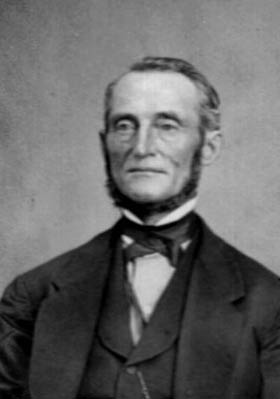
John Dow Howard (photograph from the Duluth Public Library) later owned large areas of land in both Superior and Duluth.
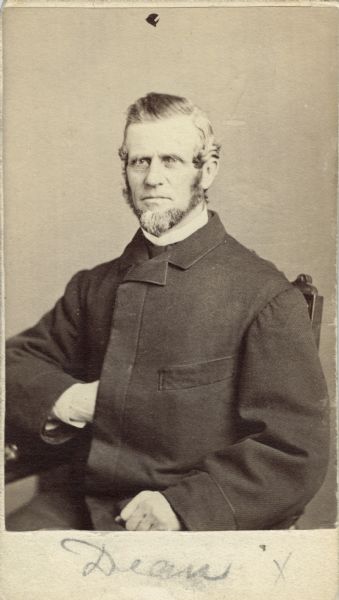
Eliab Byram Dean, Jr. (photo from Wisconsin Historical Society) was a Madison businessman and Wisconsin State Senator.
John D. Howard being duly sworn says, that he resides in Superior, Douglas County, Wisconsin, and that he is acquainted with Eliab B. Dean Jr, the Receiver of the U. S. Land office at Superior aforesaid; that sometime during the month of January or February 1858 the said Dean stated to affiant that he said Dean had an object in view whereby an investment could be made at a profitable rate, and if affiant could command the sum of one thousand or fifteen hundred dollars, he said Dean would give the affiant a proportion of the profits that might accrue therefrom, representing to the affiant that it was a matter he did not feel disposed to disclose fully the substance of [tile?] a future period, and that in the mean time affiant should follow his, Dean’s, instructions to -not- provide means to purchase Half-Breed Scrip and hold his Dean’s proportion secretly – saying he Dean did not wish to be known in the transaction. Subsequently, affiant was informed by Dean that the Half Breed Scrip was to be laid by affiant under power of attorney from Half-Breeds on lands in the Superior Land District, known as the “Iron Range” near Ashland, which lands had been filed upon by settlers under a pre-emption law of the United States that said Dean showed the affiant a list of the persons claiming the said land by pre emption which list was contained in the Register’s abstract of Declaratory statements, and told the affiant that these were the land he proposed to enter with the said scrip. For the purpose of enabling affiant to purchase genuine scrip the said Dean showed to affiant an official list of the Half-Breeds who were entitled to receive scrip from the Government. In this arrangement Dean proposed to affiant that he Dean and affiant should enter into a combination to contest the right to the land with the pre-emption. The said Dean further informed affiant that he had secured such influence at Washington that beyond a doubt he and affiant would be able to secure the land. And the said Dean wished affiant to keep Dean’s interest in the location of the Scrip a secret; and to do all the business in affiant’s name and after the title of the lands was secured, affiant was to convey to Dean, or for Dean’s benefit such portion of the lands as Dean by the agreement should be entitled to.

Ad from the Superior Chronicle, July 10, 1855.
And this affiant further says that said arrangement was not consummated in consequence of affiant’s determination not to purchase the scrip, and further says not.
J. D. Howard
Sworn to & subscribed before me this 1st day of May A.D. 1858
Geo. W. Perry
Notary Public
Douglas County
May 2 1858
State of Wisconsin
County of Douglas

Julius Austrian (photo from the Madeline Island Museum) was accused of obtaining fraudulent power-of-attorney over Chippewa Mixed-Bloods as the U.S. Postmaster at La Pointe.
“I think I have told you that E. B. Dean is removed. For this we must thank Austrian. The Com. gave him 30 days in which to answer the charge against him, and he was round here a long time trying to get Austrian to retract and even offered him $2000.00 to clear him but no go The Jew was determined to have his revenge.”
Julius Austrian being duly sworn says that he resides in the County of LaPointe, Wisconsin and that he is acquainted with Eliab B. Dean Jr Receiver of the U. S. Land Office at Superior Wisconsin; that on the first day of March A.D. 1858, this affiant applied at said Land Office to locate certain Chippewa Half Breed Scrip, under Power of Attorney to this affiant from the Half Breeds to whom said Scrip was issued, that the application of this affiant under such Power of Attorney was made in due and proper form, and signed by the Register of said Land Office, who told and that this affiant requested the Receiver (the said Dean) to sign the same, but that said Dean delayed signing the same, and would not talk with the affiant in the Land Office, but compelled this affiant to meet him said Dean at various places under various pretexts, until finally the said Dean told this affiant that he (Dean) would not sign the said applications unless this affiant should first pay him (the said Dean) the sum of Five hundred Dollars, and that this affiant being pressed for time and anxious to perfect the location of the said Scrip, after some demur, paid to the said Dean the said sum of $500.00 so demanded to the said Land Office, and signed the said applications as Receiver of said Land Office.
Julius Austrian
Sworn and subscribed before me
this 2nd day of May A.D. 1858
Geo. W. Perry
Notary Public
Douglas County
General Land Office
May 21, 1858
Sir,
Land Office Frauds
“If Congress would amuse their leisure a little by looking at these land office operations on the verge of civilization, they would strike a placer of corruption. […] Let them find out what Receiver DEAN said of Register SHAW, and what Register SHAW said of Receiver DEAN, and why DEAN was dismissed and why SHAW was retained. It will be rare fun for somebody. The country ought to know something about the Land Offices, and such an investigation as this would enlighten the country very materially. I hope it will be made, and that the country will learn how it is that more land has been entered in this district by Indians, foreigners, and minors than by qualified preëmptors, and all for the benefit of a few favored speculators.”
I have the honor to submit herewith a letter from Daniel Shaw Esq.~ Register at Superior Wisconsin, covering charges against E. B. Dean Jr., Receiver at that place, as follows:
1) Refusing to sign an application of Julius Austrian to locate certain Half breed scrip, under power of Attorney, said Dean refused to sign the applications unless Austrian paid $500, after some demur A. paid the $500 and Dean signed the papers in his official capacity as Receiver.
2) Agreeing to permit one Honsinger, for a consideration, to enter the pre-emption claim of a man named Cotas advising Honsinger what means to take to enter Cotas claim; these measures however were defeated by the Register.
3) Making an agreement with Jas. D. Ray, to purchase land of a pre-emption after he had proved up, and furnishing funds from the public safe to pay for the land so purchased.
4) Proposing to John D. Howard, a secret partnership for the purpose of speculating in half breed Scrip, and entering lands therewith, which Lands had been filed upon by settlers under the pre-emption law. Dean exhibited to Howard a list of persons claiming these lands, also exhibiting the Official list of half breeds; which list this Office directed should be kept confidentially from all persons.
Superior, Wisconsin
May 22, 1859
Sir;
You will oblige me by informing me whether my removal from the Office of Register at this place was in consequence of any charges [referred?] against me; and, if so; whether it appears from the record that I have have an opportunity for defence.
Very Respectfully
Your Obt. Servt,
Daniel Shaw.
Hon. Thos. A. Hendricks,
Comr. Genl. Land Office,
Washington, D.C.
Early Life among the Indians: Chapter II
March 21, 2018
By Amorin Mello

Early life among the Indians
by Benjamin Green Armstrong
continued from Chapter I.
CHAPTER II
In Washington.—Told to Go Home.—Senator Briggs, of New York.—The Interviews with President Fillmore.—Reversal of the Removal Order.—The Trip Home.—Treaty of 1854 and the Reservations.—The Mile Square.—The Blinding. »
After a fey days more in New York City I had raised the necessary funds to redeem the trinkets pledged with the ‘bus driver and to pay my hotel bills, etc., and on the 22d day of June, 1852, we had the good fortune to arrive in Washington.

“Washington Delegation, June 22, 1852“
Engraved from an unknown photograph by Marr and Richards Co. for Benjamin Armstrong’s Early Life Among the Indians. Chief Buffalo, his speaker Oshogay, Vincent Roy, Jr., two other La Pointe Band members, and Armstrong are assumed to be in this engraving.
I took my party to the Metropolitan Hotel and engaged a room on the first floor near the office for the Indians, as they said they did not like to get up to high in a white man’s house. As they required but a couple mattresses for their lodgings they were soon made comfortable. I requested the steward to serve their meals in their room, as I did not wish to take them into the dining room among distinguished people, and their meals were thus served.

Undated postcard of the Metropolitan Hotel, formerly known as Brown’s India Queen Hotel.
~ StreetsOfWashington.com
The morning following our arrival I set out in search of the Interior Department of the Government to find the Commissioner of Indian Affairs, to request an interview with him, which he declined to grant and said :
“I want you to take your Indians away on the next train west, as they have come here without permission, and I do not want to see you or hear of your Indians again.”
I undertook to make explanations, but he would not listen to me and ordered me from his office. I went to the sidewalk completely discouraged, for my present means was insufficient to take them home. I paced up and down the sidewalk pondering over what was best to do, when a gentleman came along and of him I inquired the way to the office of the Secretary of the Interior. He passed right along saying,
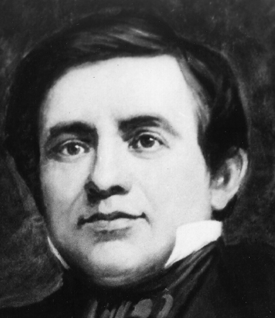
Secretary of the Interior
Alexander Hugh Holmes Stuart
~ Department of the Interior
“This way, sir; this way, sir;” and I followed him.
He entered a side door just back of the Indian Commissioner’s office and up a short flight of stairs, and going in behind a railing, divested himself of hat and cane, and said :
“What can I do for you sir.”
I told him who I was, what my party consisted of, where we came from and the object of our visit, as briefly as possible. He replied that I must go and see the Commissioner of Indian Affairs just down stairs. I told him I had been there and the treatment I had received at his hands, then he said :
“Did you have permission to come, and why did you not go to your agent in the west for permission?”
I then attempted to explain that we had been to the agent, but could get no satisfaction; but he stopped me in the middle of my explanation, saying :
“I can do nothing for you. You must go to the Indian Commissioner,”
and turning, began a conversation with his clerk who was there when we went in.
I walked out more discouraged than ever and could not imagine what next I could do. I wandered around the city and to the Capitol, thinking I might find some one I had seen before, but in this I failed and returned to the hotel, where, in the office I found Buffalo surrounded by a crowd who were trying to make him understand them and among them was the steward of the house. On my entering the office and Buffalo recognizing me, the assemblage, seeing I knew him, turned their attention to me, asking who he was, etc., to all of which questions I answered as briefly as possible, by stating that he was the head chief of of the Chippewas of the Northwest. The steward then asked:
“Why don’t you take him into the dining room with you? Certainly such a distinguished man as he, the head of the Chippewa people, should have at least that privilege.”

United States Representative George Briggs
~ Library of Congress
I did so and as we passed into the dining room we were shown to a table in one corner of the room which was unoccupied. We had only been seated a few moments when a couple of gentlemen who had been occupying seats in another part of the dining room came over and sat at our table and said that if there were no objections they would like to talk with us. They asked about the party, where from, the object of the visit, etc. I answered them briefly, supposing them to be reporters and I did not care to give them too much information. One of these gentlemen asked what room we had, saying that himself and one or two others would like to call on us right after dinner. I directed them where to come and said I would be there to meet them.
About 2 o’clock they came, and then for the first time I knew who those gentlemen were. One was Senator Briggs, of New York, and the others were members of President Filmore’s cabinet, and after I had told them more fully what had taken me there, and the difficulties I had met with, and they had consulted a little while aside. Senator Briggs said :
“We will undertake to get you and your people an interview with the President, and will notify you here when a meeting can be arranged. ”
During the afternoon I was notified that an interview had been arranged for the next afternoon at 3 o’clock. During the evening Senator Briggs and other friends called, and the whole matter was talked over and preparations made for the interview the following day, which were continued the next day until the hour set for the interview.

United States President
Millard Fillmore.
~ Library of Congress
When we were assembled Buffalo’s first request was that all be seated, as he had the pipe of peace to present, and hoped that all who were present would partake of smoke from the peace pipe. The pipe, a new one brought for the purpose, was filled and lighted by Buffalo and passed to the President who took two or three draughts from it, and smiling said, “Who is the next?” at which Buffalo pointed out Senator Briggs and desired he should be the next. The Senator smoked and the pipe was passed to me and others, including the Commissioner of Indian Affairs, Secretary of the Interior and several others whose names I did not learn or cannot recall. From them, to Buffalo, then to O-sho-ga, and from him to the four braves in turn, which completed that part of the ceremony. The pipe was then taken from the stem and handed to me for safe keeping, never to be used again on any occasion. I have the pipe still in my possession and the instructions of Buffalo have been faithfully kept. The old chief now rose from his seat, the balance following his example and marched in single file to the President and the general hand-shaking that was began with the President was continued by the Indians with all those present. This over Buffalo said his under chief, O-sha-ga, would state the object of our visit and he hoped the great father would give them some guarantee that would quiet the excitement in his country and keep his young men peaceable. After I had this speech thoroughly interpreted, O-sha-ga began and spoke for nearly an hour. He began with the treaty of 1837 and showed plainly what the Indians understood the treaty to be. He next took up the treaty of 1842 and said he did not understand that in either treaty they had ceded away the land and he further understood in both cases that the Indians were never to be asked to remove from the lands included in those treaties, provided they were peaceable and behaved themselves and this they had done. When the order to move came Chief Buffalo sent runners out in all directions to seek for reasons and causes for the order, but all those men returned without finding a single reason among all the Superior and Mississippi Indians why the great father had become displeased. When O-sha-ga had finished his speech I presented the petition I had brought and quickly discovered that the President did recognize some names upon it, which gave me new courage. When the reading and examination of it had been concluded the meeting was adjourned, the President directing the Indian Commissioner to say to the landlord at the hotel that our hotel bills would be paid by the government. He also directed that we were to have the freedom of the city for a week.
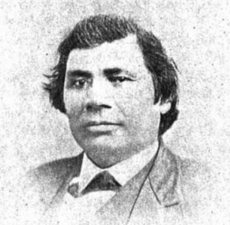
Read Biographical Sketch of Vincent Roy, Jr. manuscript for a different perspective on their meeting the President.
The second day following this Senator Briggs informed me that the President desired another interview that day, in accordance with which request we went to the White House soon after dinner and meeting the President, he told the, delegation in a brief speech that he would countermand the removal order and that the annuity payments would be made at La Pointe as before and hoped that in the future there would be no further cause for complaint. At this he handed to Buffalo a written instrument which he said would explain to his people when interpreted the promises he had made as to the removal order and payment of annuities at La Pointe and hoped when he had returned home he would call his chiefs together and have all the statements therein contained explained fully to them as the words of their great father at Washington.
The reader can imagine the great load that was then removed from my shoulders for it was a pleasing termination of the long and tedious struggle I had made in behalf of the untutored but trustworthy savage.

Downtown St. Paul, Minnesota, circa 1857.
~ Minnesota Historical Society
On June 28th, 1852, we started on our return trip, going by cars to La Crosse, Wis., thence by steamboat to St. Paul, thence by Indian trail across the country to Lake Superior. On our way from St. Paul we frequently met bands of Indians of the Chippewa tribe to whom we explained our mission and its results, which caused great rejoicing, and before leaving these bands Buffalo would tell their chief to send a delegation, at the expiration of two moons, to meet him in grand council at La Pointe, for there was many things he wanted to say to them about what he had seen and the nice manner in which he had been received and treated by the great father.
At the time appointed by Buffalo for the grand council at La Pointe, the delegates assembled and the message given Buffalo by President Filmore was interpreted, which gave the Indians great satisfaction. Before the grand council adjourned word was received that their annuities would be given to them at La Pointe about the middle of October, thus giving them time to get together to receive them. A number of messengers was immediately sent out to all parts of the territory to notify them and by the time the goods arrived, which was about October 15th, the remainder of the Indians had congregated at La Pointe. On that date the Indians were enrolled and the annuities paid and the most perfect satisfaction was apparent among all concerned. The jubilee that was held to express their gratitude to the delegation that had secured a countermanding order in the removal matter was almost extravagantly profuse. The letter of the great father was explained to them all during the progress of the annuity payments and Chief Buffalo explained to the convention what he had seen; how the pipe of peace had been smoked in the great father’s wigwam and as that pipe was the only emblem and reminder of their duties yet to come in keeping peace with his white children, he requested that the pipe be retained by me. He then went on and said that there was yet one more treaty to be made with the great father and he hoped in making it they would be more careful and wise than they had heretofore been and reserve a part of their land for themselves and their children. It was here that he told his people that he had selected and adopted, me as his son and that I would hereafter look to treaty matters and see that in the next treaty they did not sell them selves out and become homeless ; that as he was getting old and must soon leave his entire cares to others, he hoped they would listen to me as his confidence in his adopted son was great and that when treaties were presented for them to sign they would listen to me and follow my advice, assuring them that in doing so they would not again be deceived.

Map of Lake Superior Chippewa territories ceded in 1836, 1837, 1842, and 1854.
~ Great Lakes Indian Fish & Wildlife Commission
After this gathering of the Indians there was not much of interest in the Indian country that I can recall until the next annual payment in 1853. This payment was made at La Pointe and the Indians had been notified that commissioners would be appointed to make another treaty with them for the remainder of their territory. This was the territory lying in Minnesota west of Lake Superior; also east and west of the Mississippi river north to the territory belonging to the Boisfort and Pillager tribe, who are a part of the Chippewa nation, but through some arrangement between themselves, were detached from the main or more numerous body. It was at this payment that the Chippewa Indians proper desired to have one dollar each taken from their annuities to recompense me for the trouble and expense I had been to on the trip to Washington in their behalf, but I refused to accept it by reason of their very impecunious condition.
It was sometime in August, 1854, before the commissioners arrived at LaPointe to make the treaty and pay the annuities of that year. Messengers were despatched to notify all Indians of the fact that the great father had sent for them to come to La Pointe to get their money and clothing and to meet the government commissioners who wished to make another treaty with them for the territory lying west of Lake Superior and they were further instructed to have the Indians council among themselves before starting that those who came could be able to tell the wishes of any that might remain away in regards to a further treaty and disposition of their lands. Representatives came from all parts of the Chippewa country and showed a willingness to treat away the balance of their country. Henry C. Gilbert, the Indian agent at La Pointe, formerly of Ohio, and David B. Herriman, the agent for the Chippewas of the Mississippi country, were the commissioners appointed by the government to consumate this treaty.

Mackinac Indian Agent
Henry C. Gilbert
~ Branch County Photographs
While we were waiting the arrival of the interior Indians I had frequent talks with the commissioners and learned what their instructions were and about what they intended to offer for the lands which information I would communicate to Chief Buffalo and other head men in our immediate vicinity, and ample time was had to perfect our plans before the others should arrive, and when they did put in an appearance we were ready to submit to them our views for approval or rejection. Knowing as I did the Indians’ unwillingness to give up and forsake their old burying grounds I would not agree to any proposition that would take away the remainder of their lands without a reserve sufficient to afford them homes for themselves and posterity, and as fast as they arrived I counselled with them upon this subject and to ascertain where they preferred these reserves to be located. The scheme being a new one to them it required time and much talk to get the matter before them in its proper light. Finally it was agreed by all before the meeting of the council that no one would sign a treaty that did not give them reservations at different points of the country that would suit their convenience, that should afterwards be considered their bona-fide home. Maps were drawn of the different tracts that had been selected by the various chiefs for their reserve and permanent home. The reservations were as follows :
One at L’Anse Bay, one at Ontonagon, one at Lac Flambeau, one at Court O’Rilles, one at Bad River, one at Red Cliff or Buffalo Bay, one at Fond du Lac, Minn., and one at Grand Portage, Minn.

Joseph Stoddard (photo c.1941) worked on the 1854 survey of the Bad River Reservation exterior boundaries, and shared a different perspective about these surveys.
~ Bad River Tribal Historic Preservation Office
The boundaries were to be as near as possible by metes and bounds or waterways and courses. This was all agreed to by the Lake Superior Indians before the Mississippi Chippewas arrived and was to be brought up in the general council after they had come in, but when they arrived they were accompanied by the American Fur Company and most of their employees, and we found it impossible to get them to agree to any of our plans or to come to any terms. A proposition was made by Buffalo when all were gathered in council by themselves that as they could not agree as they were, a division should be drawn, dividing the Mississippi and the Lake Superior Indians from each other altogether and each make their own treaty After several days of counselling the proposition was agreed to, and thus the Lake Superiors were left to make their treaty for the lands mouth of Lake Superior to the Mississippi and the Mississippis to make their treaty for the lands west of the Mississippi. The council lasted several days, as I have stated, which was owing to the opposition of the American Fur Company, who were evidently opposed to having any such division made ; they yielded however, but only when they saw further opposition would not avail and the proposition of Buffalo became an Indian law. Our side was now ready to treat with the commissioners in open council. Buffalo, myself and several chiefs called upon them and briefly stated our case but were informed that they had no instructions to make any such treaty with us and were only instructed to buy such territory as the Lake Superiors and Mississippis then owned. Then we told them of the division the Indians had agreed upon and that we would make our own treaty, and after several days they agreed to set us off the reservations as previously asked for and to guarantee that all lands embraced within those boundaries should belong to the Indians and that they would pay them a nominal sum for the remainder of their possessions on the north shores. It was further agreed that the Lake Superior Indians should have two- thirds of all money appropriated for the Chippewas and the Mississippi contingent the other third. The Lake Superior Indians did not seem, through all these councils, to care so much for future annuities either in money or goods as they did for securing a home for themselves and their posterity that should be a permanent one. They also reserved a tract of land embracing about 100 acres lying across and along the Eastern end of La Pointe or Madeline Island so that they would not be cut off from the fishing privilege.
It was about in the midst of the councils leading up to the treaty of 1854 that Buffalo stated to his chiefs that I had rendered them services in the past that should be rewarded by something more substantial than their thanks and good wishes, and that at different times the Indians had agreed to reward me from their annuity money but I had always refused such offers as it would be taking from their necessities and as they had had no annuity money for the two years prior to 1852 they could not well afford to pay me in this way.
“And now,” continued Buffalo, “I have a proposition to make to you. As he has provided us and our children with homes by getting these reservations set off for us, and as we are about to part with all the lands we possess, I have it in my power, with your consent, to provide him with a future home by giving him a piece of ground which we are about to part with. He has agreed to accept this as it will take nothing from us and makes no difference with the great father whether we reserve a small tract of our territory or not, and if you agree I will proceed with him to the head of the lake and there select the piece of ground I desire him to have, that it may appear on paper when the treaty has been completed.”
The chiefs were unanimous in their acceptance of the proposition and told Buffalo to select a large piece that his children might also have a home in future as has been provided for ours.

Kiskitawag (Giishkitawag: “Cut Ear”) signed earlier treaties as a warrior of the Ontonagon Band and became associated with the La Pointe Band at Odanah.
~C.M. Bell, Smithsonian Digital Collections
This council lasted all night and just at break of day the old chief and myself, with four braves to row the boat, set out for the head of Lake Superior and did not stop anywhere only long enough to make and drink some tea, until we reached the head of St. Louis Bay. We landed our canoe by the side of a flat rock quite a distance from the shore, among grass and rushes. Here we ate our lunch and when completed Buffalo and myself, with another chief, Kish-ki-to-uk, waded ashore and ascended the bank to a small level plateau where we could get a better view of the bay. Here Buffalo turned to me, saying: .
“Are you satisfied with this location? I want to reserve the shore of this bay from the mouth of St. Louis river. How far that way do you you want it to go?” pointing southeast, or along the south shore of the lake.
I told him we had better not try to make it too large for if we did the great father’s officers at Washington might throw it out of the treaty and said:
“I will be satisfied with one mile square, and let it start from the rock which we have christened Buffalo rock, running easterly in the direction of Minnesota Point, taking in a mile square immediately northerly from the head of St. Louis Bay”
As there was no other way of describing it than by metes and bounds we tried to so describe it in the treaty, but Agent Gilbert, whether by mistake or not I am unable to say, described it differently. He described it as follows: “Starting from a rock immediately above and adjoining Minnesota Point, etc.”
We spent an hour or two here in looking over the plateau then went back to our canoe and set out for La Pointe. We traveled night and day until we reached home.
During our absence some of the chiefs had been talking more or less with the commissioners and immediately on our return all the Indians met in a grand council when Buffalo explained to them what he had done on the trip and how and where he had selected the piece of land that I was to have reserved in the treaty for my future home and in payment for the services I had rendered them in the past. The balance of the night was spent in preparing ourselves for the meeting with the treaty makers the next day, and about 10 o’clock next morning we were in attendance before the commissioners all prepared for a big council.
Mackinac Indian Agent
Henry Clark Gilbert
~ Branch County Photographs
Agent Gilbert started the business by beginning a speech interpreted by the government interpreter, when Buffalo interrupted him by saying that he did not want anything interpreted to them from the English language by any one except his adoped son for there had always been things told to the Indians in the past that proved afterwards to be untrue, whether wrongly interpreted or not, he could not say;
“and as we now feel that my adopted son interprets to us just what you say, and we can get it correctly, we wish to hear your words repeated by him, and when we talk to you our words can be interpreted by your own interpreter, and in this way one interpreter can watch the other and correct each other should there be mistakes. We do not want to be deceived any more as we have in the past. We now understand that we are selling our lands as well as the timber and that the whole, with the exception of what we shall reserve, goes to the great father forever.”

Bureau of Indian Affairs Director
George Washington Manypenny
~ Commons.Wikimedia.org
Commissioner of Indian affairs. Col. Manypenny, then said to Buffalo:
“What you have said meets my own views exactly and I will now appoint your adopted son your interpreter and John Johnson, of Sault Ste. Marie, shall be the interpreter on the part of the government,” then turning to the commissioners said, “how does that suit you, gentlemen.”
They at once gave their consent and the council proceeded.
Buffalo informed the commissioners of what he had done in regard to selecting a tract of land for me and insisted that it become a part of the treaty and that it should be patented to me directly by the government without any restrictions. Many other questions were debated at this session but no definite agreements were reached and the council was adjourned in the middle of the afternoon. Chief Buffalo asking for the adjournment that he might talk over some matters further with his people, and that night the subject of providing homes for their half-breed relations who lived in different parts of the country was brought up and discussed and all were in favor of making such a provision in the treaty. I proposed to them that as we had made provisions for ourselves and children it would be only fair that an arrangement should be made in the treaty whereby the government should provide for our mixed blood relations by giving to each person the head of a family or to each single person twenty-one years of age a piece of land containing at least eighty acres which would provide homes for those now living and in the future there would be ample room on the reservations for their children, where all could live happily together. We also asked that all teachers and traders in the ceded territory who at that time were located there by license and doing business by authority of law, should each be entitled to 160 acres of land at $1.25 per acre. This was all reduced to writing and when the council met next morning we were prepared to submit all our plans and requests to the commissioners save one, which we required more time to consider. Most of this day was consumed in speech-making by the chiefs and commissioners and in the last speech of the day, which was made by Mr. Gilbert, he said:
“We have talked a great deal and evidently understand one another. You have told us what you want, and now we want time to consider your requests, while you want time as you say to consider another matter, and so we will adjourn until tomorrow and we, with your father. Col. Manypenny, will carefully examine and consider your propositions and when we meet to-morrow we will be prepared to answer you with an approval or rejection.”
Julius Austrian purchased the village of La Pointe and other interests from the American Fur Company in 1853. He entered his Town Plan of La Pointe on August 29th of 1854. He was the highest paid claimant of the 1854 Treaty at La Pointe. His family hosted the 1855 Annuity Payments at La Pointe.
~ Photograph of Austrian from the Madeline Island Museum
That evening the chiefs considered the other matter, which was to provide for the payment of the debts of the Indians owing the American Fur Company and other traders and agreed that the entire debt could not be more than $90,000 and that that amount should be taken from the Indians in bulk and divided up among their creditors in a pro-rata manner according to the amount due to any person or firm, and that this should wipe out their indebtedness. The American Fur Company had filed claims which, in the aggregate, amounted to two or three times this sum and were at the council heavily armed for the purpose of enforcing their claim by intimidation. This and the next day were spent in speeches pro and con but nothing was effected toward a final settlement.
Col. Manypenny came to my store and we had a long private interview relating to the treaty then under consideration and he thought that the demands of the Indians were reasonable and just and that they would be accepted by the commissioners. He also gave me considerable credit for the manner in which I had conducted the matter for Indians, considering the terrible opposition I had to contend with. He said he had claims in his possession which had been filed by the traders that amounted to a large sum but did not state the amount. As he saw the Indians had every confidence in me and their demands were reasonable he could see no reason why the treaty could not be speedily brought to a close. He then asked if I kept a set of books. I told him I only kept a day book or blotter showing the amount each Indian owed me. I got the books and told him to take them along with him and that he or his interpreter might question any Indian whose name appeared thereon as being indebted to me and I would accept whatever that Indian said he owed me whether it be one dollar or ten cents. He said he would be pleased to take the books along and I wrapped them up and went with him to his office, where I left them. He said he was certain that some traders were making claims for far more than was due them. Messrs. Gilbert and Herriman and their chief clerk, Mr. Smith, were present when Mr. Manypenny related the talk he had with me at the store. He considered the requests of the Indians fair and just, he said, and he hoped there would be no further delays in concluding the treaty and if it was drawn up and signed with the stipulations and agreements that were now understood should be incorporated in it, he would strongly recommend its ratification by the President and senate.

Naagaanab of Fond Du Lac
~ Minnesota Historical Society
The day following the council was opened by a speech from Chief Na-gon-ab in which he cited considerable history.
“My friends,” he said, “I have been chosen by our chief, Buffalo, to speak to you. Our wishes are now on paper before you. Before this it was not so. We have been many times deceived. We had no one to look out for us. The great father’s officers made marks on paper with black liquor and quill. The Indian can not do this. We depend upon our memory. We have nothing else to look to. We talk often together and keep your words clear in our minds. When you talk we all listen, then we talk it over many times. In this way it is always fresh with us. This is the way we must keep our record. In 1837 we were asked to sell our timber and minerals. In 1842 we were asked to do the same. Our white brothers told us the great father did not want the land. We should keep it to hunt on. Bye and bye we were told to go away; to go and leave our friends that were buried yesterday. Then we asked each other what it meant. Does the great father tell the truth? Does he keep his promises? We cannot help ourselves! We try to do as we agree in treaty. We ask you what this means? You do not tell from memory! You go to your black marks and say this is what those men put down; this is what they said when they made the treaty. The men we talk with don’t come back; they do not come and you tell us they did not tell us so! We ask you where they are? You say you do not know or that they are dead and gone. This is what they told you; this is what they done. Now we have a friend who can make black marks on paper When the council is over he will tell us what we have done. We know now what we are doing! If we get what we ask our chiefs will touch the pen, but if not we will not touch it. I am told by our chief to tell you this: We will not touch the pen unless our friend says the paper is all right.”
Na-gon-ab was answered by Commissioner Gilbert, saying:
“You have submitted through your friend and interpreter the terms and conditions upon which you will cede away your lands. We have not had time to give them all consideration and want a little more time as we did not know last night what your last proposition would be. Your father. Col. Manypenny, has ordered some beef cattle killed and a supply of provisions will be issued to you right away. You can now return to your lodges and get a good dinner and talk matters over among yourselves the remainder of the day and I hope you will come back tomorrow feeling good natured and happy, for your father, Col. Manypenny, will have something to say to you and will have a paper which your friend can read and explain to you.”
When the council met next day in front of the commissioners’ office to hear what Col. Manypenny had to say a general good feeling prevailed and a hand-shaking all round preceded the council, which Col. Manypenny opened by saying:
“My friends and children: I am glad to see you all this morning looking good natured and happy and as if you could sit here and listen to what I have to say. We have a paper here for your friend to examine to see if it meets your approval. Myself and the commissioners which your great father has sent here have duly considered all your requests and have concluded to accept them. As the season is passing away and we are all anxious to go to our families and you to your homes, I hope when you read this treaty you will find it as you expect to and according to the understandings we have had during the council. Now your friend may examine the paper and while he is doing so we will take a recess until afternoon.”

Detail of Benjamin Armstrong from a photograph by Matthew Brady
~ Minnesota Historical Society
Chief Buffalo, turning to me, said:
“My son, we, the chiefs of all the country, have placed this matter entirely in your hands. Go and examine the paper and if it suits you it will suit us.”
Then turning to the chiefs, he asked,
“what do you all say to that?”
The ho-ho that followed showed the entire circle were satisfied.
I went carefully through the treaty as it had been prepared and with a few exceptions found it was right. I called the attention of the commissioners to certain parts of the stipulations that were incorrect and they directed the clerk to make the changes.
The following day the Indians told the commissioners that as their friend had made objections to the treaty as it was they requested that I might again examine it before proceeding further with the council. On this examination I found that changes had been made but on sheets of paper not attached to the body of the instrument, and as these sheets contained some of the most important items in the treaty, I again objected and told the commissioners that I would not allow the Indians to sign it in that shape and not until the whole treaty was re-written and the detached portions appeared in their proper places. I walked out and told the Indians that the treaty was not yet ready to sign and they gave up all further endeavors until next day. I met the commissioners alone in their office that afternoon and explained the objectionable points in the treaty and told them the Indians were already to sign as soon as those objections were removed. They were soon at work putting the instrument in shape.

“One version of the boundaries for Chief Buffalo’s reservation is shown at the base of Minnesota Point in a detail from an 1857 map preserved in the National Archives in Washington, D.C. Other maps show a larger and more irregularly shaped versions of the reservation boundary, though centered on the same area.”
~ DuluthStories.net
The next day when the Indians assembled they were told by the commissioners that all was ready and the treaty was laid upon a table and I found it just as the Indians had wanted it to be, except the description of the mile square. The part relating to the mile square that was to have been reserved for me read as follows:
“Chief Buffalo, being desirous of providing for some of his relatives who had rendered them important services, it is agreed that he may select one mile square of the ceded territory heretofore described.”
“Now,” said the commissioner,
“we want Buffalo to designate the person or persons to whom he wishes the patents to issue.”
Buffalo then said:
“I want them to be made out in the name of my adopted son.”
This closed all ceremony and the treaty was duly signed on the 30th day of September, 1854. This done the commissioners took a farewell shake of the hand with all the chiefs, hoping to meet them again at the annuity payment the coming year. They then boarded the steamer North Star for home. In the course of a few days the Indians also disappeared, some to their interior homes and some to their winter hunting grounds and a general quiet prevailed on the island.

Portrait of the Steamer North Star from American Steam Vessels, by Samuel Ward Stanton, page 40.
~ Wikimedia.org
About the second week in October, 1854, I went from La Pointe to Ontonagon in an open boat for the purpose of purchasing my winter supplies as it had got too late to depend on getting them from further below. While there a company was formed for the purpose of going into the newly ceded territory to make claims upon lands that would be subject to entry as soon as the late treaty should be ratified. The company consisted of Samuel McWaid, William Whitesides, W. W. Kingsbury, John Johnson, Oliver Melzer, John McFarland, Daniel S. Cash, W. W. Spaulding, all of Ontonagon, and myself. The two last named gentlemen, Daniel S. Cash and W. W. Spaulding, agreeing to furnish the company with supplies and all necessaries, including money, to enter the lands for an equal interest and it was so stipulated that we were to share equally in all that we, or either of us, might obtain. As soon as the supplies could be purchased and put aboard the schooner Algonquin we started for the head of the lake, stopping at La Pointe long enough for me to get my family aboard and my business matters arranged for the winter. I left my store at La Pointe in charge of Alex. Nevaux, and we all sailed for the head of Lake Superior, the site of which is now the city of Duluth. Reaching there about the first week in December—the bay of Superior being closed by ice—we were compelled to make our landing at Minnesota Point and take our goods from there to the main land on the north’ shore in open boats, landing about one and-one half miles east of Minnesota Point at a place where I desired to make a preemption for myself and to establish a trading post for the winter. Here I erected a building large enough for all of us to live in, as we expected to make this our headquarters for the winter, and also a building for a trading post. The other members of the company made claims in other places, but I did no more land looking that winter.

Detail of Superior City townsite at the head of Lake Superior from the 1854 U.S. General Land Office survey by Stuntz and Barber.
About January 20th, 1855, I left my place at the head of the lake to go back to La Pointe and took with me what furs I had collected up to that time, as I had a good place at La Pointe to dry and keep them. I took four men along to help me through and two dog trains. As we were passing down Superior Bay and when just in front of the village of West Superior a man came to us on the ice carrying a small bundle on his back and asked me if I had any objections to his going through in my company. He said the snow was deep and the weather cold and it was bad for one man to travel alone. I told him I had no objections provided he would take his turn with the other men in breaking the road for the dogs. We all went on together and camped that night at a place well known as Flag River. We made preparations for a cold night as the thermometer must have been twenty-five or thirty degrees below zero and the snow fully two feet deep. As there were enough of us we cut and carried up a large quantity of wood, both green and dry, and shoveled the snow away to the ground with our snow shoes and built a large fire. We then cut evergreen boughs and made a wind break or bough camp and concluded we could put in a very comfortable night. We then cooked and ate our supper and all seemed happy. I unrolled a bale of bear skins and spread them out on the ground for my bed, filled my pipe and lay down to rest while the five men with me were talking and smoking around the camp fire. I was very tired and presume I was not long in falling asleep. How long I slept I cannot tell, but was awakened by something dropping into my face, which felt like a powdered substance. I sprang to my feet for I found something had got into my eyes and was smarting them badly. I rushed for the snow bank that was melting from the heat and applied handful after handful to my eyes and face. I found the application was peeling the skin off my face and the pain soon became intense. I woke up the crew and they saw by the firelight the terrible condition I was in. In an hour’s time my eyeballs were so swollen that I could not close the lids and the pain did not abate. I could do nothing more than bathe my eyes until morning, which I did with tea-grounds. It seemed an age before morning came and when it did come I could not realize it, for I was totally blind. The party started with me at early dawn for La Pointe. The man who joined us the day before went no further, but returned to Superior, which was a great surprise to the men of our party, who frequently during the day would say:
“There is something about this matter that is not right,”
and I never could learn afterward of his having communicated the fact of my accident to any one or to assign any reason or excuse for turning back, which caused us to suspect that he had a hand in the blinding, but as I could get no proof to establish that suspicion, I could do nothing in the matter. This man was found dead in his cabin a few months afterwards.
At La Pointe I got such treatment as could be procured from the Indians which allayed the inflamation but did not restore the sight. I remained at La Pointe about ten days, and then returned home with dog train to my family, where I remained the balance of the winter, when not at Superior for treatment. When the ice moved from the lake in the spring I abandoned everything there and returned to La Pointe and was blind or nearly so until the winter of 1861.
Returning a little time to the north shore I wish to relate an incident of the death of one of our Ontonagon company. Two or three days after I had reached home from La Pointe, finding my eyes constantly growing worse I had the company take me to Superior where I could get treatment. Dr. Marcellus, son of Prof. Marcellus, of an eye infirmary in Philadelphia, who had just then married a beautiful young wife, and come west to seek his fortune, was engaged to treat me. I was taken to the boarding house of Henry Wolcott, where I engaged rooms for the winter as I expected to remain there until spring. I related to the doctor what had befallen me and he began treatment. At times I felt much better but no permanent relief seemed near. About the middle February my family required my presence at home, as there was some business to be attended to which they did not understand. My wife sent a note to me by Mr. Melzer, stating that it was necessary for me to return, and as the weather that day was very pleasant, she hoped that I would come that afternoon. Mr. Melzer delivered me the note, which I requested him to read. It was then 11 a. m. and I told him we would start right after dinner, and requested him to tell the doctor that I wished to see him right away, and then return and get his dinner, as it would be ready at noon, to which he replied:
“If I am not here do not wait for me, but I will be here at the time you are ready for home.”
Mr. Melzer did return shortly after we had finished our dinner and I requested him to eat, as I would not be ready to start for half an hour, but he insisted he was not hungry. We had no conveyance and at 1 p. m. we set out for home. We went down a few steps to the ice, as Mr. Wolcott’s house stood close to the shore of the bay, and went straight across Superior Bay to Minnesota Point, and across the point six or eight rods and struck the ice on Lake Superior. A plain, hard beaten road led from here direct to my home. After we had proceeded about 150 yards, following this hard beaten road, Melzer at once stopped and requested me to go ahead, as I could follow the beaten road without assistance, the snow being deep on either side.
“Now,” he says go ahead, for I must go back after a drink.”
I followed the road quite well, and when near the house my folks came out to meet me, their first inquiry being:
“Where is Melzer?”
I told them the circumstances of his turning back for a drink of water. Reaching the bank on which my house stood, some of my folks, looking back over the road I had come, discovered a dark object apparently floundering on the ice. Two or three of our men started for the spot and there found the dead body of poor Melzer. We immediately notified parties in Superior of the circumstances and ordered a post-mortem examination of the body. The doctors found that his stomach was entirely empty and mostly gone from the effects of whisky and was no thicker than tissue paper and that his heart had burst into three pieces. We gave him a decent burial at Superior and peace to his ashes, His last act of kindness was in my behalf.
To be continued in Chapter III…
Audit of the 1854 Treaty Claims
January 18, 2018
By Amorin Mello
This is one of many posts on Chequamegon History that feature the $90,000 of Indian trader debts that were debated during the 1854 Treaty and the 1855 Annuity Payments at La Pointe.
In summary, the Chiefs of the Chippewas made it a condition of the treaty that they would be granted $90,000 to settle outstanding debts with Indian traders, under the condition that a Council of Chiefs would determine which debts claimed by the traders were fair and accurate. The following quote is the fourth article of the 1854 Treaty of La Pointe, with the sentence about the $90,000 underlined for emphasis:
ARTICLE 4. In consideration of and payment for the country hereby ceded, the United States agree to pay to the Chippewas of Lake Superior, annually, for the term of twenty years, the following sums, to wit: five thousand dollars in coin; eight thousand dollars in goods, household furniture and cooking utensils; three thousand dollars in agricultural implements and cattle, carpenter’s and other tools and building materials, and three thousand dollars for moral and educational purposes, of which last sum, three hundred dollars per annum shall be paid to the Grand Portage band, to enable them to maintain a school at their village. The United States will also pay the further sum of ninety thousand dollars, as the chiefs in open council may direct, to enable them to meet their present just engagements. Also the further sum of six thousand dollars, in agricultural implements, household furniture, and cooking utensils, to be distributed at the next annuity payment, among the mixed bloods of said nation. The United States will also furnish two hundred guns, one hundred rifles, five hundred beaver traps, three hundred dollars’ worth of ammunition, and one thousand dollars’ worth of ready made clothing, to be distributed among the young men of the nation, at the next annuity payment.
~ 1854 Treaty with the Chippewa at La Pointe
Indian Affairs: Laws and Treaties; Volume II by Charles Kappler, 1904
This $90,000 appear to have been an unexpected expense that the United States government incurred in order to successfully negotiate this Treaty. Indian Agent Henry Clark Gilbert was a commissioner of the Treaty, and was obliged to explain this $90,000 to his superiors at the Office of Indian Affairs in Washington D.C. The following is his explanation written a few weeks after the 1854 Treaty of La Pointe was concluded:
The Chiefs who were notified to attend brought with them in every instance their entire bands. We made a careful estimate of the number present and found there were about 4,000. They all had to be fed and taken care of, thus adding greatly to the expenses attending the negotiations.
A great number of traders and claim agents were also present as well as some of the persons from St. Paul’s who I had reason to believe attended for the purpose of preventing if possible the consummation of the treaty. The utmost precautions were taken by me to prevent a knowledge of the fact that negotiations were to take place from being public. The Messenger sent by me to Mr Herriman was not only trust worthy but was himself totally ignorant of the purport of the dispatches to Major Herriman. Information however of the fact was communicated from some source and the persons present in consequence greatly embarrassed our proceedings.
~ Treaty Commissioner Henry C. Gilbert’s explanation of the treaty concluded in 1854 with the assistance of David B. Herriman
Transactions of the Wisconsin Academy of Sciences, Arts and Letters: Volume 79, No. 1, Appendix 5
Indian Agent Gilbert’s explanation suggests that there was some effort on his behalf to preemptively avoid the subject of outstanding debts from occuring during the Treaty negotiations. In January of 1855, a few months after the Treaty was negotiated, President Franklin Pierce budgeted for this $90,000 in the fund appropriated for fulfilling the terms of the Treaty:
For the payment of such debts as may be directed by the chiefs in open council, and found to be just and correct by the Secretary of the Interior, per 4th article of the treaty of September 30, 1854…….. 90,000
~ United States House of Representatives Documents, Volume 11, 33d Congress, 2nd Session, Ex. Doc. No. 61.
1854 Treaty of La Pointe Appropriations
As quoted above, the $90,000 negotiated during the treaty were to be distributed by a Council of the Chiefs following the treaty. How the $90,000 were actually distributed did not honor the intent or terms of the treaty. The following is a public notice from Indian Agent Gilbert that invited Indian traders with claims against Tribe to come forth with their claims before or during the 1855 Annuity, and makes no mention of any distribution to be determined by a Council of Chiefs:
PUBLIC NOTICE.
OFFICE MICHIGAN INDIAN AGENT,
DETROIT, June 12, 1855.ALL PERSONS having just and legal claims against the Chippewa Indians of Lake Superior are hereby notified that all such claims must be presented without delay to the undersigned, for investigation. Each claim must be accompanied by such evidence of its justice and legality as the claimant may be able to furnish; and in all cases where the idebtedness claimed is on book account, or is composed of aggregated items, transcripts of such accounts specifying the items in detail, with the charge for each item, and the name of the person to whom, and time when, the same was furnished, must accompany the claims submitted. The original books of entry must also in all cases be prepared for examination.
Claims may be presented at any time prior to the close of the next annuity payment at La Pointe, which will take place in the month of August next; but after that time they will not be received or acted upon.
This notice is given in accordance with instructions received from the United States Commissioner of Indian Affairs.
HENRY C. GILBERT.
Indian Agent.
jy 10 4t~ Superior Chronicle newspaper, July 10th, 1855
Library of Congress
The distribution of this $90,000 was hotly debated by Blackbird and other members of the Council of Chiefs during the 1855 Annuity Payments. It is clear from the speeches transcribed from this important event that the Council was not being allowed to determine the distribution of this $90,000. The following is one of many speeches that touched upon this subject:
In what Blackbird said he expressed the mind of a majority of the chiefs now present. We wish the stipulations of the treaty to be carried out to the very letter.
I wish to say our word about our reserves. Will these reserves made for each of our bands, be our homes forever?
When we took credits of our trader last winter, and took no furs to pay him, and wish to get hold of this 90,000 dollars, that we may pay him off of that. This is all we came here for. We want the money in our own hands & we will pay our own traders. We do not think it is right to pay what we do not owe. I always know how I stand my acct. and we can pay our own debts. From what I have now said I do not want you to think that we want the money to cheat our creditors, but to do justice to them I owe. I have my trader & know how much I owe him, & if the money is paid into the hands of the Indians we can pay our own debts.
~ Adikoons, Chief of Grand Portage Band
(Wheeler to Smith, 18 Jan. 1856)
Blackbird’s Speech at the 1855 Payment
With the above quotes as an introduction to this subject, we will now investigate what exactly happened to the $90,000 to be disbursed as “directed by the chiefs in open council”. What we have found so far appears to suggest that the federal government did not honor their Trust responsibility to the Tribe:
Senate Documents, Volume 112


[Page 295 of audit]
Indian Disbursements
Statement containing a list of the names of all persons to whom goods, money, or effects have been delivered, from July 1, 1856, to June 30, 1857, specifying the amounts and objects for which they were intended, the amount accounted for, and the balances under each specified head still remaining in their hands; prepared in obedience to an act of Congress of June 30, 1834, entitled “An act to provide for the organization of the department of Indian affairs.”
[Pages 303-305 of audit]
Fulfilling treaties with Chippewas of Lake Superior, September 30, 1854
| When issued | To whom issued. | For what purpose. | Amount of requisition. | Am’t accounted for. |
Amount unaccounted for.
|
| 1856 | |||||
| July 3 | John B. Jacobs | Fulfilling Treaties, (due) | $1,718.73 | $1,718.73 | |
| 22 | Henry C. Gilbert | …do… | $7,000.00 | $7,000.00 | |
| Do | …do… | $5,000.00 | $5,000.00 | ||
| Aug. 14 | Henry E. Leman | …do…(due)… | $1,412.50 | $1,412.50 | |
| 18 | Ramsey Crooks | …do…do… | $6,617.64 | $6,617.64 | |
| Adam Noongoo | …do…do… | $66.00 | $66.00 | ||
| Wm. Parsons | …do…do… | $28.50 | $28.50 | ||
| Erwin Leiky | …do…do… | $119.75 | $119.75 | ||
| Robert Morrin | …do…do… | $163.56 | $163.56 | ||
| Charles Bellisle | …do…do… | $191.00 | $191.00 | ||
| Posh-qway-gin | …do…do… | $47.88 | $47.88 | ||
| 22 | W. A. Pratt | …do…do… | $50.00 | $50.00 | |
| John G. Kittson | …do…do… | $1,280.93 | $1,280.93 | ||
| Asaph Whittlesey | …do…do… | $25.00 | $25.00 | ||
| Louis Bosquet | …do…do… | $72.00 | $72.00 | ||
| David King | …do…do… | $100.00 | $100.00 | ||
| P. O. Johnson | …do…do… | $10.12 | $10.12 | ||
| Henry Elliott | …do…do… | $399.02 | $399.02 | ||
| McCullough & Elliott | …do…do… | $475.78 | $475.78 | ||
| Edward Assinsece | …do…do… | $50.00 | $50.00 | ||
| John Southwind | …do…do… | $21.00 | $21.00 | ||
| Kay-kake | …do…do… | $35.00 | $35.00 | ||
| Goff & Co. | …do…do… | $556.21 | $556.21 | ||
| Jame Halliday | …do…do… | $67.88 | $67.88 | ||
| Peter Crebassa | …do…do… | $1,013.99 | $1,013.99 | ||
| S. L. Vaugh | …do…do… | $57.08 | $57.08 | ||
| David King | …do…do… | $191.72 | $191.72 | ||
| Peter B. Barbean | …do…do… | $1,200.00 | $1,200.00 | ||
| 23 | Antoine Gaudine | …do…do… | $3,250.94 | $3,250.94 | |
| Peter Markman | …do…do… | $300.00 | $300.00 | ||
| Pat L. Philan | …do…do… | $90.08 | $90.08 | ||
| Treasurer of township of Lapointe | …do…do… | $224.77 | $224.77 | ||
| Michael Bosquet | …do…do… | $219.63 | $219.63 | ||
| James Ermatinger | …do…do… | $2,000.00 | $2,000.00 | ||
| Louison Demaris | …do…do… | $2,000.00 | $2,000.00 | ||
| Joseph Morrison | …do…do… | $250.00 | $250.00 | ||
| John W. Bell | …do…do… | $253.11 | $253.11 | ||
| 27 | Paul H. Beaubien | …do…do… | $600.00 | $600.00 | |
| R. Sheldon & Co. | …do…do… | $1,124.71 | $1,124.71 | ||
| Abraham Place | …do…do… | $450.00 | $450.00 | ||
| Michael James | …do…do… | $195.00 | $195.00 | ||
| R. J. Graveract | …do…do… | $269.19 | $269.19 | ||
| Reuben Chapman | …do…do… | $71.11 | $71.11 | ||
| Miller Wood | …do…do… | $38.50 | $38.50 | ||
| Robert Reed | …do…do… | $21.60 | $21.60 | ||
| Louis Gurno | …do…do… | $179.00 | $179.00 | ||
| Gregory S. Bedel | …do…do… | $142.63 | $142.63 | ||
| Geo. R. Stuntz | …do…do… | $537.41 | $537.41 | ||
| Usop & Hoops | …do…do… | $49.43 | $49.43 | ||
| May-yan-wash | …do…do… | $45.50 | $45.50 | ||
| John Hartley | …do…do… | $41.01 | $41.01 | ||
| B. F. Rathbun | …do…do… | $8.07 | $8.07 | ||
| W. W. Spaulding | …do…do… | $258.92 | $258.92 | ||
| Stephen Bonge | …do…do… | $40.00 | $40.00 | ||
| Abel Hall | …do…do… | $160.00 | $160.00 | ||
| Louis Cadotte | …do…do… | $200.00 | $200.00 | ||
| John Senter & Co. | …do…do… | $17.00 | $17.00 | ||
| John B. Roy | …do…do… | $150.00 | $150.00 | ||
| L. Y. B. Birchard | …do…do… | $26.00 | $26.00 | ||
| Peter Roy | …do…do… | $250.00 | $250.00 | ||
| Jacob F. Shaffer | …do…do… | $150.00 | $150.00 | ||
| Peter Vandeventer | …do…do… | $216.31 | $216.31 | ||
| Sept. 4 | John Hotley, jr. | …do…do… | $538.48 | $538.48 | |
| G. B. Armstrong | …do…do… | $950.00 | $950.00 | ||
| Lathrop Johnson | …do…do… | $376.00 | $376.00 | ||
| 6 | Wm. Mathews | …do…do… | $1,741.50 | $1,741.50 | |
| Cronin, Hurxthal & Sears | …do…do… | $4,583.77 | $4,583.77 | ||
| 13 | Henry C. Gilbert | …do… | $12,500.00 | ||
| 24 | B. W. Brisbois | …do…(due)… | $4,000.00 | $4,000.00 | |
| 27 | John Brunet | …do…do… | $2,000.00 | $2,000.00 | |
| John B. Roy | …do…do… | $80.00 | $80.00 | ||
| Edward Connor | …do…do… | $600.00 | $600.00 | ||
| Alexis Corbin | …do…do… | $1,000.00 | $1,000.00 | ||
| Louis Corbin | …do…do… | $1,108.47 | $1,108.47 | ||
| Vincent Roy | …do…do… | $645.36 | $645.36 | ||
| Abner Sherman | …do…do… | $568.00 | $568.00 | ||
| John B. Landry | …do…do… | $502.64 | $502.64 | ||
| Thomas Conner | …do…do… | $1,050.00 | $1,050.00 | ||
| Augustus Corbin | …do…do… | $238.50 | $238.50 | ||
| Julius Austrain | …do…do… | $6,000.00 | $6,000.00 | ||
| Do… | …do…do… | $1,876.86 | $1,876.86 | ||
| John B. Corbin | …do…do… | $750.00 | $750.00 | ||
| Cruttenden & Lynde | …do…do… | $1,300.00 | $1,300.00 | ||
| Orrin W. Rice | …do…do… | $358.09 | $358.09 | ||
| Francis Ronissaie | …do…do… | $817.74 | $817.74 | ||
| Dec. 6 | W. G. and G. W. Ewing | …do…do… | $787.02 | $787.02 | |
| 1857 | |||||
| Jan. 2 | Henry C. Gilbert | …do… | $674.73 | $674.73 | |
| Feb 21 | Do | …do… | $8,133.33 | $8,133.33 | |
| 24 | John B. Cadotte | …do…(due)… | $1,265.00 | $1,265.00 | |
| Cruttenden & Lynde | …do…do… | $1,615.00 | $1,615.00 | ||
| J. B. Landry | …do…do… | $560.00 | $560.00 | ||
| P. Chouteau, jr., & Co. | …do…do… | $935.00 | $935.00 | ||
| Vincent Roy | …do…do… | $5,000.00 | $5,000.00 | ||
| Northern Fur Company | …do…do… | $625.00 | $625.00 | ||
| J. B. Landry | …do…do… | $90.00 | $90.00 | ||
| $105,071.70 | $84,363.64 | $20,708.06 |
Many of the Indian traders listed above make regular appearances in other primary documents of Chequamegon History. Some of the names are misspelled but still recognizable to regular readers. In summary let’s take a closer look at the top ten Indian traders that received the most disbursements related to the 1854 Treaty of La Pointe:
9½.) James Ermatinger
$2,000.00
James Ermatinger was involved with the American Fur Company in earlier years. He seems to have become an independent Indian trader in later years leading up to the 1854 Treaty:
James founded Jim Falls, Wis., arriving by canoe from La Pointe, Wis. where he was involved in fur trading. He settled in Jim Falls, initially managing a trading post there for the American Fur Company. Others in the Ermatinger family were prominent fur traders in Canada, the Upper Peninsula of Michigan, and Wisconsin.
9½.) Louison Demaris
$2,000.00
According to Theresa Schenck’s research in her book All Our Relations, Louison Demarais may have been a son of Jean Baptiste Demarais who was an interpreter for Alexander Henry the Younger’s North West Company on the Red River:
Louison Desmarais residing at Chippewa River a ½ breed Chippewa 50 yrs of age born at Pembina and remained in the North until 9 years back when he came to Chippewa river where he has resided since claims for himself and wfie Angelique a ½ breed, 35 yrs of age born at Fond du Lac where she remained until she was married 23 years since when she went to the North with her husband and has since lived with him.
~ 1839 Mixed Blood Census
All Our Relations by Theresa M. Schenck, 2010, page 60
8.) Cruttenden & Lynde
$1,615.00 + $1,300.00 = $2,915.00

“Here lie the remains of Hon. J. W. Lynde Killed by Sioux Indians Aug. 18.1862″
~ Findagrave.com
James William Lynde was an Indian Agent, Senator, and first casualty of 1862 Sioux Uprising. Mr. Lynde was also a signatory of the 1854 Treaty, which may be a conflict of interest:
Hon. James W. Lynd was a native of Baltimore, born in 1830, but was reared and educated at Cincinnati. He had received a college education at Woodward College, having attended from 1842 – 1844. He was a man of accomplishments and ability. He thoroughly mastered the Indian language, married successively two Indian wives, and spent years in the study of the history and general character of the Sioux or Dakota tribe. For some time prior to his death he had been engaged in revising for publication the manuscript of an elaborate work containing the results of his studies and researches. Under the circumstances the greater part of this manuscript was lost. He was a young man, of versatile talents had been an editor, lecturer, public speaker, and was a member of the Minnesota State Senate in 1861.
~ Sketches: Historical and Descriptive of the Monuments and Tablets Erected by the Minnesota Valley Historical Society in Renville and Redwood Counties, Minnesota by the Minnesota Valley Historical Society, 1902, page 6
Joel D. Cruttenden was Mr. Lynch’s business partner:
Col. Cruttenden, of whom I have spoken briefly in another place, left St. Louis in 1846 and removed to Prairie du Chien, where he was employed by Brisbois & Rice. In 1848 he came to ST. PAUL and remained up to 1850, when he took up his residence in St. Anthony and engaged in business with R. P. Russel. He then went to Crow Wing and was connected with Maj. J. W. Lynde. In 1857 he was elected to the House of Representatives, and on the breaking out of the war was commissioned Captain Assistant Quartermaster; was taken prisoner, and on being exchanged rose to the rank of Colonel. At the close of the war he was honorably discharged, and soon after removed to Bayfield, Wisconsin, where he has held many offices and is greatly esteemed. He is a pleasant, genial gentleman, well known and well liked.
~ Pen Pictures of St. Paul, Minnesota, and Biographical Sketches of Old Settlers: Volume 1, by Thomas McLean Newson, 1886, page 95
7.) Antoine Gaudine
$3,250.94

~ Antoine Gordon
~ Noble Lives of a Noble Race by the St. Mary’s Industrial School (Odanah), page 207
Antoine Gaudine (a.k.a. Gordon) as one of those larger-than-life mixed-blood members of the La Pointe Band leading up to the 1854 Treaty and beyond:
Mr Gordon was the founder of the village of Gordon and for years had a trading post there which was the only store there. It is but a few years since he discontinued this store. He was a full-blooded Chippewa Indian, and came here from Madelaine Island, where he ran a post years ago. He was formerly the owner of the famous Algonquin, the first ship to come through the Soo locks, and used her in the lumber trade.
~ Eau Claire Leader newspaper, May 8, 1907
6.) B. W. Brisbois
$4,000.00
Bernard Walter Brisbois was a son of Michael Brisbois, Sr.:
Bernard Brisbois was born in Prairie du Chien, Wisconsin, in 1808, to Michel Brisbois, a French-Canadian voyageur, and his second wife Domitelle (Madelaine) Gautier de Verville.
Like his father, Brisbois also began his career in the fur trade, working as agent for the American Fur Company. Bernard married Therese LaChappelle [daughter of metis Pélagie LaPointe (herself the daughter of Pierre LaPointe and Etoukasahwee) and Antoine LaChapelle]. Later he engaged in the mercantile business in Prairie du Chien until 1873 when he was appointed consul at Verviers, Belgium. He returned to Prairie du Chien in 1874 and lived there until his death in 1885.
5.) Cronin, Hurxthal & Sears
$4,583.77
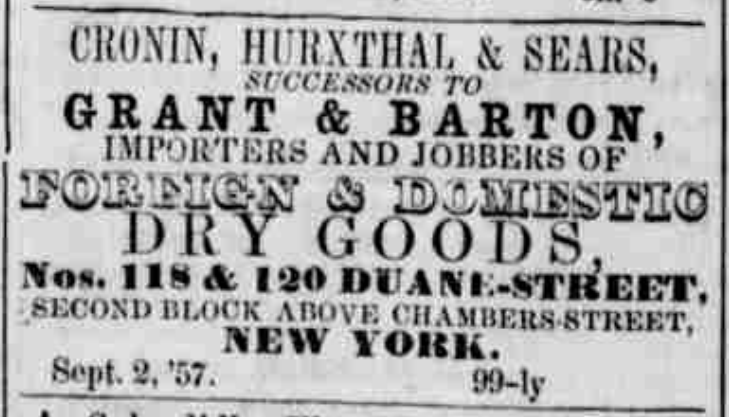
Advertisement of Cronin, Hurxthal & Sears
~ The Prairie News (Okolona, Miss.), April 15, 1858, page 4
According to a receipt from this company, the partners behind this firm were John B. Cronin, Ben. Hurxthal and J. Newton Sears. No further biographical information could be found about these individuals, who are presumed to have been New York City businessmen. In general they appear to have been involved with trades associated with slavery and Indians. Per their advertisement, they were the successors to the firm of Grant and Barton:
Grant and Barton nevertheless remained active in the [Texas] region, winning government contracts to supply the Bureau of Indian affairs with “blankets and dry goods” in the late 1840s and early 1850s…
~ The Business of Slavery and the Rise of American Capitalism, 1815-1860, by Calvin Schermerhorn, 2015, page 225
4.) Vincent Roy
$5,000.00 + $645.36 = $5,645.36

Vincent Roy, Jr. (III)
~ Life and Labors of Rt. Rev. Frederic Baraga, by Chrysostom Verwyst, 1900, pages 472-476
Vincent Roy, Sr. (II) and his son Vincent Roy, Jr. (III) were prominent members of the La Pointe Band mixed-bloods. Sr. was recognized by Gilbert as the Head of the Mixed Bloods of the La Pointe Band of Lake Superior Chippewas. Jr. was allegedly an interpreter at the 1854 Treaty, but is not identified in the Treaty itself and cannot find primary source. Jr. is described as a skilled trader in many sources, including this one:
“Leopold and Austrian (Jews) doing a general merchandize and fur-trading business at LaPointe were not slow in recognizing ‘their man.’ Having given employment to Peter Roy, who by this time quit going to school, they also, within the first year of his arrival at this place, employed Vincent to serve as handy-man for all kind of things, but especially, to be near when indians from the woods were coming to trade, which was no infrequent occurrence. After serving in that capacity about two years, and having married, he managed (from 1848 to 1852) a trading post for the same Leopold and Austrian; at first a season at Fond du Lac, Minn., then at Vermillion Lake, and finally again at Fond du Lac.”
~ Miscellaneous materials related to Vincent Roy, 1861-1862, 1892, 1921
3.) R. Crooks
$6,617.64

Ramsay Crooks
~ Madeline Island Museum
Ramsey Crooks enjoyed a long history with the American Fur Company outfit at La Pointe in the decades leading up to the 1854 Treaty:
“Ramsey Crooks (also spelled Ramsay) was born in Scotland in 1787. He immigrated to Canada in 1803 where he worked as a fur trader and explorer around the Great Lakes. He began working for the American Fur Company, which was started by John Jacob Astor, America’s first multi-millionaire, and made an expedition to the Oregon coast from 1809-1813 for the company. By doing so he also became a partner in the Pacific Fur Company. In 1834 he became acting president of the American Fur Company following Astor’s retirement to New York. A great lakes sailing vessel the Ramsey Crooks was constructed in 1836 by the American Fur Co. A nearly identical sister ship was built in the same year and was called the Astor. Both ships were sold by the dissolving fur company in 1850. Ramsay Crooks passed away in 1859, but had made a name for himself in the fur trade not only in Milwaukee and the Great Lakes, but all the way to the Pacific Ocean.”
2.) J. Austrian
$ 6,000.00 + $1,876.86 = $7,876.86
Julius Austrian
~ Madeline Island Museum
Julius Austrian was competitor and successor of the American Fur Company during the decade immediately leading up to the 1854 Treaty. Chequamegon History’s research has explored the previously uncovered circumstances of Austrian’s purchase of the Village of La Pointe from American Fur Company in 1853, being the unnamed and de facto host of the 1854 Treaty of La Pointe, being the host of the 1855 Annuities at La Pointe, and the host of the 1855 High Holy Days at La Pointe:
“In 1855 a number of Jewish Indian traders met on an island in Lake Superior in the frontier village of La Pointe, Wisconsin. The Indians were assembled there to collect their annuities and the Jews were present to dun their debtors before they dispersed. There were enough Jews for a minyan and a service was held. That was the beginning and the end of La Pointe Jewry.”
~ United States Jewry 1776-1985: Vol. 2; the Germanic Period, Part 1 by Jacob Rader Marcus Wayne State University Press , 1991, page 196
1.) Henry C. Gilbert
$0.00 ?
Henry Clark Gilbert
~ Branch County Photographs
Mackinac Indian Agent Henry Clark Gilbert was the Commissioner of the 1854 Treaty of La Pointe along with David B. Herriman.
Gilbert submitted requisitions for $5,000.00, $7,000.00, $12,500.00, $674.73, and $8,133.33; which is a total amount of $33,308.06. The amount accounted for in his name is $0.00, but his total amount unaccounted for is $20,808.06. The difference between the total amount Gilbert requisitioned and his total amount unaccounted for is $12,500, which is the same amount that Gilbert requisitioned for on September 4th, 1856.
A closer look at all of the 1854 Treaty accounts as a whole suggests that Gilbert was paid his $12,500.00 despite what is shown on paper. The total amount accounted for is actually $71,763.64; which is $12,600.00 less than the total amount on paper. The total amount unaccounted for is $20,808.06; which is $100 greater than the total amount on paper (all of which was in Gilbert’s name). We are left with a puzzle missing some pieces. Did Gilbert obtain his $12,500.00 fraudulently? Was the extra $100 accounted for taken from the unaccounted amounts by someone else as a bribe?
Did Gilbert abuse his Trust responsibility to the 1854 Treaty of La Pointe? Or was this simply a case of sloppy reporting by a federal clerk?
Wheeler Papers: 1854 La Pointe before the Treaty
August 7, 2017
By Amorin Mello
Selected letters from the
Wheeler Family Papers,
Box 3, Folders 11-12; La Pointe County.
Crow-wing, Min. Ter.
Jan. 9th 1854
Brother Wheeler,

Reverend Leonard Hemenway Wheeler ~ In Unnamed Wisconsin by Silas Chapman, 1895, cover image.
Though not indebted to you just now on the score of correspondence, I will venture to intrude upon you a few lines more. I will begin by saying we are all tolerably well. But we are somewhat uncomfortable in some respects. Our families are more subject to colds this winter than usual. This probably may be attributed in part at least to our cold and open houses. We were unable last fall to do any thing more than fix ourselves temporarily, and the frosts of winter find a great many large holes to creep in at. Some days it is almost impossible for us to keep warm enough to be comfortable.
Our prospects for accomplishing much for the Indians here I do not think look more promising than they did last fall. There are but few Indians here. These get drunk every time they can get whiskey, of which there is an abundance nearby. Among the white people here, none are disposed to attend meetings much except Mr. [Welton?]. He and his wife are discontented and unhappy here, and will probably get away as soon as they can. We hear not a word from the Indian Department. Why they are minding us in this manner I cannot tell. But I should like it much better, if they would tell us at once to be gone. I have got enough of trying to do anything for Indians in connection with the Government. We can put no dependence upon any thing they will do. I have tried the experiment till I am satisfied. I think much more could be done with a boarding school in the neighborhood of Lapointe than here And my opinion is, that since things have turned out as they have here, we had better get out of it as soon as we can. With such an agent as we now have, nothing will prosper here. He is enough to poison everything, and will do more moral evil in such a community, as this, than a half a dozen missionaries can do good. My opinion is, that if they knew at Washington how things are and have been managed here, there would be a change. But I do not feel certain of this. For I sometimes am tempted to adopt the opinion that they do not care much there how things go here. But should there be a change, I have little hope that is would would make things materially better. The moral and social improvement of the Indians, I fear, has little to do with the appointment of agents and superintendents. I do not think I ought to remain here very long and keep my family here, as things are now going. If we were not involved with the Government with regard to the school matter, I would advise the Committee to quit here as soon as we can find a place to go to. My health is not very good. The scenes, and labors and attacks of sickness which I have passed through during the past two years have made almost a wreck of my constitution. It might rally under some circumstances. But I do not think it will while I stay here, so excluded from society, and so harassed with cares and perplexities as I have been and as I am likely to be in future, should we go on and try to get up a school. My wife is in no better spirits than I am. She has had several quite ill turns this winter. the children all wish to get away from here, and I do not know that I shall have power to keep them here, even if I am to stay.
But what to do I do not know. The Committee say they do not wish to abandon the Ojibwas. I cannot in future favor the removal of the lake Indians. I believe that all the aid they will receive from the Government will never civilize or materially benifit them. I judge from the manner in which things have been managed here. Our best hope is to do what we can to aid them where they are to live peaceably with the whites, and to improve and become citizens. The idea of the Government sending infidels and heathens here to civilize and Christianize the Indians is rediculous.
I always thought it doubtful whether the experiment we are trying would succeed. In that case it was my intention to remove somewhere below here, and try to get a living, either by raising my potatoes or by trying to preach to white people, or by uniting both. but I do not hardly feel strong enough to begin entirely anew in the wilderness to make me a home. I suppose my family would be as happy at Lapointe, as they would any where in the new and scattered settlements for fifty or a hundred miles below here. And if thought I could support myself then, I might think of going back there. There are our old friends for whose improvement we have laborred so many years. I feel almost as much attachment for them as for my won children. And I do not think they ought to be left like sheep upon the mountains without a shepherd. And if the Board think it best to expend money and labor for the Ojibwas, they had better expend it there than here, as things now are at least. I think we were exerting much much more influence there before we left, then we have here or are likely to exert. I have no idea that the lake Indians will ever remove to this place, or to this region.

Reverend Sherman Hall
~ Madeline Island Museum
What do you think of recommending to the Board to day to exert a greater influence on the people in the neighborhood of Lapointe[?/!] I feel reluctant to give up the Indians. And if I could get a living at Lapointe, and could get there, I should be almost disposed to go back and live among those few for whom I have labored so long, if things turn out here as I expect they will. I have not much funds to being life with now, nor much strength to dig with. But still I shall have to dig somewhere. The land is easier tilled in this region than that about the lake. But wood is more scarce. My family do not like Minesota. Perhaps they would, if they should get out of the Indian country. Edwin says he will get out of it in the spring, and Miles says he will not stay in such a lonesome place. I shall soon be alone as to help from my children. My boys must take care of themselves as soon as they arrive at a suitable age, and will leave me to take care of myself. We feel very unsettled. Our affairs here must assume a different aspect, or we cannot remain here many months longer. Is there enough to do at Lapointe; or is there a prospect that there will soon be business to draw people enough then, to make it an object to try to establish the institution of the gospel there? Write me and let me know your views on such subjects as these.
[Unsigned, but appears to be from Sherman Hall]
Crow-wing Feb. 10th 1854
Brother Wheeler:
I received your letter of jan. 16th yesterday, and consequently did not sleep as much as usual last night. We were glad to hear that you are all well and prosperous. We too are well which we consider a great blessing, as sickness in present situation would be attended with great inconvenience. Our house is exceedingly cold and has been uncomfortable during some of the severe cold weather have had during the last months. Yet we hope to get through the winter without suffering severely. In many respects our missionary spirit has been put to a severer test than at any previous time since we have been in the Indian country, during the past year. We feel very unsettled, and of course somewhat uneasy. The future does not look very bright. We cannot get a word from the Indian Department whether we may go on or not. If we cannot get some answer from them before long I shall be taking measures to retire. We have very little to hope, I apprehend, from all the aid the Government will render to words the civilization and moral and intellectual improvement of the Indians. For missionaries or Indians to depend on them, is to depend on a broken staff.
~ Minnesota Historical Society
“The American Fur Company therefore built a ‘New Fort’ a few miles farther north, still upon the west shore of the island, and to this place, the present village, the name La Pointe came to be transferred. Half-way between the ‘Old fort’ and the ‘New fort,’ Mr. Hall erected (probably in 1832) ‘a place for worship and teaching,’ which came to be the centre of Protestant missionary work in Chequamegon Bay.”
~ The Story of Chequamegon Bay
I do not see that our house is so divided against itself, that it is in any great danger of falling at present. My wife never did wish to leave Lapointe and we have ever, both of us, thought that the station ought not to be abandoned, unless the Indians were removed. But this seemed not to be the opinion of the committee or of our associates, if I rightly understood them. I had a hard struggle in my mind whether to retire wholly from the service of the Board among the Indians, or to come here and make a further experiment. I felt reluctant to leave them, till we had tried every experiment which held out any promise of success. When I remove my family here our way ahead looked much more clear than it does now. I had completed an arrangement for the school which had the approval of Gov. Ramsey, and which fell through only in consequence of a little informality on his part, and because a new set of officers just then coming into power must show themselves a little wiser than their predecessors. Had not any associates come through last summer, so as to relieve me of some of my burdens and afford some society and counsel in my perplexities I could not have sustained the burden upon me in the state of my health at that time. A change of officers here too made quite an unfavorable change in our prospects. I have nothing to reproach myself with in deciding to come here, nor in coming when we did, though the result of our coming may not be what we hoped it would be. I never anticipated any great pleasure in being connected with a school connected in any way with the Government, nor did I suppose I should be long connected with it, even if it prospered. I have made the effort and now if it all falls, I shall feel that Providence has not a work for us to do here. The prospects of the Indians look dark, what is before me in the future I do not know. My health is not good, though relief from some of the pressure I had to sustain for a time last fall and the cold season has somewhat [?????] me for the time being. But I cannot endure much excitement, and of course our present unsettled affairs operate unfavorably upon it. I need for a time to be where I can enjoy rest from everything exciting, and when I can have more society that I have here, and to be employed moderately in some regular business.
Antoine Gordon [Gaudin]
~ Noble Lives of a Noble Race by the St. Mary’s Industrial School (Bad River Indian Reservation), 1909, page 207.

Charles Henry Oakes
~ Findagrave.com
As to your account I have not had time to examine it, but will write you something about it by & by. As to any account which Antoine Gaudin has against me, I wish you would have him send it to me in detail before you pay it. I agreed with Mr. Nettleton to settle with him, and paid him the balance due to Antoine as I had the account. I suppose he made the settlement, when he was last at Lapointe. As to the property at Lapointe, I shall immediately write to Mr. Oakes about it. But I suppose in the present state of affairs, it will be perhaps, a long time before it will be settled so as to know who does own it. It is impossible for me to control it, but you had better keep posession of it at present. I cannot send Edwin [??] through to cultivate the land & take care of it. He will be of age in the spring, and if he were to go there I must hire him. He will probably leave us in the spring. Please give my best regards to all. Write me often.
Yours truly
S. Hall
Crow-wing, Min. Ter.
Feb. 21st 1854
Brother Wheeler,
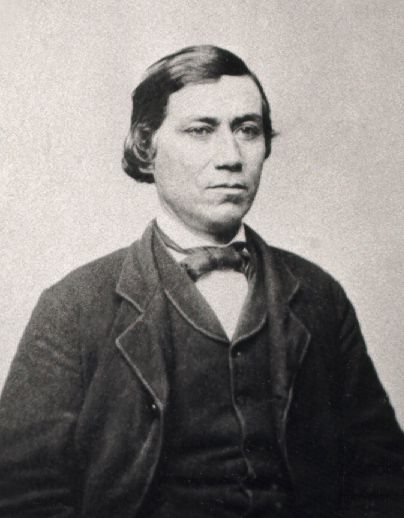
Paul Hudon Beaulieu
~ FamilySearch.org
I wrote you a few days ago, and at the same time I wrote to Mr. Oakes inquiring whether he had got possession of the Lapointe property. I have not yet got a reply from him, but Mr. Beaulieu tells me that he heard the same report which you mentioned in your letter, and that he inquired of Mr. Oakes about it when he saw him on a recent visit to St. Paul, and finds that it is all a humbug. Oakes has nothing to do with it. Mr. Beaulieu said that the sale of last spring has been confirmed, and that Austrian will hold Lapointe. So farewell to all the inhabitants’ claims then, and to anything being done for the prosperity of the peace for the present, unless it gets out of his hands.
I have written to Austrian to try to get something for our property if we can. But I fear there is not much hope. If he goes back to Lapointe in the spring, do the best you can to make him give us something. I feel sorry for the inhabitants there that they are left at his mercy. He may treat them fairly, but it is hardly to be expected.

Clement Hudon Beaulieu
~ TreatiesMatter.org
As to our affairs here, there has been no particular change in their aspects since I wrote a few days ago. There must be a crisis, I think, in a few weeks. We must either go on or break up, I think, in the spring. We are trying to get a decision. I understand our agent has been threatened with removal if he carries on as he has done. I believe there is no hope of reformation in his case, and we may get rid of him. Perhaps God sent us here to have some influence in some such matters, so intimately connected with the welfare of the Indians. I have never thought I [????] can before I was sent in deciding to come here. Some trials and disappointments have grown out of my coming, but I feel conscious of having acted in accordance with my convictions of duty at this time.
If all falls through, I know not what to do in the future. The Home Missionary Society have got more on their hands now than they have funds to pay, if I were disposed to offer myself to labor under them. I may be obliged to build me a shanty somewhere on some little unoccupied piece of land and try to dig out a living. In these matters the Lord will direct by his providence.
You must be on your guard or some body will trip you up and get away your place. There are enough unprincipled fellows who would take all your improvements and send you and all the Indians into the Lake if they could make a dollar by it. I should not enlarge much, without getting a legal claim to the land. Neither would I advise you to carry on more family than is necessary to keep what team you must have, and to supply your family with milk and vegetables. It will be advantage/disadvantage to you in a pecuniary point of view, it will load you with and tend to make you worldly minded, and give your establishment the air of secularity in the eyes of the world. If I were to go back again to my old field, I would make my establishment as small as I could & have enough to live comfortable. I with others have thought that your tendency was rather towards going to largely into farming. I do not say these things because I wish to dictate or meddle with your affairs. Comparing views sometimes leads to new investigations in regard to duty.
May the Lord bless you and yours, and give you success and abundant prosperity in your labours of love and efforts to Save the Souls around you.
Give my best regards to Mrs. W., the children, Miss S and all.
Yours truly,
S. Hall
I forgot to say that we are all well. Henry and his family have enjoyed better health here, then they used to enjoy at Lapointe.
Feb 27
Brother Wheeler.
My delay to answer your note may require an explanation. I have not had time at command to attend to it conveniently at an earlier period. As to your first questions. I suppose there will be no difference of opinion between us as to the correctness of the following remarks.
- The Gospel requires the members of a church to exercise a spirit of love, meekness and forbearance towards an offending brother. They are not to use unnecessary severity in calling him to account for his errors. Ga. 6:1.
- The Object of Church discipline is, not only to [pursue/preserve?] the Church pure in doctrine & morals, that the contrary part may have no evil thing to say of them; but also to bring the offender to a right State of mind, with regard this offense, and gain him back to duty and fidelity.
- If prejudice exist in the mind of the offender towards his brethren for any reason, the spirit of the gospel requires that he be so approached if possible as to allay that prejudice, otherwise we can hardly expect to gain a candid hearing with him.
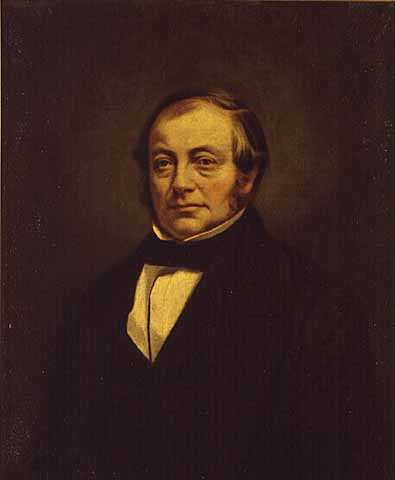
Charles William Wulff Borup, M.D. ~ Minnesota Historical Society
I consider that these remarks have some bearing on the case before us. If it was our object to gain over Dr. B. to our views of the Sabbath, and bring him to a right State of mind with regard this Sabbath breaking, the manner of approaching him would have, in my view, much to do with the offence. He may be approached in a Kind and [forbearing?] manner, when one of sternness and dictation will only repel him from you. I think we ought, if possible, and do our duty, avoid a personal quarrel with him. To have brought the subject before the Church & made a public affair of it, before [this/then?] and more private means have been tried to get satisfaction, would, I am sure, have resulted in this. I found from my own interviews with him, that there was hope, if the rest of the brethren would pursue a similar course. I felt pretty sure they would obtain satisfaction. IF they had [commenced?] by a public prosecution before the church, it would only have made trouble without doing any good. The peace of our whole community would have been disturbed. I thought one step was gained when I conversed with him, and another when you met him on the subject. I knew also that prejudices existed both in his mind towards us, & in our minds towards him which were likely to affect the settlement of this affair, and which as I thought, would be much allayed by individuals going to him and speaking face to face on this subject in private. He evidently expected they would do so. Mutual conversations and explanations allay these feelings very much. At least it has been so in my experience.

Reverend Edmund Franklin Ely.
~ Duluth Public Library
As to your second question. I do not say that it was Mr. Ely’s duty to open the subject to Doc. Borup at the preparatory lecture. If he had done so, it would have been only a private interview; for there [was?] not enough present to transact business. All I meant to affirm respecting that occasion is, that it afforded a good opportunity to do so, if he wishes, and that Dr. B. expected he would have done so, as I afterwards learnt, if he has any objection to make against his coming to the communion.
As to your third question. I have no complaint to make of the church, that I have urged them to the performance of any “duties“ in this case they have refused to perform.
And now permit me to ask in my turn.
What “duties” have they urged me to perform in this case, which I “have been unwilling, or manifested a reluctance to perform?”
Did you intend by anything which wrote to me or said verbally, to request me to commence a public prosecution of Doc. Borup before the Church?
Will you have the goodness to state in writing, the substance of what you said to me in your study as to your opinion and that of others suspecting my delinquency in maintaining church discipline.
A reply to these questions would be gratefully received.
Your brother in Christ
S. Hall
Crow Wing. March 12th 1854
Brother Wheeler:
Your letter of Feb 17th came to hand by our last mail; and though I wrote you but a short time ago, I will say a few words in relation to one or two topics to which you allude. Shortly after I received your former letter I wrote to Mr. Oakes enquiring about the property at Lapointe. In reply, says that himself and some others purchased Mr. Austrian’s rights at Lapointe of Old Hughes on the strength of a power of attorney which he held. Austrian asserts the power of attorney to be fraudulent, and that they cannot hold the property. Oakes writes as if he did not expect to hold it. Some time ago I wrote to Mr. Austrian on the same subject, and said to him that if I could get our old place back, I might go back to Lapointe. He says in reply —
Julius Austrian
~ Madeline Island Museum
“I should feel much gratified to see you back at Lapointe again, and can hold out to you the same inducements and assurances as I have done to all other inhabitants, that is, I shall be at Lapointe early in the spring and will have my land surveyed and laid out into lots, and then I shall be ready to give to every one a deed for the lot he inhabits, at a reasonable price, not paying me a great deal more than cost trouble, and time. But with you, my dear Sir, will be no trouble, as I have always known you a just and upright man, and have provided ways to be kind towards us, therefore take my assurance that I will congratulate myself to see you back again; and it shall not be my fault if you do not come. If you come to Lapointe, at our personal interview, we will arrange the matter no doubt satisfactory.”
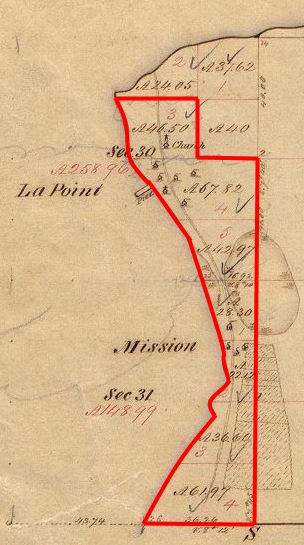
“The property” from the James Hughes Affair is outlined in red. This encompassed the Church at La Pointe (New Fort) and the Mission (Middleport) of Madeline Island. 1852 PLSS survey map by General Land Office.
I suppose Austrian will hold the property and probably we shall never realize anything for our improvements. You must do the best you can. Make your appeal to his honor, if he has any. It will avail nothing to reproach him with his dishonesty. I do not know what more I can do to save anything, or for any others whose property is in like circumstances with ours.
You speak discouragingly of my going back to Lapointe. I do not think the Home Miss. Soc. would send a missionary there only for the few he could reach in the English language. If the people want a Methodist, encourage them to get one. It is painful to me to see the place abandoned to irreligion and vices of every Kind, and the labours I have expended there thrown away. I can hardly feel that it was right to give up the station when we did. If I thought I could support myself there by working one half the time and devoting the rest to ministerial labors for the good of those I still love there, I should still be willing to go back, if could get there & had a shelter for my head, unless there is a prospect of being more useful here. But the land at Lapointe is so hard to subdue that I am discouraged about making an attempt to get a living there by farming. I am not much of a fisherman. There is some prospect that we may be allowed to go on here. Mr. Treat has been to Washington, and says he expects soon to get a decision from the Department. We have got our school farm plowed, and the materials are drawn out of the woods for fencing it. If I have no orders to the contrary, I intend to go on & plant a part of it, enough to raise some potatoes. We may yet get our school established. If we can go ahead, I shall remain here, but if not, I think it is not my duty to remain here another year, as I have the past. In other circumstances, I could do more towards supporting myself and do more good probably.
I have felt much concerned for the people of Lapointe and Bad River on account of the small pox. May the Lord stay this calamity from spreading among you. Write us every mail and tell us all. It is now posted here today that the Old Chief [Kibishkinzhugon?] is dead. I hardly credit the report, though I should suppose he might be one of the first victims of the disease.
I can write no more now. We are all very well now. Give my love to all your family and all others.
Tell Robert how the matters stands about the land. It stands him in how to be on good terms with the Jew just now.
Yours truly,
S. Hall
The snow is nearly all off the ground and the weather for two or three weeks has been as mild as April.
Crow Wing M.H. Apr. 1 1854
Dear Br. & Sr. Wheeler.
I have received a letter from you since I wrote to you & am therfore in your debt in that matter. I have also read your letters to Br. & Sr. Welton I suppose you have received my letter of the 13th of Feb. if so, you have some idea of our situation & I need say no more of that now; & will only say that we are all well as usual & have been during the winter. Mrs. P_ is considerably troubled with her old spinal difficulty. She has got over her labors here last summer * fall. Harriet is not well I fear never will be, because the necessary means are not likely to be used, she has more or less pain in her back & side all the time, but she works on as usual & appears just as she did at LaPointe, if she could be freed from work so as to do no more than she could without injury & pursue uninterruptedly & proper medical course I think she might regain pretty good health. (Do not, any of you, send back these remarks it would not be pleasing to her or the family.) We have said what we think it best to say) –
Br. Hall is pretty well but by no means the vigorous man he once was. He has a slight – hacking cough which I suppose neither he nor his family have hardly noticed, but Mrs. P_ says she does not like the sound of it. His side troubles him some especially when he is a good deal confined at writing. Mr. & Mrs. W_ are in usual health. Henry’s family have gone to the bush. They are all quite well. He stays here to assist br. H_ in the revision & keeps one or two of his children with him. They are now in Hebrews, with the Revision. Henry I suppose still intends to return to Lapointe in the spring. –
Now, you ask, in br. Welton’s letter, “are you all going to break up there in the spring.” Not that I know of. It would seem to me like running away rather prematurely. When the question is settled, that we can do nothing here, then I am willing to leave, & it may be so decided, but it is not yet. We have not had a whisper from Govt. yet. Wherefore I cannot say.
It looks now as if we must stay this season if no longer. Dr. Borup writes to br. Hall to keep up good courage, that all will come out right by & by, that he is getting into favor with Gov. Gorman & will do all he can to help us. (Br. Hall’s custom is worth something you know).
Henry C. Gilbert
~ Branch County Photographs
By advise of the Agent, we got out (last month) tamarack rails enough to fence the school farm (which was broke last summer) of some 80 acres & it will be put up immediately. Our great father turned out the money to pay for the job. These things look some like our staying awhile I tell br H_ I think we had better go as far as we can, without incurring expense to the Board (except for our support) & thus show our readiness to do what we can. if we should quit here I do not know what will be done with us. Br Hall would expect to have the service of the Board I suppose. Should they wish us to return to Bad River we should not say nay. We were much pleased with what we have heard of your last fall’s payment & I am as much gratified with the report of Mr. H. C. Gilbert which I have read in the Annual Report of the Com. of Indian Affairs. He recommends that the Lake Superior Indians be included in his Agency, that they be allowed to remain where they are & their farmers, blacksmith & carpenter be restored to them. If they come under his influence you may expect to be aided in your efforts, not thwarted , by his influence. I rejoice with you in your brightening prospects, in your increased school (day & Sabbath) & the increased inclination to industry in those around you. May the lord add his blessing, not only upon the Indians but upon your own souls & your children, then will your prosperity be permanent & real. Do not despise the day of small things, nor overlook especially neglect your own children in any respect. Suffer them not to form idle habits, teach them to be self reliant, to help themselves & especially you, they can as well do it as not & better too, according to their ability & strength, not beyond it, to fear God & keep his commandments & to be kind to one another (Pardon me these words, I every day see the necessity of what I have said.) We sympathize with you in your situation being alone as you are, but remember you have one friend always near who waits to [commence?] with you, tell Him & all with you from Abby clear down to Freddy.
Affectionately yours
C. Pulsifer
Write when you can.
Crow wing Min. Ter.
April 3d 1854
Brother Wheeler

George E. Nettleton and his brother William Nettleton were pioneers, merchants, and land speculators at what is now Duluth and Superior.
~ Image from The Eye of the North-west: First Annual Report of the Statition of Superior, Wisconsin by Frank Abial Flower, 1890, page 75.
Since I wrote you a few days ago, I have received a letter from Mr. G. E. Nettleton, in which he says, that when he was at Lapointe in December last, he was very much hurried and did not make a full settlement with Antoine. He says further, that he showed him my account, and told him I had settled with him, and that he would see the matter right with Antoine. A. replied that all was right. I presume therefore all will be made satisfactory when Mr. N. comes up in the Spring, and that you will have need to make yourself no further trouble about this matter.
I have also received a short note from Mr. Treat in which he says,
“I have not replied to your letters, because I have been daily expecting something decisive from Washington. When I was there, I had the promise of immediate action; but I have not heard a word from them”.
“I go to Washington this Feb, once more. I shall endeavor to close up the whole business before I return. I intend to wait till I get a decision. I shall propose to the Department to give up the school, if they will indemnify us. If I can get only a part of what we lose, I shall probably quit the concern”.
Thus our business with the Government stood on March the 9th, I have lost all confidence in the Indian Department of our Government under this administration, to say nothing of the rest of it. If the way they have treated us is an index to their general management, I do not think they stand very high for moral honesty. The prospects for the Indians throughout all our territories look dark in the extreme. The measures of the Government in relation to them are not such as will benefit and save many of them. They are opening the floodgates of vice and destruction upon them in every quarter. The most solemn guarantees that they shall be let alone in the possession of domains expressly granted them mean nothing.
Our prospects here look dark. For some time past I have been rather anticipating that we should soon get loose and be able to go on. But all is thrown into the dark again. What I am to do in future to support my family, I do not know. If we are ordered to quit here and turn over the property, it would turn [illegible] out of doors.
Mr. Austrian expects us back to Lapointe in the Spring & Mr. Nettleton proposes to us to go to Fond du Lac, (at the Entry). He says there will be a large settlement then next season. A company is chartered to build a railroad through from the Southern boundary of this territory to that place. It is probable that Company [illegible] will make a grant of land for that purpose. If so, it will probably be done in a few years. That will open the lake region effectually. I feel the need of relaxation and rest before I do anything to get established anywhere.
We are still working away at the Testament, it is hard work, and we make lately but slow progress. There is a prospect that the Bible Society will publish it but it is not fully decided. I wish I could be so situated that I could finish the grammar.
But I suppose I am repeating what I have said more than once before. We are generally in good health and spirits. We hope to hear from by next mail.
Yours truly
S. Hall
What do you think about the settlements above Lapointe and above the head of the Lake?
Detroit July 10th 1854
Rev. Dr. Bro.
At your request and in fulfilment of my promise made at LaPointe last fall so after so long a time I write: And besides “to do good & to communicate” as saith the Apostle “forget not, for with such sacrifices God is well pleased.”
We did not close up our Indian payments of last year until the middle of the following January, the labors, exposures and excitements of which proved too much for me and I went home to New York sick & nearly used up about the last of February & continued so for two months. I returned here about a week ago & am now preparing for the fall pay’ts.
The Com’sr. has sent in the usual amounts of Goods for the LaPointe Indians to Mr. Gilbert & I presume means to require him to make the payment at La P. that he did last fall, although we have received nothing from the Dep’t. on the subject.
“George Washington Manypenny (1808-1892) was the Director of the Bureau of Indian Affairs of the United States from 1853 to 1857.”
~ Wikipedia.org
In regard to the Treaty with the Chipp’s of La Sup’r & the Miss’i, the subject is still before Congress and if one is made this fall it has been more than intimated that Com’r Manypenny will make it himself, either at LaP’ or at F. Dodge or perhaps at some place farther west. Of course I do not speak from authority or any of the points mentioned above, for all is rumour & inference beyond the mere arrival here of the Goods to Mr G’s care.
From various sources I learn that you have passed a severe winter and that much sickness has been among the Indians and that many of them have been taken away by the Small Pox.
This is sad and painful intelligence enough and I can but pray God to bless & overrule all to the goods of his creasures and especially to the Missionaries & their families.
Notwithstanding I have not written before be assured that I have often [???] of and prayed for you and yours and while in [Penn.?] you made your case my own so far as to represent it to several of our Christian brethren and the friends of missions there and who being actuated by the benevolent principles of the Gospel, have sent you some substanted relief and they promise to do more.
The Elements of the political world both here and over the waters seem to be in fearful & [?????] commotion and what will come of it all none but the high & holy one can know. The anti Slavery Excitement with us at the North and the Slavery excitement at the South is augmenting fact and we I doubt not will soon be called upon to choose between Slavery & freedom.
If I do not greatly misjudge the blessed cause of our holy religion is or seems to be on the wane. I trust I am mistaken, but the Spirit of averice, pride, sensuality & which every where prevails makes me think otherwise. The blessed Christ will reign [recenth-den?] and his kingdom will yet over all prevail; and so may it be.
Let us present to him daily the homage of a devout & grateful heart for his tender mercies [tousward?] and see to it that by his grace we endure unto the end that we may be saved.
My best regards to Mrs. W. to Miss Spooner to each of the dear children and to all the friends & natives to each of whom I desire to be remembered as opportunity occurs.
The good Lord willing I may see you again this fall. If I do not, nor never see you again in this world, I trust I shall see and meet you in that world of pure delight where saints immortal reign.
May God bless you & yours always & ever
I am your brother
In faith Hope & Charity
Rich. M. Smith
Rev Leonard H. Wheeler
LaPointe
Lake Superior
Miss. House Boston
Augt’ 31, 1854
Rev. L. H. Wheeler,
Lake Superior
Dear Brother
Yours of July 31 I laid before the Com’sr at our last meeting. They have formally authorized the transfer of Mr & Mrs Pulsifer to the Lake, & also that of Henry Blatchford.

Robert Stuart was formerly an American Fur Company agent and Acting Superintendent on Mackinac Island during the first Treaty at La Pointe in 1842.
~ Wikipedia.org
In regard to the “claims” their feeling is that if the Govt’ will give land to your station, they have nothing to say as to the quantity. But if they are to pay the usual govt’ price, the question requires a little caution. We are clear that we may authorize you to enter & [???] take up so much land as shall be necessary for the convenience of the [mission?] families; but we do not see how we can buy land for the Indians. Will you have the [fondness?] to [????] [????] on these points. How much land do you propose to take up in all? How much is necessary for the convenience of the mission families?
Perhaps you & others propose to take up the lands with private funds. With that we have nothing to do, so long as you, Mr P. & H. do not become land speculators; of which, I presume, there is no danger.
As to the La Pointe property, Mr Stuart wrote you some since, as you know already I doubt not, and replied adversely to making any bargain with Austrian. I took up the opinion of the Com’sr after receiving your letter of July 31, & they think it the wise course. I hope Mr Stewart will get this matter in some shape in due time.
I will write to him in reference to the Bad River land, asking him to see it once if the gov’ will do any thing.
Affectionate regards to Mrs W. & Miss Spooner & all.
Fraternally Yours
S. B. Treat
P.S. Your report of July 31 came safely to hand, as you will & have seen from the Herald.
Julius Austrian Papers: James Hughes Affair
May 15, 2017
By Amorin Mello
Madeline Island Museum
Julius Austrian Papers
Folder 6: James Hughes Affair (1853-1866)
J. Austrian
Power of Attorney to
J. Hughes
“State of Wisconsin”
“La Pointe County”
“Office of Register of Deeds”
Received for Record on this 10th day of December 1853 at 7 O Clock P.M. and Recorded on Pages 20 and 21 in Book A of Records of Deeds.

Robt. D. Boyd
Register of Deeds
– – – – – – – – – –

James Bibb Hughes of St. Paul, MN, and Hudson, WI.
Newsman; Politician; Abolitionist.
~ Wikipedia.org
Know all men
by these presents that I Julius Austrian of La Pointe, Lapointe County and state of Wisconsin, have made, constituted, and appointed and do by these presents, make, constitute and appoint James Hughes now of La Pointe my lawful Attorney for me and in my name, place and stead to, to sell, alien, and convey, any and all rights, title claim and interest that I have or may have unto any lands or lands purchased by me as the public land sales at Willow River or the second day of May A. D. 1853 for which I hold a Duplicate No 242 signed by Moses S. Gibson received Dated May 2, 1853.
Giving and granting unto my said Attorney full power and Authority to do and perform all and every act or thing whatsoever, requisite and necessary to be done and performed in and about the Premises, as fully & completely, to all intents and purposes as I myself might or could do if I were personally present with full authority to make deeds or deeds for lands sold & to receive money & receipt for same here by ratifying and confirming all the acts or acts of my said Attorney (as fully as I myself could do & [cause?] to be [owner?]) by virtue thereof.
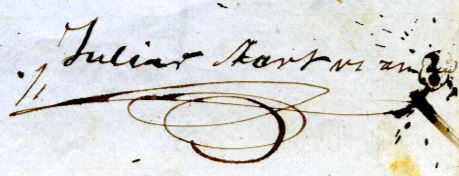
In testimony whereof I have hereunto set my hands & seal this 30th day of May AD 1853
Julius Austrian
 Signed Sealed & delivered
in Presence of
Henry Smitz
S Goff
State of Wisconsin
County of La Pointe
S. Goff came personally before me and being duly sworn according to laws, Says, That, he signed the annexed foregoing power of Attorney from Julius Austrian to James Hughes bearing date on the 30 day of May AD 1853, as one of the subscribing witnesses thereto, and that his Deponents signature thereon and thereto, is genuine, that Deponents was then and still is acquainted with and personally knew the said Julius Austrian who signed the said Power of Attorney, and that he signed the same in the presence of this Deponent at the time the same bears date. To wit: on the 30th day of May AD 1853, and the said Julius Austrian’s signature thereto and thereon is genuine.

S. Goff
Subscribed and Sworn
to before me the 10th day
of december AD 1853

John W. Bell
Justice of the peace
This Agreement
made and entered into between Charles H Oakes, Michael E Ames and Isaac Van Etten of St Paul, Minnesota Territory of the first part and James Hughes of Hudson Wisconsin, of the second part witnesseth:
That the said parties of the first part do hereby agree to pay or cause to be paid, the sum of Three Hundred and fifty Dollars, to be paid unto the said James Hughes, party of the second part, as soon as two certain Warranty Deeds made and executed by Julius Austrian through and by the said James Hughes, his Attorney in fact, to the parties of the first part of even date herewith, shall by duly Recorded in the office of the Register of La Pointe county, Wisconsin, upon the express condition however, that no deed or other instrument of conveyance of the lands described in the said Deed, or any part of them, has been executed or Recorded in said County or State from Julius Austrian, or from his Attorney in fact previous to the Record of the above deeds, to the parties of the first part.
And upon the further condition that the entry or purchase from the United States Government, of the said Austrian of said lands mentioned and described in said Deeds to the parties of the first part, shall be held good and valid by the Government and not vacated or cancelled, and that a patent issue from the United States Government therefore and perfecting the title thereof in the parties of the first part.
And the parties of the first part further agree to pay unto the said James Hughes the further sum of Six Hundred Dollars after and out of the proceeds of the sale of a portion of the property ( Real Estate described in the said two Deeds of Julius Austrian, executed and delivered to the parties of the first, by said James Hughes, as Attorney in fact, for said Austrian above named, after the same shall have been sold and proceeds therefrom realized and not before.
Charles Henry Oakes
La Pointe fur trader; Chippewa treaties signatory; father of a mixed-bloods family; St. Paul banker and Free Mason.
~ Findagrave.com
It is further understood and agreed by and between the parties of the first part, and the party of the second part hereto that the payments of the above sums or either of them, is dependent and upon the express condition, that the said Warranty Deed, bearing even date herewith, to the parties of the first part above herewith, to the parties of the first part above described, does and shall convey and vest a good perfect and legal title of the lands describe therein, in and to the parties of the first part, their heirs and assigns in fee simple, free of all adverse title or titles, and free from all incumbrance (Excepting a certain Mortgage upon a part of the premises to secure the payments of about fifteen Hundred Dollars, from the said Austrian to Charles H Oakes of the parties of the first part).
Otherwise it is understood and agreed that the party of the second part, has not and shall not have any claim whatever when the parties of the first part for the payment of the above mentioned sums, or any part thereof.
In witness whereof, we have hereto set our hands the 1st day of December AD 1853
in duplicate form
Signed Chas H Oakes
[Other signatories cut off in scan]
In presence of
I V D Heard
Julius Austrian
To.
Charles H Oakes
Michael E Ames
Isaac Van Etten
Warranty Deed
“State of Wisconsin”
“County of La Pointe”
“Office of Register of Deeds”
Received for Record on the 10th day of December 1853 at 7 O Clock P.M. and Recorded on Pages 22, 23, and 24 in Book A of Records of Deeds.
Robt. D. Boyd
Register of Deeds
– – – – – – – – – –
THIS INDENTURE,
made this first (1st) day of December is the year of our Lord one thousand eight hundred and fifty three.
BETWEEN
Julius Austrian (by James Hughes his attorney in fact)
of the county of La Pointe and State of Wisconsin of the first part, and
Charles H Oakes Michael E Ames and Isaac Van Etten
of the second part,
WITNESSETH, that the said party of the first part, for and is in consideration of the sum of
One Thousand ($1000)
Dollars, in hand paid by the said parties of the second part – the receipt whereof is hereby acknowledged – has given, granted, bargained, sold, conveyed, and confirmed, and by these presents, does give, grant, bargain, sell, convey and confirm unto the said parties of the second part, their heirs and assigns, forever, all the following described pieces or parcels of land, situate, lying and being in the County of La Pointe ^and State of Wisconsin^ and known and designated as follows, vis:
The lots of this deed are outlined in red, describing La Pointe (New Port and Middleport) for a total of 306.28 acres. This is roughly 80 acres short of “Containing 382 23/100 Acres of land”.
~ General Land Office
Lots numbered three (3) four (4) and five (5) in Section No thirty (30) in Township No. fifty (50) North of Range NO. three (3) west, and Lots Numbered One (1) two (2) three (3) and four (4) in Section Number thirty one (31) in said Township No fifty (50), Range No three (3) aforesaid, according to the Survey of the United States government and Platts thereof, [ben?] and hereby intending, to convey the same, and all of the pieces, [pared?] or lots of land heretofore entered, bids of or purchases by the said party of the first part from the United States Government, on or about the second day of May AD 1853, or at any other time. Containing 382 23/100 Acres of land.
TO HAVE AND TO HOLD THE SAME,
together with all and singular the appurtenances and privileges thereunto belonging, or in any wise appertaining, and all the Estate, Right, Title, Interest and Claim whatsoever, of the said party of the first part, either in Law or Equity, in and to the above described premises, to the only proper use, benefit, and behoof of the said parties of the second part, their heirs, and assigns forever. And the said party of the first part, for himself his heirs, executors, and administrators, does COVENANT AND AGREE to and with the said parties of the second part, their heirs and assigns, that he is well seized in fee of the aforesaid premises, and has good right to SELL and CONVEY the same in manner and form as above written, and that the same are free of all incumbrances whatever ; and that the aforesaid premises in the quiet and peaceable possession of the said parties of the second part, their heirs and assigns, against every person lawfully claiming or to claim the whole or any part thereof, he will forever WARRANT AND DEFEND.
IN TESTIMONY WHEREOF, the said party of the first part, has hereunto set his hand and seal the day and year first above written.

Julius Austrian
By James Hughes
his Attorney in fact
Sealed and Delivered in Presence of
The words “and State of Wisconsin” first [intertriced?] before signing.
I V D Heard
Truman M Smith
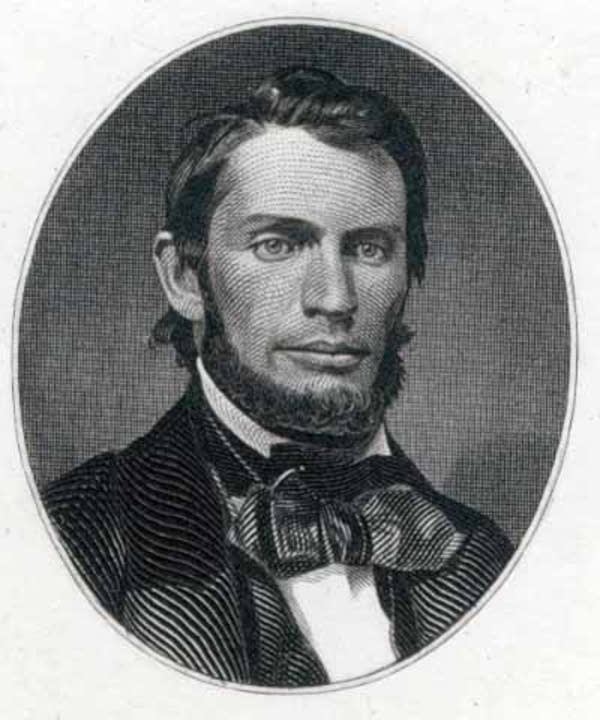
Truman Mott Smith was also a banker.
~ Minnesota Historical Society via Minnesota Public Radio
Territory of Minnesota,
COUNTY OF Ramsey
BE IT KNOWN, that on the first (1st) day of December A. D., before the undersigned, personally came James Hughes (the attorney in fact of the said Julius Austrian) the grantor to the foregoing and within DEED, from him as such grantor to Charles H Oakes Michael E Ames and Isaac Van Etten grantors, and to me personally known to be the identical person described in, and who by James Hughes his said attorney in fact executed the said deed, and the said James Hughes his attorney in fact acknowledged that he executed the said deed, freely and voluntarily, for the uses and purposes therein expressed, for in behalf and on the part of the said Julius Austrian [grantors?], aforesaid,
Truman M Smith
Justice of the Peace
– – – – – – – – – –
Territory of Minnesota
County of Ramsey
I do hereby certify that Truman M Smith, Esq before whom this within acknowledged [guest?] was taken was at the time the same bears date, a Justice of the Peace in and for said County, duly Elected & qualified to act as such, & to take Acknowledgement of Deeds,
that I am well acquainted with his hand writing & believe the within signature purporting to be his, to be his genuine signature. And that the within Deed is Executed & Acknowledged according to the laws of said Territory.
In testimony whereof I have hereunto set my hand & affirm the seal of the District Court of said County, at St. Paul, this 3rd day of December A. D. 1853. [A. J. Mutney?] Clerk.
by Sherwood Hough
Dept. Clerk of said Court
Julius Austrian
To
Charles H. Oakes
M E Ames
Isaac Van Etten
Warranty Deed
“State of Wisconsin”
“Lapointe County”
“Office of Register of Deeds”
Received for Record on this 10th day of December, 1853 at 7 O Clock P.M. and Recorded on pages 24, 25, and 26 in Book A of Records of Deeds.
Robt. D. Boyd
Register of Deeds
– – – – – – – – – –
THIS INDENTURE,
made this first (1st) day of December is the year of our Lord one thousand eight hundred and fifty three.
BETWEEN
Julius Austrian (by James Hughes his attorney in fact)
of the county of Lapointe and State of Wisconsin of the first part, and
Charles H Oakes Michael E Ames and I Van Etten
of the second part,
WITNESSETH, that the said party of the first part, for and is in consideration of the sum of
One hundred and fifty ($150~)
Dollars, in hand paid by the said parties of the second part – the receipt whereof is hereby acknowledged – has given, granted, bargained, sold, conveyed, and confirmed, and by these presents, does give, grant, bargain, sell, convey and confirm unto the said parties of the second part, their heirs and assigns, forever, all the following described pieces or parcels of land, situate, lying and being in the County of La Pointe ^and State of Wisconsin^ and known and designated as follows, vis:

Roughly 80 acres are highlighted in blue, labeled as “Austrian’s Sawmill“ on the 1852 PLSS survey map. This is located along what is now Pike’s Creek south of the Bayfield Road on the mainland.
~ General Land Office
The South West quarter of the North West quarter of Section No twenty one (21) and the North west quarter of the south west quarter of said section No. twenty one (21) in Township No fifty (50) North, of Range No. four (4) containing Eighty Acres more or less.
~ The Sawmill Community At Roy’s Point by Mary E. Carlson, 2009, page 14.
TO HAVE AND TO HOLD THE SAME,
together with all and singular the appurtenances and privileges thereunto belonging, or in any wise appertaining, and all the Estate, Right, Title, Interest and Claim whatsoever, of the said party of the first part, either in Law or Equity, in and to the above described premises, to the only proper use, benefit, and behoof of the said parties of the second part, their heirs, and assigns forever. And the said party of the first part, for himself his heirs, executors, and administrators, does COVENANT AND AGREE to and with the said parties of the second part, their heirs and assigns, that he is well seized in fee of the aforesaid premises, and has good right to SELL and CONVEY the same in manner and form as above written, and that the same are free of all incumbrances whatever ; and that the aforesaid premises in the quiet and peaceable possession of the said parties of the second part, their heirs and assigns, against every person lawfully claiming or to claim the whole or any part thereof, he will forever WARRANT AND DEFEND.
IN TESTIMONY WHEREOF, the said party of the first part, has hereunto set his hand and seal the day and year first above written.
Julius Austrian
By James Hughes
his Attorney in fact
Sealed and Delivered in Presence of
The words “and State of Wisconsin” first [introduced?] before signing.
I V D Heard
Truman M Smith
Territory of Minnesota,
COUNTY OF Ramsey
BE IT KNOWN, that on the first (1st) day of December A. D., before the undersigned, personally came James Hughes the attorney in fact of the said Julius Austrian the grantor to the foregoing and within DEED, from him as such grantor to Charles H Oakes Michael E Ames and I Van Etten grantors, and to me personally known to be the identical person described in, and who by James Huges his said attorney in fact executed the said deed, and by James Hughes his attorney in fact and who acknowledged that he executed the said deed, freely and voluntarily, for the uses and purposes therein expressed, for in behalf and on the part of the said Julius Austrian [grantors?], aforesaid,
Truman M Smith
Justice of the Peace
– – – – – – – – – –
Territory of Minnesota
County of Ramsey
I do hereby certify that Truman M. Smith Esq. before whom the within Acknowledgment was taken, was at the date thereof, a Justice of the Peace in and for said County, duly Elected & qualified to act as such, & to take the Acknowledgement of Deeds, that I am well acquainted with his hand writing and believe the signature to the within certificate purporting to be his, to be his genuine signature. And that the within Deed is Executed & Acknowledged according to the laws of this Territory.
In Testimony whereof I have hereunto set my hand & affix the Seal of the District Court of said County at St. Paul this 2nd day of December A.D. 1853. Clerk.
by Sherwood Hough
Dept. [Crt?] Clerk
of the Dist Court
of said County
Hudson, Wisconsin
Dec. 4th 1853
Julius Austrian Esq.
Dear Sir,
~ Fifty Years in the Northwest, by W. H. C. Folsom, 1888, page 169.
I have first learnt, by report, that Col. Hughes by virtue of a power of att’y given him by you, has sold to Borup and Oaks the whole La Pointe property, for the sum of four thousand dollars. You had better at once draw, execute and have placed on record a written revocation of the Power of Attorney. The revocation should be acknowledged before a justice of the peace as same as a deed.
If this report be true you had better come down at once.
Yours truly
W. H. Semmes
Notice to the Public
Julius Austrian
~ Madeline Island Museum
Whereas James Hughes of Hudson in the County of St Croix and State of Wisconsin, on the first day of December AD 1853, did execute to Charles H Oakes, Michael E Ames and Isaac Van Etten, under a pretended power of attorney from Julius Austrian and without any authority from him, or either of the under signed, two several deeds, one of which deeds had described therein, the following described lands, lying in the County of La Pointe and State of Wisconsin, to wit:
the south west quarter of the north west quarter of Section No twenty one (21), and the north west quarter of the south west quarter of Section No Twenty one (21) in Township No fifty (50) North of Range No four (4) containing eighty acres more or less,
and the other of said deeds had described therein the following described lands to wit:
Lots numbered Three (3) four (4) and five (5) in Section No Thirty (30) in Township No fifty (50) north of Range No Three (3) west and Lots numbered one (1) two (2) three (3) and four (4) in Section No Thirty one (31) in said Township No fifty (50) Range No Three (3) aforesaid.
And whereas the said lands were entered and purchased by Julius Austrian from the Government of the United States on the 2nd day of May 1853. And whereas the said Julius Austrian, did, on the 23rd day of May AD 1853, execute and deliver to one Henry Smitz of La Pointe County, a deed of conveyance in fee simple of the undivided one sixth part of the following described lands, to wit:
Lots Nos three (3) four (4) and five (5) in Section No thirty (30), and Lots Nos one (1) two (2), three (3) and four (4) of Section No Thirty one (31) in Township No fifty (50) North of Range No three (3) in the said County of La Pointe.
And whereas neither the said Julius Austrian, nor the said Henry Smitz, has conveyed any part or portion of the rel estate above described & any person. And whereas further the said James Hughes had no legal or equitable power or authority from the said Julius Austrian and Henry Smitz or either of them, to sell or convey the said above described lands, on the said first day of December AD 1853 or at any time previous or subsequent of that day.
Now therefore notice in hereby given to all persons, that the said Julius Austrian and Henry Smitz, nor either of them do not, and never have recognized the authority of the said James Hughes to make the deeds aforesaid of the said laws, and do not recognize the acts of the said James Hughes in the premises. And that the said Julius Austrian and Henry Smitz, do now claim and have ever since the said 23rd day of May 1853, claimed the legal title to and ownership of, and the sole right to sell and convey the following described lands; to wit;
Lots Nos three (3), four (4) and five (5) in Section No Thirty (30) and lots Nos one (1) two (2), three (3) and four (4) of Section No Thirty one (31) in Township No fifty (50) North of Range No three (3) West.
And that the said Julius Austrian does now claim and has ever since the 2nd day of May 1853, claimed the legal title to and the ownership of and the sole right to sell and convey the following described lands, to wit;
the South West quarter of the North West quarter of Section No Twenty one (21) and the North West quarter of the South West quarter of Section No Twenty one (21) in Township No fifty (50) North of Range No four (4) West, containing eighty acres more or less.
And all persons are therefore hereby warned, notified and forbidden from purchasing of, or receiving any manner of conveyance or conveyances from the said Charles H Oakes, Michael E Ames and Isaac Van Etten, or either of them, of any part or portion of the above described lands.
Hudson, St Croix County, Wisconsin
December 23 1853
Julius Austrian
Henry Smitz
To Messrs Charles H. Oakes, Michael E. Ames and Isaac Van Etten and to each and everyone of you
You are hereby notified that the conveyances made to you by James Hughes on the first day of December A.D. 1853 under a pretended power of attorney from Julius Austrian, of the following described lands to wit:
the South West quarter of the North West quarter of Section No. twenty one (21), and the North West quarter of the South West quarter of Section No. twenty one (21) in Township No. fifty (50) North of Range No. four (4) containing eighty acres more or less; and also Lots numbered three (3) four (4) and five (5) in Section No thirty (30) in Township No. fifty (50) North of Range No. three (3) West, and Lots numbered one (1) two (2) three (3) and four (4) in Section No. thirty one (31) in said Township No. fifty (50) Range No. three (3) aforesaid in the County of La Pointe and state of Wisconsin,
were made in fraud of the rights of the said undersigned, the said Julius Austrian and Henry Smitz to the said lands and without any authority from the said Julius Austrian and Henry Smitz or either of them, either by power of attorney or otherwise, to the said James Hughes.
And you are therefore hereby notified that we the said Julius Austrian and Henry Smitz claim the legal title to and the ownership of the following described lands to wit:
lots numbered three (3) four (4) and five (5) in Section No. thirty (30) in Township No. fifty (50) North of Range No. three (3) west and Lots numbered one (1) two (2) three (3) and four in section No. thirty one (31) in said Township No. fifty (50) Range No. three (3) aforesaid being in the County of La Pointe and state of Wisconsin.
And you are further notified hereby that the said Julius Austrian claims the legal title to and ownership of the following described lands to wit:
the South West quarter of the North West quarter of Section No. twenty one (21) and the North West quarter of the South West quarter of Section No. twenty one (21) in Township No. fifty (50) North of Range No. for (4) containing eighty acres more or less.
And that we the said Julius Austrian and Henry Smitz do not and neither of us does, recognize the acts of the said James Hughes concerning the said above described lands and hereby forbid you and each of you from executing any conveyance or in any manner encumbering the title to the lands above described or any part thereof.
Dated at Hudson December 23d 1853
Julius Austrian
Henry Smitz
Mr. [McCloud?]
You will please deliver to Julius Austrian the enclosed papers upon my sending you a quit claim deed signed by Chas. H. Oakes & wife, Michael E. Ames & wife & I. Van Etten & wife for the lands embraced in two certain Deeds executed by said Austrian by James Hughes his atty-in- fact to said Oakes, Ames & Van Etten which deeds will accompany said Quit Claim Deeds. The [?????ed ??? you?].
I Van Etten
[????] discharge of [??????]
I Van Etten
– – – – – – – – – –
Quit Claim Deed
Chas. H. Oakes
and others
to
Julius Austrian
Office of Register of Deeds
La Pointe County Wis
I hereby Certify that the within Deed was filed in this Office for Record October 10th 1859 a [M?] and was duly Recorded in Book A of Deed Vol 3 on pages 333 & 334.
John W Bell
Register of Deeds
Fee 10$
– – – – – – – – – –
Know all men by these present.
That we Charles H Oakes and Julia B., his wife, Issac Van Etten & Jan I., his wife & Michael E. Ames & Josephine, his wife, of the County of Ramsey in the State of Minnesota. & the first part in consideration of the sum of three Hundred Dollars were?] in [hand?] [paid?] by Julius Austrian of La Pointe County in the State of Wisconsin, the receipt whereof is hereby a acknowledged, have bargained, sold, and quit claimed, deed of these presents do bargain, sell and quit claim unto the said Julius Austrian, his heirs and assigns forever, all [our?] rights, title, intersets, claim and severance in and [wled?] following described pieces or parcels of land situate and being in the County of La Pointe and State of Wisconsin [as is?] described as follows, to wit:
Lots Number three four & five (3, 4 & 5) in Section Number thirty (30) in Township No fifty (50) North of Range No Three (3) West, and lots one (1) two (2) three (3) and four (4) in Section number thirty-one (31) in said Township No fifty (50) Range No Three (3), and the South West quarter of the North West quarter of Section Number twenty one (21), and the North West quarter of the South West quarter of said Section number twenty one (21) in Township Number fifty (50) North of Range No four (4), being the same lands conveyed by said Julius Austrian by James Hughes his Attorney in fact to said Oakse & Van Etten & Michael E. Ames, by Deeds dated Dec [1?] 1853.
To Have and to Hold the above Quit claimed Premises with all the privileges and appurtenances thereto belonging to the said Julius Austrian, his heirs and assigns forever, so [cleat?] neither [we do?] said parties of [wofeist?] part, [??] in heirs or assigns shall have any claims, rights, or title in [?] to the aforesaid premises.
In Witness [????] We have hereunto set our [hand?] and seal, the thirtieth day of September, AD; 1859.

Isaac Van Etten
Jane I. Van Etten
M. E. Ames
Josephine Ames
Chas. H. Oakes
Julia B. Oakes
Signed, Sealed & Delivered
in presence of
[Harvey Affrcer?]
Thomas Van Etten
– – – – – – – – – –
State of Minnesota
County of Ramsey
Be it Remembered that in this 18th day of September AD. 1859, at St Paul in said County & State formerly same before nee, [Iwrue denjued?]. Charles H Oakes and Julia B. his wife, Isaac Van Etten and Jane I. his wife and Michael E Ames and Josephine his wife [fernaly? Rumb? me? who? elusegues?] & [seates?] of [deepering?] deed and acknowledge that they embrace the same for [lew? o? wiwre?] therein expressed, and the said Julia B. Jane I. and Josephine afersaid being by nee examined separate and apart from their said husbands acknowledge that they executed said deed freely.
United States of America
State of Minnesota,
Secretary’s Office.

Francis Baasen
“He was born in Luxembourg, Germany and came to America when he was 19 years of age. […] He was Minnesota’s first Secretary of State, assuming office on May 4, 1858.”
~ Findagrave.com
In Testimony Whereof, I have hereunto set my hand and affixed the Great Seal of the State, at the Capitol, in Saint Paul, this Fifteenth day of September A. D. 1859
Francis Baasen
Secretary of State,
Rec’d August 11, 1866,
of Julius Austrian $766.50 (by draft for 450$ & 210 94/100 acres of land valued at $1.50 per acre) in full satisfaction of a certain deed presents rendered & [d???etece] in the District Court of the United States for the District of Wisconsin in July 3, 1861 for $1127.94 damages & $74.70 cents in my favor & against said Austrian.
C. H. Oakes
by I. Van Etten
his Atty.
Bayfield Aug 11, 1866
Mr Julius Austrian
Dr Sir
In consideration of my settlements this day made I agree to obtain & file a [satisfactuis?] of the Judgement I obtained against you July 3, 1861, in the District Court of the United States for the District of Wisconsin, as soon as I leave [reach?] Madison.
[Y?? ? ?]
I. Van Etten
for C. H. Oakes
Julius Austrian Papers: La Pointe Lands
April 29, 2017
By Amorin Mello
Madeline Island Museum
Julius Austrian Papers
Folder 3: La Pointe Lands
Scans #1-25 transcribed (#26-55 not transcribed)
Mortgage Deed
Julius Austrian to Charles Oakes
Office of Register of Deeds
La Pointe County Wis.
I hereby certify that the within is a true copy from the Records in my office of an instrument recorded June 9th 1853 at 10 O’clock AM in Book A of Deeds Vol 1 pages 18 & 19.
John W Bell
Register of Deeds
Fees 7-
– – – – –

Charles Henry Oakes built New Fort for the American Fur Company, was the white father of a La Ponte Band mixed-blood family, and signed several Treaties.
~ Findagrave.com
This Indenture
made the Second day of May in the year of Our Lord One thousand Eight-hundred and fifty three, Between Julius Austrian of the County of La Pointe and State of Wisconsin of the first part, and Charles H Oakes of Minnesota of the second part; Witnessed, that the said party of the first part, for and in consideration of the sum of Sixteen (16) Hundred Dollars in hand paid by the said party of the Second part, the receipt whereof is hereby acknowledged, has given, granted, bargained, sold, conveyed and confirmed, and by those present does give, grant, bargain, sell, convey and confirm unto the said party of the Second part, his heirs and assigns forever all the following described piece or parcel of land situated, lying and being in the County of La Pointe, and State of Wisconsin, known and designated as follows, to wit;

“10 acres or there abouts of Lots 3, 4 & 5 Section 30 to be selected and resumed for Light House purposes of order of the President bearing date the 4 [Apl.?] 1853 see letter of Secr Interior [apl?] 4 /53.
The above lots 3, 4 & 5 with drawn from market util the selection is made see Comt. Instructions to [R.y R. Apl.?] 28 /53 and June 18 /53.
Reservation rescinded by order of the President March 3 /54 see Instructions to [R.g R.y?] March 7 /54.”
~ General Land Office
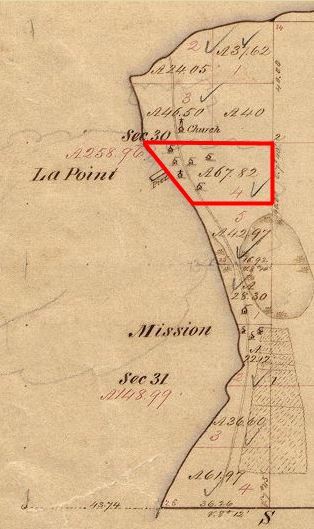
“Lot number four (4)“ is New Fort (downtown) La Pointe.
~ General Land Office
Lot number four (4) Township fifty (50) Section No. thirty (30) and Range No. three west containing sixty seven & 82/100 acres of land according to the Government Survey.
To have and to hold the same, together with all and singular the appurtenances and privileges thereunto belonging or in any wise appertaining and all the Estate Right, Title, Interest and Claim whatsoever, of the said party of the first part, either in Law or Equity, in and to the above described premises, to the only proper use, benefit and behoof of the said party of the second part, his heir and assigns forever, and the said Julius Austrian party of the first part for himself his heirs Executors and administrators do covenant and agree to and with the said party of the second part, his heirs and assigns that he is well seized in Fee of the aforesaid premises, and has good right to sell and convey the same, in manner and form as above written, and that the same are free of all incumbrances whatever, and that the aforesaid premises, in the quiet and peaceable possession of the said party of the second part, his heirs and assigns, against all and every person lawfully claiming or to claim the whole or any part thereof, he will forever warrant and defend.

Julius Austrian
~ Madeline Island Museum
Provided nevertheless that if the said Julius Austrian of the first part, his heirs, administrators, executors or assigns shall well and truly pay or cause to be paid to the said Charles H Oakes party of the second part, his heirs, executors, administrators or assigns the sum of Sixteen (16) Hundred Dollars, lawful money, in six equal annual payments, according to the condition of six certain notes bearing even date with, then this deed to be null and void, otherwise to be and remain in full force and effect, but if Default shall be made in the payment of the said sum of money, or the interest, or of any part thereof, at the time herein before specified for the payment thereof, the said party of the first part, in such case, does hereby authorize and fully empower the said party of the second part his executors, administrators or assigns, to sell the said hereby granted premises, at Public Auction, and convey the same the same to the purchase in Fee Simple, agreeably to the statute in such case made and provided, and out of the moneys arising from such sale, to retain the Principal and interest, which shall then be due on the said notes, together with all costs and charges, and pay the overplus (if any) to the said Julius Austrian, party of the first part his heirs, executors administrators or assigns.
In testimony whereof the said party of the first part has hereunto set his hand and seal the day and year first above written.
Julius Austrian
Sealed and delivered in presence of
~ Findagrave.com
Isaac V D Heard
I Van Etten
Territory of Minnesota
County of Ramsay
Be it known that on the second day of May AD 1853, before the undersigned, personally came Julius Austrian the Grantor to the foregoing and within Deed from him as such Grantor to Charles H Oakes, to me personally known to be the identical person described in and who executed the said deed, and who acknowledged that he executed the said deed freely and voluntarily for the uses and purposes therein expressed.
I Van Etten
Notary Public
Minnesota Territory

Charles W. W. Borup and Charles H. Oakes: married into the La Pointe mixed blood Beaulieu family; built the American Fur Company outift at New Fort, La Pointe; and started Minnesota’s first bank.
~ HeritageAuctions.com
St. Paul, May 2nd 1853
$200
Julius Austrian
– – – – –
St. Paul, May 2nd 1853
$300
On or before the first day of November A.D. 1854, I promise to pay Charles H. Oakes, on order, at the office of Mesfrs. Borup and Oakes, St. Paul, Min. Ter., the sum of Three Hundred dollars, value received—and in case of default in the payment of the above sum of money, then I agree to pay interest on said principal sum at the rate of ten percent per annum until paid.
Julius Austrian
– – – – –
St. Paul, May 2nd 1853
$200
Julius Austrian
– – – – –
St. Paul, May 2nd 1853
$400
Julius Austrian
[Filed 11/30/89]
Power of Att’y
from Jos Austrian
to Jul. A.
Registers certificate inside.
Recorded.
– – – – –
State of Michigan
County of Houghton
Joseph Austrian lived at La Pointe with his brother Julius during 1851 and 1852.
~ Austrian Papers
Know all men by these presents that I Joseph Austrian of Eagle River county of Houghton and State of Michigan have made, authorized, nominated and appointed and by these presents do make authorize nominate and appoint Julius Austrian of La Pointe county of La Pointe and State of Wisconsin my attorney for me and in my name and to my use, to enter into, and take possession of all such messuages, lands tenements, hereditaments, and real estate whatsoever, in La Pointe County of La Pointe State of Wisconsin, whereof I now am, or hereafter may be by any ways or means howsoever entitled or interested in, either in severalty and jointly or in common with any other person or persons.
And also for me and in my name, to grant, bargain, and sell, the same messuages lands, tenements and hereditaments, or any part, share or portion thereof, and all such rights, titles, interest, claim, and demand both in law and equity, as I may have in the same, for such sum and price, and on such terms, as to him shall seem meet, and for me and in my name to make, execute, and deliver good and sufficient deeds and conveyances for the same, and every part thereof, either with or without covenants and warranty.
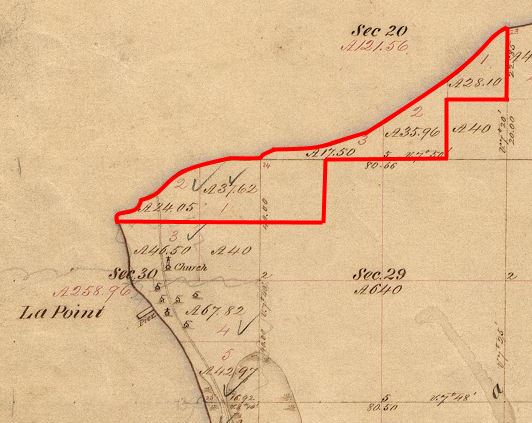
The north coast of La Pointe was patented in Joseph Austrian‘s name during 1852.
~ General Land Office
And while the sale thereof, for me, and in my name, and for my use, to let and do wise the same real estate or any part of parts thereof for the best rent that can be gotten for the same.
And also for me and in my name, and to my use to ask, demand, recover and receive all sums of money which shall become due, owing or payable to me by means of any such bargain, sale or lease. And to have, use, and take, all lawful ways and means for the recovery thereof by attachment, unrest, distress, or otherwise, and to compound, arbitrate, and agree, for the same and aquittances or sufficient discharges for the same, for me and in my name, to make, seal and deliver, and generally to do, execute, and perform, every thing that may be neccesary in and about the premises, as fully in every respect as I myself might or could do, if I were personally present.
And an attorney or attorneys under him for any or all of the purposes aforesaid, to make and substitute, and again at pleasure to revoke. And I hereby ratify, allow, and confirm, all, and whatsoever my said attorney shall do or cause to be done, in and about the premises by virtue of these presents. In witness whereof I have hereunto set my hand and seal.
Eagle River May 31st 1854.
Joseph Austrian
Signed Sealed and delivered in the presents of
Charles Hembeck
A W. Senter
State of Michigan
County of Houghton
Personally appeared before me Joseph Austrian and acknowledged that he executed the within Power of Attorney, and I further certify, that I well know the said Joseph Austrian, and that he is the same individual who is described as the within conveyance and who executed the same. Eagle River May 31st 1854.
Simon Mandlebaum
Justice of the Peace
Houghton County
Michigan
– – – – –
STATE OF MICHIGAN,
County of Houghton
I James Crawford Clerk of said County of Houghton DO HEREBY CERTIFY, that Simon Mandlebaum – whose name is subscribed to the Certificate or proof of acknowledgement of annexed Instrument, and therein written, was, at the time of taking such proof or acknowledgement a Justice of the Peace in and for said County, duly Elected and qualified, and duly authorized to take the same; AND FURTHER, that I am well acquainted with the hand writing of such Justice of the Peace and verily believe that the signature to the said Certificate or proof of acknowledgement is genuine; I FURTHER CERTIFY, that said Instrument is executed and acknowledged according to the Laws of this State.
IN TESTIMONY WHEREOF, I have hereunto set my hand and affixed the seal of said County, at Eagle River this Twelfth day of September A. D. 1856.
James Crawford
Clerk.
A Warranty Deed
S S Vaughn and Peter B Vanterventer
to
M. H. Manddlebaum
7 day April A. D. 1855
Recd for Record April 7 1855 at 4 Oclock P.M and Recorded in Book A of Deeds on Page (127)
John W Bell
Register of Deeds for
La Pointe County
Wis
– – – – –
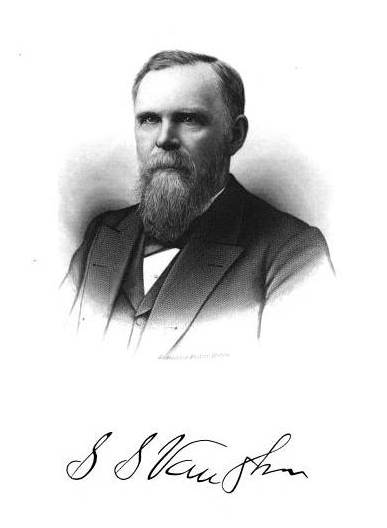
Samuel Stuart Vaughn
~ Western Reserve Historical Society
Know all men
by these presents that we S. S. Vaughn and Peter B Vanderventer and Caroline Vanderventer his wife of the Town and County of Lapointe and State of Wisconsin in consideration of Two hundred Sixty Two and a half dollars to us paid by M. H. Manddlebaum of Town County and State aforesaid the receipt whereof we do hereby acknowledge do by these presents give grant bargain sell and convey unto the said M H Manddlebaum his heirs and assigns a certain piece of land described as follows to wit lot No F??? one in Section No Four and lot No one in Section No Five Township no Forty nine range no Three containing Fifty two acres and forty seven hundreth of an acre together with all the privileges and appurtenances to the said land in any wise appertaining and belonging.

Vaughn/Vanderventer‘s lots 1 & 1 by Old Fort (Grant’s Point) La Pointe.
~ General Land Office
To have and to hold the above granted granted premises to the said M. H. Manddlebaum his heirs and assigns and to his and their use and behoof forever. And we S. S. Vaughn and Peter B Vanderventer and Caroline Vanderventer his wife for ourselves our heirs executors and administrators do covenant with the said M. H. Manddlebaum his heirs and assigns that we are lawfully seized in fee of the aforesaid premises that they are free from all incumbrances that wee have a good right to sell and to convey the same to the said M. H. Manddlebaum as aforesaid and that we will and ours heirs executors and administrators shall warrant and defend the same, to the said M H Manddlebaum his heirs and assigns forever against the lawful demands of all persons.
In testimony whereof we have hereunto set our hand and seal this 7 day of April A.D. 1855
S. S. Vaughn
P. B Vanderventer
Carline (her X mark) Vanderventer
Antoine Gordon was an influential Mixed Blood member of the La Pointe Band.
Sealed and delivered in presence of
John W Bell
A. Gaudin
State of Wisconsin
Lapointe County
April 7th 1855
They personally appeared before me the above named S. S. Vaughn, Peter B Vanderventer and Caroline wife of said Peter B. Vanderventer, who severally acknowledged they did sign and seal the foregoing instruments as their free act and deed, and the said Caroline wife of said Peter B Vanderventer on a private examination before me separate and apart from the said husband acknowledged that she did execute the foregoing deed without any fear or compulsion from her said husband or any other person.
John W Bell
Justice of the Peace in & for
Lapointe County Wisconsin
Deed ~
Antoine & Sarah Gaudin
to Joseph Austrian
Received for Record June 16 1855 [???] and Recorded in Book A of Deeds on page 153.
John W Bell Register for
La Pointe County Wisconsin
– – – – –
WARRANTY DEED. — Printed and sold by SANFORD & HAYWARD, Cleveland, Ohio.
To all People to whom these Presents shall come—GREETING:
KNOW YE, That
we Antoine Gaudin of the County of La Pointe and State of Wisconsin and Sarah wife of said Antoine Gaudin

“Mr. and Mrs. Antoine Gordon,
the founders of Gordon,
would have liked King Midas Flour.”
~ History of Gordon
For the consideration of the sum of two hundred and fifty dollars received to our full satisfaction of Joseph Austrian of Eagle River in the State of Michigan do give, grant, bargain, sell and confirm unto him the said Joseph Austrian the following described TRACT or LOTS of LAND, situate in the township of Lapointe being number (49) in the third range of Townships, which is also in the county of Lapointe and is known
as Lots two (2) and three (3) of section number five (5) containing one hundred acres (100)
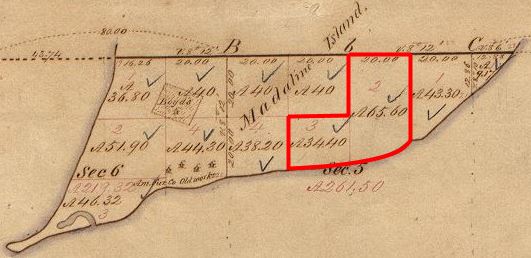
Gordons’ lots 2 & 3 near Old Fort (Grant’s Point) La Pointe.
~ General Land Office
TO HAVE AND TO HOLD the above granted and bargained premises, with the appurtenances thereunto belonging, unto him the said Joseph Austrian his heirs and assigns forever, to his and their own proper use and behoof. And we the said Antoine Gaudin and Sarah his wife do, for ourselves our executors and administrator, covenant with the said Joseph Austrian his heirs and assigns, that at, and until the ensealing of these presents we are well seized of the premises, as a good and indefeasible estate in FEE SIMPLE, and have good right to bargain and sell the same in manner and form as above written, and that the same be free from all incumbrance whatsoever. And furthermore, we the said Antoine Gaudin and Sarah his wife do by these presents find ourselves, our heirs, forever, to WARRANT AND DEFEND the above granted and bargained premises to him the said Joseph Austrian his heirs and assigns, against all lawful claims and demands whatsoever. And I the said Sarah wife of the said Antoine Gaudin do hereby remise, release, and forever quit claim unto the said Joseph Austrian his heirs and assigns, all my right and title of dower in the above described premises.
wife of Antoine Gaudin.
In Witness Whereof, we have hereunto set our hands and seals the fourteenth day of June in the year of our Lord one thousand eight hundred and fifty five.
A. Gaudin
Sarah (her X mark) Gaudin
Signed, Sealed and Delivered
in presence of
John .W. Bell.
M. H. Mandelbaum
THE STATE OF WISCONSIN,
COUNTY OF LA POINTE.
June 14 1855.
Personally appeared before the me above named Antoine Gaudin and Sarah his wife who acknowledged that they did sign and seal the foregoing instrument, and that the same is their free act and deed. I further certify, that I did examine the said Sarah wife of said Antoine Gaudin separate and apart from her husband, and did then and there make known to her the contents of the foregoing instrument, and upon that examination she declared that she did voluntarily sign, seal and acknowledge the same, and that she is still satisfied therewith.
John W. Bell
Justice of the Peace
Warrantee Deed
Joseph Austrain
to
Francois Cadotte
Office of Register of Deeds
La Pointe County Wis
I hereby Certify that the within Deed was filed in this office for Record Jany 21st 1858 A M and was duly Recorded in Book A of Deeds Vol [2 or 3?] and page 239.
John W Bell
Register
Fees $1.00
– – – – –
WARRANTY DEED.
Sold by E. Terry & Co., Milwaukee
This Indenture,
Made the Twenty first day of January in the year of our Lord one thousand eight hundred and fifty eight between
Joseph Austrian by Julius Austrian his attorney in Fact Party of the first part and Francois Cadotte of Lapointe County Wisconsin, party of the second part.

Antoine and Frank Cadotte (son and grandson of Michael and Madeline Cadotte, and Mixed Blood member sof the La Pointe Band).
~ Madeline Island Museum
Witnesseth, That the said party of the first part, for in consideration of the sum of Forty dollars Lawfull Money of the United States of America to him in hand paid by the said party of the second part, the receipt whereof is hereby confessed and acknowledged has given, granted bargained, sold, remised, released, aliened, conveyed, and confirmed, and by these presents does give, grant, bargain, sell, remise, release, alien, convey, and confirm unto the said party on the second part, and his heirs and assigns forever
the following Described Real Estate situated in the County of of Lapointe and State of Wisconsin, and Known as Lot number Thirty four (34) in the Town of Lapointe according to the Recorded Plat of said town as recorded in the Registers Office of said County of Lapointe.

Cadotte‘s block 34 in downtown La Pointe.
~ Julius Austrian Papers (maps folder)
Together with all and singular the Hereditaments and Appurtenances thereunto belonging, or in any wise appertaining; and all the estate, right, title, interest, claim, or demand whatsoever of the said party of the first part, either in Law or Equity, either in possession or expectancy of, in and to the above-bargained premises, and their Hereditaments and Appurtenances TO HAVE AND TO HOLD the said premises as above described, with the Hereditaments and Appurtenaces unto the said party of the second part, and to his heirs and assigns forever.
And the said Joseph Austrian by his P attorney for himself his heirs, executors, and administrators, does convenant, grant, bargain, and agree to and with the said party of the second part, his heirs and assigns, that at the time of the ensealing and delivery of these present, he is well seized of the premises above described, as of a good, sure, perfect, absolute, and indefeasible estate of inheritance in the Law, in fee simple, and that the same are free and clear from all incumbrances whatever, and that the above-bargained premises in the quiet and peaceable possession of the said party of the second part, his heirs and assigns against all and every person or persons, lawfully claiming the whole or any part thereof [???] will forever WARRANT AND DEFEND.
In Witness Whereof, the said party of the first part, has hereunto set his hand and seal the day and year first above written
Joseph Austrian
by Julius Austrian
his Att in fact.
Sealed and delivered in presence of
John W Bell
STATE OF WISCONSIN
COUNTY OF La Pointe
Be it Remembered, that on the Twenty first day of January A. D. 1858 personally came before me the above-named Joseph Austrian by Julius Austrian his attorney in fact to me known to be the person who executed the said Deed, and acknowledged the same to be his free act and deed, for the uses and purposes therein mentioned.
John W Bell
Justice of the Peace
Antoine Gordon & wife
to Julius Austrian
Office of Register of Deeds
La Pointe County Wis
I hereby Certify that the within Deed was filed in this Office for Record July 11th 1858 oclk and was duly Recorded in Book A of Deeds Vol 2 & page 296.
J W Bell
Register
rec 1 day of July 1861
$550 – 7%.
– – – – –
WARRANTY DEED. Sold by E. Terry & Co., Milwaukee.
This Indenture,
Made the Eleventh day of February in the year of our Lord one thousand eight hundred and fifty eight between
Antoine Gaudin and Sarah Gaudin his wife of La Pointe County & State of Wisonsin of the first part and Julius Austrian of the Same County and State party of the Second part.
Witnesseth, That the said parties of the first part, for and in consideration of the sum of Eight hundred Dollars receipt whereof is hereby confessed and acknowledged, has given, granted bargained, sold, remised, released, aliened, conveyed, and confirmed his heirs and assigns forever
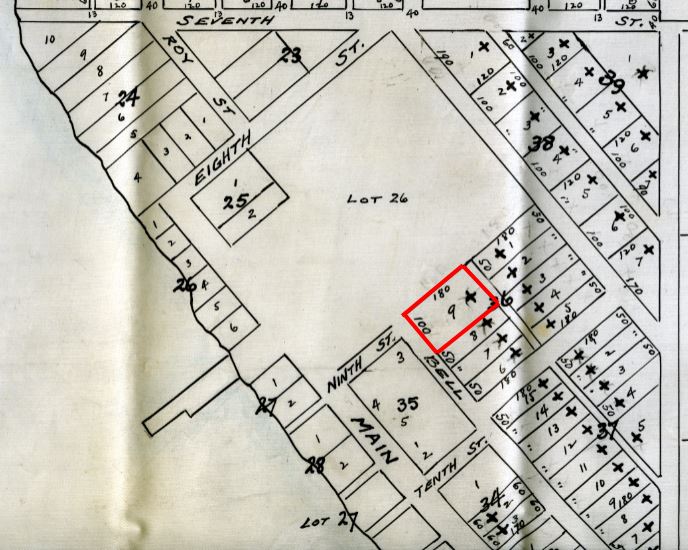
Gordons‘ lot 9 in downtown La Pointe.
~ Julius Austrian Papers (maps folder)
the following Described Real Estate situated and lying in the Town of La Pointe as on Record in the Registers Office of Lapointe County aforesaid and known and Descried as follows being Lot number nine (9) in Block number Thirty six (36) in Said Town of Lapointe, hereby absolutely Revoking and annulling a Deed of Gift, Executed by us to our son Edward on the eighth day of May 1855, and witnessed by John W Bell & William Morin and Recorded same day in the Registers Office of Lapointe County in Book A of Deeds Vol 1 & page 138 for the said described premises.
~ History of Gordon
Together with all and singular the Hereditaments and Appurtenances thereunto belonging, or in any wise appertaining; and all the estate, right, title, interest, claim, or demand whatsoever of the said parties of the first part, either in Law or Equity, either in possession or expectancy of, in and to the above-bargained premises, and their Hereditatments and Appurtenances. TO HAVE AND TO HOLD the said premises as above described, with the Hereditaments and Appurtenances, unto the said party of the second part, and to his heirs and assigns forever.
~ History of Gordon
And the said Antoine Gaudin & wife for themselves heirs, executors, and administrators, does covenant, grant, bargain, and agree to and with the said party of the second part, his heirs and assigns, that at the time of the ensealing and delivery of these present, they are well seized of the premises above described, as of a good, sure, perfect, absolute, and indefensible estate of inheritance in the Law in fee simple, and that the same are free and clear from all incubrances whatever, and that the above-bargained premises, in the quiet and peaceable possession of the said party of the second part, his heirs and assigns against all and every person or persons, lawfully claiming the whole or any part thereof He will forever WARRANT AND DEFEND.
In Witness Whereof, the said parties of the first part, has hereunto set their hands and seals the day and year first above written.
A. Gaudin
Sarah (her X mark) Gaudin
Sealed and delivered in presence of
John W Bell
John [Clikf?]
STATE OF WISCONSIN
COUNTY OF Lapointe
Be it Remembered, that on the Eleventh day of February A.D. 1858 personally came before me the above-named Antoine Gaudin & Sarah Gaudin his wife to me known to be the persons who executed the said Deed, and acknowledged the same to be their free act and deed for the uses and purposes therein mentioned.
John W Bell
Justice of the Peace
Warrantee Deeds
Francis Cadotte
to
Julius Austrian
Office of Register of Deeds
La Pointe County Wis.
I hereby Certify that the within Deed was filedin this Office for Record May the 8th 1858 at M and was duly Recorded in Book A of Deeds Vol 2 on pages 370 & 71
John W Bell
Register of Deeds
Fees $7-
– – – – –
WARRANTY DEED. Sold by E. TERRY & CO., Milwaukee.
This Indenture,
Made the Eighth day of May in the year of our Lord one thousand eight hundred and fifty Eight between
Francis Cadotte of LaPointe County, Wisconsin, party of the first part and Julius Austrian of Lapointe county party of the second part.
Witnesseth, That the said part of the first part, for and in consideration of the sum of Forty Dollars lawfull money of the United States to him in hand paid by the said party of the second part, the receipt whereof is hereby confessed and acknowledged has given, granted, bargained, sold, remised, released, aliened, conveyed, and confirmed, and by these presents does give, grant, bargain, sell, remise, release, alien, convey, and confirm, unto the said party of the second part, and his heirs and assigns forever
the following described Real Estate situate in the County of LaPointe and State of Wisconsin, and Known as Lot Number Thirty four (34) in the Town of La Pointe, according to the Recorded Plat of said Town as Recorded in the Registers Office of said County of La Pointe.
Block 34 in New Fort (downtown) La Pointe.
~ Julius Austrian Papers (maps folder)
Together with all and singular the Hereditaments and Appurtenances thereunto belonging, or in any wise appertaining; and all the estate, right, title, interest, claim, or demand whatsoever of the said party of the first part, either in Law or Equity, either in possession or expectancy of in and to the above-bargained premises, and their Hereditaments and Appurtenances. TO HAVE AND TO HOLD the said premises as above described, with the Hereditaments and Appurtenances made the said party of the second part, and to his heirs and assigns forever.
And the said Francis Cadotte for himself his heirs, executors, and administrators, does covenant, grant, bargain, and agree to and with the said party of the second part, his heirs and assigns, that at the time of the ensealing and delivery of these present, he is well seized of the premises above described, as of a good, sure, perfect, absolute, and indefensible estate of inheritance in the Law, in fee simple, and that the same are free and clear from all incumbrances whatever, and that the above-bargained premises, in the quiet and peaceable possession of the said party of the second part, his heirs and assigns against all and every person or persons, lawfully claiming the whole or any part thereof He will forever WARRANT AND DEFEND.
In Witness Whereof, the said party of the first part, has hereunto set his hand and seal the day and year first above written.
Francis Cadotte
Sealed and delivered in presence of
John W Bell
STATE OF WISCONSIN
COUNTY OF La Pointe
Be it Remembered, that on the Eight day of May A.D. 1858, personally came before me the above-named Franis Cadotte to me known to be the person who executed the said Deed, and acknowledged the same to be his free act and deed, for the uses and purposes therein mentioned.
J W Bell
Justice of the Peace
Office of Register of Deeds
La Pointe County Wisconsin Sept 5th 1859
I hereby Certify that up to this date, that the two United States Patents, to Julius Austrian numbered (79,458) and(2421) for Lands on Madeline Island have never been Recorded in this Office, nor any instrument from any person, in relation to any of the lands embraced in said Patents, and that the same are free from all incumbrances.
John W Bell
Register of Deeds
Objections to Mail Route 13780
April 10, 2017
By Amorin Mello
The following is a reproduction of “objections to Julius Austrian’s mail contract business (May 27, 1855)” from a Minnesota Historical Society collection of United States Post Office correspondences known as Selected items relating to Minnesota, 1855-1861. This is a classic example of how primary sources sources and historians tend to either honor, abhor, or ignore Julius Austrian at La Pointe. The petition was not included, but it will be reproduced here if it can be found.
Whittlesey, La-pointe Co.,
Wisconsin. May 21st, 1855

Horatio King
~ Wikipedia.org
To the Hon. Horatio King,
First Asst. Postmaster General, D.C.
Dear Sir: In addition to this petition, we would respectfully call your attention to a brief history of the base intrigues of Julius Austrian, the Jew, who now holds the contract for carrying the mail on route 13780. Heretofore there have been but few whites, that is, Yankees living upon the Island, most of the residents being halfbreeds, French and Indians. These people never have much interest in mail matters and consequently care very little whether Mr. Austrian carries the mail regularly or not. Indeed they cannot read a letter if they should receive one and therefore have no interest in such things. Now whenever Mr. Austrian wishes to effect an alteration in mail matters, he goes to these illiterate Frenchmen, gets them to sign something they hardly know what, but he gets their names and these, with his unprincipled misrepresentations, are the instruments and means by which he accomplished his selfish ends. Those who are most interested in mails, our merchants and other business men, who of course would oppose his measures, know nothing of this until the change is made, and the “Jew” triumphantly announces to them, that by his influence at Washington he has effected this or that change, a change in which those most interested and most effected, could have no voice. The change of the mail route, via St. Croix, to via Fon-Du-Lac, was accomplished in this manner; the route was perfectly satisfactory to those most interested, as it was, and they knew nothing about it until it was done. The change he has effected this winter, while at Washington, was brought about very much in the same manner, it does not meet the wants of the public.
Julius Austrian
~ Madeline Island Museum
Besides all this, he does not fulfil his present contract, and if anyone complains, he very insolently tells them, if they do not like the mail arrangements they can leave the place. The 11th of May we received a mail from Fon-dulac, how cheering to know that we must wait one month ere we could have another mail. Well, the people were indignant at such treatment, they resolved to use their utmost exertions to break up such a state of things – as soon as the “Jew” found out the indignant feelings that were among the people, he immediately dispatched a mail to Fon-du-lac, and one to Ontonagon on the 16th of May, which we believe is not in accordance with contract which he now holds, it should have left Lapointe June 5th or 8th. No one was prepared to send letters, supposing that the mail was not to go out until the last named date, consequently no good was accomplished by this irregular and untoward way of doing business. His object in this undoubtedly was to arrest our action upon the matter, by giving us to understand, that we were to have the usual privileges of mail, and as soon as our indignation had a little subsided, to do as he pleased again.
Now what we want is to give you such an insight into his doings as will forever destroy his influence at the P. O. Dept. We are tired of his underhand intrigues and disgusted with his mean duplicity. It is hard to think that the only means of doing our business correspondence and communicating with our friends can be enjoyed but twelve times a year and all through the means of an unprincipled “Jew”. We therefore respectfully ask and sincerely hope that if the Dept. can find sufficient evidence that he has broken his contract and other misdemeanors which we know him to be guilty of, they will transfer the carrying of the mail to Wm. E. Vantassle, Esq., who is a respectable man, a good citizen and every way worthy of the trust, and you will thereby illicit the gratitude of your fellow countrymen.
Unanimously approved and adopted at our indignation meeting held at Ashland Whittlesey P.O.
C. A. Rollins, Chairman.
A. W. Burtt, Secretary.
1856 Inquest on the Body of Jerry Sullivan
March 18, 2017
By Amorin Mello

Wheeler Family Papers: Box 3, Folder 12;
La Pointe County, 1849-1862
Papers Relating to an
Inquest on the Body of
Jerry Sullivan
~~~
State of Wisconsin
County of Lapointe
To any Constable of said County.
In the name of the State of Wisconsin you are hereby commanded to Summon Joseph Lapointe Oskinawa and [Cotonse for I have?] son of the little chief named [Jegequaon?] to be and appear at my office in Lapointe and give Evedince on an Inquest then & there to be held on the body of P Jerry Sullivan found frozen to death how and by what means he came to his death.
Given under my hand this 10th day of March AD 1856.
J. W. Bell
Justice of the Peace
State of Wisconsin.
To any Constable of the County of Lapointe
You are hereby required immediately to summon six good and lawfull men of the County of Lapointe to appear forthwith before me at my office in the town of Lapointe to enquire upon the view of the Dead Body of Patrick Jerry Sullivan there being dead, how and by what means he came to his death.
Given under my hand this 10th day of March 1856.
J. W. Bell
Justice of the Peace
– – – – – – – – – –
Served the within by Summoning the following Individuals and producing them in Court.
Antoine Perrinier
John Cochran
John Bono
Marks Mandelbaum
JB. Roy
Batiste Gaudin
& Edward Fornier
Antoine Cournoyer Sr. was a French-Canadian and father of a mixed-blood family in the La Pointe Band.
A. (his X mark) Cournier
Constable
Fees 50 cts
Inquest on the Body of Jerry Sullivan.
Patrick Sullivan
being duly sworn says that last Thursday evening

Captain John Daniel Angus first settled at La Pointe in 1835.
~ Madeline Island Museum
Oskinawa came to my house, and there a pair of Boots and Blanket and two quilts belonging to the deseased and was going away My little Boy seen him do so. My wife went out of Doors and asked him where the old man was, I heard them talking and I went out. I asked Oskinawa if the old man had left Angus and if he was coming to night, he replied that he did leave him the old man some where on the Ice. I went to see Oskinawa the next day and he told me that an Indian had come across and told him that the old man was sick in a house on the opposite side. I started on Saturday morning in search of the old man and called at the different houses but could get no information of him I also searched along the shore. John Morrison told me that on thursday he seen him with Oskinawa abreast of his place away a good distance from shore on his way to Lapointe. I went to Capt Angus that night to Enquire, Capt Angus told me that he had made an arrangement with Joseph Lapointe to bring the old man home with him as he was coming to Lapointe with a horse and train and he would pay him for it. on Monday afternoon after searching I found the Deseased lying on his back frozen lying on the beach about a mile or more from Lapointe and brought him home and requested that an Inquest should be held over him.
Sworn & subscribed to before me this 10th day of March 1856
J W Bell
Justice of the Peace
Inquest on the Body of Jerry Sullivan
Oskinawe
being duly sworn Says that he knows deceased. Deseased left the Bay to come to lapointe on foot thursday at about half past two o’clock PM.
I overtook him on the road Shortly after I requested the diseased to come along with me as I wanted to get ahead of horse that was going to Lapointe. Mr. Angus had given me the Old Man’s things to bring to Lapointe I had a dog and a train with me the Old Man deseased could not keep up with me and I left him. I overtook the horse at Stoney point and came home in company with the horse Joseph Lapointe had the horse. I could still see the Old Man coming after us when I was this side of the Stoney point.
Sworn to March 10th 1856 before me
J W Bell Justice
– – – – – – – – – –
John [Degequaon?]
being duly sworn says, that on Saturday last he went to the Bay & Capt Angus enquired of him if the old Man had got home.
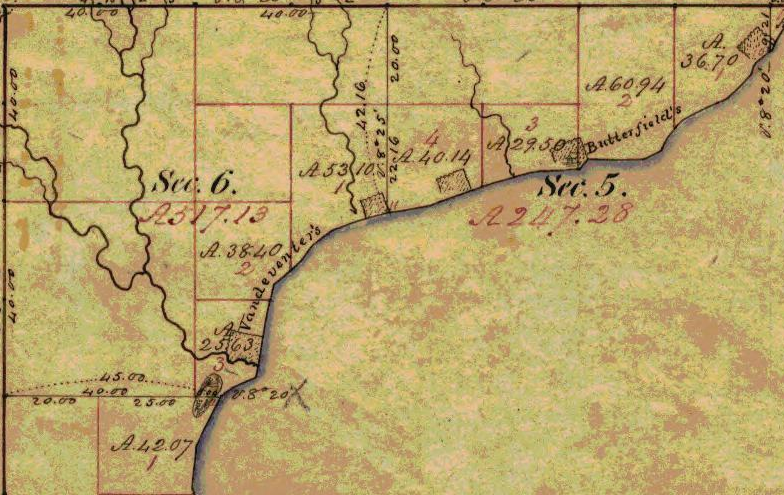
Captains Angus and Butterfield were south of Houghton Point, in what is now the City of Washburn. Detail from the Barber Brothers’ survey during August of 1855.
I answered in the negative. Capt Angus told me that he had told Joseph Lapointe on his sleigh and that he would pay him for it. Steven Butterfield told me that he heard Capt Angus tell Joseph Lapointe to take the Old Man on his sleigh. in the Evening I told Mrs Lapointe the Mother of Joseph and she said her son was very foolish in not taken the old man in his sleigh, but that she had herself told him not to take any person on his sleigh before he was paid for it as he had been cheated so often, and perhaps her son had refused the old man for the reason that the old man had once refused to lend him a bucket to water his horse.
Sworn on March 10th 1856 before me
J W Bell Justice.
– – – – –
Joseph Lapointe
duly sworn says, that he left the Bay with his horse to come to Lapointe on thursday afternoon that the deseased wanted to come over with him in his sleigh that he offered the deseased to bring him over to Lapointe with his things for half a Dollar but the Deseased would not agree to give it to him.
I then turned my horse and came away, on the road he broke an Iron pin and went back to Mr Angus to get it repaired that the Deseased was still there that Mr Angus did not say any thing to him at all in regard to bringing the old man over. Mr Angus never asked him to bring the old man over.
Says that the reason that he did not want any thing in his sleigh was because he wanted to get to Lapointe and back the same day.
Sworn to before me this 10th day of March 1856,
J W Bell Justice
An inquisition taken at Lapointe in the County of Lapointe, on the 10th day of March 1856 before J W Bell one of the Justices of the peace of said County, upon the view of the Body of Jerry Sullivan there dead by the Jurors whose names are hereunto Subscribed, who being duly sworn to Enquire on behalf of the people of this State when, in what manner, and by what means the said Jerry Sullivan came to his death upon their Oaths do say, that from the Evedince produced on their inquest that they Exempt any person from blame, and that owing to the late hour of starting the deceased came to his Death by freezing in making an effort to reach home.
In testimony whereof the said Justice of the Peace and the Jurors of this inquest have hereunto set their hands the day and year aforesaid.
John W. Bell
Justice of the Peace
W. J. Cochran
M. H. Mandelbaum
John Bono
Antoine Perrinier
Edward Fornier
John B. Roy~ Jury ~
Patrick Sullivan
Son of the diseased being duly sworn Says that Deseased was not possesed of any real Estate, and all the personal Estate that he knows of was
Money to the amount of 35.00 which he left with my wife, 7.00 which he lent me, 6 cents was found in his pocket after his disease and 1 Barrel of Flour which I got of him valued at 20.00. Making $62.06. He told me that Captain Angus Owed him for some labor, likewise he had some potatoes hid in the ground and some wood in the woods cut. the Diseased made my house his principal home. he had a due Bill on Mr
J haveAustrian for the Sum of 3.75. Total in Money & due Bills 65.81. also 5.00 worth of meal. 70.81Incidental Expenses paid by me out of the above for
holding an Inquest and Burrial rites, Church Rites &cExpenses of Inquest Jury fees & witnesses &c $8.37
Paid for Coffin & Outer Box 9.38
Paid the Preist for a Mass 5.00
To 4 Men looking for Diseased 4.00
Paid Paul Souliere 2.00
Henry Brissette 1.00
Michael Brissette for teaming 1.00
two Indian Boys for bringing Deseased 2.00
John Cochran two Days. 3.00
Hauling Sand for grave 4.50
[Bisson?] 1 Day searching for diseased 1.00
Ten Dollars for a Railing round the Grave 10.00
Grave Stone 5.00
To Massers to be said hereafter 15.00
Decided that Patrick Sullivan is the proper person to collect and settle all affairs of the diseased. and what remain he is entitled to for his trouble.
Edwin Ellis Incidents: Number I
February 11, 2017
By Amorin Mello

Originally published in the June 16th, 1877, issue of The Ashland Press. Transcribed with permission from Ashland Narratives by K. Wallin and published in 2013 by Straddle Creek Co.
EARLY RECOLLECTIONS OF ASHLAND.
“OF WHICH I WAS A PART.”
Edwin Ellis, M.D.
~ Western Reserve Historical Society
My Dear Press:– In these joyous days of Ashland’s history, when we are all made glad by the completion of that great enterprise – the Wisconsin Central Railroad – when from banishment and isolation from the populous portion of our State and from the great world we in one day are brought in close contact with and feel the throbbings of the pulse of commercial and social life, it may be of interest to some to recall a few incidents of the early history of our town and its vicinity.
The years 1853 to 1857 were noted in the West for adventure and enterprise in pushing into new regions and laying out and building new towns.
Land Office Fraud;
Barber Papers Prologue;
Part VI of Sketch of Vincent Roy Jr.
In 1853 the site of Superior City had been pre-empted and in 1854, laid out into regular lots and blocks, and the work of a new city begun. The site had attracted the attention and capital of some of our ablest men. It was backed by stronger political influences than ever combined to lay the foundations of any town in the west. Among its proprietors were many leading members of Congress and of the Cabinet, especially from the South. The most sanguine expectations of its future greatness were entertained, for it commanded a scope of country as great as that paying tribute to Chicago. Its lots were sold at fabulous prices. It was in 1855 and 1856 – probably the most talked of town in the Union.
The temporary success of Superior kindled a blaze of speculation, which spread far and wide in Wisconsin, Minnesota and Michigan.
Some of the founders of Superior at the map, saw stretching away to the South-west from the Apostles’ Islands, a deep bay, extending far inland, as if reaching forth to reach the tide of commerce flowing northward from the Gulf and the Atlantic.
This was our Chegomegon or Long Island Bay. The report of Foster and Whitney also told of mountains of iron ore, which must find its way into the channels of commerce, by the waters of this bay. An important town, it was thought, must spring up near its head.

Martin Beaser
~ Western Reserve Historical Society
While plans were maturing for the occupation of this site, we learned that another party had been attracted by the same considerations that moved us, and that Martin Beaser, Asaph Whittlesy, and Geo. Kilbourn had entered upon and claimed about three hundred acres under the townsite law. The land had not yet been surveyed, and of course could not be entered or pre-empted. The two latter gentlemen were on the spot, having arrived in the summer of 1854. But we were not deterred by these anticipations of our plans.
Early in February, 1855, Edwin Ellis, as the representative of several enterprising capitalists of St. Paul, left the latter city with one companion, Cyrus A. Rollins, to examine the situation and site, and if thought advisable and practicable, to make a lodgement there. The writer was then in full prime and vigor of early manhood, and full of ambition and bright expectations. The way from St. Paul was through an unbroken wilderness. The Lake Superior & Mississippi Railroad had not been conceived. In truth, no railroad had then approached within three hundred miles of the great Lake. The present city of Duluth in its visions of the near future – the Damascus between the Atlantic and Pacific – the halting place of the North Pacific caravan, bringing to New York and London, the wealth of India, and China and Japan, and the Islands of the South sea – was then only occupied by the wild Indian.
Emmet Jefferson, who subsequently pre-empted the site of Duluth, was one of our party from St. Paul; but for many years he had slept in his last sleep. Three or four other adventurers were with us and though it was cold and the way hard, we were a wild and joyous party of young men, going forth to seek our fortunes,– not doubtful of success.
At Superior we first saw the Great Lake. Half a dozen houses – a store or two and the beginnings of a hotel, comprised all of that rival to Chicago.
Among our acquaintances formed there, of which there were several pleasant ones, were Capt. Markland, a soldier of the Mexican war, a lawyer by profession, a man of culture, courteous in manner and stately in his bearing;– Washington Ashton, the pioneer publisher of Superior, and Colonel Carleton, who had been for several years a resident at Fond du Lac, and whose name is perpetuated by the name of a county in Minnesota. All of them have been long years dead.
Having rested a day and bade adieu to our traveling companions, already dear to us as the sharers of our toils, we turned our faces towards the east. We were fortunate in securing as a pilot on our untried voyage, Baptiste Gauden – mail carrier between Superior and La Pointe. Here we first saw a dog train, which relieved us of our packs; and at night Baptiste assisted in pitching our camp, “a day’s march nearer home.” He “still lives,” and devotes much of his time to the service of the Roman Catholic Church, of which he is an obedient and devoted son.

George Riley Stuntz had a settlement and sawmill near the mouth of the Iron River, 1852.
~ General Land Office Records

Detail of foot trails in the Sioux River Valley, 1855.
~ General Land Office Records
Leaving Superior late in the forenoon, we arrived at Iron River, twenty miles away; where we were happy to find shelter in a logging camp, full of robust, hearty, whole-souled men, some of whom had come from cultivated homes in the east. By some means strange to most of that company, the traveling pilgrim discovered a brother of the mystic tie, with whom he passed a pleasant evening, thankful for that fraternal bond, which makes strangers friends and brothers at sight.
Leaving Iron River the next morning, two days march brought us to La Pointe via the valley of the Sioux river, passing through the wilderness then, which is now the cultivated vale, made classic by being the dwelling place of the “Sage of Avoca;” the peer in farming to the immortal Horace, who has earned his title to the peerage by “causing two blades of grass to grow, where but one grew before he came,” and of him we may say:
Remote from cities lived a swain,
Unvexed with all the cares of gain;
His head is silvered o’er with age,
And long experience makes him Sage.
Antoine Gordon
~ Noble Lives of a Noble Race by the St. Mary’s Industrial School (Odanah), page 207.
At La Pointe the first object to meet our profane view were numerous large wooded crosses ten to fifteen feet high, in different parts of the town, erected by the pious zeal of the faithful believers in the then new dogma of “Immaculate Conception.” We saw also an imposing procession of French mixed bloods, escorting a fat, good natured looking priest through the street, under a gaudy canophy, borne by four devout servants of the Church. This also was in honor of the same dogma.
We put up for the night at the only hotel of the place, kept by Antoine Gauden, whose aged father, that very night, amid the chanting and prayers of the virgin saints of La Pointe, passed into the presence of the Eternal. La Pointe at that time was of much greater importance than at present – the most important town on the Lake west of Ontonagon. It was the annual gathering place of several thousand Indians, who then received their annual payments. It was the center of the fish trade for all this part of the Lake. It had, also, quite an extensive fur trade.

Samuel Stuart Vaughn
~ Western Reserve Historical Society
Julius Austrian had an extensive store of general merchandise and transacted a large business. Hon. S.S. Vaughn, one of Ashland’s present most substantial citizens, was then a young merchant at La pointe, where by close attention to business, he was laying the foundation of the fortune he has since achieved. Wm. E. Vantassel, Government Blacksmith for the Indians, a descendant of an old Knickerbocker family was there – a very skillful workman and a very genial man. In old age he now resides near Stillwater, Minnesota. Francis McElroy was also there, full of life and energy. And last but not least, I must mention John W. Bell, Esq, who even then had lived on the Island more than twenty years, and whose recollections carried him back till he could almost hear the war whoop of the Sioux and Chippewas as the latter drove their old enemies forever away from the land of the Ojibwas. He has for many years been the “Patriach” of the Island, and is much esteemed by his neighbors.

Frederick Prentice
~ History of the Maumee Valley by Horace S Knapp, 1872, pages 560-562.
Resting one night, on the following day we started across the bay on snow-shoes, reaching the shore near the Kaukaugon river. We followed the coast west, and at nightfall we found tracks leading up the ravine, a few rods from where the railroad track now touches the water of the bay. We found here a log house, built by Lusk, Prentice & Co., for purposes of trade and with the plan for the occupation of the site. Here we passed our first night. The ruins of the shanty may be seen on the block now occupied by the residence of Ferinand Schupp. Adolphus Bart, the clerk of the company, was in charge and made us welcome with his good cheer. He is now a lawyer in the State of New York.
To be continued in Number II…
Asaph Whittlesey Incidents: Number I
February 9, 2017
By Amorin Mello

Originally published in the February 16, 1878, issue of The Ashland Press. Transcribed with permission from Ashland Narratives by K. Wallin and published in 2013 by Straddle Creek Co.
Early Recollections of Ashland: Number I
by Asaph Whittlesey
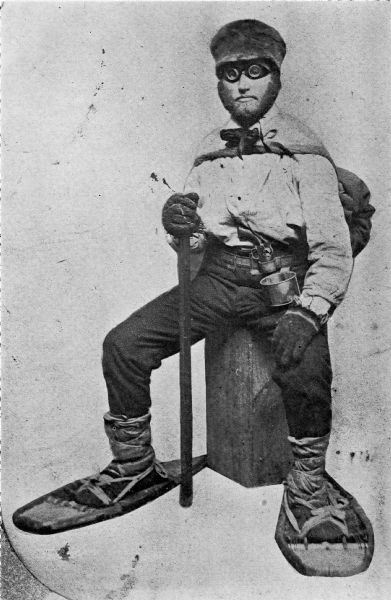
Photograph of Asaph Whittlesey from the Wisconsin Historical Society.
Our first arrival at La Pointe being so intimately associated with the settlement of Ashland, I have determined to make our arrival there the subject of my first letter.
It was among the first days of June, 1854, that George Kilburn, Jr., myself and wife and only child, Eugenia, (then some eighteen months old,) made a landing at La Pointe with a view to remain permanently in the country. Well do I remember the beautiful “town,” spread before us as we merged from the “old log warehouse” through which we passed in reaching the shore, while the general appearance was that of neatness and comfort.
Photograph of Julius Austrian from the Madeline Island Museum.
We had already made the acquaintance of Mr. and Mrs. Julius Austrian, having had the pleasure of their company up the Lakes, and had made many inquiries of them as to the place of our destination. From this time forward we found Mr. and Mrs. Austrian to be most agreeable neighbors and associates, and these young “brides” spent much of their time together, and not unfrequently did the evening air carry to listening crowds our notes of “Good old Colony times,” and “There’s no place like home,” still fresh in our memory.
La Pointe at this time was the second in importance of towns upon the Lakes, Ontonagon taking the lead.
Within a few days after our landing, we were fully organized as “house keepers,” under the same roof with Mr. and Mrs. George Starks, now residents of Bayfield; who proved to be most excellent neighbors, and never did a single roof cover a more harmonious trio of families.
We had, however, a common “foe” to encounter, visions of which filled our dreams and harassed our waking moments. This “foe” was the everlasting “bed bug,” more numerous and more determined in their onslaught than is the “Russian Army;” while this mixture of Dutch and Yankee blood served to satisfy their ravenous appetites. We had heard of this race before, but this was the first time we had met in open combat, face to face. It was our custom regularly before retiring to rest to go into combat with them armed with “wooden spads,” with which we slaughtered them by the quart. Our plan was to remain awake an hour or so after retiring to bed, when we would strike a light which was a signal for a field fight. It was an exciting scene to witness their ranks surrounding us on every hand, while the sheets of our bed seemed dyed in human blood. One means of our defense was to have the bed posts stand in molasses; but this only put them to the trouble of marching to the ceiling above from which they dropped upon us like hail; of course all these contingencies helped to make my wife good natured, and strengthen her attachments to the country. This condition of things lasted while we remained occupants of the building, and when we, in our weakness from loss of blood, staggered forth to make us a home elsewhere, we were filled with anxiety as to the safety of our German neighbors.
“Dr. Borup, the agent for the American Fur Company, (who have an extensive trading-post at this place,) has a superb garden. In walking through it with him, I saw very fine crops of the usual garden vegetables growing in it. His red currant bushes were literally bent down beneath their weight of ripe fruit. His cherry-trees had also borne well. Gooseberries also succeed well. The doctor also had some young apple-trees, that were in a thriving condition. Poultry, likewise, does well. Mrs. B. had her yard well stocked with turkeys, geese, ducks, and chickens.”
~ “Morgan“ at La Pointe during 1845.
As I have before stated, the general appearance of the island was most attractive. The garden of Mr. Austrian was laid out most tastily. We found there a large variety of fruit trees, apples, plums, cherries, etc. Also large quantities of currants and strawberries; but the crowning attraction was the “grape bower,” affording a most attractive lounging place. Here also a merry party, consisting, so far as my recollection serves me, of the following persons: Mr. and Mrs. Julius Austrian, Rev. John Chebohm, (who, I remember, asked the blessing at the table,) Marks Austrian, Mr. H. Mandelbaum, Henry Smit, Mr. and Mrs. Hocksteiner, Mr. and Mrs. George Starks, old Mr. and Mrs. Perinier, Mr. and Mrs. Asaph Whittlesey, and I think Mrs. William Herbert, and a Mr. Roy, celebrated the
“FORTH OF JULY,” 1854.
Being a curious mixture of Americans, Jews, Germans, French and Austrians, no two of whom could carry on a very extensive conversation, for want of a knowledge of the languages, so that our toasts were mainly received in silence, nevertheless the day was passed most pleasantly, while the reading of the Declaration of Independence by Asaph Whittlesey, marked it as a day for national celebration.
 Chequamegon History