1837 Petitions from La Pointe to the President
January 29, 2023
Collected & edited by Amorin Mello
Letters Received by the Office of Indian Affairs:
La Pointe Agency 1831-1839
National Archives Identifier: 164009310
O. I. A. La Pointe J171.
Hon Geo. W. Jones
Ho. of Reps. Jany 9, 1838
Transmits petition dated 31st Augt 1837, from Michel Cadotte & 25 other Chip. Half Breeds, praying that the amt to be paid them, under the late Chip. treaty, be distributed at La Pointe, and submitting the names of D. P. Bushnell, Lyman M. Warren, for the appt of Comsr to make the distribution.
Transmits it, that it may receive such attention as will secure the objects of the petitioners, says as the treaty has not been satisfied it may be necessary to bring the subject of the petition before the Comsr Ind Affrs of the Senate.
Recd 10 Jany 1838
file
[?] File.
House of Representatives Jany 9th 1838

Sir
I hasten to transmit the inclosed petition, with the hope, that the subject alluded to, may receive such attention, as to secure the object of the petitioners. As the Chippewa Treaty has not yet been ratified it may be necessary to bring the subject of the petition before the Committee of Indian Affairs of the Senate.
I am very respectfully
Your obt svt
Geo W. Jones
C. A. Harris Esqr
Comssr of Indian Affairs
War Department

To the President of the United States of America
The humble petition of the undersigned Chippewa Half-Breeds citizens of the United Sates, respectfully Shareth:

Bizhiki (Buffalo), Dagwagaane (Two Lodges Meet), and Jechiikwii’o (Snipe, aka Little Buffalo) signed the 1837 Treaty of St Peters for the La Pointe Band.
That, your petitioners having lately heard that a Treaty had been concluded between the Government of the United Sates and the Chippewa Indians at St Peters, for the cession of certain lands belonging to that tribe:
ARTICLE 3.
“The sum of one hundred thousand dollars shall be paid by the United States, to the half-
breeds of the Chippewa nation, under the direction of the President. It is the wish of the
Indians that their two sub-agents Daniel P. Bushnell, and Miles M. Vineyard, superintend
the distribution of this money among their half-breed relations.”
That, the said Chippewa Indians X, having a just regard to the interest and welfare of their Half Breed brethren, did there and then stipulate; that, a certain sum of money should be paid once for all unto the said Half-Breeds, to satisfy all claim they might have on the lands so ceded to the United States.
That, your petitioners are ignorant of the time and place where such payment is to be made.
That the great majority of the Half-Breeds entitled to a distribution of said sum of money, are either residing at La Pointe on Lake Superior, or being for the most part earning their livelihood from the Traders, are consequently congregated during the summer months at the aforesaid place.
Your petitioners humbly solicit their father the President, to take their case into consideration, and not subject them to a long and costly journey in ordering the payments to be made at any inconvenient distance, but on the contrary they trust that in his wisdom he will see the justice of their demand in requiring he will be pleased to order the same to be distributed at Lapointe agreeable to their request.
Your petitioners would also intimate that, although they are fully aware that the Executive will make a judicious choice in the appointment of the Commissioners who will be selected to carry into effect the Provisions of said Treaty, yet, they would humbly submit to the President, that they have full confidence in the integrity of D. P. Bushnell Esqr. resident Indian Agent for the United States at this place and Lyman M Warren Esquire, Merchant.
Your petitioners entertain the flattering hope, that, their petition will not be made in vain, and as in duty bound will ever pray.
La Pointe, Lake Superior,
Territory of Wisconsin 31st August 1837
Michel Cadotte
Michel Bosquet X his mark
Seraphim Lacombe X his mark
Joseph Cadotte X his mark
Antoine Cadotte X his mark
Chs W Borup for wife & Children
A Morrison for wife & children
Pierre Cotte
Henry Cotte X his mark
Frances Roussan X his mark
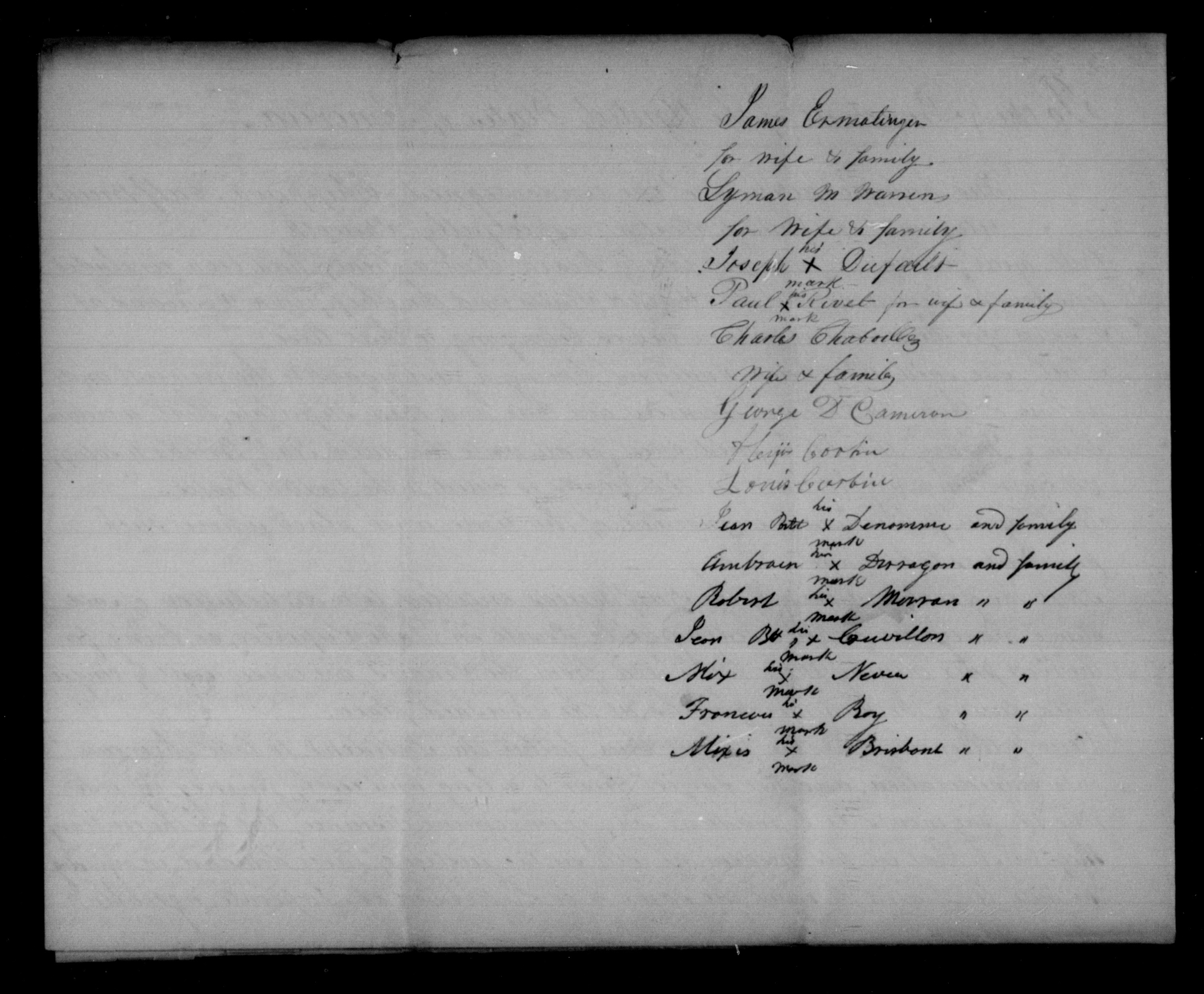
James Ermatinger for wife & family
Lyman M Warren for wife & family
Joseph Dufault X his mark
Paul Rivet X his mark for wife & family
Charles Chaboullez wife & family
George D. Cameron
Alixis Corbin
Louis Corbin
Jean Bste Denomme X his mark and family
Ambrose Deragon X his mark and family
Robert Morran X his mark ” “
Jean Bst Couvillon X his mark ” “
Alix Neveu X his mark ” “
Frances Roy X his mark ” “
Alixis Brisbant X his mark ” “
Signed in presence of G. Pauchene
John Livingston
O.I.A. La Pointe W424.
Governor of Wisconsin
Mineral Pt. Feby 19, 1838
Transmits the talk of “Buffalo,” a Chip. Chief, delivered at the La Pointe SubAgt, Dec. 9, 1837, asking that the am. due the half-breeds under the late Treaty, be divided fairly among them, & paid them there, as they will not go to St Peters for it, &c.
Says Buffalo has great influence with his tribe, & is friendly to the whites; his sentiments accord with most of those of the half-breeds & Inds in that part of the country.
File
Recd 13 March 1838
[?] File.
Superintendency of Indian Affairs
for the Territory of Wisconsin
Mineral Point, Feby 19, 1838

Sir,
I have the honor to inclose the talk of “Buffalo,” a principal chief of the Chippewa Indians in the vicinity of La Pointe, delivered on the 9th Dec’r last before Mr Bushnell, sub-agent of the Chippewas at that place. Mr. Bushnell remarks that the speech is given with as strict an adherence to the letter as the language will admit, and has no doubt the sentiments expressed by this Chief accord with those of most of the half-breeds and Indians in that place of the Country. The “Buffalo” is a man of great influence among his tribe, and very friendly to the whites.
Very respectfully,
Your obed’t sevt.
Henry Dodge
Supt Ind Affs
Hon C. A. Harris
Com. of Ind. Affairs
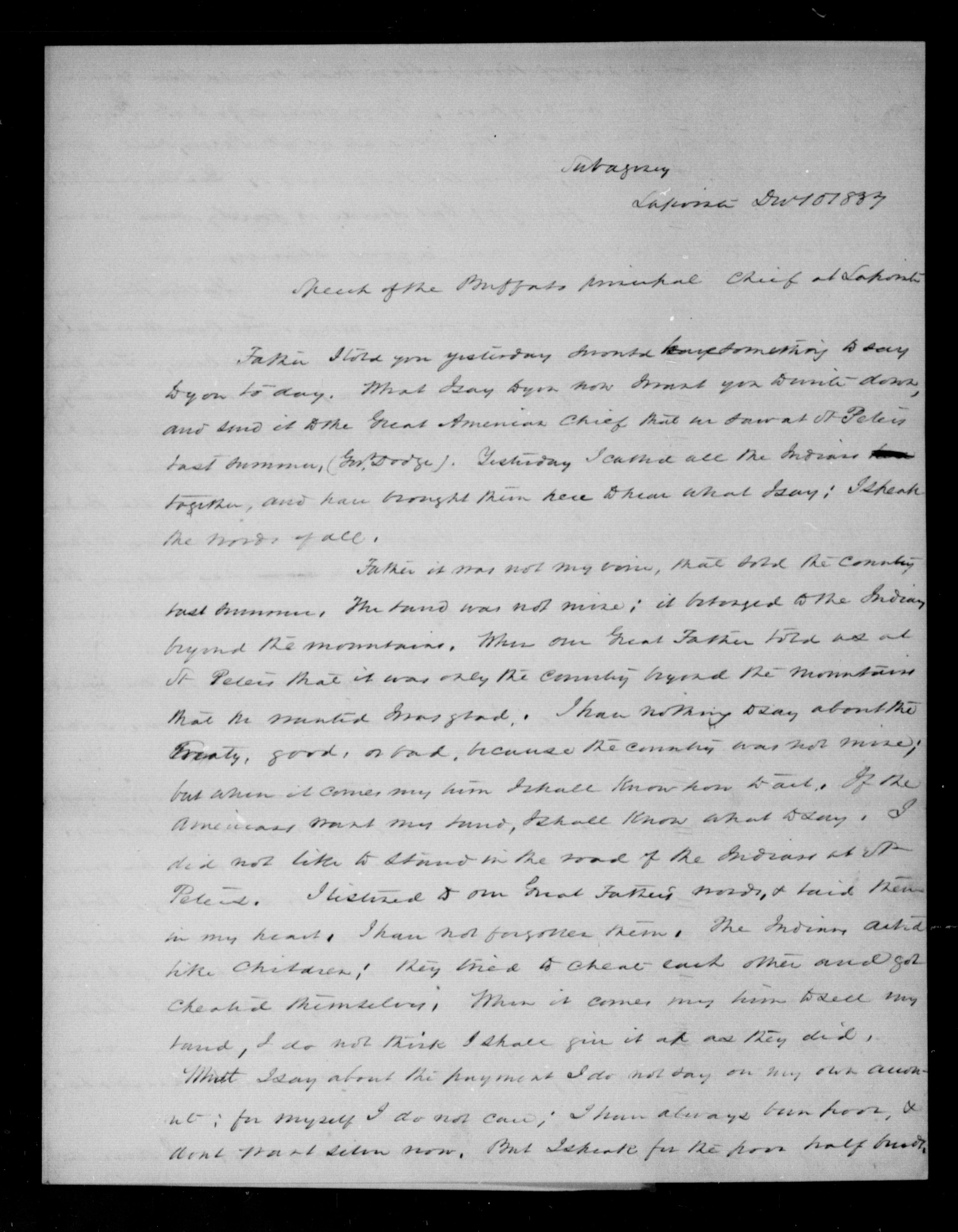
Subagency
Lapointe Dec 10 1837
Speech of the Buffalo principal Chief at Lapointe
Father I told you yesterday I would have something to say to you today. What I say to you now I want you to write down, and send it to the Great American Chief that we saw at St Peters last summer, (Gov. Dodge). Yesterday, I called all the Indians together, and have brought them here to hear what I say; I speak the words of all.
ARTICLE 1.
“The said Chippewa nation cede to the United States all that tract of country included
within the following boundaries:
[…]
thence to and along the dividing ridge between the waters of Lake Superior and those of the Mississippi
[…]“
Father it was not my voice, that sold the country last summer. The land was not mine; it belonged to the Indians beyond the mountains. When our Great Father told us at St Peters that it was only the country beyond the mountains that he wanted I was glad. I have nothing to say about the Treaty, good, or bad, because the country was not mine; but when it comes my time I shall know how to act. If the Americans want my land, I shall know what to say. I did not like to stand in the road of the Indians at St Peters. I listened to our Great Father’s words, & said them in my heart. I have not forgotten them. The Indians acted like children; they tried to cheat each other and got cheated themselves. When it comes my time to sell my land, I do not think I shall give it up as they did.
What I say about the payment I do not say on my own account; for myself I do not care; I have always been poor, & don’t want silver now. But I speak for the poor half breeds.
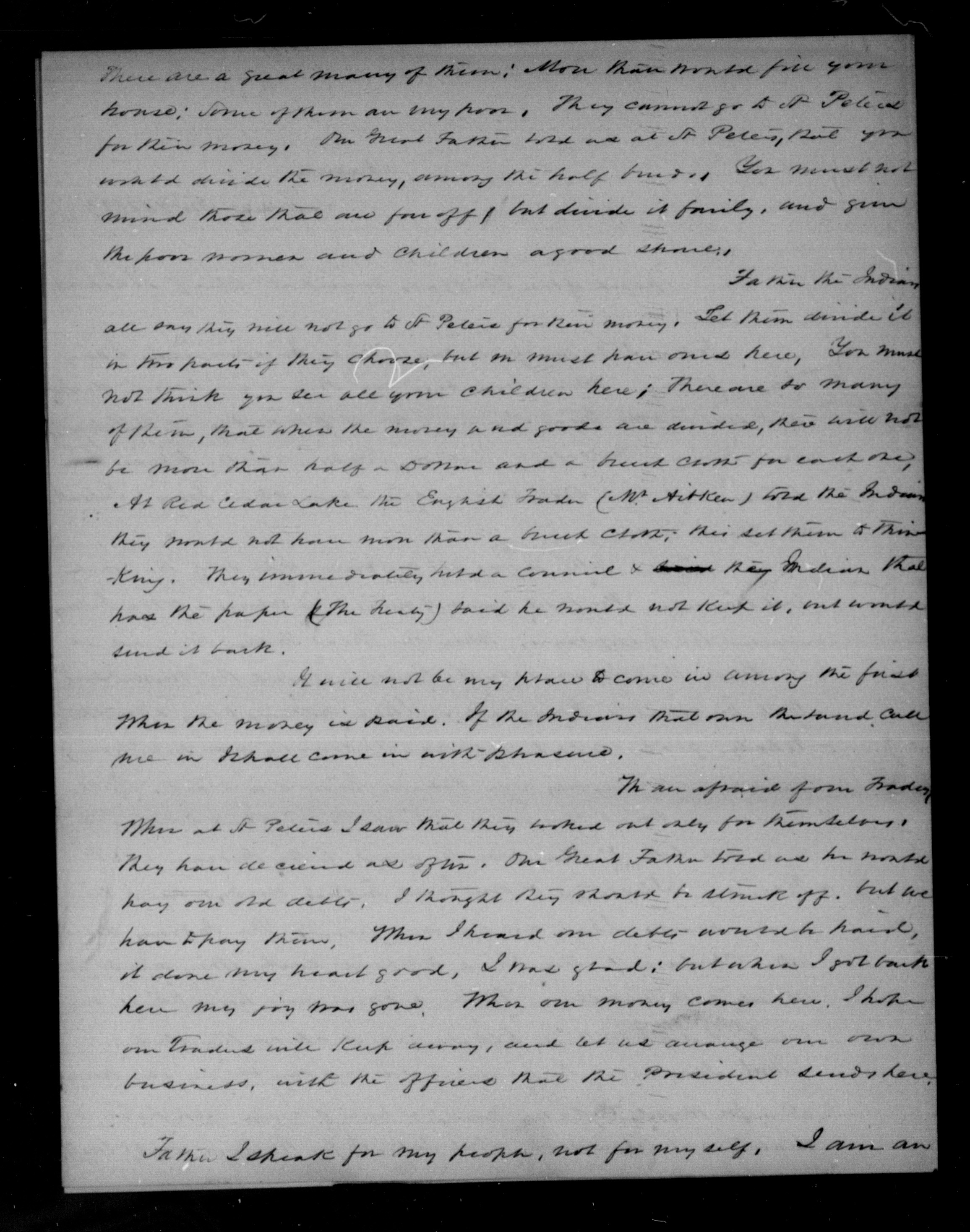
There are a great many of them; more than would fill your house; some of them are very poor They cannot go to St Peters for their money. Our Great Father told us at St Peters, that you would divide the money, among the half breeds. You must not mind those that are far off, but divide it fairly, and give the poor women and children a good share.
Father the Indians all say they will not go to St Peters for their money. Let them divide it in this parts if they choose, but one must have ones here. You must not think you see all your children here; there are so many of them, that when the money and goods are divided, there will not be more than half a Dollar and a breech cloth for each one. At Red Cedar Lake the English Trader (W. Aitken) told the Indians they would not have more than a breech cloth; this set them to thinking. They immediately held a council & their Indian that had the paper (The Treaty) said he would not keep it, and would send it back.
It will not be my place to come in among the first when the money is paid. If the Indians that own the land call me in I shall come in with pleasure.
ARTICLE 4.
“The sum of seventy thousand dollars shall be applied to the payment, by the United States, of certain claims against the Indians; of which amount twenty eight thousand dollars shall, at their request, be paid to William A. Aitkin, twenty five thousand to Lyman M. Warren, and the balance applied to the liquidation of other just demands against them—which they acknowledge to be the case with regard to that presented by Hercules L. Dousman, for the sum of five thousand dollars; and they request that it be paid.“
We are afraid of one Trader. When at St Peters I saw that they worked out only for themselves. They have deceived us often. Our Great Father told us he would pay our old debts. I thought they should be struck off, but we have to pay them. When I heard our debts would be paid, it done my heart good. I was glad; but when I got back here my joy was gone. When our money comes here, I hope our Traders will keep away, and let us arrange our own business, with the officers that the President sends here.
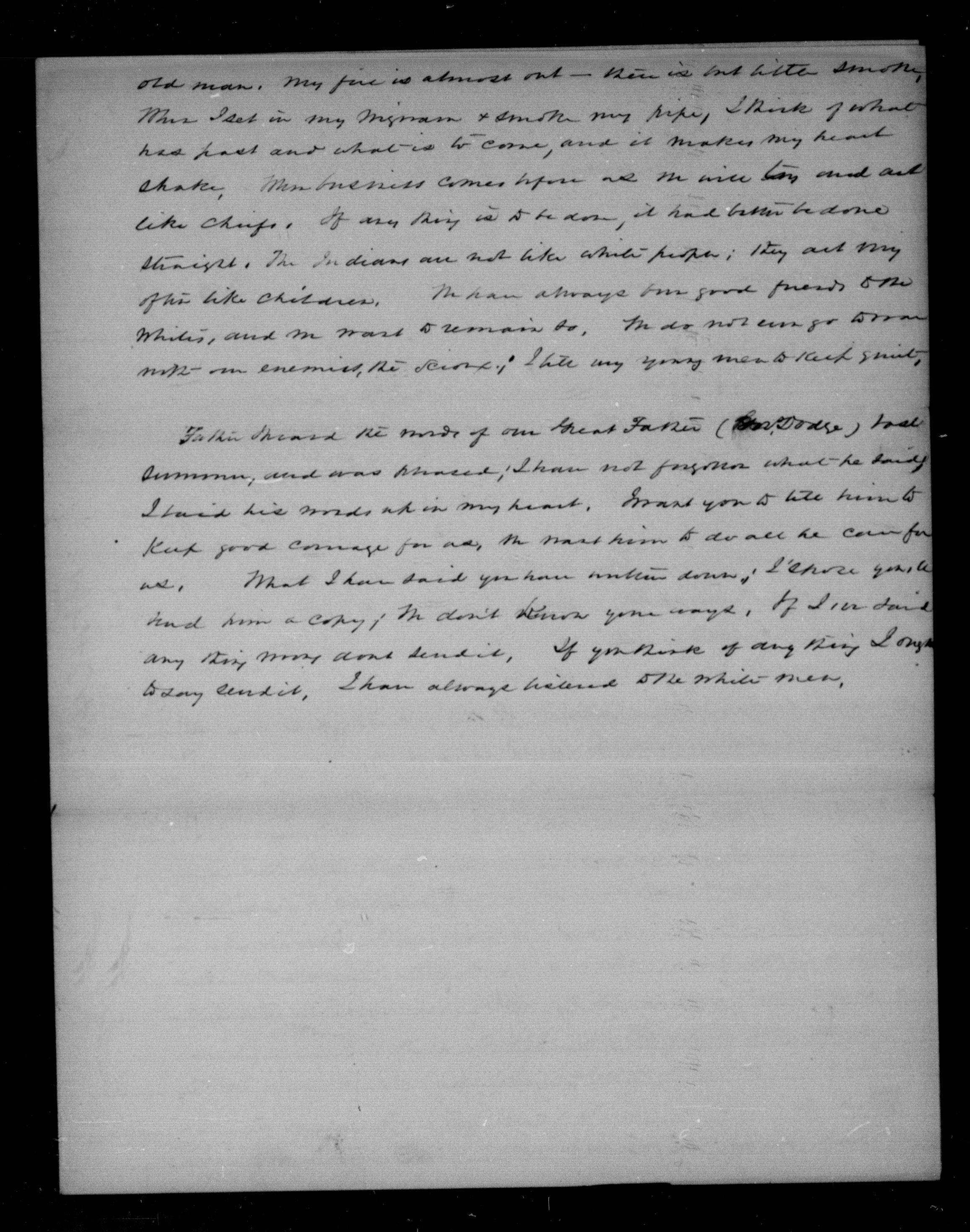
Father I speak for my people, not for myself. I am an old man. My fire is almost out – there is but little smoke. When I set in my wigwam & smoke my pipe, I think of what has past and what is to come, and it makes my heart shake. When business comes before us we will try and act like chiefs. If any thing is to be done, it had better be done straight. The Indians are not like white people; they act very often like children. We have always been good friends to the whites, and we want to remain so. We do not [even?] go to war with our enemies, the Sioux; I tell my young men to keep quiet.
Father I heard the words of our Great Father (Gov. Dodge) last summer, and was pleased; I have not forgotten what he said. I have his words up in my heart. I want you to tell him to keep good courage for us, we want him to do all he can for us. What I have said you have written down; I [?] you to hand him a copy; we don’t know your ways. If I [?] said any thing [?] dont send it. If you think of any thing I ought to say send it. I have always listened to the white men.
O.I.A. Lapointe, B.458
D. P. Bushnell
Lapointe, March 8, 1838
At the request of some of the petitioners, encloses a petition dated 7 March 1838, addressed to the Prest, signed by 167 Chip. half breeds, praying that the amt stipulated by the late Chip. Treaty to be paid to the half breeds, to satisfy all claims they ma have on the lands ceded by this Treaty, may be distributed at Lapointe.
Hopes their request will be complied with; & thinks their annuity should likewise be paid at Lapointe.
File
Recd 2nd May, 1838
Subagency
Lapointe Mch 6 1838
Sir
I have the honor herewith to enclose a petition addressed to the President of the United States, handed to me with a request by several of the petitioners that I would forward it. The justice of the demand of these poor people is so obvious to any one acquainted with their circumstances, that I cannot omit this occasion to second it, and to express a sincere hope that it will be complied with. Indeed, if the convenience and wishes of the Indians are consulted, and as the sum they receive for their country is so small, these should, I conciev, be principle considerations, their annuity will likewise as paid here; for it is a point more convenient of access for the different bands, that almost any other in their own country, and one moreover, where they have interests been in the habit of assembling in the summer months.
I am sir, with great respect,
your most obt servant,
D. P. Bushnell
O. I. A.
C. A. Harris Esqr.
Comr Ind. Affs
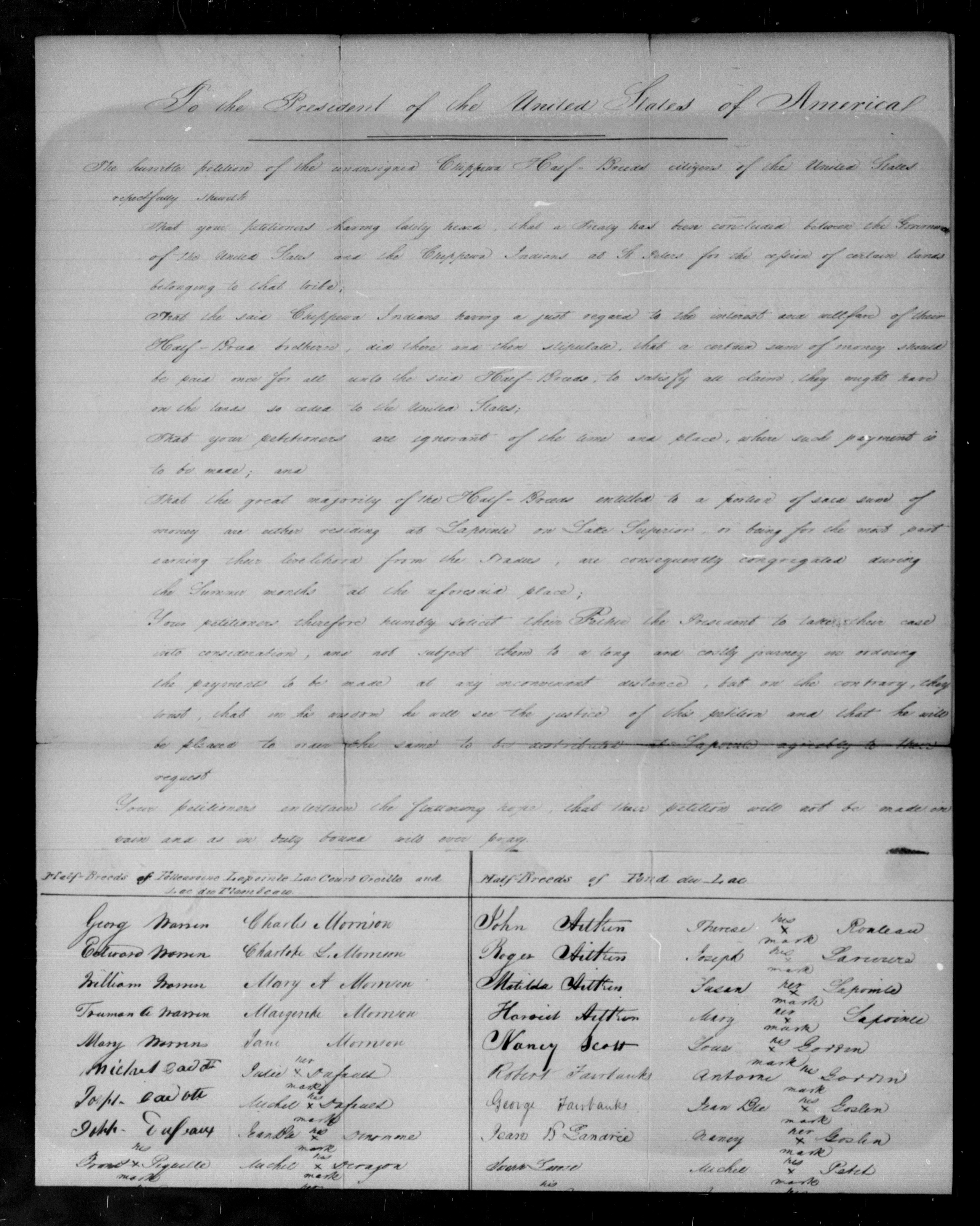
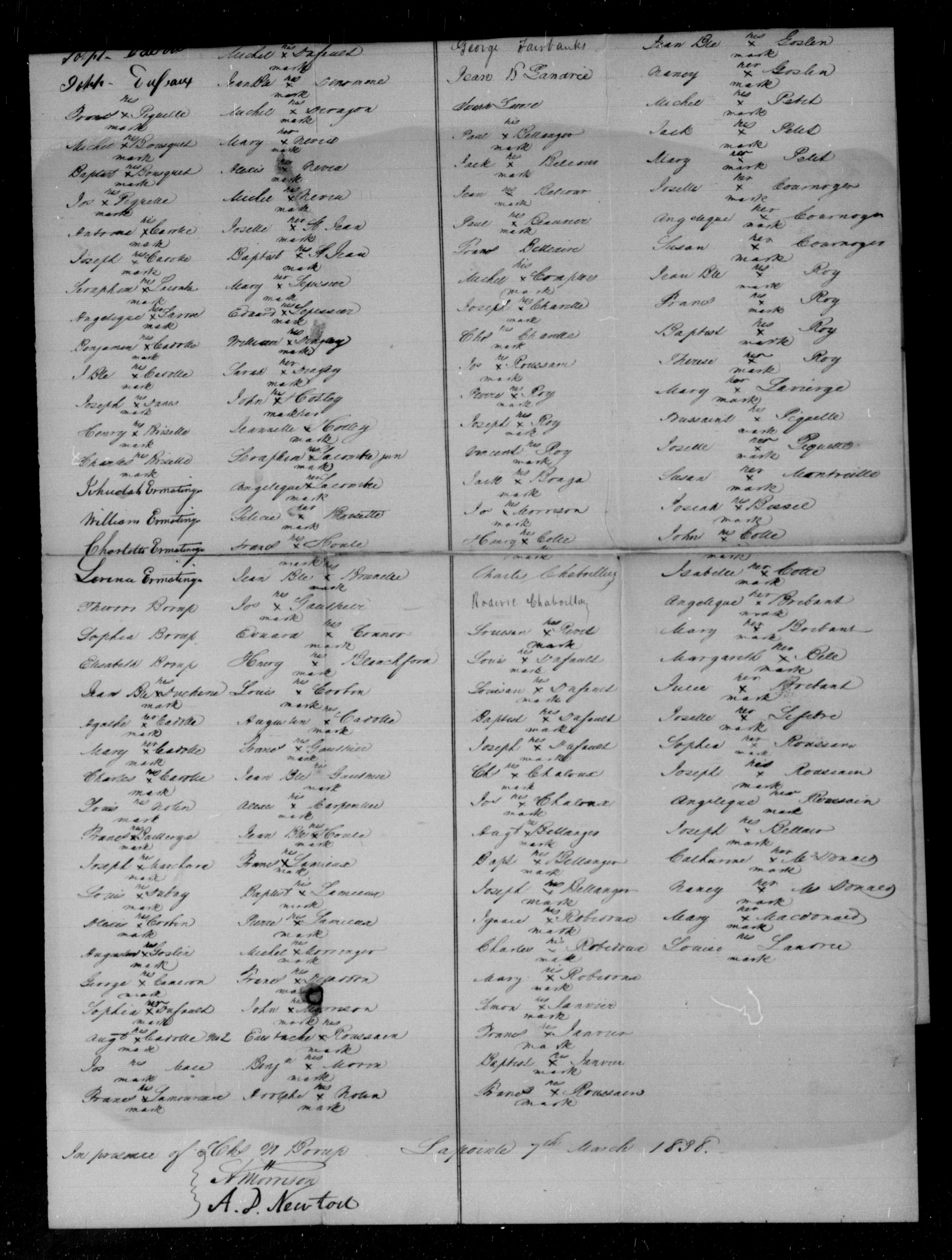
To the President of the United States of America
The humble petition of the undersigned Chippewa Half-Breeds citizens of the United States respectfully shareth
That your petitioners having lately heard, that a Treaty has been concluded between the Government of the United States and the Chippewa Indians at St Peters for the cession of certain lands belonging to that tribe;
That the said Chippewa Indians having a just regard to the interest and wellfare of their Half-Breed brethern, did there and then stipulate, that a certain sum of money should be paid once for all unto the said Half-Breeds, to satisfy all claims, they might have on the lands so ceded to the United States;
That your petitioners are ignorant of the time and place, where such payment is to be made; and
That the great majority of the Half-Breeds entitled to a portion of said sum of money are either residing at Lapointe on Lake Superior, or being for the most part earning their livelihood from the Traders, are consequently congregated during the summer months at the aforesaid place;
Your petitioners therefore humbly solicit their Father the President to take their case into consideration, and not subject them to a long and costly journey on ordering the payment to be made at any convenient distance, but on the contrary, they wish, that in his wisdom he will see the justice of this petition and that he will be pleased to order the same to be distributed at Lapointe agreeably to their request.
Your petitioners entertain the flattering hope, that their petition will not be made in vain and as in duly bound will ever pray.
Half Breeds of Folleavoine Lapointe Lac Court Oreilles and Lac du Flambeau
Georg Warren
Edward Warren
William Warren
Truman A Warren
Mary Warren
Michel Cadott
Joseph Cadotte
Joseph Dufault
Frances Piquette X his mark
Michel Bousquet X his mark
Baptiste Bousquet X his mark
Jos Piquette X his mark
Antoine Cadotte X his mark
Joseph Cadotte X his mark
Seraphim Lacombre X his mark
Angelique Larose X her mark
Benjamin Cadotte X his mark
J Bte Cadotte X his mark
Joseph Danis X his mark
Henry Brisette X his mark
Charles Brisette X his mark
Jehudah Ermatinger
William Ermatinger
Charlotte Ermatinger
Larence Ermatinger
Theodore Borup
Sophia Borup
Elisabeth Borup
Jean Bte Duchene X his mark
Agathe Cadotte X her mark
Mary Cadotte X her mark
Charles Cadotte X his mark
Louis Nolin _ his mark
Frances Baillerge X his mark
Joseph Marchand X his mark
Louis Dubay X his mark
Alexis Corbin X his mark
Augustus Goslin X his mark
George Cameron X his mark
Sophia Dufault X her mark
Augt Cadotte No 2 X his mark
Jos Mace _ his mark
Frances Lamoureau X his mark
Charles Morrison
Charlotte L. Morrison
Mary A Morrison
Margerike Morrison
Jane Morrison
Julie Dufault X her mark
Michel Dufault X his mark
Jean Bte Denomme X his mark
Michel Deragon X his mark
Mary Neveu X her mark
Alexis Neveu X his mark
Michel Neveu X his mark
Josette St Jean X her mark
Baptist St Jean X his mark
Mary Lepessier X her mark
Edward Lepessier X his mark
William Dingley X his mark
Sarah Dingley X her mark
John Hotley X his mark
Jeannette Hotley X her mark
Seraphim Lacombre Jun X his mark
Angelique Lacombre X her mark
Felicia Brisette X her mark
Frances Houle X his mark
Jean Bte Brunelle X his mark
Jos Gauthier X his mark
Edward Connor X his mark
Henry Blanchford X his mark
Louis Corbin X his mark
Augustin Cadotte X his mark
Frances Gauthier X his mark
Jean Bte Gauthier X his mark
Alexis Carpentier X his mark
Jean Bte Houle X his mark
Frances Lamieux X his mark
Baptiste Lemieux X his mark
Pierre Lamieux X his mark
Michel Morringer X his mark
Frances Dejaddon X his mark
John Morrison X his mark
Eustache Roussain X his mark
Benjn Morin X his mark
Adolphe Nolin X his mark
Half-Breeds of Fond du Lac
John Aitken
Roger Aitken
Matilda Aitken
Harriet Aitken
Nancy Scott
Robert Fairbanks
George Fairbanks
Jean B Landrie
Joseph Larose
Paul Bellanges X his mark
Jack Belcour X his mark
Jean Belcour X his mark
Paul Beauvier X his mark
Frances Belleaire
Michel Comptois X his mark
Joseph Charette X his mark
Chl Charette X his mark
Jos Roussain X his mark
Pierre Roy X his mark
Joseph Roy X his mark
Vincent Roy X his mark
Jack Bonga X his mark
Jos Morrison X his mark
Henry Cotte X his mark
Charles Chaboillez
Roderic Chaboillez
Louison Rivet X his mark
Louis Dufault X his mark
Louison Dufault X his mark
Baptiste Dufault X his mark
Joseph Dufault X his mark
Chs Chaloux X his mark
Jos Chaloux X his mark
Augt Bellanger X his mark
Bapt Bellanger X his mark
Joseph Bellanger X his mark
Ignace Robidoux X his mark
Charles Robidoux X his mark
Mary Robidoux X her mark
Simon Janvier X his mark
Frances Janvier X his mark
Baptiste Janvier X his mark
Frances Roussain X his mark
Therese Rouleau X his mark
Joseph Lavierire X his mark
Susan Lapointe X her mark
Mary Lapointe X her mark
Louis Gordon X his mark
Antoine Gordon X his mark
Jean Bte Goslin X his mark
Nancy Goslin X her mark
Michel Petit X his mark
Jack Petit X his mark
Mary Petit X her mark
Josette Cournoyer X her mark
Angelique Cournoyer X her mark
Susan Cournoyer X her mark
Jean Bte Roy X his mark
Frances Roy X his mark
Baptist Roy X his mark
Therese Roy X her mark
Mary Lavierge X her mark
Toussaint Piquette X his mark
Josette Piquette X her mark
Susan Montreille X her mark
Josiah Bissel X his mark
John Cotte X his mark
Isabelle Cotte X her mark
Angelique Brebant X her mark
Mary Brebant X her mark
Margareth Bell X her mark
Julie Brebant X her mark
Josette Lefebre X her mark
Sophia Roussain X her mark
Joseph Roussain X his mark
Angelique Roussain X her mark
Joseph Bellair X his mark
Catharine McDonald X her mark
Nancy McDonald X her mark
Mary Macdonald X her mark
Louise Landrie X his mark
In presence of
Chs W Borup
A Morrison
A. D. Newton
Lapointe 7th March 1838
By Leo
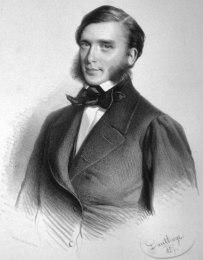
The Austrian writer, adventurer, and academic, Karl Ritter von Scherzer traveled the United States along with Moritz Wagner in 1852 and 1853. Their original German-language publication of Reisen in Nordamerika is free online through Google Books (image: wikimedia commons).
Chapter 21 of Wagner and Scherzer’s Reisen in Nordamerika in den Jahren 1852 und 1853 appeared on Chequamegon History in three posts in 2013. Chapter 22 continues the story, as Carl Scherzer describes his trip up the full length of the Brule River in September 1852, riding in a birchbark canoe guided by two La Pointe voyageurs: Souverain Denis and Jean Baptiste Belanger.
Chapter 22 lacks the variety and historical significance of chapter 21 (Ontonagon to the Mouth of the Bois-Brule), but even in Google-based translation, it maintains much of Scherzer’s beautiful (often comical) prose, that should be appreciated by readers with a fondness for canoeing. It also includes the lyrics of an authentic voyageur song that does not appear to be published anywhere else on the web.
Themes in this chapter also continue ideas explored in other Chequamegon History posts. If you wish to read more about the absolute misery encountered by inexperienced canoeists on the Brule, be sure to read the account of Lt. James Allen who accompanied Henry Schoolcraft to Lake Itasca in 1832. If reading Chapter 22 makes you think that mid 19th-century European travel writers superficially appreciated Ojibwe culture more than American writers, but that their romanticism contained the seeds of dangerously-racist ideas, be sure to check out J. G. Kohl’s Remarks on the Conversion of the Canadian Indians, another Google-aided German translation first published in English right here on Chequamegon History.
Enjoy:
XXII
A Canoe Ride through the Wisconsin Wilderness
The Rivière du Bois Brülé or Burnt Wood River (Indian: Wisakoda) has a rocky riverbed and runs east-southeast. Its serpentine curves are navigable close to 100 miles, nearly from the source to the mouth by canoes. It has 240 rapids, varying in length, alternating with smooth surface for a length of eighty miles. Most of the rapids have a one-foot, but many an eight to ten-foot slope. Four of them are so dangerous, they require portage, that is, they must be bypassed, and the boat and baggage are carried past the most dangerous points on land.
The width of the river changes tremendously. At its mouth, it is probably ninety feet wide, then sometimes narrows down to a few feet, and then expands just as quickly to the dimension of a considerable waterway. Its total slope from its source to its mouth in Lake Superior is about 600 feet. We therefore had the doubly-difficult task of overcoming river and the slope.
We took our frugal lunch of bacon and tea on a small mound of sand. We looked back and saw, probably for the last time in our eyes, but lasting forever in our memories, Lake Superior.
It should be noted that such letters are not uncommon in this great primeval forest, where bald towering tree trunks are more reliable postmen than the whims of hunting Indians, ignorant of their duties. Suddenly, Baptiste cried out, “Une lettre! Une lettre!” Mounted on a high pole, a letter hung wrapped in birch bark. It was addressed to a “Surveyor in the wilds of Lake Superior”–truly, an extended address! The letter was accompanied by a slip of paper, also in English, in which the readers, insofar as it did not concern them, were requested to leave it undamaged in its eye-catching position.
In winter, when Lake Superior is often unnavigable for months, the postal connection with La Pointe is an arduous forest path taking nine days to reach St. Croix Falls. Since it sometimes happens that the frivolous mix-bloods, growing weary of their postal duties hang their letters on the next branch and happily return to their favorite activity: hunting the wild forest thickets. The pack sits on the tree until a more-conscientious wanderer happens upon it. Thus, it takes three months to travel a road that would be covered in as many days in civilized area with modern transportation.
Birches (betula papyracea), elms, poplars, ash trees (fraxinus sambucifolia), and oak trees make up the bulk of these primeval forests. However, spruce, pine (pinus resinosa), firs, (abies balsamea and alba), cedars and juniper trees appear in such a pleasant mixture that their dark green forms a magnificent base note for the deciduous wood, as it bleaches golden in the autumn.
Within a half hour, the clear light-green water, 6 feet deep at the entrance, dropped to half a foot. From this, one may get a sense of the lightness of our birch-barked vehicle. In spite of the people, travel utensils, and provisions, probably amounting to 800 pounds of load, it glided gently, without even brushing the shallow riverbed.
The further we went up the river, the more virgin and primeval the forest, and the wilder and wilder the little waterway became. At places, tree trunks had fallen across the river and completely blocked our way. We had to take up the handy carpenter’s ax to cut a passage through. Under such navigational conditions, the oars lay quietly against the walls of the canoe, and long, hand-hewn poles were our only means of locomotion.
A heavy rain left us short on time to look for a bivouac. We spent the night in the woods under old spruce trees. Their trunks were more than 120 feet in height. Every night, we tied the thermometer to a tree branch out of the wind, and then recorded our observations in the morning. That was the only time we were able to maintain a regular hour of observation.
Friday, September 24, 53°F. Yesterday’s heavy rain has stopped, and as far as you can tell from under our green jungle canopy, the sky is quite clear and cloudless.
We continued the journey at 8 o’clock. At points, wind-broken spruce and beech hung from both sides, their still-green jewelry forming arcs of triumph across the river.
The splendorous color of the forests is enhanced by the mighty brush of autumn. You can already notice the work of this brilliant painter on the foliage of the oaks and elms. Only the stiff firs and ancient spruces, seen against the sky, allow the autumn storms to rush past without changing their defiant green.
We had a short portage to make, and a part of the provisions and effects had to be carried over the rapids. Landed at 12 o’clock for lunch. Our canoe was already severely damaged by the low water level and numerous rocky cliffs, and it began to fill with water. Now, all our luggage had to be brought to the shore and the empty boat had to be turned over to wrap the leaky areas watertight again.
For the whole afternoon’s journey, the same wild character of nature prevailed. Trees on opposite banks bent in pyramids and wrapped around each other at the summit. Sturdy roots of ash, elms, oaks having lost their balance, hung like an arched bridge over the surface of the water. All around, the eye sees the rugged beauty of the forest. Little has changed in nature or navigation in the two hundred years since the first missionary in a birch canoe passed through this wilderness.
At points, the thicket clears, the land becomes flatter, the river broadens, small lush archipelagoes rise, and the scenery gains the prestige of a modern park. In such areas, the wild rice (Zizania aquatica) comes into view. Along with hunting and fishing, it constitutes a staple food of the Indians. A marsh plant, it usually grows only in lowlands (sloughs), which are 8 to 10 inches under water for most of the year.
The harvest happens in the autumn, in a simple and effortless way. The Indians drive their slender canoes through the reeds into the middle of the rice fields. They bend the ears from both sides over the boat, and then beat out the fruit with fists and sticks, where it falls to the floor of the canoe. Most of the time, they roast the rice (Oumalouminee) and enjoy it boiled in water. Sometimes, however, when this seems too much trouble for them, the humble forest-dwellers are content to chew the raw fruit like kinikinik or smoking tobacco as a noonday meal.
When we asked Souverain how far we still had to go to the next portage, he replied that it might still be a distance of two pipes (deux pipes), by which he meant to say that we would arrive after the time in which one is able to smoke two pipes.
The black rocky bottom of the river makes the water so dark, it becomes very difficult to distinguish the sharp slightly-covered, rocks from the water, and so our boat received more than one jolt and leak. At half past four, we had to make a second portage of half a mile in length. Both the boat and the baggage had to be carried through the forest. We camped at the other end of the trail at the edge of a northern beech forest. Evening, 7 o’clock 48° F.
Saturday, 25th of September, 40° F. Heavily clouded horizon, windless, rainy. Our matches got wet and prevented us from starting a fire. Finally, a flint was found in a tin, but the gathered wood was green and wet, and took a long time to burn. After 7 o’clock, we set out. Exclusively hardwood vegetation, now, namely ash, elm, silver poplar and birch, which would seem to indicate a milder climate.
The remnants of Indian night camps are noticed at many points in the forest: the charred fire, the fresh tree-branches placed in the ground where the kettle hung above the flame, the dry wooden skeletons that were once wigwams.
Several jumbles of tree branches had to be chopped in half this morning with the ax in order to make a passage for us. Only half an hour after our departure from bivouac, we arrived at the third portage. Under heavy rain, we carried the effects through the forest on a trail that only occasionally hinted at ancient, long-weathered tracks. This time, the canoe could be pulled over the rapids, but only through a heroic decision of the two leaders to wade alongside it in the frosty, cold river. At 8:30, this painstaking portage was over, and the journey across the less-dangerous rapids continued in the canoe.
In the afternoon, more coniferous trees appeared, especially on the right bank. The rapids often continued for miles, and Souverain, the admiral of our birch-barked frigate, to whom was entrusted our destiny, had more than a hard row to hoe. Twice, shying away from the effort of cutting, we boldly passed over mighty tree trunks fallen into the river. Several times, our barge slid so narrowly under tree trunks hanging over the water there was scarcely enough space left us, lying with our backs against the bottom, to squeeze under with our slender canoe.
Despite the reappearance of softwood vegetation, the area visibly takes on a different character as it gradually changes from the hilly landscape of Lake Superior to the flat prairie ground of the West. The trees in the forest become less dense, while willows, cypresses, larches, and Thuja occidentalis are more frequently seen. On the banks, young saplings proudly take the place of the noble-stemmed spruce.
Based on our experiences so far, we would not recommend that future travelers rely too much on hunting and fishing while traveling through these wilderness areas. The almost incessant rapids give the river a current far too strong for it to be a popular habitat for fish, and the game is usually scanty along the shore. In addition, the gun often suffers much from the water, which the powerful sweep of the poles and paddles sends over the side of the canoe. Due to this moisture, which is almost unavoidable in such a small space, even the best-measured shots often fail.
Once, it was inspiring to see the keen-eyed Souverain pick out a water snipe among the bushes. Not knowing its mortal danger, it promenaded itself carelessly in search of food. We approached quietly with the boat, drawing near to fell the victim with the shotgun, and Souverain shot his enemy-snipe-weapon. The shot failed. A second and third had the same fate. The charges had been dampened by prolonged rain.
 (wikimedia) Wasserschnepfe is a generic German term for several species in the family Scolopacidae (snipes and sandpipers). Wilson’s Snipe (left) or the American Woodcock (right) are likely candidates for the suicidal Brule bird. Hypochondria was used as a synonym for depression in the 19th century–see the opening paragraph of Moby Dick for an example.
Quite remarkably, the poor animal had still not left its dangerous post, as if it were overpowered by melancholy, and would receive the mortal shot as a blessing. The fourth charge finally did its duty. The snipe staggered and fell dead in a nearby bush. She was haggard and skinny, and seemed to have truly suffered from hypochondria. In the evening, we shot a duck. General joy was had over their fatigue, and we lustily enjoyed a good evening meal.
In the final hours of the journey, the river assumes a regular, almost canal-like course, which for some miles continued in a straight line. The rapids become rarer, but the river is densely covered with rock, which hides itself under the smooth barren surface of the water. Surprised by nightfall, and in the deceitful twilight not daring to go further among the aforementioned jagged rocks, we bivouacked close to the shore in a flat, swampy area.
As a rule, since we were on the Bois-Brülé river, we drove for ten hours a day, from 7 o’clock in the morning until 5 o’clock in the evening, unless rain or canoe repairs prevented us. Every morning, before we left, we prepared our breakfast, and made a very short stop at lunchtime. We pitched our tent only at the resting hour of the evening, when possible on a hill in an area where the presence of numerous dry logs could suffice for preparing a comfortable night fire.
After the two voyageurs had cut down and brought in 12 to 18 pieces of spruce or birch trunks in the forest, they usually left it to us to keep the fire at proper heat. No sooner had our evening meal been consumed, which, like the selection at the court of an Irish emigrant’s table–one day bacon and tea, and the next day tea and bacon–the two voyageurs, fatigued by the hard work of the day, would fall asleep. Our traveling companion, wrapped in a thick buffalo robe, found no more attraction in this body-strengthening pleasure. So we were faced with a choice, stoke or freeze.
Every night, we would get up four or five times to set new tree trunks on the dying glow. And when the fire flared up again, we’d sit a while and watch the joyous flaming wave, and think of our friends across the ocean. And as this new flame intensified, new glowing thoughts and feelings rose in us again and again, for the fire possesses the same miraculous power as the sea or the blue sky. One can gaze into it for hours and yet cannot get enough of it. One laughs and cries, becomes sad then cheerful again. – The logs that we burned last night, certainly amounted to half a cord of wood!
Sunday, September 25, 5:30, snowfall. A good fire in front of our tent makes it easier for us to bear the cold and the bad weather. All night long, we heard the cries of many flocks of ducks moving cheerfully off to the west. In the forest, now, one hears only the lonely lamentations of a woodpecker, his flight inhibited and decrepit, he could not follow the young flyers and is left behind. The snowfall prevents the boat from popping up, and we are forced to wait for better weather in this swampy, frosty wilderness.
7 o’clock, 35° F. A shot was fired nearby. It was probably the hunting rifle of wandering Indians.
Around 9:30, a canoe came up with an Indian and his squaw (Indian woman). It was the postman of La Pointe who had picked up the letters in St Croix and was on the way home. As soon as he saw our camp, he stopped, got out, and he and his wife warmed themselves by our brightly-lit fire.
He was a poor, one-eyed devil. In his little boat he brought wild rice (folle avoine) tucked under animal skins, which he wished to exchange for resin to repair his damaged canoe. The shot we heard a few hours earlier fell from his shotgun, but the duck he aimed never did. The postman did not seem to be in a hurry. He talked to the voyageurs for more than an hour, then said good-bye and Boshu* to the fire’s warmth and to us.
[*Boshu, also bojoo or bojo, is undoubtedly a corruption of the French “Bon jour,” which is used by all Indian tribes on this side of the Mississippi for all kinds of greetings in the widest sense of the word. In general, the Chippewa language is teeming with English expressions, for which they have no name in their own language. The same is the case with the Indians of British Guiana, who have included many Spanish words in their language: cabarita, billy goat (Indian: cabaritü), sapatu, shoe (Indian zapato), aracabusca, firearm (Indian: arcabug). It deserves great attention at a time when we seem more inclined than ever to draw conclusions about the descent of peoples from certain similarities in languages. Comp. Dr. W. H. Brett, Dr. Thomas Jung, etc.]
11 o’clock in the morning. After the snow stopped, we quickly patched some areas on the boat, damaged by the sharp rocks. After a short snack of bacon and salt meat, we proceeded further up the river. We intended to continue, without further delay in a southwesterly direction, until dawn, hoping to escape this frighteningly-cold region.
The scenery and nature remained the same as yesterday. Hardwood, among which the American elm (ulmus americana) prevails. With its imposing height and rich crown of leaves, it is a major ornament of the American forests. With the shallow shores, rice marshes and trees hanging over the river under the weight of their leaves, our canoe laboriously sighs under its oppressive cargo. The rapids start again. The river is about 40 feet wide.
About 2:30, we passed through ten minutes of rapids, whose completion required the full effort of our two canotiers. In addition to the countless rocks, we passed through the lowest water levels, over uprooted trees that had fallen into the river. Our journey now resembled the pushing of a cart than it did the light gliding of a birch canoe. It was a fight with the water and nature. We were in danger of wounds to our heads and eyes, passing close under the wild bushy oaks and spruces that jutted into the water.
The landscape afforded variety of rich, picturesque views. Every bend, every new opening, showed the visitor a new image. At times, the river extended to the breadth of a lake, and cedars, cypresses, thujas, and all the green foliage of the swamp vegetation becomes visible. Where the rapids stop, the mirror-clear, calm water comes alive with trout and swimming birds. All at once, however, the picture will close, and the two shores form an incessantly-bright green alley, through which the smooth river stretches like a long white vein of silver.
By evening, our little boat was suffering greatly from the incoming cold. At sunset, we camped on the so-called Victory Grounds (pakui-aouon). It is a cleared piece of forest, about 40 feet above the river, that forms a kind of plateau, upon which bloody battles must have taken place in former centuries between the Sioux and Chippewas.
The cause of the hatred between these two tribes of Indians remains an object of research. However, one only needs to mention the name one tribe, to a person of the other in order to provoke his rage. Against this, even the hatred of the Czechs, who in the blessed year of Revolution wished to devour all of Germany, pales in comparison. For as often as the Sioux come into contact with Chippewa Indians, they will certainly commit a murder, because according to their legal concepts, it is their duty to scalp as many Chippewas as possible.
In the evening, when the tent is pitched, the night’s wood is felled and carried in from the forest, the fire is lighted and a small meal is prepared and consumed, the four of us would sit still for a while around the warming fire. We would listen to the voyageurs tell us about their experiences and destinies, and about the savagery of the whites and the gentleness of the Indians. Sometimes, they also sing songs that have strangely found their way from the home of the troubadours to these soundless primeval forests of the north*. Here we repeat one that Jean Baptiste sang out this evening with much emotion, as he lay carelessly, disregarding the flickers of the burning fire:
Chanson canadienne
(Canadien song)
Buvons tous le verre à la main,
Buvons du vin ensemble;
Quand on boit du vin sans dessein,
Le meilleur n’en vaut guère.
Pour moi je trouve le vin bon,
Quand j’en bois avec ma Lison.
(Let’s drink down the glasses, in our hands,
Let’s drink wine together;
When you drink wine without purpose,
Even the best is not worth it.
For me, I find the wine tastes good,
When I drink with my Lison.)
Depuis longtemps que je vous dis:
Belle Iris je vous aime,
Je vous aime si tendrement,
Soyez moi donc fidèle,
Car vous auriez en peu de temps,
Un amant qui vous aime.
(For a long time I have been telling you:
Beautiful Iris I love you,
I love you so dearly,
Be faithful to me,
For in a short time you will have,
A lover who loves you.)
Belle Iris, de tous vos amants
Faites une différence,
Je ne suis pas le plus charmant
Mais je suis le plus tendre.
Si j’étais seul auprès de vous,
Je passerais les moments les plus doux.
(Beautiful Iris, of all your lovers
Make a difference,
I am not the most charming
But I am the most tender.
If I were alone with you,
I would have the sweetest moments.)
Allons donc nous y promener,
Sous ces sombres feuillages,
Nous entendrons le rossignol chanter
Qui dit dans son langage,
Dans son joli chant d’oiseau,
Adieu amants volages.
(Let’s go for a walk,
Under the dark foliage,
We will hear the nightingale
Who sings in his language,
In his pretty bird song,
Farewell lovers.)
“Ah! rendez-moi mon coeur,
Maman me le demande.”
“”Il est à vous, si vous, pouvez le reprendre.
Il est confondu dans le mien,
Je ne saurais lequel est le tien.””
(“Ah! Give me back my heart,
Mother asks me.”
“It’s yours, if you can, take it back.
It is mixed up with mine,
I will not know which is yours.”)
[*It is a common observation that the painted native forest dwellers of America are not as eloquent as their much-simpler dressed German counterparts. Although we passed through the forests of Wisconsin, Missouri, and Ohio in all seasons, we never heard as beautiful and funny singing as in the German hall. It is as if nature wanted to compensate the German forest singer for his lack of splendor through the richer gift of song. Comp. Franz v. Neuwied and Agassiz, Lake superior etc., p. 68 u. 382, respectively.]
Monday, September 27th, 35°F. Sky is completely changed, haunting cold. The snow began to fall so thickly, we had to stop again, after a short time, to build an invigorating fire in a cedar forest amidst swamp and morass. But when the flame began to grow, its warmth reached the snowy branches of the cedar trees. The snow turned to water and fell upon us as heavy rain. We were all thoroughly soaked, and the fingers of the two canoe handlers were so frozen by the biting snow they could not paddle the ship. So we sought, as well as it was possible under such unfavorable weather conditions, to warm ourselves, and finally resumed our journey at noon under snow, rain, and a sharp north wind.
12 o’clock, 42°F. Soon after our embarkation, we had to make a small portage, and happily bypassed La Clef de Brülé, a number of rapids, which in their dangerous places are called by the voyageurs “The Key to the River”.
Cedarwood now grows almost exclusively on both banks, down to the river’s edge. They sometimes seem so harshly thrown over one another that the canoe can pass through only with difficulty.

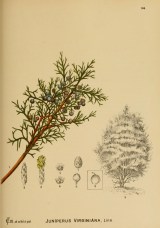 “Cedar,” used generically on today’s Brule River could only mean the Whitecedar or Arbor Vitae Thuja occidentalis (top). Curiously, however, Scherzer specifically distinguishes Thuja from Juniperus virginiana or redcedar (bottom) and describes the latter as more common, even though J. virginiana is not found this far north.
2:30 48°F. The snowflakes have changed to raindrops with the increasing temperature. Gradually, the rain stopped, and there was overcast, but rain-free weather. We now reached the Campement des Cedres, the only place up to the source of the river, where one still finds enough wood to prepare a night fire as all tree species except cedars (juniperus virginiana) are now becoming sparse along the shores. The discomfort of travel is now joined by a feeling of an unshakeable cold.
We therefore resolved to reach the navigable end of the Bois Brülé river that evening, and our captains endeavored to reach it before nightfall.
The rapids had now stopped, but another no-less uncomfortable and dangerous guest turned against us. The bushes of alders (alnus incana), willows, berberis, etc. grew on both banks. In their undisturbed growth, they had become so impenetrable that at the first sight of these thousands of closely intertwined branches, we often thought it impossible to break through with a canoe. The river was completely invisible in these thick, shady hangings, and hoe, pole, and fists had to be activated to fight all these natural hindrances.
Sometimes, we could only pass through horizontally, with our heads back to the bottom of the canoe. Closing our eyes to the relentless branches, we completely abandoned ourselves to the care of the brave Souverain. His face and hands scratched by the tiny branches, he undauntedly strove forward with unspeakable effort. Only a few times, when these forest barricades grew too overpowering, we heard a half-desperate, “mais c’est impossible!”
This wild overgrowth of the two banks, which gave our boat journey more of a character of first voyage of discovery than that of following a well-trodden path, can only be explained by the circumstance that the river is only seldom traveled up to its source. Earlier, when La Pointe was the Fur Company’s trading post, several hundred canoes loaded with commodities traveled this route every year, and from there they crossed to the various trading places of Upper Mississippi. But since Indians, forest animals and fur traders have moved westward, the cheerful waters of the Bois Brülé often trickle by, through entire seasons, without being cut by the keel of a boat, and the lush vegetation of its shores is free to reach across and embrace in wild passion.
Around 5 o’clock, we found the water of the river so low in several places that we decided to give some relief to the canoe by continuing the rest of the journey to the source of the river on foot. We walked back a mile and a half along a forest path, under the most unfavorable conditions. Our bodies wrapped from head to toe in India rubber, we sat with our travel companions against the moving forest, while the two voyageurs with canoe and effects followed the course of the river to meet us again at the grand portage.
Hardly could a hike offer more variety. Without the slightest indication of the path to be taken by the usual old footprints and tree cuts, we fought thorn bushes through deep snow, then passed through wild grain as tall as man, swiftly mowing it under our boots. In the hurry to disembark, we left our compass in the boat, so we could only guess what direction we should start navigating to find the so-called “Great Carrying Place.”
We wandered the wilderness, sweaty and fatigued, unable to move with any speed. The night was already falling, and as our innumerable “hallos,” went unanswered by our captain, we fell silent in the solitude of the forest, coming to terms with the idea of spending the night in these cold, fever-inducing swamps. All of the sudden, the voices of the voyageurs resounded like a hallelujah. We had to be very close to them, so we gained fresh courage against the complaints of pressing each step forcibly through dense undergrowth of thorny shrubs.
Drenched and chilled, we finally reached the Portage on a hill above some young cedars, and found the Voyageurs already occupied with the clearing and patching of the canoe. Unlike ourselves, our travel companion and the two Canadians had no rain-resistant rubber outfits, and were even more exposed to the cold, wet weather. For a time, the shivering appearance of our companion made us fear for his health.
In addition, we soon learned of a new misfortune. The snow cover and lack of wood in the vicinity prevented us from pitching our tent preparing a good fire as fast as our condition might desire. Besides, all our packs had gotten wet, and the provisions were in a poor state of edibility.
Our first concern, when we finally succeeded in pitching the tent and building a fire, was to dry our underwear and garments. All around us, hanging from tree branches and ropes were scattered cloths, spread out and drained of color. In our haste to remove the uncomfortable liquid from our needed garments through the warming power of the flame, we brought them into too-close contact with the wildly-flickering fire. Regrettably, they were soon covered in traces of scorch marks.
Nothing in our preceding traveling conditions had so deeply embittered us or made us as morose as these recent events. It is true that none of us complained, but each man stood in perfect silence before the burning logs, and regrettably stared at whatever soaked garment he was holding in his outstretched arms before the drying glow. Our medicines in vulgar condition, and our books, writings, documents, and physical instruments, all partially corrupted or totally broken, there was not a single piece of our effects which did not bear some lasting trace of damage.
The only consolation was that the snowstorm ended, and the overcast sky dissipated into a bright, starry, moonlit night, which made the prospect of a more favorable morning and forgetting the troubles of today, less and less difficult to fathom.
A short distance from the Portage is the inconspicuous source of the Bois-Brule River, in the marshes all around.* Only a single small stream pours into it during its long, winding course to Lake Superior. The Campement du Portage, where the travelers usually camp, is situated on a small hill, adorned with a serene cedar and spruce approach. While it may present a charming bivouac during a pleasant, warmer season. The eerie conditions under which we spent the night on the cold, damp ground could not possibly give us an idea of their summer loveliness.
[*The water of the Bois-brule River is about 12-14° Fahrenheit cooler than that of the La Croix River, for which may be explained by its forest-shaded banks being almost inaccessible to sunbeams, as well as its proximity to Lake Superior.]
In winter, when the river freezes along its entire length, it must be a marvelous sight: the wild rapids suddenly frozen by the harsh power of frost, and transformed into the strangest shapes and ice formations.
S.
By Leo Filipczak
When we last checked in with Joseph Austrian, or Doodooshaaboo (milk) as he was known in these parts, we saw some interesting stories and insights about La Pointe in 1851. The later La Pointe stories, however, are where the really good stuff is.
Austrian’s brief stay on the island came at arguably one of the most important periods in our area’s history, spanning from a few months after the Sandy Lake Tragedy, until just after Chief Buffalo’s return from Washington D.C. Whether young Joseph realized it or not, he recorded some valuable history. In his memoir, we see information about white settlement and land speculation prior to the Treaty of 1854, as well as corroborating accounts of the La Pointe and Bayfield stories found in the works of Carl Scherzer and Benjamin Armstrong.
Most importantly, there is a dramatic scene of a showdown between the Lake Superior chiefs and Agent John Watrous, one of the architects of the Sandy Lake removal. In this, we are privileged to read the most direct and succinct condemnation of the government, I’ve ever seen from Chief Buffalo. It is a statement that probably deserves to be memorialized alongside Flat Mouth’s scathing letter to Governor Ramsey.
So, without further ado, here is the second and final installment of Joseph Austrian’s memoirs of La Pointe, and fifth of this series. Enjoy:
~~~~~~~~~~~~~~~~~~~~~~~~~~~~~~~~~~~~~~~~~~~~~~~~~~
Memoirs of Doodooshaboo
… continued from La Pointe 1851-1852 (Part 1).
Scherzer, Noted Traveller Pays Us a Visit. 1851.

Carl Scherzer and his companion Moritz Wagner recorded their travels in Reisen in Nordamerkia in der Jahren 1852 und 1853. An e-translation of Chapter 21 appeared in English for the first time this fall on the Chequamegon History website. You can read it here, here, and here. The second installment records his time with Joseph Austrian. From Austrian’s account, it appears Wagner did not accompany Scherzer through the Lake Superior country. (Wikimedia Images)
During this summer a noted Austrian traveler Carl Scherzer arrived one Sept. night. He had been commissioned by the “Academy of Science” of Vienna (a Government Institution) to make a tour of America to familiarize himself with the country and gather information to write a book for the Academy. This interesting book which he wrote is called “Scherzer’s Reisen.” Mr. S. sent me a copy of this book which I have in my library. In this book, mention is made of me and my cordial reception of him and his travelling companion, an Attache of the French Legation of Washington who accompanied him on his trip. Scherzer was a highly educated gentleman, cultured and charming, tall and of imposing appearance. Scherzer arrived at La Pointe at midnight coming from Ontonagan 90 miles in a small row boat. To his dismay, he found that there was not a hotel in the place. The boatman told him that he thought that one Austrian might give him shelter for the night, so he came to the house and knocked at the door. Henry Schmitz, my fellow employee, who roomed with me opened the door and called out “Joe step auf freund von below sind da,” whereupon I cordially invited them to enter and made them as comfortable as possible. They remained with us about three days and profoundly appreciated our hospitality. Even making mention of it later on in his book. Once on going to a fishing boat for our supply of fish, Scherzer went with me and begged the privilege of carrying two of the large fine white fish, one suspended from each hand. He much enjoyed meeting the good Father Skolla, his country-mate, also an Austrian, and from him obtained more valuable and authentic information concerning that part of Lake Superior country that he could have otherwise gained. From La Point Scherzer planned to go to St. Paul. There were no railroads here at that time. There were but two roads leading to St. Paul. One was simply a footpath of several hundred miles through the woods. The other led via St. Croix [Brule?] & St. Croix river shortening the foot travel considerably. Scherzer chose the latter road. I fitted out for him, at his request, a birch bark canoe and utensils and all necessary for the trip and Scherzer and his companion started on their way to St. Paul.
He had engaged one “Balange” their voyageur who had brought them from Ontonoagan and a friend of his to take them through. They were well acquainted with the route which at times necessitated their carrying the canoes around through the woods across the portage, where the river was inaccessible through rapids, obstacles and otherwise. Scherzer arrived at St. Paul safely and wrote thanking me for my assistance and requesting me to send him a copy of the wording of a French rowing song (the oarsmen usually sang keeping time with their oars). I sent it to him and received a letter of thanks from New Orleans whence he had gone from St. Paul by steamer via the Mississippi River. This song is embodied in his book also.
A Steamer was a rare occurrence at La Point and when one did come, we often got up an Indian war dance or other Indian exhibit for the amusement of its passengers, and which they enjoyed greatly. In the fall of the year steamers were sometimes driven there by the storms prevailing on the lakes, as the harbor offered the best of shelter. We kept a good supply of cord wood on the dock which we sold to the steamers when they needed fuel.
Indians Decline to be Removed by Gov. I attend Grand Council. 1851.
During the first summer of my stay at La Point, the Indian Agent, Mr. Watrous was directed by the Secretary of the Indian Dept. at Washington to summon the chiefs of that part of the Chippewa tribe residing in the vicinity of Bad River, Bayfield, & Red River for a council. The Agent accordingly sent runners around to the chiefs of the different lodges some of which were quite remote, summoning them to meet him on a certain day at La Point. They came in obedience to the summons many bringing their squaws, papooses and their Indians of their lodges with them. Near the lake shore the put up their wigwams, which were made of birch bark leaving an opening over hung with a blanket which served as a doorway. It made an interesting Indian settlement. The meeting was held on the appointed day, in my brother’s store which was a long wooden structure. When the meeting opened the chiefs sat on the floor arranged along the left side of the room, with their blankets wrapped around them, and each one smoking a long stemmed pipe, which they make themselves, the sign of peace, many ornamented with paint and feathers. On the other side of the room was seated the Indian Agent with an interpreter who translated what either had said.
I naturally felt greatly interested in witnessing their proceedings. The President of the U. S. was known by the Indians as the Great Father and the Agent addressed them telling them what the Great Father wanted of them; namely that they remove from their reservations to interior points in order to make room for while settlers; pointing out to them that the proposed location was more suited for them, there being good fishing and hunting grounds. The government offered to pay them besides certain annuities, partly in money and partly in Indian goods–such as blankets, cotton, beads, provisions, etc. The proposition of the Government was met with murmurs of disapproval by the chiefs & Indians present, and Chief Buffalo made a most eloquent and impassioned speech saying,
“Go back to the ‘Great Father’ and tell him to keep the money and his goods. We do not want them but we wish to be left in peace. Tell him we will not move from the land that is our own, that we have always been peaceable and were always happy until the white man came among our people and sold ‘Matchie Mushkiki [majimashkiki (bad medicine)]’ (poison-whiskey) to them.“
(The real name of whiskey in Indian is “Ushkota wawa [ishkodewaaboo]” – fire water).
The Indians did remain and to this day are still occupying the same land. I was present at this meeting and it so impressed me, that although it took place over fifty years ago it is still vivid in my mind. Later on the Government encouraged the same Indians to engage in farming work on the reservation, and furnishing them with implements and seeds for that purpose, and in the course of a few years they had their own little farms on which they raised potatoes and other vegetables easily cultivated. Schools also were established by the Government. One of their large settlements today is on Bad River, and not far from Ashland Wis., known by the name of Odana.
Brother Marx Experience with Indians. 1851 .
Our blind brother Marx Austrian with brother Julius’ assistance at that time, preempted 160 acres of land near Bayfield from La Point, complying with preemption laws. He built a small log house living there with his wife. One night during their first winter in their new house, there was a knock at the door, and when opened they were confronted by a number of Indians, who were evidently under the influence of liquor and who swinging their tomahawks vigorously, making all sorts of threatening demands. An old Indian who knew Marx interceded and enabled him and his wife to escape without injury who thoroughly scared fled panic stricken in the dark about two miles at night, over the ice, on the Bay which was covered with a foot of snow to La Point for safety. The poor woman having the hazardous task of leading her blind husband over this long and difficult road, not to come back again and glad to escape with their lives and thus abandoning their right of preemption. This place was later on platted and is now known as the Bayfield Addition.
My Experience in Lumbering
Brother Julius had a small saw mill operated by water power about two miles back of Bayfield on Pike’s Creek, near which were Pine lands. In the winter I was sent with some woodsmen to look after the cutting and hauling of Pine logs for the mill. These logs were hauled by ox teams to the mill. In the spring I was again sent there to assist in the sawing of these logs into lumber. We lived in a little log hut near by. When the snow melted toward spring time, the creek was high and swollen. One day the force of the waters burst through the dam, carrying it away and the great volume of water rushing down cut a new channel in the bed of which had become a river, and undermining to foundation of our little log house causing it to topple over into it, also carrying away the logs, many of which floated down into Lake Superior and were lost.
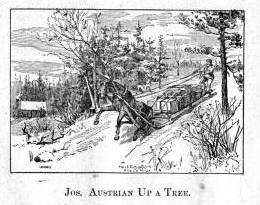
Pg. 218-219 (Armstrong, Benj G., and Thomas P. Wentworth. Early Life among the Indians: Reminiscences from the Life of Benj. G. Armstrong : Treaties of 1835, 1837, 1842 and 1854 : Habits and Customs of the Red Men of the Forest : Incidents, Biographical Sketches, Battles, &c. Ashland, WI: Press of A.W. Bowron, 1892).
In the winter when logging was going on, once I was sent across from La Point with a heavy load of provisions and supplies for the men. This was loaded on a so called “Canadian flat sleigh.” The road on the way to the mill led down a very steep high hill which half way down had a sharp bend and at this curve stood a tree. After having started down the hill, the horse was not strong enough to hold back the load, which got the better of him, and pushed him swiftly down the hill with his hind legs dragging after him wedging him against and partly into the tree with his front legs up in the air. I could not move the heavily laden sleigh with the horse wedged in so tightly I found it impossible to extricate him, and had to go to the mill for assistance. The sled had to be unloaded before we could free the horse. See Armstrong’s book in which mention and illustration is given of this as “Austrian up the tree.” The book is in my library.
Ferrying Oxen Across the Bay in Row Boat.
My brother Julius had also a large tract of meadow land on Bad River, where he had a number of men employed in making hay, in order to gather this hay for stacking, a span of cattle and a wagon were needed to haul it. There being no other means of ferrying them across the bay, one of the large Mackinaw boats of about twenty-five feet keel by six feet beam had to be used to get these over to the other side across a distance of about three miles to the mainland from where they could be driven to the meadow. I was commissioned to attend to this assisted by four competent boatmen, we finally managed with coaxing and skill to get the two big oxen into the boat, standing them crosswise in it. We tied their horns to the opposite side of the boat. The width of the boat was not sufficient to allow them to stand in their natural position which made them restless. The first thing we knew one of the oxen raised his hind leg and stuck it out over the side of the boat into the water, his other leg soon followed and we had aboard an ox half in the boat, with the weight of his body resting on and threatening to capsize the boat. We quickly cut the rope which held his head and he fell backward overboard floundering in the water. Little did I think that we would see the ox alive again. Imagine my surprise on my return to the Island to find he had swam back to shore safe and sound. When the other ox saw his mate go overboard, he tried to follow and it required much coaxing and extra feeding to restrain him and finally landed him all right on the opposite shore.
Lost in the Woods
I returned to the Island and the next morning I started for the meadow fields in a birch bark canoe with a Mr. Lehigh who had a little saw mill about five miles up Bad River. We were obliged to sit in the bottom of the little boat in a most uncomfortable and cramped position, having been warned by the boatman in charge not to move as the least motion is apt to cause the frail craft to capsize. On arrival at the meadow I found the men busily at work. They were about to take dinner and I gladly consented to join them, and being hungry relished the spread of fried pork, crackers, and tea. My companion Mr. Lehigh was bound for his little saw mill up the river where he lived, and I having business to attend to there started with him on a foot trail through the woods. He loitered on the way picking wild raspberries, just ripe and tempting, but musquitos were thick and vicious and pestered us terribly. I not being accustomed suffered more than my companion. Asking him the distance we were still to go, and on his telling me three miles, I became impatient and went ahead alone to get away from the musquitos. After walking on some time I came to a potato field into which the trail led, but was concealed by the high vines. Crossing the field I struck a trail on the other side and took for granted it was the one leading to the mill. On and on I went when it struck me that I had gone further than the three miles, and it dawned on me that I must have taken the wrong path from the potato field and I concluded to turn back and try to reach the meadow. The sun had gone down, it grew dusk very soon amongst the tall pine and maple trees, in the dense forrest. It grew so dark that I could not see my trail and became entangled in the underbrush and roots of trees, tripping and falling many times. I had with me my double barrel shot gun, both barrels being loaded I shot these off to attract Lehigh’s attention. I listened breathlessly for some answer but there was no sign of a human soul and I became thoroughly frightened at the prospect of being lost in the woods but resolved to make the best of it. I stumbled around and found a log hut near by, which had been put up for temporary use by the Indians in sugar making time. I had neither matches nor ammunition, by feeling around, I discovered that what had been the doorway was closed up with birch bark. By climbing up I also discovered that the roof had been taken off the hut and I let myself down to see what might be inside. I found there three rolls of birch bark and a rude bench made of rough poles laid along on one side lengthwise about a foot along the floor, which served as seats for the Indians while boiling the maple sap. Being tired out I laid down on the rough bench and tried to rest, tying a handkerchief over my face, and with each hand up in the boot sleeves to protect myself from large and ravenous musquitos which tortured me nigh to desperation. Having no matches with me to kindle a fire or create a smoke I was entirely at their mercy. Presently I heard a noise on the outside as though of something stealthily climbing over the wall. The moon was then shining brightly, the sky was clear and on looking up I saw the outlines of a young bear sticking his head over the wall looking down on me. I sprang up and as I did so the bear jumped back and ran off. No doubt the odor of the sugar attracted him more than I did. Under these circumstances rest was out of the question. I climbed out of the hut and made another attempt to find the lost trail by moonlight, crawling on hands and feet in some places. In doing so, I placed my gun against a tree and had a hard time to find it again. I decided there was no use to trip further and climbed back in the hut to stay there till day-light, then with renewed effort after repeated disappointment I finally struck a trail, but at this point I was confused and at a loss to know which direction to take. I reached a steep hill that I did not remember having passed the day before. As a last resort I ran up this hill and hallowed & yelled. An answer came from the valley, from me working there. Following the sound I reached the meadow. My face was so swollen from the musquito bites that I was a sight to behold. After resting and partaking of some food, I again started out for Lehigh’s place one of the me volunteering to show me the way and I arrived there a couple of hours after, and found that it was only one mile from the potato field where I had lost the trail.
For many miles in all other directions in this dense forrest there was not a single habitation nor likelihood of meeting with a soul and here a short time ago a man had been lost and never heard from again. Hence I was lucky indeed to have found my way out of the woods. Lehigh cooly informed me that when I saw him that he heard the report of my gun, but had paid no heed to it thinking I would eventually turn up.
Lost on the Ice and Night
One time during the winter Brother Julius sent me with his trusted Frenchman Alexis, to look up certain Indians who owed him for goods and whom he thought would have considerable fur. This tramp meant about ten miles each way through the woods on an Indian trail the ground being covered with snow. Taking our faithful dog, who had been trained to hauling with the little toboggan sled, on which to bring back the fur which he hoped to get in payment for our debt. We started from La Point, and I met with good success gathering quite a little fur. On our return we reached the Bay shore late in the evening from where we had four or five miles to cross on the ice in order to reach the Island. We rested for about an hour at an Indian wigwam and partook of some tea (such as it was) that the Indian squaw made for us and then started on. Alexis, acting as pilot went ahead, followed by the dog & then by me. It was a clear cold night the moon shown brightly, but about half an hour afterwards snow clouds sprang up shutting out the moonlight, Still we pushed ahead. Soon however Alexis lost his bearings and was uncertain as to direction, but on we went for several hours without reaching the Island. Presently we encountered ice roughly broken and piled high by the force of a gale from the open lake, which indicated that we were too near the open water and that we had gone too far around the Island instead of the straight for La Point. We stumbled along, and after having been out about two hours on the ice, with continued walking we managed to reach the shore and with guidance of Alexis tramped along toward La Point reaching there two hours afterwards almost exhausted by the hardships we had endured.
Trip to Ontonagon in Row Boat for Winter Supplies. 1851
It was in 1851 when brother Julius expected the last boat of the season would touch at La Point which was usually the case and deliver all his supplies but the quantity was not sufficient to induce the Captain to run in there and consequently he skipped La Pointe, thus leaving us short of necessary provisions for the winter, hence it was necessary to procure the same as best we could. I was commissioned by my brother Julius to undertake the job which I did by manning a mackinaw boat with five voyageurs. The boat was loaded with as many barrels of fish as we could carry. We started for Ontonagon about the middle of November, intending to trade the fish for supplies required. It was cold, the ground frozen and covered with snow. The wind was fair. We hoisted our two sails and made good time reaching Montreal River late in the evening where we ran in and tied up for the night. We had no tent with us but found a deserted log house by the river in which we spent the night. There was a large open fire place, and my man cutting down a dry tree kindled a brisk wood fire in the fire place. I slipped into a rough bunk in the room wrapped myself in my blankets and tried to sleep, but in vain. The smoke from the fire was so dense it nearly suffocated me. My met lighting a few tallow candles amused themselves playing cards until late at night.
The next morning early, we set sail and again had fair wind, reaching Iron River about noon and Ontonagon that night, next day succeeded in exchanging my fish for provisions and the following day started on our return trip to La Point. We had mostly fair wind and reached there on the third day in good shape.
Another Trip to Ontonagon for Provisions. 1852.
The following year, in 1852, I agains made a similar trip for like reasons but did not have nearly as good luck as on the previous trip. It was fraught with some danger and combined with a great deal of hardship. The distance from La Point to Ontonagon is nearly 100 miles, all exposed to the storms of Lake Superior which in the Fall are generally very severe. On our first day out we encountered a severe snow storm, which compelled us to make a landing near the mouth of Bad River to save the boat, which was threatened to be dashed to pieces on the shore or carried out into the open lake. So she had to be beached and in order to do this her cargo of fish had all to be thrown overboard when we touched the beach, to lighten her and when this was done she was hauled up on the beach with a block and tackle and fastened to stump of a tree. The boatmen had to go almost waist deep in the water and roll the heavy barrels up on the beach. After completing the landing we sought shelter in the nearby woods from the raging storm, we were not equipped for camping, so we took the sail from the boat and stretched it over as far as it would reach for our own protection. As before the men cut down a dead tree kindled a fire, hanging over it our camp kettle, made tea, tried some pork and this together with some crackers with which we were supplied composed our supper. To get further away from the wind and snow we had gone further back into the woods to find some protection and there we rolled ourselves in our grey blankets and laid down keeping our faces under the protection of the sail as much as possible. Being very much exhausted, we fell asleep, in spite of unfavorable conditions. Toward morning when I awoke I tried to pull my blanket over me a little more but found I could not move it, and discovered that the snow had drifted over us to such an extent that we were fairly buried in it, nothing visible but part of our faces, our breath having kept that free for the time. After daybreak we again started a fire, and this made things worse as the heat melted the snow on the trees around and water dripped down on our blankets, getting them wet. We had to hang them near the fire to dry as we collected them later on. They fairly steamed and we were delayed a whole day in getting arrangements completed to start again on our trip. Toward morning the wind had subsided considerably, and the snow storm had abated somewhat and again we ventured on our trip. After going through the same routine of reloading as on our previous occasion. At 10 A.m. we started on our perilous voyage making good head way, the wind being favorable. We reached Iron River after midnight. We detected an Indian wigwam near by, thinking we might be able to get something to eat. We tied up and investigated. We peeped into the wigwam and found the same occupied with an Indian family. The Indian squaw and papooses all tight asleep. Not wishing to arouse them or to lose further time we moved on stopping early the next morning in a small bay on our route. Kindling a fire as previously described, preparing a meager breakfast , the best scant supplies would permit. These boatmen were accustomed to cooking (such as it was) as well as boating it being often a necessity, as they were accustomed to make long coasting trips in the pioneer days of the Lake Superior regions, which was sparsely settled and vessels were very scarce. Supplies and all merchandise had to be transported all the way from Detroit to Lake Superior on those small Mackinaw boats. After breakfast we set sail and continued our journey with fair wind enabling us to make good time, but it had grown bitterly cold and as we were but poorly protected for such severe weather. It cost us untold suffering.
We finally reached Ontonagon River after dark, and to our great consternation found that the river was frozen over about an inch thick with ice. This was not easy to break through with flimsy craft, but desperation gave strength to our men and they were equal to the situation. With their heavy oars they pounded and broke the ice managing finally to get inside of the river to the dock of the merchant with whom I expected to do my trading in the town of Ontonagon, which was the Lakeport for the Minnesota and other copper mines in that vicinity, at that time being just developed. On the following morning I attended to the selling of the load of fish, purchased our supplies and intending to start back for La Point the next morning.
Ordered to go to Eagle River. 1852.
In the meantime the propeller Napoleon arrived from there bringing for me a letter from brother Julius, instructing me if still in Ontonagon to take this steamer for Eagle River and to enter the employ of Mr. Henry Leopold, who had a small store there. His man had left suddenly and he was anxious for my services. I started for Eagle River just as I was and not until the following spring did I get my trunk. I began working for Mr. Leopold as bookkeeper and general clerk, and thus abruptly terminated my business career at La Point. My boatmen under direction of Mr. Henry Schmitz started without me on their return trip to La Point as planned when between Montreal River and Bad River, they encountered a terrific gale and snow storm. It was so severe that to remain outside meant to be lost, and as a last resort, they ran their boat through the breakers, trying to beach her. She was swamped with all the supplies, and tossed up on the beach and had to be abandoned for the time being. Later on another boat was sent on from La Point to get the damaged cargo. The Napoleon got abreast of Eagle River, this place being on the open shore of Lake Superior without any protection, it being too rough there for the boat to make a landing, therefore she went on to Eagle Harbor, about nine miles distant, where she could safely land. On arrival there I put up at Charley King boarding house for the night.
To be continued after La Pointe 1852-1854…
~~~~~~~~~~~~~~~~~~~~~~~~~~~~~~~~~~~~~~~~~~~~~~~~~~~~~~~~
Special thanks to Amorin Mello and Joseph Skulan for sharing this document and their important research on the Austrian brothers and their associates with me. It is to their credit that these stories see the light of day. This is the end of the La Pointe section, but the original handwritten memoir of Joseph Austrian is held by the Chicago History Museum and contains many interesting stories from the life of this brief resident of La Pointe.
CAUTION: This translation was made using Google Translate by someone who neither speaks nor reads German. It should not be considered accurate by scholarly standards.
Our last excerpt from Wagner and Scherzer’s Reisen in Nordamerika in den Jahren 1852 und 1853. The Austrian travelers chronicled their time at La Pointe in September 1852. In this one, we will read of their adventures in my favorite part of the world, the south shore of Lake Superior between La Pointe and the Brule River. 160 years later, residents of Red Cliff, Little Sand Bay, Cornucopia, Bark Point, Herbster, and Port Wing will still recognize many of the natural features described here, and more interesting anecdotes can add to the small amount of written historical documentation of this part of the world. Enjoy:

Red Sandstone: South Shore of Lake Superior: from David Dale Owen’s Report of a Geological Survey of Wisconsin, Iowa, and Minnesota (1852).
XXI
From Ontonagon to the mouth of the Bois-brule River–Canoe ride to Magdalen Island–Porcupine Mountains–Camping in the open air–A dangerous canoe landing at night–A hospitable Jewish family–The island of La Pointe–The American Fur Company–The voyageurs or courriers de bois–Old Buffalo, the 90 year-old Chippewa chief–A schoolhouse and an examination–The Austrian Franciscan monk–Sunday mass and reflections on the Catholic missions–Continuing the journey by sail–Nous sommes degrades–A canoeman and apostle of temperance–Fond du lac–Sauvons-nous!
Since the weather was favorable, we decided prospects were right for our trip to the mouth of the Burnt Wood (Bois-brulé) River. We made all the necessary travel arrangements that evening, and even bought supplies of bacon and salted beef for fourteen days of “wild life.” We were also compelled to buy a new birch canoe*, to allow the two Canadians who will conduct us on the waters of the Bois-brulé and La Croix Rivers, through the wilds of Wisconsin to Stillwater, to make the return journey by water instead of through the woods on foot, and we had not been able to arrange for borrowing a boat.
(*These canoes are the only vehicles used by the Indians to navigate the lake. They are either made of a framework of cedar wood and covered with birch bark, with the individual parts made watertight with pitch, or they can also be carved out of a single spruce trunk hollowed to where two or three can sit. The former are preferred for their greater ease and convenience, but the latter are more durable, safer, and less expensive. Our canoe was made of birch bark and measured 18′ in length and 4′ in width. We bought it for 15 dollars, and we were very pleased when we were able to get rid of it at the end of our trip for five dollars).
Monday, September 20th, 53° F. Overcast weather but the lake completely calm, we left accompanied by the pious blessings of the Island’s Franciscan monk.
This time our boat carried a light burden. The captain stayed back out of concern there would be too many hardships and inconveniences. It was very strange to see such an experienced traveler unwisely refuse to carry a proper thick rain coat. With thin boots, a light Carbonari, and a few underwear tied in a small bundle, he took leave of us to shiver in the elements. Addio Capitano!
Our traveling companions were now a young Frenchman and two Canadians, Souverain and Jean Baptiste. The latter two were entrusted with managing the canoe. Souverain, though his thin gray hair, his toothless mouth, and his wrinkled face betrayed the features of advanced age, he was undoubtedly the more able and accomplished of the two voyageurs. Baptiste, however, strong and tireless in his youth, was an excellent complement to the old man.

Indian Sugar Camp (1850) by Seth Eastman, as depicted in Schoolcraft’s Information Respecting the History, Conditions and Prospect of the Indian Tribes of the United States, 1847-1857 (Digitized by Wisconsin Historical Society; Image ID: 9829).
We passed the Apostle Islands, 12 in number, most of which, including “Spook Island” are planted almost exclusively with maple trees (Acer saccharinum), from which the Indians prepare sugar. Every year in March and April, they make deep transverse incisions, from which, like the dripping pitch extracted from pine trees, a fresh green juice flows. Every tree can be tapped 5-6 years, in such a way to be made controllable, before the tree is disabled and is only good for the fire. In La Pointe, about 10 Indian families produce 1000-1500 pounds of sugar every year. In Bad River, there are more than 20 Indian families, who collectively produce 20,000 pounds. A pound of maple sugar is obtained by the traders for one shilling (twelve and one half cents) delivered to the Indians in kind.
We passed several miles of 40-60 foot high red sandstone cliffs, which the lashing tide had formed into the most picturesque architectural forms, among which arch and pillar structures were most prevalent. Several were formed in such a way as to create columned caverns under which a canoe could easily pass. The under-washing of this gigantic mass of rock may explain the gradual extension of the south shore.
Favored by a northwest wind, we had already covered 21 miles in 6 hours, and arrived at Riviere au Sable. We could clearly make out the north shore 50 miles distant, and the mountain chain of the British Territories, whose highest point, according to Dr. Norwood of Cincinnati is 1650 feet.
As with lucky speculators in the trading cities, our canoeists wanted to exploit the favorable wind direction even more. They turned their only protection against the cold, blue and white blankets, into excellent sails. They tied together cloth on one side to secure the oar, while they used green pine branches on the other side to maintain tension against the wind. It always remains dangerous, however, to attach a sail to so volatile a vehicle as a canoe, for a single contrary wind shock can cause the canoe to lose balance and leave the drivers to pay for their daring with terrible flooding.
In the evening, just as we were about to pitch our camp at the bay of Siscawit River, we were surprised by a terrible rain that drenched the greater part of our effects and brought great danger to our physical instruments. We were, for a long time, without the benefit of a warm fire, but our perseverance gradually allowed our flickering light to defeat the dampness, and we had flame to cook our modest supper. One often camps at the mouths of these numerous small tributaries of Lake Superior. It has always been this way, and the reason is that during stormy seas on the open water, the bays that surround the mouths of these rivers protect you from the wind and waves.
The small canvas tent, lent to us by the hospitable postmaster in Ontonagon, served us beyond expectation as powerful protection from the cold and wetness. We soon found ourselves under the soaked canvas roof in comfort we hardly thought possible in such harsh camp conditions. We must admit, however, that our foresight in bringing suits made of India rubber to spread on the ground, spared us the rheumatic breaths of the damp earth beneath us.
Tuesday, September 21, 53°F. Persistent rain and completely clouded-over sky with little chance of favorable traveling weather. During the night, the rains became so heavy that they seeped in through the canvas in several areas. Our laundry bags were totally soaked, and there was no opportunity to dry them. When camping like this, one should always keep items requiring special protection in the rear of the tent, and all care should be made to not let them touch the stretched canvas, which once wet will keep everything damp for weeks.
This morning, we had to celebrate wind, that is, a violent northeast wind prevented us from proceeding any further. “Nos sommes dégradés,” the old captain sighed, and told us how he was once stranded by violent storms, and had nothing but a dry biscuit to eat for four days. We held a small war council without a general, but with merely reason to guide us, and decided that due to this delay, we should limit our meals so that we would only enjoy the salted meat every other day. Decreasing to half rations, was necessary, as we were on the treacherous Lake Superior, which as already noted, often makes travel impossible or highly dangerous for weeks on end. Once we reached its desired tributary, the mouth of the Bois-brulé River, we would have no more fear of such a wicked delay from wind and waves.
Around 6 o’clock in the evening, the waves took on a less dangerous character. We quickly pulled down our tent, packed our belongings, and hastily boarded our already-floating boat. In boarding a canoe, caution must always be used to avoid stepping harshly with the whole foot above certain cedar ribs. This can disturb the equilibrium which can have the consequence of losing your effects, or even your life.
After an hour, we had followed a fierce north wind to Pointe aux écorces looking for a refuge. We wandered along the shore until after dark, but the rugged rocky reefs made landing impossible. Finally, we found sandbars, and pitched our tents near a tamarack swamp. Those who travel without a tent can usually find shelter from the rigors of the weather by setting the canoe at the proper angle and finding room underneath it.
We camped in a group of pines as tall as the sky. At the foot of these ancient tree trunks, our fire burned like a flaming sacrifice of the ancients. As the two voyageurs fell fast asleep at the entrance of the tent, we continued to feed sticks into the fire so as to not lose its benevolent warmth. Our fire was basically built into the base of a great pine, which gave the whole scene a picturesque backdrop, until the whole thing fell during the night with a heavy crash. This brought us all to our feet, sober and alert. There was no danger, however, as we had put numerous cuts into the tree so that it would fall away from us in the event it gave way.
Wednesday, September 22, 64°F. Northwest wind. The cheerful light of the morning sun woke us weary sleepers early. The seas were pretty rough. Once we had the infamous Point aux écorces at our back, we heard the roar of the busy oncoming waves. The red sandstone remains the predominant formation. The green hills of a moderate height, almost 50′, are embraced by a wide belt of spruce, Scotch Pine, birch, and beech. The more we approach the western end of the lake, Fond du lac, the narrower the space between the southern and northern shores becomes.
At the Riviere aux Attacas, we landed for breakfast. This time, there was bacon, whitefish, tea, butter, and hardtack, all remnants of the past brought from La Pointe. The songs our guides sang to strengthen the heart were far more modest and ethical than the erotic verses of our previous voyageurs who brought us from Ontonagon to La Pointe. The brilliant sunshine gave way to a completely cloudy sky, and a terrible northwest wind blew us into the bay of Apacha River, and there we resignedly made our night camp even though the Bruly River, as the natives call it for short, was only 12 miles away.
In the evening, we unconsciously discovered Souverain’s severe, but honorable, strength of character. We had brought a bottle of franzbranntwein, more for health than to tickle the tongue, and we poured each of our leaders a glass of this invigorating stomach potion. The younger, Baptiste, opened his throat widely and readily, but Souverain steadfastly refused even though he had worked hard all day and had taken little food.
We were curious and asked him about the cause of this refusal. He told us how he was inclined too much toward the spirituous fluids, and that to combat this, as few years ago he joined a temperance society and pledged in writing to abstain for fifty long years from all liquors. Since then, he has had not a drop of wine. His total abstinence went so far that he was not even moved to enjoy a rice broth in which we had mixed a few drops of the franzbranntwein, to give our guides more power.
This incident reminded the Canadians of some humorous anecdotes from living memory. Souverain told of an elder mix-blood who joined him for a limited period of temperance, with the lovely intent of indulging all the more joyously after the “dry” time. Baptiste told of a fisherman in La Pointe, who, since the sale of alcohol is prohibited on the island under penalty of 200 dollars, would get intoxicated almost every day with a bottle of burning hot peppermint water. Since this liquid, when used at low doses, is an excellent and popular remedy for stomach ailments, it was not easy to restrict its sale. Therefore, to save the life of this islander, the magistrate issued a special edict that the sale of peppermint is only allowed in small vials for medicine.
7 o’clock in the evening, 53°F. A gorgeous aurora borealis creates wisps and horizontal streaks of rapidly-changing dreamlike light.
Thursday, September 23, 63°F. We left early, around half past 7 o’clock. The abundant ashes of our extinguished fire, the tree trunk where our kettle hung, and the thin supports, under which our tent assumed its triangular shape, were the only traces left behind as a memorial of our presence.
Although a fairly violent south wind blew, he came from the mainland, so the waves on the lake were fairly calm, unlike those of his antagonist the engulfing north wind who yesterday threw the water up on the shore. For breakfast, we had tea, fried bacon, and galette. The latter is a composite made of kneaded flour, water, and compressed yeast dough, that seems extremely difficult to digest. It is usually prepared every morning by a practiced hand, and is gladly enjoyed, even preferred, by the voyageur.
The shotgun of our traveling companions produced a duck that will provide us with an excellent lunch. It is striking how much the forests along the banks are already emptied by Indian rifles. Temporary flocks of ducks and geese, in their autumn migration to a more southerly area, were the only wild species we encountered on our long journey. Likewise, the fishing in this season is extremely sparse, and he who leaves during these journeys to hunt or fish alone, will soon labor hard and bitterly regret his mistake.

Fond du Lac Village, At St. Louis River from David Dale Owen’s Report of a Geological Survey of Wisconsin, Iowa, and Minnesota (1852).
From the Bois Brule River to Fond du Lac, it’s about 21 miles, but to the mission and settlement on the St. Louis River, it’s about 42 miles. We could easily see with the naked eye, the contours of those western hills that mark the limit of this huge navigable water. And so, before we sailed up the Bruly, we paused to behold the joyous satisfaction of reaching the end of this enormous water, now reflecting the sky, on which we had spent 23 busy, enjoyable, and instructive days.
At 11 o’clock in the morning, we finally reached the destination we had anxiously waited for, the Bois-brulé River. Its discharge into Lake Superior was unusually low, but its flow was still very powerful. For our canoemen, it was a matter of routine to skillfully avoid a fatal collision with the bare rocky ridges at the landing.
Our captain had now thrown aside the oars as the long boat poles served better to find the sandy gaps among the rocks. Souverain stood at the upper end of the canoe and directed. He watched with a sharp eye for the moment when the perfect wave would come to our aid and carry us to the landing, and with the signal cry of, “Sauvons-nous!” it came suddenly, and we were borne to shore. We were at the mouth of the Bois-brulé River.
The End, for now…
CAUTION: This translation was made using Google Translate by someone who neither speaks nor reads German. It should not be considered accurate by scholarly standards.
 Chequamegon History