Diplomacy in the Time of Cholera: why there was no Ojibwe delegation to President Taylor in the winter of 1849-50
December 15, 2024
By Leo
At Chequamegon History, we deal mostly in the micro. By limiting our scope to a particular time and place, we are all about the narrow picture. Don’t come here for big universal ideas. The more specific and obscure a story, the more likely it is to appear on this website.
Madeline Island and the Chequamegon region are perfect for the specific and obscure. In the 1840s, most Americans would have thought of La Pointe as remote frontier wilderness, beyond the reach of worldwide events. Most of us still look at our history this way.
We are wrong. No man is an island, and Madeline Island–though literally an island–was no island.
This week, I was reminded of this fact while doing research for a project that has nothing to do with Chequamegon History. While scrolling through the death records of the Greek-Catholic church of my ancestral village in Poland, I noticed something strange. The causes of deaths are usually a mishmash of medieval sounding ailments, all written in Latin, or if the priest isn’t feeling creative or curious, the death is just listed as ordinaria.
In the summer of 1849, however, there was a noticeable uptick in death rate. It seemed my 19th-century cousins, from age 7 to 70, were all dying of the same thing:

Cause of death in right column. Akta stanu cywilnego Parafii Greckokatolickiej w Olchowcach (1840-1879). Księga zgonów dla miejscowości Olchowce. https://www.szukajwarchiwach.gov.pl/en/jednostka/-/jednostka/22431255
Cholera is a word people my age first learned on our Apple IIs back in elementary school:

At Herbster School in 1990, we pronounced it “Cho-lee-ra.” It was weird the first time someone said “Caller-uh.” You can play online at https://www.visitoregon.com/the-oregon-trail-game-online/
It is no coincidence. If you note the date of leaving Matt’s General Store in Independence Missouri, Oregon Trail takes place in 1848.
Diseases thrive in times of war, upheaval, famine, and migration, and 1848 and 1849 certainly had plenty of all of those. A third year of potato blight and oppressive British policies plunged the Irish poor deeper into squalor and starvation. The millions who were able to, left Ireland. Meanwhile, the British conquest of the Punjab and the “Springtime of Nations” democratic revolutions across central Europe meant army and refugee camps (notorious vectors of disease) popped up across the Eurasian continent.
North America had seen war as well. The Treaty of Guadalupe-Hidalgo (1848) ended the Mexican-American War and delivered half of Mexico over to Manifest Destiny. The discovery of gold in California, part of this cession, brought thousands of Chinese workers to the West Coast, while millions of Irish and Germans arrived on the East Coast. Some of those would also find their way west along the aforementioned Oregon Trail.
Closer to home, these German immigrants meant statehood for Wisconsin and the shifting of Wisconsin’s Indian administration west to Minnesota Territory. Eyeing profits, Minnesota and Mississippi River interests were increasingly calling for the removal of the Lake Superior Ojibwe bands from Wisconsin and Michigan. This caused great alarm and uncertainty at La Pointe.
All of these seemingly disparate events of 1848 and 1849 are, in fact, related. One of the most obvious manifestations was that displaced people from all these places impacted by war, poverty, and displacement carried cholera. The disease arrived in the United States multiple times, but the worst outbreak came up Mississippi from New Orleans in the summer of 1849. It ravaged St. Louis, then the Great Lakes, and reached Sault Ste, Marie and Lake Superior by August.
Longtime Chequamegon History readers will know my obsession with the Ojibwe delegation that left La Pointe in October 1848 and visited Washington D.C. in February 1849. It is a fascinating story of a group of chiefs who brought petitions (some pictographic) laying out their arguments against removal to President James K. Polk and Congress. The chiefs were well-received, but ultimately the substance of their petitions was not acted upon. They arrived after the 1848 elections. Polk and the members of Congress were lame ducks. General Zachary Taylor had been elected president, though he wasn’t inaugurated until the day after the delegation left Washington.
If you’ve read through our DOCUMENTS RELATED TO THE OJIBWE DELEGATION AND PETITIONS TO PRESIDENT POLK AND CONGRESS 1848-1849, you’ll know that both Polk and the Ojibwe delegation’s translator and alleged ringleader, the colorful Jean-Baptiste Martell of Sault Ste. Marie, died of cholera that summer.
So, in this post, we’re going to evaluate three new documents, just added to the collection, and look at how the cholera epidemic partially led to the disastrous removal of 1850, commonly known as the Sandy Lake Tragedy.
The first document is from just after the delegation’s arrival in Washington. It describes the meeting with Polk in great detail, lays out the Ojibwe grievances, and importantly, records Polk’s reaction. I have not been able to find the name of the correspondent, but this article is easily the best-reported of all the many, many newspaper accounts of the 1848-49 delegation–most of which use patronizing racist language and focus on the more trivial, “fish out of water” element of Lake Superior chiefs in the capital city.
New York Daily Tribune, 6 February 1849, Page 1
The Indians of the North-West–Their Wrongs–Chiefs in Washington
Correspondence of The Tribune
WASHINGTON, 3d Feb 1849.
Yesterday (Friday) the Chiefs representing the Chippewa Tribe of Indians located on the borders of Lake Superior and drawing their pay at La Pointe, representing 16 bands, which comprise about 9,000 Indians, after remaining here for the last ten days, were presented to the President.– The Secretary of War and Commissioner of Indian Affairs were also present. One of the Chiefs who appeared to be the eldest, first addressed the President, for a period of twenty minutes. The address was interpreted by John B. Martell, a half-breed, who was born and has always continued among them. He appears a shrewd, sensible man, and interprets with much fluency. This Chief was followed by two others in addresses occupying the same length of time. They all addressed the President as “Our Great Father,” and spoke with much energy, dignity and fluency, preserving throughout a respectful manner and evincing an earnest sincerity of purpose, that bespoke their mission to be one of no ordinary character. They represented their grievances under which their tribes were laboring: the trials and privations they had undergone to reach here, and the separation from their families, with much emotion and in truly touching and eloquent terms.
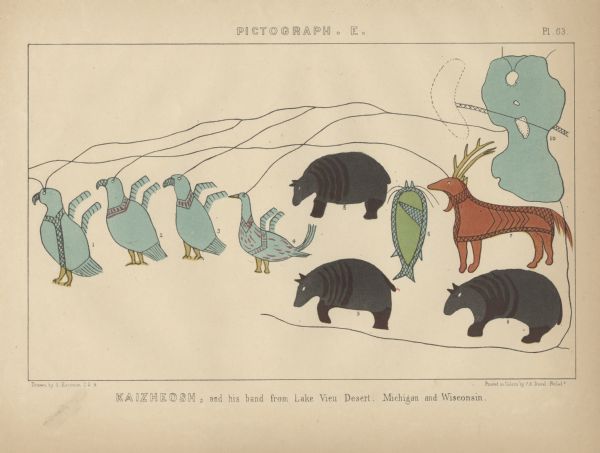
The oldest chief was Gezhiiyaash (his pictographic petition above) or “Swift Sailor” from Lac Vieux Desert. The two other chiefs were likely Oshkaabewis “Messenger” from Wisconsin River, and Naagaanab “Foremost Sitter” from Fond du Lac.
They represented that their annuities under their Treaty of La Pointe, made about the year 1843, were payable in the month of July in each year and not later, because by that time the planting season would be over; beside, it would be the best time and the least dangerous to pass the Great Lake and return to their homes in time to gather wild rice, on which they mainly depended during the hard winters. The first payment was made later than the time agreed upon. The agent, upon being notified, promised to comply with the terms of the Treaty, but every year since the payments have been made later, and that of last year did not take place until about the middle of October, in consequence of which they have been subjected to much suffering.– They assemble at the place for payment designated in the treaty. It is then the traders take advantage of them–being three hundred miles from home, without money, and without provisions; and when their money is received it must all be paid for their subsistence during the long delay they have been subjected to; and sickness frequently breaks out among them from being obliged to use salt provisions, which they are not accustomed to. By leaving their homes at any other time than in the month of July they neglect their harvesting–rice and potato crops, and if they neglect those they must starve to death; therefore it would be better for them to lose their annuities altogether. And without their blankets, procured at the Pointe, they are liable to freeze to death when passing the stormy lake; and the tradespeople influence the Agent to send for them a month before the payment is made, and when they arrive the Agent accepts orders from them for provisions which they are obliged to purchase at a great price–one dollar for 15 lbs of flour, and in proportion for other articles. They have assembled frequently in regard to these things, and can only conclude that their complaints have never reached their “Great Father,” and they have now come to see him in person, and take him by the hand.
In regard to the Half-Breeds at La Pointe, who draw pay with them, they say: That in the Treaty concluded between Governor Dodge and the Chippewas at St. Peters, provision was made for the half-breeds to draw their share all in one payment, and it was paid them accordingly, $258.50 each, which was a mere gift on the part of the tribe; a payment which they had no right to, but was given them as a present. Induced by some subsequent representations by the half-breeds, they were taken into their pay list, and the consequence has been that almost all the half breeds, as well as the French who are married to Indian women, are in the employ of, or dependent upon one of the principal trading houses, (Dr. Bourop’s) at La Pointe, with whom their goods and provisions are stored; and that they are thus enabled to select and appropriate to themselves the choice portion of all the goods designed for them–in many cases not leaving them a blanket to start with upon their journey of two or three hundred miles distant to their homes. After many other details, to which we will make reference in future articles, they urged that owing to the faithlessness of the half-breeds to them, and to the Government, that they be stricken from the pay list.
One half the goods furnished are of no use to them. The articles they most need are guns, kettles, blankets and a greater supply of provisions, &c.
They are under heavy expense, and no money to pay their board. They have undertaken this long journey for the benefit of their whole people, and at their earnest solicitations. They have been absent from their families nearly one year. It has cost them $1,400 to get here. Half of that sum has been raised from exhibitions. The other half has been borrowed from kind people on the route they have traveled. They wish to repay the money advanced them and to procure money to return home with. They want clothes and things to take to their families, and ask an appropriation of $6,000 on their annuity money.
They have before made a communication to the President, to be laid before the present Congress, for the acquisition of lands and the naturalization of their bands–propositions which they urged with great force.
All the Chiefs represented to the President that their interpreter, Mr. Martel, was living in very comfortable circumstances at home, and was induced to accompany them by the urgent solicitations of all their people who confided in his integrity and looked upon him as their friend.

The paternalistic ritual kinship (“Great Father”) language used here by James K. Polk, can be off-putting to the modern reader. However, it had a long tradition in Ojibwe “fur trade theater” rhetoric. Gezhiiyaash was no meek schoolboy, as evidenced by his words in this document (White House)
Their supplicating–though forcible, intelligent, and pathetic appeal, to be permitted to live upon the spot of their nativity, where the morning and noon of their days had been past, and the night time of their existence has reached them, was, too, and irresistible appeal to the justice, generosity and magnanimity of that boasted “civilization” that pleads mercy to the conquered, and was calculated to leave an impress upon every honest heart who claims to be a “freeman.”
The President, in answer to the several addresses, requested the interpreter to state to them that their Great Father was happy to have met with them; and as they had made allusion to written documents which they placed in his hands, as containing an expression of their views and wishes, he would carefully read them and communicate his answer to the Secretary of War and the Commissioner of Indian Affairs, assuring them of kindly feelings on the part of the Government, and terminating with some expressions very like a schoolmaster’s enjoinder upon his scholars that if they behaved themselves they might expect good treatment in future.
The fact that they met Polk was not new information, but we hadn’t been previously aware of just how long the meeting went. It is important to note the president’s use of “kindly feelings” and “behaved themselves.” Those phrases would come up frequently in subsequent years.
One could argue that Polk was a lame duck, and would be dead of cholera within a few months, so his words didn’t mean much. One could argue the problem was that the Ojibwe didn’t understand that in the American political system–that the incoming Whig administration might not feel bound by the words and “kindly feelings” of the outgoing Democratic administration.
However, the next document shows that the chiefs did feel the need to cover their bases and stuck around Washington long enough meet the next president. To us, at least, this was new information:
National Era v. III. No. 14, pg. 56 April 5, 1849
For the National Era
THE CHIPPEWA CHIEFS AND GENERAL TAYLOR
On the third day after the arrival of General Taylor at Washington, the Indian chiefs requested me to seek an interview for them, as they were about to leave for their homes, on Lake Superior, and greatly desired to see the new President before their departure.
It was accordingly arranged by the General to see them the next morning at 9 o’clock, before the usual reception hour.
Fitted out in their very best, with many items of finery which their taste for the imposing had added to their wardrobe, the delegation and their interpreter accompanied me to the reception room, and were cordially taken by the hand by the plain but benevolent-looking old General. One of the chiefs arose, and addressed the President elect nearly as follows:
“Father! We are glad to see you, and we are pleased to see you so well after your long journey.
“Father! We are the representatives of about twenty thousand of your red children, and are just about leaving for our homes, far off on Lake Superior, and we are very much gratified, that, before our departure, we have the opportunity of shaking hands with you.
“Father! You have conquered your country’s enemies in war; may you subdue the enemies of your Administration while you are President of the United States and govern this great country, like the great father, Washington, before you, with wisdom and in peace.
“Father! This our visit through the country and to the cities of your white children, and the wonderful things that we have seen, impress us with awe, and cause us to think that the white man is the favored of the Great Spirit.
“Father! In the midst of the great blessings with which you and your white children are favored of the Great Spirit, we ask of you, while you are in power, not to forget your less fortunate red children. They are now few, and scattered, and poor. You can help them.
“Father! Although a successful warrior, we have heard of your humanity! And now that we see you face to face, we are satisfied that you have a heart to feel for your poor red children.
“Father Farewell”
The tall, manly-looking chief having finished and shaken hands, General Taylor asked him to be seated, and, rising himself, replied nearly as follows”
“My Red Children: I am very happy to have this interview with you. What you have said I have listened to with interest. It is the more appreciated by me, as I am no stranger to your people. I resided for a length of time on your borders, and have been witness to your privations, and am acquainted with many of your wants.
“Peace must be established and maintained between yourselves and the neighboring tribes of the red men, and you need in the next place the means of subsistence.
“My Red Children: I thank you for your kind wishes for me personally, and as President of the United States.
“While I am in office, I shall use my influence to keep you at peace with the Sioux, between whom and the Chippewas there has always been a most deadly hostility, fatal to the prosperity of both nations. I shall also recommend that you be provided with the means of raising corn and the other necessaries of life.
“My Red Children: I hope that you have met with success in your present visit, and that you may return to your homes without an accident by the way; and I bid you say to your red brethren that I cordially wish them health and prosperity. Farewell.”
This interesting interview closed with a general shaking of hands and during the addresses, it is creditable to the parties to say, that the feelings were reached. Tears glistened in the eyes of the Indians and General Taylor evinced sufficient emotion, during the address of the chief, to show that he possesses a heart that may be touched. The old veteran was heard to remark, as the delegation left the room, “What fine looking men they are!”
Major Martell, the half-breed interpreter, acquitted himself handsomely throughout. The Indians came away declaring that “General Taylor talked very good.”
The General’s family and suite, evidently not prepared for the visit; were not dressed to receive company at so early an hour; nevertheless, they soon came in, en dishabille, and looked on with interest.
P.
One of the lingering questions I’ve had about the 1848-49 Delegation has been whether or not the Ojibwe leadership viewed it as a success. This document shows that the answer was unequivocally yes. It also shows why the chiefs felt so blindsided and disbelieving in the spring of 1850 when the government agents at La Pointe told them that Taylor had ordered them to remove. They didn’t have to go back to 1842 for the Government’s promises. They had heard them only a year earlier from both the president and the president-elect!
It also explains why during and after the removal, the chiefs number-one priority was sending another delegation. One would eventually go in 1852, led by Chief Buffalo of La Pointe. This would help secure the reservations sought by the first delegation, but that was only after two failed removal attempts and hundreds of deaths.
If the cholera epidemic had not come, Chief Buffalo and other prominent chiefs, would have likely gone back to Taylor in the winter of 1849-50. They may have been able to secure new treaty negotiations, reservations on the ceded territory, or at the very least have been more prepared for the upcoming removal:
George Johnston to Henry Schoolcraft, 5 October 1849, MS Papers of Henry Rowe Schoolcraft: General Correspondence, 1806-1864, BOX 51.
Saut Ste Maries
Oct 5th 1849
My Dear sir,
Your favor of Sep. 14th, I have just now received and will lose no time in answering. Since I wrote to you on the subject of an intended delegation of Chippewa Chiefs desiring to visit the seat of Govt., I visited Lapointe and remained there during the payment, and I had an opportunity of seeing & talking with the chiefs. They held a council with their agent Dr. Livermore and expressed their desire to visit Washington this season, and they laid the matter before him with open frankness, and Dr. Livermore answered them in the same strain, advising them at the same time, to relinquish their intended visit this year, as it would be dangerous for them, to travel in the midst of sickness which was so prevalent & so widely spread in the land, and that if they should still feel desirous to go on the following year that he would then permit them to do so, and that he would have no objections, this appearing so reasonable to the chiefs, that they assented to it.
I will write to the chiefs and express to them the subject of your letter, and direct them to address Mr. Babcock at Detroit.
You will herein find enclosed copy of Mr. Ballander’s letter to me, a gentleman of the Hon. Hudson’s Bay Co. & Chief factor at Fort Garry in the Red river region, it is very kind & his sympathy, devotes a feeling heart.– Mr. Mitchell of Green Bay to whom I have written in the early part of this summer, to make enquiries relative to certain reports of Tanner’s existence among the sioux, he has not as yet returned an answer to may communication and I feel the neglect with some degree of asperity which I cannot control.
Very Truly yours
Geo. Johnston
Henry R. Schoolcraft Esq.
Washington
It is hard to say how differently history may have turned out if a second delegation had been able to go with George Johnston. There is a good chance it would have been a lot more successful. Johnston was much more of an insider than Martell–who had had a lot of difficulty convincing the American authorities of his credentials. One of those who stood in Martell’s way was Henry Schoolcraft. Schoolcraft, was regarded by the American establishment as the foremost authority on Ojibwe affairs and was Johnston’s brother-in-law.
It may not have worked. The inertia of United States Indian Policy was still with removal. Any attempt to reverse Manifest Destiny and convince the government to cede land back to Indian nations east of the Mississippi was going to be an uphill battle. The Minnesota trade interests were strong.
Also, Schoolcraft was a Democrat, so he would have had less influence with the Whig Taylor–though agreements on Western issues sometimes crossed party lines. However, one can imagine George Johnston sitting around a table in Washington with his “Uncle” Buffalo, his brother-in-law Schoolcraft, and the U.S. President, working out the contours of a new treaty avoiding the removal entirely. Because of the cholera, however, we’ll never know.
For more on how the fallout from the Mexican War impacted Ojibwe removal, see Slavery, Debt Default, and the Sandy Lake Tragedy
For more on the 1848-49 Delegation, see: this post, this post, and this post
American Fur Company: 1834 Reinvention of La Pointe
October 4, 2023
Collected & edited by Amorin Mello
The below image from the Wisconsin Historical Society is a storymap showing La Pointe in 1834 as abstract squiggles on an oversized Madeline Island surrounded by random other Apostle Islands, Bayfield Peninsula, Houghton Point, Chequamegon Bay, Long Island, Bad River, Saxon Harbor, and Montreal River.

“Map of La Pointe”
“L M Warren”
“~ 1834 ~”
Wisconsin Historical Society
citing an original map at the New York Historical Society
My original (ongoing) goal for publishing this post is to find an image of the original 1834 map by Lyman Marcus Warren at the New York Historical Society to explore what all of his squiggles at La Pointe represented in 1834. Instead of immediately achieving my original goal, this post has become the first of a series exploring letters in the American Fur Company Papers by/to/about Warren at La Pointe.
New York Historical Society
American Fur Company Papers: 1831-1849
America’s First Business Monopoly
#16,582

Map of Lapointe
by L M Warren
~ 1834 ~
New York Historical Society
scanned as Gale Document Number GALE|SC5110110218
#36

Ramsay Crooks
~ Madeline Island Museum
Lapointe Lake Superior
September 20th ’34
Ramsey Crooks Esqr
Dear Sir
Starting in 1816, the American Fur Company (AFC) operated a trading post by the “Old Fort” of La Pointe near older trading posts built by the French in 1693 and the British in 1793.
In 1834, John Jacob Astor sold his legendary AFC to Ramsay Crooks and other trading partners, who in turn decided to relocate the AFC’s base of operations at Mackinac Island to Madeline Island, where our cartographer Lyman Marcus Warren was employed as the AFC’s trader at La Pointe.
Instead of improving any of the older trading posts on Madeline Island, Warren decided to move La Pointe to the “New Fort” of 1834 to build new infrastructure for growing business demands.

GLO PLSS 1852 survey detail of the “Am Fur Co Old Works” near Old Fort.
on My Way In as Mr Warren was was detained So Long at Mackinac I did not Wait for him at this Place as time was of So Much Consequence to me to Get my People Into the County that I Proceeded Immediately to Fond Du Lac with the Intention with the Intention of Returning to this Place When I Had Sent the Outfit off but When I Got There I Had News from the Interior Which Required me to Go In and Settle the Business there; the [appearance?] In the Interior for [????] is tolerable. Good Provision there is [none?] Whatever I [have?] Seen the [Country?] [So?] Destitute. The Indians at [Fort?] [?????] Disposed to give me Some trouble when they found they have to Get no Debts and buy their amunition and tobacco and not Get it For Nothing as usual but at Length quieted down [?????] and have all gone off to their Haunts as usual.
I Received your Instructions contained in your Circular and will be very Particular In Following them. The outfits were all off when I Received them but the men’s acts and the Invoices of the Goods Had all been Settled according to your Wishes and Every Care Will be taken not to allow the men to get In Debt the Clerks Have Strict orders on the Subject and it is made known to them that they will be Held for any of the Debts the men may Incur.
I Enclose to you the Bonds Signed and all the Funds we Received from Mr Johnston Excepting those Which Had been given to the Clerks and I could not Get them Back In time to Send them on at Present.
Mr Warren And myself Have Committed on What is to be done at this Place and I am certain all that Can be done Will be done by him. I leave here tomorrow For the Interior of Fond Du Lac Where I must be as Soon as possible.
I have written to Mr Schoolcraft as he Inquested me. Mr Brewster’s men would not Give up their [??????] and [???] [????] is [??] [?????] [????] [????] [to?] [???????] [?????] [to?] [persuade?] [more?] People for Keeping [his?] [property?] [Back?] [and] [then?] [???] by some [???] ought to be sent out of the Country [??] they are [under?] [the?] [???] [?] and [Have?] [no?] [Right?] to be [????] [????] they are trouble [????] [???] [their?] [tongues?].

GLO PLSS 1852 survey detail of the AFC’s new “La Point” (New Fort) and the ABCFM’s “Mission” (Middleport).
The Site Selected Here For the Buildings by Mr Warren is the Best there is the Harbour is good and I believe the work will go on well.
as For the Fishing we Will make Every Inquiry on the Subject and I Have no Doubt on My Mind of Fairly present that it will be more valuable than the Fur trade.
In the Month of January I will Write you Every particular How our affairs stand from St Peters. Bailly Still Continues to Give our Indians Credits and they Bring Liquor from that Place which they Say they Get from Him.
Please let Me know as Early as possible with Regard to the Price of Furs as it will Help me In the trade. the Clerks all appear anxious to do their Duty this year as the wind is now Falling and I am In Haste I Will Write you Every particular of our Business In January.
Wishing that God may Long Prosper you and your family.
In health and happiness.
I remain most truly,
and respectfully
yours $$
William A. Aitken
#42
Lake Superior
LaPointe Oct 16 1834
Ramsey Crooks Esqr
Agent American Fur Co
Honoured Sir
Your letter dated Mackinac Sept [??] reached me by Mr Chapman’s boat today.-
I will endeavour to answer it in such a manner as will give you my full and unreserved opinion on the different subjects mentioned in it.
I feel sorry to see friend Holiday health so poor, and am glad that you have provided him a comfortable place at the Sault. As you remark it is a fortunate circumstance that we have no opposition this year or we would certainly have made a poor resistance. I can see no way on which matters would be better arranged under existing circumstances than the way in which you have arranged it. If Chaboillez, and George will act in unison and according to your instructions, they will do well, but I am somewhat affeared, that this will not be the case, as I think George might perhaps from jealously refuse to obey Chaboillez or give him the proper help. Our building business prevents me from going there myself. I suppose you have now received my letter of last Sept, in which I mentioned that I had kept the Doctor here. I shall send him in a few days to see how matters comes on at the Ance. The Davenports are wanted at present in FDLac should it be necessary to make any alteration. I shall leave the Doctor at the Ance.

Undated photograph of the ABCFM Presbyterian Mission Church at it’s original 1830s location along the shoreline of Sandy Bay.
~ Madeline Island Museum

Reverend Sherman Hall
~ Madeline Island Museum
In addition to the AFC’s new La Pointe, Warren was also committed to the establishment of a mission for the American Board of Commissioners for Foreign Missions (ABCFM) as a condition of his 1827 Deed for Old La Pointe from his Chippewa wife’s parents; Madeline & Michel Cadotte.
Starting in 1830, the ABCFM built a Mission at La Pointe’s Middleport (second French fort of 1718), where they were soon joined by a new Catholic Mission in 1835.
Madeline Island was still unceded territory until the 1842 Treaty of La Pointe. The AFC and ABCFM had obtained tribal permissions to build here via Warren’s deed, while the Catholics were apparently grandfathered in through French bloodlines from earlier centuries.
I think we will want about 2 Coopers but as you suggest I if they may be got cheaper than the [????] [????]. The Goods Mr Hall has got is for his own use that is to say to pay his men [??]. The [??] [??????] [has?] to pay for a piece of land they bot from an Indian woman at Leech Lake. As far as my information goes the Missionaries have never yet interfered with our trade. Mr Hall’s intention is to have his establishment as much disconnected with regular business as he possibly can and he gets his supplies from us.
[We?] [have?] received the boxes [Angus?] [??] [???]. [You?] mention also a box, but I have not yet received it. Possible it is at the Ance.
The report about Dubay has no doubt been exaggerated. When with me at the Ance he mentioned to me that Mr Aitkin told him he had better tell the Indians not to kill their beaver entirely off and thereby ruin their country. The idea struck me as a good one and as far as I recollect I told him, it would perhaps be good to tell them so. I have not yet heard from any one, that he has tried to prevent the Indians from paying their old Debts and I should not be astonished to fend the whole is one of those falsehoods which Indians are want to use to free themselves from paying old Debts. I consider Dubay a pretty active man, but the last years extravagancies have made it necessary to have an eye upon him to prevent him from squandering.

“The Doctor” Charles William Wulff Borup, M.D.
~ Madeline Island Museum
My health had been somewhat impaired by my voyage from the Sault to this place. Instead of going to Lac Du Flambeau myself as I intended I sent the Doctor. He has just now returned and tells me that Dubay gets along pretty well, though there were some small difficulties which toke place, but which the Dr settled. The prospect are very discouraging, particularly on a/c of provisions. We have plenty opposition and all of them with liquor in great abundance. It is provoking to see ourselves restricted by the laws from taking in liquor while our opponents deal in it as largely as ever. The traders names are as far as could be ascertained Francois Charette and [Chapy?]. The liquor was at Lac du Flambeau while the Doctor was there. I have furnished Dubay with means to procure provisions, as there is actually not 1 Sack of Corn or Rice to be got.
The same is the case on Lac Courtoreilie and Folleavoigne no provisions and a Mr Demarais on the Chippeway River gives liquor to the Indians.
You want my ideas upon the fishing business. If reliance can be put in Mr Aitkin’s assertions we will at least want the quantity of Net thread mentioned in our order. Besides this we will want for our fishing business 200 Barrels Flour, [??] Barrels Pork, 10 Kegs Butter, 1000 Bushels Corn, [??] Barrels Lard, 10 or 11 Barrels Tallow.

Undated photograph of the ABCFM mission house built in 1832.
~ Madeline Island Museum
Besides this we want over and above the years supply an extra supply for our summer Establishments. say about 80 Barrels Flour, 30 Barrels Pork, 1500 # Butter, 400 Bushels Corn, 5 Barrels Lard, 5 Barrels Tallow. This will is partly to sell. be sold.
Mr Roussain will be as good as any if not better in my opinion for our business than Holiday. Ambrose Davenport might take the charge of the Ance but Roussain will be more able on account of his knowledge in fishing. I would recommend to take him as a partner. say take Holidays share if he could not be got for less.
I have not done much yet toward building. The greatest part of my men have been in the exterior to assist our people to get in. But they have now all arrived. We have got about 4 acres of land cleared, a wintering house put up and a considerable quantity of boards sawed. Mr Aitkin did not supply me with two Carpenters as he promised at Mackinac. I will try to get along as well as I can without them. I engaged Jos Dufault and Mr Aitkin brot me one of Abbott’s men, who he engaged. But I will still be under the necessity of hiring Mr Campbell of the mission to make our windows sashes and to superintend The framing of the buildings. Mr Aitkins have done us considerable damage by not fulfilling his promise in this respect. I told you in Mackinac that Mr Aitkin was far from being exact in business. Your letter to him I will forward by the first opportunity. I think it will have a good effect and you do right in being thus plain in stating your views. His contract deserves censure, and I will hope that your plain dealing with him will not be lost upon him. Shall I beg you to be as faithfull to me by giving me the earliest information whenever you might disapprove of any transaction of mine.
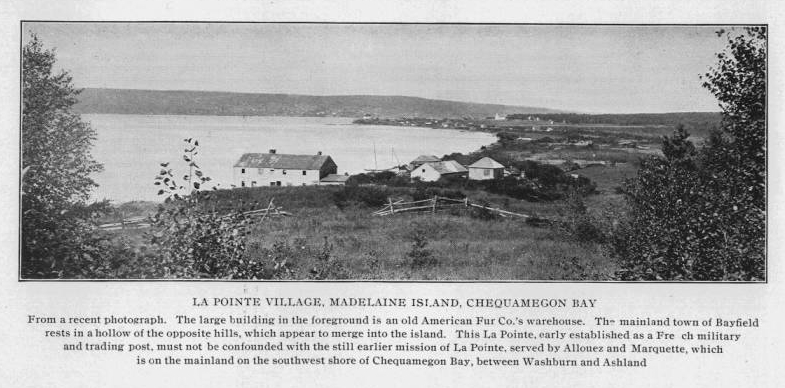
Photograph of La Pointe from Mission Hill circa 1902.
~ Wisconsin Historical Collections, Volume XVI, page 80.
I have received a supply of provisions from Mr Chapmann which will enable me to get through this season. The [?] [of?] [???] [next?], the time you have set for the arrival of the Schooner, will be sufficient, early for our business. The Glass and other materials for finishing of the buildings would be required to be sent up in the first trip but if [we?] [are?] [??] better to have them earlier. If these articles could be sent to the Sault early in the Spring a boat load might be formed of [Some?] and Provisions and sent to the Ance. From there men could be spared at that season of the year to bring the load to this place. In that way there would be no heavy expense incurred and I would be able to have the buildings in greater forwardness.
If the plan should meet your approbation please let me know by the winter express. While Mr Aitkin was here we planned out our buildings. The House will be 86 feet by 26 feet in the clear, the two stores will be put up agreeable to your Draft. We do not consider them to large.
I am afraid I shall not be able to build a wharf in season, but shall do my best to accomplish all that can be done with the means I have.

Undated photograph of Captain John Daniel Angus’ boat at the ABCFM mission dock.
~ Madeline Island Museum
I would wish to call your attention towards a few of the articles in our trade. I do not know how you have been accustomed to buy the Powder whether by the Keg or pound. If a keg is estimated at 50#, there is a great deception for some of our kegs do not contain more than 37 or 40 #s.
Our Guns are very bad particularly the barrels. They splint in the inside after been fired once or twice.
Our Holland twine is better this year than it has been for Years. One dz makes about 20 fathoms, more than last year. But it would be better if it was bleached. The NW Company and old Mr Ermantinger’s Net Thread was always bleached. It nits better and does not twist up when put into the water. Our maitre [??] [???] are some years five strand. Those are too large we have to untwist them and take 2 strands out. Our maitre this year are three strand they are rather coarse but will answer. They are not durable nor will they last as long as the nets of course they have to be [renewed?]. The best maitres are those we make of Sturgeon twine. We [?????] the twine and twist it a little. They last twice as long as our imported maitres. The great object to be gained is to have the maitres as small as possible if they be strong enough. Three coarse strands of twisted together is bulky and soon nits.
Our coarse Shoes are not worth bringing into the country. Strong sewed shoes would cost a little more but they would last longer. The [Booties?] and fine Shoes are not much better.
Our Teakettles used to have round bottoms. This year they are flat. They Indians always prefer the round bottom.
In regard to the observations you have made concerning the Doctor’s deviating from the instructions I gave him on leaving Mackinac, I must in justice to him say that I am now fully convinced in my own mind that he misunderstood me entirely, merely by an expression of mine which was intended by me in regard to his voyage from Mackinac to the Sault but by him was mistaken for the route through Lake Superior. The circumstances has hurt his feelings much and as he at all times does his best for the Interest of the Outfit I ought to have mentioned in my last letter, but it did not strike my mind at that time.

Detail from Carte des lacs du Canada by Jacques Nicolas Bellin in 1744.
When Mr Aitkin was here he mentioned to me some information he had obtained from somebody in Fond du Lac who had been in the NW Co service relating to a remarkable good white fish fishery on the “Milleau” or “Millons” Islands (do not know exactly the proper name). They lay right opposite to Point Quiwinau. a vessel which passes between the island and the point can see both. Among Mr Chapmann’s crew here there is an old man who tells me that he knew the place well, he says the island is large, say 50 or 60 miles. The Indian used to make their hunts there on account of the great quantity of Beaver and Reindeer. It is he says where the NWest Co used to make their fishing for Fort William. There is an excellent harbour for the vessel it is there where the largest white fish are caught in Lake Superior. Furthermore the old man says the island is nearer the American shore than the English. Some information might be obtained from Capt. McCargo. If it proves that we can occupy the grounds I have the most sanguine hopes that we shall succeed in the fisheries upon a large scale.
I hope you will gather all the information you can on the subject. Particular where the line runs. If it belongs to the Americans we must make a permanent post on the Island next year under the charge of an active person to conduct the fisheries upon a large scale.
Jh Chevallier one of the men I got in Mackinac is a useless man, he has always been sick since he left Sault. Mr Aitkin advised me to send him back in Chapman’s Boat. I have therefore send him out to the care of Mr Franchere.
By the Winter Express I will to give you all the informations that I may be able to give. I will close by wishing you great health and prosperity. Please present my Respects to Mr Clapp.
I remain Dear Sir.
Very Respectfully Yours
Most Obedient Servant
Lyman M. Warren
To be Continued in 1835…
Lac du Flambeau Reservation: 1842 Boundaries
October 23, 2021
“We do not feel disposed to go away into a strange & unknown country, we desire to remain where our ancestors lay & where their remains are to be seen.“
By Leo
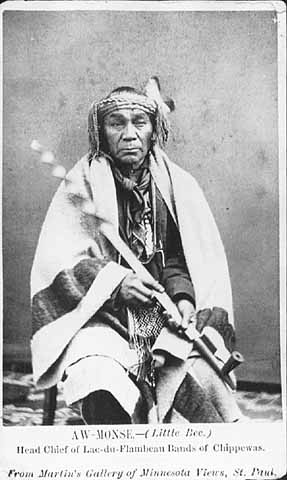
Poking through old archives, sometimes you find the best things where you wouldn’t expect to. The National Archives have been slowly digitizing its Bureau of Indian Affairs microfilms, and for several months, I have been slogging through the thousands of images from the La Pointe Agency. For a change of pace, a few days ago, I checked out the documents on the Sault Ste. Marie Agency films and got my hands on a good one.
In September of 1847, Aamoons (Little Bee) and some headmen of what had been White Crow’s (Waabishkaagaagi) Lac du Flambeau were facing a serious dilemma. They were on their way home from the annuity payment at La Pointe where the main topic of conversation would certainly have been controversy surrounding the recent treaty at Fond du Lac. Several chiefs refused to sign, and the American Fur Company’ Northern Outfit opposed it due to a controversial provision that would have established a second Ojibwe sub agency on the Mississippi River. They saw this provision as a scheme by Missisippi traders to effect the removal west of all bands east of the Mississippi. Aamoons, himself, did not initially sign the document, but his mark can be found on the back of an envelope sent from La Pointe to Washington.
Our old friend George Johnston was returning to his Sault Ste. Marie home from the annuity payments when the Lac du Flambeau men summoned him to the Turtle Portage, near today’s Mercer, Wisconsin. They presented him a map and made speeches suggesting removal would be in direct violation of promises made at the Treaty of La Pointe (1842).
Johnston did not have a position with the American Government at this time, and his trading interests in western Lake Superior were modest. However, he was well known in the country. His grandfather, Waabojiig (White Fisher), was a legendary war chief at Chequamegon, and his parents formed a powerful fur trade couple at the turn of the 19th century. In the 1820s, George served as the first Indian Office sub-agent at La Pointe under his brother-in-law Henry Rowe Schoolcraft. During this time, he developed connections with Ojibwe leaders throughout the Lake Superior country, many of whom he was related to by blood or marriage.
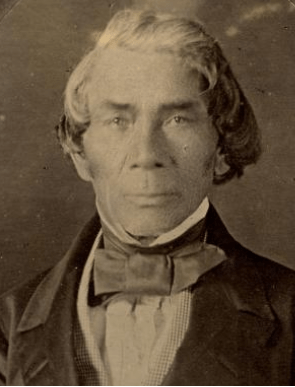
By 1847, Schoolcraft had remarried and left for Washington after the death of his first wife (George’s sister Jane). However, the two men continued to correspond and supply direct intelligence to each other regarding Ojibwe politics. Local Indian Agents attempted to control all communication moving to and from Washington, so in Johnston they likely saw a chance to subvert this system and press their case directly.
The document that emerged from this 174 year old meeting is notable for a few reasons. It further bolsters the argument that the Ojibwe did not view their land cessions in the 1837 and 1842 treaties as requiring them to leave their villages in the east. That point that has been argued for years, but here we have a document where the chiefs speak of specific promises. It also reinforces the notion that the various political factions among the Lake Superior chiefs were coalescing around a policy of promoting reservations as an alternative to removal. This seems obvious now, but reservations were a novel concept in the 1840s, and certainly the United States ceding land back to Indian nations east of the Mississippi would have been unheard of. Knowing this was part of the discussion in 1847 makes the Sandy Lake Tragedy, three years later, all the more tragic. The chiefs had the solution all along, and had the Government just listened to the Ojibwe, hundreds of lives would have been spared.
Finally, the document, especially the map, should be of interest to the modern Lac du Flambeau Band as it appears its reservation should be much larger, encompassing the historical villages at Turtle Portage and Trout Lake as well as Aamoons’ village at Lac du Flambeau proper. The borders also seem to approach, but not include the villages at Vieux Desert and Pelican Lake, which will be interesting to the modern Sokaogon and Lac Vieux Desert Bands.
Saut Ste. Marie
Augt 28th 1848.
Dear sir,
On reaching the turtle portage during the past fall; I was addressed by the Indians inhabiting, the Lac du Flambeau country and they presented me with a map of that region, also a petition addressed to you which I will herein insert, they were under an impression that you could do much in their behalf. The object of delineating a map is to show to the department, the tract of country they reserved for themselves, at the treaty of 1842, concluded by Robert Stuart at Lapointe during that period, and which now appears to be included in that treaty, without any reserve to the Indians of that region, and who expressly stated through me that they were willing to sell their mineral lands, but would retain the tract of country delineated on the map; This forms an important grievance in that region. I designed to have forwarded to you during the past winter their map & petition, but having mislaid it, I did not find it till this day, in an accidental manner, and I now feel that I am bound in duty to forward it to you.
The petition of the Chiefs Ahmonce, Padwaywayashe, Oshkanzhenemais & Say Jeanemay.
My Father (addressing Mr. Schoolcraft.)
Padwaywayashe rose and said, It is not I that will now speak on this occasion, it is these three old men before you, they are related to our ancestors, that man (pointing to Say Jeanemay will be their spokesman,
Sayjeanemay rose and said,
My Father, (addressing himself to Mr. Schoolcraft.)
Padwaywayahshe who has just now ceased speaking is the son of the late Kakabishin an ancient Chief who was lost many years ago in lower Wisconsain, and the white people have not as yet found him, and his Father was one of the first who received the Americans when they landed on the Island of Mackinac. Kishkeman and Kahkahbeshine are the two first chiefs that shook hands with the Americans, The Indian agent then told them that he had arrived and had come to be a friend to them, they who were living in the high mountains, and he saw that they were poor and he was come to rekindle their fire, and the American Indian Agent then gave Kish Keman a large flag and a large silver medal, and said to him, you will never meet with a bad day, the sky will always be bright before you.
My Father.
Our old chief the white crow died last dall, he went to the treaty held at St. Peters, and reached that point when the treaty was almost concluded, and he heard very little of it, and it was not him who sold our lands, it was an Indian living beyond the pillager band of Indians. We feel much grieved at heart, we are now living without a head, and had we reached St. Peters in time, the person who sold our lands would not have been permitted to do so, we should have made provision for ourselves and for our children, We do not now see the bright sky you spoke of to us, we see the return of the bad day I was in the habit of seeing before you came to renew my fire, and now it is again almost extinguished.
My Father;
We feel very much grieved; had my chief been present I should not have parted with my lands, and we find that the commissioner who treated with us, (meaning Mr. R. Stuart) has taken advantage of our ignorance, and bought our lands at his own price, and we did not sell the tract delineated on our map.
My Father;
We do not feel disposed to go away into a strange & unknown country, we desire to remain where our ancestors lay & where their remains are to be seen. We now shake hands with you hope that you will answer us soon.
Turtle portage 11th Sep; 1847.
In presence of}
Geo. Johnston.
Ahmonce his X mark
Padwaywayahshe his X mark
Oshkanzhenemay his X mark
Sayjeaneamy his X mark
To,
Henry R. Schoolcraft Esq.
Washington
N.B. All the country lying within the dotted lines embraces the country, the Chief Monsobodoe & others reserved at the Lapointe treaty and which now is embraced in the Treaty articles, and could not be misunderstood by Mr. Stuart and as I have already remarked forms an important grievance. All of which is respectfully submitted by
Respectfully
Your obt Servant
Geo. Johnston.
Henry R. Schoolcraft Esq.
Washington.
Respectfully referred from my files to the Commissioner of Indian Affairs
H.R.S
14th Feb 1849

Ahmonce (Aamoons), is found in many documents from the 1850s and 60s as the successor chief to the band once guided by his father Waabishkaagaagi (White Crow), uncle Moozobodo (Moose Muzzle), and grandfather Giishkiman (Sharpened Stone). The latter two are spelled Monsobodoe and Kishkeman in this document. Gaakaabishiinh (Kahkabeshine) “Screech Owl,” is probably the “old La Chouette” recorded in Malhiot’s Lac du Flambeau journal in the winter of 1804-05.
“The Americans when they landed on the Island of Mackinac” refers to the surrender of the British garrison at the end of the War of 1812, which is often referenced as the start of American assertions of sovereignty over the Ojibwe country. Despite Sayjeanemay’s lofty friendship rhetoric, it should be noted that many Ojibwe warriors fought with the British against the United States and political relations with the British crown and Ojibwe bands on the American side would continue for the next forty years.
The speaker who dominated the 1837 negotiations, and earned the scorn of the Lake Superior Bands, was Maajigaabaw or “La Trappe.” He, Flat Mouth, and Hole-in-the-Day, chiefs of the Mississippi and Pillager Bands in what is now Minnesota, were more inclined to sell the Wisconsin and Chippewa River basins than the bands who called that land home. This created a major rift between the Lake Superior and Mississippi Ojibwe.
Pa-dua-wa-aush (Padwaywayahshe) is listed under Aamoons’ band in the 1850 annuity roll. Say Jeanemay appears to be an English phonetic rendering of the Ojibwe pronunciation of the French name St. Germaine. A man named “St. Germaine” with no first name given appears in the same roll in Aamoons’ band. The St. Germaines were a mix-blood family with a long history in the Flambeau Country, but this man appears to be too old to be a child of Leon St. Germaine and Margaret Cadotte. From the text it appears this St. Germaine’s family affiliated with Ojibwe culture, in contrast to the Johnstons, another mix-blood family, who affiliated much more strongly with their father’s Anglo-Irish elite background. So far, I have not been able to find another mention of Oshkanzhenemay.
Moozobodo was not present at the Treaty of La Pointe (1842) as he died in 1831. Johnston may be confusing him with his brother Waabishkaagaagi
The timing of Schoolcraft’s submission of this document to the Indian Department is curious. In February 1849, a delegation of chiefs, mostly from villages near Lac du Flambeau was in Washington D.C. to petition President Polk for reservations. Schoolcraft worked to undermine this delegation. Had he instead promoted the cause of reservations over removal, one wonders if he could have intervened to prevent the Sandy Lake debacle.

Map of Lac du Flambeau Reservation as understood by Ojibwe at Treaty of La Pointe 1842. Apparently drawn from memory 11 September 1847 by Lac du Flambeau chiefs, copied and presumably labelled by George Johnston. Microfilm slide made available online by National Archives https://catalog.archives.gov/id/164363909 Image 340.

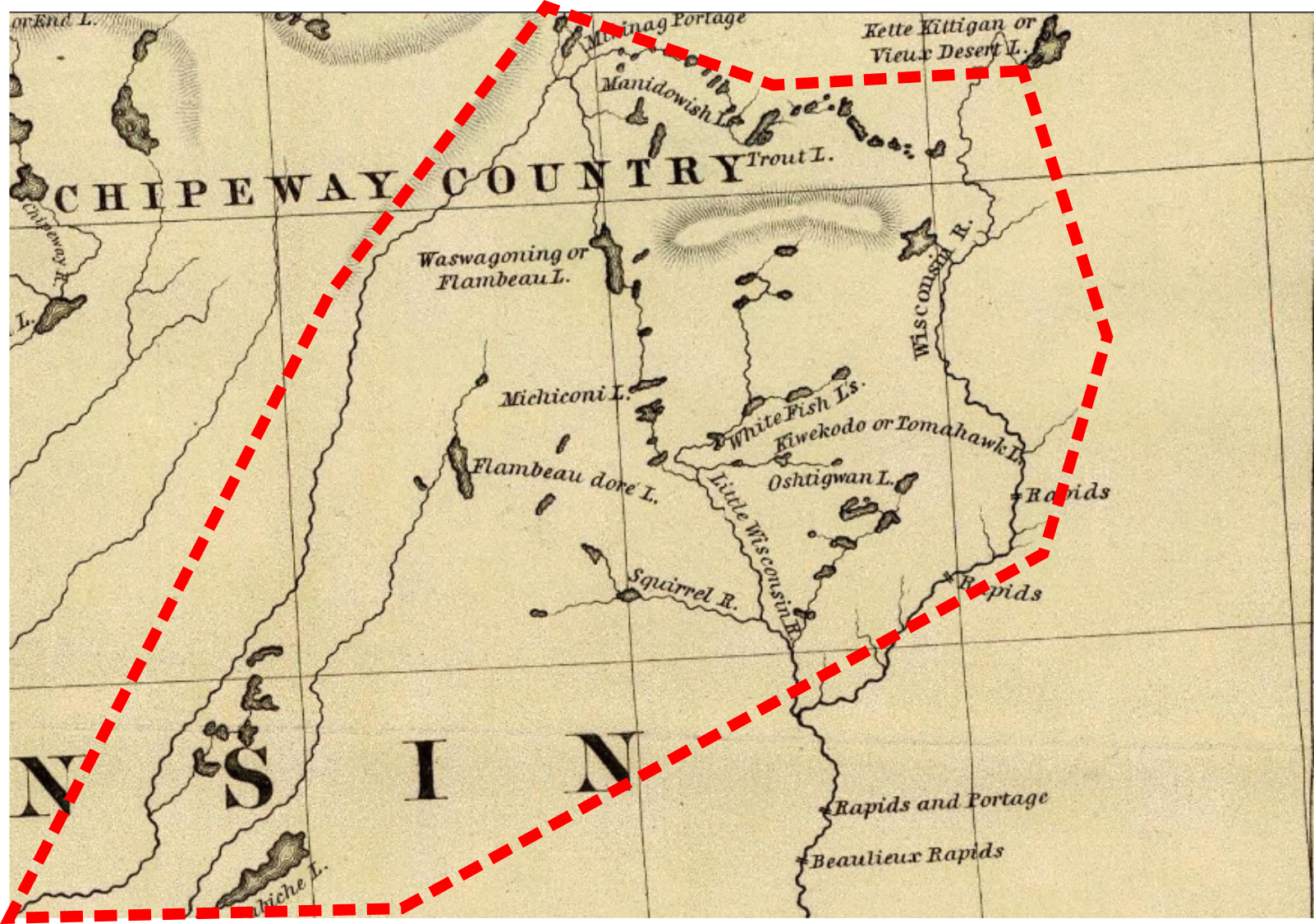

Alleged reservation boundaries agreed to in 1842 roughly superimposed over modern map. The Treaty of La Pointe (1854) called for three townships for the Lac du Flambeau Band–the white square on this map showing the modern reservation. Had the 1842 boundaries held, the reservation would have been much larger and included several popular resort communities.
Ancient Garden Beds of Michigan
May 4, 2017
By Amorin Mello

This is a reproduction of “Ancient Garden Beds of Michigan“ from Memorials of a Half Century, by Bela Hubbard, 1887, pages 243-261.
ANCIENT GARDEN BEDS OF MICHIGAN.*
* Read before the State Pioneer Society, February 7, 1877, and published in the American Antiquarian.
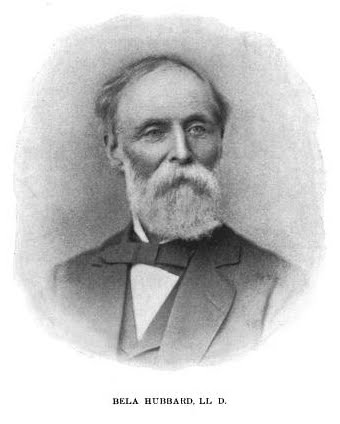
Bela Hubbard explored Lake Superior in 1840 as the Assistant State Geologist of Michigan with Douglass Houghton.
A CLASS of works of the Mound-builders exists in Michigan, of unknown age and origin, which have received the name of “Garden-Beds.”
An unusual importance attaches to these remains of a lost race, from the fact that they have been almost entirely overlooked by archæologists, and that of those which were so numerous and prominent forty, or even thirty years ago, nearly every trace has disappeared. For any knowledge beyond the scanty details hitherto recorded we are forced to rely upon the recollections of the “oldest inhabitants.” We know how uncertain this reliance often is, and were it otherwise, we cannot but recognize the rapidity with which we are losing our hold of this kind of testimony, and the very brief period of which it must cease altogether.
The earliest mention of these relics which I find is by Haven, in his “Archæology of the United States.” It is the report of Verandrie, who, with several French associates, explored this region before 1748. He found in the western wilderness
“large tracts free from wood, many of which are everywhere covered with furrows, as if they had formerly been ploughed and sown.”
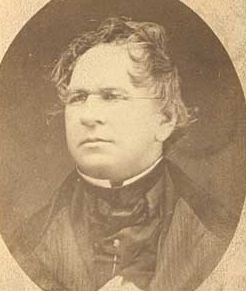
Henry Rowe Schoolcraft wrote about ancient gardens in Archives of Aboriginal Knowledge: Volumes I-VI.
Schoolcraft was the first to give to the world any accurate and systematic account of these “furrows.” Indeed, he is the only author of note who honors this interesting class of the works of the Mound-Builders with more than the most meagre mention. Observations were made by him as early as 1827. He gives figures of two kinds of beds, and he records the fact, that
“the garden-beds, and not the mounds, form the most prominent, and, by far, the most striking and characteristic antiquarian monuments of this district of country.”
Another writer of early date, still resident of our State, John T. Blois, published, in 1839, in his “Gazetteer of Michigan,” a detailed description, with a diagram, of one kind of the beds.
No mention is made of these remains by Priest or by Baldwin. Foster devotes to them less than a single page of his voluminus work, and only says, in effect, that “they certainly indicate a methodical cultivation which was not practised by the red man.”

Increase Allen Lapham wrote about ancient gardens in Antiquities of Wisconsin, and was involved with the Penokee Survey Incidents.
Dr. Lapham describes a few of this kind of remains which were found upon the western shore of Lake Michigan, as
“consisting of low parallel ridges, as if corn had been planted in drills. They average four feet in width, and twenty-five of them have been counted in the space of one hundred feet.”
Yet these relics constitute a unique feature in the antiquities of our country. They are of especial interest to us, from the fact that they were not only the most prominent of our antiquities, but, with the exception referred to in Wisconsin, they are confined to our State.
Some investigations, by no means thorough, enable me to define more accurately and fully than has been heretofore done the different kinds of these beds, which I shall attempt to classify, according to the most reliable information obtained. But I must first define their situation, extent and character.
The so-called “Garden-Beds” were found in the valleys of the St. Joseph and Grand rivers, where they occupied the most fertile of the prairie land and burr-oak plains, principally in the counties of St. Joseph, Cass and Kalamazoo.
They consist of raised patches of ground, separated by sunken paths, and were generally arrange in plats or blocks of parallel beds. These varied in dimensions, being from five to sixteen feet in width, in length from twelve to more than one hundred feet, and in height six to eighteen inches.
The tough sod of the prairie had preserved very sharply all the outlines. According to the universal testimony, these beds were laid out and fashioned with a skill, order and symmetry which distinguished them from the ordinary operations of agriculture, and were combined with some peculiar features that belong to no recognized system of horticultural art.
In the midst of diversity, sufficient uniformity is discoverable to enable me to group the beds and gardens, as in the following
CLASSIFICATION:
1. Wide convex beds, in parallel rows, without paths, composing independent plats. (Width of beds, 12 feet; paths, none; length, 74 to 115 feet.) Fig. 1.
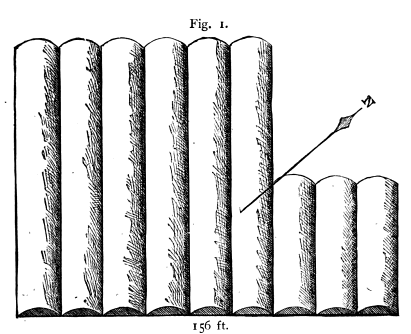
2. Wide convex beds, in parallel rows, separated by paths of same width, in independent plats (Width of bed, 12 to 16 feet; paths same; length, 74 to 132 feet.) Fig. 2.
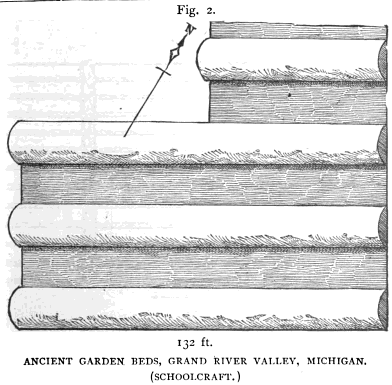
3. Wide and parallel beds, separated by narrow paths, arranged in a series of plats longitudinal to each other (Width of beds, 14 feet; paths, 2 feet; length, 100 feet.) Fig. 3.

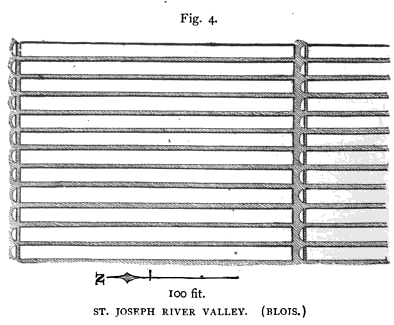
4. Long and narrow beds, separated by narrower paths and arranged in a series of longitudinal plats, each plat divided from the next by semi-circular heads. (Width of beds, 5 feet; paths, 1½ feet; length, 100 feet; height 18 inches.) Fig. 4.
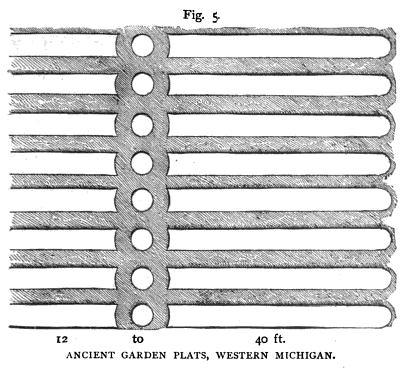
5. Parallel beds, arranged in plats similar to class 4, but divided by circular heads. (Width of beds, 6 feet; paths, 4 feet; length, 12 to 40 feet; height, 18 inches.) Fig. 5.
6. Parallel beds, of varying widths and lengths, separated by narrow paths, and arranged in plats of two or more at right angles N. and S., E. and W., to the plats adjacent. (Width of beds, 5 to 14 feet; paths, 1 to 2 feet; length, 12 to 30 feet; height, 8 inches.) Figures a, b, and c are varieties. Fig. 6.


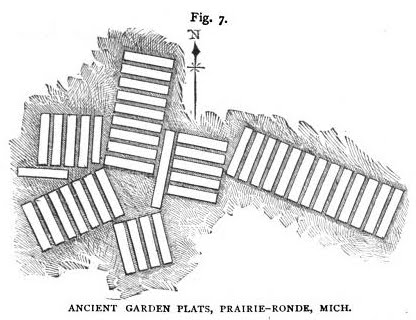
7. Parallel beds, of uniform width and length, with narrow paths, arranged in plats or blocks, and single beds, at varying angles. Width of beds, 6 feet; paths, 2 feet; length, about 30 feet; height, 10 to 12 inches.) Fig. 7.
8. Wheel-shaped plats, consisting of a circular bed, with beds of uniform shape and size radiating therefrom, all separated by narrow paths. (Width of beds, 6 to 20 feet; paths, 1 foot; length, 14 to 20 feet.) Fig. 8.

I present diagrams of each of these classes or kinds of beds. Of these only those numbered 1, 2 and 4 have ever before been delineated, to my knowledge. (See figures 1 to 8, pages 257-261.) Nos. 3 and 5 are described by Schoolcraft and Blois, while the others are figured as well – 1 and 2 by Schoolcraft and 4 by Blois. No. 3, according to the latter, consists of five plats, each 100 feet long, 20 beds in each plat. Schoolcraft does not give the exact localities, and I am unable to state whether beds of the same class have been noticed by other observers. As to their extent, his language is, “The beds are of various sizes, covering generally from 20 to 100 acres.” Some are reported to embrace even 300 acres. Plats of beds are undoubtedly here referred to.
Of the plat figured by Blois (No. 4), the writer says:
“They are found a short distance from Three Rivers, on one side of an oval prairie, surrounded by burr-oak plains. The prairie contains three hundred acres. The garden is judged to be half a mile in length by one-third in breadth, containing about one hundred acres, regularly laid out in beds running north and south, in the form of parallelograms, give feet in width and one hundred in length, and eighteen inches deep.”
The distinctive peculiarity of these beds is what Blois calls the “semi-lunar” head, at the extremity of each bed, separated from them by a path as represented.
Class 6, so far as my own inquiries warrant, represents the form and arrangement which is most common, viz.:
that of a series of parallel beds formed into blocks of two or more, alternating with other similar blocks placed at right angles to them. (See figures a, b, and c.) The prevailing width of the bed is five or six feet, and that of the paths one and a half to two feet. The length of the plats or blocks varies, the average being about twenty feet. Gardens of this kind were found by the early settlers of Schoolcraft, the burr-oak plains at Kalamazoo, Toland’s prairie, Prairie-Ronde, and elsewhere.
Mr. Henry Little says, that in 1831 they were very numerous on the plains where now stands the village of Kalamazoo; and south of the mound, eight or ten acres were entirely covered by them.
Mr. E. Laken Brown confirms this account, and says they reminded him of old New England gardens, being very regular and even, and the beds five feet by twelve or fourteen feet. In 1832 the outlines were very distinct, and the burr-oak trees on them as large as any in the vicinity. Mr. A. T. Prouty concurs as to the extent covered, but thinks the beds were six feet wide by twenty-five to forty long. On the farm of J. T. Cobb, section 7, town of Schoolcraft, the beds were quite numerous as late as 1860. There must have been 15 acres of them on his land. The “sets” would average five or six beds each. Neighbors put the number of acres covered with them in 1830, within the space of a mile, at one hundred.
Fig. 6-b, of class 6, is from a drawing by James R. Cumings, of Galesburg, of a garden in which the beds are of more than usual diversity in width and length. H. M. Shafter and Roswell Ransom, old settlers, say that three or four acres on the edge of the prairie, at this place, were covered with the beds. On the farm of the latter in the town of Comstock, of one hundred acres, there were not less than ten acres of beds, six feet by twenty-five to forty, arranged in alternate blocks, having a north-and-south and east-and-west direction.
Fig. 6-c is from a drawing by Mr. Shafter.
The series represented by Class 7 (fig. 7) were found at Prairie-Ronde. They are platted and described to me by Messrs. Cobb and Prouty. They differ from the more ordinary form of No. 6, in the arrangement of the blocks or sets of beds, which is here not at right angles, but at various and irregular angles, also in the single beds outlying. The number of beds in each block is also greater than usual.
Class 8 is established on the authority of Henry Little and A. T. Prouty, of Kalamazoo. The figure delineated is from the descriptions and dimensions given by the former. The diameter of the circular bed and the length of the radiating ones are each twenty-five to thirty feet. The latter describes two of similar design, but of smaller dimensions, the centre bed being only six feet in diameter, and the radiating ones twenty feet. All occurred at Kalamazoo, and in immediate association with the other forms of beds at that place, represented generally by Class 6.
There is reason for supposing that there may have existed another class of beds, differing altogether from any that I have represented, from expressions used by both Schoolcraft and Blois. The former speaks of “enigmatical plats of variously shaped beds;” and further, “nearly all the lines of each area or sub-area of beds are rectangular and parallel. Others admit of half circles and variously curved beds, with avenues, and are differently grouped and disposed.”
The latter says, the beds “appear in various fanciful shapes.” Some are laid off in rectilineal and curvilineal figures, either distinct or combined in a fantastic manner, in parterres and scolloped work, with alleys between, and apparently ample walks leading in different directions.”
This language is too vague to enable me to construct a diagram, nor have I any confirmation to offer from other sources. The reputation of the writers will not allow us to consider the descriptions fanciful, but it is possible to suppose they were misled by the representations of others.
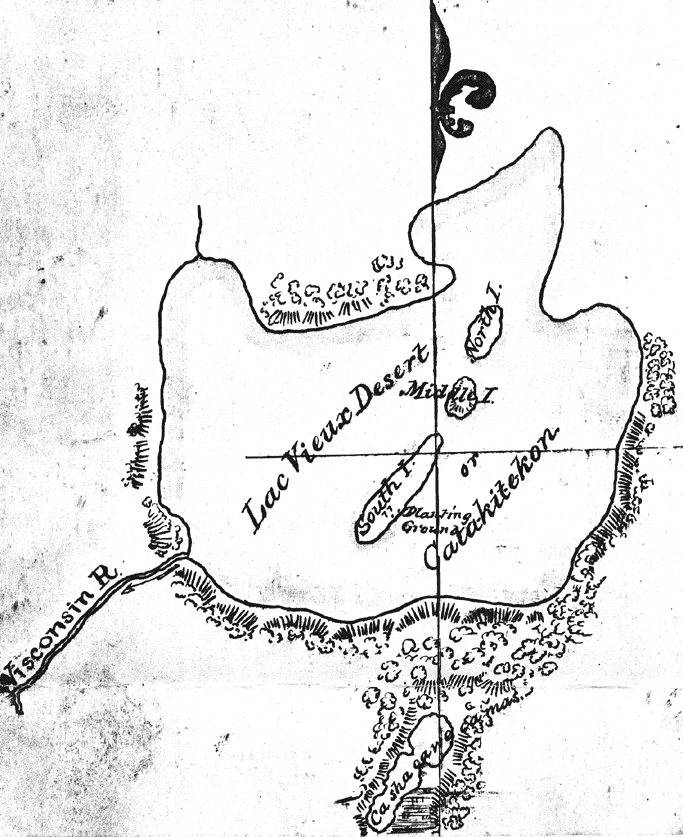
Lac Vieux Desert (‘lake of the old garden’) and Catakitekon [Gete-gitigaan (‘old gardens’)] from Thomas Jefferson Cram’s 1840 fieldbook. This is the headwaters of the Wisconsin River, and near those of the Wolf River and Ontonagon River.
~ School District of Marshfield: Digital Time Travelers
The principal crop of the Indians is maize, and this was never cultivated by them in rows, but in hills often large but always disposed in a very irregular manner. As little do these beds resemble the deserted fields of modern agriculture. On the other hand, the resemblance of many of the plats to the well-laid out garden beds of our own day is very striking; while the curvilinear forms suggest analogies quite as strong to the modern “pleasure garden.”
The nearest approach to anything resembling horticultural operations among Indian tribes, with the historic period, is noticed by Jones, who refers to a practice, among some of the southern Indians, of setting apart separate pieces of ground for each family. This author quotes from Captain Ribault’s “Discovery of Terra Florida,” published in London, 1563. “They labor and till the ground, sowing the fields with a grain called Mahis, whereof they make their meal, and in their gardens they plant beans, gourds, cucumbers, citrons, peas, and many other fruits and roots unknown to us. Their spades and mattocks are made of wood, so well and fitly as is possible.”
In the St. Joseph Valley I learned of numerous places, widely apart, where the labor and ksill of our ancient horticulturists were apparent in small gardens, laid out in different styles, and with an eye to the picturesque; as if each family had not only its separate garden patch, but had used it for the display of its own peculiar taste.
~ Bad River WPA Papers, Envelope 3, Folder 9.
~ Railroad History, Issues 54-58, pg. 26
Historians tell us of the Aztecs, that they had gardens in which were cultivated various plants, for medicinal uses, as well as for ornament. Was there something analogous to this in the Michigan Nation? Did the latter also have botanical gardens? May we accord to this unknown people a considerable advance in science, in addition to a cultivated taste, and an eye for symmetry and beauty, which is without precedent among the pre-historic people of this continent, north of Mexico?
These extensive indications of ancient culture necessarily imply a settled and populous community. We are led, therefore, to look for other evidences of the numbers and character of the people who made them. But here an extraordinary fact presents itself; such evidences are almost wanting! The testimony of nearly every one whom I have consulted – men who were among the first of the white race to break up the sod, that for ages had consecrated these old garden lands – agrees in the fact, that almost none of usual aboriginal relics were found; no pottery; no spear- and arrow-heads; no implements of stone; not even the omnipresent pipe. Tumuli, or burial mounds of the red man, are not uncommon, though not numerous, in Western Michigan, but have no recognized association with the garden race.
Upon the St. Joseph and Colorado rivers, and in the town of Prairie-Ronde, exist several small circular and rectangular embankments, resembling the lesser works of the Mound-Builders so numerous in Ohio. But no connection can be traced between these detached earthworks and the garden-beds. None of them seem to have been the bases of buildings, nor do they give indication of any religious origin or rites. There are no traces of dwellings, and the soil which has so sacredly preserved the labor of its occupants, discloses not even their bones!
At Three Rivers, and in Gilead, Branch County, are some ancient embankments, which are probably referable to this people and may pass for works of defence. That at the first named place was notably extensive. It consisted only of an earth embankment, about six feet in height, extending between two forks of a river, a mile apart. It thus enclosed a large area, and with a sufficient garrison might have withstood the siege of a large army of barbarous warriors.
It seems strange, indeed, that these garden beds, suggestive as they are, should be the only memorials of a race which has left such an evidence of civilized advancement, and was worthy of more enduring monuments! We may reasonably conclude, that they were a people of peaceable disposition, of laborious habits, and of æsthetic if not scientific tastes; that they lived in simple and patriarchal style, subsisting on the fruits of the earth, rather than of the chase. Their dwellings and their tools were of wood, and have perished. This simple record of their character and labors is all, it may be, we can ever know.
But is this all? May we not form some reasonable conjecture as to the period in which these gardeners lived?

Detail of “Chippewa Gardens” at Odanah from Narrative journal of travels from Detroit northwest through the great chain of American lakes to the sources of the Mississippi River in the year 1820, in 1820, by Henry Rowe Schoolcraft, page 105. This place is known as Gete Gititaaning (‘at the old gardens’) in Ojibwemowin.
“My children, I want you to listen to me. The proposition I am about to present will benefit all of you, and I need your cooperation. I would like to have you donate your labor to clear land for a large community garden, where every family, or any one who wishes can plant. The place I would suggest is that swampy flat, near the cemetery. It will take time to drain it and dry out but I know it will make good garden plats.“
~ Early Settlement of the Bad River Indian Reservation
A fact mentioned by Dr. Lapham furnishes a species of evidence, as to the relative antiquity of the garden beds of Wisconsin, as compared with the animal mounds. They were found overlying the latter; from which he infers, of course, a more recent origin. We may also suppose a considerable more recent age, since it is not likely that the race could have thus encroached upon the works of another, until long after these had been abandoned, and their religious or other significance forgotten.
The date of the abandonment of the beds may be approximately fixed, by the age of the trees found growing upon them. One of these mentioned by Schoolcraft, cut down in 1837, had 335 cortical layers. This carries the period back as far as 1502, or some years prior to the discovery of this country by the French. How long these labors were abandoned before this tree commenced its growth may not be susceptible of proof. Early French explorers do not appear to have been interested in the question, and it does not seem to me necessary to go further back than the three centuries during which that tree flourished, for a period quite long enough to have crumbled into indistinguishable dust every trace of wooden dwellings and implements, as well as of the bodies of their fabricators, if the latter received only simple earth burial.
(Anishinaabe Migration Story):
“In the Third Fire the Anishinabe will find the path to their chosen ground, a land in the west to which they must move their families. This will be the land where food grows upon the waters.”
~ The Mishomis Book – The Voice of the Ojibway by Edward Benton-Banai, Chapter 13 – The Seven Fires.
At the time of the arrival of the French the country was in possession of Algonquin tribes, who emigrated from the St. Lawrence about the middle of the 16th century. They were ignorant of the authors of these works, and were not more advanced in the arts of culture than the other known tribes.
It is probable that the few defensive works I have mentioned were erected by this settled and peaceful race of gardeners, as places of temporary refuge for the women and children, against the raids of the warlike tribes living eastward of them. The larger one may have served for the general defence in a time of sudden and great emergency. It is probable that on some such occasion they were surprised by their savage and relentless foes, and were overwhelmed, scattered or exterminated.
Most of the facts I have been able to present are gathered, in large part, from the memories – of course not always exact or reliable – of early settlers, and after modern culture had for many years obliterated the old.
It is perhaps useless to regret that these most interesting and unique relics of a lost people have so completely perished, through the greed of the dominant race; or that they could not have received, while they yet remained, the more exact and scientific scrutiny which is now being applied to the antiquities of our land. Much that might then have been cleared up, must now remain forever involved in mystery, or be left to conjecture.
– – – – – – – – – –
In September, 1885, the writer visited the region of the ancient garden beds, in hopes of being so fortunate as to find some remaining. He did discover, near Schoolcraft, on a plat of land which had been recently cleared of its timber, a few traces of beds belonging to a set, most of which had been broken up by the plough.
Four or five beds could be distinctly traced, for the distance of some ten to fifteen feet. The remainder of their lengths, said to be some twenty to thirty feet, had been obliterated by cultivation. Each bed had a width of about ten feet from centre to centre of the intervening paths. The latter had apparently a width of two or three feet, but it was impossible to define the exact outlines.
After much inquiry I could learn of no other place in or near Prairie-Ronde, or the plains of St. Joseph and Kalamazoo Counties, where any traces of the old garden beds remained.
Mr. Cobb informed me that about 1859 he endeavored to preserve portions of a set of these beds, which were well covered by touch, protective prairie sod. But when the white grub took possession of the turf thereabouts his ancient garden reserve did not escape. In a year or two the hogs, in their search for the grub, had so rooted and marred the outlines that he ploughed the beds up.
I found many old residents who well remembered the garden plats as they appeared a half century ago, and all concurred in the admiration excited by their peculiar character and the perfection of their preservation. Mr. Cobb says, he often took his friend to see his “ancient garden,” counted the beds, and speculated upon their object. The set of beds, which is shown only partially in his sketch (Fig. 7), contained thirteen beds, and was the largest of the sets. The others averaged five or six beds each.
All concurred, too, as to the great extent of land, amounting to several hundred acres, covered, wholly or partially, by the beds, chiefly upon the northern edge of the prairie. That all visible evidence of their existence should have so completely disappeared is not surprising to any one who notes their situation, upon the richest portions of the mixed prairies and plains. The lands most esteemed by their garden race were those which first attracted the modern farmer. These lands still constitute fields as beautiful as the eye can anywhere rest upon, and in a region second in loveliness to no other part of our country. The wants of the early settler almost preclude any care for the preservation of what was regarded as mere curiosities. Even when spared from the plough, and left to the care of nature, the absence of the annual fires, which had prevented the growth of timber; the roots of trees upheaving the beds; the decay of fallen timber; the hummocks caused by upturned roots; the destruction of the turf by the forest growth, and by cattle and hogs, all tend to deface the beds, and leave them to be reduced to the general level by the elements. Under these circumstances, a few years even would suffice to obliterate outlines which had remained almost unaltered for centuries.
An Incident of Chegoimegon
November 26, 2016
By Amorin Mello
This is a reproduction of “An Incident of Chegoimegon – 1760” from Report and Collections of the State Historical Society of Wisconsin: For the years 1877, 1878 and 1879. Volume VIII., pages 224-226.
—
AN INCIDENT OF CHEGOIMEGON – 1760.*
—
We have been permitted to extract the following from the journal of a gentleman who has seen a large portion of the country to the north and west of this place, and to whose industry our readers have been often indebted for information relating to the portion of country over which he has passed, and to transactions among the numerous tribes, within the limits of this territory, which tend to elucidate their characteristics, and lay open the workings of their untaught minds:

Detail of Isle de la Ronde from Carte des lacs du Canada by Jacques-Nicolas Bellin; published in Charlevoix’s Histoire et Description Générale de Nouvelle France, Paris, 1744.
Monecauning (abbreviated for “Monegoinaic-cauning,” the Woodpecker Island, in Chippewa language) – which is sometimes called Montreal Island, Cadott’s Island, or Middle Island, and is one of “the Apostles” mentioned by Charlevoix. it is situated in Lake Superior, about ninety miles from Fond du Lac, at the extremity of La Pointe, or Point Chegoimegon.
On this island the French Government had a fort, long previous to its surrender to the English, in 1763. It was garrisoned by regular soldiers, and was the most northern post at which the French king had troops stationed. It was never re-occupied by the English, who removed everything valuable to the Sault de St. Marie, and demolished the works. It is said to have been strongly fortified, and the remains of the works may yet be seen.
In the autumn of 1760, all of the traders except one, who traded from this post, left it for their wintering grounds. He who remained had with him his wife, who was a lady from Montreal, his child – a small boy, and one servant. During the winter, the servant, probably for the purpose of plunder, killed the trader and his wife; and a few days after their death, murdered the child. He continued at the fort until the spring. When the traders came, they enquired for the gentleman and his family; and were told by the servant, that in the month of March, they left him to go to their sugar camp, beyond the bay, since which time he had neither seen nor heard them. The Indians, who were somewhat implicated by this statement, were not well satisfied with it, and determined to examine into its truth. They went out and searched for the family’s tracks; but found none, and their suspicions of the murderer increased. They remained perfectly silent on the subject; and when the snow had melted away, and the frost left the ground, they took sharp stakes and examined around the fort by sticking them into the ground, until they found three soft spots a short distance from each other, and digging down they discovered the bodies.
The servant was immediately seized and sent off in an Indian canoe, for Montreal, for trial. When passing the Longue Saut, in the river St. Lawrence, the Indians who had him in charge, were told of the advances of the English upon Montreal, and that they could not in safety proceed to that place. They at once became a war party, – their prisoner was released, and he joined and fought with them. Having no success, and becoming tired of the war, they sought their own land – taking the murderer with them as one of their war party.
They had nearly reached the Saut de St. Marie, when they held a dance. During the dance, as is usual, each one “struck the post,” and told, in his manner, of his exploits. The murderer, in his turn, danced up to the post, and boasted that he had killed the trader and his family – relating all the circumstances attending the murder. The chief heard him in silence, saving the usual grunt, responsive to the speaker. The evening passed away, and nothing farther occurred.
The next day the chief called his young men aside, and said to them: “Did you not hear this man’s speech last night? He now says that he did the murder with which we charged him. He ought not to have boasted of it. We boast of having killed our enemies – never our friends. Now he is going back to the place where committed the act, and where we live – perhaps he will again murder. He is a bad man – neither we nor our friends are safe. If you are of my mind, we will strike this man on the head.” They all declared themselves of his opinion, and determined that justice should be rendered him speedily and effectually.
They continued encamped, and made a feast, to which the murderer was invited to partake. They filled his dish with an extravagant quantity, and when he commenced his meal, the chief informed him, in a few words, of the decree in council, and that as soon as he had finished his meal, either by eating the whole his dish contained, or as much as he could, the execution was to take place. The murderer, now becoming sensible of his perilous situation, from the appearance of things around him, availed himself of the terms of the sentence he had just heard pronounced, and did ample justice to the viands. He continued, much to the discomfiture of the “phiz” of justice (personified by the chief, who all the while sat smoking through his nose), eating and drinking until he had sat as long as a modern alderman at a corporation dinner. But it was of no avail – when he ceased eating he ceased breathing.
The chief cut up the body of the murderer, and boiled it for another feast – but his young men would touch none of it – they said, “he was not worthy to be eaten – he was worse than a bad dog. We will not taste him, for if we do, we shall be worse than dogs ourselves.”
Mr. Morrison, who gave me the above relation, told me he had it from a very old Indian, who was present at the death of the murderer.
* – This paper was originally published in the Detroit Gazette, Aug. 30, 1822. Hon. C. C. Throwbridge of Detroit, a resident of that place for sixty years, states that Mr. Schoolcraft, without doubt, contributed this sketch to the Gazette; that Mr. Schoolcraft, at the time of its publication, was residing at the Saut St. Marie: and Mr. Morrison, who was one of Mr. Astor’s most trusted agents at “L’Anse Qui-wy-we-nong,” came down to Mackinaw every summer, and thus gave Mr. Schoolcraft the information.
L. C. D.
Lake Superior in 1840
September 1, 2016
By Amorin Mello
“Soon after removing to Detroit, Bela Hubbard became acquainted with Douglas[s] Houghton, then State Geologist of Michigan, and in 1837, was appointed Assistant Geologist on the State Geological Survey, a position which he held until 1841. He accompanied Douglass Houghton on an important expedition to the southern shore of Lake Superior, in 1840, an account of which is given in his ‘Memorials of half a century.’ It is this book more than anything else that will preserve the memory of its author. It is his most fitting and most enduring monument and entitles the name of Bela Hubbard to a place on the short list of American authors who may be justly termed ‘nature writers.'”
Quote from Report of the Michigan Academy of Science, Volume 4,
by Michigan Academy of Science Council, 1904, page 163.
This is a reproduction of “Lake Superior in 1840” and illustrations from Memorials of a Half-Century, by Bela Hubbard, 1887, pages 21-62.
LAKE SUPERIOR IN 1840.*
* Read before the Detroit Pioneer Society, Jan., 1874.
Portrait and biographic sketch of Bela Hubbard are available in Report of the Michigan Academy of Science, Volume 4, by Michigan Academy of Science Council, 1904, pages 163-165. See the Bela Hubbard Papers: 1837-1893 for more information.
Among the pleasantest of all my reminiscences of travel is that of the exploration, in connection with the geological survey of Michigan, of the coasts of our upper peninsula, in 1840.

Portrait and biographic sketch of Douglass Houghton are available in Report of the Michigan Academy of Science, Volume 4, by Michigan Academy of Science Council, 1904, pages 160-162. See the Douglass Houghton Papers: 1829-1845 for more information.
The party for this expedition was composed of the State geologist, Dr. Douglass Houghton; his two assistants, C. C. Douglass and myself; Fredk. Hubbard, in charge of instrumental observations; and, for a part of the way, H. Thielson, a civil engineer, and Charles W. Penny, a young merchant of Detroit, supernumeraries.
We left Detroit in the steamer “Illinois,” arriving at Mackinac, May 23. Here two boat crews were made up, consisting of six Canadians. These belonged to that class so famous in the palmy days of the fur trade and the French régime, now extinct, and known to history as “coureurs de bois.” They were of mixed blood, in some, the French, in others, the Indian, predominating. Bred to the business, they would row without fatigue from daybreak until dark,—twelve or fourteen hours,—unlade the boats, pitch the tents for the bourgeois, pile up the baggage, prepare the evening meal, and then creep under their blankets in the open air and enjoy the sound sleep that labor bestows.
The principal dependence of these voyageurs for food—we had no leisure for hunting and little for fishing— was upon a soup of beans, with a most liberal supply of water, into which a piece of pork was dropped. A cake of hard-bread was allowed to each.
The boats for the passage of the Sault were each about twenty feet long by four broad, lightly constructed of pine and cedar, with sharp bows, and were drawn out of the water at night. At the Sault, to which provisions had been forwarded, one of these boats was exchanged for a “Mackinac barge,” sufficiently large to carry two months’ provisions and all our baggage.
A voyage to and upon our great lake at the time of my story was by no means the easy journey it is now. North of Mackinac, no steamers and no regular line of sail-vessels traversed the waters. The ship-canal around the waters of the Sault had not then been projected. Furs and fish constituted the only commerce, and the latter found too few customers to make the trade profitable. The American Fur Company had its headquarters at Sault Ste. Marie, where was a village of some twenty or thirty houses, mostly of logs, and the United States maintained a garrison. On the opposite shore was a small English settlement, consisting of a few white-washed cabins and Episcopal and Baptist mission establishments. Here also the Hudson’s Bay Company had a post.
At L’Anse had been established for many years a factory of the American Fur Company, the only buildings being a log house, storehouse, and barn, and near by a Baptist mission, consisting of a dozen neat huts of logs and bark. Near the extreme west end of the lake this company had another factory or trading-post, at La Pointe.
These were the only white settlements on the south shore of this great lake. At two or three points, transient fishing-camps might be met with. Else, all this region was wild and solitary almost as when, a century earlier, it was traversed by the canoe of the Jesuit missionary or echoed to the rude songs of the wild employees of the fur traders. In a large part of the country, on the southern border, within the territory of the United States, the Indian title had not been extinguished. But the settlements of the aboriginal race were rare; probably the whole region did not number 1000 souls.
Apart from the scientific animus of the expedition, our party, in the ardor of youth, could not but look forward to the new and strange scenes which awaited us with somewhat of the enthusiasm that inspired the first explorers of this region of vast forests and inland seas. We were to voyage almost in the same mode as those travellers, to witness scenes as yet little changed, and partaking of the same character of solitude and mystery.
Though I wander from my narrative, I must linger a moment over the impression produced by the romantic island which was our starting-point, Michilimackinac.
Connected with the story of the early wanderings of the French, their perilous missions in the far wilderness, the fur trade, with its fort, its agents, its coureurs de bois and numerous employees, its bustle, show, and dissipation, its traffic and its enormous profits, and with the numerous native tribes which here rendezvoused,—no place in the North-west possesses greater historic and traditionary interest. The town retained, as it still does, much of its old-time character. The crescent bay in front was still a lounging-place for the American Ishmaelite, whose huts often covered the beach; and this was the last place on the frontier where the Mackinac barge might manned and equipped, as a century ago, by a motley crew of half-breed voyageurs.
The natural beauties and wildness of the island, its situation, enthroned at the apex of the peninsula of Michigan and embracing magnificent views of water and island, its lake breezes and pure cold air, and the excellence of its white-fish and trout, have long made it one of the most attractive of watering-places. The proposal to conserve it as a national park is worthy of its character, and it is to be hoped that thus its natural beauties, and what remains of its woods, will be preserved forever to the nation.
On the morning of May 26 we took our departure from Mackinac, with a moderate breeze and a clear sky,—a thing to be noted where fogs are so frequent,—and coasting by St. Martin’s Island, entered les Cheneaux.
The river, or more properly Strait of Ste. Marie, is a series of channels, winding amid innumerable islands. Some of these, as St. Joseph and Drummond, cover many square miles, but the greater number are much smaller, and often occupy only a few acres. They line the whole northern coast of Lake Huron, and are occasioned by the junction between the silurian lime rocks and the azoic or primary rocks of Canada.
These islands are but little elevated above the water, and are wooded to the edge with cedar, fir and birch. The evergreen trees are completely shrouded in a tapestry of parasitic moss. This is a true lichen, and is not allied to the great Southern epiphyte which it so strongly resembles. It hangs in long festoons, giving the woods a fantastic and gloomy appearance, but the effect is very beautiful. What are called “les Cheneaux” are passages among islands of this description. They are seldom wide enough to admit any but the smallest craft, and so intricate as to form a perfect labyrinth, where any but the practised mariner might wander long, “in endless mazes lost.”
To the north and east of St. Joseph Island the Ste. Marie parts the two systems of rocks, and an instant change takes place in the character of the scenery. Instead of low, timbered shores, the islands rise in abrupt cones, rounded and water-worn, to the height of twenty to one hundred feet, presenting bare knobs of hornblende and quartz. The surfaces are worn smooth, by the action of glaciers, and are frequently covered with a thick carpet of lichens. Among these is, in profusion, the beautiful reindeer moss. A few miles to the right, in Canada, hills of granite rise to a height of 500 to 1000 feet, and form a background to the view.
To the geologist these low hills and rounded knobs have an absorbing interest. Agassiz tells us that America has been falsely denominated the new world; that “hers was the first dry land lifted out of the waters; hers the first shore washed by the ocean that enveloped all the earth beside.” The antiquary finds in this portion of America a very respectable antiquity. To its known civil history he adds evidence of the existence of a race of men familiar with this region ages before its discovery by the French, who were by no means despicable cultivators of the arts, and he infers a human history—could he but gather the full record—possibly as ancient as the pyramids. But science points a period infinitely more remote. We had reached and stood upon what was the skeleton of our earth, when but a crust above the seething fires beneath, not only ages before man had a being upon its surface, but probably ages before what we call the “Old World” had been raised by the forces of nature above the universal ocean. Here was antiquity unmeasured by any human standard. Time itself was young then. This backbone of the earliest continent still stretches unbroken, from the Atlantic to the western plains. During the unnumbered years in which the surface of the earth has been changed by successive upheavals and depressions it has stood unmoved.
Around the base of these low granite and metamorphic hills, in the bed of the river, lies a sandstone rock, which we shall find rising into cliffs along the coast of the lake above. It is the lowest of the paleozoic series, the first rock which brings to our eyes evidence of life upon this continent, and, if geologists speak truth, the first which bears witness to the dawn of life upon our earth. Of the earliest forms of organic life two only have with certainty been found in this rock, the lingula and the trilobite. And these, in the perfection and adaptation of their structure, equal the most perfect beings of their kind which exist at the present day. Thus the first record of the earliest life, upon the most ancient sea beach which the earth affords, is in apparent condemnation of the development hypothesis of Darwin. Are they then evidence of sudden and independent creation, or must we believe that these forms had their origin in some yet more remote and obscure past, and that we behold in these silurian rocks only their perfect development?
Following the northerly channel, the Ste. Marie soon expands into a broad and lovely sheet of water, twelve miles long, called Lake St. George. We have escaped from the labyrinth of rocky isles, the southern shores are again densely wooded, while the azoic rocks are seen on the Canada side, stretching off to the north-west, and terminating in a series of mountainous knobs,—the vertebræ of the world before the Flood. To this lake the Narrows succeed, and here for the first time the Ste. Marie assumes the appearance of a river, being contracted to less than 1000 feet, with a current and occasional rapids.
We passed frequent memorials of the Indian inhabitants. It is not to be wondered at that this region abounds with them, since with an eye to natural beauty this poetical race selects the loveliest spots for the resting-places, both of the living and the dead. The graves were close cabins of logs, thatched with bark, and the places selected are among the most beautiful and elevated sites, as if the souls of the departed braves could hear the echoing paddle and watch the approach of the distant canoe. The burial-place of the chief is designated by a picketed enclosure, and here it is customary for the voyaging Indian to stop, kindle his camp-fire at the head of the grave, and, on departing, to leave within the enclosure a small portion of the provisions he has cooked, for the use of the occupant. A flat cedar stake at the head exhibits in red paint the figure of some bird or brute,—the family totem of the deceased. Often is seen a small cross, erected as an emblem of his faith in Holy Catholic Church, while close by, in strange contrast, is that evidence of his unalterable attachment to the creed of his fathers,—the basket of provisions that is to support his journeying to the land of spirits.
The camping-ground of the voyageur has been that of the Indian from time immemorial. The wigwam poles are recognized from a distance, in some open glade along the shore, left standing after the vagabond inmates have departed. And there is often to be found an old canoe, a camp-kettle, a cradle swinging from the poles, and invariably a litter of picked bones and dirty rags, completely covering the spot, with the burnt brands and ashes of the cabin fire in the midst. Sometimes we meet a rude altar of stones, on which are laid bits of tobacco and other petty offerings to the Manitou. Sometimes the scene is varied by the cabin of a Canadian Frenchman, who, unable to resist the charm of savage life, is bringing up his family of half-breed children in a condition little akin to civilization.
Early on the morning of May 30 we reached the Sault, and proceeded to encamp at the head of the rapids. This required a portage of several rods. The remainder of the day was spent at the village, in witnessing the novel mode of fishing, and other sights pertaining to this remote frontier post.

Page 29: “Sault Ste. Marie, from the Canada shore.”
Preparations for our expedition being completed, on the first of June we took our departure from the head of the rapids. Here lay at anchor a beautiful light brig belonging to the American Fur Company, and which bore the name of its founder, John Jacob Astor. Close by its side was a schooner, which had been built by the Ohio Fishing and Mining Company, at Cleveland, and had just made the portage around the rapids. Another vessel was preparing for a similar transportation. With three such crafts floating on its bosom, our great lake seemed to have already lost something of its old-time character, when, a wide waste of waters, it was traversed only by the canoe of the Indian and voyageur. Its importance as a great commercial highway had thus begun to be foreshadowed, but, in fact, its waters still laved a savage wilderness.*
* The immense commerce since built up will appear from the statement, that in 1886 the number of vessels which passed through the Ste. Mary’s Falls Canal was 6203, carrying 3,701,000 tons and over 50,000 passengers.
Some natural phenomena pertaining to a high northern latitude had begun to exhibit what were marvels to our unaccustomed eyes. One of these was the lengthened twilight, the sun continuing to irradiate the horizon with a bright flash, until nearly midnight. In fact, it was quite possible to tell the hour of the night at any time, by the light which indicated the sun’s position. The Auroras, too, were surpassingly brilliant; often the electric rays streamed up from every point of the horizon, meeting at the zenith and waving like flame. I note these simple and common phenomena because they were novel to us, and it is only those who travel and encamp in the open air who enjoy to the full such scenes of beauty and wonder.
A summer temperature had now set in, and we witnessed another characteristic of this high latitude,—the sudden advance of the season. During the three days of our stay at this place, vegetation, which a week before had hardly commenced, sprung into active life. Trees then bare were now in full leaf. This phenomenon, though common to our side of the Atlantic, we had nowhere else seen so conspicuously displayed.
Time will not permit a narrative of our journey, a two-months’ coasting voyage along the whole southern side of Lake Superior. Nor can I speak, except briefly, of the beauties of the scenery, most of which is now so well known; of Gros Cap and Point Iroquois, those rock-built pillars of Hercules that guard the entrance, and
“like giants stand, To sentinel enchanted land;”
of White-fish Point and its surroundings; of the grand, wild and varied rocky coast; of the many beautiful streams, flashing with cascades, and filled with the speckled trout; or of our scientific researches and observations. I will venture only to relate an occasional incident, and to delineate some features of the coast scenery which seem to me to have been to little noticed or too imperfectly described by others.
Westward from White-fish Point stretch for many miles broad beaches of sand and gravel, backed by hills clothed with Norway-pines, spruce, hemlock, cedar, and birch. These beaches form extensive fishing-grounds, of which parties had already availed themselves. Every one knows the superiority of Lake Superior white-fish, in size and flavor, over those of the lower waters. Yet in relating the following experience I am aware of the risk which I run of being set down as the retailer of a “fish story.”
As we were rowing along the beach, some object was descried at a distance, making out of the water. All, at once, gave vigorous chase. On our near approach, the animal, which proved to be an otter, dropped upon the sand a fish which he had just hauled out, and retreated into the lake. This fish, which was scarcely dead, was of a size so extraordinary that it might truly be called—the fish, not the story—a whopper! It measured two and a half feet in length, and one foot five inches in circumference. We had no accurate means of weighing, but its weight was fairly estimated at fifteen pounds! The flesh was delicious in proportion, and made our whole party several capital meals.
These beaches terminate at a deep harbor called the Grand Marais. Hitherto the hills of dunes of sand have been of no great elevation. But now occurs a phenomenon which, though it seems not to have been classed among the wonders of this region, nor described in any books of travel, so far as I am aware, may well be called extraordinary, and worthy a place among the scenic wonders of America. It is a miniature Sahara, several miles in extent, and in many of its peculiar features resembling those lifeless, sandy deserts which are so distinguishing phenomena in some parts of the world. It is known to the French voyageurs as “Le Grand Sable.”

Page 33: “Grandes Sables.”
Steep cliffs are first observed rising from the water with a very uniform face, of about 200 feet in height, beyond which are visible barren dunes, rising still higher in the distance. On our approach the whole appeared like lofty hills enveloped in fog. This proved to be nothing less than clouds of sand, which the winds were constantly sweeping towards the lake, and which formed a mist so dense as to conceal completely the real character of the coast.
On ascending these steep and wasting cliffs, a scene opens to view which has no parallel except in the great deserts. For an extent of many miles nothing is visible but a waste of sand; not under the form of a monotonous plain, but rising into lofty cones, sweeping in graceful curves, hurled into hollows and spread into long-extended valleys. A few grass roots and small shrubs in some places find a feeble subsistence, and are the only vegetation. But thrusting through the sand are several tops of half-buried pines, barkless, and worn dry and craggy by the drifting soil, while below the surface their bodies appear to be in perfect preservation. To our imagination they seem the time-worn columns of an antique temple, whose main structure has long ago tumbled into dust, or been buried, like the ruins of Egypt, beneath the drift of many centuries.
The surface sand is mostly packed quite hard, and may be trod as a solid floor. This, in many places, is strewed thickly with pebbles; the deep hollows present vast beds of them. Among these are a great variety of precious stones common to the rocks of the country; agates, chalcedony, jasper, quartz of every shade of color and transparency, with hornstone, trap, and other minerals. All are worn smooth, and often beautifully polished by the sharp, drifting sands, and many rich specimens were obtained. We were reminded of the valley of diamonds in the Arabian tales, which it was the fortune of Sinbad to discover, in a scarcely less singular depository.
In the rear of this desert, about two miles from the coast, timber is again met with. Here, just at the edge of the wood, a small and beautiful lake lies embosomed; on the one side, a rich tract of maple forest; on the other, barren and shifting sand. It broke on our view, from amidst the realm of desolation, as did the unexpected fountain to which Saladin led the weary cavalier, Sir Kenneth, over the sandy plains of Palestine, as told in the magic pages of Scott. We named it, not inaptly, I think, “the diamond of the desert.” Around this sheet of water we found snow, on the tenth of June, in large quantities, buried beneath a few inches of sand.
From the diamond lake issues a small stream, which, after making its way through the sand, reaches the clay that constitutes the base of these dunes, and tumbles a perfect cascade into the greater lake. This rivulet separates the dense maple forest which lies on the east from cliffs of driven sand, which rise abruptly to a height that far overlooks the woodland, and are the commencement of the grand and leafless sables.
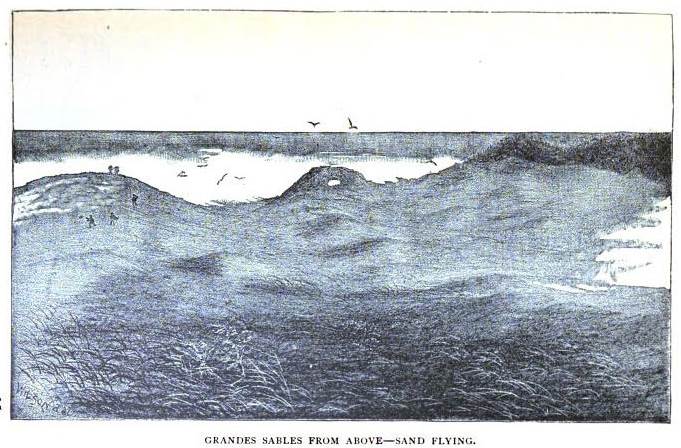
Page 35: “Grandes Sables from above – sand flying.”
The view on ascending these is most entrancing. On the one side stretches beneath, and far away, the verdant forest; while, by a transition as sudden as it is opposite in character, on the other side every feature of the landscape seems as if buried beneath hills of snow. The desert surface might be likened to that of an angry ocean, only that the undulations are far more vast, and the wave crests more lofty than the billows of the sea in its wildest commotion. Looking upward from one of these immense basins, where only the sandwave meets the sky, the beholder is impressed with a sublimity of a novel kind, unmixed with the terror which attends a storm upon the Alps or on the ocean. The scene, wild and unique, may well claim this brief praise, though hitherto unsung, and lacking the charm of historical association,—“the consecration and the poet’s dream.”
Twelve miles beyond this singular region the beaches terminate, and the sand-rock makes its appearance on the coast, in a range of abrupt cliffs. These are “The Pictured Rocks.” They have been often described, but no description that I have seen conveys to my mind a satisfactory impression of their bold, wild, and curious features. In attempting to convey some dear comprehension of them, I can only hope to impart a faithful, though it be a feeble conception of the peculiar features of this marvel of the Northern Lakes.
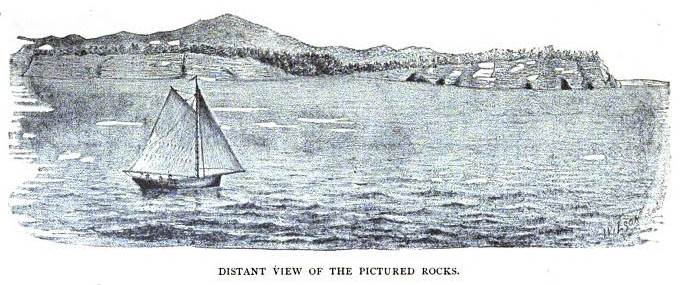
Page 37: “Distant view of the Pictured Rocks.”
These cliffs are composed of the same gray-and-red sand-rock which I have alluded to as the lowest of the paleozoic or silurian rocks. It appears in many places on the coast, and probably forms a large part of the bed of the lake. The cliffs here rise into a mural precipice, springing perpendicularly from the deep waters to the height of from 80 to 250 feet; and for the distance of fifteen miles, except in one or two places, are destitute of a beach upon which even a canoe may be landed. So dangerous is the coast that vessels all give it a wide berth, passing at too great distance for accurate view. A small boat that lingers runs imminent risks, from the liability of this lake to sudden gales, and the traverse is attempted only during a perfect calm. The sandrock lies in thick strata of varying degrees of hardness, from a coarse crag of the hardest cemented pebbles to a friable rock of aggregated sand. The predominant color is gray, sometimes light, often dark and rusty, and stained by oxides of iron and copper, with which the materials are charged. Bearing in mind these characteristics, the variety of aspects and the strange forms that these cliffs assume will find a ready explanation.
The great diversity of hues that give so beautiful and variegated an appearance to large portions of the surface, and from which the cliffs derive their name, are owing to the metallic oxides which have filtered through the porous stone in watery solutions and left their stains upon the surface. Beautiful as is the effect, it is due to candor to say that to my eyes there appeared but very imperfect representations of those various forms in the vegetable and animal kingdoms which figure in the highly-colored and fanciful descriptions in travellers’ tales. Too extravagant an idea could scarcely be conveyed of the exceeding brilliancy of the coloring; but in regard to what artists style the “laying on,” the picture presented a much closer resemblance to a house-painter’s bucket, upon the outside of which paints of all colors have trickled down in tapering streams. They represent not so much the picture which Nature has painted, as the palette upon which she has cleaned her pencils. Every hue of the rainbow, besides black and white, and in every possible circumstance of shade and alternation, are drawn in long lines, covering thousands of feet of surface.
Near the western extremity of the range, these colors assume a surpassing brilliancy, with a metallic lustre. Streaming over a gracefully curved surface, having an area of several thousand yards, they mimic, on a gigantic scale, the stripes on our national flag, as it waves in the breeze; or, passing down a fractured ledge, are contorted into long zigzag lines.
Upon close examination, these colors are found to proceed from slimy exudations, and to retain their brilliance only while fresh. When the face of the cliff has become dry, they possess a more faint and often mottled appearance. Then may sometimes be found depicted, upon a background of white, yellow or dun, as if rudely dabbed in by the artist, those vague similitudes, in which the imagination may realize verdant landscapes or fierce battle scenes; perhaps, if sufficiently vivid, a full set of Raphael’s Cartoons. As a whole, the general effect of the coloring is so striking, that the appellation conferred upon these cliffs is well deserved. Thus strangely drawn, upon as strange a canvas, they add, at least, wonderful beauty and effect to the greater wonders which Nature has here displayed.
But color is far from being the most notable feature of the Pictured Rocks. The disintegrating material of which the rock is composed renders it very susceptible to the effects of the elements. These cliffs present indubitable evidence that the lake once washed them at a height many feet above its present level. And as the strata are of differing degrees of hardness, they have been worn by the waves into a variety of forms. Huge cavernous fissures penetrate the massive wall, often to the distance of several hundred feet, piercing through its great projecting buttresses, and leaving the solid mountain supported by bare pillars. These, in turn, are worn by the eddying waters into cylindrical columns, connected by arches that sometimes spring with great regularity to a vast height.

Page 41: “La Portaille.”
An immense angular projection of the cliff, known to voyageurs as “La Portaille,” exhibits on its three sides arches of this construction, one of which springs to a height of about 150 feet. The openings form passages into a great cavern, or more properly a vestibule, the roof of which is beyond the reach of our longest oars, and which conducts through the entire projecting mass,—a distance of not less than 500 feet. Entering with our boat into this natural rock-built hall, its yawning caverns and overhanging walls strike a sudden awe into the soul. Echo gives back the voice in loud reverberations, and the discharge of a musket produces a roar like a clap of thunder. “Even the slight motion of the waves,” writes Governor Cass, “which in the most profound calm agitates these internal seas, swept through the deep caverns with a noise of distant thunder, and died upon the ear, as it rolled forward in the dark recesses inaccessible to human observation; no sound more melancholy or more awful ever vibrated upon human nerves. Resting in a frail canoe, upon the limpid waters, we seemed almost suspended in air, so pellucid is the element upon which we floated. In gazing upon the towering battlements which impended over us, and from which the smallest fragment would have destroyed us, we felt, and felt intensely, our own insignificance. No splendid cathedral, no temple built with human hands, no pomp of worship, could ever impress the spectator with such deep humility, and so strong a conviction of the immense distance between him and the Almighty Architect.”* Enthusiastic language! and yet it cannot be deemed exaggerated.
* Discourse before Detroit Historical Society.
The number and perfection of the wave-created pillars meeting the eye at every turn,— and which seem formed to support the immense weight above,—the various forms of the arches and of the overhanging rock, bear a close resemblance to the orders of human architecture. The rotundity of the columns is, in general, well preserved, and their tops swell into capitals. The supported mass, which is seldom less than 100 feet in thickness, often assumes characteristic forms, corresponding to the mock design. In one instance, for nearly half a mile, it resembles a vast entablature, of which the cornice,—jutting at least 20 feet, with a curve whose grace is not excelled by the best sculpture,—the pictured frieze, the mouldings, metopes, medallions, and other of those forms which pertain to Grecian architecture, are struck out, with a master, but giant hand, in magnificent relief, and with a perfection truly admirable. A portion of the structure had fallen, and lay at the base in heaps of ruins. But even the imperfections appear as if due to the gradual process of decay. It requires little stretch of the imagination to conceive the whole fabric to be an enormous edifice, the grandest of man’s construction, of which the main body has by some convulsion been suck and engulfed in the waters. We thought of these monuments of ancient art which the volcanic rain of Vesuvius has overwhelmed; but such a temple as this would have enclosed half of Pompeii!!

Page 43: “The gothic rock.”
The mind naturally inquires, Are the beautiful forms of ancient architecture the result of long and laborious study, or was some marvel like this exhibited in that distant era, from which cunning sculptors borrowed those designs that immortalized the Parthenon? And if—as the learned have supposed—the marble structures of that age received the addition of a coat of glowing colors,—of which time has left some traces—we here view the prototype, not only of the graceful forms upon which they labored so successfully, but of the overlay of colorings, in the glory of their original freshness!
These are but single features in the scenic display. The line of cliffs is not uniformly regular, but curves gradually to the south-west, and presents many angles and projecting points. Passing on to harder portions of the rock, the voyageur may encounter at the next angle a vertical and unbroken wall, rearing its solid front from the bed of the lake to the height of from 200 to 300 feet above the surface. The sharpness of the angular projection equals that created by the square and plummet; while the immense thickness of the strata causes the wall to appear as laid in immense blocks, a hundred feet in length. No such blocks were built into their mausolea by the proudest of the Pharaohs.
New changes present themselves as the traveller proceeds. Suddenly he is before the walls of an impregnable fortress, complete with glacis, bastion, and towers. The western cape of Miner’s River exhibits a curious display of this kind. It resembles the dilapidated tower of some timeworn castle. The base rests upon a series of short columns, connected by groined arches, through many of which a boat may pass with ease. There are eight or ten of these pillars; several have large entrances above, and the tower rears its broken battlements to the height of 120 feet.

Page 45: “La Chapelle, from the Lake.”
Among the characteristic features, none is more extra-ordinary than one to which the French voyageurs have appropriately given the name of “La Chapelle.” This rock was originally part of the solid cliff, of which the greater portion has been swept away, causing a valley about half a mile in breadth, through which a considerable stream enters the lake, falling over the rocks in a sheet of foam. Close by, reared upon the rocky platform, about twenty feet above the lake, and conspicuous from its isolation, stands the chapel. It consists of a tabular mass of sandstone, raised upon five columns, whose capitals swell into a uniform arch and support the ceiling or dome of the edifice. Its whole height is 56 feet. The pillars are somewhat irregular in form and position; including their bases, they are about 25 feet in height, and from 4 to 6 feet diameter in the swell. Regular proportion are not altogether preserved, for in most of them the central portion has the smallest diameter, like an hour-glass. Two uphold the front, and from these the arch springs to the height of 30 feet, allowing to the roof a thickness of five or six feet. The span of this arch is 32 feet, as viewed from the water, in which direction the spectator looks completely through the temple into the woodland beyond. The strength of the roof thus upheld must be considerable, since it is clothed with timber, and from the very centre shoots, spire-like, a lofty pine. The cliff on which the edifice stands forms a proportionate pedestal, ascending from the water in steps, which may be easily mounted.
This solemn natural temple might contain a congregation of several hundred persons. Nor are the usual accommodations for the preacher wanting. A column, the upper half of which has been broken, projects from a recess in the walls, and is worn into a curve behind, like the half of a letter S, creating a stand which would serve the purpose as admirably as it strikingly resembles the old-fashioned pulpit, the base of the column affording convenient steps.
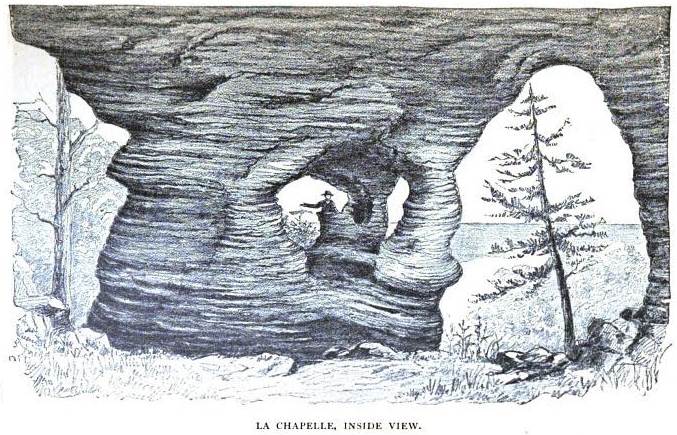
Page 47: “La Chapelle, inside view.”
Upon the cliff, just without, a column stands detached, and worn into the form of an urn, no bad representation of the baptismal font.
At what epoch of the world, or for what class of worshippers, this almost perfect temple was created, we might ask in vain of geologist or theologian. Certainly it is well designed to raise in the beholders thoughts of adoration for its all-skillful Architect, while they assign to it a chief place among the wonders of his workmanship.
An urn-shaped mass, similar to the one here observed, of great regularity and beauty of form, and not less than 50 feet in height, may ben seen at another point of the coast. Several rills of water leap from the very top of these precipitous cliffs, and add much to the charm of the view. Indeed, taken in connection with the wide-sweeping lake, the distant mountain ranges, and the woodland, crowning the cliff, the scene presented is of the most picturesque and wildest character.
“Where’er we gaze, around, above, below, What rainbow tints, what magic charms are found! Rock, river, forest, mountain, all abound, And bluest skies that harmonize the whole; Beneath, the distant torrent’s rushing sound Tells where the volumed cataract doth roll, Between those hanging rocks, that shock yet please the soul.”
Against these huge ramparts in the hour of the storm the billows of this impetuous lake dash with terrific fury, rumbling beneath the open arches, until, from the hollow caverns within, the sounds return like distant echoes, and at times their spray is thrown to the very summits of the cliff. Woe betide the bark that is overtaken by the tempest before these hopeless barriers!
But when the winds are down, lulling the lake to gentlest murmurs, the cautious boatman piles along the lone rampart, and with beating heart ventures to explore its awe-inspiring recesses, those.
“Worn and wild receptacles, Worked by the storms, yet work’d as it were planned, In hollow halls, with sparry roof and cells.”
From this sketch some correct idea may perhaps be gathered of a few of those strange forms which Nature, in her sportive hours, has here carved out of the solid fabric of the globe, as if in mockery of the efforts of man, gigantic monuments of that immeasurable Power who formed the wonders of the universe.
Thirty miles west form the Pictured Rocks, at Chocolate and Carp rivers, we first met, in their approach to the shore, the azoic or primary rocks, which from here onward constitute so interesting and important a feature in the geology of the country. Of their scientific or their economical character it is not my purpose to speak, further than to say that to them belong the iron beds, which are such a mine of wealth to our State. Here, a few years after our visit, sprang into being the busy and thriving city of Marquette. But at the time of which I speak, all was a solitude.
From hence to Keweenaw Bay ranges of granite knobs rise into considerable hills, and around them lie a series of quartzites, slates, and metamorphosed sandstones. The granites are pierced by dykes of trap, which in some cases form straight, narrow, and often lofty walls, in others have overflowed in irregular masses. Here Pluto, not Neptune, has been the controlling spirit, and has left the witness of his rule upon the face of the country. Ascending the knobs of granite and quartz, the change is most striking. To the east the eye embraces a tract lying in immense broad steppes of the sandstone, extending beyond the Pictured Rocks; while to the west are seen only rolling hills and knobs, terminating in the Huron Mountains.
I can add nothing to what is so well known of the mineral riches of this part of the country. But there is in its building-stones a wealth that is hardly yet begun to be realized. No more beautiful and serviceable material than the easily-worked and variously-tinted sandstones is found in the West; and her granites, already broken by natural forces into convenient block, and as yet untried, will command a market in the time coming, when the solid and durable shall be regarded a chief requisites to good architecture.
Following our westerly direction to Point Keweenaw, we find the dominion of Pluto established on a most magnificent scale. Not only is his energy displayed in the stern and rock-bound coast, but in the lofty ranges of trap, which rise into rugged hills of from 400 to 900 feet above the lake. Within these are secreted, but scarcely concealed, those wonderful veins of native copper, here quarried rather than mined, in masses such as the world has nowhere else produced.
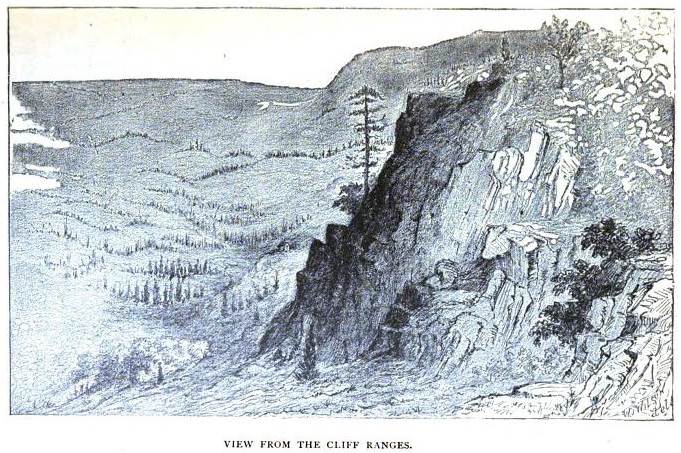
Page 51: “View from the cliff ranges.”
But of all this wealth nothing was then known, except that traces of copper were visible at a few places along the coast, and that a large mass of the native metal lay in the bed of Ontonagon River, long revered by the Indians as a Manitou, and mentioned in the relations of the early French historians.
I will but add, as the result of this season’s explorations, that the report of the State geologist, published the ensuing winter, unravelled the whole subject of the mode of occurrence of the copper and its associated minerals, in the most complete and scientific manner. It first made known the immense value which Michigan possessed in its hitherto despised Upper Peninsula; and its immediate effect was to arouse an interest in this then wild and uninhabited Indian territory, which has led to the opening up of its mines, and its present teeming prosperity.
On the third of July we encamped at Copper Harbor, and spent several days in exploration of the surrounding country, and in blasting for ores. Several blasts were got ready for the great national jubilee, which we commemorated in the noisy manner usual with Americans, by a grand discharge from the rocks. We succeeded in producing a tremendous report, and the echo, resounding from the placid water as from a sounding-board, pealed forth in corresponding reverberations for several minutes. Later in the day we retired to our camp and partook of an equally grand dinner. It consisted of pigeons, fried and stewed, corn and bean soup, short-cake and hard-tack, pork, and—last but not least—a can of fine oysters, which had been brought along for the occasion. Truly a sumptuous repast for a party of wilderness vagrants, even on a Fourth of July anniversary!
But time warns me to hasten my journey. I will therefore proceed at once to the Ontonagon, where an adventure befel, which it becomes a true knight-errant to relate. It was our purpose to pass up this river to the large mass of copper already alluded to. As we landed at the mouth there were noticed, on the opposite side of the river, several Indian lodges. As soon as we had dined, a few of the occupants crossed over in canoes, shook hands with us, giving the usual greeting of “Bo jou,” and received a small gift of tobacco and bread. Accompanying were half a dozen young boys, some of whom had remarkably fine features. We could not but notice, as an usual circumstance, that several of the men were painted black. One athletic fellow in particular, in this grimy coloring, and naked except the clout, made a very grotesque though savage appearance. The devil himself, however, is said not to be so black as he is painted, and this fellow seemed rather to act the buffoon than the noble warrior.
~ Douglass Houghton Papers: 1829-1845
“It is at this place, the Chegoimegon of early writers, that tradition places the ancient council fire of the Chippewa nation. […] The present chieftain, Chi Waishki, alias Pizhickee, or the Buffalo, is the representative of this line. He said to the Indian Agent, who, by direction of the commissioners at the treaty of Fond du Lac, in 1826, invested him with a silver medal. “What need I of this! It is known whence I am descended. […] Chi Waishki, the chief above alluded to, was met at Keweena, on his way to visit the Agency.”
~ Narrative of an expedition through the upper Mississippi to Itasca Lake, the actual source of this river : embracing an exploratory trip through the St. Croix and Burntwood (or Broule) Rivers, in 1832, by Henry Rowe Schoolcraft, 1834, pages 20-21.
The party proved to belong to the Buffaloes, whose chief we had met at River Tequamenon, near the eastern end of the lake, and were under the command of the son of that chief. The latter was a resolute-looking fellow, of about 26 or 30 years of age. His face was painted red, and he wore a medal bearing the likeness of John Quincy Adams. We paid little attention to the Indians, although aware that on several occasions exploring parties had been stopped at the mouth of this river and turned back.
We had made but two of three miles progress up the stream when the rapid stroke of paddles was heard, and a canoe, manned with Indians, shot quickly around a bend below and came into slight. The savages were seated, as their custom is, in the bottom of their bark, so that only heads and shoulders were visible. As each applied his whole strength the canoe skimmed over the surface like a young duck, while the dashing of so many paddles caused her to seem propelled by a water-wheel.
“”By a comparison of the number of Indians vaccinated upon the borders of Lake Superior, with the actual population, it will be seen that the proportion who have passed through the vaccine disease is so great as to secure them against any general prevalence of the small-pox; and perhaps it is sufficient to prevent the introduction of the disease to the bands beyond, through this channel. But in the Folle Avoine country it is not so. Of the large bands of Indians residing in that section of country, only a small fraction of been vaccinated; while of other bands not a single person has passed through the disease.”
~ Narrative of an expedition through the upper Mississippi to Itasca Lake, the actual source of this river : embracing an exploratory trip through the St. Croix and Burntwood (or Broule) Rivers, in 1832, by Henry Rowe Schoolcraft, 1834, page 253.
Our leader’s boat, which was ahead, immediately lay to and raised her American flag. “If they want to fight,” said the Doctor, “we’ll give them a chance.” Our two boats moved into line, and the doctor’s assistants armed themselves, one with a revolver, the other with a rusty shot-gun, our entire military resource. The canoe was soon alongside, and the heads and shoulders proved to belong the bodies of eight stout natives, headed by the young chief. Dr. Houghton held out his hand to be shaken as before. He then asked, through an interpreter, if they recollected the man who had put something into their arms when they were sick, a number of years ago. This something was vaccine for the small-pox, Doctor H. having accompanied the Schoolcraft expedition, in the capacity of physician and botanist. To this the chief, who doubtless well knew, made no reply, but demanded our errand up the river, and said that he and his men had been stationed at the mouth by his father, the head of the tribe, with orders to allow no boat to pass up without that chief’s permission. He added further, that we had not paid him, the son, the respect that was his due, by calling at his lodge and leaving a present. Our leader replied that he was sent hither by their great Father, whose instructions he should obey; that he should ascend the river as far as suited him, and that he did not recognize in them any authority to stop him.

Is this a photo of Jechiikwii’o wearing the 1826 medal in 1856-7? You be the judge.
~ Error Correction: Photo Mystery Still Unsolved
Chief. You must wait at the mouth until the Buffalo comes up. Else I and my band shall go with you, and see that you take nothing.
Doctor. I have been here before, and shall go now, as I am ordered by your great Father. I know the country and do not need a guide.
Chief. This country belongs to us.
Doctor. I know that the country is Indian territory, but the treaty of 1826 allows citizens of the United States to visit it. Neither shall I ask consent of the chief to take what I please. But, being acquainted with the Buffalo, I have no objection to showing him what I bring away.
At this stage of the alteration another canoe came in sight, which proved to contain the boys. By this time two of the Indians had made free to step into our small boat, where they seated themselves with great appearance of familiarity. The affair would have had enough of the ludicrous mingled with its serious aspect to warrant us in making light of it, and holding no further parley, but for two considerations, which we could not afford to overlook. Owing to the numerous rapids, the barge, which contained our whole stock, could be got up only ten miles, while we had to proceed to the forks, twenty miles further, in our smaller boat, and thence five miles by foot. And in case of a trial of strength with the Indians, no dependence could be placed upon our hired voyageurs, most of whom were allied to the opposite party, both in blood and training.
Pointing to a bend in the river, our detainers now said, “We are determined that you shall not go beyond that point to-night.” This audacious order determined us to at once break off all conference, so asserting our intention to be no longer hindered or delayed, we prepared for immediate departure. After some consultation among themselves, the chief answered, that if we would then and there make them a present of a keg of pork and a barrel of flour we would be allowed to proceed, but should be expected to bestow a further present to the head chief on our return.
To this bold demand, which plainly appeared to be a levy of blackmail, an act of piracy, Dr. Houghton replied that he would give them as a present such things as they stood in immediate need of, but nothing more. Nor should he recognize the shadow of a right to demand even that. Accordingly, a bag filled with flour, and some pork and tobacco were offered, and the leader agreed to accept his present in powder, lead, and provisions at La Pointe, whither we were bound.
The parley being at an end, we drew off and pushed up the stream. The hostiles remained awhile in consultation, and then withdrew in the opposite direction. A few miles above we encamped for the night.
It was a necessity, as I have stated, to leave our barge behind with all our stores, while the exploring party were absent for two days and a night. Of course this dilemma was known to the enemy. Holding a council of war the next morning, it was resolved to leave with our goods four of the men, together with the gun. They received most positive orders to fire upon the first Indian who touched the baggage, in case any of them should return, as we had reason to expect. And our captain added with solemn emphasis, that if any man failed in fidelity, his own life should pay the forfeit. Having thus played upon their fears, we pursued our laborious journey, reached the Copper Rock at nightfall, and tired with the day’s toils, laid down beneath the cover of the forest and slept soundly.
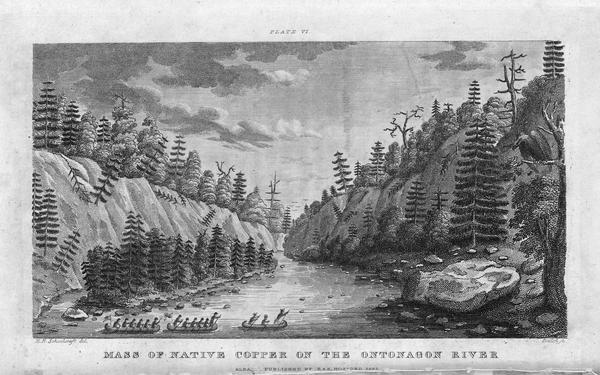
“Engraving depicting the [1820] Schoolcraft expedition crossing the Ontonagon River to investigate a copper boulder.”
~ Wisconsin Historical Society
But to conclude the narrative: on reaching camp, on our return, we learned that the chief, with several of this band, had been there, but had touched nothing, and according to his own account, had taken the trail for Lake Flambeau, in order to join a war-party, then organizing, of the Chippewas against the Sioux. Notwithstanding this story we fully expected to meet these fellows again at the mouth, and to whip them there if we could. But when we reached the place all was silent, and the lodges deserted.

Page 57: “Falls at the mouth of Montreal River.”
I will only add to this long story, that our captain’s order was never presented. We learned further, on reaching La Pointe, that the party which waylaid us had known of our journey from the first; that they had “smoked over it,” had dogged us the whole way up the lake, subsisting themselves by fishing, and that when we met they were nearly starved.
I will take my hearers but one stage further before closing this excursive ramble.
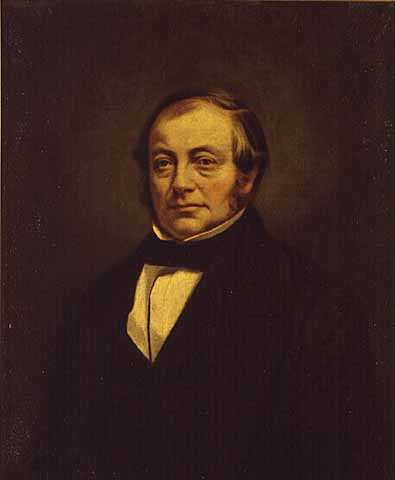
Charles William Wulff Borup
~ Minnesota Historical Society

Charles Henry Oakes
~ Findagrave.com
A few days brought us to the islands called by Carver “The Apostles.” On one of the largest of these, Madeline, at La Pointe, is located a general depot of the American Fur Company, for all the western parts of the lake, and the chain of lakes and rivers leading into it. It had become, in consequence, an asylum for all the old traders of that part of the country, and the temporary abode to great numbers of Indians. After pitching our tents on the beach, in front of the fort, amid a crowd of Indians and equally idle half-breeds, we were welcomed by the company’s factor, Dr. Borup, Mr. Oakes, the factor from Fond-dulac, and Mr. Bushnell, the Indian agent, and invited to all the hospitalities of the place.
During our whole voyage from the Sault we had not seen the face of a white man, except at the mission of L’Anse, and a casual fishing party. But here, at the end of our wandering, far from what we had been accustomed to consider the limits of civilization, we were greeted, in the families of these gentlemen, not only by features to which we had been so long strangers, but by all the attendant civilized refinements. The dress and manners of the East, the free converse with friendly voices of our own and the gentler sex, the music of a piano, the sound of the church-going bell and Christian services, seemed to us rather like a return to our homes than the extreme of a two-months’ journey in the wilderness.
It may interest my hearer to know in more detail what composed a post so remote, and which was to me so much a surprise.
La Pointe at that period was one of those peculiar growths known only to a era which has long passed away, or been banished to regions still more remote. What is called the company’s “fort” consisted of two large stores painted red, a long storehouse for fish, at the wharf, and row of neat frame buildings painted white. The latter were occupied by the half dozen families in the company’s employ. These dwellings, with the two stores, formed opposite sides of a broad street, in the centre square of which was planted a large flag-pole. Upon this street also clustered sundry smaller and unpainted log tenements of the French and half-breeds. Half a mile from the fort were the Protestant and Catholic missions. The former boasted a good frame mansion of two stories, attached to which was a school, numbering thirty scholars. The Catholic mission had a large number of followers, including the French and Indians. In all, the settlement contained about fifty permanent tenements. Beside these were perhaps an equal number of Indian lodges, irregularly disposed in vacant spaces, and adding to the size and picturesque character of the village. Several hundred Indians usually found constant employ in the fisheries at this place.
This was the oldest, as well as most remote, of the Jesuit missions in the North-west, having been established by Father Allouez, in 1665. It was then a gathering place of many Indian nations, and was hundreds of miles from the nearest French settlement.
It has additional interest from the fact that it witnessed the youthful and zealous labors of Pere Marquette, who came, in 1669, to take the place of Father Allouez, among the Ottawas, Hurons, and other tribes of the neighborhood. It was at La Pointe that Marquette planned that voyage of first discovery, exploration and missionary enterprise down the Mississippi which has rendered his name illustrious.

Page 61: “Pere Marquette. (From the statue at City Hall, Detroit.)”
In the families I have mentioned might be detected an intermixture of Indian blood, which detracts little even from the fairness of the daughters, and the ladies as well as the gentlemen are intelligent and highly educated. Their lives, when not occupied in business, are spent in reading and music; and during the long, cold winter, frequent rides are taken on the ice, upon which they pass from island to island in sledges drawn by dogs.
I could not but picture to my mind, outside of this intelligent circle, the festivities which marked this distant post, at that season, in the more palmy days of the fur trade; when it would be crowded with the hangers-on of such an establishment, returned-returned from their sojourn in the trapping grounds, or their toilsome voyages to and from Montreal and Quebec, bent on lavishing away their season’s earnings in days of idleness or debauch, and in “long nights of revelry and ease.”
Much of this old-time character still remained. The motley population, the unique village, the fisheries and furs, the Indian dances and pow-wows, the mixture of civilization and barbarism, the isolation, broken only be occasional and irregular arrivals from the world below,—made up a scene for which we were little prepared, which will not be easily forgotten, but of which I can give only this meagre description.
Early Trails and Water Routes
August 3, 2016
By Amorin Mello

United States. Works Progress Administration:
Chippewa Indian Historical Project Records 1936-1942
(Northland Micro 5; Micro 532)
Abstract
“Records of a WPA project to collect Chippewa Indian folklore sponsored by the Great Lakes Indian Agency and directed by Sister M. Macaria Murphy of St. Mary’s Indian School, Odanah, Wisconsin. Included are narrative and statistical reports, interview outlines, and operational records; and essays concerning Chippewa religious beliefs and rituals, food, liquor, transportation, trade, clothing, games and dances, and history. Also includes copies of materials from the John A. Bardon collection concerning the Superior, Wisconsin region, La Pointe baptismal records, the family tree of Qui-ka-ba-no-kwe, and artwork of Peter Whitebird.”
Reel 1, Envelope 2, Item 1
Editor’s Note: This article is the result of the information given by the staff, also gleanings from the “Bardon Collection.”
EARLY TRAILS AND WATER ROUTES
~ Fifty Years in the Northwest, by W. H. C. Folsom, 1888, page 258.
Bardon in his Collections says, “From the earliest times, the waterways were the Red Man’s highways: naturally the fur-trader, explorer, and missionary followed the same routes.”
For hundreds of years before the white man came to live in this country, the Indians rarely traveled on land except to portage their canoes in taking short cuts from one body of water to another, thus cutting off considerable distance for extensive traveling. Then, too, game was plentiful on the banks of rivers and lakes. For these reasons the Indian preferred traveling by water to that of land.
For the white man in the early 50’s as well as for the Indian, transportation could be carried on only by water in the lowlands and by trails in the uplands, therefore, canoes were extensively used in the former and quite commonly employed in the latter, for the highlands, too, and their lakes and streams.
Water Routes
An important route connecting the Great Lakes and the Mississippi was by way of the Brule and the St. Croix Rivers. This water route began at Lake Superior, ascended the Brule River to Lake St. Croix then descended the St. Croix River to the Mississippi. The first eastern settler, missionaries, explorers, traders and Indians used this route very extensively.
Another route connecting Lake Superior and the Mississippi River was made by the historian, Schoolcraft, over a hundred years ago. This historic water route began at Chequamegon Bay, ascended the Bad River, and descended the Namekagon and the St. Croix Rivers to the Mississippi.
A route by way of Fish Creek from Chequamegon Bay was also important. Indian travelers portaged their canoes from Fish Creek to White River and down this river for several miles and again portaged to Lake Namakagon, from thence to Namakagon River, thence to the St. Croix and down to the Mississippi. This same route could be taken to the Flambeau and the Wisconsin Rivers by going upstream on the St. Croix.
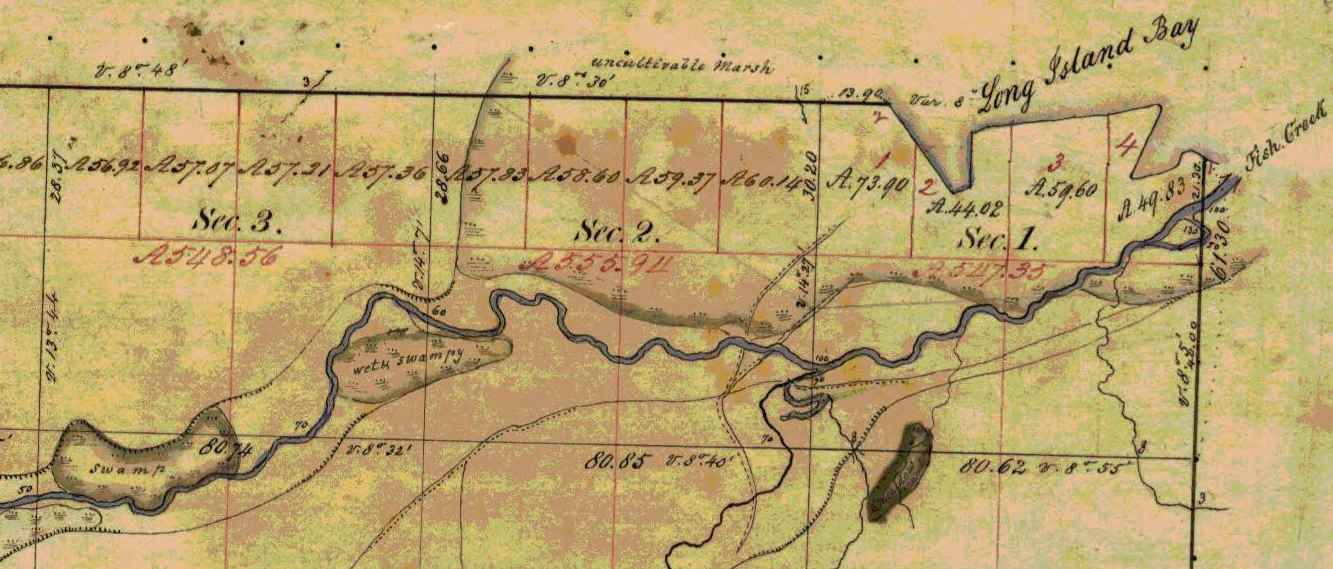
Several trails converged at the mouth of Fish Creek on Chequamegon Bay. ~ Wisconsin Public Land Survey Records
Trails
In traveling by trail most Indians traveled on foot, but many used dog-teams and toboggans, and in some cases, ponies. The Lake Superior region was a permanent camping ground for the Chippewa. This country for many miles around, and numerous trails branching off in all directions, far too many for us to mention each individually. Here we shall point out only the more important ones.
Talking Trail
“Talking Trail”, was so named on account of its beginning at a popular meeting or camping site situated where the city of Washburn now stands. “Talking Trail” began at this camping ground, thence it extended south, to Fish Creek, then south-west for a few miles, finally west to Superior, thus connecting Chequamegon Bay and Superior.
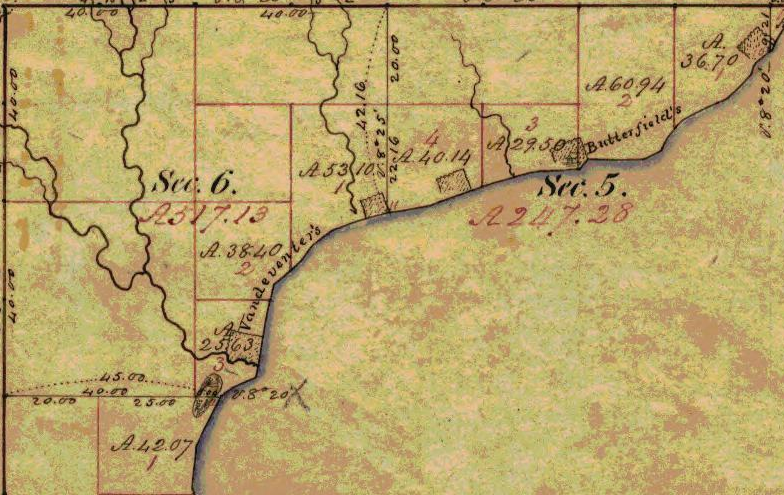
The “Talking Trail” began at the mouth of Vanderventer Creek near Washburn, and was also known as the “Council Trail.”
~ Wisconsin Public Land Survey Records
Bad River Trail
Whether or not this old trail was specifically known as designated above, the title is quite appropriate, since it began at the Leihy Mill on Bad River, Odanah, ran south to Tyler’s Forks, thence to Lake Namakagon and on to Lac Court Oreilles Reservation.
Indian War Trail
The reason for this name is evident: This trail was much used by the Chippewa in time of strife with the Sioux. The War Trail ran east to Montreal River and on to Porcupine Mountains, then to Ontonagon, thence to the copper country, including L’Anse and Marquette, Michigan. Mrs. Frank La Fernier of the Bad River Reservation, (1937) whose father, Mr. James lived to the age of one hundred-three years, corroborated this statement. Mr. James carried United States mail over this trail from our section of the country.
Moccasin Mike Trail

Chief Joseph Ozaagii was a cosigner of the 1854 Treaty at La Pointe on behalf of the Fond Du Lac Band.
~ Geni.com
“Moccasin Mike Trail”, was only another name for the “Osaugee1 Trail”. It was one of the most historic trails, and was evidently named after the local chief, Osaugee, who was the father-in-law of Charles Lord, a latter resident of Solon Springs, but originally a pioneer Quebec trader and voyageur.
This famous trail extended from the south of the St. Louis River, down Wisconsin Pointe, thence along the southern shore of Lake Superior to La Pointe, Bayfield, Ashland, Ontonagon, and the “Copper Country” of Michigan.
A branch of this trail led south, along the Montreal River to central Wisconsin, and was the route of the fur trader from Lake Superior to Green Bay. In the late 50’s and early 60’s, this trail was the land route East and South, and was much used by the early missionaries, traders and pioneer settlers. It became the regular mail route between all “south shore” points. Owen Sheridan and R.S. Mclean were two of the early mail carriers on this trail, packing on foot during the summer and fall, and travelling by dog team in winter.

“Osawgee Beach” postcard, circa 1920.
~ Zenith City Online
When Superior was started in 1853, a new branch of this trail began at the Nemadji River crossing and followed the mainland east, practically along the present high-ways 10 and 2, through what is now Alloues and Itasca, then east over the route of the present drive to an intersection with the main trail near Dutchman’s Creek. The early settlers remember it well. The density of the woods through which it passed kept the trail free from drifting snows and cutting winter winds. Snow shoes, toboggans, and dog teams were a powerful aid to travelers over this early trail.

Detail of Michael S. Bright Sr.‘s trading post on Saint Louis Bay near Oneota (West Duluth).
~ General Land Office Records
With the march of civilization, the settler, and the coming of regularly laid out roads, this intensely historic trail became practically eliminated. In the early 90’s, the Board of Douglas County in conjunction with the city of Superior saw the need of an all-year-round road to Lake Superior and Wisconsin Point. The project was sponsored by Michael S. Bright, now of Duluth, then a member of the County Board from the second ward of Superior. As the Supervisor of the Ward was always dubbed some Indian name, Mr. Bright fell heir to the sobriquet of “Moccasin Mike”. Because the rejuvenated road followed the old Osaugee Trail, and Mr. Bright had been very active in its building, the County Board officially designated the new road: “The Moccasin Mike Trail”.
1 Chief Osaugee was one of the signers of the important Treaty with the Chippewa in 1854. In Vol 2 “Treaties”, compiled by Chas. J. Kappler, the chief’s name is spelled: O sau’gee. The Chippewa spelling is: Osagi, the a being pronounced like a in ah, and the i like e in he.
TRAILS BECOME HIGHWAYS
“… the navigable waters leading into the Mississippi and St. Lawrence, and the carrying places between the same, shall be common highways and forever free …”
Many of the old Indian trails, especially those bordering on the southern shores of Lake Superior, have become permanent highways, and a number of these took their rise in our own village of Odanah. One of these led to Lac du Flambeau, and is now our present U.S. No. 2.
Over-Ridge Trail
This one-time Indian trail ran through Hurley, Wisconsin, Ironwood, Bessemer, Wakefield, and beyond Marinesco, Michigan, where it turned south to Lac du Flambeau. The Indians called the trail: “Ka-ke-way-wa-jwie-no-con”, meaning – “Over Ridge Trail”. At the turning point, it was necessary to cross a small river called “Ka-ba-no-ti-go-ge-wung” or “Presque Isle River”.
White River Trail
Another old Indian trail, leading West out of Odanah followed the [????] of our present U.S. No. 2; after crossing the Chicago and North Western railroad just a few feet west of the steel Railroad Bridge at the west entrance of the village, this trail entered the outskirts of Ashland where it turned directly towards Lake Superior. From thence it followed what is now Front Street in Ashland, turning south at the present site of the Knight Hotel. Following Ellis Avenue, it later crossed “Wa-bi-si-bi,” or White River. Mr. Scott, one of our historical staff says, “At that time there was a solid jam of flood wood at that point. Elm trees blew down on top of the jam, making it sufficiently solid for all kinds of Indian traffic.”

Detail of trails in Ashland east to Odanah and south to the White River. ~ Wisconsin Public Land Survey Records
This Indian Trail ran through Fifield, Wisconsin then straight east to Lac du Flambeau, from thence to Wausau, which was one of the trading posts of the early days. It is now our present U.S. Highway, No. 13.
N.B. An old wagon road known as the St. Paul Road was once a trail when the United States mail was carried on foot. In later years a wagon road was constructed by the War Department for military purposes.
See article following on “Military or St. Paul Road,” By W.P. Bigboy.
Reel 1, Envelope 2, Item 2
MILITARY, OR ST. PAUL, ROAD
By W.P. Bigboy
The road referred to in the “Recollections of Joseph Bell,” was the old military, or St. Paul, road, built by the government during the Civil War.
It followed the trail blazed out in earlier years by “Old Michel Buskey,” later identified as a keeper of a stopping place along this route. These hostelries could be found along the entire route and were for the accommodation and convenience of the early mail packers and travelers, who in the pursuit of their regular missions found the water ways or routes an impediment in the early and proper discharge of their assigned duties. Their locations were spaced by about twenty miles, and in most cases homesteads located near lakes were designated as such. Here mail carriers and other weary travelers, becoming too fatigued to continue farther, could pause and rest, and then continue on their way.
Leaving Bayfield, the first stopping place was at Moose Lake and the second at Loon Lake. These two places were located between Iron River and Bayfield, somewhere in the “Barrens.” The third stop was at Spider Lake. Here lived “Old Michel Buskey,” original trail blazer. His sunny disposition led to the designation of his cheery home as one of the stopping places; and for many years, not only the mail carriers, but many other weary travelers enjoyed the hospitality rendered by this family.
Leaving this place the next stopping place was at Island Lake, near Barnes of today. The next or fifth stop was at Gordon considered the crossroad of the country. Here the traveler usually made an over-night-stop, and enjoyed the hospitality of the village founder, Antoine Gordon.
From Gordon the road continued in a southwesterly direction until it reach near where the Namakagon empties into the St. Croix River. Here John Morrison, the grandfather of the Odanah Morrison, maintained a small hostelry for the accommodation of the traveling public for years. From there the road continued on to Yellow Lake, where another stopping place was located, then the road continued on to St. Croix Falls, where the traffic was ferried across the St. Croix, thence continuing on to St. Paul.
The road was not turnpiked as are the roads of today, but deep gullies and ravines were bridged with stout timbers and lumber, strong enough to bear the heavier armament of the United States Army in the event it became necessary to use the road for the transportation of army equipment.
Reel 1, Envelope 12, Item 3.
EARLY EXPERIENCE
Statement of Joseph Bell, [90?] yrs.
Interviewed by Dan Morrison.
I am in no position to give you much of a story that anyone would care to read, as I am not educated. During my childhood days we did not have the opportunity of going to school that the children now have, and all that I know is what I picked up myself. I have a few things in mind, however, that may be of interest to the present and succeeding generations, pertaining to some old people who were brought up at La Pointe on Madeline Island.

Portrait of Antoine Gordon from Noble Lives of a Noble Race by St. Mary’s Industrial School (Odanah), page 207.
I will tell you about William Gordon’s father raised on Madeline Island, who belongs ot the Lake Superior Band of Chippewa Indians. In the very early days when the United States Government caused roads to be built for the purpose of opening up the country, one of the first roads to be constructed ran from Bayfield to Eau Claire Lakes. This road opened up a vast section of the country, and when new roads were built in those times, people, as a rule, followed in quest for new locations and homes. William Gordon’s [illegible] father did just this. He followed the road from the starting point at Bayfield, running south for some distance, thence west to what they call Moose Lake. This was known as the first station and stopping place. The second station or stopping place was Moon Lake. The third station was at Spider Lake, known now as Silver Lake. The fourth place was Gordon’s, where William Gordon’s father settled. The present town of Gordon represents the first settlement of William Gordon’s father. The fifth stopping place was Yellow River; the sixth, Grantsburg and the seventh, was St. Croix Falls. This was the last stopping place as far as I remember.

The 1820 Cass-Schoolcraft expedition mapped the “Great Trail to the Folle Avoines Country” beginning at the mouth of the Sioux River.
~ Narrative journal of travels from Detroit northwest through the great chain of American lakes to the sources of the Mississippi River in the year 1820, by Henry Rowe Schoolcraft, page 105.
As I said before, these roads opened up a beautiful section of the country, full of wild game, plenty of fur-bearing animals, with many lakes and rivers where fishing was at its best. one could easily make a good living by hunting and trapping, and there was always plenty to eat. Many of the Indians who lived at La Pointe on Madeline Island left the island, following the direction of the newly constructed road. Though they were members of the La Pointe Band of the Lake Superior Chippewa, many remained in the new settlements, and the Indians remaining along the St. Croix River and other adjacent places finally lost their identity on the La Pointe Band and were later known as the “Lost Tribe.”
My great grandfather told me that the Chippewa lived on the south side of Lake St. Croix and the Sioux Indians lived on the north side, both claiming ownership of the St. Croix River. The question of full right of the St. Croix River kindled a feeling of animosity between the two tribes, and failing to arrive at any suitable agreement, war was declared between them, the aim of which was to settle the ownership of the river once and for all. In these encounters the Chippewa conquered the Sioux, driving them out of the country entirely. In their retreat, the Sioux followed a westerly direction, finally stopping where the city of St. Paul stands today.
Among The Otchipwees: III
July 20, 2016
By Amorin Mello
… continued from Among The Otchipwees: II

Magazine of Western History Illustrated
No. 4 February 1885
as republished in
Magazine of Western History: Volume I, pages 335-342.
AMONG THE OTCHIPWEES.
III.
The Northern tribes have nothing deserving the name of historical records. Their hieroglyphics or pictorial writings on trees, bark, rocks and sheltered banks of clay relate to personal or transient events. Such representations by symbols are very numerous but do not attain to a system.
Their history prior to their contact with the white man has been transmitted verbally from generation to generation with more accuracy than a civilized people would do. Story-telling constitutes their literature. In their lodges they are anything but a silent people. When their villages are approached unawares, the noise of voices is much the same as in the camps of parties on pic-nic excursions. As a voyageur the pure blood is seldom a success, and one of the objections to him is a disposition to set around the camp-fire and relate his tales of war or of the hunt, late into the night. This he does with great spirit, “suiting the action to the word” with a varied intonation and with excellent powers of description. Such tales have come down orally from old to young many generations, but are more mystical than historical. The faculty is cultivated in the wigwam during long winter nights, where the same story is repeated by the patriarchs to impress it on the memory of the coming generation. With the wild man memory is sharp, and therefore tradition has in some cases a semblance to history. In substance, however, their stories lack dates, the subjects are frivolous or merely romantic, and the narrator is generally given to embellishment. He sees spirits everywhere, the reality of which is accepted by the child, who listens with wonder to a well-told tale, in which he not only believes, but is preparing to be a professional story-teller himself.
Indian picture-writings and inscriptions, in their hieroglyphics, are seen everywhere on trees, rocks and pieces of bark, blankets and flat pieces of wood. Above Odanah, on Bad River, is a vertical bank of clay, shielded from storms by a dense group of evergreens. On this smooth surface are the records of many generations, over and across each other, regardless of the rights of previous parties. Like most of their writings, they relate to trifling events of the present, such as the route which is being traveled; the game killed; or the results of a fight. To each message the totem or dodem of the writer is attached, by which he is at once recognized. But there are records of some consequence, though not strictly historical.

Charles Whittlesey also reproduced Okandikan’s autobiography in Western Reserve Historical Society Tract 41.
Before a young man can be considered a warrior, he must undergo an ordeal of exposure and starvation. He retires to a mountain, a swamp, or a rock, and there remains day and night without food, fire or blankets, as long as his constitution is able to endure the exposure. Three or four days is not unusual, but a strong Indian, destined to be a great warrior, should fast at least a week. One of the figures on this clay bank is a tree with nine branches and a hand pointing upward. This represents the vision of an Indian known to one of my voyagers, which he saw during his seclusion. He had fasted nine days, which naturally gave him an insight of the future, and constituted his motto, or chart of life. In tract No. 41 (1877), of the Western Reserve Historical Society, I have represented some of the effigies in this group; and also the personal history of Kundickan, a Chippewa, whom I saw in 1845, at Ontonagon. This record was made by himself with a knife, on a flat piece of wood, and is in the form of an autobiography. In hundreds of places in the United States such inscriptions are seen, of the meaning of which very little is known. Schoolcraft reproduced several of them from widely separated localities, such as the Dighton Boulder, Rhode Island; a rock on Kelley’s Island, Lake Erie, and from pieces of birch bark, conveying messages or memoranda to aid an orator in his speeches.
~ New Sources of Indian History, 1850-1891: The Ghost Dance and the Prairie Sioux, A Miscellany by Stanley Vestal, 2015, page 269.
The “Indian rock” in the Susquehanna River, near Columbia, Pennsylvania; the God Rock, on the Allegheny, near Brady’s Bend; inscriptions on the Ohio River Rocks, near Wellsville, Ohio, and near the mouth of the Guyandotte, have a common style, but the particular characters are not the same. Three miles west of Barnsville, in Belmont County, Ohio, is a remarkable group of sculptured figures, principally of human feet of various dimensions and uncouth proportions. Sitting Bull gave a history of his exploits on sheets of paper, which he explained to Dr. Kimball, a surgeon in the army, published in fascimile in Harper’s Weekly, July 1876. Such hieroglyphics have been found on rocky faces in Arizona, and on boulders in Georgia.
Pointe De Froid is the northwestern extremity of La Pointe on Madeline Island. Map detail from 1852 PLSS survey.
~ Report of a geological survey of Wisconsin, Iowa, and Minnesota: and incidentally of a portion of Nebraska Territory, by David Dale Owen, 1852, page 420.
~ Geology of Wisconsin: Paleontology by R. P. Whitfield, 1880, page 58.
While pandemonium was let loose at La Pointe towards the close of the payment we made a bivouac on the beach, between the dock and the mission house. The voyageurs were all at the great finale which constitutes the paradise of a Chippewa. One of my local assistants was playing the part of a detective on the watch for whisky dealers. We had seen one of them on the head waters of Brunscilus River, who came through the woods up the Chippewa River. Beyond the village of La Pointe, on a sandy promontory called Pointe au Froid, abbreviated to Pointe au Fret or Cold Point, were about twenty-five lodges, and probably one hundred and fifty Indians excited by liquor. For this, diluted with more than half water, they paid a dollar for each pint, and the measure was none too large – neither pressed down nor running over. Their savage yells rose on the quiet moon-lit atmosphere like a thousand demons. A very little weak whisky is sufficient to work wonders in the stomach of a backwoods Indian, to whom it is a comparative stranger. About midnight the detective perceived our traveler from the Chippewa River quietly approaching the dock, to which he tied his canoe and went among the lodges. To the stern there were several kegs of fire-water attached, but weighted down below the surface of the water. It required but a few minutes to haul them in and stave the heads of all of them. Before morning there appeared to be more than a thousand savage throats giving full play to their powerful lungs. Two of them were staggering along the beach toward where I lay, with one man by my side. he said we had better be quiet, which, undoubtedly, was good advice. They were nearly naked, locked arm in arm, their long hair spread out in every direction, and as they swayed to and fro between the water line and the bushes, no imagination could paint a more complete representation of the demon. There was a yell to every step – apparently a bacchanalian song. They were within two yards before they saw us, and by one leap cleared everything, as though they were as much surprised as we were. The song, or howl, did not cease. It was kept up until they turned away from the beach into the mission road, and went on howling over the hill toward the old fort. It required three days for half-breed and full-blood alike to recover from the general debauch sufficiently to resume the oar and pack. As we were about to return to the Penoka Mountains, a Chippewa buck, with a new calico shirt and a clean blanket, wished to know if the Chemokoman would take him to the south shore. He would work a paddle or an oar. Before reaching the head of the Chegoimegon Bay there was a storm of rain. He pulled off his shirt, folded it and sat down upon it, to keep it dry. The falling rain on his bare back he did not notice.

Portrait of Stephen Bonga
~ Wisconsin Historical Society
We had made the grand portage of nine miles from the foot of the cataract of the St. Louis, above Fond du Lac, and encamped on the river where the trail came to it below the knife portage. In the evening Stephen Bungo, a brother of Charles Bungo, the half-breed negro and Chippewa, came into our tent. He said he had a message from Naugaunup, second chief of the Fond du Lac band, whose home as at Ash-ke-bwau-ka, on the river above. His chief wished to know by what authority we came through the country without consulting him. After much diplomatic parley Stephen was given some pequashigon and went to his bivouac.

Joseph Granville Norwood
~ Wikipedia.org

Portrait of Naagaanab
~ Minnesota Historical Society
The next morning he intimated that we must call at Naugaunup’s lodge on the way up, where probably permission might be had, by paying a reasonable sum, to proceed. We found him in a neat wigwam with two wives, on a pleasant rise of the river bluff, clear of timber, where there had been a village of the same name. His countenance was a pleasant one, very closely resembling that of Governor Corwin, of Ohio, but his features were smaller and also his stature. Dr. Norwood informed him that we had orders from the Great Father to go up the St. Louis to its source, thence to the waters running the other way to the Canada line. Nothing but force would prevent us from doing this, and if he was displeased he should make a complaint to the Indian agent at La Pointe, and he would forward it to Washington. We heard no more of the invasion of his territory, and he proceeded to do what very few Chippewas will do, offered to show us valuable minerals. In the stream was a pinnacle of black sale, about sixty feet high. Naugaunup soon appeared from behind it, near the top, in a position that appeared to be inaccessible, a very picturesque object pointing triumphantly to some veins of white quartz, which are very common in metamorphic slate.
Those who have heard him, say that he was a fine orator, having influence over his band, a respectable Indian, and a good negotiator. If he imagined there was value in those seams of quartz it is quite remarkable and contrary to universal practice among Chippewas that he should show them to white men. They claim that all minerals belong to the tribe. An Indian who received a price for showing them, and did not give every one his share, would be in danger of his life. They had also a superstitious dread of some great evil if they disclosed anything of the kind. Some times they promise to do so, but when they arrive at the spot, with some verdant white man, expecting to become suddenly rich, the Great Spirit or the Bad Manitou has carried it away. I have known more than one such instance, where persons have been sustained by hopeful expectation after many days of weary travel into the depths of the forest. The editor of the Ontonagon Miner gives one of the instances in his experience:
“Many years ago when Iron River was one of the fur stations, of John Jacob Astor and the American Fur Company, the Indians were known to have silver in its native state in considerable quantities.”
Men are now living who have seen them with chunks of the size of a man’s fist, but no one ever succeeded in inducing them to tell or show where the hidden treasure lay. A mortal dread clung to them, that if they showed white men a deposit of mineral the Great Manitou would punish them with death.
Several years since a half-breed brought in very fine specimens of vein rock, carrying considerable quantities of native silver. His report was that his wife had found it on the South Range, where they were trapping. To test his story he was sent back for more. In a few days he returned bringing with him quite a chunk from which was obtained eleven and one-half ounces of native silver. He returned home, went among the Flambeaux Indians and was killed. His wife refused to listen to any proposals or temptation from friend or foe to show the location of this vein, clinging with religious tenacity to the superstitious fears of her tribe.
When the British had a fort on St. Joseph’s Island in the St. Mary’s River, in the War of 1812, an Indian brought in a rich piece of copper pyrites. The usual mode of getting on good terms with him, by means of whisky, failed to get from him the location of the mineral. Goods were offered him; first a bundle, then a pile, afterwards a canoe-load, and finally enough to load a Mackinaw boat. No promise to disclose the place, no description or hint could be extorted. It was probably a specimen from the veins on the Bruce or Wellington mining property, only about twenty miles distant on the Canadian shore.
Detail of John Beargrease the Younger from stereograph “Lake Superior winter mail line” by B. F. Childs, circa 1870s-1880s.
~ Commons.Wikimedia.org
Crossing over the portage from the St. Louis River to Vermillion River, one of the voyageurs heard the report of a distant shot. They had expected to meet Bear’s Grease, with his large family, and fired a gun as a signal to them. The ashes of their fire were still warm. After much shouting and firing, it was evident that we should have no Indian society at that time. That evening, around an ample camp fire, we heard the history of the old patriarch. His former wives had borne him twenty-four children; more boys than girls. Our half-breed guide had often been importuned to take one of the girls. The old father recommended her as a good worker, and if she did not work he must whip her. Even a moderate beating always brought her to a sense of her duties. All he expected was a blanket and a gun as an offset. He would give a great feast on the occasion of the nuptials. Over the summit to Vermillion, through Vermillion Lake, passing down the outlet among many cataracts to the Crane Lake portage, there were encamped a few families, most of them too drunk to stand alone. There were two traders, from the Canada side, with plenty of rum. We wanted a guide through the intricacies of Rainy Lake. A very good-looking savage presented himself with a very unsteady gait, his countenance expressing the maudlin good nature of Tam O’Shanter as he mounted Meg. Withal, he appeared to be honest. “Yes, I know that way, but, you see, I’m drunk; can’t you wait till to-morrow.” A young squaw who apparently had not imbibed fire-water, had succeeded in acquiring a pewter ring. Her dress was a blanket of rabbit skins, made of strips woven like a rag carpet. It was bound around her waist with a girdle of deer’s hide, answering the purpose of stroud and blanket. No city belle could exhibit a ring of diamonds more conspicuously and with more self-satisfaction than this young squaw did her ring of pewter.
As we were all silently sitting in the canoes, dripping with rain, a sudden halloo announced the approach of living men. It was no other than Wau-nun-nee, the chief of the Grand Fourche bands, who was hunting for ducks among the rice. More delicious morsels never gladdened the palate than these plump, fat, rice-fed ducks. Old Wau-nun-nee is a gentleman among Indian chiefs. His band had never consented to sell their land, and consequently had no annuities. He even refused to receive a present from the Government as one of the head men of the tribe, preferring to remain wholly independent. We soon came to his village on Ash-ab-ash-kaw Lake. No band of Indians in our travels appeared as comfortable or behaved as well as this. Their country is well supplied with rice and tolerably good hunting ground. The American fur dealers (I mean the licensed ones) do not sell liquor to the Indians, and use their influence to aid Government in keeping it from them. Wau-nun-nee’s baliwick was seldom disturbed by drunken brawls. His Indians had more pleasant countenances than any we had seen, with less of the wild and haggard look than the annuity Indians. It was seldom they left their grounds, for they seldom suffered from hunger. They were comfortably clothed, made no importunities for kokoosh or pequashigon, and in gratifying their savage curiosity about our equipments they were respectful and pleasant. In his lodge the chief had teacups and saucers, with tea and sugar for his white guests, which he pressed us to enjoy. But we had no time for ceremonials, and had tea and sugar of our own. Our men recognized numerous acquaintances among the women, and as we encamped near a second village at Round Lake they came to make a draft on our provision chest. We here laid in a supply of wild rice in exchange for flour. Among this band we saw bows and arrows used to kill game. They have so little trade with the whites, and are so remote from the depots of Indian goods, that powder and lead are scarce, and guns also. For ducks and geese the bow and arrow is about as effectual as powder and shot. In truth, the community of which Wau-nun-nee was the patriarch came nearer to the pictures of Indians which poets are fond of drawing than any we saw. The squaws were more neatly clad, and their hair more often combed and braided and tied with a piece of ribbon or red flannel, with which their pappooses delighted to sport. There were among them fewer of those distinguished smoke-dried, sore-eyed creatures who present themselves at other villages.
By my estimate the channel, as we followed it to the head of the Round Lake branch, is two hundred and two mile in length, and the rise of the stream one hundred and eight feet. The portage to a stream leading into the Mississippi is one mile.
At Round Lake we engaged two young Indians to help over the portage in Jack’s place. Both of them were decided dandies, and one, who did not overtake us till late the next morning, gave an excuse that he had spent the night in courting an Indian damsel. This business is managed with them a little differently than with us. They deal largely in charms, which the medicine men furnish. This fellow had some pieces of mica, which he pulverized, and was managing to cause his inamorata to swallow. If this was effected his cause was sure to succeed. He had also some ochery, iron ore and an herb to mix with the mica. Another charm, and one very effectual, is composed of a hair from the damsel’s head placed between two wooden images. Our Lothario had prepared himself externally so as to produce a most killing effect. His hair was adorned with broad yellow ribbons, and also soaked in grease. On his cheeks were some broad jet black stripes that pointed, on both sides, toward his mouth; in his ears and nose, some beads four inches long. For a pouch and medicine bag he had the skin of a swan suspended from his girdle by the neck. His blanket was clean, and his leggings wrought with great care, so that he exhibited a most striking collection of colors.
At Round Lake we overtook the Cass Lake band on their return from the rice lakes. This meeting produced a great clatter of tongues between our men and the squaws, who came waddling down a slippery bank where they were encamped. There was a marked difference between these people and those at Ash-ab-ash-kaw. They were more ragged, more greasy, and more intrusive.
CHARLES WHITTLSEY.
Indian Records of Ontonagon and Bad River
June 11, 2016
By Amorin Mello
![This is a partial reproduction of<strong> <br /> <em>Western Reserve and Northern Ohio</em></strong><br /> <em> <strong> Historical Society</strong></em><br /> <em><strong>[Tract] Number 41</strong></em><br /> <em> <strong> Ancient Earthworks - Northern Ohio</strong></em><br /> by Charles Whittlesey, circa 1877<br /> as published in<br /> <a href="https://books.google.com/books?id=EawKAAAAIAAJ" target="_blank"><strong><span style="text-decoration: underline;">Western Reserve Historical Society Publication, Volume 2</span>,</strong></a><br /> pages 38-39.](https://chequamegonhistory.com/wp-content/uploads/2016/06/wrhs-tract-41.jpg)
This is a partial reproduction of
Western Reserve and Northern Ohio Historical Society
[Tract] Number 41: Ancient Earthworks – Northern Ohio
by Colonel Charles W. Whittlesey, circa 1877,
as republished in
Western Reserve Historical Society Publication, Volume 2,
pages 38-39.
INDIAN RECORDS.
Autobiography of Okandikan
Autobiography of Kundickan, a Chippeway Indian.
The subjoined pictorial record of his life, was made many years since by a Chippeway of Lake Superior. He delivered it to the Hon. A. C. Davis, of Detroit, who placed it in the Museum of the Natural Science Association of that place where it is now. The tracing was made in October, 1875, by Bela Hubbard, of Detroit. The engraving is from a photograph by E. Decker of Cleveland, reduced to one-third the original size.
The signs or characters are cut with a knife on both sides of a flat piece of sugar maple wood, less than one-fourth of an inch thick, wrought out by the Indian himself, for this purpose. The upright lines at a, a, a, appear to be divisions in the narrative, for the purpose of grouping events. He explained to Mr. Davis that this board contained the principal occurrences of his life, which any other Chippeway could read. How it should be read, whether from right to left or the reverse, or whether the inverted parts are to be taken in connection with those below, is not settled. The partitions A and B are colored vermillion red. It corresponds with the general character of the Indian pictorial writing, of which numerous examples are given by Schoolcraft, and shows a close relation to the rock inscriptions of the United States. It embraces the usual variety of uncouth men, animals, and implements which characterize the rock sculptures. Between the two sides of the board there does not appear to be any connection in regard to the sentences or paragraphs, though there must be as to dates. They are all, without much doubt, the work of people in the condition of savages. I saw this Indian on the Ontonagon river in 1845. He purported to have seen Alexander Henry in that region in 1769-70, who was engaged there in mining for copper and silver.

“Pictograph C. Okundekund and his Band of Ontonagon – Michigan,” as reproduced from birch bark by Seth Eastman, and published as Plate 62 in Historical and Statistical Information Respecting the History, Condition, and Prospects of the Indian Tribes of the United States, Volume I., by Henry Rowe Schoolcraft, 1851. Okandian’s pictograph petition was one of several from the 1849 Martell delegation:
“By this scroll, the chief Kun-de-kund of the Eagle totem of the river Ontonagon, of Lake Superior, and certain individuals of his band, are represented as uniting in the object of their visit of Oshcabewis. He is depicted by the figure of an eagle, Number 1. The two small lines ascending from the head of the bird denote authority or power generally. The human arm extended from the breast of the bird, with the open hand, are symbolic of friendship. By the light lines connecting the eye of each person with the chief, and that of the chief with the President, (Number 8,) unity of views or purpose, the same as in pictography Number 1, is symbolized. Number 2, 3, 4, and 5, are warriors of his own totem and kindred. Their names, in their order, are On-gwai-sug, Was-sa-ge-zhig, or The Sky that lightens, Kwe-we-ziash-ish, or the Bad-boy, and Gitch-ee-man-tau-gum-ee, or the great sounding water. Number 6. Na-boab-ains, or Little Soup, is a warrior of his band of the Catfish totem. Figure Number 7, repeated, represents dwelling-houses, and this device is employed to deonte that the persons, beneath whose symbolic totem it is respectively drawn, are inclined to live in houses and become civilized, in other words, to abandon the chase. Number 8 depicts the President of the United States standing in his official residence at Washington. The open hand extended is employed as a symbol of friendship, corresponding exactly, in this respect, with the same feature in Number 1. The chief whose name is withheld at the left hand of the inferior figures of the scroll, is represented by the rays on his head, (Figure 9,) as, apparently, possessing a higher power than Number 1, but is still concurring, by the eye-line, with Kundekund in the purport of pictograph Number 1.”
Inscriptions on Clay Banks, Bad River, Ashland County, Wis.

2

1
A few representations of recently inscribed figures are given for the purpose of comparison with ancient stone inscriptions. A short distance below the portage, across a long, loop-like bend of the Mashkeg or Bad river, above the Odanah Mission, is a perpendicular bluff of clay, on the west bank of the stream. Steep clay and sand bluffs are common through the flat country below the Falls of Bad River. This one has been sheltered by a thick fringe of growing trees, from the wearing effects of storms. It presents quite a smooth, upright face of dry clay; that is easily cut with a knife, about fifty feet long, and about ten to fifteen feet long, and about ten to fifteen feet high. This space is completely covered with picture records, made by the Chippeways. No doubt many of them are old, but most of them have been made recently, or by men now living, often obliterating or cutting new inscriptions over old ones.

4

3
In my explorations on the waters of Bad river in 1846, 1849, and 1860, I passed them repeatedly, but having other objects in view, made only a few sketches. The effigies are grotesque outlines of animals, canoes, birds, fishes, men, women, trees, and other objects, animate and inanimate. My Indians and some of the half-breed voyageurs, professed to be able to read them. They said it was expected that every young man, when he was old enough to become a warrior, should retire to some solitary place and undergo a fast. The length of time he could do without food was a test of his bravery. Sometimes he perched in a tree, day and night, or sat on a rock or on a high mountain, without fire or shelter, in order to show his contempt of pain and exposure. In due time he naturally had visions, in which his destiny or chart of life, was disclosed. Weak constitutions are unable to fast more than three or four days. When the incipient warrior had satisfied himself that his mission on earth was fully disclosed to him, he returned to the tribe and was received a man. Their version of this ceremony, and its consequences agrees generally with that of Chingwauk to Mr. Schoolcraft in 1839, as related in vol. 1, pages 13-14, of his “North American Indians.” The symbols of his destiny were generally put upon record, in such a manner and in such a place as he saw fit, but generally on trees or rocks, along a traveled route. In some cases a full statement of the vision or visions, was written out in this pictorial mode, with his dodem or “totem” attached. I remember the meaning of only one, of which figure No. 2 forms a part. The tree with nine branches, and a hand pointing upward, signifies that the party making it had fasted nine days.

5
There is nothing in their customs to prevent other messages being left in such places. Their records include nothing historical in regards to the nations or their chiefs. Such matters are perpetuated by repetition from the old to the young, until every young man is thoroughly crammed. General story telling, and the recital of their traditions, is the literary life work of an Indian. His memory is a mental record, transmitted from generation to generation. The fidelity of such records is, however, very far from reliable.
Figures one to five are random copies from a large number of the Bad river effigies, not made to scale, but they are fair representatives of Indian pictography.
By Amorin Mello
A curious series of correspondences from “Morgan”
… continued from Copper Harbor Redux.

The Daily Union (Washington D.C.)
“Liberty, The Union, And The Constitution.”
August 29, 1845.
EDITOR’S CORRESPONDENCE.
—
[From our regular correspondent.]
ST. LOUIS, Mo. Aug. 19, 1845.
One of the most interesting sections of the North American continent is the basin of the Upper Mississippi, being, as it is, greatly diversified by soil, climate, natural productions, &c. It embraces mineral lands of great extent and value, with immense tracts of good timber, and large and fertile bodies of farming land. This basin is separated by elevated land o the northeast, which divides the headwaters of rivers emptying into the Mississippi from those that flow into the lakes Superior and Michigan, Green Bay, &c. To the north and northwest, it is separated near the head of the Mississippi, by high ground, from the watercourses which flow towards Hudson’s bay. To the west, this extensive basin is divided from the waters of the Missouri by immense tracts of elevated plateau, or prairie land, called by the early French voyageurs “Coteau des Prairies,” signifying “prairie coast,” from the resemblance the high prairies, seen at a great distance, bear to the coast of some vast sea or lake. To the south, the basin of the Upper Mississippi terminates at the junction of the Mississippi with the Des Moines river.
The portion of the valley of the Mississippi thus described, if reduced to a square form, would measure about 1,000 miles each way, with St. Anthony’s falls near the centre.
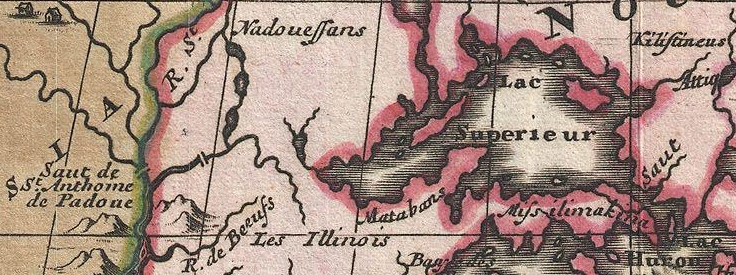
1698 detail of Saint Anthony’s Falls and Lake Superior from Amerique Septentrionalis Carte d’un tres grand Pays entre le Nouveau Mexique et la Mer Glaciace Dediee a Guilliaume IIIe. Roy de La Grand Bretagne Par le R. P. Louis de Hennepin Mission: Recol: et Not: Apost: Chez c. Specht a Utreght 1698.
~ Commons.Wikimedia.org
For a long time, this portion of the country remained unexplored, except by scattered parties of Canadian fur-traders, &c. Its physical and topographical geography, with some notions of its geology, have, as it were, but recently attracted attention.

Douglas Volk painting of Father Hennepin at Saint Anthony Falls.
~ Commons.Wikimedia.org

Father Antoine “Louis” Hennepin
~ Wikipedia.org
Father Hennepin was no doubt the first white man who visited St. Anthony’s falls. In reaching them, however, he passed the mouth of St. Peter’s river, a short distance below, without noticing it, or being aware of its existence. This was caused by the situation of an island found in the Mississippi, directly in front of the mouth of St. Peter’s, which, in a measure, conceals it from view.
After passing the falls, Father Hennepin continued to ascend the Mississippi to the St. Francis river, but went no higher.

Portrait of Jonathan Carver from his book, Travels through the interior parts of North America in the years 1766, 1767 and 1768.
~ Wisconsin Historical Society
In the year 1766, three years after the fall of Canada, Captain Johnathan Carver, who had taken an active part as an officer in the English service, and was at the surrender of Fort William Henry, where (he says) 1,500 English troops were massacred by the Indians, (he himself narrowly escaping with his life,) prepared for a tour among the Indian tribes inhabiting the shores of the upper lakes and the upper valley of the Mississippi. He left Boston in June of the year stated, and, proceeding by way of Albany and Niagara, reached Mackinac, where he fitted out for the prosecution of his journey to the banks of the Mississippi.
From Mackinac, he went to Green Bay; ascended the Fox river to the country of the Winnebago Indians; from thence, crossing some portages, and passing through Lake Winnebago, he descended the Wisconsin river to the Mississippi river; crossing which, he came to a halt at Prairie du Chien, in the country of the Sioux Indians. At the early day, this was an important trading-post between French traders and the Indians. Carver says: “It contains about three hundred families; the houses are well built, after the Indian manner, and well situated, on a very rich soil, from which they raise every necessary of life in great abundance. This town is the great mart whence all the adjacent tribes – even those who inhabit the most remote branches of the Mississippi – annually assemble about the latter end of May, bringing with them their furs to dispose of to the traders.” Carver also noticed that the people living there had some good horses.
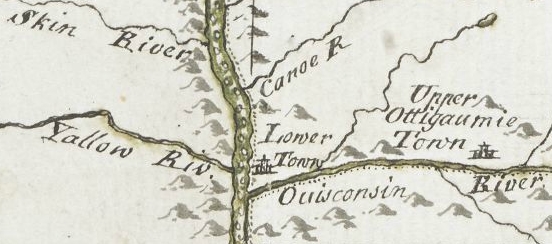
Detail of Prairie du Chien from Carver [Jonathan], Captain. Journal of his travels with maps and drawings, 1766.
~ Boston Public Library
The fur-trade, which at one time centred here, and gave it much consequence, has been removed to St. Peter’s river. Indeed, this trade, which formerly gave employment to so many agents, traders, trappers, &c., conferring wealth upon those prosecuting it, is rapidly declining on this continent; in producing which, several causes conspire. The first is, the animals caught for their furs have greatly diminished; and the second is, that competition in the trade has become more extensive and formidable, increasing as the white settlements continue to be pushed out to the West.
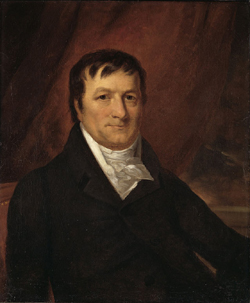
John Jacob Astor established the American Fur Company.
~ Wikipedia.com
At Prairie du Chien is still seen the large stone warehouse erected by John Jacob Astor, at a time when he ruled the trade, and realized immense profits by the business. The United States have a snug garrison at this place, which imparts more or less animation to the scene. It stands on an extensive and rather low plain, with high hills in the rear, running parallel with the Mississippi.
The house in which Carver lodged, when he visited this place, is still pointed out. There are some men living at this post, whose grandfather acted as interpreter to Carver. The Sioux Indians, whom Carver calls in his journal “the Nadowessies,” which is the Chippewa appellation for this tribe of Indians, keep up the tradition of Carver’s visit among them. The inhabitants, descendants of the first settlers at Prairie du Chien, now living at this place, firmly believe in the truth of the gift of land made to Carver by the Sioux Indians.
From this point Carver visited St. Anthony’s falls, which he describes with great accuracy and fidelity, accompanying his description with a sketch of them.
![Detail of Saint Anthony's Falls from Carver [Jonathan], Captain. Journal of his travels with maps and drawings, 1766. ~ Boston Public Library](https://chequamegonhistory.com/wp-content/uploads/2016/05/carver-detail-of-st-anthony-falls.jpg)
Detail of Saint Anthony’s Falls from Carver [Jonathan], Captain. Journal of his travels with maps and drawings, 1766.
~ Boston Public Library
From the Mississippi river Carver crossed over to the Chippewa river; up which he ascended to its source, and then crossed a portage to the head of the Bois Brulé, which he called “Goddard’s river.” Descending this latter stream to Lake Superior, he travelled around the entire northern shore of that lake from west to east, and accurately described the general appearance of the country, including notices of the existence of the copper rock on the Ontonagon, with copper-mineral ores at points along the northeastern shore of the lake, &c.
![Detail of "Goddard's River," La Pointe, and Ontonagon from Carver [Jonathan], Captain. Journal of his travels with maps and drawings, 1766. ~ Boston Public Library](https://chequamegonhistory.com/wp-content/uploads/2016/05/carver-detail-of-goddard-river-and-la-pointe.jpg)
Detail of “Goddard River,” La Pointe, and Ontonagon from Carver [Jonathan], Captain. Journal of his travels with maps and drawings, 1766.
~ Boston Public Library
He finally reached the Sault St. Marie, where he found a French Indian trader, (Monsieur Cadot,) who had built a stockade fort to protect him in his trade with the Indians.
![Detail of Sault Ste Marie from Carver [Jonathan], Captain. Journal of his travels with maps and drawings, 1766. ~ Boston Public Library](https://chequamegonhistory.com/wp-content/uploads/2016/05/carver-detail-of-sault-ste-marie.jpg)
Detail of Sault Ste Marie from Carver [Jonathan], Captain. Journal of his travels with maps and drawings, 1766.
~ Boston Public Library
Descendants of this Monsieur Cadot are still living at the Sault and at La Pointe. We met one of them returning to the latter place, in the St. Croix river, as we were descending it. They, no doubt, inherit strong claims to land at the falls of the St. Mary’s river, which must ere long prove valuable to them, if properly prosecuted.
From the Sault St. Marie, Carver went to Mackinac, then garrisoned by the English, where he spent the winter. The following year he reached Boston, having been absent about two years.
From Boston he sailed for England, with a view of publishing his travels, and securing his titles to the present of land the Sioux Indians have made him, and which it is alleged the English government pledged itself to confirm, through the command of the King, in whose presence the conveyance made to Carver by the Sioux Indians was read. He not only signified his approval of the grant, but promised to fit out an expedition with vessels to sail to New Orleans, with the necessary men, &c., which Captain Carver was to head, and proceed from thence to the site of this grant, to take possession of it, by settling his people on it. The breaking out of the American revolution suspended this contemplated expedition.
Captain Carver died poor, in London, in the year 1780, leaving two sons and five daughters. I consider his description of the Indians among whom he travelled, detailing their customs, manners, and religion, the best that has ever been published.
In this opinion I am sustained by others, and especially by old Mr. Duncan Graham, whom I met on the Upper Mississippi. He has lived among the Indians ever since the year 1783. He is now between 70 and 80 years old. He told me Carver’s book contained the best account of the customs and manners of the Indians he had ever read.
His valuable work is nearly out of print, it being rather difficult to obtain a copy. It went through three editions in London. Carver dedicated it to Sir Joseph Banks, president of the Royal Society. Almost every winter on the Indians and Indian character, since Carver’s time, has made extensive plagiarisms from his book, without the least sort of acknowledgement. I could name a number of authors who have availed themselves of Carver’s writings, without acknowledgement; but as they are still living, I do not wish to wound the feelings of themselves or friends.
One of the writers alluded to, gravely puts forth, as a speculation of his own, the suggestion that the Winnebagoes, and some other tribes of Indians now residing at the north, had, in former times, resided far to the south, and fled north from the wars and persecutions of the bloodthirsty Spaniards; that the opinion was strengthened from the fact, that the Winnebagoes retained traditions of their northern flight, and of the subsequent excursions of their war parties across the plains towards New Mexico, where, meeting with Spaniards, they had in one instance surprised and defeated a large force of them, who were travelling on horseback.
Now this whole idea originated with Carver; yet Mr. ——— has, without hesitation, adopted it as a thought or discovery as his own!

Alexander Henry, The Elder.
~ Wikipedia.com
The next Englishman who visited the northwest, and explored the shores of Lake Superior, was Mr. Henry, who departed from Montreal, and reached Mackinac through Lake Huron, in a batteau laden with some goods. His travels commenced, I believe, about 1773-‘4, and ended about 1776-‘7. Mr. Henry’s explorations were conducted almost entirely with the view of opening a profitable trade with the Indians. He happened in the country while the Indians retained a strong predilection in favor of the French, and strong prejudices against the English. It being about the period of the Pontiac war, he had some hazardous adventures among the Indians, and came near losing his life. He continued, however, to prosecute his trade with the Indians, to the north and west of Lake Superior. Making voyages along the shores of this lake, he became favorably impressed with the mineral appearances of the country. Finding frequently, through is voyageurs, or by personal inspections, rich specimens of copper ore, or of the metal in its native state, he ultimately succeeded in obtaining a charter from the English government, in conjunction with some men of wealth and respectability in London, for working the mines on Lake Superior. The company, after making an ineffectual attempt to reach a copper vein, through clay, near the Ontonagon, the work was abandoned, and was not afterwards revived.
General Cass, with Colonel Allen, &c., were the next persons to pass up the southern coast of Lake Superior, and, in going to the west and northwest of the lake, they travelled through Indian tribes in search of the head of the Mississippi river. Their travels and discoveries are well known to the public, and proved highly interesting.
Mr. Schoolcraft’s travels, pretty much over the same ground, have also been given to the public; as also the expedition of General Pike on the Upper Mississippi.

Major Stephen Harriman Long published his expedition as Voyage in a Six-oared Skiff to the Falls of St. Anthony in 1817.
~ Wikipedia.org
More lately, the basin of the Upper Mississippi has received a further and more minute examination under the explorations directed by Major Long, in his two expeditions authorized by government.

Joseph Nicholas Nicollet
~ Wikipedia.org
Lastly, Mr. J. N. Nicollet, a French savan, travelling for some years through the United States with scientific objects in view, made an extensive examination of the basin of the Upper Mississippi.
He ascended the Missouri river to the Council Bluffs; where, arranging his necessary outfit of men, horses, provisions, &c., (being supplied with good instruments for making necessary observations,) he stretched across a vast tract of country to the extreme head-waters of the St. Peter’s, determining, as he went, the heights of places above the ocean, the latitude and longitude of certain points, with magnetic variations. He reached the highland dividing the waters of the St. Peter’s from those of the Red river of the North. He descended the St. Peter’s to its mouth; examined the position and geology of St. Anthony’s falls, and then ascended the same river as high as the Crow-wing river. The secondary rock observed below the falls, changes for greenstone, sienite, &c., with erratic boulders. On the east side of the river, a little below Pikwabik, is a large mass of sienitic rock with flesh-colored feldspar, extending a mile in length, half a mile in width, and 80 feet high. This is called the Little Rock. Higher up, on the same side, at the foot on the Knife rapids, there are sources that transport a very fine, brilliant, and bluish sand, accompanied by a soft and unctuous matter. This appears to be the result of the decomposition of a steachist, probably interposed between the sienitic rocks mentioned. The same thing is observed at the mouths of the Wabezi and Omoshkos rivers.
Detail of Saint Anthony’s Falls and Saint Peter’s River from Hydrographical Basin of the Upper Mississippi River from Astronomical and Barometrical Observations Surveys and Information by Joseph Nicolas Nicollet, 1843.
~ David Rumsey Map Collection
Ascending the Crow-wing river a short distance, Mr. Nicollet turned up Gull river, and proceeded as far as Pine river, taking White Fish lake in his way; and again ascended the east fork of Pine river, and reached Little Bay river, which he descended over rapids, &c., to Leech lake, where he spent some days in making astronomical observations, &c. From Leech lake, he proceeded, through small streams and lakes, to that in which the Mississippi heads, called Itasca. Having made all necessary observations at this point, he set out on his return down the Mississippi; and finally, reaching Fort Snelling at St. Peter’s, he spent the winter there.

Detail of Leech Lake and Lake Itasca from Hydrographical Basin of the Upper Mississippi River from Astronomical and Barometrical Observations Surveys and Information by Joseph Nicolas Nicollet, 1843.
~ David Rumsey Map Collection
Lake Itasca, in which the Mississippi heads, Mr. Nicollet found to be about 1,500 feet above the level of the ocean, and lying in lat. about 47° 10′ north, and in lon. 95° west of Greenwich.
This vast basin of the Upper Mississippi forms a most interesting and valuable portion of the North American continent. From the number of its running streams and fresh-water lakes, and its high latitude, it cannot fail to prove a healthy residence for its future population.
It also contains the most extensive body of pine timber to be found in the entire valley of the Mississippi, and from which the country extending from near St. Anthony’s falls to St. Louis, for a considerable distance on each side of the river, and up many of its tributaries, must draw supplies of lumber for building purposes.
In addition to these advantages, the upper basin is rich in mines of lead and copper; and it is not improbable that silver may also be found. Its agricultural resources are also very great. Much of the land is most beautifully situated, and fertile in a high degree. The climate is milder than that found on the same parallel of latitude east of the Alleghany mountains. Mr. Nicollet fixes the mean temperature at Itasca lake at 43° to 44°; and at St. Peter’s near St. Anthony’s falls, at 45° to 46°

“Maiden Rock. Mississippi River.“ by Currier & Ives. Maiden’s Rock Bluff. This location is now designated as Maiden Rock Bluff State Natural Area.
~ SpringfieldMuseums.org
Every part of this great basin that is arable will produce good wheat, potatoes, rye, oats, Indian corn to some extent, fine grasses, fruits, garden vegetables, &c. There is no part of the Mississippi river flanked by such bold and picturesque ranges of hills, with flattened, broad summits, as are seen extending from St. Anthony’s falls down to Prairie du Chien, including those highlands bordering Lake Pepin, &c. Among the cliffs of sandstone jutting out into perpendicular bluffs near the river, (being frequently over 100 feet high,) is seen one called Maiden’s rock. it is said an Indian chief wished to force his daughter to marry another chief, while her affections were placed on another Indian; and that, rather than yield to her father’s wishes, she cast herself over this tall precipice, and met an instant death. On hearing of which, her real lover, it is said, also committed suicide. Self-destruction is very rare among the Indians; and we imagine, when it does occur, it must be produced by the strongest kind of influence over their passions. Mental alienation, if not entirely unknown among them, must be exceedingly rare. I have no recollection of ever having heard of a solitary case.
From St. Anthony’s falls to St. Louis is 900 miles. The only impediment to the regular navigation of the river by steamboats, is experienced during low water at the upper and lower rapids.
“St. Louis Map circa 1845”
~ CampbellHouseMuseum.org
The first are about 14 miles long, with a descent of only about 25 feet. The lower rapids are 11 miles long, with a descent of 24 feet. In each case, the water falls over beds of mountain or carboniferrous limestone, which it has worn into irregular and crooked channels. By a moderate expenditure of money on the part of the general government, which ought to be made as early as practicable, these rapids could be permanently opened to the passage of boats. As it is at present, boats, in passing the rapids at low water, and especially the lower rapids, have to employ barges and keel-boats to lighten them over, at very great expense.
From the rapid settlement of the country above, with the increasing trade in lumber and lead, the business on the Upper Mississippi is augmenting at a prodigious rate. When the river is sufficiently high to afford no obstruction on the lower rapids, not less than some 28 or 30 boats run regularly between Galena and St. Louis – the distance being 500 miles. Besides these, two or three steam packets run regularly to St. Anthony’s falls, or to St. Peter’s, near the foot of them. Every year will add greatly to the number of these boats. Other fine large and well-found packets run from St. Louis to Keokuk, at the foot of the lower rapids, four miles below which the Des Moines river enters the Mississippi river. It is the opinion of Mr. Nicollet, that this river can be opened, by some slight improvements, for 100 miles above its mouth. It is said the extensive body of land lying between the Des Moines and the Mississippi, and running for a long distance parallel with the left bank of the latter, contains the most lovely,rich and beautiful land to be found on the continent, if not in the world. It is already pretty thickly settled. Splendid crops of wheat and corn have been raised on farms opened upon it, the present year. Much of the former we found had already arrived at depots on the river, in quantities far too great to find a sufficient number of boats, at the present low water, to carry it to market.
I do not see but the democratic party are regularly gaining strength throughout the great West, as the results of the recent elections, which have already reached you, sufficiently indicate.
Those who wish to obtain more general, as well as minute information, respecting the basin of the Upper Mississippi, I would recommend to consult the able report, accompanied with a fine map of the country, by Mr. J. N. Nicollet, and reprinted by order of the Congress at their last session.
I am, very respectfully,
Your obedient servant,
MORGAN.
This curious series of correspondences from “Morgan” is continued in the September 1 and September 5 issues of The Daily Union, where he arrived in New York City again after 4,200 miles and two and a half months on this delegation. As those articles are not pertinent to the greater realm of Chequamegon History, this concludes our reproduction of these curious correspondences.
 Chequamegon History