Error Correction: Photo Mystery Still Unsolved
April 27, 2014
This post is outdated. We’ll leave it up, but for the latest research, see Chief Buffalo Picture Search: Coda

According to Benjamin Armstrong, the men in this photo are (back row L to R) Armstrong, Aamoons, Giishkitawag, Ba-quas (identified from other photos as Akiwenzii), Edawi-giizhig, O-be-quot, Zhingwaakoons, (front row L to R) Jechiikwii’o, Naaganab, and Omizhinawe in an 1862 delegation to President Lincoln. However, Jechiikwii’o (Jayjigwyong) died in 1860.
In the Photos, Photos, Photos post of February 10th, I announced a breakthrough in the Great Chief Buffalo Picture Search. It concerned this well-known image of “Chief Buffalo.”

(Wisconsin Historical Society)
The image, long identified with Gichi-weshkii, also called Bizhiki or Buffalo, the famous La Pointe Ojibwe chief who died in 1855, has also been linked to the great chief’s son and grandson. In the February post, I used Benjamin Armstrong’s description of the following photo to conclude that the man seated on the left in this group photograph was in fact the man in the portrait. That man was identified as Jechiikwii’o, the oldest son of Chief Buffalo (a chief in his own right who was often referred to as Young Buffalo).
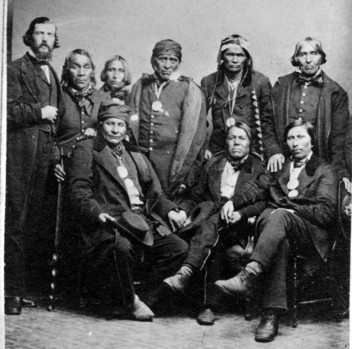
Another error in the February post is the claim that this photo was modified for and engraving in Armstrong’s book, Early Life Among the Indians. In fact, the engraving is derived from a very similar photo seen at the top of this post (Minnesota Historical Society).

(Marr & Richards Co. for Armstrong)
The problem with this conclusion is that it would have been impossible for Jechiikwii’o to visit Lincoln in the White House. The sixteenth president was elected shortly after the following report came from the Red Cliff Agency:

Drew, C.K. Report on the Chippewas of Lake Superior. Red Cliff Agency. 29 Oct. 1860. Pg. 51 of Annual Report of the Commissioner of Indian Affairs. Bureau of Indian Affairs. 1860. (Digitized by Google Books).
This was a careless oversight on my part, considering this snippet originally appeared on Chequamegon History back in November. Jechiikwii’o is still a likely suspect for the man in the photo, but this discrepancy must be settled before we can declare the mystery solved.
The question comes down to where Armstrong made the mistake. Is the man someone other than Jechiikwii’o, or is the photo somewhere other than the Lincoln White House?
If it isn’t Jechiikwii’o, the most likely candidate would be his son, Antoine Buffalo. If you remember this post, Hamilton Ross did identify the single portrait as a grandson of Chief Buffalo. Jechiikwii’o, a Catholic, gave his sons Catholic names: Antoine, Jean-Baptiste, Henry. Ultimately, however, they and their descendants would carry their grandfather’s name as a surname: Antoine Buffalo, John Buffalo, Henry Besheke, etc., so one would expect Armstrong (who was married into the family) to identify Antoine as such, and not by his father’s name.
However, I was recently sent a roster of La Pointe residents involved in stopping the whiskey trade during the 1855 annuity payment. Among the names we see:
…Antoine Ga Ge Go Yoc
John Ga Ge Go Yoc…[Read the first two Gs softly and consider that “Jayjigwyong” was Leonard Wheeler’s spelling of Jechiikwii’o]
So, Antoine and John did carry their father’s name for a time.
Regardless, though, the age and stature of the man in the group photograph, Armstrong’s accuracy in remembering the other chiefs, and the fact that Armstrong was married into the Buffalo family still suggest it’s Jechiikwii’o in the picture.
Fortunately, there are enough manuscript archives out there related to the 1862 delegation that in time I am confident someone can find the names of all the chiefs who met with Lincoln. This should render any further speculation irrelevant and will hopefully settle the question once and for all.
Until then, though, we have to reflect again on why Benjamin Armstrong’s Early Life Among the Indians is simultaneously the most accurate and least accurate source on the history of this area. It must be remembered that Armstrong himself admitted his memory was fuzzy when he dictated the work in his final years. Still, the level of accuracy in the small details is unsurpassed and confirms his authenticity even as the large details can be way off the mark.
 Chequamegon History