Judge Bell Incidents: King of the Apostle Islands
January 30, 2025
Collected & edited by Amorin Mello
This post is the first of a series featuring The Ashland News items about La Pointe’s infamous Judge John William Bell, written mainly by his son-in-law George Francis Thomas née Gilbert Fayette Thomas a.k.a G.F.T.
 Wednesday, September 30, 1885, page 2.
ON HISTORICAL GROUND.

James Chapman
~ Madeline Island Museum

Judge Joseph McCloud
~ Madeline Island Museum
Saturday last, says The Bayfield Press, the editor had the pleasure of visiting Judge John W. Bell at his home at La Pointe, accompanied by Major Wing, James Chapman and Judge Joseph McCloud. The judge, now in his 81st year, still retains much of that indomitable energy that made him for many years a veritable king of the Apostle Islands. Owing, however, to a fractured limb and an irritating ulcer on his foot he is mostly confined to his chair. His recollection of the early history of this country is vivid, while his fund of anecdotes of his early associates is apparently inexhaustible and renders a visit to this remarkable pioneer at once full of pleasure and instruction. The part played by Judge Bell in the early history of this country is one well worthy of preservation and in the hands of competent parties could be made not the least among the many historical sketches of the pioneers of the great northwest. The judge’s present home is a large, roomy house, located in the center of a handsome meadow whose sloping banks are kissed by the waters of the lake he loves so well. Here, surrounded by children and grand-children, cut off from the noise and bustle of the outside world, his sands of life are peacefully passing away.
Leaving La Pointe our little party next visited the site of the Apostle Islands Improvement company’s new summer resort and found it all the most vivid fancy could have painted. Here, also, we met Peter Robedeaux, the oldest surviving voyager of the Hudson Bay Fur Co. Mr. Robedeaux is now in his 89th year, and is as spry as any man not yet turned fifty. He was born near Montreal in 1796, and when only fourteen years of age entered the employ of the Hudson Bay Fur Co., and visited the then far distant waters of the Columbia river, in Washington Territory. He remained in the employ of this company for twenty-five years and then entered the employ of the American Fur company, with headquarters at La Pointe. For fifty years this man has resided on Madeline Island, and the streams tributary to the great lake not visited by him can be numbered by the fingers on one’s hand. His life until the past few years has been one crowded with exciting incidents, many of which would furnish ample material for the ground-work of a novel after the Leather Stocking series style.
Wednesday, June 30, 1886, page 2.
GOLDEN WEDDING.
About thirty of the old settlers of Ashland and Bayfield went over to La Pointe on Saturday to celebrate the golden wedding anniversary of Judge John W. Bell and wife, who were married in the old church at La Pointe June 26th, 1836, fifty years ago. The party took baskets containing their lunch with them, the old couple having no knowledge of the intended visit. After congratulations had been extended the table was spread, and during the meal many reminiscences of olden times were called up.
Judge Bell is in his eighty-third year, and is becoming quite feeble. Mrs. Bell is perhaps ten or twelve years younger. Judge Bell came to La Pointe in 1834, and has lived there constantly ever since. La Pointe used to be the county seat of Ashland county, and prior to the year 1872 Judge Bell performed the duties of every office of the county. In fact he was virtually king of the island.
The visitors took with them some small golden tokens of regard for the aged couple, the coins left with them aggregating between $75 and $100.
Wednesday, July 20, 1887, page 6.
REMINISCENCES OF OLD LA POINTE
(Written for The Ashland News)

Visitors to this quiet and delapidated old town on Madeline Island, Lake Superior, about whom early history and traditions so much has been published, are usually surprised when told that less than forty years have passed since there flourished at this point a city of about 2,500 people. Now not more than thirty families live upon the entire island. Thirty-five years ago neither Bayfield, Ashland nor Washburn was thought of, and La Pointe was the metropolis of Northern Wisconsin.
Since interesting himself in the island the writer has often been asked: Why, if there were so many inhabitants there as late as forty years ago, are there so few now? In reply a great number of reasons present themselves, chief among which are natural circumstances, but in the writer’s mind the imperfect land titles clouding old La Pointe for the last thirty years have tended materially to hastening its downfall.

Captain John Daniel Angus
~ Madeline Island Museum
Of the historic data of La Pointe, of which the writer has almost an unlimited supply, much that seems romance is actual fact, and the witnesses of occurrences running back over fifty years are still here upon the island and can be depended upon for the truthfulness of their reminiscences. There are no less than five very old men yet living here who have made their homes upon the island for over fifty years. Judge John W. Bell, or “Squire,” as he is familiarly called, has lived here since the year 1835, coming from the “Soo,” on the brig, John Jacob Astor, in company with another old pioneer of the place known as Capt. John Angus. Mr. Bell contracted with the American Fur Co., and Capt. Angus sailed the “Big Sea” over. Mr. Bell is now eighty three years of age, and is crippled from the effects of a fall received while attending court in Ashland, in Jan. 1884. He is a man of iron constitution and might have lived – and may yet for all we know – to become a centenarian. The hardships of pioneer life endured by the old Judge would have killed an ordinary man long ago. He is a cripple and an invalid, but he has never missed a meal of victuals nor does he show any sign of weakening of his wonderful mind. He delights to relate reminiscences of early days, and will talk for hours to those who prove congenial. Once in his career, Mr. Bell had in his employ the famous “Wilson, the Hermit,” whose romantic history is one of the interesting features sought after by tourists when they visit the islands.
~ History of Northern Wisconsin, by the Western Historical Co., 1881.
Once Mr. Bell started an opposition fur company having for his field of operations that portion of Northern Wisconsin and Michigan now included within the limits of the great Gogebic and Penokee iron ranges, and had in his employ several hundred trappers and carriers. Later Mr. Bell became a prominent explorer, joining numerous parties in the search for gold, silver and copper; iron being considered too inferior a metal for the attention of the popular mind in those days.
Almost with his advent on the island Mr. Bell became a leader in the local political field, during his residence of fifty-two years holding almost continually some one of the various offices within the gift the people. He was also employed at various times by the United States government in connection with Indian affairs, he having a great influence with the natives.

Ramsay Crooks
~ Madeline Island Museum
The American Fur Co., with Ramsay Crooks at its head gave life and sustenance to La Pointe a half century ago, and for several years later, but when a private association composed of Borup, Oakes and others purchased the rights and effects of the American Fur Co., trade at La Pointe began to fall away. The halcyon days were over. The wild animals were getting scarce, and the great west was inducing people to stray. The new fur company eventually moved to St. Paul, where even now their descendants can be found.

Julius Austrian
~ Madeline Island Museum
Prior to the final extinction of the fur trade at La Pointe and in the early days of steamboating on the great lakes, the members of the well-known firm of Leopold & Austrian settled here, and soon gathered about them a number of their relatives, forming quite a Jewish colony. They all became more or less interested in real estate, Julius and Joseph Austrian entering from the government at $1.25 per acre all the lands upon which the village was situated, some 500 acres.

Joseph Austrian
~ Jennifer Barber Family
The original patent issued by the government, of which a copy exists in the office of the register of deeds in Ashland, is a literary curiosity, as are also many other title papers issued in early days. Indeed if any one will examine the records and make a correct abstract or title history of old La Pointe, the writer will make such person a present of one of the finest corner lots on the island. Such a thing can not be done simply from the records. A large portion of the original deeds for village lots were simply worthless, but the people in those days never examined into the details, taking every man to be honest, hence errors and wrongs were not found out.
Now the lots are not worth the taxes and interest against them, and the original purchaser will never care whether his title was good or otherwise. The county of Ashland bought almost the whole town site for taxes many years ago and has had an expensive load to carry until the writer at last purchased the tax titles of the village, which includes many of the old buildings. The writer has now shouldered the load, and proposes to preserve the old relics that tourists may continue to visit the island and see a town of “Ye olden times.”
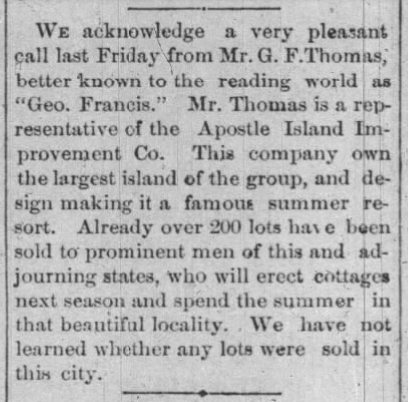
~ The Boscobel Dial
September 29, 1885.
Originally the intention was to form a syndicate to purchase the old town. An association of prominent citizens of Ashland and Bayfield, at one time came very near securing it, and the writer still has hopes of such an association some day controlling the historical spot. The scheme, however, has met with considerable opposition from a few who desire no changes to be made in the administration of affairs on the island. The principal opponent is Julius Austrian, of St. Paul, who still owns one-sixth part of La Pointe, and is expecting to get back another portion of lots, which have been sold for taxes and deeded by the county ever since 1874. He would like no doubt, to make Ashland county stand the taxes on the score of illegality. As a mark of affection for the place, he has lately removed the old warehouse which has stood so many years a prominent landmark in La Pointe’s most beautiful harbor. Tourists from every part of the world who have visited the old town will join in regretting the loss and despise the action.
G. F. T.
To be continued in King No More…
The 19th Ojibwe Journal of Edmund F. Ely
July 9, 2023
By Leo and Amorin
The Ojibwe Journals of Edmund F. Ely, 1833-1849, compiled and edited by Theresa Schenck, and published by University of Nebraska Press in 2012, are a fascinating window into Ojibwe Country at a pivotal time in history. Chequamegon History frequently cites this work, which consists of eighteen journals kept by a Protestant missionary during his largely unsuccessful labors among the Ojibwe people of western Lake Superior and the upper Mississippi country. In it, Dr. Schenck alludes to a nineteenth journal, not published in the book, dealing with the liquor trade at La Pointe in the years 1847 and 1848.  The original manuscripts are held by the Northeast Minnesota Historical Center at the University of Minnesota-Duluth. Other historical societies hold transcripts made by Grace Lee Nute and Veronica Houle in the 1930s. Here we present our own transcription of Journal 19.Unlike numbers 1-18, Journal 19 is less a personal diary and more an official log of incidents related liquor trafficking and drunkenness on Madeline Island and surrounding regions. During those years, Ely was a teacher at the La Pointe Mission under Rev. Sherman Hall and also provided assistance to Rev. Leonard Wheeler at the Bad River Mission. These missionaries came from the New England evangelical tradition of the Second Great Awakening, which in addition to trying to convert the peoples of the world, also produced movements for Abolitionism, Women’s Suffrage, and Temperance. Letters indicate that some form of La Pointe Temperance Society was created in the late 1840s. Journal 19 references papers on file, indicating that the document may actually be the official log of the Temperance Society, probably having the intent to produce evidence against illegal liquor traders.
The use of alcohol in the fur trade goes back four centuries, to the earliest French presence on Lake Superior. Government and church efforts to suppress that trade go back almost as far. These measures, however, were never successful in fully eliminating liquor from the trade. By 1847, the laws related to alcohol at La Pointe were somewhat ambiguous. The Intercourse Acts of the United States prohibited the sale of liquor to Indians and on Indian lands. Enforcement, therefore, was the responsibility of the Government Sub-Agent. However, there were questions over whether his jurisdiction extended to non-Natives, to mix-blood Ojibwe people with American citizenship, or to transactions completed on the water of Lake Superior. Suffice it to say, both Federal laws and local ordinances prohibiting alcohol were enforced irregularly. The missionaries found this maddening.
Edmund F. Ely was perfect for the job of professional tattletale. For one thing, he was good at being disliked. He had numerous enemies in both the Ojibwe and the non-Native population. Around the time he was driven out of Fond du Lac by the chiefs of that community, he even went so far as to compile a list of reasons why the Fond du Lac Ojibwe disliked him. He would later go on to alienate several of the early settlers of Superior and Duluth during the McCracken-Ludden Affair, and he often sent complaints about his fellow missionaries back to headquarters in Boston.
We, today, are also fortunate that Ely had this job. Most accounts from this era, about the destructive power of alcohol in the Laker Superior trade are very similar in nature. We get a lot of righteous screeds, emphasizing only sensational violence. These are long on moralizing and short on interesting detail. Ely is certainly moralistic to the point of sanctimony, and some of his accounts are extremely violent. However, Journal 19 preserves the same types of details and idiosyncratic observations that makes the earlier journals so compelling. Because of this, we get a true window into the nuances of 1840s La Pointe society. Despite lax or selective enforcement of liquor laws, we arguably see a community less affected by alcohol than the nearby white settlements at St. Croix and Ontonagon. Finally, we get to see familiar characters, learn of their triumphs and failures, and hear stories both horrific and humorous, but seemingly very real.
The Ojibwe Journals of Edmund F. Ely:
LaPointe 1847-1848
Journal # 19
1847
May.
Adams of Ontonagon came to Bad River with goods & Whiskey, for trade with the Indians. He first past into the Bay behind Shagouamik & the whiskey was secreted near the sand cut. Mr. Hayes (Sub-Agt) Learning of this movement went in search, & destroyed [it at once. 50 to 80 Quarts sold.]
Aug.
The Sail Boat “Flying Indian” [came ashore for sale] with whiskey & secreted it [illeg.]
“
Schooner “Fur Trader” searched by the Sub Agent & [33] qua [btls] of Liquour in bottles destroyed.
“
[omitted or illegible sentence]
“
Steam Boat “Julia Palmer” boarded and searched at the [Sault] [illeg.] of [illeg.]

Martin Beaser,a prominent name in early Ashland history, got his start here as an illegal liquor trader. These late summer incidents, in both 1847 and 1848, coincide with the La Pointe annuity payments
Augt.
Martin Beser, of Ontonagon arrived in a Yawl–with a few others, reported as passengers. Journalist has been informed that she brought part of the load (whiskey) of the Flying Indian. Probably had considerable whiskey of belonging to Beser & the Passengers.
— Besor’s boat with himself, Chas. Rowley & a stranger on board (all intoxicated) was upset in a squall while cruis about Eleven o clk P.M. while cruising about the harbour. Wind Northerly. They drifted on to Shagouamik & struck some distance off the point on the shoal in about 4ft water. Men lay on the side of the boat, benumbed, helpless, & almost speechless & inconscious.
—It being surmised from certain movements, by a member of the Temp. Socy. that a Bbl of Whiskey would be removed from the Island to Shagouamik. Mr. Hayes was informed, who sent off Mr. Smith & two strikers, before day break, to keep a look-out. Mr. Smith discovered Besor’s boat–took off the men & brought them to Cadottes–where they were seen by Messrs Wheeler & Johnson & others.
“–Sab.
Besor’s boat left, and were obliged to put in to Bad River where were encamped the Lac du Flambeau Wisconsin Indians Indians returning from payment. There was liquor enough onboard to commence a trade. The Indians were supplied & became intoxicated. The wife of White Bird (mother of Kebebizindų) was present, who states that an Ind rec’d a bottle from one of the men on board, in exchange for a Blanket, but as ascertaining it contained only water went to take his Blanket again, whereupon Besor resisted him & knocked him down with a Rifle. The Ind’s were roused by the report that the white men were killing the man, & as the boat shoved off the shore, fired upon it, shot & ball, one Ball passed through the post of the ship keel [cent]. & struck lodged in the arm of James Dorman, who had thrown himself there off place of safety. Boat put back to Warren’s for surgical help–left Dorman & went off same day (Sunday)
[perpendicular to beginning of struck-out statement]Incorrect
[in margin at beginning of struck-out statement]
Sab previous
[perpendicular to ending of struck-out statement]This statement is incorrect see Whitebird’s wife’s statement on file.
On the last two days of the payment,
Bottles of liquor were smuggled ashore in the pockets of dealers, & sold for $1, per bottle, or exchanged for blankets. Some bottles were found to contain only water. The trade in bottles was carried on, (it is believed) through the windows of the Julia Palmer. Capt. Wood, of the steamer was detected in the night, landing his yawl, with bottles of whiskey in possession. Some two or three Bbls, (in different sized casks) were found & destroyed by Govt.
Nov.
Francois Boudrie of Ontonagon arrived here with whiskey. Evidence was obtained of his having infringed the law in selling to Indians & also of selling without licence. Mr. Austrian lodged a complaint with Justice Bell & Boudrie was brought to trial, but from his supposed inability to pay the fine, & there being no prison, at the was set at liberty on securing an amount of $5 for costs, without bonds “to keep the peace” being required to enter into Bonds to keep the peace.
— Jejiguaio complained to Justice Bell against Millette for selling whiskey to Indians in exchange for paymt. goods. Case not examined–
— gave Mr. Oakes a list of goods, traded for whiskey with Millette. Indian was dissatisfied needed his goods & wished to get them again.
May 13.
Francis Boudrie of Ontonagon brought whiskey to Bad River for trade with the Inds. B. confessed his crime to Messrs. Wood & Wheeler. An officer warrant was issued by Justice Bell, but the officer arrived too late to arrest him, he having left the Territory.
May 6.
Propeller Independence arrived from Sault St. Maries. Not known that any intoxicating liquor was landed save 2 Bbls cider for Mr. Watrous.
19th
Chas. Brissett states that Henry Beaulieu told him he (Henry) bought one bottle of liquor of Watrous for $1. (Whh Henry denies) Some observed Henry to be, in their estimation, a little excited from drink.
May 23.
Propeller Independence arrived today from Sault St. Maries. Dr. Borup & fam, & J. P. Hayes Esq. passengers.
Items gathered at Ance Kiueonaui. In Oct Last, 3 young men (Indian) from the methodist Station, went across the bay to Meniclear’s, got whiskey, & returned drunk. One of them lay on the shore & died in the night. A coroner’s Inquest was held on the body. (P.O. Johnson)
Some time in Nov. or Dec.
A canadian came through from Green Bay in company with J. Paull of Ontonagon, got liquor of Geo. Burkett, & was drunk some days, was then attacked (with pluerisy probably) & died (P.O. Johnson)
In Jany.
3 miners came from Copper Harbour, on their way to Green Bay, with considerable money. They stopped at Meniclear’s & gave themselves to drinking one or two days, during which, one did a severe wound in the hand, and another found himself minus about $100. (Johnson)
There are 5 traders at L’Ance, viz.
P. Crebassa no whiskey
Meniclear Whiskey & drinker
Geo. Burkett. do – do
Sherman do – do
Sheldon do – do
2 of the above drinkers, also abuse their families.
Some time in the fall of 1847,
John Champaigne, in the Employment of Doct. Kane, on their way up the ontonagon was seized with delirium tremens, & died. Had been drinking at the mouth of Ontonagon.–
March 2nd, 1848.
Jas. Landergrun was found in a dying state on the Ice, Ontonagon River, for particulars see the letter of Mr. Saml O. Knapp (on file)
Feb 7. 1847.
Henry Rust was killed shot by a shot from an Nodin or his son in law, at Dicks Drakes trading house on Snake River St. Croix, Co. Drake & another man were drunk & were fired upon they were too drunk to know much about the circumstances for particulars, see statement of J. P. Hayes Esq (on file)
May 1848.
–Drake shot dead killed by a shot Bapt. Robideau– Liquor the cause.
June 19.
Schooner Swallow arrived from Sault St. Maries. freight for Messrs Hyde, Leopoled & N. Fur Co.
March.
Mr. Cash of Ontonagon stated to Journalist that Martin Besor, after his return from Lapoint last fall offered to sell him any number of Indian Blankets, whh he (Cash) might be disposed to buy.
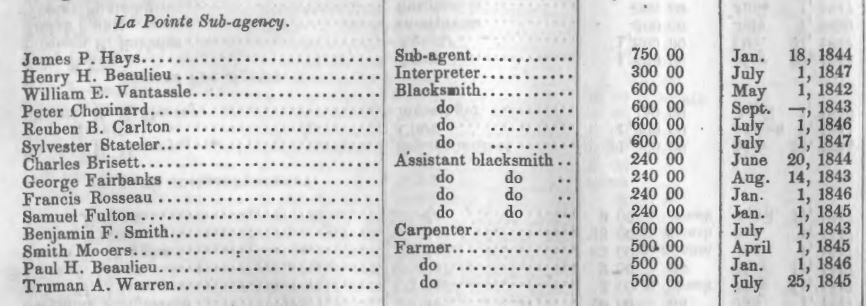
List of mid-late 1840s employees at the La Pointe Indian Sub-Agency including James P. Hayes and others.
~ Thirtieth Congress – First Session. Ex. Doc. No. 26. House of Representatives. Persons Employed In The Indian Department. Letter from The Secretary of War, Transmitting a statement of persons employed in the Indian Department. January 26, 1848.
June 22.
Jas. P. Hayes Esq. U. S. Sub Agt. recd his dismission & left in the Schooner Swallow– cause, Intemperance
July.
Fr. Boudrie arrived from Ontonagon with a cask of whiskied Cider– was prosecuted–a search warrant was issued & Peter Vandeventer was deputized to serve it. Van deventer After allowing abundant time for the service, Mr. Justice Bell & Van Tasell went to the building under search, & detected Van deventer in secreting a part of the cider. The whole was seized & destroyed by the owner–
Aug 28.
Propeller Independence arrived. Considerable intoxication among french & Half breeds.
“ 29
Schooner Napoleon, Clarke arrived with Govt provisions. Passengers Hyde, Wolcott & Martell
In discharging some bbls. of corn from the Propeller, on bbl. burst, & revealed a number of bottles of Liquor secreted among the Corn. The bbls were expressed back to the Sault. They have since been ascertained to belong have shipped by Martell of Sault St Maries. It was also reported by a passenger on the propeller, that the Napoleon was supposed to have on board a Bbl of Liquor belonging to Wolcott.
A number of Indians are reported to have had liquor about the time the Propeller left.
— An Indian was instigated by a Wht. man named Mills to murder two Americans living on Apple River–liquor was used in carry out Mills’s plans. The Ind was arrested & Hung, without judicial trial, at the Falls of St Croix.
— Majise shot killed in a drunken frolic on the St Croix. died next day–
— An old woman had her arm broken at the mouth of the Brule by a drunken son in law–Liquor furnished by Aug. Cadotte.
Sept 11.
Wood Smith & Vantassell Govt men, found 2 Kegs (about 12 [gal]) whiskey near the camp of Fr. Boudrie belonging to him, concealed in the ground–they immediately destroyed it.
6th
The sailboat Flying Indian arrived in the night of [Sunday] [day] last.
Sept 13.
Schooner Algonquin arrived from Sault St. Maries ~~~~~~~~~~~~~~~~~~~~~~~~~~~~~~~~~~~~~~~~~~~~~~~~~~~~~~~~~~~~~~~~~~~~~~~~~~~~~~~~~~~~~~~~~~~~~~~~~ Further information about the challenges of enforcing liquor laws at La Pointe can be found in the following:
“A real bona fide, unmitigated Irishman”
Reisen in Nordamerika: From Ontonagon to the mouth of the Bois-brule (Part 3)
1855 Inquest on the Body of Louis Gurnoe
1856 Inquest on the Body of Jerry Sullivan
~~~~~~~~~~~~~~~~~~~~~~~~~~~~~~~~~~~~~~~~~~~~~~~~~~~~~~~~~~~~~~~~~~~~~~~~~~~~~~~~~~~~~~~~~~~~~~~~~
Ely, Edmund Franklin, and Theresa M. Schenck. The Ojibwe Journals of Edmund F. Ely, 1833-1849. Lincoln: University of Nebraska, 2012. Print.
Folsom, William H. C., and E. E. Edwards. Fifty Years in the Northwest. St. Paul: Pioneer, 1888. Print.
Paap, Howard D. Red Cliff, Wisconsin: A History of an Ojibwe Community. St. Cloud, MN: North Star, 2013. Print.
Schenck, Theresa M. William W. Warren: The Life, Letters, and times of an Ojibwe Leader. Lincoln: University of Nebraska, 2007. Print.
Special thanks to Dr. Schenck for making this post possible.
1837 Petitions from La Pointe to the President
January 29, 2023
Collected & edited by Amorin Mello
Letters Received by the Office of Indian Affairs:
La Pointe Agency 1831-1839
National Archives Identifier: 164009310
O. I. A. La Pointe J171.
Hon Geo. W. Jones
Ho. of Reps. Jany 9, 1838
Transmits petition dated 31st Augt 1837, from Michel Cadotte & 25 other Chip. Half Breeds, praying that the amt to be paid them, under the late Chip. treaty, be distributed at La Pointe, and submitting the names of D. P. Bushnell, Lyman M. Warren, for the appt of Comsr to make the distribution.
Transmits it, that it may receive such attention as will secure the objects of the petitioners, says as the treaty has not been satisfied it may be necessary to bring the subject of the petition before the Comsr Ind Affrs of the Senate.
Recd 10 Jany 1838
file
[?] File.
House of Representatives Jany 9th 1838

Sir
I hasten to transmit the inclosed petition, with the hope, that the subject alluded to, may receive such attention, as to secure the object of the petitioners. As the Chippewa Treaty has not yet been ratified it may be necessary to bring the subject of the petition before the Committee of Indian Affairs of the Senate.
I am very respectfully
Your obt svt
Geo W. Jones
C. A. Harris Esqr
Comssr of Indian Affairs
War Department

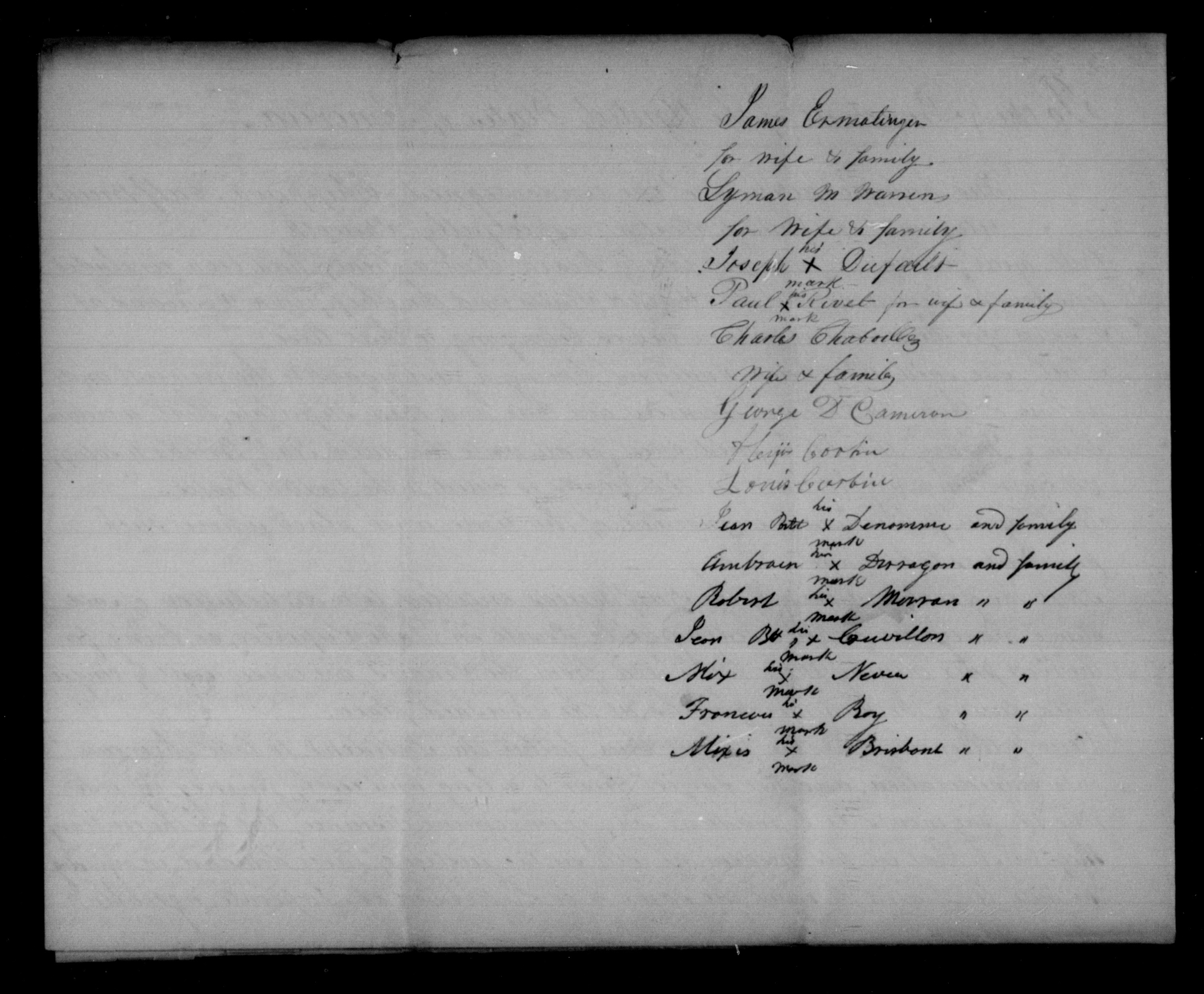
To the President of the United States of America
The humble petition of the undersigned Chippewa Half-Breeds citizens of the United Sates, respectfully Shareth:

Bizhiki (Buffalo), Dagwagaane (Two Lodges Meet), and Jechiikwii’o (Snipe, aka Little Buffalo) signed the 1837 Treaty of St Peters for the La Pointe Band.
That, your petitioners having lately heard that a Treaty had been concluded between the Government of the United Sates and the Chippewa Indians at St Peters, for the cession of certain lands belonging to that tribe:
ARTICLE 3.
“The sum of one hundred thousand dollars shall be paid by the United States, to the half-
breeds of the Chippewa nation, under the direction of the President. It is the wish of the
Indians that their two sub-agents Daniel P. Bushnell, and Miles M. Vineyard, superintend
the distribution of this money among their half-breed relations.”
That, the said Chippewa Indians X, having a just regard to the interest and welfare of their Half Breed brethren, did there and then stipulate; that, a certain sum of money should be paid once for all unto the said Half-Breeds, to satisfy all claim they might have on the lands so ceded to the United States.
That, your petitioners are ignorant of the time and place where such payment is to be made.
That the great majority of the Half-Breeds entitled to a distribution of said sum of money, are either residing at La Pointe on Lake Superior, or being for the most part earning their livelihood from the Traders, are consequently congregated during the summer months at the aforesaid place.
Your petitioners humbly solicit their father the President, to take their case into consideration, and not subject them to a long and costly journey in ordering the payments to be made at any inconvenient distance, but on the contrary they trust that in his wisdom he will see the justice of their demand in requiring he will be pleased to order the same to be distributed at Lapointe agreeable to their request.
Your petitioners would also intimate that, although they are fully aware that the Executive will make a judicious choice in the appointment of the Commissioners who will be selected to carry into effect the Provisions of said Treaty, yet, they would humbly submit to the President, that they have full confidence in the integrity of D. P. Bushnell Esqr. resident Indian Agent for the United States at this place and Lyman M Warren Esquire, Merchant.
Your petitioners entertain the flattering hope, that, their petition will not be made in vain, and as in duty bound will ever pray.
La Pointe, Lake Superior,
Territory of Wisconsin 31st August 1837
Michel Cadotte
Michel Bosquet X his mark
Seraphim Lacombe X his mark
Joseph Cadotte X his mark
Antoine Cadotte X his mark
Chs W Borup for wife & Children
A Morrison for wife & children
Pierre Cotte
Henry Cotte X his mark
Frances Roussan X his mark
James Ermatinger for wife & family
Lyman M Warren for wife & family
Joseph Dufault X his mark
Paul Rivet X his mark for wife & family
Charles Chaboullez wife & family
George D. Cameron
Alixis Corbin
Louis Corbin
Jean Bste Denomme X his mark and family
Ambrose Deragon X his mark and family
Robert Morran X his mark ” “
Jean Bst Couvillon X his mark ” “
Alix Neveu X his mark ” “
Frances Roy X his mark ” “
Alixis Brisbant X his mark ” “
Signed in presence of G. Pauchene
John Livingston
O.I.A. La Pointe W424.
Governor of Wisconsin
Mineral Pt. Feby 19, 1838
Transmits the talk of “Buffalo,” a Chip. Chief, delivered at the La Pointe SubAgt, Dec. 9, 1837, asking that the am. due the half-breeds under the late Treaty, be divided fairly among them, & paid them there, as they will not go to St Peters for it, &c.
Says Buffalo has great influence with his tribe, & is friendly to the whites; his sentiments accord with most of those of the half-breeds & Inds in that part of the country.
File
Recd 13 March 1838
[?] File.
Superintendency of Indian Affairs
for the Territory of Wisconsin
Mineral Point, Feby 19, 1838

Sir,
I have the honor to inclose the talk of “Buffalo,” a principal chief of the Chippewa Indians in the vicinity of La Pointe, delivered on the 9th Dec’r last before Mr Bushnell, sub-agent of the Chippewas at that place. Mr. Bushnell remarks that the speech is given with as strict an adherence to the letter as the language will admit, and has no doubt the sentiments expressed by this Chief accord with those of most of the half-breeds and Indians in that place of the Country. The “Buffalo” is a man of great influence among his tribe, and very friendly to the whites.
Very respectfully,
Your obed’t sevt.
Henry Dodge
Supt Ind Affs
Hon C. A. Harris
Com. of Ind. Affairs
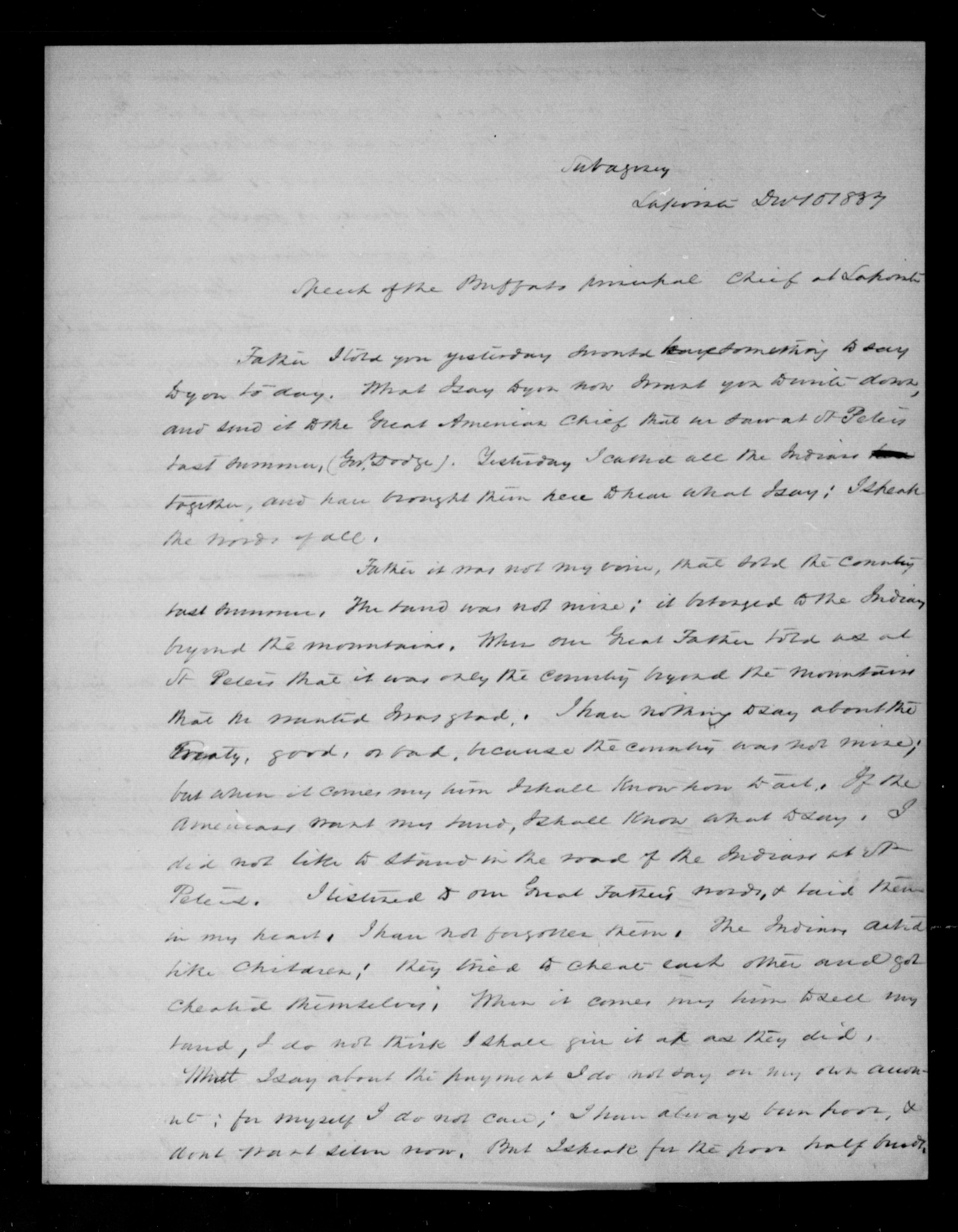
Subagency
Lapointe Dec 10 1837
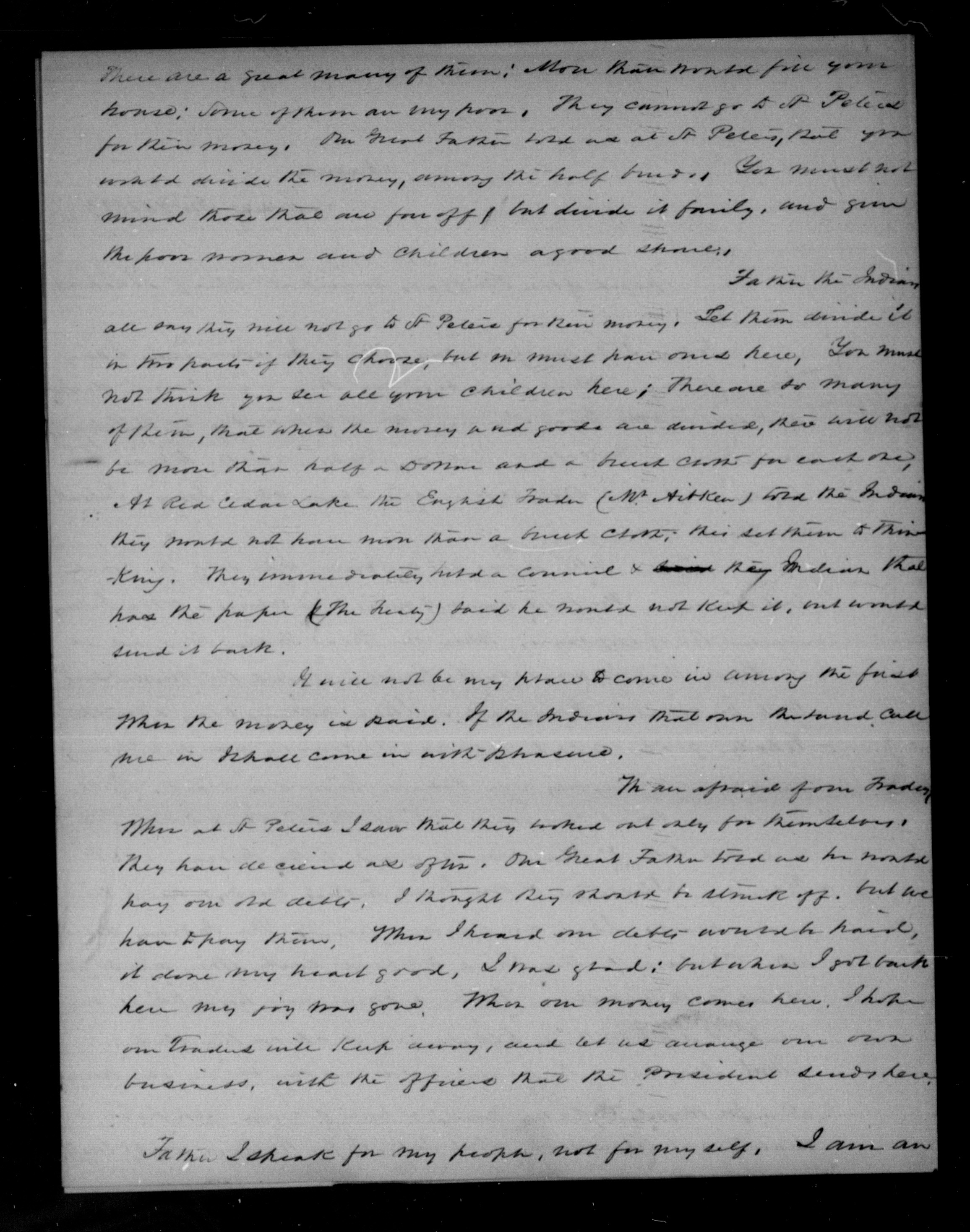
Speech of the Buffalo principal Chief at Lapointe
Father I told you yesterday I would have something to say to you today. What I say to you now I want you to write down, and send it to the Great American Chief that we saw at St Peters last summer, (Gov. Dodge). Yesterday, I called all the Indians together, and have brought them here to hear what I say; I speak the words of all.
ARTICLE 1.
“The said Chippewa nation cede to the United States all that tract of country included
within the following boundaries:
[…]
thence to and along the dividing ridge between the waters of Lake Superior and those of the Mississippi
[…]“
Father it was not my voice, that sold the country last summer. The land was not mine; it belonged to the Indians beyond the mountains. When our Great Father told us at St Peters that it was only the country beyond the mountains that he wanted I was glad. I have nothing to say about the Treaty, good, or bad, because the country was not mine; but when it comes my time I shall know how to act. If the Americans want my land, I shall know what to say. I did not like to stand in the road of the Indians at St Peters. I listened to our Great Father’s words, & said them in my heart. I have not forgotten them. The Indians acted like children; they tried to cheat each other and got cheated themselves. When it comes my time to sell my land, I do not think I shall give it up as they did.
What I say about the payment I do not say on my own account; for myself I do not care; I have always been poor, & don’t want silver now. But I speak for the poor half breeds.
There are a great many of them; more than would fill your house; some of them are very poor They cannot go to St Peters for their money. Our Great Father told us at St Peters, that you would divide the money, among the half breeds. You must not mind those that are far off, but divide it fairly, and give the poor women and children a good share.
Father the Indians all say they will not go to St Peters for their money. Let them divide it in this parts if they choose, but one must have ones here. You must not think you see all your children here; there are so many of them, that when the money and goods are divided, there will not be more than half a Dollar and a breech cloth for each one. At Red Cedar Lake the English Trader (W. Aitken) told the Indians they would not have more than a breech cloth; this set them to thinking. They immediately held a council & their Indian that had the paper (The Treaty) said he would not keep it, and would send it back.
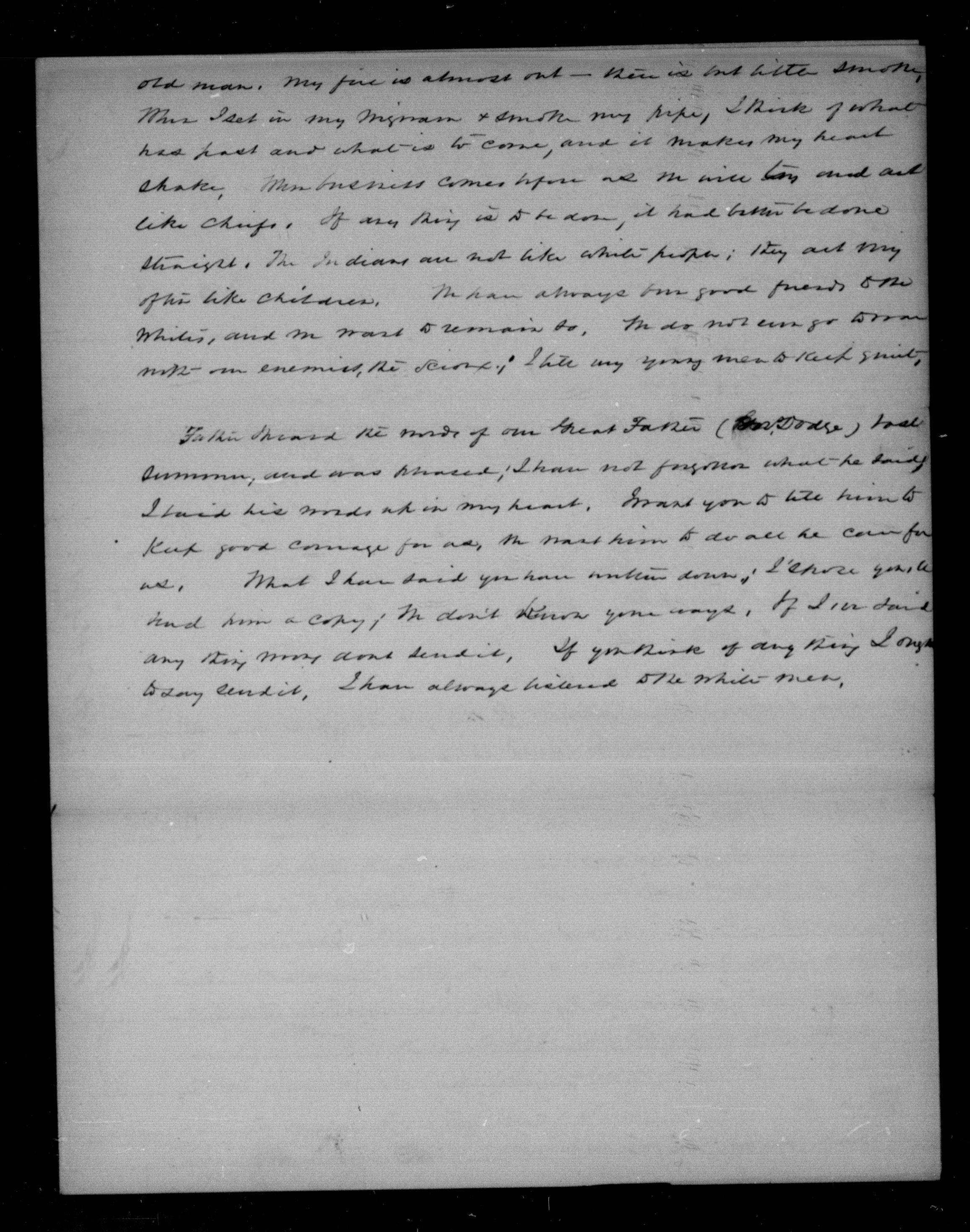
It will not be my place to come in among the first when the money is paid. If the Indians that own the land call me in I shall come in with pleasure.
ARTICLE 4.
“The sum of seventy thousand dollars shall be applied to the payment, by the United States, of certain claims against the Indians; of which amount twenty eight thousand dollars shall, at their request, be paid to William A. Aitkin, twenty five thousand to Lyman M. Warren, and the balance applied to the liquidation of other just demands against them—which they acknowledge to be the case with regard to that presented by Hercules L. Dousman, for the sum of five thousand dollars; and they request that it be paid.“
We are afraid of one Trader. When at St Peters I saw that they worked out only for themselves. They have deceived us often. Our Great Father told us he would pay our old debts. I thought they should be struck off, but we have to pay them. When I heard our debts would be paid, it done my heart good. I was glad; but when I got back here my joy was gone. When our money comes here, I hope our Traders will keep away, and let us arrange our own business, with the officers that the President sends here.
Father I speak for my people, not for myself. I am an old man. My fire is almost out – there is but little smoke. When I set in my wigwam & smoke my pipe, I think of what has past and what is to come, and it makes my heart shake. When business comes before us we will try and act like chiefs. If any thing is to be done, it had better be done straight. The Indians are not like white people; they act very often like children. We have always been good friends to the whites, and we want to remain so. We do not [even?] go to war with our enemies, the Sioux; I tell my young men to keep quiet.
Father I heard the words of our Great Father (Gov. Dodge) last summer, and was pleased; I have not forgotten what he said. I have his words up in my heart. I want you to tell him to keep good courage for us, we want him to do all he can for us. What I have said you have written down; I [?] you to hand him a copy; we don’t know your ways. If I [?] said any thing [?] dont send it. If you think of any thing I ought to say send it. I have always listened to the white men.
O.I.A. Lapointe, B.458
D. P. Bushnell
Lapointe, March 8, 1838
At the request of some of the petitioners, encloses a petition dated 7 March 1838, addressed to the Prest, signed by 167 Chip. half breeds, praying that the amt stipulated by the late Chip. Treaty to be paid to the half breeds, to satisfy all claims they ma have on the lands ceded by this Treaty, may be distributed at Lapointe.
Hopes their request will be complied with; & thinks their annuity should likewise be paid at Lapointe.
File
Recd 2nd May, 1838
Subagency
Lapointe Mch 6 1838
Sir
I have the honor herewith to enclose a petition addressed to the President of the United States, handed to me with a request by several of the petitioners that I would forward it. The justice of the demand of these poor people is so obvious to any one acquainted with their circumstances, that I cannot omit this occasion to second it, and to express a sincere hope that it will be complied with. Indeed, if the convenience and wishes of the Indians are consulted, and as the sum they receive for their country is so small, these should, I conciev, be principle considerations, their annuity will likewise as paid here; for it is a point more convenient of access for the different bands, that almost any other in their own country, and one moreover, where they have interests been in the habit of assembling in the summer months.
I am sir, with great respect,
your most obt servant,
D. P. Bushnell
O. I. A.
C. A. Harris Esqr.
Comr Ind. Affs
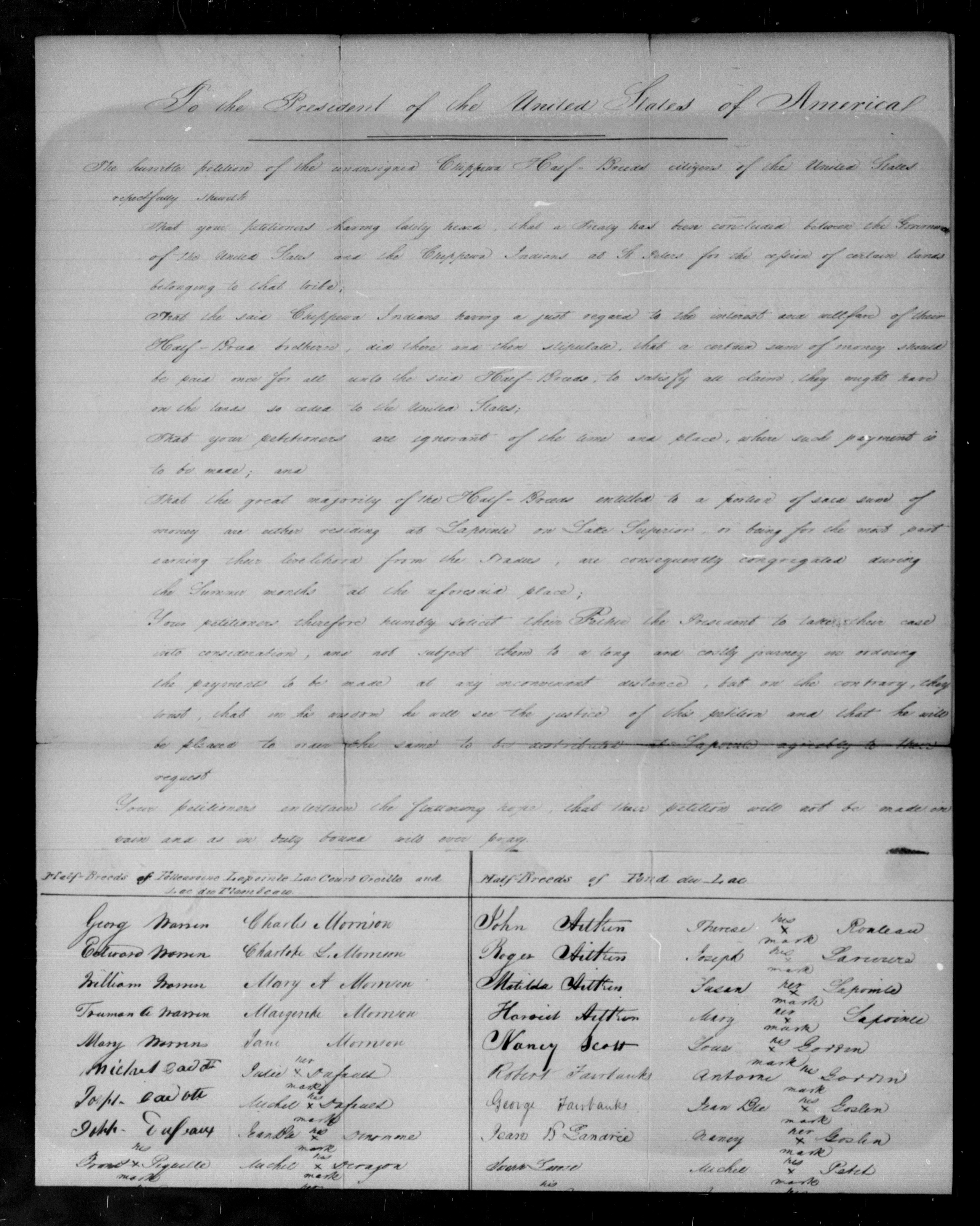
To the President of the United States of America
The humble petition of the undersigned Chippewa Half-Breeds citizens of the United States respectfully shareth
That your petitioners having lately heard, that a Treaty has been concluded between the Government of the United States and the Chippewa Indians at St Peters for the cession of certain lands belonging to that tribe;
That the said Chippewa Indians having a just regard to the interest and wellfare of their Half-Breed brethern, did there and then stipulate, that a certain sum of money should be paid once for all unto the said Half-Breeds, to satisfy all claims, they might have on the lands so ceded to the United States;
That your petitioners are ignorant of the time and place, where such payment is to be made; and
That the great majority of the Half-Breeds entitled to a portion of said sum of money are either residing at Lapointe on Lake Superior, or being for the most part earning their livelihood from the Traders, are consequently congregated during the summer months at the aforesaid place;
Your petitioners therefore humbly solicit their Father the President to take their case into consideration, and not subject them to a long and costly journey on ordering the payment to be made at any convenient distance, but on the contrary, they wish, that in his wisdom he will see the justice of this petition and that he will be pleased to order the same to be distributed at Lapointe agreeably to their request.
Your petitioners entertain the flattering hope, that their petition will not be made in vain and as in duly bound will ever pray.
Half Breeds of Folleavoine Lapointe Lac Court Oreilles and Lac du Flambeau
Georg Warren
Edward Warren
William Warren
Truman A Warren
Mary Warren
Michel Cadott
Joseph Cadotte
Joseph Dufault
Frances Piquette X his mark
Michel Bousquet X his mark
Baptiste Bousquet X his mark
Jos Piquette X his mark
Antoine Cadotte X his mark
Joseph Cadotte X his mark
Seraphim Lacombre X his mark
Angelique Larose X her mark
Benjamin Cadotte X his mark
J Bte Cadotte X his mark
Joseph Danis X his mark
Henry Brisette X his mark
Charles Brisette X his mark
Jehudah Ermatinger
William Ermatinger
Charlotte Ermatinger
Larence Ermatinger
Theodore Borup
Sophia Borup
Elisabeth Borup
Jean Bte Duchene X his mark
Agathe Cadotte X her mark
Mary Cadotte X her mark
Charles Cadotte X his mark
Louis Nolin _ his mark
Frances Baillerge X his mark
Joseph Marchand X his mark
Louis Dubay X his mark
Alexis Corbin X his mark
Augustus Goslin X his mark
George Cameron X his mark
Sophia Dufault X her mark
Augt Cadotte No 2 X his mark
Jos Mace _ his mark
Frances Lamoureau X his mark
Charles Morrison
Charlotte L. Morrison
Mary A Morrison
Margerike Morrison
Jane Morrison
Julie Dufault X her mark
Michel Dufault X his mark
Jean Bte Denomme X his mark
Michel Deragon X his mark
Mary Neveu X her mark
Alexis Neveu X his mark
Michel Neveu X his mark
Josette St Jean X her mark
Baptist St Jean X his mark
Mary Lepessier X her mark
Edward Lepessier X his mark
William Dingley X his mark
Sarah Dingley X her mark
John Hotley X his mark
Jeannette Hotley X her mark
Seraphim Lacombre Jun X his mark
Angelique Lacombre X her mark
Felicia Brisette X her mark
Frances Houle X his mark
Jean Bte Brunelle X his mark
Jos Gauthier X his mark
Edward Connor X his mark
Henry Blanchford X his mark
Louis Corbin X his mark
Augustin Cadotte X his mark
Frances Gauthier X his mark
Jean Bte Gauthier X his mark
Alexis Carpentier X his mark
Jean Bte Houle X his mark
Frances Lamieux X his mark
Baptiste Lemieux X his mark
Pierre Lamieux X his mark
Michel Morringer X his mark
Frances Dejaddon X his mark
John Morrison X his mark
Eustache Roussain X his mark
Benjn Morin X his mark
Adolphe Nolin X his mark
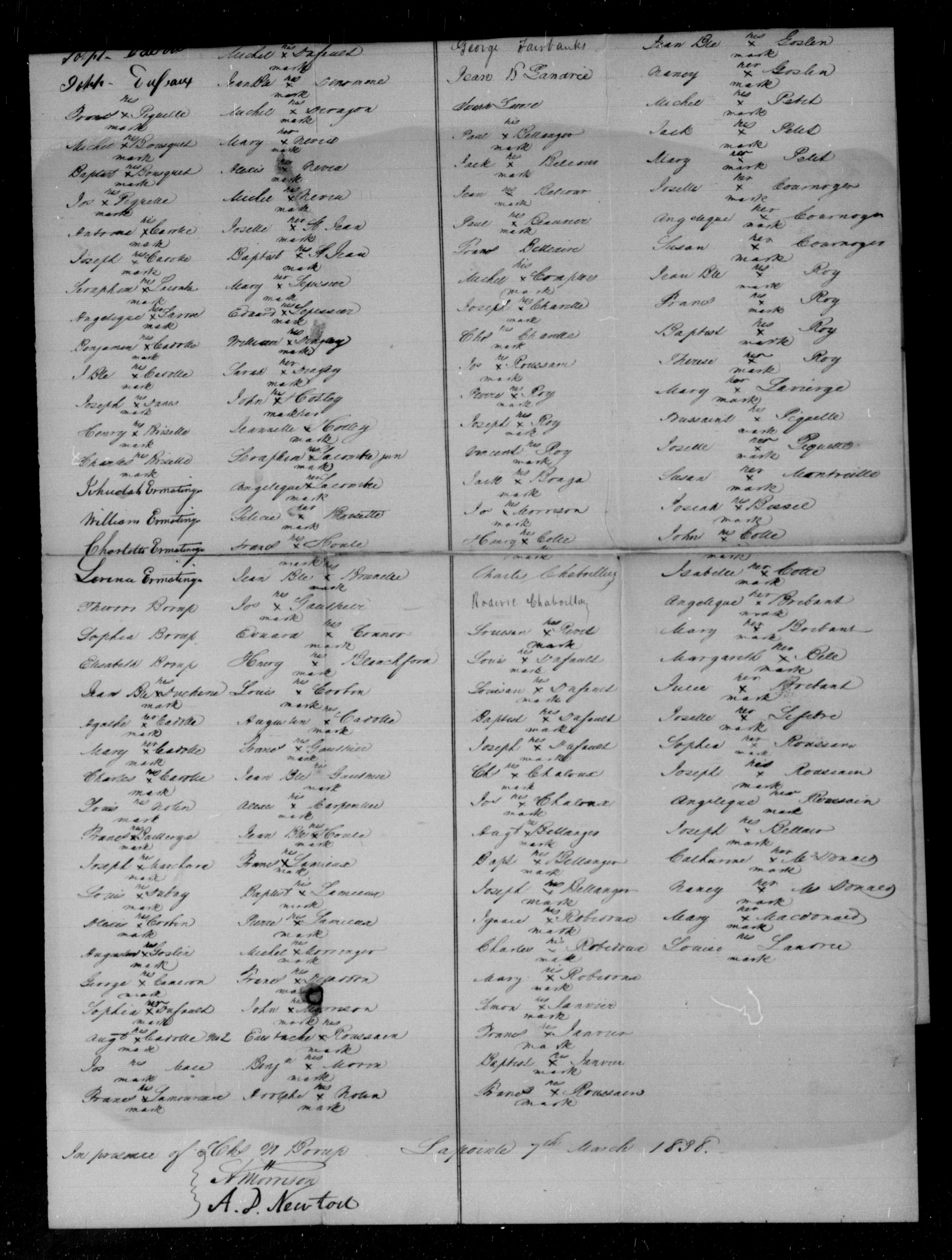
Half-Breeds of Fond du Lac
John Aitken
Roger Aitken
Matilda Aitken
Harriet Aitken
Nancy Scott
Robert Fairbanks
George Fairbanks
Jean B Landrie
Joseph Larose
Paul Bellanges X his mark
Jack Belcour X his mark
Jean Belcour X his mark
Paul Beauvier X his mark
Frances Belleaire
Michel Comptois X his mark
Joseph Charette X his mark
Chl Charette X his mark
Jos Roussain X his mark
Pierre Roy X his mark
Joseph Roy X his mark
Vincent Roy X his mark
Jack Bonga X his mark
Jos Morrison X his mark
Henry Cotte X his mark
Charles Chaboillez
Roderic Chaboillez
Louison Rivet X his mark
Louis Dufault X his mark
Louison Dufault X his mark
Baptiste Dufault X his mark
Joseph Dufault X his mark
Chs Chaloux X his mark
Jos Chaloux X his mark
Augt Bellanger X his mark
Bapt Bellanger X his mark
Joseph Bellanger X his mark
Ignace Robidoux X his mark
Charles Robidoux X his mark
Mary Robidoux X her mark
Simon Janvier X his mark
Frances Janvier X his mark
Baptiste Janvier X his mark
Frances Roussain X his mark
Therese Rouleau X his mark
Joseph Lavierire X his mark
Susan Lapointe X her mark
Mary Lapointe X her mark
Louis Gordon X his mark
Antoine Gordon X his mark
Jean Bte Goslin X his mark
Nancy Goslin X her mark
Michel Petit X his mark
Jack Petit X his mark
Mary Petit X her mark
Josette Cournoyer X her mark
Angelique Cournoyer X her mark
Susan Cournoyer X her mark
Jean Bte Roy X his mark
Frances Roy X his mark
Baptist Roy X his mark
Therese Roy X her mark
Mary Lavierge X her mark
Toussaint Piquette X his mark
Josette Piquette X her mark
Susan Montreille X her mark
Josiah Bissel X his mark
John Cotte X his mark
Isabelle Cotte X her mark
Angelique Brebant X her mark
Mary Brebant X her mark
Margareth Bell X her mark
Julie Brebant X her mark
Josette Lefebre X her mark
Sophia Roussain X her mark
Joseph Roussain X his mark
Angelique Roussain X her mark
Joseph Bellair X his mark
Catharine McDonald X her mark
Nancy McDonald X her mark
Mary Macdonald X her mark
Louise Landrie X his mark
In presence of
Chs W Borup
A Morrison
A. D. Newton
Lapointe 7th March 1838
By Leo
In April, the Supreme Court heard arguments in the case Department of Commerce v. New York and could render a decision any day on whether or not the 2020 federal census should include a question asking about citizenship status. In January, a Federal District Court in New York ruled that commerce secretary, Wilbur Ross, violated the law by pushing for that question.
Those in agreement with the District ruling suggest that the Trump administration wants to add the question as a way of discouraging immigrants from participating in the census, thereby diminishing the political power of immigrant communities. This, they say, would violate the Constitution on the grounds that the census must be an “actual enumeration” of all persons within the United States, not only citizens.
Proponents of the citizenship question counter that citizenship status is a perfectly natural question to ask in the census, that any government would want to know how many citizens it has, and that several past iterations of the 10-year count have included similar questions.
It remains to be seen how the Supreme Court will rule, but chances are it will not be the last time an issue of race, identity, or citizenship pops up in the politics of the census. From its creation by the Constitution as a way to apportion seats in congress according to populations of the states, the count has always begged tricky questions that essentially boil down to:
Who is a real American? Who isn’t? Who is a citizen? Who is three-fifths of a human being? Who might not be human at all? What does it mean to be White? To be Colored? To be civilized? How do you classify the myriad of human backgrounds, cultures and stories into finite, discrete “races?”
The Civil War and Fourteenth Amendment helped shed light on some of these questions, but it would be a mistake to think that they belong to the past. The NPR podcast Codeswitch has done an excellent series on census, and this episode from last August gives a broad overview of the history.
Here at Chequamegon History, though, we aren’t in the business broad overviews. We are going to drill down right into the data. We’ll comb through the 1850 federal census for La Pointe County and compare it with the 1860 data for La Pointe and Ashland Counties. Just for fun, we’ll compare both with the 1855 Wisconsin State Census for La Pointe County, then double back to the 1840 federal census for western St. Croix County. Ultimately, the hope is to help reveal how the population of the Chequamegon region viewed itself, and ultimately how that differed from mainstream America’s view. With luck, that will give us a framework for more stories like Amorin’s recent post on the killing of Louis Gurnoe.
Background
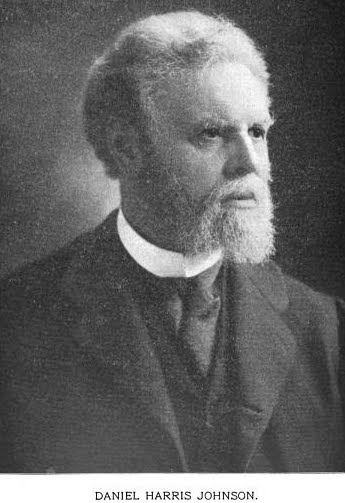 Judge Daniel Harris Johnson of Prairie du Chien had no apparent connection to Lake Superior when he was appointed to travel northward to conduct the census for La Pointe County in 1850. The event made an impression on him. It gets a mention in his short memorial biography in the 1902 Proceedings of the State Bar Association.
Two years after statehood, Lake Superior’s connection to the rest of Wisconsin was hardly existent. This was long before Highways 51 and 53 were built, and commerce still flowed west to east. Any communication to or from Madison was likely to first go through Michigan via Mackinaw and Sault Ste. Marie, or through Minnesota Territory via St. Paul, Stillwater, and Sandy Lake. La Pointe County had been created in 1845, and when official business had to happen, a motley assortment of local residents who could read and write English: Charles Oakes, John W. Bell, Antoine Gordon, Alexis Carpentier, Julius Austrian, Leonard Wheeler, etc. would meet to conduct the business.
It is unclear how much notice the majority Ojibwe and French-patois speaking population took of this or of the census generally. To them, the familiar institutions of American power, the Fur Company and the Indian Agency, were falling apart at La Pointe and reorganizing in St. Paul with dire consequences for the people of Chequamegon. When Johnson arrived in September, the Ojibwe people of Wisconsin had already been ordered to remove to Sandy Lake in Minnesota Territory for their promised annual payments for the sale of their land. That fall, the government would completely botch the payment, and by February, hundreds of people in the Lake Superior Bands would be dead from starvation and disease.
So, Daniel Johnson probably found a great deal of distraction and anxiety among the people he was charged to count. Indians, thought of by the United States as uncivilized federal wards and citizens of their own nations, were typically not enumerated. However, as I wrote about in my last post, race and identity were complicated at La Pointe, and the American citizens of the Chequamegon region also had plenty to lose from the removal.
Madison, for its part, largely ignored this remote, northern constituency and praised the efforts to remove the Ojibwe from the state. It isn’t clear how much Johnson was paying attention to these larger politics, however. He had his own concerns:

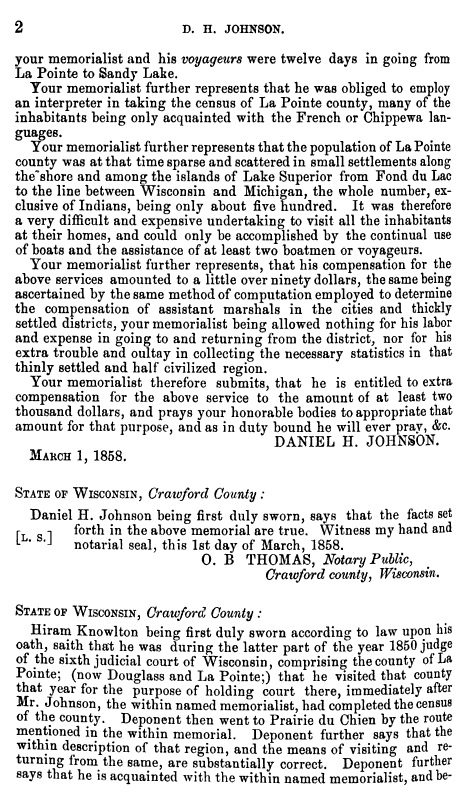
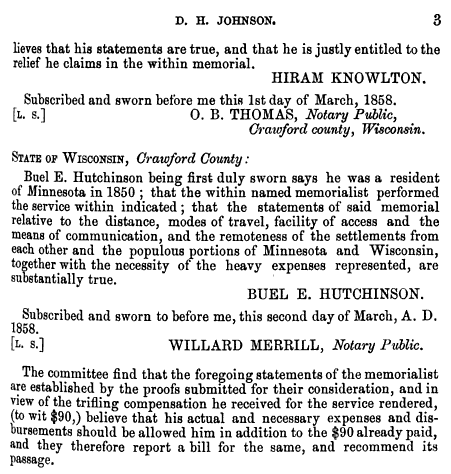
House Documents, Volume 119, Part 1. U.S. Government Printing Office, 1859. Google Books.
So, in “that thinly settled and half civilized region,” Johnson only found a population of about 500, “exclusive of Indians.” He didn’t think 500 was a lot, but by some counts, that number would have seemed very high. Take the word of a European visitor to La Pointe:
Among 200 Indians, only a few white families live there. One of the boatmen gave us a name, with which we found Mr. Austrian.
And, from this Mr. Austrian, himself:
There were only about 6 white American inhabitants on the Island, about 50 Canadian Frenchmen who were married to squaws, and a number of full blooded Indians, among whom was chief Buffalo who was a descendant of chiefs & who was a good Indian and favorably regarded by the people.
~Joseph Austrian, Brother of Julius and La Pointe resident 1851-52
Who lived around La Pointe in 1850?
In her biography, William W. Warren: the Life, Letters, and Times of an Ojibwe Leader, Theresa Schenck describes the short life of an ambitious young man from La Pointe. William Whipple Warren (1825-1853) grew up on the Island speaking Ojibwe as his first language. His father was a Yankee fur trader from New York. His mother was a daughter of Michel and Madeline Cadotte. In his famous History of the Ojibways Warren describes the Ojibwe as people with whom he readily claims kinship, but he doesn’t write as if he is an Ojibwe person himself. However, he helped interpret the Treaty of 1847 which had definitively made him an Indian in the eyes of the United States (a fact he was willing to use for economic gain). Still, a few years later, when he became a legislator in Minnesota Territory he dismissed challenges to his claims of whiteness.
If he were alive today, Warren might get a chuckle out of this line from the South African comedian Trevor Noah.
People mocked me. Gave me names like mixed breed, half caste — I hate that term ‘half’. Why half? Why not double? Or twice as nice, I don’t know.
— Trevor Noah
William Warren did not see himself as quite the walking contradiction we might see him as today. He was a product of the time and place he came from: La Pointe. By 1850, he had left that place, but his sister and a few hundred of his cousins still lived there. Many of them were counted in the census.
What is Metis?
Half-breeds, Mixed-bloods, Frenchmen, Wiisakodewininiwag, Mitif, Creoles, Metis, Canadiens, Bois Brules, Chicots, French-of-the-country, etc.–at times it seems each of these means the same thing. At other times each has a specific meaning. Each is ambiguous in its own way. In 1850, roughly half the families in the Chequamegon area fit into this hard-to-define category.

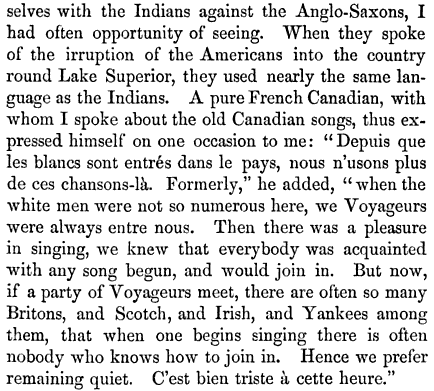
Kohl, J. G. Kitchi-Gami: Wanderings around Lake Superior. London: Chapman and Hall, 1860. pg. 260-61.
We were accompanied on our trip throughout the lakes of western Canada by half-Indians who had paternal European blood in their veins. Yet so often, a situation would allow us to spend a night inside rather than outdoors, but they always asked us to choose to Irish camp outside with the Indians, who lived at the various places. Although one spoke excellent English, and they were drawn more to the great American race, they thought, felt, and spoke—Indian! ~Carl Scherzer
In describing William Warren’s people, Dr. Schenck writes,
Although the most common term for people of mixed Indian and European ancestry in the nineteenth century was “half-breed,” the term “mixed blood” was also used. I have chosen to use the latter term, which is considered less offensive, although biologically inaccurate, today. The term “métis” was not in usage at the time, except to refer to a specific group of people of mixed ancestry in the British territories to the north. “Wissakodewinini,” the word used by the Ojibwe, meant “burned forest men,” or bois brulés in French, so called because half-breeds were like the wood of a burned forest, which is often burned on one side, and light on the other (pg. xv).
Schenck is correct in pointing out that mixed-blood was far more commonly used in 19th-century sources than Metis (though the latter term did exist). She is also correct in saying that the term is more associated with Canada and the Red River Country. There is an additional problem with Metis, in that 21st-century members of the Wannabe Tribe have latched onto the term and use it, incorrectly, to refer to anyone with partial Native ancestry but with no affiliation to a specific Indian community.
That said, I am going to use Metis for two reasons. The first is that although blood (i.e. genetic ancestry) seemed to be ubiquitous topic of conversation in these communities, I don’t think “blood” is what necessarily what defined them. The “pure-blooded French Voyageur” described above by Kohl clearly saw himself as part of Metis, rather than “blanc” society. There were also people of fully-Ojibwe ancestry who were associated more with Metis society than with traditional Ojibwe society (see my post from April). As such, I find Metis the more versatile and accurate term, given that it means “mixed,” which can be just as applicable to a culture and lifestyle as it is to a genetic lineage.

One time Canadian pariah turned national hero, Louis Riel and his followers had cousins at La Pointe (Photo: Wikipedia)
The second reason I prefer Metis is precisely because of the way it’s used in Manitoba. Analogous to the mestizo nations of Latin America, Metis is not a way of describing any person with Native and white ancestry. The Metis consider themselves a creole-indigenous nation unto themselves, with a unique culture and history. This history, already two centuries old by 1850, represents more than simply a borrowed blend of two other histories. Finally, the fur-trade families of Red River came from Sault Ste. Marie, Mackinac, Grand Portage, and La Pointe. There were plenty of Cadottes, Defaults, Roys, Gurnoes, and Gauthiers among them. There was even a Riel family at La Pointe. They were the same nation
Metis and Ojibwe Identity in the American Era
When the 1847 Treaty of Fond du Lac “stipulated that the half or mixed bloods of the Chippewas residing with them shall be considered Chippewa Indians, and shall, as such, be allowed to participate in all annuities which shall hereafter be paid…” in many ways, it contradicted two centuries of tradition. Metis identity, in part, was dependent on not being Indian. They were a minority culture within a larger traditional Anishinaabe society. This isn’t to say that Metis people were necessarily ashamed of their Native ancestors–expressions of pride are much easier to find than expressions shame–they were just a distinct people. This was supposedly based in religion and language, but I would argue it came mostly from paternal lineage (originating from highly-patriarchal French and Ojibwe societies) and with the nature of men’s work. For women, the distinction between Ojibwe and Metis was less stark.
The imposition of American hegemony over the Chequamegon region was gradual. With few exceptions, the Americans who came into the region from 1820 to 1850 were adult men. If new settlers wanted families, they followed the lead of American and British traders and married Metis and Ojibwe women.
Still, American society on the whole did not have a lot of room for the racial ambiguity present in Mexico or even Canada. A person was “white” or “colored.” Race mixing was seen as a problem that affected particular individuals. It was certainly not the basis for an entire nation. In this binary, if Metis people weren’t going to be Indian, they had to be white.
The story of the Metis and American citizenship is complicated and well-studied. There is risk of overgeneralizing, but let’s suffice to say that in relation to the United States government, Metis people did feel largely entitled to the privileges of citizenship (synonymous with whiteness until 1865), as well as to the privileges of Ojibwe citizenship. There wasn’t necessarily a contradiction.
Whatever qualms white America might have had if they’d known about it, Metis people voted in American elections, held offices, and were counted by the census.
Ojibwe “Full-bloods” and the United States Census
Representatives and direct Taxes shall be apportioned among the several States which
may be included within this Union, according to their respective Numbers, which shall be determined by adding to the whole Number of free Persons, including those bound to Service for a Term of Years, and excluding Indians not taxed, three fifths of all other Persons. The actual Enumeration shall be made within three Years after the first Meeting of the Congress of the United States, and within every subsequent Term of ten Years, in such Manner as they shall by Law direct.~Excerpt from Article I Section II, U. S. Constitution
As I argued in the April post, our modern conception of “full-blood” and “mixed-blood” has been shaped by the “scientific” racism of the late 19th and early 20th centuries. The distinction, while very real in a cultural sense, was not well-grounded in biology.
The relationship of Indians (i.e. full-bloods or those living a traditional lifestyle) to American society and citizenship was possibly more contradictory then that of the Metis. In one sense, America saw Indians as foreigners on their own continent: either as enemies to be exterminated, or as domestic-dependent ward nations to be “protected.” The constitutional language about the census calls for slaves to be counted as three-fifths of a person. It says Indians shouldn’t be counted at all.
In another sense, however, the path to personhood in America was somewhat clearer for Indians than it was for African Americans. Many New England liberals saw exodus to Liberia as the only viable future for free blacks. These same voices felt that Indians could be made white if only they were separated from their religions, cultures, and tribal identities. In 1834, to avoid a second removal, the Brothertown Indians of Wisconsin petitioned congress for citizenship and the termination of collective title to their tribal lands. In 1839, their request was granted. In the eyes of the law, they had effectively become white. Other communities would follow suit. However, most Native people did not gain any form of American citizenship until 1924.
How did that play out for the Ojibwe people of Chequamegon, and how did it impact the 1850 census? Well, it’s complicated.
Race, the Census, and Classifying Households
The enumeration forms Daniel H. Johnson carried to La Pointe had more rows and columns than ever. The Seventh Census was the first to count everyone in the household by name (previous versions only listed the Head of Household with tally marks). It was also the first census to have a box for “color.” Johnson’s choices for color were “white,” “black,” and “mulatto,” forcing him to make some decisions.
He seems to have tried to follow the Indians not taxed clause strictly. 40-50% of households in the region were headed by a full-blood Ojibwe person, possibly only two of them were enumerated. You won’t find Chief Buffalo, Makadebinesi (Blackbird), Oshkinaawe, Omizhinaawe, Edawegiizhig, and their immediate families in the 1850 census. Jechiikwii’o (often called Little Buffalo) is not in the document, even though he was an early Catholic convert, dressed in “white” clothing, and counted more Metis Ojibwe among his followers than full-bloods. However, his son, Antoine Buffalo Sr. (Antoine Jachequaon) is counted. Antoine, along with George Day, were counted as white heads of household by the census, though it is unclear if they had any European ancestry (Sources conflict. If anyone has genealogical information for the Buffalo and Day families, feel free to comment on the post). A handful of individuals called full-bloods in other sources, were listed as white. This includes 90-year old Madeline Cadotte, Marie Bosquet, and possibly the Wind sisters (presumably descendants of Noodin, one of the St. Croix chiefs who became Catholic and relocated to La Pointe around this time). They were married to Metis men or lived in Metis households. All Metis were listed as white.
Johnson did invent new category for five other Ojibwe people: “Civilized Indian,” which he seemed to use arbitrarily. Though also living in Metis households, Mary Ann Cadotte, Osquequa Baszina, Marcheoniquidoque, Charlotte Houle, and Charles Loonsfoot apparently couldn’t be marked white the way Madeline Cadotte was. These extra notations by Johnson and other enumeration marshals across the country are why the Seventh Federal Census is sometimes referred to as the first to count Native Americans.

So, out of 470 individuals enumerated at La Pointe and Bad River (I’ve excluded Fond du Lac from my study) Johnson listed 465 (99%) as white. By no definition, contemporary or modern, was the Chequamegon area 99% white in 1850. The vast majority of names on the lines had Ojibwe ancestry, and as Chippewas of Lake Superior, were receiving annuities from the treaties.
There were a few white American settlers. The Halls had been at La Pointe for twenty years. The Wheelers were well-established at Odanah. Junius and Jane Welton had arrived by then. George Nettleton was there, living with a fellow Ohioan James Cadwell. The infamous Indian agent, John Watrous, was there preparing the disastrous Sandy Lake removal. Less easy to describe as American settlers, but clearly of European origins, Fr. Otto Skolla was the Catholic priest, and Julius Austrian was the richest man it town.
There were also a handful of American bachelors who had drifted into the region and married Metis women. These first-wave settlers included government workers like William VanTassel, entrepreneurs like Peter VanderVenter, adventurers with an early connection to the region like Bob Boyd and John Bell, and homesteaders like Ervin Leihy.
It is unclear how many of French-surnamed heads of household were Chicots (of mixed ancestry) and how many were Canadiens (of fully-French ancestry). My sense is that it is about half and half. Some of this can be inferred from birthplace (though a birthplace of Canada could indicate across the river at Sault Ste. Marie as easily it could a farm in the St. Lawrence Valley). Intense genealogical study of each family might provide some clarifications, but I am going to follow Kohl’s voyageurs and not worry too much about it. Whether it was important or not to Jean Baptiste Denomie and Alexis Carpentier that they had no apparent Indian ancestry and that they had come from “the true homeland” of Quebec, for all intents and purposes they had spent their whole adult lives in “the Upper Country,” and their families were “of the Country.” They were Catholic and spoke a form of French that wasn’t taught in the universities. American society would not see them as white in the way it saw someone like Sherman Hall as white.
So, by my reckoning, 435 of the 470 people counted at La Pointe (92.5%) were Metis, full-blood Ojibwe living in Metis households, or Canadians in Metis families. Adding the five “Civilized Indians” and the six Americans married into Metis families, the number rises to 95%. I am trying to track down accurate data on the of Indians not taxed (i.e. non-enumerated full-bloods) living at or near La Pointe/Bad River at this time. My best estimates would put it roughly the same as the number of Metis. So, when Johnson describes a land with a language and culture foreign to English-speaking Americans, he’s right.
Birthplace, Age, and Gender
Ethnic composition is not the only data worth looking at if we want to know what this area was like 169 years ago. The numbers both challenge and confirm assumptions of how things worked.
Let’s take mobility for example:

The young voyageur quoted by Kohl may have felt like he didn’t have a home other than en voyage, but 86% of respondents reported being born in Wisconsin. Except for ten missionary children, all of these were Metis or “Civilized Indian.” Wisconsin could theoretically mean Lac du Flambeau, Rice Lake, or even Green Bay, this but this number still seemed high to me. I’m guessing more than 14% of 21st-century Chequamegon residents were born outside the state, and 19th-century records are all about commerce, long-distance travel, and new arrivals in new lands. We have to remember that most of those records are coming from that 14%.
In September of 1850 the federal government was telling the Ojibwe of Wisconsin they needed to leave Wisconsin forever. How the Metis fit into the story of the Sandy Lake Tragedy has always been somewhat fuzzy, but this data would indicate that for a clear majority, it meant a serious uprooting.
For those born outside Wisconsin, more than two-thirds reported being born in Michigan, Canada, or Minnesota Territory. These are overwhelmingly Metis or in the case of Anglo-Canadians like Robert Morrin, heads of Metis households from areas with a fur-trade tradition. Only eighteen individuals reported being born in the eastern United States. Only three reported Europe.
I had more questions than assumptions about the gender and age breakdown of the population. Would there be more women than men because of the dangerous jobs done by men or would mortality from childbirth balance that out? Or maybe widows wouldn’t be counted if they returned to the wigwams of their mothers? How would newcomers skew the age and gender demographics of the area?
Let’s take a look:
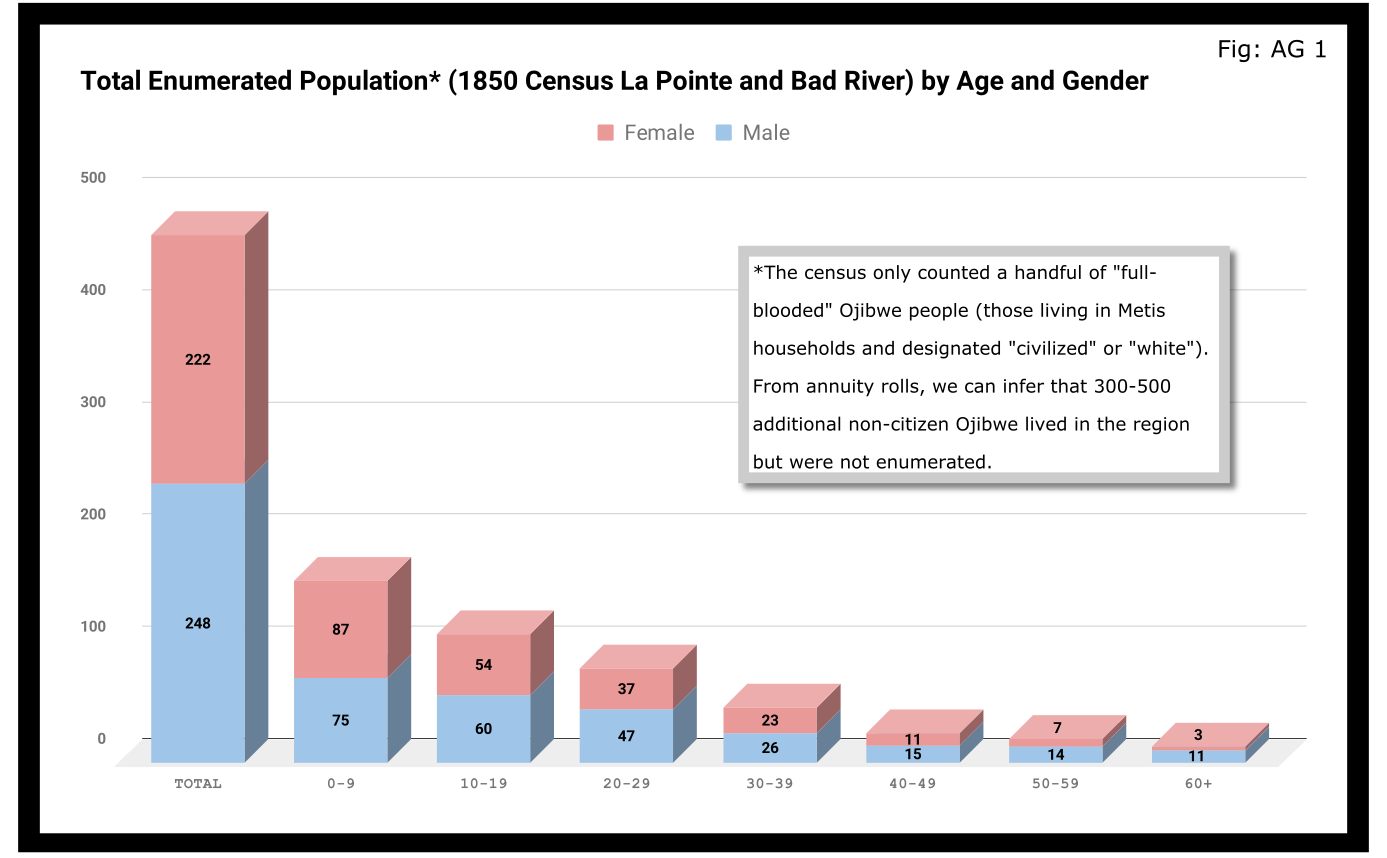
A quick glance at Figure AG 1 shows that the population skewed male 248-222 and skewed very young (61% under 20 years old). On the eve of Sandy Lake, the natural increase in the population seemed to be booming.

The hypotheses that women had higher mortality rates and were more likely to be undercounted looked good until we limit the data to the Wisconsin-born population. In Figure AG 2, we see that the male majority disappears entirely. The youthful trend, indicating large families and a growing population, continues with 66% of the Wisconsin-born population being under 20.

The male skew of the total population was entirely due to those born outside Wisconsin. This is not surprising given how much we’ve emphasized the number of men who came into the Lake Superior country to marry local women.
A look at the oldest residents in chart AG 2 and AG 3 hints at another story. Madeline Cadotte is the only Wisconsin-born person over seventy to be counted. The oldest men all came from Michigan and Canada. Why? My hypothesis is that between the fall of New France in 1759 and the establishment of Michel Cadotte’s post sometime around 1800, there wasn’t a large population or a very active fur trade around La Pointe proper. That meant Cadotte’s widow and other full bloods were the oldest locally-born residents in 1850. Their Metis contemporaries didn’t come over from the Soo or down from Grand Portage until 1810 or later.
Economics
Before the treaties, the economy of this area was built on two industries: foraging and trade. Life for Ojibwe people revolved around the seasonal harvest of fish, wild rice, game, maple sugar, light agriculture, and other forms of gathering food directly from the land. Trade did not start with the French, and even after the arrival of European goods into the region, the primary purpose of trade seemed to be for cementing alliances and for the acquisition of luxury goods and sacred objects. Richard White, Theresa Schenck, and Howard Paap have all challenged the myth of Ojibwe “dependence” on European goods for basic survival, and I find their arguments persuasive.
Trade, though, was the most important industry for Metis men and La Pointe was a center of this activity. The mid-19th century saw a steep decline in trade, however, to be replaced by a toxic cycle of debts, land sales, and annuity payments. The effects of this change on the Metis economy and society seem largely understudied. The fur trade though, was on its last legs. Again, the Austrian travel writer Carl Scherzer, who visited La Pointe in 1852:
After this discussion of the of the rates of the American Fur Company and its agents, we want to add some details about the men whose labor and time exerted such a great influence on the fate and culture of the Indian tribes. We wish to add a few explanatory words about the sad presence on La Pointe of the voyageurs or courriers du bois.
This peculiar class of people, which is like a vein of metal that suddenly disappears within the bedrock and reappears many hundreds of miles away under the same geological conditions, their light reaches the borders of the eastern Canadas. The British people, with their religion and customs, reappeared on the shores of these northern lakes only in 1808 with the Fur Company. For labor they drew on those who could carry their wares across the lakes and communicate with the Indians.
Many young men of adventurous natures left the old wide streets of Montreal and moved into the trackless primeval forests of the West. Young and strong as laborers, they soon started to adopt the lifestyle and language of the aborigines. They married with the Indians and inhabit small settlements scattered throughout those mighty lands which begin at Mackinow Island and come up the upper lake to the region of Minnesota. They almost all speak the Canadian patois along with the language of the Chippewas, the tribe with which they came into kinship. We found only a few, even among the younger generation, who understood English.
Since then, every day the population of the otherwise deserted shore of Lake Superior increases with the discovery of copper mines. The animals driven away by the whirlwind of civilization toward the west, attract the Indians with their sensitive guns, leaving La Pointe, abandoned by the Company for their headquarters at St. Paul in Minnesota. Most voyageurs left the island, having seen their business in ruins and lacking their former importance. Just a few families remain here, making a meager livelihood of hunting, fishing, and the occasional convoy of a few travelers led by business, science, or love of nature who purchase their limited resources.
From Scherzer’s description, two things are clear. It’s pretty clear from the flowery language of the Viennese visitor.Washington Irving and other Romantic-Era authors had already made the Voyageur into the stock stereotypical character we all know today. Th only change, though, is these days voyageurs are often depicted as representatives of white culture, but that’s a post for another time.
The second item, more pertinent to this post, is that a lot of voyageurs were out of work. This is especially relevant when we look at our census data. Daniel Johnson recorded the occupations of all males fifteen or over:
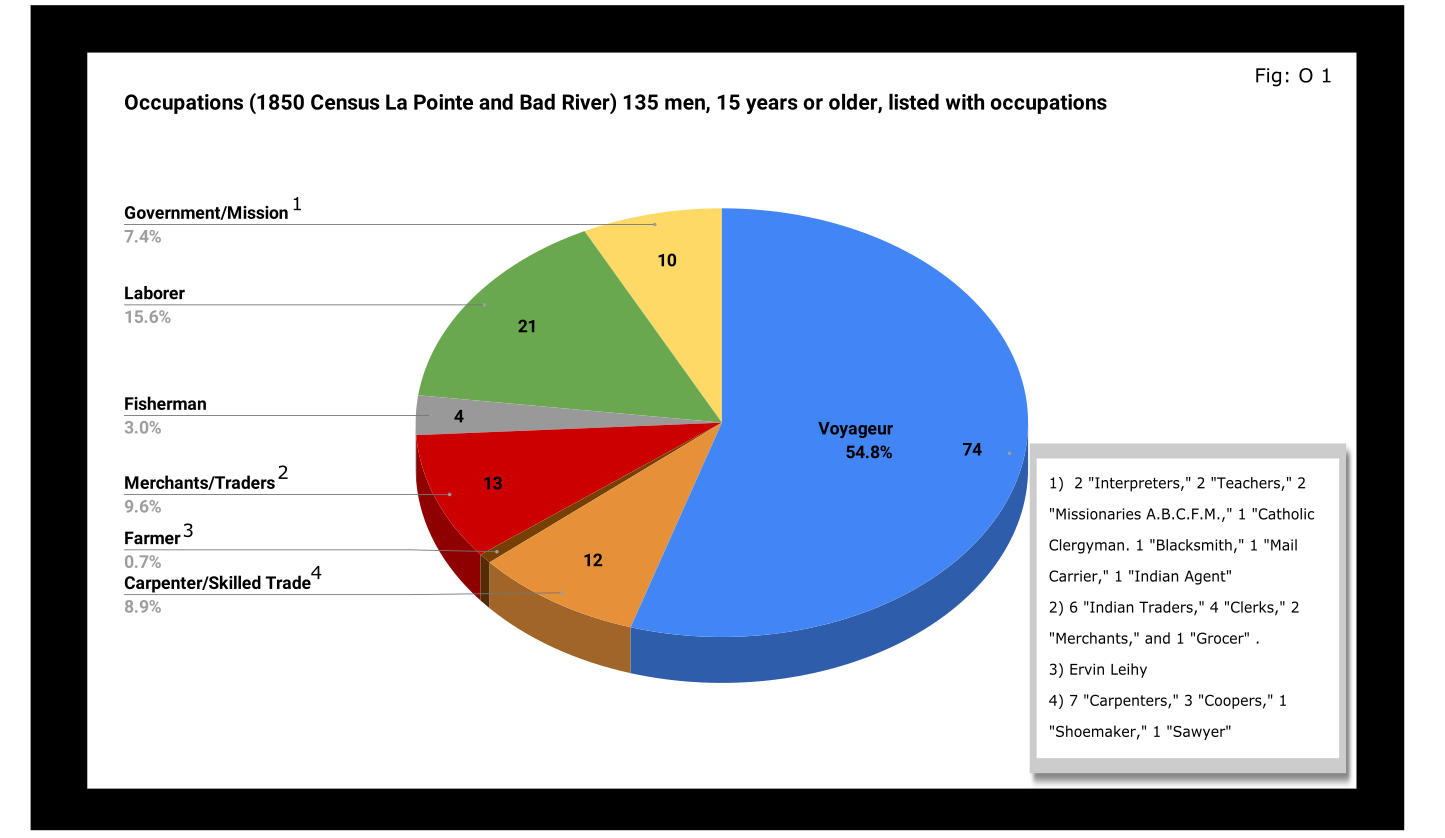
A full 55% of enumerated men fifteen and older still identified themselves as voyageurs in 1850. This included teenagers as well as senior citizens. All were from Metis households, though aside from farmer, all of the other occupation categories in Figure O 1 included Metis people.

A look at household sizes did not show voyageurs having to support significantly larger or smaller families when compared to the other occupation categories.
The other piece of economic data collected was value of real estate. Here we see some interesting themes:

If real estate is a good proxy for wealth in a farming community, it is an imperfect one in the Chequamegon area of 1850. If a voyageur had no home but the river and portage, then we might not expect him to put his coin into land and buildings. A teacher or Indian agent might draw a consistent salary but then live in supplied housing before moving on. With that caveat, let’s dig into the data.
Excluding the single farmer, men in the merchant/trader group controlled the most wealth in real estate, with Julius Austrian controlling as much as the other merchants combined. Behind them were carpenters and men with specific trades like cooper or shoemaker. Those who reported their occupation generally as “laborer” were not far behind the tradesmen. I suspect their real estate holdings may be larger and less varied than expected because of the number of sons and close relatives of Michel Cadotte Sr. who identified themselves as laborers. Government and mission employees held relatively little real estate, but the institutions they represented certainly weren’t lacking in land or power. Voyageurs come in seventh, just behind widows and ahead of fishermen of which there were only four in each category.
It is interesting, though, that the second and third richest men (by real estate) were both voyageurs, and voyageur shows a much wider range of households than some of the other categories: laborers in particular. With the number of teenagers calling themselves voyageurs, I suspect that the job still had more social prestige attached to it, in 1850, than say farmer or carpenter.
With hindsight we know that after 1854, voyageurs would be encouraged to take up farming and commercial fishing. It is striking, however, how small these industries were in 1850. Despite the American Fur Company’s efforts to push its Metis employees into commercial fishing in the 1830s, and knowing how many of the family names in Figure O 3 are associated with the industry, commercial fishing seemed neither popular nor lucrative in 1850. I do suspect, however, that the line between commercial and subsistence fishing was less defined in those days and that fishing in general was seen as falling back on the Indian gathering lifestyle. It wouldn’t be surprised if all these families were fishing alongside their Ojibwe relatives but didn’t really see fishing (or sugaring, etc.) as an occupation in the American sense.
Finally, it could not have escaped the voyageurs notice that while they were struggling, their former employers and their employers educated sons were doing pretty well. They also would have noticed that it was less and less from furs. Lump annuity payments for Ojibwe land sales brought large amounts of cash into the economy one day a year. It must have felt like piranhas with blood in the water. Alongside their full-blood cousins, Metis Ojibwe received these payments after 1847, but they had more of a history with money and capitalism. Whether to identify with the piranha or the prey would have depended on all sorts of decisions, opportunities and circumstances.
Education and Literacy
The census also collected data on education and literacy, asking whether children had attended school within the year, and whether adults over twenty could read and write. The history of white education efforts in this area are fairly well documented. The local schools in 1850 were run by the American Board of Commissioners of Foreign Missions (A.B.C.F.M.) at the La Pointe and Odanah missions, and an entire generation had come of age at La Pointe in the years since Rev. Sherman Hall first taught out of Lyman Warren’s storehouse in 1831. These Protestant ministers and teachers railed against the papists and heathens in their writings, but most of their students were Catholic or traditional Ojibwe in religion. Interestingly, much of the instruction was done in the Ojibwe language. Unfortunately, however, the census does not indicate the language an individual is literate in. I highly recommend The Ojibwe Journals of Edmund F. Ely, 1833-1849 if you are interested in these topics.
To start with, though, let’s look at how many people were going to school:

Thirty-nine students had gone to school in the previous year. There is a lot of sample-size noise in the data, but it seems like ages 7-11 (what we would call the upper-elementary years) were the prime years to attend school.
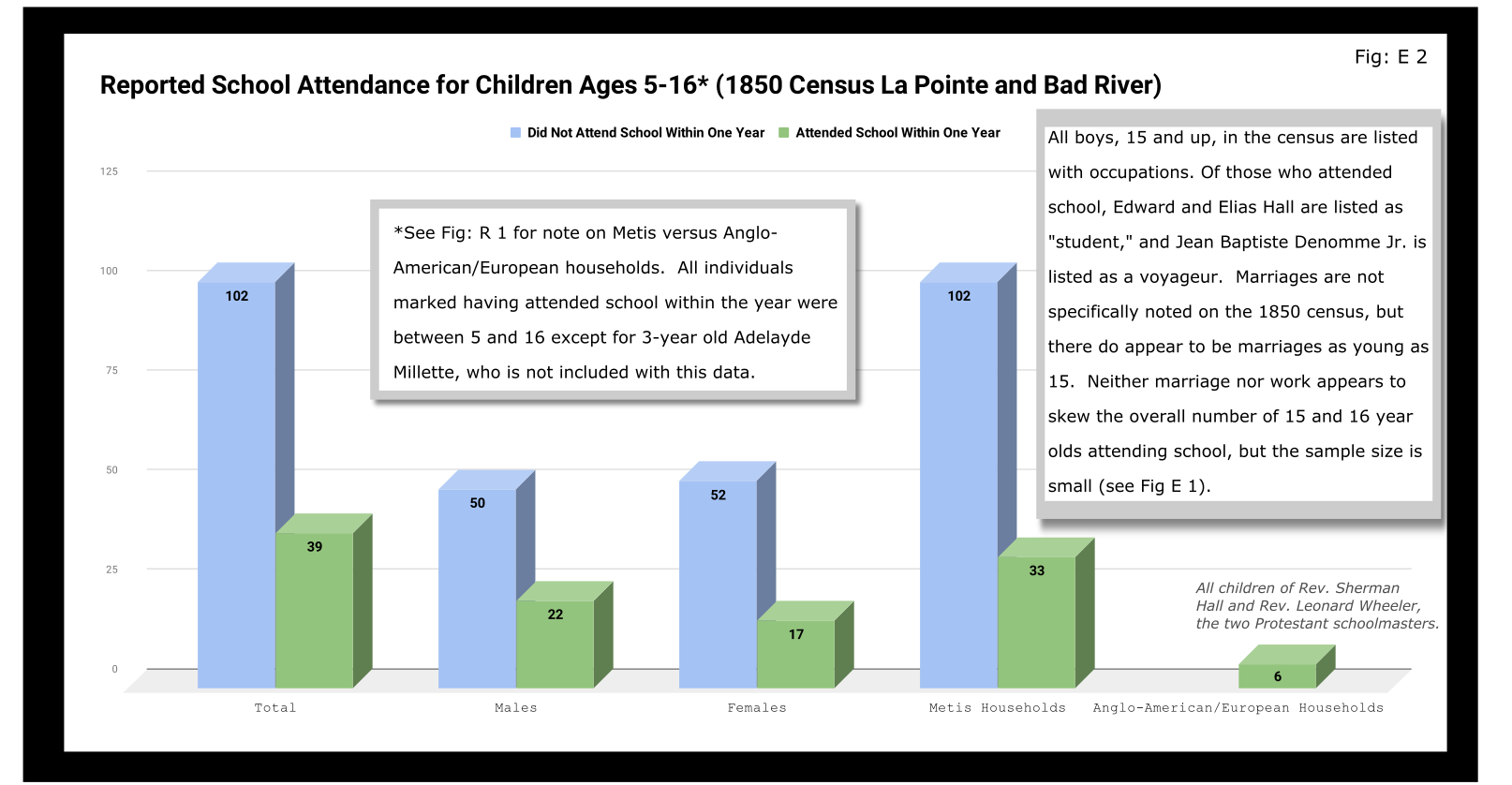
Overall, most children had not attended school within the year. Attendance rates were slightly higher for boys than for girls. White children, all from two missionary families, had a 100% attendance rate compared to 24% for the Metis and “Civilized Indian” children.
We should remember, however, that not attending school within the year is not the same as having never attended school. Twelve-year-old Eliza Morrin (later Morrison) is among the number that didn’t attend school, but she was educated enough to write her memoirs in English, which was her second language. They were published in 2002 as A Little History of My Forest Life, a fascinating account of Metis life in the decades following 1854.
Eliza’s parents were among the La Pointe adults who could read and write. Her aunt, uncle, and adult cousins in the neighboring Bosquet (Buskey) house were not. Overall, just over half of adults over 20 were illiterate without a significant gender imbalance. Splitting by birthplace, however, shows the literacy rate for Wisconsin-born (i.e. Metis and “Civilized Indian”) was only 30%, down from the overall male literacy rate of 48%. For Wisconsin-born women, the drop is only three points, from 47% to 44%. This suggests Metis women were learning to read while their husbands and brothers (perhaps en voyage) were not.

And this is exactly what the data say when we split by occupation. The literacy rate for voyageurs was only 13%. This beats fisherman–all four were illiterate–but lagged far behind all other types of work.
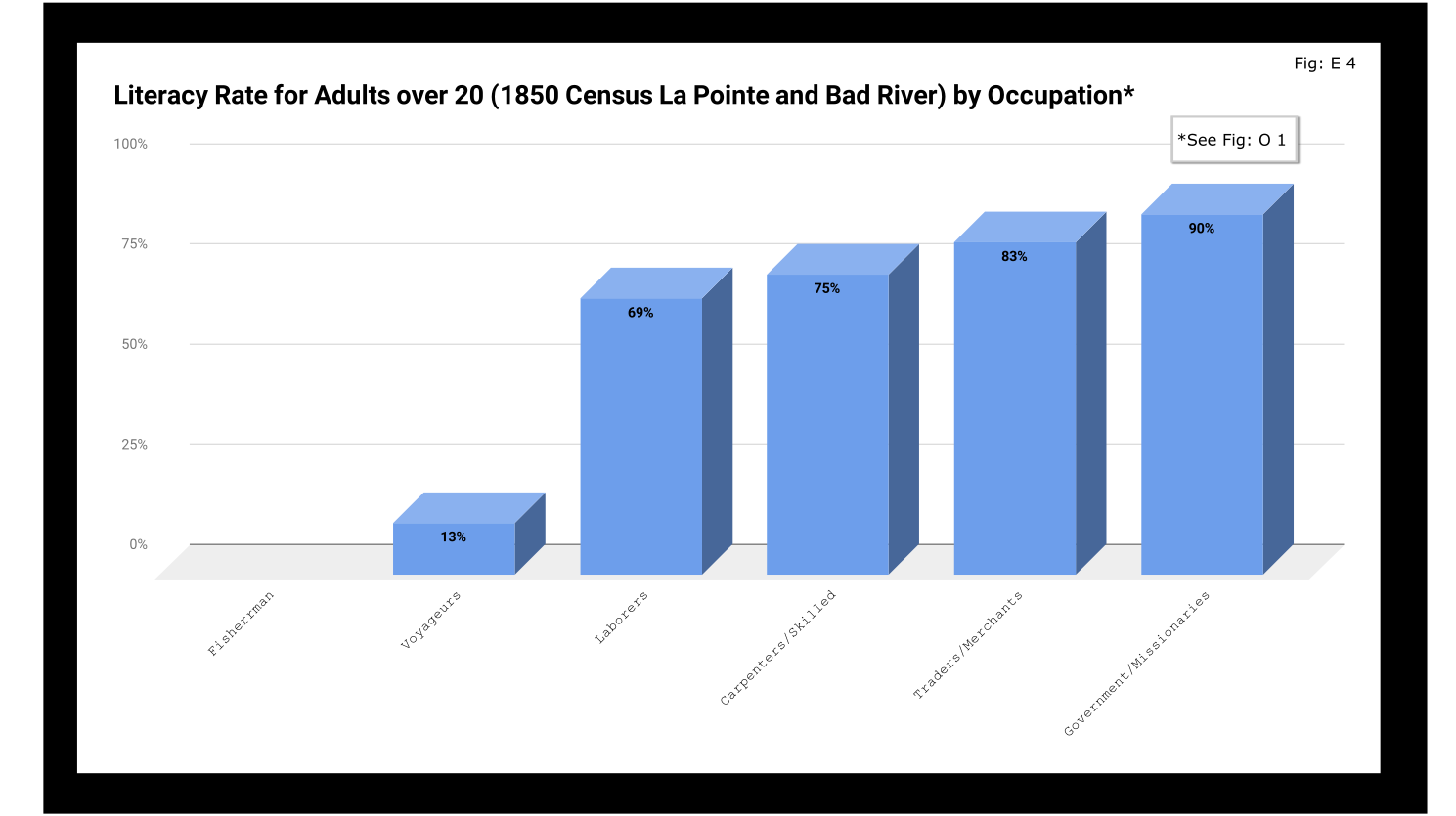
If education was going to be a factor in the economic mobility of unemployed voyageurs, the trends weren’t looking good.
Odds and Ends
Two marriages were reported as occurring in the year previous to the census: Peter and Caroline Vanderventer and Pierre and Marguerite Robideaux (ak.a. Peter and Margaret Rabideaux). Though married, however, Caroline was not living with her husband, a 32-year old grocer from New York. She (along with their infant daughter) was still in the home of her parents Benjamin and Margaret Moreau (Morrow). The Vanderventers eventually built a home together and went on to have several more children. It appears their grandson George Vanderventer married Julia Rabideaux, the granddaughter of Peter and Margaret.
I say appears in the case of George and Julia, because Metis genealogy can be tricky. It requires lots of double and triple checking. Here’s what I came across when I once tried to find an unidentified voyageur known only as Baptiste:

Sometimes it feels like for every Souverain Denis or Argapit Archambeau, there are at least 15 Jean-Baptiste Cadottes, 12 Charles Bresettes, 10 Francois Belangers and 8 Joseph DeFoes. Those old Canadian names had a way of persisting through the generations. If you were a voyageur at La Pointe in 1850, there was nearly a 30% chance your name was Jean-Baptiste. To your friends you might be John-Baptist, Shabadis, John, JB, or Battisens, and you might be called something else entirely when the census taker came around.
The final column on Daniel Johnson’s census asked whether the enumerated person was “deaf and dumb, blind, insane, idiotic, pauper, or convict.” 20 year-old Isabella Tremble, living in the household of Charles Oakes, received the unfortunate designation of idiotic. 26-year-old Francois DeCouteau did not have a mark in that column, but had “Invalid” entered in for his occupation. It’s fair to say we’ve made some progress in the treatment of people with disabilities.
Final Thoughts
I am not usually a numbers person when it comes to history. I’ll always prefer a good narrative story, to charts, tables, and cold numbers. Sometimes, though, the numbers help tell the story. They can help us understand why when Louis Gurnoe was killed, no one was held accountable. At the very least, they can help show us that the society he lived in was under significant stress, that the once-prestigious occupation of his forefathers would no longer sustain a family, and that the new American power structure didn’t really understand or care who his people were.
Ultimately, the census is about America describes itself. From the very beginning, it’s never been entirely clear if in E. pluribus unum we should emphasize the pluribus or the unum. We struggled with that in 1850, and we still struggle today. To follow the Department of Commerce v. New York citizenship case, I recommend Scotusblog. For more census posts about this area in the 19th century, keep following Chequamegon History.
Sources, Data, and Further Reading
-
Paap, Howard D. Red Cliff, Wisconsin a History of an Ojibwe Community ; Volume 1 The Earliest Years: the Origin to 1854. North Star Press of St. Cloud, Inc., 1854.
-
Satz, Ronald N. Chippewa Treaty Rights: the Reserved Rights of Wisconsin’s Chippewa Indians in Historical Perspective. University of Wisconsin Press, 1997.
-
Original Census Act of May 23, 1850 (includes form and instructions for marshals). (PDF)
-
Compiled data spreadsheets (Google Drive Folder) I’ll make these a lot more user friendly in future census posts. By the time it occurred to me that I should include my tables in this post, most of them were already done in tally marks on scrap paper.
-
Finally, these are the original pages, scanned from microfilm by FamilySearch.com. I included the image for Fond du Lac (presumably those living on the Wisconsin side of the St. Louis River) even though I did not include it in any of the data above.
-

- Bad River
-
- Fond du Lac (not included in above data)





Wheeler Papers: 1854 La Pointe before the Treaty
August 7, 2017
By Amorin Mello
Selected letters from the
Wheeler Family Papers,
Box 3, Folders 11-12; La Pointe County.
Crow-wing, Min. Ter.
Jan. 9th 1854
Brother Wheeler,

Reverend Leonard Hemenway Wheeler ~ In Unnamed Wisconsin by Silas Chapman, 1895, cover image.
Though not indebted to you just now on the score of correspondence, I will venture to intrude upon you a few lines more. I will begin by saying we are all tolerably well. But we are somewhat uncomfortable in some respects. Our families are more subject to colds this winter than usual. This probably may be attributed in part at least to our cold and open houses. We were unable last fall to do any thing more than fix ourselves temporarily, and the frosts of winter find a great many large holes to creep in at. Some days it is almost impossible for us to keep warm enough to be comfortable.
Our prospects for accomplishing much for the Indians here I do not think look more promising than they did last fall. There are but few Indians here. These get drunk every time they can get whiskey, of which there is an abundance nearby. Among the white people here, none are disposed to attend meetings much except Mr. [Welton?]. He and his wife are discontented and unhappy here, and will probably get away as soon as they can. We hear not a word from the Indian Department. Why they are minding us in this manner I cannot tell. But I should like it much better, if they would tell us at once to be gone. I have got enough of trying to do anything for Indians in connection with the Government. We can put no dependence upon any thing they will do. I have tried the experiment till I am satisfied. I think much more could be done with a boarding school in the neighborhood of Lapointe than here And my opinion is, that since things have turned out as they have here, we had better get out of it as soon as we can. With such an agent as we now have, nothing will prosper here. He is enough to poison everything, and will do more moral evil in such a community, as this, than a half a dozen missionaries can do good. My opinion is, that if they knew at Washington how things are and have been managed here, there would be a change. But I do not feel certain of this. For I sometimes am tempted to adopt the opinion that they do not care much there how things go here. But should there be a change, I have little hope that is would would make things materially better. The moral and social improvement of the Indians, I fear, has little to do with the appointment of agents and superintendents. I do not think I ought to remain here very long and keep my family here, as things are now going. If we were not involved with the Government with regard to the school matter, I would advise the Committee to quit here as soon as we can find a place to go to. My health is not very good. The scenes, and labors and attacks of sickness which I have passed through during the past two years have made almost a wreck of my constitution. It might rally under some circumstances. But I do not think it will while I stay here, so excluded from society, and so harassed with cares and perplexities as I have been and as I am likely to be in future, should we go on and try to get up a school. My wife is in no better spirits than I am. She has had several quite ill turns this winter. the children all wish to get away from here, and I do not know that I shall have power to keep them here, even if I am to stay.
But what to do I do not know. The Committee say they do not wish to abandon the Ojibwas. I cannot in future favor the removal of the lake Indians. I believe that all the aid they will receive from the Government will never civilize or materially benifit them. I judge from the manner in which things have been managed here. Our best hope is to do what we can to aid them where they are to live peaceably with the whites, and to improve and become citizens. The idea of the Government sending infidels and heathens here to civilize and Christianize the Indians is rediculous.
I always thought it doubtful whether the experiment we are trying would succeed. In that case it was my intention to remove somewhere below here, and try to get a living, either by raising my potatoes or by trying to preach to white people, or by uniting both. but I do not hardly feel strong enough to begin entirely anew in the wilderness to make me a home. I suppose my family would be as happy at Lapointe, as they would any where in the new and scattered settlements for fifty or a hundred miles below here. And if thought I could support myself then, I might think of going back there. There are our old friends for whose improvement we have laborred so many years. I feel almost as much attachment for them as for my won children. And I do not think they ought to be left like sheep upon the mountains without a shepherd. And if the Board think it best to expend money and labor for the Ojibwas, they had better expend it there than here, as things now are at least. I think we were exerting much much more influence there before we left, then we have here or are likely to exert. I have no idea that the lake Indians will ever remove to this place, or to this region.

Reverend Sherman Hall
~ Madeline Island Museum
What do you think of recommending to the Board to day to exert a greater influence on the people in the neighborhood of Lapointe[?/!] I feel reluctant to give up the Indians. And if I could get a living at Lapointe, and could get there, I should be almost disposed to go back and live among those few for whom I have labored so long, if things turn out here as I expect they will. I have not much funds to being life with now, nor much strength to dig with. But still I shall have to dig somewhere. The land is easier tilled in this region than that about the lake. But wood is more scarce. My family do not like Minesota. Perhaps they would, if they should get out of the Indian country. Edwin says he will get out of it in the spring, and Miles says he will not stay in such a lonesome place. I shall soon be alone as to help from my children. My boys must take care of themselves as soon as they arrive at a suitable age, and will leave me to take care of myself. We feel very unsettled. Our affairs here must assume a different aspect, or we cannot remain here many months longer. Is there enough to do at Lapointe; or is there a prospect that there will soon be business to draw people enough then, to make it an object to try to establish the institution of the gospel there? Write me and let me know your views on such subjects as these.
[Unsigned, but appears to be from Sherman Hall]
Crow-wing Feb. 10th 1854
Brother Wheeler:
I received your letter of jan. 16th yesterday, and consequently did not sleep as much as usual last night. We were glad to hear that you are all well and prosperous. We too are well which we consider a great blessing, as sickness in present situation would be attended with great inconvenience. Our house is exceedingly cold and has been uncomfortable during some of the severe cold weather have had during the last months. Yet we hope to get through the winter without suffering severely. In many respects our missionary spirit has been put to a severer test than at any previous time since we have been in the Indian country, during the past year. We feel very unsettled, and of course somewhat uneasy. The future does not look very bright. We cannot get a word from the Indian Department whether we may go on or not. If we cannot get some answer from them before long I shall be taking measures to retire. We have very little to hope, I apprehend, from all the aid the Government will render to words the civilization and moral and intellectual improvement of the Indians. For missionaries or Indians to depend on them, is to depend on a broken staff.
~ Minnesota Historical Society
“The American Fur Company therefore built a ‘New Fort’ a few miles farther north, still upon the west shore of the island, and to this place, the present village, the name La Pointe came to be transferred. Half-way between the ‘Old fort’ and the ‘New fort,’ Mr. Hall erected (probably in 1832) ‘a place for worship and teaching,’ which came to be the centre of Protestant missionary work in Chequamegon Bay.”
~ The Story of Chequamegon Bay
I do not see that our house is so divided against itself, that it is in any great danger of falling at present. My wife never did wish to leave Lapointe and we have ever, both of us, thought that the station ought not to be abandoned, unless the Indians were removed. But this seemed not to be the opinion of the committee or of our associates, if I rightly understood them. I had a hard struggle in my mind whether to retire wholly from the service of the Board among the Indians, or to come here and make a further experiment. I felt reluctant to leave them, till we had tried every experiment which held out any promise of success. When I remove my family here our way ahead looked much more clear than it does now. I had completed an arrangement for the school which had the approval of Gov. Ramsey, and which fell through only in consequence of a little informality on his part, and because a new set of officers just then coming into power must show themselves a little wiser than their predecessors. Had not any associates come through last summer, so as to relieve me of some of my burdens and afford some society and counsel in my perplexities I could not have sustained the burden upon me in the state of my health at that time. A change of officers here too made quite an unfavorable change in our prospects. I have nothing to reproach myself with in deciding to come here, nor in coming when we did, though the result of our coming may not be what we hoped it would be. I never anticipated any great pleasure in being connected with a school connected in any way with the Government, nor did I suppose I should be long connected with it, even if it prospered. I have made the effort and now if it all falls, I shall feel that Providence has not a work for us to do here. The prospects of the Indians look dark, what is before me in the future I do not know. My health is not good, though relief from some of the pressure I had to sustain for a time last fall and the cold season has somewhat [?????] me for the time being. But I cannot endure much excitement, and of course our present unsettled affairs operate unfavorably upon it. I need for a time to be where I can enjoy rest from everything exciting, and when I can have more society that I have here, and to be employed moderately in some regular business.

Antoine Gordon [Gaudin]
~ Noble Lives of a Noble Race by the St. Mary’s Industrial School (Bad River Indian Reservation), 1909, page 207.

Charles Henry Oakes
~ Findagrave.com
As to your account I have not had time to examine it, but will write you something about it by & by. As to any account which Antoine Gaudin has against me, I wish you would have him send it to me in detail before you pay it. I agreed with Mr. Nettleton to settle with him, and paid him the balance due to Antoine as I had the account. I suppose he made the settlement, when he was last at Lapointe. As to the property at Lapointe, I shall immediately write to Mr. Oakes about it. But I suppose in the present state of affairs, it will be perhaps, a long time before it will be settled so as to know who does own it. It is impossible for me to control it, but you had better keep posession of it at present. I cannot send Edwin [??] through to cultivate the land & take care of it. He will be of age in the spring, and if he were to go there I must hire him. He will probably leave us in the spring. Please give my best regards to all. Write me often.
Yours truly
S. Hall
Crow-wing, Min. Ter.
Feb. 21st 1854
Brother Wheeler,
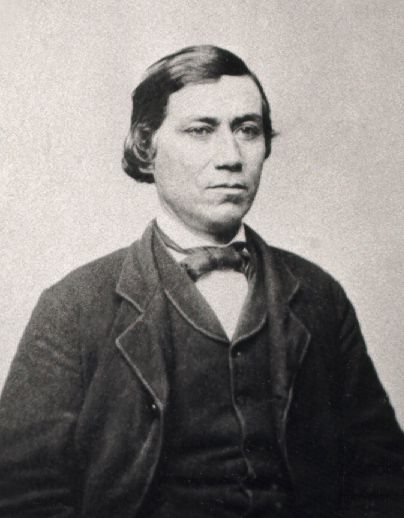
Paul Hudon Beaulieu
~ FamilySearch.org
I wrote you a few days ago, and at the same time I wrote to Mr. Oakes inquiring whether he had got possession of the Lapointe property. I have not yet got a reply from him, but Mr. Beaulieu tells me that he heard the same report which you mentioned in your letter, and that he inquired of Mr. Oakes about it when he saw him on a recent visit to St. Paul, and finds that it is all a humbug. Oakes has nothing to do with it. Mr. Beaulieu said that the sale of last spring has been confirmed, and that Austrian will hold Lapointe. So farewell to all the inhabitants’ claims then, and to anything being done for the prosperity of the peace for the present, unless it gets out of his hands.
I have written to Austrian to try to get something for our property if we can. But I fear there is not much hope. If he goes back to Lapointe in the spring, do the best you can to make him give us something. I feel sorry for the inhabitants there that they are left at his mercy. He may treat them fairly, but it is hardly to be expected.

Clement Hudon Beaulieu
~ TreatiesMatter.org
As to our affairs here, there has been no particular change in their aspects since I wrote a few days ago. There must be a crisis, I think, in a few weeks. We must either go on or break up, I think, in the spring. We are trying to get a decision. I understand our agent has been threatened with removal if he carries on as he has done. I believe there is no hope of reformation in his case, and we may get rid of him. Perhaps God sent us here to have some influence in some such matters, so intimately connected with the welfare of the Indians. I have never thought I [????] can before I was sent in deciding to come here. Some trials and disappointments have grown out of my coming, but I feel conscious of having acted in accordance with my convictions of duty at this time.
If all falls through, I know not what to do in the future. The Home Missionary Society have got more on their hands now than they have funds to pay, if I were disposed to offer myself to labor under them. I may be obliged to build me a shanty somewhere on some little unoccupied piece of land and try to dig out a living. In these matters the Lord will direct by his providence.
You must be on your guard or some body will trip you up and get away your place. There are enough unprincipled fellows who would take all your improvements and send you and all the Indians into the Lake if they could make a dollar by it. I should not enlarge much, without getting a legal claim to the land. Neither would I advise you to carry on more family than is necessary to keep what team you must have, and to supply your family with milk and vegetables. It will be advantage/disadvantage to you in a pecuniary point of view, it will load you with and tend to make you worldly minded, and give your establishment the air of secularity in the eyes of the world. If I were to go back again to my old field, I would make my establishment as small as I could & have enough to live comfortable. I with others have thought that your tendency was rather towards going to largely into farming. I do not say these things because I wish to dictate or meddle with your affairs. Comparing views sometimes leads to new investigations in regard to duty.
May the Lord bless you and yours, and give you success and abundant prosperity in your labours of love and efforts to Save the Souls around you.
Give my best regards to Mrs. W., the children, Miss S and all.
Yours truly,
S. Hall
I forgot to say that we are all well. Henry and his family have enjoyed better health here, then they used to enjoy at Lapointe.
Feb 27
Brother Wheeler.
My delay to answer your note may require an explanation. I have not had time at command to attend to it conveniently at an earlier period. As to your first questions. I suppose there will be no difference of opinion between us as to the correctness of the following remarks.
- The Gospel requires the members of a church to exercise a spirit of love, meekness and forbearance towards an offending brother. They are not to use unnecessary severity in calling him to account for his errors. Ga. 6:1.
- The Object of Church discipline is, not only to [pursue/preserve?] the Church pure in doctrine & morals, that the contrary part may have no evil thing to say of them; but also to bring the offender to a right State of mind, with regard this offense, and gain him back to duty and fidelity.
- If prejudice exist in the mind of the offender towards his brethren for any reason, the spirit of the gospel requires that he be so approached if possible as to allay that prejudice, otherwise we can hardly expect to gain a candid hearing with him.
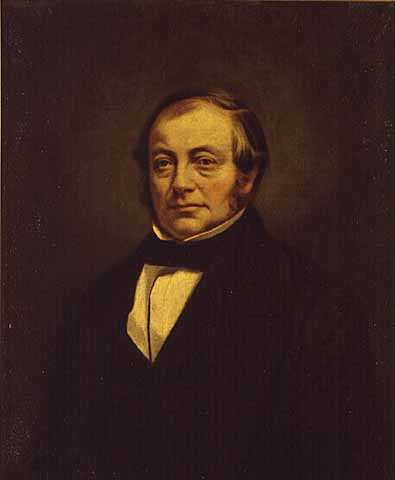
Charles William Wulff Borup, M.D. ~ Minnesota Historical Society
I consider that these remarks have some bearing on the case before us. If it was our object to gain over Dr. B. to our views of the Sabbath, and bring him to a right State of mind with regard this Sabbath breaking, the manner of approaching him would have, in my view, much to do with the offence. He may be approached in a Kind and [forbearing?] manner, when one of sternness and dictation will only repel him from you. I think we ought, if possible, and do our duty, avoid a personal quarrel with him. To have brought the subject before the Church & made a public affair of it, before [this/then?] and more private means have been tried to get satisfaction, would, I am sure, have resulted in this. I found from my own interviews with him, that there was hope, if the rest of the brethren would pursue a similar course. I felt pretty sure they would obtain satisfaction. IF they had [commenced?] by a public prosecution before the church, it would only have made trouble without doing any good. The peace of our whole community would have been disturbed. I thought one step was gained when I conversed with him, and another when you met him on the subject. I knew also that prejudices existed both in his mind towards us, & in our minds towards him which were likely to affect the settlement of this affair, and which as I thought, would be much allayed by individuals going to him and speaking face to face on this subject in private. He evidently expected they would do so. Mutual conversations and explanations allay these feelings very much. At least it has been so in my experience.

Reverend Edmund Franklin Ely.
~ Duluth Public Library
As to your second question. I do not say that it was Mr. Ely’s duty to open the subject to Doc. Borup at the preparatory lecture. If he had done so, it would have been only a private interview; for there [was?] not enough present to transact business. All I meant to affirm respecting that occasion is, that it afforded a good opportunity to do so, if he wishes, and that Dr. B. expected he would have done so, as I afterwards learnt, if he has any objection to make against his coming to the communion.
As to your third question. I have no complaint to make of the church, that I have urged them to the performance of any “duties“ in this case they have refused to perform.
And now permit me to ask in my turn.
What “duties” have they urged me to perform in this case, which I “have been unwilling, or manifested a reluctance to perform?”
Did you intend by anything which wrote to me or said verbally, to request me to commence a public prosecution of Doc. Borup before the Church?
Will you have the goodness to state in writing, the substance of what you said to me in your study as to your opinion and that of others suspecting my delinquency in maintaining church discipline.
A reply to these questions would be gratefully received.
Your brother in Christ
S. Hall
Crow Wing. March 12th 1854
Brother Wheeler:
Your letter of Feb 17th came to hand by our last mail; and though I wrote you but a short time ago, I will say a few words in relation to one or two topics to which you allude. Shortly after I received your former letter I wrote to Mr. Oakes enquiring about the property at Lapointe. In reply, says that himself and some others purchased Mr. Austrian’s rights at Lapointe of Old Hughes on the strength of a power of attorney which he held. Austrian asserts the power of attorney to be fraudulent, and that they cannot hold the property. Oakes writes as if he did not expect to hold it. Some time ago I wrote to Mr. Austrian on the same subject, and said to him that if I could get our old place back, I might go back to Lapointe. He says in reply —
Julius Austrian
~ Madeline Island Museum
“I should feel much gratified to see you back at Lapointe again, and can hold out to you the same inducements and assurances as I have done to all other inhabitants, that is, I shall be at Lapointe early in the spring and will have my land surveyed and laid out into lots, and then I shall be ready to give to every one a deed for the lot he inhabits, at a reasonable price, not paying me a great deal more than cost trouble, and time. But with you, my dear Sir, will be no trouble, as I have always known you a just and upright man, and have provided ways to be kind towards us, therefore take my assurance that I will congratulate myself to see you back again; and it shall not be my fault if you do not come. If you come to Lapointe, at our personal interview, we will arrange the matter no doubt satisfactory.”
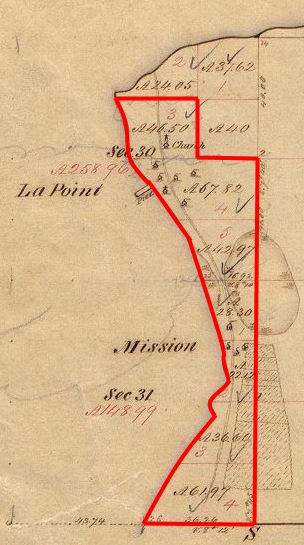
“The property” from the James Hughes Affair is outlined in red. This encompassed the Church at La Pointe (New Fort) and the Mission (Middleport) of Madeline Island. 1852 PLSS survey map by General Land Office.
I suppose Austrian will hold the property and probably we shall never realize anything for our improvements. You must do the best you can. Make your appeal to his honor, if he has any. It will avail nothing to reproach him with his dishonesty. I do not know what more I can do to save anything, or for any others whose property is in like circumstances with ours.
You speak discouragingly of my going back to Lapointe. I do not think the Home Miss. Soc. would send a missionary there only for the few he could reach in the English language. If the people want a Methodist, encourage them to get one. It is painful to me to see the place abandoned to irreligion and vices of every Kind, and the labours I have expended there thrown away. I can hardly feel that it was right to give up the station when we did. If I thought I could support myself there by working one half the time and devoting the rest to ministerial labors for the good of those I still love there, I should still be willing to go back, if could get there & had a shelter for my head, unless there is a prospect of being more useful here. But the land at Lapointe is so hard to subdue that I am discouraged about making an attempt to get a living there by farming. I am not much of a fisherman. There is some prospect that we may be allowed to go on here. Mr. Treat has been to Washington, and says he expects soon to get a decision from the Department. We have got our school farm plowed, and the materials are drawn out of the woods for fencing it. If I have no orders to the contrary, I intend to go on & plant a part of it, enough to raise some potatoes. We may yet get our school established. If we can go ahead, I shall remain here, but if not, I think it is not my duty to remain here another year, as I have the past. In other circumstances, I could do more towards supporting myself and do more good probably.
I have felt much concerned for the people of Lapointe and Bad River on account of the small pox. May the Lord stay this calamity from spreading among you. Write us every mail and tell us all. It is now posted here today that the Old Chief [Kibishkinzhugon?] is dead. I hardly credit the report, though I should suppose he might be one of the first victims of the disease.
I can write no more now. We are all very well now. Give my love to all your family and all others.
Tell Robert how the matters stands about the land. It stands him in how to be on good terms with the Jew just now.
Yours truly,
S. Hall
The snow is nearly all off the ground and the weather for two or three weeks has been as mild as April.
Crow Wing M.H. Apr. 1 1854
Dear Br. & Sr. Wheeler.
I have received a letter from you since I wrote to you & am therfore in your debt in that matter. I have also read your letters to Br. & Sr. Welton I suppose you have received my letter of the 13th of Feb. if so, you have some idea of our situation & I need say no more of that now; & will only say that we are all well as usual & have been during the winter. Mrs. P_ is considerably troubled with her old spinal difficulty. She has got over her labors here last summer * fall. Harriet is not well I fear never will be, because the necessary means are not likely to be used, she has more or less pain in her back & side all the time, but she works on as usual & appears just as she did at LaPointe, if she could be freed from work so as to do no more than she could without injury & pursue uninterruptedly & proper medical course I think she might regain pretty good health. (Do not, any of you, send back these remarks it would not be pleasing to her or the family.) We have said what we think it best to say) –
Br. Hall is pretty well but by no means the vigorous man he once was. He has a slight – hacking cough which I suppose neither he nor his family have hardly noticed, but Mrs. P_ says she does not like the sound of it. His side troubles him some especially when he is a good deal confined at writing. Mr. & Mrs. W_ are in usual health. Henry’s family have gone to the bush. They are all quite well. He stays here to assist br. H_ in the revision & keeps one or two of his children with him. They are now in Hebrews, with the Revision. Henry I suppose still intends to return to Lapointe in the spring. –
Now, you ask, in br. Welton’s letter, “are you all going to break up there in the spring.” Not that I know of. It would seem to me like running away rather prematurely. When the question is settled, that we can do nothing here, then I am willing to leave, & it may be so decided, but it is not yet. We have not had a whisper from Govt. yet. Wherefore I cannot say.
It looks now as if we must stay this season if no longer. Dr. Borup writes to br. Hall to keep up good courage, that all will come out right by & by, that he is getting into favor with Gov. Gorman & will do all he can to help us. (Br. Hall’s custom is worth something you know).

Henry C. Gilbert
~ Branch County Photographs
By advise of the Agent, we got out (last month) tamarack rails enough to fence the school farm (which was broke last summer) of some 80 acres & it will be put up immediately. Our great father turned out the money to pay for the job. These things look some like our staying awhile I tell br H_ I think we had better go as far as we can, without incurring expense to the Board (except for our support) & thus show our readiness to do what we can. if we should quit here I do not know what will be done with us. Br Hall would expect to have the service of the Board I suppose. Should they wish us to return to Bad River we should not say nay. We were much pleased with what we have heard of your last fall’s payment & I am as much gratified with the report of Mr. H. C. Gilbert which I have read in the Annual Report of the Com. of Indian Affairs. He recommends that the Lake Superior Indians be included in his Agency, that they be allowed to remain where they are & their farmers, blacksmith & carpenter be restored to them. If they come under his influence you may expect to be aided in your efforts, not thwarted , by his influence. I rejoice with you in your brightening prospects, in your increased school (day & Sabbath) & the increased inclination to industry in those around you. May the lord add his blessing, not only upon the Indians but upon your own souls & your children, then will your prosperity be permanent & real. Do not despise the day of small things, nor overlook especially neglect your own children in any respect. Suffer them not to form idle habits, teach them to be self reliant, to help themselves & especially you, they can as well do it as not & better too, according to their ability & strength, not beyond it, to fear God & keep his commandments & to be kind to one another (Pardon me these words, I every day see the necessity of what I have said.) We sympathize with you in your situation being alone as you are, but remember you have one friend always near who waits to [commence?] with you, tell Him & all with you from Abby clear down to Freddy.
Affectionately yours
C. Pulsifer
Write when you can.
Crow wing Min. Ter.
April 3d 1854
Brother Wheeler

George E. Nettleton and his brother William Nettleton were pioneers, merchants, and land speculators at what is now Duluth and Superior.
~ Image from The Eye of the North-west: First Annual Report of the Statition of Superior, Wisconsin by Frank Abial Flower, 1890, page 75.
Since I wrote you a few days ago, I have received a letter from Mr. G. E. Nettleton, in which he says, that when he was at Lapointe in December last, he was very much hurried and did not make a full settlement with Antoine. He says further, that he showed him my account, and told him I had settled with him, and that he would see the matter right with Antoine. A. replied that all was right. I presume therefore all will be made satisfactory when Mr. N. comes up in the Spring, and that you will have need to make yourself no further trouble about this matter.
I have also received a short note from Mr. Treat in which he says,
“I have not replied to your letters, because I have been daily expecting something decisive from Washington. When I was there, I had the promise of immediate action; but I have not heard a word from them”.
“I go to Washington this Feb, once more. I shall endeavor to close up the whole business before I return. I intend to wait till I get a decision. I shall propose to the Department to give up the school, if they will indemnify us. If I can get only a part of what we lose, I shall probably quit the concern”.
Thus our business with the Government stood on March the 9th, I have lost all confidence in the Indian Department of our Government under this administration, to say nothing of the rest of it. If the way they have treated us is an index to their general management, I do not think they stand very high for moral honesty. The prospects for the Indians throughout all our territories look dark in the extreme. The measures of the Government in relation to them are not such as will benefit and save many of them. They are opening the floodgates of vice and destruction upon them in every quarter. The most solemn guarantees that they shall be let alone in the possession of domains expressly granted them mean nothing.
Our prospects here look dark. For some time past I have been rather anticipating that we should soon get loose and be able to go on. But all is thrown into the dark again. What I am to do in future to support my family, I do not know. If we are ordered to quit here and turn over the property, it would turn [illegible] out of doors.
Mr. Austrian expects us back to Lapointe in the Spring & Mr. Nettleton proposes to us to go to Fond du Lac, (at the Entry). He says there will be a large settlement then next season. A company is chartered to build a railroad through from the Southern boundary of this territory to that place. It is probable that Company [illegible] will make a grant of land for that purpose. If so, it will probably be done in a few years. That will open the lake region effectually. I feel the need of relaxation and rest before I do anything to get established anywhere.
We are still working away at the Testament, it is hard work, and we make lately but slow progress. There is a prospect that the Bible Society will publish it but it is not fully decided. I wish I could be so situated that I could finish the grammar.
But I suppose I am repeating what I have said more than once before. We are generally in good health and spirits. We hope to hear from by next mail.
Yours truly
S. Hall
What do you think about the settlements above Lapointe and above the head of the Lake?
Detroit July 10th 1854
Rev. Dr. Bro.
At your request and in fulfilment of my promise made at LaPointe last fall so after so long a time I write: And besides “to do good & to communicate” as saith the Apostle “forget not, for with such sacrifices God is well pleased.”
We did not close up our Indian payments of last year until the middle of the following January, the labors, exposures and excitements of which proved too much for me and I went home to New York sick & nearly used up about the last of February & continued so for two months. I returned here about a week ago & am now preparing for the fall pay’ts.
The Com’sr. has sent in the usual amounts of Goods for the LaPointe Indians to Mr. Gilbert & I presume means to require him to make the payment at La P. that he did last fall, although we have received nothing from the Dep’t. on the subject.

“George Washington Manypenny (1808-1892) was the Director of the Bureau of Indian Affairs of the United States from 1853 to 1857.”
~ Wikipedia.org
In regard to the Treaty with the Chipp’s of La Sup’r & the Miss’i, the subject is still before Congress and if one is made this fall it has been more than intimated that Com’r Manypenny will make it himself, either at LaP’ or at F. Dodge or perhaps at some place farther west. Of course I do not speak from authority or any of the points mentioned above, for all is rumour & inference beyond the mere arrival here of the Goods to Mr G’s care.
From various sources I learn that you have passed a severe winter and that much sickness has been among the Indians and that many of them have been taken away by the Small Pox.
This is sad and painful intelligence enough and I can but pray God to bless & overrule all to the goods of his creasures and especially to the Missionaries & their families.
Notwithstanding I have not written before be assured that I have often [???] of and prayed for you and yours and while in [Penn.?] you made your case my own so far as to represent it to several of our Christian brethren and the friends of missions there and who being actuated by the benevolent principles of the Gospel, have sent you some substanted relief and they promise to do more.
The Elements of the political world both here and over the waters seem to be in fearful & [?????] commotion and what will come of it all none but the high & holy one can know. The anti Slavery Excitement with us at the North and the Slavery excitement at the South is augmenting fact and we I doubt not will soon be called upon to choose between Slavery & freedom.
If I do not greatly misjudge the blessed cause of our holy religion is or seems to be on the wane. I trust I am mistaken, but the Spirit of averice, pride, sensuality & which every where prevails makes me think otherwise. The blessed Christ will reign [recenth-den?] and his kingdom will yet over all prevail; and so may it be.
Let us present to him daily the homage of a devout & grateful heart for his tender mercies [tousward?] and see to it that by his grace we endure unto the end that we may be saved.
My best regards to Mrs. W. to Miss Spooner to each of the dear children and to all the friends & natives to each of whom I desire to be remembered as opportunity occurs.
The good Lord willing I may see you again this fall. If I do not, nor never see you again in this world, I trust I shall see and meet you in that world of pure delight where saints immortal reign.
May God bless you & yours always & ever
I am your brother
In faith Hope & Charity
Rich. M. Smith
Rev Leonard H. Wheeler
LaPointe
Lake Superior
Miss. House Boston
Augt’ 31, 1854
Rev. L. H. Wheeler,
Lake Superior
Dear Brother
Yours of July 31 I laid before the Com’sr at our last meeting. They have formally authorized the transfer of Mr & Mrs Pulsifer to the Lake, & also that of Henry Blatchford.

Robert Stuart was formerly an American Fur Company agent and Acting Superintendent on Mackinac Island during the first Treaty at La Pointe in 1842.
~ Wikipedia.org
In regard to the “claims” their feeling is that if the Govt’ will give land to your station, they have nothing to say as to the quantity. But if they are to pay the usual govt’ price, the question requires a little caution. We are clear that we may authorize you to enter & [???] take up so much land as shall be necessary for the convenience of the [mission?] families; but we do not see how we can buy land for the Indians. Will you have the [fondness?] to [????] [????] on these points. How much land do you propose to take up in all? How much is necessary for the convenience of the mission families?
Perhaps you & others propose to take up the lands with private funds. With that we have nothing to do, so long as you, Mr P. & H. do not become land speculators; of which, I presume, there is no danger.
As to the La Pointe property, Mr Stuart wrote you some since, as you know already I doubt not, and replied adversely to making any bargain with Austrian. I took up the opinion of the Com’sr after receiving your letter of July 31, & they think it the wise course. I hope Mr Stewart will get this matter in some shape in due time.
I will write to him in reference to the Bad River land, asking him to see it once if the gov’ will do any thing.
Affectionate regards to Mrs W. & Miss Spooner & all.
Fraternally Yours
S. B. Treat
P.S. Your report of July 31 came safely to hand, as you will & have seen from the Herald.
Julius Austrian Papers: James Hughes Affair
May 15, 2017
By Amorin Mello
Madeline Island Museum
Julius Austrian Papers
Folder 6: James Hughes Affair (1853-1866)
J. Austrian
Power of Attorney to
J. Hughes
“State of Wisconsin”
“La Pointe County”
“Office of Register of Deeds”
Received for Record on this 10th day of December 1853 at 7 O Clock P.M. and Recorded on Pages 20 and 21 in Book A of Records of Deeds.

Robt. D. Boyd
Register of Deeds
– – – – – – – – – –

James Bibb Hughes of St. Paul, MN, and Hudson, WI.
Newsman; Politician; Abolitionist.
~ Wikipedia.org
Know all men
by these presents that I Julius Austrian of La Pointe, Lapointe County and state of Wisconsin, have made, constituted, and appointed and do by these presents, make, constitute and appoint James Hughes now of La Pointe my lawful Attorney for me and in my name, place and stead to, to sell, alien, and convey, any and all rights, title claim and interest that I have or may have unto any lands or lands purchased by me as the public land sales at Willow River or the second day of May A. D. 1853 for which I hold a Duplicate No 242 signed by Moses S. Gibson received Dated May 2, 1853.
Giving and granting unto my said Attorney full power and Authority to do and perform all and every act or thing whatsoever, requisite and necessary to be done and performed in and about the Premises, as fully & completely, to all intents and purposes as I myself might or could do if I were personally present with full authority to make deeds or deeds for lands sold & to receive money & receipt for same here by ratifying and confirming all the acts or acts of my said Attorney (as fully as I myself could do & [cause?] to be [owner?]) by virtue thereof.
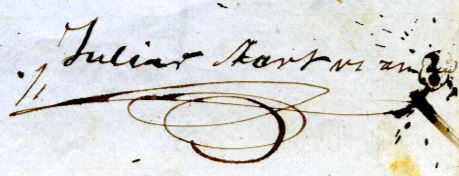
In testimony whereof I have hereunto set my hands & seal this 30th day of May AD 1853
Julius Austrian
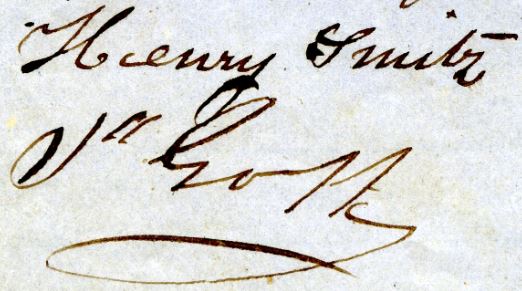 Signed Sealed & delivered
in Presence of
Henry Smitz
S Goff
State of Wisconsin
County of La Pointe
S. Goff came personally before me and being duly sworn according to laws, Says, That, he signed the annexed foregoing power of Attorney from Julius Austrian to James Hughes bearing date on the 30 day of May AD 1853, as one of the subscribing witnesses thereto, and that his Deponents signature thereon and thereto, is genuine, that Deponents was then and still is acquainted with and personally knew the said Julius Austrian who signed the said Power of Attorney, and that he signed the same in the presence of this Deponent at the time the same bears date. To wit: on the 30th day of May AD 1853, and the said Julius Austrian’s signature thereto and thereon is genuine.

S. Goff
Subscribed and Sworn
to before me the 10th day
of december AD 1853

John W. Bell
Justice of the peace
This Agreement
made and entered into between Charles H Oakes, Michael E Ames and Isaac Van Etten of St Paul, Minnesota Territory of the first part and James Hughes of Hudson Wisconsin, of the second part witnesseth:
That the said parties of the first part do hereby agree to pay or cause to be paid, the sum of Three Hundred and fifty Dollars, to be paid unto the said James Hughes, party of the second part, as soon as two certain Warranty Deeds made and executed by Julius Austrian through and by the said James Hughes, his Attorney in fact, to the parties of the first part of even date herewith, shall by duly Recorded in the office of the Register of La Pointe county, Wisconsin, upon the express condition however, that no deed or other instrument of conveyance of the lands described in the said Deed, or any part of them, has been executed or Recorded in said County or State from Julius Austrian, or from his Attorney in fact previous to the Record of the above deeds, to the parties of the first part.
And upon the further condition that the entry or purchase from the United States Government, of the said Austrian of said lands mentioned and described in said Deeds to the parties of the first part, shall be held good and valid by the Government and not vacated or cancelled, and that a patent issue from the United States Government therefore and perfecting the title thereof in the parties of the first part.
And the parties of the first part further agree to pay unto the said James Hughes the further sum of Six Hundred Dollars after and out of the proceeds of the sale of a portion of the property ( Real Estate described in the said two Deeds of Julius Austrian, executed and delivered to the parties of the first, by said James Hughes, as Attorney in fact, for said Austrian above named, after the same shall have been sold and proceeds therefrom realized and not before.
Charles Henry Oakes
La Pointe fur trader; Chippewa treaties signatory; father of a mixed-bloods family; St. Paul banker and Free Mason.
~ Findagrave.com
It is further understood and agreed by and between the parties of the first part, and the party of the second part hereto that the payments of the above sums or either of them, is dependent and upon the express condition, that the said Warranty Deed, bearing even date herewith, to the parties of the first part above herewith, to the parties of the first part above described, does and shall convey and vest a good perfect and legal title of the lands describe therein, in and to the parties of the first part, their heirs and assigns in fee simple, free of all adverse title or titles, and free from all incumbrance (Excepting a certain Mortgage upon a part of the premises to secure the payments of about fifteen Hundred Dollars, from the said Austrian to Charles H Oakes of the parties of the first part).
Otherwise it is understood and agreed that the party of the second part, has not and shall not have any claim whatever when the parties of the first part for the payment of the above mentioned sums, or any part thereof.
In witness whereof, we have hereto set our hands the 1st day of December AD 1853
in duplicate form
Signed Chas H Oakes
[Other signatories cut off in scan]
In presence of
I V D Heard
Julius Austrian
To.
Charles H Oakes
Michael E Ames
Isaac Van Etten
Warranty Deed
“State of Wisconsin”
“County of La Pointe”
“Office of Register of Deeds”
Received for Record on the 10th day of December 1853 at 7 O Clock P.M. and Recorded on Pages 22, 23, and 24 in Book A of Records of Deeds.
Robt. D. Boyd
Register of Deeds
– – – – – – – – – –
THIS INDENTURE,
made this first (1st) day of December is the year of our Lord one thousand eight hundred and fifty three.
BETWEEN
Julius Austrian (by James Hughes his attorney in fact)
of the county of La Pointe and State of Wisconsin of the first part, and
Charles H Oakes Michael E Ames and Isaac Van Etten
of the second part,
WITNESSETH, that the said party of the first part, for and is in consideration of the sum of
One Thousand ($1000)
Dollars, in hand paid by the said parties of the second part – the receipt whereof is hereby acknowledged – has given, granted, bargained, sold, conveyed, and confirmed, and by these presents, does give, grant, bargain, sell, convey and confirm unto the said parties of the second part, their heirs and assigns, forever, all the following described pieces or parcels of land, situate, lying and being in the County of La Pointe ^and State of Wisconsin^ and known and designated as follows, vis:
The lots of this deed are outlined in red, describing La Pointe (New Port and Middleport) for a total of 306.28 acres. This is roughly 80 acres short of “Containing 382 23/100 Acres of land”.
~ General Land Office
Lots numbered three (3) four (4) and five (5) in Section No thirty (30) in Township No. fifty (50) North of Range NO. three (3) west, and Lots Numbered One (1) two (2) three (3) and four (4) in Section Number thirty one (31) in said Township No fifty (50), Range No three (3) aforesaid, according to the Survey of the United States government and Platts thereof, [ben?] and hereby intending, to convey the same, and all of the pieces, [pared?] or lots of land heretofore entered, bids of or purchases by the said party of the first part from the United States Government, on or about the second day of May AD 1853, or at any other time. Containing 382 23/100 Acres of land.
TO HAVE AND TO HOLD THE SAME,
together with all and singular the appurtenances and privileges thereunto belonging, or in any wise appertaining, and all the Estate, Right, Title, Interest and Claim whatsoever, of the said party of the first part, either in Law or Equity, in and to the above described premises, to the only proper use, benefit, and behoof of the said parties of the second part, their heirs, and assigns forever. And the said party of the first part, for himself his heirs, executors, and administrators, does COVENANT AND AGREE to and with the said parties of the second part, their heirs and assigns, that he is well seized in fee of the aforesaid premises, and has good right to SELL and CONVEY the same in manner and form as above written, and that the same are free of all incumbrances whatever ; and that the aforesaid premises in the quiet and peaceable possession of the said parties of the second part, their heirs and assigns, against every person lawfully claiming or to claim the whole or any part thereof, he will forever WARRANT AND DEFEND.
IN TESTIMONY WHEREOF, the said party of the first part, has hereunto set his hand and seal the day and year first above written.

Julius Austrian
By James Hughes
his Attorney in fact
Sealed and Delivered in Presence of
The words “and State of Wisconsin” first [intertriced?] before signing.
I V D Heard
Truman M Smith
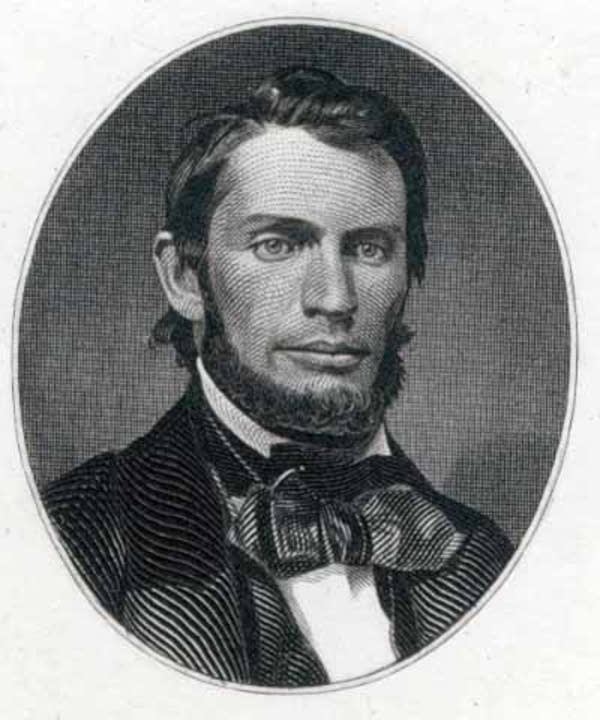
Truman Mott Smith was also a banker.
~ Minnesota Historical Society via Minnesota Public Radio
Territory of Minnesota,
COUNTY OF Ramsey
BE IT KNOWN, that on the first (1st) day of December A. D., before the undersigned, personally came James Hughes (the attorney in fact of the said Julius Austrian) the grantor to the foregoing and within DEED, from him as such grantor to Charles H Oakes Michael E Ames and Isaac Van Etten grantors, and to me personally known to be the identical person described in, and who by James Hughes his said attorney in fact executed the said deed, and the said James Hughes his attorney in fact acknowledged that he executed the said deed, freely and voluntarily, for the uses and purposes therein expressed, for in behalf and on the part of the said Julius Austrian [grantors?], aforesaid,
Truman M Smith
Justice of the Peace
– – – – – – – – – –
Territory of Minnesota
County of Ramsey
I do hereby certify that Truman M Smith, Esq before whom this within acknowledged [guest?] was taken was at the time the same bears date, a Justice of the Peace in and for said County, duly Elected & qualified to act as such, & to take Acknowledgement of Deeds,
that I am well acquainted with his hand writing & believe the within signature purporting to be his, to be his genuine signature. And that the within Deed is Executed & Acknowledged according to the laws of said Territory.
In testimony whereof I have hereunto set my hand & affirm the seal of the District Court of said County, at St. Paul, this 3rd day of December A. D. 1853. [A. J. Mutney?] Clerk.
by Sherwood Hough
Dept. Clerk of said Court
Julius Austrian
To
Charles H. Oakes
M E Ames
Isaac Van Etten
Warranty Deed
“State of Wisconsin”
“Lapointe County”
“Office of Register of Deeds”
Received for Record on this 10th day of December, 1853 at 7 O Clock P.M. and Recorded on pages 24, 25, and 26 in Book A of Records of Deeds.
Robt. D. Boyd
Register of Deeds
– – – – – – – – – –
THIS INDENTURE,
made this first (1st) day of December is the year of our Lord one thousand eight hundred and fifty three.
BETWEEN
Julius Austrian (by James Hughes his attorney in fact)
of the county of Lapointe and State of Wisconsin of the first part, and
Charles H Oakes Michael E Ames and I Van Etten
of the second part,
WITNESSETH, that the said party of the first part, for and is in consideration of the sum of
One hundred and fifty ($150~)
Dollars, in hand paid by the said parties of the second part – the receipt whereof is hereby acknowledged – has given, granted, bargained, sold, conveyed, and confirmed, and by these presents, does give, grant, bargain, sell, convey and confirm unto the said parties of the second part, their heirs and assigns, forever, all the following described pieces or parcels of land, situate, lying and being in the County of La Pointe ^and State of Wisconsin^ and known and designated as follows, vis:

Roughly 80 acres are highlighted in blue, labeled as “Austrian’s Sawmill“ on the 1852 PLSS survey map. This is located along what is now Pike’s Creek south of the Bayfield Road on the mainland.
~ General Land Office
The South West quarter of the North West quarter of Section No twenty one (21) and the North west quarter of the south west quarter of said section No. twenty one (21) in Township No fifty (50) North, of Range No. four (4) containing Eighty Acres more or less.
~ The Sawmill Community At Roy’s Point by Mary E. Carlson, 2009, page 14.
TO HAVE AND TO HOLD THE SAME,
together with all and singular the appurtenances and privileges thereunto belonging, or in any wise appertaining, and all the Estate, Right, Title, Interest and Claim whatsoever, of the said party of the first part, either in Law or Equity, in and to the above described premises, to the only proper use, benefit, and behoof of the said parties of the second part, their heirs, and assigns forever. And the said party of the first part, for himself his heirs, executors, and administrators, does COVENANT AND AGREE to and with the said parties of the second part, their heirs and assigns, that he is well seized in fee of the aforesaid premises, and has good right to SELL and CONVEY the same in manner and form as above written, and that the same are free of all incumbrances whatever ; and that the aforesaid premises in the quiet and peaceable possession of the said parties of the second part, their heirs and assigns, against every person lawfully claiming or to claim the whole or any part thereof, he will forever WARRANT AND DEFEND.
IN TESTIMONY WHEREOF, the said party of the first part, has hereunto set his hand and seal the day and year first above written.
Julius Austrian
By James Hughes
his Attorney in fact
Sealed and Delivered in Presence of
The words “and State of Wisconsin” first [introduced?] before signing.
I V D Heard
Truman M Smith
Territory of Minnesota,
COUNTY OF Ramsey
BE IT KNOWN, that on the first (1st) day of December A. D., before the undersigned, personally came James Hughes the attorney in fact of the said Julius Austrian the grantor to the foregoing and within DEED, from him as such grantor to Charles H Oakes Michael E Ames and I Van Etten grantors, and to me personally known to be the identical person described in, and who by James Huges his said attorney in fact executed the said deed, and by James Hughes his attorney in fact and who acknowledged that he executed the said deed, freely and voluntarily, for the uses and purposes therein expressed, for in behalf and on the part of the said Julius Austrian [grantors?], aforesaid,
Truman M Smith
Justice of the Peace
– – – – – – – – – –
Territory of Minnesota
County of Ramsey
I do hereby certify that Truman M. Smith Esq. before whom the within Acknowledgment was taken, was at the date thereof, a Justice of the Peace in and for said County, duly Elected & qualified to act as such, & to take the Acknowledgement of Deeds, that I am well acquainted with his hand writing and believe the signature to the within certificate purporting to be his, to be his genuine signature. And that the within Deed is Executed & Acknowledged according to the laws of this Territory.
In Testimony whereof I have hereunto set my hand & affix the Seal of the District Court of said County at St. Paul this 2nd day of December A.D. 1853. Clerk.
by Sherwood Hough
Dept. [Crt?] Clerk
of the Dist Court
of said County
Hudson, Wisconsin
Dec. 4th 1853
Julius Austrian Esq.
Dear Sir,
~ Fifty Years in the Northwest, by W. H. C. Folsom, 1888, page 169.
I have first learnt, by report, that Col. Hughes by virtue of a power of att’y given him by you, has sold to Borup and Oaks the whole La Pointe property, for the sum of four thousand dollars. You had better at once draw, execute and have placed on record a written revocation of the Power of Attorney. The revocation should be acknowledged before a justice of the peace as same as a deed.
If this report be true you had better come down at once.
Yours truly
W. H. Semmes
Notice to the Public
Julius Austrian
~ Madeline Island Museum
Whereas James Hughes of Hudson in the County of St Croix and State of Wisconsin, on the first day of December AD 1853, did execute to Charles H Oakes, Michael E Ames and Isaac Van Etten, under a pretended power of attorney from Julius Austrian and without any authority from him, or either of the under signed, two several deeds, one of which deeds had described therein, the following described lands, lying in the County of La Pointe and State of Wisconsin, to wit:
the south west quarter of the north west quarter of Section No twenty one (21), and the north west quarter of the south west quarter of Section No Twenty one (21) in Township No fifty (50) North of Range No four (4) containing eighty acres more or less,
and the other of said deeds had described therein the following described lands to wit:
Lots numbered Three (3) four (4) and five (5) in Section No Thirty (30) in Township No fifty (50) north of Range No Three (3) west and Lots numbered one (1) two (2) three (3) and four (4) in Section No Thirty one (31) in said Township No fifty (50) Range No Three (3) aforesaid.
And whereas the said lands were entered and purchased by Julius Austrian from the Government of the United States on the 2nd day of May 1853. And whereas the said Julius Austrian, did, on the 23rd day of May AD 1853, execute and deliver to one Henry Smitz of La Pointe County, a deed of conveyance in fee simple of the undivided one sixth part of the following described lands, to wit:
Lots Nos three (3) four (4) and five (5) in Section No thirty (30), and Lots Nos one (1) two (2), three (3) and four (4) of Section No Thirty one (31) in Township No fifty (50) North of Range No three (3) in the said County of La Pointe.
And whereas neither the said Julius Austrian, nor the said Henry Smitz, has conveyed any part or portion of the rel estate above described & any person. And whereas further the said James Hughes had no legal or equitable power or authority from the said Julius Austrian and Henry Smitz or either of them, to sell or convey the said above described lands, on the said first day of December AD 1853 or at any time previous or subsequent of that day.
Now therefore notice in hereby given to all persons, that the said Julius Austrian and Henry Smitz, nor either of them do not, and never have recognized the authority of the said James Hughes to make the deeds aforesaid of the said laws, and do not recognize the acts of the said James Hughes in the premises. And that the said Julius Austrian and Henry Smitz, do now claim and have ever since the said 23rd day of May 1853, claimed the legal title to and ownership of, and the sole right to sell and convey the following described lands; to wit;
Lots Nos three (3), four (4) and five (5) in Section No Thirty (30) and lots Nos one (1) two (2), three (3) and four (4) of Section No Thirty one (31) in Township No fifty (50) North of Range No three (3) West.
And that the said Julius Austrian does now claim and has ever since the 2nd day of May 1853, claimed the legal title to and the ownership of and the sole right to sell and convey the following described lands, to wit;
the South West quarter of the North West quarter of Section No Twenty one (21) and the North West quarter of the South West quarter of Section No Twenty one (21) in Township No fifty (50) North of Range No four (4) West, containing eighty acres more or less.
And all persons are therefore hereby warned, notified and forbidden from purchasing of, or receiving any manner of conveyance or conveyances from the said Charles H Oakes, Michael E Ames and Isaac Van Etten, or either of them, of any part or portion of the above described lands.
Hudson, St Croix County, Wisconsin
December 23 1853
Julius Austrian
Henry Smitz
To Messrs Charles H. Oakes, Michael E. Ames and Isaac Van Etten and to each and everyone of you
You are hereby notified that the conveyances made to you by James Hughes on the first day of December A.D. 1853 under a pretended power of attorney from Julius Austrian, of the following described lands to wit:
the South West quarter of the North West quarter of Section No. twenty one (21), and the North West quarter of the South West quarter of Section No. twenty one (21) in Township No. fifty (50) North of Range No. four (4) containing eighty acres more or less; and also Lots numbered three (3) four (4) and five (5) in Section No thirty (30) in Township No. fifty (50) North of Range No. three (3) West, and Lots numbered one (1) two (2) three (3) and four (4) in Section No. thirty one (31) in said Township No. fifty (50) Range No. three (3) aforesaid in the County of La Pointe and state of Wisconsin,
were made in fraud of the rights of the said undersigned, the said Julius Austrian and Henry Smitz to the said lands and without any authority from the said Julius Austrian and Henry Smitz or either of them, either by power of attorney or otherwise, to the said James Hughes.
And you are therefore hereby notified that we the said Julius Austrian and Henry Smitz claim the legal title to and the ownership of the following described lands to wit:
lots numbered three (3) four (4) and five (5) in Section No. thirty (30) in Township No. fifty (50) North of Range No. three (3) west and Lots numbered one (1) two (2) three (3) and four in section No. thirty one (31) in said Township No. fifty (50) Range No. three (3) aforesaid being in the County of La Pointe and state of Wisconsin.
And you are further notified hereby that the said Julius Austrian claims the legal title to and ownership of the following described lands to wit:
the South West quarter of the North West quarter of Section No. twenty one (21) and the North West quarter of the South West quarter of Section No. twenty one (21) in Township No. fifty (50) North of Range No. for (4) containing eighty acres more or less.
And that we the said Julius Austrian and Henry Smitz do not and neither of us does, recognize the acts of the said James Hughes concerning the said above described lands and hereby forbid you and each of you from executing any conveyance or in any manner encumbering the title to the lands above described or any part thereof.
Dated at Hudson December 23d 1853
Julius Austrian
Henry Smitz
Mr. [McCloud?]
You will please deliver to Julius Austrian the enclosed papers upon my sending you a quit claim deed signed by Chas. H. Oakes & wife, Michael E. Ames & wife & I. Van Etten & wife for the lands embraced in two certain Deeds executed by said Austrian by James Hughes his atty-in- fact to said Oakes, Ames & Van Etten which deeds will accompany said Quit Claim Deeds. The [?????ed ??? you?].
I Van Etten
[????] discharge of [??????]
I Van Etten
– – – – – – – – – –
Quit Claim Deed
Chas. H. Oakes
and others
to
Julius Austrian
Office of Register of Deeds
La Pointe County Wis
I hereby Certify that the within Deed was filed in this Office for Record October 10th 1859 a [M?] and was duly Recorded in Book A of Deed Vol 3 on pages 333 & 334.
John W Bell
Register of Deeds
Fee 10$
– – – – – – – – – –
Know all men by these present.
That we Charles H Oakes and Julia B., his wife, Issac Van Etten & Jan I., his wife & Michael E. Ames & Josephine, his wife, of the County of Ramsey in the State of Minnesota. & the first part in consideration of the sum of three Hundred Dollars were?] in [hand?] [paid?] by Julius Austrian of La Pointe County in the State of Wisconsin, the receipt whereof is hereby a acknowledged, have bargained, sold, and quit claimed, deed of these presents do bargain, sell and quit claim unto the said Julius Austrian, his heirs and assigns forever, all [our?] rights, title, intersets, claim and severance in and [wled?] following described pieces or parcels of land situate and being in the County of La Pointe and State of Wisconsin [as is?] described as follows, to wit:
Lots Number three four & five (3, 4 & 5) in Section Number thirty (30) in Township No fifty (50) North of Range No Three (3) West, and lots one (1) two (2) three (3) and four (4) in Section number thirty-one (31) in said Township No fifty (50) Range No Three (3), and the South West quarter of the North West quarter of Section Number twenty one (21), and the North West quarter of the South West quarter of said Section number twenty one (21) in Township Number fifty (50) North of Range No four (4), being the same lands conveyed by said Julius Austrian by James Hughes his Attorney in fact to said Oakse & Van Etten & Michael E. Ames, by Deeds dated Dec [1?] 1853.
To Have and to Hold the above Quit claimed Premises with all the privileges and appurtenances thereto belonging to the said Julius Austrian, his heirs and assigns forever, so [cleat?] neither [we do?] said parties of [wofeist?] part, [??] in heirs or assigns shall have any claims, rights, or title in [?] to the aforesaid premises.
In Witness [????] We have hereunto set our [hand?] and seal, the thirtieth day of September, AD; 1859.

Isaac Van Etten
Jane I. Van Etten
M. E. Ames
Josephine Ames
Chas. H. Oakes
Julia B. Oakes
Signed, Sealed & Delivered
in presence of
[Harvey Affrcer?]
Thomas Van Etten
– – – – – – – – – –
State of Minnesota
County of Ramsey
Be it Remembered that in this 18th day of September AD. 1859, at St Paul in said County & State formerly same before nee, [Iwrue denjued?]. Charles H Oakes and Julia B. his wife, Isaac Van Etten and Jane I. his wife and Michael E Ames and Josephine his wife [fernaly? Rumb? me? who? elusegues?] & [seates?] of [deepering?] deed and acknowledge that they embrace the same for [lew? o? wiwre?] therein expressed, and the said Julia B. Jane I. and Josephine afersaid being by nee examined separate and apart from their said husbands acknowledge that they executed said deed freely.
United States of America
State of Minnesota,
Secretary’s Office.

Francis Baasen
“He was born in Luxembourg, Germany and came to America when he was 19 years of age. […] He was Minnesota’s first Secretary of State, assuming office on May 4, 1858.”
~ Findagrave.com
In Testimony Whereof, I have hereunto set my hand and affixed the Great Seal of the State, at the Capitol, in Saint Paul, this Fifteenth day of September A. D. 1859
Francis Baasen
Secretary of State,
Rec’d August 11, 1866,
of Julius Austrian $766.50 (by draft for 450$ & 210 94/100 acres of land valued at $1.50 per acre) in full satisfaction of a certain deed presents rendered & [d???etece] in the District Court of the United States for the District of Wisconsin in July 3, 1861 for $1127.94 damages & $74.70 cents in my favor & against said Austrian.
C. H. Oakes
by I. Van Etten
his Atty.
Bayfield Aug 11, 1866
Mr Julius Austrian
Dr Sir
In consideration of my settlements this day made I agree to obtain & file a [satisfactuis?] of the Judgement I obtained against you July 3, 1861, in the District Court of the United States for the District of Wisconsin, as soon as I leave [reach?] Madison.
[Y?? ? ?]
I. Van Etten
for C. H. Oakes
Julius Austrian Papers: La Pointe Lands
April 29, 2017
By Amorin Mello
Madeline Island Museum
Julius Austrian Papers
Folder 3: La Pointe Lands
Scans #1-25 transcribed (#26-55 not transcribed)
Mortgage Deed
Julius Austrian to Charles Oakes
Office of Register of Deeds
La Pointe County Wis.
I hereby certify that the within is a true copy from the Records in my office of an instrument recorded June 9th 1853 at 10 O’clock AM in Book A of Deeds Vol 1 pages 18 & 19.
John W Bell
Register of Deeds
Fees 7-
– – – – –

Charles Henry Oakes built New Fort for the American Fur Company, was the white father of a La Ponte Band mixed-blood family, and signed several Treaties.
~ Findagrave.com
This Indenture
made the Second day of May in the year of Our Lord One thousand Eight-hundred and fifty three, Between Julius Austrian of the County of La Pointe and State of Wisconsin of the first part, and Charles H Oakes of Minnesota of the second part; Witnessed, that the said party of the first part, for and in consideration of the sum of Sixteen (16) Hundred Dollars in hand paid by the said party of the Second part, the receipt whereof is hereby acknowledged, has given, granted, bargained, sold, conveyed and confirmed, and by those present does give, grant, bargain, sell, convey and confirm unto the said party of the Second part, his heirs and assigns forever all the following described piece or parcel of land situated, lying and being in the County of La Pointe, and State of Wisconsin, known and designated as follows, to wit;

“10 acres or there abouts of Lots 3, 4 & 5 Section 30 to be selected and resumed for Light House purposes of order of the President bearing date the 4 [Apl.?] 1853 see letter of Secr Interior [apl?] 4 /53.
The above lots 3, 4 & 5 with drawn from market util the selection is made see Comt. Instructions to [R.y R. Apl.?] 28 /53 and June 18 /53.
Reservation rescinded by order of the President March 3 /54 see Instructions to [R.g R.y?] March 7 /54.”
~ General Land Office
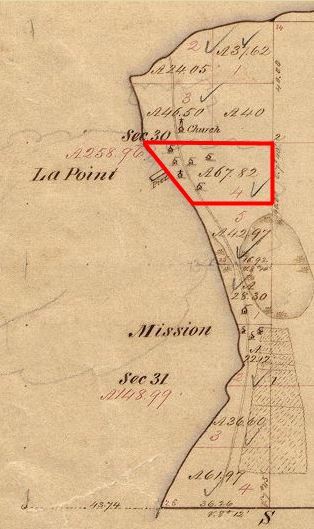
“Lot number four (4)“ is New Fort (downtown) La Pointe.
~ General Land Office
Lot number four (4) Township fifty (50) Section No. thirty (30) and Range No. three west containing sixty seven & 82/100 acres of land according to the Government Survey.
To have and to hold the same, together with all and singular the appurtenances and privileges thereunto belonging or in any wise appertaining and all the Estate Right, Title, Interest and Claim whatsoever, of the said party of the first part, either in Law or Equity, in and to the above described premises, to the only proper use, benefit and behoof of the said party of the second part, his heir and assigns forever, and the said Julius Austrian party of the first part for himself his heirs Executors and administrators do covenant and agree to and with the said party of the second part, his heirs and assigns that he is well seized in Fee of the aforesaid premises, and has good right to sell and convey the same, in manner and form as above written, and that the same are free of all incumbrances whatever, and that the aforesaid premises, in the quiet and peaceable possession of the said party of the second part, his heirs and assigns, against all and every person lawfully claiming or to claim the whole or any part thereof, he will forever warrant and defend.

Julius Austrian
~ Madeline Island Museum
Provided nevertheless that if the said Julius Austrian of the first part, his heirs, administrators, executors or assigns shall well and truly pay or cause to be paid to the said Charles H Oakes party of the second part, his heirs, executors, administrators or assigns the sum of Sixteen (16) Hundred Dollars, lawful money, in six equal annual payments, according to the condition of six certain notes bearing even date with, then this deed to be null and void, otherwise to be and remain in full force and effect, but if Default shall be made in the payment of the said sum of money, or the interest, or of any part thereof, at the time herein before specified for the payment thereof, the said party of the first part, in such case, does hereby authorize and fully empower the said party of the second part his executors, administrators or assigns, to sell the said hereby granted premises, at Public Auction, and convey the same the same to the purchase in Fee Simple, agreeably to the statute in such case made and provided, and out of the moneys arising from such sale, to retain the Principal and interest, which shall then be due on the said notes, together with all costs and charges, and pay the overplus (if any) to the said Julius Austrian, party of the first part his heirs, executors administrators or assigns.
In testimony whereof the said party of the first part has hereunto set his hand and seal the day and year first above written.
Julius Austrian
Sealed and delivered in presence of
~ Findagrave.com
Isaac V D Heard
I Van Etten
Territory of Minnesota
County of Ramsay
Be it known that on the second day of May AD 1853, before the undersigned, personally came Julius Austrian the Grantor to the foregoing and within Deed from him as such Grantor to Charles H Oakes, to me personally known to be the identical person described in and who executed the said deed, and who acknowledged that he executed the said deed freely and voluntarily for the uses and purposes therein expressed.
I Van Etten
Notary Public
Minnesota Territory

Charles W. W. Borup and Charles H. Oakes: married into the La Pointe mixed blood Beaulieu family; built the American Fur Company outift at New Fort, La Pointe; and started Minnesota’s first bank.
~ HeritageAuctions.com
St. Paul, May 2nd 1853
$200
Julius Austrian
– – – – –
St. Paul, May 2nd 1853
$300
On or before the first day of November A.D. 1854, I promise to pay Charles H. Oakes, on order, at the office of Mesfrs. Borup and Oakes, St. Paul, Min. Ter., the sum of Three Hundred dollars, value received—and in case of default in the payment of the above sum of money, then I agree to pay interest on said principal sum at the rate of ten percent per annum until paid.
Julius Austrian
– – – – –
St. Paul, May 2nd 1853
$200
Julius Austrian
– – – – –
St. Paul, May 2nd 1853
$400
Julius Austrian
[Filed 11/30/89]
Power of Att’y
from Jos Austrian
to Jul. A.
Registers certificate inside.
Recorded.
– – – – –
State of Michigan
County of Houghton
Joseph Austrian lived at La Pointe with his brother Julius during 1851 and 1852.
~ Austrian Papers
Know all men by these presents that I Joseph Austrian of Eagle River county of Houghton and State of Michigan have made, authorized, nominated and appointed and by these presents do make authorize nominate and appoint Julius Austrian of La Pointe county of La Pointe and State of Wisconsin my attorney for me and in my name and to my use, to enter into, and take possession of all such messuages, lands tenements, hereditaments, and real estate whatsoever, in La Pointe County of La Pointe State of Wisconsin, whereof I now am, or hereafter may be by any ways or means howsoever entitled or interested in, either in severalty and jointly or in common with any other person or persons.
And also for me and in my name, to grant, bargain, and sell, the same messuages lands, tenements and hereditaments, or any part, share or portion thereof, and all such rights, titles, interest, claim, and demand both in law and equity, as I may have in the same, for such sum and price, and on such terms, as to him shall seem meet, and for me and in my name to make, execute, and deliver good and sufficient deeds and conveyances for the same, and every part thereof, either with or without covenants and warranty.
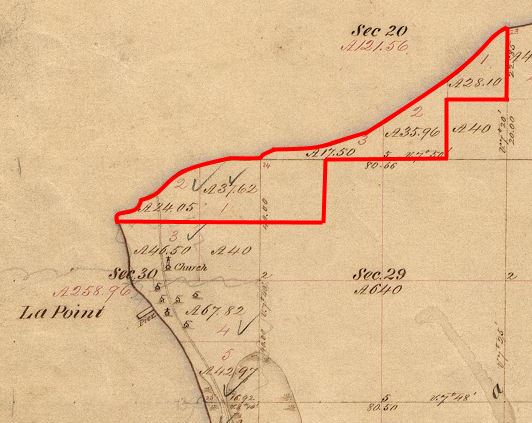
The north coast of La Pointe was patented in Joseph Austrian‘s name during 1852.
~ General Land Office
And while the sale thereof, for me, and in my name, and for my use, to let and do wise the same real estate or any part of parts thereof for the best rent that can be gotten for the same.
And also for me and in my name, and to my use to ask, demand, recover and receive all sums of money which shall become due, owing or payable to me by means of any such bargain, sale or lease. And to have, use, and take, all lawful ways and means for the recovery thereof by attachment, unrest, distress, or otherwise, and to compound, arbitrate, and agree, for the same and aquittances or sufficient discharges for the same, for me and in my name, to make, seal and deliver, and generally to do, execute, and perform, every thing that may be neccesary in and about the premises, as fully in every respect as I myself might or could do, if I were personally present.
And an attorney or attorneys under him for any or all of the purposes aforesaid, to make and substitute, and again at pleasure to revoke. And I hereby ratify, allow, and confirm, all, and whatsoever my said attorney shall do or cause to be done, in and about the premises by virtue of these presents. In witness whereof I have hereunto set my hand and seal.
Eagle River May 31st 1854.
Joseph Austrian
Signed Sealed and delivered in the presents of
Charles Hembeck
A W. Senter
State of Michigan
County of Houghton
Personally appeared before me Joseph Austrian and acknowledged that he executed the within Power of Attorney, and I further certify, that I well know the said Joseph Austrian, and that he is the same individual who is described as the within conveyance and who executed the same. Eagle River May 31st 1854.
Simon Mandlebaum
Justice of the Peace
Houghton County
Michigan
– – – – –
STATE OF MICHIGAN,
County of Houghton
I James Crawford Clerk of said County of Houghton DO HEREBY CERTIFY, that Simon Mandlebaum – whose name is subscribed to the Certificate or proof of acknowledgement of annexed Instrument, and therein written, was, at the time of taking such proof or acknowledgement a Justice of the Peace in and for said County, duly Elected and qualified, and duly authorized to take the same; AND FURTHER, that I am well acquainted with the hand writing of such Justice of the Peace and verily believe that the signature to the said Certificate or proof of acknowledgement is genuine; I FURTHER CERTIFY, that said Instrument is executed and acknowledged according to the Laws of this State.
IN TESTIMONY WHEREOF, I have hereunto set my hand and affixed the seal of said County, at Eagle River this Twelfth day of September A. D. 1856.
James Crawford
Clerk.
A Warranty Deed
S S Vaughn and Peter B Vanterventer
to
M. H. Manddlebaum
7 day April A. D. 1855
Recd for Record April 7 1855 at 4 Oclock P.M and Recorded in Book A of Deeds on Page (127)
John W Bell
Register of Deeds for
La Pointe County
Wis
– – – – –
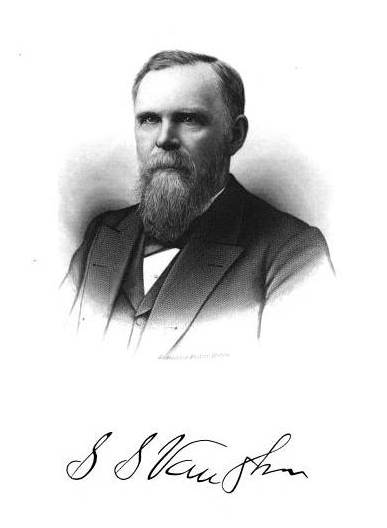
Samuel Stuart Vaughn
~ Western Reserve Historical Society
Know all men
by these presents that we S. S. Vaughn and Peter B Vanderventer and Caroline Vanderventer his wife of the Town and County of Lapointe and State of Wisconsin in consideration of Two hundred Sixty Two and a half dollars to us paid by M. H. Manddlebaum of Town County and State aforesaid the receipt whereof we do hereby acknowledge do by these presents give grant bargain sell and convey unto the said M H Manddlebaum his heirs and assigns a certain piece of land described as follows to wit lot No F??? one in Section No Four and lot No one in Section No Five Township no Forty nine range no Three containing Fifty two acres and forty seven hundreth of an acre together with all the privileges and appurtenances to the said land in any wise appertaining and belonging.

Vaughn/Vanderventer‘s lots 1 & 1 by Old Fort (Grant’s Point) La Pointe.
~ General Land Office
To have and to hold the above granted granted premises to the said M. H. Manddlebaum his heirs and assigns and to his and their use and behoof forever. And we S. S. Vaughn and Peter B Vanderventer and Caroline Vanderventer his wife for ourselves our heirs executors and administrators do covenant with the said M. H. Manddlebaum his heirs and assigns that we are lawfully seized in fee of the aforesaid premises that they are free from all incumbrances that wee have a good right to sell and to convey the same to the said M. H. Manddlebaum as aforesaid and that we will and ours heirs executors and administrators shall warrant and defend the same, to the said M H Manddlebaum his heirs and assigns forever against the lawful demands of all persons.
In testimony whereof we have hereunto set our hand and seal this 7 day of April A.D. 1855
S. S. Vaughn
P. B Vanderventer
Carline (her X mark) Vanderventer
Antoine Gordon was an influential Mixed Blood member of the La Pointe Band.
Sealed and delivered in presence of
John W Bell
A. Gaudin
State of Wisconsin
Lapointe County
April 7th 1855
They personally appeared before me the above named S. S. Vaughn, Peter B Vanderventer and Caroline wife of said Peter B. Vanderventer, who severally acknowledged they did sign and seal the foregoing instruments as their free act and deed, and the said Caroline wife of said Peter B Vanderventer on a private examination before me separate and apart from the said husband acknowledged that she did execute the foregoing deed without any fear or compulsion from her said husband or any other person.
John W Bell
Justice of the Peace in & for
Lapointe County Wisconsin
Deed ~
Antoine & Sarah Gaudin
to Joseph Austrian
Received for Record June 16 1855 [???] and Recorded in Book A of Deeds on page 153.
John W Bell Register for
La Pointe County Wisconsin
– – – – –
WARRANTY DEED. — Printed and sold by SANFORD & HAYWARD, Cleveland, Ohio.
To all People to whom these Presents shall come—GREETING:
KNOW YE, That
we Antoine Gaudin of the County of La Pointe and State of Wisconsin and Sarah wife of said Antoine Gaudin

“Mr. and Mrs. Antoine Gordon,
the founders of Gordon,
would have liked King Midas Flour.”
~ History of Gordon
For the consideration of the sum of two hundred and fifty dollars received to our full satisfaction of Joseph Austrian of Eagle River in the State of Michigan do give, grant, bargain, sell and confirm unto him the said Joseph Austrian the following described TRACT or LOTS of LAND, situate in the township of Lapointe being number (49) in the third range of Townships, which is also in the county of Lapointe and is known
as Lots two (2) and three (3) of section number five (5) containing one hundred acres (100)
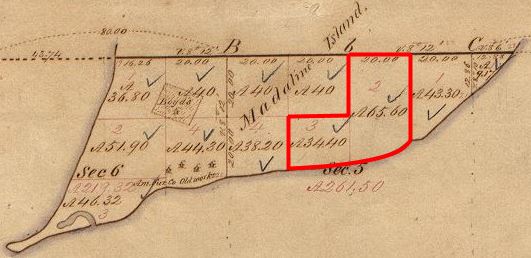
Gordons’ lots 2 & 3 near Old Fort (Grant’s Point) La Pointe.
~ General Land Office
TO HAVE AND TO HOLD the above granted and bargained premises, with the appurtenances thereunto belonging, unto him the said Joseph Austrian his heirs and assigns forever, to his and their own proper use and behoof. And we the said Antoine Gaudin and Sarah his wife do, for ourselves our executors and administrator, covenant with the said Joseph Austrian his heirs and assigns, that at, and until the ensealing of these presents we are well seized of the premises, as a good and indefeasible estate in FEE SIMPLE, and have good right to bargain and sell the same in manner and form as above written, and that the same be free from all incumbrance whatsoever. And furthermore, we the said Antoine Gaudin and Sarah his wife do by these presents find ourselves, our heirs, forever, to WARRANT AND DEFEND the above granted and bargained premises to him the said Joseph Austrian his heirs and assigns, against all lawful claims and demands whatsoever. And I the said Sarah wife of the said Antoine Gaudin do hereby remise, release, and forever quit claim unto the said Joseph Austrian his heirs and assigns, all my right and title of dower in the above described premises.
wife of Antoine Gaudin.
In Witness Whereof, we have hereunto set our hands and seals the fourteenth day of June in the year of our Lord one thousand eight hundred and fifty five.
A. Gaudin
Sarah (her X mark) Gaudin
Signed, Sealed and Delivered
in presence of
John .W. Bell.
M. H. Mandelbaum
THE STATE OF WISCONSIN,
COUNTY OF LA POINTE.
June 14 1855.
Personally appeared before the me above named Antoine Gaudin and Sarah his wife who acknowledged that they did sign and seal the foregoing instrument, and that the same is their free act and deed. I further certify, that I did examine the said Sarah wife of said Antoine Gaudin separate and apart from her husband, and did then and there make known to her the contents of the foregoing instrument, and upon that examination she declared that she did voluntarily sign, seal and acknowledge the same, and that she is still satisfied therewith.
John W. Bell
Justice of the Peace
Warrantee Deed
Joseph Austrain
to
Francois Cadotte
Office of Register of Deeds
La Pointe County Wis
I hereby Certify that the within Deed was filed in this office for Record Jany 21st 1858 A M and was duly Recorded in Book A of Deeds Vol [2 or 3?] and page 239.
John W Bell
Register
Fees $1.00
– – – – –
WARRANTY DEED.
Sold by E. Terry & Co., Milwaukee
This Indenture,
Made the Twenty first day of January in the year of our Lord one thousand eight hundred and fifty eight between
Joseph Austrian by Julius Austrian his attorney in Fact Party of the first part and Francois Cadotte of Lapointe County Wisconsin, party of the second part.

Antoine and Frank Cadotte (son and grandson of Michael and Madeline Cadotte, and Mixed Blood member sof the La Pointe Band).
~ Madeline Island Museum
Witnesseth, That the said party of the first part, for in consideration of the sum of Forty dollars Lawfull Money of the United States of America to him in hand paid by the said party of the second part, the receipt whereof is hereby confessed and acknowledged has given, granted bargained, sold, remised, released, aliened, conveyed, and confirmed, and by these presents does give, grant, bargain, sell, remise, release, alien, convey, and confirm unto the said party on the second part, and his heirs and assigns forever
the following Described Real Estate situated in the County of of Lapointe and State of Wisconsin, and Known as Lot number Thirty four (34) in the Town of Lapointe according to the Recorded Plat of said town as recorded in the Registers Office of said County of Lapointe.

Cadotte‘s block 34 in downtown La Pointe.
~ Julius Austrian Papers (maps folder)
Together with all and singular the Hereditaments and Appurtenances thereunto belonging, or in any wise appertaining; and all the estate, right, title, interest, claim, or demand whatsoever of the said party of the first part, either in Law or Equity, either in possession or expectancy of, in and to the above-bargained premises, and their Hereditaments and Appurtenances TO HAVE AND TO HOLD the said premises as above described, with the Hereditaments and Appurtenaces unto the said party of the second part, and to his heirs and assigns forever.
And the said Joseph Austrian by his P attorney for himself his heirs, executors, and administrators, does convenant, grant, bargain, and agree to and with the said party of the second part, his heirs and assigns, that at the time of the ensealing and delivery of these present, he is well seized of the premises above described, as of a good, sure, perfect, absolute, and indefeasible estate of inheritance in the Law, in fee simple, and that the same are free and clear from all incumbrances whatever, and that the above-bargained premises in the quiet and peaceable possession of the said party of the second part, his heirs and assigns against all and every person or persons, lawfully claiming the whole or any part thereof [???] will forever WARRANT AND DEFEND.
In Witness Whereof, the said party of the first part, has hereunto set his hand and seal the day and year first above written
Joseph Austrian
by Julius Austrian
his Att in fact.
Sealed and delivered in presence of
John W Bell
STATE OF WISCONSIN
COUNTY OF La Pointe
Be it Remembered, that on the Twenty first day of January A. D. 1858 personally came before me the above-named Joseph Austrian by Julius Austrian his attorney in fact to me known to be the person who executed the said Deed, and acknowledged the same to be his free act and deed, for the uses and purposes therein mentioned.
John W Bell
Justice of the Peace
Antoine Gordon & wife
to Julius Austrian
Office of Register of Deeds
La Pointe County Wis
I hereby Certify that the within Deed was filed in this Office for Record July 11th 1858 oclk and was duly Recorded in Book A of Deeds Vol 2 & page 296.
J W Bell
Register
rec 1 day of July 1861
$550 – 7%.
– – – – –
WARRANTY DEED. Sold by E. Terry & Co., Milwaukee.
This Indenture,
Made the Eleventh day of February in the year of our Lord one thousand eight hundred and fifty eight between
Antoine Gaudin and Sarah Gaudin his wife of La Pointe County & State of Wisonsin of the first part and Julius Austrian of the Same County and State party of the Second part.
Witnesseth, That the said parties of the first part, for and in consideration of the sum of Eight hundred Dollars receipt whereof is hereby confessed and acknowledged, has given, granted bargained, sold, remised, released, aliened, conveyed, and confirmed his heirs and assigns forever
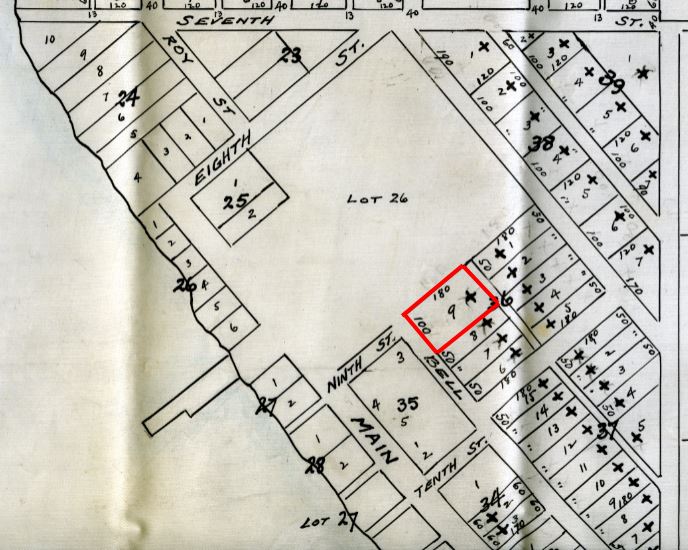
Gordons‘ lot 9 in downtown La Pointe.
~ Julius Austrian Papers (maps folder)
the following Described Real Estate situated and lying in the Town of La Pointe as on Record in the Registers Office of Lapointe County aforesaid and known and Descried as follows being Lot number nine (9) in Block number Thirty six (36) in Said Town of Lapointe, hereby absolutely Revoking and annulling a Deed of Gift, Executed by us to our son Edward on the eighth day of May 1855, and witnessed by John W Bell & William Morin and Recorded same day in the Registers Office of Lapointe County in Book A of Deeds Vol 1 & page 138 for the said described premises.
~ History of Gordon
Together with all and singular the Hereditaments and Appurtenances thereunto belonging, or in any wise appertaining; and all the estate, right, title, interest, claim, or demand whatsoever of the said parties of the first part, either in Law or Equity, either in possession or expectancy of, in and to the above-bargained premises, and their Hereditatments and Appurtenances. TO HAVE AND TO HOLD the said premises as above described, with the Hereditaments and Appurtenances, unto the said party of the second part, and to his heirs and assigns forever.
~ History of Gordon
And the said Antoine Gaudin & wife for themselves heirs, executors, and administrators, does covenant, grant, bargain, and agree to and with the said party of the second part, his heirs and assigns, that at the time of the ensealing and delivery of these present, they are well seized of the premises above described, as of a good, sure, perfect, absolute, and indefensible estate of inheritance in the Law in fee simple, and that the same are free and clear from all incubrances whatever, and that the above-bargained premises, in the quiet and peaceable possession of the said party of the second part, his heirs and assigns against all and every person or persons, lawfully claiming the whole or any part thereof He will forever WARRANT AND DEFEND.
In Witness Whereof, the said parties of the first part, has hereunto set their hands and seals the day and year first above written.
A. Gaudin
Sarah (her X mark) Gaudin
Sealed and delivered in presence of
John W Bell
John [Clikf?]
STATE OF WISCONSIN
COUNTY OF Lapointe
Be it Remembered, that on the Eleventh day of February A.D. 1858 personally came before me the above-named Antoine Gaudin & Sarah Gaudin his wife to me known to be the persons who executed the said Deed, and acknowledged the same to be their free act and deed for the uses and purposes therein mentioned.
John W Bell
Justice of the Peace
Warrantee Deeds
Francis Cadotte
to
Julius Austrian
Office of Register of Deeds
La Pointe County Wis.
I hereby Certify that the within Deed was filedin this Office for Record May the 8th 1858 at M and was duly Recorded in Book A of Deeds Vol 2 on pages 370 & 71
John W Bell
Register of Deeds
Fees $7-
– – – – –
WARRANTY DEED. Sold by E. TERRY & CO., Milwaukee.
This Indenture,
Made the Eighth day of May in the year of our Lord one thousand eight hundred and fifty Eight between
Francis Cadotte of LaPointe County, Wisconsin, party of the first part and Julius Austrian of Lapointe county party of the second part.
Witnesseth, That the said part of the first part, for and in consideration of the sum of Forty Dollars lawfull money of the United States to him in hand paid by the said party of the second part, the receipt whereof is hereby confessed and acknowledged has given, granted, bargained, sold, remised, released, aliened, conveyed, and confirmed, and by these presents does give, grant, bargain, sell, remise, release, alien, convey, and confirm, unto the said party of the second part, and his heirs and assigns forever
the following described Real Estate situate in the County of LaPointe and State of Wisconsin, and Known as Lot Number Thirty four (34) in the Town of La Pointe, according to the Recorded Plat of said Town as Recorded in the Registers Office of said County of La Pointe.
Block 34 in New Fort (downtown) La Pointe.
~ Julius Austrian Papers (maps folder)
Together with all and singular the Hereditaments and Appurtenances thereunto belonging, or in any wise appertaining; and all the estate, right, title, interest, claim, or demand whatsoever of the said party of the first part, either in Law or Equity, either in possession or expectancy of in and to the above-bargained premises, and their Hereditaments and Appurtenances. TO HAVE AND TO HOLD the said premises as above described, with the Hereditaments and Appurtenances made the said party of the second part, and to his heirs and assigns forever.
And the said Francis Cadotte for himself his heirs, executors, and administrators, does covenant, grant, bargain, and agree to and with the said party of the second part, his heirs and assigns, that at the time of the ensealing and delivery of these present, he is well seized of the premises above described, as of a good, sure, perfect, absolute, and indefensible estate of inheritance in the Law, in fee simple, and that the same are free and clear from all incumbrances whatever, and that the above-bargained premises, in the quiet and peaceable possession of the said party of the second part, his heirs and assigns against all and every person or persons, lawfully claiming the whole or any part thereof He will forever WARRANT AND DEFEND.
In Witness Whereof, the said party of the first part, has hereunto set his hand and seal the day and year first above written.
Francis Cadotte
Sealed and delivered in presence of
John W Bell
STATE OF WISCONSIN
COUNTY OF La Pointe
Be it Remembered, that on the Eight day of May A.D. 1858, personally came before me the above-named Franis Cadotte to me known to be the person who executed the said Deed, and acknowledged the same to be his free act and deed, for the uses and purposes therein mentioned.
J W Bell
Justice of the Peace
Office of Register of Deeds
La Pointe County Wisconsin Sept 5th 1859
I hereby Certify that up to this date, that the two United States Patents, to Julius Austrian numbered (79,458) and(2421) for Lands on Madeline Island have never been Recorded in this Office, nor any instrument from any person, in relation to any of the lands embraced in said Patents, and that the same are free from all incumbrances.
John W Bell
Register of Deeds
Ervin Leihy Incidents: At the Falls of Bad River
February 24, 2017
By Amorin Mello
This is a reproduction of a memoir published by Ervin Barnes Leihy, who became known as Nigigoons (Little Otter) by the Chippewas of Bad River. Leihy is emerging as of the more colorful characters from the post-1842 Treaty of La Pointe era in Chequamegon History, when he was one of the first non-natives to settle on the newly Ceded Territory surrounding La Pointe. Leihy moved to the Falls of Bad River in 1846 where he built his sawmill. After the 1854 Treaty, Leihy became associated with the Early Settlement of the Bad River Indian Reservation. During the post-1860’s era, Leihy moved to Bayfield where he became a successful business person. Leihy’s general store and brownstone house are still prominent buildings in Bayfield today.
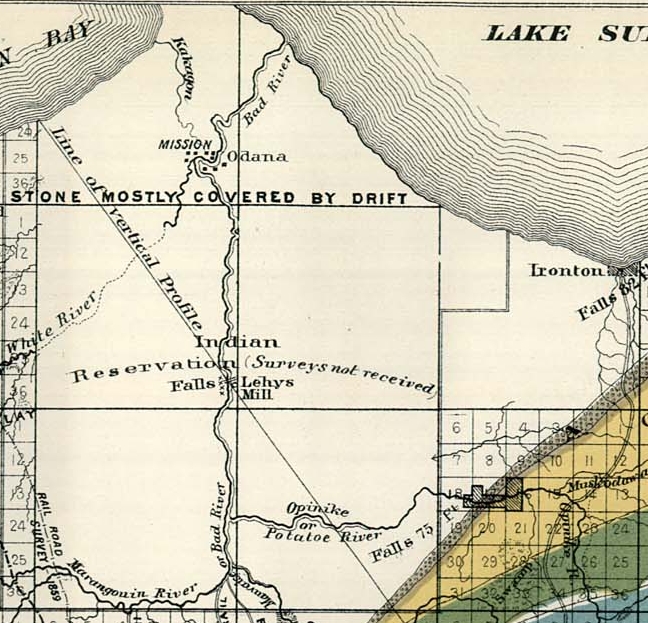
Details of Ervin Leihy’s sawmill on the La Pointe Reservation from Charles Whittlesey‘s 1860 Geological Map of the Penokie Range from Geology of Wisconsin: Volume III, plate XX-214. Also shown are the Opinike (or Potatoe) River Property, Ironton, and McEwen’s Sawmill.
Bayfield County Press
March 31, 1900
[Transcribed and shared by Robert J. Nelson, 2016]
Incidents of Early Days on Lake Superior
At the Falls of Bad River
By Ervin Leihy
– Ervin Leihy, one of the first white settlers to come to the northern part of Wisconsin died at his home in this city last week. He was born in Oswego county, N. Y., October 12, 1822. His early life was passed on a farm and at 18 moved to Illinois. Later he bought a farm at Bad River, Ashland county, and in 1846 moved onto it. In 1870 he moved to Bayfield, built his present home and opened a general store which he conducted for a number of years. While living at Bad River he was a member of the town and county boards of Ashland county for a number of years and in 1871 and 1872 was a member of the town board of Bayfield. Besides these he held numerous other offices. He was a public-spirited man, had plenty of means and was always ready to assist in anything that would tend to advance the interests of the town in which he resided.”
~ Wisconsin Weekly Advocate, June 6, 1901.
Next day our arrival at the Falls (October 5, 1846) was spent in looking over the surroundings. The murmur of the stream, the stream itself and the surrounding scenery, reminded me of the scenes of my earliest recollections on the banks of the Salmon River, Oswego County, New York. Here to his game in the forest, fish and the stream and sugar in the trees; and the soil is good.
Potatoes are worth one dollar per bushel and corn two dollars per bushel. Those were my musings as I sat on a big rock at the head of the falls. Here were many of the necessaries and some of the luxuries of life and all for the taking and no taxes to pay – all as free as air.
To say that I was delighted would be putting it mildly. I asked the captain what were his plans. He had none; he simply liked to live in the woods. Here, let me digress. Captain Wood was a man about 53 years old, had gained perhaps earned the prefix to his name during what was termed the “Toledo War,” early a squabble between the states of Ohio and Michigan for jurisdiction over a strip of land in which Toledo was the principal town. Wood being deputy sheriff of Monroe County at that time was put in command of a company of Michigan troops to help all the claims of the state of Michigan. Withal, a genial and agreeable companion. Not much time was lost.

Detail of Leihy’s sawmill and Bad River Falls omitted from the Barber brothers’ survey of the La Pointe (Bad River) Reservation.
I have soon acquired a half interest in the “Hermitage” which consisted of a long, hut about 14 feet square, a fireplace in one corner, and covered with shakes; nearly an acre of cleared land, 20 or 30 bushels of potatoes and perhaps as many more of rutabaga; a couple of axes and a hoe or two.
Brother George had gone with his boat and men. I began to talk to Capt. Wood about LaPointe of which I heard so much. He finally said, “perhaps you would like to go there?” I told him I certainly would.
Well, we found our way to LaPointe, and an interesting place. It certainly was. Here the North American fur company was in full bloom, under the efficient management of Messrs. Borup and Oakes. The traders, had already left with their outfits for their various stations at Lac du Flambeau, Lake Courerille, Sandy Lake, Leech Lake, Grand Portage and other points, not to return until May or June when they were expected to return laden with bear, beaver, otter, Fischer, Martin, mink and other valuable fur.
Reverend Sherman Hall
~ Madeline Island Museum
Here to was established a Catholic mission under the care of father Baraga; also a Presbyterian mission in under the care of Rev. Sherman Hall, and all in flourishing condition.
Fishing was also carried on to a considerable extent among the islands by the Fur company. The side-wheeler Julia Palmer, have been hauled over the portage at the Soo and had just made one trip as far West as LaPointe. The rest of the fleet on Lake Superior consisted of five small sail vessels, viz. the Merchant, Swallow, Algonquin, Fur Trader and the Chippewa.
A Mr. Hays was subbing in agent and Mr. Van Tassel was the government blacksmith at that time at LaPointe.
We stayed but a few days, procured a few necessary tools, some supplies for the winter and return to the Falls.
There were now [four] in camp. Captain Joseph Wood, Charlie Rowley, John Smith and myself. Wood, Smith and I went to work on the second house built in what is now Ashland County outside of LaPointe.
To be continued…
Copper Creek Mining Location
November 18, 2016
By Amorin Mello
—
COPPER CREEK MINING LOCATION.
—
This location embraces the east half of the southeast quarter of Section 15, and the west half of the southwest quarter of Section 14, in Township 47, Range 14 west, being 160 acres in Douglas County, Wisconsin. It is about thirteen and one-half miles by the County road from the town and harbor of Superior, and at an elevation of 300 feet above the level of the lake.
The Aminecon Trap Range, in crossing it from southwest to northeast, is cut by Copper Creek, a rapid and never-failing stream, exposing at several points veins of native copper.
~ Mine Register: Successor to the Mines Handbook; Volumes 8-9, page 205.
“We all lived in the log house until December 31, 1845, when I left for Iron River [Michigan] under agreement to mine for the Boston North American Mining company, organized by the American Fur company, under the management of Messrs. Borup and Oakes.”
~ Michigan Historical Collections: Volume 2; page 688.
These surface exposures attracted, at an early day, the attention of the agents of the American Fur Company, then the only civilized occupants of that part of the country, and in the years 1846 and 1847 some attempts at mining were made under their direction. A particular description of their operations will be found in another part of this pamphlet. As they had no title to the land and were working at great expense in a region which was at that time wholly remote from civilization, it is not surprising that like many other pioneers in Lake Superior copper-mining, they abandoned their enterprise, or postponed it to a more convenient season.
Eight years afterwards, the whole southern shore of Lake Superior had ceased to be exclusively known to hunters and trappers. The land had been surveyed and brought into market, and settlement had extended to the extreme western end of the lake.

James H. C. McKinzey was issued his patent to the Copper Creek Mining Location by the Willow River Land Office on August 1st, 1854.
~ General Land Office Records
The Copper Creek location was then entered under a preëmption claim by J. H. C. McKinzey, and after a litigation at the Land Office with a rival preëmptor in the interest of members of the Fur Company (who now made a persistent effort to secure a title to the land), McKinzey’s claim was sustained, and a patent was duly issued to him. From him the title passed, with but one intervening link, to the present proprietor.
The location has been visited from time to time by explorers, practical miners, and geologists; numerous rich specimens have been taken from it, and it has long been reputed to be the most promising mining location west of Ontonagon. During the past season a regular exploration has been made upon it, with the view of ascertaining more definitely its value for mining purposes.
“This Township has a clay soil. The small streams are all muddy and go nearly dry in summer. A copper bearing trap range extends through the middle of Township. On the south side of these hills it is well timbered with valuable Pine Cedar Sugar & Black Ash. Copper has been obtained on the SE 1/2 of Section 21 & upon Sections 14 & 15. The streams [reaching?] into Black River are all very rapid.”
~ Wisconsin Public Land Survey Records
A Report of this exploration is presented herewith. Mr. George R. Stuntz, under whose superintendence it was conducted, is an explorer of great experience, with a knowledge of the geological formations characteristic of the copper-bearing districts of Lake Superior, acquired by careful study in the field. He was the original surveyor, under government contract, of the whole Wisconsin shore of the lake, and has, perhaps, a more thorough acquaintance with that region than any person could be named. His Report is a plain statement of facts, and as the undersigned was himself present and taking part in the exploration, he is able to vouch for its accuracy. In connection with the maps, and with the specimens to which it refers (which were marked and packed on the ground by the writer’s own hand), it will furnish a correct idea of the character of the location.
It will be seen that there are three well-defined veins, two of which, including the one from which the richest specimens were obtained, run with the formation. This last mentioned lode rests upon a foot-wall of the most productive veins of the Minnesota mine. Although only three veins have been actually traced, there is reason to believe that others would be discovered by a further exploration, as many points inviting examination were passed by, owing to the lateness of the season.
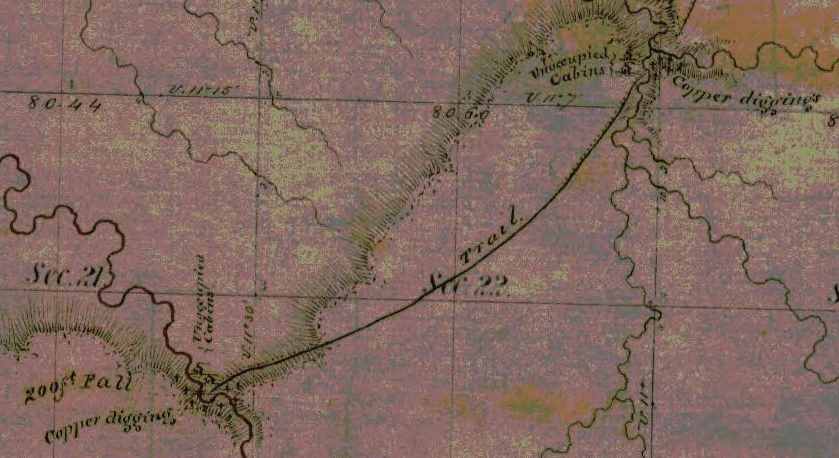
Detail from George Riley Stuntz’s original survey map of Township 47 North, Range 14 West: copper mines, abandoned cabins, and a tote road in what is now Pattison State Park. The northeast feature is Copper Creek and the southwest feature is Big Manitou Falls.
~ Wisconsin Public Land Survey Records
“Big Manitou Falls, the tallest waterfall in Wisconsin, in Pattison State Park just south of Superior, Wisconsin, USA.” Photograph from
Bobak Ha’Eri shared with a Creative Commons license.
The facilities furnished by Copper Creek for stamping purposes will be apparent from an inspection of the map. The town of Superior, having a good harbor, with piers and warehouses, erected by private enterprise, presents every convenience for shipping copper and obtaining supplies. Beef cattle, driven over from Minnesota, on the military road, can be purchased here much cheaper than at the Michigan mines, which are now largely supplied from this point. Pork can be advantageously procured in the same way. Another advantage is found in the price of lumber, an article for which the pineries and sawmills in this region now find a market at the lower mines. One of the finest bodies of pine in the north-west is found on the Brulé and Iron Rivers, about twenty-four miles east of this point.
With reference to the transportation between Superior and Copper Creek, it may be mentioned that, besides the wagon road (which is now available during the winter, and at no great expense can be made so at all times), the Nemadji River which, at ordinary stages of water is navigable for small boats to a point within four miles of the location, affords an additional route.
There is reason to believe that the whole country at the westerly end of Lake Superior will receive a new stimulus to its development before many years, by the opening of railroad communication with the Mississippi River, an enterprise which is becoming the absolute necessity to the interests of Minnesota. Meanwhile communication is kept open by means of the Point Douglas military road and a regular line of stages between St. Paul and Superior, which place is thus rendered accessible at all seasons.
JAMES O. SARGENT.
Boston, Dec. 8th, 1863.
—
REPORT OF EXPLORATION.
(ACCOMPANYING SPECIMENS.)
—
Superior, Oct. 17, 1863.
JAMES O. SARGENT, ESQ.
SIR : Under instructions from you, I have made a survey of the east half of the southeast quarter of Section 15, and the west half of the southwest quarter of Section 14, Township 47 north, Range 14 west, in Douglas county, Wisconsin, and have explored the same as thoroughly as the limited time and the small force under my direction would permit.
I herewithin submit a copy of the field-notes of the survey, and a map of the location.
In making the exploration I had the services of Mr. George Walker, an English miner, who has had several years’ experience in the various copper mines on this lake.
The tract is thickly timbered with spruce, fir, aspen, sugar, oak, white pine, and birch. This timber is small in size.

The Aminecon Trap Range crosses the location. This Range makes its appearance above the sandstone on the east side of Township 48 north, Range 12 west, about the middle of the township, runs in a southeasterly course across the township, and across Township 47, Range 13, Township 47, Range 14, Township 46, Range 15, and leaves Wisconsin. It is cut by the Aminecon River, Copper Creek, and Black River, and numerous small streams. Throughout the extent described it gives promise of being a productive mining district.
Two small streams unite near the centre of the location, forming Copper Creek, which runs in a northwest direction, and leaves the tract about twenty rods south of the northwest corner. Owing to the extremely dry season, this stream was lower at the time of my examination than it has been known to be in ten years; but it affords at all times abundance of water for the purposes of a mine employing steam power.
By a measurement, taken October 1st, I found the amount of water passing through it to be 58 5/10 cubic feet per minute, and this is very much below the average. In ordinary seasons the amount of fall in the stream (which is from fifty to a hundred feet within the location) would give a water power sufficient for all the purposes of a mine.
From my examination I believe that there are three veins, as represented in the map, in all of which we obtained native copper.
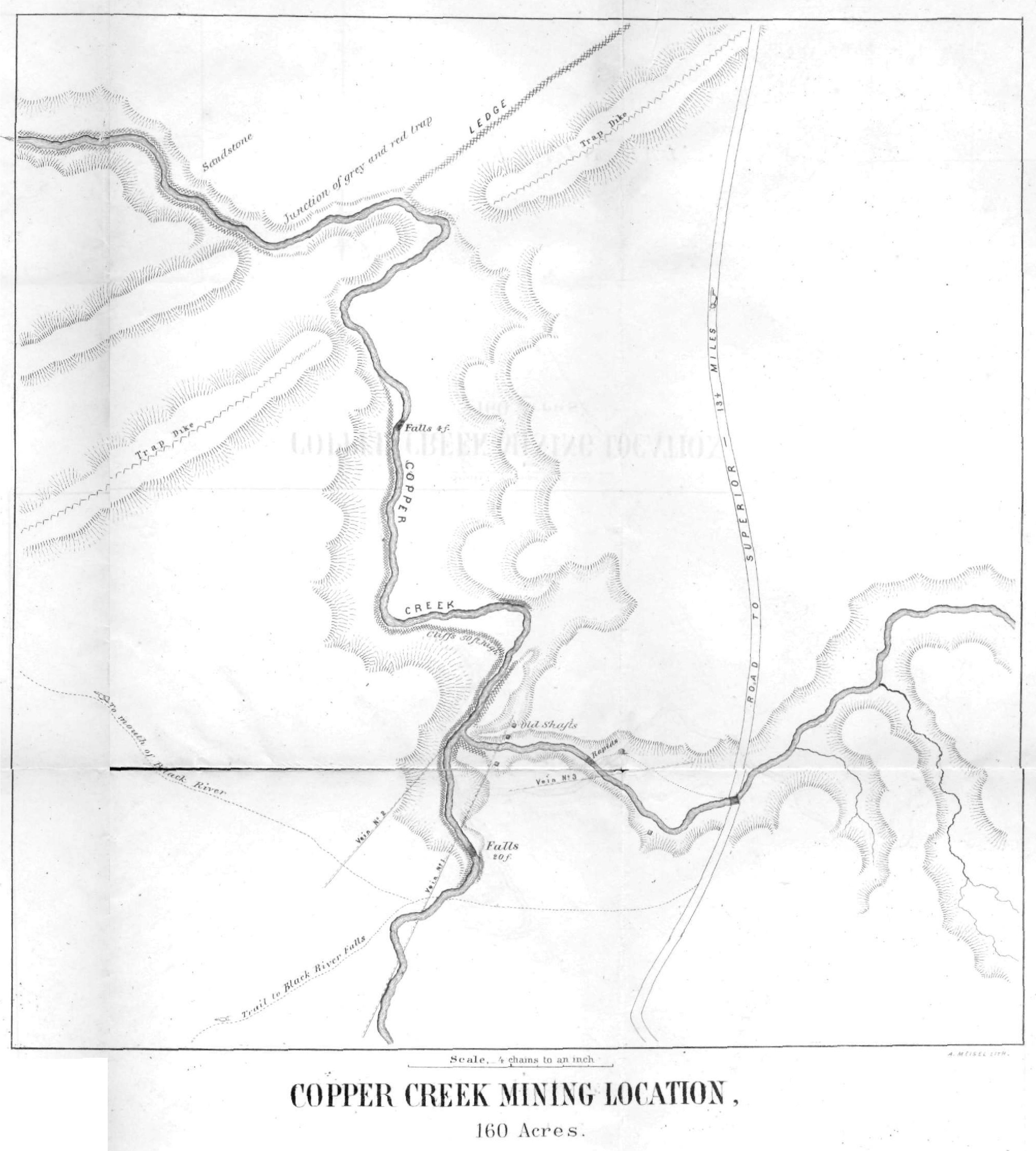
Vein No. 1 shows a breast in the east bank of the west branch of the stream, of nearly twenty feet wide, and bears south twenty-four degrees west. The specimens taken from this locality are numbered, and, as you will perceive, exhibit a quality of vein-stone which gives promise of productiveness. This vein has been traced to the southwest and adjoining location. It dips to the southeast at an angle of thirty-three degrees. The productive part of the lode lies upon the foot-wall, specimens of which I furnish with this Report, as also of the hanging wall.
Vein No. 2 shows a breast of over thirty feet in the bluff east of the stream, and appears to run in a northeast course. My explorations were not carried far enough to fully define its course in that direction. Surface specimens of the vein and of the adjacent trap are furnished herewith.
Vein No. 3 cuts the east branch of the creek, and bears north eighty-two degrees east. We opened this vein in four places at the creek, within two hundred feet. It has the appearance of being very much disturbed. On the west side of the stream, it is very compact and filled with quartz-lined cavities interspersed with crystals supposed to be malachite. It dips to the northwest. Specimens from this locality, a full collection of which is furnished, warrant a more thorough examination.
Vein No. 2, before referred to, as showing a breast of thirty feet in the east bluff, appears to branch or to be thrown out about eighty feet in crossing the creek bottom; my limited time and means did not permit me to determine which.

About two hundred feet below the junction of the two branches of the creek it shows at the foot-wall in the bed of the stream. A few feet west of this, the lode rises in the bluff on the west side of the stream. Course of stream at this point north twenty-eight degrees east. Course of vein north forty-two and one-half degrees east. At this junction of the streams, the lode, stripped of its hanging-wall, rises to the top of the cliff, a height of forty or fifty feet. At this point, we blasted into the lode, and found it rich in copper, some pieces weighing from six to fifteen pounds, and with rich stamp-work. See specimens marked Vein No. 2, west of stream.
About fifty feet above the forks of the stream the lode rests upon a bed of conglomerate. This conglomerate is highly metamorphosed, and is amygdaloidal. See specimens.
About one hundred feet west of this, we opened the vein on the brow of the hill. It there shows a breast of twenty feet, and dips to the southeast at an angle of thirty-five degrees.
~ Duluth and St. Louis County, Minnesota: Their Story and People; Volume 1, page 66.
This location was worked to some extent in the years 1846 and 1847, under a lease from the General Government, by the American Fur Company. They sunk four shafts, but appear to have done very little surface exploring.
Three of these shafts are sunk on the course of Vein No. 1, and from my examination appear to have been perpendicular. Their location is given on the map. The timbering is so much decayed that I did not venture to work in them. From soundings, I found the shaft between the streams forty-six feet deep, the next one on the east side of east branch twenty-eight feet deep, and the one east of section line twenty-eight feet deep. All of them have water to within about twelve feet of the surface. The fourth shaft is sunk at the bend of the east branch. This is thirty-five feet deep, and does not appear from the burrow to have been upon any vein.
The first three shafts above described were sunk perpendicularly upon the outcrop of a vein dipping thirty-three degrees, and therefore pass into a foot-wall. Had they been continued, they would have cut Vein No. 2. They may perhaps be made available in a further exploration.
Upon the adjoining location, to the westward, is a vein discovered by John Parry, some years ago. I have taken some specimens from it which are herewithin furnished. This vein runs north eighty-two degrees east, and intersects your western boundary six chains north of the southwest corner. It appears to be a continuation of Vein No. 3.
At the junction of the trap with the sandstone, in the northwest corner of the location, in the bed of Copper Creek, a bed of bluish-white grindstone grit of first-rate quality is found. The layers are from one inch to several inches in thickness. This white sandstone appears to belong to a different period from the red sandstone of Lake Superior. It only shows to the height of a few feet, and is overlaid by sixty feet of the red sandstone.
In the vicinity of the trap dike it is bent and fractured and considerably hardened. Near the junction, as marked on the map, it is tilted until some of the layers stand perpendicular. There are no ripple-marks on this white sandstone, while the red, resting upon it, shows evidence of a strong current.

Portrait of George Riley Stuntz from The Eye of the North-west: First Annual Report of the Statistician of Superior, Wisconsin, by Frank Abial Flower, 1890, page 26.
This tract of land is thirteen and one-half miles from the town of Superior, at the west end of Lake Superior. It is on a County Road which has been nearly completed, is now practicable for winter use, and can be made a good summer road at an expenditure not exceeding $2,000.
The soil is a sandy loam, with a subsoil of red clay containing a large per centage of marl, and is quite productive, being capable of producing a large portion of the vegetables needed by the operatives at a mine. It is especially adapted to the cultivation of grass and oats. Timber for lumber and fuel can be obtained conveniently and in unlimited quantity.
Respectfully submitted,
GEORGE R. STUNTZ,
Surveyor in charge of Exploration.
Lake Superior in 1840
September 1, 2016
By Amorin Mello
“Soon after removing to Detroit, Bela Hubbard became acquainted with Douglas[s] Houghton, then State Geologist of Michigan, and in 1837, was appointed Assistant Geologist on the State Geological Survey, a position which he held until 1841. He accompanied Douglass Houghton on an important expedition to the southern shore of Lake Superior, in 1840, an account of which is given in his ‘Memorials of half a century.’ It is this book more than anything else that will preserve the memory of its author. It is his most fitting and most enduring monument and entitles the name of Bela Hubbard to a place on the short list of American authors who may be justly termed ‘nature writers.'”
Quote from Report of the Michigan Academy of Science, Volume 4,
by Michigan Academy of Science Council, 1904, page 163.

This is a reproduction of “Lake Superior in 1840” and illustrations from Memorials of a Half-Century, by Bela Hubbard, 1887, pages 21-62.
LAKE SUPERIOR IN 1840.*
* Read before the Detroit Pioneer Society, Jan., 1874.
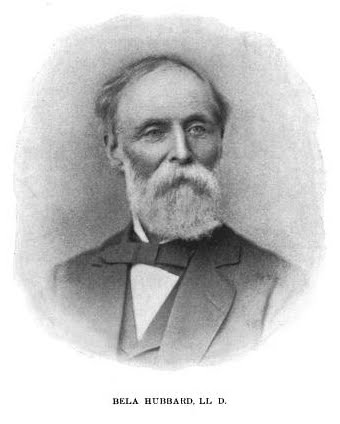
Portrait and biographic sketch of Bela Hubbard are available in Report of the Michigan Academy of Science, Volume 4, by Michigan Academy of Science Council, 1904, pages 163-165. See the Bela Hubbard Papers: 1837-1893 for more information.
Among the pleasantest of all my reminiscences of travel is that of the exploration, in connection with the geological survey of Michigan, of the coasts of our upper peninsula, in 1840.

Portrait and biographic sketch of Douglass Houghton are available in Report of the Michigan Academy of Science, Volume 4, by Michigan Academy of Science Council, 1904, pages 160-162. See the Douglass Houghton Papers: 1829-1845 for more information.
The party for this expedition was composed of the State geologist, Dr. Douglass Houghton; his two assistants, C. C. Douglass and myself; Fredk. Hubbard, in charge of instrumental observations; and, for a part of the way, H. Thielson, a civil engineer, and Charles W. Penny, a young merchant of Detroit, supernumeraries.
We left Detroit in the steamer “Illinois,” arriving at Mackinac, May 23. Here two boat crews were made up, consisting of six Canadians. These belonged to that class so famous in the palmy days of the fur trade and the French régime, now extinct, and known to history as “coureurs de bois.” They were of mixed blood, in some, the French, in others, the Indian, predominating. Bred to the business, they would row without fatigue from daybreak until dark,—twelve or fourteen hours,—unlade the boats, pitch the tents for the bourgeois, pile up the baggage, prepare the evening meal, and then creep under their blankets in the open air and enjoy the sound sleep that labor bestows.
The principal dependence of these voyageurs for food—we had no leisure for hunting and little for fishing— was upon a soup of beans, with a most liberal supply of water, into which a piece of pork was dropped. A cake of hard-bread was allowed to each.
The boats for the passage of the Sault were each about twenty feet long by four broad, lightly constructed of pine and cedar, with sharp bows, and were drawn out of the water at night. At the Sault, to which provisions had been forwarded, one of these boats was exchanged for a “Mackinac barge,” sufficiently large to carry two months’ provisions and all our baggage.
A voyage to and upon our great lake at the time of my story was by no means the easy journey it is now. North of Mackinac, no steamers and no regular line of sail-vessels traversed the waters. The ship-canal around the waters of the Sault had not then been projected. Furs and fish constituted the only commerce, and the latter found too few customers to make the trade profitable. The American Fur Company had its headquarters at Sault Ste. Marie, where was a village of some twenty or thirty houses, mostly of logs, and the United States maintained a garrison. On the opposite shore was a small English settlement, consisting of a few white-washed cabins and Episcopal and Baptist mission establishments. Here also the Hudson’s Bay Company had a post.
At L’Anse had been established for many years a factory of the American Fur Company, the only buildings being a log house, storehouse, and barn, and near by a Baptist mission, consisting of a dozen neat huts of logs and bark. Near the extreme west end of the lake this company had another factory or trading-post, at La Pointe.
These were the only white settlements on the south shore of this great lake. At two or three points, transient fishing-camps might be met with. Else, all this region was wild and solitary almost as when, a century earlier, it was traversed by the canoe of the Jesuit missionary or echoed to the rude songs of the wild employees of the fur traders. In a large part of the country, on the southern border, within the territory of the United States, the Indian title had not been extinguished. But the settlements of the aboriginal race were rare; probably the whole region did not number 1000 souls.
Apart from the scientific animus of the expedition, our party, in the ardor of youth, could not but look forward to the new and strange scenes which awaited us with somewhat of the enthusiasm that inspired the first explorers of this region of vast forests and inland seas. We were to voyage almost in the same mode as those travellers, to witness scenes as yet little changed, and partaking of the same character of solitude and mystery.
Though I wander from my narrative, I must linger a moment over the impression produced by the romantic island which was our starting-point, Michilimackinac.
Connected with the story of the early wanderings of the French, their perilous missions in the far wilderness, the fur trade, with its fort, its agents, its coureurs de bois and numerous employees, its bustle, show, and dissipation, its traffic and its enormous profits, and with the numerous native tribes which here rendezvoused,—no place in the North-west possesses greater historic and traditionary interest. The town retained, as it still does, much of its old-time character. The crescent bay in front was still a lounging-place for the American Ishmaelite, whose huts often covered the beach; and this was the last place on the frontier where the Mackinac barge might manned and equipped, as a century ago, by a motley crew of half-breed voyageurs.
The natural beauties and wildness of the island, its situation, enthroned at the apex of the peninsula of Michigan and embracing magnificent views of water and island, its lake breezes and pure cold air, and the excellence of its white-fish and trout, have long made it one of the most attractive of watering-places. The proposal to conserve it as a national park is worthy of its character, and it is to be hoped that thus its natural beauties, and what remains of its woods, will be preserved forever to the nation.
On the morning of May 26 we took our departure from Mackinac, with a moderate breeze and a clear sky,—a thing to be noted where fogs are so frequent,—and coasting by St. Martin’s Island, entered les Cheneaux.
The river, or more properly Strait of Ste. Marie, is a series of channels, winding amid innumerable islands. Some of these, as St. Joseph and Drummond, cover many square miles, but the greater number are much smaller, and often occupy only a few acres. They line the whole northern coast of Lake Huron, and are occasioned by the junction between the silurian lime rocks and the azoic or primary rocks of Canada.
These islands are but little elevated above the water, and are wooded to the edge with cedar, fir and birch. The evergreen trees are completely shrouded in a tapestry of parasitic moss. This is a true lichen, and is not allied to the great Southern epiphyte which it so strongly resembles. It hangs in long festoons, giving the woods a fantastic and gloomy appearance, but the effect is very beautiful. What are called “les Cheneaux” are passages among islands of this description. They are seldom wide enough to admit any but the smallest craft, and so intricate as to form a perfect labyrinth, where any but the practised mariner might wander long, “in endless mazes lost.”
To the north and east of St. Joseph Island the Ste. Marie parts the two systems of rocks, and an instant change takes place in the character of the scenery. Instead of low, timbered shores, the islands rise in abrupt cones, rounded and water-worn, to the height of twenty to one hundred feet, presenting bare knobs of hornblende and quartz. The surfaces are worn smooth, by the action of glaciers, and are frequently covered with a thick carpet of lichens. Among these is, in profusion, the beautiful reindeer moss. A few miles to the right, in Canada, hills of granite rise to a height of 500 to 1000 feet, and form a background to the view.
To the geologist these low hills and rounded knobs have an absorbing interest. Agassiz tells us that America has been falsely denominated the new world; that “hers was the first dry land lifted out of the waters; hers the first shore washed by the ocean that enveloped all the earth beside.” The antiquary finds in this portion of America a very respectable antiquity. To its known civil history he adds evidence of the existence of a race of men familiar with this region ages before its discovery by the French, who were by no means despicable cultivators of the arts, and he infers a human history—could he but gather the full record—possibly as ancient as the pyramids. But science points a period infinitely more remote. We had reached and stood upon what was the skeleton of our earth, when but a crust above the seething fires beneath, not only ages before man had a being upon its surface, but probably ages before what we call the “Old World” had been raised by the forces of nature above the universal ocean. Here was antiquity unmeasured by any human standard. Time itself was young then. This backbone of the earliest continent still stretches unbroken, from the Atlantic to the western plains. During the unnumbered years in which the surface of the earth has been changed by successive upheavals and depressions it has stood unmoved.
Around the base of these low granite and metamorphic hills, in the bed of the river, lies a sandstone rock, which we shall find rising into cliffs along the coast of the lake above. It is the lowest of the paleozoic series, the first rock which brings to our eyes evidence of life upon this continent, and, if geologists speak truth, the first which bears witness to the dawn of life upon our earth. Of the earliest forms of organic life two only have with certainty been found in this rock, the lingula and the trilobite. And these, in the perfection and adaptation of their structure, equal the most perfect beings of their kind which exist at the present day. Thus the first record of the earliest life, upon the most ancient sea beach which the earth affords, is in apparent condemnation of the development hypothesis of Darwin. Are they then evidence of sudden and independent creation, or must we believe that these forms had their origin in some yet more remote and obscure past, and that we behold in these silurian rocks only their perfect development?
Following the northerly channel, the Ste. Marie soon expands into a broad and lovely sheet of water, twelve miles long, called Lake St. George. We have escaped from the labyrinth of rocky isles, the southern shores are again densely wooded, while the azoic rocks are seen on the Canada side, stretching off to the north-west, and terminating in a series of mountainous knobs,—the vertebræ of the world before the Flood. To this lake the Narrows succeed, and here for the first time the Ste. Marie assumes the appearance of a river, being contracted to less than 1000 feet, with a current and occasional rapids.
We passed frequent memorials of the Indian inhabitants. It is not to be wondered at that this region abounds with them, since with an eye to natural beauty this poetical race selects the loveliest spots for the resting-places, both of the living and the dead. The graves were close cabins of logs, thatched with bark, and the places selected are among the most beautiful and elevated sites, as if the souls of the departed braves could hear the echoing paddle and watch the approach of the distant canoe. The burial-place of the chief is designated by a picketed enclosure, and here it is customary for the voyaging Indian to stop, kindle his camp-fire at the head of the grave, and, on departing, to leave within the enclosure a small portion of the provisions he has cooked, for the use of the occupant. A flat cedar stake at the head exhibits in red paint the figure of some bird or brute,—the family totem of the deceased. Often is seen a small cross, erected as an emblem of his faith in Holy Catholic Church, while close by, in strange contrast, is that evidence of his unalterable attachment to the creed of his fathers,—the basket of provisions that is to support his journeying to the land of spirits.
The camping-ground of the voyageur has been that of the Indian from time immemorial. The wigwam poles are recognized from a distance, in some open glade along the shore, left standing after the vagabond inmates have departed. And there is often to be found an old canoe, a camp-kettle, a cradle swinging from the poles, and invariably a litter of picked bones and dirty rags, completely covering the spot, with the burnt brands and ashes of the cabin fire in the midst. Sometimes we meet a rude altar of stones, on which are laid bits of tobacco and other petty offerings to the Manitou. Sometimes the scene is varied by the cabin of a Canadian Frenchman, who, unable to resist the charm of savage life, is bringing up his family of half-breed children in a condition little akin to civilization.
Early on the morning of May 30 we reached the Sault, and proceeded to encamp at the head of the rapids. This required a portage of several rods. The remainder of the day was spent at the village, in witnessing the novel mode of fishing, and other sights pertaining to this remote frontier post.

Page 29: “Sault Ste. Marie, from the Canada shore.”
Preparations for our expedition being completed, on the first of June we took our departure from the head of the rapids. Here lay at anchor a beautiful light brig belonging to the American Fur Company, and which bore the name of its founder, John Jacob Astor. Close by its side was a schooner, which had been built by the Ohio Fishing and Mining Company, at Cleveland, and had just made the portage around the rapids. Another vessel was preparing for a similar transportation. With three such crafts floating on its bosom, our great lake seemed to have already lost something of its old-time character, when, a wide waste of waters, it was traversed only by the canoe of the Indian and voyageur. Its importance as a great commercial highway had thus begun to be foreshadowed, but, in fact, its waters still laved a savage wilderness.*
* The immense commerce since built up will appear from the statement, that in 1886 the number of vessels which passed through the Ste. Mary’s Falls Canal was 6203, carrying 3,701,000 tons and over 50,000 passengers.
Some natural phenomena pertaining to a high northern latitude had begun to exhibit what were marvels to our unaccustomed eyes. One of these was the lengthened twilight, the sun continuing to irradiate the horizon with a bright flash, until nearly midnight. In fact, it was quite possible to tell the hour of the night at any time, by the light which indicated the sun’s position. The Auroras, too, were surpassingly brilliant; often the electric rays streamed up from every point of the horizon, meeting at the zenith and waving like flame. I note these simple and common phenomena because they were novel to us, and it is only those who travel and encamp in the open air who enjoy to the full such scenes of beauty and wonder.
A summer temperature had now set in, and we witnessed another characteristic of this high latitude,—the sudden advance of the season. During the three days of our stay at this place, vegetation, which a week before had hardly commenced, sprung into active life. Trees then bare were now in full leaf. This phenomenon, though common to our side of the Atlantic, we had nowhere else seen so conspicuously displayed.
Time will not permit a narrative of our journey, a two-months’ coasting voyage along the whole southern side of Lake Superior. Nor can I speak, except briefly, of the beauties of the scenery, most of which is now so well known; of Gros Cap and Point Iroquois, those rock-built pillars of Hercules that guard the entrance, and
“like giants stand, To sentinel enchanted land;”
of White-fish Point and its surroundings; of the grand, wild and varied rocky coast; of the many beautiful streams, flashing with cascades, and filled with the speckled trout; or of our scientific researches and observations. I will venture only to relate an occasional incident, and to delineate some features of the coast scenery which seem to me to have been to little noticed or too imperfectly described by others.
Westward from White-fish Point stretch for many miles broad beaches of sand and gravel, backed by hills clothed with Norway-pines, spruce, hemlock, cedar, and birch. These beaches form extensive fishing-grounds, of which parties had already availed themselves. Every one knows the superiority of Lake Superior white-fish, in size and flavor, over those of the lower waters. Yet in relating the following experience I am aware of the risk which I run of being set down as the retailer of a “fish story.”
As we were rowing along the beach, some object was descried at a distance, making out of the water. All, at once, gave vigorous chase. On our near approach, the animal, which proved to be an otter, dropped upon the sand a fish which he had just hauled out, and retreated into the lake. This fish, which was scarcely dead, was of a size so extraordinary that it might truly be called—the fish, not the story—a whopper! It measured two and a half feet in length, and one foot five inches in circumference. We had no accurate means of weighing, but its weight was fairly estimated at fifteen pounds! The flesh was delicious in proportion, and made our whole party several capital meals.
These beaches terminate at a deep harbor called the Grand Marais. Hitherto the hills of dunes of sand have been of no great elevation. But now occurs a phenomenon which, though it seems not to have been classed among the wonders of this region, nor described in any books of travel, so far as I am aware, may well be called extraordinary, and worthy a place among the scenic wonders of America. It is a miniature Sahara, several miles in extent, and in many of its peculiar features resembling those lifeless, sandy deserts which are so distinguishing phenomena in some parts of the world. It is known to the French voyageurs as “Le Grand Sable.”

Page 33: “Grandes Sables.”
Steep cliffs are first observed rising from the water with a very uniform face, of about 200 feet in height, beyond which are visible barren dunes, rising still higher in the distance. On our approach the whole appeared like lofty hills enveloped in fog. This proved to be nothing less than clouds of sand, which the winds were constantly sweeping towards the lake, and which formed a mist so dense as to conceal completely the real character of the coast.
On ascending these steep and wasting cliffs, a scene opens to view which has no parallel except in the great deserts. For an extent of many miles nothing is visible but a waste of sand; not under the form of a monotonous plain, but rising into lofty cones, sweeping in graceful curves, hurled into hollows and spread into long-extended valleys. A few grass roots and small shrubs in some places find a feeble subsistence, and are the only vegetation. But thrusting through the sand are several tops of half-buried pines, barkless, and worn dry and craggy by the drifting soil, while below the surface their bodies appear to be in perfect preservation. To our imagination they seem the time-worn columns of an antique temple, whose main structure has long ago tumbled into dust, or been buried, like the ruins of Egypt, beneath the drift of many centuries.
The surface sand is mostly packed quite hard, and may be trod as a solid floor. This, in many places, is strewed thickly with pebbles; the deep hollows present vast beds of them. Among these are a great variety of precious stones common to the rocks of the country; agates, chalcedony, jasper, quartz of every shade of color and transparency, with hornstone, trap, and other minerals. All are worn smooth, and often beautifully polished by the sharp, drifting sands, and many rich specimens were obtained. We were reminded of the valley of diamonds in the Arabian tales, which it was the fortune of Sinbad to discover, in a scarcely less singular depository.
In the rear of this desert, about two miles from the coast, timber is again met with. Here, just at the edge of the wood, a small and beautiful lake lies embosomed; on the one side, a rich tract of maple forest; on the other, barren and shifting sand. It broke on our view, from amidst the realm of desolation, as did the unexpected fountain to which Saladin led the weary cavalier, Sir Kenneth, over the sandy plains of Palestine, as told in the magic pages of Scott. We named it, not inaptly, I think, “the diamond of the desert.” Around this sheet of water we found snow, on the tenth of June, in large quantities, buried beneath a few inches of sand.
From the diamond lake issues a small stream, which, after making its way through the sand, reaches the clay that constitutes the base of these dunes, and tumbles a perfect cascade into the greater lake. This rivulet separates the dense maple forest which lies on the east from cliffs of driven sand, which rise abruptly to a height that far overlooks the woodland, and are the commencement of the grand and leafless sables.
Page 35: “Grandes Sables from above – sand flying.”
The view on ascending these is most entrancing. On the one side stretches beneath, and far away, the verdant forest; while, by a transition as sudden as it is opposite in character, on the other side every feature of the landscape seems as if buried beneath hills of snow. The desert surface might be likened to that of an angry ocean, only that the undulations are far more vast, and the wave crests more lofty than the billows of the sea in its wildest commotion. Looking upward from one of these immense basins, where only the sandwave meets the sky, the beholder is impressed with a sublimity of a novel kind, unmixed with the terror which attends a storm upon the Alps or on the ocean. The scene, wild and unique, may well claim this brief praise, though hitherto unsung, and lacking the charm of historical association,—“the consecration and the poet’s dream.”
Twelve miles beyond this singular region the beaches terminate, and the sand-rock makes its appearance on the coast, in a range of abrupt cliffs. These are “The Pictured Rocks.” They have been often described, but no description that I have seen conveys to my mind a satisfactory impression of their bold, wild, and curious features. In attempting to convey some dear comprehension of them, I can only hope to impart a faithful, though it be a feeble conception of the peculiar features of this marvel of the Northern Lakes.
Page 37: “Distant view of the Pictured Rocks.”
These cliffs are composed of the same gray-and-red sand-rock which I have alluded to as the lowest of the paleozoic or silurian rocks. It appears in many places on the coast, and probably forms a large part of the bed of the lake. The cliffs here rise into a mural precipice, springing perpendicularly from the deep waters to the height of from 80 to 250 feet; and for the distance of fifteen miles, except in one or two places, are destitute of a beach upon which even a canoe may be landed. So dangerous is the coast that vessels all give it a wide berth, passing at too great distance for accurate view. A small boat that lingers runs imminent risks, from the liability of this lake to sudden gales, and the traverse is attempted only during a perfect calm. The sandrock lies in thick strata of varying degrees of hardness, from a coarse crag of the hardest cemented pebbles to a friable rock of aggregated sand. The predominant color is gray, sometimes light, often dark and rusty, and stained by oxides of iron and copper, with which the materials are charged. Bearing in mind these characteristics, the variety of aspects and the strange forms that these cliffs assume will find a ready explanation.
The great diversity of hues that give so beautiful and variegated an appearance to large portions of the surface, and from which the cliffs derive their name, are owing to the metallic oxides which have filtered through the porous stone in watery solutions and left their stains upon the surface. Beautiful as is the effect, it is due to candor to say that to my eyes there appeared but very imperfect representations of those various forms in the vegetable and animal kingdoms which figure in the highly-colored and fanciful descriptions in travellers’ tales. Too extravagant an idea could scarcely be conveyed of the exceeding brilliancy of the coloring; but in regard to what artists style the “laying on,” the picture presented a much closer resemblance to a house-painter’s bucket, upon the outside of which paints of all colors have trickled down in tapering streams. They represent not so much the picture which Nature has painted, as the palette upon which she has cleaned her pencils. Every hue of the rainbow, besides black and white, and in every possible circumstance of shade and alternation, are drawn in long lines, covering thousands of feet of surface.
Near the western extremity of the range, these colors assume a surpassing brilliancy, with a metallic lustre. Streaming over a gracefully curved surface, having an area of several thousand yards, they mimic, on a gigantic scale, the stripes on our national flag, as it waves in the breeze; or, passing down a fractured ledge, are contorted into long zigzag lines.
Upon close examination, these colors are found to proceed from slimy exudations, and to retain their brilliance only while fresh. When the face of the cliff has become dry, they possess a more faint and often mottled appearance. Then may sometimes be found depicted, upon a background of white, yellow or dun, as if rudely dabbed in by the artist, those vague similitudes, in which the imagination may realize verdant landscapes or fierce battle scenes; perhaps, if sufficiently vivid, a full set of Raphael’s Cartoons. As a whole, the general effect of the coloring is so striking, that the appellation conferred upon these cliffs is well deserved. Thus strangely drawn, upon as strange a canvas, they add, at least, wonderful beauty and effect to the greater wonders which Nature has here displayed.
But color is far from being the most notable feature of the Pictured Rocks. The disintegrating material of which the rock is composed renders it very susceptible to the effects of the elements. These cliffs present indubitable evidence that the lake once washed them at a height many feet above its present level. And as the strata are of differing degrees of hardness, they have been worn by the waves into a variety of forms. Huge cavernous fissures penetrate the massive wall, often to the distance of several hundred feet, piercing through its great projecting buttresses, and leaving the solid mountain supported by bare pillars. These, in turn, are worn by the eddying waters into cylindrical columns, connected by arches that sometimes spring with great regularity to a vast height.

Page 41: “La Portaille.”
An immense angular projection of the cliff, known to voyageurs as “La Portaille,” exhibits on its three sides arches of this construction, one of which springs to a height of about 150 feet. The openings form passages into a great cavern, or more properly a vestibule, the roof of which is beyond the reach of our longest oars, and which conducts through the entire projecting mass,—a distance of not less than 500 feet. Entering with our boat into this natural rock-built hall, its yawning caverns and overhanging walls strike a sudden awe into the soul. Echo gives back the voice in loud reverberations, and the discharge of a musket produces a roar like a clap of thunder. “Even the slight motion of the waves,” writes Governor Cass, “which in the most profound calm agitates these internal seas, swept through the deep caverns with a noise of distant thunder, and died upon the ear, as it rolled forward in the dark recesses inaccessible to human observation; no sound more melancholy or more awful ever vibrated upon human nerves. Resting in a frail canoe, upon the limpid waters, we seemed almost suspended in air, so pellucid is the element upon which we floated. In gazing upon the towering battlements which impended over us, and from which the smallest fragment would have destroyed us, we felt, and felt intensely, our own insignificance. No splendid cathedral, no temple built with human hands, no pomp of worship, could ever impress the spectator with such deep humility, and so strong a conviction of the immense distance between him and the Almighty Architect.”* Enthusiastic language! and yet it cannot be deemed exaggerated.
* Discourse before Detroit Historical Society.
The number and perfection of the wave-created pillars meeting the eye at every turn,— and which seem formed to support the immense weight above,—the various forms of the arches and of the overhanging rock, bear a close resemblance to the orders of human architecture. The rotundity of the columns is, in general, well preserved, and their tops swell into capitals. The supported mass, which is seldom less than 100 feet in thickness, often assumes characteristic forms, corresponding to the mock design. In one instance, for nearly half a mile, it resembles a vast entablature, of which the cornice,—jutting at least 20 feet, with a curve whose grace is not excelled by the best sculpture,—the pictured frieze, the mouldings, metopes, medallions, and other of those forms which pertain to Grecian architecture, are struck out, with a master, but giant hand, in magnificent relief, and with a perfection truly admirable. A portion of the structure had fallen, and lay at the base in heaps of ruins. But even the imperfections appear as if due to the gradual process of decay. It requires little stretch of the imagination to conceive the whole fabric to be an enormous edifice, the grandest of man’s construction, of which the main body has by some convulsion been suck and engulfed in the waters. We thought of these monuments of ancient art which the volcanic rain of Vesuvius has overwhelmed; but such a temple as this would have enclosed half of Pompeii!!

Page 43: “The gothic rock.”
The mind naturally inquires, Are the beautiful forms of ancient architecture the result of long and laborious study, or was some marvel like this exhibited in that distant era, from which cunning sculptors borrowed those designs that immortalized the Parthenon? And if—as the learned have supposed—the marble structures of that age received the addition of a coat of glowing colors,—of which time has left some traces—we here view the prototype, not only of the graceful forms upon which they labored so successfully, but of the overlay of colorings, in the glory of their original freshness!
These are but single features in the scenic display. The line of cliffs is not uniformly regular, but curves gradually to the south-west, and presents many angles and projecting points. Passing on to harder portions of the rock, the voyageur may encounter at the next angle a vertical and unbroken wall, rearing its solid front from the bed of the lake to the height of from 200 to 300 feet above the surface. The sharpness of the angular projection equals that created by the square and plummet; while the immense thickness of the strata causes the wall to appear as laid in immense blocks, a hundred feet in length. No such blocks were built into their mausolea by the proudest of the Pharaohs.
New changes present themselves as the traveller proceeds. Suddenly he is before the walls of an impregnable fortress, complete with glacis, bastion, and towers. The western cape of Miner’s River exhibits a curious display of this kind. It resembles the dilapidated tower of some timeworn castle. The base rests upon a series of short columns, connected by groined arches, through many of which a boat may pass with ease. There are eight or ten of these pillars; several have large entrances above, and the tower rears its broken battlements to the height of 120 feet.

Page 45: “La Chapelle, from the Lake.”
Among the characteristic features, none is more extra-ordinary than one to which the French voyageurs have appropriately given the name of “La Chapelle.” This rock was originally part of the solid cliff, of which the greater portion has been swept away, causing a valley about half a mile in breadth, through which a considerable stream enters the lake, falling over the rocks in a sheet of foam. Close by, reared upon the rocky platform, about twenty feet above the lake, and conspicuous from its isolation, stands the chapel. It consists of a tabular mass of sandstone, raised upon five columns, whose capitals swell into a uniform arch and support the ceiling or dome of the edifice. Its whole height is 56 feet. The pillars are somewhat irregular in form and position; including their bases, they are about 25 feet in height, and from 4 to 6 feet diameter in the swell. Regular proportion are not altogether preserved, for in most of them the central portion has the smallest diameter, like an hour-glass. Two uphold the front, and from these the arch springs to the height of 30 feet, allowing to the roof a thickness of five or six feet. The span of this arch is 32 feet, as viewed from the water, in which direction the spectator looks completely through the temple into the woodland beyond. The strength of the roof thus upheld must be considerable, since it is clothed with timber, and from the very centre shoots, spire-like, a lofty pine. The cliff on which the edifice stands forms a proportionate pedestal, ascending from the water in steps, which may be easily mounted.
This solemn natural temple might contain a congregation of several hundred persons. Nor are the usual accommodations for the preacher wanting. A column, the upper half of which has been broken, projects from a recess in the walls, and is worn into a curve behind, like the half of a letter S, creating a stand which would serve the purpose as admirably as it strikingly resembles the old-fashioned pulpit, the base of the column affording convenient steps.
Page 47: “La Chapelle, inside view.”
Upon the cliff, just without, a column stands detached, and worn into the form of an urn, no bad representation of the baptismal font.
At what epoch of the world, or for what class of worshippers, this almost perfect temple was created, we might ask in vain of geologist or theologian. Certainly it is well designed to raise in the beholders thoughts of adoration for its all-skillful Architect, while they assign to it a chief place among the wonders of his workmanship.
An urn-shaped mass, similar to the one here observed, of great regularity and beauty of form, and not less than 50 feet in height, may ben seen at another point of the coast. Several rills of water leap from the very top of these precipitous cliffs, and add much to the charm of the view. Indeed, taken in connection with the wide-sweeping lake, the distant mountain ranges, and the woodland, crowning the cliff, the scene presented is of the most picturesque and wildest character.
“Where’er we gaze, around, above, below, What rainbow tints, what magic charms are found! Rock, river, forest, mountain, all abound, And bluest skies that harmonize the whole; Beneath, the distant torrent’s rushing sound Tells where the volumed cataract doth roll, Between those hanging rocks, that shock yet please the soul.”
Against these huge ramparts in the hour of the storm the billows of this impetuous lake dash with terrific fury, rumbling beneath the open arches, until, from the hollow caverns within, the sounds return like distant echoes, and at times their spray is thrown to the very summits of the cliff. Woe betide the bark that is overtaken by the tempest before these hopeless barriers!
But when the winds are down, lulling the lake to gentlest murmurs, the cautious boatman piles along the lone rampart, and with beating heart ventures to explore its awe-inspiring recesses, those.
“Worn and wild receptacles, Worked by the storms, yet work’d as it were planned, In hollow halls, with sparry roof and cells.”
From this sketch some correct idea may perhaps be gathered of a few of those strange forms which Nature, in her sportive hours, has here carved out of the solid fabric of the globe, as if in mockery of the efforts of man, gigantic monuments of that immeasurable Power who formed the wonders of the universe.
Thirty miles west form the Pictured Rocks, at Chocolate and Carp rivers, we first met, in their approach to the shore, the azoic or primary rocks, which from here onward constitute so interesting and important a feature in the geology of the country. Of their scientific or their economical character it is not my purpose to speak, further than to say that to them belong the iron beds, which are such a mine of wealth to our State. Here, a few years after our visit, sprang into being the busy and thriving city of Marquette. But at the time of which I speak, all was a solitude.
From hence to Keweenaw Bay ranges of granite knobs rise into considerable hills, and around them lie a series of quartzites, slates, and metamorphosed sandstones. The granites are pierced by dykes of trap, which in some cases form straight, narrow, and often lofty walls, in others have overflowed in irregular masses. Here Pluto, not Neptune, has been the controlling spirit, and has left the witness of his rule upon the face of the country. Ascending the knobs of granite and quartz, the change is most striking. To the east the eye embraces a tract lying in immense broad steppes of the sandstone, extending beyond the Pictured Rocks; while to the west are seen only rolling hills and knobs, terminating in the Huron Mountains.
I can add nothing to what is so well known of the mineral riches of this part of the country. But there is in its building-stones a wealth that is hardly yet begun to be realized. No more beautiful and serviceable material than the easily-worked and variously-tinted sandstones is found in the West; and her granites, already broken by natural forces into convenient block, and as yet untried, will command a market in the time coming, when the solid and durable shall be regarded a chief requisites to good architecture.
Following our westerly direction to Point Keweenaw, we find the dominion of Pluto established on a most magnificent scale. Not only is his energy displayed in the stern and rock-bound coast, but in the lofty ranges of trap, which rise into rugged hills of from 400 to 900 feet above the lake. Within these are secreted, but scarcely concealed, those wonderful veins of native copper, here quarried rather than mined, in masses such as the world has nowhere else produced.
Page 51: “View from the cliff ranges.”
But of all this wealth nothing was then known, except that traces of copper were visible at a few places along the coast, and that a large mass of the native metal lay in the bed of Ontonagon River, long revered by the Indians as a Manitou, and mentioned in the relations of the early French historians.
I will but add, as the result of this season’s explorations, that the report of the State geologist, published the ensuing winter, unravelled the whole subject of the mode of occurrence of the copper and its associated minerals, in the most complete and scientific manner. It first made known the immense value which Michigan possessed in its hitherto despised Upper Peninsula; and its immediate effect was to arouse an interest in this then wild and uninhabited Indian territory, which has led to the opening up of its mines, and its present teeming prosperity.
On the third of July we encamped at Copper Harbor, and spent several days in exploration of the surrounding country, and in blasting for ores. Several blasts were got ready for the great national jubilee, which we commemorated in the noisy manner usual with Americans, by a grand discharge from the rocks. We succeeded in producing a tremendous report, and the echo, resounding from the placid water as from a sounding-board, pealed forth in corresponding reverberations for several minutes. Later in the day we retired to our camp and partook of an equally grand dinner. It consisted of pigeons, fried and stewed, corn and bean soup, short-cake and hard-tack, pork, and—last but not least—a can of fine oysters, which had been brought along for the occasion. Truly a sumptuous repast for a party of wilderness vagrants, even on a Fourth of July anniversary!
But time warns me to hasten my journey. I will therefore proceed at once to the Ontonagon, where an adventure befel, which it becomes a true knight-errant to relate. It was our purpose to pass up this river to the large mass of copper already alluded to. As we landed at the mouth there were noticed, on the opposite side of the river, several Indian lodges. As soon as we had dined, a few of the occupants crossed over in canoes, shook hands with us, giving the usual greeting of “Bo jou,” and received a small gift of tobacco and bread. Accompanying were half a dozen young boys, some of whom had remarkably fine features. We could not but notice, as an usual circumstance, that several of the men were painted black. One athletic fellow in particular, in this grimy coloring, and naked except the clout, made a very grotesque though savage appearance. The devil himself, however, is said not to be so black as he is painted, and this fellow seemed rather to act the buffoon than the noble warrior.
~ Douglass Houghton Papers: 1829-1845
“It is at this place, the Chegoimegon of early writers, that tradition places the ancient council fire of the Chippewa nation. […] The present chieftain, Chi Waishki, alias Pizhickee, or the Buffalo, is the representative of this line. He said to the Indian Agent, who, by direction of the commissioners at the treaty of Fond du Lac, in 1826, invested him with a silver medal. “What need I of this! It is known whence I am descended. […] Chi Waishki, the chief above alluded to, was met at Keweena, on his way to visit the Agency.”
~ Narrative of an expedition through the upper Mississippi to Itasca Lake, the actual source of this river : embracing an exploratory trip through the St. Croix and Burntwood (or Broule) Rivers, in 1832, by Henry Rowe Schoolcraft, 1834, pages 20-21.
The party proved to belong to the Buffaloes, whose chief we had met at River Tequamenon, near the eastern end of the lake, and were under the command of the son of that chief. The latter was a resolute-looking fellow, of about 26 or 30 years of age. His face was painted red, and he wore a medal bearing the likeness of John Quincy Adams. We paid little attention to the Indians, although aware that on several occasions exploring parties had been stopped at the mouth of this river and turned back.
We had made but two of three miles progress up the stream when the rapid stroke of paddles was heard, and a canoe, manned with Indians, shot quickly around a bend below and came into slight. The savages were seated, as their custom is, in the bottom of their bark, so that only heads and shoulders were visible. As each applied his whole strength the canoe skimmed over the surface like a young duck, while the dashing of so many paddles caused her to seem propelled by a water-wheel.
“”By a comparison of the number of Indians vaccinated upon the borders of Lake Superior, with the actual population, it will be seen that the proportion who have passed through the vaccine disease is so great as to secure them against any general prevalence of the small-pox; and perhaps it is sufficient to prevent the introduction of the disease to the bands beyond, through this channel. But in the Folle Avoine country it is not so. Of the large bands of Indians residing in that section of country, only a small fraction of been vaccinated; while of other bands not a single person has passed through the disease.”
~ Narrative of an expedition through the upper Mississippi to Itasca Lake, the actual source of this river : embracing an exploratory trip through the St. Croix and Burntwood (or Broule) Rivers, in 1832, by Henry Rowe Schoolcraft, 1834, page 253.
Our leader’s boat, which was ahead, immediately lay to and raised her American flag. “If they want to fight,” said the Doctor, “we’ll give them a chance.” Our two boats moved into line, and the doctor’s assistants armed themselves, one with a revolver, the other with a rusty shot-gun, our entire military resource. The canoe was soon alongside, and the heads and shoulders proved to belong the bodies of eight stout natives, headed by the young chief. Dr. Houghton held out his hand to be shaken as before. He then asked, through an interpreter, if they recollected the man who had put something into their arms when they were sick, a number of years ago. This something was vaccine for the small-pox, Doctor H. having accompanied the Schoolcraft expedition, in the capacity of physician and botanist. To this the chief, who doubtless well knew, made no reply, but demanded our errand up the river, and said that he and his men had been stationed at the mouth by his father, the head of the tribe, with orders to allow no boat to pass up without that chief’s permission. He added further, that we had not paid him, the son, the respect that was his due, by calling at his lodge and leaving a present. Our leader replied that he was sent hither by their great Father, whose instructions he should obey; that he should ascend the river as far as suited him, and that he did not recognize in them any authority to stop him.

Is this a photo of Jechiikwii’o wearing the 1826 medal in 1856-7? You be the judge.
~ Error Correction: Photo Mystery Still Unsolved
Chief. You must wait at the mouth until the Buffalo comes up. Else I and my band shall go with you, and see that you take nothing.
Doctor. I have been here before, and shall go now, as I am ordered by your great Father. I know the country and do not need a guide.
Chief. This country belongs to us.
Doctor. I know that the country is Indian territory, but the treaty of 1826 allows citizens of the United States to visit it. Neither shall I ask consent of the chief to take what I please. But, being acquainted with the Buffalo, I have no objection to showing him what I bring away.
At this stage of the alteration another canoe came in sight, which proved to contain the boys. By this time two of the Indians had made free to step into our small boat, where they seated themselves with great appearance of familiarity. The affair would have had enough of the ludicrous mingled with its serious aspect to warrant us in making light of it, and holding no further parley, but for two considerations, which we could not afford to overlook. Owing to the numerous rapids, the barge, which contained our whole stock, could be got up only ten miles, while we had to proceed to the forks, twenty miles further, in our smaller boat, and thence five miles by foot. And in case of a trial of strength with the Indians, no dependence could be placed upon our hired voyageurs, most of whom were allied to the opposite party, both in blood and training.
Pointing to a bend in the river, our detainers now said, “We are determined that you shall not go beyond that point to-night.” This audacious order determined us to at once break off all conference, so asserting our intention to be no longer hindered or delayed, we prepared for immediate departure. After some consultation among themselves, the chief answered, that if we would then and there make them a present of a keg of pork and a barrel of flour we would be allowed to proceed, but should be expected to bestow a further present to the head chief on our return.
To this bold demand, which plainly appeared to be a levy of blackmail, an act of piracy, Dr. Houghton replied that he would give them as a present such things as they stood in immediate need of, but nothing more. Nor should he recognize the shadow of a right to demand even that. Accordingly, a bag filled with flour, and some pork and tobacco were offered, and the leader agreed to accept his present in powder, lead, and provisions at La Pointe, whither we were bound.
The parley being at an end, we drew off and pushed up the stream. The hostiles remained awhile in consultation, and then withdrew in the opposite direction. A few miles above we encamped for the night.
It was a necessity, as I have stated, to leave our barge behind with all our stores, while the exploring party were absent for two days and a night. Of course this dilemma was known to the enemy. Holding a council of war the next morning, it was resolved to leave with our goods four of the men, together with the gun. They received most positive orders to fire upon the first Indian who touched the baggage, in case any of them should return, as we had reason to expect. And our captain added with solemn emphasis, that if any man failed in fidelity, his own life should pay the forfeit. Having thus played upon their fears, we pursued our laborious journey, reached the Copper Rock at nightfall, and tired with the day’s toils, laid down beneath the cover of the forest and slept soundly.
“Engraving depicting the [1820] Schoolcraft expedition crossing the Ontonagon River to investigate a copper boulder.”
~ Wisconsin Historical Society
But to conclude the narrative: on reaching camp, on our return, we learned that the chief, with several of this band, had been there, but had touched nothing, and according to his own account, had taken the trail for Lake Flambeau, in order to join a war-party, then organizing, of the Chippewas against the Sioux. Notwithstanding this story we fully expected to meet these fellows again at the mouth, and to whip them there if we could. But when we reached the place all was silent, and the lodges deserted.

Page 57: “Falls at the mouth of Montreal River.”
I will only add to this long story, that our captain’s order was never presented. We learned further, on reaching La Pointe, that the party which waylaid us had known of our journey from the first; that they had “smoked over it,” had dogged us the whole way up the lake, subsisting themselves by fishing, and that when we met they were nearly starved.
I will take my hearers but one stage further before closing this excursive ramble.
Charles William Wulff Borup
~ Minnesota Historical Society
Charles Henry Oakes
~ Findagrave.com
A few days brought us to the islands called by Carver “The Apostles.” On one of the largest of these, Madeline, at La Pointe, is located a general depot of the American Fur Company, for all the western parts of the lake, and the chain of lakes and rivers leading into it. It had become, in consequence, an asylum for all the old traders of that part of the country, and the temporary abode to great numbers of Indians. After pitching our tents on the beach, in front of the fort, amid a crowd of Indians and equally idle half-breeds, we were welcomed by the company’s factor, Dr. Borup, Mr. Oakes, the factor from Fond-dulac, and Mr. Bushnell, the Indian agent, and invited to all the hospitalities of the place.
During our whole voyage from the Sault we had not seen the face of a white man, except at the mission of L’Anse, and a casual fishing party. But here, at the end of our wandering, far from what we had been accustomed to consider the limits of civilization, we were greeted, in the families of these gentlemen, not only by features to which we had been so long strangers, but by all the attendant civilized refinements. The dress and manners of the East, the free converse with friendly voices of our own and the gentler sex, the music of a piano, the sound of the church-going bell and Christian services, seemed to us rather like a return to our homes than the extreme of a two-months’ journey in the wilderness.
It may interest my hearer to know in more detail what composed a post so remote, and which was to me so much a surprise.
La Pointe at that period was one of those peculiar growths known only to a era which has long passed away, or been banished to regions still more remote. What is called the company’s “fort” consisted of two large stores painted red, a long storehouse for fish, at the wharf, and row of neat frame buildings painted white. The latter were occupied by the half dozen families in the company’s employ. These dwellings, with the two stores, formed opposite sides of a broad street, in the centre square of which was planted a large flag-pole. Upon this street also clustered sundry smaller and unpainted log tenements of the French and half-breeds. Half a mile from the fort were the Protestant and Catholic missions. The former boasted a good frame mansion of two stories, attached to which was a school, numbering thirty scholars. The Catholic mission had a large number of followers, including the French and Indians. In all, the settlement contained about fifty permanent tenements. Beside these were perhaps an equal number of Indian lodges, irregularly disposed in vacant spaces, and adding to the size and picturesque character of the village. Several hundred Indians usually found constant employ in the fisheries at this place.
This was the oldest, as well as most remote, of the Jesuit missions in the North-west, having been established by Father Allouez, in 1665. It was then a gathering place of many Indian nations, and was hundreds of miles from the nearest French settlement.
It has additional interest from the fact that it witnessed the youthful and zealous labors of Pere Marquette, who came, in 1669, to take the place of Father Allouez, among the Ottawas, Hurons, and other tribes of the neighborhood. It was at La Pointe that Marquette planned that voyage of first discovery, exploration and missionary enterprise down the Mississippi which has rendered his name illustrious.

Page 61: “Pere Marquette. (From the statue at City Hall, Detroit.)”
In the families I have mentioned might be detected an intermixture of Indian blood, which detracts little even from the fairness of the daughters, and the ladies as well as the gentlemen are intelligent and highly educated. Their lives, when not occupied in business, are spent in reading and music; and during the long, cold winter, frequent rides are taken on the ice, upon which they pass from island to island in sledges drawn by dogs.
I could not but picture to my mind, outside of this intelligent circle, the festivities which marked this distant post, at that season, in the more palmy days of the fur trade; when it would be crowded with the hangers-on of such an establishment, returned-returned from their sojourn in the trapping grounds, or their toilsome voyages to and from Montreal and Quebec, bent on lavishing away their season’s earnings in days of idleness or debauch, and in “long nights of revelry and ease.”
Much of this old-time character still remained. The motley population, the unique village, the fisheries and furs, the Indian dances and pow-wows, the mixture of civilization and barbarism, the isolation, broken only be occasional and irregular arrivals from the world below,—made up a scene for which we were little prepared, which will not be easily forgotten, but of which I can give only this meagre description.
 Chequamegon History