Chief Buffalo Picture Search: Coda
June 1, 2024
My last post ended up containing several musings on the nature of primary-source research and how to acknowledge mistakes and deal with uncertainty in the historical record. This was in anticipation of having to write this post. It’s a post I’ve been putting off for years.
Amorin forced the issue with his important work on the speeches at the 1842 Treaty negotiations. While working on it, he sent me a message that read something like, “Hey, the article quotes Chief Buffalo and describes him in a blue military coat with epaulets. Is the world ready for that picture that Smithsonian guy sent us years ago?”
This was the image in question:

Henry Inman, Big Buffalo (Chippewa), 1832-1833, oil on canvas, frame: 39 in. × 34 in. × 2 1/4 in. (99.1 × 86.4 × 5.7 cm), Smithsonian American Art Museum, Gift of Gerald and Kathleen Peters, 2019.12.2
We first learned of this image from a Chequamegon History comment by Patrick Jackson of the Smithsonian asking what we knew about the image and whether or not it was Chief Buffalo from La Pointe.
We had never seen it before.
This was our correspondence with Mr. Jackson at the time:
July 17, 2019
Hello, my name is Patrick, and I am an intern at the Smithsonian American Art Museum. I’m working on researching a recent acquisition: a painting which came to us identified as a Henry Inman portrait of “Big Buffalo Ke-Che-Wais-Ke, The Great Renewer (1759-1855) (Chippewa).” We have run into some confusion about the identification of the portrait, as it came to us identified as stated above, yet at Harvard Peabody Museum, who was previously the owner of the portrait, it was listed as an unidentified sitter. Seeing as you’ve written a few posts about the identification of images of the three different Chief Buffalos, I thought you might be able to give some insight into perhaps who is or isn’t in the portrait we have. Thank you for your time.
July 17, 2019
Hello,
I would be happy to comment. Can you send a photo to this email?
I am pretty sure Inman painted a copy of Charles Bird King’s portrait of Pee-che-kir.
Doe it resemble that portrait? Pee-che-kir (Bizhiki) means Buffalo in Ojibwe (Chippewa). From my research, I am fairly certain that King’s portrait is not of Kechewaiske, but of another chief named Buffalo who lived in the same era.
Leon Filipczak
July 17, 2019
Dear Leon,
I have attached our portrait—it’s not the best scan, but hopefully there’s enough detail for you to work with. I’ve compared it with the Peechikir in McKenney & Hall, as well as to the Chief Buffalo painted ambrotype and the James Otto Lewis portrait of Pe-schick-ee. The ambrotype has a close resemblance, as does the Peecheckir, though if that is what Charles Bird King painted I have doubts that Inman would make such drastic changes in clothing and pose.
The identification as Big Buffalo/Ke-Che-Wais-Ke/The Great Renewer, as far as I understand, refers to the La Pointe Bizhiki/Buffalo rather than the St. Croix or Leech Lake Buffalos, though of course that is a questionable identification considering Kechewaiske did not (I think) visit Washington until after Inman’s death in January of 1846. McKenney, however, did visit the Ojibwe/Chippewa for the negotiations for the Treaty of Fond du Lac in 1825/1826, and could feasibly have met multiple Chief Buffalos. Perhaps a local artist there would be responsible for the original? Another possibility is, since the identification was not made at the Peabody, who had the portrait since the 1880s, is that it has been misidentified entirely and is unrelated to any of the Ojibwe/Chippewa chiefs. Though this, to me, would seem unlikely considering the strong resemblance of the figure in our portrait to the Peechikir portrait and Chief Buffalo ambrotype.
Thank you again for the help.
Sincerely,
Patrick
July 22, 2019
Hello Patrick,
This is a head-scratcher. Your analysis is largely what I would come up with. My first thought when I saw it was, “Who identified it as someone named Buffalo? When? and using what evidence?” Whoever associated the image with the text “Ke-Che-Wais-Ke, The Great Renewer (1759-1855)” did so decades after the painting could be assumed to be created. However, if the tag “Big Buffalo” can be attached to this image in the era it was created, then we may be onto something. This is what I know:
1) During his time as Superintendent of Indian Affairs (late 1820s), Thomas McKenney amassed a large collection of portraits of Indian chiefs for what he called the “Indian Gallery” in the War Department. He sought the portraits out wherever and whenever he could. When chiefs would come to Washington, he would have Charles Bird King do the work, but he also received portraits from the interior via artists like James Otto Lewis.
2) In 1824, Bizhiki (Buffalo) from the St. Croix River (not Great Buffalo from La Pointe), visited Washington and was painted by King. This painting is presumed to have been destroyed in the Smithsonian fire that took out most of the Indian Gallery.
3) In 1825 at Prairie du Chien and in 1826 at Fond du Lac (where McKenney was present) James Otto Lewis painted several Ojibwe chiefs, and these paintings also ended up in the Indian Gallery. Both chief Buffalos were present at these treaties.
4) A team of artists copied each others’ work from these originals. King, for example remade several of Lewis’ portraits to make the faces less grotesque. Inman copied several Indian Gallery portraits (mostly King’s) to be sent to other institutions. These are the ones that survived the Smithsonian fire.
5) In the late 1830s, 10+ years after most of the portraits were painted, Lewis and McKenney sold competing lithograph collections to the American public. McKenney’s images were taken from the Indian Gallery. Lewis’ were from his works (some of which were in the Indian Gallery, often redone by King). While the images were printed with descriptions, the accuracy of the descriptions leaves something to be desired. A chief named Bizhiki appears in both Lewis and McKenney-Hall. In both, the chiefs are dressed in white and faced looking left, but their faces look nothing alike. One is very “Lewis-grotesque.” and the other is not at all. There are Lewis-based lithographs in both competing works, and they are usually easy to spot.
6) Not every image from the Indian Gallery made it into the published lithographic collections. Brian Finstad, a historian of the upper-St. Croix country, has shown me an image of Gaa-bimabi (Kappamappa, Gobamobi), a close friend/relative of the La Pointe Chief Buffalo, and upstream neighbor of the St. Croix Buffalo. This image is held by Harvard and strongly resembles the one you sent me in style. I suspect it is an Inman, based on a Lewis (possibly with a burned-up King copy somewhere in between).
7) “Big Buffalo” would seemingly indicate Buffalo from La Pointe. The word gichi is frequently translated as both “great” and “big” (i.e. big in size or big in power). Buffalo from La Pointe was both. However, the man in the painting you sent is considerably skinnier and younger-looking than I would expect him to appear c.1826.
My sense is that unless accompanying documentation can be found, there is no way to 100% ID these pictures. I am also starting to worry that McKenney and the Indian Gallery artists, themselves began to confuse the two chief Buffalos, and that the three originals (two showing St. Croix Buffalo, and one La Pointe Buffalo) burned. Therefore, what we are left with are copies that at best we are unable to positively identify, and at worst are actually composites of elements of portraits of two different men. The fact that King’s head study of Pee-chi-kir is out there makes me wonder if he put the face from his original (1824 portrait of St. Croix Buffalo?) onto the clothing from Lewis’ portrait of Pe-shick-ee when it was prepared for the lithograph publication.
A few weeks later, Patrick sent a follow-up message that he had tracked down a second version and confirmed that Inman’s portrait was indeed a copy of a Charles Bird King portrait, based on a James Otto Lewis original. It included some critical details.

Portrait of Big Buffalo, A Chippewa, 1827 Charles Bird King (1785-1862), signed, dated and inscribed ‘Odeg Buffalo/Copy by C King from a drawing/by Lewis/Washington 1826’ (on the reverse) oil on panel 17 1⁄2 X 13 3⁄4 in. (44.5 x 34.9 cm.) Last sold by Christie’s Auction House for $478,800 on 26 May 2022
The date of 1826 makes it very likely that Lewis’ original was painted at the Treaty of Fond du Lac. Chief Buffalo of La Pointe would have been in his 60s, which appears consistent with the image of Big Buffalo. Big Buffalo also does not appear as thin in King’s intermediate version as he does in Inman’s copy, lessening the concerns that the image does not match written descriptions of the chief.
Another clue is that it appears Lewis used the word Odeg to disambiguate Big Buffalo from the two other chiefs named Buffalo present at Fond du Lac in 1826. This may be the Ojibwe word Andeg (“crow”). Although I have not seen any other source that calls the La Pointe chief Andeg, it was a significant name in his family. He had multiple close relatives with Andeg in their names, which may have all stemmed from the name of Buffalo’s grandfather Andeg-wiiyaas (Crow’s Meat). As hereditary chief of the Andeg-wiiyaas band, it’s not unreasonable to think the name would stay associated with Buffalo and be used to distinguish him from the other Buffalos. However, this is speculative.
So, there we were. After the whole convoluted Chief Buffalo Picture Search, did we finally have an image we could say without a doubt was Chief Buffalo of La Pointe? No. However, we did have one we could say was “likely” or even “probably” him. I considered posting at the time, but a few things held me back.
In the earliest years of Chequamegon History, 2013 and 2014, many of the posts involved speculation about images and me trying to nitpick or disprove obvious research mistakes of others. Back then, I didn’t think anyone was reading and that the site would only appeal to academic types. Later on, however, I realized that a lot of the traffic to the site came from people looking for images, who weren’t necessarily reading all the caveats and disclaimers. This meant we were potentially contributing to the issue of false information on the internet rather than helping clear it up. So by 2019, I had switched my focus to archiving documents through the Chequamegon History Source Archive, or writing more overtly subjective and political posts.
So, the Smithsonian image of Big Buffalo went on the back burner, waiting to see if more information would materialize to confirm the identity of the man one way or the other. None did, and then in 2020 something happened that gave the whole world a collective amnesia that made those years hard to remember. When Amorin asked about using the image for his 1842 post, my first thought was “Yeah, you should, but we should probably give it its own post too.” My second thought was, “Holy crap! It’s been five years!”
Anyway, here is Chequamegon History’s statement on the identity of the man in Henry Inman’s 1832-33 portrait of Big Buffalo (Chippewa).
Likely Chief Buffalo of La Pointe: We are not 100% certain, but we are more certain than we have been about any other image featured in the Chief Buffalo Picture Search. This is a copy of a copy of a missing original by James Otto Lewis. Lewis was a self-taught artist who struggled with realistic facial features. Charles Bird King and Henry Inman, who made the first and second copies, respectively, had more talent for realism. However, they did not travel to Lake Superior themselves and were working from Lewis’ original. Therefore, the appearance of Big Buffalo may accurately show his clothing, but is probably less accurate in showing his actual physical appearance.
And while we’re on the subject of correcting misinformation related to images, I need to set the record straight on another one and offer my apologies to a certain Benjamin Green Armstrong. I promise, it relates indirectly to the “Big Buffalo” painting.
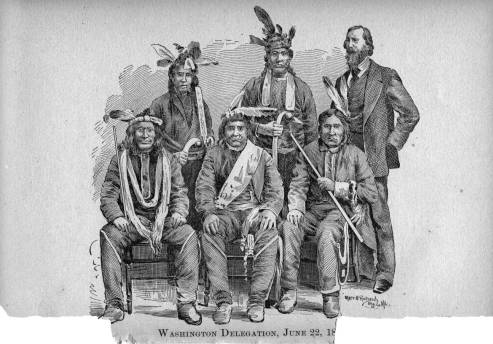
An engraving of the image in question appears in Armstrong’s Early Life Among the Indians.
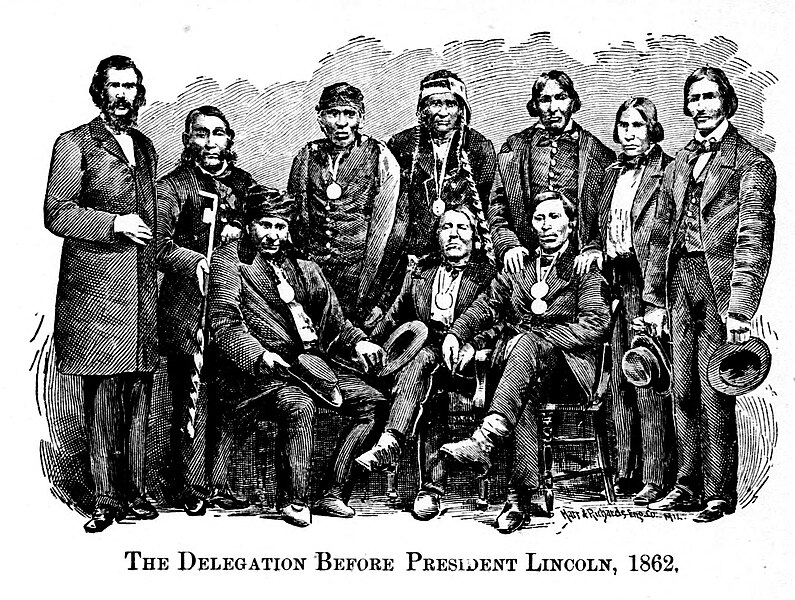
Ah-moose (Little Bee) from Lac Flambeau Reservation, Kish-ke-taw-ug (Cut Ear) from Bad River Reservation, Ba-quas (He Sews) from Lac Courte O’Rielles Reservation, Ah-do-ga-zik (Last Day) from Bad River Reservation, O-be-quot (Firm) from Fond du Lac Reservation, Sing-quak-onse (Little Pine) from La Pointe Reservation, Ja-ge-gwa-yo (Can’t Tell) from La Pointe Reservation, Na-gon-ab (He Sits Ahead) from Fond du Lac Reservation, and O-ma-shin-a-way (Messenger) from Bad River Reservation.
In this post, we contested these identifications on the grounds that Ja-ge-gwa-yo (Little Buffalo) from La Pointe Reservation died in 1860 and therefore could not have been part of the delegation to President Lincoln. In the comments on that post, readers from Michigan suggested that we had several other identities wrong, and that this was actually a group of chiefs from the Keweenaw region. We commented that we felt most of Armstrong’s identifications were correct, but that the picture was probably taken in 1856 in St. Paul.
Since then, a document has appeared that confirms Armstrong was right all along.
[Antoine Buffalo, Naagaanab, and six other chiefs to W.P. Dole, 6 March 1863
National Archives M234-393 slide 14
Transcribed by L. Filipczak 12 April 2024]
To Our Father,
Hon W P. Dole
Commissioner of Indian Affairs–
We the undersigned chiefs of the chippewas of Lake Superior, now present in Washington, do respectfully request that you will pay into the hands of our Agent L. E. Webb, the sum of Fifteen Hundred Dollars from any moneys found due us under the head of “Arrearages in Annuity” the said money to be expended in the purchase of useful articles to be taken by us to our people at home.
Antoine Buffalo His X Mark | A daw we ge zhig His X Mark
Naw gaw nab His X Mark | Obe quad His X Mark
Me zhe na way His X Mark | Aw ke wen zee His X Mark
Kish ke ta wag His X Mark | Aw monse His X Mark
I certify that I Interpreted the above to the chiefs and that the same was fully understood by them
Joseph Gurnoe
U.S. Interpreter
Witnessed the above Signed } BG Armstrong
Washington DC }
March 6th 1863 }
There were eight Lake Superior chiefs, an interpreter, and a witness in Washington that spring, for a total of ten people. There are ten people in the photograph. Chequamegon History is confident that this document confirms they are the exact ten identified by Benjamin Armstrong.
The Lac Courte Oreilles chief Ba-quas is the same person as Akiwenzii. It was not unusual for an Ojibwe chief to have more than one name. Chief Buffalo, Gaa-bimaabi, Zhingob the Younger, and Hole-in-the-Day the Younger are among the many examples.
The name “Sing-quak-onse (Little Pine) from La Pointe Reservation” seems to be absent from the letter, but he is there too. Let’s look at the signature of the interpreter, Joseph Gurnoe.

Gurnoe’s beautiful looping handwriting will be familiar to anyone who has studied the famous 1864 bilingual petition. We see this same handwriting in an 1879 census of Red Cliff. In this document, Gurnoe records his own Ojibwe name as Shingwākons, The young Pine tree.

So the man standing on the far right is Gurnoe. This can be confirmed by looking at other known photos of him.
Finally, it confirms that the chief seated on the bottom left is not Jechiikwii’o (Little Buffalo), but rather his son Antoine, who inherited the chieftainship of the Buffalo Band after the death of his father two years earlier. Known to history as Chief Antoine Buffalo, in his lifetime he was often called Antoine Tchetchigwaio (or variants thereof), using his father’s name as a surname rather than his grandfather’s.

So, now we need to address the elephant in the room that unites the Henry Inman portrait of Big Buffalo with the photograph of the 1862-63 Delegation to Washington:

Wisconsin Historical Society
This is the “ambrotype” referenced by Patrick Jackson above. It’s the image most associated with Chief Buffalo of La Pointe. It’s also one for which we have the least amount of background information. We have not been able to determine who the original photographer/painter was or when the image was created.
The resemblance to the portrait of “Big Buffalo” is undeniable.
However, if it is connected to the 1862-63 image of Chief Antoine Buffalo, it would support Hamilton Nelson Ross’s assertions on the Wisconsin Historical Society copy.
Clearly, multiple generations of the Buffalo family wore military jackets.
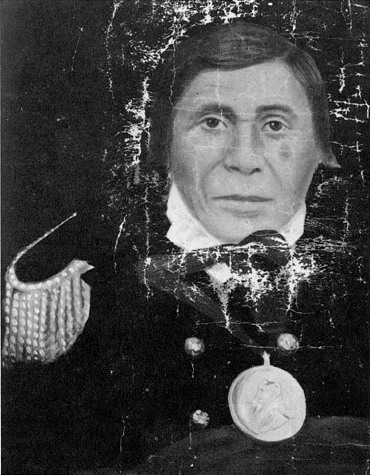
Inconclusive: uncertainty is no fun, but at this point Chequamegon History cannot determine which Chief Buffalo is in the ambrotype. However, the new evidence points more toward the grandfather (Great Buffalo) and grandson (Antoine) than it does to the son (Little Buffalo).
We will keep looking.
By Leo
In April, the Supreme Court heard arguments in the case Department of Commerce v. New York and could render a decision any day on whether or not the 2020 federal census should include a question asking about citizenship status. In January, a Federal District Court in New York ruled that commerce secretary, Wilbur Ross, violated the law by pushing for that question.
Those in agreement with the District ruling suggest that the Trump administration wants to add the question as a way of discouraging immigrants from participating in the census, thereby diminishing the political power of immigrant communities. This, they say, would violate the Constitution on the grounds that the census must be an “actual enumeration” of all persons within the United States, not only citizens.
Proponents of the citizenship question counter that citizenship status is a perfectly natural question to ask in the census, that any government would want to know how many citizens it has, and that several past iterations of the 10-year count have included similar questions.
It remains to be seen how the Supreme Court will rule, but chances are it will not be the last time an issue of race, identity, or citizenship pops up in the politics of the census. From its creation by the Constitution as a way to apportion seats in congress according to populations of the states, the count has always begged tricky questions that essentially boil down to:
Who is a real American? Who isn’t? Who is a citizen? Who is three-fifths of a human being? Who might not be human at all? What does it mean to be White? To be Colored? To be civilized? How do you classify the myriad of human backgrounds, cultures and stories into finite, discrete “races?”
The Civil War and Fourteenth Amendment helped shed light on some of these questions, but it would be a mistake to think that they belong to the past. The NPR podcast Codeswitch has done an excellent series on census, and this episode from last August gives a broad overview of the history.
Here at Chequamegon History, though, we aren’t in the business broad overviews. We are going to drill down right into the data. We’ll comb through the 1850 federal census for La Pointe County and compare it with the 1860 data for La Pointe and Ashland Counties. Just for fun, we’ll compare both with the 1855 Wisconsin State Census for La Pointe County, then double back to the 1840 federal census for western St. Croix County. Ultimately, the hope is to help reveal how the population of the Chequamegon region viewed itself, and ultimately how that differed from mainstream America’s view. With luck, that will give us a framework for more stories like Amorin’s recent post on the killing of Louis Gurnoe.
Background
 Judge Daniel Harris Johnson of Prairie du Chien had no apparent connection to Lake Superior when he was appointed to travel northward to conduct the census for La Pointe County in 1850. The event made an impression on him. It gets a mention in his short memorial biography in the 1902 Proceedings of the State Bar Association.
Two years after statehood, Lake Superior’s connection to the rest of Wisconsin was hardly existent. This was long before Highways 51 and 53 were built, and commerce still flowed west to east. Any communication to or from Madison was likely to first go through Michigan via Mackinaw and Sault Ste. Marie, or through Minnesota Territory via St. Paul, Stillwater, and Sandy Lake. La Pointe County had been created in 1845, and when official business had to happen, a motley assortment of local residents who could read and write English: Charles Oakes, John W. Bell, Antoine Gordon, Alexis Carpentier, Julius Austrian, Leonard Wheeler, etc. would meet to conduct the business.
It is unclear how much notice the majority Ojibwe and French-patois speaking population took of this or of the census generally. To them, the familiar institutions of American power, the Fur Company and the Indian Agency, were falling apart at La Pointe and reorganizing in St. Paul with dire consequences for the people of Chequamegon. When Johnson arrived in September, the Ojibwe people of Wisconsin had already been ordered to remove to Sandy Lake in Minnesota Territory for their promised annual payments for the sale of their land. That fall, the government would completely botch the payment, and by February, hundreds of people in the Lake Superior Bands would be dead from starvation and disease.
So, Daniel Johnson probably found a great deal of distraction and anxiety among the people he was charged to count. Indians, thought of by the United States as uncivilized federal wards and citizens of their own nations, were typically not enumerated. However, as I wrote about in my last post, race and identity were complicated at La Pointe, and the American citizens of the Chequamegon region also had plenty to lose from the removal.
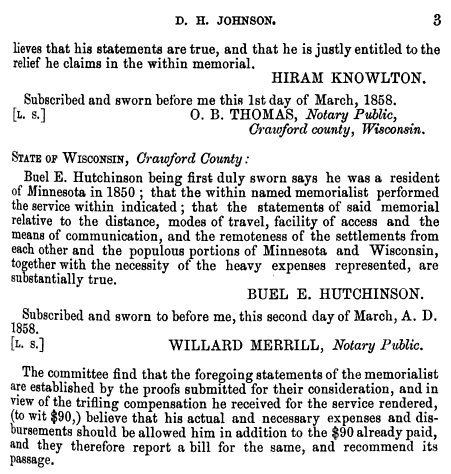
Madison, for its part, largely ignored this remote, northern constituency and praised the efforts to remove the Ojibwe from the state. It isn’t clear how much Johnson was paying attention to these larger politics, however. He had his own concerns:


House Documents, Volume 119, Part 1. U.S. Government Printing Office, 1859. Google Books.
So, in “that thinly settled and half civilized region,” Johnson only found a population of about 500, “exclusive of Indians.” He didn’t think 500 was a lot, but by some counts, that number would have seemed very high. Take the word of a European visitor to La Pointe:
Among 200 Indians, only a few white families live there. One of the boatmen gave us a name, with which we found Mr. Austrian.
And, from this Mr. Austrian, himself:
There were only about 6 white American inhabitants on the Island, about 50 Canadian Frenchmen who were married to squaws, and a number of full blooded Indians, among whom was chief Buffalo who was a descendant of chiefs & who was a good Indian and favorably regarded by the people.
~Joseph Austrian, Brother of Julius and La Pointe resident 1851-52
Who lived around La Pointe in 1850?
In her biography, William W. Warren: the Life, Letters, and Times of an Ojibwe Leader, Theresa Schenck describes the short life of an ambitious young man from La Pointe. William Whipple Warren (1825-1853) grew up on the Island speaking Ojibwe as his first language. His father was a Yankee fur trader from New York. His mother was a daughter of Michel and Madeline Cadotte. In his famous History of the Ojibways Warren describes the Ojibwe as people with whom he readily claims kinship, but he doesn’t write as if he is an Ojibwe person himself. However, he helped interpret the Treaty of 1847 which had definitively made him an Indian in the eyes of the United States (a fact he was willing to use for economic gain). Still, a few years later, when he became a legislator in Minnesota Territory he dismissed challenges to his claims of whiteness.
If he were alive today, Warren might get a chuckle out of this line from the South African comedian Trevor Noah.
People mocked me. Gave me names like mixed breed, half caste — I hate that term ‘half’. Why half? Why not double? Or twice as nice, I don’t know.
— Trevor Noah
William Warren did not see himself as quite the walking contradiction we might see him as today. He was a product of the time and place he came from: La Pointe. By 1850, he had left that place, but his sister and a few hundred of his cousins still lived there. Many of them were counted in the census.
What is Metis?
Half-breeds, Mixed-bloods, Frenchmen, Wiisakodewininiwag, Mitif, Creoles, Metis, Canadiens, Bois Brules, Chicots, French-of-the-country, etc.–at times it seems each of these means the same thing. At other times each has a specific meaning. Each is ambiguous in its own way. In 1850, roughly half the families in the Chequamegon area fit into this hard-to-define category.


Kohl, J. G. Kitchi-Gami: Wanderings around Lake Superior. London: Chapman and Hall, 1860. pg. 260-61.
We were accompanied on our trip throughout the lakes of western Canada by half-Indians who had paternal European blood in their veins. Yet so often, a situation would allow us to spend a night inside rather than outdoors, but they always asked us to choose to Irish camp outside with the Indians, who lived at the various places. Although one spoke excellent English, and they were drawn more to the great American race, they thought, felt, and spoke—Indian! ~Carl Scherzer
In describing William Warren’s people, Dr. Schenck writes,
Although the most common term for people of mixed Indian and European ancestry in the nineteenth century was “half-breed,” the term “mixed blood” was also used. I have chosen to use the latter term, which is considered less offensive, although biologically inaccurate, today. The term “métis” was not in usage at the time, except to refer to a specific group of people of mixed ancestry in the British territories to the north. “Wissakodewinini,” the word used by the Ojibwe, meant “burned forest men,” or bois brulés in French, so called because half-breeds were like the wood of a burned forest, which is often burned on one side, and light on the other (pg. xv).
Schenck is correct in pointing out that mixed-blood was far more commonly used in 19th-century sources than Metis (though the latter term did exist). She is also correct in saying that the term is more associated with Canada and the Red River Country. There is an additional problem with Metis, in that 21st-century members of the Wannabe Tribe have latched onto the term and use it, incorrectly, to refer to anyone with partial Native ancestry but with no affiliation to a specific Indian community.
That said, I am going to use Metis for two reasons. The first is that although blood (i.e. genetic ancestry) seemed to be ubiquitous topic of conversation in these communities, I don’t think “blood” is what necessarily what defined them. The “pure-blooded French Voyageur” described above by Kohl clearly saw himself as part of Metis, rather than “blanc” society. There were also people of fully-Ojibwe ancestry who were associated more with Metis society than with traditional Ojibwe society (see my post from April). As such, I find Metis the more versatile and accurate term, given that it means “mixed,” which can be just as applicable to a culture and lifestyle as it is to a genetic lineage.
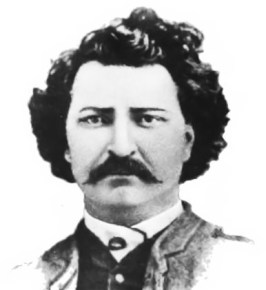
One time Canadian pariah turned national hero, Louis Riel and his followers had cousins at La Pointe (Photo: Wikipedia)
The second reason I prefer Metis is precisely because of the way it’s used in Manitoba. Analogous to the mestizo nations of Latin America, Metis is not a way of describing any person with Native and white ancestry. The Metis consider themselves a creole-indigenous nation unto themselves, with a unique culture and history. This history, already two centuries old by 1850, represents more than simply a borrowed blend of two other histories. Finally, the fur-trade families of Red River came from Sault Ste. Marie, Mackinac, Grand Portage, and La Pointe. There were plenty of Cadottes, Defaults, Roys, Gurnoes, and Gauthiers among them. There was even a Riel family at La Pointe. They were the same nation
Metis and Ojibwe Identity in the American Era
When the 1847 Treaty of Fond du Lac “stipulated that the half or mixed bloods of the Chippewas residing with them shall be considered Chippewa Indians, and shall, as such, be allowed to participate in all annuities which shall hereafter be paid…” in many ways, it contradicted two centuries of tradition. Metis identity, in part, was dependent on not being Indian. They were a minority culture within a larger traditional Anishinaabe society. This isn’t to say that Metis people were necessarily ashamed of their Native ancestors–expressions of pride are much easier to find than expressions shame–they were just a distinct people. This was supposedly based in religion and language, but I would argue it came mostly from paternal lineage (originating from highly-patriarchal French and Ojibwe societies) and with the nature of men’s work. For women, the distinction between Ojibwe and Metis was less stark.
The imposition of American hegemony over the Chequamegon region was gradual. With few exceptions, the Americans who came into the region from 1820 to 1850 were adult men. If new settlers wanted families, they followed the lead of American and British traders and married Metis and Ojibwe women.
Still, American society on the whole did not have a lot of room for the racial ambiguity present in Mexico or even Canada. A person was “white” or “colored.” Race mixing was seen as a problem that affected particular individuals. It was certainly not the basis for an entire nation. In this binary, if Metis people weren’t going to be Indian, they had to be white.
The story of the Metis and American citizenship is complicated and well-studied. There is risk of overgeneralizing, but let’s suffice to say that in relation to the United States government, Metis people did feel largely entitled to the privileges of citizenship (synonymous with whiteness until 1865), as well as to the privileges of Ojibwe citizenship. There wasn’t necessarily a contradiction.
Whatever qualms white America might have had if they’d known about it, Metis people voted in American elections, held offices, and were counted by the census.
Ojibwe “Full-bloods” and the United States Census
Representatives and direct Taxes shall be apportioned among the several States which
may be included within this Union, according to their respective Numbers, which shall be determined by adding to the whole Number of free Persons, including those bound to Service for a Term of Years, and excluding Indians not taxed, three fifths of all other Persons. The actual Enumeration shall be made within three Years after the first Meeting of the Congress of the United States, and within every subsequent Term of ten Years, in such Manner as they shall by Law direct.~Excerpt from Article I Section II, U. S. Constitution
As I argued in the April post, our modern conception of “full-blood” and “mixed-blood” has been shaped by the “scientific” racism of the late 19th and early 20th centuries. The distinction, while very real in a cultural sense, was not well-grounded in biology.
The relationship of Indians (i.e. full-bloods or those living a traditional lifestyle) to American society and citizenship was possibly more contradictory then that of the Metis. In one sense, America saw Indians as foreigners on their own continent: either as enemies to be exterminated, or as domestic-dependent ward nations to be “protected.” The constitutional language about the census calls for slaves to be counted as three-fifths of a person. It says Indians shouldn’t be counted at all.
In another sense, however, the path to personhood in America was somewhat clearer for Indians than it was for African Americans. Many New England liberals saw exodus to Liberia as the only viable future for free blacks. These same voices felt that Indians could be made white if only they were separated from their religions, cultures, and tribal identities. In 1834, to avoid a second removal, the Brothertown Indians of Wisconsin petitioned congress for citizenship and the termination of collective title to their tribal lands. In 1839, their request was granted. In the eyes of the law, they had effectively become white. Other communities would follow suit. However, most Native people did not gain any form of American citizenship until 1924.
How did that play out for the Ojibwe people of Chequamegon, and how did it impact the 1850 census? Well, it’s complicated.
Race, the Census, and Classifying Households
The enumeration forms Daniel H. Johnson carried to La Pointe had more rows and columns than ever. The Seventh Census was the first to count everyone in the household by name (previous versions only listed the Head of Household with tally marks). It was also the first census to have a box for “color.” Johnson’s choices for color were “white,” “black,” and “mulatto,” forcing him to make some decisions.
He seems to have tried to follow the Indians not taxed clause strictly. 40-50% of households in the region were headed by a full-blood Ojibwe person, possibly only two of them were enumerated. You won’t find Chief Buffalo, Makadebinesi (Blackbird), Oshkinaawe, Omizhinaawe, Edawegiizhig, and their immediate families in the 1850 census. Jechiikwii’o (often called Little Buffalo) is not in the document, even though he was an early Catholic convert, dressed in “white” clothing, and counted more Metis Ojibwe among his followers than full-bloods. However, his son, Antoine Buffalo Sr. (Antoine Jachequaon) is counted. Antoine, along with George Day, were counted as white heads of household by the census, though it is unclear if they had any European ancestry (Sources conflict. If anyone has genealogical information for the Buffalo and Day families, feel free to comment on the post). A handful of individuals called full-bloods in other sources, were listed as white. This includes 90-year old Madeline Cadotte, Marie Bosquet, and possibly the Wind sisters (presumably descendants of Noodin, one of the St. Croix chiefs who became Catholic and relocated to La Pointe around this time). They were married to Metis men or lived in Metis households. All Metis were listed as white.
Johnson did invent new category for five other Ojibwe people: “Civilized Indian,” which he seemed to use arbitrarily. Though also living in Metis households, Mary Ann Cadotte, Osquequa Baszina, Marcheoniquidoque, Charlotte Houle, and Charles Loonsfoot apparently couldn’t be marked white the way Madeline Cadotte was. These extra notations by Johnson and other enumeration marshals across the country are why the Seventh Federal Census is sometimes referred to as the first to count Native Americans.

So, out of 470 individuals enumerated at La Pointe and Bad River (I’ve excluded Fond du Lac from my study) Johnson listed 465 (99%) as white. By no definition, contemporary or modern, was the Chequamegon area 99% white in 1850. The vast majority of names on the lines had Ojibwe ancestry, and as Chippewas of Lake Superior, were receiving annuities from the treaties.
There were a few white American settlers. The Halls had been at La Pointe for twenty years. The Wheelers were well-established at Odanah. Junius and Jane Welton had arrived by then. George Nettleton was there, living with a fellow Ohioan James Cadwell. The infamous Indian agent, John Watrous, was there preparing the disastrous Sandy Lake removal. Less easy to describe as American settlers, but clearly of European origins, Fr. Otto Skolla was the Catholic priest, and Julius Austrian was the richest man it town.
There were also a handful of American bachelors who had drifted into the region and married Metis women. These first-wave settlers included government workers like William VanTassel, entrepreneurs like Peter VanderVenter, adventurers with an early connection to the region like Bob Boyd and John Bell, and homesteaders like Ervin Leihy.
It is unclear how many of French-surnamed heads of household were Chicots (of mixed ancestry) and how many were Canadiens (of fully-French ancestry). My sense is that it is about half and half. Some of this can be inferred from birthplace (though a birthplace of Canada could indicate across the river at Sault Ste. Marie as easily it could a farm in the St. Lawrence Valley). Intense genealogical study of each family might provide some clarifications, but I am going to follow Kohl’s voyageurs and not worry too much about it. Whether it was important or not to Jean Baptiste Denomie and Alexis Carpentier that they had no apparent Indian ancestry and that they had come from “the true homeland” of Quebec, for all intents and purposes they had spent their whole adult lives in “the Upper Country,” and their families were “of the Country.” They were Catholic and spoke a form of French that wasn’t taught in the universities. American society would not see them as white in the way it saw someone like Sherman Hall as white.
So, by my reckoning, 435 of the 470 people counted at La Pointe (92.5%) were Metis, full-blood Ojibwe living in Metis households, or Canadians in Metis families. Adding the five “Civilized Indians” and the six Americans married into Metis families, the number rises to 95%. I am trying to track down accurate data on the of Indians not taxed (i.e. non-enumerated full-bloods) living at or near La Pointe/Bad River at this time. My best estimates would put it roughly the same as the number of Metis. So, when Johnson describes a land with a language and culture foreign to English-speaking Americans, he’s right.
Birthplace, Age, and Gender
Ethnic composition is not the only data worth looking at if we want to know what this area was like 169 years ago. The numbers both challenge and confirm assumptions of how things worked.
Let’s take mobility for example:

The young voyageur quoted by Kohl may have felt like he didn’t have a home other than en voyage, but 86% of respondents reported being born in Wisconsin. Except for ten missionary children, all of these were Metis or “Civilized Indian.” Wisconsin could theoretically mean Lac du Flambeau, Rice Lake, or even Green Bay, this but this number still seemed high to me. I’m guessing more than 14% of 21st-century Chequamegon residents were born outside the state, and 19th-century records are all about commerce, long-distance travel, and new arrivals in new lands. We have to remember that most of those records are coming from that 14%.
In September of 1850 the federal government was telling the Ojibwe of Wisconsin they needed to leave Wisconsin forever. How the Metis fit into the story of the Sandy Lake Tragedy has always been somewhat fuzzy, but this data would indicate that for a clear majority, it meant a serious uprooting.
For those born outside Wisconsin, more than two-thirds reported being born in Michigan, Canada, or Minnesota Territory. These are overwhelmingly Metis or in the case of Anglo-Canadians like Robert Morrin, heads of Metis households from areas with a fur-trade tradition. Only eighteen individuals reported being born in the eastern United States. Only three reported Europe.
I had more questions than assumptions about the gender and age breakdown of the population. Would there be more women than men because of the dangerous jobs done by men or would mortality from childbirth balance that out? Or maybe widows wouldn’t be counted if they returned to the wigwams of their mothers? How would newcomers skew the age and gender demographics of the area?
Let’s take a look:
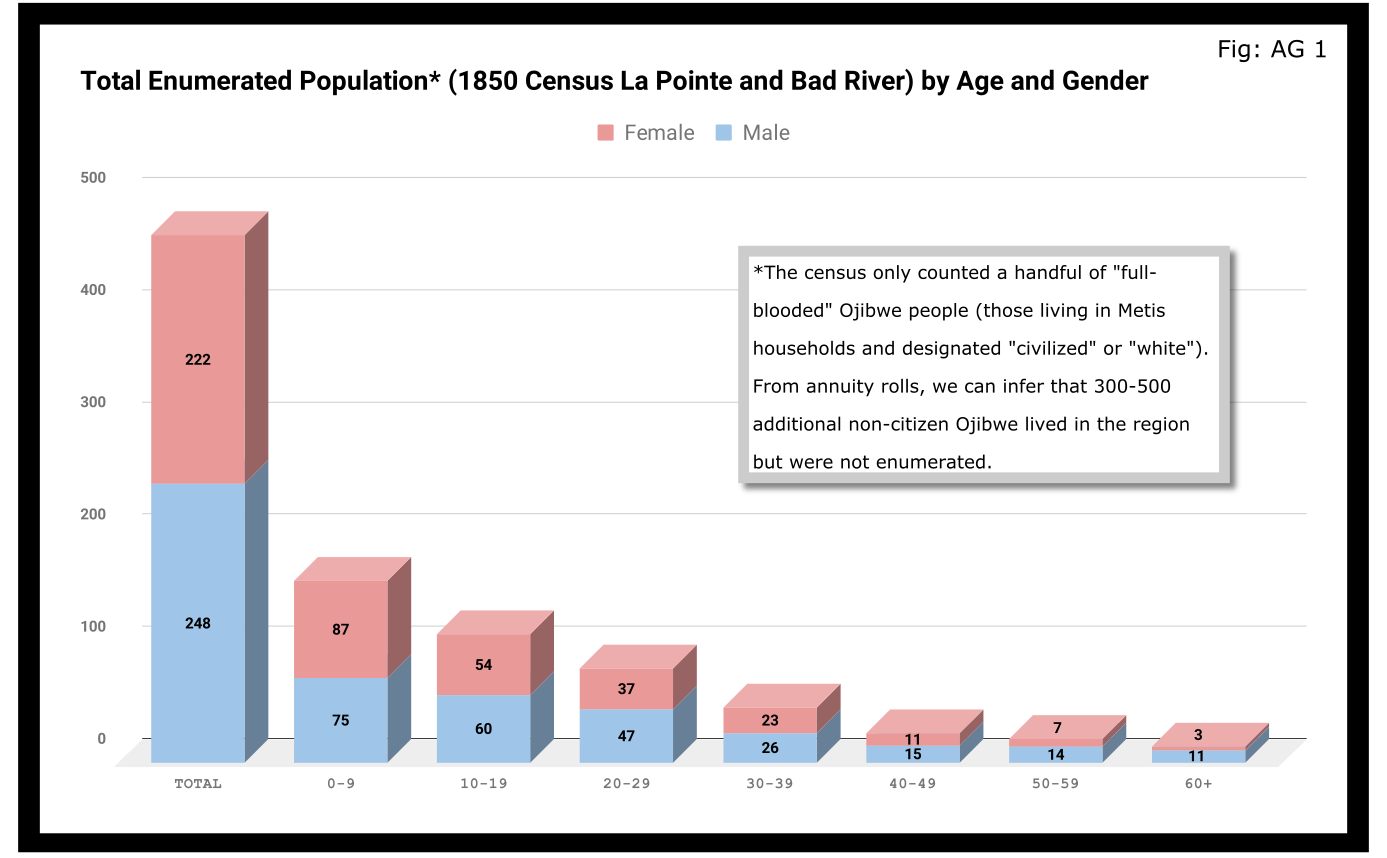
A quick glance at Figure AG 1 shows that the population skewed male 248-222 and skewed very young (61% under 20 years old). On the eve of Sandy Lake, the natural increase in the population seemed to be booming.

The hypotheses that women had higher mortality rates and were more likely to be undercounted looked good until we limit the data to the Wisconsin-born population. In Figure AG 2, we see that the male majority disappears entirely. The youthful trend, indicating large families and a growing population, continues with 66% of the Wisconsin-born population being under 20.

The male skew of the total population was entirely due to those born outside Wisconsin. This is not surprising given how much we’ve emphasized the number of men who came into the Lake Superior country to marry local women.
A look at the oldest residents in chart AG 2 and AG 3 hints at another story. Madeline Cadotte is the only Wisconsin-born person over seventy to be counted. The oldest men all came from Michigan and Canada. Why? My hypothesis is that between the fall of New France in 1759 and the establishment of Michel Cadotte’s post sometime around 1800, there wasn’t a large population or a very active fur trade around La Pointe proper. That meant Cadotte’s widow and other full bloods were the oldest locally-born residents in 1850. Their Metis contemporaries didn’t come over from the Soo or down from Grand Portage until 1810 or later.
Economics
Before the treaties, the economy of this area was built on two industries: foraging and trade. Life for Ojibwe people revolved around the seasonal harvest of fish, wild rice, game, maple sugar, light agriculture, and other forms of gathering food directly from the land. Trade did not start with the French, and even after the arrival of European goods into the region, the primary purpose of trade seemed to be for cementing alliances and for the acquisition of luxury goods and sacred objects. Richard White, Theresa Schenck, and Howard Paap have all challenged the myth of Ojibwe “dependence” on European goods for basic survival, and I find their arguments persuasive.
Trade, though, was the most important industry for Metis men and La Pointe was a center of this activity. The mid-19th century saw a steep decline in trade, however, to be replaced by a toxic cycle of debts, land sales, and annuity payments. The effects of this change on the Metis economy and society seem largely understudied. The fur trade though, was on its last legs. Again, the Austrian travel writer Carl Scherzer, who visited La Pointe in 1852:
After this discussion of the of the rates of the American Fur Company and its agents, we want to add some details about the men whose labor and time exerted such a great influence on the fate and culture of the Indian tribes. We wish to add a few explanatory words about the sad presence on La Pointe of the voyageurs or courriers du bois.
This peculiar class of people, which is like a vein of metal that suddenly disappears within the bedrock and reappears many hundreds of miles away under the same geological conditions, their light reaches the borders of the eastern Canadas. The British people, with their religion and customs, reappeared on the shores of these northern lakes only in 1808 with the Fur Company. For labor they drew on those who could carry their wares across the lakes and communicate with the Indians.
Many young men of adventurous natures left the old wide streets of Montreal and moved into the trackless primeval forests of the West. Young and strong as laborers, they soon started to adopt the lifestyle and language of the aborigines. They married with the Indians and inhabit small settlements scattered throughout those mighty lands which begin at Mackinow Island and come up the upper lake to the region of Minnesota. They almost all speak the Canadian patois along with the language of the Chippewas, the tribe with which they came into kinship. We found only a few, even among the younger generation, who understood English.
Since then, every day the population of the otherwise deserted shore of Lake Superior increases with the discovery of copper mines. The animals driven away by the whirlwind of civilization toward the west, attract the Indians with their sensitive guns, leaving La Pointe, abandoned by the Company for their headquarters at St. Paul in Minnesota. Most voyageurs left the island, having seen their business in ruins and lacking their former importance. Just a few families remain here, making a meager livelihood of hunting, fishing, and the occasional convoy of a few travelers led by business, science, or love of nature who purchase their limited resources.
From Scherzer’s description, two things are clear. It’s pretty clear from the flowery language of the Viennese visitor.Washington Irving and other Romantic-Era authors had already made the Voyageur into the stock stereotypical character we all know today. Th only change, though, is these days voyageurs are often depicted as representatives of white culture, but that’s a post for another time.
The second item, more pertinent to this post, is that a lot of voyageurs were out of work. This is especially relevant when we look at our census data. Daniel Johnson recorded the occupations of all males fifteen or over:
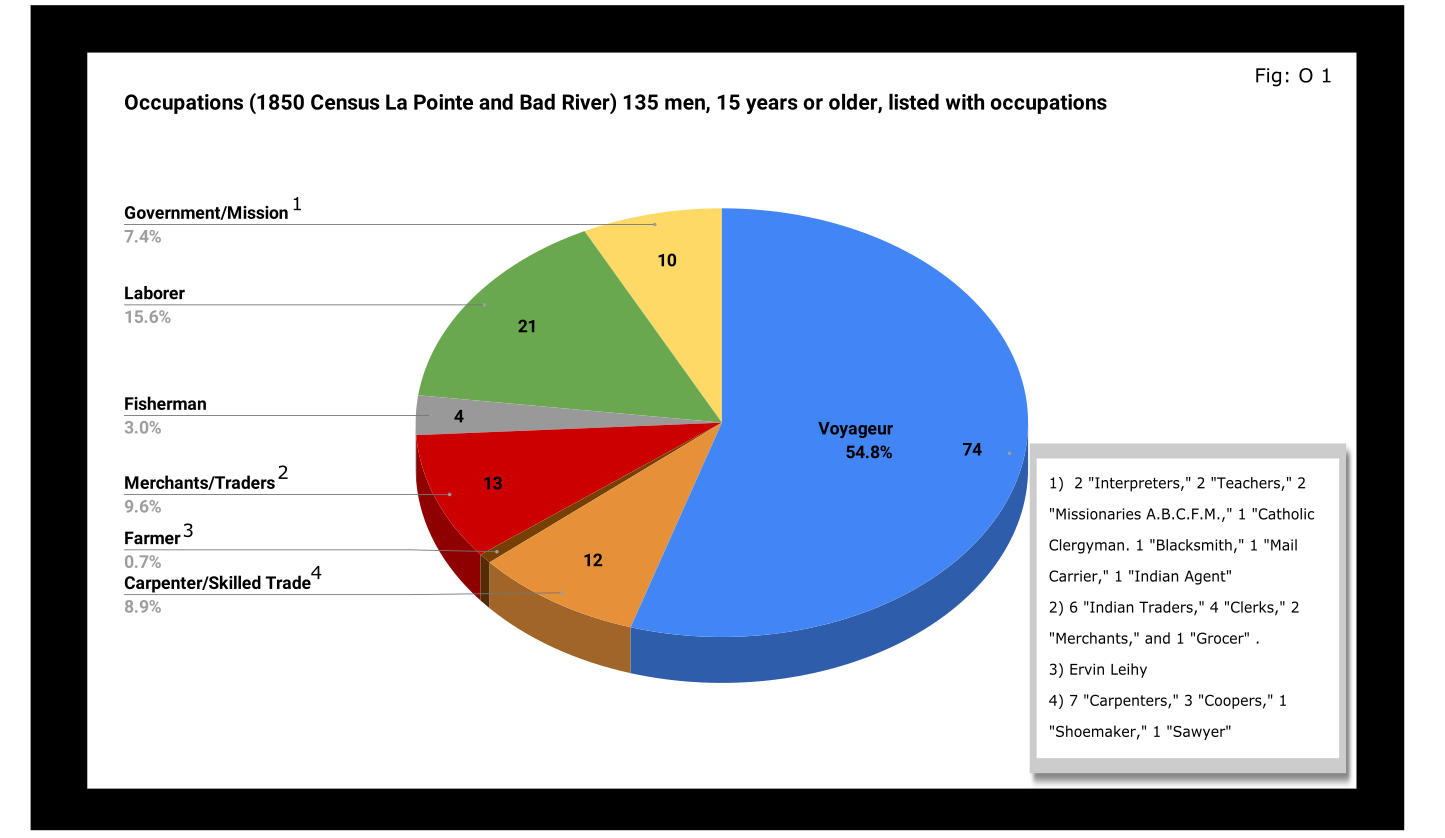
A full 55% of enumerated men fifteen and older still identified themselves as voyageurs in 1850. This included teenagers as well as senior citizens. All were from Metis households, though aside from farmer, all of the other occupation categories in Figure O 1 included Metis people.

A look at household sizes did not show voyageurs having to support significantly larger or smaller families when compared to the other occupation categories.
The other piece of economic data collected was value of real estate. Here we see some interesting themes:

If real estate is a good proxy for wealth in a farming community, it is an imperfect one in the Chequamegon area of 1850. If a voyageur had no home but the river and portage, then we might not expect him to put his coin into land and buildings. A teacher or Indian agent might draw a consistent salary but then live in supplied housing before moving on. With that caveat, let’s dig into the data.
Excluding the single farmer, men in the merchant/trader group controlled the most wealth in real estate, with Julius Austrian controlling as much as the other merchants combined. Behind them were carpenters and men with specific trades like cooper or shoemaker. Those who reported their occupation generally as “laborer” were not far behind the tradesmen. I suspect their real estate holdings may be larger and less varied than expected because of the number of sons and close relatives of Michel Cadotte Sr. who identified themselves as laborers. Government and mission employees held relatively little real estate, but the institutions they represented certainly weren’t lacking in land or power. Voyageurs come in seventh, just behind widows and ahead of fishermen of which there were only four in each category.
It is interesting, though, that the second and third richest men (by real estate) were both voyageurs, and voyageur shows a much wider range of households than some of the other categories: laborers in particular. With the number of teenagers calling themselves voyageurs, I suspect that the job still had more social prestige attached to it, in 1850, than say farmer or carpenter.
With hindsight we know that after 1854, voyageurs would be encouraged to take up farming and commercial fishing. It is striking, however, how small these industries were in 1850. Despite the American Fur Company’s efforts to push its Metis employees into commercial fishing in the 1830s, and knowing how many of the family names in Figure O 3 are associated with the industry, commercial fishing seemed neither popular nor lucrative in 1850. I do suspect, however, that the line between commercial and subsistence fishing was less defined in those days and that fishing in general was seen as falling back on the Indian gathering lifestyle. It wouldn’t be surprised if all these families were fishing alongside their Ojibwe relatives but didn’t really see fishing (or sugaring, etc.) as an occupation in the American sense.
Finally, it could not have escaped the voyageurs notice that while they were struggling, their former employers and their employers educated sons were doing pretty well. They also would have noticed that it was less and less from furs. Lump annuity payments for Ojibwe land sales brought large amounts of cash into the economy one day a year. It must have felt like piranhas with blood in the water. Alongside their full-blood cousins, Metis Ojibwe received these payments after 1847, but they had more of a history with money and capitalism. Whether to identify with the piranha or the prey would have depended on all sorts of decisions, opportunities and circumstances.
Education and Literacy
The census also collected data on education and literacy, asking whether children had attended school within the year, and whether adults over twenty could read and write. The history of white education efforts in this area are fairly well documented. The local schools in 1850 were run by the American Board of Commissioners of Foreign Missions (A.B.C.F.M.) at the La Pointe and Odanah missions, and an entire generation had come of age at La Pointe in the years since Rev. Sherman Hall first taught out of Lyman Warren’s storehouse in 1831. These Protestant ministers and teachers railed against the papists and heathens in their writings, but most of their students were Catholic or traditional Ojibwe in religion. Interestingly, much of the instruction was done in the Ojibwe language. Unfortunately, however, the census does not indicate the language an individual is literate in. I highly recommend The Ojibwe Journals of Edmund F. Ely, 1833-1849 if you are interested in these topics.
To start with, though, let’s look at how many people were going to school:

Thirty-nine students had gone to school in the previous year. There is a lot of sample-size noise in the data, but it seems like ages 7-11 (what we would call the upper-elementary years) were the prime years to attend school.
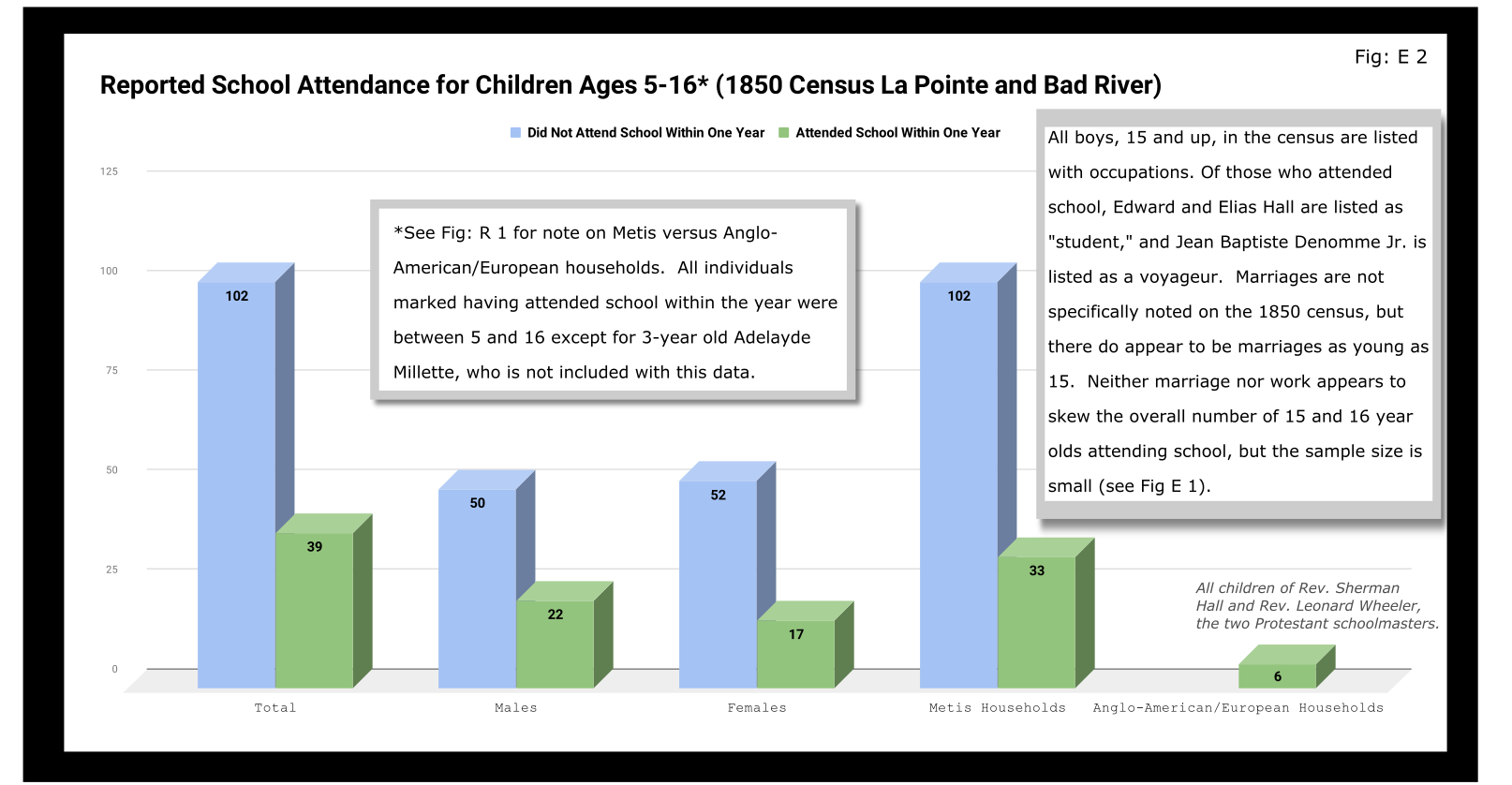
Overall, most children had not attended school within the year. Attendance rates were slightly higher for boys than for girls. White children, all from two missionary families, had a 100% attendance rate compared to 24% for the Metis and “Civilized Indian” children.
We should remember, however, that not attending school within the year is not the same as having never attended school. Twelve-year-old Eliza Morrin (later Morrison) is among the number that didn’t attend school, but she was educated enough to write her memoirs in English, which was her second language. They were published in 2002 as A Little History of My Forest Life, a fascinating account of Metis life in the decades following 1854.
Eliza’s parents were among the La Pointe adults who could read and write. Her aunt, uncle, and adult cousins in the neighboring Bosquet (Buskey) house were not. Overall, just over half of adults over 20 were illiterate without a significant gender imbalance. Splitting by birthplace, however, shows the literacy rate for Wisconsin-born (i.e. Metis and “Civilized Indian”) was only 30%, down from the overall male literacy rate of 48%. For Wisconsin-born women, the drop is only three points, from 47% to 44%. This suggests Metis women were learning to read while their husbands and brothers (perhaps en voyage) were not.

And this is exactly what the data say when we split by occupation. The literacy rate for voyageurs was only 13%. This beats fisherman–all four were illiterate–but lagged far behind all other types of work.
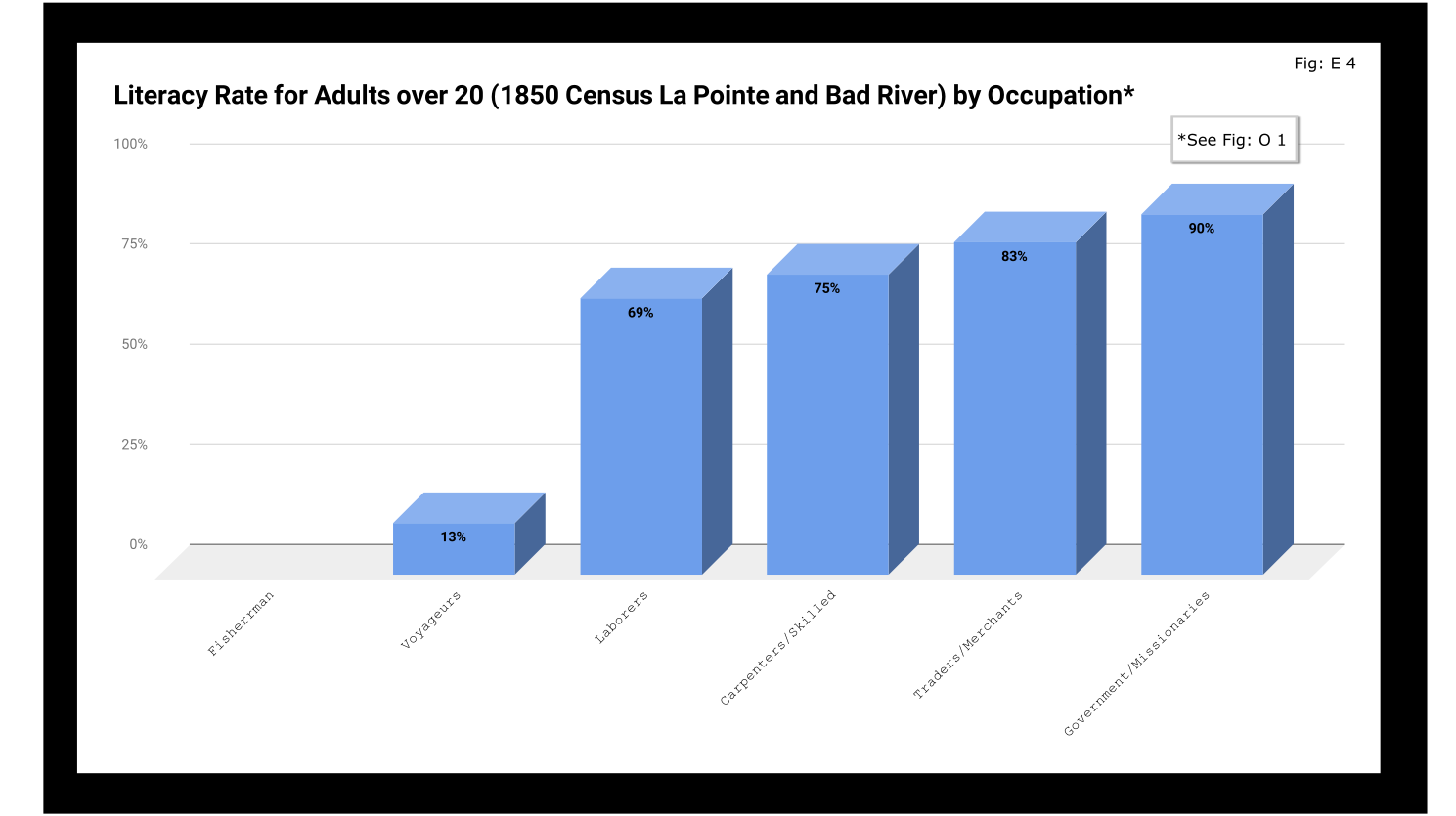
If education was going to be a factor in the economic mobility of unemployed voyageurs, the trends weren’t looking good.
Odds and Ends
Two marriages were reported as occurring in the year previous to the census: Peter and Caroline Vanderventer and Pierre and Marguerite Robideaux (ak.a. Peter and Margaret Rabideaux). Though married, however, Caroline was not living with her husband, a 32-year old grocer from New York. She (along with their infant daughter) was still in the home of her parents Benjamin and Margaret Moreau (Morrow). The Vanderventers eventually built a home together and went on to have several more children. It appears their grandson George Vanderventer married Julia Rabideaux, the granddaughter of Peter and Margaret.
I say appears in the case of George and Julia, because Metis genealogy can be tricky. It requires lots of double and triple checking. Here’s what I came across when I once tried to find an unidentified voyageur known only as Baptiste:

Sometimes it feels like for every Souverain Denis or Argapit Archambeau, there are at least 15 Jean-Baptiste Cadottes, 12 Charles Bresettes, 10 Francois Belangers and 8 Joseph DeFoes. Those old Canadian names had a way of persisting through the generations. If you were a voyageur at La Pointe in 1850, there was nearly a 30% chance your name was Jean-Baptiste. To your friends you might be John-Baptist, Shabadis, John, JB, or Battisens, and you might be called something else entirely when the census taker came around.
The final column on Daniel Johnson’s census asked whether the enumerated person was “deaf and dumb, blind, insane, idiotic, pauper, or convict.” 20 year-old Isabella Tremble, living in the household of Charles Oakes, received the unfortunate designation of idiotic. 26-year-old Francois DeCouteau did not have a mark in that column, but had “Invalid” entered in for his occupation. It’s fair to say we’ve made some progress in the treatment of people with disabilities.
Final Thoughts
I am not usually a numbers person when it comes to history. I’ll always prefer a good narrative story, to charts, tables, and cold numbers. Sometimes, though, the numbers help tell the story. They can help us understand why when Louis Gurnoe was killed, no one was held accountable. At the very least, they can help show us that the society he lived in was under significant stress, that the once-prestigious occupation of his forefathers would no longer sustain a family, and that the new American power structure didn’t really understand or care who his people were.
Ultimately, the census is about America describes itself. From the very beginning, it’s never been entirely clear if in E. pluribus unum we should emphasize the pluribus or the unum. We struggled with that in 1850, and we still struggle today. To follow the Department of Commerce v. New York citizenship case, I recommend Scotusblog. For more census posts about this area in the 19th century, keep following Chequamegon History.
Sources, Data, and Further Reading
-
Paap, Howard D. Red Cliff, Wisconsin a History of an Ojibwe Community ; Volume 1 The Earliest Years: the Origin to 1854. North Star Press of St. Cloud, Inc., 1854.
-
Satz, Ronald N. Chippewa Treaty Rights: the Reserved Rights of Wisconsin’s Chippewa Indians in Historical Perspective. University of Wisconsin Press, 1997.
-
Original Census Act of May 23, 1850 (includes form and instructions for marshals). (PDF)
-
Compiled data spreadsheets (Google Drive Folder) I’ll make these a lot more user friendly in future census posts. By the time it occurred to me that I should include my tables in this post, most of them were already done in tally marks on scrap paper.
-
Finally, these are the original pages, scanned from microfilm by FamilySearch.com. I included the image for Fond du Lac (presumably those living on the Wisconsin side of the St. Louis River) even though I did not include it in any of the data above.
-

- Bad River
-
- Fond du Lac (not included in above data)





Error Correction: Photo Mystery Still Unsolved
April 27, 2014
This post is outdated. We’ll leave it up, but for the latest research, see Chief Buffalo Picture Search: Coda

According to Benjamin Armstrong, the men in this photo are (back row L to R) Armstrong, Aamoons, Giishkitawag, Ba-quas (identified from other photos as Akiwenzii), Edawi-giizhig, O-be-quot, Zhingwaakoons, (front row L to R) Jechiikwii’o, Naaganab, and Omizhinawe in an 1862 delegation to President Lincoln. However, Jechiikwii’o (Jayjigwyong) died in 1860.
In the Photos, Photos, Photos post of February 10th, I announced a breakthrough in the Great Chief Buffalo Picture Search. It concerned this well-known image of “Chief Buffalo.”

(Wisconsin Historical Society)
The image, long identified with Gichi-weshkii, also called Bizhiki or Buffalo, the famous La Pointe Ojibwe chief who died in 1855, has also been linked to the great chief’s son and grandson. In the February post, I used Benjamin Armstrong’s description of the following photo to conclude that the man seated on the left in this group photograph was in fact the man in the portrait. That man was identified as Jechiikwii’o, the oldest son of Chief Buffalo (a chief in his own right who was often referred to as Young Buffalo).
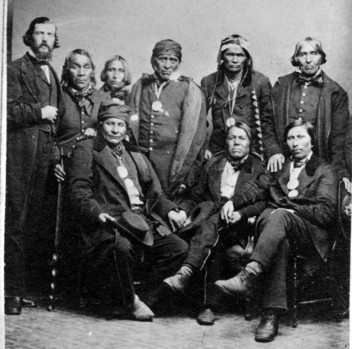
Another error in the February post is the claim that this photo was modified for and engraving in Armstrong’s book, Early Life Among the Indians. In fact, the engraving is derived from a very similar photo seen at the top of this post (Minnesota Historical Society).

(Marr & Richards Co. for Armstrong)
The problem with this conclusion is that it would have been impossible for Jechiikwii’o to visit Lincoln in the White House. The sixteenth president was elected shortly after the following report came from the Red Cliff Agency:

Drew, C.K. Report on the Chippewas of Lake Superior. Red Cliff Agency. 29 Oct. 1860. Pg. 51 of Annual Report of the Commissioner of Indian Affairs. Bureau of Indian Affairs. 1860. (Digitized by Google Books).
This was a careless oversight on my part, considering this snippet originally appeared on Chequamegon History back in November. Jechiikwii’o is still a likely suspect for the man in the photo, but this discrepancy must be settled before we can declare the mystery solved.
The question comes down to where Armstrong made the mistake. Is the man someone other than Jechiikwii’o, or is the photo somewhere other than the Lincoln White House?
If it isn’t Jechiikwii’o, the most likely candidate would be his son, Antoine Buffalo. If you remember this post, Hamilton Ross did identify the single portrait as a grandson of Chief Buffalo. Jechiikwii’o, a Catholic, gave his sons Catholic names: Antoine, Jean-Baptiste, Henry. Ultimately, however, they and their descendants would carry their grandfather’s name as a surname: Antoine Buffalo, John Buffalo, Henry Besheke, etc., so one would expect Armstrong (who was married into the family) to identify Antoine as such, and not by his father’s name.
However, I was recently sent a roster of La Pointe residents involved in stopping the whiskey trade during the 1855 annuity payment. Among the names we see:
…Antoine Ga Ge Go Yoc
John Ga Ge Go Yoc…[Read the first two Gs softly and consider that “Jayjigwyong” was Leonard Wheeler’s spelling of Jechiikwii’o]
So, Antoine and John did carry their father’s name for a time.
Regardless, though, the age and stature of the man in the group photograph, Armstrong’s accuracy in remembering the other chiefs, and the fact that Armstrong was married into the Buffalo family still suggest it’s Jechiikwii’o in the picture.
Fortunately, there are enough manuscript archives out there related to the 1862 delegation that in time I am confident someone can find the names of all the chiefs who met with Lincoln. This should render any further speculation irrelevant and will hopefully settle the question once and for all.
Until then, though, we have to reflect again on why Benjamin Armstrong’s Early Life Among the Indians is simultaneously the most accurate and least accurate source on the history of this area. It must be remembered that Armstrong himself admitted his memory was fuzzy when he dictated the work in his final years. Still, the level of accuracy in the small details is unsurpassed and confirms his authenticity even as the large details can be way off the mark.
Thank you to Charles Lippert for providing the long awaited translation and transliteration of Jechiikwii’o into the modern Ojibwe alphabet. Amorin Mello kindly shared the 1855 La Pointe documents, transcribed and submitted to the Michigan Family History website by Patricia Hamp, and Travis Armstrong’s ChiefBuffalo.com remains an outstanding bank of primary sources on the Buffalo and Armstrong families.
Chief Buffalo Picture Search: Conclusion
December 7, 2013
This post concludes the Chief Buffalo Picture Search, a series of posts attempting to determine which images of Chief Buffalo are of the La Pointe Ojibwe leader who died in 1855, and which are of other chiefs named Buffalo. To read from the beginning, click here to read Chief Buffalo Picture Search: Introduction.
 This is Chief Buffalo from St. Croix, not Chief Buffalo from La Pointe.
This lithograph from McKenney and Hall’s History of the Indian Tribes, was derived from an original oil painting (now destroyed) painted in 1824 by Charles Bird King.Buffalo from St. Croix was in Washington in 1824. Buffalo from La Pointe was not. Read:
Chief Buffalo Picture Search: The King and Lewis Lithographs

This could be Chief Buffalo from La Pointe. It could also be Chief Buffalo from St. Croix
This lithograph from James Otto Lewis’ The Aboriginal Port-Folio is based on a painting done by Lewis at the Treaty of Prairie du Chien in 1825 or at the Treaty of Fond du Lac in 1826 (Lewis is inconsistent in his own identification). The La Pointe and St. Croix chiefs were at both treaties. Read:
Chief Buffalo Picture Search: The King and Lewis Lithographs

This is not Chief Buffalo of La Pointe. This is the clan marker of Oshkaabewis, a contemporary chief from the headwaters of the Wisconsin River.
The primary sources clearly indicate that this birch bark petition was carried by Oshkaabewis to Washington in 1849 as part of a delegation of Lake Superior Ojibwe protesting Government removal plans. Read:

One of these men could be Chief Buffalo of La Pointe.
This engraving from Benjamin Armstrong’s Early Life Among the Indians appears to depict the 1852 Washington Delegation led by Buffalo. However, the men aren’t identified individually, and the original photograph hasn’t surfaced. Read:
Chief Buffalo Picture Search: The Armstrong Engraving

 This is not Chief Buffalo of La Pointe. This is Buffalo the war chief from Leech Lake.
Buffalo and Flatmouth, two Pillager (Leech Lake) leaders had their faces carved in marble in Washington in 1855. Buffalo was later copied in bronze, and both busts remain in the United States capitol. The chiefs were part of a Minnesota Ojibwe delegation making a treaty for reservations in Minnesota. Buffalo of Leech Lake was later photographed in St. Paul. Read:
Chief Buffalo Picture Search: The Capitol Busts
This could be Chief Buffalo of La Pointe.
Very little is known about the origin of this image. It is most likely Chief Buffalo’s son Jayjigwyong, who was sometimes called “The Little Buffalo.” Read:
Chief Buffalo Picture Search: The Island Museum Painting
As it currently stands, out of the seven images investigated in this study, four are definitely not Chief Buffalo from La Pointe, and the other three require further investigation. The lithograph of Pee-che-kir from McKenney and Hallʼs History of the Indian Tribes, based on the original painting by Charles Bird King, is Buffalo from St. Croix. The marble and bronze busts in Washington D.C., as well as the carte-d-visite from Whitneyʼs in St. Paul, show Bizhiki the war chief from Leech Lake. The pictograph of the crane, once identified with Buffalo, is actually the Crane-clan chief Oshkaabewis. There is not enough information yet to make a determination on the lithograph of Pe-schick-ee from James Otto Lewisʻ Aboriginal Port Folio, on the image of the 1852 delegation in Armstrongʼs Early Life Among the Indians, or on the photo and painting of the man in the military coat.
In the end, the confusion about all of these images can be attributed to authors with motivations other than recording an accurate history of these men, authors who were not familiar enough with this time period to realize that there was more than one Buffalo. Charles Bird King and Francis Vincenti created some beautiful work in the national capital, but their ultimate goal was to make a record of the look of a supposedly vanishing people. The Pillager Bizhiki was chosen to sit for the sculpture not for who he was, but for what he looked like. The St. Croix Buffalo was chosen because he happened to be in Washington when King was painting. Over a century later, scholars like Horan and Holzhueter being more concerned with the art itself than the people depicted, furthered the confusion. Unfortunately, these mistakes had consequences for the study of history.
While this new information, especially in regard to the busts in Washington, may be discouraging to the people of Red Cliff and other descendants of Buffalo from La Pointe, there is also cause for excitement. The study of these images opens up new lines of inquiry into the last three decades of the chief’s life, a pivotal time in Ojibwe history. Inaccuracies about his life can be corrected, and people will stop having to come up with stories to connect Buffalo to images that were never him to begin with.
My hope is that this investigation will encourage people to learn more about all three Chief Buffalos, all of whom represented their people in Washington, as well as the other Ojibwe leaders from this time period. It is this hopeful story, as well as the possibility of further investigation into the three remaining images, that should lead Chief Buffaloʼs descendants to feel optimism rather than disappointment.
For now, this concludes the Great Chief Buffalo Picture Search. I will update in the future, however, if new evidence surface. Thanks for reading, and feel free to add your thoughts in the comments.
Chief Buffalo Picture Search: The Island Museum Painting
November 9, 2013
This post is one of several that seek to determine how many images exist of Great Buffalo, the famous La Pointe Ojibwe chief who died in 1855. To learn why this is necessary, please read this post introducing the Great Chief Buffalo Picture Search.
(Wisconsin Historical Society, Image ID: 3957)
Wisconsin Historical Society WHI(x3)41266
If any image has been as closely tied to Chief Buffalo from La Pointe as the the bust of the Leech Lake Buffalo in Washington, it is an image of a kindly but powerful-looking man in a U.S. Army jacket with a medal around his neck. This image appears on the cover of the 1999 edition of Walleye Warriors, by treaty-rights activist Walter Bresette and Rick Whaley. It is identified as Buffalo in both Ronald Satzʼs Chippewa Treaty Rights, and Patty Loewʼs Indian Nations of Wisconsin. It occupies a prominent position in the collections of the Wisconsin Historical Society and hangs in the Madeline Island Museum, but in spite of the enduring popularity of this image, very little is known about it.
As I have not been able to thoroughly examine the originals or find any information whatsoever about their creation, chain of custody, or even when they entered the Historical Society’s collections, this post will be the most speculative of the Chief Buffalo Picture Search.
There are two versions of this image. One appears to be an early type of photograph. The Wisconsin Historical Society describes it as “over-painted enlargement, possibly from a double-portrait (possibly an ambrotype).” I’ve been told by staff that the painting that hangs in the museum is a copy of this earlier version.
A photograph of the original image is in the Societyʼs archives as part of the Hamilton Nelson Ross collection. On the back of the photo, “Chief Buffalo, Grandson of Great Chief Buffalo” is handwritten, presumably by Ross. This description would seem to indicate that the image shows one of Chief Buffaloʼs grandsons. However, we need to be careful trusting Ross as a source of information about Buffalo’s family.
Ross, a resident of Madeline Island, gathered volumes of information on his home community in preparation for his book La Pointe Village Outpost on Madeline Island (1960). Although the book is exhaustively researched and highly detailed about the white and mix-blooded populations of the Island, it contains precious little information about individual Indians. The image of Buffalo is not in the book. In fact, the only mention of the chief comes in a footnote about his grave on page 177:
O-Shaka was also known as O-Shoga and Little Buffalo, and he was the son of Chief Great Buffalo. The latter’s Ojibway name was Bezhike, but he was also known as Kechewaishkeenh–the latter with a variety of spellings. Bezhike’s tombstone, in the Indian cemetery, has had the name broken off…
Oshogay was not Buffalo’s son (though he may have been a son-in-law), and he was not the man known as “Little Buffalo,” but until his untimely death in 1853, he seemed destined to take over leadership of Buffalo’s “Red Cliff” faction of the La Pointe Band. The one who did ultimately step into that role, however, was Buffalo’s son Jayjigwyong (Che-chi-gway-on):

Drew, C.K. Report of the Chippewa Agency of Lake Superior. 26 Oct. 1858. Printed in Report of the Commissioner of Indian Affairs. 1858 (Digitized by Google Books)
We will return to Jayjigwyong later in the post, but for now, let’s examine the image itself.
The man in the picture wears an early 19th-century army jacket and a medal. This is consistent with the practices of Chief Buffalo’s day. The custom of handing out flags, jackets, and medals goes back at least to the 1700s with the French. The practice continued under the British and Americans as a way of recognizing certain individuals as chiefs and asserting imperial claims. For the chiefs, the items were symbolic of agreements and alliances. Large councils, treaty signings, and diplomatic missions were all occasions where they were given out. Buffalo had received medals and jackets from the British, and between 1820 and 1855, he took part in the negotiations of at least five treaties, many council meetings and annuity payments, visited Washington, and frequently went back and forth to the agency at Sault Ste. Marie. The United States Government favored Buffalo over the more forcefully-independent chiefs on the Ojibwe-Dakota frontier in Minnesota. Considering all this, it is likely that Buffalo received many jackets, flags, and medals from the Americans over the course of his long interaction with them. An excerpt from a letter by teacher Granville Sproat, who lived in the Lake Superior region in the 1830s reads:
Ke-che Be-zhe-kee, or Big Buffalo, as he was called by the Americans, was then chief of that band of Ogibway Indians who dwell on the south-west shores of Lake Superior, and were best known as the Lake Indians. He was wise and sagacious in council, a great orator, and was much reverenced by the Indians for his supposed intercourse with the Man-i-toes, or spirits, from whom they believed he derived much of his eloquence and wisdom in governing the affairs of the tribe.
“In the summer of 1836, his only son, a young man of rare promise, suddenly sickened and died. The old chief was almost inconsolable for his loss, and, as a token of his affection for his son, had him dressed and laid in the grave in the same military coat, together with the sword and epaulettes, which he had received a few months before as a present from the great father [president] at Washington. He also had placed beside him his favorite dog, to be his companion on his journey to the land of souls (qtd. in Peebles 107).
It is strange that Sproat says Buffalo had only one son given that his wife Florantha Sproat references another son in her description of this same funeral, but sorting out Buffalo’s descendants has never been an easy task. There are references to many sons, daughters, and wives over the course of his very long life.
Another description from the Treaty of 1842 reads:
On October 1 Buffalo appeared, wearing epaulettes on his shoulders, a hat trimmed with tinsel, and a string of bear claws about his neck (Dietrich qtd. in Paap 177-78).
From these accounts we know that Buffalo had these kinds of coats, but dozens of other Ojibwe chiefs would have had similar ones, so the identification cannot be made based on the existence of the coat alone. Consider Naaganab at the 1855 annuity payment:
Na-gon-ub is head chief of the Fond du Lac bands; about the age of forty, short and close built, inclines to ape the dandy in dress, is very polite, neat and tidy in his attire. At first, he appeared in his native blanket, leggings, &c. He soon drew from the Agent a suit of rich blue broadcloth, fine vest, and neat blue cap,–his tiny feet in elegant finely-wrought moccasins. Mr. L., husband of Grace G., with whom he was a special favorite, presented him with a pair of white kid gloves, which graced his hands on all occasions. Some two or three years since, he visited Washington, a delegate from his tribe. Upon this journey, some one presented him with a pair of large and gaudy epaulettes, said to be worth sixty dollars. These adorned his shoulders daily; his hair was cut shorter than their custom. He quite inclined to be with, and to mingle in the society, of the officers, and of white men. These relied on him more, perhaps, than any other chief, for assistance among the Chippewas… (Morse pg. 346)
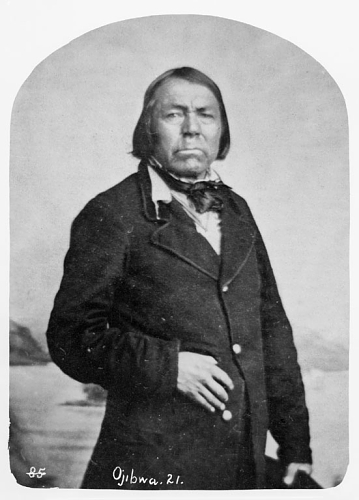
Portrait of Naw-Gaw-Nab (The Foremost Sitter) n.d by J.E. Whitney of St. Paul (Smithsonian)
In many ways, this description of Naaganab fits the image better than any description of Buffalo I’ve seen. The man is dressed in European fashion, has short hair, and large epaulets. We also know that Naaganab had presidential medals, since he continued to display them until his death in the 1890s. The image isn’t dated, but if it truly is an ambrotype, as described by the State Historical Society, that is a technique of photography used mostly in the late 1850s and 1860s. When Buffalo died in 1855, he was reported to be in his nineties. Naaganab would have been in his forties or fifties at that time. To me, the man in the image appears middle-aged rather than elderly.
So is Naaganab the man in the picture? I don’t think so. For one, there are multiple photographs of the Fond du Lac chief out there. The clothing and hairstyle largely match, but the face is different. The other thing to consider is that this image, to my knowledge, has never been identified with Naaganab. Everything I’ve ever seen associates it with the name Buffalo.
However, there is a La Pointe chief who was a political ally of Naaganab, also dressed in white fashion, could have easily owned a medal and fancy army jacket, would have been middle-aged in the 1850s, and bore the English name of “Buffalo.” It was Jayjigwyong, the son of Chief Buffalo.
Alfred Brunson recorded the following in 1843:

(pg. 158) From elsewhere in the account, we know that the “fifty” year-old is Chief Buffalo. This is odd, as most sources had Buffalo in his eighties at that time.
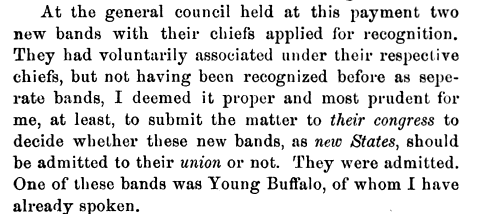
(pg. 191)
Unlike his famous father, Jayjigwyong, often recorded as “Little Buffalo,” is hardly remembered, but he is a significant figure in the history of our region. He was a signatory of the treaties of 1837, 1847, and 1854. He led the faction of the La Pointe Band that felt that rapid assimilation represented the best chance for the Ojibwe to survive and keep their lands. In addition to wearing white clothing and living in houses, Jayjigwyong was Catholic and associated more with the mix-blooded population of the Island than with the majority of the La Pointe band who sought to maintain their traditions at Bad River.
According to James Blackbird, whose father Makadebineshiinh (Black Bird) led the Bad River faction, it was Jayjigwyong who chose where the Red Cliff reservation was to be. James Blackbird, about eleven or twelve at the time of the Treaty of 1854, would have known both the elder and younger Buffalo.
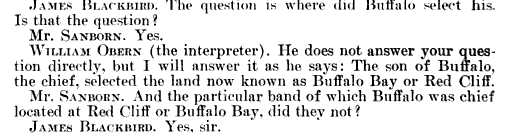
Statement of James Blackbird in the Matters of the Allotments on the Bad River Reservation, Wis. Odanah, 23 Sep. 1909. Published in Condition of Indian affairs in Wisconsin: hearings before the Committee on Indian Affairs, United States Senate, [61st congress, 2d session], on Senate resolution, Issue 263. United States Congress. 1910. Pg. 202.
The younger Blackbird, offered more information about the younger Buffalo in another publication.
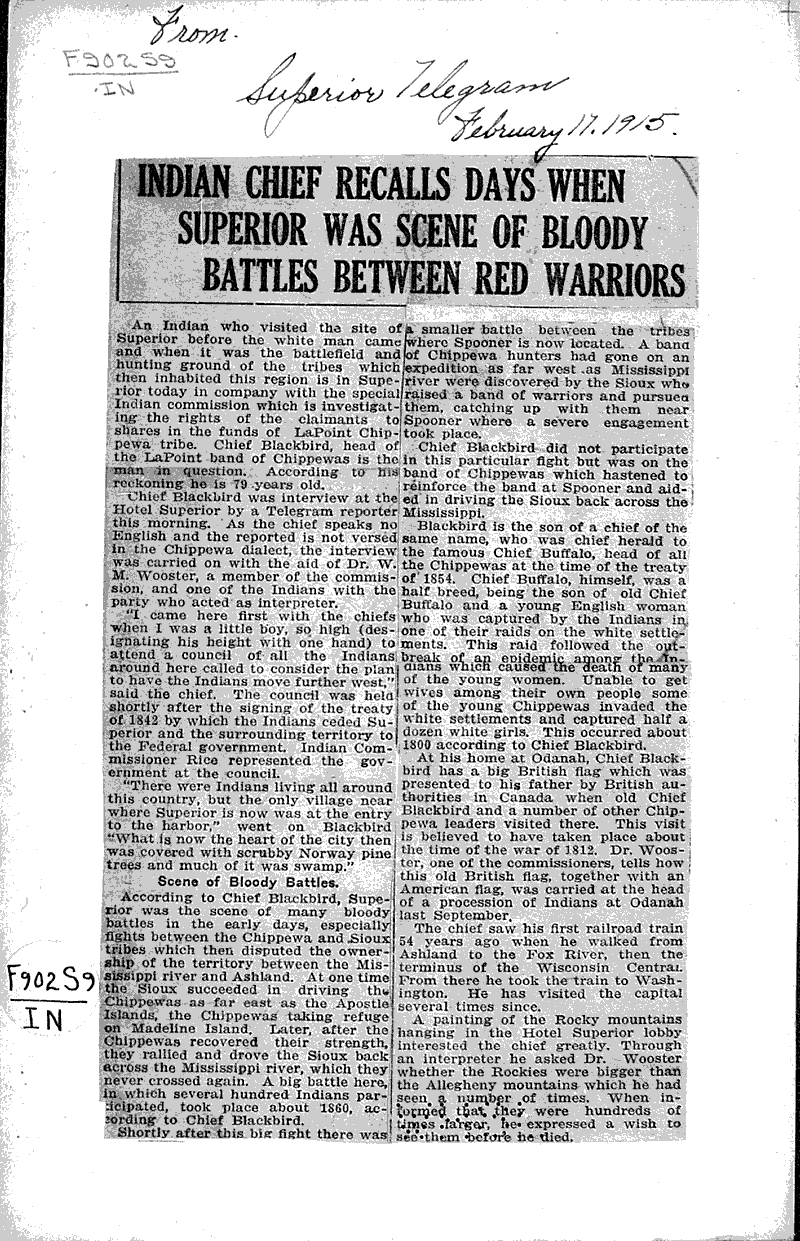
Superior Telegram. 17 Sep. 1915. (Digitized by Wisconsin Historical Society)
Even though it is from 1915, there are a number of items in this account that if accurate are very relevant to pre-1860 history. For this post, I’ll stick to the two that involve Jayjigwyong. This is the only source I’ve ever seen that refers to Chief Buffalo marrying a white woman captured on a raid. This lends further credence to the argument explored by Dietrich and Paap that Chief Buffalo fought in the Ohio Valley wars of the 1790s. It also begs the question of whether being perceived as a “half-breed” had an impact on Jayjigwyong’s decisions as an adult.
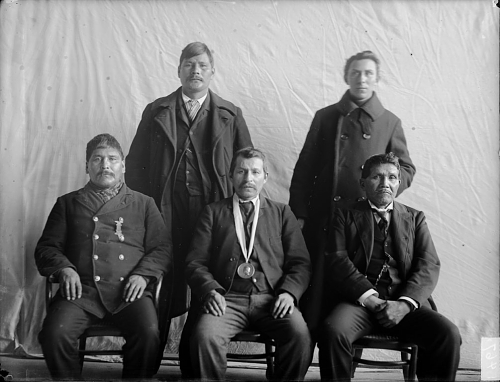
James Blackbird (seated) with interpreter John Medeguan in Washington, 1899. (Photo by Gil DeLancy, Smitsonian Collections)
The other interesting part of the statement is that James Blackbird says his father was pipe carrier for Jayjigwyong. This would be surprising as Blackbird was the most influential La Pointe chief after the death of Buffalo. However, this idea of Jayjigwyong, inheriting the symbolic “head chief” title from his father can also be seen in the following document from 1857:
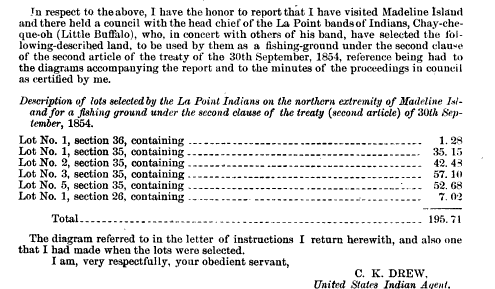
Published in Annual Report of the Commissioner of Indian Affairs to the Secretary of the Interior. Office of Indian Affairs. 1882. pg. 299. (Digitized by Google Books)
Today the fishing ground at the tip of Madeline Island is now considered part of the Bad River Reservation, but it was the Red Cliff chief who picked it out. This shows how the political division of the La Pointe Band into two distinct entities took several years to take shape, and was not an abrupt split at the Treaty of 1854.
Jayjigwyong continued to be regarded as a chief until his death in 1860:
Drew, C.K. Report on the Chippewas of Lake Superior. Red Cliff Agency. 29 Oct. 1860. Pg. 51 of Annual Report of the Commissioner of Indian Affairs. Bureau of Indian Affairs. 1860. (Digitized by Google Books). Zhingob (Shing-oop) was Naaganab’s cousin and the hereditary chief at Fond du Lac. Also known as Nindibens, he figures prominently in Edmund F. Ely’s journals of the mid-1830s.
Future generations of the Buffalo family continued to be looked at as hereditary chiefs in Red Cliff, and sources can be found calling these grandsons and great-grandsons “Chief Buffalo.”
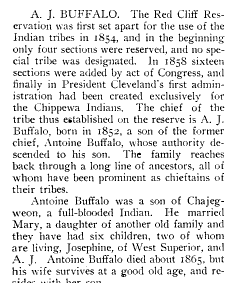
J.H. Beers and Co. Commemorative Biographical Record of the Upper Lake Region. 1905. Pg. 379. (Digitized by Google Books).
Antoine brings us full circle. If we remember, Hamiton Ross wrote that the image of the chief in the army jacket was Chief Buffalo’s grandson. And while we don’t know where Ross got his information, and he made mistakes about Buffalo’s family elsewhere, we have to consider that Antoine Buffalo was an adult by 1852 and he could have inherited his father’s, or grandfather’s, medal and coat.
The Verdict
Although we’ve uncovered several lines of inquiry for this image, all the evidence is circumstantial. Until we know more about the creation and chain of custody, it’s impossible to rule Chief Buffalo in or out. My gut tells me it’s Buffalo’s son, Jajigwyong, but it could be his grandson, Naaganab, or and entirely different chief. We don’t know.
Inconclusive: It could be Chief Buffalo, but there is also evidence pointing to others.
 Chequamegon History