Asaph Whittlesey Incidents: Number II
March 26, 2017
By Amorin Mello

Originally published in the February 23rd, 1878, issue of The Ashland Press. Transcribed with permission from Ashland Narratives by K. Wallin and published in 2013 by Straddle Creek Co.
… continued from Number I.
Early Recollections of Ashland: Number II
by Asaph Whittlesey
As the sole survivor of those who first settled upon the “town site” of Ashland, I have long felt it a duty I owe to myself and wife, and to those then associated with me, whose voices can no longer be heard; as well as a duty I owe to coming generations to add to the record already made, a mention of events of Ashland’s earlier days, overlooked, or perhaps not known to those who have heretorfore generously undertaken to write up the history of the place. And inasmuch as acts of my own, will form a conspicuous part of this record, I desire the public to charitably overlook what might otherwise be regarded as undue or extravagant mention of myself.
Those who have preceded me in their published “Early Recollections of Ashland,” especially those from the pen of Edwin Ellis, M.D., and J.S. Buck, Esq. Of Milwaukee, place the public largely in debt. First, on account of their having undertaken so thankless a task, and secondly, on account of the marvelous earnestness of their statements, which alone gives them value.
Engaged as I now am, the past comes up to me, with the precious freighting of recollections; some sad, and others of brighter hue, woven by memory into a varied “woof,” every thread of which has its cherished incidents in which we have born a part, and by which the soul is saddened or brightened as the “web” unfolds its various hues; and “old time friends” are again about me, and memory is busy with those things of the past which rendered “blessed” our “Cabin Homes” in the wilderness.
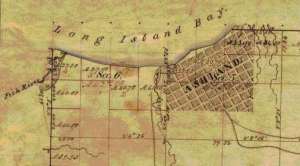
Detail of Ashland in LaPointe County circa 1855 from the Barber Papers.
The history of Ashland as a “town site” commenced with July 5th, 1854. On that day George Kilburn and myself left La Pointe in a row boat on a tour of inspection of the bay upon which Ashland is now located; having in view a “town site” on what might prove to be the most available point for a town, at or near “Equadon,” which we were told meant the “head of the bay.” Very well do I remember how our awkward attempts at rowing made us the laughing stock of numerous Half-Breeds and Frenchmen as we pulled from the shore, and how it was our fortune to face a lively head wind during this, our first few days attempting at rowing alone. However, at 5 p.m. of the day named, having taken soundings for two miles along the south shore of the bay, we landed our boat at the westerly limit of the present “town site” of Ashland, where the high land leaves the bay. As I stepped ashore, Mr. Kilburn exclaimed, “Here is the place for the big city!” and (handing me his ax) added, “I want you to have the honor of cutting the first tree in the way of settlement upon the “town site,” and the tree of which I then fell formed one of the foundation longs in the
FIRST BUILDING ERECTED,
and was erected upon what is now known as lot 2, block 105. This building was 14×10 feet square, had but one door which faced to the south, and but one window which was upon the north side, furnishing a full view of the bay.
On the 16th of August, we were joined by Mrs. Whittlesey, with her “golden haired” and only child, “Eugenia Vesta,” then less than two years of age. Mrs. Whittlesey presented an extremely youthful appearance, being less than twenty-one years of age and unused either to sunlight or to toil; she nevertheless brought “sunlight” into our first
HOME IN THE WILDERNESS.
At this time our nearest neighbors were at Odanah, a distance of eleven miles in a direct line, without even a “trail” leading thereto.
Mrs. Whittlesey’s surroundings were now in strong contrast with her former life, and so absolutely were we shut in by the dense forest that there was but one way to look out, and that was to look up. But for all this our conceptions of the place were past description. Business blocks in the near future filled our minds, and enabled us to sustain every inconvenience. Already the “town site” fever had grown into a “mania,” and adjacent lands were rapidly being taken up by “pre-emptors.”
To be continued in Number III…
1856 Inquest on the Body of Jerry Sullivan
March 18, 2017
By Amorin Mello

Wheeler Family Papers: Box 3, Folder 12;
La Pointe County, 1849-1862
Papers Relating to an
Inquest on the Body of
Jerry Sullivan
~~~
State of Wisconsin
County of Lapointe
To any Constable of said County.
In the name of the State of Wisconsin you are hereby commanded to Summon Joseph Lapointe Oskinawa and [Cotonse for I have?] son of the little chief named [Jegequaon?] to be and appear at my office in Lapointe and give Evedince on an Inquest then & there to be held on the body of P Jerry Sullivan found frozen to death how and by what means he came to his death.
Given under my hand this 10th day of March AD 1856.
J. W. Bell
Justice of the Peace
State of Wisconsin.
To any Constable of the County of Lapointe
You are hereby required immediately to summon six good and lawfull men of the County of Lapointe to appear forthwith before me at my office in the town of Lapointe to enquire upon the view of the Dead Body of Patrick Jerry Sullivan there being dead, how and by what means he came to his death.
Given under my hand this 10th day of March 1856.
J. W. Bell
Justice of the Peace
– – – – – – – – – –
Served the within by Summoning the following Individuals and producing them in Court.
Antoine Perrinier
John Cochran
John Bono
Marks Mandelbaum
JB. Roy
Batiste Gaudin
& Edward Fornier
Antoine Cournoyer Sr. was a French-Canadian and father of a mixed-blood family in the La Pointe Band.
A. (his X mark) Cournier
Constable
Fees 50 cts
Inquest on the Body of Jerry Sullivan.
Patrick Sullivan
being duly sworn says that last Thursday evening

Captain John Daniel Angus first settled at La Pointe in 1835.
~ Madeline Island Museum
Oskinawa came to my house, and there a pair of Boots and Blanket and two quilts belonging to the deseased and was going away My little Boy seen him do so. My wife went out of Doors and asked him where the old man was, I heard them talking and I went out. I asked Oskinawa if the old man had left Angus and if he was coming to night, he replied that he did leave him the old man some where on the Ice. I went to see Oskinawa the next day and he told me that an Indian had come across and told him that the old man was sick in a house on the opposite side. I started on Saturday morning in search of the old man and called at the different houses but could get no information of him I also searched along the shore. John Morrison told me that on thursday he seen him with Oskinawa abreast of his place away a good distance from shore on his way to Lapointe. I went to Capt Angus that night to Enquire, Capt Angus told me that he had made an arrangement with Joseph Lapointe to bring the old man home with him as he was coming to Lapointe with a horse and train and he would pay him for it. on Monday afternoon after searching I found the Deseased lying on his back frozen lying on the beach about a mile or more from Lapointe and brought him home and requested that an Inquest should be held over him.
Sworn & subscribed to before me this 10th day of March 1856
J W Bell
Justice of the Peace
Inquest on the Body of Jerry Sullivan
Oskinawe
being duly sworn Says that he knows deceased. Deseased left the Bay to come to lapointe on foot thursday at about half past two o’clock PM.
I overtook him on the road Shortly after I requested the diseased to come along with me as I wanted to get ahead of horse that was going to Lapointe. Mr. Angus had given me the Old Man’s things to bring to Lapointe I had a dog and a train with me the Old Man deseased could not keep up with me and I left him. I overtook the horse at Stoney point and came home in company with the horse Joseph Lapointe had the horse. I could still see the Old Man coming after us when I was this side of the Stoney point.
Sworn to March 10th 1856 before me
J W Bell Justice
– – – – – – – – – –
John [Degequaon?]
being duly sworn says, that on Saturday last he went to the Bay & Capt Angus enquired of him if the old Man had got home.
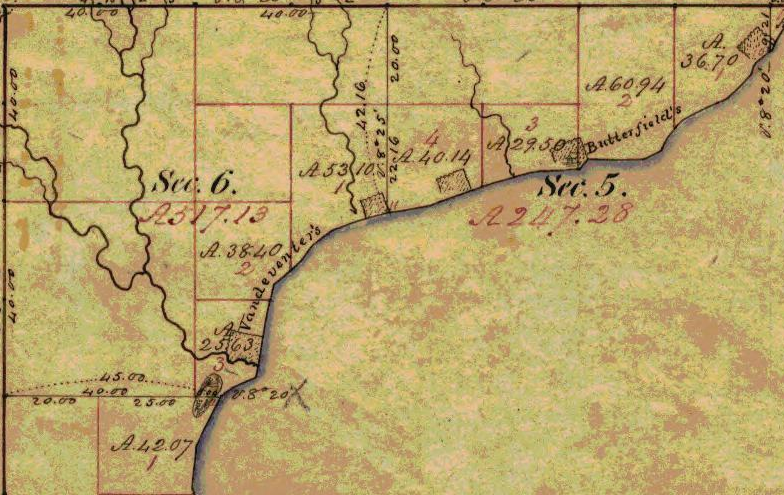
Captains Angus and Butterfield were south of Houghton Point, in what is now the City of Washburn. Detail from the Barber Brothers’ survey during August of 1855.
I answered in the negative. Capt Angus told me that he had told Joseph Lapointe on his sleigh and that he would pay him for it. Steven Butterfield told me that he heard Capt Angus tell Joseph Lapointe to take the Old Man on his sleigh. in the Evening I told Mrs Lapointe the Mother of Joseph and she said her son was very foolish in not taken the old man in his sleigh, but that she had herself told him not to take any person on his sleigh before he was paid for it as he had been cheated so often, and perhaps her son had refused the old man for the reason that the old man had once refused to lend him a bucket to water his horse.
Sworn on March 10th 1856 before me
J W Bell Justice.
– – – – –
Joseph Lapointe
duly sworn says, that he left the Bay with his horse to come to Lapointe on thursday afternoon that the deseased wanted to come over with him in his sleigh that he offered the deseased to bring him over to Lapointe with his things for half a Dollar but the Deseased would not agree to give it to him.
I then turned my horse and came away, on the road he broke an Iron pin and went back to Mr Angus to get it repaired that the Deseased was still there that Mr Angus did not say any thing to him at all in regard to bringing the old man over. Mr Angus never asked him to bring the old man over.
Says that the reason that he did not want any thing in his sleigh was because he wanted to get to Lapointe and back the same day.
Sworn to before me this 10th day of March 1856,
J W Bell Justice
An inquisition taken at Lapointe in the County of Lapointe, on the 10th day of March 1856 before J W Bell one of the Justices of the peace of said County, upon the view of the Body of Jerry Sullivan there dead by the Jurors whose names are hereunto Subscribed, who being duly sworn to Enquire on behalf of the people of this State when, in what manner, and by what means the said Jerry Sullivan came to his death upon their Oaths do say, that from the Evedince produced on their inquest that they Exempt any person from blame, and that owing to the late hour of starting the deceased came to his Death by freezing in making an effort to reach home.
In testimony whereof the said Justice of the Peace and the Jurors of this inquest have hereunto set their hands the day and year aforesaid.
John W. Bell
Justice of the Peace
W. J. Cochran
M. H. Mandelbaum
John Bono
Antoine Perrinier
Edward Fornier
John B. Roy~ Jury ~
Patrick Sullivan
Son of the diseased being duly sworn Says that Deseased was not possesed of any real Estate, and all the personal Estate that he knows of was
Money to the amount of 35.00 which he left with my wife, 7.00 which he lent me, 6 cents was found in his pocket after his disease and 1 Barrel of Flour which I got of him valued at 20.00. Making $62.06. He told me that Captain Angus Owed him for some labor, likewise he had some potatoes hid in the ground and some wood in the woods cut. the Diseased made my house his principal home. he had a due Bill on Mr
J haveAustrian for the Sum of 3.75. Total in Money & due Bills 65.81. also 5.00 worth of meal. 70.81Incidental Expenses paid by me out of the above for
holding an Inquest and Burrial rites, Church Rites &cExpenses of Inquest Jury fees & witnesses &c $8.37
Paid for Coffin & Outer Box 9.38
Paid the Preist for a Mass 5.00
To 4 Men looking for Diseased 4.00
Paid Paul Souliere 2.00
Henry Brissette 1.00
Michael Brissette for teaming 1.00
two Indian Boys for bringing Deseased 2.00
John Cochran two Days. 3.00
Hauling Sand for grave 4.50
[Bisson?] 1 Day searching for diseased 1.00
Ten Dollars for a Railing round the Grave 10.00
Grave Stone 5.00
To Massers to be said hereafter 15.00
Decided that Patrick Sullivan is the proper person to collect and settle all affairs of the diseased. and what remain he is entitled to for his trouble.
“Considerable Altercation Ensued”
March 11, 2017
By Leo
Here is another gem from Wheeler. It appears to be a short description of a meeting in Odanah that quickly devolves into absurdity. It appears without any associated documents in the chronological professional papers of the Wheeler Family Collection at the Northern Great Lakes Visitor Center. For what it lacks in length and context, it makes up for in insight into the personalities of some prominent Chequamegon residents.
Odanah July 6, 1856
Council of Indians called by Mr Warren to make regulations in regard to the partitions of Domestic Arrivals & crops here. Mr S. C. Collins was appointed chairman & L. H. Wheeler Secretary.
Mr Warren presented some resolutions stating the object of the meeting , which was interpreted to the Indians.
After reading the paper Mr. Warren added remarks explaining the importance of some such regulations for the good of both the Whites & Indians.
After he stopped Blackbird spoke. The substance of his remarks was that the commissioner & agent told him to be still and do nothing till the agent should come, and therefore he should have nothing to do with what was proposed to them.
Out of contempt to Mr Warren he proposed that he should be made chief. He said it was treating them like children for Mr W to pass laws & rules for them to observe, just as though they were not able to take care of their own interests. He was asked more fully Mr Stoddard regarding the concluding remarks of Black Bird in substance, as a motion, to drop the whole subject, seconded the motion upon which considerable altercation ensued. The result of which was that the question should be considered still open for discussion and free remarks be allowed on both sides.
Odanah in 1856, just two years removed from the Treaty of 1854, was a community in flux. The cities of Ashland and Bayfield were growing rapidly with white American settlers. Being the largest of the newly-created reservations, Bad River was also growing as some of the Ojibwe bands from the Island, Ontonagon, St. Croix and the Chippewa River relocated there. In contrast to the Buffalo Bay (Red Cliff) reservation whose population included numerous mix-blood and Catholic families, the people of Bad River were largely full-bloods practicing traditional ways.
A handful of mix-blood and white families did live in Odanah, sponsored by the US Government and eastern missionary societies for Christianizing and “civilizing” the Ojibwe. These included the families of Reverend Leonard H. Wheeler founder of the Odanah mission, Truman A. Warren the government farmer, and John Stoddard the government carpenter. At this point in history, each of these men had lived in or around Odanah for several years and were well-known to area residents.

Truman A. Warren, brother of William W. Warren (Wisconsin Historical Society).
From the document, it appears that Warren called a meeting to create rules for the distribution of crops and goods to the Bad River Band. Warren was born at La Pointe in the mid-1820s to fur-trader Lyman Warren and Marie Cadotte Warren. Most Ojibwe men of the era avoided farming as it was considered women’s work. Warren, however, did not appear to share this view. He was a Christian mix-blood whose grandfather, Michel Cadotte, planted numerous crops on the Island. As a teenager, Truman, spent several years at school in New York learning English and doing farm labor.
Getting the farmer position, which had been created by the Treaty of 1842, was seen as a stroke of good fortune. His sister, Julia Warren Spears later described it as such:
My brother Truman A. Warren was the government farmer for the Indians, who lived at Bad River about 15 miles on the main land from La Pointe. That is where they made there garden and what other farming they did. The government farmer, carpenter, and blacksmith all had good houses to live in and received good salaries. (Spears to Bartlett; October 26, 1924)

Leonard H. Wheeler (Wisconsin Historical Society)
S. C. Collins is listed as the chairman of the meeting. I have been unable to find any other information about his connection to this area. I suspect he may have been a visitor or brief resident enlisted by Leonard Wheeler as a neutral party to conduct the meeting.
The Wheelers and Warrens were very close. Truman’s father was the original force behind bringing the Protestant missions into the area and Leonard and Harriet Wheeler helped raise Truman’s younger sister.
John Stoddard, the government carpenter has been identified by Amorin Mello as the most likely author of the mystery journal found in the Wheeler Collection. He was also close to Wheeler. As was Blackbird, the most prominent chief of the Bad River Ojibwe.
I’ve written before on how Blackbird and Wheeler were an odd couple. Wheeler was dedicated to the destruction of Ojibwe culture while Blackbird was perhaps the strongest advocate for maintaining traditional ways. Even so, the primary sources seem to indicate the men had a strong respect for one another.
Blackbird’s affections for Wheeler, however, don’t appear to extend to Warren. This isn’t overly surprising. Truman, and his deceased brother William, had run counter to the chief’s wishes on multiple occasions. William Warren criticized Blackbird directly at the time of the Martell Delegation. Blackbird also wanted to limit the power of Henry Rice’s “Indian Ring,” which employed numerous La Pointe mix-bloods including the Warrens.
In Theresa Schenck’s excellent William W. Warren: The Life, Letters, and Times of an Ojibwe Leader, the Warrens occasionally betray a paternalistic attitude toward their Ojibwe relatives. For example, William and Truman both initially supported the tragic Sandy Lake Removal of 1850-51 even though the Ojibwe leadership was rightfully opposed to it. Blackbird, of all the chiefs, seemed the least willing to accept condescension and threats to tribal sovereignty so it’s not surprising that a “considerable altercation ensued.”
For Wheeler’s part, I haven’t found any evidence he tried to force Robert’s Rules of Order on this area again.
Davidson, John N. In Unnamed Wisconsin. N.p.: Nabu, 2010. Print.
Paap, Howard D. Red Cliff, Wisconsin: A History of an Ojibwe Community. St. Cloud, MN: North Star of St. Cloud, 2013. Print.
Schenck, Theresa M. William W. Warren: The Life, Letters, and times of an Ojibwe Leader. Lincoln, Neb.: U of Nebraska, 2009. Print.
Ervin Leihy Incidents: At the Falls of Bad River
February 24, 2017
By Amorin Mello
This is a reproduction of a memoir published by Ervin Barnes Leihy, who became known as Nigigoons (Little Otter) by the Chippewas of Bad River. Leihy is emerging as of the more colorful characters from the post-1842 Treaty of La Pointe era in Chequamegon History, when he was one of the first non-natives to settle on the newly Ceded Territory surrounding La Pointe. Leihy moved to the Falls of Bad River in 1846 where he built his sawmill. After the 1854 Treaty, Leihy became associated with the Early Settlement of the Bad River Indian Reservation. During the post-1860’s era, Leihy moved to Bayfield where he became a successful business person. Leihy’s general store and brownstone house are still prominent buildings in Bayfield today.
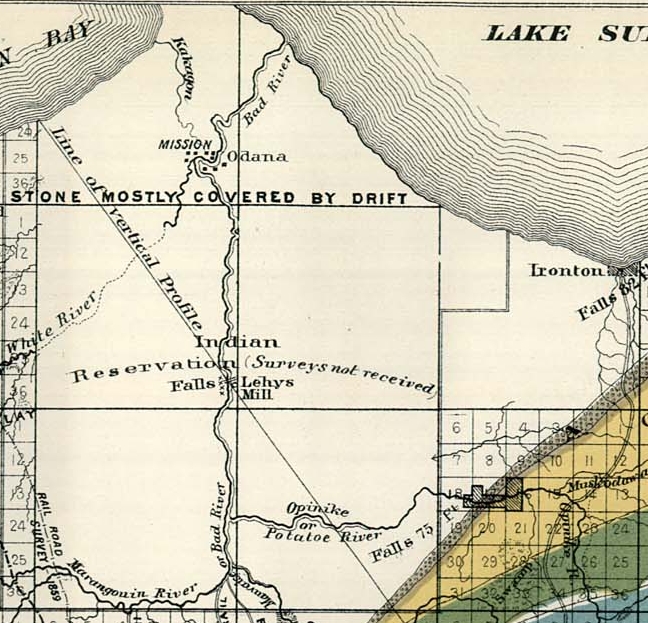
Details of Ervin Leihy’s sawmill on the La Pointe Reservation from Charles Whittlesey‘s 1860 Geological Map of the Penokie Range from Geology of Wisconsin: Volume III, plate XX-214. Also shown are the Opinike (or Potatoe) River Property, Ironton, and McEwen’s Sawmill.
Bayfield County Press
March 31, 1900
[Transcribed and shared by Robert J. Nelson, 2016]
Incidents of Early Days on Lake Superior
At the Falls of Bad River
By Ervin Leihy
– Ervin Leihy, one of the first white settlers to come to the northern part of Wisconsin died at his home in this city last week. He was born in Oswego county, N. Y., October 12, 1822. His early life was passed on a farm and at 18 moved to Illinois. Later he bought a farm at Bad River, Ashland county, and in 1846 moved onto it. In 1870 he moved to Bayfield, built his present home and opened a general store which he conducted for a number of years. While living at Bad River he was a member of the town and county boards of Ashland county for a number of years and in 1871 and 1872 was a member of the town board of Bayfield. Besides these he held numerous other offices. He was a public-spirited man, had plenty of means and was always ready to assist in anything that would tend to advance the interests of the town in which he resided.”
~ Wisconsin Weekly Advocate, June 6, 1901.
Next day our arrival at the Falls (October 5, 1846) was spent in looking over the surroundings. The murmur of the stream, the stream itself and the surrounding scenery, reminded me of the scenes of my earliest recollections on the banks of the Salmon River, Oswego County, New York. Here to his game in the forest, fish and the stream and sugar in the trees; and the soil is good.
Potatoes are worth one dollar per bushel and corn two dollars per bushel. Those were my musings as I sat on a big rock at the head of the falls. Here were many of the necessaries and some of the luxuries of life and all for the taking and no taxes to pay – all as free as air.
To say that I was delighted would be putting it mildly. I asked the captain what were his plans. He had none; he simply liked to live in the woods. Here, let me digress. Captain Wood was a man about 53 years old, had gained perhaps earned the prefix to his name during what was termed the “Toledo War,” early a squabble between the states of Ohio and Michigan for jurisdiction over a strip of land in which Toledo was the principal town. Wood being deputy sheriff of Monroe County at that time was put in command of a company of Michigan troops to help all the claims of the state of Michigan. Withal, a genial and agreeable companion. Not much time was lost.

Detail of Leihy’s sawmill and Bad River Falls omitted from the Barber brothers’ survey of the La Pointe (Bad River) Reservation.
I have soon acquired a half interest in the “Hermitage” which consisted of a long, hut about 14 feet square, a fireplace in one corner, and covered with shakes; nearly an acre of cleared land, 20 or 30 bushels of potatoes and perhaps as many more of rutabaga; a couple of axes and a hoe or two.
Brother George had gone with his boat and men. I began to talk to Capt. Wood about LaPointe of which I heard so much. He finally said, “perhaps you would like to go there?” I told him I certainly would.
Well, we found our way to LaPointe, and an interesting place. It certainly was. Here the North American fur company was in full bloom, under the efficient management of Messrs. Borup and Oakes. The traders, had already left with their outfits for their various stations at Lac du Flambeau, Lake Courerille, Sandy Lake, Leech Lake, Grand Portage and other points, not to return until May or June when they were expected to return laden with bear, beaver, otter, Fischer, Martin, mink and other valuable fur.

Reverend Sherman Hall
~ Madeline Island Museum
Here to was established a Catholic mission under the care of father Baraga; also a Presbyterian mission in under the care of Rev. Sherman Hall, and all in flourishing condition.
Fishing was also carried on to a considerable extent among the islands by the Fur company. The side-wheeler Julia Palmer, have been hauled over the portage at the Soo and had just made one trip as far West as LaPointe. The rest of the fleet on Lake Superior consisted of five small sail vessels, viz. the Merchant, Swallow, Algonquin, Fur Trader and the Chippewa.
A Mr. Hays was subbing in agent and Mr. Van Tassel was the government blacksmith at that time at LaPointe.
We stayed but a few days, procured a few necessary tools, some supplies for the winter and return to the Falls.
There were now [four] in camp. Captain Joseph Wood, Charlie Rowley, John Smith and myself. Wood, Smith and I went to work on the second house built in what is now Ashland County outside of LaPointe.
To be continued…
Edwin Ellis Incidents: Number I
February 11, 2017
By Amorin Mello
Originally published in the June 16th, 1877, issue of The Ashland Press. Transcribed with permission from Ashland Narratives by K. Wallin and published in 2013 by Straddle Creek Co.
EARLY RECOLLECTIONS OF ASHLAND.
“OF WHICH I WAS A PART.”
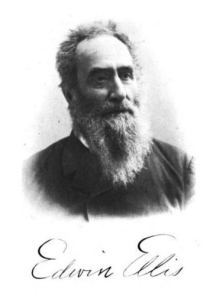
Edwin Ellis, M.D.
~ Western Reserve Historical Society
My Dear Press:– In these joyous days of Ashland’s history, when we are all made glad by the completion of that great enterprise – the Wisconsin Central Railroad – when from banishment and isolation from the populous portion of our State and from the great world we in one day are brought in close contact with and feel the throbbings of the pulse of commercial and social life, it may be of interest to some to recall a few incidents of the early history of our town and its vicinity.
The years 1853 to 1857 were noted in the West for adventure and enterprise in pushing into new regions and laying out and building new towns.
Land Office Fraud;
Barber Papers Prologue;
Part VI of Sketch of Vincent Roy Jr.
In 1853 the site of Superior City had been pre-empted and in 1854, laid out into regular lots and blocks, and the work of a new city begun. The site had attracted the attention and capital of some of our ablest men. It was backed by stronger political influences than ever combined to lay the foundations of any town in the west. Among its proprietors were many leading members of Congress and of the Cabinet, especially from the South. The most sanguine expectations of its future greatness were entertained, for it commanded a scope of country as great as that paying tribute to Chicago. Its lots were sold at fabulous prices. It was in 1855 and 1856 – probably the most talked of town in the Union.
The temporary success of Superior kindled a blaze of speculation, which spread far and wide in Wisconsin, Minnesota and Michigan.
Some of the founders of Superior at the map, saw stretching away to the South-west from the Apostles’ Islands, a deep bay, extending far inland, as if reaching forth to reach the tide of commerce flowing northward from the Gulf and the Atlantic.
This was our Chegomegon or Long Island Bay. The report of Foster and Whitney also told of mountains of iron ore, which must find its way into the channels of commerce, by the waters of this bay. An important town, it was thought, must spring up near its head.

Martin Beaser
~ Western Reserve Historical Society
While plans were maturing for the occupation of this site, we learned that another party had been attracted by the same considerations that moved us, and that Martin Beaser, Asaph Whittlesy, and Geo. Kilbourn had entered upon and claimed about three hundred acres under the townsite law. The land had not yet been surveyed, and of course could not be entered or pre-empted. The two latter gentlemen were on the spot, having arrived in the summer of 1854. But we were not deterred by these anticipations of our plans.
Early in February, 1855, Edwin Ellis, as the representative of several enterprising capitalists of St. Paul, left the latter city with one companion, Cyrus A. Rollins, to examine the situation and site, and if thought advisable and practicable, to make a lodgement there. The writer was then in full prime and vigor of early manhood, and full of ambition and bright expectations. The way from St. Paul was through an unbroken wilderness. The Lake Superior & Mississippi Railroad had not been conceived. In truth, no railroad had then approached within three hundred miles of the great Lake. The present city of Duluth in its visions of the near future – the Damascus between the Atlantic and Pacific – the halting place of the North Pacific caravan, bringing to New York and London, the wealth of India, and China and Japan, and the Islands of the South sea – was then only occupied by the wild Indian.
Emmet Jefferson, who subsequently pre-empted the site of Duluth, was one of our party from St. Paul; but for many years he had slept in his last sleep. Three or four other adventurers were with us and though it was cold and the way hard, we were a wild and joyous party of young men, going forth to seek our fortunes,– not doubtful of success.
At Superior we first saw the Great Lake. Half a dozen houses – a store or two and the beginnings of a hotel, comprised all of that rival to Chicago.
Among our acquaintances formed there, of which there were several pleasant ones, were Capt. Markland, a soldier of the Mexican war, a lawyer by profession, a man of culture, courteous in manner and stately in his bearing;– Washington Ashton, the pioneer publisher of Superior, and Colonel Carleton, who had been for several years a resident at Fond du Lac, and whose name is perpetuated by the name of a county in Minnesota. All of them have been long years dead.
Having rested a day and bade adieu to our traveling companions, already dear to us as the sharers of our toils, we turned our faces towards the east. We were fortunate in securing as a pilot on our untried voyage, Baptiste Gauden – mail carrier between Superior and La Pointe. Here we first saw a dog train, which relieved us of our packs; and at night Baptiste assisted in pitching our camp, “a day’s march nearer home.” He “still lives,” and devotes much of his time to the service of the Roman Catholic Church, of which he is an obedient and devoted son.

George Riley Stuntz had a settlement and sawmill near the mouth of the Iron River, 1852.
~ General Land Office Records

Detail of foot trails in the Sioux River Valley, 1855.
~ General Land Office Records
Leaving Superior late in the forenoon, we arrived at Iron River, twenty miles away; where we were happy to find shelter in a logging camp, full of robust, hearty, whole-souled men, some of whom had come from cultivated homes in the east. By some means strange to most of that company, the traveling pilgrim discovered a brother of the mystic tie, with whom he passed a pleasant evening, thankful for that fraternal bond, which makes strangers friends and brothers at sight.
Leaving Iron River the next morning, two days march brought us to La Pointe via the valley of the Sioux river, passing through the wilderness then, which is now the cultivated vale, made classic by being the dwelling place of the “Sage of Avoca;” the peer in farming to the immortal Horace, who has earned his title to the peerage by “causing two blades of grass to grow, where but one grew before he came,” and of him we may say:
Remote from cities lived a swain,
Unvexed with all the cares of gain;
His head is silvered o’er with age,
And long experience makes him Sage.

Antoine Gordon
~ Noble Lives of a Noble Race by the St. Mary’s Industrial School (Odanah), page 207.
At La Pointe the first object to meet our profane view were numerous large wooded crosses ten to fifteen feet high, in different parts of the town, erected by the pious zeal of the faithful believers in the then new dogma of “Immaculate Conception.” We saw also an imposing procession of French mixed bloods, escorting a fat, good natured looking priest through the street, under a gaudy canophy, borne by four devout servants of the Church. This also was in honor of the same dogma.
We put up for the night at the only hotel of the place, kept by Antoine Gauden, whose aged father, that very night, amid the chanting and prayers of the virgin saints of La Pointe, passed into the presence of the Eternal. La Pointe at that time was of much greater importance than at present – the most important town on the Lake west of Ontonagon. It was the annual gathering place of several thousand Indians, who then received their annual payments. It was the center of the fish trade for all this part of the Lake. It had, also, quite an extensive fur trade.

Samuel Stuart Vaughn
~ Western Reserve Historical Society
Julius Austrian had an extensive store of general merchandise and transacted a large business. Hon. S.S. Vaughn, one of Ashland’s present most substantial citizens, was then a young merchant at La pointe, where by close attention to business, he was laying the foundation of the fortune he has since achieved. Wm. E. Vantassel, Government Blacksmith for the Indians, a descendant of an old Knickerbocker family was there – a very skillful workman and a very genial man. In old age he now resides near Stillwater, Minnesota. Francis McElroy was also there, full of life and energy. And last but not least, I must mention John W. Bell, Esq, who even then had lived on the Island more than twenty years, and whose recollections carried him back till he could almost hear the war whoop of the Sioux and Chippewas as the latter drove their old enemies forever away from the land of the Ojibwas. He has for many years been the “Patriach” of the Island, and is much esteemed by his neighbors.

Frederick Prentice
~ History of the Maumee Valley by Horace S Knapp, 1872, pages 560-562.
Resting one night, on the following day we started across the bay on snow-shoes, reaching the shore near the Kaukaugon river. We followed the coast west, and at nightfall we found tracks leading up the ravine, a few rods from where the railroad track now touches the water of the bay. We found here a log house, built by Lusk, Prentice & Co., for purposes of trade and with the plan for the occupation of the site. Here we passed our first night. The ruins of the shanty may be seen on the block now occupied by the residence of Ferinand Schupp. Adolphus Bart, the clerk of the company, was in charge and made us welcome with his good cheer. He is now a lawyer in the State of New York.
To be continued in Number II…
Asaph Whittlesey Incidents: Number I
February 9, 2017
By Amorin Mello

Originally published in the February 16, 1878, issue of The Ashland Press. Transcribed with permission from Ashland Narratives by K. Wallin and published in 2013 by Straddle Creek Co.
Early Recollections of Ashland: Number I
by Asaph Whittlesey
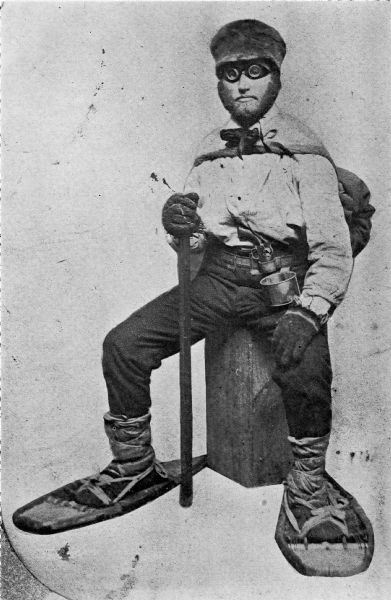
Photograph of Asaph Whittlesey from the Wisconsin Historical Society.
Our first arrival at La Pointe being so intimately associated with the settlement of Ashland, I have determined to make our arrival there the subject of my first letter.
It was among the first days of June, 1854, that George Kilburn, Jr., myself and wife and only child, Eugenia, (then some eighteen months old,) made a landing at La Pointe with a view to remain permanently in the country. Well do I remember the beautiful “town,” spread before us as we merged from the “old log warehouse” through which we passed in reaching the shore, while the general appearance was that of neatness and comfort.

Photograph of Julius Austrian from the Madeline Island Museum.
We had already made the acquaintance of Mr. and Mrs. Julius Austrian, having had the pleasure of their company up the Lakes, and had made many inquiries of them as to the place of our destination. From this time forward we found Mr. and Mrs. Austrian to be most agreeable neighbors and associates, and these young “brides” spent much of their time together, and not unfrequently did the evening air carry to listening crowds our notes of “Good old Colony times,” and “There’s no place like home,” still fresh in our memory.
La Pointe at this time was the second in importance of towns upon the Lakes, Ontonagon taking the lead.
Within a few days after our landing, we were fully organized as “house keepers,” under the same roof with Mr. and Mrs. George Starks, now residents of Bayfield; who proved to be most excellent neighbors, and never did a single roof cover a more harmonious trio of families.
We had, however, a common “foe” to encounter, visions of which filled our dreams and harassed our waking moments. This “foe” was the everlasting “bed bug,” more numerous and more determined in their onslaught than is the “Russian Army;” while this mixture of Dutch and Yankee blood served to satisfy their ravenous appetites. We had heard of this race before, but this was the first time we had met in open combat, face to face. It was our custom regularly before retiring to rest to go into combat with them armed with “wooden spads,” with which we slaughtered them by the quart. Our plan was to remain awake an hour or so after retiring to bed, when we would strike a light which was a signal for a field fight. It was an exciting scene to witness their ranks surrounding us on every hand, while the sheets of our bed seemed dyed in human blood. One means of our defense was to have the bed posts stand in molasses; but this only put them to the trouble of marching to the ceiling above from which they dropped upon us like hail; of course all these contingencies helped to make my wife good natured, and strengthen her attachments to the country. This condition of things lasted while we remained occupants of the building, and when we, in our weakness from loss of blood, staggered forth to make us a home elsewhere, we were filled with anxiety as to the safety of our German neighbors.
“Dr. Borup, the agent for the American Fur Company, (who have an extensive trading-post at this place,) has a superb garden. In walking through it with him, I saw very fine crops of the usual garden vegetables growing in it. His red currant bushes were literally bent down beneath their weight of ripe fruit. His cherry-trees had also borne well. Gooseberries also succeed well. The doctor also had some young apple-trees, that were in a thriving condition. Poultry, likewise, does well. Mrs. B. had her yard well stocked with turkeys, geese, ducks, and chickens.”
~ “Morgan“ at La Pointe during 1845.
As I have before stated, the general appearance of the island was most attractive. The garden of Mr. Austrian was laid out most tastily. We found there a large variety of fruit trees, apples, plums, cherries, etc. Also large quantities of currants and strawberries; but the crowning attraction was the “grape bower,” affording a most attractive lounging place. Here also a merry party, consisting, so far as my recollection serves me, of the following persons: Mr. and Mrs. Julius Austrian, Rev. John Chebohm, (who, I remember, asked the blessing at the table,) Marks Austrian, Mr. H. Mandelbaum, Henry Smit, Mr. and Mrs. Hocksteiner, Mr. and Mrs. George Starks, old Mr. and Mrs. Perinier, Mr. and Mrs. Asaph Whittlesey, and I think Mrs. William Herbert, and a Mr. Roy, celebrated the
“FORTH OF JULY,” 1854.
Being a curious mixture of Americans, Jews, Germans, French and Austrians, no two of whom could carry on a very extensive conversation, for want of a knowledge of the languages, so that our toasts were mainly received in silence, nevertheless the day was passed most pleasantly, while the reading of the Declaration of Independence by Asaph Whittlesey, marked it as a day for national celebration.
To be continued in Number II…
An Old Indian Settler
January 15, 2017
By Amorin Mello

“Joe Stoddard 1941″
~ Bad River Tribal Historic Preservation Office
United States. Works Progress Administration:
Chippewa Indian Historical Project Records 1936-1942
Envelope 19, Item 1
An Old Indian Settler
Statement of Joseph Stoddard
by James Scott
On the afternoon of Sunday, February 28, 1937, I visited Joseph Stoddard, one of the oldest residents of the Bad River Reservation. He is a man of full blood Indian descent, and a full-fledged member of the Bad River Band of Lake Superior Chippewas. He has always been respected for his wisdom concerning matters affecting his fellow Chippewas; as always recognized as a headman in the councils of the band, and is today an outstanding figure. He related to me many experiences of his early days, and has a distinct recollection of the incidents attending the closing deliberations leading up to the signing of the last treaty affecting the Bad River Band of Chippewas, which was concluded at Madeline Island, Sept. 30, 1854.
He relates: In this treaty with the Lake Superior Chippewas, Henry C. Gilbert and David B. Harriman represented the United States. According to Mr. Stoddard‘s version, Mr. Gilbert stood at one end of a small writing table, and Chief Buffalo on the other end, joining hands in mutual grip of friendship.

Henry C. Gilbert
Mackinac Indian Agent
~ Branch County Photographs
Commissioner Gilbert held in his hand the signed treaty, which was rolled and tied with red, white and blue ribbons. He expressed confidence that the Chippewas of Lake Superior and the Mississippi would always remain friendly toward the United States, and assured the Indians that the obligations of the United States under this treaty would be fulfilled to the latter. Using the rolled treaty as a pointer, Mr. Gilbert pointed to the East, to the West, to the North and to the South. The gesture circumscribing the Great White Father’s domain, explaining that the treaty just concluded was backed by the integrity of the U.S. and promising that the Great Father would see that the stipulations in the document would be taken care of at the time indicated. Mr. Stoddard asks: “Has the government carried out the promises embraced in the treaties?” And he answers his own question by saying, “No. Many of the most important provisions which were agreed upon at Madeline Island were stricken from the treaty, not at the Island, perhaps, but at some other point; and the whole document was so changed that every provision leaned to the advantage of the United States.” Mr. Stoddard says further, “As a Christian, I dislike to say that the field representatives of the United States were grafters and crooks, but the stories related about unfulfilled treaties, stipulations entirely ignored, and many other things that the Indians have just cause to complain about, seem to bear out my impressions in this respect.”
~ Wikipedia.org
The experience of the Indians in dealing with the United States government, contends Mr. Stoddard, has been anything but satisfactory, and this is the reason why the Reorganization Act does not appeal to many of our Indians, and the experience of Indians in different parts of the country must have been similar, as on some reservations of other tribes, the Reorganization Act has not even been given serious consideration. The Indians fear that this is just another ruse on the part of the Government to further exploit the Indians; that there is a hidden meaning between the lines, and that the Act, as a whole, is detrimental to the Indians’ interests and development.
For a person of his age, Mr. Stoddard has a wonderful memory and gives a clear portrayal of incidents connected with the treaty. He states that:
“Chief Buffalo worked so hard during the drafting of the treaty of 1854, that he suffered a general health break-down, and lived only a short time after the completion and signing of the document. The Chief felt highly elated after the work was completed, thinking that every word of the treaty would be carried out, affording permanence and security to his people.
“At the death of this venerable old chief, the funeral service attending his burial was very impressive. The pall bearers were all leading warriors who had seen and experienced the strife of battle. Those who paid tribute formed
[line(s) of text missing from bottom of page 2]
the mortal remains of the famous chief were laid to rest.

“Kiskitawag” in Washington D.C. circa 1880.
Which Giishkitawag is this?
Joseph‘s grandfather,
or Joe White?
~ C.M. Bell, Smithsonian Digital Collections
“After the death of Chief Buffalo, my grandfather, Kishketuhwig, became a leader of the Chippewa tribe. He was widely known throughout the Indian country, and well did the Sioux nation know him for this bravery and daring, having out-generalled the Sioux on many different occasions. To the whites he was known as “Cut-ear,” that being the interpretation of his Indian name, Kishketuhwig. He was born in 1770 and died in 1868.
“When nearing his ninetieth milestone, he would call me to his bed-side many times in the evenings, and often during the day, to advise and counsel me. Once he said, “My son, I can foresee the path that is leading straight ahead of you. I can see that you are going to be of great value and assistance to your people. You must make a serious effort, therefore, to familiarize yourself with the contents and stipulations of the different Chippewa treaties. My first experience in treaty negotiations was in 1785, at early dawn one day, there far off on the blue waters of Lake Superior several strange canoes. They were first sighted by a couple of fishermen, who were raising their nets at this early hour, on the east side of Madeline Island. When the fishermen were sure that the approaching canoes were those of strangers, their coming was immediately reported to the thousands of Chippewa who made their homes on the west shores of the island. The alarm was given, and a number of the most daring warriors were instructed to meet the party, and be prepared for the worst. Chief Buffalo was also notified.
“As the party came nearer, it was noted that the fleet consisted of five large, strangely designed canoes, and at the bow of the leading canoe, stood a stalwart brave in great dignity. In front of him, upon an upright rack, a war council pipe could be plainly seen, and as they approached the shore line the sounding of war drums were heard, and sacred peace songs were being sung as the party
[line(s) of text missing from bottom of page 3]
his hand high above his head, the gesture indicating the question, “Are we welcome to enter your land of liberty?” One of the Chippewa warriors acting as a lieutenant, answered in similar fashion, conveying the message, “you are welcome.”
These were visitors from the Algonquin-speaking Odawa nation. Their ancestors once lived at Grant’s Point on Madeline Island with the Wyandot people as refugees during the mid-17th century.
“After the strangers pulled their canoes onto high land, the Ojibways and the visitors clasped hands in a bond of friendship, saying Na-gay-ma, meaning ‘welcome, my friend.’ After the lieutenant was satisfied that there was no mischief connected with this party, he extended them the welcome of the village. With an apparent feeling of deep appreciation, the newcomers accepted the invitation, but indicated the wish that they preferred to prepare and eat their breakfasts first before entering the great Chippewa village. The spokesman explained that their ancestors once lived here.
“After their breakfast was over they were escorted to the village and lead to the lodge of Chief Buffalo. They explained the purpose of their visit, and Chief Buffalo indicated an open space where the meeting was to take place on the day following. Runners of the village were instructed to pass this information from lodge to lodge.
“On the day of the council, there emerged from the numerous lodges, naked figures of Chippewa warriors, looking fit for whatever the occasion required, wrapped close in their gaudy blankets, and their heads adorned with American Eagle feathers. The war-paint make-up was also conspicuous, and over the back of every brave, ‘quivers‘ were slung, while resting in the shallow of their arms were war-clubs stained with human blood.
“All were soon seated in a very wide circle upon the green grass, row after row, forming a grim assemblage. Each warrior’s face seemed carved in stone, and no one could have detected the deep and fiery emotions hidden beneath the surface of their expressionless faces.
“In the customary manner, pipes with ornamented stems were lighted and of the visitors, a young brave, arose, and walked into the midst of the council assemblage. He was not tall, but the symmetrical lines of his body spoke loudly of great strength and vigor. In complexion, he was darker than the average of his race, which we learned later was due to the fact that he belonged to the black bear clan or totem. The men and women of the Chippewa nation who belonged to the same clan accepted him as a brother and as one of the family.
“His expression was bold and confident, and as he stood in the middle of the circle, he pointed towards the heavens saying,
(Beaver, Pennsylvania)
“Constructed in 1778, it was the first fort built by the Continental Army north of the Ohio River, as a direct challenge to the British stronghold at Detroit. It was the headquarters of the largest army to serve west of the Alleghenies. Its purpose was to protect the western frontier from possible attacks by the British and from raids by their Native American allies. The fort, large for a frontier setting, at one time had a garrison of about 1,500 men.
[…]
“The fort was the scene of a historic event in January 1785 — the signing of the ‘Treaty of Fort McIntosh‘ by chiefs of the Delaware, Wyandot, Ottawa and Chippewa nations, along with treaty commissioners George Rogers Clark, Richard Butler and Arthur Lee. As a direct result, the way was cleared for Congress to enact the Land Ordinance of 1785. This became the pattern for ultimately opening all the western territories to boundary surveys and orderly settlement, and marked the real beginning of the westward migration that continued for the next 100 years.“
~ Beaver Area Heritage Foundation
‘My faith is in God, who is the creator of mankind, the maker of the heavens, the earth, the trees, the lakes and the rivers. I am very proud that the opportunity to address you is mine. I never thought that I would ever be accorded this privilege. I am sent here by my father to deliver a most humble message to your chief and to your nation. My father did not dare to leave. He is guarding his people in the East. The white man is encroaching upon our lands, and if he is not stopped, his invasion will soon reach you. My father needs your assistance. Will you join him, or will you remain passive and watch your children suffer? It is an invitation to a national council of the Algonquin nation, and it also means that you should prepare for the worst. The Grand National Council will take place as Sog-ga-nash-she Ah-ka-wob-be-win-ning, or English Look-out Tower, at Fort MacIntosh, on the last quarter of Gitche Manitou Gee-sis, meaning January.’
“The wampum belt consisted of cylindrical pieces of sea shells, a quarter of an inch long and in diameter less than the width of an ordinary pipe stem. These were drilled lengthwise to permit stringing on a sinew thread. The wampum belt was an article in general use among many tribes, not merely for ornamentation, but for graver purposes. They played an important part in national councils and in treaty negotiations. They were made of fragments of shells
[line(s) of text missing from bottom of page 5]
The color scheme was that of white, black with white tips, dark purple and violet. The only time these belts were exposed was on public gatherings, such as general councils effecting the welfare of the tribes. Only an Indian of distinction was permitted to administer the rites of the wampum belt ceremonies, and to perpetuate the history of the relation they bore to the particular council in which they were used, the belts were stored away, like other important documents. They were generally kept in custody of some old man who could interpret their meaning.
“The brave from the East continued in loud, clarion tones:
‘My father has received a message from the Great White Father. He said that he heard the voices of his red children pleading that they were in dire want, and in response to their entreaties he will come with a cargo of merchandise with his war vessels as soon as navigation opens.
‘The Algonquin Nation had agreed at one time to eat out of the same dish, so this will be our first opportunity to see what kind of a dish we are going to be offered. I thank God for the privilege of being able to deliver this message to you.’
“The speaker raised his right hand and looked straight into the heavens. He pivoted, and executing a right-turn, and with his right hand still held in the same position, walked back to his place and sat down.
“Chief Buffalo ordered that the Lake Superior Chippewa War Pipe be lighted and passed around. As it made a complete circle, the servant then presented the pipe to the strange young man. Chief Buffalo then arose, and as he walked in the midst of the council, he pointed into the heavens, saying, ‘I leave everything to God who rules my destiny. This is the very first time that this sacred war pipe is ever to leave this island.’ Chief Buffalo continued,
‘Shortly after the creation of mankind, the Great Spirit, or Gitche-manitou, sent a message to his red children, that, to insure their future security, they should establish a government of their own. The advices of the Great Spirit were
[line(s) of text missing from bottom of page 6]
regarded sacred, and the substance of the whole was carved in a pink colored agate, a rare and beautiful stone, and buried in Madeline Island. Incorporated in this document are the ten moral laws: Religion, tobacco, pipe, earth, wampum, herbs, water, fire, animals and forest. The law embracing religion stipulated that a chief shall be created, selecting one whose clan is of the Albina Loon, or Ah-ah-wek or mong. He is designated as the emancipator of the Indian race. One selected from the bear clan, is to be a leading war general; one selected from the Bull-head fish clan, a captain; wolf clan, a lieutenant, and so on down the line.’
“Like the former speaker, Chief Buffalo, at the conclusion of his speech, raised his hand heavenward and walked to his seat.
“The leading war general, Ah-num-me-me Wan-na-kwad, meaning Thunder Head Cloud, rose to his feet and walked to the center of the assemblage. Gently addressing the young brave from the visiting nation, he said,
‘This sacred pipe has been presented to you. You may take it back with you and interpret the statement you have just heard to your father, and say to your people that my great chief and his people will be fully prepared to come and assist your father. He will bring back with him the invitation emblem, your wampum peace belt, and your war pipe.’
“Immediately one of the announcers of the tribe stepped forward and announced that on the following day a feast in honor of the visitors would be had. The sounding of the war drums would be heard and a brave dance would take place. He told the people that provisions were being collected for the use of their friends upon their return voyage. Early in the morning, the day after the banquet, the strangers embarked, pointing their canoes homeward.
“During that fall many young braves were preparing to join the proposed war party. I was making clandestine preparations myself, being then about sixteen or seventeen years of age. I begged my grandmother to make me t least a dozen pairs of moccasins. When I advised her of my intentions, she shed tears saying, ‘Son, you are much too young.’ I was very anxious to see real action. Through rumors I learned that there were already eight thousand volunteers, ready to take up arms, if anything happened. If war was inevitable, it would be the first time in the history of the Lake Superior Chippewas that they would bear arms against their white brothers. There were more rumors to the effect that various bands were forming war parties to join their head chief at his command.
“Chief Buffalo told the runners of the various bands to deliver his message: that he needed only a few men at the outset. He promised that he would contact someone at the Island through his spiritual power to determine the exact time he would need his army. He advised them, however, to be on the alert. Everyone was apparently satisfied with the plans made by the chief.
“It was shortly after New Years that the alarm was given by the leading war general, Neg-ga-neg O Gitch dow, that when the moon attained a certain size, the journey should be started. Four or five days before the departure, war ceremonial dances should be held. The chief intimated that he needed a party of only one hundred to make up a visiting party. How I hated to ask permission from my grandfather to join this party, or even to tell him that I was planning on going. I finally decided to keep the information from him, because I knew that I would be terribly disappointed if he refused to allow me to join the party. Of course my grandmother was my confidant, and secretly we made the preparations. The tension of my anxiety was so high that I was unable to sleep nights. I would lie awake nights, listening to the beat of the war-drums, thinking that any moment the party might begin the journey. About two days before the appointed time, Chief Buffalo selected his visiting party, which was composed of orators and councilmen.
“The night previous to the day of departure, I went on ahead. It
[line(s) of text missing from bottom of page 8]
as far as the eye could discern. I started in the direction of Porcupine Mountains, and arrived there early the next day. After preparing, and having something to eat, I resumed my journey, my next objective being Ontonagon, or do-nagon-ning. There I waited for the party to arrive.
“I hunted and killed four deer, and when I saw them coming I sliced the meat, and placed it on hardwood sticks, standing the meat through which the stick ran, close to the fire to roast. I knew that my smoke would attract the party and guide them to my temporary camping place. When the party landed, I handed a piece of meat to each of the party, and to Chief Buffalo, who gave me a grunt and a smile in acknowledgement to my greeting, I gave a piece of meat which I had especially selected for him. I also gave him a large piece of plug tobacco, and after bestowing these favors I felt more confident that my request to join his party would be favorably considered. I told the chief that I desired to join his party, and he gave me his assent, saying that inasmuch as I was such a good cook I might join the party. I felt highly elated over the compliment the Chief paid me.
“After the repast, we started in the direction of Ontonagon. For a while we walked on the ice, and then cut across the country. It seemed that luck was with us. On the second day of our journey we ran across a group of Indian families, and as the afternoon was well on, our leader decided to camp with them that night. A couple of the men from this group presented tobacco to our chief, declaring that they had decided to join our party. The women were busy making extra pairs of moccasins, and before we retired for the night, war songs were sung, and a dance was started in one of the larger wigwams.
“The following morning saw us again on our way. We hugged the shore line closely, but very often the leader would make a short cut through the forest. The snow as not deep enough to hinder good traveling, and on the way the men hunted for fresh meat. A camping site was always located before the night.
“After traveling several days we came upon an Indian village, occupied by Indians called ‘Ba-we-tigo-we-ni-ning-wug,’ meaning Salt Ste. Marie men. We stopped at their village for a few days, and on our resuming the journey several of the men joined our party. They seemed to know all about our journey. I recall that on the morning of the day before we reached Fort MacIntosh, our leader commanded that we were not to travel very far that day, as he desired to arrive at Sog-ga-nash-she ak-ka-wab-be-we-ning, or the English Look-out Tower.
“During that night I got up to put some more wood into the fire place. Pausing, I could hear a dog barking in the far distance, and I concluded that there must be an encampment of some kind in the direction from whence the dog’s bark proceeded. I noticed also that all was talking in subdued tones. After resuming our journey the following morning, we had not traveled very far when we came to a river. Smoke was issuing from many different places. One of the younger members of our party told me that the smoke rose from the camp fires of a large Indian encampment on many tribes. In obedience to orders issued by our commander, we were to remain where we were until we received further orders. Each man had a pack of provisions weighing about twenty pounds. A camping site was immediately started. We built a hundred-foot wigwam, covering it with pine, cedar, spruce, and balsam boughs. For mattresses we used cedar boughs. We built about ten fire places, which furnished plenty of heat when the fires were all burning. Some gathered fuel, while others engaged in making water pails, dishes and cups, out of birch bark. In a short time everything was ship-shape: our lodge was in complete readiness, fuel gathered and the dishes and other receptacles required were made.
“Chief Pe-she-kie then sent one of his warriors to make inquiry where the leading chief of the Ottawa Nation resided. It wasn’t too long before the warrior returned with two strange braves, who came to invite our chief to the Ottawa camping ground. Chief Buffalo refused, saying, ‘Not until you have held your grand council, as you said when you invited my people.’ ‘Yes,’ they answered. ‘Our chief has been awaiting your arrival. We shall again come, and let you know when we shall hold the grand council.’ They returned to their encampment, and the length of time they were gone was about the time it would require to burn two pipe-fulls of tobacco. They reported back saying, ‘Not today, but tomorrow. When the morning sun shall have reached the tree tops, the grand council shall be called to order.’ This would mean about nine o’clock in the morning.
“That evening a funny thing happened. Two braves were placed on sentry duty, one on each end of our wigwam which was built long and narrow, the single door-ways on each end being covered with blankets. That night everything was quiet, and the occasional hoot of an owl, or the call of the whip-per-will were the only sounds that disturbed the deep silence of the night. I was not asleep and as I listened, I could distinctly hear a noise such as might be made by dragging some object on the ground. I gave this matter no serious thought, as I was under the impression that one of our tribesmen was dragging poles for the fires which needed more fuel. I found out later that one of our sentries located on the east side of the wigwam, saw someone peeping in the door-way. The sentry was covered up with a blanket in a sitting position, and underneath his blanket he held his light war-club. Like a flash we sprang, and taking the peeping person entirely by surprise, he tapped him on the head with his war-club, not hard enough to kill him, but with sufficient force to knock him in a state of coma for a few moments. Tying his victim with his pack-strap, he dragged him in his wigwam and laid him lengthwise in the center of the lodge. With the coming of day-light the next morning, some of the men rekindled the fires after which they sad down for their morning smoke. For centuries it has been the habit of the Indians to have their morning smoke first before anything else was attempted. Every one saw the strange Indian laying there, but nothing was said. The party soon began the preparation of breakfast, and while all were busy, it was noticed that one of the warriors was busy, sharpening his famous scalping knife, and was edging closer and closer to the stranger. Someone asked him why he was sharpening his knife, and he replied saying, ‘Oh, I’m going to have a good breakfast this morning. I think I will have some nice roast meat,’ and so saying, he started to feel and examine the leg of the victim lying in the wigwam, indicating he would supply the fresh roast. The captive became so frightened that he let out a howl and began to scream. A couple of men then came over with a large load of fish, which they presented to the chief. Seeing the stranger thus tied, screaming and begging for mercy, the two men who brought the fish began to show uneasiness. The sentry who captured this man then explained just what had taken place during the night. He said that there were two of them, but one got away. The two braves were requested to report to their people just what happened during the night at the Chippewa camping site, find out what tribe the victim belonged, and ask them to come over and get him, or that he would die on the spot if he was lying. It was not long before a party came with a large load of blankets and many other useful things which were offered to the chief with an apology and an expression of hope that he would overlook and forgive the actions of their two tribesmen.
~ Wikipedia.org
They belonged to the Kickapoo tribe. Our chief interfered, saying, ‘We did not come here to collect ransom. Go and take your child back to your home,’ and he ordered his release immediately.
“Early the next morning a runner came in our wigwam and lighted a large peace pipe. First he made inquiry as to where the leading chief sat.
[line(s) of text missing from bottom of page 12]
him first, and invited him to the national council, then he passed the pipe around the rest of us.
“We started across the river just before the position of the sun attained the tree tops. The Chippewas wore blankets of bright and many colors. Their weapons were concealed, and the quivers were the only things visible. These were slung over the backs of the warriors. As they arrived in the council ring, they were seated in the order of their arrival. In the center, was a rack, which was regarded as a sacred stand, and upon this lay a large peace pipe. This was made from light blue granite, decorated with selected eagle feathers. The pipe itself bore an engraving of the American Eagle.
“Along towards noon twenty men entered the ring, each carrying a large kettle. They served us three of the kettles, which were filled with well cooked food, consisting of fresh meat, fish, potatoes, squash and other edibles, which I cannot just now recall. The ceremonial invocation was said by Chief Ottawerriri, or Ottawa Race, who walked to the center of the ring and spoke in a loud clear voice. Saluting the heavens, he said:
‘I have faith in God, the Creator of mankind, and I hope that he will protect and guide us. In two days we are invited to meet our great White Father’s children. They tell me that they have a message which they wish to convey to us: that this message is directly from Washington.’
“According to the white man’s measurements of distance, I would say that we were about two miles from Fort MacIntosh, which the Indians called Sog-ga-nash-she Ak-ka-wob-be-we-ning, or English Look-out Tower.
“It was almost noon when the Ottawa chief called upon his war general, Neg-ga-neg-o-getche-dow, to deliver the Lake Superior War Pipe to the Chippewa chief. The general rose to his feet and walked to the center of the ring. In his hand he held the noted pipe. He filled it with tobacco and lit a good sized punk, in Chippewa Sug-ga-tog-gone, which was to be used in lighting the pipe later. As the general placed the punk in the pipe, he made four circles around the council ring and ended by handing the pipe to Chief Buffalo. The Chief took the pipe, and after drawing three or four puffs or whiffs from the pipe, and after drawing three or four puffs or whiffs from the pipe, handed it to one of his attendant chiefs, Nah-sho-ah-ade, the interpretation of whose name being ‘Three Sounding Winds.’ This chief rose to his feet, and coming to an erect position, addressed the assembly saying:
‘I trust in God. He has heard me. What pledge I made to you and my people, I am here ready to carry out and to stand by you. Whatever may happen, my people, and the other Indian nation, are ready to obey my command.’
“He then ordered his leading war general to light up the Ottawa war pipe, which he did. Then he went through the same performance as the Ottawa war general, except in the hollow of his are the Ottawa Wampum peace belt and presented both the pipe and the peace belt to the Ottawa war chief who accepted them, smoked for a minute or two, then stood up and thanked our chief. A short prayer was offered by one of the Ottawa headmen, at the conclusion of which everyone said: ‘Oh’, meaning ‘Amen’. Then all the people assembled for the morning meal. The prayer uttered by the Ottawa headman was a festive ceremonial offering. After dinner the chief of the Ottawa nation bid all to adjourn and return to their camping sites until summoned to visit the fort.
Early one bright morning, shortly after the break of day, we heard the sound of the Indian War Eagle, Kie-shik-kie-be-be-gwan. The meaning of this was clearly understood by all of the Algonquin nations. Shortly after the bugle call, a runner came to tell the chief that each tribe was to leave immediately after finishing breakfast for the white man’s council house. We hurried with our breakfasts and as soon as we were through we started out for Sog-ga-nash-she Ak-ak-wob-be-we-ning, or the English Look-out Tower. When we got near there, all I could observe was a sea of eagle feathers, which were really the head-gears of those already there. So magnificent were the head-gears, and so numerous were the eagle feathers adorning them, that a birds-eye view of the assembled group presented rather a field of eagle feathers than a group of warriors, or counselors.
“We were about the last party to arrive, and in a few minutes the meeting was called to order. This white man’s wigwam was a packed house. No business was taken up that day, the purpose of the meeting being to promote better acquaintance among the different bands. Runners from the various bands were invited to follow a few She-mog-gun-ne-shug, or soldiers. Our runners asked me to accompany them, and the white men brought us to another white man’s wigwam. I was never so surprised in all of my life, and in all of my days I never saw so much food stuffs. The soldiers told us through interpreters that our Great White Father was going to feed us from now on. They invited us to take anything that our chiefs and warriors could eat. Out of pure astonishment I hesitated for a moment. I didn’t know which way to move, or how to get started.
“I saw before me a large quantity of fresh pork, and spreading the top blanket I had on me, upon the ground, I placed several large pieces of the meat on the blanket, as well as tea, sugar, tobacco, and some bread which was as hard as the hip bone of a horse. The interpreter laughed at me, and told me to take some, saying
‘When you cook your meat, put the bread in with it. I know you will like it. The white man likes it that way, and calls it Ba-tay-be-qua-zhe-gun or hard-tack.’
“Just as we were about to go, one of our men came in and offered to [??? ??? ???] told him to take a couple of the large kettles to cook with which he did. He told us that we might just as well go to our camping grounds, as he had been instructed to come and tell us that nothing further would be done officially by the conference for several days. Arriving at our camp site, we cooked a bountiful meal, including meat, potatoes and hominy, which we brought from the fort earlier in the afternoon, and when the rest of the party arrived we had our supper.
“In about a week or so we were again notified that the council was to convene the following morning, that matters of vital importance were to be taken up, and that the council would be called to order by one of the white father’s children. We started early on the morning of the day indicated. When we got there, everything was in readiness and the council began in earnest. Johnson, representing the United States government, arose, and after making his salutation, he said:
‘I bid you a hearty welcome to this place, and I ask, pray and trust that the Great Spirit will allow us to meet in this friendly spirit more frequently. The Great White Father has now let down the bars, thus enabling all the tribes to meet his representatives in one common community, for the purpose of discussing the problems which affects them individually or as a tribe. The Great White Father is your guardian and adviser, and henceforth all of you are under his protection.’
“Mr. Johnson remained standing as Chief Ha-ro-en-yan, of the Wyandot Nation, arose and began to speak: ‘I respectfully request that the Lake Superior Chief, Ne-gie-chi ne-cieh (meaning my great brother), make the opening address.’ He also remained standing until Chief Buffalo stood up and addressed the gathering, thus: ‘Ne-she-may-yence-see-doug’ (my young brothers), and turning to Commissioner Johnson, he continued, ‘Ne-gie-ki-wayzis,’ (my friendly brother), ‘
If your intentions are right and earnest, the Great Spirit will know; and if you neglect these promises in the future, he will punish you severely. I have in my right hand a peace pipe made from a birth rights of the blue-blood clans of the Lake Superior Chippewas. I am going to fill this sacred pipe, but before I light it I am going to tell you what my ancestors conveyed to my forefathers, and that is this: Many generations ago, long before the white man ever conceived the idea that the world was round, and that across the Atlantic new lands might be found, our great ancestors knew of the white man’s coming in the future. Standing on the shores of the great Atlantic, they saw the coming of a strange craft, fluttering many white wings, and at the bow of the craft they saw a white man standing, holding in his hand a book — the word of God. The build of this white man was the same as the Indians’, the only difference being that his complexion was light, or white, and that hair grew on his face. Gitche-manitou, the Great Spirit, spoke to these old Indians, telling them that those they could see coming from the far East were their brothers, and that they should treat they courteously when they landed. I shall light this noble pipe, and pledge again our friendship to the White Man, if you will carry our your promises.’
“Chief Buffalo then lit the sog-ga-tog-gon (punk), placed it on top of the tobacco in the pipe bowl, and making a circle with the pipe covering the four points of the compass, he presented the pipe to Mr. Johnson. He received it with bowed head, and after taking a few whiffs, he returned it to Chief Buffalo, who in turn handed it to the Wyandot chief. After the Wyandot had taken several puffs, he returned the pipe to Chief Buffalo, who now also took a few whiffs from it. The Chippewa war general then stepped up, and the peace pipe was handed to him to pass to the chiefs and warriors, and to the other white men participating in the council. Commissioner Johnson still stood up, and requesting the attention of the assembly, reached out his right hand to Chief Buffalo in token of friendship, saying
‘I am the proudest man that ever stood on two legs. The pleasure of grasping your hand in this friendly spirit is all mine; and I only hope that we, as well as the rising and future generations, will always continue in this spirit of harmony. Before returning to the Great White Father I must have some evidence to show what I have accomplished here, and I have therefore prepared a document for your acknowledgement. In this document are embodied the promises the Great White Father has made to you through me. It describes the boundary lines of your lands wherein you may hunt at will and in peace, and you may rest assured that the promises held out in this document shall be fulfilled to the letter.’
“After the treaty had been signed, a peace pipe ceremonial was performed, as a sanctification of the work done there. Immediately thereafter the distribution of goods and food began, and the leading chiefs of each tribe were instructed to deliver a message to their people, that as soon as the water-ways became navigable, more goods would be delivered to various points for distribution to the Indians who were parties to this treaty.
“We lost no time in returning to our homes in Madeline Island. It was then the latter part of February. To handle their loads better, the Indians made tobaggons, or Nab-bug-gie-dob-bon. I had a large load of goods on my tobaggon, and when I got home a distribution was made to our relatives and friends, making an equal division of the goods and food I had brought. As far as I can now recall, that was the last benefit we ever got out of the treaty so solemnly concluded.”
“The foregoing is an account of the activities of the Indians within the dates mentioned, part of which was related to me by my grandfather, and a part relating my own experiences. In conclusion, I wish to state a few facts concerning the establishment of the Bad River Reservation.
“In the winter of 1854 a general survey was made of the Bad River Indian Reservation. My father was a member of the survey crew, but was unable to take up his work on account of the fact that he injured himself while he
[line(s) of text missing from bottom of page 18]
“As he could not join the survey crew, and realizing that I owed my parents a debt for the many sacrifices they made in my behalf in the early period of my life, I determined to join this party if possible. I asked my father to speak to the foreman for me, and when my application was accepted, no one in the world was happier than I was. I was happy in the thought that I would be able to support my family, and reciprocate to a small extent, at least, for their care of me from infancy.
“A half-breed Frenchman, named Antoine Soulier, was the cook. The crew consisted of five white men, and about the same number of Indians. My duties were to provide water for the crew, and to attend to the chores around the camp.
2nd Clause of Article 2;
“For the La Pointe band, and such other Indians as may see fit to settle with them, a tract of land bounded as follows: Beginning on the south shore of Lake Superior, a few miles west of Montreal River, at the mouth of a creek called by the Indians Ke-che-se-be-we-she, running thence south to a line drawn east and west through the centre of township forty-seven north, thence west to the west line of said township, thence south to the southeast corner of township forty-six north, range thirty-two west, thence west the width of two townships, thence north the width of two townships, thence west one mile, thence north to the lake shore, and thence along the lake shore, crossing Shag-waw-me-quon Point, to the place of beginning. Also two hundred acres on the northern extremity of Madeline Island, for a fishing ground.”
“It did not take very long to run the original boundary line of the reservation. There was a crew of surveyors working on the west side, within the limits of the present city of Ashland, and we were on the east side. The point of beginning was at a creek called by the Indians Ke-che-se-be-we-she (large creek), which is located east of Grave Yard Creek. The figure of a human being was carved on a large cedar tree, which was allowed to stand as one of the corner posts of the original boundary lines of the Bad River Reservation.
“After the boundary line was established, the head surveyor hastened to Washington, stating that they needed the minutes describing the boundary for insertion in the treaty of 1854.
“We kept on working. We next took up the township lines, then the section lines, and lastly the quarter lines. It took several years to complete the survey. As I grew older in age and experience, I learned to read a little, and when I ready the printed treaty, I learned to my surprise and chagrin that the description given in that treaty was different from the minutes submitted as the original survey. The Indians today contend that the treaty description of the boundary is not in accord with the description of the boundary lines established by our crew, and this has always been a bone of contention between the Bad River Band and the government of the United States.”
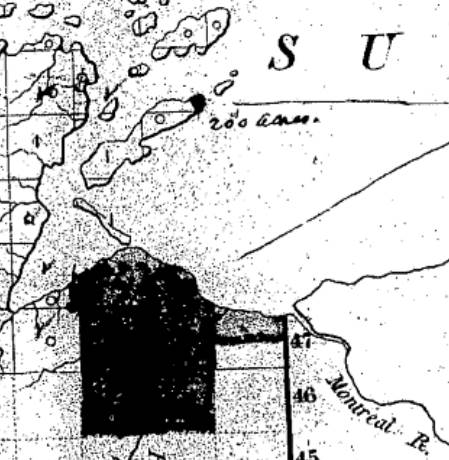
Detail of La Pointe Band Reservation including Gichi-ziibiiwishenhnyan (Saxon Harbor) in a letter dated March 30th, 1855, from the Commissioner John Wilson of the General Land Office to General Surveyor Warner Lewis at Dubuque, Iowa:
“For the Lapointe and other Indians, the body of land on the shore of Lake Superior, immediately west of Montreal river together with 200 acres on the Northern extremity of Madeline Island (all full colored blue on diagram A.) under the 2nd clause of the 2nd Article of the Treaty.”
~ National Archives Microfilm Publications; Microcopy No. 27; Roll 16; Volume 16.
By Amorin Mello
This is the third installment of the Memoirs of Doodooshaboo series on Chequamegon History, as transcribed by us from the original handwritten memoir of Joseph Austrian at the Chicago History Museum. This installment covers Joseph Austrian’s migration from New York City to Mackinac Island, where he is greeted by his sister Babette Austrian and her husband Louis Freudenthal Leopold. The next two installments describe Joseph Austrian’s experience with his Leopold and Austrian relations on Chequamegon Bay during 1851-1852 (Part 1 and Part 2).
Memoirs of Doodooshaboo
… continued from Manhattan 1848-1850.
Started for Mackinaw Island. 1850.
“State-room saloon of the Isaac Newton (Hudson River steamboat)”
~ New York Public Library digital collection, image WWM9814-012008f
Leaving my sister in New York, under the care of Uncle and Aunt, I left for Albany on the steamer Isaac Newton, then considered the finest steamer on the Hudson River. A state room then was a luxury out of the question. I sat up all night long in the engine room watching the machinery, which had a fascination for me. There was aboard a young lady who had crossed the ocean on the same ship I had come over on. She was all alone on her way to Joliet, she had been annoyed by some passengers, offering to buy a stateroom for her, and she was happy when she saw me, and as it were, put herself under my protection passing off as my sister, she also sat up all night with me in the engine room. Many years later I met this young lady’s aunt in Chicago, she was a neighbor of ours and we enjoyed a pleasant chat over by gones.

“SS Atlantic, built 1848, courtesy of Institute for Great Lakes Research, Bowling Green State University.”
~ Øyergenealogy
We reached Albany the following morning breakfasting at a restaurant, and early that afternoon started on our emmigrant car, arriving at Buffalo next morning. The car was fitted with wooden benches running length wise, all we had to eat on the journey was apples, which I bought on the way from boys and girls who came into the train with baskets full at the several stations where we stopped. This same evening we started on the side wheel steamer “Atlantic,” taking steerage passage for Detroit; we encountered a heavy storm on Lake Erie, it was very rough and we were tarted to a severe spell of seasickness. I managed by tipping one of the cooks to get some coffee for my companion and myself as eatables were not supplied to steerage passengers usually, this was our breakfast. After our long fast, with the exception of the apples, we arrived at Detroit at ten o’clock next morning, my travelling companion continuing her journey on to Chicago.
I went with a tavern keeper, a Mr. Martin Fry, who had met our boat at the landing and solicited patronage. His place was called “Gast Haus zu Rheinpfaltz” a cheap boarding house, the boarders were principally railroad laborers. Mr. Fry was a kind man, he went with me the following morning to the river front, for the purpose of making enquiries regarding the leaving of the next steamer for Mackinac, which I intended taking. Imagine my consternation, when I heard that the last boat of the season had left, there was no railroad connection between these two places, and it was too hazardous to try to reach Mackinac by sleigh on foot; under the circumstances I was compelled to face the only alternative of remaining in Detroit over the winter.
Compelled to Remain in Detroit. 1850.
~ Detroit Perspectives: Crossroads and Turning Points, by Wilma Wood Henrickson, 1991, page 114.
I had taken but 15$ or 20$ with me on leaving New York, leaving the surplus with my sister, and I had no intention of calling on her or any one for more. What to do now was the next question. Mr Fry offered to board me during the entire winter for the sum of $25, but the amount looked so large to me, and I declined but arranged to pay him $1.75 per wk but had to share my room and bed with another party, a stranger to me. Fry volunteered to assist me in trying to find employment and going with me to stores, and factories amongst others to Silverman & Co., a cigar factory and to Friedman & Co., a large dry goods store. Mr. Friedman was a friend of Mr. L. F. Leopold who had written him concerning me. In spite of all, although I was willing to do any reasonable work I was able to perform for my board, the general answer I got was “they had all the help they needed” then, and could not use me for anything I was suitable to do, which was a sore disappointment to me.
My First Business Venture:- Peddling. 1850.
~ Wikipedia.org
~ Detroit Perspectives: Crossroads and Turning Points, by Wilma Wood Henrickson, 1991, page 114.
One of the boarders, a young jeweller who had just returned from New York where he had been to buy goods to replenish his stock, found that in doing so he had failed to reserve enough cash to take him back to Chicago, and being short was forced to stop over to await funds to be sent him by his brother at Chicago. He told me confidentially of his predicament, and I confided to him my plight. I had 12$ in cash on hand, and he proposed that I should invest this in notions, he to assist me in selecting the goods, and to start out together in peddling while he remained in Detroit. As he spoke English and I could not understand one word, I gladly accepted his proposition. We started off at once, first to the market place, where we bought a cheap splint basket then to Benedict & Co’s Jefferson Ave. where we made our selection.
While making our purchases, I suddenly called a half and had the bill figured up, as the original bill I have among my papers in Chicago will [???] fearful that the order might over reach my capital, and found that there was still one dollar left to invest; after completing which we started for my room with basket and bundle, we arranged and assorted and rearranged the goods in the baskets to make the best possible showing, and my partner taking the basket and I throwing a dozen red woolen mufflers over my shoulder, we started out two days after my arrival in Detroit, on my first peddling expedition, and had fair success, selling a few dollars worth the first day, and reinvesting the amount in more goods the same evening. Thus we continued for five days, when my partner received his remittance and informed me that he would start for Chicago. We took inventory and found our profits had amounted to $2.00 in all. As his share in the profits, he took a dozen brass seal rings as I found these articles with my limited English vocabulary difficult to dispose of. He started for Chicago and the following morning I set out alone with my basket. Not being able to speak or understand English, I felt a little timid at first, however I managed to get on with fair success. I chose the outskirts of the city for my trade, the roads to the city were very bad, and I calculated the difficulty offered people in going to and fro, would be to my advantage. I naturally suffered frequently from the could, on these long tramps. I did not possess an overcoat, and only scant underwear, and no means nor inclination to incur further expense for clothing.
“Map from 1850 of the Michigan Southern and connecting railroads. The Michigan Central is also shown, with its then-western terminus of New Buffalo. The Detroit & Pontiac, soon to become the Detroit & Milwaukee, is not shown.” ~ Wikipedia.org
The Michigan Central Railroad was being constructed toward Chicago, at this time there being no through communication. Mr. Friedman had advised me to perfect myself in the English language and given me the name of a teacher who had instructed him on his coming to America. I immediately, after I found myself compelled to remain in Detroit, made arrangements with the teacher to give me two hours lesson each evening, which I continued to take most conscientiously all winter.
Left for Mackinaw. 1851.
When Spring came I found that after having paid all my expenses, I had enough money left, (ten dollars) to pay for my ticket to Mackinaw, this was May 1851, and treated myself to first cabin passage, the first time I had traveled first class since leaving my home in Germany. I left Detroit, March 28th. 1851 on the Propeller, Republic, on Lake [blank] and had a smooth passage, it was quite cold and a thin sheet of ice had formed over the lake, but not thick enough to retard progress.

“Woodcut engraving of the propeller REPUBLIC towing the Michigan Southern Railroad Company’s steamboat NORTHERN INDIANA into Pigeon Bay as she burned on Lake Erie on 17 July 1856.”
~ MaritimeHistoryoftheGreatLakes.ca
~ Wikipedia.org
~ EarlyCanadianHistory.ca
On April 1st. I arrived in Mackinaw (also called Mackinac Island) deriving its name from the Indian word Michili. The Island at this time had about three hundred white inhabitants and there was also an Indian settlement there. A government fort was located here on a high steep hill, surrounded by a stone wall, where a few companies of soldiers were stationed. The Island was a beautiful romantic place, it had no telegraphic or railroad communication, consequently in the winter, with the close of navigation, it was entirely out cut off, and isolated from the rest of the world. In the summer it was visited as a summer resort to some extent then, and has in later years become very popular as such. Chicago at this time had no direct railroad connection with the East, all travel between there and the East was by water.

1843 Drawing of Mission Point Beach at Mackinac Island, Michigan
~ Historic Mackinac: Volume 1 by Edwin O. Wood, 1918, facing-page 367.
There was a fine line of large side wheel steamers, elegantly fitted up and furnished with a band of music aboard. These steamers ran between Chicago & Buffalo, and always made stops at the Island on their regular trips and enlivened things there.
On my arrival there I received a most hearty welcome from my sister Babette and brother-in-law Louis F. Leopold, who had worried considerably over my having missed the last boat of the season and therefore having been obliged to remain all winter in Detroit. Mr. L. F. Leopold was the oldest of four brothers Aaron, Henry & Samuel, they together with Mr. Julius Austrian had a dry goods store on the Island, and in addition to this were engaged in the fish business, furnishing nets, salt & barrels to the fishermen, who caught and packed the fish, the same being later on collected from the different fishing grounds by a small schooner sent out for that purpose. Alternately the three younger brothers were sent in charge of these expeditions. L. F. Leopold was naturally a bright man, but egotistical, and very visionary and with most unpractical business ideas, still he had complete influence and control over his brothers who implicitly obeyed his commands, often contrary to their own and better judgement.
The day after my arrival at Mackinaw Mr. Leopold took me to the warehouse and showed me his stock consisting of hundreds of barrels of fish. The collection of the season. I was told that I was expected to assist in repacking this fish, which is done before their being shipped to market. I was eager to do so and went right to work and worked hard daily as I did not want to be under obligations for my board even for the short time I was to remain at Mackinaw. I did not find the occupation enticing or agreeable, my principal lamentation was that the strong salt brine ruined my clothes, and my wardrobe had become sadly depleted by this time.
To be continued in La Pointe 1851-1852 (Part 1)…
By Amorin Mello
This is the second installment of the Memoirs of Doodooshaboo series on Chequamegon History, as transcribed by us from the original handwritten memoir of Joseph Austrian at the Chicago History Museum. This installment covers Joseph Austrian’s migration from Bavaria to New York City. Later installments describe Joseph Austrian’s experience with his Leopold and Austrian relations on Chequamegon Bay during 1851-1852 (Part 1 and Part 2).
Memoirs of Doodooshaboo
… continued from Bavaria 1833-1847.
Left Wittelshofen. 1848.
~ Wikipedia.org
I went to Feuchtwang, to my uncle’s home, making myself useful in the fields about the house and barn and otherwise. He was an intelligent man, self educated and well read, a fine gentlemanly person, but penurious. My coming in contact with him was beneficial as I spent my evenings with him in his study and profitted by his large knowledge of things. My aunt was very kind and treated me as one of her own family, after having been there for one and a half years, and finding there was no further improvements to be gained, in accordance with the suggestions of my brother Julius and brother-in-law Lewis F. Leopold, who had gone to America some four years before, it was finally decided that I with my sister Ida should emigrate to America.
Mr. L. F. Leopold had a fishing and trading business at Mackinaw, my brother Julius was located at La Pointe on Madelaine Island, one of the Apostle group of islands in Lake Superior, northern Wisconsin, where he was engaged in the fur trading and had a general store, and traded with the Indians and half breeds buying fur from them.
Emigrated to America. 1850.
~ Wikipedia.org
~ Wikipedia.org
On October 4, 1850, at 4 o’clock in the morning, my sister Ida and I started for America. It was a cheerless raw morning, and with heavy hearts we set out in a private conveyance, via Feuchtwang to Wurzburg, where we arrived that evening and put up at the Wittelsbacher [Hof?]. The following morning we started on a little steam boat on the River Main, for Frankfurt, via Ashaffenburg, where we arrived that evening, leaving for Frankfurt the next morning, arriving there in the afternoon, and were met at the landing by our Uncle Heinrich Heule, who received us most cordially and invited us to his home, where we remained two days. We dined the 2nd day with his daughter, our wealthy cousin, Frau Richa Schuster, who gave a fine dinner in our honor.
~ Wikipedia.org
~ Wikipedia.org
From Frankfurt we went to Mainz, to which place our baggage had been forwarded ahead of us. The following morning we started on a Rhine steamer for Rotterdam, thus taking in the entire Rhine trip which we enjoyed immensely, we remained in Rotterdam two days, when we crossed the North Sea on rather a poor small steamer for Havre, France. In crossing we encountered a terrific storm during the night, the waves swept over the decks of the steamer causing the water to rush into the cabin where we were sleeping, and we had our first and most severe experience of home sickness. On our arrival at Havre we looked woe begone, and some of our baggage was almost ruined. The ship on which we were to sail was a large three masted “square rigged” sail vessel, “Robert Kelley”, Captain Barstow. On looking her up, I found she would not leave for five days to come, as she had not yet finished loading her cargo. In the meantime we were comfortably located in a boarding house where we made further preparations for our Ocean Voyage. Oct 20 we sailed from Havre taking 2nd cabin passage which was near the captain’s quarters. There were seven persons besides ourselves occupying our cabin. The ship did not furnish food for the passengers, but provided facilities for them to do their own cooking in a limited way. There were some rows of a certain kind of cooking stoves which were heated by an employee of the ship, the places were divided into a number of spaces so arranged, that kettles could hang in them. Each space was allocated to certain parties during the trip, but there were many more passengers than spaces, and it was not seldom that a fight was occasioned by one or the other party claiming the privilege of priority. In fact when a person turned his back for a few moments, while engaged in preparing food, someone would take off his kettle substituting his own. On certain person finding himself thus dispossessed grew furious and hurled his kettle contents and all on him who had played him this trick. The mate happened to come along, and made the one who had thrown the kettle, take off his coat, and with it wipe up the floor clean, threatening to lock up anyone who would do any thing of this kind again.
Before leaving home my mother had provided us with food such as could be easily prepared, such as roasted [four?], prunes, [gruieback?], dried beef, smoked tongue, &c. During the trip, two others of our party besides myself alternately attended to the cooking, and we got along as well as could be expected. On the voyage we had generally heavy winds and a rough sea, but fortunately the winds came mostly from the direction favorable to our sailing, consequently we made good headway.
Our Captain was a very capable navigator and very strict in his discipline. Among our passengers were two close friends, “frenchmen,” who often indulged to freely in French wine, quarreled, one stabbed the other but not seriously. After the Captain investigated the matter, the offender was hand cuffed. When it was rough the poor fellow tossed about mercilessly, when his injured companion took pity on him, and at such times would remain with him, leading him by the arm to protect him and to keep him from falling.
Besides the second class passengers there were about two hundred steerage passengers, below. One of these men “a monk” jumped overboard one day, the Capt. happened to see it, and gave orders to have the ship quickly turned about. A life buoy thrown by the Captain to the man struggling in the water, was grasped by him and six sailors in a life boat put out to rescue and managed to save him just in time. The monk was brought back to the vessel more dead than alive, the ship’s doctor worked until he revived him. On being questioned he said, he jumped over board owing to the terrible unpleasant surroundings in Steerage. The Capt. then told him that he would not again risk the lives of his sailors, should he jump in again, but there was no need of it, as he did not make another attempt.
On November 20th, we sighted land during the afternoon, and in compliance with a signed “wanting to be towed”, a tug came along side of our ship the next morning, throwing us a tow line, and we expected to reach New York the following morning. But we were doomed to disappointment, a large head wind sprang up and the tug could make no headway, and after a few hours of futile struggle, the tug gave up the attempt to tow us and cast off our line, and our ship was compelled to turn back to sea to avoid danger of the coast. But the next morning two tugs came on and took our ship in tow, and the wind having subsided, made good headway.
Presently a little schooner came along side our ship, and parties aboard began bartering with the passengers to buy their bedding, for which they might have no further use, I gladly sold mine.
Arrived in New York. 1850.

Castle Gardens was still an entertainment center in 1850, and did not operate as an Immigration Station until the years 1855-1890.
~ Castle Clinton National Monument
We landed at Castle garden about noon November 21st, our trip over, having lasted about a month. Under the inspection of the Custom House Officers the luggage was unloaded, by sliding the same down a steep plank, and in watching this performance to my great consternation, I saw one of my big chests burst open and contents scattered, giving me an endless amount of trouble to get all repacked. The chest contained an outfit of linens and feather beds our mother had given us for our future use.

Joseph and his sister Ida arrived at New York City via the Robert Kelley on November 21st, 1850.
~ “New York Passenger Lists, 1820-1891,” image 560 of 869; citing NARA microfilm publication M237 (Washington D.C.: National Archives and Records Administration, n.d.).

Joseph Austrian (Oestreicher) and his sister Ida on the passengers list.
On landing, an Uncle of ours, Mr. Heule, an old gentleman about 70 years old, met us on the pier, and it seemed good to see some one who knew us. My Uncle and sister went for a short walk leaving me to look after the baggage, expecting to return in a little while for me, but the afternoon passed, and night came on without their returning. Most all of the passengers had left the pier and I was left alone on my first night in America. Some of the sailors feeling they had been abused by the mate on the voyage over, and made up their minds to get even with him, and on the upper deck that evening, together they attacked him, beating him till they nearly killed him. The noise and excitement the tummult occasioned, did not have a cheering effect upon me, however, when things quieted, I went up on deck and stayed there till after midnight watching the ferries cross and re-cross, which was a novel sight I enjoyed. By this time I despaired of seeing or hearing from my uncle or sister that night, and although worried I sought to get some rest, there was no bed for me and I laid on the hard wood floor that night, and had not a morsel of food to eat. I could not speak a word of English, and altogether, I felt rather forlorn, on this my first night in America. Finally next morning they came to look for me & simply explained that they had wandered too far and Uncle thought it too late to come back for me, and had gone on to his home. I accompanied them back, on our way a vender of notions with his basket on his arm happened to pass me, my Uncle turned to me remarking that I would have to begin with something of this kind to earn my living; it was not an encouraging prospect, and I said nothing, but I little thought then how soon his words would come to pass.
I visited at my Uncle Max Heule’s two days and then decided to start for my intended destination, Mackinaw Island.
To be continued at Mackinac 1850-1851…
Memoirs of Doodooshaboo: Joseph Austrian in Bavaria 1833-1847
December 28, 2016
By Amorin Mello
This is the first installment of the Memoirs of Doodooshaboo series on Chequamegon History, as transcribed by us from the original handwritten memoir of Joseph Austrian at the Chicago History Museum. This installment contains rare details about a Jewish community in Bavaria before other records were destroyed by Nazi Germany in later years. Later installments describe Joseph Austrian’s experience with his Leopold and Austrian relations on Chequamegon Bay during 1851-1852 (Part 1 and Part 2).
Joseph Austrian’s
Autobiographical and Historical Sketches.
Dedicated to
My Wife and Members of my Family.
My Childhood Days. 1833.
~ Wikipedia.org
I was born September 15, 1833, in a small village called Wittelshofen (Mittel Franken, Bavaria), located at the foot of the Hesselberg, a mountain 1800 ft. high, and at the junction of two little rivers Wörnitz and Sulzach near Dinkelsbuehl, where the judiciary district court is located.
~ Wikipedia.org
On the top of the said mountain, every year in June a fair, called “Hesselberger Messe,” was held which was the great attraction for all the people of the several villages located around the foot of the mountain. To this it was customary to invite friends and relatives from far off places to attend, and it was generally very enjoyable barring the climb it meant to get up there, as it was too steep for vehicles to drive up there excepting from one direction where the road up was more gradual and which was used for the transportation of things for the fair. Besides the many places where beer was sold and where the rural population had dances, and other amusements there was generally a circus and other shows there. The view from the top of the mountain in clear weather was very fine and interesting. I always looked forward impatiently to the time when this fair took place, and soon as I was old enough to take this long steep walk, I availed myself of the opportunity which I greatly enjoyed.
Wittelshofen
The village of Wittelshofen had about 500 inhabitants of which about half consisted of Jews and the other half Protestants.
My father’s house was one of the largest and best in the place and stood opposite an old small castle, the grounds of which were surrounded by a stone wall about 10 feet high. Our home was on a lane called “Schmalz-gasse” which in wet weather was very muddy.
My father’s name was Abraham Isaac Oestreicher (Austrian), he was born in Wittelshofen and died there Sept 17, 1852 of apoplexy at the age of 75 yrs. He was an only son and his father gave him what educational advantages could then be obtained and principally in “Hebrew” which gained for him the name title of “Reb” and he was known by the Jewish village people as “Reb Frohen”. He had a large library of Hebrew books, they were of unusual size and some nearly a hundred years old.
My father was brought up strictly in the observance of the Jewish faith and adhered to its orthodox teachings very strongly. He was an easy going man and known by all for his honest and upright character. He dealt in live stock and had some good farm lands located around the outskirts of the place.
~ Chicago, the Garden City. Its magnificent parks, boulevards and cemeteries. Together with other descriptive views and sketches by Andreas Simon, 1894, pg. 147
My mother’s name was Malka nee Heule, whose parents were considered wealthy, her father, [Hyrun?] Heule was known and respected all around for his charitable deeds, especially for what he did during the famine, caused by the crop failure in 1825, when he sent big wagon loads of flour and other suplies to the famine stricken district to feed the needy, thereby saving many from starvation.
My mother was an intelligent and determined woman, and took sole charge of the house hold and education of the children. She was born in Braunsback, Wurtenberg. She died at the age of 87 yrs in Chicago, Aug 6th, 1882.
~ Wikipedia.org
My father had three children by his first wife and ten by my mother, the eldest died when a baby the others were Falk, Marx, Julius, Babette, Ida, Fanny, Joseph, Minna, & Solomon. The latter being the youngest was my father’s pet. Falk, my oldest brother, was sent to a neighboring city for higher education, which afterwards secured for him a position as a clerk and traveling agent in the business of Wedels in Furth, a brother-in-law of my mother, where he earned a good salary.
My next brother Julius, was sent to Feuchtwangen to learn the tanning trade and afterwards travelled afoot for a couple of years or more working in a number of other cities at his trade, as it was there customary to perfect themselves in the trade, and later going clear to Paris, France, before returning home, a short time afterwards he emigrated to America to join our brother-in-law Lewis F. Leopold, who had located in business at Mackinaw, with branches in Wisconsin.
Julius Austrian (Oestreicher) immigrated with his sister Babette (wife of Louis Freudenthal Leopold) and brother-in-law Henry Freudenthal Leopold.
~ “New York Passenger Lists, 1820-1891,” image 19 of 895; NARA microfilm publication M237 (Washington D.C.: National Archives and Records Administration, n.d.).
My brother Falk went to California in 1846 via Panama. At six years of age I entered school. I remember well when my mother took me on the first day to school and had me give the teacher a package of smoking tobacco. I went to the public school in the morning, the teacher had little education, his father was the village tailor; the son being versed in the three “R’s” his father secured the position of teacher for him. In the afternoon I went to the Hebrew school. Mr. Mandel was the teacher there, he had received his education in a Seminary he was very strict and high tempered, the children all feared him, as occasionally he afflicted corporal punishment. Besides this I had private lessons in history and geography.
At the age of thirteen I had to start to assist working in the field, in harvesting and hay making. I also had to plow when I was barely strong enough to handle the plough, I had to hook the handles over my shoulders to manage to get to the next furrow. I had to arise during some of the winter months at 4 o’clock in the morning, and assist in the threshing while it lasted, and I got thrashed sometimes too, when I did not keep time. My greatest sport was fishing, for which purpose I made my own pole and I often walked off to the river, when my folks thought I was busily employed. The fish I caught were mostly perch. I remember I once caught several and fastened one to a string fastened to a stake in the ground, suddenly a severe thunder storm came up, at which I made hurridly for home, forgetting the little perch I had left behind. I started bright and early the next morning to get it, and to my great surprise on pulling the string I hauled up a big pike instead of the little perch, which had evidently swallowed the latter tied to the stake and thus was caught. The joy of my good luck was indescribable.
Another sport I was very fond of was shooting off pistols. My brother Marx had one in an old cupboard drawer, which I managed to get hold of one day and when none of the family were about I with a few of my boy friends ran off to the fields, where we had such fun taking turns in shooting, and when we had no more powder we snapped off percussion caps. When a pistol was not available I constructed an improvised pistol of my own design, by attaching a big old hollow key to a natural crook of wood, which I selected in the wood shed and to which I fastened it with wire. After filing a hole on the side of the key, under which I attached a piece of tin to hold the powder. When i was ready to shoot, I laid a little flat sponge on the tin, lighting the outer edge, which acted as a fuse, and as it burned toward the powder ignited it causing it to go off and making a loud report. Not trusting the old key entirely, however, fearing it might explode, I went to a safe distance after lighting the fuse.
Outside the synagogue in Wittelshofen, Bavaria, Germany. Circa 1912-1938.
~ United States Holocaust Memorial Museum, photograph # 25821.
“Wittelshofen was declared ‘Judenfrei’ (‘free of Jews’) in January 1939.”
“The synagogue building was demolished during the winter of 1938/39.”
“A memorial stone was later unveiled there.”
~ Destroyed German Synagogues and Communities
In 1840, at the grand celebration of the new synagogue, my parents entertained with an invitation on a large scale. My mother had arranged for a special cook to prepare a grand feast. I and the younger children were excluded. I did not fancy being barred from participating. In strolling through the pantry I espied an elaborately decorated tart, chief ornament to grace the table. While the cook was otherwise engaged at the last moment, I managed to eat off the ornaments and decorations. Never will I forget the excitement and consternation the discovery of my act caused. Could hands have been laid on me then, I would have been severely dealt with.
In my fourteenth year, my mother began planning as to my future. The income of the fields, and the cattle business had declined, and considering the large family and household to be provided for did not permit of incurring much expense for my higher education, and my father advanced age made it impossible for him to enlarge his income. My mother was anxious to get me away from Wittleshofen, as she could see no promise in the future there for me. At this time, an opporunity was offered through my uncle Samuel N. Guttman and accepted.
 Chequamegon History