Barber Papers: “Lake Superior” Summer of 1855
September 7, 2015
By Amorin Mello
Selected letters of the Joel Allen Barber Papers
… continued from Spring of 1855.
Superior, Douglas County, July 2nd, 55

Detail of Superior City townsite, Douglas County (T49N R14W).
Beloved Parents
It is now two weeks since I arrived in this country and I feel a little guilty for not writing sooner but as I have been somewhat prevented by circumstances and as Augustus has informed you of my safe arrival here I have neglected writing rather longer than common.
I suppose you would like to hear a great many particulars about your children in the woods which would be too long to write therefore I can only give a synopsis of my adventures.
~ Carlton County Historical Society
~ Retracing the Military Road From Point Douglas to Superior by Grover Singley
On the boat we had a cold raw time and no danger of cholera we arrived at St. Paul on Sunday June 3d and took the stage for Stillwater 18 miles and then proceeded on foot 15 miles. Monday we got to Taylors falls 17 miles where we were detained by the great difficulty in procuring necessary provisions for the trip.
Tuesday we started with an outfit sufficient to last us to Chase’s camp, about 100 miles up the St. Croix. We camped out only three times in coming through, twice we stayed in deserted shantys [door/floor?]less, windowless and partly roofless.
We lost our trail Thursday or was misdirected and travelled all that afternoon among the swamps and thickets on the St. Croix bottoms and bluffs and finally camped on the bank of the river, and [eat?] our last provisions at night. We [where?] not lost but had lost the trail by trying a new one. Friday morning we proceeded up the river about [6?] miles, waded across and got to camp about nine o’clock where we got a good [bush pack?] and a supply of provisions.
We got out again however the night before we got here on the copper range, twelve miles from here. The road of the first hundred miles is very good walking, being mostly over pine barrens but from here to the St. Croix it is horrid much of the country is a complete network of swamps of all sizes up to a mile across. I arrived here Sunday June 10th found Augustus sailing on the bay. Since then I have been helping him build his cabin and do some other work. Camping out did not disturb me so much as I had expected – at last the novelty of lying down in a gloomy forest with the trees moving over us, a big fire at our feet, the whippoorwill singing around us and the dew moistening our blankets was not sufficient to counteract the [f??ig??ts?] of a day’s travelling, so I slept soundly and felt well in the morning. I have not seen a bed now for a month. I sleep sometimes on a bear skin sometimes on boughs and sometimes on the ground, last night on an old tent.

Business Directory published in June 26th, 1855, issue of the Superior Chronicle.
I hardly know what to say about the country.
The air is pure and bracing. Storms are sudden and frequent. One we had was the worst I ever saw. Hail, rain and sand filled the air so we could not see 30 feet. The copper region is equal to [Pabor-dure?] for rain. There is a steamboat aground in the bay near the entry – has been there all day, is now sending her freight to this wharf – will probably get away when the tide begins to go out. All the country I have seen south of the lake is generally flat or gently sloping. The soil of the points is sand thrown up by the lake and drifted into irregular mounds. In the city and some other places the rock earth is the purest red clay I ever saw, back from the lake 4 or 5 miles the soil is pretty good and would compare well with the best parts of Vermont. Some [branches?] of farming I think would pay well. Hay meadows can be made [ikey?] some places by turning up alders and hay brings $[30?] every month.
I can tell better about farming when I see what effect the new canal has on prices about here.
As to making valuable claims there are a number of good chances open yet.
I have seen one as good copper show as there is in the northwest which I might get but there are some drawbacks to it that make me rather doubtful.
There are other chances pretty fair and much surer. There are lots of Indians on this point very peaceable among themselves and towards others but some imps will furnish them with “scoo te wau bo” (firewater). Several Indians are now at work here carrying in freight. The squaws too are hanging round with their children and pappooses. I guess Father, you misunderstanding me about the land Mr. Ladd owns. A large share share of it is entirely clear of brush and ready to break, but all in a state of nature. Augustus is going to put something in with this, so if there is anything more to write I will leave it for him to write. Augustus received letters from home last night enclosing one from mother to me for which I was very thankful and I will try to give it more attention sometime.
With respect to all inquiring friends.
I remain
Your affectionate Son
Allen
Interior Field Notes
Township 48 North, Range 4 West
Barber, Augustus H.
July 1855-Aug. 1855
Notebook ID: INT040W01
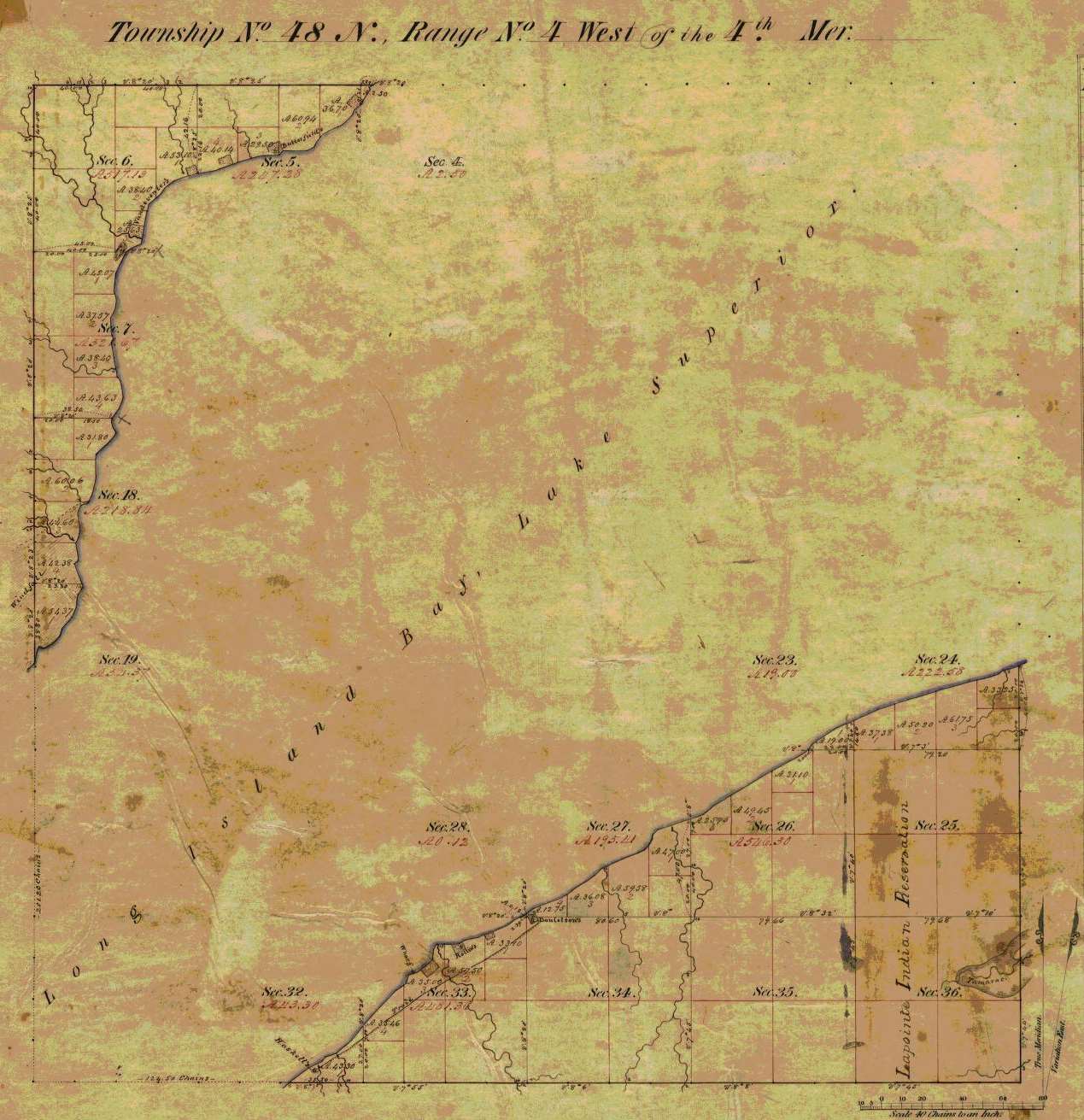
Original plat map of Chequamegon Bay (T48N R4W). Details include: Long Island Bay, Lapointe Indian Reservation, Vanderventer’s, Butterfield’s, Haskell’s, Rollin’s, Danielson’s, and other settlements. Today, this area includes the City of Washburn, the east side of the Township of Barksdale, the east side of the City of Ashland, and the northwest boundary of the Bad River Band of Lake Superior Chippewa Indian Reservation.
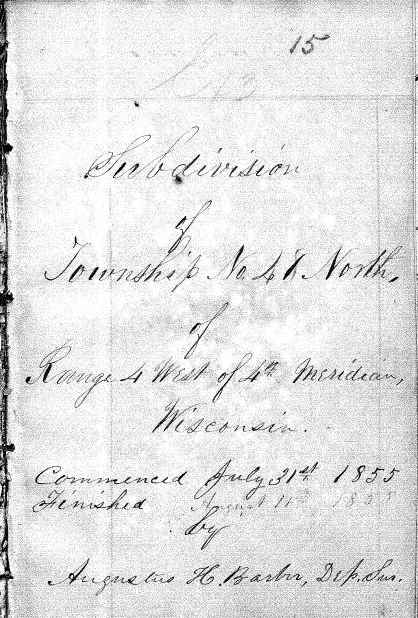
Survey of Chequamegon Bay (T48N R4W) by:
Augustus H. Barber, U.S. Deputy Surveyor.

General description of Chequamegon Bay (T48N R4W).
(This handwriting appears to belong to Allen.)

Chainmen: George I. Butler & J. Allen Barber 2nd.
(Allen 2nd is Augustus’ brother; not their cousin)
Axeman: Albert A. Little.
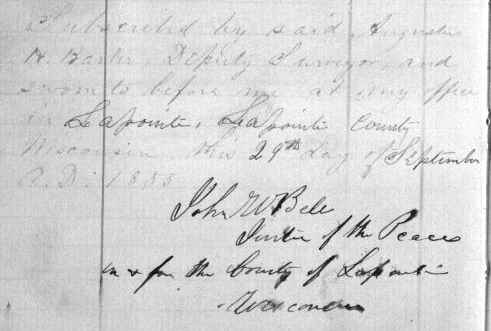
Affidavit signed by: John W. Bell, Justice of the Peace for LaPointe County.
Johnson Aug 5th AD 1855
Dear Sons
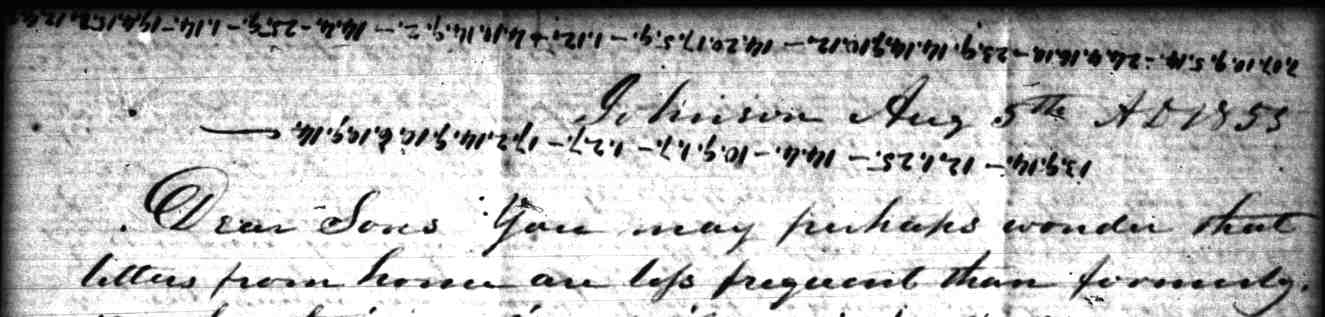
A monoalphabetic cipher was written in the header of this letter upside-down with numbers (1-26). What was father’s secret message to his sons?
“13.9.14.- 12.1.25.- 14.4.- 10.9.1.7.- 1.2.7.- 17.2.14.9.10.6.10.9.14. ~~~
7.17.10.9.5.14.- 26.4.16.10.- 23.9.14.14.9.10.12.- 14.20.17.5.9.- 1.12.- 4.11.14.9.2.- 14.4.- 25.9.- 1.14.- 19.4.15.2.12.4.2.”
Credit and gratitude goes to Eli Fredericks for cracking the Barbers’ code.
“G.E.T.- S.A.M.- T.O.- R.E.A.D.- A.N.D.- I.N.T.E.R.P.R.E.T. ~~~
D.I.R.E.C.T.- Y.O.U.R.- L.E.T.T.E.R.S.- T.W.I.C.E.- A.S.- O.F.T.E.N.- T.O.- M.E.- A.T.- J.O.H.N.S.O.N.”
Who was Sam?
Samuel Stuart Vaughn at LaPointe?
Samuel Champner at Ashland?
You may perhaps wonder that letters from home are less frequent than formerly. Now that the injunction of silence is partially removed by the recpt of a very welcome letter from Augustus, the first news I have had from either of you for nearly a month. I will once never try to write you a few words, having adopted the rule “measure for measure” that is write when I am written to, and endeavor to make up in quantity what it lacks in quality, I have for three weeks wanted to write to you but waited to get something from you first, and the longer I found my box empty when I went to the P.O. in the morning the more determined I was that the long silence might grow still longer before I would break it. I have all along written about two letters to every one I have recd from either of you within the past year and really began to think as your mother does that I “write more than there is any need of” & that you were getting to be of her mind on that [score?], and that if I graduated the number of my letters to those recd from you, I should then know just how often you wanted to hear from home. We are all well, as usual, (the lack of a sofa, centre table, chairs, new carpet, and a few more articles, now forgotten, excepting and even without them we are blest with good health, as any one could reasonably expect under such privations. It is a very healthy time in the village & through the town. Old Martin Smith brother to old Calvin was buried last Sunday having died of an injury that affected his [urinary?] organs. To day Abram [Ferry’s?] wife is dead of consumption.
Last week was commencement week and Am. went down in the Stage starting at 5 A.M. [dined?] with By at the fall, and attended the exercises in the P.M. and evening. Commencement exercises next day & stayed till Friday night before he started for home, living with [Alvira?] all the time & then had hard work to get away. Of course he had great times. He was in the village and saw a company of Firemen from Montreal 300 or 400 in number come into Burlington on Thursday & their reception & the speeches, Band, &c pretty tall time for Hiram.
He got home safely at 2 o’clock Saturday morning. The long expected new bell has arrived and was duly installed into office yesterday, and to day has proved itself a real “church going bell” at [???] its arguments in favor of attending meeting were loud and convincing. The Bell weighs 1137 lbs and has a very fine good musical tone, enough to incline anybody churchward.
I went to Cambridge & got Harvey [Butts?] to come with his tackle & rigging to hoist it into the belfrey which he did to the satisfaction of all. Even Mr D. was so much better to day that he has preached two sermons the first we have had from him for 4 or 5 weeks on account of ill health. He went to Montreal after Sarah, left there Monday (2 weeks tomorrow) at one o’clock P.M. & at [Rausis?] Point a little boy (a relative) wanted to get out of [sight?] for a moment & Sarah took him out of the car & stopped back again, the boy did not come in till the cars started, when [Minites?] sprang out to find the boy, & the cars went on then he remembered that he had Sarah; tuked in his pocket, and she had not a cent of Money with her, but she kept on, told her story was believed & got home at one at same night, but the excitement anxiety and fatigue consequent, overpowered him so that he has been quite feeble ever since, till to day.
Week before last we had a most disgraceful performance in shape of an Indian Show. Some two weeks before a fancy team with a couple of drunken [bloats?] came along, engaged ground for a big tent in the little meadow we used to occupy near Judge [Tom’s?] & put up mighty big [posters?] representing Indians riding &c &c. & on the day appointed the folks began to pour in [torrents?] to – be – humbugged.
The company arrived and after dinner the natives [Kaw shaw gaw?] as leader 5 in number & as many more whites dressed and painted like Indians paraded themselves through the street, on horseback, the horses, & themselves, decked out with feathers and sham Indian finery, well, had you seen the rush you would have been convinced that fools are plenty this year. Mum & Am were obliged to go with [Ransom?] & his wife though against their inclinations. One more notable thing has happened since I wrote last. Uncle Burr and your Aunt Martha have been here and staid 2 nights & we had a pretty good visit. [Pung?] has [bud?] all up and [awas?] in and around St Albans over three thousand dollars. [Sand?] Morgan & Ike Manning will lose about $200. by [signing forkin?] & what is most deplorable the little Devil has got drinking so that to see him drunk was no rarity. He went off with an Irish butcher over the line (45*) & came back as drunk as a fool & he was drunk at the County Convention at Bakersfield. His wife’s Piano & his books have been taken on his debts – Poor foolish fellow. Crops of all kinds are good except Grass & that is not as good in Cambridge as last year, but called about the same around here. [Prein?] have a down on [Butter?] & [breadstuffs?], but we shall have another hard winter that will bring them up again I fear.
You will see by the Grant County Herald that lands entered under the graduated prices, cannot be sold again without forfeiting the land to the government, so that the next man can go and pay the same price, and take the lands as though it had never been entered, so that Allen must not alienate his title to his land as I had advised him in case he wanted to make a preemption claim.
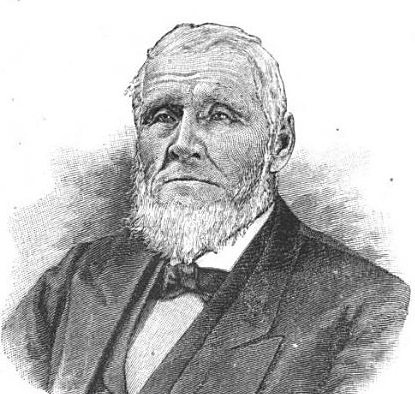
Portrait of U.S. Representative Alvah Sabin (Vermont); in office between 1853-57.
~ Wikipedia.com
It would be very agreeable to hear from you oftener, for we do feel some anxiety to know where you are, what you are about, how you are getting along, and above all to learn that you are alive and well & kicking. I am glad to hear that you receive favors occasionally from Elder Sabin, & though not of great intrinsic value in and of themselves, there is some pleasure in receiving them as a token of remembrance and esteem and another thing it will give those who know you have such documents sent from such a source a favorable opinion of your [anteredents?].
It is so long since I have written to you that I have hard work to get on the truck, and harder still to keep on I believe I have pretty much exhausted my stock of news.
Your Aunt [Betsy?] tells me to send her love to you and [aprise?] you that there is no one in the house who misses you more than she does. (Perhaps she is mistaken after all) & that she does not want you to come home ust so that she can see you, but to come when you get ready & she will be very happy to see you. Mr [Atwood?] was up yesterday with Levi & Oscar & left [Onen?] here with Am to stay a day or two, Levi [took thin] and [pale?] and is unable to do much of any thing, says he rakes hay some &c. The Methodist Meetinghouse is up and will be finished in a few weeks. The Baptist house is progressing slowly but it is evidently their intention that it shall surpass the [Cory?] house for elegance and convenience.
I am buying land warrants in co. with Mr Pike and in such a way as to make something on them. The business of the office will bring me in a pretty good sum when I go out which will probably be this fall, though I confess that for the sake of the profits I should like to hold on, but I have nothing to complain of as I consider I have had my full share for the last four years.
Adieu
G.A. Barber
Interior Field Notes
Township 49 North, Range 4 West
Barber, Augustus H.
Aug. 1855
Notebook ID: INT040W02

Original plat map of Houghton’s Point & Raspberry River Beach.
Details include: Long Island Bay, Long Island, Raspberry River, multiple settlements, and multiple roads including the Talking Trail.
Today this area is known as Houghton Falls State Natural Area, Sioux River, Friendly Valley Beach, Chequamegon Point, and Town of Bayview. Curiously, none of the settlements were attributed to their owners.
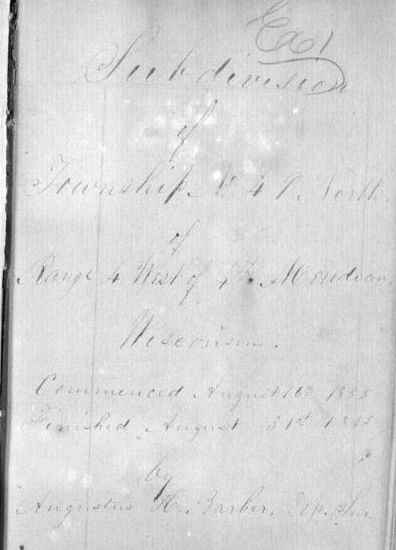
Survey by: Augustus H. Barber, U.S. Deputy Surveyor.
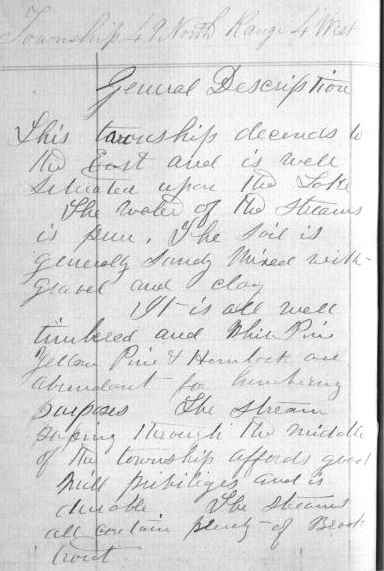
General description of T49N R4W.
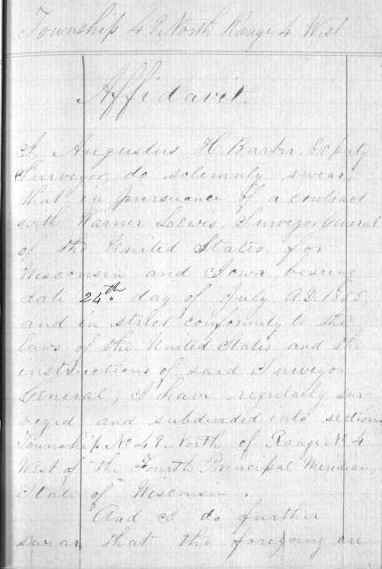
First page of affidavit; continued below.
![Chainmen: J. Allen Barber 2nd, George [?]. Butler. Axeman: A.W. Burtt. Affidavit signed by: John W. Bell, Justice of the Peace for Lapointe County.](https://chequamegonhistory.com/wp-content/uploads/2015/09/t49n-r4w-affidavit-2.jpg)
Chainmen: J. Allen Barber 2nd & George I. Butler.
Axeman: A.W. Burtt.
Affidavit signed by: John W. Bell, Justice of the Peace for Lapointe County.
(This handwriting appears to belong to Allen.)
Lake Superior, Aug 12th 1855
Dear Parents

Detail of Ashland townsite, LaPointe County (T47N R4W).
Although this is the first time I have written to you for a long while I suppose you have been informed of my whereabouts often enough by Augustus. I was pained to learn of your anxiety before you heard of my arrival at the lake. But as you fears are once more dispelled I hope they are permanently banished.
Today is Sunday and I am not at work that is not in the woods still I have not been idle.
I have sowed untill my fingers are tired and now I am trying to write a few words to send with Augustus’ letter. It really seems a privilege to live in sight of a church if it is a catholic church in La Pointe 18 miles distant. As to health I am confident I shall be as healthy here as in any part of the world. Sickness is almost unknown here except slight ailments the result of an improper diet. Surveying I think agrees with me. I feel best in the woods and like camp life. Our party is very pleasant and agreeable one and this is a beautiful and interesting part of the country so I ought to enjoy myself life if ever a surveyor did. I suppose Augustus has told you about our little shipwreck so I need not dwell upon it. I will surely say in justice to the boat that it was all the result of carelessness and bad management and we have probably learnt a useful lesson though as a dear price. The mosquitoes are getting thick and it is growing dark so I must wind up.
Has Levi Atwood got well yet. I think a year or two in this country would do him good. Burt of our party came here with consumption but is now free from it [scribbles] too dark [scribbles].

Love to all
Allen
Johnson August 26th 1855
Dear Sons
Yours of Aug 7th came duly to hand relating the misfortunes you experienced, which has caused me to feel considerable anxiety on account of your losses just as you were entering upon your undertaking. But all your [pecuniary?] losses are forgotten when I think that you are safe and unscathed after passing through such deadly peril. yes all else is but a trifle, when compared to life and health, & though your loss was more than you can conveniently bear, or repair in a long time, still with good fortune on your side for the future, you will in time outgrow it, and come out brighter for having passed through affliction.
 Since I wrote to you last there has not been much worthy of record transpiring in this [dully?] town. Last Monday morning I set out by stage for [Bellow’s Falls?] via Burlington and staid at Rutland, reached B.F. next morning [at &?] attended a Convention on State Council (as you please) & went over the river into [Walpole?] & staid with Tom. [Keyes?] that night he having found & invited me to do so. The object of the convention was to make a nomination for State Officers if thought [expudient?], so that it was as necessary for those opposed to an independent nomination to attend as for those in favor of it. There were almost enough of those in favor, to carry the day, but [we the?] wiser and more prudent finally prevented it being done & now Judge [Rayes?] stands with only 3 opposed in the field. [Meritt?] Clark [suce fase?], Judge Shafter the Temperance candidate & President John Wheeler the old line Silver Grey [??? saving, Blue Belly ?????? ??????] whig.
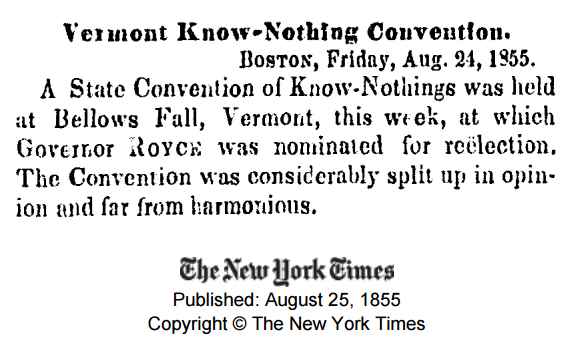
Wednesday morn I left [Walpole?] and came home [via?] Winson, White River Junction, & Waterbury heading home before 10 o’clock, at night, probably faster than you can run a line in the thickets and forests on Lake Superior. While walking near the Depot at B.F. a fellow came out bareheaded and asked if I was not Mr. Barber, said he knew me well, but I was stumped for once and could not make him out “no how“. It was George Enslow, I told him if I had heard him crow, I should have known him. He lives in Rutland and goes on the passenger train from there to B. F. every day at 30 Dolls per month & he board himself. I guess he is a poor wild improvident coot as usual. Marshal Homer is in town with his family at old man’s & he is compassing Heaven Earth & Hell to get me out of his house so that he can come into it. But all his threats, & and artifices will avail nothing, he will wait till 1st April next before he gets possession until I see fit and find I can do as well or better to give him the premises. Not all his & his wife’s storming, or his fathers blab, shall make any difference with me. I will let him understand that when he lets a house for a given time he will find it not so easy to drive the tenant out as he might wish. I shall keep on the defensive, and see that no chance is given for him to resume the occupancy of the house. After all it is very unpleasant and annoying to know that I am in any one’s way, and equally so to hear stories every day of what Marsh’ or his folks say about it, and also the 1001 questions by other people, where I am going and when &c and what was most provoking was Old H’s saying to our women that “it is to bad to have to move now.”
I have consulted [Forrier?] & Benton upon the case, and am assured that there is no trouble on my part so you need give yourself no trouble about our being pitched into the road head forward. We shall all live just as long and wide as though there were not one [Hosmer?] this side of Hell. Enough of this.
King Wallance has been here some days and report says that he is worrying [S.C.D.?] & it is quite possible that is a fact though I do sincerely hope it is otherwise, for I think her much too good a girl for such a [churl?] as H. M. Wallance. Yet it is her business and not mine, and she will have to abide by the consequences be they for weal or for woe.
[Hayes Hyde?] was in a [???] a few days ago to a Miss [Whiternob?] of Springfield [N.Y.?] The [matter?] between Jo. C. Hayes & [Abby?] does not progress so fast now. Heman is not married yet, but will be this fall. Our Houses of worship are getting along finely. The Methodists chapel is completed outside, and the inside will be finished in September. The exterior is very handsome with the exception that it has no portice in front, but the steeple is the finest in the county [in shot?] of Burlington being a [colonnade?] of 12 columns standing on the bell deck 4 on a side & those [swrindunted?] by a roof & heavy jet & a [balustran?] or battlement on the roof. The Baptist house will have a bell as soon as finished and a clock (with 4 faces that are now put up) so as to be seen from every part of this large town. I have been to hear Mr D. & Mr [G?]. both today and Hiram has been to the Plain to attend a tent meeting of Saturday folks under a tent that is carried around for the purpose [large?] enough to convene 2000 people.
Our County Convention and town caucus come off this week and as there is a mighty strife on foot for the officers there will probably be some fun growing out of it.
[Places?] are fewer than expectants or aspirants, and some who are the most greedy are those most Anoxious to the people. However “we shall see what we shall see.”
My good neighbor Caldwell’s mouth is wide open ready to close upon any thing offered, but how can any man of common sense expect office when he is hated by every one like poison and so crooked in his deal that he is shunned by all who know him.
[Riddler?] is also in the field but he has smelt too strong of rotgut for months to pass for a very good temperance man. I think it more than probably that we shall not choose a representative this fall. Capt Sam expects Judge of Probate but it will be a hard pill for Johnson folks to swallow. Well, let them [squizzle?] and suit themselves
Wheeler was here one week ago today. “Same Coon.” Mr. Benton is here again and boards with us next [turn?], as [very?] pleasant & good a boarder, as anybody. Prospect for school I should think not any flattering. I sent the Land Warrants Pike & I had bought to Ladd and got returns showing a profit of $68.45 over cost. I think of going down to Cambridge to morrow to see if I can find any there that I can buy.
There is no risk and possibly some thing to be made. I recd a letter yesterday from your Uncle Ham. who has been to the Saulte and also at Lancaster. I recd one from Mr Burr who says that he & your Aunt Martha will set out for Lancaster the week after Election & they think of buying some place there perhaps Homer’s, for they see that they have got to come to it sooner or later, and may as well make a grab now as to wait till there is no chance for them. Well knowing that you will be sufficiently tired with this [one?] what your Mum is writing I shall not take the trouble to double line the sheet but will endeavour to write you again as soon as I hear from you.
So till then Adieu
G.A. Barber
A.H. & J.A. Barber
I will make Am write this week
I sent a [waverty?] Magazine from Burlington & [one?] N. Y. [Daily Times?] & [1?] [Caladonian Times?] & I intend to furnish you occasionally with a stray paper as well as letters.
Mead has just been along and says that Johnny was [put?] under the [sod?] yesterday. So I stop the press to announce the fact.
Interior Field Notes
Township 47 North, Range 4 West
Barber, Augustus H.
Sept. 1855
Notebook ID: INT039W05

Original plat map of Ashland (T47N R4W).
Details include: Ashland townsite; Fish Creek sloughs; Long Island Bay; and trails to Bad River (Odanah), the White River, and the Penokee Mountains.
Detail NOT included: Wiiwkwedong (now Prentice Park).
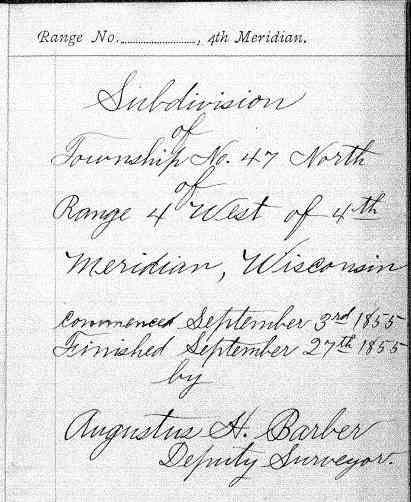
Survey by: Augustus H. Barber, U.S. Deputy Surveyor.
(The handwriting in these field notes does not belong to either of the Barber brothers.)

General description of Ashland (T47N R4W).
“Springs are of a good quality and White River in the South East part of Township is a good mill stream. Native copper has been found in this Township, but the formation does not indicate a mining locality.”
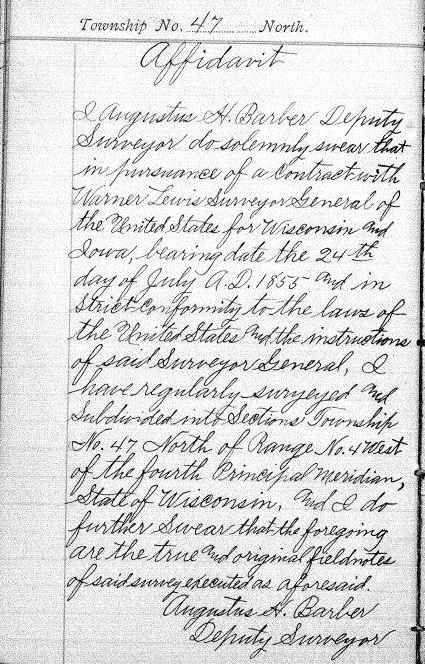
First page of affidavit; continued below.
![Chainmen: J. Allen Barber 2nd & George [I?]. Butler. Axeman: Bernard Hoppen. Affidavit signed by: John W. Bell, Justice of the Peace for Lapointe County. (not actual signatures)](https://chequamegonhistory.com/wp-content/uploads/2015/09/t47n-r4w-affidavit-2.jpg)
Chainmen: J. Allen Barber 2nd & George I. Butler.
Axeman: Bernard Hoppen.
Affidavit signed by: John W. Bell, Justice of the Peace for Lapointe County.

The Barber brothers’ original field notes for this township were reproduced in 1901 by The State of Wisconsin Office of the Commissioner of Public Lands. “This copy is made in accordance with the Chapter 177 Laws of 1885 for the reason that the original record is faded and worn from use and is becoming illegible.”
To be continued in the Fall of 1855…
Barber Papers: “I shall not go without Jo” Spring of 1855
September 4, 2015
By Amorin Mello
Selected letters of the Joel Allen Barber Papers
… continued from Winter of 1855.
Lancaster March 23rd, 1855
Dear Father,
It is not long since I wrote to you but I thought I would write just a word though it may not do any good. Uncle Allen says you would do better to send land [????] than money. So many will be drawing land under this new bounty land law, that you can probably get them cheap.
Pine lands may be better in the eastern part of the state [?? ???????] but not worth half as much as in the western part. Lumber that sells in Oshkosh for 8 or 10 dollars brings 18 to 23 or 4 dollars here or any where along the river. Do you know anything about the culture of [osiers?] for willow baskets.
I saw an advertisement in the Tribune which says they will yield 100 to 150 dollars proffit per acre. This would be a good place to raise them I should think. Willow baskets are used here more than any other for all purposes. This I suppose is because there are so many [foreigners?] here who understand making them.
This is a beautiful warm day and the snow is going off in torrents.
Was it not [fl??ging?] smart that Thode Burr could not come out with Uncle Thode. His folks were swift to have him come but as the time approached had to give it up. Grand Mother has just come in, walked up. We are pretty well all but Aunt [Lib?], who was sick yesterday but better today. Have not seen anything of Cad yet. Jo. Alcorn has taken Dr. Woods farm.
Love to all
J. Allen Barber 2nd
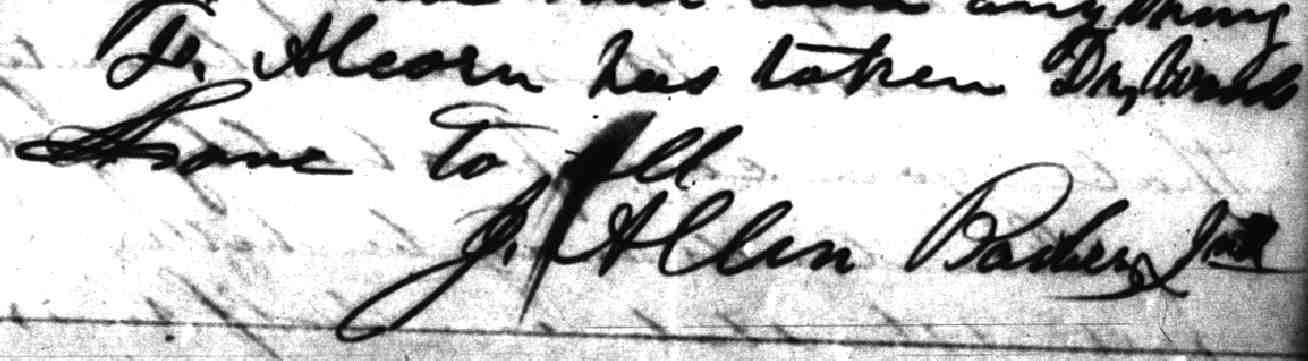
This letter appears to be written by Allen, using the name of his Cousin Allen 2nd.
Johnson April 1st, 1855
Dear Son
I do think you hurt yourself writing so often and so much as you do to us. Once in two weeks is a short time to you I suppose to intervene between the times of writing home, but it seems very long to me to wait for news from my absent children. The last letter from Augustus was dated Jan 17th but he is where he cannot write and at a distance of 30 miles from any P.O. as Mr. Stuntz has probably told you. But you are where you could write oftener and more if you would, and as we cannot hear from Augustus do let us here from you. Yet if you do not want to hear from home but seldom, just set the pattern and I will write as often as you do, and relieve you from the trouble of writing, or reading my letters any oftener than you choose. Everything is going on at the usual snail pace about here.
[…]
There was a great dance in the Town Hall Friday 23rd at the Public at the [close?] of the [dancing?] school. Somewhere from 60 to 70 couples in attendance, and what was strangest of all, some of those little lambs in the flock who have recently passed from death unto life, instead of giving living evidence of their having been with Jesus, showed their preference for gayer company & went to see the show.
It was but two days before the holy commission and Mr. Caldwell and [men?] somehow or other concluded not to show their faces there before their august teachers and the mangled remains of their adorable savior so soon after patronizing the company of Jake Dodge, Henry Daniels, Frank Atwell, [Morse’s & Patrk’s?] boys [Jo Read?] and [Almy Ferrier?]. Oh the folly of Sinners.
I thought it would look just as well for old cripples who were just ready to emigrate to the kingdom come to stay away and let the young, the wealthy, proud & gay have their [partihase?] & recreation to themselves and not betray our weakness by going to gaze at them and thereby evince to them & to the world our regrets that we are no longer fit associates for [Jo. Reads?] &c. But some folks act curiously at times like there was a partial insanity in their case.
I felt very well at home & so did Am as we did when Ossian & Dodge was here & Mum went. It is getting to be mad times. Give my love to Mother and to my other Friends if I have any. I have written about twice as much now as you write and have not got half through but time forbids more at present.
G. A. Barber
[ca. 1855] Apr.
Lancaster Apr.
Dear Mother,
Having rec’d several lines from you and Amherst without sending any full equivalent I will now try to write a few words though they may not be very interesting. Today is a beautiful Sunday.
It is now about two o’clock. I have not been to meeting. Shall probably go this evening.
You see my prejudice in favor of evening meetings is not altogether overcome.
I am dressed up in my new vest and boots, clean shirt, thin brown coat and brown hat &c. This morning Uncle Allen drove up with his carriage with his children, [and?] Ham. and three other children. I took Thody and got in (Myron was at meeting) and had a delightful ride on the prairie. Such beautiful spring weather I never saw before. Every day seems unequated. The earth has got green in spite and there are some flowers out. They look just like yellow daisies only they grow as low and humble as violets.
Night before last I got a letter from Augustus at Galena. They are having colera considerable and a number have died on the river or been put ashore in consequence of colera. You may not see anything of it in the papers as they try to keep it mum but John [Henry?] who was down there says it is so. No wonder for he says the mercury stood at 90* one day that he was there. Every boat up the river has 6 or 800 passengers.
Augustus appears to be in fine spirits. He is swift to have me come up that way.
The ground here is warm and dry as any ever need to be, gardens are being made and crops are being put in with all delight.
Uncle Jay and Cyrus will have splendid gardens in a short time. In fact, Uncle Jays garden now is the finest I know of about here, he has enlarged it this spring.
Aunt Fanny has considerable of a start in her garden because the place was made by a fellow who took great pains to have everything that he could get growing.
I am quite anxious to go up the river and see the elephants and would like not a little to see Augustus. Uncle Thode is farming and sleeps in his house and that is all I have got to say about him at present. Father requires me to write so much to him that I can hardly find any thing more to write to any one else. Little Thody is not very well – has a bad cold. My love to all. We expect Uncle Ham here every day.
Your affectionate Son
Allen
Lancaster May 2nd 1855
Dear Father
Perhaps I have neglected writing to you too long but as I have been rather busy of late and have written to mother not long since I hope to be [?????]
[…]
~ FamilySearch.org
Day before yesterday I made Jo. Alcorns folks a visit. They appear to feel pretty well. The girls were all at home.
I took dinner there and looked over the farm some. Jo is building stone wall on the farm for Dr. Wood. I begin to think we have about all the herbs here that grow in Vermont. [Spikenard?], bloodroot, coltsfoot, leeks, wild onions, wild summer savoury, balm, and a great many more grow in abundance.
Uncle Allen has spoken to me about studying law but nothing deffinite has been proposed on either side. Two fellows start from here today to go to Lake Superior. They have to walk over 200 miles so I suppose they would not wish to carry any extra burden and Jo says he thinks Augustus would not care anything about that vest up there. I am really anxious to go up there but I guess I shall not this summer.
[…]
Must close rather abruptly for want of time. Have been looking some days for a letter from you.
Love to all
Allen
All is well but Aunt Fanny who is most [used?] up with a severe cold
Lancaster May 14th /55
Dear Father
It seems to me I have not written to you for about a week and as there is just 25 minutes between [illegible words] a few words. I have nothing of special interest to write but dont want to keep you waiting for a letter. For some time we have been wishing for a little rain for which we would be very thankful although a great deal is needed. We now have a prospect for a good shower.
[…]
~ 15th Uncle Vest Phelps and all his family have arrived in town today I understand. I am most tired to death, have been planting corn all day with Cyrus and I have about a days work more to do alone to finish it and fix the apple trees. I have a wet cloth on my neck to cure a sunburn. Whatever the effort may be ultimately, it saves me a great deal of pain at present. I am thinking quite [strong?] nowadays of pottering off up to the lake.
Jo is here yet and would go with me. I should want no better companion.
There is no serious obstacle that I know of to hinder. While I wish to go for many reasons.
So far as I know I have had excellent success in grafting although I have not done a great deal only about 600. I cant tell exactly about the wheat there was not much of it all a great deal of that was wasted. I have never said a word to Shoemaker and dont want to. He is a foolish howling Methodist and nothing else. I sold 5 bushels of
[Incomplete copy of letter]

MOTHER
Lancaster Wis. May 20th 1855
Dear Mother
Last night I was much gratified by the reception of another Salvo of letters all in one envelope from home.
It is pleasing to thus find myself kindly remembered at home but letters written in the spirit of one I received from father last Tuesday are not quite so agreeable and allow me to say I think they are rather tend to defeat their object. The accounts of the season in Vermont seem rather dismal.
Can it be possible that no leaves were visible on the 13th of May. Here fruit trees were going out of blossom. A fortnight Three weeks ago today (April 26th) the poplar trees appeared to be in full foliage but the leaves were not fully grown wild plum trees were white and crabapple trees were blossoming.
Lilacs are now out of blossom. Gooseberries plums currants and cherries are about as [as peas?] – plums rather larger apples are as large as beans.
I ate rhubarb pie at Uncle Jays May 3rd made of new plants. it is somewhat doubtful about my going up to the lake this summer. Jo dont wish to go untill after harvest or about the last of August but I guess I could get him started now if I [???] really anxious about it.
It is principally on account of my health that I prefer going up there to reading law at present. Today is a beautiful [??????] I have not been to any meeting this forenoon but guess I shall go to the choir meeting this afternoon.
Aunt L is not very well yet. Yesterday I cut out a lot of willows that grew around the best spring on the east side of the farm.
It is a noble spring and might easily be made to run to go building spot on the South end of the farm on the road near the S.E. corner Cyrus thinks of selling his place in town and building on his farm but Aunt Fanny is strongly opposed to it. Going to Lake Superior is not so much of an undertaking as when Augustus first went. I should have to foot it about 200 miles. A great many people are going through every few days but probably I shall not go without Jo as he understands all the minutia of providing necessary articles and food, coaching, camping out &c &c. Well I must close this and write a few words to Father.
Receive with this the Love of
Your affectionate Son
J Allen Barber
Lancaster May 20th 1855
Dear Father
It was my good luck to receive a letter last Tuesday and another on Saturday so I must write again soon or get behind in my correspondence. Uncle Allen says I can find plenty of land though not very near town but the country is filling up so fast that it will all be worth the [??] government price. He says he will go out with me in a day or two [a?] land hunting as he has some plots only a few days old and wants more land. I should not be able to enter more than 80 acres at present but if I dont go to the lake you can send me more money and I will try to make the best disposal of it (21st) Old Ben’s auction goes off today.
There is undoubtedly money to be made in village property here but not near so much as on wild land. Well Old Bens auction has come off and proved to be a kind of mock auction – all but one bargain was struck to off to his bidder, Jim [?evens?].
I got Jo to promise to day to go to the lake in two weeks but he will alter his mind before night I am afraid. There is a terrible amount of sickness on the Mississippi and Missouri boats. The boats are all overloaded often carrying over 600.
This is a very warm day. We had a little rain this morning but not enough to do any good. Other places not 11 miles from here have plenty of rain.
It is common here to have thunder here whenever it rains. If it rains 3 days the thunder cracks around all the time night and day. Then look out for cholera. There are a lot of old telegraph posts standing between here and [Potosi?] and more than half of those that stand in open country are split down by lightning. Jo is fiddling here while I write he remains firm in his resolution to go to the lake in two weeks.
If I go I intend to come back next fall if nothing prevents still as far as health and comfort are concerned I had rather winter there than here if I could have as good accommodations.
I am glad to hear that some of the old faces once so familiar have again visited Johnson although I was not there see them. It really does me good to see their names written. How we are scattered. Albe reminds me of fast day two years ago.
He and John Cook & Charlie and I ate sugar on the catnip farm and had a good time. Now each breathes the air of a different state. It would give me great pleasure to attend the commencement at Burlington this summer. Probably at no other place in the world should I ever meet so old friends. Where is Homer [Wetherly?] now? I had a letter from when he was in Glover and would answer it sometime if I knew where to direct. Aunt Fanny wants me to tell you she is all well and anunt Lucy says when her pen gets started it will with a vengence! They think I write home so often there is no use of any ones writing any more. It may be a disappointment to you to have no more land entered but I shall not have time to receive any money from Vermont if I go up country this summer. What land there is now in market about here is of course of poorer quality and some and I think I had rather enter land north of Wisconsin where there is plenty and lumber cheaper timber plentier.
However I dont know what I shall do. I want to enter a half section all that I can enter under the graduation [act?] and it must all be adjoining or adjoining land I now own.
If I find any land very tempting perhaps I had better borrow the money of Uncle [?????] and you could remit the amount to him.
The interest would not be much for a [month?] or two – at any rate it appears that I have got to act as I think best. A Mrs. [?tig?] opened a lot of bonnets and other goods for sale this morning and the streets are full of women all crazy for a new bonnet. I hope it will have a good effect on the weather as we need rain badly.
Today I had a talk with Shoemaker. He raised 9 bushels of wheat and says he will give up your share if I will sign a receipt in full of all demands. He suffered considerable waste and ought to smart for it. But I suppose he lost money by taking the farm, of about 50 bushels of oats his share after paying for threshing and other helping was only 6 bushels. I can have things well enough this summer. The corn I planted among the hops and appletrees I shall let Cyrus have to remunerate him for the trouble I have made him. I have not done near enough here to pay my board as he has been so situated I could not very well. There are two or three other boys here that want to go up to the lake and perhaps will go with us. If you dont get this in season to answer before the 4th of June direct to Superior. I think this with Mothers and Ams will do for one letter. Shall probably write again before I leave and look for about two more letters from you.
Your affectionate Son
J. Allen Barber
Johnson June 17th 1855
Dear Sons
I expect you are now together and I will address this to you both thereby saving some scribbling paper, postage &c which is no small consideration with some folks, and I must acknowledge is to me a convenience I went to St Albans last Monday to see my father previous to his departure from this country perhaps forever, though I did not then know how so soon he was going but on arriving there found that he had fixed on the Wednesday following for leaving. I accordingly remained till that time & then accompanied him as far as [Run??’s] Point & there parted with him. Thode Burr goes to Sandusky with him, & from thence I expect your Uncle Ham will escort him to Lancaster.
Father felt very much affected at parting with your Uncle B’s folks and they as much so as though they were consigning him to the grave. Returning from St Albans I came to D Fairchild’s and stayed over night & made one more visit on my way through [Georgia?] & arrived at Johnson Thursday night in safety, but I [presumed?] not many hours before Father & Thode reached Sandusky. I found that Am. had recd a letter from Augustus & one from [me?] requesting a deposition to establish your his age. I have made it and also one for Allen thinking that he might want to make a preemption claim in that region, and if he would be deferred from making such claim on account of owning land, would it not be best for him to convey his title to his lands in Wisconsin to me or some other person to be held for him whenever he might wish to resume the ownership again. Augustus will best know how that business can be managed. I have a draft that I shall forward by mail tomorrow morning to J. Allen B. Esq. for the sum of $80.00. I think Allen’s purchase a very good one.
You will see by the Tribune that Messrs Bell & Hale are [listed?] to the U.S. Senate by the Legislature of N.H. & probably will [eybise thereat?] & further that the National [R.N.?] Convention are having hot times on the subject of slavery, & that the whole pro slavery concern will be blown sky high, as all attempts to silence freedom of discussion should be now and forevermore Amen.
[…]
I am now thinking of going to Burlington on the 27th to attend a State Convention [the call?] for which you will see in the [Freeman?]. It is now almost 3 years since I have been there to step my feet on the ground & for that as well as a wish to participate in the doings of the convention I shall like to be there very well.
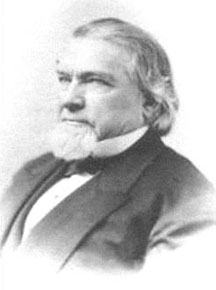
Portrait of U.S. Representative Cadwallader Colden Washburn (Wisconsin); in office between 1855-61.
~ Wikipedia.com
Portrait of U.S. Representative Alvah Sabin (Vermont); in office between 1853-57.
~ Wikipedia.com
This morning I recd a [Pub. Doc.?] from Hon. A Sabin ‘sectry of the [Amaroo?] [pant ???] by [Lieut?] [Gibbon?] with an atlas, also another [Corernoned?] at the presentation of the [swant?] of Gen Jackson, [??? Brainiere? into?] me a Biggon’s battery of the [Amaroo?] just the same thing last winter so that I now have two & if you do not receive one from Mr Sabin I will give you one of mine when you come. I think you will continue to require favors from Mr S. while you [remain?] at the Lake & that Mr C.C. Washburn will not neglect you. If Allen has arrived at the lake how does he like it & how does he propose to spend the summer? He is so great a [mineral agent?] and so patient an explorer I shall look for great exploits by him, & certainly I hope you will both be fortunate in discoveries, and that you may realize ample remuneration for all your privations and toils.
I hope to hear soon of Allen’s safe arrival and hope you will both write often and I will try to do likewise.
Accept my best wishes for your welfare and happiness.
G.A. Barber
A.W.B & J.A. Barber
[fragment, c. 1855, June]
thought but to not enter it without knowing that it was worth something. I have not seen it but Uncle Allen says it is first rate.
I am glad to hear that Am is no worse off but cannot conceive why he should continue at school this summer. The letter r in the map represents a high sand rock like a monument about 12 feet high standing on the point of a bluff. It is biggest at the top and looks very picturesque. That 40 would be a first-rate meadow just as it is and would produce 2 ½ or 3 tons of hay every year, plenty of water could be had on it by digging a few feet.
But what is of some consequence is the land is the very richest quality much better than prairie land will average and it is not more than two miles from a first rate gristmill.
I hope you will come out here and see my great purchase before many years and enter as much more some where. The land in [Richland?] in a short time will come down to .75 ¢ per acre.
I wish the old farm could be sold so that you could all come out here. I should feel a great deal better and I know you all would like your new home. Jo is more than half undecided about going to the lake but I guess he will go.
He thinks now he can’t go so soon as Wednesday. Perhaps I cannot but I want to. Hoping to hear from you once more before I leave I remain
Your affectionate Son
Allen
To be continued in the Summer of 1855…
Barber Papers: “Come up here!” Winter of 1855
August 22, 2015
By Amorin Mello
Selected letters of the Joel Allen Barber Papers
… continued from 1854.
Charlotte Wis. Jan 21st 1855
Dear Parents
You may not like the looks of this small paper but the fact is I have no other, my last sheet of large paper was used for my last letter to you and if I had been aware that I was not going to have any other I would have mentioned it so as in some measure to have modified the shock it must occasion. This is [onerely?] preface as I have not yet been to the office for your letter this week being somewhat distant having no time except today when it is tremendous cold and blustering.
I have three letters ready to mail one to Grandfather one to Uncle Cyrus and one to Albe Whiting. I have written but very few letters this winter except to you, for in fact you have monopolized most of my time for writing. The weather has continued just the same – mild, open, and clear untill today when we have a hard northwind. Prairie fires were running last night in Iowa in many directions and some in this state.
There is not a particle of snow – the brooks are icebound and the ground is frozen and cracked up like it never cracks in Vermont. X X X
Well I have been to the PO and found no letter – shall expect two by next mail. It is snowing some today (Jan 25th).
My health continues as good as could be expected under like circumstances. At the two last places where have the unvarying diet is fried pork and hot biscuits and nothing else to speak of.
Had Johnny Cake yesterday noon, made with all the bran in. It was about the best thing I have seen in the West. I went to a party a few nights ago. It was a miserable trashy affair, nothing but a great barbecue for supper, early, and then dancing untill daylight.
All the rough characters in the country were there. I went at a late hour and retired at about half past 9 oclock, satisfied that I shall not want to attend another such very soon. At Lancaster, the parties are about right, but out here they are a pretty good index of the newness of the country.
It is now impossible to get this to the P.O. unless I go myself and as it blows and snows a perfect old fashioned snow storm I think I shant go but will keep this for another time X X Sat. 27th
Am boarding with a Vermonter two miles from the school house. He is a real Vermonter named Howard one of the best and smartest men on the prairie. He has a good farm which he wants to sell. If any body wants to buy a farm out this way just tell them of this. It will be advertised in the Herald soon. It is a good farm and contains 260 acres, tillable land and firewood enough for two families, the best and most extensive start of fruit in the country. 250 apple trees 20 green gauge plums and innumerable gooseberries [redberries?] currants strawberries and some grapes. The house & barn are new and well built but small. He asks only $2000, is doing well here but wants to leave for other business.
I wish Albe Whiting would see this place; less than half would have to be paid down – good title given.
[Gov.?] Dewy has bought out Cassville or part of it. Prairie La Porte is changed to Guttenburg. Do you know where Sullivan Pierce stopped. He was in company with Hyde coming out but they got separated. Have just been out to the chicken trap found five all alive any fluttering. We killed those and retired and they [lineanes?] have just turned to the [fiels?] again. [scribble] Sunday Three more chickens caught. Went to meeting with Howards folks in a sleigh or rather on a sled – no meeting pretty cold – snow scarcely sufficient for sleighing. If I get a chance I shall try to send some to Lancaster.
I have three more weeks to keep school. 4 more places to board. I like Howards and his folks best of any people on the prairie. They are pious and attend to family worship regularly.
Monday
Have just been to the Post office and got two letters one from you and one from Augustus – He writes nothing except a few business items.
In haste
Yours affectionately
Allen
Johnson, January 27th 1855
Dear Son
Yours of the 11th arrived night before last and contrary to my usual custom I have deferred answering over two mails, but it [will hi?] forwarded now some days sooner than it would have gone by trail, for Ames Dodge will take it along to Galena and by him I shall forward those vests that I bought in the fall for you & Augustus on the very [day?] that I recd your letter saying that Augustus was to be in Lancaster in a few days. Though he has not come & probably will not for some time, [Still,?] you may [be?] your Choice out of the two and send the other to him in the spring if there any going up to the Lake. There are as many who prefer the one as the other, and though I intended to give Aug his choice [????] the danger of his being [wronged?] by your having it [for ?in to ????] he did not take one & you the other. The vests are something nice, only that the style is new and there will not probably be many among the “[Badgers?].” Amos is here after [his monday?] due him [??] estate from Dr [M????] & gets between 700 & 800 & takes west with him. He hails from [Boise?] City, [90?] miles from Dubuque, but he says that he should prefer the Northern front of Ill. or the southern part of West Iowa. Were you or Augs at Lancaster I should try to have him go up there, but he would not go [southwest?]. I know of nothing very new or strange that has happened of late. There is a funeral in [Locon?] to day, of Daniel Mills who lived beyond the Main. You have seen the poor man I suppose. A very hard working & honest man was he.
It is a general time of health in Johnson, I know not of one sick person now except Rob’ Hill who is evidently on his [last?] legs, though around the streets every day. The poor devil had a [time?] in the fore part of Dec. and has been rapidly going down with the consumption ever since. He can have one source of consolation beyond what most men are blessed with, that there will be no excess of grief at his death, and another, that nobody or even the world will ever be able to discover the road that [his?] departure will occasion, & still another, that for his dearest & best friends & companions whose comforts & happiness are undoubted, his strongest & most earnest desire, there will be a greater abundance and at a greatly [demenostred?] price of the blessed creature that has so long stood between [???] & all [witch?] cares. Yesterday Dr C. & I removed two loads of corn fodder and eight loads of hay which with two loads, drawn [before?] makes all the hay I have left, [ample sufficient as?] I think to carry me through with [???] & the old cow. I have some more [slulh?] to [draw?] & two or three loads of wood dry wood in the shed [&?] the [??????] & farming tools, sleigh, waggon, &c to it [??] home yet. Mr Clark from [Miss.?] has moved into the old house & Phelps is going in with him to occupy the part that Dr C did when he was there with us. [Phil??? is?] about buying out [???????] takes a [fusin?] in Wolcott. Sam [Wilson?] has sold or will soon & Bill Smith buys out the Widow Wilson, & [esrnard?] has bought the [Feelting?] farm [in Herling?]. [Gotn?] will probably have the [Muikler?] farm & let Patrk have the Bixley house.
Capt Sam has elected one of the directors of the Bank of Waterbury and keeps a deposit of their money as well as a deposit of [Irusburgh?] money & he is in fact a bank discounting to people like any bank would, & if he keeps it up it will greatly curtail the business of the new bank at Hydepark that will probably go into operation about May 1st. The Hydepark bank stock went off [any?] heavily. Not a dollar take below here & only 46 shares taken here & 26 of them to trade away for other Bank Stocks. The Hydepark folks have sworn vengence against the lower part of the County declaring that no County officer shall come below their [?????]. Let them squirt their dye stuff, it will make them feel better. It is getting to be pretty hard times for almost everything here. Money is scarce & hard to be got. Still prices for everything but [???] & pork are exorbitantly high, wool [no sale?], Pork $[650?] for the [best?] & less in proportion to weight. But corn is $1.25, oats 50¢ Flour $11.00 Beef $5. per [????], & 6 per hind. Butter 20 to 22′ [Churned?] 11 ¢ Hay $15.00 and none to be had at that so that is feared that some poor men will have to kill their cows or see them starve. Wood is from 1.50 to 1.75, Tallow from 14¢ &c &c. If about 1/2 the folks in Johnson were well settled in Grant County I think it would be much better for them and for those who choose to remain on these bleak hills. I should have mentioned Potatoes which are scarce at 50 ¢. Now all who are not producers had better go where they can get the necessaries of life cheaper & wages as good that would be my advice to all, and which I will convince them I am sincere in one of these days.
Your Mother is anxious that you should work with your Uncle Cyrus the ensuing season and learn the builders trade so that you can build a house on our place or one for yourself if you should ever feel the need of one. You have over estimated to us what you thought [??] doing another year, whether to try again to study Medicine, Law, or go to Lake Superior, or teach school, or work around Lancaster. There are many inducements to either course. Ponder the subject well and take the advice of your friends especially of Augustus about going where he is, perhaps he would want you there with him to explore the country for copper. And when you have selected some good place to pursue, why then you may inform us. I intended to [fell????] this [page?] out, but have not time to do it to night, perhaps I may do it in the morning.
So for the present [????] you will [Go & Barber?] I wish you would enquire what timber land can be had for near Lancaster, especially in that grove that was [G??] Dewey’s & do it in a way to not have any one think that your motive is any thing but idle curiosity. I regret that I did not buy 40 or 80 acres of it before he sold it. I am going to Cambridge to day or to morrow and perhaps may pick up some news, that will be interesting to you. If so you may rely on having it forwarded to you soon. You enquired who were Benton’s assistant. Helen Whiteny [tah?] & the small fry Rebeccah [Merriam?] & [Diana?] have [classes?]. I think you will be satisfied with the length of this and can afford to give me one half as long at least. I hope you will continue to write every week and I will endeavour to do the same by you.
G. A. B.
Iron River Falls, LaPointe Co.
Feb. 10th 1855Dear Brother Allen

Survey detail of Iron River Falls, LaPointe County, Wisconsin. A review of this location and survey (T50N R9W) is featured in our series prologue; Stuntz Surveys Superior City 1852-54.
Your [welcome line?] was duly received and at last I find an occasion to write you a word in answer. I am very sorry to learn of your poor health but presume you will improve this winter if you as careful as circumstances will allow, which is generally careful enough. I don’t know how to advise in regard to your future operations but I tell you as I have before told our parents that I wish both yourself and I to obtain a thorough education. Your poor health is at present an obstacle to the pursuit of that object and I do not know that you are resolved on it provided your health was good. I have said so much in my letters about the good efforts of the kind of life I have adopted on the health of consumption or dystrophic men that you will be expecting me to recommend it for you without knowing much about your ailments so I think [is?] almost useless to say to you.
Come up here! I am confident that our season spent in surveying, voyaging, or exploring in this region or any healthy country would do your whole system, constitution, mind & body more good than all the medicines in the universe.
If I could see you I think we might arrange to spend next summer in the woods together. I have seen some experience in frontier-life and the tendency always is (with feeble persons) to giving good health and greatly increasing bodily vigor.
What the changes will be for making a raise in this country next season I can hardly tell you now but I expect they will be pretty good.
I hope you will see Mr. Stuntz when he is in Lancaster this winter, and for I think you would come up with him. I may see you in your schoolhouse before spring, as several things make me wish to visit Lancaster this winter. I don’t know the place where you are teaching, but I wish you all the success you can wish with all my heart. As for your toothache, I wish you as speedy deliverance from it as you would experience if I had a good hold on the offending tooth and hope you will consider the applicability of the “Wellerism” about the [“boy as svollered a fardin”?]
So you don’t like Lancaster? – well, I do! i.e. I like it pretty well generally, and some of the folks in it particularly; and if I supposed my appearance there would excite half the curiosity my supposed advent did last fall I would surely hazard the experiment of confronting those terrific batteries of eyes, for those batteries are not “masked” though I apprehend some of them are case-mated. I received a letter from Father last evening, saying all were well &c.
I wrote to you about the farm, but as you are not in L. you will not find it convenient to attend to it, so you can just let it be if you should not finish your school and return to L. before I return go down or write again. If you should have done anything about it before this reaches you all right or otherwise – all right. I am [well?] and well provided with work so I stand [it?] pretty well although our quarters here are not just as one would like them. I could write better if the idea had [yet?] not taken possession of my mind that I shall see you in mere weeks, so you will excuse imperfections and believe me.
Your affectionate brother
Augustus H. Barber
P.S. I admit that I may err in advising you to undertake the labors of a trip to this region, and that some other vocation in sight be more advantageous in all respects; and I do not wish you to adopt my course simply on the strength of my recommendation. Think about it, and in your ruminations keep this idea before your mind – “Health is the vital principle of bliss. And exercise of health.”
A.H.B.
Patch Grove Wis. Feb. 18, /55
Dear Parents
I have nothing to do this evening to amuse myself unless it is to write a letter.
Closed my school last night and have got this far from the scene of my labors although it may seem that I am not much nearer Lancaster. It is no nearer but there is a stage from here there tomorrow morning.
Had a good chance to ride to L. Saturday morning but only sent my trunk. Got my pay last night in gold. Sold my clock at cost for the gold, and stayed over night at [Basfords?].
[…]
The [????] is There several of meanest roughest imps here I have yet seen in the [state?]. I guess I will wait untill I get to L. before I finish this so as to report my luck in getting home.
X X X X Lancaster Feb 20th
Got here yesterday all safe. Found the good people all well. Uncle Thode went off in the morning so I did not see him. Augustus has written something about the produce of the farm. There is considerable corn which [????] pigs have been living on lately. There are several who want to rent the place and one man wants the house without the land. He is one of the Shoemaker tribe, and I dont want him within ten miles of it. Wheeler who lives on the [place?] now and wants to rent it has a good [team?] and promises to do well with it.
[…]
I mean to get my hair cut today for the first time after leaving Vermont. It has got pretty long and looks “first rate.” There are 40 rabbits to the square rod around here – At least there are so many tracks. From what I can learn I should think Augustus was doing about as much this winter as he did last winter. There are no liquor shops open in town they say and nothing, read and spell better than could be expected of him. Have not time to write another sheet.
Allen
I will try to get some larger paper before I write to you again
1855, [Feb.] 16
Lancaster Wis. 16th 1855
Dear Father & Mother
Knowing myself to much indebted to you for the promptness and length of your letters it is my intent to reciprocate as far as lies in my poor abilities by writing as often and fully as possible. My health still appears to be good and we have all been pretty well except Myron who alarmed us very much night before last by having a fit. He had been sick all day occasionally eating too many new doughnuts and other things. The fit commenced about six o’clock P.M. and lasted 10 or 12 minutes and was stupid until 10, and will occasionaly [??????ahing?] untill next morning.
He was sick all day yesterday but got up this morning smarter than ever and continues well. Uncle Ham. has got back from the north. All the land he went after particularly he found entered but he says he got [????t] of first rate land.
Uncle Allen wants me to enter some [land?] which I think I shall do when I hear of some good [??????]. I suppose I could find land north 2 or three dollars per. acre.
I could easily sell out at any time for 20 or 30 per cent, more than cost. Ben. C. Eastman has returned. He has some timber land for which he asks about 7 dollars per acre, which I suppose is about as well as well you can do. I have some thoughts of applying for a school in [Morrisson8?] district.
The school has got to bad for any female to teach and want a man. That is just the kind of school I would like to try for the sake of variety. They pay $12. per mo to female teachers.
Uncle ham has entered 8 sections on black river, he thinks in 5 years will be worth more than all the other lands he owns.
G. R. Stuntz is in town. We have good sleighing now and have had since Sunday [Sat. 11th?]. More Snow- about a foot of new snow and about 3* below freezing cold.
[…]
Rec’d your letter
of March 6th today. Uncle Allen had got it as he does [most?] of any mail matter. The [???] cannot see the 2nd it appears. The good people here are considerably incensed by their disappointment in not seeing Grandfathers out here this spring. I know of no reason for his not coming out with uncle Thode as far as Sandusky where they would want him to stay untill into summer. I think he will yet be allowed to visit this western paradise and meet his children, grandchildren, and other friends. I did not make so good a bargain as you wished in regards to the farm but I think it was as good as could be made.
[…]
Sunday 18th. Have not been to meeting today.
~ Wikipedia.com
Last night I went up to Rowdens beyond Uncle Jays to see about that school. I guess they dont want any more school this spring. It is rather surprising that the Know Nothings have got such power in [Cambridge?].
I had heard of their strength and [power?] by way of [??] [Heath?] in a letter to Augustus which fell into the hands of Uncle Ham. There are none of them here.
I hope [Wyman?] and Charles Stanly will come out here. This is not a very good place for [??????] but they would go to Lake Superior or St Croix river and [get good wages?]. If they get here soon perhaps they could work with Stuntz.
[Incomplete copy of letter]
Home March 1st 1855
Friend Allen,
It is some time since I rec’d your last and I should have replied earlier but for several weighty reasons. Even now my eyes promise to close and carry the spirit to dream land instead of the western world, but though the flesh is willing the will is not ready to resign itself to the arms of the [dreary?] old night god, till it talks awhile with you.
My [“???”] says I last wrote you (Dec 1st) well, if tis so I ought to have a few to say to this now, but my heart is as barren as no matter what. Could I be blessed with your company tonight we might lay awake and talk till the roosters crowed; and then not say it all, but now I really do not think of anything worthwhile to write.
As I have written west from once to twice a week all winter, to three or more people. I have to repeat the news that way till they become as stale as – new crackers.
[…]
Tis a time of general health here, if we except the small pox, which is in to help the Frenchmen this hard season. Where are you going this summer? what to do? I may go west in April – may not till fall – or never. I wish to go this spring but wish to study a term or two first, still may go soon. Please write very soon, and I may see you before May if I know where to find you. Time hastens – and with a hope for your welfare and prayers for your happiness I am the same old friend.
Albe
A J Barber
Lancaster March 2nd, 1855
Dear Father,
Yours of Jan. 18th was duly received and I hasten to reply.
I have written to Augustus [lately?] all I could think of especially about his getting kissed by a squaw. The next time you write to him you can ask him about the particulars.
I am glad Cad. is going to leave Johnson.

Detail of an abandoned copper exploration of the American Fur Company at Black River Falls (Big Manitou Falls) from the T47N R14W survey in Douglas County, which Augustus worked on with Stuntz in 1852.
If I could do anything to help him to useful and profitable employment God knows I would be glad to do it. Uncle [Ham?] started yesterday for Black river falls after pine lands. [He?] expects to be out in the woods some and perhaps camp out, will be gone from here about twenty days. [Tody?] has been writing [where?], he says it is a [“tow”-(cow)?]
[written in margin] he talks most everything [/margin]
[…]
I cannot express my gratitude for the amount of reading matter I have read from home lately in letter form.
[Jake Moorn?] is very slim has been sick some time. I must close to write Am and others
Good Bye
Allen
P.S. I have lent Cyrus $50. He has bought two cows and wants to buy more
Aunt [Lila?] has been sick over a week with strange and alarming symptoms. Constant headache splitting [leload?] and the exact appearance of being [Calivated?] but she is now better.
I want to write a letter to Am. about his [cars?] and some other things but guess I will wait till some other time
J. Allen Barber
Aunt Fanny thought sending a line in this but concludes not to. She says she has a right wait a while as you did.
A Masonic lodge has been started here lately so you will not miss the privelege of meeting your Morgan killing brethren at Cadys falls when you come out here.
Aunt Fanny wants you to send her some [Russian] turnip seed. Soon as possible. If you could send some two or three years old it would be better and perhaps purer blooded.
I once had a [pear?] spruce seeds which I wish I had here They [more?] in a [papa?] and [labely?]. And I would not care if I had some spruce [germ?]
To be continued in the Spring of 1855…
Barber Papers: “Augustus” 1854
August 7, 2015
By Amorin Mello
Selected letters of the Joel Allen Barber Papers
… continued from the prologue (1852-54).
Abstract:
Augustus Hamilton Barber
brother of Joel Allen Barber
and Amherst Willoughby Barber;
nephew of Joel Allen Barber;
cousin of Joel Allen Barber, 2nd;
son of Giles Addison Barber;
grandson of Joel Barber, Jr;
great-great-great-great-grandson of Thomas Barber.Primarily letters exchanged by Barber, a surveyor in northern Wisconsin and later a soldier in the 25th Wisconsin Volunteer Infantry, and his parents in Vermont from 1854 to 1865. Written from Superior, Ashland, and La Pointe, Barber’s letters refer to economic conditions and pioneer life, to Indian affairs, and to Catholic and Protestant missions. Also included are Civil War letters by Barber; letters from his father, G. A. Barber, while in Montpelier participating in sessions of the Vermont House of Representatives; and miscellaneous items including a Revolutionary War pension statement and genealogical data on the Green family; two letters, Sept. 4 and 27, 1870, written by Joseph C. Cover, U.S. consul at Fayal in the Azores; and a printed memorial address by Col. Clement A. Lounsberry.
Biography/History:
Joel Allen Barber (1834-post 1909) was the son of Giles A. Barber (1803-1879) of Cambridge and Johnson, Vermont, and the nephew of Joel Allen Barber (1809-1881), Wisconsin legislator and Congressman. The senior J. Allen Barber came from Vermont and settled in Lancaster, Wisconsin, in 1837. He was followed by his father, by his brother T. M. Barber, who became a Lancaster merchant, and by numerous other relatives in the 1840’s and 1850’s.
The Barber brothers, Augustus and Allen, received expert legal advice and political updates from Uncle Joel Allen Barber (Senior) regarding their affairs while on Lake Superior.Giles A. Barber had three sons who reached manhood: Augustus (1831-1856), Joel Allen, and Amherst Willoughby (1841-1920). Joel Allen came to Wisconsin in 1854. After a term as a school teacher in the Blake’s Prairie area of Grant County and several months in Lancaster engaged in varied occupations suggested by his uncles, he went to the Lake Superior region in June, 1855, to join his brother Augustus, who was engaged in copper and land speculation and in a surveying business. Augustus was killed in an accident in the spring of 1856 but Joel Allen remained in northwestern Wisconsin as a surveyor until 1861. During the Civil War, he served from 1862 to 1865 in Co. C of the 25th Wisconsin Infantry and was first lieutenant of his unit at the time of his discharge.
Scope and Content Note:
An undated portrait of Uncle Joel Allen Barber is on page 199 of the Proceedings of the State Bar Association of Wisconsin, Volume 1900
A memoir of Uncle Joel is on page 198.
The collection consists primarily of letters exchanged by Joel Allen Barber and his parents from 1854 to 1865. The letters by Allen–as he was known in his family, to distinguish him from his uncle–were written from Superior, Ashland, and La Pointe and contain many references to economic conditions and pioneer life in northern Wisconsin in the 1850’s, to Indian affairs, and to Catholic and Protestant missions. In letters from Vermont, his parents commented on these matters as well as related news of eastern business and politics. G. A. Barber served several terms as judge in Lamoille County, and represented the town of Cambridge in the Vermont House of Representatives in 1858 and 1859. The collection includes numerous letters which he wrote from Montpelier during the sessions. He had also visited Allen in the fall of 1856, and his letter of November 3, 1856, was written during a rough voyage down Lake Superior and Lake Michigan in the famed steamboat “Lady Elgin.”

Johnson Apr. 15th 1854
Dear Brother Augustus
T47N R14W, T47N R15W, T48N R14W, T48N R15W, T49N R14W & T49N R15W (June 1852);
… and Interior Field Notes:
T47N R14W (June 1852);
T49N R13W (May-June 1853);
& T47N R13W (June-July 1853).
T26N R5W (Aug. 1853);
T26N R6W (Aug. 1853);
T27N R5W (Sept. 1853);
T27N R6W (Sept. 1853);
T28N R5W (Sept. 1853);
T26N R4W (Sept.-Oct. 1853);
T27N R4W (Oct. 1853);
& T28N R4W (Oct. 1853).
I wrote to you partly to kill time and partly to let you know what a ridiculous fix I am in. [Jo/Sen?] [M.?] Knight had to go to Boston and Homer Bell is sick – so the best he could do except to shut up the store was to leave me with it. I came in yesterday, then he left for Boston so I don’t know everything about the store yet. And what is worse [now if?] the goods are marked except a few staples which were marked specially for this occasion.
There is considerable [hade hike?] at least so it seems to me. Tobaccco is called for more than have as often as any other article.
[That don’t?] agree with me. Homer may get out so as to be here some of the time to advise me but it is doubtful as the weather which has been very fine of late has changed and threatened to be bad. I was greatly elated a few days ago by the prospect of going west as father thinks of sending me with the [chop roots?] but he has found another way to get them along by [Hayland?] Wilcox to Madison I believe.
Have you seen anything of John Cook out your way?
He and [Aunt?] F Whiting started for the west she stopped at [Eckhart?] Indiana and he went along and did not know but he should go to Lancaster.
Emily Whiting has been sick. She returned from Mount [Holfotre??] Seminary [??????] time ago where there was so much sickness that it had to be broken up. [Sarah Dougherty?] has also been sick from the effects of a hard cold.
We had [a maple?] sugar party at [Azioson fast?] day. I have no more time to write.
Father will write soon
Give my love &c
Allen
Sandusky Sept. 16th 1854
Dear Parents
As you will be looking for a letter I will try to not disappoint you.
I arrived here yesterday (Saturday) at noon in good health and spirits.
You may wish to know something of my journey so I will briefly notice it. We came very slowly to Albany where a valve got out of order which detained us a while, but we finaly got to R. R. where we were so lucky as to find a train waiting for us.
We made rather poor time on this road about half way but after passing a train we came out fast enough. Got to Ogdensburgh about 8 P.M. Waited about 2 hours for the boat and then took the “Ontario.”
Next morning we were at Kingston.
Wednesday, August 23, 1854
“We are desired to say that the new steamboat CLIFTON, just built by the Messrs. MacLem, at Chippewa, C.W., will leave this port, this afternoon, at two o’clock, upon a pleasure and experimental trip.”
~ Maritime History of the Great Lakes
Reached Oswego about the middle of the afternoon. Next morning (Friday) reached Queenston at the mouth of the river and took the cars for Chippeway, this is a new road just opened and much the best way to get along. Stopped at the falls two or three hours. At Chippeway took the steamer Clifton for Buffalo.
Tramped round as much as I could wish to in Buffalo and went to bed on the Mississippi which left at 10 oclock P.M. This was a grand boat, ever way superior to the Oregon. Had some toothache Friday night and one side of my face is badly swelled yet. Aunt Em. is away from home for a few days.
I like the children very well. Have not received any letter from Ind. We have no very rough weather on the lakes yet there was enough wind to make the boat roll and pitch some most of the time. I was a little seasick Friday morning but could not throw up anything.
The weather is fine peaches are plenty. Mr. Messer sends his respects. I should like to hear from home but know not where I shall be.
I shall write again soon.
My love to all.
From your affectionate Son
Allen
Lancaster Oct. 13th 1854
Dear Parents
Perhaps I should have written before but I have been prevented partly by ill health.
I did not start from Sandusky untill the 5th of this month. I was quite unwell several days before leaving Ohio. Reached Galena the second night after leaving Ohio. The cars run to [illegible] around 10 miles from Galena. Stopped at the City Hotel. Found Uncle Thode without difficulty. He is [busy?] as ever.
Stayed at Galena over Sunday and took the stage at midnight for Plattville and then finished my journey on foot.
Found people nearly all well here. Aunty Fanny has been quite sick but is getting well now. Frank Hyde has got here, bought a place in the village, opened a shop &c.
I am [spopping?] now at Uncle Allen’s now.
You will please excuse my being short as I am not well enough to write very easily.
My love to all the family and respects to some others.
Hoping to hear from Vermont often I remain
Your affectionate Son
Allen
Lancaster Oct. 19th 1854
Dear Father & Mother
Although I have written once since I arrived here I think I have reason to write again as I was not very communicative before. I mentioned being unwell as a reason for not writing more but did not mention the cause or nature of my ill health. At Sandusky I was attacked with diarrhea, occasioned I think by eating part of a diseased potatoe – this continued in spite of me four days and after a cessation of one day continued untill untill after I had been here some time. My flesh and strength failed very much, my appetite entirely.
At Galena I found I had lost ten pounds.
I am now improving under Dr. Woods medicine which though very ineffectual has done me well enough, unless the low state of my blood should superinduce fever and ague.
I acknowledge the justice of your remarks upon the paper I used, but that was the best I happened to have then. And I may as well notice the receipt of a very welcome letter from you this afternoon dated Oct. 8th.
I was very sorry to hear of Amherst’s sickness and somewhat surprised as I did not fancy that peculiarity of his breathing could be anything serious. If he is any yellower then I am, he would pass for a good Chinaman.
I believe I briefly mentioned my journey from Sandusky here. To Detroit I went by night. Fare including berth $2.00. Took breakfast at the Rail Road Exchange – a rather humble and cheap house but they are very obliging.
Went to the National Hotel to find Mr. Smith but he had gone to Rock Island to stay.
Had a fine view of the city from the cupola of the National. Was much pleased with Michigan and looked round so much that at night I could not turn my eyes without pain. There was an unequated rush of travel when I came through. Such passenger trains I never saw before. It took four cars for the baggage, express, and mail business.
Was obliged to stay over night at Chicago as the trains do not connect by a minute or two. At Rockford I inquired for Mr. Huntington but he lived on the other side of the river at some distance so I did not see him.
The R.R. will be finished to Galena in two or three weeks.
I have seen a great many people from Vermont in my travels. One fellow I saw at Plattville was lately from Morristown. He lived near [Jenery?]’s and his name was Dodge.
One fat speculator from White river inquired about Doane. I saw him in Michigan.
When I first arrived in town I made my way directly to Uncle Allen’s office where I found him and Uncle Cyrus & Frank Hyde.
Uncle Cyrus me very quick. Aunt Sa’h and Grandmother thought Augustus had returned after a severe sickness.
I felt and no doubt looked some as David Copperfield did when he got to his Aunts.
I have been very kindly received and cared for by all my relations wherever I have been. I am staying now at Aunt Fanny’s. Helped Cyrus pick corn this forenoon it rains nice this P.M. As to the country, the lay of the land &c. I hardly know what to say.
~ History of George Alcorn
I can fully endorse the sentiments of others who have praised the west but I think there are more beautiful places in the vicinity of Freeport and Warren than the country around Lancaster. Jo. Alcorn and his family arrived here a few days since.
He wants to carry on your land next year. Shoemaker does not want it as he is going to carpentry next year.
There is also another Shoemaker coming from Ill. who wants it.
The appletrees Augustus set out are most all doing well – the hops are rather scarce.
Think the [People?] of Lancaster are very kind, good hearted people but I have not got acquainted much yet.
Grandmother is perfectly captivated with Aunt Em, since being there, she thinks there is no place like Uncle Ham’s house – well it is a modest home.
But it grows dark and I must wind up. Please let Am write some in the next.
My love to all
Allen
P.S. I saw Mr Dewing a few days ago
He is swift to have me come out to this place to fish and shoot ducks &c.
Allen
Superior Nov. 7th 1854
Brother Allen
I received your letter of the 18th ult. today, and was glad to hear from you in a place so much to my fancy as Lancaster. Of course you are charmed with the western country, though you don’t say so in your letter, and though other places may offer more immediate chances for entering some lucrative employment [now?] seem more calculated to make a quiet and pleasant home than L. and its beautiful environment. I feel quite flattered by your account of the bustle among the fair ones occasioned by my supposed return, and am quite inclined to [create?] a genuine ‘furor’ by appearing in “Persona Profile” among them some of these days, and prevent the recurrence of their mistake by staying there.
But grateful and precious as are the joys of friendship and free social converse, they are only flowers beautifying the margins of the nigged path to wealth and honor, and he who presents their delights to enthrall his senses or entice him aside, is sure to stumble.
If I strive for wealth it is to enjoy it; if I fail to acquire it I hope to make none wretched by my inefficiency or misfortunes.
Perhaps you would like a little information in regard to my operations –: well Stuntz’ survey is finished and I have some writing to do for him, which will occupy me several days; as for subsequent “doins” you will be dully appraised.
I presume you will stay in L. this Winter, and I almost envy you the pleasure of mixing in the young society of the village – perhaps you will teach the village school. You will remember enough of my letters to look out for the deviltry of the boys about town, but lest you wrong the innocent I will say that with two or three exceptions they are fair and candid.
~ Lancaster Teller, April 30, 1891
You cannot and need not avoid the lately returned Californians, but a little prudent circumspection will not be any injury them and may keep you clear of some petty embarrassments: Some good luck and some good guessing kept me clear of sundry little “contrived plans” of their hatching, and I warn you, perhaps needlessly, but candidly.
Am glad Aunt Lucy has selected and called her little girl after one she knows to be among the best of good girls: she declared she would never call her Eleanor because I wished her to; but I [mistanded?] all the time that she rather meant to, finally. I think this will do at present, for I intend writing soon.
My love to all
Your affct Brother
Augustus
I went to election today and voted for the republican candidate for Congress – Mr. Washburn. All [Lokiss?] here
Johnson, November, 26th 1854
Dear Brother
As it is vacation with me now, I thought I could write a short note to you, not knowing but it might be acceptable. We have all sorts of weather here now, for today it has shone, rained, snowed, & hailed [illegible words] & rained [toreously?] [Jo?] I attended the funeral of Charles Daniels & walked up to his folk’s house with father through the mud and it was about [shortest?] one I ever attended. He died of consumption. Merrill Pillsbury died last Tuesday & was buried Thursday. I don’t know but Father has written you about it before [illegible] I believe he also died of consumpt. We had a great time here Tuesday night. There was a grand [feast?] in the [Town Hall?], and we had pig & almonds & raisins & apples &c. to the [casts-offs?] Would you not have given a quarter as I did to have been here to [both]? Every body there enjoyed themselves greatly. It was a new-fashioned dance in more respects than one for invitations were sent to all the people in the [village?] to attend and many of did so [illegible] in a manner very amusing to the swing generation. The 7th [?] of the United States Magazine came last week & also the last of the Phrenological Journal with a little paper index to the [illegible]. Do you wish to subscribe to it another year? Do you wish the volume bounds? We have prescribed [a large number nicely?] so that it might be bound. But it is time for the mail to go out. I must close.
Goodbye
Amst
Detail of an abandoned copper exploration at Big Manitou Falls from T47N R14W. Augustus worked on the Exterior and Interior Surveys here during June of 1852.
[ca. 1854]
Augustus,
When the draft comes in if you will send it down you will much oblige me.
What are you doing. Would you not do well to make some improvements about the place such as getting or making rails to hew in the pasture. Setting out trees lining for an orchard or any way to make it like a home. I hope you will find something to do for idleness will beget mischief any way you can fix it. My leaving off business so long nearly deprived me of business facultys, at least it is like leaving one again. I feel it very much as Mr. Felt left me the very day I became [introduced?] in the business. Any employment is better than to remain idle. If God will forgive me for wasting so much time will try and do better in future. Any honest business faithfully followed is doing vast good business [betting?] our own condition and enabling us to become much more useful.
Excuse me for making these suggestions for experience has prompted me so to do.
Will you be kind Augustus as to write frequently to me. Again I say forgive my plainess of speech.
Love to all
[illegible]
Truly your Friend & Uncle
T M Barber
To be continued in the Winter of 1855…
By Amorin Mello
In our Penoka Survey Incidents series earlier this year, we followed some of the adventures and schemes of Albert Conrad Stuntz circa 1857. The legacy of Albert’s influential survey still defines the geopolitical landscape of the Penokee Mountains to this day. However, Albert’s work during the late 1850s was relatively minor in comparison to that of his brother, George Riley Stuntz, during the early 1850s. The surveying work of George and his employees started in 1852 and enabled the infamous land speculators and townsite promotors of Superior City to manifest their schemes by early 1854 (months before the Treaty of La Point occurred later that year).
Among the men that worked with George was Augustus Hamilton Barber. Sometime around 1850, Augustus had followed his Grandparents, Aunts, Uncles, and Cousins from the Barber family of Lamoille County, Vermont, to Lancaster in Grant County, Wisconsin. After a short career as a school teacher in Grant County, Augustus came to Lake Superior in 1852 employed by George as a Chainman under his contract with the United States General Land Office to survey lands at the Head of Lake Superior.
Before taking a closer look at the Barber Papers, let’s examine the lives and affairs of other surveyors and speculators along the southwest shore of Lake Superior, starting with George Riley Stuntz and his production of these Exterior Field Notes (June of 1852):


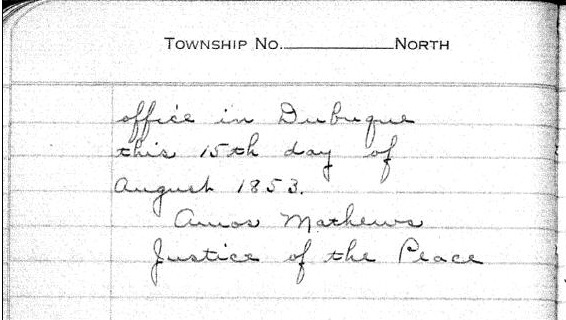
Duluth and St. Louis County, Minnesota;
Their Story and People
By Walter Van Brunt, 1921, pages 64-65.

Portrait of George Nettleton’s cabin on Minnesota Point in 1852 on page 75.
First Settler.– The honor, for both Superior and Duluth, must presumably go to George R. Stuntz. He came in 1852, and settled in 1853. Several were earlier of course, but can hardly be considered to have been legitimate independent settlers. Carlton had been on the ground, at Fond du Lac, for some years, but he was Indian agent; Borup and Oaks had spent their time between La Pointe and Fond du Lac, but were then at St. Paul, and mainly interested in the development of that city, and in fur trading. Wm. R. Marshall stated that he “was on the lake as early as 1848,” but not to settle and he did not come again until 1857. Wm. R. Marshall and George R. Stuntz were fellow-surveyors, in federal pay, “back in the ’40s,” but Marshall did not seek to take the place of Stuntz as premier pioneer at the head of Lake Superior. As a matter of fact, although “on the lake as early as “1848,” Marshall did not then get nearer to Duluth than La Pointe, where he met “Borup and Oaks, the principal traders, Truman Warren, George Nettleton, Cruttenden, Wattrous, Rev. Sherman Hall, E. F. Ely and others.” It is quite possible that Stuntz was with Marshall in 1848, for that was the year in which Stuntz first entered Minnesota territory “having charge of a surveying party that was working near Lake Pepin and in what is now Washington County.”
The “Heart of the Continent.”– George R. Stuntz prepared the way for the first attempt at white settlement at the head of Lake Superior. He surveyed the land on the Wisconsin side, within a year of beginning which survey, in 1852, the first settlers began to appear. George R. Stuntz came by direction of George B. Sargent, who at the time was surveyor-general of the Iowa, Wisconsin and Minnesota district for the federal government, his headquarters being at Davenport, Iowa. In that year, states Carey, “he surveyed and definitely located a portion of the northeastern boundary line between Minnesota and Wisconsin, starting from the head of navigation on the St. Louis River, at Fond du Lac, and running south to the St. Croix River.” Stuntz himself stated: “I came in 1852. I saw the advantages of this point (Minnesota Point) as clearly then as I do now (1892). On finishing the survey for the government, I went away to make a report, and returned the next spring and came for good. I saw as surely then as I do now that this was the heart of the continent commercially, and so I drove my stakes.”
![Group of people, including a number of Ojibwe at Minnesota Point, Duluth, Minnesota [featuring William Howenstein] ~ University of Minnesota Duluth, Kathryn A. Martin Library](https://chequamegonhistory.com/wp-content/uploads/2015/06/howenstein-minnesota-point.jpg)
Group of people, including a number of Ojibwe at Minnesota Point, Duluth, Minnesota [featuring William Howenstein in 1872?] ~ University of Minnesota Duluth
The Vanguard.– He did not come alone, needing of course assistants in the work of surveying, but he was in charge of the work, Gand necessarily takes first place in the accounting. William C. Sargent, son of George B. Sargent, stated in 1916, that his father “came here (Duluth) first in 1852 with George R. Stuntz and Bill Howenstein,” and goes on to state “a word of those two grand men, George R. Stuntz and Bill Howenstein.” He believed that “to George R. Stuntz, more than to any other man belongs the honor (of) opening up that region,” and of Howenstein, he said: “And old Bill Howenstein, one of the best ever, and always my very good friend, a kindly body, with a quaint dry humor unsurpassed and seldom met with in these later days. I had many an interesting chat with him, in his home on Minnesota Point, that he built in 1852, and lived in until his death, some years ago.” Bill Howenstein, undoubtedly was of Stuntz’ party in 1852, but it is doubtful whether he built a log house on Minnesota Point in that year. As to General Sargent’s visit in 1852. If he did come then, it was probably only a flying visit. His interest in the head of Lake Superior in 1852 reached only to the extent of directing Stuntz to survey it. He, himself, had the surveying business of three states to attend to.
The New York Times
[December 11, 1852]
The Region about the Southwest End of Lake Superior.
Mr. Stuntz, of Grant County, Wis., has been deputed by the general Land Surveyor of this Northwest District to lay off such a tract of land about the southwest point of the lake into townships and sections, as emigrants will earliest require. He returned via La Pointe and Stillwater last week. We have obtained from him some new views of that region. From Fond du Lac, a trading post situated 11 miles inland on the St. Louis River, eastward, for perhaps 50 miles, the margin of the lake is a flat strip of land reaching back to a rocky ridge about 11 miles off. The soil of this flat land is a rich red clay. The wood is white cedar and pine of the most magnificent growth. The American line is beyond the mouth of the St. Louis and Pigeon rivers. It evidently abounds in copper, iron and silver. The terrestrial compass cannot be used there, so strong is the attraction to the earth. The needle rears and plunges “like mad.” Points of survey have to be fixed by the solar compass.
The Indian and half breed packmen have astonishing strength. One Indian, who is described by the others as being as large as two men, carried for a company of 11 men provisions for ten days, viz: one barrel of flour, half barrel of pork and something else, beside the utensils. Mirage is a common phenomenon is Spring and Summer. For the bays not opening as soon as the main lake, or not cooling so early, an object out on the lake, is viewed from the shore, through a dense medium of air and a thin medium. Hence is a refraction of rays which gives so many wonderful sights that the Chippewas call that the spirit or enchanted land. Sail vessels which are really 40 miles off, are seen flapping and bellying about almost within touch. Turreted Islands, look heavy and toppling towards the zenith. Forests seem to leap from their stems and go a soaring like thistles for the very sport of it.
The ice did not leave some of the bays till the 10th of June. The fish are delicious, especially the salmon trout. But little land game. Mr. Stunts calculates on wonderful enterprises in that country after the opening of the Saut Canal.
Mr. S. describes La Pointe a town of the Lake, as being situated at the head of a bay some 25 miles from the high lake, and secluded from the lake by several islands. He saw there a warehouse 300 feet long, built of tamarac poles, and roofed with bark. This building is very much warped by the pressure of age ; it is entered by a wooden railway. The town is dingy and dreary. He saw a most luxurious garden by the former residence of Dr. Borup. It contained a variety of fruit trees and shrubs, such as plums, cherries, apples, pears, currants, &c.

Cover of Stuntz’s Exterior Field Notes (August-October 1852) ~ Wisconsin Public Land Survey Records: Original Field Notes and Plat Maps

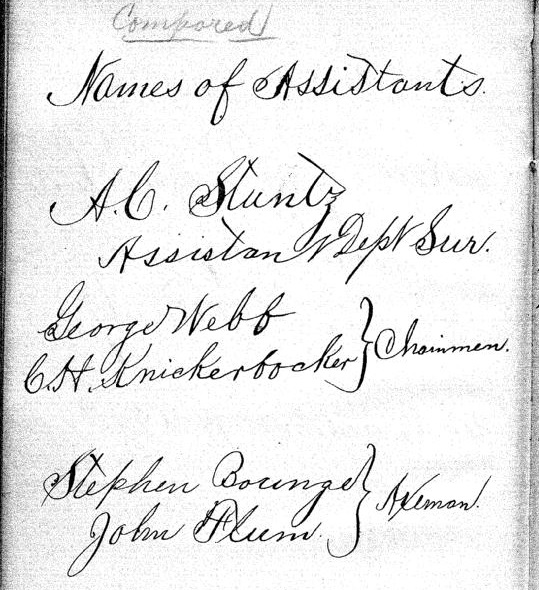
George Riley Stuntz was also assisted by his brother Albert Conrad Stuntz as well as the African-Chippewa mixed-blood Stephen Bonga employed as an Axeman. To learn more about the interesting Bonga (Bonza) family and Stephen as “the first white child born at the head of Lake Superior,” read pages 39-41 of The Black West by William Loren Katz (1971), and pages 131-34 of Black Indians also by Katz (2012).
The Eye of the North-west: First Annual Report of the Statistician of Superior, Wisconsin
By Frank Abial Flower, 1890

Portrait of Stephen Bonga, page 7.
GEORGE R. STUNTZ, DEPUTY U. S. SURVEYOR [pages 50-52]

Portrait of George Riley Stuntz, page 26.
In 1852 George R. Stuntz took a contract to run the township lines in this part of the country, including the state boundary, and filed with the land-office at Dubuque a rude map of the head of the lake, on the Wisconsin side, in December of that year. He took a new contract and returned in the spring of 1853 to survey the copper range around Black River, a few miles south of Superior. He brought seeds with him and planting them on the Namdji, raised a quantity of vegetables; they grew to great size. he also built a trading-post on Minnesota point near the present light-house, and a mill on Iron River in Bayfield county. In respect of these operations W. W. Ward writes from Morley, Mo.:
The first lumber of any description produced locally, other than by “Whip sawing”, was at Iron River, Wisconsin about forty miles from Superior on the South Shore of Lake Superior.
George R. Stuntz with William C. Howenstein, Andrew Reefer and George Falkner built and operated a water power “up and down” sawmill at the falls on Iron River about a half a mile from the Lake, capable of cutting three thousand feet of lumber a day. The writer has several 1 1/4 inch absolutely “clear” White Pine boards 24 and 26 inches wide and 18 feet long that were originally stored in a loft to be used in building a skiff. This mill was built in 1854 and the lumber was floated up the Lake to Superior, Oneota and Fond du Lac…
~ Superior, Wisconsin, papers, 1831-1942 ([unpublished])
From “A Pioneer of Old Superior” by Lillian Kimball Stewart
“In the summer of ’54 the Sam Ward plying between the Sault and any port on Lake Superior, brought on every trip a goodly number of emigrants, speculators, and tourists, bent on seeing the new “city” of Superior. Stuntz’s dock was located near an Indian village, so that every traveler as well as every piece of freight or baggage was subject to inspection by braves, squaws, and papooses before receiving a passport to the shore across the bay…”
~ Superior, Wisconsin, papers, 1831-1942 ([unpublished])
“It was in the spring of 1853 that Mr. Stuntz, Deputy U. S. Surveyor, received his second contract to survey and run the township lines taking in the range around Black River Falls, a portion of Left-hand River country and that part where Superior now is. In the latter part of April that year he organized a party – viz., Nat. W. Kendall, James McKinzie, Pain Bradt, James McBride, Harvey Fargo, Wm. H. Reed, John Chisholm, Joseph Latham, Augustus Barber, and your humble servant. Procured three birch-bark canoes and supplies at Stillwater, Minn.: left there the first day of May, passed up the St. Croix River to its head, made a portage of about two and a half miles into the headwaters of the Brule River, down said river into Lake Superior, thence up the lake to what was called the entry of St. Louis Bay [now Superior Bay], and landed on Minnesota Point in the early part of June. At that time there were no white settlers in this end of the lake – all Chippewa Indians and ‘breeds’ – scarcely a stick missing on that side of the bay where Superior City now stands. We finished the surveying contract and went in early fall down to Iron River, built a double log-shanty, and made other preparations for the construction of a saw mill. Here the first lumber was made at the head of the lake and the first road opened through to the settlement on the St. Croix. The following February, Mr. Stuntz having a trading-post on Minnesota Point [then Stuntz’s Point], I went there and assisted in building a block-house and steamboat pier, and found improvements and a few log-shanties built where old Superior now is located.”
[…]
HUSTLING FOR TOWNSITES [pages 58-60]
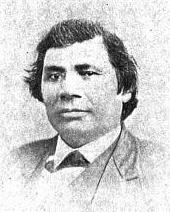
Vincent Roy Jr. ~ Life and Labors of Rt. Rev. Frederic Baraga by Chrysostom Verwyst,
VI. – Superior.
Vincent [Roy Jr.] had barely emerged from the trouble just described when it was necessary for him to exert himself in another direction. A year or so previously he had taken up a claim of land at the headwaters of Lake Superior and there was improvement now on foot for that part of the country, and danger for his interests.
The ship canal at Sault St Marie was in course of construction and it was evidently but a question of days that boats afloat on Lakes Huron and Michigan would be able to run up and unload their cargo for regions further inland somewhere on the shore at the further end of Lake Superior, at which a place, no doubt, a city would be built. The place now occupied by the city of Superior was suitable for the purposes in view but to set it in order and to own the greatest possible part of it, had become all at the same time the cherished idea of too many different elements as that developments could go on smoothly. Three independent crews were struggling to establish themselves at the lower or east end of the bay when a fourth crew approached at the upper or west end, with which Vincent, his brother Frank, and others of LaPointe had joined in. As this crew went directly to and began operations at the place where Vincent had his property it seems to have been guided by him, though it was in reality under the leadership of Wm. Nettleton who was backed by Hon. Henry M. Rice of St. Paul. Without delay the party set to work surveying the land and “improving” each claim, as soon as it was marked off, by building some kind of a log-house upon it. The hewing of timber may have attracted the attention of the other crews at the lower end about two or three miles off, as they came up about noon to see what was going on. The parties met about halfway down the bay at a place where a small creek winds its way through a rugged ravine and falls into the bay. Prospects were anything but pleasant at first at the meeting; for a time it seemed that a battle was to be fought, which however did not take place but the parceling out of ‘claims’ was for the time being suspended. This was in March or April 1854. Hereafter some transacting went on back the curtain, and before long it came out that the interests of the town-site of Superior, as far as necessary for efficient action, were united into a land company of which public and prominent view of New York, Washington, D.C. and other places east of the Mississippi river were the stockholders. Such interests as were not represented in the company were satisfied which meant for some of them that they were set aside for deficiency of right or title to a consideration. The townsite of the Superior of those days was laid out on both sides of the Nemadji river about two or three miles into the country with a base along the water edge about half way up Superior bay, so that Vincent with his property at the upper end of the bay, was pretty well out of the way of the land company, but there were an way such as thought his land a desirable thing and they contested his title in spite of his holding it already for a considerable time. An argument on hand in those days was, that persons of mixed blood were incapable of making a legal claim of land. The assertion looks more like a bugaboo invented for the purpose to get rid of persons in the way than something founded upon law and reason, yet at that time some effect was obtained with it. Vincent managed, however, to ward off all intrusion upon his property, holding it under every possible title, ‘preemption’ etc., until the treaty of LaPointe in the following September, when it was settled upon his name by title of United States scrip so called, that is by reason of the clause, as said above, entered into the second article of that treaty.
The subsequent fate of the piece of land here in question was that Vincent held it through the varying fortune of the ‘head of the lake’ for a period of about thirty six years until it had greatly risen in value, and when the west end was getting pretty much the more important complex of Superior, an English syndicate paid the sum of twenty five thousand dollars, of which was then embodied in a tract afterwards known as “Roy’s Addition”.
~ Biographical Sketch – Vincent Roy Jr; Vincent Roy Jr. Papers.
Up to the time of the survey in the spring of 1854 all was chaos as to lands west of the claims of Robertson, Nelson, Baker and their party. There could be no titles or bona fide purchases, as only the mouth of the Nemadji had been surveyed. There were really three “townsite” companies— Robertson, Nelson and Baker, with their associates J. A. Bullen, J. T. Morgan, E. Y. Shelly, August Zachau, C. G. Pettys, Abraham Emmett, and perhaps others, forming one which had the surveyed lands next to the Nemadji. West of them were Francis Roy, Benjamin Cadotte, Robert Bothwick, Basil Dennis, Charles Knowlton and nearly a dozen half-breeds, mostly brought from Crow Wing by Nettleton in the interest of what was known as the “Hollinshead crowd”—Edmund and Henry M. Rice, George L. Becker, Wm. and George W. Nettleton, Benjamin Thompson, James Stinson and W. H. Newton. Still farther west were Benjamin W. Brunson, A. A. Parker, R. F. Slaughter, C. D. Kimball, Rev. E. F. Ely, George R. Stuntz, Bradley Salter, Joseph Kimball, Calvin Hood, and others who proposed to call their town Endion—”Ahn-dy-yon,” the Chippewa for “home.”
B. W. Brunson, still a resident of St. Paul, has described the contest in writing. He says:
“Believing Superior would become of importance I went there in February, 1854, with R. F. Slaughter. We found some Ontonagon parties had claimed on the bay and we bought an interest in their claims and began to lay out a city and make improvements. While surveying the town, and when we had the same so far completed as to make a plat of it, the township having been subdivided by a good surveyor, then it was that Vincent Roy, Basil Dennis, Charles Brissette and Antoine Warren, accompanied by twenty-one other half-breeds and some four or five white men, headed, led and directed by one Stinson and one Thompson, who were acting for themselves and as agents of the company, came upon the lands to make their claims and avail themselves of pre-emption rights as citizens of the United States. These men were in the employ of the company for the purpose of making claims, and there was a claimant for each and every quarter-section as fast as the surveyor set the quarter-post. They had commenced the day before, with or at the same time the surveyor commenced his work. The timber being dense and there being a strong force, they were able to build an 8×10 cabin and cover it with boughs, upon each quarter, and then overtake the surveyor before he could establish the next quarter, thus taking the land as they went, and in that manner were progressing when they came upon the land marked out and occupied by us.“
The meeting of the two hostile parties occurred on the banks of the deep slough in what is now called Central Park. Nothing but the timidity of the half-breeds prevented bloodshed. Brunson was armed and intended to, and did stand his ground. Thompson, one of the pluckiest of men, was also armed, having two revolvers, and was prepared and intended to proceed. The Indians, not being armed, did not wish to engage in a battle where the leaders only were prepared to fight; and so there was no physical conflict, though a state of chaos and bad feeling continued for some time. Several cabins were demolished, Brunson’s party entirely cutting in pieces a house built by Basil Dennis on the ground now occupied by Dr. Conan’s fine residence.
A long legal contest followed. Finally in 1862-63 patents issued from the government to three men—S. W. Smith, Lars Lenroot and Oliver Lemerise—chosen as trustees of the townsite for the benefit of actual occupants. Thus those who claimed to be proprietors of, but not settlers on the townsite, lost their lands as well as their labor. In the winter of 1853-54 Henry M. Rice asked the Commissioner of the General Land Office whether, when lands which had not been surveyed were claimed for a townsite they would be liable to pre-emption as soon as the survey should be made. The answer was in favor of pre-emption; and that is how those who with Brunson put money into Superior City townsite lost it. The actual settlers got the townsite, the patent being made to the three trustees named who divided the plat, containing 240 acres with riparian rights in Superior Bay, and deeded lots to occupants and purchasers. It may be proper to mention here that a little plat of thirty-four acres, with riparian rights in the bay, and known as Middletown, went through a similar siege of litigation and was finally patented to three trustees —Urguelle Gouge, Louis Morrisette and Nicholas Poulliott—for the benefit of actual occupants. These decisions did not come until the “city” had collapsed and the land become nearly worthless.
The New York Times
[June 19th, 1858]
WESTERN LAND FRAUDS.
More Blood in the Body than Shows in the Face – Land Frauds in the Northwest – The Superior City Controversy – Pre-emptions by Swedes and Indians
Washington, Thursday, June 17, 1858.
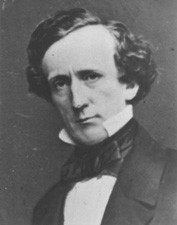
Senator Henry Mower Rice
~ United States Senate Historical Office
There are some interesting matters here besides what takes place in Congress, and I propose from time to time to touch upon them. An expenditure of $60,000,000 per annum does not cover all the pickings and stealings that “prevail” in our hereabouts. Senator RICE did not tell all he knew about land-office operations, when he testified to the value of the Fort Snelling property. Nobody is better aware than he that the tract would be much better to cut up into town lots than Bayfield was when he bought it for a few cents an acre, and sold it for hundreds of dollars. If we could find out all that Senator BRIGHT knows of these matters, one could learn how to become a millionaire at very small expense of brains or labor. Indian treaties and land-office jobbing have made more men rich than care to tell of it – ask General CASS if this is not so.
Seeing a bushel-basket of papers in the Interior Department the other day, I was curious to know what the kernel might be to all that rind, and made inquiry in the premises. I was told that they enveloped the case of Superior City. I cast my eye over some of them, and noticed that an argument was filed on behalf of one of the parties by Mr. Senator BRIGHT – or rather with Senator BRIGHT’S indorsement. This whetted my desire of knowledge, and I ran my eye over the paper in question, which was from the pen of a Minnesota Judge and was without exception the richest document I ever saw intended for a judicial or administrative tribunal. The substance of it was that the opinion of the Attorney-General CUSHING in the case was absurd, the adoption of his views by the Interior Department preposterous, and the action of the local Land office at Superior, in defining the status of certain half-breed Indians on the most abundant testimony, corrupt. It was clear enough that such a document required at least a senatorial indorsement to justify its reception. Nobody can suppose for a moment that Senator BRIGHT has any interest in the result of the case, or that he expected to influence the judgement of his friend, HENDRICKS, (Commissioner of the General Land Office,) by appearing in it. That would be too strong an inference to draw from so meek a fact ; and yet the malicious might suggest it as an apprehension.

Original Proprietors of Superior featuring James Stinson, Benjamin Thomson, Dr. W.W. Coran, U.S. Senator Robert J Walker, George W. Cass, and Horace Bridge. Featured in The Eye of the North-west, pg. 8.
From the printed argument of Senator BRIGHT’S friend, and from a private abstract of the testimony in the case, and a few items I have picked up in the Land Office, I think it will be in my power to indite an epistle that may excite some attention. At the Southwestern extremity of Lake Superior, there is a tract of land, which is expected some day to become the cite of a large city. Being aware of its great advantages for this purpose, a St. Paul speculator by the name of THOMPSON, and a Canadian operator by the name of STINSON, undertook to possess themselves of it as long as as in the early part of General PIERCE‘S administration, by vicarious preemptions. In this plan they were assisted by some official gentlement, who shared in the spoils, and patents were ground out in double-quick time, or certificates issued to Swedes and Indians for the benefit of this STINSON and THOMPSON, and their associate speculators.
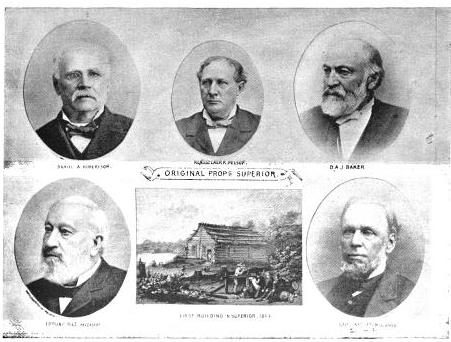
More Proprietors of Supeior from The Eye of the North-west, pg. 9.
In the Summer of 1854, this Mr. STINSON, headed a gang of Swedes and led them from Swede Lake, in the Territory of Minnesota, to Lake Superior, guiding them in person to the tracts he wished them to preempt. These men were ignorant of our language and of our laws, and were used by STINSON to “settle” their tracts, “prove up” their claims, and “convey” to him, the said STINSON, without knowing either the frauds they were practicing, or the rights which they might have secured to themselves if they had been acting in good faith. In the Land Office at Hudson, where these frauds were perpetrated, there was a notary public, who drew the deeds to STINSON, got the signatures of the Swedes to them and took the acknowledgements, immediately after the preemption oath had been administered – the Swedes thinking the whole operation a part of the preemption process. The terms were said to be $30 a month, and a bonus of $15 on the consummation of the bargain. The names of these Swedes were Aaron Peterson, Martin Larson, Peter Nelson, John Johnson, Sven Magnassan, Lorenz Johnson, Peter Norell, Sven Larson, Andreas Senson, Johannes Helon, Johannes Peterson, and Peter Erickson. These “preemptors,” for their own benefit, all “proved up” at Hudson, and the very same day they made conveyances to STINSON. The same thing is true of another Swedish invasion that was made in the Summer of 1855. In that year three Swedes – Old Westerland, Andrew Walmart, and Israel Janssen – commenced their settlements June 11, proved up June 22, and conveyed to STINSON June 22 – eleven days being sufficient for the whole operation. The records of the Land Office at Superior, and of the Register of Deeds of Douglas County, show these facts. They are well known in the General Land Office.
But Mr. STINSON did not operate through Swedes alone. He and his friend THOMPSON worked with half-breed Indians also. In March, 1854, he and THOMPSON followed up the Government Surveys with a gang of Chippewa half-breed Indians. The whole gang made preemptions in Douglas County, under the guidance of THOMPSON and STINSON, who hired them at La Pointe, and convered a large portion of a township with their fraudulent pre-emptions, which were proved up simultaneously, and simultaneously conveyed to the attorney of THOMPSON and STINSON. The names of all of this gang appear on the tract books in the General Land Office. These were Joseph Lamoureaux, Joseph Defaut, Joseph Dennis, Joseph Gauthier, Francis Decoteau, John B. Goslin, George D. Morrison and Levi B. Coffee, all preemptors for these land-sharks. There were three or four more half-breeds in the gang, who ran foul of some eight or ten American citizens who were seeking to save a slice of this Territory from Swedish and Indian preemption, and lay out a town site there under the law. This was the origin of the Superior City controversy, which has been pending some three or four years in the various land offices, and which has accumulated the basket of papers which first drew my attention to a case of such interesting dimensions. The contest is nominally between three or four Chippewa half-breeds claiming some three hundred acres as a town site. But the Indians are not merely bogus citizens, they are bogus pre-emptors in the bargain, for they were the hired men of THOMPSON & STINSON.
Mr. CUSHING decided in this controversy, before it was so settled by the Dred Scott case, that a half-breed Indian, receiving annuities as such, recognized as a dependent of a tribe, and the beneficiary of treaty stipulations, could become a citizen of the United States only by some positive act of Federal legislation ; that he could not, of his own volition, or by the laws of a State, change his condition from that of an Indian to that of a Federal citizen. Strange as it may seem, it appears that this part of the Dred Scott is repudiated by Mr. Commissioner HENDRICKS, who thinks a state cannot make a Federal citizen of a man with a drop of negro blood in his veins, but that the Commissioner of the General Land Office may naturalize Indians, ad libitum, without statute or judgement to sustain him.
I am curious to see how this controversy will be decided. The General Land Office upheld STINTSON’S Swedish preemption, on the ground that the frauds were discovered too late for the Commissioner to interefere. Whether or not STINSON hasmade any negro preemptions does not appear. It was too cold at the end of the lake for negroes to flourish much. But now it is to be settled in a case where the attempted frauds have been seasonably discovered, whether or not a Canadian adventurer can preempt whole townships of the Public Lands by the agency of a gang of half-breed Indians, and procure patents for them when the facts are known to the Federal authorities.
The pre-emptive right. Homesteads.
~ Superior, Wisconsin, papers, 1831-1942 ([unpublished])
Detail of Superior City townsite at the head of Lake Superior from Stuntz’s 1854 Plat Map of Township 49 North Range 14 West.
Early history of Superior should make mention of this right of acquisition, since there under, titles to government land were derived. Any qualified person might acquire title to one hundred and sixty acres of land by settling thereon, erecting a dwelling and making other improvements. Such person was to be twenty-one years of age, either male or female, or the head of a family whether man or woman.
Proof of each settlement was required to be made on a certain day at the United State Land Office and upon the payment of two hundred dollars with the taking of a required oath, the preemptioner got his one hundred and sixty acres of land.
But the whole proceeding, was far from straight, as a general thing, and in fact often amounted to a fraud.
“In the first place, Superior was backed by a powerful company of Democratic politicians and Government bankers in Washington, while the northern and northeastern portions of the state were still held by the Indians. This Superior company sought a connection with the Mississippi river, to obtain which they urged in congress the passage of a land grant bill, offering ten sections to the mile to aid in the construction of a railroad from Milwaukee to some point on Lake St. Croix, on the western boundary of the state of Wisconsin.”
~ History of Duluth and St. Louis County, Past and Present,
Volume 1, page 230.
Hence the whole country, in and about Superior, was dotted with preemption cabins, which were little more than logs piles up in walls, without floors, or windows, often with brush for a roof, a hole therein for a chimney and perhaps for a door. A slashing of half an acre or so of trees was the “improvement” so called. A very barbarous travesty, it was, upon a white man’s home and farm. Here is an instance, where as was said, a certain doctor of divinity laid claim to a quarter section of land, now in the midst of this city.
One day he sought “to prove up” his preemption, and one Alfred Allen was his witness, and they asked Allen, “Was the pre-emptions shanty good to live in?“, the law requiring a good habitable house on the claim. And Alf said “Yes, good for mosquitoes.” The Reverend said “Pshaw! Pshaw!” Meanding to upbraid or caution the witness who thereupon only protested and adjured the harder. The difficulty was somehow smoothed over, through some mending of the proofs, and perhaps connivance on the part of persons charged with administration of the United States land laws.
Nevertheless, it is interesting to member that upon rude and rough proceedings, such as are herein alluded to, rest at bottom the titles and claims to everything we own in the nature of lots, blocks, and land.
From: Statements of Hiram Hayes. Mr. Hayes came to Superior in 1854.
History of Duluth and St. Louis County, Past and Present, Volume 1
By Dwight Edwards Woodbridge, et al, 1910
GEORGE R. STUNTZ. [pages 229-231]
One of the earliest settlers at the head of the lakes was Mr. George E. Stuntz, who a short time ago joined the great majority. Before his death Mr. Stuntz wrote of his pioneer experiences as follows:
“In July, 1852, I came to the head of Lake Superior to run the land lines and subdivide certain townships. When I arrived at the head of the lakes there was nothing in Duluth or Superior. There was no settlement. The old American Fur Company had a post at La Pointe, at the west side of Madeline Island.
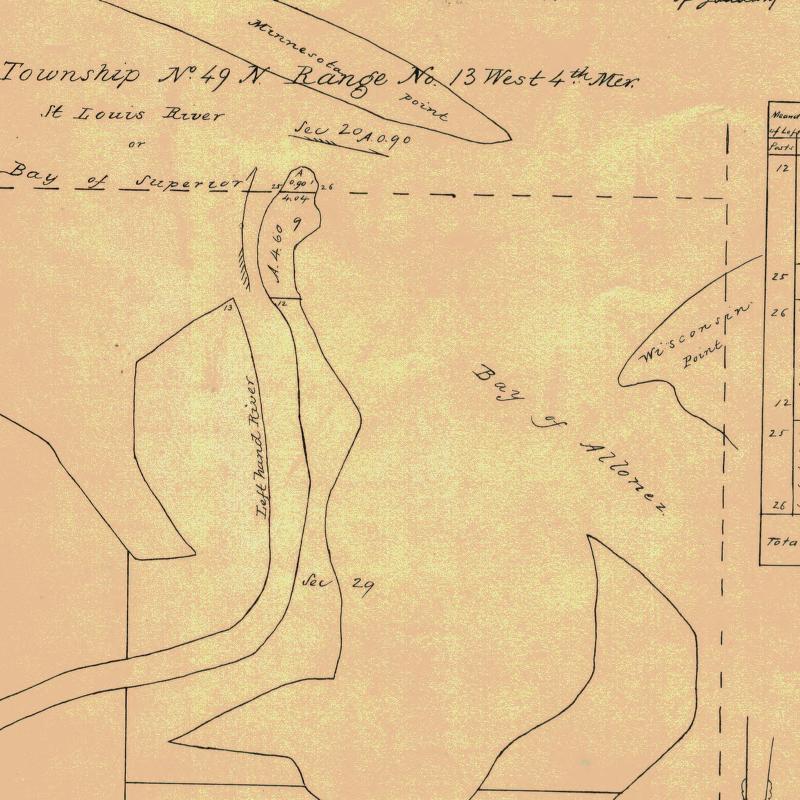
Detail of Minnesota Point from Stuntz’s Exterior Field Notes (August-October of 1852).
“In 1853 I got the range subdivided, and also in Superior, townsite 49, range 13. During the same year, later, in my absence, there came parties from the copper district of upper Michigan and located claims upon the range. They were principally miners. During the same year I built a residence on Minnesota Point under treaty license before the territory was sold to the Government. At that time there were only missionaries or license traders in the tract, as it belonged to the original Indian territory. In 1852, at Fond du Lac, there was a trading post and warehouse, in which I stored my goods on my arrival. In the fall of 1853 I bought three yoke of cattle and two cows at St. Croix Falls and brought them to the mouth of the Iron river, and had to cut a road thirty miles through the dense forest so as to get the oxen, cows and cart through. Later in the fall of 1853 I came through with an extra yoke of oxen, buying provisions, etc., and on coming up to Superior I found quite a settlement of log cabins. These settlers were anxious to get to the United States land office, then at Hudson, Wis. A dense forest intervened. We organized a volunteer company in January, 1854, to cut a road from old Superior to the nearest lumber camp on the St. Croix river, I furnishing two barrels of flour, provisions, pony and dog train, necessary to carry the provisions for a gang of seventeen men. The road was completed in twenty days, the snow being at that time two feet deep. This cut through a direct road to Taylor’s Falls and Stillwater. In 1854 I completed a mill on the Iron river and employed a man to superintend it, and I remained at Minnesota Point, my trading post, where I had first taken out the license. In the same year I took a contract to subdivide two townships located in Superior, townships 48-49, range 15, and afterward I attended the treaty at the time the Indians sold this country to the Government.
Before the 1854 Treaty of La Pointe could be ratified in Washington, D.C., the oral description agreed upon during the negotiations for exterior boundaries of the Chippewa treaties had to be surveyed with the tribe, documented, and delivered to Washington, D.C. before 1855. It is not clear who was involved with the exterior boundaries of these reservations; whether it was Stuntz, Barber, and/or others from their party.
“There were 5,000 Indians present with their chiefs. It was the biggest assemblage of Indians ever held at Lake Superior at this period of the country’s history. It took a month to pacify the troubles that grew among the different tribes in regard to their proportionate rights. This treaty was sent to congress September [30], 1854, and was ratified and became law in January, 1855.
To be continued in 1854…
By Amorin Mello
The original handwritten memoir of Joseph Austrian is held by the Chicago History Museum. We saw some interesting stories and insights about La Pointe in Part I through the eyes of Doodooshaaboo (milk) as Joseph was known there during 1851 and 1852. The later La Pointe stories in Part II, however, are where the really good stuff is about white settlement and land speculation prior to the Treaty of 1854. When we last checked in with Joseph, he had just been ordered by brother-in-law Louis F. Leopold to terminate his business career at brother Julius Austrian’s Indian trading post at La Pointe, and to immediately relocate to Keweenaw Peninsula to co-manage brother-in-law Henry F. Leopold’s store in Eagle River.

Joseph Austrian’s land purchase at La Pointe during 1852.
~ General Land Office Records
In this installment we follow pages 66-78 of Joseph Austrian’s memoir about his reassignment to Eagle River. While there he engages with the Leopolds’ business affairs with copper mines and miners of the Keweenaw Peninsula before the opening of the Soo Locks. Joseph is quick to succeed in his new position as a trusted business partner during 1852-54.
A mysterious omission from this memoir is the fact that, during the summer of 1852, Doodooshaboo purchased 183 acres in La Pointe from the U.S. General Land Office in Willow River. In other words, this was the first federal sale of any land in La Pointe County. We will take a closer look at this critical shift in La Pointe’s political landscape as the subject of a future post on Chequamegon History. But for now, Joseph’s stories about 1852-54 provide us with glimpses of the Austrian family’s affairs at La Pointe during these pivotal years before the 1854 Treaty of La Pointe.
Memoirs of Doodooshaboo
… continued from La Pointe 1851-1852 (Part 2).

Outline Map showing the position of the ancient mine-pits of Point Keweenaw, Michigan.
~ Ancient Mining on the Shores of Lake Superior, by Charles Whittlesey
Reached Eagle River by Sleigh. 1852.
~ CopperCountryExplorer.com
Mr. H. F. Leopold, who hearing that the boat had passed by during the night and expecting me on her, came over with a sleigh for me. Eagle River was a small settlement of not over one hundred inhabitants situated in Houghton County, Michigan. It depended entirely for its business patronage on the adjacent copper mines, principally the Cliff Mine, North American, Phoenix & Garden City mines, some of which at that time were just in course of development. In the place there were but two stores the smaller one 18 x 24 situated on top of a hill facing the Lake was Leopolds. The other larger store was owned by Tenter and Mandelbaum. There were a number of saloons and boarding houses combined and this constituted the business portion of the town.

Simon Mandelbaum was an employee of the Phoenix Mine, the successor of the the Lake Superior Copper Company (the first regularly organized corporation to engage in Lake Superior Copper mining).
~ Annual Report by the Michigan Department of Mineral Statistics, 1900, pg. 240-41
Started Work at Eagle River. 1852.
I was at once installed in my work after my arrival, and the next day went to the Cliff Mine to attend to some collections. Mr. H. F. Leopold was an uneducated man not able to read or write English, the business correspondence and keeping of accounts therefore devolved entirely on me.
After becoming thoroughly acquainted with the business I resolved to enlarge the same and my efforts to do so succeeded well. A short time after my arrival at Eagle River a letter was received by the Leopolds containing the sad news of the death of my father. He died suddenly Sept 17th, 1852 from a stroke of apoplexy at the age of 75 years. This was naturally a cause of great grief and worry to me, as there was besides my mother, my blind brother Marx, a younger sister and brother at home to be cared for.
The next spring a larger stock was ordered than had ever been carried before and new departments added, namely: groceries, grain, and provisions, heretofore, only dry goods had been carried, from this time on the business as a matter of course showed a decided increase, and at the next annual inventory the profits showed a much better result than ever before. We boarded at Joseph Lang’s place who had a saloon in connection with his boarding house and poor as it was we had no choice to better ourselves. Mr. Leopold spent his evenings generally at the boarding house enjoying a game of cards with some of his friends, while I had to pass my evenings alone at the store playing watchman. We had no fire insurance on the store or on its contents, as firstly there were no insurance companies taking risks there at the time, and secondly even if they had I doubt that we could had placed any, owing to the dangerous condition of the heating apparatus. The store was heated by a box wood stove with the pipe running through the entire length of the store to the chimney, and it was necessary to be very careful and watchful under the circumstances. The store was hard to get comfortably warm, and I often sat there cold and shivering wrapped up in a blanket waiting for Mr. Leopold to come in for the night.
We slept up stairs over the store, and here it was most cheerless and dismal, not being heated at all.
The winters were very severe and extremely cold which did not add to our comfort and during our first winter there we had to put up with many hardships.
Dug Tunnel Under Snow to Stable.
We had frequently severe blizzards one I well remember, it lasted over a week. The depth of the snow that fell at that time was so great that with the drifts it reached high as the roof of the stable and we had to dig a tunnel through the snow to get from the store to the stable, and the horses were led out some weeks through this tunnel. Our store was exposed to the full force of the severe Lake Superior gales which some times shook the building threatening to demolish it.
Tough Boarding House Experiences.
During the winter there was no fresh meat to be had. In the Fall the boats would bring some, but having no refrigerators it was hung up on the boom of the Schooner to preserve it during transportation and when it reached the table it was anything but tempting. However, it was kept and used for weeks after, strong vinegar was used in preparing it by our land lord’s cook to hide the flavor. When this “so called” fresh meat gave out for the rest of the winter they substituted salted meat.
The Cliff Mine store had a large supply which it had had on hand for several years, our land lord bought of this firstly because it was cheap and secondly because he could not get any other. Eggs were not to be had either and turnips and potatoes were about the only vegetable procurable. This diet caused scurvy more or less. In the Spring when navigation opened, the first boat of the season was hailed with delight it was the signal for eggs and other delicacies we had been deprived of so long. Our land lord bought a barrel of eggs and fed us on them three times a day, while they lasted. During the summer we were also regaled with a variety of fresh vegetables and some fresh meat that could be had at times.
Brother Julius Brings our Family to America. 1853.
Secretary of State
Office of Indian Affairs
June 30th, 1853
Dear Sir,
In the absence of the Commissioner of Indian Affairs, to whom the bearer, Mr. Julius Austrian of Cleveland, Ohio, has letters of introduction and whose business here pertains to your Department in connection with an intended visit to Europe with his family, I beg leave respectfully to salient for him such courtesies as the case demands.
I have the honor to be
Very respectfully
Your obedient
Charles E. Mix
Acting Comm.”
~ Ancestry.com
Things went on satisfactorily in the business and in the summer of 1853 brother Julius, who was stationed at La Point started with his wife, a sister of the Leopolds, for Germany in accordance with a conclusion we had come to, to bring mother and the rest of the family to this country, and at the same time to visit the native village of his wife – “Rḯchen,” in the Grand Dukedom of Baden. It was a mission combined with a great deal of hardship and trouble for Julius, as it meant for him to convert all the real & personal property of my late father’s estate into money, which was in itself very difficult besides getting the family ready for this long voyage for their destination in the new world after having lived all their lifetime in Wittelshofen. Brother Marx especially was disinclined to go on account of his affliction from loss of eyesight.
My mother not having any special ties there to keep her, was in a measure glad to go where the most of her children were living, and did everything in her power to get ready without unnecessary delay.
They had a safe voyage and arrived at Cleveland Sept 1853.

U.S.M. Steamship Atlantic, James West, Commander.
~ Library of Congress Prints and Photographs Division Washington, D.C.
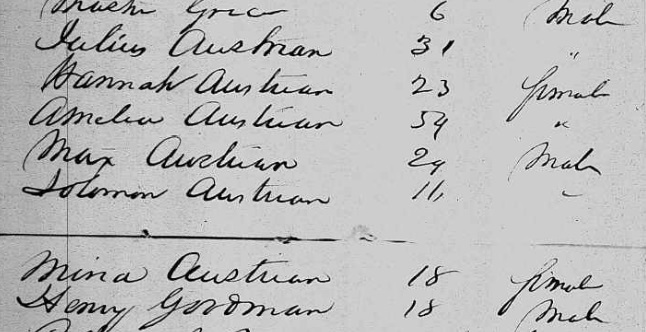
Julius Austrian returned from Europe on the U.S.M. Steamer Atlantic to America on October 17th, 1853 with his family: Hannah Leopold Austrian (Wife); Malka Heule Austrian (Mother); Marx Austrian (Brother); Samuel Solomon Austrian (Brother); Mina (Sister); and Henry Guttman aka Goodman (Cousin).
~ New York, Passenger Lists, 1820-1891, pg. 499, FamilySearch.org
Mother took a small house in Cleveland on Ohio St. and started house keeping with my sister Mina and necessary help when she was comfortably located. My brother Sol for the time being lived with my sister Babette. During this winter my sister Mina became engaged to Levi Jordan of Baltimore, where he was in business. He came from the same place where we were born, and therefore the families were well acquainted. Their marriage took place the next summer (1854) and afterward they resided in Baltimore.
Store Sold by Mistake.
The business had kept on increasing steadily. Mr. Louis F. Leopold had removed from Mackinaw and was living in Cleveland Ohio. In sending the annual inventory to Mr. L. F. L., through a mistake of his, he did not think the result satisfactory and peremptorily ordered his brother Henry to close out the business in Eagle River and sell the store. Henry boy like regardless of his own individual ideas and judgement at once obeyed his controlling brother, and sold out to his competitor, Mandelbaum, but soon regretted having done so.
I Spend Winter of 1853 in Cleveland.
After selling the store Henry Leopold and I went to Cleveland. I was anxious to meet my mother and the rest of the family from Germany. That winter I spent in Cleveland visiting my mother and the others. One of the first things we did was to get brother Solomon (then about 13 yrs- old) to learn a trade, and decided on shoe making as he was also eager to do something. We arranged for him to go into the service of a certain Weidenthal who agreed to instruct him in the trade at a small remuneration.
He took his place at once, living for the time being with our sister Babette. He took a good hold of the work and progressed very well in the trade to the entire satisfaction of his employer.
During the winter my brother Julius came through from Lake Superior, also Aaron and Sam F. Leopold for a conference between the Leopold brothers and me about the future program of our business. We all decided it had been a mistake to sell the store as the profits when correctly viewed was quite satisfactory with good prospects ahead. It was ascertained that Mr. Louis F. Leopold had taken it for granted that the inventory sent him showed him the result of two years profit since the business had existed; whereas it in reality was a statement of the one year of my management. We all agreed to open up again in the Spring on a larger scale. During the winter I contracted with a carpenter at Eagle River, and had the store enlarged to more than double its size and had the second story fitted up as living rooms, and a good cellar put under the store.
During this winter my sister Ida was engaged to Henry F. Leopold, and Jan 23rd, 1854, was married to him. The wedding was an enjoyable family affair.
As soon as navigation opened up in Spring, in May 1854, Henry Leopold, his wife, and I returned to Eagle River with a good stock of goods.
“We had already made the acquaintance of Mr. and Mrs. Julius Austrian, having had the pleasure of their company up the Lakes, and had made many inquiries of them as to the place of our destination. From this time forward we found Mr. and Mrs. Austrian to be most agreeable neighbors and associates, and
these young ‘brides’ spent much of their time together…”
~ The Ashland Press, Feb. 16, 1878.
At this time brother Julius and wife returned to La Point taking Brother Marx with them, who about a year later married Caroline Milner of Cleveland, and settled for the time being in La Pointe. That same year I sent him a small amount of goods from Eagle River, which enabled him to do a little something in trading with the same to the Indians for furs. After the episode with the Indians as I have previously narrated Marx was anxious to get away from La Point, and I had him and his wife come to Eagle River where I built them a cottage, conveniently arranged for him to live in with a small crockery store attached which he and his wife attended.
Some years later when brother Julius moved to St. Paul by his advice Marx and his wife went there also, and lived in a house next to Julius which he had had fitted up for the purpose. As far as business is concerned he acquired an interest in a butcher shop there.
After brother Solomon had finished his apprenticeship in the shoe business, the following year he also went up to La Pointe by advice of brother Julius where he stayed but a short time and then went to Hancock & opened a shoe store in which he did a good business.
To be continued at Eagle Harbor 1854-1859…
La Pointe Bands Part 1
April 19, 2015
By Leo Filipczak

(Click to Enlarge)
On March 8th, I posted a map of Ojibwe people mentioned in the trade journals of Perrault, Curot, Nelson, and Malhoit as a starting point to an exploration of this area at the dawn of the 19th Century. Later the map was updated to include the journal of John Sayer.
In these journals, a number of themes emerge, some of which challenge conventional wisdom about the history of the La Pointe Band. For one, there is very little mention of a La Pointe Band at all. The traders discuss La Pointe as the location of Michel Cadotte’s trading depot, and as a central location on the lakeshore, but there is no mention of a large Ojibwe village there. In fact, the journals suggest that the St. Croix and Chippewa River basins as the place where the bulk of the Lake Superior Ojibwe could be found at this time.
In the post, I repeated an argument that the term “Band” in these journals is less identifiable with a particular geographical location than it is with a particular chief or extended family. Therefore, it makes more sense to speak of “Giishkiman’s Band,” than of the “Lac du Flambeau Band,” because Giishkiman (Sharpened Stone) was not the only chief who had a village near Lac du Flambeau and Giishkiman’s Band appears at various locations in the Chippewa and St. Croix country in that era.
In later treaties and United State’s Government relations, the Ojibwe came to be described more often by village names (La Pointe, St. Croix, Fond du Lac, Lac du Flambeau, Lac Courte Oreilles, Ontonagon, etc.), even though these oversimplified traditional political divisions. However, these more recent designations are the divisions that exist today and drive historical scholarship.
So what does this mean for the La Pointe Band, the political antecedent of the modern-day Bad River and Red Cliff Bands? This is a complicated question, but I’ve come across some little-known documents that may shed new light on the meaning and chronology of the “La Pointe Band.” In a series of posts, I will work through these documents.
This series is not meant to be an exhaustive look at the Ojibwe at Chequamegon. The goal here is much narrower, and if it can be condensed into one line of inquiry, it is this:
Fourteen men signed the Treaty of 1854 as chiefs and headmen of the La Pointe Band:
Ke-che-waish-ke, or the Buffalo, 1st chief, his x mark. [L. S.]
Chay-che-que-oh, 2d chief, his x mark. [L. S.]
A-daw-we-ge-zhick, or Each Side of the sky, 2d chief, his x mark. [L. S.]
O-ske-naw-way, or the Youth, 2d chief, his x mark. [L. S.]
Maw-caw-day-pe-nay-se, or the Black Bird, 2d chief, his x mark. [L. S.]
Naw-waw-naw-quot, headman, his x mark. [L. S.]
Ke-wain-zeence, headman, his x mark. [L. S.]
Waw-baw-ne-me-ke, or the White Thunder, 2d chief, his x mark. [L. S.]
Pay-baw-me-say, or the Soarer, 2d chief, his x mark. [L. S.]
Naw-waw-ge-waw-nose, or the Little Current, 2d chief, his x mark. [L. S.]
Maw-caw-day-waw-quot, or the Black Cloud, 2d chief, his x mark. [L. S.]
Me-she-naw-way, or the Disciple, 2d chief, his x mark. [L. S.]
Key-me-waw-naw-um, headman, his x mark. [L. S.]
She-gog headman, his x mark. [L. S.]
If we consider a “band” as a unit of kinship rather than a unit of physical geography, how many bands do those fourteen names represent? For each of those bands (representing core families at Red Cliff and Bad River), what is the specific relationship to the Ojibwe villages at Chequamegon in the centuries before the treaty?
The Fitch-Wheeler Letter
Chequamegon History spends a disproportionately large amount of time on Ojibwe annuity payments. These payments, which spanned from the late 1830s to the mid-1870s were large gatherings, which produced colorful stories (dozens from the 1855 payment alone), but also highlighted the tragedy of colonialism. This is particularly true of the attempted removal of the payments to Sandy Lake in 1850-1851. Other than the Sandy Lake years, the payments took place at La Pointe until 1855 and afterward at Odanah.
The 1857 payment does not necessarily stand out from the others the way the 1855 one does, but for the purposes of our investigation in this post, one part of it does. In July of that year, the new Indian Agent at Detroit, A.W. Fitch, wrote to Odanah missionary Leonard Wheeler for aid in the payment:
Office Michn Indn Agency
Detroit July 8th 1857
Sir,
I have fixed upon Friday August 21st for the distribution of annuities to the Chippewa Indians of Lake Supr. at Bad River for the present year. A schedule of the Bands which are to be paid there is appended.
I will thank you to apprise the LaPointe Indians of the time of payment, so that they should may be there on the day. It is not necessary that they should be there before the day and I prefer that they should not.
And as there was, according to my information a partial failure in the notification of the Lake De Flambeau and Lake Court Oreille Indians last year, I take the liberty to entrust their notification this year to you and would recommend that you dispatch two trusty Messengers at once, to their settlements to notify them to be at Bad River by the 21st of August and to urge them forward with all due diligence.
It is not necessary for any of these Indians to come but the Chiefs, their headmen and one representative for each family. The women and children need not come. Two Bands of these Indians, that is Negicks & Megeesee’s you will notice are to be notified by the same Messengers to be at L’Anse on the 7th of September that they may receive their pay there instead of Bad River.
I presume that Messengers can be obtained at your place for a Dollar a day each & perhaps less and found and you will please be particular about giving them their instructions and be sure that they understand them. Perhaps you had better write them down, as it is all important that there should be no misunderstanding nor failure in the matter and furthermore you will charge the Messenger to return to Bad River immediately, so that you may know from them, what they have done.
It is my purpose to land the Goods at the mo. of Bad River somewhere about the 1st of Aug. (about which I will write you again or some one at your place) and proceed at once to my Grand Portage and Fond Du Lac payments & then return to Bad River.
Schedule of the Bands of Chipps. of Lake Supr. to be notified of the payment at Bad River, Wisn to be made Friday August 21st for the year 1854.
____________________________
La Pointe Bands.
__________
Maw kaw-day pe nay se [Blackbird]
Chay, che, qui, oh, [Little Buffalo/Plover]
Maw kaw-day waw quot [Black Cloud]
Waw be ne me ke [White Thunder]
Me she naw way [Disciple]
Aw, naw, quot [Cloud]
Naw waw ge won. [Little Current]
Key me waw naw um [Canoes in the Rain] {This Chief lives some distance away}
A, daw, we ge zhick [Each Side of the Sky]
Vincent Roy Sen. {head ½ Breeds.}
Lakes De Flambeau & Court Oreille Bands.
__________
Keynishteno [Cree]
Awmose [Little Bee]
Oskawbaywis [Messenger]
Keynozhance [Little Pike]
Iyawbanse [Little Buck]
Oshawwawskogezhick [Blue Sky]
Keychepenayse [Big Bird]
Naynayonggaybe [Dressing Bird]
Awkeywainze [Old Man]
Keychewawbeshayshe [Big Marten]
Aishquaygonaybe–[End Wing Feather]
Wawbeshaysheence [Little Marten] {I do not know where this Band is but notify it.}
__________
And Negick’s [Otter] & Megeesee’s [Eagle] Bands, which (that is Negicks and Megeesees Bands only) are to be notified by the same Messengers to go to L’Anse the 7th of Sept. for their payt.
Very respectfully
Your Obedt Servt,
A W Fitch
Indn. Agent
Rev. L H Wheeler
Bad River msn.
Source: Wheeler Family Papers, Wisconsin Historical Society, Ashland, WI
This letter reveals that in 1857, three years after the Treaty of La Pointe called for the creation of reservations for the La Pointe, Lac du Flambeau, and Lac Courte Oreilles Bands, the existence of these bands as singular political entities was still dubious. The most meaningful designation attached to the bands in the instructions to Wheeler is that of the chief’s name.
Canoes in the Rain and Little Marten clearly live far from the central villages named in the treaty, and Nigig (Otter) and Migizi (Eagle) whose villages at this time were near Lac Vieux Desert or Mole Lake aren’t depicted as attached to any particular reservation village.

Edawigijig (Edawi-giizhig “Both Sides of the Sky”), 1880 (C.M. Bell, Smithsonian Digital Collections)
Additionally, Fitch makes no distinction between Red Cliff and Bad River. Jechiikwii’o (Little Buffalo) and Vincent Roy Sr. representing the La Pointe mix-bloods could be considered “Red Cliff” chiefs while the rest would be “Bad River.” However, these reservation-based divisions are clearly secondary to the kinship/leadership divisions.
This indicates that we should conceptualize the “La Pointe Band” for the entire pre-1860 historical period as several bands that were not necessarily all tied to Madeline Island at all times. This means of thinking helps greatly in sorting out the historical timeline of this area.
This is highlighted in a curious 1928 statement by John Cloud of Bad River regarding the lineage of his grandfather Edawi-giizhig (Each Side of the Sky), one of the chiefs who signed the 1854 Treaty), to E. P. Wheeler, the La Pointe-born son of Leonard Wheeler:
AN ABRAHAM LINCOLN INDIAN MEDAL
Theodore T. Brown
This medal was obtained by Rev. E. P. Wheeler during the summer of 1928 at Odanah, on the Bad River Indian Reservation, from John Cloud, Zah-buh-deece, a Chippewa Indian, whose grandfather had obtained it from President Abraham Lincoln. His grandfather, A-duh-wih-gee-zhig, was a chief of the La Pointe band of Chippewa. His name signifies “on both sides of the sky or day.” His father was Mih-zieh, meaning a “fish without scales.” The chieftain- ship of A-duh-wih-gee-zhig was certified to by the U. S. Commissioner of Indian Affairs on March 22, 1880.
His father, Mih-zieh, was one of the three chiefs who led the original migration of the Chippewa to Chequamegon Bay, the others being Uh-jih-jahk, the Crane, and Gih-chih-way-shkeenh, or the “Big Plover.” The latter was also sometimes known as Bih-zih-kih, or the “Buffalo.”
A-duh-wih-gee-zhig was a member of the delegation of Lake Superior Chippewa chiefs who went to Washington to see President Lincoln under the guidance of Benjamin G. Armstrong, during the winter of 1861…
~WISCONSIN ARCHEOLOGIST. Vol. 8, No. 3 pg.103
The three chiefs mentioned as leading the “original migration” are well known to history. Waabajijaak, the White Crane, was the father of Ikwezewe or Madeline Cadotte, the namesake of Madeline Island. According to his great-grandson, William Warren, White Crane was in the direct Crane Clan lineage that claimed chieftainship over the entire Ojibwe nation.
Mih-zieh, or Mizay (Lawyerfish) was a prominent speaker for the La Pointe band in the early 19th Century. According to Janet Chute’s research, he was the brother of Chief Buffalo, and he later settled at Garden River, the village of the great “British” Ojibwe chief Zhingwaakoons (Little Pine) on the Canadian side of the Sault.
Bizhiki, of course, is Chief Buffalo, the most famous of the La Pointe chiefs, who died in 1855. Gichi-Weshkii, his other name, is usually translated meaning something along the lines of “Great First Born,” “Great Hereditary Chief,” or more literally as “Great New One.” John Cloud and E. P. Wheeler identify him as the “Big Plover,” which is interesting. Buffalo’s doodem (clan) was the Loon, but his contemporary Zhingwaakoons was of the Plover doodem (Jiichiishkwenh in Ojibwe). How this potentially relates to the name of Buffalo’s son Jechiikwii’o (identified as “Snipe” by Charles Lippert) is unclear but worthy of further investigation.
The characterization of these three chiefs leading the “original migration” to Chequamegon stands at odds with everything we’ve ever heard about the first Ojibwe arrival at La Pointe. The written record places the Ojibwe at Chequamegon at least a half century before any of these chiefs were born, and many sources would suggest much earlier date. Furthermore, Buffalo and White Crane are portrayed in the works of William Warren and Henry Schoolcraft as heirs to the leadership of the “ancient capital” of the Ojibwes, La Pointe.
Warren and Schoolcraft knew Buffalo personally, and Warren’s History of the Ojibways even includes a depiction of Buffalo and Daagwagane (son of White Crane, great uncle of Warren) arguing over which of their ancestors first reached Chequamegon in the mists of antiquity. Buffalo and Daawagane’s exchange would have taken a much different form if they had been alive to see this “original migration.”
Still, Cloud and Wheeler’s statement may contain a grain of truth, something I will return to after filling in a little background on the controversies and mysteries surrounding the timeline of the Ojibwe bands at La Pointe.
TO BE CONTINUED
Penokee Survey Incidents: Number VII
April 16, 2015
By Amorin Mello

January 5, 1878.
The Survey of the Penoka Range and Incidents Connected with its Early History.
—
Number VII.
Upon the arrival of Gen. Cutler and myself at Milwaukee, December 25th, 1857, we found that the affairs of the Wisconsin & Lake Superior Mining and Smelting Company were in a very different condition, financially, from what they were when we left home, nearly eight months before. The great commercial storm, that, like a tidal wave, had swept over the country that year from Maine to California, had left its mark in wrecking many of the best business men of the “Cream City,” as well as elsewhere. Among these were some of the original stock holders of our company, who, unable to stand their assessments any longer, had, previous to our arrival, given place to others as green as they were originally themselves. Even some of the new stock holders were also subsequently compelled to sell out to other parties, not being any better able to respond when the call for more money was made upon them, than had their illustrious predecessors, thereby losing not only all they had invested, but what they had in prospect to make, as well.
Among those who stepped into the trap at this time and who remained in to the end were Messrs. Green & Button, who yet hold stock, John W. Pixley, Simeon N. Small, J.B.D. Coggswell and R.B. Bell, a one-horse banker who came to our city about that time. The outs being John Lockwood, who, in imagination, had been a large capitalist, and worth at least two hundred thousand dollars; but whose liabilities so far exceeded his ability to pay when brought to the front as to make him a hopeless bankrupt, was, with Palmer, Greves and Cummings, compelled to retire.
The amount of money expended up to this time, in order to obtain possession of this imaginary bonanza had not only floored these gentlemen, leaving them high and dry upon the shoals of commercial bankruptcy, but had so far exceeded the amount originally contemplated, as to make those of us who remained fear the wrath to come in view of the stringency of the money market, as well as the general stagnation of business, particularly, as from past experience, it was not possible to calculate with certainty what further amounts would be required, in order to insure success. A large force was still upon the Range, neither could it be withdrawn until the lands were entered, except at the risk of losing all that had been done. These men were to be paid as well as fed during the winter, which would of itself, require no inconsiderable sum; besides we must pay the Government for the land. Money must be raised, consequently, to go back was impossible; to go forward, equally so. But to go ahead was our motto, and the amount necessary for these purposes was at once raised by assessment upon those of us who were yet solvent, and the “pot kept a boiling.”
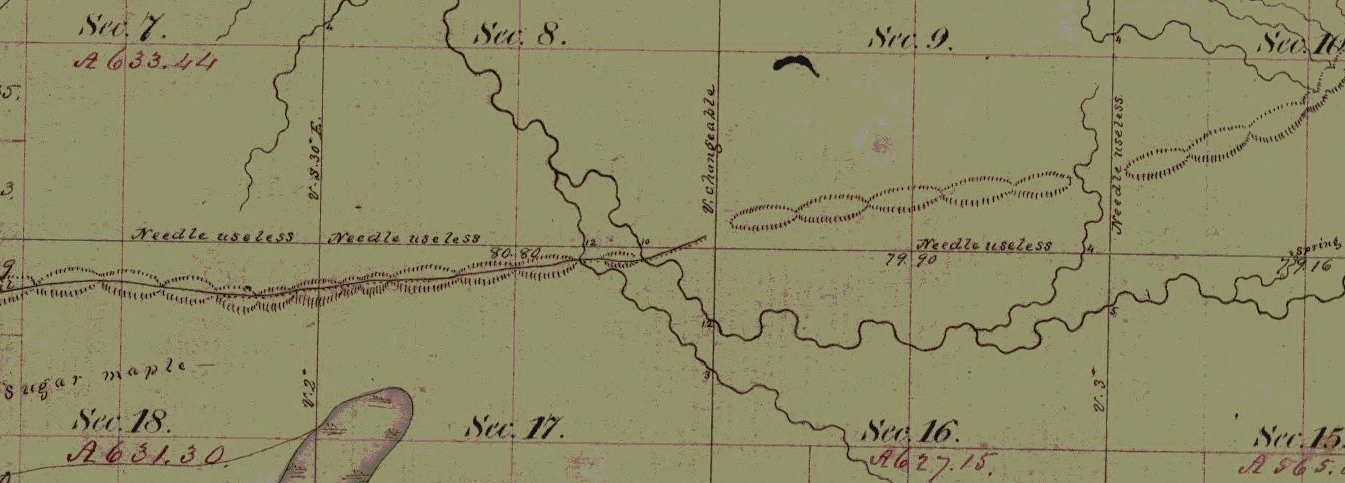
Wheelock’s unmarked townsite claim at Ballou Gap in the Iron Range with sugar bushes, artesian springs, and useless compasses. (Detail of Stuntz’s survey during September of 1857)
During the winter the improvements upon the Range spoken of as contemplated were pushed steadily forward under the skillful management of A.B. Wheelock, who was in every way, the man for the place, as in addition to completing the two block houses in good shape, twelve hundred pounds of sugar and forty gallons of molasses were made under his direction during the spring. The tubs for holding the sugar and syrup were all made during the winter at Penoka, by that Jack of all trades, Steve Sanborn, who could do almost as good work with a hatchet, knife, saw, auger and draw shave, as half the coopers and carpenters in the country, with a full set of tools.
Perhaps a short sketch of this singular mortal, so well known to many of Ashland’s early men, may not be uninteresting to your readers.
In height he was about five feet six inches, broad shoulders, arms long and sinewy, head large and wide; dark complexion, long, dark brown hair, blue eyes, face smooth and beardless, high cheek bones, long, wide, projecting chin, that was always getting up a muss with his nose, which was also long, and slightly hooked. He walked heavily, his knees usually about six inches in advance of his toes, giving his legs, which were bowed, the shape of an obtuse angle. Such was his personale. His conversational powers were not of the highest order – in fact he seldom spoke to any one; was fond of hunting and trapping, a vocation he usually followed every winter, remaining out alone for weeks together, at the Marengo, living upon mink, martin, muskrat, or any other kind of rat. He was always restless and uneasy, and could get outside of more bean soup and shanty bread at a sitting than any two men upon the Range. Such are my recollections of Stephen Sanborn. The last known of him was at Pike’s Peak, where, if living, he is no doubt following the same hermit life he loved so well upon Lake Superior.

Charter of the Ashland and Iron Mountain Railroad Company. ~ The Penokee Iron Range of Lake Superior, with Reports and Statistics Showing Its Mineral Wealth and Prospects: Charter and Organization of the Wisconsin and Lake Superior Mining and Smelting Company, 1860, pg 9
At length, after a winter of unusual mildness, similar to what the present one promises to be, gentle spring once more showed her smiling face, a signal to us to hurry up and complete our work; and as the returns of the survey were now all made, and the lands subject to entry, the necessary funds for entering them were placed in my hands, with which I returned to the Range, took the boys to Superior City, where they made their little affidavits, got their duplicates, and returned with me to La Pointe, where we met the General, who had followed me from Milwaukee, where the work of transferring the titles to the company was at once commenced and completed successfully with all except A.S. Stacy, who traitor-like, (to use a commercial term), “laid down” on us, refusing to convey, unless paid a bonus of one thousand dollars, which, if my memory is correct, and I’ll bet it is, he never got. The duplicates once in our possession, the patents were soon forthcoming, through influence brought to bear at Washington, after which, there being no prospect of doing anything with the lands at present, owing to the financial condition of the country, as well as the almost total prostration of the iron interest. The personal property was placed in store at Sibley’s and other points, until again wanted, and the Range abandoned about July 1, 1858. This abandonment, however, which was at the time supposed to be only temporary, proved in the end, to us at least, eternal. The fruits of our labors are not enjoyed by others. “We shook the bush and they caught the bird.” Notwithstanding that a railroad,- the Ashland and Iron Mountain, of which I, with others, was a corporator, was chartered in 1859, it was, as is well known, never built. We were finally compelled, after all, to see this whole thing, upon which we had spent so much money, and suffered so many hardships, slip from our grasp, and pass into the hands of those who had not labored for it. But so it is ever; one planeth, and another gathereth.

Corporate literature published by the Wisconsin & Lake Superior Mining and Smelting Company. ~ The Penokee Iron Range of Lake Superior, with Reports and Statistics Showing Its Mineral Wealth and Prospects: Charter and Organization of the Wisconsin and Lake Superior Mining and Smelting Company, 1860, pg 1

“List of Lands”
belonging to the Wisconsin & Lake Superior Mining & Smelting Company. ~ The Penokee Iron Range of Lake Superior, with Reports and Statistics Showing Its Mineral Wealth and Prospects: Charter and Organization of the Wisconsin and Lake Superior Mining and Smelting Company, 1860, pg 4
Such, Mr. Editor, is the history in brief, of the way, as well as by whom, the Penoka Range was first surveyed and located, and although we underwent much hardship and privation, yet I look back today upon that summer, as the pleasantest, in many respects, that I ever spent in Wisconsin. Neither would I hesitate, even now, to undertake the same again, and would like very much to see the old cabin at Penoka, which I am told is yet standing, in which I spent so many happy days in 1857.
The history of the Range from that time to the present is as well known to you as to me, and need not be dwelt upon further than to say that its possession did not make millionaires of any of us.
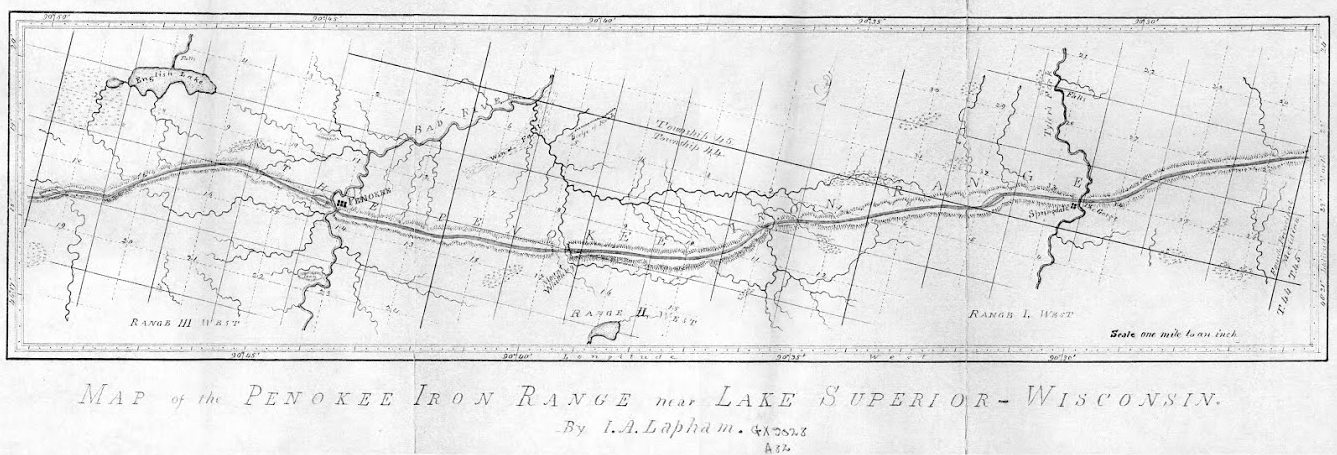
Increase A. Lapham surveyed the Penokee Iron Range on behalf of the Wisconsin & Lake Superior Mining and Smelting Company during 1858.
But what a change have these twenty years brought to the members, as well as the employees of the old company! Of the company, Palmer, Gen. Cutler, H. Hill, Sidebotham, Pixley, J.B.D. Cogswell, Small and Ripley have passed from earth. Lockwood and Harris are in New Orleans; J.F. Hill, J. Cummings and myself in Milwaukee, and Greves in California. Of the others I have no knowledge. Of the employees, Wheelock is upon a farm in Dakota; J.C. Cutler, at his home in Dexter, Maine; Whitcomb is in Milwaukee; Valliant, Stevens and Chase were killed in the late unpleasantness, and H.C. Palmer died in Milwaukee. Of the others I know not.
There are, however, many yet living with whom I became acquainted at that time, in Ashland and vicinity, for whom I have ever cherished the warmest personal friendship. If these sketches and reminiscences of long long ago have interested or amused them, I am glad. The writing of them has brought to mind many scenes and faces, that were almost forgotten, but which are as vivid now as though occurring yesterday. I hope, the coming season to see you all, and talk over old times, and make a trip to the Range over the old trail, every foot of which is accurately mapped in my eye. And now, as my task is done, at least for the present, I will bid the Press readers good-bye, and
Let Brother Whittlesey “spiel” it a while.
About that wonderful siege of Barlile.
J.S. Buck
Milwaukee, Dec. 18, 1877.
Penokee Survey Incidents: Number VI
March 14, 2015
By Amorin Mello
December 22, 1877.
The Survey of the Penoka Range and Incidents Connected with its Early History.
—
Number VI.
At length, somewhere about the 25th of October, the General returned from below, accompanied by his son, Joseph Cutler, George Spaulding, a young man who had formerly been in his employ in Maine, and Henry C. Palmer of Milwaukee, a son of President Palmer, who all came to hold claims for the Company, if wanted. He also brought two cook stoves and two metal kettles, the stoves for housekeeping, the kettles for sugar making. Both of the kettles and one of the stoves were subsequently sent to the Range, where they did good service during the winter and following spring, and are no doubt in use somewhere in the country today.
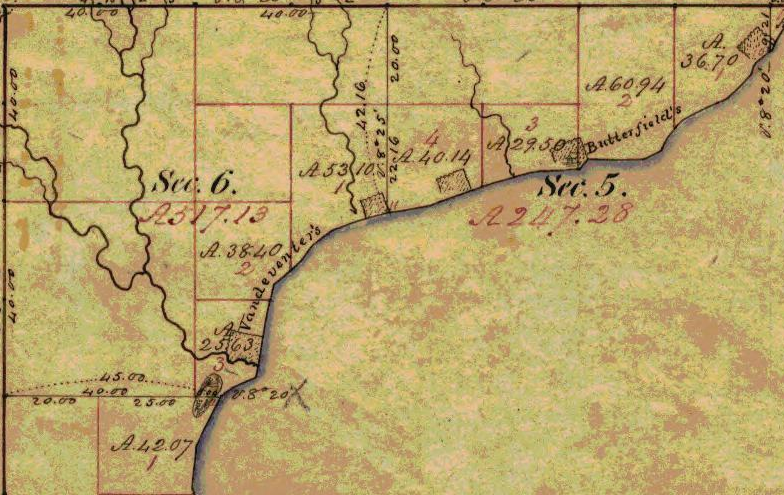
Houghton was a small settlement in the Town of BayPort, located northeast of what is now the City of Washburn. Captain Steven Butterfield and Peter B Vanderventer lived at what is now Washburn. (Detail from Augustus H. Barber’s survey during August of 1855)

Antoine Gordon from Noble Lives of a Noble Race (pg. 207) published by the St. Mary’s Industrial School in Odanah.
These kettles and stoves came very near sending Gen. Cutler, myself and Mr. Sidebotham, who had been stopping at La Pointe for several weeks, awaiting events, to a watery grave, during the run from that place to Ashland, in the Jane, a large two-masted boat formerly used by the Government upon the lake coast survey. Nothing but the coolness and skill of Captain Steve Butterfield, who was at the helm, saved us from going to the bottom. It was a long time before the recollections of that November day ceased to haunt us. The idea of going down in 150 feet of water with such a load, was not a pleasant thing to contemplate. Mr. Sidebotham was wholly unconscious, until after he reached the shore, of the peril we were in, owing to his ignorance of nautical affairs, but not so the General. He realized it as keenly as I did, not a word was spoken for over an hour, but in that hour we lived a lifetime. At length we succeeded in reaching the land at Houghton, where the high rocky shore furnished a lee. I shall never forget that ride while I live. We stopped for dinner at Antoine Gordon‘s, who lived at that time a little to the westward of Houghton, after which we ran down the shore to Pete Vanderventer‘s old place before venturing to cross the Bay to Ashland, which however, we finally did, reaching there in safety about sunset. Here we left Mr. Sidebotham to remain until wanted, and with J. Cutler, Palmer, and Spaulding, started the next morning for the Range, reaching there the second day at noon. Immediately upon our arrival, an interview was had with Stuntz, who informed us that if the fine weather we were then enjoying should continue for three weeks more, the survey to complete which he was making every possible exertion, would be finalized. This was to us indeed joyful news, as we were getting very anxious to return to our homes for the winter; whereupon all of our spare men were at once detailed to assist him, leaving me alone at Penoka, the General, in the meantime, visiting the different locations, and arranging for the winter, during which a blockhouse was to be built at Penoka, and one at the Gorge, which was done, the lumber for both being manufactured upon the ground, with a whip saw. Up to this time there had been no snow except the usual light fall we had every year, about the 1st of November. This, however, had all disappeared in three days after it fell, after which the weather was beautiful. In this way the time passed along, I seeing no one except Gen. Cutler, who came occasionally, or some of Stuntz’s men, who came for supplies, which were at this time kept mostly at Penoka, until the 12th of November, when it being certain that one week more would finish the survey, General Cutler left for Ashland, after Mr. Sidebotham, who by the requirements of the pre-emption law, must sleep upon his claim the 30th, in order to hold it, at least we so understood it at the time, leaving me entirely alone.
The weather continued fair up to the 18th, when there came a change. Saturday, the 17th, was as fine an Indian summer day as I ever saw, nearly all of which I slept seated upon a log in front of the cabin, listening to the singing of the birds, many of them not yet having left us for their homes in the south, and watching them as they were fitting around me, in search of food. At length old Sol sunk in the west, and night once more spread her dark mouth over the surrounding landscape. A strange feeling of loneliness, such as I had never felt before, crept over me as I closed the door of the cabin for the night, and sought my couch of balsam boughs, where I slept soundly until 6 o’clock the following morning, when presto! what a change met my eye! The air so soft and clear the previous evening, was now filled with snow, while upon the ground it was two and a half feet in depth, and increasing rapidly. You can easily imagine that I was not a little startled at the outlook, as being snowed in upon Lake Superior was no joke; and from the rapidity with which it was falling, it was apparent that it would be six feet in depth in twenty-four hours, if it kept on. I quickly saw that the first thing to be done was to lay in a supply of wood, the nearest pile of which was thirty rods distant. To this a track was quickly made, and the work of moving it commenced; neither did it stop until 2 P.M., at which time the whole pile, one and a half cords was in the cabin. The snow was now three feet in depth, but very light. My wood secured, I proceeded to cook some food, of which I felt the need, after which my thoughts began to wander after Stuntz and party, who were fifteen miles south. Neither did they reach the Range until the fourth day, as they had but one mile to run, in order to complete, when the storm came. This done, they started, and were three days in making that fifteen miles, during one of which, the last, they had nothing to eat, and one of them, Wilhelm Goetzenburg, literally nothing to wear, being clad in duck pants, hickory shirt, and stoga boots, no stockings, coat or vest. They were all badly used up when they got in; Stevens, in particular, who gave out when within only three miles of the Range, where he remained until his companions had reached the cabin, and two of them returned to him with some food, after which he came in, but as weak as to render it necessary to lead him. It was several days before he fully recovered his former strength. Goetzenburg, although nearly naked, stood it the best of them all. Perhaps a short sketch of this curious mortal, who certainly exhibited upon this occasion, powers of endurance equal to the gay and festive mule may not be inopportune, in this connection, before closing this article.
Wilhelm Goetzenburg, or Gutsenburg, as George Miller once spelt it when directing a letter for him to his “bruder” in Ontonagon, was not an Adonis, in the strict sense of the term. No sir! his keel was laid for a jumping jack, but from some unexplained cause, that plan was abandoned by his builder, who finally modeled him after the tubs the performing elephants use in the circus, broad at the base; in fact, his basement story was the largest part of him, in fact, nearly all of him; his legs, which were bowed, were short; his arms were long; his chest was short, and shaped like the dummies we see in the windows of ladies’ furnishing stores; his shoulders were broad, upon which a head covered with a thick mat of coarse hair, in color like that of a North Carolina clay-eater; a short nose, and a mouth that if open would have fooled a badger. Taken as a whole, he looked like a mixture of Low Dutch, Esquimaux and New Zealander combined. But beneath that iron frame, beat as honest a heart as ever beat in Ashland, or any other land. Good luck to thee, honest Wilhelm, I shall never see thy like again, but wherever thou arts or goest, may beans be plenty and clothing cheap. But en resume.
The fifth day brought Gen. Cutler from Ashland, accompanied by Mr. Sidebotham, George Kilburn, Sibley, Steve Sanborn, and George Miller, with the pack horses, who all came to break the road, except Sanborn, who came to stay through the winter. The boys had also now got in from the different claims, and the old cabin was full. Here they all remained for two days, when there came a thaw and melted the snow, after which Uncle George and Sibley returned to the Marengo, and George Miller with the horses to Ashland. The rest remained until the 30th, when their claims secured, and the arrangements for the winter completed. Mr. Arthur E. Wheelock was placed in charge of the week with J. Culter, Palmer, Steve Sanborn, Spaulding, and Elie Valliant, a French Canuck, formerly a resident at Ironton, a ship and house carpenter by trade, as companions. This done, Gen. Cutler and myself, Sidebotham, McClelland, Chase, and Al. Stevens accompanied by two of Stuntz’s men, whose names I have forgotten, left for home. We camped the first night at the Marengo, where the boys, as usual, hid the sugar from Mr. Sidebotham, reaching Ashland the second day. Here we remained for two days, when leaving Mr. Sidebotham, as previous stated, we took our departure, going directly across the bay upon the ice, for Pete Vanderventer’s. Before reaching the shore, however, Chase, who led the party, broke in, and came very near drowning, as in addition to his pack and snowshoes, which were also carried, he had on rubber boots, the legs of which held water enough to run a milk factory for a week. He was finally pulled out and inverted a few moments to let him drain, after which we proceeded, reaching Antoine Gordon’s at dark, and reached Bayfield the second day, the last six miles being made in an open boat, obtained, from the Indians at Sioux River, which was returned by Wheelock and William Pell, who had accompanied us thus far on the way.
From Bayfield to Superior City on snow shoes, occupied seven days, during which we camped on the snow every night. This, although a hard tramp, was very much enjoyed by all. The last three days our route lay along the shore of the lake, where many laughable scenes occurred in the way of tumbles from the ice bergs that lined the shore. From Superior City via St. Paul and La Crosse, to New Lisbon by stage, occupied nine days. From New Lisbon by cars to Milwaukee, one day, reaching that place Dec. 25, 1857. J.S.B.
Penokee Survey Incidents: Number V
March 4, 2015
By Amorin Mello
December 15, 1877.
The Survey of the Penoka Range and Incidents Connected with its Early History.
—
Number V.
~ History of Milwaukee, pg. 358
Friend Fifield:- The reader will no doubt remember that my last left us all anxiously awaiting the completion of the township surveys, which, up to this time, we had hoped would have been accomplished as soon, at least, as we were ready on our part, to “prove up.” But still the work lagged, and instead of being through and home in three months, as at first anticipated, it was now plainly seen that such was not to be the case. Three months had already elapsed since the work was commenced, yet the goal was apparently as far distant as over, and as we could not discharge our men, it was finally decided to explore the country south and west of the Range for the purpose of ascertaining, as far as possible, its adaption for a railroad from Milwaukee to the Range, as well as from the Range to Ashland, the latter of which must, of necessity, be built to move the iron. And in order that it might be properly done, Mr. Albert W. Whitcomb, a civil engineer of considerable experience, was sent up from Milwaukee, to superintend the work, who, after making one trip to the Range returned to Ashland and commenced his work by running what was afterwards known as the “Transit Line,” on account of its being run with that instrument. This line followed principally what was known as the Coburn Trail, which was the only one in use at that time by the company; crossing White River at Welton‘s mill, the Marengo at Sibley‘s, (now Martin Rhiem‘s.) and the outlet of Dr. Brunschweiler‘s old copper location, and thence to Ashland “Pond.” When it became evident that no good route could be found from that point to the Range on account of the heavy grades to be overcome, the work by transit was abandoned, and the balance was run by compass and chain only, simply to ascertain the exact distance in miles. This work, which should under ordinary circumstances, have been completed in ten days, occupied over a month, besides involving a large expenditure of money which might as well have been sunk in the ocean, as far as the Company was concerned, as no benefit whatever resulted from it except to the men employed in the work.
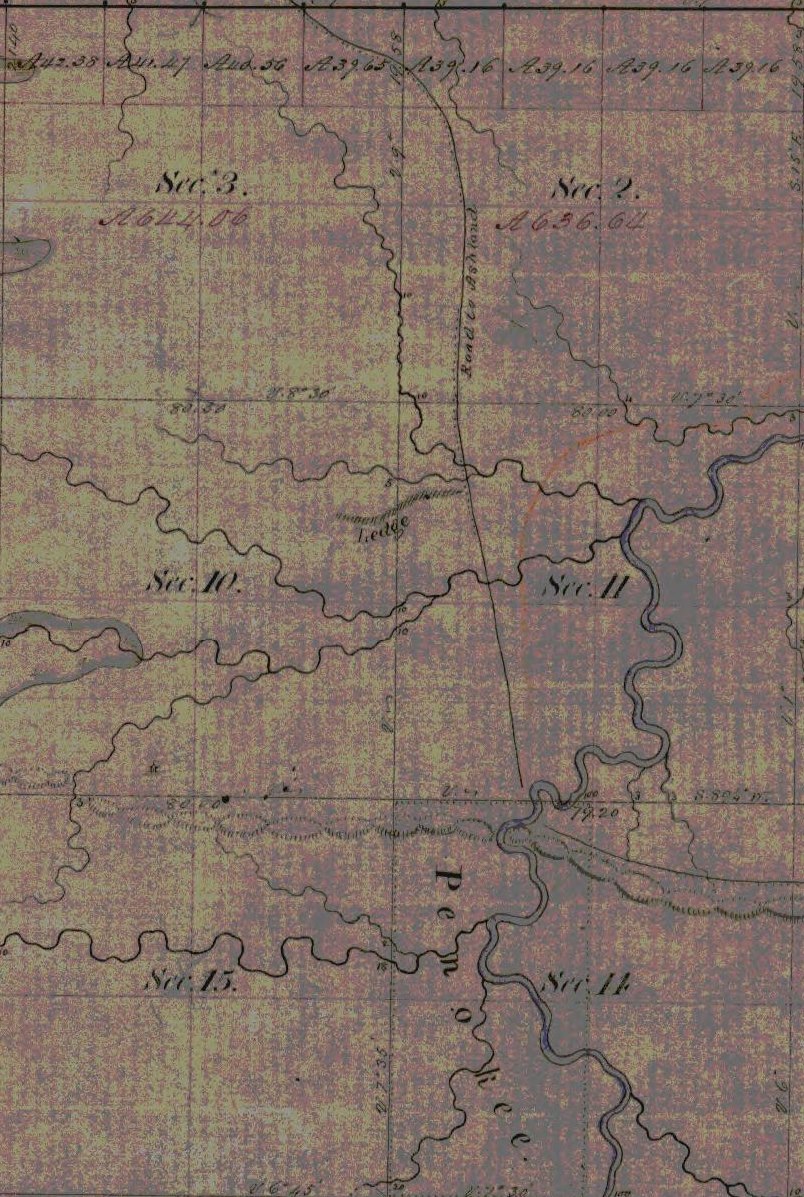
Palmer’s townsite claim located near Penokee Gap on Bad River with the “Coburn Trail” to Ashland. (Detail from Stuntz’s survey during May of 1858)
Subsequent, however, to the close of the survey upon the Transit Line, and the return of Mr. Whitcomb to Milwaukee, several extensive explorations were made to the south and west of the Range, by Gen. Cutler and myself, accompanied by Wheelock, Chas. Stevens, French Joe, (Joe Le Roy, with Big Joe as packer, and a Halfbreed called Little Alic as cook.) in one case nearly to the head waters of the Chippewa. These explorations, which were made with compass and chain, were by far the pleasantest part of my labors that summer, relieving us, as they did, not only of the monotony of camp life while awaiting the completion of the survey, but they also added largely to our knowledge of the topography, as well as the resources of the country south of the Range, then an unbroken wilderness, filled with beaver ponds, many of which were seen, but which is today, thanks to the energy and business tact of the gentlemen in charge of the Wisconsin Central railroad, beginning, metaphorically speaking, to bloom like the rose, and is destined, at no distant period, to take rank as one of the most wealthy and prosperous portions of our fair state. All honor to them for the same.
In this way our time was spent until September, when all homes of Stuntz being able to complete his work that season, unless some special providence should intervene, were abaonded, and preparations for spending the winter upon the Range were at once commenced. Gen Cutler immediately left for Milwaukee after additional supplies, first placing me in charge of the work. A pack train consisting of Stuntz’s pony, (old Jack) and Bascom‘s mare, were at once put upon the trail, in charge of Geo. Miller, a wild, harum-scarum Canuck from Canada West, who quickly stocked the Range with supplies.
But in order that the survey might yet be completed, if possible, additional men were put on, among whom was Wilhelm Goetzenburg, a Mechlinberger, at that time domiciled at Bay City and August Eckee, an old Courier de Bois, including all of our spare men, leaving me to keep camp at Penoka, which I did from about the middle of September to the 12th of October, during which time I saw no one except those who came in from the different claims at stated intervals, for supplies.
I see in your number of December 1, a reference by Hon. Asaph Whittlesey, to my sketch of Sibley and Lazarus, in which he not only confirms my statement, but goes one better in assigning him the belt as the champion liar, also which belt he (Sibley) was subsequently, however, compelled to surrender to John Beck. In consequence of Mr. Whittlesey’s statement I will relate one of Sibley’s yarns, told in the presence of Gen. Cutler, myself, Wheelock and a young man from St. Paul, by the name of Fargo, while eating dinner at his house on the Marengo, in August, 1857, which not only illustrates his powers as a yarn spinner, but the wonderful acoustic properties of his ears as well; being seated at the table, Sibley at once asked a blessing upon the food, for he could pray as well as lie, after which the question was asked by some one, how far it was possible to hear the human voice, upon which Sibley stated that he had not only heard the shouts of the people, but the words of the speaker also, distinctly, that were made at a political barbeque held in Ohio, in the fall of 1844, one hundred miles distant from where he was. Mr. Fargo, although no slouch of a liar himself, was so affected by this statement as to nearly faint, and finally made the remark that if that was not a lie, it came very near it; them lugs of Sibley’s were lugs as was lugs. Can John Beck beat that?

Harvey “Harry” Fargo was a cabinet maker, George R. Stuntz’s neighbor on the Minnesota Point in Duluth, an early mail carrier, and was in the 1853 census of Superior as “Arfargo.” ~ Duluth and St. Louis County, Minnesota; Their Story and People: An Authentic Narrative of the Past, with Particular Attention to the Modern Era in the Commercial, Industrial, Educational, Civic and Social Development, Volume 1, edited by Walter Van Brunt, 1921.
I wish to state at this time, also, a little incident in connection with Eckee, mentioned above, related to me by himself, which was this: That in the fall of 1846, he, in company with three others, in the employ of the Sigourney Lumber Co., of Quebec, ascended the river of the name three hundred miles in an open boat, for the purpose of cutting timber during the winter, and that when within three miles of their journey’s end, their boat was upset in a rapid, they barely escaping with their lives, but with the loss of the boat and all its contents, axes, fishing tackle and supplies. His companions, horrified at their situation, started immediately on their return, following the sinuosities of the river. He however, chose to remain, which he did until spring, never seeing a human face for six entire months. There were four oxen and two horses at the camp the care of which he claimed, kept him from going insane. It is needless to state that his companions were never heard from again. Although this incident has no immediate connection with my history, yet it serves to illustrate the hardships to which the class of men he belonged to are often called to suffer. He could never speak of that winter and its horrors, without tears.
But to return to the Range. Although I can truthfully say that the whole time spent upon the Range was to me one of unalloyed pleasure, yet that engaged during the latter part of September and up to the 20th of October, exceeded all the rest. The forest has, at all times, a charm for me, and the autumnal months doubly so; It is then and then only that its full glories can be seen; and in no country or section of country that it has ever been my privilege to visit, is the handiwork of Dame Nature’s gelid pencil, so grandly displayed as upon Lake Superior, and more particularly is this so, in and around the Range. No doubt the good people of Ashland think the scenery at the Gap very fine, and so it is. Yet that at the west end is far more so. Here the range terminates in a bold escarpment some 300 feet above the surrounding country, giving to an observer an unobstructed view east, west and south, for forty miles.
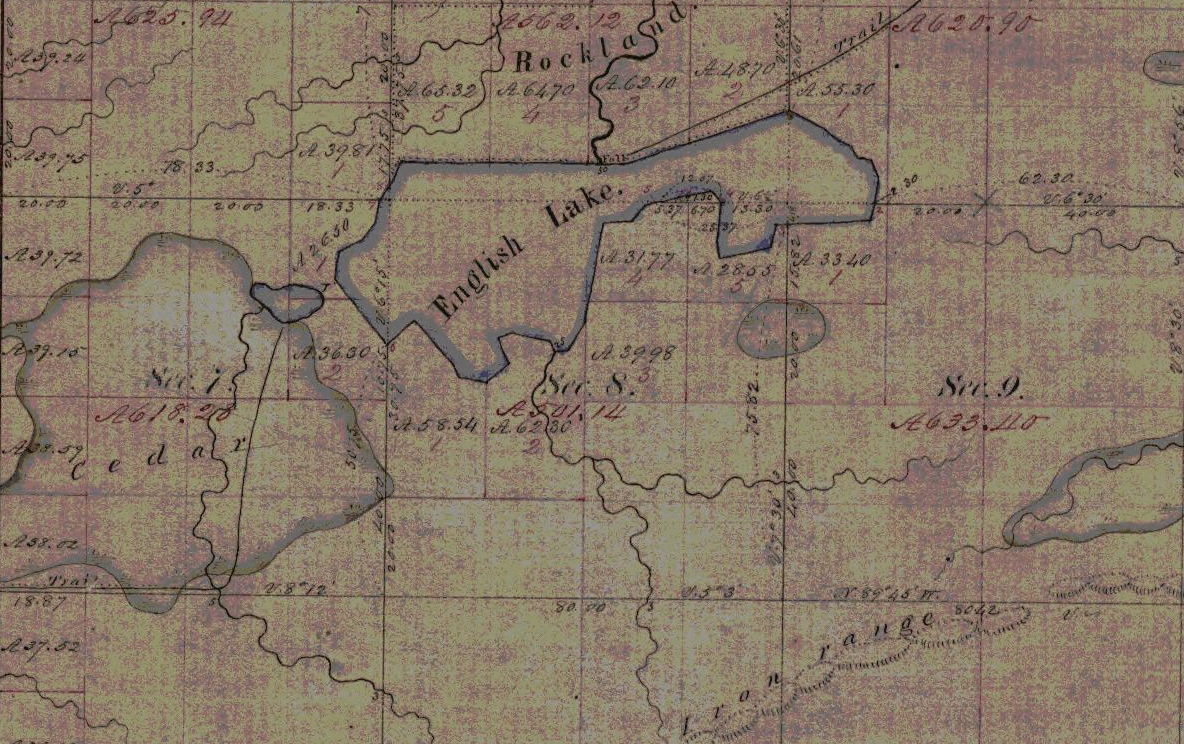
Indian trails to the “Rockland” townsite claim overlooking English Lake and the west end of the Penoka Range. Julius Austrian later claimed the “Rockland” site for his daughter’s estate.(Detail from Stuntz’s survey from May of 1858)
This was my favorite resort in those beautiful autumn mornings, where, seated upon the edge of the bluff, I would feast my eyes for hours upon that matchless panorama. Neither could I ever divest myself of the feeling that, while there, I was alone with God. I have seen, in the course of my life, many landscape paintings that were very beautiful, but never one that could at all compare with the views I enjoyed in the months of October 1857, from the west end of the Penoka Range. J.S.B.
 Chequamegon History