Colonel Charles Whittlesey
May 27, 2016
By Amorin Mello

C.C. Baldwin was a friend, colleague, and biographer of Charles Whittlesey.
~ Memorial of Charles Candee Baldwin, LL. D.: Late President of the Western Reserve Historical Society, 1896, page iii.
This is a reproduction of Colonel Charles Whittlesey’s biography from the Magazine of Western History, Volume V, pages 534-548, as published by his successor Charles Candee Baldwin from the Western Reserve Historical Society. This biography provides extensive and intimate details about the life and profession of Whittlesey not available in other accounts about this legendary man.
Whittlesey came to Lake Superior in 1845 while working for the Algonquin Mining Company along the Keweenaw Peninsula’s copper region. His first trip to Chequamegon Bay appears to have been in 1849 while doing do a geological survey of the Penokee Mountains for David Dale Owen. Whittlesey played a dramatic role in American settlement of the Chequamegon Bay region. Whittlesey convinced his brother, Asaph Whittlesey Jr., to move from the Western Reserve in 1854 establish what became the City of Ashland at the head of Chequamegon Bay as a future port town for extracting and shipping minerals from the Penokee Mountains. Whittlesey’s influence can still be witnessed to this day through local landmarks named in his honor:
Whittlesey published more than two hundred books, pamphlets, and articles. For additional research resources, the extensive Charles Whittlesey Papers are available through the Western Reserve Historical Society in two series:
Magazine of Western History, Volume V, pages 534-548.
COLONEL CHARLES WHITTLESEY.

Map of the Connecticut Western Reserve in Ohio by William Sumner, September 1826.
~ Cleveland Public Library
![Asaph Whittlesey [Sr], Late of Tallmadge, Summit Co., Ohio by Vesta Hart Whittlesey and Susan Everett Whittlesey, né Fitch, 1872.](https://chequamegonhistory.com/wp-content/uploads/2016/05/asaph-whittlesey-vesta-hart.jpg)
[Father] Asaph Whittlesey [Sr], Late of Tallmadge, Summit Co., Ohio by [mother] Vesta Hart Whittlesey [posthumously] and [stepmother] Susan Everett Whittlesey, né Fitch, 1872.
~ Archive.org
War was then in the west, and his neighbors feared they might be the victims of the scalping knife. But the danger was different. In passing the Narrows, between Pittsburgh and Beaver, the wagon ran off a bank and turned completely over on the wife and children. They were rescued and revived, but the accident permanently impaired the health of Mr. Whittlesey.
Mr. Whittlesey was in Tallmadge, justice of the peace from soon after his arrival till near the close of his life, and postmaster from 1814, when the office was first established, to his death. He was again severely injured, but a strong constitution and unflinching will enabled him to accomplish much. He had a store, buying goods in Pittsburgh and bringing them in wagons to Tallmadge; and an ashery; and in 1818 he commenced the manufacture of iron on the Little Cuyahoga, below Middlebury.
The times were hard, tariff reduced, and in 1828 he returned to his farm prematurely old. He died in 1842. Says General Bierce,
“His intellect was naturally of a high order, his religious convictions were strong and never yielded to policy or expediency. He was plain in speech, sometimes abrupt. Those who respected him were more numerous than those who loved him. But for his friends, no one had a stronger attachment. His dislikes were not very well concealed or easily removed. In short, he was a man of strong mind, strong feelings, strong prejudices, strong affections and strong attachments, yet the whole was tempered with a strong sense of justice and strong religious feelings.”
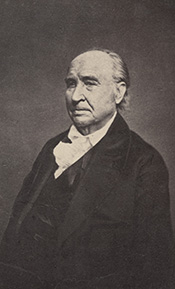
[Uncle] Elisha Whittlesey
~ Collection of the U.S. House of Representatives

Portrait of Reverend David Bacon from ConnecticutHistory.org:
“David Bacon (1771 – August 27, 1817) was an American missionary in Michigan Territory. He was born in Woodstock, Connecticut. He worked primarily with the Ottawa and Chippewa tribes, although they were not particularly receptive to his Christian teachings. He founded the town of Tallmadge, Ohio, which later became the center of the Congregationalist faith in Ohio.”
~ Wikipedia.org
Tallmadge was settled in 1808 as a religious colony of New England Congregationalists, by a colony led by Rev. David Bacon, a missionary to the Indians. This affected the society in which the boy lived, and exercised much influence on the morality of the town and the future of its children, one of whom was the Rev. Leonard Bacon. Rev. Timlow’s History of Southington says, “Mr. Whittlesey moved to Tallmadge, having become interested in settling a portion of Portage county with Christian families.” And that he was a man “of surpassing excellence of character.”
If it should seem that I have dwelt upon the parents of Colonel Whittlesey, it is because his own character and career were strongly affected by their characters and history. Charles, the son, combined the traits of the two. He commenced school at four years old in Southington; the next year he attended the log school house at Tallmadge until 1819, when the frame academy was finished and he attended it in winter, working on the farm in summer until he was nineteen.
The boy, too, saw early life on foot, horseback and with ox-teams. He found the Indians still on the Reserve, and in person witnessed the change from savage life and new settlements, to a state of three millions of people, and a large city around him. One of Colonel Whittlesey’s happiest speeches is a sketch of log cabin times in Tallmadge, delivered at the semi-centennial there in 1857.
~ Annual Report on the Geological Survey of the State of Ohio: 1837 by Ohio Geologist William Williams Mather, 1838, page 22.
In 1827 the youngster became a cadet at West Point. Here he displayed industry, and in some unusual incidents there, coolness and courage. He graduated in 1831, and became brevet second lieutenant in the Fifth United States infantry, and in November started to join his regiment at Mackinaw. He did duty through the winter with the garrison at Fort Gratiot. In the spring he was assigned at Green Bay to the company of Captain Martin Scott, so famous as a shot. At the close of the Black Hawk War he resigned from the army. Though recognizing the claim of the country to the services of the graduates of West Point, he tendered his services to the government during the Seminole Mexican war. By a varied experience his life thereafter was given to wide and general uses. He at first opened a law office in Cleveland, Ohio, and was fully occupied in his profession, and as part owner and co-editor of the Whig and Herald until the year 1837. He was that year appointed assistant geologist of the state of Ohio. Through very uneconomical economy, the survey was discontinued at the end of two years, when the work was partly done and no final reports had been made. Of course most of the work and its results were lost. Great and permanent good indeed resulted to the material wealth of the state, in disclosing the rich coal and iron deposit of southeastern Ohio, thus laying the foundation for the vast manufacturing industries which have made that portion of the state populous and prosperous. The other gentlemen associated with him were Professor William Mather as principal; Dr. Kirtland was entrusted with natural history. Others were Dr. S. P. Hildreth, Dr. Caleb Briggs, Jr., Professor John Locke and Dr. J. W. Foster. It was an able corps, and the final results would have been very valuable and accurate. In 1884, Colonel Whittlesey was sole survivor and said in this Magazine:
“Fifty years since, geology had barely obtained a standing among the sciences even in Europe. In Ohio it was scarcely recognized. The state at that time was more of a wilderness than a cultivated country, and the survey was in progress little more than two years. It was unexpectedly brought to a close without a final report. No provision was made for the preservation of papers, field notes and maps.”
Report of Progress in 1869, by J. S. Newberry, Chief Geologist, by the Geological Survey of Ohio, 1870.
Professor Newbury, in a brief resume of the work of the first survey (report of 1869), says the benefits derived “conclusively demonstrate that the geological survey was a producer and not a consumer, that it added far more than it took from the public treasury and deserved special encouragement and support as a wealth producing agency in our darkest financial hour.” The publication of the first board, “did much,” says Professor Newberry, “to arrest useless expenditure of money in the search for coal outside of the coal fields and in other mining enterprises equally fallacious, by which, through ignorance of the teachings of geology, parties were constantly led to squander their means.” “It is scarcely less important to let our people know what we have not, than what we have, among our mineral resources.”

“Descriptions of Ancient Works in Ohio. By Charles Whittlesey, of the late Geological Corps of Ohio.”
~ Smithsonian Contributions to Knowledge, Volume III., Article 7, 1852.
The topographical and mathematical parts of the survey were committed to Colonel Whittlesey. He made partial reports, to be found in the ‘State Documents’ of 1838 and 1839, but his knowledge acquired in the survey was of vastly greater service in many subsequent writings, and, as a foundation for learning, made useful in many business enterprises of Ohio. He had, during this survey, examined and surveyed many ancient works in the state, and, at its close, Mr. Joseph Sullivant, a wealthy gentleman interested in archaeology, residing in Columbus, proposed that, he bearing the actual expense, Whittlesey should continue the survey of the works of the Mound Builders, with a view to joint publication. During the years 1839 and 1840, and under the arrangement, he made examination of nearly all the remaining works then discovered, but nothing was done toward their publication. Many of his plans and notes were used by Messrs. Squier & Davis, in 1845 and 1846, in their great work, which was the first volume of the Smithsonian Contributions, and in that work these gentlemen said:
“Among the most zealous investigators in the field of American antiquarian research is Charles Whittlesey, esq., of Cleveland, formerly topographical engineer of Ohio. His surveys and observations, carried on for many years and over a wide field, have been both numerous and accurate, and are among the most valuable in all respects of any hitherto made. Although Mr. Whittlesey, in conjunction with Joseph Sullivant, esq., of Columbus, originally contemplated a joint work, in which the results of his investigations should be embodied, he has, nevertheless, with a liberality which will be not less appreciated by the public than by the authors, contributed to this memoir about twenty plans of ancient works, which, with the accompanying explanations and general observations, will be found embodied in the following pages.
“It is to be hoped the public may be put in possession of the entire results of Mr. Whittlesey’s labor, which could not fail of adding greatly to our stock of knowledge on this interesting subject.”

“Marietta Works, Ohio. Charles Whittlesey, Surveyor 1837.”
~ Smithsonian Contributions to Knowledge, Volume I., Plate XXVI.
It will be seen that Mr. Whittlesey was now fairly started, interested and intelligent, in the several fields which he was to make his own. And his very numerous writings may be fairly divided into geology, archaeology, history, religion, with an occasional study of topographical geology. A part of Colonel Whittlesey’s surveys were published in 1850, as one of the Smithsonian contributions; portions of the plans and minutes were unfortunately lost. Fortunately the finest and largest works surveyed by him were published. Among those in the work of Squier & Davis, were the wonderful extensive works at Newark, and those at Marietta. No one again could see those works extending over areas of twelve and fifteen miles, as he did. Farmers cannot raise crops without plows, and the geography of the works at Newark must still be learned from the work of Colonel Whittlesey.
~ Smithsonian Contributions to Knowledge, Volume XIII., Article IV., page 2 of “Ancient Mining on the Shores of Lake Superior” by Charles Whittlesey.
He made an agricultural survey of Hamilton county in 1844. That year the copper mines of Michigan began to excite enthusiasm. The next year a company was organized in Detroit, of which Colonel Whittlesey was the geologist. In August they launched their boat above the rapids of the Sault St. Marie and coasted along the shore to where is now Marquette. Iron ore was beneath notice, and in truth was no then transportable, and they pulled away for Copper Harbor, and then to the region between Portage lake and Ontonagon, where the Algonquin and Douglas Houghton mines were opened. The party narrowly escaped drowning the night they landed. Dr. Houghton was drowned the same night not far from them. A very interesting and life-like account of their adventures was published by Colonel Whittlesey in the National Magazine of New York City, entitled “Two Months in the Copper Regions.” From 1847 to 1851 inclusive, he was employed by the United States in the survey of the country around Lake Superior and the upper Mississippi, in reference to mines and minerals. After that he spent much time in exploring and surveying the mineral district of the Lake Superior basin. The wild life of the woods with a guide and voyageurs threading the streams had great attractions for him and he spent in all fifteen seasons upon Lake Superior and the upper Mississippi, becoming thoroughly familiar with the topography and geological character of that part of the country.

“Pictograph C. Okundekund [Okandikan] and his Band of Ontonagon – Michigan,” as reproduced from birch bark by Seth Eastman, and published as Plate 62 in Historical and Statistical Information Respecting the History, Condition, and Prospects of the Indian Tribes of the United States, Volume I., by Henry Rowe Schoolcraft, 1851. This was one of several pictograph petitions from the 1849 Martell delegation:
“By this scroll, the chief Kun-de-kund of the Eagle totem of the river Ontonagon, of Lake Superior, and certain individuals of his band, are represented as uniting in the object of their visit of Oshcabewis. He is depicted by the figure of an eagle, Number 1. The two small lines ascending from the head of the bird denote authority or power generally. The human arm extended from the breast of the bird, with the open hand, are symbolic of friendship. By the light lines connecting the eye of each person with the chief, and that of the chief with the President, (Number 8,) unity of views or purpose, the same as in pictography Number 1, is symbolized. Number 2, 3, 4, and 5, are warriors of his own totem and kindred. Their names, in their order, are On-gwai-sug, Was-sa-ge-zhig, or The Sky that lightens, Kwe-we-ziash-ish, or the Bad-boy, and Gitch-ee-man-tau-gum-ee, or the great sounding water. Number 6. Na-boab-ains, or Little Soup, is a warrior of his band of the Catfish totem. Figure Number 7, repeated, represents dwelling-houses, and this device is employed to deonte that the persons, beneath whose symbolic totem it is respectively drawn, are inclined to live in houses and become civilized, in other words, to abandon the chase. Number 8 depicts the President of the United States standing in his official residence at Washington. The open hand extended is employed as a symbol of friendship, corresponding exactly, in this respect, with the same feature in Number 1. The chief whose name is withheld at the left hand of the inferior figures of the scroll, is represented by the rays on his head, (Figure 9,) as, apparently, possessing a higher power than Number 1, but is still concurring, by the eye-line, with Kundekund in the purport of pictograph Number 1.”
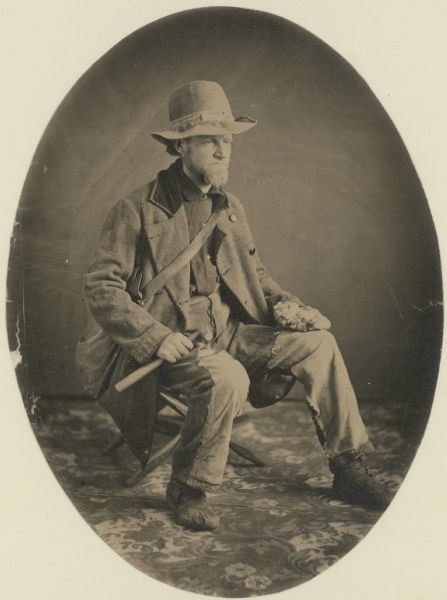
“Studio portrait of geologist Charles Whittlesey dressed for a field trip.” Circa 1858.
~ Wisconsin Historical Society
His detailed examination extended along the copper range from the extreme east of Point Keweenaw to Ontonagon, through the Porcupine mountain to the Montreal river, and thence to Long lake in Wisconsin, a distance of two hundred miles. In 1849, 1850 and 1858 he explored the valley of the Menominee river from its mouth to the Brule. He was the first geologist to explore the South range. The Wisconsin Geological Survey (Vol. 3 pp. 490 and 679) says this range was first observed by him, and that he many years ago drew attention to its promise of merchantable ores which are now extensively developed from the Wauceda to the Commonwealth mines, and for several miles beyond. He examined the north shore from Fond du Lac east, one hundred miles, the copper range of Minnesota and on the St. Louis river to the bounds of our country. His report was published by the state in 1865, and was stated by Professor Winchill to be the most valuable made.
All his geological work was thorough, and the development of the mineral resources which he examined, and upon which he reported, gave the best proofs of his scientific ability and judgment.

“Outline Map Showing the Position of the Ancient Mine Pits of Point Keweenaw, Michigan by Charles Whittlesey.”
~ Smithsonian Contributions to Knowledge, Volume XIII., Article IV., frontpiece of “Ancient Mining on the Shores of Lake Superior” by Charles Whittlesey, 1863.
With the important results from his labors in Ohio in mind, the state of Wisconsin secured his services upon the geological survey of that state, carried on in 1858, 1859 and 1860, and terminated only by the war. The Wisconsin survey was resumed by other parties, and the third volume of the Report for Northern Wisconsin, page 58, says:
The Contract of James Hall with Charles Whittlesey is available from the Journal of the Assembly of Wisconsin, Volume I, pages 178-179, 1862. Whittlesey was to perform “a careful geological survey of the country lying between the Montreal river on the east, and the westerly branches of [the] Bad River on west”. This contract was unfulfilled due to the outbreak of the American Civil War. Whittlesey independently published his survey of the Penokee Mountains in 1865 without Hall. Some of Whittlesey”s pamphlets have been republished here on Chequamegon History in the Western Reserve category of posts.“The only geological examinations of this region, however, previous to those on which the report is based, and deserving the name, were those of Colonel Charles Whittlesey of Cleveland, Ohio. This gentleman was connected with Dr. D. D. Owen’s United States geological survey of Wisconsin, Iowa and Minnesota, and in this connection examined the Bad River country, in 1848. The results are given in Dr. Owen’s final report, published in Washington, in 1852. In 1860 (August to October) Colonel Whittlesey engaged in another geological exploration in Ashland, Bayfield and Douglass counties, as part of the geological survey of Wisconsin, then organized under James Hall. His report, presented to Professor Hall in the ensuing year, was never published, on account of the stoppage of the survey. A suite of specimens, collected by Colonel Whittlesey during these explorations, is at present preserved in the cabinet of the state university at Madison, and it bears testimony to the laborious manner in which that gentleman prosecuted the work. Although the report was never published, he has issued a number of pamphlet publications, giving the main results obtained by him. A list of them, with full extracts from some of them, will be found in an appendix to the report. In the same appendix I have reproduced a geological map of this region, prepared by Colonel Whittlesey in 1860.”

“Geological Map of the Penokie Range.” by Charles Whittlesey, Dec. 1860.
~ Geology of Wisconsin. Survey of 1873-1879. Volume III., 1880, Plate XX, page 214.
~ Biographical Register of the Officers and Graduates of the United States Military Academy at West Point, New York, since its establishment in 1802 by George W. Cullum, page 496.
“The Baltimore Plot was an alleged conspiracy in late February 1861 to assassinate President-elect Abraham Lincoln en route to his inauguration. Allan Pinkerton, founder of the Pinkerton National Detective Agency, played a key role by managing Lincoln’s security throughout the journey. Though scholars debate whether or not the threat was real, clearly Lincoln and his advisors believed that there was a threat and took actions to ensure his safe passage through Baltimore, Maryland.”
~ Wikipedia.org
Such was Colonel Whittlesey’s employment when the first signs of the civil war appeared. He abandoned it at once. He became a member of one of the military companies that tendered its services to President-elect Lincoln, when he was first threatened, in February, 1861. He became quickly convinced that war was inevitable, and urged the state authorities that Ohio be put at once in preparation for it; and it was partly through his influence that Ohio was so very ready for the fray, in which, at first, the general government relied on the states. Two days after the proclamation of April 15, 1861, he joined the governor’s staff as assistant quartermaster-general. He served in the field in West Virginia with the three months’ men, as state military engineer; with the Ohio troops, under General McClellan, Cox and Hill. At Seary Run, on the Kanawha, July 17, 1861, he distinguished himself by intrepidity and coolness during a severe engagement, in which his horse was shot under him. At the expiration of the three months’ service, he was appointed colonel of the Twentieth regiment, Ohio volunteers, and detailed by General Mitchell as chief engineer of the department of Ohio, where he planned and constructed the defenses of Cincinnati.
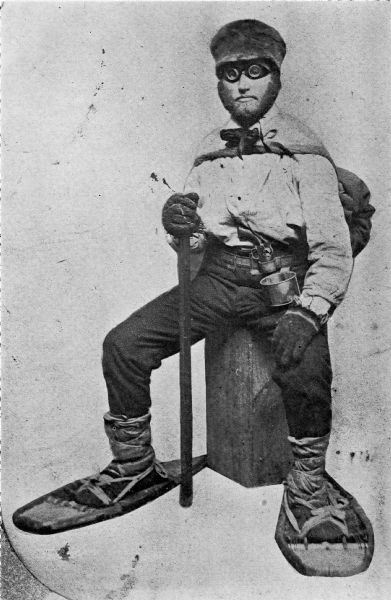
“[Brother] Asaph Whittlesey [Jr.] dressed for his journey from Ashland to Madison, Wisconsin, to take up his seat in the state legislature. Whittlesey is attired for the long trek in winter gear including goggles, a walking staff, and snowshoes.” Circa 1860.
~ Wisconsin Historical Society
“SIR: Will you allow me to suggest the consideration of a great movement by land and water, up the Cumberland and Tennessee rivers.
“First, Would it not allow of water transportation half way to Nashville?
“Second, Would it not necessitate the evacuation of Columbus, by threatening their railway communications?
“Third, Would it not necessitate the retreat of General Buckner, by threatening his railway lines?
“Fourth, Is it not the most feasible route into Tennessee?”
This plan was adopted, and Colonel Whittlesey’s regiment took part in its execution.
In April, 1862, on the second day of the battle of Shiloh, Colonel Whittlesey commanded the Third brigade of General Wallace’s division — the Twentieth, Fifty-sixth, Seventy-sixth and Seventy-eighth Ohio regiments. “It was against the line of that brigade that General Beauregard attempted to throw the whole weight of his force for a last desperate charge; but he was driven back by the terrible fire, that his men were unable to face.” As to his conduct, Senator Sherman said in the United States senate.1
The official report of General Wallace leaves little to be said. The division commander says, “The firing was grand and terrible. Before us was the Crescent regiment of New Orleans; shelling us on our right was the Washington artillery of Manassas renown, whose last charge was made in front of Colonel Whittlesey’s command.”
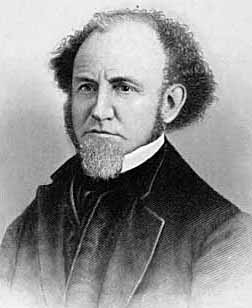
“This is an engraved portrait of Charles Whittlesey, a prominent soldier, attorney, scholar, newspaper editor, and geologist during the nineteenth century. He participated in a geological survey of Ohio conducted in the late 1830s, during which he discovered numerous Native American earthworks. In 1867, Whittlesey helped establish the Western Reserve Historical Society, and he served as the organization’s president until his death in 1886. Whittlesey also wrote approximately two hundred books and articles, mostly on geology and Ohio’s early history.”
~ Ohio History Central
General Force, then lieutenant-colonel under Colonel Whittlesey, fully describes the battle,2 and quotes General Wallace. “The nation is indebted to our brigade for the important services rendered, with the small loss it sustained and the manner in which Colonel Whittlesey handled it.”
Colonel Whittlesey was fortunate in escaping with his life, for General Force says, it was ascertained that the rebels had been deliberately firing at him, sometimes waiting to get a line shot.
Colonel Whittlesey had for some time been in bad health, and contemplating resignation, but deferring it for a decisive battle. Regarding this battle as virtually closing the campaign in the southwest, and believing the Rebellion to be near its end, he now sent it in.
General Grant endorsed his application, “We cannot afford to lose so good an officer.”
“Few officers,” it is said, “retired from the army with a cleaner or more satisfactory record, or with greater regret on the part of their associates.” The Twentieth was an early volunteer regiment. The men were citizens of intelligence and character. They reached high discipline without severity, and without that ill-feeling that often existed between men and their officers. There was no emergency in which they could not be relied upon. “Between them and their commander existed a strong mutual regard, which, on their part, was happily expressed by a letter signed by all the non-commissioned officers.”
“CAMP SHILOH, NEAR PITTSBURGH LANDING, TENNESSEE, April 21, 1862.
“COL. CHAS. WHITTLESEY:
“Sir — We deeply regret that you have resigned the command of the Twentieth Ohio. The considerate care evinced for the soldiers in camp, and, above all, the courage, coolness and prudence displayed on the battle-field, have inspired officers and men with the highest esteem for, and most unbounded confidence in our commander.
“From what we have seen at Fort Donelson, and at the bloody field near Pittsburgh, on Monday, the seventh, all felt ready to follow you unfalteringly into any contest and into any post of danger.
“While giving expression to our unfeigned sorrow at your departure from us, and assurance of our high regard and esteem for you, and unwavering confidence as our leader, we would follow you with the earnest hope that your future days may be spent in uninterrupted peace and quiet, enjoying the happy reflections and richly earned rewards of well-spent service in the cause of our blessed country in its dark hour of need.”
Said Mr. W. H. Searles, who served under him, at the memorial meeting of the Engineers Club of Cleveland: “In the war he was genial and charitable, but had that conscientious devotion to duty characteristic of a West Point soldier.”
Since Colonel Whittlesey’s decease the following letter was received:
“CINCINNATI, November 10, 1886.
“DEAR MRS. WHITTLESEY: — Your noble husband has got release from the pains and ills that made life a burden. His active life was a lesson to us how to live. His latter years showed us how to endure. To all of us in the Twentieth Ohio regiment he seemed a father. I do not know any other colonel that was so revered by his regiment. Since the war he has constantly surprised me with his incessant literary and scientific activity. Always his character was an example and an incitement. Very truly yours,
“M. F. Force.”
Colonel Whittlesey now turned his attention at once again to explorations in the Lake Superior and upper Mississippi basins, and “new additions to the mineral wealth of the country were the result of his surveys and researches.” His geological papers commencing again in 1863, show his industry and ability.
It happened during his life many times, and will happen again and again, that his labors as an original investigator have borne and will bear fruit long afterwards, and, as the world looks at fruition, of much greater value to others than to himself.
~ Report of a geological survey of Wisconsin, Iowa, and Minnesota: and incidentally of a portion of Nebraska Territory, by David Dale Owen, 1852, page 420.
He prognosticated as early as 1848, while on Dr. Owen’s survey, that the vast prairies of the northwest would in time be the great wheat region. These views were set forth in a letter requested by Captain Mullen of the Topographical Engineers, who had made a survey for the Northern Pacific railroad, and was read by him in a lecture before the New York Geographical society in the winter of 1863-4.
He examined the prairies between the head of the St. Louis river and Rainy Lake, between the Grand fork of Rainy Lake river and the Mississippi, and between the waters of Cass Lake and those of Red Lake. All were found so level that canals might be made across the summits more easily than several summits already cut in this country.
In 1879 the project attracted attention, and Mr. Seymour, the chief engineer and surveyor of New York, became zealous for it, and in his letters of 1880, to the Chambers of Commerce of Duluth and Buffalo, acknowledged the value of the information supplied by Colonel Whittlesey.
Says the Detroit Illustrated News:
“A large part of the distance from the navigable waters of Lake Superior to those of Red river, about three hundred and eight miles, is river channel easily utilized by levels and drains or navigable lakes. The lift is about one thousand feet to the Cass Lake summit. At Red river this canal will connect with the Manitoba system of navigation through Lake Winnipeg and the valleys of the Saskatchewan. Its probable cost is given at less than four millions of dollars, which is below the cost of a railway making the same connections. And it is estimated that a bushel of wheat may be carried from Red river to New York by water for seventeen cents, or about one-third of the cost of transportation by rail.”
We approach that part of the life of Colonel Whittlesey which was so valuable to our society. The society was proposed in 1866.3 Colonel Whittlesey’s own account of its foundation is: “The society originally comprised about twenty persons, organized in May, 1867, upon the suggestion of C. C. Baldwin, its present secretary. The real work fell upon Colonel Whittlesey, Mr. Goodman and Mr. Baldwin, Mr. Goodman devoting nearly all of his time until 1872 (the date of his death).” The statement is a very modest one on the part of Colonel Whittlesey. All looked to him to lead the movement, and none other could have approached his efficiency or ability as president of the society.
The society seemed as much to him as a child is to a parent, and his affection for it has been as great. By his learning, constant devotion without compensation from that time to his death, his value as inspiring confidence in the public, his wide acquaintance through the state, he has accomplished a wonderful result, and this society and its collections may well be regarded as his monument.
Mr. J. P. Holloway, in his memorial notice before the Civil Engineer’s club, of which Colonel Whittlesey was an honorary member, feelingly and justly said:
“Colonel Whittlesey will be best and longest remembered in Cleveland and on the Reserve, for his untiring interest and labors in seeking to rescue from oblivion the pioneer history of this portion of the state, and which culminated in the establishment of the present Western Reserve Historical society, of which for many years he was the presiding officer. It will be remembered by many here, how for years there was little else of the Western Reserve Historical society, except its active, hard working president. But as time moved on, and one by one the pioneers were passing away, there began to be felt an increasing interest in preserving not only the relics of a by-gone generation, but also the records of their trials and struggles, until now we can point with a feeling of pride to the collections of a society which owes its existence and success to a master spirit so recently called away.”
The colonel was remarkably successful in collecting the library, in which he interested with excellent pecuniary purpose the late Mr. Case. He commenced the collection of a permanent fund which is now over ten thousand dollars. It had reached that amount when its increase was at once stopped by the panic of 1873, and while it was growing most rapidly. The permanent rooms, the large and very valuable museum, are all due in greatest measure to the colonel’s intelligent influence and devotion.
I well remember the interest with which he received the plan; the instant devotion to it, the zeal with which at once and before the society was started, he began the preparation of his valuable book, The Early History of Cleveland, published during the year.
Colonel Whittlesey was author of — I had almost said most, and I may with no dissent say— the most valuable publications of the society. His own very wide reputation as an archaeologist and historian also redounded to its credit. But his most valuable work was not the most showy, and consisted in the constant and indefatigable zeal he had from 1867 to 1886, in its prosperity. These were twenty years when the welfare of the society was at all times his business and never off his mind. During the last few years Colonel Whittlesey has been confined to his home by rheumatism and other disorders, the seeds of which were contracted years before in his exposed life on Lake Superior, and he has not been at the rooms for years. He proposed some years since to resign, but the whole society would have felt that the fitness of things was over had the resignation been accepted. Many citizens of Cleveland recall that if Colonel Whittlesey could no longer travel about the city he could write. And it was fortunate that he could. He took great pleasure in reading and writing, and spent much of his time in his work, which continued when he was in a condition in which most men would have surrendered to suffering.
Colonel Whittlesey did not yet regard his labors as finished. During the last few years of his life religion, and the attitude and relation of science to it, engaged much of his thought, and he not unfrequently contributed an editorial or other article to some newspaper on the subject. Lately these had taken more systematic shape, and as late as the latter part of September, and within thirty days of his death, he closed a series of articles which were published in the Evangelical Messenger on “Theism and Atheism in Science.” These able articles were more systematic and complete than his previous writings on the subject, and we learn from the Messenger that they will be published in book form. The paper says:
Colonel Charles Whittlesey of this city, known to our readers as the author of an able series of articles on “Theism and Atheism in Science” just concluded, has fallen asleep in Jesus. One who knew the venerable man and loved him for his genuine worth said to us that “his last work on earth was the preparation of these articles . . . which to him was a labor of love and done for Christ’s sake.”
!["The Old Whittlesey Homestead, Euclid Avenue [Cleveland, Ohio]." ~ Historical Collections of Ohio in Two Volumes, by Henry Howe, 1907, page 521.](https://chequamegonhistory.com/wp-content/uploads/2016/05/whittlesey-home-cleveland.jpg)
“The Old Whittlesey Homestead, Euclid Avenue.” [Cleveland, Ohio]
~ Historical Collections of Ohio in Two Volumes by Henry Howe, 1907, page 521.
Colonel Whittlesey was married October 4, 1858, to Mrs. Mary E. (Lyon) Morgan4 of Oswego, New York, who survives him; they had no children.
!["Char. Whittlesey - Cleveland Ohio, Oct. 30, 1895[?] - Geologist of Ohio." ~ Wisconsin Historical Society](https://chequamegonhistory.com/wp-content/uploads/2016/05/charles-whittlesey-geologist.jpg)
Charles Whittlesey died on October 18th, 1886, and was never Ohio’s State Geologist.
“Char. Whittlesey – Cleveland Ohio, Oct. 30, 1895[?] – Geologist of Ohio.”
~ Wisconsin Historical Society
Much of his work does not therefore appear in that complete and systematic shape which would make it best known to the general public. But by scholars in his lines of study in Europe and America, he was well known and very highly respected. “His contributions to literature,” said the New York Herald,5 “have attracted wide attention among the scientific men of Europe and America.”
Whittlesey Culture:
A.D. 1000 to 1600
“‘Whittlesey Culture’ is an archaeological designation referring to a Late Prehistoric (more appropriately: Late Pre-Contact) North American indigenous group that occupied portions of northeastern Ohio. This culture isdistinguished from other so-called Late Prehistoric societies mainly by distinctive kinds of pottery. Many Whittlesey communities were located on plateaus overlooking stream valleys or the shores of Lake Erie. The villages often were surrounded with a pallisade or a ditch, suggesting a need for defense.
“The Whittlesey culture is named for Charles Whittlesey, a 19th century geologist and archaeologist who was a founder of the Western Reserve Historical Society.”
As an American archaeologist, Colonel Whittlesey was very learned and thorough. He had in Ohio the advantage of surveying its wonderful works at an early date. He had, too, that cool poise and self-possession that prevented his enthusiasm from coloring his judgment. He completely avoided errors into which a large share of archaeologists fall. The scanty information as to the past and its romantic interest, lead to easy but dangerous theories, and even suffers the practice of many impositions. He was of late years of great service in exposing frauds, and thereby helped the science to a healthy tone. It may be well enough to say that in one of his tracts he exposed, on what was apparently the best evidence, the supposed falsity of the Cincinnati tablet so called. Its authenticity was defended by Mr. Robert Clarke of Cincinnati, successfully and convincingly, to Colonel Whittlesey himself. I was with the colonel when he first heard of the successful defense and with a mutual friend who thought he might be chagrined, but he was so much more interested in the truth for its own sake, than in his relations to it, that he appeared much pleased with the result.
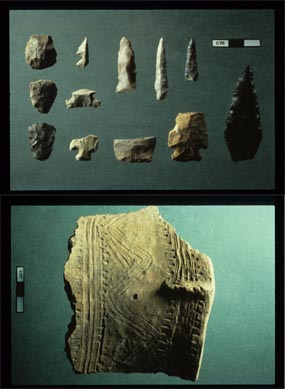
Whittlesey Culture artifacts: “South Park Village points (above) and pottery fragment (below)”
~ Cuyahoga Valley National Park
Among American writers, Mr. Short speaks of his investigations as of “greater value, due to the eminence of the antiquarian who writes them.” Hon. John D. Baldwin says, “in this Ancient America speaks of Colonel Whittlesey as one of the best authorities.” The learned Frenchman, Marquis de Nadaillac and writers generally upon such subjects quote his information and conclusions with that high and safe confidence in his learning and sound views which is the best tribute to Colonel Whittlesey, and at the same time a great help to the authors. And no one could write with any fullness on the archaeology of America without using liberally the work of Colonel Whittlesey, as will appear in any book on the subject. He was an extensive, original investigator, always observing, thoughtful and safe, and in some branches, as in Ancient Mining at Lake Superior, his work has been the substantial basis of present learning. It is noticeable that the most eminent gentlemen have best appreciated his safe and varied learning. Colonel Whittlesey was early in the geological field. Fifty years ago little was known of paleontology, and Colonel Whittlesey cared little for it, perhaps too little; but in economic geology, in his knowledge of Ohio, its surface, its strata, its iron, its coal and its limestone in his knowledge of the copper and iron of the northwest, he excelled indeed. From that date to his death he studied intelligently these sections. As Professor Lapham said he was studying Wisconsin, so did Colonel Whittlesey give himself to Ohio, its mines and its miners, its manufactures, dealings in coal and iron, its history, archaeology, its religion and its morals. Nearly all his articles contributed to magazines were to western magazines, and anyone who undertook a literary enterprise in the state of Ohio that promised value was sure to have his aid.6
In geology his services were great. The New York Herald, already cited, speaks of his help toward opening coal mines in Ohio and adds,“he was largely instrumental in discovering and causing the development of the great iron and copper regions of Lake Superior.” Twenty-six years ago he discovered a now famous range of iron ore.
“ On the Mound Builders and on the geological character and phenomena of the region of the lakes and the northwest he was quoted extensively as an authority in most of the standard geological and anthropological works of America and Europe,” truthfully says the ‘Biographical Cyclopedia.
Colonel Whittlesey was as zealous in helping to preserve new and original material for history as for science. In 1869 he pushed with energy the investigation, examination and measures which resulted in the purchase by the State of Ohio of the St. Clair papers so admirably, fully and ably edited by Mr. William Henry Smith, and in 1882 published in two large and handsome volumes by Messrs. Robert Clarke and Co. of Cincinnati.
Colonel Whittlesey was very prominent in the project which ended in the publication of the Margry papers in Paris. Their value may be gathered from the writing of Mr. Parkman (La Salle) and The Narrative and Critical History of America, Volume IV., where on page 242 is an account of their publication.7 In 1870 and 1871 an effort to enlist congress failed. The Boston fire defeated the efforts of Mr. Parkman to have them published in that city. Colonel Whittlesey originated the plan eventually adopted, by which congress voted ten thousand dollars as a subscription for five hundred copies, and, as says our history: “at last by Mr. Parkman’s assiduous labors in the east, and by those of Colonel Whittlesey, Mr. O. H. Marshall and others in the west,” the bill was passed.
The late President Garfield, an active member of our society, took a lively interest in the matter, and instigated by Colonel Whittlesey used his strong influence in its favor. Mr. Margry has felt and expressed a very warm feeling for Colonel Whittlesey for his interest and efforts, and since the colonel’s death, and in ignorance of it, has written him a characteristic letter to announce to the colonel, first of any in America, the completion of the work. A copy of the letter follows :
“PARIS, November 4, 1886.
“VERY DEAR AND HONORED SIR: It is to-day in France, St. Charles’ day, the holiday I wished when I had friends so called. I thought it suitable to send you to-day the good news to continue celebrating as of old. You will now be the first in America to whom I write it. I have just given the check to be drawn, for the last leaves of the work, of which your portrait may show a volume under your arm.8 Therefore there is no more but stitching to be done to send the book on its way.
“In telling you this I will not forget to tell you that I well remembered the part you took in that, publication as new, as glorious for the origin of your state, and for which you can congratulate yourself, in thanking you I have but one regret, that Mr. Marshall can not have the same pleasure. I hope that your health as well as that of Madame Whittlesey is satisfactory. I would be happy to hear so. For me if I am in good health it is only by the intervention of providence. However, I have lost much strength, though I do not show it. We must try to seem well.
“Receive, dear and honored sir, and for Madame, the assurance of my profound respect and attachment.
“PIERRE MARGRY.”
Colonel Whittlesey views of the lives of others were affected by his own. Devoted to extending human learning, with little thought of self interest, he was perhaps a little too impatient with others, whose lives had other ends deemed by them more practical. Yet after all, the colonel’s life was a real one, and his pursuits the best as being nearer to nature and far removed from the adventitious circumstances of what is ordinarily called polite life.
He impressed his associates as being full of learning, not from books, but nevertheless of all around — the roads the fields, the waters, the sky, men animals or plants. Charming it was to be with him in excursions; that was really life and elevated the mind and heart.
He was a profoundly religious man, never ostentatiously so, but to him religion and science were twin and inseparable companions. They were in his life and thought, and he wished to and did live to express in print his sense that the God of science was the God of religion, and that the Maker had not lost power over the thing made.
He rounded and finished his character as he finished his life, by joint and hearty affection and service to the two joint instruments of God’s revelation, for so he regarded them. Rev. Dr. Hayden testifies: “He had no patience with materialism, but in his mature strength of mind had harmonized the facts of science with the truths of religion.”

Charles Whittlesey
~ Magazine of Western History, Volume V, page 536.
Colonel Whittlesey’s life was plain, regular and simple. During the last few years he suffered much from catarrhal headache, rheumatism and kindred other troubles, and it was difficult for him to get around even with crutches. This was attributed to the exposure he had suffered for the fifteen years he had been exposed in the Lake Superior region, and his long life and preservation of a clear mind was no doubt due to his simple habits. With considerable bodily suffering, his mind was on the alert, and he seemed to have after all considerable happiness, and, to quote Dr Hayden, he could say with Byrd, “thy mind to me a kingdom is.”
Colonel Whittlesey was an original member of the American Association for the Advancement of Science, an old and valued member of the American Antiquarian society, an honorary member of the Ohio State Archaeological and Historical society, with headquarters at Columbus. He was trustee of the former State Archaeological society (making the archaeological exhibition at the Centennial), and although each of these is necessarily to some extent a rival of his pet society, he took a warm interest in the welfare of each.
He was a member of the Society of Americanites of France, and his judgment, learning and communications were much esteemed by the French members of that society. Of how many other societies he was an honorary or other member I can not tell.
C. C. Baldwin.
1 – Speech of May 9, 1862.
2 – Cincinnati Commercial, April 9, 1862.
3 – The society was organized under the auspices of the Cleveland Library Association (now Case Library). The plan occurred to the writer while vice-president of that association. At the annual meeting in 1867, the necessary changes were made in the constitution, and Colonel Whittlesey was elected to the Case Library board for the purpose of heading the historical committee and movement. The result appears in a scarce pamphlet issued in 1867 by the library association, containing, among other things, an account of the formation of the society and an address by Colonel Whittlesey, which is an interesting sketch of the successive literary and library societies of Cleveland, of which the first was in 1811.
4 – Mary E. Lyon was a daughter of James Lyon of Oswego, and sister of John E. Lyon, now of Oswego but years ago a prominent citizen of Cleveland. She m. first Colonel Theophilus Morgan,6 Theophilus,5 Theophilus,4 Theophilus,3 John,2 James Morgan.1 Colonel Morgan was an honored citizen of Oswego. Colonel Morgan and his wife Mary, had a son James Sherman, a very promising young man, killed in 1864 in a desperate cavalry charge in which he was lieutenant, in Sherman’s march to the sea. Mrs. Whittlesey survives in Cleveland.
5 – October, 19, 1886.
6 – The Hesperian, American Pioneer, the Western Literary Journal and Review of Cincinnati, the Democratic Review and Ohio Cultivator of Columbus, and later the Magazine of Western History at Cleveland, all received his hearty support.
7 – These papers were also described in an extract from a congressional speech of the late President Garfield. The extract is in Tract No. 20 of the Historical society.
8 – Alluding to a photograph of Colonel Whittlesey
then with a book under his arm.
Land Office Frauds
March 25, 2016
By Amorin Mello
New York Times
December 9, 1858
—~~~0~~~—
Land Office Frauds.
—~~~0~~~—
AGRICULTURAL CAPABILITIES HEREABOUT – LOCAL AMUSEMENTS AND EXCITEMENTS – SETTLEMENTS OF SUPERIOR CITY – A CONTROVERSY, AND SECRETARY M’CLELLAND’S ADJUDICATION OF IT – SECRETARY THOMPSON’S REVERSAL OF THAT JUDGEMENT – ITS CONSEQUENCES – LAND-STEALING RAMPANT – INSTRUCTIONS FOR THE ENTRY OF SUPERIOR CITY – THE LAND OFFICE REPEALS THE LAW OF THE LAND – A CASE FOR INVESTIGATION.
Correspondence of the New-York Times.
SUPERIOR CITY, Wis., Thursday, Nov. 25.
I am booked here for another winter, but fortunately with no fear of starvation this time. We have been most successful the last Summer in our Agricultural labors. The clay soils about here has proved marvelously fruitful, and where we expected little or nothing it has turned out huge potatoes that almost dissolve under the steaming process, and open as white as the inside of a cocoa-nut ; mammoth turnips, as good as turnips can be ; cabbages of enormous size ; and cauliflowers, that queen of vegetables, weighing as much as a child a year old. There is no reason to fear for the future of this country, now that we can show such vegetable products, and talk of our gardens as well as of our mines, forests, furs, and fisheries.
We are not without our excitements here, too ; though we have no model artists, or theatrical exhibitions, to treat our friends with. But our little city is now in a state of commotion produced by causes which often agitate frontier life, and sometimes reach the great center with their echo or reverberation. The Land Office is the great point of interest to frontier men, and the land law is the only jurisprudence save Lynch law, in which we are particularly interested. And as we have no means of reaching the great Federal legislature, through our Local Presses, we are always glad of an opportunity to be heard through the Atlantic organs, which are heard all over the country, and strike a note which the wind takes up and carries not only to San Francisco, but up here to the mouth of the St. Louis River, the hereafter great local point of Pacific and Atlantic intercommunication.

The Eye of the Northwest, pg. 8: James Stinson; Benjamin Thompson; W. W. Corcoran; U. S. Senator Robert J Walker; George W Cass; and Horace S Walbridge.
Five or six years ago a few American pioneers – stalwart backwoodsmen, undertook to select a town site out here, and did select one in good faith, and with clubs and muskets in had fought off from their premises a gang of Indians who were claiming to preëmpt it as “American citizens.” The Indians, however, were backup up by a Canadian white man by the name of STINSON, and some of the great speculators who were engaged in another town enterprise alongside here, and this “Indian war” was protracted in the local and general Land Offices some two or three years, when Mr. M’CLELLAND, then Secretary of the Interior, made a final adjudication of all the legal questions involved in the controversy, and sent it back to the Land Office to ascertain and apply the facts to the law as settled, on great deliberation by himself and Mr. CUSHING.
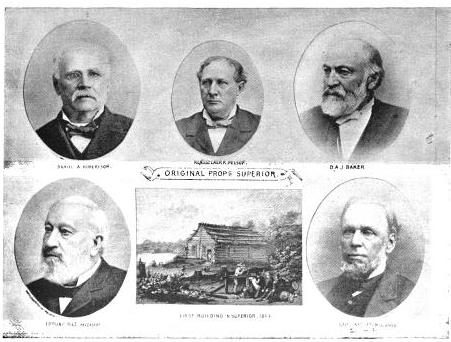
More Proprietors of Superior from The Eye of the North-west
, pg. 9: [names are illegible]
Meanwhile the original settlers and occupants maintained their adverse possession against the Indians and all the world, and expended a good deal of money in erecting buildings and a pier, and in cutting out streets and in laying out their town, and in carrying on their litigation, which was by no means inexpensive. M’CLELLAND’s determination of the law in their favor encouraged them to go on and incur additional expenses ; and they parted with diverse interests in the town site, some by assignment to persons who advanced money, and some by sale on quit-claim to persons who covenanted to make improvements. They made application to the proper office to enter the site, and nobody objected but the Indians – and the Indians were nowhere. So things stood when the case went back to the General Land Office, and to Mr. Secretary THOMPSON. The worthy Secretary, for some cause altogether unaccountable, adopted the extraordinary (and under the decision of the Supreme Court illegal) course of reversing the final judgement of his predecessor in this very case, (an exercise of power entirely unheard of in a case of mere private right,) and of rejecting the claim of the original occupants and settlers, though it was not contested by somebody who had a better right.
You may well imagine that this decision excited no little astonishment here. All the land stealers looked upon Superior City as vacant ground. They thought the men who selected and settled the town site were outlawed, and had no interests. Some supposed that the Land Office would put the ground up at auction. A chap by the name of SWEETZER came on here fresh from the General Land Office, and undertook to lay Sioux scrip on the whole site. Another – one JOHN GRANT – made application to preëmpt a portion of the site – and, what is the most remarkable feature about this business, GRANT was permitted to enter it as a preëmptor, though it was notoriously a selected town site, and in the adverse possession of town claimants half a year before GRANT ever saw it. This outrage created a great excitement for a small place. The Register, Mr. DANIEL SHAW, excuses himself by saying that he was almost expressly ordered by HENDRICKS to issue the certificate to GRANT, but this we do not believe in these parts. SHAW is clever, and covers his tracks, but nobody here supposes that the Commissioner ever countenanced such a gross violation of a public statute, without a motive. And what motive could the Commissioner have?
But, besides these movements, one of the Indians – ROY by name, who was defeated as one of the claimants by preëmeption – is now seeking to locate his Chippewa scrip on the town-site, and it is supposed that the same influences which urged him as an American citizen will support his claim as an Indian. A white man by the name of KINGSBURY, encouraged by the disregard of law exhibited by the local office, has made a claim on another part of the town-site. This purports to have originated in the fourth year of a litigation between the town claimants and the illegal preëmptors, and is supposed to be stimulated and encouraged by the Register.Subsequently to his original rejection of the town-site claim, Mr. Secretary THOMPSON issued instructions to permit the entry, and the County Judge made application on the 18th instant, under the law of the United States, May 23, 1844. On this being known, some of the persons heretofore claiming under the original settlers and occupants (who had selected the town and paid all the expenses of the settlement) came together and formed an organization as a city, under a recent law of Wisconsin, the object of which they declare to be secure to themselves a title from the United States to the lots they specially occupy, and to sell the balance to defray their expenses in entering and alloting the land! The men whose rights vested under the absolute decision of Secretary MCCLELLAND, and who did all that they could do to enter the land, and paid the money for it more than two years ago, – the men whose “respective INTERESTS” the statute of 1844 recognizes and was designed to protect, – these men are all ruled off the course, and the men claiming under them have conspired to divide the land and its proceeds among themselves.
Of course these iniquitous and illegal proceedings are all within the reach of the Courts – but they are the legitimate consequence of Mr. JACOB THOMPSON’s repeal of so much of the Preëmption Law of 1841 as excludes from preëmption those portions of the public lands that have been “selected as the site of a city or town.” Mr. THOMPSON has overruled all his predecessors, all the Attorney-General, all the local offices, all the lexicographers, and the English language generally, by deciding solemnly that “selection” does not mean “selection,” but means something else – or more particularly nothing at all. Because, says he, if adverse “selection” excluded a preëmptor, then a preëmptor might be excluded by a false allegation of selection. Was there ever such an argal since Dogberry’s time? The Secretary has discovered an equally efficient “dispensing power” with that of King JAMES of blessed memory, and one which his brethren in the Cabinet may use very efficiently, if Congress does not look into the subject and fix some limits to it. For now, not only the Secretary, but the Commissioner, and the Register and Receiver, all think that they are at liberty to treat the repeal by the Secretary as an effective nullification of the law of the land.
If Congress would amuse their leisure a little by looking at these land office operations on the verge of civilization, they would strike a placer of corruption. Let them open the books and call for the documents, and see what Dr. T. RUSH SPENSER, late Register of the Willow River District, says of his predecessor and successor, Mr. JOHN O. HENNING, and then ascertain by what influences HENNING has been reappointed, and SPENSER transferred to Superior. Let them find out what Receiver DEAN said of Register SHAW, and what Register SHAW said of Receiver DEAN, and why DEAN was dismissed and why SHAW was retained. It will be rare fun for somebody. The country ought to know something about the Land Offices, and such an investigation as this would enlighten the country very materially. I hope it will be made, and that the country will learn how it is that more land has been entered in this district by Indians, foreigners, and minors than by qualified preëmptors, and all for the benefit of a few favored speculators.
The Woman In Stone
March 15, 2016
By Amorin Mello & Leo Filipczak
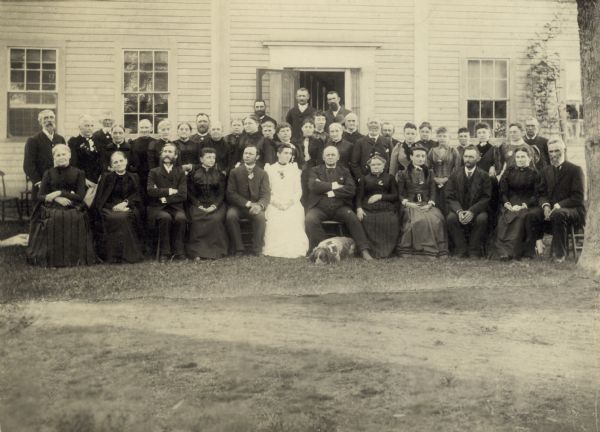
Photograph of the Wheeler and Wood Families from the Wheeler Family Papers at the Wisconsin Historical Society. The woman dressed in white is Harriet Martha Wheeler, according to the book about her mother, Woman in the Wilderness: Letters of Harriet Wood Wheeler, Missonary Wife, 1832-1892, by Nancy Bunge, 2010.
![Leonard Hemenway Wheeler ~ Unnamed Wisconsin by [????]](https://chequamegonhistory.com/wp-content/uploads/2016/03/leonard-hemenway-wheeler-from-unnamed-wisconsin.jpg)
Leonard Hemenway Wheeler: husband of Harriet Wood Wheeler, and father of author Harriet Martha Wheeler.
~ Unnamed Wisconsin, by John Nelson Davidson, 1895.
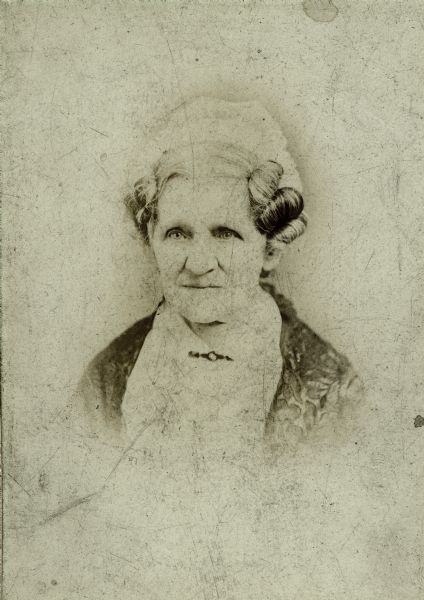
Harriet Wood Wheeler: wife of Leonard Wheeler, and mother of author Harriet Martha Wheeler.
~ Wisconsin Historical Society
This is a reproduction of the final chapter from Harriet Martha Wheeler’s 1903 book, The Woman in Stone: A Novel. If you want to read the entire novel without spoiling the final chapter featured here, you can download it here as a PDF file: The Woman in Stone: A Novel. Special thanks to Paul DeMain at Indian Country Today Media Network for making the digitization of this novel possible for the public to read with convenience.
“Hattie” was named after her mother, Harriet Wood Wheeler; the wife of Reverend Leonard Hemenway Wheeler. Hattie was born in 1858 at Odanah, shortly after the events portrayed in her novel. Hattie’s experiences and writings about the Lake Superior Chippewa are summarized in an academic article by Nancy Bunge, published in The American Transcendental Quarterly , Vol. 16, No. 1 , March 2002: Straddling Cultures: Harriet Wheeler’s and William W. Warren’s Renditions of Ojibwe History

William Whipple Warren (c. 1851)
~ Wikimedia.org
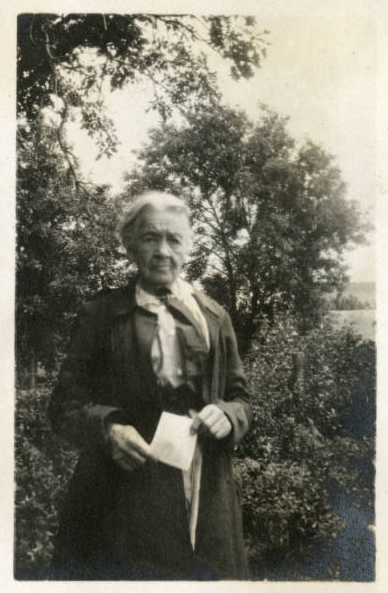
“Mary Warren English, White Earth, Minnesota”
~ University of Minnesota Duluth, Kathryn A. Martin Library, NEMHC Collections
Harriet Wheeler and William W. Warren not only both lived on Ojibwe reservations in northern Wisconsin during the nineteenth century, but their families had strong bonds between them. William Warren’s sister, Mary Warren English, writes that her brother returned to La Pointe, Wisconsin, from school on the same boat Harriet’s parents took to begin their mission work. The Wheelers liked him and appreciated his help: “He won a warm and life-long friendship–with these most estimable people–by his genial and happy disposition–and ever ready and kindly assistance–during their long and tedious voyage” (Warren Papers). When Mary Warren English’s parents died, she moved in with the Wheelers, and, long after she and Harriet no longer shared the same household, she began letters to Harriet with the salutation, “Dear Sister.” But William Warren’s History of the Ojibwe People (1885) and Harriet Wheeler’s novel The Woman in Stone (1903) reveal that this shared background could not overcome the cultural differences between them. Even though Wheeler and Warren often describe the same events and people, their accounts have different implications. Wheeler, the daughter of Congregational missionaries from New England, portrays the inevitable and necessary decline of the Ojibwe, as emissaries of Christianity help civilization progress; Warren, who had French and Ojibwe ancestors, as well as Yankee roots, identifies growing Anglo-Saxon influence on the Ojibwe as a cause of moral decay.
Hattie’s book appears to provide some valuable insights about certain events in Chequamegon history, yet it is clearly erroneous about other such events. According to the University of Wisconsin – Madison, Harriet’s novel is “based on discovery of petrified body of Indian woman in northern Wisconsin.” This statement seems to acknowledge this peculiar event as being somewhat factual. However, Hattie’s novel is clearly a work of fiction; it appears that some of her references were to actual events. At this point in time, this mystery of the forest may never be thoroughly confirmed or debunked.
An incomplete theater screenplay, with the title “Woman in Stone,” was also written by Hattie. It appears to be based on her novel, can be found at the Northern Great Lakes Visitor Center Archives, in the Wheeler Family Papers: Northland Mss 14; Box 10; Folder 19. However, only several pages of this screenplay copy still exist in the archive there. A complete copy of Hattie’s screenplay may still exist somewhere else yet.
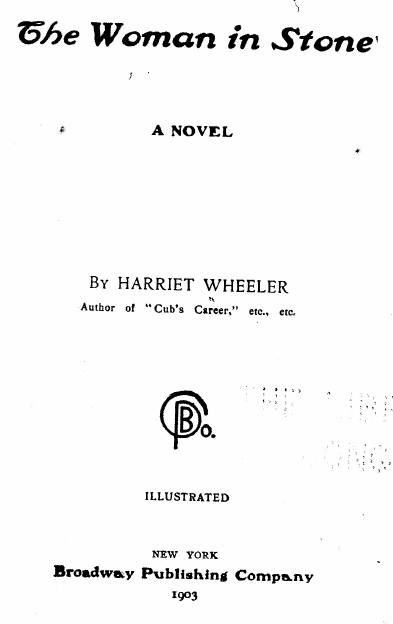
The Woman in Stone: A Novel by Harriet Martha Wheeler, 1903.
[Due to the inconsistencies found in Hattie’s novel, we have omitted most of this novel for this reproduction. We shall skip to the final chapter of Hattie’s novel, to the rediscovery of long lost “Wa-be-goon-a-quace,” the Little Flower Girl. If you want to read the entire novel first, before spoiling this final chapter, you can download it here: The Woman in Stone: A Novel, by Harriet Wheeler, 1903. Special thanks to Paul DeMain at Indian Country Today Media Network for making the digitization of this novel possible for the public to read with convenience.]
(Pages 164-168)
CHAPTER XX.
THE DISCOVERY OF THE WOMAN IN STONE
A hundred years swept over the island Madelaine, bringing change and decay in their train. But, nature renews the waste of time with a prodigal hand and robed the island in verdant loveliness.

Madelaine still towers the queen of the Apostle group, with rocky dells and pine clad shores and odorous forests, through which murmur the breezes from the great lake, and over all hover centuries of history, romance, and legendary lore.
Jean Michel Cadotte was Madelaine’s father-in-law, not husband. Madelaine Cadotte’s Ojibwe name was Ikwezewe, and she was still alive at La Pointe, in her ’90s, during Hattie‘s childhood in Odanah. It’s kind of disturbing how little of this Hattie got right considering Mary Warren (Madeline’s granddaughter) was basically Hattie’s stepsister.
Evolution toward the spiritual is the destiny of humanity and in this trend of progress the Red Men are vanishing before the onward march of the Pale Face. In the place of the blazing Sacred Fire stands the Protestant Mission. The settlers’ cabin supplants the wigwam. No longer are heard the voyageur’s song and the rippling canoes. This is the age of steam, and far and near echoes the shrill whistle. Overgrown mounds mark the sites of the forts of La Ronde and Cadotte. In the spacious log cabin of Jean and Madelaine Cadotte lives their grandson, John Cadotte.

“Dirt trail passing log shack that was probably the home of Michael and Madeline Cadotte, La Pointe,” circa 1897.
~ Wisconsin Historical Society
A practical man is John. He tills his garden, strings his fish-net in the bay, and acts as guide, philosopher and friend for all the tourists who visit the island.
Hildreth Huntington and his father may have been fictionalized, or they may be actual people from the Huntington clan:
by the Huntington Family Association, 1915.
On a June morning of the year 1857, John sat beneath a sheltering pine mending his fish-net. he smoked a cob-pipe, which he occasionally laid by to whistle a voyageur’s song. A shrill whistle sounded and a tug steamed around the bend to the wharf. John laid aside his fish-net and pipe and strolled to the beach. Two gentlemen, clad in tourist’s costume, stepped from the tug and approached John.
“Can you direct us to Mr. John Cadotte?” said the elder man.
“I am your man,” responded John.
Augustus Hamilton Barber had copper and land claims around the Montreal and Tyler Forks Rivers before his death in 1856. It is possible that this father and son pair in Hattie’s novel actually represent Joel Allen Barber and his father, Giles Addison Barber. They were following up on their belated Augustus’ unresolved business in this area during June of 1857. This theory about the Barber family is explored in more details with “Legend of the Montreal River,” by George Francis Thomas.
“My name is Huntington. This young man is my son, Hildreth. We came from New York, and are anxious to explore the region about Tyler’s fork where copper has been discovered. We were directed to you as a guide on whom we might depend. Can we secure your services, sir?” asked the stranger.
“It is also proper to state in addition to what has been already mentioned, that at, or about this time [1857], a road was opened by Mr. Herbert’s order, from the Hay Marsh, six miles out from Ironton, to which point one had been previously opened, to the Range [on the Tyler Forks River], which it struck about midway between Sidebotham’s and Lockwood’s Stations, over which, I suppose, the 50,000 tons as previously mentioned, was to find its way to Ironton, (in a horn).“
~ Penokee Survey Incidents: IV
“I am always open to engagement,” responded John.
“Very well, we will start at once, if agreeable to you.”
“I will run up to the house and pack my traps,” said John.
The stranger strolled along the beach until John’s return. Then all aboard the tug and steamed away towards Ashland. John entertained the strangers with stories and legends of those romantic and adventurous days which were fading into history.
“The company not being satisfied with Mr. Herbert as agent, he was removed and Gen. Cutler appointed in his place, who quickly selected Ashland as headquarters, to which place all the personal property, consisting of merchandise principally, was removed during the summer by myself upon Gen. C.’s order – and Ironton abandoned to its fate.”
~ Penokee Survey Incidents: I
The party left the tug at Ashland and engaged a logger’s team to carry them to Tyler’s Forks, twenty miles away. A rough road had been cut through the forest where once ran an Indian trail. Over this road the horses slowly made their way. Night lowered before they had reached their destination and they pitched their tents in the forest. John kindled a camp-fire and prepared supper. The others gathered wood and arranged bough beds in the tent. They were wearied with the long and tedious journey and early sought this rude couch.
John’s strident tones summoned them to a sunrise breakfast. They broke camp and resumed their journey, arriving at the Forks at noon.
The tourists sat down on the banks of the river and viewed the beautiful falls before them.
“This is the most picturesque spot I have seen, Hildreth. It surpasses Niagara, to my mind,” said Mr. Huntington.

The preface to this novel is a photograph of Brownstone Falls, where the Tyler Forks River empties into the Bad River at Copper Falls State Park. George Francis Thomas’ “A Mystery of the Forest” was originally published as “Legend of the Montreal River“ (and republished here). It suggests that the legend takes place at the Gorge on the Tyler Forks River, where it crosses the Iron Range; not where it terminates on Bad River along the Copper Range.
They gazed about them in wondering admiration. The forest primeval towered above them. Beyond, the falls rolled over their rocky bed. The ceaseless murmur of the rapids sounded below them and over all floated the odors of the pines and balsam firs.
“This description will, I think, give your readers a very good understanding of the condition as well as the true inwardness of the affairs of the Wisconsin & Lake Superior Mining and Smelting Co., in the month of June, 1857.”
[…]
“Rome was not built in a day, but most of these cabins were. I built four myself near the Gorge [on Tyler Forks River], in a day, with the assistance of two halfbreeds, but was not able to find them a week afterwards. This is not only a mystery but a conundrum. I thinksome traveling showman must have stolen them; but although they werenon est we could swear that we had built them, and did.“
~ Penokee Survey Incidents: IV
After dinner the party began their explorations under John’s leadership. Two days were spent in examining the banks of Bad River. On the third morning they came to the gorge. Here, the river narrowed to a few feet and cut its way through high banks of rock. The party examined the rocks on both sides. John climbed to the pool behind the gorge and examined the rocks lying beneath the shallow water. He rested his hand on what seemed to be a water-soaked log and was surprised to find the log a solid block of stone. He examined it carefully. The stone resembled a human form.
“Mr. Huntington, come down here,” he called.
“Have you struck a claim, John?” asked Mr. Huntington.
“Not exactly. Look at this rock. What do you call it, sir?”
Mr. Huntington, his son and the teamster climbed down to the pool and examined the rock.
“A petrification of some sort,” exclaimed Mr. Huntington. “Let us lift it from the water.”
The men struggled some time before they succeeded in raising the solid mass. They rested it against the rocky bank.
Wabigance: Little Flower Girl
Hattie identified this character as “Wa-be-goon-a-quace.” In the Ojibwemowin language, Wabigance is a small flower. Wabigon or Wabegoon is a flower. Wabegoonakwe is a flower that is female.
“A petrified Indian girl,” exclaimed Mr. Huntington.
The men bent low over the strange figure, examining it carefully.
“Look at her moccasins, father,” exclaimed Hildreth, “and her long hair. Here is a rosary and cross about her neck. Evidently she was a good Catholic.”
“Holy Mother,” exclaimed John, “it is the Little Flower Girl.”“And who was she?” asked Mr. Huntington.
“She was my grandmother Madelaine’s cousin. I have heard my grandmother tell about her many times when I was a boy. The Little Flower Girl lost her mind when her pale-faced lover died in battle. She was always hunting for him in the island woods. One evening she disappeared in her canoe and never returned.”
“How came she by this cross?”

Portrait of Jacques Marquette
~ Wikipedia.org
“The Holy Father Marquette gave it to her grandmother, Ogonã. The Little Flower Girl wore it always. She thought it protected her from evil and would lead her to her lover, Claude.”
And so it has. The cross has led the Little Flower Girl up yonder where she has found her Claude and life immortal.
“A touching romance, worthy to be embalmed in stone,” said Hildreth.
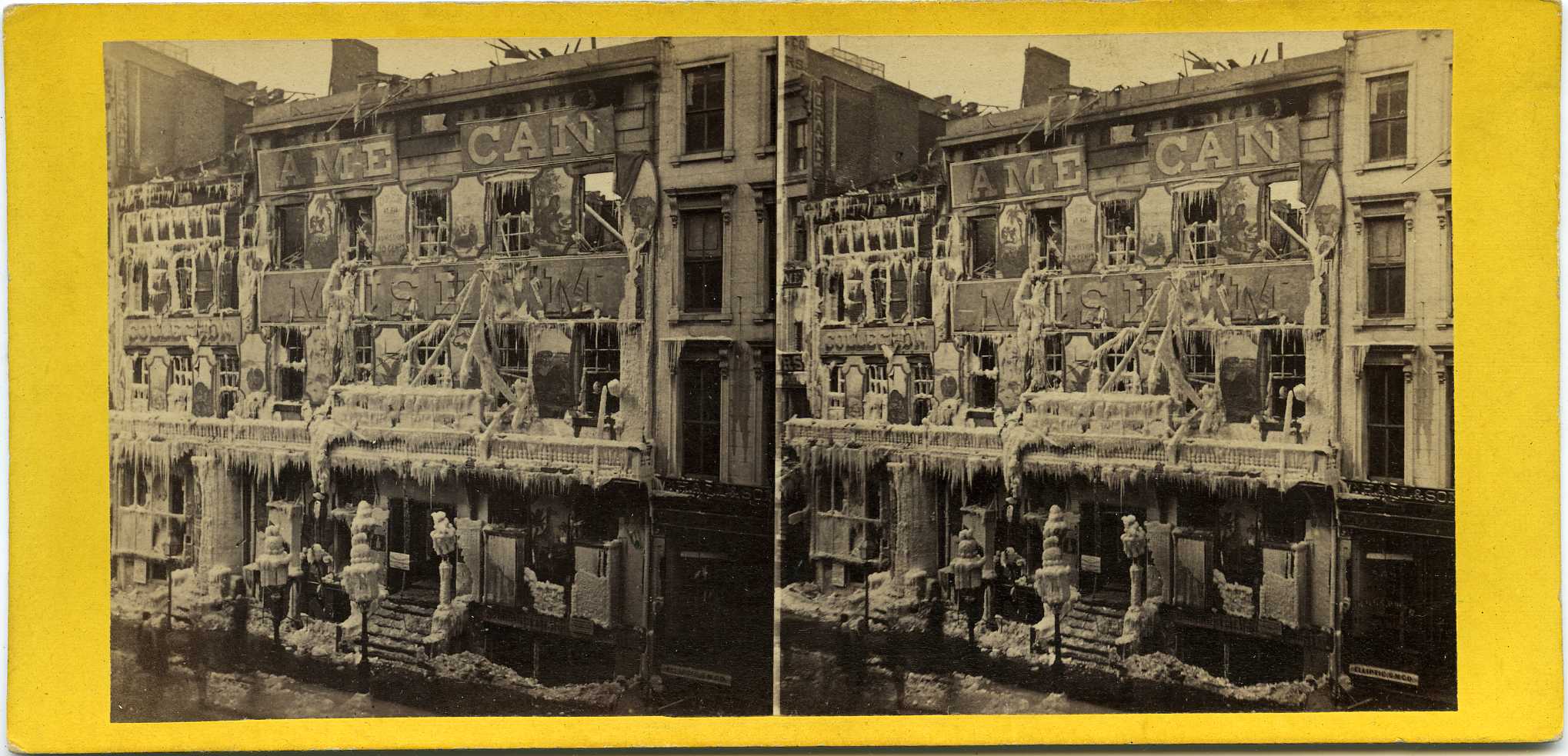
“Barnum’s Museum Fire, New York City, 1868 Incredible view of the frozen ruins of Barnum’s ‘American Museum’ just after the March, 1868 fire. 3-1/4×6-3/4″ yellow-mount view published by E & HT Anthony; #5971 in their series of ‘Anthony’s Stereoscopic Views.’ Huge ice formations where the water sprays hit the building; burned out windows and doors.”
~ CraigCamera.com
“Yes, and worthy of a better resting place,” responded Mr. Huntington. “We must take the Little Flower Girl with us, Hildreth. Her life belongs to the public. Our great city will be better for this monument of her romantic, tragic, sorrowing life.”
Over the forest road, where her moccasined feet had strayed one hundred years before, they bore the Little Flower Girl. And the eyes of the Holy Father shone on her as she crossed the silvery water where her “Ave Maria” echoed long ago. Back to the island Madelaine they carried her, and on, down the great lakes, the Little Flower Girl followed in the wake of her lover, Claude. To the great city of New York they bore her. In one of that great city’s museum rests the Woman in Stone.

Wabigance below the Gorge on the Tyler Forks River.
~ Photograph by M. Matusewic © December 2013.
Reproduced with permission.
The Removal Order of 1849
March 12, 2016
By Amorin Mello
United States. Works Progress Administration:
Chippewa Indian Historical Project Records 1936-1942
(Northland Micro 5; Micro 532)

12th President Zachary Taylor gave the 1849 Removal Order while he was still in office. During 1852, Chief Buffalo and his delegation met 13th President Millard Fillmore in Washington, D.C., to petition against this Removal Order.
~ 1848 presidential campaign poster from the Library of Congress
Reel 1; Envelop 1; Item 14.
The Removal Order of 1849
By Jerome Arbuckle
After the war of 1812 the westward advance of the people of the United States of was renewed with vigor. These pioneers were imbued with the idea that the possessions of the Indian tribes, with whom they came in contact, were for their convenience and theirs for the taking. Any attempt on the part of the aboriginal owners to defend their ancestral homes were a signal for a declaration of war, or a punitive expedition, which invariably resulted in the defeat of the Indians.
“Peace Treaties,” incorporating terms and stipulations suitable particularly to the white man’s government, were then negotiated, whereby the Indians ceded their lands, and the remnants of the dispossessed tribe moved westward. The tribes to the south of the Great Lakes, along the Ohio Valley, were the greatest sufferers from this system of acquisition.
Another system used with equal, if less sanguinary success, was the “treaty system.” Treaties of this type were actually little more than receipt signed by the Indian, which acknowledged the cessions of huge tracts of land. The language of the treaties, in some instances, is so plainly a scheme for the dispossession and removal of the Indians that it is doubtful if the signers for the Indians understood the true import of the document. Possibly, and according to the statements handed down from the Indians of earlier days to the present, Indians who signed the treaties were duped and were the victims of treachery and collusion.
By the terms of the Treaties of 1837 and 1842, the Indians ceded to the Government all their territory lying east of the Mississippi embracing the St. Croix district and eastward to the Chocolate River. The Indians, however, were ignorant of the fact that they had ceded these lands. According to the terms, as understood by them, they were permitted to remain within these treaty boundaries and continue to enjoy the privileges of hunting, fishing, ricing and the making of maple sugar, provided they did not molest their white neighbors; but they clearly understood that the Government was to have the right to use the timber and minerals on these lands.

Entitled “Chief Buffalo’s Petition to the President“ by the Wisconsin Historical Society, the story behind this now famous symbolic petition is actually unrelated to Chief Buffalo from La Pointe, and was created before the Sandy Lake Tragedy. It is a common error to mis-attribute this to Chief Buffalo’s trip to Washington D.C., which occurred after that Tragedy. See Chequamegon History’s original post for more information.

Detail of Benjamin Armstrong from a photograph by Matthew Brady (Minnesota Historical Society). See our Armstrong Engravings post for more information.
Their eyes were opened when the Removal Order of 1849 came like a bolt from the blue. This order cancelled the Indians’ right to hunt and fish in the territory ceded, and gave notification for their removal westward. According to Verwyst, the Franciscan Missionary, many left by reason of this order, and sought a refuge among the westernmost of their tribe who dwelt in Minnesota.
Many of the full bloods, who naturally had a deep attachment for their home soil, refused to budge. The chiefs who signed the treaty were included in this action. They then concluded that they were duped by the Treaty Commissioners and were given a faulty interpretation of the treaty passages. Although the Chippewa realized the futility of armed resistance, those who chose to remain unanimously decided to fight it out. A few white men who were true friends of the Indians, among these was Ben Armstrong, the adopted son of the Head Chief, Buffalo, and he cautioned the Indians against any show of hostility.
At a council, Armstrong prevailed upon the chiefs to make a trip to Washington. Accordingly, preparations for the trip were made, a canoe of special make being constructed for the journey. After cautioning the tribesmen to remain calm, pending their return, they set out for Washington in April, 1852. The party was composed of Buffalo, the head Chief, and several sub-chiefs, one of whom was Oshoga, who later became a noted man among the Chippewa. Armstrong was the interpreter and director of the party. The delegation left La Pointe and proceeded by way of the Great Lakes as far as Buffalo, N. Y., and then by rail to Washington. They stopped at the white settlements along the route and their leader, Mr. Armstrong, circulated a petition among the white people. This petition, which was to be presented to the President, urged that the Chippewa be permitted to remain in their own country and the Removal Order reconsidered. Many signatures were obtained, some of the signers being acquaintances of the President, whose signatures he later recognized.
Despite repeated attempts of arbitrary agents, who were employed by the government to administer Indian affairs, and who endeavored to return them back or discourage the trip, they resolutely persisted. The party arrived at Buffalo, New York, practically penniless. By disposing of some Indian trinkets, and by putting the chief on exhibition, they managed to acquire enough money to defray their expenses until they finally arrived at Washington.
Here it seemed their troubles were to begin. They were refused an audience with those persons who might have been able to assist them. Through the kind assistance of Senator Briggs of New York, they eventually managed to arrange for an interview with President Fillmore.

United States Representative George Briggs was helpful in getting an audience with President Millard Fillmore.
~ Library of Congress
At the appointed time they assembled for the interview and after smoking the peace pipe offered by Chief Buffalo, the “Great White Father” listened to their story of conditions in the Northwest. Their petition was presented and read and the meeting adjourned. President Fillmore, deeply impressed by his visitors, directed that their expenses should be paid by the Government and that they should have the freedom of the city for a week.
![Vincent Roy, Jr., portrait from "Short biographical sketch of Vincent Roy, [Jr.,]" in Life and Labors of Rt. Rev. Frederic Baraga, by Chrysostom Verwyst, 1900, pages 472-476.](https://chequamegonhistory.com/wp-content/uploads/2016/03/vincent-roy-jr.jpg)
Vincent Roy, Jr., was also on this famous trip to Washington, D.C. For more information, see this excerpt from Vincent Roy Jr’s biography.
Their mission was accomplished and all were happy. They had achieved what they sought. An uprising of their people had been averted in which thousands of human lives might have been cruelly slaughtered; so with light hearts they prepared for their homeward trip. Their fare was paid and they returned by rail by way of St. Paul, Minnesota, which was as near as they could get by rail to their homes. From St. Paul they traveled overland, a distance of over two hundred miles, overland. Along the route they frequently met with bands of Chippewa, whom they delighted with the information of the successes of their trip. These groups they instructed to repair to Madeline Island for the treaty at the time stipulated.
Upon their arrival at their own homes, the successes of the delegation was hailed with joy. Runners were dispatched to notify the entire Chippewa nation. As a consequence, many who had left their homes in compliance with the Removal Order now returned.
When the time for the treaty drew near, the Chippewa began to arrive at the Island from all directions. Finally, after careful deliberations, the treaty of 1854 was concluded. This treaty provided for several reservations within the ceded territory. These were Ontonagon and L’Anse, in the present state of Michigan, Lac du Flambeau, Bad River or La Pointe, Red Cliff, and Lac Courte Oreille, in Wisconsin, and Fond du Lac and Grand Portage in Minnesota.
It was at this time that the Chippewa mutually agreed to separate into two divisions, making the Mississippi the dividing line between the Mississippi Chippewa and the Lake Superior Chippewa, and allowing each division the right to deal separately with the Government.
Early Settlement of the Bad River Indian Reservation
March 9, 2016
By Amorin Mello
United States. Works Progress Administration:
Chippewa Indian Historical Project Records 1936-1942
(Northland Micro 5; Micro 532)
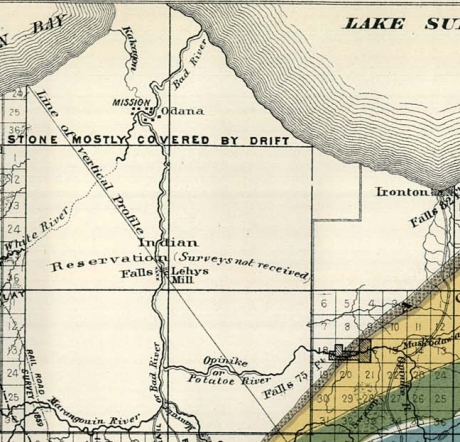
Details of early settlements on the La Pointe Reservation from Charles Whittlesey‘s 1860 Geological Map of the Penokie Range.
Reel 1; Envelope 1; Item 30.
EARLY SETTLEMENT OF THE BAD RIVER INDIAN RESERVATION
by James Scott
The Bad River Indian Reservation was set aside for the use of the Indians in the year 1854. The legal proceedings for this venture were ratified by Congress in 1855. (See Indian Treaty Laws, Chippewa Treaty, 1854, P. 646.)
Many years before the White Man ever came in contact with the Ojibway Indians of Lake Superior, our forefathers inhabited an island now known as Madeline Island, or La Pointe. They were the ancestors of our present Chippewa now located on the Bad River Reservation, and they came to this location by the way of Shau-boo-mi-ni-ka-ning (Gooseberry Landing Point), which is situated at the extreme South of Madeline Island. From there they traveled across to Chi-gee-wa-ne-kung (a long and shallow sandy point). This is the point where the Great Lakes Light House is now situated. The white people call it Chequamegon Point. From Chequamegon Point, the Indians came to this locality by way of the Ka-ka-gon and Bad rivers. The Indians called this location Kie-tig-ga-ning, (Agricultural Paradise). They had good reason for this title, since the ground was fertile, fish were abundant, game plentiful, and invariably there was a good crop of berries and small fruits. In fact, Kie-tig-ga-ning was their home in the warm months. They planted their gardens here.
The original site for the Bad River Village was located west of the present Chicago & North-western Railroad steel bridge crossing the Bad River just a few rods north of the White River.
The first Indian to make a permanent home here was Ba-bom-ni-go-ni-boy (Spreading Eagle). Having selected a suitable location, he built a large wigwam out of elm bark. After completing his home which was situated between what is now Walker’s store and the railroad bridge, he brought his family.
Not long after, more Indian families from Madeline Island, which was the original habitation of the Ojibwas of Lake Superior, moved to Bad River and settled here with Spreading Eagle. Each year more families came, built their wigwams and bark houses and lived along the banks of the Bad River, near where St. Mary’s School is now located. As the population grew, wigwams multiplied, until they extended from the Bad River to the Ka-ka-gon River, and along the south side of what was known as Blackbird’s field. The village grew so rapidly that wigwams and bark houses were built on both sides of the Bad River, and extended about one-half mile above the west side of the White River.
About this time, secret emissaries from the French and English governments came here as fur traders. The Indians surmised that these people might be representatives of some foreign government. They mingled with the Indians; they looked down upon them as an inferior race; consequently the Indians hated the English.
The French, on the other hand, were very friendly with the Indians. They treated them like brothers and even adopted their ways and customs and married the Indian women. They settle d here permanently, and began to build log cabins. It was undoubtedly from them that the Indians learned how to build the log house besides many other useful things. There are a few of these log-cabins still standing that were built by the early French and Indians settlers. But most of them have been remodeled many times, by covering them inside and out with pine lumber, and building additions to them.

Detail of Nigikoon‘s sawmill and Bad River Falls omitted from Joel Allen Barber’s survey of “The Gardens”.
Several years before the final treaty was signed by the Chippewas of Lake Superior, a strange gentleman appeared in the Indian country: He was a white man and became very well acquainted with some of the Indians His name was Ervin Leihy, but the Indians called him Neg-gi-goons (a young otter). When he saw that the Indians were making their homes on each side of the Bad River, as far up as the Bad River Falls, he too decided to build a little home for himself on the bank at the foot of the Falls. He cleared a small piece of land, built his house and in time erected a saw mill which was run by water power. There he lived for many years cultivating the soil and manufacturing lumber. He was never bothered by any of the Indians because he never gave them any cause for unfriendliness. He associated mostly with the young men of the tribe, learned their language, and spoke it quite fluently. He was soon familiar with Indian ways and habits and adopted many of them.
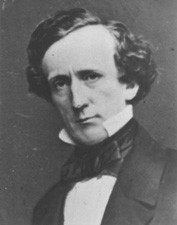
Senator Henry Mower Rice
~ United States Senate Historical Office
On September 30, 1854, the final treaty between the Chippewa of Lake Superior and the United States was concluded, (ratified Jan. 10, 1855). The preliminaries required thirty days of deliberation.
Before the last conference, a gentleman by the name of Henry M. Rice, approached the chiefs and headmen of the La Pointe Band at night, and held a secret conference with them. He coached and advised them to be on the alert should a question arise concerning the selection of a reservation.
“I have been secretly approached,” he said, “by a certain band of Chippewa to assist them in securing the land where you have maintained your homes for years. It would be a shame if another band should cheat you out of this place where you have built your homes and lived so long. Any band, or member of such band, which is a part of the Lake Superior Chippewa who reside in the territory you are now ceding to the United States government, have equal rights to make a selection anywhere in the territory the United States is reserving for you.”
When the conference convened the next day, the question of selecting reservations was in order. Immediately after the announcement was made by the official interpreter, Chief Blackbird of the Bad River Band was on his feet shouting and pointing in different directions with a large flat ceremonial pipe which he held in his right hand, describing the boundary lines of his reservation. (See Article 2, paragraph 2, page 648, Chippewa Treaty of 1854).1
As soon as Chief Blackbird arose, Chief Moni-don-se (Small Bug) of the Lac du Flambeau Band, also arose at the same time, and tried hard to discourage Chief Blackbird. Chief Moni-don-se claimed that he was supposed to make the selection that Chief Blackbird was now making. Then both chiefs became angry and exchanged unpleasant words with one another. One of the Government officials intervened. Chief Moni-don-se claimed that his people had as much right to select this land as Chief Blackbird had. Moni-don-se was finally over-ruled, so he had to settle on the Lac du Flambeau Reservation. Chief Blackbird then thanked Mr. Henry M. Rice for his advice and assistance.
Vincent Roy, Jr. was Henry Mower Rice’s interpreter during the 1854 Treaty with the Chippewas at La Pointe, according to The Sawmill Community at Roy’s Pointe, by Mary Carlson, 2009, page 21.
A few years after the reservations were set aside for the Chippewa people, the construction of more log houses was begun, even being used to bring the timber required for this purpose from the forest. Many new homes were built along the Bad River, the location of the houses extending as far as the Falls. The then existing homes were not lost from view in this movement, and houses needing repairs were given attention. A sub-agent was appointed and placed in charge of the Bad River Reservation, whose duty it was to assist the Indians in agricultural pursuits, as well as guide and advise them in matters concerning such pursuits. None was known as the Government Farmer.
The Indians always took the responsibility and care of his children quite seriously. He taught them early the rudiments of the hunt and the trapping of wild game. He instilled into them from infancy a love of the traditions and customs of their forefathers; he brought before their young minds the organization of the tribe and clans and their duties. He also taught them early in life to be grateful to the Great Spirit and appreciate his many gifts.
Sunday, 21 Apr. 1918
“ASHLAND, Wis., April 20. – Chief Adam Scott, of the Chippewa tribe of Indians is dead. He passed away at his home in Odanah after a short illness of pneumonia at the age of 76 and was buried today.
Chief Scott was one of the head chiefs of the Chippewas since the death of his father who was a head chief of the Chippewa tribe when they were uncivilized. His father was Ka-ta-wa-ba-bay Scott and he lived to see his tribe emerge from a savage state to civilization. His son has been one of the chief advisors of the tribe and has made many trips to Washington on tribal business. Chief Adam Scott leaves one son who becomes chief. Chief Scott was born on Madeline Island and has lived either at Madeline Island or on the Bad River reservation all his life.”
Gic-he-chi-gie-nig Cah-dub-wah-be-da Scott, my father, who died at the age of seventy-six years and ten months, (born June 12, 1840; died April 16, 1916, told me the following:

Kiskitawag (Giishkitawag: “Cut Ear”) signed multiple treaties as a warrior of the Ontonagon Band but afterwards was associated with the Bad River Band. Photograph circa 1880.
~ C.M. Bell, Smithsonian Digital Collections
About four years after the signing of the Treaty of 1854, in the spring of 1858, Chief Keesh-ke-tow-wug (Cut Ear), one of the signers of the treaty, sent invitations through his runner, George Cedar Root (Ke-ka-geese, meaning young Raven) to tell all the people he could contact, to come to his home on a certain day. He had his wife and daughters prepare a great feast and opened up a large Mo-kuk (birch bark container for maple sugar) of maple sugar. About a hundred people ate at his feast that day.
Chief Keesh-ke-tow-wug ordered his runner to light his personal ceremonial pipe and pass it to each of his male guests. After the pipe ceremony he arose in a very dignified manner. He was a tall, lanky old gentleman, and when standing erect was over six feet tall. He said:
“My children, I want you to listen to me. The proposition I am about to present will benefit all of you, and I need your cooperation. I would like to have you donate your labor to clear land for a large community garden, where every family, or any one who wishes can plant. The place I would suggest is that swampy flat, near the cemetery. It will take time to drain it and dry out but I know it will make good garden plats.”
The people approved of the idea and gave him the assurance that they would cooperate with him to carry out his plans. The old chief was more than pleased. he designated a date on which to start.
When they started clearing the ground for this purpose, many things had to be done. The land was covered with willows and scrubby tamarack and water. Long ditches had to be dug to furnish adequate drainage into both rivers, the Ka-ka-gon and the Bad. It was not long before a tract of land of about eighty acres was prepared for the plow and under actual cultivation.
This community garden extended from Mrs. Armstrong’s dwelling on the U. S. Highway No. 2 to where the steel and concrete bridge now crosses the Bad River on the east; and north-west to Waish-ki Martin’s house. This old community clearing is now known as the “Blackbird Field.” The Indians used this ground for their gardens about twenty-five years.

Detail of Chief James Blackbird from an 1899 photo by De Lancey Gill.
~ Smithsonian Collections
In the years 1888 to 1890, Gic-caw-kie-yesh-sheese (Minor Surface Wind), son of the old chief Ma-ca-day-pe-nay-se (Blackbird), filed on this community clearing as his allotment. He was later known as Chief James Blackbird. The selection was approved by the Indian Department and a patent issued, covering the greater portion of the community garden, in the name of James Blackbird. (see Article 3, granting of allotments, in the Chippewa Treaty of 1854, page 649).1
Under the stipulations of the Treaty of 1854, the chiefs with the assistance of a field Indian Agent constituted an allotment committee, who made membership rolls and gave allotments to those who were recognized as members of the Bad River band. Tracts of eighty acres of land were allotted to each.

The Cass-Schoolcraft Expedition identified “Chippewa Gardens” at the location of Odanah. This map is several decades older than Kiskitawag‘s proposal to pursue agriculture at the same location.
~ Narrative journal of travels from Detroit northwest through the great chain of American lakes to the sources of the Mississippi River in the year 1820, by Henry Rowe Schoolcraft, page 105.
Bayfield’s Beginnings
March 6, 2016
By Amorin Mello
This is a reproduction of Captain Robinson Darling Pike’s speech for the 50th anniversary celebrations of Bayfield, Wisconsin on March 24th, 1906. It was originally digitized and reproduced onto RootsWeb.com by John Griener, a great-grandson of Currie G. Bell. The Bayfield County Press was in the Bell family from the Fall of 1882 until July of 1927. Pike’s obituary was not included in this reproduction.

Portrait of Bayfield from History of Northern Wisconsin, by the Western Historical Company, 1881, page 80.
Capt. R. D. PIKE on
Bayfield’s Beginnings
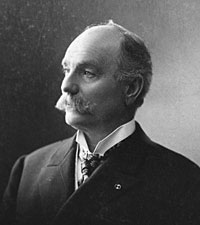
Captain Robinson Derling Pike
~ A gift that spawns Great Lakes fisheries:The legacy of Bayfield pioneer R.D. Pike, by Julia Riley, Darren Miller and Karl Scheidegger for the Wisconsin Department of Natural Resources, October 2011.
Robinson Darling PIKE, son of Judge Elisha and Elizabeth Kimmey PIKE, was a lumbering giant in early Bayfield history. Capt. R. D. Pike, as his name appeared weekly in the Press, was one of the most influential men in the county, associated not only with timber interests, but with the Bayfield Brownstone Company, the electric light company, the fish hatchery, etc. Just before his death on March 27, 1906, he wrote the following recollections of early Bayfield. The paper was read at the Bayfield 50th anniversary celebrations and was published in the March 30, 1906 issue of the Press along with Capt. PIKE’s obituary:
I regret very much not being able to be with you at the celebration of the fiftieth anniversary of the town of Bayfield. As you may be aware, I have been ill for the past few weeks, but am pleased to state at this time I am on the gain and hope to be among you soon. If my health permitted I would take great pleasure in being present with you this evening.
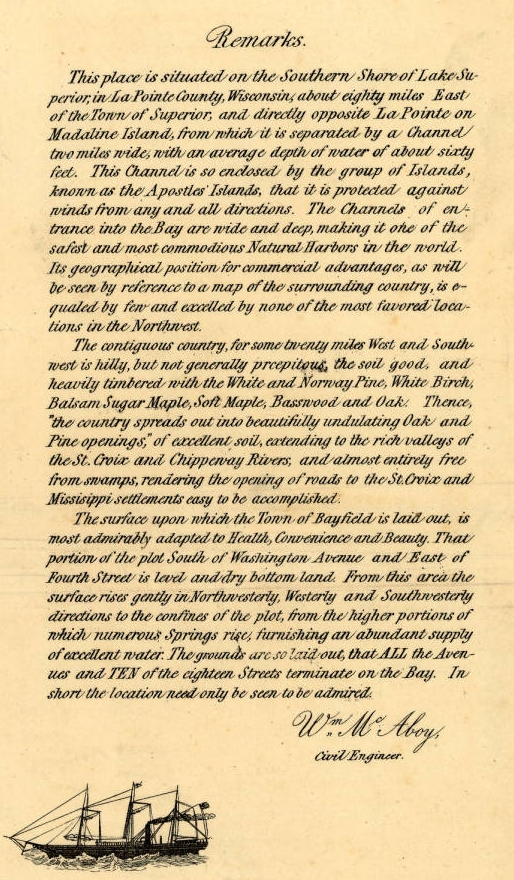
Detail from Major William McAboy‘s 1856 Map of Bayfield.
Senator Henry Mower Rice
~ United States Senate Historical Office
I remember very distinctly that the first stake was driven in the town of Bayfield by Major McABOY who was employed by the Bayfield Townsite Company to make a survey and plat same, (the original plat being recorded at our county seat.) This Bayfield Townsite Company was organized with Hon. Henry M. RICE of St. Paul at the head and some very enterprising men from Washington D.C. Major McABOY arrived here about the first of March and made his headquarters with Julius AUSTRIAN of LaPointe. Julius AUSTRIAN in those days being the Governor General of all that part of the country west of Ontonagon to Superior; Ashland and Duluth being too small to count The major spent probably two weeks at LaPointe going back and forth to Bayfield with a team of large bay horses owned by Julius AUSTRIAN, being the only team of horses in the country.
For more information about Julius Austrian, see other Austrian Papers.
I remember very well being in his office at LaPointe with father, (I being then a mere lad of seventeen,) and I recollect hearing them discuss with Mr. AUSTRIAN the question of running the streets in Bayfield north and south and avenues east and west, or whether they should run them diagonally due to the topography of the country, but he decided on the plan as the town is now laid out. Mr. AUSTRIAN and quite a little party from LaPointe came over here on the 24th of March, 1856, when they officially laid out the town, driving the first stake and deciding on the name Bayfield, named after Lieutenant Bayfield of the Royal Navy who was a particular friend of Senator RICE, and it was he who made the first chart for the guidance of boats on Lake Superior.

“Map of Bayfield situate in La Pointe County, Wisconsin” by Major William McAboy, 1856 for the Bayfield Land Company.
~ Wisconsin Historical Society

For more information about Indian interpreter Frederick Prentice, see his appearances in the Barber Papers.
~ Portrait of Prentice from History of the Maumee Valley by Horace S Knapp, 1872, pages 560-562.
The summer of 1855 father was in poor health, filled up with malaria from the swamps of Toledo, and he was advised by Mr. Frederick PRENTICE, now of New York, and known by everybody here as “the brownstone man,” to come up here and spend the summer as it was a great health resort, so father arrived at LaPointe in June, 1855, on a little steamer that ran from the Soo to the head of the lakes, the canal at that time not being open, but it was opened a little later in the season.

Detail of “Austrian’s Saw Mill” on Pike’s Creek, Chequamegon Bay, Lake Superior, circa 1852.
~ Wisconsin Public Land Survey Records
Upon arrival at LaPointe father entered into an agreement with Julius AUSTRIAN to come over to Pike’s creek and repair the little water mill that was built by the North American Fur Company, which at that time was owned by Julius AUSTRIAN. He made the necessary repairs on the little mill, caught plenty of brook trout and fell in love with the country on account of the good water and pure air and wrote home to us at Toledo glowing letters as to this section of the country. Finally he bought the mill and I think the price paid was $350 for the mill and forty acres of land, and that largely on time; however the mill was not a very extensive affair. Nearly everything was made of wood, except the saw and crank-pin, but it cut about two thousand feet of lumber in twelve hours. Some of the old shafting and pulleys can be seen in the debris at the old mill site now. Remember these were not iron shafts as we used wooden shafts and pulleys in those days. This class of the mill at the time beat whip-sawing, that being the usual way of sawing lumber.
Father left LaPointe some time in September 1855 for Toledo to move his family to Pike’s creek, which stream was named after we moved up here. Onion river and Sioux river were named before that time. On father’s arrival from Toledo from this country we immediately began to get ready to move. We had a large fine yoke of red oxen and logging trucks. He sold out our farm at Toledo, packed up our effects, and boarded a small steamer which took us to Detroit. Our family then consisted of father, mother, grandma PIKE, and my sister, now Mrs. BICKSLER, of Ashland. We stayed several days in Detroit to give father time to buy supplies for the winter; that is feed for the oxen and cow and groceries for the family to carry us through until Spring.
We then boarded the steamer Planet, which was a new boat operated by the Ward Line, considered the fastest on the lake. It was about two hundred fifty tons capacity. We came to Sault Ste. Marie, it being the Planet‘s first trip through the Soo, the canal as I remember was completed that fall. During this year the Lady Elgin was running from Chicago and the Planet and North Star running from Detroit, they being about the only boats which were classed better than sail boats of the one hundred and fifty tons.

Portrait of the Steamer North Star from American Steam Vessels, by Samuel Ward Stanton, page 40.
~ Wikimedia.org
We arrived at LaPointe the early part of October, 1855. On our way up we stopped at Marquette, Eagle Harbor, Eagle River, and Ontonagon. We left Ontonagon in the evening expecting to arrive at LaPointe early the next morning, but a fearful storm arose and the machinery of the Planet became disabled off Porcupine mountains and it looked for a while as though we were never going to weather the storm, but arrived at LaPointe the next day. There were some parties aboard for Superior who left LaPointe by sail.
We remained at LaPointe for a week or ten days on account of my mother’s health and then went to Pike’s bay with all our supplies, oxen and cow on what was known as the Uncle Robert MORRIN’s bateau. Uncle Robert and William MORRIN now of Bayfield, and if I remember rightly, each of the boys pulled an oar taking us across. We landed in Pike’s bay just before sundown, hitched up the oxen and drove to the old mill. Now, this was all in the fall of 1855.

Detail from William McAboy‘s 1856 Map of Bayfield.
“HON. JOHN W. BELL, retired, Madeline Island, P.O. La Pointe, was born in New York City, May 3, 1805, where he remained till he was eight years of age. His parents then took him to Canada, where his father died. He had gotten his education from his father and served an apprenticeship at three trades – watchingmaking, shipbuilding, and coopering. He then moved to Ft. La Prairie, and started a cooper shop, where he remained till 1835, when he came to La Pointe, on the brig “Astor,” in the employ of the American Furn Company as cooper, for whom he worked six months, when he took the business into his own hands, and continued to make barrels as late as 1870. It was in 1846 or 1847 that Robert Stewart, then Commissioner, granted him a license, and he opened a trading post at Island River, and became interested in the mines. he explored and struck a lead in the Porcupine Range, on Onion River, which he sold to the Boston Company, and then came back to La Pointe. In 1854 he was at the treaty between the Chippewas of Lake Superior and the Mississippi River, and was appointed Enrolling Agent on their new reservation, on the St. Louis River, where he went, but soon came back, as the Indians were not willing to stay there. He was then appointed by the Indians to look up their arrearages, and while at this work visited the national capital. He was appointed to County Judge for La Pointe County, and helt till 1878. He was elected on the town board in 1880. Has been Register of Deeds a great many years. Has held most all the different county and town offices, and at one time held or did principally the business for the whole county. He has seen La Pointe in all of its glory dwindle down to a little fishing hamlet; is now Postmaster at his island home, where he occupies a house put up by the old fur company. He was married in 1837 to Miss Margaret Brebant, in the old Catholic Church, by Rev. Bishop Baraga. They had seven children – John(deceased), Harriette (now Mrs. La Pointe), Thomas (deceased), Alfred (now Town Clerk), Sarah F., Margaret (deceased), and Mary (now Mrs. Denome).”
~ History of Northern Wisconsin, by the Western Historical Company, 1881.
As I said before, the town was laid out on March 24th, 1856, and record made same at LaPointe by John W. BELL, who at that time was the “Witte” of all the country between Ontonagon and Superior; Julius AUSTRIAN being the “Czar” of those days and both God’s noblemen. [Note: This was a reference to Count Sergei Witte and Tsar Nicholas II, contemporaries of Capt. Pike. Witte was responsible for much industrial development of Tsarist Russia in the 1890’s.] The Territory now comprising the town of Bayfield was taken from LaPointe county. There were a number of very prominent men interested in laying out the townsite and naming our avenues and streets, such as Hon. H. M. RICE and men of means from Washington after whom some of our avenues were named.
Very soon after this they wished to build a large mill in order to furnish lumber necessary for building up the town. The Washington people decided upon a man by the name of CAHO, an old lumberman of Virginia, so he was employed to come up here and direct the building of the mill. A hotel was built directly across from the courthouse by the Mr. BICKSLER who afterwards married my sister. The saw mill was built about a block west of where my saw mill now stands. The mill had a capacity of five or six thousand feet per day and I think the machinery came from Alexandria, Virginia. Joe LaPOINTE was the only man recognized as being capable of running a mill from the fact that he could do his own filing and sawing. While they were constructing the mill they had a gang of men in the woods getting out hard wood for fuel, not thinking of using any of the sawdust, and they piled the sawdust out with the slabs as useless. Charley DAY, whom many of you will remember, who was the party who got out the hardwood as fuel for the mill.
Time has wrought many changes in our midst. As far as I know, I am the only white man living who was here at the time the town was laid out.
In conclusion I wish to say that at a banquet given in Bayfield some two or three years ago, I made the statement that when the last pine tree was cut from the peninsula on which Bayfield is located the prosperity of our town and vicinity will have just commenced. The pine has gone and now we are cutting the hemlock and hardwood which will last ten to fifteen years; and long before this is exhausted the cut over lands will be taken up and farms tilled, as is the history of other sections of the country.

“Elisha and R.D. Pike owned a private fish hatchery [at Julius Austrian’s former sawmill] in Bayfield County from the 1860s to 1895. The Wisconsin State Legislature mandated the construction of a fish hatchery in northern Wisconsin in 1895, so R.D. Pike donated 405 acres (1.64 km2) from his hatchery to serve as the state hatchery. The state built the main hatchery building in 1897 using brownstone from nearby Pike’s Quarry. The Chicago, St. Paul, Minneapolis and Omaha Railway built a siding to the hatchery, and a special railcar known as The Badger brought fish from the hatchery to Wisconsin waterbodies. In 1974, new buildings and wells were constructed to modernize the hatchery. The hatchery was renamed in honor of longtime Wisconsin Department of Natural Resources secretary Les Voigt in 2006, and the main building was named for R.D. Pike in 2011. The hatchery currently spawns five types of trout and salmon and also includes a visitor’s center and aquarium.”
~ Wikipedia.org
Baash-ki-taa-go-zi, the Firecracker
March 5, 2016
By Amorin Mello

Original sketch of Detroit’s flag, by David Emil Heineman, 1907.
~ Detroit Historical Society
This is a reproduction of biographical sketches from “Jewish Beginnings in Michigan Before 1850,” by Hon. David Emil Heineman. It was transcribed from Publications of the American Jewish Historical Society: Number 13, 1905, pages 57-63. The author’s father, E. S. Heineman, and Kanter were business partners. For more information about Kanter while working for the Leopolds and Austrians families, see the Edward Kanter Papers, 1847-1848.

——-
Jewish Beginnings in Michigan Before 1850
——-
Beginnings Of The Immigration Preceding The Year 1850.
An account of the Jews who came to Michigan in the years immediately succeeding 1850 would be of secondary interest to a society such as this. Such an account would be more proper for a local than a national society; it would deal with the extensive immigration, principally German, of that period, and be made up of long lists of names, birthplaces, and dates of arrival. It would be a recital common at a somewhat earlier date to most of the then Western States telling of the humble beginnings of prosperous merchants, successful professional men, and communal leaders, in largest measure, valuable and valued citizens. The beginnings of congregations would be accurately set down and the memory of man would still suffice to amend the errors due to a neglect of local history. Inasmuch as there has hitherto been a woeful neglect of proper investigation, the writer does not hesitate to enlarge upon the commencement of this immigration and upon a few pioneers therein, all prior to 1850.
The Leopold And Austrian Families.

1843 Drawing of Mission Point Beach at Mackinac Island, Michigan ~ Wikimedia.org
We again recur to Mackinac, and in 1845 find at this point members of the Leopold and Austrian families1 which afterwards became prominent as owners of Lake Michigan vessels and merchants in the ports of the Great Lakes. Lewis F. Leopold, his wife, who was a Miss Babette Austrian,and their son of less than a year old, together with his sister Hannah and his brother Samuel, were located at the island in the year mentioned. Samuel F. Leopold soon after his arrival at Mackinac purchased a one-mast sloop, the “Agate,” with which he gathered up the product of the different fishing points, becoming the first pioneer at this locality in the fishery business, which since that time has grown to such a great industry. The brothers sent down to Cleveland a thousand barrels of salted fish each season, no insignificant industry for those days. This venture, together with the sale of supplies to fishermen, Indian trading, and the purchase of furs, laid the foundations for an extensive business. Samuel F. Leopold left Mackinac in 1853, joining his brothers, Henry and Aaron, and Julius Austrian, who had married Miss Hannah Leopold in 1849, in their recently undertaken business ventures at La Pointe and Fond du Lac, Wisconsin, where they were among the first white settlers.
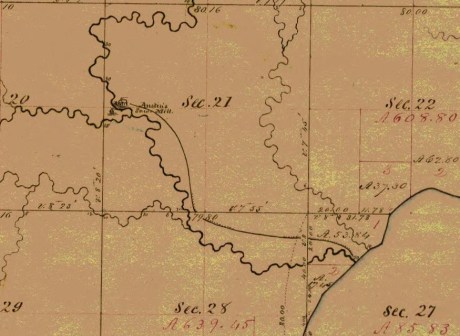
Detail of the “Austrian’s Saw Mill” (formerly the American Fur Company’s sawmill) on Pike’s Creek in the Town of Bayfield, La Pointe County, circa 1852. ~ Wisconsin Public Land Survey Records
Stories about the Austrians’ sawmill and home in Bayfield are shared in Joseph Austrian’s Memoir, and in Benjamin Armstrong’s Memoir.
The town of Bayfield, Wisconsin, was platted shortly thereafter, Marks and Julius Austrian being the preemptors, and Mrs. Julius Austrian the first white woman resident at that place. The history of these enterprising and prominent families, it will thus be seen, falls properly to Wisconsin, but in addition to what has been mentioned, it should be stated that within a few years after 1850 they had established leading stores in Michigan, at Eagle River, Eagle Harbor, the Cliff Mine, Calumet, and at Hancock, Mr. Joseph Austrian having selected at the latter place the site for its first store and warehouse. The Leopolds came from Baden where their name was Freudenthaler; the Austrians, whose name originally was Oesterreicher, came from Wittelshofen, Bavaria. As is obvious, the name in each instance was changed purely for convenience.

Map of the City of Bayfield, La Pointe Co., Wisconsin : Showing the Situation of Lands of Lyman C. Dayton of St. Paul, Minnesota, in and Adjoining the Same, drawn by Wellman and Johnson, surveyors, circa 1856. ~ Wisconsin Historical Society
Sketch Of Edward Kanter.2
There was a young man at Mackinac who in 1846 worked for the parties just mentioned and whose name was Edward Kanter. He had come to Detroit in the fall of 1844 and remained a citizen of Michigan until his death, 52 years later. Always a modest man, he never, in spite of his prominence as a citizen, permitted the publication of his biography and the interesting facts of his career certainly deserve such preservation as the records of this Society afford. They are here set forth for the first time.
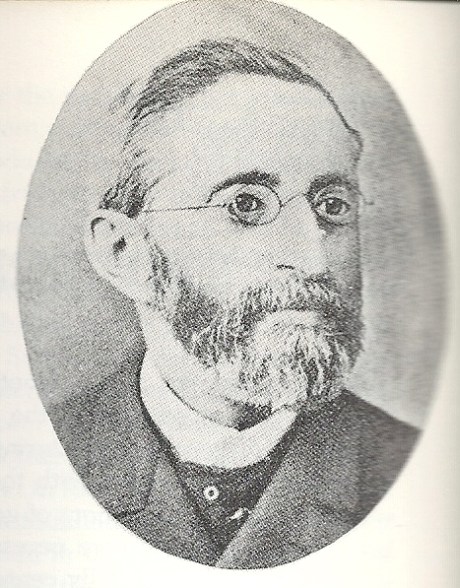
Edward Kanter “Photo published in Katz, Irving I. The Jewish Soldier from Michigan in the Civil War. Detroit, Mich.: Wayne State University Press, 1962. Page 8. Kanter served as vice-president of a Detroit soldier recruitment organization and was the first Jewish member of the Michigan Legislature. Added by: Hebrew Heritage Foundation”
~ Findagrave.com
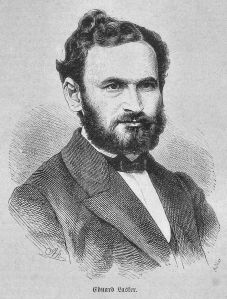
Edward Kanter was related to German Parliamentarian Eduard Lasker (originally Jizchak Lasker).
~ Wikipedia.org
Edward Kanter was born in Breslau in 1824. His father was Louis Kanter, a prosperous linen merchant and a member of the Linen Merchants’ Guild. His mother was Helena Lasker, a near kinswoman of Edward Lasker, the German Parliamentarian, of whose birthplace she was also a native. Young Kanter graduated from the Breslau Gymnasium, equipped among other things with a knowledge of Greek, Latin, German, English, French, and Hebrew. In later years he was often heard to remark that it was his education above all things which helped him out in emergencies. A wild spirit of adventure seized him early in life with the result that he ran away from home and made his way to Paris where his knowledge of the language obtained him employment in a lawyer’s office. Six months later saw him at Havre where, as he was strolling about the wharves, a sudden impulse prompted him to go aboard a vessel bound for New Orleans. He hid behind a coil of rope until well out at sea when he was discovered and at once given a further taste of the rope accompanied by an assortment of curses in several languages. As he was able to turn away wrath with soft answers in all of the respective tongues, it instantly dawned upon the mate at the other end of the rope that he had found a much-needed interpreter for the immigrants of various nations with whom the ship was crowded. The rest of the trip was pleasant sailing for the young stowaway.
The Occident and American Jewish Advocate, Vol. IX. No. 8: Elul 5611, September 1851
——-
“Isaac Hart, Esq., of New Orleans.—We lately intimated that Mr. Hart would be presented with a token of regard from the congregation over which he had been president for several years. The presentation took place on Sunday, the 21st of September, and the following extract from the New Orleans Bee will give our readers all the particulars which have reached us:
Presentation of a Silver Pitcher.— On Sunday last, we were witness of a highly-interesting ceremony. Everybody knows Mr. Isaac Hart, of Canip Street, and most persons are aware that he is an active, zealous, and intelligent member of the German Hebrew Congregation of this city. To his unwearied exertions, his liberality, and his unflagging energy, that Congregation is indebted, in a great degree, for its present prosperity, and for the possession of a spacious and beautiful Temple for the worship of the GOD of Israel. Mr. HART retained the honorable post of President of the Congregation, devoting himself to its welfare, until its leading objects were secured. He then resigned his office, leaving to his successors a noble example of the successful fruits of diligence, religious faith, and indefatigable perseverance.
The members of the congregation, desirous of testifying their grateful appreciation of the efforts of their ex-president, subscribed toward the construction of a massive silver pitcher of exquisite workmanship, having on one side an appropriate inscription, and on the other a beautiful representation of the German Synagogue, and enriched all over with tasteful devices. On Sunday, the officers of the Congregation assembled at Mr. Hart’s residence, and Mr. George G. Levi, on behalf of that body, tendered the pitcher to that gentleman, accompanying the gift with some feeling and eloquent remarks, in which he set forth the valuable services of Mr. Hart, and the high sense of his merits entertained by the association of which he had been selected the interpreter. The donee, in accepting the splendid token, responded warmly and sincerely. He sketched the history and progress of the Congregation, from the days when, obscure and almost nameless, it first struggled into existence, up to the present time, when its members assemble weekly in a noble edifice, consecrated to the Almighty, to solemnize their Sabbath and offer up devotion and prayer to the Most High. He claimed little merit for himself, but said, that like a general in battle, he only led his soldiers, while they had won the victory by their courage and resolution. At the conclusion of the ceremony, the gentlemen and ladies present were conducted by Mr. Hart into another room, where they were entertained with cordial and profuse hospitality.”
On arriving at New Orleans, he found himself with but a single shilling which he gave to be changed to one of the sailors on the ship. The sailor did not return and so the lad landed on the soil of America with literally not a single penny in his pocket. Hardly ashore, he was laid low with yellow fever. He was taken care of by a relief committee of Jewish citizens of New Orleans, among them Mr. Isaac Hart, afterwards a resident of Detroit, a gentleman most kindly remembered by Detroiters. Upon his recovery, the same committee set him to peddling cigars until a congenial place was found for him in a drug store. The place was too congenial; he was much given to chemical experiments, reminiscences perhaps of the Breslau Gymnasium. Presently one of the experiments resulted in a bad explosion of the drug store, from the wreck of which the young scientist rushed terrified to the levee. He went aboard the first boat which happened to need a waiter. Because of his excellent penmanship he was soon promoted to the position of clerk and as such he continued to sail up and down the Red River until one day the boat happened to blow up opposite Helena. He swam ashore, worked his way to St. Louis, took a steamer to Pekin, Illinois, and walked thence to Chicago, where he shipped on the steamer Wisconsin until the close of navigation, 1844. He was now only twenty years of age, but had certainly obtained a few lessons in the larger university of life.
Jewish Virtual Library: Detroit
——-
“German Jews arrived in Detroit in significant numbers in the 1840s. Charles E. Bresler, a settler of the Ann Arbor-Ypsilanti area in the 1830s, moved to Detroit in 1844. He dealt in horses, furs, and wool, and made a fortune importing steel pens. He was one of the incorporators of Detroit’s first Jewish congregation, Temple Beth El. Edward Kanter arrived in Detroit that same year, moving to Mackinac the following year where he was employed by the American Fur Company. Later he worked for the Leopold Brothers, pioneers on the island of Mackinac in the fishery business, and fur traders. Kanter returned to Detroit in 1852 and became Detroit’s first Jewish banker and the first Michigan Jew to serve in the state legislature. Kanter Street is named after him.”
He spent the winter of 1844 in Detroit. The English he had learned at Breslau had always given him trouble, or more properly speaking, had always given trouble to those to whom he spoke, and so he profited by his stay in Detroit to take some lessons from Chas. E. Bresler, a Jewish resident of Michigan, originally from the same part of Europe as Kanter. The ensuing spring saw him again on the lakes, this time as clerk of the steamer Illinois. He left this position, however, taking employment the same year at Mackinac as clerk and interpreter for the American Fur Company, the successor to John Jacob Aster’s venture. Here again his French and English stood him in good stead. His remarkable faculty for languages revealed itself in the rapidity with which he picked up the Indian tongues. In a short time he had mastered the Huron, Chippewa, and Pottawatomie languages and even in later life could on occasion unconcernedly carry on a fluent conversation in any of them. He visited at this time Duluth and the Apostle Islands and was a passenger on the first trip of the “Julia Palmer,” the second boat to be carried on rollers around the Falls at Sault Ste. Marie.
In 1846, as has been stated, he worked for the Leopolds and Austrians. The following year he had been placed in charge of a stock of goods at the island by some eastern parties who suddenly decamped without notice to their creditors. When the latter arrived, they were so impressed by the honesty and zeal wherewith young Kanter had guarded their interests that they voluntarily turned the entire stock and store over to him on easy terms of payment, and so in July, 1847, he opened his books with a cash capital of $200. On these prospects he married a month later the daughter of former State Senator Lyman Granger of the neighboring Bois Blanc Island. He remained at Mackinac until 1852. In that year the late Mr. E. S. Heineman,3 father of the writer, recently arrived at Detroit, was sent to Mackinac to be present at the Indian payment. Mr. Kanter and he immediately became warm friends. The Indians had given Mr. Kanter, because of his bustling activity, the name of “Bosh-bish-gay-bish-gon-sen,” meaning “Fire Cracker,” and Mr. Heineman being somewhat shorter in stature than Mr. Kanter, but of equal activity, was immediately dubbed “Little Firecracker.”
Edward Kanter’s father-in-law was Senator Lyman Granger.
~ Findagrave.com
The red men always had a great liking for Mr. Kanter; they never missed an opportunity to call on him in Detroit or to send greetings to him. The merchants of Detroit in the early 60’s were at a loss one day to account for a circle of Indians gravely squatted in front of Mr. Kanter’s store on the chief business street, Mr. Kanter making one of the circle, the whole company smoking and maintaining a dense silence, until they were informed that a delegation of chiefs on their way to see the Great Father at Washington would not pass through Detroit without smoking a pipe of peace with “Firecracker.”
Julius Austrian also went to Germany during 1853 to liquidate his recently deceased father’s estate, and to bring the rest of his family back to settle upon the Great Lakes. Did Edward Kanter travel with the Austrian family?

German-American Bank, possibly Detroit, circa 1900-1920.
~ Library of Congress
In 1853 Mr. Kanter visited his parents in Europe. On his return he continued his successful business career. He became the founder of the German-American Bank, of which one of his sons continues at present to be a principal officer. He entered actively into political life at about this time. He was elected to the legislature of 1857, and though not a member of the prevailing party, presented and so persistently drove home a minority report on certain wrongdoings in the State treasury that the matter ended with the guilty party’s being sent to prison. He was twice made a candidate for the office of State Treasurer, but being a Democrat, the nomination was against hopeless odds. Mr. Kanter was long and conspicuously connected with the Democratic party organization. In the sixties he was Secretary of the Democratic State Central Committee; he was a delegate to the National Convention that nominated Tilden, for eight years was the member from Michigan of the Democratic National Committee. He was Commissioner from Michigan to the New Orleans Exposition, a member of the Board of the House of Correction of Detroit, and in general a constant and valuable participator in public affairs. He was Vice-President and Treasurer of Congregation Beth El in Detroit in 1855 and an unfailing contributor towards its needs. He died in June, 1896. Respected by all who knew him, he left a name synonymous with strict integrity.

“German American Bank, Detroit. Organized February 3, 1883.”
~ Annual Report of the Commissioner of the Banking Dept
By Michigan. Banking Dept, 1891, page 56.
Detail from Congregation Beth El
by Temple Beth El (Detroit, Mich.), 1900, page 54.
1 Data obtained through the kindness of our fellow-member, Rev. Dr. Jos. Stolz, from Mrs. Julius Austrian (Hannah Leopold), and other members of the Austrian family.
2 Data supplied mainly by Hon. Henry L. Kanter of Detroit, son of Edward Kanter.
3 Farmer’s History of Detroit, Vol. II, p. 1155. The friendship of these two young men, thus meeting on this distant and savage island, was a most natural one. Both had been born in the same year, both had received a superior education in Europe, and both had left homes of comfort and luxury, having been equally unfitted by temperament to endure the political and other conditions then prevailing abroad. Their friendship endured until 1896, being terminated by death, Mr. Kanter surviving his friend only a few days.
Legend of the Montreal River
March 5, 2016
By Amorin Mello & Leo Filipczak
This is a reproduction of “Legend of the Montreal River” by George Francis Thomas from his book: Legends of the Land of Lakes, Or History, Traditions and Mysteries, Gleaned from Years of Experience Among the Pioneers, Voyageurs and Indians: With Descriptive Accounts of the Many Natural Curiosities Met with from Lake Huron to the Columbia River. And the Meaning and Derivation of Names of Rivers, Lakes, Towns, Etc., of the Northwest, 1884, pages 70-73.
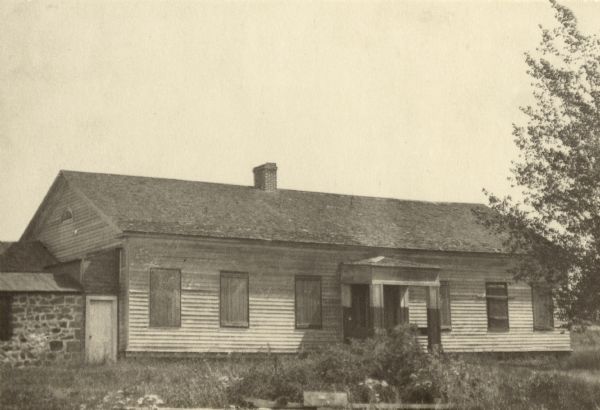
Old Treaty Hall, La Pointe, Madeline Island, cirica 1922.
“At some point in its history the building came into the hands of George Francis Thomas, who in turn presented it to the [Daughters of the American Revolution], but it was destroyed by fires shortly thereafter.”
~ Wisconsin Historical Society
——-
George Francis Thomas married Sarah E. Bell at La Pointe in 1882. Sarah was the daughter of Judge John William Bell of La Pointe and Maraget Brebant of the Sandy Lake Band of Chippewa Indians. Thomas inherited Treaty Hall at La Pointe from the Bell family after his in-laws and wife died. Thomas also inherited many legends from his marriage at La Pointe.

—
Legend of the Montreal River.
—
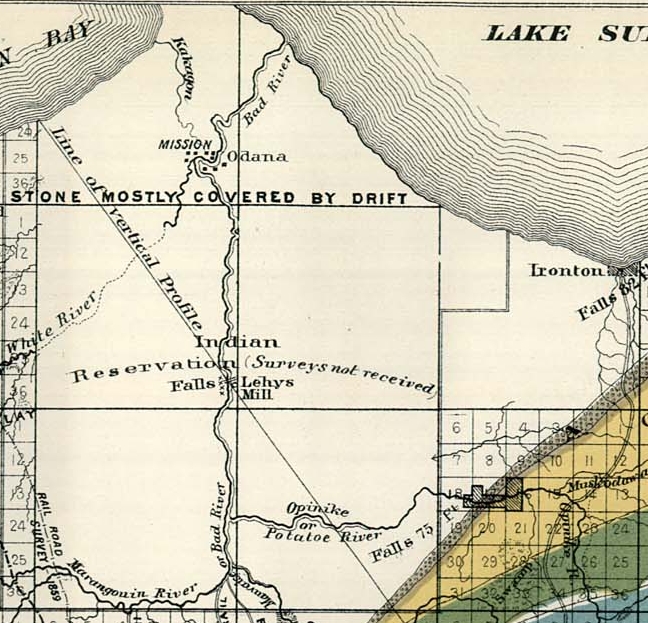
Detail of Odanah, Ironton, and Leihy‘s settlements on the La Pointe Reservation from Charles Whittlesey‘s 1860 “Geological Map of the Penokie Range“ from Geology of Wisconsin, Volume III, plate XX-214. Ironton is located near the mouth of the Montreal River.
Long ago, perhaps fifty years, before a single house or wigwam stood where the city of Ashland now spreads its mammoth protecting wings, there was an Indian settlement on Bad River and another near the beautiful falls on the Montreal. A short distance above its mouth and within sight of the lake, the red sandstone rocks rise boldly to the height of eighty feet, forming a ledge over which the entire volume of water is precipitated into a deep, circular basin or amphitheater, presenting a scene novel and strikingly beautiful. About three miles up the stream is another similar fall, very beautiful, but not so interesting as the first.
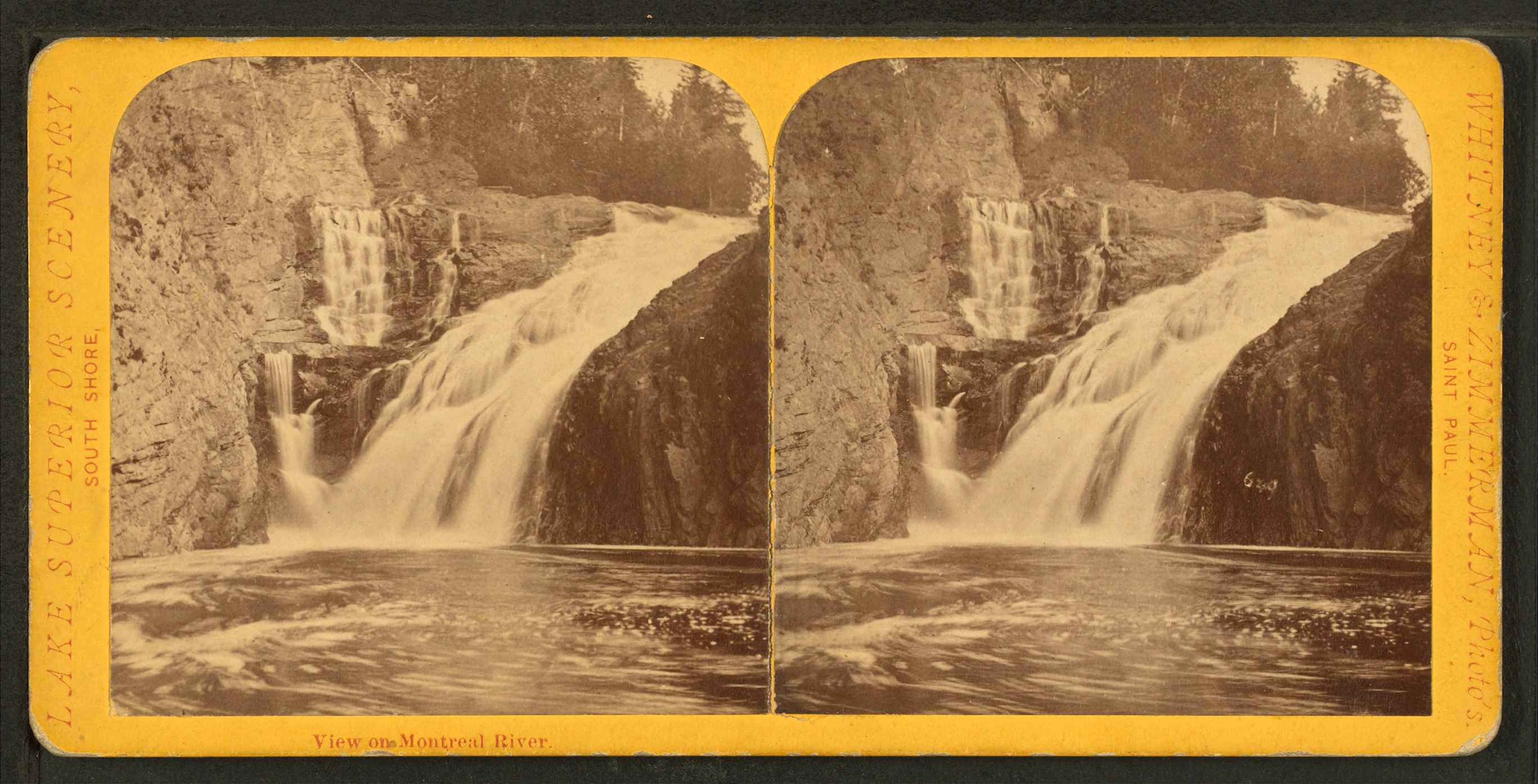
Superior Falls at the mouth of the Montreal River; featured in the stereograph titled “View on Montreal River” by Whitney & Zimmerman from St. Paul, circa 1870.
~ Wikimedia Commons
“Skirting the southern shore of the lake, past the now famous Pictured Rocks, [Pierre d’Esprit, Sieur Radisson, and his sister’s husband, Medard Chouart, Sieur de Groseilliers] carried across Keweenaw Point, visited a band of [Cree] Indians not far from the mouth of Montreal River, now the far western boundary between Upper Michigan and Wisconsin, and, portaging across the base of the Chequamegon Island of to-day, – then united to the mainland,- entered beautiful Chequamegon Bay.”
~ The Story of Chequamegon Bay by Reuben Gold Thwaites.
Below this lovely waterfall and near the shore of the lake, once dwelt the chief a Chippewa band, and near his wigwam were clustered a number of his warriors. Their time was passed in the chase and in fishing; the squaws made mats, canoes, and in the spring time maple sugar; and all were happy and prosperous. In this quiet, peaceful circle was enacted the only real love tragedy recorded during many years upon these shores; and this was caused by the cruel inconstancy of a white man, who had won the heart of an innocent child of nature only to break it, and leave her to mourn and die, as many a fairer, but no less pure maiden had been left before.

Detail of the Rivière du Montreal (Montreal River) from the Carte de l’Amerique Septentrionnale by Jean Baptiste Louis Franquelin, 1688.
~ Library of Congress
It seems that the simple girl had been won by the gew-gaws and glitter – so attractive to the forest maiden – brought here by a young American for trade. At first she only sought his wares, of which, owing to her standing in the tribe as the chief’s daughter, she was enabled to purchase a full share. Decked out in all the latest finery of civilization, she, woman-like no doubt, began to exhibit her new acquisitions in a spirit of rivalry, which, of course, soon begat jealousy in the hearts of her female companions. At this point Cupid came to the front; for if there is one thing more than another which a woman delights in, it is to monopolize the attention of the beau of society. In this particular society, for such really exists among the children of the forest, in a manner at least, the young trader reigned supreme. He was sought by all the beauties of the camp, and had no rival; for be it known that the old beaux and stand-bys are always laid on the shelf when a dashing cavalier from civilization appears – especially when he is an American, and of course rich – for all Americans are either rich or worthless in the eyes of the natives. This bold, bad man was the favored one, no Frenchman or half-caste Indian stood the least show, and ere the joyful days of spring time had gone, two hearts beat as one. The chief’s daughter and the young American were to be married, the gossips said. Time passed and the white man went below to buy goods. He returned, and went once more after many happy hours and days had rolled by; but the maid now began to get impatient. She dreamed that the white man loved another, which may have been true, for he never returned again. At their last parting she bade him farewell, never intimating her suspicions until his canoe was launched upon the waters, and as he paddled away her song of reproach, full of melody and pathos greeted his most unwilling ears. The notes, clear and sweet, floated out over the rising billows, until the truant lover was far beyond. Her words in part were these:
“That water on whose bosom bright,
With joy I’ve seen your bark appear;
You cross no longer with delight,
Nor I with joy, your greeting hear.False words are thine; tho’ now you sigh
I know your grief is not sincere;
‘Tis well our dreaded parting’s nigh;
I bid farewell to pleasure dear.When o’er the waters wide and deep,
Far, thine Ojibway maid shall be,
New loves will make you please to weep,
Nor e’er again remember me.”
With this the fairest of all the tribe, the beloved child of a kind father, confiding and loving, thoughtless and innocent, the merry chirping bird of the forest, and the forsaken fawn, left to die of a wounded heart, wandered far away and was lost in the impenetrable pine forest.
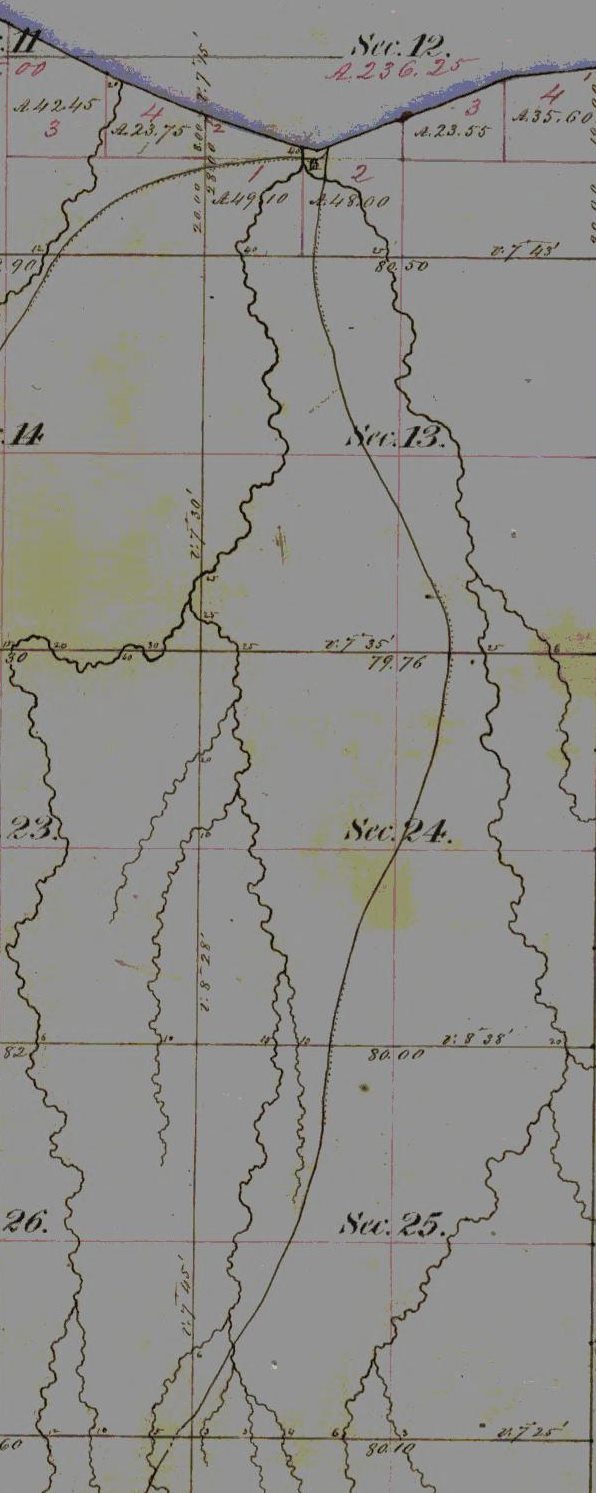
Detail of the Chippewa village (Ironton), at Saxon Harbor, near the mouth of the Montreal River and Superior Falls; with footpaths leading East towards Odanah, and South into the Penokee Mountains …
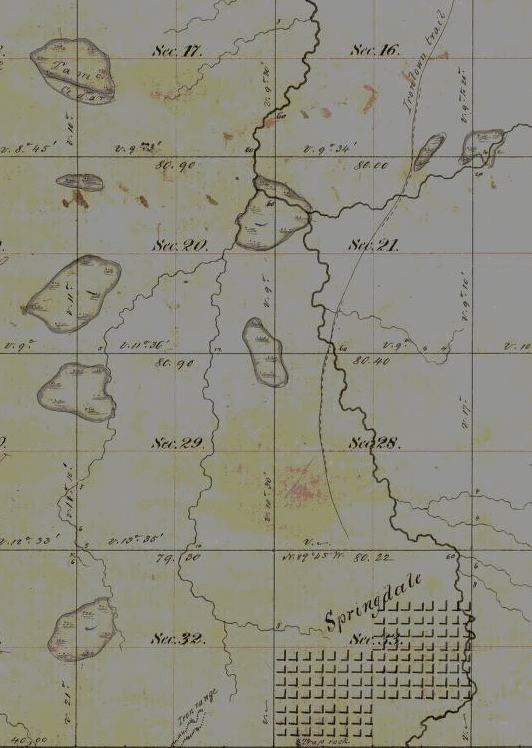
… leading to the Wisconsin & Lake Superior Mining & Smelting Company‘s town-site Springdale at The Gorge on Tyler Forks River.
~ Wisconsin Public Land Survey Records
[…]
“Rome was not built in a day, but most of these cabins were. I built four myself near the Gorge [on Tyler Forks River], in a day, with the assistance of two halfbreeds, but was not able to find them a week afterwards. This is not only a mystery but a conundrum. I think some traveling showman must have stolen them; but although they were non est we could swear that we had built them, and did.“
~ Penokee Survey Incidents: IV
Years afterwards, about 1857, there was considerable excitement in these regions on account of copper discoveries in the range near where it crosses Bad River. Buildings were erected on the banks of Tyler’s Fork, and near the falls, the remains of which are visible at the present day. Mines were opened with fair prospects, but there was no use to try to stem the tide, the current was too strong, transportation was too primitive, and the mines were abandoned. Not, however, until a strange discovery had been made. One day while engaged in exploring below the falls, a workman noticed in a pool what he at first took for a water-soaked section of a log. It was covered by some two feet of water and on closer contact was found to be a solid rock, but in form and size of a human being; in fact it was a petrified Indian woman. How it came there is a mystery. Only a few ever knew of the discovery, for it was kept a secret until it was carried away and sold to a New York Museum. Those who saw the petrified body and knew the story of the chief’s daughter failed not to connect here the two mysteries of the pine forest.
Bad River1 receives its waters partially from a marsh just south of the Penokee range, and besides being dark in color, it possesses some peculiar qualities which may have caused the petrifaction of the body of the young girl after she had drowned herself, as she most likely did.
1 The Chippewa name for Bad River is Mus-ke-ze-bing, meaning river from the marsh. Because the water was discolored the white men thought the Indian name meant dirty or impure water.

Wabigance below the Gorge on the Tyler Forks River.
~ Photograph by M. Matusewic © December 2013.
Reproduced with permission.
First Sawmills on the Bad River Reservation
March 5, 2016
By Amorin Mello
United States. Works Progress Administration:
Chippewa Indian Historical Project Records 1936-1942
(Northland Micro 5; Micro 532)

Abstract
“Records of a WPA project to collect Chippewa Indian folklore sponsored by the Great Lakes Indian Agency and directed by Sister M. Macaria Murphy of St. Mary’s Indian School, Odanah, Wisconsin. Included are narrative and statistical reports, interview outlines, and operational records; and essays concerning Chippewa religious beliefs and rituals, food, liquor, transportation, trade, clothing, games and dances, and history. Also includes copies of materials from the John A. Bardon collection concerning the Superior, Wisconsin region, La Pointe baptismal records, the family tree of Qui-ka-ba-no-kwe, and artwork of Peter Whitebird.”
Reel 1; Envelope 8; Item 4.
FIRST SAWMILLS ON THE BAD RIVER RESERVATION
By Jerome Arbuckle
Detail of Ervin Leihy’s sawmill at Bad River Falls omitted by the General Land Office.
– Ervin Leihy, one of the first white settlers to come to the northern part of Wisconsin died at his home in this city last week. He was born in Oswego county, N. Y., October 12, 1822. His early life was passed on a farm and at 18 moved to Illinois. Later he bought a farm at Bad River, Ashland county, and in 1846 moved onto it. In 1870 he moved to Bayfield, built his present home and opened a general store which he conducted for a number of years. While living at Bad River he was a member of the town and county boards of Ashland county for a number of years and in 1871 and 1872 was a member of the town board of Bayfield. Besides these he held numerous other offices. He was a public-spirited man, had plenty of means and was always ready to assist in anything that would tend to advance the interests of the town in which he resided.”
~ Wisconsin Weekly Advocate, June 6, 1901.
The first sawmill on the Bad River Reservation was operated by a Mr. Leihy at the rapids of Bad River, which is approximately fifteen miles from the village of Odanah. The power was furnished by a paddle-wheel which was propelled by the force of the stream. The saw was of the old vertical style. With these rude methods, the sawing of six to ten logs into lumber was considered a good daily average. Mr. Leihy was known to the Indians as “Nig-gig-goons” or “Little Otter”. He married a woman of Indian blood, and he apparently enjoyed great favor among the Indians of this region.
The lumber was placed on rafts made of large cedar logs and guided down Bad River when the conditions for such a venture were favorable. A long oar or sculler was used in the stern to assist in propelling the raft and to act as a rudder.
From the mouth of Bad River the raft emerged into Lake Superior provided the wind conditions were favorable, then along the shore line to Chequamegon point and thence across to Madeline Island. The channel between the point and the island was considerably narrower at the time than it is at the present. The lumber thus landed was carried to other points on the Lake by sailboats.

Detail of Albert “Wabi-gog” McEwen‘s sawmill on the White River omitted by the General Land Office.
According to the oldest residents of Odanah, another sawmill was located some distance up the White River. This mill was operated by a man known to the Chippewa as “Wabi-gog” or “The White Porcupine.” This mill was operated practically the same as the Leihy mill. The lumber was also rafted down White River to the confluence with Bad River, thence to Lake Superior and to Madeline Island. During the winter the lumber from this mill was hauled on sleighs by oxen to what is now the city of Ashland.
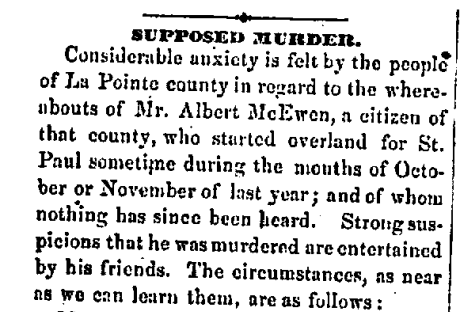
Read about Benjamin Armstrong’s investigation of Wabi-gog‘s supposed murder in Poor McEwen.
“Wabi-gog” was in the habit of making trips on foot to St. Paul, where he purchased the necessaries for his project. He used a trail that intersected what was known as the “Military Road” which led to St. Paul.
On one of these trips he failed to arrive at his destination and no trace of him was ever found. It was surmised that he had been waylaid and murdered, as he usually carried a considerable sum of money on his person.
Detail of the La Pointe Indian Reservation from Charles Whittlesey‘s 1860 “Geological Map of the Penokie Range“ from Geology of Wisconsin, Volume III, plate XX-214: “Lehys Mill” is identified at the Falls on the “Mauvaise or Bad River”. The White River was partly surveyed upstream from the Mission at “Odana”, up to Albert “Wabi-gog” McEwen‘s sawmill, but did not identify it. Whittlesey may have had a copy of Joel Allen Barber’s missing 1856 survey of The Gardens at Odanah.
Biographical Sketch of Vincent Roy, Jr.
March 3, 2016
By Amorin Mello
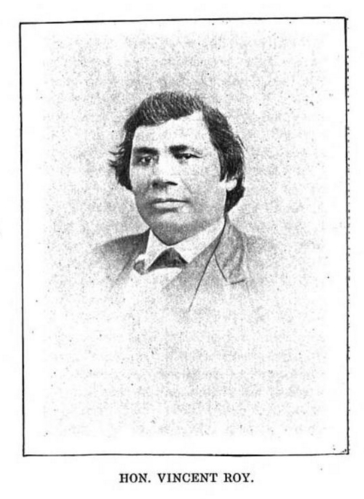
Portrait of Vincent Roy, Jr., from “Short biographical sketch of Vincent Roy,” in Life and Labors of Rt. Rev. Frederic Baraga, by Chrysostom Verwyst, 1900, pages 472-476.
Miscellaneous materials related to Vincent Roy,
1861-1862, 1892, 1921
Wisconsin Historical Society
“Miscellaneous items related to Roy, a fur trader in Wisconsin of French and Chippewa Indian descent including a sketch of his early years by Reverend T. Valentine, 1896; a letter to Roy concerning the first boats to go over the Sault Ste. Marie, 1892; a letter to Valentine regarding an article on Roy; an abstract and sketch on Roy’s life; a typewritten copy of a biographical sketch from the Franciscan Herald, March 1921; and a diary by Roy describing a fur trading journey, 1860-1861, with an untitled document in the Ojibwe language (p. 19 of diary).”
Reuben Gold Thwaites was the author of “The Story of Chequamegon Bay”.
St. Agnes’ Church
205 E. Front St.
Ashland, Wis., June 27 1903

Reuben G. Thwaites
Sec. Wisc. Hist Soc. Madison Wis.
Dear Sir,
I herewith send you personal memories of Hon. Vincent Roy, lately deceased, as put together by Rev. Father Valentine O.F.M. Should your society find them of sufficient historical interest to warrant their publication, you will please correct them properly before getting them printed.
Yours very respectfully,
Fr. Chrysostom Verwyst O.F.M.

~ Proceedings of the State Historical Society of Wisconsin, Issue 51, 1904, page 71.
~ Biographical Sketch – Vincent Roy. ~
~ J. Apr. 2. 1896 – Superior, Wis. ~
I.
Vincent Roy was born August 29, 1825, the third child of a family of eleven children. His father Vincent Roy Sen. was a halfblood Chippewa, so or nearly so was his mother, Elisabeth Pacombe.1
Three Generations:
I. Vincent Roy
(1764-1845)
II. Vincent Roy, Sr.
(1795-1872)
III. Vincent Roy, Jr.
(1825-1896)
His grandfather was a french-canadian who located as a trader for the American Fur Company first at Cass Lake Minn, and removed in 1810 to the bank of Rainy River at its junction with Little Fork, which is now in Itasca Co. Minn.2 At this place Vincent saw at first the light of the world and there his youth passed by. He had reached his twentieth year, when his grandfather died, who had been to him and all the children an unmistakable good fortune.
‘I remember him well,’ such are Vincent’s own words when himself in his last sickness.3 ‘I remember him well, my grandfather, he was a well-meaning, God-fearing frenchman. He taught me and all of us to say our prayers and to do right. He prayed a great deal. Who knows what might have become of us, had he not been.’
The general situation of the family at the time is given by Peter Roy thus:4
“My grandfather must have had about fifty acres of land under cultivation. About the time I left the place (1839) he used to raise quite a lot of wheat, barley, potatoes and tobacco – and had quite a lot of stock, such as horses, cattle, hogs and chickens. One winter about twenty horses were lost; they strayed away and started to go back to Cass Lake, where my grandfather first commenced a farm. The horses came across a band of Indians and were all killed for food. – When I got to be old enough to see what was going on my father was trading with the Bois Forte bands of Chippewa Indians. he used to go to Mackinaw annually to make his returns and buy goods for a year’s supply.”
This trading of the Roys with the Indians was done in commission from the American Fur Company; that is they were conducting one of the many trading posts of this Company. What is peculiar is that they were evidently set up to defeat the hostile Hudson Bay Company, which had a post at Fort St. Francis, which was across the river, otherwise within sight. Yet, the Roys appear to have managed things peaceably, going at pleasure to the Fort at which they sold the farm-products that were of no use to themselves.
II.
LaPointe – School – Marriage
Grandfather Roy died and was buried on the farm in 1845. Soon after, the family broke away from the old homestead and removed to LaPointe, where a boy had been placed at school already 6 or 7 years before.5
“About the year 1838 or 1839,” says Peter Roy,6 “my father took me down to LaPointe, it then being the headquarters of the American Fur Company. He left me with my uncle Charles LaRose. (Mr. LaRose was married to his mother’s sister.) At that time my uncle was United States interpreter for Daniel P. Bushnell, U.S. Indian Agent. I went to the missionary school (presbyterian), which was under the charge of Rev. Sherman Hall. Grenville T. Sprout was the teacher.”
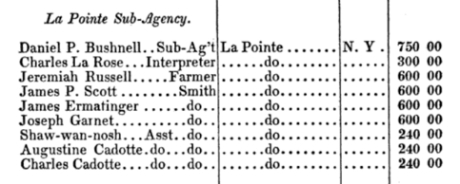
Officers | Where employed | Where born | Compensation
~ “War Department – Indian Agencies,” Official Register of the United States, 1839
The family was acting on wise principles. Where they lived church and school were things unknown and would remain such for yet an indefinite future. The children were fast growing from under the care of their parents; yet, they were to be preserved to the faith and to civilization. It was intended to come more in touch with either. LaPointe was then a frontier-town situated on Madaline Island; opposite to what is now Bayfield Wis. Here Father Baraga had from upwards ten years attended the spiritual wants of the place.
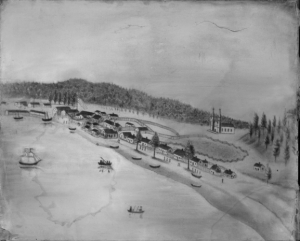
“View of La Pointe,” circa 1842.
~ Wisconsin Historical Society
Our Vincent came, of course, along etc. etc. with the rest. Here for the first time in his life, he came within reach of a school which he might have attended. He was however pretty well past school age. The fact is he did not get to see the inside of a school a ten months and may be, much less, as there is an opinion he became an employ for salary in 1845, which was the year of his arrival.7 But with his energy of will made up for lack of opportunity. More than likely his grandfather taught him the first rudiments, upon which he kept on building up his store of knowledge by self-instruction.
‘At any spare moment,’ it is said,8 ‘he was sure to be at some place where he was least disturbed working at some problem or master some language lesson. He acquired a good control of the English language; his native languages – French and Ojibway – were not neglected, & he nibbled even a little at Latin, applying the knowledge he acquired of that language in translating a few church hymns into his native Ojibway. Studying turned into a habit of life with him. When later on he had a store of his own, he drew the trade of the Scandinavians of that locality just because he had picked up quite a few words of their language. Having heard a word he kept repeating it half loud to himself until he had it well fixed on his memory and the stock laid up in this manner he made use of in a jovial spirit as soon as often as an opportunity was open for it.’

“Boardwalk leading to St. Joseph’s Catholic Church in La Pointe.” Photograph by Whitney and Zimmerman, circa 1870.
~ Wisconsin Historical Society
About three years after his coming to LaPointe, Vincent chose for his life’s companion Elisabeth Cournoyer. The holy bond of matrimony between them was blessed by Reverend Otto Skolla in the LaPoint catholic church, August 13th, 1848. They did not obtain the happiness to see children born to them. Yet, they lived with each other nearly 48 years and looking back over those years there appears nothing which could not permit their marriage to be called a happy one. Their home had a good ordinary measure of home sunshine in which, in a way, children came yet to do their share and have their part.
III.
His occupation.
Vincent was employed in the interest of the fur trade with little intermission up to the forty third year of his life and thereafter until he retired from business he was engaged in keeping a general store.
“Lapointe was a quiet town in the early days and many Indians lived there. The government pay station was there and the Indians received certain monies from the government.”
“The Austrians, a fine Jewish family, established a store and maintained a good Indian trade.”
“Knowing the Indians lack of providing for the future, the Austrians always laid in extra supplies for the winter and these were doled out when necessary.”
~ Tales of Bayfield Pioneers by Eleanor Knight, 2008.
“Mr. and Mrs. Julius Austrian were among the first settlers. Splendid people they were and especially kind to the Indians. It was their custom to lay in extra supplies of flour and corn meal for they knew the Indians would be begging for them before the winter was over. On this particular occassion the winter had been extra cold and long. Food supplies were running low. The Indians were begging for food every day and it was hard to refuse them. The flour was used up and the corn meal nearly so. Still Mrs. Austrian would deal it out in small quantities. Finally they were down to the last sack, and then to the last panful. She gave the children half of this for their supper, but went to bed without tasting any herself. About midnight she was awakened by the cry of ‘Steamboat! Steamboat!’ And looking out the window she saw the lights of the North Star approaching the dock. She said that now she felt justified in going downstairs and eating the other half of the corn bread that was left.”
~ The Lake Superior Country in History and in Story by Guy M. Burnham, 1930, pg. 288.
It was but natural that Vincent turned to the occupation of his father and grandfather. There was no other it may have appeared to him to choose. He picked up what was lying in his way and did well with it. From an early age he was his father’s right hand and business manager.9 No doubt, intelligent and clever, as he was, his father could find no more efficient help, who, at the same time, was always willing and ready to do his part. Thus he grew up. By the time the family migrated south, he was conversant with the drift of the indian trade knowing all its hooks and crooks; he spoke the language of the indians and had their confidence; he was swift a foot and enduring against the tear and wear in frontier life; and there was no question but that he would continue to be useful in frontier business.
Leopold and Austrian (Jews) doing a general merchandize and fur-trading business at LaPointe were not slow in recognizing ‘their man.’ Having given employment to Peter Roy, who by this time quit going to school, they also, within the first year of his arrival at this place, employed Vincent to serve as handy-man for all kind of things, but especially, to be near when indians from the woods were coming to trade, which was no infrequent occurrence. After serving in that capacity about two years, and having married, he managed (from 1848 to 1852) a trading post for the same Leopold and Austrian;10 at first a season at Fond du Lac, Minn., then at Vermillion Lake, and finally again at Fond du Lac.11 Set up for the sole purpose to facilitate the exchange trade carried on with the indians, those trading-posts, nothing but log houses of rather limited pretensions, were nailed up for the spring and summer to be reopened in the fall. Vincent regularly returned with his wife to LaPointe. A part of the meantime was then devoted to fishing.12
A Dictionary of the Otchipwe Language, Explained in English was published by Bishop Frederic Baraga in 1853.
It was also in these years that Vincent spent a great deal of the time, which was at his disposal, with Father Frederic Baraga assisting him in getting up the books of the Ojibway language, which that zealous man has left.13
In the years which then followed Vincent passed through a variety of experience.
IV.
His first Visit to Washington, D.C. – The Treaty of LaPointe.
Read Chief Buffalo Really Did Meet The President on Chequamegon History for more context about this trip.
At the insistence of Chief Buffalo and in his company Vincent made his first trip to Washington D.C. It was in the spring of the year 1852. – Buffalo (Kechewaishke), head chief of the Lake Superior Ojibways had seen the day, when his people, according to indian estimation, was wealthy and powerful, but now he was old and his people sickly and starving poor. Vincent referring once to the incidents of that time spoke about in this way:14
“He (Buffalo) and the other old men of the tribe, his advisors, saw quite well that things could not go on much longer in the way they had done. The whites were crowding in upon them from all sides and the U.S. government said and did nothing. It appeared to these indians their land might be taken from them without they ever getting anything for it. They were scant of food and clothing and the annuities resulting from a sale of their land might keep them alive yet for a while. The sire became loud that it might be tried to push the matter at Washington admitting that they had to give up the land but insisting they be paid for it. Buffalo was willing to go but there was no one to go with him. He asked me to go with him. As I had no other business just then on hand I went along.”
Ashland, Wisconsin, is named in honor of Henry Clay’s Estate.
They went by way of the lakes. Arriving at Washington, they found the City and the capitol in a barb of morning and business suspended.15 Henry Clay, the great statesman and orator, had died (June 29) and his body was lying in state. Vincent said:
“we shook hands and spoke with the President (Fillmore) and with some of the headmen of the government. They told us that they could not do anything at the moment, but that our petition should be attended to as soon as possible. Unable to obtain any more, we looked around a few days and returned home”.
The trip had entailed a considerable drain on their private purses and the result towards the point at issue for them, the selling of the land of the indians, was not very apparent.

Henry C. Gilbert
~ Branch County Photographs
After repeated urging and an interval of over two years, during which Franklin Pierce had become President of the United States, the affairs of these Indians were at last taken up and dealt with at LaPointe by Henry C. Gilbert and David B. Herriman, commissioners on the part of the United States. A treaty was concluded, September 30th, 1854. The Lake Superior Ojibways thereby relinquished their last claims to the soil of northwest Michigan, north east Wisconsin and an adjoining part of Minnesota, and, whilst it was understood that the reserves, at L’Anse Michigan, Odanah, and Courte Oreille Wisconsin and Fond du Lac Minnesota, were set apart for them, they received in consideration of the rest the aggregate sum of about four hundred and seventy five thousand dollars, which, specified as to money and material, ran into twenty years rations.
Chief Buffalo, in consideration of services rendered, was allowed his choice of a section of land anywhere in the ceded terrain.
‘The choice he made,’ it is said,16 ‘were the heights of the city of Duluth; but never complying with the incident law formalities, it matters little that the land became the site of a city, his heirs never got the benefit of it. Of Vincent who had been also of service to the indians from the first to the last of the deal, it can only be said that he remained not just without all benefit from it.’
Julius Austrian‘s capitalization of the Mixed Blood clause from the 1854 Chippewa Treaty will be published on Chequamegon History.
A clause was inserted in the treaty (art. 2. n. 7.) 17 by which heads of families and single persons over twenty one years of age of mixed blood were each entitled to take and hold free of further charge eighty acres of the ceded lands.; – this overruled in a simple and direct way the difficulties Vincent had met with of late in trying to make good his claim to such a property. The advantage here gained was however common to others with him. For the sacrifices he made of time and money in going with Chief Buffalo to Washington he was not reimbursed, so it is believed, and it is very likely time, judging from what was the case when later on he made the same trip a second time.
V.
The small-pox.
During the two years the Lake Superior indians waited for the United States to settle their claims, important events transpired in which Vincent took part. In the fall of 1853 those indians were visited by the smallpox which took an epidemic run among them during the following winter. The first case of that disease appeared in the Roy family and it is made a circumstance somewhat interesting in the way it is given.18 Vincent and his oldest brother John B. were on some business to Madison, Wisconsin. Returning they went around by way of St. Paul Minnesota to see their brother Peter Roy who was at the time acting representative of a northern district, at the Minnesota territorial legislation which had then, as it seems, convened in extra session. On the evening previous to their departure from St. Paul, John B. paid a short visit to a family he knew from Madaline Island. In the house in which that family lived a girl had died about a year before of small-pox, but no one was sick there now at the time of the visit. If John B.’s subsequent sickness should have to be attributed to infection, it was certainly a peculiar case. The two brothers started home going by way of Taylor’s Falls, up the St. Croix river on the Wisconsin side, till Yellow Lake river, then through the woods to what is now Bayfield where they crossed over to Madaline Island. John B. began feeling sick the second day of the journey. Vincent remembered ever after the anxiety which he experienced on that homeward journey.19 It costed him every effort to keep the energies of his brother aroused. Had the same been allowed to rest as he desired he had inevitably perished in the woods. All strengths was however spent and the sick man lay helpless when the boat which carried them from the mainland touched Madaline Island. Willing hands lifted him from the boat and carried him to his house. His sickness developed into a severe case of small-pox of which he finally recovered. The indians of whom the settlement was chiefly made up did not as yet understand the character of that disease which was all the more dangerous with them for their exposed way of living. Before they were aware of it they were infected. General sickness soon prevailed. Deaths followed. Some fled in dismay from the settlement, but it may be said only to carry the angel of death to other habitations and to die after all.
Several members of the Roy family were laid up with the sickness, none of them died though.20 Vincent had been in close contact with his brother while yet on the road and had been more than any attending his brother and other members of the family in their sickness, yet he passed through the ordeal unscathed. The visitation cased with the return of spring.
VI.
Superior.
Vincent had barely emerged from the trouble just described when it was necessary for him to exert himself in another direction. A year or so previously he had taken up a claim of land at the headwaters of Lake Superior and there was improvement now on foot for that part of the country, and danger for his interests.21

Vincent Roy Jr. storage building, circa 1933.
The following is a statement by John A. Bardon of Superior accompanying the photography, “Small storehouse building erected by the late Vincent Roy [Jr] at Old Superior. The timbers are 4′ x 8′. After the one mile dike across Superior Bay had served its purpose, it was allowed to gradually go to pieces. The timbers floating in the Bay for a while were a menace to navigation. You would find them drifting when least expected. The U.S. War Department caused the building of this dike from the end of Rice’s Point, straight across to Minnesota Point to prevent the waters of the St. Louis River being diverted from the natural entry at Superior, to the newly dug canal, across Minnesota Point in Duluth. The contention was that, if the waters of the St. Louis were diverted, the natural entrance at Superior would become shoaled from lack of the rivers scouring current. However, when the piers were extended into 18 feet of water at both the old entrance and the Duluth Canal, it was found that the currents of the river had no serious effect. The dike was never popular and was always in the way of the traffic between Superior and Duluth. Several openings were made in it to allow the passage of smaller boats. It was finally condemned by the Government Engineers as a menace to navigation. This all happened in the early 70’s. This building is now the only authentic evidence of the dike. It is owned by the Superior and Douglas County Historical Society. The writer is the man in the picture.”
~ Wisconsin Historical Society

Read more about Vincent Roy, Jr.’s town-site at Superior City here on Chequamegon History.
The ship canal at Sault St Marie was in course of construction and it was evidently but a question of days that boats afloat on Lakes Huron and Michigan would be able to run up and unload their cargo for regions further inland somewhere on the shore at the further end of Lake Superior, at which a place, no doubt, a city would be built. The place now occupied by the city of Superior was suitable for the purposes in view but to set it in order and to own the greatest possible part of it, had become all at the same time the cherished idea of too many different elements as that developments could go on smoothly. Three independent crews were struggling to establish themselves at the lower or east end of the bay when a fourth crew approached at the upper or west end, with which Vincent, his brother Frank, and others of LaPointe had joined in.22 As this crew went directly to and began operations at the place where Vincent had his property it seems to have been guided by him, though it was in reality under the leadership of Wm. Nettleton who was backed by Hon. Henry M. Rice of St. Paul.23 Without delay the party set to work surveying the land and “improving” each claim, as soon as it was marked off, by building some kind of a log-house upon it. The hewing of timber may have attracted the attention of the other crews at the lower end about two or three miles off, as they came up about noon to see what was going on. The parties met about halfway down the bay at a place where a small creek winds its way through a rugged ravine and falls into the bay. Prospects were anything but pleasant at first at the meeting; for a time it seemed that a battle was to be fought, which however did not take place but the parceling out of ‘claims’ was for the time being suspended. This was in March or April 1854. Hereafter some transacting went on back the curtain, and before long it came out that the interests of the town-site of Superior, as far as necessary for efficient action, were united into a land company of which public and prominent view of New York, Washington, D.C. and other places east of the Mississippi river were the stockholders. Such interests as were not represented in the company were satisfied which meant for some of them that they were set aside for deficiency of right or title to a consideration. The townsite of the Superior of those days was laid out on both sides of the Nemadji river about two or three miles into the country with a base along the water edge about half way up Superior bay, so that Vincent with his property at the upper end of the bay, was pretty well out of the way of the land company, but there were an way such as thought his land a desirable thing and they contested his title in spite of his holding it already for a considerable time. An argument on hand in those days was, that persons of mixed blood were incapable of making a legal claim of land. The assertion looks more like a bugaboo invented for the purpose to get rid of persons in the way than something founded upon law and reason, yet at that time some effect was obtained with it. Vincent managed, however, to ward off all intrusion upon his property, holding it under every possible title, ‘preemption’ etc., until the treaty of LaPointe in the following September, when it was settled upon his name by title of United States scrip so called, that is by reason of the clause,as said above, entered into the second article of that treaty.
The subsequent fate of the piece of land here in question was that Vincent held it through the varying fortune of the ‘head of the lake’ for a period of about thirty six years until it had greatly risen in value, and when the west end was getting pretty much the more important complex of Superior, an English syndicate paid the sum of twenty five thousand dollars, of which was then embodied in a tract afterwards known as “Roy’s Addition”.
VII.
– On his farm – in a bivonac – on the ice.
Superior was now the place of Vincent’s home and continued to be it for the remaining time of his life. The original ‘claim’ shanty made room for a better kind of cover to which of course the circumstances of time, place, and means had still prescribed the outlines.24 Yet Vincent is credited with the talent of making a snug home with little. His own and his wife’s parents came to live with him. One day the three families being all seated around a well filled holy-day table, the sense of comfort called forth a remark of Vincent’s mother to her husband:25
“Do you remember, man,” she said, “how you made our Vincent frequently eat his meals on the ground apart from the family-table; now see the way he repays you; there is none of the rest of the children that could offer us as much and would do it in the way he does.”
It was during this time of his farming that Vincent spent his first outdoor night all alone and he never forgot it.26 It was about June. Spring had just clothed the trees with their full new foliage. Vincent was taking a run down to Hudson, Wisconsin, walking along the military wagon road which lead from Superior to St. Paul. Night was lowering when he came to Kettle river. Just above the slope he perceived a big bushy cedar tree with its dense branches like an inscrutable pyramid set off before the evening light and he was quickly resolved to have his night’s quarters underneath it. Branches and dry leaves being gathered for a bed, his frugal meal taken he rolled up in the blanket carried along for such purposes, and invited sleep to come and refresh his fatigued mortality. Little birds in the underbrush along the bank had twittered lower and lower until they slept, the frogs were bringing their concert to a close, the pines and cedars and sparse hardwood of the forest around were quiet, the night air was barely moving a twig; Vincent was just beginning to forget the world about him, when his awakening was brought on upon a sudden. An unearthly din was filling the air about him. As quick as he could extricate himself from his blanket, he jumped to his feet. If ever his hair stood up on end, it did it now; he trembled from head to foot. His first thoughts as he afterwards said, were, that a band of blood-thirsty savages had discovered his whereabouts and were on the point to dispatch him. In a few moments, everything around was again dead silence. He waited, but he heard nothing save the beating of his own heart. He had no other weapon than a muzzle-loaded pistol which he held ready for his defense. Nothing coming in upon him, he walked cautiously from under his shelter, watching everything which might reveal a danger. He observed nothing extraordinary. Facing about he viewed the tree under which he had tried to sleep. There! – from near the top of that same tree now, as if it had waited to take in the effect of its freak and to ridicule all his excitement, a screeching owl lazily took wing and disappeared in the night. The screeching of this bird with its echo in the dead of night multiplied a hundred times by an imagination yet confused from sleep had been the sole cause of disturbance. Vincent used to say that never in his life he had been so upset as on this night and though all had cleared up as a false alarm, he had had but little sleep when at daybreak he resumed his journey.
Another adventure Vincent had in one of these years on the ice of Lake Superior.27 All the family young and old had been on Bass Island near Bayfield for the purpose of making maple-sugar. That meant, they had been some three weeks in March-April at work gathering day and night the sap tapped from maple-trees and boiling down to a mass which they stored in birch bark boxed of fifty to hundred and fifty pounds each. At the end of the season Vincent got his horse and sleigh and put aboard the product of his work, himself, his wife and two young persons, relatives of his wife, followed; they were going home to Superior on the ice of the lake along the shore. When they came however towards Siskowit bay, instead of following the circuit of the shore, they made directly for Bark Point, which they saw standing out before them. This brought them out on a pretty big field of ice and the ice was not to be trusted so late in spring as it was now. Being almost coming in upon the point they all at once noticed the ice to be moving from shore – a split was just crossing through ahead of them. No time was to be lost. With a providential presence of mind, Vincent whipped his horse, which seemed to understand the peril of the situation; with all the speed it could gather up in a few paces it jumped across the gap. The sleigh shooting over the open water struck the further ice edge with a thump yet without harm – they were safe.
By pressure of other ice wedging in at a distance or from the hold which wind and wave get upon it, a considerable area of ice may, sometimes in spring, break loose with a report as that of a cannon and glide apart some ten feet right out upon the start. That it happened different this time and that our travelers did not drift out into the lake with a cake of ice however large yet, any thawing away or breaking up under them, was their very good fortune.
VIII.
– Superior’s short-lived prosperity – V. at his old profession – a memorable tour.

Built circa 1857, photographed circa 1930.
“The trading post was owned by Vincent Roy [Jr]. The Roy family was prominent in the early history of the Superior area.”
~ Wisconsin Historical Society
Vincent was too near Superior as not to feel the pulsation of her life and to enter into the joys and sorrows of already her infant days.28 The place had fast donned the appearance of a city; streets were graded, lines of buildings were standing, trades were at work. Indeed, a printing office was putting out at convenient intervals printed matter for the benefit of the commonwealth at home and abroad; then was a transfer of real-estate going on averaging some thousand dollars a week, town lots selling at two to three hundred dollars each; and several stores of general merchandise were doing business.
The scarcity of provision the first winter was but an incident, the last boat which was to complete the supply being lost in a gale. It did not come to severe suffering and great was the joy, when a boat turned up in spring especially early.
In short, the general outlook had great hopes on the wing for the place, but its misgivings came. Its life blood ceased to flow in the financial crisis of September 1857, as the capital which had pushed it was no more forthcoming. It was a regular nor’easter that blew down the young plant, not killing it outright but stunting its growth for many, many years to come. The place settled down to a mere village of some hundred inhabitants, doing duty of course as county seat but that was not saying much as the whites stood in that part of the country all the way to pretty well up in the eighties.

~ The Superior Chronicle, July 7th, 1860.
About 1856 Vincent embarked again in the profession of his youth, the fur trade. Alexander Paul who did business in “The Superior Outfit” on Second Street, engaged his services. After a few years the business passed into the hands of Peter E. Bradshaw; which however did not interfere with Vincent. He was required to give all his attention to fur and peltry; first to getting them in, then to sorting them and tending to them until they were set off in the east. His employers had trading posts along the north shore at Grand Marais and Grant Portage, about the border line at the Lakes Basswood, Vermillion and Rainy, then at Lower Red Lake, at Mud Lake east of Leech Lake and at Cross Lake about thirty miles north of Crow Wing Minnesota. A tour of inspection of these posts was necessary on the average in the fall to see what was needed to be sent out, and in the spring to get home the peltries which had been obtained.29 One tour in which Vincent, Mr. P Bradshaw, Francis Blair, and one or two others, made up the party, was regarded especially memorable. It was undertaken early in spring, perhaps in February since the calculation was to find brook and lake yet passable on the ice. The party set out with the usual train of three dogs harnessed to a toboggan which carried as long as the dogs did not give out, the most necessary luggage; to wit, a blanket for each the men to roll up in at night and the supply of food consisting in a packet of cornmeal with a proportionate amount of tallow for the dogs and bacon for the men to add, the Canadian snowshoes being carried in hand any way as long and wherever they would be but an incumbrance to the feet. Their way led them along the wagon road to Kettle river, then across the country passing Mille lac Lake to Crow Wing, then northward to touch their posts of Cross and Mud Lake, moving nearly always on the ice in that region of lakes in which the Mississippi has its beginning. After leaving the Mud Lake post a swamp of more than a day in crossing was to be traversed to reach the Red Lake post. They were taking the usual trail but this time they were meeting more than usual inconvenience. They had been having a few days soft weather and here where the water would not run off they found themselves walking knee-deep in the slush, to increase their annoyance it set in drizzling. Still they trudged along till about mid-afternoon when they halted. The heavens scowling down in a gray threatening way, all around snow, from which looked forth, an occasional tuft of swamp grass, otherwise shrubby browse with only at places dwarfed pine and tamarack, were sticks of an arm’s thickness and but thinly scattered, they were in dread of the night and what it might bring them in such dismal surrounding. They were to have a fire and to make sure of it, they now began to gather sticks at a place when they were to be had, until they had a heap which they thought would enable them to keep up a fire till morning. The next thing and not an easy one was to build a fire. They could not proceed on their usual plan of scraping away the snow and set it up around as a fortification against the cold air, it would have been opening here a pit of clear water. So they began throwing down layers of sticks across each other until the pile stood in pierform above water and snow and furnished a fire-place. Around the fire they built a platform of browse-wood and grass for themselves to lie upon. But the fire would not burn well and the men lay too much exposed. Luckily the heavens remained clouded, which kept up the temperature. A severe cold night easily have had serious results in those circumstances. The party passed a very miserable night, but it took an end, and no one carried any immediate harm from it.
Next morning, the party pushed forward on its way and without further adventure reached the Red Lake post. Thence they worked their way upwards to the Lake of the Woods, then down the Rainy Lake River and along Rainy Lake, up Crane Lake, to Pelican Lake, and finally across Vermillion Lake to the Vermillion post, about the spot where Tower, Minn. now stands. Thence back to Superior, following the water courses, chiefly the St. Louis river. The distance traveled, if it is taken in a somewhat straight line, is from five to six hundred miles, but for the party it must have been more judging from the meandering way it went from lake to lake and along the course of streams. That tour Messrs. Bradshaw required for their business, twice a year; once in the winter, to gather in the crops of furs of the year and again in the fall to furnish the posts with provision and stock in trade and the managing there lay chiefly upon Mr. Roy. As to the hardships on these tours, dint of habit went far to help them endure them. Thus Mr. Bradshaw remarked yet in 1897 – he did not remember that he or any of his employees out on a trip, in the winter, in the open air, day and night, ever they had to be careful or they get a cold then.
“As any who have tried snowshoes will know, there is a trick to using them. The novice will spread his legs to keep the snowshoes from scraping each other, but this awkward position, like attempting too great a distance before conditioning oneself to the strain, will cause lameness. Such invalids, the old voyageur type would say, suffer from ‘Mal de raquette.’“
~ Forest & Outdoors, Volume 42, by the Canadian Forestry Assocation, 1946, page 380.
Not infrequently a man’s ingenuity came into action and helped to overcome a difficulty. An instance in case happened on the above or a similar tour. Somewhere back of Fond du Lac, Minn, notwithstanding the fact that they were approaching home, one of the men declared himself incapable of traveling any longer, being afflicted most severely with what the “courreurs du bois” called “mal de la raquette.” This was a trouble consequent to long walks on snow shoes. The weight and continual friction of the snow-shoe on the forefoot would wear this so much that blood oozed from it and cramps in foot and leg set in. In this unpleasant predicament, the man was undismayed, he advised his companions to proceed and leave him to his fate, as he would still find means to take care of himself. So he was left. After about a week some anxiety was felt about the man and a search-party set out to hunt him up. Arriving at his whereabouts, they found their man in somewhat comfortable circumstances, he had built for himself a hut of the boughs of trees and dry grass and have lived on rabbits which he managed to get without a gun. So far from being in need of assistance, he was now in a condition to bestow such for it being about noon and a rabbit on the fire being about ready to be served he invited his would-be-rescuers to dinner and after he had regaled them in the best manner circumstances permitted, he returned home with them all in good spirits.
The following incidents shows how Mr. Roy met an exigency. Once at night-fall he and the men had pitched for a night’s stay and made preparations for supper. No game or fish was at hand. A brook flowed near by but there was nothing in the possession of the crew to catch a fish with. But Roy was bent upon making the anyway scant fare more savory with a supply of fish, if it could be. Whilst the rest made a fire, he absented himself and in a very short time he returned with a couple of fish fresh from the water and sufficiently large to furnish a dish for all. He had managed to get them out from the brook with no other contrivance than the forked twig of a tree.
The following trip of Mr. Roy is remembered for the humorous incidents to which it gave occasion. One summer day probably in August and in the sixties, a tourist party turned up at Superior. It consisted of two gentlemen with wives and daughters, some six or seven persons. They were from the east, probably New York and it was fairly understood that it was the ambition of the ladies to pose as heroines, that had made a tour through the wild west and had seen the wild indian in his own country. The Bradshaws being under some obligation to these strangers detailed Roy and a few oarsmen to take them by boat along the north shore to Fort William, where they could take passage on a steamer for the continuation of their journey.
Now the story goes that Roy sent word ahead to some family at Grand Marais, Minn. or thereabouts that his crew would make a stop at their house. The unusual news, however, spread and long before Roy’s boat came in sight, not only the family, which was to furnish hospitality, was getting ready, but also their friends; men, women and children, in quite a number, had come gathering in from the woods, each ready for something, if no more, at least to show their wild indian faces.

Maple sugar in a birch bark container.
~ Minnesota Historical Society
When Roy and the gentlemen and ladies in his custody had arrived and were seated at table, the women and girls busied themselves in some way or another in order to make sure not to miss seeing, what was going on, above all how the strange ladies would behave at table. The Indian woman, who had set the table, had put salt on it – simply enough it is said for the boiled eggs served; – but what was peculiar, was that the salt was not put in salt-dishes, but in a coffee cup or bowl. If sugar was on the table, it was maple-sugar, which any Indian of the country could distinguish from salt, but the ladies at the table were not so versed in the customs of the country through which they were travelling, they mistaking the salt for sugar, reached for it and put a tea-spoonful of it into their tea or coffee. A ripple of surprise ran over the numerous spectators, the features of the older ones relaxing somewhat from their habitual rigor and a half-suppressed titter of the younger being heard – possibly in their judgement, the strange ladies of the city in the east were the less civilized there. In fact, the occurrence was never forgotten by those who witnessed it.
Proceeding on their journey, one night Roy and those in his custody had not been able to take their night’s rest at a human habitation and had chanced to pitch their tents on a high embankment of the lake. During the night the wind arose and blew a gale from the lake, so strong that the pegs of the tents, in which the ladies were lodged, pulled up and the canvass blew away. When the ladies were thus on a sudden aroused from sleep and without a tent out in the storm they screamed for their life for Roy to come to their aid. The men helped along with Roy to set up the tent again. Roy often afterwards amusingly referred to this that the ladies had not screamed for their husbands or fathers, but for Roy. The ladies gave later on their reasons for acting thus. Not knowing the real cause of what was transpiring, they in their freight thought the wild Indians were now indeed upon them that they were on the point of being carried off into the woods. In such a peril they of course thought of Roy as the only one who could rescue them. After the excitement things were soon explained and set aright and the ladies with their husbands and fathers arrived safely at Fort William and took passage in due season on an east-bound steamer.
A Friend of Roy.
Sources of Inform:tion
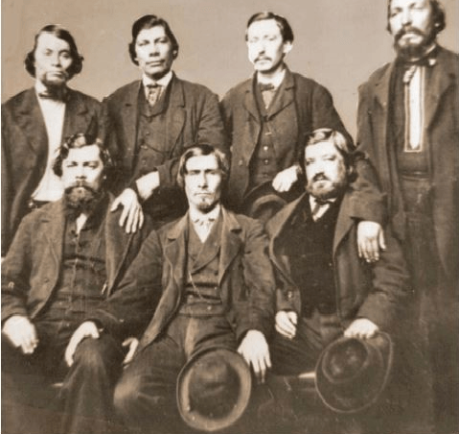
“Top: Frank Roy, Vincent Roy, E. Roussin, Old Frank D.o., Bottom: Peter Roy, Jos. Gourneau (Gurnoe), D. Geo. Morrison.” The photo is labelled Chippewa Treaty in Washington 1845 by the St. Louis Hist. Lib and Douglas County Museum, but if it is in fact in Washington, it was probably the Bois Forte Treaty of 1866, where these men acted as conductors and interpreters (Digitized by Mary E. Carlson for The Sawmill Community at Roy’s Point).
1 His journal and folks.
2 Pet. Roy’s sketch.
3 Mr. Roy to V.
4 P. R.’s sketch
5 Mr. Geo. Morrison says, the place was in those days always called Madelaine Island.

~ The Superior Chronicle, July 7, 1860.
6 P. Roy’s sketch.
7 His wife.
8 His folks.
9 Cournoyer.
10 Mrs. Roy.
11 See foot-note.
12 Mrs. Roy.
13 Fr. Eustachius said smthng to this effect.
14 Mr. Roy to V.
15 Cournoyer or Mr. Roy to V.
16 Cournoyer.
18 by Geo. Morrison & others.
19 Mr. Roy to V.
20 The family.
21 Mr. Roy to V.
22 Mr. Roy to V.
23 History of Superior as to the substce.
Vincent Cournoyer was Vincent Roy Jr’s brother-in-law. The Roy brothers, Cournoyer, Morrison, and La Fave were all Mixed-Blood members of the Lake Superior Chippewa, and elected officials in Douglas County, Wisconsin.
24 The family.
25 Cournoyer.
26 Mr Roy to V. – His family also.
27 Mr. Roy to V. – His family also.
28 History aS subst.e
29 Mr. J. Bradshaw and J. La Fave.
Father Valentine wishes his name to be suppressed in this communication and hence signs himself as above: “A Friend of Roy.”
Fr. Chrysostom Verwyst O.F.M.
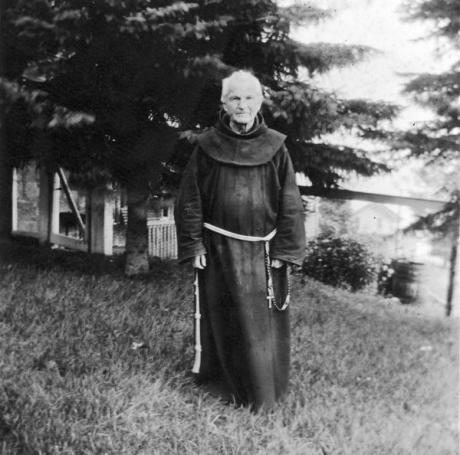
Reverend Chrysostome Verwyst, circa 1918. ~ Wisconsin Historical Society
 Chequamegon History