Chief Buffalo Picture Search: The Capitol Busts
July 17, 2013
This post is one of several that seek to determine how many images exist of Great Buffalo, the famous La Pointe Ojibwe chief who died in 1855. To learn why this is necessary, please read this post introducing the Great Chief Buffalo Picture Search.
Posts on Chequamegon History are generally of the obscure variety and are probably only interesting to a handful of people. I anticipate this one could cause some controversy as it concerns an object that holds a lot of importance to many people who live in our area. All I can say about that is that this post represents my research into original historical documents. I did not set out to prove anybody right or wrong, and I don’t think this has to be the last word on the subject. This post is simply my reasoned conclusions based on the evidence I’ve seen. Take from it what you will.

Be sheekee, or Buffalo by Francis Vincenti, Marble, Modeled 1855, Carved 1856 (United States Senate)
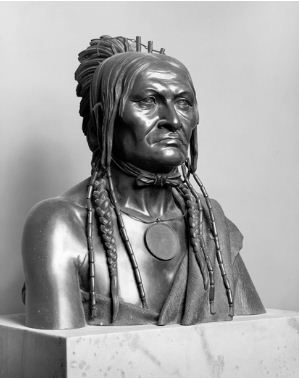
Be Sheekee: A Chippewa Warrior from the Sources of the Mississippi, bronze, by Joseph Lassalle after Francis Vincenti, House wing of the United States Capitol (U.S. Capitol Historical Society).
“A Chippewa Warrior from the Sources of the Mississippi”
There is no image that has been more widely identified with Chief Buffalo from La Pointe than the marble bust and bronze copy in the U.S. Capitol Building in Washington D.C. Red Cliff leaders make a point of visiting the statues on trips to the capital city, the tribe uses the image in advertising and educational materials, and literature from the United States Senate about the bust includes a short biography of the La Pointe chief.
I can trace the connection between the bust and the La Pointe chief to 1973, when John O. Holzhueter, editor of the Wisconsin Magazine of History wrote an article for the magazine titled Chief Buffalo and Other Wisconsin-Related Art in the National Capitol. From Holzhueterʼs notes we can tell that in 1973, the rediscovery of the story of the La Pointe Buffalo was just beginning at the Wisconsin Historical Society (the publisher of the magazine). Holzhueter deserves credit for helping to rekindle interest in the chief. However, he made a critical error.

English: Aysh-ke-bah-ke-ko-zhay ojibwa chief (Photo credit: Wikipedia)
In the article he briefly discusses Eshkibagikoonzhe (Flat Mouth), the chief of the Leech Lake or Pillager Ojibwe from northern Minnesota. Roughly the same age as Buffalo, Flat Mouth is as prominent a chief in the history of the upper Mississippi as Buffalo is for the Lake Superior bands. Had Holzhueter investigated further into the life of Flat Mouth, he may have discovered that at the time the bust was carved, the Pillagers had another leader who had risen to prominence, a war chief named Buffalo.
Holzhueter clearly was not aware that there was more than one Buffalo, and thus, he had to invent facts to make the history fit the art. According to the article (and a book published by Holzhueter the next year) the La Pointe Buffalo visited President Pierce in Washington in January of 1855. Buffalo did visit Washington in 1852 in the aftermath of the Sandy Lake Tragedy, but the old chief was nowhere near Washington in 1855. In fact, he was at home on the island in declining health having secured reservations for his people in Wisconsin the previous summer. He would die in September of 1855. The Buffalo who met with Pierce, of course, was the war chief from Leech Lake.
“He wore in his headdress 5 war-eagle feathers“
The Pillager Buffalo was in Washington for treaty negotiations that would transfer most of the remaining Ojibwe land in northern Minnesota to the United States and create reservations at the principal villages. The minutes of the February 1855 negotiations between the Minnesota chiefs and Indian Commissioner George Manypenny are filled with Ojibwe frustration at Manypennyʼs condescending tone. The chiefs, included the powerful young Hole-in-the-Day, the respected elder Flat Mouth, and Buffalo, who was growing in experience and age, though he was still considerably younger than Flat Mouth or the La Pointe Buffalo. The men were used to being called “red children” in communications with their “fathers” in the government, but Manypennyʼs paternalism brought it to a new low. Buffalo used his clothing to communicate to the commissioner that his message of assimilation to white ways was not something that all Ojibwes desired. Manypennyʼs words and Buffaloʼs responses as interpreted by the mix- blooded trader Paul Beaulieu follow:
The commissioner remarked to Buffalo, that if he was a young man he would insist upon his dispensing with his headdress of feathers, but that, as he was old, he would not disturb a custom which habit had endeared to him.
Buffalo repoled ithat the feathered plume among the Chippewas was a badge of honor. Those who were successful in fighting with or conquering their enemies were entitled to wear plumes as marks of distinction, and as the reward of meritorious actions.The commissioner asked him how old he was.
Buffalo said that was a question which he could not answer exactly. If he guessed right, however, he supposed he was about fifty. (He looked, and was doubtless, much
older).Commissioner. I would think, my firend, you were older than that. I would like to philosophise with you about that headdress, and desired to know if he had a farm, a house, stock, and other comforts about him.
Buffalo. I have none of those things which you have mentioned. I live like other members of the tribe.
Commissioner. How long have you been in the habit of painting—thirty years or more?
Buffalo. I can not tell the number of years. It may have been more or it may have been less. I have distinguished myself in war as well as in peace among my people and the whites, and am entitled to the distinction which the practice implies.
Commissioner. While you, my firend, have been spending your time and money in painting your face, how many of your white brothers have started without a dollar in the world and acquired all those things mentioned so necessary to your comfort and independent support. The paint, with the exception of what is now on my friend’s face, has disappeared, but the white persons to whom I alluded by way of contrast are surrounded by all the comforts of life, the legitimate fruits of their well-directed industry. This illustrates the difference between civilized and savage life, and the importance of our red brothers changing their habits and pursuits for those of the white.

Major General Montgomery C. Meigs was a Captain before the Civil War and was in charge of the Capitol restoration, As with Thomas McKenney in the 1820s, Meigs was hoping to capture the look of the “vanishing Indian.” He commissioned the busts of the Leech Lake chiefs during the 1855 Treaty negotiations. (Wikimedia Images)
While Manypenny clearly did not like the Ojibwe way of life or Buffaloʼs style of dress, it did catch the attention of the authorities in charge of building an extension on the U.S. Capitol. Captain Montgomery Meigs, the supervisor, had hired numerous artists and much like Thomas McKenney two decades earlier, was looking for examples of the indigenous cultures that were assumed to be vanishing. On February 17th, Meigs received word from Seth Eastman that the Ojibwe delegation was in town.
The Captain met Bizhiki and described him in his journal:
“He is a fine-looking Indian, with character strongly marked. He wore in his headdress 5 war-eagle feathers, the sign of that many enemies put to death by his hand, and sat up, an old murderer, as proud of his feathers as a Frenchman of his Cross of the Legion of Honor. He is a leading warrior rather than a chief, but he has a good head, one which would not lead one, if he were in the Senate, to think he was not fit to be the companion of the wise of the land.”
Buffalo was paid $5.00 and sat for three days with the skilled Italian sculptor Francis Vincenti. Meigs recorded:
“Vincenti is making a good likeness of a fine bust of Buffalo. I think I will have it put into marble and placed in a proper situation in the Capitol as a record of the Indian culture. 500 years hence it will be interesting.”
Vincenti first formed clay models of both Buffalo and Flat Mouth. The marbles would not be finished until the next year. A bronze replica of Buffalo was finished by Joseph Lassalle in 1859. The marble was put into the Senate wing of the Capitol, and the bronze was placed in the House wing.
Clues in the Marble
The sculptures themselves hold further clues that the man depicted is not the La Pointe Buffalo. Multiple records describe the La Pointe chief as a very large man. In his obituary, recorded the same year the statue was modeled, Morse writes:
Any one would recognize in the person of the Buffalo chief, a man of superiority. About the middle height, a face remarkably grave and dignified, indicating great thoughtfulness; neat in his native attire; short neck, very large head, and the most capacious chest of any human subject we ever saw.
At the time of his death, he was thought to have been over ninety years old. The man in the sculpture is lean and not ninety. In addition, there is another clue that got by Holzhueter even though he printed it in his article. There is a medallion around the neck of the bronze bust that reads, “Beeshekee, the BUFFALO; A Chippewa Warrior from the Sources of the Mississippi…” This description works for a war chief from Leech Lake, but makes no sense for a civil chief and orator from La Pointe.
Another Image of the Leech Lake Bizhiki

Be-She-Kee (Buffalo), Head Chief of the Leech Lake Chippewas (Whitney and Zimmerman St. Paul)
The Treaty of 1855 was signed on February 22, and the Leech Lake chiefs returned to Minnesota. By the outbreak of the Civil War, Flat Mouth had died leaving Buffalo as the most prominent Pillager chief. Indian-White relations in Minnesota grew violent in 1862 as the U.S.- Dakota War (also called the Sioux Uprising) broke out in the southern part of the state. The Gull Lake chief, Hole in the Day, who had claimed the title of head of the Ojibwes, was making noise about an Ojibwe uprising as well. When he tried to use the Pillagers in his plan, Buffalo voiced skepticism and Hole in the Dayʼs plans petered out. In 1863, Buffalo returned to Washington for a new treaty. Ironically, he was still very much alive in the midst of complicated politics in a city where his bust was on display as monument to the vanishing race.
At some point during these years, the Pillager Buffalo had his photograph taken by Whitneyʼs Gallery in St. Paul. Although the La Pointe Buffalo was dead by this time, internet sites will occasional connect it with him even with an original caption that reads “Head Chief of the Leech Lake Chippewas.”
The Verdict
Although it wasn’t the outcome I was hoping for, my research leads me to definitively conclude that the busts in the U.S. Capitol are of Buffalo the Leech Lake war chief. It’s disappointing for our area to lose this Washington connection, but our loss it Leech Lake’s gain. Though less well-known than the La Pointe band’s chief, their chief Buffalo should also be remembered for his role in history.
Not Chief Buffalo from La Pointe: This is Chief Buffalo from Leech Lake.

Not Chief Buffalo from La Pointe: This is Chief Buffalo from Leech Lake.
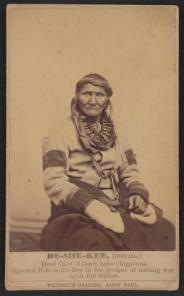
Not Chief Buffalo from La Pointe: This is Chief Buffalo from Leech Lake.
Sources:
Holzhueter, John O. “Chief Buffalo and Other Wisconsin-Related Art in the National Capitol.” Wisconsin Magazine of History 56.4 (1973): 284-89. Print.
———– Madeline Island & the Chequamegon Region. Madison: State Historical Society of Wisconsin, 1974. Print.
KAPPLER’S INDIAN AFFAIRS: LAWS AND TREATIES. Ed. Charles J. Kappler. Oklahoma State University Library, n.d. Web. 21 June 2012. <http:// digital.library.okstate.edu/Kappler/>.
Kloss, William, Diane K. Skvarla, and Jane R. McGoldrick. United States Senate Catalogue of Fine Art. Washington, D.C.: U.S. G.P.O., 2002. Print.
Legendary Waters Resort and Casino. Red Cliff Band of Lake Superior Chippewa, 2012. Web. 28 June 2012. <http://www.legendarywaters.com/>.
Minutes of the 1855 Treaty. 1855. MS. Bureau of Indian Affairs, Washington. Gibagdinamaagoom. White Earth Tribal and Community College Et. Al. Web. 28 June 2012. <gibagadinamaagoom.info/images/1855TreatyMinutes.pdf>.
Morse, Richard F. “The Chippewas of Lake Superior.” Collections of the State Historical Society of Wisconsin. Ed. Lyman C. Draper. Vol. 3. Madison: State Historical Society of Wisconsin, 1857. 338-69. Print.
Schenck, Theresa M. William W. Warren: The Life, Letters, and times of an Ojibwe Leader. Lincoln: University of Nebraska, 2007. Print.
Treuer, Anton. The Assassination of Hole in the Day. St. Paul, MN: Borealis, 2010. Print.
Warren, William W., and Theresa M. Schenck. History of the Ojibway People. St. Paul: Minnesota Historical Society, 2009. Print.
Whitney’s Gallery. Be-she-kee (Buffalo). c.1860. Photograph. Minnesota Historical Society, St. Paul. MHS Visual Resource Database. Minnesota Historical Society, 2012. Web. 28 June 2012. <http://collections.mnhs.org/visualresources/>.
Wolff, Wendy, ed. Capitol Builder: The Shorthand Journals of Montgomery C. Meigs, 1853-1859, 1861. U.S. Government Printing Office, Washington, DC: 2001. Print.
Sandy Lake Letters: Sherman Hall to the Wheelers
July 11, 2013

“Chippewa Indians Fishing on the Ice” (Digitized by New York Public Library from Heroes and hunters of the West : comprising sketches and adventures of Boone, Kenton, Brady, Logan, Whetzel, Fleehart, Hughes, Johnston, etc. Philadelphia : H. C. Peck & Theo. Bliss, 1859.)
On June 9th, I transcribed and posted two letters related to the Sandy Lake Tragedy (the attempted removal of the Lake Superior Ojibwe in the fall of 1850, which claimed as many as 400 innocent lives). The letters, digitized by the Wisconsin Historical Society, were from the Warren Family Papers. One was from missionary Leonard Wheeler to William Warren before the tragedy, and another was from Indian Agent John Watrous to Warren during a second removal attempt a year later.
That post sought to assess how much responsibility Warren and Watrous bear for the 400 deaths. It also touched on the role of the Protestant A.B.C.F.M. missionaries in the region. This post continues those thoughts. This time, we’re looking at two more letters and evaluating one of the missionaries himself.
Both of these letters are from the Wheeler Family Papers, held by the Wisconsin Historical Society at the Ashland Area Research Center. I went directly to the original documents for these, and while I’ve seen them referenced in published works, I believe this is the first time these particular letters have been transcribed or posted online.
The first is from Sherman Hall, the founder of the La Pointe Mission, to his colleague Leonard Wheeler, who operated the satellite mission at Odanah. Hall traveled to Sandy Lake for the annuity payments and sent this letter to Wheeler, who was visiting family back in Massachusetts, after returning to La Pointe.
Lapointe. Dec. 28th 1850
Brother Wheeler:
I wrote you while at Sandy Lake and promised to write again when I should reach Lapointe. That promise I now redeem. I started from Sandy Lake on the fourth inst. and reached home on the 16th having been absent from home just eight weeks. I was never more heartily glad to leave a place than I was Sandy Lake, nor more glad to reach home after an absence. Of course winter here has justly begun. The snow was some ten inches deep on the Savannah Portage. On reaching the East Savannah River we found the ice good and clear of snow and water. This continued to be the case most of the way to the Grand Portage at Fond du Lac. From Fond du Lac to Lapointe the traveling most of the way was hard, and it was not till the seventh day from F. du L. that I reached home. Besides bad traveling I had to carry a pack which I found, when I got home weighed 60 pounds. With this however I found it not difficult to keep up with most of my traveling companions who were much heavier loaded than I. This is my first experience of carrying a heavy pack on a long journey and I am fully satisfied with the experiment. I had no alternative however, bet either to throw away my blankets and clothes, or carry them. Every body was loaded with a heavy pack, and I could employ no one. I however got through well—did not get lame as many others did, nor do I feel any furious[?] by ill effects of my journey since my arrival.
I found the mission family well on my arrival. They had felt somewhat lonesome while so many were absent from this place. Things in the community here are generally in a quiet state at present. I apprehend that there will be considerable pinching for provisions before spring. It has been a very windy and stormy fall. The people have taken but little fish. Many nets have been lost. The traders have but a small quantity of provisions, and if they had the people have but little to buy with. The bay opposite to this island is now principally covered with ice so that the Indians are on the ice some to spear fish. The ice has once broken up since it first closed, and a heavy wind would break it up again, as it is yet very thin, and the weather mild. If the lake is frozen the Inds will probably get considerable fish; but if it should be open they must suffer.
Our Indian meetings are pretty well attended, and I feel that there is ground for encouragement. Simon I think is exerting a good influence. His Catholic friends have tried to draw him back to their church; but seems stable. His oldest brother, who has recently lost his wife, has expressed a wish to hear the word of God. I hope he will yet become a sincere listener.
Our English exercises are attended by a smaller number than formerly since many have left this place. I think however for our own good, as well as on account of others, we ought to keep them up. Mr. Van Tassel has returned to remain here till spring. I have heard nothing from Bad River for some time past. I had formed a design to go there this week, but have been prevented by the state of the ice. I intend going as soon as the ice gets a little stronger. I suppose there are very few Indians there. More are about the Lake.
I heard that Mr. Leihy has lost both his horses which will be a serious inconvenience to him in this mill enterprise I presume.
Mr. Pulsifer has received one letter from you, and by our last mail he heard through his correspondent at Lowell that you had arrived at that place.
I suppose you find some changes have taken place in the wide world during the times you have been shut up in the wilderness. Do you find calls enough to keep you busy? I have been expecting a letter from you. I want to hear what you have to say about the things you see, and how you like visiting, etc.
I have just had a letter from Mr. Ely, who says, “We are [snugly by quarters?] in St. Paul. My home is full of music—am employed as choir leader in Mr. [Mill’s?] (Prs.) church—sing two evenings a week at Stillwater, and the rest of my time is well filled with the private scholars & tuning Pianos, of which there are 7 or 8 at St. Paul.” Perhaps Br. Ely will find this a more lucrative business than cutting and hauling pine logs. I am glad he has found employment.
Our children all attend school except Harriet. Marydoes very well. Please give my regards to your friends at Lowell. I am writing to Mr. Treat by this opportunity. [Wish?] kind regards to Mrs. W. I remain
yours
S. Hall.
 The Old Mission Church, La Pointe, Madeline Island. (Wisconsin Historical Society Image ID: 24827)
 Harriet Wheeler, pictured about forty years after receiving this letter. (Wisconsin Historical Society: Image ID 36771)
“…your note to Harriet” Harriet Hall was Sherman’s oldest daughter, about 19 years old at this time.
 Many Ojibwe leaders, including Hole in the Day, blamed the rotten pork and moldy flour distributed at Sandy Lake for the disease that broke out. The speech in St. Paul is covered on pages 101-109 of Theresa Schenck’s William W. Warren: The Life, Letters, and Times of an Ojibwe Leader, my favorite book about this time period. (Photo from Whitney’s Gallery of St. Paul: Wisconsin Historical Society Image ID 27525)
 Mary Warren (1835-1925), was a teenager at the time of the Sandy Lake Tragedy. She is pictured here over seventy years later. Mary, the sister of William Warren, had been living with the Wheelers but stayed with Hall during their trip east. (Photo found on University of Connecticut Radio website, scanned from Frances Densmore photos in the Smithsonian Bureau of Ethnology)
Lapointe, Feb. 24th 1851.
Mrs. Wheeler,
By our last mail I wrote to Mr Wheeler, and by this I will address a few lines to you. From your note to Harriet I suppose you are happy among your friends. I am glad you are so, and hope you will not only spend your winter pleasantly, but that you will find the present season of relaxation from the severe duties of your station here, the occasion of reconnecting[?] your health and spirits.
I do not feel that the time has yet come when the churches ought to close their efforts to save these Indians. I do not think they are entirely beyond the reach of hope. The prospect however looks dark. But I think the greatest cause of discouragement arises from their character, and not from their present political condition. Generally they do not want to improve their condition. They are satisfied with their ignorance and degradation. All they think of is to supply for their present wants without their own exertions, while they wish to live in idleness and sin. This is the cause of their keeping so much aloof from the influence of the missions. Their minds are dreadfully dark respecting the things of the future world. They seem to have no ideas of happiness superior to that derives from the gratification of the lowest animal appetites and passions. This is the reason why the truths of the gospel so little effect on them. These things present to my mind much stronger grounds of discouragement than their present political difficulties, though those at present are not inconsiderable.
But as stupid as is the conscience, and as dark as is the understanding and the heart, and as much as they are given up to [?]ality and sin, I believe there is a Power that can quicken them into life. My only hope is that He who has made them, and has power to save them, will come and add his blessing to the preaching of his own gospel, and make it to them the power and wisdom of God. Thousands of others as dead in trespasses and sins, have been saved. Why may not they be saved? Come back home and let us try still to do something for them. Tell Christians to remember them and pray for them, that the word of God among them may have free course and be glorified.
It is a time of great scarcity of food among the Indians. There is some one in our houses almost every hour of the day begging for food. Very few get more than a meal a day; many not half of one. I have been told by several individuals, that they have tried three or four days in succession to catch fish, and have been obliged to return to their starving families each night with nothing for them. I am frequently importuned to spare a little provisions till I am obliged to go away out of sight to get rid of their pleading. I have spared the last potatoes I dare let go. Corn we have none. We have but a small quantity of flour over what will be required to sustain our families till we can expect to obtain a new supply. For a long time I have not known fish so scarce as the present winter. That is almost the only dependence of this people. For a month to come there will be many hungry ones. Many of the French and half-breeds are but little better off than the Indians. All we can do is to divide a little morsel with the hungry ones who come to beg. We have not much to give to those who importune for something to carry to their families. But as long as they continue to waste their summers in idleness they must starve in the winter.
The young Hole-in-the-day has been down to St Paul and there made a public speech in which he attributes the sickness at the payment last fall to the bad provisions which were dealt out to the Indians, and imparts much blame to the officers of the government for the way in which they [were with?]. In time they had some flour dealt out to them which was much damaged. But I think there were other causes for the sickness which prevailed besides the bad provisions. I think however that in some [aspects?] the Indians were wronged. Treaty stipulations were not carried out. H is very confident that many of the Indians are not satisfied with the manner in which they have been dealt with, and recent events have not served to strengthen their attachment to the Government.
We had our communion yesterday. I think there is a [?]ably good state of feeling among the native church members at this time. Simon has been frequently sick this winter. But his trials appear to bring nearer to God. He appears to be growing in the knowledge of God and in piety.
You will probably recollect Mo-ko-kun-ens-ish, an Indian with a bunch[?] between his shoulders, married into the family of the Little-current. He is, by profession, a Catholic. About a week ago, he made me a visit, and said his priest had offended him, and he wished to join us. A short time since he lost a child, and when the priest came to bury it, he said he “scolded him” because he had not cleaned away the snow from the gate of the burying yard, and made a better path for him to come to the grave. He told a long story. I suspected his object was to get some provisions of me. I told him we should be happy to see him at our meetings, and told him where and when they would be held. He said he should attend only sometimes he might be obliged to fish to get something to eat, and be occasionally away. I said a few words to him on religious subjects, and he left without asking for anything. The next day he came with a small piece of cloth and asked me to give him provisions for it. I told I had not provisions to trade. He then enquired about meeting. I told him we were to hold one that evening in the school-house. He said he should attend. The evening came, the meeting was held—but he was not there. Nor have we seen him at any other meeting. Such are the methods the heathens & Catholics take to deceive us. We could make many converts with flour and pork, especially at this time.
Yours Truly,
S. Hall
[Written in margins]
All send love though I have not room to write it.
Mary goes to school and is doing very well.

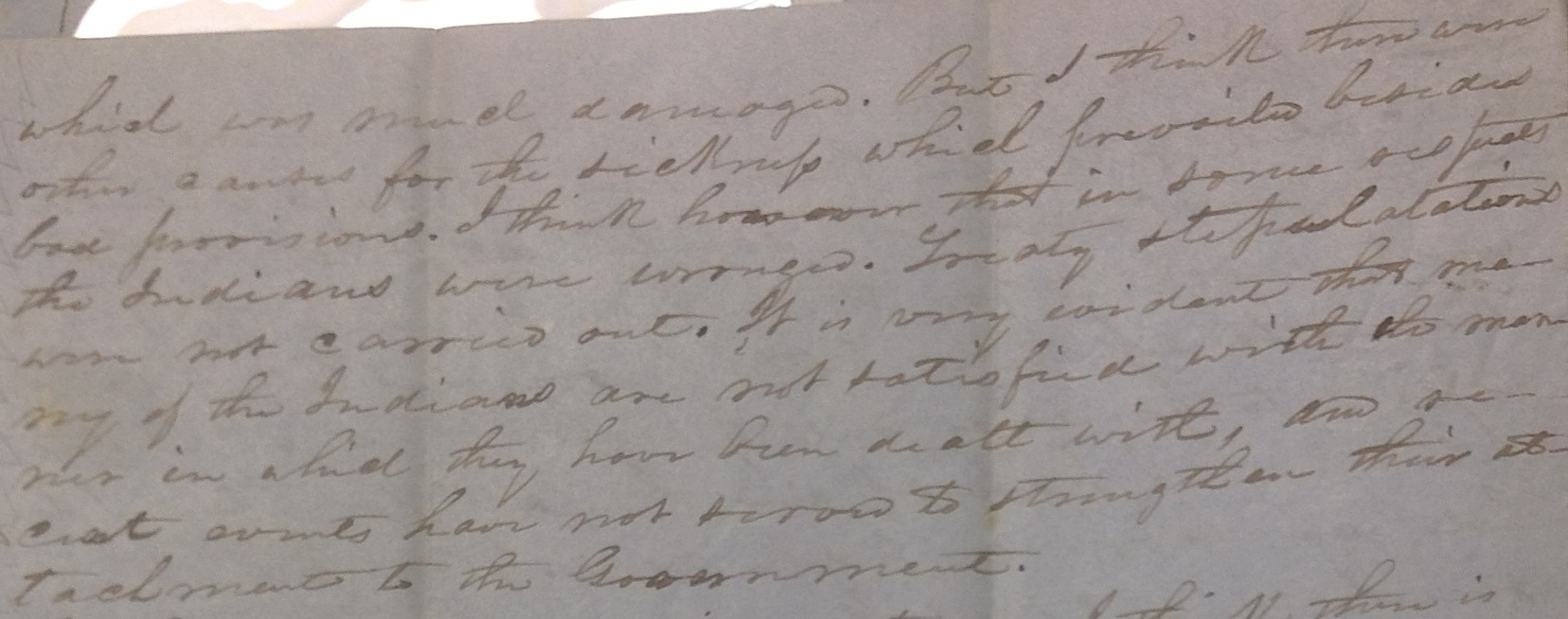
These are the originals of the paragraph about Hole in the Day’s speech in St. Paul. I couldn’t quite decipher all of it. Let me know what you see (Wheeler Family Papers, Personal Correspondence 1851, Wisconsin Historical Society Ashland Area Research Center).
In the June 9th post, we tried to determine how much William Warren and John S. Watrous were at fault for the deaths resulting from the 1850 Sandy Lake removal attempt. In this post, we will do the same for Sherman Hall.
Before we begin, it’s worth reviewing the facts. By 1850, Hall had lived at La Pointe for twenty years. He knew the people who lived here, and he knew the promises the Ojibwe were given at the Treaty of 1842. He was certainly aware of the Ojibwe position on the removal.
Rev. Hall did not order the removal. Compared with the government and Fur Company officials, he was fairly powerless within the Lake Superior region. However, he had a power of a different sort. As the primary voice of the ABCFM in Ojibwe country, he had powerful friends in the eastern states. Many Americans perceived the missionaries as the only neutral voice in the area. Hall admits in the December 28th letter that the Ojibwe were wronged. He could have advocated for their cause in the summer of 1850 as the illegal removal was unfolding. Instead, he largely went along with government efforts.
To his credit, in other letters Hall did blame the government for the failure of the Sandy Lake payment. The best book I’ve encountered about this time period is William W. Warren: The Life, Letters, and Times of an Ojibwe Leader by Theresa Schenck (Nebraska UP, 2007). On page 94, Dr. Schenck quotes a letter from Hall to ABCFM Secretary S.B. Treat. It is dated December 30, and is probably the letter referred to in the letter to Leonard Wheeler above. Hall is honest about Ojibwe feelings on the removal and seems to empathize somewhat. On page 155, Schenck details how the La Pointe mission did eventually turn against government removal efforts later in 1851.
So, it probably seems that I am defending Sherman Hall. Why? Truthfully, it’s because I want to have some balance in this post because, quite frankly, these two letters are some of the most disgusting, horrifying documents I’ve ever read. I felt especially sick typing up the February 24th letter to Harriet Wheeler. For a man who claimed to be “saving” the Ojibwe to be so heartless in the midst of so much suffering is appalling.
Was the mission running low on food? Sure, but doesn’t true Christian charity demand sharing to the last?
Should Hall’s language be judged by the standards of the racist times he lived in? Absolutely, but to say the things he says about human beings, his neighbors of twenty years, is inexcusable in any time period.
Is it possible he was traumatized by his experience at Sandy Lake, and this was a way of dealing with his personal guilt? This is possible. He does seem to be speaking to himself in the letter as much as he is to the Wheelers.
There is a danger in judging too much from just two letters, but I think Hall needs to be held to the same standard as Warren and Watrous were in the June 9th post. He could have spoken out against the removal to begin with. He didn’t. He was an eyewitness to Sandy Lake. He knew what the Ojibwe had been promised, and he saw the consequences of the government breaking those promises. His letters to the Wheelers in Boston could have been used to help right those wrongs by uniting the missions behind the Ojibwe cause. Instead, he chose to blame the people who had been wronged to the point of 400 deaths. For these reasons, I think when we list the villains of Sandy Lake, the Reverend Sherman Hall needs to be among them.
Sources:
Densmore, Frances. Chippewa Customs. Washington: U.S. G.P.O., 1929. Print.
Ely, Edmund Franklin, and Theresa M. Schenck. The Ojibwe Journals of Edmund F. Ely, 1833-1849. Lincoln: University of Nebraska, 2012. Print.
KAPPLER’S INDIAN AFFAIRS: LAWS AND TREATIES. Ed. Charles J. Kappler. Oklahoma State University Library, n.d. Web. 21 June 2012. <http:// digital.library.okstate.edu/Kappler/>.
Satz, Ronald N. Chippewa Treaty Rights: The Reserved Rights of Wisconsin’s Chippewa Indians in Historical Perspective. Madison, WI: Wisconsin Academy of Sciences, Arts and Letters, 1991. Print.
Schenck, Theresa M. William W. Warren: The Life, Letters, and times of an Ojibwe Leader. Lincoln: University of Nebraska, 2007. Print.
Warren, William W., and Theresa M. Schenck. History of the Ojibway People. St. Paul: Minnesota Historical Society, 2009. Print.
Fun With Maps
June 28, 2013
I’m someone who loves a good historical map, so one of my favorite websites is memory.loc.gov, the digital collections of the Library of Congress. You can spend hours zooming in on neat vintage maps. This post has snippets from eleven of them, stretching from 1674 to 1843. They are full of cool old inaccuracies, but they also highlight important historical trends and eras in our history. This should not be considered an exhaustive survey of the best maps out there, nor is it representative of all the LOC maps. Really, it’s just 11 semi-random maps with my observations on what I found interesting. Click on any map to go to the Library of Congress site where you can browse more of it. Enjoy:
French 1674
Nouvelle decouverte de plusieurs nations dans la Nouvelle France en l’année 1673 et 1674 by Louis Joliet. Joliet famously traveled from the Great Lakes down the Mississippi with the Jesuit Jacques Marquette in 1673.
- Cool trees.
- Baye des Puans: The French called the Ho-Chunk Puans, “Stinky People.” That was a translation of the Ojibwe word Wiinibiigoo (Winnebago), which means “stinky water people.” Green Bay is “green” in summer because of the stinky green algae that covers it. It’s not surprising that the Ho-Chunk no longer wish to be called the Winnebago or Puans.
- 8tagami: The French used 8 in Indian words for the English sound “W.” 8tagami (Odagami) is the Ojibwe/Odawa/Potawatomi word for the Meskwaki (Fox) People.
- Nations du Nord: To the French, the country between Lake Superior and Hudson Bay was the home of “an infinity of nations,” (check out this book by that title) small bands speaking dialects of Ojibwe, Cree, and Assiniboine Sioux.
- The Keweenaw is pretty small, but Lake Superior has generally the right shape.
French 1688
Carte de l’Amerique Septentrionnale by Jean Baptiste Louis Franquelin: Franquelin created dozens of maps as the royal cartographer and hydrographer of New France.
- Lake Superior is remarkably accurate for this time period.
- Nations sous le nom d’Outouacs: “Nations under the name of Ottawas”–the French had a tendency to lump all Anishinaabe peoples in the west (Ojibwe, Ottawa, Potawatomi, etc.) under the name Outouais or Outouacs.
- River names, some are the same and some have changed. Bois Brule (Brule River) in French is “burnt wood” a translation of the Ojibwe wiisakode. I see ouatsicoto inside the name of the Brule on this map (Neouatsicoton), but I’m not 100% sure that’s wiisakode. Piouabic (biwaabik is Ojibwe word for Iron) for the Iron River is still around. Mosquesisipi (Mashkiziibi) or Swampy River is the Ojibwe for the Bad River.
- Madeline Island is Ile. St. Michel, showing that it was known at “Michael’s Island” a century before Michel Cadotte established his fur post.
- Ance Chagoüamigon: Point Chequamegon
French 1703
Carte de la riviere Longue : et de quelques autres, qui se dechargent dans le grand fleuve de Missisipi [sic] … by Louis Armand the Baron de Lahontan. Baron Lahontan was a military officer of New France who explored the Mississippi and Missouri River valleys.
- Lake Superior looks quite strange.
- “Sauteurs” and Jesuits at Sault Ste. Marie: the French called the Anishinaabe people at Sault Ste. Marie (mostly Crane Clan) the Sauteurs or Saulteaux, meaning “people of the falls.” This term came to encompass most of the people who would now be called Ojibwe.
- Fort Dulhut: This is not Duluth, Minnesota, but rather Kaministiquia (modern-day Thunder Bay). It is named for the same person–Daniel Greysolon, the Sieur du Lhut (Duluth).
- Riviere Du Tombeau: “The River of Tombs” at the west end of the Lake is the St. Croix River, which does not actually flow into Lake Superior but connects it to the Mississippi over a short portage from the Brule River.
- Chagouamigon (Chequamegon) is placed much too far to the east.
- The Fox River is gigantic flowing due east rather than north into Green Bay. We see the “Savage friends of the French:” Outagamis (Meskwaki/Fox), Malumins (Menominee), and Kikapous (Kickapoo).
French 1742
Carte des lacs du Canada by Jacques N. Bellin 1742. Bellin was a famous European mapmaker who compiled various maps together. The top map is a detail from the Carte de Lacs. The bottom one is from a slightly later map.
- Of the maps shown so far, this has the best depiction of Chequamegon, but Lake Superior as a whole is much less accurate than on Franquelin’s map from fifty years earlier.
- The mysterious “Isle Phillipeaux,” a second large island southeast of Isle Royale shows prominently on this map. Isle Phillipeaux is one of those cartographic oddities that pops up on maps for decades after it first appears even though it doesn’t exist.
- Cool river names not shown on Franquelin’s map: Atokas (Cranberry River) and Fond Plat “Flat-bottom” (Sand River)
- The region west of today’s Herbster, Wisconsin is lablled “Papoishika.” I did an extensive post about an area called Ka-puk-wi-e-kah in that same location.
- Ici etoit une Bourgade Considerable: “Here there was a large village.” This in reference to when Chequamegon was a center for the Huron, Ottawa (Odawa) and other refugee nations of the Iroquois Wars in the mid-1600s.
- “La Petite Fille”: Little Girl’s Point.
- Chequamegon Bay is Baye St. Charles
- Catagane: Kakagon, Maxisipi: Mashkizibi
- The islands are “The 12 Apostles.”
British 1778
A new map of North America, from the latest discoveries 1778. Engrav’d for Carver’s Travels. In 1766 Jonathan Carver became one of the first Englishmen to pass through this region. His narrative is a key source for the time period directly following the conquest of New France, when the British claimed dominion over the Great Lakes.
- Lake Superior still has two giant islands in the middle of it.
- The Chipeway (Ojibwe), Ottaway (Odawa), and Ottagamie (Meskwaki/Fox) seem to have neatly delineated nations. The reality was much more complex. By 1778, the Ojibwe had moved inland from Lake Superior and were firmly in control of areas like Lac du Flambeau and Lac Courte Oreilles, which had formerly been contested by the Meskwaki.
Dutch 1805
Charte von den Vereinigten Staaten von Nord-America nebst Louisiana by F.L. Gussefeld: Published in Europe.
- The Dutch never had a claim to this region. In fact, this is a copy of a German map. However, it was too cool-looking to pass up.
- Over 100 years after Franquelin’s fairly-accurate outline of Lake Superior, much of Europe was still looking at this junk.
- “Ober See” and Tschippeweer” are funny to me.
- Isle Phillipeau is hanging on strong into the nineteenth century.
American 1805
A map of Lewis and Clark’s track across the western portion of North America, from the Mississippi to the Pacific Ocean : by order of the executive of the United States in 1804, 5 & 6 / copied by Samuel Lewis from the original drawing of Wm. Clark. This map was compiled from the manuscript maps of Lewis and Clark.
- The Chequamegon Region supposedly became American territory with the Treaty of Paris in 1783. The reality on the ground, however, was that the Ojibwe held sovereignty over their lands. The fur companies operating in the area were British-Canadian, and they employed mostly French-Ojibwe mix-bloods in the industry.
- This is a lovely-looking map, but it shows just how little the Americans knew about this area. Ironically, British Canada is very well-detailed, as is the route of Lewis and Clark and parts of the Mississippi that had just been visited by the American, Lt. Zebulon Pike.
- “Point Cheganega” is a crude islandless depiction of what we would call Point Detour.
- The Montreal River is huge and sprawling, but the Brule, Bad, and Ontonagon Rivers do not exist.
- To this map’s credit, there is only one Isle Royale. Goodbye Isle Phillipeaux. It was fun knowing you.
- It is striking how the American’s had access to decent maps of the British-Canadian areas of Lake Superior, but not of what was supposedly their own territory.
English 1811
A new map of North America from the latest authorities By John Cary of London. This map was published just before the outbreak of war between Britain and the United States.
- These maps are starting to look modern. The rivers are getting more accurate and the shape of Lake Superior is much better–though the shoreline isn’t done very well.
- Burntwood=Brule, Donagan=Ontonagon
- The big red line across Lake Superior is the US-British border. This map shows Isle Royale in Canada. The line stops at Rainy Lake because the fate of the parts of Minnesota and North Dakota in the Hudson Bay Watershed (claimed by the Hudson Bay Company) was not yet settled.
- “About this place a settlement of the North West Company”: This is Michel Cadotte’s trading post at La Pointe on Madeline Island. Cadotte was the son of a French trader and an Anishinaabe woman, and he traded for the British North West Company.
- It is striking that a London-made map created for mass consumption would so blatantly show a British company operating on the American side of the line. This was one of the issues that sparked the War of 1812. The Indian nations of the Great Lakes weren’t party to the Treaty of Paris and certainly did not recognize American sovereignty over their lands. They maintained the right to have British traders. America didn’t see it that way.
American 1820
Map of the United States of America : with the contiguous British and Spanish possessions / compiled from the latest & best authorities by John Melish
- Lake Superior shape and shoreline are looking much better.
- Bad River is “Red River.” I’ve never seen that as an alternate name for the Bad. I’m wondering if it’s a typo from a misreading of “bad”
- Copper mines are shown on the Donagon (Ontonagon) River. Serious copper mining in that region was still over a decade away. This probably references the ancient Indian copper-mining culture of Lake Superior or the handful of exploratory attempts by the French and British.
- The Brule-St. Croix portage is marked “Carrying Place.”
- No mention of Chequamegon or any of the Apostle Islands–just Sand Point.
- Isle Phillipeaux lives! All the way into the 1820s! But, it’s starting to settle into being what it probably was all along–the end of the Keweenaw mistakenly viewed from Isle Royale as an island rather than a peninsula.
American 1839 

From the Map of Michigan and part of Wisconsin Territory, part of the American Atlas produced under the direction of U.S. Postmaster General David H. Burr.
- Three years before the Ojibwe cede the Lake Superior shoreline of Wisconsin, we see how rapidly American knowledge of this area is growing in the 1830s.
- The shoreline is looking much better, but the islands are odd. Stockton (Presque Isle) and Outer Island have merged into a huge dinosaur foot while Madeline Island has lost its north end.
- Weird river names: Flagg River is Spencer’s, Siskiwit River is Heron, and Sand River is Santeaux. Fish Creek is the gigantic Talking Fish River, and “Raspberry” appears to be labeling the Sioux River rather than the farther-north Raspberry River.
- Points: Bark Point is Birch Bark, Detour is Detour, and Houghton is Cold Point. Chequamegon Point is Chegoimegon Point, but the bay is just “The Bay.”
- The “Factory” at Madeline Island and the other on Long Island refers to a fur post. This usage is common in Canada: Moose Factory, York Factory, etc. At this time period, the only Factory would have been on Madeline.
- The Indian Village is shown at Odanah six years before Protestant missionaries supposedly founded Odanah. A commonly-heard misconception is that the La Pointe Band split into Island and Bad River factions in the 1840s. In reality, the Ojibwe didn’t have fixed villages. They moved throughout the region based on the seasonal availability of food. The traders were on the island, and it provided access to good fishing, but the gardens, wild rice, and other food sources were more abundant near the Kakagon sloughs. Yes, those Ojibwe married into the trading families clustered more often on the Island, and those who got sick of the missionaries stayed more often at Bad River (at least until the missionaries followed them there), but there was no hard and fast split of the La Pointe Band until long after Bad River and Red Cliff were established as separate reservations.
American 1843
Hydrographical basin of the upper Mississippi River from astronomical and barometrical observations, surveys, and information by Joseph Nicollet. Nicollet is considered the first to accurately map the basin of the Upper Mississippi. His Chequamegon Region is pretty good also.
- You may notice this map decorating the sides of the Chequamegon History website.
- This post mentions this map and the usage of Apakwa for the Bark River.
- As with the 1839 map, this map’s Raspberry River appears to be the Sioux rather than the Miskomin (Raspberry) River.
- Madeline Island has a little tail, but the Islands have their familiar shapes.
- Shagwamigon, another variant spelling
- Mashkeg River: in Ojibwe the Bad River is Mashkizibi (Swamp River). Mashkiig is the Ojibwe word for swamp. In the boreal forests of North America, this word had migrated into English as muskeg. It’s interesting how Nicollet labels the forks, with the White River fork being the most prominent.
That’s all for now folks. Thanks for covering 200 years of history with me through these maps. If you have any questions, or have any cool observations of your own, go ahead and post them in the comments.
This post is on of several that seeks to determine how many images exist of Great Buffalo, the famous La Pointe Ojibwe chief who died in 1855. To learn why this is necessary, read this post introducing the Great Chief Buffalo Picture Search.
Today’s post looks at two paintings from the 1820s of Ojibwe men named Bizhiki (Buffalo). The originals are lost forever, but the images still exist in the lithographs that follow.

Pee-che-kir: A Chippewa Chief Lithograph from McKenney and Hall’s History of the Indian Tribes of North America based on destroyed original by Charles Bird King; 1824. (Wikimedia Images)

Pe-shick-ee: A Celebrated Chippeway Chief from the Aboriginal Port-Folio by James Otto Lewis. The original painting was done by Lewis at Prairie du Chien or Fond du Lac of Lake Superior in 1825 or 1826 (Wisconsin Historical Society).
1824 Delegation to Washington
Chronologically, the first known image to show an Ojibwe chief named Buffalo appeared in the mid-1820s at time when the Ojibwe and the United States government were still getting to know each other. Prior to the 1820s, the Americans viewed the Ojibwe as a large and powerful nation. They had an uncomfortably close history with the British, who were till lurking over the border in Canada, but they otherwise inhabited a remote country unfit for white settlement. To the Ojibwe, the Americans were chimookomaan, “long knives,” in reference to the swords carried by the military officers who were the first Americans to come into their country. It was one of these long knives, Thomas McKenney, who set in motion the gathering of hundreds of paintings of Indians. Two of these showed men named Buffalo (Bizhiki).

Charles Bird King: Self portrait 1815 (Wikimedia Images)
McKenney was appointed the first Superintendent of Indian Affairs in 1824. Indian Affairs was under the Department of War at that time, and McKenneyʼs men in the West were mostly soldiers. He, like many in his day, believed that the Indian nations of North America were destined for extinction within a matter of decades. To preserve a record of these peoples, he commissioned over 100 portraits of various Indian delegates who came to Washington from all over the U.S. states and territories. Most of the painting work fell to Charles Bird King, a skilled Washington portrait artist. Beginning in 1822, King painted Indian portraits for two decades. He would paint famous men like Black Hawk, Red Jacket, Joseph Brandt, and Major Ridge, but Kingʼs primary goal was not to record the stories of important individuals so much as it was to capture the look of a vanishing race.

No-tin copied from 1824 Charles Bird King original by Henry Inman. Noodin (Wind) was a prominent chief from the St. Croix country. King’s painting of Buffalo from St. Croix was probably also copied by Inman, but its location is unknown (Wikimedia Images).
In July of 1824, William Clark, the famous companion of Meriwether Lewis, brought a delegation of Sauks, Foxes, and Ioways to Washington to negotiate land cessions. Lawrence Taliaferro, the Indian agent at Fort St. Anthony (now Minneapolis), brought representatives of the Sioux, Menominee, and Ojibwe to observe the treaty process. The St. Croix chiefs Buffalo and Noodin (Wind) represented the Ojibwe.

Charles Bird King painted portraits of most of the Indians listed here in the the 1824 Washington group by Niles’ Weekly Register, July 31, 1824. (Google Books)
The St. Croix chiefs were treated well: taken to shows, and to visit the sights of the eastern cities. However, there was a more sinister motivation behind the governmentʼs actions. McKenney made sure the chiefs saw the size and scope of the U.S. Military facilities in Washington, the unspoken message being that resistance to American expansion was impossible. This message seems to have resonated with Buffalo and Noodin of St. Croix as it is referred to repeatedly in the official record. McKenney pointed Buffalo out as a witness to American power at the Treaty of Fond du Lac (1826). Schoolcraft and Allen mention Buffalo’s trip in their own ill-fated journey up the St. Croix in 1832 (see it in this post), and Noodin talks about the soldiers he saw in Washington in the treaty deliberations in the 1837 Treaty of St. Peters.
While in Washington, Buffalo, Noodin, and most of the other Indians in the group sat with King for portraits in oil. Buffalo was shown wearing a white shirt and cloak, holding a pipe, with his face painted red. The paintings were hung in the offices of the Department of War, and the chiefs returned to their villages.
James Otto Lewis
The following summer, St. Croix Buffalo and Noodin joined chiefs from villages throughout the Ojibwe country, as well as from the Sioux, Sac and Fox, Menominee, Ho-Chunk, Ioway, Ottawa, and Potawatomi at Prairie du Chien. The Americans had called them there to sign a treaty to establish firm borders between their nations. The stated goal was to end the wars between the Sioux and Ojibwe, but it also provided the government an opportunity to assert its authority over the country and to set the stage for future land cessions.
McKenney did not attend the Treaty of Prairie du Chien leaving it to Clark and Lewis Cass to act as commissioners. A quick scan of the Ojibwe signatories shows “Pee-see- ker or buffalo, St. Croix Band,” toward the bottom. Looking up to the third signature, we see “Gitspee Waskee, or le boeuf of la pointe lake Superior,” so both the St. Croix and La Pointe Buffalos were present among the dozens of signatures. One of the government witnesses listed was an artist from Philadelphia named James Otto Lewis. Over the several days of negotiation, Lewis painted scenes of the treaty grounds as well as portraits of various chiefs. These were sent back to Washington, some were copied and improved by King or other artists, and they were added to the collection of the War Department.
The following year, 1826, McKenney himself traveled to Fond du Lac at the western end of Lake Superior to make a new treaty with the Ojibwe concerning mineral exploration on the south shore. Lewis accompanied him and continued to create images. At some point in these two years, a Lewis portrait of an Ojibwe chief named Pe-schick-ee (Bizhiki) appeared in McKenneyʼs growing War Department collection.
Lithographs
By 1830, McKenney had been dismissed from his position and turned his attention to publishing a portfolio of lithographs from the paintings in the War Department collection. Hoping to cash in his own paintings by beating McKenney to the lithograph market, Lewis released The Aboriginal Port Folio in May of 1835. It included 72 color plates, one of which was Pe-schick-ee: A Celebrated Chippeway Chief.

Pencil sketch of Pee-che-kir by Charles Bird King. King made these sketches after his original paintings to assist in making copies. (Herman J. Viola, The Indian Legacy of Charles Bird King.)
Due to financial issues The History of the Indian Tribes of North America, by McKenney with James Hall, would not come out in full release until the mid 1840s. The three-volume work became a bestseller and included color plates of 120 Indians, 95 of which are accompanied by short biographies. Most of the lithographs were derived from works by King, but some were from Lewis and other artists. Kingʼs portrait of Pee-Che-Kir: A Chippewa Chief was included among them, unfortunately without a biography. However, we know its source as the painting of the St. Croix Buffalo in 1824. Noodin and several others from that delegation also made it into lithograph form. The original War Department paintings, including both Pee-Che-Kir and Pe-schick-ee were sent to the Smithsonian, where they were destroyed in a fire in 1858. Oil copies of some of the originals, including Henry Inmanʼs copy of Kingʼs portrait of Noodin, survive, but the lithographs remain the only known versions of the Buffalo portraits other than a pencil sketch of the head of Pee-Che-Kir done by King.
The man in the Lewis lithograph is difficult to identify. The only potential clue we get from the image itself is the title of “A Celebrated Chippeway Chief,” and information that it was painted at Prairie du Chien in 1825. To many, “celebrated” would indicate Buffalo from La Pointe, but in 1825, he was largely unknown to the Americans while the St. Croix Buffalo had been to Washington. In the 1820s, La Pointe Buffaloʼs stature was nowhere near what it would become. However, he was a noted speaker from a prominent family and his signature is featured prominently in the treaty. Any assumptions about which chief was more “celebrated” are difficult.
In dress and pose, the man painted by Lewis resembles the King portrait of St. Croix Buffalo. This has caused some to claim that the Lewis is simply the original version of the King. King did copy and improve several of Lewisʼ works, but the copies tended to preserve in some degree the grotesque, almost cartoonish, facial features that are characteristic of the self-taught Lewis (see this post for another Lewis portrait). The classically-trained King painted highly realistic faces, and side-by-side comparison of the lithographs shows very little facial resemblance between Kingʼs Pee-Che-Kir and Lewisʼ Pe-schick-ee.

Thomas L. McKenney painted in 1856 by Charles Loring Elliott (Wikimedia Images)
Of the 147 War Department Indian portraits cataloged by William J. Rhees of the Smithsonian prior to the fire, 26 are described as being painted by “King from Lewis,” all of which are from 1826 or after. Most of the rest are attributed solely to King. Almost all the members of the 1824 trip to Washington are represented in the catalog. “Pee-che-ker, Buffalo, Chief of the Chippeways.” does not have an artist listed, but Noodin and several of the others from the 1824 group are listed as King, and it is safe to assume Buffalo’s should be as well. The published lithograph of Pee-che-kir was attributed solely to King, and not “King from Lewis” as others are. This further suggests that the two Buffalo lithographs are separate portraits from separate sittings, and potentially of separate chiefs.
Even without all this evidence, we can be confident that the King is not a copy of the Lewis because the King portrait was painted in 1824, and the Lewis was painted no earlier than 1825. There is, however, some debate about when the Lewis was painted. From the historical record, we know that Lewis was present at both Prairie du Chien and Fond du Lac along with both the La Pointe Buffalo and the St. Croix Buffalo. When Pe- schick-ee was released, Lewis identified it as being painted at Prairie du Chien. However, the work has also been placed at Fond du Lac.
The modern identification of Pee-che-kir as a copy of Pe-schick-ee seems to have originated with the work of James D. Horan. In his 1972 book, The McKenney-Hall Portrait Gallery of American Indians, he reproduces all the images from History of the Indian Tribes, and adds his own analysis. On page 206, he describes the King portrait of Pee-che-kir with:
“Peechekir (or Peechekor, Buffalo) was “a solid, straight formed Indian,” Colonel McKenney recalled many years after the Fond du Lac treaty where he had met the chief. Apparently the Chippewa played a minor role at the council.
Original by James Otto Lewis, Fond du Lac council, 1826, later copied in Washington by Charles Bird King.”
Presumably, the original he refers to would be the Lewis portrait of Pe-schick-ee. However, Horanʼs statement that McKenney met St. Croix Buffalo at Fond du Lac is false. As we already know, the two men met in 1824 in Washington. It is puzzling how Horan did not know this considering he includes the following account on page 68:
The first Indian to step out of the closely packed lines of stone-faced red men made McKenney feel at home; it was a chief he had met a few years before in Washington. The Indian held up his hand in a sign of peace and called out:
“Washigton [sic]… Washington… McKenney shook hands with the chief and nodded to Lewis but the artist had already started to sketch.”
McKenneyʼs original account identifies this chief as none other than St. Croix Buffalo:
In half an hour after, another band came in who commenced, as did the others, by shaking hands, followed, of course, by smoking. In this second band I recognized Pee-che-kee, or rather he recognized me–a chief who had been at Washington, and whose likeness hangs in my office there. I noticed that his eye was upon me, and that he smiled, and was busily employed speaking to an Indian who sat beside him, and no doubt about me. His first word on coming up to speak to me was, “Washington”–pointing to the east. The substance of his address was, that he was glad to see me–he felt his heart jump when he first saw me–it made him think of Washington, of his great father, of the good living he had when he visited us–how kind we all were to him, and that he should never forget any of it.
From this, Horan should have known not only that the two men knew each other, but also that a portrait of the chief (Kingʼs) already was part of the War Department collection and therefore existed before the Lewis portrait. Horanʼs description of Lewis already beginning his sketch does not appear in McKenneyʼs account and seems to invented. This is not the only instance where Horan confuses facts or takes wide license with Ojibwe history. His statement quoted above that the Ojibwe “played a minor role” in the Treaty of Fond du Lac, when they were the only Indian nation present and greatly outnumbered the Americans, should disqualify Horan from being treated as any kind of authority on the topic. However, he is not the only one to place the Lewis portrait of Pe-schick-ee at Fond du Lac rather than Prairie du Chien.
Between, 1835 and 1838 Lewis released 80 lithographs, mostly of individual Indians, in a set of ten installments. He had intended to include an eleventh with biographies. However, a dispute with the publisher prevented the final installment from coming out immediately. His London edition, released in 1844 by another publisher, included a few short biographies but none for Pe-schick-ee. Most scholars assumed that he never released the promised eleventh installment. However, one copy of a self-published 1850 pamphlet donated by Lewisʼs grandson exists in the Free Library of Philadelphia. In it are the remaining biographies. Number 30 reads:
No. 30. Pe-shisk-Kee. A Chippewa warrior from Lake Huron, noted for his attachment to the British, with whom he always sided. At the treaty held at Fond du Lac, when the Council opened, he appeared with a British medal of George the III. on his breast, and carrying a British flag, which Gen. Cass, one of the Commissioners, promptly and indignantly placed under his feet, and pointing to the stars and stripes, floating above them, informed him that that was the only one permitted to wave there.
The Chief haughtily refused to participate in the business of the Council, until, by gifts, he became partly conciliated, when he joined in their deliberations. Painted at Fond du Lac, in 1826.
This new evidence further clouds the story. Initially, this description does not seem to fit what we know about either the La Pointe or the St. Croix Buffalo, as both were born near Lake Superior and lived in Wisconsin. Both men were also inclined to be friendly toward the American government. The St. Croix Buffalo had recently been to Washington, and the La Pointe Buffalo frequently spoke of his desire for good relations with the United States in later years. It is also troubling that Lewis contradicts his earlier identification of the location of the portrait at Prairie du Chien.
It is unlikely that Pe-schick-ee depicts a third chief given that no men named Buffalo other than the two mentioned signed the Treaty of Fond du Lac, and the far-eastern bands of Ojibwe from Lake Huron were not part of treaty councils with the Lake Superior bands. One can speculate that perhaps Lewis, writing 25 years after the original painting, mistook the story of Pe-schick-ee with that one of the many other chiefs he met in his travels, but there are some suggestions that it might, in fact, be La Pointe Buffalo.
The La Pointe Band traded with the British in the other side of Lake Superior for years after the War of 1812 supposedly confirmed Chequamegon as American territory. If you’ve read this post, you’ll know that Buffalo from La Pointe was a follower of Tenskwatawa, whose brother Tecumseh fought beside the British. On July 22, 1822, Schoolcraft writes:
At that place [Chequamegon] lived, in comparatively modern times, Wabojeeg and Andaigweos, and there still lives one of their descendants in Gitchee Waishkee, the Great First-born, or, as he is familiarly called, Pezhickee, or the Buffalo, a chief decorated with British insignia. His band is estimated at one hundred and eighteen souls, of whom thirty-four are adult males, forty-one females, and forty-three children.
It’s possible that it was La Pointe Buffalo with the British flag. Archival research into the Treaty of Fond du Lac could potentially clear this up. If I stumble across any, I’ll be sure to add it here. For now, we can’t say one way or the other which Buffalo is in the Lewis portrait.
The Verdict
Not Chief Buffalo from La Pointe: This is Chief Buffalo from St. Croix.
Inconclusive: This could be Buffalo from La Pointe or Buffalo from St. Croix.
Sources:
Horan, James David, and Thomas Loraine McKenney. The McKenney-Hall Portrait Gallery of American Indians. New York, NY: Bramhall House, 1986. Print.
KAPPLER’S INDIAN AFFAIRS: LAWS AND TREATIES. Ed. Charles J. Kappler. Oklahoma State University Library, n.d. Web. 21 June 2012. <http:// digital.library.okstate.edu/Kappler/>.
Lewis, James O., The Aboriginal Port-Folio: A Collection of Portraits of the Most Celebrated Chiefs of the North American Indians. Philadelphia: J.O. Lewis, 1835-1838. Print.
———– Catalogue of the Indian Gallery,. New York: J.O. Lewis, 1850. Print.
Loew, Patty. Indian Nations of Wisconsin: Histories of Endurance and Renewal.
Madison: Wisconsin Historical Society, 2001. Print.
McKenney, Thomas Loraine. Sketches of a Tour to the Lakes of the Character and Customs of the Chippeway Indians, and of Incidents Connected with the Treaty of Fond Du Lac. Baltimore: F. Lucas, Jun’r., 1827. Print.
McKenney, Thomas Loraine, and James Hall. Biographical Sketches and Anecdotes of Ninety-five of 120 Principal Chiefs from the Indian Tribes of North America. Washington: U.S. Dept. of the Interior, Bureau of Indian Affairs, 1967. Print.
Moore, Robert J. Native Americans: A Portrait : The Art and Travels of Charles Bird King, George Catlin, and Karl Bodmer. New York: Stewart, Tabori & Chang, 1997. Print.
Niles, Hezekiah, William O. Niles, Jeremiah Hughes, and George Beatty, eds. “Indians.” Niles’ Weekly Register [Baltimore] 31 July 1824, Miscellaneous sec.: 363. Print.
Rhees, William J. An Account of the Smithsonian Institution. Washington: T. McGill, 1859. Print.
Satz, Ronald N. Chippewa Treaty Rights: The Reserved Rights of Wisconsin’s Chippewa Indians in Historical Perspective. Madison, WI: Wisconsin Academy of Sciences, Arts and Letters, 1991. Print.
Schoolcraft, Henry Rowe, and Philip P. Mason. Expedition to Lake Itasca; the Discovery of the Source of the Mississippi,. [East Lansing]: Michigan State UP, 1958. Print.
Schoolcraft, Henry R. Personal Memoirs of a Residence of Thirty Years with the Indian Tribes on the American Frontiers: With Brief Notices of Passing Events, Facts, and Opinions, A.D. 1812 to A.D. 1842. Philadelphia: Lippincott, Grambo and, 1851. Print.
Viola, Herman J. The Indian Legacy of Charles Bird King. Washington: Smithsonian Institution, 1976. Print.
Warren, William W., and Theresa M. Schenck. History of the Ojibway People. St. Paul: Minnesota Historical Society, 2009. Print.
Special thanks to Theresa Schenck of the University of Wisconsin and Charles Lippert for helping me work through this information, and to Michael Edmonds of the Wisconsin Historical Society, and Alice Cornell (formerly of the University of Cincinnati) for tracking down the single copy of the unpublished James Otto Lewis catalog.
In the Fall of 1850, the Lake Superior Ojibwe (Chippewa) bands were called to receive their annual payments at Sandy Lake on the Mississippi River. The money was compensation for the cession of most of northern Wisconsin, Upper Michigan, and parts of Minnesota in the treaties of 1837 and 1842. Before that, payments had always taken place in summer at La Pointe. That year they were switched to Sandy Lake as part of a government effort to remove the entire nation from Wisconsin and Michigan in blatant disregard of promises made to the Ojibwe just a few years earlier.
There isn’t enough space in this post to detail the entire Sandy Lake Tragedy (I’ll cover more at a later date), but the payments were not made, and 130-150 Ojibwe people, mostly men, died that fall and winter at Sandy Lake. Over 250 more died that December and January, trying to return to their villages without food or money.

George Warren (b.1823) was the son of Truman Warren and Charlotte Cadotte and the cousin of William Warren. (photo source unclear, found on Canku Ota Newsletter)
If you are a regular reader of Chequamegon History, you will recognize the name of William Warren as the writer of History of the Ojibway People. William’s father, Lyman, was an American fur trader at La Pointe. His mother, Mary Cadotte was a member of the influential Ojibwe-French Cadotte family of Madeline Island. William, his siblings, and cousins were prominent in this era as interpreters and guides. They were people who could navigate between the Ojibwe and mix-blood cultures that had been in this area for centuries, and the ever-encroaching Anglo-American culture.
The Warrens have a mixed legacy when it comes to the Sandy Lake Tragedy. They initially supported the removal efforts, and profited from them as government employees, even though removal was completely against the wishes of their Ojibwe relatives. However, one could argue this support for the government came from a misguided sense of humanitarianism. I strongly recommend William W. Warren: The Life, Letters, and Times of an Ojibwe Leader by Theresa Schenck if you are interested in Warren family and their motivations. The Wisconsin Historical Society has also digitized several Warren family letters, and that’s what prompted this post. I decided to transcribe and analyze two of these letters–one from before the tragedy and one from after it.
The first letter is from Leonard Wheeler, a missionary at Bad River, to William Warren. Initially, I chose to transcribe this one because I wanted to get familiar with Wheeler’s handwriting. The Historical Society has his papers in Ashland, and I’m planning to do some work with them this summer. This letter has historical value beyond handwriting, however. It shows the uncertainty that was in the air prior to the removal. Wheeler doesn’t know whether he will have to move his mission to Minnesota or not, even though it is only a month before the payments are scheduled.
Sept 6, 1850
Dear Friend,
I have time to write you but a few lines, which I do chiefly to fulfill my promise to Hole in the Day’s son. Will you please tell him I and my family are expecting to go Below and visit our friends this winter and return again in the spring. We heard at Sandy Lake, on our way home, that this chief told [Rev.?] Spates that he was expecting a teacher from St. Peters’ if so, the Band will not need another missionary. I was some what surprised that the man could express a desire to have me come and live among his people, and then afterwards tell Rev Spates he was expecting a teacher this fall from St. Peters’. I thought perhaps there was some where a little misunderstanding. Mr Hall and myself are entirely undecided what we shall do next Spring. We shall wait a little and see what are to be the movements of gov. Mary we shall leave with Mr Hall, to go to school during the winter. We think she will have a better opportunity for improvement there, than any where else in the country. We reached our home in safety, and found our families all well. My wife wishes a kind remembrance and joins me in kind regards to your wife, Charlotte and all the members of your family. If Truman is now with you please remember us to him also. Tomorrow we are expecting to go to La Pointe and take the Steam Boat for the Sault monday. I can scarcely realize that nine years have passed away since in company with yourself and Pa[?] Edward[?] we came into the country.
Mary is now well and will probably write you by the bearer of this.
Very truly yours
L. H. Wheeler
 By the 1850s, Young Hole in the Day was positioning himself to the government as “head chief of all the Chippewas,” but to the people of this area, he was still Gwiiwiizens (Boy), his famous father’s son. (Minnesota Historical Society)
Samuel Spates was a missionary at Sandy Lake. Sherman Hall started as a missionary at La Pointe and later moved to Crow Wing.
Mary, Charlotte, and Truman Warren are William’s siblings.
The Wheeler letter is interesting for what it reveals about the position of Protestant missionaries in the 1850s Chequamegon region. From the 1820s onward, the American Board of Commissioners for Foreign Missions sent missionaries, mostly Congregationalists and Presbyterians from New England, to the Lake Superior Country. Their names, Wheeler, Hall, Ely, Boutwell, Ayer, etc. are very familiar to historians, because they produced hundreds of pages of letters and diaries that reveal a great deal about this time period.

Leonard H. Wheeler (Wisconsin Historical Society)
Ojibwe people reacted to these missionaries in different ways. A few were openly hostile, while others were friendly and visited prayer, song, and school meetings. Many more just ignored them or regarded them as a simple nuisance. In forty-plus years, the amount of Ojibwe people converted to Protestantism could be counted on one hand, so in that sense the missions were a spectacular failure. However, they did play a role in colonization as a vanguard for Anglo-American culture in the region. Unlike the traders, who generally married into Ojibwe communities and adapted to local ways to some degree, the missionaries made a point of trying to recreate “civilization in the wilderness.” They brought their wives, their books, and their art with them. Because they were not working for the government or the Fur Company, and because they were highly respected in white-American society, there were times when certain missionaries were able to help the Ojibwe advance their politics. The aftermath of the Sandy Lake Tragedy was such a time for Wheeler.
This letter comes before the tragedy, however, and there are two things I want to point out. First, Wheeler and Sherman Hall don’t know the tragedy is coming. They were aware of the removal, and tentatively supported it on the grounds that it might speed up the assimilation and conversion of the Ojibwe, but they are clearly out of the loop on the government’s plans.
Second, it seems to me that Hole in the Day is giving the missionaries the runaround on purpose. While Wheeler and Spates were not powerful themselves, being hostile to them would not help the Ojibwe argument against the removal. However, most Ojibwe did not really want what the missionaries had to offer. Rather than reject them outright and cause a rift, the chief is confusing them. I say this because this would not be the only instance in the records of Ojibwe people giving ambiguous messages to avoid having their children taken.
Anyway, that’s my guess on what’s going on with the school comment, but you can’t be sure from one letter. Young Hole in the Day was a political genius, and I strongly recommend Anton Treuer’s The Assassination of Hole in the Day if you aren’t familiar with him.

I read this as “passed away since in company with yourself and Pa[?] Edward we came into the country.” Who was Wheeler’s companion when a young William guided him to La Pointe? I intend to find out and fix this quote. (from original in the digital collections of the Wisconsin Historical Society)
In 1851, Warren was in failing health and desperately trying to earn money for his family. He accepted the position of government interpreter and conductor of the removal of the Chippewa River bands. He feels removing is still the best course of action for the Ojibwe, but he has serious doubts about the government’s competence. He hears the desires of the chiefs to meet with the president, and sees the need for a full rice harvest before making the journey to La Pointe. Warren decides to stall at Lac Courte Oreilles until all the Ojibwe bands can unite and act as one, and does not proceed to Lake Superior as ordered by Watrous. The agent is getting very nervous.
 Clement and Paul (pictured) Hudon Beaulieu, and Edward Conner, were mix-blooded traders who like the Warrens were capable of navigating Anglo-American culture while maintaining close kin relationships in several Ojibwe communities. Clement Beaulieu and William Warren had been fierce rivals ever since Beaulieu’s faction drove Lyman Warren out of the American Fur Company. (Photo original unknown: uploaded to findadagrave.com by Joan Edmonson)
For more on Cob-wa-wis (Oshkaabewis) and his Wisconsin River band, see this post.
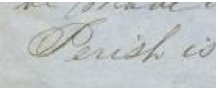
“Perish” is what I see, but I don’t know who that might be. Is there a “Parrish”, or possibly a “Bineshii” who could have carried Watrous’ letter? I’m on the lookout. (from original in the digital collections of the Wisconsin Historical Society)
Aug 9th 1851
Friend Warren
I am now very anxiously waiting the arrival of yourself and the Indians that are embraced in your division to come out to this place.
Mr. C. H. Beaulieu has arrived from the Lake Du Flambeau with nearly all that quarter and by an express sent on in advance I am informed that P. H. Beaulieu and Edward Conner will be here with Cob-wa-wis and they say the entire Wisconsin band, there had some 32 of the Pillican Lake band come out and some now are in Conner’s Party.
I want you should be here without fail in 10 days from this as I cannot remain longer, I shall leave at the expiration of this time for Crow Wing to make the payment to the St. Croix Bands who have all removed as I learn from letters just received from the St. Croix. I want your assistance very much in making the Crow Wing payment and immediately after the completion of this, (which will not take over two days[)] shall proceed to Sandy Lake to make the payment to the Mississippi and Lake Bands.
The goods are all at Sandy Lake and I shall make the entire payment without delay, and as much dispatch as can be made it; will be quite lots enough for the poor Indians. Perish[?] is the bearer of this and he can tell you all my plans better then I can write them. give My respects to your cousin George and beli[e]ve me
Your friend
J. S. Watrous
W. W. Warren Esq.}
P. S. Inform the Indians that if they are not here by the time they will be struck from the roll. I am daily expecting a company of Infantry to be stationed at this place.
JSW
Sources:
Schenck, Theresa M., William W. Warren: The Life, Letters, and times of an Ojibwe Leader. Lincoln: University of Nebraska, 2007. Print.
Treuer, Anton. The Assassination of Hole in the Day. St. Paul, MN: Borealis, 2010. Print.
Warren, William W., and Theresa M. Schenck. History of the Ojibway People. St. Paul: Minnesota Historical Society, 2009. Print.
Chief Buffalo Picture Search: Introduction
May 26, 2013
Click the question mark under the picture to see if it shows Chief Buffalo.

?


Buffalo, the 19th-century chief of the La Pointe Ojibwe, is arguably the most locally-famous person in history of the Chequamegon region. He is best known for his 1852 trip to Washington D.C., undertaken when he was thought to be over ninety years old. Buffalo looms large in the written records of the time, and makes many appearances on this website.
He is especially important to the people of Red Cliff. He is the founding father of their small community at the northern tip of Wisconsin in the sense that in the Treaty of 1854, he negotiated for Red Cliff (then called the Buffalo Estate or the Buffalo Bay Reservation) as a separate entity from the main La Pointe Band reservation at Bad River. Buffalo is a direct ancestor to several of the main families of Red Cliff, and many tribal members will proudly tell of how they connect back to him. Finally, Buffaloʼs fight to keep the Ojibwe in Wisconsin, in the face of a government that wanted to move them west, has served as an inspiration to those who try to maintain their cultural traditions and treaty rights. It is unfortunate, then, that through honest mistakes and scholarly carelessness, there is a lot of inaccurate information out there about him.
During the early twentieth century, the people of Red Cliff maintained oral traditions about about his life while the written records were largely being forgotten by mainstream historians. However, the 1960s and ʻ70s brought a renewed interest in American Indian history and the written records came back to light. With them came no fewer than seven purported images of Buffalo, some of them vouched for by such prestigious institutions as the State Historical Society of Wisconsin and the U.S. Capitol. These images, ranged from well-known lithographs produced during Buffaloʼs lifetime, to a photograph taken five years after he died, to a symbolic representation of a clan animal originally drawn on birch bark. These images continue to appear connected to Buffalo in both scholarly and mainstream works. However, there is no proof that any of them show the La Pointe chief, and there is clear evidence that several of them do not show him.
The problem this has created is not merely one of mistaken identity in pictures. To reconcile incorrect pictures with ill-fitting facts, multiple authors have attempted to create back stories where none exist, placing Buffalo where he wasnʼt, in order for the pictures to make sense. This spiral of compounding misinformation has begun to obscure the legacy of this important man, and therefore, this study attempts to sort it out.
Bizhikiwag
The confusion over the images stems from the fact that there was more than one Ojibwe leader in the mid-nineteenth century named Bizhiki (Buffalo). Because Ojibwe names are descriptive, and often come from dreams, visions, or life experiences, one can be lead to believe that each name was wholly unique. However, this is not the case. Names were frequently repeated within families or even outside of families. Waabojiig (White Fisher) and Bugone-Giizhig (Hole in the Day) are prominent examples of names from Buffaloʼs lifetime that were given to unrelated men from different villages and clans. Buffalo himself carried two names, neither of which was particularly unique. Whites usually referred to him as Buffalo, Great Buffalo, or LaBoeuf, translations of his name Bizhiki. In Ojibwe, he is just as often recorded by the name Gichi-Weshkii. Weshkii, literally “new one,” was a name often given to firstborn sons in Ojibwe families. Gichi is a prefix meaning “big” or “great,” both of which could be used to describe Buffalo.

Nichols and Nyholm translate Bizhiki (Besheke, Peezhickee, Bezhike, etc.) as both “cow” and “buffalo.” Originally it meant “buffalo” in Ojibwe. As cattle became more common in Ojibwe country, the term expanded to include both animals to the point where the primary meaning of the word today is “cow” in some dialects. These dialects will use Mashkodebizhiki (Prairie Cow) to mean buffalo. However, this term is a more recent addition to the language and was not used by individuals named Buffalo in the mid- nineteenth century. (National Park Service photo)
One glance at the 1837 Treaty of St. Peters shows three Buffalos. Pe-zhe-kins (Bizhikiins) or “Young Buffalo” signed as a warrior from Leech Lake. “Pe-zhe-ke, or the Buffalo” was the first chief to sign from the St. Croix region. Finally, the familiar Buffalo is listed as the first name under those from La Pointe on Lake Superior. It is these two other Buffalos, from St. Croix and Leech Lake, whose faces grace several of the images supposedly showing Buffalo of La Pointe. All three of these men were chiefs, all three were Ojibwe, and all three represented their people in Washington D.C. Because they share a name, their histories have unfortunately been mashed together.
Who were these three men?

Treaty of St. Peters (1837) For more on Dagwagaane (Ta-qua-ga-na), check out the People Index.
The familiar Buffalo was born at La Pointe in the middle of the 18th century. He was a member of the Loon Clan, which had become a chiefly clan under the leadership of his grandfather Andeg-wiiyas (Crowʼs Meat). Although he was already elderly by the time the Lake Superior Ojibwe entered into their treaty relationship with the United States, his skills as an orator were such that by the Treaty of 1854, one year before his death, Buffalo was the most influential leader not only of La Pointe, but of the whole Lake Superior country.
Treaty of St. Peters (1837) For more on Gaa-bimabi (Ka-be-ma-be), check out the People Index.
William Warren, describes the St. Croix Buffalo as a member of the Bear Clan who originally came to the St. Croix from Sault Ste. Marie after committing a murder. He goes on to declare that this Buffaloʼs chieftainship came only as a reward from traders who appreciated his trapping skills. Warren does admit, however, that Buffaloʼs influence grew and surpassed that of the hereditary St. Croix leaders.

Treaty of St. Peters (1837) For more on Flat Mouth, check out the People Index.
The “Young Buffalo,” of the Pillager or Leech Lake Ojibwe of northern Minnesota was a war chief who also belonged to the Bear Clan and was considerably younger than the other two Buffalos (the La Pointe and St. Croix chiefs were about the same age). As Biizhikiins grew into his later adulthood, he was known simply as Bizhiki (Buffalo). His mark on history came largely after the La Pointe Buffaloʼs death, during the politics surrounding the various Ojibwe treaties in Minnesota and in the events surrounding the US-Dakota War of 1862.
The Picture Search
In the coming months, I will devote several posts to analyzing the reported images of Chief Buffalo that I am aware of. The first post on this site can be considered the first in the series. Keep checking back for more.
Sources:
KAPPLER’S INDIAN AFFAIRS: LAWS AND TREATIES. Ed. Charles J. Kappler. Oklahoma State University Library, n.d. Web. 21 June 2012. <http:// digital.library.okstate.edu/Kappler/>.
Nichols, John, and Earl Nyholm. A Concise Dictionary of Minnesota Ojibwe. Minneapolis: University of Minnesota, 1995. Print.
Schoolcraft, Henry R. Personal Memoirs of a Residence of Thirty Years with the Indian Tribes on the American Frontiers: With Brief Notices of Passing Events, Facts, and Opinions, A.D. 1812 to A.D. 1842. Philadelphia: Lippincott, Grambo and, 1851. Print.
Treuer, Anton. The Assassination of Hole in the Day. St. Paul, MN: Borealis, 2010. Print.
Warren, William W., and Theresa M. Schenck. History of the Ojibway People. St. Paul: Minnesota Historical Society, 2009. Print.
Note: This is the final post of four about Lt. James Allen, his ten American soldiers and their experiences on the St. Croix and Brule rivers. They were sent from Sault Ste. Marie to accompany the 1832 expedition of Indian Agent Henry Schoolcraft to the source of the Mississippi River. Each of the posts gives some general information about the expedition and some pages from Allen’s journal.

- Sauk Chief Makataimeshekiakiah, or Black Hawk by Charles Bird King (Wikimedia Images)

On the night of August 1, 1831, the section of the Michigan Territory that would become the state of Wisconsin, was a scene of stark contrasts regarding the United States Army’s ability to force its will on Indian people. In the south, American forces had caught up and skirmished with the starving followers of Black Hawk near the mouth of the Bad Axe River in present-day Vernon County. The next morning, with the backing of the steamboat Warrior, the soldiers would slaughter dozens of men, women, and children as they tried to retreat across the Mississippi. The massacre at Bad Axe was the end of the Black Hawk War, the last major military resistance from the Indian nations of the Old Northwest.
Less than 300 miles upstream, Lieutenant James Allen had his bread stolen right out of his fire as he slept. Presumably, it was taken by Ojibwe youths from the Yellow River village on the St. Croix. Earlier that day, he had been unable to get convince any members of the Yellow River band to guide him up to the Brule River portage. The next morning, (the same day as the Battle of Bad Axe), Allen was able to buy a new bark canoe to take some load off his leaky fleet. However, the Ojibwe family that sold it to him was able to take advantage of supply and demand to get twice the amount of flour from the soldiers that they would’ve gotten from the local traders. Later that day, the well-known chief Gaa-bimabi (Kabamappa), from the upper St. Croix, brought him a desperately-needed map, so not all of his interactions with the Ojibwe that day were negative. However, each of these encounters showed clearly that the Ojibwe were neither cowed nor intimidated by the presence of American soldiers in their country.
In fact, Allen’s detachment must have been a miserable sight. They had fallen several days behind the voyageur-paddled canoes carrying Schoolcraft, the interpreter, and the doctor. Their canoes were leaking badly and they were running out of gum (pitch) to seal them up. Their feet were torn up from wading up the rapids, and one man was too injured to walk. They were running low on food, didn’t know how to find the Brule, and their morale was running dangerously low. If the War Department’s plan was for Allen to demonstrate American power to the Ojibwe, the plan had completely backfired.
The journey down the Brule was even more difficult for the soldiers than the trip up the St. Croix. I won’t repeat it all here because it’s in the posted pages of Allen’s journal in these four posts, but in the end, it was our old buddy Maangozid (see 4/14/13 post) and some other Fond du Lac Ojibwe who rescued the soldiers from their ordeal.
Allen’s journal entry after finally reaching Lake Superior is telling:
“[T]he management of bark canoes, of any size, in rapid rivers, is an art which it takes years to acquire; and, in this country, it is only possessed by Canadians [mix-blooded voyageurs] and Indians, whose habits of life have taught them but little else. The common soldiers of the army have no experience of this kind, and consequently, are not generally competent to transport themselves in this way; and whenever it is required to transport troops, by means of bark canoes, two Canadian voyageurs ought to be assigned to each canoe, one in the bow, and another in the stern; it will then be the safest and most expeditious method that can be adopted in this country.”
The 1830s were the years of Indian Removal throughout the United States, but at that time, the American government had no hope of conquering and subduing the Ojibwe militarily. When the Ojibwe did surrender their lands (in 1837 and 1842 for the Wisconsin parts), it was due to internal politics and economics rather than any serious threat of American invasion. Rather than proving the strength of the United States, Allen’s expedition revealed a serious weakness.
The Ojibwe weren’t overconfident or ignorant. The very word for Americans, chimookomaan (long knife), referred to soldiers. A handful of Ojibwe and mix-blooded warriors had fought the United States in the War of 1812 and earlier in the Ohio country. Bizhiki and Noodin, two chiefs whose territory Allen passed through on his ill-fated journey, had been to Washington in 1824 and saw the army firsthand. The next year, many more chiefs got to see the long knives in person at the Treaty of Prairie du Chien. Finally, the removal of their Ottawa and Potawatomi cousins and other nations to Indian Territory in the 1830s was a well-known topic of concern in Ojibwe villages. They knew the danger posed by American soldiers, but the reality of the Lake Superior Country in 1832 was that American power was very limited.
The journal picks up from part 3 with Allen and crew on the Brule River with their canoes in rapidly-deteriorating condition. They’ve made contact with the Fond du Lac villagers camped at the mouth, but there are still several obstacles to overcome.
Doc. 323, pg. 66

Doc. 323, pg. 65

Doc. 323, pg. 66
Allen’s journal is part of Phillip P. Mason’s edition of Schoolcraft’s Expedition to Lake Itasca: The Discovery of the Source of the Mississippi (1958). However, these Google Books pages come from the original publication as part of the United States Congress Serial Set.

James Allen (1806-1846)
Collections of the Iowa Historical Society
Allen and all of his men survived the ordeal of the 1832 expedition. He returned to La Pointe on August 11 and left the next day with Dr. Houghton. The two men returned to the Soo together, stopping at the great copper rock on the Ontonagon River along the way.
On September 13, 1832, he wrote Alexander Macomb, his commander at Fort Brady. The letter officially complained about Schoolcraft “unnecessarily and injuriously” leaving the soldiers behind at the mouth of the St. Croix. When the New York American published its review of Schoolcraft’s Narrative on July 19, 1834, it expressed “indignation and dismay” at the “un-Christianlike” behavior of the agent for abandoning the soldiers in the “enemy’s country.” The resulting controversy forced Schoolcraft to defend himself in the Detroit Journal and Michigan Advertiser where he pointed out Allen’s map’s importance to the Narrative. He also reminded the public that the Ojibwe and the United States were considered allies.
James Allen went on to serve in Chicago and at the Sac and Fox agency in Iowa Territory. After the Mexican War broke out in 1846, he traveled to Utah and organized a Mormon Battalion to fight on the American side. He died on his way back east on August 23, 1846. He was only forty years old. (John Lindquist has great website about the career of James Allen with much more information about his post-1832 life).
Sources:
Ely, Edmund Franklin, and Theresa M. Schenck. The Ojibwe Journals of Edmund F. Ely, 1833-1849. Lincoln: University of Nebraska, 2012. Print.
Loew, Patty. Indian Nations of Wisconsin: Histories of Endurance and Renewal. Madison: Wisconsin Historical Society, 2001. Print.
Schoolcraft, Henry Rowe, and Philip P. Mason. Expedition to Lake Itasca; the Discovery of the Source of the Mississippi,. [East Lansing]: Michigan State UP, 1958. Print.
Warren, William W., and Theresa M. Schenck. History of the Ojibway People. St. Paul: Minnesota Historical Society, 2009. Print.
Witgen, Michael J. An Infinity of Nations: How the Native New World Shaped Early North America. Philadelphia: University of Pennsylvania, 2012. Print.
No Princess Zone: Hanging Cloud, the Ogichidaakwe
May 12, 2013

This image of Aazhawigiizhigokwe (Hanging Cloud) was created 35 years after the battle depicted by Marr and Richards Engraving of Milwaukee for use in Benjamin Armstrong’s Early Life Among the Indians (Wikimedia Images).
Here is an interesting story I’ve run across a few times. Don’t consider this exhaustive research on the subject, but it’s something I thought was worth putting on here.
In late 1854 and 1855, the talk of northern Wisconsin was a young woman from from the Chippewa River around Rice Lake. Her name was Ah-shaw-way-gee-she-go-qua, which Morse (below) translates as “Hanging Cloud.” Her father was Nenaa’angebi (Beautifying Bird) a chief who the treaties record as part of the Lac Courte Oreilles band. His band’s territory, however, was further down the Chippewa from Lac Courte Oreilles, dangerously close to the territories of the Dakota Sioux. The Ojibwe and Dakota of that region had a long history of intermarriage, but the fallout from the Treaty of Prairie du Chien (1825) led to increased incidents of violence. This, along with increased population pressures combined with hunting territory lost to white settlement, led to an intensification of warfare between the two nations in the mid-18th century.
As you’ll see below, Hanging Cloud gained her fame in battle. She was an ogichidaakwe (warrior). Unfortunately, many sources refer to her as the “Chippewa Princess.” She was not a princess. Her father was not a king. She did not sit in a palace waited on hand and foot. Her marriageability was not her only contribution to her people. Leave the princesses in Europe. Hanging Cloud was an ogichidaakwe. She literally fought and killed to protect her people.
 Americans have had a bizarre obsession with the idea of Indian princesses since Pocahontas. Engraving of Pocahontas by Simon van de Passe (1616) Wikimedia Images
In An Infinity of Nations, Michael Witgen devotes a chapter to America’s ongoing obsession with the concept of the “Indian Princess.” He traces the phenomenon from Pocahontas down to 21st-century white Americans claiming descent from mythical Cherokee princesses. He has some interesting thoughts about the idea being used to justify the European conquest and dispossession of Native peoples. I’m going to try to stick to history here and not get bogged down in theory, but am going to declare northern Wisconsin a “NO PRINCESS ZONE.”
Ozhaawashkodewekwe, Madeline Cadotte, and Hanging Cloud were remarkable women who played a pivotal role in history. They are not princesses, and to describe them as such does not add to their credit. It detracts from it.
Anyway, rant over, the first account of Hanging Cloud reproduced here comes from Dr. Richard E. Morse of Detroit. He observed the 1855 annuity payment at La Pointe. This was the first payment following the Treaty of 1854, and it was overseen directly by Indian Affairs Commissioner George Manypenny. Morse records speeches of many of the most prominent Lake Superior Ojibwe chiefs at the time, records the death of Chief Buffalo in September of that year, and otherwise offers his observations. These were published in 1857 as The Chippewas of Lake Superior in the third volume of the State Historical Society’s Wisconsin Historical Collections. This is most of pages 349 to 354:
“The “Princess”–AH-SHAW-WAY-GEE-SHE-GO-QUA–The Hanging Cloud.
The Chippewa Princess was very conspicuous at the payment. She attracted much notice; her history and character were subjects of general observation and comment, after the bands, to which she was, arrived at La Pointe, more so than any other female who attended the payment.
She was a chivalrous warrior, of tried courage and valor; the only female who was allowed to participate in the dancing circles, war ceremonies, or to march in rank and file, to wear the plumes of the braves. Her feats of fame were not long in being known after she arrived; most persons felt curious to look upon the renowned youthful maiden.
 Nenaa’angebi as depicted on the cover of Benjamin Armstrong’s Early Life Among the Indians (Wikimedia Images).
She is the daughter of Chief NA-NAW-ONG-GA-BE, whose speech, with comments upon himself and bands, we have already given. Of him, who is the gifted orator, the able chieftain, this maiden is the boast of her father, the pride of her tribe. She is about the usual height of females, slim and spare-built, between eighteen and twenty years of age. These people do not keep records, nor dates of their marriages, nor of the birth of their children.
This female is unmarried. No warrior nor brave need presume to win her heart or to gain her hand in marriage, who cannot prove credentials to superior courage and deeds of daring upon the war-path, as well as endurance in the chase. On foot she was conceded the fleetest of her race. Her complexion is rather dark, prominent nose, inclining to the Roman order, eyes rather large and very black, hair the color of coal and glossy, a countenance upon which smiles seemed strangers, an expression that indicated the ne plus ultra of craft and cunning, a face from which, sure enough, a portentous cloud seemed to be ever hanging–ominous of her name. We doubt not, that to plunge the dagger into the heart of an execrable Sioux, would be more grateful to her wish, more pleasing to her heart, than the taste of precious manna to her tongue…
…Inside the circle were the musicians and persons of distinction, not least of whom was our heroine, who sat upon a blanket spread upon the ground. She was plainly, though richly dressed in blue broad-cloth shawl and leggings. She wore the short skirt, a la Bloomer, and be it known that the females of all Indians we have seen, invariably wear the Bloomer skirt and pants. Their good sense, in this particular, at least, cannot, we think, be too highly commended. Two plumes, warrior feathers, were in her hair; these bore devices, stripes of various colored ribbon pasted on, as all braves have, to indicate the number of the enemy killed, and of scalps taken by the wearer. Her countenance betokened self-possession, and as she sat her fingers played furtively with the haft of a good sized knife.
The coterie leaving a large kettle hanging upon the cross-sticks over a fire, in which to cook a fat dog for a feast at the close of the ceremony, soon set off, in single file procession, to visit the camp of the respective chiefs, who remained at their lodges to receive these guests. In the march, our heroine was the third, two leading braves before her. No timid air and bearing were apparent upon the person of this wild-wood nymph; her step was proud and majestic, as that of a Forest Queen should be.
The party visited the various chiefs, each of whom, or his proxy, appeared and gave a harangue, the tenor of which, we learned, was to minister to their war spirit, to herald the glory of their tribe, and to exhort the practice of charity and good will to their poor. At the close of each speech, some donation to the beggar’s fun, blankets, provisions, &c., was made from the lodge of each visited chief. Some of the latter danced and sung around the ring, brandishing the war-club in the air and over his head. Chief “LOON’S FOOT,” whose lodge was near the Indian Agents residence, (the latter chief is the brother of Mrs. Judge ASHMAN at the Soo,) made a lengthy talk and gave freely…
…An evening’s interview, through an interpreter, with the chief, father of the Princess, disclosed that a small party of Sioux, at a time not far back, stole near unto the lodge of the the chief, who was lying upon his back inside, and fired a rifle at him; the ball grazed his nose near his eyes, the scar remaining to be seen–when the girl seizing the loaded rifle of her father, and with a few young braces near by, pursued the enemy; two were killed, the heroine shot one, and bore his scalp back to the lodge of NA-NAW-ONG-GA-BE, her father.
At this interview, we learned of a custom among the Chippewas, savoring of superstition, and which they say has ever been observed in their tribe. All the youths of either sex, before they can be considered men and women, are required to undergo a season of rigid fasting. If any fail to endure for four days without food or drink, they cannot be respected in the tribe, but if they can continue to fast through ten days it is sufficient, and all in any case required. They have then perfected their high position in life.
This Princess fasted ten days without a particle of food or drink; on the tenth day, feeble and nervous from fasting, she had a remarkable vision which she revealed to her friends. She dreamed that at a time not far distant, she accompanied a war party to the Sioux country, and the party would kill one of the enemy, and would bring home his scalp. The war party, as she had dreamed, was duly organized for the start.
Against the strongest remonstrance of her mother, father, and other friends, who protested against it, the young girl insisted upon going with the party; her highest ambition, her whole destiny, her life seemed to be at stake, to go and verify the prophecy of her dream. She did go with the war party. They were absent about ten or twelve days, the had crossed the Mississippi, and been into the Sioux territory. There had been no blood of the enemy to allay their thirst or to palliate their vengeance. They had taken no scalp to herald their triumphant return to their home. The party reached the great river homeward, were recrossing, when lo! they spied a single Sioux, in his bark canoe near by, whom they shot, and hastened exultingly to bear his scalp to their friends at the lodges from which they started. Thus was the prophecy of the prophetess realized to the letter, and herself, in the esteem of all the neighboring bands, elevated to the highest honor in all their ceremonies. They even hold her in superstitious reverence. She alone, of the females, is permitted in all festivities, to associate, mingle and to counsel with the bravest of the braves of her tribe…”
 Benjamin Armstrong
Benjamin Armstrong’s memoir Early Life Among the Indians also includes an account of the warrior daughter of Nenaa’angebi. In contrast to Morse, the outside observer, Armstrong was married to Buffalo’s niece and was the old chief’s personal interpreter. He lived in this area for over fifty years and knew just about everyone. His memoir, published over 35 years after Hanging Cloud got her fame, contains details an outsider wouldn’t have any way of knowing.
Unfortunately, the details don’t line up very well. Most conspicuously, Armstrong says that Nenaa’angebi was killed in the attack that brought his daughter fame. If that’s true, then I don’t know how Morse was able to record the Rice Lake chief’s speeches the following summer. It’s possible these were separate incidents, but it is more likely that Armstrong’s memories were scrambled. He warns us as much in his introduction. Some historians refuse to use Armstrong at all because of discrepancies like this and because it contains a good deal of fiction. I have a hard time throwing out Armstrong completely because he really does have the insider’s knowledge that is lacking in so many primary sources about this area. I don’t look at him as a liar or fraud, but rather as a typical northwoodsman who knows how to run a line of B.S. when he needs to liven up a story. Take what you will of it, these are pages 199-202 of Early Life Among the Indians.
“While writing about chiefs and their character it may not be amiss to give the reader a short story of a chief‟s daughter in battle, where she proved as good a warrior as many of the sterner sex.
In the ’50’s there lived in the vicinity of Rice Lake, Wis. a band of Indians numbering about 200. They were headed by a chief named Na-nong-ga-bee. This chief, with about seventy of his people came to La Point to attend the treaty of 1854. After the treaty was concluded he started home with his people, the route being through heavy forests and the trail one which was little used. When they had reached a spot a few miles south of the Namekagon River and near a place called Beck-qua-ah-wong they were surprised by a band of Sioux who were on the warpath and then in ambush, where a few Chippewas were killed, including the old chief and his oldest son, the trail being a narrow one only one could pass at a time, true Indian file. This made their line quite long as they were not trying to keep bunched, not expecting or having any thought of being attacked by their life long enemy.
The chief, his son and daughter were in the lead and the old man and his son were the first to fall, as the Sioux had of course picked them out for slaughter and they were killed before they dropped their packs or were ready for war. The old chief had just brought the gun to his face to shoot when a ball struck him square in the forehead. As he fell, his daughter fell beside him and feigned death. At the firing Na-nong-ga-bee’s Band swung out of the trail to strike the flanks of the Sioux and get behind them to cut off their retreat, should they press forward or make a retreat, but that was not the Sioux intention. There was not a great number of them and their tactic was to surprise the band, get as many scalps as they could and get out of the way, knowing that it would be but the work of a few moments, when they would be encircled by the Chippewas. The girl lay motionless until she perceived that the Sioux would not come down on them en-masse, when she raised her father‟s loaded gun and killed a warrior who was running to get her father‟s scalp, thus knowing she had killed the slayer of her father, as no Indian would come for a scalp he had not earned himself. The Sioux were now on the retreat and their flank and rear were being threatened, the girl picked up her father‟s ammunition pouch, loaded the rifle, and started in pursuit. Stopping at the body of her dead Sioux she lifted the scalp and tucked it under her belt. She continued the chase with the men of her band, and it was two days before they returned to the women and children, whom they had left on the trail, and when the brave little heroine returned she had added two scalps to the one she started with.
She is now living, or was, but a few years ago, near Rice Lake, Wis., the wife of Edward Dingley, who served in the war of rebellion from the time of the first draft of soldiers to the end of the war. She became his wife in 1857, and lived with him until he went into the service, and at this time had one child, a boy. A short time after he went to the war news came that all the party that had left Bayfield at the time he did as substitutes had been killed in battle, and a year or so after, his wife, hearing nothing from him, and believing him dead, married again. At the end of the war Dingley came back and I saw him at Bayfield and told him everyone had supposed him dead and that his wife had married another man. He was very sorry to hear this news and said he would go and see her, and if she preferred the second man she could stay with him, but that he should take the boy. A few years ago I had occasion to stop over night with them. And had a long talk over the two marriages. She told me the circumstances that had let her to the second marriage. She thought Dingley dead, and her father and brother being dead, she had no one to look after her support, or otherwise she would not have done so. She related the related the pursuit of the Sioux at the time of her father‟s death with much tribal pride, and the satisfaction she felt at revenging herself upon the murder of her father and kinsmen. She gave me the particulars of getting the last two scalps that she secured in the eventful chase. The first she raised only a short distance from her place of starting; a warrior she espied skulking behind a tree presumably watching for some one other of her friends that was approaching. The other she did not get until the second day out when she discovered a Sioux crossing a river. She said: “The good luck that had followed me since I raised my father‟s rifle did not now desert me,” for her shot had proved a good one and she soon had his dripping scalp at her belt although she had to wade the river after it.”
At this point, this is all I have to offer on the story of Hanging Cloud the ogichidaakwe. I’ll be sure to update if I stumble across anything else, but for now, we’ll have to be content with these two contradictory stories.
Sources:
Armstrong, Benj G., and Thomas P. Wentworth. Early Life among the Indians: Reminiscences from the Life of Benj. G. Armstrong : Treaties of 1835, 1837, 1842 and 1854 : Habits and Customs of the Red Men of the Forest : Incidents, Biographical Sketches, Battles, &c. Ashland, WI: Press of A.W. Bowron, 1892. Print.
Morse, Richard F. “The Chippewas of Lake Superior.” Collections of the State Historical Society of Wisconsin. Ed. Lyman C. Draper. Vol. 3. Madison: State Historical Society of Wisconsin, 1857. 338-69. Print.
Warren, William W., and Theresa M. Schenck. History of the Ojibway People. St. Paul: Minnesota Historical Society, 2009. Print.
Witgen, Michael J. An Infinity of Nations: How the Native New World Shaped Early North America. Philadelphia: University of Pennsylvania, 2012. Print.
Note: This is the third of four posts about Lt. James Allen, his ten American soldiers and their experiences on the St. Croix and Brule rivers. They were sent from Sault Ste. Marie to accompany the 1832 expedition of Indian Agent Henry Schoolcraft to the source of the Mississippi River. Each of the posts will give some general information about the expedition and some pages from Allen’s journal.

Douglass Houghton (1809-1845) was the naturalist and physician for the expedition. While traveling with Schoolcraft’s lead group, he expressed frequent concern for Allen and the soldiers as they fell behind (painted by Alva Bradish, 1850; Wikimedia Commons).
Schoolcraft’s original book takes up the first quarter of the pages in the 1958 edition of Narrative of an Expedition, edited by Phillip P. Mason. The rest of the pages are six appendixes including the journals of Douglass Houghton the surgeon and geologist, W.T. Boutwell the missionary, and Allen. Of the four, Schoolcraft’s provides the blandest reading. His positive, official spin on everything offers little glimpse into his psyche. In contrast, Houghton gives us a unique account of smallpox vaccinations, botany, and geology. Boutwell gives us detailed descriptions of Ojibwe religious practices through his zealous missionary filter. His frequent complaints about mosquitoes, profane soldiers, Indian drumming, and voyageur gambling ruining his Sabbaths are very humorous to those who aren’t sympathetic to his mission.
Allen’s journal is fascinating. He was sent by the War Department to record information about the geography of the country and its people for military purposes. Officially the Ojibwe and the United States were friendly. Schoolcraft, being married into a prominent Ojibwe family at the Sault, promoted this idea. However, a sense of future military confrontation looms over the narrative. The Indian Removal Act was only two years old, and Black Hawk’s War broke out just as the expedition was starting out. In 1832, lasting peace between the Ojibwe and the United States was not automatically guaranteed.
The journal reads, at times, like a post-modern anti-colonial novel complete with Allen as the villainous narrator looking to get rich off Lake Superior copper and making war plans against Leech Lake. However, Allen’s writing style allows the reader in as Schoolcraft’s doesn’t, and he shows himself to be thoughtful and observant.
Allen’s primary objective was to protect Schoolcraft and show the Ojibwe that the United States could easily deliver soldiers to their remotest villages. This mission proved difficult from the beginning. Once they left Lake Superior and reached the Fond du Lac portages, it became evident that Allen’s soldiers had no canoe experience and could not keep up with Schoolcraft’s mix-blooded voyageurs. Schoolcraft never seems overly concerned about this, and much of Allen’s narrative is about his men painfully trying to catch up while the Ojibwe and mix-blooded guides laugh at their floundering techniques for getting through rapids.
Through all the hardship, though, Allen did complete the journey to Elk Lake (Itasca) and back down the Mississippi to Fort Snelling. His map of the trip was praised back east as a great contribution to world geography, and Schoolcraft used it to illustrate the published narrative. However, it was the final stretch through the St. Croix and Brule, after Schoolcraft had already declared the expedition a success, where things really got bad for the soldiers.
Continued from Part 2:

Section of Allen’s map showing the St. Croix to Brule portage. Note Gaa-bimabi’s (Keppameppa’s) village on Whitefish Lake near present-day Gordon, Wisconsin. (Reproduced by John Lindquist).
At this point, Allen and his men have fallen multiple days behind Schoolcraft. They have no knowledge of the country save a few rough maps and descriptions. Their canoes are falling apart, and they are physically beaten from their difficult journey up the St. Croix. In theory, the portage over the hill to the Brule should be an easy one given the fact they have little food and supplies left to carry. However, the men are demoralized and ready to quit. Little do they know, the darkest days of their journey are still to come.

Doc. 323, pg. 61

Doc. 323, pg. 62
Doc. 323, pg. 63
Allen’s journal is part of Phillip P. Mason’s edition of Schoolcraft’s Expedition to Lake Itasca: The Discovery of the Source of the Mississippi (1958). However, these Google Books pages come from the original publication as part of the United States Congress Serial Set.
Chief Buffalo, Flat Mouth, and Tecumseh
April 28, 2013
 The Shawnee Prophet, Tenskwatawa painted by Charles Bird King c.1820 (Wikimedia Commons)
In contrast with other Great Lakes nations, the Lake Superior Ojibwe are often portrayed as not having had a role in the Seven Years War, Pontiac’s War, Tecumseh’s War, or the War of 1812. The Chequamegon Ojibwe are often characterized as being uniformly friendly toward whites, peacefully transitioning from the French and British to the American era. The Ojibwe leaders Buffalo of La Pointe and Flat Mouth of Leech Lake are seen as men who led their people into negotiations rather than battle with the United States.
No one tried harder to promote the idea of Ojibwe-American friendship than William W. Warren (1825-1853), the Madeline Island-born mix-blooded historian who wrote History of the Ojibway People. Warren details Ojibwe involvement in all of these late-18th and early 20th-century imperial conflicts, but then repeatedly dismisses it as solely the work of more easterly Ojibwe bands or a few rogue warriors. The reality was much more complicated.
It is true, the Lake Superior Ojibwe never entered into these wars as a single body, but the Lake Superior Ojibwe rarely did anything as a single body. Different bands, chiefs, and families pursued different policies. What is clear from digging deeper into the sources, however, is that the anti-American resistance ideologies of men like the Tecumseh and his brother Tenskwatawa (The Prophet) had more followers around here than Warren would have you believe. The passage below, from none other than Warren himself, shows that these followers included Buffalo and Flat Mouth.
History of the Ojibway People is available free online, but I’m not going to link to it. I want you to check out or buy the second edition, edited and annotated by Theresa Schenck and published by the Minnesota Historical Society in 2009. It is not the edition I first read this story in, but this post does owe a great debt to Dr. Schenck’s footnotes. Also, if you get the book, you will find the added bonus of a second account of these same events from Julia Warren Spears, William’s sister (Appendix C). The passage that is reproduced here can be read on pages 227-231.
“… no event of any importance occured on the Chippeway and Wisconsin Rivers till the year 1808, when, under the influence of the excitement which the Shaw-nee prophet, brother of Tecumseh, succeeded in raising, even to the remotest village of the Ojibways, the men of the Lac Coutereille village, pillaged the trading house of Michel Cadotte at Lac Coutereilles, while under charge of a clerk named John Baptiste Corbin. From the lips of Mons. Corbin, who is still living at Lac Coutereille, at the advanced age of seventy-six years, and who has now been fifty-six years in the Ojibway country, I have obtained a reliable account of this transaction…”
“…In the year 1808, during the summer while John B. Corbin had charge of the Lac Coutereille post, messengers, whose faces were painted black, and whose actions appeared strange, arrived at the different principal villages of the Ojibways. In solemn councils they performed certain ceremonies, and told that the Great Spirit had at last condescended to hold communion with the red race, through the medium of a Shawano prophet, and that they had been sent to impart the glad tidings.
The Shawano sent them word that the Great Spirit was about to take pity on his red children, whom he had long forsaken for their wickedness. He bade them to return to the primitive usages and customs of their ancestors, to leave off the use of everything which the evil white race had introduced among them. Even the fire-steel must be discarded, and fire made as in ages past, by the friction of two sticks. And this fire, once lighted in their principal villages, must always be kept sacred and burning. He bade them to discard the use of fire-water—to give up lying and stealing and warring with one another. He even struck at some of the roots of the Me-da-we religion, which he asserted had become permeated with many evil medicines, and had lost almost altogether its original uses and purity. He bade the medicine men to throw away their evil and poisonous medicines, and to forget the songs and ceremonies attached thereto, and he introduced new medicines and songs in their place. He prophesied that the day was nigh, when, if the red race listened to and obeyed his words, the Great Spirit would deliver them from their dependence on the whites, and prevent their being finally down-trodden and exterminated by them. The prophet invited the Ojibways to come and meet him at Detroit, where in person, he would explain to them the revelations of the “Great Master of Life.” He even claimed the power of causing the dead to arise, and come again to life.
It is astonishing how quickly this new belief obtained possession in the minds of the Ojibways. It spread like wild-fire throughout their entire country, and even reached the remotest northern hunters who had allied themselves with the Crees and Assiniboines. The strongest possible proof which can be adduced of their entire belief, is in their obeying the mandate to throw away their medicine bags, which the Indian holds most sacred and inviolate. It is said that the shores of Sha-ga-waum-ik-ong were strewed with the remains of medicine bags, which had been committed to the deep. At this place, the Ojibways collected in great numbers. Night and day, the ceremonies of the new religion were performed, till it was at last determined to go in a body to Detroit, to visit the prophet. One hundred and fifty canoes are said to have actually started from Pt. Shag-a-waum-ik-ong for this purpose, and so strong was their belief, that a dead child was brought from Lac Coutereille to be taken to the prophet for resuscitation.
This large party arrived on their foolish journey, as far as the Pictured Rocks, on Lake Superior, when, meeting with Michel Cadotte, who had been to Sault Ste. Marie for his annual outfit of goods, his influence, together with information of the real motives of the prophet in sending for them, succeeded in turning them back.
The few Ojibways who had gone to visit the prophet from the more eastern villages of the tribe, had returned home disappointed, and brought back exaggerated accounts of the suffering through hunger, which the proselytes of the prophet who had gathered at his call, were enduring, and also giving the lie to many of the attributes which he had assumed. It is said that at Detroit he would sometimes leave the camp of the Indians, and be gone, no one knew whither, for three and four days at a time. On his return he would assert that he had been to the spirit land and communed with the master of life. It was, however, soon discovered that he only went and hid himself in a hollow oak which stood behind the hill on which the most beautiful portion of Detroit City is now built. These stories became current among the Ojibways, and each succeeding year developing more fully the fraud and warlike purpose of the Shawano, the excitement gradually died away among the Ojibways, and the medicine men and chiefs who had become such ardent believers, hung their heads in shame whenever the Shawano was mentioned.

 Two men of “strong minds and unusual intelligence,” Buffalo of La Pointe (top) and Eshkibagikoonzhe or “Flat Mouth” of Leech Lake. (Wisconsin Historical Society) (Minnesota Historical Society)
At this day it is almost impossible to procure any information on this subject from the old men who are still living, who were once believers and preached their religion, so anxious are they to conceal the fact of their once having been so egregiously duped. The venerable chiefs Buffalo, of La Pointe, and Esh-ke-bug-e-coshe, of Leech Lake, who have been men of strong minds and unusual intelligence, were not only firm believers of the prophet, but undertook to preach his doctrines.
One essential good resulted to the Ojibways through the Shawano excitement–they threw away their poisonous roots and medicines, and poisoning, which was formerly practiced by their worst class of medicine men, has since become entirely unknown.
So much has been written respecting the prophet and the new beliefs which he endeavored to inculcate amongst his red brethren, that we will no longer dwell on the merits or demerits of his pretended mission. It is now evident that he and his brother Tecumseh had in view, and worked to effect, a general alliance of the red race, against the whites, and their final extermination from the ‘Great Island which the great spirit had given as an inheritance to his red children.’”
From 1805 to 1811, the Shawnee Prophet Tenskwatawa and his brother Tecumseh spread a religious and political message from the Canadas in the north, to the Gulf of Mexico in the south, to the prairies of the west. They called for all Indians to abandon white ways, unite as one people, and create a British-protected Indian country between the Ohio and the Great Lakes. While he seldom convinced entire nations (including the Shawnee) to join him, Tecumseh gained followers from all over.
 This picture of Tecumseh in British uniform was painted decades after his death by Benson John Lossing (Wikimedia Commons)
His coalition came apart, however, at the Battle of Tippecanoe on November 7, 1811. Tecumseh was away recruiting more followers when American forces under William Henry Harrison defeated Tenskwatawa. Accounts suggest it was a closely-fought battle with the Americans suffering the most casualties. However, in the end Harrison prevailed due to his superior numbers.
With Tenskwatawa discredited, Tecumseh ended up raising a new coalition to fight alongside the British against the Americans in the War of 1812. He was killed in the Battle of the Thames, October 5, 1813, when the British forces under General Henry Procter abandoned their Indian allies on the battlefield.
After the War of 1812, British traders pulled out of their posts in American territory. However, the Ojibwe of Lake Superior continued to trade across the line in Canada. In 1822, the American agent Henry Schoolcraft’s gave his first description of Buffalo, a man he would come to know well over the next thirty-five years. He described “a chief decorated with British insignia.” Ten years later, Flat Mouth was telling Schoolcraft he had no right or ability to stop the Ojibwe from allying with the British. These chiefs were not men who were unwavering friends of the United States for their whole lives.
Buffalo and Flat Mouth lived to be very old men, and lived to see the Ojibwe cede their lands in treaties, suffer the tragic 1850-51 removal to Sandy Lake, and see the beginnings of a paternalist American regime on the newly-created reservations. Their Shawnee contemporary, Tecumseh, did not live that long.
Tecumseh’s life and death are documented in the second episode of the 2009 television miniseries American Experience: We Shall Remain. The episode, Tecumseh’s Vision, is very good throughout. The most interesting part comes at the very end when several of the expert interviewees comment on the meaning of Tecumseh’s death:
“I think Tecumseh is, in a sense, saved by his death. He’s saved for immortality through death on the battlefield.”
Stephen Warren, Augustana College
“One of the great things in icons is to bow out at the right time, and one of the things Tecumseh does is he never lets you down. He was there, articulating his position — uncompromisingly pro-Native American position. He never signs the treaties. He never reneges on those basic as principles of the sacrosanct aboriginal holding of this territory. He bows out at the peak of this great movement he is leading. He’s there, right at the end, whatever the odds are, fighting for it into the dying moments.”
John Sugden, author Tecumseh: A Life
“For some people, they may call him a troublemaker. And I think that’s because, in the end, he lost. Had he won, he’d have been, you know, a hero. But I think, to a degree, he still has to be recognized as a hero, for what he attempted to do. If he had a little more help, maybe he would have got a little farther down the line. If the British would have backed him up, like they were supposed to have, maybe the United States is only half as big as it is today.”
Sherman Tiger, Absentee Shawnee Tribe of Oklahoma
Stephen Warren and John Sugden indicate that he is a hero because of the way he died. Sherman Tiger seems to say that Tecumseh’s death, in part, is what kept him from being a hero, and that if he had more men, maybe his “vision” of a united Indian nation would have come true.
In 1811, the Ojibwe of Lake Superior and the upper Mississippi had hundreds of warriors experienced in battle with the Dakota Sioux. They were heirs to a military tradition that defeated the Iroquois and the Meskwaki (Fox). A handful of Ojibwe did fight beside Tecumseh, and according to John Baptiste Corbine through Warren, many more could have. It’s possible they could have tipped the balance and caused Tippecanoe or Thames to end differently. It is also possible that Buffalo, Flat Mouth, and other future Ojibwe leaders could have died on the battlefield.
Tecumseh died young and uncompromised. Buffalo and Flat Mouth faced many tough decisions and lived long enough to see their people lose their independence and most of their land. However, they were there to lead their people through the hard times of the removal period. Tecumseh wasn’t.
Ultimately, it’s hard to say which is more heroic? What do you think?
Sources:
Schenck, Theresa M., William W. Warren: The Life, Letters, and times of an Ojibwe Leader. Lincoln: University of Nebraska, 2007. Print.
Schoolcraft, Henry Rowe, and Philip P. Mason. Expedition to Lake Itasca; the Discovery of the Source of the Mississippi,. [East Lansing]: Michigan State UP, 1958. Print.
Schoolcraft, Henry R. Personal Memoirs of a Residence of Thirty Years with the Indian Tribes on the American Frontiers: With Brief Notices of Passing Events, Facts, and Opinions, A.D. 1812 to A.D. 1842. Philadelphia: Lippincott, Grambo and, 1851. Print.
Warren, William W., and Theresa M. Schenck. History of the Ojibway People. St. Paul: Minnesota Historical Society, 2009. Print.
White, Richard. The Middle Ground: Indians, Empires, and Republics in the Great Lakes Region, 1650-1815. Cambridge: Cambridge UP, 1991. Print.
Witgen, Michael J. An Infinity of Nations: How the Native New World Shaped Early North America. Philadelphia: University of Pennsylvania, 2012. Print.
 Chequamegon History