Patty Loew Speaks in Ashland, March 20, 2015
March 6, 2015

I just came across this poster today. Dr. Loew is a fantastic speaker and researcher. She is one of the most-frequently cited historians here on the Chequamegon History website.
19th-Century Deer in the Headlights
January 18, 2015
By Leo

Deer Hunting by Torchlight in Bark Canoes 1846-1848 by George Catlin (Smithsonian American Art Museum)
Chequamegon History doesn’t usually deal with current events, preferring to stay in the 18th and 19th centuries, but I heard a radio program last week that prompted me to dig out some old sources related to a timely topic: off-reservation deer hunting at night by the Lake Superior Chippewa bands.
The State of Wisconsin’s January 7th, 2015 decision to appeal a lower-court decision in favor of Chippewa off-reservation night hunting prompted an edition of Wisconsin Public Radio’s Central Time on the topic that aired later that afternoon. The Ojibwe case in favor of night hunting is briefly, but thoughtfully, presented by the hosts, by Brandon Thoms for the Lac du Flambeau Band and by Richard Monette, Director of the Great Lakes Indian Law Center at UW-Madison.
Though Monette and Thoms touched briefly on the historical and ethical role in Ojibwe communities, the program wasn’t long enough for them to go into much depth. Since night hunting is something that brings controversy, and with it misinformation, I am hoping these historical documents can help promote three points of understanding among those of us who live in the ceded territory of the 21st century.
1. Ojibwe hunters used bright light as a means to harvest deer at night long before the creation of the current reservations.
2. Hunting at night was historically an efficient and effective means of obtaining food.
3. Controversy over the ethics of “shining” stems more from differences in historical and cultural hunting values than on real environmental values and sustainable practices.
“Modern” Technology
In Northern Wisconsin, the idea of night-hunting deer is often associated with the term “shining.” Often used pejoratively, the word tends to conjure up the image of hunters shooting deer out the windows of mud-covered trucks equipped with high-powered electrical spotlights.
Since deer tend to freeze in place when bright light is shone in their eyes, this makes it possible to get close enough to make an accurate shot in darkness. I’ve heard the argument that “shining” relies on modern technology and therefore isn’t fair to the deer.
However, this argument isn’t true. North American hunters used bright light as a means to harvest deer long before the invention of electric spotlights. An 1804 journal entry from the British-Canadian fur-trader George Nelson explains how it worked. Nelson, a teenager trading on the Chippewa River under Simon Charette for the XY Company, participated in such a hunt with his Ojibwe companions just south of Clam Lake. This entry appears on page 158-160 of the 2002 Minnesota Historical Press Edition of the Nelson journals, edited by Laura Lynn Peers and Theresa Schenck:
Monday 29th [May 1804] Sorel & I go to get our small canoe that we left above in this small river not being able to bring it down with our fish upon our backs the river being too rapidous. As soon as we arrived at our camp we set off & encamped at a small portage not very distant. We had no sooner carried our things across the Portage, then I embarked with the indian to hunt deer to night with a Candle[*]. We ascended the river about 2 leagues further than our encampment where we seen a large Buck which we frightened away by sneezing – : However at dusk we light our candle & about an hour after hearing something puddling in the water we let ourselves drift ’till within 8 or ten yards when we found it to be several deer, the indian wounded one & the others immediately run off – we debarked & seen much blood having our candle, dispairing however of finding it we reembarked – but misfortunately we upset our canoe just getting in, consequently our candle not being well secured fell over board & a terrible shower of rain falling just at this momment obliged us to shelter ourselves under a large pine (Epinette) ’till next morning when after some search we found the deer dead – We returned to our people [–& then continued our course up this same river]
At the end of this journal, Nelson added the following (in footnote on same pages of the published edition):
*(To Page 29 – May 29th) The indians from about the 15th of May ’till about the 20th of August kill a great number of deer every night by this means, the skins of which they gather & sell or trade them in the fall with the traders – The means they employ are these, they raise about 4 foot long of pine, elm, or any other strong bark which they double in such a manner as to make the lower part serve as a shelf & upon this the Candle rests, while the rest or upper part off the bark serves as a kind of screen behind which they set unperceived; for the candle that is upon the lower part of the shelf does not leave any part of the canoe visable for it is fastened to the bow of the canoe between the first bar & the curve – it is tied fast & high enough to put the Gun under below. When there is any deer (for they never fail coming every night to the borders of the small lakes & rivers where they eat weeds & remain in the water on account of the muskatas that are no less numerous than troublesome) it is easily known; for indians in General have as sharp an ear as their sight; & can tell where to direct when he hears the least puddling in the water. The deer whenever they see a light of this kind never stir but keep looking upon it ’till sometimes they are not more than three yards distant when the indian shoots them with shot, but if the least noise be made, by striking upon the canoe or its bars, sneezing, caughing, or even by touching your paddle upon a stone or stick in the bottom of the river they scamper off immediately…
And in a later consolidation of his journals, he added this to the account:
…At another place, a young indian & I went out to hunt deer. We made a Candle by chewing tallow, of which we had plenty & wrapped over a piece of cotton shirt as a wick, & placed it conveniently in the bow of the Canoe, where a screen had been erected with a piece of Spruce bark so large as to completely cover the indian, yet so as he could see what was going on before. We saw Several Deer. At dark, we drifted down -frightened off one party of deer. We soon found another, who attracted by the Candles, kept staring upon it alone: we drifted slowly only the lad shot one, & off the others ran…
Similar accounts can be found in other sources, and it seems this method of hunting was widespread and the most common way to hunt deer in spring and summer. The practice almost certainly predates the arrival of whites in the Lake Superior country, and hopefully these journals can put to bed the idea that night-hunting only became possible with the advent of electricity.
The Sport in Shining

Sir Edward Robert Sullivan, 5th Baronet, as depicted by Carlo Pelligrini for Vanity Fair in 1885 (National Portrait Gallery; London)
Some criticism of night hunting comes from the idea that it is too easy, and therefore, not sporting or fair to the deer. An 1850 account from the St. Croix River near present-day Gordon shows some of this sentiment. Sir Edward Robert Sullivan Bart., an English noble came here during a trip throughout the Americas described in the 1852 work, Rambles and Scrambles in North and South America. Although it comes two years before Carl Scherzer’s account of La Pointe (translated into English for the time first here on Chequamegon History) the Brule and the St. Croix, Rambles and Scrambles is not nearly as interesting as the German work. Sullivan took the same route to Stillwater, and even engaged the same La Pointe voyageur (Souverain Denis) as a guide, but the work is generally disappointing. Rather than Scherzer’s curiosity and deep ethnographic detail, Sullivan’s text is largely filled with the haughty superiority one might expect from the most stereotypical Victorian gentleman colonialist.

pg. 76

pg. 77
This account of Ojibwe hunting contrasts humorously with Sullivan’s earlier account from the lakeshore (probably near Sand Bay) of his own attempt at hunting the Northwoods:

pg. 67

pg. 68
The image of the pompous British gentleman hunter walking in panicked circles, is made all the more hilarious by the fact that one of his companions would do the exact same thing the next evening at Iron River. One imagines the thoughts going through the minds of the Ojibwe-French mix-blood guides as they had to rescue two mighty Zhaaganash sportsmen out of the woods in two days.
And that brings me to my point. As hard as it may be to admit, much of the prevailing American conservation ethic comes from this British notion of hunting for sport. This comes from a time in Europe when hunting was forbidden to the common people. A peasant might be arrested for poaching a deer to feed his family, while the gamekeepers kept the forests preserved so men like Sullivan could bring home trophies. In such a viewpoint, something like shining might be condemned for being too easy, effective, and unromantic.
On the other hand, the Ojibwe husband and wife on the St. Croix were not looking for a splendid evening of recreation. They needed venison to feed the village. It didn’t matter if it was summer and the buck’s antlers weren’t as impressive as they might get in November. Hunting was necessary work for survival, and it was done using the most efficient and effective means possible. In describing the Ojibwe idea of the afterlife five years later in 1855, the German ethnographer Johann Kohl writes:
…But, even if we wished to represent the buffalo-covered prairies as a paradise for the hunter, it is still questionable to me whether hunting forms a material feature of the Indian paradise. To us Europeans hunting is more or less an amusement, but to the Indian it is a toil, and frequently a most fatiguing mode of life. In many Indian dialects the words “hunter” and “hunting” are synonymous with “work” and “working.” A good hunter is a clever and industrious workman. As, then, the idea entertained by most nations of paradise is, that it will be without toil or labour, it is to me more than doubtful whether they regard the chase as an element of their paradisiac existence. Among the Ojibbeways I never heard that they held such a view. I once asked a man of their tribe, who was describing paradise to me, and did not at all allude to hunting, “And then you will go every day to hunt and kill a countless number of animals?” “Oh no!” he replied, dryly, “there is no hunting or labour in paradise (212-13).”
I would argue that most deer hunters in Northern Wisconsin today, both Native and non-Native, derive food, pleasure, and a sense of tradition from hunting. However, the relative importance of each can vary greatly from hunter to hunter in both communities.
I know many white hunters who hunt mainly to fill the freezer rather rather than for sport, and with it, there is a certain conservation ethic that has descended from those peasant poachers. In this viewpoint, you respect and value the lives of animals because they gave their lives to keep you alive, not because you came up with some convoluted “sporting” method of harvesting them. The ethics that would have you break the law to keep and eat a dying undersized fish aren’t the same ethics of the Teddy Roosevelts and Ernest Hemingways of the world, but they are conservation ethics nonetheless.
In my mind, these two viewpoints on the role and purpose of hunting are central to the debate over “shining,” and I think examination of history might find Ojibwe and non-Ojibwe residents of the ceded territory having more in common with each other than they do with Scott Walker and his Deer Czar.
Environmental Impact of Night Hunting
While on the subject of conservation, it is worth looking at whether or not night hunting is bad for the environment. Let’s put aside for a minute the fact that the off-reservation night harvest would be minuscule compared to the regular Wisconsin deer hunt or the amount of deer who die at night after being inadvertently “shined” on the highways. And let’s forget for a minute how “divide and conquer” politicians in the eighties used the environment as red herring to turn whites and Indians against each other over the issue of spearfishing or how the walleye populations in the ceded territory are kept up in large part by tribal conservation efforts. Finally, let’s stop puzzling over how Native people managed to survive on this continent for tens of thousands of years before whites came to teach them how to manage resources. Yes, let’s forget about those things and go back to the historical record.
If Nelson’s journals show that hunting out of a canoe by torchlight was well established at the outset of the 1800s, and Sullivan’s Rambles and Scrambles, show it being used at mid-century, we can close out the 19th century with an account from Minnesota.
Reverend Joseph Gillfillan, was a Christian missionary to the Ojibwe people in the areas around Red, Cass, and Leech lakes. In an 1895 letter to the Minnesota Forestry Department and a subsequent article, The Ojibways in Minnesota, presented in 1896 and published in 1901, we hear a familiar story.
Gillfillan doesn’t describe the Lake Superior Chippewa cessions, specifically, but it shows that Ojibwe hunters continued to night at hunt, by canoe, on off-reservation ceded territory:


pg. 100
This account, well into the reservation period, is highly critical of Ojibwe hunting techniques. In it, we see parallels to the earlier elite European hunting ethic and today’s concerns over shining. However, we must remember that the goal of Christian missionaries at that time was not only spreading Christianity but also the assimilation of Native people into white culture. Gillfillan sees success at hunting as an impediment to the settled agricultural life he desires. “The Great Spirit always provid[ing] for their wants,” is a direct threat to his mission. So, rather than admit that maybe the increasing deer population was due to sustainable hunting practices, he tries to come up with outside explanations while condemning the hunt as wasteful.
Changing the Narrative
In presenting these historical documents, I’m not necessarily trying to convince people to change their views on off-reservation night hunting. However, I do want people to have their facts straight. The use of bright lights at the bow of a canoe was a traditional Ojibwe technique for hunting deer long before the land was ceded, and it continues to be to this day.
In my opinion, whether it is a wooden torch or a battery-powered flashlight shining at the deer is immaterial. It serves the same ends.
I don’t expect this to end the conversation on night hunting. I didn’t bring up the safety argument, which is a key part of the State’s opposition (though the DNR has sanctioned other types of night hunting with firearms). I will say, however, that despite its widespread use, I haven’t found any examples of the torch technique being dangerous (unless you count George Nelson capsizing his canoe). I will post one if I come across it.
So, as the ethics of “shining” continue to be debated, I call on those of both sides of this argument to examine where their personal conservation ethics come from. Is hunting primarily for sport or food? How traditional is night hunting, and how sustainable is it? Finally, how have those in power used similar issues in the past to divide different groups of hunters and fishermen, and what motives do they have for doing so?
Think about it.
~LF
~~~~~~~~~~~~~~~~~~~~~~~~~~~~~~~~~~~~~~~~~~~~~~~~~~~~~~~~~~~
While I can’t promise this post will lead to more writing from Leo anytime soon, Chequamegon History will keep producing! Amorin Mello has agreed to contribute a series of articles related to the original land claims, frauds, and mining operations in the Penokee Mountains. For a fascinating preview of what’s coming, check out 0:37-1:24 of this video clip from Indian Country Television’s coverage of the recent Penokee conference at Legendary Waters in Red Cliff. Thank you Amorin for this outstanding research, for the upcoming posts, and for giving Chequamegon History its first mention on TV!
Sources
Gilfillan, Rev. Joseph A. The Ojibways in Minnesota, Collections of the Minnesota Historical Society, Vol. 9 (St. Paul: Minnesota Historical Society, 1901) 72.
Kohl, J. G. Kitchi-Gami: Life among the Lake Superior Ojibway. St. Paul: Minnesota Historical Society, 1985. Print.
Minnesota. Forestry Commissioner. Forestry. Annual Report. N.p.: n.p., 1895. Print.
Nelson, George, Laura L. Peers, and Theresa M. Schenck. My First Years in the Fur Trade: The Journals of 1802-1804. St. Paul, MN: Minnesota Historical Society, 2002. Print.
Sullivan, Edward Robert. Rambles and Scrambles in North and South America. London: R. Bentley, 1852. Print.
“A real bona fide, unmitigated Irishman”
December 7, 2014
By Leo

“The Usual Irish Way of Doing Things”, by Thomas Nast Published 2 September 1871 in Harper’s Weekly. Nast, who battled Tammany Hall and designed the modern image of Santa Claus, is one of the most famous American political cartoonists. However, he frequently depicted Irish-Americans as drunken, monkey-like monsters (Wikimedia Images).
It has been a while since I’ve posted anything new. My personal life has made it impossible to meet my former quota of three new posts a month. Now, it seems like I’ll be lucky to get one every three months. I haven’t forgotten about this site, however, and there is certainly no shortage of new topics. Unfortunately, most of them require more effort than I am able to give right now. Today, however, I have a short one.
Regular readers will know that the 1855 La Pointe annuity payment to the Lake Superior Chippewa bands is a frequent subject on Chequamegon History. To fully understand the context of this post, I recommend reading some of the earlier posts on that topic. The 1855 payment produced dozens of interesting stories and anecdotes: some funny, some tragic, some heroic, some bizarre, and many complicated. We’ve covered everything from Chief Buffalo’s death, to Hanging Cloud the female warrior, to Chief Blackbird’s great speech, to the random arrival of several politicians, celebrities, and dignitaries on Madeline Island.
Racism is an unavoidable subject in nearly all of these stories. The decisive implementation of American power on the Chequamegon Region in the 1850s cannot be understood without harshly examining the new racial order that it brought.
The earlier racial order (Native, Mix-blood, European) allowed Michel Cadotte Jr., being only of one-eighth European ancestry to be French while Antoine Gendron, of full French ancestry, was seen as fully Ojibwe. The new American order, however, increasingly defined ones race according to the shade of his or her skin.
But there are never any easy narratives in the history of this area, and much can be missed if the story of American domination is only understood as strictly an Indian/White conflict. There are always misfits, and this area was full of them.
I recently found an example from the November 7, 1855 edition of the Western Reserve Chronicle in Warren, Ohio shows just how the suffocating paternalism directed toward the Ojibwe at the 1855 payment hit others as well:
A GENUINE IRISHMAN
A correspondent of the Home Journal relates the following characteristic incident of Irish tactic. He says:
Does the wide world contain another paradox that will compare with a real bona fide, unmitigated Irishman? Imagination and sensuality, poetry and cupidity, generosity and avarice, heroism and cowardice–and so on, to the end of the list; all colors, shades and degrees of character congregated together, and each in most intimate association with its intensest antithesis–a very Joseph’s coat, and yet, most marvelous of marvels! a perfect harmony pervading the whole.
Among the reminiscences of a month’s sojourn at La Pointe, Lake Superior, during the annual Indian payment of the last summer, I find the following truly ‘representative’ anecdote:
One day while Commissioner Monypenny was sitting in council with the chiefs, intelligence was brought to Mr. Gilbert (the Indian agent) that two or three Indians were drunk and fighting, at a certain wigwam. With his usual promptitude, Mr. Gilbert summoned one of his interpreters, and proceeded directly to the lodge, where he seized the parties and locked them in the little wooden jail of the village, having first ascertained from them where they obtained their liquor. He then went immediately to the house they had designated, which was a private dwelling, occupied by an Irishman and his wife, and demanded if they kept liquor to sell to the Indians.

Henry C. Gilbert was the Indian Agent during the Treaty of 1854 and oversaw the 1855 annuity payment along with Commissioner of Indian Affairs George Manypenny (Branch County Photographs).
Both the man and woman, with rational vehemence and volubility–and both at once, of course, utterly denied having ‘a dhrop in the house, more nor a little jug full, which we just kape by us, like, for saysonin’ the vittals, and sickness.’ But, unfortunately for the veracity of the parties, on searching the premises, the interpreter discovered, in a little back wood-shed, two barrels of whiskey, besides the ‘little jug’ which proved to be a two gallon one, and full.
Mr. Gilbert ordered some of his men to roll the barrels out on the green, where in the presence of the whole council, they knocked in head, and the jug broken. But the flow of whisky was as nothing compared with the Irish wife’s temper, meanwhile. I had never conceived it possible for a tongue to possess such leverage; it seemed literally to be ‘hung in the middle and to work both ways.’ However, mother Earth drank the whisky, and the abuse melted into ‘the circumambient air’–though one would not have suspected their volubility, they seemed to be such concrete masses of venom.
In the evening of the same day, as Col. Monypenny was walking out with a friend, he encountered and was accosted by, the Irish whisky vender.
‘The first star of the avenin’ to yees, Misther Commissioner! An’ sure it was a bad thrick ye were putting on a poor mon, this mornin’. Och, murther! to think how ye dissipayted the illegant whisky; but ye’ll not be doin’ less nor payin’ me the first cost of it, will ye?’
‘On the contrary,’ said the commissioner, ‘we are thinking of having you up in the morning, and fining you; and if we catch you selling another drop to the Indians, we shall forcibly remove you from the island.’
Quick as–but I despair of a simile, for surely there is no operation of nature or art that will furnish a parallel to the agility of an Irishman’s wit–his whole tone and manner changed, and dropping his voice to the pitch confidential, he said:
‘Wll, Misther Commissioner, an’ its truth I’m tellin’ ye–its mighty glad I was, intirely, to see the dirty barrels beheaded; sure I’d a done it meself, for the moral of the thing, ef it hadn’t been for the ould woman. Good avenin’ to ye, Misther Commissioner.’
It is hardly necessary to add that no further application was made for the ‘first cost of it.’
Very truly yours.
~ Western Reserve chronicle. (Warren, Ohio) November 07, 1855
(Library of Congress Chronicling America Historic Newspaper Collection)
The sale of alcohol was illegal at La Pointe at that time. However, the law was generally impossible to enforce and liquor flowed freely into and out of the island.
Admittedly I chuckled at the depiction of the Irish wit and the temper of the “Irish wife,” but as a descendant of immigrants who fled the Great Famine in the 1840s, it’s hard to read the condescending stereotypes my ancestors would have been subjected to.
That said, it’s important to note that the two or three Ojibwe people in this story were imprisoned without charges or trial for drinking, while the couple selling the illegal liquor only lost his stock and wasn’t fined. This is something those of us of European descent need to be careful of when trying to draw equivalencies.
So then who was the bona fide, unmitigated Irishman?
Hundreds of thousands of Irish immigrants came to America during the 1840s and ’50s. Inevitably, some of them ended up in this area. However, by 1855 it was only a handful.
Just a few weeks prior to the payment, Alexis Carpentier, a former voyageur from a mixed French-Ojibwe family was charged with taking the Wisconsin State Census for La Pointe County. He found 37 residents of foreign birth. Most of these were French or mix-blooded men, born in Canada, who married into local Ojibwe and mix-blood families.
In only one household, more than one person is listed as being foreign-born. This was the home of Patric Sullivan. State censuses only listed the name of the head of household and do not list country of origin. However, in the 1860 Federal census, we find Patrick and Johanna Sullivan living with their three sons in La Pointe township. Both were born in Ireland.

Page 1 of 1855 Wisconsin State Census for La Pointe County (familysearch.org)
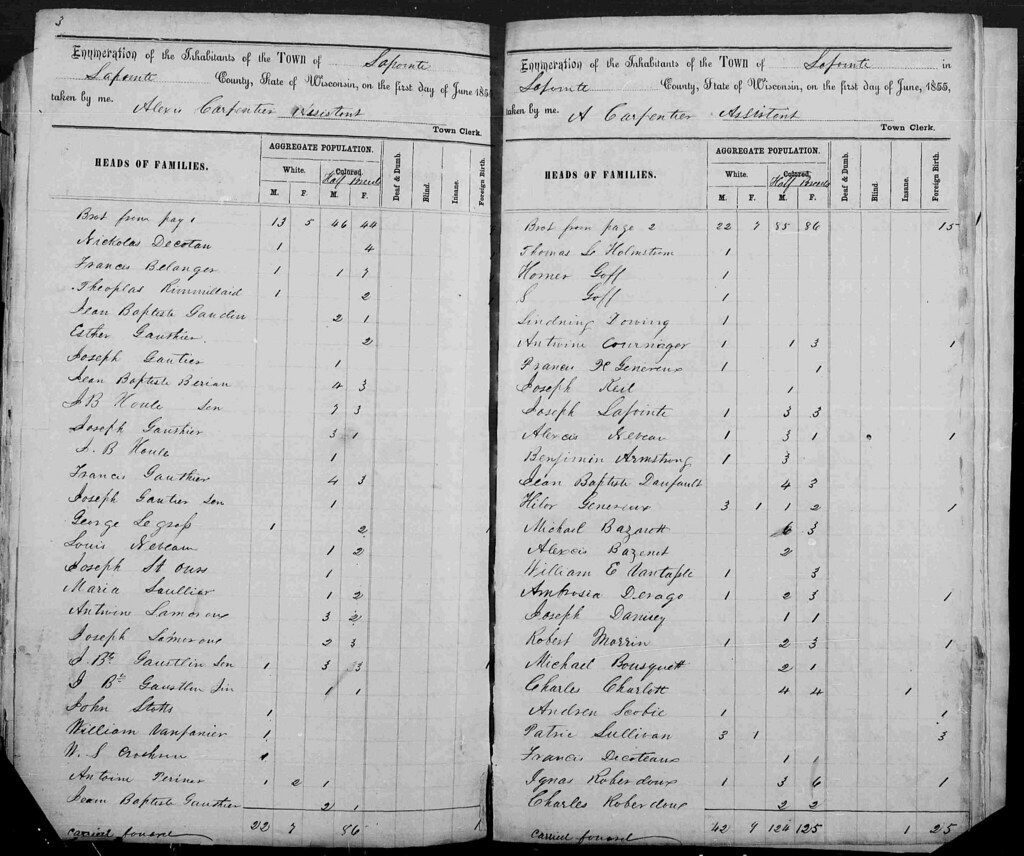
Pages 2 and 3. Patric Sullivan is fourth from the bottom on the right side. enlarge

Pages 4 and 5.
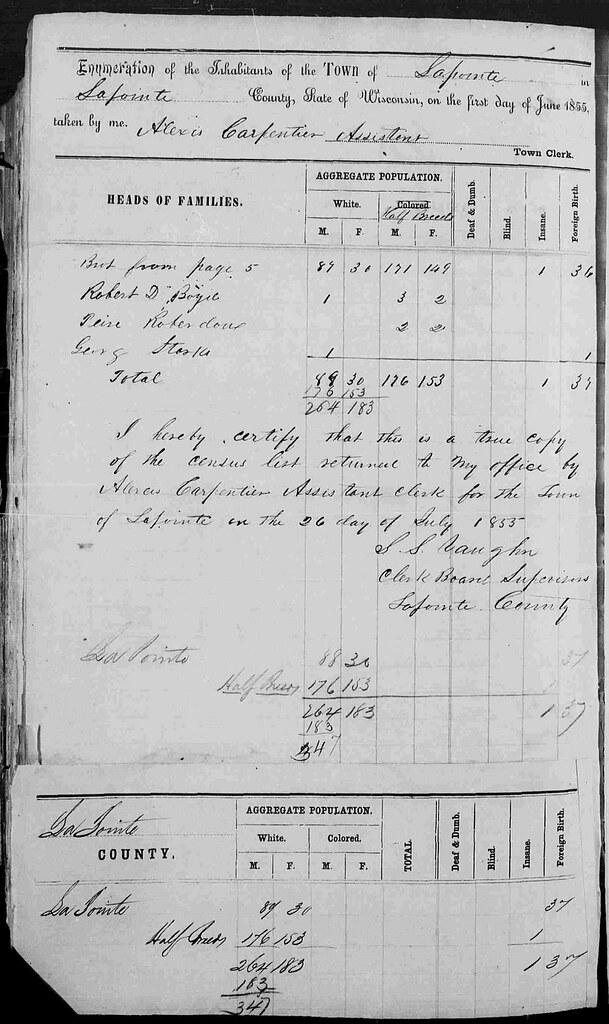
Page 6 with totals.
Patrick Sullivan did not sign the LaPoint Agreement to Stop Whiskey Trade of September 10, 1855. In fact, I haven’t been able to find much information at all about Patrick and Johanna Sullivan in later years. It does appear the family stayed in the area and their children were still living in Ashland at the dawn of the 20th century.
Finally, since this post deals with the 1855 census and issues of race and identity, it’s worth noting another interesting fact. The state census had only two categories for race: “White” and “Colored.” As non-citizens, full-blooded Ojibwe people would not have been counted among the 447 names on the census. However, it seems that Carpentier and his boss, La Pointe town clerk Samuel S. Vaughn, were not sure how to categorize by race.
Carpentier crossed out the designation “Colored” and replaced it with “Half-Breed.” By their count, 329 “Half-Breeds” and 118 Whites (many of them in mixed families) lived in La Pointe County in 1855. Mix-bloods were considered Ojibwe tribal members under the Treaty of 1847. However, they traditionally had their own identity and were thought eligible for U.S. citizenship.
One wonders what conversations were had as the census was completed, but in the final compilation, all 447 names (including several core Red Cliff and Bad River families) were submitted to the state as “White” rather than “Colored.” Despite America’s best efforts to create a racial duality, which would only intensify following the Civil War, this region would continue to defy such categorization for the remainder of the 19th century.
Sources:
Kohl, J. G. Kitchi-Gami: Life among the Lake Superior Ojibway. St. Paul: Minnesota Historical Society, 1985. Print.
Miller, Kerby A. Emigrants and Exiles: Ireland and the Irish Exodus to North America. New York: Oxford UP, 1985. Print.
NOTES: Research originally featured on Chequamegon History is featured in the new Changing Currents exhibit opening today at the Chippewa Valley Museum in Eau Claire. I had a chance to preview the exhibit on Friday, and John Vanek and crew have created an incredibly well-done display of Ojibwe treaty and removal politics of the mid 1800s. See their website for more information. The research found in this exhibit, which extends into several topics, is very deep and does not shy away from uncomfortable topics. I highly recommend it.
There may be some exciting guest research featured on Chequamegon History in the coming months dealing with the aftermath of the 1854 Treaty and fraudulent land claims in the Penokee Iron Range. Stay tuned.
Fall 2014 Preview
September 20, 2014
Posting has slowed considerably on Chequamegon History over the last few months due to my very busy personal life. This shows no signs of letting up, so I can’t promise a new post any time soon. However, the site is not abandoned, and new research topics continue to arise. Here are some I hope to get to before Christmas:
- La Pointe Bands: This is an offshoot of the Perrault-Curot-Nelson-Malhoit-Sayer map and its implications for the identity of the La Pointe Ojibwe Band. It will suggest that even after the Treaty of 1854, there were several “La Pointe” Bands, rather than just one that split into two (Red Cliff and Bad River) as the usual story goes. Theresa Schenck’s annotated edition of William Warren’s History of the Ojibways, and some obscure primary documents will guide much of this.
- Trowbridge Account of the 1820 Cass Expedition: There are several primary accounts of the 1820 expedition led by Lewis Cass through Lake Superior and the Upper Mississippi. This one comes from newspaper articles during the Lake Superior tourist rush of 1855. C. C. Trowbridge, who had accompanied Cass thirty-five years earlier, returned to Lake Superior aboard one of the steamboats.
- “A real bona fide, unmitigated Irishman:” Another account from the 1855 annuity payment, this one describes an Irish whiskey dealer and his wife on Madeline Island. Although the author praises the “Irish wit,” it is highly stereotypical.
- The “British” Chiefs of La Pointe: This one will expand on the La Pointe Bands post, and examine recent scholarship by Janet Chute, Mark Dietrich, and Howard Paap, to suggest that despite La Pointe’s reputation as being a friendly area for American government efforts, the Ojibwe leadership at Chequamegon maintained close connections and sympathies with British-Canadian authorities well into the “American” Era.
- Blackbird-Wheeler Letters Part 2: Politics and the Battle for the Soul of Bad River: This continues from the Blackbird-Wheeler Letters post, looking deeper into the religious aspects of the post-1854 rifts in the Bad River community. Catholics from La Pointe/Red Cliff, the Protestant mission led by Leonard Wheeler and Henry Blatchford, and the families led by Blackbird who kept to the traditions of the Midewiwin all competed for influence.
- Reisen in Nordamerika: From Brule to Stillwater: This is potentially a further translation from the Austrian travelers, Wagner and Scherzer, who visited this area in 1852. We last left them at the mouth of the Brule River with their voyageur guides (thought to be Souverain Denis and Jean-Baptiste Belanger). In Chapters 22 and 23, Denis and Belanger lead the group down the Brule and St. Croix, which are described by Scherzer in detail.
Thank you for reading. I hope to be back at it soon:
~LF
Steamboats, Celebrities, Soo Shipping, and Superior Speculation: Joseph R. Williams’ Account of the 1855 Payment
July 30, 2014
By Leo
“They fade, they perish, as the grass of the prairies withers before the devouring element. The officers of our government, in their conference, have been accustomed to talk about the protection their Great Father vouchsafes to them, but it is the protection which the vulture affords the sparrow. Whatever may be the intentions of our professedly paternal government, no alternative seems to remain to the Indian, but submission to its crushing and onward march.”
-Joseph R. Williams, 1855

When Joseph R. Williams stepped out from the steamboat Planet onto the dock at La Pointe in August of 1855 he tried to make sense out of the scene before him. The arrival of the Toledo-based newspaper editor and hundreds of his fellow passengers, including dignitaries, celebrities, and politicians at Madeline Island coincided with the arrival of thousands of members of the Lake Superior Ojibwe bands for the first annuity payment under the Treaty of 1854.
The portrayal of the Chequamegon region in history would never be the same.
Prior to that year, the main story depicted in the written record is the expansion of the indigenous Ojibwe and Ojibwe-French mix-blood populations, their interactions with the nations of France, Britain, and the Dakota Sioux, and ultimately their attempt to defend their lands and sovereignty against an ever-encroaching United States.
After 1855, the Ojibwe and even the first-wave white settlers appear in the written history only as curious relics of a bygone age. They are an afterthought to the story of “progress”: shipping, real estate, mining, logging, and tourism. This second version of history, what I often call “Shipwrecks and Lighthouses” still dominates today. Much of it has been written by outsiders and newcomers, and it is a more sanitary history. It’s heavy on human triumph and light on controversy, but ultimately it conceals the earlier more-interesting history and its legacy.
If we could pick one event to mark this shift, what would it be? Was it the death of Chief Buffalo that summer of 1855? Was it the creation of the reservations? Was it the new Indian policies in Washington? While those events are related, and each is significant in its own right, none explains why the ideology of Manifest Destiny (as expressed by men like Williams) so swiftly and thoroughly took over the written record.
No, if there is one event that gets credit (or I would argue blame) for changing the tone of history in the summer of 1855, it was that the first vessels passed through the new canal at Sault Ste. Marie.
The Soo Locks and Superior
The St. Mary’s Falls Canal, or the Soo Locks as we commonly call them today, had been a dream of Great Lakes industrialists and the State of Michigan for years. In their view, Lake Superior was essentially cut off from the rest of the United States because all its water passes through Sault Ste. Marie, dropping over twenty feet as it drains into Lake Huron.
These falls, or more accurately rapids, were of immense economic, symbolic, and strategic value to the Ojibwe people. The French, British, and American governments also recognized their significance as a gateway to Lake Superior and beyond. However, for the merchants of Detroit, Cleveland, and Buffalo, drawn to Lake Superior by the copper mines of the Upper Peninsula or the rich iron deposits on the North Shore (opened up by the Treaty of 1854), the falls were only an obstacle to be overcome. Traders and speculators in the western part of Lake Superior also stood to gain from increased shipping traffic and eagerly watched the progress on the canal. We can see this in the amount of space Joseph Austrian, brother of La Pointe merchant Julius Austrian, gave the canal in his memoirs.
For the young city of Superior, the opening of the canal was seen as one of the critical steps toward becoming the next St. Louis or Chicago. In 1855, Duluth did not exist. Squatters had made claims on the Minnesota side under the Preemption Act, but the real action was on the Wisconsin side where a faction of Americans led by Col. D. A. Robinson was locked in a full-on real estate speculation battle with Sen. Henry M. Rice of Minnesota. Rice, had many La Pointe traders including Vincent Roy Jr. wrapped up in his scheme, but without the lifeline of the canal, neither faction would have the settlers, goods, or commerce necessary to grow the city beyond its few hundred residents.

Steamer North Star: From American Steam Vessels, page 40 by Samuel Ward Stanton (Wikimedia Images)
The Steamers

Port of Superior Arrivals Up to Sept. 25, 1855 (Superior Chronicle, 25 Sep. 1855)
When the first steamboats embarked on the lower Great Lakes in the 1810s, few large sailing vessels had ever appeared on Lake Superior. Birchbark canoes and Mackinac boats provided virtually all the shipping traffic. Brought by the copper rush in the Upper Peninsula, a few steamers appeared on Lake Superior in the late 1840s and early 1850s but these were modified from earlier sailing ships or painfully brought overland around the Sault. Once on Lake Superior, these vessels were confined and could no longer go back and forth to Mackinaw, Detroit, or beyond. These steamers did carry passengers, but primarily their job was to go back and forth from the copper mines to the Sault.
The opening of the canal on June 22, 1855, however, brought a new type of steamer all the way to the western end of Lake Superior. The North Star, Illinois, and Planet were massive, brightly-painted, beauties with grand dining halls with live music. They could luxuriously carry hundreds of passengers from Cleveland to Superior and back in a little over a week, a trip that had previously taken three weeks.
Decrease travel time also meant that news could travel back and forth much more quickly. Chequamegon Bay residents could get newspaper articles about unfolding war in the Crimea and the bloody fallout from the Kansas-Nebraska Act. And on June 12, 1855 the first issue of the weekly Superior Chronicle appeared off the presses of John C. Wise and Washington Ashton of Superior. The paper printed literature, world news, local events and advertisements, but large portions of its pages were devoted to economic opportunities and descriptions of the Superior area. Conspicuously absent from its pages is much mention at all of the politics of the local Ojibwe bands or any indication whatsoever that Ojibwe and mix-blooded families made up the largest percentage of the area’s population. In this way, the Chronicle, being backed by Henry Rice, was as much about promoting Superior to the outside world as it was about bringing news in.
Advertisements began to appear in the eastern papers…

New-York daily tribune. August 04, 1855 (Image provided by Library of Congress, Washington, DC Persistent link: http://chroniclingamerica.loc.gov/lccn/sn83030213/1855-08-04/ed-1/seq-3/)
…and the press took notice:
THE NEW YORK MIRROR says: “The fashionable watering places are not nearly as full as they were a year ago at this season; one reason for the falling off is, that thousands who have hitherto summered at these resorts have gone to Europe; and another is that the hard times of last autumn and winter have left their pinching reminiscences in many men’s purses.” The editor of the Sandusky Register seems to think that if these “fashionables” would cease to frequent Saratoga, Newport and Niagra, where $100 goes just far enough to make a waiter smile, there would be no cause for complaints of “too poor to spend the season North.”–When the snobs and devotees at the shrine of show and fashion learn that there are such places as Lake Superior, as the Islands in Lake Erie, as St. Catherines in Canada, where to live costs no more than a residence at home, we might suppose no further cause for complaint of poverty would exist. But the fact is, “go where the crowd goes or go not at all” is the motto with the fashionables; and until the places above named become popular resorts they will receive the attention only of those whose good sense leads them to prefer pure air, quiet, the pleasures of boating, bathing, fishing, &c., to the follies of Saratoga or Newport. To those who would enjoy a healthful and truly agreeable resort we can but commend the islands in Lake Erie, with a trip to the Upper Lake of Superior.
Bedford [IN] White River Standard, July 26, 1855

North Star: from American Steam Vessels by Samuel Ward Stanton, 1895 (Google Books).
By the time the August payment rolled around, steamers carrying hundreds of passengers from the highest rungs of American society. Chequamegon Bay had become a tourist destination.
The Tourists
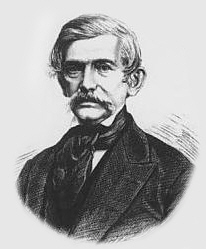
Prof. J. G. Kohl (Wikimedia Images)
Johann Georg Kohl is a familiar name to readers of the Chequamegon History website. Kohl’s Kitchi Gami, originally published in his native Germany, is a standard of Ojibwe cultural history and anthropology. His astute observations and willingness to actually ask questions about unfamiliar cultural practices of the people practicing them, created a work that has stood the test of time much better than those of his contemporaries. The modern reader will find Kohl’s depiction of Ojibwe people as actual intelligent human beings stands in refreshing contrast to most 19th-century works. Kohl also wrote some untranslated articles for German newspapers mentioning his time at La Pointe. One of these, on the subject of the death and conversion of Chief Buffalo, partially appeared on this site back in April.
Johann Kohl was atypical of the steamboat tourists, but he was a steamboat tourist nonetheless:
Prof. Kohl, professor in Dresden University has been rusticating for a few weeks past, in the Lake Superior Country, collecting matter for a forthcoming work, which he intends publishing after his return to Germany. He expressed himself highly pleased with his visit, and remarked that the more familiar he became with the American people and the resources of our country, the better satisfied he was that America had fallen into the hands of those who were perfectly competent to develop her riches and improve the natural sources of wealth and prosperity, which nature has given her.
Grace Greenwood has also been paying her respects to the Lake Superior region, and came down on the North Star with Prof. Kohl.
[Milwaukee] Daily Free Democrat, September 15, 1855

Sara Jane Lippincott, a.k.a. Grace Greenwood (Wikimedia Images).
“Grace Greenwood” was the pseudonym of Sara Jane Lippincott, and a household name in 1855. Though more forgotten to history than some of the other names in this post, the New York native was probably the biggest celebrity to visit La Pointe in the summer of 1855. As an acclaimed poet, she had risen to the highest rungs of American literary society and was a strong advocate of abolitionism and women’s rights. However, she was probably best known as the editor of The Little Pilgrim, a popular children’s magazine. She is mentioned in several accounts of the 1855 payment, but none mention an important detail, considered improper for the time, detail. Sara was very pregnant. Annie Grace Lippincott was born less than two months after her mother left Lake Superior on the North Star.
Although much of her work is digitized and online for the public, the only mention of the trip I’ve found from her pen is this blurb from the front page of the September 1855 edition of The Little Pilgrim:
Our little readers will please forgive whatever delay there may be in the coming of our paper this month, for we are among the wild Indians away up in Lake Superior on the island of La Pointe; and the mails from this far region are so slow and irregular that our articles may not reach Philadelphia till two or three weeks after they should do so (The Little Pilgrim: Google Books).
Dr. Richard F. Morse was one of the chroniclers of the 1855 payment who made sure to mention Lippincott. Morse’s essay, The Chippewas of Lake Superior, published in the third volume of the Collections of the State Historical Society of Wisconsin (1857), is entirely about the payment. It is also the clearest example of the abrupt shift in narrative discussed above. It is full of the suffocating racism of benevolent paternalism. Morse arrogantly portrays himself as an advocate for the Lake Superior bands, but his analysis shows how little he knows of the Ojibwe and their political situation in 1855. Unlike Kohl, he doesn’t seem to care enough to ask and learn.
In fairness, Morse’s account is a valuable document, excerpted in several posts on this website (see People Index). It is also the document that years ago inspired the first steps toward this research by planting the question, “Where did all these fancy people at the 1855 annuity come from?” Chippewas of Lake Superior is too long and too well-known to bother reproducing on this site, but it can be read in it’s entirety on Google Books.

Crockett McElroy (Cyclopedia of Michigan [1890])
After the Civil War, McElroy would go on to find wealth in the Great Lakes shipping industry and be elected as a Republican to several offices in the State of Michigan. In the summer of 1855, however, he was only nineteen years old and looking for work. Crockett’s father, Francis McElroy appears in several later 19th-century censuses as a resident of Bayfield. Apparently, Francis (along with Crockett’s younger brothers) split time between Bayfield and Michigan. Young Crockett did not stay in Bayfield, but his biography in the Cyclopedia of Michigan (1890) suggest his account can be considered that of a semi-local laborer in contrast to the fancier visitors he would have shared a steamboat with:
Crocket McElroy, the subject of this sketch, received his early education at Gait, Ontario; and, when twelve years of age, removed to Detroit. Here he attended one of. the public schools of that city for a short time, and, afterwards, a commercial academy. When thirteen years of age, he began to act as clerk in a wholesale and retail grocery store, remaining three years; he then, for two years, sold small beer. In 1853 he went to Ira, St. Clair County, as clerk, to take charge of a general store; and for the next five years served as clerk and taught school, spending the summer months of 1854-55 in the Lake Superior region (pg. 310).

Lewis Cass (Wikimedia Images)
Another Michigan-based politician, considerably more famous than McElroy, Lewis Cass’ excursion to Lake Superior in 1855 was portrayed as a homecoming of sorts. The 72 year-old Michigan senator had by then occupied several high-level cabinet and congressional positions, and was the Democratic nominee for president in 1848, but those came after he had already entered the American popular imagination. Thirty-five years earlier, as a little known governor of the Michigan Territory (which included Wisconsin and the arrowhead of Minnesota) he led an American expedition to Red Cedar (Cass) Lake near the headwaters of the Mississippi. Thirty-seven years after the Treaty of Paris, and seven years after the death of Tecumseh, it was the first real attempt by the United States to assert dominion over the Lake Superior country. In some ways, 1855 marked the end of that colonization process and brought the Cass Expedition full-circle, the significance of which was not lost on the editors of the Superior Chronicle:
The Predictions of Gen. Cass.: At the opening of the Wabash and Erie Canal, which unites the waters of Lake Erie with those of the Mississippi, the celebration of which took place at Fort Wayne, Indiana, in 1844, Gen. Cass in his address subsequently predicted the union of Lake Michigan from Chicago to the Mississippi; this prediction was fulfilled in 1850. At the same time he said that there were then present those who would witness the settlement of the region at the southwest extremity of Lake Superior, and lay the foundation for a similar union of the waters of that lake with the Mississippi.
On the last trip of the steamer Illinois to this place, Gen. Cass was among the passengers, and witnessed the fulfillment of his prediction in respect to the settlement of this region. May he live to be present at the opening of the channel which will connect this end of the lake with the Mississippi, and witness the consummation of all his prophesies.
Superior Chronicle, August 21, 1855
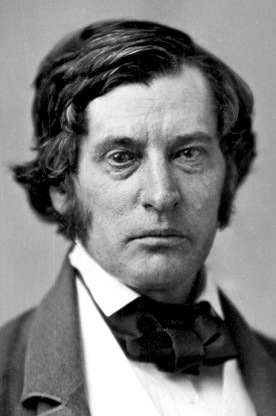
Charles Sumner in 1855 (Wikimedia Images)
A political opponent of western Democrats like Cass, Charles Sumner has gone down in history as the only man to be nearly beaten to death on the floor of the United States senate. Less than a year before Rep. Preston Brooks of South Carolina would attack him with a cane, sending the country hurtling ever-faster toward civil war, the Massachusetts senator visited La Pointe to watch the annuity payment. By 1855, Sumner already had a reputation as a staunch abolitionist, and he even wrote a letter to the Anti-Slavery Reporter while on board the North Star. Aside from a handful of like-minded native New Englanders like Edmund Ely and Leonard Wheeler, Sumner was not in a part of the country where most voters shared his views (the full-blood and most mix-blood Ojibwe were not considered citizens and therefore ineligible to vote). The Lake Superior country was overwhelmingly Democratic, and the Superior Chronicle praised the “popular sovereignty” views of Stephen Douglas in the midst of the violence following the Kansas-Nebraska Act. Sumner, whose caning resulted from his fierce criticism of popular sovereignty, was among those “radical Bostonians” the Chronicle warned its readers about. However, the newspaper was kind and uncritical when the senator appeared in its city:
Senator Sumner at Superior and La Pointe.: In our last number we neglected to announce the visit of Hon. Charles Sumner, Bishop McClosky, and other distinguished persons to Superior. They came by the North Star, and staying but a few hours, had merely time to hastily view our thriving town. They expressed gratfication at its admirable location and rapidity of its growth.
At La Pointe, the heat stopped to allow the passengers an opportunity to see that pretty village and the large number of Indians and others congregating there to the last great payment at this station of the Lake Superior Chippewas. Here Mr. Sumner was the guest of the reverend Catholic missionary, whose successful endeavors to gratify the numerous visitors at La Pointe we have frequently heard commended.
Superior Chronicle, August 14, 1855

Jesse D. Bright (Wikimedia Images)
Staying a little longer at Superior, another U.S. senator, Jesse Bright the President pro tempore Indiana, also appeared on Lake Superior in the summer of 1855. For Bright, however, this was more than a pleasure excursion. He had a chance to make real money in the real estate boom of the 1850s. Superior, at the head of the lake with ship traffic through the Soo, and military road and potential railroad connection to St. Paul, looked poised to be the next great gateway to the west. He invested and apparently lost big when the Great Lakes real-estate boom busted in the Panic of 1857.
Bright would go on to be a Southern sympathizer and a “Copperhead” during the Civil War and was the only northerner to be expelled from the Senate for supporting the Confederacy. In 1855, he was already a controversial figure in the partisan (Democrat, Whig, Know-Nothing) newspapers:
The Buffalo Commercial, upon the authority of the Cincinnati Gazette, states “that Mr. Bright, of Indiana, President of the Senate, pro tem lately made a Sunday speech, an hour and a half long to the people of a town on Lake Superior, and the passengers of the steamer in which he was travelling. He discoursed most eloquently on the virtues and glories of modern Democracy, whose greatest exemplar, he said, was the administration of Franklin Pierce.” The Know Nothing press, of which the Commercial and the Gazette are leading journals, must be rather hard up for material, when recourse to such misrepresentation as the above becomes necessary…
…The speaker did not allude to politics, and did not speak over ten minutes.
And out of this mole hill the Commercial manufactures a mountain of speculation, headed “Jesse D. Bright–The Presidency.” –Sandusky Mirror.
Fort Wayne [IN] Sentinel, September 5, 1855

Promoters & Proprietors of Old Superior: (Clockwise from upper left) U.S. Senator W[illiam]. A. Richardson, Sen. R[obert] M. T. Hunter, Sen. Jesse Bright, Sen. John C. Breckinridge, Benjamin Brunson, Col. John W. Fourney, Henry M. Rice (Flower, Frank A. Report of the City Statistician [1890] Digitized by Google Books)

John C. Breckinridge (Wikimedia Images)
It may also be uncomfortable for the modern northern reader to see how cozy the politicians of our area were with unabashedly pro-slavery Democrats and future Confederates. The biggest name among these Lake Superior investors and 1855 visitors would be John C. Breckinridge. Breckinridge, coming off a stint as U.S. Representative from Kentucky, would go on to be Vice President of the United States under James Buchanan, and Secretary of War for the Confederacy. However, he is most famous for finishing second to Abraham Lincoln in the pivotal presidential election of 1860. Chequamegon Bay residents will probably find another investment of the future vice-president more interesting even than the Superior scheme:
A PLEASANT SUMMER RESIDENCE–The senior editor of the Chicago Press writes from Lake Superior:
Basswood Island, one of the group of Apostle Island has been entered by Mr. Breckinridge of Kentucky, who, I am told, contemplates the erection of a summer residence upon it. We landed at this Island for wood. There is deep water up to its base, and our steamer lay close alongside the rocky shore as though it had been a pier erected for the purpose. There is deep water, I am told, in the channels between most of the Islands of the group furnished an excellent shelter for vessels in tempestuous weather.
[Milwaukee] Weekly Wisconsin, August 15, 1855
Hon J. C. Breckenridge, of Kentucky, has purchased Basswood Island, one of the group of Apostle Islands, in Lake Superior, and intends erecting a summer residence thereon.
Boston Post, August 23, 1855

Captain John Wilson (Frank Leslie’s Illustrated)
The Whig/Free Soil press’ condemnation of Senator Bright for allegedly forgetting the Sabbath and to keep it holy may remind the Chequamegon History reader of the A.B.C.F.M missionaries’ obsession with that particular commandment in their efforts among the Ojibwe people. However, it seems to be one of those features of 19th-Century America that was fussed about more than it was actually observed.
A good example of this comes from Captain John Wilson, who led the steamer Illinois to La Pointe in the summer of 1855. He seems to have been one of those larger-than-life characters, and he is often mentioned in newspaper accounts from the various Great Lakes ships he commanded. Wilson died off the shore of Milwaukee in the sinking of the Lady Elgin, in 1860 along with over 300 passengers. “The Titanic of the Great Lakes,” as the disaster came to be known, is still the greatest loss of life in the history of the lakes (this article gives a good overview). Other than the North Star, the Lady Elgin, which began its runs to the “Upper Lake” in 1855, was probably the most famous steamer on Lake Superior before its sinking. Captain Wilson was afterwards praised for his character heroism during the ordeal, which was blamed on the captain of the schooner that collided with the Elgin.
Captain Wilson’s charisma shines through in the following 1855 Lake Superior account, but I’ll let the reader be the judge of his character:
A MAN FOR ALL OCCASIONS–TWO AMUSEMENTS–Capt Wilson, of the steamer Illinois, on the Upper Lakes is proverbially a man for all occasions and is equally at home in a horse-race or a dance. During a recent excursion of his beautiful boat to Lake Superior, he happened to arrive at a place on Sunday, where several tribes of Indians were soon to receive their annuity from the General Government and where a large number were already present. As soon as the breakfast table was cleared Capt. W. commenced arrangements for religious services in the ladies’ cabin, agreeably to the request of a preacher on board. Chairs and sofa were placed across the hall and the piano, with a large bible on it, represented a pulpit. The large bell of the boat was tolled, and in a short time quite a respectable congregation occupied the seats. As soon as service had fairly begun, the Captain came upon the forward deck where a number of gentlemen were enjoying their pipes and meerschaum, and thus addressed them.
Gentlemen–I come to let you know that meetin‘ is now going on in the aft cabin, where all of you in need of prayers and who wish to hear a good sermon had better retire. I would also state that in accordance with the desire of several passengers , I intend to get up an Indian foot race on shore for a barrel of flour.–You can make your own selection of the two amusements.”
The foot race did come off, and it was fortunate that all the lady passengers were at “meetin,” as one of the Indians who started with nothing on him but a calico shirt came in minus that! He won the flour, however. Good for you! —Spirit of the Times
[Milwaukee] Weekly Wisconsin, October 3, 1855

Joseph R. Williams (Wikimedia Images)
Finally, we get back to Joseph R. Williams. The reason so many stories like Captain Wilson’s made it into the papers that summer was that each of the steamboats seemed to be carrying one or more Midwestern newspaper editors. Williams, the editor of the Toledo Blade, arrived on the Planet in time to witness the La Pointe payment.
Williams would go on to become the first president of what would become Michigan State University and serve in multiple positions in the state government in Michigan. His letters and notes from Lake Superior turned into multiple articles that made their way back up to the Superior Chronicle. In a later post, I may transcribe his record of C. C. Trowbridge’s account of the 1820 Cass Expedition or his description of Superior, but in the name of brevity, I’ll limit this post to his a article on the payment itself:
From La Pointe–Indian Payment, etc.
The following interesting incidents of the recent meeting of Chippeways at La Pointe are taken from the letters of Mr. Williams, editor of the Toledo Blade. Mr. W. was among those who visited Lake Superior on the last excursion of the steamer Planet. In another portion of this week’s paper will be made an account of General Cass’ expedition to the Northwest, from the pen of the same gentleman. We commend it and the following extracts, to the perusal of our readers.
This is one of the old American Fur Company’s stations, a village such as formerly existed at Detroit and Mackinac. Indian huts with bark roofs, the long low warehouse, the half dressed and painted Indians, here and there a Frenchman speaking his mother tongue, his whole air indicating his lineage plainly that he was the descendant of an old voyager, revive the reflection of those days so graphically described by Washington Irving in his Astoria. La Pointe is upon an island, and the harbor gracefully curves around us from the north.
Here we find Colonel Manypenny, Commissioner of Indian Affairs; H. C. Gilbert, Indian Agent for Michigan; Hon. D. A. Noble and Hon. H. L. Stevens, late members of Congress, and other gentlemen, who are awaiting the Indian payment to take place the beginning of next month. Grace Greenwood, who came up on the Illinois a few days since is also excursioning here. The store houses are full of the goods provided for the payment, piles of [?] and provisions, [?], plows, spades, [?] carts, mattresses, bedsteads, blankets, clothing, and [?] a well [?] supply of such articles as are calculated to promote the comfort and civilization of the ill-fated remnant of the former lords of these [many] isles scattered around us, and [the] “forests primeval,” on either shore of this vast inland sea.
Colonel Manypenny deserves great credit for the [ind?bility] with which he has endeavoured to carry into wholesale effect the [?] method adopted of paying the Indians their annuities. Formerly, the unfortunate [race] were paid in specie, and close on the tract of the dispenser of the payment came a swarm of cormorant and heartless Indians traders, who, for whisky and trinkets, and inferior arms and implements, including perhaps blankets and some useful articles of dress, obtained the dollars as soon as they were paid. The Indian dances followed by wild drunken orgies, were a perpetual accompaniment. The Indian, besotted by liquor, parted with almost everything of value, and returned to his home and his hunting grounds, poor and in worse condition than he came. Many years since I attended a payment at Grand Rapids, Michigan, and it was a mournful spectacle. One hardly knew whether to pity the weakness of the victims or abhor the heartlessness of the destroyers most. As late as 1833 the last Indian payment was made on the Maumee in the immediate vicinity of Toledo, on the point below Manhattan. One Lloyd was Indian Agent in 1830. It is said that he purloined from each of the thousand dollar boxes paid the Indians one or two hundred dollars, and that during the night whites went around among the wigwams and cut off the portion of the dresses of the Indians in which the specie was tied up. But the picture before us is relieved of features so disgraceful and disgusting. We saw no drunken Indian on shore. Indeed several of the Caucasian lords of these fading tribes, whom we had on board, might have taken a useful lesson in sobriety from the red men. The traders however are here. They mutter curses upon Colonel Manypenny, because he does not wink at their robberies. It is supposed abundance of whisky is concealed on the island, which will be unwrapped and sold, to besot the Indians, as soon at the valuables are distributed among them.
***
On his arrival here, the Indians proposed a dance. As dances end in Bacchanalian revels, the colonel has set his face against them. Enlivened and excited, however, by our band of music, the Indians could resist no longer. A dozen or more emerged from their cabins, bearing before them their war flag, which was a staff with a fringe of long feathers extending its length, and with bells attached to it, and engaged in a war dance. Their bodies were nearly naked and painted. The dance was a pantomimic description of war scenes. The leading brave struck the flagstaff to stop the dance, and made a speech describing how he had, less than thirty days ago, killed and scalped a Sioux, and he held up in his clenched fist, in triumph before us, the almost yet reeking scalp of his victim. His speech was accompanied by vigorous and appropriate [motion]. It was the imprompt and natural movement of body, [hands], and features from this brief specimen, it was easy enough to imagine that the Indian is often eloquent. This small band of dancers were splendid physical specimens of men, and the dance was real exultation over a late actual achievement. The Chippeways–and they are all Chippeways in these regions–maintain a traditional hostility to the Sioux, and are rarely at peace. It was only a few months since a band of Chippeways pioneered down into the village of St. Paul, and killed a Sioux woman trading in a store. Before the witnesses had recovered from the terror excited, the band had fled as rapidly as they appeared. The Sioux remain on the lands beyond, and the Chippeways this side of the Mississippi.
After the war dance was finished, they danced a beggar’s dance, the purport of which was that they wanted three beeves of Colonel Manypenny. At its close, the brave presented a pipe to Captain Ward, who smoked it in a token of amity. He then forced through the surrounding crowd, and sought Colonel M., who stood at a distance. The Colonel rejected the proffered pipe. His acceptance would have been a sanction of the dances he disapproved, and a concession of the three beeves. The Chief returned to the ring, and made a brief vehement speech, evidently a concentration of indignant scorn. Mrs. A., of Monroe, Michigan, an educated lady of Indian blood, informed me that it was full of defiance, bitterness and mortification.
******
In speaking of the Indians assembled at the payment in my last, I said they were a motley crew, and indeed they are. The braves, engaged in the dances described, were fine specimens of manhood. Their erect forms, developed chests, and symmetry, and general health, as developed in every muscle and feature, illustrate the perfection to which physical man is brought in savage life. But in sad contrast, we see around us pitiable specimens of humanity, crouching, lazy, filthy, besotted beings, who possess all the vices of both the white and the red races, and none of the virtues of either.
Canoes are marshalled along the beach, which have wafted here the tenants of both shores of Superior. Indians have dotted their clusters of wigwams over the vicinity, and seem to have brought along all their aged and infirm as well as infants.
I think one Indian woman here is the oldest human being I ever saw. The deep furrows, the folds of skin which have lost almost the appearance of vitality, so withered and dead as to resemble gutta percha, eye sight lost, hearing gone, no sense left except touch, which was indicated by the avidity with which she seized small pieces of money thrown into her lap, all these proofs convinced me that she was older by ten or fifteen years than any person I ever saw. A son and daughter were near her, apparently kind and affectionate, and proud to protect her, who themselves, were verging upon old age, an illustrative example of these [?ate] savages, to unnatural whites of whom melancholy tales of ingratitude are told. Even her children could not tell her age. All they could say was that she was “the oldest Indian.” Old Buffalo, the Chief, who was ninety years old, looked like a young man compared with her.
Nothing more surprised our party than the great proportion of their children, of all sizes, and I may add, shades of color, for the infusion of French blood from a long series of successive intermarriages, is found in every tribe. Infants fastened on boards, with the children and youth under sixteen, outnumber the adults. The children are all plump, all have rounded and full muscles, all good chests, thus showing that their life, vicious as it is, is more favorable to health and development, in consequence of their freedom of motion, perpetual exercise in the open air. Their gregariousness, flocking together where impulse carried them, as self reliant as their parents who seemed to allow them perfect freedom, even though strangers were so numerous among them, bore a pleasing, and to us instructive contrast to the entire and melancholy helplessness to which white children, especially in cities, are doomed.
Many of the Indians wore a feather or feathers in their cap, indicating the number of Sioux they had scalped. One displayed six feathers. He told us that he had in battle killed two, and taken the scalps of four others, killed by unknown hands of his band. The last victim he had slain but a month ago. One erect youth, of not more than eighteen, with a fresh and handsome face, bore proudly a single feather as a token of his early prowess. One man, in answer to the question, whether he had ever taken a scalp, replied gravely, without a smile, that he had not, and was of no more account that a woman in his tribe. An illustration of their generosity and savage ferocity is afforded by a sub-Chief who had an interview with Mr. Gilbert, the Indian Agent, a few days since. He presented Mr. G. an elegant cloak, made entirely of beaver skins, in expectation of nothing but a large medal in return. He was intent in speech, and animated and pleasant in address. No trace of savage ferocity lingered in his face. Yet it was stated that this man had actually killed and eaten his own child.
Sometimes their earnings if economically used would afford them a comfortable subsistence. The whites, even in their ordinary trade have practiced habitually heartless extortion. When Gov. Cass’s expedition visited this country in 1820, the Indians were in the habit of paying the traders a beaver skin, worth sixteen dollars, for a gill of powder; the same for a shirt; the same for thirty balls; and three beaver skins for a single blanket. I inquired of the Chief, Old Buffalo, what was the highest price he had ever paid for tobacco. He replied that they formerly made purchases of the Hudson Bay Company, tobacco was coiled up in ropes of about three quarters of an inch in diameter, and that he had paid ten beaver skins for a fathom, or at least ten dollars for a foot in length. But when the poor creatures became maniacs or idiots from drink, no possession was so prized that they would not part with it for a single cup of fire water. That the trader availed himself of the imbecility he created, is acknowledged. A large share of the boundless wealth of Mr. Astor was based on acquisitions, through his instruments and agents of this questionable and indeed diabolical character. Well might Burns exclaim in sorrow,
“Man’s inhumanity to man.
Makes countless thousands mourn.”
for whether among men and families of the same blood, or between civilized and savage men, either in peace or in the antagonism of war, the whole world and all time has teemed with sickening, heart-rending examples of its melancholy truth.
By chance we have been able to witness what can not be seen, a few years hence on this side of the “Father of waters,” or indeed on the continent. Here in our magnificent floating palace and the crowd of intellectual and cultivated people on board, surrounded by the refinements of life, we have the highest triumphs of civilization, side by side and in contrast with the rudest manifestations of primitive savage life.–An interesting episode in human affairs, though prompting [a] thousand sad reflections. The doom of entire extirpation of the red man seems surely and gradually to approach. The perpetual warfare among tribes on the extreme frontier annually declinates their most vigorous braves, and consequently it is manifest that among this tribe at least there were far more women than men between the ages of twenty and forty. Many perish from ignorance of the laws of nature, and many from excessive exposure and famine. Rapacity of the whites, and whiskey, finish the merciless work. They fade, they perish, as the grass of the prairies withers before the devouring element. The officers of our government, in their conference, have been accustomed to talk about the protection their Great Father vouchsafes to them, but it is the protection which the vulture affords the sparrow. Whatever may be the intentions of our professedly paternal government, no alternative seems to remain to the Indian, but submission to its crushing and onward march.

Dr. Bethune Duffield (Detroit–biographical sketches by Walter Buell [1886] Google Books)
1855 as a Turning Point: A plea to today’s Chequamegon Bay residents
Williams’ quote about the vulture and the sparrow, excerpted at the very top of this post, is about as succinct a statement about Manifest Destiny as I have ever read. If it weren’t surrounded by so many grossly-ignorant and disgusting statements about Ojibwe people, one might almost take it as sympathy for the Ojibwe cause. Still, the statement holds the key to our understanding of the story of 1855.
In the grand scheme of our region’s history, the payment was less significant than the treaty itself or the tragic removal politics of the early 1850s. Sure, it was the first payment under the final treaty and it featured the visit of Indian Affairs Commissioner George Manypenny to La Pointe, but ultimately it was largely like the rest of the 30-plus annuity payments that took place in our area in the middle of the 19th century. The death of Chief Buffalo in September 1855, and visit of Manypenny who shifted American Indian policy from removal to assimilation, represented both real and symbolic breaks with the past, but ultimately the great shift of 1855 is only one of tone.
Ultimately, however, this shift is only superficial and the reality of life for most Chequamegon residents didn’t change overnight in 1855. The careers of men like Blackbird, Vincent Roy Jr., Julius Austrian, Naaganab, and others show the artificiality of such a line. To them, the tourists on the Planet and North Star were probably just a distraction or curiosity.
Williams was wrong. The Ojibwe did not perish before the “devouring element,” and neither did that earlier history. Somehow, though, since then those of us who live in this area have allowed outsiders to write the story. Maybe it’s comfortable for those, like myself, of European ancestry to focus on shipwrecks and lighthouses rather than colonialism and dispossession, but in doing so we deny ourselves the most significant events of our area’s history and an understanding of its legacy on today.
By all means, learn the names of Grace Greenwood, John Breckinridge, and the Lady Elgin, but understand the fleeting impact of those names on our area’s history. Then, read up on Blackbird, Jechiikwii’o, Leonard Wheeler, Benjamin Armstrong and other players in 1855 politics who really did leave a lasting legacy.
Off my soapbox for now…
The bulk of this article comes from newspaper articles found on two digital archives. Access Newspaper Archive is available to Wisconsin library card holders through badgerlink.net. The Library of Congress Chronicling America site is free at http://chroniclingamerica.loc.gov/. Other sources are linked within the post.
John Johnston Describes La Pointe (1807-09)
June 12, 2014

Susan Johnston, or Ozhaawashkodewekwe, the wife of John Johnston ( Chicago Newberry Library)
The name of John Johnston will be familiar to those who have read the works of his son-in-law Henry Schoolcraft. Johnston (1762-1828) was born into the Anglo-Protestant gentry of Northern Ireland and came to the Chequamegon region in 1791. After marrying Ozhaawashkodewekwe, the daughter of Waabojiig, he cemented his alliance with a prominent Ojibwe trading family. The Johnstons settled at Sault Ste. Marie, and their influence as a fur-trade power couple in the eastern part of Lake Superior parallels that of Michel and Madeline (Ikwezewe) Cadotte around La Pointe. The Johnstons played a key role in resistance to American encroachment in Lake Superior during the War of 1812 but later became centrally-connected to the United States Government efforts to establish a foothold in the northern country. A nice concise biography of John Johnston is available in the Dictionary of Canadian Biography Online.

Roderick MacKenzie (Wikimedia Commons)
In 1806, John Johnston was trading at the Soo for the North West Company when he received a printed request from Roderick MacKenzie, one of the heads of the Company. It called for information on the physical and cultural geography of the different parts of North America where the NWC traded. Johnston took it upon himself to describe the Lake Superior region and prepared An Account of Lake Superior, an 82-page manuscript.
By the end of the 19th century, the manuscript had found its way to Louis Rodrigue Masson (a grandson-in-law of MacKenzie) who edited it and published it in Les Bourgeois de la Compagnie du Nord-Ouest; recits de voyages, lettres et rapports inedits relatifs au Nord-Ouest Canadien (1889-90). The Masson archives were later donated to the McGill University Library in Montreal and are now digitized.
Much of Johnston’s account concerns the Sault and the eastern part of Lake Superior. However, he does include some information from his time at La Pointe, which is reproduced below. While it doesn’t say much about the political topics that I tend to focus on, this document is fascinating for its geographic toponyms and terminology, which is much more reflective of the 18th century than the 19th. Enjoy:
[Ojibwe names for geographic locations are taken from Gidakiiminaan: An Anishinaabe Atlas of the 1836 (Upper Michigan), 1837, and 1842 Treaty Ceded Territories (GLIFWC 2007)].
[pg. 49-56]
…The coast runs almost due West from the Kakewiching or Porcupine Mountain to the Montreal River a distance of fifteen leagues, and the beach is a shelving rock the same as the Mountain all the way with here and there a little gravelly strand. There is but one river, and that a very small one, from the Black to the Montreal River. This last takes its rise from the Wa[s]wagonnis or flambeau Lake about 80 leagues to the Southwest: it is one continued rapid from within ten leagues of its source, and a few hundred yards from the entrance has a fall of fifteen or twenty feet: – there are two high clay banks which distinguish the entrance. The lands tends to the Northwest and is a stiff clay for three leagues rent into deep gutters at short distances; it then gradually declines to a sandy beach for three leagues farther until you arrive at the Mouskissipi or bad river so called from its broad and shallow stream in which it is almost impossible to mount even an Indian Canoe.
It takes its rise from the Ottawa Lake about 125 leagues to the Westward: the Lake has its waters divided very partially as the chief part takes a southerly course and falls into the Mississipi and is called Ottawa River.
The Flambeau Lake has its waters also, the better part taking a southeasterly direction to the Mississipi and is called Ouisconsin or the medicine River. From the bad river the coast runs north four leagues to Chogowiminan or La Pointe; it is a fine strand all the way, behind which are sand hills covered with bent and sand cherry shrubs – and behind the hills there runs all the length a shallow bay which is a branch from the Bay of St Charles.
At Lapointe you are nearly opposite the Anse or Keegwagnan the distance I should conjecture to be twenty leagues in a straight line.
The Bay of St Charles runs southwest from La Pointe and is four leagues in depth and better than a league broad at the entrance. Opposite Lapointe to the Northeast is the Island of Montreal, one of the largest of those called the twelve Apostles. On the main land the Indians had once a Village amounting to 200 huts but since the Traders have multiplied, they no longer assemble at Netoungan or the sand beach, but remain in small bands near their hunting grounds. When you double the Point of Netoungan the coast tends nearly west and is composed of high rocky points of Basaltes with some freestone; there is one place in particular which is an humble imitation of the Portals but not near so high: it is about a leagues from La Pointe and is a projection from the highest mountain from Porcupine bay to fond du lac, a distance of more than 45 leagues. From the Summit of the Mountain; you can count twenty six Islands extending to the North and North east, Islands which has never been visited by the boldest Indians and lying out of the way of the N.W.Co’s Vessel: have a chance of never being better known. Of the Islands opposite La pointe ten or twelve have been visited by the Indians, some of which have a rich soil covered with oak and beech, and round all of them there is deep water and fine fishing for Trout. The Trout in this part of the Lake are equal to those of Mackinac in size & richness – I myself saw one taken off the Northeast end of Montreal Island that weighed fifty two Pounds. How many Islands this Archipelago actually contains will not be easily ascertained; but I take Carribou Island to be the eastern end of the chain. It lies a little to the Southward of the course of the Co’s Vessel, is about three miles round, has a flat shore and good anchorage, and is allowed to be half passage from Camanitiquia to St. Mary’s. However, no other land is seen from it by the Vessel; but that may be owing to the Islands being low and lying too much to the Southward of the course. It is to be observed this account of the number of Islands is upon Indian Authority, which though not the best, is still less apocryphal than that of the Canadians.
There are several rivers between Lapointe and Fond du Lac, the distance is allowed to be thirty leagues, and the breadth of the bay from a high Rocky point within a leagues of Netoungan to the roche deboute, or the upright rock, which is a lofty Mountain right opposite, cannot be less than twenty leagues.
The Metal River is within ten leagues of Fond du Lac; it is only remarkable from the Old Chief of Lapointe’s having once found a large piece of Silver ore in descending it. The Burnt river is three leagues to the Westward of Metal river; it issues from one of the Lakes of the little wild Oats Country about thirty leagues to the Southward, and is only navigable for small Canoes: it has several rapids and the Portages are dangerous, several of them lying along the edge of the river, and over precipices where one false step would be fatal. It empties itself into the Bay of Fond du Lac through a stiff Clay Bank which continues all along the shore until it joins the sands of Fond du Lac river.
About sixteen years ago, Wabogick, or the Whitefisher, the Chief of Lapointe, made his sugar on the skirt of a high mountain four days march from the entrance of the river to the south west, his eldest daughter then a girl of fourteen with a cousin of hers who was two or three years older, rambling one day up the eastern side of the Mountain came to a perpendicular Cliff, which exactly fronted the rising sun, and had an apparently artificial level before it, on which near the base of the Cliff they found a pieces of yellow metal as they called it, about eighteen inches long, a foot broad, and four inches thick; and perfectly Smooth: – it was so heavy that they could raise it with great difficulty: – after amusing themselves with examining it for some time, it occured to the eldest girl that it belonged to the Gitchi Manitou or the great spirit; upon which they abandoned the place with precipitation. As the Chipeways are not Idolators, it occurs to me that some of the Southern tribes must have once Migrated thus far to the North, and that the piece, either of copper or gold, is part of an alter dedicated to the sun. If my conjecture is right, the slab is most probably gold as the Mexicans have more of that Metal than they have of copper. I have often regretted the premature death of the Chief the same autumn that he told me the story, as he had promised to go and bring it to me if he recovered: and circumstances since have precluded my making any attempt to procure it.
The river of Fond du Lac is deep, wide and serpentine, but is only navigable for four or five leagues from its entrance. The Portages are many and different until you arrive at the sand Lake, where the tribe of Chipeways, called the Pillagers, reside. The furs from this country are the best assorted of any on the Continent; and the quantity would much increase were it possible to repress the mutual incursions of the Scieux and Chipeways, who caray on perpetual war. The tract of country lying between the two nations for near 150 leagues in length and from thirty to forty in breadth is only visited by stealth, and if peaceably hunted would be more productive than the richest mine of Peru…
[pg. 75-76]
…The wild Vine is not found at St Mary’s nor any where along the lake except at Lapointe, where however it is scarce. The wild Hop is very abundant at Lapointe but I do not recollect to have seen it elsewhere. There are three distinct species of Whortleberry. The blue or real whortleberry is by far the most wholesome and agreeable: the abundance of this fruit on the borders of Lake Superior is incredible; the Indians dry great quantities of them which they preserve during the winter, and which make an agreeable taste when repeatedly washed in warm water to take away the smoky taste from them. The black Whortleberry grows much higher than the blue; its seeds are very hard and astringent – the largest species the Indians call Hareberry; it grows to 2 or 3 feet high and bears a fruit as large as a cherry, but it is neither so agreeable nor so wholesome as either of the others…
 Poisson Blanc (whitefish), Broche (pike) and Truite Comune (Lake Trout) from the Codex Canadensis.
 (Photo: Wikimedia Images)
 This is all for now on John Johnston, but this document is a potential jumping-off point for several potential research topics. Look for an upcoming post on the meaning of “La Pointe” and “La Pointe Band.”
Sources:
Armour, David A. “JOHNSTON, JOHN,” in Dictionary of Canadian Biography, vol. 6, University of Toronto/Université Laval, 2003–, accessed June 12, 2014, http://www.biographi.ca/en/bio/johnston_john_6E.html.
Gidakiiminaan = Our Earth. Odanah, WI: Great Lakes Indian Fish & Wildlife Commission, 2007. Print.
Masson, L. R. Les Bourgeois De La Compagnie Du Nord-Ouest: Recits De Voyages, Lettres Et Rapports Inedits Relatifs Au Nord-ouest Canadien. Québec: A. Côté, 1889. Print.
Schoolcraft, Henry Rowe. Oneóta, or Characteristics of the Red Race of America. New York: Wiley & Putnam, 1845. Print
Schoolcraft, Henry Rowe. The Indian in His Wigwam, Or, Characteristics of the Red Race of America from Original Notes and Manuscripts. New York: W.H. Graham, 1848. Print.
Warren, William W., and Theresa M. Schenck. History of the Ojibway People. St. Paul: Minnesota Historical Society, 2009. Print.
Leonard Wheeler Obituary
May 31, 2014

Rev. Leonard Hemenway Wheeler 1811-1872 (Photo: In Unnamed Wisconsin)
Bob Nelson recently contacted me with a treasure he transcribed from an 1872 copy of the Bayfield Press. For those who don’t know, Mr. Nelson is one of the top amateur historians in the Chequamegon area. He is on the board of the Bayfield Heritage Association, chairman of the Apostle Islands Historic Preservation Conservancy, and has extensively researched the history of Bayfield and the surrounding area.
The document itself is the obituary of Leonard Wheeler, the Congregational-Presbyterian minister who came to La Pointe as a missionary in 1841. Over the next quarter-century, spent mostly at Odanah where he founded the Protestant Mission, he found himself in the middle of the rapid social and political changes occurring in this area.
Generally, my impression of the missionaries has always tended to be negative. While we should always judge historical figures in the context of the times they lived in, to me there is something inherently arrogant and wrong with going among an unfamiliar culture and telling people their most-sacred beliefs are wrong. The Protestant missionaries, especially, who tended to demand conversion to white-American values along with conversion to Christianity, generally come off as especially hateful and racist in their writings on the Ojibwe and mix-blooded families of this area.
Leonard Wheeler, however, is one of my historical heroes. It’s true that he was like his colleagues Sherman Hall, William T. Boutwell, and Edmund Ely, in believing that practitioners of the Midewiwin and Catholicism were doomed to a fiery hell. He also believed in the superiority of white culture and education. However, in his writings, these beliefs don’t seem to diminish his acceptance of his Ojibwe neighbors as fellow human beings. This is something that isn’t always clear in the writings of the other missionaries.
Furthermore, Wheeler is someone who more than once stood up for justice and against corruption even when it brought him powerful enemies and endangered his health and safety. For this, he earned the friendship of some of the staunchest traditionalists among the Bad River leadership. He relocated to Beloit by the end of his life, but I am sure that Wheeler’s death in 1872 brought great sadness to many of the older residents of the Chequamegon Bay region and would have been seen as a significant event.
Therefore, I am very thankful to Bob Nelson for the opportunity to present this important document:
Reverend Leonard H. Wheeler
Missionary to the Ojibway
From the Beloit Free Press
Entered in the Bayfield Press
March 23, 1872
The recent death of Reverend Leonard H. Wheeler, for twenty-five years missionary to the Ojibway Indians on Lake Superior and for the last five and one half years a resident of Beloit, Wisconsin and known to many through his church and business relations, seems to call for some notice of his life and character through your paper.
Mr. Wheeler was born at Shrewsbury, Massachusetts, April 13, 1811. His mother dying during his infancy, he was left in charge of an aunt who with his father soon afterward removed to Bridgeport, Vermont, where the father still lives. At the age 17 he went first from home to reside with an uncle at Middlebury, Vermont. Here he was converted into the church in advance of both his father and uncle. His conversion was of so marked a character and was the occasion of such an awakening and putting forth of his mental and spiritual facilities that he and his friends soon began to think of the ministry as an appropriate calling. With this in view he entered Middlebury College in 1832, and soon found a home in the family of a Christian lady with whom he continued to reside until his graduation. For the kindly and elevating influences of that home and for the love that followed him afterwards, as if he had been a son, he was ever grateful. After his graduation he taught for a year or two before entering the theological seminary at Andover.
During his theological course the marked traits of character were developed which seem to have determined his future course. One was a deep sympathy with the wronged and oppressed; the other was conscious carefulness in settling his convictions and an un-calculating and unswerving firmness (under a gentle and quiet manner) in following such ripened convictions. These made him a staunch but a fanatical advocate of the enslaved, long before anti-slavery sentiments became popular. And thus was he moved to offer his services as a missionary to the Indians – relinquishing for that purpose his original plan to go on a mission to Ceylon. The turning point of his decision seems to have been the fact that for the service abroad men could readily be found, while few or none offer themselves to the more self-denying and unromantic business of civilizing and Christianizing the wild men within our own borders.

Harriet Wood Wheeler much later in life (Wisconsin Historical Society)
Reverend Wheeler found in Ms. Harriet Woods, of Lowell, Massachusetts, the spirit kindred with his own in these self-denying purposes and labors of love. There married on April 26, 1841, and June of that year they set out, and in August arrived at La Pointe – a fur trading post on Madeline Island in Lake Superior. They spent four years in learning the Ojibway language, in preaching and teaching, and in caring for the temporal and spiritual welfare of the Indians and half-breeds at that station. Their fur trading friends held out many inducements to remain at La Pointe but having become fully satisfied that the civilizing of the Indians required their removal to someplace where they might obtain lands and homes of their own; the Wheelers secured their removal to Odanah on the Bad River. Here the humble and slowly rewarded labors of the island were renewed with increased energy and hopefulness, and continued without serious interruption for seven years. Then, the white man’s greed, which has often dictated the policy of the government toward the Indians, and oftener defeated its wise and liberal intentions, clamored for their second removal to the Red Lake region, in Minnesota, and by forged petitions and misrepresentation, an order to this effect was obtained.
Mr. Wheeler’s spirit was stirred within him by these iniquitous proceedings, and he set himself calmly but resolutely to work to defeat the measure, even after it had been so far consummated. To make sure of his ground he explored the Red Lake region during the heat of midsummer. Becoming fully satisfied with the temptations to intemperance and other evil thereof, bonding would prove the room of this people. He made such strong and truthful representations of this matter (not without hazards to himself and his family) that the order was at last revoked. But the agitation and delays thus occasioned proved well nigh the ruin of the mission. For two years Mr. Wheeler without help from government, stood between his people and absolute starvation; and had at last the satisfaction of knowing that his course was fully approved. The year 1858 found the mission and Odanah almost prostrate again by unusual labors. Mrs. Wheeler was compelled by order of her physician to return to her eastern home for indispensable rest. Mr. Wheeler, worn by superintending the erection of buildings in addition to his preaching four times on the Sabbath and in other necessary cares and labors, also undertook a journey to the east to bring back his family and partly as a measure of relief to himself.
He started in March on snowshoes and traveled nearly 200 miles in that way. On his way he fell in with the band of Indians whose lands were about to be sold in violation of solemn treaties. He undertook their case and did not abandon it, yet visited Washington and obtained justice in their behalf. He reached Lowell, Massachusetts on his return from Washington, worn in body and mind, and with the severe cold firmly settled on his lungs. Trusting to an iron constitution to right it, he kept on preaching and visiting among his eastern friends. He then set out to return to his beloved people and his eastern home, trusting to find in a quiet journey by water the rest which had now become imperative. But he was not thus to be relieved. Soon after reaching home he was taken with violent hemorrhage and was ever after this a broken man.
Once again he asked to be relieved and a stronger man be sent in his place. But this was not done, and he continued to struggle on doing what he could until the fall of 1866, when the boarding school – which had been his right hand – was denied further support from the government. Mr. Wheeler’s strength not being equal to the task of obtaining for its support from other quarters, he retired from the mission, and he, with his family became residents of Beloit, and for these five years and more he has bravely battled with disease, and, for a sick man, has led a happy and withal useful life.

“ECLIPSE BELOIT:” Originally invented for the Odanah mission, Rev. Wheeler’s patent on the Eclipse Windmill brought wealth to his descendants (Wikimedia Images).
Mr. Wheeler had by nature something of that capacity for being self-reliant and patient, continuous thoughts which marks the inventor. Thrown upon his own resources for as much, and in need of a mill for grinding, he devised, while in his mission, a windmill for that purpose with improvements of his own. Unable to speak or preach as he was when he came among us, and incapacitated for continuous manual laborers, he busied himself with making drawings and a model of his previous invention. He obtained a patent, and with the aid of friends here began the manufacture of windmills. Thus has the sick man proved one of our most useful citizens, and established a business which we hope will do credit to his ingenuity and energy and be a source of substantial advantage to his family in the place.
Debilitated by the heat of last summer he took a journey to the east in September for his health, and to visit their aged parents. His health was for a time improved, but soon after his return hemorrhages began to appear, and after a long and trying sickness, borne with great cheerfulness and Christian resignation, he went to his rest on the Sabbath, February 25, 1872. During the delirium of his disease, and in his clear hours, his thoughts were much occupied with his former missionary cares and labors. Doing well to that people was evidently his ruling passion. It was a great joy in his last sickness to get news from there, to know that the boarding school had been revived and then some whom he had long worn upon his heart had become converts to Christ.
Thus has passed away one whose death will be severely limited by the people for whom he gave his life and whom he longed once more to visit. It will add not a little to the pleasure and richness of life’s recollections that we have known so true a fair and good a man. While we cherish his memory and follow his family with affectionate sympathy for his sake in their own, let us not overlook the simple faith, the utter integrity and soundness of soul which one for him such unbounded confidence from us and from all who knew him, and gave to his character so much gentleness blended with so much dignity and strength. He was an Israelite, indeed in who was no guile, a Nathaniel, given of God, prepared in a crystalline medium through which the light from heaven freely passed to gladden and to bless.
For more on Rev. Leonard Wheeler on this site, check out the People Index, or the Wheeler Papers category.
Leonard Wheeler’s original correspondence, journals, legal documents and manuscripts can be found in the Wheeler Family Papers at the Northern Great Lakes Visitor Center.
The book In Unnamed Wisconsin (1895) contains several incidents from Wheeler’s time at La Pointe and Odanah from the original writings of his widow, Harriet Wood Wheeler.
Finally, the article White Boy Grew Up Among the Chippewas from the Milwaukee Journal in 1931 is a nice companion to this obituary. The article, about Wheeler’s son William, sheds unique insight on what it was like to grow up as the child of a missionary. This article exists transcribed on the internet because of the efforts of Timm Severud, the outstanding amateur historian of the Barron County area. This is just one of many great stories uncovered by Mr. Severud, who passed away in 2010 at age 55.
John Sayer’s Winter Journal (Snake River 1804-1805)
May 17, 2014

(Click to Enlarge)
On March 8th, I posted a map visually laying out the names of Ojibwe people and certain traders and voyageurs who appeared in the journals and narratives of Perrault, Curot, Nelson, and Malhoit. These four men traded during years of fierce competition between the North West Company (Perrault, Malhoit), and the upstart XY Company (Nelson, Curot), at the dawn of the 19th-century. These were British companies, working on American-claimed territory, but they mostly employed French-Ojibwe mix blood and French-Canadians. These were violent and turbulent times, but they are valuable to written history because the competition led the companies to require journals from their clerks and traders.
I recently came across the published journal of John Sayer, a prominent North West trader of this era. He wintered at Cross Lake on Snake River in 1804-05, the same winter that Francois Malhoit spent at Lac du Flambeau, and the same winter that the North West and XY began the process of combining back into one company. I decided the names from Sayer’s journal absolutely belonged on the map.
Sayer’s journal is very similar to the others, but is probably the least interesting, and least historically-important of the five. It records day-to-day operations of the post with little commentary. It largely lacks the colorful stories of Perrault and Nelson, and does not reveal as much about its author as Curot’s or Malhoit’s. In fact, for several years historians did not know Sayer had even written it. The online version, is scanned from Five fur traders of the Northwest: being the narrative of Peter Pond and the diaries of John Macdonell. Archibald N. McLeod, Hugh Faries, and Thomas Connor (1933), and identifies the journal with Thomas Connor. It wasn’t until the 1970s that Douglas Birk and Bruce White revealed the true identity of the journal’s author. Birk later had it republished as John Sayer’s Snake River Journal, 1804-1805: A Fur Trade Diary from East Central Minnesota.
Detail from map at the top of the post: note that the black dot is at the mouth of the Snake River, while Sayer’s post was farther upstream at Cross Lake. JS=John Sayer, MC=Michel Curot, and GN=George Nelson.
Surprisingly, there was very little overlap between Sayer’s names the names recorded by Michel Curot the previous winter at nearby Yellow Lake. Pike (Brochet, presumably Ginoozhe) is the only one I saw.

Zhaagobe (Jack-o-pa, Shakopee, Chacoubai) was the name of several Ojibwe and Dakota chiefs in this part of the world. The one Sayer traded with was likely the man above, in this lithograph of a Charles Bird King revision of a James Otto Lewis portrait from the Treaty of Prairie du Chien. Charles Lippert’s Wikipedia articles are very helpful in sorting out the different Zhaagobes and Ozaawindibs (Wikimedia Images).
This gives additional support to the notion, repeated in the March 8th post, that kinship ties rather than geographic proximity is what defines a “band” in this time period. In these journals, you see references to both chiefs and villages, but descriptions like “Tete Jaune’s Band” appear much more often than ones like “Pokegama Band.” Undoubtedly, these definitions were still very strong in mid-18th century, which begs the question of how meaningful the categories in the Chequamegon History People Index (or for that matter, the treaties) are.
It also appears that these kinship-based bands were often affiliated with one trading company or the other, and moved according to where there was a trader. La Plat is described by Sayer as one of “Chernier’s (XY trader) Indians,” and along with Giishkiman (Sharpened Stone), he seems to pop up at XY posts from the St. Croix, to the Chippewa River, to Lac du Flambeau.
Anyway, I get out of my league if I go too far down this “big-picture” path, so I’ll wrap it up for now. I may revisit this section of the map if I’m ever inclined to write about Zhaagobe (Shakopee “Six”), Ozaawindib (Yellow Head), and the shifting identities of the Ojibwe and Dakota of the Snake River area, but for now I leave that in the hands of people much more qualified than myself.
By Leo Filipczak
When we last checked in with Joseph Austrian, or Doodooshaaboo (milk) as he was known in these parts, we saw some interesting stories and insights about La Pointe in 1851. The later La Pointe stories, however, are where the really good stuff is.
Austrian’s brief stay on the island came at arguably one of the most important periods in our area’s history, spanning from a few months after the Sandy Lake Tragedy, until just after Chief Buffalo’s return from Washington D.C. Whether young Joseph realized it or not, he recorded some valuable history. In his memoir, we see information about white settlement and land speculation prior to the Treaty of 1854, as well as corroborating accounts of the La Pointe and Bayfield stories found in the works of Carl Scherzer and Benjamin Armstrong.
Most importantly, there is a dramatic scene of a showdown between the Lake Superior chiefs and Agent John Watrous, one of the architects of the Sandy Lake removal. In this, we are privileged to read the most direct and succinct condemnation of the government, I’ve ever seen from Chief Buffalo. It is a statement that probably deserves to be memorialized alongside Flat Mouth’s scathing letter to Governor Ramsey.
So, without further ado, here is the second and final installment of Joseph Austrian’s memoirs of La Pointe, and fifth of this series. Enjoy:
~~~~~~~~~~~~~~~~~~~~~~~~~~~~~~~~~~~~~~~~~~~~~~~~~~
Memoirs of Doodooshaboo
… continued from La Pointe 1851-1852 (Part 1).
Scherzer, Noted Traveller Pays Us a Visit. 1851.

Carl Scherzer and his companion Moritz Wagner recorded their travels in Reisen in Nordamerkia in der Jahren 1852 und 1853. An e-translation of Chapter 21 appeared in English for the first time this fall on the Chequamegon History website. You can read it here, here, and here. The second installment records his time with Joseph Austrian. From Austrian’s account, it appears Wagner did not accompany Scherzer through the Lake Superior country. (Wikimedia Images)
During this summer a noted Austrian traveler Carl Scherzer arrived one Sept. night. He had been commissioned by the “Academy of Science” of Vienna (a Government Institution) to make a tour of America to familiarize himself with the country and gather information to write a book for the Academy. This interesting book which he wrote is called “Scherzer’s Reisen.” Mr. S. sent me a copy of this book which I have in my library. In this book, mention is made of me and my cordial reception of him and his travelling companion, an Attache of the French Legation of Washington who accompanied him on his trip. Scherzer was a highly educated gentleman, cultured and charming, tall and of imposing appearance. Scherzer arrived at La Pointe at midnight coming from Ontonagan 90 miles in a small row boat. To his dismay, he found that there was not a hotel in the place. The boatman told him that he thought that one Austrian might give him shelter for the night, so he came to the house and knocked at the door. Henry Schmitz, my fellow employee, who roomed with me opened the door and called out “Joe step auf freund von below sind da,” whereupon I cordially invited them to enter and made them as comfortable as possible. They remained with us about three days and profoundly appreciated our hospitality. Even making mention of it later on in his book. Once on going to a fishing boat for our supply of fish, Scherzer went with me and begged the privilege of carrying two of the large fine white fish, one suspended from each hand. He much enjoyed meeting the good Father Skolla, his country-mate, also an Austrian, and from him obtained more valuable and authentic information concerning that part of Lake Superior country that he could have otherwise gained. From La Point Scherzer planned to go to St. Paul. There were no railroads here at that time. There were but two roads leading to St. Paul. One was simply a footpath of several hundred miles through the woods. The other led via St. Croix [Brule?] & St. Croix river shortening the foot travel considerably. Scherzer chose the latter road. I fitted out for him, at his request, a birch bark canoe and utensils and all necessary for the trip and Scherzer and his companion started on their way to St. Paul.
He had engaged one “Balange” their voyageur who had brought them from Ontonoagan and a friend of his to take them through. They were well acquainted with the route which at times necessitated their carrying the canoes around through the woods across the portage, where the river was inaccessible through rapids, obstacles and otherwise. Scherzer arrived at St. Paul safely and wrote thanking me for my assistance and requesting me to send him a copy of the wording of a French rowing song (the oarsmen usually sang keeping time with their oars). I sent it to him and received a letter of thanks from New Orleans whence he had gone from St. Paul by steamer via the Mississippi River. This song is embodied in his book also.
A Steamer was a rare occurrence at La Point and when one did come, we often got up an Indian war dance or other Indian exhibit for the amusement of its passengers, and which they enjoyed greatly. In the fall of the year steamers were sometimes driven there by the storms prevailing on the lakes, as the harbor offered the best of shelter. We kept a good supply of cord wood on the dock which we sold to the steamers when they needed fuel.
Indians Decline to be Removed by Gov. I attend Grand Council. 1851.
During the first summer of my stay at La Point, the Indian Agent, Mr. Watrous was directed by the Secretary of the Indian Dept. at Washington to summon the chiefs of that part of the Chippewa tribe residing in the vicinity of Bad River, Bayfield, & Red River for a council. The Agent accordingly sent runners around to the chiefs of the different lodges some of which were quite remote, summoning them to meet him on a certain day at La Point. They came in obedience to the summons many bringing their squaws, papooses and their Indians of their lodges with them. Near the lake shore the put up their wigwams, which were made of birch bark leaving an opening over hung with a blanket which served as a doorway. It made an interesting Indian settlement. The meeting was held on the appointed day, in my brother’s store which was a long wooden structure. When the meeting opened the chiefs sat on the floor arranged along the left side of the room, with their blankets wrapped around them, and each one smoking a long stemmed pipe, which they make themselves, the sign of peace, many ornamented with paint and feathers. On the other side of the room was seated the Indian Agent with an interpreter who translated what either had said.
I naturally felt greatly interested in witnessing their proceedings. The President of the U. S. was known by the Indians as the Great Father and the Agent addressed them telling them what the Great Father wanted of them; namely that they remove from their reservations to interior points in order to make room for while settlers; pointing out to them that the proposed location was more suited for them, there being good fishing and hunting grounds. The government offered to pay them besides certain annuities, partly in money and partly in Indian goods–such as blankets, cotton, beads, provisions, etc. The proposition of the Government was met with murmurs of disapproval by the chiefs & Indians present, and Chief Buffalo made a most eloquent and impassioned speech saying,
“Go back to the ‘Great Father’ and tell him to keep the money and his goods. We do not want them but we wish to be left in peace. Tell him we will not move from the land that is our own, that we have always been peaceable and were always happy until the white man came among our people and sold ‘Matchie Mushkiki [majimashkiki (bad medicine)]’ (poison-whiskey) to them.“
(The real name of whiskey in Indian is “Ushkota wawa [ishkodewaaboo]” – fire water).
The Indians did remain and to this day are still occupying the same land. I was present at this meeting and it so impressed me, that although it took place over fifty years ago it is still vivid in my mind. Later on the Government encouraged the same Indians to engage in farming work on the reservation, and furnishing them with implements and seeds for that purpose, and in the course of a few years they had their own little farms on which they raised potatoes and other vegetables easily cultivated. Schools also were established by the Government. One of their large settlements today is on Bad River, and not far from Ashland Wis., known by the name of Odana.
Brother Marx Experience with Indians. 1851 .
Our blind brother Marx Austrian with brother Julius’ assistance at that time, preempted 160 acres of land near Bayfield from La Point, complying with preemption laws. He built a small log house living there with his wife. One night during their first winter in their new house, there was a knock at the door, and when opened they were confronted by a number of Indians, who were evidently under the influence of liquor and who swinging their tomahawks vigorously, making all sorts of threatening demands. An old Indian who knew Marx interceded and enabled him and his wife to escape without injury who thoroughly scared fled panic stricken in the dark about two miles at night, over the ice, on the Bay which was covered with a foot of snow to La Point for safety. The poor woman having the hazardous task of leading her blind husband over this long and difficult road, not to come back again and glad to escape with their lives and thus abandoning their right of preemption. This place was later on platted and is now known as the Bayfield Addition.
My Experience in Lumbering
Brother Julius had a small saw mill operated by water power about two miles back of Bayfield on Pike’s Creek, near which were Pine lands. In the winter I was sent with some woodsmen to look after the cutting and hauling of Pine logs for the mill. These logs were hauled by ox teams to the mill. In the spring I was again sent there to assist in the sawing of these logs into lumber. We lived in a little log hut near by. When the snow melted toward spring time, the creek was high and swollen. One day the force of the waters burst through the dam, carrying it away and the great volume of water rushing down cut a new channel in the bed of which had become a river, and undermining to foundation of our little log house causing it to topple over into it, also carrying away the logs, many of which floated down into Lake Superior and were lost.
Pg. 218-219 (Armstrong, Benj G., and Thomas P. Wentworth. Early Life among the Indians: Reminiscences from the Life of Benj. G. Armstrong : Treaties of 1835, 1837, 1842 and 1854 : Habits and Customs of the Red Men of the Forest : Incidents, Biographical Sketches, Battles, &c. Ashland, WI: Press of A.W. Bowron, 1892).
In the winter when logging was going on, once I was sent across from La Point with a heavy load of provisions and supplies for the men. This was loaded on a so called “Canadian flat sleigh.” The road on the way to the mill led down a very steep high hill which half way down had a sharp bend and at this curve stood a tree. After having started down the hill, the horse was not strong enough to hold back the load, which got the better of him, and pushed him swiftly down the hill with his hind legs dragging after him wedging him against and partly into the tree with his front legs up in the air. I could not move the heavily laden sleigh with the horse wedged in so tightly I found it impossible to extricate him, and had to go to the mill for assistance. The sled had to be unloaded before we could free the horse. See Armstrong’s book in which mention and illustration is given of this as “Austrian up the tree.” The book is in my library.
Ferrying Oxen Across the Bay in Row Boat.
My brother Julius had also a large tract of meadow land on Bad River, where he had a number of men employed in making hay, in order to gather this hay for stacking, a span of cattle and a wagon were needed to haul it. There being no other means of ferrying them across the bay, one of the large Mackinaw boats of about twenty-five feet keel by six feet beam had to be used to get these over to the other side across a distance of about three miles to the mainland from where they could be driven to the meadow. I was commissioned to attend to this assisted by four competent boatmen, we finally managed with coaxing and skill to get the two big oxen into the boat, standing them crosswise in it. We tied their horns to the opposite side of the boat. The width of the boat was not sufficient to allow them to stand in their natural position which made them restless. The first thing we knew one of the oxen raised his hind leg and stuck it out over the side of the boat into the water, his other leg soon followed and we had aboard an ox half in the boat, with the weight of his body resting on and threatening to capsize the boat. We quickly cut the rope which held his head and he fell backward overboard floundering in the water. Little did I think that we would see the ox alive again. Imagine my surprise on my return to the Island to find he had swam back to shore safe and sound. When the other ox saw his mate go overboard, he tried to follow and it required much coaxing and extra feeding to restrain him and finally landed him all right on the opposite shore.
Lost in the Woods
I returned to the Island and the next morning I started for the meadow fields in a birch bark canoe with a Mr. Lehigh who had a little saw mill about five miles up Bad River. We were obliged to sit in the bottom of the little boat in a most uncomfortable and cramped position, having been warned by the boatman in charge not to move as the least motion is apt to cause the frail craft to capsize. On arrival at the meadow I found the men busily at work. They were about to take dinner and I gladly consented to join them, and being hungry relished the spread of fried pork, crackers, and tea. My companion Mr. Lehigh was bound for his little saw mill up the river where he lived, and I having business to attend to there started with him on a foot trail through the woods. He loitered on the way picking wild raspberries, just ripe and tempting, but musquitos were thick and vicious and pestered us terribly. I not being accustomed suffered more than my companion. Asking him the distance we were still to go, and on his telling me three miles, I became impatient and went ahead alone to get away from the musquitos. After walking on some time I came to a potato field into which the trail led, but was concealed by the high vines. Crossing the field I struck a trail on the other side and took for granted it was the one leading to the mill. On and on I went when it struck me that I had gone further than the three miles, and it dawned on me that I must have taken the wrong path from the potato field and I concluded to turn back and try to reach the meadow. The sun had gone down, it grew dusk very soon amongst the tall pine and maple trees, in the dense forrest. It grew so dark that I could not see my trail and became entangled in the underbrush and roots of trees, tripping and falling many times. I had with me my double barrel shot gun, both barrels being loaded I shot these off to attract Lehigh’s attention. I listened breathlessly for some answer but there was no sign of a human soul and I became thoroughly frightened at the prospect of being lost in the woods but resolved to make the best of it. I stumbled around and found a log hut near by, which had been put up for temporary use by the Indians in sugar making time. I had neither matches nor ammunition, by feeling around, I discovered that what had been the doorway was closed up with birch bark. By climbing up I also discovered that the roof had been taken off the hut and I let myself down to see what might be inside. I found there three rolls of birch bark and a rude bench made of rough poles laid along on one side lengthwise about a foot along the floor, which served as seats for the Indians while boiling the maple sap. Being tired out I laid down on the rough bench and tried to rest, tying a handkerchief over my face, and with each hand up in the boot sleeves to protect myself from large and ravenous musquitos which tortured me nigh to desperation. Having no matches with me to kindle a fire or create a smoke I was entirely at their mercy. Presently I heard a noise on the outside as though of something stealthily climbing over the wall. The moon was then shining brightly, the sky was clear and on looking up I saw the outlines of a young bear sticking his head over the wall looking down on me. I sprang up and as I did so the bear jumped back and ran off. No doubt the odor of the sugar attracted him more than I did. Under these circumstances rest was out of the question. I climbed out of the hut and made another attempt to find the lost trail by moonlight, crawling on hands and feet in some places. In doing so, I placed my gun against a tree and had a hard time to find it again. I decided there was no use to trip further and climbed back in the hut to stay there till day-light, then with renewed effort after repeated disappointment I finally struck a trail, but at this point I was confused and at a loss to know which direction to take. I reached a steep hill that I did not remember having passed the day before. As a last resort I ran up this hill and hallowed & yelled. An answer came from the valley, from me working there. Following the sound I reached the meadow. My face was so swollen from the musquito bites that I was a sight to behold. After resting and partaking of some food, I again started out for Lehigh’s place one of the me volunteering to show me the way and I arrived there a couple of hours after, and found that it was only one mile from the potato field where I had lost the trail.
For many miles in all other directions in this dense forrest there was not a single habitation nor likelihood of meeting with a soul and here a short time ago a man had been lost and never heard from again. Hence I was lucky indeed to have found my way out of the woods. Lehigh cooly informed me that when I saw him that he heard the report of my gun, but had paid no heed to it thinking I would eventually turn up.
Lost on the Ice and Night
One time during the winter Brother Julius sent me with his trusted Frenchman Alexis, to look up certain Indians who owed him for goods and whom he thought would have considerable fur. This tramp meant about ten miles each way through the woods on an Indian trail the ground being covered with snow. Taking our faithful dog, who had been trained to hauling with the little toboggan sled, on which to bring back the fur which he hoped to get in payment for our debt. We started from La Point, and I met with good success gathering quite a little fur. On our return we reached the Bay shore late in the evening from where we had four or five miles to cross on the ice in order to reach the Island. We rested for about an hour at an Indian wigwam and partook of some tea (such as it was) that the Indian squaw made for us and then started on. Alexis, acting as pilot went ahead, followed by the dog & then by me. It was a clear cold night the moon shown brightly, but about half an hour afterwards snow clouds sprang up shutting out the moonlight, Still we pushed ahead. Soon however Alexis lost his bearings and was uncertain as to direction, but on we went for several hours without reaching the Island. Presently we encountered ice roughly broken and piled high by the force of a gale from the open lake, which indicated that we were too near the open water and that we had gone too far around the Island instead of the straight for La Point. We stumbled along, and after having been out about two hours on the ice, with continued walking we managed to reach the shore and with guidance of Alexis tramped along toward La Point reaching there two hours afterwards almost exhausted by the hardships we had endured.
Trip to Ontonagon in Row Boat for Winter Supplies. 1851
It was in 1851 when brother Julius expected the last boat of the season would touch at La Point which was usually the case and deliver all his supplies but the quantity was not sufficient to induce the Captain to run in there and consequently he skipped La Pointe, thus leaving us short of necessary provisions for the winter, hence it was necessary to procure the same as best we could. I was commissioned by my brother Julius to undertake the job which I did by manning a mackinaw boat with five voyageurs. The boat was loaded with as many barrels of fish as we could carry. We started for Ontonagon about the middle of November, intending to trade the fish for supplies required. It was cold, the ground frozen and covered with snow. The wind was fair. We hoisted our two sails and made good time reaching Montreal River late in the evening where we ran in and tied up for the night. We had no tent with us but found a deserted log house by the river in which we spent the night. There was a large open fire place, and my man cutting down a dry tree kindled a brisk wood fire in the fire place. I slipped into a rough bunk in the room wrapped myself in my blankets and tried to sleep, but in vain. The smoke from the fire was so dense it nearly suffocated me. My met lighting a few tallow candles amused themselves playing cards until late at night.
The next morning early, we set sail and again had fair wind, reaching Iron River about noon and Ontonagon that night, next day succeeded in exchanging my fish for provisions and the following day started on our return trip to La Point. We had mostly fair wind and reached there on the third day in good shape.
Another Trip to Ontonagon for Provisions. 1852.
The following year, in 1852, I agains made a similar trip for like reasons but did not have nearly as good luck as on the previous trip. It was fraught with some danger and combined with a great deal of hardship. The distance from La Point to Ontonagon is nearly 100 miles, all exposed to the storms of Lake Superior which in the Fall are generally very severe. On our first day out we encountered a severe snow storm, which compelled us to make a landing near the mouth of Bad River to save the boat, which was threatened to be dashed to pieces on the shore or carried out into the open lake. So she had to be beached and in order to do this her cargo of fish had all to be thrown overboard when we touched the beach, to lighten her and when this was done she was hauled up on the beach with a block and tackle and fastened to stump of a tree. The boatmen had to go almost waist deep in the water and roll the heavy barrels up on the beach. After completing the landing we sought shelter in the nearby woods from the raging storm, we were not equipped for camping, so we took the sail from the boat and stretched it over as far as it would reach for our own protection. As before the men cut down a dead tree kindled a fire, hanging over it our camp kettle, made tea, tried some pork and this together with some crackers with which we were supplied composed our supper. To get further away from the wind and snow we had gone further back into the woods to find some protection and there we rolled ourselves in our grey blankets and laid down keeping our faces under the protection of the sail as much as possible. Being very much exhausted, we fell asleep, in spite of unfavorable conditions. Toward morning when I awoke I tried to pull my blanket over me a little more but found I could not move it, and discovered that the snow had drifted over us to such an extent that we were fairly buried in it, nothing visible but part of our faces, our breath having kept that free for the time. After daybreak we again started a fire, and this made things worse as the heat melted the snow on the trees around and water dripped down on our blankets, getting them wet. We had to hang them near the fire to dry as we collected them later on. They fairly steamed and we were delayed a whole day in getting arrangements completed to start again on our trip. Toward morning the wind had subsided considerably, and the snow storm had abated somewhat and again we ventured on our trip. After going through the same routine of reloading as on our previous occasion. At 10 A.m. we started on our perilous voyage making good head way, the wind being favorable. We reached Iron River after midnight. We detected an Indian wigwam near by, thinking we might be able to get something to eat. We tied up and investigated. We peeped into the wigwam and found the same occupied with an Indian family. The Indian squaw and papooses all tight asleep. Not wishing to arouse them or to lose further time we moved on stopping early the next morning in a small bay on our route. Kindling a fire as previously described, preparing a meager breakfast , the best scant supplies would permit. These boatmen were accustomed to cooking (such as it was) as well as boating it being often a necessity, as they were accustomed to make long coasting trips in the pioneer days of the Lake Superior regions, which was sparsely settled and vessels were very scarce. Supplies and all merchandise had to be transported all the way from Detroit to Lake Superior on those small Mackinaw boats. After breakfast we set sail and continued our journey with fair wind enabling us to make good time, but it had grown bitterly cold and as we were but poorly protected for such severe weather. It cost us untold suffering.
We finally reached Ontonagon River after dark, and to our great consternation found that the river was frozen over about an inch thick with ice. This was not easy to break through with flimsy craft, but desperation gave strength to our men and they were equal to the situation. With their heavy oars they pounded and broke the ice managing finally to get inside of the river to the dock of the merchant with whom I expected to do my trading in the town of Ontonagon, which was the Lakeport for the Minnesota and other copper mines in that vicinity, at that time being just developed. On the following morning I attended to the selling of the load of fish, purchased our supplies and intending to start back for La Point the next morning.
Ordered to go to Eagle River. 1852.
In the meantime the propeller Napoleon arrived from there bringing for me a letter from brother Julius, instructing me if still in Ontonagon to take this steamer for Eagle River and to enter the employ of Mr. Henry Leopold, who had a small store there. His man had left suddenly and he was anxious for my services. I started for Eagle River just as I was and not until the following spring did I get my trunk. I began working for Mr. Leopold as bookkeeper and general clerk, and thus abruptly terminated my business career at La Point. My boatmen under direction of Mr. Henry Schmitz started without me on their return trip to La Point as planned when between Montreal River and Bad River, they encountered a terrific gale and snow storm. It was so severe that to remain outside meant to be lost, and as a last resort, they ran their boat through the breakers, trying to beach her. She was swamped with all the supplies, and tossed up on the beach and had to be abandoned for the time being. Later on another boat was sent on from La Point to get the damaged cargo. The Napoleon got abreast of Eagle River, this place being on the open shore of Lake Superior without any protection, it being too rough there for the boat to make a landing, therefore she went on to Eagle Harbor, about nine miles distant, where she could safely land. On arrival there I put up at Charley King boarding house for the night.
To be continued after La Pointe 1852-1854…
~~~~~~~~~~~~~~~~~~~~~~~~~~~~~~~~~~~~~~~~~~~~~~~~~~~~~~~~
Special thanks to Amorin Mello and Joseph Skulan for sharing this document and their important research on the Austrian brothers and their associates with me. It is to their credit that these stories see the light of day. This is the end of the La Pointe section, but the original handwritten memoir of Joseph Austrian is held by the Chicago History Museum and contains many interesting stories from the life of this brief resident of La Pointe.
Error Correction: Photo Mystery Still Unsolved
April 27, 2014
This post is outdated. We’ll leave it up, but for the latest research, see Chief Buffalo Picture Search: Coda

According to Benjamin Armstrong, the men in this photo are (back row L to R) Armstrong, Aamoons, Giishkitawag, Ba-quas (identified from other photos as Akiwenzii), Edawi-giizhig, O-be-quot, Zhingwaakoons, (front row L to R) Jechiikwii’o, Naaganab, and Omizhinawe in an 1862 delegation to President Lincoln. However, Jechiikwii’o (Jayjigwyong) died in 1860.
In the Photos, Photos, Photos post of February 10th, I announced a breakthrough in the Great Chief Buffalo Picture Search. It concerned this well-known image of “Chief Buffalo.”

(Wisconsin Historical Society)
The image, long identified with Gichi-weshkii, also called Bizhiki or Buffalo, the famous La Pointe Ojibwe chief who died in 1855, has also been linked to the great chief’s son and grandson. In the February post, I used Benjamin Armstrong’s description of the following photo to conclude that the man seated on the left in this group photograph was in fact the man in the portrait. That man was identified as Jechiikwii’o, the oldest son of Chief Buffalo (a chief in his own right who was often referred to as Young Buffalo).
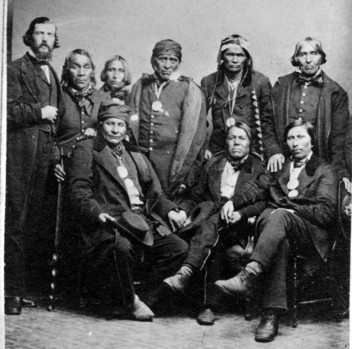
Another error in the February post is the claim that this photo was modified for and engraving in Armstrong’s book, Early Life Among the Indians. In fact, the engraving is derived from a very similar photo seen at the top of this post (Minnesota Historical Society).

(Marr & Richards Co. for Armstrong)
The problem with this conclusion is that it would have been impossible for Jechiikwii’o to visit Lincoln in the White House. The sixteenth president was elected shortly after the following report came from the Red Cliff Agency:

Drew, C.K. Report on the Chippewas of Lake Superior. Red Cliff Agency. 29 Oct. 1860. Pg. 51 of Annual Report of the Commissioner of Indian Affairs. Bureau of Indian Affairs. 1860. (Digitized by Google Books).
This was a careless oversight on my part, considering this snippet originally appeared on Chequamegon History back in November. Jechiikwii’o is still a likely suspect for the man in the photo, but this discrepancy must be settled before we can declare the mystery solved.
The question comes down to where Armstrong made the mistake. Is the man someone other than Jechiikwii’o, or is the photo somewhere other than the Lincoln White House?
If it isn’t Jechiikwii’o, the most likely candidate would be his son, Antoine Buffalo. If you remember this post, Hamilton Ross did identify the single portrait as a grandson of Chief Buffalo. Jechiikwii’o, a Catholic, gave his sons Catholic names: Antoine, Jean-Baptiste, Henry. Ultimately, however, they and their descendants would carry their grandfather’s name as a surname: Antoine Buffalo, John Buffalo, Henry Besheke, etc., so one would expect Armstrong (who was married into the family) to identify Antoine as such, and not by his father’s name.
However, I was recently sent a roster of La Pointe residents involved in stopping the whiskey trade during the 1855 annuity payment. Among the names we see:
…Antoine Ga Ge Go Yoc
John Ga Ge Go Yoc…[Read the first two Gs softly and consider that “Jayjigwyong” was Leonard Wheeler’s spelling of Jechiikwii’o]
So, Antoine and John did carry their father’s name for a time.
Regardless, though, the age and stature of the man in the group photograph, Armstrong’s accuracy in remembering the other chiefs, and the fact that Armstrong was married into the Buffalo family still suggest it’s Jechiikwii’o in the picture.
Fortunately, there are enough manuscript archives out there related to the 1862 delegation that in time I am confident someone can find the names of all the chiefs who met with Lincoln. This should render any further speculation irrelevant and will hopefully settle the question once and for all.
Until then, though, we have to reflect again on why Benjamin Armstrong’s Early Life Among the Indians is simultaneously the most accurate and least accurate source on the history of this area. It must be remembered that Armstrong himself admitted his memory was fuzzy when he dictated the work in his final years. Still, the level of accuracy in the small details is unsurpassed and confirms his authenticity even as the large details can be way off the mark.
 Chequamegon History