1823andMe™: Perceptions of Race in Pre-Civil War Chequamegon Society
April 7, 2019
By Leo
If you haven’t seen a lot of posts lately, it’s because I’ve given up the the lucrative history-blogging business to become a mad scientist. I have a time machine that will make me wealthy beyond belief. Unfortunately, there are still some kinks to work out with the time-space continuum. Until they’re fixed, I plan to fund my research with my state-of-the-art genetic-ancestry testing business, 1823andMe™. Just spit into a tube, and in three to four weeks we can tell you, with scientific precision, what your actual true race and ethnicity are. You thought you were English? Ha Ha–you’re actually Scottish!
I had hoped to be collecting modern spit by now, but my stupid investors were frightened off by a simple trademark lawsuit. This has really slowed the field testing, so I’ve been reduced to taking the time machine back to eras where I can get saliva on the cheap. In fact, I just returned from a trip to the Lake Superior country!
Originally, I was just going to visit Sault Ste. Marie in 1830, but on the ride back, I just had to stop in at La Pointe in 1850 and 1855. I mean, I used to write a lot about that place and time, so it seemed only right to collect some stories and anecdotes for old-time’s sake.
But, disaster! My briefcase spilled out all over the floor and the notecards got all jumbled. The genetic profiles of the seven donors, and their descriptions, are all out of order. Can you help me sort them?
Here are the seven genetic ancestry profiles I collected according to my proprietary SuperDNA™analysis system:
- 100% Native American
- 88% Native American, 12% European (Mediterranean)
- 50% Native American, 50% West African
- 50% European (British Isles), 50% Native American
- 100% European (Mediterranean)
- 75% Native American, 25% European (Mediterranean)
- 100% European (British Isles)
And here are the descriptions of the seven people they belong to:
- I met him talking to a group of American pioneers who were planning to settle in the new city of Superior. Being one of the few English speakers around, he informed them that he was the first white man born in the area where the city was being built.
- He was a young man of the Lac Vieux Desert band. He arrived at La Pointe in his bark canoe for the payment and Midewiwin ceremonies. We tried to talk a little, but he only spoke Ojibwe.
- This kindly old woman was the matriarch of the leading family on the island. The federal census taker was in the middle of getting her information. I asked if he was going over to Bad River next, and he said he didn’t need to because he only had to count white people.
- We talked for quite a while because there were so few people who spoke English around. He was a clerk and he told me about how he “trades with the Indians,” but now his boss wants him to go into politics. His boss is a prominent Democrat who is friends with John Calhoun and all the other pro-slavery politicians.
- His name was Shaw-shaw-wa-ne-ba-se of the Snake clan, and you could tell he’d led a rough life out in the prairies of Manitoba. He had stolen horses from the Mandan around the time Lewis and Clark stayed with them. Later, his family considered joining Tenskwatawa and Tecumseh in their prophecy to give up white ways so the Great Spirit would send the whites back across the ocean.
- This old Frenchman was loved by almost everyone around. He took great pride in being descended from the French nobility and saw himself as a link back to the old French days at La Pointe. He was proud of his role in getting the Catholic church re-established on the island.
- He was one of the most imposing and respected Ojibwe chiefs around. He was great at playing the American and British authorities off each other. He did the same with the churches, and his influence on other Ojibwe bands was impressive.
Can you sort them accurately?
Ack! Absent-minded professor here–I forgot I had already compiled those notes with names and a few pictures. Sorry for wasting your time. Here are the actual results:
 I met him talking with a group of American pioneers who were planning to settle in the new city of Superior. Being one of the few English speakers around, he informed them that he was the first white man born in the area where the city was being built. I met him talking with a group of American pioneers who were planning to settle in the new city of Superior. Being one of the few English speakers around, he informed them that he was the first white man born in the area where the city was being built.
Bonga, Stephen 1823andMe™ SuperDNA™: 50% Native American, 50% West African |
| He was a young man of the Lac Vieux Desert band. He arrived at La Pointe with his bark canoe, for the payment and Midewiwin ceremonies. We tried to talk a little, but he only spoke Ojibwe.
Gendron, Antoine 1823andMe™ SuperDNA™: 100% European (Mediterranean) |
| This kindly old woman was the matriarch of the leading family on the island. The federal census taker was in the middle of getting her information. I asked if he was going over to Bad River next, and he said he didn’t need to because he only had to count white people.
Cadotte, Mdme. Madeleine Equaysayway 1823andMe™ SuperDNA™: 100% Native American |
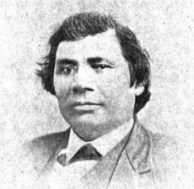 We talked for quite a while because there were so few people who spoke English around. He was a clerk and he told me about how he “trades with the Indians,” but now his boss wants him to go into politics. His boss is a prominent Democrat who is friends with John Calhoun and all the other pro-slavery politicians. We talked for quite a while because there were so few people who spoke English around. He was a clerk and he told me about how he “trades with the Indians,” but now his boss wants him to go into politics. His boss is a prominent Democrat who is friends with John Calhoun and all the other pro-slavery politicians.
Roy Jr., Vincent 1823andMe™ SuperDNA™: 75% Native American, 25% European (Mediterranean) |
 His name was Shaw-shaw-wa-ne-ba-se of the snake clan, and you could tell he’d led a rough life out in prairies of Manitoba. He had stolen horses from the Mandan around the time Lewis and Clark stayed with them. Later, his family considered joining Tenskwatawa and Tecumseh in their prophecy to give up white ways so that the Great Spirit would send the whites back across the ocean. His name was Shaw-shaw-wa-ne-ba-se of the snake clan, and you could tell he’d led a rough life out in prairies of Manitoba. He had stolen horses from the Mandan around the time Lewis and Clark stayed with them. Later, his family considered joining Tenskwatawa and Tecumseh in their prophecy to give up white ways so that the Great Spirit would send the whites back across the ocean.
Tanner, John Shawshawwanebase 1823andMe™ SuperDNA™: 100% European (British Isles) |
| This old Frenchman was loved by almost everyone around. He took great pride in being descended from the French nobility and saw himself as a link back to the old French days at La Pointe. He was proud of his role in getting the Catholic church re-established on the island.
Cadotte Jr., Michel (Mishoons) 1823andMe™ SuperDNA™: 88% Native American 12% European (Mediterranean) |
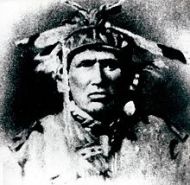 He was one of the most imposing and respected Ojibwe chiefs I met. He was great at playing the Americans and British off of each other. He did the same with the churches, and his influence on other bands was impressive. He was one of the most imposing and respected Ojibwe chiefs I met. He was great at playing the Americans and British off of each other. He did the same with the churches, and his influence on other bands was impressive.
Shingwaukonse 1823andMe™ SuperDNA™: 50% European (British Isles) 50% Native American |
Whew! Disaster averted.

Okay, back to reality. I don’t have a time machine, I don’t have much to say about Elizabeth Warren’s campaign roll-out, and I actually had my DNA done by Ancestry.com and enjoyed the process. So, why the snarky attempt to dabble in anthropology, where I have no business dabbling?
Is it because I really am retiring from teaching* at the ripe-old age of 35 but still have a compulsion to quiz and lesson-plan?
No! It’s because I have some upcoming posts on the concepts of race, identity and citizenship in the census records from 1850-1860 and I wanted to hammer home the following points:
- We, as Americans, have been conditioned to think of race as an immutable, biological aspect of identity. However, this current form of racialized thinking did not fully take hold until the later 19th and early 20th centuries. Earlier times also had racialized thinking, but it was different.
- In the pre-Civil War Lake Superior country, one’s race had as much or more to do with his or her lifestyle, culture, religion, or assigned paternal lineage than it did with perceived genetic ancestry (i.e. amount of “blood” or DNA). Therefore, the race a person had at birth wasn’t necessarily the one he or she would have at death.
- Racial identity in the Lake Superior country was not a matter of black and white (or Native and white for that matter). There was a great deal of nuance in a person’s identity that could not be inferred simply from skin tone or facial features.
- Our modern definitions of a “white person,” a “Native person,” or a “biracial person” did not exist then.
- The idea of race as arbitrary and defined by society is not a new concept, nor is it hard to grasp on a superficial level. However, with race and racism in their current form (and the consequences thereof) being so present in our modern thinking, it is very difficult to remove our present notions from study of the past.
- I mostly like to collect old documents and create narratives. Smarter people than I can continue to fill libraries on these headier topics. That said, if we want to get a good discussion going on the census, we better get close to the same wavelength.
See you soon,
Leo
Notes:
Stephen Bonga, his father, and his brothers have figured in a number of historical studies of African-Americans in the west. See pages 7 and 43 of The Eye of the Northwest by Frank Flower (1890) for this particular story.
This description of Antoine Gendron comes directly from pages 34-37 of Kohl’s Kitch-Gami. Kohl often used pseudonyms, so “Gendron” might not be the actual name of the man he met at La Pointe in 1855.
Madeline Cadotte is an ancestor to so many of the families of this region, and such an important part of regional folklore, we sometimes lose track of Mdme. Cadotte the historical figure who lived to a very old age and was still around into the 1850s. Written sources in English, when compared to contemporaries like Chief Buffalo and Ozhaguscodaywayquay (Susan Johnston), are surprisingly sparse. There are some discrepancies in sources about her early life, but I’ve yet to encounter a source that disputes that she was born to two Ojibwe parents and raised in an Ojibwe household.
Verwyst devotes the final few pages of his biography of Father Baraga, (1900) to a short biography of Vincent Roy Jr., calling the elderly Roy “the best Indian of the Northwest.” In their younger lives, however, Roy and contemporaries like the Warren cousins, Paul and Clement Beaulieu, and Antoine Gordon self-identified variously as white, mix-blood, or Indian depending on the appropriateness of the context. This didn’t mean he wasn’t subject to discrimination, however. The land, business and political ambitions Roy and his brother-in-law, Vincent Cournoyer, were challenged by rivals on the basis of their Ojibwe ancestry.
John Tanner’s narrative (1830) is a fascinating view on the Ojibwe society of the Red River prairies at the dawn of the 19th century. He was kidnapped from American settlers at age 10 by a Saginaw Ojibwe war party. He was later adopted into a prominent Arbre Croche Ottawa family and moved with them to the prairies. By adulthood, he had forgotten English and was fully integrated into the Anishinaabe world. Though his white origins were a liability at times, he was generally perceived as an Ottawa by the Ojibwe, Cree and Assiniboine of the region. He was of the clan of the Saginaw chief who had originally taken him from his birth parents.
The marriage of Misho’s parents, Michel and Madeline, is often portrayed as the coming together of Native and European culture in the region. However, few modern-day Americans would describe Michel Cadotte Sr. as a white man if they met him on the street. His father was half Huron, and his mother was Anishinaabe from the Lake Nipissing region. Michel Jr. and his siblings had seven Native great-grandparents and one European great-grandparent. The direct paternal line being French, both Anishinaabe and French-Canadian society of the time would consider them French. This would not necessarily imply shame or rejection toward their Native ancestry, just an acknowledgement that children belonged to their father’s village.
Janet Chute’s biography of Shingwaukonse (1998), devotes significant time to his origins and how and why he fit into the Ojibwe society of the Soo rather than the area’s large Metis community.
Shameless advertisement:
*I am actually leaving the K-12 teaching field, so hopefully that will leave me with more time and mental energy for Chequamegon History. Also, let me know if you have any job openings for old-document readers and/or transcribers.
 Chequamegon History
Thanks again Leo! Another great effort! But, how do you define “race”? Now……stepping away from Middle School? Stepping up to the lecture podium? Bringing Ojibwe history to Northland College? Or, a dealer at the poker tables at Legendary Waters?
Not sure my BS in Education can get a professorship. Maybe dealing poker–I have a couple months before I panic. I’m going to dodge your first question by saying I’m trying to confuse the definition, not pin it down .