The Removal Order of 1849
March 12, 2016
By Amorin Mello
United States. Works Progress Administration:
Chippewa Indian Historical Project Records 1936-1942
(Northland Micro 5; Micro 532)

12th President Zachary Taylor gave the 1849 Removal Order while he was still in office. During 1852, Chief Buffalo and his delegation met 13th President Millard Fillmore in Washington, D.C., to petition against this Removal Order.
~ 1848 presidential campaign poster from the Library of Congress
Reel 1; Envelop 1; Item 14.
The Removal Order of 1849
By Jerome Arbuckle
After the war of 1812 the westward advance of the people of the United States of was renewed with vigor. These pioneers were imbued with the idea that the possessions of the Indian tribes, with whom they came in contact, were for their convenience and theirs for the taking. Any attempt on the part of the aboriginal owners to defend their ancestral homes were a signal for a declaration of war, or a punitive expedition, which invariably resulted in the defeat of the Indians.
“Peace Treaties,” incorporating terms and stipulations suitable particularly to the white man’s government, were then negotiated, whereby the Indians ceded their lands, and the remnants of the dispossessed tribe moved westward. The tribes to the south of the Great Lakes, along the Ohio Valley, were the greatest sufferers from this system of acquisition.
Another system used with equal, if less sanguinary success, was the “treaty system.” Treaties of this type were actually little more than receipt signed by the Indian, which acknowledged the cessions of huge tracts of land. The language of the treaties, in some instances, is so plainly a scheme for the dispossession and removal of the Indians that it is doubtful if the signers for the Indians understood the true import of the document. Possibly, and according to the statements handed down from the Indians of earlier days to the present, Indians who signed the treaties were duped and were the victims of treachery and collusion.
By the terms of the Treaties of 1837 and 1842, the Indians ceded to the Government all their territory lying east of the Mississippi embracing the St. Croix district and eastward to the Chocolate River. The Indians, however, were ignorant of the fact that they had ceded these lands. According to the terms, as understood by them, they were permitted to remain within these treaty boundaries and continue to enjoy the privileges of hunting, fishing, ricing and the making of maple sugar, provided they did not molest their white neighbors; but they clearly understood that the Government was to have the right to use the timber and minerals on these lands.

Entitled “Chief Buffalo’s Petition to the President“ by the Wisconsin Historical Society, the story behind this now famous symbolic petition is actually unrelated to Chief Buffalo from La Pointe, and was created before the Sandy Lake Tragedy. It is a common error to mis-attribute this to Chief Buffalo’s trip to Washington D.C., which occurred after that Tragedy. See Chequamegon History’s original post for more information.

Detail of Benjamin Armstrong from a photograph by Matthew Brady (Minnesota Historical Society). See our Armstrong Engravings post for more information.
Their eyes were opened when the Removal Order of 1849 came like a bolt from the blue. This order cancelled the Indians’ right to hunt and fish in the territory ceded, and gave notification for their removal westward. According to Verwyst, the Franciscan Missionary, many left by reason of this order, and sought a refuge among the westernmost of their tribe who dwelt in Minnesota.
Many of the full bloods, who naturally had a deep attachment for their home soil, refused to budge. The chiefs who signed the treaty were included in this action. They then concluded that they were duped by the Treaty Commissioners and were given a faulty interpretation of the treaty passages. Although the Chippewa realized the futility of armed resistance, those who chose to remain unanimously decided to fight it out. A few white men who were true friends of the Indians, among these was Ben Armstrong, the adopted son of the Head Chief, Buffalo, and he cautioned the Indians against any show of hostility.
At a council, Armstrong prevailed upon the chiefs to make a trip to Washington. Accordingly, preparations for the trip were made, a canoe of special make being constructed for the journey. After cautioning the tribesmen to remain calm, pending their return, they set out for Washington in April, 1852. The party was composed of Buffalo, the head Chief, and several sub-chiefs, one of whom was Oshoga, who later became a noted man among the Chippewa. Armstrong was the interpreter and director of the party. The delegation left La Pointe and proceeded by way of the Great Lakes as far as Buffalo, N. Y., and then by rail to Washington. They stopped at the white settlements along the route and their leader, Mr. Armstrong, circulated a petition among the white people. This petition, which was to be presented to the President, urged that the Chippewa be permitted to remain in their own country and the Removal Order reconsidered. Many signatures were obtained, some of the signers being acquaintances of the President, whose signatures he later recognized.
Despite repeated attempts of arbitrary agents, who were employed by the government to administer Indian affairs, and who endeavored to return them back or discourage the trip, they resolutely persisted. The party arrived at Buffalo, New York, practically penniless. By disposing of some Indian trinkets, and by putting the chief on exhibition, they managed to acquire enough money to defray their expenses until they finally arrived at Washington.
Here it seemed their troubles were to begin. They were refused an audience with those persons who might have been able to assist them. Through the kind assistance of Senator Briggs of New York, they eventually managed to arrange for an interview with President Fillmore.

United States Representative George Briggs was helpful in getting an audience with President Millard Fillmore.
~ Library of Congress
At the appointed time they assembled for the interview and after smoking the peace pipe offered by Chief Buffalo, the “Great White Father” listened to their story of conditions in the Northwest. Their petition was presented and read and the meeting adjourned. President Fillmore, deeply impressed by his visitors, directed that their expenses should be paid by the Government and that they should have the freedom of the city for a week.
![Vincent Roy, Jr., portrait from "Short biographical sketch of Vincent Roy, [Jr.,]" in Life and Labors of Rt. Rev. Frederic Baraga, by Chrysostom Verwyst, 1900, pages 472-476.](https://chequamegonhistory.com/wp-content/uploads/2016/03/vincent-roy-jr.jpg)
Vincent Roy, Jr., was also on this famous trip to Washington, D.C. For more information, see this excerpt from Vincent Roy Jr’s biography.
Their mission was accomplished and all were happy. They had achieved what they sought. An uprising of their people had been averted in which thousands of human lives might have been cruelly slaughtered; so with light hearts they prepared for their homeward trip. Their fare was paid and they returned by rail by way of St. Paul, Minnesota, which was as near as they could get by rail to their homes. From St. Paul they traveled overland, a distance of over two hundred miles, overland. Along the route they frequently met with bands of Chippewa, whom they delighted with the information of the successes of their trip. These groups they instructed to repair to Madeline Island for the treaty at the time stipulated.
Upon their arrival at their own homes, the successes of the delegation was hailed with joy. Runners were dispatched to notify the entire Chippewa nation. As a consequence, many who had left their homes in compliance with the Removal Order now returned.
When the time for the treaty drew near, the Chippewa began to arrive at the Island from all directions. Finally, after careful deliberations, the treaty of 1854 was concluded. This treaty provided for several reservations within the ceded territory. These were Ontonagon and L’Anse, in the present state of Michigan, Lac du Flambeau, Bad River or La Pointe, Red Cliff, and Lac Courte Oreille, in Wisconsin, and Fond du Lac and Grand Portage in Minnesota.
It was at this time that the Chippewa mutually agreed to separate into two divisions, making the Mississippi the dividing line between the Mississippi Chippewa and the Lake Superior Chippewa, and allowing each division the right to deal separately with the Government.
Bayfield’s Beginnings
March 6, 2016
By Amorin Mello
This is a reproduction of Captain Robinson Darling Pike’s speech for the 50th anniversary celebrations of Bayfield, Wisconsin on March 24th, 1906. It was originally digitized and reproduced onto RootsWeb.com by John Griener, a great-grandson of Currie G. Bell. The Bayfield County Press was in the Bell family from the Fall of 1882 until July of 1927. Pike’s obituary was not included in this reproduction.

Portrait of Bayfield from History of Northern Wisconsin, by the Western Historical Company, 1881, page 80.
Capt. R. D. PIKE on
Bayfield’s Beginnings
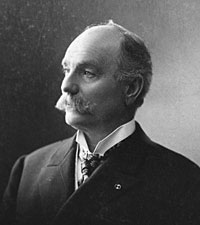
Captain Robinson Derling Pike
~ A gift that spawns Great Lakes fisheries:The legacy of Bayfield pioneer R.D. Pike, by Julia Riley, Darren Miller and Karl Scheidegger for the Wisconsin Department of Natural Resources, October 2011.
Robinson Darling PIKE, son of Judge Elisha and Elizabeth Kimmey PIKE, was a lumbering giant in early Bayfield history. Capt. R. D. Pike, as his name appeared weekly in the Press, was one of the most influential men in the county, associated not only with timber interests, but with the Bayfield Brownstone Company, the electric light company, the fish hatchery, etc. Just before his death on March 27, 1906, he wrote the following recollections of early Bayfield. The paper was read at the Bayfield 50th anniversary celebrations and was published in the March 30, 1906 issue of the Press along with Capt. PIKE’s obituary:
I regret very much not being able to be with you at the celebration of the fiftieth anniversary of the town of Bayfield. As you may be aware, I have been ill for the past few weeks, but am pleased to state at this time I am on the gain and hope to be among you soon. If my health permitted I would take great pleasure in being present with you this evening.
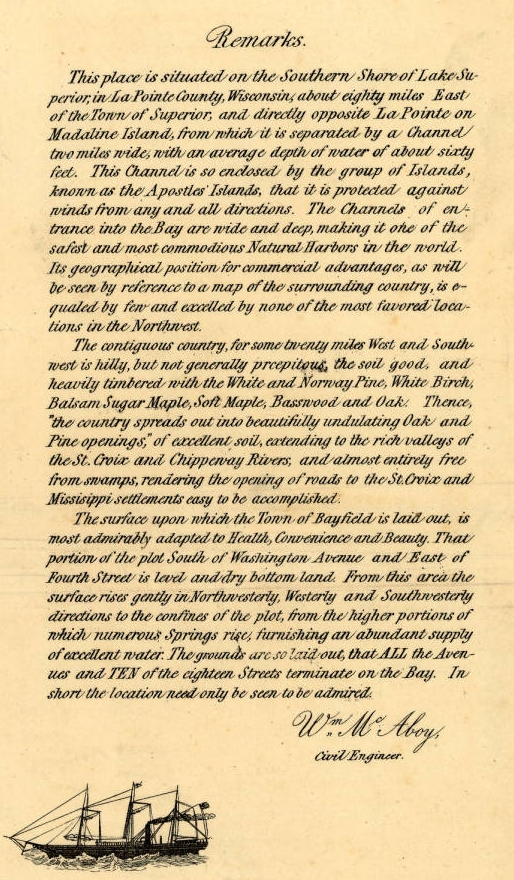
Detail from Major William McAboy‘s 1856 Map of Bayfield.
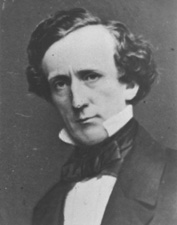
Senator Henry Mower Rice
~ United States Senate Historical Office
I remember very distinctly that the first stake was driven in the town of Bayfield by Major McABOY who was employed by the Bayfield Townsite Company to make a survey and plat same, (the original plat being recorded at our county seat.) This Bayfield Townsite Company was organized with Hon. Henry M. RICE of St. Paul at the head and some very enterprising men from Washington D.C. Major McABOY arrived here about the first of March and made his headquarters with Julius AUSTRIAN of LaPointe. Julius AUSTRIAN in those days being the Governor General of all that part of the country west of Ontonagon to Superior; Ashland and Duluth being too small to count The major spent probably two weeks at LaPointe going back and forth to Bayfield with a team of large bay horses owned by Julius AUSTRIAN, being the only team of horses in the country.
For more information about Julius Austrian, see other Austrian Papers.
I remember very well being in his office at LaPointe with father, (I being then a mere lad of seventeen,) and I recollect hearing them discuss with Mr. AUSTRIAN the question of running the streets in Bayfield north and south and avenues east and west, or whether they should run them diagonally due to the topography of the country, but he decided on the plan as the town is now laid out. Mr. AUSTRIAN and quite a little party from LaPointe came over here on the 24th of March, 1856, when they officially laid out the town, driving the first stake and deciding on the name Bayfield, named after Lieutenant Bayfield of the Royal Navy who was a particular friend of Senator RICE, and it was he who made the first chart for the guidance of boats on Lake Superior.

“Map of Bayfield situate in La Pointe County, Wisconsin” by Major William McAboy, 1856 for the Bayfield Land Company.
~ Wisconsin Historical Society

For more information about Indian interpreter Frederick Prentice, see his appearances in the Barber Papers.
~ Portrait of Prentice from History of the Maumee Valley by Horace S Knapp, 1872, pages 560-562.
The summer of 1855 father was in poor health, filled up with malaria from the swamps of Toledo, and he was advised by Mr. Frederick PRENTICE, now of New York, and known by everybody here as “the brownstone man,” to come up here and spend the summer as it was a great health resort, so father arrived at LaPointe in June, 1855, on a little steamer that ran from the Soo to the head of the lakes, the canal at that time not being open, but it was opened a little later in the season.

Detail of “Austrian’s Saw Mill” on Pike’s Creek, Chequamegon Bay, Lake Superior, circa 1852.
~ Wisconsin Public Land Survey Records
Upon arrival at LaPointe father entered into an agreement with Julius AUSTRIAN to come over to Pike’s creek and repair the little water mill that was built by the North American Fur Company, which at that time was owned by Julius AUSTRIAN. He made the necessary repairs on the little mill, caught plenty of brook trout and fell in love with the country on account of the good water and pure air and wrote home to us at Toledo glowing letters as to this section of the country. Finally he bought the mill and I think the price paid was $350 for the mill and forty acres of land, and that largely on time; however the mill was not a very extensive affair. Nearly everything was made of wood, except the saw and crank-pin, but it cut about two thousand feet of lumber in twelve hours. Some of the old shafting and pulleys can be seen in the debris at the old mill site now. Remember these were not iron shafts as we used wooden shafts and pulleys in those days. This class of the mill at the time beat whip-sawing, that being the usual way of sawing lumber.
Father left LaPointe some time in September 1855 for Toledo to move his family to Pike’s creek, which stream was named after we moved up here. Onion river and Sioux river were named before that time. On father’s arrival from Toledo from this country we immediately began to get ready to move. We had a large fine yoke of red oxen and logging trucks. He sold out our farm at Toledo, packed up our effects, and boarded a small steamer which took us to Detroit. Our family then consisted of father, mother, grandma PIKE, and my sister, now Mrs. BICKSLER, of Ashland. We stayed several days in Detroit to give father time to buy supplies for the winter; that is feed for the oxen and cow and groceries for the family to carry us through until Spring.
We then boarded the steamer Planet, which was a new boat operated by the Ward Line, considered the fastest on the lake. It was about two hundred fifty tons capacity. We came to Sault Ste. Marie, it being the Planet‘s first trip through the Soo, the canal as I remember was completed that fall. During this year the Lady Elgin was running from Chicago and the Planet and North Star running from Detroit, they being about the only boats which were classed better than sail boats of the one hundred and fifty tons.

Portrait of the Steamer North Star from American Steam Vessels, by Samuel Ward Stanton, page 40.
~ Wikimedia.org
We arrived at LaPointe the early part of October, 1855. On our way up we stopped at Marquette, Eagle Harbor, Eagle River, and Ontonagon. We left Ontonagon in the evening expecting to arrive at LaPointe early the next morning, but a fearful storm arose and the machinery of the Planet became disabled off Porcupine mountains and it looked for a while as though we were never going to weather the storm, but arrived at LaPointe the next day. There were some parties aboard for Superior who left LaPointe by sail.
We remained at LaPointe for a week or ten days on account of my mother’s health and then went to Pike’s bay with all our supplies, oxen and cow on what was known as the Uncle Robert MORRIN’s bateau. Uncle Robert and William MORRIN now of Bayfield, and if I remember rightly, each of the boys pulled an oar taking us across. We landed in Pike’s bay just before sundown, hitched up the oxen and drove to the old mill. Now, this was all in the fall of 1855.

Detail from William McAboy‘s 1856 Map of Bayfield.
“HON. JOHN W. BELL, retired, Madeline Island, P.O. La Pointe, was born in New York City, May 3, 1805, where he remained till he was eight years of age. His parents then took him to Canada, where his father died. He had gotten his education from his father and served an apprenticeship at three trades – watchingmaking, shipbuilding, and coopering. He then moved to Ft. La Prairie, and started a cooper shop, where he remained till 1835, when he came to La Pointe, on the brig “Astor,” in the employ of the American Furn Company as cooper, for whom he worked six months, when he took the business into his own hands, and continued to make barrels as late as 1870. It was in 1846 or 1847 that Robert Stewart, then Commissioner, granted him a license, and he opened a trading post at Island River, and became interested in the mines. he explored and struck a lead in the Porcupine Range, on Onion River, which he sold to the Boston Company, and then came back to La Pointe. In 1854 he was at the treaty between the Chippewas of Lake Superior and the Mississippi River, and was appointed Enrolling Agent on their new reservation, on the St. Louis River, where he went, but soon came back, as the Indians were not willing to stay there. He was then appointed by the Indians to look up their arrearages, and while at this work visited the national capital. He was appointed to County Judge for La Pointe County, and helt till 1878. He was elected on the town board in 1880. Has been Register of Deeds a great many years. Has held most all the different county and town offices, and at one time held or did principally the business for the whole county. He has seen La Pointe in all of its glory dwindle down to a little fishing hamlet; is now Postmaster at his island home, where he occupies a house put up by the old fur company. He was married in 1837 to Miss Margaret Brebant, in the old Catholic Church, by Rev. Bishop Baraga. They had seven children – John(deceased), Harriette (now Mrs. La Pointe), Thomas (deceased), Alfred (now Town Clerk), Sarah F., Margaret (deceased), and Mary (now Mrs. Denome).”
~ History of Northern Wisconsin, by the Western Historical Company, 1881.
As I said before, the town was laid out on March 24th, 1856, and record made same at LaPointe by John W. BELL, who at that time was the “Witte” of all the country between Ontonagon and Superior; Julius AUSTRIAN being the “Czar” of those days and both God’s noblemen. [Note: This was a reference to Count Sergei Witte and Tsar Nicholas II, contemporaries of Capt. Pike. Witte was responsible for much industrial development of Tsarist Russia in the 1890’s.] The Territory now comprising the town of Bayfield was taken from LaPointe county. There were a number of very prominent men interested in laying out the townsite and naming our avenues and streets, such as Hon. H. M. RICE and men of means from Washington after whom some of our avenues were named.
Very soon after this they wished to build a large mill in order to furnish lumber necessary for building up the town. The Washington people decided upon a man by the name of CAHO, an old lumberman of Virginia, so he was employed to come up here and direct the building of the mill. A hotel was built directly across from the courthouse by the Mr. BICKSLER who afterwards married my sister. The saw mill was built about a block west of where my saw mill now stands. The mill had a capacity of five or six thousand feet per day and I think the machinery came from Alexandria, Virginia. Joe LaPOINTE was the only man recognized as being capable of running a mill from the fact that he could do his own filing and sawing. While they were constructing the mill they had a gang of men in the woods getting out hard wood for fuel, not thinking of using any of the sawdust, and they piled the sawdust out with the slabs as useless. Charley DAY, whom many of you will remember, who was the party who got out the hardwood as fuel for the mill.
Time has wrought many changes in our midst. As far as I know, I am the only white man living who was here at the time the town was laid out.
In conclusion I wish to say that at a banquet given in Bayfield some two or three years ago, I made the statement that when the last pine tree was cut from the peninsula on which Bayfield is located the prosperity of our town and vicinity will have just commenced. The pine has gone and now we are cutting the hemlock and hardwood which will last ten to fifteen years; and long before this is exhausted the cut over lands will be taken up and farms tilled, as is the history of other sections of the country.

“Elisha and R.D. Pike owned a private fish hatchery [at Julius Austrian’s former sawmill] in Bayfield County from the 1860s to 1895. The Wisconsin State Legislature mandated the construction of a fish hatchery in northern Wisconsin in 1895, so R.D. Pike donated 405 acres (1.64 km2) from his hatchery to serve as the state hatchery. The state built the main hatchery building in 1897 using brownstone from nearby Pike’s Quarry. The Chicago, St. Paul, Minneapolis and Omaha Railway built a siding to the hatchery, and a special railcar known as The Badger brought fish from the hatchery to Wisconsin waterbodies. In 1974, new buildings and wells were constructed to modernize the hatchery. The hatchery was renamed in honor of longtime Wisconsin Department of Natural Resources secretary Les Voigt in 2006, and the main building was named for R.D. Pike in 2011. The hatchery currently spawns five types of trout and salmon and also includes a visitor’s center and aquarium.”
~ Wikipedia.org
 Chequamegon History