Edwin Ellis Incidents: Number IV
August 31, 2018
By Amorin Mello

Originally published in the July 14th, 1877, issue of The Ashland Press. Transcribed with permission from Ashland Narratives by K. Wallin and published in 2013 by Straddle Creek Co.
… continued from Number III.
EARLY RECOLLECTIONS OF ASHLAND.
“OF WHICH I WAS A PART.”
Number IV
My Dear Press: – In March 1855, Conrad and Adam Goeltz – then young men, came to Ashland. They were natives of Wittenberg, and Conrad had served six years in the Cavalry of that Kingdom; but liking freedom, he bade adieu to the King, his master, and came to the “Land of the Free.” They both cleared land near the town site, which they afterwards pre-empted, and bought from the U.S. Government. For several years both of them lived in Michigan, but upon the revival of Ashland they came back to their early home. Katy Goeltz, Conrad’s Daughter, was the first white child born in this town, in the fall of 1855. Henry Dretler, Mrs. Conrad Goeltz’s father, came early and bought a quarter section of land. He died here in 1858 and was buried near the present residence of Mr. Durfee.
In June 1855, Dr. Myron Tompkins (brother-in-law of Mr. Whittlsey) came to the bay in search of health. He had been driven from Illinois by ague and rheumatism. The climate cured the ague, and accidentally falling off from a raft in the bay – the severe shock cured the rheumatism. Being thus cured by our climate and water, he has ever since lived on the lake. He is a well-educated physician. At present he is the physician of the Silver Islet Mining Company, on the North Shore of the Lake.
I recall others who came in 1855; Andrew Scobie, now of Ontonagon, Thomas Danielson, Charles Day, (now farming on Fish Creek,) Joseph Webb, Bernard Hoppenjohn, Duncan Sinclair, Lawrence Farley, and Austin Corser. Farley died many years ago, but his widow, after years of absence, has again returned to Ashland. Austin Corser in the summer of 1855 began a farm on the east side of Fish Creek, about half a mile above the mouth. Remaining only two or three years, he went to Ontonagon and afterwards to Iron River – in a wild lonely glen – where in after years from 1873 to 1876. He sold his homestead on which the Scranton Mining Company was formed for a snug little fortune, on which he settled down on a farm near Waukegan, Illinois.
John Beck, also coming in the early days of Ashland. He pre-empted and lived upon the spot now laid out and occupied as our cemetery. His wife was the first adult person who died in this town. The remains of the house in which she died may be seen near the Ashland Lumber Company’s store. He was for many years an active explorer for minerals, was the originator of the Montreal River Copper Mining Company. Subsequently he discovered silver lodes on the North Shore, in Canada. He is now engaged in gold mining in California.
Albert C. Stuntz was also one of our early settlers. He is a brother of Geo. R. Stuntz, to whom reference has already been made. He was here engaged in practicing surveying and ran many hundred miles of township and section lines in this and neighboring counties. The townships embracing our Penoka Iron Range were subdivided by him in 1856 and ’57. He once represented this district in the Legislature. His old home is in ruins on the east bank of Bay City creek. Mrs. Stuntz, who endured much hardship and privation died here in 1862. Mr. S. at present lives at Monroe, in this State.
Geo. E. Stuntz. nephew of A.C. and great grandson of the old Hessian Soldier mentioned in a former chapter, also came to Ashland early. In connection with his uncle and on his own account he did a great deal in the subdivision of the lands on the South Shore of the Lake. Soon after the outbreak of our civil war he enlisted in defense of the Union – was severely wounded and died, as it is supposed, in consequence of his wounds.
~ Sarah Adah Ashe – Part IV – San Bernardino by Marta Tilley Belanger

Welton’s mill and Sibley’s farm were both located along the trail south from Ashland to the Penokee Mountains on the 1860 Geological Map of the Penokie Range by Charles Whittlesey.
~ Geology of Wisconsin. Survey of 1873-1879.
Volume III., 1880, Plate XX, page 214.
J. T. Welton and T.P. Sibley, though never living in Ashland, were yet closely identified with its early history. Mr. Welton came about 1850 to Bad River, where he was Government Farmer among the Indians. He was an ingenious mechanic, and could build a water mill. He was on the lookout for a mill site, and finally in 1854 discovered the falls on White River, six miles south of Ashland. It was an unfailing supply of water, with abundant head and fall, and the river was not subject to great rises. As a mill site it has few rivals. His resolution was quickly formed. The rising town on the bay would afford a ready market for all the lumber he could make. The mill should be built. He corresponded with his brother-in-law, Mr. Sibley, and he was eager to come and make his fortune in this new country; and in Nov. 1855, Mr. Sibley and his wife and one little daughter, about a year old, landed upon our shores. During the summer of 1855 Mr. Welton had built a log house at White River. It still stands, though in ruins. Thither late in Nov. 1855, the two families removed. The sisters were refined, cultivated and Christian ladies from the Western Reserve, in Ohio – a spot itself favored by counting among its early settlers some of the best families of New England, and which had been the new center in the west, whence have validated those influences which have tended to improve and elevate the moral and religious condition of the millions of this new empire. They were of Puritan stock. An unbroken wilderness was around them and their nearest neighbors were at Ashland, six miles away. No time was lost. The work of opening up a farm and building a mill was at once begun. They had little money and the labor must be done with their own hands. The casting for the mill must be brought a thousand miles – from Detroit. Nearly a year of toil had passed, when in October, 1856, a few days before the election of James Buchanan to the Presidency – all the able bodied men were invited to go the mill raising at White River. We went and the frame was up, but it was not until 1857 that they could set the mill running. They were greatly impeded for want of capital in cutting logs and floating down the logs to the mill and sawing a few thousand feet of lumber. But before anything could be realized from it they must either haul it over bad roads to Ashland (6 miles) or raft it down many miles to the Lake. But the river was full of jams and “flood wood” – enough to discourage puny men.
The panic of 1857 and resulting hard times put an end to all building at Ashland, and so their hopes of selling their lumber near home were blasted and after struggling vainly for some time longer, Mr. Welton was finally compelled to abandon his home, which he had labored so hard to establish. He found friends and employment in the copper mines of Michigan, and after somewhat improving his fortunes finally settled in south western Iowa, where he now resides.
In some subsequent chapter I will, with your leave, recur to Mrs. Sibley and the circumstances connected with her death.
To be continued in Number V…
Marangoin River Iron Property
March 21, 2016
By Amorin Mello

MARANGOIN RIVER
IRON PROPERTY
EMBRACING
FIVE HUNDRED AND SIXTY ACRES,
IN SECTIONS 16 AND 20,
TOWN 44, NORTH RANGE 5 WEST,
ASHLAND COUNTY, WISCONSIN.
———–
CLEVELAND, OHIO:
FAIRBANKS, BENEDICT & CO., PRINTERS, HERALD OFFICE.
1865.
—–

Detail of Township 44 North, Range 5 West, from Charles Whittlesey’s 1860 Geological Map of the Penokie Range.
The Penokie Iron Belt rises from low ground into an elevated mountain ridge, near the Fourth Principal Meridian, and extends westerly as far as Range 4 W., T. 44 North, where it drops off into the Valley of Bladder Lake. The iron stratum probably extends in the same general direction, beneath the surface ; but I have been unable to find any out-crop of the ore until after crossing the Marangoin Fork in T. 44, N. R. 5 W. Over this interesting space of about nine (9) miles the country is lower, and covered with the drift materials to a great depth. On the west bank of the Marangoin, in Section 16, T. 44, R. 5, a bold cliff is seen, as a prominent land mark over the country, rising to a level with the Iron Range at Bladder Lake. Here the Penokie system re-appears, embracing a band of magnetic ore, in all respects like that on the main waters of Bad River in Ranges 2 and 3 West. This outburst, or uplift of the strata rises to a height of 200 or 250 feet above the river, and 900 to 1000 feet above Lake Superior It is composed of the same quartz rocks, lying in the same order – the iron near the summit, – has a mural face or bluff to the South, and descends in a distance of about a mile and a-half beneath the level of Aitkin’s Lake on the West, as is represented in the accompanying map.
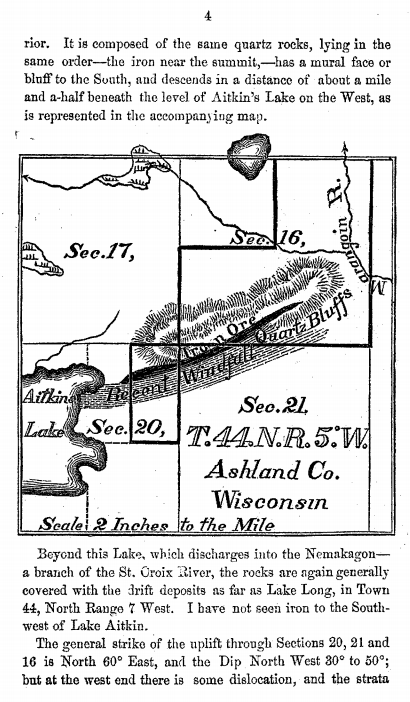
~ Geological Report on That Portion of Wisconsin Bordering on the South Shore of Lake Superior. Surveyed in the Year 1849, Under the Direction of David Dale Owen, United States Geologist, by Charles Whittlesey, Head of Sub-Corps, page 432.
Beyond this Lake, which discharges into the Nemakagon – a branch of the St. Croix River, the rocks are again generally covered with the drift deposits as far as Lake Long, in Town 44, North Range 7 West. I have not seen iron to the South-west of Lake Aitkin.
The general strike of the uplift through Sections 20, 21 and 16 is North 60° East, and the Dip North West 30° to 50°; but at the west end there is some dislocation, and the strata are flatter. Like the formation at Penokie Gap, there is a series of quartz rocks several hundred feet in thickness tilted more or less to the North. Beneath the ferruginous portion, which is near the middle, there is the same fine-grained, thin-bedded, laminated quartz, approaching to novaculte 50 to 100 feet thick. Below this a bed of coarser sub-crystalline, thicker bedded gray quartz, standing prominent in cliffs, covered with tripe de roche.
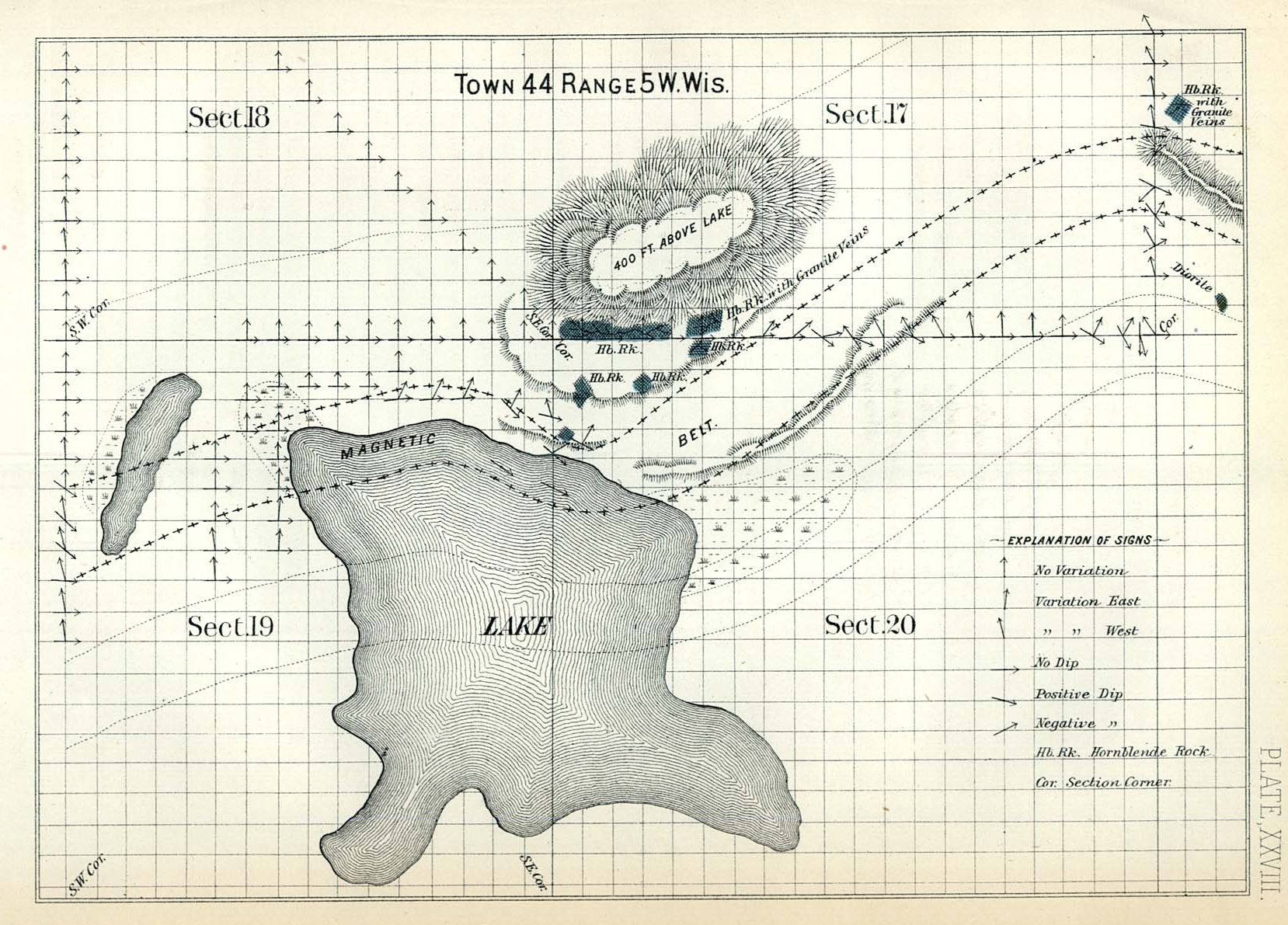
Detail of Aitkins Lake in Section 20, reproduced from the Geology of Wisconsin: Volume III.
Overlying the iron stratum, is a heavy quartz bed, of a darker color, and more jointed, resembling horne blende rock, 300 to 400 feet thick. The iron portion is in thin layers, which deserve the name of slate. It is full of joints, and the pieces come out in regular forms, with straight edges, not rounded by exposure. It dips conformably with the other beds, to the North, and of course descends with them to great depths, ensuring an inexhaustible supply of ore. On Sections 16, where it is steeper than on Section 20, the breadth of the out-crop is less. Its thickness varies from twenty (20) to sixty (60) feet, although in places there are layers of ore, alternating with quartz beds, over a breadth of 100 feet. Most of the way across the South-west quarter of Section 16 – the out-crop is at or near the edge of the bluff, receding from it towards the East. The height of the bluff is about 100 feet, which gives an excellent opportunity to quarry and throw down the ore, and the atde of a mine.
No analysis of this ore has been made; but it resembles the magnetite of the Penokie Range so closely, as to leave no reasonable doubt of their identity.

Detail of the Marengo/Marangoin River in Section 16, reproduced from the Geology of Wisconsin: Volume III.
Four specimens of that ore have been analyzed by three different chemists, the average of which resulted in giving fifty-nine 88/100 (59.88) per cent. of metallic iron. Three of these specimens were selected by myself for the government collections, with the intention of representing an average of the ores. One of the four was selected by a company to represent the best quality of ore, and yielded sixty-eight (68) per cent., the others fifty-six to fifty-eight. A pure magnetic oxide yields 72.40, which is the richest known ore of iron. No injurious chemical ingredient, such as phosphorus, arsenic, or sulphur, has been as yet discovered in the Penokie ores. The only foreign substance is silex, or quartz, a material entirely harmless, and i easily melted with a proper flux. It is from fine grained magnetic ore that the choicest iron is made. This ore is not always as rich, or as easily wrought as the specular and hematite varieties, but invariably produces better iron. It is also very desirable as a mixture with those ores for the purpose f producing a higher grade of metal. Magnetic iron ore is calculated for Bloomeries or common forges, where wrought iron is produced direct from the ore with charcoal, by one process. On this location there is a fall in the Marangoin Fork which I estimate to be equal to a twenty foot overshot wheel. The river is rapid above, and is the most prominent branch of the Bad River. Its sources are in numerous lakes, swamps and springs, which give it great uniformity in the supply of water. The Northern slope of the mountain is heavily covered with hard wood timber for making charcoal, principally sugar-tree. There is an abundance of timber land and water power in the vicinity not yet entered. A horse trail has been cut from the East side of Section 16 to Sibley’s, which is reported to be on easy ground and a trifle over eleven (11) miles in length. From Sibley’s there is a road to Ashland at the head of Chequamegon Bay, a distance of twelve (12) miles due North. At the head of this Bay is a spacious harbor, safe in all weather. The Berlin & Bayfield Railroad will probably pass within ten miles of this property on the East, and the West the Bayfield Branch of the Hudson & Superior Railroad within twelve miles.
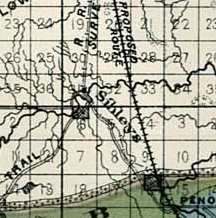
Detail of Thaddeus Pembroke Sibley‘s saw-mill on the Marengo River from Charles Whittlesey’s 1860 Geological Map of the Penokie Range.
The country on and North of the Iron Range is, for farming purposes, the best part of Lake Superior. Its climate is less severe, and the snow in winter less deep than at the Ontonagon and Portage Lake. Messrs. Sibley & Lehy have for many years raised cattle and farm crops successfully. Hay, oats, potatoes, barley and all kinds of vegetables grow better here than in many farming regions farther South. There is little doubt but wheat and rye can be raised when they are needed. The settlers and the Indians make large quantities of sugar from the sugar-maple, which is abundant and rich in sap. Thus a large part of the forage and the food required about iron works can be produced on the spot. There is no healthier region to be found in the United States. In Europe, a northern climate is considered favorable to the iron business, on account of the increased health and vigor of the laborers, as compared to warmer latitudes. When the railways now designed to connect the Mississippi and the Wisconsin Rivers with Lake Superior, shall have been built, or such portions as shall connect the Iron Range with navigation, charcoal furnaces may be erected at numerous points along the route, where there is timber and water power.
The Penokie Range is now held principally by three organized companies. In case there should be a failure, or a great delay, on the part of the Land Grant Railroad Company in prosecuting that work, on that part of the line from Lake Superior to the iron region, a road will probably by built by the parties interested. No business improves a new country, for the capital employed, so rapidly as the manufacture of iron. The rapid increase of the Town and County of Marquette, in Michigan, where in ten years, from 1855 to 1864 inclusive, the shipments of ore increased from 1,447 to 225,119 tons, is conclusive evidence of this fact. The iron business requires and introduces an intelligent class of mechanics and laborers, because skill and intelligence are necessary to carry it on successfully. For such iron as this pure magnetic ore will produce, there must always be a steady demand, at high prices. The competition for high grade charcoal iron is, and must always be, limited. Thus nature seems to have designed the region watered by the tributaries of the Bad River as an iron manufacturing country.
CHARLES WHITTLESEY.
Cleveland, Jan’y 1, 1865.
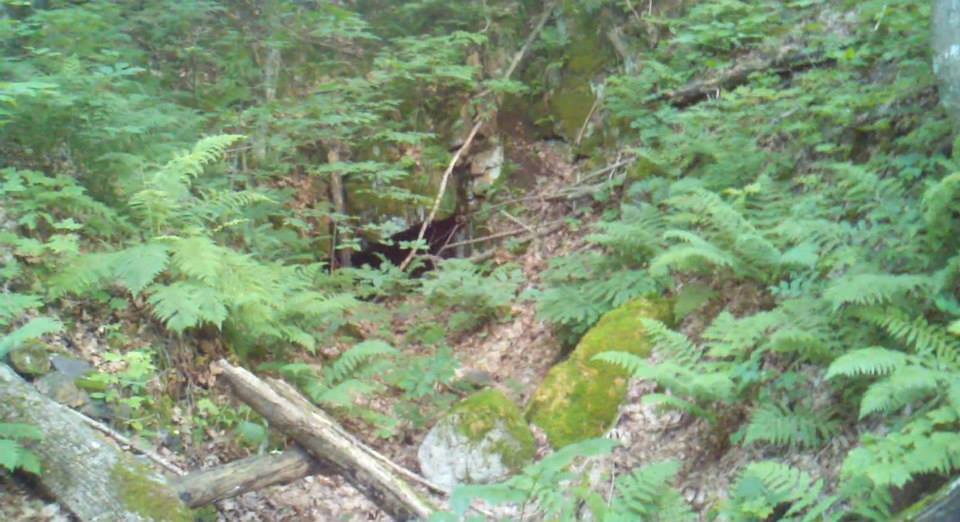
Abandoned mine shaft on the Marangoin River Iron Property.
Penokee Survey Incidents: Number VI
March 14, 2015
By Amorin Mello
December 22, 1877.
The Survey of the Penoka Range and Incidents Connected with its Early History.
—
Number VI.
At length, somewhere about the 25th of October, the General returned from below, accompanied by his son, Joseph Cutler, George Spaulding, a young man who had formerly been in his employ in Maine, and Henry C. Palmer of Milwaukee, a son of President Palmer, who all came to hold claims for the Company, if wanted. He also brought two cook stoves and two metal kettles, the stoves for housekeeping, the kettles for sugar making. Both of the kettles and one of the stoves were subsequently sent to the Range, where they did good service during the winter and following spring, and are no doubt in use somewhere in the country today.
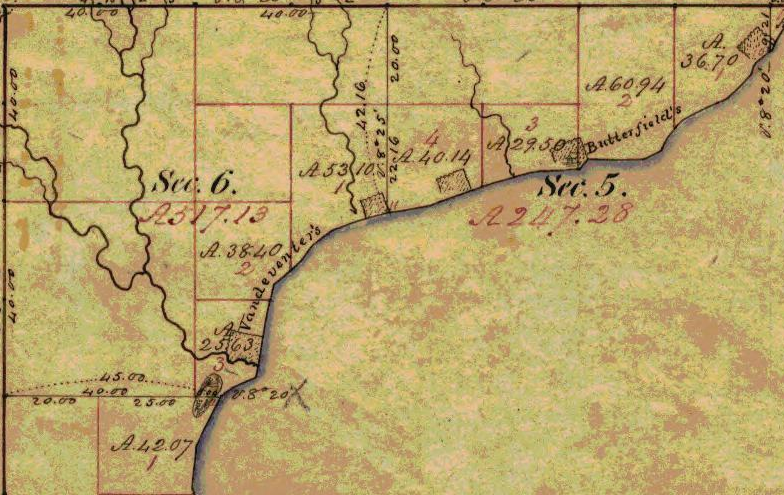
Houghton was a small settlement in the Town of BayPort, located northeast of what is now the City of Washburn. Captain Steven Butterfield and Peter B Vanderventer lived at what is now Washburn. (Detail from Augustus H. Barber’s survey during August of 1855)

Antoine Gordon from Noble Lives of a Noble Race (pg. 207) published by the St. Mary’s Industrial School in Odanah.
These kettles and stoves came very near sending Gen. Cutler, myself and Mr. Sidebotham, who had been stopping at La Pointe for several weeks, awaiting events, to a watery grave, during the run from that place to Ashland, in the Jane, a large two-masted boat formerly used by the Government upon the lake coast survey. Nothing but the coolness and skill of Captain Steve Butterfield, who was at the helm, saved us from going to the bottom. It was a long time before the recollections of that November day ceased to haunt us. The idea of going down in 150 feet of water with such a load, was not a pleasant thing to contemplate. Mr. Sidebotham was wholly unconscious, until after he reached the shore, of the peril we were in, owing to his ignorance of nautical affairs, but not so the General. He realized it as keenly as I did, not a word was spoken for over an hour, but in that hour we lived a lifetime. At length we succeeded in reaching the land at Houghton, where the high rocky shore furnished a lee. I shall never forget that ride while I live. We stopped for dinner at Antoine Gordon‘s, who lived at that time a little to the westward of Houghton, after which we ran down the shore to Pete Vanderventer‘s old place before venturing to cross the Bay to Ashland, which however, we finally did, reaching there in safety about sunset. Here we left Mr. Sidebotham to remain until wanted, and with J. Cutler, Palmer, and Spaulding, started the next morning for the Range, reaching there the second day at noon. Immediately upon our arrival, an interview was had with Stuntz, who informed us that if the fine weather we were then enjoying should continue for three weeks more, the survey to complete which he was making every possible exertion, would be finalized. This was to us indeed joyful news, as we were getting very anxious to return to our homes for the winter; whereupon all of our spare men were at once detailed to assist him, leaving me alone at Penoka, the General, in the meantime, visiting the different locations, and arranging for the winter, during which a blockhouse was to be built at Penoka, and one at the Gorge, which was done, the lumber for both being manufactured upon the ground, with a whip saw. Up to this time there had been no snow except the usual light fall we had every year, about the 1st of November. This, however, had all disappeared in three days after it fell, after which the weather was beautiful. In this way the time passed along, I seeing no one except Gen. Cutler, who came occasionally, or some of Stuntz’s men, who came for supplies, which were at this time kept mostly at Penoka, until the 12th of November, when it being certain that one week more would finish the survey, General Cutler left for Ashland, after Mr. Sidebotham, who by the requirements of the pre-emption law, must sleep upon his claim the 30th, in order to hold it, at least we so understood it at the time, leaving me entirely alone.
The weather continued fair up to the 18th, when there came a change. Saturday, the 17th, was as fine an Indian summer day as I ever saw, nearly all of which I slept seated upon a log in front of the cabin, listening to the singing of the birds, many of them not yet having left us for their homes in the south, and watching them as they were fitting around me, in search of food. At length old Sol sunk in the west, and night once more spread her dark mouth over the surrounding landscape. A strange feeling of loneliness, such as I had never felt before, crept over me as I closed the door of the cabin for the night, and sought my couch of balsam boughs, where I slept soundly until 6 o’clock the following morning, when presto! what a change met my eye! The air so soft and clear the previous evening, was now filled with snow, while upon the ground it was two and a half feet in depth, and increasing rapidly. You can easily imagine that I was not a little startled at the outlook, as being snowed in upon Lake Superior was no joke; and from the rapidity with which it was falling, it was apparent that it would be six feet in depth in twenty-four hours, if it kept on. I quickly saw that the first thing to be done was to lay in a supply of wood, the nearest pile of which was thirty rods distant. To this a track was quickly made, and the work of moving it commenced; neither did it stop until 2 P.M., at which time the whole pile, one and a half cords was in the cabin. The snow was now three feet in depth, but very light. My wood secured, I proceeded to cook some food, of which I felt the need, after which my thoughts began to wander after Stuntz and party, who were fifteen miles south. Neither did they reach the Range until the fourth day, as they had but one mile to run, in order to complete, when the storm came. This done, they started, and were three days in making that fifteen miles, during one of which, the last, they had nothing to eat, and one of them, Wilhelm Goetzenburg, literally nothing to wear, being clad in duck pants, hickory shirt, and stoga boots, no stockings, coat or vest. They were all badly used up when they got in; Stevens, in particular, who gave out when within only three miles of the Range, where he remained until his companions had reached the cabin, and two of them returned to him with some food, after which he came in, but as weak as to render it necessary to lead him. It was several days before he fully recovered his former strength. Goetzenburg, although nearly naked, stood it the best of them all. Perhaps a short sketch of this curious mortal, who certainly exhibited upon this occasion, powers of endurance equal to the gay and festive mule may not be inopportune, in this connection, before closing this article.
Wilhelm Goetzenburg, or Gutsenburg, as George Miller once spelt it when directing a letter for him to his “bruder” in Ontonagon, was not an Adonis, in the strict sense of the term. No sir! his keel was laid for a jumping jack, but from some unexplained cause, that plan was abandoned by his builder, who finally modeled him after the tubs the performing elephants use in the circus, broad at the base; in fact, his basement story was the largest part of him, in fact, nearly all of him; his legs, which were bowed, were short; his arms were long; his chest was short, and shaped like the dummies we see in the windows of ladies’ furnishing stores; his shoulders were broad, upon which a head covered with a thick mat of coarse hair, in color like that of a North Carolina clay-eater; a short nose, and a mouth that if open would have fooled a badger. Taken as a whole, he looked like a mixture of Low Dutch, Esquimaux and New Zealander combined. But beneath that iron frame, beat as honest a heart as ever beat in Ashland, or any other land. Good luck to thee, honest Wilhelm, I shall never see thy like again, but wherever thou arts or goest, may beans be plenty and clothing cheap. But en resume.
The fifth day brought Gen. Cutler from Ashland, accompanied by Mr. Sidebotham, George Kilburn, Sibley, Steve Sanborn, and George Miller, with the pack horses, who all came to break the road, except Sanborn, who came to stay through the winter. The boys had also now got in from the different claims, and the old cabin was full. Here they all remained for two days, when there came a thaw and melted the snow, after which Uncle George and Sibley returned to the Marengo, and George Miller with the horses to Ashland. The rest remained until the 30th, when their claims secured, and the arrangements for the winter completed. Mr. Arthur E. Wheelock was placed in charge of the week with J. Culter, Palmer, Steve Sanborn, Spaulding, and Elie Valliant, a French Canuck, formerly a resident at Ironton, a ship and house carpenter by trade, as companions. This done, Gen. Cutler and myself, Sidebotham, McClelland, Chase, and Al. Stevens accompanied by two of Stuntz’s men, whose names I have forgotten, left for home. We camped the first night at the Marengo, where the boys, as usual, hid the sugar from Mr. Sidebotham, reaching Ashland the second day. Here we remained for two days, when leaving Mr. Sidebotham, as previous stated, we took our departure, going directly across the bay upon the ice, for Pete Vanderventer’s. Before reaching the shore, however, Chase, who led the party, broke in, and came very near drowning, as in addition to his pack and snowshoes, which were also carried, he had on rubber boots, the legs of which held water enough to run a milk factory for a week. He was finally pulled out and inverted a few moments to let him drain, after which we proceeded, reaching Antoine Gordon’s at dark, and reached Bayfield the second day, the last six miles being made in an open boat, obtained, from the Indians at Sioux River, which was returned by Wheelock and William Pell, who had accompanied us thus far on the way.
From Bayfield to Superior City on snow shoes, occupied seven days, during which we camped on the snow every night. This, although a hard tramp, was very much enjoyed by all. The last three days our route lay along the shore of the lake, where many laughable scenes occurred in the way of tumbles from the ice bergs that lined the shore. From Superior City via St. Paul and La Crosse, to New Lisbon by stage, occupied nine days. From New Lisbon by cars to Milwaukee, one day, reaching that place Dec. 25, 1857. J.S.B.
Penokee Survey Incidents: Number V
March 4, 2015
By Amorin Mello
December 15, 1877.
The Survey of the Penoka Range and Incidents Connected with its Early History.
—
Number V.
~ History of Milwaukee, pg. 358
Friend Fifield:- The reader will no doubt remember that my last left us all anxiously awaiting the completion of the township surveys, which, up to this time, we had hoped would have been accomplished as soon, at least, as we were ready on our part, to “prove up.” But still the work lagged, and instead of being through and home in three months, as at first anticipated, it was now plainly seen that such was not to be the case. Three months had already elapsed since the work was commenced, yet the goal was apparently as far distant as over, and as we could not discharge our men, it was finally decided to explore the country south and west of the Range for the purpose of ascertaining, as far as possible, its adaption for a railroad from Milwaukee to the Range, as well as from the Range to Ashland, the latter of which must, of necessity, be built to move the iron. And in order that it might be properly done, Mr. Albert W. Whitcomb, a civil engineer of considerable experience, was sent up from Milwaukee, to superintend the work, who, after making one trip to the Range returned to Ashland and commenced his work by running what was afterwards known as the “Transit Line,” on account of its being run with that instrument. This line followed principally what was known as the Coburn Trail, which was the only one in use at that time by the company; crossing White River at Welton‘s mill, the Marengo at Sibley‘s, (now Martin Rhiem‘s.) and the outlet of Dr. Brunschweiler‘s old copper location, and thence to Ashland “Pond.” When it became evident that no good route could be found from that point to the Range on account of the heavy grades to be overcome, the work by transit was abandoned, and the balance was run by compass and chain only, simply to ascertain the exact distance in miles. This work, which should under ordinary circumstances, have been completed in ten days, occupied over a month, besides involving a large expenditure of money which might as well have been sunk in the ocean, as far as the Company was concerned, as no benefit whatever resulted from it except to the men employed in the work.
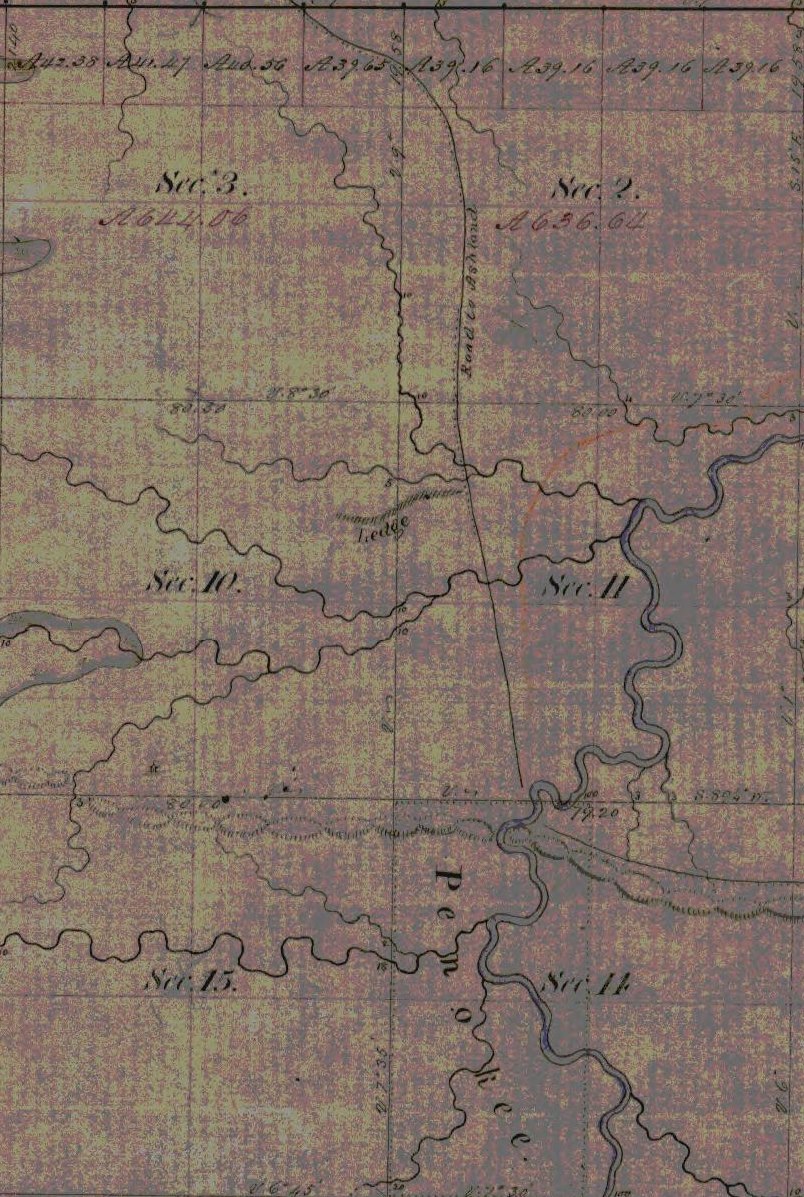
Palmer’s townsite claim located near Penokee Gap on Bad River with the “Coburn Trail” to Ashland. (Detail from Stuntz’s survey during May of 1858)
Subsequent, however, to the close of the survey upon the Transit Line, and the return of Mr. Whitcomb to Milwaukee, several extensive explorations were made to the south and west of the Range, by Gen. Cutler and myself, accompanied by Wheelock, Chas. Stevens, French Joe, (Joe Le Roy, with Big Joe as packer, and a Halfbreed called Little Alic as cook.) in one case nearly to the head waters of the Chippewa. These explorations, which were made with compass and chain, were by far the pleasantest part of my labors that summer, relieving us, as they did, not only of the monotony of camp life while awaiting the completion of the survey, but they also added largely to our knowledge of the topography, as well as the resources of the country south of the Range, then an unbroken wilderness, filled with beaver ponds, many of which were seen, but which is today, thanks to the energy and business tact of the gentlemen in charge of the Wisconsin Central railroad, beginning, metaphorically speaking, to bloom like the rose, and is destined, at no distant period, to take rank as one of the most wealthy and prosperous portions of our fair state. All honor to them for the same.
In this way our time was spent until September, when all homes of Stuntz being able to complete his work that season, unless some special providence should intervene, were abaonded, and preparations for spending the winter upon the Range were at once commenced. Gen Cutler immediately left for Milwaukee after additional supplies, first placing me in charge of the work. A pack train consisting of Stuntz’s pony, (old Jack) and Bascom‘s mare, were at once put upon the trail, in charge of Geo. Miller, a wild, harum-scarum Canuck from Canada West, who quickly stocked the Range with supplies.
But in order that the survey might yet be completed, if possible, additional men were put on, among whom was Wilhelm Goetzenburg, a Mechlinberger, at that time domiciled at Bay City and August Eckee, an old Courier de Bois, including all of our spare men, leaving me to keep camp at Penoka, which I did from about the middle of September to the 12th of October, during which time I saw no one except those who came in from the different claims at stated intervals, for supplies.
I see in your number of December 1, a reference by Hon. Asaph Whittlesey, to my sketch of Sibley and Lazarus, in which he not only confirms my statement, but goes one better in assigning him the belt as the champion liar, also which belt he (Sibley) was subsequently, however, compelled to surrender to John Beck. In consequence of Mr. Whittlesey’s statement I will relate one of Sibley’s yarns, told in the presence of Gen. Cutler, myself, Wheelock and a young man from St. Paul, by the name of Fargo, while eating dinner at his house on the Marengo, in August, 1857, which not only illustrates his powers as a yarn spinner, but the wonderful acoustic properties of his ears as well; being seated at the table, Sibley at once asked a blessing upon the food, for he could pray as well as lie, after which the question was asked by some one, how far it was possible to hear the human voice, upon which Sibley stated that he had not only heard the shouts of the people, but the words of the speaker also, distinctly, that were made at a political barbeque held in Ohio, in the fall of 1844, one hundred miles distant from where he was. Mr. Fargo, although no slouch of a liar himself, was so affected by this statement as to nearly faint, and finally made the remark that if that was not a lie, it came very near it; them lugs of Sibley’s were lugs as was lugs. Can John Beck beat that?

Harvey “Harry” Fargo was a cabinet maker, George R. Stuntz’s neighbor on the Minnesota Point in Duluth, an early mail carrier, and was in the 1853 census of Superior as “Arfargo.” ~ Duluth and St. Louis County, Minnesota; Their Story and People: An Authentic Narrative of the Past, with Particular Attention to the Modern Era in the Commercial, Industrial, Educational, Civic and Social Development, Volume 1, edited by Walter Van Brunt, 1921.
I wish to state at this time, also, a little incident in connection with Eckee, mentioned above, related to me by himself, which was this: That in the fall of 1846, he, in company with three others, in the employ of the Sigourney Lumber Co., of Quebec, ascended the river of the name three hundred miles in an open boat, for the purpose of cutting timber during the winter, and that when within three miles of their journey’s end, their boat was upset in a rapid, they barely escaping with their lives, but with the loss of the boat and all its contents, axes, fishing tackle and supplies. His companions, horrified at their situation, started immediately on their return, following the sinuosities of the river. He however, chose to remain, which he did until spring, never seeing a human face for six entire months. There were four oxen and two horses at the camp the care of which he claimed, kept him from going insane. It is needless to state that his companions were never heard from again. Although this incident has no immediate connection with my history, yet it serves to illustrate the hardships to which the class of men he belonged to are often called to suffer. He could never speak of that winter and its horrors, without tears.
But to return to the Range. Although I can truthfully say that the whole time spent upon the Range was to me one of unalloyed pleasure, yet that engaged during the latter part of September and up to the 20th of October, exceeded all the rest. The forest has, at all times, a charm for me, and the autumnal months doubly so; It is then and then only that its full glories can be seen; and in no country or section of country that it has ever been my privilege to visit, is the handiwork of Dame Nature’s gelid pencil, so grandly displayed as upon Lake Superior, and more particularly is this so, in and around the Range. No doubt the good people of Ashland think the scenery at the Gap very fine, and so it is. Yet that at the west end is far more so. Here the range terminates in a bold escarpment some 300 feet above the surrounding country, giving to an observer an unobstructed view east, west and south, for forty miles.
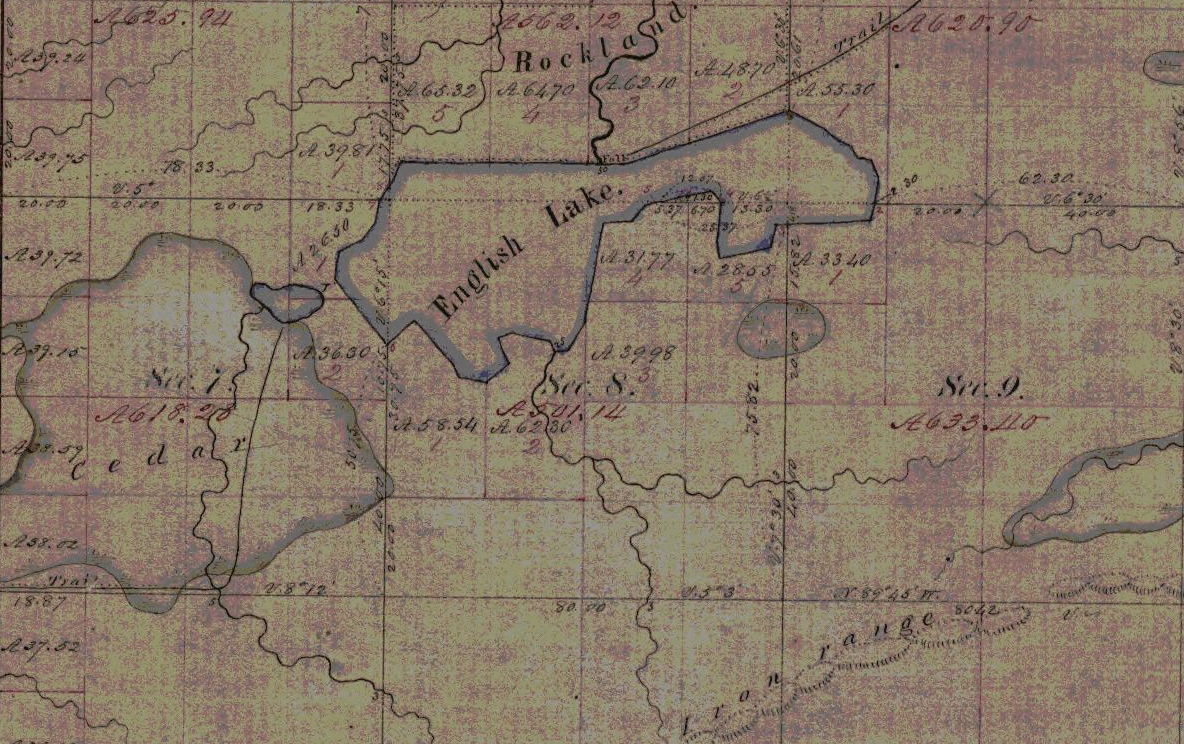
Indian trails to the “Rockland” townsite claim overlooking English Lake and the west end of the Penoka Range. Julius Austrian later claimed the “Rockland” site for his daughter’s estate.(Detail from Stuntz’s survey from May of 1858)
This was my favorite resort in those beautiful autumn mornings, where, seated upon the edge of the bluff, I would feast my eyes for hours upon that matchless panorama. Neither could I ever divest myself of the feeling that, while there, I was alone with God. I have seen, in the course of my life, many landscape paintings that were very beautiful, but never one that could at all compare with the views I enjoyed in the months of October 1857, from the west end of the Penoka Range. J.S.B.
Penokee Survey Incidents: Number III
February 15, 2015
By Amorin Mello
December 1, 1877
The Survey of the Penoka Range and Incidents Connected with its Early History.
—
Number III.
~ Detroit Free Press, June 5, 1857
(MarinetimeHistoryoftheGreatLakes.ca)
Friend Fifield:- Upon the first arrival of Mr. Sidebotham and myself at La Pointe, in May, ’57, as previously stated, we took lodging at the “Hotel Angus,” the hospitalities of which we were forced to enjoy until some means could be found to communicate with Gen. Cutler. The Bay, as well as the Lake, was full of ice. In fact, we had been compelled to fight out way from the Sault to La Pointe, through heavy masses of ice, nearly the whole distance – and while upon this subject, I will say, that incredible as the statement may appear to many, yes it is a fact, that ice bergs were aground in front of Austrian’s Warehouse, at La Pointe, on the 4th day of July, 1857, in 36 feet of water, while at the same time a field of floating ice was visible from the Range, beyond which, no water could be seen. I verily believe that the lake was not wholly free from ice that summer.
~ Madeline Island Ferry Line
At length, after remaining at the hotel some eight or ten days, during which Mrs. Angus made us as happy as she could by her kindness and attention, Gen. Cutler came, accompanied by Mr. Herbert. This was the first time that either of us had ever seen Gen. Cutler, but on being informed who we were, he seemed overjoyed to see us, and at once made the proposition to me to take charge of the work, and let him return to Milwaukee, so thoroughly disgusted had he become with the whole thing. To this, however, I would not consent, whereupon he decided to remain, and at once directed Mr. Herbert, who was at that time still in our employ, to return at once to Ironton, taking a part of the supplies, which came up with us, of which they were in great need, Mr. Sidebotham accompanying him, leaving the General and myself at La Pointe. After a long consultation, the General decided to go below, after men and money, wherewith to complete the work; which he did, I following Mr. Sidebotham to Ironton, which place I reached in time to join Mr. Herbert’s party, just starting for the Range, which we reached the second day after leaving Ironton.
During its existence the taxable real estate in the Town of Bayport had increased from nothing to several hundred thousand dollars, principally through entry of pine lands in the south and western portions of the township and also by extensive entries of mineral properties on the Iron Range.”
~ The Lake Superior Country in History and in Story by Guy M Burnham, pg. 179
Omission was made in the list of stockholders given in my first chapter, of Mr. Herbert, whom name should have been included. His stock was, however, by special agreement, unassessable, as it was through his instrumentality, in part, that the existence of this most wonderful metallic deposit was first brought to the knowledge of the Company, and the work of surveying and locating is undertaken. It was this, together with the knowledge that his long residence in the country was supposed to give him, as to the best mode of conducting such an enterprise, that procured for him this aqucession, as well as the appointment of Agent. In justice, however, to Mr. Herbert, it is proper to state, that besides the work done, and money spent at Ironton, the place selected by him as the future shipping point for the iron, (50,000 tons of which he contemplated bringing there that season, at least he stated) considerable work had also been done upon the range during his administration; mostly, however, at Penoka, where a log cabin, yet standing, had been erected, and some thirty acres cleared, the timber being cut into cordwood, to be used in the manufacture of charcoal iron, for the making of which it was contemplated to erect the proper furnaces in the near future. Neither is it any injustice to say, that although perhaps he did the best he could, situated as he was, yet the work did not progress as fast as the company thought it should, the force, while under his control had became badly demoralized. The idea had obtained, if not with him it had with them, that they were working for a company of bloated bondholders,- had a soft thing, and meant to make the most of it; but with the advent of Gen. Cutler, a change came over the spirit of their dreams. Order was quickly brought out of chaos, and the discovery made that a master hand held the reins. Up to this time, May, ’57, the Range had never been visited by any of the company except Messrs. Palmer, Greves and Ripley, those visiting ’56 was one of exploration only, and as Gen. Cutler, Mr. Sidebotham and myself were the only ones that went up there in ’57, or who, in fact, over performed any work there, a short sketch of them will perhaps not be inappropriate in this connection, while awaiting, metaphorically speaking, the arrival of the expected reinforcements from below. And first of Gen. Cutler:

Lysander Cutler of Wisc. (Library of Congress Prints and Photographs Division, Washington, D.C.)
The Order of the County Board creating the Town of Bayport was made March 11, 1856, and the store of Schuyler Goff, in Bay City (Ellis Division) was designated as the place for holding the first election for town officers, the election to be held Tuesday, April 1, 1856.
The Town of Bayport comprised all that portion of LaPointe county (since changed to Ashland County) lying south of the north line of Town 48 North; in all over sixty-eight Townships, including the Bad River reservation, which was, on the 8th day of November, 1859, made a precinct by itself.
At the first election held April 1, 1856, there were 24 votes cast — resulting as follows; for Chairman of the Town Board, Schuyler Goff (later appointed County Judge, an office he held for a year or more). The other members of the town board being J.T. Welton and Asaph Whittlesey. Schuyler Goff, chairman elect, was the first officer to qualify, his oath of office being administered by Asaph Whittlesey, Justice of the Peace.”
~ The Lake Superior Country in History and in Story by Guy M. Burnham, pg. 179
Gen. Lysander L. Cutler was, in many respects, a remarkable man. In person he was rather above the medium height, large head, large, dark eyes, heavy eyebrows, a sure indication of a good memory, as well as firmness, dark hair, inclined to stand erect; walked, usually with a slow and dignified step, with his eyes apparently fixed upon the ground, as if in deep thought, leading an observer to suppose that he was not cognizant of what was being enacted around him. This, however, was a mistake; nothing escaped his observation. In fact, he seemed to know your very thoughts; neither could anyone be in his presence ten minutes without feeling the magnetic influence of his iron will. Was any dangerous work to be undertaken, he would, if within call, be the first one consulted, and appointed to take charge of it. He was a born leader. He was not only one of the best business men I ever knew, but he was also a leader in politics. A good judge of men, sharp and keen, and who ever undertook to circumvent him was sure to some grief, as some of the people who went about the Range did that summer, have no doubt, an abiding recollection. I refer now to Hall, of St. Paul, Minnesota, who undertook, with the assistance of S.R. Marston, a treacherous employee of the Company, and Schuyler Goff, of Racine, at that time a resident of La Pointe, to beat us out of our rights, by entering the lands upon the Range with Sioux Scrip, in which nefarious attempt they would no doubt have succeeded, but for him. He was more than a match for all of them, and they finally retired from the contest in disgrace. Such was Gen. L.L. Cutler, a firm friend, but an uncompromising enemy. Never will the writer forget the happy days spent with him upon the Range in the summer of 1857. We were like brothers, and our friendship was never interrupted by even a passing cloud. We fraternized at once upon our first meeting, and fought the battle for the possession of the Range together, never doubting our ultimately winning the prize. He has gone to his reward, in that bright world beyond the River; yet “in memory’s ever sleepless eye” he is often present with me.
Mr. Sidebotham, however, who was by birth an Englishman, and by occupation a cabinet maker, was of a different mould, and although an honest man, was by his habits of life, wholly unfitted for such an undertaking, and of no practical use whatever, and although not constantly at the Range, he was while there, an actual incumbrance, some one having to remain with him constantly; he could not accustom himself to the woods and its annoyance; was always complaining of his food, which of course soon brought him into contempt with the men. One of his peculiarities was a great fondness for sugar, particularly in his tea, which he could not, or thought he could not, drink without it, and as this was an article not always plenty, the boys would sometimes hide it, in order to see him hunt for it, which he would do most persistently until he found it. I remember on one occasion they hid it in a tree, and as he could not climb or chip, although in plain sight he could not get it. They had, as they expressed it, the “dead wood” on him that time. He finally became so afflicted with boils, on account of his sedentary habits and change of food, that it was with the utmost difficulty we were able to get him from the Range to Ashland, in December, where he remained until sufficiently recovered to be able to travel, after which he reached home in safety. He was the last to sell his stock, which, however, he finally did, to the late Simeon N. Small, claiming that as it was through much tribulation he had obtained it, he would not part with it except at his own price, which I believe he got. This purchase, although it gave Mr. Small a controlling interest in the stock, was ultimately the cause of his financial ruin. J.S.B.
[from same issue of The Ashland Press]
Whittlesey on Early Times in Ashland.
—
~ The Monthly Magazine; A Monthly Journal of American History, Volume 9, 1888, pg. 18
Editor Ashland Press.- In your last issue of the 24th inst., your correspondent “J.S.B.,” in his Early Recollections of Ashland, makes very portient reference to two of Ashland’s prominent citizens of early days, known as “Sibley” and “Lazarus,” stating that in laziness they were competitors for the belt. My own recollection tells me that of this same Sibley had gained some notoriety for telling big yarns, but in this I think he ultimately gave way to John Beck. On one occasion, Sibley arrived in town on foot and alone, and entering a crowd of the boys, addressing himself to Lazarus, said: “Lazarus, I want you to go and help me get my team into town. It now stands in the mud near the head of Main St.” to which Lazarus replied, “I’ll go, if you will first tell us the biggest lie you ever told.” Sibley responded, “Lazarus, I don’t lie.” Lazarus says, “That will do, I’ll go and help you.” I am personally knowing to the fact that this same Lazarus has been known at several different times when he was “keeping back” in cold winters, to remain in beds two nights and the intervening day, to avoid the necessity of cutting wood and cooking a meal; nevertheless, “George E.,” as Lazarus was otherwise known, was a man of much more than usual ability, and was a surveyor had few superiors. We were all glad to have him show himself, and to witness his alacrity in getting upon the “off side” of any proposition that might be submitted.
I hope that brother “J.S.B.” may be heard from again, and that he may tell us more in regard to the crowd of pre-emptors imported by himself and others, (modesty forbids me to mention who,) tending almost invariably to bankruptcy. You, sir, were at the head of some “noble boys,” and you, too, had your share of tough cases. Should I sufficiently recover my strength to enable me to do so, I may hereafter open out on my “Early Recollections” of the place, and if I do attempt it, let all “stand from under,” for “At the siege of Barlisle, I was there all the while.”
W.
Bayfield, Wis., Nov. 24, 1877.
Penokee Survey Incidents: Number II
February 12, 2015
By Amorin Mello
November 24, 1877.
The Survey of the Penoka Range and Incidents Connected with its Early History
—
Number II.
Friend Fifield:– Notwithstanding the work upon the Range was delayed very much on account of the unwoodsman like conduct of the Milwaukee boys, referred to in my first communication, yet it did not cease,- the company having a few white men, previous employed, as well as a large number who were “to the Mannor born” that did not show the “white feather” on account of the mosquitos, gnats, gad flies and other vermin with which the woods were filled,– most of whom remained with us to the end.
Prominent among these last named was Joseph Houle, or “Big Joe” as he was usually called,– a giant halfbreed, (now dead), who was invaluable as a woodsman and packer. Some idea of Joe’s immense strength and power of endurance may be formed from the fact that he carried upon one occasion the entire contents, (200 lbs.) of a barrel of pork from Ironton to the Range without seeming to think it much of a feat. Among the party along on this trip was a young man taking his first lesson in woodcraft, whose animal spirits cropped out to such a degree that the leader caused to be placed upon his back a bushel of dried apples (33 lbs.), simply to keep him from climbing the trees, but before he reached the Range, his load, light as it was, proved too much for him, when Joe, in charity, relieved him of it, adding it to his own pack – making it 233 lbs. This was, without doubt the largest pack ever carried to the Range by any one man. There was an Indian, however, in the employ of the company, as a packer, (“Old Batteese“), who left Sidebotham‘s claim one morning at 7 A.M., went to Ironton and was back again to camp at 7 P.M. with 126 lbs. of pork, having traveled forty-two miles in ten hours. This was in July ’57, and was what I considered the biggest day’s work ever done for the company. The usual load, however, for a packer, was from sixty to eighty pounds.

Ironton townsite claim at Saxon Harbor with trails to Odanah and the Penoka Iron Range. (Detail from Wisconsin Public Land Survey Records)
The halfbreeds were sulky and mutinous at times, giving us some trouble, until Gen. Cutler, who was a strict disciplinarian, gave them a lesson that they did not soon forget and which occurred at follows:
The General and myself left Ironton just before the removal of our supplies to Ashland, with four of these boys, with provisions for the Range, to be delivered at Lockwood’s Station. But upon reaching Sidebotham’s, two of them refused to proceed any further, threw down their packs, and started on their return to Ironton. The General’s blood was up in a moment, and directing me to remain with the others until he returned, at once started after them. Reaching Ironton at 11 A.M., about an hour after their arrival, they were quite surprised at seeing him, but said nothing. The General at once directed Duncan Sinclair, who had charge of the supplies at that time, to make up two packs of one hundred pounds each, with ropes in place of the usual leathern strap, which was quickly done, the “rebels” looking sullenly on all the while. When all was ready he drew his revolver and ordered them to pick them up and start. They did not wait for a second order, but took them and started, he followed immediately behind. Nor did he let them lay them down again until they reached Lockwood’s at sunset, a distance of twenty-six miles. – That evening they were the most completely used up men I ever saw on the Range, and from that time forward were as submissive and obedient as could be desired. After that we never had any trouble. It was a lesson they never forgot.
Among the whites referred to in this article, was James Stephenson, a young man from Virginia, who came up with Stuntz as a surveyor. He was of light build, wiry and muscular – full of fun – very excitable and nervous, – but a good man for the woods. He had some knowledge of the compass, but not sufficient education to make a good surveyor. “Jim” got lost once and was out three days before he came into camp, which he did just as the party was starting out to find him. “Jim” would not have made a good rope walker. He was no Blondin. On the ground he was all right, but let him attempt to cross a stream of water, be it ever so small, upon a log, no matter if the log was six feet in diameter, and he would fall in sure. He fell in twice while lost and came near perishing with wet and cold in consequence of it. He left the company in the fall of ’57.
But the best man we had on the range that summer, as a surveyor, (except Albert Stuntz, and I very much doubt if he could beat him), was George E. Stuntz, a nephew of Albert’s, known among the boys as “Lazarus.” He was tall and slim, with a long thin face, blue eyes, long dark brown hair, stooped slightly when walking; walked with a swinging motion, spoke slow and loud – was fond of the woods, prided himself on his skill with the compass, and was, I think, the laziest man at that time in the county, except “Sibly,” who could discount him fifty and then beat him. But notwithstanding all this Albert could not have completed his survey that season without him. His lines never required any corrections. George was a singer – or thought he was, which is all the same. The recollections of some of his attempts in this line almost brings tears to my eyes from laughter, even now. Nearly every night in camp, the boys, after getting into a position where they could laugh without his seeing them, would coax him to sing. His favorite piece was a song called “The Frozen Limb.” What it meant I have no idea, and do not think he had. One verse of this only can I recall to mind, which ran as follows:
“One cold, frosty evening as Mary was sleeping –
Alone in her chamber, all snugly in bed. – She woke with a noise that did sorely affright her.
‘Who’s that at my window?’ she fearfully said.”
You can easily imagine how this would sound when sung through the nose in the hard shell style – each syllable ending with a jerk, something like this:
“Who’s-that-at-my-win-dow-she-fear-ful-ly-said-ud.”
George had a suit of clothes for the woods made of bed ticking, cap and all complete – all but the cap in one piece. The cap was after the “Dunce” pattern, ie, it ran to a point. The stripes instead of running up and down as they should have done, ran diagonally around him, giving him the appearance of a walking barber’s pole. He was a nice looking boy – he was.
Shortly after donning this beautiful suit, while crossing the Range, he suddenly found himself face to face with a full grown bear. It was no doubt a surprise to both parties,– it certainly was to the bear. For he took one square look and left for distant lands at a speed which, if kept up, would have carried him to Mexico in two days. “Not any of that in mine” was probably what was passing through his massive brain, but he made no sign. The boys who were surveying some fifteen miles south of the Range claimed to have met him that day, still on the jump. J.S.B.
 Chequamegon History