1838 more Petitions from La Pointe to the President
April 16, 2023
Collected & edited by Amorin Mello
Letters Received by the Office of Indian Affairs:
La Pointe Agency 1831-1839
National Archives Identifier: 164009310
O.I.A. Lapointe W.692.
Governor of Wisconsin
Mineral Pt. 15 Oct. 1838.
Encloses two communications
from D. P. Bushnell; one,
to speech of Jean B. DuBay, a half
breed Chippewa, delivered Aug. 15, ’38,
on behalf of the half breeds then assembled,
protesting against the decision
of the U.S. Court on the subject of the
murder of Alfred Aitkin by an Ind,
& again demanding the murderer;
with Mr Bushnell’s reply: the other,
dated 14 Aug. 1838, being a Report
in reference to the intermeddling of
any foreign Gov’t or its officers, with
the Ind’s within the limits of the U.S.
[Sentence in light text too faint to read]
12 April 1839.
Rec’d 17 Nov 1838.
See letter of 7 June 39 to Hon Lucius Lyon
Ans’d 12 April, 1839
W Ward
Superintendency of Indian Affairs
for the Territory of Wisconsin
Mineral Point Oct 15, 1838.

Henry Dodge
Sir:
I have the honor to enclose herewith two communications from D. P. Bushnell Esq, Subagent of the Chippewas at La Pointe; the first, being the Speech of Jean B. DuBay, a half breed Chippewa, on behalf of the half-breeds assembled at La Pointe, on the 15th august last, in relation to the decision of the U.S. Court on the subject of the murder of Alfred Aitkin by an Indian; the last, in reference to the intermeddling of any foreign government, or the officers thereof, with the Indians within the limits of the United States.
Very respectfully
Your obed’t serv’t.
Henry Dodge
Sup’t Ind. Affs.
Hon. C. A. Harris
Com of Ind. Affairs.
D. P. Bushnell Aug. 14, 1838
W692
Subagency
La Pointe Aug 14th 1838
Sir
I have the honor to acknowledge the receipt of your communication dated 7 ultimo enclosing an extract from a Resolution of the House of the Representatives of the 19th of March, 1838. No case of intermeddling by any foreign government on the officers, or subject thereof with the Indians under my charge or any others, directly , or indirectly, has come to my knowledge. It is believed that the English government has been in the Habit of distributing presents at a point on Lake Huron below Drummonds Island to the Chippewa for a series of years.
The Indians from this region, until recently, visited that place for their share of the annual distribution. But the Treaty made last summer between them and the United States, and the small distribution of presents that has been made within the Last Year, under the direction of our government, have had the effect to permit any of them from visiting, the English Territory this year. These Indians have generally manifested a desire to live upon terms of friendship with the American people. All of the Chiefs from the region of Lake Superior have expressed a desire to visit the seat of Gov’t where none of them have yet been. There is no doubt, but such a visit with the distribution of a few presents among them would be productive: of much good, and render their attachment to our Gov’t still stronger.
Very Resp’y
yr ms ob sev’t
D. P. Bushnell.
I. O. A.
To
His Excellency Henry Dodge
Ter, Wisconsin Sup’t Ind Affs
Half breed Speech
Speech of Jean B. DuBay,
a half breed Chippewa, on behalf of the half breeds assembled in a numerous body at the United States Sub Indian Agency office at La Pointe, on the 15th day of August 1838.
Father. We have come to you for the purpose of speaking on the subject of the murder that was committed two years ago by an Indian on one of our Brothers. I allude to Alfred Aitken. We have always considered ourselves Subject to the Laws of the United States and have consequently relied upon their protection. But it appears by the decision of the United Sates court in this case. “That it was an Indian Killed an Indian, on Indian ground, and died not therefore come under its jurisdiction,” that we have hitherto laboured under a delusion, and that a resort to the laws can avail nothing. We come therefore to you, at the agent of the Government here, to tell you that we have councilled with the Indians and, have declared to them and we have solemnly pledged ourselves in your presence, to each other, that we will enforce in the Indian Country, the Indian Law, Blood for Blood.
We pay taxes, and in the Indian Country are held amenable to the Laws, but appeal to them in vain for protection. Sir we will protect ourselves. We take the case into our own hands. Blood shall be shed! We will have justice and who can be answerable for the consequences? Our brother was a gentlemanly young man. He was educated at a Seminary in Louville in the State of New York. He was dear to us. We remember him as the companion of our childhood. The voice of his Blood now cries to us from the ground for vengence! But the stain left by his you shall be washed out by one of a deeper dye!
For injuries committed upon the persons or property of whites, although within the Indian Country we are still willing to be held responsible to the Laws of the United States, notwithstanding the decision of a United States Court that we are Indians. And for like injuries committed upon us by whites we will appeal to the same tribunal.
Sir our attachments to the American Government and people was great. But they have cast us off. The Half breeds muster strong on the northwestern frontier & we Know no distinction of tribes. In one thing at least we are all united. We might muster into the service of the United States in case of a war and officered by Americans would compose in frontier warfare a formidable corps. We can fight the Indian or white man, in his own manner, & would pledge ourselves to Keep peace among the different Indian tribes.
Sir we will do nothing rashly. We once more ask from your hands the murder of Mr. Aitken. We wish you to represent our case to the President and we promise to remain quiet for one year, giving ample time for his decision to be made Known. Let the Government extend its protection to us and we will be found its staunchest friends. If it persists in abandoning us the most painful consequences may ensue.
Sir we will listen to your reply, and shall be Happy to avail ourselves of your advice.
Reply of the Subagent.
My friends, I have lived several years on the frontier & have Known many half breeds. They have to my Knowledge paid taxes, & held offices under State, Territorial, and United States authorities, been treated in every respect by the Laws as American Citizens; and I have hitherto supposed they were entitled to the protection of the Laws. The decision of the court is this case, if court is a virtual acknowledgement of your title to the Indians as land, in common with the Indians & I see no other way for you to obtain satisfaction then to enforce the Indian Law. Indeed your own safety requires it. in the meantime I think the course you have adopted, in awaiting the results of this appeal is very proper, and cannot injure your cause although made in vain. At your request I will forward the words of your speaker, through the proper channel to the authorities at Washington. In the event of your being compelled to resort to the Indian mode of obtaining satisfaction it is to be hoped you will not wage an indiscriminate warfare. If you punish the guilty only, the Indians can have no cause for complaint, neither do I think they will complain. Any communication that may be made to me on this subject I will make Known to you in due time.
O.I.A. Lapointe. D.333.
Hon. Ja’s D. Doty.
New York. 25 March, 1839
Encloses Petition, dated
20 Dec. last, of Michel Nevou & 111
others, Chippewa Half Breeds, to the
President, complaining of the delay
in the payment of the sum granted
them, by Treaty of 29 July, 1837,
protesting against its payments on the
St Croix river, & praying that it be
paid at La Pointe on Lake Superior.
Recommends that the payment
be made at this latter place,
for reasons stated.
Rec’d 28 March, 1839.
Ans 29 Mch 1839.
(see over)
Mr Ward
D.100 3 Mch 28
Mch 38, 1839.
Indian Office.
The within may be
an [?] [?] [?] –
[guest?]. in fact will be
in accordance with [?]
[lat?] opinions and not of
the department.
W. Ward
New York
March 25, 1839
The Hon.
J.R. Pointsett
Secy of War
Sir,
I have the honour to submit to you a petition from the Half-breeds of the Chippewa Nation, which has just been received.
It must be obvious to you Sir, that the place from which the Indian Trade is prosecuted in the Country of that Nation is the proper place to collect the Half Breeds to receive their allowance under the Treaty. A very large number being employed by the Traders, if they are required to go to any other spot than La Pointe, they must lose their employment for the season. Three fourths of them visit La Pointe annually, in the course of the Trade. Very few either live or are employed on the St. Croix.
As an act of justice, and of humanity, to them I respectfully recommend that the payment be made to them under the Treaty at La Pointe.
I remain Sir, with very great respect
Your obedient Servant.
J D Doty
[D333-39.LA POINTE]
Hon.
J. D. Doty
March 29, 1839
Recorded in N 26
Page 192
[WD?] OIA
Mch 29, 1839
Sir
I have the honor to acknowledge the receipt of your letter of the 25th with the Petition of the Chippewa half breeds.
It is only necessary for me to observe his reply that it had been previously determined that the appropriation for them should be distributed at Lapointe, & the instructions with be given accordingly.
Very rcy
Hon.
J.D. Doty
New York
D100
D.333.

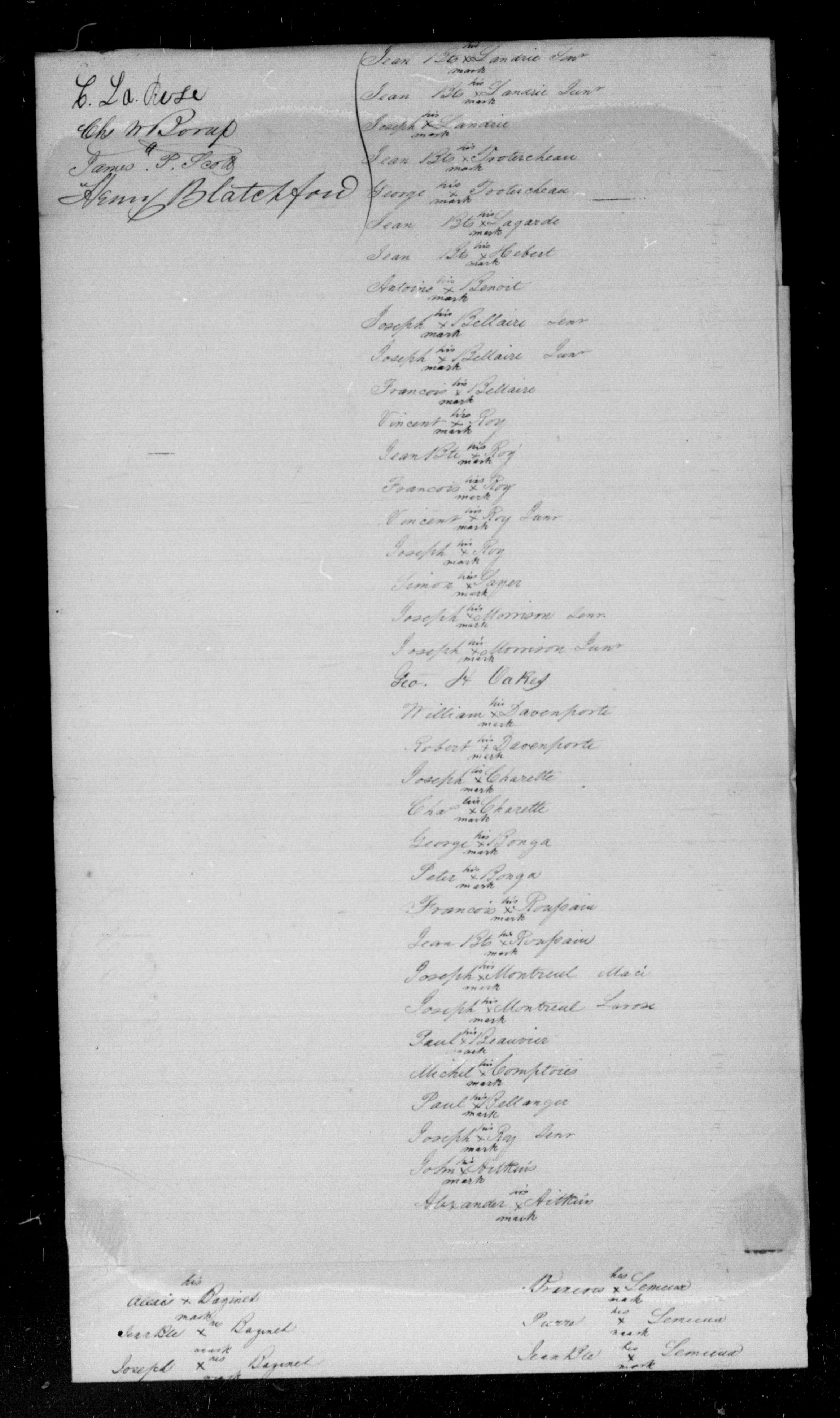

To the President of the United States of America
The Petition of the Half Breeds of the Chippewa nation respectfully shareth.
That we, Half Breeds of the Chippewa Nation, have recently learned, that the payment of the sum granted to the Chippewa Half Breeds, by virtue of the Treaty of 29th July 1837, has been deferred to next Spring, and, that the St Croix River has been selected as the place of payment.
That the delay in not having received our share of the above grant to the Chippewa Half Breeds, last summer, has caused us much loss, by keeping us from our regular vocations for several months, and by leaving many of us without means of support during winter, and that the arrangement of having the payment made next spring on the St Croix, will oblige us to perform a long and expensive Journey, leaving our families in our absence without any means of subsistance, and depriving us of all chance of being employed either in the Indian Trade or at fishing, by which means alone, we are able to earn our daily bread.
Your Petitioners with great deference and implicit submission to the pleasure of the President of the United States, respectfully pray, that an alteration may be made in the place assigned for payment and that Lapointe on Lake Superior may be fixed upon as the place of payment that place being the annual rendezvous of the Chippewa Half Breeds and the Chippewa Indians Traders, by whom we are employed.
And your Petitioners as in duty bound shall ever pray &c. &c.
Lake Superior Lapointe Dec. 20th 1838
Michel Neveu X his mark
Louis Neveu X his mark
Newel Neveu X his mark
Alexis Neveu X his mark
Joseph Danis X his mark
Benjamin Danis X his mark
Jean Bts Landrie Sen’r X his mark
Jean Bts Landrie Jun’r X his mark
Joseph Landrie X his mark
Jean Bts Trotercheau X his mark
George Trotercheau X his mark
Jean Bts Lagarde X his mark
Jean Bts Herbert X his mark
Antoine Benoit X his mark
Joseph Bellaire Sen’r X his mark
Joseph Bellaire Jun’r X his mark
Francois Bellaire X his mark
Vincent Roy X his mark
Jean Bts Roy X his mark
Francois Roy X his mark
Vincent Roy Jun’r X his mark
Joseph Roy X his mark
Simon Sayer X his mark
Joseph Morrison Sen’r X his mark
Joseph Morrison Jun’r X his mark
Geo. H Oakes
William Davenporte X his mark
Robert Davenporte X his mark
Joseph Charette X his mark
Chas Charette X his mark
George Bonga X his mark
Peter Bonga X his mark
Francois Roussain X his mark
Jean Bts Roussain X his mark
Joseph Montreal Maci X his mark
Joseph Montreal Larose X his mark
Paul Beauvier X his mark
Michel Comptories X his mark
Paul Bellanger X his mark
Joseph Roy Sen’r X his mark
John Aitkins X his mark
Alexander Aitkins X his mark
Alexis Bazinet X his mark
Jean Bts Bazinet X his mark
Joseph Bazinet X his mark
Michel Brisette X his mark
Augustin Cadotte X his mark
Joseph Gauthier X his mark
Isaac Ermatinger X his mark
Alexander Chaboillez X his mark
Michel Bousquet X his mark
Louis Bousquet X his mark
Antoine Cournoyer X his mark
Francois Bellanger X his mark
John William Bell, Jun’r
Jean Bts Robidoux X his mark
Robert Morin X his mark
Michel Petit Jun X his mark
Joseph Petit X his mark
Michel Petit Sen’r X his mark
Pierre Forcier X his mark
Jean Bte Rouleaux X his mark
Antoine Cournoyer X his mark
Louis Francois X his mark
Francois Lamoureaux X his mark
Francois Piquette X his mark
Benjamin Rivet X his mark
Robert Fairbanks X his mark
Benjamin Fairbanks X his mark
Antoine Maci X his mark
Joseph Maci X his mark
Edward Maci X his mark
Alexander Maci X his mark
Joseph Montreal Jun. X his mark
Peter Crebassa X his mark
Ambrose Davenporte X his mark
George Fairbanks X his mark
Francois Lemieux X his mark
Pierre Lemieux X his mark
Jean Bte Lemieux X his mark
Baptist St. Jean X his mark
Francis St Jean X his mark
Francis Decoteau X his mark
Jean Bte Brisette X his mark
Henry Brisette X his mark
Charles Brisette X his mark
Jehudah Ermatinger X his mark
Elijah Eramtinger X his mark
Jean Bte Cadotte X his mark
Charles Morrison X his mark
Louis Cournoyer X his mark
Jack Hotley X his mark
John Hotley X his mark
Gabriel Lavierge X his mark
Alexis Brebant X his mark
Eunsice Childes
Etienne St Martin X his mark
Eduard St Arnaud X his mark
Paul Rivet X his mark
Louisan Rivet X his mark
John Fairbanks X his mark
William Fairbanks X his mark
Theodor Borup
James P Scott
Bazil Danis X his mark
Alexander Danis X his mark
Joseph Danis X his mark
Souverain Danis X his mark
Frances Dechonauet
Joseph La Pointe X
Joseph Dafault X his mark
Antoine Cadotte X his mark
Signed in Presnce of
John Angus
John Wood
John William Bell Sen’r
Antoine Perinier
Grenville T. Sproat
Jay P. Childes
C. La Rose
Chs W. Borup
James P. Scott
Henry Blatchford
By Leo
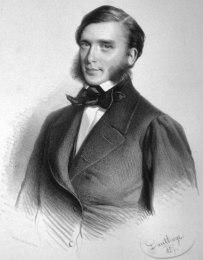
The Austrian writer, adventurer, and academic, Karl Ritter von Scherzer traveled the United States along with Moritz Wagner in 1852 and 1853. Their original German-language publication of Reisen in Nordamerika is free online through Google Books (image: wikimedia commons).
Chapter 21 of Wagner and Scherzer’s Reisen in Nordamerika in den Jahren 1852 und 1853 appeared on Chequamegon History in three posts in 2013. Chapter 22 continues the story, as Carl Scherzer describes his trip up the full length of the Brule River in September 1852, riding in a birchbark canoe guided by two La Pointe voyageurs: Souverain Denis and Jean Baptiste Belanger.
Chapter 22 lacks the variety and historical significance of chapter 21 (Ontonagon to the Mouth of the Bois-Brule), but even in Google-based translation, it maintains much of Scherzer’s beautiful (often comical) prose, that should be appreciated by readers with a fondness for canoeing. It also includes the lyrics of an authentic voyageur song that does not appear to be published anywhere else on the web.
Themes in this chapter also continue ideas explored in other Chequamegon History posts. If you wish to read more about the absolute misery encountered by inexperienced canoeists on the Brule, be sure to read the account of Lt. James Allen who accompanied Henry Schoolcraft to Lake Itasca in 1832. If reading Chapter 22 makes you think that mid 19th-century European travel writers superficially appreciated Ojibwe culture more than American writers, but that their romanticism contained the seeds of dangerously-racist ideas, be sure to check out J. G. Kohl’s Remarks on the Conversion of the Canadian Indians, another Google-aided German translation first published in English right here on Chequamegon History.
Enjoy:
XXII
A Canoe Ride through the Wisconsin Wilderness
The Rivière du Bois Brülé or Burnt Wood River (Indian: Wisakoda) has a rocky riverbed and runs east-southeast. Its serpentine curves are navigable close to 100 miles, nearly from the source to the mouth by canoes. It has 240 rapids, varying in length, alternating with smooth surface for a length of eighty miles. Most of the rapids have a one-foot, but many an eight to ten-foot slope. Four of them are so dangerous, they require portage, that is, they must be bypassed, and the boat and baggage are carried past the most dangerous points on land.
The width of the river changes tremendously. At its mouth, it is probably ninety feet wide, then sometimes narrows down to a few feet, and then expands just as quickly to the dimension of a considerable waterway. Its total slope from its source to its mouth in Lake Superior is about 600 feet. We therefore had the doubly-difficult task of overcoming river and the slope.
We took our frugal lunch of bacon and tea on a small mound of sand. We looked back and saw, probably for the last time in our eyes, but lasting forever in our memories, Lake Superior.
It should be noted that such letters are not uncommon in this great primeval forest, where bald towering tree trunks are more reliable postmen than the whims of hunting Indians, ignorant of their duties. Suddenly, Baptiste cried out, “Une lettre! Une lettre!” Mounted on a high pole, a letter hung wrapped in birch bark. It was addressed to a “Surveyor in the wilds of Lake Superior”–truly, an extended address! The letter was accompanied by a slip of paper, also in English, in which the readers, insofar as it did not concern them, were requested to leave it undamaged in its eye-catching position.
In winter, when Lake Superior is often unnavigable for months, the postal connection with La Pointe is an arduous forest path taking nine days to reach St. Croix Falls. Since it sometimes happens that the frivolous mix-bloods, growing weary of their postal duties hang their letters on the next branch and happily return to their favorite activity: hunting the wild forest thickets. The pack sits on the tree until a more-conscientious wanderer happens upon it. Thus, it takes three months to travel a road that would be covered in as many days in civilized area with modern transportation.
Birches (betula papyracea), elms, poplars, ash trees (fraxinus sambucifolia), and oak trees make up the bulk of these primeval forests. However, spruce, pine (pinus resinosa), firs, (abies balsamea and alba), cedars and juniper trees appear in such a pleasant mixture that their dark green forms a magnificent base note for the deciduous wood, as it bleaches golden in the autumn.
Within a half hour, the clear light-green water, 6 feet deep at the entrance, dropped to half a foot. From this, one may get a sense of the lightness of our birch-barked vehicle. In spite of the people, travel utensils, and provisions, probably amounting to 800 pounds of load, it glided gently, without even brushing the shallow riverbed.
The further we went up the river, the more virgin and primeval the forest, and the wilder and wilder the little waterway became. At places, tree trunks had fallen across the river and completely blocked our way. We had to take up the handy carpenter’s ax to cut a passage through. Under such navigational conditions, the oars lay quietly against the walls of the canoe, and long, hand-hewn poles were our only means of locomotion.
A heavy rain left us short on time to look for a bivouac. We spent the night in the woods under old spruce trees. Their trunks were more than 120 feet in height. Every night, we tied the thermometer to a tree branch out of the wind, and then recorded our observations in the morning. That was the only time we were able to maintain a regular hour of observation.
Friday, September 24, 53°F. Yesterday’s heavy rain has stopped, and as far as you can tell from under our green jungle canopy, the sky is quite clear and cloudless.
We continued the journey at 8 o’clock. At points, wind-broken spruce and beech hung from both sides, their still-green jewelry forming arcs of triumph across the river.
The splendorous color of the forests is enhanced by the mighty brush of autumn. You can already notice the work of this brilliant painter on the foliage of the oaks and elms. Only the stiff firs and ancient spruces, seen against the sky, allow the autumn storms to rush past without changing their defiant green.
We had a short portage to make, and a part of the provisions and effects had to be carried over the rapids. Landed at 12 o’clock for lunch. Our canoe was already severely damaged by the low water level and numerous rocky cliffs, and it began to fill with water. Now, all our luggage had to be brought to the shore and the empty boat had to be turned over to wrap the leaky areas watertight again.
For the whole afternoon’s journey, the same wild character of nature prevailed. Trees on opposite banks bent in pyramids and wrapped around each other at the summit. Sturdy roots of ash, elms, oaks having lost their balance, hung like an arched bridge over the surface of the water. All around, the eye sees the rugged beauty of the forest. Little has changed in nature or navigation in the two hundred years since the first missionary in a birch canoe passed through this wilderness.
At points, the thicket clears, the land becomes flatter, the river broadens, small lush archipelagoes rise, and the scenery gains the prestige of a modern park. In such areas, the wild rice (Zizania aquatica) comes into view. Along with hunting and fishing, it constitutes a staple food of the Indians. A marsh plant, it usually grows only in lowlands (sloughs), which are 8 to 10 inches under water for most of the year.
The harvest happens in the autumn, in a simple and effortless way. The Indians drive their slender canoes through the reeds into the middle of the rice fields. They bend the ears from both sides over the boat, and then beat out the fruit with fists and sticks, where it falls to the floor of the canoe. Most of the time, they roast the rice (Oumalouminee) and enjoy it boiled in water. Sometimes, however, when this seems too much trouble for them, the humble forest-dwellers are content to chew the raw fruit like kinikinik or smoking tobacco as a noonday meal.
When we asked Souverain how far we still had to go to the next portage, he replied that it might still be a distance of two pipes (deux pipes), by which he meant to say that we would arrive after the time in which one is able to smoke two pipes.
The black rocky bottom of the river makes the water so dark, it becomes very difficult to distinguish the sharp slightly-covered, rocks from the water, and so our boat received more than one jolt and leak. At half past four, we had to make a second portage of half a mile in length. Both the boat and the baggage had to be carried through the forest. We camped at the other end of the trail at the edge of a northern beech forest. Evening, 7 o’clock 48° F.
Saturday, 25th of September, 40° F. Heavily clouded horizon, windless, rainy. Our matches got wet and prevented us from starting a fire. Finally, a flint was found in a tin, but the gathered wood was green and wet, and took a long time to burn. After 7 o’clock, we set out. Exclusively hardwood vegetation, now, namely ash, elm, silver poplar and birch, which would seem to indicate a milder climate.
The remnants of Indian night camps are noticed at many points in the forest: the charred fire, the fresh tree-branches placed in the ground where the kettle hung above the flame, the dry wooden skeletons that were once wigwams.
Several jumbles of tree branches had to be chopped in half this morning with the ax in order to make a passage for us. Only half an hour after our departure from bivouac, we arrived at the third portage. Under heavy rain, we carried the effects through the forest on a trail that only occasionally hinted at ancient, long-weathered tracks. This time, the canoe could be pulled over the rapids, but only through a heroic decision of the two leaders to wade alongside it in the frosty, cold river. At 8:30, this painstaking portage was over, and the journey across the less-dangerous rapids continued in the canoe.
In the afternoon, more coniferous trees appeared, especially on the right bank. The rapids often continued for miles, and Souverain, the admiral of our birch-barked frigate, to whom was entrusted our destiny, had more than a hard row to hoe. Twice, shying away from the effort of cutting, we boldly passed over mighty tree trunks fallen into the river. Several times, our barge slid so narrowly under tree trunks hanging over the water there was scarcely enough space left us, lying with our backs against the bottom, to squeeze under with our slender canoe.
Despite the reappearance of softwood vegetation, the area visibly takes on a different character as it gradually changes from the hilly landscape of Lake Superior to the flat prairie ground of the West. The trees in the forest become less dense, while willows, cypresses, larches, and Thuja occidentalis are more frequently seen. On the banks, young saplings proudly take the place of the noble-stemmed spruce.
Based on our experiences so far, we would not recommend that future travelers rely too much on hunting and fishing while traveling through these wilderness areas. The almost incessant rapids give the river a current far too strong for it to be a popular habitat for fish, and the game is usually scanty along the shore. In addition, the gun often suffers much from the water, which the powerful sweep of the poles and paddles sends over the side of the canoe. Due to this moisture, which is almost unavoidable in such a small space, even the best-measured shots often fail.
Once, it was inspiring to see the keen-eyed Souverain pick out a water snipe among the bushes. Not knowing its mortal danger, it promenaded itself carelessly in search of food. We approached quietly with the boat, drawing near to fell the victim with the shotgun, and Souverain shot his enemy-snipe-weapon. The shot failed. A second and third had the same fate. The charges had been dampened by prolonged rain.
 (wikimedia) Wasserschnepfe is a generic German term for several species in the family Scolopacidae (snipes and sandpipers). Wilson’s Snipe (left) or the American Woodcock (right) are likely candidates for the suicidal Brule bird. Hypochondria was used as a synonym for depression in the 19th century–see the opening paragraph of Moby Dick for an example.
Quite remarkably, the poor animal had still not left its dangerous post, as if it were overpowered by melancholy, and would receive the mortal shot as a blessing. The fourth charge finally did its duty. The snipe staggered and fell dead in a nearby bush. She was haggard and skinny, and seemed to have truly suffered from hypochondria. In the evening, we shot a duck. General joy was had over their fatigue, and we lustily enjoyed a good evening meal.
In the final hours of the journey, the river assumes a regular, almost canal-like course, which for some miles continued in a straight line. The rapids become rarer, but the river is densely covered with rock, which hides itself under the smooth barren surface of the water. Surprised by nightfall, and in the deceitful twilight not daring to go further among the aforementioned jagged rocks, we bivouacked close to the shore in a flat, swampy area.
As a rule, since we were on the Bois-Brülé river, we drove for ten hours a day, from 7 o’clock in the morning until 5 o’clock in the evening, unless rain or canoe repairs prevented us. Every morning, before we left, we prepared our breakfast, and made a very short stop at lunchtime. We pitched our tent only at the resting hour of the evening, when possible on a hill in an area where the presence of numerous dry logs could suffice for preparing a comfortable night fire.
After the two voyageurs had cut down and brought in 12 to 18 pieces of spruce or birch trunks in the forest, they usually left it to us to keep the fire at proper heat. No sooner had our evening meal been consumed, which, like the selection at the court of an Irish emigrant’s table–one day bacon and tea, and the next day tea and bacon–the two voyageurs, fatigued by the hard work of the day, would fall asleep. Our traveling companion, wrapped in a thick buffalo robe, found no more attraction in this body-strengthening pleasure. So we were faced with a choice, stoke or freeze.
Every night, we would get up four or five times to set new tree trunks on the dying glow. And when the fire flared up again, we’d sit a while and watch the joyous flaming wave, and think of our friends across the ocean. And as this new flame intensified, new glowing thoughts and feelings rose in us again and again, for the fire possesses the same miraculous power as the sea or the blue sky. One can gaze into it for hours and yet cannot get enough of it. One laughs and cries, becomes sad then cheerful again. – The logs that we burned last night, certainly amounted to half a cord of wood!
Sunday, September 25, 5:30, snowfall. A good fire in front of our tent makes it easier for us to bear the cold and the bad weather. All night long, we heard the cries of many flocks of ducks moving cheerfully off to the west. In the forest, now, one hears only the lonely lamentations of a woodpecker, his flight inhibited and decrepit, he could not follow the young flyers and is left behind. The snowfall prevents the boat from popping up, and we are forced to wait for better weather in this swampy, frosty wilderness.
7 o’clock, 35° F. A shot was fired nearby. It was probably the hunting rifle of wandering Indians.
Around 9:30, a canoe came up with an Indian and his squaw (Indian woman). It was the postman of La Pointe who had picked up the letters in St Croix and was on the way home. As soon as he saw our camp, he stopped, got out, and he and his wife warmed themselves by our brightly-lit fire.
He was a poor, one-eyed devil. In his little boat he brought wild rice (folle avoine) tucked under animal skins, which he wished to exchange for resin to repair his damaged canoe. The shot we heard a few hours earlier fell from his shotgun, but the duck he aimed never did. The postman did not seem to be in a hurry. He talked to the voyageurs for more than an hour, then said good-bye and Boshu* to the fire’s warmth and to us.
[*Boshu, also bojoo or bojo, is undoubtedly a corruption of the French “Bon jour,” which is used by all Indian tribes on this side of the Mississippi for all kinds of greetings in the widest sense of the word. In general, the Chippewa language is teeming with English expressions, for which they have no name in their own language. The same is the case with the Indians of British Guiana, who have included many Spanish words in their language: cabarita, billy goat (Indian: cabaritü), sapatu, shoe (Indian zapato), aracabusca, firearm (Indian: arcabug). It deserves great attention at a time when we seem more inclined than ever to draw conclusions about the descent of peoples from certain similarities in languages. Comp. Dr. W. H. Brett, Dr. Thomas Jung, etc.]
11 o’clock in the morning. After the snow stopped, we quickly patched some areas on the boat, damaged by the sharp rocks. After a short snack of bacon and salt meat, we proceeded further up the river. We intended to continue, without further delay in a southwesterly direction, until dawn, hoping to escape this frighteningly-cold region.
The scenery and nature remained the same as yesterday. Hardwood, among which the American elm (ulmus americana) prevails. With its imposing height and rich crown of leaves, it is a major ornament of the American forests. With the shallow shores, rice marshes and trees hanging over the river under the weight of their leaves, our canoe laboriously sighs under its oppressive cargo. The rapids start again. The river is about 40 feet wide.
About 2:30, we passed through ten minutes of rapids, whose completion required the full effort of our two canotiers. In addition to the countless rocks, we passed through the lowest water levels, over uprooted trees that had fallen into the river. Our journey now resembled the pushing of a cart than it did the light gliding of a birch canoe. It was a fight with the water and nature. We were in danger of wounds to our heads and eyes, passing close under the wild bushy oaks and spruces that jutted into the water.
The landscape afforded variety of rich, picturesque views. Every bend, every new opening, showed the visitor a new image. At times, the river extended to the breadth of a lake, and cedars, cypresses, thujas, and all the green foliage of the swamp vegetation becomes visible. Where the rapids stop, the mirror-clear, calm water comes alive with trout and swimming birds. All at once, however, the picture will close, and the two shores form an incessantly-bright green alley, through which the smooth river stretches like a long white vein of silver.
By evening, our little boat was suffering greatly from the incoming cold. At sunset, we camped on the so-called Victory Grounds (pakui-aouon). It is a cleared piece of forest, about 40 feet above the river, that forms a kind of plateau, upon which bloody battles must have taken place in former centuries between the Sioux and Chippewas.
The cause of the hatred between these two tribes of Indians remains an object of research. However, one only needs to mention the name one tribe, to a person of the other in order to provoke his rage. Against this, even the hatred of the Czechs, who in the blessed year of Revolution wished to devour all of Germany, pales in comparison. For as often as the Sioux come into contact with Chippewa Indians, they will certainly commit a murder, because according to their legal concepts, it is their duty to scalp as many Chippewas as possible.
In the evening, when the tent is pitched, the night’s wood is felled and carried in from the forest, the fire is lighted and a small meal is prepared and consumed, the four of us would sit still for a while around the warming fire. We would listen to the voyageurs tell us about their experiences and destinies, and about the savagery of the whites and the gentleness of the Indians. Sometimes, they also sing songs that have strangely found their way from the home of the troubadours to these soundless primeval forests of the north*. Here we repeat one that Jean Baptiste sang out this evening with much emotion, as he lay carelessly, disregarding the flickers of the burning fire:
Chanson canadienne
(Canadien song)
Buvons tous le verre à la main,
Buvons du vin ensemble;
Quand on boit du vin sans dessein,
Le meilleur n’en vaut guère.
Pour moi je trouve le vin bon,
Quand j’en bois avec ma Lison.
(Let’s drink down the glasses, in our hands,
Let’s drink wine together;
When you drink wine without purpose,
Even the best is not worth it.
For me, I find the wine tastes good,
When I drink with my Lison.)
Depuis longtemps que je vous dis:
Belle Iris je vous aime,
Je vous aime si tendrement,
Soyez moi donc fidèle,
Car vous auriez en peu de temps,
Un amant qui vous aime.
(For a long time I have been telling you:
Beautiful Iris I love you,
I love you so dearly,
Be faithful to me,
For in a short time you will have,
A lover who loves you.)
Belle Iris, de tous vos amants
Faites une différence,
Je ne suis pas le plus charmant
Mais je suis le plus tendre.
Si j’étais seul auprès de vous,
Je passerais les moments les plus doux.
(Beautiful Iris, of all your lovers
Make a difference,
I am not the most charming
But I am the most tender.
If I were alone with you,
I would have the sweetest moments.)
Allons donc nous y promener,
Sous ces sombres feuillages,
Nous entendrons le rossignol chanter
Qui dit dans son langage,
Dans son joli chant d’oiseau,
Adieu amants volages.
(Let’s go for a walk,
Under the dark foliage,
We will hear the nightingale
Who sings in his language,
In his pretty bird song,
Farewell lovers.)
“Ah! rendez-moi mon coeur,
Maman me le demande.”
“”Il est à vous, si vous, pouvez le reprendre.
Il est confondu dans le mien,
Je ne saurais lequel est le tien.””
(“Ah! Give me back my heart,
Mother asks me.”
“It’s yours, if you can, take it back.
It is mixed up with mine,
I will not know which is yours.”)
[*It is a common observation that the painted native forest dwellers of America are not as eloquent as their much-simpler dressed German counterparts. Although we passed through the forests of Wisconsin, Missouri, and Ohio in all seasons, we never heard as beautiful and funny singing as in the German hall. It is as if nature wanted to compensate the German forest singer for his lack of splendor through the richer gift of song. Comp. Franz v. Neuwied and Agassiz, Lake superior etc., p. 68 u. 382, respectively.]
Monday, September 27th, 35°F. Sky is completely changed, haunting cold. The snow began to fall so thickly, we had to stop again, after a short time, to build an invigorating fire in a cedar forest amidst swamp and morass. But when the flame began to grow, its warmth reached the snowy branches of the cedar trees. The snow turned to water and fell upon us as heavy rain. We were all thoroughly soaked, and the fingers of the two canoe handlers were so frozen by the biting snow they could not paddle the ship. So we sought, as well as it was possible under such unfavorable weather conditions, to warm ourselves, and finally resumed our journey at noon under snow, rain, and a sharp north wind.
12 o’clock, 42°F. Soon after our embarkation, we had to make a small portage, and happily bypassed La Clef de Brülé, a number of rapids, which in their dangerous places are called by the voyageurs “The Key to the River”.
Cedarwood now grows almost exclusively on both banks, down to the river’s edge. They sometimes seem so harshly thrown over one another that the canoe can pass through only with difficulty.

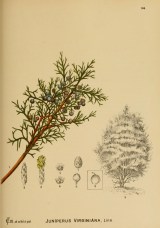 “Cedar,” used generically on today’s Brule River could only mean the Whitecedar or Arbor Vitae Thuja occidentalis (top). Curiously, however, Scherzer specifically distinguishes Thuja from Juniperus virginiana or redcedar (bottom) and describes the latter as more common, even though J. virginiana is not found this far north.
2:30 48°F. The snowflakes have changed to raindrops with the increasing temperature. Gradually, the rain stopped, and there was overcast, but rain-free weather. We now reached the Campement des Cedres, the only place up to the source of the river, where one still finds enough wood to prepare a night fire as all tree species except cedars (juniperus virginiana) are now becoming sparse along the shores. The discomfort of travel is now joined by a feeling of an unshakeable cold.
We therefore resolved to reach the navigable end of the Bois Brülé river that evening, and our captains endeavored to reach it before nightfall.
The rapids had now stopped, but another no-less uncomfortable and dangerous guest turned against us. The bushes of alders (alnus incana), willows, berberis, etc. grew on both banks. In their undisturbed growth, they had become so impenetrable that at the first sight of these thousands of closely intertwined branches, we often thought it impossible to break through with a canoe. The river was completely invisible in these thick, shady hangings, and hoe, pole, and fists had to be activated to fight all these natural hindrances.
Sometimes, we could only pass through horizontally, with our heads back to the bottom of the canoe. Closing our eyes to the relentless branches, we completely abandoned ourselves to the care of the brave Souverain. His face and hands scratched by the tiny branches, he undauntedly strove forward with unspeakable effort. Only a few times, when these forest barricades grew too overpowering, we heard a half-desperate, “mais c’est impossible!”
This wild overgrowth of the two banks, which gave our boat journey more of a character of first voyage of discovery than that of following a well-trodden path, can only be explained by the circumstance that the river is only seldom traveled up to its source. Earlier, when La Pointe was the Fur Company’s trading post, several hundred canoes loaded with commodities traveled this route every year, and from there they crossed to the various trading places of Upper Mississippi. But since Indians, forest animals and fur traders have moved westward, the cheerful waters of the Bois Brülé often trickle by, through entire seasons, without being cut by the keel of a boat, and the lush vegetation of its shores is free to reach across and embrace in wild passion.
Around 5 o’clock, we found the water of the river so low in several places that we decided to give some relief to the canoe by continuing the rest of the journey to the source of the river on foot. We walked back a mile and a half along a forest path, under the most unfavorable conditions. Our bodies wrapped from head to toe in India rubber, we sat with our travel companions against the moving forest, while the two voyageurs with canoe and effects followed the course of the river to meet us again at the grand portage.
Hardly could a hike offer more variety. Without the slightest indication of the path to be taken by the usual old footprints and tree cuts, we fought thorn bushes through deep snow, then passed through wild grain as tall as man, swiftly mowing it under our boots. In the hurry to disembark, we left our compass in the boat, so we could only guess what direction we should start navigating to find the so-called “Great Carrying Place.”
We wandered the wilderness, sweaty and fatigued, unable to move with any speed. The night was already falling, and as our innumerable “hallos,” went unanswered by our captain, we fell silent in the solitude of the forest, coming to terms with the idea of spending the night in these cold, fever-inducing swamps. All of the sudden, the voices of the voyageurs resounded like a hallelujah. We had to be very close to them, so we gained fresh courage against the complaints of pressing each step forcibly through dense undergrowth of thorny shrubs.
Drenched and chilled, we finally reached the Portage on a hill above some young cedars, and found the Voyageurs already occupied with the clearing and patching of the canoe. Unlike ourselves, our travel companion and the two Canadians had no rain-resistant rubber outfits, and were even more exposed to the cold, wet weather. For a time, the shivering appearance of our companion made us fear for his health.
In addition, we soon learned of a new misfortune. The snow cover and lack of wood in the vicinity prevented us from pitching our tent preparing a good fire as fast as our condition might desire. Besides, all our packs had gotten wet, and the provisions were in a poor state of edibility.
Our first concern, when we finally succeeded in pitching the tent and building a fire, was to dry our underwear and garments. All around us, hanging from tree branches and ropes were scattered cloths, spread out and drained of color. In our haste to remove the uncomfortable liquid from our needed garments through the warming power of the flame, we brought them into too-close contact with the wildly-flickering fire. Regrettably, they were soon covered in traces of scorch marks.
Nothing in our preceding traveling conditions had so deeply embittered us or made us as morose as these recent events. It is true that none of us complained, but each man stood in perfect silence before the burning logs, and regrettably stared at whatever soaked garment he was holding in his outstretched arms before the drying glow. Our medicines in vulgar condition, and our books, writings, documents, and physical instruments, all partially corrupted or totally broken, there was not a single piece of our effects which did not bear some lasting trace of damage.
The only consolation was that the snowstorm ended, and the overcast sky dissipated into a bright, starry, moonlit night, which made the prospect of a more favorable morning and forgetting the troubles of today, less and less difficult to fathom.
A short distance from the Portage is the inconspicuous source of the Bois-Brule River, in the marshes all around.* Only a single small stream pours into it during its long, winding course to Lake Superior. The Campement du Portage, where the travelers usually camp, is situated on a small hill, adorned with a serene cedar and spruce approach. While it may present a charming bivouac during a pleasant, warmer season. The eerie conditions under which we spent the night on the cold, damp ground could not possibly give us an idea of their summer loveliness.
[*The water of the Bois-brule River is about 12-14° Fahrenheit cooler than that of the La Croix River, for which may be explained by its forest-shaded banks being almost inaccessible to sunbeams, as well as its proximity to Lake Superior.]
In winter, when the river freezes along its entire length, it must be a marvelous sight: the wild rapids suddenly frozen by the harsh power of frost, and transformed into the strangest shapes and ice formations.
S.
By Leo
In April, the Supreme Court heard arguments in the case Department of Commerce v. New York and could render a decision any day on whether or not the 2020 federal census should include a question asking about citizenship status. In January, a Federal District Court in New York ruled that commerce secretary, Wilbur Ross, violated the law by pushing for that question.
Those in agreement with the District ruling suggest that the Trump administration wants to add the question as a way of discouraging immigrants from participating in the census, thereby diminishing the political power of immigrant communities. This, they say, would violate the Constitution on the grounds that the census must be an “actual enumeration” of all persons within the United States, not only citizens.
Proponents of the citizenship question counter that citizenship status is a perfectly natural question to ask in the census, that any government would want to know how many citizens it has, and that several past iterations of the 10-year count have included similar questions.
It remains to be seen how the Supreme Court will rule, but chances are it will not be the last time an issue of race, identity, or citizenship pops up in the politics of the census. From its creation by the Constitution as a way to apportion seats in congress according to populations of the states, the count has always begged tricky questions that essentially boil down to:
Who is a real American? Who isn’t? Who is a citizen? Who is three-fifths of a human being? Who might not be human at all? What does it mean to be White? To be Colored? To be civilized? How do you classify the myriad of human backgrounds, cultures and stories into finite, discrete “races?”
The Civil War and Fourteenth Amendment helped shed light on some of these questions, but it would be a mistake to think that they belong to the past. The NPR podcast Codeswitch has done an excellent series on census, and this episode from last August gives a broad overview of the history.
Here at Chequamegon History, though, we aren’t in the business broad overviews. We are going to drill down right into the data. We’ll comb through the 1850 federal census for La Pointe County and compare it with the 1860 data for La Pointe and Ashland Counties. Just for fun, we’ll compare both with the 1855 Wisconsin State Census for La Pointe County, then double back to the 1840 federal census for western St. Croix County. Ultimately, the hope is to help reveal how the population of the Chequamegon region viewed itself, and ultimately how that differed from mainstream America’s view. With luck, that will give us a framework for more stories like Amorin’s recent post on the killing of Louis Gurnoe.
Background
 Judge Daniel Harris Johnson of Prairie du Chien had no apparent connection to Lake Superior when he was appointed to travel northward to conduct the census for La Pointe County in 1850. The event made an impression on him. It gets a mention in his short memorial biography in the 1902 Proceedings of the State Bar Association.
Two years after statehood, Lake Superior’s connection to the rest of Wisconsin was hardly existent. This was long before Highways 51 and 53 were built, and commerce still flowed west to east. Any communication to or from Madison was likely to first go through Michigan via Mackinaw and Sault Ste. Marie, or through Minnesota Territory via St. Paul, Stillwater, and Sandy Lake. La Pointe County had been created in 1845, and when official business had to happen, a motley assortment of local residents who could read and write English: Charles Oakes, John W. Bell, Antoine Gordon, Alexis Carpentier, Julius Austrian, Leonard Wheeler, etc. would meet to conduct the business.
It is unclear how much notice the majority Ojibwe and French-patois speaking population took of this or of the census generally. To them, the familiar institutions of American power, the Fur Company and the Indian Agency, were falling apart at La Pointe and reorganizing in St. Paul with dire consequences for the people of Chequamegon. When Johnson arrived in September, the Ojibwe people of Wisconsin had already been ordered to remove to Sandy Lake in Minnesota Territory for their promised annual payments for the sale of their land. That fall, the government would completely botch the payment, and by February, hundreds of people in the Lake Superior Bands would be dead from starvation and disease.
So, Daniel Johnson probably found a great deal of distraction and anxiety among the people he was charged to count. Indians, thought of by the United States as uncivilized federal wards and citizens of their own nations, were typically not enumerated. However, as I wrote about in my last post, race and identity were complicated at La Pointe, and the American citizens of the Chequamegon region also had plenty to lose from the removal.
Madison, for its part, largely ignored this remote, northern constituency and praised the efforts to remove the Ojibwe from the state. It isn’t clear how much Johnson was paying attention to these larger politics, however. He had his own concerns:


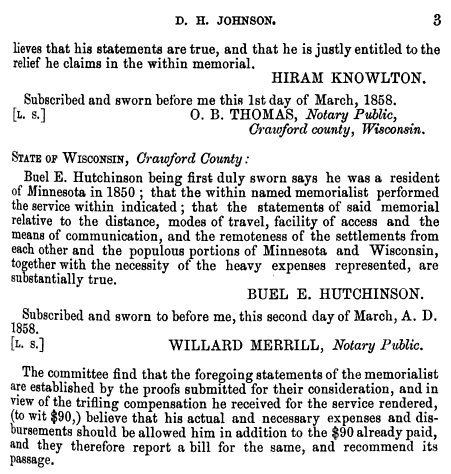
House Documents, Volume 119, Part 1. U.S. Government Printing Office, 1859. Google Books.
So, in “that thinly settled and half civilized region,” Johnson only found a population of about 500, “exclusive of Indians.” He didn’t think 500 was a lot, but by some counts, that number would have seemed very high. Take the word of a European visitor to La Pointe:
Among 200 Indians, only a few white families live there. One of the boatmen gave us a name, with which we found Mr. Austrian.
And, from this Mr. Austrian, himself:
There were only about 6 white American inhabitants on the Island, about 50 Canadian Frenchmen who were married to squaws, and a number of full blooded Indians, among whom was chief Buffalo who was a descendant of chiefs & who was a good Indian and favorably regarded by the people.
~Joseph Austrian, Brother of Julius and La Pointe resident 1851-52
Who lived around La Pointe in 1850?
In her biography, William W. Warren: the Life, Letters, and Times of an Ojibwe Leader, Theresa Schenck describes the short life of an ambitious young man from La Pointe. William Whipple Warren (1825-1853) grew up on the Island speaking Ojibwe as his first language. His father was a Yankee fur trader from New York. His mother was a daughter of Michel and Madeline Cadotte. In his famous History of the Ojibways Warren describes the Ojibwe as people with whom he readily claims kinship, but he doesn’t write as if he is an Ojibwe person himself. However, he helped interpret the Treaty of 1847 which had definitively made him an Indian in the eyes of the United States (a fact he was willing to use for economic gain). Still, a few years later, when he became a legislator in Minnesota Territory he dismissed challenges to his claims of whiteness.
If he were alive today, Warren might get a chuckle out of this line from the South African comedian Trevor Noah.
People mocked me. Gave me names like mixed breed, half caste — I hate that term ‘half’. Why half? Why not double? Or twice as nice, I don’t know.
— Trevor Noah
William Warren did not see himself as quite the walking contradiction we might see him as today. He was a product of the time and place he came from: La Pointe. By 1850, he had left that place, but his sister and a few hundred of his cousins still lived there. Many of them were counted in the census.
What is Metis?
Half-breeds, Mixed-bloods, Frenchmen, Wiisakodewininiwag, Mitif, Creoles, Metis, Canadiens, Bois Brules, Chicots, French-of-the-country, etc.–at times it seems each of these means the same thing. At other times each has a specific meaning. Each is ambiguous in its own way. In 1850, roughly half the families in the Chequamegon area fit into this hard-to-define category.


Kohl, J. G. Kitchi-Gami: Wanderings around Lake Superior. London: Chapman and Hall, 1860. pg. 260-61.
We were accompanied on our trip throughout the lakes of western Canada by half-Indians who had paternal European blood in their veins. Yet so often, a situation would allow us to spend a night inside rather than outdoors, but they always asked us to choose to Irish camp outside with the Indians, who lived at the various places. Although one spoke excellent English, and they were drawn more to the great American race, they thought, felt, and spoke—Indian! ~Carl Scherzer
In describing William Warren’s people, Dr. Schenck writes,
Although the most common term for people of mixed Indian and European ancestry in the nineteenth century was “half-breed,” the term “mixed blood” was also used. I have chosen to use the latter term, which is considered less offensive, although biologically inaccurate, today. The term “métis” was not in usage at the time, except to refer to a specific group of people of mixed ancestry in the British territories to the north. “Wissakodewinini,” the word used by the Ojibwe, meant “burned forest men,” or bois brulés in French, so called because half-breeds were like the wood of a burned forest, which is often burned on one side, and light on the other (pg. xv).
Schenck is correct in pointing out that mixed-blood was far more commonly used in 19th-century sources than Metis (though the latter term did exist). She is also correct in saying that the term is more associated with Canada and the Red River Country. There is an additional problem with Metis, in that 21st-century members of the Wannabe Tribe have latched onto the term and use it, incorrectly, to refer to anyone with partial Native ancestry but with no affiliation to a specific Indian community.
That said, I am going to use Metis for two reasons. The first is that although blood (i.e. genetic ancestry) seemed to be ubiquitous topic of conversation in these communities, I don’t think “blood” is what necessarily what defined them. The “pure-blooded French Voyageur” described above by Kohl clearly saw himself as part of Metis, rather than “blanc” society. There were also people of fully-Ojibwe ancestry who were associated more with Metis society than with traditional Ojibwe society (see my post from April). As such, I find Metis the more versatile and accurate term, given that it means “mixed,” which can be just as applicable to a culture and lifestyle as it is to a genetic lineage.
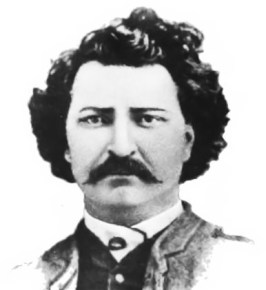
One time Canadian pariah turned national hero, Louis Riel and his followers had cousins at La Pointe (Photo: Wikipedia)
The second reason I prefer Metis is precisely because of the way it’s used in Manitoba. Analogous to the mestizo nations of Latin America, Metis is not a way of describing any person with Native and white ancestry. The Metis consider themselves a creole-indigenous nation unto themselves, with a unique culture and history. This history, already two centuries old by 1850, represents more than simply a borrowed blend of two other histories. Finally, the fur-trade families of Red River came from Sault Ste. Marie, Mackinac, Grand Portage, and La Pointe. There were plenty of Cadottes, Defaults, Roys, Gurnoes, and Gauthiers among them. There was even a Riel family at La Pointe. They were the same nation
Metis and Ojibwe Identity in the American Era
When the 1847 Treaty of Fond du Lac “stipulated that the half or mixed bloods of the Chippewas residing with them shall be considered Chippewa Indians, and shall, as such, be allowed to participate in all annuities which shall hereafter be paid…” in many ways, it contradicted two centuries of tradition. Metis identity, in part, was dependent on not being Indian. They were a minority culture within a larger traditional Anishinaabe society. This isn’t to say that Metis people were necessarily ashamed of their Native ancestors–expressions of pride are much easier to find than expressions shame–they were just a distinct people. This was supposedly based in religion and language, but I would argue it came mostly from paternal lineage (originating from highly-patriarchal French and Ojibwe societies) and with the nature of men’s work. For women, the distinction between Ojibwe and Metis was less stark.
The imposition of American hegemony over the Chequamegon region was gradual. With few exceptions, the Americans who came into the region from 1820 to 1850 were adult men. If new settlers wanted families, they followed the lead of American and British traders and married Metis and Ojibwe women.
Still, American society on the whole did not have a lot of room for the racial ambiguity present in Mexico or even Canada. A person was “white” or “colored.” Race mixing was seen as a problem that affected particular individuals. It was certainly not the basis for an entire nation. In this binary, if Metis people weren’t going to be Indian, they had to be white.
The story of the Metis and American citizenship is complicated and well-studied. There is risk of overgeneralizing, but let’s suffice to say that in relation to the United States government, Metis people did feel largely entitled to the privileges of citizenship (synonymous with whiteness until 1865), as well as to the privileges of Ojibwe citizenship. There wasn’t necessarily a contradiction.
Whatever qualms white America might have had if they’d known about it, Metis people voted in American elections, held offices, and were counted by the census.
Ojibwe “Full-bloods” and the United States Census
Representatives and direct Taxes shall be apportioned among the several States which
may be included within this Union, according to their respective Numbers, which shall be determined by adding to the whole Number of free Persons, including those bound to Service for a Term of Years, and excluding Indians not taxed, three fifths of all other Persons. The actual Enumeration shall be made within three Years after the first Meeting of the Congress of the United States, and within every subsequent Term of ten Years, in such Manner as they shall by Law direct.~Excerpt from Article I Section II, U. S. Constitution
As I argued in the April post, our modern conception of “full-blood” and “mixed-blood” has been shaped by the “scientific” racism of the late 19th and early 20th centuries. The distinction, while very real in a cultural sense, was not well-grounded in biology.
The relationship of Indians (i.e. full-bloods or those living a traditional lifestyle) to American society and citizenship was possibly more contradictory then that of the Metis. In one sense, America saw Indians as foreigners on their own continent: either as enemies to be exterminated, or as domestic-dependent ward nations to be “protected.” The constitutional language about the census calls for slaves to be counted as three-fifths of a person. It says Indians shouldn’t be counted at all.
In another sense, however, the path to personhood in America was somewhat clearer for Indians than it was for African Americans. Many New England liberals saw exodus to Liberia as the only viable future for free blacks. These same voices felt that Indians could be made white if only they were separated from their religions, cultures, and tribal identities. In 1834, to avoid a second removal, the Brothertown Indians of Wisconsin petitioned congress for citizenship and the termination of collective title to their tribal lands. In 1839, their request was granted. In the eyes of the law, they had effectively become white. Other communities would follow suit. However, most Native people did not gain any form of American citizenship until 1924.
How did that play out for the Ojibwe people of Chequamegon, and how did it impact the 1850 census? Well, it’s complicated.
Race, the Census, and Classifying Households
The enumeration forms Daniel H. Johnson carried to La Pointe had more rows and columns than ever. The Seventh Census was the first to count everyone in the household by name (previous versions only listed the Head of Household with tally marks). It was also the first census to have a box for “color.” Johnson’s choices for color were “white,” “black,” and “mulatto,” forcing him to make some decisions.
He seems to have tried to follow the Indians not taxed clause strictly. 40-50% of households in the region were headed by a full-blood Ojibwe person, possibly only two of them were enumerated. You won’t find Chief Buffalo, Makadebinesi (Blackbird), Oshkinaawe, Omizhinaawe, Edawegiizhig, and their immediate families in the 1850 census. Jechiikwii’o (often called Little Buffalo) is not in the document, even though he was an early Catholic convert, dressed in “white” clothing, and counted more Metis Ojibwe among his followers than full-bloods. However, his son, Antoine Buffalo Sr. (Antoine Jachequaon) is counted. Antoine, along with George Day, were counted as white heads of household by the census, though it is unclear if they had any European ancestry (Sources conflict. If anyone has genealogical information for the Buffalo and Day families, feel free to comment on the post). A handful of individuals called full-bloods in other sources, were listed as white. This includes 90-year old Madeline Cadotte, Marie Bosquet, and possibly the Wind sisters (presumably descendants of Noodin, one of the St. Croix chiefs who became Catholic and relocated to La Pointe around this time). They were married to Metis men or lived in Metis households. All Metis were listed as white.
Johnson did invent new category for five other Ojibwe people: “Civilized Indian,” which he seemed to use arbitrarily. Though also living in Metis households, Mary Ann Cadotte, Osquequa Baszina, Marcheoniquidoque, Charlotte Houle, and Charles Loonsfoot apparently couldn’t be marked white the way Madeline Cadotte was. These extra notations by Johnson and other enumeration marshals across the country are why the Seventh Federal Census is sometimes referred to as the first to count Native Americans.

So, out of 470 individuals enumerated at La Pointe and Bad River (I’ve excluded Fond du Lac from my study) Johnson listed 465 (99%) as white. By no definition, contemporary or modern, was the Chequamegon area 99% white in 1850. The vast majority of names on the lines had Ojibwe ancestry, and as Chippewas of Lake Superior, were receiving annuities from the treaties.
There were a few white American settlers. The Halls had been at La Pointe for twenty years. The Wheelers were well-established at Odanah. Junius and Jane Welton had arrived by then. George Nettleton was there, living with a fellow Ohioan James Cadwell. The infamous Indian agent, John Watrous, was there preparing the disastrous Sandy Lake removal. Less easy to describe as American settlers, but clearly of European origins, Fr. Otto Skolla was the Catholic priest, and Julius Austrian was the richest man it town.
There were also a handful of American bachelors who had drifted into the region and married Metis women. These first-wave settlers included government workers like William VanTassel, entrepreneurs like Peter VanderVenter, adventurers with an early connection to the region like Bob Boyd and John Bell, and homesteaders like Ervin Leihy.
It is unclear how many of French-surnamed heads of household were Chicots (of mixed ancestry) and how many were Canadiens (of fully-French ancestry). My sense is that it is about half and half. Some of this can be inferred from birthplace (though a birthplace of Canada could indicate across the river at Sault Ste. Marie as easily it could a farm in the St. Lawrence Valley). Intense genealogical study of each family might provide some clarifications, but I am going to follow Kohl’s voyageurs and not worry too much about it. Whether it was important or not to Jean Baptiste Denomie and Alexis Carpentier that they had no apparent Indian ancestry and that they had come from “the true homeland” of Quebec, for all intents and purposes they had spent their whole adult lives in “the Upper Country,” and their families were “of the Country.” They were Catholic and spoke a form of French that wasn’t taught in the universities. American society would not see them as white in the way it saw someone like Sherman Hall as white.
So, by my reckoning, 435 of the 470 people counted at La Pointe (92.5%) were Metis, full-blood Ojibwe living in Metis households, or Canadians in Metis families. Adding the five “Civilized Indians” and the six Americans married into Metis families, the number rises to 95%. I am trying to track down accurate data on the of Indians not taxed (i.e. non-enumerated full-bloods) living at or near La Pointe/Bad River at this time. My best estimates would put it roughly the same as the number of Metis. So, when Johnson describes a land with a language and culture foreign to English-speaking Americans, he’s right.
Birthplace, Age, and Gender
Ethnic composition is not the only data worth looking at if we want to know what this area was like 169 years ago. The numbers both challenge and confirm assumptions of how things worked.
Let’s take mobility for example:

The young voyageur quoted by Kohl may have felt like he didn’t have a home other than en voyage, but 86% of respondents reported being born in Wisconsin. Except for ten missionary children, all of these were Metis or “Civilized Indian.” Wisconsin could theoretically mean Lac du Flambeau, Rice Lake, or even Green Bay, this but this number still seemed high to me. I’m guessing more than 14% of 21st-century Chequamegon residents were born outside the state, and 19th-century records are all about commerce, long-distance travel, and new arrivals in new lands. We have to remember that most of those records are coming from that 14%.
In September of 1850 the federal government was telling the Ojibwe of Wisconsin they needed to leave Wisconsin forever. How the Metis fit into the story of the Sandy Lake Tragedy has always been somewhat fuzzy, but this data would indicate that for a clear majority, it meant a serious uprooting.
For those born outside Wisconsin, more than two-thirds reported being born in Michigan, Canada, or Minnesota Territory. These are overwhelmingly Metis or in the case of Anglo-Canadians like Robert Morrin, heads of Metis households from areas with a fur-trade tradition. Only eighteen individuals reported being born in the eastern United States. Only three reported Europe.
I had more questions than assumptions about the gender and age breakdown of the population. Would there be more women than men because of the dangerous jobs done by men or would mortality from childbirth balance that out? Or maybe widows wouldn’t be counted if they returned to the wigwams of their mothers? How would newcomers skew the age and gender demographics of the area?
Let’s take a look:
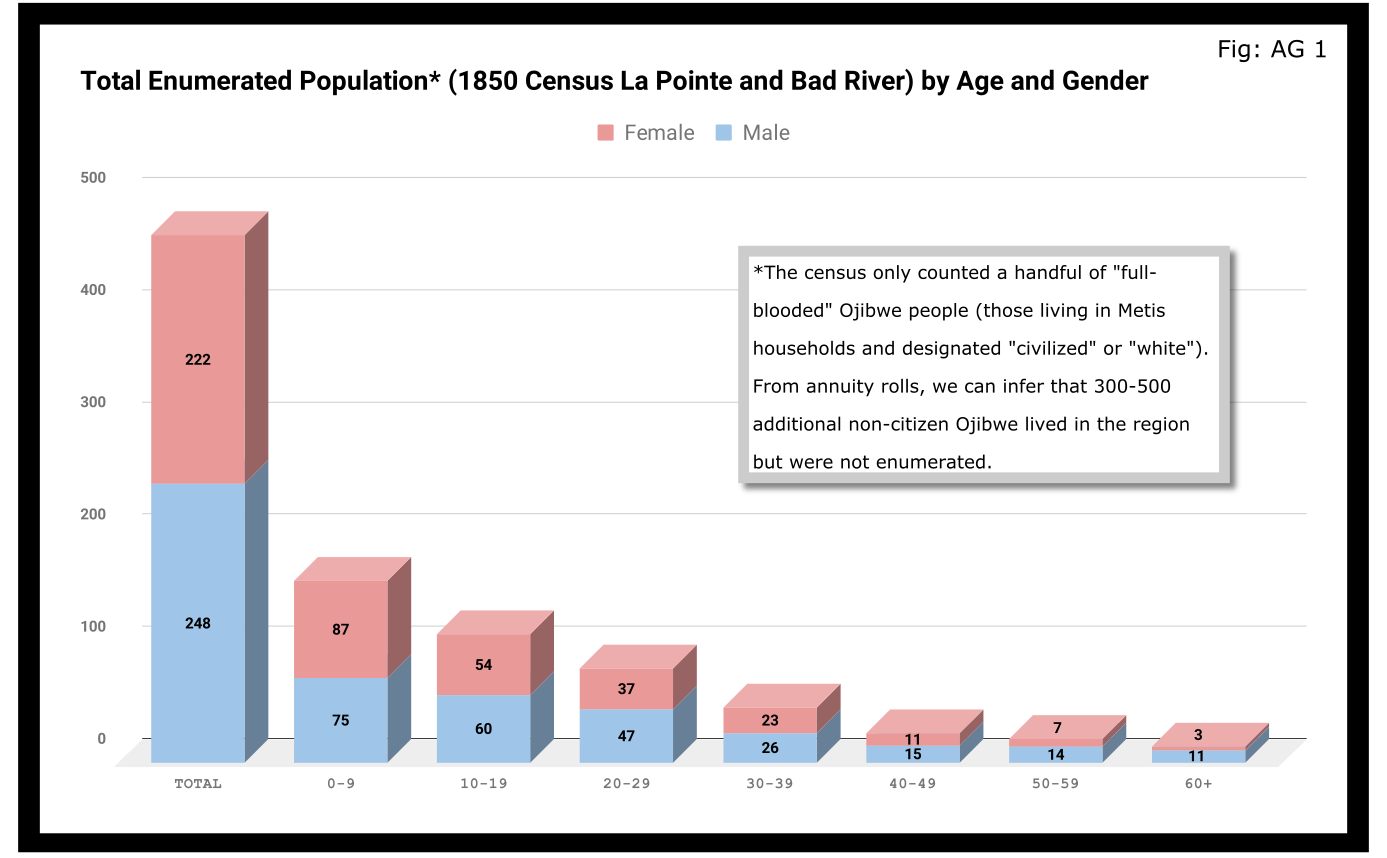
A quick glance at Figure AG 1 shows that the population skewed male 248-222 and skewed very young (61% under 20 years old). On the eve of Sandy Lake, the natural increase in the population seemed to be booming.

The hypotheses that women had higher mortality rates and were more likely to be undercounted looked good until we limit the data to the Wisconsin-born population. In Figure AG 2, we see that the male majority disappears entirely. The youthful trend, indicating large families and a growing population, continues with 66% of the Wisconsin-born population being under 20.

The male skew of the total population was entirely due to those born outside Wisconsin. This is not surprising given how much we’ve emphasized the number of men who came into the Lake Superior country to marry local women.
A look at the oldest residents in chart AG 2 and AG 3 hints at another story. Madeline Cadotte is the only Wisconsin-born person over seventy to be counted. The oldest men all came from Michigan and Canada. Why? My hypothesis is that between the fall of New France in 1759 and the establishment of Michel Cadotte’s post sometime around 1800, there wasn’t a large population or a very active fur trade around La Pointe proper. That meant Cadotte’s widow and other full bloods were the oldest locally-born residents in 1850. Their Metis contemporaries didn’t come over from the Soo or down from Grand Portage until 1810 or later.
Economics
Before the treaties, the economy of this area was built on two industries: foraging and trade. Life for Ojibwe people revolved around the seasonal harvest of fish, wild rice, game, maple sugar, light agriculture, and other forms of gathering food directly from the land. Trade did not start with the French, and even after the arrival of European goods into the region, the primary purpose of trade seemed to be for cementing alliances and for the acquisition of luxury goods and sacred objects. Richard White, Theresa Schenck, and Howard Paap have all challenged the myth of Ojibwe “dependence” on European goods for basic survival, and I find their arguments persuasive.
Trade, though, was the most important industry for Metis men and La Pointe was a center of this activity. The mid-19th century saw a steep decline in trade, however, to be replaced by a toxic cycle of debts, land sales, and annuity payments. The effects of this change on the Metis economy and society seem largely understudied. The fur trade though, was on its last legs. Again, the Austrian travel writer Carl Scherzer, who visited La Pointe in 1852:
After this discussion of the of the rates of the American Fur Company and its agents, we want to add some details about the men whose labor and time exerted such a great influence on the fate and culture of the Indian tribes. We wish to add a few explanatory words about the sad presence on La Pointe of the voyageurs or courriers du bois.
This peculiar class of people, which is like a vein of metal that suddenly disappears within the bedrock and reappears many hundreds of miles away under the same geological conditions, their light reaches the borders of the eastern Canadas. The British people, with their religion and customs, reappeared on the shores of these northern lakes only in 1808 with the Fur Company. For labor they drew on those who could carry their wares across the lakes and communicate with the Indians.
Many young men of adventurous natures left the old wide streets of Montreal and moved into the trackless primeval forests of the West. Young and strong as laborers, they soon started to adopt the lifestyle and language of the aborigines. They married with the Indians and inhabit small settlements scattered throughout those mighty lands which begin at Mackinow Island and come up the upper lake to the region of Minnesota. They almost all speak the Canadian patois along with the language of the Chippewas, the tribe with which they came into kinship. We found only a few, even among the younger generation, who understood English.
Since then, every day the population of the otherwise deserted shore of Lake Superior increases with the discovery of copper mines. The animals driven away by the whirlwind of civilization toward the west, attract the Indians with their sensitive guns, leaving La Pointe, abandoned by the Company for their headquarters at St. Paul in Minnesota. Most voyageurs left the island, having seen their business in ruins and lacking their former importance. Just a few families remain here, making a meager livelihood of hunting, fishing, and the occasional convoy of a few travelers led by business, science, or love of nature who purchase their limited resources.
From Scherzer’s description, two things are clear. It’s pretty clear from the flowery language of the Viennese visitor.Washington Irving and other Romantic-Era authors had already made the Voyageur into the stock stereotypical character we all know today. Th only change, though, is these days voyageurs are often depicted as representatives of white culture, but that’s a post for another time.
The second item, more pertinent to this post, is that a lot of voyageurs were out of work. This is especially relevant when we look at our census data. Daniel Johnson recorded the occupations of all males fifteen or over:
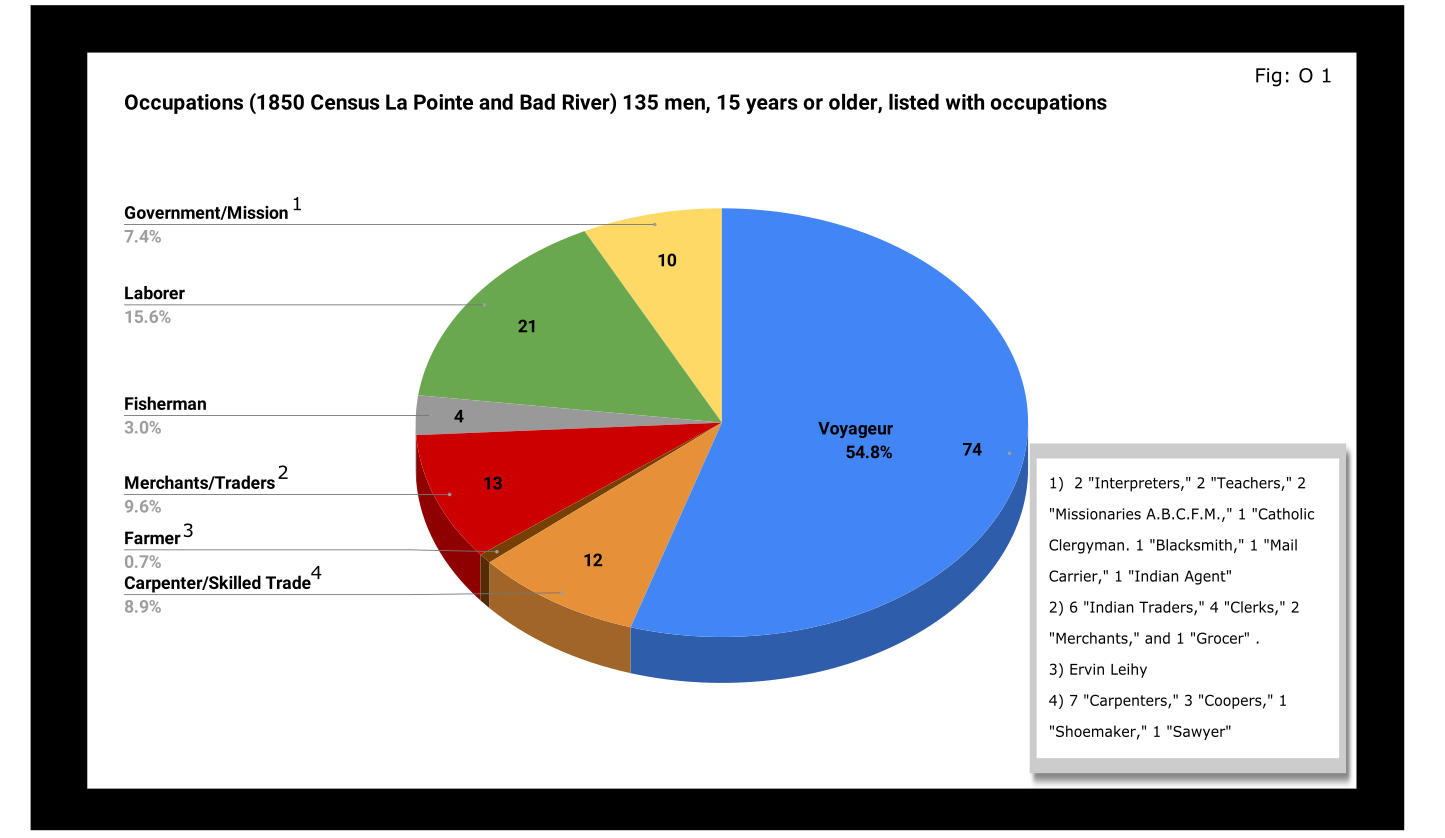
A full 55% of enumerated men fifteen and older still identified themselves as voyageurs in 1850. This included teenagers as well as senior citizens. All were from Metis households, though aside from farmer, all of the other occupation categories in Figure O 1 included Metis people.

A look at household sizes did not show voyageurs having to support significantly larger or smaller families when compared to the other occupation categories.
The other piece of economic data collected was value of real estate. Here we see some interesting themes:

If real estate is a good proxy for wealth in a farming community, it is an imperfect one in the Chequamegon area of 1850. If a voyageur had no home but the river and portage, then we might not expect him to put his coin into land and buildings. A teacher or Indian agent might draw a consistent salary but then live in supplied housing before moving on. With that caveat, let’s dig into the data.
Excluding the single farmer, men in the merchant/trader group controlled the most wealth in real estate, with Julius Austrian controlling as much as the other merchants combined. Behind them were carpenters and men with specific trades like cooper or shoemaker. Those who reported their occupation generally as “laborer” were not far behind the tradesmen. I suspect their real estate holdings may be larger and less varied than expected because of the number of sons and close relatives of Michel Cadotte Sr. who identified themselves as laborers. Government and mission employees held relatively little real estate, but the institutions they represented certainly weren’t lacking in land or power. Voyageurs come in seventh, just behind widows and ahead of fishermen of which there were only four in each category.
It is interesting, though, that the second and third richest men (by real estate) were both voyageurs, and voyageur shows a much wider range of households than some of the other categories: laborers in particular. With the number of teenagers calling themselves voyageurs, I suspect that the job still had more social prestige attached to it, in 1850, than say farmer or carpenter.
With hindsight we know that after 1854, voyageurs would be encouraged to take up farming and commercial fishing. It is striking, however, how small these industries were in 1850. Despite the American Fur Company’s efforts to push its Metis employees into commercial fishing in the 1830s, and knowing how many of the family names in Figure O 3 are associated with the industry, commercial fishing seemed neither popular nor lucrative in 1850. I do suspect, however, that the line between commercial and subsistence fishing was less defined in those days and that fishing in general was seen as falling back on the Indian gathering lifestyle. It wouldn’t be surprised if all these families were fishing alongside their Ojibwe relatives but didn’t really see fishing (or sugaring, etc.) as an occupation in the American sense.
Finally, it could not have escaped the voyageurs notice that while they were struggling, their former employers and their employers educated sons were doing pretty well. They also would have noticed that it was less and less from furs. Lump annuity payments for Ojibwe land sales brought large amounts of cash into the economy one day a year. It must have felt like piranhas with blood in the water. Alongside their full-blood cousins, Metis Ojibwe received these payments after 1847, but they had more of a history with money and capitalism. Whether to identify with the piranha or the prey would have depended on all sorts of decisions, opportunities and circumstances.
Education and Literacy
The census also collected data on education and literacy, asking whether children had attended school within the year, and whether adults over twenty could read and write. The history of white education efforts in this area are fairly well documented. The local schools in 1850 were run by the American Board of Commissioners of Foreign Missions (A.B.C.F.M.) at the La Pointe and Odanah missions, and an entire generation had come of age at La Pointe in the years since Rev. Sherman Hall first taught out of Lyman Warren’s storehouse in 1831. These Protestant ministers and teachers railed against the papists and heathens in their writings, but most of their students were Catholic or traditional Ojibwe in religion. Interestingly, much of the instruction was done in the Ojibwe language. Unfortunately, however, the census does not indicate the language an individual is literate in. I highly recommend The Ojibwe Journals of Edmund F. Ely, 1833-1849 if you are interested in these topics.
To start with, though, let’s look at how many people were going to school:

Thirty-nine students had gone to school in the previous year. There is a lot of sample-size noise in the data, but it seems like ages 7-11 (what we would call the upper-elementary years) were the prime years to attend school.
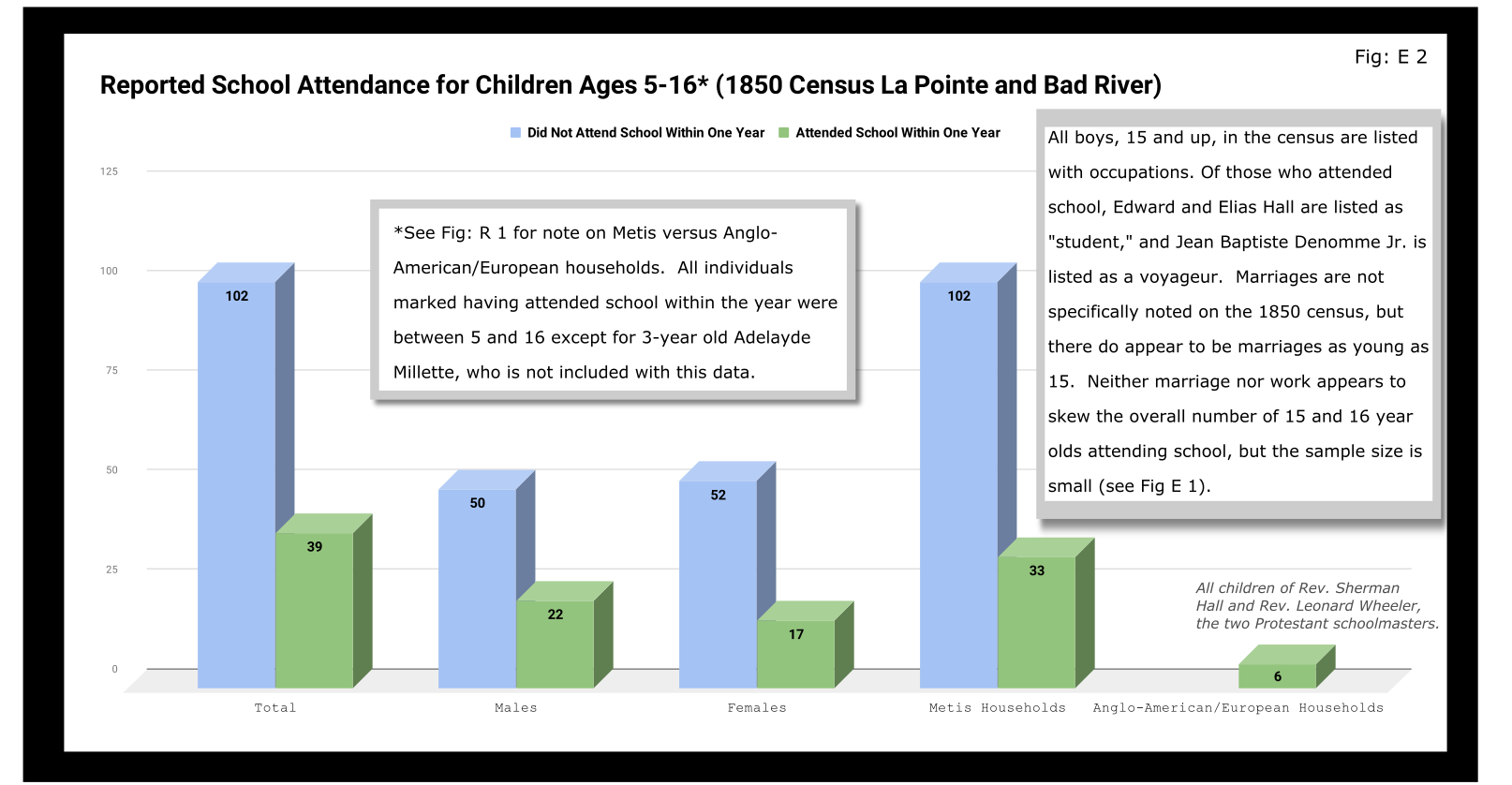
Overall, most children had not attended school within the year. Attendance rates were slightly higher for boys than for girls. White children, all from two missionary families, had a 100% attendance rate compared to 24% for the Metis and “Civilized Indian” children.
We should remember, however, that not attending school within the year is not the same as having never attended school. Twelve-year-old Eliza Morrin (later Morrison) is among the number that didn’t attend school, but she was educated enough to write her memoirs in English, which was her second language. They were published in 2002 as A Little History of My Forest Life, a fascinating account of Metis life in the decades following 1854.
Eliza’s parents were among the La Pointe adults who could read and write. Her aunt, uncle, and adult cousins in the neighboring Bosquet (Buskey) house were not. Overall, just over half of adults over 20 were illiterate without a significant gender imbalance. Splitting by birthplace, however, shows the literacy rate for Wisconsin-born (i.e. Metis and “Civilized Indian”) was only 30%, down from the overall male literacy rate of 48%. For Wisconsin-born women, the drop is only three points, from 47% to 44%. This suggests Metis women were learning to read while their husbands and brothers (perhaps en voyage) were not.

And this is exactly what the data say when we split by occupation. The literacy rate for voyageurs was only 13%. This beats fisherman–all four were illiterate–but lagged far behind all other types of work.
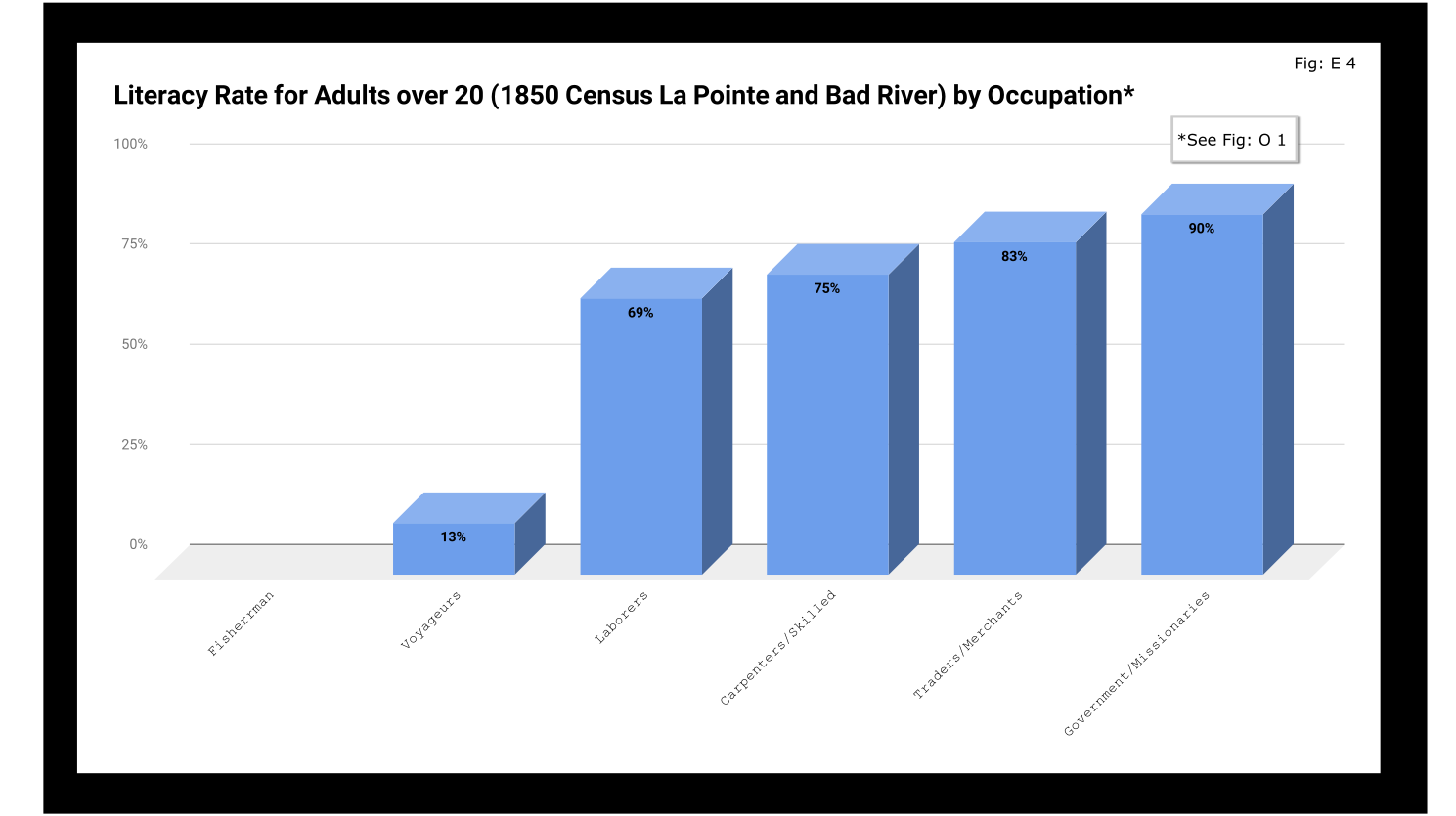
If education was going to be a factor in the economic mobility of unemployed voyageurs, the trends weren’t looking good.
Odds and Ends
Two marriages were reported as occurring in the year previous to the census: Peter and Caroline Vanderventer and Pierre and Marguerite Robideaux (ak.a. Peter and Margaret Rabideaux). Though married, however, Caroline was not living with her husband, a 32-year old grocer from New York. She (along with their infant daughter) was still in the home of her parents Benjamin and Margaret Moreau (Morrow). The Vanderventers eventually built a home together and went on to have several more children. It appears their grandson George Vanderventer married Julia Rabideaux, the granddaughter of Peter and Margaret.
I say appears in the case of George and Julia, because Metis genealogy can be tricky. It requires lots of double and triple checking. Here’s what I came across when I once tried to find an unidentified voyageur known only as Baptiste:

Sometimes it feels like for every Souverain Denis or Argapit Archambeau, there are at least 15 Jean-Baptiste Cadottes, 12 Charles Bresettes, 10 Francois Belangers and 8 Joseph DeFoes. Those old Canadian names had a way of persisting through the generations. If you were a voyageur at La Pointe in 1850, there was nearly a 30% chance your name was Jean-Baptiste. To your friends you might be John-Baptist, Shabadis, John, JB, or Battisens, and you might be called something else entirely when the census taker came around.
The final column on Daniel Johnson’s census asked whether the enumerated person was “deaf and dumb, blind, insane, idiotic, pauper, or convict.” 20 year-old Isabella Tremble, living in the household of Charles Oakes, received the unfortunate designation of idiotic. 26-year-old Francois DeCouteau did not have a mark in that column, but had “Invalid” entered in for his occupation. It’s fair to say we’ve made some progress in the treatment of people with disabilities.
Final Thoughts
I am not usually a numbers person when it comes to history. I’ll always prefer a good narrative story, to charts, tables, and cold numbers. Sometimes, though, the numbers help tell the story. They can help us understand why when Louis Gurnoe was killed, no one was held accountable. At the very least, they can help show us that the society he lived in was under significant stress, that the once-prestigious occupation of his forefathers would no longer sustain a family, and that the new American power structure didn’t really understand or care who his people were.
Ultimately, the census is about America describes itself. From the very beginning, it’s never been entirely clear if in E. pluribus unum we should emphasize the pluribus or the unum. We struggled with that in 1850, and we still struggle today. To follow the Department of Commerce v. New York citizenship case, I recommend Scotusblog. For more census posts about this area in the 19th century, keep following Chequamegon History.
Sources, Data, and Further Reading
-
Paap, Howard D. Red Cliff, Wisconsin a History of an Ojibwe Community ; Volume 1 The Earliest Years: the Origin to 1854. North Star Press of St. Cloud, Inc., 1854.
-
Satz, Ronald N. Chippewa Treaty Rights: the Reserved Rights of Wisconsin’s Chippewa Indians in Historical Perspective. University of Wisconsin Press, 1997.
-
Original Census Act of May 23, 1850 (includes form and instructions for marshals). (PDF)
-
Compiled data spreadsheets (Google Drive Folder) I’ll make these a lot more user friendly in future census posts. By the time it occurred to me that I should include my tables in this post, most of them were already done in tally marks on scrap paper.
-
Finally, these are the original pages, scanned from microfilm by FamilySearch.com. I included the image for Fond du Lac (presumably those living on the Wisconsin side of the St. Louis River) even though I did not include it in any of the data above.
-

- Bad River
-
- Fond du Lac (not included in above data)





By Leo Filipczak
When we last checked in with Joseph Austrian, or Doodooshaaboo (milk) as he was known in these parts, we saw some interesting stories and insights about La Pointe in 1851. The later La Pointe stories, however, are where the really good stuff is.
Austrian’s brief stay on the island came at arguably one of the most important periods in our area’s history, spanning from a few months after the Sandy Lake Tragedy, until just after Chief Buffalo’s return from Washington D.C. Whether young Joseph realized it or not, he recorded some valuable history. In his memoir, we see information about white settlement and land speculation prior to the Treaty of 1854, as well as corroborating accounts of the La Pointe and Bayfield stories found in the works of Carl Scherzer and Benjamin Armstrong.
Most importantly, there is a dramatic scene of a showdown between the Lake Superior chiefs and Agent John Watrous, one of the architects of the Sandy Lake removal. In this, we are privileged to read the most direct and succinct condemnation of the government, I’ve ever seen from Chief Buffalo. It is a statement that probably deserves to be memorialized alongside Flat Mouth’s scathing letter to Governor Ramsey.
So, without further ado, here is the second and final installment of Joseph Austrian’s memoirs of La Pointe, and fifth of this series. Enjoy:
~~~~~~~~~~~~~~~~~~~~~~~~~~~~~~~~~~~~~~~~~~~~~~~~~~
Memoirs of Doodooshaboo
… continued from La Pointe 1851-1852 (Part 1).
Scherzer, Noted Traveller Pays Us a Visit. 1851.

Carl Scherzer and his companion Moritz Wagner recorded their travels in Reisen in Nordamerkia in der Jahren 1852 und 1853. An e-translation of Chapter 21 appeared in English for the first time this fall on the Chequamegon History website. You can read it here, here, and here. The second installment records his time with Joseph Austrian. From Austrian’s account, it appears Wagner did not accompany Scherzer through the Lake Superior country. (Wikimedia Images)
During this summer a noted Austrian traveler Carl Scherzer arrived one Sept. night. He had been commissioned by the “Academy of Science” of Vienna (a Government Institution) to make a tour of America to familiarize himself with the country and gather information to write a book for the Academy. This interesting book which he wrote is called “Scherzer’s Reisen.” Mr. S. sent me a copy of this book which I have in my library. In this book, mention is made of me and my cordial reception of him and his travelling companion, an Attache of the French Legation of Washington who accompanied him on his trip. Scherzer was a highly educated gentleman, cultured and charming, tall and of imposing appearance. Scherzer arrived at La Pointe at midnight coming from Ontonagan 90 miles in a small row boat. To his dismay, he found that there was not a hotel in the place. The boatman told him that he thought that one Austrian might give him shelter for the night, so he came to the house and knocked at the door. Henry Schmitz, my fellow employee, who roomed with me opened the door and called out “Joe step auf freund von below sind da,” whereupon I cordially invited them to enter and made them as comfortable as possible. They remained with us about three days and profoundly appreciated our hospitality. Even making mention of it later on in his book. Once on going to a fishing boat for our supply of fish, Scherzer went with me and begged the privilege of carrying two of the large fine white fish, one suspended from each hand. He much enjoyed meeting the good Father Skolla, his country-mate, also an Austrian, and from him obtained more valuable and authentic information concerning that part of Lake Superior country that he could have otherwise gained. From La Point Scherzer planned to go to St. Paul. There were no railroads here at that time. There were but two roads leading to St. Paul. One was simply a footpath of several hundred miles through the woods. The other led via St. Croix [Brule?] & St. Croix river shortening the foot travel considerably. Scherzer chose the latter road. I fitted out for him, at his request, a birch bark canoe and utensils and all necessary for the trip and Scherzer and his companion started on their way to St. Paul.
He had engaged one “Balange” their voyageur who had brought them from Ontonoagan and a friend of his to take them through. They were well acquainted with the route which at times necessitated their carrying the canoes around through the woods across the portage, where the river was inaccessible through rapids, obstacles and otherwise. Scherzer arrived at St. Paul safely and wrote thanking me for my assistance and requesting me to send him a copy of the wording of a French rowing song (the oarsmen usually sang keeping time with their oars). I sent it to him and received a letter of thanks from New Orleans whence he had gone from St. Paul by steamer via the Mississippi River. This song is embodied in his book also.
A Steamer was a rare occurrence at La Point and when one did come, we often got up an Indian war dance or other Indian exhibit for the amusement of its passengers, and which they enjoyed greatly. In the fall of the year steamers were sometimes driven there by the storms prevailing on the lakes, as the harbor offered the best of shelter. We kept a good supply of cord wood on the dock which we sold to the steamers when they needed fuel.
Indians Decline to be Removed by Gov. I attend Grand Council. 1851.
During the first summer of my stay at La Point, the Indian Agent, Mr. Watrous was directed by the Secretary of the Indian Dept. at Washington to summon the chiefs of that part of the Chippewa tribe residing in the vicinity of Bad River, Bayfield, & Red River for a council. The Agent accordingly sent runners around to the chiefs of the different lodges some of which were quite remote, summoning them to meet him on a certain day at La Point. They came in obedience to the summons many bringing their squaws, papooses and their Indians of their lodges with them. Near the lake shore the put up their wigwams, which were made of birch bark leaving an opening over hung with a blanket which served as a doorway. It made an interesting Indian settlement. The meeting was held on the appointed day, in my brother’s store which was a long wooden structure. When the meeting opened the chiefs sat on the floor arranged along the left side of the room, with their blankets wrapped around them, and each one smoking a long stemmed pipe, which they make themselves, the sign of peace, many ornamented with paint and feathers. On the other side of the room was seated the Indian Agent with an interpreter who translated what either had said.
I naturally felt greatly interested in witnessing their proceedings. The President of the U. S. was known by the Indians as the Great Father and the Agent addressed them telling them what the Great Father wanted of them; namely that they remove from their reservations to interior points in order to make room for while settlers; pointing out to them that the proposed location was more suited for them, there being good fishing and hunting grounds. The government offered to pay them besides certain annuities, partly in money and partly in Indian goods–such as blankets, cotton, beads, provisions, etc. The proposition of the Government was met with murmurs of disapproval by the chiefs & Indians present, and Chief Buffalo made a most eloquent and impassioned speech saying,
“Go back to the ‘Great Father’ and tell him to keep the money and his goods. We do not want them but we wish to be left in peace. Tell him we will not move from the land that is our own, that we have always been peaceable and were always happy until the white man came among our people and sold ‘Matchie Mushkiki [majimashkiki (bad medicine)]’ (poison-whiskey) to them.“
(The real name of whiskey in Indian is “Ushkota wawa [ishkodewaaboo]” – fire water).
The Indians did remain and to this day are still occupying the same land. I was present at this meeting and it so impressed me, that although it took place over fifty years ago it is still vivid in my mind. Later on the Government encouraged the same Indians to engage in farming work on the reservation, and furnishing them with implements and seeds for that purpose, and in the course of a few years they had their own little farms on which they raised potatoes and other vegetables easily cultivated. Schools also were established by the Government. One of their large settlements today is on Bad River, and not far from Ashland Wis., known by the name of Odana.
Brother Marx Experience with Indians. 1851 .
Our blind brother Marx Austrian with brother Julius’ assistance at that time, preempted 160 acres of land near Bayfield from La Point, complying with preemption laws. He built a small log house living there with his wife. One night during their first winter in their new house, there was a knock at the door, and when opened they were confronted by a number of Indians, who were evidently under the influence of liquor and who swinging their tomahawks vigorously, making all sorts of threatening demands. An old Indian who knew Marx interceded and enabled him and his wife to escape without injury who thoroughly scared fled panic stricken in the dark about two miles at night, over the ice, on the Bay which was covered with a foot of snow to La Point for safety. The poor woman having the hazardous task of leading her blind husband over this long and difficult road, not to come back again and glad to escape with their lives and thus abandoning their right of preemption. This place was later on platted and is now known as the Bayfield Addition.
My Experience in Lumbering
Brother Julius had a small saw mill operated by water power about two miles back of Bayfield on Pike’s Creek, near which were Pine lands. In the winter I was sent with some woodsmen to look after the cutting and hauling of Pine logs for the mill. These logs were hauled by ox teams to the mill. In the spring I was again sent there to assist in the sawing of these logs into lumber. We lived in a little log hut near by. When the snow melted toward spring time, the creek was high and swollen. One day the force of the waters burst through the dam, carrying it away and the great volume of water rushing down cut a new channel in the bed of which had become a river, and undermining to foundation of our little log house causing it to topple over into it, also carrying away the logs, many of which floated down into Lake Superior and were lost.
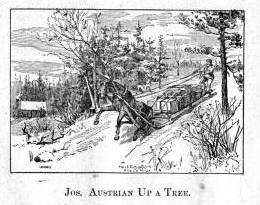
Pg. 218-219 (Armstrong, Benj G., and Thomas P. Wentworth. Early Life among the Indians: Reminiscences from the Life of Benj. G. Armstrong : Treaties of 1835, 1837, 1842 and 1854 : Habits and Customs of the Red Men of the Forest : Incidents, Biographical Sketches, Battles, &c. Ashland, WI: Press of A.W. Bowron, 1892).
In the winter when logging was going on, once I was sent across from La Point with a heavy load of provisions and supplies for the men. This was loaded on a so called “Canadian flat sleigh.” The road on the way to the mill led down a very steep high hill which half way down had a sharp bend and at this curve stood a tree. After having started down the hill, the horse was not strong enough to hold back the load, which got the better of him, and pushed him swiftly down the hill with his hind legs dragging after him wedging him against and partly into the tree with his front legs up in the air. I could not move the heavily laden sleigh with the horse wedged in so tightly I found it impossible to extricate him, and had to go to the mill for assistance. The sled had to be unloaded before we could free the horse. See Armstrong’s book in which mention and illustration is given of this as “Austrian up the tree.” The book is in my library.
Ferrying Oxen Across the Bay in Row Boat.
My brother Julius had also a large tract of meadow land on Bad River, where he had a number of men employed in making hay, in order to gather this hay for stacking, a span of cattle and a wagon were needed to haul it. There being no other means of ferrying them across the bay, one of the large Mackinaw boats of about twenty-five feet keel by six feet beam had to be used to get these over to the other side across a distance of about three miles to the mainland from where they could be driven to the meadow. I was commissioned to attend to this assisted by four competent boatmen, we finally managed with coaxing and skill to get the two big oxen into the boat, standing them crosswise in it. We tied their horns to the opposite side of the boat. The width of the boat was not sufficient to allow them to stand in their natural position which made them restless. The first thing we knew one of the oxen raised his hind leg and stuck it out over the side of the boat into the water, his other leg soon followed and we had aboard an ox half in the boat, with the weight of his body resting on and threatening to capsize the boat. We quickly cut the rope which held his head and he fell backward overboard floundering in the water. Little did I think that we would see the ox alive again. Imagine my surprise on my return to the Island to find he had swam back to shore safe and sound. When the other ox saw his mate go overboard, he tried to follow and it required much coaxing and extra feeding to restrain him and finally landed him all right on the opposite shore.
Lost in the Woods
I returned to the Island and the next morning I started for the meadow fields in a birch bark canoe with a Mr. Lehigh who had a little saw mill about five miles up Bad River. We were obliged to sit in the bottom of the little boat in a most uncomfortable and cramped position, having been warned by the boatman in charge not to move as the least motion is apt to cause the frail craft to capsize. On arrival at the meadow I found the men busily at work. They were about to take dinner and I gladly consented to join them, and being hungry relished the spread of fried pork, crackers, and tea. My companion Mr. Lehigh was bound for his little saw mill up the river where he lived, and I having business to attend to there started with him on a foot trail through the woods. He loitered on the way picking wild raspberries, just ripe and tempting, but musquitos were thick and vicious and pestered us terribly. I not being accustomed suffered more than my companion. Asking him the distance we were still to go, and on his telling me three miles, I became impatient and went ahead alone to get away from the musquitos. After walking on some time I came to a potato field into which the trail led, but was concealed by the high vines. Crossing the field I struck a trail on the other side and took for granted it was the one leading to the mill. On and on I went when it struck me that I had gone further than the three miles, and it dawned on me that I must have taken the wrong path from the potato field and I concluded to turn back and try to reach the meadow. The sun had gone down, it grew dusk very soon amongst the tall pine and maple trees, in the dense forrest. It grew so dark that I could not see my trail and became entangled in the underbrush and roots of trees, tripping and falling many times. I had with me my double barrel shot gun, both barrels being loaded I shot these off to attract Lehigh’s attention. I listened breathlessly for some answer but there was no sign of a human soul and I became thoroughly frightened at the prospect of being lost in the woods but resolved to make the best of it. I stumbled around and found a log hut near by, which had been put up for temporary use by the Indians in sugar making time. I had neither matches nor ammunition, by feeling around, I discovered that what had been the doorway was closed up with birch bark. By climbing up I also discovered that the roof had been taken off the hut and I let myself down to see what might be inside. I found there three rolls of birch bark and a rude bench made of rough poles laid along on one side lengthwise about a foot along the floor, which served as seats for the Indians while boiling the maple sap. Being tired out I laid down on the rough bench and tried to rest, tying a handkerchief over my face, and with each hand up in the boot sleeves to protect myself from large and ravenous musquitos which tortured me nigh to desperation. Having no matches with me to kindle a fire or create a smoke I was entirely at their mercy. Presently I heard a noise on the outside as though of something stealthily climbing over the wall. The moon was then shining brightly, the sky was clear and on looking up I saw the outlines of a young bear sticking his head over the wall looking down on me. I sprang up and as I did so the bear jumped back and ran off. No doubt the odor of the sugar attracted him more than I did. Under these circumstances rest was out of the question. I climbed out of the hut and made another attempt to find the lost trail by moonlight, crawling on hands and feet in some places. In doing so, I placed my gun against a tree and had a hard time to find it again. I decided there was no use to trip further and climbed back in the hut to stay there till day-light, then with renewed effort after repeated disappointment I finally struck a trail, but at this point I was confused and at a loss to know which direction to take. I reached a steep hill that I did not remember having passed the day before. As a last resort I ran up this hill and hallowed & yelled. An answer came from the valley, from me working there. Following the sound I reached the meadow. My face was so swollen from the musquito bites that I was a sight to behold. After resting and partaking of some food, I again started out for Lehigh’s place one of the me volunteering to show me the way and I arrived there a couple of hours after, and found that it was only one mile from the potato field where I had lost the trail.
For many miles in all other directions in this dense forrest there was not a single habitation nor likelihood of meeting with a soul and here a short time ago a man had been lost and never heard from again. Hence I was lucky indeed to have found my way out of the woods. Lehigh cooly informed me that when I saw him that he heard the report of my gun, but had paid no heed to it thinking I would eventually turn up.
Lost on the Ice and Night
One time during the winter Brother Julius sent me with his trusted Frenchman Alexis, to look up certain Indians who owed him for goods and whom he thought would have considerable fur. This tramp meant about ten miles each way through the woods on an Indian trail the ground being covered with snow. Taking our faithful dog, who had been trained to hauling with the little toboggan sled, on which to bring back the fur which he hoped to get in payment for our debt. We started from La Point, and I met with good success gathering quite a little fur. On our return we reached the Bay shore late in the evening from where we had four or five miles to cross on the ice in order to reach the Island. We rested for about an hour at an Indian wigwam and partook of some tea (such as it was) that the Indian squaw made for us and then started on. Alexis, acting as pilot went ahead, followed by the dog & then by me. It was a clear cold night the moon shown brightly, but about half an hour afterwards snow clouds sprang up shutting out the moonlight, Still we pushed ahead. Soon however Alexis lost his bearings and was uncertain as to direction, but on we went for several hours without reaching the Island. Presently we encountered ice roughly broken and piled high by the force of a gale from the open lake, which indicated that we were too near the open water and that we had gone too far around the Island instead of the straight for La Point. We stumbled along, and after having been out about two hours on the ice, with continued walking we managed to reach the shore and with guidance of Alexis tramped along toward La Point reaching there two hours afterwards almost exhausted by the hardships we had endured.
Trip to Ontonagon in Row Boat for Winter Supplies. 1851
It was in 1851 when brother Julius expected the last boat of the season would touch at La Point which was usually the case and deliver all his supplies but the quantity was not sufficient to induce the Captain to run in there and consequently he skipped La Pointe, thus leaving us short of necessary provisions for the winter, hence it was necessary to procure the same as best we could. I was commissioned by my brother Julius to undertake the job which I did by manning a mackinaw boat with five voyageurs. The boat was loaded with as many barrels of fish as we could carry. We started for Ontonagon about the middle of November, intending to trade the fish for supplies required. It was cold, the ground frozen and covered with snow. The wind was fair. We hoisted our two sails and made good time reaching Montreal River late in the evening where we ran in and tied up for the night. We had no tent with us but found a deserted log house by the river in which we spent the night. There was a large open fire place, and my man cutting down a dry tree kindled a brisk wood fire in the fire place. I slipped into a rough bunk in the room wrapped myself in my blankets and tried to sleep, but in vain. The smoke from the fire was so dense it nearly suffocated me. My met lighting a few tallow candles amused themselves playing cards until late at night.
The next morning early, we set sail and again had fair wind, reaching Iron River about noon and Ontonagon that night, next day succeeded in exchanging my fish for provisions and the following day started on our return trip to La Point. We had mostly fair wind and reached there on the third day in good shape.
Another Trip to Ontonagon for Provisions. 1852.
The following year, in 1852, I agains made a similar trip for like reasons but did not have nearly as good luck as on the previous trip. It was fraught with some danger and combined with a great deal of hardship. The distance from La Point to Ontonagon is nearly 100 miles, all exposed to the storms of Lake Superior which in the Fall are generally very severe. On our first day out we encountered a severe snow storm, which compelled us to make a landing near the mouth of Bad River to save the boat, which was threatened to be dashed to pieces on the shore or carried out into the open lake. So she had to be beached and in order to do this her cargo of fish had all to be thrown overboard when we touched the beach, to lighten her and when this was done she was hauled up on the beach with a block and tackle and fastened to stump of a tree. The boatmen had to go almost waist deep in the water and roll the heavy barrels up on the beach. After completing the landing we sought shelter in the nearby woods from the raging storm, we were not equipped for camping, so we took the sail from the boat and stretched it over as far as it would reach for our own protection. As before the men cut down a dead tree kindled a fire, hanging over it our camp kettle, made tea, tried some pork and this together with some crackers with which we were supplied composed our supper. To get further away from the wind and snow we had gone further back into the woods to find some protection and there we rolled ourselves in our grey blankets and laid down keeping our faces under the protection of the sail as much as possible. Being very much exhausted, we fell asleep, in spite of unfavorable conditions. Toward morning when I awoke I tried to pull my blanket over me a little more but found I could not move it, and discovered that the snow had drifted over us to such an extent that we were fairly buried in it, nothing visible but part of our faces, our breath having kept that free for the time. After daybreak we again started a fire, and this made things worse as the heat melted the snow on the trees around and water dripped down on our blankets, getting them wet. We had to hang them near the fire to dry as we collected them later on. They fairly steamed and we were delayed a whole day in getting arrangements completed to start again on our trip. Toward morning the wind had subsided considerably, and the snow storm had abated somewhat and again we ventured on our trip. After going through the same routine of reloading as on our previous occasion. At 10 A.m. we started on our perilous voyage making good head way, the wind being favorable. We reached Iron River after midnight. We detected an Indian wigwam near by, thinking we might be able to get something to eat. We tied up and investigated. We peeped into the wigwam and found the same occupied with an Indian family. The Indian squaw and papooses all tight asleep. Not wishing to arouse them or to lose further time we moved on stopping early the next morning in a small bay on our route. Kindling a fire as previously described, preparing a meager breakfast , the best scant supplies would permit. These boatmen were accustomed to cooking (such as it was) as well as boating it being often a necessity, as they were accustomed to make long coasting trips in the pioneer days of the Lake Superior regions, which was sparsely settled and vessels were very scarce. Supplies and all merchandise had to be transported all the way from Detroit to Lake Superior on those small Mackinaw boats. After breakfast we set sail and continued our journey with fair wind enabling us to make good time, but it had grown bitterly cold and as we were but poorly protected for such severe weather. It cost us untold suffering.
We finally reached Ontonagon River after dark, and to our great consternation found that the river was frozen over about an inch thick with ice. This was not easy to break through with flimsy craft, but desperation gave strength to our men and they were equal to the situation. With their heavy oars they pounded and broke the ice managing finally to get inside of the river to the dock of the merchant with whom I expected to do my trading in the town of Ontonagon, which was the Lakeport for the Minnesota and other copper mines in that vicinity, at that time being just developed. On the following morning I attended to the selling of the load of fish, purchased our supplies and intending to start back for La Point the next morning.
Ordered to go to Eagle River. 1852.
In the meantime the propeller Napoleon arrived from there bringing for me a letter from brother Julius, instructing me if still in Ontonagon to take this steamer for Eagle River and to enter the employ of Mr. Henry Leopold, who had a small store there. His man had left suddenly and he was anxious for my services. I started for Eagle River just as I was and not until the following spring did I get my trunk. I began working for Mr. Leopold as bookkeeper and general clerk, and thus abruptly terminated my business career at La Point. My boatmen under direction of Mr. Henry Schmitz started without me on their return trip to La Point as planned when between Montreal River and Bad River, they encountered a terrific gale and snow storm. It was so severe that to remain outside meant to be lost, and as a last resort, they ran their boat through the breakers, trying to beach her. She was swamped with all the supplies, and tossed up on the beach and had to be abandoned for the time being. Later on another boat was sent on from La Point to get the damaged cargo. The Napoleon got abreast of Eagle River, this place being on the open shore of Lake Superior without any protection, it being too rough there for the boat to make a landing, therefore she went on to Eagle Harbor, about nine miles distant, where she could safely land. On arrival there I put up at Charley King boarding house for the night.
To be continued after La Pointe 1852-1854…
~~~~~~~~~~~~~~~~~~~~~~~~~~~~~~~~~~~~~~~~~~~~~~~~~~~~~~~~
Special thanks to Amorin Mello and Joseph Skulan for sharing this document and their important research on the Austrian brothers and their associates with me. It is to their credit that these stories see the light of day. This is the end of the La Pointe section, but the original handwritten memoir of Joseph Austrian is held by the Chicago History Museum and contains many interesting stories from the life of this brief resident of La Pointe.
CAUTION: This translation was made using Google Translate by someone who neither speaks nor reads German. It should not be considered accurate by scholarly standards.
Our last excerpt from Wagner and Scherzer’s Reisen in Nordamerika in den Jahren 1852 und 1853. The Austrian travelers chronicled their time at La Pointe in September 1852. In this one, we will read of their adventures in my favorite part of the world, the south shore of Lake Superior between La Pointe and the Brule River. 160 years later, residents of Red Cliff, Little Sand Bay, Cornucopia, Bark Point, Herbster, and Port Wing will still recognize many of the natural features described here, and more interesting anecdotes can add to the small amount of written historical documentation of this part of the world. Enjoy:

Red Sandstone: South Shore of Lake Superior: from David Dale Owen’s Report of a Geological Survey of Wisconsin, Iowa, and Minnesota (1852).
XXI
From Ontonagon to the mouth of the Bois-brule River–Canoe ride to Magdalen Island–Porcupine Mountains–Camping in the open air–A dangerous canoe landing at night–A hospitable Jewish family–The island of La Pointe–The American Fur Company–The voyageurs or courriers de bois–Old Buffalo, the 90 year-old Chippewa chief–A schoolhouse and an examination–The Austrian Franciscan monk–Sunday mass and reflections on the Catholic missions–Continuing the journey by sail–Nous sommes degrades–A canoeman and apostle of temperance–Fond du lac–Sauvons-nous!
Since the weather was favorable, we decided prospects were right for our trip to the mouth of the Burnt Wood (Bois-brulé) River. We made all the necessary travel arrangements that evening, and even bought supplies of bacon and salted beef for fourteen days of “wild life.” We were also compelled to buy a new birch canoe*, to allow the two Canadians who will conduct us on the waters of the Bois-brulé and La Croix Rivers, through the wilds of Wisconsin to Stillwater, to make the return journey by water instead of through the woods on foot, and we had not been able to arrange for borrowing a boat.
(*These canoes are the only vehicles used by the Indians to navigate the lake. They are either made of a framework of cedar wood and covered with birch bark, with the individual parts made watertight with pitch, or they can also be carved out of a single spruce trunk hollowed to where two or three can sit. The former are preferred for their greater ease and convenience, but the latter are more durable, safer, and less expensive. Our canoe was made of birch bark and measured 18′ in length and 4′ in width. We bought it for 15 dollars, and we were very pleased when we were able to get rid of it at the end of our trip for five dollars).
Monday, September 20th, 53° F. Overcast weather but the lake completely calm, we left accompanied by the pious blessings of the Island’s Franciscan monk.
This time our boat carried a light burden. The captain stayed back out of concern there would be too many hardships and inconveniences. It was very strange to see such an experienced traveler unwisely refuse to carry a proper thick rain coat. With thin boots, a light Carbonari, and a few underwear tied in a small bundle, he took leave of us to shiver in the elements. Addio Capitano!
Our traveling companions were now a young Frenchman and two Canadians, Souverain and Jean Baptiste. The latter two were entrusted with managing the canoe. Souverain, though his thin gray hair, his toothless mouth, and his wrinkled face betrayed the features of advanced age, he was undoubtedly the more able and accomplished of the two voyageurs. Baptiste, however, strong and tireless in his youth, was an excellent complement to the old man.

Indian Sugar Camp (1850) by Seth Eastman, as depicted in Schoolcraft’s Information Respecting the History, Conditions and Prospect of the Indian Tribes of the United States, 1847-1857 (Digitized by Wisconsin Historical Society; Image ID: 9829).
We passed the Apostle Islands, 12 in number, most of which, including “Spook Island” are planted almost exclusively with maple trees (Acer saccharinum), from which the Indians prepare sugar. Every year in March and April, they make deep transverse incisions, from which, like the dripping pitch extracted from pine trees, a fresh green juice flows. Every tree can be tapped 5-6 years, in such a way to be made controllable, before the tree is disabled and is only good for the fire. In La Pointe, about 10 Indian families produce 1000-1500 pounds of sugar every year. In Bad River, there are more than 20 Indian families, who collectively produce 20,000 pounds. A pound of maple sugar is obtained by the traders for one shilling (twelve and one half cents) delivered to the Indians in kind.
We passed several miles of 40-60 foot high red sandstone cliffs, which the lashing tide had formed into the most picturesque architectural forms, among which arch and pillar structures were most prevalent. Several were formed in such a way as to create columned caverns under which a canoe could easily pass. The under-washing of this gigantic mass of rock may explain the gradual extension of the south shore.
Favored by a northwest wind, we had already covered 21 miles in 6 hours, and arrived at Riviere au Sable. We could clearly make out the north shore 50 miles distant, and the mountain chain of the British Territories, whose highest point, according to Dr. Norwood of Cincinnati is 1650 feet.
As with lucky speculators in the trading cities, our canoeists wanted to exploit the favorable wind direction even more. They turned their only protection against the cold, blue and white blankets, into excellent sails. They tied together cloth on one side to secure the oar, while they used green pine branches on the other side to maintain tension against the wind. It always remains dangerous, however, to attach a sail to so volatile a vehicle as a canoe, for a single contrary wind shock can cause the canoe to lose balance and leave the drivers to pay for their daring with terrible flooding.
In the evening, just as we were about to pitch our camp at the bay of Siscawit River, we were surprised by a terrible rain that drenched the greater part of our effects and brought great danger to our physical instruments. We were, for a long time, without the benefit of a warm fire, but our perseverance gradually allowed our flickering light to defeat the dampness, and we had flame to cook our modest supper. One often camps at the mouths of these numerous small tributaries of Lake Superior. It has always been this way, and the reason is that during stormy seas on the open water, the bays that surround the mouths of these rivers protect you from the wind and waves.
The small canvas tent, lent to us by the hospitable postmaster in Ontonagon, served us beyond expectation as powerful protection from the cold and wetness. We soon found ourselves under the soaked canvas roof in comfort we hardly thought possible in such harsh camp conditions. We must admit, however, that our foresight in bringing suits made of India rubber to spread on the ground, spared us the rheumatic breaths of the damp earth beneath us.
Tuesday, September 21, 53°F. Persistent rain and completely clouded-over sky with little chance of favorable traveling weather. During the night, the rains became so heavy that they seeped in through the canvas in several areas. Our laundry bags were totally soaked, and there was no opportunity to dry them. When camping like this, one should always keep items requiring special protection in the rear of the tent, and all care should be made to not let them touch the stretched canvas, which once wet will keep everything damp for weeks.
This morning, we had to celebrate wind, that is, a violent northeast wind prevented us from proceeding any further. “Nos sommes dégradés,” the old captain sighed, and told us how he was once stranded by violent storms, and had nothing but a dry biscuit to eat for four days. We held a small war council without a general, but with merely reason to guide us, and decided that due to this delay, we should limit our meals so that we would only enjoy the salted meat every other day. Decreasing to half rations, was necessary, as we were on the treacherous Lake Superior, which as already noted, often makes travel impossible or highly dangerous for weeks on end. Once we reached its desired tributary, the mouth of the Bois-brulé River, we would have no more fear of such a wicked delay from wind and waves.
Around 6 o’clock in the evening, the waves took on a less dangerous character. We quickly pulled down our tent, packed our belongings, and hastily boarded our already-floating boat. In boarding a canoe, caution must always be used to avoid stepping harshly with the whole foot above certain cedar ribs. This can disturb the equilibrium which can have the consequence of losing your effects, or even your life.
After an hour, we had followed a fierce north wind to Pointe aux écorces looking for a refuge. We wandered along the shore until after dark, but the rugged rocky reefs made landing impossible. Finally, we found sandbars, and pitched our tents near a tamarack swamp. Those who travel without a tent can usually find shelter from the rigors of the weather by setting the canoe at the proper angle and finding room underneath it.
We camped in a group of pines as tall as the sky. At the foot of these ancient tree trunks, our fire burned like a flaming sacrifice of the ancients. As the two voyageurs fell fast asleep at the entrance of the tent, we continued to feed sticks into the fire so as to not lose its benevolent warmth. Our fire was basically built into the base of a great pine, which gave the whole scene a picturesque backdrop, until the whole thing fell during the night with a heavy crash. This brought us all to our feet, sober and alert. There was no danger, however, as we had put numerous cuts into the tree so that it would fall away from us in the event it gave way.
Wednesday, September 22, 64°F. Northwest wind. The cheerful light of the morning sun woke us weary sleepers early. The seas were pretty rough. Once we had the infamous Point aux écorces at our back, we heard the roar of the busy oncoming waves. The red sandstone remains the predominant formation. The green hills of a moderate height, almost 50′, are embraced by a wide belt of spruce, Scotch Pine, birch, and beech. The more we approach the western end of the lake, Fond du lac, the narrower the space between the southern and northern shores becomes.
At the Riviere aux Attacas, we landed for breakfast. This time, there was bacon, whitefish, tea, butter, and hardtack, all remnants of the past brought from La Pointe. The songs our guides sang to strengthen the heart were far more modest and ethical than the erotic verses of our previous voyageurs who brought us from Ontonagon to La Pointe. The brilliant sunshine gave way to a completely cloudy sky, and a terrible northwest wind blew us into the bay of Apacha River, and there we resignedly made our night camp even though the Bruly River, as the natives call it for short, was only 12 miles away.
In the evening, we unconsciously discovered Souverain’s severe, but honorable, strength of character. We had brought a bottle of franzbranntwein, more for health than to tickle the tongue, and we poured each of our leaders a glass of this invigorating stomach potion. The younger, Baptiste, opened his throat widely and readily, but Souverain steadfastly refused even though he had worked hard all day and had taken little food.
We were curious and asked him about the cause of this refusal. He told us how he was inclined too much toward the spirituous fluids, and that to combat this, as few years ago he joined a temperance society and pledged in writing to abstain for fifty long years from all liquors. Since then, he has had not a drop of wine. His total abstinence went so far that he was not even moved to enjoy a rice broth in which we had mixed a few drops of the franzbranntwein, to give our guides more power.
This incident reminded the Canadians of some humorous anecdotes from living memory. Souverain told of an elder mix-blood who joined him for a limited period of temperance, with the lovely intent of indulging all the more joyously after the “dry” time. Baptiste told of a fisherman in La Pointe, who, since the sale of alcohol is prohibited on the island under penalty of 200 dollars, would get intoxicated almost every day with a bottle of burning hot peppermint water. Since this liquid, when used at low doses, is an excellent and popular remedy for stomach ailments, it was not easy to restrict its sale. Therefore, to save the life of this islander, the magistrate issued a special edict that the sale of peppermint is only allowed in small vials for medicine.
7 o’clock in the evening, 53°F. A gorgeous aurora borealis creates wisps and horizontal streaks of rapidly-changing dreamlike light.
Thursday, September 23, 63°F. We left early, around half past 7 o’clock. The abundant ashes of our extinguished fire, the tree trunk where our kettle hung, and the thin supports, under which our tent assumed its triangular shape, were the only traces left behind as a memorial of our presence.
Although a fairly violent south wind blew, he came from the mainland, so the waves on the lake were fairly calm, unlike those of his antagonist the engulfing north wind who yesterday threw the water up on the shore. For breakfast, we had tea, fried bacon, and galette. The latter is a composite made of kneaded flour, water, and compressed yeast dough, that seems extremely difficult to digest. It is usually prepared every morning by a practiced hand, and is gladly enjoyed, even preferred, by the voyageur.
The shotgun of our traveling companions produced a duck that will provide us with an excellent lunch. It is striking how much the forests along the banks are already emptied by Indian rifles. Temporary flocks of ducks and geese, in their autumn migration to a more southerly area, were the only wild species we encountered on our long journey. Likewise, the fishing in this season is extremely sparse, and he who leaves during these journeys to hunt or fish alone, will soon labor hard and bitterly regret his mistake.

Fond du Lac Village, At St. Louis River from David Dale Owen’s Report of a Geological Survey of Wisconsin, Iowa, and Minnesota (1852).
From the Bois Brule River to Fond du Lac, it’s about 21 miles, but to the mission and settlement on the St. Louis River, it’s about 42 miles. We could easily see with the naked eye, the contours of those western hills that mark the limit of this huge navigable water. And so, before we sailed up the Bruly, we paused to behold the joyous satisfaction of reaching the end of this enormous water, now reflecting the sky, on which we had spent 23 busy, enjoyable, and instructive days.
At 11 o’clock in the morning, we finally reached the destination we had anxiously waited for, the Bois-brulé River. Its discharge into Lake Superior was unusually low, but its flow was still very powerful. For our canoemen, it was a matter of routine to skillfully avoid a fatal collision with the bare rocky ridges at the landing.
Our captain had now thrown aside the oars as the long boat poles served better to find the sandy gaps among the rocks. Souverain stood at the upper end of the canoe and directed. He watched with a sharp eye for the moment when the perfect wave would come to our aid and carry us to the landing, and with the signal cry of, “Sauvons-nous!” it came suddenly, and we were borne to shore. We were at the mouth of the Bois-brulé River.
The End, for now…
CAUTION: This translation was made using Google Translate by someone who neither speaks nor reads German. It should not be considered accurate by scholarly standards.
 Chequamegon History