Land Office Frauds
March 25, 2016
By Amorin Mello
New York Times
December 9, 1858
—~~~0~~~—
Land Office Frauds.
—~~~0~~~—
AGRICULTURAL CAPABILITIES HEREABOUT – LOCAL AMUSEMENTS AND EXCITEMENTS – SETTLEMENTS OF SUPERIOR CITY – A CONTROVERSY, AND SECRETARY M’CLELLAND’S ADJUDICATION OF IT – SECRETARY THOMPSON’S REVERSAL OF THAT JUDGEMENT – ITS CONSEQUENCES – LAND-STEALING RAMPANT – INSTRUCTIONS FOR THE ENTRY OF SUPERIOR CITY – THE LAND OFFICE REPEALS THE LAW OF THE LAND – A CASE FOR INVESTIGATION.
Correspondence of the New-York Times.
SUPERIOR CITY, Wis., Thursday, Nov. 25.

I am booked here for another winter, but fortunately with no fear of starvation this time. We have been most successful the last Summer in our Agricultural labors. The clay soils about here has proved marvelously fruitful, and where we expected little or nothing it has turned out huge potatoes that almost dissolve under the steaming process, and open as white as the inside of a cocoa-nut ; mammoth turnips, as good as turnips can be ; cabbages of enormous size ; and cauliflowers, that queen of vegetables, weighing as much as a child a year old. There is no reason to fear for the future of this country, now that we can show such vegetable products, and talk of our gardens as well as of our mines, forests, furs, and fisheries.
We are not without our excitements here, too ; though we have no model artists, or theatrical exhibitions, to treat our friends with. But our little city is now in a state of commotion produced by causes which often agitate frontier life, and sometimes reach the great center with their echo or reverberation. The Land Office is the great point of interest to frontier men, and the land law is the only jurisprudence save Lynch law, in which we are particularly interested. And as we have no means of reaching the great Federal legislature, through our Local Presses, we are always glad of an opportunity to be heard through the Atlantic organs, which are heard all over the country, and strike a note which the wind takes up and carries not only to San Francisco, but up here to the mouth of the St. Louis River, the hereafter great local point of Pacific and Atlantic intercommunication.

The Eye of the Northwest, pg. 8: James Stinson; Benjamin Thompson; W. W. Corcoran; U. S. Senator Robert J Walker; George W Cass; and Horace S Walbridge.
Five or six years ago a few American pioneers – stalwart backwoodsmen, undertook to select a town site out here, and did select one in good faith, and with clubs and muskets in had fought off from their premises a gang of Indians who were claiming to preëmpt it as “American citizens.” The Indians, however, were backup up by a Canadian white man by the name of STINSON, and some of the great speculators who were engaged in another town enterprise alongside here, and this “Indian war” was protracted in the local and general Land Offices some two or three years, when Mr. M’CLELLAND, then Secretary of the Interior, made a final adjudication of all the legal questions involved in the controversy, and sent it back to the Land Office to ascertain and apply the facts to the law as settled, on great deliberation by himself and Mr. CUSHING.
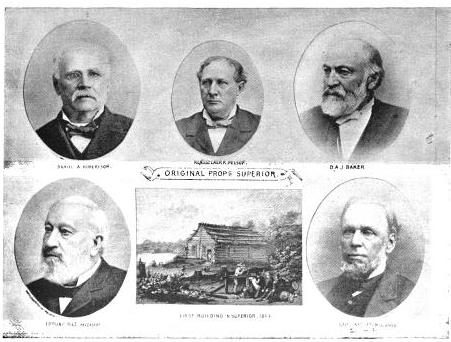
More Proprietors of Superior from The Eye of the North-west
, pg. 9: [names are illegible]
Meanwhile the original settlers and occupants maintained their adverse possession against the Indians and all the world, and expended a good deal of money in erecting buildings and a pier, and in cutting out streets and in laying out their town, and in carrying on their litigation, which was by no means inexpensive. M’CLELLAND’s determination of the law in their favor encouraged them to go on and incur additional expenses ; and they parted with diverse interests in the town site, some by assignment to persons who advanced money, and some by sale on quit-claim to persons who covenanted to make improvements. They made application to the proper office to enter the site, and nobody objected but the Indians – and the Indians were nowhere. So things stood when the case went back to the General Land Office, and to Mr. Secretary THOMPSON. The worthy Secretary, for some cause altogether unaccountable, adopted the extraordinary (and under the decision of the Supreme Court illegal) course of reversing the final judgement of his predecessor in this very case, (an exercise of power entirely unheard of in a case of mere private right,) and of rejecting the claim of the original occupants and settlers, though it was not contested by somebody who had a better right.
You may well imagine that this decision excited no little astonishment here. All the land stealers looked upon Superior City as vacant ground. They thought the men who selected and settled the town site were outlawed, and had no interests. Some supposed that the Land Office would put the ground up at auction. A chap by the name of SWEETZER came on here fresh from the General Land Office, and undertook to lay Sioux scrip on the whole site. Another – one JOHN GRANT – made application to preëmpt a portion of the site – and, what is the most remarkable feature about this business, GRANT was permitted to enter it as a preëmptor, though it was notoriously a selected town site, and in the adverse possession of town claimants half a year before GRANT ever saw it. This outrage created a great excitement for a small place. The Register, Mr. DANIEL SHAW, excuses himself by saying that he was almost expressly ordered by HENDRICKS to issue the certificate to GRANT, but this we do not believe in these parts. SHAW is clever, and covers his tracks, but nobody here supposes that the Commissioner ever countenanced such a gross violation of a public statute, without a motive. And what motive could the Commissioner have?
But, besides these movements, one of the Indians – ROY by name, who was defeated as one of the claimants by preëmeption – is now seeking to locate his Chippewa scrip on the town-site, and it is supposed that the same influences which urged him as an American citizen will support his claim as an Indian. A white man by the name of KINGSBURY, encouraged by the disregard of law exhibited by the local office, has made a claim on another part of the town-site. This purports to have originated in the fourth year of a litigation between the town claimants and the illegal preëmptors, and is supposed to be stimulated and encouraged by the Register.![Vincent Roy, Jr., portrait from "Short biographical sketch of Vincent Roy, [Jr.,]" in Life and Labors of Rt. Rev. Frederic Baraga, by Chrysostom Verwyst, 1900, pages 472-476.](https://chequamegonhistory.com/wp-content/uploads/2016/03/vincent-roy-jr.jpg)
Subsequently to his original rejection of the town-site claim, Mr. Secretary THOMPSON issued instructions to permit the entry, and the County Judge made application on the 18th instant, under the law of the United States, May 23, 1844. On this being known, some of the persons heretofore claiming under the original settlers and occupants (who had selected the town and paid all the expenses of the settlement) came together and formed an organization as a city, under a recent law of Wisconsin, the object of which they declare to be secure to themselves a title from the United States to the lots they specially occupy, and to sell the balance to defray their expenses in entering and alloting the land! The men whose rights vested under the absolute decision of Secretary MCCLELLAND, and who did all that they could do to enter the land, and paid the money for it more than two years ago, – the men whose “respective INTERESTS” the statute of 1844 recognizes and was designed to protect, – these men are all ruled off the course, and the men claiming under them have conspired to divide the land and its proceeds among themselves.
Of course these iniquitous and illegal proceedings are all within the reach of the Courts – but they are the legitimate consequence of Mr. JACOB THOMPSON’s repeal of so much of the Preëmption Law of 1841 as excludes from preëmption those portions of the public lands that have been “selected as the site of a city or town.” Mr. THOMPSON has overruled all his predecessors, all the Attorney-General, all the local offices, all the lexicographers, and the English language generally, by deciding solemnly that “selection” does not mean “selection,” but means something else – or more particularly nothing at all. Because, says he, if adverse “selection” excluded a preëmptor, then a preëmptor might be excluded by a false allegation of selection. Was there ever such an argal since Dogberry’s time? The Secretary has discovered an equally efficient “dispensing power” with that of King JAMES of blessed memory, and one which his brethren in the Cabinet may use very efficiently, if Congress does not look into the subject and fix some limits to it. For now, not only the Secretary, but the Commissioner, and the Register and Receiver, all think that they are at liberty to treat the repeal by the Secretary as an effective nullification of the law of the land.
If Congress would amuse their leisure a little by looking at these land office operations on the verge of civilization, they would strike a placer of corruption. Let them open the books and call for the documents, and see what Dr. T. RUSH SPENSER, late Register of the Willow River District, says of his predecessor and successor, Mr. JOHN O. HENNING, and then ascertain by what influences HENNING has been reappointed, and SPENSER transferred to Superior. Let them find out what Receiver DEAN said of Register SHAW, and what Register SHAW said of Receiver DEAN, and why DEAN was dismissed and why SHAW was retained. It will be rare fun for somebody. The country ought to know something about the Land Offices, and such an investigation as this would enlighten the country very materially. I hope it will be made, and that the country will learn how it is that more land has been entered in this district by Indians, foreigners, and minors than by qualified preëmptors, and all for the benefit of a few favored speculators.
Penokee Survey Incidents: Number IV
February 22, 2015
By Amorin Mello

December 8, 1877.
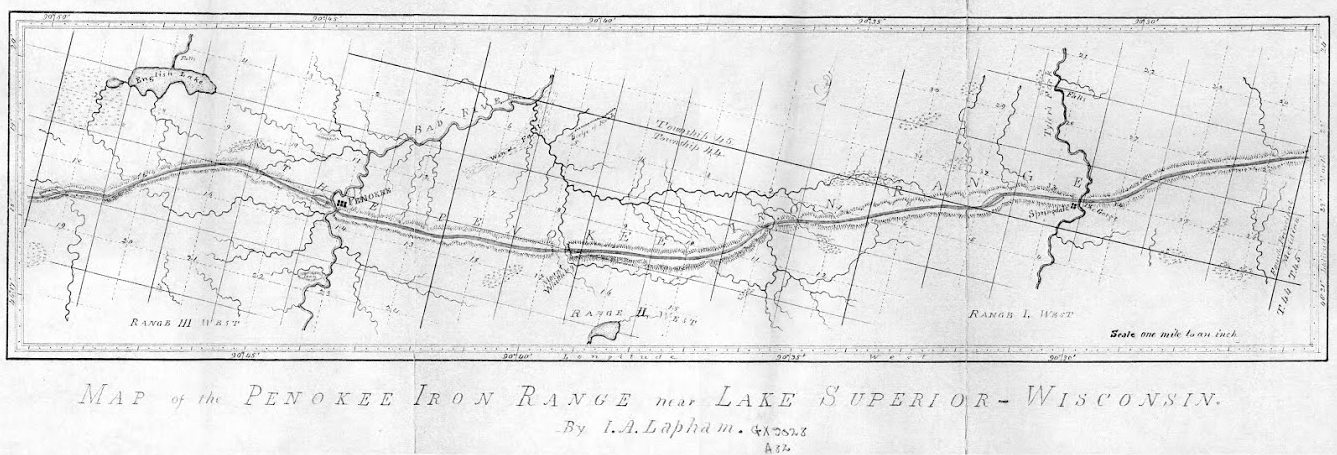
Increase Allen Lapham surveyed the Penokee Iron Range in September of 1858 for the Wisconsin & Lake Superior Mining and Smelting Company. Years later, Lapham’s experience was published as “Mountain of Iron Ore: The buried wealth of Northern Wisconsin“ in the Milwaukee Evening Wisconsin newspaper on February 21, 1887. (Image courtesy of the University of Wisconsin Geography Department)
~ 1978 Marsden Report for US Steel.
~ Railroad History, Issues 54-58, pg. 26
The Penoka Iron Range consists, as is well known, of a sharp ridge, some fifteen miles in length, by from one to one and one half in breadth, with a mean elevation of 700 feet above Lake Superior, from which is a distance about twenty-two miles, as the crow flies, its general trend being nearly east and west, it is densely covered with timber consisting of sugar maple, (of which nearly every tree is birdseye or curly) elm, red cedar, black, or yellow birch, some of which are of an enormous girth, among which are intermixed a few white pine and balsams, for it is traversed from north to south at three different points, by running streams, upon each of which the company had a station, the western being known in the vernacular of the company, as Palmer’s, (now Penoka); the center, as Lockwood’s, in honor of John Lockwood, who was at the time a prominent member of the Company, and upon its executive board; and the eastern, as Sidebotham’s, or “The Gorge.” These were the principal stations or centers, where supplies and men were always kept, and as which, as before stated, more or less work had been done the previous year. Penoka, as which the most work had been done, being considered by far the most valuable. This post was, at the time of my first visit, by charge of S.R. Marston, of whom mention was made in my last, and two young boys from Portsmouth, N.H., who had come west on exhibition, I should say, from the way they acted. They soon left, however, too many mosquitoes for them. “Lockwood’s,” as previously stated, was garrisoned by one man, whose name I have forgotten, and although a great amount of work had been done here as yet, it was nevertheless considered a very valuable claim, on account of the feasibility with which it could be reached by the rail Mr. Herbert had in contemplation to build from Ironton, and which would, in passing along the north side of the Range, come in close proximity to this station; besides, it had the additional advantages of a fine water power. At the east end were two half-breeds employed by the company, and George Chase, a young man from Derby, Vermont, a nephew of ex-Mayor Horace, and Dr. Enoch Chase, of Milwaukee, an employee of Stuntz, who, with James Stephenson, was awaiting the return of Gen. Cutler with reinforcements, in order to continue the survey. Chase subsequently made a claim which he was successful in securing – selling it finally to the Mr. Cogswell, of Milwaukee.
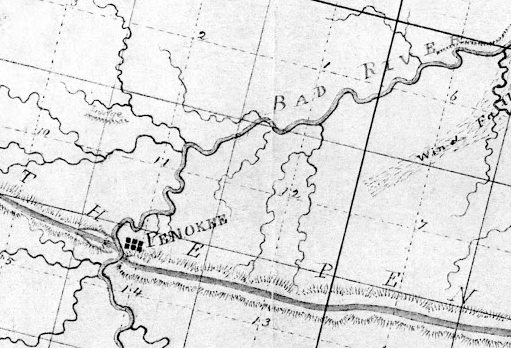
Penoka, aka Penokee, is Palmer’s station near the Bad River Gap.
It is also proper to state in addition to what has been already mentioned, that at, or about this time, a road was opened by Mr. Herbert’s order, from the Hay Marsh, six miles out from Ironton, to which point one had been previously opened, to the Range, which it struck about midway between Sidebotham’s and Lockwood’s Stations, over which, I suppose, the 50,000 tons as previously mentioned, was to find its way to Ironton, (in a horn). For this work, however, the Company refused to pay, as they had not authorized it; neither had Mr. Herbert, at that time, any authority to contract for it, except at his own risk; his appointment as agent having already been revoked; although his accounts had not, as yet, been fully settled. This work, which was without doubt, intended to commit the company still further in favor of Ironton as an outlet for the iron, was done by Samuel Champner, a then resident of Ashland and who if living is probably that much out of pocket today. No use was ever made of this road by the Company, not one of their employees, to my knowledge, ever passing over it.

The location of Lockwood’s station was not mapped by Lapham or by Stuntz. City Creek and Ballou Creek are the two water gaps on either side of Mount Whittlesey, midway between the gaps of Bad River and Tyler’s Fork.
This description will, I think, give your readers a very good understanding of the condition as well as the true inwardness of the affairs of the Wisconsin & Lake Superior Mining and Smelting Co., in the month of June, 1857.
At length, after remaining on the Range nearly three weeks, awaiting, Micawber like, for something to turn up, a change came with the arrival of Gen. Cutler from Milwaukee with the expected reinforcements. Mr. Herbert at once left the Range, went to Milwaukee and settled up with the Company, after which, to use a scriptural expression, “he walked no more with us.”

Springdale is Sidebotham’s station at The Gorge of Tyler Fork’s River.
“A special defense in contract law to allow a person to avoid having to respect a contract that she or he signed because of certain reasons such as a mistake as to the kind of contract.”
~ Duhaime.org
Wheelock, Smith, and McClellan were at once placed upon claims – McClellan in the interest of John Cummings, (whose name by an oversight was also omitted from the list of stockholders, given in my first paper), and Wheelock and Smith for the Company generally. Subsequently, A.S. Stacy, of Canada, was also employed to hold a claim. How well he performed this duty, will be seen further on. This done, the improvements necessary to be made in order to entitle us to the benefits of the preemption law were at once commenced. These improvements consisted of log cabins, principally, of which some twenty in all were erected upon the different claims. These cabins would have been a study for Michel Angelo, or Sir Christopher Wren. They had more angles than the Forty-seventh Problem of Euclid, with an average inclination of fifteen degrees to the Ecliptic. O, but they were “fearfully and wonderfully made,” were these cabins. Their construction embodied all the principle points of architecture in the Ancient as well as Modern–Milesian-Greek, mixed with the “hoop skirt” and Heathen Chimee. Probably ten dollars a month would have been considered a high rent for any of them. No such cabins as those were in exhibition at the Centennial, no sir. Rome was not built in a day, but most of these cabins were. I built four myself near the Gorge, in a day, with the assistance of two halfbreeds, but was not able to find them a week afterwards. This is not only a mystery but a conundrum. I think some traveling showman must have stolen them; but although they were non est we could swear that we had built them, and did.
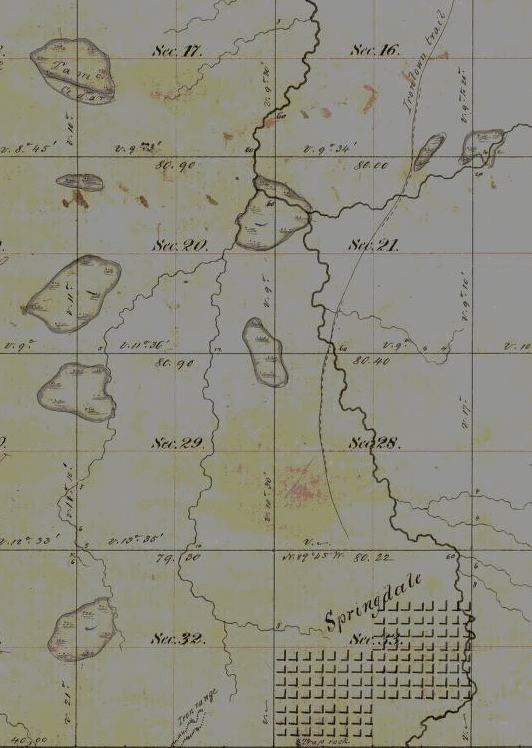
Springdale townsite plan at Sidebotham’s station by The Gorge of Tyler’s Fork in close proximity to the Ironton Trail and Iron Range. (Detail of Stuntz’s survey during August of 1857.)
Three were accordingly platted — one at Penoka, one at Lockwood‘s and one at the Gorge. And in order that it might be done without interfering with the regular survey, Gen. Cutler decided to place S.R. Marston who, in addition to his other accomplishments, claimed to be a full-fledged surveyor, in charge of the work, assisted by Wheelock, Smith and myself. He commenced at the Gorge, run three lines and quit, fully satisfied that he had greatly overestimated his abilities. We were certainly satisfied that he had. A drunken man could have reeled it off in the dark and come nearer the corner than he did. He was a complete failure in every thing he undertook. He left in the fall after the failure of the Sioux Scrip plot. Where he went I never knew. George E. Stuntz was subsequently put upon the work, which he was not long in doing, after which he rejoined Albert on the main work. This main work, however, for the completion of which we were all so anxious, was very much delayed, the cause for which we did not at the time fully understand, but we did afterwards. J.S.B.
Penokee Survey Incidents: Number III
February 15, 2015
By Amorin Mello
December 1, 1877
The Survey of the Penoka Range and Incidents Connected with its Early History.
—
Number III.
~ Detroit Free Press, June 5, 1857
(MarinetimeHistoryoftheGreatLakes.ca)
Friend Fifield:- Upon the first arrival of Mr. Sidebotham and myself at La Pointe, in May, ’57, as previously stated, we took lodging at the “Hotel Angus,” the hospitalities of which we were forced to enjoy until some means could be found to communicate with Gen. Cutler. The Bay, as well as the Lake, was full of ice. In fact, we had been compelled to fight out way from the Sault to La Pointe, through heavy masses of ice, nearly the whole distance – and while upon this subject, I will say, that incredible as the statement may appear to many, yes it is a fact, that ice bergs were aground in front of Austrian’s Warehouse, at La Pointe, on the 4th day of July, 1857, in 36 feet of water, while at the same time a field of floating ice was visible from the Range, beyond which, no water could be seen. I verily believe that the lake was not wholly free from ice that summer.
~ Madeline Island Ferry Line
At length, after remaining at the hotel some eight or ten days, during which Mrs. Angus made us as happy as she could by her kindness and attention, Gen. Cutler came, accompanied by Mr. Herbert. This was the first time that either of us had ever seen Gen. Cutler, but on being informed who we were, he seemed overjoyed to see us, and at once made the proposition to me to take charge of the work, and let him return to Milwaukee, so thoroughly disgusted had he become with the whole thing. To this, however, I would not consent, whereupon he decided to remain, and at once directed Mr. Herbert, who was at that time still in our employ, to return at once to Ironton, taking a part of the supplies, which came up with us, of which they were in great need, Mr. Sidebotham accompanying him, leaving the General and myself at La Pointe. After a long consultation, the General decided to go below, after men and money, wherewith to complete the work; which he did, I following Mr. Sidebotham to Ironton, which place I reached in time to join Mr. Herbert’s party, just starting for the Range, which we reached the second day after leaving Ironton.
During its existence the taxable real estate in the Town of Bayport had increased from nothing to several hundred thousand dollars, principally through entry of pine lands in the south and western portions of the township and also by extensive entries of mineral properties on the Iron Range.”
~ The Lake Superior Country in History and in Story by Guy M Burnham, pg. 179
Omission was made in the list of stockholders given in my first chapter, of Mr. Herbert, whom name should have been included. His stock was, however, by special agreement, unassessable, as it was through his instrumentality, in part, that the existence of this most wonderful metallic deposit was first brought to the knowledge of the Company, and the work of surveying and locating is undertaken. It was this, together with the knowledge that his long residence in the country was supposed to give him, as to the best mode of conducting such an enterprise, that procured for him this aqucession, as well as the appointment of Agent. In justice, however, to Mr. Herbert, it is proper to state, that besides the work done, and money spent at Ironton, the place selected by him as the future shipping point for the iron, (50,000 tons of which he contemplated bringing there that season, at least he stated) considerable work had also been done upon the range during his administration; mostly, however, at Penoka, where a log cabin, yet standing, had been erected, and some thirty acres cleared, the timber being cut into cordwood, to be used in the manufacture of charcoal iron, for the making of which it was contemplated to erect the proper furnaces in the near future. Neither is it any injustice to say, that although perhaps he did the best he could, situated as he was, yet the work did not progress as fast as the company thought it should, the force, while under his control had became badly demoralized. The idea had obtained, if not with him it had with them, that they were working for a company of bloated bondholders,- had a soft thing, and meant to make the most of it; but with the advent of Gen. Cutler, a change came over the spirit of their dreams. Order was quickly brought out of chaos, and the discovery made that a master hand held the reins. Up to this time, May, ’57, the Range had never been visited by any of the company except Messrs. Palmer, Greves and Ripley, those visiting ’56 was one of exploration only, and as Gen. Cutler, Mr. Sidebotham and myself were the only ones that went up there in ’57, or who, in fact, over performed any work there, a short sketch of them will perhaps not be inappropriate in this connection, while awaiting, metaphorically speaking, the arrival of the expected reinforcements from below. And first of Gen. Cutler:

Lysander Cutler of Wisc. (Library of Congress Prints and Photographs Division, Washington, D.C.)
The Order of the County Board creating the Town of Bayport was made March 11, 1856, and the store of Schuyler Goff, in Bay City (Ellis Division) was designated as the place for holding the first election for town officers, the election to be held Tuesday, April 1, 1856.
The Town of Bayport comprised all that portion of LaPointe county (since changed to Ashland County) lying south of the north line of Town 48 North; in all over sixty-eight Townships, including the Bad River reservation, which was, on the 8th day of November, 1859, made a precinct by itself.
At the first election held April 1, 1856, there were 24 votes cast — resulting as follows; for Chairman of the Town Board, Schuyler Goff (later appointed County Judge, an office he held for a year or more). The other members of the town board being J.T. Welton and Asaph Whittlesey. Schuyler Goff, chairman elect, was the first officer to qualify, his oath of office being administered by Asaph Whittlesey, Justice of the Peace.”
~ The Lake Superior Country in History and in Story by Guy M. Burnham, pg. 179
Gen. Lysander L. Cutler was, in many respects, a remarkable man. In person he was rather above the medium height, large head, large, dark eyes, heavy eyebrows, a sure indication of a good memory, as well as firmness, dark hair, inclined to stand erect; walked, usually with a slow and dignified step, with his eyes apparently fixed upon the ground, as if in deep thought, leading an observer to suppose that he was not cognizant of what was being enacted around him. This, however, was a mistake; nothing escaped his observation. In fact, he seemed to know your very thoughts; neither could anyone be in his presence ten minutes without feeling the magnetic influence of his iron will. Was any dangerous work to be undertaken, he would, if within call, be the first one consulted, and appointed to take charge of it. He was a born leader. He was not only one of the best business men I ever knew, but he was also a leader in politics. A good judge of men, sharp and keen, and who ever undertook to circumvent him was sure to some grief, as some of the people who went about the Range did that summer, have no doubt, an abiding recollection. I refer now to Hall, of St. Paul, Minnesota, who undertook, with the assistance of S.R. Marston, a treacherous employee of the Company, and Schuyler Goff, of Racine, at that time a resident of La Pointe, to beat us out of our rights, by entering the lands upon the Range with Sioux Scrip, in which nefarious attempt they would no doubt have succeeded, but for him. He was more than a match for all of them, and they finally retired from the contest in disgrace. Such was Gen. L.L. Cutler, a firm friend, but an uncompromising enemy. Never will the writer forget the happy days spent with him upon the Range in the summer of 1857. We were like brothers, and our friendship was never interrupted by even a passing cloud. We fraternized at once upon our first meeting, and fought the battle for the possession of the Range together, never doubting our ultimately winning the prize. He has gone to his reward, in that bright world beyond the River; yet “in memory’s ever sleepless eye” he is often present with me.
Mr. Sidebotham, however, who was by birth an Englishman, and by occupation a cabinet maker, was of a different mould, and although an honest man, was by his habits of life, wholly unfitted for such an undertaking, and of no practical use whatever, and although not constantly at the Range, he was while there, an actual incumbrance, some one having to remain with him constantly; he could not accustom himself to the woods and its annoyance; was always complaining of his food, which of course soon brought him into contempt with the men. One of his peculiarities was a great fondness for sugar, particularly in his tea, which he could not, or thought he could not, drink without it, and as this was an article not always plenty, the boys would sometimes hide it, in order to see him hunt for it, which he would do most persistently until he found it. I remember on one occasion they hid it in a tree, and as he could not climb or chip, although in plain sight he could not get it. They had, as they expressed it, the “dead wood” on him that time. He finally became so afflicted with boils, on account of his sedentary habits and change of food, that it was with the utmost difficulty we were able to get him from the Range to Ashland, in December, where he remained until sufficiently recovered to be able to travel, after which he reached home in safety. He was the last to sell his stock, which, however, he finally did, to the late Simeon N. Small, claiming that as it was through much tribulation he had obtained it, he would not part with it except at his own price, which I believe he got. This purchase, although it gave Mr. Small a controlling interest in the stock, was ultimately the cause of his financial ruin. J.S.B.
[from same issue of The Ashland Press]
Whittlesey on Early Times in Ashland.
—
~ The Monthly Magazine; A Monthly Journal of American History, Volume 9, 1888, pg. 18
Editor Ashland Press.- In your last issue of the 24th inst., your correspondent “J.S.B.,” in his Early Recollections of Ashland, makes very portient reference to two of Ashland’s prominent citizens of early days, known as “Sibley” and “Lazarus,” stating that in laziness they were competitors for the belt. My own recollection tells me that of this same Sibley had gained some notoriety for telling big yarns, but in this I think he ultimately gave way to John Beck. On one occasion, Sibley arrived in town on foot and alone, and entering a crowd of the boys, addressing himself to Lazarus, said: “Lazarus, I want you to go and help me get my team into town. It now stands in the mud near the head of Main St.” to which Lazarus replied, “I’ll go, if you will first tell us the biggest lie you ever told.” Sibley responded, “Lazarus, I don’t lie.” Lazarus says, “That will do, I’ll go and help you.” I am personally knowing to the fact that this same Lazarus has been known at several different times when he was “keeping back” in cold winters, to remain in beds two nights and the intervening day, to avoid the necessity of cutting wood and cooking a meal; nevertheless, “George E.,” as Lazarus was otherwise known, was a man of much more than usual ability, and was a surveyor had few superiors. We were all glad to have him show himself, and to witness his alacrity in getting upon the “off side” of any proposition that might be submitted.
I hope that brother “J.S.B.” may be heard from again, and that he may tell us more in regard to the crowd of pre-emptors imported by himself and others, (modesty forbids me to mention who,) tending almost invariably to bankruptcy. You, sir, were at the head of some “noble boys,” and you, too, had your share of tough cases. Should I sufficiently recover my strength to enable me to do so, I may hereafter open out on my “Early Recollections” of the place, and if I do attempt it, let all “stand from under,” for “At the siege of Barlisle, I was there all the while.”
W.
Bayfield, Wis., Nov. 24, 1877.
They called him “Gray Devil”
January 21, 2015
By Amorin Mello

(Lewiston Saturday Journal, April 27, 1895, page 11)

(Lewiston Saturday Journal, April 27, 1895, page 11)
Transcript from the
History of Milwaukee, Wisconsin:
From Prehistoric Times to the Present Date
as published in 1881 by the Milwaukee Genealogical Society:
MAJOR-GENERAL LYSANDER CUTLER was born in Royalston, Worcester County, Mass., February 16, 1807. His father, Tarrant Cutler, was one of the most independent and sturdy farmers of the county, and cultivated, with the help of six boys, as they grew up, one of the largest and most rocky farms in all that stony region of hills that lies at the foot of Mount Monadnock. Here Lysander received his early education. He worked on the farm during the Summers, and attended the district school each Winter till he was 16 years old. At that age he had acquired all that could be gotten from the town schools and all other sources within his reach, and in the opinion of his father was in a dangerous state of forwardness, calculated to unfit him for the high and noble career he had marked out for him — on the farm, and he accordingly determined that his education was complete, and set him down for the coming five years as a steady hand on the farm. The young man broke out in open rebellion against this paternal edict and announced his intention to leave the homestead forever, unless his father would at least assist him to acquire an academic education. After many stormy discussions, the matter was settled by a sort of treaty, whereby, although still under parental rule, he had a roving commission to forage for himself within limits set by his father. Under this arrangement he did very little farm work except in haying, when all the boys were called home to assist. During these five years he managed to clothe himself, learn the clothier’s trade, get a fair academic education, had learnt the art of land surveying, and had acquired a very enviable reputation in the county as a successful schoolmaster, as he had fought into submission several turbulent and unmanageable schools that had heretofore made it a practice to “pitch out” such teachers as were undesirable to them. With such acquisitions, at the age of 21, he emigrated to Maine and settled in the town of Dexter, Penobscot County, in 1828. His worldly goods on his arrival consisted of a silver watch and two dollars in money. He arrived in the Winter, just as the settlement was in an uproar over a rebellion in the school that had thus far proved unmanageable and had resulted in the flogging and summary ejectment of several masters who had attempted to maintain discipline by the ferule and switch, the only means then in vogue. He immediately volunteered to keep the school out for the sum of sixteen dollars per month — no school, no pay. The school committee accepted his proposition. The first day was devoted to an examination on the part of the big boys, as to the qualification of the new master. The examination was searching, and resulted in the thorough flogging of every bully in the school and a quiet orderly session thereafter to the end of the term. Thus early established in favor at the settlement, he began the business of his life. He surveyed the land up and down the stream which flowed from a small lake having an outlet at the village, and discovered the value of the water-power which had hitherto only been roughly put to use to run a saw-mill. In 1834 he entered into a co-partnership with Jonathan Farrar, a wealthy proprietor of the township, and built a woolen mill, then the largest east of Massachusetts, which under his successful management brought him what was then deemed an independent fortune in ten years. In 1843 the mill was burned to the ground, leaving him as poor as when he started. His partner, however, drew upon his private credit and the works were speedily rebuilt and added to from time to time till 1856. At that time the village had grown to a smart manufacturing town numbering 2,000 inhabitants, nearly half of whom were dependent on him for support. The firm owned three woolen factories, a foundry, a grist-mill, a saw-mill, a large store and many tenements. The panic of that year found his business widely extended. The mills stopped, the immense accumulation of their unsold goods were sold, in some instances, at less than half their cost, the property went into other hands and the firm was ruined. Turning his back on the scenes of his active life, he came to Milwaukee in 1856.
During his New England life he took an active part in the affairs of his State. He was almost uninterruptedly a member of the Board of Selectmen of his town, served in the State Senate one term — 1839-40 — as a Whig. He commanded a regiment of troops on the border, pending the settlement of the northeastern boundary, in 1838-9. He was also active in educational matters. He was for several years one of the Trustees of Westbrook Seminary, and served on the Board of Trustees of Tufis College, during the years when it was struggling into life. He also gave his time and means to the development of the railroad system of the State, and was one of the Board of Directors of the Maine Central (then the Androscoggin and Penobscot Railroad Company) until it was built as far east as Bangor. He was generous to a fault, and for the thirty years he lived in Maine he carried an open hand and purse to all who needed. It was certainly no small thing or such a man at such a time of life to commence anew, in a strange country the strife for business success among the crowds of younger men who were thronging every avenue that opened to even a chance of good fortune.

(Pioneer History of Milwaukee: 1847 by James Smith Buck)
“…the population of Ashland increased quite rapidly… Of these a few remained only a short time, coming merely for temporary purposes. 1855 brought a still larger increase of inhabitants, among them M. H. Mandlebaum (now a resident of Hancock, Mich.), Augustus Barber (who was drowned at Montreal River in 1867), Benj. Hoppenyan, Chas. Day, Geo R. Stuntz, George E. Stuntz, Dr. Edwin Ellis, Martin Roehm, Col. Lysander Cutler, J. S. Buck, Ingraham Fletcher, Hon. J. R. Nelson, Hon. D. A. J. Baker, Mrs. Conrad Goeltz, Henry Drixler (father of Mrs. Conrad Goeltz, who died in 1857, his being the first death in town), and Henry Palmer.” ~ Ashland Press, January 4, 1893 (Wisconsin Historical Society)
He came to Milwaukee in answer to a letter from an old Maine friend, Horatio Hill, then one of the most active business men and public-spirited citizens of Milwaukee. He with Palmer, the Pbrothers Hercules and Talbot Dousman, Dr. Greaves and others had organized the Penokee Mining Company. The company had a sort of undefined and undefinable title to some parts of the celebrated iron deposits in the Penokee Range lying some thirty miles inland from Lake Superior, at the extreme northern point where what is now Bayfield County, juts out into the lake. The title was held by virtue of some Indian script which had been bought from the Sioux Indians, then inhabiting that region, and was by no means a perfect one, except the land was surveyed and occupied by the company and direct warrants thereby secured from the Government Land Office. Most brilliant reports had been made of the extent of the deposits and the purity of the ore. There could be no doubt that the development of these immense mineral resources would bring to the owners untold wealth. Mr. Cutler was appointed the managing agent of this prospective Wisconsin bonanza, at a fair salary, to which was added a liberal amount of the stock of the company. His first task was to perfect the title to the property, and the first step toward it was to take a personal view of the situation and the property. It was a somewhat arduous undertaking, not unfraught with danger. Excepting two or three traders and surveyors, who had stock in the company, the population, which consisted mostly of Indians and half-breeds, viewed this incursion of wealth-hunters from the lower lakes with suspicion and distrust. To add to the difficulties of the situation, other parties owning Sioux script were endeavoring to acquire a title to the mineral range. One man working in the interest of the company the year before, had been discovered, after being missed for some weeks, dead in the forest, near the range. Bruises and other indications of violence on the body gave strong ground for the belief that he had been murdered. Altogether it was a position, the applications for which were not numerous. His first trip was made in the Summer of 1857. He spent several months on the range and at LaPointe, Ashland, Bayfield and on to the Indian Reservation, acquainted himself thoroughly with the status of the company’s claims, and returned to Milwaukee. He had ascertained that the immense value of the claim had not been overestimated, and had made a further discovery, less desirable, that the company had no valid title to it, except they occupied it as actual settlers. It was determined to organize a colony sufficiently large to cover every section of the territory desired, and squat it out a sufficient time to entitle them to settlers’ warrants. The colony consisted of picked men, some from the State of Maine, who entered the employ of the company, and built their cabins as fast as the surveyor’s stakes were driven. The main cabin, which was a depot of supplies, was of importance as it was the center of the town, and as it complied with all the requirements of the law, being organized as a store and a school, it gave the company a claim to a “town plat” of a square mile. Here Colonel Cutler spent two Winters, during which he and his trusty employs endured all the hardships and dangers of a pioneer life. The nearest point where supplies could be obtained was thirty miles distant through a trackless and dense forest. All supplies were packed in on the backs of the squatters or half-breed packers who sometimes in a surly mood would lay down their burdens and return to the settlement. Nothing but the fearless pluck and dauntless courage of Colonel Cutler kept these men in wholesome awe, and insured the safety of the settlers while they remained.
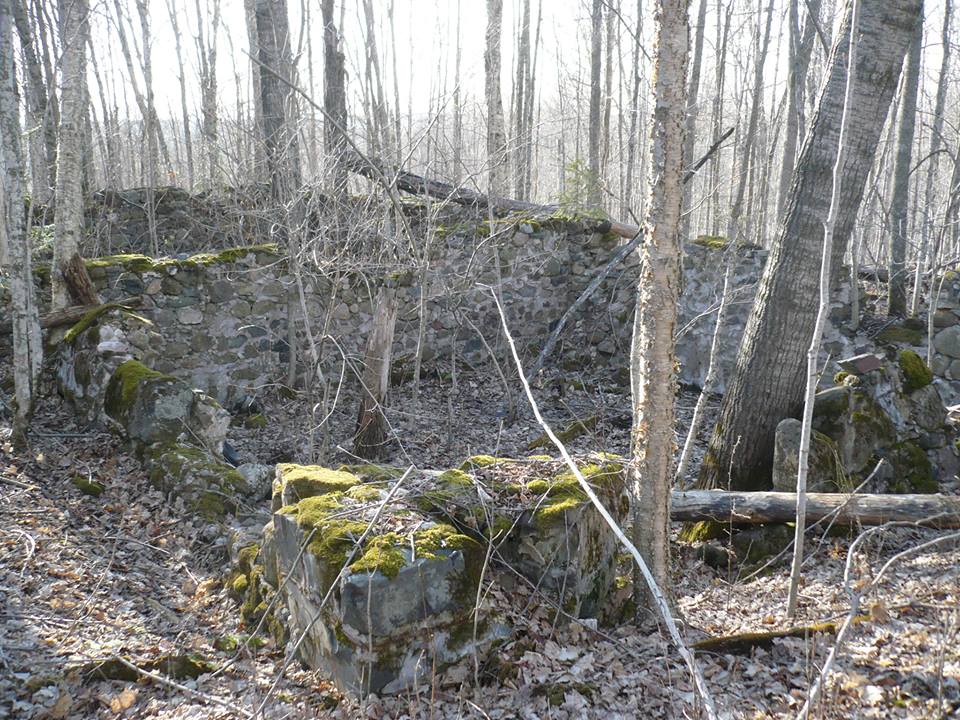
Lysander Cutler’s town plat ruins at the “Moore Location” of the Lac Courte Oreilles Harvest Education Learning Project (Paul DeMain © 2013).

Lysander Cutler and the Ironton Trail (Pioneer History of Milwaukee: 1847 by James Smith Buck)
The following story is told by James S. Buck, of this city, who was one of the colony, as illustrating his mode of discipline: Late one week it was discovered that there were not sufficient supplies to last over Sunday. Colonel Cutler dispatched one of his men to the lake, with instructions to load two half-breeds and send them forward to camp the next day, he agreeing to meet them at the half-way camp and pay them for their services. They arrived before him, in a surly mood, and without waiting except to get breath took up their loads and trudged back to Bayfield. Soon after Colonel Cutler arrived and having been informed of their return set out after them. He did not overtake them on the road, but entered Bayfield a few minutes behind them, and found them at the store sitting by the fire, with their packs, which they had just thrown off, by their sides. On entering he drew up his rifle and said: “Boys, you can have just half a minute to shoulder those packs and start for the range.” In less time than was allowed they were again on the return tramp, supported in the rear by the Colonel and his rifle. At the half-way camp they begged for rest, but the only reply from their implacable guard was: “March!” with an expletive which showed undoubtedly that he was in earnest. They reached the range late at night. It was the last attempt at breach of contract on the part of the half-breeds while he remained in that region.
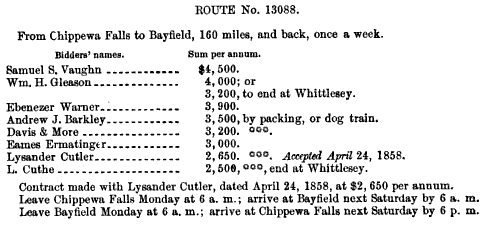
Cutler was contracted for carrying the mails in 1858 (United States Congressional serial set, Volume 1013).
In the Winter all the communication with the rest of the world was cut off, except by a weekly mail which was brought through from St. Paul by an Indian mail-carrier. Once during each Winter he made the trip on snow shoes, to St. Paul, a distance of over two hundred miles. The claim was at last secured, and a valid title to the land vested in the company. He left the region, at the end of two years, successful in this mission, and attained, while there, the general respect of all, both white and red, although his pet name among the Indians did not evince a love unmingled with fear; they called him “Gray Devil.” The dull times that followed put a long quietus on Western schemes of speculation, and Colonel Cutler’s company was laid on the shelf with many others of less merit, till more propitious times.

Cutler’s contract was not successful for long. (United States Congressional serial set, Issue 1041, Part 2).
In 1859 he engaged in the grains and commission business, in which he continued with indifferent success till the breaking out of the war.
The first gun fired on the flag seemed to rouse the full energies of his naturally pugnacious nature. It seemed as though the burdens of twenty years had fallen from his shoulders, and he showed the war-like enthusiasm of a young man of thirty instead of the more quiet demonstrations of a man who had already done the arduous work of a common lifetime. It was only in deference to the earnest protests of his friends that he did not enlist as a common soldier when the first call was made for ninety-day troops.

pg. 787 (History of Milwaukee, Wisconsin)
Colonel Cutler was commissioned as Colonel of the Sixth Wisconsin Regiment June 25, 1861. His regiment left the State July 28, and joined the forces around Washington August 7. August 29 it was attached to King’s Brigade, of which it remained a part during the war and shares in its imperishable renown as “The Iron Brigade.” During its first year of service Colonel Cutler was much of the time in command of the Brigade, and did much in perfecting it in discipline and tactics. His active service in the field commenced with the campaign of 1862. McDowell’s Division, to which the “Iron Brigade” was attached, did not participate in the peninsular battles of the campaign, being held as a reserve force to repel any overland demonstrations on the Capital, similar to that of the year before, which culminated in the first battle of Bull Run. During the earlier months of the campaign Colonel Cutler commanded the Brigade, till the assignment of Brigadier-General John Gibbons, May 2, when he again returned to his regiment. The Brigade was almost constantly on the march from point to point to avert threatened danger or mislead the enemy, till the beginning of August. On the fifth of that month the withdrawal of a part of the rebel forces from McClellan’s front, and a movement up the Shenandoah as well as toward Pope, commenced the active campaign. August 6, Colonel Cutler with his regiment and a New Hampshire regiment of cavalry penetrated into the enemy’s country as far as Frederick’s Hall Station, twenty-three miles from the junction of the Virginia Central with the Richmond & Potomac Railroad, and there tore up the track for a mile in each direction, thus cutting off the rebel communication between Richmond and Gordonsville. They also burned the depot, warehouse and telegraph office and destroyed a large amount of Confederate supplies. The expedition was entirely successful. During three days and one half the regiment had marched ninety miles, and were, when they struck the railroad, thirty miles from any support. It returned without the loss of aman. General Gibbon in his official report commended the regiment and Colonel Cutler as follows: “Colonel Cutler’s part in the expedition was completely successful. I can not refer in too high terms to the conduct of Colonel Cutler; to his energy and good judgment, seconded as he was by his fine regiment, the success of the expedition is entirely due.” On the 19th of August General Pope commenced his retreat. The “Iron Brigade” was for nearly ten days within sight of the enemy as they slowly worked their way up towards Washington, avoiding as much as possible any collision with the troops during its maneuvers to outflank Pope and if possible intercept him in his march to the defense of the threatened Capital. On the twenty-eighth having so far out-maneuvered him as to have separated the divisions of the army too far for support, the division of Longstreet fell upon the “Iron Brigade” which was marching toward Centerville on the Gainesville road. The Federal troops were outnumbered three to one, but they held the enemy in check till night put an end to the carnage which marked it as one of the most severe engagements of the war. How Colonel Cutler and Colonel Hamilton of Milwaukee bore themselves on that bloody field has been detailed in a previous chapter. They were severely wounded. Colonel Cutler had his horse shot under him, and was wounded by a minnie bail which passed entirely through his thigh, His wound was dangerous and kept him from active service till November 5, when he returned to the front and took command of the Brigade which he retained till the twenty-second, when General Sol. Merideth, who had been appointed Brigadier-General, assumed the command and he again returned to his regiment. At the battle of Fredericksburg he again led the “Iron Brigade,” being put in command during the action, after the Brigade had crossed the Rappahannock, and taken position in line of battle. Soon after he was appointed Brigadier-General, to date from November 29, I862, and assigned to the Second Brigade, First Division, First Army Corps. His Brigade with the “Iron Brigade” comprised the division commanded by Wadsworth. The corps was commanded by Major-General Reynolds. He fought through the Chancellorsville campaign, his Brigade covering the retreat after the three days’ slaughter was finished. At Gettysburg his brigade was in the advance, opened the battle and, with the “Iron Brigade,” sustained the brunt of the fighting on the memorable 1st of July 1863. During that day. his old regiment, the Sixth, was attached to his brigade. Major-General Newton, in his report, details the part taken in this action as follows:
“General Cutler was in the advance and opened the battle of Gettsyburg. In this severe and obstinate engagement he held the right for four hours, changing front without confusion, three times, under a galling fire, and lost, in killed and wounded, three-fourths of his officers and men, having three of his staff wounded and all the horses killed. When the order was given to retire, he marched the remnant of his brigade off the field in perfect order and checked the advance of Ewell’s corps, which gave the artillery time to retire. In effecting this he lost heavily. His brigade was engaged on the night of the second and the morning of the third in repulsing the assaults of the Rebels on the right of our line.”
During Grant’s campaign of 1864, General Wadsworth was killed in the second day’s battle in the Wilderness. On his death the command of the division devolved on General Cutler, which he held thereafter all through the series of battles that followed, and during the siege of Petersburg, until August 21, when he was wounded in the face while repulsing an assault on the Weldon Railroad. On the 15th of September, wounded and in broken health, from his long and arduous service, he was, at his own request relieved from field duty, and ordered to New York, to take charge of the forwarding of troops from that State. Subsequently he was ordered to the command of the draft camp of rendezvous at Jackson, Mich., where he remained till the close of the Rebellion. He was appointed Brevet Major-General. the commission to date from his last fight on the Weldon Railroad, August 21. 1864, He resigned July 1, 1865,and returned to Milwaukee. With the excitement of active duty gone, his recuperative powers failed to restore his impaired health, and his earthly career ended July 30, 1866. The following orders were issued at Madison on the occasion of his death, by Gov. Fairchild, one of his companions in arms, and by the G.A.R.
State of Wisconsin, Executive Department,
Madison. July 31, 1866.Executive Order No. 7.
The people of Wisconsin will hear with deep regret the announcement of the death of Brevet Major-General Lysander Cutler. at Milwaukee, on Monday the 30th inst.General Cutler was among the most efficient and best beloved soldiers from this State. Distinguished for his services, covered with honorable scars, filled with years and glory, he goes to his grave deeply mourned by the entire people of a sorrowing State.
As a testimony of respect, the flag upon the State Capitol will be displayed at half mast, on Tuesday, 31st of July, inst.
By the Governor,
Charles Fairchild, Military Secretary.LUCIUS FAIRCHILD
Headquarters Post No. 1. G.A.R;
Madison, July 31, 1866.Special Order No. 1.
It is my painful duty to announce the death of one of Wisconsin’s most devoted and prominent general officers during the late war, Major-General Lysander Cutler, of Milwaukee.
It is ordered that as a mark of respect to the deceased, the members oi’ this post wear the badge of mourning prescribed by army regulations, for the period or ten days from this date.
By command of
Henry Sanford, P.A.J.W. TOLFORD, P.C.
General Cutler was married in 1830, to Catherine W. Bassett. He had five children, two sons and three daughters, all of whom are still living. His widow still survives. In stature he was six feet tall and spare. His eyes were iron gray, deep set. and overhung by heavy eyebrows. He was prematurely gray, and during the later years of life both his hair and beard were white. His indomitable will and strict devotion to duty rendered him stern and uncompromising in his general bearing and appearance; but underneath his rough exterior beat a heart, as tender as a woman’s, that won the lasting love of all who came to know him well. To the toils, dangers and sufferings of his campaigns he never yielded, but on receiving the tidings of the death of his little grandson, who died while he was in the service, he took to his tent and bed, completely bowed and broken by the great grief that had smote his heart. The child and the grim old warrior now sleep side by side at Forest Home.

Gen. Lysander Cutler (Library of Congress Prints and Photographs Division)
 Chequamegon History