Penokee Survey Incidents: Number VII
April 16, 2015
By Amorin Mello

January 5, 1878.
The Survey of the Penoka Range and Incidents Connected with its Early History.
—
Number VII.
Upon the arrival of Gen. Cutler and myself at Milwaukee, December 25th, 1857, we found that the affairs of the Wisconsin & Lake Superior Mining and Smelting Company were in a very different condition, financially, from what they were when we left home, nearly eight months before. The great commercial storm, that, like a tidal wave, had swept over the country that year from Maine to California, had left its mark in wrecking many of the best business men of the “Cream City,” as well as elsewhere. Among these were some of the original stock holders of our company, who, unable to stand their assessments any longer, had, previous to our arrival, given place to others as green as they were originally themselves. Even some of the new stock holders were also subsequently compelled to sell out to other parties, not being any better able to respond when the call for more money was made upon them, than had their illustrious predecessors, thereby losing not only all they had invested, but what they had in prospect to make, as well.
Among those who stepped into the trap at this time and who remained in to the end were Messrs. Green & Button, who yet hold stock, John W. Pixley, Simeon N. Small, J.B.D. Coggswell and R.B. Bell, a one-horse banker who came to our city about that time. The outs being John Lockwood, who, in imagination, had been a large capitalist, and worth at least two hundred thousand dollars; but whose liabilities so far exceeded his ability to pay when brought to the front as to make him a hopeless bankrupt, was, with Palmer, Greves and Cummings, compelled to retire.
The amount of money expended up to this time, in order to obtain possession of this imaginary bonanza had not only floored these gentlemen, leaving them high and dry upon the shoals of commercial bankruptcy, but had so far exceeded the amount originally contemplated, as to make those of us who remained fear the wrath to come in view of the stringency of the money market, as well as the general stagnation of business, particularly, as from past experience, it was not possible to calculate with certainty what further amounts would be required, in order to insure success. A large force was still upon the Range, neither could it be withdrawn until the lands were entered, except at the risk of losing all that had been done. These men were to be paid as well as fed during the winter, which would of itself, require no inconsiderable sum; besides we must pay the Government for the land. Money must be raised, consequently, to go back was impossible; to go forward, equally so. But to go ahead was our motto, and the amount necessary for these purposes was at once raised by assessment upon those of us who were yet solvent, and the “pot kept a boiling.”
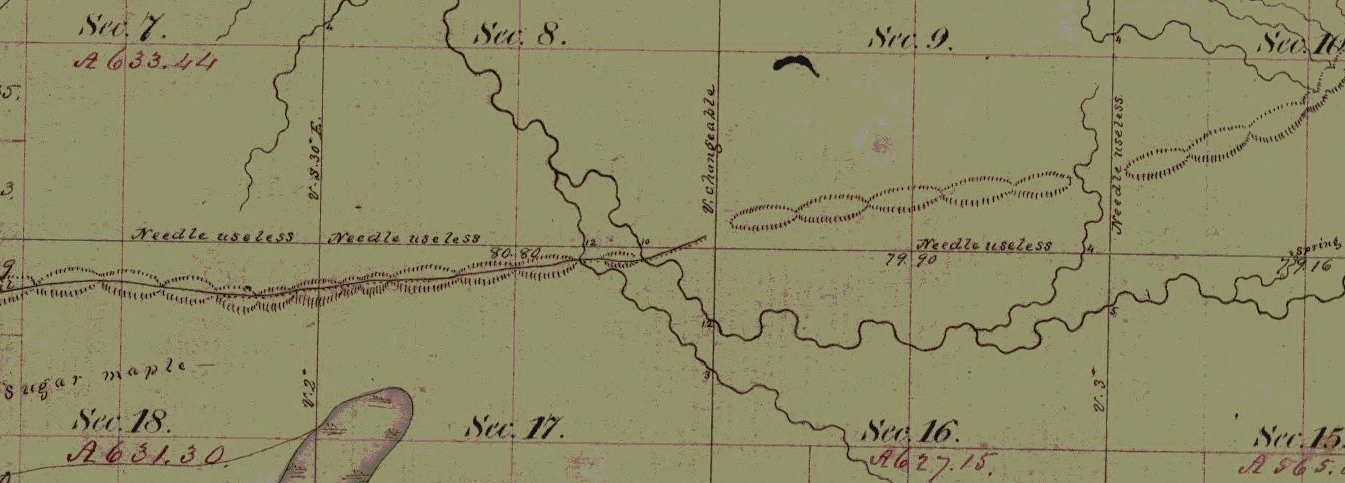
Wheelock’s unmarked townsite claim at Ballou Gap in the Iron Range with sugar bushes, artesian springs, and useless compasses. (Detail of Stuntz’s survey during September of 1857)
During the winter the improvements upon the Range spoken of as contemplated were pushed steadily forward under the skillful management of A.B. Wheelock, who was in every way, the man for the place, as in addition to completing the two block houses in good shape, twelve hundred pounds of sugar and forty gallons of molasses were made under his direction during the spring. The tubs for holding the sugar and syrup were all made during the winter at Penoka, by that Jack of all trades, Steve Sanborn, who could do almost as good work with a hatchet, knife, saw, auger and draw shave, as half the coopers and carpenters in the country, with a full set of tools.
Perhaps a short sketch of this singular mortal, so well known to many of Ashland’s early men, may not be uninteresting to your readers.
In height he was about five feet six inches, broad shoulders, arms long and sinewy, head large and wide; dark complexion, long, dark brown hair, blue eyes, face smooth and beardless, high cheek bones, long, wide, projecting chin, that was always getting up a muss with his nose, which was also long, and slightly hooked. He walked heavily, his knees usually about six inches in advance of his toes, giving his legs, which were bowed, the shape of an obtuse angle. Such was his personale. His conversational powers were not of the highest order – in fact he seldom spoke to any one; was fond of hunting and trapping, a vocation he usually followed every winter, remaining out alone for weeks together, at the Marengo, living upon mink, martin, muskrat, or any other kind of rat. He was always restless and uneasy, and could get outside of more bean soup and shanty bread at a sitting than any two men upon the Range. Such are my recollections of Stephen Sanborn. The last known of him was at Pike’s Peak, where, if living, he is no doubt following the same hermit life he loved so well upon Lake Superior.

Charter of the Ashland and Iron Mountain Railroad Company. ~ The Penokee Iron Range of Lake Superior, with Reports and Statistics Showing Its Mineral Wealth and Prospects: Charter and Organization of the Wisconsin and Lake Superior Mining and Smelting Company, 1860, pg 9
At length, after a winter of unusual mildness, similar to what the present one promises to be, gentle spring once more showed her smiling face, a signal to us to hurry up and complete our work; and as the returns of the survey were now all made, and the lands subject to entry, the necessary funds for entering them were placed in my hands, with which I returned to the Range, took the boys to Superior City, where they made their little affidavits, got their duplicates, and returned with me to La Pointe, where we met the General, who had followed me from Milwaukee, where the work of transferring the titles to the company was at once commenced and completed successfully with all except A.S. Stacy, who traitor-like, (to use a commercial term), “laid down” on us, refusing to convey, unless paid a bonus of one thousand dollars, which, if my memory is correct, and I’ll bet it is, he never got. The duplicates once in our possession, the patents were soon forthcoming, through influence brought to bear at Washington, after which, there being no prospect of doing anything with the lands at present, owing to the financial condition of the country, as well as the almost total prostration of the iron interest. The personal property was placed in store at Sibley’s and other points, until again wanted, and the Range abandoned about July 1, 1858. This abandonment, however, which was at the time supposed to be only temporary, proved in the end, to us at least, eternal. The fruits of our labors are not enjoyed by others. “We shook the bush and they caught the bird.” Notwithstanding that a railroad,- the Ashland and Iron Mountain, of which I, with others, was a corporator, was chartered in 1859, it was, as is well known, never built. We were finally compelled, after all, to see this whole thing, upon which we had spent so much money, and suffered so many hardships, slip from our grasp, and pass into the hands of those who had not labored for it. But so it is ever; one planeth, and another gathereth.

Corporate literature published by the Wisconsin & Lake Superior Mining and Smelting Company. ~ The Penokee Iron Range of Lake Superior, with Reports and Statistics Showing Its Mineral Wealth and Prospects: Charter and Organization of the Wisconsin and Lake Superior Mining and Smelting Company, 1860, pg 1

“List of Lands”
belonging to the Wisconsin & Lake Superior Mining & Smelting Company. ~ The Penokee Iron Range of Lake Superior, with Reports and Statistics Showing Its Mineral Wealth and Prospects: Charter and Organization of the Wisconsin and Lake Superior Mining and Smelting Company, 1860, pg 4
Such, Mr. Editor, is the history in brief, of the way, as well as by whom, the Penoka Range was first surveyed and located, and although we underwent much hardship and privation, yet I look back today upon that summer, as the pleasantest, in many respects, that I ever spent in Wisconsin. Neither would I hesitate, even now, to undertake the same again, and would like very much to see the old cabin at Penoka, which I am told is yet standing, in which I spent so many happy days in 1857.
The history of the Range from that time to the present is as well known to you as to me, and need not be dwelt upon further than to say that its possession did not make millionaires of any of us.
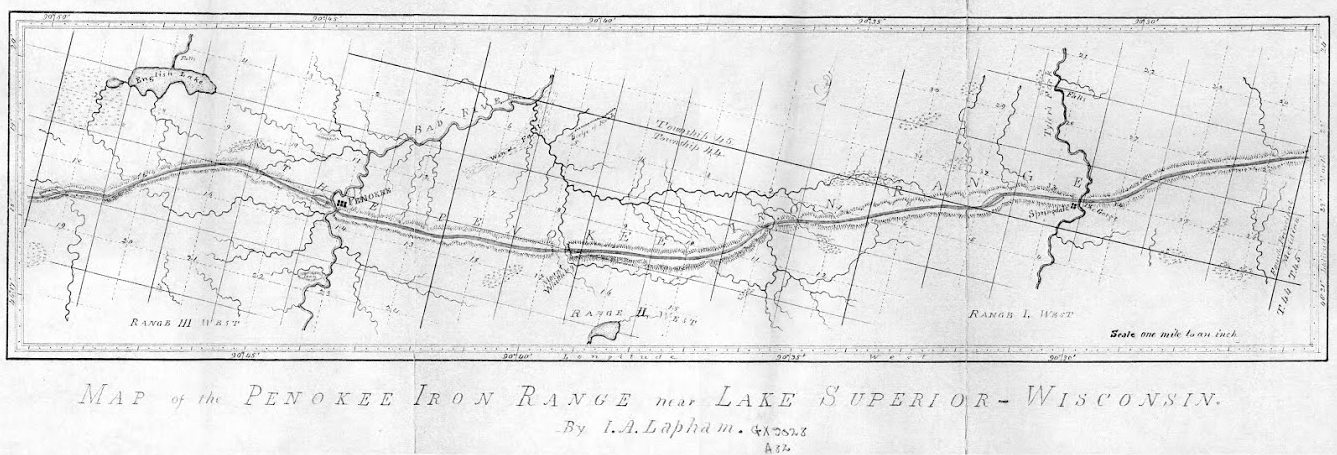
Increase A. Lapham surveyed the Penokee Iron Range on behalf of the Wisconsin & Lake Superior Mining and Smelting Company during 1858.
But what a change have these twenty years brought to the members, as well as the employees of the old company! Of the company, Palmer, Gen. Cutler, H. Hill, Sidebotham, Pixley, J.B.D. Cogswell, Small and Ripley have passed from earth. Lockwood and Harris are in New Orleans; J.F. Hill, J. Cummings and myself in Milwaukee, and Greves in California. Of the others I have no knowledge. Of the employees, Wheelock is upon a farm in Dakota; J.C. Cutler, at his home in Dexter, Maine; Whitcomb is in Milwaukee; Valliant, Stevens and Chase were killed in the late unpleasantness, and H.C. Palmer died in Milwaukee. Of the others I know not.
There are, however, many yet living with whom I became acquainted at that time, in Ashland and vicinity, for whom I have ever cherished the warmest personal friendship. If these sketches and reminiscences of long long ago have interested or amused them, I am glad. The writing of them has brought to mind many scenes and faces, that were almost forgotten, but which are as vivid now as though occurring yesterday. I hope, the coming season to see you all, and talk over old times, and make a trip to the Range over the old trail, every foot of which is accurately mapped in my eye. And now, as my task is done, at least for the present, I will bid the Press readers good-bye, and
Let Brother Whittlesey “spiel” it a while.
About that wonderful siege of Barlile.
J.S. Buck
Milwaukee, Dec. 18, 1877.
Penokee Survey Incidents: Number III
February 15, 2015
By Amorin Mello
December 1, 1877
The Survey of the Penoka Range and Incidents Connected with its Early History.
—
Number III.
~ Detroit Free Press, June 5, 1857
(MarinetimeHistoryoftheGreatLakes.ca)
Friend Fifield:- Upon the first arrival of Mr. Sidebotham and myself at La Pointe, in May, ’57, as previously stated, we took lodging at the “Hotel Angus,” the hospitalities of which we were forced to enjoy until some means could be found to communicate with Gen. Cutler. The Bay, as well as the Lake, was full of ice. In fact, we had been compelled to fight out way from the Sault to La Pointe, through heavy masses of ice, nearly the whole distance – and while upon this subject, I will say, that incredible as the statement may appear to many, yes it is a fact, that ice bergs were aground in front of Austrian’s Warehouse, at La Pointe, on the 4th day of July, 1857, in 36 feet of water, while at the same time a field of floating ice was visible from the Range, beyond which, no water could be seen. I verily believe that the lake was not wholly free from ice that summer.
~ Madeline Island Ferry Line
At length, after remaining at the hotel some eight or ten days, during which Mrs. Angus made us as happy as she could by her kindness and attention, Gen. Cutler came, accompanied by Mr. Herbert. This was the first time that either of us had ever seen Gen. Cutler, but on being informed who we were, he seemed overjoyed to see us, and at once made the proposition to me to take charge of the work, and let him return to Milwaukee, so thoroughly disgusted had he become with the whole thing. To this, however, I would not consent, whereupon he decided to remain, and at once directed Mr. Herbert, who was at that time still in our employ, to return at once to Ironton, taking a part of the supplies, which came up with us, of which they were in great need, Mr. Sidebotham accompanying him, leaving the General and myself at La Pointe. After a long consultation, the General decided to go below, after men and money, wherewith to complete the work; which he did, I following Mr. Sidebotham to Ironton, which place I reached in time to join Mr. Herbert’s party, just starting for the Range, which we reached the second day after leaving Ironton.
During its existence the taxable real estate in the Town of Bayport had increased from nothing to several hundred thousand dollars, principally through entry of pine lands in the south and western portions of the township and also by extensive entries of mineral properties on the Iron Range.”
~ The Lake Superior Country in History and in Story by Guy M Burnham, pg. 179
Omission was made in the list of stockholders given in my first chapter, of Mr. Herbert, whom name should have been included. His stock was, however, by special agreement, unassessable, as it was through his instrumentality, in part, that the existence of this most wonderful metallic deposit was first brought to the knowledge of the Company, and the work of surveying and locating is undertaken. It was this, together with the knowledge that his long residence in the country was supposed to give him, as to the best mode of conducting such an enterprise, that procured for him this aqucession, as well as the appointment of Agent. In justice, however, to Mr. Herbert, it is proper to state, that besides the work done, and money spent at Ironton, the place selected by him as the future shipping point for the iron, (50,000 tons of which he contemplated bringing there that season, at least he stated) considerable work had also been done upon the range during his administration; mostly, however, at Penoka, where a log cabin, yet standing, had been erected, and some thirty acres cleared, the timber being cut into cordwood, to be used in the manufacture of charcoal iron, for the making of which it was contemplated to erect the proper furnaces in the near future. Neither is it any injustice to say, that although perhaps he did the best he could, situated as he was, yet the work did not progress as fast as the company thought it should, the force, while under his control had became badly demoralized. The idea had obtained, if not with him it had with them, that they were working for a company of bloated bondholders,- had a soft thing, and meant to make the most of it; but with the advent of Gen. Cutler, a change came over the spirit of their dreams. Order was quickly brought out of chaos, and the discovery made that a master hand held the reins. Up to this time, May, ’57, the Range had never been visited by any of the company except Messrs. Palmer, Greves and Ripley, those visiting ’56 was one of exploration only, and as Gen. Cutler, Mr. Sidebotham and myself were the only ones that went up there in ’57, or who, in fact, over performed any work there, a short sketch of them will perhaps not be inappropriate in this connection, while awaiting, metaphorically speaking, the arrival of the expected reinforcements from below. And first of Gen. Cutler:

Lysander Cutler of Wisc. (Library of Congress Prints and Photographs Division, Washington, D.C.)
The Order of the County Board creating the Town of Bayport was made March 11, 1856, and the store of Schuyler Goff, in Bay City (Ellis Division) was designated as the place for holding the first election for town officers, the election to be held Tuesday, April 1, 1856.
The Town of Bayport comprised all that portion of LaPointe county (since changed to Ashland County) lying south of the north line of Town 48 North; in all over sixty-eight Townships, including the Bad River reservation, which was, on the 8th day of November, 1859, made a precinct by itself.
At the first election held April 1, 1856, there were 24 votes cast — resulting as follows; for Chairman of the Town Board, Schuyler Goff (later appointed County Judge, an office he held for a year or more). The other members of the town board being J.T. Welton and Asaph Whittlesey. Schuyler Goff, chairman elect, was the first officer to qualify, his oath of office being administered by Asaph Whittlesey, Justice of the Peace.”
~ The Lake Superior Country in History and in Story by Guy M. Burnham, pg. 179
Gen. Lysander L. Cutler was, in many respects, a remarkable man. In person he was rather above the medium height, large head, large, dark eyes, heavy eyebrows, a sure indication of a good memory, as well as firmness, dark hair, inclined to stand erect; walked, usually with a slow and dignified step, with his eyes apparently fixed upon the ground, as if in deep thought, leading an observer to suppose that he was not cognizant of what was being enacted around him. This, however, was a mistake; nothing escaped his observation. In fact, he seemed to know your very thoughts; neither could anyone be in his presence ten minutes without feeling the magnetic influence of his iron will. Was any dangerous work to be undertaken, he would, if within call, be the first one consulted, and appointed to take charge of it. He was a born leader. He was not only one of the best business men I ever knew, but he was also a leader in politics. A good judge of men, sharp and keen, and who ever undertook to circumvent him was sure to some grief, as some of the people who went about the Range did that summer, have no doubt, an abiding recollection. I refer now to Hall, of St. Paul, Minnesota, who undertook, with the assistance of S.R. Marston, a treacherous employee of the Company, and Schuyler Goff, of Racine, at that time a resident of La Pointe, to beat us out of our rights, by entering the lands upon the Range with Sioux Scrip, in which nefarious attempt they would no doubt have succeeded, but for him. He was more than a match for all of them, and they finally retired from the contest in disgrace. Such was Gen. L.L. Cutler, a firm friend, but an uncompromising enemy. Never will the writer forget the happy days spent with him upon the Range in the summer of 1857. We were like brothers, and our friendship was never interrupted by even a passing cloud. We fraternized at once upon our first meeting, and fought the battle for the possession of the Range together, never doubting our ultimately winning the prize. He has gone to his reward, in that bright world beyond the River; yet “in memory’s ever sleepless eye” he is often present with me.
Mr. Sidebotham, however, who was by birth an Englishman, and by occupation a cabinet maker, was of a different mould, and although an honest man, was by his habits of life, wholly unfitted for such an undertaking, and of no practical use whatever, and although not constantly at the Range, he was while there, an actual incumbrance, some one having to remain with him constantly; he could not accustom himself to the woods and its annoyance; was always complaining of his food, which of course soon brought him into contempt with the men. One of his peculiarities was a great fondness for sugar, particularly in his tea, which he could not, or thought he could not, drink without it, and as this was an article not always plenty, the boys would sometimes hide it, in order to see him hunt for it, which he would do most persistently until he found it. I remember on one occasion they hid it in a tree, and as he could not climb or chip, although in plain sight he could not get it. They had, as they expressed it, the “dead wood” on him that time. He finally became so afflicted with boils, on account of his sedentary habits and change of food, that it was with the utmost difficulty we were able to get him from the Range to Ashland, in December, where he remained until sufficiently recovered to be able to travel, after which he reached home in safety. He was the last to sell his stock, which, however, he finally did, to the late Simeon N. Small, claiming that as it was through much tribulation he had obtained it, he would not part with it except at his own price, which I believe he got. This purchase, although it gave Mr. Small a controlling interest in the stock, was ultimately the cause of his financial ruin. J.S.B.
[from same issue of The Ashland Press]
Whittlesey on Early Times in Ashland.
—
~ The Monthly Magazine; A Monthly Journal of American History, Volume 9, 1888, pg. 18
Editor Ashland Press.- In your last issue of the 24th inst., your correspondent “J.S.B.,” in his Early Recollections of Ashland, makes very portient reference to two of Ashland’s prominent citizens of early days, known as “Sibley” and “Lazarus,” stating that in laziness they were competitors for the belt. My own recollection tells me that of this same Sibley had gained some notoriety for telling big yarns, but in this I think he ultimately gave way to John Beck. On one occasion, Sibley arrived in town on foot and alone, and entering a crowd of the boys, addressing himself to Lazarus, said: “Lazarus, I want you to go and help me get my team into town. It now stands in the mud near the head of Main St.” to which Lazarus replied, “I’ll go, if you will first tell us the biggest lie you ever told.” Sibley responded, “Lazarus, I don’t lie.” Lazarus says, “That will do, I’ll go and help you.” I am personally knowing to the fact that this same Lazarus has been known at several different times when he was “keeping back” in cold winters, to remain in beds two nights and the intervening day, to avoid the necessity of cutting wood and cooking a meal; nevertheless, “George E.,” as Lazarus was otherwise known, was a man of much more than usual ability, and was a surveyor had few superiors. We were all glad to have him show himself, and to witness his alacrity in getting upon the “off side” of any proposition that might be submitted.
I hope that brother “J.S.B.” may be heard from again, and that he may tell us more in regard to the crowd of pre-emptors imported by himself and others, (modesty forbids me to mention who,) tending almost invariably to bankruptcy. You, sir, were at the head of some “noble boys,” and you, too, had your share of tough cases. Should I sufficiently recover my strength to enable me to do so, I may hereafter open out on my “Early Recollections” of the place, and if I do attempt it, let all “stand from under,” for “At the siege of Barlisle, I was there all the while.”
W.
Bayfield, Wis., Nov. 24, 1877.
 Chequamegon History