By Leo Filipczak
Joseph Oesterreicher was only eighteen years old when he arrived at La Pointe in 1851. Less than a year earlier, he had left his native Germany for Mackinac, where he’d come to work for the firm of his older brother Julius and their in-laws, the Leopolds, another Bavarian Jewish family trading on Lake Superior.
In America, the Oesterreichers became the Austrians, but in his time at Mackinac, Joseph Austrian picked up very little English and even less of the Ojibwe and Metis-French that predominated at La Pointe. So, when Joseph made the move to his brother’s store at Madeline Island, it probably felt like he was immigrating all over again.
In the spring of 1851, he would have found at La Pointe, a society in flux. American settlement intensified as the fur trade economy made its last gasps. The island’s mix-blooded voyageurs found it harder and harder to make a living, and the Fur Company, and smaller traders like Julius Austrian, began to focus more on getting Ojibwe money from treaty annuity payments than they did from the actual trade in fur. This competition for Indian money had led to the deaths of hundreds of Ojibwe people in the Sandy Lake tragedy just a few months earlier.
The uncertainty surrounding Ojibwe removal would continue to hang heavily over the Island for both of Joseph’s years at La Pointe, as the Ojibwe leadership scrambled to process the horror of Sandy Lake and tried to secure a permanent homeland on the lakeshore.
The Austrians, however, found this an opportune time to be at the forefront of all the new business ventures in the Lake Superior country. They made money in merchandise, real estate, shipping, mining, lumber, government contracts, and every other way they could. This was not without controversy, and the name of Julius Austrian is frequently attached to documents showing the web of corruption and exploitation of Native people that characterized this era.
It’s difficult to say whether Joseph realized in 1851, while sweeping out his brother’s store or earning his unfortunate nickname, but he would become a very wealthy man. He lived into the 20th century and left a long and colorful memoir. I plan to transcribe and post all the stories from pages 26-66, which consists of Joseph’s time at La Pointe. Here is the first fourth [our original] installment:
Memoirs of Doodooshaboo
… continued from Mackinac 1850-1851.
Left for La Point: My First Trip on Lake Superior
1851

Julius Austrian
~ Madeline Island Museum
Mr. Julius Austrian was stationed at La Pointe, Madaline Island, one of the Apostle Group in Lake Superior, where he conducted an Indian Trading post, buying large quantities of fur and trading in fish on the premises previously occupied by the American Fur Co. whose stores, boats etc. the firm bought.
Julius Austrian, one of the partners had had charge of the store at La Point for five years past, he was at this time expected at Mackinaw and it had been arranged that I should accompany him back to La Pointe when he returned there, on the first boat of the season leaving the Sault Ste. Marie. I was to work in the store and to assist generally in all I was capable of at the wages of $10 a month. I gladly accepted the proposition being anxious for steady employment. Shortly after, brother Julius, his wife (a sister of H. Leopold) and I started on the side wheel steamer Columbia for Sault Ste. Marie, generally called “The Soo,” and waited there five days until the Napoleon, a small propellor on which we intended going to La Point, was ready to sail. During this time she was loading her cargo which had all to be transported from the Soo River to a point above the rapids across the Portage (a strip of land about ¾ of a mile connecting the two points) on a train road operated with horses. At this time there were only two propellers and three schooners on the entire Lake Superior, and those were hauled out below the rapids and moved up and over the portage and launched in Lake Superior. Another propeller Monticello, which was about half way across the Portage, was soon to be added to the Lake Superior fleet, which consisted of Independence & Napoleon and the Schooners Algonquin, Swallow, and Sloop Agate owned by my brother Julius. Quite different from the present day, where a very large number of steel ships on the chain of Lakes, some as much as 8000 tons capacity, navigate through the canal to Lake Superior from the lower lakes engaged in transporting copper, iron ore, pig iron, grain & flour from the various ports of Marquette, Houghton, Hancock, Duluth, and others. It was found necessary in later years to enlarge the locks of the canal to accomodate the larger sized vessels that had been constructed.
Building Sault Ste. Marie Canal. 1851.

Map of proposed Soo canal and locks 1852 (From The Honorable Peter White by Ralph D. Williams, 1910 pg. 121)
The ship canal at that time had not been constructed, but the digging of it had just been started. The construction of this canal employed hundreds of laborers, and it took years to complete this great piece of work, which had to be cut mostly through the solid rock. The State of Michigan appropriated thousands of sections of land for the purpose of building this canal, for the construction of which a company was incorporated under the name of Sault Ste. Marie Ship Canal & Land Co., who received the land in payment for building this canal, and which appropriation entitled the Co. to located in any unsold government land in the State of Michigan. The company availed itself of this privilege and selected large tracts of the best mineral and timber land in Houghton, Ontonagan & Kewanaw Counties, locating some of the land in the copper district, some of which proved afterwards of immense value, and on which were opened up some of the richest copper mines in the world, namely: Calumet, Hecla, and Quincy mines, and others. There were also very valuable timber lands covered by this grant.
The canal improved and enlarged as it now stands, is one of the greatest and most important artificial waterways in the world. A greater tonnage is transported through it annually that through the Suez or any other canal. In later years the canal was turned over by the State of Mich. to the General Government, which made it free of toll to all vessels and cargoes passing through it, even giving Canadian vessels the same privilege; whereas when operated by the State of Mich. toll was exacted from all vessels and cargoes using it.
The Napoleon, sailed by Capt. Ryder, had originally been a schooner, it had been turned into a propeller by putting in a small propeller engine. She had the great (?) speed of 8 miles an hour in calm weather, and had the reputation of beating any boat of the Lake in rolling in rough weather, and some even said she had rolled completely over turning right side up finally.

To return to my trip, after passing White Fish Point, the following day and getting into the open lake, we encountered a strong north wind raising considerable sea, causing our boat to toss and pitch, giving us our first experience of sea sickness on the trip. Beside the ordinary crew, we had aboard 25 horses for Ontonogan where we arrived the third day out. The Captain finding the depth of water was not sufficient to allow the boat to go inside the Ontonogan river and there being no dock outside, he attempted to land the horses by throwing them overboard, expecting them to swim ashore, to begin with, he had three thrown overboard and had himself with a few of his men lowered in the yawl boat to follow, he caught the halter of the foremost horse intending to guide him and the others ashore. The lake was exceedingly rough, and the poor horses became panic stricken and when near the shore turned back swimming toward the boat with hard work. The Captain finally succeeded in land those that had been thrown overboard, but finding it both hazardous to the horses and the men he concluded to give up the attempt to land the other horses in this way, and ordered the life boat hoisted up aboard. She had to be hoisted up the stern, in doing so a heavy wave struck and knocked it against the stern of the boat before she was clear of the water with such force as to endanger the lives of the Capt. and men in it, and some of the passengers were called on to assist in helping to hoist the life boat owing to its perilous position. Captain and the men were drenched to the skin, when they reached the deck. Capt. vented his rage in swearing at the hard luck and was so enraged that he did not change his wet clothing for some time afterward. The remaining horses were kept aboard to be delivered on the return trip, and the boat started for her point of destination La Point.
Arrived at La Point and Started in Employ of Brother Julius. 1851
Next morning we sighted land, which proved to be the outer island of the Apostle Group. Captain flew into the wheel room and found the wheelsman fast asleep. He grasped the wheel and steered the boat clear of the rocks, just in time to prevent the boat from striking. Captain lost no time in changing wheelsman. We arrived without further incidents at La Point the same afternoon. When she unloaded her cargo, work was at once begun transferring goods to the store, in which I assisted and thus began my regular business career. These goods were hauled to the store from the dock in a car, drawn by a horse, on wooden rails.
There were only about 6 white American inhabitants on the Island, about 50 Canadian Frenchmen who were married to squaws, and a number of full blooded Indians, among whom was chief Buffalo who was a descendant of chiefs & who was a good Indian and favorably regarded by the people.

Fr. Otto Skolla (self-portrait contained in History of the diocese of Sault Ste, Marie and Marquette (1906) by Antoine Ivan Rezek; pg.360; Digitized by Google Books)
The most conspicuous building in the place was an old Catholic Church which had been created more than 50 years before by some Austrian missionaries. This church contained some very fine and valuable paintings by old masters. The priest in charge there was Father Skolla, an Austrian, who himself was quite an artist, and spent his leisure hours in painting Holy pictures. The contributions to the church amounted to a mere pittance, and his consequent poverty allowed him the most meager and scant living. One Christmas he could not secure any candles to light up his church which made him feel very sad, my sister-in-law heard of this and sent me with a box of candles to him, which made him the happiest of mortals. When I handed them to him, his words were inadequate to express his gratitude and praise for my brother’s wife.
There was also a Methodist church of which a man by the name of Hall was the preacher. He had several sons and his family and my brother Julius and his wife were on friendly terms and often met.
The principle man of the place was Squire Bell, a very genial gentleman who held most of the offices of the town & county, such as Justice of the Peace & Supervisor. He also was married to a squaw. This was the fashion of that time, there being no other women there.

 John W. Bell, “King of the Apostle Islands” as described by Benjamin Armstrong (Digitized by Google Books) .
There was a school in the place for the Indians and half breeds, there being no white children there at this time. I took lessons privately of the teacher of this school, his name was Pulsevor. I was anxious to perfect myself in English. I also picked up quite a bit of the Chippewa language and in very short time was able to understand enough to enable me to trade with the Indians.
My brother Julius was a very kind hearted man, of a very sympathetic and indulgent nature, and to his own detriment and loss he often trusted needy and hungry Indians for provisions and goods depending on their promise to return the following year with fur in payment for the goods. He was personally much liked and popular with the Indians, but his business with them was not a success as the fur often failed to materialize. The first morning after my arrival, my brother Julius handed me a milk pail and told me to go to the squaws next door, who having a cow, supplied the family with the article. He told me to ask for “Toto-Shapo” meaning in the Indian language, milk.
I repeated this to myself over and over again, and when I asked the squaw for “Toto Shapo” she and all the squaws screamed with delight and excitement to think that I had just arrived and could make myself understood in the Indian tongue. This fact was spread among the Indians generally and from that day on while I remained on the Island I was called “Toto Shapo.” One of the Indian characteristics is to name people and things by their first impression–for instance on seeing the first priest who work a black gown, they called him “Makada-Conyeh,” which means a black gown, and that is the only name retained in their language for priests. The first soldier who had a sword hanging by his side they called “Kitchie Mogaman” meaning “a big knife” in their language. The first steamboat they saw struck them as a house with fire escaping through the chimney, consequently they called it “Ushkutua wigwam” (Firehouse) which is also the only name in their language for steamboat. Whiskey they call “Ushkutua wawa” meaning “Fire Water.”
My brother Julius had the United States mail contract between La Point & St. Croix. The mail bag had to be taken by a man afoot between these two places via Bayfield a distance of about 125 miles, 2 miles of these being across the frozen lake from the Island to Bayfield.
Dangerous Crossing on the Ice.
An Indian named Kitchie (big) Inini (man) was hired to carry it. Once on the way on he started to cross on the ice but found it very unsafe and turned back. When my brother heard this, he made up his mind to see that the mail started on its way across the Lake no matter what the consequence. He took a rope about 25 ft. long tying one end around his body and the other about mine, and he and I each took a long light pole carrying it with two hands crosswise, which was to hold us up with in case we broke through the ice. Taking the mail bag on a small tobogan sled drawn by a dog, we started out with the Indian. When we had gone but a short way the ice was so bad that the Indian now thoroughly frightened turned back again, but my brother called me telling me not to pay any attention to him and we went straight on. This put him to shame and he finally followed us. We reached the other side in safety, but had found the crossing so dangerous, that we hesitated to return over it and thought best to wait until we could return by a small boat, but the time for this was so uncertain that after all we concluded to risk going back on the ice taking a shorter cut for the Island, and we were lucky to get back all right.
In the summer when the mail carrier returned from these trips, he would build a fire on the shore of the bay about 5 miles distant, as a signal to send a boat to bring him across to the Island. Once I remember my brother Julius not being at home when a signal was given. I with two young Indian boys (about 12 yrs. of age) started to cross over with the boat, when about two miles out a terrific thunder and hail storm sprang up suddenly. The hail stones were so large that it caused the boys to relax their hold on the oars and it was all I could do to keep them at the oars. I attempted to steer the boat back to the Island, and barely managed to reach there. The boat was over half full of water when we reached the shore. When I landed we were met by the boys’ mothers who were greatly incensed at my taking their boys on this perilous trip, nearly resulting in drowning them. They didn’t consider I had no idea of this terrible thunder storm which so suddenly came up and had I known it for my own safety would not dreamed of attempting the trip.
Nearly Capsize in a Small Boat.
Once I went out in a small sail boat with two Frenchmen to collect some barrels of fish near the Island at the fishing ground near La Point. We got two barrels of fish which they stood up on end, when a sudden gust of wind caused the boat to list to one side so that the barrels fell over on the side and nearly capsized the boat. By pulling the barrels up the boat was finally righted after being pretty well filled with water. I could not swim, and as a matter of self-preservation grabbed the Frenchman nearest me. He was furious, expressing his anger half in French and half in English, saying, “If I had drowned, I would have taken him with me.” which no doubt was true.
A Young Indian Locked up for Robbery
One day brother Julius went to the Indian payment. During his absence I with another employee, Henry Schmitz, were left in charge. A young Indian that night burglarized the store stealing some gold coins from the cash drawer. The same were offered to someone in the town next day who told me, which led to his detection. He admitted theft and was committed to jail by the Indian agent Mr. Watrous, which the Indians consider a great disgrace.
Some inquisitive boys peering through the window discovered that the young Indian had attempted to commit suicide and spread the alarm. His father was away at the time and his mother and friends were frenzied and their threats of vengeance were loud. The jailer was found but he had lost the key to the jail (the jail was in a log hut) the door of which was finally forced open with an axe, and the young culprit with his head bleeding was handed over to his people who revived him in their wigwam. The next day the money was returned and we and the authorities were glad to call it quits.
To be continued at La Pointe 1851-1852 (Part 2)…
Special thanks to Amorin Mello and Joseph Skulan for sharing this document and their important research on the Austrian brothers and their associates with me. It is to their credit that these stories see the light of day. The original handwritten memoir of Joseph Austrian is held by the Chicago History Museum.
Ishkigamizigedaa! Bad River Sugar Camps 1844
March 15, 2014

Indian Sugar Camp by Seth Eastman c.1850 (Minnesota Historical Society)
Since we’re into the middle of March 2014 and a couple of warm days have had people asking, “Is it too early to tap?” I thought it might be a good time to transcribe a document I’ve been hanging onto for a while.
170 years ago, that question would have been on everyone’s mind. The maple sugar season was perhaps the most joyous time of the year. The starving times of February and early March were on the way out, and food would be readily available again. Friends and relatives, separated during the winter hunts, might join back together in sugar camp, play music around the fire as the sap boiled, and catch up on the winter’s news.
Probably the only person around here who probably didn’t like the sugar season was the Rev. Sherman Hall. Hall, who ran the La Pointe mission and school, aimed to convert Madeline Island’s Native and non-Native inhabitants to Protestantism. To him, Christianity and “civilization” went hand and hand with hard labor and settling down in one place to farm the land. When, at this time of the year, all his students abandoned the Island with everyone else, for sugar camps at Bad River and elsewhere on the mainland and other islands, he saw it as an impediment to their progress as civilized Christians.
Rev. Leonard Wheeler, who joined Hall in 1841, shared many of his ethnocentric attitudes toward Ojibwe culture. However, over the next two decades Wheeler would show himself much more willing than Hall and other A.B.C.F.M. missionaries to meet Ojibwe people on their own cultural turf. It was Wheeler who ultimately relocated from La Pointe to Bad River, where most of the La Pointe Band now stayed, partly to avoid the missionaries, where he ultimately befriended some of the staunchest traditionalists among the Ojibwe leadership. And while he never came close to accepting the validity of Ojibwe religion and culture, he would go on to become a critical ally of the La Pointe Band during the Sandy Lake Tragedy and other attempted land grabs and broken Government promises of the 1850s and ’60s.
In 1844, however, Wheeler was still living on the island and still relatively new to the area. Coming from New England, he knew the process and language of making sugar–it’s remarkable how little the sugar-bush vocabulary has changed in the last 170 years–but he would see some unfamiliar practices as he followed the people of La Pointe to camp in Bad River. Although there is some condescending language in his written account, not all of his comparisons are unfavorable to his Ojibwe neighbors.
Of course, I may have a blind spot for Wheeler. Regular readers might not be surprised that I can identify with his scattered thoughts, run-on sentences, and irregular punctuation. Maybe for that reason, I thought this was a document that deserved to see the light of day. Enjoy:
Bad River Monday March 25, 1844
We are now comfortably quartered at the sugar camps, Myself, wife, son and Indian Boy. Here we have been just three weeks today.
I came myself the middle of the week previous and commenced building a log cabin to live in with the aid of two men , we succeeded in putting up a few logs and the week following our house was completed built of logs 12 by 18 feet long and 4 feet high in the walls, covered with cedar birch bark of most miserable quality so cracked as to let in the wind and rain in all parts of the roof. We lived in a lodge the first week till Saturday when we moved into our new house. Here we have, with the exception of a few very cold days, been quite comfortable. We brought some boards with us to make a floor–a part of this is covered with a piece of carpeting–we have a small cooking stove with which we have succeeded in warming our room very well. Our house we partitioned off putting the best of the bark over the best part we live in, the other part we use as a sort of storeroom and woodhouse.
We have had meetings during on the Sabbath and those who have been accustomed to meet with us have generally been present. We have had a public meeting in the foreroom at Roberts sugar bush lodge immediately after which my wife has had a meeting with the women or a sabbath school at our house. Thus far our people have seemed to keep up their interest in Religion.
They have thus far generally remembered the Sabbath and in this respect set a good example to their neighbors, who both (pagan) Indians and Catholics generally work upon the Sabbath as upon other days. If our being here can be the means of preventing these from declension in respect to religion and from falling into temptation, (especially) in respect to the Sabbath, an important end will be gained.
The sugar making season is a great temptation to them to break the sabbath. It is quite a test upon their faith to see their sap buckets running over with sap and they yet be restrained from gathering it out of respect to the sabbath, especially should their neighbors work in the same day. Yet they generally abstain from Labor on the Sabbath. In so doing however they are not often obliged to make much sacrifice. By gathering all the sap Saturday night, their sap buckets do not ordinarily make them fill in one day, and when the sap is gathered monday morning.
They do not in this respect suffer much loss. In other respects, they are called to make no more sacrifice by observing the sabbath than the people of N.E. do during the season of haying. We are now living more strictly in the Indian country among an Indian community than ever before. We are almost the only persons among a population of some 5 or 600 people who speak the English language. We have therefore a better opportunity to observe Indian manners and customs than heretofore, as well as to make proficiency in speaking the language.
Process of making sugar and skillful use of birch bark.
The process of making sugar from the (maple) sap is in general as that practiced elsewhere where this kind of sugar is make, and yet in some respects the modus operandi is very different. The sugar making season is the most an important event to the Indians every year. Every year about the middle of March the Indians, French and halfbreeds all leave the Islands for the sugar camps. As they move off in bodies from the La Pointe, sometimes in companies of 8, 10, 12 or 20 families, they make a very singular appearance.
Upon some pleasant morning about sunrise you will see these, by families, first perhaps a Frenchman with his horse team carrying his apuckuais for his lodge–provisions kettles, etc., and perhaps in addition some one or two of the [squaw?] helpers of his family. The next will be a dog train with two or three dogs with a similar load driven by some Indians. The next would be a similar train drawn by a man with a squaw pushing behind carrying a little child on her back and two or three little children trudging behind on foot. The next load in order might be a squaw drawn by dogs or a man upon a sled at each end. This forms about the variety that will be witnessed in the modes of conveyance. To see such a ([raucous?] company) [motley process?] moving off, and then listen to the Frenchmen whipping his horse, which from his hard fare is but poorly able to carry himself, and to hear the yelping of the dogs, the (crying of) the children, and the jabbering in french and Indian. And if you never saw the like before you have before you the loud and singular spectacle of the Indians going to the sugar bush.

“Frame of Lodge Used For Storage and Boiling Sap;” undated (Densmore Collection: Smithsonian)
One night they are obliged to camp out before they reach the place of making sugar. This however is counted no hardship the Indian carries his house with him. When they have made one days march it might when they come to a place where they wish to camp, all hands set to work to make to make a lodge. Some shovel away the snow another cut a few poles. Another cuts up some wood to make a fire. Another gets some pine, cedar or hemlock (boughs) to spread upon the ground for floor and carpet. By the time the snow is shoveled away the poles are ready, which the women set around in a circular form at the bottom–crossed at the top. These are covered with a few apuckuais, and while one or two are covering the putting up the house another is making a fire, & perhaps is spreading down the boughs. The blankets, provisions, etc. are then brought in the course of 20 or ½ an hour from the time they stop, the whole company are seated in their lodge around a comfortable fire, and if they are French men you will see them with their pipes in their mouths. After supper, when they have anything to eat, each one wraps himself in a blanket and is soon snoring asleep. The next day they are again under way and when they arrive at the sugar camp they live in their a lodge again till they have some time to build a more substantial (building) lodge for making sugar. A sugar camp is a large high lodge or a sort of a frame of poles covered with flagg and Birch apuckuais open at the top. In the center is a long fire with two rows of kettles suspended on wooden forks for boiling sap. As Robert (our hired man) sugar makes (the best kind of) sugar and does business upon rather a large scale in quite a systematic manner. I will describe his camp as a mode of procedure, as an illustration of the manner in which the best kind of sugar is made. His camp is some 25 or 30 feet square, made of a sort of frame of poles with a high roof open at the (top) the whole length coming down with in about (4 feet) of the ground. This frame is covered around the sides at the bottom with Flag apukuais. The outside and roof is covered with birch (bark) apukuais. Upon each side next to the wall are laid some raised poles, the whole length of the (lodge) wall. Upon these poles are laid some pine & cedar boughs. Upon these two platforms are places all the household furniture, bedding, etc. Here also they sleep at night. In the middle of the lodge is a long fire where he has two rows of kettles 16 in number for boiling sap. He has also a large trough, one end of it coming into the lodge holding several Barrels, as a sort of reservoir for sap, beside several barrels reserved for the same purpose. The sap when it is gathered is put into this trough and barrels, which are kept covered up to prevent the exposure of the sap to the wind and light and heat, as the sap when exposed sours very quick. For the same reason also when the sap and well the kettles are kept boiling night and day, as the sap kept in the best way will undergo some changes if it be not immediately boild. The sap after it is boild down to about the consistency of molases it is strained into a barrel through a wollen blanket. After standing 3 or 4 days to give it an opportunity to settle, some day, when the sap does not run very well, is then set aside for sugaring off. When two or 3 kettles are hung over the fire a small fire built directly under the bottom. A few quarts of molasses are then put into the kettles. When this is boiled enough to make sugar one kettle is taken off by Robert, by the side of which he sets down and begins to stir it with a small paddle stick. After stirring it a few moments it begins to grow all white, swells up with a peculiar tenacious kind of foam. Then it begins to grain and soon becomes hard like [?] Indian pudding. Then by a peculiar moulding for some time with a wooden large wooden spoon it becomes white as the nicest brown sugar and very clean, in this state, while it is yet warm, it is packed down into large birch bark mukoks made of holding from 50 to a hundred lbs.
 Makak: a semi-rigid or rigid container: a basket (especially one of birch bark), a box (Ojibwe People’s Dictionary) Photo: Densmore Collection; Smithsonian
Certainly no sugar can be more cleaner than that made here, though it is not all the sugar that is made as nice. The Indians do not stop for all this long process of making sugar. Some of (their) sorup does not pass through anything in the shape of a strainer–much less is it left to stand and settle after straining, but is boiled down immediately into sugar, sticks, soot, dirt and all. Sometimes they strain their sorup through the meshes of their snow shoe, which is but little better than it would be to strain it through a ladder. Their sugar of course has rather a darker hue. The season for making sugar is the most industrious season in the whole year. If the season be favorable, every man wom and child is set to work. And the departments of labor are so various that every able bodied person can find something to do.
 The British missionary John Williams describes the coconut on page 493 of his A Narrative of Missionary Enterprises in the South Sea Islands (1837). (Wikimedia Commons)
In the business of making sugar also we have a striking illustration of the skillful and varied use the Indians make of birch bark. A few years since I was forcibly struck, in reading Williams missionary enterprises of the South Seas, with some annals of his in regard to the use of the cocoanut tree illustrated of the goodness and wisdom of God in so wonderfully providing for their condition and wants (of men). His remarks as near as I can recollect are in substance as follows. The cocoanut tree furnishes the native with timber to make his house, canoe, his fire and in short for most of the purposes for which they want wood. The fruit furnishes his most substantial article of food, and what is still more remarkable as illustrating that principle of compensation by which the Lord in his good providence suplies the want of one blessing by the bestowment of another to take its place. On the low islands their are no springs of water to supply the place of this. The native has but to climb the cocoanut tree growing near his door and pluckes the fruit where in each shall he find from ¼ a pint to a kind of a most agreeable drink to slake his thirst. His tree bearing fruit every month in year, fresh springs of water are supplied the growing upon the trees before his own door. Although the birch bark does not supply the same wants throughout to the Indian, yet they supply wants as numerous and in some respects nearly as important to their mode of living as does the cocoanut to the Inhabitants of the South Sea Islands.
 Biskitenaagan: a sap bucket of folded birch bark (Ojibwe People’s Dictionary) Photo: Waugh Collection; Smithsonian
It is with the bark he covers his house. With this bark he makes his canoe. What could the Indian do without his wigwam and his canoe? The first use (of the bark) we notice in the sugar making business what is called the piscatanagun, or vessel for catching sap in. The Indian is not to the expence or trouble of making troughs or procuring buckets to catch the sap at the trees. A piece of birch bark some 14 inches wide and 18 or 20 inches wide in the shape of a pane of glass by a peculiar fold at each end kept in place by a stitch of bark string makes a vessel for catching sap called a piskitenagun. These are light, cheap, easily made and with careful usage will last several years. When I first saw these vessels, it struck me as being the most skillful use of the bark I had seen. It contrasted so beautifully with the clumsy trough or the more expensive bucket I had seen used in N.E. This bark is not only used to catch the sap in but also to carry it in to the sugar camps, a substitute for pails, though lighter and much more convenient for this purpose than a pail.
 “Chippewa Bucket and Trays Made of Birch Bark” (
In making a sap bucket bark of a more substantial kind is used than for the piskatanaguns. They made large at the bottom small at the top, to prevent the sap from spilling out by the motion of carrying. They are sewed up with bark the seams gummed and a hoop about the top to keep them in shape and a lid. But we are not yet done with the bark at the sugar bush. In boiling sap in the evening thin strips are rolled tight together, which is a good substitute for a candle. Every once in a little while the matron of the lodge may be seen with her little torch in hand walking around the fire taking a survey of her kettles. Lastly when the sugar is made it is finally deposited in large firmly wrought mukuks, which are made of bark. This however is not the end of bark. It is used for a variety of other purposes. Besides being a substitute in many cases for plates, [bearers & etc.?], it is upon birch bark that the most important events in history are recorded–National records–songs, & etc. are written in hieroglific characters (upon this article) and carefully preserved by many of the Indians.
And finally the most surprising use of bark of which I have heard or could conceive of, is before the acquaintance of the Indians with the whites, the bark was used as a substitute for kettles in cooking, not exactly for bake kettles but for (kettles for) boiling fish, potatoes, & etc. This fact we have from undoubted authority. Some of the Indians now living have used it for this purpose themselves, and many of them say their fathers tell them it was used by their ancestors before iron kettles were obtained from the whites. One kettle of bark however would not answer but for a single use.
Transcription note: Spelling and grammatical errors have been maintained except where ambiguous in the original text. Original struck out text has been maintained, when legible, and inserted text is shown in parentheses. Brackets indicate illegible or ambiguous text and are not part of the original nor are the bolded words and phrases, which were added to draw attention to the sidebars.
The original document is held by the Wisconsin Historical Society in the Wheeler Family Papers at the Northern Great Lakes Visitor Center in Ashland.
Photos, Photos, Photos
February 10, 2014
The queue of Chequamegon History posts that need to be written grows much faster than my ability to write them. Lately, I’ve been backed up with mysteries surrounding a number of photographs. Many of these photos are from after 1860, so they are technically outside the scope of this website (though they involve people who were important in the pre-1860 era too.
Photograph posts are some of the hardest to write, so I decided to just run through all of them together with minimal commentary other than that needed to resolve the unanswered questions. I will link all the photos back to their sources where their full descriptions can be found. Here it goes, stream-of-consciousness style:

Ojibwa Delegation by C.M. Bell. Washington D.C. 1880 (NMAI Collections)
This whole topic started with a photo of a delegation of Lake Superior Ojibwe chiefs that sits on the windowsill of the Bayfield Public Library. Even though it is clearly after 1860, some of the names in the caption: Oshogay, George Warren, and Vincent Roy Jr. caught my attention. These men, looking past their prime, were all involved in the politics of the 1850s that I had been studying, so I wanted to find out more about the picture.
As I mentioned in the Oshogay post, this photo is also part of the digital collections of the Smithsonian, but the people are identified by different names. According to the Smithsonian, the picture was taken in Washington in 1880 by the photographer C.M. Bell.
I found a second version of this photo as well. If it wasn’t for one of the chiefs in front, you’d think it was the same picture:
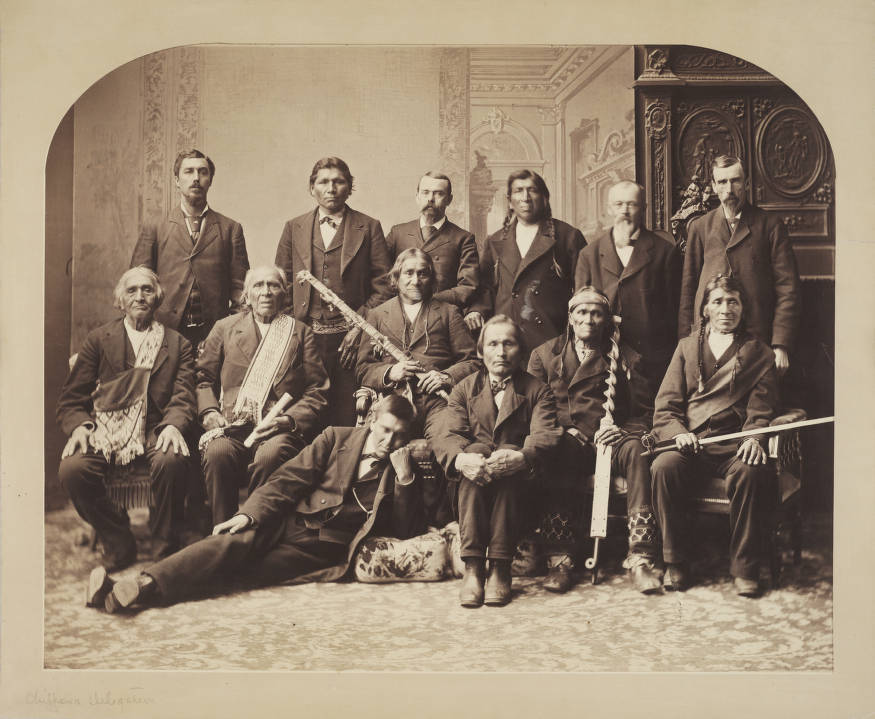
Chippewa Delegation (Denver Public Library Digital Collections)
While my heart wanted to believe the person, probably in the early 20th century, who labelled the Bayfield photograph, my head told me the photographer probably wouldn’t have known anything about the people of Lake Superior, and therefore could only have gotten the chiefs’ names directly from them. Plus, Bell took individual photos:
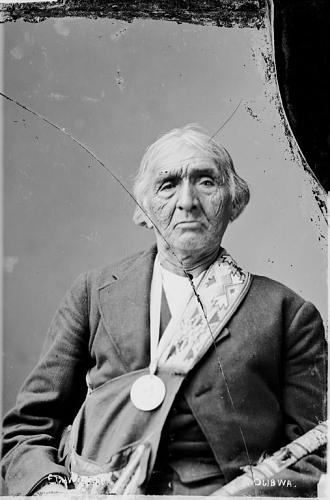
Edawigijig (Edawi-giizhig “Both Sides of the Sky”), Bad River chief and signer of the Treaty of 1854 (C.M. Bell, Smithsonian Digital Collections)
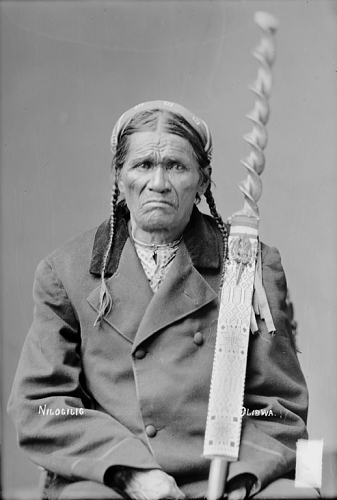
Niizhogiizhig: “Second Day,” (C.M. Bell, Smithsonian Digital Collections)
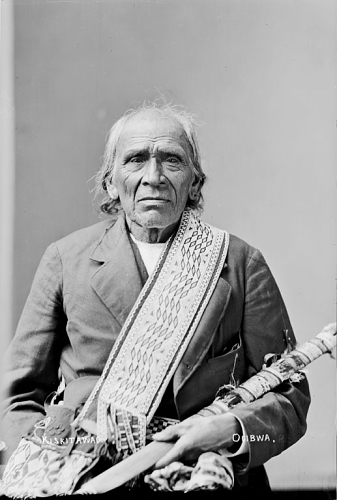
Kiskitawag (Giishkitawag: “Cut Ear”) signed multiple treaties as a warrior of the Ontonagon Band but afterwards was associated with the Bad River Band (C.M. Bell, Smithsonian Digital Collections).
By cross-referencing the individual photos with the names listed with the group photo, you can identify nine of the thirteen men. They are chiefs from Bad River, Lac Courte Oreilles, and Lac du Flambeau.
 According to this, the man identified by the library caption as Vincent Roy Jr., was in fact Ogimaagiizhig (Sky Chief). He does have a resemblance to Roy, so I’ll forgive whoever it was, even if it means having to go back and correct my Vincent Roy post:
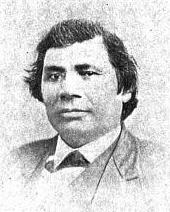
Vincent Roy Jr. From C. Verwyst’s Life and Labors of Rt. Rev. Frederic Baraga, First Bishop of Marquette, Mich: To which are Added Short Sketches of the Lives and Labors of Other Indian Missionaries of the Northwest (Digitized by Google Books)

Top: Frank Roy, Vincent Roy, E. Roussin, Old Frank D.o., Bottom: Peter Roy, Jos. Gourneau (Gurnoe), D. Geo. Morrison. The photo is labelled Chippewa Treaty in Washington 1845 by the St. Louis Hist. Lib and Douglas County Museum, but if it is in fact in Washington, it was probably the Bois Forte Treaty of 1866, where these men acted as conductors and interpreters (Digitized by Mary E. Carlson for The Sawmill Community at Roy’s Point).
So now that we know who went on the 1880 trip, it begs the question of why they went. The records I’ve found haven’t been overly clear, but it appears that it involved a bill in the senate for “severalty” of the Ojibwe reservations in Wisconsin. A precursor to the 1888 Allotment Act of Senator Henry Dawes, this legislation was proposed by Senator Thaddeus C. Pound of Wisconsin. It would divide the reservations into parcels for individual families and sell the remaining lands to the government, thereby greatly reducing the size of the reservations and opening the lands up for logging.
Pound spent a lot of time on Indian issues and while he isn’t as well known as Dawes or as Richard Henry Pratt the founder of the Carlisle Indian School, he probably should be. Pound was a friend of Pratt’s and an early advocate of boarding schools as a way to destroy Native cultures as a way to uplift Native peoples.
I’m sure that Pound’s legislation was all written solely with the welfare of the Ojibwe in mind, and it had nothing to do with the fact that he was a wealthy lumber baron from Chippewa Falls who was advocating damming the Chippewa River (and flooding Lac Courte Oreilles decades before it actually happened). All sarcasm aside, if any American Indian Studies students need a thesis topic, or if any L.C.O. band members need a new dartboard cover, I highly recommend targeting Senator Pound.
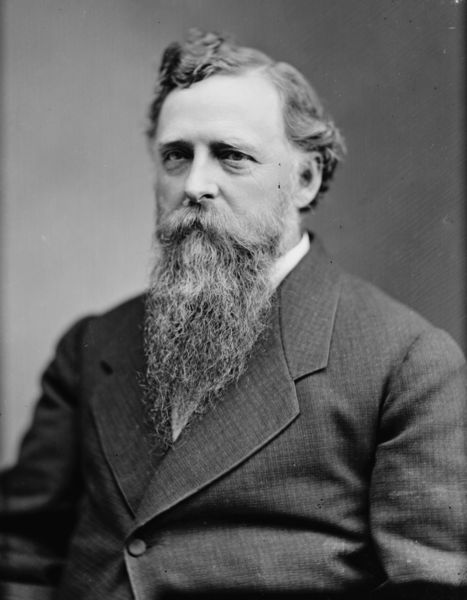
Like many self-proclaimed “Friends of the Indian” in the 1880s, Senator Thaddeus C. Pound of Wisconsin thought the government should be friendly to Indians by taking away more of their land and culture. That he stood to make a boatload of money out of it was just a bonus (Brady & Handy: Wikimedia Commons).
While we know Pound’s motivations, it doesn’t explain why the chiefs came to Washington. According to the Indian Agent at Bayfield they were brought in to support the legislation. We also know they toured Carlisle and visited the Ojibwe students there. There are a number of potential explanations, but without having the chiefs’ side of the story, I hesitate to speculate. However, it does explain the photograph.
Now, let’s look at what a couple of these men looked like two decades earlier:
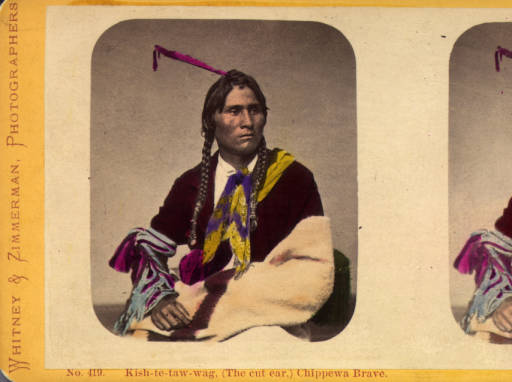
This stereocard of Giishkitawag was produced in the early 1870s, but the original photo was probably taken in the early 1860s (Denver Public Library).

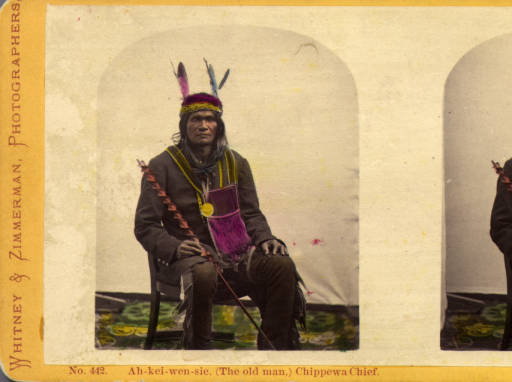
By the mid 1850s, Akiwenzii (Old Man) was the most prominent chief of the Lac Courte Oreilles Band. This stereocard was made by Whitney and Zimmerman c.1870 from an original possibly by James E. Martin in the late 1850s or early 1860s (Denver Public Library).
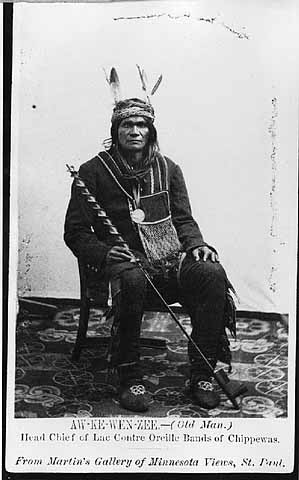
Giishkitawag and Akiwenzii are seem to have aged quite a bit between the early 1860s, when these photos were taken, and 1880 but they are still easily recognized. The earlier photos were taken in St. Paul by the photographers Joel E. Whitney and James E. Martin. Their galleries, especially after Whitney partnered with Charles Zimmerman, produced hundreds of these images on cards and stereoviews for an American public anxious to see real images of Indian leaders.
Giishkitawag and Akiwenzii were not the only Lake Superior chiefs to end up on these souvenirs. Aamoons (Little Bee), of Lac du Flambeau appears to have been a popular subject:

Aamoons (Little Bee) was a prominent chief from Lac du Flambeau (Denver Public Library).
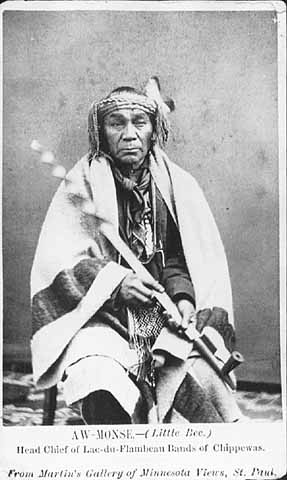
As the images were reproduced throughout the 1870s, it appears the studios stopped caring who the photos were actually depicting:

One wonders what the greater insult to Aamoons was: reducing him to being simply “Chippewa Brave” as Whitney and Zimmerman did here, or completely misidentifying him as Na-gun-ub (Naaganab) as a later stereo reproduction as W. M. McLeish does here:
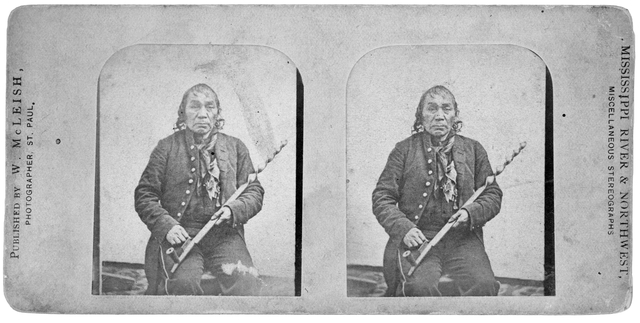
Chief identified as Na-gun-ub (Minnesota Historical Society)
Aamoons and Naaganab don’t even look alike…

Naaganab (Minnesota Historical Society)
…but the Lac du Flambeau and Fond du Lac chiefs were probably photographed in St. Paul around the time they were both part of a delegation to President Lincoln in 1862.

Chippewa Delegation 1862 by Matthew Brady? (Minnesota Historical Society)
Naaganab (seated middle) and Aamoons (back row, second from left) are pretty easy to spot, and if you look closely, you’ll see Giishkitawag, Akiwenzii, and a younger Edawi-giizhig (4th, 5th, and 6th from left, back row) were there too. I can’t find individual photos of the other chiefs, but there is a place we can find their names.
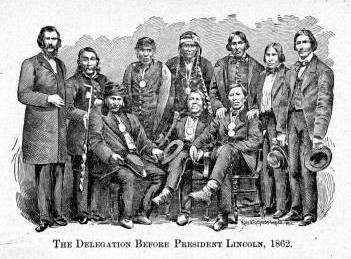
(From Early Life Among the Indians by Benjamin Armstrong)
Benjamin Armstrong, who interpreted for the delegation, included a version of the image in his memoir Early Life Among the Indians. He identifies the men who went with him as:
Ah-moose (Little Bee) from Lac Flambeau Reservation, Kish-ke-taw-ug (Cut Ear) from Bad River Reservation, Ba-quas (He Sews) from Lac Courte O’Rielles Reservation, Ah-do-ga-zik (Last Day) from Bad River Reservation, O-be-quot (Firm) from Fond du Lac Reservation, Sing-quak-onse (Little Pine) from La Pointe Reservation, Ja-ge-gwa-yo (Can’t Tell) from La Pointe Reservation, Na-gon-ab (He Sits Ahead) from Fond du Lac Reservation, and O-ma-shin-a-way (Messenger) from Bad River Reservation.
It appears that Armstrong listed the men according to their order in the photograph. He identifies Akiwenzii as “Ba-quas (He Sews),” which until I find otherwise, I’m going to assume the chief had two names (a common occurrence) since the village is the same. Aamoons, Giishkitawag, Edawi-giizhig and Naaganab are all in the photograph in the places corresponding to the order in Armstrong’s list. That means we can identify the other men in the photo.
I don’t know anything about O-be-quot from Fond du Lac (who appears to have been moved in the engraving) or S[h]ing-guak-onse from Red Cliff (who is cut out of the photo entirely) other than the fact that the latter shares a name with a famous 19th-century Sault Ste. Marie chief. Travis Armstrong’s outstanding website, chiefbuffalo.com, has more information on these chiefs and the mission of the delegation.
Seated to the right of Naaganab, in front of Edawi-giizhig is Omizhinawe, the brother of and speaker for Blackbird of Bad River. Finally, the broad-shouldered chief on the bottom left is “Ja-ge-gwa-yo (Can’t Tell)” from Red Cliff. This is Jajigwyong, the son of Chief Buffalo, who signed the treaties as a chief in his own right. Jayjigwyong, sometimes called Little Chief Buffalo, was known for being an early convert to Catholicism and for encouraging his followers to dress in European style. Indeed, we see him and the rest of the chiefs dressed in buttoned coats and bow-ties and wearing their Lincoln medals.
Wait a minute… button coats?… bow-ties?… medals?…. a chief identified as Buffalo…That reminds me of…
This image is generally identified as Chief Buffalo (Wikimedia Commons)

Anyway, with that mystery solved, we can move on to the next one. It concerns a photograph that is well-known to any student of Chequamegon-area history in the mid 19th century (or any Chequamegon History reader who looks at the banners on the side of this page).Noooooo!!!!!!! I’ve been trying to identify the person in The above “Chief Buffalo” photo for years, and the answer was in Armstrong all along! Now I need to revise this post among others. I had already begun to suspect it was Jayjigwyong rather than his father, but my evidence was circumstantial. This leaves me without a doubt. This picture of the younger Chief Buffalo, not his more-famous father.
The photo showing an annuity payment, must have been widely distributed in its day, because it has made it’s way into various formats in archives and historical societies around the world. It has also been reproduced in several secondary works including Ronald Satz’ Chippewa Treaty Rights, Patty Loew’s Indian Nations of Wisconsin, Hamilton Ross’ La Pointe: Village Outpost on Madeline Island, and in numerous other pamphlets, videos, and displays in the Chequamegon Region. However, few seem to agree on the basic facts:
When was it taken?
Where was it taken?
Who was the photographer?
Who are the people in the photograph?
We’ll start with a cropped version that seems to be the most popular in reproductions:
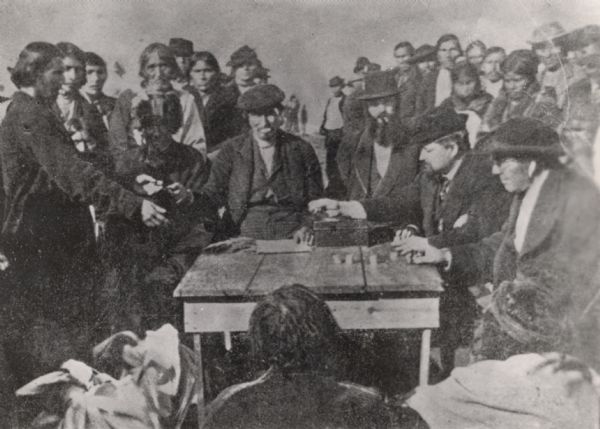
According to Hamilton Ross and the Wisconsin Historical Society: “Annuity Payment at La Pointe: Indians receiving payment. Seated on the right is John W. Bell. Others are, left to right, Asaph Whittlesey, Agent Henry C. Gilbert, and William S. Warren (son of Truman Warren).” 1870. Photographer Charles Zimmerman (more info).
In the next one, we see a wider version of the image turned into a souvenir card much like the ones of the chiefs further up the post:
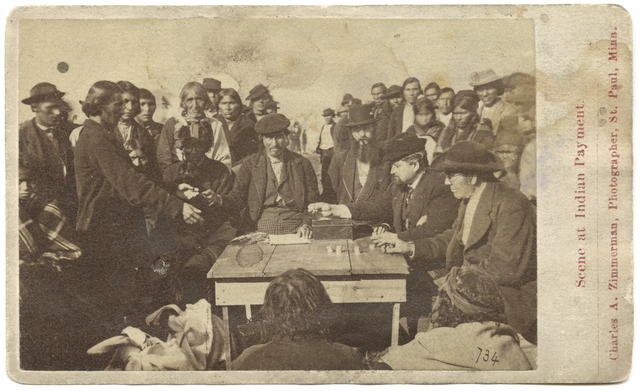
According to the Minnesota Historical Society “Scene at Indian payment, Wisconsin; man in black hat, lower right, is identified as Richard Bardon, Superior, Wisconsin, then acting Indian school teacher and farmer” c.1871 by Charles Zimmerman (more info).
In this version, we can see more foreground and the backs of the two men sitting in front.

According to the Library of Congress: “Cherokee payments(?). Several men seated around table counting coins; large group of Native Americans stand in background.” Published 1870-1900 (more info).
The image also exists in engraved forms, both slightly modified…

According to Benjamin Armstrong: “Annuity papment [sic] at La Pointe 1852” (From Armstrong’s Early Life Among the Indians)
…and greatly-modified.
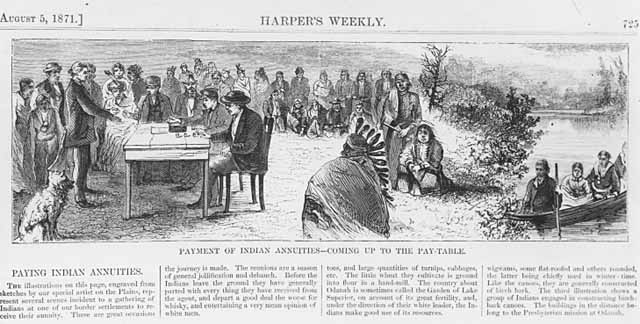
Harper’s Weekly August 5, 1871: “Payment of Indian Annuities–Coming up to the Pay Table.” (more info)
It should also be mentioned that another image exists that was clearly taken on the same day. We see many of the same faces in the crowd:
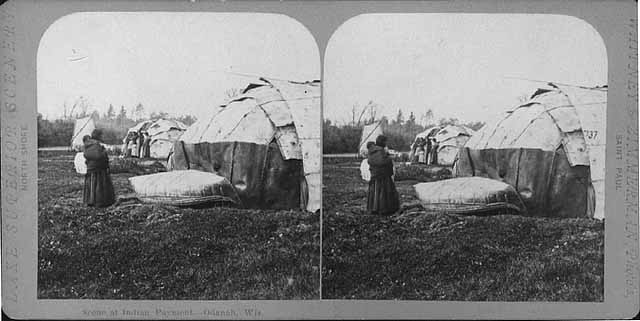
Scene at Indian payment, probably at Odanah, Wisconsin. c.1865 by Charles Zimmerman (more info)
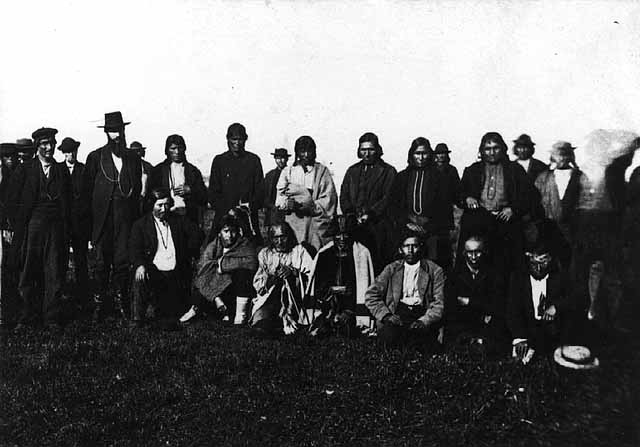
We have a lot of conflicting information here. If we exclude the Library of Congress Cherokee reference, we can be pretty sure that this is an annuity payment at La Pointe or Odanah, which means it was to the Lake Superior Ojibwe. However, we have dates ranging from as early as 1852 up to 1900. These payments took place, interrupted from 1850-1852 by the Sandy Lake Removal, from 1837 to 1874.
Although he would have attended a number of these payments, Benjamin Armstrong’s date of 1852, is too early. A number of secondary sources have connected this photo to dates in the early 1850s, but outside of Armstrong, there is no evidence to support it.
Charles Zimmerman, who is credited as the photographer when someone is credited, became active in St. Paul in the late 1860s, which would point to the 1870-71 dates as more likely. However, if you scroll up the page and look at Giishkitaawag, Akiwenzii, and Aamoons again, you’ll see that these photos, (taken in the early 1860s) are credited to “Whitney & Zimmerman,” even though they predate Zimmerman’s career.
What happened was that Zimmerman partnered with Joel Whitney around 1870, eventually taking over the business, and inherited all Whitney’s negatives (and apparently those of James Martin as well). There must have been an increase in demand for images of Indian peoples in the 1870s, because Zimmerman re-released many of the earlier Whitney images.
So, we’re left with a question. Did Zimmerman take the photograph of the annuity payment around 1870, or did he simply reproduce a Whitney negative from a decade earlier?
I had a hard time finding any primary information that would point to an answer. However, the Summer 1990 edition of the Minnesota History magazine includes an article by Bonnie G. Wilson called Working the Light: Nineteenth Century Professional Photographers in Minnesota. In this article, we find the following:
“…Zimmerman was not a stay-at-home artist. He took some of his era’s finest landscape photos of Minnesota, specializing in stereographs of the Twin Cities area, but also traveling to Odanah, Wisconsin for an Indian annuity payment…”
In the footnotes, Wilson writes:
“The MHS has ten views in the Odanah series, which were used as a basis for engravings in Harper’s Weekly, Aug. 5, 1871. See also Winona Republican, Oct. 12, 1869 p.3;”
Not having access to the Winona Republican, I tried to see how many of the “Odanah series” I could track down. Zimmerman must have sold a lot of stereocards, because this task was surprisingly easy. Not all are labelled as being in Odanah, but the backgrounds are similar enough to suggest they were all taken in the same place. Click on them to view enlarged versions at various digital archives.
Scene at Indian Payment, Odanah Wisconsin (Minnesota Historical Society)


Chippewa Wedding (British Museum)

Domestic Life–Chippewa Indians (British Museum)
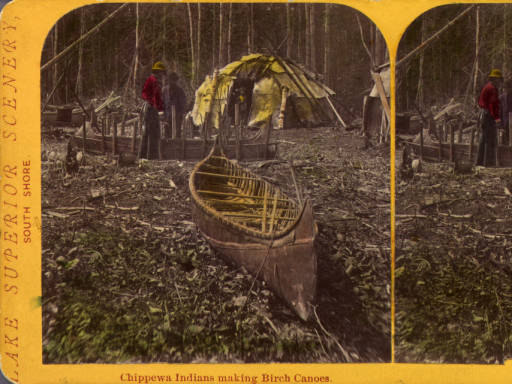
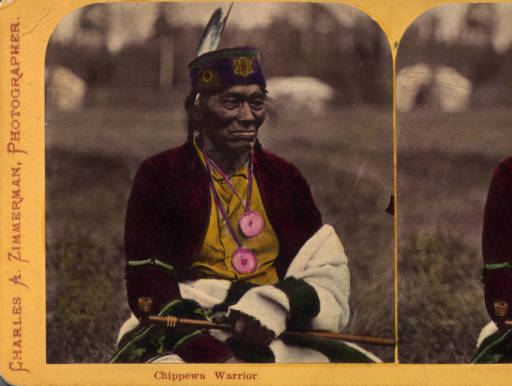

Chippewa Wedding (British Museum)

Finally…

Scene at Indian Payment–Odanah, Wis. (Wikimedia Images)
So, if Zimmerman took the “Odanah series” in 1869, and the pay table image is part of it, then this is a picture of the 1869 payment. To be absolutely certain, we should try to identify the men in the image.
This task is easier than ever because the New York Public Library has uploaded a high-resolution scan of the Whitney & Zimmerman stereocard version to Wikimedia Commons. For the first time, we can really get a close look at the men and women in this photo.
They say a picture tells a thousand words. I’m thinking I could write ten-thousand and still not say as much as the faces in this picture.


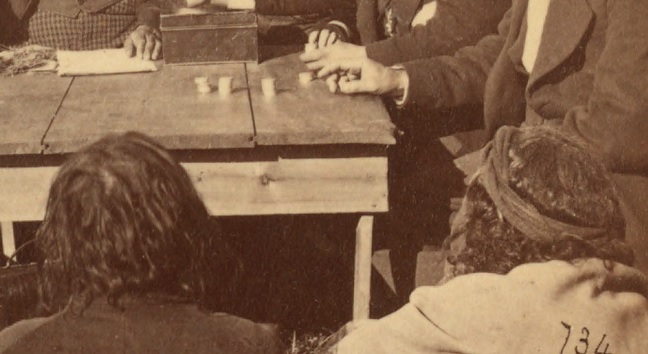
To try to date the photo, I decided to concentrate the six most conspicuous men in the photo:
1) The chief in the fur cap whose face in the shadows.
2) The gray-haired man standing behind him.
3) The man sitting behind the table who is handing over a payment.
4) The man with the long beard, cigar, and top hat.
5) The man with the goatee looking down at the money sitting to the left of the top-hat guy (to the right in our view)
6) The man with glasses sitting at the table nearest the photographer
According to Hamilton Ross, #3 is Asaph Whittlesey, #4 is Agent Henry Gilbert, #5 is William S. Warren (son of Truman), and #6 is John W. Bell. While all four of those men could have been found at annuity payments as various points between 1850 and 1870, this appears to be a total guess by Ross. Three of the four men appear to be of at least partial Native descent and only one (Warren) of those identified by Ross was Ojibwe. Chronologically, it doesn’t add up either. Those four wouldn’t have been at the same table at the same time. Additionally, we can cross-reference two of them with other photos.

Asaph Whittlesey was an interesting looking dude, but he’s not in the Zimmerman photo (Wisconsin Historical Society).

Henry C. Gilbert was the Indian Agent during the Treaty of 1854 and oversaw the 1855 annuity payment, but he was dead by the time the “Zimmerman” photo was taken (Branch County Photographs)
Whittlesey and Gilbert are not in the photograph.
The man who I label as #5 is identified by Ross as William S. Warren. This seems like a reasonable guess, though considering the others, I don’t know that it’s based on any evidence. Warren, who shares a first name with his famous uncle William Whipple Warren, worked as a missionary in this area.
The man I label #6 is called John W. Bell by Ross and Richard Bardon by the Minnesota Historical Society. I highly doubt either of these. I haven’t found photos of either to confirm, but the Ireland-born Bardon and the Montreal-born Bell were both white men. Mr. 6 appears to be Native. I did briefly consider Bell as a suspect for #4, though.
Neither Ross nor the Minnesota Historical Society speculated on #1 or #2.
At this point, I cannot positively identify Mssrs. 1, 2, 3, 5, or 6. I have suspicions about each, but I am not skilled at matching faces, so these are wild guesses at this point:
#1 is too covered in shadows for a clear identification. However, the fact that he is wearing the traditional fur headwrap of an Ojibwe civil chief, along with a warrior’s feather, indicates that he is one of the traditional chiefs, probably from Bad River but possibly from Lac Courte Oreilles or Lac du Flambeau. I can’t see his face well enough to say whether or not he’s in one of the delegation photos from the top of the post.
#2 could be Edawi-giizhig (see above), but I can’t be certain.
#3 is also tricky. When I started to examine this photo, one of the faces I was looking for was that of Joseph Gurnoe of Red Cliff. You can see him in a picture toward the top of the post with the Roy brothers. Gurnoe was very active with the Indian Agency in Bayfield as a clerk, interpreter, and in other positions. Comparing the two photos I can’t say whether or not that’s him. Leave a comment if you think you know.
#5 could be a number of different people.
#6 I don’t have a solid guess on either. His apparent age, and the fact that the Minnesota Historical Society’s guess was a government farmer and schoolteacher, makes me wonder about Henry Blatchford. Blatchford took over the Odanah Mission and farm from Leonard Wheeler in the 1860s. This was after spending decades as Rev. Sherman Hall’s interpreter, and as a teacher and missionary in La Pointe and Odanah area. When this photo was taken, Blatchford had nearly four decades of experience as an interpreter for the Government. I don’t have any proof that it’s him, but he is someone who is easy to imagine having a place at the pay table.
Finally, I’ll backtrack to #4, whose clearly identifiable gray-streaked beard allows us to firmly date the photo. The man is Col. John H. Knight, who came to Bayfield as Indian Agent in 1869.
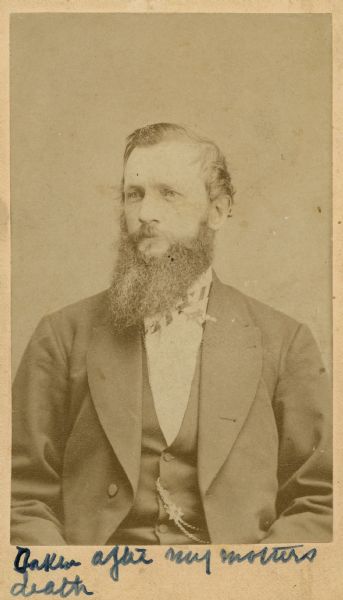
Col. John H. Knight (Wisconsin Historical Society)
Knight oversaw a couple of annuity payments, but considering the other evidence, I’m confident that the popular image that decorates the sides of the Chequamegon History site was indeed taken at Odanah by Charles Zimmerman at the 1869 annuity payment.
Do you agree? Do you disagree? Have you spotted anything in any of these photos that begs for more investigation? Leave a comment.
As for myself, it’s a relief to finally get all these photo mysteries out of my post backlog. The 1870 date on the Zimmerman photo reminds me that I’m spending too much time in the later 19th century. After all, the subtitle of this website says it’s history before 1860. I think it might be time to go back for a while to the days of the old North West Company or maybe even to Pontiac. Stay tuned, and thanks for reading,
Sandy Lake Letters: Sherman Hall to the Wheelers
July 11, 2013

“Chippewa Indians Fishing on the Ice” (Digitized by New York Public Library from Heroes and hunters of the West : comprising sketches and adventures of Boone, Kenton, Brady, Logan, Whetzel, Fleehart, Hughes, Johnston, etc. Philadelphia : H. C. Peck & Theo. Bliss, 1859.)
On June 9th, I transcribed and posted two letters related to the Sandy Lake Tragedy (the attempted removal of the Lake Superior Ojibwe in the fall of 1850, which claimed as many as 400 innocent lives). The letters, digitized by the Wisconsin Historical Society, were from the Warren Family Papers. One was from missionary Leonard Wheeler to William Warren before the tragedy, and another was from Indian Agent John Watrous to Warren during a second removal attempt a year later.
That post sought to assess how much responsibility Warren and Watrous bear for the 400 deaths. It also touched on the role of the Protestant A.B.C.F.M. missionaries in the region. This post continues those thoughts. This time, we’re looking at two more letters and evaluating one of the missionaries himself.
Both of these letters are from the Wheeler Family Papers, held by the Wisconsin Historical Society at the Ashland Area Research Center. I went directly to the original documents for these, and while I’ve seen them referenced in published works, I believe this is the first time these particular letters have been transcribed or posted online.
The first is from Sherman Hall, the founder of the La Pointe Mission, to his colleague Leonard Wheeler, who operated the satellite mission at Odanah. Hall traveled to Sandy Lake for the annuity payments and sent this letter to Wheeler, who was visiting family back in Massachusetts, after returning to La Pointe.
Lapointe. Dec. 28th 1850
Brother Wheeler:
I wrote you while at Sandy Lake and promised to write again when I should reach Lapointe. That promise I now redeem. I started from Sandy Lake on the fourth inst. and reached home on the 16th having been absent from home just eight weeks. I was never more heartily glad to leave a place than I was Sandy Lake, nor more glad to reach home after an absence. Of course winter here has justly begun. The snow was some ten inches deep on the Savannah Portage. On reaching the East Savannah River we found the ice good and clear of snow and water. This continued to be the case most of the way to the Grand Portage at Fond du Lac. From Fond du Lac to Lapointe the traveling most of the way was hard, and it was not till the seventh day from F. du L. that I reached home. Besides bad traveling I had to carry a pack which I found, when I got home weighed 60 pounds. With this however I found it not difficult to keep up with most of my traveling companions who were much heavier loaded than I. This is my first experience of carrying a heavy pack on a long journey and I am fully satisfied with the experiment. I had no alternative however, bet either to throw away my blankets and clothes, or carry them. Every body was loaded with a heavy pack, and I could employ no one. I however got through well—did not get lame as many others did, nor do I feel any furious[?] by ill effects of my journey since my arrival.
I found the mission family well on my arrival. They had felt somewhat lonesome while so many were absent from this place. Things in the community here are generally in a quiet state at present. I apprehend that there will be considerable pinching for provisions before spring. It has been a very windy and stormy fall. The people have taken but little fish. Many nets have been lost. The traders have but a small quantity of provisions, and if they had the people have but little to buy with. The bay opposite to this island is now principally covered with ice so that the Indians are on the ice some to spear fish. The ice has once broken up since it first closed, and a heavy wind would break it up again, as it is yet very thin, and the weather mild. If the lake is frozen the Inds will probably get considerable fish; but if it should be open they must suffer.
Our Indian meetings are pretty well attended, and I feel that there is ground for encouragement. Simon I think is exerting a good influence. His Catholic friends have tried to draw him back to their church; but seems stable. His oldest brother, who has recently lost his wife, has expressed a wish to hear the word of God. I hope he will yet become a sincere listener.
Our English exercises are attended by a smaller number than formerly since many have left this place. I think however for our own good, as well as on account of others, we ought to keep them up. Mr. Van Tassel has returned to remain here till spring. I have heard nothing from Bad River for some time past. I had formed a design to go there this week, but have been prevented by the state of the ice. I intend going as soon as the ice gets a little stronger. I suppose there are very few Indians there. More are about the Lake.
I heard that Mr. Leihy has lost both his horses which will be a serious inconvenience to him in this mill enterprise I presume.
Mr. Pulsifer has received one letter from you, and by our last mail he heard through his correspondent at Lowell that you had arrived at that place.
I suppose you find some changes have taken place in the wide world during the times you have been shut up in the wilderness. Do you find calls enough to keep you busy? I have been expecting a letter from you. I want to hear what you have to say about the things you see, and how you like visiting, etc.
I have just had a letter from Mr. Ely, who says, “We are [snugly by quarters?] in St. Paul. My home is full of music—am employed as choir leader in Mr. [Mill’s?] (Prs.) church—sing two evenings a week at Stillwater, and the rest of my time is well filled with the private scholars & tuning Pianos, of which there are 7 or 8 at St. Paul.” Perhaps Br. Ely will find this a more lucrative business than cutting and hauling pine logs. I am glad he has found employment.
Our children all attend school except Harriet. Marydoes very well. Please give my regards to your friends at Lowell. I am writing to Mr. Treat by this opportunity. [Wish?] kind regards to Mrs. W. I remain
yours
S. Hall.
 The Old Mission Church, La Pointe, Madeline Island. (Wisconsin Historical Society Image ID: 24827)
 Harriet Wheeler, pictured about forty years after receiving this letter. (Wisconsin Historical Society: Image ID 36771)
“…your note to Harriet” Harriet Hall was Sherman’s oldest daughter, about 19 years old at this time.
 Many Ojibwe leaders, including Hole in the Day, blamed the rotten pork and moldy flour distributed at Sandy Lake for the disease that broke out. The speech in St. Paul is covered on pages 101-109 of Theresa Schenck’s William W. Warren: The Life, Letters, and Times of an Ojibwe Leader, my favorite book about this time period. (Photo from Whitney’s Gallery of St. Paul: Wisconsin Historical Society Image ID 27525)
 Mary Warren (1835-1925), was a teenager at the time of the Sandy Lake Tragedy. She is pictured here over seventy years later. Mary, the sister of William Warren, had been living with the Wheelers but stayed with Hall during their trip east. (Photo found on University of Connecticut Radio website, scanned from Frances Densmore photos in the Smithsonian Bureau of Ethnology)
Lapointe, Feb. 24th 1851.
Mrs. Wheeler,
By our last mail I wrote to Mr Wheeler, and by this I will address a few lines to you. From your note to Harriet I suppose you are happy among your friends. I am glad you are so, and hope you will not only spend your winter pleasantly, but that you will find the present season of relaxation from the severe duties of your station here, the occasion of reconnecting[?] your health and spirits.
I do not feel that the time has yet come when the churches ought to close their efforts to save these Indians. I do not think they are entirely beyond the reach of hope. The prospect however looks dark. But I think the greatest cause of discouragement arises from their character, and not from their present political condition. Generally they do not want to improve their condition. They are satisfied with their ignorance and degradation. All they think of is to supply for their present wants without their own exertions, while they wish to live in idleness and sin. This is the cause of their keeping so much aloof from the influence of the missions. Their minds are dreadfully dark respecting the things of the future world. They seem to have no ideas of happiness superior to that derives from the gratification of the lowest animal appetites and passions. This is the reason why the truths of the gospel so little effect on them. These things present to my mind much stronger grounds of discouragement than their present political difficulties, though those at present are not inconsiderable.
But as stupid as is the conscience, and as dark as is the understanding and the heart, and as much as they are given up to [?]ality and sin, I believe there is a Power that can quicken them into life. My only hope is that He who has made them, and has power to save them, will come and add his blessing to the preaching of his own gospel, and make it to them the power and wisdom of God. Thousands of others as dead in trespasses and sins, have been saved. Why may not they be saved? Come back home and let us try still to do something for them. Tell Christians to remember them and pray for them, that the word of God among them may have free course and be glorified.
It is a time of great scarcity of food among the Indians. There is some one in our houses almost every hour of the day begging for food. Very few get more than a meal a day; many not half of one. I have been told by several individuals, that they have tried three or four days in succession to catch fish, and have been obliged to return to their starving families each night with nothing for them. I am frequently importuned to spare a little provisions till I am obliged to go away out of sight to get rid of their pleading. I have spared the last potatoes I dare let go. Corn we have none. We have but a small quantity of flour over what will be required to sustain our families till we can expect to obtain a new supply. For a long time I have not known fish so scarce as the present winter. That is almost the only dependence of this people. For a month to come there will be many hungry ones. Many of the French and half-breeds are but little better off than the Indians. All we can do is to divide a little morsel with the hungry ones who come to beg. We have not much to give to those who importune for something to carry to their families. But as long as they continue to waste their summers in idleness they must starve in the winter.
The young Hole-in-the-day has been down to St Paul and there made a public speech in which he attributes the sickness at the payment last fall to the bad provisions which were dealt out to the Indians, and imparts much blame to the officers of the government for the way in which they [were with?]. In time they had some flour dealt out to them which was much damaged. But I think there were other causes for the sickness which prevailed besides the bad provisions. I think however that in some [aspects?] the Indians were wronged. Treaty stipulations were not carried out. H is very confident that many of the Indians are not satisfied with the manner in which they have been dealt with, and recent events have not served to strengthen their attachment to the Government.
We had our communion yesterday. I think there is a [?]ably good state of feeling among the native church members at this time. Simon has been frequently sick this winter. But his trials appear to bring nearer to God. He appears to be growing in the knowledge of God and in piety.
You will probably recollect Mo-ko-kun-ens-ish, an Indian with a bunch[?] between his shoulders, married into the family of the Little-current. He is, by profession, a Catholic. About a week ago, he made me a visit, and said his priest had offended him, and he wished to join us. A short time since he lost a child, and when the priest came to bury it, he said he “scolded him” because he had not cleaned away the snow from the gate of the burying yard, and made a better path for him to come to the grave. He told a long story. I suspected his object was to get some provisions of me. I told him we should be happy to see him at our meetings, and told him where and when they would be held. He said he should attend only sometimes he might be obliged to fish to get something to eat, and be occasionally away. I said a few words to him on religious subjects, and he left without asking for anything. The next day he came with a small piece of cloth and asked me to give him provisions for it. I told I had not provisions to trade. He then enquired about meeting. I told him we were to hold one that evening in the school-house. He said he should attend. The evening came, the meeting was held—but he was not there. Nor have we seen him at any other meeting. Such are the methods the heathens & Catholics take to deceive us. We could make many converts with flour and pork, especially at this time.
Yours Truly,
S. Hall
[Written in margins]
All send love though I have not room to write it.
Mary goes to school and is doing very well.

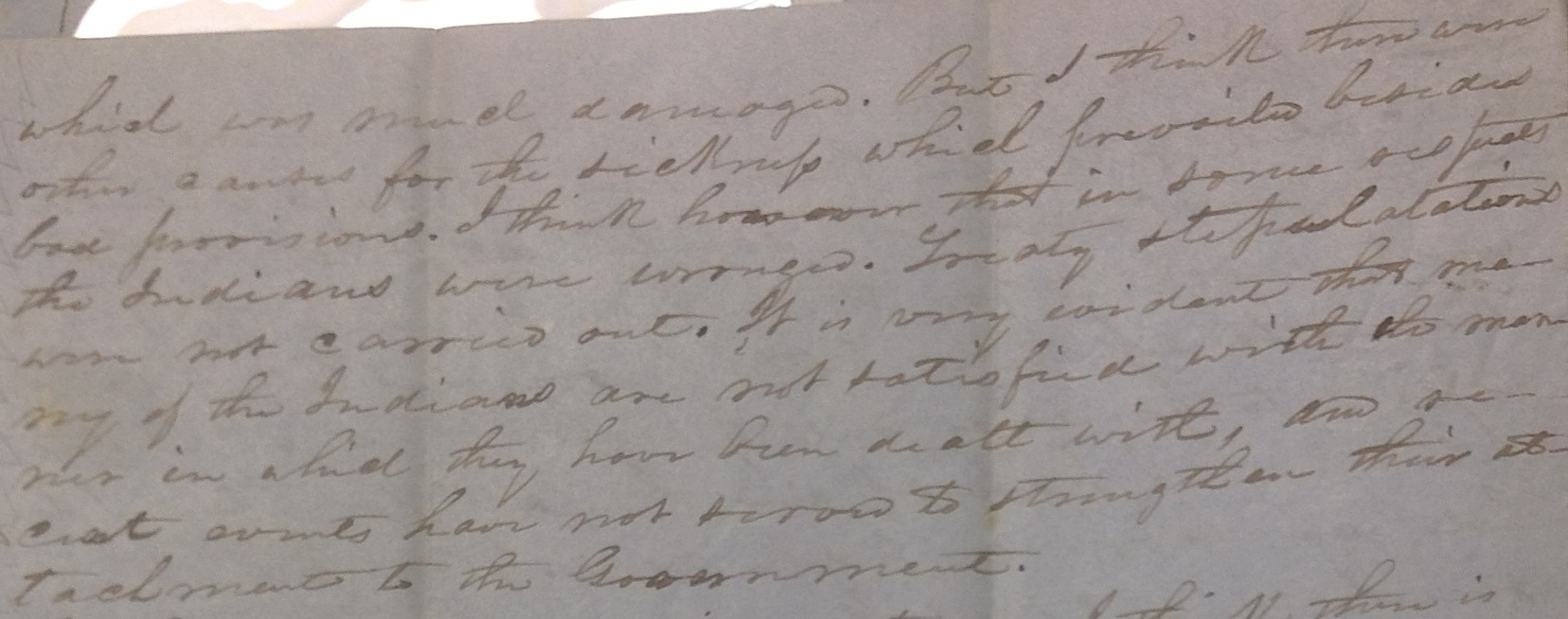
These are the originals of the paragraph about Hole in the Day’s speech in St. Paul. I couldn’t quite decipher all of it. Let me know what you see (Wheeler Family Papers, Personal Correspondence 1851, Wisconsin Historical Society Ashland Area Research Center).
In the June 9th post, we tried to determine how much William Warren and John S. Watrous were at fault for the deaths resulting from the 1850 Sandy Lake removal attempt. In this post, we will do the same for Sherman Hall.
Before we begin, it’s worth reviewing the facts. By 1850, Hall had lived at La Pointe for twenty years. He knew the people who lived here, and he knew the promises the Ojibwe were given at the Treaty of 1842. He was certainly aware of the Ojibwe position on the removal.
Rev. Hall did not order the removal. Compared with the government and Fur Company officials, he was fairly powerless within the Lake Superior region. However, he had a power of a different sort. As the primary voice of the ABCFM in Ojibwe country, he had powerful friends in the eastern states. Many Americans perceived the missionaries as the only neutral voice in the area. Hall admits in the December 28th letter that the Ojibwe were wronged. He could have advocated for their cause in the summer of 1850 as the illegal removal was unfolding. Instead, he largely went along with government efforts.
To his credit, in other letters Hall did blame the government for the failure of the Sandy Lake payment. The best book I’ve encountered about this time period is William W. Warren: The Life, Letters, and Times of an Ojibwe Leader by Theresa Schenck (Nebraska UP, 2007). On page 94, Dr. Schenck quotes a letter from Hall to ABCFM Secretary S.B. Treat. It is dated December 30, and is probably the letter referred to in the letter to Leonard Wheeler above. Hall is honest about Ojibwe feelings on the removal and seems to empathize somewhat. On page 155, Schenck details how the La Pointe mission did eventually turn against government removal efforts later in 1851.
So, it probably seems that I am defending Sherman Hall. Why? Truthfully, it’s because I want to have some balance in this post because, quite frankly, these two letters are some of the most disgusting, horrifying documents I’ve ever read. I felt especially sick typing up the February 24th letter to Harriet Wheeler. For a man who claimed to be “saving” the Ojibwe to be so heartless in the midst of so much suffering is appalling.
Was the mission running low on food? Sure, but doesn’t true Christian charity demand sharing to the last?
Should Hall’s language be judged by the standards of the racist times he lived in? Absolutely, but to say the things he says about human beings, his neighbors of twenty years, is inexcusable in any time period.
Is it possible he was traumatized by his experience at Sandy Lake, and this was a way of dealing with his personal guilt? This is possible. He does seem to be speaking to himself in the letter as much as he is to the Wheelers.
There is a danger in judging too much from just two letters, but I think Hall needs to be held to the same standard as Warren and Watrous were in the June 9th post. He could have spoken out against the removal to begin with. He didn’t. He was an eyewitness to Sandy Lake. He knew what the Ojibwe had been promised, and he saw the consequences of the government breaking those promises. His letters to the Wheelers in Boston could have been used to help right those wrongs by uniting the missions behind the Ojibwe cause. Instead, he chose to blame the people who had been wronged to the point of 400 deaths. For these reasons, I think when we list the villains of Sandy Lake, the Reverend Sherman Hall needs to be among them.
Sources:
Densmore, Frances. Chippewa Customs. Washington: U.S. G.P.O., 1929. Print.
Ely, Edmund Franklin, and Theresa M. Schenck. The Ojibwe Journals of Edmund F. Ely, 1833-1849. Lincoln: University of Nebraska, 2012. Print.
KAPPLER’S INDIAN AFFAIRS: LAWS AND TREATIES. Ed. Charles J. Kappler. Oklahoma State University Library, n.d. Web. 21 June 2012. <http:// digital.library.okstate.edu/Kappler/>.
Satz, Ronald N. Chippewa Treaty Rights: The Reserved Rights of Wisconsin’s Chippewa Indians in Historical Perspective. Madison, WI: Wisconsin Academy of Sciences, Arts and Letters, 1991. Print.
Schenck, Theresa M. William W. Warren: The Life, Letters, and times of an Ojibwe Leader. Lincoln: University of Nebraska, 2007. Print.
Warren, William W., and Theresa M. Schenck. History of the Ojibway People. St. Paul: Minnesota Historical Society, 2009. Print.
In the Fall of 1850, the Lake Superior Ojibwe (Chippewa) bands were called to receive their annual payments at Sandy Lake on the Mississippi River. The money was compensation for the cession of most of northern Wisconsin, Upper Michigan, and parts of Minnesota in the treaties of 1837 and 1842. Before that, payments had always taken place in summer at La Pointe. That year they were switched to Sandy Lake as part of a government effort to remove the entire nation from Wisconsin and Michigan in blatant disregard of promises made to the Ojibwe just a few years earlier.
There isn’t enough space in this post to detail the entire Sandy Lake Tragedy (I’ll cover more at a later date), but the payments were not made, and 130-150 Ojibwe people, mostly men, died that fall and winter at Sandy Lake. Over 250 more died that December and January, trying to return to their villages without food or money.

George Warren (b.1823) was the son of Truman Warren and Charlotte Cadotte and the cousin of William Warren. (photo source unclear, found on Canku Ota Newsletter)
If you are a regular reader of Chequamegon History, you will recognize the name of William Warren as the writer of History of the Ojibway People. William’s father, Lyman, was an American fur trader at La Pointe. His mother, Mary Cadotte was a member of the influential Ojibwe-French Cadotte family of Madeline Island. William, his siblings, and cousins were prominent in this era as interpreters and guides. They were people who could navigate between the Ojibwe and mix-blood cultures that had been in this area for centuries, and the ever-encroaching Anglo-American culture.
The Warrens have a mixed legacy when it comes to the Sandy Lake Tragedy. They initially supported the removal efforts, and profited from them as government employees, even though removal was completely against the wishes of their Ojibwe relatives. However, one could argue this support for the government came from a misguided sense of humanitarianism. I strongly recommend William W. Warren: The Life, Letters, and Times of an Ojibwe Leader by Theresa Schenck if you are interested in Warren family and their motivations. The Wisconsin Historical Society has also digitized several Warren family letters, and that’s what prompted this post. I decided to transcribe and analyze two of these letters–one from before the tragedy and one from after it.
The first letter is from Leonard Wheeler, a missionary at Bad River, to William Warren. Initially, I chose to transcribe this one because I wanted to get familiar with Wheeler’s handwriting. The Historical Society has his papers in Ashland, and I’m planning to do some work with them this summer. This letter has historical value beyond handwriting, however. It shows the uncertainty that was in the air prior to the removal. Wheeler doesn’t know whether he will have to move his mission to Minnesota or not, even though it is only a month before the payments are scheduled.
Sept 6, 1850
Dear Friend,
I have time to write you but a few lines, which I do chiefly to fulfill my promise to Hole in the Day’s son. Will you please tell him I and my family are expecting to go Below and visit our friends this winter and return again in the spring. We heard at Sandy Lake, on our way home, that this chief told [Rev.?] Spates that he was expecting a teacher from St. Peters’ if so, the Band will not need another missionary. I was some what surprised that the man could express a desire to have me come and live among his people, and then afterwards tell Rev Spates he was expecting a teacher this fall from St. Peters’. I thought perhaps there was some where a little misunderstanding. Mr Hall and myself are entirely undecided what we shall do next Spring. We shall wait a little and see what are to be the movements of gov. Mary we shall leave with Mr Hall, to go to school during the winter. We think she will have a better opportunity for improvement there, than any where else in the country. We reached our home in safety, and found our families all well. My wife wishes a kind remembrance and joins me in kind regards to your wife, Charlotte and all the members of your family. If Truman is now with you please remember us to him also. Tomorrow we are expecting to go to La Pointe and take the Steam Boat for the Sault monday. I can scarcely realize that nine years have passed away since in company with yourself and Pa[?] Edward[?] we came into the country.
Mary is now well and will probably write you by the bearer of this.
Very truly yours
L. H. Wheeler
 By the 1850s, Young Hole in the Day was positioning himself to the government as “head chief of all the Chippewas,” but to the people of this area, he was still Gwiiwiizens (Boy), his famous father’s son. (Minnesota Historical Society)
Samuel Spates was a missionary at Sandy Lake. Sherman Hall started as a missionary at La Pointe and later moved to Crow Wing.
Mary, Charlotte, and Truman Warren are William’s siblings.
The Wheeler letter is interesting for what it reveals about the position of Protestant missionaries in the 1850s Chequamegon region. From the 1820s onward, the American Board of Commissioners for Foreign Missions sent missionaries, mostly Congregationalists and Presbyterians from New England, to the Lake Superior Country. Their names, Wheeler, Hall, Ely, Boutwell, Ayer, etc. are very familiar to historians, because they produced hundreds of pages of letters and diaries that reveal a great deal about this time period.

Leonard H. Wheeler (Wisconsin Historical Society)
Ojibwe people reacted to these missionaries in different ways. A few were openly hostile, while others were friendly and visited prayer, song, and school meetings. Many more just ignored them or regarded them as a simple nuisance. In forty-plus years, the amount of Ojibwe people converted to Protestantism could be counted on one hand, so in that sense the missions were a spectacular failure. However, they did play a role in colonization as a vanguard for Anglo-American culture in the region. Unlike the traders, who generally married into Ojibwe communities and adapted to local ways to some degree, the missionaries made a point of trying to recreate “civilization in the wilderness.” They brought their wives, their books, and their art with them. Because they were not working for the government or the Fur Company, and because they were highly respected in white-American society, there were times when certain missionaries were able to help the Ojibwe advance their politics. The aftermath of the Sandy Lake Tragedy was such a time for Wheeler.
This letter comes before the tragedy, however, and there are two things I want to point out. First, Wheeler and Sherman Hall don’t know the tragedy is coming. They were aware of the removal, and tentatively supported it on the grounds that it might speed up the assimilation and conversion of the Ojibwe, but they are clearly out of the loop on the government’s plans.
Second, it seems to me that Hole in the Day is giving the missionaries the runaround on purpose. While Wheeler and Spates were not powerful themselves, being hostile to them would not help the Ojibwe argument against the removal. However, most Ojibwe did not really want what the missionaries had to offer. Rather than reject them outright and cause a rift, the chief is confusing them. I say this because this would not be the only instance in the records of Ojibwe people giving ambiguous messages to avoid having their children taken.
Anyway, that’s my guess on what’s going on with the school comment, but you can’t be sure from one letter. Young Hole in the Day was a political genius, and I strongly recommend Anton Treuer’s The Assassination of Hole in the Day if you aren’t familiar with him.

I read this as “passed away since in company with yourself and Pa[?] Edward we came into the country.” Who was Wheeler’s companion when a young William guided him to La Pointe? I intend to find out and fix this quote. (from original in the digital collections of the Wisconsin Historical Society)
In 1851, Warren was in failing health and desperately trying to earn money for his family. He accepted the position of government interpreter and conductor of the removal of the Chippewa River bands. He feels removing is still the best course of action for the Ojibwe, but he has serious doubts about the government’s competence. He hears the desires of the chiefs to meet with the president, and sees the need for a full rice harvest before making the journey to La Pointe. Warren decides to stall at Lac Courte Oreilles until all the Ojibwe bands can unite and act as one, and does not proceed to Lake Superior as ordered by Watrous. The agent is getting very nervous.
 Clement and Paul (pictured) Hudon Beaulieu, and Edward Conner, were mix-blooded traders who like the Warrens were capable of navigating Anglo-American culture while maintaining close kin relationships in several Ojibwe communities. Clement Beaulieu and William Warren had been fierce rivals ever since Beaulieu’s faction drove Lyman Warren out of the American Fur Company. (Photo original unknown: uploaded to findadagrave.com by Joan Edmonson)
For more on Cob-wa-wis (Oshkaabewis) and his Wisconsin River band, see this post.
“Perish” is what I see, but I don’t know who that might be. Is there a “Parrish”, or possibly a “Bineshii” who could have carried Watrous’ letter? I’m on the lookout. (from original in the digital collections of the Wisconsin Historical Society)
Aug 9th 1851
Friend Warren
I am now very anxiously waiting the arrival of yourself and the Indians that are embraced in your division to come out to this place.
Mr. C. H. Beaulieu has arrived from the Lake Du Flambeau with nearly all that quarter and by an express sent on in advance I am informed that P. H. Beaulieu and Edward Conner will be here with Cob-wa-wis and they say the entire Wisconsin band, there had some 32 of the Pillican Lake band come out and some now are in Conner’s Party.
I want you should be here without fail in 10 days from this as I cannot remain longer, I shall leave at the expiration of this time for Crow Wing to make the payment to the St. Croix Bands who have all removed as I learn from letters just received from the St. Croix. I want your assistance very much in making the Crow Wing payment and immediately after the completion of this, (which will not take over two days[)] shall proceed to Sandy Lake to make the payment to the Mississippi and Lake Bands.
The goods are all at Sandy Lake and I shall make the entire payment without delay, and as much dispatch as can be made it; will be quite lots enough for the poor Indians. Perish[?] is the bearer of this and he can tell you all my plans better then I can write them. give My respects to your cousin George and beli[e]ve me
Your friend
J. S. Watrous
W. W. Warren Esq.}
P. S. Inform the Indians that if they are not here by the time they will be struck from the roll. I am daily expecting a company of Infantry to be stationed at this place.
JSW
 Chequamegon History