By Amorin Mello
This is the second installment of the Memoirs of Doodooshaboo series on Chequamegon History, as transcribed by us from the original handwritten memoir of Joseph Austrian at the Chicago History Museum. This installment covers Joseph Austrian’s migration from Bavaria to New York City. Later installments describe Joseph Austrian’s experience with his Leopold and Austrian relations on Chequamegon Bay during 1851-1852 (Part 1 and Part 2).
Memoirs of Doodooshaboo
… continued from Bavaria 1833-1847.
Left Wittelshofen. 1848.
~ Wikipedia.org
I went to Feuchtwang, to my uncle’s home, making myself useful in the fields about the house and barn and otherwise. He was an intelligent man, self educated and well read, a fine gentlemanly person, but penurious. My coming in contact with him was beneficial as I spent my evenings with him in his study and profitted by his large knowledge of things. My aunt was very kind and treated me as one of her own family, after having been there for one and a half years, and finding there was no further improvements to be gained, in accordance with the suggestions of my brother Julius and brother-in-law Lewis F. Leopold, who had gone to America some four years before, it was finally decided that I with my sister Ida should emigrate to America.
Mr. L. F. Leopold had a fishing and trading business at Mackinaw, my brother Julius was located at La Pointe on Madelaine Island, one of the Apostle group of islands in Lake Superior, northern Wisconsin, where he was engaged in the fur trading and had a general store, and traded with the Indians and half breeds buying fur from them.
Emigrated to America. 1850.
~ Wikipedia.org
~ Wikipedia.org
On October 4, 1850, at 4 o’clock in the morning, my sister Ida and I started for America. It was a cheerless raw morning, and with heavy hearts we set out in a private conveyance, via Feuchtwang to Wurzburg, where we arrived that evening and put up at the Wittelsbacher [Hof?]. The following morning we started on a little steam boat on the River Main, for Frankfurt, via Ashaffenburg, where we arrived that evening, leaving for Frankfurt the next morning, arriving there in the afternoon, and were met at the landing by our Uncle Heinrich Heule, who received us most cordially and invited us to his home, where we remained two days. We dined the 2nd day with his daughter, our wealthy cousin, Frau Richa Schuster, who gave a fine dinner in our honor.
~ Wikipedia.org
~ Wikipedia.org
From Frankfurt we went to Mainz, to which place our baggage had been forwarded ahead of us. The following morning we started on a Rhine steamer for Rotterdam, thus taking in the entire Rhine trip which we enjoyed immensely, we remained in Rotterdam two days, when we crossed the North Sea on rather a poor small steamer for Havre, France. In crossing we encountered a terrific storm during the night, the waves swept over the decks of the steamer causing the water to rush into the cabin where we were sleeping, and we had our first and most severe experience of home sickness. On our arrival at Havre we looked woe begone, and some of our baggage was almost ruined. The ship on which we were to sail was a large three masted “square rigged” sail vessel, “Robert Kelley”, Captain Barstow. On looking her up, I found she would not leave for five days to come, as she had not yet finished loading her cargo. In the meantime we were comfortably located in a boarding house where we made further preparations for our Ocean Voyage. Oct 20 we sailed from Havre taking 2nd cabin passage which was near the captain’s quarters. There were seven persons besides ourselves occupying our cabin. The ship did not furnish food for the passengers, but provided facilities for them to do their own cooking in a limited way. There were some rows of a certain kind of cooking stoves which were heated by an employee of the ship, the places were divided into a number of spaces so arranged, that kettles could hang in them. Each space was allocated to certain parties during the trip, but there were many more passengers than spaces, and it was not seldom that a fight was occasioned by one or the other party claiming the privilege of priority. In fact when a person turned his back for a few moments, while engaged in preparing food, someone would take off his kettle substituting his own. On certain person finding himself thus dispossessed grew furious and hurled his kettle contents and all on him who had played him this trick. The mate happened to come along, and made the one who had thrown the kettle, take off his coat, and with it wipe up the floor clean, threatening to lock up anyone who would do any thing of this kind again.
Before leaving home my mother had provided us with food such as could be easily prepared, such as roasted [four?], prunes, [gruieback?], dried beef, smoked tongue, &c. During the trip, two others of our party besides myself alternately attended to the cooking, and we got along as well as could be expected. On the voyage we had generally heavy winds and a rough sea, but fortunately the winds came mostly from the direction favorable to our sailing, consequently we made good headway.
Our Captain was a very capable navigator and very strict in his discipline. Among our passengers were two close friends, “frenchmen,” who often indulged to freely in French wine, quarreled, one stabbed the other but not seriously. After the Captain investigated the matter, the offender was hand cuffed. When it was rough the poor fellow tossed about mercilessly, when his injured companion took pity on him, and at such times would remain with him, leading him by the arm to protect him and to keep him from falling.
Besides the second class passengers there were about two hundred steerage passengers, below. One of these men “a monk” jumped overboard one day, the Capt. happened to see it, and gave orders to have the ship quickly turned about. A life buoy thrown by the Captain to the man struggling in the water, was grasped by him and six sailors in a life boat put out to rescue and managed to save him just in time. The monk was brought back to the vessel more dead than alive, the ship’s doctor worked until he revived him. On being questioned he said, he jumped over board owing to the terrible unpleasant surroundings in Steerage. The Capt. then told him that he would not again risk the lives of his sailors, should he jump in again, but there was no need of it, as he did not make another attempt.
On November 20th, we sighted land during the afternoon, and in compliance with a signed “wanting to be towed”, a tug came along side of our ship the next morning, throwing us a tow line, and we expected to reach New York the following morning. But we were doomed to disappointment, a large head wind sprang up and the tug could make no headway, and after a few hours of futile struggle, the tug gave up the attempt to tow us and cast off our line, and our ship was compelled to turn back to sea to avoid danger of the coast. But the next morning two tugs came on and took our ship in tow, and the wind having subsided, made good headway.
Presently a little schooner came along side our ship, and parties aboard began bartering with the passengers to buy their bedding, for which they might have no further use, I gladly sold mine.
Arrived in New York. 1850.

Castle Gardens was still an entertainment center in 1850, and did not operate as an Immigration Station until the years 1855-1890.
~ Castle Clinton National Monument
We landed at Castle garden about noon November 21st, our trip over, having lasted about a month. Under the inspection of the Custom House Officers the luggage was unloaded, by sliding the same down a steep plank, and in watching this performance to my great consternation, I saw one of my big chests burst open and contents scattered, giving me an endless amount of trouble to get all repacked. The chest contained an outfit of linens and feather beds our mother had given us for our future use.

Joseph and his sister Ida arrived at New York City via the Robert Kelley on November 21st, 1850.
~ “New York Passenger Lists, 1820-1891,” image 560 of 869; citing NARA microfilm publication M237 (Washington D.C.: National Archives and Records Administration, n.d.).

Joseph Austrian (Oestreicher) and his sister Ida on the passengers list.
On landing, an Uncle of ours, Mr. Heule, an old gentleman about 70 years old, met us on the pier, and it seemed good to see some one who knew us. My Uncle and sister went for a short walk leaving me to look after the baggage, expecting to return in a little while for me, but the afternoon passed, and night came on without their returning. Most all of the passengers had left the pier and I was left alone on my first night in America. Some of the sailors feeling they had been abused by the mate on the voyage over, and made up their minds to get even with him, and on the upper deck that evening, together they attacked him, beating him till they nearly killed him. The noise and excitement the tummult occasioned, did not have a cheering effect upon me, however, when things quieted, I went up on deck and stayed there till after midnight watching the ferries cross and re-cross, which was a novel sight I enjoyed. By this time I despaired of seeing or hearing from my uncle or sister that night, and although worried I sought to get some rest, there was no bed for me and I laid on the hard wood floor that night, and had not a morsel of food to eat. I could not speak a word of English, and altogether, I felt rather forlorn, on this my first night in America. Finally next morning they came to look for me & simply explained that they had wandered too far and Uncle thought it too late to come back for me, and had gone on to his home. I accompanied them back, on our way a vender of notions with his basket on his arm happened to pass me, my Uncle turned to me remarking that I would have to begin with something of this kind to earn my living; it was not an encouraging prospect, and I said nothing, but I little thought then how soon his words would come to pass.
I visited at my Uncle Max Heule’s two days and then decided to start for my intended destination, Mackinaw Island.
To be continued at Mackinac 1850-1851…
Memoirs of Doodooshaboo: Joseph Austrian in Bavaria 1833-1847
December 28, 2016
By Amorin Mello
This is the first installment of the Memoirs of Doodooshaboo series on Chequamegon History, as transcribed by us from the original handwritten memoir of Joseph Austrian at the Chicago History Museum. This installment contains rare details about a Jewish community in Bavaria before other records were destroyed by Nazi Germany in later years. Later installments describe Joseph Austrian’s experience with his Leopold and Austrian relations on Chequamegon Bay during 1851-1852 (Part 1 and Part 2).
Joseph Austrian’s
Autobiographical and Historical Sketches.
Dedicated to
My Wife and Members of my Family.
My Childhood Days. 1833.
~ Wikipedia.org
I was born September 15, 1833, in a small village called Wittelshofen (Mittel Franken, Bavaria), located at the foot of the Hesselberg, a mountain 1800 ft. high, and at the junction of two little rivers Wörnitz and Sulzach near Dinkelsbuehl, where the judiciary district court is located.
~ Wikipedia.org
On the top of the said mountain, every year in June a fair, called “Hesselberger Messe,” was held which was the great attraction for all the people of the several villages located around the foot of the mountain. To this it was customary to invite friends and relatives from far off places to attend, and it was generally very enjoyable barring the climb it meant to get up there, as it was too steep for vehicles to drive up there excepting from one direction where the road up was more gradual and which was used for the transportation of things for the fair. Besides the many places where beer was sold and where the rural population had dances, and other amusements there was generally a circus and other shows there. The view from the top of the mountain in clear weather was very fine and interesting. I always looked forward impatiently to the time when this fair took place, and soon as I was old enough to take this long steep walk, I availed myself of the opportunity which I greatly enjoyed.
Wittelshofen
The village of Wittelshofen had about 500 inhabitants of which about half consisted of Jews and the other half Protestants.
My father’s house was one of the largest and best in the place and stood opposite an old small castle, the grounds of which were surrounded by a stone wall about 10 feet high. Our home was on a lane called “Schmalz-gasse” which in wet weather was very muddy.
My father’s name was Abraham Isaac Oestreicher (Austrian), he was born in Wittelshofen and died there Sept 17, 1852 of apoplexy at the age of 75 yrs. He was an only son and his father gave him what educational advantages could then be obtained and principally in “Hebrew” which gained for him the name title of “Reb” and he was known by the Jewish village people as “Reb Frohen”. He had a large library of Hebrew books, they were of unusual size and some nearly a hundred years old.
My father was brought up strictly in the observance of the Jewish faith and adhered to its orthodox teachings very strongly. He was an easy going man and known by all for his honest and upright character. He dealt in live stock and had some good farm lands located around the outskirts of the place.
~ Chicago, the Garden City. Its magnificent parks, boulevards and cemeteries. Together with other descriptive views and sketches by Andreas Simon, 1894, pg. 147
My mother’s name was Malka nee Heule, whose parents were considered wealthy, her father, [Hyrun?] Heule was known and respected all around for his charitable deeds, especially for what he did during the famine, caused by the crop failure in 1825, when he sent big wagon loads of flour and other suplies to the famine stricken district to feed the needy, thereby saving many from starvation.
My mother was an intelligent and determined woman, and took sole charge of the house hold and education of the children. She was born in Braunsback, Wurtenberg. She died at the age of 87 yrs in Chicago, Aug 6th, 1882.
~ Wikipedia.org
My father had three children by his first wife and ten by my mother, the eldest died when a baby the others were Falk, Marx, Julius, Babette, Ida, Fanny, Joseph, Minna, & Solomon. The latter being the youngest was my father’s pet. Falk, my oldest brother, was sent to a neighboring city for higher education, which afterwards secured for him a position as a clerk and traveling agent in the business of Wedels in Furth, a brother-in-law of my mother, where he earned a good salary.
My next brother Julius, was sent to Feuchtwangen to learn the tanning trade and afterwards travelled afoot for a couple of years or more working in a number of other cities at his trade, as it was there customary to perfect themselves in the trade, and later going clear to Paris, France, before returning home, a short time afterwards he emigrated to America to join our brother-in-law Lewis F. Leopold, who had located in business at Mackinaw, with branches in Wisconsin.
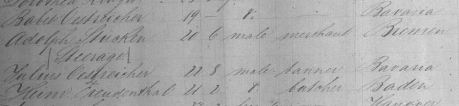
Julius Austrian (Oestreicher) immigrated with his sister Babette (wife of Louis Freudenthal Leopold) and brother-in-law Henry Freudenthal Leopold.
~ “New York Passenger Lists, 1820-1891,” image 19 of 895; NARA microfilm publication M237 (Washington D.C.: National Archives and Records Administration, n.d.).
My brother Falk went to California in 1846 via Panama. At six years of age I entered school. I remember well when my mother took me on the first day to school and had me give the teacher a package of smoking tobacco. I went to the public school in the morning, the teacher had little education, his father was the village tailor; the son being versed in the three “R’s” his father secured the position of teacher for him. In the afternoon I went to the Hebrew school. Mr. Mandel was the teacher there, he had received his education in a Seminary he was very strict and high tempered, the children all feared him, as occasionally he afflicted corporal punishment. Besides this I had private lessons in history and geography.
At the age of thirteen I had to start to assist working in the field, in harvesting and hay making. I also had to plow when I was barely strong enough to handle the plough, I had to hook the handles over my shoulders to manage to get to the next furrow. I had to arise during some of the winter months at 4 o’clock in the morning, and assist in the threshing while it lasted, and I got thrashed sometimes too, when I did not keep time. My greatest sport was fishing, for which purpose I made my own pole and I often walked off to the river, when my folks thought I was busily employed. The fish I caught were mostly perch. I remember I once caught several and fastened one to a string fastened to a stake in the ground, suddenly a severe thunder storm came up, at which I made hurridly for home, forgetting the little perch I had left behind. I started bright and early the next morning to get it, and to my great surprise on pulling the string I hauled up a big pike instead of the little perch, which had evidently swallowed the latter tied to the stake and thus was caught. The joy of my good luck was indescribable.
Another sport I was very fond of was shooting off pistols. My brother Marx had one in an old cupboard drawer, which I managed to get hold of one day and when none of the family were about I with a few of my boy friends ran off to the fields, where we had such fun taking turns in shooting, and when we had no more powder we snapped off percussion caps. When a pistol was not available I constructed an improvised pistol of my own design, by attaching a big old hollow key to a natural crook of wood, which I selected in the wood shed and to which I fastened it with wire. After filing a hole on the side of the key, under which I attached a piece of tin to hold the powder. When i was ready to shoot, I laid a little flat sponge on the tin, lighting the outer edge, which acted as a fuse, and as it burned toward the powder ignited it causing it to go off and making a loud report. Not trusting the old key entirely, however, fearing it might explode, I went to a safe distance after lighting the fuse.
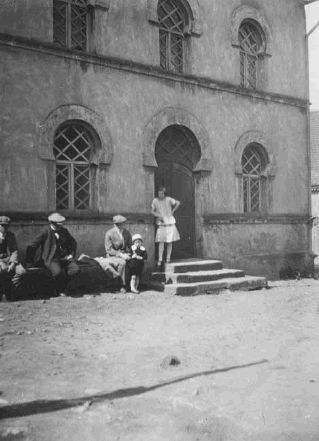
Outside the synagogue in Wittelshofen, Bavaria, Germany. Circa 1912-1938.
~ United States Holocaust Memorial Museum, photograph # 25821.
“Wittelshofen was declared ‘Judenfrei’ (‘free of Jews’) in January 1939.”
“The synagogue building was demolished during the winter of 1938/39.”
“A memorial stone was later unveiled there.”
~ Destroyed German Synagogues and Communities
In 1840, at the grand celebration of the new synagogue, my parents entertained with an invitation on a large scale. My mother had arranged for a special cook to prepare a grand feast. I and the younger children were excluded. I did not fancy being barred from participating. In strolling through the pantry I espied an elaborately decorated tart, chief ornament to grace the table. While the cook was otherwise engaged at the last moment, I managed to eat off the ornaments and decorations. Never will I forget the excitement and consternation the discovery of my act caused. Could hands have been laid on me then, I would have been severely dealt with.
In my fourteenth year, my mother began planning as to my future. The income of the fields, and the cattle business had declined, and considering the large family and household to be provided for did not permit of incurring much expense for my higher education, and my father advanced age made it impossible for him to enlarge his income. My mother was anxious to get me away from Wittleshofen, as she could see no promise in the future there for me. At this time, an opporunity was offered through my uncle Samuel N. Guttman and accepted.
 Chequamegon History