By Amorin Mello
A curious series of correspondences from “Morgan”
… continued from Copper Harbor Redux.
The Daily Union (Washington D.C.)
“Liberty, The Union, And The Constitution.”
August 29, 1845.
EDITOR’S CORRESPONDENCE.
—
[From our regular correspondent.]
ST. LOUIS, Mo. Aug. 19, 1845.
One of the most interesting sections of the North American continent is the basin of the Upper Mississippi, being, as it is, greatly diversified by soil, climate, natural productions, &c. It embraces mineral lands of great extent and value, with immense tracts of good timber, and large and fertile bodies of farming land. This basin is separated by elevated land o the northeast, which divides the headwaters of rivers emptying into the Mississippi from those that flow into the lakes Superior and Michigan, Green Bay, &c. To the north and northwest, it is separated near the head of the Mississippi, by high ground, from the watercourses which flow towards Hudson’s bay. To the west, this extensive basin is divided from the waters of the Missouri by immense tracts of elevated plateau, or prairie land, called by the early French voyageurs “Coteau des Prairies,” signifying “prairie coast,” from the resemblance the high prairies, seen at a great distance, bear to the coast of some vast sea or lake. To the south, the basin of the Upper Mississippi terminates at the junction of the Mississippi with the Des Moines river.
The portion of the valley of the Mississippi thus described, if reduced to a square form, would measure about 1,000 miles each way, with St. Anthony’s falls near the centre.
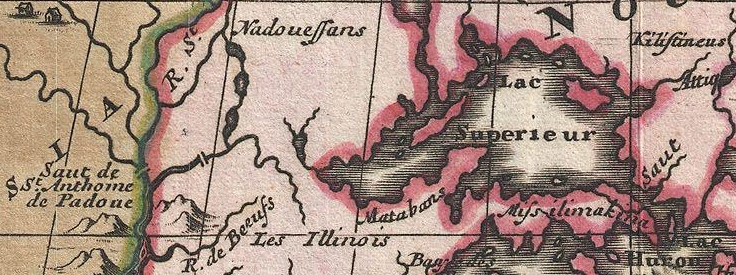
1698 detail of Saint Anthony’s Falls and Lake Superior from Amerique Septentrionalis Carte d’un tres grand Pays entre le Nouveau Mexique et la Mer Glaciace Dediee a Guilliaume IIIe. Roy de La Grand Bretagne Par le R. P. Louis de Hennepin Mission: Recol: et Not: Apost: Chez c. Specht a Utreght 1698.
~ Commons.Wikimedia.org
For a long time, this portion of the country remained unexplored, except by scattered parties of Canadian fur-traders, &c. Its physical and topographical geography, with some notions of its geology, have, as it were, but recently attracted attention.

Douglas Volk painting of Father Hennepin at Saint Anthony Falls.
~ Commons.Wikimedia.org

Father Antoine “Louis” Hennepin
~ Wikipedia.org
Father Hennepin was no doubt the first white man who visited St. Anthony’s falls. In reaching them, however, he passed the mouth of St. Peter’s river, a short distance below, without noticing it, or being aware of its existence. This was caused by the situation of an island found in the Mississippi, directly in front of the mouth of St. Peter’s, which, in a measure, conceals it from view.
After passing the falls, Father Hennepin continued to ascend the Mississippi to the St. Francis river, but went no higher.

Portrait of Jonathan Carver from his book, Travels through the interior parts of North America in the years 1766, 1767 and 1768.
~ Wisconsin Historical Society
In the year 1766, three years after the fall of Canada, Captain Johnathan Carver, who had taken an active part as an officer in the English service, and was at the surrender of Fort William Henry, where (he says) 1,500 English troops were massacred by the Indians, (he himself narrowly escaping with his life,) prepared for a tour among the Indian tribes inhabiting the shores of the upper lakes and the upper valley of the Mississippi. He left Boston in June of the year stated, and, proceeding by way of Albany and Niagara, reached Mackinac, where he fitted out for the prosecution of his journey to the banks of the Mississippi.
From Mackinac, he went to Green Bay; ascended the Fox river to the country of the Winnebago Indians; from thence, crossing some portages, and passing through Lake Winnebago, he descended the Wisconsin river to the Mississippi river; crossing which, he came to a halt at Prairie du Chien, in the country of the Sioux Indians. At the early day, this was an important trading-post between French traders and the Indians. Carver says: “It contains about three hundred families; the houses are well built, after the Indian manner, and well situated, on a very rich soil, from which they raise every necessary of life in great abundance. This town is the great mart whence all the adjacent tribes – even those who inhabit the most remote branches of the Mississippi – annually assemble about the latter end of May, bringing with them their furs to dispose of to the traders.” Carver also noticed that the people living there had some good horses.
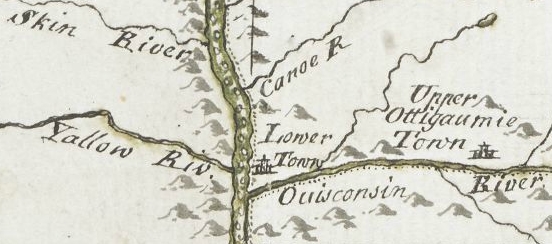
Detail of Prairie du Chien from Carver [Jonathan], Captain. Journal of his travels with maps and drawings, 1766.
~ Boston Public Library
The fur-trade, which at one time centred here, and gave it much consequence, has been removed to St. Peter’s river. Indeed, this trade, which formerly gave employment to so many agents, traders, trappers, &c., conferring wealth upon those prosecuting it, is rapidly declining on this continent; in producing which, several causes conspire. The first is, the animals caught for their furs have greatly diminished; and the second is, that competition in the trade has become more extensive and formidable, increasing as the white settlements continue to be pushed out to the West.
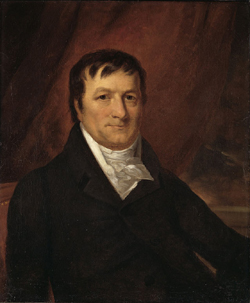
John Jacob Astor established the American Fur Company.
~ Wikipedia.com
At Prairie du Chien is still seen the large stone warehouse erected by John Jacob Astor, at a time when he ruled the trade, and realized immense profits by the business. The United States have a snug garrison at this place, which imparts more or less animation to the scene. It stands on an extensive and rather low plain, with high hills in the rear, running parallel with the Mississippi.
The house in which Carver lodged, when he visited this place, is still pointed out. There are some men living at this post, whose grandfather acted as interpreter to Carver. The Sioux Indians, whom Carver calls in his journal “the Nadowessies,” which is the Chippewa appellation for this tribe of Indians, keep up the tradition of Carver’s visit among them. The inhabitants, descendants of the first settlers at Prairie du Chien, now living at this place, firmly believe in the truth of the gift of land made to Carver by the Sioux Indians.
From this point Carver visited St. Anthony’s falls, which he describes with great accuracy and fidelity, accompanying his description with a sketch of them.
![Detail of Saint Anthony's Falls from Carver [Jonathan], Captain. Journal of his travels with maps and drawings, 1766. ~ Boston Public Library](https://chequamegonhistory.com/wp-content/uploads/2016/05/carver-detail-of-st-anthony-falls.jpg)
Detail of Saint Anthony’s Falls from Carver [Jonathan], Captain. Journal of his travels with maps and drawings, 1766.
~ Boston Public Library
From the Mississippi river Carver crossed over to the Chippewa river; up which he ascended to its source, and then crossed a portage to the head of the Bois Brulé, which he called “Goddard’s river.” Descending this latter stream to Lake Superior, he travelled around the entire northern shore of that lake from west to east, and accurately described the general appearance of the country, including notices of the existence of the copper rock on the Ontonagon, with copper-mineral ores at points along the northeastern shore of the lake, &c.
![Detail of "Goddard's River," La Pointe, and Ontonagon from Carver [Jonathan], Captain. Journal of his travels with maps and drawings, 1766. ~ Boston Public Library](https://chequamegonhistory.com/wp-content/uploads/2016/05/carver-detail-of-goddard-river-and-la-pointe.jpg)
Detail of “Goddard River,” La Pointe, and Ontonagon from Carver [Jonathan], Captain. Journal of his travels with maps and drawings, 1766.
~ Boston Public Library
He finally reached the Sault St. Marie, where he found a French Indian trader, (Monsieur Cadot,) who had built a stockade fort to protect him in his trade with the Indians.
![Detail of Sault Ste Marie from Carver [Jonathan], Captain. Journal of his travels with maps and drawings, 1766. ~ Boston Public Library](https://chequamegonhistory.com/wp-content/uploads/2016/05/carver-detail-of-sault-ste-marie.jpg)
Detail of Sault Ste Marie from Carver [Jonathan], Captain. Journal of his travels with maps and drawings, 1766.
~ Boston Public Library
Descendants of this Monsieur Cadot are still living at the Sault and at La Pointe. We met one of them returning to the latter place, in the St. Croix river, as we were descending it. They, no doubt, inherit strong claims to land at the falls of the St. Mary’s river, which must ere long prove valuable to them, if properly prosecuted.
From the Sault St. Marie, Carver went to Mackinac, then garrisoned by the English, where he spent the winter. The following year he reached Boston, having been absent about two years.
From Boston he sailed for England, with a view of publishing his travels, and securing his titles to the present of land the Sioux Indians have made him, and which it is alleged the English government pledged itself to confirm, through the command of the King, in whose presence the conveyance made to Carver by the Sioux Indians was read. He not only signified his approval of the grant, but promised to fit out an expedition with vessels to sail to New Orleans, with the necessary men, &c., which Captain Carver was to head, and proceed from thence to the site of this grant, to take possession of it, by settling his people on it. The breaking out of the American revolution suspended this contemplated expedition.
Captain Carver died poor, in London, in the year 1780, leaving two sons and five daughters. I consider his description of the Indians among whom he travelled, detailing their customs, manners, and religion, the best that has ever been published.
In this opinion I am sustained by others, and especially by old Mr. Duncan Graham, whom I met on the Upper Mississippi. He has lived among the Indians ever since the year 1783. He is now between 70 and 80 years old. He told me Carver’s book contained the best account of the customs and manners of the Indians he had ever read.
His valuable work is nearly out of print, it being rather difficult to obtain a copy. It went through three editions in London. Carver dedicated it to Sir Joseph Banks, president of the Royal Society. Almost every winter on the Indians and Indian character, since Carver’s time, has made extensive plagiarisms from his book, without the least sort of acknowledgement. I could name a number of authors who have availed themselves of Carver’s writings, without acknowledgement; but as they are still living, I do not wish to wound the feelings of themselves or friends.
One of the writers alluded to, gravely puts forth, as a speculation of his own, the suggestion that the Winnebagoes, and some other tribes of Indians now residing at the north, had, in former times, resided far to the south, and fled north from the wars and persecutions of the bloodthirsty Spaniards; that the opinion was strengthened from the fact, that the Winnebagoes retained traditions of their northern flight, and of the subsequent excursions of their war parties across the plains towards New Mexico, where, meeting with Spaniards, they had in one instance surprised and defeated a large force of them, who were travelling on horseback.
Now this whole idea originated with Carver; yet Mr. ——— has, without hesitation, adopted it as a thought or discovery as his own!

Alexander Henry, The Elder.
~ Wikipedia.com
The next Englishman who visited the northwest, and explored the shores of Lake Superior, was Mr. Henry, who departed from Montreal, and reached Mackinac through Lake Huron, in a batteau laden with some goods. His travels commenced, I believe, about 1773-‘4, and ended about 1776-‘7. Mr. Henry’s explorations were conducted almost entirely with the view of opening a profitable trade with the Indians. He happened in the country while the Indians retained a strong predilection in favor of the French, and strong prejudices against the English. It being about the period of the Pontiac war, he had some hazardous adventures among the Indians, and came near losing his life. He continued, however, to prosecute his trade with the Indians, to the north and west of Lake Superior. Making voyages along the shores of this lake, he became favorably impressed with the mineral appearances of the country. Finding frequently, through is voyageurs, or by personal inspections, rich specimens of copper ore, or of the metal in its native state, he ultimately succeeded in obtaining a charter from the English government, in conjunction with some men of wealth and respectability in London, for working the mines on Lake Superior. The company, after making an ineffectual attempt to reach a copper vein, through clay, near the Ontonagon, the work was abandoned, and was not afterwards revived.
General Cass, with Colonel Allen, &c., were the next persons to pass up the southern coast of Lake Superior, and, in going to the west and northwest of the lake, they travelled through Indian tribes in search of the head of the Mississippi river. Their travels and discoveries are well known to the public, and proved highly interesting.
Mr. Schoolcraft’s travels, pretty much over the same ground, have also been given to the public; as also the expedition of General Pike on the Upper Mississippi.

Major Stephen Harriman Long published his expedition as Voyage in a Six-oared Skiff to the Falls of St. Anthony in 1817.
~ Wikipedia.org
More lately, the basin of the Upper Mississippi has received a further and more minute examination under the explorations directed by Major Long, in his two expeditions authorized by government.

Joseph Nicholas Nicollet
~ Wikipedia.org
Lastly, Mr. J. N. Nicollet, a French savan, travelling for some years through the United States with scientific objects in view, made an extensive examination of the basin of the Upper Mississippi.
He ascended the Missouri river to the Council Bluffs; where, arranging his necessary outfit of men, horses, provisions, &c., (being supplied with good instruments for making necessary observations,) he stretched across a vast tract of country to the extreme head-waters of the St. Peter’s, determining, as he went, the heights of places above the ocean, the latitude and longitude of certain points, with magnetic variations. He reached the highland dividing the waters of the St. Peter’s from those of the Red river of the North. He descended the St. Peter’s to its mouth; examined the position and geology of St. Anthony’s falls, and then ascended the same river as high as the Crow-wing river. The secondary rock observed below the falls, changes for greenstone, sienite, &c., with erratic boulders. On the east side of the river, a little below Pikwabik, is a large mass of sienitic rock with flesh-colored feldspar, extending a mile in length, half a mile in width, and 80 feet high. This is called the Little Rock. Higher up, on the same side, at the foot on the Knife rapids, there are sources that transport a very fine, brilliant, and bluish sand, accompanied by a soft and unctuous matter. This appears to be the result of the decomposition of a steachist, probably interposed between the sienitic rocks mentioned. The same thing is observed at the mouths of the Wabezi and Omoshkos rivers.
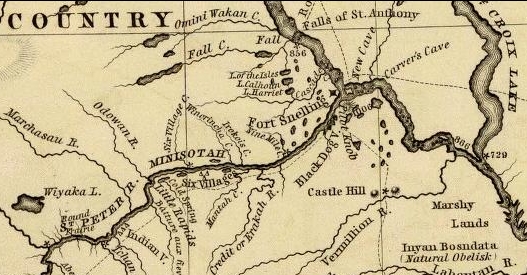
Detail of Saint Anthony’s Falls and Saint Peter’s River from Hydrographical Basin of the Upper Mississippi River from Astronomical and Barometrical Observations Surveys and Information by Joseph Nicolas Nicollet, 1843.
~ David Rumsey Map Collection
Ascending the Crow-wing river a short distance, Mr. Nicollet turned up Gull river, and proceeded as far as Pine river, taking White Fish lake in his way; and again ascended the east fork of Pine river, and reached Little Bay river, which he descended over rapids, &c., to Leech lake, where he spent some days in making astronomical observations, &c. From Leech lake, he proceeded, through small streams and lakes, to that in which the Mississippi heads, called Itasca. Having made all necessary observations at this point, he set out on his return down the Mississippi; and finally, reaching Fort Snelling at St. Peter’s, he spent the winter there.

Detail of Leech Lake and Lake Itasca from Hydrographical Basin of the Upper Mississippi River from Astronomical and Barometrical Observations Surveys and Information by Joseph Nicolas Nicollet, 1843.
~ David Rumsey Map Collection
Lake Itasca, in which the Mississippi heads, Mr. Nicollet found to be about 1,500 feet above the level of the ocean, and lying in lat. about 47° 10′ north, and in lon. 95° west of Greenwich.
This vast basin of the Upper Mississippi forms a most interesting and valuable portion of the North American continent. From the number of its running streams and fresh-water lakes, and its high latitude, it cannot fail to prove a healthy residence for its future population.
It also contains the most extensive body of pine timber to be found in the entire valley of the Mississippi, and from which the country extending from near St. Anthony’s falls to St. Louis, for a considerable distance on each side of the river, and up many of its tributaries, must draw supplies of lumber for building purposes.
In addition to these advantages, the upper basin is rich in mines of lead and copper; and it is not improbable that silver may also be found. Its agricultural resources are also very great. Much of the land is most beautifully situated, and fertile in a high degree. The climate is milder than that found on the same parallel of latitude east of the Alleghany mountains. Mr. Nicollet fixes the mean temperature at Itasca lake at 43° to 44°; and at St. Peter’s near St. Anthony’s falls, at 45° to 46°

“Maiden Rock. Mississippi River.“ by Currier & Ives. Maiden’s Rock Bluff. This location is now designated as Maiden Rock Bluff State Natural Area.
~ SpringfieldMuseums.org
Every part of this great basin that is arable will produce good wheat, potatoes, rye, oats, Indian corn to some extent, fine grasses, fruits, garden vegetables, &c. There is no part of the Mississippi river flanked by such bold and picturesque ranges of hills, with flattened, broad summits, as are seen extending from St. Anthony’s falls down to Prairie du Chien, including those highlands bordering Lake Pepin, &c. Among the cliffs of sandstone jutting out into perpendicular bluffs near the river, (being frequently over 100 feet high,) is seen one called Maiden’s rock. it is said an Indian chief wished to force his daughter to marry another chief, while her affections were placed on another Indian; and that, rather than yield to her father’s wishes, she cast herself over this tall precipice, and met an instant death. On hearing of which, her real lover, it is said, also committed suicide. Self-destruction is very rare among the Indians; and we imagine, when it does occur, it must be produced by the strongest kind of influence over their passions. Mental alienation, if not entirely unknown among them, must be exceedingly rare. I have no recollection of ever having heard of a solitary case.
From St. Anthony’s falls to St. Louis is 900 miles. The only impediment to the regular navigation of the river by steamboats, is experienced during low water at the upper and lower rapids.
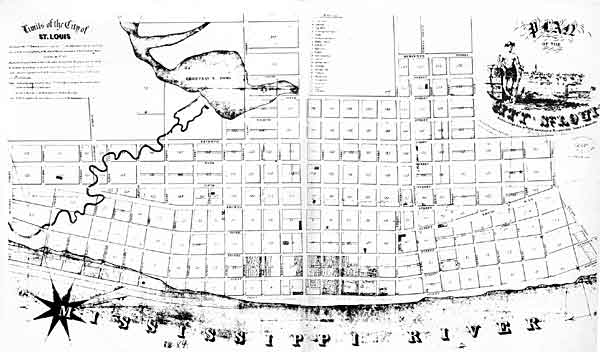
“St. Louis Map circa 1845”
~ CampbellHouseMuseum.org
The first are about 14 miles long, with a descent of only about 25 feet. The lower rapids are 11 miles long, with a descent of 24 feet. In each case, the water falls over beds of mountain or carboniferrous limestone, which it has worn into irregular and crooked channels. By a moderate expenditure of money on the part of the general government, which ought to be made as early as practicable, these rapids could be permanently opened to the passage of boats. As it is at present, boats, in passing the rapids at low water, and especially the lower rapids, have to employ barges and keel-boats to lighten them over, at very great expense.
From the rapid settlement of the country above, with the increasing trade in lumber and lead, the business on the Upper Mississippi is augmenting at a prodigious rate. When the river is sufficiently high to afford no obstruction on the lower rapids, not less than some 28 or 30 boats run regularly between Galena and St. Louis – the distance being 500 miles. Besides these, two or three steam packets run regularly to St. Anthony’s falls, or to St. Peter’s, near the foot of them. Every year will add greatly to the number of these boats. Other fine large and well-found packets run from St. Louis to Keokuk, at the foot of the lower rapids, four miles below which the Des Moines river enters the Mississippi river. It is the opinion of Mr. Nicollet, that this river can be opened, by some slight improvements, for 100 miles above its mouth. It is said the extensive body of land lying between the Des Moines and the Mississippi, and running for a long distance parallel with the left bank of the latter, contains the most lovely,rich and beautiful land to be found on the continent, if not in the world. It is already pretty thickly settled. Splendid crops of wheat and corn have been raised on farms opened upon it, the present year. Much of the former we found had already arrived at depots on the river, in quantities far too great to find a sufficient number of boats, at the present low water, to carry it to market.
I do not see but the democratic party are regularly gaining strength throughout the great West, as the results of the recent elections, which have already reached you, sufficiently indicate.
Those who wish to obtain more general, as well as minute information, respecting the basin of the Upper Mississippi, I would recommend to consult the able report, accompanied with a fine map of the country, by Mr. J. N. Nicollet, and reprinted by order of the Congress at their last session.
I am, very respectfully,
Your obedient servant,
MORGAN.
This curious series of correspondences from “Morgan” is continued in the September 1 and September 5 issues of The Daily Union, where he arrived in New York City again after 4,200 miles and two and a half months on this delegation. As those articles are not pertinent to the greater realm of Chequamegon History, this concludes our reproduction of these curious correspondences.
The End.
1848 La Pointe Annuity Payments
March 2, 2016
By Amorin Mello

American Fur Company Papers: “Map of La Pointe”
drawn by Lyman Marcus Warren, 1834.
~ Wisconsin Historical Society
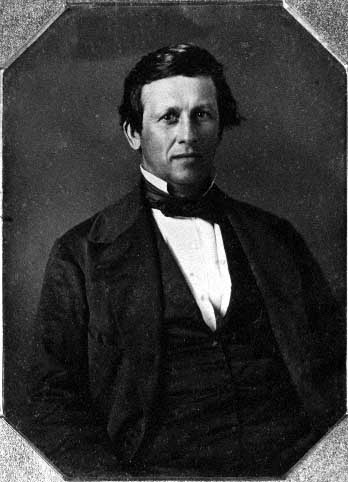
Hercules Louis Dousman
“In 1827, the American Fur Company (AFC) achieved a monopoly on the fur trade in what is now Minnesota. The Company suddenly increased its prices by 300 percent; American Indians, returning from the hunt with expectations of trading for their yearly supplies, found themselves cast into a debt cycle that would increase in the decades ahead. American Indians would receive virtually unlimited credit as long as they maintained the most precious collateral: land.
As game was overhunted and demands for furs changed, the system collapsed under a burden of debt. In 1834, AFC departments were sold to partners who included the Chouteaus, Henry Sibley, and Hercules Dousman. The business strategy of the reorganized companies changed from fur trading to treaty making. In 1837, economically stressed Dakota and Ojibwe people began selling land in what became Minnesota. Fur traders, through their political connections, were able to divert government payments for American Indian land into their own pockets. In effect, land cession treaties became a vast government bailout of fur trade corporations.”
~ Relations: Dakota & Ojibwe Treaties
Henry Hastings Sibley Papers 1826-1848

Henry Hastings Sibley
~ Minnesota Historical Society
Northern Great Lakes Visitor Center
History Center & Archives
“Papers of Minnesota’s first governor during his years as a fur trader, consisting primarily of correspondence among the various American Fur Company agents located in the Wisconsin Territory. Correspondence concerns internal company business; business with Hudson Bay Fur Company; company agreements with the Dakota Indians; company interest in United States government treaties with the Dakota, Ojibwa, and Winnebago Indians; attempts by the company to prevent war between the Dakota and the Sauk and Fox Indians; relations with missionaries to the Indians of the region; and company disputes with Indian agents Henry R. Schoolcraft and Lawrence Taliaferro.
Correspondents prominent in the early history of Minnesota and Wisconsin include William Aitken, Frederick Ayer, Alexis Bailly, Bernard Brisbois, Ramsay Crooks, Henry Dodge, James Doty, Hercules Dousman, Jean Faribault, Alexander Faribault, Joseph Nicollet, Henry Rice, Joseph Rolette, Henry Schoolcraft, Lawrence Taliaferro, and Lyman Warren.”
New York April 17, 1848
To Geo Ebninger Esq.
Assignee Am. Fur Co.
Dear Sir,

Pierre Chouteau, Jr.; son of French Creole fur trader, merchant, politician, and slaveholder Jean-Pierre Chouteau.
~ Wikipedia.org
We hasten to reply to you, of this date offering to sell “The American Fur Co Establishments at Lapointe” all the Northern Outfit Posts: – “The whole for twenty five hundred dollars ($2500)” provided we will take the goods remaining on hand there after this spring’s trade at New York cash for sound Merchantable goods everything else as its fair actual value & say that we regret you waited until the moment our senior was leaving for the west before making the above proposition & also some days after the departure of Mr. Rice. It is probable, if your letter had been received during his stay here, that we would have accepted it or made other propositions which would have been agreeable. We thought if you were desirous of selling the Establishments & goods that you would have apprised us earlier of your intentions & given us time to consult or reflect upon it. And we expect, and hope that you will give us time to communicate your proposition to the persons interested with us in Upper Mississippi & particularly with Mr. Rice who alone has visited the posts & has a correct idea of their value.
Believing that the delay we ask will not or cannot be prejudicial to your interests we will wait your answer.
Very respectfully
yr obd svt
P Chouteau Junr
New York 28th June, 1848
Mister P Chouteau Jr & Co
New York
Gentlemen,
Agreeably to what I had the pleasure to address you on the 14th April last, copy of which letter is annex I will sell you the late American Fur Company’s Establishment at La Pointe & as the terms and conditions as before named, delivery to be made to you or your agent on a date to be hereafter agreed upon between the First day of September and Fifteenth day of October next and ending Payments for the same to be made in New York to me in October or November next.
Please let me have your written reply to this proposition.
I am gentlemen bestly
Your Obedt Servt
George Ebninger
Assignee to P Chouteau Jr, St Louis
New York 30th June, 1848
To George Ebninger Esq.
Assignee Am Fur Co.Dear Sir,

View of La Pointe, circa 1843.
“American Fur Company with both Mission churches. Sketch purportedly by a Native American youth. Probably an overpainted photographic copy enlargement. Paper on a canvas stretcher.”
~ Wisconsin Historical Society
In reply to yours of 28th inst (with copy annexed of similar letters under date 14th April last) we have to say that under advises lately received from our Saint Louis house we accept in general terms your proposition for the sale of the American Fur Co’s trading Establishment at Lapointe and interior for the sum offered, of Twenty Five Hundred dollars. It may be well enough to observe how ever that we consider the sale as dating only from the time of delivery to our authorized agents. Until then received we shall consider the posts as the property of Late American Fur Co and to be as their risk and any destruction of property between now and the time you may fix for delivery to be their loss and not ours.
The terms of payments proposed by you are entirely acceptable. But we think it might be better to make it more definite and accordingly suggest that our agents who received the property draw upon us as forty days & nights for the amount. Hoping that these slights exchanged may meet your sanctions and that you will name an early day for the delivery of posts & we remain very truly,
Your Obedt Servt
P. Chouteau Jr & Co
New York 5th July 1848
P Chouteau Jr Esq
Saint LouisDear Sir

“Ramsey Crooks (also spelled Ramsay) was born in Scotland in 1787. He immigrated to Canada in 1803 where he worked as a fur trader and explorer around the Great Lakes. He began working for the American Fur Company, which was started by John Jacob Astor, America’s first multi-millionaire, and made an expedition to the Oregon coast from 1809-1813 for the company. By doing so he also became a partner in the Pacific Fur Company. In 1834 he became acting president of the American Fur Company following Astor’s retirement to New York. A great lakes sailing vessel the Ramsey Crooks was constructed in 1836 by the American Fur Co. A nearly identical sister ship was built in the same year and was called the Astor. Both ships were sold by the dissolving fur company in 1850. Ramsay Crooks passed away in 1859, but had made a name for himself in the fur trade not only in Milwaukee and the Great Lakes, but all the way to the Pacific Ocean.” ~ Milwaukee County Historical Society
On the 28th June I sold to your house the Establishments of the late American Fur Company at Lapointe agreeably to the letter I had written to you on the 14th April. Cash delivery to be made at some period to be agreed upon hereafter between the first day of September and fifteenth day of October next. I hope that it may be in my power to get to Lapointe and attend to the delivery to your agents but if not we must select some other to act for me, Mr. Crooks and myself are not on good terms in [cou-bethee?] ease as he has been opposed to the sale being made by from the bush. I have lately heard that Mr. Crooks has written the Establishment & at Lapointe (Mr. [Ludgem?] of Detroit told me so while in the city lately) and he must have written to him shortly after the offer was made to you here, and it remains to be seen what authority he can have to dish use of the property which has been assigned to me and over which I have acted as assignee for nearly the last six years. Mr. Crooks acts of leaving here shortly for the Northern Posts. Before then I shall know what he proposes to do to annul the sale I have (under the authority vested in me as assignee) made to you, and which has been made agreeably to his only Suggestions on the 14th day of April last, and the only objection he can make to the Sale is that you did not as once accepts of his but required only a reasonable time to reply to which I was willing to grant and would again give under such circumstances you being there on the eve of leaving here, but it was clear enough that Mr. Crooks never wished that you should have the Northern Outfit Establishment, but that his friend Borrup should. I shall however do all that I can to oppose his injust views on that score.
I am In Most Truly
Your Obedt Servt
George Ebninger
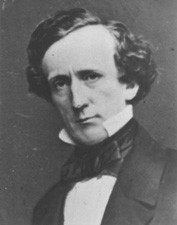
Aspring politician and future Senator Henry Mower Rice represented the Chippewas at the 1847 Treaty of Fond du Lac, and appears frequently here on Chequamegon History.
~ United States Senate Historical Office
St. Louis July 14, 1848
Mr.s Sibley & Rice
St. PetersDr. Sirs
We had this pleasure of the 7th inst by [Shamus Highland Many?] enclosing Invoice & Bill of Landing of C.O. English goods which we hope you will have received in good order and due time – The same day and as the time the boat was pushing off we addressed you a few lines in haste, advising you of the purchase made by our House in New York, of the posts at Lapointe. We have just received several documents in relation to that purchase of which you will find copies herewithin.
You will perceive from their contents how Mr. Crooks has acted in the matter, and that it has become urgent for us to take such steps as will answer the possession of the said posts. How we will be able to succeed, Doctr. Borrup being now in possession & having apparently purchased from Mr. Crooks, is a matter of doubt and can only be ascertained at Lapointe. We have purchased Bona Fide from Mr. G. Ebninger, the only person authorized to make sale, as the assigner of the late American F. Co. Mr. Borrup we are afraid, will (as you can see by Mr. Sanford’s letter) refuses to give possession, and in that case, in a country where there is no way of enforcing law, we may not be able to obtain possession before next year. Now, would it be desirable or advantageous to make the purchase and not get possession before that time? We think not.

Oil painting of Doctor Charles William Wulff Borup from the Minnesota Historical Society:
“Borup and Oakes were headmen for the [American Fur Company]. All voyageurs, ‘runners,’ as they were called, were employed by said company. They would leave La Pointe about the beginning of September, stay away all fall and winter among the Indians in their respective districts, collect furs, and return about the beginning of June. They would take along blankets, clothes, guns, etc., to trade with the Indians for their furs. They took along very little provisions, as they depended mostly on hunting, fishing, wild reice, and trade with the Indians for their support. There were several depots for depositing goods and collecting furs, for instance at Fond du Lac (Minnesota,) Sandy Lake, Courtes Oreilles, Lac du Flambeau Mouth of Yellow River, etc.”
~ Proceedings of the [Wisconsin Historical] Society at its Sixty-fourth Annual Meeting, 1917, pages 177-9
We are writing this day to our home in New York and to Mr. G. Ebninger that he must proceed immediately to Lapointe so as to be here from the 1st to the 15th September, and claim himself & in person the delivery of the posts. Any agent would not probably succeed, or objections would no doubt be made by Doctr. Borrup which said agent could not face or answer. You will therefore do the necessity of either of you going to Lapointe and meet them with Mr. Ebninger on the time appointed above.
Very truly yours,
P. Chouteau Jr & Co
It was only on the 10th inst that we were handed your forms of 25 june enclosing packing ‘℅’ of the U.S. postal M.R. #01037 for ℅ St Louis ℅ Chippewa outfit. Capt. Ludwick ought to be more particular with papers confided to his care.
Bernard Walter Brisbois was an agent for the American Fur Company.
Duplicates of this letter and documents enclosed, sent to the care of Mr. Brisbois of Prairie du Chien, by mail
You will notice by copy of telegraphic dispatch of the 10th that the Chippewa annuity will be paid at Lake Superior as heretofore.
[Illegible]
The New York Times
September 29, 1851
“Indian Moneys”
There is no greater abuse in the governmental policy of the United States, than the past and present system of Indian payments; and the Indians would be benefited if the money thus appropriated were cast into the Lakes, rather than made the cause of such much distress and swindling as it is.
The author of this article is not identified.
In the August of 1848 we were present at a payment at La Pointe, and we have no hesitation in saying that every dollar paid to the Indians there was a disadvantage rather than a benefit to them.
The payment was fixed for August, and Indians from West of the Mississippi were called together at La Pointe to receive it. They gathered at the appointed time, and the payment was not made for three weeks after the time specified.
The money collected at the Saut Ste. Marie Land Office, the most convenient point, had been transported, as per Government order, to Chicago, and the Paymaster received drafts on that point where he was compelled to go for the specie, and the payment was thus delayed.

La Pointe Beaver Money of the American Fur Company’s Northern Outfit from “The Beaver in Early Wisconsin” by A. W. Schorger, Wisconsin Academy of Science, Arts, & Letters, Volume 54, page 159.
Meantime, the Indians gathered at La Pointe were without the necessaries of life, and the agents of the North American Fur Company, and a few old traders who were posted in the business, supplied them with provisions at exorbitant rates, and forced them to buy with every ounce of pork or flour which they needed, an equal amount of dry-goods and gewgaws, which had no value for them. These sales were made on credit, to be settled at the pay-table. At the payment, some $30,000 in cash, and a stipulated quantity of blankets, guns, powder, tin pails, calicoes, ribbons, &c., were distributed; and this American Fur Company, and the favored traders, raked from the Paymaster’s table as it was counted out to the bands, over $12,000 for provisions furnished to, and trash forced upon the Indians, while they were delayed after being summoned to the payment.
Some $14,000 more was spent among forty traders and the remaining $4,000 the Indians carried home; about one dollar each.
Their blankets, about the only valuable thing they received in the way of dry goods, were on the night after payment, mostly transferred to a mercenary set of speculators, at a cost of a pint of whiskey each, and came down to the Saut as private property on the same propeller that took them up as government gratuity.
Such was the result of a payment for which thousands of Indians traversed many miles of forest, wasted six weeks’ time, and lost the crop of wild rice upon which they depended for their winter’s subsistence.
If a white man with a white soul, writes the history of the Indians of the West, the American government will gain little credit from his record of Indian payments.
For more context about these American Fur Company partners and their affairs following the 1848 La Pointe annuity payments, please read pages 133-136 of Last Days of the Upper Mississippi Fur Trade by Rhonda R. Gilman, Minnesota History, Winter 1970.
But the swindle of 1848 was not gross enough to suit certain grasping parties. La Pointe was too easy of access. So many traders sought a market for their goods there, that the old monopolists could not obtain a thousand per cent on the goods they sold; and even in 1848, it was whispered that they were using all their influence to have the future payments made at some point so far West that competition would not force them to be content with moderate profits.
For more context about the Lake Superior Chippewa following the 1848 La Pointe annuity payments, please read our The Sandy Lake Tragedy and Ojibwe Removal series here on Chequamegon History.
To effect this it was necessary to remove the Chippewas further West, and by some influence, not, perhaps, distinctly marked, but yet more than suspected, this order of removal was secured.
It was uncalled for, useless, and abominable; and we are glad, for the sake of humanity and justice, that the Administration have resolved that for the present the edict shall not be enforced. We trust it may never be.
 Chequamegon History