Tonight’s presentation: Trails & Towns before Washburn
February 6, 2024
Join us LIVE in person on Tuesday night to learn about the Ancient Trails and Ghost Towns that were here before Washburn was founded in 1883.
Presented by Chequamegon History’s Amorin Mello.
Hosted by the Washburn Heritage Association for the 13th Annual Tony Woiak Winter History Festival.
Apologies for the very short notice!
The 19th Ojibwe Journal of Edmund F. Ely
July 9, 2023
By Leo and Amorin
The Ojibwe Journals of Edmund F. Ely, 1833-1849, compiled and edited by Theresa Schenck, and published by University of Nebraska Press in 2012, are a fascinating window into Ojibwe Country at a pivotal time in history. Chequamegon History frequently cites this work, which consists of eighteen journals kept by a Protestant missionary during his largely unsuccessful labors among the Ojibwe people of western Lake Superior and the upper Mississippi country. In it, Dr. Schenck alludes to a nineteenth journal, not published in the book, dealing with the liquor trade at La Pointe in the years 1847 and 1848.  The original manuscripts are held by the Northeast Minnesota Historical Center at the University of Minnesota-Duluth. Other historical societies hold transcripts made by Grace Lee Nute and Veronica Houle in the 1930s. Here we present our own transcription of Journal 19.Unlike numbers 1-18, Journal 19 is less a personal diary and more an official log of incidents related liquor trafficking and drunkenness on Madeline Island and surrounding regions. During those years, Ely was a teacher at the La Pointe Mission under Rev. Sherman Hall and also provided assistance to Rev. Leonard Wheeler at the Bad River Mission. These missionaries came from the New England evangelical tradition of the Second Great Awakening, which in addition to trying to convert the peoples of the world, also produced movements for Abolitionism, Women’s Suffrage, and Temperance. Letters indicate that some form of La Pointe Temperance Society was created in the late 1840s. Journal 19 references papers on file, indicating that the document may actually be the official log of the Temperance Society, probably having the intent to produce evidence against illegal liquor traders.
The use of alcohol in the fur trade goes back four centuries, to the earliest French presence on Lake Superior. Government and church efforts to suppress that trade go back almost as far. These measures, however, were never successful in fully eliminating liquor from the trade. By 1847, the laws related to alcohol at La Pointe were somewhat ambiguous. The Intercourse Acts of the United States prohibited the sale of liquor to Indians and on Indian lands. Enforcement, therefore, was the responsibility of the Government Sub-Agent. However, there were questions over whether his jurisdiction extended to non-Natives, to mix-blood Ojibwe people with American citizenship, or to transactions completed on the water of Lake Superior. Suffice it to say, both Federal laws and local ordinances prohibiting alcohol were enforced irregularly. The missionaries found this maddening.
Edmund F. Ely was perfect for the job of professional tattletale. For one thing, he was good at being disliked. He had numerous enemies in both the Ojibwe and the non-Native population. Around the time he was driven out of Fond du Lac by the chiefs of that community, he even went so far as to compile a list of reasons why the Fond du Lac Ojibwe disliked him. He would later go on to alienate several of the early settlers of Superior and Duluth during the McCracken-Ludden Affair, and he often sent complaints about his fellow missionaries back to headquarters in Boston.
We, today, are also fortunate that Ely had this job. Most accounts from this era, about the destructive power of alcohol in the Laker Superior trade are very similar in nature. We get a lot of righteous screeds, emphasizing only sensational violence. These are long on moralizing and short on interesting detail. Ely is certainly moralistic to the point of sanctimony, and some of his accounts are extremely violent. However, Journal 19 preserves the same types of details and idiosyncratic observations that makes the earlier journals so compelling. Because of this, we get a true window into the nuances of 1840s La Pointe society. Despite lax or selective enforcement of liquor laws, we arguably see a community less affected by alcohol than the nearby white settlements at St. Croix and Ontonagon. Finally, we get to see familiar characters, learn of their triumphs and failures, and hear stories both horrific and humorous, but seemingly very real.
The Ojibwe Journals of Edmund F. Ely:
LaPointe 1847-1848
Journal # 19
1847
May.
Adams of Ontonagon came to Bad River with goods & Whiskey, for trade with the Indians. He first past into the Bay behind Shagouamik & the whiskey was secreted near the sand cut. Mr. Hayes (Sub-Agt) Learning of this movement went in search, & destroyed [it at once. 50 to 80 Quarts sold.]
Aug.
The Sail Boat “Flying Indian” [came ashore for sale] with whiskey & secreted it [illeg.]
“
Schooner “Fur Trader” searched by the Sub Agent & [33] qua [btls] of Liquour in bottles destroyed.
“
[omitted or illegible sentence]
“
Steam Boat “Julia Palmer” boarded and searched at the [Sault] [illeg.] of [illeg.]

Martin Beaser,a prominent name in early Ashland history, got his start here as an illegal liquor trader. These late summer incidents, in both 1847 and 1848, coincide with the La Pointe annuity payments
Augt.
Martin Beser, of Ontonagon arrived in a Yawl–with a few others, reported as passengers. Journalist has been informed that she brought part of the load (whiskey) of the Flying Indian. Probably had considerable whiskey of belonging to Beser & the Passengers.
— Besor’s boat with himself, Chas. Rowley & a stranger on board (all intoxicated) was upset in a squall while cruis about Eleven o clk P.M. while cruising about the harbour. Wind Northerly. They drifted on to Shagouamik & struck some distance off the point on the shoal in about 4ft water. Men lay on the side of the boat, benumbed, helpless, & almost speechless & inconscious.
—It being surmised from certain movements, by a member of the Temp. Socy. that a Bbl of Whiskey would be removed from the Island to Shagouamik. Mr. Hayes was informed, who sent off Mr. Smith & two strikers, before day break, to keep a look-out. Mr. Smith discovered Besor’s boat–took off the men & brought them to Cadottes–where they were seen by Messrs Wheeler & Johnson & others.
“–Sab.
Besor’s boat left, and were obliged to put in to Bad River where were encamped the Lac du Flambeau Wisconsin Indians Indians returning from payment. There was liquor enough onboard to commence a trade. The Indians were supplied & became intoxicated. The wife of White Bird (mother of Kebebizindų) was present, who states that an Ind rec’d a bottle from one of the men on board, in exchange for a Blanket, but as ascertaining it contained only water went to take his Blanket again, whereupon Besor resisted him & knocked him down with a Rifle. The Ind’s were roused by the report that the white men were killing the man, & as the boat shoved off the shore, fired upon it, shot & ball, one Ball passed through the post of the ship keel [cent]. & struck lodged in the arm of James Dorman, who had thrown himself there off place of safety. Boat put back to Warren’s for surgical help–left Dorman & went off same day (Sunday)
[perpendicular to beginning of struck-out statement]Incorrect
[in margin at beginning of struck-out statement]
Sab previous
[perpendicular to ending of struck-out statement]This statement is incorrect see Whitebird’s wife’s statement on file.
On the last two days of the payment,
Bottles of liquor were smuggled ashore in the pockets of dealers, & sold for $1, per bottle, or exchanged for blankets. Some bottles were found to contain only water. The trade in bottles was carried on, (it is believed) through the windows of the Julia Palmer. Capt. Wood, of the steamer was detected in the night, landing his yawl, with bottles of whiskey in possession. Some two or three Bbls, (in different sized casks) were found & destroyed by Govt.
Nov.
Francois Boudrie of Ontonagon arrived here with whiskey. Evidence was obtained of his having infringed the law in selling to Indians & also of selling without licence. Mr. Austrian lodged a complaint with Justice Bell & Boudrie was brought to trial, but from his supposed inability to pay the fine, & there being no prison, at the was set at liberty on securing an amount of $5 for costs, without bonds “to keep the peace” being required to enter into Bonds to keep the peace.
— Jejiguaio complained to Justice Bell against Millette for selling whiskey to Indians in exchange for paymt. goods. Case not examined–
— gave Mr. Oakes a list of goods, traded for whiskey with Millette. Indian was dissatisfied needed his goods & wished to get them again.
May 13.
Francis Boudrie of Ontonagon brought whiskey to Bad River for trade with the Inds. B. confessed his crime to Messrs. Wood & Wheeler. An officer warrant was issued by Justice Bell, but the officer arrived too late to arrest him, he having left the Territory.
May 6.
Propeller Independence arrived from Sault St. Maries. Not known that any intoxicating liquor was landed save 2 Bbls cider for Mr. Watrous.
19th
Chas. Brissett states that Henry Beaulieu told him he (Henry) bought one bottle of liquor of Watrous for $1. (Whh Henry denies) Some observed Henry to be, in their estimation, a little excited from drink.
May 23.
Propeller Independence arrived today from Sault St. Maries. Dr. Borup & fam, & J. P. Hayes Esq. passengers.
Items gathered at Ance Kiueonaui. In Oct Last, 3 young men (Indian) from the methodist Station, went across the bay to Meniclear’s, got whiskey, & returned drunk. One of them lay on the shore & died in the night. A coroner’s Inquest was held on the body. (P.O. Johnson)
Some time in Nov. or Dec.
A canadian came through from Green Bay in company with J. Paull of Ontonagon, got liquor of Geo. Burkett, & was drunk some days, was then attacked (with pluerisy probably) & died (P.O. Johnson)
In Jany.
3 miners came from Copper Harbour, on their way to Green Bay, with considerable money. They stopped at Meniclear’s & gave themselves to drinking one or two days, during which, one did a severe wound in the hand, and another found himself minus about $100. (Johnson)
There are 5 traders at L’Ance, viz.
P. Crebassa no whiskey
Meniclear Whiskey & drinker
Geo. Burkett. do – do
Sherman do – do
Sheldon do – do
2 of the above drinkers, also abuse their families.
Some time in the fall of 1847,
John Champaigne, in the Employment of Doct. Kane, on their way up the ontonagon was seized with delirium tremens, & died. Had been drinking at the mouth of Ontonagon.–
March 2nd, 1848.
Jas. Landergrun was found in a dying state on the Ice, Ontonagon River, for particulars see the letter of Mr. Saml O. Knapp (on file)
Feb 7. 1847.
Henry Rust was killed shot by a shot from an Nodin or his son in law, at Dicks Drakes trading house on Snake River St. Croix, Co. Drake & another man were drunk & were fired upon they were too drunk to know much about the circumstances for particulars, see statement of J. P. Hayes Esq (on file)
May 1848.
–Drake shot dead killed by a shot Bapt. Robideau– Liquor the cause.
June 19.
Schooner Swallow arrived from Sault St. Maries. freight for Messrs Hyde, Leopoled & N. Fur Co.
March.
Mr. Cash of Ontonagon stated to Journalist that Martin Besor, after his return from Lapoint last fall offered to sell him any number of Indian Blankets, whh he (Cash) might be disposed to buy.
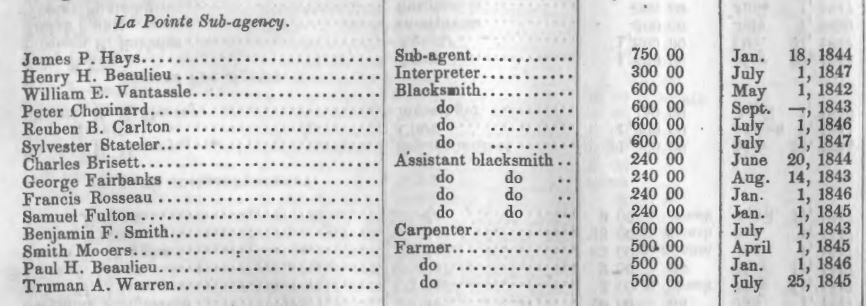
List of mid-late 1840s employees at the La Pointe Indian Sub-Agency including James P. Hayes and others.
~ Thirtieth Congress – First Session. Ex. Doc. No. 26. House of Representatives. Persons Employed In The Indian Department. Letter from The Secretary of War, Transmitting a statement of persons employed in the Indian Department. January 26, 1848.
June 22.
Jas. P. Hayes Esq. U. S. Sub Agt. recd his dismission & left in the Schooner Swallow– cause, Intemperance
July.
Fr. Boudrie arrived from Ontonagon with a cask of whiskied Cider– was prosecuted–a search warrant was issued & Peter Vandeventer was deputized to serve it. Van deventer After allowing abundant time for the service, Mr. Justice Bell & Van Tasell went to the building under search, & detected Van deventer in secreting a part of the cider. The whole was seized & destroyed by the owner–
Aug 28.
Propeller Independence arrived. Considerable intoxication among french & Half breeds.
“ 29
Schooner Napoleon, Clarke arrived with Govt provisions. Passengers Hyde, Wolcott & Martell
In discharging some bbls. of corn from the Propeller, on bbl. burst, & revealed a number of bottles of Liquor secreted among the Corn. The bbls were expressed back to the Sault. They have since been ascertained to belong have shipped by Martell of Sault St Maries. It was also reported by a passenger on the propeller, that the Napoleon was supposed to have on board a Bbl of Liquor belonging to Wolcott.
A number of Indians are reported to have had liquor about the time the Propeller left.
— An Indian was instigated by a Wht. man named Mills to murder two Americans living on Apple River–liquor was used in carry out Mills’s plans. The Ind was arrested & Hung, without judicial trial, at the Falls of St Croix.
— Majise shot killed in a drunken frolic on the St Croix. died next day–
— An old woman had her arm broken at the mouth of the Brule by a drunken son in law–Liquor furnished by Aug. Cadotte.
Sept 11.
Wood Smith & Vantassell Govt men, found 2 Kegs (about 12 [gal]) whiskey near the camp of Fr. Boudrie belonging to him, concealed in the ground–they immediately destroyed it.
6th
The sailboat Flying Indian arrived in the night of [Sunday] [day] last.
Sept 13.
Schooner Algonquin arrived from Sault St. Maries ~~~~~~~~~~~~~~~~~~~~~~~~~~~~~~~~~~~~~~~~~~~~~~~~~~~~~~~~~~~~~~~~~~~~~~~~~~~~~~~~~~~~~~~~~~~~~~~~~ Further information about the challenges of enforcing liquor laws at La Pointe can be found in the following:
“A real bona fide, unmitigated Irishman”
Reisen in Nordamerika: From Ontonagon to the mouth of the Bois-brule (Part 3)
1855 Inquest on the Body of Louis Gurnoe
1856 Inquest on the Body of Jerry Sullivan
~~~~~~~~~~~~~~~~~~~~~~~~~~~~~~~~~~~~~~~~~~~~~~~~~~~~~~~~~~~~~~~~~~~~~~~~~~~~~~~~~~~~~~~~~~~~~~~~~
Ely, Edmund Franklin, and Theresa M. Schenck. The Ojibwe Journals of Edmund F. Ely, 1833-1849. Lincoln: University of Nebraska, 2012. Print.
Folsom, William H. C., and E. E. Edwards. Fifty Years in the Northwest. St. Paul: Pioneer, 1888. Print.
Paap, Howard D. Red Cliff, Wisconsin: A History of an Ojibwe Community. St. Cloud, MN: North Star, 2013. Print.
Schenck, Theresa M. William W. Warren: The Life, Letters, and times of an Ojibwe Leader. Lincoln: University of Nebraska, 2007. Print.
Special thanks to Dr. Schenck for making this post possible.
Asaph Whittlesey Incidents: Number VIII
April 20, 2023
Collected & edited by Amorin Mello

Originally published in the April 6, 1878, issue of The Ashland Press. Transcribed with permission from Ashland Narratives by K. Wallin and published in 2013 by Straddle Creek Co.
… continued from Number VII.
Early Recollections of Ashland: Number VIII
by Asaph Whittlesey
We now offer a few comments upon our experience in common, and our appreciation of Doctor Edwin Ellis. I observe first that the inherent modesty of the man left him with next to no thought of himself in his “Early Recollections of Ashland,” and therefore the weightier of the task falling upon me. Had the question been raised “who is Dr. Ellis?” a proper reply would have been “Dr. Ellis is Dr. Ellis.”

In all my acquaintance I find no person more clearly identified than is this man. His manner of shaking hands, the music of his voice, and his unconscious habit of setting his hair on end, belong to no one but the man Edwin Ellis. For near a quarter of a century have I known him in the relationship of neighbor, physician, oarsman, farmer, speculator, preacher, merchant and as one skilled in back gammon, and can testify that he is a man who does with his might whatsoever his hands find to do. Those of us who were known as pre-emptors or town site claimants had occasion to regard the arrival of Dr. Ellis with no little suspicion, as certainly an emergency only would have induced him to make the trip from La Pointe during the most inclement season of the year. I remember well my anxiety to know whether or not he was a married man, and so direct were my inquiries as to this, that seemingly there was no way left but for him to satisfy our curiosity by simply saying yes or no. However we soon discovered that we were only wasting words in pressing the subject, and abandoned all further inquiry regarding it. Is it not strange that so good a man and one possessing so admirable a wife should be found so unwilling to satisfy our inquisitive minds in regard to this matter?
There was still another peculiarity noticeable in the Doctor, and that was his proclivity for secret organizations. He was chosen Chairman of a secret organization having for its object protection to pre-emptors from having their claims jumped, though one writer informs us that in the eye of the law they were all trespassers, – but by this means those holding claims felt a security in being absent from them the greater portion of their time. Perhaps the existence of this organization may explain why there has been so many little acres of early clearings discovered by brother Pratt, in the vicinity of Ashland.
Again, Dr. Ellis is one who thinks for himself, but is ever free to weigh the arguments of others, that he may be convinced of the right, and having formed his conclusion is outspoken, so that no one can mistake his position. Being of a hopeful and cheerful turn of mind, his company is courted. All in all whether as to his fitness for the life of a pioneer or as a neighbor and Christian friend I never knew a better.
I have been with him also in times of very great peril, when seemingly we were destined to a watery grave. But through presence of mind and well directed effort we succeeded in reaching the shore amid a feeling of profound gratitude toward our Great Protector above, for sparing our lives. As it is my intention hereafter to refer briefly to the history of a few of the ladies who first settled in and about Ashland. I will omit any special reference to Mrs. Ellis at this time.
HON. SAMUEL S. VAUGHN
First arrived at La Pointe in 1852. At the time of my arrival there in 1854, I found him running a one horse store in an old frame building, standing in the sand near the present residence of George A. Stahl. So far as I am enabled to bring to mind the succession of events, my first sight of this man was at his own store where I invested in a very poor pocket compass, and this I soon after deposited on the copper range while upon an exploring trip with Ervin Leihy, Esq. Mr. Vaughn, however, claims that he first caught sight of me on the occasion of my aiding Rev. L. H. Wheeler in a social talk with the La Pointe people upon the subject of temperance one Sunday afternoon, in the store of Julias Austrian, Esq.

Reverend
Leonard H Wheeler
The leading man then engaged in the grocery business, as it was called, was one Peter B. Vanderventer, who subsequently left the country at a midnight hour rather than remain and meet a worse doom. Vanderventer was a large sized man and more a hellish countenance, and in exhibition of his bravery at the temperance meeting to which I have referred, he planted himself directly in front of me, and not more than three feet distant, so that I presume he did not mistake my language.

I cannot let slip the opportunity now furnished for informing the public of what seemed to me a rather severe practical joke inflicted upon Vaughn and Vanderventer, as it is too good to be lost, we will mention it right here. It seems that at the time Mr. Austrian made so extended entries of land upon the island, Messrs. Vaughn and Vanderventer discovered that Austrian had failed to enter a fraction shown upon the official plot, as reaching quite a distance into the bay, from what was known as Boyd’s Point and containing some forty acres or more. As La Pointe seemed likely to hold prominence as a business place, they saw the necessity of forthwith securing the tract of land in question. The two therefore suddenly disappeared amid the coldest days of a Lake Superior winter, and footed it under very adverse circumstances through to Willow River, something like one hundred and seventy-five miles, and returned, but yet were quite satisfied to know that they had secured to themselves what they had started for. From this time forward for several years these gentlemen paid their taxes promptly, until they finally employed a surveyor to re-survey and plot their promising possessions. Right here is where they discovered the point of the joke, by being informed that there was not a single foot of their land left, but all and much more had been washed away. Perhaps it was cruel in me to do so, but I could not resist making frequent inquiries as to their real estate.

Section 6 from 1852 GLO PLSS survey of T49N-R3W-4PM showing Boyds Point (now Grants Point) on Madeline Island.
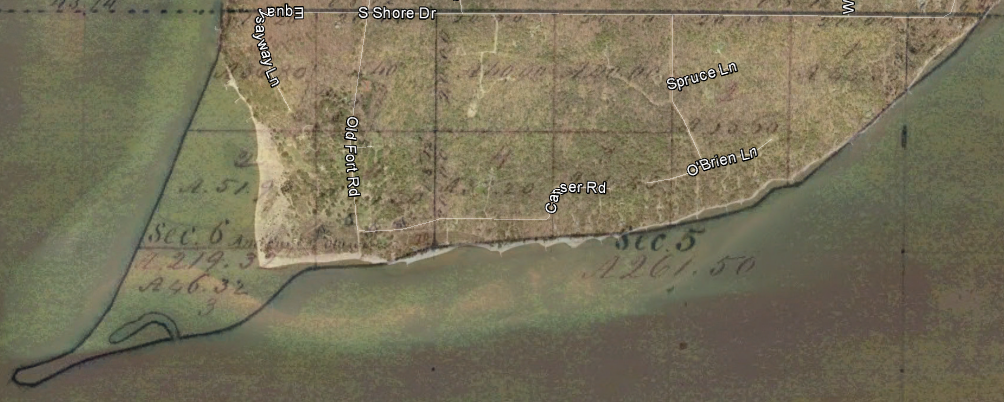
Modern aerial imagery overlay showing Vanderventer & Vaughn’s Lot 3 lost to the sands of time (along with parts of Boyd & Rowley’s Lots 1 & 2).
In 1855 Vaughn removed his stock of goods to a building near where Thomas Stahl, Esq., now resides, where I often shared his bed and board, and it remains a pleasure to me to this day to testify to his qualities as a No. one cook, while biscuits of his make were entitled to special mention. It was a standing rule with him to have a controversy of words with Mr. McElroy, neither being specially noted for the refinement of their language. I think it was during the August term of the Circuit Court in 1860 that Mr. Vaughn and Andrew Tate were admitted to the practice of law before the Hon. S.N. Fuller, Judge of the Eighth Circuit of Wisconsin. It is said that they passed a very creditable examination.
This was the first term of Circuit Court held in the County of La Pointe, Elisha Pike being honored as foreman of the first grand jury convened within the county. Although Mr. Vaughn is but forty-eight years of age he can boast of having held the following positions of trust: Post-master, Justice of the Peace, Chairman of Town and County Boards, also member of the Wisconsin legislature in 1871, (having a constituency of 6,365 souls). In the practice of law his maiden effort was that of procuring papers of divorce in a somewhat renowned case. It is thought that but for the public trust which he held as a Chairman of the School Board he probably would never have known married life, – but as it was so foreordained they accepted the situation, while the people shouted, Amen!
On the arrival of business at Ashland in 1873, Mr. Vaughn removed his family to that place where he once more engaged as trader and forwarding and commission merchant.
To be continued in Number IX…
By Leo
In April, the Supreme Court heard arguments in the case Department of Commerce v. New York and could render a decision any day on whether or not the 2020 federal census should include a question asking about citizenship status. In January, a Federal District Court in New York ruled that commerce secretary, Wilbur Ross, violated the law by pushing for that question.
Those in agreement with the District ruling suggest that the Trump administration wants to add the question as a way of discouraging immigrants from participating in the census, thereby diminishing the political power of immigrant communities. This, they say, would violate the Constitution on the grounds that the census must be an “actual enumeration” of all persons within the United States, not only citizens.
Proponents of the citizenship question counter that citizenship status is a perfectly natural question to ask in the census, that any government would want to know how many citizens it has, and that several past iterations of the 10-year count have included similar questions.
It remains to be seen how the Supreme Court will rule, but chances are it will not be the last time an issue of race, identity, or citizenship pops up in the politics of the census. From its creation by the Constitution as a way to apportion seats in congress according to populations of the states, the count has always begged tricky questions that essentially boil down to:
Who is a real American? Who isn’t? Who is a citizen? Who is three-fifths of a human being? Who might not be human at all? What does it mean to be White? To be Colored? To be civilized? How do you classify the myriad of human backgrounds, cultures and stories into finite, discrete “races?”
The Civil War and Fourteenth Amendment helped shed light on some of these questions, but it would be a mistake to think that they belong to the past. The NPR podcast Codeswitch has done an excellent series on census, and this episode from last August gives a broad overview of the history.
Here at Chequamegon History, though, we aren’t in the business broad overviews. We are going to drill down right into the data. We’ll comb through the 1850 federal census for La Pointe County and compare it with the 1860 data for La Pointe and Ashland Counties. Just for fun, we’ll compare both with the 1855 Wisconsin State Census for La Pointe County, then double back to the 1840 federal census for western St. Croix County. Ultimately, the hope is to help reveal how the population of the Chequamegon region viewed itself, and ultimately how that differed from mainstream America’s view. With luck, that will give us a framework for more stories like Amorin’s recent post on the killing of Louis Gurnoe.
Background
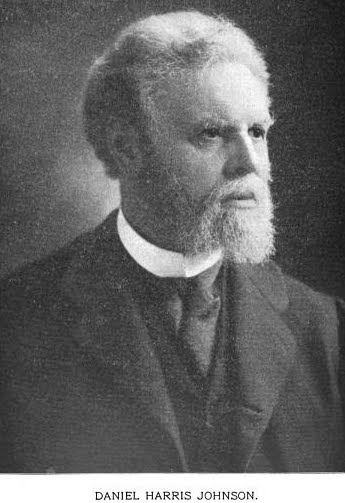 Judge Daniel Harris Johnson of Prairie du Chien had no apparent connection to Lake Superior when he was appointed to travel northward to conduct the census for La Pointe County in 1850. The event made an impression on him. It gets a mention in his short memorial biography in the 1902 Proceedings of the State Bar Association.
Two years after statehood, Lake Superior’s connection to the rest of Wisconsin was hardly existent. This was long before Highways 51 and 53 were built, and commerce still flowed west to east. Any communication to or from Madison was likely to first go through Michigan via Mackinaw and Sault Ste. Marie, or through Minnesota Territory via St. Paul, Stillwater, and Sandy Lake. La Pointe County had been created in 1845, and when official business had to happen, a motley assortment of local residents who could read and write English: Charles Oakes, John W. Bell, Antoine Gordon, Alexis Carpentier, Julius Austrian, Leonard Wheeler, etc. would meet to conduct the business.
It is unclear how much notice the majority Ojibwe and French-patois speaking population took of this or of the census generally. To them, the familiar institutions of American power, the Fur Company and the Indian Agency, were falling apart at La Pointe and reorganizing in St. Paul with dire consequences for the people of Chequamegon. When Johnson arrived in September, the Ojibwe people of Wisconsin had already been ordered to remove to Sandy Lake in Minnesota Territory for their promised annual payments for the sale of their land. That fall, the government would completely botch the payment, and by February, hundreds of people in the Lake Superior Bands would be dead from starvation and disease.
So, Daniel Johnson probably found a great deal of distraction and anxiety among the people he was charged to count. Indians, thought of by the United States as uncivilized federal wards and citizens of their own nations, were typically not enumerated. However, as I wrote about in my last post, race and identity were complicated at La Pointe, and the American citizens of the Chequamegon region also had plenty to lose from the removal.
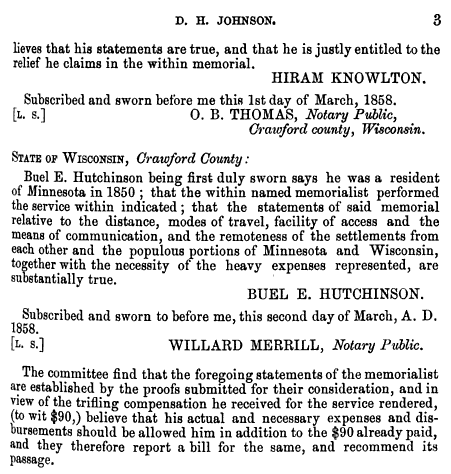
Madison, for its part, largely ignored this remote, northern constituency and praised the efforts to remove the Ojibwe from the state. It isn’t clear how much Johnson was paying attention to these larger politics, however. He had his own concerns:

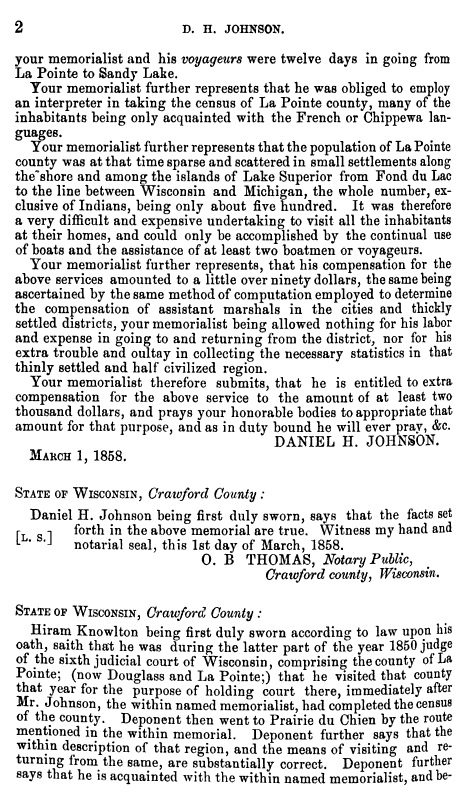
House Documents, Volume 119, Part 1. U.S. Government Printing Office, 1859. Google Books.
So, in “that thinly settled and half civilized region,” Johnson only found a population of about 500, “exclusive of Indians.” He didn’t think 500 was a lot, but by some counts, that number would have seemed very high. Take the word of a European visitor to La Pointe:
Among 200 Indians, only a few white families live there. One of the boatmen gave us a name, with which we found Mr. Austrian.
And, from this Mr. Austrian, himself:
There were only about 6 white American inhabitants on the Island, about 50 Canadian Frenchmen who were married to squaws, and a number of full blooded Indians, among whom was chief Buffalo who was a descendant of chiefs & who was a good Indian and favorably regarded by the people.
~Joseph Austrian, Brother of Julius and La Pointe resident 1851-52
Who lived around La Pointe in 1850?
In her biography, William W. Warren: the Life, Letters, and Times of an Ojibwe Leader, Theresa Schenck describes the short life of an ambitious young man from La Pointe. William Whipple Warren (1825-1853) grew up on the Island speaking Ojibwe as his first language. His father was a Yankee fur trader from New York. His mother was a daughter of Michel and Madeline Cadotte. In his famous History of the Ojibways Warren describes the Ojibwe as people with whom he readily claims kinship, but he doesn’t write as if he is an Ojibwe person himself. However, he helped interpret the Treaty of 1847 which had definitively made him an Indian in the eyes of the United States (a fact he was willing to use for economic gain). Still, a few years later, when he became a legislator in Minnesota Territory he dismissed challenges to his claims of whiteness.
If he were alive today, Warren might get a chuckle out of this line from the South African comedian Trevor Noah.
People mocked me. Gave me names like mixed breed, half caste — I hate that term ‘half’. Why half? Why not double? Or twice as nice, I don’t know.
— Trevor Noah
William Warren did not see himself as quite the walking contradiction we might see him as today. He was a product of the time and place he came from: La Pointe. By 1850, he had left that place, but his sister and a few hundred of his cousins still lived there. Many of them were counted in the census.
What is Metis?
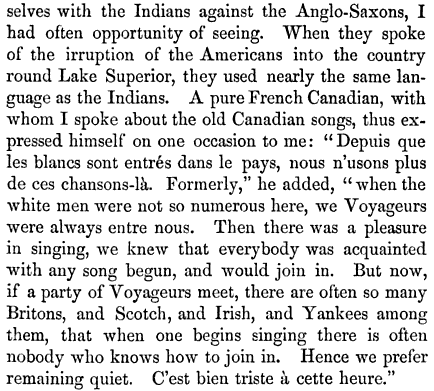
Half-breeds, Mixed-bloods, Frenchmen, Wiisakodewininiwag, Mitif, Creoles, Metis, Canadiens, Bois Brules, Chicots, French-of-the-country, etc.–at times it seems each of these means the same thing. At other times each has a specific meaning. Each is ambiguous in its own way. In 1850, roughly half the families in the Chequamegon area fit into this hard-to-define category.

Kohl, J. G. Kitchi-Gami: Wanderings around Lake Superior. London: Chapman and Hall, 1860. pg. 260-61.
We were accompanied on our trip throughout the lakes of western Canada by half-Indians who had paternal European blood in their veins. Yet so often, a situation would allow us to spend a night inside rather than outdoors, but they always asked us to choose to Irish camp outside with the Indians, who lived at the various places. Although one spoke excellent English, and they were drawn more to the great American race, they thought, felt, and spoke—Indian! ~Carl Scherzer
In describing William Warren’s people, Dr. Schenck writes,
Although the most common term for people of mixed Indian and European ancestry in the nineteenth century was “half-breed,” the term “mixed blood” was also used. I have chosen to use the latter term, which is considered less offensive, although biologically inaccurate, today. The term “métis” was not in usage at the time, except to refer to a specific group of people of mixed ancestry in the British territories to the north. “Wissakodewinini,” the word used by the Ojibwe, meant “burned forest men,” or bois brulés in French, so called because half-breeds were like the wood of a burned forest, which is often burned on one side, and light on the other (pg. xv).
Schenck is correct in pointing out that mixed-blood was far more commonly used in 19th-century sources than Metis (though the latter term did exist). She is also correct in saying that the term is more associated with Canada and the Red River Country. There is an additional problem with Metis, in that 21st-century members of the Wannabe Tribe have latched onto the term and use it, incorrectly, to refer to anyone with partial Native ancestry but with no affiliation to a specific Indian community.
That said, I am going to use Metis for two reasons. The first is that although blood (i.e. genetic ancestry) seemed to be ubiquitous topic of conversation in these communities, I don’t think “blood” is what necessarily what defined them. The “pure-blooded French Voyageur” described above by Kohl clearly saw himself as part of Metis, rather than “blanc” society. There were also people of fully-Ojibwe ancestry who were associated more with Metis society than with traditional Ojibwe society (see my post from April). As such, I find Metis the more versatile and accurate term, given that it means “mixed,” which can be just as applicable to a culture and lifestyle as it is to a genetic lineage.

One time Canadian pariah turned national hero, Louis Riel and his followers had cousins at La Pointe (Photo: Wikipedia)
The second reason I prefer Metis is precisely because of the way it’s used in Manitoba. Analogous to the mestizo nations of Latin America, Metis is not a way of describing any person with Native and white ancestry. The Metis consider themselves a creole-indigenous nation unto themselves, with a unique culture and history. This history, already two centuries old by 1850, represents more than simply a borrowed blend of two other histories. Finally, the fur-trade families of Red River came from Sault Ste. Marie, Mackinac, Grand Portage, and La Pointe. There were plenty of Cadottes, Defaults, Roys, Gurnoes, and Gauthiers among them. There was even a Riel family at La Pointe. They were the same nation
Metis and Ojibwe Identity in the American Era
When the 1847 Treaty of Fond du Lac “stipulated that the half or mixed bloods of the Chippewas residing with them shall be considered Chippewa Indians, and shall, as such, be allowed to participate in all annuities which shall hereafter be paid…” in many ways, it contradicted two centuries of tradition. Metis identity, in part, was dependent on not being Indian. They were a minority culture within a larger traditional Anishinaabe society. This isn’t to say that Metis people were necessarily ashamed of their Native ancestors–expressions of pride are much easier to find than expressions shame–they were just a distinct people. This was supposedly based in religion and language, but I would argue it came mostly from paternal lineage (originating from highly-patriarchal French and Ojibwe societies) and with the nature of men’s work. For women, the distinction between Ojibwe and Metis was less stark.
The imposition of American hegemony over the Chequamegon region was gradual. With few exceptions, the Americans who came into the region from 1820 to 1850 were adult men. If new settlers wanted families, they followed the lead of American and British traders and married Metis and Ojibwe women.
Still, American society on the whole did not have a lot of room for the racial ambiguity present in Mexico or even Canada. A person was “white” or “colored.” Race mixing was seen as a problem that affected particular individuals. It was certainly not the basis for an entire nation. In this binary, if Metis people weren’t going to be Indian, they had to be white.
The story of the Metis and American citizenship is complicated and well-studied. There is risk of overgeneralizing, but let’s suffice to say that in relation to the United States government, Metis people did feel largely entitled to the privileges of citizenship (synonymous with whiteness until 1865), as well as to the privileges of Ojibwe citizenship. There wasn’t necessarily a contradiction.
Whatever qualms white America might have had if they’d known about it, Metis people voted in American elections, held offices, and were counted by the census.
Ojibwe “Full-bloods” and the United States Census
Representatives and direct Taxes shall be apportioned among the several States which
may be included within this Union, according to their respective Numbers, which shall be determined by adding to the whole Number of free Persons, including those bound to Service for a Term of Years, and excluding Indians not taxed, three fifths of all other Persons. The actual Enumeration shall be made within three Years after the first Meeting of the Congress of the United States, and within every subsequent Term of ten Years, in such Manner as they shall by Law direct.~Excerpt from Article I Section II, U. S. Constitution
As I argued in the April post, our modern conception of “full-blood” and “mixed-blood” has been shaped by the “scientific” racism of the late 19th and early 20th centuries. The distinction, while very real in a cultural sense, was not well-grounded in biology.
The relationship of Indians (i.e. full-bloods or those living a traditional lifestyle) to American society and citizenship was possibly more contradictory then that of the Metis. In one sense, America saw Indians as foreigners on their own continent: either as enemies to be exterminated, or as domestic-dependent ward nations to be “protected.” The constitutional language about the census calls for slaves to be counted as three-fifths of a person. It says Indians shouldn’t be counted at all.
In another sense, however, the path to personhood in America was somewhat clearer for Indians than it was for African Americans. Many New England liberals saw exodus to Liberia as the only viable future for free blacks. These same voices felt that Indians could be made white if only they were separated from their religions, cultures, and tribal identities. In 1834, to avoid a second removal, the Brothertown Indians of Wisconsin petitioned congress for citizenship and the termination of collective title to their tribal lands. In 1839, their request was granted. In the eyes of the law, they had effectively become white. Other communities would follow suit. However, most Native people did not gain any form of American citizenship until 1924.
How did that play out for the Ojibwe people of Chequamegon, and how did it impact the 1850 census? Well, it’s complicated.
Race, the Census, and Classifying Households
The enumeration forms Daniel H. Johnson carried to La Pointe had more rows and columns than ever. The Seventh Census was the first to count everyone in the household by name (previous versions only listed the Head of Household with tally marks). It was also the first census to have a box for “color.” Johnson’s choices for color were “white,” “black,” and “mulatto,” forcing him to make some decisions.
He seems to have tried to follow the Indians not taxed clause strictly. 40-50% of households in the region were headed by a full-blood Ojibwe person, possibly only two of them were enumerated. You won’t find Chief Buffalo, Makadebinesi (Blackbird), Oshkinaawe, Omizhinaawe, Edawegiizhig, and their immediate families in the 1850 census. Jechiikwii’o (often called Little Buffalo) is not in the document, even though he was an early Catholic convert, dressed in “white” clothing, and counted more Metis Ojibwe among his followers than full-bloods. However, his son, Antoine Buffalo Sr. (Antoine Jachequaon) is counted. Antoine, along with George Day, were counted as white heads of household by the census, though it is unclear if they had any European ancestry (Sources conflict. If anyone has genealogical information for the Buffalo and Day families, feel free to comment on the post). A handful of individuals called full-bloods in other sources, were listed as white. This includes 90-year old Madeline Cadotte, Marie Bosquet, and possibly the Wind sisters (presumably descendants of Noodin, one of the St. Croix chiefs who became Catholic and relocated to La Pointe around this time). They were married to Metis men or lived in Metis households. All Metis were listed as white.
Johnson did invent new category for five other Ojibwe people: “Civilized Indian,” which he seemed to use arbitrarily. Though also living in Metis households, Mary Ann Cadotte, Osquequa Baszina, Marcheoniquidoque, Charlotte Houle, and Charles Loonsfoot apparently couldn’t be marked white the way Madeline Cadotte was. These extra notations by Johnson and other enumeration marshals across the country are why the Seventh Federal Census is sometimes referred to as the first to count Native Americans.

So, out of 470 individuals enumerated at La Pointe and Bad River (I’ve excluded Fond du Lac from my study) Johnson listed 465 (99%) as white. By no definition, contemporary or modern, was the Chequamegon area 99% white in 1850. The vast majority of names on the lines had Ojibwe ancestry, and as Chippewas of Lake Superior, were receiving annuities from the treaties.
There were a few white American settlers. The Halls had been at La Pointe for twenty years. The Wheelers were well-established at Odanah. Junius and Jane Welton had arrived by then. George Nettleton was there, living with a fellow Ohioan James Cadwell. The infamous Indian agent, John Watrous, was there preparing the disastrous Sandy Lake removal. Less easy to describe as American settlers, but clearly of European origins, Fr. Otto Skolla was the Catholic priest, and Julius Austrian was the richest man it town.
There were also a handful of American bachelors who had drifted into the region and married Metis women. These first-wave settlers included government workers like William VanTassel, entrepreneurs like Peter VanderVenter, adventurers with an early connection to the region like Bob Boyd and John Bell, and homesteaders like Ervin Leihy.
It is unclear how many of French-surnamed heads of household were Chicots (of mixed ancestry) and how many were Canadiens (of fully-French ancestry). My sense is that it is about half and half. Some of this can be inferred from birthplace (though a birthplace of Canada could indicate across the river at Sault Ste. Marie as easily it could a farm in the St. Lawrence Valley). Intense genealogical study of each family might provide some clarifications, but I am going to follow Kohl’s voyageurs and not worry too much about it. Whether it was important or not to Jean Baptiste Denomie and Alexis Carpentier that they had no apparent Indian ancestry and that they had come from “the true homeland” of Quebec, for all intents and purposes they had spent their whole adult lives in “the Upper Country,” and their families were “of the Country.” They were Catholic and spoke a form of French that wasn’t taught in the universities. American society would not see them as white in the way it saw someone like Sherman Hall as white.
So, by my reckoning, 435 of the 470 people counted at La Pointe (92.5%) were Metis, full-blood Ojibwe living in Metis households, or Canadians in Metis families. Adding the five “Civilized Indians” and the six Americans married into Metis families, the number rises to 95%. I am trying to track down accurate data on the of Indians not taxed (i.e. non-enumerated full-bloods) living at or near La Pointe/Bad River at this time. My best estimates would put it roughly the same as the number of Metis. So, when Johnson describes a land with a language and culture foreign to English-speaking Americans, he’s right.
Birthplace, Age, and Gender
Ethnic composition is not the only data worth looking at if we want to know what this area was like 169 years ago. The numbers both challenge and confirm assumptions of how things worked.
Let’s take mobility for example:

The young voyageur quoted by Kohl may have felt like he didn’t have a home other than en voyage, but 86% of respondents reported being born in Wisconsin. Except for ten missionary children, all of these were Metis or “Civilized Indian.” Wisconsin could theoretically mean Lac du Flambeau, Rice Lake, or even Green Bay, this but this number still seemed high to me. I’m guessing more than 14% of 21st-century Chequamegon residents were born outside the state, and 19th-century records are all about commerce, long-distance travel, and new arrivals in new lands. We have to remember that most of those records are coming from that 14%.
In September of 1850 the federal government was telling the Ojibwe of Wisconsin they needed to leave Wisconsin forever. How the Metis fit into the story of the Sandy Lake Tragedy has always been somewhat fuzzy, but this data would indicate that for a clear majority, it meant a serious uprooting.
For those born outside Wisconsin, more than two-thirds reported being born in Michigan, Canada, or Minnesota Territory. These are overwhelmingly Metis or in the case of Anglo-Canadians like Robert Morrin, heads of Metis households from areas with a fur-trade tradition. Only eighteen individuals reported being born in the eastern United States. Only three reported Europe.
I had more questions than assumptions about the gender and age breakdown of the population. Would there be more women than men because of the dangerous jobs done by men or would mortality from childbirth balance that out? Or maybe widows wouldn’t be counted if they returned to the wigwams of their mothers? How would newcomers skew the age and gender demographics of the area?
Let’s take a look:
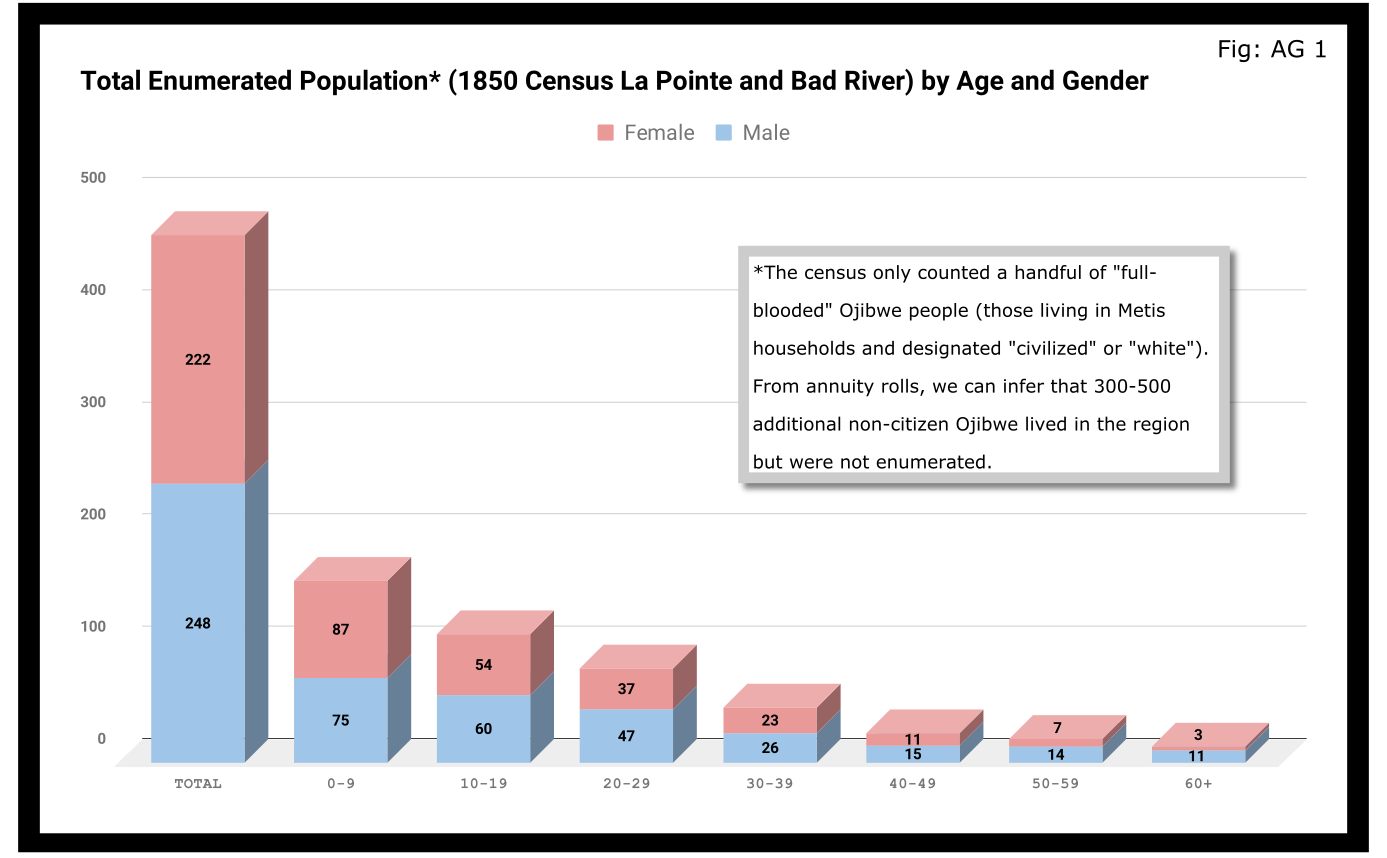
A quick glance at Figure AG 1 shows that the population skewed male 248-222 and skewed very young (61% under 20 years old). On the eve of Sandy Lake, the natural increase in the population seemed to be booming.

The hypotheses that women had higher mortality rates and were more likely to be undercounted looked good until we limit the data to the Wisconsin-born population. In Figure AG 2, we see that the male majority disappears entirely. The youthful trend, indicating large families and a growing population, continues with 66% of the Wisconsin-born population being under 20.

The male skew of the total population was entirely due to those born outside Wisconsin. This is not surprising given how much we’ve emphasized the number of men who came into the Lake Superior country to marry local women.
A look at the oldest residents in chart AG 2 and AG 3 hints at another story. Madeline Cadotte is the only Wisconsin-born person over seventy to be counted. The oldest men all came from Michigan and Canada. Why? My hypothesis is that between the fall of New France in 1759 and the establishment of Michel Cadotte’s post sometime around 1800, there wasn’t a large population or a very active fur trade around La Pointe proper. That meant Cadotte’s widow and other full bloods were the oldest locally-born residents in 1850. Their Metis contemporaries didn’t come over from the Soo or down from Grand Portage until 1810 or later.
Economics
Before the treaties, the economy of this area was built on two industries: foraging and trade. Life for Ojibwe people revolved around the seasonal harvest of fish, wild rice, game, maple sugar, light agriculture, and other forms of gathering food directly from the land. Trade did not start with the French, and even after the arrival of European goods into the region, the primary purpose of trade seemed to be for cementing alliances and for the acquisition of luxury goods and sacred objects. Richard White, Theresa Schenck, and Howard Paap have all challenged the myth of Ojibwe “dependence” on European goods for basic survival, and I find their arguments persuasive.
Trade, though, was the most important industry for Metis men and La Pointe was a center of this activity. The mid-19th century saw a steep decline in trade, however, to be replaced by a toxic cycle of debts, land sales, and annuity payments. The effects of this change on the Metis economy and society seem largely understudied. The fur trade though, was on its last legs. Again, the Austrian travel writer Carl Scherzer, who visited La Pointe in 1852:
After this discussion of the of the rates of the American Fur Company and its agents, we want to add some details about the men whose labor and time exerted such a great influence on the fate and culture of the Indian tribes. We wish to add a few explanatory words about the sad presence on La Pointe of the voyageurs or courriers du bois.
This peculiar class of people, which is like a vein of metal that suddenly disappears within the bedrock and reappears many hundreds of miles away under the same geological conditions, their light reaches the borders of the eastern Canadas. The British people, with their religion and customs, reappeared on the shores of these northern lakes only in 1808 with the Fur Company. For labor they drew on those who could carry their wares across the lakes and communicate with the Indians.
Many young men of adventurous natures left the old wide streets of Montreal and moved into the trackless primeval forests of the West. Young and strong as laborers, they soon started to adopt the lifestyle and language of the aborigines. They married with the Indians and inhabit small settlements scattered throughout those mighty lands which begin at Mackinow Island and come up the upper lake to the region of Minnesota. They almost all speak the Canadian patois along with the language of the Chippewas, the tribe with which they came into kinship. We found only a few, even among the younger generation, who understood English.
Since then, every day the population of the otherwise deserted shore of Lake Superior increases with the discovery of copper mines. The animals driven away by the whirlwind of civilization toward the west, attract the Indians with their sensitive guns, leaving La Pointe, abandoned by the Company for their headquarters at St. Paul in Minnesota. Most voyageurs left the island, having seen their business in ruins and lacking their former importance. Just a few families remain here, making a meager livelihood of hunting, fishing, and the occasional convoy of a few travelers led by business, science, or love of nature who purchase their limited resources.
From Scherzer’s description, two things are clear. It’s pretty clear from the flowery language of the Viennese visitor.Washington Irving and other Romantic-Era authors had already made the Voyageur into the stock stereotypical character we all know today. Th only change, though, is these days voyageurs are often depicted as representatives of white culture, but that’s a post for another time.
The second item, more pertinent to this post, is that a lot of voyageurs were out of work. This is especially relevant when we look at our census data. Daniel Johnson recorded the occupations of all males fifteen or over:
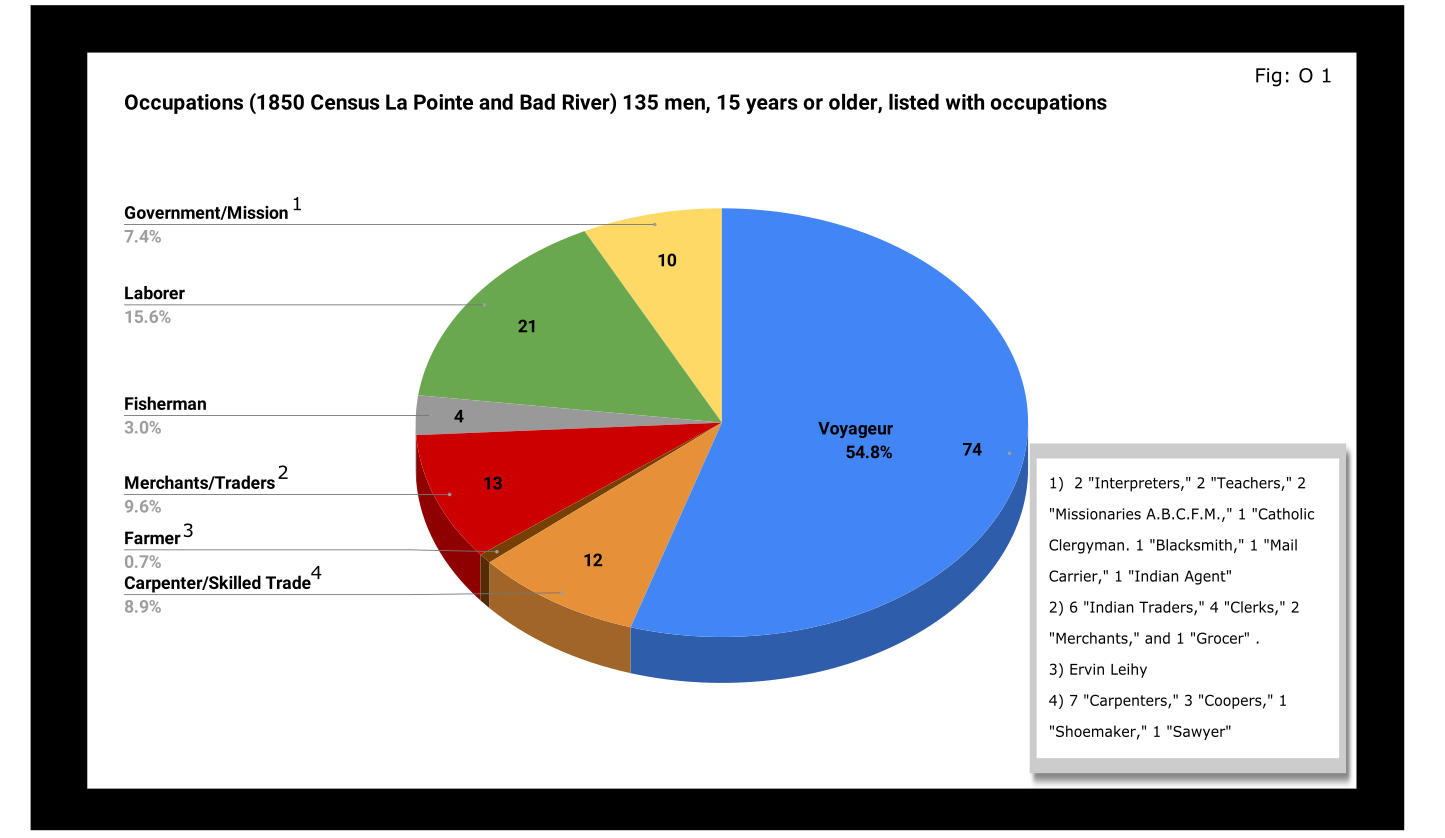
A full 55% of enumerated men fifteen and older still identified themselves as voyageurs in 1850. This included teenagers as well as senior citizens. All were from Metis households, though aside from farmer, all of the other occupation categories in Figure O 1 included Metis people.

A look at household sizes did not show voyageurs having to support significantly larger or smaller families when compared to the other occupation categories.
The other piece of economic data collected was value of real estate. Here we see some interesting themes:

If real estate is a good proxy for wealth in a farming community, it is an imperfect one in the Chequamegon area of 1850. If a voyageur had no home but the river and portage, then we might not expect him to put his coin into land and buildings. A teacher or Indian agent might draw a consistent salary but then live in supplied housing before moving on. With that caveat, let’s dig into the data.
Excluding the single farmer, men in the merchant/trader group controlled the most wealth in real estate, with Julius Austrian controlling as much as the other merchants combined. Behind them were carpenters and men with specific trades like cooper or shoemaker. Those who reported their occupation generally as “laborer” were not far behind the tradesmen. I suspect their real estate holdings may be larger and less varied than expected because of the number of sons and close relatives of Michel Cadotte Sr. who identified themselves as laborers. Government and mission employees held relatively little real estate, but the institutions they represented certainly weren’t lacking in land or power. Voyageurs come in seventh, just behind widows and ahead of fishermen of which there were only four in each category.
It is interesting, though, that the second and third richest men (by real estate) were both voyageurs, and voyageur shows a much wider range of households than some of the other categories: laborers in particular. With the number of teenagers calling themselves voyageurs, I suspect that the job still had more social prestige attached to it, in 1850, than say farmer or carpenter.
With hindsight we know that after 1854, voyageurs would be encouraged to take up farming and commercial fishing. It is striking, however, how small these industries were in 1850. Despite the American Fur Company’s efforts to push its Metis employees into commercial fishing in the 1830s, and knowing how many of the family names in Figure O 3 are associated with the industry, commercial fishing seemed neither popular nor lucrative in 1850. I do suspect, however, that the line between commercial and subsistence fishing was less defined in those days and that fishing in general was seen as falling back on the Indian gathering lifestyle. It wouldn’t be surprised if all these families were fishing alongside their Ojibwe relatives but didn’t really see fishing (or sugaring, etc.) as an occupation in the American sense.
Finally, it could not have escaped the voyageurs notice that while they were struggling, their former employers and their employers educated sons were doing pretty well. They also would have noticed that it was less and less from furs. Lump annuity payments for Ojibwe land sales brought large amounts of cash into the economy one day a year. It must have felt like piranhas with blood in the water. Alongside their full-blood cousins, Metis Ojibwe received these payments after 1847, but they had more of a history with money and capitalism. Whether to identify with the piranha or the prey would have depended on all sorts of decisions, opportunities and circumstances.
Education and Literacy
The census also collected data on education and literacy, asking whether children had attended school within the year, and whether adults over twenty could read and write. The history of white education efforts in this area are fairly well documented. The local schools in 1850 were run by the American Board of Commissioners of Foreign Missions (A.B.C.F.M.) at the La Pointe and Odanah missions, and an entire generation had come of age at La Pointe in the years since Rev. Sherman Hall first taught out of Lyman Warren’s storehouse in 1831. These Protestant ministers and teachers railed against the papists and heathens in their writings, but most of their students were Catholic or traditional Ojibwe in religion. Interestingly, much of the instruction was done in the Ojibwe language. Unfortunately, however, the census does not indicate the language an individual is literate in. I highly recommend The Ojibwe Journals of Edmund F. Ely, 1833-1849 if you are interested in these topics.
To start with, though, let’s look at how many people were going to school:

Thirty-nine students had gone to school in the previous year. There is a lot of sample-size noise in the data, but it seems like ages 7-11 (what we would call the upper-elementary years) were the prime years to attend school.
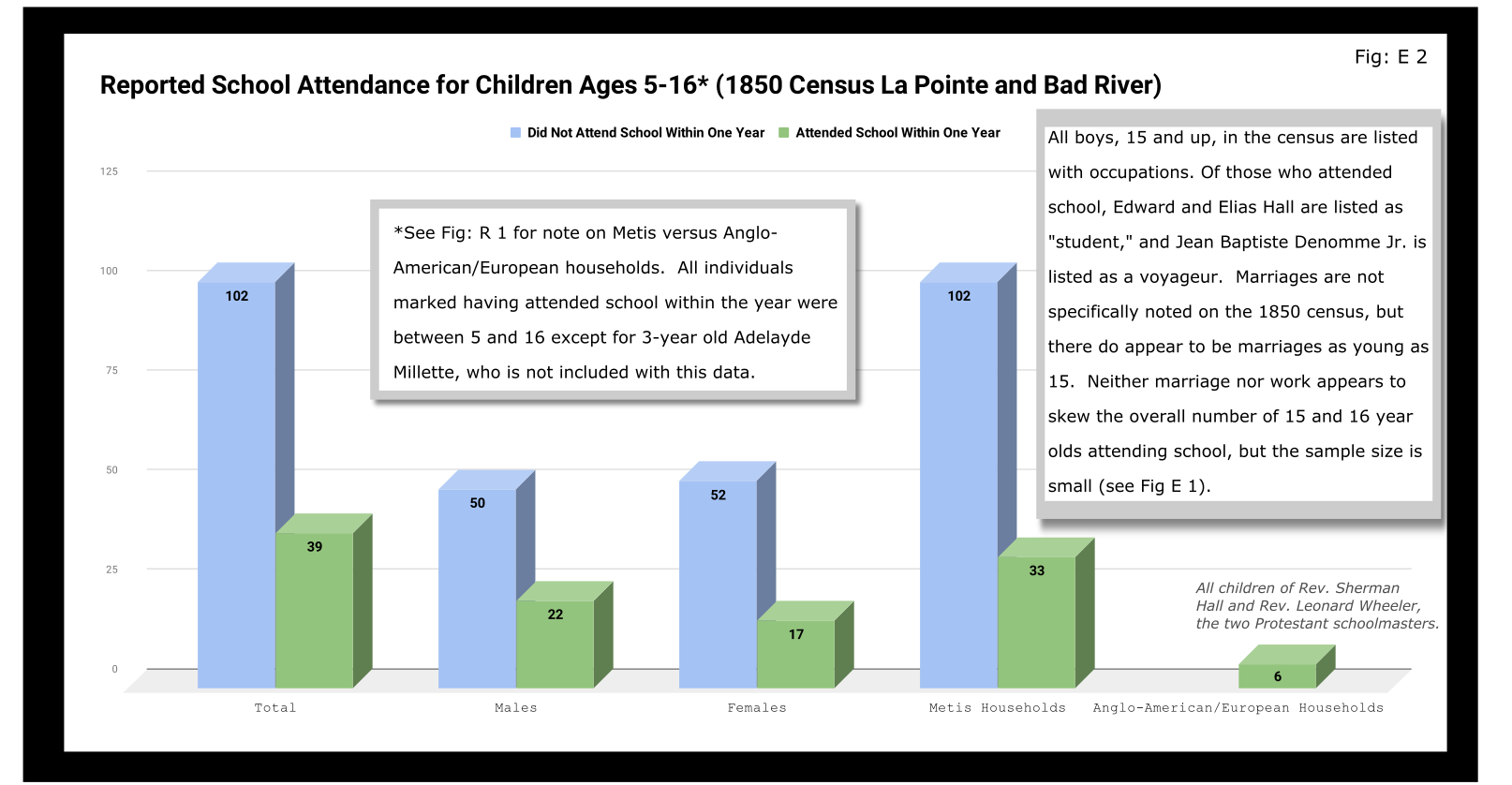
Overall, most children had not attended school within the year. Attendance rates were slightly higher for boys than for girls. White children, all from two missionary families, had a 100% attendance rate compared to 24% for the Metis and “Civilized Indian” children.
We should remember, however, that not attending school within the year is not the same as having never attended school. Twelve-year-old Eliza Morrin (later Morrison) is among the number that didn’t attend school, but she was educated enough to write her memoirs in English, which was her second language. They were published in 2002 as A Little History of My Forest Life, a fascinating account of Metis life in the decades following 1854.
Eliza’s parents were among the La Pointe adults who could read and write. Her aunt, uncle, and adult cousins in the neighboring Bosquet (Buskey) house were not. Overall, just over half of adults over 20 were illiterate without a significant gender imbalance. Splitting by birthplace, however, shows the literacy rate for Wisconsin-born (i.e. Metis and “Civilized Indian”) was only 30%, down from the overall male literacy rate of 48%. For Wisconsin-born women, the drop is only three points, from 47% to 44%. This suggests Metis women were learning to read while their husbands and brothers (perhaps en voyage) were not.

And this is exactly what the data say when we split by occupation. The literacy rate for voyageurs was only 13%. This beats fisherman–all four were illiterate–but lagged far behind all other types of work.
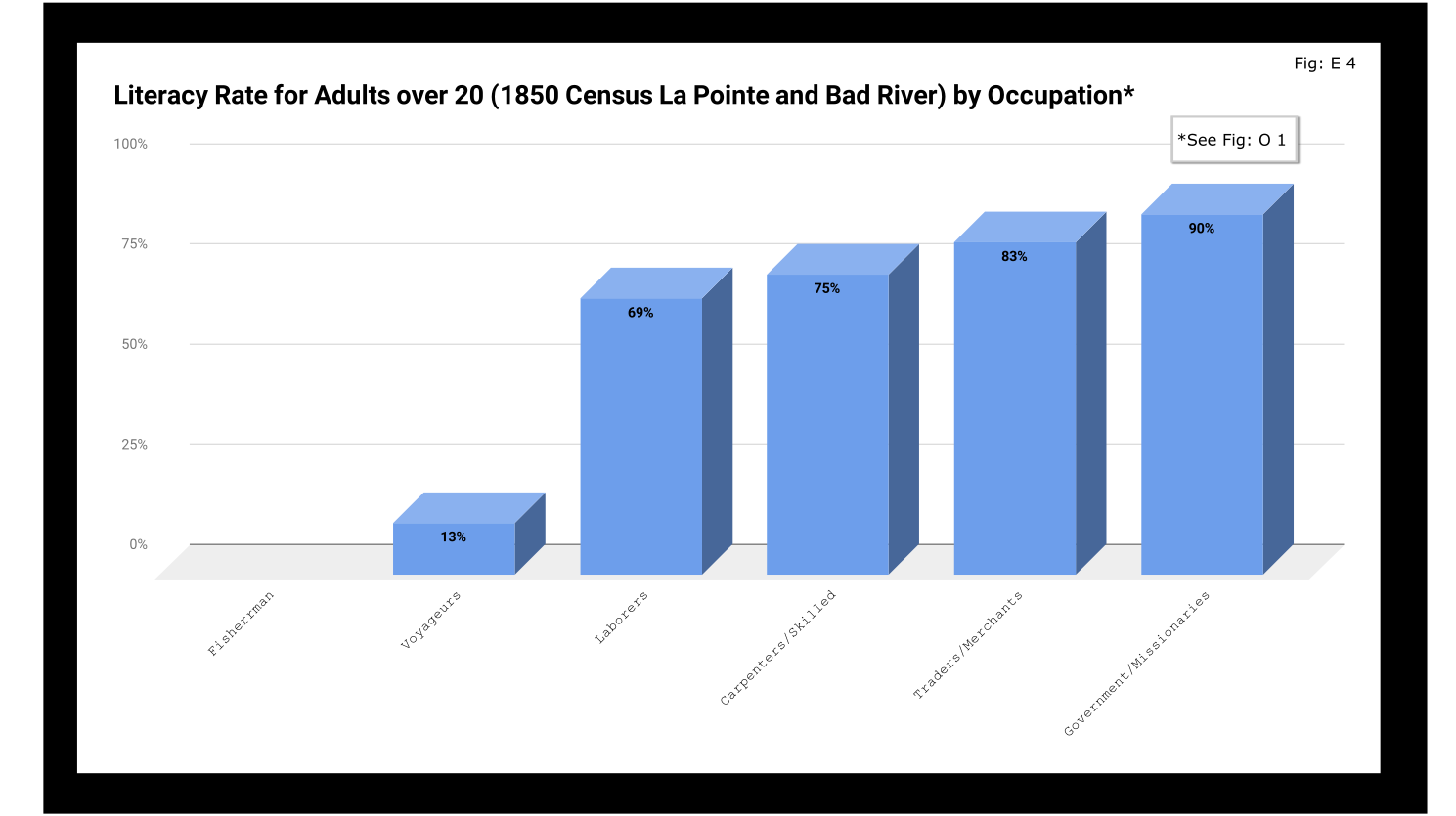
If education was going to be a factor in the economic mobility of unemployed voyageurs, the trends weren’t looking good.
Odds and Ends
Two marriages were reported as occurring in the year previous to the census: Peter and Caroline Vanderventer and Pierre and Marguerite Robideaux (ak.a. Peter and Margaret Rabideaux). Though married, however, Caroline was not living with her husband, a 32-year old grocer from New York. She (along with their infant daughter) was still in the home of her parents Benjamin and Margaret Moreau (Morrow). The Vanderventers eventually built a home together and went on to have several more children. It appears their grandson George Vanderventer married Julia Rabideaux, the granddaughter of Peter and Margaret.
I say appears in the case of George and Julia, because Metis genealogy can be tricky. It requires lots of double and triple checking. Here’s what I came across when I once tried to find an unidentified voyageur known only as Baptiste:

Sometimes it feels like for every Souverain Denis or Argapit Archambeau, there are at least 15 Jean-Baptiste Cadottes, 12 Charles Bresettes, 10 Francois Belangers and 8 Joseph DeFoes. Those old Canadian names had a way of persisting through the generations. If you were a voyageur at La Pointe in 1850, there was nearly a 30% chance your name was Jean-Baptiste. To your friends you might be John-Baptist, Shabadis, John, JB, or Battisens, and you might be called something else entirely when the census taker came around.
The final column on Daniel Johnson’s census asked whether the enumerated person was “deaf and dumb, blind, insane, idiotic, pauper, or convict.” 20 year-old Isabella Tremble, living in the household of Charles Oakes, received the unfortunate designation of idiotic. 26-year-old Francois DeCouteau did not have a mark in that column, but had “Invalid” entered in for his occupation. It’s fair to say we’ve made some progress in the treatment of people with disabilities.
Final Thoughts
I am not usually a numbers person when it comes to history. I’ll always prefer a good narrative story, to charts, tables, and cold numbers. Sometimes, though, the numbers help tell the story. They can help us understand why when Louis Gurnoe was killed, no one was held accountable. At the very least, they can help show us that the society he lived in was under significant stress, that the once-prestigious occupation of his forefathers would no longer sustain a family, and that the new American power structure didn’t really understand or care who his people were.
Ultimately, the census is about America describes itself. From the very beginning, it’s never been entirely clear if in E. pluribus unum we should emphasize the pluribus or the unum. We struggled with that in 1850, and we still struggle today. To follow the Department of Commerce v. New York citizenship case, I recommend Scotusblog. For more census posts about this area in the 19th century, keep following Chequamegon History.
Sources, Data, and Further Reading
-
Paap, Howard D. Red Cliff, Wisconsin a History of an Ojibwe Community ; Volume 1 The Earliest Years: the Origin to 1854. North Star Press of St. Cloud, Inc., 1854.
-
Satz, Ronald N. Chippewa Treaty Rights: the Reserved Rights of Wisconsin’s Chippewa Indians in Historical Perspective. University of Wisconsin Press, 1997.
-
Original Census Act of May 23, 1850 (includes form and instructions for marshals). (PDF)
-
Compiled data spreadsheets (Google Drive Folder) I’ll make these a lot more user friendly in future census posts. By the time it occurred to me that I should include my tables in this post, most of them were already done in tally marks on scrap paper.
-
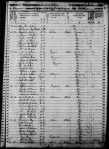
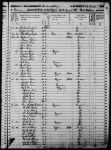
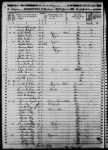
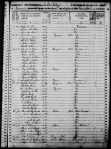
Finally, these are the original pages, scanned from microfilm by FamilySearch.com. I included the image for Fond du Lac (presumably those living on the Wisconsin side of the St. Louis River) even though I did not include it in any of the data above.
-

- Bad River
-
- Fond du Lac (not included in above data)





Julius Austrian Papers: La Pointe Lands
April 29, 2017
By Amorin Mello
Madeline Island Museum
Julius Austrian Papers
Folder 3: La Pointe Lands
Scans #1-25 transcribed (#26-55 not transcribed)
Mortgage Deed
Julius Austrian to Charles Oakes
Office of Register of Deeds
La Pointe County Wis.
I hereby certify that the within is a true copy from the Records in my office of an instrument recorded June 9th 1853 at 10 O’clock AM in Book A of Deeds Vol 1 pages 18 & 19.
John W Bell
Register of Deeds
Fees 7-
– – – – –

Charles Henry Oakes built New Fort for the American Fur Company, was the white father of a La Ponte Band mixed-blood family, and signed several Treaties.
~ Findagrave.com
This Indenture
made the Second day of May in the year of Our Lord One thousand Eight-hundred and fifty three, Between Julius Austrian of the County of La Pointe and State of Wisconsin of the first part, and Charles H Oakes of Minnesota of the second part; Witnessed, that the said party of the first part, for and in consideration of the sum of Sixteen (16) Hundred Dollars in hand paid by the said party of the Second part, the receipt whereof is hereby acknowledged, has given, granted, bargained, sold, conveyed and confirmed, and by those present does give, grant, bargain, sell, convey and confirm unto the said party of the Second part, his heirs and assigns forever all the following described piece or parcel of land situated, lying and being in the County of La Pointe, and State of Wisconsin, known and designated as follows, to wit;

“10 acres or there abouts of Lots 3, 4 & 5 Section 30 to be selected and resumed for Light House purposes of order of the President bearing date the 4 [Apl.?] 1853 see letter of Secr Interior [apl?] 4 /53.
The above lots 3, 4 & 5 with drawn from market util the selection is made see Comt. Instructions to [R.y R. Apl.?] 28 /53 and June 18 /53.
Reservation rescinded by order of the President March 3 /54 see Instructions to [R.g R.y?] March 7 /54.”
~ General Land Office
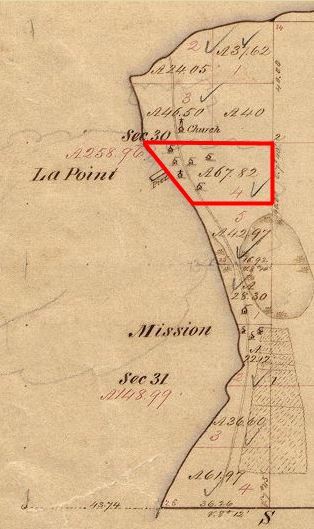
“Lot number four (4)“ is New Fort (downtown) La Pointe.
~ General Land Office
Lot number four (4) Township fifty (50) Section No. thirty (30) and Range No. three west containing sixty seven & 82/100 acres of land according to the Government Survey.
To have and to hold the same, together with all and singular the appurtenances and privileges thereunto belonging or in any wise appertaining and all the Estate Right, Title, Interest and Claim whatsoever, of the said party of the first part, either in Law or Equity, in and to the above described premises, to the only proper use, benefit and behoof of the said party of the second part, his heir and assigns forever, and the said Julius Austrian party of the first part for himself his heirs Executors and administrators do covenant and agree to and with the said party of the second part, his heirs and assigns that he is well seized in Fee of the aforesaid premises, and has good right to sell and convey the same, in manner and form as above written, and that the same are free of all incumbrances whatever, and that the aforesaid premises, in the quiet and peaceable possession of the said party of the second part, his heirs and assigns, against all and every person lawfully claiming or to claim the whole or any part thereof, he will forever warrant and defend.

Julius Austrian
~ Madeline Island Museum
Provided nevertheless that if the said Julius Austrian of the first part, his heirs, administrators, executors or assigns shall well and truly pay or cause to be paid to the said Charles H Oakes party of the second part, his heirs, executors, administrators or assigns the sum of Sixteen (16) Hundred Dollars, lawful money, in six equal annual payments, according to the condition of six certain notes bearing even date with, then this deed to be null and void, otherwise to be and remain in full force and effect, but if Default shall be made in the payment of the said sum of money, or the interest, or of any part thereof, at the time herein before specified for the payment thereof, the said party of the first part, in such case, does hereby authorize and fully empower the said party of the second part his executors, administrators or assigns, to sell the said hereby granted premises, at Public Auction, and convey the same the same to the purchase in Fee Simple, agreeably to the statute in such case made and provided, and out of the moneys arising from such sale, to retain the Principal and interest, which shall then be due on the said notes, together with all costs and charges, and pay the overplus (if any) to the said Julius Austrian, party of the first part his heirs, executors administrators or assigns.
In testimony whereof the said party of the first part has hereunto set his hand and seal the day and year first above written.
Julius Austrian
Sealed and delivered in presence of
~ Findagrave.com
Isaac V D Heard
I Van Etten
Territory of Minnesota
County of Ramsay
Be it known that on the second day of May AD 1853, before the undersigned, personally came Julius Austrian the Grantor to the foregoing and within Deed from him as such Grantor to Charles H Oakes, to me personally known to be the identical person described in and who executed the said deed, and who acknowledged that he executed the said deed freely and voluntarily for the uses and purposes therein expressed.
I Van Etten
Notary Public
Minnesota Territory

Charles W. W. Borup and Charles H. Oakes: married into the La Pointe mixed blood Beaulieu family; built the American Fur Company outift at New Fort, La Pointe; and started Minnesota’s first bank.
~ HeritageAuctions.com
St. Paul, May 2nd 1853
$200
Julius Austrian
– – – – –
St. Paul, May 2nd 1853
$300
On or before the first day of November A.D. 1854, I promise to pay Charles H. Oakes, on order, at the office of Mesfrs. Borup and Oakes, St. Paul, Min. Ter., the sum of Three Hundred dollars, value received—and in case of default in the payment of the above sum of money, then I agree to pay interest on said principal sum at the rate of ten percent per annum until paid.
Julius Austrian
– – – – –
St. Paul, May 2nd 1853
$200
Julius Austrian
– – – – –
St. Paul, May 2nd 1853
$400
Julius Austrian
[Filed 11/30/89]
Power of Att’y
from Jos Austrian
to Jul. A.
Registers certificate inside.
Recorded.
– – – – –
State of Michigan
County of Houghton
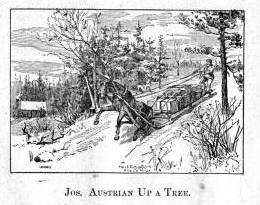
Joseph Austrian lived at La Pointe with his brother Julius during 1851 and 1852.
~ Austrian Papers
Know all men by these presents that I Joseph Austrian of Eagle River county of Houghton and State of Michigan have made, authorized, nominated and appointed and by these presents do make authorize nominate and appoint Julius Austrian of La Pointe county of La Pointe and State of Wisconsin my attorney for me and in my name and to my use, to enter into, and take possession of all such messuages, lands tenements, hereditaments, and real estate whatsoever, in La Pointe County of La Pointe State of Wisconsin, whereof I now am, or hereafter may be by any ways or means howsoever entitled or interested in, either in severalty and jointly or in common with any other person or persons.
And also for me and in my name, to grant, bargain, and sell, the same messuages lands, tenements and hereditaments, or any part, share or portion thereof, and all such rights, titles, interest, claim, and demand both in law and equity, as I may have in the same, for such sum and price, and on such terms, as to him shall seem meet, and for me and in my name to make, execute, and deliver good and sufficient deeds and conveyances for the same, and every part thereof, either with or without covenants and warranty.
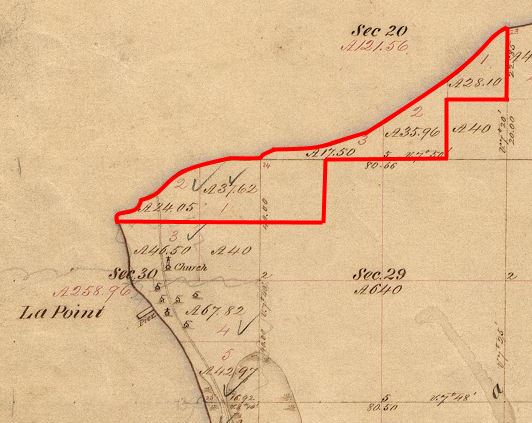
The north coast of La Pointe was patented in Joseph Austrian‘s name during 1852.
~ General Land Office
And while the sale thereof, for me, and in my name, and for my use, to let and do wise the same real estate or any part of parts thereof for the best rent that can be gotten for the same.
And also for me and in my name, and to my use to ask, demand, recover and receive all sums of money which shall become due, owing or payable to me by means of any such bargain, sale or lease. And to have, use, and take, all lawful ways and means for the recovery thereof by attachment, unrest, distress, or otherwise, and to compound, arbitrate, and agree, for the same and aquittances or sufficient discharges for the same, for me and in my name, to make, seal and deliver, and generally to do, execute, and perform, every thing that may be neccesary in and about the premises, as fully in every respect as I myself might or could do, if I were personally present.
And an attorney or attorneys under him for any or all of the purposes aforesaid, to make and substitute, and again at pleasure to revoke. And I hereby ratify, allow, and confirm, all, and whatsoever my said attorney shall do or cause to be done, in and about the premises by virtue of these presents. In witness whereof I have hereunto set my hand and seal.
Eagle River May 31st 1854.
Joseph Austrian
Signed Sealed and delivered in the presents of
Charles Hembeck
A W. Senter
State of Michigan
County of Houghton
Personally appeared before me Joseph Austrian and acknowledged that he executed the within Power of Attorney, and I further certify, that I well know the said Joseph Austrian, and that he is the same individual who is described as the within conveyance and who executed the same. Eagle River May 31st 1854.
Simon Mandlebaum
Justice of the Peace
Houghton County
Michigan
– – – – –
STATE OF MICHIGAN,
County of Houghton
I James Crawford Clerk of said County of Houghton DO HEREBY CERTIFY, that Simon Mandlebaum – whose name is subscribed to the Certificate or proof of acknowledgement of annexed Instrument, and therein written, was, at the time of taking such proof or acknowledgement a Justice of the Peace in and for said County, duly Elected and qualified, and duly authorized to take the same; AND FURTHER, that I am well acquainted with the hand writing of such Justice of the Peace and verily believe that the signature to the said Certificate or proof of acknowledgement is genuine; I FURTHER CERTIFY, that said Instrument is executed and acknowledged according to the Laws of this State.
IN TESTIMONY WHEREOF, I have hereunto set my hand and affixed the seal of said County, at Eagle River this Twelfth day of September A. D. 1856.
James Crawford
Clerk.
A Warranty Deed
S S Vaughn and Peter B Vanterventer
to
M. H. Manddlebaum
7 day April A. D. 1855
Recd for Record April 7 1855 at 4 Oclock P.M and Recorded in Book A of Deeds on Page (127)
John W Bell
Register of Deeds for
La Pointe County
Wis
– – – – –
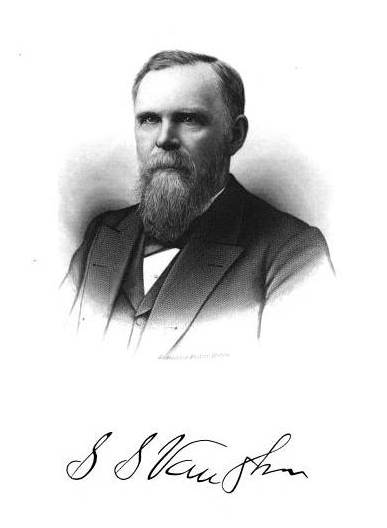
Samuel Stuart Vaughn
~ Western Reserve Historical Society
Know all men
by these presents that we S. S. Vaughn and Peter B Vanderventer and Caroline Vanderventer his wife of the Town and County of Lapointe and State of Wisconsin in consideration of Two hundred Sixty Two and a half dollars to us paid by M. H. Manddlebaum of Town County and State aforesaid the receipt whereof we do hereby acknowledge do by these presents give grant bargain sell and convey unto the said M H Manddlebaum his heirs and assigns a certain piece of land described as follows to wit lot No F??? one in Section No Four and lot No one in Section No Five Township no Forty nine range no Three containing Fifty two acres and forty seven hundreth of an acre together with all the privileges and appurtenances to the said land in any wise appertaining and belonging.

Vaughn/Vanderventer‘s lots 1 & 1 by Old Fort (Grant’s Point) La Pointe.
~ General Land Office
To have and to hold the above granted granted premises to the said M. H. Manddlebaum his heirs and assigns and to his and their use and behoof forever. And we S. S. Vaughn and Peter B Vanderventer and Caroline Vanderventer his wife for ourselves our heirs executors and administrators do covenant with the said M. H. Manddlebaum his heirs and assigns that we are lawfully seized in fee of the aforesaid premises that they are free from all incumbrances that wee have a good right to sell and to convey the same to the said M. H. Manddlebaum as aforesaid and that we will and ours heirs executors and administrators shall warrant and defend the same, to the said M H Manddlebaum his heirs and assigns forever against the lawful demands of all persons.
In testimony whereof we have hereunto set our hand and seal this 7 day of April A.D. 1855
S. S. Vaughn
P. B Vanderventer
Carline (her X mark) Vanderventer

Antoine Gordon was an influential Mixed Blood member of the La Pointe Band.
Sealed and delivered in presence of
John W Bell
A. Gaudin
State of Wisconsin
Lapointe County
April 7th 1855
They personally appeared before me the above named S. S. Vaughn, Peter B Vanderventer and Caroline wife of said Peter B. Vanderventer, who severally acknowledged they did sign and seal the foregoing instruments as their free act and deed, and the said Caroline wife of said Peter B Vanderventer on a private examination before me separate and apart from the said husband acknowledged that she did execute the foregoing deed without any fear or compulsion from her said husband or any other person.
John W Bell
Justice of the Peace in & for
Lapointe County Wisconsin
Deed ~
Antoine & Sarah Gaudin
to Joseph Austrian
Received for Record June 16 1855 [???] and Recorded in Book A of Deeds on page 153.
John W Bell Register for
La Pointe County Wisconsin
– – – – –
WARRANTY DEED. — Printed and sold by SANFORD & HAYWARD, Cleveland, Ohio.
To all People to whom these Presents shall come—GREETING:
KNOW YE, That
we Antoine Gaudin of the County of La Pointe and State of Wisconsin and Sarah wife of said Antoine Gaudin

“Mr. and Mrs. Antoine Gordon,
the founders of Gordon,
would have liked King Midas Flour.”
~ History of Gordon
For the consideration of the sum of two hundred and fifty dollars received to our full satisfaction of Joseph Austrian of Eagle River in the State of Michigan do give, grant, bargain, sell and confirm unto him the said Joseph Austrian the following described TRACT or LOTS of LAND, situate in the township of Lapointe being number (49) in the third range of Townships, which is also in the county of Lapointe and is known
as Lots two (2) and three (3) of section number five (5) containing one hundred acres (100)
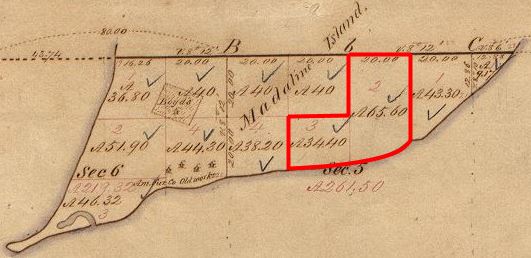
Gordons’ lots 2 & 3 near Old Fort (Grant’s Point) La Pointe.
~ General Land Office
TO HAVE AND TO HOLD the above granted and bargained premises, with the appurtenances thereunto belonging, unto him the said Joseph Austrian his heirs and assigns forever, to his and their own proper use and behoof. And we the said Antoine Gaudin and Sarah his wife do, for ourselves our executors and administrator, covenant with the said Joseph Austrian his heirs and assigns, that at, and until the ensealing of these presents we are well seized of the premises, as a good and indefeasible estate in FEE SIMPLE, and have good right to bargain and sell the same in manner and form as above written, and that the same be free from all incumbrance whatsoever. And furthermore, we the said Antoine Gaudin and Sarah his wife do by these presents find ourselves, our heirs, forever, to WARRANT AND DEFEND the above granted and bargained premises to him the said Joseph Austrian his heirs and assigns, against all lawful claims and demands whatsoever. And I the said Sarah wife of the said Antoine Gaudin do hereby remise, release, and forever quit claim unto the said Joseph Austrian his heirs and assigns, all my right and title of dower in the above described premises.
wife of Antoine Gaudin.
In Witness Whereof, we have hereunto set our hands and seals the fourteenth day of June in the year of our Lord one thousand eight hundred and fifty five.
A. Gaudin
Sarah (her X mark) Gaudin
Signed, Sealed and Delivered
in presence of
John .W. Bell.
M. H. Mandelbaum
THE STATE OF WISCONSIN,
COUNTY OF LA POINTE.
June 14 1855.
Personally appeared before the me above named Antoine Gaudin and Sarah his wife who acknowledged that they did sign and seal the foregoing instrument, and that the same is their free act and deed. I further certify, that I did examine the said Sarah wife of said Antoine Gaudin separate and apart from her husband, and did then and there make known to her the contents of the foregoing instrument, and upon that examination she declared that she did voluntarily sign, seal and acknowledge the same, and that she is still satisfied therewith.
John W. Bell
Justice of the Peace
Warrantee Deed
Joseph Austrain
to
Francois Cadotte
Office of Register of Deeds
La Pointe County Wis
I hereby Certify that the within Deed was filed in this office for Record Jany 21st 1858 A M and was duly Recorded in Book A of Deeds Vol [2 or 3?] and page 239.
John W Bell
Register
Fees $1.00
– – – – –
WARRANTY DEED.
Sold by E. Terry & Co., Milwaukee
This Indenture,
Made the Twenty first day of January in the year of our Lord one thousand eight hundred and fifty eight between
Joseph Austrian by Julius Austrian his attorney in Fact Party of the first part and Francois Cadotte of Lapointe County Wisconsin, party of the second part.

Antoine and Frank Cadotte (son and grandson of Michael and Madeline Cadotte, and Mixed Blood member sof the La Pointe Band).
~ Madeline Island Museum
Witnesseth, That the said party of the first part, for in consideration of the sum of Forty dollars Lawfull Money of the United States of America to him in hand paid by the said party of the second part, the receipt whereof is hereby confessed and acknowledged has given, granted bargained, sold, remised, released, aliened, conveyed, and confirmed, and by these presents does give, grant, bargain, sell, remise, release, alien, convey, and confirm unto the said party on the second part, and his heirs and assigns forever
the following Described Real Estate situated in the County of of Lapointe and State of Wisconsin, and Known as Lot number Thirty four (34) in the Town of Lapointe according to the Recorded Plat of said town as recorded in the Registers Office of said County of Lapointe.

Cadotte‘s block 34 in downtown La Pointe.
~ Julius Austrian Papers (maps folder)
Together with all and singular the Hereditaments and Appurtenances thereunto belonging, or in any wise appertaining; and all the estate, right, title, interest, claim, or demand whatsoever of the said party of the first part, either in Law or Equity, either in possession or expectancy of, in and to the above-bargained premises, and their Hereditaments and Appurtenances TO HAVE AND TO HOLD the said premises as above described, with the Hereditaments and Appurtenaces unto the said party of the second part, and to his heirs and assigns forever.
And the said Joseph Austrian by his P attorney for himself his heirs, executors, and administrators, does convenant, grant, bargain, and agree to and with the said party of the second part, his heirs and assigns, that at the time of the ensealing and delivery of these present, he is well seized of the premises above described, as of a good, sure, perfect, absolute, and indefeasible estate of inheritance in the Law, in fee simple, and that the same are free and clear from all incumbrances whatever, and that the above-bargained premises in the quiet and peaceable possession of the said party of the second part, his heirs and assigns against all and every person or persons, lawfully claiming the whole or any part thereof [???] will forever WARRANT AND DEFEND.
In Witness Whereof, the said party of the first part, has hereunto set his hand and seal the day and year first above written
Joseph Austrian
by Julius Austrian
his Att in fact.
Sealed and delivered in presence of
John W Bell
STATE OF WISCONSIN
COUNTY OF La Pointe
Be it Remembered, that on the Twenty first day of January A. D. 1858 personally came before me the above-named Joseph Austrian by Julius Austrian his attorney in fact to me known to be the person who executed the said Deed, and acknowledged the same to be his free act and deed, for the uses and purposes therein mentioned.
John W Bell
Justice of the Peace
Antoine Gordon & wife
to Julius Austrian
Office of Register of Deeds
La Pointe County Wis
I hereby Certify that the within Deed was filed in this Office for Record July 11th 1858 oclk and was duly Recorded in Book A of Deeds Vol 2 & page 296.
J W Bell
Register
rec 1 day of July 1861
$550 – 7%.
– – – – –
WARRANTY DEED. Sold by E. Terry & Co., Milwaukee.
This Indenture,
Made the Eleventh day of February in the year of our Lord one thousand eight hundred and fifty eight between
Antoine Gaudin and Sarah Gaudin his wife of La Pointe County & State of Wisonsin of the first part and Julius Austrian of the Same County and State party of the Second part.
Witnesseth, That the said parties of the first part, for and in consideration of the sum of Eight hundred Dollars receipt whereof is hereby confessed and acknowledged, has given, granted bargained, sold, remised, released, aliened, conveyed, and confirmed his heirs and assigns forever
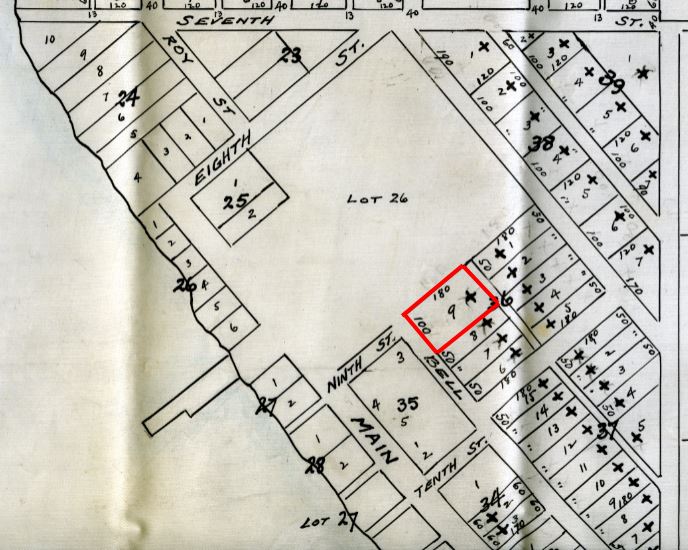
Gordons‘ lot 9 in downtown La Pointe.
~ Julius Austrian Papers (maps folder)
the following Described Real Estate situated and lying in the Town of La Pointe as on Record in the Registers Office of Lapointe County aforesaid and known and Descried as follows being Lot number nine (9) in Block number Thirty six (36) in Said Town of Lapointe, hereby absolutely Revoking and annulling a Deed of Gift, Executed by us to our son Edward on the eighth day of May 1855, and witnessed by John W Bell & William Morin and Recorded same day in the Registers Office of Lapointe County in Book A of Deeds Vol 1 & page 138 for the said described premises.
~ History of Gordon
Together with all and singular the Hereditaments and Appurtenances thereunto belonging, or in any wise appertaining; and all the estate, right, title, interest, claim, or demand whatsoever of the said parties of the first part, either in Law or Equity, either in possession or expectancy of, in and to the above-bargained premises, and their Hereditatments and Appurtenances. TO HAVE AND TO HOLD the said premises as above described, with the Hereditaments and Appurtenances, unto the said party of the second part, and to his heirs and assigns forever.
~ History of Gordon
And the said Antoine Gaudin & wife for themselves heirs, executors, and administrators, does covenant, grant, bargain, and agree to and with the said party of the second part, his heirs and assigns, that at the time of the ensealing and delivery of these present, they are well seized of the premises above described, as of a good, sure, perfect, absolute, and indefensible estate of inheritance in the Law in fee simple, and that the same are free and clear from all incubrances whatever, and that the above-bargained premises, in the quiet and peaceable possession of the said party of the second part, his heirs and assigns against all and every person or persons, lawfully claiming the whole or any part thereof He will forever WARRANT AND DEFEND.
In Witness Whereof, the said parties of the first part, has hereunto set their hands and seals the day and year first above written.
A. Gaudin
Sarah (her X mark) Gaudin
Sealed and delivered in presence of
John W Bell
John [Clikf?]
STATE OF WISCONSIN
COUNTY OF Lapointe
Be it Remembered, that on the Eleventh day of February A.D. 1858 personally came before me the above-named Antoine Gaudin & Sarah Gaudin his wife to me known to be the persons who executed the said Deed, and acknowledged the same to be their free act and deed for the uses and purposes therein mentioned.
John W Bell
Justice of the Peace
Warrantee Deeds
Francis Cadotte
to
Julius Austrian
Office of Register of Deeds
La Pointe County Wis.
I hereby Certify that the within Deed was filedin this Office for Record May the 8th 1858 at M and was duly Recorded in Book A of Deeds Vol 2 on pages 370 & 71
John W Bell
Register of Deeds
Fees $7-
– – – – –
WARRANTY DEED. Sold by E. TERRY & CO., Milwaukee.
This Indenture,
Made the Eighth day of May in the year of our Lord one thousand eight hundred and fifty Eight between
Francis Cadotte of LaPointe County, Wisconsin, party of the first part and Julius Austrian of Lapointe county party of the second part.
Witnesseth, That the said part of the first part, for and in consideration of the sum of Forty Dollars lawfull money of the United States to him in hand paid by the said party of the second part, the receipt whereof is hereby confessed and acknowledged has given, granted, bargained, sold, remised, released, aliened, conveyed, and confirmed, and by these presents does give, grant, bargain, sell, remise, release, alien, convey, and confirm, unto the said party of the second part, and his heirs and assigns forever
the following described Real Estate situate in the County of LaPointe and State of Wisconsin, and Known as Lot Number Thirty four (34) in the Town of La Pointe, according to the Recorded Plat of said Town as Recorded in the Registers Office of said County of La Pointe.
Block 34 in New Fort (downtown) La Pointe.
~ Julius Austrian Papers (maps folder)
Together with all and singular the Hereditaments and Appurtenances thereunto belonging, or in any wise appertaining; and all the estate, right, title, interest, claim, or demand whatsoever of the said party of the first part, either in Law or Equity, either in possession or expectancy of in and to the above-bargained premises, and their Hereditaments and Appurtenances. TO HAVE AND TO HOLD the said premises as above described, with the Hereditaments and Appurtenances made the said party of the second part, and to his heirs and assigns forever.
And the said Francis Cadotte for himself his heirs, executors, and administrators, does covenant, grant, bargain, and agree to and with the said party of the second part, his heirs and assigns, that at the time of the ensealing and delivery of these present, he is well seized of the premises above described, as of a good, sure, perfect, absolute, and indefensible estate of inheritance in the Law, in fee simple, and that the same are free and clear from all incumbrances whatever, and that the above-bargained premises, in the quiet and peaceable possession of the said party of the second part, his heirs and assigns against all and every person or persons, lawfully claiming the whole or any part thereof He will forever WARRANT AND DEFEND.
In Witness Whereof, the said party of the first part, has hereunto set his hand and seal the day and year first above written.
Francis Cadotte
Sealed and delivered in presence of
John W Bell
STATE OF WISCONSIN
COUNTY OF La Pointe
Be it Remembered, that on the Eight day of May A.D. 1858, personally came before me the above-named Franis Cadotte to me known to be the person who executed the said Deed, and acknowledged the same to be his free act and deed, for the uses and purposes therein mentioned.
J W Bell
Justice of the Peace
Office of Register of Deeds
La Pointe County Wisconsin Sept 5th 1859
I hereby Certify that up to this date, that the two United States Patents, to Julius Austrian numbered (79,458) and(2421) for Lands on Madeline Island have never been Recorded in this Office, nor any instrument from any person, in relation to any of the lands embraced in said Patents, and that the same are free from all incumbrances.
John W Bell
Register of Deeds
Historic Sites on Chequamegon Bay
July 25, 2016
By Amorin Mello
Historical Sites on Chequamegon Bay was originally published in Collections of the State Historical Society of Wisconsin: Volume XIII, by Reuben Gold Thwaites, 1895, pages 426-440.
HISTORIC SITES ON CHEQUAMEGON BAY.1
—
BY CHRYSOSTOM VERWYST, O.S.F.
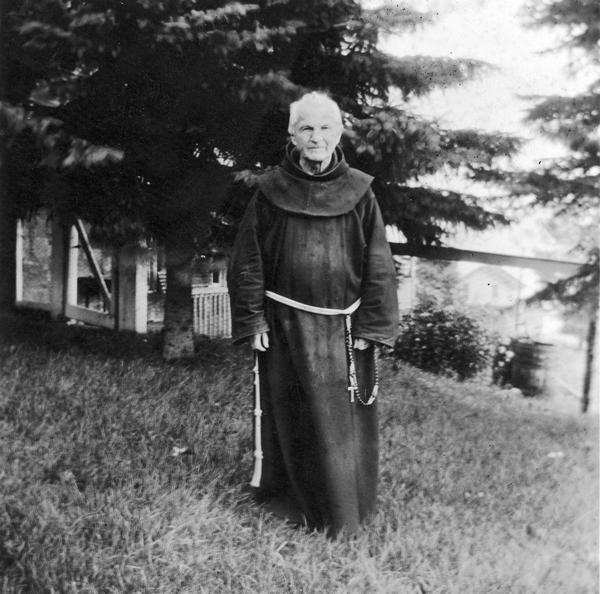
Reverend Chrysostome Verwyst, circa 1918.
~ Wisconsin Historical Society
One of the earliest spots in the Northwest trodden by the feet of white men was the shore of Chequamegon Bay. Chequamegon is a corrupt form of Jagawamikong;2 or, as it was written by Father Allouez in the Jesuit Relation for 1667, Chagaouamigong. The Chippewas on Lake Superior have always applied this name exclusively to Chequamegon Point, the long point of land at the entrance of Ashland Bay. It is now commonly called by whites, Long Island; of late years, the prevailing northeast winds have caused Lake Superior to make a break through this long, narrow peninsula, at its junction with the mainland, or south shore, so that it is in reality an island. On the northwestern extremity of this attenuated strip of land, stands the government light-house, marking the entrance of the bay.

William Whipple Warren, circa 1851.
~ Commons.Wikimedia.org
W. W. Warren, in his History of the Ojibway Nation3, relates an Indian legend to explain the origin of this name. Menabosho, the great Algonkin demi-god, who made this earth anew after the deluge, was once hunting for the great beaver in Lake Superior, which was then but a large beaver-pond. In order to escape his powerful enemy, the great beaver took refuge in Ashland Bay. To capture him, Menabosho built a large dam extending from the south shore of Lake Superior across to Madelaine (or La Pointe) Island. In doing so, he took up the mud from the bottom of the bay and occasionally would throw a fist-full into the lake, each handful forming an island, – hence the origin of the Apostle Islands. Thus did the ancient Indians, the “Gété-anishinabeg,” explain the origin of Chequamegon Point and the islands in the vicinity. His dam completed, Menabosho started in pursuit of the patriarch of all the beavers ; he thinks he has him cornered. But, alas, poor Menabosho is doomed to disappointment. The beaver breaks through the soft dam and escapes into Lake Superior. Thence the word chagaouamig, or shagawamik (“soft beaver-dam”), – in the locative case, shagawamikong (“at the soft beaver-dam”).
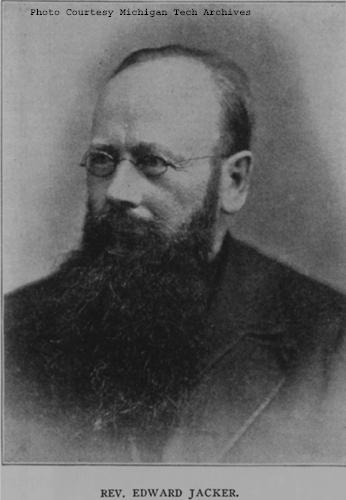
Reverend Edward Jacker
~ FindAGrave.com
Rev. Edward Jacker, a well-known Indian scholar, now deceased, suggests the following explanation of Chequamegon: The point in question was probably first named Jagawamika (pr. shagawamika), meaning “there are long, far-extending breakers;” the participle of this verb is jaiagawamikag (“where there are long breakers”). But later, the legend of the beaver hunt being applied to the spot, the people imagined the word amik (a beaver) to be a constituent part of the compound, and changed the ending in accordance with the rules of their language, – dropping the final a in jagawamika, making it jagawamik, – and used the locative case, ong (jagawamikong), instead of the participial form, ag (jaiagawamikag).4
The Jesuit Relations apply the Indian name to both the bay and the projection of land between Ashland Bay and Lake Superior. our Indians, however, apply it exclusively to this point at the entrance of Ashland Bay. It was formerly nearly connected with Madelaine (La Pointe) Island, so that old Indians claim a man might in early days shoot with a bow across the intervening channel. At present, the opening is about two miles wide. The shores of Chequamegon Bay have from time immemorial been the dwelling-place of numerous Indian tribes. The fishery was excellent in the bay and along the adjacent islands. The bay was convenient to some of the best hunting grounds of Northern Wisconsin and Minnesota. The present writer was informed, a few years ago, that in Douglas county alone 2,500 deer had been killed during one short hunting season.5 How abundant must have been the chase in olden times, before the white had introduced to this wilderness his far-reaching fire-arms! Along the shores of our bay were established at an early day fur-trading posts, where adventurous Frenchmen carried on a lucrative trade with their red brethren of the forest, being protected by French garrisons quartered in the French fort on Madelaine Island.
From Rev. Henry Blatchford, an octogenarian, and John B. Denomie (Denominé), an intelligent half-breed Indian of Odanah, near Ashland, the writer has obtained considerable information as to the location of ancient and modern aboriginal villages on the shores of Chequamegon Bay. Following are the Chippewa names of the rivers and creeks emptying into the bay, where there used formerly to be Indian villages:

Charles Whittlesey documented several pictographs along the Bad River.
Mashki-Sibi (Swamp River, misnamed Bad River): Up this river are pictured rocks, now mostly covered with earth, on which in former times Indians engraved in the soft stone the images of their dreams, or the likenesses of their tutelary manitous. Along this river are many maple-groves, where from time immemorial they have made maple-sugar.
Makodassonagani-Sibi (Bear-trap River), which emptties into the Kakagon. The latter seems in olden times to have been the regular channel of Bad River, when the Bad emptied into Ashland Bay, instead of Lake Superior, as it now does. Near the mouth of the Kakagon are large wild-rice fields, where the Chippewas annually gather, as no doubt did their ancestors, great quantities of wild rice (Manomin). By the way, wild rice is very palatable, and the writer and his dusky spiritual children prefer it to the rice of commerce, although it does not look quite so nice.
Bishigokwe-Sibiwishen is a small creek, about six miles or so east of Ashland. Bishigokwe means a woman who has been abandoned by her husband. In olden times, a French trader resided at the mouth of this creek. He suddenly disappeared, – whether murdered or not, is not known. His wife continued to reside for many years at their old home, hence the name.
Nedobikag-Sibiwishen is the Indian name for Bay City Creek, within the limits of Ashland. Here Tagwagané, a celebrated Indian chief of the Crane totem, used occasionally to reside. Warren6 gives us a speech of his, at the treaty of La Pointe in 1842. This Tagwagané had a copper plate, an heirloom handed down in his family from generation to generation, on which were rude indentations and hieroglyphics denoting the number of generations of that family which had passed away since they first pitched their lodges at Shagawamikong and took possession of the adjacent country, including Madelaine Island. From this original mode of reckoning time, Warren concludes that the ancestors of said family first came to La Pointe circa A. D. 1490.

Detail of “Ici était une bourgade considerable” from Carte des lacs du Canada by Jacques-Nicolas Bellin, 1744.
~ Wisconsin Historical Society
Metabikitigweiag-Sibiwishen is the creek between Ashland and Ashland Junction, which runs into Fish Creek a short distance west of Ashland. At the junction of these two creeks and along their banks, especially on the east bank of Fish Creek, was once a large and populous Indian village of Ottawas, who there raised Indian corn. It is pointed out on N. Bellin’s map (1744)7, with the remark, Ici était une bourgade considerable (“here was once a considerable village”). We shall hereafter have occasion to speak of this place. The soil along Fish Creek is rich, formed by the annual overflowage of its water, leaving behind a deposit of rich, sand loam. There a young growth of timber along the right bank between the bay and Ashland Junction, and the grass growing underneath the trees shows that it was once a cultivated clearing. It was from this place that the trail left the bay, leading to the Chippewa River country. Fish Creek is called by the Indians Wikwedo-Sibiwishen, which means “Bay Creek,” from wikwed, Chippewa for bay; hence the name Wikwedong, the name they gave to Ashland, meaning “at the bay.”
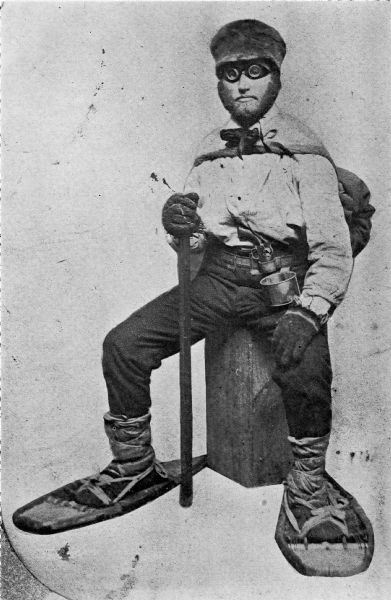
Whittlesey Creek (National Wildlife Refuge) was named after Asaph Whittlesey, brother of Charles Whittlesey. Photo of Asaph, circa 1860.
~ Wisconsin Historical Society
According to Blatchford, there was formerly another considerable village at the mouth of Whittlesey’s Creek, called by the Indians Agami-Wikwedo-Sibiwishen, which signifies “a creek on the other side of the bay,” from agaming (on the other side of a river, or lake), wikwed (a bay), and sibiwishen (a creek). I think that Fathers Allouez and Marquette had their ordinary abode at or near this place, although Allouez seems also to have resided for some time at the Ottawa village up Fish Creek.
A short distance from Whittlesey’s Creek, at the western bend of the bay, where is now Shore’s Landing, there used to be a large Indian village and trading-post, kept by a Frenchman. Being at the head of the bay, it was the starting point of the Indian trail to the St. Croix country. Some years ago the writer dug up there, an Indian mound. The young growth of timber at the bend of the bay, and the absence of stumps, indicate that it had once been cleared. At the foot of the bluff or bank, is a beautiful spring of fresh water. As the St. Croix country was one of the principal hunting grounds of the Chippewas and Sioux, it is natural there should always be many living at the terminus of the trail, where it struck the bay.
From this place northward, there were Indian hamlets strung along the western shore of the bay. Father Allouez mentions visiting various hamlets two, three, or more (French) leagues away from his chapel. Marquette mentions five clearings, where Indian villages were located. At Wyman’s place, the writer some years ago dug up two Indian mounds, one of which was located on the very bank of the bay and was covered with a large number of boulders, taken from the bed of the bay. In this mound were found a piece of milled copper, some old-fashioned hand-made iron nails, the stem of a clay pipe, etc. The objects were no doubt relics of white men, although Indians had built the mound itself, which seemed like a fire-place shoveled under, and covered with large boulders to prevent it from being desecrated.
Boyd’s Creek is called in Chippewa, Namebinikanensi-Sibiwishen, meaning “Little Sucker Creek.” A man named Boyd once resided there, married to an Indian woman. He was shot in a quarrel with another man. One of his sons resides at Spider Lake, and another at Flambeau Farm, while two of his grand-daughters live at Lac du Flambeau.
Further north is Kitchi-Namebinikani-Sibiwishen, meaning “Large Sucker Creek,” but whites now call it Bonos Creek. These two creeks are not far apart, and once there was a village of Indians there. It was noted as a place for fishing at a certain season of the year, probably in spring, when suckers and other fish would go up these creeks to spawn.
At Vanderventer’s Creek, near Washburn, was the celebrated Gigito-Mikana, or “council-trail,” so called because here the Chippewas once held a celebrated council; hence the Indian name Gigito-Mikana-Sibiwishen, meaning “Council-trail Creek.” At the mouth of this creek, there was once a large Indian village.
There used also to be a considerable village between Pike’s Bay and Bayfield. It was probably there that the celebrated war chief, Waboujig, resided.

John Baptiste Denomie
~ Noble Lives of a Noble Race, A Series of Reproductions by the Pupils of Saint Mary’s, Odanah, Wisconsin, page 213-217.
There was once an Indian village where Bayfield now stands, also at Wikweiag (Buffalo Bay), at Passabikang, Red Cliff, and on Madelaine Island. The writer was informed by John B. Denomie, who was born on the island in 1834, that towards Chabomnicon Bay (meaning “Gooseberry Bay”) could long ago be seen small mounds or corn-hills, now overgrown with large trees, indications of early Indian agriculture. There must have been a village there in olden times. Another ancient village was located on the southwestern extremity of Madelaine Island, facing Chequamegon Point, where some of their graves may still be seen. It is also highly probable that there were Indian hamlets scattered along the shore between Bayfield and Red Cliff, the most northern mainland of Wisconsin. There is now a large, flourishing Indian settlement there, forming the Red Cliff Chippewa reservation. There is a combination church and school there at present, under the charge of the Franciscan Order. Many Indians also used to live on Chequamegon Point, during a great part of the year, as the fishing was good there, and blueberries were abundant in their season. No doubt from time immemorial Indians were wont to gather wild rice at the mouth of the Kakagon, and to make maple sugar up Bad River.

Illustration from The Story of Chequamegon Bay, Collections of the State Historical Society of Wisconsin: Volume XIII, 1895, page 419.
We thus see that the Jesuit Relations are correct when they speak of many large and small Indian villages (Fr. bourgades) along the shores of Chequamegon Bay. Father Allouez mentions two large Indian villages at the head of the bay – the one an Ottawa village, on Fish Creek; the other a Huron, probably between Shore’s Landing and Washburn. Besides, he mentions smaller hamlets visited by him on his sick-calls. Marquette says that the Indians lived there in five clearings, or villages. From all this we see that the bay was from most ancient times the seat of a large aboriginal population. Its geographical position towards the western end of the great lake, its rich fisheries and hunting grounds, all tended to make it the home of thousands of Indians. Hence it is much spoken of by Perrot, in his Mémoire, and by most writers on the Northwest of the last century. Chequamegon Bay, Ontonagon, Keweenaw Bay, and Sault Ste. Marie (Baweting) were the principal resorts of the Chippewa Indians and their allies, on the south shore of Lake Superior.
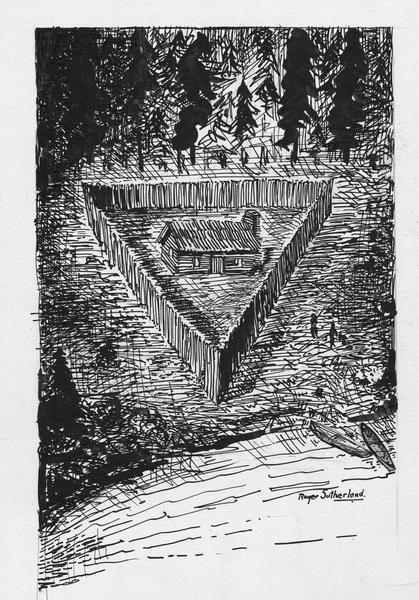
“Front view of the Radisson cabin, the first house built by a white man in Wisconsin. It was built between 1650 and 1660 on Chequamegon Bay, in the vicinity of Ashland. This drawing is not necessarily historically accurate.”
~ Wisconsin Historical Society
The first white men on the shores of Chequamegon Bay were in all probability Groseilliers and Radisson. They built a fort on Houghton Point, and another at the head of the bay, somewhere between Whittlesey’s Creek and Shore’s Landing, as in some later paper I hope to show from Radisson’s narrative.8 As to the place where he shot the bustards, a creek which led him to a meadow9, I think this was Fish Creek, at the mouth of which is a large meadow, or swamp.10
After spending six weeks in the Sioux country, our explorers retraced their steps to Chequamegon Bay, arriving there towards the end of winter. They built a fort on Houghton Point. The Ottawas had built another fort somewhere on Chequamegon Point. In travelling towards this Ottawa fort, on the half-rotten ice, Radisson gave out and was very sick for eight days; but by rubbing his legs with hot bear’s oil, and keeping them well bandaged, he finally recovered. After his convalescence, our explorers traveled northward, finally reaching James Bay.
The next white men to visit our bay were two Frenchmen, of whom W. W. Warren says:11
“One clear morning in the early part of winter, soon after the islands which are clustered in this portion of Lake Superior, and known as the Apostles, had been locked in ice, a party of young men of the Ojibways started out from their village in the Bay of Shag-a-waum-ik-ong [Chequamegon], to go, as was customary, and spear fish through holes in the ice, between the island of La Pointe and the main shore, this being considered as the best ground for this mode of fishing. While engaged in this sport, they discovered a smoke arising from a point of the adjacent island, toward its eastern extremity.
“The island of La Pointe was then totally unfrequented, from superstitious fears which had but a short time previous led to its total evacuation by the tribe, and it was considered an act of the greatest hardihood for any one to set foot on its shores. The young men returned home at evening and reported the smoke which they had seen arising from the island, and various were the conjectures of the old people respecting the persons who would dare to build a fire on the spirit-haunted isle. They must be strangers, and the young men were directed, should they again see the smoke, to go and find out who made it.
“Early the next morning, again proceeding to their fishing-ground, the young men once more noticed the smoke arising from the eastern end of the unfrequented island, and, again led on by curiosity, they ran thither and found a small log cabin, in which they discovered two white men in the last stages of starvation. The young Ojibways, filled with compassion, carefully conveyed them to their village, where being nourished with great kindness, their lives were preserved.
“These two white men had started from Quebec during the summer with a supply of goods, to go and find the Ojibways who every year had brought rich packs of beaver to the sea-coast, notwithstanding that their road was barred by numerous parties of the watchful and jealous Iroquois. Coasting slowly up the southern shores of the Great Lake late in the fall, they had been driven by the ice on to the unfrequented island, and not discovering the vicinity of the Indian village, they had been for some time enduring the pangs of hunger. At the time they were found by the young Indians, they had been reduced to the extremity of roasting and eating their woolen cloth and blankets as the last means of sustaining life.
“Having come provided with goods they remained in the village during the winter, exchanging their commodities for beaver skins. They ensuing spring a large number of the Ojibways accompanied them on their return home.
“From close inquiry, and judging from events which are said to have occurred about this period of time, I am disposed to believe that this first visit by the whites took place about two hundred years ago [Warren wrote in 1852]. It is, at any rate, certain that it happened a few years prior to the visit of the ‘Black-gowns’ [Jesuits] mentioned in Bancroft’s History, and it is one hundred and eighty-four years since this well-authenticated occurrence.”
So far Warren; he is, however, mistaken as to the date of the first black-gown’s visit, which was not 1668 but 1665.

Portrayal of Claude Allouez
~ National Park Service
The next visitors to Chequamegon Bay were Père Claude Allouez and his six companions in 1665. We come now to a most interesting chapter in the history of our bay, the first formal preaching of the Christian religion on its shores. For a full account of Father Allouez’s labors here, the reader is referred to the writer’s Missionary Labors of Fathers Marquette, Allouez, and Ménard in the Lake Superior Region. Here will be given merely a succinct account of their work on the shores of the bay. To the writer it has always been a soul-inspiring thought that he is allowed to tread in the footsteps of those saintly men, who walked, over two hundred years ago, the same ground on which he now travels; and to labor among the same race for which they, in starvation and hardship, suffered so much.
In the Jesuit Relation for 1667, Father Allouez thus begins the account of his five years’ labors on the shores of our bay:
“On the eight of August of the year 1665, I embarked at Three Rivers with six Frenchmen, in company with more than four hundred Indians of different tribes, who were returning to their country, having concluded the little traffic for which they had come.”
Marquis Alexandre de Prouville de Tracy
~ Wikipedia.org
His voyage into the Northwest was one of the great hardships and privations. The Indians willingly took along his French lay companions, but him they disliked. Although M. Tracy, the governor of Quebec, had made Father Allouez his ambassador to the Upper Algonquins, thus to facilitate his reception in their country, nevertheless they opposed him accompanying them, and threatened to abandon him on some desolate island. No doubt the medicine-men were the principal instigators of this opposition. He was usually obliged to paddle like the rest, often till late in the night, and that frequently without anything to eat all day.
“On a certain morning,” he says, “a deer was found, dead since four or five days. It was a lucky acquisition for poor famished beings. I was offered some, and although the bad smell hindered some from eating it, hunger made me take my share. But I had in consequence an offensive odor in my mouth until the next day. In addition to all these miseries we met with, at the rapids I used to carry packs as large as possible for my strength; but I often succumbed, and this gave our Indians occasion to laugh at me. They used to make fun of me, saying a child ought to be called to carry me and my baggage.”
August 24, they arrived at Lake Huron, where they made a short stay; then coasting along the shores of that lake, they arrived at Sault Ste. Marie towards the beginning of September. September 2, they entered Lake Superior, which the Father named Lake Tracy in acknowledgement of the obligations which the people of those upper countries owed to the governor. Speaking of his voyage on Lake Superior, Father Allouez remarks:
“Having entered Lake Tracy, we were engaged the whole month of September in coasting along the south shore. I had the consolation of saying holy mass, as I now found myself alone with our Frenchmen, which I had not been able to do since my departure from Three Rivers. * * * We afterwards passed the bay, called by the aged, venerable Father Ménard, Sait Theresa [Keweenaw] Bay.”
Speaking of his arrival at Chequamegon Bay, he says:
“After having traveled a hundred and eighty leagues on the south shore of Lake Tracy, during which our Saviour often deigned to try our patience by storms, hunger, daily and nightly fatigues, we finally, on the first day of October, 1665, arrived at Chagaouamigong, for which place we had sighed so long. It is a beautiful bay, at the head of which is situated the large village of the Indians, who there cultivate fields of Indian corn and do not lead a nomadic life. There are at this place men bearing arms, who number about eight hundred; but these are gathered together from seven different tribes, and live in peacable community. This great number of people induced us to prefer this place to all others for our ordinary abode, in order to attend more conveniently to the instruction of these heathens, to put up a chapel there and commence the functions of Christianity.”
Further on, speaking of the site of his mission and its chapel, he remarks:
“The section of the lake shore, where we have settled down, is between two large villages, and is, as it were, the center of all the tribes of these countries, because the fishing here is very good, which is the principal source of support of these people.”
To locate still more precisely the exact site of his chapel, he remarks, speaking of the three Ottawa clans (Outaouacs, Kiskakoumacs, and Outaoua-Sinagonc):
“I join these tribes [that is, speaks of them as one tribe] because they had one and the same language, which is the Algonquin, and compose one of the same village, which is opposite that of the Tionnontatcheronons [Hurons of the Petun tribe] between which villages we reside.”
But where was that Ottawa village? A casual remark of Allouez, when speaking of the copper mines of Lake Superior, will help us locate it.
“It is true,” says he, “on the mainland, at the place where the Outaouacs raise Indian corn, about half a league from the edge of the water, the women have sometimes found pieces of copper scattered here and there, weighing ten, twenty or thirty pounds. It is when digging into the sand to conceal their corn that they make these discoveries.”
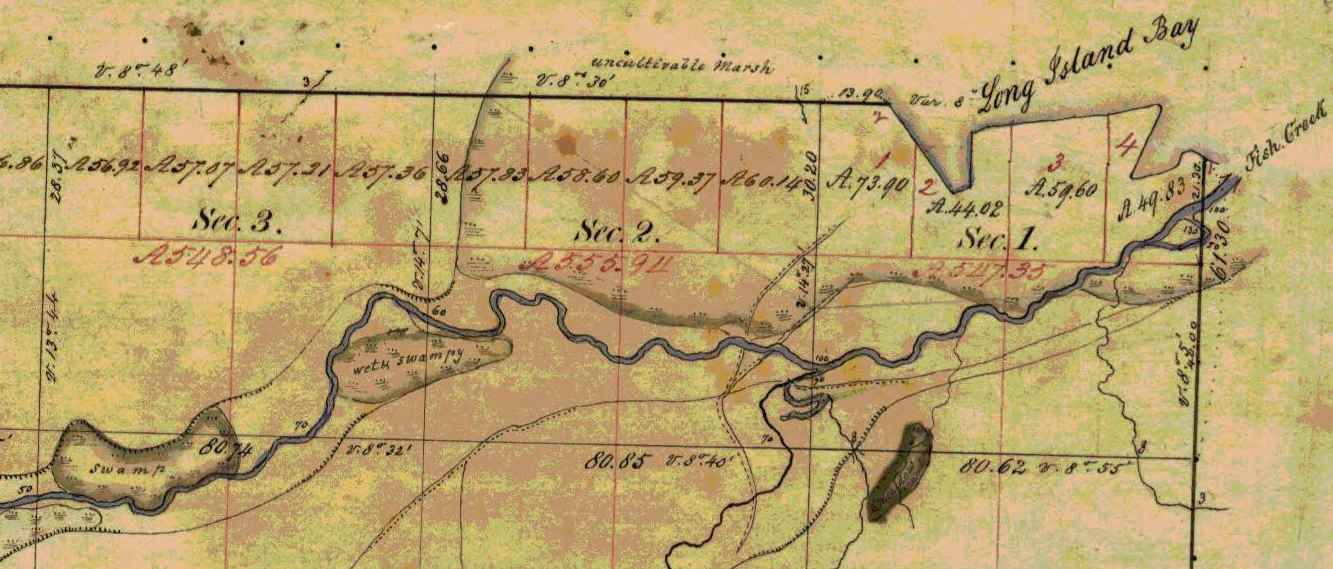
Detail of Fish Creek from Township 47 North Range 5 West.
~ Wisconsin Public Land Survey Records
Allouez evidently means Fish Creek. About a mile or so from the shore of the bay, going up this creek, can be seen traces of an ancient clearing on the left-hand side, where Metabikitigweiag Creeek empties into Fish Creek, about half-way between Ashland and Ashland Junction. The writer examined the locality about ten years ago. This then is the place where the Ottawas raised Indian corn and had their village. In Charlevoix’s History of New France, the same place is marked as the site of an ancient large village. The Ottawa village on Fish Creek appears to have been the larger of the two at the head of Chequamegon Bay, and it was there Allouez resided for a time, until he was obliged to return to his ordinary dwelling place, “three-fourths of a league distant.” This shows that the ordinary abode of Father Allouez and Marquette, the site of their chapel, was somewhere near Whittlesey’s Creek or Shore’s Landing. The Huron village was most probably along the western shore of the bay, between Shore’s Landing and Washburn.

Detail of Ashland next to an ancient large village (unmarked) in Township 47 North Range 4 West.
~ Wisconsin Public Land Survey Records
Father Allouez did not confine his apostolic labors to the two large village at the head of the bay. He traveled all over the neighborhood, visiting the various shore hamlets, and he also spent a month at the western extremity of Lake Superior – probably at Fond du Lac – where he met with some Chippewas and Sioux. In 1667 he crossed the lake, most probably from Sand Island, in a frail birch canoe, and visited some Nipissirinien Christians at Lake Nepigon (Allimibigong). The same year he went to Quebec with an Indian flotilla, and arrived there on the 3d of August, 1667. After only two days’ rest he returned with the same flotilla to his far distant mission on Chequamegon Bay, taking along Father Louis Nicholas. Allouez contained his missionary labors here until 1669, when he left to found St. Francis Xavier mission at the head of Green Bay. His successor at Chequamegon Bay was Father James Marquette, discoverer and explorer of the Mississippi. Marquette arrived here September 13, 1669, and labored until the spring of 1671, when he was obliged to leave on account of the war which had broken out the year before, between the Algonquin Indians at Chequamegon Bay and their western neighbors, the Sioux.
1 – See ante, p. 419 for map of the bay. – ED.
2 – In writing Indian names, I follow Baraga’s system of orthography, giving the French quality to both consonants and vowels.
3 – Minn. Hist. Colls., v. – ED.
4 – See ante, p. 399, note. – ED.
5 – See Carr’s interesting and exhaustive article, “The Food of Certain American Indians,” in Amer. Antiq. Proc., x., pp. 155 et seq. – ED.
6 – Minn. Hist. Colls., v. – ED.
7 – In Charlevoix’s Nouvelle France. – ED.
8 – See Radisson’s Journal, in Wis. Hist. Colls., xi. Radisson and Groseilliers reached Chequamegon Bay late in the autumn of 1661. – ED.
9 – Ibid., p. 73: “I went to the wood some 3 or 4 miles. I find a small brooke, where I walked by ye sid awhile, wch brought me into meddowes. There was a poole, where weare a good store of bustards.” – ED.
10 – Ex-Lieut. Gov. Sam. S. Fifield, of Ashland, writes me as follows:
“After re-reading Radisson’s voyage to Bay Chewamegon, I am satisfied that it would by his description be impossible to locate the exact spot of his camp. The stream in which he found the “pools,” and where he shot fowl, is no doubt Fish Creek, emptying into the bay at its western extremity. Radisson’s fort must have been near the head of the bay, on the west shore, probably at or near Boyd’s Creek, as there is an outcropping of rock in that vicinity, and the banks are somewhat higher than at the head of the bay, where the bottom lands are low and swampy, forming excellent “duck ground” even to this day. Fish Creek has three outlets into the bay, – one on the east shore or near the east side, one central, and one near the western shore; for full two miles up the stream, it is a vast swamp, through which the stream flows in deep, sluggish lagoons. Here, in the early days of American settlement, large brook trout were plenty; and even in my day many fine specimens have been taken from these “pools.” Originally, there was along these bottoms a heavy elm forest, mixed with cedar and black ash, but it has now mostly disappeared. An old “second growth,” along the east side, near Prentice Park, was evidently once the site of an Indian settlement, probably of the 18th century.
“I am of the opinion that the location of Allouez’s mission was at the mouth of Vanderventer’s Creek, on the west shore of the bay, near the present village of Washburn. It was undoubtedly once the site of a large Indian village, as was the western part of the present city of Ashland. When I came to this locality, nearly a quarter of a century ago, “second growth” spots could be seen in several places, where it was evident that the Indians had once had clearings for their homes. The march of civilization has obliterated these landmarks of the fur-trading days, when the old French voyageurs made the forest-clad shores of our beautiful bay echo with their boat songs, and when resting from their labors sparked the dusky maidens in their wigwams.”
Rev. E. P. Wheeler, of Ashland, a native of Madelaine Island, and an authority on the region, writes me:
“I think Radisson’s fort was at the mouth of Boyd’s Creek, – at least that place seems for the present to fulfill the conditions of his account. it is about three or four miles from here to Fish Creek valley, which leads, when followed down stream, to marshes ‘meadows, and a pool.’ No other stream seems to have the combination as described. Boyd’s Creek is about four miles from the route he probably took, which would be by way of the plateau back from the first level, near the lake. Radisson evidently followed Fish Creek down towards the lake, before reaching the marshes. This condition is met by the formation of the creek, as it is some distance from the plateau through which Fish Creek flows to its marshy expanse. Only one thing makes me hesitate about coming to a final decision, – that is, the question of the age of the lowlands and formations around Whittlesey Creek. I am going to go over the ground with an expert geologist, and will report later. Thus far, there seems to be no reason to doubt that Fish Creek is the one upon which Radisson hunted.” – ED.
11 – Minn. Hist. Colls., v., pp. 121, 122, gives the date as 1652. – ED.
Penokee Survey Incidents: Number VI
March 14, 2015
By Amorin Mello
December 22, 1877.
The Survey of the Penoka Range and Incidents Connected with its Early History.
—
Number VI.
At length, somewhere about the 25th of October, the General returned from below, accompanied by his son, Joseph Cutler, George Spaulding, a young man who had formerly been in his employ in Maine, and Henry C. Palmer of Milwaukee, a son of President Palmer, who all came to hold claims for the Company, if wanted. He also brought two cook stoves and two metal kettles, the stoves for housekeeping, the kettles for sugar making. Both of the kettles and one of the stoves were subsequently sent to the Range, where they did good service during the winter and following spring, and are no doubt in use somewhere in the country today.
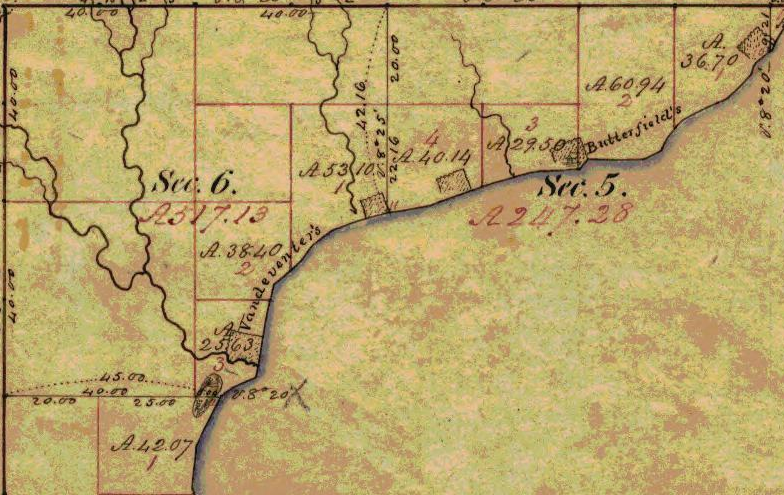
Houghton was a small settlement in the Town of BayPort, located northeast of what is now the City of Washburn. Captain Steven Butterfield and Peter B Vanderventer lived at what is now Washburn. (Detail from Augustus H. Barber’s survey during August of 1855)
Antoine Gordon from Noble Lives of a Noble Race (pg. 207) published by the St. Mary’s Industrial School in Odanah.
These kettles and stoves came very near sending Gen. Cutler, myself and Mr. Sidebotham, who had been stopping at La Pointe for several weeks, awaiting events, to a watery grave, during the run from that place to Ashland, in the Jane, a large two-masted boat formerly used by the Government upon the lake coast survey. Nothing but the coolness and skill of Captain Steve Butterfield, who was at the helm, saved us from going to the bottom. It was a long time before the recollections of that November day ceased to haunt us. The idea of going down in 150 feet of water with such a load, was not a pleasant thing to contemplate. Mr. Sidebotham was wholly unconscious, until after he reached the shore, of the peril we were in, owing to his ignorance of nautical affairs, but not so the General. He realized it as keenly as I did, not a word was spoken for over an hour, but in that hour we lived a lifetime. At length we succeeded in reaching the land at Houghton, where the high rocky shore furnished a lee. I shall never forget that ride while I live. We stopped for dinner at Antoine Gordon‘s, who lived at that time a little to the westward of Houghton, after which we ran down the shore to Pete Vanderventer‘s old place before venturing to cross the Bay to Ashland, which however, we finally did, reaching there in safety about sunset. Here we left Mr. Sidebotham to remain until wanted, and with J. Cutler, Palmer, and Spaulding, started the next morning for the Range, reaching there the second day at noon. Immediately upon our arrival, an interview was had with Stuntz, who informed us that if the fine weather we were then enjoying should continue for three weeks more, the survey to complete which he was making every possible exertion, would be finalized. This was to us indeed joyful news, as we were getting very anxious to return to our homes for the winter; whereupon all of our spare men were at once detailed to assist him, leaving me alone at Penoka, the General, in the meantime, visiting the different locations, and arranging for the winter, during which a blockhouse was to be built at Penoka, and one at the Gorge, which was done, the lumber for both being manufactured upon the ground, with a whip saw. Up to this time there had been no snow except the usual light fall we had every year, about the 1st of November. This, however, had all disappeared in three days after it fell, after which the weather was beautiful. In this way the time passed along, I seeing no one except Gen. Cutler, who came occasionally, or some of Stuntz’s men, who came for supplies, which were at this time kept mostly at Penoka, until the 12th of November, when it being certain that one week more would finish the survey, General Cutler left for Ashland, after Mr. Sidebotham, who by the requirements of the pre-emption law, must sleep upon his claim the 30th, in order to hold it, at least we so understood it at the time, leaving me entirely alone.
The weather continued fair up to the 18th, when there came a change. Saturday, the 17th, was as fine an Indian summer day as I ever saw, nearly all of which I slept seated upon a log in front of the cabin, listening to the singing of the birds, many of them not yet having left us for their homes in the south, and watching them as they were fitting around me, in search of food. At length old Sol sunk in the west, and night once more spread her dark mouth over the surrounding landscape. A strange feeling of loneliness, such as I had never felt before, crept over me as I closed the door of the cabin for the night, and sought my couch of balsam boughs, where I slept soundly until 6 o’clock the following morning, when presto! what a change met my eye! The air so soft and clear the previous evening, was now filled with snow, while upon the ground it was two and a half feet in depth, and increasing rapidly. You can easily imagine that I was not a little startled at the outlook, as being snowed in upon Lake Superior was no joke; and from the rapidity with which it was falling, it was apparent that it would be six feet in depth in twenty-four hours, if it kept on. I quickly saw that the first thing to be done was to lay in a supply of wood, the nearest pile of which was thirty rods distant. To this a track was quickly made, and the work of moving it commenced; neither did it stop until 2 P.M., at which time the whole pile, one and a half cords was in the cabin. The snow was now three feet in depth, but very light. My wood secured, I proceeded to cook some food, of which I felt the need, after which my thoughts began to wander after Stuntz and party, who were fifteen miles south. Neither did they reach the Range until the fourth day, as they had but one mile to run, in order to complete, when the storm came. This done, they started, and were three days in making that fifteen miles, during one of which, the last, they had nothing to eat, and one of them, Wilhelm Goetzenburg, literally nothing to wear, being clad in duck pants, hickory shirt, and stoga boots, no stockings, coat or vest. They were all badly used up when they got in; Stevens, in particular, who gave out when within only three miles of the Range, where he remained until his companions had reached the cabin, and two of them returned to him with some food, after which he came in, but as weak as to render it necessary to lead him. It was several days before he fully recovered his former strength. Goetzenburg, although nearly naked, stood it the best of them all. Perhaps a short sketch of this curious mortal, who certainly exhibited upon this occasion, powers of endurance equal to the gay and festive mule may not be inopportune, in this connection, before closing this article.
Wilhelm Goetzenburg, or Gutsenburg, as George Miller once spelt it when directing a letter for him to his “bruder” in Ontonagon, was not an Adonis, in the strict sense of the term. No sir! his keel was laid for a jumping jack, but from some unexplained cause, that plan was abandoned by his builder, who finally modeled him after the tubs the performing elephants use in the circus, broad at the base; in fact, his basement story was the largest part of him, in fact, nearly all of him; his legs, which were bowed, were short; his arms were long; his chest was short, and shaped like the dummies we see in the windows of ladies’ furnishing stores; his shoulders were broad, upon which a head covered with a thick mat of coarse hair, in color like that of a North Carolina clay-eater; a short nose, and a mouth that if open would have fooled a badger. Taken as a whole, he looked like a mixture of Low Dutch, Esquimaux and New Zealander combined. But beneath that iron frame, beat as honest a heart as ever beat in Ashland, or any other land. Good luck to thee, honest Wilhelm, I shall never see thy like again, but wherever thou arts or goest, may beans be plenty and clothing cheap. But en resume.
The fifth day brought Gen. Cutler from Ashland, accompanied by Mr. Sidebotham, George Kilburn, Sibley, Steve Sanborn, and George Miller, with the pack horses, who all came to break the road, except Sanborn, who came to stay through the winter. The boys had also now got in from the different claims, and the old cabin was full. Here they all remained for two days, when there came a thaw and melted the snow, after which Uncle George and Sibley returned to the Marengo, and George Miller with the horses to Ashland. The rest remained until the 30th, when their claims secured, and the arrangements for the winter completed. Mr. Arthur E. Wheelock was placed in charge of the week with J. Culter, Palmer, Steve Sanborn, Spaulding, and Elie Valliant, a French Canuck, formerly a resident at Ironton, a ship and house carpenter by trade, as companions. This done, Gen. Cutler and myself, Sidebotham, McClelland, Chase, and Al. Stevens accompanied by two of Stuntz’s men, whose names I have forgotten, left for home. We camped the first night at the Marengo, where the boys, as usual, hid the sugar from Mr. Sidebotham, reaching Ashland the second day. Here we remained for two days, when leaving Mr. Sidebotham, as previous stated, we took our departure, going directly across the bay upon the ice, for Pete Vanderventer’s. Before reaching the shore, however, Chase, who led the party, broke in, and came very near drowning, as in addition to his pack and snowshoes, which were also carried, he had on rubber boots, the legs of which held water enough to run a milk factory for a week. He was finally pulled out and inverted a few moments to let him drain, after which we proceeded, reaching Antoine Gordon’s at dark, and reached Bayfield the second day, the last six miles being made in an open boat, obtained, from the Indians at Sioux River, which was returned by Wheelock and William Pell, who had accompanied us thus far on the way.
From Bayfield to Superior City on snow shoes, occupied seven days, during which we camped on the snow every night. This, although a hard tramp, was very much enjoyed by all. The last three days our route lay along the shore of the lake, where many laughable scenes occurred in the way of tumbles from the ice bergs that lined the shore. From Superior City via St. Paul and La Crosse, to New Lisbon by stage, occupied nine days. From New Lisbon by cars to Milwaukee, one day, reaching that place Dec. 25, 1857. J.S.B.
 Chequamegon History