The Woman In Stone
March 15, 2016
By Amorin Mello & Leo Filipczak
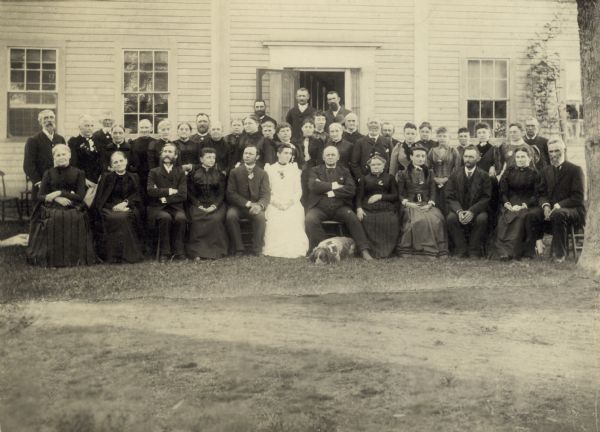
Photograph of the Wheeler and Wood Families from the Wheeler Family Papers at the Wisconsin Historical Society. The woman dressed in white is Harriet Martha Wheeler, according to the book about her mother, Woman in the Wilderness: Letters of Harriet Wood Wheeler, Missonary Wife, 1832-1892, by Nancy Bunge, 2010.
![Leonard Hemenway Wheeler ~ Unnamed Wisconsin by [????]](https://chequamegonhistory.com/wp-content/uploads/2016/03/leonard-hemenway-wheeler-from-unnamed-wisconsin.jpg)
Leonard Hemenway Wheeler: husband of Harriet Wood Wheeler, and father of author Harriet Martha Wheeler.
~ Unnamed Wisconsin, by John Nelson Davidson, 1895.
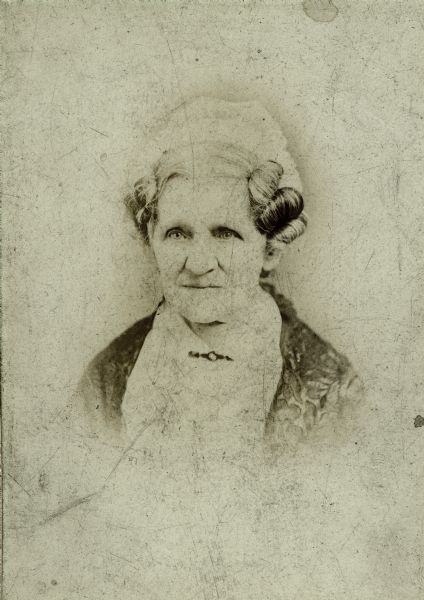
Harriet Wood Wheeler: wife of Leonard Wheeler, and mother of author Harriet Martha Wheeler.
~ Wisconsin Historical Society
This is a reproduction of the final chapter from Harriet Martha Wheeler’s 1903 book, The Woman in Stone: A Novel. If you want to read the entire novel without spoiling the final chapter featured here, you can download it here as a PDF file: The Woman in Stone: A Novel. Special thanks to Paul DeMain at Indian Country Today Media Network for making the digitization of this novel possible for the public to read with convenience.
“Hattie” was named after her mother, Harriet Wood Wheeler; the wife of Reverend Leonard Hemenway Wheeler. Hattie was born in 1858 at Odanah, shortly after the events portrayed in her novel. Hattie’s experiences and writings about the Lake Superior Chippewa are summarized in an academic article by Nancy Bunge, published in The American Transcendental Quarterly , Vol. 16, No. 1 , March 2002: Straddling Cultures: Harriet Wheeler’s and William W. Warren’s Renditions of Ojibwe History

William Whipple Warren (c. 1851)
~ Wikimedia.org
“Mary Warren English, White Earth, Minnesota”
~ University of Minnesota Duluth, Kathryn A. Martin Library, NEMHC Collections
Harriet Wheeler and William W. Warren not only both lived on Ojibwe reservations in northern Wisconsin during the nineteenth century, but their families had strong bonds between them. William Warren’s sister, Mary Warren English, writes that her brother returned to La Pointe, Wisconsin, from school on the same boat Harriet’s parents took to begin their mission work. The Wheelers liked him and appreciated his help: “He won a warm and life-long friendship–with these most estimable people–by his genial and happy disposition–and ever ready and kindly assistance–during their long and tedious voyage” (Warren Papers). When Mary Warren English’s parents died, she moved in with the Wheelers, and, long after she and Harriet no longer shared the same household, she began letters to Harriet with the salutation, “Dear Sister.” But William Warren’s History of the Ojibwe People (1885) and Harriet Wheeler’s novel The Woman in Stone (1903) reveal that this shared background could not overcome the cultural differences between them. Even though Wheeler and Warren often describe the same events and people, their accounts have different implications. Wheeler, the daughter of Congregational missionaries from New England, portrays the inevitable and necessary decline of the Ojibwe, as emissaries of Christianity help civilization progress; Warren, who had French and Ojibwe ancestors, as well as Yankee roots, identifies growing Anglo-Saxon influence on the Ojibwe as a cause of moral decay.
Hattie’s book appears to provide some valuable insights about certain events in Chequamegon history, yet it is clearly erroneous about other such events. According to the University of Wisconsin – Madison, Harriet’s novel is “based on discovery of petrified body of Indian woman in northern Wisconsin.” This statement seems to acknowledge this peculiar event as being somewhat factual. However, Hattie’s novel is clearly a work of fiction; it appears that some of her references were to actual events. At this point in time, this mystery of the forest may never be thoroughly confirmed or debunked.
An incomplete theater screenplay, with the title “Woman in Stone,” was also written by Hattie. It appears to be based on her novel, can be found at the Northern Great Lakes Visitor Center Archives, in the Wheeler Family Papers: Northland Mss 14; Box 10; Folder 19. However, only several pages of this screenplay copy still exist in the archive there. A complete copy of Hattie’s screenplay may still exist somewhere else yet.
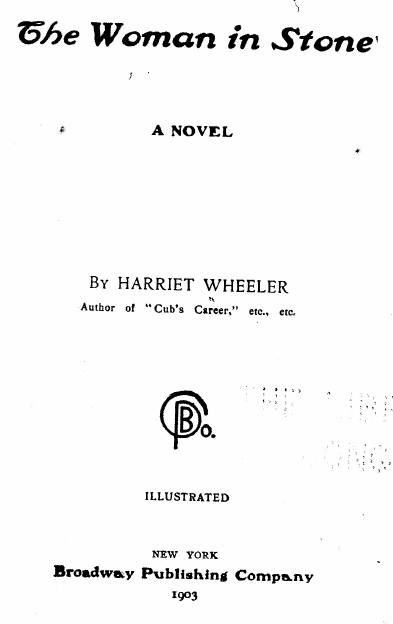
The Woman in Stone: A Novel by Harriet Martha Wheeler, 1903.
[Due to the inconsistencies found in Hattie’s novel, we have omitted most of this novel for this reproduction. We shall skip to the final chapter of Hattie’s novel, to the rediscovery of long lost “Wa-be-goon-a-quace,” the Little Flower Girl. If you want to read the entire novel first, before spoiling this final chapter, you can download it here: The Woman in Stone: A Novel, by Harriet Wheeler, 1903. Special thanks to Paul DeMain at Indian Country Today Media Network for making the digitization of this novel possible for the public to read with convenience.]
(Pages 164-168)
CHAPTER XX.
THE DISCOVERY OF THE WOMAN IN STONE
A hundred years swept over the island Madelaine, bringing change and decay in their train. But, nature renews the waste of time with a prodigal hand and robed the island in verdant loveliness.

Madelaine still towers the queen of the Apostle group, with rocky dells and pine clad shores and odorous forests, through which murmur the breezes from the great lake, and over all hover centuries of history, romance, and legendary lore.
Jean Michel Cadotte was Madelaine’s father-in-law, not husband. Madelaine Cadotte’s Ojibwe name was Ikwezewe, and she was still alive at La Pointe, in her ’90s, during Hattie‘s childhood in Odanah. It’s kind of disturbing how little of this Hattie got right considering Mary Warren (Madeline’s granddaughter) was basically Hattie’s stepsister.
Evolution toward the spiritual is the destiny of humanity and in this trend of progress the Red Men are vanishing before the onward march of the Pale Face. In the place of the blazing Sacred Fire stands the Protestant Mission. The settlers’ cabin supplants the wigwam. No longer are heard the voyageur’s song and the rippling canoes. This is the age of steam, and far and near echoes the shrill whistle. Overgrown mounds mark the sites of the forts of La Ronde and Cadotte. In the spacious log cabin of Jean and Madelaine Cadotte lives their grandson, John Cadotte.

“Dirt trail passing log shack that was probably the home of Michael and Madeline Cadotte, La Pointe,” circa 1897.
~ Wisconsin Historical Society
A practical man is John. He tills his garden, strings his fish-net in the bay, and acts as guide, philosopher and friend for all the tourists who visit the island.
Hildreth Huntington and his father may have been fictionalized, or they may be actual people from the Huntington clan:
by the Huntington Family Association, 1915.
On a June morning of the year 1857, John sat beneath a sheltering pine mending his fish-net. he smoked a cob-pipe, which he occasionally laid by to whistle a voyageur’s song. A shrill whistle sounded and a tug steamed around the bend to the wharf. John laid aside his fish-net and pipe and strolled to the beach. Two gentlemen, clad in tourist’s costume, stepped from the tug and approached John.
“Can you direct us to Mr. John Cadotte?” said the elder man.
“I am your man,” responded John.
Augustus Hamilton Barber had copper and land claims around the Montreal and Tyler Forks Rivers before his death in 1856. It is possible that this father and son pair in Hattie’s novel actually represent Joel Allen Barber and his father, Giles Addison Barber. They were following up on their belated Augustus’ unresolved business in this area during June of 1857. This theory about the Barber family is explored in more details with “Legend of the Montreal River,” by George Francis Thomas.
“My name is Huntington. This young man is my son, Hildreth. We came from New York, and are anxious to explore the region about Tyler’s fork where copper has been discovered. We were directed to you as a guide on whom we might depend. Can we secure your services, sir?” asked the stranger.
“It is also proper to state in addition to what has been already mentioned, that at, or about this time [1857], a road was opened by Mr. Herbert’s order, from the Hay Marsh, six miles out from Ironton, to which point one had been previously opened, to the Range [on the Tyler Forks River], which it struck about midway between Sidebotham’s and Lockwood’s Stations, over which, I suppose, the 50,000 tons as previously mentioned, was to find its way to Ironton, (in a horn).“
~ Penokee Survey Incidents: IV
“I am always open to engagement,” responded John.
“Very well, we will start at once, if agreeable to you.”
“I will run up to the house and pack my traps,” said John.
The stranger strolled along the beach until John’s return. Then all aboard the tug and steamed away towards Ashland. John entertained the strangers with stories and legends of those romantic and adventurous days which were fading into history.
“The company not being satisfied with Mr. Herbert as agent, he was removed and Gen. Cutler appointed in his place, who quickly selected Ashland as headquarters, to which place all the personal property, consisting of merchandise principally, was removed during the summer by myself upon Gen. C.’s order – and Ironton abandoned to its fate.”
~ Penokee Survey Incidents: I
The party left the tug at Ashland and engaged a logger’s team to carry them to Tyler’s Forks, twenty miles away. A rough road had been cut through the forest where once ran an Indian trail. Over this road the horses slowly made their way. Night lowered before they had reached their destination and they pitched their tents in the forest. John kindled a camp-fire and prepared supper. The others gathered wood and arranged bough beds in the tent. They were wearied with the long and tedious journey and early sought this rude couch.
John’s strident tones summoned them to a sunrise breakfast. They broke camp and resumed their journey, arriving at the Forks at noon.
The tourists sat down on the banks of the river and viewed the beautiful falls before them.
“This is the most picturesque spot I have seen, Hildreth. It surpasses Niagara, to my mind,” said Mr. Huntington.

The preface to this novel is a photograph of Brownstone Falls, where the Tyler Forks River empties into the Bad River at Copper Falls State Park. George Francis Thomas’ “A Mystery of the Forest” was originally published as “Legend of the Montreal River“ (and republished here). It suggests that the legend takes place at the Gorge on the Tyler Forks River, where it crosses the Iron Range; not where it terminates on Bad River along the Copper Range.
They gazed about them in wondering admiration. The forest primeval towered above them. Beyond, the falls rolled over their rocky bed. The ceaseless murmur of the rapids sounded below them and over all floated the odors of the pines and balsam firs.
“This description will, I think, give your readers a very good understanding of the condition as well as the true inwardness of the affairs of the Wisconsin & Lake Superior Mining and Smelting Co., in the month of June, 1857.”
[…]
“Rome was not built in a day, but most of these cabins were. I built four myself near the Gorge [on Tyler Forks River], in a day, with the assistance of two halfbreeds, but was not able to find them a week afterwards. This is not only a mystery but a conundrum. I thinksome traveling showman must have stolen them; but although they werenon est we could swear that we had built them, and did.“
~ Penokee Survey Incidents: IV
After dinner the party began their explorations under John’s leadership. Two days were spent in examining the banks of Bad River. On the third morning they came to the gorge. Here, the river narrowed to a few feet and cut its way through high banks of rock. The party examined the rocks on both sides. John climbed to the pool behind the gorge and examined the rocks lying beneath the shallow water. He rested his hand on what seemed to be a water-soaked log and was surprised to find the log a solid block of stone. He examined it carefully. The stone resembled a human form.
“Mr. Huntington, come down here,” he called.
“Have you struck a claim, John?” asked Mr. Huntington.
“Not exactly. Look at this rock. What do you call it, sir?”
Mr. Huntington, his son and the teamster climbed down to the pool and examined the rock.
“A petrification of some sort,” exclaimed Mr. Huntington. “Let us lift it from the water.”
The men struggled some time before they succeeded in raising the solid mass. They rested it against the rocky bank.
Wabigance: Little Flower Girl
Hattie identified this character as “Wa-be-goon-a-quace.” In the Ojibwemowin language, Wabigance is a small flower. Wabigon or Wabegoon is a flower. Wabegoonakwe is a flower that is female.
“A petrified Indian girl,” exclaimed Mr. Huntington.
The men bent low over the strange figure, examining it carefully.
“Look at her moccasins, father,” exclaimed Hildreth, “and her long hair. Here is a rosary and cross about her neck. Evidently she was a good Catholic.”
“Holy Mother,” exclaimed John, “it is the Little Flower Girl.”“And who was she?” asked Mr. Huntington.
“She was my grandmother Madelaine’s cousin. I have heard my grandmother tell about her many times when I was a boy. The Little Flower Girl lost her mind when her pale-faced lover died in battle. She was always hunting for him in the island woods. One evening she disappeared in her canoe and never returned.”
“How came she by this cross?”

Portrait of Jacques Marquette
~ Wikipedia.org
“The Holy Father Marquette gave it to her grandmother, Ogonã. The Little Flower Girl wore it always. She thought it protected her from evil and would lead her to her lover, Claude.”
And so it has. The cross has led the Little Flower Girl up yonder where she has found her Claude and life immortal.
“A touching romance, worthy to be embalmed in stone,” said Hildreth.
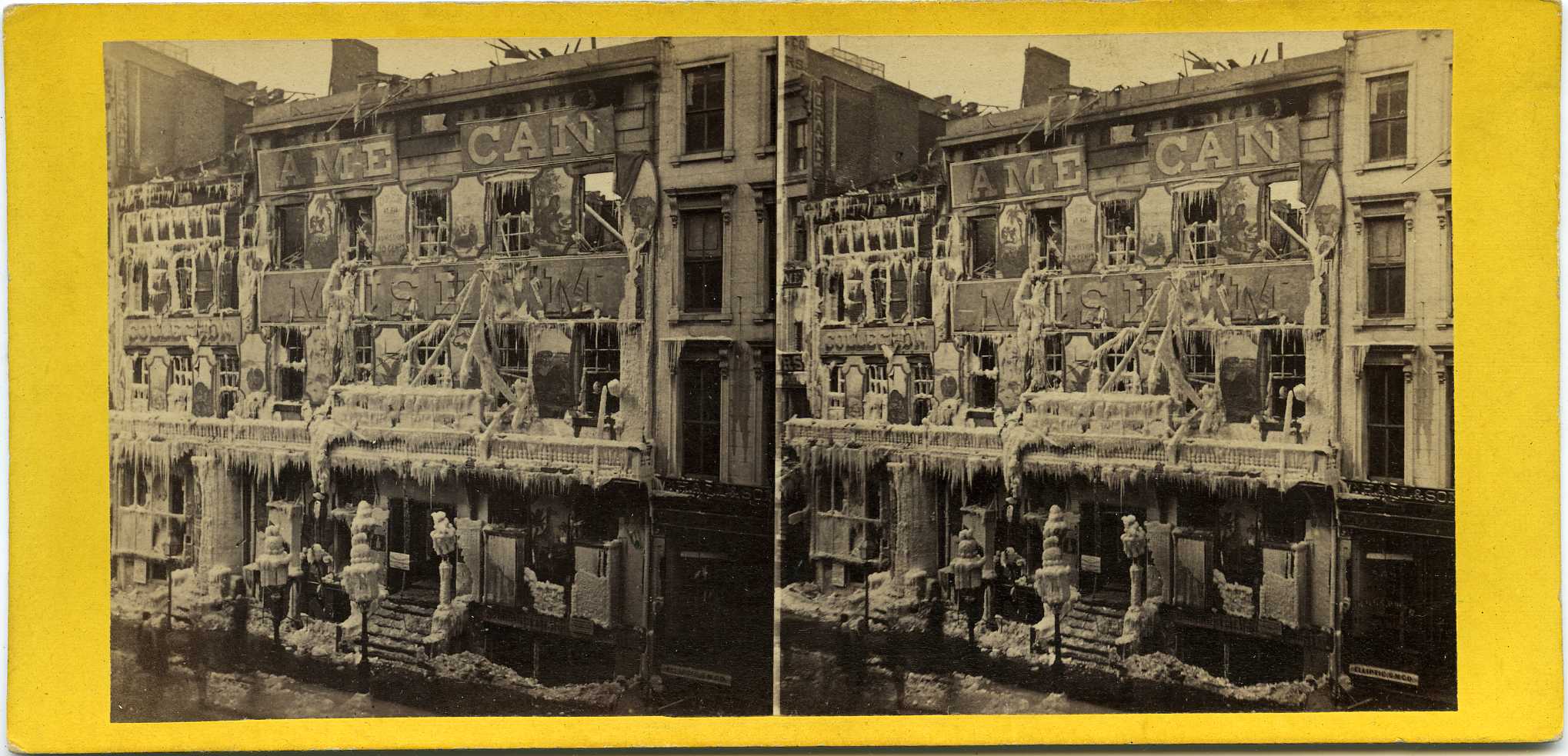
“Barnum’s Museum Fire, New York City, 1868 Incredible view of the frozen ruins of Barnum’s ‘American Museum’ just after the March, 1868 fire. 3-1/4×6-3/4″ yellow-mount view published by E & HT Anthony; #5971 in their series of ‘Anthony’s Stereoscopic Views.’ Huge ice formations where the water sprays hit the building; burned out windows and doors.”
~ CraigCamera.com
“Yes, and worthy of a better resting place,” responded Mr. Huntington. “We must take the Little Flower Girl with us, Hildreth. Her life belongs to the public. Our great city will be better for this monument of her romantic, tragic, sorrowing life.”
Over the forest road, where her moccasined feet had strayed one hundred years before, they bore the Little Flower Girl. And the eyes of the Holy Father shone on her as she crossed the silvery water where her “Ave Maria” echoed long ago. Back to the island Madelaine they carried her, and on, down the great lakes, the Little Flower Girl followed in the wake of her lover, Claude. To the great city of New York they bore her. In one of that great city’s museum rests the Woman in Stone.

Wabigance below the Gorge on the Tyler Forks River.
~ Photograph by M. Matusewic © December 2013.
Reproduced with permission.
Sandy Lake Letters: Sherman Hall to the Wheelers
July 11, 2013

“Chippewa Indians Fishing on the Ice” (Digitized by New York Public Library from Heroes and hunters of the West : comprising sketches and adventures of Boone, Kenton, Brady, Logan, Whetzel, Fleehart, Hughes, Johnston, etc. Philadelphia : H. C. Peck & Theo. Bliss, 1859.)
On June 9th, I transcribed and posted two letters related to the Sandy Lake Tragedy (the attempted removal of the Lake Superior Ojibwe in the fall of 1850, which claimed as many as 400 innocent lives). The letters, digitized by the Wisconsin Historical Society, were from the Warren Family Papers. One was from missionary Leonard Wheeler to William Warren before the tragedy, and another was from Indian Agent John Watrous to Warren during a second removal attempt a year later.
That post sought to assess how much responsibility Warren and Watrous bear for the 400 deaths. It also touched on the role of the Protestant A.B.C.F.M. missionaries in the region. This post continues those thoughts. This time, we’re looking at two more letters and evaluating one of the missionaries himself.
Both of these letters are from the Wheeler Family Papers, held by the Wisconsin Historical Society at the Ashland Area Research Center. I went directly to the original documents for these, and while I’ve seen them referenced in published works, I believe this is the first time these particular letters have been transcribed or posted online.
The first is from Sherman Hall, the founder of the La Pointe Mission, to his colleague Leonard Wheeler, who operated the satellite mission at Odanah. Hall traveled to Sandy Lake for the annuity payments and sent this letter to Wheeler, who was visiting family back in Massachusetts, after returning to La Pointe.
Lapointe. Dec. 28th 1850
Brother Wheeler:
I wrote you while at Sandy Lake and promised to write again when I should reach Lapointe. That promise I now redeem. I started from Sandy Lake on the fourth inst. and reached home on the 16th having been absent from home just eight weeks. I was never more heartily glad to leave a place than I was Sandy Lake, nor more glad to reach home after an absence. Of course winter here has justly begun. The snow was some ten inches deep on the Savannah Portage. On reaching the East Savannah River we found the ice good and clear of snow and water. This continued to be the case most of the way to the Grand Portage at Fond du Lac. From Fond du Lac to Lapointe the traveling most of the way was hard, and it was not till the seventh day from F. du L. that I reached home. Besides bad traveling I had to carry a pack which I found, when I got home weighed 60 pounds. With this however I found it not difficult to keep up with most of my traveling companions who were much heavier loaded than I. This is my first experience of carrying a heavy pack on a long journey and I am fully satisfied with the experiment. I had no alternative however, bet either to throw away my blankets and clothes, or carry them. Every body was loaded with a heavy pack, and I could employ no one. I however got through well—did not get lame as many others did, nor do I feel any furious[?] by ill effects of my journey since my arrival.
I found the mission family well on my arrival. They had felt somewhat lonesome while so many were absent from this place. Things in the community here are generally in a quiet state at present. I apprehend that there will be considerable pinching for provisions before spring. It has been a very windy and stormy fall. The people have taken but little fish. Many nets have been lost. The traders have but a small quantity of provisions, and if they had the people have but little to buy with. The bay opposite to this island is now principally covered with ice so that the Indians are on the ice some to spear fish. The ice has once broken up since it first closed, and a heavy wind would break it up again, as it is yet very thin, and the weather mild. If the lake is frozen the Inds will probably get considerable fish; but if it should be open they must suffer.
Our Indian meetings are pretty well attended, and I feel that there is ground for encouragement. Simon I think is exerting a good influence. His Catholic friends have tried to draw him back to their church; but seems stable. His oldest brother, who has recently lost his wife, has expressed a wish to hear the word of God. I hope he will yet become a sincere listener.
Our English exercises are attended by a smaller number than formerly since many have left this place. I think however for our own good, as well as on account of others, we ought to keep them up. Mr. Van Tassel has returned to remain here till spring. I have heard nothing from Bad River for some time past. I had formed a design to go there this week, but have been prevented by the state of the ice. I intend going as soon as the ice gets a little stronger. I suppose there are very few Indians there. More are about the Lake.
I heard that Mr. Leihy has lost both his horses which will be a serious inconvenience to him in this mill enterprise I presume.
Mr. Pulsifer has received one letter from you, and by our last mail he heard through his correspondent at Lowell that you had arrived at that place.
I suppose you find some changes have taken place in the wide world during the times you have been shut up in the wilderness. Do you find calls enough to keep you busy? I have been expecting a letter from you. I want to hear what you have to say about the things you see, and how you like visiting, etc.
I have just had a letter from Mr. Ely, who says, “We are [snugly by quarters?] in St. Paul. My home is full of music—am employed as choir leader in Mr. [Mill’s?] (Prs.) church—sing two evenings a week at Stillwater, and the rest of my time is well filled with the private scholars & tuning Pianos, of which there are 7 or 8 at St. Paul.” Perhaps Br. Ely will find this a more lucrative business than cutting and hauling pine logs. I am glad he has found employment.
Our children all attend school except Harriet. Marydoes very well. Please give my regards to your friends at Lowell. I am writing to Mr. Treat by this opportunity. [Wish?] kind regards to Mrs. W. I remain
yours
S. Hall.
 The Old Mission Church, La Pointe, Madeline Island. (Wisconsin Historical Society Image ID: 24827)
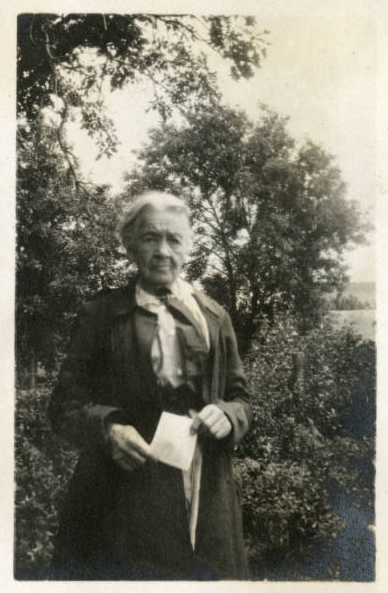
 Harriet Wheeler, pictured about forty years after receiving this letter. (Wisconsin Historical Society: Image ID 36771)
“…your note to Harriet” Harriet Hall was Sherman’s oldest daughter, about 19 years old at this time.
 Many Ojibwe leaders, including Hole in the Day, blamed the rotten pork and moldy flour distributed at Sandy Lake for the disease that broke out. The speech in St. Paul is covered on pages 101-109 of Theresa Schenck’s William W. Warren: The Life, Letters, and Times of an Ojibwe Leader, my favorite book about this time period. (Photo from Whitney’s Gallery of St. Paul: Wisconsin Historical Society Image ID 27525)
 Mary Warren (1835-1925), was a teenager at the time of the Sandy Lake Tragedy. She is pictured here over seventy years later. Mary, the sister of William Warren, had been living with the Wheelers but stayed with Hall during their trip east. (Photo found on University of Connecticut Radio website, scanned from Frances Densmore photos in the Smithsonian Bureau of Ethnology)
Lapointe, Feb. 24th 1851.
Mrs. Wheeler,
By our last mail I wrote to Mr Wheeler, and by this I will address a few lines to you. From your note to Harriet I suppose you are happy among your friends. I am glad you are so, and hope you will not only spend your winter pleasantly, but that you will find the present season of relaxation from the severe duties of your station here, the occasion of reconnecting[?] your health and spirits.
I do not feel that the time has yet come when the churches ought to close their efforts to save these Indians. I do not think they are entirely beyond the reach of hope. The prospect however looks dark. But I think the greatest cause of discouragement arises from their character, and not from their present political condition. Generally they do not want to improve their condition. They are satisfied with their ignorance and degradation. All they think of is to supply for their present wants without their own exertions, while they wish to live in idleness and sin. This is the cause of their keeping so much aloof from the influence of the missions. Their minds are dreadfully dark respecting the things of the future world. They seem to have no ideas of happiness superior to that derives from the gratification of the lowest animal appetites and passions. This is the reason why the truths of the gospel so little effect on them. These things present to my mind much stronger grounds of discouragement than their present political difficulties, though those at present are not inconsiderable.
But as stupid as is the conscience, and as dark as is the understanding and the heart, and as much as they are given up to [?]ality and sin, I believe there is a Power that can quicken them into life. My only hope is that He who has made them, and has power to save them, will come and add his blessing to the preaching of his own gospel, and make it to them the power and wisdom of God. Thousands of others as dead in trespasses and sins, have been saved. Why may not they be saved? Come back home and let us try still to do something for them. Tell Christians to remember them and pray for them, that the word of God among them may have free course and be glorified.
It is a time of great scarcity of food among the Indians. There is some one in our houses almost every hour of the day begging for food. Very few get more than a meal a day; many not half of one. I have been told by several individuals, that they have tried three or four days in succession to catch fish, and have been obliged to return to their starving families each night with nothing for them. I am frequently importuned to spare a little provisions till I am obliged to go away out of sight to get rid of their pleading. I have spared the last potatoes I dare let go. Corn we have none. We have but a small quantity of flour over what will be required to sustain our families till we can expect to obtain a new supply. For a long time I have not known fish so scarce as the present winter. That is almost the only dependence of this people. For a month to come there will be many hungry ones. Many of the French and half-breeds are but little better off than the Indians. All we can do is to divide a little morsel with the hungry ones who come to beg. We have not much to give to those who importune for something to carry to their families. But as long as they continue to waste their summers in idleness they must starve in the winter.
The young Hole-in-the-day has been down to St Paul and there made a public speech in which he attributes the sickness at the payment last fall to the bad provisions which were dealt out to the Indians, and imparts much blame to the officers of the government for the way in which they [were with?]. In time they had some flour dealt out to them which was much damaged. But I think there were other causes for the sickness which prevailed besides the bad provisions. I think however that in some [aspects?] the Indians were wronged. Treaty stipulations were not carried out. H is very confident that many of the Indians are not satisfied with the manner in which they have been dealt with, and recent events have not served to strengthen their attachment to the Government.
We had our communion yesterday. I think there is a [?]ably good state of feeling among the native church members at this time. Simon has been frequently sick this winter. But his trials appear to bring nearer to God. He appears to be growing in the knowledge of God and in piety.
You will probably recollect Mo-ko-kun-ens-ish, an Indian with a bunch[?] between his shoulders, married into the family of the Little-current. He is, by profession, a Catholic. About a week ago, he made me a visit, and said his priest had offended him, and he wished to join us. A short time since he lost a child, and when the priest came to bury it, he said he “scolded him” because he had not cleaned away the snow from the gate of the burying yard, and made a better path for him to come to the grave. He told a long story. I suspected his object was to get some provisions of me. I told him we should be happy to see him at our meetings, and told him where and when they would be held. He said he should attend only sometimes he might be obliged to fish to get something to eat, and be occasionally away. I said a few words to him on religious subjects, and he left without asking for anything. The next day he came with a small piece of cloth and asked me to give him provisions for it. I told I had not provisions to trade. He then enquired about meeting. I told him we were to hold one that evening in the school-house. He said he should attend. The evening came, the meeting was held—but he was not there. Nor have we seen him at any other meeting. Such are the methods the heathens & Catholics take to deceive us. We could make many converts with flour and pork, especially at this time.
Yours Truly,
S. Hall
[Written in margins]
All send love though I have not room to write it.
Mary goes to school and is doing very well.

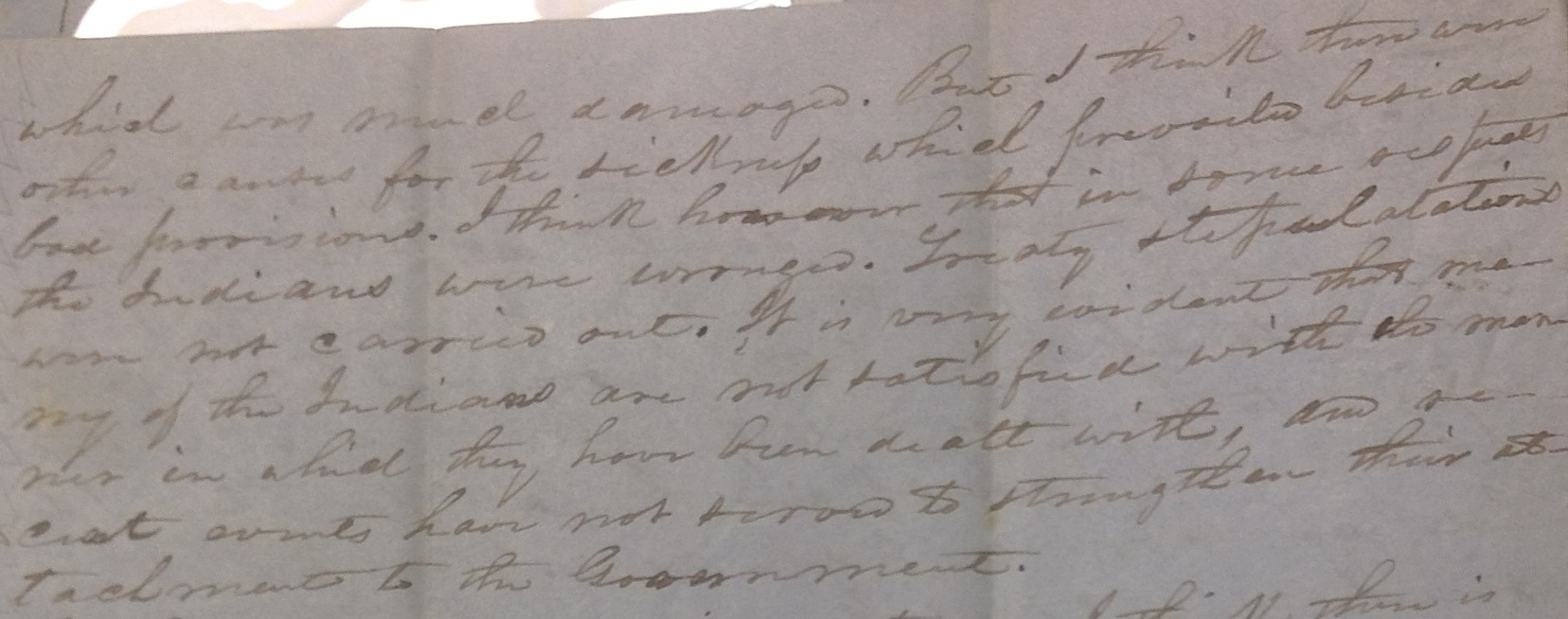
These are the originals of the paragraph about Hole in the Day’s speech in St. Paul. I couldn’t quite decipher all of it. Let me know what you see (Wheeler Family Papers, Personal Correspondence 1851, Wisconsin Historical Society Ashland Area Research Center).
In the June 9th post, we tried to determine how much William Warren and John S. Watrous were at fault for the deaths resulting from the 1850 Sandy Lake removal attempt. In this post, we will do the same for Sherman Hall.
Before we begin, it’s worth reviewing the facts. By 1850, Hall had lived at La Pointe for twenty years. He knew the people who lived here, and he knew the promises the Ojibwe were given at the Treaty of 1842. He was certainly aware of the Ojibwe position on the removal.
Rev. Hall did not order the removal. Compared with the government and Fur Company officials, he was fairly powerless within the Lake Superior region. However, he had a power of a different sort. As the primary voice of the ABCFM in Ojibwe country, he had powerful friends in the eastern states. Many Americans perceived the missionaries as the only neutral voice in the area. Hall admits in the December 28th letter that the Ojibwe were wronged. He could have advocated for their cause in the summer of 1850 as the illegal removal was unfolding. Instead, he largely went along with government efforts.
To his credit, in other letters Hall did blame the government for the failure of the Sandy Lake payment. The best book I’ve encountered about this time period is William W. Warren: The Life, Letters, and Times of an Ojibwe Leader by Theresa Schenck (Nebraska UP, 2007). On page 94, Dr. Schenck quotes a letter from Hall to ABCFM Secretary S.B. Treat. It is dated December 30, and is probably the letter referred to in the letter to Leonard Wheeler above. Hall is honest about Ojibwe feelings on the removal and seems to empathize somewhat. On page 155, Schenck details how the La Pointe mission did eventually turn against government removal efforts later in 1851.
So, it probably seems that I am defending Sherman Hall. Why? Truthfully, it’s because I want to have some balance in this post because, quite frankly, these two letters are some of the most disgusting, horrifying documents I’ve ever read. I felt especially sick typing up the February 24th letter to Harriet Wheeler. For a man who claimed to be “saving” the Ojibwe to be so heartless in the midst of so much suffering is appalling.
Was the mission running low on food? Sure, but doesn’t true Christian charity demand sharing to the last?
Should Hall’s language be judged by the standards of the racist times he lived in? Absolutely, but to say the things he says about human beings, his neighbors of twenty years, is inexcusable in any time period.
Is it possible he was traumatized by his experience at Sandy Lake, and this was a way of dealing with his personal guilt? This is possible. He does seem to be speaking to himself in the letter as much as he is to the Wheelers.
There is a danger in judging too much from just two letters, but I think Hall needs to be held to the same standard as Warren and Watrous were in the June 9th post. He could have spoken out against the removal to begin with. He didn’t. He was an eyewitness to Sandy Lake. He knew what the Ojibwe had been promised, and he saw the consequences of the government breaking those promises. His letters to the Wheelers in Boston could have been used to help right those wrongs by uniting the missions behind the Ojibwe cause. Instead, he chose to blame the people who had been wronged to the point of 400 deaths. For these reasons, I think when we list the villains of Sandy Lake, the Reverend Sherman Hall needs to be among them.
Sources:
Densmore, Frances. Chippewa Customs. Washington: U.S. G.P.O., 1929. Print.
Ely, Edmund Franklin, and Theresa M. Schenck. The Ojibwe Journals of Edmund F. Ely, 1833-1849. Lincoln: University of Nebraska, 2012. Print.
KAPPLER’S INDIAN AFFAIRS: LAWS AND TREATIES. Ed. Charles J. Kappler. Oklahoma State University Library, n.d. Web. 21 June 2012. <http:// digital.library.okstate.edu/Kappler/>.
Satz, Ronald N. Chippewa Treaty Rights: The Reserved Rights of Wisconsin’s Chippewa Indians in Historical Perspective. Madison, WI: Wisconsin Academy of Sciences, Arts and Letters, 1991. Print.
Schenck, Theresa M. William W. Warren: The Life, Letters, and times of an Ojibwe Leader. Lincoln: University of Nebraska, 2007. Print.
Warren, William W., and Theresa M. Schenck. History of the Ojibway People. St. Paul: Minnesota Historical Society, 2009. Print.
In the Fall of 1850, the Lake Superior Ojibwe (Chippewa) bands were called to receive their annual payments at Sandy Lake on the Mississippi River. The money was compensation for the cession of most of northern Wisconsin, Upper Michigan, and parts of Minnesota in the treaties of 1837 and 1842. Before that, payments had always taken place in summer at La Pointe. That year they were switched to Sandy Lake as part of a government effort to remove the entire nation from Wisconsin and Michigan in blatant disregard of promises made to the Ojibwe just a few years earlier.
There isn’t enough space in this post to detail the entire Sandy Lake Tragedy (I’ll cover more at a later date), but the payments were not made, and 130-150 Ojibwe people, mostly men, died that fall and winter at Sandy Lake. Over 250 more died that December and January, trying to return to their villages without food or money.

George Warren (b.1823) was the son of Truman Warren and Charlotte Cadotte and the cousin of William Warren. (photo source unclear, found on Canku Ota Newsletter)
If you are a regular reader of Chequamegon History, you will recognize the name of William Warren as the writer of History of the Ojibway People. William’s father, Lyman, was an American fur trader at La Pointe. His mother, Mary Cadotte was a member of the influential Ojibwe-French Cadotte family of Madeline Island. William, his siblings, and cousins were prominent in this era as interpreters and guides. They were people who could navigate between the Ojibwe and mix-blood cultures that had been in this area for centuries, and the ever-encroaching Anglo-American culture.
The Warrens have a mixed legacy when it comes to the Sandy Lake Tragedy. They initially supported the removal efforts, and profited from them as government employees, even though removal was completely against the wishes of their Ojibwe relatives. However, one could argue this support for the government came from a misguided sense of humanitarianism. I strongly recommend William W. Warren: The Life, Letters, and Times of an Ojibwe Leader by Theresa Schenck if you are interested in Warren family and their motivations. The Wisconsin Historical Society has also digitized several Warren family letters, and that’s what prompted this post. I decided to transcribe and analyze two of these letters–one from before the tragedy and one from after it.
The first letter is from Leonard Wheeler, a missionary at Bad River, to William Warren. Initially, I chose to transcribe this one because I wanted to get familiar with Wheeler’s handwriting. The Historical Society has his papers in Ashland, and I’m planning to do some work with them this summer. This letter has historical value beyond handwriting, however. It shows the uncertainty that was in the air prior to the removal. Wheeler doesn’t know whether he will have to move his mission to Minnesota or not, even though it is only a month before the payments are scheduled.
Sept 6, 1850
Dear Friend,
I have time to write you but a few lines, which I do chiefly to fulfill my promise to Hole in the Day’s son. Will you please tell him I and my family are expecting to go Below and visit our friends this winter and return again in the spring. We heard at Sandy Lake, on our way home, that this chief told [Rev.?] Spates that he was expecting a teacher from St. Peters’ if so, the Band will not need another missionary. I was some what surprised that the man could express a desire to have me come and live among his people, and then afterwards tell Rev Spates he was expecting a teacher this fall from St. Peters’. I thought perhaps there was some where a little misunderstanding. Mr Hall and myself are entirely undecided what we shall do next Spring. We shall wait a little and see what are to be the movements of gov. Mary we shall leave with Mr Hall, to go to school during the winter. We think she will have a better opportunity for improvement there, than any where else in the country. We reached our home in safety, and found our families all well. My wife wishes a kind remembrance and joins me in kind regards to your wife, Charlotte and all the members of your family. If Truman is now with you please remember us to him also. Tomorrow we are expecting to go to La Pointe and take the Steam Boat for the Sault monday. I can scarcely realize that nine years have passed away since in company with yourself and Pa[?] Edward[?] we came into the country.
Mary is now well and will probably write you by the bearer of this.
Very truly yours
L. H. Wheeler
 By the 1850s, Young Hole in the Day was positioning himself to the government as “head chief of all the Chippewas,” but to the people of this area, he was still Gwiiwiizens (Boy), his famous father’s son. (Minnesota Historical Society)
Samuel Spates was a missionary at Sandy Lake. Sherman Hall started as a missionary at La Pointe and later moved to Crow Wing.
Mary, Charlotte, and Truman Warren are William’s siblings.
The Wheeler letter is interesting for what it reveals about the position of Protestant missionaries in the 1850s Chequamegon region. From the 1820s onward, the American Board of Commissioners for Foreign Missions sent missionaries, mostly Congregationalists and Presbyterians from New England, to the Lake Superior Country. Their names, Wheeler, Hall, Ely, Boutwell, Ayer, etc. are very familiar to historians, because they produced hundreds of pages of letters and diaries that reveal a great deal about this time period.

Leonard H. Wheeler (Wisconsin Historical Society)
Ojibwe people reacted to these missionaries in different ways. A few were openly hostile, while others were friendly and visited prayer, song, and school meetings. Many more just ignored them or regarded them as a simple nuisance. In forty-plus years, the amount of Ojibwe people converted to Protestantism could be counted on one hand, so in that sense the missions were a spectacular failure. However, they did play a role in colonization as a vanguard for Anglo-American culture in the region. Unlike the traders, who generally married into Ojibwe communities and adapted to local ways to some degree, the missionaries made a point of trying to recreate “civilization in the wilderness.” They brought their wives, their books, and their art with them. Because they were not working for the government or the Fur Company, and because they were highly respected in white-American society, there were times when certain missionaries were able to help the Ojibwe advance their politics. The aftermath of the Sandy Lake Tragedy was such a time for Wheeler.
This letter comes before the tragedy, however, and there are two things I want to point out. First, Wheeler and Sherman Hall don’t know the tragedy is coming. They were aware of the removal, and tentatively supported it on the grounds that it might speed up the assimilation and conversion of the Ojibwe, but they are clearly out of the loop on the government’s plans.
Second, it seems to me that Hole in the Day is giving the missionaries the runaround on purpose. While Wheeler and Spates were not powerful themselves, being hostile to them would not help the Ojibwe argument against the removal. However, most Ojibwe did not really want what the missionaries had to offer. Rather than reject them outright and cause a rift, the chief is confusing them. I say this because this would not be the only instance in the records of Ojibwe people giving ambiguous messages to avoid having their children taken.
Anyway, that’s my guess on what’s going on with the school comment, but you can’t be sure from one letter. Young Hole in the Day was a political genius, and I strongly recommend Anton Treuer’s The Assassination of Hole in the Day if you aren’t familiar with him.

I read this as “passed away since in company with yourself and Pa[?] Edward we came into the country.” Who was Wheeler’s companion when a young William guided him to La Pointe? I intend to find out and fix this quote. (from original in the digital collections of the Wisconsin Historical Society)
In 1851, Warren was in failing health and desperately trying to earn money for his family. He accepted the position of government interpreter and conductor of the removal of the Chippewa River bands. He feels removing is still the best course of action for the Ojibwe, but he has serious doubts about the government’s competence. He hears the desires of the chiefs to meet with the president, and sees the need for a full rice harvest before making the journey to La Pointe. Warren decides to stall at Lac Courte Oreilles until all the Ojibwe bands can unite and act as one, and does not proceed to Lake Superior as ordered by Watrous. The agent is getting very nervous.
 Clement and Paul (pictured) Hudon Beaulieu, and Edward Conner, were mix-blooded traders who like the Warrens were capable of navigating Anglo-American culture while maintaining close kin relationships in several Ojibwe communities. Clement Beaulieu and William Warren had been fierce rivals ever since Beaulieu’s faction drove Lyman Warren out of the American Fur Company. (Photo original unknown: uploaded to findadagrave.com by Joan Edmonson)
For more on Cob-wa-wis (Oshkaabewis) and his Wisconsin River band, see this post.
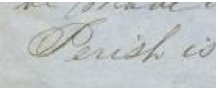
“Perish” is what I see, but I don’t know who that might be. Is there a “Parrish”, or possibly a “Bineshii” who could have carried Watrous’ letter? I’m on the lookout. (from original in the digital collections of the Wisconsin Historical Society)
Aug 9th 1851
Friend Warren
I am now very anxiously waiting the arrival of yourself and the Indians that are embraced in your division to come out to this place.
Mr. C. H. Beaulieu has arrived from the Lake Du Flambeau with nearly all that quarter and by an express sent on in advance I am informed that P. H. Beaulieu and Edward Conner will be here with Cob-wa-wis and they say the entire Wisconsin band, there had some 32 of the Pillican Lake band come out and some now are in Conner’s Party.
I want you should be here without fail in 10 days from this as I cannot remain longer, I shall leave at the expiration of this time for Crow Wing to make the payment to the St. Croix Bands who have all removed as I learn from letters just received from the St. Croix. I want your assistance very much in making the Crow Wing payment and immediately after the completion of this, (which will not take over two days[)] shall proceed to Sandy Lake to make the payment to the Mississippi and Lake Bands.
The goods are all at Sandy Lake and I shall make the entire payment without delay, and as much dispatch as can be made it; will be quite lots enough for the poor Indians. Perish[?] is the bearer of this and he can tell you all my plans better then I can write them. give My respects to your cousin George and beli[e]ve me
Your friend
J. S. Watrous
W. W. Warren Esq.}
P. S. Inform the Indians that if they are not here by the time they will be struck from the roll. I am daily expecting a company of Infantry to be stationed at this place.
JSW
 Chequamegon History