Judge Bell Incidents: Fooled the Austrian Brothers
October 30, 2025
Collected & edited by Amorin Mello
This is the third post in a series featuring The Ashland News items about La Pointe’s infamous Judge John William Bell, written mainly by his son-in-law George Francis Thomas née Gilbert Fayette Thomas a.k.a G.F.T. In today’s post we explore stories about real estate transactions negotiated between Judge Bell and Julius Austrian.
… continued from King No More.

The Ashland News
Wednesday, January 11, 1888, Page 5
STORIES OF JUDGE BELL
HOW HE FOOLED THE AUSTRIAN BROTHERS IN A LAND DEAL.
“Incidents in the life of Judge John W. Bell. – A Half Century in Old La Pointe – by Geo. Francis Thomas.”
Such is the proposed title to a forth-coming historical work which will prove wonderfully interesting, especially to the older residents in this vicinity. The author begins with the year 1835, when the brig “John Jacob Astor,” the first vessel built upon the shores of Lake Superior, first cast her anchor in the bay at La Pointe, and ends with the death of the old pioneer, John W. Bell, which occurred but a few days since. In speaking of the pioneer the author says:
“From the day that Mr. Bell stepped ashore at La Pointe from ‘The Astor,’ June 23, 1835, to the day of his death, he was a character possessing a most positive individuality; and it was not until his later years, and then when he had become financially distressed, that his wonderful spirit became at all broken; but even then he was never known to as a favor.”
The old judge, or “Squire” as he was usually called, was always ready to relate some incident of early days in which he was usually a participant. There are also a great many equally interesting incidents related by others, where the old judge would not justify his telling the story himself. The author says:

Detail from Julius Austrian’s 1854 Plan of the Town of La Pointe with Judge Bell’s Block 35 and four small Lots.
~ Wisconsin Historical Society
“[…] except a small portion in the North West Corner claimed and enclosed by Edwin Connor, and so much of the South West Corner as is claimed by P. B. Vanderventer, and the enclosure of Barboo & Meletle in the South East Corner”
“The old man always liked to have things done on the square, so when Julius Austrian was platting the village of La Pointe and proposed to Mr. Bell to give him the block he already occupied for a nominal consideration, Mr. Bell insisted that his block, number thirty-five, be exactly square – all the four streets crossing at right angles. A square block or lot was quite a novelty where each squatter’s garden-patch had been fenced in and called a lot, regardless of street lines or quantity of land.”
Memoirs of Doodooshaaboo: Joseph Austrian’s Time at La Pointe 1851-52 (Pt. 2)
“Our blind brother Marx Austrian with brother Julius’ assistance at that time, preempted 160 acres of land near Bayfield from La Point, complying with preemption laws. He built a small log house living there with his wife. One night during their first winter in their new house, there was a knock at the door, and when opened they were confronted by a number of Indians, who were evidently under the influence of liquor and who swinging their tomahawks vigorously, making all sorts of threatening demands. An old Indian who knew Marx interceded and enabled him and his wife to escape without injury who thoroughly scared fled panic stricken in the dark about two miles at night, over the ice, on the Bay which was covered with a foot of snow to La Point for safety. The poor woman having the hazardous task of leading her blind husband over this long and difficult road, not to come back again and glad to escape with their lives and thus abandoning their right of preemption. This place was later on platted and is now known as the Bayfield Addition.”
Mr. Bell was an acute judge of human nature, and made it an invariable rule to deal with his fellowmen according to each one’s individual peculiarity. Before Bayfield was located, or in fact thought of as a town site, a Hebrew by the name of Marx Austrian pre-empted the 126 acres of land now known as Austrian’s clearing, and which adjoins Bayfield on the south. After a short residence upon the claim Mr. Austrian’s family became sick, and in order that proper care might be given them they were compelled to move to La Pointe, where a physician could be had. A speculator, noticing the apparent irregularity, tried to jump the claim. The case was taken to Superior for trial, and Mr. Bell, being the only available witness, the Austrian brothers and Louis Leopold proposed to give him a one-fourth interest in the land as compensation for making the trip to Superior. Mr. Bell accordingly accompanied the party, to Superior, and on arriving at the hotel as was his custom, he immediately began to make himself at home with the guests of the house, most of whom he was well acquainted with. At length when the case was called, Mr. Bell seemed so entirely unconcerned that he was urged to come forward by some one of the interested parties; but Mr. Bell carelessly said,
“Oh! I believe I will not attend court today.”

Julius Austrian
~ Madeline Island Museum
The Austrians wildly expostulated, and at last agreed to pay all the old “Judge’s” expenses for the trip, besides giving him a one-fourth interest in the 126 acres of land. This brought him all right and Marx Austrian gained his point. A few years later, when the town of Bayfield was laid out by the Hon. Henry M. Rice, the Austrians, Julius and Marx, concluded that they ought to buy back the one-fourth interest in the 126 acres held by “Squire” Bell, and accordingly Julius approached him on the subject. Mr. Bell was a man of few words and no give-in to his dictum. He told Austrian that $1,000 would buy his interest if taken by noon the next day. Austrian claimed the price was exorbitant but finally went off to get the cash. on the morrow at noon, or a few minutes before, Austrian called on Bell and said he could only give him $800. Mr Bell insisted on $1,000, which Julius Austrian finally agreed to pay;
“but,” says Mr. Bell, “now you are too late. It is fully a minute past the time which I specified, now I will not take less than $1,250, and that must be forthcoming within two hours from now.”
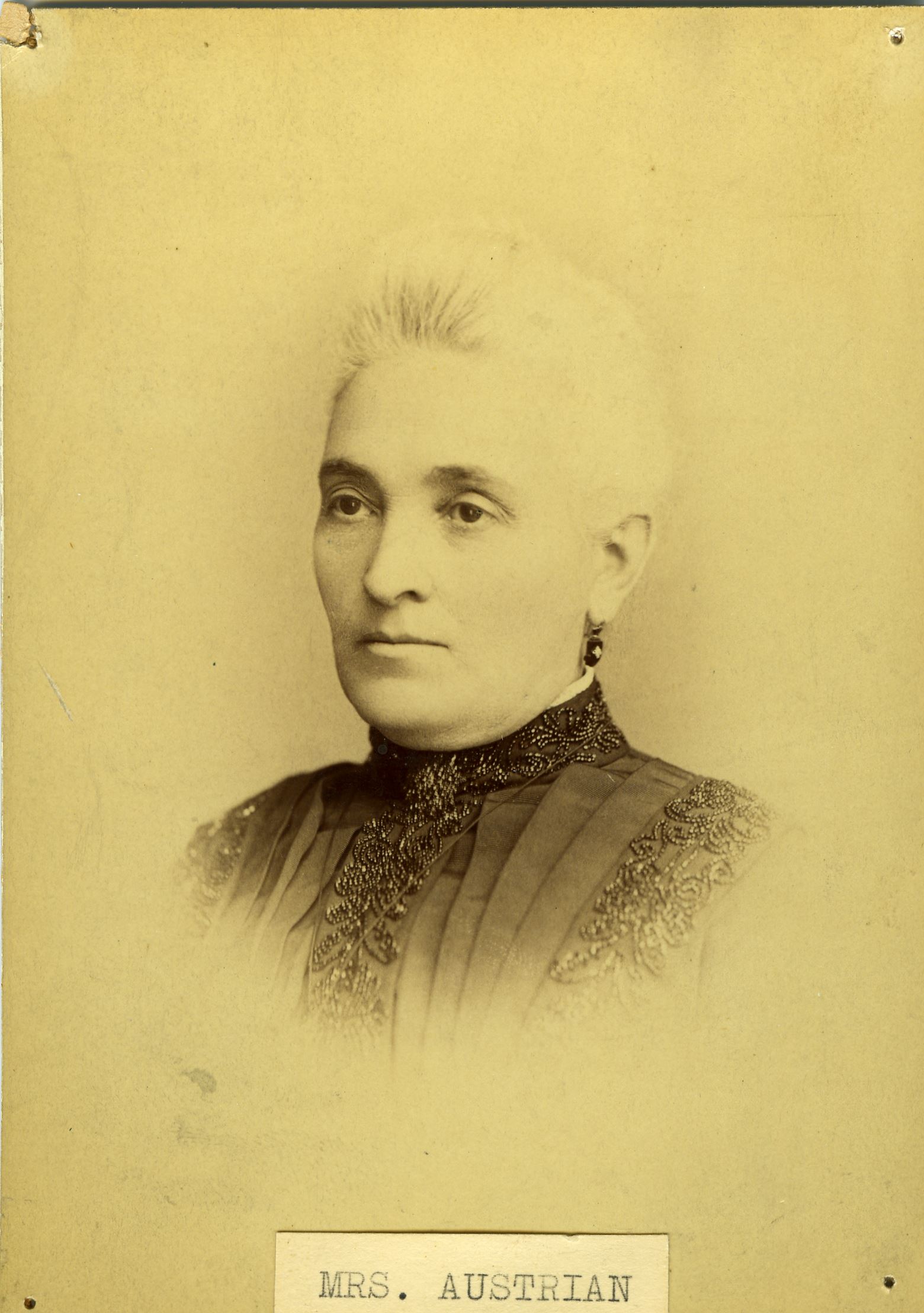
Hannah Leopold Austrian
~ Madeline Island Museum.
This time Austrian kept away, thinking Mr. Bell would go back to his $1,000 offer if he did not seem too anxious. In that Mr. Austrian misjudged his man, for when Austrian again approached the “squire” his price was $1,500 spot cash. Things now looked dubious to the Austrians, a conference was held with Mrs. Hannah Austrian and together they raised $1,300, all the cash which was available at that moment. This they handed over to Mr. Bell with a sight due bill for $200, secured by a deposit of all Mrs. Austrian’s jewels, including her diamond earrings. They got back the one quarter interest in the 126 acres, and they have paid taxes on it ever since, yet the whole is hardly worth now what the quarter cost them.
“This recalls an incident back in ’61 or ’62,” said one of the jurymen at a recent trial in this city. “It was a case against a trader who was accused of selling whiskey to an Indian. The jury was drawn, and after hearing the evidence they retired to a back room to determine on a verdict. It was about four o’clock in the afternoon. At six o’clock the jury was about evenly divided. About midnight, after continuous balloting, the vote stood ten for acquittal and two for conviction. There was no fire in the room, and it was very cold. The ten jurors who stood for acquittal made one final request to the other two to vote with them, but they persistently refused. The ten then got a long pine board and laying it across two stools proceeded to play an interesting game of freeze-out. About two o’clock one of the two came over on the other side and joined the rest in the game of freezing out the other juror. At three o’clock in the morning he gave up.”
To be continued…
Asaph Whittlesey Incidents: Number I
February 9, 2017
By Amorin Mello

Originally published in the February 16, 1878, issue of The Ashland Press. Transcribed with permission from Ashland Narratives by K. Wallin and published in 2013 by Straddle Creek Co.
Early Recollections of Ashland: Number I
by Asaph Whittlesey
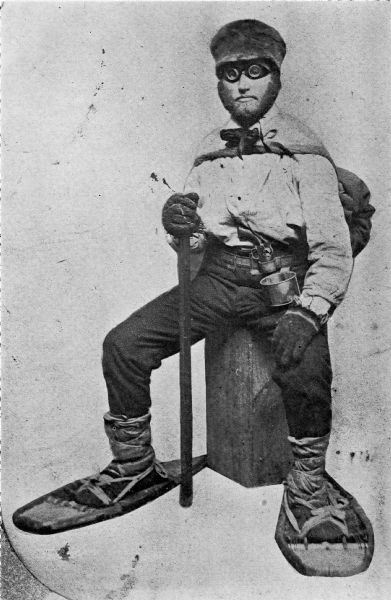
Photograph of Asaph Whittlesey from the Wisconsin Historical Society.
Our first arrival at La Pointe being so intimately associated with the settlement of Ashland, I have determined to make our arrival there the subject of my first letter.
It was among the first days of June, 1854, that George Kilburn, Jr., myself and wife and only child, Eugenia, (then some eighteen months old,) made a landing at La Pointe with a view to remain permanently in the country. Well do I remember the beautiful “town,” spread before us as we merged from the “old log warehouse” through which we passed in reaching the shore, while the general appearance was that of neatness and comfort.
Photograph of Julius Austrian from the Madeline Island Museum.
We had already made the acquaintance of Mr. and Mrs. Julius Austrian, having had the pleasure of their company up the Lakes, and had made many inquiries of them as to the place of our destination. From this time forward we found Mr. and Mrs. Austrian to be most agreeable neighbors and associates, and these young “brides” spent much of their time together, and not unfrequently did the evening air carry to listening crowds our notes of “Good old Colony times,” and “There’s no place like home,” still fresh in our memory.
La Pointe at this time was the second in importance of towns upon the Lakes, Ontonagon taking the lead.
Within a few days after our landing, we were fully organized as “house keepers,” under the same roof with Mr. and Mrs. George Starks, now residents of Bayfield; who proved to be most excellent neighbors, and never did a single roof cover a more harmonious trio of families.
We had, however, a common “foe” to encounter, visions of which filled our dreams and harassed our waking moments. This “foe” was the everlasting “bed bug,” more numerous and more determined in their onslaught than is the “Russian Army;” while this mixture of Dutch and Yankee blood served to satisfy their ravenous appetites. We had heard of this race before, but this was the first time we had met in open combat, face to face. It was our custom regularly before retiring to rest to go into combat with them armed with “wooden spads,” with which we slaughtered them by the quart. Our plan was to remain awake an hour or so after retiring to bed, when we would strike a light which was a signal for a field fight. It was an exciting scene to witness their ranks surrounding us on every hand, while the sheets of our bed seemed dyed in human blood. One means of our defense was to have the bed posts stand in molasses; but this only put them to the trouble of marching to the ceiling above from which they dropped upon us like hail; of course all these contingencies helped to make my wife good natured, and strengthen her attachments to the country. This condition of things lasted while we remained occupants of the building, and when we, in our weakness from loss of blood, staggered forth to make us a home elsewhere, we were filled with anxiety as to the safety of our German neighbors.
“Dr. Borup, the agent for the American Fur Company, (who have an extensive trading-post at this place,) has a superb garden. In walking through it with him, I saw very fine crops of the usual garden vegetables growing in it. His red currant bushes were literally bent down beneath their weight of ripe fruit. His cherry-trees had also borne well. Gooseberries also succeed well. The doctor also had some young apple-trees, that were in a thriving condition. Poultry, likewise, does well. Mrs. B. had her yard well stocked with turkeys, geese, ducks, and chickens.”
~ “Morgan“ at La Pointe during 1845.
As I have before stated, the general appearance of the island was most attractive. The garden of Mr. Austrian was laid out most tastily. We found there a large variety of fruit trees, apples, plums, cherries, etc. Also large quantities of currants and strawberries; but the crowning attraction was the “grape bower,” affording a most attractive lounging place. Here also a merry party, consisting, so far as my recollection serves me, of the following persons: Mr. and Mrs. Julius Austrian, Rev. John Chebohm, (who, I remember, asked the blessing at the table,) Marks Austrian, Mr. H. Mandelbaum, Henry Smit, Mr. and Mrs. Hocksteiner, Mr. and Mrs. George Starks, old Mr. and Mrs. Perinier, Mr. and Mrs. Asaph Whittlesey, and I think Mrs. William Herbert, and a Mr. Roy, celebrated the
“FORTH OF JULY,” 1854.
Being a curious mixture of Americans, Jews, Germans, French and Austrians, no two of whom could carry on a very extensive conversation, for want of a knowledge of the languages, so that our toasts were mainly received in silence, nevertheless the day was passed most pleasantly, while the reading of the Declaration of Independence by Asaph Whittlesey, marked it as a day for national celebration.
To be continued in Number II…
Memoirs of Doodooshaboo: Joseph Austrian in Bavaria 1833-1847
December 28, 2016
By Amorin Mello
This is the first installment of the Memoirs of Doodooshaboo series on Chequamegon History, as transcribed by us from the original handwritten memoir of Joseph Austrian at the Chicago History Museum. This installment contains rare details about a Jewish community in Bavaria before other records were destroyed by Nazi Germany in later years. Later installments describe Joseph Austrian’s experience with his Leopold and Austrian relations on Chequamegon Bay during 1851-1852 (Part 1 and Part 2).
Joseph Austrian’s
Autobiographical and Historical Sketches.
Dedicated to
My Wife and Members of my Family.
My Childhood Days. 1833.
~ Wikipedia.org
I was born September 15, 1833, in a small village called Wittelshofen (Mittel Franken, Bavaria), located at the foot of the Hesselberg, a mountain 1800 ft. high, and at the junction of two little rivers Wörnitz and Sulzach near Dinkelsbuehl, where the judiciary district court is located.
~ Wikipedia.org
On the top of the said mountain, every year in June a fair, called “Hesselberger Messe,” was held which was the great attraction for all the people of the several villages located around the foot of the mountain. To this it was customary to invite friends and relatives from far off places to attend, and it was generally very enjoyable barring the climb it meant to get up there, as it was too steep for vehicles to drive up there excepting from one direction where the road up was more gradual and which was used for the transportation of things for the fair. Besides the many places where beer was sold and where the rural population had dances, and other amusements there was generally a circus and other shows there. The view from the top of the mountain in clear weather was very fine and interesting. I always looked forward impatiently to the time when this fair took place, and soon as I was old enough to take this long steep walk, I availed myself of the opportunity which I greatly enjoyed.
Wittelshofen
The village of Wittelshofen had about 500 inhabitants of which about half consisted of Jews and the other half Protestants.
My father’s house was one of the largest and best in the place and stood opposite an old small castle, the grounds of which were surrounded by a stone wall about 10 feet high. Our home was on a lane called “Schmalz-gasse” which in wet weather was very muddy.
My father’s name was Abraham Isaac Oestreicher (Austrian), he was born in Wittelshofen and died there Sept 17, 1852 of apoplexy at the age of 75 yrs. He was an only son and his father gave him what educational advantages could then be obtained and principally in “Hebrew” which gained for him the name title of “Reb” and he was known by the Jewish village people as “Reb Frohen”. He had a large library of Hebrew books, they were of unusual size and some nearly a hundred years old.
My father was brought up strictly in the observance of the Jewish faith and adhered to its orthodox teachings very strongly. He was an easy going man and known by all for his honest and upright character. He dealt in live stock and had some good farm lands located around the outskirts of the place.
~ Chicago, the Garden City. Its magnificent parks, boulevards and cemeteries. Together with other descriptive views and sketches by Andreas Simon, 1894, pg. 147
My mother’s name was Malka nee Heule, whose parents were considered wealthy, her father, [Hyrun?] Heule was known and respected all around for his charitable deeds, especially for what he did during the famine, caused by the crop failure in 1825, when he sent big wagon loads of flour and other suplies to the famine stricken district to feed the needy, thereby saving many from starvation.
My mother was an intelligent and determined woman, and took sole charge of the house hold and education of the children. She was born in Braunsback, Wurtenberg. She died at the age of 87 yrs in Chicago, Aug 6th, 1882.
~ Wikipedia.org
My father had three children by his first wife and ten by my mother, the eldest died when a baby the others were Falk, Marx, Julius, Babette, Ida, Fanny, Joseph, Minna, & Solomon. The latter being the youngest was my father’s pet. Falk, my oldest brother, was sent to a neighboring city for higher education, which afterwards secured for him a position as a clerk and traveling agent in the business of Wedels in Furth, a brother-in-law of my mother, where he earned a good salary.
My next brother Julius, was sent to Feuchtwangen to learn the tanning trade and afterwards travelled afoot for a couple of years or more working in a number of other cities at his trade, as it was there customary to perfect themselves in the trade, and later going clear to Paris, France, before returning home, a short time afterwards he emigrated to America to join our brother-in-law Lewis F. Leopold, who had located in business at Mackinaw, with branches in Wisconsin.
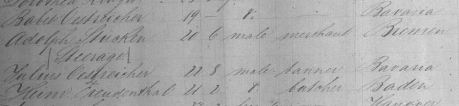
Julius Austrian (Oestreicher) immigrated with his sister Babette (wife of Louis Freudenthal Leopold) and brother-in-law Henry Freudenthal Leopold.
~ “New York Passenger Lists, 1820-1891,” image 19 of 895; NARA microfilm publication M237 (Washington D.C.: National Archives and Records Administration, n.d.).
My brother Falk went to California in 1846 via Panama. At six years of age I entered school. I remember well when my mother took me on the first day to school and had me give the teacher a package of smoking tobacco. I went to the public school in the morning, the teacher had little education, his father was the village tailor; the son being versed in the three “R’s” his father secured the position of teacher for him. In the afternoon I went to the Hebrew school. Mr. Mandel was the teacher there, he had received his education in a Seminary he was very strict and high tempered, the children all feared him, as occasionally he afflicted corporal punishment. Besides this I had private lessons in history and geography.
At the age of thirteen I had to start to assist working in the field, in harvesting and hay making. I also had to plow when I was barely strong enough to handle the plough, I had to hook the handles over my shoulders to manage to get to the next furrow. I had to arise during some of the winter months at 4 o’clock in the morning, and assist in the threshing while it lasted, and I got thrashed sometimes too, when I did not keep time. My greatest sport was fishing, for which purpose I made my own pole and I often walked off to the river, when my folks thought I was busily employed. The fish I caught were mostly perch. I remember I once caught several and fastened one to a string fastened to a stake in the ground, suddenly a severe thunder storm came up, at which I made hurridly for home, forgetting the little perch I had left behind. I started bright and early the next morning to get it, and to my great surprise on pulling the string I hauled up a big pike instead of the little perch, which had evidently swallowed the latter tied to the stake and thus was caught. The joy of my good luck was indescribable.
Another sport I was very fond of was shooting off pistols. My brother Marx had one in an old cupboard drawer, which I managed to get hold of one day and when none of the family were about I with a few of my boy friends ran off to the fields, where we had such fun taking turns in shooting, and when we had no more powder we snapped off percussion caps. When a pistol was not available I constructed an improvised pistol of my own design, by attaching a big old hollow key to a natural crook of wood, which I selected in the wood shed and to which I fastened it with wire. After filing a hole on the side of the key, under which I attached a piece of tin to hold the powder. When i was ready to shoot, I laid a little flat sponge on the tin, lighting the outer edge, which acted as a fuse, and as it burned toward the powder ignited it causing it to go off and making a loud report. Not trusting the old key entirely, however, fearing it might explode, I went to a safe distance after lighting the fuse.
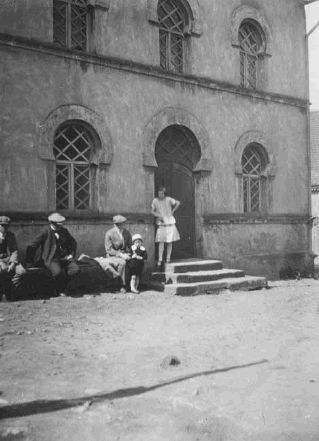
Outside the synagogue in Wittelshofen, Bavaria, Germany. Circa 1912-1938.
~ United States Holocaust Memorial Museum, photograph # 25821.
“Wittelshofen was declared ‘Judenfrei’ (‘free of Jews’) in January 1939.”
“The synagogue building was demolished during the winter of 1938/39.”
“A memorial stone was later unveiled there.”
~ Destroyed German Synagogues and Communities
In 1840, at the grand celebration of the new synagogue, my parents entertained with an invitation on a large scale. My mother had arranged for a special cook to prepare a grand feast. I and the younger children were excluded. I did not fancy being barred from participating. In strolling through the pantry I espied an elaborately decorated tart, chief ornament to grace the table. While the cook was otherwise engaged at the last moment, I managed to eat off the ornaments and decorations. Never will I forget the excitement and consternation the discovery of my act caused. Could hands have been laid on me then, I would have been severely dealt with.
In my fourteenth year, my mother began planning as to my future. The income of the fields, and the cattle business had declined, and considering the large family and household to be provided for did not permit of incurring much expense for my higher education, and my father advanced age made it impossible for him to enlarge his income. My mother was anxious to get me away from Wittleshofen, as she could see no promise in the future there for me. At this time, an opporunity was offered through my uncle Samuel N. Guttman and accepted.
To be continued in Manhattan 1848-1850…
1855 Yom Kippur at La Pointe
December 18, 2016
By Amorin Mello
Photograph of Julius Austrian from the Madeline Island Museum
One of the more colorful figures from primary sources of Chequamegon History is Julius Austrian at La Pointe. Austrian is also one of the more elusive, as he is often overlooked and omitted from secondary sources.
My research of Austrian is what originally inspired me to begin contributing to Chequamegon History. I have been working behind the scenes on a series of stories about Austrian featuring extensive collections of primary documents to shed more light on his life at La Pointe during the 1850’s, and look forward to publishing them at a later date.
One story in particular is about Austrian’s, and his family’s, involvement with the 1855 La Pointe annuity payment, one of the most colorful events in Chequamegon History. A brief introduction to the 1855 La Pointe annuity payment is needed for context, so I refer to a quote from Leo in an earlier post of his: A real bona fide, unmitigated Irishman:
“Regular readers will know that the 1855 La Pointe annuity payment to the Lake Superior Chippewa bands is a frequent subject on Chequamegon History. […] The 1855 payment produced dozens of interesting stories and anecdotes: some funny, some tragic, some heroic, some bizarre, and many complicated. We’ve covered everything from Chief Buffalo’s death, to Hanging Cloud the female warrior, to Chief Blackbird’s great speech, to the random arrival of several politicians, celebrities, and dignitaries on Madeline Island.”
At this moment in Chequamegon History, Austrian was a powerful resident at La Pointe in terms of private land ownership and political savvy. Austrian was a signatory of the 1847 Treaty at Fond du Lac, but not a signatory of the 1854 Treaty at La Pointe. However, primary sources reveal that Austrian was the owner of La Pointe during the 1854 Treaty, and received financial reimbursement from the Department of Interior for services related it. A letter from Reverend Leonard Wheeler at Odanah dated January 18, 1856, asserts that the 1855 annuity payment at La Pointe was hosted by Austrian:
“The following is the substance of my notes taken at the Indian council at La Pointe a copy of which you requested. Council held in front of Mr. Austrian’s store house Aug 30. 1855.”
I have come across secondary sources that allude to Austrian’s role as the host of the 1855 Yom Kippur at La Pointe immediately after the annuity payments, but have not yet been able to locate any primary sources. This post cites secondary sources in hopes that another researcher may review them and help me find primary sources. Having a background in Jewish studies would be helpful, as it is possible primary sources about the 1855 Yom Kippur at La Pointe were written in the Hebrew language rather than in English. Please contact Chequamegon History if you can help find and translate primary sources.
Without further ado, here are secondary sources about the 1855 Yom Kippur at La Pointe listed chronologically by their publication dates.
The Beth El Story: With a History of the Jews in Michigan before 1850
by Irving I. Katz
Wayne University Press (1955)
ISBN-10: 0-7837-3584-7
ISBN-13: 978-0-7837-3584-9
Pages 53-54:
“Lewis F. Leopold, whose name was Freudenthaler in his native Baden, Germany, his wife, Babette, who was a member of the Oesterreicher (Austrian) family, their infant son, Lewis’ sister, Hannah, and Lewis’ brother, Samuel, were located on the Island of Mackinac in 1845. The brothers became the first pioneers in this locality in the fishery business and were soon shipping a thousand barrels of salted fish to Cleveland each season. This business, together with the sale of supplies to fishermen, Indian trading and the purchase of furs, laid the foundation for an extensive business and they became prominent as owners of Lake Michigan vessels and merchants in the ports of the Great Lakes.
“Samuel Leopold left Mackinac in 1853 to join his two other brothers and Julius Austrian, who had married Hannah Leopold in 1849, in their recently undertaken business enterprises at La Pointe and Fond du Lac, Wisconsin, where they were among the first white settlers. Lewis Leopold officiated as cantor at the first High Holy Day services held at La Pointe in the fall of 1855. Within a few years after 1850, the Leopolds and Austrians established leading stores in Michigan, at Eagle River, Eagle Harbor, the Cliff Mine, Calumet, and at Hancock, Joseph Austrian having selected the latter place as the site for his first store and warehouse.”
Mount Zion, 1856-1956: The First Hundred Years
by W. Gunther Plaut
North Central Publishing Company (1956)
ASIN: B0007DEZ4W
Page 24:
Minnesota Pioneer article about Julius Austrian and his Chippewa mixed-blood employee Vincent Roy, Jr. in Saint Paul as republished in The Daily Crescent (New Orleans, LA), February 24th, 1851. Roy also worked for Austrian and Leopold at La Pointe, Fond du Lac, and Vermillion Lake.
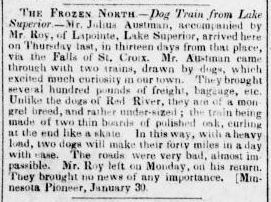
“Julius Austrian was perhaps one of the most colorful figures not merely in the history of the Congregation but in the larger Minnesota community as well. His wife, the former Hannah Leopold (in Germany, the name had been Freudenthaler), at once became an undisputed leader among the Jewish women. The couple had married in 1849 and were among the first white settlers at La Pointe and at Fond du Lac, Wisconsin. Others of the family joined them later. High Holy day services are recorded at Fond du Lac as early as 1855. Austrian laid claim to mineral rights and lands in what later became part of Duluth. 1851 he once made the trek south to St. Paul in the dead of the winter – and arrived in St. Paul with two dog trains and several hundred pounds of freight. The Minnesota Pioneer duly reported that this ‘excited much curiosity in our town.’ The Austrians and Leopolds, who may be reckoned as among the earliest pioneers of the region, later had stores in a number of Michigan towns; and when Julius and Hannah moved to St. Paul, their reputation had preceded them. But unlike his wife, Julius Austrian preferred the quiet, behind-the-scenes type of leadership. When funds were low, he would make up the deficit; and at least on one occasion, so the minute book records, he guaranteed the Rabbi’s salary. He wrote a fine hand, both in English and in Hebrew, as is attested by the cemetery records which he kept for many years.”
The Jews in Minnesota: The First Seventy-Five Years
by W. Gunther Plaut
American Jewish Historical Society (1959)
ISBN:
Pages 12-14:
“When Abram Elfelt became Vice-President of the new Minnesota Lodge No. 157, B’nai B’rith, his fellow officer and treasurer was a man by the name of Julius Austrian. The two had known each other for many years, for while Austrian did not come to St. Paul until after the Civil War he, too, had been in the Territory when it was still part of Wisconsin.

Julius Austrian (Oestreicher) immigrated with his sister Babette Austrian (Babet Oestreicher) (wife of Louis F. Leopold) and their brother-in-law Henry F. Leopold (Heinr Freudenthal).
~ “New York Passenger Lists, 1820-1891,” image 19 of 895; NARA microfilm publication M237 (Washington D.C.: National Archives and Records Administration, n.d.).
“Austrian was one of five brothers. In the old country, their name had been Oesterreicher or Oestreicher. Julius must have had an adequate Jewish education, for he could write Hebrew with a sure hand and had deep and definite religious convictions. In the late forties he, his brother Marx, and Lewis Leopold had gone up to LaPointe, Wisconsin, on Lake Superior, where they were among the first white settlers. As early as 1855, they held Holy Day services in this outpost of civilization.
“In 1849, Julius had married his partner’s sister, Hannah Leopold, a girl who was then not quite nineteen years old. Their business prospered; stores were established on the northernmost part of Michigan’s Upper Peninsula: in Eagle River, Eagle harbor, Cliff Mine, Calumet and Hancock, where their store and warehouse were located.
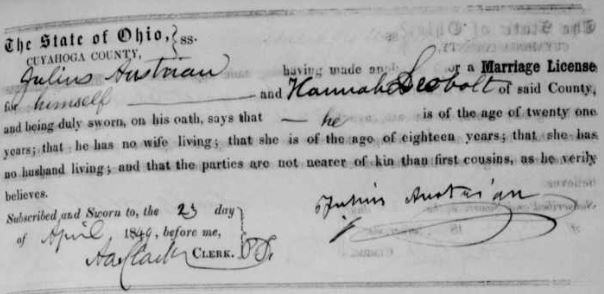
Marriage license application for Julius Austrian and Hannah Leopold.
~ “Ohio, County Marriages, 1789-2013,” image 47 of 229.
“The Austrians and Leopolds traded throughout the area and soon extended their contacts into Minnesota. Even during the summer, it was quite a journey to St. Paul, but only the hardiest person would gather enough courage to make it during the winter. No wonder, therefore, when Julius Austrian dared it in January, 1851, the press recorded that his arrival ‘excited much curiosity in our town.’ He came with another person from Lake Superior via the Falls of St. Croix. Their mode of transportation was the northern dog-train. In their two sleds they brought several hundred pounds of freight for trading.
“Austrian soon became a land owner in Minnesota. He acquired mineral rights at Lake Superior on a site where later the city of Duluth was built. In the late sixties, he and his brother Marx moved to St. Paul where Julius and Hannah at once became two of the leading Jewish citizens. For they soon proved their strong Jewish loyalties and unusual leadership qualities.
Photograph of Hannah Leopold Austrian from the Madeline Island Museum.
“When they came to St. Paul, the Civil War was over, and whatever little Jewish institutional life there had been in Minnesota was left in very poor circumstances. The two Austrians were soon engaged in building up the congregation. They helped to find the means for erecting the young state’s first synagogue. Hannah founded its first women’s group and headed it in its work for the Temple and in its increasingly ambitious welfare and social enterprises until after the turn of the century. Under her presidency Mount Zion’s women founded the St. Paul Neighborhood House. In 1897, she was feted lavishly on her twenty-fifth anniversary as president of the Temple auxiliary. She was a stocky woman, coupled with a wonderful sense of humor. She died in ripe old age in Chicago, where she had gone to live with her daughter, who had married Amiel Hart. Hannah’s passing was noted with great sorrow in her old community to which she had given so much.
“The Austrians were moderate in their outlook; they were Reformers, but of the evolutionary kind. Julius was, until his death in 1891, a mainstay of Mount Zion Hebrew Congregation. More retiring than his wife, he preferred a trusteeship or vice-presidency to the chair itself. He was responsible for bringing Leopold Wintner was the first ordained Rabbi to Minnesota; for when his fellow members were fearful of committing themselves to a contract he personally agreed to underwrite it. His special concern was the cemetery of Mount Zion, the first Jewish burial ground in the state. He kept its records in English and Hebrew, and some of the social background of the earlier days can be read in his private obituary notes.
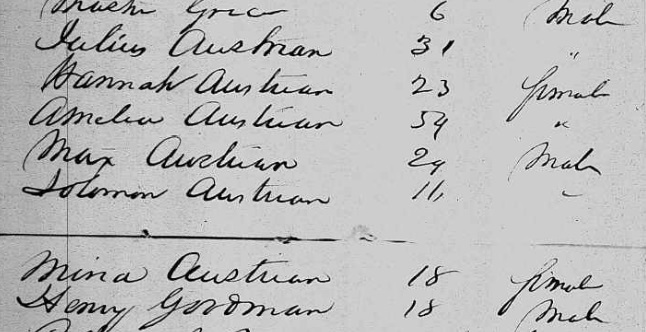
Marx Austrian immigrated to the United States during 1853 with his mother, several of his siblings, and cousin Henry Guttman (Goodman).
~ “New York Passenger Lists, 1820-1891,” image 499 of 671; NARA microfilm publication M237 (Washington D.C.: National Archives and Records Administration, n.d.).
“His brother Marx (more often he was known as Max) was blind from early youth on. Still he pioneered with the rest of the family, and the Indians at Lake Superior loved the handicapped white man. In St. Paul, whither he removed with Julius and Hannah in 1869, he was known as a man of dignity and piety. For many years he blew the shofar at Mt. Zion’s Holy Day services. He outlived Julius by twelve years.”
United States Jewry 1776-1985.
Vol. 2: the Germanic Period, Part 1
by Jacob Rader Marcus
Wayne State University Press (1991)
ISBN-10: 0-8143-2187-9
ISBN-13: 978-0-8143-2187-4
Page 196:
“By the 1850’s America was studded with Jewish societies, one even on the High Plains. How rapid was the organizing process? In general a whole generation elapsed, possibly two, after the coming of the pioneers before the first communal society came into being. In some states, as in Florida and Connecticut, it would take decades before the Jews would established a congregation. There are some striking exceptions. In 1855 a number of Jewish Indian traders met on an island in Lake Superior in the frontier village of La Pointe, Wisconsin. The Indians were assembled there to collect their annuities and the Jews were present to dun their debtors before they dispersed. There were enough Jews for a minyan and a service was held. That was the beginning and the end of La Pointe Jewry. Another historical accident is the “instant” community. The Jews of Savannah arrived from London in 1733 already organized as a congregation; San Francisco Jewry of the Gold Rush was able to establish two religious groups without delay and Oklahoma City and Guthrie were born overnight during the 1889 ‘run.’ All this is completely atypical.”
Jewish Pioneers of Saint Paul: 1849-1874
by Gene H. Rosenblum
Arcadia Publishing (2001)
ISBN-10: 0-7385-1862-X
ISBN-13: 978-0738518626
Page 75:
“Julius Austrian was one of the more influential and colorful Jewish pioneers. In 1849, he and his wife Hannah Leopold Austrian were among the first white settlers in La Pointe and Fon Du Lac, Wisconsin, at a time when the Minnesota Territory was part of the Wisconsin Territory. In 1855, they had participated in the Jewish High Holiday services in La Pointe. He was already a successful businessman when he and his family came to St. Paul in 1869 from Wisconsin. He had a string of successful stores throughout the Upper Michigan Peninsula. He also had already acquired claims in mineral rights around Lake Superior, where the city of Duluth now stands. He was a man of great generosity, and when the fledgling Mt. Zion Synagogue was unable to hire its first rabbi, he guaranteed payment. He also was a moving force in the failed attempt to establish the Painted woods colony in North Dakota.”
Page 79:
~ Mount Zion Temple
~ Mount Zion Temple
“Two significant events took place in 1869 that had a permanent impact on the pattern of communal life within the St. Paul Jewish community. The first event involved the more orthodox of the settlers. Dissatisfied with Mt. Zion, they began to gather together for private prayers in a frame house on Payne Avenue near Seventh Street in the Dayton’s Bluff near East Side area. They were the roots for the first strictly orthodox synagogue in Minnesota and established what later became the Sons of Jacob Synagogue. At this point, Mt. Zion began its slow evolution toward Reform Judaism. The second event involved a husband and wife team who were to have far reaching influence. Julius Austrian and his wife Hannah arrived in St. Paul in 1869 when the Jewish communal institutions were in very poor circumstances.
“Julius Austrian was one of five brothers. In the old country their name was Oestrreicher. In the late 1840s, his older brothers, Marx Austrian and Lewis Leopold, had gone to La Pointe, Wisconsin, on Lake Superior, where they were among the first white settlers. As early as 1855 they held High Holy Day (Yom Kippur) services in La Pointe, Wisconsin. In 1849, Julius married Lewis Leopold’s sister Hannah, who was not quite 19. In 1851, he made a trip south to St. Paul in the dead of winter and arrived with two dog trains and several hundred pounds of freight.”
By Amorin Mello
The original handwritten memoir of Joseph Austrian is held by the Chicago History Museum. We saw some interesting stories and insights about La Pointe in Part I through the eyes of Doodooshaaboo (milk) as Joseph was known there during 1851 and 1852. The later La Pointe stories in Part II, however, are where the really good stuff is about white settlement and land speculation prior to the Treaty of 1854. When we last checked in with Joseph, he had just been ordered by brother-in-law Louis F. Leopold to terminate his business career at brother Julius Austrian’s Indian trading post at La Pointe, and to immediately relocate to Keweenaw Peninsula to co-manage brother-in-law Henry F. Leopold’s store in Eagle River.

Joseph Austrian’s land purchase at La Pointe during 1852.
~ General Land Office Records
In this installment we follow pages 66-78 of Joseph Austrian’s memoir about his reassignment to Eagle River. While there he engages with the Leopolds’ business affairs with copper mines and miners of the Keweenaw Peninsula before the opening of the Soo Locks. Joseph is quick to succeed in his new position as a trusted business partner during 1852-54.
A mysterious omission from this memoir is the fact that, during the summer of 1852, Doodooshaboo purchased 183 acres in La Pointe from the U.S. General Land Office in Willow River. In other words, this was the first federal sale of any land in La Pointe County. We will take a closer look at this critical shift in La Pointe’s political landscape as the subject of a future post on Chequamegon History. But for now, Joseph’s stories about 1852-54 provide us with glimpses of the Austrian family’s affairs at La Pointe during these pivotal years before the 1854 Treaty of La Pointe.
Memoirs of Doodooshaboo
… continued from La Pointe 1851-1852 (Part 2).

Outline Map showing the position of the ancient mine-pits of Point Keweenaw, Michigan.
~ Ancient Mining on the Shores of Lake Superior, by Charles Whittlesey
Reached Eagle River by Sleigh. 1852.
~ CopperCountryExplorer.com
Mr. H. F. Leopold, who hearing that the boat had passed by during the night and expecting me on her, came over with a sleigh for me. Eagle River was a small settlement of not over one hundred inhabitants situated in Houghton County, Michigan. It depended entirely for its business patronage on the adjacent copper mines, principally the Cliff Mine, North American, Phoenix & Garden City mines, some of which at that time were just in course of development. In the place there were but two stores the smaller one 18 x 24 situated on top of a hill facing the Lake was Leopolds. The other larger store was owned by Tenter and Mandelbaum. There were a number of saloons and boarding houses combined and this constituted the business portion of the town.

Simon Mandelbaum was an employee of the Phoenix Mine, the successor of the the Lake Superior Copper Company (the first regularly organized corporation to engage in Lake Superior Copper mining).
~ Annual Report by the Michigan Department of Mineral Statistics, 1900, pg. 240-41
Started Work at Eagle River. 1852.
I was at once installed in my work after my arrival, and the next day went to the Cliff Mine to attend to some collections. Mr. H. F. Leopold was an uneducated man not able to read or write English, the business correspondence and keeping of accounts therefore devolved entirely on me.
After becoming thoroughly acquainted with the business I resolved to enlarge the same and my efforts to do so succeeded well. A short time after my arrival at Eagle River a letter was received by the Leopolds containing the sad news of the death of my father. He died suddenly Sept 17th, 1852 from a stroke of apoplexy at the age of 75 years. This was naturally a cause of great grief and worry to me, as there was besides my mother, my blind brother Marx, a younger sister and brother at home to be cared for.
The next spring a larger stock was ordered than had ever been carried before and new departments added, namely: groceries, grain, and provisions, heretofore, only dry goods had been carried, from this time on the business as a matter of course showed a decided increase, and at the next annual inventory the profits showed a much better result than ever before. We boarded at Joseph Lang’s place who had a saloon in connection with his boarding house and poor as it was we had no choice to better ourselves. Mr. Leopold spent his evenings generally at the boarding house enjoying a game of cards with some of his friends, while I had to pass my evenings alone at the store playing watchman. We had no fire insurance on the store or on its contents, as firstly there were no insurance companies taking risks there at the time, and secondly even if they had I doubt that we could had placed any, owing to the dangerous condition of the heating apparatus. The store was heated by a box wood stove with the pipe running through the entire length of the store to the chimney, and it was necessary to be very careful and watchful under the circumstances. The store was hard to get comfortably warm, and I often sat there cold and shivering wrapped up in a blanket waiting for Mr. Leopold to come in for the night.
We slept up stairs over the store, and here it was most cheerless and dismal, not being heated at all.
The winters were very severe and extremely cold which did not add to our comfort and during our first winter there we had to put up with many hardships.
Dug Tunnel Under Snow to Stable.
We had frequently severe blizzards one I well remember, it lasted over a week. The depth of the snow that fell at that time was so great that with the drifts it reached high as the roof of the stable and we had to dig a tunnel through the snow to get from the store to the stable, and the horses were led out some weeks through this tunnel. Our store was exposed to the full force of the severe Lake Superior gales which some times shook the building threatening to demolish it.
Tough Boarding House Experiences.
During the winter there was no fresh meat to be had. In the Fall the boats would bring some, but having no refrigerators it was hung up on the boom of the Schooner to preserve it during transportation and when it reached the table it was anything but tempting. However, it was kept and used for weeks after, strong vinegar was used in preparing it by our land lord’s cook to hide the flavor. When this “so called” fresh meat gave out for the rest of the winter they substituted salted meat.
The Cliff Mine store had a large supply which it had had on hand for several years, our land lord bought of this firstly because it was cheap and secondly because he could not get any other. Eggs were not to be had either and turnips and potatoes were about the only vegetable procurable. This diet caused scurvy more or less. In the Spring when navigation opened, the first boat of the season was hailed with delight it was the signal for eggs and other delicacies we had been deprived of so long. Our land lord bought a barrel of eggs and fed us on them three times a day, while they lasted. During the summer we were also regaled with a variety of fresh vegetables and some fresh meat that could be had at times.
Brother Julius Brings our Family to America. 1853.
Secretary of State
Office of Indian Affairs
June 30th, 1853
Dear Sir,
In the absence of the Commissioner of Indian Affairs, to whom the bearer, Mr. Julius Austrian of Cleveland, Ohio, has letters of introduction and whose business here pertains to your Department in connection with an intended visit to Europe with his family, I beg leave respectfully to salient for him such courtesies as the case demands.
I have the honor to be
Very respectfully
Your obedient
Charles E. Mix
Acting Comm.”
~ Ancestry.com
Things went on satisfactorily in the business and in the summer of 1853 brother Julius, who was stationed at La Point started with his wife, a sister of the Leopolds, for Germany in accordance with a conclusion we had come to, to bring mother and the rest of the family to this country, and at the same time to visit the native village of his wife – “Rḯchen,” in the Grand Dukedom of Baden. It was a mission combined with a great deal of hardship and trouble for Julius, as it meant for him to convert all the real & personal property of my late father’s estate into money, which was in itself very difficult besides getting the family ready for this long voyage for their destination in the new world after having lived all their lifetime in Wittelshofen. Brother Marx especially was disinclined to go on account of his affliction from loss of eyesight.
My mother not having any special ties there to keep her, was in a measure glad to go where the most of her children were living, and did everything in her power to get ready without unnecessary delay.
They had a safe voyage and arrived at Cleveland Sept 1853.

U.S.M. Steamship Atlantic, James West, Commander.
~ Library of Congress Prints and Photographs Division Washington, D.C.
Julius Austrian returned from Europe on the U.S.M. Steamer Atlantic to America on October 17th, 1853 with his family: Hannah Leopold Austrian (Wife); Malka Heule Austrian (Mother); Marx Austrian (Brother); Samuel Solomon Austrian (Brother); Mina (Sister); and Henry Guttman aka Goodman (Cousin).
~ New York, Passenger Lists, 1820-1891, pg. 499, FamilySearch.org
Mother took a small house in Cleveland on Ohio St. and started house keeping with my sister Mina and necessary help when she was comfortably located. My brother Sol for the time being lived with my sister Babette. During this winter my sister Mina became engaged to Levi Jordan of Baltimore, where he was in business. He came from the same place where we were born, and therefore the families were well acquainted. Their marriage took place the next summer (1854) and afterward they resided in Baltimore.
Store Sold by Mistake.
The business had kept on increasing steadily. Mr. Louis F. Leopold had removed from Mackinaw and was living in Cleveland Ohio. In sending the annual inventory to Mr. L. F. L., through a mistake of his, he did not think the result satisfactory and peremptorily ordered his brother Henry to close out the business in Eagle River and sell the store. Henry boy like regardless of his own individual ideas and judgement at once obeyed his controlling brother, and sold out to his competitor, Mandelbaum, but soon regretted having done so.
I Spend Winter of 1853 in Cleveland.
After selling the store Henry Leopold and I went to Cleveland. I was anxious to meet my mother and the rest of the family from Germany. That winter I spent in Cleveland visiting my mother and the others. One of the first things we did was to get brother Solomon (then about 13 yrs- old) to learn a trade, and decided on shoe making as he was also eager to do something. We arranged for him to go into the service of a certain Weidenthal who agreed to instruct him in the trade at a small remuneration.
He took his place at once, living for the time being with our sister Babette. He took a good hold of the work and progressed very well in the trade to the entire satisfaction of his employer.
During the winter my brother Julius came through from Lake Superior, also Aaron and Sam F. Leopold for a conference between the Leopold brothers and me about the future program of our business. We all decided it had been a mistake to sell the store as the profits when correctly viewed was quite satisfactory with good prospects ahead. It was ascertained that Mr. Louis F. Leopold had taken it for granted that the inventory sent him showed him the result of two years profit since the business had existed; whereas it in reality was a statement of the one year of my management. We all agreed to open up again in the Spring on a larger scale. During the winter I contracted with a carpenter at Eagle River, and had the store enlarged to more than double its size and had the second story fitted up as living rooms, and a good cellar put under the store.
During this winter my sister Ida was engaged to Henry F. Leopold, and Jan 23rd, 1854, was married to him. The wedding was an enjoyable family affair.
As soon as navigation opened up in Spring, in May 1854, Henry Leopold, his wife, and I returned to Eagle River with a good stock of goods.
“We had already made the acquaintance of Mr. and Mrs. Julius Austrian, having had the pleasure of their company up the Lakes, and had made many inquiries of them as to the place of our destination. From this time forward we found Mr. and Mrs. Austrian to be most agreeable neighbors and associates, and
these young ‘brides’ spent much of their time together…”
~ The Ashland Press, Feb. 16, 1878.
At this time brother Julius and wife returned to La Point taking Brother Marx with them, who about a year later married Caroline Milner of Cleveland, and settled for the time being in La Pointe. That same year I sent him a small amount of goods from Eagle River, which enabled him to do a little something in trading with the same to the Indians for furs. After the episode with the Indians as I have previously narrated Marx was anxious to get away from La Point, and I had him and his wife come to Eagle River where I built them a cottage, conveniently arranged for him to live in with a small crockery store attached which he and his wife attended.
Some years later when brother Julius moved to St. Paul by his advice Marx and his wife went there also, and lived in a house next to Julius which he had had fitted up for the purpose. As far as business is concerned he acquired an interest in a butcher shop there.
After brother Solomon had finished his apprenticeship in the shoe business, the following year he also went up to La Pointe by advice of brother Julius where he stayed but a short time and then went to Hancock & opened a shoe store in which he did a good business.
To be continued at Eagle Harbor 1854-1859…
An Interesting Family History
February 2, 2015
By Amorin Mello

1856 Colton Map of Prussia and Saxony, Germany (WikiMedia.org).
This is a reproduction of “An Interesting Family History” from The Jews of Illinois : their religious and civic life, their charity and industry, their patriotism and loyalty to American institutions, from their earliest settlement in the State unto the present time, by Herman Eliassof, Lawrence J. Gutter Collection of Chicagoana (University of Illinois at Chicago), 1901, pages 383-386:
The goal of this post is to provide genealogical information about the illustrious Austrian and Leopold families as a companion to the Joseph Austrian Memoir and as a reference for future stories. In this post, we will explore events within and outside of the Chequamegon region for context about this family’s history. We recommend reading this Opinion by Andrew Muchin, director for the Wisconsin Small Jewish Communities History Project, for more information about Jewish immigration to Wisconsin in general. Coming soon to Chequamegon History, we will explore some of Julius Austrian’s adventures and his impact upon the Village of La Pointe, the La Pointe Iron Company of the Penokee Mountains, and the Lake Superior Chippewa.
——-
AN INTERESTING FAMILY HISTORY.
——-
The two families of Austrian and Leopold have been prominent in Chicago for many years. They came to Chicago from the Lake Superior region and formed the Lake Michigan and Lake Superior Transportation Co., engaging in freight and passenger transportation on Lake Michigan and Lake Superior, to Mackinac, Sault Ste. Marie and Duluth and did an extensive business. For a number of years, until recently, their luxuriously furnished passenger boat, Manitou, has been extensively patronized by summer pleasure seekers, who wished to enjoy the cool and delightful climate of the Lake Superior region. The boat was then sold to a company, in which Mr. Nathan F. Leopold still holds the largest interest. Mr. N. F. Leopold is the son of one of the Leopold brothers who settled in Mackinac in the early forties, and were the first Jews in that region. He married a daughter of the late Mr. Gerhard Foreman, who is related to the Greenebaum family, and who was a prominent banker of Chicago, the founder of the Foreman Bros. Banking Co., a. very popular financial institution of today.
The history of this old Jewish family, favorably known as successful merchants in the Lake Superior region and in Chicago, appeared in 1866, in the Portage, Mich., Gazette, and was copied in the American Israelite under date of April 13th, 1866. We believe that the history of this popular and highly respected family will be read with interest by their many relatives and friends, and we therefore publish it here. They were brave, honest and upright business men, and the story of their pioneer life in a sparsely settled region, of their struggles, hardships and ultimate success will serve as an encouraging example for many a young beginner.
Following is their history as we find it in the American Israelite:
A BAND OF BROTHERS.
Dissolution of the Oldest Merchant Firm on Lake Superior – The Leopold Brothers – Sketch of their Operations – A Pioneer History.
Abraham Isaac Oestreicher &
Malka Heule
Falk Austrian
Julius Austrian
Marx Austrian
Babette Austrian
Joseph Austrian
Ida Austrian
Fanny Austrian
Samuel Solomon Austrian
Bernard Austrian
Mina Austrian
Jette H.S.H Freudenthaler
Louis F. Leopold
Aaron F. Leopold
Henry F. Leopold
Samuel F. Leopold
Hannah Leopold
Karolina Freudenthaler
Ascher Freudenthaler
In our last issue we made a brief notice of the dissolution of the well known firm of Leopold & Brothers, doing business in Hancock, Chicago and Eagle River, the oldest business firm on Lake Superior after a successful existence of over twenty years. The firm has been composed of Louis F., Henry F., Aaron F., and Samuel F. Leopold and Joseph, Julius and Samuel Austrian, the latter being the last admitted partner, and not so intimately connected with the history of the firm. From the very inception of business transactions within the wilds of Lake Superior down to the present day, the firm of the brothers has been identified with the struggles, hardships, successes, and all the varying interests of the country, have participated with its good and ill fortunes, many times carrying burdens that less confident competitors shrank from bearing; never once fearing that all would be well in the end, and after gathering a rich reward retired from the field, leaving an untarnished history, and brilliant record as an incentive to their successors.
~ Joseph Austrian Memoir
Louis Leopold + Babette Austrian
Hannah Leopold + Julius Austrian
Henry Leopold + Ida Austrian
Samuel Leopold + Babette Guttman
Joseph Austrian + Mary Mann
Solomon Austrian + Julia Mann
The Messrs. Leopold are natives of the little town of Richen, in the Great Duchy of Baden, Germany, and there received the elementary education which fitted them to become the shrewd and successful merchants they have proven to be. They first began business life as clerks in an ordinary country store, as it may not be inaptly termed, as Richen was but a small place, having a less population than either Hancock or Houghton, here on Portage Lake.
Early in the year 1842, Louis, the elder brother, who has since become the “father” of the firm, left his home to try his fortunes in the New World, with a stout heart, and but a very moderate amount of means whereon to build up a fortune, upon arriving in this country he very shrewdly foresaw that the great West, then but just attracting attention, was the most promising field for men of enterprise and limited capital, and instead of joining in the precarious struggle for position and existence, even so peculiar to the crowded cities of the Eastern states, he at once wended his way to Michigan, then considered one of the Western states.
~ Joseph Austrian Memoir, pg. 9
Early in the year 1843 he opened a small depot for fishermen’s supplies on the island of Mackinac, providing for them provisions, salt, barrels, etc., and purchasing the fish caught, and forwarding them by vessels to better markets. The business could not have been a very extensive one, for when joined by his brothers three years afterward, their united capital is stated as being but little more than $3,000, but which has since been increased by their energy, prudence and foresight, at least one hundred fold.
In the year 1844, Louis was joined by his brother Henry (Aaron and Samuel serving their time in the store of Richen), who for a short time became his assistant at Mackinac. At that time there was but one steamboat plying on the headwaters of Lake Huron and Michigan, the old General Scott, which made regular trips between Mackinac and Sault Ste. Marie.
By the 1850’s the Leopolds, Samuel, Henry, and Aaron, and their brother-in-law Julius Austrian had moved westward from Mackinac into Lake Superior and had settled in the Wisconsin island town of La Pointe, not too far from present-day Duluth. They helped also to found the nearby mainland town of Bayfield. Nevertheless the Leopolds and Austrians were not Wisconsin’s Jewish pioneers; Jacob Franks of Montreal had bought peltries and traded with the Indians since the early 1790’s using Green Bay as his base. The town, the oldest in that part of the country, was strategically located on the water highways linking the Mississippi to the Great Lakes and the eastern tidewater. At first Franks was an agent for a Canadian firm; by 1797 he was on his own. He enjoyed several years of prosperity before the game, the furs, and the Indians began to fade away and before he had to cope with the competition of John Jacob Astor’s formidable American Fur Company. Franks was an innovative entrepreneur. Around the turn of the century he built a blacksmith shop, a dam for water power, a saw and grist mill, ran a farm and began a family of Indian children, before he finally went back to Mackinac and then to Montreal where he rejoined his Jewish wife.”
~ United States Jewry, 1776-1985, Volumes 1-2 by Jacob Rader Marcus, pg. 94
Shortly after his arrival at Mackinac, Henry conceived the idea of going to La Pointe with a small stock of goods, and attending the Indian payment, an enterprise never before undertaken by a trader from below the Sault. At that time Lapointe was a much larger place than it is now, was the principal station of Lake Superior, of the American Fur Company and the leading business point above the Sault. Every fall, the government disbursed among the Indians some $40,000 to $50,000, which before the arrival of the Leopold Brothers found its way almost entirely into the coffers of the Fur Company.
In the latter part of the spring the brothers left Mackinac on the old General Scott, and went to the Sault with their goods, and after much difficulty succeeded in chartering the schooner Chippewa, Captain Clark, to take them to Lapointe for $300. There were but four small schooners on Lake Superior that season, the Chippewa, Uncle Sam, Allegonquin and Swallow. The trip from the Sault to Lapointe occupied some three weeks, but one stop being made at Copper Harbor, which was then beginning its existence. The building of Ft. Wilkins was then going on. Little or no thought of mining then occurred to the inhabitants, and did not until two or three years subsequently.
Arrived safely at Lapointe, they at once opened a store in opposition to that of the Fur Company, and were, much to the surprise of the latter, the first white traders who undertook an opposition trade with the Indians. They sold their goods for furs, fish, etc., and prospered well. In the fall they were joined by Julius Austrian (now at Eagle River) and Louis leaving him with Henry, returned to Mackinac.
Before Minnesota became a territory in 1849 it was for a time part of Wisconsin and Iowa territories. In Minnesota as in most states there was a wave of Jewish pioneers who came early, often a decade or more before some form of Jewish institutional life made its appearance. Jewish fur traders roamed in the territory from the 1840’s on, bartering with the Indians on the rivers and on the reservations. They were among the first white settlers in Minnesota. Julius Austrian had a trading post in Minnesota in the 1840’s and he may once have owned the land on which Duluth now stands. In 1851 in the dead of winter he drove a dog sled team loaded with hundreds of pounds of supplies into St. Paul; his arrival created a sensation.”
~ United States Jewry, 1776-1985, Volumes 1-2 by Jacob Rader Marcus, pg. 100-1
In the summer of 1845 Henry also returned to Mackinac, leaving Julius to attend to the business at Lapointe. He remained in Mackinac until the year 1846, when Aaron and Samuel came out from Germany and joined them at that place. The four brothers at once united their fortunes; in fact in all their business career they do not appear to have thought of dividing them. Everything they had was, from the outset, common property, and each labored for the general welfare. They appeared to have fully understood the truthfulness of the adage, that, in “Unity there is strength,” and however varied and scattered may have been their operations, the profits went into the general fund.
In the season of 1846 Henry and Samuel went to Green Bay, and opened a store in Follett’s block, remained there until early in 1848, but did not succeed as well as they anticipated. Green Bay was then a miserable place in comparison with what it is now, and its growth very much retarded by the grasping policy of the site owners, John Jacob Astor and Mr. Whitney, a brother of the present postmaster. They would not sell lots at anything near what was considered a reasonable figure, and the result was that after many vain endeavors to secure property very many business men left for other places, holding out better inducements for settlement. While at Green Bay, Samuel began the study of the English language, under the tutelage of a young Methodist minister who considered himself liberally rewarded by return instruction in the German language.

“This represents the home of Julius and Hannah Austrian, after their marriage in the spring of 1848. Premises located at La Pointe, Madeline Island, Lake Superior. Resided there 19 years, happy and contented among Indians, Half-breeds and two Missionaries who represented the inhabitants of the island. Photograph taken summer of 1850.”
~ Julius Austrian Papers (Madeline Island Museum)
Solomon Austrian“also went up to La Pointe by advice of brother Julius where he stayed but a short time…”
~ Joseph Austrian Memoir, pg. 76
Early in 1847, Joseph Austrian, the subsequent brother-in-law of the Leopolds, came out from Germany, and joined his brother, Julius, at Lapointe, where he remained until the next spring, when he joined Henry Leopold at Eagle River, who had opened a small store in an old stable, the habitation of one cow. A partition was put up, and about two-thirds of her ladyship’s parlor fitted up for the sale of dry goods, groceries, etc. The shanty stood on the lot now owned by John Hocking, the second from the corner in the turn of the road down to the old bridge across Eagle River.
Was Simon Mandelbaum of Eagle River related to M.H. Mandelbaum of Bayfield?
There was then but one opposition store in Eagle River, that of Messrs. Senter and Mandlebaum, with whom Henry and Joe entered into lively competition for the trade of the place.
The same season Samuel joined Aaron and Louis at Mackinac, where their business had materially increased, and remained there until the season of 1855, when they left and returned to Lake Superior. Louis had previously left and established himself at Cleveland, where he remained until he went to Chicago in the fall of 1862. During this period he acted as the purchasing agent of the brothers on the lake.
Stories about the early days of the Keweenaw copper mining industry are told in the Memoirs of Doodooshaboo (Joseph Austrian).
In the fall of 1855 Samuel started a branch store at Eagle Harbor in a small shanty not more than twenty feet square, situated on the lot now owned by Hoffenbecker, and the shanty now forms a part of his building. At the time there were five mines working in that vicinity, as follows: Copper Falls, S. W. Hill, agent; Northwestern (Pennsylvania), M. Hopkins, agent; Summit (Madison), Jonathan Cox, agent; Connecticut (Amygdaloid), C. B. Petrie, agent.
The Copper Falls and Northwest were the two great mines of the District, the others doing but little beyond exploration at that time.
In 1856 Samuel bought out Upson and Hoopes, who had been doing a good business in the building now occupied by Messrs. Raley, Shapley & Co., and was that season joined by Aaron, who, since leaving Mackinac, had been spending his time with Louis, in Cleveland. Samuel was appointed postmaster at Eagle Harbor, and acceptably filled the office till his departure in 1859.
Julius Austrian advertisements
(Bayfield Mercury, August 22nd, 1857)

The three brothers, Henry, Samuel and Aaron, and their brother-in-law, Jos. Austrian, might now be said to be operating in the same field with the elder brother, Louis, at Cleveland, as their ever wide-awake purchasing agent. For a year or two they prospered as well as they could desire, but the hard times of 1857-8 tried them pretty severely, but by the most adroit management they came through safely. At Eagle River, in 1857, there were four mines at work, the Garden City, Phoenix, Bay State and Cliff. This was after the great silver excitement at the Phoenix, and when the reaction had fully set in. The assessments were grudgingly paid, if at all, and the workmen at the mine that winter were paid in orders on Leopold Brothers, who paid them in goods and currency. To enable the company to get along as easily as possible they took thirty day drafts on the treasurer in Boston, which were paid when due and presented. As the winter passed, the time of the drafts were extended from thirty to sixty, ninety, and finally to one hundred and twenty days, and in the spring, the firm was astonished by a notification that the drafts had gone to protest. The mine then owed them about $20,000, a large sum, especially when it is considered that they were also carrying nearly $10,000 for the Garden City Mine, which was also struggling along like the Phoenix.
The first news received by the public of the protesting of the drafts was communicated by the clerk of one of the steamboats, and created no small amount of excitement, especially among the employees of the mine, who naturally became fearful and clamorous for their back pay. The Leopold Brothers told them to go on and work, and they would be responsible for their pay. This quieted them, and the work of the mine continued as before.
Upon receiving information of the protesting of the Phoenix drafts, Samuel was at once dispatched to Boston to consult with the company about their payment. To secure themselves they could have attached the mining property, improvements and machinery, but such was their confidence in the integrity of the agent, Mr. Farwell, President, Mr. Jackson, and Secretary, and Treasurer, Mr. Coffin, that this was not done. Upon his arrival in Boston, Samuel found that Mr. Farwell had held a consultation with the Directors, and in his most emphatic manner demanded that Messrs. Leopold should be reimbursed the money they had advanced for the mine.
~ The Mining Magazine: Devoted to Mines, Mining Operations, Metallurgy, &c., &c., Volume 2, 1854, pg. 404.
Another meeting was called and Samuel presented a statement of the amount due his firm, and inquired what they intended to do. It was difficult for them to say, and after many long consultations no definite course of action was decided upon. Believing that delays were dangerous Samuel proposed that he and his brothers would take the property in satisfaction of their demand, pay off the Company’s indebtedness, amounting to nearly $10,000, and perhaps pay them a few thousand dollars on the head of the bargain.
Another consultation followed this offer, and it was finally concluded that if a merchant firm considered the property sufficiently valuable to pay therefor nearly $40,000, it must be worth at least that much to the company. Some three thousand shares of Phoenix stock had been forfeited for the non-payment of an assessment of $1.50 per share, and these shares were offered Mr. Leopold in satisfaction of his claim. He, of course, declined, saying he would take the whole property, or nothing. Another consultation was held and a meeting of stockholders was called, an assessment was levied and In a few days enough paid in to liquidate his demands, and he started for home mentally determining that in future the Phoenix should give sight drafts for all. future orders, and that they would no longer assume, or be identified with its obligations. It required no small amount of finesse to make the discouraged stockholders of the Phoenix believe that there was a sufficiently valuable property to further advance $2 or $3 per share on its stock, but the cool offer to take its property for its indebtedness, completely assured them and saved the Messrs. Leopold their $20,000.
But it is said ill fortune never comes singly; and this was true of the affairs of Leopold & Brothers. Samuel had scarcely arrived in Cleveland when Louis informed him that their Garden City drafts had been protested and the same night he hurried on to Chicago to provide security for the indebtedness. Arriving there he did not find the Company as tractable as the Phoenix, and after much parleying found the best they were willing to do was to give him a mortgage on their stamp mill, as security for the $10,000. Very correctly deeming this insufficient, he returned home, and got out an attachment for the whole property of the Company. This had the desired effect, and the claim was secured by a mortgage and the attachment withdrawn. Shortly afterward the mine passed into the hands of a new party of men, with Judge Canton at their head, and in a short time the claim was satisfactorily adjusted.
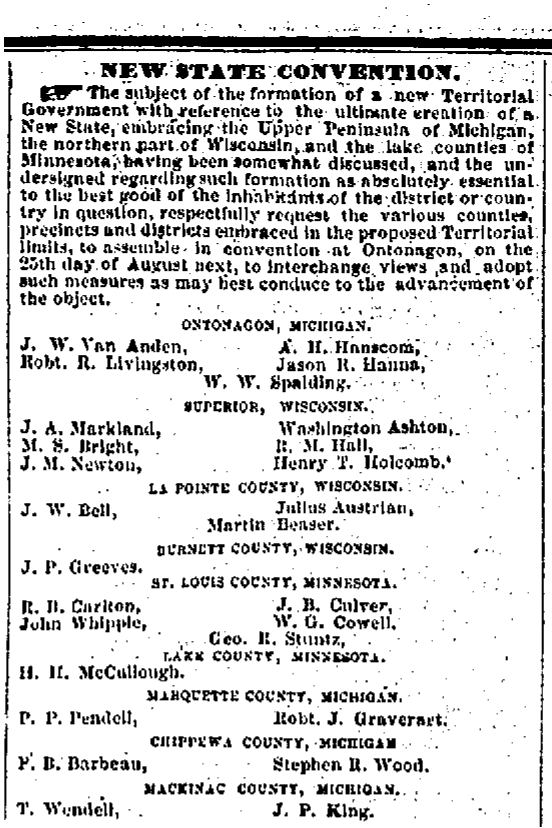
Julius Austrian, along with Martin Beaser and John W. Bell, attended the New State Convention of Lake Superior to represent La Pointe County ~ Superior Chronicle, August 3rd, 1858.
In 1858, the firm had much difficulty in collecting their orders on the mines in the vicinity of Eagle Harbor, and it was finally determined to sell out their store and build up a business elsewhere. S. W. Hill, Esq., had then left the Copper Falls and assumed the direction of the Quincy Mine here at this place. He foresaw that Portage Lake, possessing as it did so many natural advantages, would eventually become the grand business point or the copper region, and with his accustomed energy began the laying out of the town site now occupied by the village of Hancock. Soon after this was done he wrote to the Messrs. Leopold, urging them to come over and open a store there, but they did not give the offer much consideration that year, as nearly everybody in Keweenaw County ridiculed the idea of Portage Lake ever becoming anything of a place.
That year, however, they sold out their business at Eagle Harbor, and removed to Eagle River, where Samuel was for the second time appointed Postmaster, and their business conducted by him and Jos. Austrian. Their present store site at Eagle River had been previously purchased, and additions annually made to their main building, as their business demanded, until they were of a much greater extent than the original frame.
Aaron Leopold was the first Tyler of the Quincy Lodge No. 135 in Hancock. M.H. Mandelbaum was a member.
In the summer of 1859, Jos. Austrian, who was the building man of the firm, came over from Eagle River to Hancock with Geo. D. Emerson, C. E., and selected a site for their new store, and chose the lots on which now stands the Mason House and the Congregational Church, and the dock front now owned by Little, Heyn & Eytenbenz, but Louis, who came up about that time, changed to the present site, deeming the other too remote from what would be the business center of the town. This was judged from the line of the road coming down from the mine, and the location of the Stamp Mill, around which he naturally concluded the workmen’s dwellings would cluster. In this he was slightly mistaken, though the real difference was unimportant; we give it merely to show how easily the most careful and calculating men may make a mistake.
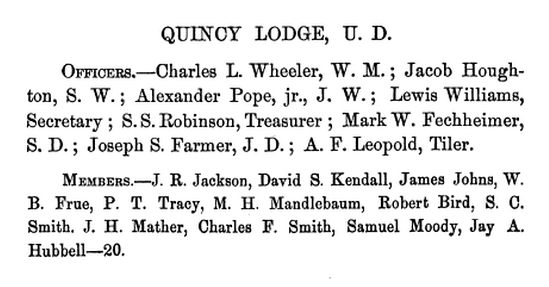
Transactions of the Grand Lodge of Free and Accepted Masons, of the State of Michigan, at Its Annual Communication, 1861, pg. 71.
After the site was determined upon, building was commenced, but as their faith in the future growth of the place was small, they did not propose to erect a large store, or even construct a substantial cellar underneath. Mr. Hill, hearing of their intention, at once paid them a visit and strongly protested against it. “This is going to be a leading town,” he said, “and I want a good large store, and a stone cellar underneath it.” He carried the day, and a larger building was completed, which two years afterward was too small for the business, even with the addition of a large warehouse for storing additional supplies.
As soon as the building was commenced, Louis began to send up goods from Cleveland, and Aaron came over from Eagle River to take charge of the new business. He scarcely reached here before the goods arrived, and were stored in the building before it was closed in, and he for several weeks had to make his bed on the goods virtually in the open air. As this was in the fall of the year, it was not pleasant, as may be at first supposed. Since then their principal business has been done at Hancock, the old head concern at Eagle River having been a branch.
Additional sources about this festive celebration for the Freudenthaler family in Richen have not been located yet.
In the fall of 1861, Aaron concluded to visit his home in Germany, to attend the golden wedding anniversary of his parents, and Samuel came over from Eagle River to take his place in the store. The celebration of the golden wedding was the grandest event which had happened in the little town of Richen for fully one hundred years, and, probably, will not be equaled in the present century. It would be impossible within the limits of this article to give a full description of the proceedings on that festival occasion, suffice it to say, that all the inhabitants of Richen and the neighboring towns, to the number of full five thousand assembled, and under the guidance of the mayor and municipal officers, for three days kept up a continuous round of merry-making and rejoicing. On the anniversary wedding day a procession over a mile in length waited upon the “happy couple,” and escorted them to the church, where appropriate and imposing services were performed. In the name of his brothers Aaron presented the church with a copy of the Sacred Writings, beautifully engrossed on parchment, which, with its ornamented silver case, cost over $600. All the halls and hotels were opened to the public, where for three days and nights they feasted, drank and danced without intermission and free of expense. The celebration of this golden wedding cost the brothers over $5,000, but which they rightfully considered the grandest event in their history.

In the fall of 1862, Joseph Austrian joined the firm at Hancock, and Louis removed from Cleveland to Chicago, which point they had concluded would soon monopolize the trade of Lake Superior. In the spring of 1864 he commenced a shipping business in that city, and early in the following winter was joined by Jos. Austrian, and the purchase of the propeller Ontonagon effected, and a forwarding and commission business regularly organized. Lately they have purchased the light-draft propeller Norman, intending it to run in connection with the Ontonagon.
While this was the end of Julius Austrian’s presence at La Pointe, he was still attached to the region for the remainder of this life by social ties and legal affairs. Julius eventually moved to St. Paul and became President of the Mount Zion Temple.“The Austrians retained their generous spirit even after moving to St. Paul for it was on a mission to the poor with a cutter full of good things to eat that Mr. Austrian was run over by a beer wagon (we don’t have them nowadays) and killed.”
~ The Lake Superior Country in History and in Story by Guy M. Burnham, 1996, pg. 288As aforementioned, Moses Hanauer was son to Moritz Hanauer, elementary educator of the Leopold brothers in their hometown of Richen. Moses’ brother-in-law was Henry Smitz of La Pointe.
In 1862 their branch house at Lapointe was given up, and Julius Austrian returned to Eagle River, and, in connection with Solomon, conducted the branch at that place. The firm now is composed of Solomon and Julius Austrian and Moses G. Hanauer, who for several years has acted as bookkeeper for the firm, under the firm name of S. Austrian & Co. The Hancock firm is composed of H. F. Leopold, Joseph and Solomon Austrian, under the title of Leopold, Austrian & Bro. The Chicago firm is composed of L. F. Leopold and Joseph Austrian, under the name of Leopold & Austrian. Mr. S. F. Leopold will return to Germany, upon the opening of navigation, and spend a year in pleasure and relaxation, which he certainly merits after twenty years constant labor. Aaron will remain here during the coming summer, and in the fall will go below and establish a wholesale business in Detroit, where it is probable he will be joined by Samuel after his return from Europe.
“CHICAGO AND LAKE SUPERIOR LINE.
This line is owned in Chicago, but is included in our list with other lines plying between Michigan ports. Those enterprising and well known gentlemen, Leopold & Austrian, for many years proprietors of this line, have consolidated their navigation interests with those of the Spencer, Lake Michigan and Lake Superior Transportation Co., their boats running between Chicago and Duluth, touching at all intermediate ports in Illinois, Michigan and Wisconsin. The steamers are the Peerless, J. L. Hurd, City of Duluth, City of Fremont and barge Whiting.”
~ Tackabury’s atlas of the State of Michigan : including statistics and descriptions of its topography, hydrography, climate, natural and civil history, railway and steam boat history, educational institutions, material resources, etc. (1884), pg. 23Louis F. Leopold and his sons, Asa F. and Henry F. Jr, started the first mercantile house in Duluth in 1869. Asa and Henry were the first Jewish residents in Duluth and enjoyed success as prominent businessmen.
That the Messrs. Leopold have been more than ordinarily successful in their mercantile career of over twenty years is made evident from the extent and variety of their business transactions within the past five years, and the very large amount of capital required to carry it on successfully and properly. We feel confident that the joint capital of $3,000, with which they commenced business in 1843, had been increased one hundred times by the close of the past year, and we should not be surprised if it had augmented even more than that. It has been the result of no particularly good fortune, but of persistent application in one direction, and the only exception to the ordinary course of operation which can be said to have contributed to their success, has been the remarkable unity which has pervaded all their business transactions, whether located at Mackinac, Green Bay, Lapointe, Eagle River, Cleveland, Eagle Harbor, Portage Lake or Chicago, each member of the firm has labored, not for his benefit alone, but that of the whole brotherhood.
“S. Solomon Austrian, a merchant from the copper country of Upper Michigan married Julia R. Mann, ten years his junior and not yet out of school, of Natchez, Mississippi, about 1866. Their first home was in Hancock, Michigan. In writing of her mother at a later time, Delia describes the young wife’s inexperience as she entered this strange new country, and the difficulties she had learning homemaking from her pioneer neighbors, along with her fear of Indians. Here, their first child, Bertha, was born. After two years of residence, they moved to Cleveland. In 1870, a son, Alfred S., was born in Chicago, but there is no evidence to show they were residents of that city at the time. However, they were still living in Cleveland in 1874 when twin daughters, Celia and Delia, were born.”
~ Guide to the Celia and Delia Austrian Papers 1921-1932, Special Collections Research Center, University of Chicago Library.
And at this partial termination of their active associations, it is with a pride which but few firms experience after so long connection, they can say that in all their twenty years’ relation with each other there has never been a disagreement to mar the harmony and unity of their operations. Whatever has been done by one, even though it did not result as anticipated, has met with the immediate sanction of the others, who had unlimited confidence in the integrity of his intentions to benefit them all. Until now there has been no division of the accumulated profits; all has been placed in one general fund, from which each has drawn as the wants or exigencies of their business demanded. Neither of them have indulged in any private outside investments or speculations, the profits of which has resulted to his own pecuniary benefit. Profit and loss has been shared alike by them all. Such unanimity of action is very rarely to be met with, especially In these modern days of “every man for himself and the devil take the hindmost,” and is, therefore, the more commendable. Although nominally dissolved, at present, we are of the opinion that after S. F. Leopold has returned from his vacation in Europe the old order of things will again prevail, for, after such a lengthy and intimate association, it will be difficult for either of them to operate independent of the rest, after such a practical verification of the truthfulness of the adage on which they founded their business existence, that “In union there is strength.”
We also copy the following letter, which, in our estimation, forms a part of and belongs to the history of the Leopold family. We understand that the son of whose birth the writer of the letter to the “Israelite” speaks, was the first Jewish child born in the northern region of Michigan:
Chicago, July 18, 1863.
Editor of The Israelite:
I have just now returned from Lake Superior, where I have found all my brothers and friends and the readers of The Israelite and Deborah in perfect good health. I cannot refrain from giving you a little history of a very noble act, the fruit of which in hereby enclosed, being a draft for $30, which you will please to appropriate to the purpose for which it has been destined, namely at a Berith which took place on a child of my brother at his house in Hancock, Lake Superior. After about forty participants had done justice to a very luxurious dinner, with the permission of Mr. Hoffman of Cleveland, the operator, a motion was made that the saying of grace should be sold, and the proceeds appropriated to some charitable purpose, whereupon Brother Samuel made an amendment that the proceeds should be sent to Dr. Wise of Cincinnati, to be appropriated by him for the monument to be erected for Dr. Rothenhelm; the sheriff, Mr. Fechheimer, seconded the motion, and the same was unanimously carried. Brother A. F. was the last bidder with $30, consequently he was the lucky purchaser, and bestowed the honor on your humble correspondent.
The act is worth imitating, and if you think it worth mentioning you may give it publicity in The Israelite and Deborah.
Yours truly,
L. F. Leopold.
By Leo Filipczak
When we last checked in with Joseph Austrian, or Doodooshaaboo (milk) as he was known in these parts, we saw some interesting stories and insights about La Pointe in 1851. The later La Pointe stories, however, are where the really good stuff is.
Austrian’s brief stay on the island came at arguably one of the most important periods in our area’s history, spanning from a few months after the Sandy Lake Tragedy, until just after Chief Buffalo’s return from Washington D.C. Whether young Joseph realized it or not, he recorded some valuable history. In his memoir, we see information about white settlement and land speculation prior to the Treaty of 1854, as well as corroborating accounts of the La Pointe and Bayfield stories found in the works of Carl Scherzer and Benjamin Armstrong.
Most importantly, there is a dramatic scene of a showdown between the Lake Superior chiefs and Agent John Watrous, one of the architects of the Sandy Lake removal. In this, we are privileged to read the most direct and succinct condemnation of the government, I’ve ever seen from Chief Buffalo. It is a statement that probably deserves to be memorialized alongside Flat Mouth’s scathing letter to Governor Ramsey.
So, without further ado, here is the second and final installment of Joseph Austrian’s memoirs of La Pointe, and fifth of this series. Enjoy:
~~~~~~~~~~~~~~~~~~~~~~~~~~~~~~~~~~~~~~~~~~~~~~~~~~
Memoirs of Doodooshaboo
… continued from La Pointe 1851-1852 (Part 1).
Scherzer, Noted Traveller Pays Us a Visit. 1851.

Carl Scherzer and his companion Moritz Wagner recorded their travels in Reisen in Nordamerkia in der Jahren 1852 und 1853. An e-translation of Chapter 21 appeared in English for the first time this fall on the Chequamegon History website. You can read it here, here, and here. The second installment records his time with Joseph Austrian. From Austrian’s account, it appears Wagner did not accompany Scherzer through the Lake Superior country. (Wikimedia Images)
During this summer a noted Austrian traveler Carl Scherzer arrived one Sept. night. He had been commissioned by the “Academy of Science” of Vienna (a Government Institution) to make a tour of America to familiarize himself with the country and gather information to write a book for the Academy. This interesting book which he wrote is called “Scherzer’s Reisen.” Mr. S. sent me a copy of this book which I have in my library. In this book, mention is made of me and my cordial reception of him and his travelling companion, an Attache of the French Legation of Washington who accompanied him on his trip. Scherzer was a highly educated gentleman, cultured and charming, tall and of imposing appearance. Scherzer arrived at La Pointe at midnight coming from Ontonagan 90 miles in a small row boat. To his dismay, he found that there was not a hotel in the place. The boatman told him that he thought that one Austrian might give him shelter for the night, so he came to the house and knocked at the door. Henry Schmitz, my fellow employee, who roomed with me opened the door and called out “Joe step auf freund von below sind da,” whereupon I cordially invited them to enter and made them as comfortable as possible. They remained with us about three days and profoundly appreciated our hospitality. Even making mention of it later on in his book. Once on going to a fishing boat for our supply of fish, Scherzer went with me and begged the privilege of carrying two of the large fine white fish, one suspended from each hand. He much enjoyed meeting the good Father Skolla, his country-mate, also an Austrian, and from him obtained more valuable and authentic information concerning that part of Lake Superior country that he could have otherwise gained. From La Point Scherzer planned to go to St. Paul. There were no railroads here at that time. There were but two roads leading to St. Paul. One was simply a footpath of several hundred miles through the woods. The other led via St. Croix [Brule?] & St. Croix river shortening the foot travel considerably. Scherzer chose the latter road. I fitted out for him, at his request, a birch bark canoe and utensils and all necessary for the trip and Scherzer and his companion started on their way to St. Paul.
He had engaged one “Balange” their voyageur who had brought them from Ontonoagan and a friend of his to take them through. They were well acquainted with the route which at times necessitated their carrying the canoes around through the woods across the portage, where the river was inaccessible through rapids, obstacles and otherwise. Scherzer arrived at St. Paul safely and wrote thanking me for my assistance and requesting me to send him a copy of the wording of a French rowing song (the oarsmen usually sang keeping time with their oars). I sent it to him and received a letter of thanks from New Orleans whence he had gone from St. Paul by steamer via the Mississippi River. This song is embodied in his book also.
A Steamer was a rare occurrence at La Point and when one did come, we often got up an Indian war dance or other Indian exhibit for the amusement of its passengers, and which they enjoyed greatly. In the fall of the year steamers were sometimes driven there by the storms prevailing on the lakes, as the harbor offered the best of shelter. We kept a good supply of cord wood on the dock which we sold to the steamers when they needed fuel.
Indians Decline to be Removed by Gov. I attend Grand Council. 1851.
During the first summer of my stay at La Point, the Indian Agent, Mr. Watrous was directed by the Secretary of the Indian Dept. at Washington to summon the chiefs of that part of the Chippewa tribe residing in the vicinity of Bad River, Bayfield, & Red River for a council. The Agent accordingly sent runners around to the chiefs of the different lodges some of which were quite remote, summoning them to meet him on a certain day at La Point. They came in obedience to the summons many bringing their squaws, papooses and their Indians of their lodges with them. Near the lake shore the put up their wigwams, which were made of birch bark leaving an opening over hung with a blanket which served as a doorway. It made an interesting Indian settlement. The meeting was held on the appointed day, in my brother’s store which was a long wooden structure. When the meeting opened the chiefs sat on the floor arranged along the left side of the room, with their blankets wrapped around them, and each one smoking a long stemmed pipe, which they make themselves, the sign of peace, many ornamented with paint and feathers. On the other side of the room was seated the Indian Agent with an interpreter who translated what either had said.
I naturally felt greatly interested in witnessing their proceedings. The President of the U. S. was known by the Indians as the Great Father and the Agent addressed them telling them what the Great Father wanted of them; namely that they remove from their reservations to interior points in order to make room for while settlers; pointing out to them that the proposed location was more suited for them, there being good fishing and hunting grounds. The government offered to pay them besides certain annuities, partly in money and partly in Indian goods–such as blankets, cotton, beads, provisions, etc. The proposition of the Government was met with murmurs of disapproval by the chiefs & Indians present, and Chief Buffalo made a most eloquent and impassioned speech saying,
“Go back to the ‘Great Father’ and tell him to keep the money and his goods. We do not want them but we wish to be left in peace. Tell him we will not move from the land that is our own, that we have always been peaceable and were always happy until the white man came among our people and sold ‘Matchie Mushkiki [majimashkiki (bad medicine)]’ (poison-whiskey) to them.“
(The real name of whiskey in Indian is “Ushkota wawa [ishkodewaaboo]” – fire water).
The Indians did remain and to this day are still occupying the same land. I was present at this meeting and it so impressed me, that although it took place over fifty years ago it is still vivid in my mind. Later on the Government encouraged the same Indians to engage in farming work on the reservation, and furnishing them with implements and seeds for that purpose, and in the course of a few years they had their own little farms on which they raised potatoes and other vegetables easily cultivated. Schools also were established by the Government. One of their large settlements today is on Bad River, and not far from Ashland Wis., known by the name of Odana.
Brother Marx Experience with Indians. 1851 .
Our blind brother Marx Austrian with brother Julius’ assistance at that time, preempted 160 acres of land near Bayfield from La Point, complying with preemption laws. He built a small log house living there with his wife. One night during their first winter in their new house, there was a knock at the door, and when opened they were confronted by a number of Indians, who were evidently under the influence of liquor and who swinging their tomahawks vigorously, making all sorts of threatening demands. An old Indian who knew Marx interceded and enabled him and his wife to escape without injury who thoroughly scared fled panic stricken in the dark about two miles at night, over the ice, on the Bay which was covered with a foot of snow to La Point for safety. The poor woman having the hazardous task of leading her blind husband over this long and difficult road, not to come back again and glad to escape with their lives and thus abandoning their right of preemption. This place was later on platted and is now known as the Bayfield Addition.
My Experience in Lumbering
Brother Julius had a small saw mill operated by water power about two miles back of Bayfield on Pike’s Creek, near which were Pine lands. In the winter I was sent with some woodsmen to look after the cutting and hauling of Pine logs for the mill. These logs were hauled by ox teams to the mill. In the spring I was again sent there to assist in the sawing of these logs into lumber. We lived in a little log hut near by. When the snow melted toward spring time, the creek was high and swollen. One day the force of the waters burst through the dam, carrying it away and the great volume of water rushing down cut a new channel in the bed of which had become a river, and undermining to foundation of our little log house causing it to topple over into it, also carrying away the logs, many of which floated down into Lake Superior and were lost.
Pg. 218-219 (Armstrong, Benj G., and Thomas P. Wentworth. Early Life among the Indians: Reminiscences from the Life of Benj. G. Armstrong : Treaties of 1835, 1837, 1842 and 1854 : Habits and Customs of the Red Men of the Forest : Incidents, Biographical Sketches, Battles, &c. Ashland, WI: Press of A.W. Bowron, 1892).
In the winter when logging was going on, once I was sent across from La Point with a heavy load of provisions and supplies for the men. This was loaded on a so called “Canadian flat sleigh.” The road on the way to the mill led down a very steep high hill which half way down had a sharp bend and at this curve stood a tree. After having started down the hill, the horse was not strong enough to hold back the load, which got the better of him, and pushed him swiftly down the hill with his hind legs dragging after him wedging him against and partly into the tree with his front legs up in the air. I could not move the heavily laden sleigh with the horse wedged in so tightly I found it impossible to extricate him, and had to go to the mill for assistance. The sled had to be unloaded before we could free the horse. See Armstrong’s book in which mention and illustration is given of this as “Austrian up the tree.” The book is in my library.
Ferrying Oxen Across the Bay in Row Boat.
My brother Julius had also a large tract of meadow land on Bad River, where he had a number of men employed in making hay, in order to gather this hay for stacking, a span of cattle and a wagon were needed to haul it. There being no other means of ferrying them across the bay, one of the large Mackinaw boats of about twenty-five feet keel by six feet beam had to be used to get these over to the other side across a distance of about three miles to the mainland from where they could be driven to the meadow. I was commissioned to attend to this assisted by four competent boatmen, we finally managed with coaxing and skill to get the two big oxen into the boat, standing them crosswise in it. We tied their horns to the opposite side of the boat. The width of the boat was not sufficient to allow them to stand in their natural position which made them restless. The first thing we knew one of the oxen raised his hind leg and stuck it out over the side of the boat into the water, his other leg soon followed and we had aboard an ox half in the boat, with the weight of his body resting on and threatening to capsize the boat. We quickly cut the rope which held his head and he fell backward overboard floundering in the water. Little did I think that we would see the ox alive again. Imagine my surprise on my return to the Island to find he had swam back to shore safe and sound. When the other ox saw his mate go overboard, he tried to follow and it required much coaxing and extra feeding to restrain him and finally landed him all right on the opposite shore.
Lost in the Woods
I returned to the Island and the next morning I started for the meadow fields in a birch bark canoe with a Mr. Lehigh who had a little saw mill about five miles up Bad River. We were obliged to sit in the bottom of the little boat in a most uncomfortable and cramped position, having been warned by the boatman in charge not to move as the least motion is apt to cause the frail craft to capsize. On arrival at the meadow I found the men busily at work. They were about to take dinner and I gladly consented to join them, and being hungry relished the spread of fried pork, crackers, and tea. My companion Mr. Lehigh was bound for his little saw mill up the river where he lived, and I having business to attend to there started with him on a foot trail through the woods. He loitered on the way picking wild raspberries, just ripe and tempting, but musquitos were thick and vicious and pestered us terribly. I not being accustomed suffered more than my companion. Asking him the distance we were still to go, and on his telling me three miles, I became impatient and went ahead alone to get away from the musquitos. After walking on some time I came to a potato field into which the trail led, but was concealed by the high vines. Crossing the field I struck a trail on the other side and took for granted it was the one leading to the mill. On and on I went when it struck me that I had gone further than the three miles, and it dawned on me that I must have taken the wrong path from the potato field and I concluded to turn back and try to reach the meadow. The sun had gone down, it grew dusk very soon amongst the tall pine and maple trees, in the dense forrest. It grew so dark that I could not see my trail and became entangled in the underbrush and roots of trees, tripping and falling many times. I had with me my double barrel shot gun, both barrels being loaded I shot these off to attract Lehigh’s attention. I listened breathlessly for some answer but there was no sign of a human soul and I became thoroughly frightened at the prospect of being lost in the woods but resolved to make the best of it. I stumbled around and found a log hut near by, which had been put up for temporary use by the Indians in sugar making time. I had neither matches nor ammunition, by feeling around, I discovered that what had been the doorway was closed up with birch bark. By climbing up I also discovered that the roof had been taken off the hut and I let myself down to see what might be inside. I found there three rolls of birch bark and a rude bench made of rough poles laid along on one side lengthwise about a foot along the floor, which served as seats for the Indians while boiling the maple sap. Being tired out I laid down on the rough bench and tried to rest, tying a handkerchief over my face, and with each hand up in the boot sleeves to protect myself from large and ravenous musquitos which tortured me nigh to desperation. Having no matches with me to kindle a fire or create a smoke I was entirely at their mercy. Presently I heard a noise on the outside as though of something stealthily climbing over the wall. The moon was then shining brightly, the sky was clear and on looking up I saw the outlines of a young bear sticking his head over the wall looking down on me. I sprang up and as I did so the bear jumped back and ran off. No doubt the odor of the sugar attracted him more than I did. Under these circumstances rest was out of the question. I climbed out of the hut and made another attempt to find the lost trail by moonlight, crawling on hands and feet in some places. In doing so, I placed my gun against a tree and had a hard time to find it again. I decided there was no use to trip further and climbed back in the hut to stay there till day-light, then with renewed effort after repeated disappointment I finally struck a trail, but at this point I was confused and at a loss to know which direction to take. I reached a steep hill that I did not remember having passed the day before. As a last resort I ran up this hill and hallowed & yelled. An answer came from the valley, from me working there. Following the sound I reached the meadow. My face was so swollen from the musquito bites that I was a sight to behold. After resting and partaking of some food, I again started out for Lehigh’s place one of the me volunteering to show me the way and I arrived there a couple of hours after, and found that it was only one mile from the potato field where I had lost the trail.
For many miles in all other directions in this dense forrest there was not a single habitation nor likelihood of meeting with a soul and here a short time ago a man had been lost and never heard from again. Hence I was lucky indeed to have found my way out of the woods. Lehigh cooly informed me that when I saw him that he heard the report of my gun, but had paid no heed to it thinking I would eventually turn up.
Lost on the Ice and Night
One time during the winter Brother Julius sent me with his trusted Frenchman Alexis, to look up certain Indians who owed him for goods and whom he thought would have considerable fur. This tramp meant about ten miles each way through the woods on an Indian trail the ground being covered with snow. Taking our faithful dog, who had been trained to hauling with the little toboggan sled, on which to bring back the fur which he hoped to get in payment for our debt. We started from La Point, and I met with good success gathering quite a little fur. On our return we reached the Bay shore late in the evening from where we had four or five miles to cross on the ice in order to reach the Island. We rested for about an hour at an Indian wigwam and partook of some tea (such as it was) that the Indian squaw made for us and then started on. Alexis, acting as pilot went ahead, followed by the dog & then by me. It was a clear cold night the moon shown brightly, but about half an hour afterwards snow clouds sprang up shutting out the moonlight, Still we pushed ahead. Soon however Alexis lost his bearings and was uncertain as to direction, but on we went for several hours without reaching the Island. Presently we encountered ice roughly broken and piled high by the force of a gale from the open lake, which indicated that we were too near the open water and that we had gone too far around the Island instead of the straight for La Point. We stumbled along, and after having been out about two hours on the ice, with continued walking we managed to reach the shore and with guidance of Alexis tramped along toward La Point reaching there two hours afterwards almost exhausted by the hardships we had endured.
Trip to Ontonagon in Row Boat for Winter Supplies. 1851
It was in 1851 when brother Julius expected the last boat of the season would touch at La Point which was usually the case and deliver all his supplies but the quantity was not sufficient to induce the Captain to run in there and consequently he skipped La Pointe, thus leaving us short of necessary provisions for the winter, hence it was necessary to procure the same as best we could. I was commissioned by my brother Julius to undertake the job which I did by manning a mackinaw boat with five voyageurs. The boat was loaded with as many barrels of fish as we could carry. We started for Ontonagon about the middle of November, intending to trade the fish for supplies required. It was cold, the ground frozen and covered with snow. The wind was fair. We hoisted our two sails and made good time reaching Montreal River late in the evening where we ran in and tied up for the night. We had no tent with us but found a deserted log house by the river in which we spent the night. There was a large open fire place, and my man cutting down a dry tree kindled a brisk wood fire in the fire place. I slipped into a rough bunk in the room wrapped myself in my blankets and tried to sleep, but in vain. The smoke from the fire was so dense it nearly suffocated me. My met lighting a few tallow candles amused themselves playing cards until late at night.
The next morning early, we set sail and again had fair wind, reaching Iron River about noon and Ontonagon that night, next day succeeded in exchanging my fish for provisions and the following day started on our return trip to La Point. We had mostly fair wind and reached there on the third day in good shape.
Another Trip to Ontonagon for Provisions. 1852.
The following year, in 1852, I agains made a similar trip for like reasons but did not have nearly as good luck as on the previous trip. It was fraught with some danger and combined with a great deal of hardship. The distance from La Point to Ontonagon is nearly 100 miles, all exposed to the storms of Lake Superior which in the Fall are generally very severe. On our first day out we encountered a severe snow storm, which compelled us to make a landing near the mouth of Bad River to save the boat, which was threatened to be dashed to pieces on the shore or carried out into the open lake. So she had to be beached and in order to do this her cargo of fish had all to be thrown overboard when we touched the beach, to lighten her and when this was done she was hauled up on the beach with a block and tackle and fastened to stump of a tree. The boatmen had to go almost waist deep in the water and roll the heavy barrels up on the beach. After completing the landing we sought shelter in the nearby woods from the raging storm, we were not equipped for camping, so we took the sail from the boat and stretched it over as far as it would reach for our own protection. As before the men cut down a dead tree kindled a fire, hanging over it our camp kettle, made tea, tried some pork and this together with some crackers with which we were supplied composed our supper. To get further away from the wind and snow we had gone further back into the woods to find some protection and there we rolled ourselves in our grey blankets and laid down keeping our faces under the protection of the sail as much as possible. Being very much exhausted, we fell asleep, in spite of unfavorable conditions. Toward morning when I awoke I tried to pull my blanket over me a little more but found I could not move it, and discovered that the snow had drifted over us to such an extent that we were fairly buried in it, nothing visible but part of our faces, our breath having kept that free for the time. After daybreak we again started a fire, and this made things worse as the heat melted the snow on the trees around and water dripped down on our blankets, getting them wet. We had to hang them near the fire to dry as we collected them later on. They fairly steamed and we were delayed a whole day in getting arrangements completed to start again on our trip. Toward morning the wind had subsided considerably, and the snow storm had abated somewhat and again we ventured on our trip. After going through the same routine of reloading as on our previous occasion. At 10 A.m. we started on our perilous voyage making good head way, the wind being favorable. We reached Iron River after midnight. We detected an Indian wigwam near by, thinking we might be able to get something to eat. We tied up and investigated. We peeped into the wigwam and found the same occupied with an Indian family. The Indian squaw and papooses all tight asleep. Not wishing to arouse them or to lose further time we moved on stopping early the next morning in a small bay on our route. Kindling a fire as previously described, preparing a meager breakfast , the best scant supplies would permit. These boatmen were accustomed to cooking (such as it was) as well as boating it being often a necessity, as they were accustomed to make long coasting trips in the pioneer days of the Lake Superior regions, which was sparsely settled and vessels were very scarce. Supplies and all merchandise had to be transported all the way from Detroit to Lake Superior on those small Mackinaw boats. After breakfast we set sail and continued our journey with fair wind enabling us to make good time, but it had grown bitterly cold and as we were but poorly protected for such severe weather. It cost us untold suffering.
We finally reached Ontonagon River after dark, and to our great consternation found that the river was frozen over about an inch thick with ice. This was not easy to break through with flimsy craft, but desperation gave strength to our men and they were equal to the situation. With their heavy oars they pounded and broke the ice managing finally to get inside of the river to the dock of the merchant with whom I expected to do my trading in the town of Ontonagon, which was the Lakeport for the Minnesota and other copper mines in that vicinity, at that time being just developed. On the following morning I attended to the selling of the load of fish, purchased our supplies and intending to start back for La Point the next morning.
Ordered to go to Eagle River. 1852.
In the meantime the propeller Napoleon arrived from there bringing for me a letter from brother Julius, instructing me if still in Ontonagon to take this steamer for Eagle River and to enter the employ of Mr. Henry Leopold, who had a small store there. His man had left suddenly and he was anxious for my services. I started for Eagle River just as I was and not until the following spring did I get my trunk. I began working for Mr. Leopold as bookkeeper and general clerk, and thus abruptly terminated my business career at La Point. My boatmen under direction of Mr. Henry Schmitz started without me on their return trip to La Point as planned when between Montreal River and Bad River, they encountered a terrific gale and snow storm. It was so severe that to remain outside meant to be lost, and as a last resort, they ran their boat through the breakers, trying to beach her. She was swamped with all the supplies, and tossed up on the beach and had to be abandoned for the time being. Later on another boat was sent on from La Point to get the damaged cargo. The Napoleon got abreast of Eagle River, this place being on the open shore of Lake Superior without any protection, it being too rough there for the boat to make a landing, therefore she went on to Eagle Harbor, about nine miles distant, where she could safely land. On arrival there I put up at Charley King boarding house for the night.
To be continued after La Pointe 1852-1854…
~~~~~~~~~~~~~~~~~~~~~~~~~~~~~~~~~~~~~~~~~~~~~~~~~~~~~~~~
Special thanks to Amorin Mello and Joseph Skulan for sharing this document and their important research on the Austrian brothers and their associates with me. It is to their credit that these stories see the light of day. This is the end of the La Pointe section, but the original handwritten memoir of Joseph Austrian is held by the Chicago History Museum and contains many interesting stories from the life of this brief resident of La Pointe.
 Chequamegon History