Edwin Ellis Incidents: Number VIII
February 11, 2024
Collected & edited by Amorin Mello

Originally published in the September 1st, 1877, issue of The Ashland Press.
Transcribed with permission from Ashland Narratives by K. Wallin and published in 2013 by Straddle Creek Co.
… continued from Number VII.
My Dear Press: – Among the early names associated with Ashland, I must not omit to mention a few others.
1. E. F. Prince

came to Ashland early in 1857. He was brother-in-law to Martin Beaser and was induced by him to come from Buffalo to this place. He had been employed as clerk in a large ship building establishment, and when he left the employees of the yard showed their regard for him by presenting to him an elaborate and valuable set of silver service. He erected, in the same year, the house in which he now lives, on Main Street, in Beaser’s Division. From 1861 to 1872, he resided in Ontonagon and Duluth, but upon the commencement of work on the W.C.R.R., at Ashland, he returned to his old home, where he now resides.
Though still young and vigorous, he is entitled to be reckoned as one of the “Old Folk” of Ashland.
2. Oliver St. Germain
came to this place in 1856, and built a home on Main Street, adjoining Mr. Prince’s place. The house, with all its contents, was burnt down in the spring of 1858, inflicting a heavy loss upon Mr. St. Germain. He pre-empted a quarter section of land adjoining the town site, and cleared about twenty acres in 1858. The railroad passes through this clearing about a mile from town.
In the general wreck which followed the crash of 1857, he was compelled to abandon his Ashland home, and for some fifteen years lived at Ontonagon, Carp Lake, and Superior City. In 1872 he returned to his early home, and was among the first to build a house in Vaughn’s Division, in which he now resides. Though like the rest of us, he has encountered hard times, still, in the midst of discouragements, he is ever cheerful and hopeful, and determined never to give up, as long as a plank is left in the ship.
3.
I approach with reluctance another name, for I am conscious of my inability to do justice to his memory; nor fairly exhibit to this generation, his manly social, and religious character; nor make clear, in its true extent, the important part he acted in moulding and elevating the society, not of Ashland alone, but of the Counties of Ashland and Bayfield. In the annals of that History recorded by God himself, upon the tablets of Eternity, I doubt not his name will eclipse in true greatness and glory, those of Caesar and Napoleon.
I allude to
Rev. Hemenway Wheeler.

Reverend Leonard Hemenway Wheeler of the ABCFM Mission.
He was a native of Vermont, educated at Middlebury College, and at Andover Theological Seminary.

Reverend Sherman Hall of the ABCFM Mission.
~ Madeline Island Museum

Bishop Frederick Baraga of the Catholic Mission.
~ Madeline Island Museum
At the time of the completion of his course in theology, he had nearly decided to devote his life to the foreign mission field, in which he had near relatives. At this juncture, his attention was directed to the condition of the Chippewa Indians on Lake Superior. He offered his services to the American Board of Foreign Missions, who, besides the foreign work, had charge of the missions among the American Indians. His offer was accepted, and he was directed to join the Mission at La Pointe, then one of the stations of the Board, under the care of Rev. Sherman Hall, who still survives, at a very advanced age, at Sauk Rapids, in the state of Minnesota. Mr. Wheeler, in the early part of 1841, was married to Miss Harriet Wood, of Lowell, Mass., a refined and cultivated young lady, who, like her husband, was thoroughly imbued with the spirit of missions, and with true heroism, she left her cultivated home, and society, and went into what seemed banishment from civilization. We of this day, with our numerous steamboats, from Chicago, Detroit, Cleveland and Buffalo, – with the iron horse, drinking the waters of the lake at our very doors, and with the streams of commerce, and of social life sweeping by and among us in a constant flow, can have no idea of what it involved to come here for a life work, forty years ago.
At that time, there was a small settlement at the Sault. The site of the present beautiful and substantial city of Marquette was Indian hunting grounds. L’Anse, Houghton, Hancock, Calumet, Eagle harbor, Eagle River, Ontonagon, Ashland, Bayfield, Superior and Duluth were then in the unknown future. La Pointe was at that time the most important town on the Great Lakes. It had, in the 17th century, attracted the notice of the French explorers, and of the Jesuit missionaries, who made choice of it, as a trading post and as a mission station. The mission had been continued for near two centuries, and the trading post still held, though now under another race of men, was now the headquarters of the American Fur Company, where a factor resided, and where great warehouses were erected for the reception of the vast supplies of goods to be used in the Indian trade, which were brought once a year in the company’s vessel. From La Pointe these goods were distributed to various trading posts, scattered around the basin of Lake Superior, for more than four hundred miles, and extending inland indefinitely. Among these posts may be mentioned L’Anse and Iron River, in Michigan; Lake Flambeau, Montreal River, Lac Court Oreille, and St. Croix, in Wisconsin; Fond du Lac, Grand Portage, Vermillion Lake and Crow Wing, in the Territory of Minnesota, thus embracing the largest part of the waters flowing into the gulf.

View of La Pointe, circa 1843.
“American Fur Company with both Mission churches. Sketch purportedly by a Native American youth. Probably an overpainted photographic copy enlargement. Paper on a canvas stretcher.”
~ Wisconsin Historical Society
La Pointe was the emporium, the metropolitan city of this vast extent of country. It was the Mecca of the Ojibwas, occupying the extensive country I have named. To reach La Pointe and be buried there, was to be close to the gate of entrance to the “happy hunting grounds.” It was to him the “sweet Island of the blest.” With joy he hailed its sight, as he emerged from the forests in which months had been spent, gathering his pack of furs; and with regret he turned his lingering look upon it, as he again plunged into the wild wastes for his solitary hunt of half a year.

“Boardwalk leading to St. Joseph’s Catholic Church in La Pointe.” Photograph by Whitney & Zimmerman, circa 1870.
~ Wisconsin Historical Society
It was the scene of some of the most important treaties made with the Chippewas of the Northwest, by which they ceded to the United States, lands in extent sufficient to form respectable states. It was also the gathering place where the annual Indian payments were made for many years, and where the native chiefs, with their braves, delighted to hold their great councils.
Fifty years ago, no other place in this part of the West afforded access to so large a number of natives as did La Pointe. The truths made known to these “untutored minds,” and the light flashed into their dark understandings, by the preaching of the simple story of the Cross, could soon be carried to the head waters of the Mississippi, or to the dwellers on the tributaries of Hudson’s Bay, or of the Arctic Ocean. As a central point for carrying on this work of benevolence and love, it was unsurpassed.

Undated photograph of Hall & Wheeler’s ABCFM Mission Church at it’s original location on Sandy Bay (Middleport) before it was moved uphill onto Mission Hill.
~ Madeline Island Museum
It was the consideration of these facts that induced the American Board to establish a mission station at La Pointe, and to send thither for this purpose, about fifty years ago, the Rev. Sherman Hall. He had successfully planted the mission, and established a school at the time of the arrival of Mr. Wheeler.
Mr. Wheeler immediately entered actively upon his life work devoting himself to learning the Ojibwa language, and preaching by means of an interpreter, teaching in the school, and striving, in every way, to promote the spiritual and material welfare of the people.
To be continued in Number IX…
The 19th Ojibwe Journal of Edmund F. Ely
July 9, 2023
By Leo and Amorin
The Ojibwe Journals of Edmund F. Ely, 1833-1849, compiled and edited by Theresa Schenck, and published by University of Nebraska Press in 2012, are a fascinating window into Ojibwe Country at a pivotal time in history. Chequamegon History frequently cites this work, which consists of eighteen journals kept by a Protestant missionary during his largely unsuccessful labors among the Ojibwe people of western Lake Superior and the upper Mississippi country. In it, Dr. Schenck alludes to a nineteenth journal, not published in the book, dealing with the liquor trade at La Pointe in the years 1847 and 1848.  The original manuscripts are held by the Northeast Minnesota Historical Center at the University of Minnesota-Duluth. Other historical societies hold transcripts made by Grace Lee Nute and Veronica Houle in the 1930s. Here we present our own transcription of Journal 19.Unlike numbers 1-18, Journal 19 is less a personal diary and more an official log of incidents related liquor trafficking and drunkenness on Madeline Island and surrounding regions. During those years, Ely was a teacher at the La Pointe Mission under Rev. Sherman Hall and also provided assistance to Rev. Leonard Wheeler at the Bad River Mission. These missionaries came from the New England evangelical tradition of the Second Great Awakening, which in addition to trying to convert the peoples of the world, also produced movements for Abolitionism, Women’s Suffrage, and Temperance. Letters indicate that some form of La Pointe Temperance Society was created in the late 1840s. Journal 19 references papers on file, indicating that the document may actually be the official log of the Temperance Society, probably having the intent to produce evidence against illegal liquor traders.
The use of alcohol in the fur trade goes back four centuries, to the earliest French presence on Lake Superior. Government and church efforts to suppress that trade go back almost as far. These measures, however, were never successful in fully eliminating liquor from the trade. By 1847, the laws related to alcohol at La Pointe were somewhat ambiguous. The Intercourse Acts of the United States prohibited the sale of liquor to Indians and on Indian lands. Enforcement, therefore, was the responsibility of the Government Sub-Agent. However, there were questions over whether his jurisdiction extended to non-Natives, to mix-blood Ojibwe people with American citizenship, or to transactions completed on the water of Lake Superior. Suffice it to say, both Federal laws and local ordinances prohibiting alcohol were enforced irregularly. The missionaries found this maddening.
Edmund F. Ely was perfect for the job of professional tattletale. For one thing, he was good at being disliked. He had numerous enemies in both the Ojibwe and the non-Native population. Around the time he was driven out of Fond du Lac by the chiefs of that community, he even went so far as to compile a list of reasons why the Fond du Lac Ojibwe disliked him. He would later go on to alienate several of the early settlers of Superior and Duluth during the McCracken-Ludden Affair, and he often sent complaints about his fellow missionaries back to headquarters in Boston.
We, today, are also fortunate that Ely had this job. Most accounts from this era, about the destructive power of alcohol in the Laker Superior trade are very similar in nature. We get a lot of righteous screeds, emphasizing only sensational violence. These are long on moralizing and short on interesting detail. Ely is certainly moralistic to the point of sanctimony, and some of his accounts are extremely violent. However, Journal 19 preserves the same types of details and idiosyncratic observations that makes the earlier journals so compelling. Because of this, we get a true window into the nuances of 1840s La Pointe society. Despite lax or selective enforcement of liquor laws, we arguably see a community less affected by alcohol than the nearby white settlements at St. Croix and Ontonagon. Finally, we get to see familiar characters, learn of their triumphs and failures, and hear stories both horrific and humorous, but seemingly very real.
The Ojibwe Journals of Edmund F. Ely:
LaPointe 1847-1848
Journal # 19
1847
May.
Adams of Ontonagon came to Bad River with goods & Whiskey, for trade with the Indians. He first past into the Bay behind Shagouamik & the whiskey was secreted near the sand cut. Mr. Hayes (Sub-Agt) Learning of this movement went in search, & destroyed [it at once. 50 to 80 Quarts sold.]
Aug.
The Sail Boat “Flying Indian” [came ashore for sale] with whiskey & secreted it [illeg.]
“
Schooner “Fur Trader” searched by the Sub Agent & [33] qua [btls] of Liquour in bottles destroyed.
“
[omitted or illegible sentence]
“
Steam Boat “Julia Palmer” boarded and searched at the [Sault] [illeg.] of [illeg.]

Martin Beaser,a prominent name in early Ashland history, got his start here as an illegal liquor trader. These late summer incidents, in both 1847 and 1848, coincide with the La Pointe annuity payments
Augt.
Martin Beser, of Ontonagon arrived in a Yawl–with a few others, reported as passengers. Journalist has been informed that she brought part of the load (whiskey) of the Flying Indian. Probably had considerable whiskey of belonging to Beser & the Passengers.
— Besor’s boat with himself, Chas. Rowley & a stranger on board (all intoxicated) was upset in a squall while cruis about Eleven o clk P.M. while cruising about the harbour. Wind Northerly. They drifted on to Shagouamik & struck some distance off the point on the shoal in about 4ft water. Men lay on the side of the boat, benumbed, helpless, & almost speechless & inconscious.
—It being surmised from certain movements, by a member of the Temp. Socy. that a Bbl of Whiskey would be removed from the Island to Shagouamik. Mr. Hayes was informed, who sent off Mr. Smith & two strikers, before day break, to keep a look-out. Mr. Smith discovered Besor’s boat–took off the men & brought them to Cadottes–where they were seen by Messrs Wheeler & Johnson & others.
“–Sab.
Besor’s boat left, and were obliged to put in to Bad River where were encamped the Lac du Flambeau Wisconsin Indians Indians returning from payment. There was liquor enough onboard to commence a trade. The Indians were supplied & became intoxicated. The wife of White Bird (mother of Kebebizindų) was present, who states that an Ind rec’d a bottle from one of the men on board, in exchange for a Blanket, but as ascertaining it contained only water went to take his Blanket again, whereupon Besor resisted him & knocked him down with a Rifle. The Ind’s were roused by the report that the white men were killing the man, & as the boat shoved off the shore, fired upon it, shot & ball, one Ball passed through the post of the ship keel [cent]. & struck lodged in the arm of James Dorman, who had thrown himself there off place of safety. Boat put back to Warren’s for surgical help–left Dorman & went off same day (Sunday)
[perpendicular to beginning of struck-out statement]Incorrect
[in margin at beginning of struck-out statement]
Sab previous
[perpendicular to ending of struck-out statement]This statement is incorrect see Whitebird’s wife’s statement on file.
On the last two days of the payment,
Bottles of liquor were smuggled ashore in the pockets of dealers, & sold for $1, per bottle, or exchanged for blankets. Some bottles were found to contain only water. The trade in bottles was carried on, (it is believed) through the windows of the Julia Palmer. Capt. Wood, of the steamer was detected in the night, landing his yawl, with bottles of whiskey in possession. Some two or three Bbls, (in different sized casks) were found & destroyed by Govt.
Nov.
Francois Boudrie of Ontonagon arrived here with whiskey. Evidence was obtained of his having infringed the law in selling to Indians & also of selling without licence. Mr. Austrian lodged a complaint with Justice Bell & Boudrie was brought to trial, but from his supposed inability to pay the fine, & there being no prison, at the was set at liberty on securing an amount of $5 for costs, without bonds “to keep the peace” being required to enter into Bonds to keep the peace.
— Jejiguaio complained to Justice Bell against Millette for selling whiskey to Indians in exchange for paymt. goods. Case not examined–
— gave Mr. Oakes a list of goods, traded for whiskey with Millette. Indian was dissatisfied needed his goods & wished to get them again.
May 13.
Francis Boudrie of Ontonagon brought whiskey to Bad River for trade with the Inds. B. confessed his crime to Messrs. Wood & Wheeler. An officer warrant was issued by Justice Bell, but the officer arrived too late to arrest him, he having left the Territory.
May 6.
Propeller Independence arrived from Sault St. Maries. Not known that any intoxicating liquor was landed save 2 Bbls cider for Mr. Watrous.
19th
Chas. Brissett states that Henry Beaulieu told him he (Henry) bought one bottle of liquor of Watrous for $1. (Whh Henry denies) Some observed Henry to be, in their estimation, a little excited from drink.
May 23.
Propeller Independence arrived today from Sault St. Maries. Dr. Borup & fam, & J. P. Hayes Esq. passengers.
Items gathered at Ance Kiueonaui. In Oct Last, 3 young men (Indian) from the methodist Station, went across the bay to Meniclear’s, got whiskey, & returned drunk. One of them lay on the shore & died in the night. A coroner’s Inquest was held on the body. (P.O. Johnson)
Some time in Nov. or Dec.
A canadian came through from Green Bay in company with J. Paull of Ontonagon, got liquor of Geo. Burkett, & was drunk some days, was then attacked (with pluerisy probably) & died (P.O. Johnson)
In Jany.
3 miners came from Copper Harbour, on their way to Green Bay, with considerable money. They stopped at Meniclear’s & gave themselves to drinking one or two days, during which, one did a severe wound in the hand, and another found himself minus about $100. (Johnson)
There are 5 traders at L’Ance, viz.
P. Crebassa no whiskey
Meniclear Whiskey & drinker
Geo. Burkett. do – do
Sherman do – do
Sheldon do – do
2 of the above drinkers, also abuse their families.
Some time in the fall of 1847,
John Champaigne, in the Employment of Doct. Kane, on their way up the ontonagon was seized with delirium tremens, & died. Had been drinking at the mouth of Ontonagon.–
March 2nd, 1848.
Jas. Landergrun was found in a dying state on the Ice, Ontonagon River, for particulars see the letter of Mr. Saml O. Knapp (on file)
Feb 7. 1847.
Henry Rust was killed shot by a shot from an Nodin or his son in law, at Dicks Drakes trading house on Snake River St. Croix, Co. Drake & another man were drunk & were fired upon they were too drunk to know much about the circumstances for particulars, see statement of J. P. Hayes Esq (on file)
May 1848.
–Drake shot dead killed by a shot Bapt. Robideau– Liquor the cause.
June 19.
Schooner Swallow arrived from Sault St. Maries. freight for Messrs Hyde, Leopoled & N. Fur Co.
March.
Mr. Cash of Ontonagon stated to Journalist that Martin Besor, after his return from Lapoint last fall offered to sell him any number of Indian Blankets, whh he (Cash) might be disposed to buy.
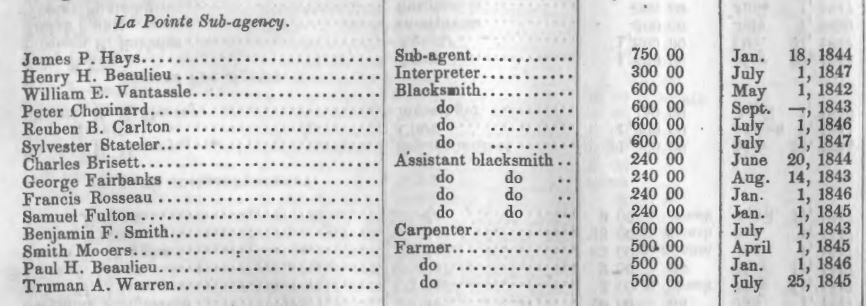
List of mid-late 1840s employees at the La Pointe Indian Sub-Agency including James P. Hayes and others.
~ Thirtieth Congress – First Session. Ex. Doc. No. 26. House of Representatives. Persons Employed In The Indian Department. Letter from The Secretary of War, Transmitting a statement of persons employed in the Indian Department. January 26, 1848.
June 22.
Jas. P. Hayes Esq. U. S. Sub Agt. recd his dismission & left in the Schooner Swallow– cause, Intemperance
July.
Fr. Boudrie arrived from Ontonagon with a cask of whiskied Cider– was prosecuted–a search warrant was issued & Peter Vandeventer was deputized to serve it. Van deventer After allowing abundant time for the service, Mr. Justice Bell & Van Tasell went to the building under search, & detected Van deventer in secreting a part of the cider. The whole was seized & destroyed by the owner–
Aug 28.
Propeller Independence arrived. Considerable intoxication among french & Half breeds.
“ 29
Schooner Napoleon, Clarke arrived with Govt provisions. Passengers Hyde, Wolcott & Martell
In discharging some bbls. of corn from the Propeller, on bbl. burst, & revealed a number of bottles of Liquor secreted among the Corn. The bbls were expressed back to the Sault. They have since been ascertained to belong have shipped by Martell of Sault St Maries. It was also reported by a passenger on the propeller, that the Napoleon was supposed to have on board a Bbl of Liquor belonging to Wolcott.
A number of Indians are reported to have had liquor about the time the Propeller left.
— An Indian was instigated by a Wht. man named Mills to murder two Americans living on Apple River–liquor was used in carry out Mills’s plans. The Ind was arrested & Hung, without judicial trial, at the Falls of St Croix.
— Majise shot killed in a drunken frolic on the St Croix. died next day–
— An old woman had her arm broken at the mouth of the Brule by a drunken son in law–Liquor furnished by Aug. Cadotte.
Sept 11.
Wood Smith & Vantassell Govt men, found 2 Kegs (about 12 [gal]) whiskey near the camp of Fr. Boudrie belonging to him, concealed in the ground–they immediately destroyed it.
6th
The sailboat Flying Indian arrived in the night of [Sunday] [day] last.
Sept 13.
Schooner Algonquin arrived from Sault St. Maries ~~~~~~~~~~~~~~~~~~~~~~~~~~~~~~~~~~~~~~~~~~~~~~~~~~~~~~~~~~~~~~~~~~~~~~~~~~~~~~~~~~~~~~~~~~~~~~~~~ Further information about the challenges of enforcing liquor laws at La Pointe can be found in the following:
“A real bona fide, unmitigated Irishman”
Reisen in Nordamerika: From Ontonagon to the mouth of the Bois-brule (Part 3)
1855 Inquest on the Body of Louis Gurnoe
1856 Inquest on the Body of Jerry Sullivan
~~~~~~~~~~~~~~~~~~~~~~~~~~~~~~~~~~~~~~~~~~~~~~~~~~~~~~~~~~~~~~~~~~~~~~~~~~~~~~~~~~~~~~~~~~~~~~~~~
Ely, Edmund Franklin, and Theresa M. Schenck. The Ojibwe Journals of Edmund F. Ely, 1833-1849. Lincoln: University of Nebraska, 2012. Print.
Folsom, William H. C., and E. E. Edwards. Fifty Years in the Northwest. St. Paul: Pioneer, 1888. Print.
Paap, Howard D. Red Cliff, Wisconsin: A History of an Ojibwe Community. St. Cloud, MN: North Star, 2013. Print.
Schenck, Theresa M. William W. Warren: The Life, Letters, and times of an Ojibwe Leader. Lincoln: University of Nebraska, 2007. Print.
Special thanks to Dr. Schenck for making this post possible.
Asaph Whittlesey Incidents: Number VII
March 27, 2023
Collected & edited by Amorin Mello
Originally published in the March 30, 1878, issue of The Ashland Press. Transcribed with permission from Ashland Narratives by K. Wallin and published in 2013 by Straddle Creek Co.
… continued from Number VI.
Early Recollections of Ashland: Number VII
by Asaph Whittlesey
—
I am now brought to the more difficult task of making suitable mention of those who were associated with me as original proprietors of the place, some of whom have already passed the bounds of time.
Charles Whittlesey whote about Martin Beaser working for the Algonquin Company of Detroit during 1845 in Two Months In The Copper Range:
“… Martin, a sailor just from the whaling grounds of the Northwest Coast …”
Martin Beaser, was a man of much more than ordinary ability. I am not informed as to his opportunities for education in early life, but judge that they were somewhat limited, while his individual experiences were wide spread. Nothing ever passed his notice, nor would he abandon a subject until he fully comprehended it. In form he was compact, and as he was capable of great endurance, no obstacle in his life seemed too great for him to surmount. A look at his extended library will itself evince his inclination for the best of literature. – When I first met him (in August, 1854,) I took him to be something like forty-two or forty-three years of age. I had often heard his name mentioned by my brother Charles, as having been associated with him during the season of 1846 in his geological explorations of the Lake region for the General Government in connection with Dr. Houghton, – but we had never met until in August, 1854. Mr. Beaser had been very successful in business during the “palmy days” of Ontonagon, and was abundantly able to meet the expense of opening the town site of Ashland.
I think Mrs. Beaser first made Ashland her home in 1856. On the 7th of June, 1855, there landed a large sized mackinaw at Ashland, (the boat being named Ashland,) containing the following persons:
~ Edwin Ellis Incidents: Part III
Martin Beaser, Captain and owner; G. L. Brunschweiler, civil engineer and draftsman, Charles Day, J. S. Norton, Jonas Whitney, a man by the name of Weiber and a Menominie Half Breed from Green Bay. This event was a signal for an onward movement, and during that season the town was greatly improved.
I think portions of the boat named may yet be seen near the base of Durfee’s Dock in Ashland. An amusing incident took place during this trip from Ontonagon which is deserving of notice. The boat, besides passengers, was heavily loaded with provisions, groceries, &c., so that the passengers were somewhat cramped for room. As the wind was fair the party kept under way all night long, reaching the mouth of Bad River about day break. Brunschweiler, who was a very passionate man, had passed the night in a very uncomfortable manner, on account of a box of saleratus taking up the room he needed for his comfort. He had evidently felt it as a very great annoyance to him the live-long night, and he could restrain himself no longer. He therefore, with an oath, pitches overboard the box of saleratus, and in doing so lost a very valuable meerschaum pipe belonging to himself, which created a roar of laughter from the party, Mr. Beaser himself joining therein. I will only add regarding our association with Mr. Beaser and his family, that we found them to be most excellent, and accommodating neighbors.

Detail of Ashland and Bay City from inset map on Plat of Prentice’s Addition to Ashland circa late 1850s or early 1860s.
~ Wisconsin Historical Society
Mr. Beaser was drowned in Ashland Bay November 4th, 1866, having evidently reached near the center of the bay before falling overboard. The wind was in the north east so that his boat landed a little south of Whittlesey’s landing at the head of the bay. – When the boat was found the sail was set and the boat contained the purchases he had made at Bayfield. Immediate search was made for his body, but it was not found until the following spring, when a Half Breed first discovered it near the mouth of Boyd’s Creek on the west side of the bay. The citizens of Bayfield gave the body a suitable burial, first at Bayfield, and subsequently it was removed to the Protestant burying ground on La Pointe Island.
Mr. Beaser was noted for his unusual good temper, and often indulged in practical jokes. At one time he was inquired of as to the provisions made for the poor in the town of Ashland. His answer was “we starve them out.”
BRIEF SKETCH OF THE LIFE OF GEORGE KILBOURN, JR.
While I lack much in his history to enable me to be as precise in my statements regarding him as I would like to be, I am, nevertheless, in a general way, fully acquainted with his entire history. Long before I was born, George Kilbourn, Senior, (father to the subject of this notice,) purchased a farm in my native town in Ohio, and here it was that George, Jr., first displayed his qualities as an axeman, evincing the grudge he steadfastly bore towards growing timber. Even before attaining his majority George, Jr., had cleared the principle portion of his father’s farm, and after his marriage he removed to Hudson, Ohio, where he purchased for himself a heavily timbered tract of 160 acres, the clearing of which afforded him the greatest comfort. Unfortunately he married very unhappily, and in due time his wife and children virtually drove him from his own home. I chanced to meet him something like two weeks previous to my leaving Ohio for this place, and informed him of the time I intended to stay, and bade him goodbye. But on my passing through Hudson on the cars for Cleveland as the appointed time, Mr. Kilbourn came on board the train and informed me he had decided to accompany me on my trip to Lake Superior, that he could not endure it to remain at home any longer. This was, in brief, his history up to the time of our leaving Ohio in 1854. – The Kilbourns are known as a long lived race, while the “old stocks” were all hard workers. George, Jr., (better known as Uncle George,) was not far from fifty-five years of age when he first came to this country. He died suddenly in July, 1870, while visiting a daughter then living at East Hartford, Michigan, being not far from seventy-one years of age. His father and mother lived together at Hudson, Ohio, quite a number of years after Uncle George left Ohio, and lived to pass something over seventy years together in married life.
~ Edwin Ellis Incidents: Part IV
Had it not been for Uncle George’s proclivity and skill in clearing land, the clearings in and about original Ashland would have been much more limited than they are now. I have often known him to chop all day long, and during bright nights he not unfrequently left his bed and put in from one third to one half of the night felling timber. He often requested me, in case I out-lived him, to bury a good axe and grind stone with him. He had also another peculiarity belonging strictly to himself and that was a ravenous appetite, and usually ate the most and worked the hardest during his sick days. At one time when he was boarding with Conrad Goeltz, he started out just at day break to get to his chopping, and as he passed through the dining room caught sight of extended preparations upon the table which had been specially arranged the evening previous for a party of six persons who had ordered their breakfast at an early hour, but without giving it a thought Uncle George placed himself outside of all there was in sight, and poor Conrad has not to this day forgotten how infernally mad he felt when he found out how he had been victimized. I will add further that Uncle George called this a lunch only, and was on hand for breakfast at the usual hour. We all regarded him as being a hardworking, conscientious and strictly honest man. The settlers, whites, half breeds or Indians all addressed him by the familiar title of Uncle George.
To be continued in Number VIII…
Edwin Ellis Incidents: Number VI
April 13, 2022
By Amorin Mello
Originally published in the August 11th, 1877, issue of The Ashland Press. Transcribed with permission from Ashland Narratives by K. Wallin and published in 2013 by Straddle Creek Co.
… continued from Number V.
EARLY RECOLLECTIONS OF ASHLAND
“OF WHICH I WAS A PART.”
Number VI

Edwin Ellis, M.D.
photograph from Magazine of Western History: Volume IX, No.1, page 20.
My Dear Press: – The history of the first attempt at dock building was told in a former chapter, and also the sudden disappearance of the dock one night in April, 1855.
The early settlers did not, upon their first arrival here, have any fair appreciation of the difficulties in the way of constructing docks, which should be able to resist the several forces to which they would be exposed, and which would certainly tend to their overthrow. They had not had, as this generation has, the advantage of years of observation of the force of ice as affected by winds, as floating in great fields and driven by wind and tide, nor of the great force arising from expansion. We now understand better what is the strength of these destructive forces. Some of us watched them with intense and eager anxiety for years; for no commercial town could be here built up without docks.
It may not be uninteresting to consider in a few words, the varying modes in which the heavy accumulation of ice, during our long winters, is got rid of in the spring, and navigation opened.
Some seasons the water in the bay seems to stand at the same level, not moving by winds or tides for many days in succession. The ice melts away under the rays of the sun and by the warmth of the south wind. It is a slow but gentle process. Any dock is safe in such a season. At other times there are sudden and great changes in the elevation of the surface of the ice or water, either from the force of wind on the open water in the outside lake, or from barometric pressure, or both combined, a great influx of water is driven under the ice into the bay. At that juncture the ice having been melted away near the shore all around the bay, the whole mass is lifted up several inches and held us on the top of a great wave. But the reflux of the water must soon occur – when this great field of ice moves down upon a heavy grade. Its speed will often be accelerated by a strong southwest wind. The force thus generated is well-nigh irresistible unless there be such a conformation of the shore as shall save the dock from its full effect, and such, fortunately, is the case with our shore.
Another force, also operating with great power and effect upon the first docks built here and from which they suffered severely, was the expansive power of ice, resulting from changes of temperature. The water in early winter freezes with level surface and is fast to both shores. But as the cold becomes more intense and the ice thickens, it also sensibly expands, and crowds with great power upon the shore. It is easy to perceive that docks fully exposed to this force would need to be very firmly bolted together, and covered with heavy loads, or they must be pushed over. Our docks were thus in the more exposed cribs, broken, and afterwards easily carried away by floating ice and waves. Our first docks having been carried away; though somewhat alarmed, we did not at once give up.

Martin Beaser
portrait from Magazine of Western History: Volume IX, No.1, page 24.
In December 1855, two docks were commenced, one called the Bay City Dock, near the sash factory – and the other at the foot of Main Street in Beaser’s Division of Ashland, in front of the present residence of James A. Wilson. This last was built by Mr. Beaser. His plan was to build cribs with flattened timber, fitted closely together so as to hold the clay with which they were filled as ballast, instead of rock, for rock could only be obtained at great cost. We had no steam tugs then, with which to tow scows, as at present. The cribs were carried out some five or six hundred feet and filled with clay. Stringers connected the cribs, over which poles were laid as a roadway.
The Bay City Dock was also built out into deep water with an L running east. The cribs near the shore were filled with rocks, but for want of time the outer cribs and the L were not filled before the spring break up. The cribs were, however, constructed with stringers and covered, and some two hundred cords of cord wood were piled upon the dock to prevent the moving of the cribs.
The ice in the bay had not moved, but was melted away and broken up for a few hundred feet from the shore. There was a great influx of water from the Lake, raising the whole body of the ice. In a short time there was a greater reflux of the water, and the vast field of ice was seen to be in motion. All eyes were watching the docks, nor was it needed to watch long. Mr. Beaser’s was the first to give way. The cribs did not seem to offer any resistance to the moving mass. The most of them were carried away in less time than it takes to describe it. Only a few cribs near the shore escaped.
Nor was the attack on Bay City Dock long delayed; steadily onward came the mass. And the outer portion was soon in ruins, and the great pile of wood was floating upon the water. The cribs forming the approach for about three hundred feet, being filled with rock were not carried away. Thus in one hour were swept away the labors of many months, and several thousand dollars. The sight was discouraging to men who had come here to make their homes, and whose all was involved in the ruins. The elements seemed in league against us. The next day the steamer Superior arrived and effected a landing upon the broken timbers of our dock. Capt. Jones was in command of her, who, together with his boat were soon to go down in death beneath the waters of the Great Lake.

1860 photograph of the steamer Lady Elgin from the Chicago History Museum and digitized by Ship-Wrecks.net
During the summer and fall of 1856 the Bay City Dock was repaired and extended further into the bay, and the cribs filled with rocks, and the steamer Lady Elgin made several landings alongside. But during the winter of 1856 and ’57 the expansive power of the ice, showing against the cribs pushed off the timbers at the water line of several of the outer cribs, which, at the opening of navigation in 1857, were carried away, leaving only sunken cribs. The dock was never rebuilt, as the financial storm of 1857 began already to lower upon us. The sunken cribs still remain, as has been proved by the exploration of Capts. Patrick and Davidson, in command of the tugs Eva Wadsworth and Agate.
The experience of the “new Ashland” have demonstrated that pile docks can be built so as successfully to resist all the opposing forces to which they are exposed. The result of all our experience seems to show that the best dock which can be built is the pile dock filled in between piles with logs or slabs, or what would be better to drive piles close together, capping them and filling in with rocks which will, beyond doubt, be done so soon as our Penoka iron mountains shall be worked. The time when, must depend upon an improved demand for iron.
To be continued in Number VII…
Asaph Whittlesey Incidents: Number VI
April 17, 2019
By Amorin Mello
Originally published in the March 23, 1878, issue of The Ashland Press. Transcribed with permission from Ashland Narratives by K. Wallin and published in 2013 by Straddle Creek Co.
… continued from Number V.
Early Recollections of Ashland: Number VI
by Asaph Whittlesey
—
During 1856 the steamers Lady Elgin, Illinois, and Superior landed freight and passengers upon a steamboat dock constructed at Bay City, now Ellis division of Ashland.
1860 photograph of the sidewheel steamer Lady Elgin.
~ Ship-Wrecks.net
Ashland’s first saloon was opened by James Whitney in June 1856, and during the same month the first store was opened by Martin Beaser, on the corner of block one hundred and one.
The patent to Ashland, issued by the United States, bears the date June 23rd, 1862.
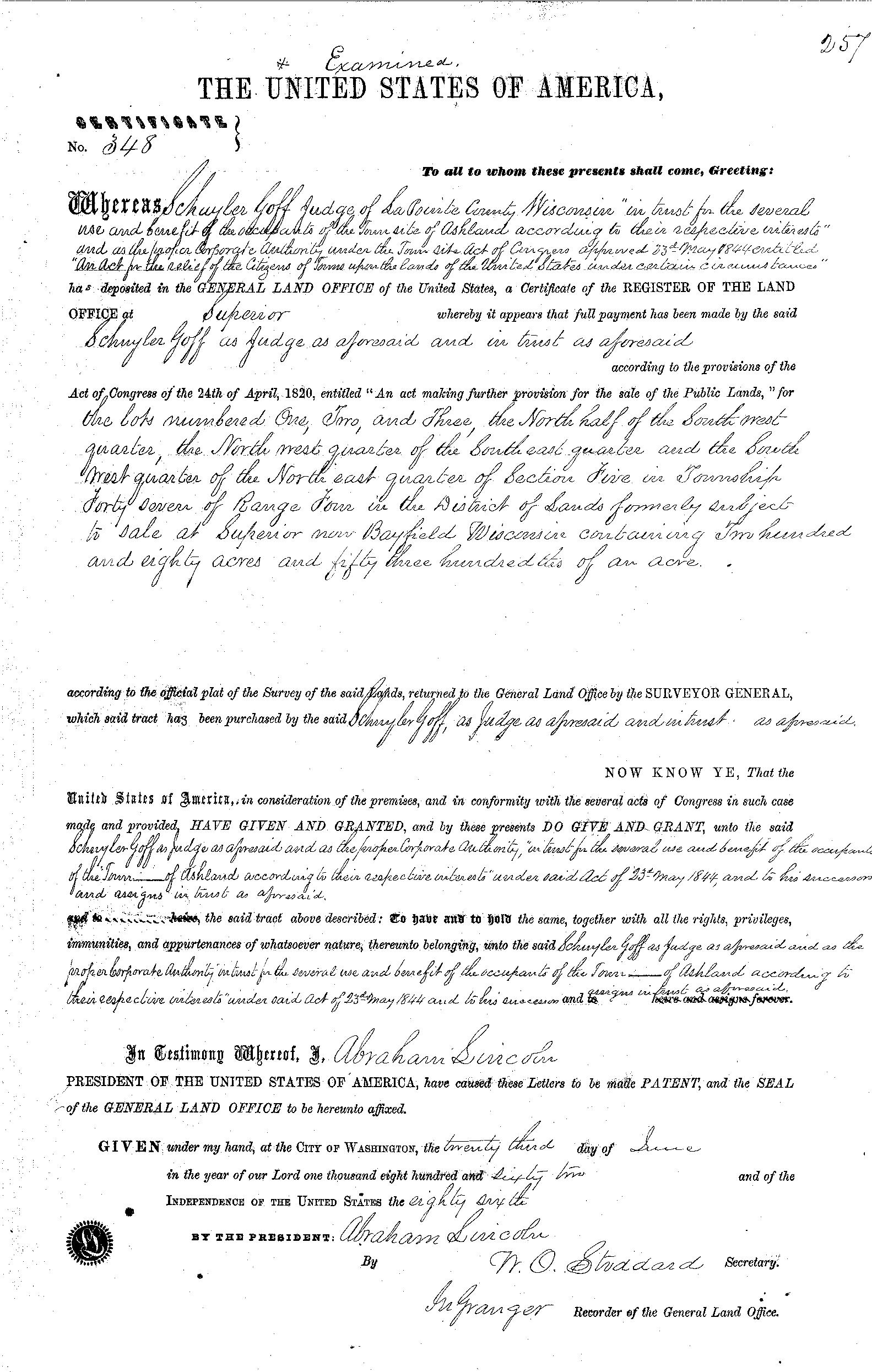
Land patent for the town site of Ashland issued by President Abraham Lincoln on June 23rd, 1862 to Schuyler Goff:
“The contract between the three was, that Mr. Whittlesey and Mr. Kilborn were to receive each an eighth interest in the land, while the residue was to go to Mr. Beaser. The patent for the land was issued to Schuyler Goff, as county Judge of La Pointe county, Wisconsin, who was the trustee for the three men, under the law then governing the location of town sites.”
~ Biographic sketch of Martin Beaser
OF THE OPENING OF ROADS IN THE EARLY DAYS OF ASHLAND.
In reporting upon this subject it is very possible that our town authorities of the present day may be put somewhat to the blush by the manner in which these and other like improvements were made. And I will guarantee the re-election of any Town Board, or other town officer who will carry out the program of former days for the opening of roads, which was simply this:
Whenever a road was needed such men as Edwin Elllis, Martin Beaser, George Kilbourn and myself, (I came near overlooking the latter,) and others who mainly volunteered their work, shouldered their axes and served in person until roads contemplated were completed. There was also this peculiarity attached to this class of individuals; they did not hang about the steps of the town house the balance of the year for the purpose of getting bills audited for work done upon the highways. It was in this manner that the road leading to Odanah and also that leading south to White River Falls were first opened. Even Indians partook of the same spirit in volunteering their labor, as Aid-de-camp to their Great Leader, Rev. L. H. Wheeler.
I have no doubt Dr. Ellis still bears in mind how the woods at Bear Trap were made to echo the yells of the Indians as they collided with the party from Ashland on the very day agreed upon, and I think I may safely say that the citizens of Odanah and of Ashland looked upon the opening of this road as a momentous event, and one which cemented us together even more firmly as friends and neighbors, though I have no doubt many of my readers will stand ready to declare that the foot race existed not very far back.
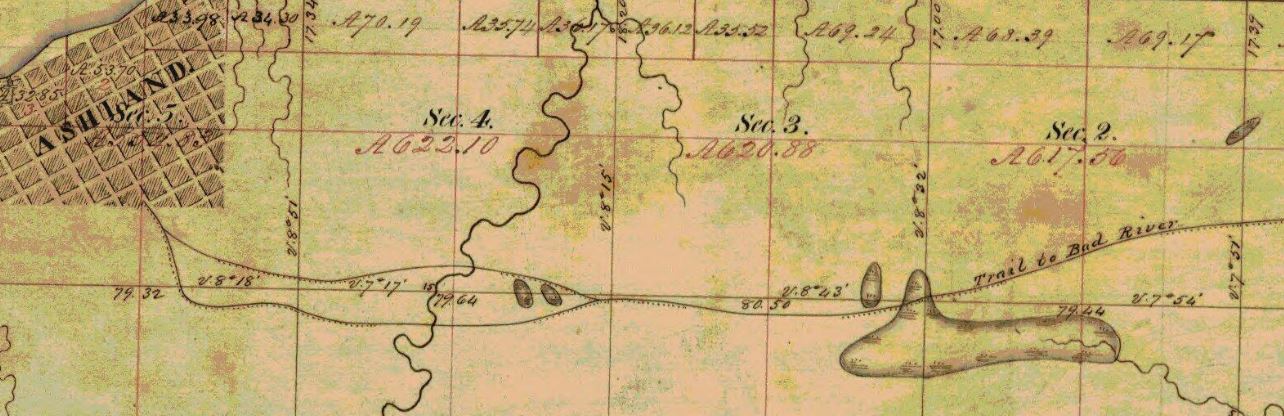
Detail of trail from Ashland to Bad River on Barbers’ survey during the Summer of 1855.
We wore good countenances, slept well nights, and paid one hundred cents on the dollar of our obligations. We were not ashamed to eat salt pork (those of us who could get it,) while our faithful wives vied with each other in the different styles of cooking this staple article of diet.
Next to this comes the everlasting pancake, without which neither town site nor pre-emptions could be legally established.
~ History of the Soo Line by James Lyden, chapter 9.
~ History of Northern Wisconsin by the Western Historical Company, 1881, page 82.
On the second day of June, 1877, I had the honor of driving the last spike, which took place at Chippewa Station, amid the shoutings of a large assemblage of people, including laborers upon the road, and in a few moments thereafter the first train from Milwaukee passed over the road on its way to Ashland, amid great rejoicing and demonstrations of joy over the victory won. At Ashland also the excitement became intense and though it was late on a Saturday evening on which our train reached the town, the illumination of the place brought to our view a field of faces, crazy with excitement over the event they were celebration. As for myself, I confess I felt very much like saying, “Now let thy servant depart in peace.” No longer were we to be informed of what was to be done, but we now knew it to be actually accomplished, and the Wisconsin Central Railroad remained a standing monument to the good name of Gardner Colby, Charles L. Colby and E. B. Phillips, all other efforts being secondary to that of these individuals. I have in my possession a map of this section of country, published by Charles C. Tucker in 1858, on which he laid down an imaginary line of railroad as being likely to be constructed from Madison via Portage and Stevens Point to Ashland, and strange to say it lays down the precise route of the Wisconsin Central Railroad, the very first to be constructed.
Having received by our last mail an important official statement from the Railroad Commissioner for the State of Wisconsin, I will insert the same here rather than to fail to have it published:
He says “the number of miles of railroad now constructed within the State of Wisconsin is two thousand six hundred and fifty-nine and 6-100, while there are seventy-one thousand seven hundred and fifty-nine miles of railroad now operated within the United States, with a capital and debt amounting to four billion six hundred and fifty-eight million two hundred and eight thousand six hundred and thirty dollars.”
STATISTICS IN GENERAL
In furnishing these I desire specially to acknowledge the obligation I am under to Mrs. James Wilson, for granting me access to early records of the place kept by Martin Beaser, Esq., though I find some discrepancies between his record and my own, which I think can be explained by the fact that he did not commence his record until some years after the first settlement of the place, and made it from memory along. For instance he says “the town site of Ashland was located by Martin Beaser, Asaph Whittlesey and George Kilbourn in August, 1854,” whereas Mr. Kilbourn and myself commenced the settlement of the town site July 5th, while Mr. Beaser first visited the place in August when he became an owner therein, the town site being from this time forward owned three fourths by Martin Beaser and one eighth each Kilbourn and Whittlesey.
Again Mr. Beaser’s record states that “the first house was built by Asaph Whittlesey in October, 1854, and was twenty by thirty feet square,” while the fact is I had erected two cabins upon the town site previous to the erection of this one and had lived in them.
Following cabin built by Kilbourn and Whittlesey, foundation laid July 5th, 1854, was twelve by fourteen feet square and was erected on lot number two in block one hundred and five. The foundation to the second cabin built was laid by Kilbourn and Whittlesey Sept. 9th 1854. This cabin was thirteen by fifteen feet square and was erected on lot five of block six. The outline of this building may still be traced. – The third house erected was that erected by Asaph Whittlesey on lot six in block six and was twenty by thirty feet square and this building constituted the residence of the Whittlesey family until the fall of 1857 when I removed to what is known as the Tompkins house on lots five and six in block three. I have in my possession very correct sketches of the first three cabins built, which I hope eventually to have lithographed for preservation. The fourth house was erected by Conrad Goeltz. The fifth house by Martin Beaser. The sixth house by Myron Tompkins. The seventh house by Lawrence Farley. The eighth house by Charles Malmet. The ninth house by Anthony Fisher. The tenth house by Frederick Bauman. Beyond this I am unable to give the order in which buildings were erected.
Conrad and Adam Goeltz first arrived at Ashland in March, 1855, and were employed by me in chopping and delivering cord wood upon the bay shore. As we were without a team we improvised one by harnessing these two Dutchmen and myself in the form of a spike team to a large sized hand-sled with which we banked twenty cords of wood per day.
P.S. – Adam had it twenty-two cords per day, but I think we had better throw off the two cords and try to save our reputation for veracity.
The first chickens brought into town were those brought by A. Whittlesey from Ohio in 1854.
John Beck butchered the first hogs in town, though he left a few which he did not butcher.
Martin Beaser brought the first yoke of oxen, and in 1855 raised about two hundred bushels of potatoes upon the town site. On the third of December, 1855, the schooner Algonquin landed at Ashland two hundred and twenty-five barrels of freight, seventy-five thousand feet of lumber and a yoke of oxen.
Ashland Bay froze over Dec. 7th, 1855. The two first steamboat docks were built during the winter of 1855-6, one by Martin Beaser at the foot of Main Street and one by the Bay City Company. These were carried away by the ice May 1st, 1856.
To be continued in Number VII…
Asaph Whittlesey Incidents: Number IV
April 11, 2017
By Amorin Mello
Originally published in the March 9th, 1878, issue of The Ashland Press. Transcribed with permission from Ashland Narratives by K. Wallin and published in 2013 by Straddle Creek Co.
… continued from Number III.
Early Recollections of Ashland: Number IV
by Asaph Whittlesey
In our last number we referred to “the most aristocratic house” with lumber floors, etc. Though it was the third cabin built upon the “town site,” it was in reality the first cabin built, designed as a permanent residence. The foundation logs of this house were laid Sept. 20th, 1854. The record made by Martin Beaser, (evidently made from recollection,) calls this the first building erected, (giving the size of it,) whereas we had lived in two buildings previous to the building of this one.

Rev. Leonard Hemenway Wheeler
~ In Unnamed Wisconsin by Silas Chapman, 1895, cover image.
The “Whittlesey Post Office” was kept therein from the date of its establishment, March 12th, 1855 to Nov. 1858. The first dancing done within the “town site” was in this house in Nov. 1854, and during the winter religious services were held therein by Rev. L. H. Wheeler, of the Odanah Mission. It was the birthplace of Delia Elizabeth, second daughter to Mr. And Mrs. Asaph Whittlesey, born May 21st, 1856, being the first American child born within the limits of the “town site.” The first celebration of the Fourth of July was held in this house July 4th, 1855, further reference to which will hereafter be made. The first general election of county officers in the county of Ashland, was held in this building Nov. 4th, 1856, at which time Samuel S. Vaughn received eleven votes for the office of County Clerk, and M. H. Mandelbaum receive twelve. Francis McElroy was elected District Attorney and Asaph Whittlesey County Judge. It was in this house that Robert D. Boyd was shot and instantly killed by Henry Cross, January 10th, 1858, for which a verdict of justifiable homicide was rendered at an inquest, held by Asaph Whittlesey, Justice of the Peace, acting as Coroner.
ARRIVAL OF THE SECOND FEMALE UPON THE TOWN SITE.
Mr. and Mrs. John P. T. Haskell, with their family, parents of Mrs. Whittlesey, made a landing at Ashland, Nov. 2nd, 1854, and made their home with us during the winter following. In the early spring they made a home of their own in a cabin located upon the site of the present residence of G. M. Willis, Esq., a little to the east of Vaughn’s Dock, in Vaughn’s addition to Ashland, which was originally known as Haskell’s pre-emption claim. Mr. Haskell and family remained in the country only a single year, when they returned to Illinois, where Mr. Haskell died in 1873. Mrs. Haskell is still living and is unusually active for one of her age.
I next call your attention to the
FIRST CELEBRATION OF THE 4TH OF JULY
upon the “town site” July 4th, 1855.
Under an understanding had between Mr. and Mrs. Austin Corser and Mr. And Mrs. John Corser, (then living at Fish Creek,) and being the owners of the only cows nearer than Odanah, an agreement was made whereby the Corsers were to furnish milk, while Mrs. Haskell and Mrs. Whittlesey, (then living in the log house still visible on lot 6, of block 6,) were to do the necessary cooking in the celebrated “mud oven” attached thereto, marvelous for its baking capacity and for the quality of its production.
On the day referred to, the Declaration of Independence was read by Asaph Whittlesey, and this with the delivery of an oration by A. W. Burt, with singing and amusements, constituted the first public celebration of the 4th of July in the history of Ashland. The exercises were had at Whittlesey’s house in the after part of the day, and extended late in the evening, when music and dancing were added to the festivities of the day. The ladies present were Mrs. Haskell, Mrs. Whittlesey, the two Mrs. Corsers and Mrs. Farley. The gentlemen present were J. P. T. Haskell, George Kilborn, Lawrence Farley, Austin and John Corser, Asaph Whittlsey, A. W. Burt, A. J. Barckley, Adam Goeltz, John Donaldson, Conrad Goeltz, Andrew Scobie, and Duncan Sinclaire. The children present were Eugenia E. Whittlesey, (less than three years old,) George, son of Mr. and Mrs. Austin Corser, also a child of Mr. and Mrs. John Corser and William, John Joseph and Hattie Haskell, children and Mr. and Mrs. J. P. T. Haskell.
I shall never forget Mrs. Haskell’s “classic step” on that occasion, discounting many of those present much younger than herself. At intervals during the night the party were very highly entertained with singing by Conrad and Adam Goeltz.
FIRST POST OFFICE ESTABLISHED AT ASHLAND, MARCH 12TH, 1855.
As there was no opportunity for doubt as to the rapid growth of the city the establishment of a Post Office was the result of our first raid upon the general government, though for nearly one year following no provision whatsoever was made for furnishing this office with mail service, and mails were received by chance from La Pointe up to the opening of semi-monthly service, upon a new route established between La Pointe via Ashland to Chippewa Falls, and was soon after, during the winter months, supplied with weekly service upon the route from Ontonagon, Mich., to Superior, Wis. On both of these routes the mails were carried by packers and upon dog teams.

Detail of La Pointe County from a map of Wisconsin published by J. H. Colton & Co., New York, 1856.
~ MapofUS.org
In the petition forwarded to Washington asking for the establishment of an office at Ashland, La Pointe county, Wisconsin, the request was made that it be given the name of Ashland, and that Asaph Whittlesey be appointed postmaster. The sequel showed that as there was an office by the name of Ashland within the State, it was not lawful to attach the name to this office and therefore the appointing officers at Washington attached the name of Whittlesey thereto, by which the office was known until July 30th, 1860, when the obstacle to change in the name being removed, it was then given the name of Ashland, and was also designated as being in Ashland County, Wisconsin. I well remember how difficult a task I found it to be to satisfactorily explain to them how the place could one day be known as Whittlesey, La Pointe county and the next as Ashland, Ashland county. But they soon admitted it rather than be longer afflicted with my letters upon the subject.
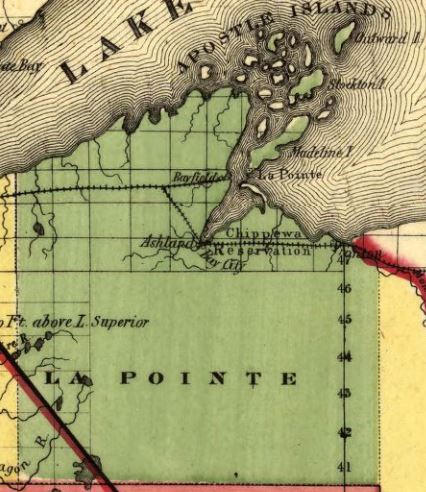
Detail of La Pointe County from a map of Wisconsin by The Milwaukee & Horicon Rail Road, 1857.
~ Library of Congress
The office of Whittlesey was kept in the cabin still in existence on lot 6 of block 6, “original Ashland,” until in Nov. 1857, when it was removed to lot 3 of block 3, into what was known as the Tomkins House, which then became the residence of myself and family until Nov. 1860. The case in which the books and papers connected with the office were kept, (which was made by myself,) is now in the “farm house” at “Pleasant Valley,” and will be delivered to any public organization in Ashland desiring to preserve the same. I continued to serve as postmaster until Nov. 21st, 1860, when I resigned the office and Andrew J. Barckley’s was appointed as my successor. Barckley’s term as postmaster expired Sept. 9th, 1861, by the appointment of Martin Beaser as successor in office to Barckley. Mr. Beaser served as postmaster until his death in Nov. 1866.
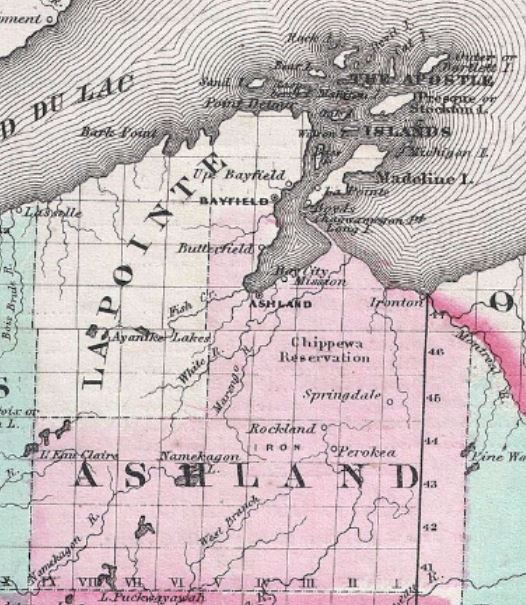
Detail of La Pointe and Ashland Counties from a map of Wisconsin and Michigan by A. J. Johnson and Ward, 1864.
~ Geographicus.org
The post office of Ashland was re-established Dec. 18th, 1871, and James A. Wilson, (the present incumbent,) being appointed postmaster.
The amount of post office money turned over to the Government by me at the close of my term of service was $8.53. My commissions upon this amount, together with the “franking privilege” vested upon postmasters, laid the foundation for my future fortunes, the balance was taken in waitings upon William Gotzenberg, who made daily inquiries for his mail, though he was aware that no mails were received oftener than once a week.
To be continued in Number V…
Edwin Ellis Incidents: Number III
April 9, 2017
By Amorin Mello
Originally published in the July 7th, 1877, issue of The Ashland Press. Transcribed with permission from Ashland Narratives by K. Wallin and published in 2013 by Straddle Creek Co.
… continued from Number II.
EARLY RECOLLECTIONS OF ASHLAND.
“OF WHICH I WAS A PART.”
Number III
Dear Press: – My last jottings brought us to the sweeping away of the first dock ever attempted in Ashland, April 1, 1855. Before relating any of the further attempts in the construction of docks, I will recall the names of some of the settlers who came here in 1855 to 1856.
1. George Kilbourn was then over fifty years old, from the Western Reserve, Ohio – a man of great energy and iron constitution, whose greatest joy was hard work, (and if we had a few hundred such men in our country now, who were not afraid to dive into our forests and open farms, the success of Ashland would soon be assured), and who was ever battling with the woods in this, his new home. No one man who ever came to Ashland ever did half as much as he did, with his own strong arm, to clear up our beautiful town site. His favorite spot is now occupied by the house built by Alex. Livingston, Esq. Ashland was “Uncle George’s” pet, and he loved it with an undying love, and when stricken down by death a few years since, he was on his way from Ohio to Ashland. He merits a monument, and his name should always be held in grateful remembrance.
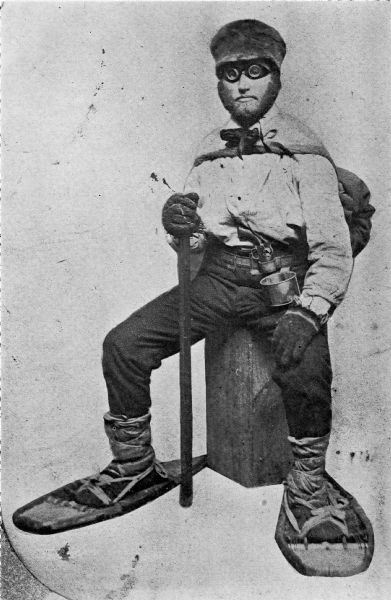
Asaph Whittlesey was Charles Whittlesey’s younger brother.
~ Wisconsin Historical Society
2. Asaph Whittlesey, then about thirty years of age, a native of Ohio, but who had for several years been engaged in business in Peoria, Ill., where the fruits of years of toil were swept away by fire in a single hour, was, in 1854, looking for a place to try anew his fortune. He belonged to one of the oldest and most respectable families of the Buckeye State – an energetic, lively, genial, whole-souled man, whom to know is to esteem. He was active in all the early years of Ashland; was its first Postmaster, (when the office bore his name) in compliment to his venerable uncle, the Hon. Elisha Whittlesey, for many years connected with the U.S. Treasury. And though he now resides at Bayfield, his interests are still largely in our town, and his pleasant face still occasionally gladdens our homes. In his present ill health he has our heartfelt sympathies. May he soon be well again and may his iter ad coctum be postponed yet many years.
~ The Eye of the North-west: First Annual Report of the Statistician of Superior, Wisconsin by Frank Abial Flower, 1890, page 251.
Mrs. Whittlesey, with her mother, Mrs. Haskell, were the first white women who passed the winter on this shore. Her house, though built of logs, was neat and comfortable, and was the resort of all new confers, where we were all made welcome; and the writer will always remember her singing of “The little tailor with the broadcloth under his arm,” and the dancing of her little Eugenia, a flaxen-haired girl of two year, but who, in later years, matured into a beautiful and accomplished woman, and happily settled in life, was, in 1874, called to the “sweet fields beyond the swelling flood.” Mrs. Whittlesey endured much privation, but she was brave and full of life. She is still spared to adorn and cheer her pleasant home at Bayfield.
Her father, Mr. Haskell, who passed the first winter in Mr. Whittlesey’s family, died a few years ago, but Mrs. Haskell still lives in green old age, and in 1875 re-visited the scenes of her pioneer life.
Martin Beaser
~ Western Reserve Historical Society
3. Martin Beaser, though he did not bring his family to Ashland till 1856, he is entitled, nevertheless, to be ranked among the very first settlers of Ashland, for he had chosen this for his home in 1854; had aided by his means and counsel, Messrs. Whittlesey and Kilbourn, and came from Ontonagon several times during the year 1855 to assist in carrying out their plans. He employed and brought with him early in 1855, Dr. Brunschweiler, a Civil Engineer, who surveyed and platted the first site on this bay, which is now known as “Old Ashland” or “Beaser’s Division of Ashland.” Brunschweiler River, twelve miles from Ashland, perpetuates his name.
Mr. Beaser was a native of the State of New York, who, in early life, had passed several years on a whaler in the Pacific Ocean and being an acute observer of men and things, had accumulated a vast amount of useful and entertaining knowledge. He was familiar with the ports of Central and South American and our Northwest coast, not ours then, for the Star Spangled Banner then floated only over a narrow strip of land near the mouth of the Columbia River.
The vast stretch of coast now embraced in the State of California was then Mexican territory and the Russian Bear was the emblem of power extending over forty degrees of longitude and from the fifty-fifth to the seventy-second degree of latitude, or more than eleven hundred miles, from south to north, and sixteen hundred miles from east to west. By the diplomacy of Mr. Seward and the payment of seven million dollars in gold, the vast extent of coast came under our flag.
No one could listen to Mr. Beaser’s recital of what he saw and heard on the Pacific coast without being entertained, and receiving much useful knowledge.
Mr. Beaser came to Ontonagon about 30 years ago, soon after the discovery of copper in that country. Very few settlers had preceded him there; but for several years, from 1858, they came in rapidly.
But here were no regular lines of boats as at present from Lake Erie and Michigan. All the supplies for the population must be brought by water a thousand miles. They were brought to the Sault and transferred across the portage, re-loaded on vessels and distributed to the infant settlements along the coast. As a result of the scanty and uncertain means of conveyance, the early northern winter often found the settlers without their winter’s supply of flour, pork and groceries. They must be brought to Ontonagon from Copper Harbor or Eagle River in open boats, which in the late fall and early winter was a work of hardship and danger. Mr. Beaser’s skill and bravery as a sailor was more than once instrumental in saving Ontonagon from starvation and want.
In the fall of 1856, Mr. Beaser brought his family to Ashland. Here he was closely identified with all enterprises calculated to aid in the opening up of this country. He had accumulated a competence at Ontonagon which he here freely expended.
He was a man of sound discretion and great good common sense, and was one of Ashland’s most useful citizens. Through discouragements and long deferred hope he persevered; while nearly all the rest of us were compelled to retreat. His hope seemed never to forsake him and like the heroes of the Cumberland who went down with their colors flying, he stuck to Ashland in its hours of greatest depression and finally found his grave in the waters of our Bay – while attempting to come from Bayfield to Ashland in an open boat alone during a severe storm in November, 1866. He rests on the Island of La Pointe, but the home of his life should be the home of his mortal remains and I doubt not they will be transferred hither at an early day.
To be continued in Number IV…
Edwin Ellis Incidents: Number I
February 11, 2017
By Amorin Mello
Originally published in the June 16th, 1877, issue of The Ashland Press. Transcribed with permission from Ashland Narratives by K. Wallin and published in 2013 by Straddle Creek Co.
EARLY RECOLLECTIONS OF ASHLAND.
“OF WHICH I WAS A PART.”

Edwin Ellis, M.D.
~ Western Reserve Historical Society
My Dear Press:– In these joyous days of Ashland’s history, when we are all made glad by the completion of that great enterprise – the Wisconsin Central Railroad – when from banishment and isolation from the populous portion of our State and from the great world we in one day are brought in close contact with and feel the throbbings of the pulse of commercial and social life, it may be of interest to some to recall a few incidents of the early history of our town and its vicinity.
The years 1853 to 1857 were noted in the West for adventure and enterprise in pushing into new regions and laying out and building new towns.
Land Office Fraud;
Barber Papers Prologue;
Part VI of Sketch of Vincent Roy Jr.
In 1853 the site of Superior City had been pre-empted and in 1854, laid out into regular lots and blocks, and the work of a new city begun. The site had attracted the attention and capital of some of our ablest men. It was backed by stronger political influences than ever combined to lay the foundations of any town in the west. Among its proprietors were many leading members of Congress and of the Cabinet, especially from the South. The most sanguine expectations of its future greatness were entertained, for it commanded a scope of country as great as that paying tribute to Chicago. Its lots were sold at fabulous prices. It was in 1855 and 1856 – probably the most talked of town in the Union.
The temporary success of Superior kindled a blaze of speculation, which spread far and wide in Wisconsin, Minnesota and Michigan.
Some of the founders of Superior at the map, saw stretching away to the South-west from the Apostles’ Islands, a deep bay, extending far inland, as if reaching forth to reach the tide of commerce flowing northward from the Gulf and the Atlantic.
This was our Chegomegon or Long Island Bay. The report of Foster and Whitney also told of mountains of iron ore, which must find its way into the channels of commerce, by the waters of this bay. An important town, it was thought, must spring up near its head.
Martin Beaser
~ Western Reserve Historical Society
While plans were maturing for the occupation of this site, we learned that another party had been attracted by the same considerations that moved us, and that Martin Beaser, Asaph Whittlesy, and Geo. Kilbourn had entered upon and claimed about three hundred acres under the townsite law. The land had not yet been surveyed, and of course could not be entered or pre-empted. The two latter gentlemen were on the spot, having arrived in the summer of 1854. But we were not deterred by these anticipations of our plans.
Early in February, 1855, Edwin Ellis, as the representative of several enterprising capitalists of St. Paul, left the latter city with one companion, Cyrus A. Rollins, to examine the situation and site, and if thought advisable and practicable, to make a lodgement there. The writer was then in full prime and vigor of early manhood, and full of ambition and bright expectations. The way from St. Paul was through an unbroken wilderness. The Lake Superior & Mississippi Railroad had not been conceived. In truth, no railroad had then approached within three hundred miles of the great Lake. The present city of Duluth in its visions of the near future – the Damascus between the Atlantic and Pacific – the halting place of the North Pacific caravan, bringing to New York and London, the wealth of India, and China and Japan, and the Islands of the South sea – was then only occupied by the wild Indian.
Emmet Jefferson, who subsequently pre-empted the site of Duluth, was one of our party from St. Paul; but for many years he had slept in his last sleep. Three or four other adventurers were with us and though it was cold and the way hard, we were a wild and joyous party of young men, going forth to seek our fortunes,– not doubtful of success.
At Superior we first saw the Great Lake. Half a dozen houses – a store or two and the beginnings of a hotel, comprised all of that rival to Chicago.
Among our acquaintances formed there, of which there were several pleasant ones, were Capt. Markland, a soldier of the Mexican war, a lawyer by profession, a man of culture, courteous in manner and stately in his bearing;– Washington Ashton, the pioneer publisher of Superior, and Colonel Carleton, who had been for several years a resident at Fond du Lac, and whose name is perpetuated by the name of a county in Minnesota. All of them have been long years dead.
Having rested a day and bade adieu to our traveling companions, already dear to us as the sharers of our toils, we turned our faces towards the east. We were fortunate in securing as a pilot on our untried voyage, Baptiste Gauden – mail carrier between Superior and La Pointe. Here we first saw a dog train, which relieved us of our packs; and at night Baptiste assisted in pitching our camp, “a day’s march nearer home.” He “still lives,” and devotes much of his time to the service of the Roman Catholic Church, of which he is an obedient and devoted son.

George Riley Stuntz had a settlement and sawmill near the mouth of the Iron River, 1852.
~ General Land Office Records

Detail of foot trails in the Sioux River Valley, 1855.
~ General Land Office Records
Leaving Superior late in the forenoon, we arrived at Iron River, twenty miles away; where we were happy to find shelter in a logging camp, full of robust, hearty, whole-souled men, some of whom had come from cultivated homes in the east. By some means strange to most of that company, the traveling pilgrim discovered a brother of the mystic tie, with whom he passed a pleasant evening, thankful for that fraternal bond, which makes strangers friends and brothers at sight.
Leaving Iron River the next morning, two days march brought us to La Pointe via the valley of the Sioux river, passing through the wilderness then, which is now the cultivated vale, made classic by being the dwelling place of the “Sage of Avoca;” the peer in farming to the immortal Horace, who has earned his title to the peerage by “causing two blades of grass to grow, where but one grew before he came,” and of him we may say:
Remote from cities lived a swain,
Unvexed with all the cares of gain;
His head is silvered o’er with age,
And long experience makes him Sage.

Antoine Gordon
~ Noble Lives of a Noble Race by the St. Mary’s Industrial School (Odanah), page 207.
At La Pointe the first object to meet our profane view were numerous large wooded crosses ten to fifteen feet high, in different parts of the town, erected by the pious zeal of the faithful believers in the then new dogma of “Immaculate Conception.” We saw also an imposing procession of French mixed bloods, escorting a fat, good natured looking priest through the street, under a gaudy canophy, borne by four devout servants of the Church. This also was in honor of the same dogma.
We put up for the night at the only hotel of the place, kept by Antoine Gauden, whose aged father, that very night, amid the chanting and prayers of the virgin saints of La Pointe, passed into the presence of the Eternal. La Pointe at that time was of much greater importance than at present – the most important town on the Lake west of Ontonagon. It was the annual gathering place of several thousand Indians, who then received their annual payments. It was the center of the fish trade for all this part of the Lake. It had, also, quite an extensive fur trade.
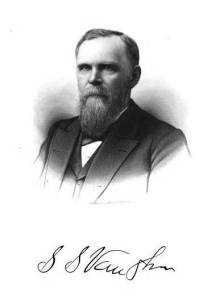
Samuel Stuart Vaughn
~ Western Reserve Historical Society
Julius Austrian had an extensive store of general merchandise and transacted a large business. Hon. S.S. Vaughn, one of Ashland’s present most substantial citizens, was then a young merchant at La pointe, where by close attention to business, he was laying the foundation of the fortune he has since achieved. Wm. E. Vantassel, Government Blacksmith for the Indians, a descendant of an old Knickerbocker family was there – a very skillful workman and a very genial man. In old age he now resides near Stillwater, Minnesota. Francis McElroy was also there, full of life and energy. And last but not least, I must mention John W. Bell, Esq, who even then had lived on the Island more than twenty years, and whose recollections carried him back till he could almost hear the war whoop of the Sioux and Chippewas as the latter drove their old enemies forever away from the land of the Ojibwas. He has for many years been the “Patriach” of the Island, and is much esteemed by his neighbors.

Frederick Prentice
~ History of the Maumee Valley by Horace S Knapp, 1872, pages 560-562.
Resting one night, on the following day we started across the bay on snow-shoes, reaching the shore near the Kaukaugon river. We followed the coast west, and at nightfall we found tracks leading up the ravine, a few rods from where the railroad track now touches the water of the bay. We found here a log house, built by Lusk, Prentice & Co., for purposes of trade and with the plan for the occupation of the site. Here we passed our first night. The ruins of the shanty may be seen on the block now occupied by the residence of Ferinand Schupp. Adolphus Bart, the clerk of the company, was in charge and made us welcome with his good cheer. He is now a lawyer in the State of New York.
To be continued in Number II…
Ashland, Wisconsin: Its Early Days
November 29, 2016
By Amorin Mello

Magazine of Western History Illustrated
November 1888
as republished in
Magazine of Western History: Volume IX, No. 1, pages 12-17.
—
ASHLAND, WISCONSIN:
ITS EARLY AND PRESENT DAYS.
—
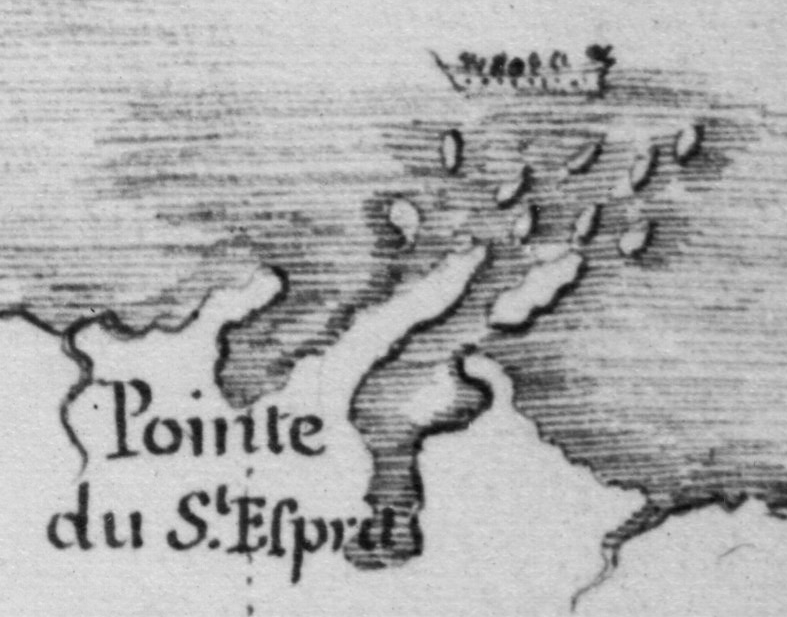
Detail of Lapointe du Saint Espirit and Mission du Saint Espirit from Claude Allouez Map of New France, 1669.
~ Research Laboratories of Archaeology
If the reader will look at the map of the United States, he will see on its northern boundary the largest body of fresh water in the world – Lake Superior, called by the Ojibways Kitche Gumi, “The Big Water.” It lies between 46 and 47 degrees north latitude, and stretches east and west through eight degrees of longitude. Its coast-line is nearly two thousand miles in extent, forming some of the finest natural harbors in the world. Its surface is six hundred and thirty feet above the ocean level, while its bottom in the deepest parts is four hundred feet below the level of the tide-waters. As you come from the east end of the lake, St. Mary’s river, approaching its western extremity, you will, from the deck of the steamer, notice a group of beautiful islands – the same islands which, more than two hundred years ago, met the gaze of Fathers Marquette, Allouez and Mesnard, and which, in their religious zeal, they named the “Apostles’ Islands,” thinking that in number they corresponded with the number of our Savior’s disciples. One of these they named “Madeline,” from a favorite saint of their own “Belle France,” and to commemorate one of the most noted churches of Paris.

Detail of “The 12 Apostles” from Captain Jonathan Carver’s journal of his travels with maps and drawings, 1766.
~ Boston Public Library
These islands in ancient times were doubtless a part of the main, as was also the land now lying under Ashland bay. Underlying them was sandstone, rising from twenty to one hundred feet above the water, and horizontal. The great glaciers coming from the north, and moving in a southwest direction, cut channels in the sandstone, forming these islands, and scooping out of the solid rock the large basin which, in after years, received the name of Chaquamegon bay, and which is now known as Ashland bay. This was the first prophecy of the city of Ashland. In the times, millions of years before this, the vast deposits of iron ore had been upheaved and stored along the south shore of the lake, to subserve the designs of the Mighty Builder in the development of that commerce of which we now see but the earliest down, and of whose future extent we can form but a faint comprehension. Chaquamegon, Le Anse and Marquette bays are the natural outlets on Lake Superior for the rich mineral deposits which line its southern shore.
The formation of Ashland bay was therefore not accidental, but in harmony with Eternal plans. It is protected from the storms of the lake by a long, low, sandy point, and also by the Apostles’ islands. Into it open from the lake three broad channels, with a depth of water ample for the largest vessels, called the North, Middle and South channels. Under these islands, vessels coming from the wild storms of the open lake are secure. It is the sailor’s haven of safety.

1834 Map of LaPointe by Lyman Warren for the American Fur Company.
~ Wisconsin Historical Society
The first settlement on the bay was made by the American Fur company in the early part of the present century, on the beautiful Madeline island, and named La Pointe. It continued for many years the headquarters of a flourishing fur and fishing trade. About 1830 a Protestant and, soon after, a Catholic mission were established there, and churches built by them, in which devoted missionaries labored to Christianize and civilize the Indians whose homes were here and in the surrounding country. Here toiled Rev. Sherman Hall, a missionary of the American board, and Rev. L. H. Wheeler, and also that devoted man, now known to us as Bishop Baraga. These have all passed away. La Pointe, then the most populous and active village on the lake, is now, alas, “The deserted village,” and is visited alone in veneration of its past memories.

Map inset of Chequamegon Bay with Houghton, LaPointe, Bayfield, Ashland, and Bay City.
~ Wisconsin Historical Society
On the west shore of the bay, opposite La Pointe, is the beautiful town of Bayfield, founded by Honorable Henry. M. Rice in 1856. It is the terminus of the C., St. P., M. & O. railroad and the headquarters of a flourishing fish and lumber trade, and one of the most charming summer resorts on the lake.
On the west shore of the bay is also the flourishing town of Washburn – named in honor of Wisconsin’s governor, Cadwallader C. Washburn. It is the favorite town of the Omaha railroad, and has several large saw-mills, and is an active and enterprising town.
Asaph Whittlesey circa 1860.
~ Wisconsin Historical Society
The first settlement on the spot where Ashland now stands was made, in 1854, by Asaph Whittlesey and George Kilborn, both natives of the Western Reserve, Ohio. The lands were not as yet surveyed, so that they could not preëmpt them, and there was as yet no Homestead law. For this reason they, with Martin Beaser, then living in Ontonagon, Michigan, laid claim, under the “Town Site” law, to about three hundred acres, embracing their log houses and small clearing. They platted this into town lots in 1855, and subsequently were allowed to enter their lands as claimed, and in due course received their title. In February, 1855, Edwin Ellis, a graduate in medicine, in the University of the City of New York, of the class of 1846, came on foot through the woods from St. Paul to the bay. He had been engaged in the practice of his profession in his native state – Maine – till 1854, when, attracted by the prospect of wider fields for enterprise in the new west, and by the advice of Judge D. A. J. Baker, his brother-in-law, then living in St. Paul, he came to Minnesota.

Edwin Ellis, M.D.
~ Commemorative Biographical Record of the Upper Lake Region by J.H. Beers & Co., 1905, pages 16-18.
The years 1853 to 1857 were years of wild speculation. The states of Wisconsin and Minnesota especially were covered with rising cities – at least on paper. Fabulous stories of rich silver, copper and iron mines on the south shore of Lake Superior attracted a multitude of active young men from the eastern states. The city of Superior had been laid out, and its lots were selling for fabulous prices. The penniless young man of to-day became the millionaire to-morrow. The consequent excitement was great, and in the event demoralizing.
The Bay of Ashland, stretching far in-land, the known vast deposits of iron near the Penokee Gap, whose natural route to market was evidently by Chaquamegon bay, indicated with moral certainty that at its head would rise a commercial mart which should command a wide extent of country. The vast forests of pine were then hardly thought of, and no efforts made to obtain them. The lands were unsurveyed, and all the “squatters” were, in the eye of the law, trespassers. Nevertheless, the new-comers ran “spotted” lines around their claims and built log-cabins to hold them, and began to clear up the land. In June, 1855, Dr. Ellis went on foot to St. Paul, and thence to Dubuque, Iowa, and secured from the surveyor-general an order to survey four townships about the bay, embracing the site of the present city of Ashland. In the meantime, many settlers had come in and preëmpted lands in the neighborhood. In the fall of 1855 many of them were enabled to prove up and get titles to their lands.
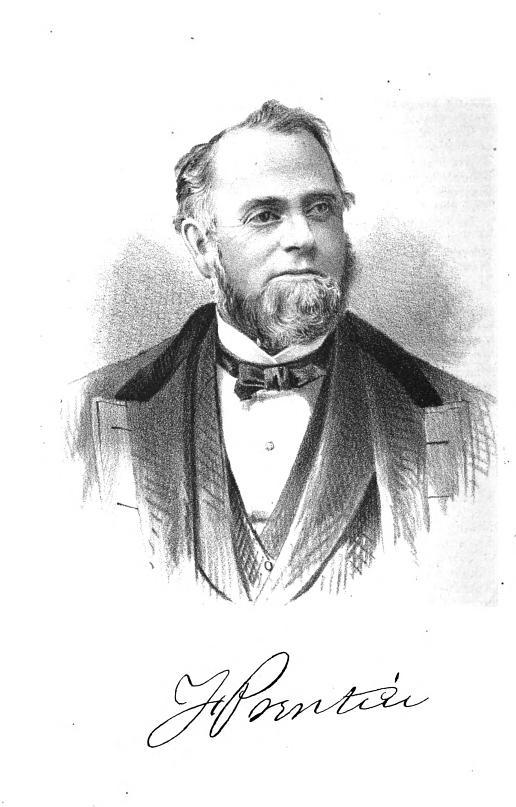
Portrait and biography of Frederick Prentice; the “first white child born in … Toledo.”
~ History of the Maumee Valley by Horace S Knapp, 1872, pages 560-562.
In the winter of 1855 Lusk, Prentice & Company, who had a trading-post within the present limits of Ellis’ division of Ashland, built a dock for the accommodation of the settlers coming to the new town. It was built of cribs, made of round logs sunk in the water about twenty feet apart. From one crib to another were stringers, made of logs, flattened on the upper surface, all covered with small logs to make a roadway. On the docks were piled several hundred cords of wood for the purpose of “holding” the dock from floating away, and to be sold in the summer to the steamboats which should come to bring supplies and begin the commerce of the town. The evening of the second day of April, 1855, saw the bay full of ice, slightly detached for a few feet from the shore, but with no sign of an immediate opening of navigation.
Portrait of Martin Beaser on page 24.
The next morning no ice was in sight, nor a vestige of the dock to be seen. Floating timber and cord-wood covered the bay. Till then the settlers had no idea the power of the floating ice moved by the tide of the bay. But they were not discouraged. The following winter two other docks were constructed – one by Martin Beaser, at the foot of what is now called “Beaser Avenue,” and the other by Edwin Ellis, near where Seyler’s foundry now stands.
These were also crib-docks, but the effort was made to anchor the cribs. There were no rocks to be had on the side of the bay where the docks were built, for which reason Mr. Beaser filled his cribs with clay, dug out of the banks. Dr. Ellis hauled stone across the bay, and filled as many of his cribs as possible, and on the top of the dock also piled several hundred cords of wood, and the settlers with anxious faces watched the departure of the ice. The shock came, and the docks afforded little resistance. The cribs filled with clay were easily carried. Those filled with stone stood better, but that part of those above water, and near the outer end, were swept away. The labors of many weary days and much money was thus swept away. There was, however, enough of the Ellis dock left to afford a landing to the few boats that came with supplies for the people.

Survey of Frederick Prentice‘s Addition of Ashland near the Gichi-wiikwedong village.
“It is in this addition, that, the Chippewa River and the St. Croix Indian trails reach the Bay, and for the purpose of accomodating the trade, already flowing in on their routes, a commodious store has just been built”
~ Wisconsin Historical Society
Translates as “Big Bay” in Ojibwemowin.
Traditional place-name for Ashland, WI.
Anglicized version of Gichi-wiikwedong.
Prentice Park and Maslowski Beach.
Area is famous for artesian wells.
“This was all Indian land then, but [Asaph] Whittlesey believed in take time for the forelock, looking he said, for a place that ‘might prove to be the most available point for a town, at or near Equadon (pronounced E Quay don, the second syllable emphasized.) The word ‘Equadon,’ is the Chippewa word meaning ‘settlement near the head of the bay.'”
~ The Ashland Daily Press, July 6, 1933, by Guy M. Burnham, reproduced on TurtleTrack.org. Read the full article for an interesting stories about how the town-site for Ashland was allegedly negotiated between Reverend Wheeler and Little Current.
During the years 1855, ’56 and ’57 many settlers had come to Ashland and built homes, and were all young men full of bright hopes for the future. In the spring of 1856 a township organization was formed, embracing more than forty townships of six miles square, and was called Bayport. The usual township officers were elected. The year 1857 opened with bright prospects. In Ashland streets were cleared and several frame houses were built. A steam saw-mill was begun and brought near completion. But in September of that year the great financial storm came, involving the whole country in ruin. The little village of Ashland was overwhelmed. The people had but little money, and in making their improvements had contracted debts which they could not at once pay. There had been so such speculation that the settlers had paid but little attention to the cultivation of the soil, depending upon supplies brought by water a thousand miles. We had no wagon roads nor railroads within three hundred miles. Winter was coming on, and many of the settlers – in truth, all who could get away – left the place. The few who remained saw hard times, whose memory is not pleasant to recall. Some of them, in making improvements, had assumed liabilities which well-nigh ruined them. If the county had then been organized for judicial purposes, so that judgements and execution could have been easily obtained, scarcely anyone would have saved a dollar from the wreck. But this fortunate circumstance gave them time, and their debts were finally paid, and they had their land left; but it then was without value in the market. Town lots in the village, which are now selling for five thousand to six thousand dollars, could then be sold for enough to buy a barrel of flour. The years following “’57” were hard years, and the settlers, one by one, moved away, so that in 1862 only two remained – Martin Beaser and Martin Roehn. In 1866 Mr. Beaser undertook to come alone from Bayfield to Ashland in an open sail-boat. It was a stormy day, and he never reached home. His boat was found soon afterwards at the head of the bay, and his body was found the following spring on the beach on the west side of the bay. Ashland was now left desolate and alone. Mr. Roehn, with a few cows, migrated backward and forward between Ashland and the Marengo river, finding hay and pasture for his cows, selling his produce and butter at Bayfield and La Pointe, and thus eked out an existence. The first railroad to reach Ashland was the Wisconsin Central, completed in 1877, connecting Ashland with Milwaukee. Work at the Ashland end was begun in 1872, and in 1873 finished to Penokee, twenty-nine miles south from Ashland. It had been built from the south to within about eighty-five miles of Ashland, and then came the panic of 1873, and all work stopped. The building in 1872 in Ashland was quite extensive, and village property sold at good prices, and everybody was hopeful. But the crisis of 1873 coming on, all enterprises at once stopped. Not till 1877 was the railroad completed. Its completion established Ashland on a substantial basis. In 1877 the Wisconsin Central company completed the Chaquamegon hotel, one of the finest in the country, which has added greatly to the attractions of Ashland.
The building of the Chicago, St. Paul, Minneapolis & Omaha road to this place, in 1883, gave a short outlet to the west and southwest, greatly benefiting the lumber trade.
The Northern Pacific, whose eastern terminus is at Ashland, soon after completed, gave it new importance as in the direct line of transcontinental commerce.
But the advent of the Milwaukee, Lake Shore & Western railroad had done more, perhaps to stimulate the growth of Ashland than any one of its great enterprises.
It runs northerly from Milwaukee to Manitowoc, where, turning in northwesterly course, it traverses vast tracts of valuable timber and farming lands, running for fifty miles along the Gogebic range – the richest iron region in the world.
This company has built two large and costly ore docks for the shipment of the vast amount of iron ore which it brings over its road.
South From Ashland
“The promoters decided to make Ashland the north end of their iron. It was a mere clearing, in the woods in 1870, formerly known as Equadon which was founded in 1854 and abandoned in 1863. The Ashland site was located on the bank of a splendid natural harbor called Cheguamegon Bay.”
…
“The clearing, grubbing and grading of the 30-mile Ashland-Penokee Gap Division had been practically complete in 1872. The iron rails were not laid into the Gap until October 1873, and there the railroad stopped for 4 long years.”
…
“Penokee Gap, 1000 feet above Lake Superior, is a break in the rough country, a regular gap where the Bad River breaks through the Iron Range Hills on its way to Lake Superior. The Gap is an historic pathway through which the copper workers from Mexico and South America came to Lake Superior centuries ago enroute to the copper deposits on Isle Royal in Lake Superior.”
~ History of the Soo Line, by James Lyden.
The Wisconsin Central Railroad company has also built a very fine ore dock, over which it ships the iron brought from the same range by its own line – the “Penokee Railroad” – built easterly along the northern base of the Gogebic range to Bessemer, in Michigan.
Notwithstanding the depression in the iron trade, more than a million tons of ore will be shipped from Ashland the present season.
Ashland has also two coal docks – one operated by the Ohio Coal company and the other by the Columbus & Hocking Valley Coal company – both of whom are doing a large business. The Lake Shore railroad and the Wisconsin Central obtain their coal for their engines, on the northern two hundred miles, by their docks at Ashland. The same rates for coal going west prevail as from Duluth and Washburn, and a large trade is springing up over the Omaha & Northern Pacific lines.
Ashland has three National and one private bank, all of which are conservative and carefully managed. It has also a street railway, two miles in length, with six fine cars and about forty horses, and is rendering very satisfactory service. We have also a “Gas and Electric Light Plant,” which affords abundant light for the streets, stores, dwellings and the ore docks. Ashland has also the Holly system of water-works, with about two miles of pipe laid, affording ample protection against fire and an abundant supply of water for domestic purposes. The pump-house has two ponderous engines, one being kept in reserve in case of accident.
As a point for the distribution of manufactured goods of all kinds, Ashland stands among the foremost. With practically the same rates as by the roads leading from Duluth west, it is prepared to compete with that lively town for part of the trade of the great northwest – now in its infancy but destined soon to attain great proportions; whose beginnings we can measure, but whose vast results we cannot now comprehend.
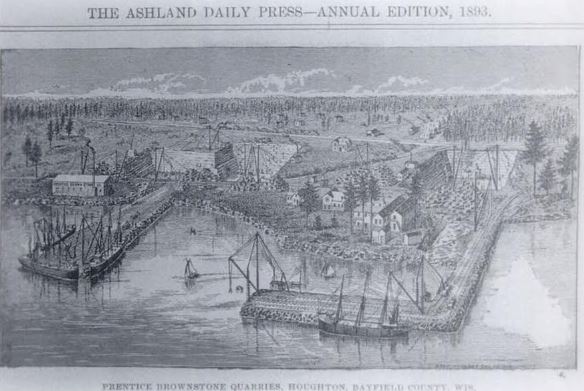
Portrait of Prentice’s brownstone quarries at Houghton Point.
~ Ashland Daily Press, circa 1893.
A Great Brownstone Industry Established At Houghton Point.
What Frederick Prentice Has Accomplished During The Season.“
~ Ashland Daily Press article in the Washburn Itemizer, October 18, 1888, reproduced on BattleAxCamp.tripod.com
One industry on Ashland bay is the brown stone, which exists along the water’s edge for many miles on the shore of the mainland and on the islands. It can be quarried in inexhaustible quantities within a few hundred feet of navigable waters of Lake Superior. It is of fine texture and beautiful color, and hardens by exposure. Large quantities have already been shipped and the demand is rapidly increasing. It can be shipped by rail at about four dollars per ton to Cincinnati. This stone, used for trimmings in buildings built of white brick, makes a very beautiful appearance.
The vast quantities of pine and hardwood timber in the vicinity of Ashland, and its advantages as a point of distribution for manufactured articles in wood, render it one of the best locations for manufacturing industries. For tanneries its location is unrivaled; the supply of hemlock bark is ample, while hides can be cheaply brought from Minnesota and the northwest, and the products can be shipped in all directions at low rates.
The schools of Ashland afford the best of opportunities for the education of our youth. Our school buildings are large, new and commodious, with all modern improvements. Our schools are graded and the attendance is large.
In the churches, most denominations are represented. The Catholic is the finest church edifice in the city, built of our own brown stone at a cost of over thirty thousand dollars. There are Presbyterian, Congregational, Episcopal, Baptist, Methodist, Lutheran and several Scandinavian churches.
As a summer resort, Ashland and the Apostles’ islands afford unrivaled attractions. Sail-boats, tugs and steamboats make daily excursions in all directions. They busy men from Chicago, St. Louis, St. Paul, Cincinnati and other cities can, in one day, escape from the sweltering heat and sleep on the cool ore of Lake Superior, and with our lines of railroad and telegraph stretching in all directons, they can be in constant and instant communication with their counting-rooms a thousand miles away. Its advantages in this line are already drawing many persons of wealth and leisure, as well as invalids, who come here to spend the hot season and at the close of the summer return home with new health and vigor.
Portrait of Edwin Ellis, M.D. on page 20.
Ashland has just two daily and three weekly newspapers, models of enterprise and very newsy, contributing much to the prosperity of the city.
The population of Ashland is about fifteen thousand, composed principally of persons under thirty-five years of age, and full of push and activity, who have come to stay and built up fortunes.
With all these and many other advantages Ashland seems to have a bright future, and many of us think it bids fair, in the near future, to become the second city in the state of Wisconsin. And we will labor that she shall be worthy of her rank.
EDWIN ELLIS.
Martin Beaser
August 9, 2016
By Amorin Mello
Magazine of Western History Illustrated
November 1888
as republished in
Magazine of Western History: Volume IX, No.1, pages 24-27.
Martin Beaser.
Portrait of Martin Beaser on page 24.
On the fifth day of July 1854, Asaph Whittlesey and George Kilborn left La Pointe, in a row-boat, with the design of finding a “town site” on some available point near the “head of the bay.” At five o’clock P.M. of the same day they landed at the westerly limit of the present town site of Ashland. As Mr. Whittlesey stepped ashore, Mr. Kilborn exclaimed, “Here is the place for a big city!” and handing his companion an axe, he added, “I want you to have the honor of cutting the first tree in a way of a settlement upon the town site.” And the tree thus felled formed one of the foundation logs in the first building in the place. Such is the statement which has found its way into print as to the beginning of Ashland. But the same account adds: “Many new-comers arrived during the first few years after the settlement; among them Martin Beaser, who located permanently in Ashland in 1856, and was one of its founders.”1 How this was will soon be explained.
The father of the subject of this sketch, John Baptiste Beaser, was a native of Switzerland, educated as a priest, but never took orders. He came to America, reaching Philadelphia about the year 1812, where he married Margaret McLeod. They then moved to Buffalo, in one of the suburbs of which, called Williamsville, their son Martin was born, on the twenty-seventh of October, 1822. The boy received his early education in the common schools of the place, when, at the age of fourteen, he went on a whaling voyage, sailing from New Bedford, Massachusetts. His voyage lasted four years; his second voyage, three years; the last of which was made in the whaleship Rosseau, which is still afloat, the oldest of its class in America.
The young man went out as boat-steerer on his second voyage, returning as third mate. During his leisure time on shipboard and the interval between the two voyages, he spent in studying the science of navigation, which he successfully mastered. On his return from his fourth years’ cruise in the Pacific and Indian oceans, he was offered the position of second mate on a new ship then nearing completion and which would be ready to sail in about sixty days. He accepted the offer. They would notify him when the ship was ready, and he would in the meantime visit his mother, then a widow, residing in Buffalo. Accordingly, after an absence of seven years, he returned to his native city, spending the time in renewing old acquaintances and relating the varied experience of a whaler’s life. He had rare conversational powers, holding his listeners spell-bound at the recital of some thrilling adventure. A journal kept by him during his voyages and now in the possession of his family, abounds in hair-breadth escapes from savages on the shores of some of the South sea islands and the perils of whale-fishing, of which he had many narrow escapes. The time passed quickly, and he anxiously awaited the summons to join his ship. Leaving the city for a day the expected letter came, but was carefully concealed by his mother until after the ship had sailed, thus entirely changing the future of his life.
“… Martin, a sailor just from the whaling grounds of the Northwest Coast …”
Disappointed in his aspirations to command a ship in the near future, as he had reasons to hope from the rapid promotions he had already received – from a boy before the mast to mate of a ship in two voyages – and yielding to his mother’s wish not to leave home again, he engaged in sailing on Lake Erie from Buffalo to Detroit until 1847, when he went in the interest of a company in the latter city to Lake Superior for the purpose of exploring the copper ranges in the northern peninsula of Michigan. He coasted from Sault Ste. Marie to Ontonagon in a bateau. Remaining in the employ of the company about a year, he then engaged in a general forwarding and commission business for himself.
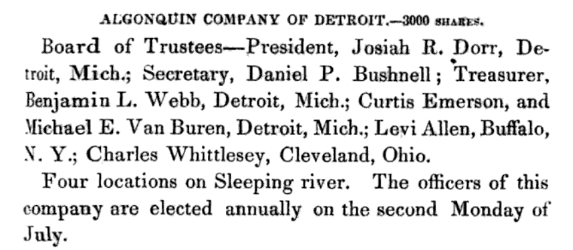
“Algonquin Company of Detroit.”
~ Reports of Wm. A. Burt and Bela Hubbard, by T. W. Bristol, 1846, page 97.
~ A History of the Northern Peninsula of Michigan and Its People: Volume 1, by Alvah Littlefield Sawyer, 1911, page 222.
Mr. Beaser was largely identified with the early mining interests of Ontonagon county, being instrumental in opening up and developing some of the best mines in that district.
In 1848 he was married in Cattaraugus county, New York, in the town of Perrysburgh, to Laura Antionette Bebee. The husband and wife the next spring went west, going to Ontonagon by way of Detroit. The trip from buffalo lasted from the first day of May to the sixth of June, they being detained at the “Soo” two weeks on account of the changing of the schooner Napoleon into a propeller, in which vessel, after a voyage of six days, they reached Ontonagon.
Here Mr. Beaser resided for seven years in the same business of forwarding and commission, furnishing frequently powder and candles to the miners by the ton. He was a portion of the this time associated with Thomas B. Hanna, formerly of Ohio. They then sold out their interest – Mr. Beaser going in company with Augustus Coburn and Edward Sayles to Superior, at the head of the lake, taking a small boat with them and Indian guides. Thus equipped they explored the region of Duluth, going up the Brule and St. Louis rivers. They then returned to La Pointe, going up Chaquamegon bay; and having their attention called to the site of what is now Ashland, on account of what seemed to be its favorable geographical position. As there had been some talk of the feasibility of connecting the Mississippi river and Lake Superior by a ship canal, it was suggested to them that this point would be a good one for its eastern terminus. Another circumstance which struck them was the contiguity of the Penokee iron range. This was in 1853. The company then returned to Ontonagon.
Closing up his business at the latter place, Mr. Beaser decided to return to the bay of Chaquamegon to look up and locate the town site on its southern shore. In the summer of 1854, on arriving there, he found Mr. Whittlesey and Mr. Kilborn on the ground. He then made arrangement with them by which he (Mr. Beaser) was to enter the land, which he did at Superior, where the land office was then located for that section. The contract between the three was, that Mr. Whittlesey and Mr. Kilborn were to receive each an eighth interest in the land, while the residue was to go to Mr. Beaser. The patent for the land was issued to Schuyler Goff, as county Judge of La Pointe county, Wisconsin, who was the trustee for the three men, under the law then governing the location of town sites.
La Pointe County Judge Schuyler Goff was issued this patent for 280.53 acres on June 23rd, 1862, on behalf of Martin Beaser, Asaph Whittlesey, and George Kilburn.
~ General Land Office Records
Mr. Beaser afterwards got his deed from the judge to his three-quarters’ interest in the site.

Beaser named Ashland in honor of the Henry Clay Estate in Kentucky.
~ National Park Service
In January, 1854, Mr. Beaser having previously engaged a topographical engineer, G.L. Brunschweiler, the two, with a dog train and two Indians, made the journey from Ontonagon to the proposed town site, where Mr. Brunschweiler surveyed and platted2 a town on the land of the men before spoken of as parties in interest, to which town Mr. Beaser gave the name of Ashland. These three men, therefore, were the founders of Ashland, although afterwards various additions were made to it.
Mr. Beaser did not bring his family to Ashland until the eighth of September, 1856. He engaged in the mercantile business there until the war broke out, and was drowned in the bay while attempting to come from Bayfield to Ashland in an open boat, during a storm, on the fourth of November, 1866. He was buried on Madeline island at La Pointe. He was “closely identified with enterprises tending to open up the country; was wealthy and expended freely; was a man of fine discretion and good, common sense.” He was never discouraged as to Ashland’s future prosperity.
The children of Mr. Beaser, three in number, are all living: Margaret Elizabeth, wife of James A. Croser of Menominee, Michigan; Percy McLeod, now of Ashland; and Harry Hamlin, also of Ashland, residing with his mother, now Mrs. Wilson, an intelligent and very estimable lady.
1 See ‘History of Northern Wisconsin,’ p. 67.
2 The date of the platting of Ashland by Brunschweiler is taken from the original plat in the possession of the recorder of Ashland county, Wisconsin.
 Chequamegon History