Asaph Whittlesey Incidents: Number VIII
April 20, 2023
Collected & edited by Amorin Mello

Originally published in the April 6, 1878, issue of The Ashland Press. Transcribed with permission from Ashland Narratives by K. Wallin and published in 2013 by Straddle Creek Co.
… continued from Number VII.
Early Recollections of Ashland: Number VIII
by Asaph Whittlesey
We now offer a few comments upon our experience in common, and our appreciation of Doctor Edwin Ellis. I observe first that the inherent modesty of the man left him with next to no thought of himself in his “Early Recollections of Ashland,” and therefore the weightier of the task falling upon me. Had the question been raised “who is Dr. Ellis?” a proper reply would have been “Dr. Ellis is Dr. Ellis.”
In all my acquaintance I find no person more clearly identified than is this man. His manner of shaking hands, the music of his voice, and his unconscious habit of setting his hair on end, belong to no one but the man Edwin Ellis. For near a quarter of a century have I known him in the relationship of neighbor, physician, oarsman, farmer, speculator, preacher, merchant and as one skilled in back gammon, and can testify that he is a man who does with his might whatsoever his hands find to do. Those of us who were known as pre-emptors or town site claimants had occasion to regard the arrival of Dr. Ellis with no little suspicion, as certainly an emergency only would have induced him to make the trip from La Pointe during the most inclement season of the year. I remember well my anxiety to know whether or not he was a married man, and so direct were my inquiries as to this, that seemingly there was no way left but for him to satisfy our curiosity by simply saying yes or no. However we soon discovered that we were only wasting words in pressing the subject, and abandoned all further inquiry regarding it. Is it not strange that so good a man and one possessing so admirable a wife should be found so unwilling to satisfy our inquisitive minds in regard to this matter?
There was still another peculiarity noticeable in the Doctor, and that was his proclivity for secret organizations. He was chosen Chairman of a secret organization having for its object protection to pre-emptors from having their claims jumped, though one writer informs us that in the eye of the law they were all trespassers, – but by this means those holding claims felt a security in being absent from them the greater portion of their time. Perhaps the existence of this organization may explain why there has been so many little acres of early clearings discovered by brother Pratt, in the vicinity of Ashland.
Again, Dr. Ellis is one who thinks for himself, but is ever free to weigh the arguments of others, that he may be convinced of the right, and having formed his conclusion is outspoken, so that no one can mistake his position. Being of a hopeful and cheerful turn of mind, his company is courted. All in all whether as to his fitness for the life of a pioneer or as a neighbor and Christian friend I never knew a better.
I have been with him also in times of very great peril, when seemingly we were destined to a watery grave. But through presence of mind and well directed effort we succeeded in reaching the shore amid a feeling of profound gratitude toward our Great Protector above, for sparing our lives. As it is my intention hereafter to refer briefly to the history of a few of the ladies who first settled in and about Ashland. I will omit any special reference to Mrs. Ellis at this time.
HON. SAMUEL S. VAUGHN
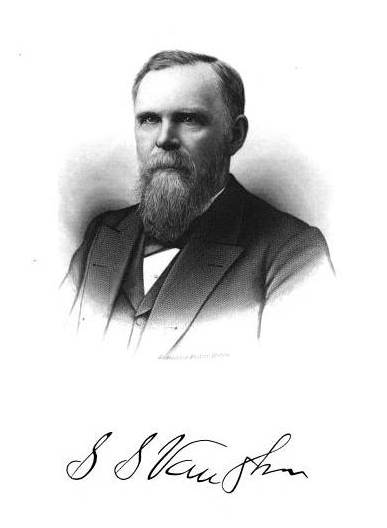
First arrived at La Pointe in 1852. At the time of my arrival there in 1854, I found him running a one horse store in an old frame building, standing in the sand near the present residence of George A. Stahl. So far as I am enabled to bring to mind the succession of events, my first sight of this man was at his own store where I invested in a very poor pocket compass, and this I soon after deposited on the copper range while upon an exploring trip with Ervin Leihy, Esq. Mr. Vaughn, however, claims that he first caught sight of me on the occasion of my aiding Rev. L. H. Wheeler in a social talk with the La Pointe people upon the subject of temperance one Sunday afternoon, in the store of Julias Austrian, Esq.

Reverend
Leonard H Wheeler
The leading man then engaged in the grocery business, as it was called, was one Peter B. Vanderventer, who subsequently left the country at a midnight hour rather than remain and meet a worse doom. Vanderventer was a large sized man and more a hellish countenance, and in exhibition of his bravery at the temperance meeting to which I have referred, he planted himself directly in front of me, and not more than three feet distant, so that I presume he did not mistake my language.

I cannot let slip the opportunity now furnished for informing the public of what seemed to me a rather severe practical joke inflicted upon Vaughn and Vanderventer, as it is too good to be lost, we will mention it right here. It seems that at the time Mr. Austrian made so extended entries of land upon the island, Messrs. Vaughn and Vanderventer discovered that Austrian had failed to enter a fraction shown upon the official plot, as reaching quite a distance into the bay, from what was known as Boyd’s Point and containing some forty acres or more. As La Pointe seemed likely to hold prominence as a business place, they saw the necessity of forthwith securing the tract of land in question. The two therefore suddenly disappeared amid the coldest days of a Lake Superior winter, and footed it under very adverse circumstances through to Willow River, something like one hundred and seventy-five miles, and returned, but yet were quite satisfied to know that they had secured to themselves what they had started for. From this time forward for several years these gentlemen paid their taxes promptly, until they finally employed a surveyor to re-survey and plot their promising possessions. Right here is where they discovered the point of the joke, by being informed that there was not a single foot of their land left, but all and much more had been washed away. Perhaps it was cruel in me to do so, but I could not resist making frequent inquiries as to their real estate.

Section 6 from 1852 GLO PLSS survey of T49N-R3W-4PM showing Boyds Point (now Grants Point) on Madeline Island.
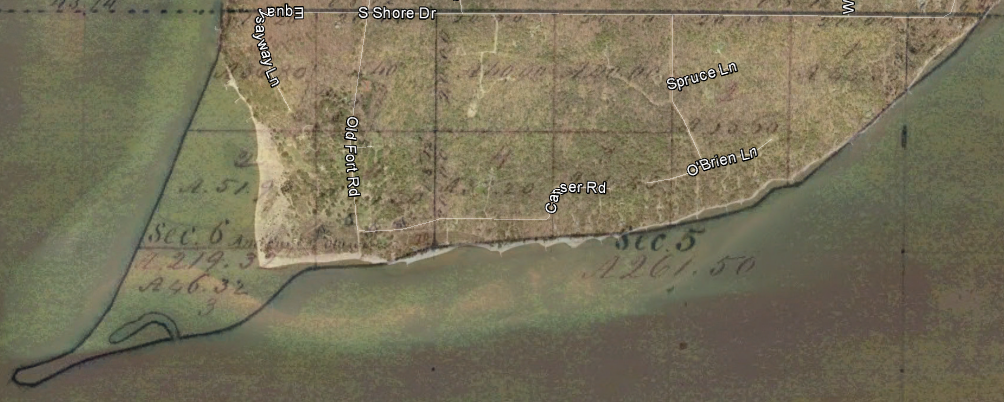
Modern aerial imagery overlay showing Vanderventer & Vaughn’s Lot 3 lost to the sands of time (along with parts of Boyd & Rowley’s Lots 1 & 2).
In 1855 Vaughn removed his stock of goods to a building near where Thomas Stahl, Esq., now resides, where I often shared his bed and board, and it remains a pleasure to me to this day to testify to his qualities as a No. one cook, while biscuits of his make were entitled to special mention. It was a standing rule with him to have a controversy of words with Mr. McElroy, neither being specially noted for the refinement of their language. I think it was during the August term of the Circuit Court in 1860 that Mr. Vaughn and Andrew Tate were admitted to the practice of law before the Hon. S.N. Fuller, Judge of the Eighth Circuit of Wisconsin. It is said that they passed a very creditable examination.
This was the first term of Circuit Court held in the County of La Pointe, Elisha Pike being honored as foreman of the first grand jury convened within the county. Although Mr. Vaughn is but forty-eight years of age he can boast of having held the following positions of trust: Post-master, Justice of the Peace, Chairman of Town and County Boards, also member of the Wisconsin legislature in 1871, (having a constituency of 6,365 souls). In the practice of law his maiden effort was that of procuring papers of divorce in a somewhat renowned case. It is thought that but for the public trust which he held as a Chairman of the School Board he probably would never have known married life, – but as it was so foreordained they accepted the situation, while the people shouted, Amen!
On the arrival of business at Ashland in 1873, Mr. Vaughn removed his family to that place where he once more engaged as trader and forwarding and commission merchant.
To be continued in Number IX…
Edwin Ellis, M.D.
August 7, 2016
By Amorin Mello

Magazine of Western History Illustrated
November 1888
as republished in
Magazine of Western History: Volume IX, No.1, pages 21-24.
Edwin Ellis.

Portrait of Edwin Ellis, M.D. on page 20.
The subject of this sketch is a native of New England, and one of the “Oxford Bears,” having been in Peru, Oxford county, Maine, in 1824. His birthplace was on the banks of the Androscoggin river, among the mountains, a wild, romantic place. His ancestors came early from England to the Massachusetts colony, about the middle of the seventeenth century.
His maternal grandfather was in the Revolutionary army, and to the end of a long life was intensely patriotic and American in all his acts and thoughts. He bought one hundred and sixty acres of government land at the close of the War of the Revolution, on which he lived for more than seventy years, until his death. It still remains in the family. There were no roads in his neighborhood; and at first he was obliged to carry his corn and wheat to mill, for more than thirty miles, upon his shoulders and by a “spotted line.” He lived to break the ground for a railroad to his town and to see its completion.
Dr. Ellis received his early education in the New England common school, whose term was not more than three months in the year. At the age of fourteen years he began the study of Latin at home, going for occasional recitations to one of the celebrated Abbot family, who was a farmer in the town, some four miles distant. He was inclined to study the law, but his mother, who was a most conscientious woman, thought an honest lawyer could not live by his calling, often repeating to him this couplet –
“If I turn lawyer, I must lie and cheat,
For honest lawyers have no bread to eat.”
This had some influence upon him, and he chose the profession of medicine. He entered Waterville college (now Cobly university) in 1842, pursuing its first year’s course, when he began the study of medicine, teaching school in winter to raise money enough to pay his expenses, in which he was cheerfully assisted by his father to the extent of his means, which were very limited, he being a house carpenter and receiving the usual wages of those days of one dollar to one dollar and fifty cents per day.
Edwin Ellis graduated in medicine at the University of the city of New York, in March, 1846, being nearly twenty-two years of age. He at first settled at North New Portland, Maine. It was a frontier town, and the roads in such condition that he was obliged to travel on horseback, going sometimes forty miles in the night.
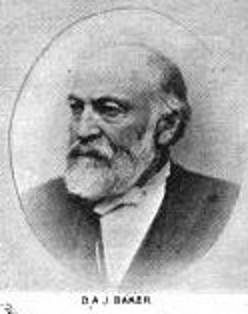
Brother-in-law Daniel A. J. Baker
~ The Eye of the North-west, pg. 9.
At the end of a year he settled in Farmington, Maine, where he had studied his profession, where, in 1847, he was married to Sophia S. Davis, who lived less than two years, leaving a daughter, Sophia Augusta, who married George H. Kennedy, who now lives at Ashland.
Dr. Ellis married Martha B. Baker of New Sharon, Maine, in 1850, a woman who has been a faithful and efficient wife for almost forty years. By her he has three children – Domelia, married to George C. Loranger of Calumet, Michigan; Edwin H., bookkeeper in the First National Bank of Ashland, and J. Scott, engaged in wood and coal at Ashland.
Dr. Ellis continued the practice of his profession in Maine, till 1854, with an increasing practice and fair prospects.
~ Minnesota Historical Society Collections: Volume XV, page 832.
But the west was then attracting much attention and the tide of emigration flowing with a strong current. His wife’s brother, Judge Baker of St. Paul, and been for several years in St. Paul, and his representations and inducements led him to sever his pleasant relations with the east and try his fortunes in the west. He with his family, wife and two children, reached St. Paul early in May, 1854. That year he carried on a farm where Merriam park now is, but he was not at home in this business, and abandoned it in the fall of that year.
The years 1852 to 1857 were years of great speculation throughout the northwest. Towns and cities, at least on paper, were springing up with marvelous rapidity. Men became, or seemed to become, suddenly rich by the rapid rise of farming lands and city lots. It was an era of strange speculation, demoralizing in its effects and leading to the terrible panic of 1857.
!["In 1845 [Warren Lewis] was appointed Register of the United States Land Office at Dubuque. In 1853 he was appointed by President Pierce Surveyor-General for Iowa, Wisconsin and Minnesota and at the expiration of his term was reappointed by President Buchanan." ~ The Iowa Legislature](https://chequamegonhistory.com/wp-content/uploads/2015/10/warner-lewis.jpg)
“In 1845 [Warren Lewis] was appointed Register of the United States Land Office at Dubuque. In 1853 he was appointed by President Pierce Surveyor-General for Iowa, Wisconsin and Minnesota and at the expiration of his term was reappointed by President Buchanan.”
~ The Iowa Legislature

Ellis was issued his title to 125.72 acres of land in Ashland on July 15th, 1858.
~ General Land Office Records

Downtown in Saint Paul during the financial panic of 1857.
~ Minnesota Historical Society
Leonard Hemenway Wheeler
~ Unnamed Wisconsin, by John Nelson Davidson, 1895.
In 1877 he was appointed as county judge of Ashland county, by Governor Smith, to which he has been twice re-elected by his fellow-citizens. He is president of the First National Bank of Ashland. He has retired from the general practice of his profession, but is one of the surgeons of St. Joseph’s hospital, which he visits an hour each day. He is still active and deeply interested in all that concerns Ashland; has aided in securing the Holly system of water-works, the gas and electric works and the street railway. He is a firm believer in the Christian religion and in a personal God, whose guiding hand he recognizes in all the events of his life, and to whom he owes everything and to whom he desires to honor in all his journey of life, and is still alive to all efforts designed to improve and elevate the condition of his fellow-men.

Edwin Ellis, M.D., died in Ashland on May 3rd, 1903. This portrait and a posthumous biography of Dr. Ellis are available on pages 16-18 of Commemorative Biographical Record of the Upper Lake Region by J.H. Beers & Co., 1905.
 Chequamegon History