Asaph Whittlesey Incidents: Number IV
April 11, 2017
By Amorin Mello

Originally published in the March 9th, 1878, issue of The Ashland Press. Transcribed with permission from Ashland Narratives by K. Wallin and published in 2013 by Straddle Creek Co.
… continued from Number III.
Early Recollections of Ashland: Number IV
by Asaph Whittlesey
In our last number we referred to “the most aristocratic house” with lumber floors, etc. Though it was the third cabin built upon the “town site,” it was in reality the first cabin built, designed as a permanent residence. The foundation logs of this house were laid Sept. 20th, 1854. The record made by Martin Beaser, (evidently made from recollection,) calls this the first building erected, (giving the size of it,) whereas we had lived in two buildings previous to the building of this one.

Rev. Leonard Hemenway Wheeler
~ In Unnamed Wisconsin by Silas Chapman, 1895, cover image.
The “Whittlesey Post Office” was kept therein from the date of its establishment, March 12th, 1855 to Nov. 1858. The first dancing done within the “town site” was in this house in Nov. 1854, and during the winter religious services were held therein by Rev. L. H. Wheeler, of the Odanah Mission. It was the birthplace of Delia Elizabeth, second daughter to Mr. And Mrs. Asaph Whittlesey, born May 21st, 1856, being the first American child born within the limits of the “town site.” The first celebration of the Fourth of July was held in this house July 4th, 1855, further reference to which will hereafter be made. The first general election of county officers in the county of Ashland, was held in this building Nov. 4th, 1856, at which time Samuel S. Vaughn received eleven votes for the office of County Clerk, and M. H. Mandelbaum receive twelve. Francis McElroy was elected District Attorney and Asaph Whittlesey County Judge. It was in this house that Robert D. Boyd was shot and instantly killed by Henry Cross, January 10th, 1858, for which a verdict of justifiable homicide was rendered at an inquest, held by Asaph Whittlesey, Justice of the Peace, acting as Coroner.
ARRIVAL OF THE SECOND FEMALE UPON THE TOWN SITE.
Mr. and Mrs. John P. T. Haskell, with their family, parents of Mrs. Whittlesey, made a landing at Ashland, Nov. 2nd, 1854, and made their home with us during the winter following. In the early spring they made a home of their own in a cabin located upon the site of the present residence of G. M. Willis, Esq., a little to the east of Vaughn’s Dock, in Vaughn’s addition to Ashland, which was originally known as Haskell’s pre-emption claim. Mr. Haskell and family remained in the country only a single year, when they returned to Illinois, where Mr. Haskell died in 1873. Mrs. Haskell is still living and is unusually active for one of her age.
I next call your attention to the
FIRST CELEBRATION OF THE 4TH OF JULY
upon the “town site” July 4th, 1855.
Under an understanding had between Mr. and Mrs. Austin Corser and Mr. And Mrs. John Corser, (then living at Fish Creek,) and being the owners of the only cows nearer than Odanah, an agreement was made whereby the Corsers were to furnish milk, while Mrs. Haskell and Mrs. Whittlesey, (then living in the log house still visible on lot 6, of block 6,) were to do the necessary cooking in the celebrated “mud oven” attached thereto, marvelous for its baking capacity and for the quality of its production.
On the day referred to, the Declaration of Independence was read by Asaph Whittlesey, and this with the delivery of an oration by A. W. Burt, with singing and amusements, constituted the first public celebration of the 4th of July in the history of Ashland. The exercises were had at Whittlesey’s house in the after part of the day, and extended late in the evening, when music and dancing were added to the festivities of the day. The ladies present were Mrs. Haskell, Mrs. Whittlesey, the two Mrs. Corsers and Mrs. Farley. The gentlemen present were J. P. T. Haskell, George Kilborn, Lawrence Farley, Austin and John Corser, Asaph Whittlsey, A. W. Burt, A. J. Barckley, Adam Goeltz, John Donaldson, Conrad Goeltz, Andrew Scobie, and Duncan Sinclaire. The children present were Eugenia E. Whittlesey, (less than three years old,) George, son of Mr. and Mrs. Austin Corser, also a child of Mr. and Mrs. John Corser and William, John Joseph and Hattie Haskell, children and Mr. and Mrs. J. P. T. Haskell.
I shall never forget Mrs. Haskell’s “classic step” on that occasion, discounting many of those present much younger than herself. At intervals during the night the party were very highly entertained with singing by Conrad and Adam Goeltz.
FIRST POST OFFICE ESTABLISHED AT ASHLAND, MARCH 12TH, 1855.
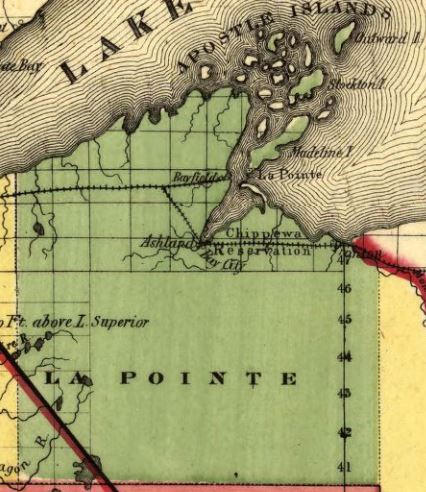
As there was no opportunity for doubt as to the rapid growth of the city the establishment of a Post Office was the result of our first raid upon the general government, though for nearly one year following no provision whatsoever was made for furnishing this office with mail service, and mails were received by chance from La Pointe up to the opening of semi-monthly service, upon a new route established between La Pointe via Ashland to Chippewa Falls, and was soon after, during the winter months, supplied with weekly service upon the route from Ontonagon, Mich., to Superior, Wis. On both of these routes the mails were carried by packers and upon dog teams.

Detail of La Pointe County from a map of Wisconsin published by J. H. Colton & Co., New York, 1856.
~ MapofUS.org
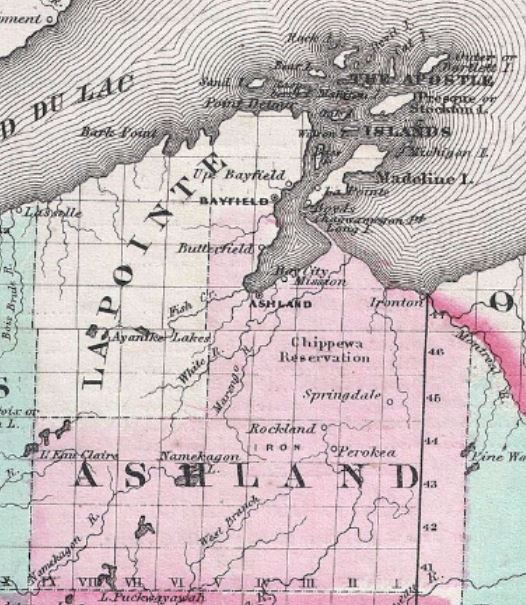
In the petition forwarded to Washington asking for the establishment of an office at Ashland, La Pointe county, Wisconsin, the request was made that it be given the name of Ashland, and that Asaph Whittlesey be appointed postmaster. The sequel showed that as there was an office by the name of Ashland within the State, it was not lawful to attach the name to this office and therefore the appointing officers at Washington attached the name of Whittlesey thereto, by which the office was known until July 30th, 1860, when the obstacle to change in the name being removed, it was then given the name of Ashland, and was also designated as being in Ashland County, Wisconsin. I well remember how difficult a task I found it to be to satisfactorily explain to them how the place could one day be known as Whittlesey, La Pointe county and the next as Ashland, Ashland county. But they soon admitted it rather than be longer afflicted with my letters upon the subject.
Detail of La Pointe County from a map of Wisconsin by The Milwaukee & Horicon Rail Road, 1857.
~ Library of Congress
The office of Whittlesey was kept in the cabin still in existence on lot 6 of block 6, “original Ashland,” until in Nov. 1857, when it was removed to lot 3 of block 3, into what was known as the Tomkins House, which then became the residence of myself and family until Nov. 1860. The case in which the books and papers connected with the office were kept, (which was made by myself,) is now in the “farm house” at “Pleasant Valley,” and will be delivered to any public organization in Ashland desiring to preserve the same. I continued to serve as postmaster until Nov. 21st, 1860, when I resigned the office and Andrew J. Barckley’s was appointed as my successor. Barckley’s term as postmaster expired Sept. 9th, 1861, by the appointment of Martin Beaser as successor in office to Barckley. Mr. Beaser served as postmaster until his death in Nov. 1866.
Detail of La Pointe and Ashland Counties from a map of Wisconsin and Michigan by A. J. Johnson and Ward, 1864.
~ Geographicus.org
The post office of Ashland was re-established Dec. 18th, 1871, and James A. Wilson, (the present incumbent,) being appointed postmaster.
The amount of post office money turned over to the Government by me at the close of my term of service was $8.53. My commissions upon this amount, together with the “franking privilege” vested upon postmasters, laid the foundation for my future fortunes, the balance was taken in waitings upon William Gotzenberg, who made daily inquiries for his mail, though he was aware that no mails were received oftener than once a week.
To be continued in Number V…
Edwin Ellis Incidents: Number III
April 9, 2017
By Amorin Mello
Originally published in the July 7th, 1877, issue of The Ashland Press. Transcribed with permission from Ashland Narratives by K. Wallin and published in 2013 by Straddle Creek Co.
… continued from Number II.
EARLY RECOLLECTIONS OF ASHLAND.
“OF WHICH I WAS A PART.”
Number III
Dear Press: – My last jottings brought us to the sweeping away of the first dock ever attempted in Ashland, April 1, 1855. Before relating any of the further attempts in the construction of docks, I will recall the names of some of the settlers who came here in 1855 to 1856.
1. George Kilbourn was then over fifty years old, from the Western Reserve, Ohio – a man of great energy and iron constitution, whose greatest joy was hard work, (and if we had a few hundred such men in our country now, who were not afraid to dive into our forests and open farms, the success of Ashland would soon be assured), and who was ever battling with the woods in this, his new home. No one man who ever came to Ashland ever did half as much as he did, with his own strong arm, to clear up our beautiful town site. His favorite spot is now occupied by the house built by Alex. Livingston, Esq. Ashland was “Uncle George’s” pet, and he loved it with an undying love, and when stricken down by death a few years since, he was on his way from Ohio to Ashland. He merits a monument, and his name should always be held in grateful remembrance.
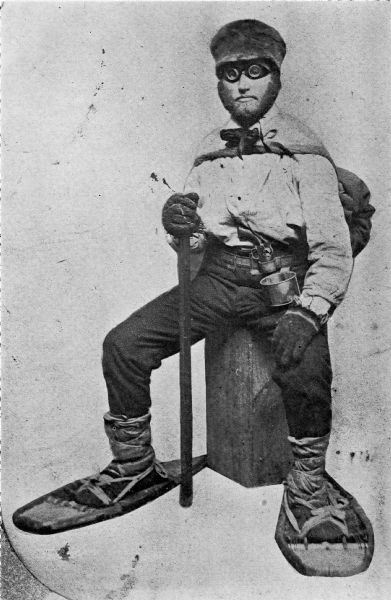
Asaph Whittlesey was Charles Whittlesey’s younger brother.
~ Wisconsin Historical Society
2. Asaph Whittlesey, then about thirty years of age, a native of Ohio, but who had for several years been engaged in business in Peoria, Ill., where the fruits of years of toil were swept away by fire in a single hour, was, in 1854, looking for a place to try anew his fortune. He belonged to one of the oldest and most respectable families of the Buckeye State – an energetic, lively, genial, whole-souled man, whom to know is to esteem. He was active in all the early years of Ashland; was its first Postmaster, (when the office bore his name) in compliment to his venerable uncle, the Hon. Elisha Whittlesey, for many years connected with the U.S. Treasury. And though he now resides at Bayfield, his interests are still largely in our town, and his pleasant face still occasionally gladdens our homes. In his present ill health he has our heartfelt sympathies. May he soon be well again and may his iter ad coctum be postponed yet many years.
~ The Eye of the North-west: First Annual Report of the Statistician of Superior, Wisconsin by Frank Abial Flower, 1890, page 251.
Mrs. Whittlesey, with her mother, Mrs. Haskell, were the first white women who passed the winter on this shore. Her house, though built of logs, was neat and comfortable, and was the resort of all new confers, where we were all made welcome; and the writer will always remember her singing of “The little tailor with the broadcloth under his arm,” and the dancing of her little Eugenia, a flaxen-haired girl of two year, but who, in later years, matured into a beautiful and accomplished woman, and happily settled in life, was, in 1874, called to the “sweet fields beyond the swelling flood.” Mrs. Whittlesey endured much privation, but she was brave and full of life. She is still spared to adorn and cheer her pleasant home at Bayfield.
Her father, Mr. Haskell, who passed the first winter in Mr. Whittlesey’s family, died a few years ago, but Mrs. Haskell still lives in green old age, and in 1875 re-visited the scenes of her pioneer life.

Martin Beaser
~ Western Reserve Historical Society
3. Martin Beaser, though he did not bring his family to Ashland till 1856, he is entitled, nevertheless, to be ranked among the very first settlers of Ashland, for he had chosen this for his home in 1854; had aided by his means and counsel, Messrs. Whittlesey and Kilbourn, and came from Ontonagon several times during the year 1855 to assist in carrying out their plans. He employed and brought with him early in 1855, Dr. Brunschweiler, a Civil Engineer, who surveyed and platted the first site on this bay, which is now known as “Old Ashland” or “Beaser’s Division of Ashland.” Brunschweiler River, twelve miles from Ashland, perpetuates his name.
Mr. Beaser was a native of the State of New York, who, in early life, had passed several years on a whaler in the Pacific Ocean and being an acute observer of men and things, had accumulated a vast amount of useful and entertaining knowledge. He was familiar with the ports of Central and South American and our Northwest coast, not ours then, for the Star Spangled Banner then floated only over a narrow strip of land near the mouth of the Columbia River.
The vast stretch of coast now embraced in the State of California was then Mexican territory and the Russian Bear was the emblem of power extending over forty degrees of longitude and from the fifty-fifth to the seventy-second degree of latitude, or more than eleven hundred miles, from south to north, and sixteen hundred miles from east to west. By the diplomacy of Mr. Seward and the payment of seven million dollars in gold, the vast extent of coast came under our flag.
No one could listen to Mr. Beaser’s recital of what he saw and heard on the Pacific coast without being entertained, and receiving much useful knowledge.
Mr. Beaser came to Ontonagon about 30 years ago, soon after the discovery of copper in that country. Very few settlers had preceded him there; but for several years, from 1858, they came in rapidly.
But here were no regular lines of boats as at present from Lake Erie and Michigan. All the supplies for the population must be brought by water a thousand miles. They were brought to the Sault and transferred across the portage, re-loaded on vessels and distributed to the infant settlements along the coast. As a result of the scanty and uncertain means of conveyance, the early northern winter often found the settlers without their winter’s supply of flour, pork and groceries. They must be brought to Ontonagon from Copper Harbor or Eagle River in open boats, which in the late fall and early winter was a work of hardship and danger. Mr. Beaser’s skill and bravery as a sailor was more than once instrumental in saving Ontonagon from starvation and want.
In the fall of 1856, Mr. Beaser brought his family to Ashland. Here he was closely identified with all enterprises calculated to aid in the opening up of this country. He had accumulated a competence at Ontonagon which he here freely expended.
He was a man of sound discretion and great good common sense, and was one of Ashland’s most useful citizens. Through discouragements and long deferred hope he persevered; while nearly all the rest of us were compelled to retreat. His hope seemed never to forsake him and like the heroes of the Cumberland who went down with their colors flying, he stuck to Ashland in its hours of greatest depression and finally found his grave in the waters of our Bay – while attempting to come from Bayfield to Ashland in an open boat alone during a severe storm in November, 1866. He rests on the Island of La Pointe, but the home of his life should be the home of his mortal remains and I doubt not they will be transferred hither at an early day.
To be continued in Number IV…
Asaph Whittlesey Incidents: Number III
April 8, 2017
By Amorin Mello
Originally published in the March 2nd, 1878, issue of The Ashland Press. Transcribed with permission from Ashland Narratives by K. Wallin and published in 2013 by Straddle Creek Co.
Early Recollections of Ashland
by Asaph Whittlesey
(Continuation of number two.)
So much in harmony with the views we then entertained, are the words of Hon. W. E. Allen, published in the Ashland Press of the 16th inst., as to induce me to quote largely there from. He says:
“That beautiful harbor on which Ashland is situated, was as I believe, intended for use. No prettier harbor or site in the wide world for a city, than that on which the little town now stands. The beautiful rising ground at the south and east of it, with the clear water of the queen of the lakes bathing her shore, hemmed in with a crescent forest circle, extending for hundreds of miles inland, made a picture of nature that to be known and felt must be seen. I was almost transported with rapture at the beauty – the profuse beauty on every side displayed, and as we passed away from all this loveliness, beyond the green islands, which make the bay of Ashland the most commodious and safe harbor on this inland sea, I turned my eyes back upon it till it faded out of sight, and felt a sorrow that I was forced to leave it so soon.
Ashland is a lovely place, its surrounding country equally lovely, and the day is coming when she will be at the main west commercial end of the lake on which she stands, with a railroad running west to the shore of the Pacific Ocean, where the grand city west of the Rocky Mountains is yet to be built. Then the little town of Ashland will take her place with the commercial cities of our state, which nature has given her such just claims to.”
Number III
Next your attention is called to the landing of the first steamboat at Ashland, which took place in the afternoon of Sep. 7th, 1854. Captain Moses Easterbrook, of the steamer Sam Ward, wishing to have the honor of being the first to land a steamer at the new city, extended a general invitation to the people of La Pointe to join him in the excursion, at the same time having on board some fifty or sixty barrels of freight consigned to “Asaph Whittlesey, Ashland, Wis.”
About 5 p.m. of the day mentioned, the steamer Sam Ward driver dropped anchor directly in front of the ravine at the foot of Main Street, where she unloaded her freight by small boat, and while so doing the “freedom of the city” was extended to her passengers by Major Whittlesey. I have never known the exact number of mosquitoes taken on board the steamer by this party, but as each member thereof, with palm in hand, were unceasing in their gestures, it was evident that this is what they were engaged in.
SECOND HOME BUILT UPON THE “TOWN SITE”
The second home built upon the “town site” was built 13×15, one story, and was designed soon to become a store house. This was built upon lot 5 in block 6, the foundation logs only being now visible; it was completed Sep. 12th, 1854, and formed a temporary house for us. The economy of its apartments deserve further notice, especially as it was in reality the first “Chequamegon” of the place. The lower and only floor thereto, was of “puncheons,” so adjusted as to give thorough ventilation, while directly over the bed in which my wife and I slept, a “chicken roost” had been constructed, entrance to which the fowls made from the outside at the top, up an inclined pole. Thus at midnight hour and at early dawn, our “feathered associates” told us of our entrance upon the duties of a new day. As a historical fact of the same period, I will add that a family of skunks had their headquarters underneath the house, and could readily be seen through the “Puncheons,” as also while meandering the premises.
The third and
ONLY REMAINING CABIN BUILT UPON THE “TOWN SITE” DURING 1854

Example of a contemporary mud oven. Not historically accurate.
Amorin Mello © 2005.
was 20×30, built upon lot 6 and block 6, and is in a remarkable state of preservation to this day, except that the “stoop” in front and “room back” for a kitchen with the mud oven opening into it are wanting. So many and important were the events intimately associated with the history of this house, that a somewhat extended notice thereof seems unavoidable. The logs of which it was built were cut by my hands and with only the help of a yoke of oxen, (driven through the woods from Odanah.) Mrs. Whittlesey and myself raised the building to the chamber floor and adjusted the joist for the second story. (Mr. Kilborn being in attendance upon Rev. Wheeler, then dangerously ill.)
By the middle of November we found ourselves fairly settled in a neatly finished cabin of massive proportions, having floors of lumber, being also provided with a “kitchen” with “mud oven,” “mud chimney,” etc., so that it took rank as the most “aristocratic” house in the place.
A few of the events which unite to make this cabin historical will begin in our next number.
To be continued in Number IV…
Asaph Whittlesey Incidents: Number II
March 26, 2017
By Amorin Mello
Originally published in the February 23rd, 1878, issue of The Ashland Press. Transcribed with permission from Ashland Narratives by K. Wallin and published in 2013 by Straddle Creek Co.
… continued from Number I.
Early Recollections of Ashland: Number II
by Asaph Whittlesey
As the sole survivor of those who first settled upon the “town site” of Ashland, I have long felt it a duty I owe to myself and wife, and to those then associated with me, whose voices can no longer be heard; as well as a duty I owe to coming generations to add to the record already made, a mention of events of Ashland’s earlier days, overlooked, or perhaps not known to those who have heretorfore generously undertaken to write up the history of the place. And inasmuch as acts of my own, will form a conspicuous part of this record, I desire the public to charitably overlook what might otherwise be regarded as undue or extravagant mention of myself.
Those who have preceded me in their published “Early Recollections of Ashland,” especially those from the pen of Edwin Ellis, M.D., and J.S. Buck, Esq. Of Milwaukee, place the public largely in debt. First, on account of their having undertaken so thankless a task, and secondly, on account of the marvelous earnestness of their statements, which alone gives them value.
Engaged as I now am, the past comes up to me, with the precious freighting of recollections; some sad, and others of brighter hue, woven by memory into a varied “woof,” every thread of which has its cherished incidents in which we have born a part, and by which the soul is saddened or brightened as the “web” unfolds its various hues; and “old time friends” are again about me, and memory is busy with those things of the past which rendered “blessed” our “Cabin Homes” in the wilderness.
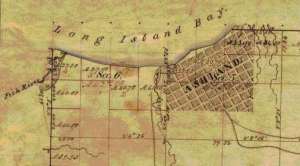
Detail of Ashland in LaPointe County circa 1855 from the Barber Papers.
The history of Ashland as a “town site” commenced with July 5th, 1854. On that day George Kilburn and myself left La Pointe in a row boat on a tour of inspection of the bay upon which Ashland is now located; having in view a “town site” on what might prove to be the most available point for a town, at or near “Equadon,” which we were told meant the “head of the bay.” Very well do I remember how our awkward attempts at rowing made us the laughing stock of numerous Half-Breeds and Frenchmen as we pulled from the shore, and how it was our fortune to face a lively head wind during this, our first few days attempting at rowing alone. However, at 5 p.m. of the day named, having taken soundings for two miles along the south shore of the bay, we landed our boat at the westerly limit of the present “town site” of Ashland, where the high land leaves the bay. As I stepped ashore, Mr. Kilburn exclaimed, “Here is the place for the big city!” and (handing me his ax) added, “I want you to have the honor of cutting the first tree in the way of settlement upon the “town site,” and the tree of which I then fell formed one of the foundation longs in the
FIRST BUILDING ERECTED,
and was erected upon what is now known as lot 2, block 105. This building was 14×10 feet square, had but one door which faced to the south, and but one window which was upon the north side, furnishing a full view of the bay.
On the 16th of August, we were joined by Mrs. Whittlesey, with her “golden haired” and only child, “Eugenia Vesta,” then less than two years of age. Mrs. Whittlesey presented an extremely youthful appearance, being less than twenty-one years of age and unused either to sunlight or to toil; she nevertheless brought “sunlight” into our first
HOME IN THE WILDERNESS.
At this time our nearest neighbors were at Odanah, a distance of eleven miles in a direct line, without even a “trail” leading thereto.
Mrs. Whittlesey’s surroundings were now in strong contrast with her former life, and so absolutely were we shut in by the dense forest that there was but one way to look out, and that was to look up. But for all this our conceptions of the place were past description. Business blocks in the near future filled our minds, and enabled us to sustain every inconvenience. Already the “town site” fever had grown into a “mania,” and adjacent lands were rapidly being taken up by “pre-emptors.”
To be continued in Number III…
Asaph Whittlesey Incidents: Number I
February 9, 2017
By Amorin Mello

Originally published in the February 16, 1878, issue of The Ashland Press. Transcribed with permission from Ashland Narratives by K. Wallin and published in 2013 by Straddle Creek Co.
Early Recollections of Ashland: Number I
by Asaph Whittlesey
Photograph of Asaph Whittlesey from the Wisconsin Historical Society.
Our first arrival at La Pointe being so intimately associated with the settlement of Ashland, I have determined to make our arrival there the subject of my first letter.
It was among the first days of June, 1854, that George Kilburn, Jr., myself and wife and only child, Eugenia, (then some eighteen months old,) made a landing at La Pointe with a view to remain permanently in the country. Well do I remember the beautiful “town,” spread before us as we merged from the “old log warehouse” through which we passed in reaching the shore, while the general appearance was that of neatness and comfort.

Photograph of Julius Austrian from the Madeline Island Museum.
We had already made the acquaintance of Mr. and Mrs. Julius Austrian, having had the pleasure of their company up the Lakes, and had made many inquiries of them as to the place of our destination. From this time forward we found Mr. and Mrs. Austrian to be most agreeable neighbors and associates, and these young “brides” spent much of their time together, and not unfrequently did the evening air carry to listening crowds our notes of “Good old Colony times,” and “There’s no place like home,” still fresh in our memory.
La Pointe at this time was the second in importance of towns upon the Lakes, Ontonagon taking the lead.
Within a few days after our landing, we were fully organized as “house keepers,” under the same roof with Mr. and Mrs. George Starks, now residents of Bayfield; who proved to be most excellent neighbors, and never did a single roof cover a more harmonious trio of families.
We had, however, a common “foe” to encounter, visions of which filled our dreams and harassed our waking moments. This “foe” was the everlasting “bed bug,” more numerous and more determined in their onslaught than is the “Russian Army;” while this mixture of Dutch and Yankee blood served to satisfy their ravenous appetites. We had heard of this race before, but this was the first time we had met in open combat, face to face. It was our custom regularly before retiring to rest to go into combat with them armed with “wooden spads,” with which we slaughtered them by the quart. Our plan was to remain awake an hour or so after retiring to bed, when we would strike a light which was a signal for a field fight. It was an exciting scene to witness their ranks surrounding us on every hand, while the sheets of our bed seemed dyed in human blood. One means of our defense was to have the bed posts stand in molasses; but this only put them to the trouble of marching to the ceiling above from which they dropped upon us like hail; of course all these contingencies helped to make my wife good natured, and strengthen her attachments to the country. This condition of things lasted while we remained occupants of the building, and when we, in our weakness from loss of blood, staggered forth to make us a home elsewhere, we were filled with anxiety as to the safety of our German neighbors.
“Dr. Borup, the agent for the American Fur Company, (who have an extensive trading-post at this place,) has a superb garden. In walking through it with him, I saw very fine crops of the usual garden vegetables growing in it. His red currant bushes were literally bent down beneath their weight of ripe fruit. His cherry-trees had also borne well. Gooseberries also succeed well. The doctor also had some young apple-trees, that were in a thriving condition. Poultry, likewise, does well. Mrs. B. had her yard well stocked with turkeys, geese, ducks, and chickens.”
~ “Morgan“ at La Pointe during 1845.
As I have before stated, the general appearance of the island was most attractive. The garden of Mr. Austrian was laid out most tastily. We found there a large variety of fruit trees, apples, plums, cherries, etc. Also large quantities of currants and strawberries; but the crowning attraction was the “grape bower,” affording a most attractive lounging place. Here also a merry party, consisting, so far as my recollection serves me, of the following persons: Mr. and Mrs. Julius Austrian, Rev. John Chebohm, (who, I remember, asked the blessing at the table,) Marks Austrian, Mr. H. Mandelbaum, Henry Smit, Mr. and Mrs. Hocksteiner, Mr. and Mrs. George Starks, old Mr. and Mrs. Perinier, Mr. and Mrs. Asaph Whittlesey, and I think Mrs. William Herbert, and a Mr. Roy, celebrated the
“FORTH OF JULY,” 1854.
Being a curious mixture of Americans, Jews, Germans, French and Austrians, no two of whom could carry on a very extensive conversation, for want of a knowledge of the languages, so that our toasts were mainly received in silence, nevertheless the day was passed most pleasantly, while the reading of the Declaration of Independence by Asaph Whittlesey, marked it as a day for national celebration.
 Chequamegon History