By Leo
In April, the Supreme Court heard arguments in the case Department of Commerce v. New York and could render a decision any day on whether or not the 2020 federal census should include a question asking about citizenship status. In January, a Federal District Court in New York ruled that commerce secretary, Wilbur Ross, violated the law by pushing for that question.
Those in agreement with the District ruling suggest that the Trump administration wants to add the question as a way of discouraging immigrants from participating in the census, thereby diminishing the political power of immigrant communities. This, they say, would violate the Constitution on the grounds that the census must be an “actual enumeration” of all persons within the United States, not only citizens.
Proponents of the citizenship question counter that citizenship status is a perfectly natural question to ask in the census, that any government would want to know how many citizens it has, and that several past iterations of the 10-year count have included similar questions.
It remains to be seen how the Supreme Court will rule, but chances are it will not be the last time an issue of race, identity, or citizenship pops up in the politics of the census. From its creation by the Constitution as a way to apportion seats in congress according to populations of the states, the count has always begged tricky questions that essentially boil down to:
Who is a real American? Who isn’t? Who is a citizen? Who is three-fifths of a human being? Who might not be human at all? What does it mean to be White? To be Colored? To be civilized? How do you classify the myriad of human backgrounds, cultures and stories into finite, discrete “races?”
The Civil War and Fourteenth Amendment helped shed light on some of these questions, but it would be a mistake to think that they belong to the past. The NPR podcast Codeswitch has done an excellent series on census, and this episode from last August gives a broad overview of the history.
Here at Chequamegon History, though, we aren’t in the business broad overviews. We are going to drill down right into the data. We’ll comb through the 1850 federal census for La Pointe County and compare it with the 1860 data for La Pointe and Ashland Counties. Just for fun, we’ll compare both with the 1855 Wisconsin State Census for La Pointe County, then double back to the 1840 federal census for western St. Croix County. Ultimately, the hope is to help reveal how the population of the Chequamegon region viewed itself, and ultimately how that differed from mainstream America’s view. With luck, that will give us a framework for more stories like Amorin’s recent post on the killing of Louis Gurnoe.
Background
 Judge Daniel Harris Johnson of Prairie du Chien had no apparent connection to Lake Superior when he was appointed to travel northward to conduct the census for La Pointe County in 1850. The event made an impression on him. It gets a mention in his short memorial biography in the 1902 Proceedings of the State Bar Association.
Two years after statehood, Lake Superior’s connection to the rest of Wisconsin was hardly existent. This was long before Highways 51 and 53 were built, and commerce still flowed west to east. Any communication to or from Madison was likely to first go through Michigan via Mackinaw and Sault Ste. Marie, or through Minnesota Territory via St. Paul, Stillwater, and Sandy Lake. La Pointe County had been created in 1845, and when official business had to happen, a motley assortment of local residents who could read and write English: Charles Oakes, John W. Bell, Antoine Gordon, Alexis Carpentier, Julius Austrian, Leonard Wheeler, etc. would meet to conduct the business.
It is unclear how much notice the majority Ojibwe and French-patois speaking population took of this or of the census generally. To them, the familiar institutions of American power, the Fur Company and the Indian Agency, were falling apart at La Pointe and reorganizing in St. Paul with dire consequences for the people of Chequamegon. When Johnson arrived in September, the Ojibwe people of Wisconsin had already been ordered to remove to Sandy Lake in Minnesota Territory for their promised annual payments for the sale of their land. That fall, the government would completely botch the payment, and by February, hundreds of people in the Lake Superior Bands would be dead from starvation and disease.
So, Daniel Johnson probably found a great deal of distraction and anxiety among the people he was charged to count. Indians, thought of by the United States as uncivilized federal wards and citizens of their own nations, were typically not enumerated. However, as I wrote about in my last post, race and identity were complicated at La Pointe, and the American citizens of the Chequamegon region also had plenty to lose from the removal.
Madison, for its part, largely ignored this remote, northern constituency and praised the efforts to remove the Ojibwe from the state. It isn’t clear how much Johnson was paying attention to these larger politics, however. He had his own concerns:


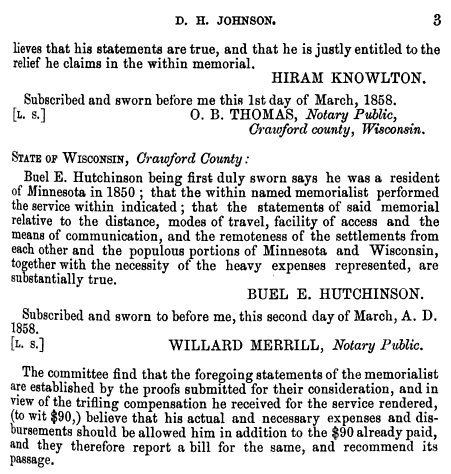
House Documents, Volume 119, Part 1. U.S. Government Printing Office, 1859. Google Books.
So, in “that thinly settled and half civilized region,” Johnson only found a population of about 500, “exclusive of Indians.” He didn’t think 500 was a lot, but by some counts, that number would have seemed very high. Take the word of a European visitor to La Pointe:
Among 200 Indians, only a few white families live there. One of the boatmen gave us a name, with which we found Mr. Austrian.
And, from this Mr. Austrian, himself:
There were only about 6 white American inhabitants on the Island, about 50 Canadian Frenchmen who were married to squaws, and a number of full blooded Indians, among whom was chief Buffalo who was a descendant of chiefs & who was a good Indian and favorably regarded by the people.
~Joseph Austrian, Brother of Julius and La Pointe resident 1851-52
Who lived around La Pointe in 1850?
In her biography, William W. Warren: the Life, Letters, and Times of an Ojibwe Leader, Theresa Schenck describes the short life of an ambitious young man from La Pointe. William Whipple Warren (1825-1853) grew up on the Island speaking Ojibwe as his first language. His father was a Yankee fur trader from New York. His mother was a daughter of Michel and Madeline Cadotte. In his famous History of the Ojibways Warren describes the Ojibwe as people with whom he readily claims kinship, but he doesn’t write as if he is an Ojibwe person himself. However, he helped interpret the Treaty of 1847 which had definitively made him an Indian in the eyes of the United States (a fact he was willing to use for economic gain). Still, a few years later, when he became a legislator in Minnesota Territory he dismissed challenges to his claims of whiteness.
If he were alive today, Warren might get a chuckle out of this line from the South African comedian Trevor Noah.
People mocked me. Gave me names like mixed breed, half caste — I hate that term ‘half’. Why half? Why not double? Or twice as nice, I don’t know.
— Trevor Noah
William Warren did not see himself as quite the walking contradiction we might see him as today. He was a product of the time and place he came from: La Pointe. By 1850, he had left that place, but his sister and a few hundred of his cousins still lived there. Many of them were counted in the census.
What is Metis?
Half-breeds, Mixed-bloods, Frenchmen, Wiisakodewininiwag, Mitif, Creoles, Metis, Canadiens, Bois Brules, Chicots, French-of-the-country, etc.–at times it seems each of these means the same thing. At other times each has a specific meaning. Each is ambiguous in its own way. In 1850, roughly half the families in the Chequamegon area fit into this hard-to-define category.


Kohl, J. G. Kitchi-Gami: Wanderings around Lake Superior. London: Chapman and Hall, 1860. pg. 260-61.
We were accompanied on our trip throughout the lakes of western Canada by half-Indians who had paternal European blood in their veins. Yet so often, a situation would allow us to spend a night inside rather than outdoors, but they always asked us to choose to Irish camp outside with the Indians, who lived at the various places. Although one spoke excellent English, and they were drawn more to the great American race, they thought, felt, and spoke—Indian! ~Carl Scherzer
In describing William Warren’s people, Dr. Schenck writes,
Although the most common term for people of mixed Indian and European ancestry in the nineteenth century was “half-breed,” the term “mixed blood” was also used. I have chosen to use the latter term, which is considered less offensive, although biologically inaccurate, today. The term “métis” was not in usage at the time, except to refer to a specific group of people of mixed ancestry in the British territories to the north. “Wissakodewinini,” the word used by the Ojibwe, meant “burned forest men,” or bois brulés in French, so called because half-breeds were like the wood of a burned forest, which is often burned on one side, and light on the other (pg. xv).
Schenck is correct in pointing out that mixed-blood was far more commonly used in 19th-century sources than Metis (though the latter term did exist). She is also correct in saying that the term is more associated with Canada and the Red River Country. There is an additional problem with Metis, in that 21st-century members of the Wannabe Tribe have latched onto the term and use it, incorrectly, to refer to anyone with partial Native ancestry but with no affiliation to a specific Indian community.
That said, I am going to use Metis for two reasons. The first is that although blood (i.e. genetic ancestry) seemed to be ubiquitous topic of conversation in these communities, I don’t think “blood” is what necessarily what defined them. The “pure-blooded French Voyageur” described above by Kohl clearly saw himself as part of Metis, rather than “blanc” society. There were also people of fully-Ojibwe ancestry who were associated more with Metis society than with traditional Ojibwe society (see my post from April). As such, I find Metis the more versatile and accurate term, given that it means “mixed,” which can be just as applicable to a culture and lifestyle as it is to a genetic lineage.
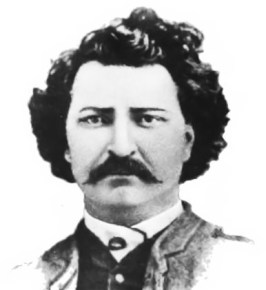
One time Canadian pariah turned national hero, Louis Riel and his followers had cousins at La Pointe (Photo: Wikipedia)
The second reason I prefer Metis is precisely because of the way it’s used in Manitoba. Analogous to the mestizo nations of Latin America, Metis is not a way of describing any person with Native and white ancestry. The Metis consider themselves a creole-indigenous nation unto themselves, with a unique culture and history. This history, already two centuries old by 1850, represents more than simply a borrowed blend of two other histories. Finally, the fur-trade families of Red River came from Sault Ste. Marie, Mackinac, Grand Portage, and La Pointe. There were plenty of Cadottes, Defaults, Roys, Gurnoes, and Gauthiers among them. There was even a Riel family at La Pointe. They were the same nation
Metis and Ojibwe Identity in the American Era
When the 1847 Treaty of Fond du Lac “stipulated that the half or mixed bloods of the Chippewas residing with them shall be considered Chippewa Indians, and shall, as such, be allowed to participate in all annuities which shall hereafter be paid…” in many ways, it contradicted two centuries of tradition. Metis identity, in part, was dependent on not being Indian. They were a minority culture within a larger traditional Anishinaabe society. This isn’t to say that Metis people were necessarily ashamed of their Native ancestors–expressions of pride are much easier to find than expressions shame–they were just a distinct people. This was supposedly based in religion and language, but I would argue it came mostly from paternal lineage (originating from highly-patriarchal French and Ojibwe societies) and with the nature of men’s work. For women, the distinction between Ojibwe and Metis was less stark.
The imposition of American hegemony over the Chequamegon region was gradual. With few exceptions, the Americans who came into the region from 1820 to 1850 were adult men. If new settlers wanted families, they followed the lead of American and British traders and married Metis and Ojibwe women.
Still, American society on the whole did not have a lot of room for the racial ambiguity present in Mexico or even Canada. A person was “white” or “colored.” Race mixing was seen as a problem that affected particular individuals. It was certainly not the basis for an entire nation. In this binary, if Metis people weren’t going to be Indian, they had to be white.
The story of the Metis and American citizenship is complicated and well-studied. There is risk of overgeneralizing, but let’s suffice to say that in relation to the United States government, Metis people did feel largely entitled to the privileges of citizenship (synonymous with whiteness until 1865), as well as to the privileges of Ojibwe citizenship. There wasn’t necessarily a contradiction.
Whatever qualms white America might have had if they’d known about it, Metis people voted in American elections, held offices, and were counted by the census.
Ojibwe “Full-bloods” and the United States Census
Representatives and direct Taxes shall be apportioned among the several States which
may be included within this Union, according to their respective Numbers, which shall be determined by adding to the whole Number of free Persons, including those bound to Service for a Term of Years, and excluding Indians not taxed, three fifths of all other Persons. The actual Enumeration shall be made within three Years after the first Meeting of the Congress of the United States, and within every subsequent Term of ten Years, in such Manner as they shall by Law direct.~Excerpt from Article I Section II, U. S. Constitution
As I argued in the April post, our modern conception of “full-blood” and “mixed-blood” has been shaped by the “scientific” racism of the late 19th and early 20th centuries. The distinction, while very real in a cultural sense, was not well-grounded in biology.
The relationship of Indians (i.e. full-bloods or those living a traditional lifestyle) to American society and citizenship was possibly more contradictory then that of the Metis. In one sense, America saw Indians as foreigners on their own continent: either as enemies to be exterminated, or as domestic-dependent ward nations to be “protected.” The constitutional language about the census calls for slaves to be counted as three-fifths of a person. It says Indians shouldn’t be counted at all.
In another sense, however, the path to personhood in America was somewhat clearer for Indians than it was for African Americans. Many New England liberals saw exodus to Liberia as the only viable future for free blacks. These same voices felt that Indians could be made white if only they were separated from their religions, cultures, and tribal identities. In 1834, to avoid a second removal, the Brothertown Indians of Wisconsin petitioned congress for citizenship and the termination of collective title to their tribal lands. In 1839, their request was granted. In the eyes of the law, they had effectively become white. Other communities would follow suit. However, most Native people did not gain any form of American citizenship until 1924.
How did that play out for the Ojibwe people of Chequamegon, and how did it impact the 1850 census? Well, it’s complicated.
Race, the Census, and Classifying Households
The enumeration forms Daniel H. Johnson carried to La Pointe had more rows and columns than ever. The Seventh Census was the first to count everyone in the household by name (previous versions only listed the Head of Household with tally marks). It was also the first census to have a box for “color.” Johnson’s choices for color were “white,” “black,” and “mulatto,” forcing him to make some decisions.
He seems to have tried to follow the Indians not taxed clause strictly. 40-50% of households in the region were headed by a full-blood Ojibwe person, possibly only two of them were enumerated. You won’t find Chief Buffalo, Makadebinesi (Blackbird), Oshkinaawe, Omizhinaawe, Edawegiizhig, and their immediate families in the 1850 census. Jechiikwii’o (often called Little Buffalo) is not in the document, even though he was an early Catholic convert, dressed in “white” clothing, and counted more Metis Ojibwe among his followers than full-bloods. However, his son, Antoine Buffalo Sr. (Antoine Jachequaon) is counted. Antoine, along with George Day, were counted as white heads of household by the census, though it is unclear if they had any European ancestry (Sources conflict. If anyone has genealogical information for the Buffalo and Day families, feel free to comment on the post). A handful of individuals called full-bloods in other sources, were listed as white. This includes 90-year old Madeline Cadotte, Marie Bosquet, and possibly the Wind sisters (presumably descendants of Noodin, one of the St. Croix chiefs who became Catholic and relocated to La Pointe around this time). They were married to Metis men or lived in Metis households. All Metis were listed as white.
Johnson did invent new category for five other Ojibwe people: “Civilized Indian,” which he seemed to use arbitrarily. Though also living in Metis households, Mary Ann Cadotte, Osquequa Baszina, Marcheoniquidoque, Charlotte Houle, and Charles Loonsfoot apparently couldn’t be marked white the way Madeline Cadotte was. These extra notations by Johnson and other enumeration marshals across the country are why the Seventh Federal Census is sometimes referred to as the first to count Native Americans.

So, out of 470 individuals enumerated at La Pointe and Bad River (I’ve excluded Fond du Lac from my study) Johnson listed 465 (99%) as white. By no definition, contemporary or modern, was the Chequamegon area 99% white in 1850. The vast majority of names on the lines had Ojibwe ancestry, and as Chippewas of Lake Superior, were receiving annuities from the treaties.
There were a few white American settlers. The Halls had been at La Pointe for twenty years. The Wheelers were well-established at Odanah. Junius and Jane Welton had arrived by then. George Nettleton was there, living with a fellow Ohioan James Cadwell. The infamous Indian agent, John Watrous, was there preparing the disastrous Sandy Lake removal. Less easy to describe as American settlers, but clearly of European origins, Fr. Otto Skolla was the Catholic priest, and Julius Austrian was the richest man it town.
There were also a handful of American bachelors who had drifted into the region and married Metis women. These first-wave settlers included government workers like William VanTassel, entrepreneurs like Peter VanderVenter, adventurers with an early connection to the region like Bob Boyd and John Bell, and homesteaders like Ervin Leihy.
It is unclear how many of French-surnamed heads of household were Chicots (of mixed ancestry) and how many were Canadiens (of fully-French ancestry). My sense is that it is about half and half. Some of this can be inferred from birthplace (though a birthplace of Canada could indicate across the river at Sault Ste. Marie as easily it could a farm in the St. Lawrence Valley). Intense genealogical study of each family might provide some clarifications, but I am going to follow Kohl’s voyageurs and not worry too much about it. Whether it was important or not to Jean Baptiste Denomie and Alexis Carpentier that they had no apparent Indian ancestry and that they had come from “the true homeland” of Quebec, for all intents and purposes they had spent their whole adult lives in “the Upper Country,” and their families were “of the Country.” They were Catholic and spoke a form of French that wasn’t taught in the universities. American society would not see them as white in the way it saw someone like Sherman Hall as white.
So, by my reckoning, 435 of the 470 people counted at La Pointe (92.5%) were Metis, full-blood Ojibwe living in Metis households, or Canadians in Metis families. Adding the five “Civilized Indians” and the six Americans married into Metis families, the number rises to 95%. I am trying to track down accurate data on the of Indians not taxed (i.e. non-enumerated full-bloods) living at or near La Pointe/Bad River at this time. My best estimates would put it roughly the same as the number of Metis. So, when Johnson describes a land with a language and culture foreign to English-speaking Americans, he’s right.
Birthplace, Age, and Gender
Ethnic composition is not the only data worth looking at if we want to know what this area was like 169 years ago. The numbers both challenge and confirm assumptions of how things worked.
Let’s take mobility for example:

The young voyageur quoted by Kohl may have felt like he didn’t have a home other than en voyage, but 86% of respondents reported being born in Wisconsin. Except for ten missionary children, all of these were Metis or “Civilized Indian.” Wisconsin could theoretically mean Lac du Flambeau, Rice Lake, or even Green Bay, this but this number still seemed high to me. I’m guessing more than 14% of 21st-century Chequamegon residents were born outside the state, and 19th-century records are all about commerce, long-distance travel, and new arrivals in new lands. We have to remember that most of those records are coming from that 14%.
In September of 1850 the federal government was telling the Ojibwe of Wisconsin they needed to leave Wisconsin forever. How the Metis fit into the story of the Sandy Lake Tragedy has always been somewhat fuzzy, but this data would indicate that for a clear majority, it meant a serious uprooting.
For those born outside Wisconsin, more than two-thirds reported being born in Michigan, Canada, or Minnesota Territory. These are overwhelmingly Metis or in the case of Anglo-Canadians like Robert Morrin, heads of Metis households from areas with a fur-trade tradition. Only eighteen individuals reported being born in the eastern United States. Only three reported Europe.
I had more questions than assumptions about the gender and age breakdown of the population. Would there be more women than men because of the dangerous jobs done by men or would mortality from childbirth balance that out? Or maybe widows wouldn’t be counted if they returned to the wigwams of their mothers? How would newcomers skew the age and gender demographics of the area?
Let’s take a look:
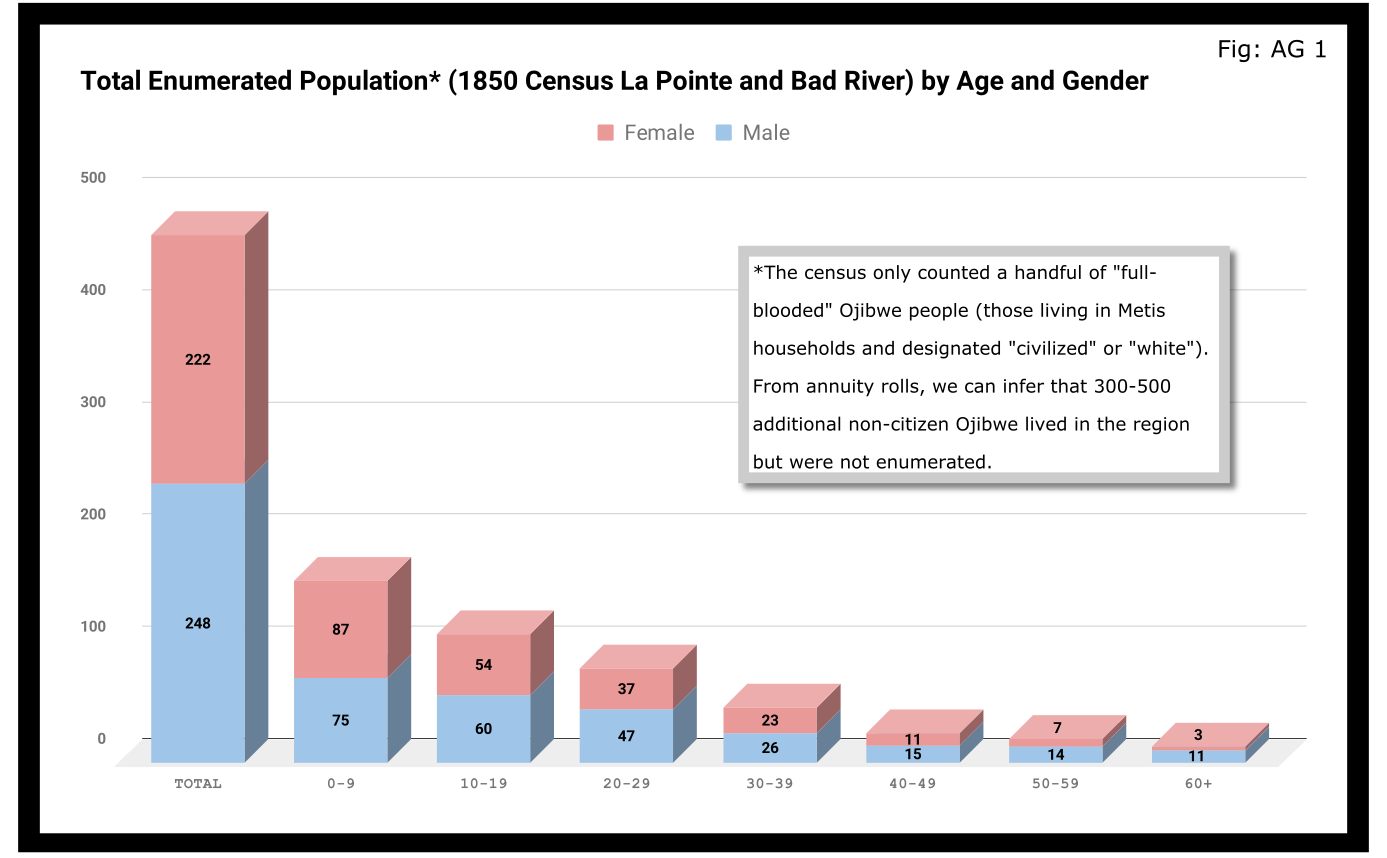
A quick glance at Figure AG 1 shows that the population skewed male 248-222 and skewed very young (61% under 20 years old). On the eve of Sandy Lake, the natural increase in the population seemed to be booming.

The hypotheses that women had higher mortality rates and were more likely to be undercounted looked good until we limit the data to the Wisconsin-born population. In Figure AG 2, we see that the male majority disappears entirely. The youthful trend, indicating large families and a growing population, continues with 66% of the Wisconsin-born population being under 20.

The male skew of the total population was entirely due to those born outside Wisconsin. This is not surprising given how much we’ve emphasized the number of men who came into the Lake Superior country to marry local women.
A look at the oldest residents in chart AG 2 and AG 3 hints at another story. Madeline Cadotte is the only Wisconsin-born person over seventy to be counted. The oldest men all came from Michigan and Canada. Why? My hypothesis is that between the fall of New France in 1759 and the establishment of Michel Cadotte’s post sometime around 1800, there wasn’t a large population or a very active fur trade around La Pointe proper. That meant Cadotte’s widow and other full bloods were the oldest locally-born residents in 1850. Their Metis contemporaries didn’t come over from the Soo or down from Grand Portage until 1810 or later.
Economics
Before the treaties, the economy of this area was built on two industries: foraging and trade. Life for Ojibwe people revolved around the seasonal harvest of fish, wild rice, game, maple sugar, light agriculture, and other forms of gathering food directly from the land. Trade did not start with the French, and even after the arrival of European goods into the region, the primary purpose of trade seemed to be for cementing alliances and for the acquisition of luxury goods and sacred objects. Richard White, Theresa Schenck, and Howard Paap have all challenged the myth of Ojibwe “dependence” on European goods for basic survival, and I find their arguments persuasive.
Trade, though, was the most important industry for Metis men and La Pointe was a center of this activity. The mid-19th century saw a steep decline in trade, however, to be replaced by a toxic cycle of debts, land sales, and annuity payments. The effects of this change on the Metis economy and society seem largely understudied. The fur trade though, was on its last legs. Again, the Austrian travel writer Carl Scherzer, who visited La Pointe in 1852:
After this discussion of the of the rates of the American Fur Company and its agents, we want to add some details about the men whose labor and time exerted such a great influence on the fate and culture of the Indian tribes. We wish to add a few explanatory words about the sad presence on La Pointe of the voyageurs or courriers du bois.
This peculiar class of people, which is like a vein of metal that suddenly disappears within the bedrock and reappears many hundreds of miles away under the same geological conditions, their light reaches the borders of the eastern Canadas. The British people, with their religion and customs, reappeared on the shores of these northern lakes only in 1808 with the Fur Company. For labor they drew on those who could carry their wares across the lakes and communicate with the Indians.
Many young men of adventurous natures left the old wide streets of Montreal and moved into the trackless primeval forests of the West. Young and strong as laborers, they soon started to adopt the lifestyle and language of the aborigines. They married with the Indians and inhabit small settlements scattered throughout those mighty lands which begin at Mackinow Island and come up the upper lake to the region of Minnesota. They almost all speak the Canadian patois along with the language of the Chippewas, the tribe with which they came into kinship. We found only a few, even among the younger generation, who understood English.
Since then, every day the population of the otherwise deserted shore of Lake Superior increases with the discovery of copper mines. The animals driven away by the whirlwind of civilization toward the west, attract the Indians with their sensitive guns, leaving La Pointe, abandoned by the Company for their headquarters at St. Paul in Minnesota. Most voyageurs left the island, having seen their business in ruins and lacking their former importance. Just a few families remain here, making a meager livelihood of hunting, fishing, and the occasional convoy of a few travelers led by business, science, or love of nature who purchase their limited resources.
From Scherzer’s description, two things are clear. It’s pretty clear from the flowery language of the Viennese visitor.Washington Irving and other Romantic-Era authors had already made the Voyageur into the stock stereotypical character we all know today. Th only change, though, is these days voyageurs are often depicted as representatives of white culture, but that’s a post for another time.
The second item, more pertinent to this post, is that a lot of voyageurs were out of work. This is especially relevant when we look at our census data. Daniel Johnson recorded the occupations of all males fifteen or over:
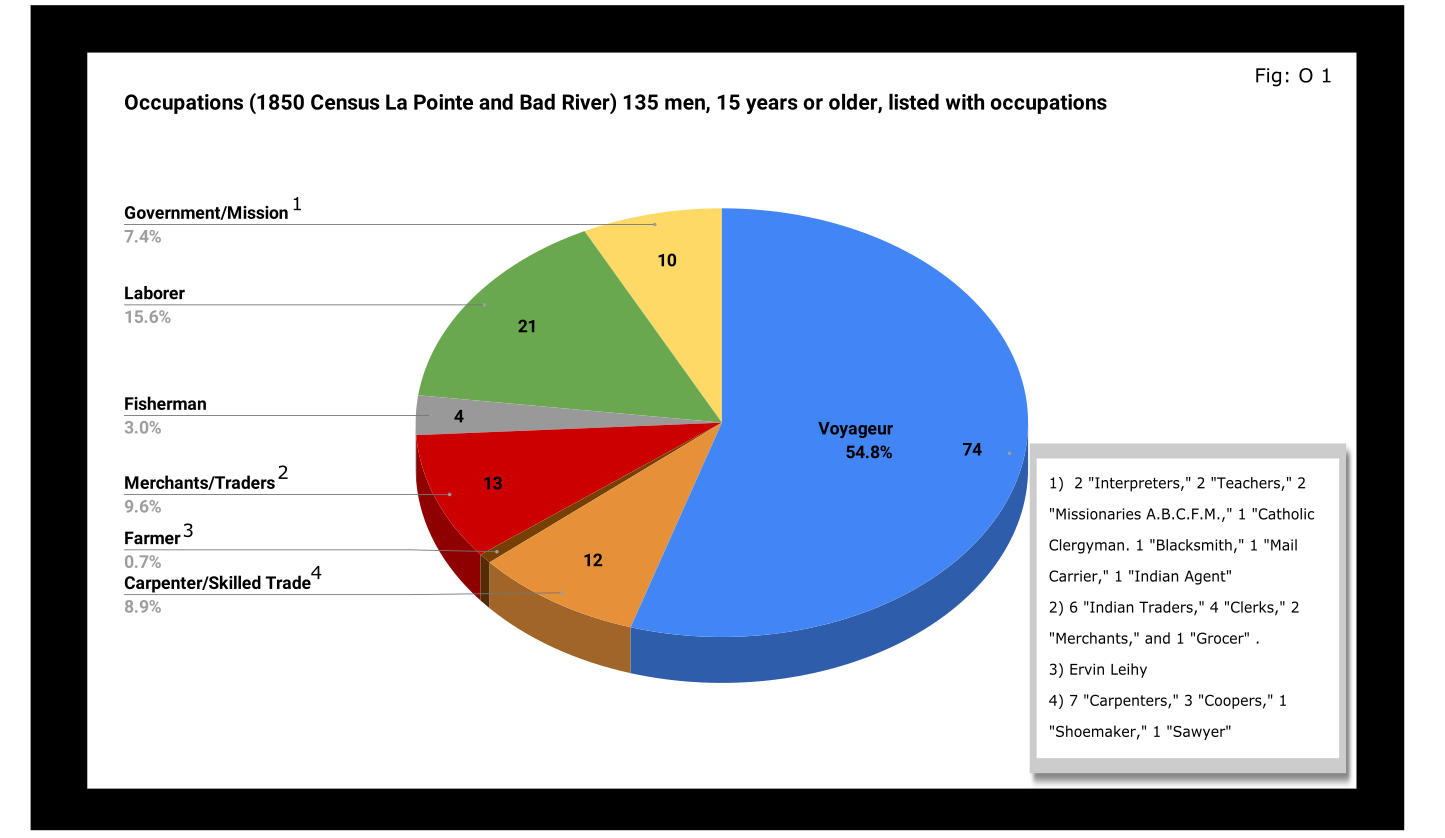
A full 55% of enumerated men fifteen and older still identified themselves as voyageurs in 1850. This included teenagers as well as senior citizens. All were from Metis households, though aside from farmer, all of the other occupation categories in Figure O 1 included Metis people.

A look at household sizes did not show voyageurs having to support significantly larger or smaller families when compared to the other occupation categories.
The other piece of economic data collected was value of real estate. Here we see some interesting themes:

If real estate is a good proxy for wealth in a farming community, it is an imperfect one in the Chequamegon area of 1850. If a voyageur had no home but the river and portage, then we might not expect him to put his coin into land and buildings. A teacher or Indian agent might draw a consistent salary but then live in supplied housing before moving on. With that caveat, let’s dig into the data.
Excluding the single farmer, men in the merchant/trader group controlled the most wealth in real estate, with Julius Austrian controlling as much as the other merchants combined. Behind them were carpenters and men with specific trades like cooper or shoemaker. Those who reported their occupation generally as “laborer” were not far behind the tradesmen. I suspect their real estate holdings may be larger and less varied than expected because of the number of sons and close relatives of Michel Cadotte Sr. who identified themselves as laborers. Government and mission employees held relatively little real estate, but the institutions they represented certainly weren’t lacking in land or power. Voyageurs come in seventh, just behind widows and ahead of fishermen of which there were only four in each category.
It is interesting, though, that the second and third richest men (by real estate) were both voyageurs, and voyageur shows a much wider range of households than some of the other categories: laborers in particular. With the number of teenagers calling themselves voyageurs, I suspect that the job still had more social prestige attached to it, in 1850, than say farmer or carpenter.
With hindsight we know that after 1854, voyageurs would be encouraged to take up farming and commercial fishing. It is striking, however, how small these industries were in 1850. Despite the American Fur Company’s efforts to push its Metis employees into commercial fishing in the 1830s, and knowing how many of the family names in Figure O 3 are associated with the industry, commercial fishing seemed neither popular nor lucrative in 1850. I do suspect, however, that the line between commercial and subsistence fishing was less defined in those days and that fishing in general was seen as falling back on the Indian gathering lifestyle. It wouldn’t be surprised if all these families were fishing alongside their Ojibwe relatives but didn’t really see fishing (or sugaring, etc.) as an occupation in the American sense.
Finally, it could not have escaped the voyageurs notice that while they were struggling, their former employers and their employers educated sons were doing pretty well. They also would have noticed that it was less and less from furs. Lump annuity payments for Ojibwe land sales brought large amounts of cash into the economy one day a year. It must have felt like piranhas with blood in the water. Alongside their full-blood cousins, Metis Ojibwe received these payments after 1847, but they had more of a history with money and capitalism. Whether to identify with the piranha or the prey would have depended on all sorts of decisions, opportunities and circumstances.
Education and Literacy
The census also collected data on education and literacy, asking whether children had attended school within the year, and whether adults over twenty could read and write. The history of white education efforts in this area are fairly well documented. The local schools in 1850 were run by the American Board of Commissioners of Foreign Missions (A.B.C.F.M.) at the La Pointe and Odanah missions, and an entire generation had come of age at La Pointe in the years since Rev. Sherman Hall first taught out of Lyman Warren’s storehouse in 1831. These Protestant ministers and teachers railed against the papists and heathens in their writings, but most of their students were Catholic or traditional Ojibwe in religion. Interestingly, much of the instruction was done in the Ojibwe language. Unfortunately, however, the census does not indicate the language an individual is literate in. I highly recommend The Ojibwe Journals of Edmund F. Ely, 1833-1849 if you are interested in these topics.
To start with, though, let’s look at how many people were going to school:

Thirty-nine students had gone to school in the previous year. There is a lot of sample-size noise in the data, but it seems like ages 7-11 (what we would call the upper-elementary years) were the prime years to attend school.
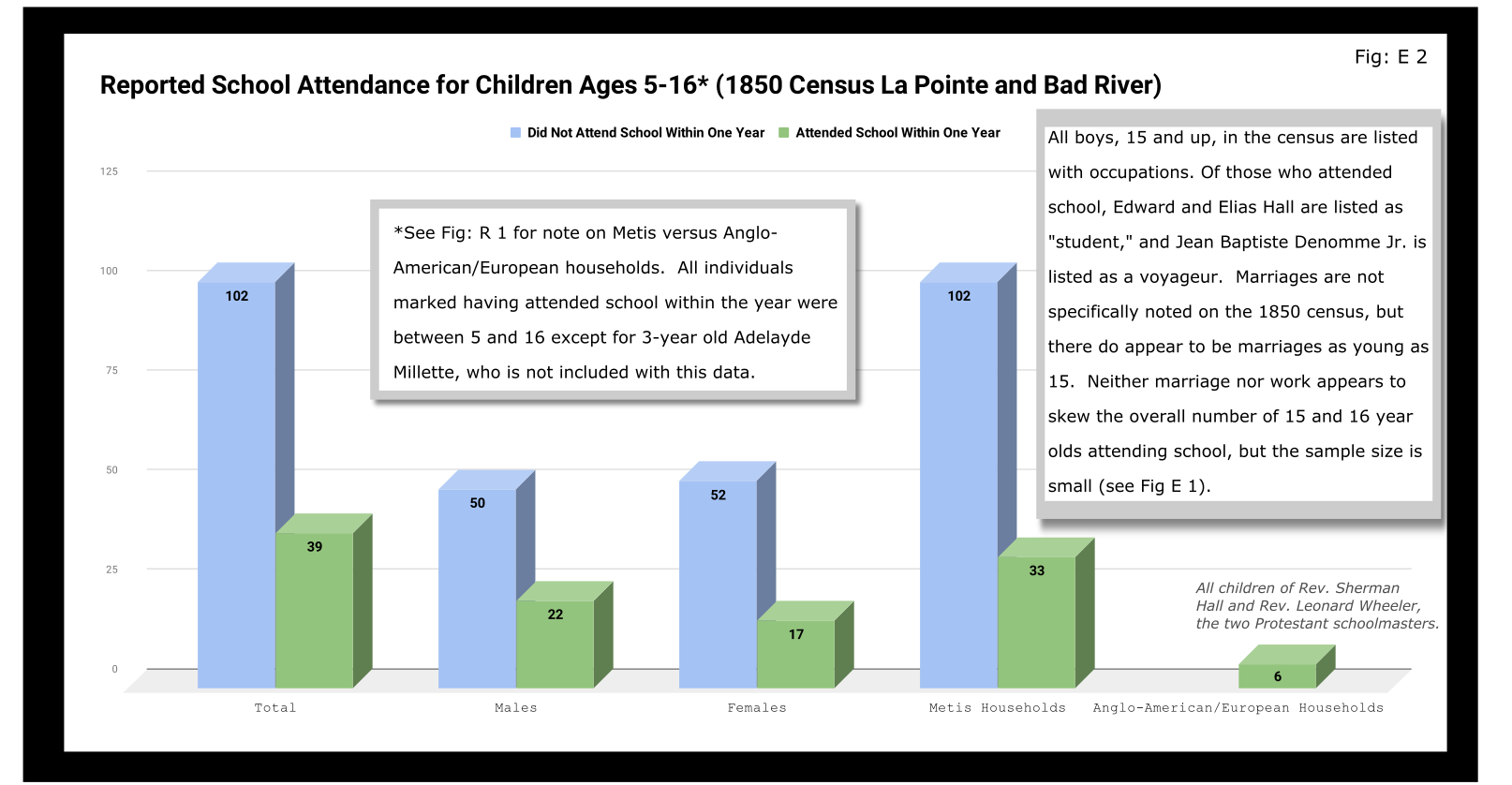
Overall, most children had not attended school within the year. Attendance rates were slightly higher for boys than for girls. White children, all from two missionary families, had a 100% attendance rate compared to 24% for the Metis and “Civilized Indian” children.
We should remember, however, that not attending school within the year is not the same as having never attended school. Twelve-year-old Eliza Morrin (later Morrison) is among the number that didn’t attend school, but she was educated enough to write her memoirs in English, which was her second language. They were published in 2002 as A Little History of My Forest Life, a fascinating account of Metis life in the decades following 1854.
Eliza’s parents were among the La Pointe adults who could read and write. Her aunt, uncle, and adult cousins in the neighboring Bosquet (Buskey) house were not. Overall, just over half of adults over 20 were illiterate without a significant gender imbalance. Splitting by birthplace, however, shows the literacy rate for Wisconsin-born (i.e. Metis and “Civilized Indian”) was only 30%, down from the overall male literacy rate of 48%. For Wisconsin-born women, the drop is only three points, from 47% to 44%. This suggests Metis women were learning to read while their husbands and brothers (perhaps en voyage) were not.

And this is exactly what the data say when we split by occupation. The literacy rate for voyageurs was only 13%. This beats fisherman–all four were illiterate–but lagged far behind all other types of work.
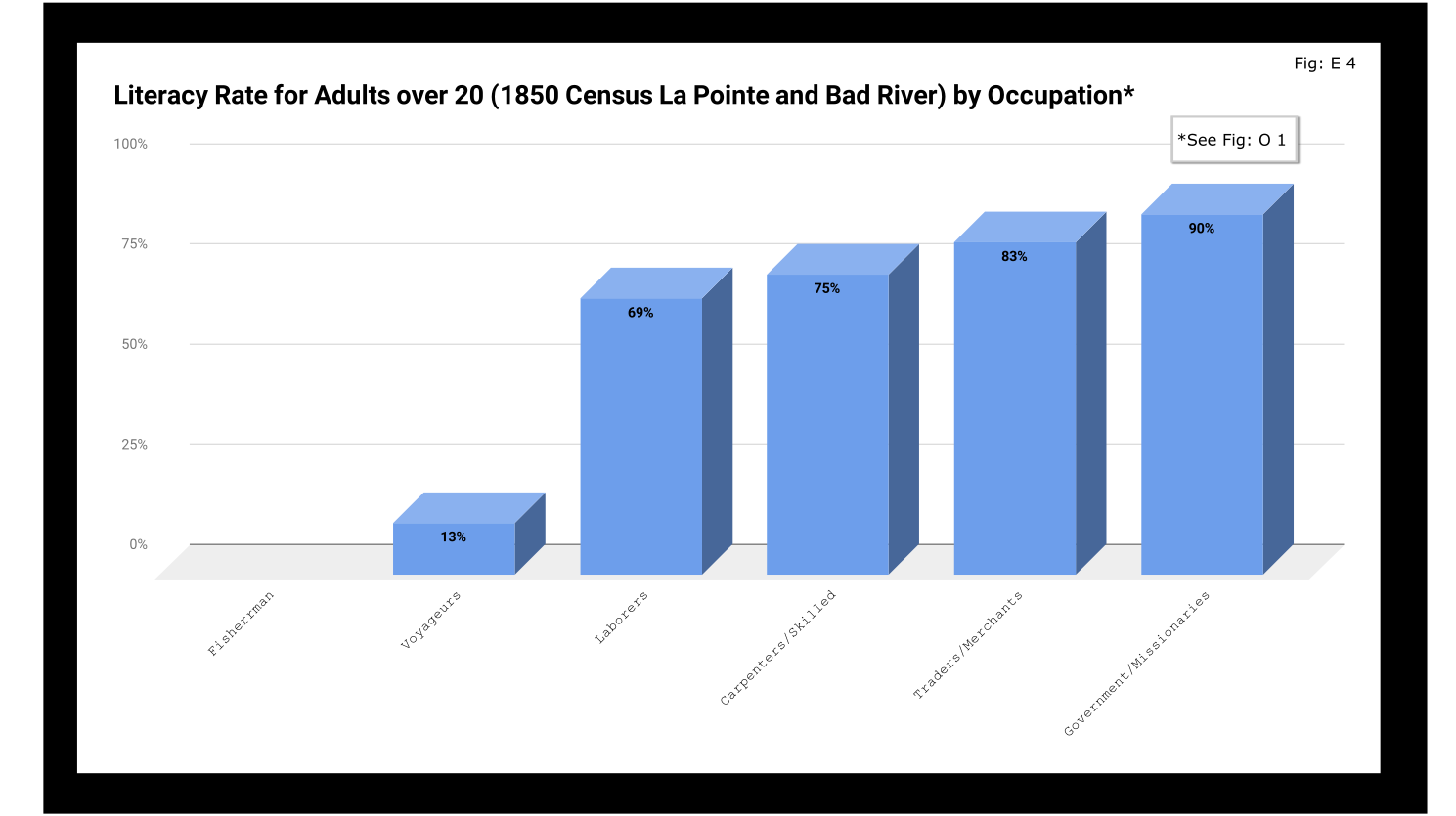
If education was going to be a factor in the economic mobility of unemployed voyageurs, the trends weren’t looking good.
Odds and Ends
Two marriages were reported as occurring in the year previous to the census: Peter and Caroline Vanderventer and Pierre and Marguerite Robideaux (ak.a. Peter and Margaret Rabideaux). Though married, however, Caroline was not living with her husband, a 32-year old grocer from New York. She (along with their infant daughter) was still in the home of her parents Benjamin and Margaret Moreau (Morrow). The Vanderventers eventually built a home together and went on to have several more children. It appears their grandson George Vanderventer married Julia Rabideaux, the granddaughter of Peter and Margaret.
I say appears in the case of George and Julia, because Metis genealogy can be tricky. It requires lots of double and triple checking. Here’s what I came across when I once tried to find an unidentified voyageur known only as Baptiste:

Sometimes it feels like for every Souverain Denis or Argapit Archambeau, there are at least 15 Jean-Baptiste Cadottes, 12 Charles Bresettes, 10 Francois Belangers and 8 Joseph DeFoes. Those old Canadian names had a way of persisting through the generations. If you were a voyageur at La Pointe in 1850, there was nearly a 30% chance your name was Jean-Baptiste. To your friends you might be John-Baptist, Shabadis, John, JB, or Battisens, and you might be called something else entirely when the census taker came around.
The final column on Daniel Johnson’s census asked whether the enumerated person was “deaf and dumb, blind, insane, idiotic, pauper, or convict.” 20 year-old Isabella Tremble, living in the household of Charles Oakes, received the unfortunate designation of idiotic. 26-year-old Francois DeCouteau did not have a mark in that column, but had “Invalid” entered in for his occupation. It’s fair to say we’ve made some progress in the treatment of people with disabilities.
Final Thoughts
I am not usually a numbers person when it comes to history. I’ll always prefer a good narrative story, to charts, tables, and cold numbers. Sometimes, though, the numbers help tell the story. They can help us understand why when Louis Gurnoe was killed, no one was held accountable. At the very least, they can help show us that the society he lived in was under significant stress, that the once-prestigious occupation of his forefathers would no longer sustain a family, and that the new American power structure didn’t really understand or care who his people were.
Ultimately, the census is about America describes itself. From the very beginning, it’s never been entirely clear if in E. pluribus unum we should emphasize the pluribus or the unum. We struggled with that in 1850, and we still struggle today. To follow the Department of Commerce v. New York citizenship case, I recommend Scotusblog. For more census posts about this area in the 19th century, keep following Chequamegon History.
Sources, Data, and Further Reading
-
Paap, Howard D. Red Cliff, Wisconsin a History of an Ojibwe Community ; Volume 1 The Earliest Years: the Origin to 1854. North Star Press of St. Cloud, Inc., 1854.
-
Satz, Ronald N. Chippewa Treaty Rights: the Reserved Rights of Wisconsin’s Chippewa Indians in Historical Perspective. University of Wisconsin Press, 1997.
-
Original Census Act of May 23, 1850 (includes form and instructions for marshals). (PDF)
-
Compiled data spreadsheets (Google Drive Folder) I’ll make these a lot more user friendly in future census posts. By the time it occurred to me that I should include my tables in this post, most of them were already done in tally marks on scrap paper.
-
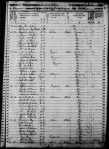
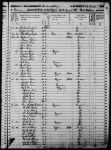
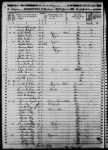
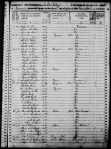
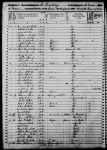
Finally, these are the original pages, scanned from microfilm by FamilySearch.com. I included the image for Fond du Lac (presumably those living on the Wisconsin side of the St. Louis River) even though I did not include it in any of the data above.
-

- Bad River
-
- Fond du Lac (not included in above data)





1855 Inquest on the Body of Louis Gurnoe
April 11, 2019
By Amorin Mello
The following is a set of three articles collected and edited from the Superior Chronicle newspaper, followed by my personal thoughts on this matter :

Superior Chronicle newspaper July 7th, 1855, page 2.
Lake News.
We find in the Lake Superior Journal the following paragraphs of lake news:

“The brig Columbia, which carried the first cargo of ore through the Sault Ste. Marie Canal.”
~ The Honorable Peter White, by Ralph D. Williams, 1907, Chapter XIV.
Johnson & Tisdale, of Cleveland, have just built a small side-wheel steamer, for J. H. Garrett, of Ontonagon, and intended to be used on that river as a passenger boat, and also for towing between the mouth of the river and the mines. Her dimensions are : length of keel, 85 feet; beam, 14 feet; depth of hold, 2 feet. She has two engines, and will draw about fifteen inches water.
The Garrison stable at the Sault Ste. Marie, containing two horses was set on fire on the morning of the 29th ult., and, with its contents, totally consumed.
The Canal Company showed their patriotism on the Fourth of July, by exploding about one hundred and fifty barrels of damaged powder.
The first locomotive for the Iron Mountain Railroad, from Lake Superior to the Iron Mountains, left Buffalo on Tuesday by the brig Columbia, for Marquette.
Superior Chronicle newspaper, October 23rd, 1855, page 2.
Man Shot.

George Riley Stuntz
Deputy U.S. Surveyor, and Chequamegon Bay land and minerals speculator.
On Tuesday night last an affray occurred on Minnesota Point, which resulted in the shooting of a sailor, attached to the brig Columbia. The vessel was lying at the wharf of Messrs. Stuntz & Co., and the crew, under the influence of liquor, went on shore for the purpose of having a frolic; in the course of their spree they came across some Indians, encamped on the Point, and one of the men soon provoked a quarrel with an Indian. The Indian was being beaten severely, when the captain coming up, interfered, whereupon he was attached by the man. The captain, being small in statue, and unable otherwise to defend himself, drew a pistol and fired at his assailant, the ball entering his side. The wounded man was brought to town, his wound dressed, and is now said to be doing well, the ball not having penetrated to any serious depth.
Superior Chronicle newspaper, November 6th, 1855, page 2.
Death of Louis Gurnoe — Inquest by a Coronors’ Jury — Verdict, etc.
There were more than one Chippewa mixed-blood named Louis Gurnoe.
man living alone in Superior City during the 1855 Wisconsin Census. No further sources about J. Baker could be found.
Several weeks ago we gave an account of the shooting of a half-breed named Louis Gurnoe by Captain Wells, of the brig Columbia. The affray occurred on Minnesota Point, opposite Superior. It appears that Gurnoe was a man of very intemperate habits, and several nights previous to his difficulty with the captain, was engaged in a row at a low groggery on First street, kept by a negro named Baker. A dance was being held at that place, and Gurnoe, under the influence of liquor, challenged those present to a fight; he was then set upon, knocked down, and kicked and beaten in a cruel manner. The injuries he sustained, aided by excessive dissipation, ensued his death, just as the vessel was leaving our port. At La Pointe, a coronor’s inquest was held on the body, and the verdict rendered was that death was caused by bruises received at Baker’s house. We hope this matter will be brought before the grand jury at the next sitting of our circuit court, and while we may not expect to see the murderers brought to justice, we hope, at least, that sufficient cause may be shown why this miserable den should be removed. It has been tolerated too long already, and for the good order and character of our town, if for no other consideration, some effect should be made to put a stop to the disgraceful proceedings there enacted.
We publish the entire testimony elicited at the inquest, verdict of the jury, and an affidavit made by Gurnoe previous to his death, exhonorating Captain Wells from all blame whatsoever.
Joseph Stone, one of the hands on board, being duly sworn said:
That on Tuesday evening last, the brig Columbia, Captain Justus Wells, from St. Clair, was opposite Superior; there was a noise between [Sandy?] and deceased, Louis Gurnoe; Louis wanted to fight; captain wished him to stop; deceased knocked captain down; Louis then challenged captain to fight; he then got hold of the captain by the hair of the head; captain told him several times to let go; captain said if he did not let go he would shoot him; told him five or six times to let him go; he did not let go; the first thing I heard was the report of a pistol; [Sandy?], captain, and myself carried him to a tent; I stopped there till four o’clock; captain directly sent two men away to get a physician; deceased was in liquor at the time; he had been very quarrelsome; he shipped at Saut Ste. Marie this trip; he had been bruised on the face the Saturday previous; on the Monday previous when leaving Superior wharf he was so intoxicated that he fell off the provision chest; he was sick coming up; he was unable to do duty after Saturday.
Simeon Nelsonn being duly sworn said:
We went on shore at Superior, on Saturday evening last; at Baker’s there was a dance; the dance went on nicely till about twelve o’clock; Louis said something to the effect that no one in the room was able to fight him; with that a little Irishman took it up; I went in and hauled Louis back; some one took me off from him, shoved me on one side and commenced at Louis; knocked him down with his fist, and several men piled on him; they then commenced kicking him in the side, breast, and once or twice in the face; after a while they were parted; then Louis commenced drinking again – had been drinking during the evening. After having got all pacified we went on board about two o’clock in the morning; he went to sleep; when he woke he swore he would have a row with somebody before he left the place; on going on shore he commenced drinking; we unloaded the vessel on Monday and Tuesday, and on that afternoon we went over to Minnesota Point; in the evening all went ashore to have some sport; Louis said, before he went ashore, he was bound to have a row with the captain; after going on shore, everything went on well till about two o’clock in the morning. (Wednesday;) I was lying in the lodge; Louis came in and commenced at me; I told him that I did not want any fuss with him and that everything he said I was bound to knock under to save a row; at that the captain heard the words from Louis and came out from another lodge; as Louis was going to come in at me, the captain grabbed him by the shoulders, hauled him back, and said to him, “Louis we did not come here for a row, we came to have sport;” Louis turned on him, and knocked him down; they were then parted; the captain balloed “enough;” Louis was going at him again; the captain stepped back, pulled out a revolver, and said, “If you don’t leave me alone I will shoot you;” Louis opened his breast to him, and said, “Here’s a clean breast shoot;” captain stepped back, and Louis went at him again; caught the captain by the hair of the head; captain told him if he did not let go he would shoot him; we tried to part them again; couldn’t part them; captain wanted to let go, but Louis wouldn’t; captain again said “If you do not let go I will shoot you;” as Louis was drawing back his foot to kick the captain in the face, he being down about knee high, the captain again repeated his caution, gave him one minute to let go, and then shot him; Louis then let go; says he, “I’m dead’ I’m dead.” – Captain said “I thought it would turn out that way – I told you I would shoot but you would not mind me;” captain said “If there is anything I can do I will do it;” the captain, Joseph Stone and myself, carried him into the lodge; the other two boys that were with him commenced dressing his wounds; captain sent John Scott and myself aboard the vessel after the boat to go for a physician; we went aboard and got the boat; got the second mate and Benj. Rassau to go for the doctor; went to Superior; couldn’t find a physician; captain, second mate, Joseph Chapman, a Frenchman living on the point, and myself, got the deceased into the boat and brought him aboard; before we got him aboard a physician came; about eight o’clock in the morning I saw deceased lying in the cabin; said he felt better; about four o’clock p.m. we endeavored to put him into one of the berths; he seemed to be in convulsions; on Wednesday night he got out of his berth, went on deck, and walked fore and aft; Thursday morning he left the cabin and sat on the rail aft; I said “Louis, you will be falling overboard;” he said “there is no fear of that;” he then left the rail; I was standing at the helm; he came up; looked me very hard in the face; I said, “what is the matter?” he gave no answer, but went directly into the boat; deceased had been very quarrelsome all the way up; he remained in the boat about three minutes; he was sitting in the boat with his arm on the taffrail; I took him to be asleep, and tried to wake up; I lifted his arm up, and eased him down into the boat to keep him from falling overboard, and went down after a lantern, (about five o’clock a.m.;) before I had time to time to come with a lantern, some one hard me talking to him and was there before me with one; the captain was also there; I looked at him, and said he was dead; then we took him out of the boat, and laid him forward of the cabin, and put a mattress under him; he was warm at the time, and we thought he might recover; one of the passengers then said life was not gone but he was dying; deceased frequently complained of his bruises received on Saturday night.

James Chapman
~ Madeline Island Museum
James Chapman, being duly sworn, said:
The quarrel commenced about a squaw; in other respect; he corroborated the testimony of the previous witness.
Daniel Weihl, a passenger, being duly sworn, said:
I saw the doctor probe the wound, and he followed the rib, one or one and a half inches; I turned away as he found the ball; I do not think the wound was sufficient to cause his death; no inflamation existed; deceased went forward so many times that I concluded he had the diarrhea.
A. W. [Groveract?], being sworn, said:
I told the captain not to use the weapon there; after the shot, saw the deceased standing by a tree; he vomited blood; had not seen deceased vomit blood previous to the shot; he bled very near a pint; the blood from the bruise on his face might have got into his mouth and he threw it up.
John [Babner?], being sworn, said:
I corroborate the testimony given by Mr. Nelsonn.
Mr. Hancock, (a passenger,) being sworn, said:
I corroborate the testimony given by Mr. Nelsonn.
Calvin Ripley, being sworn, said:
Deceased had been sick about six weeks previous to his shipping, and was sick again when about two days out; was drunk every night, while at Superior, that I saw him; kept the forecastle a day after the fight at Superior; doctor said the wound would not injure him at all – that deceased was worse off in other respects; doctor said it was better for deceased to be on shore; he might suffer from the bruises; deceased wished to come on board and go down.
E. M. Raymond, being duly sworn, said:
I saw the doctor drawing the ball out, and left; saw nothing out of the way till last evening; noticed that deceased thrashed about the chains, and made unnecessary noise; I think deceased was not in his right mind last evening.
Daniel Weihl, being recalled, said:
The wound did not cause mortification; the worst bruise is the one at the rim of the belly; have seen a person kicked in the same place vomit about a quart of blood.
J. E. Rogers, (passenger,) being sworn, said:
That he observed that that deceased, during the time he lay in the cabin, hawked and spit, and about one-third of it appeared to be blood and the rest yellowish matter.
At the conclusion of the testimony, the following verdict was rendered by the jury:
An inquisition taken on board the brig Columbia, Captain Justus Wells, in the port of La Pointe, on the 18th day of October, 1855, before John W. Bell, one of the justices of the peace for La Pointe county, Wisconsin, upon the view of the body of Louis Gurnoe, there dead, by the jurors whose names are hereunto subscribed, who being duly sworn to inquire on behalf of the people of this State, where, in what manner, and by what means the said Louis Gurnoe came to his death, upon their oaths do say:
That the deceased came to his death in consequence of bruises received at Superior, at Baker’s residence, from the hands of individuals to the jury unknown, but with whom he was engaged in a fight;
That he was at the same time, and had been, suffering from the effects of continued hard drinking, following sickness, from which he had only partially recovered previous to shipping;
That we acquit Captain Wells of all guilt as to the shot fired by him, and that we do not deem it as a mortal wound, or one that accelerated the death of the deceased.
In witness whereof, the said Justice of the peace and the jurors of this inquest have hereunto set their hands the day and year aforesaid.
JOHN W. BELL Justice of Peace,
S. S. VAUGHN, Foreman,
M. H. MENDELBAUM,
R. D. BOYD,
JOHN M. BRADFORT,
JULIUS AUSTRIAN,
A. CARPENTIER.
Copy of a settlement made at Minnesota Point for assault and battery:
Minnesota Territory, Superior county,
Dock at Minnesota Point,
October 17, 1855.Know all men by these presents, That whereas the brig Columbia, of one hundred and seventy-six tons, commanded by Capt. Justus Wells, from St. Clair, Michigan, District of Detroit, laying at Minnesota Point now and for a few days previous, and among other hands on board said brig was one Louis Gurnoe, a half-breed, and this man was in a state of intoxication, and was making a quarrel with other parties; and whereas, the said captain interfered for the purpose of introducing peace measures, and the said Gurnoe opposed the said captain, and they came to blows and a clinch; and whereas Gurnoe held the said captain firm by the hair of the head, and the said captain requested the said Gurnoe to let go of him, and he would not, and the said captain shot the said Gurnoe in the skin of the side to get clear of him, which would was only a flesh wound, entering the skin against the rib and running along under the skin outside of the rib; and the said captain sent a boat to Superior City for a doctor, and he came and dressed the said wound, and said captain paid said doctor five dollars for his fee for crossing St. Louis river from Wisconsin; and the said Louis Gurnoe having [diver?] other fights, was badly bruised before this; and whereas the said captain has made arrangements in Superior City for the taking care of said Gurnoe to the amount of twenty-five dollars, which we receive of the said Captain Justus Wells, and discharge him of all expense whatever that may arise in an action of assault and battery or any other action for the said causes as the said Gurnoe has received a full compensation for all injuries by the said captain on the ground that the said captain seems not to have done anything more than to defend him or his own personal safety, and what he gives is of good heart and a charitable act received by me.
This settlement is to be construed no further than the said parties have a right by law to settle actions and causes of action. In this settlement the said captain does not mean to have it understood that he acknowledged that he has done anything or [ac?] whereby he may be liable to the law, but for the purpose to buy his peace and a general good will to the said Gurnoe.
(Signed)
LOUIS (his X mark) GURNOE,
In presence of JOSEPH GURNOE,
[DORUS MARCUS?], and CALVIN RIPLEY.
Amorin’s Commentary
Hi, Amorin here again. I don’t always add commentary to my reproductions of Chequamegon History, but when I do… it is because I am still trying to understand the rest of the story.
First and foremost, the death of Louis Gurnoe was horrific. It is unfortunate that these articles disrespected him and served him no justice. The October article doesn’t even mention his name. The only real biographical information gleaned from the November article about Louis Gurnoe is that he was a Chippewa mixed-blood who came aboard the brig Columbia at Sault Ste. Marie. Apparently, his death was far more newsworthy than his life to Americans.
The language stereotyping Louis as a drunk Indian is disgraceful, and makes me question whether the references to the negro and little Irishman were perjury. To be clear, yes, I do believe this entire inquest was a fraud. One red flag, for example, is that the doctor was never identified by any of the witnesses for verification.
Besides dishonoring Louis’ life, it seems that the sole purpose of the Verdict in the November article was to acquit George Riley Stuntz and Captain Justus O. Wells of any guilt with the incident as reported in the October article. The Judge and Jury of the mystery Louis were all white Euroamerican settlers of La Pointe that were very involved with Lake Superior Chippewa mixed-bloods by marriage and/or business, yet there does not seem to be any amount of empathy expressed by them for Louis Gurnoe.
Although these articles dishonored Louis (and failed to identify exactly which Louis Gurnoe he was) they revealed just enough information to hint at what his life may have been like before boarding the brig Columbia at Sault Ste. Marie in 1855. The Gurnoe/Garneau/Gournon/Gornow/Gaunaux/etc. families of Chippewa mixed-bloods (a.k.a. Metis) were very active in the cosmopolitan politics of Lake Superior throughout the mid-1800’s. There is more than one Louis Gurnoe this could have been, so unfortunately the Louis Gurnoe that boarded the brig in 1855 may only be known as a mystery to Chequamegon History.
Consider, for example, the Louis Genereaux [Gurnoe] that authored an August 29, 1855 letter to Indian Affairs Commissioner George W. Manypenny via the Mackinac Indian Agency on behalf of Saginaw Chippewa/Odawa Tribe trying to locate their reservation lands in lower Michigan. While it may have been possible for someone to travel from lower Michigan to western Lake Superior within this time frame, there doesn’t seem to be any compelling correlation suggesting that this Louis Genereaux would be the same Louis Gurnoe from the brig Columbia.
Another example Louis Gurnoe that we may consider is the one featured in the bottom right of the following photograph from 1855 at Sault Ste. Marie;
the elder Louis Gurnoe.
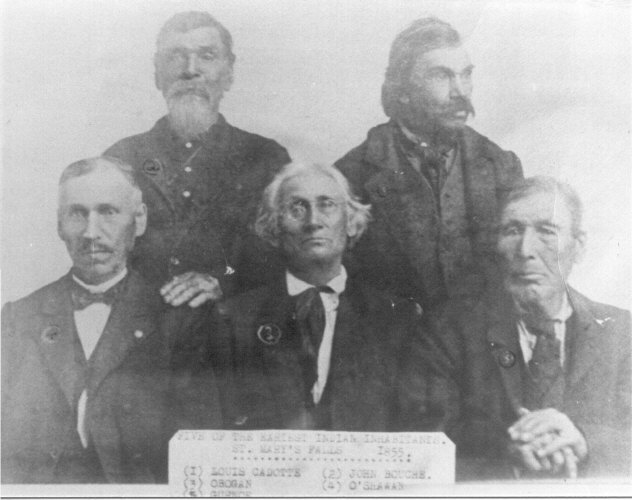
1855 photograph from the Soo Evening newspaper labeled “Five of the Earliest Indian Inhabitants of St. Mary’s Falls” [Sault Ste. Marie] and identified from left to right:
1) Louis Cadotte; 2) John Bouche; 3) Obogan; 4) O’Shawn;
5) [Louis] Gurnoe.
Read Metis-History.info/ by Richard Garneau (Gurnoe) for other possible identities of the first four men in this photograph.
It is possible that the Louis Gurnoe from these articles was one of this elder Louis Gurnoe’s sons. Louis Gurnoe’s Settlement at the end of the November article was signed by another son, who is featured in the bottom center of the following photograph:
the Indian Agency interpreter Joseph D. Gurnoe.

Top: Frank Roy, Vincent Roy, E. Roussin, Old Frank D.o., Bottom: Peter Roy, Jos. Gourneau [Joseph Gurnoe], D. Geo. Morrison. The photo is labelled “Chippewa Treaty in Washington” and dated 1845 by the St. Louis Hist. Lib and Douglas County Museum, but also dated 1855 by the Northeast Minnesota Historical Center. It was probably taken during the Bois Forte Treaty of 1866, which was these men acted as conductors and interpreters in Washington, D.C. Photograph digitized by Mary E. Carlson for her book The Sawmill Community at Roy’s Point.

Superior Chronicle newspaper November 4, 1856
I will share details about Joseph D. Gurnoe’s life, and his professional relationship to James Chapman, but these details will have to wait to be published in another post in the future. This concludes my thoughts for this post.
Until next time,
Amorin
 Chequamegon History