Judge Bell Incidents: Fooled the Austrian Brothers
October 30, 2025
Collected & edited by Amorin Mello
This is the third post in a series featuring The Ashland News items about La Pointe’s infamous Judge John William Bell, written mainly by his son-in-law George Francis Thomas née Gilbert Fayette Thomas a.k.a G.F.T. In today’s post we explore stories about real estate transactions negotiated between Judge Bell and Julius Austrian.
… continued from King No More.

The Ashland News
Wednesday, January 11, 1888, Page 5
STORIES OF JUDGE BELL
HOW HE FOOLED THE AUSTRIAN BROTHERS IN A LAND DEAL.
“Incidents in the life of Judge John W. Bell. – A Half Century in Old La Pointe – by Geo. Francis Thomas.”
Such is the proposed title to a forth-coming historical work which will prove wonderfully interesting, especially to the older residents in this vicinity. The author begins with the year 1835, when the brig “John Jacob Astor,” the first vessel built upon the shores of Lake Superior, first cast her anchor in the bay at La Pointe, and ends with the death of the old pioneer, John W. Bell, which occurred but a few days since. In speaking of the pioneer the author says:
“From the day that Mr. Bell stepped ashore at La Pointe from ‘The Astor,’ June 23, 1835, to the day of his death, he was a character possessing a most positive individuality; and it was not until his later years, and then when he had become financially distressed, that his wonderful spirit became at all broken; but even then he was never known to as a favor.”
The old judge, or “Squire” as he was usually called, was always ready to relate some incident of early days in which he was usually a participant. There are also a great many equally interesting incidents related by others, where the old judge would not justify his telling the story himself. The author says:

Detail from Julius Austrian’s 1854 Plan of the Town of La Pointe with Judge Bell’s Block 35 and four small Lots.
~ Wisconsin Historical Society
“[…] except a small portion in the North West Corner claimed and enclosed by Edwin Connor, and so much of the South West Corner as is claimed by P. B. Vanderventer, and the enclosure of Barboo & Meletle in the South East Corner”
“The old man always liked to have things done on the square, so when Julius Austrian was platting the village of La Pointe and proposed to Mr. Bell to give him the block he already occupied for a nominal consideration, Mr. Bell insisted that his block, number thirty-five, be exactly square – all the four streets crossing at right angles. A square block or lot was quite a novelty where each squatter’s garden-patch had been fenced in and called a lot, regardless of street lines or quantity of land.”
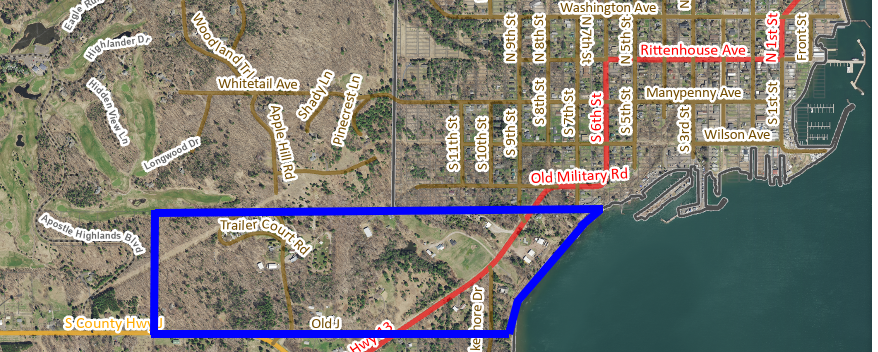
Memoirs of Doodooshaaboo: Joseph Austrian’s Time at La Pointe 1851-52 (Pt. 2)
“Our blind brother Marx Austrian with brother Julius’ assistance at that time, preempted 160 acres of land near Bayfield from La Point, complying with preemption laws. He built a small log house living there with his wife. One night during their first winter in their new house, there was a knock at the door, and when opened they were confronted by a number of Indians, who were evidently under the influence of liquor and who swinging their tomahawks vigorously, making all sorts of threatening demands. An old Indian who knew Marx interceded and enabled him and his wife to escape without injury who thoroughly scared fled panic stricken in the dark about two miles at night, over the ice, on the Bay which was covered with a foot of snow to La Point for safety. The poor woman having the hazardous task of leading her blind husband over this long and difficult road, not to come back again and glad to escape with their lives and thus abandoning their right of preemption. This place was later on platted and is now known as the Bayfield Addition.”
Mr. Bell was an acute judge of human nature, and made it an invariable rule to deal with his fellowmen according to each one’s individual peculiarity. Before Bayfield was located, or in fact thought of as a town site, a Hebrew by the name of Marx Austrian pre-empted the 126 acres of land now known as Austrian’s clearing, and which adjoins Bayfield on the south. After a short residence upon the claim Mr. Austrian’s family became sick, and in order that proper care might be given them they were compelled to move to La Pointe, where a physician could be had. A speculator, noticing the apparent irregularity, tried to jump the claim. The case was taken to Superior for trial, and Mr. Bell, being the only available witness, the Austrian brothers and Louis Leopold proposed to give him a one-fourth interest in the land as compensation for making the trip to Superior. Mr. Bell accordingly accompanied the party, to Superior, and on arriving at the hotel as was his custom, he immediately began to make himself at home with the guests of the house, most of whom he was well acquainted with. At length when the case was called, Mr. Bell seemed so entirely unconcerned that he was urged to come forward by some one of the interested parties; but Mr. Bell carelessly said,
“Oh! I believe I will not attend court today.”

Julius Austrian
~ Madeline Island Museum
The Austrians wildly expostulated, and at last agreed to pay all the old “Judge’s” expenses for the trip, besides giving him a one-fourth interest in the 126 acres of land. This brought him all right and Marx Austrian gained his point. A few years later, when the town of Bayfield was laid out by the Hon. Henry M. Rice, the Austrians, Julius and Marx, concluded that they ought to buy back the one-fourth interest in the 126 acres held by “Squire” Bell, and accordingly Julius approached him on the subject. Mr. Bell was a man of few words and no give-in to his dictum. He told Austrian that $1,000 would buy his interest if taken by noon the next day. Austrian claimed the price was exorbitant but finally went off to get the cash. on the morrow at noon, or a few minutes before, Austrian called on Bell and said he could only give him $800. Mr Bell insisted on $1,000, which Julius Austrian finally agreed to pay;
“but,” says Mr. Bell, “now you are too late. It is fully a minute past the time which I specified, now I will not take less than $1,250, and that must be forthcoming within two hours from now.”
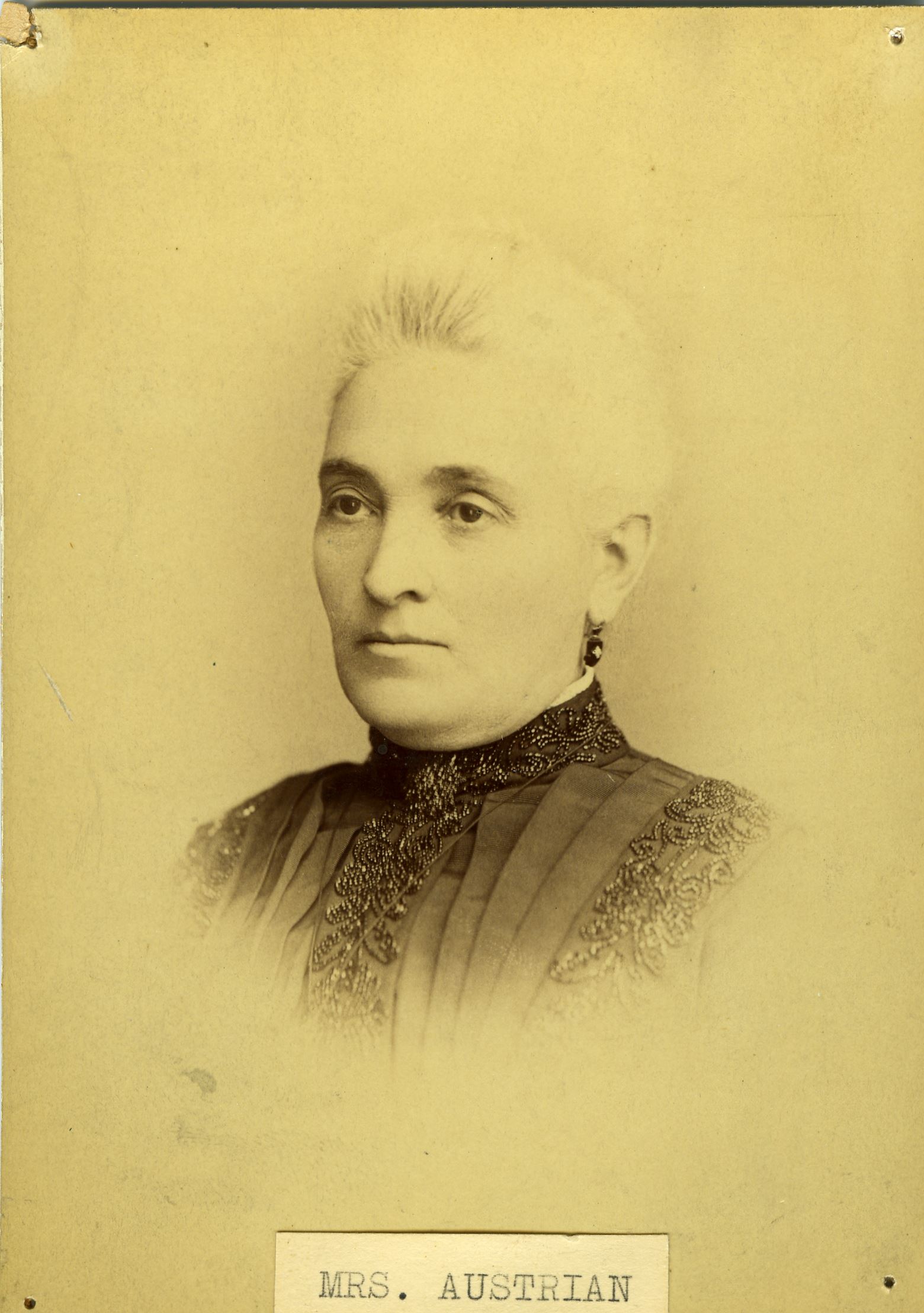
Hannah Leopold Austrian
~ Madeline Island Museum.
This time Austrian kept away, thinking Mr. Bell would go back to his $1,000 offer if he did not seem too anxious. In that Mr. Austrian misjudged his man, for when Austrian again approached the “squire” his price was $1,500 spot cash. Things now looked dubious to the Austrians, a conference was held with Mrs. Hannah Austrian and together they raised $1,300, all the cash which was available at that moment. This they handed over to Mr. Bell with a sight due bill for $200, secured by a deposit of all Mrs. Austrian’s jewels, including her diamond earrings. They got back the one quarter interest in the 126 acres, and they have paid taxes on it ever since, yet the whole is hardly worth now what the quarter cost them.
“This recalls an incident back in ’61 or ’62,” said one of the jurymen at a recent trial in this city. “It was a case against a trader who was accused of selling whiskey to an Indian. The jury was drawn, and after hearing the evidence they retired to a back room to determine on a verdict. It was about four o’clock in the afternoon. At six o’clock the jury was about evenly divided. About midnight, after continuous balloting, the vote stood ten for acquittal and two for conviction. There was no fire in the room, and it was very cold. The ten jurors who stood for acquittal made one final request to the other two to vote with them, but they persistently refused. The ten then got a long pine board and laying it across two stools proceeded to play an interesting game of freeze-out. About two o’clock one of the two came over on the other side and joined the rest in the game of freezing out the other juror. At three o’clock in the morning he gave up.”
To be continued…
Memoirs of Doodooshaboo: Joseph Austrian at Eagle River 1854-1859
November 2, 2024
By Amorin Mello
This post is the seventh of our Memoirs of Doodooshaboo series reproducing the memoirs of Joseph Austrian at the Chicago History Museum. The previous post began in 1852 when the Leopold & Austrian family transferred Joseph from their La Pointe store to work at their other store in Eagle River on the Keweenaw Peninsula, and ended up spending the Winter of 1853 at the family headquarters in Cleveland to greet his mother and siblings upon their arrival immigrating from Bavaria.
This post begins in 1854 upon Joseph’s return from Cleveland to Eagle River to continue the family business at their new storefront, and provides insights into the growing pains of the pioneering copper mining companies on the Keweenaw Peninsula, Joseph somehow fails to mention much else about life on Lake Superior during 1854-1859.
1854-1859 were the boom and bust years of La Pointe County land speculation, which arose from the La Pointe Treaty of 1854 and Soo Locks of 1855, and crashed with the 1857 Financial Panic of 1857 and American Civil War of 1861. It is unfortunate how Joseph’s memoirs do not mention anything about his Leopold & Austrian family’s business at La Pointe during 1854-1859, when they were capitalizing on Chippewa Treaty Allotments in the Penokee Mountains to form the La Pointe Iron Company.
Some of that story can be told through other records in our Austrian Papers and upcoming posts on Chequamegon History. Until then, we’ll continue with Joseph’s memoirs.
Memoirs of Doodooshaboo
… continued from after La Pointe 1852-54.
Partner of Leopolds in Eagle River Store. 1854.
Louis Leopold & Babette Austrian;
Hannah Leopold & Julius Austrian.
On our arrival in Eagle River, May 1854, I found the work on the store had not been properly finished by the contractor, and I had my hands full to get the new store in shape quickly for business without unnecessary delay. Henry Leopold & wife (my sister Ida) occupied the apartment over the store and I boarded with them as soon as they started housekeeping, which as a matter of course was a great improvement over our former mode of living, and fresh meat was no longer scarce.

Sketch of the Cliff Mine, 1849.
~ The Cliff Mine Archeology Project Blog
The additional store now permitted us to add, various new departments in; grain, heavy provisions, hard ware, &c. We also opened up in connection with our business a meat market located at the Cliff Mine, managed by Henry F. Leopold with a branch at Eagle River. I took sole charge of the Eagle River business making the daily rounds to the Cliff and other near by mines, boarding houses and miners homes, soliciting orders. In the evenings I worked at the books, as I had no one to assist me in this work.
Sam went to Mackinaw to wind up the old business affairs of his brother Louis, then he went to New York and settled with his creditors. After this he went to Eagle River in the fall and we jointly attended to the business. He went to New York every season to buy goods, consisting of clothing, dry goods, boots & shoes & mens furnishing goods.
During the second winter of our settling at Eagle River, he went to Europe and became engaged to Babette Guttman, a cousin of mine, and the following winter he went to Europe again to be married and returned in the Spring with his wife. A Mr. Henry Guttman, Babette’s brother who had been interested with us in the meat market at the Cliff Mine assisted me in our store during Sam’s absence.
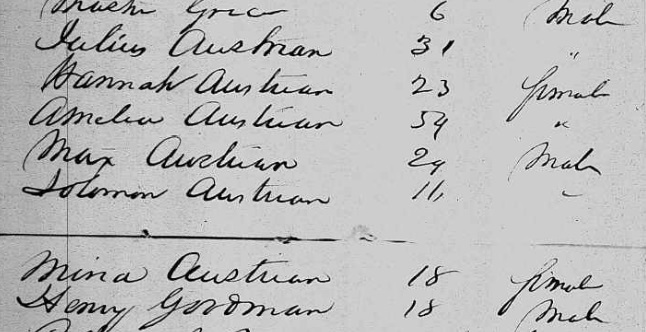
Henry Guttman (Goodman) immigrated with the Austrians.
~ 17 October 1853 passenger manifest of the steamer Atlantic.
Business Increases.
Later on I found it necessary to engage a book keeper owing to the rapid growth of our business, and for that purpose I engaged a Mr. Moses Hanauer, a son of the teacher in the native place of the Leopolds.
I made it my duty to solicit orders and deliver goods, and went the rounds in a delivery wagon daily, soliciting new orders. Of course I had a hostler to attend to the horses & wagons and who assisted in loading the goods. By the next year our store had again become too small and I contracted for a new wing to be added, which made a great improvement and gave us better facilities for carrying on our business.
Phoenix Mining Company’s Drafts Protested.
By an arrangement with the Phoenix Mining Co. we agreed to attend to the payment of their miners, taking the drafts of the Company’s agent in Boston in settlement each month. We did this on account of the business which came to us through it.

~ The Mining Magazine: Devoted to Mines, Mining Operations, Metallurgy, &c., &c., Volume 2, 1854, pg. 404.
After this thing had gone on for some time, the several drafts had amounted to a big sum, and unexpectedly to our consternation the drafts came back protested.
We had quite a struggle and wrangle trying to get them to make good their drafts. Finally Sam Leopold went to Boston and proposed that we would take the mine in payment of their debt if they though it was not worth the protested drafts. This proposition brought them to their senses and they made immediate arrangements then for funds by calling an assessment on the Stockholders to satisfy our claim.
The success we had met with in the Eagle River business in course of years gave us sufficient capital for new enterprises.
To be continued on the Keweenaw Range 1860-1864…
The 19th Ojibwe Journal of Edmund F. Ely
July 9, 2023
By Leo and Amorin
The Ojibwe Journals of Edmund F. Ely, 1833-1849, compiled and edited by Theresa Schenck, and published by University of Nebraska Press in 2012, are a fascinating window into Ojibwe Country at a pivotal time in history. Chequamegon History frequently cites this work, which consists of eighteen journals kept by a Protestant missionary during his largely unsuccessful labors among the Ojibwe people of western Lake Superior and the upper Mississippi country. In it, Dr. Schenck alludes to a nineteenth journal, not published in the book, dealing with the liquor trade at La Pointe in the years 1847 and 1848.  The original manuscripts are held by the Northeast Minnesota Historical Center at the University of Minnesota-Duluth. Other historical societies hold transcripts made by Grace Lee Nute and Veronica Houle in the 1930s. Here we present our own transcription of Journal 19.Unlike numbers 1-18, Journal 19 is less a personal diary and more an official log of incidents related liquor trafficking and drunkenness on Madeline Island and surrounding regions. During those years, Ely was a teacher at the La Pointe Mission under Rev. Sherman Hall and also provided assistance to Rev. Leonard Wheeler at the Bad River Mission. These missionaries came from the New England evangelical tradition of the Second Great Awakening, which in addition to trying to convert the peoples of the world, also produced movements for Abolitionism, Women’s Suffrage, and Temperance. Letters indicate that some form of La Pointe Temperance Society was created in the late 1840s. Journal 19 references papers on file, indicating that the document may actually be the official log of the Temperance Society, probably having the intent to produce evidence against illegal liquor traders.
The use of alcohol in the fur trade goes back four centuries, to the earliest French presence on Lake Superior. Government and church efforts to suppress that trade go back almost as far. These measures, however, were never successful in fully eliminating liquor from the trade. By 1847, the laws related to alcohol at La Pointe were somewhat ambiguous. The Intercourse Acts of the United States prohibited the sale of liquor to Indians and on Indian lands. Enforcement, therefore, was the responsibility of the Government Sub-Agent. However, there were questions over whether his jurisdiction extended to non-Natives, to mix-blood Ojibwe people with American citizenship, or to transactions completed on the water of Lake Superior. Suffice it to say, both Federal laws and local ordinances prohibiting alcohol were enforced irregularly. The missionaries found this maddening.
Edmund F. Ely was perfect for the job of professional tattletale. For one thing, he was good at being disliked. He had numerous enemies in both the Ojibwe and the non-Native population. Around the time he was driven out of Fond du Lac by the chiefs of that community, he even went so far as to compile a list of reasons why the Fond du Lac Ojibwe disliked him. He would later go on to alienate several of the early settlers of Superior and Duluth during the McCracken-Ludden Affair, and he often sent complaints about his fellow missionaries back to headquarters in Boston.
We, today, are also fortunate that Ely had this job. Most accounts from this era, about the destructive power of alcohol in the Laker Superior trade are very similar in nature. We get a lot of righteous screeds, emphasizing only sensational violence. These are long on moralizing and short on interesting detail. Ely is certainly moralistic to the point of sanctimony, and some of his accounts are extremely violent. However, Journal 19 preserves the same types of details and idiosyncratic observations that makes the earlier journals so compelling. Because of this, we get a true window into the nuances of 1840s La Pointe society. Despite lax or selective enforcement of liquor laws, we arguably see a community less affected by alcohol than the nearby white settlements at St. Croix and Ontonagon. Finally, we get to see familiar characters, learn of their triumphs and failures, and hear stories both horrific and humorous, but seemingly very real.
The Ojibwe Journals of Edmund F. Ely:
LaPointe 1847-1848
Journal # 19
1847
May.
Adams of Ontonagon came to Bad River with goods & Whiskey, for trade with the Indians. He first past into the Bay behind Shagouamik & the whiskey was secreted near the sand cut. Mr. Hayes (Sub-Agt) Learning of this movement went in search, & destroyed [it at once. 50 to 80 Quarts sold.]
Aug.
The Sail Boat “Flying Indian” [came ashore for sale] with whiskey & secreted it [illeg.]
“
Schooner “Fur Trader” searched by the Sub Agent & [33] qua [btls] of Liquour in bottles destroyed.
“
[omitted or illegible sentence]
“
Steam Boat “Julia Palmer” boarded and searched at the [Sault] [illeg.] of [illeg.]

Martin Beaser,a prominent name in early Ashland history, got his start here as an illegal liquor trader. These late summer incidents, in both 1847 and 1848, coincide with the La Pointe annuity payments
Augt.
Martin Beser, of Ontonagon arrived in a Yawl–with a few others, reported as passengers. Journalist has been informed that she brought part of the load (whiskey) of the Flying Indian. Probably had considerable whiskey of belonging to Beser & the Passengers.
— Besor’s boat with himself, Chas. Rowley & a stranger on board (all intoxicated) was upset in a squall while cruis about Eleven o clk P.M. while cruising about the harbour. Wind Northerly. They drifted on to Shagouamik & struck some distance off the point on the shoal in about 4ft water. Men lay on the side of the boat, benumbed, helpless, & almost speechless & inconscious.
—It being surmised from certain movements, by a member of the Temp. Socy. that a Bbl of Whiskey would be removed from the Island to Shagouamik. Mr. Hayes was informed, who sent off Mr. Smith & two strikers, before day break, to keep a look-out. Mr. Smith discovered Besor’s boat–took off the men & brought them to Cadottes–where they were seen by Messrs Wheeler & Johnson & others.
“–Sab.
Besor’s boat left, and were obliged to put in to Bad River where were encamped the Lac du Flambeau Wisconsin Indians Indians returning from payment. There was liquor enough onboard to commence a trade. The Indians were supplied & became intoxicated. The wife of White Bird (mother of Kebebizindų) was present, who states that an Ind rec’d a bottle from one of the men on board, in exchange for a Blanket, but as ascertaining it contained only water went to take his Blanket again, whereupon Besor resisted him & knocked him down with a Rifle. The Ind’s were roused by the report that the white men were killing the man, & as the boat shoved off the shore, fired upon it, shot & ball, one Ball passed through the post of the ship keel [cent]. & struck lodged in the arm of James Dorman, who had thrown himself there off place of safety. Boat put back to Warren’s for surgical help–left Dorman & went off same day (Sunday)
[perpendicular to beginning of struck-out statement]Incorrect
[in margin at beginning of struck-out statement]
Sab previous
[perpendicular to ending of struck-out statement]This statement is incorrect see Whitebird’s wife’s statement on file.
On the last two days of the payment,
Bottles of liquor were smuggled ashore in the pockets of dealers, & sold for $1, per bottle, or exchanged for blankets. Some bottles were found to contain only water. The trade in bottles was carried on, (it is believed) through the windows of the Julia Palmer. Capt. Wood, of the steamer was detected in the night, landing his yawl, with bottles of whiskey in possession. Some two or three Bbls, (in different sized casks) were found & destroyed by Govt.
Nov.
Francois Boudrie of Ontonagon arrived here with whiskey. Evidence was obtained of his having infringed the law in selling to Indians & also of selling without licence. Mr. Austrian lodged a complaint with Justice Bell & Boudrie was brought to trial, but from his supposed inability to pay the fine, & there being no prison, at the was set at liberty on securing an amount of $5 for costs, without bonds “to keep the peace” being required to enter into Bonds to keep the peace.
— Jejiguaio complained to Justice Bell against Millette for selling whiskey to Indians in exchange for paymt. goods. Case not examined–
— gave Mr. Oakes a list of goods, traded for whiskey with Millette. Indian was dissatisfied needed his goods & wished to get them again.
May 13.
Francis Boudrie of Ontonagon brought whiskey to Bad River for trade with the Inds. B. confessed his crime to Messrs. Wood & Wheeler. An officer warrant was issued by Justice Bell, but the officer arrived too late to arrest him, he having left the Territory.
May 6.
Propeller Independence arrived from Sault St. Maries. Not known that any intoxicating liquor was landed save 2 Bbls cider for Mr. Watrous.
19th
Chas. Brissett states that Henry Beaulieu told him he (Henry) bought one bottle of liquor of Watrous for $1. (Whh Henry denies) Some observed Henry to be, in their estimation, a little excited from drink.
May 23.
Propeller Independence arrived today from Sault St. Maries. Dr. Borup & fam, & J. P. Hayes Esq. passengers.
Items gathered at Ance Kiueonaui. In Oct Last, 3 young men (Indian) from the methodist Station, went across the bay to Meniclear’s, got whiskey, & returned drunk. One of them lay on the shore & died in the night. A coroner’s Inquest was held on the body. (P.O. Johnson)
Some time in Nov. or Dec.
A canadian came through from Green Bay in company with J. Paull of Ontonagon, got liquor of Geo. Burkett, & was drunk some days, was then attacked (with pluerisy probably) & died (P.O. Johnson)
In Jany.
3 miners came from Copper Harbour, on their way to Green Bay, with considerable money. They stopped at Meniclear’s & gave themselves to drinking one or two days, during which, one did a severe wound in the hand, and another found himself minus about $100. (Johnson)
There are 5 traders at L’Ance, viz.
P. Crebassa no whiskey
Meniclear Whiskey & drinker
Geo. Burkett. do – do
Sherman do – do
Sheldon do – do
2 of the above drinkers, also abuse their families.
Some time in the fall of 1847,
John Champaigne, in the Employment of Doct. Kane, on their way up the ontonagon was seized with delirium tremens, & died. Had been drinking at the mouth of Ontonagon.–
March 2nd, 1848.
Jas. Landergrun was found in a dying state on the Ice, Ontonagon River, for particulars see the letter of Mr. Saml O. Knapp (on file)
Feb 7. 1847.
Henry Rust was killed shot by a shot from an Nodin or his son in law, at Dicks Drakes trading house on Snake River St. Croix, Co. Drake & another man were drunk & were fired upon they were too drunk to know much about the circumstances for particulars, see statement of J. P. Hayes Esq (on file)
May 1848.
–Drake shot dead killed by a shot Bapt. Robideau– Liquor the cause.
June 19.
Schooner Swallow arrived from Sault St. Maries. freight for Messrs Hyde, Leopoled & N. Fur Co.
March.
Mr. Cash of Ontonagon stated to Journalist that Martin Besor, after his return from Lapoint last fall offered to sell him any number of Indian Blankets, whh he (Cash) might be disposed to buy.
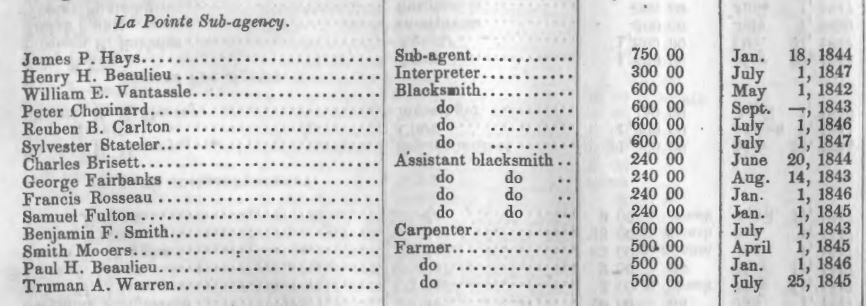
List of mid-late 1840s employees at the La Pointe Indian Sub-Agency including James P. Hayes and others.
~ Thirtieth Congress – First Session. Ex. Doc. No. 26. House of Representatives. Persons Employed In The Indian Department. Letter from The Secretary of War, Transmitting a statement of persons employed in the Indian Department. January 26, 1848.
June 22.
Jas. P. Hayes Esq. U. S. Sub Agt. recd his dismission & left in the Schooner Swallow– cause, Intemperance
July.
Fr. Boudrie arrived from Ontonagon with a cask of whiskied Cider– was prosecuted–a search warrant was issued & Peter Vandeventer was deputized to serve it. Van deventer After allowing abundant time for the service, Mr. Justice Bell & Van Tasell went to the building under search, & detected Van deventer in secreting a part of the cider. The whole was seized & destroyed by the owner–
Aug 28.
Propeller Independence arrived. Considerable intoxication among french & Half breeds.
“ 29
Schooner Napoleon, Clarke arrived with Govt provisions. Passengers Hyde, Wolcott & Martell
In discharging some bbls. of corn from the Propeller, on bbl. burst, & revealed a number of bottles of Liquor secreted among the Corn. The bbls were expressed back to the Sault. They have since been ascertained to belong have shipped by Martell of Sault St Maries. It was also reported by a passenger on the propeller, that the Napoleon was supposed to have on board a Bbl of Liquor belonging to Wolcott.
A number of Indians are reported to have had liquor about the time the Propeller left.
— An Indian was instigated by a Wht. man named Mills to murder two Americans living on Apple River–liquor was used in carry out Mills’s plans. The Ind was arrested & Hung, without judicial trial, at the Falls of St Croix.
— Majise shot killed in a drunken frolic on the St Croix. died next day–
— An old woman had her arm broken at the mouth of the Brule by a drunken son in law–Liquor furnished by Aug. Cadotte.
Sept 11.
Wood Smith & Vantassell Govt men, found 2 Kegs (about 12 [gal]) whiskey near the camp of Fr. Boudrie belonging to him, concealed in the ground–they immediately destroyed it.
6th
The sailboat Flying Indian arrived in the night of [Sunday] [day] last.
Sept 13.
Schooner Algonquin arrived from Sault St. Maries ~~~~~~~~~~~~~~~~~~~~~~~~~~~~~~~~~~~~~~~~~~~~~~~~~~~~~~~~~~~~~~~~~~~~~~~~~~~~~~~~~~~~~~~~~~~~~~~~~ Further information about the challenges of enforcing liquor laws at La Pointe can be found in the following:
“A real bona fide, unmitigated Irishman”
Reisen in Nordamerika: From Ontonagon to the mouth of the Bois-brule (Part 3)
1855 Inquest on the Body of Louis Gurnoe
1856 Inquest on the Body of Jerry Sullivan
~~~~~~~~~~~~~~~~~~~~~~~~~~~~~~~~~~~~~~~~~~~~~~~~~~~~~~~~~~~~~~~~~~~~~~~~~~~~~~~~~~~~~~~~~~~~~~~~~
Ely, Edmund Franklin, and Theresa M. Schenck. The Ojibwe Journals of Edmund F. Ely, 1833-1849. Lincoln: University of Nebraska, 2012. Print.
Folsom, William H. C., and E. E. Edwards. Fifty Years in the Northwest. St. Paul: Pioneer, 1888. Print.
Paap, Howard D. Red Cliff, Wisconsin: A History of an Ojibwe Community. St. Cloud, MN: North Star, 2013. Print.
Schenck, Theresa M. William W. Warren: The Life, Letters, and times of an Ojibwe Leader. Lincoln: University of Nebraska, 2007. Print.
Special thanks to Dr. Schenck for making this post possible.
By Amorin Mello
This is the third installment of the Memoirs of Doodooshaboo series on Chequamegon History, as transcribed by us from the original handwritten memoir of Joseph Austrian at the Chicago History Museum. This installment covers Joseph Austrian’s migration from New York City to Mackinac Island, where he is greeted by his sister Babette Austrian and her husband Louis Freudenthal Leopold. The next two installments describe Joseph Austrian’s experience with his Leopold and Austrian relations on Chequamegon Bay during 1851-1852 (Part 1 and Part 2).
Memoirs of Doodooshaboo
… continued from Manhattan 1848-1850.
Started for Mackinaw Island. 1850.
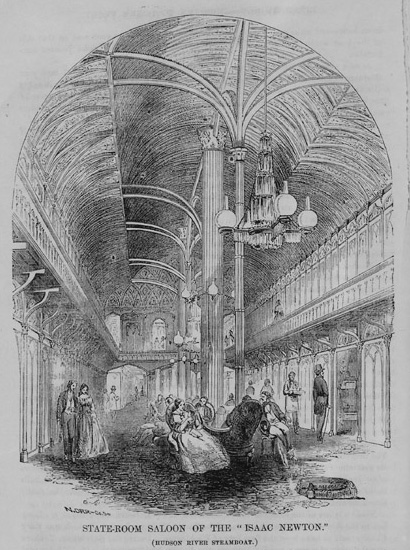
“State-room saloon of the Isaac Newton (Hudson River steamboat)”
~ New York Public Library digital collection, image WWM9814-012008f
Leaving my sister in New York, under the care of Uncle and Aunt, I left for Albany on the steamer Isaac Newton, then considered the finest steamer on the Hudson River. A state room then was a luxury out of the question. I sat up all night long in the engine room watching the machinery, which had a fascination for me. There was aboard a young lady who had crossed the ocean on the same ship I had come over on. She was all alone on her way to Joliet, she had been annoyed by some passengers, offering to buy a stateroom for her, and she was happy when she saw me, and as it were, put herself under my protection passing off as my sister, she also sat up all night with me in the engine room. Many years later I met this young lady’s aunt in Chicago, she was a neighbor of ours and we enjoyed a pleasant chat over by gones.

“SS Atlantic, built 1848, courtesy of Institute for Great Lakes Research, Bowling Green State University.”
~ Øyergenealogy
We reached Albany the following morning breakfasting at a restaurant, and early that afternoon started on our emmigrant car, arriving at Buffalo next morning. The car was fitted with wooden benches running length wise, all we had to eat on the journey was apples, which I bought on the way from boys and girls who came into the train with baskets full at the several stations where we stopped. This same evening we started on the side wheel steamer “Atlantic,” taking steerage passage for Detroit; we encountered a heavy storm on Lake Erie, it was very rough and we were tarted to a severe spell of seasickness. I managed by tipping one of the cooks to get some coffee for my companion and myself as eatables were not supplied to steerage passengers usually, this was our breakfast. After our long fast, with the exception of the apples, we arrived at Detroit at ten o’clock next morning, my travelling companion continuing her journey on to Chicago.
I went with a tavern keeper, a Mr. Martin Fry, who had met our boat at the landing and solicited patronage. His place was called “Gast Haus zu Rheinpfaltz” a cheap boarding house, the boarders were principally railroad laborers. Mr. Fry was a kind man, he went with me the following morning to the river front, for the purpose of making enquiries regarding the leaving of the next steamer for Mackinac, which I intended taking. Imagine my consternation, when I heard that the last boat of the season had left, there was no railroad connection between these two places, and it was too hazardous to try to reach Mackinac by sleigh on foot; under the circumstances I was compelled to face the only alternative of remaining in Detroit over the winter.
Compelled to Remain in Detroit. 1850.
~ Detroit Perspectives: Crossroads and Turning Points, by Wilma Wood Henrickson, 1991, page 114.
I had taken but 15$ or 20$ with me on leaving New York, leaving the surplus with my sister, and I had no intention of calling on her or any one for more. What to do now was the next question. Mr Fry offered to board me during the entire winter for the sum of $25, but the amount looked so large to me, and I declined but arranged to pay him $1.75 per wk but had to share my room and bed with another party, a stranger to me. Fry volunteered to assist me in trying to find employment and going with me to stores, and factories amongst others to Silverman & Co., a cigar factory and to Friedman & Co., a large dry goods store. Mr. Friedman was a friend of Mr. L. F. Leopold who had written him concerning me. In spite of all, although I was willing to do any reasonable work I was able to perform for my board, the general answer I got was “they had all the help they needed” then, and could not use me for anything I was suitable to do, which was a sore disappointment to me.
My First Business Venture:- Peddling. 1850.
~ Wikipedia.org
~ Detroit Perspectives: Crossroads and Turning Points, by Wilma Wood Henrickson, 1991, page 114.
One of the boarders, a young jeweller who had just returned from New York where he had been to buy goods to replenish his stock, found that in doing so he had failed to reserve enough cash to take him back to Chicago, and being short was forced to stop over to await funds to be sent him by his brother at Chicago. He told me confidentially of his predicament, and I confided to him my plight. I had 12$ in cash on hand, and he proposed that I should invest this in notions, he to assist me in selecting the goods, and to start out together in peddling while he remained in Detroit. As he spoke English and I could not understand one word, I gladly accepted his proposition. We started off at once, first to the market place, where we bought a cheap splint basket then to Benedict & Co’s Jefferson Ave. where we made our selection.
While making our purchases, I suddenly called a half and had the bill figured up, as the original bill I have among my papers in Chicago will [???] fearful that the order might over reach my capital, and found that there was still one dollar left to invest; after completing which we started for my room with basket and bundle, we arranged and assorted and rearranged the goods in the baskets to make the best possible showing, and my partner taking the basket and I throwing a dozen red woolen mufflers over my shoulder, we started out two days after my arrival in Detroit, on my first peddling expedition, and had fair success, selling a few dollars worth the first day, and reinvesting the amount in more goods the same evening. Thus we continued for five days, when my partner received his remittance and informed me that he would start for Chicago. We took inventory and found our profits had amounted to $2.00 in all. As his share in the profits, he took a dozen brass seal rings as I found these articles with my limited English vocabulary difficult to dispose of. He started for Chicago and the following morning I set out alone with my basket. Not being able to speak or understand English, I felt a little timid at first, however I managed to get on with fair success. I chose the outskirts of the city for my trade, the roads to the city were very bad, and I calculated the difficulty offered people in going to and fro, would be to my advantage. I naturally suffered frequently from the could, on these long tramps. I did not possess an overcoat, and only scant underwear, and no means nor inclination to incur further expense for clothing.

“Map from 1850 of the Michigan Southern and connecting railroads. The Michigan Central is also shown, with its then-western terminus of New Buffalo. The Detroit & Pontiac, soon to become the Detroit & Milwaukee, is not shown.” ~ Wikipedia.org
The Michigan Central Railroad was being constructed toward Chicago, at this time there being no through communication. Mr. Friedman had advised me to perfect myself in the English language and given me the name of a teacher who had instructed him on his coming to America. I immediately, after I found myself compelled to remain in Detroit, made arrangements with the teacher to give me two hours lesson each evening, which I continued to take most conscientiously all winter.
Left for Mackinaw. 1851.
When Spring came I found that after having paid all my expenses, I had enough money left, (ten dollars) to pay for my ticket to Mackinaw, this was May 1851, and treated myself to first cabin passage, the first time I had traveled first class since leaving my home in Germany. I left Detroit, March 28th. 1851 on the Propeller, Republic, on Lake [blank] and had a smooth passage, it was quite cold and a thin sheet of ice had formed over the lake, but not thick enough to retard progress.

“Woodcut engraving of the propeller REPUBLIC towing the Michigan Southern Railroad Company’s steamboat NORTHERN INDIANA into Pigeon Bay as she burned on Lake Erie on 17 July 1856.”
~ MaritimeHistoryoftheGreatLakes.ca
~ Wikipedia.org
~ EarlyCanadianHistory.ca
On April 1st. I arrived in Mackinaw (also called Mackinac Island) deriving its name from the Indian word Michili. The Island at this time had about three hundred white inhabitants and there was also an Indian settlement there. A government fort was located here on a high steep hill, surrounded by a stone wall, where a few companies of soldiers were stationed. The Island was a beautiful romantic place, it had no telegraphic or railroad communication, consequently in the winter, with the close of navigation, it was entirely out cut off, and isolated from the rest of the world. In the summer it was visited as a summer resort to some extent then, and has in later years become very popular as such. Chicago at this time had no direct railroad connection with the East, all travel between there and the East was by water.
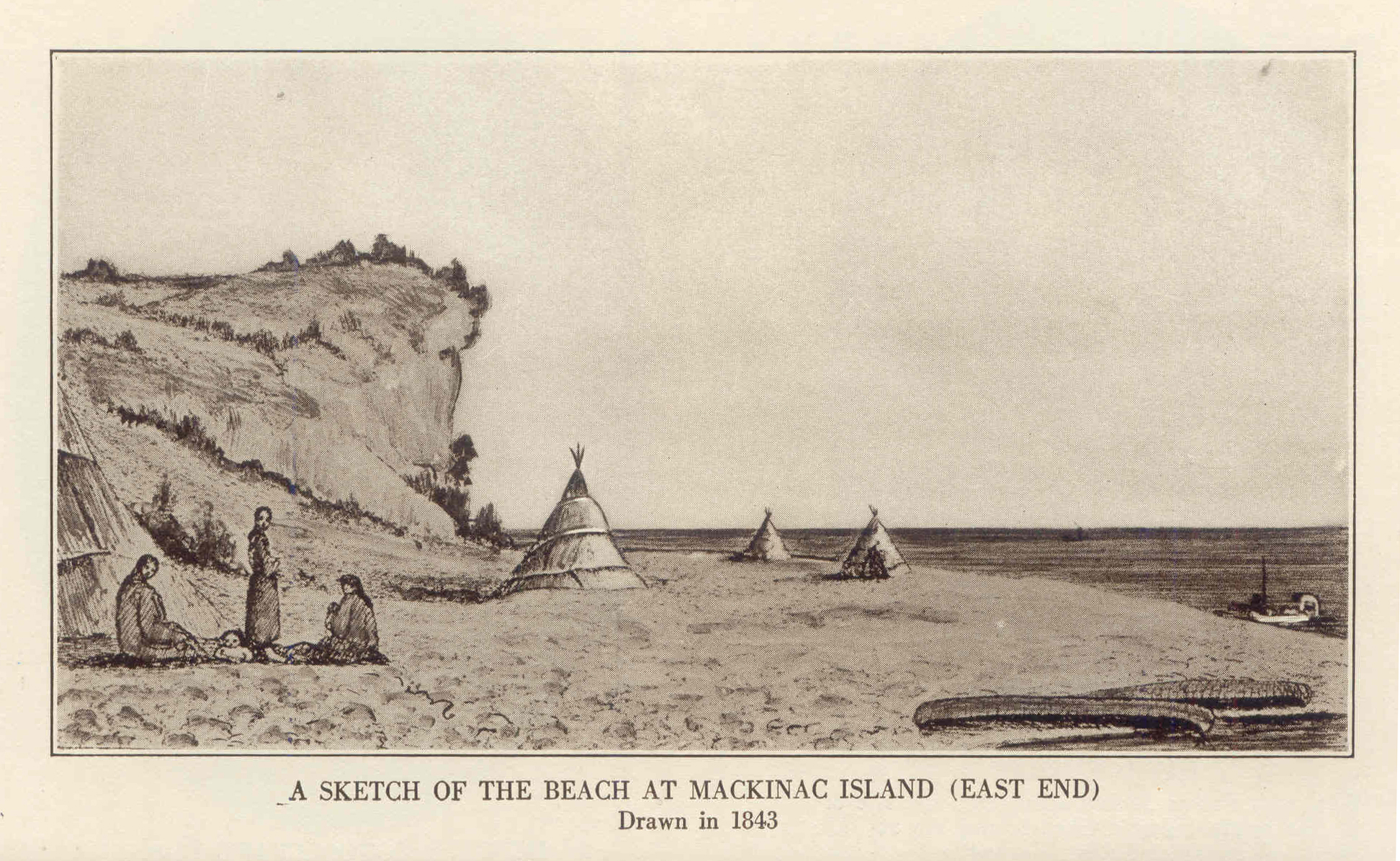
1843 Drawing of Mission Point Beach at Mackinac Island, Michigan
~ Historic Mackinac: Volume 1 by Edwin O. Wood, 1918, facing-page 367.
There was a fine line of large side wheel steamers, elegantly fitted up and furnished with a band of music aboard. These steamers ran between Chicago & Buffalo, and always made stops at the Island on their regular trips and enlivened things there.
On my arrival there I received a most hearty welcome from my sister Babette and brother-in-law Louis F. Leopold, who had worried considerably over my having missed the last boat of the season and therefore having been obliged to remain all winter in Detroit. Mr. L. F. Leopold was the oldest of four brothers Aaron, Henry & Samuel, they together with Mr. Julius Austrian had a dry goods store on the Island, and in addition to this were engaged in the fish business, furnishing nets, salt & barrels to the fishermen, who caught and packed the fish, the same being later on collected from the different fishing grounds by a small schooner sent out for that purpose. Alternately the three younger brothers were sent in charge of these expeditions. L. F. Leopold was naturally a bright man, but egotistical, and very visionary and with most unpractical business ideas, still he had complete influence and control over his brothers who implicitly obeyed his commands, often contrary to their own and better judgement.
The day after my arrival at Mackinaw Mr. Leopold took me to the warehouse and showed me his stock consisting of hundreds of barrels of fish. The collection of the season. I was told that I was expected to assist in repacking this fish, which is done before their being shipped to market. I was eager to do so and went right to work and worked hard daily as I did not want to be under obligations for my board even for the short time I was to remain at Mackinaw. I did not find the occupation enticing or agreeable, my principal lamentation was that the strong salt brine ruined my clothes, and my wardrobe had become sadly depleted by this time.
To be continued in La Pointe 1851-1852 (Part 1)…
By Amorin Mello
This is the second installment of the Memoirs of Doodooshaboo series on Chequamegon History, as transcribed by us from the original handwritten memoir of Joseph Austrian at the Chicago History Museum. This installment covers Joseph Austrian’s migration from Bavaria to New York City. Later installments describe Joseph Austrian’s experience with his Leopold and Austrian relations on Chequamegon Bay during 1851-1852 (Part 1 and Part 2).
Memoirs of Doodooshaboo
… continued from Bavaria 1833-1847.
Left Wittelshofen. 1848.
~ Wikipedia.org
I went to Feuchtwang, to my uncle’s home, making myself useful in the fields about the house and barn and otherwise. He was an intelligent man, self educated and well read, a fine gentlemanly person, but penurious. My coming in contact with him was beneficial as I spent my evenings with him in his study and profitted by his large knowledge of things. My aunt was very kind and treated me as one of her own family, after having been there for one and a half years, and finding there was no further improvements to be gained, in accordance with the suggestions of my brother Julius and brother-in-law Lewis F. Leopold, who had gone to America some four years before, it was finally decided that I with my sister Ida should emigrate to America.
Mr. L. F. Leopold had a fishing and trading business at Mackinaw, my brother Julius was located at La Pointe on Madelaine Island, one of the Apostle group of islands in Lake Superior, northern Wisconsin, where he was engaged in the fur trading and had a general store, and traded with the Indians and half breeds buying fur from them.
Emigrated to America. 1850.
~ Wikipedia.org
~ Wikipedia.org
On October 4, 1850, at 4 o’clock in the morning, my sister Ida and I started for America. It was a cheerless raw morning, and with heavy hearts we set out in a private conveyance, via Feuchtwang to Wurzburg, where we arrived that evening and put up at the Wittelsbacher [Hof?]. The following morning we started on a little steam boat on the River Main, for Frankfurt, via Ashaffenburg, where we arrived that evening, leaving for Frankfurt the next morning, arriving there in the afternoon, and were met at the landing by our Uncle Heinrich Heule, who received us most cordially and invited us to his home, where we remained two days. We dined the 2nd day with his daughter, our wealthy cousin, Frau Richa Schuster, who gave a fine dinner in our honor.
~ Wikipedia.org
~ Wikipedia.org
From Frankfurt we went to Mainz, to which place our baggage had been forwarded ahead of us. The following morning we started on a Rhine steamer for Rotterdam, thus taking in the entire Rhine trip which we enjoyed immensely, we remained in Rotterdam two days, when we crossed the North Sea on rather a poor small steamer for Havre, France. In crossing we encountered a terrific storm during the night, the waves swept over the decks of the steamer causing the water to rush into the cabin where we were sleeping, and we had our first and most severe experience of home sickness. On our arrival at Havre we looked woe begone, and some of our baggage was almost ruined. The ship on which we were to sail was a large three masted “square rigged” sail vessel, “Robert Kelley”, Captain Barstow. On looking her up, I found she would not leave for five days to come, as she had not yet finished loading her cargo. In the meantime we were comfortably located in a boarding house where we made further preparations for our Ocean Voyage. Oct 20 we sailed from Havre taking 2nd cabin passage which was near the captain’s quarters. There were seven persons besides ourselves occupying our cabin. The ship did not furnish food for the passengers, but provided facilities for them to do their own cooking in a limited way. There were some rows of a certain kind of cooking stoves which were heated by an employee of the ship, the places were divided into a number of spaces so arranged, that kettles could hang in them. Each space was allocated to certain parties during the trip, but there were many more passengers than spaces, and it was not seldom that a fight was occasioned by one or the other party claiming the privilege of priority. In fact when a person turned his back for a few moments, while engaged in preparing food, someone would take off his kettle substituting his own. On certain person finding himself thus dispossessed grew furious and hurled his kettle contents and all on him who had played him this trick. The mate happened to come along, and made the one who had thrown the kettle, take off his coat, and with it wipe up the floor clean, threatening to lock up anyone who would do any thing of this kind again.
Before leaving home my mother had provided us with food such as could be easily prepared, such as roasted [four?], prunes, [gruieback?], dried beef, smoked tongue, &c. During the trip, two others of our party besides myself alternately attended to the cooking, and we got along as well as could be expected. On the voyage we had generally heavy winds and a rough sea, but fortunately the winds came mostly from the direction favorable to our sailing, consequently we made good headway.
Our Captain was a very capable navigator and very strict in his discipline. Among our passengers were two close friends, “frenchmen,” who often indulged to freely in French wine, quarreled, one stabbed the other but not seriously. After the Captain investigated the matter, the offender was hand cuffed. When it was rough the poor fellow tossed about mercilessly, when his injured companion took pity on him, and at such times would remain with him, leading him by the arm to protect him and to keep him from falling.
Besides the second class passengers there were about two hundred steerage passengers, below. One of these men “a monk” jumped overboard one day, the Capt. happened to see it, and gave orders to have the ship quickly turned about. A life buoy thrown by the Captain to the man struggling in the water, was grasped by him and six sailors in a life boat put out to rescue and managed to save him just in time. The monk was brought back to the vessel more dead than alive, the ship’s doctor worked until he revived him. On being questioned he said, he jumped over board owing to the terrible unpleasant surroundings in Steerage. The Capt. then told him that he would not again risk the lives of his sailors, should he jump in again, but there was no need of it, as he did not make another attempt.
On November 20th, we sighted land during the afternoon, and in compliance with a signed “wanting to be towed”, a tug came along side of our ship the next morning, throwing us a tow line, and we expected to reach New York the following morning. But we were doomed to disappointment, a large head wind sprang up and the tug could make no headway, and after a few hours of futile struggle, the tug gave up the attempt to tow us and cast off our line, and our ship was compelled to turn back to sea to avoid danger of the coast. But the next morning two tugs came on and took our ship in tow, and the wind having subsided, made good headway.
Presently a little schooner came along side our ship, and parties aboard began bartering with the passengers to buy their bedding, for which they might have no further use, I gladly sold mine.
Arrived in New York. 1850.

Castle Gardens was still an entertainment center in 1850, and did not operate as an Immigration Station until the years 1855-1890.
~ Castle Clinton National Monument
We landed at Castle garden about noon November 21st, our trip over, having lasted about a month. Under the inspection of the Custom House Officers the luggage was unloaded, by sliding the same down a steep plank, and in watching this performance to my great consternation, I saw one of my big chests burst open and contents scattered, giving me an endless amount of trouble to get all repacked. The chest contained an outfit of linens and feather beds our mother had given us for our future use.

Joseph and his sister Ida arrived at New York City via the Robert Kelley on November 21st, 1850.
~ “New York Passenger Lists, 1820-1891,” image 560 of 869; citing NARA microfilm publication M237 (Washington D.C.: National Archives and Records Administration, n.d.).

Joseph Austrian (Oestreicher) and his sister Ida on the passengers list.
On landing, an Uncle of ours, Mr. Heule, an old gentleman about 70 years old, met us on the pier, and it seemed good to see some one who knew us. My Uncle and sister went for a short walk leaving me to look after the baggage, expecting to return in a little while for me, but the afternoon passed, and night came on without their returning. Most all of the passengers had left the pier and I was left alone on my first night in America. Some of the sailors feeling they had been abused by the mate on the voyage over, and made up their minds to get even with him, and on the upper deck that evening, together they attacked him, beating him till they nearly killed him. The noise and excitement the tummult occasioned, did not have a cheering effect upon me, however, when things quieted, I went up on deck and stayed there till after midnight watching the ferries cross and re-cross, which was a novel sight I enjoyed. By this time I despaired of seeing or hearing from my uncle or sister that night, and although worried I sought to get some rest, there was no bed for me and I laid on the hard wood floor that night, and had not a morsel of food to eat. I could not speak a word of English, and altogether, I felt rather forlorn, on this my first night in America. Finally next morning they came to look for me & simply explained that they had wandered too far and Uncle thought it too late to come back for me, and had gone on to his home. I accompanied them back, on our way a vender of notions with his basket on his arm happened to pass me, my Uncle turned to me remarking that I would have to begin with something of this kind to earn my living; it was not an encouraging prospect, and I said nothing, but I little thought then how soon his words would come to pass.
I visited at my Uncle Max Heule’s two days and then decided to start for my intended destination, Mackinaw Island.
To be continued at Mackinac 1850-1851…
Memoirs of Doodooshaboo: Joseph Austrian in Bavaria 1833-1847
December 28, 2016
By Amorin Mello
This is the first installment of the Memoirs of Doodooshaboo series on Chequamegon History, as transcribed by us from the original handwritten memoir of Joseph Austrian at the Chicago History Museum. This installment contains rare details about a Jewish community in Bavaria before other records were destroyed by Nazi Germany in later years. Later installments describe Joseph Austrian’s experience with his Leopold and Austrian relations on Chequamegon Bay during 1851-1852 (Part 1 and Part 2).
Joseph Austrian’s
Autobiographical and Historical Sketches.
Dedicated to
My Wife and Members of my Family.
My Childhood Days. 1833.
~ Wikipedia.org
I was born September 15, 1833, in a small village called Wittelshofen (Mittel Franken, Bavaria), located at the foot of the Hesselberg, a mountain 1800 ft. high, and at the junction of two little rivers Wörnitz and Sulzach near Dinkelsbuehl, where the judiciary district court is located.
~ Wikipedia.org
On the top of the said mountain, every year in June a fair, called “Hesselberger Messe,” was held which was the great attraction for all the people of the several villages located around the foot of the mountain. To this it was customary to invite friends and relatives from far off places to attend, and it was generally very enjoyable barring the climb it meant to get up there, as it was too steep for vehicles to drive up there excepting from one direction where the road up was more gradual and which was used for the transportation of things for the fair. Besides the many places where beer was sold and where the rural population had dances, and other amusements there was generally a circus and other shows there. The view from the top of the mountain in clear weather was very fine and interesting. I always looked forward impatiently to the time when this fair took place, and soon as I was old enough to take this long steep walk, I availed myself of the opportunity which I greatly enjoyed.
Wittelshofen
The village of Wittelshofen had about 500 inhabitants of which about half consisted of Jews and the other half Protestants.
My father’s house was one of the largest and best in the place and stood opposite an old small castle, the grounds of which were surrounded by a stone wall about 10 feet high. Our home was on a lane called “Schmalz-gasse” which in wet weather was very muddy.
My father’s name was Abraham Isaac Oestreicher (Austrian), he was born in Wittelshofen and died there Sept 17, 1852 of apoplexy at the age of 75 yrs. He was an only son and his father gave him what educational advantages could then be obtained and principally in “Hebrew” which gained for him the name title of “Reb” and he was known by the Jewish village people as “Reb Frohen”. He had a large library of Hebrew books, they were of unusual size and some nearly a hundred years old.
My father was brought up strictly in the observance of the Jewish faith and adhered to its orthodox teachings very strongly. He was an easy going man and known by all for his honest and upright character. He dealt in live stock and had some good farm lands located around the outskirts of the place.
~ Chicago, the Garden City. Its magnificent parks, boulevards and cemeteries. Together with other descriptive views and sketches by Andreas Simon, 1894, pg. 147
My mother’s name was Malka nee Heule, whose parents were considered wealthy, her father, [Hyrun?] Heule was known and respected all around for his charitable deeds, especially for what he did during the famine, caused by the crop failure in 1825, when he sent big wagon loads of flour and other suplies to the famine stricken district to feed the needy, thereby saving many from starvation.
My mother was an intelligent and determined woman, and took sole charge of the house hold and education of the children. She was born in Braunsback, Wurtenberg. She died at the age of 87 yrs in Chicago, Aug 6th, 1882.
~ Wikipedia.org
My father had three children by his first wife and ten by my mother, the eldest died when a baby the others were Falk, Marx, Julius, Babette, Ida, Fanny, Joseph, Minna, & Solomon. The latter being the youngest was my father’s pet. Falk, my oldest brother, was sent to a neighboring city for higher education, which afterwards secured for him a position as a clerk and traveling agent in the business of Wedels in Furth, a brother-in-law of my mother, where he earned a good salary.
My next brother Julius, was sent to Feuchtwangen to learn the tanning trade and afterwards travelled afoot for a couple of years or more working in a number of other cities at his trade, as it was there customary to perfect themselves in the trade, and later going clear to Paris, France, before returning home, a short time afterwards he emigrated to America to join our brother-in-law Lewis F. Leopold, who had located in business at Mackinaw, with branches in Wisconsin.

Julius Austrian (Oestreicher) immigrated with his sister Babette (wife of Louis Freudenthal Leopold) and brother-in-law Henry Freudenthal Leopold.
~ “New York Passenger Lists, 1820-1891,” image 19 of 895; NARA microfilm publication M237 (Washington D.C.: National Archives and Records Administration, n.d.).
My brother Falk went to California in 1846 via Panama. At six years of age I entered school. I remember well when my mother took me on the first day to school and had me give the teacher a package of smoking tobacco. I went to the public school in the morning, the teacher had little education, his father was the village tailor; the son being versed in the three “R’s” his father secured the position of teacher for him. In the afternoon I went to the Hebrew school. Mr. Mandel was the teacher there, he had received his education in a Seminary he was very strict and high tempered, the children all feared him, as occasionally he afflicted corporal punishment. Besides this I had private lessons in history and geography.
At the age of thirteen I had to start to assist working in the field, in harvesting and hay making. I also had to plow when I was barely strong enough to handle the plough, I had to hook the handles over my shoulders to manage to get to the next furrow. I had to arise during some of the winter months at 4 o’clock in the morning, and assist in the threshing while it lasted, and I got thrashed sometimes too, when I did not keep time. My greatest sport was fishing, for which purpose I made my own pole and I often walked off to the river, when my folks thought I was busily employed. The fish I caught were mostly perch. I remember I once caught several and fastened one to a string fastened to a stake in the ground, suddenly a severe thunder storm came up, at which I made hurridly for home, forgetting the little perch I had left behind. I started bright and early the next morning to get it, and to my great surprise on pulling the string I hauled up a big pike instead of the little perch, which had evidently swallowed the latter tied to the stake and thus was caught. The joy of my good luck was indescribable.
Another sport I was very fond of was shooting off pistols. My brother Marx had one in an old cupboard drawer, which I managed to get hold of one day and when none of the family were about I with a few of my boy friends ran off to the fields, where we had such fun taking turns in shooting, and when we had no more powder we snapped off percussion caps. When a pistol was not available I constructed an improvised pistol of my own design, by attaching a big old hollow key to a natural crook of wood, which I selected in the wood shed and to which I fastened it with wire. After filing a hole on the side of the key, under which I attached a piece of tin to hold the powder. When i was ready to shoot, I laid a little flat sponge on the tin, lighting the outer edge, which acted as a fuse, and as it burned toward the powder ignited it causing it to go off and making a loud report. Not trusting the old key entirely, however, fearing it might explode, I went to a safe distance after lighting the fuse.

Outside the synagogue in Wittelshofen, Bavaria, Germany. Circa 1912-1938.
~ United States Holocaust Memorial Museum, photograph # 25821.
“Wittelshofen was declared ‘Judenfrei’ (‘free of Jews’) in January 1939.”
“The synagogue building was demolished during the winter of 1938/39.”
“A memorial stone was later unveiled there.”
~ Destroyed German Synagogues and Communities
In 1840, at the grand celebration of the new synagogue, my parents entertained with an invitation on a large scale. My mother had arranged for a special cook to prepare a grand feast. I and the younger children were excluded. I did not fancy being barred from participating. In strolling through the pantry I espied an elaborately decorated tart, chief ornament to grace the table. While the cook was otherwise engaged at the last moment, I managed to eat off the ornaments and decorations. Never will I forget the excitement and consternation the discovery of my act caused. Could hands have been laid on me then, I would have been severely dealt with.
In my fourteenth year, my mother began planning as to my future. The income of the fields, and the cattle business had declined, and considering the large family and household to be provided for did not permit of incurring much expense for my higher education, and my father advanced age made it impossible for him to enlarge his income. My mother was anxious to get me away from Wittleshofen, as she could see no promise in the future there for me. At this time, an opporunity was offered through my uncle Samuel N. Guttman and accepted.
To be continued in Manhattan 1848-1850…
1855 Yom Kippur at La Pointe
December 18, 2016
By Amorin Mello
Photograph of Julius Austrian from the Madeline Island Museum
One of the more colorful figures from primary sources of Chequamegon History is Julius Austrian at La Pointe. Austrian is also one of the more elusive, as he is often overlooked and omitted from secondary sources.
My research of Austrian is what originally inspired me to begin contributing to Chequamegon History. I have been working behind the scenes on a series of stories about Austrian featuring extensive collections of primary documents to shed more light on his life at La Pointe during the 1850’s, and look forward to publishing them at a later date.
One story in particular is about Austrian’s, and his family’s, involvement with the 1855 La Pointe annuity payment, one of the most colorful events in Chequamegon History. A brief introduction to the 1855 La Pointe annuity payment is needed for context, so I refer to a quote from Leo in an earlier post of his: A real bona fide, unmitigated Irishman:
“Regular readers will know that the 1855 La Pointe annuity payment to the Lake Superior Chippewa bands is a frequent subject on Chequamegon History. […] The 1855 payment produced dozens of interesting stories and anecdotes: some funny, some tragic, some heroic, some bizarre, and many complicated. We’ve covered everything from Chief Buffalo’s death, to Hanging Cloud the female warrior, to Chief Blackbird’s great speech, to the random arrival of several politicians, celebrities, and dignitaries on Madeline Island.”
At this moment in Chequamegon History, Austrian was a powerful resident at La Pointe in terms of private land ownership and political savvy. Austrian was a signatory of the 1847 Treaty at Fond du Lac, but not a signatory of the 1854 Treaty at La Pointe. However, primary sources reveal that Austrian was the owner of La Pointe during the 1854 Treaty, and received financial reimbursement from the Department of Interior for services related it. A letter from Reverend Leonard Wheeler at Odanah dated January 18, 1856, asserts that the 1855 annuity payment at La Pointe was hosted by Austrian:
“The following is the substance of my notes taken at the Indian council at La Pointe a copy of which you requested. Council held in front of Mr. Austrian’s store house Aug 30. 1855.”
I have come across secondary sources that allude to Austrian’s role as the host of the 1855 Yom Kippur at La Pointe immediately after the annuity payments, but have not yet been able to locate any primary sources. This post cites secondary sources in hopes that another researcher may review them and help me find primary sources. Having a background in Jewish studies would be helpful, as it is possible primary sources about the 1855 Yom Kippur at La Pointe were written in the Hebrew language rather than in English. Please contact Chequamegon History if you can help find and translate primary sources.
Without further ado, here are secondary sources about the 1855 Yom Kippur at La Pointe listed chronologically by their publication dates.
The Beth El Story: With a History of the Jews in Michigan before 1850
by Irving I. Katz
Wayne University Press (1955)
ISBN-10: 0-7837-3584-7
ISBN-13: 978-0-7837-3584-9
Pages 53-54:
“Lewis F. Leopold, whose name was Freudenthaler in his native Baden, Germany, his wife, Babette, who was a member of the Oesterreicher (Austrian) family, their infant son, Lewis’ sister, Hannah, and Lewis’ brother, Samuel, were located on the Island of Mackinac in 1845. The brothers became the first pioneers in this locality in the fishery business and were soon shipping a thousand barrels of salted fish to Cleveland each season. This business, together with the sale of supplies to fishermen, Indian trading and the purchase of furs, laid the foundation for an extensive business and they became prominent as owners of Lake Michigan vessels and merchants in the ports of the Great Lakes.
“Samuel Leopold left Mackinac in 1853 to join his two other brothers and Julius Austrian, who had married Hannah Leopold in 1849, in their recently undertaken business enterprises at La Pointe and Fond du Lac, Wisconsin, where they were among the first white settlers. Lewis Leopold officiated as cantor at the first High Holy Day services held at La Pointe in the fall of 1855. Within a few years after 1850, the Leopolds and Austrians established leading stores in Michigan, at Eagle River, Eagle Harbor, the Cliff Mine, Calumet, and at Hancock, Joseph Austrian having selected the latter place as the site for his first store and warehouse.”
Mount Zion, 1856-1956: The First Hundred Years
by W. Gunther Plaut
North Central Publishing Company (1956)
ASIN: B0007DEZ4W
Page 24:
Minnesota Pioneer article about Julius Austrian and his Chippewa mixed-blood employee Vincent Roy, Jr. in Saint Paul as republished in The Daily Crescent (New Orleans, LA), February 24th, 1851. Roy also worked for Austrian and Leopold at La Pointe, Fond du Lac, and Vermillion Lake.
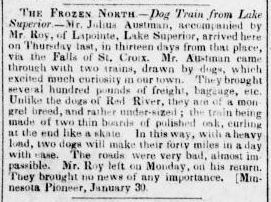
“Julius Austrian was perhaps one of the most colorful figures not merely in the history of the Congregation but in the larger Minnesota community as well. His wife, the former Hannah Leopold (in Germany, the name had been Freudenthaler), at once became an undisputed leader among the Jewish women. The couple had married in 1849 and were among the first white settlers at La Pointe and at Fond du Lac, Wisconsin. Others of the family joined them later. High Holy day services are recorded at Fond du Lac as early as 1855. Austrian laid claim to mineral rights and lands in what later became part of Duluth. 1851 he once made the trek south to St. Paul in the dead of the winter – and arrived in St. Paul with two dog trains and several hundred pounds of freight. The Minnesota Pioneer duly reported that this ‘excited much curiosity in our town.’ The Austrians and Leopolds, who may be reckoned as among the earliest pioneers of the region, later had stores in a number of Michigan towns; and when Julius and Hannah moved to St. Paul, their reputation had preceded them. But unlike his wife, Julius Austrian preferred the quiet, behind-the-scenes type of leadership. When funds were low, he would make up the deficit; and at least on one occasion, so the minute book records, he guaranteed the Rabbi’s salary. He wrote a fine hand, both in English and in Hebrew, as is attested by the cemetery records which he kept for many years.”
The Jews in Minnesota: The First Seventy-Five Years
by W. Gunther Plaut
American Jewish Historical Society (1959)
ISBN:
Pages 12-14:
“When Abram Elfelt became Vice-President of the new Minnesota Lodge No. 157, B’nai B’rith, his fellow officer and treasurer was a man by the name of Julius Austrian. The two had known each other for many years, for while Austrian did not come to St. Paul until after the Civil War he, too, had been in the Territory when it was still part of Wisconsin.
Julius Austrian (Oestreicher) immigrated with his sister Babette Austrian (Babet Oestreicher) (wife of Louis F. Leopold) and their brother-in-law Henry F. Leopold (Heinr Freudenthal).
~ “New York Passenger Lists, 1820-1891,” image 19 of 895; NARA microfilm publication M237 (Washington D.C.: National Archives and Records Administration, n.d.).
“Austrian was one of five brothers. In the old country, their name had been Oesterreicher or Oestreicher. Julius must have had an adequate Jewish education, for he could write Hebrew with a sure hand and had deep and definite religious convictions. In the late forties he, his brother Marx, and Lewis Leopold had gone up to LaPointe, Wisconsin, on Lake Superior, where they were among the first white settlers. As early as 1855, they held Holy Day services in this outpost of civilization.
“In 1849, Julius had married his partner’s sister, Hannah Leopold, a girl who was then not quite nineteen years old. Their business prospered; stores were established on the northernmost part of Michigan’s Upper Peninsula: in Eagle River, Eagle harbor, Cliff Mine, Calumet and Hancock, where their store and warehouse were located.
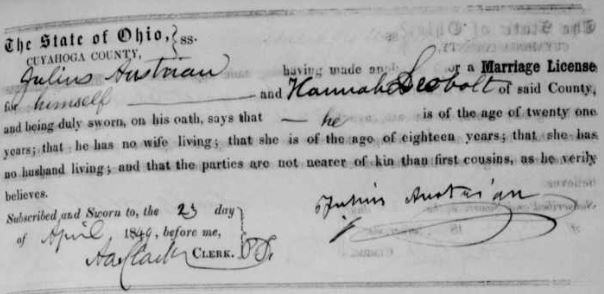
Marriage license application for Julius Austrian and Hannah Leopold.
~ “Ohio, County Marriages, 1789-2013,” image 47 of 229.
“The Austrians and Leopolds traded throughout the area and soon extended their contacts into Minnesota. Even during the summer, it was quite a journey to St. Paul, but only the hardiest person would gather enough courage to make it during the winter. No wonder, therefore, when Julius Austrian dared it in January, 1851, the press recorded that his arrival ‘excited much curiosity in our town.’ He came with another person from Lake Superior via the Falls of St. Croix. Their mode of transportation was the northern dog-train. In their two sleds they brought several hundred pounds of freight for trading.
“Austrian soon became a land owner in Minnesota. He acquired mineral rights at Lake Superior on a site where later the city of Duluth was built. In the late sixties, he and his brother Marx moved to St. Paul where Julius and Hannah at once became two of the leading Jewish citizens. For they soon proved their strong Jewish loyalties and unusual leadership qualities.
Photograph of Hannah Leopold Austrian from the Madeline Island Museum.
“When they came to St. Paul, the Civil War was over, and whatever little Jewish institutional life there had been in Minnesota was left in very poor circumstances. The two Austrians were soon engaged in building up the congregation. They helped to find the means for erecting the young state’s first synagogue. Hannah founded its first women’s group and headed it in its work for the Temple and in its increasingly ambitious welfare and social enterprises until after the turn of the century. Under her presidency Mount Zion’s women founded the St. Paul Neighborhood House. In 1897, she was feted lavishly on her twenty-fifth anniversary as president of the Temple auxiliary. She was a stocky woman, coupled with a wonderful sense of humor. She died in ripe old age in Chicago, where she had gone to live with her daughter, who had married Amiel Hart. Hannah’s passing was noted with great sorrow in her old community to which she had given so much.
“The Austrians were moderate in their outlook; they were Reformers, but of the evolutionary kind. Julius was, until his death in 1891, a mainstay of Mount Zion Hebrew Congregation. More retiring than his wife, he preferred a trusteeship or vice-presidency to the chair itself. He was responsible for bringing Leopold Wintner was the first ordained Rabbi to Minnesota; for when his fellow members were fearful of committing themselves to a contract he personally agreed to underwrite it. His special concern was the cemetery of Mount Zion, the first Jewish burial ground in the state. He kept its records in English and Hebrew, and some of the social background of the earlier days can be read in his private obituary notes.
Marx Austrian immigrated to the United States during 1853 with his mother, several of his siblings, and cousin Henry Guttman (Goodman).
~ “New York Passenger Lists, 1820-1891,” image 499 of 671; NARA microfilm publication M237 (Washington D.C.: National Archives and Records Administration, n.d.).
“His brother Marx (more often he was known as Max) was blind from early youth on. Still he pioneered with the rest of the family, and the Indians at Lake Superior loved the handicapped white man. In St. Paul, whither he removed with Julius and Hannah in 1869, he was known as a man of dignity and piety. For many years he blew the shofar at Mt. Zion’s Holy Day services. He outlived Julius by twelve years.”
United States Jewry 1776-1985.
Vol. 2: the Germanic Period, Part 1
by Jacob Rader Marcus
Wayne State University Press (1991)
ISBN-10: 0-8143-2187-9
ISBN-13: 978-0-8143-2187-4
Page 196:
“By the 1850’s America was studded with Jewish societies, one even on the High Plains. How rapid was the organizing process? In general a whole generation elapsed, possibly two, after the coming of the pioneers before the first communal society came into being. In some states, as in Florida and Connecticut, it would take decades before the Jews would established a congregation. There are some striking exceptions. In 1855 a number of Jewish Indian traders met on an island in Lake Superior in the frontier village of La Pointe, Wisconsin. The Indians were assembled there to collect their annuities and the Jews were present to dun their debtors before they dispersed. There were enough Jews for a minyan and a service was held. That was the beginning and the end of La Pointe Jewry. Another historical accident is the “instant” community. The Jews of Savannah arrived from London in 1733 already organized as a congregation; San Francisco Jewry of the Gold Rush was able to establish two religious groups without delay and Oklahoma City and Guthrie were born overnight during the 1889 ‘run.’ All this is completely atypical.”
Jewish Pioneers of Saint Paul: 1849-1874
by Gene H. Rosenblum
Arcadia Publishing (2001)
ISBN-10: 0-7385-1862-X
ISBN-13: 978-0738518626
Page 75:
“Julius Austrian was one of the more influential and colorful Jewish pioneers. In 1849, he and his wife Hannah Leopold Austrian were among the first white settlers in La Pointe and Fon Du Lac, Wisconsin, at a time when the Minnesota Territory was part of the Wisconsin Territory. In 1855, they had participated in the Jewish High Holiday services in La Pointe. He was already a successful businessman when he and his family came to St. Paul in 1869 from Wisconsin. He had a string of successful stores throughout the Upper Michigan Peninsula. He also had already acquired claims in mineral rights around Lake Superior, where the city of Duluth now stands. He was a man of great generosity, and when the fledgling Mt. Zion Synagogue was unable to hire its first rabbi, he guaranteed payment. He also was a moving force in the failed attempt to establish the Painted woods colony in North Dakota.”
Page 79:
~ Mount Zion Temple
~ Mount Zion Temple
“Two significant events took place in 1869 that had a permanent impact on the pattern of communal life within the St. Paul Jewish community. The first event involved the more orthodox of the settlers. Dissatisfied with Mt. Zion, they began to gather together for private prayers in a frame house on Payne Avenue near Seventh Street in the Dayton’s Bluff near East Side area. They were the roots for the first strictly orthodox synagogue in Minnesota and established what later became the Sons of Jacob Synagogue. At this point, Mt. Zion began its slow evolution toward Reform Judaism. The second event involved a husband and wife team who were to have far reaching influence. Julius Austrian and his wife Hannah arrived in St. Paul in 1869 when the Jewish communal institutions were in very poor circumstances.
“Julius Austrian was one of five brothers. In the old country their name was Oestrreicher. In the late 1840s, his older brothers, Marx Austrian and Lewis Leopold, had gone to La Pointe, Wisconsin, on Lake Superior, where they were among the first white settlers. As early as 1855 they held High Holy Day (Yom Kippur) services in La Pointe, Wisconsin. In 1849, Julius married Lewis Leopold’s sister Hannah, who was not quite 19. In 1851, he made a trip south to St. Paul in the dead of winter and arrived with two dog trains and several hundred pounds of freight.”
Baash-ki-taa-go-zi, the Firecracker
March 5, 2016
By Amorin Mello

Original sketch of Detroit’s flag, by David Emil Heineman, 1907.
~ Detroit Historical Society
This is a reproduction of biographical sketches from “Jewish Beginnings in Michigan Before 1850,” by Hon. David Emil Heineman. It was transcribed from Publications of the American Jewish Historical Society: Number 13, 1905, pages 57-63. The author’s father, E. S. Heineman, and Kanter were business partners. For more information about Kanter while working for the Leopolds and Austrians families, see the Edward Kanter Papers, 1847-1848.

——-
Jewish Beginnings in Michigan Before 1850
——-
Beginnings Of The Immigration Preceding The Year 1850.
An account of the Jews who came to Michigan in the years immediately succeeding 1850 would be of secondary interest to a society such as this. Such an account would be more proper for a local than a national society; it would deal with the extensive immigration, principally German, of that period, and be made up of long lists of names, birthplaces, and dates of arrival. It would be a recital common at a somewhat earlier date to most of the then Western States telling of the humble beginnings of prosperous merchants, successful professional men, and communal leaders, in largest measure, valuable and valued citizens. The beginnings of congregations would be accurately set down and the memory of man would still suffice to amend the errors due to a neglect of local history. Inasmuch as there has hitherto been a woeful neglect of proper investigation, the writer does not hesitate to enlarge upon the commencement of this immigration and upon a few pioneers therein, all prior to 1850.
The Leopold And Austrian Families.

1843 Drawing of Mission Point Beach at Mackinac Island, Michigan ~ Wikimedia.org
We again recur to Mackinac, and in 1845 find at this point members of the Leopold and Austrian families1 which afterwards became prominent as owners of Lake Michigan vessels and merchants in the ports of the Great Lakes. Lewis F. Leopold, his wife, who was a Miss Babette Austrian,and their son of less than a year old, together with his sister Hannah and his brother Samuel, were located at the island in the year mentioned. Samuel F. Leopold soon after his arrival at Mackinac purchased a one-mast sloop, the “Agate,” with which he gathered up the product of the different fishing points, becoming the first pioneer at this locality in the fishery business, which since that time has grown to such a great industry. The brothers sent down to Cleveland a thousand barrels of salted fish each season, no insignificant industry for those days. This venture, together with the sale of supplies to fishermen, Indian trading, and the purchase of furs, laid the foundations for an extensive business. Samuel F. Leopold left Mackinac in 1853, joining his brothers, Henry and Aaron, and Julius Austrian, who had married Miss Hannah Leopold in 1849, in their recently undertaken business ventures at La Pointe and Fond du Lac, Wisconsin, where they were among the first white settlers.

Detail of the “Austrian’s Saw Mill” (formerly the American Fur Company’s sawmill) on Pike’s Creek in the Town of Bayfield, La Pointe County, circa 1852. ~ Wisconsin Public Land Survey Records
Stories about the Austrians’ sawmill and home in Bayfield are shared in Joseph Austrian’s Memoir, and in Benjamin Armstrong’s Memoir.
The town of Bayfield, Wisconsin, was platted shortly thereafter, Marks and Julius Austrian being the preemptors, and Mrs. Julius Austrian the first white woman resident at that place. The history of these enterprising and prominent families, it will thus be seen, falls properly to Wisconsin, but in addition to what has been mentioned, it should be stated that within a few years after 1850 they had established leading stores in Michigan, at Eagle River, Eagle Harbor, the Cliff Mine, Calumet, and at Hancock, Mr. Joseph Austrian having selected at the latter place the site for its first store and warehouse. The Leopolds came from Baden where their name was Freudenthaler; the Austrians, whose name originally was Oesterreicher, came from Wittelshofen, Bavaria. As is obvious, the name in each instance was changed purely for convenience.

Map of the City of Bayfield, La Pointe Co., Wisconsin : Showing the Situation of Lands of Lyman C. Dayton of St. Paul, Minnesota, in and Adjoining the Same, drawn by Wellman and Johnson, surveyors, circa 1856. ~ Wisconsin Historical Society
Sketch Of Edward Kanter.2
There was a young man at Mackinac who in 1846 worked for the parties just mentioned and whose name was Edward Kanter. He had come to Detroit in the fall of 1844 and remained a citizen of Michigan until his death, 52 years later. Always a modest man, he never, in spite of his prominence as a citizen, permitted the publication of his biography and the interesting facts of his career certainly deserve such preservation as the records of this Society afford. They are here set forth for the first time.

Edward Kanter “Photo published in Katz, Irving I. The Jewish Soldier from Michigan in the Civil War. Detroit, Mich.: Wayne State University Press, 1962. Page 8. Kanter served as vice-president of a Detroit soldier recruitment organization and was the first Jewish member of the Michigan Legislature. Added by: Hebrew Heritage Foundation”
~ Findagrave.com
Edward Kanter was related to German Parliamentarian Eduard Lasker (originally Jizchak Lasker).
~ Wikipedia.org
Edward Kanter was born in Breslau in 1824. His father was Louis Kanter, a prosperous linen merchant and a member of the Linen Merchants’ Guild. His mother was Helena Lasker, a near kinswoman of Edward Lasker, the German Parliamentarian, of whose birthplace she was also a native. Young Kanter graduated from the Breslau Gymnasium, equipped among other things with a knowledge of Greek, Latin, German, English, French, and Hebrew. In later years he was often heard to remark that it was his education above all things which helped him out in emergencies. A wild spirit of adventure seized him early in life with the result that he ran away from home and made his way to Paris where his knowledge of the language obtained him employment in a lawyer’s office. Six months later saw him at Havre where, as he was strolling about the wharves, a sudden impulse prompted him to go aboard a vessel bound for New Orleans. He hid behind a coil of rope until well out at sea when he was discovered and at once given a further taste of the rope accompanied by an assortment of curses in several languages. As he was able to turn away wrath with soft answers in all of the respective tongues, it instantly dawned upon the mate at the other end of the rope that he had found a much-needed interpreter for the immigrants of various nations with whom the ship was crowded. The rest of the trip was pleasant sailing for the young stowaway.
The Occident and American Jewish Advocate, Vol. IX. No. 8: Elul 5611, September 1851
——-
“Isaac Hart, Esq., of New Orleans.—We lately intimated that Mr. Hart would be presented with a token of regard from the congregation over which he had been president for several years. The presentation took place on Sunday, the 21st of September, and the following extract from the New Orleans Bee will give our readers all the particulars which have reached us:
Presentation of a Silver Pitcher.— On Sunday last, we were witness of a highly-interesting ceremony. Everybody knows Mr. Isaac Hart, of Canip Street, and most persons are aware that he is an active, zealous, and intelligent member of the German Hebrew Congregation of this city. To his unwearied exertions, his liberality, and his unflagging energy, that Congregation is indebted, in a great degree, for its present prosperity, and for the possession of a spacious and beautiful Temple for the worship of the GOD of Israel. Mr. HART retained the honorable post of President of the Congregation, devoting himself to its welfare, until its leading objects were secured. He then resigned his office, leaving to his successors a noble example of the successful fruits of diligence, religious faith, and indefatigable perseverance.
The members of the congregation, desirous of testifying their grateful appreciation of the efforts of their ex-president, subscribed toward the construction of a massive silver pitcher of exquisite workmanship, having on one side an appropriate inscription, and on the other a beautiful representation of the German Synagogue, and enriched all over with tasteful devices. On Sunday, the officers of the Congregation assembled at Mr. Hart’s residence, and Mr. George G. Levi, on behalf of that body, tendered the pitcher to that gentleman, accompanying the gift with some feeling and eloquent remarks, in which he set forth the valuable services of Mr. Hart, and the high sense of his merits entertained by the association of which he had been selected the interpreter. The donee, in accepting the splendid token, responded warmly and sincerely. He sketched the history and progress of the Congregation, from the days when, obscure and almost nameless, it first struggled into existence, up to the present time, when its members assemble weekly in a noble edifice, consecrated to the Almighty, to solemnize their Sabbath and offer up devotion and prayer to the Most High. He claimed little merit for himself, but said, that like a general in battle, he only led his soldiers, while they had won the victory by their courage and resolution. At the conclusion of the ceremony, the gentlemen and ladies present were conducted by Mr. Hart into another room, where they were entertained with cordial and profuse hospitality.”
On arriving at New Orleans, he found himself with but a single shilling which he gave to be changed to one of the sailors on the ship. The sailor did not return and so the lad landed on the soil of America with literally not a single penny in his pocket. Hardly ashore, he was laid low with yellow fever. He was taken care of by a relief committee of Jewish citizens of New Orleans, among them Mr. Isaac Hart, afterwards a resident of Detroit, a gentleman most kindly remembered by Detroiters. Upon his recovery, the same committee set him to peddling cigars until a congenial place was found for him in a drug store. The place was too congenial; he was much given to chemical experiments, reminiscences perhaps of the Breslau Gymnasium. Presently one of the experiments resulted in a bad explosion of the drug store, from the wreck of which the young scientist rushed terrified to the levee. He went aboard the first boat which happened to need a waiter. Because of his excellent penmanship he was soon promoted to the position of clerk and as such he continued to sail up and down the Red River until one day the boat happened to blow up opposite Helena. He swam ashore, worked his way to St. Louis, took a steamer to Pekin, Illinois, and walked thence to Chicago, where he shipped on the steamer Wisconsin until the close of navigation, 1844. He was now only twenty years of age, but had certainly obtained a few lessons in the larger university of life.
Jewish Virtual Library: Detroit
——-
“German Jews arrived in Detroit in significant numbers in the 1840s. Charles E. Bresler, a settler of the Ann Arbor-Ypsilanti area in the 1830s, moved to Detroit in 1844. He dealt in horses, furs, and wool, and made a fortune importing steel pens. He was one of the incorporators of Detroit’s first Jewish congregation, Temple Beth El. Edward Kanter arrived in Detroit that same year, moving to Mackinac the following year where he was employed by the American Fur Company. Later he worked for the Leopold Brothers, pioneers on the island of Mackinac in the fishery business, and fur traders. Kanter returned to Detroit in 1852 and became Detroit’s first Jewish banker and the first Michigan Jew to serve in the state legislature. Kanter Street is named after him.”
He spent the winter of 1844 in Detroit. The English he had learned at Breslau had always given him trouble, or more properly speaking, had always given trouble to those to whom he spoke, and so he profited by his stay in Detroit to take some lessons from Chas. E. Bresler, a Jewish resident of Michigan, originally from the same part of Europe as Kanter. The ensuing spring saw him again on the lakes, this time as clerk of the steamer Illinois. He left this position, however, taking employment the same year at Mackinac as clerk and interpreter for the American Fur Company, the successor to John Jacob Aster’s venture. Here again his French and English stood him in good stead. His remarkable faculty for languages revealed itself in the rapidity with which he picked up the Indian tongues. In a short time he had mastered the Huron, Chippewa, and Pottawatomie languages and even in later life could on occasion unconcernedly carry on a fluent conversation in any of them. He visited at this time Duluth and the Apostle Islands and was a passenger on the first trip of the “Julia Palmer,” the second boat to be carried on rollers around the Falls at Sault Ste. Marie.
In 1846, as has been stated, he worked for the Leopolds and Austrians. The following year he had been placed in charge of a stock of goods at the island by some eastern parties who suddenly decamped without notice to their creditors. When the latter arrived, they were so impressed by the honesty and zeal wherewith young Kanter had guarded their interests that they voluntarily turned the entire stock and store over to him on easy terms of payment, and so in July, 1847, he opened his books with a cash capital of $200. On these prospects he married a month later the daughter of former State Senator Lyman Granger of the neighboring Bois Blanc Island. He remained at Mackinac until 1852. In that year the late Mr. E. S. Heineman,3 father of the writer, recently arrived at Detroit, was sent to Mackinac to be present at the Indian payment. Mr. Kanter and he immediately became warm friends. The Indians had given Mr. Kanter, because of his bustling activity, the name of “Bosh-bish-gay-bish-gon-sen,” meaning “Fire Cracker,” and Mr. Heineman being somewhat shorter in stature than Mr. Kanter, but of equal activity, was immediately dubbed “Little Firecracker.”
Edward Kanter’s father-in-law was Senator Lyman Granger.
~ Findagrave.com
The red men always had a great liking for Mr. Kanter; they never missed an opportunity to call on him in Detroit or to send greetings to him. The merchants of Detroit in the early 60’s were at a loss one day to account for a circle of Indians gravely squatted in front of Mr. Kanter’s store on the chief business street, Mr. Kanter making one of the circle, the whole company smoking and maintaining a dense silence, until they were informed that a delegation of chiefs on their way to see the Great Father at Washington would not pass through Detroit without smoking a pipe of peace with “Firecracker.”
Julius Austrian also went to Germany during 1853 to liquidate his recently deceased father’s estate, and to bring the rest of his family back to settle upon the Great Lakes. Did Edward Kanter travel with the Austrian family?
German-American Bank, possibly Detroit, circa 1900-1920.
~ Library of Congress
In 1853 Mr. Kanter visited his parents in Europe. On his return he continued his successful business career. He became the founder of the German-American Bank, of which one of his sons continues at present to be a principal officer. He entered actively into political life at about this time. He was elected to the legislature of 1857, and though not a member of the prevailing party, presented and so persistently drove home a minority report on certain wrongdoings in the State treasury that the matter ended with the guilty party’s being sent to prison. He was twice made a candidate for the office of State Treasurer, but being a Democrat, the nomination was against hopeless odds. Mr. Kanter was long and conspicuously connected with the Democratic party organization. In the sixties he was Secretary of the Democratic State Central Committee; he was a delegate to the National Convention that nominated Tilden, for eight years was the member from Michigan of the Democratic National Committee. He was Commissioner from Michigan to the New Orleans Exposition, a member of the Board of the House of Correction of Detroit, and in general a constant and valuable participator in public affairs. He was Vice-President and Treasurer of Congregation Beth El in Detroit in 1855 and an unfailing contributor towards its needs. He died in June, 1896. Respected by all who knew him, he left a name synonymous with strict integrity.

“German American Bank, Detroit. Organized February 3, 1883.”
~ Annual Report of the Commissioner of the Banking Dept
By Michigan. Banking Dept, 1891, page 56.
Detail from Congregation Beth El
by Temple Beth El (Detroit, Mich.), 1900, page 54.
1 Data obtained through the kindness of our fellow-member, Rev. Dr. Jos. Stolz, from Mrs. Julius Austrian (Hannah Leopold), and other members of the Austrian family.
2 Data supplied mainly by Hon. Henry L. Kanter of Detroit, son of Edward Kanter.
3 Farmer’s History of Detroit, Vol. II, p. 1155. The friendship of these two young men, thus meeting on this distant and savage island, was a most natural one. Both had been born in the same year, both had received a superior education in Europe, and both had left homes of comfort and luxury, having been equally unfitted by temperament to endure the political and other conditions then prevailing abroad. Their friendship endured until 1896, being terminated by death, Mr. Kanter surviving his friend only a few days.
Biographical Sketch of Vincent Roy, Jr.
March 3, 2016
By Amorin Mello

Portrait of Vincent Roy, Jr., from “Short biographical sketch of Vincent Roy,” in Life and Labors of Rt. Rev. Frederic Baraga, by Chrysostom Verwyst, 1900, pages 472-476.
Miscellaneous materials related to Vincent Roy,
1861-1862, 1892, 1921
Wisconsin Historical Society
“Miscellaneous items related to Roy, a fur trader in Wisconsin of French and Chippewa Indian descent including a sketch of his early years by Reverend T. Valentine, 1896; a letter to Roy concerning the first boats to go over the Sault Ste. Marie, 1892; a letter to Valentine regarding an article on Roy; an abstract and sketch on Roy’s life; a typewritten copy of a biographical sketch from the Franciscan Herald, March 1921; and a diary by Roy describing a fur trading journey, 1860-1861, with an untitled document in the Ojibwe language (p. 19 of diary).”
Reuben Gold Thwaites was the author of “The Story of Chequamegon Bay”.
St. Agnes’ Church
205 E. Front St.
Ashland, Wis., June 27 1903

Reuben G. Thwaites
Sec. Wisc. Hist Soc. Madison Wis.
Dear Sir,
I herewith send you personal memories of Hon. Vincent Roy, lately deceased, as put together by Rev. Father Valentine O.F.M. Should your society find them of sufficient historical interest to warrant their publication, you will please correct them properly before getting them printed.
Yours very respectfully,
Fr. Chrysostom Verwyst O.F.M.

~ Proceedings of the State Historical Society of Wisconsin, Issue 51, 1904, page 71.
~ Biographical Sketch – Vincent Roy. ~
~ J. Apr. 2. 1896 – Superior, Wis. ~
I.
Vincent Roy was born August 29, 1825, the third child of a family of eleven children. His father Vincent Roy Sen. was a halfblood Chippewa, so or nearly so was his mother, Elisabeth Pacombe.1
Three Generations:
I. Vincent Roy
(1764-1845)
II. Vincent Roy, Sr.
(1795-1872)
III. Vincent Roy, Jr.
(1825-1896)
His grandfather was a french-canadian who located as a trader for the American Fur Company first at Cass Lake Minn, and removed in 1810 to the bank of Rainy River at its junction with Little Fork, which is now in Itasca Co. Minn.2 At this place Vincent saw at first the light of the world and there his youth passed by. He had reached his twentieth year, when his grandfather died, who had been to him and all the children an unmistakable good fortune.
‘I remember him well,’ such are Vincent’s own words when himself in his last sickness.3 ‘I remember him well, my grandfather, he was a well-meaning, God-fearing frenchman. He taught me and all of us to say our prayers and to do right. He prayed a great deal. Who knows what might have become of us, had he not been.’
The general situation of the family at the time is given by Peter Roy thus:4
“My grandfather must have had about fifty acres of land under cultivation. About the time I left the place (1839) he used to raise quite a lot of wheat, barley, potatoes and tobacco – and had quite a lot of stock, such as horses, cattle, hogs and chickens. One winter about twenty horses were lost; they strayed away and started to go back to Cass Lake, where my grandfather first commenced a farm. The horses came across a band of Indians and were all killed for food. – When I got to be old enough to see what was going on my father was trading with the Bois Forte bands of Chippewa Indians. he used to go to Mackinaw annually to make his returns and buy goods for a year’s supply.”
This trading of the Roys with the Indians was done in commission from the American Fur Company; that is they were conducting one of the many trading posts of this Company. What is peculiar is that they were evidently set up to defeat the hostile Hudson Bay Company, which had a post at Fort St. Francis, which was across the river, otherwise within sight. Yet, the Roys appear to have managed things peaceably, going at pleasure to the Fort at which they sold the farm-products that were of no use to themselves.
II.
LaPointe – School – Marriage
Grandfather Roy died and was buried on the farm in 1845. Soon after, the family broke away from the old homestead and removed to LaPointe, where a boy had been placed at school already 6 or 7 years before.5
“About the year 1838 or 1839,” says Peter Roy,6 “my father took me down to LaPointe, it then being the headquarters of the American Fur Company. He left me with my uncle Charles LaRose. (Mr. LaRose was married to his mother’s sister.) At that time my uncle was United States interpreter for Daniel P. Bushnell, U.S. Indian Agent. I went to the missionary school (presbyterian), which was under the charge of Rev. Sherman Hall. Grenville T. Sprout was the teacher.”
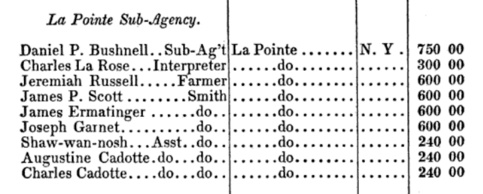
Officers | Where employed | Where born | Compensation
~ “War Department – Indian Agencies,” Official Register of the United States, 1839
The family was acting on wise principles. Where they lived church and school were things unknown and would remain such for yet an indefinite future. The children were fast growing from under the care of their parents; yet, they were to be preserved to the faith and to civilization. It was intended to come more in touch with either. LaPointe was then a frontier-town situated on Madaline Island; opposite to what is now Bayfield Wis. Here Father Baraga had from upwards ten years attended the spiritual wants of the place.

“View of La Pointe,” circa 1842.
~ Wisconsin Historical Society
Our Vincent came, of course, along etc. etc. with the rest. Here for the first time in his life, he came within reach of a school which he might have attended. He was however pretty well past school age. The fact is he did not get to see the inside of a school a ten months and may be, much less, as there is an opinion he became an employ for salary in 1845, which was the year of his arrival.7 But with his energy of will made up for lack of opportunity. More than likely his grandfather taught him the first rudiments, upon which he kept on building up his store of knowledge by self-instruction.
‘At any spare moment,’ it is said,8 ‘he was sure to be at some place where he was least disturbed working at some problem or master some language lesson. He acquired a good control of the English language; his native languages – French and Ojibway – were not neglected, & he nibbled even a little at Latin, applying the knowledge he acquired of that language in translating a few church hymns into his native Ojibway. Studying turned into a habit of life with him. When later on he had a store of his own, he drew the trade of the Scandinavians of that locality just because he had picked up quite a few words of their language. Having heard a word he kept repeating it half loud to himself until he had it well fixed on his memory and the stock laid up in this manner he made use of in a jovial spirit as soon as often as an opportunity was open for it.’

“Boardwalk leading to St. Joseph’s Catholic Church in La Pointe.” Photograph by Whitney and Zimmerman, circa 1870.
~ Wisconsin Historical Society
About three years after his coming to LaPointe, Vincent chose for his life’s companion Elisabeth Cournoyer. The holy bond of matrimony between them was blessed by Reverend Otto Skolla in the LaPoint catholic church, August 13th, 1848. They did not obtain the happiness to see children born to them. Yet, they lived with each other nearly 48 years and looking back over those years there appears nothing which could not permit their marriage to be called a happy one. Their home had a good ordinary measure of home sunshine in which, in a way, children came yet to do their share and have their part.
III.
His occupation.
Vincent was employed in the interest of the fur trade with little intermission up to the forty third year of his life and thereafter until he retired from business he was engaged in keeping a general store.
“Lapointe was a quiet town in the early days and many Indians lived there. The government pay station was there and the Indians received certain monies from the government.”
“The Austrians, a fine Jewish family, established a store and maintained a good Indian trade.”
“Knowing the Indians lack of providing for the future, the Austrians always laid in extra supplies for the winter and these were doled out when necessary.”
~ Tales of Bayfield Pioneers by Eleanor Knight, 2008.
“Mr. and Mrs. Julius Austrian were among the first settlers. Splendid people they were and especially kind to the Indians. It was their custom to lay in extra supplies of flour and corn meal for they knew the Indians would be begging for them before the winter was over. On this particular occassion the winter had been extra cold and long. Food supplies were running low. The Indians were begging for food every day and it was hard to refuse them. The flour was used up and the corn meal nearly so. Still Mrs. Austrian would deal it out in small quantities. Finally they were down to the last sack, and then to the last panful. She gave the children half of this for their supper, but went to bed without tasting any herself. About midnight she was awakened by the cry of ‘Steamboat! Steamboat!’ And looking out the window she saw the lights of the North Star approaching the dock. She said that now she felt justified in going downstairs and eating the other half of the corn bread that was left.”
~ The Lake Superior Country in History and in Story by Guy M. Burnham, 1930, pg. 288.
It was but natural that Vincent turned to the occupation of his father and grandfather. There was no other it may have appeared to him to choose. He picked up what was lying in his way and did well with it. From an early age he was his father’s right hand and business manager.9 No doubt, intelligent and clever, as he was, his father could find no more efficient help, who, at the same time, was always willing and ready to do his part. Thus he grew up. By the time the family migrated south, he was conversant with the drift of the indian trade knowing all its hooks and crooks; he spoke the language of the indians and had their confidence; he was swift a foot and enduring against the tear and wear in frontier life; and there was no question but that he would continue to be useful in frontier business.
Leopold and Austrian (Jews) doing a general merchandize and fur-trading business at LaPointe were not slow in recognizing ‘their man.’ Having given employment to Peter Roy, who by this time quit going to school, they also, within the first year of his arrival at this place, employed Vincent to serve as handy-man for all kind of things, but especially, to be near when indians from the woods were coming to trade, which was no infrequent occurrence. After serving in that capacity about two years, and having married, he managed (from 1848 to 1852) a trading post for the same Leopold and Austrian;10 at first a season at Fond du Lac, Minn., then at Vermillion Lake, and finally again at Fond du Lac.11 Set up for the sole purpose to facilitate the exchange trade carried on with the indians, those trading-posts, nothing but log houses of rather limited pretensions, were nailed up for the spring and summer to be reopened in the fall. Vincent regularly returned with his wife to LaPointe. A part of the meantime was then devoted to fishing.12
A Dictionary of the Otchipwe Language, Explained in English was published by Bishop Frederic Baraga in 1853.
It was also in these years that Vincent spent a great deal of the time, which was at his disposal, with Father Frederic Baraga assisting him in getting up the books of the Ojibway language, which that zealous man has left.13
In the years which then followed Vincent passed through a variety of experience.
IV.
His first Visit to Washington, D.C. – The Treaty of LaPointe.
Read Chief Buffalo Really Did Meet The President on Chequamegon History for more context about this trip.
At the insistence of Chief Buffalo and in his company Vincent made his first trip to Washington D.C. It was in the spring of the year 1852. – Buffalo (Kechewaishke), head chief of the Lake Superior Ojibways had seen the day, when his people, according to indian estimation, was wealthy and powerful, but now he was old and his people sickly and starving poor. Vincent referring once to the incidents of that time spoke about in this way:14
“He (Buffalo) and the other old men of the tribe, his advisors, saw quite well that things could not go on much longer in the way they had done. The whites were crowding in upon them from all sides and the U.S. government said and did nothing. It appeared to these indians their land might be taken from them without they ever getting anything for it. They were scant of food and clothing and the annuities resulting from a sale of their land might keep them alive yet for a while. The sire became loud that it might be tried to push the matter at Washington admitting that they had to give up the land but insisting they be paid for it. Buffalo was willing to go but there was no one to go with him. He asked me to go with him. As I had no other business just then on hand I went along.”
Ashland, Wisconsin, is named in honor of Henry Clay’s Estate.
They went by way of the lakes. Arriving at Washington, they found the City and the capitol in a barb of morning and business suspended.15 Henry Clay, the great statesman and orator, had died (June 29) and his body was lying in state. Vincent said:
“we shook hands and spoke with the President (Fillmore) and with some of the headmen of the government. They told us that they could not do anything at the moment, but that our petition should be attended to as soon as possible. Unable to obtain any more, we looked around a few days and returned home”.
The trip had entailed a considerable drain on their private purses and the result towards the point at issue for them, the selling of the land of the indians, was not very apparent.

Henry C. Gilbert
~ Branch County Photographs
After repeated urging and an interval of over two years, during which Franklin Pierce had become President of the United States, the affairs of these Indians were at last taken up and dealt with at LaPointe by Henry C. Gilbert and David B. Herriman, commissioners on the part of the United States. A treaty was concluded, September 30th, 1854. The Lake Superior Ojibways thereby relinquished their last claims to the soil of northwest Michigan, north east Wisconsin and an adjoining part of Minnesota, and, whilst it was understood that the reserves, at L’Anse Michigan, Odanah, and Courte Oreille Wisconsin and Fond du Lac Minnesota, were set apart for them, they received in consideration of the rest the aggregate sum of about four hundred and seventy five thousand dollars, which, specified as to money and material, ran into twenty years rations.
Chief Buffalo, in consideration of services rendered, was allowed his choice of a section of land anywhere in the ceded terrain.
‘The choice he made,’ it is said,16 ‘were the heights of the city of Duluth; but never complying with the incident law formalities, it matters little that the land became the site of a city, his heirs never got the benefit of it. Of Vincent who had been also of service to the indians from the first to the last of the deal, it can only be said that he remained not just without all benefit from it.’
Julius Austrian‘s capitalization of the Mixed Blood clause from the 1854 Chippewa Treaty will be published on Chequamegon History.
A clause was inserted in the treaty (art. 2. n. 7.) 17 by which heads of families and single persons over twenty one years of age of mixed blood were each entitled to take and hold free of further charge eighty acres of the ceded lands.; – this overruled in a simple and direct way the difficulties Vincent had met with of late in trying to make good his claim to such a property. The advantage here gained was however common to others with him. For the sacrifices he made of time and money in going with Chief Buffalo to Washington he was not reimbursed, so it is believed, and it is very likely time, judging from what was the case when later on he made the same trip a second time.
V.
The small-pox.
During the two years the Lake Superior indians waited for the United States to settle their claims, important events transpired in which Vincent took part. In the fall of 1853 those indians were visited by the smallpox which took an epidemic run among them during the following winter. The first case of that disease appeared in the Roy family and it is made a circumstance somewhat interesting in the way it is given.18 Vincent and his oldest brother John B. were on some business to Madison, Wisconsin. Returning they went around by way of St. Paul Minnesota to see their brother Peter Roy who was at the time acting representative of a northern district, at the Minnesota territorial legislation which had then, as it seems, convened in extra session. On the evening previous to their departure from St. Paul, John B. paid a short visit to a family he knew from Madaline Island. In the house in which that family lived a girl had died about a year before of small-pox, but no one was sick there now at the time of the visit. If John B.’s subsequent sickness should have to be attributed to infection, it was certainly a peculiar case. The two brothers started home going by way of Taylor’s Falls, up the St. Croix river on the Wisconsin side, till Yellow Lake river, then through the woods to what is now Bayfield where they crossed over to Madaline Island. John B. began feeling sick the second day of the journey. Vincent remembered ever after the anxiety which he experienced on that homeward journey.19 It costed him every effort to keep the energies of his brother aroused. Had the same been allowed to rest as he desired he had inevitably perished in the woods. All strengths was however spent and the sick man lay helpless when the boat which carried them from the mainland touched Madaline Island. Willing hands lifted him from the boat and carried him to his house. His sickness developed into a severe case of small-pox of which he finally recovered. The indians of whom the settlement was chiefly made up did not as yet understand the character of that disease which was all the more dangerous with them for their exposed way of living. Before they were aware of it they were infected. General sickness soon prevailed. Deaths followed. Some fled in dismay from the settlement, but it may be said only to carry the angel of death to other habitations and to die after all.
Several members of the Roy family were laid up with the sickness, none of them died though.20 Vincent had been in close contact with his brother while yet on the road and had been more than any attending his brother and other members of the family in their sickness, yet he passed through the ordeal unscathed. The visitation cased with the return of spring.
VI.
Superior.
Vincent had barely emerged from the trouble just described when it was necessary for him to exert himself in another direction. A year or so previously he had taken up a claim of land at the headwaters of Lake Superior and there was improvement now on foot for that part of the country, and danger for his interests.21

Vincent Roy Jr. storage building, circa 1933.
The following is a statement by John A. Bardon of Superior accompanying the photography, “Small storehouse building erected by the late Vincent Roy [Jr] at Old Superior. The timbers are 4′ x 8′. After the one mile dike across Superior Bay had served its purpose, it was allowed to gradually go to pieces. The timbers floating in the Bay for a while were a menace to navigation. You would find them drifting when least expected. The U.S. War Department caused the building of this dike from the end of Rice’s Point, straight across to Minnesota Point to prevent the waters of the St. Louis River being diverted from the natural entry at Superior, to the newly dug canal, across Minnesota Point in Duluth. The contention was that, if the waters of the St. Louis were diverted, the natural entrance at Superior would become shoaled from lack of the rivers scouring current. However, when the piers were extended into 18 feet of water at both the old entrance and the Duluth Canal, it was found that the currents of the river had no serious effect. The dike was never popular and was always in the way of the traffic between Superior and Duluth. Several openings were made in it to allow the passage of smaller boats. It was finally condemned by the Government Engineers as a menace to navigation. This all happened in the early 70’s. This building is now the only authentic evidence of the dike. It is owned by the Superior and Douglas County Historical Society. The writer is the man in the picture.”
~ Wisconsin Historical Society

Read more about Vincent Roy, Jr.’s town-site at Superior City here on Chequamegon History.
The ship canal at Sault St Marie was in course of construction and it was evidently but a question of days that boats afloat on Lakes Huron and Michigan would be able to run up and unload their cargo for regions further inland somewhere on the shore at the further end of Lake Superior, at which a place, no doubt, a city would be built. The place now occupied by the city of Superior was suitable for the purposes in view but to set it in order and to own the greatest possible part of it, had become all at the same time the cherished idea of too many different elements as that developments could go on smoothly. Three independent crews were struggling to establish themselves at the lower or east end of the bay when a fourth crew approached at the upper or west end, with which Vincent, his brother Frank, and others of LaPointe had joined in.22 As this crew went directly to and began operations at the place where Vincent had his property it seems to have been guided by him, though it was in reality under the leadership of Wm. Nettleton who was backed by Hon. Henry M. Rice of St. Paul.23 Without delay the party set to work surveying the land and “improving” each claim, as soon as it was marked off, by building some kind of a log-house upon it. The hewing of timber may have attracted the attention of the other crews at the lower end about two or three miles off, as they came up about noon to see what was going on. The parties met about halfway down the bay at a place where a small creek winds its way through a rugged ravine and falls into the bay. Prospects were anything but pleasant at first at the meeting; for a time it seemed that a battle was to be fought, which however did not take place but the parceling out of ‘claims’ was for the time being suspended. This was in March or April 1854. Hereafter some transacting went on back the curtain, and before long it came out that the interests of the town-site of Superior, as far as necessary for efficient action, were united into a land company of which public and prominent view of New York, Washington, D.C. and other places east of the Mississippi river were the stockholders. Such interests as were not represented in the company were satisfied which meant for some of them that they were set aside for deficiency of right or title to a consideration. The townsite of the Superior of those days was laid out on both sides of the Nemadji river about two or three miles into the country with a base along the water edge about half way up Superior bay, so that Vincent with his property at the upper end of the bay, was pretty well out of the way of the land company, but there were an way such as thought his land a desirable thing and they contested his title in spite of his holding it already for a considerable time. An argument on hand in those days was, that persons of mixed blood were incapable of making a legal claim of land. The assertion looks more like a bugaboo invented for the purpose to get rid of persons in the way than something founded upon law and reason, yet at that time some effect was obtained with it. Vincent managed, however, to ward off all intrusion upon his property, holding it under every possible title, ‘preemption’ etc., until the treaty of LaPointe in the following September, when it was settled upon his name by title of United States scrip so called, that is by reason of the clause,as said above, entered into the second article of that treaty.
The subsequent fate of the piece of land here in question was that Vincent held it through the varying fortune of the ‘head of the lake’ for a period of about thirty six years until it had greatly risen in value, and when the west end was getting pretty much the more important complex of Superior, an English syndicate paid the sum of twenty five thousand dollars, of which was then embodied in a tract afterwards known as “Roy’s Addition”.
VII.
– On his farm – in a bivonac – on the ice.
Superior was now the place of Vincent’s home and continued to be it for the remaining time of his life. The original ‘claim’ shanty made room for a better kind of cover to which of course the circumstances of time, place, and means had still prescribed the outlines.24 Yet Vincent is credited with the talent of making a snug home with little. His own and his wife’s parents came to live with him. One day the three families being all seated around a well filled holy-day table, the sense of comfort called forth a remark of Vincent’s mother to her husband:25
“Do you remember, man,” she said, “how you made our Vincent frequently eat his meals on the ground apart from the family-table; now see the way he repays you; there is none of the rest of the children that could offer us as much and would do it in the way he does.”
It was during this time of his farming that Vincent spent his first outdoor night all alone and he never forgot it.26 It was about June. Spring had just clothed the trees with their full new foliage. Vincent was taking a run down to Hudson, Wisconsin, walking along the military wagon road which lead from Superior to St. Paul. Night was lowering when he came to Kettle river. Just above the slope he perceived a big bushy cedar tree with its dense branches like an inscrutable pyramid set off before the evening light and he was quickly resolved to have his night’s quarters underneath it. Branches and dry leaves being gathered for a bed, his frugal meal taken he rolled up in the blanket carried along for such purposes, and invited sleep to come and refresh his fatigued mortality. Little birds in the underbrush along the bank had twittered lower and lower until they slept, the frogs were bringing their concert to a close, the pines and cedars and sparse hardwood of the forest around were quiet, the night air was barely moving a twig; Vincent was just beginning to forget the world about him, when his awakening was brought on upon a sudden. An unearthly din was filling the air about him. As quick as he could extricate himself from his blanket, he jumped to his feet. If ever his hair stood up on end, it did it now; he trembled from head to foot. His first thoughts as he afterwards said, were, that a band of blood-thirsty savages had discovered his whereabouts and were on the point to dispatch him. In a few moments, everything around was again dead silence. He waited, but he heard nothing save the beating of his own heart. He had no other weapon than a muzzle-loaded pistol which he held ready for his defense. Nothing coming in upon him, he walked cautiously from under his shelter, watching everything which might reveal a danger. He observed nothing extraordinary. Facing about he viewed the tree under which he had tried to sleep. There! – from near the top of that same tree now, as if it had waited to take in the effect of its freak and to ridicule all his excitement, a screeching owl lazily took wing and disappeared in the night. The screeching of this bird with its echo in the dead of night multiplied a hundred times by an imagination yet confused from sleep had been the sole cause of disturbance. Vincent used to say that never in his life he had been so upset as on this night and though all had cleared up as a false alarm, he had had but little sleep when at daybreak he resumed his journey.
Another adventure Vincent had in one of these years on the ice of Lake Superior.27 All the family young and old had been on Bass Island near Bayfield for the purpose of making maple-sugar. That meant, they had been some three weeks in March-April at work gathering day and night the sap tapped from maple-trees and boiling down to a mass which they stored in birch bark boxed of fifty to hundred and fifty pounds each. At the end of the season Vincent got his horse and sleigh and put aboard the product of his work, himself, his wife and two young persons, relatives of his wife, followed; they were going home to Superior on the ice of the lake along the shore. When they came however towards Siskowit bay, instead of following the circuit of the shore, they made directly for Bark Point, which they saw standing out before them. This brought them out on a pretty big field of ice and the ice was not to be trusted so late in spring as it was now. Being almost coming in upon the point they all at once noticed the ice to be moving from shore – a split was just crossing through ahead of them. No time was to be lost. With a providential presence of mind, Vincent whipped his horse, which seemed to understand the peril of the situation; with all the speed it could gather up in a few paces it jumped across the gap. The sleigh shooting over the open water struck the further ice edge with a thump yet without harm – they were safe.
By pressure of other ice wedging in at a distance or from the hold which wind and wave get upon it, a considerable area of ice may, sometimes in spring, break loose with a report as that of a cannon and glide apart some ten feet right out upon the start. That it happened different this time and that our travelers did not drift out into the lake with a cake of ice however large yet, any thawing away or breaking up under them, was their very good fortune.
VIII.
– Superior’s short-lived prosperity – V. at his old profession – a memorable tour.

Built circa 1857, photographed circa 1930.
“The trading post was owned by Vincent Roy [Jr]. The Roy family was prominent in the early history of the Superior area.”
~ Wisconsin Historical Society
Vincent was too near Superior as not to feel the pulsation of her life and to enter into the joys and sorrows of already her infant days.28 The place had fast donned the appearance of a city; streets were graded, lines of buildings were standing, trades were at work. Indeed, a printing office was putting out at convenient intervals printed matter for the benefit of the commonwealth at home and abroad; then was a transfer of real-estate going on averaging some thousand dollars a week, town lots selling at two to three hundred dollars each; and several stores of general merchandise were doing business.
The scarcity of provision the first winter was but an incident, the last boat which was to complete the supply being lost in a gale. It did not come to severe suffering and great was the joy, when a boat turned up in spring especially early.
In short, the general outlook had great hopes on the wing for the place, but its misgivings came. Its life blood ceased to flow in the financial crisis of September 1857, as the capital which had pushed it was no more forthcoming. It was a regular nor’easter that blew down the young plant, not killing it outright but stunting its growth for many, many years to come. The place settled down to a mere village of some hundred inhabitants, doing duty of course as county seat but that was not saying much as the whites stood in that part of the country all the way to pretty well up in the eighties.

~ The Superior Chronicle, July 7th, 1860.
About 1856 Vincent embarked again in the profession of his youth, the fur trade. Alexander Paul who did business in “The Superior Outfit” on Second Street, engaged his services. After a few years the business passed into the hands of Peter E. Bradshaw; which however did not interfere with Vincent. He was required to give all his attention to fur and peltry; first to getting them in, then to sorting them and tending to them until they were set off in the east. His employers had trading posts along the north shore at Grand Marais and Grant Portage, about the border line at the Lakes Basswood, Vermillion and Rainy, then at Lower Red Lake, at Mud Lake east of Leech Lake and at Cross Lake about thirty miles north of Crow Wing Minnesota. A tour of inspection of these posts was necessary on the average in the fall to see what was needed to be sent out, and in the spring to get home the peltries which had been obtained.29 One tour in which Vincent, Mr. P Bradshaw, Francis Blair, and one or two others, made up the party, was regarded especially memorable. It was undertaken early in spring, perhaps in February since the calculation was to find brook and lake yet passable on the ice. The party set out with the usual train of three dogs harnessed to a toboggan which carried as long as the dogs did not give out, the most necessary luggage; to wit, a blanket for each the men to roll up in at night and the supply of food consisting in a packet of cornmeal with a proportionate amount of tallow for the dogs and bacon for the men to add, the Canadian snowshoes being carried in hand any way as long and wherever they would be but an incumbrance to the feet. Their way led them along the wagon road to Kettle river, then across the country passing Mille lac Lake to Crow Wing, then northward to touch their posts of Cross and Mud Lake, moving nearly always on the ice in that region of lakes in which the Mississippi has its beginning. After leaving the Mud Lake post a swamp of more than a day in crossing was to be traversed to reach the Red Lake post. They were taking the usual trail but this time they were meeting more than usual inconvenience. They had been having a few days soft weather and here where the water would not run off they found themselves walking knee-deep in the slush, to increase their annoyance it set in drizzling. Still they trudged along till about mid-afternoon when they halted. The heavens scowling down in a gray threatening way, all around snow, from which looked forth, an occasional tuft of swamp grass, otherwise shrubby browse with only at places dwarfed pine and tamarack, were sticks of an arm’s thickness and but thinly scattered, they were in dread of the night and what it might bring them in such dismal surrounding. They were to have a fire and to make sure of it, they now began to gather sticks at a place when they were to be had, until they had a heap which they thought would enable them to keep up a fire till morning. The next thing and not an easy one was to build a fire. They could not proceed on their usual plan of scraping away the snow and set it up around as a fortification against the cold air, it would have been opening here a pit of clear water. So they began throwing down layers of sticks across each other until the pile stood in pierform above water and snow and furnished a fire-place. Around the fire they built a platform of browse-wood and grass for themselves to lie upon. But the fire would not burn well and the men lay too much exposed. Luckily the heavens remained clouded, which kept up the temperature. A severe cold night easily have had serious results in those circumstances. The party passed a very miserable night, but it took an end, and no one carried any immediate harm from it.
Next morning, the party pushed forward on its way and without further adventure reached the Red Lake post. Thence they worked their way upwards to the Lake of the Woods, then down the Rainy Lake River and along Rainy Lake, up Crane Lake, to Pelican Lake, and finally across Vermillion Lake to the Vermillion post, about the spot where Tower, Minn. now stands. Thence back to Superior, following the water courses, chiefly the St. Louis river. The distance traveled, if it is taken in a somewhat straight line, is from five to six hundred miles, but for the party it must have been more judging from the meandering way it went from lake to lake and along the course of streams. That tour Messrs. Bradshaw required for their business, twice a year; once in the winter, to gather in the crops of furs of the year and again in the fall to furnish the posts with provision and stock in trade and the managing there lay chiefly upon Mr. Roy. As to the hardships on these tours, dint of habit went far to help them endure them. Thus Mr. Bradshaw remarked yet in 1897 – he did not remember that he or any of his employees out on a trip, in the winter, in the open air, day and night, ever they had to be careful or they get a cold then.
“As any who have tried snowshoes will know, there is a trick to using them. The novice will spread his legs to keep the snowshoes from scraping each other, but this awkward position, like attempting too great a distance before conditioning oneself to the strain, will cause lameness. Such invalids, the old voyageur type would say, suffer from ‘Mal de raquette.’“
~ Forest & Outdoors, Volume 42, by the Canadian Forestry Assocation, 1946, page 380.
Not infrequently a man’s ingenuity came into action and helped to overcome a difficulty. An instance in case happened on the above or a similar tour. Somewhere back of Fond du Lac, Minn, notwithstanding the fact that they were approaching home, one of the men declared himself incapable of traveling any longer, being afflicted most severely with what the “courreurs du bois” called “mal de la raquette.” This was a trouble consequent to long walks on snow shoes. The weight and continual friction of the snow-shoe on the forefoot would wear this so much that blood oozed from it and cramps in foot and leg set in. In this unpleasant predicament, the man was undismayed, he advised his companions to proceed and leave him to his fate, as he would still find means to take care of himself. So he was left. After about a week some anxiety was felt about the man and a search-party set out to hunt him up. Arriving at his whereabouts, they found their man in somewhat comfortable circumstances, he had built for himself a hut of the boughs of trees and dry grass and have lived on rabbits which he managed to get without a gun. So far from being in need of assistance, he was now in a condition to bestow such for it being about noon and a rabbit on the fire being about ready to be served he invited his would-be-rescuers to dinner and after he had regaled them in the best manner circumstances permitted, he returned home with them all in good spirits.
The following incidents shows how Mr. Roy met an exigency. Once at night-fall he and the men had pitched for a night’s stay and made preparations for supper. No game or fish was at hand. A brook flowed near by but there was nothing in the possession of the crew to catch a fish with. But Roy was bent upon making the anyway scant fare more savory with a supply of fish, if it could be. Whilst the rest made a fire, he absented himself and in a very short time he returned with a couple of fish fresh from the water and sufficiently large to furnish a dish for all. He had managed to get them out from the brook with no other contrivance than the forked twig of a tree.
The following trip of Mr. Roy is remembered for the humorous incidents to which it gave occasion. One summer day probably in August and in the sixties, a tourist party turned up at Superior. It consisted of two gentlemen with wives and daughters, some six or seven persons. They were from the east, probably New York and it was fairly understood that it was the ambition of the ladies to pose as heroines, that had made a tour through the wild west and had seen the wild indian in his own country. The Bradshaws being under some obligation to these strangers detailed Roy and a few oarsmen to take them by boat along the north shore to Fort William, where they could take passage on a steamer for the continuation of their journey.
Now the story goes that Roy sent word ahead to some family at Grand Marais, Minn. or thereabouts that his crew would make a stop at their house. The unusual news, however, spread and long before Roy’s boat came in sight, not only the family, which was to furnish hospitality, was getting ready, but also their friends; men, women and children, in quite a number, had come gathering in from the woods, each ready for something, if no more, at least to show their wild indian faces.

Maple sugar in a birch bark container.
~ Minnesota Historical Society
When Roy and the gentlemen and ladies in his custody had arrived and were seated at table, the women and girls busied themselves in some way or another in order to make sure not to miss seeing, what was going on, above all how the strange ladies would behave at table. The Indian woman, who had set the table, had put salt on it – simply enough it is said for the boiled eggs served; – but what was peculiar, was that the salt was not put in salt-dishes, but in a coffee cup or bowl. If sugar was on the table, it was maple-sugar, which any Indian of the country could distinguish from salt, but the ladies at the table were not so versed in the customs of the country through which they were travelling, they mistaking the salt for sugar, reached for it and put a tea-spoonful of it into their tea or coffee. A ripple of surprise ran over the numerous spectators, the features of the older ones relaxing somewhat from their habitual rigor and a half-suppressed titter of the younger being heard – possibly in their judgement, the strange ladies of the city in the east were the less civilized there. In fact, the occurrence was never forgotten by those who witnessed it.
Proceeding on their journey, one night Roy and those in his custody had not been able to take their night’s rest at a human habitation and had chanced to pitch their tents on a high embankment of the lake. During the night the wind arose and blew a gale from the lake, so strong that the pegs of the tents, in which the ladies were lodged, pulled up and the canvass blew away. When the ladies were thus on a sudden aroused from sleep and without a tent out in the storm they screamed for their life for Roy to come to their aid. The men helped along with Roy to set up the tent again. Roy often afterwards amusingly referred to this that the ladies had not screamed for their husbands or fathers, but for Roy. The ladies gave later on their reasons for acting thus. Not knowing the real cause of what was transpiring, they in their freight thought the wild Indians were now indeed upon them that they were on the point of being carried off into the woods. In such a peril they of course thought of Roy as the only one who could rescue them. After the excitement things were soon explained and set aright and the ladies with their husbands and fathers arrived safely at Fort William and took passage in due season on an east-bound steamer.
A Friend of Roy.
Sources of Inform:tion
“Top: Frank Roy, Vincent Roy, E. Roussin, Old Frank D.o., Bottom: Peter Roy, Jos. Gourneau (Gurnoe), D. Geo. Morrison.” The photo is labelled Chippewa Treaty in Washington 1845 by the St. Louis Hist. Lib and Douglas County Museum, but if it is in fact in Washington, it was probably the Bois Forte Treaty of 1866, where these men acted as conductors and interpreters (Digitized by Mary E. Carlson for The Sawmill Community at Roy’s Point).
1 His journal and folks.
2 Pet. Roy’s sketch.
3 Mr. Roy to V.
4 P. R.’s sketch
5 Mr. Geo. Morrison says, the place was in those days always called Madelaine Island.

~ The Superior Chronicle, July 7, 1860.
6 P. Roy’s sketch.
7 His wife.
8 His folks.
9 Cournoyer.
10 Mrs. Roy.
11 See foot-note.
12 Mrs. Roy.
13 Fr. Eustachius said smthng to this effect.
14 Mr. Roy to V.
15 Cournoyer or Mr. Roy to V.
16 Cournoyer.
18 by Geo. Morrison & others.
19 Mr. Roy to V.
20 The family.
21 Mr. Roy to V.
22 Mr. Roy to V.
23 History of Superior as to the substce.
Vincent Cournoyer was Vincent Roy Jr’s brother-in-law. The Roy brothers, Cournoyer, Morrison, and La Fave were all Mixed-Blood members of the Lake Superior Chippewa, and elected officials in Douglas County, Wisconsin.
24 The family.
25 Cournoyer.
26 Mr Roy to V. – His family also.
27 Mr. Roy to V. – His family also.
28 History aS subst.e
29 Mr. J. Bradshaw and J. La Fave.
Father Valentine wishes his name to be suppressed in this communication and hence signs himself as above: “A Friend of Roy.”
Fr. Chrysostom Verwyst O.F.M.
Reverend Chrysostome Verwyst, circa 1918. ~ Wisconsin Historical Society
By Amorin Mello
The original handwritten memoir of Joseph Austrian is held by the Chicago History Museum. We saw some interesting stories and insights about La Pointe in Part I through the eyes of Doodooshaaboo (milk) as Joseph was known there during 1851 and 1852. The later La Pointe stories in Part II, however, are where the really good stuff is about white settlement and land speculation prior to the Treaty of 1854. When we last checked in with Joseph, he had just been ordered by brother-in-law Louis F. Leopold to terminate his business career at brother Julius Austrian’s Indian trading post at La Pointe, and to immediately relocate to Keweenaw Peninsula to co-manage brother-in-law Henry F. Leopold’s store in Eagle River.

Joseph Austrian’s land purchase at La Pointe during 1852.
~ General Land Office Records
In this installment we follow pages 66-78 of Joseph Austrian’s memoir about his reassignment to Eagle River. While there he engages with the Leopolds’ business affairs with copper mines and miners of the Keweenaw Peninsula before the opening of the Soo Locks. Joseph is quick to succeed in his new position as a trusted business partner during 1852-54.
A mysterious omission from this memoir is the fact that, during the summer of 1852, Doodooshaboo purchased 183 acres in La Pointe from the U.S. General Land Office in Willow River. In other words, this was the first federal sale of any land in La Pointe County. We will take a closer look at this critical shift in La Pointe’s political landscape as the subject of a future post on Chequamegon History. But for now, Joseph’s stories about 1852-54 provide us with glimpses of the Austrian family’s affairs at La Pointe during these pivotal years before the 1854 Treaty of La Pointe.
Memoirs of Doodooshaboo
… continued from La Pointe 1851-1852 (Part 2).

Outline Map showing the position of the ancient mine-pits of Point Keweenaw, Michigan.
~ Ancient Mining on the Shores of Lake Superior, by Charles Whittlesey
Reached Eagle River by Sleigh. 1852.
~ CopperCountryExplorer.com
Mr. H. F. Leopold, who hearing that the boat had passed by during the night and expecting me on her, came over with a sleigh for me. Eagle River was a small settlement of not over one hundred inhabitants situated in Houghton County, Michigan. It depended entirely for its business patronage on the adjacent copper mines, principally the Cliff Mine, North American, Phoenix & Garden City mines, some of which at that time were just in course of development. In the place there were but two stores the smaller one 18 x 24 situated on top of a hill facing the Lake was Leopolds. The other larger store was owned by Tenter and Mandelbaum. There were a number of saloons and boarding houses combined and this constituted the business portion of the town.

Simon Mandelbaum was an employee of the Phoenix Mine, the successor of the the Lake Superior Copper Company (the first regularly organized corporation to engage in Lake Superior Copper mining).
~ Annual Report by the Michigan Department of Mineral Statistics, 1900, pg. 240-41
Started Work at Eagle River. 1852.
I was at once installed in my work after my arrival, and the next day went to the Cliff Mine to attend to some collections. Mr. H. F. Leopold was an uneducated man not able to read or write English, the business correspondence and keeping of accounts therefore devolved entirely on me.
After becoming thoroughly acquainted with the business I resolved to enlarge the same and my efforts to do so succeeded well. A short time after my arrival at Eagle River a letter was received by the Leopolds containing the sad news of the death of my father. He died suddenly Sept 17th, 1852 from a stroke of apoplexy at the age of 75 years. This was naturally a cause of great grief and worry to me, as there was besides my mother, my blind brother Marx, a younger sister and brother at home to be cared for.
The next spring a larger stock was ordered than had ever been carried before and new departments added, namely: groceries, grain, and provisions, heretofore, only dry goods had been carried, from this time on the business as a matter of course showed a decided increase, and at the next annual inventory the profits showed a much better result than ever before. We boarded at Joseph Lang’s place who had a saloon in connection with his boarding house and poor as it was we had no choice to better ourselves. Mr. Leopold spent his evenings generally at the boarding house enjoying a game of cards with some of his friends, while I had to pass my evenings alone at the store playing watchman. We had no fire insurance on the store or on its contents, as firstly there were no insurance companies taking risks there at the time, and secondly even if they had I doubt that we could had placed any, owing to the dangerous condition of the heating apparatus. The store was heated by a box wood stove with the pipe running through the entire length of the store to the chimney, and it was necessary to be very careful and watchful under the circumstances. The store was hard to get comfortably warm, and I often sat there cold and shivering wrapped up in a blanket waiting for Mr. Leopold to come in for the night.
We slept up stairs over the store, and here it was most cheerless and dismal, not being heated at all.
The winters were very severe and extremely cold which did not add to our comfort and during our first winter there we had to put up with many hardships.
Dug Tunnel Under Snow to Stable.
We had frequently severe blizzards one I well remember, it lasted over a week. The depth of the snow that fell at that time was so great that with the drifts it reached high as the roof of the stable and we had to dig a tunnel through the snow to get from the store to the stable, and the horses were led out some weeks through this tunnel. Our store was exposed to the full force of the severe Lake Superior gales which some times shook the building threatening to demolish it.
Tough Boarding House Experiences.
During the winter there was no fresh meat to be had. In the Fall the boats would bring some, but having no refrigerators it was hung up on the boom of the Schooner to preserve it during transportation and when it reached the table it was anything but tempting. However, it was kept and used for weeks after, strong vinegar was used in preparing it by our land lord’s cook to hide the flavor. When this “so called” fresh meat gave out for the rest of the winter they substituted salted meat.
The Cliff Mine store had a large supply which it had had on hand for several years, our land lord bought of this firstly because it was cheap and secondly because he could not get any other. Eggs were not to be had either and turnips and potatoes were about the only vegetable procurable. This diet caused scurvy more or less. In the Spring when navigation opened, the first boat of the season was hailed with delight it was the signal for eggs and other delicacies we had been deprived of so long. Our land lord bought a barrel of eggs and fed us on them three times a day, while they lasted. During the summer we were also regaled with a variety of fresh vegetables and some fresh meat that could be had at times.
Brother Julius Brings our Family to America. 1853.
Secretary of State
Office of Indian Affairs
June 30th, 1853
Dear Sir,
In the absence of the Commissioner of Indian Affairs, to whom the bearer, Mr. Julius Austrian of Cleveland, Ohio, has letters of introduction and whose business here pertains to your Department in connection with an intended visit to Europe with his family, I beg leave respectfully to salient for him such courtesies as the case demands.
I have the honor to be
Very respectfully
Your obedient
Charles E. Mix
Acting Comm.”
~ Ancestry.com
Things went on satisfactorily in the business and in the summer of 1853 brother Julius, who was stationed at La Point started with his wife, a sister of the Leopolds, for Germany in accordance with a conclusion we had come to, to bring mother and the rest of the family to this country, and at the same time to visit the native village of his wife – “Rḯchen,” in the Grand Dukedom of Baden. It was a mission combined with a great deal of hardship and trouble for Julius, as it meant for him to convert all the real & personal property of my late father’s estate into money, which was in itself very difficult besides getting the family ready for this long voyage for their destination in the new world after having lived all their lifetime in Wittelshofen. Brother Marx especially was disinclined to go on account of his affliction from loss of eyesight.
My mother not having any special ties there to keep her, was in a measure glad to go where the most of her children were living, and did everything in her power to get ready without unnecessary delay.
They had a safe voyage and arrived at Cleveland Sept 1853.

U.S.M. Steamship Atlantic, James West, Commander.
~ Library of Congress Prints and Photographs Division Washington, D.C.
Julius Austrian returned from Europe on the U.S.M. Steamer Atlantic to America on October 17th, 1853 with his family: Hannah Leopold Austrian (Wife); Malka Heule Austrian (Mother); Marx Austrian (Brother); Samuel Solomon Austrian (Brother); Mina (Sister); and Henry Guttman aka Goodman (Cousin).
~ New York, Passenger Lists, 1820-1891, pg. 499, FamilySearch.org
Mother took a small house in Cleveland on Ohio St. and started house keeping with my sister Mina and necessary help when she was comfortably located. My brother Sol for the time being lived with my sister Babette. During this winter my sister Mina became engaged to Levi Jordan of Baltimore, where he was in business. He came from the same place where we were born, and therefore the families were well acquainted. Their marriage took place the next summer (1854) and afterward they resided in Baltimore.
Store Sold by Mistake.
The business had kept on increasing steadily. Mr. Louis F. Leopold had removed from Mackinaw and was living in Cleveland Ohio. In sending the annual inventory to Mr. L. F. L., through a mistake of his, he did not think the result satisfactory and peremptorily ordered his brother Henry to close out the business in Eagle River and sell the store. Henry boy like regardless of his own individual ideas and judgement at once obeyed his controlling brother, and sold out to his competitor, Mandelbaum, but soon regretted having done so.
I Spend Winter of 1853 in Cleveland.
After selling the store Henry Leopold and I went to Cleveland. I was anxious to meet my mother and the rest of the family from Germany. That winter I spent in Cleveland visiting my mother and the others. One of the first things we did was to get brother Solomon (then about 13 yrs- old) to learn a trade, and decided on shoe making as he was also eager to do something. We arranged for him to go into the service of a certain Weidenthal who agreed to instruct him in the trade at a small remuneration.
He took his place at once, living for the time being with our sister Babette. He took a good hold of the work and progressed very well in the trade to the entire satisfaction of his employer.
During the winter my brother Julius came through from Lake Superior, also Aaron and Sam F. Leopold for a conference between the Leopold brothers and me about the future program of our business. We all decided it had been a mistake to sell the store as the profits when correctly viewed was quite satisfactory with good prospects ahead. It was ascertained that Mr. Louis F. Leopold had taken it for granted that the inventory sent him showed him the result of two years profit since the business had existed; whereas it in reality was a statement of the one year of my management. We all agreed to open up again in the Spring on a larger scale. During the winter I contracted with a carpenter at Eagle River, and had the store enlarged to more than double its size and had the second story fitted up as living rooms, and a good cellar put under the store.
During this winter my sister Ida was engaged to Henry F. Leopold, and Jan 23rd, 1854, was married to him. The wedding was an enjoyable family affair.
As soon as navigation opened up in Spring, in May 1854, Henry Leopold, his wife, and I returned to Eagle River with a good stock of goods.
“We had already made the acquaintance of Mr. and Mrs. Julius Austrian, having had the pleasure of their company up the Lakes, and had made many inquiries of them as to the place of our destination. From this time forward we found Mr. and Mrs. Austrian to be most agreeable neighbors and associates, and
these young ‘brides’ spent much of their time together…”
~ The Ashland Press, Feb. 16, 1878.
At this time brother Julius and wife returned to La Point taking Brother Marx with them, who about a year later married Caroline Milner of Cleveland, and settled for the time being in La Pointe. That same year I sent him a small amount of goods from Eagle River, which enabled him to do a little something in trading with the same to the Indians for furs. After the episode with the Indians as I have previously narrated Marx was anxious to get away from La Point, and I had him and his wife come to Eagle River where I built them a cottage, conveniently arranged for him to live in with a small crockery store attached which he and his wife attended.
Some years later when brother Julius moved to St. Paul by his advice Marx and his wife went there also, and lived in a house next to Julius which he had had fitted up for the purpose. As far as business is concerned he acquired an interest in a butcher shop there.
After brother Solomon had finished his apprenticeship in the shoe business, the following year he also went up to La Pointe by advice of brother Julius where he stayed but a short time and then went to Hancock & opened a shoe store in which he did a good business.
 Chequamegon History