Blackbird’s Speech at the 1855 Payment
January 20, 2014
“We sold our land for our graves–that we might have a home, where the bones of our fathers are buried. We were not willing to sell the ashes of our relatives which are so dear to us. This was the reason why we sold our lands. It was not to pay debts over and over again, but to benefit the living, those of us who yet remain upon earth, our young men & women & children.”
~Makade-binesi (Blackbird)

Scene at Indian Payment–Odanah, Wis. This image is from a later payment than the one described below (Whitney & Zimmerman c.1870)
Most of us have heard Chief Joseph’s “Fight No More Forever” speech and Chief Seattle’s largely-fictional plea for the environment, but very few will know that a outstanding example of Native American oratory took place right here in the Chequamegon Region in the summer of 1855.
It was exactly eleven months after the Lake Superior Ojibwe bands gave up the Arrowhead region of Minnesota, in their final treaty with the United States, in exchange for permanent reservations. Already, the American government was trying to back out of a key provision of the agreement. It concerned a clause in Article Four of the 1854 Treaty of La Pointe that reads:
The United States will also pay the further sum of ninety thousand dollars, as the chiefs in open council may direct, to enable them to meet their present just engagements.
The inclusion of clauses to pay off trade debts was nothing new in Ojibwe treaties. In 1837, $70,000 went to pay off debts, and in 1842 another $75,000 went to the traders. Personal debts would often be paid out of annuity funds by the government directly to the creditors and certain Ojibwe families would never see their money. However, from the beginning there were accusations that these debts were inflated or illegitimate, and that it was the traders rather than the Ojibwe themselves, who profited from the sale of the lands. Therefore, in 1854, when $90,000 in claims were inserted in the treaty, the chiefs demanded that they be the ones to address the claims of the creditors.
However, less than a year later, at the first post-1854 payment, the government was pressured to back off of the language in the treaty. George Manypenny, the Commissioner of Indian Affairs, came to La Pointe to oversee the payment where he was asked by Indian Agent Henry Gilbert to let the Agency oversee the disbursement of the $90,000. Most white inhabitants, and many of the white tourists in town to view the spectacle that was the 1855 payment, supported the agent’s plan, as did most of the mix-blooded Ojibwe (most of whom were employed in the trading business in one way or another) and a substantial minority of the full-bloods.
However, the clear majority of the Lake Superior chiefs insisted they keep the right to handle their own debt claims. As we saw in this post, the Odanah-based missionary Leonard Wheeler also felt the Government needed to honor its treaties to the letter. This larger faction of Ojibwe rallied around one chief. He was from the La Pointe Band and was entrusted to speak for Ojibwe with one voice. From this description, you might assume it was Chief Buffalo. However, Buffalo, in the final days of his life, found himself in the minority on this issue. The speaker for the majority was the Bad River chief Blackbird, and he may have delivered one of the greatest speeches ever given in the Chequamegon Bay region.
Unfortunately, the Ojibwe version of the speech has not survived, and it’s English version, originally translated by Paul Bealieu, exists in pieces recorded by multiple observers. None of these accounts captures all the nuances of the speech, so it is necessary to read all of them and then analyze the different passages to see its true brilliance.
The first reference to Blackbird’s speech I remember seeing appeared in the eyewitness account of Dr. Richard F. Morse of Detroit who visited La Pointe that summer specifically to see the payment. His article, The Chippewas of Lake Superior appeared in the third volume of the Collections of the State Historical Society of Wisconsin. As you’ll read, it doesn’t speak very highly of Blackbird or the speech, celebrating instead the oratory of Naaganab, the Fond du Lac chief who was part of the minority faction and something of a celebrity among the visiting whites in 1855:


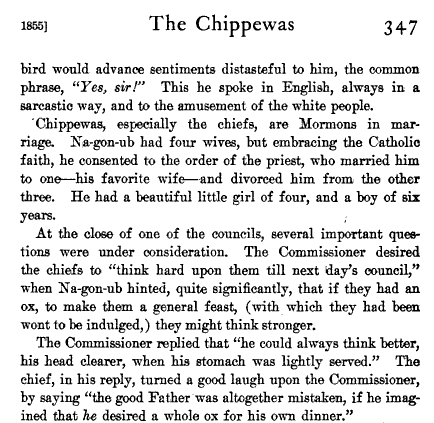
From Morse’s clear bias against Ojibwe culture, I thought there may have been more to this story, but my suspicions weren’t confirmed until I transcribed another account of the payment for Chequamegon History. An Indian Payment written by another eyewitness, Crocket McElroy, paints a different picture of Blackbird and quotes part of his speech:

Paul H. Beaulieu translated the speeches at the 1855 annuity payment (Minnesota Historical Society Collections).
In August 1855 about three thousand Chippewa Indians gathered at the village of Lapointe, on Lapointe Island, Lake Superior, for an Indian Payment and also to hold a council with the commissioner of Indian affairs, who at that time was George W. Monypenny of Ohio. The Indians selected for their orator a chief named Blackbird, and the choice was a good one, as Blackbird held his own well in a long discussion with the commissioner. Blackbird was not one of the haughty style of Indians, but modest in his bearing, with a good command of language and a clear head. In his speeches he showed much ingenuity and ably pleaded the cause of his people. He spoke in Chippewa stopping frequently to give the interpreter time to translate what he said into English. In beginning his address he spoke substantially as follows:
“My great white father, we are pleased to meet you and have a talk with you We are friends and we want to remain friends. We expect to do what you want us to do, and we hope that you will deal kindly with us. We wish to remind you that we are the source from which you have derived all your riches. Our furs, our timber, our lands, everything that we have goes to you; even the gold out of which that chain was forged (pointing to a heavy watch chain that the commissioner carried) came from us, and now we hope that you will not use that chain to bind us.”
These conflicting accounts of the largely-unremembered Bad River chief’s speech made me curious, and after I found the Blackbird-Wheeler-Manypenny letters written after the payment, I knew I needed to learn more about the speech. Luckily, digging further into the Wheeler Papers uncovered the following. To my knowledge, this is the first time it has been transcribed or published in any form.
[Italics, line breaks, and quotation marks added by transcriber to clearly differentiate when Wheeler is quoting a speaker. Blackbird’s words are in blue.]
O-da-nah Jan 18, 1856.
L. H. Wheeler to Richard M. Smith
Dear Sir,
The following is the substance of my notes taken at the Indian council at La Pointe a copy of which you requested. Council held in front of Mr. Austrian’s store house Aug 30. 1855.
Short speech first from Kenistino of Lac du Flambeau.
My father, I have a little to say to you & to the Indians. There is no difference between myself and the other chiefs in regard to the subject upon which we wish to speak. Our chiefs and young men & old men & even the women & children are all of the same mind. Blackbird our chief will speak for us & express our sentiments.
The Commissioner, Col Manypenny replied as follows.
My children I suppose you have come to reply to what I said to you day before yesterday. Is this what you have come for?
“Ah;” or yes, was the reply.
I am happy to see you, but would suggest whether you had not better come tomorrow. It is now late in the day and is unpleasant & you have a great deal to say and will not have time to finish, but if you will come tomorrow we shall have time to hear all you have to say. Don’t you think this will be the best way?
“Ah!” yes was the response.
Think well about what you want to say and come prepared to speak freely & fully about all you wish to say. I would like not only to hear the chiefs and old men speak, but the young men talk, and even the women, if they wish to come, let them come and listen too. I want the women to understand all that is said and done. I understand that some of the Indians were drunk last night with the fire-water. I hope we shall hear nothing more of it. If any body gives you liquor let me know it and I will deal with him as he deserves. I hope we shall have a good time tomorrow and be able to explain all about your affairs.
Aug 31. Commissioner opened the council by saying that he wanted all to keep order.
Let the whites and others sit down on the ground and we will have a pleasant time. If you have anything to say I hope you will speak to the point.
Black Bird. To the Indians.
My brother chiefs, head men & young men & children. I have listened well to all the men & women & others who have spoken in our councils and shall now tell it to my father. I shall have but one mouth to speak your will.
Nose [noose (no-say) “my father”]. My father. We present you our salutations in your heart. We salute you in the name of our great father the President, whose representative you are. We want the Great Spirit now to bless us. The Day is clear, and we hope our thoughts will be clear too. My intention is to tell you what the owner of life has done for us. He has provided for the life of us all. When the Lord made us he provided for us here upon earth he invested it (ie, he made provision for our wants) in the running streams, in the woods & lakes which abound with fish and in the wild animals. We regard you as if men like a spirit, perhaps it is because of your education, because you are so much wiser than we, but if we can trace our tradition right the Great Spirit has not made the white man to cheat us. There is a difference of opinion as it regards different colors among, as to which shall have the preeminence, but the Great Spirit made us to be happy before you discovered us.
I will now tell you about how it was with us before our payments, and before we sold any land. Our furs that we took we sold to our traders. We were then paid 4 martin skins for a dollar. 4 bears skins also & 4 beaver skins for $1.00 too. Can you wonder that we are poor? I say this to show you what our condition was before we had any payments. I[t] was by our treaties that we learned the use of money. I see you White men that sit here how you are dressed. I see your watch chains & seals and your rich clothing. Now I will tell you how it is with our traders. When they first came among us they were very poor, but by & by they became very fat & rich, and wear rich clothing and had their watches & gold chains such as I see you wear. But they got their things out of us. They were made rich at our expense. My father, you told us to bring our women here too. Here they are, and now behold them in their poverty, and pity their condition (at this juncture in the speech several old women stood dressed in their worn out blankets and tattered garments as if designed to appeal to his humanity[)].
My father, I am now coming to the point. We are here to protect our own interests. Our land which we got from our forefathers is ours & we must get what we can for it. Our traders step between us & our father to controll our interests, and we have been imposed upon. Mr. Gilbert was the one I shook hands with last year when he was sent here to treat for our lands. He was the one who was sent to uphold us in our poverty. We are thankful to see you both here to attend to our interests, and that we are permitted to express to you our wants. Last year you came here to treat for our lands we are now speaking about. We sold them because we were poor. We thank our father for bringing clothing to pay for them. We sold our land for our graves–that we might have a home, where the bones of our fathers are buried. We were not willing to sell the ashes of our relatives which are so dear to us. This was the reason why we sold our lands. It was not to pay debts over and over again, but to benefit the living, those of us who yet remain upon earth, our young men & women & children.
You said you wanted to see them. They have been sent for and are now here. Behold them in their poverty & see how poor they look.
They are poor because so much of our money is taken to pay old debts. We want the 90,000 dollars to be paid as we direct. We know that it is just and right that it should be so. We want to have the money paid in our own hands, and we will see that our just debts are paid. We want the 90,000 to feed our poor women, and after paying our just debts we want the remainder to buy what we want. This is the will of all present. The chiefs, & young men & old men & the women & children.
Let what I have now said, my father, enter your head & heart; and let it enter the head of our great father the President, that it may be as we have now said. We own no more land. We must hereafter provide for ourselves. We want to profit by all the provisions of the treaty we have now made. We want the whole annuity paid to us as stipulated in the treaty. I am now done. After you have spoken, perhaps there are others who would like to speak.
This is the first time my father that I have appeared dressed in a coat & pants & I must confess I feel a little awkward.
The Commissioner replied as follows
We have all heard & noted down what you have said. If any others wish to speak they had better speak first and I will reply to all at once.
The Grand Portage Indian [Adikoons] then spoke as follows.
My father, I have a few words to say, and I wish to speak what I think. We have long coveted the privilege of seeing our Great Father. Why not now embrace the opportunity to speak freely while he is here? This man will speak my mind. He is old enough to speak and is a man endowed with good sense. He will speak our minds without reserve.
When we look around us, we think of our God who is the maker of us all. You have come here with the laws of that God we have talked about, and you profess to be a Christian and acknowledge the authority of God. The word of God ought to be obeyed not only by the Indians, but by all. When we see you, we think you must respect that word of God, who gives life to all. Your advice is like the law of God. Those who listen to his law are like God–firm as a rock, (not fickle and vacilating). When the word of the Great Spirit ends. When there is an end to life, we are all pleased with the advice you have given us, and intend to act in accord with it. If we are one here, and keep the word of the Great Spirit we shall be one here after. In what Blackbird said he expressed the mind of a majority of the chiefs now present. We wish the stipulations of the treaty to be carried out to the very letter.
I wish to say our word about our reserves. Will these reserves made for each of our bands, be our homes forever?
When we took credits of our trader last winter, and took no furs to pay him, and wish to get hold of this 90,000 dollars, that we may pay him off of that. This is all we came here for. We want the money in our own hands & we will pay our own traders. We do not think it is right to pay what we do not owe. I always know how I stand my acct. and we can pay our own debts. From what I have now said I do not want you to think that we want the money to cheat our creditors, but to do justice to them I owe. I have my trader & know how much I owe him, & if the money is paid into the hands of the Indians we can pay our own debts.
Naganub.
We have 90,000 dollars set apart to pay our traders, for my part I think it is just that the money should go for this object. We all know that the traders help us. We could not well do without them.
Buffalo.
We who live here are ready to pay our just debts. Some have used expressions as though these debts were not just. I have lived here many years and been very poor. There are some here who have been pleased to assist me in my poverty. They have had pity on me. Those we justly owe I don’t think ought to be defrauded. The trader feeds our women & children. We cannot live one winter without him. This is all I have to say.
 [Wheeler does not identify a new speaker here, but marks a a star (right). Kohl (below) attributes the line about the “came out of the water” to Blackbird, but the line about the copper diggings contradicts Blackbird’s earlier statement, in Kohl, about not knowing their value. This, and Wheeler’s marking of Blackbird as the one who spoke after this speech would indicate this is Buffalo still talking].
Our rights ought to be protected. When commissioners have come here to treat for our lands, we have always listened well to their words. Not because we did not know ourselves the worth of our lands. We have noticed the ancient copper diggings, and know their worth. We have never refused to listen to the words of our Great Father. He it is true has had the power but we have made him rich. The traders have always wanted pay for what we do not remember to have bought. At Crow [W]ing River when our lands were ceded there, then there was a large sum demanded to pay old debts. We have always paid our traders we have acted fair on our part. At St. Peters also there was a large amount of old debts to be paid–many of them came from places unknown–for what I know they came out of the water. We think many of them came out of the same bag, and are many of them paid over & over again at every treaty.
Black Bird.
I get up no[w] to finish what you have put into my heart. The night would be heavy on my breast should I retain any of the words of them with whom I have councilled & for whom I speak. I speak no[w] of farmers, carpenters, & other employees of Govt. Where is the money gone to for them? We have not had these laborers for several years that has been appropriated. Where is the money that has been set apart to pay them? You will not probably see your Red Children again in after years to council with them. So we protest by the present opportunity to speak to you of our wants & grievances. We regard you as standing in the place of our great father at Washington, and your judgement must be correct. This is all I have to say about our arrearages, we have not two tongues.
As exciting as it was to have the full speech, as I transcribed some of the passages, some of them seemed very familiar. Sure enough, on page 53 of Johann Georg Kohl’s Kitchi-Gami: Life Among the Lake Superior Ojibway, there is another whole version. Kitchi-Gami is one of the standards of Ojibwe cultural history, and I use it for reference fairly often, but it had been so long since I had read the book cover to cover that I forgot that Kohl had been another witness that August day in 1855:


When one considers that Paul Beaulieu, the man giving the official English translation was probably speaking in his third language, after Ojibwe and Metis-French, and that Kohl was a native German speaker who understood English but may have been relying on his own mix-blood translator, it is remarkable how similar these two accounts are. This makes the parts where they differ all the more fascinating. Undoubtedly there are key parts of this speech that we could only understand if we had the original Ojibwe version and a full understanding of the complicated artistry of Ojibwe rhetoric with all its symbolism and metaphor. Even so, there are enough outstanding passages here for me to call it a great speech.
“My father…great Father…We regard you as if men like a spirit, perhaps it is because of your education, because you are so much wiser than we…”
The ritual language of kinship and humility in traditional Ojibwe rhetoric can be off-putting to those who haven’t read many Ojibwe speeches, and can be mistaken as by-product of American arrogance and paternalism toward Native people. However, the language of “My Father” predates the Americans, going all the way back to New France, and does not necessarily indicate any sort weakness or submission on the part of the speaker. Richard White, Michael Witgen, and Howard Paap, much smarter men than I, have dedicated pages to what Paap calls “fur-trade theater,” so I won’t spend too much time on it other than to say that 1855 was indeed a low point in Ojibwe power, but Blackbird is only acting the ritual part of the submissive child here in a long-running play. He is not grovelling.
On the contrary, I think Blackbird is playing Manypenny here a little bit. George Manypenny’s rise to the head of Indian Affairs coincided with the end of American removal policy and the ushering in of the reservation era. In the short term, this was to the political advantage of the Lake Superior Ojibwe. In Manypenny the Ojibwe got a “Father” who would allow them to stay in their homelands, but they also got a zealous believer in the superiority of white culture who wanted to exterminate Indian cultures as quickly as possible.
In a future post about the 1855 treaty negotiations with the Minnesota Ojibwe we will see how Commissioner Manypenny viewed the Ojibwe, including masterful politicians like Flat Mouth and Hole in the Day, as having the intelligence of children. Blackbird shows himself a a savvy politician here by playing into these prejudices as a way to get the Commissioner off his guard. Other parts of the speech lead me to doubt that Blackbird sincerely believed that the Americans were “so much wiser” than he was.
My intention is to tell you what the owner of life has done for us. He has provided for the life of us all. When the Lord made us he provided for us here upon earth he invested it (ie, he made provision for our wants) in the running streams, in the woods & lakes which abound with fish and in the wild animals… There is a Great Spirit from whom all good things here on earth come. He has given them to mankind–to the white as to the red man; for He sees no distinction of colour…but if we can trace our tradition right the Great Spirit has not made the white man to cheat us. There is a difference of opinion as it regards different colors among, as to which shall have the preeminence, but the Great Spirit made us to be happy before you discovered us…
This part varies slightly between Wheeler and Kohl, but in both it is very eloquent and similar in style to many Ojibwe speeches of the time. One item that piqued my interest was the line about the “difference of opinion.” Many Americans at the time understood the expansion of the United States and the dispossession of Native peoples in religious terms. It was Manifest Destiny. The Ojibwe also sought answers for their hardships in prophecy. On pages 117 and 118 of History of the Ojibwe People, William Warren relates the following:

Warren, writing in the late 1840s and early 1850s, contrasts this tradition with the popularity of the prophecies of Tenskwatawa, brother of Tecumseh, in Ojibwe country forty years earlier. Tenskwatawa taught that Indians would inherit North America and drive whites from the continent. Blackbird seems to be suggesting that in 1855 this question of prophecy was not settled among the Lake Superior Ojibwe. Presumably there would have been fertile ground for a charismatic millenarian Native spiritual leader along the lines of Neolin, Tenskwatawa, or Wovoka to gain adherents among the Lake Superior Ojibwe at that time.

Johann Georg Kohl recorded Blackbird’s speech in his well known account of Lake Superior in the Summer of 1855, Kitchi-Gami: Life Among the Lake Superior Ojibway.
Our furs, our timber, our lands, everything that we have goes to you; even the gold out of which that chain was forged…Now I will tell you how it is with our traders. When they first came among us they were very poor, but by & by they became very fat & rich, and wear rich clothing and had their watches & gold chains such as I see you wear. But they got their things out of us. They were made rich at our expense…and now we hope that you will not use that chain to bind us…
The gold chain appears in each of McElroy, Wheeler, and Kohl’s accounts. It acts as a symbol on multiple levels. To Blackbird, the gold represents the immense wealth produced during the fur trade on the backs of Indian trappers. By 1855, with the fur trade on its last legs, some of the traders are very wealthy while the Ojibwe are much poorer than they were when the trade started. The gold also stands in for the value of the ceded territory itself, specifically the lakeshore lands (ceded in 1842), which thirteen years later were producing immense riches from that other shiny metal, copper. Finally, in McElroy’s account, we also see the chain acting as the familiar symbol of bondage.
…We sold our land for our graves–that we might have a home, where the bones of our fathers are buried…Our debts we will pay. But our land we will keep. As we have already given away so much, we will, at least, keep that land you have left us, and which is reserved for us. Answer us, if thou canst, this question. Assure us, if thou canst, that this piece of land reserved for us, will really always be left to us…
This passage of Blackbird’s speech, and a similar statement by the “Grand Portage Indian” (identified by Morse as Adikoons or Little Caribou), indicate that perhaps, the actual disbursement of the $90,000 was a secondary to the need to hold Agent Gilbert and the Government to their word. It was very important to the Ojibwe that words of the Treaty of 1854 be rock-solid, not for a need to pay off debts or to get annuity payments, but because the Government absolutely needed to keep its promise to grant reservations around the ancestral villages. The memory of the Sandy Lake Tragedy, less than five years earlier, cast a long shadow over this decade. Paap argues in Red Cliff, Wisconsin that the singular goal of the treaty, from the Ojibwe perspective, was to end the removal talk forever, a goal that had seemingly been accomplished. To hear the Government trying to weasel out of a provision of the 1854 Treaty must have been very frightening to those who heard Robert Stuart’s promises in 1842. This time, the chiefs had to make sure a promise of a permanent homeland for their people wouldn’t turn out to be another lie.
This is the first time my father that I have appeared dressed in a coat & pants & I must confess I feel a little awkward.
You can argue that a great speech can’t end with the line, “I must confess I feel a little awkward.” However, I will argue that this might be the best line of all. It is another example of the political brilliance of Blackbird. The Bad River chief knew who his allies were, knew who his opponents were, and knew how to take advantage of the Commissioner’s prejudices. Clothing played a role in all of this.
George Manypenny despised Indian cultures. In fact, the whole council had almost derailed a few days before the speeches when the Commissioner refused to smoke the pipe presented to him by the chiefs in open ceremony. He remedied this insult somewhat by smoking it later while indoors, but he let it be known that he had no use for Ojibwe songs, dances, rituals or clothing. This put Blackbird, an unapologetic traditionalist and practitioner of the midewiwin at a distinct disadvantage, when compared with chiefs like Naaganab who were known to wear European clothes and profess to be Christians.
Although he had the majority of the people behind him, Blackbird had very little negotiating power. He had to persuade Manypenny that he was in the right. He had no chance unless he could appear to the Commissioner that he was trying to become “civilized” and was therefore worthy enough to be listened to. However, by wearing European clothes, he ran the risk of alienating the majority of the people in the crowd who preferred traditional ways and dress. Furthermore, the chiefs most likely to oppose him, Naaganab and Jayjigwyong (Little Buffalo) had been dressing like whites (I would argue also largely for political reasons) for years and were much more likely to come across as “civilized” in the Commissioner’s eyes.
How did the chief solve these dilemmas? In the same way he turned Manypenny’s request to see the Ojibwe women to his advantage, he used the clothing to demonstrate that he had gone out of his way to work with the Commissioner’s wishes, while still solidifying the backing of the traditional Ojibwe majority and putting his opponents on the defensive all with one well-timed joke. Although this joke seems to have gone over Wheeler’s head, and likely Manypenny’s as well, Kohl’s mention of the “applauding laughter of the entire assembly,” shows it reached its target audience. So, contrary to first appearances, the crack about the awkward pants is anything but an awkward ending to this speech.
Conclusion
In the 1840s and early 1850s, Blackbird rarely appears in the historical record. Here and there he is mentioned as a second chief to Chief Buffalo or as leading the village at Bad River. Many mentions of him by English-speaking authors are negative. He is referred to as a rascal, scoundrel, or worse, and I’ve yet to find any mention of his father or other family members as being prominent chiefs.
However, in the late 1850s and early 1860s, he was clearly the most important speaker for not just the La Pointe Band, but for the other Lake Superior Bands as well. This was a mystery to me. I temporarily hypothesized his rise was due to the fact that Chequamegon was seen as the center of the nation and that when Buffalo died, Blackbird succeeded to the position by default. However, this view doesn’t really fit what I understood as Ojibwe leadership.
This speech puts that interpretation to rest. Blackbird earned his position by merit and by the will of the people.
He did not, however, win on the question of the $90,000. A Chequamegon History reader recently sent me a document showing it was eventually paid to the creditors directly by the Agent. However, if my argument is correct, the more important issue was that the Government keep its word that the reservations would belong to the Ojibwe forever. The land question wasn’t settled overnight, and it required many leaders over the last 160 years to hold the United States to its word. But today, Blackbird’s descendants still live beside the swamps of Mashkiziibii at least partially because of the determination of their great ogimaa.
Sources:
Kohl, J. G. Kitchi-Gami: Wanderings round Lake Superior. London: Chapman and Hall, 1860. Print.
McClurken, James M., and Charles E. Cleland. Fish in the Lakes, Wild Rice, and Game in Abundance: Testimony on Behalf of Mille Lacs Ojibwe Hunting and Fishing Rights / James M. McClurken, Compiler ; with Charles E. Cleland … [et Al.]. East Lansing, MI: Michigan State UP, 2000. Print.
McElroy, Crocket. “An Indian Payment.” Americana v.5. American Historical Company, American Historical Society, National Americana Society Publishing Society of New York, 1910 (Digitized by Google Books) pages 298-302.
Morse, Richard F. “The Chippewas of Lake Superior.” Collections of the State Historical Society of Wisconsin. Ed. Lyman C. Draper. Vol. 3. Madison: State Historical Society of Wisconsin, 1857. 338-69. Print.
Paap, Howard D. Red Cliff, Wisconsin: A History of an Ojibwe Community. St. Cloud, MN: North Star, 2013. Print.
Satz, Ronald N. Chippewa Treaty Rights: The Reserved Rights of Wisconsin’s Chippewa Indians in Historical Perspective. Madison, WI: Wisconsin Academy of Sciences, Arts and Letters, 1991. Print.
Schenck, Theresa M. The Voice of the Crane Echoes Afar: The Sociopolitical Organization of the Lake Superior Ojibwa, 1640-1855. New York: Garland Pub.,1997. Print.
—————— William W. Warren: The Life, Letters, and times of an Ojibwe Leader. Lincoln: University of Nebraska, 2007. Print.
Warren, William W., and Theresa M. Schenck. History of the Ojibway People. St. Paul: Minnesota Historical Society, 2009. Print.
White, Richard. The Middle Ground: Indians, Empires, and Republics in the Great Lakes Region, 1650-1815. Cambridge: Cambridge UP, 1991. Print.
Witgen, Michael J. An Infinity of Nations: How the Native New World Shaped Early North America. Philadelphia: University of Pennsylvania, 2012. Print.
Chief Buffalo Picture Search: The Island Museum Painting
November 9, 2013
This post is one of several that seek to determine how many images exist of Great Buffalo, the famous La Pointe Ojibwe chief who died in 1855. To learn why this is necessary, please read this post introducing the Great Chief Buffalo Picture Search.

(Wisconsin Historical Society, Image ID: 3957)
Wisconsin Historical Society WHI(x3)41266
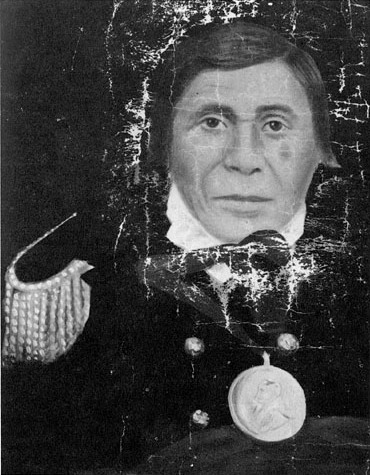
If any image has been as closely tied to Chief Buffalo from La Pointe as the the bust of the Leech Lake Buffalo in Washington, it is an image of a kindly but powerful-looking man in a U.S. Army jacket with a medal around his neck. This image appears on the cover of the 1999 edition of Walleye Warriors, by treaty-rights activist Walter Bresette and Rick Whaley. It is identified as Buffalo in both Ronald Satzʼs Chippewa Treaty Rights, and Patty Loewʼs Indian Nations of Wisconsin. It occupies a prominent position in the collections of the Wisconsin Historical Society and hangs in the Madeline Island Museum, but in spite of the enduring popularity of this image, very little is known about it.
As I have not been able to thoroughly examine the originals or find any information whatsoever about their creation, chain of custody, or even when they entered the Historical Society’s collections, this post will be the most speculative of the Chief Buffalo Picture Search.
There are two versions of this image. One appears to be an early type of photograph. The Wisconsin Historical Society describes it as “over-painted enlargement, possibly from a double-portrait (possibly an ambrotype).” I’ve been told by staff that the painting that hangs in the museum is a copy of this earlier version.
A photograph of the original image is in the Societyʼs archives as part of the Hamilton Nelson Ross collection. On the back of the photo, “Chief Buffalo, Grandson of Great Chief Buffalo” is handwritten, presumably by Ross. This description would seem to indicate that the image shows one of Chief Buffaloʼs grandsons. However, we need to be careful trusting Ross as a source of information about Buffalo’s family.
Ross, a resident of Madeline Island, gathered volumes of information on his home community in preparation for his book La Pointe Village Outpost on Madeline Island (1960). Although the book is exhaustively researched and highly detailed about the white and mix-blooded populations of the Island, it contains precious little information about individual Indians. The image of Buffalo is not in the book. In fact, the only mention of the chief comes in a footnote about his grave on page 177:
O-Shaka was also known as O-Shoga and Little Buffalo, and he was the son of Chief Great Buffalo. The latter’s Ojibway name was Bezhike, but he was also known as Kechewaishkeenh–the latter with a variety of spellings. Bezhike’s tombstone, in the Indian cemetery, has had the name broken off…
Oshogay was not Buffalo’s son (though he may have been a son-in-law), and he was not the man known as “Little Buffalo,” but until his untimely death in 1853, he seemed destined to take over leadership of Buffalo’s “Red Cliff” faction of the La Pointe Band. The one who did ultimately step into that role, however, was Buffalo’s son Jayjigwyong (Che-chi-gway-on):

Drew, C.K. Report of the Chippewa Agency of Lake Superior. 26 Oct. 1858. Printed in Report of the Commissioner of Indian Affairs. 1858 (Digitized by Google Books)
We will return to Jayjigwyong later in the post, but for now, let’s examine the image itself.
The man in the picture wears an early 19th-century army jacket and a medal. This is consistent with the practices of Chief Buffalo’s day. The custom of handing out flags, jackets, and medals goes back at least to the 1700s with the French. The practice continued under the British and Americans as a way of recognizing certain individuals as chiefs and asserting imperial claims. For the chiefs, the items were symbolic of agreements and alliances. Large councils, treaty signings, and diplomatic missions were all occasions where they were given out. Buffalo had received medals and jackets from the British, and between 1820 and 1855, he took part in the negotiations of at least five treaties, many council meetings and annuity payments, visited Washington, and frequently went back and forth to the agency at Sault Ste. Marie. The United States Government favored Buffalo over the more forcefully-independent chiefs on the Ojibwe-Dakota frontier in Minnesota. Considering all this, it is likely that Buffalo received many jackets, flags, and medals from the Americans over the course of his long interaction with them. An excerpt from a letter by teacher Granville Sproat, who lived in the Lake Superior region in the 1830s reads:
Ke-che Be-zhe-kee, or Big Buffalo, as he was called by the Americans, was then chief of that band of Ogibway Indians who dwell on the south-west shores of Lake Superior, and were best known as the Lake Indians. He was wise and sagacious in council, a great orator, and was much reverenced by the Indians for his supposed intercourse with the Man-i-toes, or spirits, from whom they believed he derived much of his eloquence and wisdom in governing the affairs of the tribe.
“In the summer of 1836, his only son, a young man of rare promise, suddenly sickened and died. The old chief was almost inconsolable for his loss, and, as a token of his affection for his son, had him dressed and laid in the grave in the same military coat, together with the sword and epaulettes, which he had received a few months before as a present from the great father [president] at Washington. He also had placed beside him his favorite dog, to be his companion on his journey to the land of souls (qtd. in Peebles 107).
It is strange that Sproat says Buffalo had only one son given that his wife Florantha Sproat references another son in her description of this same funeral, but sorting out Buffalo’s descendants has never been an easy task. There are references to many sons, daughters, and wives over the course of his very long life.
Another description from the Treaty of 1842 reads:
On October 1 Buffalo appeared, wearing epaulettes on his shoulders, a hat trimmed with tinsel, and a string of bear claws about his neck (Dietrich qtd. in Paap 177-78).
From these accounts we know that Buffalo had these kinds of coats, but dozens of other Ojibwe chiefs would have had similar ones, so the identification cannot be made based on the existence of the coat alone. Consider Naaganab at the 1855 annuity payment:
Na-gon-ub is head chief of the Fond du Lac bands; about the age of forty, short and close built, inclines to ape the dandy in dress, is very polite, neat and tidy in his attire. At first, he appeared in his native blanket, leggings, &c. He soon drew from the Agent a suit of rich blue broadcloth, fine vest, and neat blue cap,–his tiny feet in elegant finely-wrought moccasins. Mr. L., husband of Grace G., with whom he was a special favorite, presented him with a pair of white kid gloves, which graced his hands on all occasions. Some two or three years since, he visited Washington, a delegate from his tribe. Upon this journey, some one presented him with a pair of large and gaudy epaulettes, said to be worth sixty dollars. These adorned his shoulders daily; his hair was cut shorter than their custom. He quite inclined to be with, and to mingle in the society, of the officers, and of white men. These relied on him more, perhaps, than any other chief, for assistance among the Chippewas… (Morse pg. 346)
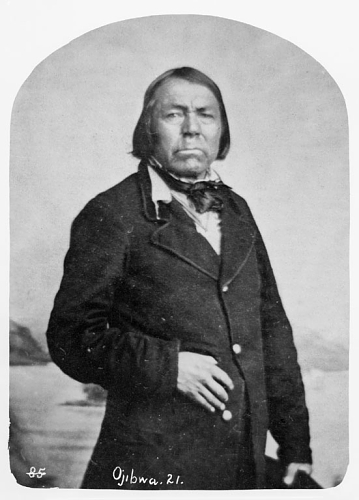
Portrait of Naw-Gaw-Nab (The Foremost Sitter) n.d by J.E. Whitney of St. Paul (Smithsonian)
In many ways, this description of Naaganab fits the image better than any description of Buffalo I’ve seen. The man is dressed in European fashion, has short hair, and large epaulets. We also know that Naaganab had presidential medals, since he continued to display them until his death in the 1890s. The image isn’t dated, but if it truly is an ambrotype, as described by the State Historical Society, that is a technique of photography used mostly in the late 1850s and 1860s. When Buffalo died in 1855, he was reported to be in his nineties. Naaganab would have been in his forties or fifties at that time. To me, the man in the image appears middle-aged rather than elderly.
So is Naaganab the man in the picture? I don’t think so. For one, there are multiple photographs of the Fond du Lac chief out there. The clothing and hairstyle largely match, but the face is different. The other thing to consider is that this image, to my knowledge, has never been identified with Naaganab. Everything I’ve ever seen associates it with the name Buffalo.
However, there is a La Pointe chief who was a political ally of Naaganab, also dressed in white fashion, could have easily owned a medal and fancy army jacket, would have been middle-aged in the 1850s, and bore the English name of “Buffalo.” It was Jayjigwyong, the son of Chief Buffalo.
Alfred Brunson recorded the following in 1843:

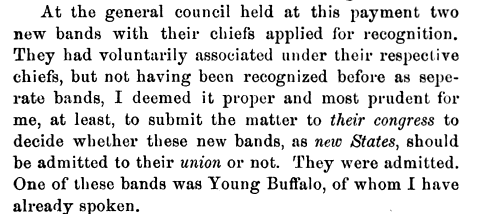
(pg. 158) From elsewhere in the account, we know that the “fifty” year-old is Chief Buffalo. This is odd, as most sources had Buffalo in his eighties at that time.
(pg. 191)
Unlike his famous father, Jayjigwyong, often recorded as “Little Buffalo,” is hardly remembered, but he is a significant figure in the history of our region. He was a signatory of the treaties of 1837, 1847, and 1854. He led the faction of the La Pointe Band that felt that rapid assimilation represented the best chance for the Ojibwe to survive and keep their lands. In addition to wearing white clothing and living in houses, Jayjigwyong was Catholic and associated more with the mix-blooded population of the Island than with the majority of the La Pointe band who sought to maintain their traditions at Bad River.
According to James Blackbird, whose father Makadebineshiinh (Black Bird) led the Bad River faction, it was Jayjigwyong who chose where the Red Cliff reservation was to be. James Blackbird, about eleven or twelve at the time of the Treaty of 1854, would have known both the elder and younger Buffalo.
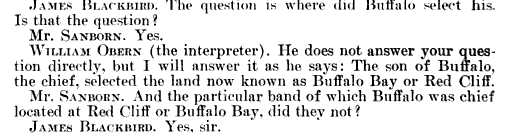
Statement of James Blackbird in the Matters of the Allotments on the Bad River Reservation, Wis. Odanah, 23 Sep. 1909. Published in Condition of Indian affairs in Wisconsin: hearings before the Committee on Indian Affairs, United States Senate, [61st congress, 2d session], on Senate resolution, Issue 263. United States Congress. 1910. Pg. 202.
The younger Blackbird, offered more information about the younger Buffalo in another publication.
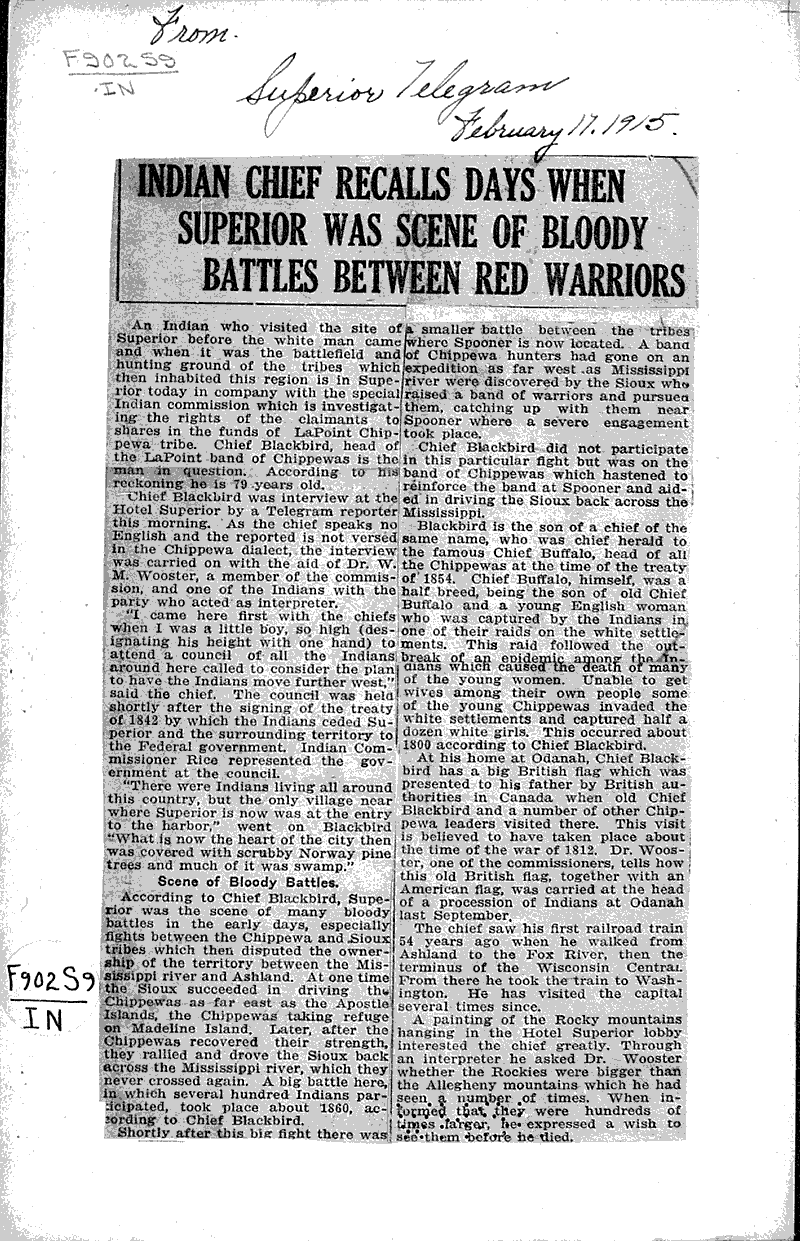
Superior Telegram. 17 Sep. 1915. (Digitized by Wisconsin Historical Society)
Even though it is from 1915, there are a number of items in this account that if accurate are very relevant to pre-1860 history. For this post, I’ll stick to the two that involve Jayjigwyong. This is the only source I’ve ever seen that refers to Chief Buffalo marrying a white woman captured on a raid. This lends further credence to the argument explored by Dietrich and Paap that Chief Buffalo fought in the Ohio Valley wars of the 1790s. It also begs the question of whether being perceived as a “half-breed” had an impact on Jayjigwyong’s decisions as an adult.
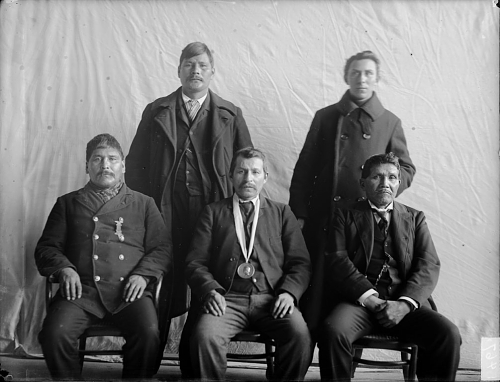
James Blackbird (seated) with interpreter John Medeguan in Washington, 1899. (Photo by Gil DeLancy, Smitsonian Collections)
The other interesting part of the statement is that James Blackbird says his father was pipe carrier for Jayjigwyong. This would be surprising as Blackbird was the most influential La Pointe chief after the death of Buffalo. However, this idea of Jayjigwyong, inheriting the symbolic “head chief” title from his father can also be seen in the following document from 1857:
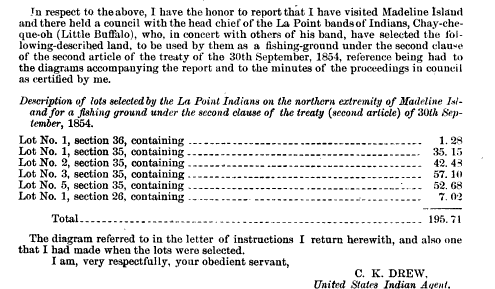
Published in Annual Report of the Commissioner of Indian Affairs to the Secretary of the Interior. Office of Indian Affairs. 1882. pg. 299. (Digitized by Google Books)
Today the fishing ground at the tip of Madeline Island is now considered part of the Bad River Reservation, but it was the Red Cliff chief who picked it out. This shows how the political division of the La Pointe Band into two distinct entities took several years to take shape, and was not an abrupt split at the Treaty of 1854.
Jayjigwyong continued to be regarded as a chief until his death in 1860:

Drew, C.K. Report on the Chippewas of Lake Superior. Red Cliff Agency. 29 Oct. 1860. Pg. 51 of Annual Report of the Commissioner of Indian Affairs. Bureau of Indian Affairs. 1860. (Digitized by Google Books). Zhingob (Shing-oop) was Naaganab’s cousin and the hereditary chief at Fond du Lac. Also known as Nindibens, he figures prominently in Edmund F. Ely’s journals of the mid-1830s.
Future generations of the Buffalo family continued to be looked at as hereditary chiefs in Red Cliff, and sources can be found calling these grandsons and great-grandsons “Chief Buffalo.”
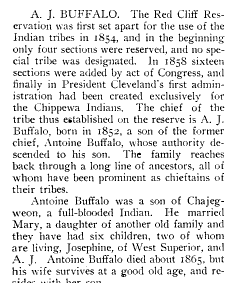
J.H. Beers and Co. Commemorative Biographical Record of the Upper Lake Region. 1905. Pg. 379. (Digitized by Google Books).
Antoine brings us full circle. If we remember, Hamiton Ross wrote that the image of the chief in the army jacket was Chief Buffalo’s grandson. And while we don’t know where Ross got his information, and he made mistakes about Buffalo’s family elsewhere, we have to consider that Antoine Buffalo was an adult by 1852 and he could have inherited his father’s, or grandfather’s, medal and coat.
The Verdict
Although we’ve uncovered several lines of inquiry for this image, all the evidence is circumstantial. Until we know more about the creation and chain of custody, it’s impossible to rule Chief Buffalo in or out. My gut tells me it’s Buffalo’s son, Jajigwyong, but it could be his grandson, Naaganab, or and entirely different chief. We don’t know.
Inconclusive: It could be Chief Buffalo, but there is also evidence pointing to others.
Sources:
Brunson, Alfred. A Western Pioneer, Or, Incidents of the Life and times of Rev. Alfred Brunson Embracing a Period of over Seventy Years. Cinncinnati: Hitchchock and Walden, 1872. Print.
Commemorative Biographical Record of the Upper Lake Region. Chicago: J. H. Beers &, 1905. Print.
Ely, Edmund Franklin, and Theresa M. Schenck. The Ojibwe Journals of Edmund F. Ely, 1833-1849. Lincoln: University of Nebraska, 2012. Print.
KAPPLER’S INDIAN AFFAIRS: LAWS AND TREATIES. Ed. Charles J. Kappler. Oklahoma State University Library, n.d. Web. 21 June 2012. <http:// digital.library.okstate.edu/Kappler/>.
Loew, Patty. Indian Nations of Wisconsin: Histories of Endurance and Renewal. Madison: Wisconsin Historical Society, 2001. Print.
Morse, Richard F. “The Chippewas of Lake Superior.” Collections of the State Historical Society of Wisconsin. Ed. Lyman C. Draper. Vol. 3. Madison: State Historical Society of Wisconsin, 1857. 338-69. Print.
Paap, Howard D. Red Cliff, Wisconsin: A History of an Ojibwe Community. St. Cloud, MN: North Star, 2013. Print.
Peebles, J. M. Immortality, and Our Employments Hereafter. With What a Hundred Spirits, Good and Evil, Say of Their Dwelling Places. Boston: Colby and Rich, 1880. Print.
Ross, Hamilton Nelson. La Pointe, Village Outpost. St. Paul: North Central Pub., 1960. Print
Satz, Ronald N. Chippewa Treaty Rights: The Reserved Rights of Wisconsin’s Chippewa Indians in Historical Perspective. Madison, WI: Wisconsin Academy of Sciences, Arts and Letters, 1991. Print.
Schenck, Theresa M. The Voice of the Crane Echoes Afar: The Sociopolitical Organization of the Lake Superior Ojibwa, 1640-1855. New York: Garland Pub.,1997. Print.
Warren, William W., and Theresa M. Schenck. History of the Ojibway People. St. Paul: Minnesota Historical Society, 2009. Print.
Whaley, Rick, and Walter Bresette. Walleye Warriors: The Chippewa Treaty Rights Story. Warner, NH: Tongues of Green Fire, Writers Pub. Cooperative, 1999. Print.
The banner at the top of this website reads “Primary history of the Chequamegon Region before 1860. In the About page, I explain that 1860 is really an arbitrary round number, and what I’m really focusing on is this area before it became dominated by an English-speaking American society. This is not an easy date to pinpoint, though I think most would argue it happened between 1842 and 1855. While the Treaty of La Pointe in 1854 is an easy marker of separation between the two eras, I would argue that the annuity payments that took place on the island the next summer, can also be seen as a watershed moment in history.

Crocket McElroy from a short biography in the Cyclopedia of Michigan: historical and biographical, comprising a synopsis of general history of the state, and biographical sketches of men who have, in their various spheres, contributed toward its development. Ed. John Bersey. Western Engraving and Publishing; 1890 (Digitized by Google Books)
The 1855 payment, in many ways, illustrates the change in the relationship between the United States and the Ojibwe people that would characterize the rest of the 19th century and early 20th century. The threats of Ojibwe removal or military conflict between the two nations largely ended with the treaty and the establishment of reservations. However, in their place was a paternalistic and domineering government that felt a responsibility to “civilize the Indian.” No one at this time embodied this idea more than George Manypenny, the Commissioner of Indian Affairs, and it was Manypenny, himself, who presided over the 1855 payment.
The days were over when master politicians like Buffalo and Flat Mouth could try to negotiate with the Americans as equals while playing them off of the British in Canada at the same time. In fact, Buffalo died during the 1855 payment, and the new generation of chiefs were men who had spent their youth in a time of Ojibwe power, but who would grow old in an era where government Indian Agents would rule the reservations like petty dictators. The men of this generation, Jayjigwyong (“Little Buffalo”) of Red Cliff, Blackbird of Bad River, and Naaganab of Fond du Lac, were the ones who were prominent during the summer of 1855.
Until this point, our knowledge of the 1855 payment cams largely from the essay The Chippewas of Lake Superior by a witness named Richard Morse. Dr. Morse’s writing includes a number of speeches by the Ojibwe leadership and a number of smaller accounts of items that piqued his interest, including the story of Hanging Cloud the female warrior, and the deaths of Buffalo and Oshogay. However, when reading Morse, one gets the sense that he or she is not getting stray observations of an uninformed visitor rather than a complete story.
It was for this reason that I got excited today when I stumbled across a second memoir of the 1855 payment. It comes from Volume 5 of Americana, a turn-of-the-century historical journal. Crocket McElroy, the author, is writing around fifty years after he witnessed the 1855 payment as a young clerk in Bayfield.
We still do not have a full picture of the 1855 payment, since we will never have full written accounts from Blackbird, Naaganab, and the rest of the Ojibwe leadership, but McElroy’s essay does provide an interesting contrast to Morse’s. The two men saw many of the same events but interpreted them very differently. And while McElroy’s racist beliefs skew his observations and make his writing hard to stomach, in some ways his observations are as informative as Morse’s even though his work is considerably shorter:
From Americana v.5 American Historical Company, American Historical Society, National Americana Society Publishing Society of New York, 1910 (Digitized by Google Books) pages 298-302.
AN INDIAN PAYMENT
By Crocket McElroy
In August 1855 about three thousand Chippewa Indians gathered at the village of Lapointe, on Lapointe Island, Lake Superior, for an Indian Payment and also to hold a council with the commissioner of Indian affairs, who at that time was George W. Monypenny of Ohio. The Indians selected for their orator a chief named Blackbird, and the choice was a good one, as Blackbird held his own well in a long discussion with the commissioner. Blackbird was not one of the haughty style of Indians, but modest in his bearing, with a good command of language and a clear head. In his speeches he showed much ingenuity and ably pleaded the cause of his people. He spoke in Chippewa stopping frequently to give the interpreter time to translate what he said into English. In beginning his address he spoke substantially as follows:
“My great white father, we are pleased to meet you and have a talk with you We are friends and we want to remain friends. We expect to do what you want us to do, and we hope that you will deal kindly with us. We wish to remind you that we are the source from which you have derived all your riches. Our furs, our timber, our lands, everything that we have goes to you; even the gold out of which that chain was forged (pointing to a heavy watch chain that the commissioner carried) came from us, and now we hope that you will not use that chain to bind us.”

Buffalo’s death in 1855 marked the end of an era. Jayjigwyong (Young Buffalo) was no young man when he took over from his father. The connection between Buffalo and Buffalo, New York also appears in Morse on page 368, although he says the names are not connected. If Buffalo did indeed live in the Niagara region, it may lend credence to the hypothesis explored in Paap’s Red Cliff Wisconsin, that Buffalo fought the Americans in the Indian Wars of the 1790s and signed the Treaty of Greenville (Photo: Wikimedia Images).
The commissioner was an amiable man and got along pleasantly with his savage friends, besides managing the council skilfully.
Among the prominent chiefs attending the payment was Buffalo, then called “Old Buffalo,” as he had a son called “Young Buffalo” who was also an old man. Old Buffalo was said to be over one hundred years old. He died during the council and the writer witnessed the funeral. He was buried in the Indian grave yard near the Indian church in Lapointe village. The body was laid on a stretcher formed of two poles laid lengthwise and several poles laid crosswise. The stretcher was carried on the shoulders of four Indians. Following the corpse was a long procession of Indians in irregular order. It was claimed for Buffalo, that he maintained a camp many years before at the mouth of Buffalo Creek on the Niagara River, and that the creek and the present large and flourishing city of Buffalo were named after him.

Naaganab’s (above) comments about Wheeler being ungenerous with food echoed a common Ojibwe complaint about the ABCFM missionaries. Wheeler’s Protestant Ethic of upward mobility and self-reliance made little sense in a tribal society where those who had extra were expected to share. Read The Ojibwe Journals of Edmund F. Ely, edited by Theresa Schenck, for Naaganab’s experience with another missionary two decades earlier. Read this post if you don’t understand why the Ojibwe resented the missionaries over the issue of food (Photo from Newberry Library Collections, Chicago).
Another prominent chief attending the conference was Ne-gon-up, head chief of the Fond du lac Indians. Negonup’s camp was on the south side of the St Louis River in Wisconsin, about where the city of Superior now stands. Negonup was a shrewd, practical Indian and had considerable influence. The writer saw him going to the Indian church one Sunday, there was a squaw on each side of him and one behind, they were said to be his wives. A good and zealous Methodist minister named Wheeler desired to talk to Negonup and his tribe about the Great Spirit. Negonup it is said expressed himself in regard to Mr. Wheeler in this manner:
“Mr. Wheeler comes to us and says he wants to do us good. He looks like a good man and we think he is and we believe his intentions are good, but he does not bring us any proof. Now if Mr. Wheeler will bring to me a good supply of barrels of flour and barrels of pork, for distribution among my people, then I shall be convinced that he is a good man.”
The sessions of the council began on August 30th and were held in the open air on a grass common. On the second day the special police acting under directions from the Indian agent H. Gilbert, seized two barrels of whisky that was being secretly sold to the half-breeds and Indians. The proceedings of the council were suspended and the two barrels of whisky were rolled into the center of the common. Mr. Gilbert then took a hatchet, chopped a hole into each barrel and poured the whiskey out on the ground. A few half-breeds and Indians in the outer edge of the crowd dropped on their knees and sucked some of the whisky out of the grass.
In accordance with the stipulations of a treaty, the government was distributing among the Indians a large quantity of blankets, cotton cloth, calico, and other kinds of cloth to be used for clothing or bedding. Also provisions, farming implements, cooking utensils, and other articles supposed to be useful to the Indians The Indians were entitled to a certain value per head in goods and also in cash. The cash payment was I think two dollars and fifty cents per head. The goods were distributed first to the heads of families. After the goods were disposed of the money was paid in gold and silver.
Notwithstanding the care exercised by the Indian agent to prevent the sale of liquor to Indians they were still able to find it, and occasionally some would be found drunk. One who was acting badly was arrested and confined in a log lockup, and while there created a great disturbance. He pounded his head against the logs and yelled so loud and continuously as to excite the other Indians and some of them became very angry. It was feared they would make trouble and a rumor spread through the village that the Indians would rise that night, break into the jail, release the prisoner and then murder all the white people on the island. As the Indians outnumbered the whites ten to one the excitement became painfully intense and a meeting of whites and half breeds was called to take action. A company of volunteers was organized to assist the Indian agent in searching for and destroying liquors. A systematic and thorough search was made of nearly every building in the village, from attic to cellar. A good deal of liquor was found and promptly destroyed. After two days of this kind of work the danger of murders being committed by drunken Indians was supposed to be past and quiet was restored. Either the laws of the United States give the Indian agent in such cases arbitrary power, or the agent assumed it at any rate it was courageously exercised.

Rev. Leonard Wheeler’s mission was Congregational-Presbyterian, not Methodist as McElroy states. The Fond du Lac Indians were familiar with both Protestant sects, but the “civilized” Fond du Lac chiefs Zhingob (Nindibens) and Naaganab, much like Jayjigwyong in Red Cliff, aligned with the Catholics. This represented a major threat to Wheeler and his virulently anti-Catholic colleagues who envisioned a fully-assimilated Protestant future for the Ojibwe (Photo: Wisconsin Historical Society).
A good many of the Indians were warriors, who were frequently, in fact, almost constantly at war with the Sioux. They were pure savages, totally uncivilized, and the faces of some of them had an expression as utterly destitute of human kindness as I have ever seen in wild beasts. A small portion of them were partially civilized and a very few could talk a little English. Nearly all the Indians came to the island in their own canoes bringing along the entire family.
The agent completed his work in about twenty-five days.
There is hardly anything that a savage Indian has less use for than money and when it comes into his hands he hastens to spend it. It goes quickly into the hands of traders, half-breeds and the partially civilized Indians.
A few days previous to the opening of the council, the Indians gave a war dance which was attended by a large crowd of Indians and whites. A ring about twenty feet in diameter was formed by male Indians and squaws sitting cross legged around it, a number of whom had small unmusical drums. The ceremony commenced with the Indians in the circle singing: “Hi yi yi, i e, i o.” This was the whole song and it was repeated over and over with tiresome monotony, and the drums were beaten to keep time with the singing. After the singing had been going on for some minutes a warrior bounced into the ring and began to talk. Instantly the singing stopped. The orator showed great agitation, no doubt for the purpose of convincing his hearers that he was a brave warrior. He hopped and jumped about the ring, swung his arms violently and pointed toward his enemies in the west. He was apparently telling how badly the Sioux had been beaten in the last fight, or how they would be whipped in the next one, and perhaps also how many scalps he had taken. So soon as the talking stopped the singing would begin again and after a little more of the ridiculous music, another warrior would bounce into the ring and begin his speech.
For this occasion some of the Indians were painted with different colored paints, made out of clay and other coarse materials daubed on without much regard to order or taste. A good many males were entirely naked except that they wore breech clouts. One Indian had one leg painted black and the other red, and his face was daubed with various colored paints, so that except in the form of his body, he looked like anything but a human being. When a few speeches had been made the war dance ended.
During the council a begging party of Indians went the rounds of the camps to solicit donations for a squaw widow with four children, whose husband had been killed by the Sioux. At every tent something was given and the articles were carried along by the party. One of the presents was a dead dog, a rope was tied to the dog’s legs and an Indian put the rope over his head and let the dog hang on his back. The widow marched in the procession she was a large strong woman with long hair in a single braid hanging down her back. To the end of the braid was tied two scalps which dangled about one foot below. It was said she had killed two Sioux in revenge for their killing her husband and had taken their scalps.
Among the notable persons in attendance at the council, was a lady distinguished as a writer of fiction under the pen name of Grace Greenwood. She had been recently married to a Mr. Lippincott and was accompanied by her husband. Mrs. Lippincott. did not look like a healthy woman, but she lived to be forty-nine years older and to be highly respected and honored before she died in the year 1904.
Hopefully this document will contribute to the understanding of our area in the earliest years after the Treaty of 1854. Look for an upcoming post with a letter from Blackbird himself on issues surrounding the payment.
 Chequamegon History